
A English
Non-uniform Circular Motion (Centrifugal/Centripetal and tangential Accelaration) Questions in English
Class 11 Physics · 3-2.Motion in Plane · Non-uniform Circular Motion (Centrifugal/Centripetal and tangential Accelaration)
82+
Questions
English
Language
100%
With Solutions
Showing 50 of 82 questions in English
1
EasyMCQ
$A$ particle is moving on a circular path with constant speed,then its acceleration will be
A
Zero
B
External radial acceleration
C
Internal radial acceleration
D
Constant acceleration
Solution
(C) In uniform circular motion,the speed of the particle remains constant,but the direction of velocity changes continuously at every point along the path.
Since acceleration is defined as the rate of change of velocity,this change in direction results in an acceleration.
This acceleration is directed towards the center of the circular path and is known as centripetal or radial acceleration.
Therefore,the acceleration is an internal radial acceleration directed towards the center.
Since acceleration is defined as the rate of change of velocity,this change in direction results in an acceleration.
This acceleration is directed towards the center of the circular path and is known as centripetal or radial acceleration.
Therefore,the acceleration is an internal radial acceleration directed towards the center.
0 likes
View Solution2
EasyMCQ
The force required to keep a body in uniform circular motion is:
A
Centripetal force
B
Centrifugal force
C
Resistance
D
None of the above
Solution
(A) For a body to move in a uniform circular motion,it must constantly change its direction of velocity.
According to Newton's first law,a body requires an external force to change its state of motion (direction).
This force,which acts towards the center of the circular path and is perpendicular to the velocity vector,is known as the centripetal force.
Therefore,the correct answer is $A$.
According to Newton's first law,a body requires an external force to change its state of motion (direction).
This force,which acts towards the center of the circular path and is perpendicular to the velocity vector,is known as the centripetal force.
Therefore,the correct answer is $A$.
0 likes
View Solution3
EasyMCQ
The magnitude of the centripetal force acting on a body of mass $m$ executing uniform circular motion in a circle of radius $r$ with speed $v$ is:
A
$mvr$
B
$mv^2/r$
C
$v/(r^2m)$
D
$v/(rm)$
Solution
(B) For a body of mass $m$ moving in a circle of radius $r$ with a constant speed $v$,the acceleration directed towards the center is known as centripetal acceleration,given by $a_c = v^2/r$.
According to Newton's second law of motion,the force $F$ is the product of mass and acceleration $(F = ma)$.
Therefore,the magnitude of the centripetal force is $F_c = m \cdot a_c = m(v^2/r) = mv^2/r$.
Thus,the correct option is $B$.
According to Newton's second law of motion,the force $F$ is the product of mass and acceleration $(F = ma)$.
Therefore,the magnitude of the centripetal force is $F_c = m \cdot a_c = m(v^2/r) = mv^2/r$.
Thus,the correct option is $B$.
0 likes
View Solution4
EasyMCQ
The centripetal acceleration is given by
A
$v^2/r$
B
$vr$
C
$vr^2$
D
$v/r$
Solution
(A) Centripetal acceleration $(a_c)$ is the acceleration of an object moving in a circular path directed towards the center of the circle.
For an object moving with a constant speed $(v)$ in a circular path of radius $(r)$,the magnitude of the centripetal acceleration is given by the formula:
$a_c = \frac{v^2}{r}$
Therefore,the correct option is $(A)$.
For an object moving with a constant speed $(v)$ in a circular path of radius $(r)$,the magnitude of the centripetal acceleration is given by the formula:
$a_c = \frac{v^2}{r}$
Therefore,the correct option is $(A)$.
0 likes
View Solution5
EasyMCQ
$A$ stone is tied to one end of a string $50\, cm$ long and is whirled in a horizontal circle with a constant speed. If the stone makes $10$ revolutions in $20\, s$,what is the magnitude of the acceleration of the stone in $cm/s^2$?
A
$493$
B
$720$
C
$860$
D
$990$
Solution
(A) Given: Radius $r = 50\, cm$,Number of revolutions $N = 10$,Time $t = 20\, s$.
Frequency $n = \frac{N}{t} = \frac{10}{20} = 0.5\, Hz = \frac{1}{2}\, Hz$.
The centripetal acceleration $a$ is given by $a = \omega^2 r = (2\pi n)^2 r = 4\pi^2 n^2 r$.
Substituting the values: $a = 4 \times (3.14)^2 \times (0.5)^2 \times 50$.
$a = 4 \times 9.8596 \times 0.25 \times 50$.
$a = 492.98\, cm/s^2 \approx 493\, cm/s^2$.
Frequency $n = \frac{N}{t} = \frac{10}{20} = 0.5\, Hz = \frac{1}{2}\, Hz$.
The centripetal acceleration $a$ is given by $a = \omega^2 r = (2\pi n)^2 r = 4\pi^2 n^2 r$.
Substituting the values: $a = 4 \times (3.14)^2 \times (0.5)^2 \times 50$.
$a = 4 \times 9.8596 \times 0.25 \times 50$.
$a = 492.98\, cm/s^2 \approx 493\, cm/s^2$.
0 likes
View Solution6
EasyMCQ
The acceleration of a train travelling with a speed of $400 \, m/s$ as it goes round a curve of radius $160 \, m$ is:
A
$1 \, km/s^2$
B
$100 \, m/s^2$
C
$10 \, m/s^2$
D
$1 \, m/s^2$
Solution
(A) The acceleration of an object moving in a circular path is the centripetal acceleration,given by the formula $a = \frac{v^2}{r}$.
Given,speed $v = 400 \, m/s$ and radius $r = 160 \, m$.
Substituting the values into the formula:
$a = \frac{(400)^2}{160} = \frac{160000}{160} = 1000 \, m/s^2$.
Since $1000 \, m/s^2 = 1 \, km/s^2$,the correct option is $A$.
Given,speed $v = 400 \, m/s$ and radius $r = 160 \, m$.
Substituting the values into the formula:
$a = \frac{(400)^2}{160} = \frac{160000}{160} = 1000 \, m/s^2$.
Since $1000 \, m/s^2 = 1 \, km/s^2$,the correct option is $A$.
0 likes
View Solution7
EasyMCQ
What happens to the centripetal acceleration of a revolving body if you double the orbital speed $v$ and halve the angular velocity $\omega$?
A
The centripetal acceleration remains unchanged
B
The centripetal acceleration is halved
C
The centripetal acceleration is doubled
D
The centripetal acceleration is quadrupled
Solution
(A) The formula for centripetal acceleration $a$ is given by $a = v\omega$,where $v$ is the orbital speed and $\omega$ is the angular velocity.
Given that the new orbital speed $v' = 2v$ and the new angular velocity $\omega' = \frac{\omega}{2}$.
The new centripetal acceleration $a'$ is calculated as:
$a' = v' \times \omega' = (2v) \times \left( \frac{\omega}{2} \right) = v\omega = a$.
Therefore,the centripetal acceleration remains unchanged.
Given that the new orbital speed $v' = 2v$ and the new angular velocity $\omega' = \frac{\omega}{2}$.
The new centripetal acceleration $a'$ is calculated as:
$a' = v' \times \omega' = (2v) \times \left( \frac{\omega}{2} \right) = v\omega = a$.
Therefore,the centripetal acceleration remains unchanged.
0 likes
View Solution8
EasyMCQ
$A$ particle is moving in a circle of radius $R$ with constant speed $v$. If the radius is doubled while keeping the speed the same,what happens to the centripetal force?
A
Doubled
B
Halved
C
Quadrupled
D
Unchanged
Solution
(B) The formula for centripetal force is $F = \frac{mv^2}{R}$.
Given that the mass $m$ and speed $v$ remain constant,the centripetal force $F$ is inversely proportional to the radius $R$,i.e.,$F \propto \frac{1}{R}$.
If the radius is doubled $(R' = 2R)$,the new force $F'$ becomes $F' = \frac{mv^2}{2R} = \frac{1}{2} F$.
Therefore,the centripetal force is halved.
Given that the mass $m$ and speed $v$ remain constant,the centripetal force $F$ is inversely proportional to the radius $R$,i.e.,$F \propto \frac{1}{R}$.
If the radius is doubled $(R' = 2R)$,the new force $F'$ becomes $F' = \frac{mv^2}{2R} = \frac{1}{2} F$.
Therefore,the centripetal force is halved.
0 likes
View Solution9
MediumMCQ
$A$ car is moving with a speed of $30 \ m/s$ on a circular path of radius $500 \ m$. Its speed is increasing at the rate of $2 \ m/s^2$. What is the acceleration of the car in $m/s^2$?
A
$2$
B
$2.7$
C
$1.8$
D
$9.8$
Solution
(B) The car is undergoing non-uniform circular motion.
There are two components of acceleration:
$1$. Tangential acceleration $(a_t)$: This is the rate of change of speed,given as $a_t = 2 \ m/s^2$.
$2$. Centripetal acceleration $(a_c)$: This is directed towards the center of the circular path,given by $a_c = \frac{v^2}{r}$.
Substituting the values: $a_c = \frac{(30)^2}{500} = \frac{900}{500} = 1.8 \ m/s^2$.
The net acceleration $(a)$ is the vector sum of these two perpendicular components:
$a = \sqrt{a_t^2 + a_c^2} = \sqrt{(2)^2 + (1.8)^2} = \sqrt{4 + 3.24} = \sqrt{7.24} \approx 2.69 \ m/s^2$.
Rounding to one decimal place,the acceleration is $2.7 \ m/s^2$.
There are two components of acceleration:
$1$. Tangential acceleration $(a_t)$: This is the rate of change of speed,given as $a_t = 2 \ m/s^2$.
$2$. Centripetal acceleration $(a_c)$: This is directed towards the center of the circular path,given by $a_c = \frac{v^2}{r}$.
Substituting the values: $a_c = \frac{(30)^2}{500} = \frac{900}{500} = 1.8 \ m/s^2$.
The net acceleration $(a)$ is the vector sum of these two perpendicular components:
$a = \sqrt{a_t^2 + a_c^2} = \sqrt{(2)^2 + (1.8)^2} = \sqrt{4 + 3.24} = \sqrt{7.24} \approx 2.69 \ m/s^2$.
Rounding to one decimal place,the acceleration is $2.7 \ m/s^2$.
0 likes
View Solution10
EasyMCQ
For a particle in a non-uniform accelerated circular motion:
A
Velocity is radial and acceleration is transverse only
B
Velocity is transverse and acceleration is radial only
C
Velocity is radial and acceleration has both radial and transverse components
D
Velocity is transverse and acceleration has both radial and transverse components
Solution
(D) In circular motion,the velocity vector is always tangent to the circular path,which is referred to as the transverse direction.
In non-uniform circular motion,the particle experiences two components of acceleration:
$1$. Centripetal (radial) acceleration $(a_r = v^2/r)$,which changes the direction of velocity.
$2$. Tangential (transverse) acceleration $(a_t = dv/dt)$,which changes the magnitude of velocity.
Since both components are present,the acceleration has both radial and transverse components,while the velocity remains transverse.
In non-uniform circular motion,the particle experiences two components of acceleration:
$1$. Centripetal (radial) acceleration $(a_r = v^2/r)$,which changes the direction of velocity.
$2$. Tangential (transverse) acceleration $(a_t = dv/dt)$,which changes the magnitude of velocity.
Since both components are present,the acceleration has both radial and transverse components,while the velocity remains transverse.
0 likes
View Solution11
EasyMCQ
For a particle in circular motion,the centripetal acceleration is
A
Less than its tangential acceleration
B
Equal to its tangential acceleration
C
More than its tangential acceleration
D
May be more or less than its tangential acceleration
Solution
(D) The centripetal acceleration $(a_c = v^2/r)$ is required for any circular motion to change the direction of the velocity vector.
Tangential acceleration $(a_t = dv/dt)$ is responsible for changing the magnitude of the velocity.
Since $a_c$ depends on the speed and radius,and $a_t$ depends on the rate of change of speed,there is no fixed relationship between them.
In uniform circular motion,$a_t = 0$ while $a_c \neq 0$.
In non-uniform circular motion,both can have any arbitrary values depending on the kinematics of the particle.
Therefore,the centripetal acceleration may be more,less,or even equal to the tangential acceleration depending on the specific motion.
Tangential acceleration $(a_t = dv/dt)$ is responsible for changing the magnitude of the velocity.
Since $a_c$ depends on the speed and radius,and $a_t$ depends on the rate of change of speed,there is no fixed relationship between them.
In uniform circular motion,$a_t = 0$ while $a_c \neq 0$.
In non-uniform circular motion,both can have any arbitrary values depending on the kinematics of the particle.
Therefore,the centripetal acceleration may be more,less,or even equal to the tangential acceleration depending on the specific motion.
0 likes
View Solution12
EasyMCQ
$A$ particle moves in a circular path with decreasing speed. Determine the correct statement.
A
Angular momentum remains constant.
B
Acceleration $(a)$ is directed towards the center.
C
The particle moves in a spiral path with decreasing radius.
D
The direction of angular momentum remains constant.
Solution
(D) $1$. In circular motion,the angular momentum is given by $\vec{L} = \vec{r} \times \vec{p} = m(\vec{r} \times \vec{v})$.
$2$. For a particle moving in a circular path,the position vector $\vec{r}$ and the velocity vector $\vec{v}$ lie in the plane of the circle.
$3$. The angular momentum vector $\vec{L}$ is perpendicular to the plane of the circle (along the axis of rotation) according to the right-hand rule.
$4$. Even if the speed $v$ is decreasing,the direction of the axis of rotation remains fixed perpendicular to the plane of the circular path.
$5$. Therefore,the direction of the angular momentum vector remains constant,although its magnitude changes as the speed changes.
$2$. For a particle moving in a circular path,the position vector $\vec{r}$ and the velocity vector $\vec{v}$ lie in the plane of the circle.
$3$. The angular momentum vector $\vec{L}$ is perpendicular to the plane of the circle (along the axis of rotation) according to the right-hand rule.
$4$. Even if the speed $v$ is decreasing,the direction of the axis of rotation remains fixed perpendicular to the plane of the circular path.
$5$. Therefore,the direction of the angular momentum vector remains constant,although its magnitude changes as the speed changes.
0 likes
View Solution13
EasyMCQ
$A$ particle moves on a circular path with decreasing speed. Identify the correct statement.
A
Angular momentum remains constant.
B
Acceleration $(a)$ is directed towards the center.
C
The particle moves in a spiral path with decreasing radius.
D
The direction of angular momentum remains constant.
Solution
(D) When a particle moves in a circular path,its position vector $\vec{r}$ and velocity vector $\vec{v}$ lie in the plane of the circle.
The angular momentum is given by $\vec{L} = \vec{r} \times \vec{p} = m(\vec{r} \times \vec{v})$.
Since the motion is confined to a fixed plane (the plane of the circle),the cross product $\vec{r} \times \vec{v}$ always points in a direction perpendicular to the plane of the circle according to the right-hand rule.
Even if the speed of the particle changes,the direction of the angular momentum vector remains constant (perpendicular to the plane of motion).
Therefore,the correct statement is that the direction of angular momentum remains constant.
The angular momentum is given by $\vec{L} = \vec{r} \times \vec{p} = m(\vec{r} \times \vec{v})$.
Since the motion is confined to a fixed plane (the plane of the circle),the cross product $\vec{r} \times \vec{v}$ always points in a direction perpendicular to the plane of the circle according to the right-hand rule.
Even if the speed of the particle changes,the direction of the angular momentum vector remains constant (perpendicular to the plane of motion).
Therefore,the correct statement is that the direction of angular momentum remains constant.
0 likes
View Solution14
MediumMCQ
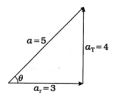
For a particle in circular motion,$a_r = 3 \ m/s^2$ and $a_T = 4 \ m/s^2$. If $\theta$ is the angle between the resultant acceleration $a$ and the radial acceleration $a_r$,then .......
A
$\cos \theta = \frac{4}{5}$
B
$\sin \theta = \frac{3}{5}$
C
$\tan \theta = \frac{3}{4}$
D
$\sec \theta = \frac{5}{3}$
Solution
(D) The resultant acceleration $a$ is given by $a = \sqrt{a_T^2 + a_r^2}$.
Substituting the given values: $a = \sqrt{4^2 + 3^2} = \sqrt{16 + 9} = \sqrt{25} = 5 \ m/s^2$.
From the geometry of the vector triangle,the radial acceleration $a_r$ is the adjacent side and the resultant acceleration $a$ is the hypotenuse for the angle $\theta$.
Therefore,$\cos \theta = \frac{a_r}{a} = \frac{3}{5}$.
Since $\sec \theta = \frac{1}{\cos \theta}$,we have $\sec \theta = \frac{5}{3}$.
Substituting the given values: $a = \sqrt{4^2 + 3^2} = \sqrt{16 + 9} = \sqrt{25} = 5 \ m/s^2$.
From the geometry of the vector triangle,the radial acceleration $a_r$ is the adjacent side and the resultant acceleration $a$ is the hypotenuse for the angle $\theta$.
Therefore,$\cos \theta = \frac{a_r}{a} = \frac{3}{5}$.
Since $\sec \theta = \frac{1}{\cos \theta}$,we have $\sec \theta = \frac{5}{3}$.
0 likes
View Solution15
MediumMCQ
If the mass,speed,and radius of an object are increased by $50\%$,what is the percentage increase in the centripetal force?
A
$225$
B
$125$
C
$150$
D
$100$
Solution
(B) The formula for centripetal force is $F = \frac{mv^2}{r}$.
Given that mass $m$,speed $v$,and radius $r$ are increased by $50\%$,the new values are $m' = 1.5m$,$v' = 1.5v$,and $r' = 1.5r$.
The new centripetal force $F'$ is given by:
$F' = \frac{m' (v')^2}{r'} = \frac{(1.5m)(1.5v)^2}{1.5r} = \frac{1.5 \times 2.25}{1.5} \frac{mv^2}{r} = 2.25 F$.
The percentage increase in force is given by:
$\frac{F' - F}{F} \times 100\% = \frac{2.25F - F}{F} \times 100\% = 1.25 \times 100\% = 125\%$.
Given that mass $m$,speed $v$,and radius $r$ are increased by $50\%$,the new values are $m' = 1.5m$,$v' = 1.5v$,and $r' = 1.5r$.
The new centripetal force $F'$ is given by:
$F' = \frac{m' (v')^2}{r'} = \frac{(1.5m)(1.5v)^2}{1.5r} = \frac{1.5 \times 2.25}{1.5} \frac{mv^2}{r} = 2.25 F$.
The percentage increase in force is given by:
$\frac{F' - F}{F} \times 100\% = \frac{2.25F - F}{F} \times 100\% = 1.25 \times 100\% = 125\%$.
0 likes
View Solution16
DifficultMCQ
$A$ particle of mass $m$ moves in a circle of radius $r$. Its centripetal acceleration changes with time according to the formula $a_c = k^2 r t^2$. What is the power delivered to the particle by the force acting on it?
A
$2 \pi m k^2 r^2 t$
B
$m k^2 r^2 t$
C
$\frac{m k^4 r^2 t^5}{3}$
D
$Zero$
Solution
(B) The centripetal acceleration is given by $a_c = \frac{v^2}{r} = k^2 r t^2$.
From this,we find the velocity $v$:
$v^2 = k^2 r^2 t^2 \implies v = k r t$.
The tangential acceleration $a_t$ is the rate of change of speed:
$a_t = \frac{dv}{dt} = \frac{d}{dt}(k r t) = k r$.
The power $P$ delivered by the force is given by $P = F_t v$,where $F_t = m a_t$ is the tangential force.
$P = (m a_t) v = m(k r)(k r t) = m k^2 r^2 t$.
From this,we find the velocity $v$:
$v^2 = k^2 r^2 t^2 \implies v = k r t$.
The tangential acceleration $a_t$ is the rate of change of speed:
$a_t = \frac{dv}{dt} = \frac{d}{dt}(k r t) = k r$.
The power $P$ delivered by the force is given by $P = F_t v$,where $F_t = m a_t$ is the tangential force.
$P = (m a_t) v = m(k r)(k r t) = m k^2 r^2 t$.
0 likes
View Solution17
MediumMCQ
$A$ particle moves on a circle of radius $0.1 \ m$ with a velocity $v = 1.0t$. The total acceleration at $t = 5 \ s$ will be ........ $m/s^2$.
A
$10$
B
$100$
C
$250$
D
$500$
Solution
(C) Given,velocity $v = 1.0t$ and radius $r = 0.1 \ m$.
Tangential acceleration $a_t = \frac{dv}{dt} = \frac{d}{dt}(1.0t) = 1.0 \ m/s^2$.
At $t = 5 \ s$,the velocity $v = 1.0 \times 5 = 5 \ m/s$.
Centripetal acceleration $a_c = \frac{v^2}{r} = \frac{5^2}{0.1} = \frac{25}{0.1} = 250 \ m/s^2$.
The total acceleration $a_{net} = \sqrt{a_c^2 + a_t^2} = \sqrt{250^2 + 1^2} = \sqrt{62500 + 1} = \sqrt{62501} \approx 250 \ m/s^2$.
Tangential acceleration $a_t = \frac{dv}{dt} = \frac{d}{dt}(1.0t) = 1.0 \ m/s^2$.
At $t = 5 \ s$,the velocity $v = 1.0 \times 5 = 5 \ m/s$.
Centripetal acceleration $a_c = \frac{v^2}{r} = \frac{5^2}{0.1} = \frac{25}{0.1} = 250 \ m/s^2$.
The total acceleration $a_{net} = \sqrt{a_c^2 + a_t^2} = \sqrt{250^2 + 1^2} = \sqrt{62500 + 1} = \sqrt{62501} \approx 250 \ m/s^2$.
0 likes
View Solution18
DifficultMCQ
$A$ car moves with a velocity $v$ in a circular path of radius $r$. If its tangential acceleration is $g \, m/s^2$,what is the magnitude of the net acceleration of the car?
A
$\frac{v^2}{r} + g$
B
$\frac{v^2}{r^2} + g^2$
C
$[\frac{v^4}{r^2} + g^2]^{1/2}$
D
$[\frac{v^2}{r} + g]^{1/2}$
Solution
(C) The car is moving in a circular path,so it experiences two types of acceleration:
$1$. Centripetal acceleration $(a_c)$,which is directed towards the center: $a_c = \frac{v^2}{r}$.
$2$. Tangential acceleration $(a_t)$,which is given as $a_t = g$.
Since these two accelerations are perpendicular to each other,the net acceleration $(a_{net})$ is the vector sum of the two:
$a_{net} = \sqrt{a_c^2 + a_t^2}$
Substituting the values:
$a_{net} = \sqrt{(\frac{v^2}{r})^2 + g^2}$
$a_{net} = \sqrt{\frac{v^4}{r^2} + g^2} = [\frac{v^4}{r^2} + g^2]^{1/2}$.
$1$. Centripetal acceleration $(a_c)$,which is directed towards the center: $a_c = \frac{v^2}{r}$.
$2$. Tangential acceleration $(a_t)$,which is given as $a_t = g$.
Since these two accelerations are perpendicular to each other,the net acceleration $(a_{net})$ is the vector sum of the two:
$a_{net} = \sqrt{a_c^2 + a_t^2}$
Substituting the values:
$a_{net} = \sqrt{(\frac{v^2}{r})^2 + g^2}$
$a_{net} = \sqrt{\frac{v^4}{r^2} + g^2} = [\frac{v^4}{r^2} + g^2]^{1/2}$.
0 likes
View Solution19
MediumMCQ
$A$ car moves with a speed of $30 \, m/s$ on a circular path of radius $500 \, m$. If its tangential acceleration is $2 \, m/s^2$,what is the magnitude of the total acceleration of the car in $m/s^2$?
A
$2$
B
$2.7$
C
$1.8$
D
$9.8$
Solution
(B) Given: Tangential acceleration $a_t = 2 \, m/s^2$,velocity $v = 30 \, m/s$,and radius $r = 500 \, m$.
First,calculate the centripetal acceleration $a_c$ using the formula $a_c = \frac{v^2}{r}$.
$a_c = \frac{30^2}{500} = \frac{900}{500} = 1.8 \, m/s^2$.
The total acceleration $a$ is the vector sum of tangential and centripetal acceleration,given by $a = \sqrt{a_t^2 + a_c^2}$.
$a = \sqrt{2^2 + 1.8^2} = \sqrt{4 + 3.24} = \sqrt{7.24}$.
$a \approx 2.69 \, m/s^2$,which rounds to $2.7 \, m/s^2$.
First,calculate the centripetal acceleration $a_c$ using the formula $a_c = \frac{v^2}{r}$.
$a_c = \frac{30^2}{500} = \frac{900}{500} = 1.8 \, m/s^2$.
The total acceleration $a$ is the vector sum of tangential and centripetal acceleration,given by $a = \sqrt{a_t^2 + a_c^2}$.
$a = \sqrt{2^2 + 1.8^2} = \sqrt{4 + 3.24} = \sqrt{7.24}$.
$a \approx 2.69 \, m/s^2$,which rounds to $2.7 \, m/s^2$.
0 likes
View Solution20
DifficultMCQ
$A$ particle moves along a circle of radius $3 \, m$ with its displacement given by $S = \frac{t^2}{2} + \frac{t^3}{3}$. The total acceleration at $t = 2 \, s$ is ....... $m/s^2$.
A
$1.3$
B
$13$
C
$3$
D
$10$
Solution
(B) Given displacement $S = \frac{t^2}{2} + \frac{t^3}{3}$.
Velocity $v = \frac{dS}{dt} = t + t^2$.
At $t = 2 \, s$,$v = 2 + (2)^2 = 6 \, m/s$.
Tangential acceleration $a_t = \frac{dv}{dt} = 1 + 2t$.
At $t = 2 \, s$,$a_t = 1 + 2(2) = 5 \, m/s^2$.
Centripetal acceleration $a_c = \frac{v^2}{r} = \frac{6^2}{3} = \frac{36}{3} = 12 \, m/s^2$.
The total acceleration $a = \sqrt{a_t^2 + a_c^2} = \sqrt{5^2 + 12^2} = \sqrt{25 + 144} = \sqrt{169} = 13 \, m/s^2$.
Velocity $v = \frac{dS}{dt} = t + t^2$.
At $t = 2 \, s$,$v = 2 + (2)^2 = 6 \, m/s$.
Tangential acceleration $a_t = \frac{dv}{dt} = 1 + 2t$.
At $t = 2 \, s$,$a_t = 1 + 2(2) = 5 \, m/s^2$.
Centripetal acceleration $a_c = \frac{v^2}{r} = \frac{6^2}{3} = \frac{36}{3} = 12 \, m/s^2$.
The total acceleration $a = \sqrt{a_t^2 + a_c^2} = \sqrt{5^2 + 12^2} = \sqrt{25 + 144} = \sqrt{169} = 13 \, m/s^2$.
0 likes
View Solution21
MediumMCQ
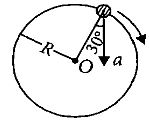
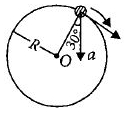
In the given figure,$a = 15 \, m s^{-2}$ represents the total acceleration of a particle moving in the clockwise direction in a circle of radius $R = 2.5 \, m$ at a given instant of time. The speed of the particle is ........ $m/s$.
A
$5.7$
B
$6.2$
C
$4.5$
D
$5.0$
Solution
(A) Given:
Total acceleration $a = 15 \, m s^{-2}$
Radius $R = 2.5 \, m$
Angle between total acceleration and centripetal acceleration is $30^{\circ}$.
The centripetal acceleration $a_c$ is the component of the total acceleration $a$ directed towards the center of the circle.
From the figure,$a_c = a \cos(30^{\circ})$.
$a_c = 15 \times \frac{\sqrt{3}}{2} \approx 15 \times 0.866 = 12.99 \, m s^{-2}$.
We know that the centripetal acceleration is given by $a_c = \frac{v^2}{R}$,where $v$ is the speed of the particle.
Therefore,$v = \sqrt{a_c R}$.
$v = \sqrt{12.99 \times 2.5} = \sqrt{32.475} \approx 5.698 \, m/s$.
Rounding to one decimal place,we get $v \approx 5.7 \, m/s$.
Thus,the correct option is $A$.
Total acceleration $a = 15 \, m s^{-2}$
Radius $R = 2.5 \, m$
Angle between total acceleration and centripetal acceleration is $30^{\circ}$.
The centripetal acceleration $a_c$ is the component of the total acceleration $a$ directed towards the center of the circle.
From the figure,$a_c = a \cos(30^{\circ})$.
$a_c = 15 \times \frac{\sqrt{3}}{2} \approx 15 \times 0.866 = 12.99 \, m s^{-2}$.
We know that the centripetal acceleration is given by $a_c = \frac{v^2}{R}$,where $v$ is the speed of the particle.
Therefore,$v = \sqrt{a_c R}$.
$v = \sqrt{12.99 \times 2.5} = \sqrt{32.475} \approx 5.698 \, m/s$.
Rounding to one decimal place,we get $v \approx 5.7 \, m/s$.
Thus,the correct option is $A$.
0 likes
View Solution22
MediumMCQ
$A$ uniform circular disc of radius $50\, cm$ at rest is free to turn about an axis which is perpendicular to its plane and passes through its centre. It is subjected to a torque which produces a constant angular acceleration of $2.0\, rad \,s^{-2}$. Its net acceleration in $m\,s^{-2}$ at the end of $2.0\,s$ is approximately (in $.0$)
A
$7$
B
$6$
C
$3$
D
$8$
Solution
(D) Given: Radius $r = 50\, cm = 0.5\, m$,angular acceleration $\alpha = 2.0\, rad\, s^{-2}$,initial angular velocity $\omega_0 = 0$,and time $t = 2.0\, s$.
First,calculate the angular velocity $\omega$ at $t = 2.0\, s$ using $\omega = \omega_0 + \alpha t = 0 + (2.0)(2.0) = 4.0\, rad\, s^{-1}$.
The tangential acceleration is $a_t = r\alpha = 0.5 \times 2.0 = 1.0\, m\, s^{-2}$.
The radial (centripetal) acceleration is $a_r = \omega^2 r = (4.0)^2 \times 0.5 = 16 \times 0.5 = 8.0\, m\, s^{-2}$.
The net acceleration $a$ is given by $a = \sqrt{a_t^2 + a_r^2} = \sqrt{1.0^2 + 8.0^2} = \sqrt{1 + 64} = \sqrt{65} \approx 8.06\, m\, s^{-2}$.
Rounding to the nearest value,the net acceleration is approximately $8.0\, m\, s^{-2}$.
First,calculate the angular velocity $\omega$ at $t = 2.0\, s$ using $\omega = \omega_0 + \alpha t = 0 + (2.0)(2.0) = 4.0\, rad\, s^{-1}$.
The tangential acceleration is $a_t = r\alpha = 0.5 \times 2.0 = 1.0\, m\, s^{-2}$.
The radial (centripetal) acceleration is $a_r = \omega^2 r = (4.0)^2 \times 0.5 = 16 \times 0.5 = 8.0\, m\, s^{-2}$.
The net acceleration $a$ is given by $a = \sqrt{a_t^2 + a_r^2} = \sqrt{1.0^2 + 8.0^2} = \sqrt{1 + 64} = \sqrt{65} \approx 8.06\, m\, s^{-2}$.
Rounding to the nearest value,the net acceleration is approximately $8.0\, m\, s^{-2}$.
0 likes
View Solution23
EasyMCQ
$A$ car is travelling with linear velocity $v$ on a circular road of radius $r$. If it is increasing its speed at the rate of $a \ m/s^2$,then the resultant acceleration will be
A
$\sqrt {\frac{v^4}{r^2} - a^2}$
B
$\sqrt {\frac{v^4}{r^2} + a^2}$
C
$\sqrt {\frac{v^2}{r^2} - a^2}$
D
$\sqrt {\frac{v^2}{r^2} + a^2}$
Solution
(B) In circular motion,the car experiences two types of acceleration:
$1$. Radial (centripetal) acceleration: $a_r = \frac{v^2}{r}$
$2$. Tangential acceleration: $a_t = a$ (given as the rate of change of speed)
Since these two accelerations are perpendicular to each other,the resultant acceleration $a_{net}$ is given by:
$a_{net} = \sqrt{a_r^2 + a_t^2}$
Substituting the values:
$a_{net} = \sqrt{\left(\frac{v^2}{r}\right)^2 + a^2} = \sqrt{\frac{v^4}{r^2} + a^2}$
$1$. Radial (centripetal) acceleration: $a_r = \frac{v^2}{r}$
$2$. Tangential acceleration: $a_t = a$ (given as the rate of change of speed)
Since these two accelerations are perpendicular to each other,the resultant acceleration $a_{net}$ is given by:
$a_{net} = \sqrt{a_r^2 + a_t^2}$
Substituting the values:
$a_{net} = \sqrt{\left(\frac{v^2}{r}\right)^2 + a^2} = \sqrt{\frac{v^4}{r^2} + a^2}$
0 likes
View Solution24
AdvancedMCQ
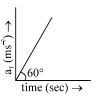
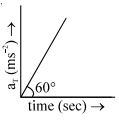
The tangential acceleration of a particle moving in a circle of radius $1 \ m$ varies with time $t$ as shown in the graph (initial velocity of the particle is zero). The time after which the total acceleration of the particle makes an angle of $30^{\circ}$ with the radial acceleration is:
A
$4 \ s$
B
$4/3 \ s$
C
$2^{2/3} \ s$
D
$\sqrt{2} \ s$
Solution
(C) From the given graph,the tangential acceleration $a_T$ is a linear function of time $t$ passing through the origin. The slope of the line is $\tan 60^{\circ} = \sqrt{3}$.
Thus,$a_T = \sqrt{3} t$.
Since $a_T = \frac{dv}{dt}$,we have $\frac{dv}{dt} = \sqrt{3} t$.
Integrating with respect to time with initial velocity $v(0) = 0$,we get $v = \int_0^t \sqrt{3} t \ dt = \frac{\sqrt{3} t^2}{2}$.
The centripetal (radial) acceleration is $a_c = \frac{v^2}{r}$. Given $r = 1 \ m$,$a_c = \frac{(\sqrt{3} t^2 / 2)^2}{1} = \frac{3 t^4}{4}$.
The total acceleration vector $\vec{a}$ makes an angle $\theta = 30^{\circ}$ with the radial acceleration vector $\vec{a}_c$. Since $\vec{a}_c$ and $\vec{a}_T$ are perpendicular,we have $\tan \theta = \frac{a_T}{a_c}$.
Substituting the values: $\tan 30^{\circ} = \frac{\sqrt{3} t}{3 t^4 / 4} \Rightarrow \frac{1}{\sqrt{3}} = \frac{4 \sqrt{3} t}{3 t^4} = \frac{4}{t^3}$.
Solving for $t$: $t^3 = 4 \sqrt{3} \times \sqrt{3} = 4 \times 3 = 12$. This seems to contradict the options. Let's re-evaluate: $\tan 30^{\circ} = \frac{a_T}{a_c} \Rightarrow \frac{1}{\sqrt{3}} = \frac{\sqrt{3} t}{3 t^4 / 4} = \frac{4 \sqrt{3} t}{3 t^4} = \frac{4}{\sqrt{3} t^3}$.
Thus,$t^3 = 4 \times 3 / 1 = 12$ is incorrect. Let's re-check: $\tan 30^{\circ} = \frac{a_T}{a_c} = \frac{\sqrt{3} t}{3 t^4 / 4} = \frac{4 \sqrt{3} t}{3 t^4} = \frac{4}{\sqrt{3} t^3}$.
Wait,$\frac{1}{\sqrt{3}} = \frac{4}{\sqrt{3} t^3} \Rightarrow t^3 = 4 \Rightarrow t = 4^{1/3} = 2^{2/3} \ s$.
Thus,$a_T = \sqrt{3} t$.
Since $a_T = \frac{dv}{dt}$,we have $\frac{dv}{dt} = \sqrt{3} t$.
Integrating with respect to time with initial velocity $v(0) = 0$,we get $v = \int_0^t \sqrt{3} t \ dt = \frac{\sqrt{3} t^2}{2}$.
The centripetal (radial) acceleration is $a_c = \frac{v^2}{r}$. Given $r = 1 \ m$,$a_c = \frac{(\sqrt{3} t^2 / 2)^2}{1} = \frac{3 t^4}{4}$.
The total acceleration vector $\vec{a}$ makes an angle $\theta = 30^{\circ}$ with the radial acceleration vector $\vec{a}_c$. Since $\vec{a}_c$ and $\vec{a}_T$ are perpendicular,we have $\tan \theta = \frac{a_T}{a_c}$.
Substituting the values: $\tan 30^{\circ} = \frac{\sqrt{3} t}{3 t^4 / 4} \Rightarrow \frac{1}{\sqrt{3}} = \frac{4 \sqrt{3} t}{3 t^4} = \frac{4}{t^3}$.
Solving for $t$: $t^3 = 4 \sqrt{3} \times \sqrt{3} = 4 \times 3 = 12$. This seems to contradict the options. Let's re-evaluate: $\tan 30^{\circ} = \frac{a_T}{a_c} \Rightarrow \frac{1}{\sqrt{3}} = \frac{\sqrt{3} t}{3 t^4 / 4} = \frac{4 \sqrt{3} t}{3 t^4} = \frac{4}{\sqrt{3} t^3}$.
Thus,$t^3 = 4 \times 3 / 1 = 12$ is incorrect. Let's re-check: $\tan 30^{\circ} = \frac{a_T}{a_c} = \frac{\sqrt{3} t}{3 t^4 / 4} = \frac{4 \sqrt{3} t}{3 t^4} = \frac{4}{\sqrt{3} t^3}$.
Wait,$\frac{1}{\sqrt{3}} = \frac{4}{\sqrt{3} t^3} \Rightarrow t^3 = 4 \Rightarrow t = 4^{1/3} = 2^{2/3} \ s$.
0 likes
View Solution25
DifficultMCQ
Tangential acceleration of a particle moving in a circle of radius $1 \, m$ varies with time $t$ as shown in the graph (initial velocity of the particle is zero). The time after which the total acceleration of the particle makes an angle of $30^{\circ}$ with the radial acceleration is:
A
$4 \, s$
B
$4/3 \, s$
C
$2^{2/3} \, s$
D
$\sqrt{2} \, s$
Solution
(C) From the given graph,the tangential acceleration $a_T$ is a linear function of time $t$ passing through the origin with a slope of $\tan 60^{\circ} = \sqrt{3}$.
Thus,$a_T = \sqrt{3} t$.
Since $a_T = \frac{dv}{dt}$,we have $\frac{dv}{dt} = \sqrt{3} t$.
Integrating with respect to time (with initial velocity $v=0$ at $t=0$): $v = \int_{0}^{t} \sqrt{3} t \, dt = \frac{\sqrt{3}}{2} t^2$.
The centripetal (radial) acceleration is $a_c = \frac{v^2}{r}$. Given $r = 1 \, m$,we have $a_c = \frac{(\frac{\sqrt{3}}{2} t^2)^2}{1} = \frac{3}{4} t^4$.
The total acceleration vector $\vec{a}$ is the vector sum of the radial acceleration $\vec{a}_c$ and the tangential acceleration $\vec{a}_T$. Since $\vec{a}_c$ and $\vec{a}_T$ are perpendicular,the angle $\theta$ that the total acceleration makes with the radial acceleration $\vec{a}_c$ is given by $\tan \theta = \frac{a_T}{a_c}$.
We are given $\theta = 30^{\circ}$,so $\tan 30^{\circ} = \frac{a_T}{a_c}$.
$\frac{1}{\sqrt{3}} = \frac{\sqrt{3} t}{\frac{3}{4} t^4} = \frac{4 \sqrt{3} t}{3 t^4} = \frac{4}{\sqrt{3} t^3}$.
$t^3 = \frac{4 \times \sqrt{3}}{\sqrt{3}} = 4$.
$t = 4^{1/3} = (2^2)^{1/3} = 2^{2/3} \, s$.
Thus,$a_T = \sqrt{3} t$.
Since $a_T = \frac{dv}{dt}$,we have $\frac{dv}{dt} = \sqrt{3} t$.
Integrating with respect to time (with initial velocity $v=0$ at $t=0$): $v = \int_{0}^{t} \sqrt{3} t \, dt = \frac{\sqrt{3}}{2} t^2$.
The centripetal (radial) acceleration is $a_c = \frac{v^2}{r}$. Given $r = 1 \, m$,we have $a_c = \frac{(\frac{\sqrt{3}}{2} t^2)^2}{1} = \frac{3}{4} t^4$.
The total acceleration vector $\vec{a}$ is the vector sum of the radial acceleration $\vec{a}_c$ and the tangential acceleration $\vec{a}_T$. Since $\vec{a}_c$ and $\vec{a}_T$ are perpendicular,the angle $\theta$ that the total acceleration makes with the radial acceleration $\vec{a}_c$ is given by $\tan \theta = \frac{a_T}{a_c}$.
We are given $\theta = 30^{\circ}$,so $\tan 30^{\circ} = \frac{a_T}{a_c}$.
$\frac{1}{\sqrt{3}} = \frac{\sqrt{3} t}{\frac{3}{4} t^4} = \frac{4 \sqrt{3} t}{3 t^4} = \frac{4}{\sqrt{3} t^3}$.
$t^3 = \frac{4 \times \sqrt{3}}{\sqrt{3}} = 4$.
$t = 4^{1/3} = (2^2)^{1/3} = 2^{2/3} \, s$.
0 likes
View Solution26
AdvancedMCQ
$A$ particle is moving along a circular path of radius $R$ in such a way that at any instant the magnitude of radial acceleration and tangential acceleration are equal. If at $t = 0$ the velocity of the particle is $V_0$,the time period of the first revolution of the particle is:
A
$\frac{R}{V_0} e^{-2 \pi}$
B
$\frac{R}{V_0} (e^{2 \pi} - 1)$
C
$\frac{R}{V_0}$
D
$\frac{R}{V_0} (1 - e^{-2 \pi})$
Solution
(D) Given that the magnitude of radial acceleration $(a_r = v^2/R)$ and tangential acceleration $(a_t = dv/dt)$ are equal:
$dv/dt = v^2/R$
Rearranging the terms for integration:
$\int_{V_0}^{v} \frac{dv}{v^2} = \int_{0}^{t} \frac{dt}{R}$
$[-1/v]_{V_0}^{v} = t/R \Rightarrow 1/V_0 - 1/v = t/R \Rightarrow t = R(1/V_0 - 1/v) \dots(1)$
Also,$a_t = v(dv/ds) = v^2/R$,which implies $dv/v = ds/R$.
Integrating for one full revolution ($s = 0$ to $s = 2\pi R$):
$\int_{V_0}^{v} \frac{dv}{v} = \int_{0}^{2\pi R} \frac{ds}{R}$
$\ln(v/V_0) = 2\pi \Rightarrow v = V_0 e^{2\pi} \dots(2)$
Substituting $v$ from $(2)$ into $(1)$:
$t = R/V_0 (1 - 1/e^{2\pi}) = R/V_0 (1 - e^{-2\pi})$.
$dv/dt = v^2/R$
Rearranging the terms for integration:
$\int_{V_0}^{v} \frac{dv}{v^2} = \int_{0}^{t} \frac{dt}{R}$
$[-1/v]_{V_0}^{v} = t/R \Rightarrow 1/V_0 - 1/v = t/R \Rightarrow t = R(1/V_0 - 1/v) \dots(1)$
Also,$a_t = v(dv/ds) = v^2/R$,which implies $dv/v = ds/R$.
Integrating for one full revolution ($s = 0$ to $s = 2\pi R$):
$\int_{V_0}^{v} \frac{dv}{v} = \int_{0}^{2\pi R} \frac{ds}{R}$
$\ln(v/V_0) = 2\pi \Rightarrow v = V_0 e^{2\pi} \dots(2)$
Substituting $v$ from $(2)$ into $(1)$:
$t = R/V_0 (1 - 1/e^{2\pi}) = R/V_0 (1 - e^{-2\pi})$.
0 likes
View Solution27
MediumMCQ
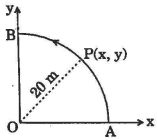
$A$ point $P$ moves in a counter-clockwise direction on a circular path as shown in the figure. The movement of $P$ is such that it sweeps out a length $s = t^3 + 5$,where $s$ is in meters and $t$ is in seconds. The radius of the path is $20 \ m$. The acceleration of $P$ when $t = 2 \ s$ is nearly .......... $m/s^2$.
A
$14$
B
$13$
C
$12$
D
$7.2$
Solution
(A) Given,the path length $s = t^3 + 5$.
Velocity $v = \frac{ds}{dt} = \frac{d}{dt}(t^3 + 5) = 3t^2 \ m/s$.
Tangential acceleration $a_t = \frac{dv}{dt} = \frac{d}{dt}(3t^2) = 6t \ m/s^2$.
Radial (centripetal) acceleration $a_c = \frac{v^2}{R} = \frac{(3t^2)^2}{R} = \frac{9t^4}{R} \ m/s^2$.
At $t = 2 \ s$:
$a_t = 6 \times 2 = 12 \ m/s^2$.
$a_c = \frac{9 \times (2)^4}{20} = \frac{9 \times 16}{20} = \frac{144}{20} = 7.2 \ m/s^2$.
The resultant acceleration $a = \sqrt{a_t^2 + a_c^2}$.
$a = \sqrt{(12)^2 + (7.2)^2} = \sqrt{144 + 51.84} = \sqrt{195.84} \approx 14 \ m/s^2$.
Velocity $v = \frac{ds}{dt} = \frac{d}{dt}(t^3 + 5) = 3t^2 \ m/s$.
Tangential acceleration $a_t = \frac{dv}{dt} = \frac{d}{dt}(3t^2) = 6t \ m/s^2$.
Radial (centripetal) acceleration $a_c = \frac{v^2}{R} = \frac{(3t^2)^2}{R} = \frac{9t^4}{R} \ m/s^2$.
At $t = 2 \ s$:
$a_t = 6 \times 2 = 12 \ m/s^2$.
$a_c = \frac{9 \times (2)^4}{20} = \frac{9 \times 16}{20} = \frac{144}{20} = 7.2 \ m/s^2$.
The resultant acceleration $a = \sqrt{a_t^2 + a_c^2}$.
$a = \sqrt{(12)^2 + (7.2)^2} = \sqrt{144 + 51.84} = \sqrt{195.84} \approx 14 \ m/s^2$.
0 likes
View Solution28
MediumMCQ
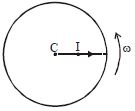
$A$ disc is rotating with constant angular velocity $\omega$ about an axis passing through centre $C$ and perpendicular to the plane of the disc. An insect is moving over the disc along the radial direction with constant velocity $v$ with respect to the disc. The acceleration of the insect at the instant when its distance from the centre is $r$ will be :-
A
$r\omega^2$ towards the centre
B
$r\omega^2$ away from the centre
C
Greater than $r\omega^2$ in magnitude
D
Less than $r\omega^2$ in magnitude
Solution
(C) In the rotating frame of the disc,the insect experiences two pseudo-forces: the centrifugal force $F_c = m\omega^2r$ directed radially outwards and the Coriolis force $F_{cor} = 2m(\vec{v} \times \vec{\omega})$ directed perpendicular to the radial velocity.
In the ground frame,the acceleration of the insect is the vector sum of radial and tangential components.
The radial acceleration is $a_r = -r\omega^2$ (centripetal acceleration).
The tangential acceleration is $a_t = 2v\omega$ (due to the change in tangential velocity as the insect moves radially).
The total acceleration magnitude is $a = \sqrt{a_r^2 + a_t^2} = \sqrt{(r\omega^2)^2 + (2v\omega)^2}$.
Since $(2v\omega)^2 > 0$,the magnitude $a = \sqrt{r^2\omega^4 + 4v^2\omega^2}$ is clearly greater than $r\omega^2$.
In the ground frame,the acceleration of the insect is the vector sum of radial and tangential components.
The radial acceleration is $a_r = -r\omega^2$ (centripetal acceleration).
The tangential acceleration is $a_t = 2v\omega$ (due to the change in tangential velocity as the insect moves radially).
The total acceleration magnitude is $a = \sqrt{a_r^2 + a_t^2} = \sqrt{(r\omega^2)^2 + (2v\omega)^2}$.
Since $(2v\omega)^2 > 0$,the magnitude $a = \sqrt{r^2\omega^4 + 4v^2\omega^2}$ is clearly greater than $r\omega^2$.
0 likes
View Solution29
MediumMCQ
$A$ particle is moving in a circular path. The acceleration and momentum of the particle at a certain moment are $\vec a = (4\hat i + 3\hat j)\ m/s^2$ and $\vec p = (8\hat i - 6\hat j)\ kg \cdot m/s$. The motion of the particle is
A
uniform circular motion
B
accelerated circular motion
C
de-accelerated circular motion
D
we can not say anything with $\vec a$ and $\vec p$ only
Solution
(B) The acceleration vector $\vec{a}$ can be resolved into tangential acceleration $\vec{a}_t$ and centripetal acceleration $\vec{a}_c$.
Tangential acceleration $\vec{a}_t$ is parallel to the velocity vector $\vec{v}$ (and thus parallel to momentum $\vec{p}$),while centripetal acceleration $\vec{a}_c$ is perpendicular to $\vec{v}$.
We calculate the dot product of $\vec{a}$ and $\vec{p}$ to determine the nature of the speed change:
$\vec{a} \cdot \vec{p} = (4\hat{i} + 3\hat{j}) \cdot (8\hat{i} - 6\hat{j}) = (4 \times 8) + (3 \times -6) = 32 - 18 = 14$.
Since $\vec{a} \cdot \vec{p} > 0$,the angle between $\vec{a}$ and $\vec{v}$ is acute.
This implies that the tangential component of acceleration is in the direction of velocity,causing the speed of the particle to increase.
Therefore,the motion is accelerated circular motion.
Tangential acceleration $\vec{a}_t$ is parallel to the velocity vector $\vec{v}$ (and thus parallel to momentum $\vec{p}$),while centripetal acceleration $\vec{a}_c$ is perpendicular to $\vec{v}$.
We calculate the dot product of $\vec{a}$ and $\vec{p}$ to determine the nature of the speed change:
$\vec{a} \cdot \vec{p} = (4\hat{i} + 3\hat{j}) \cdot (8\hat{i} - 6\hat{j}) = (4 \times 8) + (3 \times -6) = 32 - 18 = 14$.
Since $\vec{a} \cdot \vec{p} > 0$,the angle between $\vec{a}$ and $\vec{v}$ is acute.
This implies that the tangential component of acceleration is in the direction of velocity,causing the speed of the particle to increase.
Therefore,the motion is accelerated circular motion.
0 likes
View Solution30
DifficultMCQ
$A$ particle moves along an arc of a circle of radius $R$. Its velocity depends on the distance covered as $v = a\sqrt{s}$,where $a$ is a constant. Then the angle $\alpha$ between the vector of the total acceleration and the vector of velocity as a function of $s$ will be:
A
$\tan \alpha = \frac{R}{2s}$
B
$\tan \alpha = \frac{2s}{R}$
C
$\tan \alpha = \frac{2R}{s}$
D
$\tan \alpha = \frac{s}{2R}$
Solution
(B) Given,$v = a\sqrt{s}$.
Tangential acceleration $a_t = v \frac{dv}{ds}$.
Since $\frac{dv}{ds} = a \cdot \frac{1}{2\sqrt{s}} = \frac{a}{2\sqrt{s}}$,we have $a_t = (a\sqrt{s}) \cdot (\frac{a}{2\sqrt{s}}) = \frac{a^2}{2}$.
Centripetal acceleration $a_c = \frac{v^2}{R} = \frac{(a\sqrt{s})^2}{R} = \frac{a^2 s}{R}$.
The angle $\alpha$ between the total acceleration vector and the velocity vector is given by $\tan \alpha = \frac{a_c}{a_t}$.
Substituting the values,$\tan \alpha = \frac{a^2 s / R}{a^2 / 2} = \frac{2s}{R}$.
Tangential acceleration $a_t = v \frac{dv}{ds}$.
Since $\frac{dv}{ds} = a \cdot \frac{1}{2\sqrt{s}} = \frac{a}{2\sqrt{s}}$,we have $a_t = (a\sqrt{s}) \cdot (\frac{a}{2\sqrt{s}}) = \frac{a^2}{2}$.
Centripetal acceleration $a_c = \frac{v^2}{R} = \frac{(a\sqrt{s})^2}{R} = \frac{a^2 s}{R}$.
The angle $\alpha$ between the total acceleration vector and the velocity vector is given by $\tan \alpha = \frac{a_c}{a_t}$.
Substituting the values,$\tan \alpha = \frac{a^2 s / R}{a^2 / 2} = \frac{2s}{R}$.
0 likes
View Solution31
EasyMCQ
The net applied force on a body in uniform circular motion should always be
A
Constant in magnitude and parallel to direction of motion
B
Constant in magnitude and perpendicular to direction of motion
C
Gravitational in nature
D
Zero
Solution
(B) In uniform circular motion,a body moves along a circular path with a constant speed.
Although the speed is constant,the direction of velocity changes at every point,which implies that the body is accelerating.
This acceleration is known as centripetal acceleration,which is directed towards the center of the circle.
According to Newton's second law of motion $(F = ma)$,the net force acting on the body must be in the same direction as the acceleration.
Therefore,the net force (centripetal force) is directed towards the center of the circle,which is always perpendicular to the instantaneous velocity (direction of motion).
Since the speed $(v)$ and the radius $(r)$ are constant,the magnitude of the centripetal force $(F = mv^2/r)$ remains constant.
Although the speed is constant,the direction of velocity changes at every point,which implies that the body is accelerating.
This acceleration is known as centripetal acceleration,which is directed towards the center of the circle.
According to Newton's second law of motion $(F = ma)$,the net force acting on the body must be in the same direction as the acceleration.
Therefore,the net force (centripetal force) is directed towards the center of the circle,which is always perpendicular to the instantaneous velocity (direction of motion).
Since the speed $(v)$ and the radius $(r)$ are constant,the magnitude of the centripetal force $(F = mv^2/r)$ remains constant.
0 likes
View Solution32
MediumMCQ
$A$ car is moving on a circular path of radius $500 \ m$ with a speed of $30 \ m/s$. If the speed is increasing at a rate of $2 \ m/s^2$,the net acceleration will be ......... $m/s^2$.
A
$2$
B
$2.5$
C
$2.7$
D
$4$
Solution
(C) The tangential acceleration is given as $a_t = 2 \ m/s^2$.
The centripetal acceleration is given by the formula $a_c = \frac{v^2}{r}$.
Substituting the given values,$a_c = \frac{30^2}{500} = \frac{900}{500} = 1.8 \ m/s^2$.
The net acceleration $a_{net}$ is the vector sum of tangential and centripetal acceleration,given by $a_{net} = \sqrt{a_t^2 + a_c^2}$.
$a_{net} = \sqrt{2^2 + 1.8^2} = \sqrt{4 + 3.24} = \sqrt{7.24} \approx 2.69 \ m/s^2$.
Rounding to one decimal place,the net acceleration is $2.7 \ m/s^2$.
The centripetal acceleration is given by the formula $a_c = \frac{v^2}{r}$.
Substituting the given values,$a_c = \frac{30^2}{500} = \frac{900}{500} = 1.8 \ m/s^2$.
The net acceleration $a_{net}$ is the vector sum of tangential and centripetal acceleration,given by $a_{net} = \sqrt{a_t^2 + a_c^2}$.
$a_{net} = \sqrt{2^2 + 1.8^2} = \sqrt{4 + 3.24} = \sqrt{7.24} \approx 2.69 \ m/s^2$.
Rounding to one decimal place,the net acceleration is $2.7 \ m/s^2$.
0 likes
View Solution33
DifficultMCQ
The kinetic energy $k$ of a particle moving along a circle of radius $R$ depends on the distance covered $s$ as $k = as^2$,where $a$ is a constant. The force acting on the particle is
A
$2a\frac{s^2}{R}$
B
$2as\sqrt{1 + \frac{s^2}{R^2}}$
C
$2as$
D
$2a\frac{R^2}{s}$
Solution
(B) Given kinetic energy $k = \frac{1}{2}mv^2 = as^2$.
From this,the velocity is $v = s\sqrt{\frac{2a}{m}}$.
The centripetal acceleration is $a_R = \frac{v^2}{R} = \frac{2as^2}{mR}$.
The tangential acceleration is $a_t = \frac{dv}{dt} = v\frac{dv}{ds}$.
Substituting $v$,we get $a_t = \left(s\sqrt{\frac{2a}{m}}\right) \frac{d}{ds}\left(s\sqrt{\frac{2a}{m}}\right) = s\left(\frac{2a}{m}\right) = \frac{2as}{m}$.
The net acceleration is $a_{net} = \sqrt{a_R^2 + a_t^2} = \sqrt{\left(\frac{2as^2}{mR}\right)^2 + \left(\frac{2as}{m}\right)^2}$.
Simplifying,$a_{net} = \frac{2as}{m} \sqrt{\frac{s^2}{R^2} + 1}$.
The net force is $F = m \cdot a_{net} = 2as \sqrt{1 + \frac{s^2}{R^2}}$.
From this,the velocity is $v = s\sqrt{\frac{2a}{m}}$.
The centripetal acceleration is $a_R = \frac{v^2}{R} = \frac{2as^2}{mR}$.
The tangential acceleration is $a_t = \frac{dv}{dt} = v\frac{dv}{ds}$.
Substituting $v$,we get $a_t = \left(s\sqrt{\frac{2a}{m}}\right) \frac{d}{ds}\left(s\sqrt{\frac{2a}{m}}\right) = s\left(\frac{2a}{m}\right) = \frac{2as}{m}$.
The net acceleration is $a_{net} = \sqrt{a_R^2 + a_t^2} = \sqrt{\left(\frac{2as^2}{mR}\right)^2 + \left(\frac{2as}{m}\right)^2}$.
Simplifying,$a_{net} = \frac{2as}{m} \sqrt{\frac{s^2}{R^2} + 1}$.
The net force is $F = m \cdot a_{net} = 2as \sqrt{1 + \frac{s^2}{R^2}}$.
0 likes
View Solution34
MediumMCQ
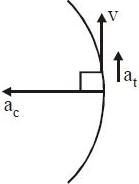
For circular motion,if $\vec a_t$,$\vec a_c$,$\vec r$ and $\vec v$ are tangential acceleration,centripetal acceleration,radius vector and velocity respectively,then find the wrong relation.
A
$\vec a_t \cdot \vec a_c = 0$
B
$\vec a_t \cdot \vec v$ may be positive or negative
C
$\vec a_c \cdot \vec v$ may be positive or negative
D
$\vec a_c \cdot \vec v = 0$
Solution
(C) In circular motion,the tangential acceleration $\vec a_t$ is directed along the tangent to the path,and the centripetal acceleration $\vec a_c$ is directed towards the center of the circle along the radius.
Since the tangent is perpendicular to the radius,$\vec a_t$ and $\vec a_c$ are perpendicular to each other. Therefore,$\vec a_t \cdot \vec a_c = 0$.
The velocity vector $\vec v$ is always directed along the tangent to the path. Since $\vec a_c$ is directed towards the center (along the radius),$\vec a_c$ is always perpendicular to $\vec v$. Therefore,$\vec a_c \cdot \vec v = 0$.
The tangential acceleration $\vec a_t$ is parallel or anti-parallel to the velocity vector $\vec v$. If the speed is increasing,$\vec a_t$ and $\vec v$ are in the same direction,so $\vec a_t \cdot \vec v > 0$. If the speed is decreasing,$\vec a_t$ and $\vec v$ are in opposite directions,so $\vec a_t \cdot \vec v < 0$. Thus,$\vec a_t \cdot \vec v$ can be positive or negative.
Comparing these with the given options,the statement $\vec a_c \cdot \vec v$ may be positive or negative is incorrect because $\vec a_c \cdot \vec v$ is always zero.
Since the tangent is perpendicular to the radius,$\vec a_t$ and $\vec a_c$ are perpendicular to each other. Therefore,$\vec a_t \cdot \vec a_c = 0$.
The velocity vector $\vec v$ is always directed along the tangent to the path. Since $\vec a_c$ is directed towards the center (along the radius),$\vec a_c$ is always perpendicular to $\vec v$. Therefore,$\vec a_c \cdot \vec v = 0$.
The tangential acceleration $\vec a_t$ is parallel or anti-parallel to the velocity vector $\vec v$. If the speed is increasing,$\vec a_t$ and $\vec v$ are in the same direction,so $\vec a_t \cdot \vec v > 0$. If the speed is decreasing,$\vec a_t$ and $\vec v$ are in opposite directions,so $\vec a_t \cdot \vec v < 0$. Thus,$\vec a_t \cdot \vec v$ can be positive or negative.
Comparing these with the given options,the statement $\vec a_c \cdot \vec v$ may be positive or negative is incorrect because $\vec a_c \cdot \vec v$ is always zero.
0 likes
View Solution35
MediumMCQ
$A$ particle of mass $m$ describes a circle of radius $r$. The centripetal acceleration of the particle is $4/r^2$. What will be the momentum of the particle?
A
$2m/r$
B
$2m/\sqrt{r}$
C
$4m/\sqrt{r}$
D
$4m/r$
Solution
(B) The centripetal acceleration $a_c$ is given by $a_c = v^2/r$.
Given $a_c = 4/r^2$,we equate the two expressions:
$v^2/r = 4/r^2$
$v^2 = 4/r$
$v = 2/\sqrt{r}$
The momentum $P$ of the particle is given by $P = mv$.
Substituting the value of $v$:
$P = m \times (2/\sqrt{r}) = 2m/\sqrt{r}$.
Given $a_c = 4/r^2$,we equate the two expressions:
$v^2/r = 4/r^2$
$v^2 = 4/r$
$v = 2/\sqrt{r}$
The momentum $P$ of the particle is given by $P = mv$.
Substituting the value of $v$:
$P = m \times (2/\sqrt{r}) = 2m/\sqrt{r}$.
0 likes
View Solution36
MediumMCQ
$A$ particle of mass $m$ is moving in a circular path of constant radius $r$ such that its tangential acceleration varies with time as $a_t = K^2rt^2$ ($K$ is a constant). Select the correct statement.
A
Centripetal acceleration remains constant.
B
Power delivered by tangential force will be zero.
C
Power delivered by net force will be zero.
D
Power delivered by centripetal force will always be zero.
Solution
(D) Given the tangential acceleration $a_t = K^2rt^2$.
Since $a_t = \frac{dv}{dt}$,we have $dv = K^2rt^2 dt$.
Integrating both sides,$\int dv = \int K^2rt^2 dt$,which gives $v = \frac{K^2rt^3}{3}$.
Since the velocity $v$ changes with time,the centripetal acceleration $a_c = \frac{v^2}{r}$ is not constant.
The power delivered by a force $\vec{F}$ is given by $P = \vec{F} \cdot \vec{v}$.
The centripetal force $\vec{F}_c$ is always directed towards the center of the circular path,while the velocity vector $\vec{v}$ is always tangential to the path.
Therefore,the angle between $\vec{F}_c$ and $\vec{v}$ is always $90^\circ$.
Thus,the power delivered by the centripetal force is $P_c = \vec{F}_c \cdot \vec{v} = F_c v \cos(90^\circ) = 0$.
Since $a_t = \frac{dv}{dt}$,we have $dv = K^2rt^2 dt$.
Integrating both sides,$\int dv = \int K^2rt^2 dt$,which gives $v = \frac{K^2rt^3}{3}$.
Since the velocity $v$ changes with time,the centripetal acceleration $a_c = \frac{v^2}{r}$ is not constant.
The power delivered by a force $\vec{F}$ is given by $P = \vec{F} \cdot \vec{v}$.
The centripetal force $\vec{F}_c$ is always directed towards the center of the circular path,while the velocity vector $\vec{v}$ is always tangential to the path.
Therefore,the angle between $\vec{F}_c$ and $\vec{v}$ is always $90^\circ$.
Thus,the power delivered by the centripetal force is $P_c = \vec{F}_c \cdot \vec{v} = F_c v \cos(90^\circ) = 0$.

0 likes
View Solution37
DifficultMCQ
$A$ car is moving at a speed of $40\,m/s$ on a circular track of radius $400\,m.$ This speed is increasing at the rate of $3\,m/s^2.$ The acceleration of the car is ........ $m/s^2$.
A
$4$
B
$7$
C
$5$
D
$3$
Solution
(C) The car is undergoing non-uniform circular motion,so it has two components of acceleration: tangential acceleration $(a_t)$ and centripetal (radial) acceleration $(a_c)$.
Given: Speed $v = 40\,m/s$,radius $r = 400\,m$,and tangential acceleration $a_t = 3\,m/s^2$.
The centripetal acceleration is calculated as $a_c = \frac{v^2}{r} = \frac{40^2}{400} = \frac{1600}{400} = 4\,m/s^2$.
The total acceleration $a$ is the vector sum of these perpendicular components: $a = \sqrt{a_c^2 + a_t^2}$.
Substituting the values: $a = \sqrt{4^2 + 3^2} = \sqrt{16 + 9} = \sqrt{25} = 5\,m/s^2$.
Given: Speed $v = 40\,m/s$,radius $r = 400\,m$,and tangential acceleration $a_t = 3\,m/s^2$.
The centripetal acceleration is calculated as $a_c = \frac{v^2}{r} = \frac{40^2}{400} = \frac{1600}{400} = 4\,m/s^2$.
The total acceleration $a$ is the vector sum of these perpendicular components: $a = \sqrt{a_c^2 + a_t^2}$.
Substituting the values: $a = \sqrt{4^2 + 3^2} = \sqrt{16 + 9} = \sqrt{25} = 5\,m/s^2$.
0 likes
View Solution38
EasyMCQ
$A$ particle moves in a circular path of radius $r$ with speed $v.$ It then increases its speed to $2v$ while travelling along the same circular path. The centripetal acceleration of the particle has changed by a factor of
A
$0.25$
B
$0.5$
C
$2$
D
$4$
Solution
(D) The centripetal acceleration of a particle moving in a circular path is given by the formula $a_{cp} = \frac{v^2}{r}$.
Initially,the speed is $v$,so the initial centripetal acceleration is $a_1 = \frac{v^2}{r}$.
Finally,the speed is $2v$,so the final centripetal acceleration is $a_2 = \frac{(2v)^2}{r} = \frac{4v^2}{r}$.
Comparing the two,we get $a_2 = 4 \times \left(\frac{v^2}{r}\right) = 4a_1$.
Therefore,the centripetal acceleration has changed by a factor of $4$.
Initially,the speed is $v$,so the initial centripetal acceleration is $a_1 = \frac{v^2}{r}$.
Finally,the speed is $2v$,so the final centripetal acceleration is $a_2 = \frac{(2v)^2}{r} = \frac{4v^2}{r}$.
Comparing the two,we get $a_2 = 4 \times \left(\frac{v^2}{r}\right) = 4a_1$.
Therefore,the centripetal acceleration has changed by a factor of $4$.
0 likes
View Solution39
EasyMCQ
In circular motion,the centripetal acceleration is given by
A
$\vec a \times \vec r$
B
$\vec \omega \times \vec v$
C
$\vec a \times \vec v$
D
$\vec \omega \times \vec r$
Solution
(B) In circular motion,the velocity vector $\vec{v}$ is related to the angular velocity vector $\vec{\omega}$ and the position vector $\vec{r}$ by the relation $\vec{v} = \vec{\omega} \times \vec{r}$.
The acceleration vector $\vec{a}$ is the time derivative of the velocity vector: $\vec{a} = \frac{d\vec{v}}{dt} = \frac{d}{dt}(\vec{\omega} \times \vec{r})$.
Using the product rule for differentiation,we get $\vec{a} = \frac{d\vec{\omega}}{dt} \times \vec{r} + \vec{\omega} \times \frac{d\vec{r}}{dt}$.
Since $\frac{d\vec{\omega}}{dt} = \vec{\alpha}$ (angular acceleration) and $\frac{d\vec{r}}{dt} = \vec{v}$,we have $\vec{a} = \vec{\alpha} \times \vec{r} + \vec{\omega} \times \vec{v}$.
For uniform circular motion,the angular acceleration $\vec{\alpha} = 0$,so the acceleration is purely centripetal: $\vec{a}_c = \vec{\omega} \times \vec{v}$.
The acceleration vector $\vec{a}$ is the time derivative of the velocity vector: $\vec{a} = \frac{d\vec{v}}{dt} = \frac{d}{dt}(\vec{\omega} \times \vec{r})$.
Using the product rule for differentiation,we get $\vec{a} = \frac{d\vec{\omega}}{dt} \times \vec{r} + \vec{\omega} \times \frac{d\vec{r}}{dt}$.
Since $\frac{d\vec{\omega}}{dt} = \vec{\alpha}$ (angular acceleration) and $\frac{d\vec{r}}{dt} = \vec{v}$,we have $\vec{a} = \vec{\alpha} \times \vec{r} + \vec{\omega} \times \vec{v}$.
For uniform circular motion,the angular acceleration $\vec{\alpha} = 0$,so the acceleration is purely centripetal: $\vec{a}_c = \vec{\omega} \times \vec{v}$.
0 likes
View Solution40
MediumMCQ
$A$ particle moves in a circular path of radius $R$ with an angular velocity $\omega = a - bt$,where $a$ and $b$ are positive constants and $t$ is time. The magnitude of the acceleration of the particle after time $t = \frac{2a}{b}$ is:
A
$\frac{a}{R}$
B
$a^2R$
C
$R(a^2 + b)$
D
$R\sqrt{a^4 + b^2}$
Solution
(D) The angular acceleration is given by $\alpha = \frac{d\omega}{dt} = \frac{d}{dt}(a - bt) = -b$.
The tangential acceleration is $a_t = R\alpha = -Rb$.
At time $t = \frac{2a}{b}$,the angular velocity is $\omega = a - b(\frac{2a}{b}) = a - 2a = -a$.
The radial (centripetal) acceleration is $a_r = R\omega^2 = R(-a)^2 = Ra^2$.
The magnitude of the total acceleration is $a = \sqrt{a_t^2 + a_r^2} = \sqrt{(-Rb)^2 + (Ra^2)^2} = \sqrt{R^2b^2 + R^2a^4} = R\sqrt{a^4 + b^2}$.
The tangential acceleration is $a_t = R\alpha = -Rb$.
At time $t = \frac{2a}{b}$,the angular velocity is $\omega = a - b(\frac{2a}{b}) = a - 2a = -a$.
The radial (centripetal) acceleration is $a_r = R\omega^2 = R(-a)^2 = Ra^2$.
The magnitude of the total acceleration is $a = \sqrt{a_t^2 + a_r^2} = \sqrt{(-Rb)^2 + (Ra^2)^2} = \sqrt{R^2b^2 + R^2a^4} = R\sqrt{a^4 + b^2}$.
0 likes
View Solution41
MediumMCQ
An object is moving on a circular track of radius $450\, m$. At some instant,the object is moving at $30\, m/s$ and gaining speed at a uniform rate of $2\, m/s^2$. Its acceleration at this instant is nearly .......... $m/s^2$.
A
$1.6$
B
$0.8$
C
$2.8$
D
$3.4$
Solution
(C) The object undergoes non-uniform circular motion,so it has both centripetal acceleration $(a_c)$ and tangential acceleration $(a_t)$.
Given: velocity $v = 30\, m/s$,radius $r = 450\, m$,and tangential acceleration $a_t = 2\, m/s^2$.
The centripetal acceleration is $a_c = \frac{v^2}{r} = \frac{30^2}{450} = \frac{900}{450} = 2\, m/s^2$.
The net acceleration $a$ is given by $a = \sqrt{a_c^2 + a_t^2}$.
Substituting the values: $a = \sqrt{2^2 + 2^2} = \sqrt{4 + 4} = \sqrt{8} \approx 2.828\, m/s^2$.
Thus,the acceleration is nearly $2.8\, m/s^2$.
Given: velocity $v = 30\, m/s$,radius $r = 450\, m$,and tangential acceleration $a_t = 2\, m/s^2$.
The centripetal acceleration is $a_c = \frac{v^2}{r} = \frac{30^2}{450} = \frac{900}{450} = 2\, m/s^2$.
The net acceleration $a$ is given by $a = \sqrt{a_c^2 + a_t^2}$.
Substituting the values: $a = \sqrt{2^2 + 2^2} = \sqrt{4 + 4} = \sqrt{8} \approx 2.828\, m/s^2$.
Thus,the acceleration is nearly $2.8\, m/s^2$.
0 likes
View Solution42
MediumMCQ
The acceleration of a body in a non-uniform circular motion is $5\, ms^{-2}$. Which one of the following is correct?
A
The radial acceleration and the tangential acceleration are $3\, ms^{-2}$ and $4\, ms^{-2}$ respectively.
B
The radial and the tangential accelerations are $2\, ms^{-2}$ and $3\, ms^{-2}$ respectively.
C
The radial and the tangential accelerations are both $5\, ms^{-2}$.
D
The radial and the tangential acceleration are $5\, ms^{-2}$ and $3\, ms^{-2}$ respectively.
Solution
(A) In non-uniform circular motion,the total acceleration $a$ is the vector sum of the radial acceleration $a_r$ and the tangential acceleration $a_t$. Since these two components are perpendicular to each other,the magnitude of the resultant acceleration is given by $a = \sqrt{a_r^2 + a_t^2}$.
Given $a = 5\, ms^{-2}$.
Checking option $A$: $a_r = 3\, ms^{-2}$ and $a_t = 4\, ms^{-2}$.
$a = \sqrt{3^2 + 4^2} = \sqrt{9 + 16} = \sqrt{25} = 5\, ms^{-2}$.
This matches the given total acceleration. Thus,option $A$ is correct.
Given $a = 5\, ms^{-2}$.
Checking option $A$: $a_r = 3\, ms^{-2}$ and $a_t = 4\, ms^{-2}$.
$a = \sqrt{3^2 + 4^2} = \sqrt{9 + 16} = \sqrt{25} = 5\, ms^{-2}$.
This matches the given total acceleration. Thus,option $A$ is correct.
0 likes
View Solution43
MediumMCQ
For a particle in a uniformly accelerated circular motion:
A
velocity is radial and acceleration has both radial and transverse components
B
velocity is transverse and acceleration has both radial and transverse components
C
velocity is radial and acceleration is transverse only
D
velocity is transverse and acceleration is radial only
Solution
(B) In circular motion,the velocity vector is always directed along the tangent to the circular path,which is also known as the transverse direction.
For a uniformly accelerated circular motion,the particle experiences two types of acceleration:
$1$. Radial (centripetal) acceleration $(a_r = v^2/r)$,which is directed towards the center of the circle.
$2$. Tangential acceleration $(a_t = dv/dt)$,which is directed along the tangent (transverse direction).
Since both radial and tangential accelerations are present,the total acceleration has both radial and transverse components.
For a uniformly accelerated circular motion,the particle experiences two types of acceleration:
$1$. Radial (centripetal) acceleration $(a_r = v^2/r)$,which is directed towards the center of the circle.
$2$. Tangential acceleration $(a_t = dv/dt)$,which is directed along the tangent (transverse direction).
Since both radial and tangential accelerations are present,the total acceleration has both radial and transverse components.
0 likes
View Solution44
EasyMCQ
$A$ particle is confined to rotate in a circular path with decreasing linear speed. Which of the following is correct?
A
$\vec{L}$ (angular momentum) is conserved about the centre.
B
Only the direction of angular momentum $\vec{L}$ is conserved.
C
It spirals towards the centre.
D
Its acceleration is towards the centre.
Solution
(B) The angular momentum is given by $\vec{L} = \vec{r} \times \vec{p} = m(\vec{r} \times \vec{v})$. Since the particle is moving in a circular path,the position vector $\vec{r}$ and velocity vector $\vec{v}$ are always perpendicular. The magnitude of angular momentum is $L = mvr$. Since the linear speed $v$ is decreasing,the magnitude of angular momentum $L$ is not conserved.
However,for a particle moving in a circular path in a plane,the direction of the angular momentum vector $\vec{L}$ is perpendicular to the plane of motion (determined by the right-hand rule). As long as the particle remains in the same circular path,the direction of $\vec{L}$ remains constant.
Since the particle is confined to a circular path,it cannot spiral towards the centre. Because the speed is changing,there is a tangential acceleration $a_t$ in addition to the centripetal acceleration $a_c$. Therefore,the net acceleration is not directed towards the centre. Thus,only the direction of angular momentum is conserved.
However,for a particle moving in a circular path in a plane,the direction of the angular momentum vector $\vec{L}$ is perpendicular to the plane of motion (determined by the right-hand rule). As long as the particle remains in the same circular path,the direction of $\vec{L}$ remains constant.
Since the particle is confined to a circular path,it cannot spiral towards the centre. Because the speed is changing,there is a tangential acceleration $a_t$ in addition to the centripetal acceleration $a_c$. Therefore,the net acceleration is not directed towards the centre. Thus,only the direction of angular momentum is conserved.
0 likes
View Solution45
MediumMCQ
$A$ stone tied to the end of a string $80\; cm$ long is whirled in a horizontal circle with a constant speed. If the stone makes $14$ revolutions in $25\; s$,what is the magnitude and direction of acceleration of the stone?
A
$9.91\; m/s^2$ directed towards the center
B
$8.91\; m/s^2$ directed towards the center
C
$7.91\; m/s^2$ directed towards the center
D
$6.91\; m/s^2$ directed towards the center
Solution
(A) Length of the string,$r = 80\; cm = 0.8\; m$.
Number of revolutions $= 14$,Time taken $= 25\; s$.
Frequency,$\nu = \frac{\text{Number of revolutions}}{\text{Time taken}} = \frac{14}{25}\; Hz$.
Angular frequency,$\omega = 2\pi\nu = 2 \times \frac{22}{7} \times \frac{14}{25} = \frac{88}{25}\; rad/s = 3.52\; rad/s$.
Centripetal acceleration,$a_c = \omega^2 r = (3.52)^2 \times 0.8$.
$a_c = 12.3904 \times 0.8 = 9.91232\; m/s^2 \approx 9.91\; m/s^2$.
The direction of centripetal acceleration is always directed along the radius towards the center of the circular path.
Number of revolutions $= 14$,Time taken $= 25\; s$.
Frequency,$\nu = \frac{\text{Number of revolutions}}{\text{Time taken}} = \frac{14}{25}\; Hz$.
Angular frequency,$\omega = 2\pi\nu = 2 \times \frac{22}{7} \times \frac{14}{25} = \frac{88}{25}\; rad/s = 3.52\; rad/s$.
Centripetal acceleration,$a_c = \omega^2 r = (3.52)^2 \times 0.8$.
$a_c = 12.3904 \times 0.8 = 9.91232\; m/s^2 \approx 9.91\; m/s^2$.
The direction of centripetal acceleration is always directed along the radius towards the center of the circular path.
0 likes
View Solution46
Medium
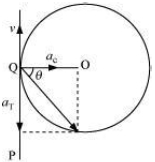
$A$ cyclist is riding with a speed of $27 \; km/h$. As he approaches a circular turn on the road of radius $80 \; m$,he applies brakes and reduces his speed at the constant rate of $0.50 \; m/s^2$. What is the magnitude and direction of the net acceleration of the cyclist on the circular turn?
Solution
(N/A) Speed of the cyclist,$v = 27 \; km/h = 7.5 \; m/s$.
Radius of the circular turn,$r = 80 \; m$.
Centripetal acceleration is given as:
$a_c = \frac{v^2}{r} = \frac{(7.5)^2}{80} = 0.703 \; m/s^2 \approx 0.7 \; m/s^2$.
Tangential acceleration is given as $a_T = 0.5 \; m/s^2$.
Since the angle between $a_c$ and $a_T$ is $90^{\circ}$,the resultant acceleration $a$ is given by:
$a = \sqrt{a_c^2 + a_T^2} = \sqrt{(0.7)^2 + (0.5)^2} = \sqrt{0.49 + 0.25} = \sqrt{0.74} \approx 0.86 \; m/s^2$.
Let $\theta$ be the angle of the resultant acceleration with the direction of centripetal acceleration.
$\tan \theta = \frac{a_T}{a_c} = \frac{0.5}{0.7} = 0.714$.
$\theta = \tan^{-1}(0.714) \approx 35.5^{\circ}$ with the direction of centripetal acceleration.
Radius of the circular turn,$r = 80 \; m$.
Centripetal acceleration is given as:
$a_c = \frac{v^2}{r} = \frac{(7.5)^2}{80} = 0.703 \; m/s^2 \approx 0.7 \; m/s^2$.
Tangential acceleration is given as $a_T = 0.5 \; m/s^2$.
Since the angle between $a_c$ and $a_T$ is $90^{\circ}$,the resultant acceleration $a$ is given by:
$a = \sqrt{a_c^2 + a_T^2} = \sqrt{(0.7)^2 + (0.5)^2} = \sqrt{0.49 + 0.25} = \sqrt{0.74} \approx 0.86 \; m/s^2$.
Let $\theta$ be the angle of the resultant acceleration with the direction of centripetal acceleration.
$\tan \theta = \frac{a_T}{a_c} = \frac{0.5}{0.7} = 0.714$.
$\theta = \tan^{-1}(0.714) \approx 35.5^{\circ}$ with the direction of centripetal acceleration.
0 likes
View Solution47
EasyMCQ
$A$ train is moving at a speed of $50\, m s^{-1}$ on a curved track of radius $250\, m$. What is its acceleration (in $, m s^{-2}$)?
A
$10$
B
$5$
C
$20$
D
$25$
Solution
(A) The acceleration of an object moving in a circular path is the centripetal acceleration,given by the formula $a_c = \frac{v^2}{r}$.
Given:
Speed $v = 50\, m s^{-1}$
Radius $r = 250\, m$
Substituting the values into the formula:
$a_c = \frac{(50)^2}{250} = \frac{2500}{250} = 10\, m s^{-2}$.
Thus,the acceleration is $10\, m s^{-2}$.
Given:
Speed $v = 50\, m s^{-1}$
Radius $r = 250\, m$
Substituting the values into the formula:
$a_c = \frac{(50)^2}{250} = \frac{2500}{250} = 10\, m s^{-2}$.
Thus,the acceleration is $10\, m s^{-2}$.
0 likes
View Solution48
MediumMCQ
The angular velocity of a particle of a rigid body is not constant. Which of the following statements is true?
A
The particle must be undergoing non-uniform circular motion.
B
The particle must be undergoing uniform circular motion.
C
The particle cannot be in a rigid body.
D
The particle must be moving in a straight line.
Solution
(A) In a rigid body,all particles rotate about the same axis of rotation with the same angular velocity $\omega$ at any given instant. If the angular velocity $\omega$ of the rigid body is not constant,it means the body has an angular acceleration $\alpha = \frac{d\omega}{dt} \neq 0$. Since the particle is part of a rigid body,it must be rotating about the axis. $A$ particle rotating with a changing angular velocity $\omega$ experiences both centripetal acceleration $(a_c = \omega^2 r)$ and tangential acceleration $(a_t = \alpha r)$. This combination of accelerations characterizes non-uniform circular motion.
0 likes
View Solution49
EasyMCQ
What is the angle between the tangential component and the radial component of linear acceleration for circular motion (in $^{\circ}$)?
A
$0$
B
$45$
C
$90$
D
$180$
Solution
(C) In circular motion,the linear acceleration $\vec{a}$ has two components:
$1$. The tangential acceleration $\vec{a}_t$,which is directed along the tangent to the circular path.
$2$. The radial (or centripetal) acceleration $\vec{a}_r$,which is directed towards the center of the circle along the radius.
Since the tangent to a circle at any point is always perpendicular to the radius at that point,the angle between the tangential component $\vec{a}_t$ and the radial component $\vec{a}_r$ is $90^{\circ}$.
$1$. The tangential acceleration $\vec{a}_t$,which is directed along the tangent to the circular path.
$2$. The radial (or centripetal) acceleration $\vec{a}_r$,which is directed towards the center of the circle along the radius.
Since the tangent to a circle at any point is always perpendicular to the radius at that point,the angle between the tangential component $\vec{a}_t$ and the radial component $\vec{a}_r$ is $90^{\circ}$.
0 likes
View Solution50
Medium
Explain the effects of the radial component and the tangential component of the linear acceleration of a particle in circular motion.
Solution
(N/A) The radial component of acceleration,also known as centripetal acceleration $(a_r = v^2/r)$,is responsible for changing the direction of the linear velocity of the particle.
The tangential component of acceleration $(a_t = dv/dt)$ is responsible for changing the magnitude (speed) of the linear velocity of the particle.
The tangential component of acceleration $(a_t = dv/dt)$ is responsible for changing the magnitude (speed) of the linear velocity of the particle.
0 likes
View Solution3-2.Motion in Plane — Non-uniform Circular Motion (Centrifugal/Centripetal and tangential Accelaration) · Frequently Asked Questions
1Are these 3-2.Motion in Plane questions useful for JEE and NEET?
Yes. All questions in this section are mapped to JEE Main and NEET exam patterns. Previous year questions from JEE Main, NEET, GUJCET and state-level exams are included with full solutions.
2Can I switch to Hindi or Gujarati for these questions?
Yes. Use the language tabs in the hero section or the sidebar to view the same questions and solutions in English, Hindi or Gujarati.
3How do I generate a question paper from this subtopic?
Use the Vedclass Exam Paper Generator — select the chapter and subtopic, set difficulty, and generate Sets A, B, C, D automatically. First 3 chapters of every subject are free.
Vedclass Products
For Students
Vedclass Test Series
Mock tests in real JEE/NEET style with performance analysis. 5-day free trial.
Start Free TrialFor Teachers
Exam Paper Generator
Generate Set A/B/C/D papers from this chapter in 2 minutes. 3 chapters free.
Try FreeFor Institutes
Online Exam Module
Live online exams with unlimited students, 360° analytics & white-label branding.
See DemoFor Teachers & Institutes
Generate a 3-2.Motion in Plane Exam Paper in 2 Minutes
Select subtopic & difficulty — Sets A, B, C, D auto-generated with No Repeat logic.
First 3 chapters of every subject are free — no payment required.