
A English
Relative Velocity (river boat, rain, wind) Questions in English
Class 11 Physics · 3-2.Motion in Plane · Relative Velocity (river boat, rain, wind)
185+
Questions
English
Language
100%
With Solutions
Showing 33 of 185 questions in English
151
MediumMCQ
Two particles having position vectors $r_1 = (3 \hat{i} + 5 \hat{j}) \text{ m}$ and $r_2 = (-5 \hat{i} - 3 \hat{j}) \text{ m}$ are moving with velocities $v_1 = (4 \hat{i} + 3 \hat{j}) \text{ m/s}$ and $v_2 = (a \hat{i} + 7 \hat{j}) \text{ m/s}$. If they collide after $2 \text{ s}$,then the value of $a$ is:
A
$2$
B
$4$
C
$6$
D
$8$
Solution
(D) For two particles to collide,their positions at time $t$ must be equal: $r_1 + v_1 t = r_2 + v_2 t$.
Rearranging the equation: $r_1 - r_2 = (v_2 - v_1) t$.
Given $r_1 = (3 \hat{i} + 5 \hat{j})$ and $r_2 = (-5 \hat{i} - 3 \hat{j})$,the relative position vector is $r_1 - r_2 = (3 - (-5)) \hat{i} + (5 - (-3)) \hat{j} = (8 \hat{i} + 8 \hat{j}) \text{ m}$.
The relative velocity is $v_2 - v_1 = (a \hat{i} + 7 \hat{j}) - (4 \hat{i} + 3 \hat{j}) = (a - 4) \hat{i} + 4 \hat{j}$.
Substituting these into the collision condition with $t = 2 \text{ s}$:
$8 \hat{i} + 8 \hat{j} = ((a - 4) \hat{i} + 4 \hat{j}) \times 2$.
Dividing by $2$: $4 \hat{i} + 4 \hat{j} = (a - 4) \hat{i} + 4 \hat{j}$.
Comparing the coefficients of $\hat{i}$: $4 = a - 4$,which gives $a = 8$.
Rearranging the equation: $r_1 - r_2 = (v_2 - v_1) t$.
Given $r_1 = (3 \hat{i} + 5 \hat{j})$ and $r_2 = (-5 \hat{i} - 3 \hat{j})$,the relative position vector is $r_1 - r_2 = (3 - (-5)) \hat{i} + (5 - (-3)) \hat{j} = (8 \hat{i} + 8 \hat{j}) \text{ m}$.
The relative velocity is $v_2 - v_1 = (a \hat{i} + 7 \hat{j}) - (4 \hat{i} + 3 \hat{j}) = (a - 4) \hat{i} + 4 \hat{j}$.
Substituting these into the collision condition with $t = 2 \text{ s}$:
$8 \hat{i} + 8 \hat{j} = ((a - 4) \hat{i} + 4 \hat{j}) \times 2$.
Dividing by $2$: $4 \hat{i} + 4 \hat{j} = (a - 4) \hat{i} + 4 \hat{j}$.
Comparing the coefficients of $\hat{i}$: $4 = a - 4$,which gives $a = 8$.
0 likes
View Solution152
MediumMCQ
$A$ boat running downstream covers a distance of $16 \, km$ in $2 \, hours$, while for covering the same distance upstream, it takes $4 \, hours$. What is the speed of the boat in still water?
A
$4 \, km/hr$
B
$6 \, km/hr$
C
$8 \, km/hr$
D
Data inadequate
Solution
(B) Let the speed of the boat in still water be $v_b$ and the speed of the stream be $v_s$.
Downstream speed is $v_b + v_s = \frac{16 \, km}{2 \, h} = 8 \, km/h$.
Upstream speed is $v_b - v_s = \frac{16 \, km}{4 \, h} = 4 \, km/h$.
Adding the two equations: $(v_b + v_s) + (v_b - v_s) = 8 + 4$.
$2v_b = 12 \, km/h$.
Therefore, the speed of the boat in still water is $v_b = 6 \, km/h$.
Downstream speed is $v_b + v_s = \frac{16 \, km}{2 \, h} = 8 \, km/h$.
Upstream speed is $v_b - v_s = \frac{16 \, km}{4 \, h} = 4 \, km/h$.
Adding the two equations: $(v_b + v_s) + (v_b - v_s) = 8 + 4$.
$2v_b = 12 \, km/h$.
Therefore, the speed of the boat in still water is $v_b = 6 \, km/h$.
0 likes
View Solution153
MediumMCQ
If a $100 \,m$ long train needs $7.2 \,s$ to cross an object moving in a direction opposite to the train's direction with a speed of $5 \,km/h$, then find the velocity of the train. (in $\,km/h$)
A
$40$
B
$25$
C
$45$
D
$20$
Solution
(C) Given: Length of the train, $l = 100 \,m$.
Time taken to cross the object, $t = 7.2 \,s$.
Velocity of the object moving in the opposite direction, $v_o = 5 \,km/h = 5 \times \frac{5}{18} \,m/s = \frac{25}{18} \,m/s \approx 1.39 \,m/s$.
Let the velocity of the train be $v_t = v$.
Since the objects are moving in opposite directions, the relative velocity is $v_{\text{rel}} = v_t + v_o$.
The distance covered to cross the object is equal to the length of the train, $l = v_{\text{rel}} \times t$.
$100 = (v + \frac{25}{18}) \times 7.2$.
Dividing by $7.2$: $\frac{100}{7.2} = v + \frac{25}{18}$.
$\frac{1000}{72} = v + \frac{25}{18} \Rightarrow \frac{125}{9} = v + \frac{25}{18}$.
$v = \frac{250}{18} - \frac{25}{18} = \frac{225}{18} = 12.5 \,m/s$.
Converting to $km/h$: $v = 12.5 \times \frac{18}{5} = 45 \,km/h$.
Time taken to cross the object, $t = 7.2 \,s$.
Velocity of the object moving in the opposite direction, $v_o = 5 \,km/h = 5 \times \frac{5}{18} \,m/s = \frac{25}{18} \,m/s \approx 1.39 \,m/s$.
Let the velocity of the train be $v_t = v$.
Since the objects are moving in opposite directions, the relative velocity is $v_{\text{rel}} = v_t + v_o$.
The distance covered to cross the object is equal to the length of the train, $l = v_{\text{rel}} \times t$.
$100 = (v + \frac{25}{18}) \times 7.2$.
Dividing by $7.2$: $\frac{100}{7.2} = v + \frac{25}{18}$.
$\frac{1000}{72} = v + \frac{25}{18} \Rightarrow \frac{125}{9} = v + \frac{25}{18}$.
$v = \frac{250}{18} - \frac{25}{18} = \frac{225}{18} = 12.5 \,m/s$.
Converting to $km/h$: $v = 12.5 \times \frac{18}{5} = 45 \,km/h$.
0 likes
View Solution154
MediumMCQ
Two towns $A$ and $B$ are connected by a regular bus service with a bus leaving in either direction every $T$ min. $A$ man cycling with a speed of $20 \,km/h$ from $A$ to $B$ notices that a bus travelling in the direction of his motion goes past him every $18 \,min$ and every $6 \,min$ he notices a bus travelling in the opposite direction go past him. Assuming that the buses travel with a constant speed,find $T$ and the constant speed of the buses.
A
$\frac{2}{27} \,h$ and $38 \,km/h$
B
$\frac{5}{8} \,h$ and $40 \,km/h$
C
$\frac{3}{20} \,h$ and $40 \,km/h$
D
$\frac{2}{3} \,h$ and $28 \,km/h$
Solution
(C) Let the speed of the bus be $v_B$ and the speed of the cyclist be $v_C = 20 \,km/h$.
Let $d$ be the distance between two consecutive buses,where $d = v_B \times T$.
Case $1$: Bus moving from $A$ to $B$ (same direction as cyclist).
The relative speed of the bus with respect to the cyclist is $(v_B - v_C)$.
The time interval between buses passing the cyclist is $t_1 = 18 \,min = \frac{18}{60} \,h = 0.3 \,h$.
Thus,$d = (v_B - 20) \times 0.3 \dots (i)$.
Case $2$: Bus moving from $B$ to $A$ (opposite direction to cyclist).
The relative speed of the bus with respect to the cyclist is $(v_B + v_C)$.
The time interval between buses passing the cyclist is $t_2 = 6 \,min = \frac{6}{60} \,h = 0.1 \,h$.
Thus,$d = (v_B + 20) \times 0.1 \dots (ii)$.
Equating $(i)$ and $(ii)$:
$(v_B - 20) \times 0.3 = (v_B + 20) \times 0.1$
$3(v_B - 20) = v_B + 20$
$3v_B - 60 = v_B + 20$
$2v_B = 80 \Rightarrow v_B = 40 \,km/h$.
Now,substitute $v_B$ into $d = v_B \times T$ using equation $(ii)$:
$v_B \times T = (v_B + 20) \times 0.1$
$40 \times T = (40 + 20) \times 0.1$
$40T = 60 \times 0.1 = 6$
$T = \frac{6}{40} \,h = \frac{3}{20} \,h$.
Let $d$ be the distance between two consecutive buses,where $d = v_B \times T$.
Case $1$: Bus moving from $A$ to $B$ (same direction as cyclist).
The relative speed of the bus with respect to the cyclist is $(v_B - v_C)$.
The time interval between buses passing the cyclist is $t_1 = 18 \,min = \frac{18}{60} \,h = 0.3 \,h$.
Thus,$d = (v_B - 20) \times 0.3 \dots (i)$.
Case $2$: Bus moving from $B$ to $A$ (opposite direction to cyclist).
The relative speed of the bus with respect to the cyclist is $(v_B + v_C)$.
The time interval between buses passing the cyclist is $t_2 = 6 \,min = \frac{6}{60} \,h = 0.1 \,h$.
Thus,$d = (v_B + 20) \times 0.1 \dots (ii)$.
Equating $(i)$ and $(ii)$:
$(v_B - 20) \times 0.3 = (v_B + 20) \times 0.1$
$3(v_B - 20) = v_B + 20$
$3v_B - 60 = v_B + 20$
$2v_B = 80 \Rightarrow v_B = 40 \,km/h$.
Now,substitute $v_B$ into $d = v_B \times T$ using equation $(ii)$:
$v_B \times T = (v_B + 20) \times 0.1$
$40 \times T = (40 + 20) \times 0.1$
$40T = 60 \times 0.1 = 6$
$T = \frac{6}{40} \,h = \frac{3}{20} \,h$.
0 likes
View Solution155
DifficultMCQ
$A$ train of $150 \,m$ length is going towards north direction at a speed of $10 \,ms^{-1}$. $A$ parrot flies at the speed of $5 \,ms^{-1}$ towards south direction parallel to the railway track. The time for which the parrot flies alongside the train is (in $\,s$)
A
$12$
B
$30$
C
$10$
D
$5$
Solution
(C) Let the direction of the train (North) be positive and the direction of the parrot (South) be negative.
Velocity of the train,$v_t = 10 \,ms^{-1}$.
Velocity of the parrot,$v_p = -5 \,ms^{-1}$.
The relative velocity of the parrot with respect to the train is given by $v_{pt} = v_t - v_p$.
$v_{pt} = 10 - (-5) = 15 \,ms^{-1}$.
The length of the train is $L = 150 \,m$.
The time $t$ taken by the parrot to fly alongside the train is the time taken to cover the length of the train with the relative velocity.
$t = \frac{L}{v_{pt}} = \frac{150}{15} = 10 \,s$.
Velocity of the train,$v_t = 10 \,ms^{-1}$.
Velocity of the parrot,$v_p = -5 \,ms^{-1}$.
The relative velocity of the parrot with respect to the train is given by $v_{pt} = v_t - v_p$.
$v_{pt} = 10 - (-5) = 15 \,ms^{-1}$.
The length of the train is $L = 150 \,m$.
The time $t$ taken by the parrot to fly alongside the train is the time taken to cover the length of the train with the relative velocity.
$t = \frac{L}{v_{pt}} = \frac{150}{15} = 10 \,s$.
0 likes
View Solution156
EasyMCQ
$A$ person walks up a stalled escalator in $90 \ s$. When standing on the same moving escalator,he reaches the top in $60 \ s$. The time it would take him to walk up the moving escalator will be: (in $s$)
A
$36$
B
$72$
C
$18$
D
$27$
Solution
(A) Let $L$ be the length of the escalator.
Let $v_p$ be the speed of the person walking and $v_e$ be the speed of the escalator.
When the escalator is stalled,the person walks the length $L$ in $t_1 = 90 \ s$. Thus,$v_p = \frac{L}{90}$.
When the person stands on the moving escalator,they reach the top in $t_2 = 60 \ s$. Thus,$v_e = \frac{L}{60}$.
When the person walks up the moving escalator,their effective speed is $v_{eff} = v_p + v_e$.
The time taken $t_3$ is given by $t_3 = \frac{L}{v_p + v_e} = \frac{L}{\frac{L}{90} + \frac{L}{60}}$.
$t_3 = \frac{1}{\frac{1}{90} + \frac{1}{60}} = \frac{90 \times 60}{90 + 60} = \frac{5400}{150} = 36 \ s$.
Let $v_p$ be the speed of the person walking and $v_e$ be the speed of the escalator.
When the escalator is stalled,the person walks the length $L$ in $t_1 = 90 \ s$. Thus,$v_p = \frac{L}{90}$.
When the person stands on the moving escalator,they reach the top in $t_2 = 60 \ s$. Thus,$v_e = \frac{L}{60}$.
When the person walks up the moving escalator,their effective speed is $v_{eff} = v_p + v_e$.
The time taken $t_3$ is given by $t_3 = \frac{L}{v_p + v_e} = \frac{L}{\frac{L}{90} + \frac{L}{60}}$.
$t_3 = \frac{1}{\frac{1}{90} + \frac{1}{60}} = \frac{90 \times 60}{90 + 60} = \frac{5400}{150} = 36 \ s$.
0 likes
View Solution157
EasyMCQ
$A$ person walks up a stalled escalator in $80 \,s$. When standing on the same escalator, now moving, he is carried up in $20 \,s$. The time taken by him to walk up the moving escalator is (in $\,s$)
A
$4$
B
$8$
C
$12$
D
$16$
Solution
(D) Let the distance of the escalator be $D$.
Speed of the person walking on the stalled escalator is $v_p = \frac{D}{80}$.
Speed of the moving escalator is $v_e = \frac{D}{20}$.
When the person walks up the moving escalator, his effective speed is $v_{eff} = v_p + v_e$.
$v_{eff} = \frac{D}{80} + \frac{D}{20} = \frac{D + 4D}{80} = \frac{5D}{80} = \frac{D}{16}$.
The time taken $t$ to walk up the moving escalator is $t = \frac{D}{v_{eff}} = \frac{D}{D/16} = 16 \,s$.
Speed of the person walking on the stalled escalator is $v_p = \frac{D}{80}$.
Speed of the moving escalator is $v_e = \frac{D}{20}$.
When the person walks up the moving escalator, his effective speed is $v_{eff} = v_p + v_e$.
$v_{eff} = \frac{D}{80} + \frac{D}{20} = \frac{D + 4D}{80} = \frac{5D}{80} = \frac{D}{16}$.
The time taken $t$ to walk up the moving escalator is $t = \frac{D}{v_{eff}} = \frac{D}{D/16} = 16 \,s$.
0 likes
View Solution158
EasyMCQ
$A$ bird is tossing (flying to and fro) between two cars moving towards each other on a straight road. One car has a speed of $54 \text{ kmh}^{-1}$ while the other has a speed of $36 \text{ kmh}^{-1}$. The bird starts moving from the first car towards the other and is moving with a speed of $36 \text{ kmh}^{-1}$ when the two cars are separated by $36 \text{ km}$. The total distance covered by the bird before the cars meet each other is: (in $\text{ m}$)
A
$14400$
B
$1440$
C
$244$
D
$24400$
Solution
(A) The total time taken for the two cars to meet is given by the formula:
$T = \frac{\text{Total distance}}{\text{Relative velocity of the cars}}$
Given, distance $d = 36 \text{ km}$, speed of car $1$ $v_1 = 54 \text{ kmh}^{-1}$, and speed of car $2$ $v_2 = 36 \text{ kmh}^{-1}$.
Since they are moving towards each other, relative velocity $v_{rel} = v_1 + v_2 = 54 + 36 = 90 \text{ kmh}^{-1}$.
$T = \frac{36}{90} = 0.4 \text{ h}$.
The bird flies continuously at a speed of $v_b = 36 \text{ kmh}^{-1}$ for the entire duration $T$.
Total distance covered by the bird $= v_b \times T = 36 \times 0.4 = 14.4 \text{ km}$.
Converting to meters: $14.4 \times 1000 = 14400 \text{ m}$.
$T = \frac{\text{Total distance}}{\text{Relative velocity of the cars}}$
Given, distance $d = 36 \text{ km}$, speed of car $1$ $v_1 = 54 \text{ kmh}^{-1}$, and speed of car $2$ $v_2 = 36 \text{ kmh}^{-1}$.
Since they are moving towards each other, relative velocity $v_{rel} = v_1 + v_2 = 54 + 36 = 90 \text{ kmh}^{-1}$.
$T = \frac{36}{90} = 0.4 \text{ h}$.
The bird flies continuously at a speed of $v_b = 36 \text{ kmh}^{-1}$ for the entire duration $T$.
Total distance covered by the bird $= v_b \times T = 36 \times 0.4 = 14.4 \text{ km}$.
Converting to meters: $14.4 \times 1000 = 14400 \text{ m}$.
0 likes
View Solution159
EasyMCQ
$A$ swimmer wants to cross a river which is flowing at a speed $v$. If the swimmer can swim in still water at speed $V$,the direction he should swim to cross the river in the least time is
A
Along the flow of the river
B
Opposite to the flow of the river
C
Perpendicular to the flow of the river
D
$45^{\circ}$ to the flow of the river
Solution
(C) The time taken to cross a river of width $d$ is given by $t = \frac{d}{V \cos \theta}$,where $\theta$ is the angle the swimmer makes with the perpendicular to the river flow.
To minimize the time $t$,the denominator $V \cos \theta$ must be maximized.
This occurs when $\cos \theta$ is maximum,which is at $\theta = 0^{\circ}$.
Therefore,the swimmer must swim perpendicular to the flow of the river to cross it in the least time.
To minimize the time $t$,the denominator $V \cos \theta$ must be maximized.
This occurs when $\cos \theta$ is maximum,which is at $\theta = 0^{\circ}$.
Therefore,the swimmer must swim perpendicular to the flow of the river to cross it in the least time.
0 likes
View Solution160
MediumMCQ
$A$ car travels with a speed of $40 \text{ km h}^{-1}$. Rain drops are falling at a constant speed vertically. The traces of the rain on the side windows of the car make an angle of $30^{\circ}$ with the vertical. The magnitude of the velocity of the rain with respect to the car is
A
$40 \sqrt{3} \text{ km h}^{-1}$
B
$\frac{40}{\sqrt{3}} \text{ km h}^{-1}$
C
$80 \text{ km h}^{-1}$
D
$\frac{80}{\sqrt{3}} \text{ km h}^{-1}$
Solution
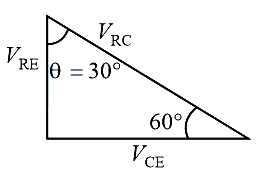
(C) Let $v_{CE}$ be the velocity of the car with respect to the Earth,$v_{RE}$ be the velocity of the rain with respect to the Earth,and $v_{RC}$ be the velocity of the rain with respect to the car.
Given: $v_{CE} = 40 \text{ km h}^{-1}$.
The rain falls vertically,so $v_{RE}$ is along the vertical direction.
The trace of the rain on the side window makes an angle $\theta = 30^{\circ}$ with the vertical.
From the vector triangle of relative velocity,we have $\vec{v}_{RC} = \vec{v}_{RE} - \vec{v}_{CE}$.
In the right-angled triangle formed by these vectors,the side representing the car's velocity $v_{CE}$ is opposite to the angle $\theta = 30^{\circ}$.
Therefore,$\sin \theta = \frac{v_{CE}}{v_{RC}}$.
Rearranging for $v_{RC}$,we get $v_{RC} = \frac{v_{CE}}{\sin 30^{\circ}}$.
Substituting the values,$v_{RC} = \frac{40}{0.5} = 80 \text{ km h}^{-1}$.
Given: $v_{CE} = 40 \text{ km h}^{-1}$.
The rain falls vertically,so $v_{RE}$ is along the vertical direction.
The trace of the rain on the side window makes an angle $\theta = 30^{\circ}$ with the vertical.
From the vector triangle of relative velocity,we have $\vec{v}_{RC} = \vec{v}_{RE} - \vec{v}_{CE}$.
In the right-angled triangle formed by these vectors,the side representing the car's velocity $v_{CE}$ is opposite to the angle $\theta = 30^{\circ}$.
Therefore,$\sin \theta = \frac{v_{CE}}{v_{RC}}$.
Rearranging for $v_{RC}$,we get $v_{RC} = \frac{v_{CE}}{\sin 30^{\circ}}$.
Substituting the values,$v_{RC} = \frac{40}{0.5} = 80 \text{ km h}^{-1}$.
0 likes
View Solution161
MediumMCQ
Two cars $A$ and $B$ are moving with a velocity of $30 \ km/h$ in the same direction. They are separated by $10 \ km$. The speed of another car $C$ moving in the opposite direction,if it meets these two cars at an interval of $8 \ minutes$,is: (in $km/h$)
A
$45$
B
$40$
C
$15$
D
$30$
Solution
(A) Let the velocity of cars $A$ and $B$ be $v_A = v_B = 30 \ km/h$ in the positive direction.
Let the velocity of car $C$ be $v_C$ in the opposite direction,so $v_C = -v$ (where $v$ is the speed of car $C$).
The relative velocity of car $C$ with respect to cars $A$ and $B$ is $v_{rel} = v_A - v_C = 30 - (-v) = 30 + v$.
The distance between car $A$ and $B$ is $d = 10 \ km$.
Car $C$ meets car $B$ and then car $A$ after an interval of $t = 8 \ minutes = \frac{8}{60} \ h = \frac{2}{15} \ h$.
Using the formula $d = v_{rel} \times t$:
$10 = (30 + v) \times \frac{2}{15}$
$10 \times \frac{15}{2} = 30 + v$
$75 = 30 + v$
$v = 75 - 30 = 45 \ km/h$.
Let the velocity of car $C$ be $v_C$ in the opposite direction,so $v_C = -v$ (where $v$ is the speed of car $C$).
The relative velocity of car $C$ with respect to cars $A$ and $B$ is $v_{rel} = v_A - v_C = 30 - (-v) = 30 + v$.
The distance between car $A$ and $B$ is $d = 10 \ km$.
Car $C$ meets car $B$ and then car $A$ after an interval of $t = 8 \ minutes = \frac{8}{60} \ h = \frac{2}{15} \ h$.
Using the formula $d = v_{rel} \times t$:
$10 = (30 + v) \times \frac{2}{15}$
$10 \times \frac{15}{2} = 30 + v$
$75 = 30 + v$
$v = 75 - 30 = 45 \ km/h$.
0 likes
View Solution162
DifficultMCQ
$A$ swimmer can swim in still water with speed $v$ and the river is flowing with velocity $\frac{v}{2}$. To cross the river in the shortest time,he should swim making an angle $\theta$ with the upstream. What is the ratio of the time taken to swim across in the shortest time to that in swimming across over the shortest distance?
A
$\cos \theta$
B
$\cot \theta$
C
$\sin \theta$
D
$\tan \theta$
Solution
(C) Let $d$ be the width of the river. The swimmer swims with speed $v$ in still water.
For the shortest time,the swimmer must swim perpendicular to the river flow. The time taken is $t = \frac{d}{v}$.
For the shortest distance,the swimmer must swim at an angle such that the resultant velocity is perpendicular to the river bank. Let the angle with the normal to the stream be $\alpha$. Then $\sin \alpha = \frac{v_{river}}{v} = \frac{v/2}{v} = \frac{1}{2}$,so $\alpha = 30^{\circ}$.
The angle with the upstream is $\theta = 90^{\circ} + \alpha = 120^{\circ}$.
The time taken for the shortest distance is $t^{\prime} = \frac{d}{v \cos \alpha} = \frac{d}{v \sin \theta}$.
The ratio of the time taken is $\frac{t}{t^{\prime}} = \frac{d/v}{d/(v \sin \theta)} = \sin \theta$.
For the shortest time,the swimmer must swim perpendicular to the river flow. The time taken is $t = \frac{d}{v}$.
For the shortest distance,the swimmer must swim at an angle such that the resultant velocity is perpendicular to the river bank. Let the angle with the normal to the stream be $\alpha$. Then $\sin \alpha = \frac{v_{river}}{v} = \frac{v/2}{v} = \frac{1}{2}$,so $\alpha = 30^{\circ}$.
The angle with the upstream is $\theta = 90^{\circ} + \alpha = 120^{\circ}$.
The time taken for the shortest distance is $t^{\prime} = \frac{d}{v \cos \alpha} = \frac{d}{v \sin \theta}$.
The ratio of the time taken is $\frac{t}{t^{\prime}} = \frac{d/v}{d/(v \sin \theta)} = \sin \theta$.
0 likes
View Solution163
DifficultMCQ
Ship $A$ is moving westwards with a speed of $20 \ km h^{-1}$ and another ship $B$ which is at $200 \ km$ south of $A$ is moving northwards with a speed of $10 \ km h^{-1}$. The time after which the distance between them is shortest and the shortest distance between them are respectively
A
$4 \ h, 80 \sqrt{5} \ km$
B
$50 \sqrt{2} \ h, \sqrt{10} \ km$
C
$100 \sqrt{2} \ h, 2 \sqrt{10} \ km$
D
$80 \sqrt{5} \ h, 4 \ km$
Solution
(A) Let the position of ship $A$ at $t=0$ be $(0, 200)$ and ship $B$ be $(0, 0)$.
Velocity of ship $A$ is $\vec{v}_A = -20 \hat{i} \ km h^{-1}$.
Velocity of ship $B$ is $\vec{v}_B = 10 \hat{j} \ km h^{-1}$.
Relative velocity $\vec{v}_{BA} = \vec{v}_B - \vec{v}_A = 20 \hat{i} + 10 \hat{j} \ km h^{-1}$.
Relative position $\vec{r}_{BA} = \vec{r}_B - \vec{r}_A = (0 - 0) \hat{i} + (0 - 200) \hat{j} = -200 \hat{j} \ km$.
The distance $d$ at time $t$ is given by $|\vec{r}_{BA} + \vec{v}_{BA} t| = |20t \hat{i} + (10t - 200) \hat{j}|$.
$d^2 = (20t)^2 + (10t - 200)^2 = 400t^2 + 100t^2 - 4000t + 40000 = 500t^2 - 4000t + 40000$.
For minimum distance,$\frac{d(d^2)}{dt} = 1000t - 4000 = 0 \implies t = 4 \ h$.
Shortest distance $d = \sqrt{500(4)^2 - 4000(4) + 40000} = \sqrt{8000 - 16000 + 40000} = \sqrt{32000} = 80 \sqrt{5} \ km$.
Velocity of ship $A$ is $\vec{v}_A = -20 \hat{i} \ km h^{-1}$.
Velocity of ship $B$ is $\vec{v}_B = 10 \hat{j} \ km h^{-1}$.
Relative velocity $\vec{v}_{BA} = \vec{v}_B - \vec{v}_A = 20 \hat{i} + 10 \hat{j} \ km h^{-1}$.
Relative position $\vec{r}_{BA} = \vec{r}_B - \vec{r}_A = (0 - 0) \hat{i} + (0 - 200) \hat{j} = -200 \hat{j} \ km$.
The distance $d$ at time $t$ is given by $|\vec{r}_{BA} + \vec{v}_{BA} t| = |20t \hat{i} + (10t - 200) \hat{j}|$.
$d^2 = (20t)^2 + (10t - 200)^2 = 400t^2 + 100t^2 - 4000t + 40000 = 500t^2 - 4000t + 40000$.
For minimum distance,$\frac{d(d^2)}{dt} = 1000t - 4000 = 0 \implies t = 4 \ h$.
Shortest distance $d = \sqrt{500(4)^2 - 4000(4) + 40000} = \sqrt{8000 - 16000 + 40000} = \sqrt{32000} = 80 \sqrt{5} \ km$.
0 likes
View Solution164
MediumMCQ
$A$ man running at a speed of $5 \text{ km/h}$ finds that the rain falls vertically. When he stops running,he finds that the rain is falling at an angle of $60^{\circ}$ with the horizontal. The velocity of rain with respect to the running man is
A
$\frac{5}{\sqrt{3}} \text{ km/h}$
B
$\frac{5\sqrt{3}}{2} \text{ km/h}$
C
$\frac{4\sqrt{3}}{2} \text{ km/h}$
D
$5\sqrt{3} \text{ km/h}$
Solution
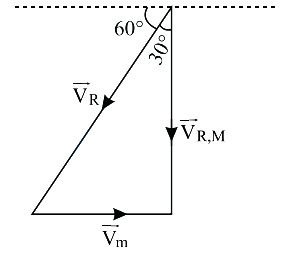
(D) Let $\vec{v}_m$ be the velocity of the man,$\vec{v}_r$ be the velocity of the rain,and $\vec{v}_{rm}$ be the velocity of the rain with respect to the man.
Given,$\vec{v}_{rm} = \vec{v}_r - \vec{v}_m$.
When the man is running,the rain appears to fall vertically,meaning $\vec{v}_{rm}$ is vertical.
When the man stops,the rain falls at $60^{\circ}$ with the horizontal,meaning $\vec{v}_r$ makes an angle of $60^{\circ}$ with the horizontal.
From the vector triangle,the angle between $\vec{v}_r$ and the vertical is $90^{\circ} - 60^{\circ} = 30^{\circ}$.
In the right-angled triangle formed by $\vec{v}_m$,$\vec{v}_r$,and $\vec{v}_{rm}$:
$\tan(30^{\circ}) = \frac{|\vec{v}_m|}{|\vec{v}_{rm}|}$
$\frac{1}{\sqrt{3}} = \frac{5}{|\vec{v}_{rm}|}$
$|\vec{v}_{rm}| = 5\sqrt{3} \text{ km/h}$.
Given,$\vec{v}_{rm} = \vec{v}_r - \vec{v}_m$.
When the man is running,the rain appears to fall vertically,meaning $\vec{v}_{rm}$ is vertical.
When the man stops,the rain falls at $60^{\circ}$ with the horizontal,meaning $\vec{v}_r$ makes an angle of $60^{\circ}$ with the horizontal.
From the vector triangle,the angle between $\vec{v}_r$ and the vertical is $90^{\circ} - 60^{\circ} = 30^{\circ}$.
In the right-angled triangle formed by $\vec{v}_m$,$\vec{v}_r$,and $\vec{v}_{rm}$:
$\tan(30^{\circ}) = \frac{|\vec{v}_m|}{|\vec{v}_{rm}|}$
$\frac{1}{\sqrt{3}} = \frac{5}{|\vec{v}_{rm}|}$
$|\vec{v}_{rm}| = 5\sqrt{3} \text{ km/h}$.
0 likes
View Solution165
DifficultMCQ
$A$ river has a steady speed of $v$. $A$ man swims upstream for a distance of $d$ and swims back to the starting point in a total time $t$. The man can swim at a speed of $2v$ in still water. If the time taken by the man in still water is $t_0$ to complete the same total distance of $2d$,then $\frac{t}{t_0}$ is
A
$\frac{1}{2}$
B
$\frac{3}{2}$
C
$\frac{3}{4}$
D
$\frac{4}{3}$
Solution
(D) The total distance to be covered is $2d$ (distance $d$ upstream and $d$ downstream).
In still water,the man swims at speed $2v$. The time taken to cover distance $2d$ is $t_0 = \frac{2d}{2v} = \frac{d}{v}$.
When swimming downstream,the effective speed is $v_{down} = v_m + v_r = 2v + v = 3v$. The time taken is $t_1 = \frac{d}{3v}$.
When swimming upstream,the effective speed is $v_{up} = v_m - v_r = 2v - v = v$. The time taken is $t_2 = \frac{d}{v}$.
The total time taken is $t = t_1 + t_2 = \frac{d}{3v} + \frac{d}{v} = \frac{d + 3d}{3v} = \frac{4d}{3v}$.
Therefore,the ratio is $\frac{t}{t_0} = \frac{4d/3v}{d/v} = \frac{4}{3}$.
In still water,the man swims at speed $2v$. The time taken to cover distance $2d$ is $t_0 = \frac{2d}{2v} = \frac{d}{v}$.
When swimming downstream,the effective speed is $v_{down} = v_m + v_r = 2v + v = 3v$. The time taken is $t_1 = \frac{d}{3v}$.
When swimming upstream,the effective speed is $v_{up} = v_m - v_r = 2v - v = v$. The time taken is $t_2 = \frac{d}{v}$.
The total time taken is $t = t_1 + t_2 = \frac{d}{3v} + \frac{d}{v} = \frac{d + 3d}{3v} = \frac{4d}{3v}$.
Therefore,the ratio is $\frac{t}{t_0} = \frac{4d/3v}{d/v} = \frac{4}{3}$.
0 likes
View Solution166
MediumMCQ
Two towns $X$ and $Y$ are connected by a regular bus service. $A$ bus leaves in either direction at every $T$ minutes. $A$ man moving with some speed in the direction $X$ to $Y$ finds that a bus goes past him every $t_1$ minutes in the direction of his motion,and every $t_2$ minutes in the opposite direction. Then $T$ is given by
A
$\frac{2 t_1 t_2}{t_1+t_2}$
B
$\frac{\left(t_1-t_2\right) t_1}{t_1+t_2}$
C
$\frac{2 t_2\left(t_1+t_2\right)}{\left|t_1+t_2\right|}$
D
$\frac{t_1 t_2}{\left|t_1-t_2\right|}$
Solution
(A) Let $V$ be the speed of the bus and $V_o$ be the speed of the man. The distance between two consecutive buses is $d = V \cdot T$.
When the man moves in the direction of the bus,the relative speed is $V - V_o$. The time interval between buses passing him is $t_1 = \frac{d}{V - V_o} = \frac{VT}{V - V_o}$.
This implies $V - V_o = \frac{VT}{t_1} \quad \dots (1)$.
When the man moves in the opposite direction,the relative speed is $V + V_o$. The time interval between buses passing him is $t_2 = \frac{d}{V + V_o} = \frac{VT}{V + V_o}$.
This implies $V + V_o = \frac{VT}{t_2} \quad \dots (2)$.
Adding equations $(1)$ and $(2)$:
$(V - V_o) + (V + V_o) = \frac{VT}{t_1} + \frac{VT}{t_2}$
$2V = VT \left( \frac{1}{t_1} + \frac{1}{t_2} \right)$
$2 = T \left( \frac{t_1 + t_2}{t_1 t_2} \right)$
$T = \frac{2 t_1 t_2}{t_1 + t_2}$
When the man moves in the direction of the bus,the relative speed is $V - V_o$. The time interval between buses passing him is $t_1 = \frac{d}{V - V_o} = \frac{VT}{V - V_o}$.
This implies $V - V_o = \frac{VT}{t_1} \quad \dots (1)$.
When the man moves in the opposite direction,the relative speed is $V + V_o$. The time interval between buses passing him is $t_2 = \frac{d}{V + V_o} = \frac{VT}{V + V_o}$.
This implies $V + V_o = \frac{VT}{t_2} \quad \dots (2)$.
Adding equations $(1)$ and $(2)$:
$(V - V_o) + (V + V_o) = \frac{VT}{t_1} + \frac{VT}{t_2}$
$2V = VT \left( \frac{1}{t_1} + \frac{1}{t_2} \right)$
$2 = T \left( \frac{t_1 + t_2}{t_1 t_2} \right)$
$T = \frac{2 t_1 t_2}{t_1 + t_2}$

0 likes
View Solution167
MediumMCQ
Two trains $A$ and $B$ travel on two parallel rail tracks in opposite directions with speeds $v_1$ and $v_2$,respectively. They take $4 \ s$ to pass each other at these speeds. If the speed of train $A$ is increased by $50 \%$,then they take $3 \ s$ to pass each other. The ratio $v_1 / v_2$ is:
A
$0.5$
B
$1: 5$
C
$2: 1$
D
$2: 5$
Solution
(C) Let the total length of the two trains be $L$. Since they are moving in opposite directions,their relative velocity is $v_{rel} = v_1 + v_2$.
Given that they take $4 \ s$ to cross each other:
$L = (v_1 + v_2) \times 4$ --- $(i)$
When the speed of train $A$ is increased by $50 \%$,the new speed of train $A$ becomes $v_1' = v_1 + 0.5 v_1 = 1.5 v_1 = \frac{3}{2} v_1$.
The new relative velocity is $v_{rel}' = \frac{3}{2} v_1 + v_2$.
Given that they take $3 \ s$ to cross each other:
$L = (\frac{3}{2} v_1 + v_2) \times 3$ --- (ii)
Equating $(i)$ and (ii):
$4(v_1 + v_2) = 3(\frac{3}{2} v_1 + v_2)$
$4 v_1 + 4 v_2 = 4.5 v_1 + 3 v_2$
$v_2 = 0.5 v_1$
$\frac{v_1}{v_2} = \frac{1}{0.5} = \frac{2}{1}$.
Given that they take $4 \ s$ to cross each other:
$L = (v_1 + v_2) \times 4$ --- $(i)$
When the speed of train $A$ is increased by $50 \%$,the new speed of train $A$ becomes $v_1' = v_1 + 0.5 v_1 = 1.5 v_1 = \frac{3}{2} v_1$.
The new relative velocity is $v_{rel}' = \frac{3}{2} v_1 + v_2$.
Given that they take $3 \ s$ to cross each other:
$L = (\frac{3}{2} v_1 + v_2) \times 3$ --- (ii)
Equating $(i)$ and (ii):
$4(v_1 + v_2) = 3(\frac{3}{2} v_1 + v_2)$
$4 v_1 + 4 v_2 = 4.5 v_1 + 3 v_2$
$v_2 = 0.5 v_1$
$\frac{v_1}{v_2} = \frac{1}{0.5} = \frac{2}{1}$.
0 likes
View Solution168
DifficultMCQ
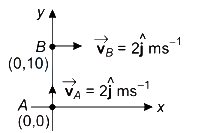
Two persons $A$ and $B$ are located in the $X-Y$ plane at the points $(0,0)$ and $(0,10)$ respectively. (The distances are measured in $MKS$ units). At time $t=0$,they start moving simultaneously with velocities $\overrightarrow{v}_A = 2\hat{j} \text{ m/s}$ and $\overrightarrow{v}_B = 2\hat{i} \text{ m/s}$ respectively. The time after which $A$ and $B$ are at their closest distance is:
A
$2.5$ s
B
$4$ s
C
$1$ s
D
$\frac{10}{\sqrt{2}} \text{ s}$
Solution
(A) Let at time $t$,the position of $A$ be $\overrightarrow{r}_A = (0 + 0t)\hat{i} + (0 + 2t)\hat{j} = 2t\hat{j}$.
Let at time $t$,the position of $B$ be $\overrightarrow{r}_B = (0 + 2t)\hat{i} + (10 + 0t)\hat{j} = 2t\hat{i} + 10\hat{j}$.
The relative position vector $\overrightarrow{r}_{AB} = \overrightarrow{r}_B - \overrightarrow{r}_A = 2t\hat{i} + (10 - 2t)\hat{j}$.
The square of the distance $D^2 = |\overrightarrow{r}_{AB}|^2 = (2t)^2 + (10 - 2t)^2$.
$D^2 = 4t^2 + 100 + 4t^2 - 40t = 8t^2 - 40t + 100$.
For minimum distance,$\frac{d(D^2)}{dt} = 0$.
$16t - 40 = 0$.
$t = \frac{40}{16} = 2.5 \text{ s}$.
Since $\frac{d^2(D^2)}{dt^2} = 16 > 0$,the distance is minimum at $t = 2.5 \text{ s}$.
Let at time $t$,the position of $B$ be $\overrightarrow{r}_B = (0 + 2t)\hat{i} + (10 + 0t)\hat{j} = 2t\hat{i} + 10\hat{j}$.
The relative position vector $\overrightarrow{r}_{AB} = \overrightarrow{r}_B - \overrightarrow{r}_A = 2t\hat{i} + (10 - 2t)\hat{j}$.
The square of the distance $D^2 = |\overrightarrow{r}_{AB}|^2 = (2t)^2 + (10 - 2t)^2$.
$D^2 = 4t^2 + 100 + 4t^2 - 40t = 8t^2 - 40t + 100$.
For minimum distance,$\frac{d(D^2)}{dt} = 0$.
$16t - 40 = 0$.
$t = \frac{40}{16} = 2.5 \text{ s}$.
Since $\frac{d^2(D^2)}{dt^2} = 16 > 0$,the distance is minimum at $t = 2.5 \text{ s}$.
0 likes
View Solution169
EasyMCQ
Particle $A$ (which was located at the origin at time $t=0$) is moving along the $x$-axis with a constant speed of $1 \,m/s$. The location of particle $B$, which is moving along the $y$-axis, is given by $y=ct^2$, where $c=1 \,m/s^2$. Find the speed of particle $A$ relative to particle $B$ at $t=1 \,s$.
A
$\sqrt{5} \,m/s$
B
$2 \,m/s$
C
$1 \,m/s$
D
$0 \,m/s$
Solution
(A) The velocity of particle $A$ is constant along the $x$-axis: $\vec{V}_A = 1 \hat{i} \,m/s$.
For particle $B$ moving along the $y$-axis, the position is $y = ct^2$.
The velocity of particle $B$ is $\vec{V}_B = \frac{dy}{dt} \hat{j} = 2ct \hat{j}$.
At $t = 1 \,s$ and $c = 1 \,m/s^2$, the velocity of particle $B$ is $\vec{V}_B = 2(1)(1) \hat{j} = 2 \hat{j} \,m/s$.
The relative velocity of particle $A$ with respect to particle $B$ is $\vec{V}_{AB} = \vec{V}_A - \vec{V}_B = 1 \hat{i} - 2 \hat{j} \,m/s$.
The speed is the magnitude of the relative velocity: $|\vec{V}_{AB}| = \sqrt{(1)^2 + (-2)^2} = \sqrt{1 + 4} = \sqrt{5} \,m/s$.
For particle $B$ moving along the $y$-axis, the position is $y = ct^2$.
The velocity of particle $B$ is $\vec{V}_B = \frac{dy}{dt} \hat{j} = 2ct \hat{j}$.
At $t = 1 \,s$ and $c = 1 \,m/s^2$, the velocity of particle $B$ is $\vec{V}_B = 2(1)(1) \hat{j} = 2 \hat{j} \,m/s$.
The relative velocity of particle $A$ with respect to particle $B$ is $\vec{V}_{AB} = \vec{V}_A - \vec{V}_B = 1 \hat{i} - 2 \hat{j} \,m/s$.
The speed is the magnitude of the relative velocity: $|\vec{V}_{AB}| = \sqrt{(1)^2 + (-2)^2} = \sqrt{1 + 4} = \sqrt{5} \,m/s$.
0 likes
View Solution170
MediumMCQ
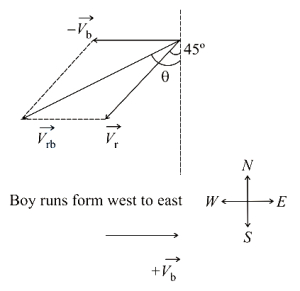
$A$ boy runs on a horizontal road with a speed of $4 \ m \ s^{-1}$ while it is raining. He sees that the rain is making an angle $\theta$ with the vertical while running from west to east. However,when he runs from east to west,the angle is $\alpha$. The rain is pouring down at an angle $45^{\circ}$ with the vertical and at a speed of $8 \ m \ s^{-1}$ as shown in the figure. The ratio $\frac{\tan \theta}{\tan \alpha}$ is,
A
$(1-\sqrt{2})^2$
B
$(1+\sqrt{2})^2$
C
$(1+\sqrt{2})$
D
$(\sqrt{2}-1)$
Solution
(A) Given:
Velocity of boy,$\overrightarrow{v_b} = 4 \ m \ s^{-1}$ and velocity of rain,$\overrightarrow{v_r} = 8 \ m \ s^{-1}$.
The velocity of rain with respect to the boy is $\overrightarrow{v_{rb}} = \overrightarrow{v_r} - \overrightarrow{v_b}$.
Let the vertical direction be the $y$-axis and the horizontal direction be the $x$-axis.
Rain velocity components: $v_{rx} = v_r \sin(45^{\circ}) = 8 \times \frac{1}{\sqrt{2}} = 4\sqrt{2} \ m \ s^{-1}$ and $v_{ry} = v_r \cos(45^{\circ}) = 8 \times \frac{1}{\sqrt{2}} = 4\sqrt{2} \ m \ s^{-1}$.
When the boy runs from west to east $(\overrightarrow{v_b} = 4 \hat{i})$:
$\overrightarrow{v_{rb}} = (v_{rx} \hat{i} - v_{ry} \hat{j}) - (4 \hat{i}) = (4\sqrt{2} - 4) \hat{i} - 4\sqrt{2} \hat{j}$.
$\tan \theta = \frac{|v_{rb,x}|}{|v_{rb,y}|} = \frac{4\sqrt{2} - 4}{4\sqrt{2}} = \frac{\sqrt{2} - 1}{\sqrt{2}}$.
When the boy runs from east to west $(\overrightarrow{v_b} = -4 \hat{i})$:
$\overrightarrow{v_{rb}} = (v_{rx} \hat{i} - v_{ry} \hat{j}) - (-4 \hat{i}) = (4\sqrt{2} + 4) \hat{i} - 4\sqrt{2} \hat{j}$.
$\tan \alpha = \frac{|v_{rb,x}|}{|v_{rb,y}|} = \frac{4\sqrt{2} + 4}{4\sqrt{2}} = \frac{\sqrt{2} + 1}{\sqrt{2}}$.
Therefore,the ratio $\frac{\tan \theta}{\tan \alpha} = \frac{(\sqrt{2} - 1)/\sqrt{2}}{(\sqrt{2} + 1)/\sqrt{2}} = \frac{\sqrt{2} - 1}{\sqrt{2} + 1}$.
Rationalizing the denominator: $\frac{(\sqrt{2} - 1)(\sqrt{2} - 1)}{(\sqrt{2} + 1)(\sqrt{2} - 1)} = \frac{2 + 1 - 2\sqrt{2}}{2 - 1} = 3 - 2\sqrt{2} = (\sqrt{2} - 1)^2$.
Velocity of boy,$\overrightarrow{v_b} = 4 \ m \ s^{-1}$ and velocity of rain,$\overrightarrow{v_r} = 8 \ m \ s^{-1}$.
The velocity of rain with respect to the boy is $\overrightarrow{v_{rb}} = \overrightarrow{v_r} - \overrightarrow{v_b}$.
Let the vertical direction be the $y$-axis and the horizontal direction be the $x$-axis.
Rain velocity components: $v_{rx} = v_r \sin(45^{\circ}) = 8 \times \frac{1}{\sqrt{2}} = 4\sqrt{2} \ m \ s^{-1}$ and $v_{ry} = v_r \cos(45^{\circ}) = 8 \times \frac{1}{\sqrt{2}} = 4\sqrt{2} \ m \ s^{-1}$.
When the boy runs from west to east $(\overrightarrow{v_b} = 4 \hat{i})$:
$\overrightarrow{v_{rb}} = (v_{rx} \hat{i} - v_{ry} \hat{j}) - (4 \hat{i}) = (4\sqrt{2} - 4) \hat{i} - 4\sqrt{2} \hat{j}$.
$\tan \theta = \frac{|v_{rb,x}|}{|v_{rb,y}|} = \frac{4\sqrt{2} - 4}{4\sqrt{2}} = \frac{\sqrt{2} - 1}{\sqrt{2}}$.
When the boy runs from east to west $(\overrightarrow{v_b} = -4 \hat{i})$:
$\overrightarrow{v_{rb}} = (v_{rx} \hat{i} - v_{ry} \hat{j}) - (-4 \hat{i}) = (4\sqrt{2} + 4) \hat{i} - 4\sqrt{2} \hat{j}$.
$\tan \alpha = \frac{|v_{rb,x}|}{|v_{rb,y}|} = \frac{4\sqrt{2} + 4}{4\sqrt{2}} = \frac{\sqrt{2} + 1}{\sqrt{2}}$.
Therefore,the ratio $\frac{\tan \theta}{\tan \alpha} = \frac{(\sqrt{2} - 1)/\sqrt{2}}{(\sqrt{2} + 1)/\sqrt{2}} = \frac{\sqrt{2} - 1}{\sqrt{2} + 1}$.
Rationalizing the denominator: $\frac{(\sqrt{2} - 1)(\sqrt{2} - 1)}{(\sqrt{2} + 1)(\sqrt{2} - 1)} = \frac{2 + 1 - 2\sqrt{2}}{2 - 1} = 3 - 2\sqrt{2} = (\sqrt{2} - 1)^2$.
0 likes
View Solution171
EasyMCQ
$A$ man walking along a straight line with a velocity $6 \text{ km/h}$ encounters rain falling vertically down with a velocity $6\sqrt{3} \text{ km/h}$. At what angle should the man hold his umbrella to protect himself from the rain?
A
$30^{\circ}$ with respect to ground
B
$30^{\circ}$ with respect to vertical
C
$45^{\circ}$ with respect to ground
D
$60^{\circ}$ with respect to vertical
Solution
(B) Let the velocity of the man be $\vec{v}_m = 6 \hat{i} \text{ km/h}$ and the velocity of the rain be $\vec{v}_r = -6\sqrt{3} \hat{j} \text{ km/h}$.
To protect himself,the man must hold the umbrella in the direction of the relative velocity of the rain with respect to the man,$\vec{v}_{rm} = \vec{v}_r - \vec{v}_m$.
$\vec{v}_{rm} = -6\sqrt{3} \hat{j} - 6 \hat{i} \text{ km/h}$.
The angle $\alpha$ with respect to the vertical is given by $\tan \alpha = \frac{|v_m|}{|v_r|} = \frac{6}{6\sqrt{3}} = \frac{1}{\sqrt{3}}$.
Since $\tan \alpha = \frac{1}{\sqrt{3}}$,we have $\alpha = 30^{\circ}$.
Therefore,the man should hold his umbrella at an angle of $30^{\circ}$ with respect to the vertical.
To protect himself,the man must hold the umbrella in the direction of the relative velocity of the rain with respect to the man,$\vec{v}_{rm} = \vec{v}_r - \vec{v}_m$.
$\vec{v}_{rm} = -6\sqrt{3} \hat{j} - 6 \hat{i} \text{ km/h}$.
The angle $\alpha$ with respect to the vertical is given by $\tan \alpha = \frac{|v_m|}{|v_r|} = \frac{6}{6\sqrt{3}} = \frac{1}{\sqrt{3}}$.
Since $\tan \alpha = \frac{1}{\sqrt{3}}$,we have $\alpha = 30^{\circ}$.
Therefore,the man should hold his umbrella at an angle of $30^{\circ}$ with respect to the vertical.
0 likes
View Solution172
MediumMCQ
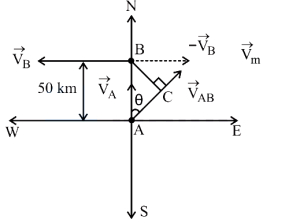
Two cars,at a certain instant,are $50 \ km$ apart on a line running from south to north. The one farther north is moving west at $25 \ km/hr$. The other is moving towards north at $25 \ km/hr$. How long do they take to reach their distance of closest approach (in $min$)?
A
$30$
B
$60$
C
$85$
D
$90$
Solution
(B) Let car $A$ be at the origin $(0, 0)$ moving north with velocity $\vec{V}_A = 25 \hat{j} \ km/hr$. Let car $B$ be at $(0, 50)$ moving west with velocity $\vec{V}_B = -25 \hat{i} \ km/hr$.
The relative velocity of $A$ with respect to $B$ is $\vec{V}_{AB} = \vec{V}_A - \vec{V}_B = 25 \hat{j} - (-25 \hat{i}) = 25 \hat{i} + 25 \hat{j} \ km/hr$.
The magnitude of relative velocity is $|\vec{V}_{AB}| = \sqrt{25^2 + 25^2} = 25\sqrt{2} \ km/hr$.
The relative position vector is $\vec{r}_{AB} = \vec{r}_A - \vec{r}_B = (0 - 0)\hat{i} + (0 - 50)\hat{j} = -50 \hat{j} \ km$.
The time taken to reach the closest approach is given by $t = -\frac{\vec{r}_{AB} \cdot \vec{V}_{AB}}{|\vec{V}_{AB}|^2}$.
$t = -\frac{(-50 \hat{j}) \cdot (25 \hat{i} + 25 \hat{j})}{(25\sqrt{2})^2} = -\frac{-1250}{1250} = 1 \ hr$.
Thus,the time taken is $60 \ min$.
The relative velocity of $A$ with respect to $B$ is $\vec{V}_{AB} = \vec{V}_A - \vec{V}_B = 25 \hat{j} - (-25 \hat{i}) = 25 \hat{i} + 25 \hat{j} \ km/hr$.
The magnitude of relative velocity is $|\vec{V}_{AB}| = \sqrt{25^2 + 25^2} = 25\sqrt{2} \ km/hr$.
The relative position vector is $\vec{r}_{AB} = \vec{r}_A - \vec{r}_B = (0 - 0)\hat{i} + (0 - 50)\hat{j} = -50 \hat{j} \ km$.
The time taken to reach the closest approach is given by $t = -\frac{\vec{r}_{AB} \cdot \vec{V}_{AB}}{|\vec{V}_{AB}|^2}$.
$t = -\frac{(-50 \hat{j}) \cdot (25 \hat{i} + 25 \hat{j})}{(25\sqrt{2})^2} = -\frac{-1250}{1250} = 1 \ hr$.
Thus,the time taken is $60 \ min$.
0 likes
View Solution173
EasyMCQ
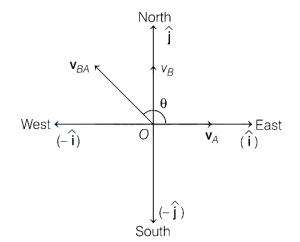
Car $A$ is moving to the East with a speed of $30 \text{ km/h}$,and car $B$ is moving to the North with the same speed. What is the velocity of car $B$ as measured from car $A$?
A
$42 \text{ km/h}, 45^{\circ}$ North of West
B
$42 \text{ km/h}, 45^{\circ}$ East of North
C
$60 \text{ km/h}, 45^{\circ}$ South of East
D
$42 \text{ km/h}, 45^{\circ}$ South of East
Solution
(A) Given that,velocity of car $A$ is $\vec{v}_A = 30 \hat{i} \text{ km/h}$ (toward East).
For car $B$,velocity is $\vec{v}_B = 30 \hat{j} \text{ km/h}$ (toward North).
The velocity of car $B$ as measured from car $A$ is the relative velocity $\vec{v}_{BA} = \vec{v}_B - \vec{v}_A$.
$\vec{v}_{BA} = 30 \hat{j} - 30 \hat{i} \text{ km/h}$.
The magnitude of $\vec{v}_{BA}$ is $|\vec{v}_{BA}| = \sqrt{(-30)^2 + (30)^2} = \sqrt{900 + 900} = \sqrt{1800} = 30\sqrt{2} \approx 42 \text{ km/h}$.
The direction is given by $\tan \theta = \frac{v_{y}}{v_{x}} = \frac{30}{-30} = -1$. This corresponds to an angle of $135^{\circ}$ from the positive $x$-axis (East).
Since the vector points in the second quadrant (negative $x$,positive $y$),it is $45^{\circ}$ North of West.
For car $B$,velocity is $\vec{v}_B = 30 \hat{j} \text{ km/h}$ (toward North).
The velocity of car $B$ as measured from car $A$ is the relative velocity $\vec{v}_{BA} = \vec{v}_B - \vec{v}_A$.
$\vec{v}_{BA} = 30 \hat{j} - 30 \hat{i} \text{ km/h}$.
The magnitude of $\vec{v}_{BA}$ is $|\vec{v}_{BA}| = \sqrt{(-30)^2 + (30)^2} = \sqrt{900 + 900} = \sqrt{1800} = 30\sqrt{2} \approx 42 \text{ km/h}$.
The direction is given by $\tan \theta = \frac{v_{y}}{v_{x}} = \frac{30}{-30} = -1$. This corresponds to an angle of $135^{\circ}$ from the positive $x$-axis (East).
Since the vector points in the second quadrant (negative $x$,positive $y$),it is $45^{\circ}$ North of West.
0 likes
View Solution174
EasyMCQ
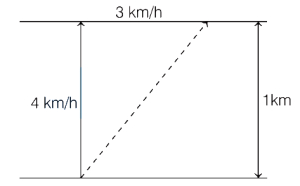
$A$ man can swim with a speed of $4 \ km/h$ in still water. How long does he take to cross a river $1 \ km$ wide,if the river flows steadily at $3 \ km/h$ and he makes his strokes normal to the river current (in $min$)?
A
$30$
B
$25$
C
$20$
D
$15$
Solution
(D) The man swims across the river by making strokes normal to the river current. The velocity of the man relative to the ground is the vector sum of his velocity in still water and the velocity of the river. However,the time taken to cross the river depends only on the component of his velocity perpendicular to the river flow.
Since the man swims normal to the current,his velocity component perpendicular to the river is $v_y = 4 \ km/h$.
The width of the river is $d = 1 \ km$.
The time taken to cross the river is given by:
$t = \frac{d}{v_y} = \frac{1 \ km}{4 \ km/h} = 0.25 \ h$
To convert this into minutes:
$t = 0.25 \times 60 \ min = 15 \ min$.
Since the man swims normal to the current,his velocity component perpendicular to the river is $v_y = 4 \ km/h$.
The width of the river is $d = 1 \ km$.
The time taken to cross the river is given by:
$t = \frac{d}{v_y} = \frac{1 \ km}{4 \ km/h} = 0.25 \ h$
To convert this into minutes:
$t = 0.25 \times 60 \ min = 15 \ min$.
0 likes
View Solution175
EasyMCQ
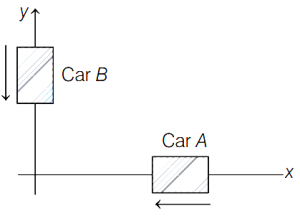
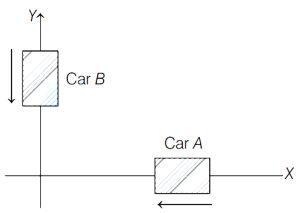
Two cars $A$ and $B$ are moving with speeds $v_A = 120 \text{ km/h}$ and $v_B = 50 \text{ km/h}$ respectively in the directions as indicated by the arrows in the figure below. What is the relative speed of car $B$ with respect to car $A$ (in $\text{ km/h}$)?
A
$70$
B
$120$
C
$130$
D
$170$
Solution
(C) The given situation is shown in the figure.
Velocity of car $A$ is along the negative $x$-axis:
$\vec{v}_A = -120 \hat{i} \text{ km/h}$
Velocity of car $B$ is along the negative $y$-axis:
$\vec{v}_B = -50 \hat{j} \text{ km/h}$
The relative velocity of car $B$ with respect to car $A$ is given by:
$\vec{v}_{BA} = \vec{v}_B - \vec{v}_A$
$\vec{v}_{BA} = (-50 \hat{j}) - (-120 \hat{i})$
$\vec{v}_{BA} = 120 \hat{i} - 50 \hat{j}$
The relative speed is the magnitude of the relative velocity vector:
$|\vec{v}_{BA}| = \sqrt{(120)^2 + (-50)^2}$
$|\vec{v}_{BA}| = \sqrt{14400 + 2500}$
$|\vec{v}_{BA}| = \sqrt{16900}$
$|\vec{v}_{BA}| = 130 \text{ km/h}$
Velocity of car $A$ is along the negative $x$-axis:
$\vec{v}_A = -120 \hat{i} \text{ km/h}$
Velocity of car $B$ is along the negative $y$-axis:
$\vec{v}_B = -50 \hat{j} \text{ km/h}$
The relative velocity of car $B$ with respect to car $A$ is given by:
$\vec{v}_{BA} = \vec{v}_B - \vec{v}_A$
$\vec{v}_{BA} = (-50 \hat{j}) - (-120 \hat{i})$
$\vec{v}_{BA} = 120 \hat{i} - 50 \hat{j}$
The relative speed is the magnitude of the relative velocity vector:
$|\vec{v}_{BA}| = \sqrt{(120)^2 + (-50)^2}$
$|\vec{v}_{BA}| = \sqrt{14400 + 2500}$
$|\vec{v}_{BA}| = \sqrt{16900}$
$|\vec{v}_{BA}| = 130 \text{ km/h}$
0 likes
View Solution176
MediumMCQ
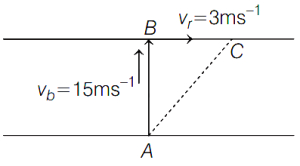
$A$ river $200 \,m$ wide is flowing at a rate of $3.0 \,m/s$. $A$ boat is sailing at a velocity of $15 \,m/s$ with respect to the water in a direction perpendicular to the river. How far from the point directly opposite to the starting point does the boat reach on the opposite bank (in $\,m$)?
A
$25$
B
$60$
C
$40$
D
$50$
Solution
(C) The given situation is shown in the figure.
Velocity of river,$v_r = 3 \,m/s$.
Velocity of boat with respect to water,$v_b = 15 \,m/s$.
Width of river,$d = AB = 200 \,m$.
We need to calculate the horizontal drift,$BC$.
The time taken by the boat to cross the river is given by:
$t = \frac{d}{v_b} = \frac{200}{15} = \frac{40}{3} \,s$.
The horizontal distance covered by the boat due to the river flow is:
$BC = v_r \times t = 3 \times \frac{40}{3} = 40 \,m$.
Velocity of river,$v_r = 3 \,m/s$.
Velocity of boat with respect to water,$v_b = 15 \,m/s$.
Width of river,$d = AB = 200 \,m$.
We need to calculate the horizontal drift,$BC$.
The time taken by the boat to cross the river is given by:
$t = \frac{d}{v_b} = \frac{200}{15} = \frac{40}{3} \,s$.
The horizontal distance covered by the boat due to the river flow is:
$BC = v_r \times t = 3 \times \frac{40}{3} = 40 \,m$.
0 likes
View Solution177
EasyMCQ
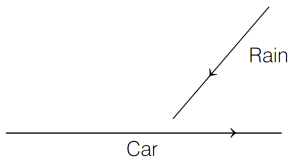
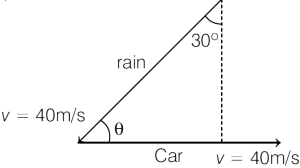
Rain is falling at an angle of $30^{\circ}$ from the vertical due to the wind with a speed of $40 \ m/s$. $A$ car is travelling horizontally in the direction opposite to the wind,at a speed of $40 \ m/s$. At what angle from the vertical will it experience the rain falling from (in $^{\circ}$)?
A
$30$
B
$60$
C
$90$
D
$120$
Solution
(B) Let the velocity of rain be $\vec{v}_r$. The horizontal component of rain velocity is $v_{rx} = v_r \sin(30^{\circ})$ and the vertical component is $v_{ry} = v_r \cos(30^{\circ})$.
Given that the rain is falling at $30^{\circ}$ from the vertical with a speed of $40 \ m/s$,we have $v_r = 40 \ m/s$.
Thus,$v_{rx} = 40 \sin(30^{\circ}) = 40 \times 0.5 = 20 \ m/s$ and $v_{ry} = 40 \cos(30^{\circ}) = 40 \times \frac{\sqrt{3}}{2} = 20\sqrt{3} \ m/s$.
The car is moving in the opposite direction to the horizontal component of the rain with a speed $v_c = 40 \ m/s$.
Let the velocity of the car be $\vec{v}_c = 40 \hat{i} \ m/s$. The velocity of rain relative to the car is $\vec{v}_{rc} = \vec{v}_r - \vec{v}_c$.
Assuming the rain's horizontal component is in the negative $x$-direction,$\vec{v}_r = -20 \hat{i} - 20\sqrt{3} \hat{j}$.
Then $\vec{v}_{rc} = (-20 \hat{i} - 20\sqrt{3} \hat{j}) - (40 \hat{i}) = -60 \hat{i} - 20\sqrt{3} \hat{j}$.
The angle $\alpha$ with the vertical is given by $\tan(\alpha) = \frac{|v_{rc,x}|}{|v_{rc,y}|} = \frac{60}{20\sqrt{3}} = \frac{3}{\sqrt{3}} = \sqrt{3}$.
Therefore,$\alpha = \tan^{-1}(\sqrt{3}) = 60^{\circ}$.
Given that the rain is falling at $30^{\circ}$ from the vertical with a speed of $40 \ m/s$,we have $v_r = 40 \ m/s$.
Thus,$v_{rx} = 40 \sin(30^{\circ}) = 40 \times 0.5 = 20 \ m/s$ and $v_{ry} = 40 \cos(30^{\circ}) = 40 \times \frac{\sqrt{3}}{2} = 20\sqrt{3} \ m/s$.
The car is moving in the opposite direction to the horizontal component of the rain with a speed $v_c = 40 \ m/s$.
Let the velocity of the car be $\vec{v}_c = 40 \hat{i} \ m/s$. The velocity of rain relative to the car is $\vec{v}_{rc} = \vec{v}_r - \vec{v}_c$.
Assuming the rain's horizontal component is in the negative $x$-direction,$\vec{v}_r = -20 \hat{i} - 20\sqrt{3} \hat{j}$.
Then $\vec{v}_{rc} = (-20 \hat{i} - 20\sqrt{3} \hat{j}) - (40 \hat{i}) = -60 \hat{i} - 20\sqrt{3} \hat{j}$.
The angle $\alpha$ with the vertical is given by $\tan(\alpha) = \frac{|v_{rc,x}|}{|v_{rc,y}|} = \frac{60}{20\sqrt{3}} = \frac{3}{\sqrt{3}} = \sqrt{3}$.
Therefore,$\alpha = \tan^{-1}(\sqrt{3}) = 60^{\circ}$.
0 likes
View Solution178
EasyMCQ
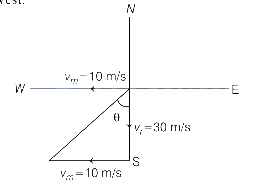
Rain is falling vertically with a speed of $30 \,m/s$. A man rides a bicycle with a speed of $10 \,m/s$ from East to West direction. At what angle with the vertical does he see the rain falling?
A
$\tan^{-1}(1/3)$ towards West
B
$\tan^{-1}(3)$ towards West
C
$\tan^{-1}(1/3)$ towards East
D
$\tan^{-1}(3)$ towards East
Solution
(A) Given, speed of rain in vertical direction, $v_r = 30 \,m/s$.
Speed of the man, $v_m = 10 \,m/s$ (towards West).
The relative velocity of rain with respect to the man is $\vec{v}_{rm} = \vec{v}_r - \vec{v}_m$.
Since the man is moving towards the West, the relative velocity vector $\vec{v}_{rm}$ will be directed towards the West relative to the vertical.
Let $\theta$ be the angle with the vertical.
From the vector triangle, $\tan \theta = \frac{v_m}{v_r} = \frac{10}{30} = \frac{1}{3}$.
Therefore, $\theta = \tan^{-1}(1/3)$ towards the West direction.
Speed of the man, $v_m = 10 \,m/s$ (towards West).
The relative velocity of rain with respect to the man is $\vec{v}_{rm} = \vec{v}_r - \vec{v}_m$.
Since the man is moving towards the West, the relative velocity vector $\vec{v}_{rm}$ will be directed towards the West relative to the vertical.
Let $\theta$ be the angle with the vertical.
From the vector triangle, $\tan \theta = \frac{v_m}{v_r} = \frac{10}{30} = \frac{1}{3}$.
Therefore, $\theta = \tan^{-1}(1/3)$ towards the West direction.
0 likes
View Solution179
EasyMCQ
$A$ swimmer wants to cross a $200 \ m$ wide river which is flowing at a speed of $2 \ m/s$. The velocity of the swimmer with respect to the river is $1 \ m/s$. How far from the point directly opposite to the starting point does the swimmer reach the opposite bank (in $m$)?
A
$200$
B
$400$
C
$600$
D
$800$
Solution
(B) Given:
Width of the river $(w) = 200 \ m$
Velocity of the river $(v_r) = 2 \ m/s$
Velocity of the swimmer with respect to the river $(v_{sr}) = 1 \ m/s$
To cross the river in the shortest time,the swimmer should swim perpendicular to the river flow.
The time taken to cross the river is $t = \frac{w}{v_{sr}} = \frac{200 \ m}{1 \ m/s} = 200 \ s$.
During this time,the swimmer is carried downstream by the river flow.
The distance drifted downstream $(d)$ is given by $d = v_r \times t$.
$d = 2 \ m/s \times 200 \ s = 400 \ m$.
Therefore,the swimmer reaches the opposite bank at a distance of $400 \ m$ from the point directly opposite to the starting point.
Width of the river $(w) = 200 \ m$
Velocity of the river $(v_r) = 2 \ m/s$
Velocity of the swimmer with respect to the river $(v_{sr}) = 1 \ m/s$
To cross the river in the shortest time,the swimmer should swim perpendicular to the river flow.
The time taken to cross the river is $t = \frac{w}{v_{sr}} = \frac{200 \ m}{1 \ m/s} = 200 \ s$.
During this time,the swimmer is carried downstream by the river flow.
The distance drifted downstream $(d)$ is given by $d = v_r \times t$.
$d = 2 \ m/s \times 200 \ s = 400 \ m$.
Therefore,the swimmer reaches the opposite bank at a distance of $400 \ m$ from the point directly opposite to the starting point.
0 likes
View Solution180
DifficultMCQ
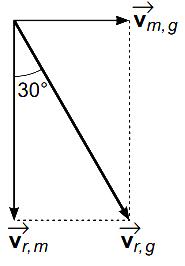
$A$ man standing on a road has to hold his umbrella at $30^{\circ}$ with the vertical to keep the rain away. He throws the umbrella and starts running at $10 \,km/h$. He finds that raindrops are hitting his head vertically. The actual speed of raindrops is:
A
$20 \,km/h$
B
$10 \sqrt{3} \,km/h$
C
$20 \sqrt{3} \,km/h$
D
$10 \,km/h$
Solution
$(\text{A})$ Let $\vec{v}_{r,g}$ be the velocity of rain with respect to the ground, $\vec{v}_{m,g}$ be the velocity of the man with respect to the ground, and $\vec{v}_{r,m}$ be the velocity of rain with respect to the man.
When the man is at rest, the rain falls at $30^{\circ}$ with the vertical. Thus, the horizontal component of $\vec{v}_{r,g}$ is $v_{r,g} \sin 30^{\circ}$ and the vertical component is $v_{r,g} \cos 30^{\circ}$.
When the man runs at $v_{m,g} = 10 \,km/h$, the rain appears to fall vertically. This means the horizontal component of the relative velocity $\vec{v}_{r,m} = \vec{v}_{r,g} - \vec{v}_{m,g}$ must be zero.
Therefore, the horizontal component of $\vec{v}_{r,g}$ must be equal to the velocity of the man:
$v_{r,g} \sin 30^{\circ} = v_{m,g}$
$v_{r,g} \times (1/2) = 10 \,km/h$
$v_{r,g} = 20 \,km/h$.
When the man is at rest, the rain falls at $30^{\circ}$ with the vertical. Thus, the horizontal component of $\vec{v}_{r,g}$ is $v_{r,g} \sin 30^{\circ}$ and the vertical component is $v_{r,g} \cos 30^{\circ}$.
When the man runs at $v_{m,g} = 10 \,km/h$, the rain appears to fall vertically. This means the horizontal component of the relative velocity $\vec{v}_{r,m} = \vec{v}_{r,g} - \vec{v}_{m,g}$ must be zero.
Therefore, the horizontal component of $\vec{v}_{r,g}$ must be equal to the velocity of the man:
$v_{r,g} \sin 30^{\circ} = v_{m,g}$
$v_{r,g} \times (1/2) = 10 \,km/h$
$v_{r,g} = 20 \,km/h$.
0 likes
View Solution181
MediumMCQ
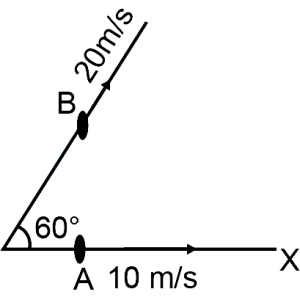
Particle $A$ moves along the $X$-axis with a uniform velocity of magnitude $10 \ m/s$. Particle $B$ moves with a uniform velocity of $20 \ m/s$ along a direction making an angle of $60^{\circ}$ with the positive direction of the $X$-axis as shown in the figure. The relative velocity of $B$ with respect to $A$ is
A
$10 \ m/s$ along the $X$-axis
B
$10 \sqrt{3} \ m/s$ along the $Y$-axis (perpendicular to the $X$-axis)
C
$10 \sqrt{5} \ m/s$ along the bisection of the velocities of $A$ and $B$
D
$30 \ m/s$ along the negative $X$-axis
Solution
(B) The velocity of particle $A$ is given by $\vec{v}_A = 10 \hat{i} \ m/s$.
The velocity of particle $B$ can be resolved into components. Its magnitude is $20 \ m/s$ at an angle of $60^{\circ}$ with the $X$-axis:
$\vec{v}_B = (20 \cos 60^{\circ}) \hat{i} + (20 \sin 60^{\circ}) \hat{j}$
$\vec{v}_B = (20 \times 0.5) \hat{i} + (20 \times \frac{\sqrt{3}}{2}) \hat{j} = 10 \hat{i} + 10 \sqrt{3} \hat{j} \ m/s$.
The relative velocity of $B$ with respect to $A$ is $\vec{v}_{BA} = \vec{v}_B - \vec{v}_A$.
$\vec{v}_{BA} = (10 \hat{i} + 10 \sqrt{3} \hat{j}) - (10 \hat{i}) = 10 \sqrt{3} \hat{j} \ m/s$.
This result indicates a velocity of magnitude $10 \sqrt{3} \ m/s$ directed along the positive $Y$-axis,which is perpendicular to the $X$-axis.
The velocity of particle $B$ can be resolved into components. Its magnitude is $20 \ m/s$ at an angle of $60^{\circ}$ with the $X$-axis:
$\vec{v}_B = (20 \cos 60^{\circ}) \hat{i} + (20 \sin 60^{\circ}) \hat{j}$
$\vec{v}_B = (20 \times 0.5) \hat{i} + (20 \times \frac{\sqrt{3}}{2}) \hat{j} = 10 \hat{i} + 10 \sqrt{3} \hat{j} \ m/s$.
The relative velocity of $B$ with respect to $A$ is $\vec{v}_{BA} = \vec{v}_B - \vec{v}_A$.
$\vec{v}_{BA} = (10 \hat{i} + 10 \sqrt{3} \hat{j}) - (10 \hat{i}) = 10 \sqrt{3} \hat{j} \ m/s$.
This result indicates a velocity of magnitude $10 \sqrt{3} \ m/s$ directed along the positive $Y$-axis,which is perpendicular to the $X$-axis.
0 likes
View Solution182
DifficultMCQ
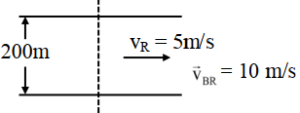
$A$ river of width $200 \ m$ is flowing from west to east with a speed of $18 \ km/h$. $A$ boat,moving with a speed of $36 \ km/h$ in still water,is made to travel one round trip (bank to bank of the river). The minimum time taken by the boat for this journey and the displacement along the river bank are . . . . . . and . . . . . . respectively.
A
$20 \ s$ and $100 \ m$
B
$40 \ s$ and $0 \ m$
C
$40 \ s$ and $200 \ m$
D
$40 \ s$ and $100 \ m$
Solution
(C) Given: Width of the river $d = 200 \ m$,velocity of river $v_R = 18 \ km/h = 18 \times \frac{5}{18} = 5 \ m/s$,velocity of boat in still water $v_{BR} = 36 \ km/h = 36 \times \frac{5}{18} = 10 \ m/s$.
To cross the river in minimum time,the boat must head perpendicular to the river flow.
The time taken to cross the river once is $t = \frac{d}{v_{BR}} = \frac{200}{10} = 20 \ s$.
For a round trip (going and coming back),the total time taken is $T = 20 + 20 = 40 \ s$.
During this time,the boat is carried downstream by the river flow. The velocity of the boat relative to the ground along the river bank is $v_R = 5 \ m/s$.
The displacement along the river bank is $x = v_R \times T = 5 \times 40 = 200 \ m$.
To cross the river in minimum time,the boat must head perpendicular to the river flow.
The time taken to cross the river once is $t = \frac{d}{v_{BR}} = \frac{200}{10} = 20 \ s$.
For a round trip (going and coming back),the total time taken is $T = 20 + 20 = 40 \ s$.
During this time,the boat is carried downstream by the river flow. The velocity of the boat relative to the ground along the river bank is $v_R = 5 \ m/s$.
The displacement along the river bank is $x = v_R \times T = 5 \times 40 = 200 \ m$.
0 likes
View Solution183
DifficultMCQ
Two cars $A$ and $B$ are moving in the same direction along a straight line with speeds $100 \text{ km/h}$ and $80 \text{ km/h}$,respectively,such that car $A$ is moving ahead of car $B$. $A$ person in car $B$ throws a stone with a speed $v$ so that it hits car $A$ with a speed of $5 \text{ m/s}$. The value of $v$ is . . . . . . $\text{km/h}$.
A
$18$
B
$28$
C
$38$
D
$48$
Solution
(C) Let the velocity of car $A$ be $v_A = 100 \text{ km/h}$ and car $B$ be $v_B = 80 \text{ km/h}$.
Relative velocity of $A$ with respect to $B$ is $v_{AB} = v_A - v_B = 100 - 80 = 20 \text{ km/h}$.
Converting this to $\text{m/s}$,we get $20 \times (5/18) = 5.55 \text{ m/s}$.
Let the velocity of the stone relative to car $B$ be $v$. Since the stone is thrown towards $A$,its velocity relative to the ground is $v_{sg} = v + v_B$.
The velocity of the stone relative to car $A$ is $v_{sa} = v_{sg} - v_A = (v + v_B) - v_A = v - (v_A - v_B) = v - 20 \text{ km/h}$.
Given that the speed of the stone relative to $A$ is $5 \text{ m/s}$,which is $5 \times (18/5) = 18 \text{ km/h}$.
Thus,$|v - 20| = 18$.
Since the stone must hit car $A$ (which is ahead),$v$ must be greater than $20 \text{ km/h}$.
Therefore,$v - 20 = 18$,which gives $v = 38 \text{ km/h}$.
Relative velocity of $A$ with respect to $B$ is $v_{AB} = v_A - v_B = 100 - 80 = 20 \text{ km/h}$.
Converting this to $\text{m/s}$,we get $20 \times (5/18) = 5.55 \text{ m/s}$.
Let the velocity of the stone relative to car $B$ be $v$. Since the stone is thrown towards $A$,its velocity relative to the ground is $v_{sg} = v + v_B$.
The velocity of the stone relative to car $A$ is $v_{sa} = v_{sg} - v_A = (v + v_B) - v_A = v - (v_A - v_B) = v - 20 \text{ km/h}$.
Given that the speed of the stone relative to $A$ is $5 \text{ m/s}$,which is $5 \times (18/5) = 18 \text{ km/h}$.
Thus,$|v - 20| = 18$.
Since the stone must hit car $A$ (which is ahead),$v$ must be greater than $20 \text{ km/h}$.
Therefore,$v - 20 = 18$,which gives $v = 38 \text{ km/h}$.
0 likes
View Solution3-2.Motion in Plane — Relative Velocity (river boat, rain, wind) · Frequently Asked Questions
1Are these 3-2.Motion in Plane questions useful for JEE and NEET?
Yes. All questions in this section are mapped to JEE Main and NEET exam patterns. Previous year questions from JEE Main, NEET, GUJCET and state-level exams are included with full solutions.
2Can I switch to Hindi or Gujarati for these questions?
Yes. Use the language tabs in the hero section or the sidebar to view the same questions and solutions in English, Hindi or Gujarati.
3How do I generate a question paper from this subtopic?
Use the Vedclass Exam Paper Generator — select the chapter and subtopic, set difficulty, and generate Sets A, B, C, D automatically. First 3 chapters of every subject are free.
Vedclass Products
For Students
Vedclass Test Series
Mock tests in real JEE/NEET style with performance analysis. 5-day free trial.
Start Free TrialFor Teachers
Exam Paper Generator
Generate Set A/B/C/D papers from this chapter in 2 minutes. 3 chapters free.
Try FreeFor Institutes
Online Exam Module
Live online exams with unlimited students, 360° analytics & white-label branding.
See DemoFor Teachers & Institutes
Generate a 3-2.Motion in Plane Exam Paper in 2 Minutes
Select subtopic & difficulty — Sets A, B, C, D auto-generated with No Repeat logic.
First 3 chapters of every subject are free — no payment required.