
A English
Relative Velocity (river boat, rain, wind) Questions in English
Class 11 Physics · 3-2.Motion in Plane · Relative Velocity (river boat, rain, wind)
185+
Questions
English
Language
100%
With Solutions
Showing 50 of 185 questions in English
51
MediumMCQ
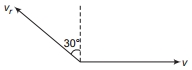
$A$ person running horizontally observes that rain is falling on his head vertically with a speed of $10\,m/s$. When he stops,he observes that the rain is falling at an angle of $30^o$ with the vertical. Find the speed with which the man was running.
A
$20\,m/s$
B
$\frac{20}{\sqrt{3}}\,m/s$
C
$10\sqrt{3}\,m/s$
D
$\frac{10}{\sqrt{3}}\,m/s$
Solution
(D) Let $\vec{V}_r$ be the velocity of rain and $\vec{V}_m$ be the velocity of the man.
When the man is running,the relative velocity of rain with respect to the man is $\vec{V}_{rm} = \vec{V}_r - \vec{V}_m$. Given that this is vertical,$\vec{V}_{rm} = -10\hat{j}$.
Thus,$\vec{V}_r - \vec{V}_m = -10\hat{j}$,which implies $\vec{V}_r = \vec{V}_m - 10\hat{j}$.
Since the man is running horizontally,let $\vec{V}_m = v\hat{i}$. So,$\vec{V}_r = v\hat{i} - 10\hat{j}$.
When the man stops,he observes the actual velocity of the rain $\vec{V}_r$,which makes an angle of $30^o$ with the vertical.
From the components of $\vec{V}_r$,$\tan 30^o = \frac{|v_x|}{|v_y|} = \frac{v}{10}$.
Therefore,$v = 10 \tan 30^o = 10 \times \frac{1}{\sqrt{3}} = \frac{10}{\sqrt{3}}\,m/s$.
When the man is running,the relative velocity of rain with respect to the man is $\vec{V}_{rm} = \vec{V}_r - \vec{V}_m$. Given that this is vertical,$\vec{V}_{rm} = -10\hat{j}$.
Thus,$\vec{V}_r - \vec{V}_m = -10\hat{j}$,which implies $\vec{V}_r = \vec{V}_m - 10\hat{j}$.
Since the man is running horizontally,let $\vec{V}_m = v\hat{i}$. So,$\vec{V}_r = v\hat{i} - 10\hat{j}$.
When the man stops,he observes the actual velocity of the rain $\vec{V}_r$,which makes an angle of $30^o$ with the vertical.
From the components of $\vec{V}_r$,$\tan 30^o = \frac{|v_x|}{|v_y|} = \frac{v}{10}$.
Therefore,$v = 10 \tan 30^o = 10 \times \frac{1}{\sqrt{3}} = \frac{10}{\sqrt{3}}\,m/s$.
0 likes
View Solution52
DifficultMCQ
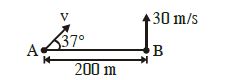
Two particles $A$ and $B$ are moving in a horizontal plane as shown in the figure at $t = 0$. The time after which $A$ will catch $B$ is.......$s$.
A
$4$
B
$5$
C
$2$
D
$8$
Solution
(B) For particle $A$ to catch particle $B$,the component of velocity of $A$ in the direction of $B$'s motion must be equal to the velocity of $B$.
Let the velocity of $A$ be $v$. The velocity of $B$ is $30 \ m/s$ in the vertical direction.
For $A$ to catch $B$,the vertical component of $A$'s velocity must equal $B$'s velocity:
$(v_y)_A = (v_y)_B$
$v \sin 37^{\circ} = 30 \ m/s$
Since $\sin 37^{\circ} = 3/5$,we have:
$v \times (3/5) = 30$
$v = 30 \times (5/3) = 50 \ m/s$
Now,the time taken to catch $B$ is the time required for $A$ to cover the horizontal distance of $200 \ m$ relative to $B$ at the relative horizontal velocity:
Time $t = \frac{\text{Distance}}{\text{Relative horizontal velocity}} = \frac{200}{v \cos 37^{\circ}}$
Since $\cos 37^{\circ} = 4/5$,we have:
$t = \frac{200}{50 \times (4/5)} = \frac{200}{40} = 5 \ s$.
Let the velocity of $A$ be $v$. The velocity of $B$ is $30 \ m/s$ in the vertical direction.
For $A$ to catch $B$,the vertical component of $A$'s velocity must equal $B$'s velocity:
$(v_y)_A = (v_y)_B$
$v \sin 37^{\circ} = 30 \ m/s$
Since $\sin 37^{\circ} = 3/5$,we have:
$v \times (3/5) = 30$
$v = 30 \times (5/3) = 50 \ m/s$
Now,the time taken to catch $B$ is the time required for $A$ to cover the horizontal distance of $200 \ m$ relative to $B$ at the relative horizontal velocity:
Time $t = \frac{\text{Distance}}{\text{Relative horizontal velocity}} = \frac{200}{v \cos 37^{\circ}}$
Since $\cos 37^{\circ} = 4/5$,we have:
$t = \frac{200}{50 \times (4/5)} = \frac{200}{40} = 5 \ s$.
0 likes
View Solution53
MediumMCQ
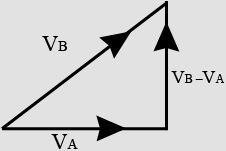
$A$ ship is travelling due east at $10 \, km/hr$. $A$ second ship,heading $30^o$ east of north,is always due north of the first ship. The speed of the second ship in $km/hr$ is:
A
$20 \sqrt{2}$
B
$20 \sqrt{3/2}$
C
$20$
D
$20/\sqrt{2}$
Solution
(C) Let the velocity of the first ship be $\vec{v}_A = 10 \hat{i} \, km/hr$.
Let the velocity of the second ship be $\vec{v}_B = v_B \sin(30^o) \hat{i} + v_B \cos(30^o) \hat{j}$.
Since the second ship is always due north of the first ship,the relative velocity $\vec{v}_{BA} = \vec{v}_B - \vec{v}_A$ must have no component in the east-west direction (i.e.,the $\hat{i}$ component must be zero).
Therefore,$v_B \sin(30^o) - 10 = 0$.
$v_B \times (1/2) = 10$.
$v_B = 20 \, km/hr$.
Let the velocity of the second ship be $\vec{v}_B = v_B \sin(30^o) \hat{i} + v_B \cos(30^o) \hat{j}$.
Since the second ship is always due north of the first ship,the relative velocity $\vec{v}_{BA} = \vec{v}_B - \vec{v}_A$ must have no component in the east-west direction (i.e.,the $\hat{i}$ component must be zero).
Therefore,$v_B \sin(30^o) - 10 = 0$.
$v_B \times (1/2) = 10$.
$v_B = 20 \, km/hr$.
0 likes
View Solution54
EasyMCQ
Two particles $P_1$ and $P_2$ are moving with velocities $v_1$ and $v_2$ respectively. Which of the following statements about their relative velocity $v_{12}$ is true?
A
$v_{12} > (v_1 + v_2)$
B
$v_{12}$ cannot be greater than $v_1 - v_2$
C
$v_{12}$ cannot be greater than $v_1 + v_2$
D
$v_{12} < (v_1 + v_2)$
Solution
(C) The relative velocity of particle $P_1$ with respect to $P_2$ is defined as $\vec{v}_{12} = \vec{v}_1 - \vec{v}_2$.
Using the triangle inequality for vectors,the magnitude of the relative velocity is given by $|\vec{v}_{12}| = |\vec{v}_1 + (-\vec{v}_2)|$.
According to the triangle inequality,$|\vec{a} + \vec{b}| \leq |\vec{a}| + |\vec{b}|$.
Substituting $\vec{a} = \vec{v}_1$ and $\vec{b} = -\vec{v}_2$,we get $|\vec{v}_{12}| \leq |\vec{v}_1| + |-\vec{v}_2|$.
Since $|-\vec{v}_2| = |\vec{v}_2|$,this simplifies to $|\vec{v}_{12}| \leq v_1 + v_2$.
Therefore,the relative velocity $v_{12}$ cannot be greater than the sum of the magnitudes of the individual velocities $v_1 + v_2$.
Using the triangle inequality for vectors,the magnitude of the relative velocity is given by $|\vec{v}_{12}| = |\vec{v}_1 + (-\vec{v}_2)|$.
According to the triangle inequality,$|\vec{a} + \vec{b}| \leq |\vec{a}| + |\vec{b}|$.
Substituting $\vec{a} = \vec{v}_1$ and $\vec{b} = -\vec{v}_2$,we get $|\vec{v}_{12}| \leq |\vec{v}_1| + |-\vec{v}_2|$.
Since $|-\vec{v}_2| = |\vec{v}_2|$,this simplifies to $|\vec{v}_{12}| \leq v_1 + v_2$.
Therefore,the relative velocity $v_{12}$ cannot be greater than the sum of the magnitudes of the individual velocities $v_1 + v_2$.
0 likes
View Solution55
MediumMCQ
$A$ man goes $10\,km$ downstream in $2\,hrs$ and $30\,km$ upstream in $10\,hrs$. How much time will he take to swim $40\,km$ in still water?
A
$8$
B
$10$
C
$12$
D
$6$
Solution
(B) Let $v_m$ be the speed of the man in still water and $v_r$ be the speed of the river current.
Downstream speed: $v_m + v_r = \frac{10\,km}{2\,hrs} = 5\,km/h$ $...(i)$
Upstream speed: $v_m - v_r = \frac{30\,km}{10\,hrs} = 3\,km/h$ $...(ii)$
Adding equations $(i)$ and $(ii)$:
$2v_m = 8\,km/h \Rightarrow v_m = 4\,km/h$
Time taken to swim $40\,km$ in still water:
$t = \frac{Distance}{v_m} = \frac{40\,km}{4\,km/h} = 10\,hrs$.
Downstream speed: $v_m + v_r = \frac{10\,km}{2\,hrs} = 5\,km/h$ $...(i)$
Upstream speed: $v_m - v_r = \frac{30\,km}{10\,hrs} = 3\,km/h$ $...(ii)$
Adding equations $(i)$ and $(ii)$:
$2v_m = 8\,km/h \Rightarrow v_m = 4\,km/h$
Time taken to swim $40\,km$ in still water:
$t = \frac{Distance}{v_m} = \frac{40\,km}{4\,km/h} = 10\,hrs$.
0 likes
View Solution56
MediumMCQ
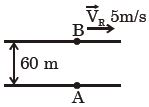
$A$ man is crossing a river flowing with a velocity of $5 \ m/s$. He reaches a point directly across at a distance of $60 \ m$ in $5 \ s$. His velocity in still water should be: (in $m/s$)
A
$12$
B
$13$
C
$5$
D
$10$
Solution
(B) Let $v$ be the velocity of the man in still water and $u = 5 \ m/s$ be the velocity of the river flow.
To reach a point directly across,the man must swim at an angle such that his resultant velocity is perpendicular to the river flow.
The effective velocity of the man across the river is $v_{eff} = \sqrt{v^2 - u^2}$.
The time taken to cross the river is given by $t = \frac{d}{v_{eff}}$,where $d = 60 \ m$ is the width of the river.
Substituting the given values: $5 = \frac{60}{\sqrt{v^2 - 5^2}}$.
$\sqrt{v^2 - 25} = \frac{60}{5} = 12$.
Squaring both sides: $v^2 - 25 = 144$.
$v^2 = 144 + 25 = 169$.
$v = \sqrt{169} = 13 \ m/s$.
To reach a point directly across,the man must swim at an angle such that his resultant velocity is perpendicular to the river flow.
The effective velocity of the man across the river is $v_{eff} = \sqrt{v^2 - u^2}$.
The time taken to cross the river is given by $t = \frac{d}{v_{eff}}$,where $d = 60 \ m$ is the width of the river.
Substituting the given values: $5 = \frac{60}{\sqrt{v^2 - 5^2}}$.
$\sqrt{v^2 - 25} = \frac{60}{5} = 12$.
Squaring both sides: $v^2 - 25 = 144$.
$v^2 = 144 + 25 = 169$.
$v = \sqrt{169} = 13 \ m/s$.
0 likes
View Solution57
MediumMCQ
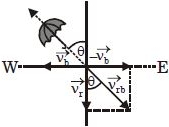
Rain is falling vertically with a speed of $30\,ms^{-1}$. $A$ woman rides a bicycle with a speed of $12\,ms^{-1}$ in the east to west direction. She should hold her umbrella:
A
At an angle of $tan^{-1} (\frac {2}{5})$ with the vertical towards the east
B
At an angle of $tan^{-1} (\frac {2}{5})$ with the vertical towards the west
C
At an angle of $tan^{-1} (\frac {5}{2})$ with the vertical towards the east
D
At an angle of $tan^{-1} (\frac {5}{2})$ with the vertical towards the west
Solution
(B) Let the velocity of rain be $\vec{v}_r = -30\hat{j}\,ms^{-1}$ and the velocity of the bicycle be $\vec{v}_b = -12\hat{i}\,ms^{-1}$ (since she is moving from east to west).
The relative velocity of rain with respect to the woman is $\vec{v}_{rb} = \vec{v}_r - \vec{v}_b = -30\hat{j} - (-12\hat{i}) = 12\hat{i} - 30\hat{j}\,ms^{-1}$.
To protect herself from rain,she must hold the umbrella in the direction of the relative velocity of rain $\vec{v}_{rb}$.
The angle $\theta$ with the vertical is given by $\tan \theta = \frac{|v_b|}{|v_r|} = \frac{12}{30} = \frac{2}{5}$.
Thus,$\theta = \tan^{-1}(\frac{2}{5})$.
Since the relative velocity vector has a positive $x$-component (eastward relative to the woman) and a negative $y$-component (downward),the rain appears to come from the east. Therefore,she must tilt her umbrella towards the west to block the rain.
The relative velocity of rain with respect to the woman is $\vec{v}_{rb} = \vec{v}_r - \vec{v}_b = -30\hat{j} - (-12\hat{i}) = 12\hat{i} - 30\hat{j}\,ms^{-1}$.
To protect herself from rain,she must hold the umbrella in the direction of the relative velocity of rain $\vec{v}_{rb}$.
The angle $\theta$ with the vertical is given by $\tan \theta = \frac{|v_b|}{|v_r|} = \frac{12}{30} = \frac{2}{5}$.
Thus,$\theta = \tan^{-1}(\frac{2}{5})$.
Since the relative velocity vector has a positive $x$-component (eastward relative to the woman) and a negative $y$-component (downward),the rain appears to come from the east. Therefore,she must tilt her umbrella towards the west to block the rain.
0 likes
View Solution58
MediumMCQ
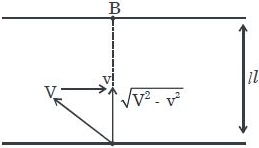
An aeroplane is to go along a straight line from $A$ to $B$,and back again. The relative speed with respect to wind is $V$. The wind blows perpendicular to the line $AB$ with speed $v$. The distance between $A$ and $B$ is $\ell$. The total time for the round trip is:
A
$\frac{2\ell}{\sqrt{V^2 - v^2}}$
B
$\frac{2v\ell}{V^2 - v^2}$
C
$\frac{2V\ell}{V^2 - v^2}$
D
$\frac{2\ell}{\sqrt{V^2 + v^2}}$
Solution
(A) To travel from $A$ to $B$ in a straight line while a wind of speed $v$ blows perpendicular to $AB$,the aeroplane must head at an angle such that its resultant velocity vector points directly along $AB$.
Let the resultant velocity of the aeroplane relative to the ground be $V_g$.
Using the Pythagorean theorem,$V^2 = V_g^2 + v^2$,which gives the ground speed $V_g = \sqrt{V^2 - v^2}$.
The time taken to travel from $A$ to $B$ is $t_1 = \frac{\ell}{V_g} = \frac{\ell}{\sqrt{V^2 - v^2}}$.
Similarly,the time taken to return from $B$ to $A$ is $t_2 = \frac{\ell}{V_g} = \frac{\ell}{\sqrt{V^2 - v^2}}$.
The total time for the round trip is $T = t_1 + t_2 = \frac{\ell}{\sqrt{V^2 - v^2}} + \frac{\ell}{\sqrt{V^2 - v^2}} = \frac{2\ell}{\sqrt{V^2 - v^2}}$.
Let the resultant velocity of the aeroplane relative to the ground be $V_g$.
Using the Pythagorean theorem,$V^2 = V_g^2 + v^2$,which gives the ground speed $V_g = \sqrt{V^2 - v^2}$.
The time taken to travel from $A$ to $B$ is $t_1 = \frac{\ell}{V_g} = \frac{\ell}{\sqrt{V^2 - v^2}}$.
Similarly,the time taken to return from $B$ to $A$ is $t_2 = \frac{\ell}{V_g} = \frac{\ell}{\sqrt{V^2 - v^2}}$.
The total time for the round trip is $T = t_1 + t_2 = \frac{\ell}{\sqrt{V^2 - v^2}} + \frac{\ell}{\sqrt{V^2 - v^2}} = \frac{2\ell}{\sqrt{V^2 - v^2}}$.
0 likes
View Solution59
MediumMCQ
$A$ stationary man observes that the rain is falling vertically downward. When he starts running with a velocity of $12 \ km/h$,he observes that the rain is falling at an angle of $60^{\circ}$ with the vertical. The actual velocity of the rain is:
A
$12\sqrt{3} \ km/h$
B
$6\sqrt{3} \ km/h$
C
$4\sqrt{3} \ km/h$
D
$2\sqrt{3} \ km/h$
Solution
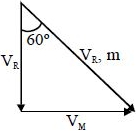
(C) Let $\vec{V}_R$ be the actual velocity of the rain (vertically downward) and $\vec{V}_M$ be the velocity of the man ($12 \ km/h$ horizontally).
The relative velocity of the rain with respect to the man is $\vec{V}_{RM} = \vec{V}_R - \vec{V}_M$.
From the vector diagram,the angle $\theta = 60^{\circ}$ is between the vertical (direction of $\vec{V}_R$) and the relative velocity vector $\vec{V}_{RM}$.
Using trigonometry in the right-angled triangle formed by $\vec{V}_R$,$\vec{V}_M$,and $\vec{V}_{RM}$:
$\tan(60^{\circ}) = \frac{\text{Opposite}}{\text{Adjacent}} = \frac{V_M}{V_R}$
Substituting the known values:
$\sqrt{3} = \frac{12}{V_R}$
Solving for $V_R$:
$V_R = \frac{12}{\sqrt{3}} = \frac{12 \times \sqrt{3}}{3} = 4\sqrt{3} \ km/h$.
The relative velocity of the rain with respect to the man is $\vec{V}_{RM} = \vec{V}_R - \vec{V}_M$.
From the vector diagram,the angle $\theta = 60^{\circ}$ is between the vertical (direction of $\vec{V}_R$) and the relative velocity vector $\vec{V}_{RM}$.
Using trigonometry in the right-angled triangle formed by $\vec{V}_R$,$\vec{V}_M$,and $\vec{V}_{RM}$:
$\tan(60^{\circ}) = \frac{\text{Opposite}}{\text{Adjacent}} = \frac{V_M}{V_R}$
Substituting the known values:
$\sqrt{3} = \frac{12}{V_R}$
Solving for $V_R$:
$V_R = \frac{12}{\sqrt{3}} = \frac{12 \times \sqrt{3}}{3} = 4\sqrt{3} \ km/h$.
0 likes
View Solution60
MediumMCQ
$A$ person climbs up a stalled escalator in $60\,s$. If standing on the same but escalator running with constant velocity,he takes $40\,s$. How much time is taken by the person to walk up the moving escalator?........$s$
A
$37$
B
$27$
C
$24$
D
$45$
Solution
(C) Let the length of the escalator be $L$.
Speed of the person walking on the stalled escalator is $v_p = \frac{L}{60}$.
Speed of the escalator is $v_e = \frac{L}{40}$.
When the person walks on the moving escalator,their effective speed is $v_{eff} = v_p + v_e$.
$v_{eff} = \frac{L}{60} + \frac{L}{40} = L \left( \frac{2+3}{120} \right) = \frac{5L}{120} = \frac{L}{24}$.
The time taken to cover the distance $L$ is $t = \frac{L}{v_{eff}} = \frac{L}{L/24} = 24\,s$.
Speed of the person walking on the stalled escalator is $v_p = \frac{L}{60}$.
Speed of the escalator is $v_e = \frac{L}{40}$.
When the person walks on the moving escalator,their effective speed is $v_{eff} = v_p + v_e$.
$v_{eff} = \frac{L}{60} + \frac{L}{40} = L \left( \frac{2+3}{120} \right) = \frac{5L}{120} = \frac{L}{24}$.
The time taken to cover the distance $L$ is $t = \frac{L}{v_{eff}} = \frac{L}{L/24} = 24\,s$.
0 likes
View Solution61
DifficultMCQ
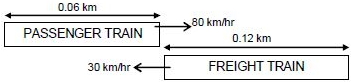
$A$ passenger train of length $60\, m$ travels at a speed of $80\, km/hr$. Another freight train of length $120\, m$ travels at a speed of $30\, km/hr$. The ratio of times taken by the passenger train to completely cross the freight train when:
$(i)$ they are moving in the same direction,and
$(ii)$ in the opposite directions is
$(i)$ they are moving in the same direction,and
$(ii)$ in the opposite directions is
A
$2.2$
B
$2.5$
C
$1.5$
D
$\frac{22}{11} = 2.0$
Solution
(A) The total distance to be covered by the passenger train to completely cross the freight train is the sum of their lengths: $D = 60\, m + 120\, m = 180\, m = 0.18\, km$.
$(i)$ When moving in the same direction,the relative speed is $v_{rel} = 80 - 30 = 50\, km/hr$.
The time taken is $t_1 = \frac{D}{v_{rel}} = \frac{0.18}{50}\, hr$.
$(ii)$ When moving in the opposite direction,the relative speed is $v_{rel} = 80 + 30 = 110\, km/hr$.
The time taken is $t_2 = \frac{D}{v_{rel}} = \frac{0.18}{110}\, hr$.
The ratio of the times is $\frac{t_1}{t_2} = \frac{0.18 / 50}{0.18 / 110} = \frac{110}{50} = \frac{11}{5} = 2.2$.
$(i)$ When moving in the same direction,the relative speed is $v_{rel} = 80 - 30 = 50\, km/hr$.
The time taken is $t_1 = \frac{D}{v_{rel}} = \frac{0.18}{50}\, hr$.
$(ii)$ When moving in the opposite direction,the relative speed is $v_{rel} = 80 + 30 = 110\, km/hr$.
The time taken is $t_2 = \frac{D}{v_{rel}} = \frac{0.18}{110}\, hr$.
The ratio of the times is $\frac{t_1}{t_2} = \frac{0.18 / 50}{0.18 / 110} = \frac{110}{50} = \frac{11}{5} = 2.2$.
0 likes
View Solution62
DifficultMCQ
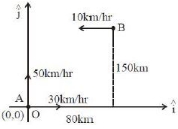
Ship $A$ is sailing towards north-east with velocity $\vec{v}_A = 30\hat{i} + 50\hat{j}\,\text{km/hr}$,where $\hat{i}$ points east and $\hat{j}$ points north. Ship $B$ is at a distance of $80\,\text{km}$ east and $150\,\text{km}$ north of Ship $A$ and is sailing towards west at $10\,\text{km/hr}$. After how many hours will Ship $A$ be at the minimum distance from Ship $B$?
A
$2.2$
B
$4.2$
C
$2.6$
D
$3.2$
Solution
(C) Let the position of ship $A$ be at the origin $(0,0)$.
The initial position vectors are $\vec{r}_A = 0\hat{i} + 0\hat{j}$ and $\vec{r}_B = 80\hat{i} + 150\hat{j}$.
The velocity vectors are $\vec{v}_A = 30\hat{i} + 50\hat{j}$ and $\vec{v}_B = -10\hat{i}$.
The relative position vector is $\vec{r}_{BA} = \vec{r}_B - \vec{r}_A = 80\hat{i} + 150\hat{j}$.
The relative velocity vector is $\vec{v}_{BA} = \vec{v}_B - \vec{v}_A = (-10\hat{i}) - (30\hat{i} + 50\hat{j}) = -40\hat{i} - 50\hat{j}$.
The time $t$ at which the distance is minimum is given by $t = -\frac{\vec{r}_{BA} \cdot \vec{v}_{BA}}{|\vec{v}_{BA}|^2}$.
Substituting the values:
$t = -\frac{(80\hat{i} + 150\hat{j}) \cdot (-40\hat{i} - 50\hat{j})}{(-40)^2 + (-50)^2}$
$t = -\frac{(80 \times -40) + (150 \times -50)}{1600 + 2500}$
$t = -\frac{-3200 - 7500}{4100} = \frac{10700}{4100} = \frac{107}{41} \approx 2.61\,\text{hrs}$.
Rounding to the nearest given option,the time is $2.6\,\text{hrs}$.
The initial position vectors are $\vec{r}_A = 0\hat{i} + 0\hat{j}$ and $\vec{r}_B = 80\hat{i} + 150\hat{j}$.
The velocity vectors are $\vec{v}_A = 30\hat{i} + 50\hat{j}$ and $\vec{v}_B = -10\hat{i}$.
The relative position vector is $\vec{r}_{BA} = \vec{r}_B - \vec{r}_A = 80\hat{i} + 150\hat{j}$.
The relative velocity vector is $\vec{v}_{BA} = \vec{v}_B - \vec{v}_A = (-10\hat{i}) - (30\hat{i} + 50\hat{j}) = -40\hat{i} - 50\hat{j}$.
The time $t$ at which the distance is minimum is given by $t = -\frac{\vec{r}_{BA} \cdot \vec{v}_{BA}}{|\vec{v}_{BA}|^2}$.
Substituting the values:
$t = -\frac{(80\hat{i} + 150\hat{j}) \cdot (-40\hat{i} - 50\hat{j})}{(-40)^2 + (-50)^2}$
$t = -\frac{(80 \times -40) + (150 \times -50)}{1600 + 2500}$
$t = -\frac{-3200 - 7500}{4100} = \frac{10700}{4100} = \frac{107}{41} \approx 2.61\,\text{hrs}$.
Rounding to the nearest given option,the time is $2.6\,\text{hrs}$.
1 likes
View Solution63
MediumMCQ
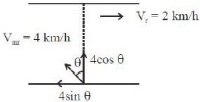
The stream of a river is flowing with a speed of $2\,km/h$. $A$ swimmer can swim at a speed of $4\,km/h$. What should be the direction of the swimmer with respect to the flow of the river to cross the river straight (in $^\circ$)?
A
$60$
B
$90$
C
$120$
D
$150$
Solution
(C) To cross the river straight,the component of the swimmer's velocity perpendicular to the river flow must cancel out the river's velocity component in the opposite direction.
Let $\theta$ be the angle the swimmer makes with the line perpendicular to the river flow.
The velocity of the river is $v_r = 2\,km/h$.
The velocity of the swimmer is $v_s = 4\,km/h$.
For the swimmer to move straight across,the horizontal component of the swimmer's velocity must equal the river's velocity:
$v_s \sin \theta = v_r$
$4 \sin \theta = 2$
$\sin \theta = \frac{2}{4} = \frac{1}{2}$
$\theta = 30^\circ$ (with respect to the perpendicular line).
The angle with respect to the direction of the river flow is $90^\circ + \theta = 90^\circ + 30^\circ = 120^\circ$.
Let $\theta$ be the angle the swimmer makes with the line perpendicular to the river flow.
The velocity of the river is $v_r = 2\,km/h$.
The velocity of the swimmer is $v_s = 4\,km/h$.
For the swimmer to move straight across,the horizontal component of the swimmer's velocity must equal the river's velocity:
$v_s \sin \theta = v_r$
$4 \sin \theta = 2$
$\sin \theta = \frac{2}{4} = \frac{1}{2}$
$\theta = 30^\circ$ (with respect to the perpendicular line).
The angle with respect to the direction of the river flow is $90^\circ + \theta = 90^\circ + 30^\circ = 120^\circ$.
0 likes
View Solution64
MediumMCQ
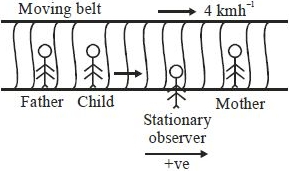
On a long horizontally moving belt,a child runs to and fro with a speed $9 \, km \, h^{-1}$ (with respect to the belt) between his father and mother located $50 \, m$ apart on the moving belt. The belt moves with a speed of $4 \, km \, h^{-1}$. For an observer on a stationary platform,the speed of the child running in the direction of motion of the belt is ..... $km \, h^{-1}$.
A
$4$
B
$5$
C
$9$
D
$13$
Solution
(D) Let the velocity of the belt with respect to the ground be $v_{BG} = 4 \, km \, h^{-1}$.
Let the velocity of the child with respect to the belt be $v_{CB} = 9 \, km \, h^{-1}$.
We need to find the velocity of the child with respect to the ground $(v_{CG})$ when the child is running in the direction of the belt's motion.
According to the relative velocity formula: $v_{CG} = v_{CB} + v_{BG}$.
Substituting the given values:
$v_{CG} = 9 \, km \, h^{-1} + 4 \, km \, h^{-1} = 13 \, km \, h^{-1}$.
Thus,for an observer on a stationary platform,the speed of the child running in the direction of motion of the belt is $13 \, km \, h^{-1}$.
Let the velocity of the child with respect to the belt be $v_{CB} = 9 \, km \, h^{-1}$.
We need to find the velocity of the child with respect to the ground $(v_{CG})$ when the child is running in the direction of the belt's motion.
According to the relative velocity formula: $v_{CG} = v_{CB} + v_{BG}$.
Substituting the given values:
$v_{CG} = 9 \, km \, h^{-1} + 4 \, km \, h^{-1} = 13 \, km \, h^{-1}$.
Thus,for an observer on a stationary platform,the speed of the child running in the direction of motion of the belt is $13 \, km \, h^{-1}$.
0 likes
View Solution65
EasyMCQ
On a long horizontal belt,a child runs to and fro with a speed of $9\,km/h$ (with respect to the belt) between his father and mother located $50\,m$ apart on the moving belt. The belt moves with a speed of $4\,km/h.$ For an observer on the platform,the speed of the child in the direction of motion of the belt is.........$km/h$.
A
$9$
B
$4$
C
$13$
D
$5$
Solution
(C) Let the speed of the child with respect to the belt be $v_{cb} = 9\,km/h$.
Let the speed of the belt with respect to the ground (platform) be $v_{bg} = 4\,km/h$.
We need to find the speed of the child with respect to the ground $(v_{cg})$ when the child is running in the direction of the belt's motion.
Using the concept of relative velocity: $v_{cg} = v_{cb} + v_{bg}$.
Substituting the given values: $v_{cg} = 9\,km/h + 4\,km/h = 13\,km/h$.
Therefore,for an observer on the platform,the speed of the child in the direction of motion of the belt is $13\,km/h$.
Let the speed of the belt with respect to the ground (platform) be $v_{bg} = 4\,km/h$.
We need to find the speed of the child with respect to the ground $(v_{cg})$ when the child is running in the direction of the belt's motion.
Using the concept of relative velocity: $v_{cg} = v_{cb} + v_{bg}$.
Substituting the given values: $v_{cg} = 9\,km/h + 4\,km/h = 13\,km/h$.
Therefore,for an observer on the platform,the speed of the child in the direction of motion of the belt is $13\,km/h$.
0 likes
View Solution66
MediumMCQ
Two cars $A$ and $B$ are moving with the same speed of $45\,km/h$ along the same direction. If a third car $C$ coming from the opposite direction with a speed of $36\,km/h$ meets the two cars in an interval of $5\,min$,the distance of separation between the two cars $A$ and $B$ should be.......$km$.
A
$6.75$
B
$7.25$
C
$5.55$
D
$8.35$
Solution
(A) Let the speed of cars $A$ and $B$ be $v_A = v_B = 45\,km/h$ in the same direction.
Let the speed of car $C$ be $v_C = 36\,km/h$ in the opposite direction.
The relative speed of car $C$ with respect to cars $A$ and $B$ is $v_{rel} = v_A + v_C = 45 + 36 = 81\,km/h$.
Since car $C$ meets car $A$ and car $B$ with a time interval of $\Delta t = 5\,min = \frac{5}{60}\,h = \frac{1}{12}\,h$,the distance $d$ between car $A$ and car $B$ is given by the product of their relative speed and the time interval.
$d = v_{rel} \times \Delta t = 81 \times \frac{1}{12} = 6.75\,km$.
Let the speed of car $C$ be $v_C = 36\,km/h$ in the opposite direction.
The relative speed of car $C$ with respect to cars $A$ and $B$ is $v_{rel} = v_A + v_C = 45 + 36 = 81\,km/h$.
Since car $C$ meets car $A$ and car $B$ with a time interval of $\Delta t = 5\,min = \frac{5}{60}\,h = \frac{1}{12}\,h$,the distance $d$ between car $A$ and car $B$ is given by the product of their relative speed and the time interval.
$d = v_{rel} \times \Delta t = 81 \times \frac{1}{12} = 6.75\,km$.
0 likes
View Solution67
MediumMCQ
$A$ train of $150 \; m$ length is going towards the north direction at a speed of $10 \; m/s$. $A$ parrot flies at a speed of $5 \; m/s$ towards the south direction parallel to the railway track. The time taken by the parrot to cross the train is: (in $; s$)
A
$12$
B
$8$
C
$15$
D
$10$
Solution
(D) Let the positive direction of the $x$-axis be from south to north.
Velocity of the train,$v_{T} = +10 \; m/s$.
Velocity of the parrot,$v_{P} = -5 \; m/s$.
The relative velocity of the parrot with respect to the train is given by $v_{PT} = v_{P} - v_{T}$.
$v_{PT} = (-5 \; m/s) - (+10 \; m/s) = -15 \; m/s$.
The magnitude of the relative velocity is $15 \; m/s$,which means the parrot appears to move at $15 \; m/s$ from north to south relative to the train.
The length of the train to be covered is $L = 150 \; m$.
Therefore,the time taken by the parrot to cross the train is $t = \frac{L}{|v_{PT}|} = \frac{150 \; m}{15 \; m/s} = 10 \; s$.
Velocity of the train,$v_{T} = +10 \; m/s$.
Velocity of the parrot,$v_{P} = -5 \; m/s$.
The relative velocity of the parrot with respect to the train is given by $v_{PT} = v_{P} - v_{T}$.
$v_{PT} = (-5 \; m/s) - (+10 \; m/s) = -15 \; m/s$.
The magnitude of the relative velocity is $15 \; m/s$,which means the parrot appears to move at $15 \; m/s$ from north to south relative to the train.
The length of the train to be covered is $L = 150 \; m$.
Therefore,the time taken by the parrot to cross the train is $t = \frac{L}{|v_{PT}|} = \frac{150 \; m}{15 \; m/s} = 10 \; s$.
0 likes
View Solution68
EasyMCQ
$A$ man is running at a speed of $5 \, m/s$. The rain drops appear to be falling at an angle of $45^{\circ}$ from the vertical. If the rain drops are actually falling vertically downwards,then the velocity of the rain drops (in $m/s$) is:
A
$5$
B
$5 \sqrt{3}$
C
$5 \sqrt{2}$
D
$4$
Solution
(A) Let the velocity of the man be $\vec{v}_m = 5 \, m/s$ (horizontal) and the velocity of the rain be $\vec{v}_r = v \, m/s$ (vertically downwards).
The velocity of rain relative to the man is $\vec{v}_{rm} = \vec{v}_r - \vec{v}_m$.
This relative velocity vector $\vec{v}_{rm}$ makes an angle of $45^{\circ}$ with the vertical.
Using the vector components,we have $\tan 45^{\circ} = \frac{|v_m|}{|v_r|} = \frac{5}{v}$.
Since $\tan 45^{\circ} = 1$,we get $1 = \frac{5}{v}$,which implies $v = 5 \, m/s$.
The velocity of rain relative to the man is $\vec{v}_{rm} = \vec{v}_r - \vec{v}_m$.
This relative velocity vector $\vec{v}_{rm}$ makes an angle of $45^{\circ}$ with the vertical.
Using the vector components,we have $\tan 45^{\circ} = \frac{|v_m|}{|v_r|} = \frac{5}{v}$.
Since $\tan 45^{\circ} = 1$,we get $1 = \frac{5}{v}$,which implies $v = 5 \, m/s$.

0 likes
View Solution69
MediumMCQ
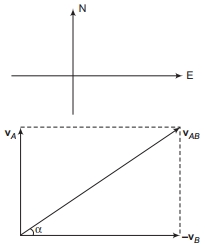
$A$ particle $(A)$ moves due north at $3\,km/h$ and another particle $(B)$ moves due west at $4\,km/h$. The relative velocity of $A$ with respect to $B$ is $(\tan 37^{\circ} = 3/4)$.
A
$5\,km/h, 37^{\circ}$ north of east
B
$5\,km/h, 37^{\circ}$ east of north
C
$5\sqrt{2}\,km/h, 53^{\circ}$ east of north
D
$5\sqrt{2}\,km/h, 53^{\circ}$ north of east
Solution
(A) Given:
Velocity of particle $A$,$\vec{v}_A = 3\hat{j}\,km/h$
Velocity of particle $B$,$\vec{v}_B = -4\hat{i}\,km/h$
The relative velocity of $A$ with respect to $B$ is given by $\vec{v}_{AB} = \vec{v}_A - \vec{v}_B$.
$\vec{v}_{AB} = 3\hat{j} - (-4\hat{i}) = 4\hat{i} + 3\hat{j}\,km/h$.
The magnitude of relative velocity is $|\vec{v}_{AB}| = \sqrt{4^2 + 3^2} = \sqrt{16 + 9} = \sqrt{25} = 5\,km/h$.
To find the direction,let $\alpha$ be the angle with the east direction (positive $x$-axis).
$\tan \alpha = \frac{v_{AB,y}}{v_{AB,x}} = \frac{3}{4}$.
Since $\tan 37^{\circ} = 3/4$,we have $\alpha = 37^{\circ}$.
Thus,the direction is $37^{\circ}$ north of east.
Therefore,the correct option is $A$.
Velocity of particle $A$,$\vec{v}_A = 3\hat{j}\,km/h$
Velocity of particle $B$,$\vec{v}_B = -4\hat{i}\,km/h$
The relative velocity of $A$ with respect to $B$ is given by $\vec{v}_{AB} = \vec{v}_A - \vec{v}_B$.
$\vec{v}_{AB} = 3\hat{j} - (-4\hat{i}) = 4\hat{i} + 3\hat{j}\,km/h$.
The magnitude of relative velocity is $|\vec{v}_{AB}| = \sqrt{4^2 + 3^2} = \sqrt{16 + 9} = \sqrt{25} = 5\,km/h$.
To find the direction,let $\alpha$ be the angle with the east direction (positive $x$-axis).
$\tan \alpha = \frac{v_{AB,y}}{v_{AB,x}} = \frac{3}{4}$.
Since $\tan 37^{\circ} = 3/4$,we have $\alpha = 37^{\circ}$.
Thus,the direction is $37^{\circ}$ north of east.
Therefore,the correct option is $A$.
0 likes
View Solution70
MediumMCQ
$A$ river is flowing from west to east at a speed of $8\,m/min$. $A$ man on the south bank of the river,capable of swimming at $20\,m/min$ in still water,wants to swim across the river in the shortest time. He should swim in a direction
A
due north
B
$30^{\circ}$ east of north
C
$30^{\circ}$ west of north
D
$60^{\circ}$ east of north
Solution
(A) To cross a river in the shortest time,the swimmer must maximize their velocity component perpendicular to the river flow.
Let the velocity of the man in still water be $v_m = 20\,m/min$ and the velocity of the river be $v_r = 8\,m/min$.
The time taken to cross the river of width $d$ is given by $t = \frac{d}{v_m \cos \theta}$,where $\theta$ is the angle with the normal to the river bank.
To minimize $t$,the denominator $v_m \cos \theta$ must be maximized.
This occurs when $\cos \theta = 1$,which means $\theta = 0^{\circ}$.
Therefore,the man should swim perpendicular to the river flow,which is due north.
Let the velocity of the man in still water be $v_m = 20\,m/min$ and the velocity of the river be $v_r = 8\,m/min$.
The time taken to cross the river of width $d$ is given by $t = \frac{d}{v_m \cos \theta}$,where $\theta$ is the angle with the normal to the river bank.
To minimize $t$,the denominator $v_m \cos \theta$ must be maximized.
This occurs when $\cos \theta = 1$,which means $\theta = 0^{\circ}$.
Therefore,the man should swim perpendicular to the river flow,which is due north.
0 likes
View Solution71
MediumMCQ
$A$ thief's car is moving with a speed of $10\,m/s$. $A$ police van chasing this car with a speed of $5\,m/s$ fires a bullet at the thief's car with a muzzle velocity of $72\,km/h$. Find the speed with which the bullet will hit the car in $m/s$.
A
$10$
B
$20$
C
$15$
D
$25$
Solution
(C) Let the direction of the thief's car be positive.
Velocity of the thief's car with respect to the ground: $v_{TG} = 10\,m/s$.
Velocity of the police van with respect to the ground: $v_{PG} = 5\,m/s$.
Muzzle velocity of the bullet with respect to the police van: $v_{BP} = 72\,km/h = 72 \times \frac{5}{18} = 20\,m/s$.
Velocity of the bullet with respect to the ground: $v_{BG} = v_{BP} + v_{PG} = 20 + 5 = 25\,m/s$.
Velocity of the bullet with respect to the thief's car: $v_{BT} = v_{BG} - v_{TG} = 25 - 10 = 15\,m/s$.
Thus,the bullet hits the car with a speed of $15\,m/s$.
Velocity of the thief's car with respect to the ground: $v_{TG} = 10\,m/s$.
Velocity of the police van with respect to the ground: $v_{PG} = 5\,m/s$.
Muzzle velocity of the bullet with respect to the police van: $v_{BP} = 72\,km/h = 72 \times \frac{5}{18} = 20\,m/s$.
Velocity of the bullet with respect to the ground: $v_{BG} = v_{BP} + v_{PG} = 20 + 5 = 25\,m/s$.
Velocity of the bullet with respect to the thief's car: $v_{BT} = v_{BG} - v_{TG} = 25 - 10 = 15\,m/s$.
Thus,the bullet hits the car with a speed of $15\,m/s$.
0 likes
View Solution72
MediumMCQ
Two cars get closer by $8\,m$ every second while travelling in the opposite directions. They get closer by $0.8\,m$ in every second while travelling in the same direction. What are the speeds of the two cars?
A
$4\,ms^{-1}$ and $4.4\,ms^{-1}$
B
$4.4\,ms^{-1}$ and $3.6\,ms^{-1}$
C
$4\,ms^{-1}$ and $3.6\,ms^{-1}$
D
$4\,ms^{-1}$ and $3\,ms^{-1}$
Solution
(B) Let the speeds of the two cars be $v_1$ and $v_2$ (where $v_1 > v_2$).
When travelling in opposite directions,the relative speed is the sum of their individual speeds:
$v_1 + v_2 = \frac{8\,m}{1\,s} = 8\,ms^{-1}$ (Equation $1$)
When travelling in the same direction,the relative speed is the difference of their individual speeds:
$v_1 - v_2 = \frac{0.8\,m}{1\,s} = 0.8\,ms^{-1}$ (Equation $2$)
Adding Equation $1$ and Equation $2$:
$(v_1 + v_2) + (v_1 - v_2) = 8 + 0.8$
$2v_1 = 8.8$
$v_1 = 4.4\,ms^{-1}$
Substituting $v_1$ in Equation $1$:
$4.4 + v_2 = 8$
$v_2 = 8 - 4.4 = 3.6\,ms^{-1}$
Thus,the speeds of the two cars are $4.4\,ms^{-1}$ and $3.6\,ms^{-1}$.
When travelling in opposite directions,the relative speed is the sum of their individual speeds:
$v_1 + v_2 = \frac{8\,m}{1\,s} = 8\,ms^{-1}$ (Equation $1$)
When travelling in the same direction,the relative speed is the difference of their individual speeds:
$v_1 - v_2 = \frac{0.8\,m}{1\,s} = 0.8\,ms^{-1}$ (Equation $2$)
Adding Equation $1$ and Equation $2$:
$(v_1 + v_2) + (v_1 - v_2) = 8 + 0.8$
$2v_1 = 8.8$
$v_1 = 4.4\,ms^{-1}$
Substituting $v_1$ in Equation $1$:
$4.4 + v_2 = 8$
$v_2 = 8 - 4.4 = 3.6\,ms^{-1}$
Thus,the speeds of the two cars are $4.4\,ms^{-1}$ and $3.6\,ms^{-1}$.
0 likes
View Solution73
MediumMCQ
Two trains are moving with equal speed in opposite directions along two parallel railway tracks. If the wind is blowing with speed $u$ along the track so that the relative velocities of the trains with respect to the wind are in the ratio of $1:2$,then the speed of each train must be
A
$3u$
B
$2u$
C
$4u$
D
$u$
Solution
(A) Let the speed of each train be $v$.
Since the trains are moving in opposite directions,let the velocity of the first train be $\vec{v}_1 = v \hat{i}$ and the second train be $\vec{v}_2 = -v \hat{i}$.
The wind is blowing with speed $u$ along the track,so its velocity is $\vec{v}_w = u \hat{i}$.
The relative velocity of the first train with respect to the wind is $\vec{v}_{1w} = \vec{v}_1 - \vec{v}_w = (v - u) \hat{i}$.
The relative velocity of the second train with respect to the wind is $\vec{v}_{2w} = \vec{v}_2 - \vec{v}_w = (-v - u) \hat{i} = -(v + u) \hat{i}$.
The ratio of the magnitudes of these relative velocities is given as $1:2$.
Therefore,$\frac{|v - u|}{|-(v + u)|} = \frac{1}{2}$.
Assuming $v > u$,we have $\frac{v - u}{v + u} = \frac{1}{2}$.
Cross-multiplying gives $2(v - u) = v + u$,which simplifies to $2v - 2u = v + u$.
Solving for $v$,we get $v = 3u$.
Since the trains are moving in opposite directions,let the velocity of the first train be $\vec{v}_1 = v \hat{i}$ and the second train be $\vec{v}_2 = -v \hat{i}$.
The wind is blowing with speed $u$ along the track,so its velocity is $\vec{v}_w = u \hat{i}$.
The relative velocity of the first train with respect to the wind is $\vec{v}_{1w} = \vec{v}_1 - \vec{v}_w = (v - u) \hat{i}$.
The relative velocity of the second train with respect to the wind is $\vec{v}_{2w} = \vec{v}_2 - \vec{v}_w = (-v - u) \hat{i} = -(v + u) \hat{i}$.
The ratio of the magnitudes of these relative velocities is given as $1:2$.
Therefore,$\frac{|v - u|}{|-(v + u)|} = \frac{1}{2}$.
Assuming $v > u$,we have $\frac{v - u}{v + u} = \frac{1}{2}$.
Cross-multiplying gives $2(v - u) = v + u$,which simplifies to $2v - 2u = v + u$.
Solving for $v$,we get $v = 3u$.
0 likes
View Solution74
EasyMCQ
$A$ boy is running on a plane road with velocity $v$ with a long hollow tube in his hand. The water is falling vertically downwards with velocity $u$. At what angle to the vertical,he must incline the tube so that the water drops enter it without touching its sides?
A
$\tan ^{-1}\left(\frac{v}{u}\right)$
B
$\sin ^{-1}\left(\frac{v}{u}\right)$
C
$\tan ^{-1}\left(\frac{u}{v}\right)$
D
$\cos ^{-1}\left(\frac{v}{u}\right)$
Solution
(A) To ensure the water drops enter the tube without touching its sides,the tube must be aligned with the direction of the relative velocity of the rain with respect to the boy.
Let the velocity of the boy be $\vec{v}_b = v \hat{i}$ and the velocity of the rain be $\vec{v}_r = -u \hat{j}$.
The relative velocity of the rain with respect to the boy is $\vec{v}_{rb} = \vec{v}_r - \vec{v}_b = -u \hat{j} - v \hat{i}$.
The angle $\theta$ that the resultant velocity vector makes with the vertical is given by $\tan \theta = \frac{|v_x|}{|v_y|} = \frac{v}{u}$.
Therefore,the angle with the vertical is $\theta = \tan ^{-1}\left(\frac{v}{u}\right)$.
Let the velocity of the boy be $\vec{v}_b = v \hat{i}$ and the velocity of the rain be $\vec{v}_r = -u \hat{j}$.
The relative velocity of the rain with respect to the boy is $\vec{v}_{rb} = \vec{v}_r - \vec{v}_b = -u \hat{j} - v \hat{i}$.
The angle $\theta$ that the resultant velocity vector makes with the vertical is given by $\tan \theta = \frac{|v_x|}{|v_y|} = \frac{v}{u}$.
Therefore,the angle with the vertical is $\theta = \tan ^{-1}\left(\frac{v}{u}\right)$.
0 likes
View Solution75
MediumMCQ
$A$ person walks up a stalled escalator in $90 \, s$. When just standing on the same moving escalator,he is carried in $60 \, s$. The time it would take him to walk up the moving escalator will be $....... \, s$.
A
$27$
B
$50$
C
$18$
D
$36$
Solution
(D) Let the length of the escalator be $s$.
The speed of the person with respect to the escalator is $v_p = \frac{s}{90}$.
The speed of the escalator is $v_e = \frac{s}{60}$.
When the person walks up the moving escalator,his effective speed is $v_{eff} = v_p + v_e$.
$v_{eff} = \frac{s}{90} + \frac{s}{60} = s \left( \frac{2 + 3}{180} \right) = \frac{5s}{180} = \frac{s}{36}$.
The time taken to cover the distance $s$ is $t = \frac{s}{v_{eff}} = \frac{s}{s/36} = 36 \, s$.
The speed of the person with respect to the escalator is $v_p = \frac{s}{90}$.
The speed of the escalator is $v_e = \frac{s}{60}$.
When the person walks up the moving escalator,his effective speed is $v_{eff} = v_p + v_e$.
$v_{eff} = \frac{s}{90} + \frac{s}{60} = s \left( \frac{2 + 3}{180} \right) = \frac{5s}{180} = \frac{s}{36}$.
The time taken to cover the distance $s$ is $t = \frac{s}{v_{eff}} = \frac{s}{s/36} = 36 \, s$.
0 likes
View Solution76
EasyMCQ
$A$ ship $X$ moving due north with speed $v$ observes that another ship $Y$ is moving due west with the same speed $v$. The actual velocity of $Y$ is $........$.
A
$\sqrt{2}v$ towards south-west
B
$\sqrt{2}v$ towards north-west
C
$\sqrt{2}v$ towards south-east
D
$v$ towards north-east
Solution
(B) Let the velocity of ship $X$ be $\vec{v}_X = v\hat{j}$.
Given that the velocity of $Y$ relative to $X$ is $\vec{v}_{YX} = -v\hat{i}$ (since it appears to move west).
The relative velocity is defined as $\vec{v}_{YX} = \vec{v}_Y - \vec{v}_X$.
Therefore,the actual velocity of $Y$ is $\vec{v}_Y = \vec{v}_{YX} + \vec{v}_X$.
Substituting the values: $\vec{v}_Y = -v\hat{i} + v\hat{j}$.
The magnitude is $|\vec{v}_Y| = \sqrt{(-v)^2 + v^2} = \sqrt{2}v$.
The direction is north-west because the vector has a negative $x$-component (west) and a positive $y$-component (north).
Given that the velocity of $Y$ relative to $X$ is $\vec{v}_{YX} = -v\hat{i}$ (since it appears to move west).
The relative velocity is defined as $\vec{v}_{YX} = \vec{v}_Y - \vec{v}_X$.
Therefore,the actual velocity of $Y$ is $\vec{v}_Y = \vec{v}_{YX} + \vec{v}_X$.
Substituting the values: $\vec{v}_Y = -v\hat{i} + v\hat{j}$.
The magnitude is $|\vec{v}_Y| = \sqrt{(-v)^2 + v^2} = \sqrt{2}v$.
The direction is north-west because the vector has a negative $x$-component (west) and a positive $y$-component (north).
0 likes
View Solution77
DifficultMCQ
$A$ swimmer crosses a river of width $d$ flowing at velocity $v$. While swimming,he heads himself always at an angle of $120^{\circ}$ with the river flow and on reaching the other end he finds a drift of $d/2$ in the direction of flow of river. The speed of the swimmer with respect to the river is
A
$(2-\sqrt{3})v$
B
$2(2-\sqrt{3})v$
C
$4(2-\sqrt{3})v$
D
$(2+\sqrt{3})v$
Solution
(C) Let $v_r$ be the velocity of the swimmer with respect to the river.
The swimmer heads at an angle of $120^{\circ}$ with the river flow $v$. The component of $v_r$ perpendicular to the river flow is $v_r \sin(120^{\circ}-90^{\circ}) = v_r \sin 30^{\circ} = v_r/2$ is incorrect based on the geometry.
Actually,the angle with the normal to the river flow is $120^{\circ}-90^{\circ} = 30^{\circ}$.
The time taken to cross the river is $t = \frac{d}{v_r \cos 30^{\circ}} = \frac{d}{v_r (\sqrt{3}/2)} = \frac{2d}{\sqrt{3} v_r}$.
The drift in the direction of the river flow is given by $x = (v - v_r \sin 30^{\circ})t$.
Given $x = d/2$,we have $d/2 = (v - v_r/2) \left( \frac{2d}{\sqrt{3} v_r} \right)$.
Simplifying,$1/2 = \frac{2v - v_r}{\sqrt{3} v_r} \implies \sqrt{3} v_r = 4v - 2v_r$.
$v_r(2 + \sqrt{3}) = 4v \implies v_r = \frac{4v}{2 + \sqrt{3}}$.
Rationalizing the denominator: $v_r = \frac{4v(2 - \sqrt{3})}{(2 + \sqrt{3})(2 - \sqrt{3})} = \frac{4v(2 - \sqrt{3})}{4 - 3} = 4(2 - \sqrt{3})v$.
The swimmer heads at an angle of $120^{\circ}$ with the river flow $v$. The component of $v_r$ perpendicular to the river flow is $v_r \sin(120^{\circ}-90^{\circ}) = v_r \sin 30^{\circ} = v_r/2$ is incorrect based on the geometry.
Actually,the angle with the normal to the river flow is $120^{\circ}-90^{\circ} = 30^{\circ}$.
The time taken to cross the river is $t = \frac{d}{v_r \cos 30^{\circ}} = \frac{d}{v_r (\sqrt{3}/2)} = \frac{2d}{\sqrt{3} v_r}$.
The drift in the direction of the river flow is given by $x = (v - v_r \sin 30^{\circ})t$.
Given $x = d/2$,we have $d/2 = (v - v_r/2) \left( \frac{2d}{\sqrt{3} v_r} \right)$.
Simplifying,$1/2 = \frac{2v - v_r}{\sqrt{3} v_r} \implies \sqrt{3} v_r = 4v - 2v_r$.
$v_r(2 + \sqrt{3}) = 4v \implies v_r = \frac{4v}{2 + \sqrt{3}}$.
Rationalizing the denominator: $v_r = \frac{4v(2 - \sqrt{3})}{(2 + \sqrt{3})(2 - \sqrt{3})} = \frac{4v(2 - \sqrt{3})}{4 - 3} = 4(2 - \sqrt{3})v$.
0 likes
View Solution78
EasyMCQ
When a train is at rest,rain drops fall vertically. When it moves along east with a velocity equal to that of rain,the rain will appear to fall,for a passenger in the train
A
Along north-east
B
Along north-west
C
From upwards
D
$45^o$ to vertical
Solution
(D) Let the velocity of rain be $\vec{v}_r = -v \hat{j}$,where $v$ is the speed of rain.
Let the velocity of the train be $\vec{v}_t = v \hat{i}$ (moving towards the east).
The velocity of rain relative to the train is $\vec{v}_{rt} = \vec{v}_r - \vec{v}_t$.
Substituting the values,we get $\vec{v}_{rt} = -v \hat{j} - v \hat{i} = -v(\hat{i} + \hat{j})$.
The direction of this vector is in the third quadrant,which corresponds to the direction between south and west. However,looking at the relative motion from the perspective of a passenger,the rain appears to come from the opposite direction of the resultant velocity vector.
Since the horizontal component is towards the west and the vertical component is downwards,the rain appears to fall at an angle of $45^o$ to the vertical towards the west.
Let the velocity of the train be $\vec{v}_t = v \hat{i}$ (moving towards the east).
The velocity of rain relative to the train is $\vec{v}_{rt} = \vec{v}_r - \vec{v}_t$.
Substituting the values,we get $\vec{v}_{rt} = -v \hat{j} - v \hat{i} = -v(\hat{i} + \hat{j})$.
The direction of this vector is in the third quadrant,which corresponds to the direction between south and west. However,looking at the relative motion from the perspective of a passenger,the rain appears to come from the opposite direction of the resultant velocity vector.
Since the horizontal component is towards the west and the vertical component is downwards,the rain appears to fall at an angle of $45^o$ to the vertical towards the west.
0 likes
View Solution79
AdvancedMCQ
On a calm day,a boat can go across a lake and return in time $T_0$ at a speed $V$. On a rough day,there is a uniform current at speed $v$ that helps the onward journey and impedes the return journey. If the time taken to go across and return on the rough day is $T$,then $T / T_0$ is:
A
$1 - v^2 / V^2$
B
$\frac{1}{1 - v^2 / V^2}$
C
$1 + v^2 / V^2$
D
$\frac{1}{1 + v^2 / V^2}$
Solution
(B) Let the distance across the lake be $S$.
On a calm day,the speed of the boat is $V$. The time taken to go and return is $T_0 = \frac{S}{V} + \frac{S}{V} = \frac{2S}{V}$.
On a rough day,the current speed is $v$. The speed during the onward journey is $(V + v)$ and during the return journey is $(V - v)$.
The total time taken is $T = \frac{S}{V + v} + \frac{S}{V - v}$.
$T = S \left( \frac{V - v + V + v}{V^2 - v^2} \right) = \frac{2SV}{V^2 - v^2}$.
Now,calculating the ratio $T / T_0$:
$T / T_0 = \frac{2SV / (V^2 - v^2)}{2S / V} = \frac{V^2}{V^2 - v^2}$.
Dividing the numerator and denominator by $V^2$,we get $T / T_0 = \frac{1}{1 - v^2 / V^2}$.
On a calm day,the speed of the boat is $V$. The time taken to go and return is $T_0 = \frac{S}{V} + \frac{S}{V} = \frac{2S}{V}$.
On a rough day,the current speed is $v$. The speed during the onward journey is $(V + v)$ and during the return journey is $(V - v)$.
The total time taken is $T = \frac{S}{V + v} + \frac{S}{V - v}$.
$T = S \left( \frac{V - v + V + v}{V^2 - v^2} \right) = \frac{2SV}{V^2 - v^2}$.
Now,calculating the ratio $T / T_0$:
$T / T_0 = \frac{2SV / (V^2 - v^2)}{2S / V} = \frac{V^2}{V^2 - v^2}$.
Dividing the numerator and denominator by $V^2$,we get $T / T_0 = \frac{1}{1 - v^2 / V^2}$.
0 likes
View Solution80
DifficultMCQ
$A$ steam boat goes across a lake and comes back: $(i)$ on a quiet day when the water is still and $(ii)$ on a rough day when there is a uniform current so as to help the journey onward and to impede the journey back. If the speed of the launch,on both days,was same,the time required for the complete journey on the rough day as compared to that on the quiet day,will be
A
less
B
same
C
more
D
cannot be predicted
Solution
(C) Let $L$ be the length of the lake and $V$ be the velocity of the boat relative to the water.
On a quiet day,the velocity of the water is $0$. The time taken for the round trip is:
$t_{Q} = \frac{L}{V} + \frac{L}{V} = \frac{2L}{V} \quad ...(i)$
On a rough day,let $v$ be the velocity of the uniform current. During the onward journey,the effective speed is $(V + v)$,and during the return journey,the effective speed is $(V - v)$.
The time taken for the round trip on a rough day is:
$t_{R} = \frac{L}{V + v} + \frac{L}{V - v} = \frac{L(V - v) + L(V + v)}{V^{2} - v^{2}} = \frac{2LV}{V^{2} - v^{2}} = \frac{2L}{V(1 - (v/V)^{2})} \quad ...(ii)$
Comparing equations $(i)$ and $(ii)$:
$t_{R} = t_{Q} \times \frac{1}{1 - (v/V)^{2}}$
Since $(v/V)^{2} > 0$,the denominator $1 - (v/V)^{2} < 1$,which implies that $\frac{1}{1 - (v/V)^{2}} > 1$.
Therefore,$t_{R} > t_{Q}$. The time required on a rough day is more.
On a quiet day,the velocity of the water is $0$. The time taken for the round trip is:
$t_{Q} = \frac{L}{V} + \frac{L}{V} = \frac{2L}{V} \quad ...(i)$
On a rough day,let $v$ be the velocity of the uniform current. During the onward journey,the effective speed is $(V + v)$,and during the return journey,the effective speed is $(V - v)$.
The time taken for the round trip on a rough day is:
$t_{R} = \frac{L}{V + v} + \frac{L}{V - v} = \frac{L(V - v) + L(V + v)}{V^{2} - v^{2}} = \frac{2LV}{V^{2} - v^{2}} = \frac{2L}{V(1 - (v/V)^{2})} \quad ...(ii)$
Comparing equations $(i)$ and $(ii)$:
$t_{R} = t_{Q} \times \frac{1}{1 - (v/V)^{2}}$
Since $(v/V)^{2} > 0$,the denominator $1 - (v/V)^{2} < 1$,which implies that $\frac{1}{1 - (v/V)^{2}} > 1$.
Therefore,$t_{R} > t_{Q}$. The time required on a rough day is more.
0 likes
View Solution81
DifficultMCQ
$A$ bird is flying to and fro between two cars moving towards each other on a straight road. One car has a speed of $18\,km/h$ while the other has a speed of $27\,km/h$. The bird starts moving from the first car towards the other with a speed of $36\,km/h$. If the two cars were initially separated by $36\,km$,what is the total distance covered by the bird?
A
$28.8$
B
$36.4$
C
$58.2$
D
None of these
Solution
(A) Given,speed of the first car $v_1 = 18\,km/h$.
Speed of the second car $v_2 = 27\,km/h$.
Since the cars are moving towards each other,their relative speed is $v_{rel} = v_1 + v_2 = 18 + 27 = 45\,km/h$.
The initial distance between the cars is $d = 36\,km$.
The time taken for the cars to meet is $t = \frac{d}{v_{rel}} = \frac{36}{45} = 0.8\,h$.
The bird flies continuously at a constant speed $v_b = 36\,km/h$ until the cars meet.
Therefore,the total distance covered by the bird is $D = v_b \times t = 36 \times 0.8 = 28.8\,km$.
Speed of the second car $v_2 = 27\,km/h$.
Since the cars are moving towards each other,their relative speed is $v_{rel} = v_1 + v_2 = 18 + 27 = 45\,km/h$.
The initial distance between the cars is $d = 36\,km$.
The time taken for the cars to meet is $t = \frac{d}{v_{rel}} = \frac{36}{45} = 0.8\,h$.
The bird flies continuously at a constant speed $v_b = 36\,km/h$ until the cars meet.
Therefore,the total distance covered by the bird is $D = v_b \times t = 36 \times 0.8 = 28.8\,km$.
0 likes
View Solution82
EasyMCQ
$Assertion$ : The magnitude of velocity of two boats relative to the river is the same. Both boats start simultaneously from the same point on one bank and may reach the opposite bank simultaneously while moving along different paths.
$Reason$ : For boats to cross the river in the same time,the component of their velocity relative to the river in the direction normal to the flow should be the same.
$Reason$ : For boats to cross the river in the same time,the component of their velocity relative to the river in the direction normal to the flow should be the same.
A
If both Assertion and Reason are correct and the Reason is a correct explanation of the Assertion.
B
If both Assertion and Reason are correct but Reason is not a correct explanation of the Assertion.
C
If the Assertion is correct but Reason is incorrect.
D
If both the Assertion and Reason are incorrect.
Solution
(A) The time taken to cross a river of width $d$ is given by $t = \frac{d}{v_y}$,where $v_y$ is the component of the boat's velocity relative to the river in the direction normal to the river flow.
If the magnitudes of the velocities of two boats relative to the river are the same $(v_1 = v_2 = v)$,and they are directed at the same angle $\theta$ with respect to the normal to the river bank,then their normal components are $v_y = v \cos \theta$.
Since $v$ and $\theta$ are the same for both boats,their normal components $v_y$ are identical.
Therefore,both boats will cross the river in the same time $t = \frac{d}{v \cos \theta}$,even if they follow different paths due to the river's flow.
Thus,both the Assertion and the Reason are correct,and the Reason is the correct explanation of the Assertion.
If the magnitudes of the velocities of two boats relative to the river are the same $(v_1 = v_2 = v)$,and they are directed at the same angle $\theta$ with respect to the normal to the river bank,then their normal components are $v_y = v \cos \theta$.
Since $v$ and $\theta$ are the same for both boats,their normal components $v_y$ are identical.
Therefore,both boats will cross the river in the same time $t = \frac{d}{v \cos \theta}$,even if they follow different paths due to the river's flow.
Thus,both the Assertion and the Reason are correct,and the Reason is the correct explanation of the Assertion.
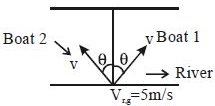
0 likes
View Solution83
MediumMCQ
The speed of a swimmer in still water is $20 \; m/s$. The speed of river water is $10 \; m/s$ and is flowing due east. If he is standing on the south bank and wishes to cross the river along the shortest path,the angle at which he should make his strokes with respect to north is given by ......$^o$ west.
A
$30$
B
$0$
C
$60$
D
$45$
Solution
(A) Let the speed of the swimmer in still water be $v = 20 \; m/s$ and the speed of the river be $u = 10 \; m/s$.
To cross the river along the shortest path (perpendicular to the river flow),the swimmer must swim at an angle $\theta$ with respect to the north (perpendicular to the bank) such that the horizontal component of his velocity cancels the river's velocity.
From the geometry of the velocity vector triangle,we have:
$\sin \theta = \frac{u}{v}$
Substituting the given values:
$\sin \theta = \frac{10}{20} = \frac{1}{2}$
Therefore,$\theta = \arcsin(1/2) = 30^{\circ}$.
Thus,the swimmer should make his strokes at an angle of $30^{\circ}$ west of north.
To cross the river along the shortest path (perpendicular to the river flow),the swimmer must swim at an angle $\theta$ with respect to the north (perpendicular to the bank) such that the horizontal component of his velocity cancels the river's velocity.
From the geometry of the velocity vector triangle,we have:
$\sin \theta = \frac{u}{v}$
Substituting the given values:
$\sin \theta = \frac{10}{20} = \frac{1}{2}$
Therefore,$\theta = \arcsin(1/2) = 30^{\circ}$.
Thus,the swimmer should make his strokes at an angle of $30^{\circ}$ west of north.
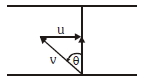
1 likes
View Solution84
MediumMCQ
$A$ particle is moving along the $x$-axis with its coordinate with time '$t$' given by $x(t) = 10 + 8t - 3t^2$. Another particle is moving along the $y$-axis with its coordinate as a function of time given by $y(t) = 5 - 8t^3$. At $t = 1 \; s$,the speed of the second particle as measured in the frame of the first particle is given as $\sqrt{v}$. Then $v$ (in $m^2/s^2$) is:
A
$441$
B
$600$
C
$580$
D
$484$
Solution
(C) The velocity of the first particle is given by the derivative of its position with respect to time: $v_x = \frac{dx}{dt} = 8 - 6t$. At $t = 1 \; s$,$v_x = 8 - 6(1) = 2 \; m/s$. Thus,$\vec{v}_1 = 2 \hat{i} \; m/s$.
The velocity of the second particle is given by the derivative of its position with respect to time: $v_y = \frac{dy}{dt} = -24t^2$. At $t = 1 \; s$,$v_y = -24(1)^2 = -24 \; m/s$. Thus,$\vec{v}_2 = -24 \hat{j} \; m/s$.
The velocity of the second particle relative to the first particle is $\vec{v}_{21} = \vec{v}_2 - \vec{v}_1 = -2 \hat{i} - 24 \hat{j}$.
The speed of the second particle in the frame of the first is the magnitude of the relative velocity: $|\vec{v}_{21}| = \sqrt{(-2)^2 + (-24)^2} = \sqrt{4 + 576} = \sqrt{580}$.
Given that the speed is $\sqrt{v}$,we have $\sqrt{v} = \sqrt{580}$,which implies $v = 580$.
The velocity of the second particle is given by the derivative of its position with respect to time: $v_y = \frac{dy}{dt} = -24t^2$. At $t = 1 \; s$,$v_y = -24(1)^2 = -24 \; m/s$. Thus,$\vec{v}_2 = -24 \hat{j} \; m/s$.
The velocity of the second particle relative to the first particle is $\vec{v}_{21} = \vec{v}_2 - \vec{v}_1 = -2 \hat{i} - 24 \hat{j}$.
The speed of the second particle in the frame of the first is the magnitude of the relative velocity: $|\vec{v}_{21}| = \sqrt{(-2)^2 + (-24)^2} = \sqrt{4 + 576} = \sqrt{580}$.
Given that the speed is $\sqrt{v}$,we have $\sqrt{v} = \sqrt{580}$,which implies $v = 580$.
0 likes
View Solution85
Easy
Explain this common observation clearly: If you look out of the window of a fast-moving train,the nearby trees,houses,etc.,seem to move rapidly in a direction opposite to the train's motion,but the distant objects (hilltops,the Moon,the stars,etc.) seem to be stationary. (In fact,since you are aware that you are moving,these distant objects seem to move with you).
Solution
(N/A) The line of sight is defined as an imaginary line joining an object and an observer's eye.
When we observe nearby stationary objects such as trees or houses while sitting in a moving train,the angle subtended by these objects at our eye changes very rapidly as we move past them. This rapid change in the direction of the line of sight makes them appear to move quickly in the opposite direction.
On the other hand,for distant objects like hilltops,the Moon,or stars,the distance is so large that the change in the angle of the line of sight is negligible even as the train covers a significant distance. Consequently,these objects appear to be stationary or moving slowly with the observer.
When we observe nearby stationary objects such as trees or houses while sitting in a moving train,the angle subtended by these objects at our eye changes very rapidly as we move past them. This rapid change in the direction of the line of sight makes them appear to move quickly in the opposite direction.
On the other hand,for distant objects like hilltops,the Moon,or stars,the distance is so large that the change in the angle of the line of sight is negligible even as the train covers a significant distance. Consequently,these objects appear to be stationary or moving slowly with the observer.
0 likes
View Solution86
Medium
$A$ man walking briskly in rain with speed $v$ must slant his umbrella forward making an angle $\theta$ with the vertical. $A$ student derives the following relation between $\theta$ and $v: \tan \theta = v$ and checks that the relation has a correct limit: as $v \rightarrow 0, \theta \rightarrow 0,$ as expected. (We are assuming there is no strong wind and that the rain falls vertically for a stationary man). Do you think this relation can be correct? If not,guess the correct relation.
Solution
(A) The relation $\tan \theta = v$ is incorrect.
Dimensional Analysis:
Dimension of $L.H.S = \tan \theta = [M^0 L^0 T^0]$ (dimensionless).
Dimension of $R.H.S = v = [L T^{-1}]$.
Since the dimensions of $L.H.S$ and $R.H.S$ do not match,the equation is dimensionally inconsistent.
To make it dimensionally correct,the $R.H.S$ must also be dimensionless. This can be achieved by dividing $v$ by the speed of the rain $v'$,which is also a velocity.
Therefore,the correct relation is $\tan \theta = \frac{v}{v'}$,where $v'$ is the speed of the rain.
Dimensional Analysis:
Dimension of $L.H.S = \tan \theta = [M^0 L^0 T^0]$ (dimensionless).
Dimension of $R.H.S = v = [L T^{-1}]$.
Since the dimensions of $L.H.S$ and $R.H.S$ do not match,the equation is dimensionally inconsistent.
To make it dimensionally correct,the $R.H.S$ must also be dimensionless. This can be achieved by dividing $v$ by the speed of the rain $v'$,which is also a velocity.
Therefore,the correct relation is $\tan \theta = \frac{v}{v'}$,where $v'$ is the speed of the rain.
0 likes
View Solution87
MediumMCQ
Two parallel rail tracks run north-south. Train $A$ moves north with a speed of $54 \; km \; h^{-1},$ and train $B$ moves south with a speed of $90 \; km \; h^{-1}.$ What is the velocity of $B$ with respect to $A$?
A
The train $B$ appears to $A$ to move with a speed of $10 \; m \; s^{-1}$ from north to south.
B
The train $B$ appears to $A$ to move with a speed of $40 \; m \; s^{-1}$ from south to north.
C
The train $B$ appears to $A$ to move with a speed of $10 \; m \; s^{-1}$ from south to north.
D
The train $B$ appears to $A$ to move with a speed of $40 \; m \; s^{-1}$ from north to south.
Solution
(D) Let the positive direction of the $x-$axis be from south to north.
Then,the velocity of train $A$ is $v_{A} = +54 \; km \; h^{-1} = 54 \times \frac{5}{18} \; m \; s^{-1} = +15 \; m \; s^{-1}.$
The velocity of train $B$ is $v_{B} = -90 \; km \; h^{-1} = -90 \times \frac{5}{18} \; m \; s^{-1} = -25 \; m \; s^{-1}.$
The relative velocity of $B$ with respect to $A$ is given by $v_{BA} = v_{B} - v_{A}.$
Substituting the values,$v_{BA} = -25 \; m \; s^{-1} - (+15 \; m \; s^{-1}) = -40 \; m \; s^{-1}.$
The negative sign indicates that the train $B$ appears to $A$ to move with a speed of $40 \; m \; s^{-1}$ from north to south.
Then,the velocity of train $A$ is $v_{A} = +54 \; km \; h^{-1} = 54 \times \frac{5}{18} \; m \; s^{-1} = +15 \; m \; s^{-1}.$
The velocity of train $B$ is $v_{B} = -90 \; km \; h^{-1} = -90 \times \frac{5}{18} \; m \; s^{-1} = -25 \; m \; s^{-1}.$
The relative velocity of $B$ with respect to $A$ is given by $v_{BA} = v_{B} - v_{A}.$
Substituting the values,$v_{BA} = -25 \; m \; s^{-1} - (+15 \; m \; s^{-1}) = -40 \; m \; s^{-1}.$
The negative sign indicates that the train $B$ appears to $A$ to move with a speed of $40 \; m \; s^{-1}$ from north to south.
0 likes
View Solution88
MediumMCQ
Two parallel rail tracks run north-south. Train $A$ moves north with a speed of $54 \; km \; h^{-1},$ and train $B$ moves south with a speed of $90 \; km \; h^{-1}.$ What is the velocity of the ground in $m \; s^{-1}$ with respect to train $B$?
A
$25$
B
$15$
C
$40$
D
$10$
Solution
(A) Let the positive direction of the $x$-axis be from south to north.
The velocity of train $A$ is $v_{A} = +54 \; km \; h^{-1} = 54 \times \frac{5}{18} \; m \; s^{-1} = 15 \; m \; s^{-1}$.
The velocity of train $B$ is $v_{B} = -90 \; km \; h^{-1} = -90 \times \frac{5}{18} \; m \; s^{-1} = -25 \; m \; s^{-1}$.
The velocity of the ground with respect to train $B$ is given by $v_{GB} = v_{G} - v_{B}$.
Since the ground is stationary,$v_{G} = 0 \; m \; s^{-1}$.
Therefore,$v_{GB} = 0 - (-25 \; m \; s^{-1}) = +25 \; m \; s^{-1}$.
Thus,the velocity of the ground with respect to train $B$ is $25 \; m \; s^{-1}$ towards the north.
The velocity of train $A$ is $v_{A} = +54 \; km \; h^{-1} = 54 \times \frac{5}{18} \; m \; s^{-1} = 15 \; m \; s^{-1}$.
The velocity of train $B$ is $v_{B} = -90 \; km \; h^{-1} = -90 \times \frac{5}{18} \; m \; s^{-1} = -25 \; m \; s^{-1}$.
The velocity of the ground with respect to train $B$ is given by $v_{GB} = v_{G} - v_{B}$.
Since the ground is stationary,$v_{G} = 0 \; m \; s^{-1}$.
Therefore,$v_{GB} = 0 - (-25 \; m \; s^{-1}) = +25 \; m \; s^{-1}$.
Thus,the velocity of the ground with respect to train $B$ is $25 \; m \; s^{-1}$ towards the north.
0 likes
View Solution89
DifficultMCQ
Two parallel rail tracks run north-south. Train $A$ moves north with a speed of $54\; km\; h^{-1},$ and train $B$ moves south with a speed of $90\; km\; h^{-1}.$ What is the velocity (in $m\; s^{-1}$) of a monkey running on the roof of the train $A$ against its motion (with a velocity of $18\; km\; h^{-1}$ with respect to the train $A$) as observed by a man standing on the ground?
A
$15$
B
$10$
C
$25$
D
$40$
Solution
(B) Let the positive direction of the $x$-axis be from south to north.
The velocity of train $A$ is $v_{A} = +54\; km\; h^{-1} = 54 \times \frac{5}{18}\; m\; s^{-1} = +15\; m\; s^{-1}$.
The velocity of the monkey with respect to train $A$ is $v_{MA} = -18\; km\; h^{-1}$ (since it moves against the motion of the train).
Converting this to $m\; s^{-1}$: $v_{MA} = -18 \times \frac{5}{18}\; m\; s^{-1} = -5\; m\; s^{-1}$.
We know that the relative velocity of the monkey with respect to train $A$ is given by $v_{MA} = v_{M} - v_{A}$,where $v_{M}$ is the velocity of the monkey with respect to the ground.
Substituting the values: $-5\; m\; s^{-1} = v_{M} - 15\; m\; s^{-1}$.
Therefore,$v_{M} = 15\; m\; s^{-1} - 5\; m\; s^{-1} = 10\; m\; s^{-1}$.
The velocity of train $A$ is $v_{A} = +54\; km\; h^{-1} = 54 \times \frac{5}{18}\; m\; s^{-1} = +15\; m\; s^{-1}$.
The velocity of the monkey with respect to train $A$ is $v_{MA} = -18\; km\; h^{-1}$ (since it moves against the motion of the train).
Converting this to $m\; s^{-1}$: $v_{MA} = -18 \times \frac{5}{18}\; m\; s^{-1} = -5\; m\; s^{-1}$.
We know that the relative velocity of the monkey with respect to train $A$ is given by $v_{MA} = v_{M} - v_{A}$,where $v_{M}$ is the velocity of the monkey with respect to the ground.
Substituting the values: $-5\; m\; s^{-1} = v_{M} - 15\; m\; s^{-1}$.
Therefore,$v_{M} = 15\; m\; s^{-1} - 5\; m\; s^{-1} = 10\; m\; s^{-1}$.
0 likes
View Solution90
EasyMCQ
$A$ jet airplane travelling at the speed of $500 \; km \; h^{-1}$ ejects its products of combustion at the speed of $1500 \; km \; h^{-1}$ relative to the jet plane. What is the speed of the latter with respect to an observer on the ground?
A
$2000 \; km \; h^{-1}$
B
$3000 \; km \; h^{-1}$
C
$1000 \; km \; h^{-1}$
D
$2500 \; km \; h^{-1}$
Solution
(C) Let the velocity of the jet airplane with respect to the ground be $v_p = 500 \; km \; h^{-1}$.
Let the velocity of the combustion products with respect to the jet airplane be $v_{cp/p} = -1500 \; km \; h^{-1}$ (since they are ejected in the opposite direction to the plane's motion).
The velocity of the combustion products with respect to the ground $v_{cp}$ is given by the relative velocity formula:
$v_{cp/p} = v_{cp} - v_p$
Substituting the values:
$-1500 = v_{cp} - 500$
$v_{cp} = -1500 + 500 = -1000 \; km \; h^{-1}$.
The speed is the magnitude of the velocity,which is $1000 \; km \; h^{-1}$.
Let the velocity of the combustion products with respect to the jet airplane be $v_{cp/p} = -1500 \; km \; h^{-1}$ (since they are ejected in the opposite direction to the plane's motion).
The velocity of the combustion products with respect to the ground $v_{cp}$ is given by the relative velocity formula:
$v_{cp/p} = v_{cp} - v_p$
Substituting the values:
$-1500 = v_{cp} - 500$
$v_{cp} = -1500 + 500 = -1000 \; km \; h^{-1}$.
The speed is the magnitude of the velocity,which is $1000 \; km \; h^{-1}$.
0 likes
View Solution91
MediumMCQ
On a two-lane road,car $A$ is travelling with a speed of $36 \; km/h$. Two cars $B$ and $C$ approach car $A$ in opposite directions with a speed of $54 \; km/h$ each. At a certain instant,when the distance $AB = AC = 1 \; km$,car $B$ decides to overtake car $A$ before car $C$ does. What minimum acceleration (in $m/s^2$) of car $B$ is required to avoid an accident?
A
$0.5$
B
$1$
C
$2$
D
$2.5$
Solution
(B) First,convert all speeds to $m/s$:
$v_A = 36 \times (5/18) = 10 \; m/s$.
$v_B = 54 \times (5/18) = 15 \; m/s$.
$v_C = 54 \times (5/18) = 15 \; m/s$.
Relative velocity of $B$ w.r.t $A$ is $v_{BA} = v_B - v_A = 15 - 10 = 5 \; m/s$.
Relative velocity of $C$ w.r.t $A$ is $v_{CA} = v_C - (-v_A) = 15 + 10 = 25 \; m/s$.
Distance $s = 1 \; km = 1000 \; m$.
Time taken by car $C$ to reach car $A$ is $t = s / v_{CA} = 1000 / 25 = 40 \; s$.
To avoid an accident,car $B$ must cover $1000 \; m$ in $t = 40 \; s$.
Using the equation of motion $s = u_{BA}t + (1/2)at^2$:
$1000 = 5 \times 40 + (1/2) \times a \times (40)^2$.
$1000 = 200 + 800a$.
$800 = 800a$.
$a = 1 \; m/s^2$.
$v_A = 36 \times (5/18) = 10 \; m/s$.
$v_B = 54 \times (5/18) = 15 \; m/s$.
$v_C = 54 \times (5/18) = 15 \; m/s$.
Relative velocity of $B$ w.r.t $A$ is $v_{BA} = v_B - v_A = 15 - 10 = 5 \; m/s$.
Relative velocity of $C$ w.r.t $A$ is $v_{CA} = v_C - (-v_A) = 15 + 10 = 25 \; m/s$.
Distance $s = 1 \; km = 1000 \; m$.
Time taken by car $C$ to reach car $A$ is $t = s / v_{CA} = 1000 / 25 = 40 \; s$.
To avoid an accident,car $B$ must cover $1000 \; m$ in $t = 40 \; s$.
Using the equation of motion $s = u_{BA}t + (1/2)at^2$:
$1000 = 5 \times 40 + (1/2) \times a \times (40)^2$.
$1000 = 200 + 800a$.
$800 = 800a$.
$a = 1 \; m/s^2$.
0 likes
View Solution92
MediumMCQ
Two towns $A$ and $B$ are connected by a regular bus service with a bus leaving in either direction every $T$ minutes. $A$ man cycling with a speed of $20 \; km/h$ in the direction $A$ to $B$ notices that a bus goes past him every $18 \; min$ in the direction of his motion,and every $6 \; min$ in the opposite direction. What is the period $T$ (in $min$) of the bus service and with what speed (assumed constant) do the buses ply on the road?
A
$5 \; min$ and $60 \; km/h$
B
$7 \; min$ and $40 \; km/h$
C
$9 \; min$ and $40 \; km/h$
D
$9 \; min$ and $60 \; km/h$
Solution
(C) Let $V$ be the speed of the bus. The speed of the cyclist is $v = 20 \; km/h$.
When the bus moves in the direction of the cyclist,the relative speed is $(V - 20) \; km/h$. The time interval between buses passing the cyclist is $18 \; min = 18/60 \; h$. The distance between two consecutive buses is $V \times (T/60)$. Thus,$(V - 20) \times (18/60) = V \times (T/60) \implies (V - 20) \times 18 = VT \quad \dots (i)$.
When the bus moves in the opposite direction,the relative speed is $(V + 20) \; km/h$. The time interval between buses passing the cyclist is $6 \; min = 6/60 \; h$. Thus,$(V + 20) \times (6/60) = V \times (T/60) \implies (V + 20) \times 6 = VT \quad \dots (ii)$.
Equating $(i)$ and $(ii)$:
$(V - 20) \times 18 = (V + 20) \times 6$
$3(V - 20) = V + 20$
$3V - 60 = V + 20$
$2V = 80 \implies V = 40 \; km/h$.
Substituting $V = 40$ in $(ii)$:
$(40 + 20) \times 6 = 40 \times T$
$60 \times 6 = 40T$
$360 = 40T \implies T = 9 \; min$.
When the bus moves in the direction of the cyclist,the relative speed is $(V - 20) \; km/h$. The time interval between buses passing the cyclist is $18 \; min = 18/60 \; h$. The distance between two consecutive buses is $V \times (T/60)$. Thus,$(V - 20) \times (18/60) = V \times (T/60) \implies (V - 20) \times 18 = VT \quad \dots (i)$.
When the bus moves in the opposite direction,the relative speed is $(V + 20) \; km/h$. The time interval between buses passing the cyclist is $6 \; min = 6/60 \; h$. Thus,$(V + 20) \times (6/60) = V \times (T/60) \implies (V + 20) \times 6 = VT \quad \dots (ii)$.
Equating $(i)$ and $(ii)$:
$(V - 20) \times 18 = (V + 20) \times 6$
$3(V - 20) = V + 20$
$3V - 60 = V + 20$
$2V = 80 \implies V = 40 \; km/h$.
Substituting $V = 40$ in $(ii)$:
$(40 + 20) \times 6 = 40 \times T$
$60 \times 6 = 40T$
$360 = 40T \implies T = 9 \; min$.
0 likes
View Solution93
MediumMCQ
$A$ police van moving on a highway with a speed of $30\; km/h$ fires a bullet at a thief's car speeding away in the same direction with a speed of $192\; km/h.$ If the muzzle speed of the bullet is $150\; m/s,$ with what speed (in $m/s$) does the bullet hit the thief's car?
A
$58.33$
B
$158.33$
C
$105$
D
$8.33$
Solution
(C) First,convert the speeds from $km/h$ to $m/s$ by multiplying by $\frac{5}{18}$.
Speed of the police van,$v_p = 30 \times \frac{5}{18} = 8.33\; m/s$.
Speed of the thief's car,$v_t = 192 \times \frac{5}{18} = 53.33\; m/s$.
The muzzle speed of the bullet relative to the police van is $v_{b/p} = 150\; m/s$.
The velocity of the bullet with respect to the ground is $v_b = v_{b/p} + v_p = 150 + 8.33 = 158.33\; m/s$.
The relative velocity of the bullet with respect to the thief's car is $v_{b/t} = v_b - v_t$.
$v_{b/t} = 158.33 - 53.33 = 105\; m/s$.
Speed of the police van,$v_p = 30 \times \frac{5}{18} = 8.33\; m/s$.
Speed of the thief's car,$v_t = 192 \times \frac{5}{18} = 53.33\; m/s$.
The muzzle speed of the bullet relative to the police van is $v_{b/p} = 150\; m/s$.
The velocity of the bullet with respect to the ground is $v_b = v_{b/p} + v_p = 150 + 8.33 = 158.33\; m/s$.
The relative velocity of the bullet with respect to the thief's car is $v_{b/t} = v_b - v_t$.
$v_{b/t} = 158.33 - 53.33 = 105\; m/s$.
0 likes
View Solution94
Medium
On a long horizontally moving belt,a child runs to and fro with a speed $9 \; km \; h^{-1}$ (with respect to the belt) between his father and mother located $50 \; m$ apart on the moving belt. The belt moves with a speed of $4 \; km \; h^{-1}$. For an observer on a stationary platform outside,what is the:
$(a)$ speed of the child running in the direction of motion of the belt?
$(b)$ speed of the child running opposite to the direction of motion of the belt?
$(c)$ time taken by the child in $(a)$ and $(b)$?
Which of the answers alter if motion is viewed by one of the parents?
$(a)$ speed of the child running in the direction of motion of the belt?
$(b)$ speed of the child running opposite to the direction of motion of the belt?
$(c)$ time taken by the child in $(a)$ and $(b)$?
Which of the answers alter if motion is viewed by one of the parents?
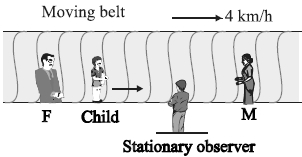
Solution
(N/A) Speed of the belt,$v_{B} = 4 \; km \; h^{-1}$.
Speed of the child with respect to the belt,$v_{c} = 9 \; km \; h^{-1}$.
$(a)$ Since the child is running in the same direction as the motion of the belt,his speed as observed by the stationary observer is:
$v_{a} = v_{c} + v_{B} = 9 + 4 = 13 \; km \; h^{-1}$.
$(b)$ Since the child is running opposite to the direction of motion of the belt,his speed as observed by the stationary observer is:
$v_{b} = v_{c} - v_{B} = 9 - 4 = 5 \; km \; h^{-1}$.
$(c)$ Distance between the parents,$d = 50 \; m = 0.05 \; km$.
Since both parents are on the moving belt,the relative speed of the child with respect to the parents is always $9 \; km \; h^{-1}$.
Converting speed to $m \; s^{-1}$: $9 \; km \; h^{-1} = 9 \times \frac{5}{18} = 2.5 \; m \; s^{-1}$.
Time taken,$t = \frac{d}{v_{c}} = \frac{50 \; m}{2.5 \; m \; s^{-1}} = 20 \; s$.
If the motion is viewed by one of the parents,the answers for $(a)$ and $(b)$ will alter because the parents are in the same frame of reference as the belt. For the parents,the speed of the child is always $9 \; km \; h^{-1}$ regardless of the direction. The time taken remains unaltered.
Speed of the child with respect to the belt,$v_{c} = 9 \; km \; h^{-1}$.
$(a)$ Since the child is running in the same direction as the motion of the belt,his speed as observed by the stationary observer is:
$v_{a} = v_{c} + v_{B} = 9 + 4 = 13 \; km \; h^{-1}$.
$(b)$ Since the child is running opposite to the direction of motion of the belt,his speed as observed by the stationary observer is:
$v_{b} = v_{c} - v_{B} = 9 - 4 = 5 \; km \; h^{-1}$.
$(c)$ Distance between the parents,$d = 50 \; m = 0.05 \; km$.
Since both parents are on the moving belt,the relative speed of the child with respect to the parents is always $9 \; km \; h^{-1}$.
Converting speed to $m \; s^{-1}$: $9 \; km \; h^{-1} = 9 \times \frac{5}{18} = 2.5 \; m \; s^{-1}$.
Time taken,$t = \frac{d}{v_{c}} = \frac{50 \; m}{2.5 \; m \; s^{-1}} = 20 \; s$.
If the motion is viewed by one of the parents,the answers for $(a)$ and $(b)$ will alter because the parents are in the same frame of reference as the belt. For the parents,the speed of the child is always $9 \; km \; h^{-1}$ regardless of the direction. The time taken remains unaltered.
0 likes
View Solution95
Medium
Rain is falling vertically with a speed of $35 \; m s^{-1}$. Winds start blowing after sometime with a speed of $12 \; m s^{-1}$ in the east to west direction. In which direction should a boy waiting at a bus stop hold his umbrella?
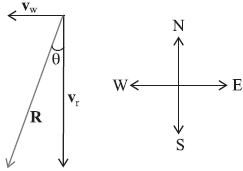
Solution
(N/A) The velocity of the rain $(v_r)$ and the wind $(v_w)$ are represented by vectors as shown in the figure. The rain falls vertically downwards,and the wind blows from east to west.
Using the rule of vector addition,the resultant velocity $R$ of the rain relative to the ground is the vector sum of $v_r$ and $v_w$.
The magnitude of the resultant velocity $R$ is given by:
$R = \sqrt{v_r^2 + v_w^2} = \sqrt{35^2 + 12^2} \; m s^{-1} = \sqrt{1225 + 144} \; m s^{-1} = \sqrt{1369} \; m s^{-1} = 37 \; m s^{-1}$.
The direction $\theta$ that the resultant velocity $R$ makes with the vertical is given by:
$\tan \theta = \frac{v_w}{v_r} = \frac{12}{35} \approx 0.343$.
$\theta = \tan^{-1}(0.343) \approx 19^{\circ}$.
Since the wind is blowing towards the west,the rain appears to come from the west. Therefore,the boy should hold his umbrella in the vertical plane at an angle of about $19^{\circ}$ with the vertical towards the west.
Using the rule of vector addition,the resultant velocity $R$ of the rain relative to the ground is the vector sum of $v_r$ and $v_w$.
The magnitude of the resultant velocity $R$ is given by:
$R = \sqrt{v_r^2 + v_w^2} = \sqrt{35^2 + 12^2} \; m s^{-1} = \sqrt{1225 + 144} \; m s^{-1} = \sqrt{1369} \; m s^{-1} = 37 \; m s^{-1}$.
The direction $\theta$ that the resultant velocity $R$ makes with the vertical is given by:
$\tan \theta = \frac{v_w}{v_r} = \frac{12}{35} \approx 0.343$.
$\theta = \tan^{-1}(0.343) \approx 19^{\circ}$.
Since the wind is blowing towards the west,the rain appears to come from the west. Therefore,the boy should hold his umbrella in the vertical plane at an angle of about $19^{\circ}$ with the vertical towards the west.
0 likes
View Solution96
Medium
$A$ motorboat is racing towards north at $25\; km/h$ and the water current in that region is $10\; km/h$ in the direction of $60^{\circ}$ east of south. Find the resultant velocity of the boat.
Solution
(N/A) Let $v_b$ be the velocity of the motorboat (directed North) and $v_c$ be the velocity of the water current (directed $60^{\circ}$ East of South). The angle between $v_b$ and $v_c$ is $\theta = 180^{\circ} - 60^{\circ} = 120^{\circ}$.
Using the law of cosines,the magnitude of the resultant velocity $R$ is:
$R = \sqrt{v_b^2 + v_c^2 + 2v_b v_c \cos(120^{\circ})}$
$R = \sqrt{25^2 + 10^2 + 2(25)(10)(-0.5)}$
$R = \sqrt{625 + 100 - 250} = \sqrt{475} \approx 21.8\; km/h$.
To find the direction $\phi$ of the resultant velocity with respect to the North direction,we use the law of sines:
$\frac{R}{\sin(120^{\circ})} = \frac{v_c}{\sin(\phi)}$
$\sin(\phi) = \frac{v_c \sin(120^{\circ})}{R} = \frac{10 \times 0.866}{21.8} \approx 0.397$
$\phi = \arcsin(0.397) \approx 23.4^{\circ}$.
Thus,the resultant velocity is approximately $21.8\; km/h$ at an angle of $23.4^{\circ}$ East of North.
Using the law of cosines,the magnitude of the resultant velocity $R$ is:
$R = \sqrt{v_b^2 + v_c^2 + 2v_b v_c \cos(120^{\circ})}$
$R = \sqrt{25^2 + 10^2 + 2(25)(10)(-0.5)}$
$R = \sqrt{625 + 100 - 250} = \sqrt{475} \approx 21.8\; km/h$.
To find the direction $\phi$ of the resultant velocity with respect to the North direction,we use the law of sines:
$\frac{R}{\sin(120^{\circ})} = \frac{v_c}{\sin(\phi)}$
$\sin(\phi) = \frac{v_c \sin(120^{\circ})}{R} = \frac{10 \times 0.866}{21.8} \approx 0.397$
$\phi = \arcsin(0.397) \approx 23.4^{\circ}$.
Thus,the resultant velocity is approximately $21.8\; km/h$ at an angle of $23.4^{\circ}$ East of North.
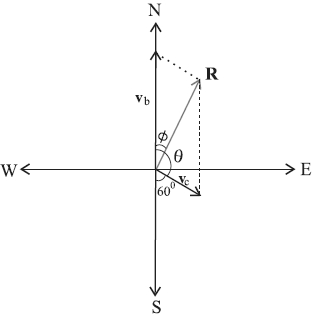
1 likes
View Solution97
Medium
Rain is falling vertically with a speed of $35 \; m s^{-1}$. $A$ woman rides a bicycle with a speed of $12 \; m s^{-1}$ in the east to west direction. What is the direction in which she should hold her umbrella?
Solution
(N/A) Let $v_r$ represent the velocity of rain and $v_b$ represent the velocity of the bicycle,both with respect to the ground.
Since the woman is riding a bicycle,the velocity of rain as experienced by her is the velocity of rain relative to the bicycle,given by:
$v_{rb} = v_r - v_b$
This relative velocity vector $v_{rb}$ makes an angle $\theta$ with the vertical,as shown in the figure.
It is given by:
$\tan \theta = \frac{|v_b|}{|v_r|} = \frac{12}{35} \approx 0.343$
$\theta = \tan^{-1}(0.343) \approx 19^{\circ}$
Therefore,the woman should hold her umbrella at an angle of about $19^{\circ}$ with the vertical towards the west.
Since the woman is riding a bicycle,the velocity of rain as experienced by her is the velocity of rain relative to the bicycle,given by:
$v_{rb} = v_r - v_b$
This relative velocity vector $v_{rb}$ makes an angle $\theta$ with the vertical,as shown in the figure.
It is given by:
$\tan \theta = \frac{|v_b|}{|v_r|} = \frac{12}{35} \approx 0.343$
$\theta = \tan^{-1}(0.343) \approx 19^{\circ}$
Therefore,the woman should hold her umbrella at an angle of about $19^{\circ}$ with the vertical towards the west.
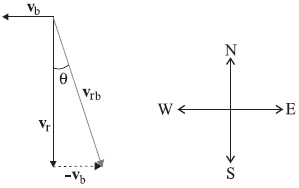
0 likes
View Solution98
MediumMCQ
Rain is falling vertically with a speed of $30\; m/s$. $A$ woman rides a bicycle with a speed of $10\; m/s$ in the north to south direction. What is the direction in which she should hold her umbrella?
A
$\theta=\tan ^{-1}\left(\frac{2}{3}\right)$
B
$\theta=\tan ^{-1}\left(\frac{1}{3}\right)$
C
$\theta=\tan ^{-1}\left(\frac{1}{6}\right)$
D
$\theta=\tan ^{-1}\left(\frac{1}{2}\right)$
Solution
(B) Let $v_r$ be the velocity of the rain falling vertically downwards,$v_r = 30\; m/s$.
Let $v_c$ be the velocity of the cyclist moving from north to south,$v_c = 10\; m/s$.
The relative velocity of the rain with respect to the woman is given by $\vec{v}_{rw} = \vec{v}_r - \vec{v}_c$.
To protect herself from the rain,the woman must hold her umbrella in the direction of the relative velocity $\vec{v}_{rw}$.
The angle $\theta$ that the relative velocity vector makes with the vertical is given by:
$\tan \theta = \frac{|\vec{v}_c|}{|\vec{v}_r|} = \frac{10}{30} = \frac{1}{3}$.
Therefore,$\theta = \tan^{-1}\left(\frac{1}{3}\right)$.
The woman should hold her umbrella at an angle of $\tan^{-1}\left(\frac{1}{3}\right)$ with the vertical towards the south.
Let $v_c$ be the velocity of the cyclist moving from north to south,$v_c = 10\; m/s$.
The relative velocity of the rain with respect to the woman is given by $\vec{v}_{rw} = \vec{v}_r - \vec{v}_c$.
To protect herself from the rain,the woman must hold her umbrella in the direction of the relative velocity $\vec{v}_{rw}$.
The angle $\theta$ that the relative velocity vector makes with the vertical is given by:
$\tan \theta = \frac{|\vec{v}_c|}{|\vec{v}_r|} = \frac{10}{30} = \frac{1}{3}$.
Therefore,$\theta = \tan^{-1}\left(\frac{1}{3}\right)$.
The woman should hold her umbrella at an angle of $\tan^{-1}\left(\frac{1}{3}\right)$ with the vertical towards the south.
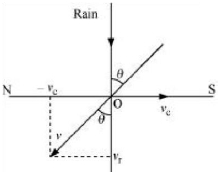
0 likes
View Solution99
Medium
$A$ man can swim with a speed of $4.0 \; km/h$ in still water. How long does he take to cross a river $1.0 \; km$ wide if the river flows steadily at $3.0 \; km/h$ and he makes his strokes normal to the river current? How far down the river does he go when he reaches the other bank?
Solution
(A) Speed of the man in still water,$v_m = 4.0 \; km/h$.
Width of the river,$d = 1.0 \; km$.
Since the man swims normal to the river current,his velocity component across the river is $v_m = 4.0 \; km/h$.
Time taken to cross the river,$t = \frac{d}{v_m} = \frac{1.0 \; km}{4.0 \; km/h} = 0.25 \; h$.
Converting to minutes,$t = 0.25 \times 60 = 15 \; min$.
Speed of the river,$v_r = 3.0 \; km/h$.
The distance covered down the river (drift) is $x = v_r \times t = 3.0 \; km/h \times 0.25 \; h = 0.75 \; km$.
Converting to meters,$x = 0.75 \times 1000 = 750 \; m$.
Width of the river,$d = 1.0 \; km$.
Since the man swims normal to the river current,his velocity component across the river is $v_m = 4.0 \; km/h$.
Time taken to cross the river,$t = \frac{d}{v_m} = \frac{1.0 \; km}{4.0 \; km/h} = 0.25 \; h$.
Converting to minutes,$t = 0.25 \times 60 = 15 \; min$.
Speed of the river,$v_r = 3.0 \; km/h$.
The distance covered down the river (drift) is $x = v_r \times t = 3.0 \; km/h \times 0.25 \; h = 0.75 \; km$.
Converting to meters,$x = 0.75 \times 1000 = 750 \; m$.
0 likes
View Solution100
Medium
In a harbour,wind is blowing at the speed of $72 \; km/h$ and the flag on the mast of a boat anchored in the harbour flutters along the $N-E$ direction. If the boat starts moving at a speed of $51 \; km/h$ to the north,what is the direction of the flag on the mast of the boat?
Solution
(D) Velocity of the boat,$v_{b} = 51 \; km/h$ (towards North).
Velocity of the wind,$v_{w} = 72 \; km/h$ (towards North-East).
The flag flutters in the direction of the relative velocity of the wind with respect to the boat,given by $\vec{v}_{wb} = \vec{v}_{w} - \vec{v}_{b} = \vec{v}_{w} + (-\vec{v}_{b})$.
Here,$\vec{v}_{w}$ makes an angle of $45^{\circ}$ with the North (or East) direction. The vector $(-\vec{v}_{b})$ is directed towards the South.
The angle between $\vec{v}_{w}$ and $(-\vec{v}_{b})$ is $90^{\circ} + 45^{\circ} = 135^{\circ}$.
Using the formula for the direction $\beta$ of the resultant vector with respect to the East direction:
$\tan \beta = \frac{v_{w} \sin(135^{\circ}) - v_{b} \sin(90^{\circ})}{v_{w} \cos(135^{\circ}) + v_{b} \cos(90^{\circ})}$ is not the standard approach. Let's use the vector components:
$\vec{v}_{w} = 72 \cos(45^{\circ}) \hat{i} + 72 \sin(45^{\circ}) \hat{j} = 50.91 \hat{i} + 50.91 \hat{j}$
$\vec{v}_{b} = 51 \hat{j}$
$\vec{v}_{wb} = \vec{v}_{w} - \vec{v}_{b} = 50.91 \hat{i} + (50.91 - 51) \hat{j} = 50.91 \hat{i} - 0.09 \hat{j}$
The angle $\theta$ with the East direction is $\tan \theta = \frac{|v_{wb, y}|}{|v_{wb, x}|} = \frac{0.09}{50.91} \approx 0.00177$.
$\theta \approx \tan^{-1}(0.00177) \approx 0.1^{\circ}$ South of East.
Thus,the flag flutters almost due East.
Velocity of the wind,$v_{w} = 72 \; km/h$ (towards North-East).
The flag flutters in the direction of the relative velocity of the wind with respect to the boat,given by $\vec{v}_{wb} = \vec{v}_{w} - \vec{v}_{b} = \vec{v}_{w} + (-\vec{v}_{b})$.
Here,$\vec{v}_{w}$ makes an angle of $45^{\circ}$ with the North (or East) direction. The vector $(-\vec{v}_{b})$ is directed towards the South.
The angle between $\vec{v}_{w}$ and $(-\vec{v}_{b})$ is $90^{\circ} + 45^{\circ} = 135^{\circ}$.
Using the formula for the direction $\beta$ of the resultant vector with respect to the East direction:
$\tan \beta = \frac{v_{w} \sin(135^{\circ}) - v_{b} \sin(90^{\circ})}{v_{w} \cos(135^{\circ}) + v_{b} \cos(90^{\circ})}$ is not the standard approach. Let's use the vector components:
$\vec{v}_{w} = 72 \cos(45^{\circ}) \hat{i} + 72 \sin(45^{\circ}) \hat{j} = 50.91 \hat{i} + 50.91 \hat{j}$
$\vec{v}_{b} = 51 \hat{j}$
$\vec{v}_{wb} = \vec{v}_{w} - \vec{v}_{b} = 50.91 \hat{i} + (50.91 - 51) \hat{j} = 50.91 \hat{i} - 0.09 \hat{j}$
The angle $\theta$ with the East direction is $\tan \theta = \frac{|v_{wb, y}|}{|v_{wb, x}|} = \frac{0.09}{50.91} \approx 0.00177$.
$\theta \approx \tan^{-1}(0.00177) \approx 0.1^{\circ}$ South of East.
Thus,the flag flutters almost due East.
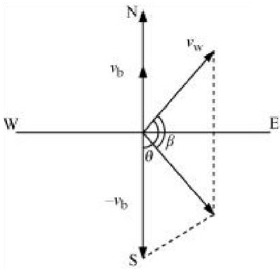
0 likes
View Solution3-2.Motion in Plane — Relative Velocity (river boat, rain, wind) · Frequently Asked Questions
1Are these 3-2.Motion in Plane questions useful for JEE and NEET?
Yes. All questions in this section are mapped to JEE Main and NEET exam patterns. Previous year questions from JEE Main, NEET, GUJCET and state-level exams are included with full solutions.
2Can I switch to Hindi or Gujarati for these questions?
Yes. Use the language tabs in the hero section or the sidebar to view the same questions and solutions in English, Hindi or Gujarati.
3How do I generate a question paper from this subtopic?
Use the Vedclass Exam Paper Generator — select the chapter and subtopic, set difficulty, and generate Sets A, B, C, D automatically. First 3 chapters of every subject are free.
Vedclass Products
For Students
Vedclass Test Series
Mock tests in real JEE/NEET style with performance analysis. 5-day free trial.
Start Free TrialFor Teachers
Exam Paper Generator
Generate Set A/B/C/D papers from this chapter in 2 minutes. 3 chapters free.
Try FreeFor Institutes
Online Exam Module
Live online exams with unlimited students, 360° analytics & white-label branding.
See DemoFor Teachers & Institutes
Generate a 3-2.Motion in Plane Exam Paper in 2 Minutes
Select subtopic & difficulty — Sets A, B, C, D auto-generated with No Repeat logic.
First 3 chapters of every subject are free — no payment required.