
A English
Motion In Two And Three Dimension Questions in English
Class 11 Physics · 3-2.Motion in Plane · Motion In Two And Three Dimension
43+
Questions
English
Language
100%
With Solutions
Showing 43 of 43 questions in English
1
MediumMCQ
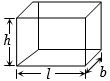
$A$ hall has the dimensions $10\,m \times 12\,m \times 14\,m$. $A$ fly starting at one corner ends up at a diametrically opposite corner. What is the magnitude of its displacement in meters?
A
$17$
B
$26$
C
$36$
D
$21$
Solution
(D) The displacement of the fly is equal to the length of the space diagonal of the rectangular hall.
The formula for the space diagonal $d$ of a rectangular parallelepiped with dimensions $l$,$b$,and $h$ is given by:
$d = \sqrt{l^2 + b^2 + h^2}$
Given dimensions are $l = 10\,m$,$b = 12\,m$,and $h = 14\,m$.
Substituting these values into the formula:
$d = \sqrt{10^2 + 12^2 + 14^2}$
$d = \sqrt{100 + 144 + 196}$
$d = \sqrt{440}$
$d \approx 20.97\,m$
Rounding to the nearest whole number,we get $d \approx 21\,m$.
Therefore,the correct option is $D$.
The formula for the space diagonal $d$ of a rectangular parallelepiped with dimensions $l$,$b$,and $h$ is given by:
$d = \sqrt{l^2 + b^2 + h^2}$
Given dimensions are $l = 10\,m$,$b = 12\,m$,and $h = 14\,m$.
Substituting these values into the formula:
$d = \sqrt{10^2 + 12^2 + 14^2}$
$d = \sqrt{100 + 144 + 196}$
$d = \sqrt{440}$
$d \approx 20.97\,m$
Rounding to the nearest whole number,we get $d \approx 21\,m$.
Therefore,the correct option is $D$.
0 likes
View Solution2
EasyMCQ
$A$ body moves $6\,m$ north,$8\,m$ east,and $10\,m$ vertically upwards. What is its resultant displacement from the initial position?
A
$10\sqrt{2}\,m$
B
$10\,m$
C
$\frac{10}{\sqrt{2}}\,m$
D
$20\,m$
Solution
(A) Let the initial position be the origin $(0, 0, 0)$.
Moving $6\,m$ north corresponds to the $y$-axis,$8\,m$ east corresponds to the $x$-axis,and $10\,m$ vertically upwards corresponds to the $z$-axis.
The position vector of the body is $\vec{r} = 8\hat{i} + 6\hat{j} + 10\hat{k}$.
The magnitude of the resultant displacement is given by $r = |\vec{r}| = \sqrt{x^2 + y^2 + z^2}$.
Substituting the values: $r = \sqrt{8^2 + 6^2 + 10^2}$.
$r = \sqrt{64 + 36 + 100} = \sqrt{200}$.
$r = \sqrt{100 \times 2} = 10\sqrt{2}\,m$.
Moving $6\,m$ north corresponds to the $y$-axis,$8\,m$ east corresponds to the $x$-axis,and $10\,m$ vertically upwards corresponds to the $z$-axis.
The position vector of the body is $\vec{r} = 8\hat{i} + 6\hat{j} + 10\hat{k}$.
The magnitude of the resultant displacement is given by $r = |\vec{r}| = \sqrt{x^2 + y^2 + z^2}$.
Substituting the values: $r = \sqrt{8^2 + 6^2 + 10^2}$.
$r = \sqrt{64 + 36 + 100} = \sqrt{200}$.
$r = \sqrt{100 \times 2} = 10\sqrt{2}\,m$.
2 likes
View Solution3
MediumMCQ
An aeroplane flies $400 \,m$ north and $300 \,m$ south and then flies $1200 \,m$ upwards. The net displacement is...........$m$.
A
$1204$
B
$1300$
C
$1400$
D
$1500$
Solution
(A) Let the initial position be the origin $(0, 0, 0)$.
First,the aeroplane moves $400 \,m$ North (along $y$-axis) and $300 \,m$ South (along negative $y$-axis).
The net displacement in the horizontal plane is $400 \,m - 300 \,m = 100 \,m$ towards the North.
Then,it flies $1200 \,m$ upwards (along $z$-axis).
The final position vector is $\vec{r} = 100 \hat{j} + 1200 \hat{k}$.
The magnitude of the net displacement is $r = \sqrt{(100)^2 + (1200)^2}$.
$r = \sqrt{10000 + 1440000} = \sqrt{1450000}$.
$r = 100 \sqrt{145} \approx 100 \times 12.04 = 1204 \,m$.
First,the aeroplane moves $400 \,m$ North (along $y$-axis) and $300 \,m$ South (along negative $y$-axis).
The net displacement in the horizontal plane is $400 \,m - 300 \,m = 100 \,m$ towards the North.
Then,it flies $1200 \,m$ upwards (along $z$-axis).
The final position vector is $\vec{r} = 100 \hat{j} + 1200 \hat{k}$.
The magnitude of the net displacement is $r = \sqrt{(100)^2 + (1200)^2}$.
$r = \sqrt{10000 + 1440000} = \sqrt{1450000}$.
$r = 100 \sqrt{145} \approx 100 \times 12.04 = 1204 \,m$.
0 likes
View Solution4
DifficultMCQ
The coordinates of a moving particle at any time $t$ are given by $x = at^2$ and $y = bt^2$. The speed of the particle at any moment is
A
$2t(a + b)$
B
$2t\sqrt{a^2 - b^2}$
C
$t\sqrt{a^2 + b^2}$
D
$2t\sqrt{a^2 + b^2}$
Solution
(D) The velocity component along the $X$-axis is given by $v_x = \frac{dx}{dt} = \frac{d}{dt}(at^2) = 2at$.
The velocity component along the $Y$-axis is given by $v_y = \frac{dy}{dt} = \frac{d}{dt}(bt^2) = 2bt$.
The magnitude of the velocity (speed) of the particle is $v = \sqrt{v_x^2 + v_y^2}$.
Substituting the values,we get $v = \sqrt{(2at)^2 + (2bt)^2} = \sqrt{4a^2t^2 + 4b^2t^2} = \sqrt{4t^2(a^2 + b^2)}$.
Simplifying this,we get $v = 2t\sqrt{a^2 + b^2}$.
The velocity component along the $Y$-axis is given by $v_y = \frac{dy}{dt} = \frac{d}{dt}(bt^2) = 2bt$.
The magnitude of the velocity (speed) of the particle is $v = \sqrt{v_x^2 + v_y^2}$.
Substituting the values,we get $v = \sqrt{(2at)^2 + (2bt)^2} = \sqrt{4a^2t^2 + 4b^2t^2} = \sqrt{4t^2(a^2 + b^2)}$.
Simplifying this,we get $v = 2t\sqrt{a^2 + b^2}$.
0 likes
View Solution5
MediumMCQ
The position of a particle moving in the $xy$-plane at any time $t$ is given by $x = (3t^2 - 6t) \text{ m}$ and $y = (t^2 - 2t) \text{ m}$. Select the correct statement about the moving particle from the following:
A
The acceleration of the particle is zero at $t = 0 \text{ s}$.
B
The velocity of the particle is zero at $t = 0 \text{ s}$.
C
The velocity of the particle is zero at $t = 1 \text{ s}$.
D
The velocity and acceleration of the particle are never zero.
Solution
(C) The velocity components are given by the time derivatives of position:
$v_x = \frac{dx}{dt} = \frac{d}{dt}(3t^2 - 6t) = 6t - 6 \text{ m/s}$.
$v_y = \frac{dy}{dt} = \frac{d}{dt}(t^2 - 2t) = 2t - 2 \text{ m/s}$.
At $t = 1 \text{ s}$,$v_x = 6(1) - 6 = 0 \text{ m/s}$ and $v_y = 2(1) - 2 = 0 \text{ m/s}$.
Since both components are zero,the magnitude of velocity $v = \sqrt{v_x^2 + v_y^2} = 0 \text{ m/s}$ at $t = 1 \text{ s}$.
Therefore,the velocity of the particle is zero at $t = 1 \text{ s}$.
$v_x = \frac{dx}{dt} = \frac{d}{dt}(3t^2 - 6t) = 6t - 6 \text{ m/s}$.
$v_y = \frac{dy}{dt} = \frac{d}{dt}(t^2 - 2t) = 2t - 2 \text{ m/s}$.
At $t = 1 \text{ s}$,$v_x = 6(1) - 6 = 0 \text{ m/s}$ and $v_y = 2(1) - 2 = 0 \text{ m/s}$.
Since both components are zero,the magnitude of velocity $v = \sqrt{v_x^2 + v_y^2} = 0 \text{ m/s}$ at $t = 1 \text{ s}$.
Therefore,the velocity of the particle is zero at $t = 1 \text{ s}$.
0 likes
View Solution6
MediumMCQ
The $x$ and $y$ coordinates of a particle at any time $t$ are given by $x = 7t + 4t^2$ and $y = 5t$,where $x$ and $y$ are in $m$ and $t$ is in $s$. The acceleration of the particle at $t = 5 \ s$ is ......... $m/s^2$.
A
$0$
B
$8$
C
$20$
D
$40$
Solution
(B) The acceleration components are given by the second derivative of position with respect to time.
For the $x$-coordinate: $x = 7t + 4t^2$.
Velocity $v_x = \frac{dx}{dt} = 7 + 8t$.
Acceleration $a_x = \frac{dv_x}{dt} = 8 \ m/s^2$.
For the $y$-coordinate: $y = 5t$.
Velocity $v_y = \frac{dy}{dt} = 5$.
Acceleration $a_y = \frac{dv_y}{dt} = 0 \ m/s^2$.
The net acceleration is $a = \sqrt{a_x^2 + a_y^2} = \sqrt{8^2 + 0^2} = 8 \ m/s^2$.
Since the acceleration is constant,it remains $8 \ m/s^2$ at $t = 5 \ s$.
For the $x$-coordinate: $x = 7t + 4t^2$.
Velocity $v_x = \frac{dx}{dt} = 7 + 8t$.
Acceleration $a_x = \frac{dv_x}{dt} = 8 \ m/s^2$.
For the $y$-coordinate: $y = 5t$.
Velocity $v_y = \frac{dy}{dt} = 5$.
Acceleration $a_y = \frac{dv_y}{dt} = 0 \ m/s^2$.
The net acceleration is $a = \sqrt{a_x^2 + a_y^2} = \sqrt{8^2 + 0^2} = 8 \ m/s^2$.
Since the acceleration is constant,it remains $8 \ m/s^2$ at $t = 5 \ s$.
0 likes
View Solution7
MediumMCQ
The coordinates of a moving particle at any time $t$ are given by $x = \alpha t^3$ and $y = \beta t^3$. The speed of the particle at time $t$ is given by
A
$\sqrt{\alpha^2 + \beta^2}$
B
$3t\sqrt{\alpha^2 + \beta^2}$
C
$3t^2\sqrt{\alpha^2 + \beta^2}$
D
$t^2\sqrt{\alpha^2 + \beta^2}$
Solution
(C) Given the position coordinates of the particle as $x = \alpha t^3$ and $y = \beta t^3$.
The velocity components are obtained by differentiating the position with respect to time $t$:
$v_x = \frac{dx}{dt} = \frac{d}{dt}(\alpha t^3) = 3\alpha t^2$
$v_y = \frac{dy}{dt} = \frac{d}{dt}(\beta t^3) = 3\beta t^2$
The speed $v$ of the particle is the magnitude of the velocity vector:
$v = \sqrt{v_x^2 + v_y^2}$
$v = \sqrt{(3\alpha t^2)^2 + (3\beta t^2)^2}$
$v = \sqrt{9\alpha^2 t^4 + 9\beta^2 t^4}$
$v = \sqrt{9t^4(\alpha^2 + \beta^2)}$
$v = 3t^2\sqrt{\alpha^2 + \beta^2}$
The velocity components are obtained by differentiating the position with respect to time $t$:
$v_x = \frac{dx}{dt} = \frac{d}{dt}(\alpha t^3) = 3\alpha t^2$
$v_y = \frac{dy}{dt} = \frac{d}{dt}(\beta t^3) = 3\beta t^2$
The speed $v$ of the particle is the magnitude of the velocity vector:
$v = \sqrt{v_x^2 + v_y^2}$
$v = \sqrt{(3\alpha t^2)^2 + (3\beta t^2)^2}$
$v = \sqrt{9\alpha^2 t^4 + 9\beta^2 t^4}$
$v = \sqrt{9t^4(\alpha^2 + \beta^2)}$
$v = 3t^2\sqrt{\alpha^2 + \beta^2}$
0 likes
View Solution8
MediumMCQ
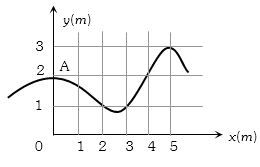
The trajectory of a particle moving in a plane is as shown in the figure. The coordinates of position $A$ are $(0, 2)$. The coordinates of another point at which the instantaneous velocity is the same as the average velocity between the points $(0, 2)$ and $(5, 3)$ are:
A
$(1, 4)$
B
$(5, 3)$
C
$(3, 1)$
D
$(4, 2)$
Solution
(D) The average velocity vector between two points $(x_1, y_1)$ and $(x_2, y_2)$ is given by $\vec{v}_{avg} = \frac{\Delta \vec{r}}{\Delta t} = \frac{(x_2 - x_1)\hat{i} + (y_2 - y_1)\hat{j}}{\Delta t}$.
The slope of the secant line connecting these two points is $m = \frac{y_2 - y_1}{x_2 - x_1}$.
For the points $A(0, 2)$ and $B(5, 3)$,the slope is $m = \frac{3 - 2}{5 - 0} = \frac{1}{5} = 0.2$.
The instantaneous velocity at any point is given by the slope of the tangent to the trajectory at that point,$v_y / v_x = dy/dx$.
We are looking for a point where the tangent slope is equal to the secant slope,i.e.,$dy/dx = 0.2$.
Looking at the graph,at the point $(3, 1)$,the curve is transitioning from a downward slope to an upward slope,and the tangent is horizontal $(slope = 0)$.
At the point $(4, 2)$,the tangent slope is positive and visually matches the slope of the line connecting $(0, 2)$ and $(5, 3)$.
Thus,the correct coordinates are $(4, 2)$.
The slope of the secant line connecting these two points is $m = \frac{y_2 - y_1}{x_2 - x_1}$.
For the points $A(0, 2)$ and $B(5, 3)$,the slope is $m = \frac{3 - 2}{5 - 0} = \frac{1}{5} = 0.2$.
The instantaneous velocity at any point is given by the slope of the tangent to the trajectory at that point,$v_y / v_x = dy/dx$.
We are looking for a point where the tangent slope is equal to the secant slope,i.e.,$dy/dx = 0.2$.
Looking at the graph,at the point $(3, 1)$,the curve is transitioning from a downward slope to an upward slope,and the tangent is horizontal $(slope = 0)$.
At the point $(4, 2)$,the tangent slope is positive and visually matches the slope of the line connecting $(0, 2)$ and $(5, 3)$.
Thus,the correct coordinates are $(4, 2)$.
0 likes
View Solution9
MediumMCQ
$A$ body starts from rest from the origin with an acceleration of $6 \; m/s^2$ along the $x$-axis and $8 \; m/s^2$ along the $y$-axis. Its distance from the origin after $4 \; s$ will be (in $; m$)
A
$56$
B
$64$
C
$80$
D
$128$
Solution
(C) Given that the body starts from rest,the initial velocity components are $u_x = 0$ and $u_y = 0$.
The acceleration components are $a_x = 6 \; m/s^2$ and $a_y = 8 \; m/s^2$.
The time elapsed is $t = 4 \; s$.
Using the kinematic equation $s = ut + \frac{1}{2}at^2$ for both axes:
For the $x$-axis: $x = 0(4) + \frac{1}{2} \times 6 \times (4)^2 = 3 \times 16 = 48 \; m$.
For the $y$-axis: $y = 0(4) + \frac{1}{2} \times 8 \times (4)^2 = 4 \times 16 = 64 \; m$.
The distance from the origin is given by $d = \sqrt{x^2 + y^2}$.
$d = \sqrt{(48)^2 + (64)^2} = \sqrt{2304 + 4096} = \sqrt{6400} = 80 \; m$.
The acceleration components are $a_x = 6 \; m/s^2$ and $a_y = 8 \; m/s^2$.
The time elapsed is $t = 4 \; s$.
Using the kinematic equation $s = ut + \frac{1}{2}at^2$ for both axes:
For the $x$-axis: $x = 0(4) + \frac{1}{2} \times 6 \times (4)^2 = 3 \times 16 = 48 \; m$.
For the $y$-axis: $y = 0(4) + \frac{1}{2} \times 8 \times (4)^2 = 4 \times 16 = 64 \; m$.
The distance from the origin is given by $d = \sqrt{x^2 + y^2}$.
$d = \sqrt{(48)^2 + (64)^2} = \sqrt{2304 + 4096} = \sqrt{6400} = 80 \; m$.
0 likes
View Solution10
MediumMCQ
The $x$ and $y$ coordinates of a particle at any time $t$ are given by $x = 5t - 2t^2$ and $y = 10t$ respectively,where $x$ and $y$ are in meters and $t$ is in seconds. The acceleration of the particle at $t = 2 \, s$ is . . . . . . $m/s^2$.
A
$-4$
B
$-5$
C
$-8$
D
$0$
Solution
(A) Given the position coordinates of the particle as functions of time $t$:
$x = 5t - 2t^2$
$y = 10t$
To find the velocity components,we differentiate the position coordinates with respect to time $t$:
$v_x = \frac{dx}{dt} = \frac{d}{dt}(5t - 2t^2) = 5 - 4t$
$v_y = \frac{dy}{dt} = \frac{d}{dt}(10t) = 10$
To find the acceleration components,we differentiate the velocity components with respect to time $t$:
$a_x = \frac{dv_x}{dt} = \frac{d}{dt}(5 - 4t) = -4 \, m/s^2$
$a_y = \frac{dv_y}{dt} = \frac{d}{dt}(10) = 0 \, m/s^2$
The acceleration vector is $\vec{a} = a_x \hat{i} + a_y \hat{j} = -4 \hat{i} + 0 \hat{j} = -4 \hat{i} \, m/s^2$.
Since the acceleration components are constant,the acceleration of the particle at any time $t$,including $t = 2 \, s$,is $-4 \, m/s^2$ in the $x$-direction.
$x = 5t - 2t^2$
$y = 10t$
To find the velocity components,we differentiate the position coordinates with respect to time $t$:
$v_x = \frac{dx}{dt} = \frac{d}{dt}(5t - 2t^2) = 5 - 4t$
$v_y = \frac{dy}{dt} = \frac{d}{dt}(10t) = 10$
To find the acceleration components,we differentiate the velocity components with respect to time $t$:
$a_x = \frac{dv_x}{dt} = \frac{d}{dt}(5 - 4t) = -4 \, m/s^2$
$a_y = \frac{dv_y}{dt} = \frac{d}{dt}(10) = 0 \, m/s^2$
The acceleration vector is $\vec{a} = a_x \hat{i} + a_y \hat{j} = -4 \hat{i} + 0 \hat{j} = -4 \hat{i} \, m/s^2$.
Since the acceleration components are constant,the acceleration of the particle at any time $t$,including $t = 2 \, s$,is $-4 \, m/s^2$ in the $x$-direction.
0 likes
View Solution11
MediumMCQ
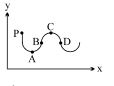
$A$ man moves in the $x-y$ plane along the path shown. At what point is his average velocity vector in the same direction as his instantaneous velocity vector? The man starts from point $P$.
A
$A$
B
$B$
C
$C$
D
$D$
Solution
(C) The average velocity vector $\vec{v}_{avg}$ from the starting point $P$ to any point $Q$ on the path is given by $\vec{v}_{avg} = \frac{\vec{r}_Q - \vec{r}_P}{t_Q - t_P}$,which is the direction of the displacement vector $\Delta \vec{r} = \vec{r}_Q - \vec{r}_P$.
The instantaneous velocity vector $\vec{v}_{inst}$ at any point is tangent to the path at that point.
For the average velocity vector to be in the same direction as the instantaneous velocity vector,the displacement vector $\vec{r}_Q - \vec{r}_P$ must be tangent to the path at point $Q$.
Geometrically,this means the line segment connecting the starting point $P$ to point $Q$ must be tangent to the curve at point $Q$.
Looking at the path,if we draw a line from $P$ to $C$,this line is tangent to the path at point $C$. Therefore,at point $C$,the average velocity vector is in the same direction as the instantaneous velocity vector.
The instantaneous velocity vector $\vec{v}_{inst}$ at any point is tangent to the path at that point.
For the average velocity vector to be in the same direction as the instantaneous velocity vector,the displacement vector $\vec{r}_Q - \vec{r}_P$ must be tangent to the path at point $Q$.
Geometrically,this means the line segment connecting the starting point $P$ to point $Q$ must be tangent to the curve at point $Q$.
Looking at the path,if we draw a line from $P$ to $C$,this line is tangent to the path at point $C$. Therefore,at point $C$,the average velocity vector is in the same direction as the instantaneous velocity vector.
0 likes
View Solution12
DifficultMCQ
$A$ particle moves in the $x-y$ plane with velocity $\vec{v} = a\hat{i} + bx\hat{j}$,where $a$ and $b$ are constants. If the particle was initially at the origin,find the equation of its trajectory.
A
$y = \frac{a}{b}x - \frac{1}{2}bx^2$
B
$y = x - \frac{bx^2}{2a}$
C
$y = \frac{bx^2}{2a}$
D
None of the above
Solution
(C) Given velocity $\vec{v} = v_x \hat{i} + v_y \hat{j} = a \hat{i} + bx \hat{j}$.
Thus,$v_x = \frac{dx}{dt} = a$ and $v_y = \frac{dy}{dt} = bx$.
From $v_x = a$,we integrate with respect to time: $\int_0^x dx = \int_0^t a dt$,which gives $x = at$,or $t = \frac{x}{a}$.
Now,substitute $t$ into the expression for $v_y$: $\frac{dy}{dt} = bx$.
Using the chain rule,$\frac{dy}{dx} = \frac{dy/dt}{dx/dt} = \frac{bx}{a}$.
Integrating both sides with respect to $x$: $\int_0^y dy = \int_0^x \frac{b}{a} x dx$.
This yields $y = \frac{b}{a} \cdot \frac{x^2}{2} = \frac{bx^2}{2a}$.
Thus,$v_x = \frac{dx}{dt} = a$ and $v_y = \frac{dy}{dt} = bx$.
From $v_x = a$,we integrate with respect to time: $\int_0^x dx = \int_0^t a dt$,which gives $x = at$,or $t = \frac{x}{a}$.
Now,substitute $t$ into the expression for $v_y$: $\frac{dy}{dt} = bx$.
Using the chain rule,$\frac{dy}{dx} = \frac{dy/dt}{dx/dt} = \frac{bx}{a}$.
Integrating both sides with respect to $x$: $\int_0^y dy = \int_0^x \frac{b}{a} x dx$.
This yields $y = \frac{b}{a} \cdot \frac{x^2}{2} = \frac{bx^2}{2a}$.
0 likes
View Solution13
MediumMCQ
$A$ point moves in the $x-y$ plane according to $x = kt$ and $y = kt(1 - \alpha t)$,where $k$ and $\alpha$ are positive constants. The equation of the trajectory is:
A
$y = x - \frac{\alpha x^2}{k}$
B
$y = x + \frac{\alpha x^2}{k}$
C
$x = y - \frac{\alpha y^2}{k}$
D
$x = y + \frac{\alpha y^2}{k}$
Solution
(A) Given the equations of motion:
$x = kt$
$y = kt(1 - \alpha t)$
From the first equation,we can express time $t$ as:
$t = \frac{x}{k}$
Substitute this value of $t$ into the equation for $y$:
$y = k \left( \frac{x}{k} \right) \left( 1 - \alpha \left( \frac{x}{k} \right) \right)$
$y = x \left( 1 - \frac{\alpha x}{k} \right)$
$y = x - \frac{\alpha x^2}{k}$
Thus,the equation of the trajectory is $y = x - \frac{\alpha x^2}{k}$.
$x = kt$
$y = kt(1 - \alpha t)$
From the first equation,we can express time $t$ as:
$t = \frac{x}{k}$
Substitute this value of $t$ into the equation for $y$:
$y = k \left( \frac{x}{k} \right) \left( 1 - \alpha \left( \frac{x}{k} \right) \right)$
$y = x \left( 1 - \frac{\alpha x}{k} \right)$
$y = x - \frac{\alpha x^2}{k}$
Thus,the equation of the trajectory is $y = x - \frac{\alpha x^2}{k}$.
0 likes
View Solution14
DifficultMCQ
$A$ particle moves in space along the path $z = ax^3 + by^2$ in such a way that $\frac{dx}{dt} = c = \frac{dy}{dt}$,where $a, b,$ and $c$ are constants. The acceleration of the particle is:
A
$(6ac^2x + 2bc^2) \, \widehat{k}$
B
$(2ax^2 + 6by^2) \, \widehat{k}$
C
$(4bc^2x + 3ac^2) \, \widehat{k}$
D
$(bc^2x + 2by) \, \widehat{k}$
Solution
(A) Given that $\frac{dx}{dt} = c$ and $\frac{dy}{dt} = c$. Since $c$ is a constant,the second derivatives are $\frac{d^2x}{dt^2} = 0$ and $\frac{d^2y}{dt^2} = 0$.
The path is given by $z = ax^3 + by^2$.
To find the velocity component in the $z$-direction,differentiate with respect to time $t$:
$\frac{dz}{dt} = 3ax^2 \frac{dx}{dt} + 2by \frac{dy}{dt} = 3ax^2(c) + 2by(c) = 3acx^2 + 2bcy$.
To find the acceleration component in the $z$-direction,differentiate $\frac{dz}{dt}$ with respect to time $t$:
$\frac{d^2z}{dt^2} = \frac{d}{dt}(3acx^2 + 2bcy) = 3ac(2x \frac{dx}{dt}) + 2bc(\frac{dy}{dt})$.
Substituting $\frac{dx}{dt} = c$ and $\frac{dy}{dt} = c$:
$\frac{d^2z}{dt^2} = 6acx(c) + 2bc(c) = 6ac^2x + 2bc^2$.
The acceleration vector is $\vec{a} = \frac{d^2x}{dt^2} \hat{i} + \frac{d^2y}{dt^2} \hat{j} + \frac{d^2z}{dt^2} \hat{k}$.
Substituting the values,we get $\vec{a} = 0 \hat{i} + 0 \hat{j} + (6ac^2x + 2bc^2) \hat{k} = (6ac^2x + 2bc^2) \hat{k}$.
The path is given by $z = ax^3 + by^2$.
To find the velocity component in the $z$-direction,differentiate with respect to time $t$:
$\frac{dz}{dt} = 3ax^2 \frac{dx}{dt} + 2by \frac{dy}{dt} = 3ax^2(c) + 2by(c) = 3acx^2 + 2bcy$.
To find the acceleration component in the $z$-direction,differentiate $\frac{dz}{dt}$ with respect to time $t$:
$\frac{d^2z}{dt^2} = \frac{d}{dt}(3acx^2 + 2bcy) = 3ac(2x \frac{dx}{dt}) + 2bc(\frac{dy}{dt})$.
Substituting $\frac{dx}{dt} = c$ and $\frac{dy}{dt} = c$:
$\frac{d^2z}{dt^2} = 6acx(c) + 2bc(c) = 6ac^2x + 2bc^2$.
The acceleration vector is $\vec{a} = \frac{d^2x}{dt^2} \hat{i} + \frac{d^2y}{dt^2} \hat{j} + \frac{d^2z}{dt^2} \hat{k}$.
Substituting the values,we get $\vec{a} = 0 \hat{i} + 0 \hat{j} + (6ac^2x + 2bc^2) \hat{k} = (6ac^2x + 2bc^2) \hat{k}$.
0 likes
View Solution15
MediumMCQ
The position coordinates of a particle moving in a $3-D$ coordinate system are given by $x = a \cos \omega t$,$y = a \sin \omega t$,and $z = a \omega t$. The speed of the particle is:
A
$\sqrt{2} a \omega$
B
$a \omega$
C
$\sqrt{3} a \omega$
D
$2 a \omega$
Solution
(A) The velocity components are obtained by differentiating the position coordinates with respect to time $t$:
$v_x = \frac{dx}{dt} = -a \omega \sin \omega t$
$v_y = \frac{dy}{dt} = a \omega \cos \omega t$
$v_z = \frac{dz}{dt} = a \omega$
The speed $v$ is the magnitude of the velocity vector:
$v = \sqrt{v_x^2 + v_y^2 + v_z^2}$
$v = \sqrt{(-a \omega \sin \omega t)^2 + (a \omega \cos \omega t)^2 + (a \omega)^2}$
$v = \sqrt{a^2 \omega^2 \sin^2 \omega t + a^2 \omega^2 \cos^2 \omega t + a^2 \omega^2}$
$v = \sqrt{a^2 \omega^2 (\sin^2 \omega t + \cos^2 \omega t) + a^2 \omega^2}$
Since $\sin^2 \omega t + \cos^2 \omega t = 1$,we get:
$v = \sqrt{a^2 \omega^2 (1) + a^2 \omega^2} = \sqrt{2 a^2 \omega^2} = \sqrt{2} a \omega$
$v_x = \frac{dx}{dt} = -a \omega \sin \omega t$
$v_y = \frac{dy}{dt} = a \omega \cos \omega t$
$v_z = \frac{dz}{dt} = a \omega$
The speed $v$ is the magnitude of the velocity vector:
$v = \sqrt{v_x^2 + v_y^2 + v_z^2}$
$v = \sqrt{(-a \omega \sin \omega t)^2 + (a \omega \cos \omega t)^2 + (a \omega)^2}$
$v = \sqrt{a^2 \omega^2 \sin^2 \omega t + a^2 \omega^2 \cos^2 \omega t + a^2 \omega^2}$
$v = \sqrt{a^2 \omega^2 (\sin^2 \omega t + \cos^2 \omega t) + a^2 \omega^2}$
Since $\sin^2 \omega t + \cos^2 \omega t = 1$,we get:
$v = \sqrt{a^2 \omega^2 (1) + a^2 \omega^2} = \sqrt{2 a^2 \omega^2} = \sqrt{2} a \omega$
0 likes
View Solution16
MediumMCQ
The position vector of a particle changes with time according to the relation $\vec{r}(t) = 15t^2 \hat{i} + (4 - 20t^2) \hat{j}$. What is the magnitude of the acceleration at $t = 1 \ s$?
A
$40$
B
$100$
C
$25$
D
$50$
Solution
(D) The position vector is given by $\vec{r}(t) = (15t^2) \hat{i} + (4 - 20t^2) \hat{j}$.
To find the velocity vector $\vec{v}$,we differentiate $\vec{r}$ with respect to time $t$:
$\vec{v} = \frac{d\vec{r}}{dt} = \frac{d}{dt}(15t^2) \hat{i} + \frac{d}{dt}(4 - 20t^2) \hat{j} = (30t) \hat{i} - (40t) \hat{j}$.
To find the acceleration vector $\vec{a}$,we differentiate $\vec{v}$ with respect to time $t$:
$\vec{a} = \frac{d\vec{v}}{dt} = \frac{d}{dt}(30t) \hat{i} - \frac{d}{dt}(40t) \hat{j} = 30 \hat{i} - 40 \hat{j}$.
The acceleration is constant and independent of time.
The magnitude of the acceleration is $|\vec{a}| = \sqrt{(30)^2 + (-40)^2} = \sqrt{900 + 1600} = \sqrt{2500} = 50 \ m/s^2$.
To find the velocity vector $\vec{v}$,we differentiate $\vec{r}$ with respect to time $t$:
$\vec{v} = \frac{d\vec{r}}{dt} = \frac{d}{dt}(15t^2) \hat{i} + \frac{d}{dt}(4 - 20t^2) \hat{j} = (30t) \hat{i} - (40t) \hat{j}$.
To find the acceleration vector $\vec{a}$,we differentiate $\vec{v}$ with respect to time $t$:
$\vec{a} = \frac{d\vec{v}}{dt} = \frac{d}{dt}(30t) \hat{i} - \frac{d}{dt}(40t) \hat{j} = 30 \hat{i} - 40 \hat{j}$.
The acceleration is constant and independent of time.
The magnitude of the acceleration is $|\vec{a}| = \sqrt{(30)^2 + (-40)^2} = \sqrt{900 + 1600} = \sqrt{2500} = 50 \ m/s^2$.
0 likes
View Solution17
Difficult
The position of a particle is given by $r = 3.0 t \hat{i} + 2.0 t^{2} \hat{j} + 5.0 \hat{k}$,where $t$ is in seconds and the coefficients have the proper units for $r$ to be in metres. $(a)$ Find $v(t)$ and $a(t)$ of the particle. $(b)$ Find the magnitude and direction of $v(t)$ at $t = 1.0 \ s$.
Solution
(N/A) $v(t) = \frac{dr}{dt} = \frac{d}{dt}(3.0 t \hat{i} + 2.0 t^{2} \hat{j} + 5.0 \hat{k}) = 3.0 \hat{i} + 4.0 t \hat{j} \ m/s$.
$a(t) = \frac{dv}{dt} = \frac{d}{dt}(3.0 \hat{i} + 4.0 t \hat{j}) = 4.0 \hat{j} \ m/s^{2}$.
At $t = 1.0 \ s$,the velocity vector is $v = 3.0 \hat{i} + 4.0 \hat{j} \ m/s$.
The magnitude is $|v| = \sqrt{3.0^{2} + 4.0^{2}} = \sqrt{9 + 16} = 5.0 \ m/s$.
The direction $\theta$ with the $x$-axis is given by $\theta = \tan^{-1}(\frac{v_{y}}{v_{x}}) = \tan^{-1}(\frac{4.0}{3.0}) \approx 53^{\circ}$.
$a(t) = \frac{dv}{dt} = \frac{d}{dt}(3.0 \hat{i} + 4.0 t \hat{j}) = 4.0 \hat{j} \ m/s^{2}$.
At $t = 1.0 \ s$,the velocity vector is $v = 3.0 \hat{i} + 4.0 \hat{j} \ m/s$.
The magnitude is $|v| = \sqrt{3.0^{2} + 4.0^{2}} = \sqrt{9 + 16} = 5.0 \ m/s$.
The direction $\theta$ with the $x$-axis is given by $\theta = \tan^{-1}(\frac{v_{y}}{v_{x}}) = \tan^{-1}(\frac{4.0}{3.0}) \approx 53^{\circ}$.
0 likes
View Solution18
Medium
$A$ particle starts from the origin at $t=0$ with a velocity $5.0 \hat{i} \; m/s$ and moves in the $x-y$ plane under the action of a force which produces a constant acceleration of $(3.0 \hat{i} + 2.0 \hat{j}) \; m/s^2$.
$(a)$ What is the $y$-coordinate of the particle at the instant its $x$-coordinate is $84 \; m$?
$(b)$ What is the speed of the particle at this time?
$(a)$ What is the $y$-coordinate of the particle at the instant its $x$-coordinate is $84 \; m$?
$(b)$ What is the speed of the particle at this time?
Solution
(A) The position vector of the particle at time $t$ is given by $r(t) = v_0 t + \frac{1}{2} a t^2$.
Given $v_0 = 5.0 \hat{i} \; m/s$ and $a = (3.0 \hat{i} + 2.0 \hat{j}) \; m/s^2$,we have:
$r(t) = (5.0 \hat{i})t + \frac{1}{2}(3.0 \hat{i} + 2.0 \hat{j})t^2 = (5.0t + 1.5t^2) \hat{i} + (1.0t^2) \hat{j}$.
Thus,$x(t) = 5.0t + 1.5t^2$ and $y(t) = 1.0t^2$.
For $x = 84 \; m$,we solve $1.5t^2 + 5.0t - 84 = 0$. Using the quadratic formula,$t = \frac{-5.0 \pm \sqrt{25 + 4(1.5)(84)}}{2(1.5)} = \frac{-5.0 \pm \sqrt{529}}{3} = \frac{-5.0 \pm 23}{3}$. Since $t > 0$,$t = 6 \; s$.
$(a)$ At $t = 6 \; s$,$y = 1.0(6)^2 = 36.0 \; m$.
$(b)$ The velocity vector is $v(t) = \frac{dr}{dt} = (5.0 + 3.0t) \hat{i} + (2.0t) \hat{j}$.
At $t = 6 \; s$,$v = (5.0 + 3.0(6)) \hat{i} + (2.0(6)) \hat{j} = 23.0 \hat{i} + 12.0 \hat{j} \; m/s$.
The speed is $|v| = \sqrt{23^2 + 12^2} = \sqrt{529 + 144} = \sqrt{673} \approx 25.94 \; m/s \approx 26 \; m/s$.
Given $v_0 = 5.0 \hat{i} \; m/s$ and $a = (3.0 \hat{i} + 2.0 \hat{j}) \; m/s^2$,we have:
$r(t) = (5.0 \hat{i})t + \frac{1}{2}(3.0 \hat{i} + 2.0 \hat{j})t^2 = (5.0t + 1.5t^2) \hat{i} + (1.0t^2) \hat{j}$.
Thus,$x(t) = 5.0t + 1.5t^2$ and $y(t) = 1.0t^2$.
For $x = 84 \; m$,we solve $1.5t^2 + 5.0t - 84 = 0$. Using the quadratic formula,$t = \frac{-5.0 \pm \sqrt{25 + 4(1.5)(84)}}{2(1.5)} = \frac{-5.0 \pm \sqrt{529}}{3} = \frac{-5.0 \pm 23}{3}$. Since $t > 0$,$t = 6 \; s$.
$(a)$ At $t = 6 \; s$,$y = 1.0(6)^2 = 36.0 \; m$.
$(b)$ The velocity vector is $v(t) = \frac{dr}{dt} = (5.0 + 3.0t) \hat{i} + (2.0t) \hat{j}$.
At $t = 6 \; s$,$v = (5.0 + 3.0(6)) \hat{i} + (2.0(6)) \hat{j} = 23.0 \hat{i} + 12.0 \hat{j} \; m/s$.
The speed is $|v| = \sqrt{23^2 + 12^2} = \sqrt{529 + 144} = \sqrt{673} \approx 25.94 \; m/s \approx 26 \; m/s$.
0 likes
View Solution19
Medium
The position of a particle is given by $\vec{r} = 3.0 t \hat{i} - 2.0 t^{2} \hat{j} + 4.0 \hat{k} \; m$,where $t$ is in seconds and the coefficients have the proper units for $\vec{r}$ to be in metres.
$(a)$ Find the velocity $\vec{v}$ and acceleration $\vec{a}$ of the particle.
$(b)$ What is the magnitude and direction of velocity of the particle at $t = 2.0 \; s$?
$(a)$ Find the velocity $\vec{v}$ and acceleration $\vec{a}$ of the particle.
$(b)$ What is the magnitude and direction of velocity of the particle at $t = 2.0 \; s$?
Solution
(N/A) The position of the particle is given by:
$\vec{r} = 3.0 t \hat{i} - 2.0 t^{2} \hat{j} + 4.0 \hat{k}$
Velocity $\vec{v}$ is the time derivative of position:
$\vec{v} = \frac{d\vec{r}}{dt} = \frac{d}{dt}(3.0 t \hat{i} - 2.0 t^{2} \hat{j} + 4.0 \hat{k}) = 3.0 \hat{i} - 4.0 t \hat{j} \; m/s$
Acceleration $\vec{a}$ is the time derivative of velocity:
$\vec{a} = \frac{d\vec{v}}{dt} = \frac{d}{dt}(3.0 \hat{i} - 4.0 t \hat{j}) = -4.0 \hat{j} \; m/s^{2}$
$(b)$ At $t = 2.0 \; s$,the velocity vector is:
$\vec{v} = 3.0 \hat{i} - 4.0(2.0) \hat{j} = 3.0 \hat{i} - 8.0 \hat{j} \; m/s$
The magnitude is $|\vec{v}| = \sqrt{(3.0)^{2} + (-8.0)^{2}} = \sqrt{9 + 64} = \sqrt{73} \approx 8.54 \; m/s$
The direction $\theta$ with respect to the $x$-axis is:
$\theta = \tan^{-1}\left(\frac{v_{y}}{v_{x}}\right) = \tan^{-1}\left(\frac{-8.0}{3.0}\right) \approx -69.45^{\circ}$
The negative sign indicates the direction is $69.45^{\circ}$ below the positive $x$-axis.
$\vec{r} = 3.0 t \hat{i} - 2.0 t^{2} \hat{j} + 4.0 \hat{k}$
Velocity $\vec{v}$ is the time derivative of position:
$\vec{v} = \frac{d\vec{r}}{dt} = \frac{d}{dt}(3.0 t \hat{i} - 2.0 t^{2} \hat{j} + 4.0 \hat{k}) = 3.0 \hat{i} - 4.0 t \hat{j} \; m/s$
Acceleration $\vec{a}$ is the time derivative of velocity:
$\vec{a} = \frac{d\vec{v}}{dt} = \frac{d}{dt}(3.0 \hat{i} - 4.0 t \hat{j}) = -4.0 \hat{j} \; m/s^{2}$
$(b)$ At $t = 2.0 \; s$,the velocity vector is:
$\vec{v} = 3.0 \hat{i} - 4.0(2.0) \hat{j} = 3.0 \hat{i} - 8.0 \hat{j} \; m/s$
The magnitude is $|\vec{v}| = \sqrt{(3.0)^{2} + (-8.0)^{2}} = \sqrt{9 + 64} = \sqrt{73} \approx 8.54 \; m/s$
The direction $\theta$ with respect to the $x$-axis is:
$\theta = \tan^{-1}\left(\frac{v_{y}}{v_{x}}\right) = \tan^{-1}\left(\frac{-8.0}{3.0}\right) \approx -69.45^{\circ}$
The negative sign indicates the direction is $69.45^{\circ}$ below the positive $x$-axis.
0 likes
View Solution20
Difficult
$A$ particle starts from the origin at $t=0 \; s$ with a velocity of $10.0 \hat{j} \; m/s$ and moves in the $x-y$ plane with a constant acceleration of $(8.0 \hat{i} + 2.0 \hat{j}) \; m/s^2$.
$(a)$ At what time is the $x$-coordinate of the particle $16 \; m$? What is the $y$-coordinate of the particle at that time?
$(b)$ What is the speed of the particle at that time?
$(a)$ At what time is the $x$-coordinate of the particle $16 \; m$? What is the $y$-coordinate of the particle at that time?
$(b)$ What is the speed of the particle at that time?
Solution
(A) Given: Initial velocity $\vec{u} = 10.0 \hat{j} \; m/s$,Acceleration $\vec{a} = (8.0 \hat{i} + 2.0 \hat{j}) \; m/s^2$.
Using the kinematic equation for position: $\vec{r}(t) = \vec{u}t + \frac{1}{2} \vec{a}t^2$.
Substituting the values: $\vec{r}(t) = (10.0 \hat{j})t + \frac{1}{2} (8.0 \hat{i} + 2.0 \hat{j})t^2 = 4.0 t^2 \hat{i} + (10t + t^2) \hat{j}$.
Equating components: $x = 4.0 t^2$ and $y = 10t + t^2$.
For $x = 16 \; m$: $16 = 4.0 t^2 \implies t^2 = 4 \implies t = 2 \; s$.
At $t = 2 \; s$,$y = 10(2) + (2)^2 = 20 + 4 = 24 \; m$.
$(b)$ Velocity vector $\vec{v}(t) = \vec{u} + \vec{a}t = 10.0 \hat{j} + (8.0 \hat{i} + 2.0 \hat{j})t = 8.0 t \hat{i} + (10 + 2.0 t) \hat{j}$.
At $t = 2 \; s$: $\vec{v} = 8.0(2) \hat{i} + (10 + 2.0(2)) \hat{j} = 16 \hat{i} + 14 \hat{j}$.
Speed $|\vec{v}| = \sqrt{16^2 + 14^2} = \sqrt{256 + 196} = \sqrt{452} \approx 21.26 \; m/s$.
Using the kinematic equation for position: $\vec{r}(t) = \vec{u}t + \frac{1}{2} \vec{a}t^2$.
Substituting the values: $\vec{r}(t) = (10.0 \hat{j})t + \frac{1}{2} (8.0 \hat{i} + 2.0 \hat{j})t^2 = 4.0 t^2 \hat{i} + (10t + t^2) \hat{j}$.
Equating components: $x = 4.0 t^2$ and $y = 10t + t^2$.
For $x = 16 \; m$: $16 = 4.0 t^2 \implies t^2 = 4 \implies t = 2 \; s$.
At $t = 2 \; s$,$y = 10(2) + (2)^2 = 20 + 4 = 24 \; m$.
$(b)$ Velocity vector $\vec{v}(t) = \vec{u} + \vec{a}t = 10.0 \hat{j} + (8.0 \hat{i} + 2.0 \hat{j})t = 8.0 t \hat{i} + (10 + 2.0 t) \hat{j}$.
At $t = 2 \; s$: $\vec{v} = 8.0(2) \hat{i} + (10 + 2.0(2)) \hat{j} = 16 \hat{i} + 14 \hat{j}$.
Speed $|\vec{v}| = \sqrt{16^2 + 14^2} = \sqrt{256 + 196} = \sqrt{452} \approx 21.26 \; m/s$.
0 likes
View Solution21
EasyMCQ
When is it necessary to use vectors?
A
To describe motion in one dimension.
B
To describe motion in two or three dimensions.
C
To describe scalar quantities like mass.
D
To describe time intervals.
Solution
(B) In one-dimensional motion,physical quantities like displacement,velocity,and acceleration can be described using $(+)$ and $(-)$ signs to indicate direction,as there are only two possible directions along a straight line.
However,when an object moves in two dimensions (a plane) or three dimensions (space),the direction is no longer restricted to just two possibilities. In such cases,we must use vectors to fully describe these physical quantities,as vectors account for both magnitude and direction in any arbitrary orientation.
However,when an object moves in two dimensions (a plane) or three dimensions (space),the direction is no longer restricted to just two possibilities. In such cases,we must use vectors to fully describe these physical quantities,as vectors account for both magnitude and direction in any arbitrary orientation.
0 likes
View Solution22
Easy
Give examples of one-dimensional,two-dimensional,and three-dimensional motion.
Solution
(N/A) One-dimensional motion: The motion of a train moving along a straight track is an example of one-dimensional motion,as it requires only one coordinate to specify its position at any time.
Two-dimensional motion: The motion of a striker on a carrom board is an example of two-dimensional motion,as the striker moves in a plane and requires two coordinates $(x, y)$ to specify its position.
Three-dimensional motion: The motion of a fish swimming in water or a bird flying in the sky is an example of three-dimensional motion,as it requires three coordinates $(x, y, z)$ to specify its position at any given time.
Two-dimensional motion: The motion of a striker on a carrom board is an example of two-dimensional motion,as the striker moves in a plane and requires two coordinates $(x, y)$ to specify its position.
Three-dimensional motion: The motion of a fish swimming in water or a bird flying in the sky is an example of three-dimensional motion,as it requires three coordinates $(x, y, z)$ to specify its position at any given time.
0 likes
View Solution23
Medium
Explain the position and displacement vectors for a particle moving in a plane using suitable equations.
Solution
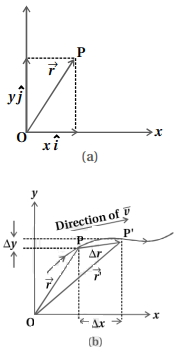
(N/A) Position vector: The position vector $\vec{r}$ of a particle $P$ located in a plane with reference to the origin $O$ is given by:
$\vec{r} = x \hat{i} + y \hat{j}$
Where $x$ and $y$ are the components of $\vec{r}$ along the $x$ and $y$-axes,respectively,representing the coordinates of the object.
Displacement vector:
Suppose a particle moves along a curve and is at position $P$ at time $t$ and at position $P^{\prime}$ at time $t^{\prime}$.
At $P$,the position vector is $\vec{r} = x \hat{i} + y \hat{j}$.
At $P^{\prime}$,the position vector is $\vec{r}^{\prime} = x^{\prime} \hat{i} + y^{\prime} \hat{j}$.
The displacement vector $\Delta \vec{r}$ is the change in the position vector from $P$ to $P^{\prime}$:
$\Delta \vec{r} = \vec{r}^{\prime} - \vec{r}$
$\Delta \vec{r} = (x^{\prime} - x) \hat{i} + (y^{\prime} - y) \hat{j}$
$\Delta \vec{r} = \Delta x \hat{i} + \Delta y \hat{j}$
Where $\Delta x = x^{\prime} - x$ and $\Delta y = y^{\prime} - y$ are the changes in the $x$ and $y$ coordinates,respectively.
$\vec{r} = x \hat{i} + y \hat{j}$
Where $x$ and $y$ are the components of $\vec{r}$ along the $x$ and $y$-axes,respectively,representing the coordinates of the object.
Displacement vector:
Suppose a particle moves along a curve and is at position $P$ at time $t$ and at position $P^{\prime}$ at time $t^{\prime}$.
At $P$,the position vector is $\vec{r} = x \hat{i} + y \hat{j}$.
At $P^{\prime}$,the position vector is $\vec{r}^{\prime} = x^{\prime} \hat{i} + y^{\prime} \hat{j}$.
The displacement vector $\Delta \vec{r}$ is the change in the position vector from $P$ to $P^{\prime}$:
$\Delta \vec{r} = \vec{r}^{\prime} - \vec{r}$
$\Delta \vec{r} = (x^{\prime} - x) \hat{i} + (y^{\prime} - y) \hat{j}$
$\Delta \vec{r} = \Delta x \hat{i} + \Delta y \hat{j}$
Where $\Delta x = x^{\prime} - x$ and $\Delta y = y^{\prime} - y$ are the changes in the $x$ and $y$ coordinates,respectively.
0 likes
View Solution24
Difficult
Explain average velocity,instantaneous velocity,and components of velocity for motion in a plane.
Solution
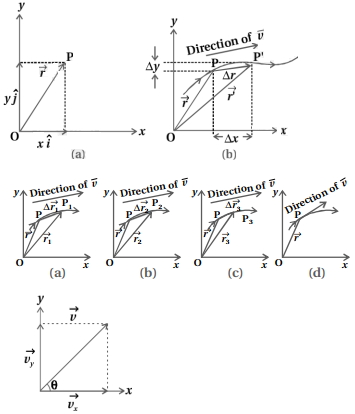
(N/A) The average velocity $(\vec{v})$ of an object is the ratio of the displacement and the corresponding time interval.
Suppose an object covers a displacement $\Delta \vec{r}$ in a time interval $\Delta t$.
Average velocity is given by:
$\langle\vec{v}\rangle = \frac{\Delta \vec{r}}{\Delta t} = \frac{\Delta x \hat{i} + \Delta y \hat{j}}{\Delta t} = \hat{i} \left( \frac{\Delta x}{\Delta t} \right) + \hat{j} \left( \frac{\Delta y}{\Delta t} \right)$
Or,$\langle\vec{v}\rangle = \langle v_{x} \rangle \hat{i} + \langle v_{y} \rangle \hat{j}$
The direction of the average velocity is the same as that of the displacement vector $\Delta \vec{r}$.
Instantaneous velocity is defined as the limiting value of the average velocity as the time interval approaches zero:
$\vec{v} = \lim_{\Delta t \rightarrow 0} \frac{\Delta \vec{r}}{\Delta t} = \frac{d\vec{r}}{dt}$
The direction of velocity at any point on the path is tangential to the path at that point and is in the direction of motion.
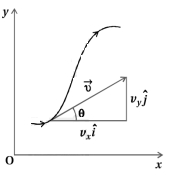
In terms of components,the instantaneous velocity is:
$\vec{v} = \hat{i} \left( \frac{dx}{dt} \right) + \hat{j} \left( \frac{dy}{dt} \right) = v_{x} \hat{i} + v_{y} \hat{j}$
where $v_{x} = \frac{dx}{dt}$ and $v_{y} = \frac{dy}{dt}$ are the components of velocity along the $x$ and $y$ axes respectively.
The magnitude of the velocity vector is given by:
$v = \sqrt{v_{x}^{2} + v_{y}^{2}}$
The units of velocity in the $MKS$ system are $m/s$ and in the $CGS$ system are $cm/s$.
Suppose an object covers a displacement $\Delta \vec{r}$ in a time interval $\Delta t$.
Average velocity is given by:
$\langle\vec{v}\rangle = \frac{\Delta \vec{r}}{\Delta t} = \frac{\Delta x \hat{i} + \Delta y \hat{j}}{\Delta t} = \hat{i} \left( \frac{\Delta x}{\Delta t} \right) + \hat{j} \left( \frac{\Delta y}{\Delta t} \right)$
Or,$\langle\vec{v}\rangle = \langle v_{x} \rangle \hat{i} + \langle v_{y} \rangle \hat{j}$
The direction of the average velocity is the same as that of the displacement vector $\Delta \vec{r}$.
Instantaneous velocity is defined as the limiting value of the average velocity as the time interval approaches zero:
$\vec{v} = \lim_{\Delta t \rightarrow 0} \frac{\Delta \vec{r}}{\Delta t} = \frac{d\vec{r}}{dt}$
The direction of velocity at any point on the path is tangential to the path at that point and is in the direction of motion.
In terms of components,the instantaneous velocity is:
$\vec{v} = \hat{i} \left( \frac{dx}{dt} \right) + \hat{j} \left( \frac{dy}{dt} \right) = v_{x} \hat{i} + v_{y} \hat{j}$
where $v_{x} = \frac{dx}{dt}$ and $v_{y} = \frac{dy}{dt}$ are the components of velocity along the $x$ and $y$ axes respectively.
The magnitude of the velocity vector is given by:
$v = \sqrt{v_{x}^{2} + v_{y}^{2}}$
The units of velocity in the $MKS$ system are $m/s$ and in the $CGS$ system are $cm/s$.
0 likes
View Solution25
Difficult
Explain average acceleration and instantaneous acceleration.
Solution
Average acceleration is defined as the time rate of change of velocity over a given time interval.
$\text{Average acceleration} = \frac{\text{Change in velocity}}{\text{Time interval}}$
The average acceleration $\vec{a}$ of an object moving in the $xy$-plane for a time interval $\Delta t$ is the change in velocity divided by the time interval:
$\vec{a} = \frac{\overrightarrow{\Delta v}}{\Delta t} = \frac{\Delta(v_x \hat{i} + v_y \hat{j})}{\Delta t} = \frac{\Delta v_x}{\Delta t} \hat{i} + \frac{\Delta v_y}{\Delta t} \hat{j} = a_x \hat{i} + a_y \hat{j}$
Instantaneous acceleration is the limiting value of the average acceleration as the time interval approaches zero:
$\vec{a} = \lim_{\Delta t \rightarrow 0} \frac{\overrightarrow{\Delta v}}{\Delta t} = \frac{d\vec{v}}{dt}$
Since $\vec{v} = v_x \hat{i} + v_y \hat{j}$,we have:
$\vec{a} = \frac{d}{dt}(v_x \hat{i} + v_y \hat{j}) = \frac{dv_x}{dt} \hat{i} + \frac{dv_y}{dt} \hat{j} = a_x \hat{i} + a_y \hat{j}$
where $a_x = \frac{dv_x}{dt}$ and $a_y = \frac{dv_y}{dt}$.
Furthermore,since $\vec{v} = \frac{d\vec{r}}{dt}$,acceleration can be expressed as the second derivative of position with respect to time:
$\vec{a} = \frac{d\vec{v}}{dt} = \frac{d}{dt}\left(\frac{d\vec{r}}{dt}\right) = \frac{d^2\vec{r}}{dt^2} = \ddot{\vec{r}}$
$\text{Average acceleration} = \frac{\text{Change in velocity}}{\text{Time interval}}$
The average acceleration $\vec{a}$ of an object moving in the $xy$-plane for a time interval $\Delta t$ is the change in velocity divided by the time interval:
$\vec{a} = \frac{\overrightarrow{\Delta v}}{\Delta t} = \frac{\Delta(v_x \hat{i} + v_y \hat{j})}{\Delta t} = \frac{\Delta v_x}{\Delta t} \hat{i} + \frac{\Delta v_y}{\Delta t} \hat{j} = a_x \hat{i} + a_y \hat{j}$
Instantaneous acceleration is the limiting value of the average acceleration as the time interval approaches zero:
$\vec{a} = \lim_{\Delta t \rightarrow 0} \frac{\overrightarrow{\Delta v}}{\Delta t} = \frac{d\vec{v}}{dt}$
Since $\vec{v} = v_x \hat{i} + v_y \hat{j}$,we have:
$\vec{a} = \frac{d}{dt}(v_x \hat{i} + v_y \hat{j}) = \frac{dv_x}{dt} \hat{i} + \frac{dv_y}{dt} \hat{j} = a_x \hat{i} + a_y \hat{j}$
where $a_x = \frac{dv_x}{dt}$ and $a_y = \frac{dv_y}{dt}$.
Furthermore,since $\vec{v} = \frac{d\vec{r}}{dt}$,acceleration can be expressed as the second derivative of position with respect to time:
$\vec{a} = \frac{d\vec{v}}{dt} = \frac{d}{dt}\left(\frac{d\vec{r}}{dt}\right) = \frac{d^2\vec{r}}{dt^2} = \ddot{\vec{r}}$
0 likes
View Solution26
EasyMCQ
If the position vector of a particle is given by $\vec{r}(t) = (3t)\hat{i} + (4t^2)\hat{j}$,then obtain its velocity vector at $t = 2 \ s$.
A
$3\hat{i} + 8\hat{j}$
B
$3\hat{i} + 16\hat{j}$
C
$6\hat{i} + 16\hat{j}$
D
$3\hat{i} + 32\hat{j}$
Solution
(B) The position vector of the particle is given by $\vec{r}(t) = (3t)\hat{i} + (4t^2)\hat{j}$.
To find the velocity vector $\vec{v}(t)$,we differentiate the position vector with respect to time $t$:
$\vec{v}(t) = \frac{d\vec{r}}{dt} = \frac{d}{dt} [(3t)\hat{i} + (4t^2)\hat{j}]$
$\vec{v}(t) = 3\hat{i} + (8t)\hat{j}$.
Now,substitute $t = 2 \ s$ into the velocity equation:
$\vec{v}(2) = 3\hat{i} + (8 \times 2)\hat{j}$
$\vec{v}(2) = 3\hat{i} + 16\hat{j} \ m/s$.
To find the velocity vector $\vec{v}(t)$,we differentiate the position vector with respect to time $t$:
$\vec{v}(t) = \frac{d\vec{r}}{dt} = \frac{d}{dt} [(3t)\hat{i} + (4t^2)\hat{j}]$
$\vec{v}(t) = 3\hat{i} + (8t)\hat{j}$.
Now,substitute $t = 2 \ s$ into the velocity equation:
$\vec{v}(2) = 3\hat{i} + (8 \times 2)\hat{j}$
$\vec{v}(2) = 3\hat{i} + 16\hat{j} \ m/s$.
0 likes
View Solution27
EasyMCQ
What can be the angle between velocity and acceleration for the motion in two or three dimensions?
A
Only $0^{\circ}$
B
Only $90^{\circ}$
C
Only $180^{\circ}$
D
Any angle between $0^{\circ}$ and $180^{\circ}$
Solution
(D) In motion in two or three dimensions,the velocity vector $\vec{v}$ and acceleration vector $\vec{a}$ can have any angle $\theta$ between them such that $0^{\circ} \le \theta \le 180^{\circ}$.
If $\theta = 0^{\circ}$,the speed increases.
If $\theta = 180^{\circ}$,the speed decreases.
If $\theta = 90^{\circ}$,the speed remains constant (uniform circular motion).
Therefore,the angle can be any value in the range $[0^{\circ}, 180^{\circ}]$.
If $\theta = 0^{\circ}$,the speed increases.
If $\theta = 180^{\circ}$,the speed decreases.
If $\theta = 90^{\circ}$,the speed remains constant (uniform circular motion).
Therefore,the angle can be any value in the range $[0^{\circ}, 180^{\circ}]$.
0 likes
View Solution28
Difficult
Derive the equations of motion for a body moving in two dimensions: $\vec{v} = \vec{v_0} + \vec{a}t$ and $\vec{r} = \vec{r_0} + \vec{v_0}t + \frac{1}{2}\vec{a}t^2$.
Solution
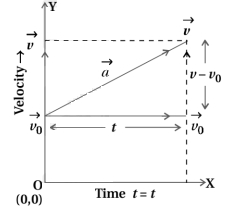
Consider a particle moving in a plane with constant acceleration $\vec{a}$. At time $t=0$,the velocity is initial velocity $\vec{v_0}$ and the position is $\vec{r_0}$. At time $t=t$,the velocity is $\vec{v}$ and the position is $\vec{r}$.
$1$. Derivation of $\vec{v} = \vec{v_0} + \vec{a}t$:
Since the acceleration is constant,the instantaneous acceleration is given by:
$\vec{a} = \frac{\vec{v} - \vec{v_0}}{t - 0}$
$\vec{a} = \frac{\vec{v} - \vec{v_0}}{t}$
$\vec{v} = \vec{v_0} + \vec{a}t$
In component form:
$v_x = v_{0x} + a_x t$
$v_y = v_{0y} + a_y t$
$2$. Derivation of $\vec{r} = \vec{r_0} + \vec{v_0}t + \frac{1}{2}\vec{a}t^2$:
For constant acceleration,the average velocity is $\vec{v}_{avg} = \frac{\vec{v} + \vec{v_0}}{2}$.
The displacement is $\vec{r} - \vec{r_0} = \vec{v}_{avg} \cdot t = \left( \frac{\vec{v} + \vec{v_0}}{2} \right) t$.
Substituting $\vec{v} = \vec{v_0} + \vec{a}t$:
$\vec{r} - \vec{r_0} = \left( \frac{\vec{v_0} + \vec{a}t + \vec{v_0}}{2} \right) t$
$\vec{r} - \vec{r_0} = \left( \frac{2\vec{v_0} + \vec{a}t}{2} \right) t$
$\vec{r} = \vec{r_0} + \vec{v_0}t + \frac{1}{2}\vec{a}t^2$.
$1$. Derivation of $\vec{v} = \vec{v_0} + \vec{a}t$:
Since the acceleration is constant,the instantaneous acceleration is given by:
$\vec{a} = \frac{\vec{v} - \vec{v_0}}{t - 0}$
$\vec{a} = \frac{\vec{v} - \vec{v_0}}{t}$
$\vec{v} = \vec{v_0} + \vec{a}t$
In component form:
$v_x = v_{0x} + a_x t$
$v_y = v_{0y} + a_y t$
$2$. Derivation of $\vec{r} = \vec{r_0} + \vec{v_0}t + \frac{1}{2}\vec{a}t^2$:
For constant acceleration,the average velocity is $\vec{v}_{avg} = \frac{\vec{v} + \vec{v_0}}{2}$.
The displacement is $\vec{r} - \vec{r_0} = \vec{v}_{avg} \cdot t = \left( \frac{\vec{v} + \vec{v_0}}{2} \right) t$.
Substituting $\vec{v} = \vec{v_0} + \vec{a}t$:
$\vec{r} - \vec{r_0} = \left( \frac{\vec{v_0} + \vec{a}t + \vec{v_0}}{2} \right) t$
$\vec{r} - \vec{r_0} = \left( \frac{2\vec{v_0} + \vec{a}t}{2} \right) t$
$\vec{r} = \vec{r_0} + \vec{v_0}t + \frac{1}{2}\vec{a}t^2$.
0 likes
View Solution29
EasyMCQ
Which two motions are considered to be combined for motion in a plane?
A
Two motions along the same straight line
B
Two independent motions along mutually perpendicular directions
C
Two motions with equal velocities
D
Two circular motions
Solution
(B) Motion in a plane is defined as motion in two dimensions.
According to the principle of independence of motion,any motion in a plane can be treated as the combination of two independent motions along two mutually perpendicular directions (typically the $x$ and $y$ axes).
Therefore,the correct option is $B$.
According to the principle of independence of motion,any motion in a plane can be treated as the combination of two independent motions along two mutually perpendicular directions (typically the $x$ and $y$ axes).
Therefore,the correct option is $B$.
0 likes
View Solution30
Medium
Write the equations of motion for uniformly accelerated motion in a plane.
Solution
(N/A) For motion in a plane with uniform acceleration $\vec{a}$,the motion can be resolved into two independent components along the $x$ and $y$ axes.
$1$. For the $x$-axis:
$v_x = u_x + a_x t$
$x = u_x t + \frac{1}{2} a_x t^2$
$v_x^2 = u_x^2 + 2 a_x x$
$2$. For the $y$-axis:
$v_y = u_y + a_y t$
$y = u_y t + \frac{1}{2} a_y t^2$
$v_y^2 = u_y^2 + 2 a_y y$
Here,$\vec{u} = (u_x, u_y)$ is the initial velocity,$\vec{v} = (v_x, v_y)$ is the final velocity at time $t$,and $\vec{a} = (a_x, a_y)$ is the constant acceleration.
$1$. For the $x$-axis:
$v_x = u_x + a_x t$
$x = u_x t + \frac{1}{2} a_x t^2$
$v_x^2 = u_x^2 + 2 a_x x$
$2$. For the $y$-axis:
$v_y = u_y + a_y t$
$y = u_y t + \frac{1}{2} a_y t^2$
$v_y^2 = u_y^2 + 2 a_y y$
Here,$\vec{u} = (u_x, u_y)$ is the initial velocity,$\vec{v} = (v_x, v_y)$ is the final velocity at time $t$,and $\vec{a} = (a_x, a_y)$ is the constant acceleration.
0 likes
View Solution31
MediumMCQ
The coordinates of a particle moving in the $XY$-plane vary with time as $x = 4t^2$ and $y = 2t$. The locus of the particle is a:
A
Straight line
B
Circle
C
Parabola
D
Ellipse
Solution
(C) Given the coordinates of the particle as functions of time $t$:
$x = 4t^2$
$y = 2t$
To find the locus (path) of the particle,we eliminate the parameter $t$ from the equations.
From the second equation,we have $t = \frac{y}{2}$.
Substituting this value of $t$ into the first equation:
$x = 4 \left( \frac{y}{2} \right)^2$
$x = 4 \left( \frac{y^2}{4} \right)$
$x = y^2$
The equation $x = y^2$ represents a parabola opening along the positive $x$-axis.
Therefore,the locus of the particle is a parabola.
$x = 4t^2$
$y = 2t$
To find the locus (path) of the particle,we eliminate the parameter $t$ from the equations.
From the second equation,we have $t = \frac{y}{2}$.
Substituting this value of $t$ into the first equation:
$x = 4 \left( \frac{y}{2} \right)^2$
$x = 4 \left( \frac{y^2}{4} \right)$
$x = y^2$
The equation $x = y^2$ represents a parabola opening along the positive $x$-axis.
Therefore,the locus of the particle is a parabola.
0 likes
View Solution32
MediumMCQ
Two particles $A$ and $B$ are moving in the $XY$-plane. Their positions vary with time $t$ according to the relations:
$x_A(t) = 3t, \quad x_B(t) = 6$
$y_A(t) = t, \quad y_B(t) = 2 + 3t^2$
What is the distance between the two particles at $t = 1$?
$x_A(t) = 3t, \quad x_B(t) = 6$
$y_A(t) = t, \quad y_B(t) = 2 + 3t^2$
What is the distance between the two particles at $t = 1$?
A
$5$
B
$3$
C
$4$
D
$\sqrt{12}$
Solution
(A) At $t = 1$,the positions of particle $A$ are:
$x_A(1) = 3(1) = 3$
$y_A(1) = 1$
So,the position of particle $A$ is $(3, 1)$.
At $t = 1$,the positions of particle $B$ are:
$x_B(1) = 6$
$y_B(1) = 2 + 3(1)^2 = 2 + 3 = 5$
So,the position of particle $B$ is $(6, 5)$.
The distance $d$ between two points $(x_1, y_1)$ and $(x_2, y_2)$ is given by $d = \sqrt{(x_2 - x_1)^2 + (y_2 - y_1)^2}$.
Substituting the values:
$d = \sqrt{(6 - 3)^2 + (5 - 1)^2}$
$d = \sqrt{3^2 + 4^2}$
$d = \sqrt{9 + 16} = \sqrt{25} = 5$.
$x_A(1) = 3(1) = 3$
$y_A(1) = 1$
So,the position of particle $A$ is $(3, 1)$.
At $t = 1$,the positions of particle $B$ are:
$x_B(1) = 6$
$y_B(1) = 2 + 3(1)^2 = 2 + 3 = 5$
So,the position of particle $B$ is $(6, 5)$.
The distance $d$ between two points $(x_1, y_1)$ and $(x_2, y_2)$ is given by $d = \sqrt{(x_2 - x_1)^2 + (y_2 - y_1)^2}$.
Substituting the values:
$d = \sqrt{(6 - 3)^2 + (5 - 1)^2}$
$d = \sqrt{3^2 + 4^2}$
$d = \sqrt{9 + 16} = \sqrt{25} = 5$.
0 likes
View Solution33
MediumMCQ
At time $t = 0$,a particle starts travelling from a height of $7 \, \text{cm}$ along the $z$-axis in a plane,keeping the $z$-coordinate constant. At any instant of time,its positions along the $x$ and $y$ directions are defined as $x = 3t$ and $y = 5t^3$ respectively. What will be the acceleration of the particle at $t = 1 \, \text{s}$?
A
$-30 \, \hat{j} \, \text{cm/s}^2$
B
$30 \, \hat{j} \, \text{cm/s}^2$
C
$3 \, \hat{i} + 15 \, \hat{j} \, \text{cm/s}^2$
D
$3 \, \hat{i} + 15 \, \hat{j} + 7 \, \hat{k} \, \text{cm/s}^2$
Solution
(B) The position vector of the particle at any time $t$ is given by $\vec{r}(t) = x(t) \hat{i} + y(t) \hat{j} + z(t) \hat{k}$.
Given $x = 3t$,$y = 5t^3$,and $z = 7$ (constant).
So,$\vec{r}(t) = 3t \hat{i} + 5t^3 \hat{j} + 7 \hat{k}$.
The velocity vector $\vec{v}$ is the first derivative of position with respect to time: $\vec{v} = \frac{d\vec{r}}{dt} = \frac{d}{dt}(3t) \hat{i} + \frac{d}{dt}(5t^3) \hat{j} + \frac{d}{dt}(7) \hat{k} = 3 \hat{i} + 15t^2 \hat{j}$.
The acceleration vector $\vec{a}$ is the derivative of velocity with respect to time: $\vec{a} = \frac{d\vec{v}}{dt} = \frac{d}{dt}(3) \hat{i} + \frac{d}{dt}(15t^2) \hat{j} = 0 \hat{i} + 30t \hat{j}$.
At $t = 1 \, \text{s}$,the acceleration is $\vec{a} = 30(1) \hat{j} = 30 \hat{j} \, \text{cm/s}^2$.
Given $x = 3t$,$y = 5t^3$,and $z = 7$ (constant).
So,$\vec{r}(t) = 3t \hat{i} + 5t^3 \hat{j} + 7 \hat{k}$.
The velocity vector $\vec{v}$ is the first derivative of position with respect to time: $\vec{v} = \frac{d\vec{r}}{dt} = \frac{d}{dt}(3t) \hat{i} + \frac{d}{dt}(5t^3) \hat{j} + \frac{d}{dt}(7) \hat{k} = 3 \hat{i} + 15t^2 \hat{j}$.
The acceleration vector $\vec{a}$ is the derivative of velocity with respect to time: $\vec{a} = \frac{d\vec{v}}{dt} = \frac{d}{dt}(3) \hat{i} + \frac{d}{dt}(15t^2) \hat{j} = 0 \hat{i} + 30t \hat{j}$.
At $t = 1 \, \text{s}$,the acceleration is $\vec{a} = 30(1) \hat{j} = 30 \hat{j} \, \text{cm/s}^2$.
0 likes
View Solution34
EasyMCQ
The position vector of an object at any time $t$ is given by $\vec{r} = 3t^2 \hat{i} + 6t \hat{j} + \hat{k}$. Its velocity along the $y$-axis has the magnitude:
A
$6t$
B
$6$
C
$0$
D
$9$
Solution
(B) The position vector is given by $\vec{r} = 3t^2 \hat{i} + 6t \hat{j} + \hat{k}$.
To find the velocity vector $\vec{v}$,we differentiate the position vector with respect to time $t$:
$\vec{v} = \frac{d\vec{r}}{dt} = \frac{d}{dt}(3t^2 \hat{i} + 6t \hat{j} + \hat{k})$
$\vec{v} = (6t) \hat{i} + (6) \hat{j} + (0) \hat{k}$
The velocity component along the $y$-axis is the coefficient of the $\hat{j}$ unit vector,which is $v_y = 6$.
Thus,the magnitude of the velocity along the $y$-axis is $6$.
To find the velocity vector $\vec{v}$,we differentiate the position vector with respect to time $t$:
$\vec{v} = \frac{d\vec{r}}{dt} = \frac{d}{dt}(3t^2 \hat{i} + 6t \hat{j} + \hat{k})$
$\vec{v} = (6t) \hat{i} + (6) \hat{j} + (0) \hat{k}$
The velocity component along the $y$-axis is the coefficient of the $\hat{j}$ unit vector,which is $v_y = 6$.
Thus,the magnitude of the velocity along the $y$-axis is $6$.
0 likes
View Solution35
DifficultMCQ
$A$ particle projected from the origin moves in the $x-y$ plane with a velocity $\vec{v} = 3 \hat{i} + 6x \hat{j}$,where $\hat{i}$ and $\hat{j}$ are the unit vectors along the $x$ and $y$ axes. Find the equation of the path followed by the particle.
A
$y = x^2$
B
$y = \frac{1}{x^2}$
C
$y = 2x^2$
D
$y = \frac{1}{x}$
Solution
(A) Given velocity vector: $\vec{v} = v_x \hat{i} + v_y \hat{j} = 3 \hat{i} + 6x \hat{j}$.
Comparing components,we get $v_x = \frac{dx}{dt} = 3$ and $v_y = \frac{dy}{dt} = 6x$.
The slope of the path is given by $\frac{dy}{dx} = \frac{v_y}{v_x}$.
Substituting the values,$\frac{dy}{dx} = \frac{6x}{3} = 2x$.
Integrating both sides with respect to $x$: $\int dy = \int 2x dx$.
Since the particle starts from the origin $(0,0)$,the constant of integration is $0$.
Thus,$y = x^2$.
Comparing components,we get $v_x = \frac{dx}{dt} = 3$ and $v_y = \frac{dy}{dt} = 6x$.
The slope of the path is given by $\frac{dy}{dx} = \frac{v_y}{v_x}$.
Substituting the values,$\frac{dy}{dx} = \frac{6x}{3} = 2x$.
Integrating both sides with respect to $x$: $\int dy = \int 2x dx$.
Since the particle starts from the origin $(0,0)$,the constant of integration is $0$.
Thus,$y = x^2$.
0 likes
View Solution36
EasyMCQ
An ant is moving on a plane horizontal surface. The number of degrees of freedom of the ant will be .........
A
$1$
B
$2$
C
$3$
D
$6$
Solution
(B) The number of degrees of freedom of a particle is defined as the number of independent coordinates required to specify its position in space.
Since the ant is moving on a plane horizontal surface,its position can be completely described by two coordinates,typically $(x, y)$ in a Cartesian coordinate system.
Therefore,the ant has $2$ degrees of freedom.
Since the ant is moving on a plane horizontal surface,its position can be completely described by two coordinates,typically $(x, y)$ in a Cartesian coordinate system.
Therefore,the ant has $2$ degrees of freedom.
0 likes
View Solution37
DifficultMCQ
Position of an ant ($S$ in metres) moving in $Y-Z$ plane is given by $S = 2t^2 \hat{j} + 5 \hat{k}$ (where $t$ is in seconds). The magnitude and direction of velocity of the ant at $t = 1 \ s$ will be:
A
$16 \ m/s$ in $y$-direction
B
$4 \ m/s$ in $x$-direction
C
$9 \ m/s$ in $z$-direction
D
$4 \ m/s$ in $y$-direction
Solution
(D) The position vector of the ant is given by $\vec{S} = 2t^2 \hat{j} + 5 \hat{k}$.
Velocity $\vec{v}$ is the time derivative of the position vector: $\vec{v} = \frac{d\vec{S}}{dt} = \frac{d}{dt}(2t^2 \hat{j} + 5 \hat{k}) = 4t \hat{j}$.
At $t = 1 \ s$,the velocity is $\vec{v} = 4(1) \hat{j} = 4 \hat{j} \ m/s$.
The magnitude of velocity is $|\vec{v}| = 4 \ m/s$.
The direction is along the positive $y$-axis (indicated by the unit vector $\hat{j}$).
Velocity $\vec{v}$ is the time derivative of the position vector: $\vec{v} = \frac{d\vec{S}}{dt} = \frac{d}{dt}(2t^2 \hat{j} + 5 \hat{k}) = 4t \hat{j}$.
At $t = 1 \ s$,the velocity is $\vec{v} = 4(1) \hat{j} = 4 \hat{j} \ m/s$.
The magnitude of velocity is $|\vec{v}| = 4 \ m/s$.
The direction is along the positive $y$-axis (indicated by the unit vector $\hat{j}$).
1 likes
View Solution38
MediumMCQ
The position vector of a moving body at any instant of time is given as $\overrightarrow{r} = (5t^2 \hat{i} - 5t \hat{j}) \text{ m}$. The magnitude and direction of velocity at $t = 2 \text{ s}$ is,
A
$5 \sqrt{15} \text{ m/s}$,making an angle of $\tan^{-1} 4$ with $-$ve $\text{Y}$ axis
B
$5 \sqrt{15} \text{ m/s}$,making an angle of $\tan^{-1} 4$ with $+$ve $\text{X}$ axis
C
$5 \sqrt{17} \text{ m/s}$,making an angle of $\tan^{-1} 4$ with $-$ve $\text{Y}$ axis
D
$5 \sqrt{17} \text{ m/s}$,making an angle of $\tan^{-1} 4$ with $+$ve $\text{X}$ axis
Solution
(C) The position vector is given by $\overrightarrow{r} = 5t^2 \hat{i} - 5t \hat{j}$.
The velocity vector $\overrightarrow{v}$ is the derivative of position with respect to time: $\overrightarrow{v} = \frac{d\overrightarrow{r}}{dt} = 10t \hat{i} - 5 \hat{j}$.
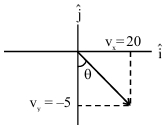
At $t = 2 \text{ s}$,the velocity vector is $\overrightarrow{v} = 10(2) \hat{i} - 5 \hat{j} = 20 \hat{i} - 5 \hat{j} \text{ m/s}$.
The magnitude of velocity is $|\overrightarrow{v}| = \sqrt{(20)^2 + (-5)^2} = \sqrt{400 + 25} = \sqrt{425} = \sqrt{25 \times 17} = 5\sqrt{17} \text{ m/s}$.
To find the direction,let $\theta$ be the angle with the negative $\text{Y}$-axis. From the vector components,$\tan \theta = \frac{|v_x|}{|v_y|} = \frac{20}{5} = 4$. Thus,$\theta = \tan^{-1} 4$ with the negative $\text{Y}$-axis.
The velocity vector $\overrightarrow{v}$ is the derivative of position with respect to time: $\overrightarrow{v} = \frac{d\overrightarrow{r}}{dt} = 10t \hat{i} - 5 \hat{j}$.
At $t = 2 \text{ s}$,the velocity vector is $\overrightarrow{v} = 10(2) \hat{i} - 5 \hat{j} = 20 \hat{i} - 5 \hat{j} \text{ m/s}$.
The magnitude of velocity is $|\overrightarrow{v}| = \sqrt{(20)^2 + (-5)^2} = \sqrt{400 + 25} = \sqrt{425} = \sqrt{25 \times 17} = 5\sqrt{17} \text{ m/s}$.
To find the direction,let $\theta$ be the angle with the negative $\text{Y}$-axis. From the vector components,$\tan \theta = \frac{|v_x|}{|v_y|} = \frac{20}{5} = 4$. Thus,$\theta = \tan^{-1} 4$ with the negative $\text{Y}$-axis.
0 likes
View Solution39
EasyMCQ
$A$ particle starts from the origin at $t=0$ with a velocity of $10 \hat{j} \text{ ms}^{-1}$ and moves in the $x-y$ plane with a constant acceleration of $(8 \hat{i} + 2 \hat{j}) \text{ ms}^{-2}$. At an instant when the $x$-coordinate of the particle is $16 \text{ m}$, the $y$-coordinate of the particle is: (in $\text{ m}$)
A
$16$
B
$28$
C
$36$
D
$24$
Solution
(D) Given: Initial velocity $\vec{u} = 10 \hat{j} \text{ ms}^{-1}$, Acceleration $\vec{a} = 8 \hat{i} + 2 \hat{j} \text{ ms}^{-2}$.
Using the kinematic equation $\vec{s} = \vec{u}t + \frac{1}{2} \vec{a}t^2$:
$\vec{s} = (10 \hat{j})t + \frac{1}{2} (8 \hat{i} + 2 \hat{j})t^2$
$\vec{s} = (4t^2) \hat{i} + (10t + t^2) \hat{j}$.
Comparing the components with $\vec{s} = x \hat{i} + y \hat{j}$, we get $x = 4t^2$ and $y = 10t + t^2$.
Given $x = 16 \text{ m}$, so $4t^2 = 16 \Rightarrow t^2 = 4 \Rightarrow t = 2 \text{ s}$.
Substituting $t = 2 \text{ s}$ into the expression for $y$:
$y = 10(2) + (2)^2 = 20 + 4 = 24 \text{ m}$.
Using the kinematic equation $\vec{s} = \vec{u}t + \frac{1}{2} \vec{a}t^2$:
$\vec{s} = (10 \hat{j})t + \frac{1}{2} (8 \hat{i} + 2 \hat{j})t^2$
$\vec{s} = (4t^2) \hat{i} + (10t + t^2) \hat{j}$.
Comparing the components with $\vec{s} = x \hat{i} + y \hat{j}$, we get $x = 4t^2$ and $y = 10t + t^2$.
Given $x = 16 \text{ m}$, so $4t^2 = 16 \Rightarrow t^2 = 4 \Rightarrow t = 2 \text{ s}$.
Substituting $t = 2 \text{ s}$ into the expression for $y$:
$y = 10(2) + (2)^2 = 20 + 4 = 24 \text{ m}$.
0 likes
View Solution40
EasyMCQ
$A$ particle is moving in the $xy$-plane such that its position coordinates are given by $x = (4t + t^2) \text{ m}$ and $y = (2t + \frac{t^2}{2}) \text{ m}$,where $t$ is in seconds. What is the velocity of the particle?
A
$\vec{v} = (4 + t) \hat{i} + (2 + t) \hat{j}$
B
$\vec{v} = (4 + 2t) \hat{i} + (2 + t) \hat{j}$
C
$\vec{v} = (4 + 2t) \hat{i} + (2 + \frac{t}{2}) \hat{j}$
D
$\vec{v} = (4 + t) \hat{i} + (2 + \frac{t}{2}) \hat{j}$
Solution
(B) The position vector of the particle is given by $\vec{r} = x\hat{i} + y\hat{j} = (4t + t^2)\hat{i} + (2t + \frac{t^2}{2})\hat{j}$.
Velocity is the time derivative of the position vector: $\vec{v} = \frac{d\vec{r}}{dt} = \frac{dx}{dt}\hat{i} + \frac{dy}{dt}\hat{j}$.
Differentiating $x$ with respect to $t$: $v_x = \frac{d}{dt}(4t + t^2) = 4 + 2t$.
Differentiating $y$ with respect to $t$: $v_y = \frac{d}{dt}(2t + \frac{t^2}{2}) = 2 + t$.
Therefore,the velocity vector is $\vec{v} = (4 + 2t)\hat{i} + (2 + t)\hat{j} \text{ m/s}$.
Velocity is the time derivative of the position vector: $\vec{v} = \frac{d\vec{r}}{dt} = \frac{dx}{dt}\hat{i} + \frac{dy}{dt}\hat{j}$.
Differentiating $x$ with respect to $t$: $v_x = \frac{d}{dt}(4t + t^2) = 4 + 2t$.
Differentiating $y$ with respect to $t$: $v_y = \frac{d}{dt}(2t + \frac{t^2}{2}) = 2 + t$.
Therefore,the velocity vector is $\vec{v} = (4 + 2t)\hat{i} + (2 + t)\hat{j} \text{ m/s}$.
0 likes
View Solution41
MediumMCQ
The magnitude of acceleration and velocity of a particle moving in a plane,whose position vector is $\vec{r} = 3t^2 \hat{i} + 2t \hat{j} + \hat{k}$ at $t = 2 \text{ s}$,are,respectively:
A
$6, \sqrt{148}$
B
$6, \sqrt{144}$
C
$3, \sqrt{13}$
D
$3, \sqrt{14}$
Solution
(A) Given the position vector: $\vec{r} = 3t^2 \hat{i} + 2t \hat{j} + \hat{k}$.
Velocity is the time derivative of position: $\vec{v} = \frac{d\vec{r}}{dt} = 6t \hat{i} + 2 \hat{j}$.
At $t = 2 \text{ s}$,the velocity vector is $\vec{v} = 6(2) \hat{i} + 2 \hat{j} = 12 \hat{i} + 2 \hat{j}$.
The magnitude of velocity is $|\vec{v}| = \sqrt{12^2 + 2^2} = \sqrt{144 + 4} = \sqrt{148} \text{ m/s}$.
Acceleration is the time derivative of velocity: $\vec{a} = \frac{d\vec{v}}{dt} = 6 \hat{i}$.
The magnitude of acceleration is $|\vec{a}| = \sqrt{6^2} = 6 \text{ m/s}^2$.
Thus,the magnitude of acceleration is $6$ and the magnitude of velocity is $\sqrt{148}$.
Velocity is the time derivative of position: $\vec{v} = \frac{d\vec{r}}{dt} = 6t \hat{i} + 2 \hat{j}$.
At $t = 2 \text{ s}$,the velocity vector is $\vec{v} = 6(2) \hat{i} + 2 \hat{j} = 12 \hat{i} + 2 \hat{j}$.
The magnitude of velocity is $|\vec{v}| = \sqrt{12^2 + 2^2} = \sqrt{144 + 4} = \sqrt{148} \text{ m/s}$.
Acceleration is the time derivative of velocity: $\vec{a} = \frac{d\vec{v}}{dt} = 6 \hat{i}$.
The magnitude of acceleration is $|\vec{a}| = \sqrt{6^2} = 6 \text{ m/s}^2$.
Thus,the magnitude of acceleration is $6$ and the magnitude of velocity is $\sqrt{148}$.
0 likes
View Solution42
EasyMCQ
$A$ particle initially at the origin starts moving in the $xy$-plane with a velocity component $\vec{V} = (6 + 2t) \hat{i} + (4 + 2\sqrt{3}t) \hat{j} \text{ m/s}$. The acceleration of the particle in $\text{m/s}^2$ is ($x, y$ are measured in meters,$t$ in seconds,respectively).
A
$(6 + 2t) \hat{i} + (4 + 2\sqrt{3}t) \hat{j}$
B
$(6 + 2t) \hat{i} + 2\sqrt{3} \hat{j}$
C
$2 \hat{i} + 2\sqrt{3} \hat{j}$
D
$2 \hat{i} + 2\sqrt{3} \hat{k}$
Solution
(C) The velocity vector is given by $\vec{V} = V_x \hat{i} + V_y \hat{j}$,where $V_x = 6 + 2t$ and $V_y = 4 + 2\sqrt{3}t$.
Acceleration $\vec{a}$ is the time derivative of velocity: $\vec{a} = \frac{d\vec{V}}{dt} = \frac{dV_x}{dt} \hat{i} + \frac{dV_y}{dt} \hat{j}$.
Calculating the components:
$a_x = \frac{d}{dt}(6 + 2t) = 2 \text{ m/s}^2$.
$a_y = \frac{d}{dt}(4 + 2\sqrt{3}t) = 2\sqrt{3} \text{ m/s}^2$.
Therefore,the acceleration vector is $\vec{a} = 2 \hat{i} + 2\sqrt{3} \hat{j} \text{ m/s}^2$.
Acceleration $\vec{a}$ is the time derivative of velocity: $\vec{a} = \frac{d\vec{V}}{dt} = \frac{dV_x}{dt} \hat{i} + \frac{dV_y}{dt} \hat{j}$.
Calculating the components:
$a_x = \frac{d}{dt}(6 + 2t) = 2 \text{ m/s}^2$.
$a_y = \frac{d}{dt}(4 + 2\sqrt{3}t) = 2\sqrt{3} \text{ m/s}^2$.
Therefore,the acceleration vector is $\vec{a} = 2 \hat{i} + 2\sqrt{3} \hat{j} \text{ m/s}^2$.
0 likes
View Solution43
EasyMCQ
Consider the motion of a particle described by $x = a \cos t$,$y = a \sin t$,and $z = t$. The trajectory traced by the particle as a function of time is
A
helix
B
circular
C
elliptical
D
straight line
Solution
(A) Given the parametric equations of motion:
$x = a \cos t$
$y = a \sin t$
$z = t$
First,consider the projection of the motion on the $xy$-plane:
$x^2 + y^2 = (a \cos t)^2 + (a \sin t)^2 = a^2(\cos^2 t + \sin^2 t) = a^2$
This represents a circle of radius $a$ in the $xy$-plane.
Simultaneously,the particle moves along the $z$-axis with a constant velocity since $z = t$,which implies $\frac{dz}{dt} = 1$.
Since the particle moves in a circular path in the $xy$-plane while simultaneously advancing linearly along the $z$-axis,the resulting trajectory is a helix.
$x = a \cos t$
$y = a \sin t$
$z = t$
First,consider the projection of the motion on the $xy$-plane:
$x^2 + y^2 = (a \cos t)^2 + (a \sin t)^2 = a^2(\cos^2 t + \sin^2 t) = a^2$
This represents a circle of radius $a$ in the $xy$-plane.
Simultaneously,the particle moves along the $z$-axis with a constant velocity since $z = t$,which implies $\frac{dz}{dt} = 1$.
Since the particle moves in a circular path in the $xy$-plane while simultaneously advancing linearly along the $z$-axis,the resulting trajectory is a helix.
0 likes
View Solution3-2.Motion in Plane — Motion In Two And Three Dimension · Frequently Asked Questions
1Are these 3-2.Motion in Plane questions useful for JEE and NEET?
Yes. All questions in this section are mapped to JEE Main and NEET exam patterns. Previous year questions from JEE Main, NEET, GUJCET and state-level exams are included with full solutions.
2Can I switch to Hindi or Gujarati for these questions?
Yes. Use the language tabs in the hero section or the sidebar to view the same questions and solutions in English, Hindi or Gujarati.
3How do I generate a question paper from this subtopic?
Use the Vedclass Exam Paper Generator — select the chapter and subtopic, set difficulty, and generate Sets A, B, C, D automatically. First 3 chapters of every subject are free.
Vedclass Products
For Students
Vedclass Test Series
Mock tests in real JEE/NEET style with performance analysis. 5-day free trial.
Start Free TrialFor Teachers
Exam Paper Generator
Generate Set A/B/C/D papers from this chapter in 2 minutes. 3 chapters free.
Try FreeFor Institutes
Online Exam Module
Live online exams with unlimited students, 360° analytics & white-label branding.
See DemoFor Teachers & Institutes
Generate a 3-2.Motion in Plane Exam Paper in 2 Minutes
Select subtopic & difficulty — Sets A, B, C, D auto-generated with No Repeat logic.
First 3 chapters of every subject are free — no payment required.