
A English
Horizontal Projectile Motion Questions in English
Class 11 Physics · 3-2.Motion in Plane · Horizontal Projectile Motion
492+
Questions
English
Language
100%
With Solutions
Showing 48 of 492 questions in English
1
EasyMCQ
$A$ ball $P$ is dropped vertically and another ball $Q$ is thrown horizontally with the same initial vertical velocity (which is $0$) from the same height $h$ at the same time. If air resistance is neglected,then:
A
Ball $P$ reaches the ground first.
B
Ball $Q$ reaches the ground first.
C
Both reach the ground at the same time.
D
The respective masses of the two balls will decide the time.
Solution
(C) The vertical motion of both balls is governed by the equation of motion $h = ut + \frac{1}{2}gt^2$.
For both balls,the initial vertical velocity $u_y = 0$.
Thus,the time taken to reach the ground is $t = \sqrt{\frac{2h}{g}}$.
Since both $h$ and $g$ are the same for both balls,the time taken to reach the ground is identical for both balls,regardless of their horizontal velocity.
For both balls,the initial vertical velocity $u_y = 0$.
Thus,the time taken to reach the ground is $t = \sqrt{\frac{2h}{g}}$.
Since both $h$ and $g$ are the same for both balls,the time taken to reach the ground is identical for both balls,regardless of their horizontal velocity.
1 likes
View Solution2
MediumMCQ
$A$ bullet is fired with a speed of $1000 \, m/s$ in order to hit a target $100 \, m$ away. If $g = 10 \, m/s^2$,the gun should be aimed:
A
Directly towards the target
B
$5 \, cm$ above the target
C
$10 \, cm$ above the target
D
$15 \, cm$ above the target
Solution
(B) The time taken by the bullet to reach the target is $t = \frac{\text{distance}}{\text{speed}} = \frac{100 \, m}{1000 \, m/s} = 0.1 \, s$.
During this time,the bullet undergoes a vertical downward displacement due to gravity,given by $h = \frac{1}{2}gt^2$.
Substituting the values: $h = \frac{1}{2} \times 10 \, m/s^2 \times (0.1 \, s)^2 = 5 \times 0.01 \, m = 0.05 \, m = 5 \, cm$.
To compensate for this downward drop,the gun must be aimed $5 \, cm$ above the target.
During this time,the bullet undergoes a vertical downward displacement due to gravity,given by $h = \frac{1}{2}gt^2$.
Substituting the values: $h = \frac{1}{2} \times 10 \, m/s^2 \times (0.1 \, s)^2 = 5 \times 0.01 \, m = 0.05 \, m = 5 \, cm$.
To compensate for this downward drop,the gun must be aimed $5 \, cm$ above the target.
0 likes
View Solution3
EasyMCQ
The maximum range of a gun on horizontal terrain is $16 \, km$. If $g = 10 \, m/s^2$,what must be the muzzle velocity of the shell in $m/s$?
A
$800$
B
$400$
C
$160$
D
$200\sqrt{2}$
Solution
(B) The maximum horizontal range $(R_{\max})$ of a projectile is given by the formula: $R_{\max} = \frac{u^2}{g}$,where $u$ is the muzzle velocity and $g$ is the acceleration due to gravity.
Given: $R_{\max} = 16 \, km = 16,000 \, m$ and $g = 10 \, m/s^2$.
Substituting the values into the formula:
$16,000 = \frac{u^2}{10}$
$u^2 = 16,000 \times 10 = 160,000$
$u = \sqrt{160,000} = 400 \, m/s$.
Therefore,the muzzle velocity of the shell is $400 \, m/s$.
Given: $R_{\max} = 16 \, km = 16,000 \, m$ and $g = 10 \, m/s^2$.
Substituting the values into the formula:
$16,000 = \frac{u^2}{10}$
$u^2 = 16,000 \times 10 = 160,000$
$u = \sqrt{160,000} = 400 \, m/s$.
Therefore,the muzzle velocity of the shell is $400 \, m/s$.
1 likes
View Solution4
EasyMCQ
$A$ stone is just released from the window of a train moving along a horizontal straight track. The stone will hit the ground following:
A
Straight path
B
Circular path
C
Parabolic path
D
Hyperbolic path
Solution
(C) When the stone is released from the moving train,it possesses an initial horizontal velocity equal to the velocity of the train.
After release,there is no horizontal force acting on the stone (ignoring air resistance),so its horizontal velocity remains constant.
Simultaneously,the stone is subjected to a constant vertical downward acceleration due to gravity $(g)$.
The combination of constant horizontal velocity and constant vertical acceleration results in a trajectory that is a parabola.
Therefore,the stone will hit the ground following a parabolic path.
After release,there is no horizontal force acting on the stone (ignoring air resistance),so its horizontal velocity remains constant.
Simultaneously,the stone is subjected to a constant vertical downward acceleration due to gravity $(g)$.
The combination of constant horizontal velocity and constant vertical acceleration results in a trajectory that is a parabola.
Therefore,the stone will hit the ground following a parabolic path.
0 likes
View Solution5
EasyMCQ
$A$ bullet is dropped from a certain height,and at the same instant,another bullet is fired horizontally from the same height. Which bullet will hit the ground first?
A
The one dropped first
B
Simultaneously
C
The one fired horizontally
D
Depends on the initial velocity
Solution
(B) The motion of both bullets can be analyzed by separating the vertical and horizontal components. For both bullets,the initial vertical velocity $u_y = 0$. The vertical displacement $h$ is given by the equation of motion $h = u_y t + \frac{1}{2} g t^2$. Substituting $u_y = 0$,we get $h = \frac{1}{2} g t^2$,which simplifies to $t = \sqrt{\frac{2h}{g}}$. Since the time $t$ depends only on the height $h$ and the acceleration due to gravity $g$,both bullets will hit the ground simultaneously.
0 likes
View Solution6
EasyMCQ
An aeroplane is flying at a constant horizontal velocity of $600\, km/hr$ at an elevation of $6\, km$ towards a point directly above the target on the earth's surface. At an appropriate time,the pilot releases a ball so that it strikes the target at the earth. The ball will appear to be falling
A
On a parabolic path as seen by pilot in the plane
B
Vertically along a straight path as seen by an observer on the ground near the target
C
On a parabolic path as seen by an observer on the ground near the target
D
On a zig-zag path as seen by pilot in the plane
Solution
(C) When the pilot releases the ball,it possesses the same horizontal velocity as the aeroplane $(600\, km/hr)$.
For the pilot inside the aeroplane,the relative horizontal velocity of the ball is zero. Therefore,the pilot observes the ball falling vertically in a straight line.
However,for an observer standing on the ground,the ball has both a constant horizontal velocity and a vertical velocity component due to gravity. This combination of motions results in a parabolic trajectory.
Thus,the ball appears to follow a parabolic path to an observer on the ground.
For the pilot inside the aeroplane,the relative horizontal velocity of the ball is zero. Therefore,the pilot observes the ball falling vertically in a straight line.
However,for an observer standing on the ground,the ball has both a constant horizontal velocity and a vertical velocity component due to gravity. This combination of motions results in a parabolic trajectory.
Thus,the ball appears to follow a parabolic path to an observer on the ground.
0 likes
View Solution7
MediumMCQ
An aeroplane is flying horizontally with a velocity of $600 \, km/h$ at a height of $1960 \, m$. When it is vertically above a point $A$ on the ground,a bomb is released from it. The bomb strikes the ground at point $B$. The distance $AB$ is
A
$1200 \, m$
B
$0.33 \, km$
C
$3.33 \, km$
D
$33 \, km$
Solution
(C) The horizontal velocity of the bomb is $u = 600 \, km/h = 600 \times \frac{5}{18} \, m/s = \frac{500}{3} \, m/s$.
The height from which the bomb is released is $h = 1960 \, m$.
The time taken by the bomb to reach the ground is given by $t = \sqrt{\frac{2h}{g}}$.
Taking $g = 9.8 \, m/s^2$,we have $t = \sqrt{\frac{2 \times 1960}{9.8}} = \sqrt{\frac{3920}{9.8}} = \sqrt{400} = 20 \, s$.
The horizontal distance $AB$ is the horizontal displacement,which is given by $AB = u \times t$.
$AB = \frac{500}{3} \times 20 = \frac{10000}{3} \, m = 3333.33 \, m = 3.33 \, km$.
The height from which the bomb is released is $h = 1960 \, m$.
The time taken by the bomb to reach the ground is given by $t = \sqrt{\frac{2h}{g}}$.
Taking $g = 9.8 \, m/s^2$,we have $t = \sqrt{\frac{2 \times 1960}{9.8}} = \sqrt{\frac{3920}{9.8}} = \sqrt{400} = 20 \, s$.
The horizontal distance $AB$ is the horizontal displacement,which is given by $AB = u \times t$.
$AB = \frac{500}{3} \times 20 = \frac{10000}{3} \, m = 3333.33 \, m = 3.33 \, km$.
0 likes
View Solution8
MediumMCQ
$A$ body is thrown horizontally from the top of a tower of height $5 \, m$. It touches the ground at a distance of $10 \, m$ from the foot of the tower. The initial velocity of the body is ......... $m/s$ $(g = 10 \, m/s^2)$.
A
$2.5$
B
$5$
C
$10$
D
$20$
Solution
(C) For a body projected horizontally from a height $h$,the time taken to reach the ground is given by $t = \sqrt{\frac{2h}{g}}$.
Given $h = 5 \, m$ and $g = 10 \, m/s^2$,we have $t = \sqrt{\frac{2 \times 5}{10}} = \sqrt{1} = 1 \, s$.
The horizontal distance (range) $R$ is given by $R = u \times t$,where $u$ is the initial horizontal velocity.
Given $R = 10 \, m$,we have $10 = u \times 1$.
Therefore,$u = 10 \, m/s$.
Given $h = 5 \, m$ and $g = 10 \, m/s^2$,we have $t = \sqrt{\frac{2 \times 5}{10}} = \sqrt{1} = 1 \, s$.
The horizontal distance (range) $R$ is given by $R = u \times t$,where $u$ is the initial horizontal velocity.
Given $R = 10 \, m$,we have $10 = u \times 1$.
Therefore,$u = 10 \, m/s$.
0 likes
View Solution9
EasyMCQ
$A$ particle $(A)$ is dropped from a height and another particle $(B)$ is thrown in a horizontal direction with a speed of $5 \; m/s$ from the same height. The correct statement is:
A
Both particles will reach the ground simultaneously.
B
Both particles will reach the ground with the same speed.
C
Particle $(A)$ will reach the ground first with respect to particle $(B)$.
D
Particle $(B)$ will reach the ground first with respect to particle $(A)$.
Solution
(A) For both particles,the vertical motion is governed by the equation of motion $h = ut + \frac{1}{2}gt^2$.
Since both particles are released from the same height $h$ and their initial vertical velocity component $u_y$ is $0$ in both cases,the time taken to reach the ground is given by $t = \sqrt{\frac{2h}{g}}$.
Since $h$ and $g$ are the same for both,the time taken $t$ is identical for both particles.
Therefore,both particles will reach the ground simultaneously.
Since both particles are released from the same height $h$ and their initial vertical velocity component $u_y$ is $0$ in both cases,the time taken to reach the ground is given by $t = \sqrt{\frac{2h}{g}}$.
Since $h$ and $g$ are the same for both,the time taken $t$ is identical for both particles.
Therefore,both particles will reach the ground simultaneously.
0 likes
View Solution10
EasyMCQ
$A$ particle moves in a plane with constant acceleration in a direction different from the initial velocity. The path of the particle will be
A
$A$ straight line
B
An arc of a circle
C
$A$ parabola
D
An ellipse
Solution
(C) particle moves with constant acceleration in a direction different from the initial velocity. Let the initial velocity be $v$ and the constant acceleration be $a$,with an angle $\theta$ between them $(0 < \theta < 180^{\circ})$.
Resolve the velocity into two components: one parallel to the acceleration $(v \cos \theta)$ and one perpendicular to the acceleration $(v \sin \theta)$.
Let the direction perpendicular to the acceleration be the $x$-axis and the direction of acceleration be the $y$-axis.
In the $x$-direction,there is no acceleration,so the displacement is $x = (v \sin \theta) t$,which gives $t = \frac{x}{v \sin \theta}$.
In the $y$-direction,the initial velocity is $v \cos \theta$ and the acceleration is $a$. The displacement is $y = (v \cos \theta) t + \frac{1}{2} a t^2$.
Substituting the expression for $t$ into the equation for $y$:
$y = (v \cos \theta) \left( \frac{x}{v \sin \theta} \right) + \frac{1}{2} a \left( \frac{x}{v \sin \theta} \right)^2$
$y = x \cot \theta + \frac{a}{2 v^2 \sin^2 \theta} x^2$.
This equation is of the form $y = Ax^2 + Bx$,which represents a parabola.
Resolve the velocity into two components: one parallel to the acceleration $(v \cos \theta)$ and one perpendicular to the acceleration $(v \sin \theta)$.
Let the direction perpendicular to the acceleration be the $x$-axis and the direction of acceleration be the $y$-axis.
In the $x$-direction,there is no acceleration,so the displacement is $x = (v \sin \theta) t$,which gives $t = \frac{x}{v \sin \theta}$.
In the $y$-direction,the initial velocity is $v \cos \theta$ and the acceleration is $a$. The displacement is $y = (v \cos \theta) t + \frac{1}{2} a t^2$.
Substituting the expression for $t$ into the equation for $y$:
$y = (v \cos \theta) \left( \frac{x}{v \sin \theta} \right) + \frac{1}{2} a \left( \frac{x}{v \sin \theta} \right)^2$
$y = x \cot \theta + \frac{a}{2 v^2 \sin^2 \theta} x^2$.
This equation is of the form $y = Ax^2 + Bx$,which represents a parabola.
0 likes
View Solution11
MediumMCQ
$A$ large number of bullets are fired in all directions with the same speed $v$. What is the maximum area on the ground on which these bullets will spread?
A
$\pi \frac{v^2}{g}$
B
$\pi \frac{v^4}{g^2}$
C
$\pi^2 \frac{v^4}{g^2}$
D
$\pi^2 \frac{v^2}{g^2}$
Solution
(B) The bullets fired in all directions with speed $v$ will cover a circular area on the ground.
The radius of this circle is equal to the maximum horizontal range $R_{\max}$ of the projectile.
The formula for the horizontal range is $R = \frac{v^2 \sin(2\theta)}{g}$.
The maximum range occurs at $\theta = 45^\circ$,where $R_{\max} = \frac{v^2}{g}$.
The area $A$ covered by the bullets is the area of a circle with radius $R_{\max}$,given by $A = \pi R_{\max}^2$.
Substituting the value of $R_{\max}$,we get $A = \pi \left( \frac{v^2}{g} \right)^2 = \frac{\pi v^4}{g^2}$.
The radius of this circle is equal to the maximum horizontal range $R_{\max}$ of the projectile.
The formula for the horizontal range is $R = \frac{v^2 \sin(2\theta)}{g}$.
The maximum range occurs at $\theta = 45^\circ$,where $R_{\max} = \frac{v^2}{g}$.
The area $A$ covered by the bullets is the area of a circle with radius $R_{\max}$,given by $A = \pi R_{\max}^2$.
Substituting the value of $R_{\max}$,we get $A = \pi \left( \frac{v^2}{g} \right)^2 = \frac{\pi v^4}{g^2}$.
0 likes
View Solution12
EasyMCQ
$A$ projectile fired with initial velocity $u$ at an angle $\theta$ has a range $R$. If the initial velocity is doubled at the same angle of projection,then the new range will be:
A
$2R$
B
$R/2$
C
$R$
D
$4R$
Solution
(D) The horizontal range $R$ of a projectile is given by the formula: $R = \frac{u^2 \sin(2\theta)}{g}$.
From this expression,it is clear that the range is directly proportional to the square of the initial velocity,i.e.,$R \propto u^2$.
If the initial velocity $u$ is doubled (i.e.,$u' = 2u$),the new range $R'$ becomes:
$R' = \frac{(2u)^2 \sin(2\theta)}{g} = 4 \times \frac{u^2 \sin(2\theta)}{g} = 4R$.
Therefore,the range becomes $4R$.
From this expression,it is clear that the range is directly proportional to the square of the initial velocity,i.e.,$R \propto u^2$.
If the initial velocity $u$ is doubled (i.e.,$u' = 2u$),the new range $R'$ becomes:
$R' = \frac{(2u)^2 \sin(2\theta)}{g} = 4 \times \frac{u^2 \sin(2\theta)}{g} = 4R$.
Therefore,the range becomes $4R$.
0 likes
View Solution13
EasyMCQ
If the initial velocity of a projectile is doubled,keeping the angle of projection the same,the maximum height reached by it will:
A
Remain the same
B
Be doubled
C
Be quadrupled
D
Be halved
Solution
(C) The formula for the maximum height $(H)$ reached by a projectile is given by:
$H = \frac{u^2 \sin^2 \theta}{2g}$
From this expression,we can see that the maximum height is directly proportional to the square of the initial velocity $(u)$:
$H \propto u^2$
If the initial velocity is doubled $(u' = 2u)$,the new maximum height $(H')$ becomes:
$H' \propto (2u)^2 = 4u^2$
Therefore,$H' = 4H$.
Thus,the maximum height reached by the projectile will be quadrupled.
$H = \frac{u^2 \sin^2 \theta}{2g}$
From this expression,we can see that the maximum height is directly proportional to the square of the initial velocity $(u)$:
$H \propto u^2$
If the initial velocity is doubled $(u' = 2u)$,the new maximum height $(H')$ becomes:
$H' \propto (2u)^2 = 4u^2$
Therefore,$H' = 4H$.
Thus,the maximum height reached by the projectile will be quadrupled.
0 likes
View Solution14
EasyMCQ
In the motion of a projectile moving freely under gravity,which of the following is true?
A
Total energy is conserved
B
Momentum is conserved
C
Energy and momentum both are conserved
D
None is conserved
Solution
(A) In the motion of a projectile under gravity,the only force acting on the body is the gravitational force,which is a conservative force.
Since the gravitational force is conservative,the total mechanical energy (kinetic energy + potential energy) of the projectile remains constant throughout its flight.
However,because there is an external gravitational force acting on the projectile,the net external force is not zero.
According to Newton's second law,the rate of change of momentum is equal to the external force. Since the external force is non-zero,the linear momentum of the projectile is not conserved.
Therefore,only the total energy is conserved.
Since the gravitational force is conservative,the total mechanical energy (kinetic energy + potential energy) of the projectile remains constant throughout its flight.
However,because there is an external gravitational force acting on the projectile,the net external force is not zero.
According to Newton's second law,the rate of change of momentum is equal to the external force. Since the external force is non-zero,the linear momentum of the projectile is not conserved.
Therefore,only the total energy is conserved.
0 likes
View Solution15
EasyMCQ
The range of a projectile for a given initial velocity is maximum when the angle of projection is $45^\circ$. The range will be minimum,if the angle of projection is ......... $^\circ$.
A
$90$
B
$180$
C
$60$
D
$75$
Solution
(A) The horizontal range $R$ of a projectile is given by the formula $R = \frac{u^2 \sin(2\theta)}{g}$,where $u$ is the initial velocity,$\theta$ is the angle of projection,and $g$ is the acceleration due to gravity.
To find the minimum range,we look for the angle $\theta$ that makes $\sin(2\theta)$ minimum.
The range $R$ is minimum when $\sin(2\theta) = 0$,which occurs at $2\theta = 0^\circ$ or $2\theta = 180^\circ$.
For $2\theta = 180^\circ$,we get $\theta = 90^\circ$.
At $\theta = 90^\circ$,the projectile is thrown vertically upwards,and it returns to the point of projection,resulting in a horizontal range of $R = 0$.
To find the minimum range,we look for the angle $\theta$ that makes $\sin(2\theta)$ minimum.
The range $R$ is minimum when $\sin(2\theta) = 0$,which occurs at $2\theta = 0^\circ$ or $2\theta = 180^\circ$.
For $2\theta = 180^\circ$,we get $\theta = 90^\circ$.
At $\theta = 90^\circ$,the projectile is thrown vertically upwards,and it returns to the point of projection,resulting in a horizontal range of $R = 0$.
0 likes
View Solution16
DifficultMCQ
The angle of projection at which the horizontal range and maximum height of a projectile are equal is
A
$45^\circ$
B
$\theta = \tan^{-1}(0.25)$
C
$\theta = \tan^{-1}(4)$ or $\theta \approx 76^\circ$
D
$60^\circ$
Solution
(C) The horizontal range $R$ of a projectile is given by $R = \frac{u^2 \sin(2\theta)}{g} = \frac{2u^2 \sin\theta \cos\theta}{g}$.
The maximum height $H$ of a projectile is given by $H = \frac{u^2 \sin^2\theta}{2g}$.
Given that the horizontal range is equal to the maximum height,$R = H$.
Substituting the formulas: $\frac{2u^2 \sin\theta \cos\theta}{g} = \frac{u^2 \sin^2\theta}{2g}$.
Simplifying the equation: $2 \cos\theta = \frac{\sin\theta}{2}$.
Rearranging for $\tan\theta$: $\frac{\sin\theta}{\cos\theta} = 4$,which means $\tan\theta = 4$.
Therefore,$\theta = \tan^{-1}(4)$,which is approximately $76^\circ$.
The maximum height $H$ of a projectile is given by $H = \frac{u^2 \sin^2\theta}{2g}$.
Given that the horizontal range is equal to the maximum height,$R = H$.
Substituting the formulas: $\frac{2u^2 \sin\theta \cos\theta}{g} = \frac{u^2 \sin^2\theta}{2g}$.
Simplifying the equation: $2 \cos\theta = \frac{\sin\theta}{2}$.
Rearranging for $\tan\theta$: $\frac{\sin\theta}{\cos\theta} = 4$,which means $\tan\theta = 4$.
Therefore,$\theta = \tan^{-1}(4)$,which is approximately $76^\circ$.
0 likes
View Solution17
EasyMCQ
$A$ ball is thrown upwards and it returns to the ground describing a parabolic path. Which of the following remains constant?
A
Kinetic energy of the ball
B
Speed of the ball
C
Horizontal component of velocity
D
Vertical component of velocity
Solution
(C) In projectile motion,the only force acting on the object is gravity,which acts vertically downwards.
There is no force acting in the horizontal direction,meaning the horizontal acceleration is $a_x = 0$.
Since $a_x = 0$,the horizontal component of velocity,$v_x = u \cos \theta$,remains constant throughout the flight.
The vertical component of velocity changes due to the acceleration due to gravity $(g)$,and consequently,the speed and kinetic energy also change.
Therefore,the correct option is $C$.
There is no force acting in the horizontal direction,meaning the horizontal acceleration is $a_x = 0$.
Since $a_x = 0$,the horizontal component of velocity,$v_x = u \cos \theta$,remains constant throughout the flight.
The vertical component of velocity changes due to the acceleration due to gravity $(g)$,and consequently,the speed and kinetic energy also change.
Therefore,the correct option is $C$.
0 likes
View Solution18
EasyMCQ
At the top of the trajectory of a projectile,the directions of its velocity and acceleration are
A
Perpendicular to each other
B
Parallel to each other
C
Inclined to each other at an angle of $45^o$
D
Antiparallel to each other
Solution
(A) The direction of velocity is always tangent to the path of the projectile. At the highest point of the trajectory,the vertical component of velocity becomes zero,so the velocity vector is purely horizontal.
Acceleration due to gravity $(g)$ always acts in the vertically downward direction throughout the motion.
Since the velocity is horizontal and the acceleration is vertical,the angle between the velocity vector $\vec{v}$ and the acceleration vector $\vec{g}$ is $90^o$.
Therefore,they are perpendicular to each other.
Acceleration due to gravity $(g)$ always acts in the vertically downward direction throughout the motion.
Since the velocity is horizontal and the acceleration is vertical,the angle between the velocity vector $\vec{v}$ and the acceleration vector $\vec{g}$ is $90^o$.
Therefore,they are perpendicular to each other.
0 likes
View Solution19
MediumMCQ
An object is thrown along a direction inclined at an angle of $45^\circ$ with the horizontal direction. The horizontal range of the particle is equal to
A
Vertical height
B
Twice the vertical height
C
Thrice the vertical height
D
Four times the vertical height
Solution
(D) The horizontal range $R$ of a projectile is given by $R = \frac{u^2 \sin(2\theta)}{g}$.
The maximum vertical height $H$ is given by $H = \frac{u^2 \sin^2 \theta}{2g}$.
Dividing $R$ by $H$,we get $\frac{R}{H} = \frac{u^2 \sin(2\theta) / g}{u^2 \sin^2 \theta / (2g)} = \frac{2 \sin \theta \cos \theta}{\sin^2 \theta / 2} = 4 \cot \theta$.
Therefore,$R = 4H \cot \theta$.
Given the angle of projection $\theta = 45^\circ$,we substitute this into the equation:
$R = 4H \cot(45^\circ)$.
Since $\cot(45^\circ) = 1$,we have $R = 4H$.
Thus,the horizontal range is four times the vertical height.
The maximum vertical height $H$ is given by $H = \frac{u^2 \sin^2 \theta}{2g}$.
Dividing $R$ by $H$,we get $\frac{R}{H} = \frac{u^2 \sin(2\theta) / g}{u^2 \sin^2 \theta / (2g)} = \frac{2 \sin \theta \cos \theta}{\sin^2 \theta / 2} = 4 \cot \theta$.
Therefore,$R = 4H \cot \theta$.
Given the angle of projection $\theta = 45^\circ$,we substitute this into the equation:
$R = 4H \cot(45^\circ)$.
Since $\cot(45^\circ) = 1$,we have $R = 4H$.
Thus,the horizontal range is four times the vertical height.
0 likes
View Solution20
MediumMCQ
The height $y$ and the distance $x$ along the horizontal plane of a projectile on a certain planet (with no surrounding atmosphere) are given by $y = (8t - 5t^2) \ m$ and $x = 6t \ m$,where $t$ is in seconds. The velocity with which the projectile is projected is ......... $m/s$.
A
$8$
B
$6$
C
$10$
D
Not obtainable from the data
Solution
(C) The velocity components are obtained by differentiating the position equations with respect to time $t$.
$v_x = \frac{dx}{dt} = \frac{d}{dt}(6t) = 6 \ m/s$.
$v_y = \frac{dy}{dt} = \frac{d}{dt}(8t - 5t^2) = 8 - 10t \ m/s$.
At the time of projection,$t = 0$.
Substituting $t = 0$ into the velocity components:
$v_x = 6 \ m/s$.
$v_y = 8 - 10(0) = 8 \ m/s$.
The magnitude of the initial velocity $v$ is given by $v = \sqrt{v_x^2 + v_y^2}$.
$v = \sqrt{6^2 + 8^2} = \sqrt{36 + 64} = \sqrt{100} = 10 \ m/s$.
$v_x = \frac{dx}{dt} = \frac{d}{dt}(6t) = 6 \ m/s$.
$v_y = \frac{dy}{dt} = \frac{d}{dt}(8t - 5t^2) = 8 - 10t \ m/s$.
At the time of projection,$t = 0$.
Substituting $t = 0$ into the velocity components:
$v_x = 6 \ m/s$.
$v_y = 8 - 10(0) = 8 \ m/s$.
The magnitude of the initial velocity $v$ is given by $v = \sqrt{v_x^2 + v_y^2}$.
$v = \sqrt{6^2 + 8^2} = \sqrt{36 + 64} = \sqrt{100} = 10 \ m/s$.
2 likes
View Solution21
MediumMCQ
The height $y$ and the distance $x$ along the horizontal plane of a projectile on a certain planet (with no surrounding atmosphere) are given by $y = (8t - 5t^2) \ m$ and $x = 6t \ m$,where $t$ is in seconds. The angle with the horizontal at which the projectile was projected is:
A
$\tan^{-1}(3/4)$
B
$\tan^{-1}(4/3)$
C
$\sin^{-1}(3/4)$
D
Not obtainable from the given data
Solution
(B) The velocity components are obtained by differentiating the position equations with respect to time $t$.
$v_y = \frac{dy}{dt} = \frac{d}{dt}(8t - 5t^2) = 8 - 10t \ m/s$
$v_x = \frac{dx}{dt} = \frac{d}{dt}(6t) = 6 \ m/s$
At the time of projection,$t = 0$.
Substituting $t = 0$ into the velocity components:
$v_{y0} = 8 - 10(0) = 8 \ m/s$
$v_{x0} = 6 \ m/s$
The angle of projection $\theta$ is given by $\tan \theta = \frac{v_{y0}}{v_{x0}}$.
$\tan \theta = \frac{8}{6} = \frac{4}{3}$
Therefore,$\theta = \tan^{-1}(4/3)$.
$v_y = \frac{dy}{dt} = \frac{d}{dt}(8t - 5t^2) = 8 - 10t \ m/s$
$v_x = \frac{dx}{dt} = \frac{d}{dt}(6t) = 6 \ m/s$
At the time of projection,$t = 0$.
Substituting $t = 0$ into the velocity components:
$v_{y0} = 8 - 10(0) = 8 \ m/s$
$v_{x0} = 6 \ m/s$
The angle of projection $\theta$ is given by $\tan \theta = \frac{v_{y0}}{v_{x0}}$.
$\tan \theta = \frac{8}{6} = \frac{4}{3}$
Therefore,$\theta = \tan^{-1}(4/3)$.
0 likes
View Solution22
MediumMCQ
The height $y$ and the distance $x$ along the horizontal plane of a projectile on a certain planet (with no surrounding atmosphere) are given by $y = (8t - 5t^2) \text{ m}$ and $x = 6t \text{ m}$,where $t$ is in seconds. The acceleration due to gravity on this planet is ......... $m/s^2$.
A
$10$
B
$5$
C
$20$
D
$2.5$
Solution
(A) The position coordinates of the projectile are given by $x = 6t$ and $y = 8t - 5t^2$.
To find the acceleration,we first find the velocity components by differentiating the position with respect to time $t$.
Velocity in the $x$-direction: $v_x = \frac{dx}{dt} = \frac{d}{dt}(6t) = 6 \text{ m/s}$.
Velocity in the $y$-direction: $v_y = \frac{dy}{dt} = \frac{d}{dt}(8t - 5t^2) = 8 - 10t \text{ m/s}$.
Now,we find the acceleration components by differentiating the velocity with respect to time $t$.
Acceleration in the $x$-direction: $a_x = \frac{dv_x}{dt} = \frac{d}{dt}(6) = 0 \text{ m/s}^2$.
Acceleration in the $y$-direction: $a_y = \frac{dv_y}{dt} = \frac{d}{dt}(8 - 10t) = -10 \text{ m/s}^2$.
The negative sign indicates that the acceleration is acting downwards. The magnitude of the acceleration due to gravity is $g = |a_y| = 10 \text{ m/s}^2$.
To find the acceleration,we first find the velocity components by differentiating the position with respect to time $t$.
Velocity in the $x$-direction: $v_x = \frac{dx}{dt} = \frac{d}{dt}(6t) = 6 \text{ m/s}$.
Velocity in the $y$-direction: $v_y = \frac{dy}{dt} = \frac{d}{dt}(8t - 5t^2) = 8 - 10t \text{ m/s}$.
Now,we find the acceleration components by differentiating the velocity with respect to time $t$.
Acceleration in the $x$-direction: $a_x = \frac{dv_x}{dt} = \frac{d}{dt}(6) = 0 \text{ m/s}^2$.
Acceleration in the $y$-direction: $a_y = \frac{dv_y}{dt} = \frac{d}{dt}(8 - 10t) = -10 \text{ m/s}^2$.
The negative sign indicates that the acceleration is acting downwards. The magnitude of the acceleration due to gravity is $g = |a_y| = 10 \text{ m/s}^2$.
0 likes
View Solution23
MediumMCQ
The range of a particle when launched at an angle of $15^\circ$ with the horizontal is $1.5 \, km$. What is the range of the projectile when launched at an angle of $45^\circ$ to the horizontal? (in $km$)
A
$1.5$
B
$3.0$
C
$6.0$
D
$0.75$
Solution
(B) The formula for the horizontal range of a projectile is $R = \frac{u^2 \sin(2\theta)}{g}$.
For $\theta_1 = 15^\circ$,the range is $R_1 = \frac{u^2 \sin(30^\circ)}{g} = \frac{u^2}{2g} = 1.5 \, km$.
From this,we find $\frac{u^2}{g} = 1.5 \times 2 = 3.0 \, km$.
For $\theta_2 = 45^\circ$,the range is $R_2 = \frac{u^2 \sin(90^\circ)}{g} = \frac{u^2}{g}$.
Substituting the value,$R_2 = 3.0 \, km$.
For $\theta_1 = 15^\circ$,the range is $R_1 = \frac{u^2 \sin(30^\circ)}{g} = \frac{u^2}{2g} = 1.5 \, km$.
From this,we find $\frac{u^2}{g} = 1.5 \times 2 = 3.0 \, km$.
For $\theta_2 = 45^\circ$,the range is $R_2 = \frac{u^2 \sin(90^\circ)}{g} = \frac{u^2}{g}$.
Substituting the value,$R_2 = 3.0 \, km$.
1 likes
View Solution24
DifficultMCQ
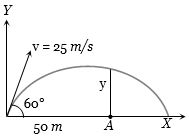
$A$ cricketer hits a ball with a velocity $25\,m/s$ at $60^\circ$ above the horizontal. How far above the ground does it pass over a fielder $50\,m$ from the bat (in $,m$)? (Assume the ball is struck very close to the ground and $g = 9.8\,m/s^2$)
A
$8.2$
B
$9.0$
C
$11.6$
D
$12.7$
Solution
(A) The horizontal component of the initial velocity is $v_x = v \cos \theta = 25 \cos 60^\circ = 25 \times 0.5 = 12.5\,m/s$.
The vertical component of the initial velocity is $v_y = v \sin \theta = 25 \sin 60^\circ = 25 \times \frac{\sqrt{3}}{2} = 12.5\sqrt{3}\,m/s$.
The time $t$ taken to cover a horizontal distance of $x = 50\,m$ is $t = \frac{x}{v_x} = \frac{50}{12.5} = 4\,s$.
The vertical height $y$ at time $t$ is given by the equation of motion $y = v_y t - \frac{1}{2} g t^2$.
Substituting the values: $y = (12.5\sqrt{3}) \times 4 - \frac{1}{2} \times 9.8 \times (4)^2$.
$y = 50\sqrt{3} - 4.9 \times 16 = 50 \times 1.732 - 78.4 = 86.6 - 78.4 = 8.2\,m$.
The vertical component of the initial velocity is $v_y = v \sin \theta = 25 \sin 60^\circ = 25 \times \frac{\sqrt{3}}{2} = 12.5\sqrt{3}\,m/s$.
The time $t$ taken to cover a horizontal distance of $x = 50\,m$ is $t = \frac{x}{v_x} = \frac{50}{12.5} = 4\,s$.
The vertical height $y$ at time $t$ is given by the equation of motion $y = v_y t - \frac{1}{2} g t^2$.
Substituting the values: $y = (12.5\sqrt{3}) \times 4 - \frac{1}{2} \times 9.8 \times (4)^2$.
$y = 50\sqrt{3} - 4.9 \times 16 = 50 \times 1.732 - 78.4 = 86.6 - 78.4 = 8.2\,m$.
0 likes
View Solution25
MediumMCQ
$A$ stone is projected from the ground with velocity $25\,m/s$. Two seconds later,it just clears a wall $5\,m$ high. The angle of projection of the stone is ........ $^o$ $(g = 10\,m/s^2)$.
A
$30$
B
$45$
C
$50.2$
D
$60$
Solution
(A) The vertical component of the initial velocity is $u_y = u \sin \theta = 25 \sin \theta$.
Using the equation of motion for the vertical direction: $h = u_y t - \frac{1}{2} g t^2$.
Given $h = 5\,m$,$t = 2\,s$,and $g = 10\,m/s^2$,we substitute these values:
$5 = (25 \sin \theta) \times 2 - \frac{1}{2} \times 10 \times (2)^2$.
$5 = 50 \sin \theta - 20$.
$25 = 50 \sin \theta$.
$\sin \theta = \frac{25}{50} = 0.5$.
Therefore,$\theta = \arcsin(0.5) = 30^\circ$.
Using the equation of motion for the vertical direction: $h = u_y t - \frac{1}{2} g t^2$.
Given $h = 5\,m$,$t = 2\,s$,and $g = 10\,m/s^2$,we substitute these values:
$5 = (25 \sin \theta) \times 2 - \frac{1}{2} \times 10 \times (2)^2$.
$5 = 50 \sin \theta - 20$.
$25 = 50 \sin \theta$.
$\sin \theta = \frac{25}{50} = 0.5$.
Therefore,$\theta = \arcsin(0.5) = 30^\circ$.
1 likes
View Solution26
EasyMCQ
Galileo writes that for angles of projection of a projectile at angles $(45^\circ + \theta)$ and $(45^\circ - \theta)$,the horizontal ranges described by the projectile are in the ratio of (if $\theta \le 45^\circ$):
A
$2:1$
B
$1:2$
C
$1:1$
D
$2:3$
Solution
(C) The horizontal range $R$ of a projectile is given by the formula $R = \frac{u^2 \sin(2\alpha)}{g}$,where $u$ is the initial velocity,$\alpha$ is the angle of projection,and $g$ is the acceleration due to gravity.
For the first angle of projection $\alpha_1 = (45^\circ - \theta)$:
$R_1 = \frac{u^2 \sin(2(45^\circ - \theta))}{g} = \frac{u^2 \sin(90^\circ - 2\theta)}{g} = \frac{u^2 \cos(2\theta)}{g}$.
For the second angle of projection $\alpha_2 = (45^\circ + \theta)$:
$R_2 = \frac{u^2 \sin(2(45^\circ + \theta))}{g} = \frac{u^2 \sin(90^\circ + 2\theta)}{g} = \frac{u^2 \cos(2\theta)}{g}$.
Comparing the two ranges,we see that $R_1 = R_2$.
Therefore,the ratio of the horizontal ranges is $R_1 : R_2 = 1 : 1$.
For the first angle of projection $\alpha_1 = (45^\circ - \theta)$:
$R_1 = \frac{u^2 \sin(2(45^\circ - \theta))}{g} = \frac{u^2 \sin(90^\circ - 2\theta)}{g} = \frac{u^2 \cos(2\theta)}{g}$.
For the second angle of projection $\alpha_2 = (45^\circ + \theta)$:
$R_2 = \frac{u^2 \sin(2(45^\circ + \theta))}{g} = \frac{u^2 \sin(90^\circ + 2\theta)}{g} = \frac{u^2 \cos(2\theta)}{g}$.
Comparing the two ranges,we see that $R_1 = R_2$.
Therefore,the ratio of the horizontal ranges is $R_1 : R_2 = 1 : 1$.
0 likes
View Solution27
EasyMCQ
$A$ projectile thrown with a speed $v$ at an angle $\theta$ has a range $R$ on the surface of the Earth. For the same $v$ and $\theta$,its range on the surface of the Moon will be:
A
$R/6$
B
$6R$
C
$R/36$
D
$36R$
Solution
(B) The horizontal range $R$ of a projectile is given by the formula $R = \frac{v^2 \sin(2\theta)}{g}$.
Here,$v$ is the initial speed,$\theta$ is the angle of projection,and $g$ is the acceleration due to gravity.
On the surface of the Earth,the range is $R = \frac{v^2 \sin(2\theta)}{g_e}$,where $g_e = g$.
On the surface of the Moon,the acceleration due to gravity is $g_m = \frac{g_e}{6} = \frac{g}{6}$.
Since the speed $v$ and the angle $\theta$ remain the same,the new range $R_m$ on the Moon is given by $R_m = \frac{v^2 \sin(2\theta)}{g_m} = \frac{v^2 \sin(2\theta)}{g/6} = 6 \times \left( \frac{v^2 \sin(2\theta)}{g} \right)$.
Substituting the value of $R$,we get $R_m = 6R$.
Here,$v$ is the initial speed,$\theta$ is the angle of projection,and $g$ is the acceleration due to gravity.
On the surface of the Earth,the range is $R = \frac{v^2 \sin(2\theta)}{g_e}$,where $g_e = g$.
On the surface of the Moon,the acceleration due to gravity is $g_m = \frac{g_e}{6} = \frac{g}{6}$.
Since the speed $v$ and the angle $\theta$ remain the same,the new range $R_m$ on the Moon is given by $R_m = \frac{v^2 \sin(2\theta)}{g_m} = \frac{v^2 \sin(2\theta)}{g/6} = 6 \times \left( \frac{v^2 \sin(2\theta)}{g} \right)$.
Substituting the value of $R$,we get $R_m = 6R$.
0 likes
View Solution28
MediumMCQ
$A$ ball is projected with kinetic energy $E$ at an angle of $45^\circ$ to the horizontal. At the highest point during its flight,its kinetic energy will be
A
Zero
B
$E/2$
C
$E/\sqrt{2}$
D
$E$
Solution
(B) The initial kinetic energy of the ball is $E = \frac{1}{2}mv^2$,where $v$ is the initial velocity.
At the highest point of the trajectory,the vertical component of the velocity becomes zero,while the horizontal component remains constant.
The horizontal component of velocity is $v_x = v \cos \theta$.
At the highest point,the velocity of the ball is $v_h = v \cos \theta$.
The kinetic energy at the highest point is $E' = \frac{1}{2}m(v_h)^2 = \frac{1}{2}m(v \cos \theta)^2$.
$E' = (\frac{1}{2}mv^2) \cos^2 \theta = E \cos^2 \theta$.
Given $\theta = 45^\circ$,we have $\cos 45^\circ = \frac{1}{\sqrt{2}}$.
Therefore,$E' = E (\frac{1}{\sqrt{2}})^2 = E (\frac{1}{2}) = \frac{E}{2}$.
At the highest point of the trajectory,the vertical component of the velocity becomes zero,while the horizontal component remains constant.
The horizontal component of velocity is $v_x = v \cos \theta$.
At the highest point,the velocity of the ball is $v_h = v \cos \theta$.
The kinetic energy at the highest point is $E' = \frac{1}{2}m(v_h)^2 = \frac{1}{2}m(v \cos \theta)^2$.
$E' = (\frac{1}{2}mv^2) \cos^2 \theta = E \cos^2 \theta$.
Given $\theta = 45^\circ$,we have $\cos 45^\circ = \frac{1}{\sqrt{2}}$.
Therefore,$E' = E (\frac{1}{\sqrt{2}})^2 = E (\frac{1}{2}) = \frac{E}{2}$.
0 likes
View Solution29
DifficultMCQ
$A$ particle of mass $m$ is projected with velocity $v$ making an angle of $45^{\circ}$ with the horizontal. The magnitude of the angular momentum of the particle about the point of projection when the particle is at its maximum height is (where $g$ is the acceleration due to gravity):
A
Zero
B
$mv^3 / (4\sqrt{2}g)$
C
$mv^3 / (\sqrt{2}g)$
D
$mv^2 / 2g$
Solution
(B) At the highest point,the vertical component of velocity is zero,and the horizontal component is $v_x = v \cos 45^{\circ} = v / \sqrt{2}$.
The momentum of the particle at this point is $p = m v_x = mv / \sqrt{2}$.
The angular momentum $L$ about the point of projection is given by $L = p \times h$,where $h$ is the maximum height.
The maximum height $h$ is given by $h = (v^2 \sin^2 45^{\circ}) / (2g) = (v^2 \cdot (1/2)) / (2g) = v^2 / (4g)$.
Substituting these values,we get $L = (mv / \sqrt{2}) \times (v^2 / 4g) = mv^3 / (4\sqrt{2}g)$.
The momentum of the particle at this point is $p = m v_x = mv / \sqrt{2}$.
The angular momentum $L$ about the point of projection is given by $L = p \times h$,where $h$ is the maximum height.
The maximum height $h$ is given by $h = (v^2 \sin^2 45^{\circ}) / (2g) = (v^2 \cdot (1/2)) / (2g) = v^2 / (4g)$.
Substituting these values,we get $L = (mv / \sqrt{2}) \times (v^2 / 4g) = mv^3 / (4\sqrt{2}g)$.
1 likes
View Solution30
MediumMCQ
$A$ particle reaches its highest point when it has covered exactly one half of its horizontal range. The corresponding point on the displacement-time graph is characterized by
A
Negative slope and zero curvature
B
Zero slope and positive curvature
C
Zero slope and negative curvature
D
Positive slope and zero curvature
Solution
(C) In projectile motion,the horizontal displacement $x$ is given by $x = u_x t$,which is a linear function of time. The vertical displacement $y$ is given by $y = u_y t - \frac{1}{2} g t^2$,which is a downward-opening parabola. At the highest point,the vertical velocity $v_y = \frac{dy}{dt} = 0$. On a displacement-time graph for vertical motion,the slope is $\frac{dy}{dt}$. At the highest point,the slope is $0$. Since the path is a downward-opening parabola ($y = at^2 + bt + c$ with $a < 0$),the second derivative $\frac{d^2y}{dt^2} = -g$ is negative. However,the question asks for the displacement-time graph of the particle's motion. The vertical displacement $y(t)$ reaches a maximum at the peak,where the slope is $0$ and the curvature (concavity) is negative. Thus,the correct description is zero slope and negative curvature.
0 likes
View Solution31
EasyMCQ
At the top of the trajectory of a projectile,the acceleration is
A
Maximum
B
Minimum
C
Zero
D
$g$
Solution
(D) During the entire flight of a projectile,the only force acting on it is the gravitational force,which acts vertically downwards.
According to Newton's second law,$F = ma$,the acceleration $a = F/m = mg/m = g$.
Therefore,the acceleration remains constant and equal to $g$ throughout the projectile motion,including at the highest point of the trajectory.
According to Newton's second law,$F = ma$,the acceleration $a = F/m = mg/m = g$.
Therefore,the acceleration remains constant and equal to $g$ throughout the projectile motion,including at the highest point of the trajectory.
0 likes
View Solution32
EasyMCQ
When a body is thrown with a velocity $u$ making an angle $\theta$ with the horizontal plane,the maximum distance covered by it in the horizontal direction is:
A
$\frac{u^2 \sin \theta}{g}$
B
$\frac{u^2 \sin 2\theta}{2g}$
C
$\frac{u^2 \sin 2\theta}{g}$
D
$\frac{u^2 \cos 2\theta}{g}$
Solution
(C) The horizontal component of the initial velocity is $u_x = u \cos \theta$.
Since there is no acceleration in the horizontal direction,the horizontal velocity remains constant throughout the motion.
The time of flight $T$ for a projectile is given by $T = \frac{2u \sin \theta}{g}$.
The horizontal range $R$ is the product of the horizontal velocity and the time of flight:
$R = u_x \times T$
$R = (u \cos \theta) \times \left( \frac{2u \sin \theta}{g} \right)$
Using the trigonometric identity $\sin 2\theta = 2 \sin \theta \cos \theta$,we get:
$R = \frac{u^2 (2 \sin \theta \cos \theta)}{g} = \frac{u^2 \sin 2\theta}{g}$.
Since there is no acceleration in the horizontal direction,the horizontal velocity remains constant throughout the motion.
The time of flight $T$ for a projectile is given by $T = \frac{2u \sin \theta}{g}$.
The horizontal range $R$ is the product of the horizontal velocity and the time of flight:
$R = u_x \times T$
$R = (u \cos \theta) \times \left( \frac{2u \sin \theta}{g} \right)$
Using the trigonometric identity $\sin 2\theta = 2 \sin \theta \cos \theta$,we get:
$R = \frac{u^2 (2 \sin \theta \cos \theta)}{g} = \frac{u^2 \sin 2\theta}{g}$.
0 likes
View Solution33
EasyMCQ
$A$ football player throws a ball with a velocity of $50 \ m/s$ at an angle of $30^{\circ}$ from the horizontal. The ball remains in the air for ...... $s$ $(g = 10 \ m/s^2)$.
A
$2.5$
B
$1.25$
C
$5$
D
$0.625$
Solution
(C) The time of flight $T$ for a projectile is given by the formula:
$T = \frac{2u \sin \theta}{g}$
Given:
Initial velocity $u = 50 \ m/s$
Angle of projection $\theta = 30^{\circ}$
Acceleration due to gravity $g = 10 \ m/s^2$
Substituting the values:
$T = \frac{2 \times 50 \times \sin 30^{\circ}}{10}$
Since $\sin 30^{\circ} = 0.5$:
$T = \frac{100 \times 0.5}{10} = \frac{50}{10} = 5 \ s$
Therefore,the ball remains in the air for $5 \ s$.
$T = \frac{2u \sin \theta}{g}$
Given:
Initial velocity $u = 50 \ m/s$
Angle of projection $\theta = 30^{\circ}$
Acceleration due to gravity $g = 10 \ m/s^2$
Substituting the values:
$T = \frac{2 \times 50 \times \sin 30^{\circ}}{10}$
Since $\sin 30^{\circ} = 0.5$:
$T = \frac{100 \times 0.5}{10} = \frac{50}{10} = 5 \ s$
Therefore,the ball remains in the air for $5 \ s$.
0 likes
View Solution34
MediumMCQ
$A$ body is projected at such an angle that the horizontal range is three times the greatest height. The angle of projection is
A
$25^\circ 8'$
B
$33^\circ 7'$
C
$42^\circ 8'$
D
$53^\circ 8'$
Solution
(D) The horizontal range $R$ of a projectile is given by $R = \frac{u^2 \sin(2\theta)}{g} = \frac{2u^2 \sin \theta \cos \theta}{g}$.
The maximum height $H$ is given by $H = \frac{u^2 \sin^2 \theta}{2g}$.
According to the problem,the horizontal range is three times the maximum height,so $R = 3H$.
Substituting the formulas:
$\frac{2u^2 \sin \theta \cos \theta}{g} = 3 \left( \frac{u^2 \sin^2 \theta}{2g} \right)$.
Simplifying the equation:
$2 \cos \theta = \frac{3}{2} \sin \theta$.
Rearranging to find $\tan \theta$:
$\tan \theta = \frac{4}{3}$.
Therefore,$\theta = \tan^{-1}(1.333) \approx 53^\circ 8'$.
The maximum height $H$ is given by $H = \frac{u^2 \sin^2 \theta}{2g}$.
According to the problem,the horizontal range is three times the maximum height,so $R = 3H$.
Substituting the formulas:
$\frac{2u^2 \sin \theta \cos \theta}{g} = 3 \left( \frac{u^2 \sin^2 \theta}{2g} \right)$.
Simplifying the equation:
$2 \cos \theta = \frac{3}{2} \sin \theta$.
Rearranging to find $\tan \theta$:
$\tan \theta = \frac{4}{3}$.
Therefore,$\theta = \tan^{-1}(1.333) \approx 53^\circ 8'$.
0 likes
View Solution35
EasyMCQ
$A$ gun is aimed at a target in the line of its barrel. The target is released and allowed to fall under gravity at the same instant the gun is fired. The bullet will
A
Pass above the target
B
Pass below the target
C
Hit the target
D
Certainly miss the target
Solution
(C) Let the initial velocity of the bullet be $u$ and the angle of projection be $\theta$. The target is at a distance $d$ from the gun. The time taken for the bullet to reach the horizontal distance $d$ is $t = d / (u \cos \theta)$.
In this time $t$,the vertical displacement of the bullet due to gravity is $y_1 = (1/2) g t^2$.
The vertical position of the bullet relative to the line of sight (which is at angle $\theta$) is $y_2 = (u \sin \theta) t - (1/2) g t^2$.
Since the target is in the line of the barrel,the initial height of the target is $h = d \tan \theta = (u \sin \theta) t$.
The actual position of the target at time $t$ is $h' = h - (1/2) g t^2 = (u \sin \theta) t - (1/2) g t^2$.
Since the vertical position of the bullet $y_2$ is equal to the vertical position of the target $h'$,the bullet will hit the target.
In this time $t$,the vertical displacement of the bullet due to gravity is $y_1 = (1/2) g t^2$.
The vertical position of the bullet relative to the line of sight (which is at angle $\theta$) is $y_2 = (u \sin \theta) t - (1/2) g t^2$.
Since the target is in the line of the barrel,the initial height of the target is $h = d \tan \theta = (u \sin \theta) t$.
The actual position of the target at time $t$ is $h' = h - (1/2) g t^2 = (u \sin \theta) t - (1/2) g t^2$.
Since the vertical position of the bullet $y_2$ is equal to the vertical position of the target $h'$,the bullet will hit the target.
0 likes
View Solution36
MediumMCQ
Two bodies are projected with the same velocity. If one is projected at an angle of $30^\circ$ and the other at an angle of $60^\circ$ to the horizontal,the ratio of the maximum heights reached is
A
$3:1$
B
$1:3$
C
$1:2$
D
$2:1$
Solution
(B) The formula for the maximum height $H$ of a projectile is given by $H = \frac{u^2 \sin^2 \theta}{2g}$.
Since both bodies are projected with the same velocity $u$,the ratio of the maximum heights $H_1$ and $H_2$ is given by:
$\frac{H_1}{H_2} = \frac{\sin^2 \theta_1}{\sin^2 \theta_2}$.
Given $\theta_1 = 30^\circ$ and $\theta_2 = 60^\circ$,we have:
$\frac{H_1}{H_2} = \frac{\sin^2 30^\circ}{\sin^2 60^\circ} = \frac{(1/2)^2}{(\sqrt{3}/2)^2} = \frac{1/4}{3/4} = \frac{1}{3}$.
Therefore,the ratio is $1:3$.
Since both bodies are projected with the same velocity $u$,the ratio of the maximum heights $H_1$ and $H_2$ is given by:
$\frac{H_1}{H_2} = \frac{\sin^2 \theta_1}{\sin^2 \theta_2}$.
Given $\theta_1 = 30^\circ$ and $\theta_2 = 60^\circ$,we have:
$\frac{H_1}{H_2} = \frac{\sin^2 30^\circ}{\sin^2 60^\circ} = \frac{(1/2)^2}{(\sqrt{3}/2)^2} = \frac{1/4}{3/4} = \frac{1}{3}$.
Therefore,the ratio is $1:3$.
1 likes
View Solution37
MediumMCQ
If the range of a gun which fires a shell with muzzle speed $V$ is $R$,then the angle of elevation of the gun is
A
$\cos^{-1}\left(\frac{V^2}{Rg}\right)$
B
$\cos^{-1}\left(\frac{gR}{V^2}\right)$
C
$\frac{1}{2}\left(\frac{V^2}{Rg}\right)$
D
$\frac{1}{2}\sin^{-1}\left(\frac{gR}{V^2}\right)$
Solution
(D) The horizontal range $R$ of a projectile fired with muzzle speed $V$ at an angle of elevation $\theta$ is given by the formula:
$R = \frac{V^2 \sin(2\theta)}{g}$
Rearranging the formula to solve for $\theta$:
$\sin(2\theta) = \frac{Rg}{V^2}$
Taking the inverse sine on both sides:
$2\theta = \sin^{-1}\left(\frac{gR}{V^2}\right)$
Dividing by $2$:
$\theta = \frac{1}{2} \sin^{-1}\left(\frac{gR}{V^2}\right)$
Thus,the correct option is $D$.
$R = \frac{V^2 \sin(2\theta)}{g}$
Rearranging the formula to solve for $\theta$:
$\sin(2\theta) = \frac{Rg}{V^2}$
Taking the inverse sine on both sides:
$2\theta = \sin^{-1}\left(\frac{gR}{V^2}\right)$
Dividing by $2$:
$\theta = \frac{1}{2} \sin^{-1}\left(\frac{gR}{V^2}\right)$
Thus,the correct option is $D$.
0 likes
View Solution38
MediumMCQ
If the time of flight of a projectile is $10 \ s$,and its range is $500 \ m$,then the maximum height attained by it will be ......... $m$.
A
$125$
B
$50$
C
$100$
D
$150$
Solution
(A) The formula for the time of flight of a projectile is $T = \frac{2u \sin \theta}{g}$.
Given $T = 10 \ s$ and taking $g = 10 \ m/s^2$,we have $10 = \frac{2u \sin \theta}{10}$,which gives $u \sin \theta = 50 \ m/s$.
The formula for the maximum height attained by a projectile is $H = \frac{u^2 \sin^2 \theta}{2g}$.
Substituting the value of $u \sin \theta$,we get $H = \frac{(u \sin \theta)^2}{2g} = \frac{50^2}{2 \times 10} = \frac{2500}{20} = 125 \ m$.
Given $T = 10 \ s$ and taking $g = 10 \ m/s^2$,we have $10 = \frac{2u \sin \theta}{10}$,which gives $u \sin \theta = 50 \ m/s$.
The formula for the maximum height attained by a projectile is $H = \frac{u^2 \sin^2 \theta}{2g}$.
Substituting the value of $u \sin \theta$,we get $H = \frac{(u \sin \theta)^2}{2g} = \frac{50^2}{2 \times 10} = \frac{2500}{20} = 125 \ m$.
0 likes
View Solution39
EasyMCQ
If a body $A$ of mass $M$ is thrown with velocity $v$ at an angle of $30^{\circ}$ to the horizontal and another body $B$ of the same mass is thrown with the same speed at an angle of $60^{\circ}$ to the horizontal,the ratio of the horizontal range of $A$ to $B$ will be:
A
$1:3$
B
$1:1$
C
$1:\sqrt{3}$
D
$\sqrt{3}:1$
Solution
(B) The horizontal range $R$ of a projectile is given by the formula: $R = \frac{v^2 \sin(2\theta)}{g}$.
For body $A$,the angle of projection is $\theta_A = 30^{\circ}$. Thus,$R_A = \frac{v^2 \sin(2 \times 30^{\circ})}{g} = \frac{v^2 \sin(60^{\circ})}{g}$.
For body $B$,the angle of projection is $\theta_B = 60^{\circ}$. Thus,$R_B = \frac{v^2 \sin(2 \times 60^{\circ})}{g} = \frac{v^2 \sin(120^{\circ})}{g}$.
Since $\sin(120^{\circ}) = \sin(180^{\circ} - 60^{\circ}) = \sin(60^{\circ})$,it follows that $R_A = R_B$.
Therefore,the ratio of the horizontal range of $A$ to $B$ is $R_A : R_B = 1:1$.
For body $A$,the angle of projection is $\theta_A = 30^{\circ}$. Thus,$R_A = \frac{v^2 \sin(2 \times 30^{\circ})}{g} = \frac{v^2 \sin(60^{\circ})}{g}$.
For body $B$,the angle of projection is $\theta_B = 60^{\circ}$. Thus,$R_B = \frac{v^2 \sin(2 \times 60^{\circ})}{g} = \frac{v^2 \sin(120^{\circ})}{g}$.
Since $\sin(120^{\circ}) = \sin(180^{\circ} - 60^{\circ}) = \sin(60^{\circ})$,it follows that $R_A = R_B$.
Therefore,the ratio of the horizontal range of $A$ to $B$ is $R_A : R_B = 1:1$.
0 likes
View Solution40
EasyMCQ
$A$ bullet is fired from a cannon with a velocity of $500 \, m/s$. If the angle of projection is $15^\circ$ and $g = 10 \, m/s^2$,then the horizontal range is:
A
$25 \times 10^3 \, m$
B
$12.5 \times 10^3 \, m$
C
$50 \times 10^2 \, m$
D
$25 \times 10^2 \, m$
Solution
(B) The formula for the horizontal range $R$ of a projectile is given by $R = \frac{u^2 \sin(2\theta)}{g}$.
Given values are:
Initial velocity $u = 500 \, m/s$
Angle of projection $\theta = 15^\circ$
Acceleration due to gravity $g = 10 \, m/s^2$
Substituting these values into the formula:
$R = \frac{(500)^2 \times \sin(2 \times 15^\circ)}{10}$
$R = \frac{250000 \times \sin(30^\circ)}{10}$
Since $\sin(30^\circ) = 0.5$,we have:
$R = \frac{250000 \times 0.5}{10} = 25000 \times 0.5 = 12500 \, m$
This can be written as $12.5 \times 10^3 \, m$.
Therefore,the correct option is $B$.
Given values are:
Initial velocity $u = 500 \, m/s$
Angle of projection $\theta = 15^\circ$
Acceleration due to gravity $g = 10 \, m/s^2$
Substituting these values into the formula:
$R = \frac{(500)^2 \times \sin(2 \times 15^\circ)}{10}$
$R = \frac{250000 \times \sin(30^\circ)}{10}$
Since $\sin(30^\circ) = 0.5$,we have:
$R = \frac{250000 \times 0.5}{10} = 25000 \times 0.5 = 12500 \, m$
This can be written as $12.5 \times 10^3 \, m$.
Therefore,the correct option is $B$.
2 likes
View Solution41
EasyMCQ
$A$ ball thrown by a boy is caught by another after $2 \ s$ at the same level some distance away. If the angle of projection is $30^o$,the velocity of projection is ......... $m/s$.
A
$19.6$
B
$9.8$
C
$14.7$
D
None of these
Solution
(A) The time of flight $T$ for a projectile is given by the formula: $T = \frac{2u \sin \theta}{g}$.
Given: $T = 2 \ s$,$\theta = 30^o$,and $g = 9.8 \ m/s^2$.
Rearranging the formula to solve for the initial velocity $u$:
$u = \frac{T \times g}{2 \sin \theta}$.
Substituting the values:
$u = \frac{2 \times 9.8}{2 \times \sin 30^o} = \frac{19.6}{2 \times 0.5} = \frac{19.6}{1} = 19.6 \ m/s$.
Given: $T = 2 \ s$,$\theta = 30^o$,and $g = 9.8 \ m/s^2$.
Rearranging the formula to solve for the initial velocity $u$:
$u = \frac{T \times g}{2 \sin \theta}$.
Substituting the values:
$u = \frac{2 \times 9.8}{2 \times \sin 30^o} = \frac{19.6}{2 \times 0.5} = \frac{19.6}{1} = 19.6 \ m/s$.
0 likes
View Solution42
EasyMCQ
$A$ particle covers $50\, m$ distance when projected with an initial speed. On the same surface,it will cover a distance of ......... $m$ when projected with double the initial speed.
A
$100$
B
$150$
C
$200$
D
$250$
Solution
(C) The horizontal range $R$ of a projectile is given by the formula $R = \frac{u^2 \sin(2\theta)}{g}$.
Assuming the angle of projection $\theta$ and the acceleration due to gravity $g$ remain constant,the range is directly proportional to the square of the initial speed: $R \propto u^2$.
Let the initial speed be $u_1$ and the initial range be $R_1 = 50\, m$.
When the speed is doubled,$u_2 = 2u_1$.
The new range $R_2$ is given by $R_2 = R_1 \times (\frac{u_2}{u_1})^2$.
Substituting the values: $R_2 = 50 \times (\frac{2u_1}{u_1})^2 = 50 \times 2^2 = 50 \times 4 = 200\, m$.
Assuming the angle of projection $\theta$ and the acceleration due to gravity $g$ remain constant,the range is directly proportional to the square of the initial speed: $R \propto u^2$.
Let the initial speed be $u_1$ and the initial range be $R_1 = 50\, m$.
When the speed is doubled,$u_2 = 2u_1$.
The new range $R_2$ is given by $R_2 = R_1 \times (\frac{u_2}{u_1})^2$.
Substituting the values: $R_2 = 50 \times (\frac{2u_1}{u_1})^2 = 50 \times 2^2 = 50 \times 4 = 200\, m$.
0 likes
View Solution43
EasyMCQ
$A$ ball is thrown upwards at an angle of $60^o$ to the horizontal. It falls on the ground at a distance of $90 \,m$. If the ball is thrown with the same initial velocity at an angle $30^o$,it will fall on the ground at a distance of ........ $m$.
A
$30$
B
$60$
C
$90$
D
$120$
Solution
(C) The horizontal range $R$ of a projectile is given by the formula $R = \frac{u^2 \sin(2\theta)}{g}$,where $u$ is the initial velocity,$\theta$ is the angle of projection,and $g$ is the acceleration due to gravity.
For the first case,$\theta_1 = 60^o$,so $R_1 = \frac{u^2 \sin(120^o)}{g} = 90 \,m$.
For the second case,$\theta_2 = 30^o$,so $R_2 = \frac{u^2 \sin(60^o)}{g}$.
Since $\sin(120^o) = \sin(180^o - 60^o) = \sin(60^o)$,it follows that $\sin(2 \times 60^o) = \sin(2 \times 30^o)$.
Therefore,the range is the same for complementary angles (angles that add up to $90^o$).
Since $60^o + 30^o = 90^o$,the range $R_2$ will be equal to $R_1$,which is $90 \,m$.
For the first case,$\theta_1 = 60^o$,so $R_1 = \frac{u^2 \sin(120^o)}{g} = 90 \,m$.
For the second case,$\theta_2 = 30^o$,so $R_2 = \frac{u^2 \sin(60^o)}{g}$.
Since $\sin(120^o) = \sin(180^o - 60^o) = \sin(60^o)$,it follows that $\sin(2 \times 60^o) = \sin(2 \times 30^o)$.
Therefore,the range is the same for complementary angles (angles that add up to $90^o$).
Since $60^o + 30^o = 90^o$,the range $R_2$ will be equal to $R_1$,which is $90 \,m$.
0 likes
View Solution44
MediumMCQ
For a projectile,the ratio of maximum height reached to the square of flight time is $(g = 10 \ m/s^2)$.
A
$5:4$
B
$5:2$
C
$5:1$
D
$10:1$
Solution
(A) The maximum height $H$ reached by a projectile is given by $H = \frac{u^2 \sin^2 \theta}{2g}$.
The time of flight $T$ is given by $T = \frac{2u \sin \theta}{g}$.
Squaring the time of flight,we get $T^2 = \frac{4u^2 \sin^2 \theta}{g^2}$.
Now,the ratio of maximum height to the square of flight time is $\frac{H}{T^2} = \frac{u^2 \sin^2 \theta / 2g}{4u^2 \sin^2 \theta / g^2}$.
Simplifying this expression: $\frac{H}{T^2} = \frac{u^2 \sin^2 \theta}{2g} \times \frac{g^2}{4u^2 \sin^2 \theta} = \frac{g}{8}$.
Given $g = 10 \ m/s^2$,we have $\frac{H}{T^2} = \frac{10}{8} = \frac{5}{4}$.
The time of flight $T$ is given by $T = \frac{2u \sin \theta}{g}$.
Squaring the time of flight,we get $T^2 = \frac{4u^2 \sin^2 \theta}{g^2}$.
Now,the ratio of maximum height to the square of flight time is $\frac{H}{T^2} = \frac{u^2 \sin^2 \theta / 2g}{4u^2 \sin^2 \theta / g^2}$.
Simplifying this expression: $\frac{H}{T^2} = \frac{u^2 \sin^2 \theta}{2g} \times \frac{g^2}{4u^2 \sin^2 \theta} = \frac{g}{8}$.
Given $g = 10 \ m/s^2$,we have $\frac{H}{T^2} = \frac{10}{8} = \frac{5}{4}$.
0 likes
View Solution45
EasyMCQ
Which of the following sets of factors will affect the horizontal distance covered by an athlete in a long-jump event?
A
Speed before he jumps and his weight
B
The direction in which he leaps and the initial speed
C
The force with which he pushes the ground and his speed
D
None of these
Solution
(B) The horizontal distance covered in a long-jump is equivalent to the range of a projectile. The formula for the horizontal range $R$ is given by $R = \frac{u^2 \sin(2\theta)}{g}$,where $u$ is the initial speed,$\theta$ is the angle of projection,and $g$ is the acceleration due to gravity.
From this formula,it is clear that the range $R$ depends on the initial speed $u$ and the angle of projection $\theta$ (the direction in which the athlete leaps).
Therefore,the correct set of factors is the direction in which he leaps and the initial speed.
From this formula,it is clear that the range $R$ depends on the initial speed $u$ and the angle of projection $\theta$ (the direction in which the athlete leaps).
Therefore,the correct set of factors is the direction in which he leaps and the initial speed.
0 likes
View Solution46
DifficultMCQ
$A$ ball thrown by one player reaches the other in $2 \ s$. The maximum height attained by the ball above the point of projection will be about ....... $m$. (Take $g = 10 \ m/s^2$)
A
$10$
B
$7.5$
C
$5$
D
$2.5$
Solution
(C) The time of flight $T$ for a projectile is given by $T = \frac{2u \sin \theta}{g}$.
Given $T = 2 \ s$ and $g = 10 \ m/s^2$,we have $2 = \frac{2u \sin \theta}{10}$.
This simplifies to $u \sin \theta = 10 \ m/s$.
The maximum height $H$ attained by the projectile is given by $H = \frac{u^2 \sin^2 \theta}{2g}$.
Substituting the value of $u \sin \theta$,we get $H = \frac{(10)^2}{2 \times 10} = \frac{100}{20} = 5 \ m$.
Given $T = 2 \ s$ and $g = 10 \ m/s^2$,we have $2 = \frac{2u \sin \theta}{10}$.
This simplifies to $u \sin \theta = 10 \ m/s$.
The maximum height $H$ attained by the projectile is given by $H = \frac{u^2 \sin^2 \theta}{2g}$.
Substituting the value of $u \sin \theta$,we get $H = \frac{(10)^2}{2 \times 10} = \frac{100}{20} = 5 \ m$.
0 likes
View Solution47
EasyMCQ
In a projectile motion,the velocity at maximum height is:
A
$\frac{u \cos \theta}{2}$
B
$u \cos \theta$
C
$\frac{u \sin \theta}{2}$
D
None of these
Solution
(B) In projectile motion,the velocity of the projectile can be resolved into two components: horizontal $(u_x = u \cos \theta)$ and vertical $(u_y = u \sin \theta)$.
At the maximum height,the vertical component of velocity becomes zero $(v_y = 0)$.
However,the horizontal component of velocity remains constant throughout the motion because there is no acceleration acting in the horizontal direction.
Therefore,the velocity at the maximum height is equal to the horizontal component,which is $u \cos \theta$.
At the maximum height,the vertical component of velocity becomes zero $(v_y = 0)$.
However,the horizontal component of velocity remains constant throughout the motion because there is no acceleration acting in the horizontal direction.
Therefore,the velocity at the maximum height is equal to the horizontal component,which is $u \cos \theta$.
0 likes
View Solution48
EasyMCQ
Two projectiles of same mass and with same velocity are thrown at an angle $60^o$ and $30^o$ with the horizontal,then which quantity will remain same?
A
Horizontal range of projectile
B
Maximum height acquired
C
Time of flight
D
All of them
Solution
(A) The horizontal range $R$ of a projectile is given by the formula $R = \frac{u^2 \sin(2\theta)}{g}$.
Given that the initial velocity $u$ is the same for both projectiles.
For the first projectile,$\theta_1 = 60^o$,so $R_1 = \frac{u^2 \sin(120^o)}{g} = \frac{u^2 \sin(60^o)}{g}$.
For the second projectile,$\theta_2 = 30^o$,so $R_2 = \frac{u^2 \sin(60^o)}{g}$.
Since $\sin(120^o) = \sin(60^o)$,the horizontal range $R$ is the same for both angles.
Angles $\theta$ and $(90^o - \theta)$ are complementary angles,and for any pair of complementary angles,the horizontal range is identical.
Given that the initial velocity $u$ is the same for both projectiles.
For the first projectile,$\theta_1 = 60^o$,so $R_1 = \frac{u^2 \sin(120^o)}{g} = \frac{u^2 \sin(60^o)}{g}$.
For the second projectile,$\theta_2 = 30^o$,so $R_2 = \frac{u^2 \sin(60^o)}{g}$.
Since $\sin(120^o) = \sin(60^o)$,the horizontal range $R$ is the same for both angles.
Angles $\theta$ and $(90^o - \theta)$ are complementary angles,and for any pair of complementary angles,the horizontal range is identical.
0 likes
View Solution3-2.Motion in Plane — Horizontal Projectile Motion · Frequently Asked Questions
1Are these 3-2.Motion in Plane questions useful for JEE and NEET?
Yes. All questions in this section are mapped to JEE Main and NEET exam patterns. Previous year questions from JEE Main, NEET, GUJCET and state-level exams are included with full solutions.
2Can I switch to Hindi or Gujarati for these questions?
Yes. Use the language tabs in the hero section or the sidebar to view the same questions and solutions in English, Hindi or Gujarati.
3How do I generate a question paper from this subtopic?
Use the Vedclass Exam Paper Generator — select the chapter and subtopic, set difficulty, and generate Sets A, B, C, D automatically. First 3 chapters of every subject are free.
Vedclass Products
For Students
Vedclass Test Series
Mock tests in real JEE/NEET style with performance analysis. 5-day free trial.
Start Free TrialFor Teachers
Exam Paper Generator
Generate Set A/B/C/D papers from this chapter in 2 minutes. 3 chapters free.
Try FreeFor Institutes
Online Exam Module
Live online exams with unlimited students, 360° analytics & white-label branding.
See DemoFor Teachers & Institutes
Generate a 3-2.Motion in Plane Exam Paper in 2 Minutes
Select subtopic & difficulty — Sets A, B, C, D auto-generated with No Repeat logic.
First 3 chapters of every subject are free — no payment required.