
A English
Horizontal Projectile Motion Questions in English
Class 11 Physics · 3-2.Motion in Plane · Horizontal Projectile Motion
492+
Questions
English
Language
100%
With Solutions
Showing 50 of 492 questions in English
101
MediumMCQ
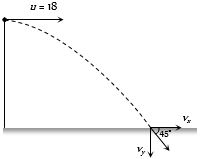
$A$ body is projected horizontally from a tower with a velocity of $18 \, ms^{-1}$. It strikes the ground at an angle of $45^o$. The vertical component of the velocity when it strikes the ground is ........ $ms^{-1}$.
A
$9$
B
$9\sqrt{2}$
C
$18$
D
$18\sqrt{2}$
Solution
(C) In horizontal projectile motion,the horizontal component of velocity $(v_x)$ remains constant throughout the motion.
Given,initial horizontal velocity $u_x = 18 \, ms^{-1}$.
Therefore,at the time of striking the ground,$v_x = 18 \, ms^{-1}$.
The angle of impact with the ground is given as $\theta = 45^o$.
The relationship between the velocity components and the angle is given by $\tan \theta = \frac{v_y}{v_x}$.
Substituting the values: $\tan 45^o = \frac{v_y}{18}$.
Since $\tan 45^o = 1$,we have $1 = \frac{v_y}{18}$.
Thus,$v_y = 18 \, ms^{-1}$.
Given,initial horizontal velocity $u_x = 18 \, ms^{-1}$.
Therefore,at the time of striking the ground,$v_x = 18 \, ms^{-1}$.
The angle of impact with the ground is given as $\theta = 45^o$.
The relationship between the velocity components and the angle is given by $\tan \theta = \frac{v_y}{v_x}$.
Substituting the values: $\tan 45^o = \frac{v_y}{18}$.
Since $\tan 45^o = 1$,we have $1 = \frac{v_y}{18}$.
Thus,$v_y = 18 \, ms^{-1}$.
1 likes
View Solution102
EasyMCQ
For angles of projection of a projectile at angles $(45^\circ + \theta)$ and $(45^\circ - \theta)$,the horizontal range described by the projectile are in the ratio of:
A
$2:1$
B
$1:1$
C
$2:3$
D
$1:2$
Solution
(B) The horizontal range $R$ of a projectile is given by the formula: $R = \frac{u^2 \sin(2\alpha)}{g}$,where $u$ is the initial velocity,$\alpha$ is the angle of projection,and $g$ is the acceleration due to gravity.
For the first angle of projection $\alpha_1 = (45^\circ - \theta)$:
$R_1 = \frac{u^2 \sin[2(45^\circ - \theta)]}{g} = \frac{u^2 \sin(90^\circ - 2\theta)}{g} = \frac{u^2 \cos(2\theta)}{g}$.
For the second angle of projection $\alpha_2 = (45^\circ + \theta)$:
$R_2 = \frac{u^2 \sin[2(45^\circ + \theta)]}{g} = \frac{u^2 \sin(90^\circ + 2\theta)}{g} = \frac{u^2 \cos(2\theta)}{g}$.
Comparing the two ranges:
$\frac{R_1}{R_2} = \frac{\frac{u^2 \cos(2\theta)}{g}}{\frac{u^2 \cos(2\theta)}{g}} = \frac{1}{1}$.
Thus,the ratio of the horizontal ranges is $1:1$.
For the first angle of projection $\alpha_1 = (45^\circ - \theta)$:
$R_1 = \frac{u^2 \sin[2(45^\circ - \theta)]}{g} = \frac{u^2 \sin(90^\circ - 2\theta)}{g} = \frac{u^2 \cos(2\theta)}{g}$.
For the second angle of projection $\alpha_2 = (45^\circ + \theta)$:
$R_2 = \frac{u^2 \sin[2(45^\circ + \theta)]}{g} = \frac{u^2 \sin(90^\circ + 2\theta)}{g} = \frac{u^2 \cos(2\theta)}{g}$.
Comparing the two ranges:
$\frac{R_1}{R_2} = \frac{\frac{u^2 \cos(2\theta)}{g}}{\frac{u^2 \cos(2\theta)}{g}} = \frac{1}{1}$.
Thus,the ratio of the horizontal ranges is $1:1$.
0 likes
View Solution103
DifficultMCQ
The horizontal range and the maximum height of a projectile are equal. The angle of projection of the projectile is
A
$45^o$
B
$\theta = \tan^{-1}(0.25)$
C
$\theta = \tan^{-1}(4)$
D
$60^o$
Solution
(C) The horizontal range $R$ of a projectile is given by $R = \frac{u^2 \sin 2\theta}{g}$.
The maximum height $H$ of a projectile is given by $H = \frac{u^2 \sin^2 \theta}{2g}$.
According to the problem,$R = H$.
Therefore,$\frac{u^2 \sin 2\theta}{g} = \frac{u^2 \sin^2 \theta}{2g}$.
Using the identity $\sin 2\theta = 2 \sin \theta \cos \theta$,we get:
$\frac{2 u^2 \sin \theta \cos \theta}{g} = \frac{u^2 \sin^2 \theta}{2g}$.
Canceling $u^2$,$g$,and $\sin \theta$ (assuming $\sin \theta \neq 0$):
$2 \cos \theta = \frac{\sin \theta}{2}$.
Rearranging the terms,we get $\frac{\sin \theta}{\cos \theta} = 4$,which means $\tan \theta = 4$.
Thus,$\theta = \tan^{-1}(4)$.
The maximum height $H$ of a projectile is given by $H = \frac{u^2 \sin^2 \theta}{2g}$.
According to the problem,$R = H$.
Therefore,$\frac{u^2 \sin 2\theta}{g} = \frac{u^2 \sin^2 \theta}{2g}$.
Using the identity $\sin 2\theta = 2 \sin \theta \cos \theta$,we get:
$\frac{2 u^2 \sin \theta \cos \theta}{g} = \frac{u^2 \sin^2 \theta}{2g}$.
Canceling $u^2$,$g$,and $\sin \theta$ (assuming $\sin \theta \neq 0$):
$2 \cos \theta = \frac{\sin \theta}{2}$.
Rearranging the terms,we get $\frac{\sin \theta}{\cos \theta} = 4$,which means $\tan \theta = 4$.
Thus,$\theta = \tan^{-1}(4)$.
0 likes
View Solution104
EasyMCQ
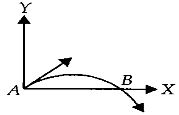
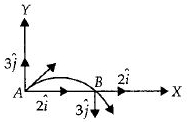
The velocity of a projectile at the initial point $A$ is $(2\hat i + 3\hat j) \text{ m/s}$. Its velocity (in $\text{m/s}$) at point $B$ is
A
$( - 2\hat i - 3\hat j)$
B
$( - 2\hat i + 3\hat j)$
C
$(2\hat i - 3\hat j)$
D
$(2\hat i + 3\hat j)$
Solution
(C) In projectile motion,the horizontal component of velocity $(v_x)$ remains constant throughout the motion because there is no acceleration in the horizontal direction.
At point $A$,the velocity is $\vec{v}_A = 2\hat i + 3\hat j \text{ m/s}$.
At point $B$,which is at the same horizontal level as point $A$,the horizontal component remains $2\hat i \text{ m/s}$.
The vertical component of velocity $(v_y)$ changes due to gravity. At the same horizontal level,the magnitude of the vertical component remains the same,but its direction is reversed.
Therefore,the vertical component at point $B$ becomes $-3\hat j \text{ m/s}$.
Thus,the velocity at point $B$ is $\vec{v}_B = 2\hat i - 3\hat j \text{ m/s}$.
At point $A$,the velocity is $\vec{v}_A = 2\hat i + 3\hat j \text{ m/s}$.
At point $B$,which is at the same horizontal level as point $A$,the horizontal component remains $2\hat i \text{ m/s}$.
The vertical component of velocity $(v_y)$ changes due to gravity. At the same horizontal level,the magnitude of the vertical component remains the same,but its direction is reversed.
Therefore,the vertical component at point $B$ becomes $-3\hat j \text{ m/s}$.
Thus,the velocity at point $B$ is $\vec{v}_B = 2\hat i - 3\hat j \text{ m/s}$.
0 likes
View Solution105
EasyMCQ
At the highest point of the path of a projectile,its
A
Kinetic energy is maximum
B
Potential energy is minimum
C
Kinetic energy is minimum
D
Total energy is maximum
Solution
(C) For a projectile launched with an initial velocity $u$ at an angle $\theta$,the velocity at any point is given by $v = \sqrt{v_x^2 + v_y^2}$.
At the highest point of the trajectory,the vertical component of velocity $v_y$ becomes $0$,while the horizontal component $v_x = u \cos \theta$ remains constant.
Since the kinetic energy is given by $K = \frac{1}{2}mv^2$,it is proportional to the square of the velocity.
At the highest point,the velocity is minimum $(v = v_x = u \cos \theta)$,therefore the kinetic energy is minimum.
Conversely,the potential energy $U = mgh$ is maximum at the highest point because the height $h$ is maximum.
At the highest point of the trajectory,the vertical component of velocity $v_y$ becomes $0$,while the horizontal component $v_x = u \cos \theta$ remains constant.
Since the kinetic energy is given by $K = \frac{1}{2}mv^2$,it is proportional to the square of the velocity.
At the highest point,the velocity is minimum $(v = v_x = u \cos \theta)$,therefore the kinetic energy is minimum.
Conversely,the potential energy $U = mgh$ is maximum at the highest point because the height $h$ is maximum.
0 likes
View Solution106
EasyMCQ
$A$ cricket ball is hit at $30^{\circ}$ with the horizontal with kinetic energy $K$. The kinetic energy at the highest point is
A
Zero
B
$K/4$
C
$K/2$
D
$3K/4$
Solution
(D) The initial kinetic energy is $K = \frac{1}{2}mv^2$,where $v$ is the initial velocity.
At the highest point of the trajectory,the vertical component of velocity becomes zero,and the velocity is only the horizontal component,$v_x = v \cos \theta$.
The kinetic energy at the highest point is $K' = \frac{1}{2}m(v \cos \theta)^2$.
Substituting $K = \frac{1}{2}mv^2$,we get $K' = K \cos^2 \theta$.
Given $\theta = 30^{\circ}$,we have $K' = K \cos^2(30^{\circ}) = K \left( \frac{\sqrt{3}}{2} \right)^2 = \frac{3K}{4}$.
At the highest point of the trajectory,the vertical component of velocity becomes zero,and the velocity is only the horizontal component,$v_x = v \cos \theta$.
The kinetic energy at the highest point is $K' = \frac{1}{2}m(v \cos \theta)^2$.
Substituting $K = \frac{1}{2}mv^2$,we get $K' = K \cos^2 \theta$.
Given $\theta = 30^{\circ}$,we have $K' = K \cos^2(30^{\circ}) = K \left( \frac{\sqrt{3}}{2} \right)^2 = \frac{3K}{4}$.
0 likes
View Solution107
MediumMCQ
$A$ cannon on a level plane is aimed at an angle $\theta$ above the horizontal and a shell is fired with a muzzle velocity $v_0$ towards a vertical cliff a distance $D$ away. Then the height from the bottom at which the shell strikes the side walls of the cliff is
A
$D\sin \theta - \frac{gD^2}{2v_0^2\sin^2 \theta}$
B
$D\cos \theta - \frac{gD^2}{2v_0^2\cos^2 \theta}$
C
$D\tan \theta - \frac{gD^2}{2v_0^2\cos^2 \theta}$
D
$D\tan \theta - \frac{gD^2}{2v_0^2\sin^2 \theta}$
Solution
(C) The trajectory of a projectile fired at an angle $\theta$ with initial velocity $v_0$ is given by the equation:
$y = x \tan \theta - \frac{gx^2}{2v_0^2 \cos^2 \theta}$
Here,$x$ represents the horizontal distance and $y$ represents the vertical height.
Given that the cliff is at a horizontal distance $D$,we substitute $x = D$ into the equation to find the height $h$ at which the shell strikes the cliff:
$h = D \tan \theta - \frac{gD^2}{2v_0^2 \cos^2 \theta}$
Thus,the correct option is $C$.
$y = x \tan \theta - \frac{gx^2}{2v_0^2 \cos^2 \theta}$
Here,$x$ represents the horizontal distance and $y$ represents the vertical height.
Given that the cliff is at a horizontal distance $D$,we substitute $x = D$ into the equation to find the height $h$ at which the shell strikes the cliff:
$h = D \tan \theta - \frac{gD^2}{2v_0^2 \cos^2 \theta}$
Thus,the correct option is $C$.
0 likes
View Solution108
MediumMCQ
$A$ stone is projected from the ground with velocity $50 \, m/s$ at an angle of $30^o$. It crosses a wall after $3 \, s$. How far beyond the wall will the stone strike the ground? $(g = 10 \, m/s^2)$
A
$90.2$
B
$89.6$
C
$86.6$
D
$70.2$
Solution
(C) The total time of flight $T$ is given by $T = \frac{2u \sin \theta}{g}$.
Substituting the values: $T = \frac{2 \times 50 \times \sin(30^o)}{10} = \frac{100 \times 0.5}{10} = 5 \, s$.
Given that the stone crosses the wall at $t_1 = 3 \, s$,the remaining time in the air after crossing the wall is $t_2 = T - t_1 = 5 - 3 = 2 \, s$.
The horizontal velocity $v_x$ remains constant throughout the motion: $v_x = u \cos \theta = 50 \times \cos(30^o) = 50 \times \frac{\sqrt{3}}{2} = 25\sqrt{3} \, m/s$.
The distance $d$ traveled beyond the wall is $d = v_x \times t_2 = 25\sqrt{3} \times 2 = 50\sqrt{3} \, m$.
Using $\sqrt{3} \approx 1.732$,we get $d = 50 \times 1.732 = 86.6 \, m$.
Substituting the values: $T = \frac{2 \times 50 \times \sin(30^o)}{10} = \frac{100 \times 0.5}{10} = 5 \, s$.
Given that the stone crosses the wall at $t_1 = 3 \, s$,the remaining time in the air after crossing the wall is $t_2 = T - t_1 = 5 - 3 = 2 \, s$.
The horizontal velocity $v_x$ remains constant throughout the motion: $v_x = u \cos \theta = 50 \times \cos(30^o) = 50 \times \frac{\sqrt{3}}{2} = 25\sqrt{3} \, m/s$.
The distance $d$ traveled beyond the wall is $d = v_x \times t_2 = 25\sqrt{3} \times 2 = 50\sqrt{3} \, m$.
Using $\sqrt{3} \approx 1.732$,we get $d = 50 \times 1.732 = 86.6 \, m$.
0 likes
View Solution109
DifficultMCQ
$A$ particle is projected from a horizontal plane ($x-z$ plane) such that its velocity vector at time $t$ is given by $\vec{V} = a\hat{i} + (b - ct)\hat{j}$. Its range on the horizontal plane is given by:
A
$\frac{ba}{c}$
B
$\frac{2ba}{c}$
C
$\frac{3ba}{c}$
D
None
Solution
(B) The velocity vector is given by $\vec{V} = a\hat{i} + (b - ct)\hat{j}$.
Comparing this with $\vec{V} = v_x\hat{i} + v_y\hat{j}$,we get $v_x = a$ and $v_y = b - ct$.
At $t = 0$,the initial velocity components are $u_x = a$ and $u_y = b$.
The acceleration in the $y$-direction is $a_y = \frac{dv_y}{dt} = -c$.
The time of flight $T$ is the time when the particle returns to the horizontal plane,i.e.,displacement in $y$ is $0$.
Using $s_y = u_y T + \frac{1}{2} a_y T^2 = 0$,we get $bT - \frac{1}{2} cT^2 = 0$,which gives $T = \frac{2b}{c}$.
The range $R$ is the displacement in the $x$-direction during the time of flight: $R = u_x T = a \times \left( \frac{2b}{c} \right) = \frac{2ab}{c}$.
Comparing this with $\vec{V} = v_x\hat{i} + v_y\hat{j}$,we get $v_x = a$ and $v_y = b - ct$.
At $t = 0$,the initial velocity components are $u_x = a$ and $u_y = b$.
The acceleration in the $y$-direction is $a_y = \frac{dv_y}{dt} = -c$.
The time of flight $T$ is the time when the particle returns to the horizontal plane,i.e.,displacement in $y$ is $0$.
Using $s_y = u_y T + \frac{1}{2} a_y T^2 = 0$,we get $bT - \frac{1}{2} cT^2 = 0$,which gives $T = \frac{2b}{c}$.
The range $R$ is the displacement in the $x$-direction during the time of flight: $R = u_x T = a \times \left( \frac{2b}{c} \right) = \frac{2ab}{c}$.
0 likes
View Solution110
DifficultMCQ
$A$ ball is thrown from a point on the ground at some angle of projection. At the same time,a bird starts from a point directly above this point of projection at a height $h$ and moves horizontally with speed $u$. Given that in its flight,the ball just touches the bird at one point. Find the distance on the ground where the ball strikes.
A
$2u \sqrt{\frac{h}{g}}$
B
$u \sqrt{\frac{2h}{g}}$
C
$2u \sqrt{\frac{2h}{g}}$
D
$u \sqrt{\frac{h}{g}}$
Solution
(C) Let the ball be thrown with velocity components $v_x$ and $v_y$. The bird moves horizontally with speed $u$. Since the ball touches the bird,the horizontal velocity of the ball must be equal to the speed of the bird,so $v_x = u$.
The vertical displacement of the ball at the point of contact is $h$. Using the equation of motion $h = v_y t - \frac{1}{2}gt^2$ and the condition that the ball 'just touches' the bird (meaning the vertical velocity of the ball at that height is zero relative to the bird's path,or simply considering the peak of the trajectory),we have $h = \frac{v_y^2}{2g}$,which gives $v_y = \sqrt{2gh}$.
The time taken to reach the height $h$ is $t = \frac{v_y}{g} = \sqrt{\frac{2h}{g}}$.
The total time of flight for the projectile is $T = 2t = 2\sqrt{\frac{2h}{g}}$.
The horizontal range $R$ is given by $R = v_x T = u \times 2\sqrt{\frac{2h}{g}} = 2u\sqrt{\frac{2h}{g}}$.
The vertical displacement of the ball at the point of contact is $h$. Using the equation of motion $h = v_y t - \frac{1}{2}gt^2$ and the condition that the ball 'just touches' the bird (meaning the vertical velocity of the ball at that height is zero relative to the bird's path,or simply considering the peak of the trajectory),we have $h = \frac{v_y^2}{2g}$,which gives $v_y = \sqrt{2gh}$.
The time taken to reach the height $h$ is $t = \frac{v_y}{g} = \sqrt{\frac{2h}{g}}$.
The total time of flight for the projectile is $T = 2t = 2\sqrt{\frac{2h}{g}}$.
The horizontal range $R$ is given by $R = v_x T = u \times 2\sqrt{\frac{2h}{g}} = 2u\sqrt{\frac{2h}{g}}$.
0 likes
View Solution111
DifficultMCQ
Average velocity of a particle in projectile motion between its starting point and the highest point of its trajectory is: (projection speed = $u$,angle of projection from horizontal = $\theta$)
A
$u \cos \theta$
B
$\frac{u}{2} \sqrt{1 + 3 \cos^2 \theta}$
C
$\frac{u}{2} \sqrt{2 + \cos^2 \theta}$
D
$\frac{u}{2} \sqrt{1 + \cos^2 \theta}$
Solution
(B) The displacement vector $\vec{s}$ from the starting point $(0,0)$ to the highest point $(\frac{R}{2}, H)$ is given by $\vec{s} = \frac{R}{2} \hat{i} + H \hat{j}$.
The magnitude of displacement is $|\vec{s}| = \sqrt{(\frac{R}{2})^2 + H^2}$.
Given $R = \frac{u^2 \sin 2\theta}{g} = \frac{2u^2 \sin \theta \cos \theta}{g}$ and $H = \frac{u^2 \sin^2 \theta}{2g}$.
So,$\frac{R}{2} = \frac{u^2 \sin \theta \cos \theta}{g}$.
$|\vec{s}| = \sqrt{(\frac{u^2 \sin \theta \cos \theta}{g})^2 + (\frac{u^2 \sin^2 \theta}{2g})^2} = \frac{u^2 \sin \theta}{g} \sqrt{\cos^2 \theta + \frac{\sin^2 \theta}{4}} = \frac{u^2 \sin \theta}{2g} \sqrt{4 \cos^2 \theta + \sin^2 \theta} = \frac{u^2 \sin \theta}{2g} \sqrt{3 \cos^2 \theta + 1}$.
The time taken to reach the highest point is $t = \frac{u \sin \theta}{g}$.
Average velocity $V_{avg} = \frac{|\vec{s}|}{t} = \frac{\frac{u^2 \sin \theta}{2g} \sqrt{3 \cos^2 \theta + 1}}{\frac{u \sin \theta}{g}} = \frac{u}{2} \sqrt{1 + 3 \cos^2 \theta}$.
The magnitude of displacement is $|\vec{s}| = \sqrt{(\frac{R}{2})^2 + H^2}$.
Given $R = \frac{u^2 \sin 2\theta}{g} = \frac{2u^2 \sin \theta \cos \theta}{g}$ and $H = \frac{u^2 \sin^2 \theta}{2g}$.
So,$\frac{R}{2} = \frac{u^2 \sin \theta \cos \theta}{g}$.
$|\vec{s}| = \sqrt{(\frac{u^2 \sin \theta \cos \theta}{g})^2 + (\frac{u^2 \sin^2 \theta}{2g})^2} = \frac{u^2 \sin \theta}{g} \sqrt{\cos^2 \theta + \frac{\sin^2 \theta}{4}} = \frac{u^2 \sin \theta}{2g} \sqrt{4 \cos^2 \theta + \sin^2 \theta} = \frac{u^2 \sin \theta}{2g} \sqrt{3 \cos^2 \theta + 1}$.
The time taken to reach the highest point is $t = \frac{u \sin \theta}{g}$.
Average velocity $V_{avg} = \frac{|\vec{s}|}{t} = \frac{\frac{u^2 \sin \theta}{2g} \sqrt{3 \cos^2 \theta + 1}}{\frac{u \sin \theta}{g}} = \frac{u}{2} \sqrt{1 + 3 \cos^2 \theta}$.
0 likes
View Solution112
DifficultMCQ
$A$ projectile is fired with a speed $u$ at an angle $\theta$ with the horizontal. Its speed when its direction of motion makes an angle $\alpha$ with the horizontal is
A
$u \sec \theta \cos \alpha$
B
$u \sec \theta \sin \alpha$
C
$u \cos \theta \sec \alpha$
D
$u \sin \theta \sec \alpha$
Solution
(C) In projectile motion,the horizontal component of velocity remains constant throughout the flight.
$v_x = u \cos \theta$.
Let the speed of the projectile at an angle $\alpha$ be $v$. The horizontal component of this velocity is $v_x = v \cos \alpha$.
Since the horizontal component is constant,we have $v \cos \alpha = u \cos \theta$.
Solving for $v$,we get $v = \frac{u \cos \theta}{\cos \alpha} = u \cos \theta \sec \alpha$.
$v_x = u \cos \theta$.
Let the speed of the projectile at an angle $\alpha$ be $v$. The horizontal component of this velocity is $v_x = v \cos \alpha$.
Since the horizontal component is constant,we have $v \cos \alpha = u \cos \theta$.
Solving for $v$,we get $v = \frac{u \cos \theta}{\cos \alpha} = u \cos \theta \sec \alpha$.
0 likes
View Solution113
DifficultMCQ
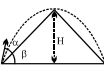
$A$ shell fired from the base of a mountain just clears it. If $\alpha$ is the angle of projection,then the angular elevation of the summit $\beta$ is
A
$\frac{1}{2}\alpha$
B
$\tan^{-1}(1/2)$
C
$\tan^{-1}(\frac{1}{2} \tan \alpha)$
D
$\tan^{-1}(2 \tan \alpha)$
Solution
(C) Let the maximum height of the projectile be $H$ and the horizontal range be $R$. The shell clears the summit,which is at the peak of the trajectory.
The angular elevation $\beta$ of the summit from the base is given by $\tan \beta = \frac{H}{R/2} = \frac{2H}{R}$.
Substituting the standard formulas for maximum height $H = \frac{u^2 \sin^2 \alpha}{2g}$ and horizontal range $R = \frac{u^2 \sin(2\alpha)}{g} = \frac{2u^2 \sin \alpha \cos \alpha}{g}$:
$\tan \beta = \frac{2 \left( \frac{u^2 \sin^2 \alpha}{2g} \right)}{\left( \frac{2u^2 \sin \alpha \cos \alpha}{g} \right)}$
$\tan \beta = \frac{u^2 \sin^2 \alpha / g}{2u^2 \sin \alpha \cos \alpha / g} = \frac{\sin^2 \alpha}{2 \sin \alpha \cos \alpha} = \frac{\tan \alpha}{2}$.
Therefore,$\beta = \tan^{-1}\left(\frac{\tan \alpha}{2}\right)$.
The angular elevation $\beta$ of the summit from the base is given by $\tan \beta = \frac{H}{R/2} = \frac{2H}{R}$.
Substituting the standard formulas for maximum height $H = \frac{u^2 \sin^2 \alpha}{2g}$ and horizontal range $R = \frac{u^2 \sin(2\alpha)}{g} = \frac{2u^2 \sin \alpha \cos \alpha}{g}$:
$\tan \beta = \frac{2 \left( \frac{u^2 \sin^2 \alpha}{2g} \right)}{\left( \frac{2u^2 \sin \alpha \cos \alpha}{g} \right)}$
$\tan \beta = \frac{u^2 \sin^2 \alpha / g}{2u^2 \sin \alpha \cos \alpha / g} = \frac{\sin^2 \alpha}{2 \sin \alpha \cos \alpha} = \frac{\tan \alpha}{2}$.
Therefore,$\beta = \tan^{-1}\left(\frac{\tan \alpha}{2}\right)$.
0 likes
View Solution114
MediumMCQ
An aeroplane flying at a constant velocity releases a bomb. As the bomb drops down from the aeroplane,
A
it will always be vertically below the aeroplane
B
it will always be vertically below the aeroplane only if the aeroplane is flying horizontally
C
it will always be vertically below the aeroplane only if the aeroplane is flying at an angle of $45^o$ to the horizontal
D
it will gradually fall behind the aeroplane if the aeroplane is flying horizontally
Solution
(A) When the bomb is released from an aeroplane flying at a constant horizontal velocity,the bomb possesses the same horizontal velocity as the aeroplane at the moment of release.
Since there is no air resistance (assuming ideal conditions) and no horizontal force acting on the bomb,its horizontal velocity remains constant throughout its flight.
Because both the aeroplane and the bomb maintain the same horizontal velocity,the horizontal displacement of both objects at any time $t$ will be identical.
Therefore,the bomb will always remain vertically below the aeroplane during its descent.
Since there is no air resistance (assuming ideal conditions) and no horizontal force acting on the bomb,its horizontal velocity remains constant throughout its flight.
Because both the aeroplane and the bomb maintain the same horizontal velocity,the horizontal displacement of both objects at any time $t$ will be identical.
Therefore,the bomb will always remain vertically below the aeroplane during its descent.
0 likes
View Solution115
MediumMCQ
Suppose a player hits several baseballs. Which baseball will be in the air for the longest time?
A
The one with the farthest range.
B
The one which reaches maximum height.
C
The one with the greatest initial velocity.
D
The one leaving the bat at $45^o$ with respect to the ground.
Solution
(B) The time of flight $T$ for a projectile is given by the formula $T = \frac{2 u \sin \theta}{g}$.
We also know that the maximum height $H$ reached by a projectile is $H = \frac{u^2 \sin^2 \theta}{2g}$.
From the expression for maximum height,we can write $\sqrt{H} = \frac{u \sin \theta}{\sqrt{2g}}$,which implies $u \sin \theta = \sqrt{2gH}$.
Substituting this into the time of flight formula: $T = \frac{2 \sqrt{2gH}}{g} = 2 \sqrt{\frac{2H}{g}}$.
Since $g$ is constant,$T \propto \sqrt{H}$.
Therefore,the baseball that reaches the maximum height will remain in the air for the longest time.
We also know that the maximum height $H$ reached by a projectile is $H = \frac{u^2 \sin^2 \theta}{2g}$.
From the expression for maximum height,we can write $\sqrt{H} = \frac{u \sin \theta}{\sqrt{2g}}$,which implies $u \sin \theta = \sqrt{2gH}$.
Substituting this into the time of flight formula: $T = \frac{2 \sqrt{2gH}}{g} = 2 \sqrt{\frac{2H}{g}}$.
Since $g$ is constant,$T \propto \sqrt{H}$.
Therefore,the baseball that reaches the maximum height will remain in the air for the longest time.
0 likes
View Solution116
MediumMCQ
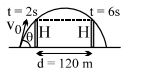
$A$ projectile crosses two walls of equal height $H$ symmetrically as shown. The maximum height of the projectile is ........ $m$.
A
$120$
B
$80$
C
$160$
D
cannot be obtained
Solution
(B) The projectile crosses the two walls at $t_1 = 2 \ s$ and $t_2 = 6 \ s$.
Due to symmetry,the time taken to reach the maximum height is $T_{max} = \frac{t_1 + t_2}{2} = \frac{2 + 6}{2} = 4 \ s$.
Using the equation of motion for vertical displacement,$y = u_y t - \frac{1}{2} g t^2$.
At $t = 4 \ s$,the vertical velocity $v_y = 0$.
Using $v_y = u_y - gt$,we get $0 = u_y - 10(4)$,so $u_y = 40 \ m/s$.
The maximum height $H_{max}$ is given by $H_{max} = \frac{u_y^2}{2g} = \frac{40^2}{2 \times 10} = \frac{1600}{20} = 80 \ m$.
Due to symmetry,the time taken to reach the maximum height is $T_{max} = \frac{t_1 + t_2}{2} = \frac{2 + 6}{2} = 4 \ s$.
Using the equation of motion for vertical displacement,$y = u_y t - \frac{1}{2} g t^2$.
At $t = 4 \ s$,the vertical velocity $v_y = 0$.
Using $v_y = u_y - gt$,we get $0 = u_y - 10(4)$,so $u_y = 40 \ m/s$.
The maximum height $H_{max}$ is given by $H_{max} = \frac{u_y^2}{2g} = \frac{40^2}{2 \times 10} = \frac{1600}{20} = 80 \ m$.
0 likes
View Solution117
DifficultMCQ
$A$ projectile crosses two walls of equal height $H$ symmetrically as shown. The velocity of projection is........ $ms^{-1}$.
A
$30$
B
$40$
C
$50$
D
none of these
Solution
(C) Let the projectile be thrown with velocity $v_0$ at an angle $\theta$ with the horizontal.
The projectile crosses the two walls at times $t_1 = 2 \ s$ and $t_2 = 6 \ s$.
Since the motion is symmetric,the time taken to reach the maximum height is $t_{max} = \frac{t_1 + t_2}{2} = \frac{2 + 6}{2} = 4 \ s$.
At maximum height,the vertical component of velocity is zero,so $v_y = v_0 \sin \theta - gt = 0$.
Using $g = 10 \ ms^{-2}$,we get $v_0 \sin \theta = 10 \times 4 = 40 \ ms^{-1}$.
The horizontal distance between the two walls is $d = 120 \ m$,and the time taken to travel this distance is $\Delta t = t_2 - t_1 = 6 - 2 = 4 \ s$.
The horizontal component of velocity is constant: $v_x = v_0 \cos \theta = \frac{d}{\Delta t} = \frac{120}{4} = 30 \ ms^{-1}$.
The magnitude of the projection velocity is $v_0 = \sqrt{(v_x)^2 + (v_y \sin \theta)^2} = \sqrt{30^2 + 40^2} = \sqrt{900 + 1600} = \sqrt{2500} = 50 \ ms^{-1}$.
The projectile crosses the two walls at times $t_1 = 2 \ s$ and $t_2 = 6 \ s$.
Since the motion is symmetric,the time taken to reach the maximum height is $t_{max} = \frac{t_1 + t_2}{2} = \frac{2 + 6}{2} = 4 \ s$.
At maximum height,the vertical component of velocity is zero,so $v_y = v_0 \sin \theta - gt = 0$.
Using $g = 10 \ ms^{-2}$,we get $v_0 \sin \theta = 10 \times 4 = 40 \ ms^{-1}$.
The horizontal distance between the two walls is $d = 120 \ m$,and the time taken to travel this distance is $\Delta t = t_2 - t_1 = 6 - 2 = 4 \ s$.
The horizontal component of velocity is constant: $v_x = v_0 \cos \theta = \frac{d}{\Delta t} = \frac{120}{4} = 30 \ ms^{-1}$.
The magnitude of the projection velocity is $v_0 = \sqrt{(v_x)^2 + (v_y \sin \theta)^2} = \sqrt{30^2 + 40^2} = \sqrt{900 + 1600} = \sqrt{2500} = 50 \ ms^{-1}$.
0 likes
View Solution118
MediumMCQ
$A$ projectile is thrown with a velocity of $50 \, ms^{-1}$ at an angle of $53^o$ with the horizontal. Choose the incorrect statement.
A
It travels vertically with a velocity of $40 \, ms^{-1}$.
B
It travels horizontally with a velocity of $30 \, ms^{-1}$.
C
The minimum velocity of the projectile is $30 \, ms^{-1}$.
D
None of these.
Solution
(D) Given: Initial velocity $u = 50 \, ms^{-1}$,angle $\theta = 53^o$.
Horizontal component of velocity: $u_x = u \cos 53^o = 50 \times (3/5) = 30 \, ms^{-1}$.
Vertical component of velocity: $u_y = u \sin 53^o = 50 \times (4/5) = 40 \, ms^{-1}$.
Statement $A$: The vertical component of velocity at the start is $40 \, ms^{-1}$. This is correct.
Statement $B$: The horizontal component of velocity is $30 \, ms^{-1}$. This is correct.
Statement $C$: The minimum velocity of a projectile occurs at the highest point,which is equal to the horizontal component $u_x = 30 \, ms^{-1}$. This is correct.
Since all statements $A, B,$ and $C$ are correct,the incorrect statement is none of these.
Horizontal component of velocity: $u_x = u \cos 53^o = 50 \times (3/5) = 30 \, ms^{-1}$.
Vertical component of velocity: $u_y = u \sin 53^o = 50 \times (4/5) = 40 \, ms^{-1}$.
Statement $A$: The vertical component of velocity at the start is $40 \, ms^{-1}$. This is correct.
Statement $B$: The horizontal component of velocity is $30 \, ms^{-1}$. This is correct.
Statement $C$: The minimum velocity of a projectile occurs at the highest point,which is equal to the horizontal component $u_x = 30 \, ms^{-1}$. This is correct.
Since all statements $A, B,$ and $C$ are correct,the incorrect statement is none of these.
0 likes
View Solution119
DifficultMCQ
$A$ projectile is thrown with a velocity of $50 \, m/s$ at an angle of $53^o$ with the horizontal. Determine the instants at which the projectile is at the same height.
A
$t = 1 \, s$ and $t = 7 \, s$
B
$t = 3 \, s$ and $t = 5 \, s$
C
$t = 2 \, s$ and $t = 6 \, s$
D
All the above
Solution
(D) The vertical component of velocity is $u_y = u \sin \theta = 50 \sin 53^o = 50 \times (4/5) = 40 \, m/s$.
The vertical displacement at any time $t$ is given by $y = u_y t - \frac{1}{2} g t^2$.
For a given height $h$,the equation is $\frac{1}{2} g t^2 - u_y t + h = 0$.
This is a quadratic equation in $t$,which has two roots $t_1$ and $t_2$ representing the two times the projectile reaches height $h$.
The sum of the roots is $t_1 + t_2 = \frac{-(-u_y)}{\frac{1}{2} g} = \frac{2 u_y}{g} = \frac{2 \times 40}{10} = 8 \, s$.
Checking the options:
For $A$: $1 + 7 = 8 \, s$.
For $B$: $3 + 5 = 8 \, s$.
For $C$: $2 + 6 = 8 \, s$.
Since all pairs satisfy the condition $t_1 + t_2 = 8 \, s$,the correct option is $D$.
The vertical displacement at any time $t$ is given by $y = u_y t - \frac{1}{2} g t^2$.
For a given height $h$,the equation is $\frac{1}{2} g t^2 - u_y t + h = 0$.
This is a quadratic equation in $t$,which has two roots $t_1$ and $t_2$ representing the two times the projectile reaches height $h$.
The sum of the roots is $t_1 + t_2 = \frac{-(-u_y)}{\frac{1}{2} g} = \frac{2 u_y}{g} = \frac{2 \times 40}{10} = 8 \, s$.
Checking the options:
For $A$: $1 + 7 = 8 \, s$.
For $B$: $3 + 5 = 8 \, s$.
For $C$: $2 + 6 = 8 \, s$.
Since all pairs satisfy the condition $t_1 + t_2 = 8 \, s$,the correct option is $D$.
0 likes
View Solution120
MediumMCQ
$A$ projectile is thrown with a velocity of $50 \, ms^{-1}$ at an angle of $53^o$ with the horizontal. The equation of the trajectory is given by:
A
$180y = 240x - x^2$
B
$180y = x^2 - 240x$
C
$180y = 135x - x^2$
D
$180y = x^2 - 135x$
Solution
(A) The equation of trajectory for a projectile is given by $y = x \tan \theta - \frac{gx^2}{2u^2 \cos^2 \theta}$.
Given: $u = 50 \, ms^{-1}$,$\theta = 53^o$,$g = 10 \, ms^{-2}$.
We know $\sin 53^o = 0.8$ and $\cos 53^o = 0.6$,so $\tan 53^o = \frac{0.8}{0.6} = \frac{4}{3}$.
Substituting the values:
$y = x \left( \frac{4}{3} \right) - \frac{10 x^2}{2(50)^2 (0.6)^2}$
$y = \frac{4x}{3} - \frac{10 x^2}{2(2500)(0.36)}$
$y = \frac{4x}{3} - \frac{10 x^2}{1800}$
$y = \frac{4x}{3} - \frac{x^2}{180}$
Multiply the entire equation by $180$:
$180y = 180 \left( \frac{4x}{3} \right) - x^2$
$180y = 240x - x^2$.
Given: $u = 50 \, ms^{-1}$,$\theta = 53^o$,$g = 10 \, ms^{-2}$.
We know $\sin 53^o = 0.8$ and $\cos 53^o = 0.6$,so $\tan 53^o = \frac{0.8}{0.6} = \frac{4}{3}$.
Substituting the values:
$y = x \left( \frac{4}{3} \right) - \frac{10 x^2}{2(50)^2 (0.6)^2}$
$y = \frac{4x}{3} - \frac{10 x^2}{2(2500)(0.36)}$
$y = \frac{4x}{3} - \frac{10 x^2}{1800}$
$y = \frac{4x}{3} - \frac{x^2}{180}$
Multiply the entire equation by $180$:
$180y = 180 \left( \frac{4x}{3} \right) - x^2$
$180y = 240x - x^2$.
0 likes
View Solution121
AdvancedMCQ
$A$ particle moves in the $xy$ plane with a constant acceleration $g$ in the negative $y$-direction. Its equation of motion is $y = ax - bx^2$,where $a$ and $b$ are constants. Which of the following are correct?
A
The $x$-component of its velocity is constant.
B
At the origin,the $y$-component of its velocity is $a\sqrt{\frac{g}{2b}}$.
C
At the origin,its velocity makes an angle $\tan^{-1}(a)$ with the $x$-axis.
D
All of the above
Solution
(D) Given that the particle has acceleration only in the negative $y$-direction,the acceleration in the $x$-direction is $a_x = 0$. Since $a_x = 0$,the $x$-component of velocity $v_x$ is constant.
From the equation $y = ax - bx^2$,differentiate with respect to time $t$: $\frac{dy}{dt} = a\frac{dx}{dt} - 2bx\frac{dx}{dt}$,which gives $v_y = v_x(a - 2bx)$.
Differentiating again with respect to time: $\frac{d^2y}{dt^2} = a\frac{d^2x}{dt^2} - 2b\left[\left(\frac{dx}{dt}\right)^2 + x\frac{d^2x}{dt^2}\right]$.
Since $a_x = 0$ and $a_y = -g$,we get $-g = -2bv_x^2$,which implies $v_x = \sqrt{\frac{g}{2b}}$.
At the origin $(x = 0)$,$v_y = a v_x = a\sqrt{\frac{g}{2b}}$.
The angle $\theta$ with the $x$-axis is given by $\tan \theta = \frac{v_y}{v_x} = \frac{a v_x}{v_x} = a$,so $\theta = \tan^{-1}(a)$.
Thus,all statements are correct.
From the equation $y = ax - bx^2$,differentiate with respect to time $t$: $\frac{dy}{dt} = a\frac{dx}{dt} - 2bx\frac{dx}{dt}$,which gives $v_y = v_x(a - 2bx)$.
Differentiating again with respect to time: $\frac{d^2y}{dt^2} = a\frac{d^2x}{dt^2} - 2b\left[\left(\frac{dx}{dt}\right)^2 + x\frac{d^2x}{dt^2}\right]$.
Since $a_x = 0$ and $a_y = -g$,we get $-g = -2bv_x^2$,which implies $v_x = \sqrt{\frac{g}{2b}}$.
At the origin $(x = 0)$,$v_y = a v_x = a\sqrt{\frac{g}{2b}}$.
The angle $\theta$ with the $x$-axis is given by $\tan \theta = \frac{v_y}{v_x} = \frac{a v_x}{v_x} = a$,so $\theta = \tan^{-1}(a)$.
Thus,all statements are correct.
0 likes
View Solution122
DifficultMCQ
$A$ ball is projected from the ground with a velocity $V$ at an angle $\theta$ to the vertical. On its path,it makes an elastic collision with a vertical wall and returns to the ground. The total time of flight of the ball is:
A
$\frac{2V \sin \theta}{g}$
B
$\frac{2V \cos \theta}{g}$
C
$\frac{V \sin 2\theta}{g}$
D
$\frac{V \cos \theta}{g}$
Solution
(B) The time of flight of a projectile depends only on the vertical component of the initial velocity and the acceleration due to gravity.
The initial velocity $V$ is given at an angle $\theta$ with the vertical. Therefore,the vertical component of the velocity is $V_y = V \cos \theta$.
In an elastic collision with a vertical wall,the horizontal component of the velocity reverses direction,but the vertical component of the velocity remains unchanged.
Since the vertical motion is unaffected by the collision with the vertical wall,the total time of flight is the same as that of a projectile moving without any collision.
The formula for the time of flight is $T = \frac{2V_y}{g}$.
Substituting $V_y = V \cos \theta$,we get $T = \frac{2V \cos \theta}{g}$.
The initial velocity $V$ is given at an angle $\theta$ with the vertical. Therefore,the vertical component of the velocity is $V_y = V \cos \theta$.
In an elastic collision with a vertical wall,the horizontal component of the velocity reverses direction,but the vertical component of the velocity remains unchanged.
Since the vertical motion is unaffected by the collision with the vertical wall,the total time of flight is the same as that of a projectile moving without any collision.
The formula for the time of flight is $T = \frac{2V_y}{g}$.
Substituting $V_y = V \cos \theta$,we get $T = \frac{2V \cos \theta}{g}$.
0 likes
View Solution123
DifficultMCQ
$A$ particle of mass $m$ is projected with a velocity $u$ making an angle $45^o$ with the horizontal. The magnitude of the torque due to the weight of the projectile,when the particle is at its maximum height,about the point of projection is:
A
$m u^2$
B
$\frac{3}{4} m u^2$
C
$\frac{1}{4} m u^2$
D
$\frac{1}{2} m u^2$
Solution
(D) The torque $\vec{\tau}$ about the point of projection is given by $\vec{\tau} = \vec{r} \times \vec{F}$.
Here,the force $\vec{F}$ is the weight $m\vec{g}$ acting downwards.
At maximum height,the horizontal distance (range) from the point of projection is $x = R/2$,where $R$ is the horizontal range.
The formula for horizontal range is $R = \frac{u^2 \sin(2\theta)}{g}$.
Given $\theta = 45^o$,$R = \frac{u^2 \sin(90^o)}{g} = \frac{u^2}{g}$.
At maximum height,the horizontal position is $x = \frac{R}{2} = \frac{u^2}{2g}$.
The vertical force is $F = mg$ acting downwards.
The torque magnitude is $\tau = F \cdot x = (mg) \cdot \left( \frac{u^2}{2g} \right) = \frac{1}{2} m u^2$.
Here,the force $\vec{F}$ is the weight $m\vec{g}$ acting downwards.
At maximum height,the horizontal distance (range) from the point of projection is $x = R/2$,where $R$ is the horizontal range.
The formula for horizontal range is $R = \frac{u^2 \sin(2\theta)}{g}$.
Given $\theta = 45^o$,$R = \frac{u^2 \sin(90^o)}{g} = \frac{u^2}{g}$.
At maximum height,the horizontal position is $x = \frac{R}{2} = \frac{u^2}{2g}$.
The vertical force is $F = mg$ acting downwards.
The torque magnitude is $\tau = F \cdot x = (mg) \cdot \left( \frac{u^2}{2g} \right) = \frac{1}{2} m u^2$.
0 likes
View Solution124
MediumMCQ
$A$ particle is projected at $60^\circ$ to the horizontal with a kinetic energy $K$. The kinetic energy at the highest point is
A
$\frac{K}{2}$
B
$K$
C
$0$
D
$\frac{K}{4}$
Solution
(D) Let $u$ be the initial velocity with which the particle is thrown and $m$ be the mass of the particle. The initial kinetic energy is given by $K = \frac{1}{2}mu^2$.
At the highest point of the trajectory, the vertical component of velocity becomes zero, and only the horizontal component of velocity remains.
The horizontal component of velocity is $v_x = u \cos(60^\circ)$.
Therefore, the kinetic energy at the highest point $K'$ is:
$K' = \frac{1}{2}m(v_x)^2 = \frac{1}{2}m(u \cos(60^\circ))^2$
$K' = \frac{1}{2}mu^2 \cos^2(60^\circ)$
Since $\cos(60^\circ) = \frac{1}{2}$, we have $\cos^2(60^\circ) = \frac{1}{4}$.
Substituting $K = \frac{1}{2}mu^2$, we get:
$K' = K \times \frac{1}{4} = \frac{K}{4}$.
At the highest point of the trajectory, the vertical component of velocity becomes zero, and only the horizontal component of velocity remains.
The horizontal component of velocity is $v_x = u \cos(60^\circ)$.
Therefore, the kinetic energy at the highest point $K'$ is:
$K' = \frac{1}{2}m(v_x)^2 = \frac{1}{2}m(u \cos(60^\circ))^2$
$K' = \frac{1}{2}mu^2 \cos^2(60^\circ)$
Since $\cos(60^\circ) = \frac{1}{2}$, we have $\cos^2(60^\circ) = \frac{1}{4}$.
Substituting $K = \frac{1}{2}mu^2$, we get:
$K' = K \times \frac{1}{4} = \frac{K}{4}$.
0 likes
View Solution125
MediumMCQ
$A$ water fountain on the ground sprinkles water all around it. If the speed of water coming out of the fountain is $v$,the total area around the fountain that gets wet is :
A
$\frac{\pi v^2}{g}$
B
$\frac{\pi v^2}{g^2}$
C
$\frac{\pi^2 v^2}{g^2}$
D
$\frac{\pi v^4}{g^2}$
Solution
(D) The water fountain acts as a projectile source spraying water in all directions with speed $v$. The maximum horizontal range $R_{\max}$ of the water is achieved when the angle of projection is $45^\circ$.
Using the formula for horizontal range: $R = \frac{v^2 \sin(2\theta)}{g}$.
For maximum range,$\sin(2\theta) = 1$,so $R_{\max} = \frac{v^2}{g}$.
The water covers a circular area around the fountain with radius $R_{\max}$.
Therefore,the total area $A$ is given by: $A = \pi R_{\max}^2 = \pi \left( \frac{v^2}{g} \right)^2 = \frac{\pi v^4}{g^2}$.
Using the formula for horizontal range: $R = \frac{v^2 \sin(2\theta)}{g}$.
For maximum range,$\sin(2\theta) = 1$,so $R_{\max} = \frac{v^2}{g}$.
The water covers a circular area around the fountain with radius $R_{\max}$.
Therefore,the total area $A$ is given by: $A = \pi R_{\max}^2 = \pi \left( \frac{v^2}{g} \right)^2 = \frac{\pi v^4}{g^2}$.
0 likes
View Solution126
MediumMCQ
$A$ boy can throw a stone up to a maximum height of $10 \ m$. The maximum horizontal distance that the boy can throw the same stone up to will be .......... $m$.
A
$20$
B
$20\sqrt{2}$
C
$10$
D
$10\sqrt{2}$
Solution
(A) The maximum height $H_{max}$ attained by a projectile is given by $H_{max} = \frac{u^2}{2g}$.
Given $H_{max} = 10 \ m$,we have $10 = \frac{u^2}{2g}$,which implies $u^2 = 20g$.
The maximum horizontal range $R_{max}$ is achieved when the angle of projection is $45^\circ$,given by $R_{max} = \frac{u^2}{g}$.
Substituting the value of $u^2$,we get $R_{max} = \frac{20g}{g} = 20 \ m$.
Given $H_{max} = 10 \ m$,we have $10 = \frac{u^2}{2g}$,which implies $u^2 = 20g$.
The maximum horizontal range $R_{max}$ is achieved when the angle of projection is $45^\circ$,given by $R_{max} = \frac{u^2}{g}$.
Substituting the value of $u^2$,we get $R_{max} = \frac{20g}{g} = 20 \ m$.
0 likes
View Solution127
MediumMCQ
$A$ projectile is given an initial velocity of $(\hat i + 2\hat j) \ ms^{-1}$,where $\hat i$ is along the ground and $\hat j$ is along the vertical. If $g = 10 \ m/s^2$,the equation of its trajectory is
A
$y = x - 5x^2$
B
$y = 2x - 5x^2$
C
$4y = 2x - 5x^2$
D
$4y = 2x - 25x^2$
Solution
(B) The initial velocity vector is given by $\vec{u} = (1 \hat{i} + 2 \hat{j}) \ ms^{-1}$.
Comparing this with $\vec{u} = u_x \hat{i} + u_y \hat{j}$,we get the horizontal component $u_x = 1 \ ms^{-1}$ and the vertical component $u_y = 2 \ ms^{-1}$.
The equation of the trajectory of a projectile is given by $y = x \tan \theta - \frac{gx^2}{2u_x^2}$.
Since $\tan \theta = \frac{u_y}{u_x} = \frac{2}{1} = 2$,we substitute the values into the equation:
$y = x(2) - \frac{10 \cdot x^2}{2(1)^2}$
$y = 2x - \frac{10x^2}{2}$
$y = 2x - 5x^2$.
Comparing this with $\vec{u} = u_x \hat{i} + u_y \hat{j}$,we get the horizontal component $u_x = 1 \ ms^{-1}$ and the vertical component $u_y = 2 \ ms^{-1}$.
The equation of the trajectory of a projectile is given by $y = x \tan \theta - \frac{gx^2}{2u_x^2}$.
Since $\tan \theta = \frac{u_y}{u_x} = \frac{2}{1} = 2$,we substitute the values into the equation:
$y = x(2) - \frac{10 \cdot x^2}{2(1)^2}$
$y = 2x - \frac{10x^2}{2}$
$y = 2x - 5x^2$.
0 likes
View Solution128
DifficultMCQ
$A$ particle is projected with kinetic energy $K$ at an angle of $60^o$ with the horizontal. The kinetic energy of the particle at the maximum height is . . . . . . .
A
$K/2$
B
$K$
C
$0$
D
$K/4$
Solution
(D) Let the initial velocity of the particle be $u$. The initial kinetic energy is $K = \frac{1}{2}mu^2$.
At the maximum height,the vertical component of velocity becomes $0$,but the horizontal component remains constant.
The horizontal component of velocity is $v_x = u \cos \theta$.
Given $\theta = 60^o$,so $v_x = u \cos 60^o = u/2$.
The kinetic energy at the maximum height is $K' = \frac{1}{2}m(v_x)^2$.
Substituting $v_x = u/2$,we get $K' = \frac{1}{2}m(u/2)^2 = \frac{1}{2}m(u^2/4) = \frac{1}{4} (\frac{1}{2}mu^2)$.
Since $K = \frac{1}{2}mu^2$,we have $K' = K/4$.
At the maximum height,the vertical component of velocity becomes $0$,but the horizontal component remains constant.
The horizontal component of velocity is $v_x = u \cos \theta$.
Given $\theta = 60^o$,so $v_x = u \cos 60^o = u/2$.
The kinetic energy at the maximum height is $K' = \frac{1}{2}m(v_x)^2$.
Substituting $v_x = u/2$,we get $K' = \frac{1}{2}m(u/2)^2 = \frac{1}{2}m(u^2/4) = \frac{1}{4} (\frac{1}{2}mu^2)$.
Since $K = \frac{1}{2}mu^2$,we have $K' = K/4$.
0 likes
View Solution129
MediumMCQ
In the climax of a movie,the hero jumps from a helicopter and the villain chasing the hero also jumps at the same time from the same level. After some time,when they are at the same horizontal level,the villain fires a bullet horizontally towards the hero. Both the hero and the villain are falling with a constant downward acceleration of $2\ m/s^2$ due to their parachutes. Assuming the hero is within the range of the bullet and air resistance on the bullet is negligible,which of the following is correct?
A
The bullet will hit the hero.
B
The bullet will pass above the hero.
C
The bullet will pass below the hero.
D
The bullet will definitely hit the hero if both were falling with a constant acceleration of $4\ m/s^2$ instead of $2\ m/s^2$.
Solution
(C) Let the hero and the villain be at the same horizontal level at $t = 0$. At this instant,the villain fires the bullet horizontally.
Both the hero and the villain have a downward acceleration of $a_p = 2\ m/s^2$.
Since the bullet is fired horizontally,its initial vertical velocity is $0$. However,once the bullet is in the air,it is only subject to gravity (ignoring air resistance),so its vertical acceleration is $a_b = g = 10\ m/s^2$ (downwards).
Let $t$ be the time taken for the bullet to reach the hero's horizontal position.
The vertical displacement of the hero in time $t$ is $y_h = u_y t + \frac{1}{2} a_p t^2 = u_y t + \frac{1}{2} (2) t^2 = u_y t + t^2$.
The vertical displacement of the bullet in time $t$ is $y_b = u_y t + \frac{1}{2} a_b t^2 = u_y t + \frac{1}{2} (10) t^2 = u_y t + 5t^2$.
Since $5t^2 > t^2$,the bullet will have a greater downward displacement than the hero in the same amount of time.
Therefore,the bullet will pass below the hero.
Both the hero and the villain have a downward acceleration of $a_p = 2\ m/s^2$.
Since the bullet is fired horizontally,its initial vertical velocity is $0$. However,once the bullet is in the air,it is only subject to gravity (ignoring air resistance),so its vertical acceleration is $a_b = g = 10\ m/s^2$ (downwards).
Let $t$ be the time taken for the bullet to reach the hero's horizontal position.
The vertical displacement of the hero in time $t$ is $y_h = u_y t + \frac{1}{2} a_p t^2 = u_y t + \frac{1}{2} (2) t^2 = u_y t + t^2$.
The vertical displacement of the bullet in time $t$ is $y_b = u_y t + \frac{1}{2} a_b t^2 = u_y t + \frac{1}{2} (10) t^2 = u_y t + 5t^2$.
Since $5t^2 > t^2$,the bullet will have a greater downward displacement than the hero in the same amount of time.
Therefore,the bullet will pass below the hero.
0 likes
View Solution130
MediumMCQ
$A$ ball is projected with velocity $V_0$ at an angle of elevation $30^o$. Mark the correct statement.
A
Kinetic energy will be zero at the highest point of the trajectory.
B
Vertical component of momentum will be conserved.
C
Horizontal component of momentum will be conserved.
D
Gravitational potential energy will be minimum at the highest point of the trajectory.
Solution
(C) In projectile motion,there is no external horizontal force acting on the object (ignoring air resistance).
According to Newton's second law,if the net external force in a direction is zero,the momentum in that direction remains constant.
Since the horizontal component of velocity $v_x = V_0 \cos(30^o)$ remains constant throughout the flight,the horizontal component of momentum $p_x = m v_x$ is conserved.
Therefore,the correct statement is that the horizontal component of momentum will be conserved.
According to Newton's second law,if the net external force in a direction is zero,the momentum in that direction remains constant.
Since the horizontal component of velocity $v_x = V_0 \cos(30^o)$ remains constant throughout the flight,the horizontal component of momentum $p_x = m v_x$ is conserved.
Therefore,the correct statement is that the horizontal component of momentum will be conserved.
0 likes
View Solution131
DifficultMCQ
$A$ projectile is thrown in the upward direction making an angle of $60^{\circ}$ with the horizontal direction with a velocity of $147 \ m/s$. Then the time after which its inclination with the horizontal is $45^{\circ}$ is ......... $s$.
A
$15$
B
$10.98$
C
$5.49$
D
$2.745$
Solution
(C) The horizontal component of velocity remains constant throughout the motion of the projectile.
Let $u = 147 \ m/s$ and $\theta_1 = 60^{\circ}$. The horizontal component is $u_x = u \cos 60^{\circ} = 147 \times 0.5 = 73.5 \ m/s$.
At time $t$,the velocity is $v$ and the angle is $\theta_2 = 45^{\circ}$. The horizontal component is $v_x = v \cos 45^{\circ} = v / \sqrt{2}$.
Since $u_x = v_x$,we have $v \cos 45^{\circ} = u \cos 60^{\circ} \Rightarrow v = u \frac{\cos 60^{\circ}}{\cos 45^{\circ}} = 147 \times \frac{0.5}{1/\sqrt{2}} = 73.5 \sqrt{2} \ m/s$.
The vertical component of velocity at time $t$ is $v_y = v \sin 45^{\circ} = (73.5 \sqrt{2}) \times (1/\sqrt{2}) = 73.5 \ m/s$.
The initial vertical component is $u_y = u \sin 60^{\circ} = 147 \times \frac{\sqrt{3}}{2} \approx 127.3 \ m/s$.
Using the equation $v_y = u_y - gt$,we get $73.5 = 127.3 - 9.8t$.
$9.8t = 127.3 - 73.5 = 53.8$.
$t = 53.8 / 9.8 \approx 5.49 \ s$.
Let $u = 147 \ m/s$ and $\theta_1 = 60^{\circ}$. The horizontal component is $u_x = u \cos 60^{\circ} = 147 \times 0.5 = 73.5 \ m/s$.
At time $t$,the velocity is $v$ and the angle is $\theta_2 = 45^{\circ}$. The horizontal component is $v_x = v \cos 45^{\circ} = v / \sqrt{2}$.
Since $u_x = v_x$,we have $v \cos 45^{\circ} = u \cos 60^{\circ} \Rightarrow v = u \frac{\cos 60^{\circ}}{\cos 45^{\circ}} = 147 \times \frac{0.5}{1/\sqrt{2}} = 73.5 \sqrt{2} \ m/s$.
The vertical component of velocity at time $t$ is $v_y = v \sin 45^{\circ} = (73.5 \sqrt{2}) \times (1/\sqrt{2}) = 73.5 \ m/s$.
The initial vertical component is $u_y = u \sin 60^{\circ} = 147 \times \frac{\sqrt{3}}{2} \approx 127.3 \ m/s$.
Using the equation $v_y = u_y - gt$,we get $73.5 = 127.3 - 9.8t$.
$9.8t = 127.3 - 73.5 = 53.8$.
$t = 53.8 / 9.8 \approx 5.49 \ s$.
0 likes
View Solution132
MediumMCQ
$A$ swimmer dived off a cliff with a running horizontal leap. What must his minimum speed be just as he leaves the top of the cliff so that he will miss the edge at the bottom,given that the ledge at the bottom is $2 \ m$ wide and $10 \ m$ below the top of the cliff?
A
$1.1$
B
$1.4$
C
$1.7$
D
$2.0$
Solution
(B) The swimmer performs horizontal projectile motion.
Let $h = 10 \ m$ be the vertical height and $x = 2 \ m$ be the horizontal distance to clear.
The time taken to fall $10 \ m$ is given by $h = \frac{1}{2} g t^2$.
Using $g = 9.8 \ m/s^2$,we get $t = \sqrt{\frac{2h}{g}} = \sqrt{\frac{2 \times 10}{9.8}} = \sqrt{2.04} \approx 1.428 \ s$.
To clear the ledge,the horizontal distance covered must be at least $2 \ m$.
Using $x = v \times t$,we have $v = \frac{x}{t} = \frac{2}{1.428} \approx 1.4 \ m/s$.
Thus,the minimum speed required is $1.4 \ m/s$.
Let $h = 10 \ m$ be the vertical height and $x = 2 \ m$ be the horizontal distance to clear.
The time taken to fall $10 \ m$ is given by $h = \frac{1}{2} g t^2$.
Using $g = 9.8 \ m/s^2$,we get $t = \sqrt{\frac{2h}{g}} = \sqrt{\frac{2 \times 10}{9.8}} = \sqrt{2.04} \approx 1.428 \ s$.
To clear the ledge,the horizontal distance covered must be at least $2 \ m$.
Using $x = v \times t$,we have $v = \frac{x}{t} = \frac{2}{1.428} \approx 1.4 \ m/s$.
Thus,the minimum speed required is $1.4 \ m/s$.
0 likes
View Solution133
MediumMCQ
$A$ heavy particle is projected from a point on the horizontal at an angle $60^\circ$ with the horizontal with a speed of $10 \ m/s$. Then the radius of curvature of its path at the instant of crossing the same horizontal will be ......... $m$.
A
$20$
B
$30$
C
$25$
D
$40$
Solution
(A) The particle is projected with speed $u = 10 \ m/s$ at an angle $\theta = 60^\circ$ with the horizontal.
Due to the symmetry of projectile motion,when the particle returns to the same horizontal level,its speed remains $u = 10 \ m/s$,and the angle it makes with the horizontal is also $\theta = 60^\circ$,but directed downwards.
The radius of curvature $R$ is given by the formula $R = \frac{v^2}{a_n}$,where $v$ is the speed and $a_n$ is the normal acceleration.
The normal acceleration $a_n$ is the component of acceleration perpendicular to the velocity vector.
At the point of landing,the acceleration due to gravity $g$ acts vertically downwards.
The angle between the velocity vector and the horizontal is $60^\circ$,so the angle between the velocity vector and the vertical is $30^\circ$.
The component of $g$ perpendicular to the velocity is $a_n = g \cos(60^\circ)$.
Substituting the values: $R = \frac{u^2}{g \cos(60^\circ)} = \frac{10^2}{10 \times 0.5} = \frac{100}{5} = 20 \ m$.
Due to the symmetry of projectile motion,when the particle returns to the same horizontal level,its speed remains $u = 10 \ m/s$,and the angle it makes with the horizontal is also $\theta = 60^\circ$,but directed downwards.
The radius of curvature $R$ is given by the formula $R = \frac{v^2}{a_n}$,where $v$ is the speed and $a_n$ is the normal acceleration.
The normal acceleration $a_n$ is the component of acceleration perpendicular to the velocity vector.
At the point of landing,the acceleration due to gravity $g$ acts vertically downwards.
The angle between the velocity vector and the horizontal is $60^\circ$,so the angle between the velocity vector and the vertical is $30^\circ$.
The component of $g$ perpendicular to the velocity is $a_n = g \cos(60^\circ)$.
Substituting the values: $R = \frac{u^2}{g \cos(60^\circ)} = \frac{10^2}{10 \times 0.5} = \frac{100}{5} = 20 \ m$.
0 likes
View Solution134
DifficultMCQ
$A$ particle is thrown with a speed of $12 \, m/s$ at an angle $60^o$ with the horizontal. The time interval between the moments when its speed is $10 \, m/s$ is $(g = 10 \, m/s^2)$.........$s$
A
$1$
B
$1.2$
C
$1.4$
D
$1.6$
Solution
(D) The horizontal component of velocity remains constant throughout the motion: $v_x = u \cos \theta = 12 \cos 60^o = 12 \times 0.5 = 6 \, m/s$.
Let the speed of the particle be $v = 10 \, m/s$ at some time $t$. The speed is given by $v = \sqrt{v_x^2 + v_y^2}$.
Substituting the values: $10 = \sqrt{6^2 + v_y^2} \implies 100 = 36 + v_y^2 \implies v_y^2 = 64 \implies v_y = \pm 8 \, m/s$.
The vertical component of velocity at time $t$ is $v_y = u \sin \theta - gt = 12 \sin 60^o - 10t = 12(\frac{\sqrt{3}}{2}) - 10t = 6\sqrt{3} - 10t$.
For $v_y = 8 \, m/s$: $6\sqrt{3} - 10t_1 = 8 \implies 10t_1 = 6\sqrt{3} - 8 \implies t_1 = \frac{6\sqrt{3}-8}{10}$.
For $v_y = -8 \, m/s$: $6\sqrt{3} - 10t_2 = -8 \implies 10t_2 = 6\sqrt{3} + 8 \implies t_2 = \frac{6\sqrt{3}+8}{10}$.
The time interval is $\Delta t = t_2 - t_1 = \frac{6\sqrt{3}+8 - (6\sqrt{3}-8)}{10} = \frac{16}{10} = 1.6 \, s$.
Let the speed of the particle be $v = 10 \, m/s$ at some time $t$. The speed is given by $v = \sqrt{v_x^2 + v_y^2}$.
Substituting the values: $10 = \sqrt{6^2 + v_y^2} \implies 100 = 36 + v_y^2 \implies v_y^2 = 64 \implies v_y = \pm 8 \, m/s$.
The vertical component of velocity at time $t$ is $v_y = u \sin \theta - gt = 12 \sin 60^o - 10t = 12(\frac{\sqrt{3}}{2}) - 10t = 6\sqrt{3} - 10t$.
For $v_y = 8 \, m/s$: $6\sqrt{3} - 10t_1 = 8 \implies 10t_1 = 6\sqrt{3} - 8 \implies t_1 = \frac{6\sqrt{3}-8}{10}$.
For $v_y = -8 \, m/s$: $6\sqrt{3} - 10t_2 = -8 \implies 10t_2 = 6\sqrt{3} + 8 \implies t_2 = \frac{6\sqrt{3}+8}{10}$.
The time interval is $\Delta t = t_2 - t_1 = \frac{6\sqrt{3}+8 - (6\sqrt{3}-8)}{10} = \frac{16}{10} = 1.6 \, s$.
0 likes
View Solution135
DifficultMCQ
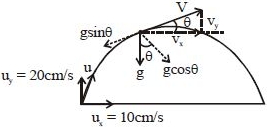
$A$ stone is projected from the ground at $t = 0$. At the time of projection,the horizontal and vertical components of velocity are $10\, m/s$ and $20\, m/s$ respectively. Find the time at which the magnitudes of tangential and normal acceleration will be equal $(g = 10\, m/s^2)$ [neglect air friction].
A
$1\, s$
B
$3\, s$
C
$1\, s$ and $3\, s$
D
$4\, s$
Solution
(C) For a projectile,the acceleration is always $g$ acting vertically downwards.
At any instant,the tangential acceleration is $a_t = g \sin \theta$ and the normal acceleration is $a_n = g \cos \theta$,where $\theta$ is the angle the velocity vector makes with the horizontal.
Given that the magnitudes of tangential and normal acceleration are equal,we have $a_t = a_n$.
Therefore,$g \sin \theta = g \cos \theta$,which implies $\tan \theta = 1$.
The angle $\theta$ is the angle of the velocity vector with the horizontal,so $\tan \theta = |v_y / v_x| = 1$.
This means $|v_y| = |v_x|$.
We know $v_x = u_x = 10\, m/s$ and $v_y = u_y - gt = 20 - 10t$.
So,$|20 - 10t| = 10$.
Case $1$: $20 - 10t = 10 \Rightarrow 10t = 10 \Rightarrow t = 1\, s$.
Case $2$: $20 - 10t = -10 \Rightarrow 10t = 30 \Rightarrow t = 3\, s$.
Thus,the magnitudes are equal at $t = 1\, s$ and $t = 3\, s$.
At any instant,the tangential acceleration is $a_t = g \sin \theta$ and the normal acceleration is $a_n = g \cos \theta$,where $\theta$ is the angle the velocity vector makes with the horizontal.
Given that the magnitudes of tangential and normal acceleration are equal,we have $a_t = a_n$.
Therefore,$g \sin \theta = g \cos \theta$,which implies $\tan \theta = 1$.
The angle $\theta$ is the angle of the velocity vector with the horizontal,so $\tan \theta = |v_y / v_x| = 1$.
This means $|v_y| = |v_x|$.
We know $v_x = u_x = 10\, m/s$ and $v_y = u_y - gt = 20 - 10t$.
So,$|20 - 10t| = 10$.
Case $1$: $20 - 10t = 10 \Rightarrow 10t = 10 \Rightarrow t = 1\, s$.
Case $2$: $20 - 10t = -10 \Rightarrow 10t = 30 \Rightarrow t = 3\, s$.
Thus,the magnitudes are equal at $t = 1\, s$ and $t = 3\, s$.
0 likes
View Solution136
DifficultMCQ
$A$ particle of mass $m$ is projected with a velocity $V$ making an angle of $45^{\circ}$ with the horizontal. The magnitude of the angular momentum of the projectile about the point of projection when the particle is at its maximum height $h$ is
A
zero
B
$\frac{mV^2}{\sqrt{2}g}$
C
$\frac{mV^2}{4\sqrt{2}g}$
D
$m\sqrt{2gh^3}$
Solution
(D) At the maximum height $h$,the vertical component of velocity is zero,and the horizontal component of velocity is $V_x = V \cos 45^{\circ} = \frac{V}{\sqrt{2}}$.
The momentum of the particle at the maximum height is $p = m V_x = \frac{mV}{\sqrt{2}}$.
The angular momentum $L$ about the point of projection is given by $L = p \times h$,where $h$ is the perpendicular distance (maximum height) from the point of projection.
The maximum height $h$ is given by $h = \frac{V^2 \sin^2 45^{\circ}}{2g} = \frac{V^2}{4g}$.
Substituting these into the angular momentum formula:
$L = \left( \frac{mV}{\sqrt{2}} \right) \times h = \frac{mV}{\sqrt{2}} \times \frac{V^2}{4g} = \frac{mV^3}{4\sqrt{2}g}$.
Since $h = \frac{V^2}{4g}$,we have $V^2 = 4gh$,which implies $V = \sqrt{4gh} = 2\sqrt{gh}$.
Substituting $V$ into the expression for $L$:
$L = \frac{m(2\sqrt{gh})^3}{4\sqrt{2}g} = \frac{m(8g^{3/2}h^{3/2})}{4\sqrt{2}g} = \frac{2m g h \sqrt{gh}}{\sqrt{2}g} = \frac{2}{\sqrt{2}} m \sqrt{gh^3} = m\sqrt{2gh^3}$.
The momentum of the particle at the maximum height is $p = m V_x = \frac{mV}{\sqrt{2}}$.
The angular momentum $L$ about the point of projection is given by $L = p \times h$,where $h$ is the perpendicular distance (maximum height) from the point of projection.
The maximum height $h$ is given by $h = \frac{V^2 \sin^2 45^{\circ}}{2g} = \frac{V^2}{4g}$.
Substituting these into the angular momentum formula:
$L = \left( \frac{mV}{\sqrt{2}} \right) \times h = \frac{mV}{\sqrt{2}} \times \frac{V^2}{4g} = \frac{mV^3}{4\sqrt{2}g}$.
Since $h = \frac{V^2}{4g}$,we have $V^2 = 4gh$,which implies $V = \sqrt{4gh} = 2\sqrt{gh}$.
Substituting $V$ into the expression for $L$:
$L = \frac{m(2\sqrt{gh})^3}{4\sqrt{2}g} = \frac{m(8g^{3/2}h^{3/2})}{4\sqrt{2}g} = \frac{2m g h \sqrt{gh}}{\sqrt{2}g} = \frac{2}{\sqrt{2}} m \sqrt{gh^3} = m\sqrt{2gh^3}$.
0 likes
View Solution137
DifficultMCQ
The equation of motion of a projectile is $y = 12x - \frac{5}{9}x^2$. The horizontal component of velocity is $3 \ ms^{-1}$. Given that $g = 10 \ ms^{-2}$,the range of the projectile is .......... $m$.
A
$12.4$
B
$21.6$
C
$30.6$
D
$36.0$
Solution
(B) The general equation of a projectile is $y = x \tan \theta - \frac{g x^2}{2 u^2 \cos^2 \theta}$.
Comparing this with the given equation $y = 12x - \frac{5}{9}x^2$:
$1) \tan \theta = 12$
$2) \frac{g}{2 u^2 \cos^2 \theta} = \frac{5}{9}$
Given the horizontal component of velocity $v_x = u \cos \theta = 3 \ ms^{-1}$.
Substitute $u \cos \theta = 3$ into the second equation:
$\frac{10}{2 (3)^2} = \frac{5}{9} \implies \frac{10}{18} = \frac{5}{9}$,which is consistent.
To find the range $R$,we set $y = 0$ in the equation of motion:
$0 = 12x - \frac{5}{9}x^2$
$x(12 - \frac{5}{9}x) = 0$
Since $x \neq 0$,$12 = \frac{5}{9}x$
$x = \frac{12 \times 9}{5} = \frac{108}{5} = 21.6 \ m$.
Thus,the range of the projectile is $21.6 \ m$.
Comparing this with the given equation $y = 12x - \frac{5}{9}x^2$:
$1) \tan \theta = 12$
$2) \frac{g}{2 u^2 \cos^2 \theta} = \frac{5}{9}$
Given the horizontal component of velocity $v_x = u \cos \theta = 3 \ ms^{-1}$.
Substitute $u \cos \theta = 3$ into the second equation:
$\frac{10}{2 (3)^2} = \frac{5}{9} \implies \frac{10}{18} = \frac{5}{9}$,which is consistent.
To find the range $R$,we set $y = 0$ in the equation of motion:
$0 = 12x - \frac{5}{9}x^2$
$x(12 - \frac{5}{9}x) = 0$
Since $x \neq 0$,$12 = \frac{5}{9}x$
$x = \frac{12 \times 9}{5} = \frac{108}{5} = 21.6 \ m$.
Thus,the range of the projectile is $21.6 \ m$.
0 likes
View Solution138
DifficultMCQ
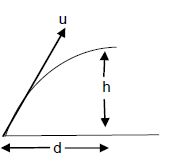
If a stone is to hit a point which is at a horizontal distance $d$ and at a vertical height $h$ above the point from where the stone is launched,what is the initial speed $u$ if the stone is launched at an angle $\theta$?
A
$\frac{g}{\cos \theta} \sqrt{\frac{d}{2(d \tan \theta - h)}}$
B
$\frac{d}{\cos \theta} \sqrt{\frac{g}{2(d \tan \theta - h)}}$
C
$\sqrt{\frac{g d^2}{h \cos^2 \theta}}$
D
$\sqrt{\frac{g d^2}{(d - h)}}$
Solution
(B) The equations of motion for a projectile are:
Horizontal displacement: $d = (u \cos \theta) t$
Vertical displacement: $h = (u \sin \theta) t - \frac{1}{2} g t^2$
From the horizontal equation,we find the time of flight to reach distance $d$:
$t = \frac{d}{u \cos \theta}$
Substitute this expression for $t$ into the vertical displacement equation:
$h = (u \sin \theta) \left( \frac{d}{u \cos \theta} \right) - \frac{1}{2} g \left( \frac{d}{u \cos \theta} \right)^2$
$h = d \tan \theta - \frac{g d^2}{2 u^2 \cos^2 \theta}$
Rearranging to solve for $u^2$:
$\frac{g d^2}{2 u^2 \cos^2 \theta} = d \tan \theta - h$
$u^2 = \frac{g d^2}{2 \cos^2 \theta (d \tan \theta - h)}$
Taking the square root of both sides:
$u = \frac{d}{\cos \theta} \sqrt{\frac{g}{2(d \tan \theta - h)}}$
Horizontal displacement: $d = (u \cos \theta) t$
Vertical displacement: $h = (u \sin \theta) t - \frac{1}{2} g t^2$
From the horizontal equation,we find the time of flight to reach distance $d$:
$t = \frac{d}{u \cos \theta}$
Substitute this expression for $t$ into the vertical displacement equation:
$h = (u \sin \theta) \left( \frac{d}{u \cos \theta} \right) - \frac{1}{2} g \left( \frac{d}{u \cos \theta} \right)^2$
$h = d \tan \theta - \frac{g d^2}{2 u^2 \cos^2 \theta}$
Rearranging to solve for $u^2$:
$\frac{g d^2}{2 u^2 \cos^2 \theta} = d \tan \theta - h$
$u^2 = \frac{g d^2}{2 \cos^2 \theta (d \tan \theta - h)}$
Taking the square root of both sides:
$u = \frac{d}{\cos \theta} \sqrt{\frac{g}{2(d \tan \theta - h)}}$
0 likes
View Solution139
MediumMCQ
The speed of a projectile at its maximum height is $\frac{\sqrt{3}}{2}$ times its initial speed. If the range of the projectile is $P$ times the maximum height attained by it,$P$ is equal to
A
$\frac{4}{3}$
B
$2\sqrt{3}$
C
$4\sqrt{3}$
D
$\frac{3}{4}$
Solution
(C) Let the initial speed be $u$ and the angle of projection be $\theta$.
The speed at maximum height is $u \cos \theta$.
Given that $u \cos \theta = \frac{\sqrt{3}}{2} u$,so $\cos \theta = \frac{\sqrt{3}}{2}$,which implies $\theta = 30^{\circ}$.
The maximum height $H$ is given by $H = \frac{u^2 \sin^2 \theta}{2g}$ and the range $R$ is given by $R = \frac{u^2 \sin 2\theta}{g}$.
We are given $R = P \times H$,so $P = \frac{R}{H}$.
Substituting the formulas: $P = \frac{u^2 (2 \sin \theta \cos \theta) / g}{u^2 \sin^2 \theta / (2g)} = \frac{4 \cos \theta}{\sin \theta} = 4 \cot \theta$.
For $\theta = 30^{\circ}$,$P = 4 \cot 30^{\circ} = 4 \times \sqrt{3} = 4\sqrt{3}$.
The speed at maximum height is $u \cos \theta$.
Given that $u \cos \theta = \frac{\sqrt{3}}{2} u$,so $\cos \theta = \frac{\sqrt{3}}{2}$,which implies $\theta = 30^{\circ}$.
The maximum height $H$ is given by $H = \frac{u^2 \sin^2 \theta}{2g}$ and the range $R$ is given by $R = \frac{u^2 \sin 2\theta}{g}$.
We are given $R = P \times H$,so $P = \frac{R}{H}$.
Substituting the formulas: $P = \frac{u^2 (2 \sin \theta \cos \theta) / g}{u^2 \sin^2 \theta / (2g)} = \frac{4 \cos \theta}{\sin \theta} = 4 \cot \theta$.
For $\theta = 30^{\circ}$,$P = 4 \cot 30^{\circ} = 4 \times \sqrt{3} = 4\sqrt{3}$.
0 likes
View Solution140
MediumMCQ
$A$ missile is fired for maximum range with an initial velocity of $20\; m/s$. If $g = 10\; m/s^2$,the range of the missile is ...... $m$.
A
$20$
B
$50$
C
$40$
D
$60$
Solution
(C) For a projectile,the range $R$ is given by $R = \frac{u^2 \sin(2\theta)}{g}$.
To achieve the maximum range,the angle of projection $\theta$ must be $45^\circ$,which makes $\sin(2\theta) = \sin(90^\circ) = 1$.
Thus,the formula for maximum range is $R_{\max} = \frac{u^2}{g}$.
Given initial velocity $u = 20\; m/s$ and acceleration due to gravity $g = 10\; m/s^2$.
Substituting these values: $R_{\max} = \frac{(20)^2}{10} = \frac{400}{10} = 40\; m$.
To achieve the maximum range,the angle of projection $\theta$ must be $45^\circ$,which makes $\sin(2\theta) = \sin(90^\circ) = 1$.
Thus,the formula for maximum range is $R_{\max} = \frac{u^2}{g}$.
Given initial velocity $u = 20\; m/s$ and acceleration due to gravity $g = 10\; m/s^2$.
Substituting these values: $R_{\max} = \frac{(20)^2}{10} = \frac{400}{10} = 40\; m$.
0 likes
View Solution141
DifficultMCQ
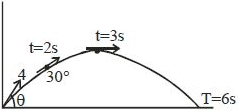
Two seconds after projection,a projectile is travelling in a direction inclined at $30^o$ to the horizontal. After one more second,it is travelling horizontally. What is the magnitude and direction of its velocity at the initial point?
A
$20\sqrt{3} \, m/s, 30^o$
B
$20\sqrt{3} \, m/s, 60^o$
C
$10\sqrt{3} \, m/s, 30^o$
D
$10\sqrt{3} \, m/s, 60^o$
Solution
(B) Let the initial velocity be $u$ at an angle $\theta$ with the horizontal. The horizontal component is $v_x = u \cos \theta$ and the vertical component is $v_y(t) = u \sin \theta - gt$.
At $t = 3 \, s$,the projectile is at its highest point,so $v_y(3) = 0$.
$u \sin \theta - g(3) = 0 \implies u \sin \theta = 3g = 30 \, m/s$ (taking $g = 10 \, m/s^2$).
At $t = 2 \, s$,the angle of inclination is $30^o$,so $\tan 30^o = \frac{v_y(2)}{v_x}$.
$\frac{1}{\sqrt{3}} = \frac{u \sin \theta - 2g}{u \cos \theta} = \frac{30 - 20}{u \cos \theta} = \frac{10}{u \cos \theta}$.
$u \cos \theta = 10\sqrt{3} \, m/s$.
The magnitude of initial velocity $u = \sqrt{(u \cos \theta)^2 + (u \sin \theta)^2} = \sqrt{(10\sqrt{3})^2 + 30^2} = \sqrt{300 + 900} = \sqrt{1200} = 20\sqrt{3} \, m/s$.
The direction $\theta = \tan^{-1}(\frac{u \sin \theta}{u \cos \theta}) = \tan^{-1}(\frac{30}{10\sqrt{3}}) = \tan^{-1}(\sqrt{3}) = 60^o$.
At $t = 3 \, s$,the projectile is at its highest point,so $v_y(3) = 0$.
$u \sin \theta - g(3) = 0 \implies u \sin \theta = 3g = 30 \, m/s$ (taking $g = 10 \, m/s^2$).
At $t = 2 \, s$,the angle of inclination is $30^o$,so $\tan 30^o = \frac{v_y(2)}{v_x}$.
$\frac{1}{\sqrt{3}} = \frac{u \sin \theta - 2g}{u \cos \theta} = \frac{30 - 20}{u \cos \theta} = \frac{10}{u \cos \theta}$.
$u \cos \theta = 10\sqrt{3} \, m/s$.
The magnitude of initial velocity $u = \sqrt{(u \cos \theta)^2 + (u \sin \theta)^2} = \sqrt{(10\sqrt{3})^2 + 30^2} = \sqrt{300 + 900} = \sqrt{1200} = 20\sqrt{3} \, m/s$.
The direction $\theta = \tan^{-1}(\frac{u \sin \theta}{u \cos \theta}) = \tan^{-1}(\frac{30}{10\sqrt{3}}) = \tan^{-1}(\sqrt{3}) = 60^o$.
0 likes
View Solution142
DifficultMCQ
$A$ ball is rolled off the edge of a horizontal table at a speed of $4\, m/s$. It hits the ground after $0.4\, s$. Which statement given below is true?
A
It hits the ground at a horizontal distance $1.6\, m$ from the edge of the table.
B
The speed with which it hits the ground is $4.0\, m/s$.
C
Height of the table is $0.9\, m$.
D
It hits the ground at an angle of $60^o$ to the horizontal.
Solution
(A) Given: Horizontal velocity $u = 4\, m/s$,Time $t = 0.4\, s$,Acceleration due to gravity $g = 10\, m/s^2$.
Horizontal distance (Range) $R = u \times t = 4 \times 0.4 = 1.6\, m$.
Vertical height $h = \frac{1}{2}gt^2 = 0.5 \times 10 \times (0.4)^2 = 5 \times 0.16 = 0.8\, m$.
Final vertical velocity $v_y = gt = 10 \times 0.4 = 4\, m/s$.
Final speed $v = \sqrt{u^2 + v_y^2} = \sqrt{4^2 + 4^2} = 4\sqrt{2} \approx 5.66\, m/s$.
Angle with horizontal $\tan \theta = \frac{v_y}{u} = \frac{4}{4} = 1 \implies \theta = 45^o$.
Comparing with options,option $A$ is correct.
Horizontal distance (Range) $R = u \times t = 4 \times 0.4 = 1.6\, m$.
Vertical height $h = \frac{1}{2}gt^2 = 0.5 \times 10 \times (0.4)^2 = 5 \times 0.16 = 0.8\, m$.
Final vertical velocity $v_y = gt = 10 \times 0.4 = 4\, m/s$.
Final speed $v = \sqrt{u^2 + v_y^2} = \sqrt{4^2 + 4^2} = 4\sqrt{2} \approx 5.66\, m/s$.
Angle with horizontal $\tan \theta = \frac{v_y}{u} = \frac{4}{4} = 1 \implies \theta = 45^o$.
Comparing with options,option $A$ is correct.
0 likes
View Solution143
DifficultMCQ
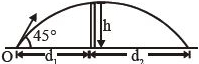
$A$ ball is projected at an angle $45^{\circ}$ with the horizontal. It passes through a wall of height $h$ at a horizontal distance $d_1$ from the point of projection and strikes the ground at a horizontal distance $(d_1 + d_2)$ from the point of projection. Then $h$ is:
A
$h = \frac{2d_1d_2}{d_1 + d_2}$
B
$h = \frac{d_1d_2}{d_1 + d_2}$
C
$h = \frac{\sqrt{2}d_1d_2}{d_1 + d_2}$
D
$h = \frac{d_1d_2}{2(d_1 + d_2)}$
Solution
(B) The equation of the trajectory of a projectile is given by:
$y = x \tan \theta \left(1 - \frac{x}{R}\right)$
Where $R$ is the horizontal range of the projectile.
Given the total horizontal distance covered is $R = d_1 + d_2$ and the angle of projection is $\theta = 45^{\circ}$.
At horizontal distance $x = d_1$,the height of the ball is $y = h$.
Substituting these values into the trajectory equation:
$h = d_1 \tan 45^{\circ} \left(1 - \frac{d_1}{d_1 + d_2}\right)$
Since $\tan 45^{\circ} = 1$:
$h = d_1 \left(\frac{d_1 + d_2 - d_1}{d_1 + d_2}\right)$
$h = d_1 \left(\frac{d_2}{d_1 + d_2}\right)$
$h = \frac{d_1 d_2}{d_1 + d_2}$
$y = x \tan \theta \left(1 - \frac{x}{R}\right)$
Where $R$ is the horizontal range of the projectile.
Given the total horizontal distance covered is $R = d_1 + d_2$ and the angle of projection is $\theta = 45^{\circ}$.
At horizontal distance $x = d_1$,the height of the ball is $y = h$.
Substituting these values into the trajectory equation:
$h = d_1 \tan 45^{\circ} \left(1 - \frac{d_1}{d_1 + d_2}\right)$
Since $\tan 45^{\circ} = 1$:
$h = d_1 \left(\frac{d_1 + d_2 - d_1}{d_1 + d_2}\right)$
$h = d_1 \left(\frac{d_2}{d_1 + d_2}\right)$
$h = \frac{d_1 d_2}{d_1 + d_2}$
0 likes
View Solution144
DifficultMCQ
$A$ projectile is thrown into space so as to have maximum horizontal range $R$. Taking the point of projection as the origin,the coordinates of the point where the speed of the particle is minimum are:
A
$(R, R)$
B
$\left( R, \frac{R}{2} \right)$
C
$\left( \frac{R}{2}, \frac{R}{4} \right)$
D
$\left( \frac{R}{2}, \frac{R}{4} \right)$
Solution
(C) For maximum horizontal range,the angle of projection is $\theta = 45^{\circ}$.
The horizontal range is given by $R = \frac{u^2 \sin(2\theta)}{g} = \frac{u^2}{g}$.
The speed of a projectile is minimum at the highest point of its trajectory,where the vertical component of velocity becomes zero and only the horizontal component $u_x = u \cos \theta$ remains.
The coordinates of the highest point are $(x, y) = \left( \frac{R}{2}, H \right)$.
The maximum height $H$ is given by $H = \frac{u^2 \sin^2 \theta}{2g}$.
Substituting $\theta = 45^{\circ}$,we get $H = \frac{u^2 \sin^2 45^{\circ}}{2g} = \frac{u^2 (1/2)}{2g} = \frac{u^2}{4g}$.
Since $R = \frac{u^2}{g}$,we can write $H = \frac{R}{4}$.
Therefore,the coordinates of the point where the speed is minimum are $\left( \frac{R}{2}, \frac{R}{4} \right)$.
The horizontal range is given by $R = \frac{u^2 \sin(2\theta)}{g} = \frac{u^2}{g}$.
The speed of a projectile is minimum at the highest point of its trajectory,where the vertical component of velocity becomes zero and only the horizontal component $u_x = u \cos \theta$ remains.
The coordinates of the highest point are $(x, y) = \left( \frac{R}{2}, H \right)$.
The maximum height $H$ is given by $H = \frac{u^2 \sin^2 \theta}{2g}$.
Substituting $\theta = 45^{\circ}$,we get $H = \frac{u^2 \sin^2 45^{\circ}}{2g} = \frac{u^2 (1/2)}{2g} = \frac{u^2}{4g}$.
Since $R = \frac{u^2}{g}$,we can write $H = \frac{R}{4}$.
Therefore,the coordinates of the point where the speed is minimum are $\left( \frac{R}{2}, \frac{R}{4} \right)$.
0 likes
View Solution145
MediumMCQ
Two stones having different masses $m_1$ and $m_2$ are projected at an angle $\alpha$ and $(90^{\circ}-\alpha)$ with the same speed from the same point. The ratio of their maximum heights is
A
$1: 1$
B
$1: \tan \alpha$
C
$\tan \alpha: 1$
D
$\tan^2 \alpha: 1$
Solution
(D) The maximum height $H$ attained by a projectile is given by the formula $H = \frac{u^2 \sin^2 \theta}{2g}$,where $u$ is the initial speed,$\theta$ is the angle of projection,and $g$ is the acceleration due to gravity.
For the first stone,the angle of projection is $\alpha$,so its maximum height is $H_1 = \frac{u^2 \sin^2 \alpha}{2g}$.
For the second stone,the angle of projection is $(90^{\circ}-\alpha)$,so its maximum height is $H_2 = \frac{u^2 \sin^2(90^{\circ}-\alpha)}{2g}$.
Since $\sin(90^{\circ}-\alpha) = \cos \alpha$,we have $H_2 = \frac{u^2 \cos^2 \alpha}{2g}$.
The ratio of their maximum heights is $\frac{H_1}{H_2} = \frac{\frac{u^2 \sin^2 \alpha}{2g}}{\frac{u^2 \cos^2 \alpha}{2g}} = \frac{\sin^2 \alpha}{\cos^2 \alpha} = \tan^2 \alpha$.
Thus,the ratio is $\tan^2 \alpha : 1$.
For the first stone,the angle of projection is $\alpha$,so its maximum height is $H_1 = \frac{u^2 \sin^2 \alpha}{2g}$.
For the second stone,the angle of projection is $(90^{\circ}-\alpha)$,so its maximum height is $H_2 = \frac{u^2 \sin^2(90^{\circ}-\alpha)}{2g}$.
Since $\sin(90^{\circ}-\alpha) = \cos \alpha$,we have $H_2 = \frac{u^2 \cos^2 \alpha}{2g}$.
The ratio of their maximum heights is $\frac{H_1}{H_2} = \frac{\frac{u^2 \sin^2 \alpha}{2g}}{\frac{u^2 \cos^2 \alpha}{2g}} = \frac{\sin^2 \alpha}{\cos^2 \alpha} = \tan^2 \alpha$.
Thus,the ratio is $\tan^2 \alpha : 1$.
0 likes
View Solution146
MediumMCQ
Three balls of same masses are projected with equal speeds at angles $15^{\circ}, 45^{\circ}$,and $75^{\circ}$. If their ranges are $R_1, R_2$,and $R_3$ respectively,then:
A
$R_1 > R_2 > R_3$
B
$R_1 < R_2 < R_3$
C
$R_1 = R_2 = R_3$
D
$R_1 = R_3 < R_2$
Solution
(D) The horizontal range $R$ of a projectile is given by the formula $R = \frac{u^2 \sin(2\theta)}{g}$,where $u$ is the initial speed and $\theta$ is the angle of projection.
Since $u$ is constant for all three balls,$R \propto \sin(2\theta)$.
For $\theta_1 = 15^{\circ}$,$R_1 \propto \sin(30^{\circ}) = 0.5$.
For $\theta_2 = 45^{\circ}$,$R_2 \propto \sin(90^{\circ}) = 1$.
For $\theta_3 = 75^{\circ}$,$R_3 \propto \sin(150^{\circ}) = \sin(180^{\circ} - 30^{\circ}) = \sin(30^{\circ}) = 0.5$.
Thus,$R_1 = R_3 = 0.5 \times \frac{u^2}{g}$ and $R_2 = 1 \times \frac{u^2}{g}$.
Comparing these,we get $R_1 = R_3 < R_2$.
Since $u$ is constant for all three balls,$R \propto \sin(2\theta)$.
For $\theta_1 = 15^{\circ}$,$R_1 \propto \sin(30^{\circ}) = 0.5$.
For $\theta_2 = 45^{\circ}$,$R_2 \propto \sin(90^{\circ}) = 1$.
For $\theta_3 = 75^{\circ}$,$R_3 \propto \sin(150^{\circ}) = \sin(180^{\circ} - 30^{\circ}) = \sin(30^{\circ}) = 0.5$.
Thus,$R_1 = R_3 = 0.5 \times \frac{u^2}{g}$ and $R_2 = 1 \times \frac{u^2}{g}$.
Comparing these,we get $R_1 = R_3 < R_2$.
0 likes
View Solution147
MediumMCQ
$A$ projectile is thrown at an angle $\theta$ with the horizontal and its range is $R_1$. It is then thrown at an angle $\theta$ with the vertical and the range is $R_2$. Then:
A
$R_1 = 4 R_2$
B
$R_1 = 2 R_2$
C
$R_1 = R_2$
D
data insufficient
Solution
(C) The horizontal range of a projectile is given by the formula $R = \frac{u^2 \sin(2\theta)}{g}$,where $u$ is the initial velocity,$\theta$ is the angle of projection with the horizontal,and $g$ is the acceleration due to gravity.
For the first case,the angle with the horizontal is $\theta$,so the range is $R_1 = \frac{u^2 \sin(2\theta)}{g}$.
For the second case,the angle with the vertical is $\theta$,which means the angle with the horizontal is $(90^{\circ} - \theta)$. Therefore,the range is $R_2 = \frac{u^2 \sin(2(90^{\circ} - \theta))}{g} = \frac{u^2 \sin(180^{\circ} - 2\theta)}{g}$.
Since $\sin(180^{\circ} - 2\theta) = \sin(2\theta)$,we have $R_2 = \frac{u^2 \sin(2\theta)}{g}$.
Comparing the two expressions,we find that $R_1 = R_2$.
For the first case,the angle with the horizontal is $\theta$,so the range is $R_1 = \frac{u^2 \sin(2\theta)}{g}$.
For the second case,the angle with the vertical is $\theta$,which means the angle with the horizontal is $(90^{\circ} - \theta)$. Therefore,the range is $R_2 = \frac{u^2 \sin(2(90^{\circ} - \theta))}{g} = \frac{u^2 \sin(180^{\circ} - 2\theta)}{g}$.
Since $\sin(180^{\circ} - 2\theta) = \sin(2\theta)$,we have $R_2 = \frac{u^2 \sin(2\theta)}{g}$.
Comparing the two expressions,we find that $R_1 = R_2$.
0 likes
View Solution148
MediumMCQ
The ratio of the speed of a projectile at the point of projection to the speed at the top of its trajectory is $x$. The angle of projection with the horizontal is
A
$\sin^{-1}(x)$
B
$\cos^{-1}(x)$
C
$\sin^{-1}(1/x)$
D
$\cos^{-1}(1/x)$
Solution
(D) Let the speed of projection be $u$ and the angle of projection be $\theta$.
At the point of projection,the speed is $v_1 = u$.
At the highest point of the trajectory,the vertical component of velocity becomes zero,so the speed is $v_2 = u \cos \theta$.
The ratio of the speed at the point of projection to the speed at the top is given as $x$.
Therefore,$\frac{v_1}{v_2} = x$.
Substituting the values,we get $\frac{u}{u \cos \theta} = x$.
This simplifies to $\frac{1}{\cos \theta} = x$,which means $\cos \theta = \frac{1}{x}$.
Thus,the angle of projection is $\theta = \cos^{-1}(\frac{1}{x})$.
At the point of projection,the speed is $v_1 = u$.
At the highest point of the trajectory,the vertical component of velocity becomes zero,so the speed is $v_2 = u \cos \theta$.
The ratio of the speed at the point of projection to the speed at the top is given as $x$.
Therefore,$\frac{v_1}{v_2} = x$.
Substituting the values,we get $\frac{u}{u \cos \theta} = x$.
This simplifies to $\frac{1}{\cos \theta} = x$,which means $\cos \theta = \frac{1}{x}$.
Thus,the angle of projection is $\theta = \cos^{-1}(\frac{1}{x})$.
0 likes
View Solution149
DifficultMCQ
$A$ particle is projected from the ground at an angle of $\theta$ with the horizontal with an initial speed of $u$. The time after which the velocity vector of the projectile is perpendicular to the initial velocity is:
A
$u / (g \sin \theta)$
B
$u / (g \cos \theta)$
C
$2u / (g \sin \theta)$
D
$2u / (g \tan \theta)$
Solution
(A) Let the initial velocity be $\vec{u} = u \cos \theta \hat{i} + u \sin \theta \hat{j}$.
After time $t$,the velocity vector is $\vec{v} = u \cos \theta \hat{i} + (u \sin \theta - gt) \hat{j}$.
Given that the velocity vector $\vec{v}$ is perpendicular to the initial velocity $\vec{u}$,their dot product must be zero: $\vec{v} \cdot \vec{u} = 0$.
$(u \cos \theta \hat{i} + (u \sin \theta - gt) \hat{j}) \cdot (u \cos \theta \hat{i} + u \sin \theta \hat{j}) = 0$.
$u^2 \cos^2 \theta + (u \sin \theta - gt)(u \sin \theta) = 0$.
$u^2 \cos^2 \theta + u^2 \sin^2 \theta - ugt \sin \theta = 0$.
$u^2 (\cos^2 \theta + \sin^2 \theta) = ugt \sin \theta$.
$u^2 = ugt \sin \theta$.
$t = \frac{u}{g \sin \theta}$.
After time $t$,the velocity vector is $\vec{v} = u \cos \theta \hat{i} + (u \sin \theta - gt) \hat{j}$.
Given that the velocity vector $\vec{v}$ is perpendicular to the initial velocity $\vec{u}$,their dot product must be zero: $\vec{v} \cdot \vec{u} = 0$.
$(u \cos \theta \hat{i} + (u \sin \theta - gt) \hat{j}) \cdot (u \cos \theta \hat{i} + u \sin \theta \hat{j}) = 0$.
$u^2 \cos^2 \theta + (u \sin \theta - gt)(u \sin \theta) = 0$.
$u^2 \cos^2 \theta + u^2 \sin^2 \theta - ugt \sin \theta = 0$.
$u^2 (\cos^2 \theta + \sin^2 \theta) = ugt \sin \theta$.
$u^2 = ugt \sin \theta$.
$t = \frac{u}{g \sin \theta}$.
0 likes
View Solution150
EasyMCQ
In projectile motion,the modulus of the rate of change of velocity is:
A
constant
B
first increases then decreases
C
first decreases then increases
D
None of the above
Solution
(A) In projectile motion,the only force acting on the projectile is gravity,which acts vertically downwards.
According to Newton's second law of motion,the acceleration of the projectile is given by $\vec{a} = \frac{\vec{F}}{m} = \frac{m\vec{g}}{m} = \vec{g}$.
The rate of change of velocity is defined as acceleration,i.e.,$\frac{d\vec{v}}{dt} = \vec{a} = \vec{g}$.
The modulus of the rate of change of velocity is $|\frac{d\vec{v}}{dt}| = |\vec{g}| = g$.
Since the acceleration due to gravity $g$ is constant throughout the motion,the modulus of the rate of change of velocity is also constant.
According to Newton's second law of motion,the acceleration of the projectile is given by $\vec{a} = \frac{\vec{F}}{m} = \frac{m\vec{g}}{m} = \vec{g}$.
The rate of change of velocity is defined as acceleration,i.e.,$\frac{d\vec{v}}{dt} = \vec{a} = \vec{g}$.
The modulus of the rate of change of velocity is $|\frac{d\vec{v}}{dt}| = |\vec{g}| = g$.
Since the acceleration due to gravity $g$ is constant throughout the motion,the modulus of the rate of change of velocity is also constant.
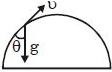
0 likes
View Solution3-2.Motion in Plane — Horizontal Projectile Motion · Frequently Asked Questions
1Are these 3-2.Motion in Plane questions useful for JEE and NEET?
Yes. All questions in this section are mapped to JEE Main and NEET exam patterns. Previous year questions from JEE Main, NEET, GUJCET and state-level exams are included with full solutions.
2Can I switch to Hindi or Gujarati for these questions?
Yes. Use the language tabs in the hero section or the sidebar to view the same questions and solutions in English, Hindi or Gujarati.
3How do I generate a question paper from this subtopic?
Use the Vedclass Exam Paper Generator — select the chapter and subtopic, set difficulty, and generate Sets A, B, C, D automatically. First 3 chapters of every subject are free.
Vedclass Products
For Students
Vedclass Test Series
Mock tests in real JEE/NEET style with performance analysis. 5-day free trial.
Start Free TrialFor Teachers
Exam Paper Generator
Generate Set A/B/C/D papers from this chapter in 2 minutes. 3 chapters free.
Try FreeFor Institutes
Online Exam Module
Live online exams with unlimited students, 360° analytics & white-label branding.
See DemoFor Teachers & Institutes
Generate a 3-2.Motion in Plane Exam Paper in 2 Minutes
Select subtopic & difficulty — Sets A, B, C, D auto-generated with No Repeat logic.
First 3 chapters of every subject are free — no payment required.