
A English
Horizontal Projectile Motion Questions in English
Class 11 Physics · 3-2.Motion in Plane · Horizontal Projectile Motion
492+
Questions
English
Language
100%
With Solutions
Showing 48 of 492 questions in English
51
EasyMCQ
$A$ body is thrown with a velocity of $9.8 \, m/s$ making an angle of $30^o$ with the horizontal. It will hit the ground after a time of ....... $s$.
A
$1.5$
B
$1$
C
$3$
D
$2$
Solution
(B) The time of flight $T$ for a projectile is given by the formula: $T = \frac{2u \sin \theta}{g}$.
Given:
Initial velocity $u = 9.8 \, m/s$
Angle of projection $\theta = 30^o$
Acceleration due to gravity $g = 9.8 \, m/s^2$
Substituting the values into the formula:
$T = \frac{2 \times 9.8 \times \sin 30^o}{9.8}$
Since $\sin 30^o = 0.5$,we get:
$T = \frac{2 \times 9.8 \times 0.5}{9.8} = 1 \, s$.
Therefore,the body will hit the ground after $1 \, s$.
Given:
Initial velocity $u = 9.8 \, m/s$
Angle of projection $\theta = 30^o$
Acceleration due to gravity $g = 9.8 \, m/s^2$
Substituting the values into the formula:
$T = \frac{2 \times 9.8 \times \sin 30^o}{9.8}$
Since $\sin 30^o = 0.5$,we get:
$T = \frac{2 \times 9.8 \times 0.5}{9.8} = 1 \, s$.
Therefore,the body will hit the ground after $1 \, s$.
0 likes
View Solution52
MediumMCQ
The equations of motion of a projectile are given by $x = 36t \, m$ and $2y = 96t - 9.8t^2 \, m$. The angle of projection is
A
$\sin^{-1}\left(\frac{4}{5}\right)$
B
$\sin^{-1}\left(\frac{3}{5}\right)$
C
$\sin^{-1}\left(\frac{4}{3}\right)$
D
$\sin^{-1}\left(\frac{3}{4}\right)$
Solution
(A) The horizontal position is given by $x = 36t$. The horizontal velocity is $v_x = \frac{dx}{dt} = 36 \, m/s$.
The vertical position is given by $2y = 96t - 9.8t^2$,which simplifies to $y = 48t - 4.9t^2$. The vertical velocity is $v_y = \frac{dy}{dt} = 48 - 9.8t$.
At the time of projection $(t = 0)$,the initial horizontal velocity is $u_x = 36 \, m/s$ and the initial vertical velocity is $u_y = 48 \, m/s$.
The angle of projection $\theta$ is given by $\tan \theta = \frac{u_y}{u_x} = \frac{48}{36} = \frac{4}{3}$.
Using the trigonometric identity for a right-angled triangle with opposite side $4$ and adjacent side $3$,the hypotenuse is $\sqrt{4^2 + 3^2} = 5$. Therefore,$\sin \theta = \frac{\text{opposite}}{\text{hypotenuse}} = \frac{4}{5}$.
Thus,$\theta = \sin^{-1}\left(\frac{4}{5}\right)$.
The vertical position is given by $2y = 96t - 9.8t^2$,which simplifies to $y = 48t - 4.9t^2$. The vertical velocity is $v_y = \frac{dy}{dt} = 48 - 9.8t$.
At the time of projection $(t = 0)$,the initial horizontal velocity is $u_x = 36 \, m/s$ and the initial vertical velocity is $u_y = 48 \, m/s$.
The angle of projection $\theta$ is given by $\tan \theta = \frac{u_y}{u_x} = \frac{48}{36} = \frac{4}{3}$.
Using the trigonometric identity for a right-angled triangle with opposite side $4$ and adjacent side $3$,the hypotenuse is $\sqrt{4^2 + 3^2} = 5$. Therefore,$\sin \theta = \frac{\text{opposite}}{\text{hypotenuse}} = \frac{4}{5}$.
Thus,$\theta = \sin^{-1}\left(\frac{4}{5}\right)$.
0 likes
View Solution53
DifficultMCQ
For a given velocity,a projectile has the same range $R$ for two angles of projection. If $t_1$ and $t_2$ are the times of flight in the two cases,then:
A
${t_1}{t_2} \propto {R^2}$
B
${t_1}{t_2} \propto R$
C
${t_1}{t_2} \propto \frac{1}{R}$
D
${t_1}{t_2} \propto \frac{1}{R^2}$
Solution
(B) For a given velocity $u$,the range $R$ is the same for two angles of projection,$\theta$ and $(90^\circ - \theta)$.
The time of flight for angle $\theta$ is $t_1 = \frac{2u \sin \theta}{g}$.
The time of flight for angle $(90^\circ - \theta)$ is $t_2 = \frac{2u \sin(90^\circ - \theta)}{g} = \frac{2u \cos \theta}{g}$.
Multiplying the two times of flight:
$t_1 t_2 = \left( \frac{2u \sin \theta}{g} \right) \left( \frac{2u \cos \theta}{g} \right) = \frac{4u^2 \sin \theta \cos \theta}{g^2}$.
Using the identity $\sin 2\theta = 2 \sin \theta \cos \theta$,we get:
$t_1 t_2 = \frac{2u^2 (2 \sin \theta \cos \theta)}{g^2} = \frac{2(u^2 \sin 2\theta)}{g^2}$.
Since the range $R = \frac{u^2 \sin 2\theta}{g}$,we can substitute this into the equation:
$t_1 t_2 = \frac{2R}{g}$.
Since $g$ is constant,we conclude that $t_1 t_2 \propto R$.
The time of flight for angle $\theta$ is $t_1 = \frac{2u \sin \theta}{g}$.
The time of flight for angle $(90^\circ - \theta)$ is $t_2 = \frac{2u \sin(90^\circ - \theta)}{g} = \frac{2u \cos \theta}{g}$.
Multiplying the two times of flight:
$t_1 t_2 = \left( \frac{2u \sin \theta}{g} \right) \left( \frac{2u \cos \theta}{g} \right) = \frac{4u^2 \sin \theta \cos \theta}{g^2}$.
Using the identity $\sin 2\theta = 2 \sin \theta \cos \theta$,we get:
$t_1 t_2 = \frac{2u^2 (2 \sin \theta \cos \theta)}{g^2} = \frac{2(u^2 \sin 2\theta)}{g^2}$.
Since the range $R = \frac{u^2 \sin 2\theta}{g}$,we can substitute this into the equation:
$t_1 t_2 = \frac{2R}{g}$.
Since $g$ is constant,we conclude that $t_1 t_2 \propto R$.
0 likes
View Solution54
MediumMCQ
$A$ body of mass $m$ is thrown upwards at an angle $\theta$ with the horizontal with velocity $v$. While rising up,the velocity of the mass after $t$ seconds will be:
A
$\sqrt{(v\cos\theta)^2 + (v\sin\theta)^2}$
B
$\sqrt{(v\cos\theta - v\sin\theta)^2 - gt}$
C
$\sqrt{v^2 + g^2t^2 - 2vgt\sin\theta}$
D
$\sqrt{v^2 + g^2t^2 - 2vgt\cos\theta}$
Solution
(C) The initial velocity $v$ is resolved into two components:
Horizontal component: $v_x = v\cos\theta$
Vertical component: $v_y = v\sin\theta$
After $t$ seconds,the horizontal component remains constant: $v_x = v\cos\theta$
The vertical component changes due to gravity: $v_y = v\sin\theta - gt$
The magnitude of the resultant velocity $v_t$ is given by:
$v_t = \sqrt{v_x^2 + v_y^2}$
$v_t = \sqrt{(v\cos\theta)^2 + (v\sin\theta - gt)^2}$
$v_t = \sqrt{v^2\cos^2\theta + v^2\sin^2\theta + g^2t^2 - 2vgt\sin\theta}$
Since $\cos^2\theta + \sin^2\theta = 1$,we get:
$v_t = \sqrt{v^2 + g^2t^2 - 2vgt\sin\theta}$
Horizontal component: $v_x = v\cos\theta$
Vertical component: $v_y = v\sin\theta$
After $t$ seconds,the horizontal component remains constant: $v_x = v\cos\theta$
The vertical component changes due to gravity: $v_y = v\sin\theta - gt$
The magnitude of the resultant velocity $v_t$ is given by:
$v_t = \sqrt{v_x^2 + v_y^2}$
$v_t = \sqrt{(v\cos\theta)^2 + (v\sin\theta - gt)^2}$
$v_t = \sqrt{v^2\cos^2\theta + v^2\sin^2\theta + g^2t^2 - 2vgt\sin\theta}$
Since $\cos^2\theta + \sin^2\theta = 1$,we get:
$v_t = \sqrt{v^2 + g^2t^2 - 2vgt\sin\theta}$
0 likes
View Solution55
MediumMCQ
$A$ cricketer can throw a ball to a maximum horizontal distance of $100 \, m$. With the same effort,he throws the ball vertically upwards. The maximum height attained by the ball is ......... $m$.
A
$100$
B
$80$
C
$60$
D
$50$
Solution
(D) The maximum horizontal range $R_{max}$ for a projectile is given by $R_{max} = \frac{u^2}{g} = 100 \, m$.
When the ball is thrown vertically upwards,the maximum height $H$ attained is given by $H = \frac{u^2}{2g}$.
Substituting the value of $u^2$ from the range formula $(u^2 = 100g)$:
$H = \frac{100g}{2g} = \frac{100}{2} = 50 \, m$.
When the ball is thrown vertically upwards,the maximum height $H$ attained is given by $H = \frac{u^2}{2g}$.
Substituting the value of $u^2$ from the range formula $(u^2 = 100g)$:
$H = \frac{100g}{2g} = \frac{100}{2} = 50 \, m$.
0 likes
View Solution56
MediumMCQ
$A$ cricketer can throw a ball to a maximum horizontal distance of $100\, m$. The speed with which he throws the ball is ......... $m/s$ (to the nearest integer).
A
$30$
B
$42$
C
$32$
D
$35$
Solution
(C) The maximum horizontal range of a projectile is given by the formula $R_{\text{max}} = \frac{u^2}{g}$.
Given that $R_{\text{max}} = 100\, m$ and taking the acceleration due to gravity $g = 9.8\, m/s^2$ (or $10\, m/s^2$ for approximation).
Using $g = 9.8\, m/s^2$:
$100 = \frac{u^2}{9.8}$
$u^2 = 980$
$u = \sqrt{980} \approx 31.3\, m/s$.
Rounding to the nearest integer,we get $u = 31\, m/s$.
Using $g = 10\, m/s^2$:
$100 = \frac{u^2}{10}$
$u^2 = 1000$
$u = \sqrt{1000} \approx 31.62\, m/s$.
Rounding to the nearest integer,we get $u = 32\, m/s$.
Given the options provided,the correct answer is $32\, m/s$.
Given that $R_{\text{max}} = 100\, m$ and taking the acceleration due to gravity $g = 9.8\, m/s^2$ (or $10\, m/s^2$ for approximation).
Using $g = 9.8\, m/s^2$:
$100 = \frac{u^2}{9.8}$
$u^2 = 980$
$u = \sqrt{980} \approx 31.3\, m/s$.
Rounding to the nearest integer,we get $u = 31\, m/s$.
Using $g = 10\, m/s^2$:
$100 = \frac{u^2}{10}$
$u^2 = 1000$
$u = \sqrt{1000} \approx 31.62\, m/s$.
Rounding to the nearest integer,we get $u = 32\, m/s$.
Given the options provided,the correct answer is $32\, m/s$.
0 likes
View Solution57
MediumMCQ
Neglecting air resistance,the time of flight of a projectile is determined by:
A
$U_{\text{vertical}}$
B
$U_{\text{horizontal}}$
C
$U = U_{\text{vertical}}^2 + U_{\text{horizontal}}^2$
D
$U = U(U_{\text{vertical}}^2 + U_{\text{horizontal}}^2)^{1/2}$
Solution
(A) The time of flight $(T)$ of a projectile is the total time for which the projectile remains in the air.
It is given by the formula $T = \frac{2u \sin \theta}{g}$.
Since the vertical component of the initial velocity is $u_y = u \sin \theta$,we can rewrite the formula as $T = \frac{2u_y}{g}$.
Therefore,the time of flight is determined by the vertical component of the initial velocity,$U_{\text{vertical}}$.
It is given by the formula $T = \frac{2u \sin \theta}{g}$.
Since the vertical component of the initial velocity is $u_y = u \sin \theta$,we can rewrite the formula as $T = \frac{2u_y}{g}$.
Therefore,the time of flight is determined by the vertical component of the initial velocity,$U_{\text{vertical}}$.
0 likes
View Solution58
MediumMCQ
$A$ ball is thrown from a point with a speed $v_0$ at an angle of projection $\theta$. From the same point and at the same instant,a person starts running with a constant speed $v_0/2$ to catch the ball. Will the person be able to catch the ball? If yes,what should be the angle of projection?
A
Yes,$60^\circ$
B
Yes,$30^\circ$
C
No
D
Yes,$45^\circ$
Solution
(A) The person can catch the ball if their constant speed is equal to the horizontal component of the ball's velocity,as the ball will land at a distance determined by its horizontal motion.
The horizontal component of the ball's velocity is $v_x = v_0 \cos \theta$.
The person's speed is $v_p = v_0/2$.
For the person to catch the ball at the point of impact,their speeds must match: $v_0/2 = v_0 \cos \theta$.
Dividing both sides by $v_0$,we get: $\cos \theta = 1/2$.
Therefore,$\theta = \cos^{-1}(1/2) = 60^\circ$.
The horizontal component of the ball's velocity is $v_x = v_0 \cos \theta$.
The person's speed is $v_p = v_0/2$.
For the person to catch the ball at the point of impact,their speeds must match: $v_0/2 = v_0 \cos \theta$.
Dividing both sides by $v_0$,we get: $\cos \theta = 1/2$.
Therefore,$\theta = \cos^{-1}(1/2) = 60^\circ$.
1 likes
View Solution59
MediumMCQ
$A$ stone is thrown at an angle $\theta$ to the horizontal reaches a maximum height $H$. Then the time of flight of the stone will be
A
$\sqrt{\frac{2H}{g}}$
B
$2\sqrt{\frac{2H}{g}}$
C
$\frac{2\sqrt{2H\sin\theta}}{g}$
D
$\frac{\sqrt{2H\sin\theta}}{g}$
Solution
(B) The maximum height $H$ reached by a projectile is given by $H = \frac{u^2 \sin^2 \theta}{2g}$.
The time of flight $T$ is given by $T = \frac{2u \sin \theta}{g}$.
From the expression for $H$,we can write $u^2 \sin^2 \theta = 2gH$,which implies $u \sin \theta = \sqrt{2gH}$.
Substituting this value of $u \sin \theta$ into the expression for $T$:
$T = \frac{2}{g} \times \sqrt{2gH} = \frac{2 \sqrt{2} \sqrt{g} \sqrt{H}}{g} = 2 \sqrt{\frac{2H}{g}}$.
Thus,the correct option is $B$.
The time of flight $T$ is given by $T = \frac{2u \sin \theta}{g}$.
From the expression for $H$,we can write $u^2 \sin^2 \theta = 2gH$,which implies $u \sin \theta = \sqrt{2gH}$.
Substituting this value of $u \sin \theta$ into the expression for $T$:
$T = \frac{2}{g} \times \sqrt{2gH} = \frac{2 \sqrt{2} \sqrt{g} \sqrt{H}}{g} = 2 \sqrt{\frac{2H}{g}}$.
Thus,the correct option is $B$.
0 likes
View Solution60
MediumMCQ
The horizontal range of a projectile is $4\sqrt{3}$ times its maximum height. Its angle of projection will be ......... $^\circ$.
A
$45$
B
$60$
C
$90$
D
$30$
Solution
(D) The horizontal range $R$ of a projectile is given by $R = \frac{u^2 \sin(2\theta)}{g} = \frac{2u^2 \sin \theta \cos \theta}{g}$.
The maximum height $H$ is given by $H = \frac{u^2 \sin^2 \theta}{2g}$.
Dividing $R$ by $H$,we get $\frac{R}{H} = \frac{2u^2 \sin \theta \cos \theta}{g} \times \frac{2g}{u^2 \sin^2 \theta} = 4 \cot \theta$.
Given that $R = 4\sqrt{3} H$,we have $\frac{R}{H} = 4\sqrt{3}$.
Equating the two expressions: $4 \cot \theta = 4\sqrt{3}$.
Therefore,$\cot \theta = \sqrt{3}$.
Since $\cot 30^\circ = \sqrt{3}$,the angle of projection $\theta = 30^\circ$.
The maximum height $H$ is given by $H = \frac{u^2 \sin^2 \theta}{2g}$.
Dividing $R$ by $H$,we get $\frac{R}{H} = \frac{2u^2 \sin \theta \cos \theta}{g} \times \frac{2g}{u^2 \sin^2 \theta} = 4 \cot \theta$.
Given that $R = 4\sqrt{3} H$,we have $\frac{R}{H} = 4\sqrt{3}$.
Equating the two expressions: $4 \cot \theta = 4\sqrt{3}$.
Therefore,$\cot \theta = \sqrt{3}$.
Since $\cot 30^\circ = \sqrt{3}$,the angle of projection $\theta = 30^\circ$.
0 likes
View Solution61
EasyMCQ
At what point of a projectile motion are acceleration and velocity perpendicular to each other?
A
At the point of projection
B
At the point of drop
C
At the topmost point
D
Anywhere in between the point of projection and topmost point
Solution
(C) At the topmost point of the projectile motion,the vertical component of velocity becomes zero,and only the horizontal component of velocity remains. The acceleration due to gravity $(g)$ always acts vertically downward. Since the horizontal velocity is perpendicular to the vertical acceleration,the velocity and acceleration are perpendicular to each other at the topmost point.
0 likes
View Solution62
MediumMCQ
An object is projected at an angle of $45^\circ$ with the horizontal. The ratio of the horizontal range to the maximum height reached is:
A
$1:2$
B
$2:1$
C
$1:4$
D
$4:1$
Solution
(D) The horizontal range $R$ of a projectile is given by $R = \frac{u^2 \sin(2\theta)}{g}$.
The maximum height $H$ reached by the projectile is given by $H = \frac{u^2 \sin^2 \theta}{2g}$.
Taking the ratio of $R$ to $H$:
$\frac{R}{H} = \frac{u^2 \sin(2\theta) / g}{u^2 \sin^2 \theta / (2g)} = \frac{2 \sin \theta \cos \theta}{\sin^2 \theta / 2} = \frac{4 \cos \theta}{\sin \theta} = 4 \cot \theta$.
Given the angle of projection $\theta = 45^\circ$,we have:
$\frac{R}{H} = 4 \cot(45^\circ) = 4(1) = 4$.
Therefore,the ratio $R:H$ is $4:1$.
The maximum height $H$ reached by the projectile is given by $H = \frac{u^2 \sin^2 \theta}{2g}$.
Taking the ratio of $R$ to $H$:
$\frac{R}{H} = \frac{u^2 \sin(2\theta) / g}{u^2 \sin^2 \theta / (2g)} = \frac{2 \sin \theta \cos \theta}{\sin^2 \theta / 2} = \frac{4 \cos \theta}{\sin \theta} = 4 \cot \theta$.
Given the angle of projection $\theta = 45^\circ$,we have:
$\frac{R}{H} = 4 \cot(45^\circ) = 4(1) = 4$.
Therefore,the ratio $R:H$ is $4:1$.
0 likes
View Solution63
MediumMCQ
The maximum horizontal range of a projectile is $400\, m$. The maximum height attained by it will be ......... $m$.
A
$100$
B
$200$
C
$400$
D
$800$
Solution
(B) The maximum horizontal range is given by $R_{\max} = \frac{u^2}{g} = 400\, m$ (at $\theta = 45^\circ$).
The maximum height attained by a projectile is given by $H_{\max} = \frac{u^2 \sin^2 \theta}{2g}$.
For the maximum height,the projectile must be projected at $\theta = 90^\circ$,so $H_{\max} = \frac{u^2}{2g}$.
Substituting $\frac{u^2}{g} = 400\, m$ into the equation:
$H_{\max} = \frac{1}{2} \times \left( \frac{u^2}{g} \right) = \frac{1}{2} \times 400 = 200\, m$.
The maximum height attained by a projectile is given by $H_{\max} = \frac{u^2 \sin^2 \theta}{2g}$.
For the maximum height,the projectile must be projected at $\theta = 90^\circ$,so $H_{\max} = \frac{u^2}{2g}$.
Substituting $\frac{u^2}{g} = 400\, m$ into the equation:
$H_{\max} = \frac{1}{2} \times \left( \frac{u^2}{g} \right) = \frac{1}{2} \times 400 = 200\, m$.
0 likes
View Solution64
MediumMCQ
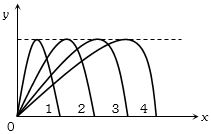
The figure shows four paths for a kicked football. Ignoring the effects of air on the flight,rank the paths according to the initial horizontal velocity component,highest first.
A
$1, 2, 3, 4$
B
$2, 3, 4, 1$
C
$3, 4, 1, 2$
D
$4, 3, 2, 1$
Solution
(D) The time of flight $T$ for a projectile is given by $T = \frac{2u_y}{g}$,where $u_y$ is the initial vertical velocity component. Since all four paths reach the same maximum height $H = \frac{u_y^2}{2g}$,they all have the same initial vertical velocity component $u_y$ and thus the same time of flight $T$.
The horizontal range $R$ is given by $R = u_x T$,where $u_x$ is the initial horizontal velocity component.
Since $T$ is constant for all paths,the range $R$ is directly proportional to the initial horizontal velocity component $u_x$ $(R \propto u_x)$.
From the figure,the ranges are $R_4 > R_3 > R_2 > R_1$. Therefore,the initial horizontal velocity components are ranked as $4, 3, 2, 1$.
The horizontal range $R$ is given by $R = u_x T$,where $u_x$ is the initial horizontal velocity component.
Since $T$ is constant for all paths,the range $R$ is directly proportional to the initial horizontal velocity component $u_x$ $(R \propto u_x)$.
From the figure,the ranges are $R_4 > R_3 > R_2 > R_1$. Therefore,the initial horizontal velocity components are ranked as $4, 3, 2, 1$.
0 likes
View Solution65
EasyMCQ
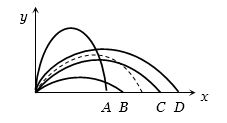
The path of a projectile in the absence of air drag is shown in the figure by a dotted line. If air resistance is not ignored,then which one of the paths shown in the figure is appropriate for the projectile?
A
$B$
B
$A$
C
$D$
D
$C$
Solution
(B) When air resistance is considered,it acts as a resistive force opposite to the direction of motion of the projectile.
This resistive force continuously does negative work on the projectile,leading to a loss of mechanical energy.
As a result,both the horizontal velocity and the vertical velocity components decrease over time compared to the ideal case.
Consequently,the projectile will reach a lower maximum height and cover a shorter horizontal range than it would in a vacuum.
Looking at the provided figure,the dotted line represents the ideal path. Path $A$ shows a trajectory with a smaller maximum height and a shorter range compared to the dotted line. Therefore,path $A$ is the appropriate path when air resistance is taken into account.
This resistive force continuously does negative work on the projectile,leading to a loss of mechanical energy.
As a result,both the horizontal velocity and the vertical velocity components decrease over time compared to the ideal case.
Consequently,the projectile will reach a lower maximum height and cover a shorter horizontal range than it would in a vacuum.
Looking at the provided figure,the dotted line represents the ideal path. Path $A$ shows a trajectory with a smaller maximum height and a shorter range compared to the dotted line. Therefore,path $A$ is the appropriate path when air resistance is taken into account.
0 likes
View Solution66
MediumMCQ
Assume that the acceleration due to gravity on the surface of the moon is $0.2$ times the acceleration due to gravity on the surface of the earth. If $R_e$ is the maximum range of a projectile on the earth's surface,what is the maximum range on the surface of the moon for the same velocity of projection (in $,R_e$)?
A
$0.2$
B
$2$
C
$0.5$
D
$5$
Solution
(D) The formula for the horizontal range of a projectile is given by $R = \frac{u^2 \sin 2\theta}{g}$.
Given that the velocity of projection $u$ and the angle of projection $\theta$ are constant,the range $R$ is inversely proportional to the acceleration due to gravity $g$,i.e.,$R \propto \frac{1}{g}$.
Let $R_e$ and $g_e$ be the range and acceleration due to gravity on Earth,and $R_m$ and $g_m$ be the range and acceleration due to gravity on the Moon.
We are given $g_m = 0.2 \, g_e$.
Using the proportionality $R_m \, g_m = R_e \, g_e$,we get:
$R_m = R_e \left( \frac{g_e}{g_m} \right)$
$R_m = R_e \left( \frac{g_e}{0.2 \, g_e} \right)$
$R_m = \frac{R_e}{0.2} = 5 \, R_e$.
Therefore,the maximum range on the surface of the moon is $5 \, R_e$.
Given that the velocity of projection $u$ and the angle of projection $\theta$ are constant,the range $R$ is inversely proportional to the acceleration due to gravity $g$,i.e.,$R \propto \frac{1}{g}$.
Let $R_e$ and $g_e$ be the range and acceleration due to gravity on Earth,and $R_m$ and $g_m$ be the range and acceleration due to gravity on the Moon.
We are given $g_m = 0.2 \, g_e$.
Using the proportionality $R_m \, g_m = R_e \, g_e$,we get:
$R_m = R_e \left( \frac{g_e}{g_m} \right)$
$R_m = R_e \left( \frac{g_e}{0.2 \, g_e} \right)$
$R_m = \frac{R_e}{0.2} = 5 \, R_e$.
Therefore,the maximum range on the surface of the moon is $5 \, R_e$.
0 likes
View Solution67
MediumMCQ
$A$ particle is projected at an angle of $45^{\circ}$ with the horizontal with an initial kinetic energy $K$. What will be its kinetic energy at the highest point?
A
$K/\sqrt{2}$
B
$K/2$
C
$2K$
D
$K$
Solution
(B) The initial kinetic energy is given by $K = \frac{1}{2}mu^2$, where $u$ is the initial velocity.
At the highest point of the trajectory, the vertical component of velocity becomes zero, and the particle only possesses the horizontal component of velocity, which is $v_x = u \cos \theta$.
The kinetic energy at the highest point $K'$ is given by $K' = \frac{1}{2}m(u \cos \theta)^2 = \frac{1}{2}mu^2 \cos^2 \theta$.
Substituting $\theta = 45^{\circ}$, we get $K' = K \cos^2(45^{\circ}) = K \times (1/\sqrt{2})^2 = K/2$.
At the highest point of the trajectory, the vertical component of velocity becomes zero, and the particle only possesses the horizontal component of velocity, which is $v_x = u \cos \theta$.
The kinetic energy at the highest point $K'$ is given by $K' = \frac{1}{2}m(u \cos \theta)^2 = \frac{1}{2}mu^2 \cos^2 \theta$.
Substituting $\theta = 45^{\circ}$, we get $K' = K \cos^2(45^{\circ}) = K \times (1/\sqrt{2})^2 = K/2$.
0 likes
View Solution68
MediumMCQ
If the potential energy of a projectile at its maximum height is $3/4$ of its initial kinetic energy,then the angle of projection is ...... $^o$.
A
$30$
B
$45$
C
$60$
D
$75$
Solution
(C) Let the initial kinetic energy of the projectile be $E_0 = \frac{1}{2}mv_0^2$,where $v_0$ is the initial velocity.
At maximum height,the potential energy is $U = \frac{3}{4}E_0$.
By the law of conservation of energy,the total energy remains constant. The kinetic energy at maximum height is $K = E_0 - U = E_0 - \frac{3}{4}E_0 = \frac{1}{4}E_0$.
At maximum height,the vertical component of velocity is zero,so the kinetic energy is due to the horizontal component $v_x = v_0 \cos \theta$.
Thus,$K = \frac{1}{2}m(v_0 \cos \theta)^2 = \frac{1}{2}mv_0^2 \cos^2 \theta = E_0 \cos^2 \theta$.
Equating the two expressions for $K$: $E_0 \cos^2 \theta = \frac{1}{4}E_0$.
$\cos^2 \theta = \frac{1}{4} \implies \cos \theta = \frac{1}{2}$.
Therefore,$\theta = 60^o$.
At maximum height,the potential energy is $U = \frac{3}{4}E_0$.
By the law of conservation of energy,the total energy remains constant. The kinetic energy at maximum height is $K = E_0 - U = E_0 - \frac{3}{4}E_0 = \frac{1}{4}E_0$.
At maximum height,the vertical component of velocity is zero,so the kinetic energy is due to the horizontal component $v_x = v_0 \cos \theta$.
Thus,$K = \frac{1}{2}m(v_0 \cos \theta)^2 = \frac{1}{2}mv_0^2 \cos^2 \theta = E_0 \cos^2 \theta$.
Equating the two expressions for $K$: $E_0 \cos^2 \theta = \frac{1}{4}E_0$.
$\cos^2 \theta = \frac{1}{4} \implies \cos \theta = \frac{1}{2}$.
Therefore,$\theta = 60^o$.
0 likes
View Solution69
MediumMCQ
The equation of a projectile is $y = \sqrt{3} x - \frac{gx^2}{2}$. The angle of projection is:
A
$30^\circ$
B
$45^\circ$
C
$60^\circ$
D
None of these
Solution
(C) The standard equation of a projectile trajectory is given by $y = x \tan \theta - \frac{gx^2}{2u^2 \cos^2 \theta}$.
Comparing this with the given equation $y = \sqrt{3} x - \frac{gx^2}{2}$,we can identify the term corresponding to $\tan \theta$.
Here,$\tan \theta = \sqrt{3}$.
Since $\tan 60^\circ = \sqrt{3}$,the angle of projection $\theta$ is $60^\circ$.
Comparing this with the given equation $y = \sqrt{3} x - \frac{gx^2}{2}$,we can identify the term corresponding to $\tan \theta$.
Here,$\tan \theta = \sqrt{3}$.
Since $\tan 60^\circ = \sqrt{3}$,the angle of projection $\theta$ is $60^\circ$.
0 likes
View Solution70
MediumMCQ
The equation of a projectile is $y = \sqrt{3}x - \frac{x^2}{2}$. The velocity of projection is:
A
$3\sqrt{10} \, m/s$
B
$2\sqrt{10} \, m/s$
C
$10\sqrt{3} \, m/s$
D
$10\sqrt{2} \, m/s$
Solution
(B) The standard equation of a projectile is given by $y = x \tan \theta - \frac{gx^2}{2u^2 \cos^2 \theta}$.
Comparing this with the given equation $y = \sqrt{3}x - \frac{x^2}{2}$,we get:
$\tan \theta = \sqrt{3} \implies \theta = 60^\circ$.
Also,$\frac{g}{2u^2 \cos^2 \theta} = \frac{1}{2}$.
Taking $g = 10 \, m/s^2$ and $\theta = 60^\circ$,we have $\cos 60^\circ = 1/2$,so $\cos^2 60^\circ = 1/4$.
Substituting these values: $\frac{10}{2u^2(1/4)} = \frac{1}{2}$.
$\frac{10}{u^2/2} = \frac{1}{2} \implies \frac{20}{u^2} = \frac{1}{2}$.
$u^2 = 40 \implies u = \sqrt{40} = 2\sqrt{10} \, m/s$.
Comparing this with the given equation $y = \sqrt{3}x - \frac{x^2}{2}$,we get:
$\tan \theta = \sqrt{3} \implies \theta = 60^\circ$.
Also,$\frac{g}{2u^2 \cos^2 \theta} = \frac{1}{2}$.
Taking $g = 10 \, m/s^2$ and $\theta = 60^\circ$,we have $\cos 60^\circ = 1/2$,so $\cos^2 60^\circ = 1/4$.
Substituting these values: $\frac{10}{2u^2(1/4)} = \frac{1}{2}$.
$\frac{10}{u^2/2} = \frac{1}{2} \implies \frac{20}{u^2} = \frac{1}{2}$.
$u^2 = 40 \implies u = \sqrt{40} = 2\sqrt{10} \, m/s$.
0 likes
View Solution71
MediumMCQ
The equation of a projectile is $y = 16x - \frac{5x^2}{4}$. The horizontal range is .......... $m$.
A
$16$
B
$8$
C
$3.2$
D
$12.8$
Solution
(D) The standard equation of a projectile trajectory is given by $y = x \tan \theta \left( 1 - \frac{x}{R} \right)$,where $R$ is the horizontal range.
Given equation: $y = 16x - \frac{5x^2}{4}$.
Factor out $16x$ from the expression: $y = 16x \left( 1 - \frac{5x^2}{4 \cdot 16x} \right) = 16x \left( 1 - \frac{5x}{64} \right)$.
Rewrite the term inside the bracket to match the standard form: $y = 16x \left( 1 - \frac{x}{64/5} \right)$.
Comparing this with the standard equation $y = x \tan \theta \left( 1 - \frac{x}{R} \right)$,we get $R = \frac{64}{5}$.
Calculating the value: $R = 12.8 \ m$.
Given equation: $y = 16x - \frac{5x^2}{4}$.
Factor out $16x$ from the expression: $y = 16x \left( 1 - \frac{5x^2}{4 \cdot 16x} \right) = 16x \left( 1 - \frac{5x}{64} \right)$.
Rewrite the term inside the bracket to match the standard form: $y = 16x \left( 1 - \frac{x}{64/5} \right)$.
Comparing this with the standard equation $y = x \tan \theta \left( 1 - \frac{x}{R} \right)$,we get $R = \frac{64}{5}$.
Calculating the value: $R = 12.8 \ m$.
0 likes
View Solution72
MediumMCQ
$A$ body is thrown at an angle of $30^{\circ}$ to the horizontal with a velocity of $30\; m/s$. After $1\; s$,its velocity will be (in $m/s$) $\left(g=10\; m/s^{2}\right)$
A
$10\sqrt{7}$
B
$700\sqrt{10}$
C
$100\sqrt{7}$
D
$\sqrt{40}$
Solution
(A) The horizontal component of velocity remains constant throughout the motion because there is no acceleration in the $x$-direction.
$v_{x} = u \cos \theta = 30 \cos 30^{\circ} = 30 \times \frac{\sqrt{3}}{2} = 15\sqrt{3}\; m/s$.
The vertical component of velocity after time $t$ is given by $v_{y} = u \sin \theta - gt$.
Substituting the values: $v_{y} = 30 \sin 30^{\circ} - 10 \times 1 = 30 \times \frac{1}{2} - 10 = 15 - 10 = 5\; m/s$.
The magnitude of the resultant velocity $v$ is given by $v = \sqrt{v_{x}^{2} + v_{y}^{2}}$.
$v = \sqrt{(15\sqrt{3})^{2} + (5)^{2}} = \sqrt{225 \times 3 + 25} = \sqrt{675 + 25} = \sqrt{700}$.
$v = 10\sqrt{7}\; m/s$.
$v_{x} = u \cos \theta = 30 \cos 30^{\circ} = 30 \times \frac{\sqrt{3}}{2} = 15\sqrt{3}\; m/s$.
The vertical component of velocity after time $t$ is given by $v_{y} = u \sin \theta - gt$.
Substituting the values: $v_{y} = 30 \sin 30^{\circ} - 10 \times 1 = 30 \times \frac{1}{2} - 10 = 15 - 10 = 5\; m/s$.
The magnitude of the resultant velocity $v$ is given by $v = \sqrt{v_{x}^{2} + v_{y}^{2}}$.
$v = \sqrt{(15\sqrt{3})^{2} + (5)^{2}} = \sqrt{225 \times 3 + 25} = \sqrt{675 + 25} = \sqrt{700}$.
$v = 10\sqrt{7}\; m/s$.
0 likes
View Solution73
MediumMCQ
$A$ projectile is fired at $30^{\circ}$ to the horizontal. The vertical component of its velocity is $80 \; ms^{-1}$. Its time of flight is $T$. What will be the velocity of the projectile at $t = \frac{T}{2}$?
A
$80 \; ms^{-1}$
B
$80\sqrt{3} \; ms^{-1}$
C
$(80/\sqrt{3}) \; ms^{-1}$
D
$40 \; ms^{-1}$
Solution
(B) Given the vertical component of velocity $u_y = u \sin \theta = 80 \; ms^{-1}$ and $\theta = 30^{\circ}$.
Since $\sin 30^{\circ} = 0.5$,we have $u = \frac{80}{0.5} = 160 \; ms^{-1}$.
The horizontal component of velocity is $u_x = u \cos \theta = 160 \cos 30^{\circ} = 160 \times \frac{\sqrt{3}}{2} = 80\sqrt{3} \; ms^{-1}$.
At time $t = \frac{T}{2}$,the projectile is at its maximum height,where the vertical component of velocity $v_y = 0$.
Therefore,the resultant velocity at $t = \frac{T}{2}$ is equal to the horizontal component $u_x$,which remains constant throughout the motion.
Thus,$v = u_x = 80\sqrt{3} \; ms^{-1}$.
Since $\sin 30^{\circ} = 0.5$,we have $u = \frac{80}{0.5} = 160 \; ms^{-1}$.
The horizontal component of velocity is $u_x = u \cos \theta = 160 \cos 30^{\circ} = 160 \times \frac{\sqrt{3}}{2} = 80\sqrt{3} \; ms^{-1}$.
At time $t = \frac{T}{2}$,the projectile is at its maximum height,where the vertical component of velocity $v_y = 0$.
Therefore,the resultant velocity at $t = \frac{T}{2}$ is equal to the horizontal component $u_x$,which remains constant throughout the motion.
Thus,$v = u_x = 80\sqrt{3} \; ms^{-1}$.
1 likes
View Solution74
MediumMCQ
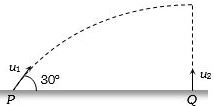
$A$ particle $P$ is projected with velocity $u_1$ at an angle of $30^\circ$ with the horizontal. Another particle $Q$ is projected vertically upwards with velocity $u_2$ from the point directly below the maximum height of $P$. The condition for the collision of both particles is:
A
$u_1 = u_2$
B
$u_1 = 2u_2$
C
$u_1 = \frac{u_2}{2}$
D
$u_1 = 4u_2$
Solution
(B) For the particles to collide,they must reach the same point at the same time.
Particle $P$ reaches its maximum height at the horizontal distance equal to half of its range.
At the maximum height,the vertical component of the velocity of particle $P$ becomes zero.
However,for the particles to collide at the peak,the vertical velocity of particle $Q$ must match the vertical velocity of particle $P$ at the point of collision.
Since particle $Q$ is projected from the point directly below the maximum height of $P$,it will reach the maximum height of $P$ at the same time $P$ reaches it if their vertical velocities are equal at that point.
The vertical component of the initial velocity of $P$ is $u_{1y} = u_1 \sin 30^\circ$.
For collision at the maximum height,the vertical velocity of $Q$ must be equal to the vertical component of $P$'s velocity at the start,or more precisely,the time taken to reach the peak must be the same.
Since $v_y = u_y - gt$,at the peak $v_y = 0$,so $t = \frac{u_y}{g}$.
For $P$,$t_P = \frac{u_1 \sin 30^\circ}{g}$.
For $Q$,$t_Q = \frac{u_2}{g}$.
Equating $t_P = t_Q$,we get $u_1 \sin 30^\circ = u_2$.
$u_1 \times \frac{1}{2} = u_2$.
Therefore,$u_1 = 2u_2$.
Particle $P$ reaches its maximum height at the horizontal distance equal to half of its range.
At the maximum height,the vertical component of the velocity of particle $P$ becomes zero.
However,for the particles to collide at the peak,the vertical velocity of particle $Q$ must match the vertical velocity of particle $P$ at the point of collision.
Since particle $Q$ is projected from the point directly below the maximum height of $P$,it will reach the maximum height of $P$ at the same time $P$ reaches it if their vertical velocities are equal at that point.
The vertical component of the initial velocity of $P$ is $u_{1y} = u_1 \sin 30^\circ$.
For collision at the maximum height,the vertical velocity of $Q$ must be equal to the vertical component of $P$'s velocity at the start,or more precisely,the time taken to reach the peak must be the same.
Since $v_y = u_y - gt$,at the peak $v_y = 0$,so $t = \frac{u_y}{g}$.
For $P$,$t_P = \frac{u_1 \sin 30^\circ}{g}$.
For $Q$,$t_Q = \frac{u_2}{g}$.
Equating $t_P = t_Q$,we get $u_1 \sin 30^\circ = u_2$.
$u_1 \times \frac{1}{2} = u_2$.
Therefore,$u_1 = 2u_2$.
0 likes
View Solution75
EasyMCQ
$A$ particle is projected with velocity $u$ at an angle $\theta$ with the horizontal. What is the change in its velocity at the maximum height?
A
$u \cos \theta$
B
$u$
C
$u \sin \theta$
D
$u(1 - \cos \theta)$
Solution
(C) The initial velocity of the particle is $\vec{u} = u \cos \theta \hat{i} + u \sin \theta \hat{j}$.
At the maximum height,the vertical component of the velocity becomes zero,so the velocity is $\vec{v} = u \cos \theta \hat{i}$.
The change in velocity is $\Delta \vec{v} = \vec{v} - \vec{u}$.
$\Delta \vec{v} = (u \cos \theta \hat{i}) - (u \cos \theta \hat{i} + u \sin \theta \hat{j}) = -u \sin \theta \hat{j}$.
The magnitude of the change in velocity is $|\Delta \vec{v}| = u \sin \theta$.
At the maximum height,the vertical component of the velocity becomes zero,so the velocity is $\vec{v} = u \cos \theta \hat{i}$.
The change in velocity is $\Delta \vec{v} = \vec{v} - \vec{u}$.
$\Delta \vec{v} = (u \cos \theta \hat{i}) - (u \cos \theta \hat{i} + u \sin \theta \hat{j}) = -u \sin \theta \hat{j}$.
The magnitude of the change in velocity is $|\Delta \vec{v}| = u \sin \theta$.
0 likes
View Solution76
DifficultMCQ
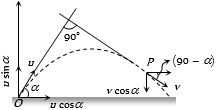
$A$ particle is projected from point $O$ with velocity $u$ at an angle $\alpha$ with the horizontal. If at point $P$,its velocity is perpendicular to the initial direction of projection,then find the time taken to reach from $O$ to $P$.
A
$\frac{u \sin \alpha}{g}$
B
$\frac{u \csc \alpha}{g}$
C
$\frac{u \tan \alpha}{g}$
D
$\frac{u \sec \alpha}{g}$
Solution
(B) Let the initial velocity be $\vec{u} = u \cos \alpha \hat{i} + u \sin \alpha \hat{j}$.
At point $P$,the velocity $\vec{v}$ is perpendicular to $\vec{u}$,so $\vec{v} \cdot \vec{u} = 0$.
The velocity at any time $t$ is $\vec{v} = u \cos \alpha \hat{i} + (u \sin \alpha - gt) \hat{j}$.
Taking the dot product: $(u \cos \alpha \hat{i} + (u \sin \alpha - gt) \hat{j}) \cdot (u \cos \alpha \hat{i} + u \sin \alpha \hat{j}) = 0$.
$u^2 \cos^2 \alpha + u \sin \alpha (u \sin \alpha - gt) = 0$.
$u^2 \cos^2 \alpha + u^2 \sin^2 \alpha - u \sin \alpha gt = 0$.
$u^2 (\cos^2 \alpha + \sin^2 \alpha) = u \sin \alpha gt$.
$u^2 = u \sin \alpha gt$.
$t = \frac{u}{g \sin \alpha} = \frac{u \csc \alpha}{g}$.
At point $P$,the velocity $\vec{v}$ is perpendicular to $\vec{u}$,so $\vec{v} \cdot \vec{u} = 0$.
The velocity at any time $t$ is $\vec{v} = u \cos \alpha \hat{i} + (u \sin \alpha - gt) \hat{j}$.
Taking the dot product: $(u \cos \alpha \hat{i} + (u \sin \alpha - gt) \hat{j}) \cdot (u \cos \alpha \hat{i} + u \sin \alpha \hat{j}) = 0$.
$u^2 \cos^2 \alpha + u \sin \alpha (u \sin \alpha - gt) = 0$.
$u^2 \cos^2 \alpha + u^2 \sin^2 \alpha - u \sin \alpha gt = 0$.
$u^2 (\cos^2 \alpha + \sin^2 \alpha) = u \sin \alpha gt$.
$u^2 = u \sin \alpha gt$.
$t = \frac{u}{g \sin \alpha} = \frac{u \csc \alpha}{g}$.
0 likes
View Solution77
MediumMCQ
$A$ particle is projected with velocity $u$ at an angle $\alpha$ with the horizontal,and another particle is projected with the same velocity $u$ at an angle $\alpha$ with the vertical. What is the ratio of their times of flight?
A
$tan \alpha : 1$
B
$cot \alpha : 1$
C
$1 : tan \alpha$
D
$1 : 1$
Solution
(A) The time of flight $T$ for a projectile is given by $T = \frac{2u \sin \theta}{g}$,where $\theta$ is the angle of projection with the horizontal.
For the first particle,the angle with the horizontal is $\theta_1 = \alpha$. Thus,$T_1 = \frac{2u \sin \alpha}{g}$.
For the second particle,the angle with the vertical is $\alpha$,so the angle with the horizontal is $\theta_2 = 90^\circ - \alpha$. Thus,$T_2 = \frac{2u \sin(90^\circ - \alpha)}{g} = \frac{2u \cos \alpha}{g}$.
The ratio of their times of flight is $\frac{T_1}{T_2} = \frac{\frac{2u \sin \alpha}{g}}{\frac{2u \cos \alpha}{g}} = \frac{\sin \alpha}{\cos \alpha} = \tan \alpha$.
Therefore,the ratio is $\tan \alpha : 1$.
For the first particle,the angle with the horizontal is $\theta_1 = \alpha$. Thus,$T_1 = \frac{2u \sin \alpha}{g}$.
For the second particle,the angle with the vertical is $\alpha$,so the angle with the horizontal is $\theta_2 = 90^\circ - \alpha$. Thus,$T_2 = \frac{2u \sin(90^\circ - \alpha)}{g} = \frac{2u \cos \alpha}{g}$.
The ratio of their times of flight is $\frac{T_1}{T_2} = \frac{\frac{2u \sin \alpha}{g}}{\frac{2u \cos \alpha}{g}} = \frac{\sin \alpha}{\cos \alpha} = \tan \alpha$.
Therefore,the ratio is $\tan \alpha : 1$.
0 likes
View Solution78
DifficultMCQ
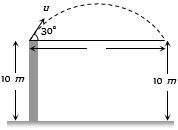
$A$ ball is projected from a building of height $10 \ m$ with a velocity of $10 \ m/s$ at an angle of $30^\circ$ with the horizontal. What is the horizontal distance covered by the ball when it reaches the same height of $10 \ m$ again (in $m$)? $(g = 10 \ m/s^2, \sin 30^\circ = 1/2, \cos 30^\circ = \sqrt{3}/2)$
A
$8.66$
B
$5.20$
C
$4.33$
D
$2.60$
Solution
(A) The ball is projected from a height $h = 10 \ m$ and returns to the same vertical level ($10 \ m$ height). This is equivalent to the horizontal range of a projectile on a level plane.
The formula for the horizontal range $R$ is given by:
$R = \frac{u^2 \sin(2\theta)}{g}$
Given:
Initial velocity $u = 10 \ m/s$
Angle of projection $\theta = 30^\circ$
Acceleration due to gravity $g = 10 \ m/s^2$
Substituting the values:
$R = \frac{(10)^2 \sin(2 \times 30^\circ)}{10}$
$R = \frac{100 \times \sin(60^\circ)}{10}$
$R = 10 \times \frac{\sqrt{3}}{2}$
$R = 5\sqrt{3} \ m$
Using $\sqrt{3} \approx 1.732$:
$R = 5 \times 1.732 = 8.66 \ m$
The formula for the horizontal range $R$ is given by:
$R = \frac{u^2 \sin(2\theta)}{g}$
Given:
Initial velocity $u = 10 \ m/s$
Angle of projection $\theta = 30^\circ$
Acceleration due to gravity $g = 10 \ m/s^2$
Substituting the values:
$R = \frac{(10)^2 \sin(2 \times 30^\circ)}{10}$
$R = \frac{100 \times \sin(60^\circ)}{10}$
$R = 10 \times \frac{\sqrt{3}}{2}$
$R = 5\sqrt{3} \ m$
Using $\sqrt{3} \approx 1.732$:
$R = 5 \times 1.732 = 8.66 \ m$
0 likes
View Solution79
MediumMCQ
Four objects $P, Q, R,$ and $S$ are projected with the same velocity at angles of $15^o, 30^o, 45^o,$ and $60^o$ respectively. Which of these will have the minimum range?
A
$P$
B
$Q$
C
$R$
D
$S$
Solution
(A) The horizontal range $R$ of a projectile is given by the formula: $R = \frac{u^2 \sin(2\theta)}{g}$.
Since the initial velocity $u$ and acceleration due to gravity $g$ are constant for all objects,the range $R$ depends only on $\sin(2\theta)$.
For the given angles:
For $P$ $(\theta = 15^o)$: $2\theta = 30^o$,$\sin(30^o) = 0.5$
For $Q$ $(\theta = 30^o)$: $2\theta = 60^o$,$\sin(60^o) \approx 0.866$
For $R$ $(\theta = 45^o)$: $2\theta = 90^o$,$\sin(90^o) = 1.0$
For $S$ $(\theta = 60^o)$: $2\theta = 120^o$,$\sin(120^o) = \sin(60^o) \approx 0.866$
Comparing the values,$\sin(2\theta)$ is minimum for $\theta = 15^o$ (which is $P$) and $\theta = 75^o$ (not given). Among the choices,$P$ has the smallest value of $\sin(2\theta)$,therefore $P$ has the minimum range.
Since the initial velocity $u$ and acceleration due to gravity $g$ are constant for all objects,the range $R$ depends only on $\sin(2\theta)$.
For the given angles:
For $P$ $(\theta = 15^o)$: $2\theta = 30^o$,$\sin(30^o) = 0.5$
For $Q$ $(\theta = 30^o)$: $2\theta = 60^o$,$\sin(60^o) \approx 0.866$
For $R$ $(\theta = 45^o)$: $2\theta = 90^o$,$\sin(90^o) = 1.0$
For $S$ $(\theta = 60^o)$: $2\theta = 120^o$,$\sin(120^o) = \sin(60^o) \approx 0.866$
Comparing the values,$\sin(2\theta)$ is minimum for $\theta = 15^o$ (which is $P$) and $\theta = 75^o$ (not given). Among the choices,$P$ has the smallest value of $\sin(2\theta)$,therefore $P$ has the minimum range.
0 likes
View Solution80
MediumMCQ
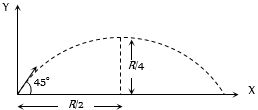
$A$ projectile is thrown such that it achieves a maximum range $R$. What are the coordinates of the point where its velocity is minimum?
A
$(R, R)$
B
$(R, R/2)$
C
$(R/2, R/4)$
D
$(R, R/4)$
Solution
(C) For maximum range,the angle of projection is $\theta = 45^\circ$.
At the highest point of the trajectory,the vertical component of velocity becomes zero,and the velocity is minimum,equal to $u \cos \theta$.
The coordinates of the highest point are $(x, y) = (R/2, H)$,where $R$ is the range and $H$ is the maximum height.
The formula for maximum height is $H = \frac{u^2 \sin^2 \theta}{2g}$ and for range is $R = \frac{u^2 \sin 2\theta}{g}$.
For $\theta = 45^\circ$,$H = \frac{u^2 (1/\sqrt{2})^2}{2g} = \frac{u^2}{4g}$ and $R = \frac{u^2 \sin 90^\circ}{g} = \frac{u^2}{g}$.
Thus,$H = R/4$.
The coordinates of the highest point are $(R/2, R/4)$.
At the highest point of the trajectory,the vertical component of velocity becomes zero,and the velocity is minimum,equal to $u \cos \theta$.
The coordinates of the highest point are $(x, y) = (R/2, H)$,where $R$ is the range and $H$ is the maximum height.
The formula for maximum height is $H = \frac{u^2 \sin^2 \theta}{2g}$ and for range is $R = \frac{u^2 \sin 2\theta}{g}$.
For $\theta = 45^\circ$,$H = \frac{u^2 (1/\sqrt{2})^2}{2g} = \frac{u^2}{4g}$ and $R = \frac{u^2 \sin 90^\circ}{g} = \frac{u^2}{g}$.
Thus,$H = R/4$.
The coordinates of the highest point are $(R/2, R/4)$.
0 likes
View Solution81
MediumMCQ
If the velocity of a projectile at its maximum height is $\frac{1}{\sqrt{2}}$ times its initial velocity,what is its range?
A
$\frac{u^2}{g}$
B
$\frac{u^2}{2g}$
C
$\frac{u^2}{3g}$
D
$\frac{u^2}{4g}$
Solution
(A) Let the initial velocity be $u$ and the angle of projection be $\theta$.
At maximum height,the vertical component of velocity is $0$,so the velocity is only the horizontal component,$v_x = u \cos \theta$.
Given that $v_x = \frac{u}{\sqrt{2}}$,we have $u \cos \theta = \frac{u}{\sqrt{2}}$.
This implies $\cos \theta = \frac{1}{\sqrt{2}}$,so $\theta = 45^o$.
The formula for the range $R$ of a projectile is $R = \frac{u^2 \sin(2\theta)}{g}$.
Substituting $\theta = 45^o$,we get $R = \frac{u^2 \sin(2 \times 45^o)}{g} = \frac{u^2 \sin(90^o)}{g}$.
Since $\sin(90^o) = 1$,the range is $R = \frac{u^2}{g}$.
At maximum height,the vertical component of velocity is $0$,so the velocity is only the horizontal component,$v_x = u \cos \theta$.
Given that $v_x = \frac{u}{\sqrt{2}}$,we have $u \cos \theta = \frac{u}{\sqrt{2}}$.
This implies $\cos \theta = \frac{1}{\sqrt{2}}$,so $\theta = 45^o$.
The formula for the range $R$ of a projectile is $R = \frac{u^2 \sin(2\theta)}{g}$.
Substituting $\theta = 45^o$,we get $R = \frac{u^2 \sin(2 \times 45^o)}{g} = \frac{u^2 \sin(90^o)}{g}$.
Since $\sin(90^o) = 1$,the range is $R = \frac{u^2}{g}$.
0 likes
View Solution82
DifficultMCQ
The velocity of a projectile is $(6\hat{i} + 8\hat{j}) \ m/s$. Its horizontal range is ........ $m$.
A
$4.8$
B
$9.6$
C
$19.2$
D
$14.0$
Solution
(B) Given velocity of the projectile is $\vec{u} = (6\hat{i} + 8\hat{j}) \ m/s$.
Here,the horizontal component of velocity is $u_x = 6 \ m/s$ and the vertical component is $u_y = 8 \ m/s$.
The time of flight $T$ is given by $T = \frac{2u_y}{g} = \frac{2 \times 8}{10} = 1.6 \ s$.
The horizontal range $R$ is given by $R = u_x \times T$.
Substituting the values,$R = 6 \times 1.6 = 9.6 \ m$.
Therefore,the horizontal range is $9.6 \ m$.
Here,the horizontal component of velocity is $u_x = 6 \ m/s$ and the vertical component is $u_y = 8 \ m/s$.
The time of flight $T$ is given by $T = \frac{2u_y}{g} = \frac{2 \times 8}{10} = 1.6 \ s$.
The horizontal range $R$ is given by $R = u_x \times T$.
Substituting the values,$R = 6 \times 1.6 = 9.6 \ m$.
Therefore,the horizontal range is $9.6 \ m$.
0 likes
View Solution83
MediumMCQ
$A$ projectile is thrown with velocity $u$ at an angle of $15^o$ and has a range $R$. What will be the range of the projectile if it is thrown with velocity $2u$ at an angle of $45^o$ (in $, R$)?
A
$12$
B
$3$
C
$8$
D
$4$
Solution
(C) The formula for the horizontal range $R$ of a projectile is given by $R = \frac{u^2 \sin(2\theta)}{g}$.
From this,we can see that $R \propto u^2 \sin(2\theta)$.
Let the initial range be $R_1 = R$,initial velocity be $u_1 = u$,and initial angle be $\theta_1 = 15^o$.
Let the final range be $R_2$,final velocity be $u_2 = 2u$,and final angle be $\theta_2 = 45^o$.
Taking the ratio:
$\frac{R_2}{R_1} = \left( \frac{u_2}{u_1} \right)^2 \left( \frac{\sin(2\theta_2)}{\sin(2\theta_1)} \right)$
Substituting the values:
$\frac{R_2}{R} = \left( \frac{2u}{u} \right)^2 \left( \frac{\sin(2 \times 45^o)}{\sin(2 \times 15^o)} \right)$
$\frac{R_2}{R} = (2)^2 \left( \frac{\sin(90^o)}{\sin(30^o)} \right)$
$\frac{R_2}{R} = 4 \left( \frac{1}{0.5} \right) = 4 \times 2 = 8$
Therefore,$R_2 = 8R$.
From this,we can see that $R \propto u^2 \sin(2\theta)$.
Let the initial range be $R_1 = R$,initial velocity be $u_1 = u$,and initial angle be $\theta_1 = 15^o$.
Let the final range be $R_2$,final velocity be $u_2 = 2u$,and final angle be $\theta_2 = 45^o$.
Taking the ratio:
$\frac{R_2}{R_1} = \left( \frac{u_2}{u_1} \right)^2 \left( \frac{\sin(2\theta_2)}{\sin(2\theta_1)} \right)$
Substituting the values:
$\frac{R_2}{R} = \left( \frac{2u}{u} \right)^2 \left( \frac{\sin(2 \times 45^o)}{\sin(2 \times 15^o)} \right)$
$\frac{R_2}{R} = (2)^2 \left( \frac{\sin(90^o)}{\sin(30^o)} \right)$
$\frac{R_2}{R} = 4 \left( \frac{1}{0.5} \right) = 4 \times 2 = 8$
Therefore,$R_2 = 8R$.
0 likes
View Solution84
MediumMCQ
The velocity at the maximum height of a projectile is half of its initial velocity $u$. Its range on the horizontal plane is
A
$\frac{\sqrt{3} u^{2}}{2 g}$
B
$\frac{u^{2}}{3 g}$
C
$\frac{u^{2}}{2 g}$
D
$\frac{3 u^{2}}{g}$
Solution
(A) At the maximum height,the vertical component of velocity is zero,so the velocity of the projectile is equal to its horizontal component,$v_x = u \cos \theta$.
Given that this velocity is half of the initial velocity $u$,we have $u \cos \theta = \frac{u}{2}$.
This implies $\cos \theta = \frac{1}{2}$,so the angle of projection is $\theta = 60^\circ$.
The horizontal range $R$ of a projectile is given by the formula $R = \frac{u^2 \sin(2\theta)}{g}$.
Substituting $\theta = 60^\circ$,we get $R = \frac{u^2 \sin(2 \times 60^\circ)}{g} = \frac{u^2 \sin(120^\circ)}{g}$.
Since $\sin(120^\circ) = \frac{\sqrt{3}}{2}$,the range is $R = \frac{\sqrt{3} u^2}{2g}$.
Given that this velocity is half of the initial velocity $u$,we have $u \cos \theta = \frac{u}{2}$.
This implies $\cos \theta = \frac{1}{2}$,so the angle of projection is $\theta = 60^\circ$.
The horizontal range $R$ of a projectile is given by the formula $R = \frac{u^2 \sin(2\theta)}{g}$.
Substituting $\theta = 60^\circ$,we get $R = \frac{u^2 \sin(2 \times 60^\circ)}{g} = \frac{u^2 \sin(120^\circ)}{g}$.
Since $\sin(120^\circ) = \frac{\sqrt{3}}{2}$,the range is $R = \frac{\sqrt{3} u^2}{2g}$.
0 likes
View Solution85
MediumMCQ
$A$ projectile is thrown from a point in a horizontal plane such that the horizontal and vertical velocities are $9.8 \; m/s$ and $19.6 \; m/s$ respectively. It will strike the plane after covering a horizontal distance of ........ $m$.
A
$4.9$
B
$9.8$
C
$19.6$
D
$39.2$
Solution
(D) The horizontal velocity is given as $u_x = 9.8 \; m/s$ and the vertical velocity is $u_y = 19.6 \; m/s$.
The time of flight $T$ is given by $T = \frac{2u_y}{g} = \frac{2 \times 19.6}{9.8} = 4 \; s$.
The horizontal range $R$ is given by $R = u_x \times T$.
Substituting the values,$R = 9.8 \times 4 = 39.2 \; m$.
Alternatively,using the formula $R = \frac{2u_x u_y}{g} = \frac{2 \times 9.8 \times 19.6}{9.8} = 39.2 \; m$.
The time of flight $T$ is given by $T = \frac{2u_y}{g} = \frac{2 \times 19.6}{9.8} = 4 \; s$.
The horizontal range $R$ is given by $R = u_x \times T$.
Substituting the values,$R = 9.8 \times 4 = 39.2 \; m$.
Alternatively,using the formula $R = \frac{2u_x u_y}{g} = \frac{2 \times 9.8 \times 19.6}{9.8} = 39.2 \; m$.
0 likes
View Solution86
DifficultMCQ
If the range of a projectile is twice its maximum height,what is the range?
A
$\frac{4v^2}{5g}$
B
$\frac{4g}{5v^2}$
C
$\frac{v^2}{g}$
D
$\frac{4v^2}{\sqrt{5}g}$
Solution
(A) The formula for the range $R$ is $R = \frac{u^2 \sin(2\theta)}{g} = \frac{2u^2 \sin \theta \cos \theta}{g}$.
The formula for maximum height $H$ is $H = \frac{u^2 \sin^2 \theta}{2g}$.
Given that the range is twice the maximum height,$R = 2H$.
Substituting the formulas: $\frac{2u^2 \sin \theta \cos \theta}{g} = 2 \left( \frac{u^2 \sin^2 \theta}{2g} \right)$.
Simplifying,we get $2 \sin \theta \cos \theta = \sin^2 \theta$,which implies $\tan \theta = 2$.
If $\tan \theta = 2$,then $\sin \theta = \frac{2}{\sqrt{5}}$ and $\cos \theta = \frac{1}{\sqrt{5}}$.
Substituting these into the range formula: $R = \frac{2u^2}{g} \left( \frac{2}{\sqrt{5}} \right) \left( \frac{1}{\sqrt{5}} \right) = \frac{4u^2}{5g}$.
The formula for maximum height $H$ is $H = \frac{u^2 \sin^2 \theta}{2g}$.
Given that the range is twice the maximum height,$R = 2H$.
Substituting the formulas: $\frac{2u^2 \sin \theta \cos \theta}{g} = 2 \left( \frac{u^2 \sin^2 \theta}{2g} \right)$.
Simplifying,we get $2 \sin \theta \cos \theta = \sin^2 \theta$,which implies $\tan \theta = 2$.
If $\tan \theta = 2$,then $\sin \theta = \frac{2}{\sqrt{5}}$ and $\cos \theta = \frac{1}{\sqrt{5}}$.
Substituting these into the range formula: $R = \frac{2u^2}{g} \left( \frac{2}{\sqrt{5}} \right) \left( \frac{1}{\sqrt{5}} \right) = \frac{4u^2}{5g}$.
0 likes
View Solution87
MediumMCQ
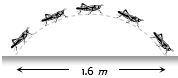
$A$ grasshopper can jump a maximum distance of $1.6 \; m$. It spends a negligible amount of time on the ground. How far can it go in $10 \; s$?
A
$5\sqrt{2} \; m$
B
$10\sqrt{2} \; m$
C
$20\sqrt{2} \; m$
D
$40\sqrt{2} \; m$
Solution
(C) For maximum horizontal range,the angle of projection is $\theta = 45^\circ$.
The maximum range is given by $R_{\max} = \frac{u^2}{g} = 1.6 \; m$.
Taking $g = 10 \; m/s^2$,we have $u^2 = 1.6 \times 10 = 16$,so $u = 4 \; m/s$.
The horizontal component of velocity is $v_x = u \cos \theta = 4 \cos 45^\circ = 4 \times \frac{1}{\sqrt{2}} = 2\sqrt{2} \; m/s$.
Since the time spent on the ground is negligible,the grasshopper is effectively in the air for the entire duration of $10 \; s$.
The total horizontal distance covered in time $t = 10 \; s$ is $S = v_x \times t$.
$S = 2\sqrt{2} \times 10 = 20\sqrt{2} \; m$.
The maximum range is given by $R_{\max} = \frac{u^2}{g} = 1.6 \; m$.
Taking $g = 10 \; m/s^2$,we have $u^2 = 1.6 \times 10 = 16$,so $u = 4 \; m/s$.
The horizontal component of velocity is $v_x = u \cos \theta = 4 \cos 45^\circ = 4 \times \frac{1}{\sqrt{2}} = 2\sqrt{2} \; m/s$.
Since the time spent on the ground is negligible,the grasshopper is effectively in the air for the entire duration of $10 \; s$.
The total horizontal distance covered in time $t = 10 \; s$ is $S = v_x \times t$.
$S = 2\sqrt{2} \times 10 = 20\sqrt{2} \; m$.
0 likes
View Solution88
DifficultMCQ
The initial velocity of a projectile is given by $v = a\hat{i} + b\hat{j}$. If the range $R$ is twice the maximum height $H$,then which of the following is true?
A
$a = 2b$
B
$b = a$
C
$b = 2a$
D
$b = 4a$
Solution
(C) The initial velocity components are $v_x = a$ and $v_y = b$.
The angle of projection $\theta$ is given by $\tan \theta = \frac{v_y}{v_x} = \frac{b}{a}$.
We know the formulas for range $R = \frac{2v_x v_y}{g} = \frac{2ab}{g}$ and maximum height $H = \frac{v_y^2}{2g} = \frac{b^2}{2g}$.
Given the condition $R = 2H$,we substitute the expressions:
$\frac{2ab}{g} = 2 \left( \frac{b^2}{2g} \right)$.
Simplifying the equation:
$\frac{2ab}{g} = \frac{b^2}{g}$.
Dividing both sides by $b/g$ (assuming $b \neq 0$):
$2a = b$ or $b = 2a$.
The angle of projection $\theta$ is given by $\tan \theta = \frac{v_y}{v_x} = \frac{b}{a}$.
We know the formulas for range $R = \frac{2v_x v_y}{g} = \frac{2ab}{g}$ and maximum height $H = \frac{v_y^2}{2g} = \frac{b^2}{2g}$.
Given the condition $R = 2H$,we substitute the expressions:
$\frac{2ab}{g} = 2 \left( \frac{b^2}{2g} \right)$.
Simplifying the equation:
$\frac{2ab}{g} = \frac{b^2}{g}$.
Dividing both sides by $b/g$ (assuming $b \neq 0$):
$2a = b$ or $b = 2a$.
0 likes
View Solution89
MediumMCQ
$A$ ball can be thrown to a maximum horizontal distance of $100\,m$. To what maximum height can it be thrown?
A
$100$
B
$80$
C
$60$
D
$50$
Solution
(D) The maximum horizontal range is given by $R_{\max} = \frac{u^2}{g} = 100\,m$ (at $\theta = 45^\circ$).
Therefore,$u^2 = 100 \times g = 1000\,m^2/s^2$ (taking $g = 10\,m/s^2$).
The maximum height reached when thrown vertically is $H_{\max} = \frac{u^2}{2g}$ (at $\theta = 90^\circ$).
Substituting the value of $u^2$,we get $H_{\max} = \frac{1000}{2 \times 10} = 50\,m$.
Therefore,$u^2 = 100 \times g = 1000\,m^2/s^2$ (taking $g = 10\,m/s^2$).
The maximum height reached when thrown vertically is $H_{\max} = \frac{u^2}{2g}$ (at $\theta = 90^\circ$).
Substituting the value of $u^2$,we get $H_{\max} = \frac{1000}{2 \times 10} = 50\,m$.
0 likes
View Solution90
MediumMCQ
$A$ ball thrown by one player reaches another player in $2 \, s$. The maximum height attained by the ball is ........ $m$. (Take $g = 10 \, m/s^2$)
A
$10$
B
$7.5$
C
$5$
D
$2.5$
Solution
(C) The time of flight $T$ is given by $T = \frac{2u \sin \theta}{g} = 2 \, s$.
From this,we get $u \sin \theta = \frac{g \times T}{2} = \frac{10 \times 2}{2} = 10 \, m/s$.
The maximum height $H$ attained by the projectile is given by the formula $H = \frac{u^2 \sin^2 \theta}{2g}$.
Substituting the value of $u \sin \theta = 10 \, m/s$:
$H = \frac{(10)^2}{2 \times 10} = \frac{100}{20} = 5 \, m$.
Therefore,the maximum height attained by the ball is $5 \, m$.
From this,we get $u \sin \theta = \frac{g \times T}{2} = \frac{10 \times 2}{2} = 10 \, m/s$.
The maximum height $H$ attained by the projectile is given by the formula $H = \frac{u^2 \sin^2 \theta}{2g}$.
Substituting the value of $u \sin \theta = 10 \, m/s$:
$H = \frac{(10)^2}{2 \times 10} = \frac{100}{20} = 5 \, m$.
Therefore,the maximum height attained by the ball is $5 \, m$.
1 likes
View Solution91
MediumMCQ
$A$ projectile is thrown at an angle of $\pi/3$ with the horizontal,reaching a maximum height $Y$. If another projectile is thrown with the same initial velocity at an angle of $\pi/6$,what will be the maximum height attained?
A
$Y$
B
$2Y$
C
$3Y$
D
$Y/3$
Solution
(D) The formula for the maximum height of a projectile is given by $H = \frac{u^2 \sin^2 \theta}{2g}$.
Given the initial velocity $u$ is the same for both cases.
For the first projectile,$\theta_1 = \pi/3 = 60^\circ$,so $H_1 = Y = \frac{u^2 \sin^2(60^\circ)}{2g} = \frac{u^2}{2g} \left( \frac{\sqrt{3}}{2} \right)^2 = \frac{3u^2}{8g}$.
For the second projectile,$\theta_2 = \pi/6 = 30^\circ$,so $H_2 = \frac{u^2 \sin^2(30^\circ)}{2g} = \frac{u^2}{2g} \left( \frac{1}{2} \right)^2 = \frac{u^2}{8g}$.
Comparing the two heights: $\frac{H_2}{H_1} = \frac{u^2/8g}{3u^2/8g} = \frac{1}{3}$.
Therefore,$H_2 = \frac{H_1}{3} = \frac{Y}{3}$.
Given the initial velocity $u$ is the same for both cases.
For the first projectile,$\theta_1 = \pi/3 = 60^\circ$,so $H_1 = Y = \frac{u^2 \sin^2(60^\circ)}{2g} = \frac{u^2}{2g} \left( \frac{\sqrt{3}}{2} \right)^2 = \frac{3u^2}{8g}$.
For the second projectile,$\theta_2 = \pi/6 = 30^\circ$,so $H_2 = \frac{u^2 \sin^2(30^\circ)}{2g} = \frac{u^2}{2g} \left( \frac{1}{2} \right)^2 = \frac{u^2}{8g}$.
Comparing the two heights: $\frac{H_2}{H_1} = \frac{u^2/8g}{3u^2/8g} = \frac{1}{3}$.
Therefore,$H_2 = \frac{H_1}{3} = \frac{Y}{3}$.
0 likes
View Solution92
MediumMCQ
The maximum horizontal range of a projectile is $400\;m$. What is the maximum height attained by it (in $;m$)?
A
$100$
B
$200$
C
$400$
D
$800$
Solution
(A) The maximum horizontal range is given by $R_{\max} = \frac{u^2}{g} = 400\;m$.
The maximum height attained by a projectile is given by $H = \frac{u^2 \sin^2 \theta}{2g}$.
For maximum horizontal range,the angle of projection is $\theta = 45^\circ$.
Substituting $\theta = 45^\circ$ into the height formula:
$H = \frac{u^2 \sin^2 45^\circ}{2g} = \frac{u^2 (1/\sqrt{2})^2}{2g} = \frac{u^2}{2g \times 2} = \frac{u^2}{4g}$.
Since $R_{\max} = \frac{u^2}{g} = 400\;m$,we have:
$H = \frac{1}{4} \times R_{\max} = \frac{1}{4} \times 400\;m = 100\;m$.
The maximum height attained by a projectile is given by $H = \frac{u^2 \sin^2 \theta}{2g}$.
For maximum horizontal range,the angle of projection is $\theta = 45^\circ$.
Substituting $\theta = 45^\circ$ into the height formula:
$H = \frac{u^2 \sin^2 45^\circ}{2g} = \frac{u^2 (1/\sqrt{2})^2}{2g} = \frac{u^2}{2g \times 2} = \frac{u^2}{4g}$.
Since $R_{\max} = \frac{u^2}{g} = 400\;m$,we have:
$H = \frac{1}{4} \times R_{\max} = \frac{1}{4} \times 400\;m = 100\;m$.
0 likes
View Solution93
MediumMCQ
If a ball can be thrown to a maximum horizontal distance of $80 \, m$,what is the maximum height to which it can be thrown (in $, m$)?
A
$10$
B
$15$
C
$30$
D
$40$
Solution
(D) The maximum horizontal range $R_{\max}$ is given by the formula $R_{\max} = \frac{u^2}{g} = 80 \, m$,where $u$ is the initial velocity and $g$ is the acceleration due to gravity.
The maximum height $H_{\max}$ reached when thrown vertically upwards is given by $H_{\max} = \frac{u^2}{2g}$.
By substituting the value of $R_{\max}$ into the expression for $H_{\max}$,we get:
$H_{\max} = \frac{1}{2} \left( \frac{u^2}{g} \right) = \frac{1}{2} \times 80 \, m = 40 \, m$.
Therefore,the maximum height to which the ball can be thrown is $40 \, m$.
The maximum height $H_{\max}$ reached when thrown vertically upwards is given by $H_{\max} = \frac{u^2}{2g}$.
By substituting the value of $R_{\max}$ into the expression for $H_{\max}$,we get:
$H_{\max} = \frac{1}{2} \left( \frac{u^2}{g} \right) = \frac{1}{2} \times 80 \, m = 40 \, m$.
Therefore,the maximum height to which the ball can be thrown is $40 \, m$.
0 likes
View Solution94
MediumMCQ
$A$ ball is thrown at different angles with the same speed $u$ and from the same point. It has the same range in both cases. If $y_1$ and $y_2$ are the heights attained in the two cases,then $y_1 + y_2$ is equal to:
A
$\frac{u^2}{g}$
B
$\frac{2u^2}{g}$
C
$\frac{u^2}{2g}$
D
$\frac{u^2}{4g}$
Solution
(C) For a projectile,the range is the same for complementary angles $\theta$ and $90^o - \theta$.
The maximum heights attained for these angles are given by:
$y_1 = \frac{u^2 \sin^2 \theta}{2g}$
$y_2 = \frac{u^2 \sin^2(90^o - \theta)}{2g} = \frac{u^2 \cos^2 \theta}{2g}$
Adding the two heights:
$y_1 + y_2 = \frac{u^2 \sin^2 \theta}{2g} + \frac{u^2 \cos^2 \theta}{2g}$
$y_1 + y_2 = \frac{u^2}{2g} (\sin^2 \theta + \cos^2 \theta)$
Since $\sin^2 \theta + \cos^2 \theta = 1$,we get:
$y_1 + y_2 = \frac{u^2}{2g}$
The maximum heights attained for these angles are given by:
$y_1 = \frac{u^2 \sin^2 \theta}{2g}$
$y_2 = \frac{u^2 \sin^2(90^o - \theta)}{2g} = \frac{u^2 \cos^2 \theta}{2g}$
Adding the two heights:
$y_1 + y_2 = \frac{u^2 \sin^2 \theta}{2g} + \frac{u^2 \cos^2 \theta}{2g}$
$y_1 + y_2 = \frac{u^2}{2g} (\sin^2 \theta + \cos^2 \theta)$
Since $\sin^2 \theta + \cos^2 \theta = 1$,we get:
$y_1 + y_2 = \frac{u^2}{2g}$
1 likes
View Solution95
MediumMCQ
At what horizontal distance does a projectile reach its minimum kinetic energy?
A
$0.25 \, R$
B
$0.5 \, R$
C
$0.75 \, R$
D
$R$
Solution
(B) The kinetic energy of a projectile is given by $K = \frac{1}{2} m v^2$.
Since the horizontal component of velocity $v_x = u \cos \theta$ remains constant throughout the motion,the kinetic energy is minimum when the vertical component of velocity $v_y$ is zero.
This occurs at the highest point of the trajectory.
The horizontal distance covered to reach the highest point is half of the total horizontal range $R$.
Therefore,the horizontal distance is $R/2$ or $0.5 \, R$.
Since the horizontal component of velocity $v_x = u \cos \theta$ remains constant throughout the motion,the kinetic energy is minimum when the vertical component of velocity $v_y$ is zero.
This occurs at the highest point of the trajectory.
The horizontal distance covered to reach the highest point is half of the total horizontal range $R$.
Therefore,the horizontal distance is $R/2$ or $0.5 \, R$.
0 likes
View Solution96
MediumMCQ
If the kinetic energy of a second ball at its maximum height is $K$,what will be the kinetic energy of the first ball at its maximum height? (Assuming the first ball is thrown vertically upwards).
A
$4K$
B
$3K$
C
$2K$
D
$0$
Solution
(D) The kinetic energy of a projectile at its maximum height is given by $KE = \frac{1}{2} m (u \cos \theta)^2$,where $u$ is the initial velocity and $\theta$ is the angle of projection.
For a ball thrown vertically upwards,the angle of projection $\theta = 90^o$.
At the maximum height,the vertical component of velocity becomes zero.
Since $\cos 90^o = 0$,the kinetic energy at the maximum height for a ball thrown vertically is $KE = \frac{1}{2} m (u \cos 90^o)^2 = 0$.
Therefore,the kinetic energy of the first ball at its maximum height is $0$.
For a ball thrown vertically upwards,the angle of projection $\theta = 90^o$.
At the maximum height,the vertical component of velocity becomes zero.
Since $\cos 90^o = 0$,the kinetic energy at the maximum height for a ball thrown vertically is $KE = \frac{1}{2} m (u \cos 90^o)^2 = 0$.
Therefore,the kinetic energy of the first ball at its maximum height is $0$.
0 likes
View Solution97
MediumMCQ
If the initial kinetic energy of a projectile is $100 \, J$ and the kinetic energy at the maximum height is $30 \, J$,what is the angle of projection?
A
$45^\circ$
B
$30^\circ$
C
$\cos^{-1} (3/10)$
D
$\cos^{-1} (\sqrt{3/10})$
Solution
(D) The initial kinetic energy $K$ is given by $K = \frac{1}{2}mv^2$.
At the maximum height,the vertical component of velocity is zero,so the velocity is only the horizontal component $v_x = v \cos \theta$.
The kinetic energy at the maximum height $K'$ is given by $K' = \frac{1}{2}m(v \cos \theta)^2 = K \cos^2 \theta$.
Given $K = 100 \, J$ and $K' = 30 \, J$,we have:
$30 = 100 \cos^2 \theta$
$\cos^2 \theta = \frac{30}{100} = \frac{3}{10}$
$\cos \theta = \sqrt{\frac{3}{10}}$
$\theta = \cos^{-1} \left( \sqrt{\frac{3}{10}} \right)$.
At the maximum height,the vertical component of velocity is zero,so the velocity is only the horizontal component $v_x = v \cos \theta$.
The kinetic energy at the maximum height $K'$ is given by $K' = \frac{1}{2}m(v \cos \theta)^2 = K \cos^2 \theta$.
Given $K = 100 \, J$ and $K' = 30 \, J$,we have:
$30 = 100 \cos^2 \theta$
$\cos^2 \theta = \frac{30}{100} = \frac{3}{10}$
$\cos \theta = \sqrt{\frac{3}{10}}$
$\theta = \cos^{-1} \left( \sqrt{\frac{3}{10}} \right)$.
0 likes
View Solution98
DifficultMCQ
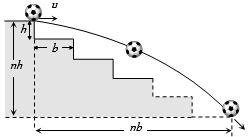
$A$ ball rolls from the top of a stairway with a horizontal velocity $u \; m/s$. If the steps are $h \; m$ high and $b \; m$ wide,the ball will hit the edge of the $n^{th}$ step,if $n=$
A
$\frac{h u^2}{g b^2}$
B
$\frac{u^2}{g b^2}$
C
$\frac{2 h u^2}{g b^2}$
D
$\frac{2 u^2 g}{h b^2}$
Solution
(C) The equation of the trajectory of a projectile launched horizontally from the top of a cliff is given by $y = \frac{g x^2}{2 u^2}$.
For the ball to hit the edge of the $n^{th}$ step,the horizontal distance covered is $x = n b$ and the vertical distance covered is $y = n h$.
Substituting these values into the trajectory equation:
$n h = \frac{g (n b)^2}{2 u^2}$
$n h = \frac{g n^2 b^2}{2 u^2}$
Dividing both sides by $n$ (assuming $n \neq 0$):
$h = \frac{g n b^2}{2 u^2}$
Solving for $n$:
$n = \frac{2 h u^2}{g b^2}$
For the ball to hit the edge of the $n^{th}$ step,the horizontal distance covered is $x = n b$ and the vertical distance covered is $y = n h$.
Substituting these values into the trajectory equation:
$n h = \frac{g (n b)^2}{2 u^2}$
$n h = \frac{g n^2 b^2}{2 u^2}$
Dividing both sides by $n$ (assuming $n \neq 0$):
$h = \frac{g n b^2}{2 u^2}$
Solving for $n$:
$n = \frac{2 h u^2}{g b^2}$
0 likes
View Solution3-2.Motion in Plane — Horizontal Projectile Motion · Frequently Asked Questions
1Are these 3-2.Motion in Plane questions useful for JEE and NEET?
Yes. All questions in this section are mapped to JEE Main and NEET exam patterns. Previous year questions from JEE Main, NEET, GUJCET and state-level exams are included with full solutions.
2Can I switch to Hindi or Gujarati for these questions?
Yes. Use the language tabs in the hero section or the sidebar to view the same questions and solutions in English, Hindi or Gujarati.
3How do I generate a question paper from this subtopic?
Use the Vedclass Exam Paper Generator — select the chapter and subtopic, set difficulty, and generate Sets A, B, C, D automatically. First 3 chapters of every subject are free.
Vedclass Products
For Students
Vedclass Test Series
Mock tests in real JEE/NEET style with performance analysis. 5-day free trial.
Start Free TrialFor Teachers
Exam Paper Generator
Generate Set A/B/C/D papers from this chapter in 2 minutes. 3 chapters free.
Try FreeFor Institutes
Online Exam Module
Live online exams with unlimited students, 360° analytics & white-label branding.
See DemoFor Teachers & Institutes
Generate a 3-2.Motion in Plane Exam Paper in 2 Minutes
Select subtopic & difficulty — Sets A, B, C, D auto-generated with No Repeat logic.
First 3 chapters of every subject are free — no payment required.