
A English
Mix Examples-Thermometry, Thermal Expansion and Calorimetry Questions in English
Class 11 Physics · 10-1.Thermometry, Thermal Expansion and Calorimetry · Mix Examples-Thermometry, Thermal Expansion and Calorimetry
198+
Questions
English
Language
100%
With Solutions
Showing 50 of 198 questions in English
101
DifficultMCQ
One $kg$ of water, at $20, ^oC$, is heated in an electric kettle whose heating element has a mean (temperature averaged) resistance of $20, \Omega$. The rms voltage in the mains is $200, V$. Ignoring heat loss from the kettle, the time taken for water to evaporate fully is close to.......... $min$. [Specific heat of water $= 4200, J/kg, ^oC$, Latent heat of water $= 2260, kJ/kg$]
A
$3$
B
$10$
C
$22$
D
$16$
Solution
(C) The total heat $Q$ required to raise the temperature of $1, kg$ of water from $20, ^oC$ to $100, ^oC$ and then to evaporate it is given by:
$Q = mc\Delta T + mL$
Here, $m = 1, kg$, $c = 4200, J/kg, ^oC$, $\Delta T = (100 - 20) = 80, ^oC$, and $L = 2260 \times 10^3, J/kg$.
$Q = (1 \times 4200 \times 80) + (1 \times 2260 \times 10^3) = 336000 + 2260000 = 2596000, J$.
The power $P$ dissipated by the heating element is:
$P = \frac{V_{rms}^2}{R} = \frac{200^2}{20} = \frac{40000}{20} = 2000, W$.
The time $t$ taken is given by $t = \frac{Q}{P}$:
$t = \frac{2596000}{2000} = 1298, s$.
Converting to minutes: $t = \frac{1298}{60} \approx 21.63, min \approx 22, min$.
$Q = mc\Delta T + mL$
Here, $m = 1, kg$, $c = 4200, J/kg, ^oC$, $\Delta T = (100 - 20) = 80, ^oC$, and $L = 2260 \times 10^3, J/kg$.
$Q = (1 \times 4200 \times 80) + (1 \times 2260 \times 10^3) = 336000 + 2260000 = 2596000, J$.
The power $P$ dissipated by the heating element is:
$P = \frac{V_{rms}^2}{R} = \frac{200^2}{20} = \frac{40000}{20} = 2000, W$.
The time $t$ taken is given by $t = \frac{Q}{P}$:
$t = \frac{2596000}{2000} = 1298, s$.
Converting to minutes: $t = \frac{1298}{60} \approx 21.63, min \approx 22, min$.
0 likes
View Solution102
DifficultMCQ
The temperature of a body is given by $T = 6t^2 + 4$. The rate of change of temperature with respect to time at $t = 10 \ s$ is ........ $K/s$. ($T$ is in $Kelvin$ and $t$ is in $seconds$)
A
$604$
B
$120$
C
$140$
D
$80$
Solution
(B) The temperature of the body is given by the function $T = 6t^2 + 4$.
To find the rate of change of temperature with respect to time,we differentiate $T$ with respect to $t$:
$\frac{dT}{dt} = \frac{d}{dt}(6t^2 + 4) = 12t$.
Now,we evaluate this rate at $t = 10 \ s$:
$\frac{dT}{dt} \Big|_{t=10} = 12 \times 10 = 120 \ K/s$.
Therefore,the rate of change of temperature at $t = 10 \ s$ is $120 \ K/s$.
To find the rate of change of temperature with respect to time,we differentiate $T$ with respect to $t$:
$\frac{dT}{dt} = \frac{d}{dt}(6t^2 + 4) = 12t$.
Now,we evaluate this rate at $t = 10 \ s$:
$\frac{dT}{dt} \Big|_{t=10} = 12 \times 10 = 120 \ K/s$.
Therefore,the rate of change of temperature at $t = 10 \ s$ is $120 \ K/s$.
0 likes
View Solution103
MediumMCQ
$A$ drilling machine of $10 \, kW$ power is used to drill a bore in a small aluminium block of mass $8 \, kg$. If $50 \%$ of power is used up in heating the machine itself or lost to the surroundings,then the rise in temperature of the block in $2.5 \, minutes$ is ........ $^\circ C$. [Specific heat of aluminium $= 0.91 \, J/g \cdot ^\circ C$]
A
$103$
B
$130$
C
$105$
D
$30$
Solution
(A) Power of the drilling machine $P = 10 \, kW = 10^4 \, W$.
Time $t = 2.5 \, minutes = 2.5 \times 60 = 150 \, s$.
Total energy supplied $E = P \times t = 10^4 \times 150 = 1.5 \times 10^6 \, J$.
Since $50 \%$ of the power is lost,the energy absorbed by the aluminium block is $Q = 50 \% \text{ of } E = 0.5 \times 1.5 \times 10^6 = 7.5 \times 10^5 \, J$.
The mass of the block $m = 8 \, kg = 8000 \, g$.
The specific heat capacity of aluminium $s = 0.91 \, J/g \cdot ^\circ C$.
Using the formula $Q = ms \Delta T$,we have:
$7.5 \times 10^5 = 8000 \times 0.91 \times \Delta T$.
$7.5 \times 10^5 = 7280 \times \Delta T$.
$\Delta T = \frac{750000}{7280} \approx 103.02 \, ^\circ C$.
Therefore,the rise in temperature is approximately $103 \, ^\circ C$.
Time $t = 2.5 \, minutes = 2.5 \times 60 = 150 \, s$.
Total energy supplied $E = P \times t = 10^4 \times 150 = 1.5 \times 10^6 \, J$.
Since $50 \%$ of the power is lost,the energy absorbed by the aluminium block is $Q = 50 \% \text{ of } E = 0.5 \times 1.5 \times 10^6 = 7.5 \times 10^5 \, J$.
The mass of the block $m = 8 \, kg = 8000 \, g$.
The specific heat capacity of aluminium $s = 0.91 \, J/g \cdot ^\circ C$.
Using the formula $Q = ms \Delta T$,we have:
$7.5 \times 10^5 = 8000 \times 0.91 \times \Delta T$.
$7.5 \times 10^5 = 7280 \times \Delta T$.
$\Delta T = \frac{750000}{7280} \approx 103.02 \, ^\circ C$.
Therefore,the rise in temperature is approximately $103 \, ^\circ C$.
0 likes
View Solution104
MediumMCQ
If $1\; g$ of steam at $100^{\circ}C$ is mixed with $1\; g$ of ice at $0^{\circ}C$,then the resultant temperature of the mixture is ........ $^{\circ}C$.
A
$100$
B
$50$
C
$230$
D
$270$
Solution
(A) Let us calculate the heat required to convert $1\; g$ of ice at $0^{\circ}C$ to water at $100^{\circ}C$:
Heat to melt ice: $Q_1 = m L_f = 1\; g \times 80\; cal/g = 80\; cal$.
Heat to raise water temperature from $0^{\circ}C$ to $100^{\circ}C$: $Q_2 = m c \Delta T = 1\; g \times 1\; cal/g^{\circ}C \times 100^{\circ}C = 100\; cal$.
Total heat required by ice: $Q_{total} = 80 + 100 = 180\; cal$.
Now,calculate the heat released by $1\; g$ of steam at $100^{\circ}C$ to condense into water at $100^{\circ}C$:
Heat released: $Q_{steam} = m L_v = 1\; g \times 540\; cal/g = 540\; cal$.
Since the heat released by steam $(540\; cal)$ is greater than the heat required by ice $(180\; cal)$,the final mixture will be at $100^{\circ}C$ with some steam remaining condensed as water.
Heat to melt ice: $Q_1 = m L_f = 1\; g \times 80\; cal/g = 80\; cal$.
Heat to raise water temperature from $0^{\circ}C$ to $100^{\circ}C$: $Q_2 = m c \Delta T = 1\; g \times 1\; cal/g^{\circ}C \times 100^{\circ}C = 100\; cal$.
Total heat required by ice: $Q_{total} = 80 + 100 = 180\; cal$.
Now,calculate the heat released by $1\; g$ of steam at $100^{\circ}C$ to condense into water at $100^{\circ}C$:
Heat released: $Q_{steam} = m L_v = 1\; g \times 540\; cal/g = 540\; cal$.
Since the heat released by steam $(540\; cal)$ is greater than the heat required by ice $(180\; cal)$,the final mixture will be at $100^{\circ}C$ with some steam remaining condensed as water.
0 likes
View Solution105
MediumMCQ
$A$ lead bullet of $10\,g$ travelling at $300\,m/s$ strikes against a block of wood and comes to rest. Assuming $50\,\%$ of heat is absorbed by the bullet,the increase in its temperature is ........ $^oC$ (Specific heat of lead $= 150\,J/kg\cdot K$)
A
$100$
B
$125$
C
$150$
D
$200$
Solution
(C) The kinetic energy of the bullet is $K.E. = \frac{1}{2}mv^2$.
Given mass $m = 10\,g = 0.01\,kg$,velocity $v = 300\,m/s$,and specific heat $c = 150\,J/kg\cdot K$.
The total heat produced is equal to the kinetic energy lost: $Q = \frac{1}{2}mv^2$.
Only $50\,\%$ of this heat is absorbed by the bullet,so the heat absorbed is $Q_{abs} = 0.5 \times \frac{1}{2}mv^2 = \frac{1}{4}mv^2$.
The heat absorbed also equals $mc\Delta\theta$,where $\Delta\theta$ is the change in temperature.
Equating the two: $mc\Delta\theta = \frac{1}{4}mv^2$.
$\Delta\theta = \frac{v^2}{4c} = \frac{(300)^2}{4 \times 150} = \frac{90000}{600} = 150^{\circ}C$.
Given mass $m = 10\,g = 0.01\,kg$,velocity $v = 300\,m/s$,and specific heat $c = 150\,J/kg\cdot K$.
The total heat produced is equal to the kinetic energy lost: $Q = \frac{1}{2}mv^2$.
Only $50\,\%$ of this heat is absorbed by the bullet,so the heat absorbed is $Q_{abs} = 0.5 \times \frac{1}{2}mv^2 = \frac{1}{4}mv^2$.
The heat absorbed also equals $mc\Delta\theta$,where $\Delta\theta$ is the change in temperature.
Equating the two: $mc\Delta\theta = \frac{1}{4}mv^2$.
$\Delta\theta = \frac{v^2}{4c} = \frac{(300)^2}{4 \times 150} = \frac{90000}{600} = 150^{\circ}C$.
0 likes
View Solution106
MediumMCQ
When water is heated from $0^{\circ}C$ to $4^{\circ}C$,which of the following relations holds true?
A
$C_p = C_v$
B
$C_p > C_v$
C
$C_p < C_v$
D
$C_p - C_v = R$
Solution
(C) Water exhibits anomalous expansion between $0^{\circ}C$ and $4^{\circ}C$.
When water is heated from $0^{\circ}C$ to $4^{\circ}C$,its volume decreases due to the breaking of hydrogen-bonded clusters,meaning $\Delta V < 0$.
The relationship between molar heat capacities is given by $C_p - C_v = P \left( \frac{\partial V}{\partial T} \right)_p$.
Since the volume $V$ decreases as temperature $T$ increases in this specific range,the derivative $\left( \frac{\partial V}{\partial T} \right)_p$ is negative.
Therefore,$C_p - C_v < 0$,which implies $C_p < C_v$.
When water is heated from $0^{\circ}C$ to $4^{\circ}C$,its volume decreases due to the breaking of hydrogen-bonded clusters,meaning $\Delta V < 0$.
The relationship between molar heat capacities is given by $C_p - C_v = P \left( \frac{\partial V}{\partial T} \right)_p$.
Since the volume $V$ decreases as temperature $T$ increases in this specific range,the derivative $\left( \frac{\partial V}{\partial T} \right)_p$ is negative.
Therefore,$C_p - C_v < 0$,which implies $C_p < C_v$.
0 likes
View Solution107
MediumMCQ
Water falls from a height of $500\,m$. The rise in temperature of the water at the bottom,assuming all energy remains in the water,will be ........ $^oC$ [Specific heat of water = $4.2\,kJ/kg\cdot K$]
A
$0.23$
B
$1.16$
C
$27$
D
$1.02$
Solution
(B) According to the principle of conservation of energy,the potential energy lost by the water is converted into heat energy.
$mgh = ms\Delta T$
Here,$m$ is the mass of water,$g$ is the acceleration due to gravity $(9.8\,m/s^2)$,$h$ is the height $(500\,m)$,$s$ is the specific heat capacity of water $(4200\,J/kg\cdot K)$,and $\Delta T$ is the rise in temperature.
$\Delta T = \frac{gh}{s}$
$\Delta T = \frac{9.8 \times 500}{4200}$
$\Delta T = \frac{4900}{4200} = 1.166... \approx 1.16^{\circ}C$
$mgh = ms\Delta T$
Here,$m$ is the mass of water,$g$ is the acceleration due to gravity $(9.8\,m/s^2)$,$h$ is the height $(500\,m)$,$s$ is the specific heat capacity of water $(4200\,J/kg\cdot K)$,and $\Delta T$ is the rise in temperature.
$\Delta T = \frac{gh}{s}$
$\Delta T = \frac{9.8 \times 500}{4200}$
$\Delta T = \frac{4900}{4200} = 1.166... \approx 1.16^{\circ}C$
0 likes
View Solution108
DifficultMCQ
$A$ glass flask of volume $1$ litre is fully filled with mercury at $0\,^{\circ}C$. Both the flask and mercury are now heated to $100\,^{\circ}C$. If the coefficient of volume expansion of mercury is $1.82 \times 10^{-4}/^{\circ}C$ and the coefficient of linear expansion of glass is $10 \times 10^{-6}/^{\circ}C$,the amount of mercury which is spilled out is ............ $ml$. (in $.2$)
A
$15$
B
$17$
C
$19$
D
$21$
Solution
(A) The volume of mercury spilled is given by the difference in the expansion of mercury and the expansion of the glass flask.
The formula for the volume of liquid spilled is $\Delta V = V_0 (\gamma_m - \gamma_g) \Delta T$,where $\gamma_g = 3 \alpha_g$.
Given:
$V_0 = 1 \text{ litre} = 1000 \text{ ml}$
$\gamma_m = 1.82 \times 10^{-4} /^{\circ}C$
$\alpha_g = 10 \times 10^{-6} /^{\circ}C \implies \gamma_g = 3 \times 10 \times 10^{-6} = 0.3 \times 10^{-4} /^{\circ}C$
$\Delta T = 100 - 0 = 100^{\circ}C$
Substituting the values:
$\Delta V = 1000 \times (1.82 \times 10^{-4} - 0.3 \times 10^{-4}) \times 100$
$\Delta V = 1000 \times (1.52 \times 10^{-4}) \times 100$
$\Delta V = 1000 \times 0.0152 = 15.2 \text{ ml}$.
The formula for the volume of liquid spilled is $\Delta V = V_0 (\gamma_m - \gamma_g) \Delta T$,where $\gamma_g = 3 \alpha_g$.
Given:
$V_0 = 1 \text{ litre} = 1000 \text{ ml}$
$\gamma_m = 1.82 \times 10^{-4} /^{\circ}C$
$\alpha_g = 10 \times 10^{-6} /^{\circ}C \implies \gamma_g = 3 \times 10 \times 10^{-6} = 0.3 \times 10^{-4} /^{\circ}C$
$\Delta T = 100 - 0 = 100^{\circ}C$
Substituting the values:
$\Delta V = 1000 \times (1.82 \times 10^{-4} - 0.3 \times 10^{-4}) \times 100$
$\Delta V = 1000 \times (1.52 \times 10^{-4}) \times 100$
$\Delta V = 1000 \times 0.0152 = 15.2 \text{ ml}$.
0 likes
View Solution109
DifficultMCQ
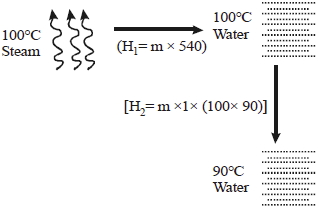
Steam is passed into $22\, g$ of water at $20^{\circ}C$. The mass of water that will be present when the water acquires a temperature of $90^{\circ}C$ is ............ $g$ (Latent heat of steam is $540\, cal/g$) (in $, g$)
A
$24.8$
B
$24$
C
$36.6$
D
$30$
Solution
(A) Let $m\, g$ be the mass of steam that condenses into water.
Heat gained by $22\, g$ of water to raise its temperature from $20^{\circ}C$ to $90^{\circ}C$ is:
$Q_{gain} = m_{water} \times c \times \Delta T = 22 \times 1 \times (90 - 20) = 22 \times 70 = 1540\, cal$.
Heat lost by $m\, g$ of steam at $100^{\circ}C$ to become water at $90^{\circ}C$ consists of two parts:
$1$. Heat released during condensation: $Q_1 = m \times L = m \times 540$.
$2$. Heat released by condensed water cooling from $100^{\circ}C$ to $90^{\circ}C$: $Q_2 = m \times c \times \Delta T = m \times 1 \times (100 - 90) = 10m$.
Equating heat lost and heat gained:
$540m + 10m = 1540$
$550m = 1540$
$m = \frac{1540}{550} = 2.8\, g$.
The total mass of water present in the mixture is the initial mass plus the condensed mass:
$M_{total} = 22 + 2.8 = 24.8\, g$.
Heat gained by $22\, g$ of water to raise its temperature from $20^{\circ}C$ to $90^{\circ}C$ is:
$Q_{gain} = m_{water} \times c \times \Delta T = 22 \times 1 \times (90 - 20) = 22 \times 70 = 1540\, cal$.
Heat lost by $m\, g$ of steam at $100^{\circ}C$ to become water at $90^{\circ}C$ consists of two parts:
$1$. Heat released during condensation: $Q_1 = m \times L = m \times 540$.
$2$. Heat released by condensed water cooling from $100^{\circ}C$ to $90^{\circ}C$: $Q_2 = m \times c \times \Delta T = m \times 1 \times (100 - 90) = 10m$.
Equating heat lost and heat gained:
$540m + 10m = 1540$
$550m = 1540$
$m = \frac{1540}{550} = 2.8\, g$.
The total mass of water present in the mixture is the initial mass plus the condensed mass:
$M_{total} = 22 + 2.8 = 24.8\, g$.
0 likes
View Solution110
EasyMCQ
$A$ beaker is filled with water at $4\,^{\circ}C$. At one time the temperature is increased by a few degrees above $4\,^{\circ}C$ and at another time it is decreased by a few degrees below $4\,^{\circ}C$. One shall observe that:
A
the level remains constant in each case
B
in the first case water overflows while in the second case its level comes down
C
in the second case water overflows while in the first case its level comes down
D
water overflows in both the cases
Solution
(D) Water exhibits anomalous expansion. The density of water is maximum at $4\,^{\circ}C$.
When the temperature increases above $4\,^{\circ}C$,water expands,causing the volume to increase,which leads to overflow.
When the temperature decreases below $4\,^{\circ}C$,water also expands (anomalous behavior),causing the volume to increase,which again leads to overflow.
Therefore,water overflows in both cases.
When the temperature increases above $4\,^{\circ}C$,water expands,causing the volume to increase,which leads to overflow.
When the temperature decreases below $4\,^{\circ}C$,water also expands (anomalous behavior),causing the volume to increase,which again leads to overflow.
Therefore,water overflows in both cases.
0 likes
View Solution111
EasyMCQ
$Assertion :$ In the pressure-temperature $(P-T)$ phase diagram of water,the slope of the melting curve is found to be negative.
$Reason :$ Ice contracts on melting to water.
$Reason :$ Ice contracts on melting to water.
A
If both Assertion and Reason are correct and the Reason is a correct explanation of the Assertion.
B
If both Assertion and Reason are correct but Reason is not a correct explanation of the Assertion.
C
If the Assertion is correct but Reason is incorrect.
D
If both the Assertion and Reason are incorrect.
Solution
(A) According to the Clausius-Clapeyron equation,the slope of the melting curve is given by $\frac{dP}{dT} = \frac{L}{T(V_2 - V_1)}$,where $L$ is the latent heat of fusion,$T$ is the temperature,$V_2$ is the volume of the liquid phase,and $V_1$ is the volume of the solid phase.
For water,ice contracts upon melting,meaning the volume of water $(V_2)$ is less than the volume of ice $(V_1)$.
Therefore,$(V_2 - V_1) < 0$,which makes the slope $\frac{dP}{dT}$ negative.
Thus,both the Assertion and the Reason are correct,and the Reason is the correct explanation for the Assertion.
For water,ice contracts upon melting,meaning the volume of water $(V_2)$ is less than the volume of ice $(V_1)$.
Therefore,$(V_2 - V_1) < 0$,which makes the slope $\frac{dP}{dT}$ negative.
Thus,both the Assertion and the Reason are correct,and the Reason is the correct explanation for the Assertion.
0 likes
View Solution112
MediumMCQ
If liquefied oxygen at $1$ atmospheric pressure is heated from $50\, K$ to $300\, K$ by supplying heat at a constant rate,the graph of temperature vs. time will be:
A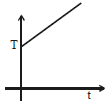
B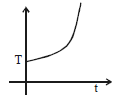
C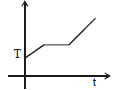
D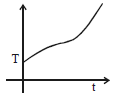
Solution
(C) The heat supplied at a constant rate is given by $Q = K t$,where $K$ is the heating rate.
For a substance in a single phase,the temperature change is given by $Q = m c \Delta T$,which implies $K t = m c (T - T_0)$. Thus,$T = T_0 + (K / mc) t$. This shows that the temperature increases linearly with time during the heating of a single phase.
When the substance undergoes a phase change (e.g.,vaporization),the heat supplied is used to change the state at a constant temperature,given by $Q = m L$. During this process,the temperature remains constant,resulting in a horizontal line on the $T-t$ graph.
Since oxygen at $1$ atmospheric pressure undergoes a phase change (boiling) between $50\, K$ and $300\, K$,the graph will show a linear increase,followed by a horizontal segment during phase change,and then another linear increase.
Therefore,the correct graph is $C$.
For a substance in a single phase,the temperature change is given by $Q = m c \Delta T$,which implies $K t = m c (T - T_0)$. Thus,$T = T_0 + (K / mc) t$. This shows that the temperature increases linearly with time during the heating of a single phase.
When the substance undergoes a phase change (e.g.,vaporization),the heat supplied is used to change the state at a constant temperature,given by $Q = m L$. During this process,the temperature remains constant,resulting in a horizontal line on the $T-t$ graph.
Since oxygen at $1$ atmospheric pressure undergoes a phase change (boiling) between $50\, K$ and $300\, K$,the graph will show a linear increase,followed by a horizontal segment during phase change,and then another linear increase.
Therefore,the correct graph is $C$.
0 likes
View Solution113
MediumMCQ
Calculate the heat required to convert $3 \; kg$ of ice at $-12 \; ^{\circ}C$ kept in a calorimeter to steam at $100 \; ^{\circ}C$ at atmospheric pressure. Given: specific heat capacity of ice $= 2100 \; J \; kg^{-1} \; K^{-1}$,specific heat capacity of water $= 4186 \; J \; kg^{-1} \; K^{-1}$,latent heat of fusion of ice $= 3.35 \times 10^{5} \; J \; kg^{-1}$,and latent heat of steam $= 2.256 \times 10^{6} \; J \; kg^{-1}$.
A
$9.1 \times 10^{6} \; J$
B
$2.4 \times 10^{4} \; J$
C
$6.2 \times 10^{5} \; J$
D
$8.6 \times 10^{7} \; J$
Solution
(A) The total heat $Q$ required is the sum of heat for four processes:
$1$. Heating ice from $-12 \; ^{\circ}C$ to $0 \; ^{\circ}C$: $Q_{1} = m \cdot s_{\text{ice}} \cdot \Delta T_{1} = 3 \; kg \times 2100 \; J \; kg^{-1} \; K^{-1} \times (0 - (-12)) \; K = 75600 \; J$.
$2$. Melting ice at $0 \; ^{\circ}C$ to water at $0 \; ^{\circ}C$: $Q_{2} = m \cdot L_{\text{fusion}} = 3 \; kg \times 3.35 \times 10^{5} \; J \; kg^{-1} = 1005000 \; J$.
$3$. Heating water from $0 \; ^{\circ}C$ to $100 \; ^{\circ}C$: $Q_{3} = m \cdot s_{\text{water}} \cdot \Delta T_{2} = 3 \; kg \times 4186 \; J \; kg^{-1} \; K^{-1} \times (100 - 0) \; K = 1255800 \; J$.
$4$. Converting water at $100 \; ^{\circ}C$ to steam at $100 \; ^{\circ}C$: $Q_{4} = m \cdot L_{\text{steam}} = 3 \; kg \times 2.256 \times 10^{6} \; J \; kg^{-1} = 6768000 \; J$.
Total heat $Q = Q_{1} + Q_{2} + Q_{3} + Q_{4} = 75600 + 1005000 + 1255800 + 6768000 = 9104400 \; J \approx 9.1 \times 10^{6} \; J$.
$1$. Heating ice from $-12 \; ^{\circ}C$ to $0 \; ^{\circ}C$: $Q_{1} = m \cdot s_{\text{ice}} \cdot \Delta T_{1} = 3 \; kg \times 2100 \; J \; kg^{-1} \; K^{-1} \times (0 - (-12)) \; K = 75600 \; J$.
$2$. Melting ice at $0 \; ^{\circ}C$ to water at $0 \; ^{\circ}C$: $Q_{2} = m \cdot L_{\text{fusion}} = 3 \; kg \times 3.35 \times 10^{5} \; J \; kg^{-1} = 1005000 \; J$.
$3$. Heating water from $0 \; ^{\circ}C$ to $100 \; ^{\circ}C$: $Q_{3} = m \cdot s_{\text{water}} \cdot \Delta T_{2} = 3 \; kg \times 4186 \; J \; kg^{-1} \; K^{-1} \times (100 - 0) \; K = 1255800 \; J$.
$4$. Converting water at $100 \; ^{\circ}C$ to steam at $100 \; ^{\circ}C$: $Q_{4} = m \cdot L_{\text{steam}} = 3 \; kg \times 2.256 \times 10^{6} \; J \; kg^{-1} = 6768000 \; J$.
Total heat $Q = Q_{1} + Q_{2} + Q_{3} + Q_{4} = 75600 + 1005000 + 1255800 + 6768000 = 9104400 \; J \approx 9.1 \times 10^{6} \; J$.
0 likes
View Solution114
MediumMCQ
$A$ copper block of mass $2.5\; kg$ is heated in a furnace to a temperature of $500\; ^{\circ}C$ and then placed on a large ice block. What is the maximum amount of ice (in $kg$) that can melt? (Specific heat of copper $= 0.39\; J\; g^{-1}\; K^{-1}$; heat of fusion of water $= 335\; J\; g^{-1}$)
A
$1.45$
B
$1$
C
$2.1$
D
$2.5$
Solution
(A) Mass of the copper block,$m = 2.5\; kg = 2500\; g$.
Change in temperature of the copper block,$\Delta \theta = 500\; ^{\circ}C$.
Specific heat of copper,$C = 0.39\; J\; g^{-1}\; ^{\circ}C^{-1}$.
Heat of fusion of water,$L = 335\; J\; g^{-1}$.
The maximum heat the copper block can lose,$Q = m C \Delta \theta$.
$Q = 2500\; g \times 0.39\; J\; g^{-1}\; ^{\circ}C^{-1} \times 500\; ^{\circ}C = 487500\; J$.
Let $m_1$ be the mass of ice that melts. The heat gained by the ice to melt is $Q = m_1 L$.
$m_1 = \frac{Q}{L} = \frac{487500\; J}{335\; J\; g^{-1}} \approx 1455.22\; g$.
Converting to kilograms,$m_1 \approx 1.45\; kg$.
Change in temperature of the copper block,$\Delta \theta = 500\; ^{\circ}C$.
Specific heat of copper,$C = 0.39\; J\; g^{-1}\; ^{\circ}C^{-1}$.
Heat of fusion of water,$L = 335\; J\; g^{-1}$.
The maximum heat the copper block can lose,$Q = m C \Delta \theta$.
$Q = 2500\; g \times 0.39\; J\; g^{-1}\; ^{\circ}C^{-1} \times 500\; ^{\circ}C = 487500\; J$.
Let $m_1$ be the mass of ice that melts. The heat gained by the ice to melt is $Q = m_1 L$.
$m_1 = \frac{Q}{L} = \frac{487500\; J}{335\; J\; g^{-1}} \approx 1455.22\; g$.
Converting to kilograms,$m_1 \approx 1.45\; kg$.
0 likes
View Solution115
MediumMCQ
$A$ child running a temperature of $101\,^{\circ} F$ is given an antipyrin (i.e. a medicine that lowers fever) which causes an increase in the rate of evaporation of sweat from his body. If the fever is brought down to $98\,^{\circ} F$ in $20$ minutes,what is the average rate of extra evaporation caused by the drug (in $g/min$)? Assume the evaporation mechanism to be the only way by which heat is lost. The mass of the child is $30\; kg$. The specific heat of the human body is approximately the same as that of water,and the latent heat of evaporation of water at that temperature is about $580\; cal \;g^{-1}$.
A
$9.5$
B
$1.8$
C
$6.8$
D
$4.3$
Solution
(D) Initial temperature of the child's body,$T_{1} = 101^{\circ} F$.
Final temperature of the child's body,$T_{2} = 98^{\circ} F$.
Change in temperature,$\Delta T = (101 - 98) \times \frac{5}{9} = 3 \times \frac{5}{9} = \frac{5}{3} ^{\circ} C$.
Time taken to reduce the temperature,$t = 20 \; min$.
Mass of the child,$m = 30 \; kg = 30,000 \; g$.
Specific heat of the human body,$c = 1 \; cal \; g^{-1} \; ^{\circ} C^{-1} = 1000 \; cal \; kg^{-1} \; ^{\circ} C^{-1}$.
Latent heat of evaporation of water,$L = 580 \; cal \; g^{-1}$.
The heat lost by the child's body is $\Delta Q = m c \Delta T$.
$\Delta Q = 30,000 \; g \times 1 \; cal \; g^{-1} \; ^{\circ} C^{-1} \times \frac{5}{3} ^{\circ} C = 50,000 \; cal$.
Let $m_{1}$ be the mass of water evaporated. Since $\Delta Q = m_{1} L$,we have $m_{1} = \frac{\Delta Q}{L}$.
$m_{1} = \frac{50,000}{580} \approx 86.21 \; g$.
The average rate of evaporation is $\frac{m_{1}}{t} = \frac{86.21}{20} \approx 4.31 \; g/min$.
Thus,the average rate of extra evaporation is $4.3 \; g/min$.
Final temperature of the child's body,$T_{2} = 98^{\circ} F$.
Change in temperature,$\Delta T = (101 - 98) \times \frac{5}{9} = 3 \times \frac{5}{9} = \frac{5}{3} ^{\circ} C$.
Time taken to reduce the temperature,$t = 20 \; min$.
Mass of the child,$m = 30 \; kg = 30,000 \; g$.
Specific heat of the human body,$c = 1 \; cal \; g^{-1} \; ^{\circ} C^{-1} = 1000 \; cal \; kg^{-1} \; ^{\circ} C^{-1}$.
Latent heat of evaporation of water,$L = 580 \; cal \; g^{-1}$.
The heat lost by the child's body is $\Delta Q = m c \Delta T$.
$\Delta Q = 30,000 \; g \times 1 \; cal \; g^{-1} \; ^{\circ} C^{-1} \times \frac{5}{3} ^{\circ} C = 50,000 \; cal$.
Let $m_{1}$ be the mass of water evaporated. Since $\Delta Q = m_{1} L$,we have $m_{1} = \frac{\Delta Q}{L}$.
$m_{1} = \frac{50,000}{580} \approx 86.21 \; g$.
The average rate of evaporation is $\frac{m_{1}}{t} = \frac{86.21}{20} \approx 4.31 \; g/min$.
Thus,the average rate of extra evaporation is $4.3 \; g/min$.
0 likes
View Solution116
Medium
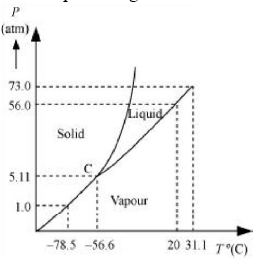
Answer the following questions based on the $P$ - $T$ phase diagram of carbon dioxide:
$(a)$ At what temperature and pressure can the solid,liquid and vapour phases of $CO_{2}$ co-exist in equilibrium?
$(b)$ What is the effect of decrease of pressure on the fusion and boiling point of $CO_{2}$?
$(c)$ What are the critical temperature and pressure for $CO_{2}$? What is their significance?
$(d)$ Is $CO_{2}$ solid,liquid or gas at $(i)$ $-70^{\circ}C$ under $1\;atm$,$(ii)$ $-60^{\circ}C$ under $10\;atm$,$(iii)$ $15^{\circ}C$ under $56\;atm$?
$(a)$ At what temperature and pressure can the solid,liquid and vapour phases of $CO_{2}$ co-exist in equilibrium?
$(b)$ What is the effect of decrease of pressure on the fusion and boiling point of $CO_{2}$?
$(c)$ What are the critical temperature and pressure for $CO_{2}$? What is their significance?
$(d)$ Is $CO_{2}$ solid,liquid or gas at $(i)$ $-70^{\circ}C$ under $1\;atm$,$(ii)$ $-60^{\circ}C$ under $10\;atm$,$(iii)$ $15^{\circ}C$ under $56\;atm$?
Solution
(N/A) The $P-T$ phase diagram for $CO_{2}$ is shown in the provided figure.
$(a)$ Point $C$ is the triple point of the $CO_{2}$ phase diagram. At this point,the temperature is $-56.6^{\circ}C$ and the pressure is $5.11\;atm$. At these conditions,the solid,liquid,and vapour phases of $CO_{2}$ co-exist in equilibrium.
$(b)$ The fusion and boiling points of $CO_{2}$ decrease with a decrease in pressure.
$(c)$ The critical temperature and critical pressure of $CO_{2}$ are $31.1^{\circ}C$ and $73\;atm$ respectively. The significance is that $CO_{2}$ cannot be liquefied above the critical temperature,regardless of how much pressure is applied.
$(d)$ Based on the $P-T$ phase diagram:
$(i)$ At $-70^{\circ}C$ and $1\;atm$,$CO_{2}$ is in the vapour (gas) phase.
$(ii)$ At $-60^{\circ}C$ and $10\;atm$,$CO_{2}$ is in the solid phase.
$(iii)$ At $15^{\circ}C$ and $56\;atm$,$CO_{2}$ is in the liquid phase.
$(a)$ Point $C$ is the triple point of the $CO_{2}$ phase diagram. At this point,the temperature is $-56.6^{\circ}C$ and the pressure is $5.11\;atm$. At these conditions,the solid,liquid,and vapour phases of $CO_{2}$ co-exist in equilibrium.
$(b)$ The fusion and boiling points of $CO_{2}$ decrease with a decrease in pressure.
$(c)$ The critical temperature and critical pressure of $CO_{2}$ are $31.1^{\circ}C$ and $73\;atm$ respectively. The significance is that $CO_{2}$ cannot be liquefied above the critical temperature,regardless of how much pressure is applied.
$(d)$ Based on the $P-T$ phase diagram:
$(i)$ At $-70^{\circ}C$ and $1\;atm$,$CO_{2}$ is in the vapour (gas) phase.
$(ii)$ At $-60^{\circ}C$ and $10\;atm$,$CO_{2}$ is in the solid phase.
$(iii)$ At $15^{\circ}C$ and $56\;atm$,$CO_{2}$ is in the liquid phase.
0 likes
View Solution117
MediumMCQ
What type of changes occur in an object by heating it?
A
Increase in temperature
B
Thermal expansion
C
Change of state
D
All of the above
Solution
(D) When an object is heated,several physical changes can occur:
$1$. Its temperature may increase,which is the most common effect.
$2$. It may undergo thermal expansion,where the dimensions of the object increase.
$3$. It may undergo a change of state (e.g.,solid to liquid or liquid to gas) if the heating continues to the melting or boiling point.
$1$. Its temperature may increase,which is the most common effect.
$2$. It may undergo thermal expansion,where the dimensions of the object increase.
$3$. It may undergo a change of state (e.g.,solid to liquid or liquid to gas) if the heating continues to the melting or boiling point.
0 likes
View Solution118
MediumMCQ
$A$ geyser heats water flowing at the rate of $3.0 \, L/min$ from $27 \, ^{\circ}C$ to $77 \, ^{\circ}C$. If the geyser operates on a gas burner,what is the rate of consumption (in $g/min$) of the fuel if its heat of combustion is $4.0 \times 10^{4} \, J/g$?
A
$15.75$
B
$24.65$
C
$8.62$
D
$18.95$
Solution
(A) The rate of water flow is $m = 3.0 \, L/min = 3000 \, g/min$ (assuming density of water is $1 \, g/mL$).
The temperature rise is $\Delta T = 77 \, ^{\circ}C - 27 \, ^{\circ}C = 50 \, ^{\circ}C$.
The specific heat capacity of water is $c = 4.2 \, J \cdot g^{-1} \cdot ^{\circ}C^{-1}$.
The total heat required per minute is $\Delta Q = m c \Delta T = 3000 \times 4.2 \times 50 = 6.3 \times 10^{5} \, J/min$.
Given the heat of combustion of the fuel is $H = 4.0 \times 10^{4} \, J/g$,the rate of fuel consumption $R$ is given by $R = \frac{\Delta Q}{H}$.
$R = \frac{6.3 \times 10^{5}}{4.0 \times 10^{4}} = 15.75 \, g/min$.
The temperature rise is $\Delta T = 77 \, ^{\circ}C - 27 \, ^{\circ}C = 50 \, ^{\circ}C$.
The specific heat capacity of water is $c = 4.2 \, J \cdot g^{-1} \cdot ^{\circ}C^{-1}$.
The total heat required per minute is $\Delta Q = m c \Delta T = 3000 \times 4.2 \times 50 = 6.3 \times 10^{5} \, J/min$.
Given the heat of combustion of the fuel is $H = 4.0 \times 10^{4} \, J/g$,the rate of fuel consumption $R$ is given by $R = \frac{\Delta Q}{H}$.
$R = \frac{6.3 \times 10^{5}}{4.0 \times 10^{4}} = 15.75 \, g/min$.
0 likes
View Solution119
Medium
Explain why:
$(a)$ Two bodies at different temperatures $T_1$ and $T_2$,if brought in thermal contact,do not necessarily settle to the mean temperature $(T_1 + T_2) / 2$.
$(b)$ The coolant in a chemical or a nuclear plant (i.e.,the liquid used to prevent the different parts of a plant from getting too hot) should have high specific heat.
$(c)$ Air pressure in a car tyre increases during driving.
$(d)$ The climate of a harbour town is more temperate than that of a town in a desert at the same latitude.
$(a)$ Two bodies at different temperatures $T_1$ and $T_2$,if brought in thermal contact,do not necessarily settle to the mean temperature $(T_1 + T_2) / 2$.
$(b)$ The coolant in a chemical or a nuclear plant (i.e.,the liquid used to prevent the different parts of a plant from getting too hot) should have high specific heat.
$(c)$ Air pressure in a car tyre increases during driving.
$(d)$ The climate of a harbour town is more temperate than that of a town in a desert at the same latitude.
Solution
(N/A) When two bodies at different temperatures $T_1$ and $T_2$ are brought into thermal contact,heat flows from the body at the higher temperature to the body at the lower temperature until thermal equilibrium is achieved. The final equilibrium temperature is equal to the mean temperature $(T_1 + T_2) / 2$ only if the heat capacities of both bodies are equal. If the heat capacities differ,the equilibrium temperature will be closer to the temperature of the body with the higher heat capacity.
$(b)$ $A$ coolant in a chemical or nuclear plant must have a high specific heat capacity. This is because a substance with a high specific heat can absorb a large amount of heat energy for a relatively small rise in temperature. This allows the coolant to effectively remove excess heat from the plant components without its own temperature rising to dangerous levels.
$(c)$ When a car is driven,the friction between the tyres and the road,along with the internal compression of air,increases the temperature of the air inside the tyre. According to Gay-Lussac's Law (or Charles' Law for a fixed volume),for a fixed mass of gas in a constant volume,the pressure is directly proportional to the absolute temperature. Thus,as the temperature increases,the air pressure inside the tyre increases.
$(d)$ $A$ harbour town is located near a large body of water,which has a high specific heat capacity. Water heats up and cools down much more slowly than land. Consequently,the water acts as a heat reservoir,moderating the temperature of the air in the harbour town. In contrast,desert sand has a low specific heat capacity,leading to rapid temperature fluctuations,resulting in a more extreme climate.
$(b)$ $A$ coolant in a chemical or nuclear plant must have a high specific heat capacity. This is because a substance with a high specific heat can absorb a large amount of heat energy for a relatively small rise in temperature. This allows the coolant to effectively remove excess heat from the plant components without its own temperature rising to dangerous levels.
$(c)$ When a car is driven,the friction between the tyres and the road,along with the internal compression of air,increases the temperature of the air inside the tyre. According to Gay-Lussac's Law (or Charles' Law for a fixed volume),for a fixed mass of gas in a constant volume,the pressure is directly proportional to the absolute temperature. Thus,as the temperature increases,the air pressure inside the tyre increases.
$(d)$ $A$ harbour town is located near a large body of water,which has a high specific heat capacity. Water heats up and cools down much more slowly than land. Consequently,the water acts as a heat reservoir,moderating the temperature of the air in the harbour town. In contrast,desert sand has a low specific heat capacity,leading to rapid temperature fluctuations,resulting in a more extreme climate.
0 likes
View Solution120
EasyMCQ
Which form of heat was believed in before the modern time?
A
Caloric theory
B
Kinetic theory
C
Quantum theory
D
Thermodynamic theory
Solution
(A) Before the modern understanding of thermodynamics,heat was believed to be an invisible,weightless fluid called 'caloric'.
This theory,known as the Caloric theory,suggested that heat could flow from hotter bodies to colder bodies and that it was conserved during physical processes.
It was later disproven by experiments conducted by Benjamin Thompson (Count Rumford) and James Prescott Joule,which showed that heat is a form of energy transfer rather than a substance.
This theory,known as the Caloric theory,suggested that heat could flow from hotter bodies to colder bodies and that it was conserved during physical processes.
It was later disproven by experiments conducted by Benjamin Thompson (Count Rumford) and James Prescott Joule,which showed that heat is a form of energy transfer rather than a substance.
0 likes
View Solution121
EasyMCQ
How much energy will be released by cooling $1\,kg$ of water up to a temperature of $10\,^{\circ}C$?
A
The question is incomplete as the initial temperature is not provided.
B
The energy released depends on the initial temperature of the water.
C
The energy released is $0\,J$ if the initial temperature is $10\,^{\circ}C$.
D
All of the above.
Solution
(D) The energy released $(Q)$ during cooling is given by the formula $Q = mc\Delta T$,where $m$ is the mass,$c$ is the specific heat capacity of water,and $\Delta T$ is the change in temperature.
Here,$m = 1\,kg$ and the final temperature $T_f = 10\,^{\circ}C$.
The initial temperature $T_i$ is not specified in the question.
Therefore,the energy released $Q = 1 \times 4186 \times (T_i - 10)\,J$.
Since $T_i$ is unknown,the exact amount of energy cannot be calculated.
Thus,the answer depends on the initial temperature of the water.
Here,$m = 1\,kg$ and the final temperature $T_f = 10\,^{\circ}C$.
The initial temperature $T_i$ is not specified in the question.
Therefore,the energy released $Q = 1 \times 4186 \times (T_i - 10)\,J$.
Since $T_i$ is unknown,the exact amount of energy cannot be calculated.
Thus,the answer depends on the initial temperature of the water.
0 likes
View Solution122
Medium
Give one example each for solid,liquid,and gas showing expansion with an increase in temperature and contraction with a decrease in temperature.
Solution
(N/A) For Solids: $A$ metallic lid on a glass jar that is stuck can be opened by placing it in hot water. The heat causes the metallic lid to expand more than the glass,loosening it for easy removal.
For Liquids: The mercury in a clinical thermometer rises when placed in warm water due to thermal expansion. When the thermometer is removed and cooled,the mercury level falls due to contraction.
For Gases: $A$ partially inflated balloon placed in warm water will expand as the air inside gains kinetic energy and occupies more volume. Conversely,a fully inflated balloon placed in cold water will shrink as the air inside contracts.
For Liquids: The mercury in a clinical thermometer rises when placed in warm water due to thermal expansion. When the thermometer is removed and cooled,the mercury level falls due to contraction.
For Gases: $A$ partially inflated balloon placed in warm water will expand as the air inside gains kinetic energy and occupies more volume. Conversely,a fully inflated balloon placed in cold water will shrink as the air inside contracts.
0 likes
View Solution123
Easy
Why is cooking faster in a pressure cooker?
Solution
(N/A) The boiling point of water is increased inside a pressure cooker by increasing the internal pressure.
In a pressure cooker,as the pressure increases,the boiling point of water rises above its normal value of $100 \ ^\circ\text{C}$.
Consequently,the food is cooked at a higher temperature,which provides more heat energy to the food,resulting in a faster cooking process.
In a pressure cooker,as the pressure increases,the boiling point of water rises above its normal value of $100 \ ^\circ\text{C}$.
Consequently,the food is cooked at a higher temperature,which provides more heat energy to the food,resulting in a faster cooking process.
0 likes
View Solution124
Medium
What is sublimation? Give names of sublimable substances.
Solution
(N/A) Sublimation is the process in which a substance changes directly from the solid state to the vapour state without passing through the intermediate liquid state.
Conversely,the process of changing directly from vapour to solid is also often referred to as sublimation or deposition.
Examples of substances that undergo sublimation include dry ice (solid $CO_{2}$),iodine $(I_{2})$,naphthalene $(C_{10}H_{8})$,and camphor.
During the sublimation process,the solid and vapour phases of the substance coexist in thermal equilibrium at a specific temperature and pressure.
Conversely,the process of changing directly from vapour to solid is also often referred to as sublimation or deposition.
Examples of substances that undergo sublimation include dry ice (solid $CO_{2}$),iodine $(I_{2})$,naphthalene $(C_{10}H_{8})$,and camphor.
During the sublimation process,the solid and vapour phases of the substance coexist in thermal equilibrium at a specific temperature and pressure.
0 likes
View Solution125
Medium
What are freezing and freezing point?
Solution
(N/A) Freezing is the phase transition process in which a substance changes from a liquid state to a solid state. This occurs when the thermal energy of the molecules decreases,causing them to lose their mobility and arrange themselves into a fixed,ordered structure.
The freezing point is the specific temperature at which a liquid turns into a solid at a given pressure. At this temperature,the liquid and solid phases of the substance exist in thermal equilibrium. For pure water at standard atmospheric pressure $(1.013 \times 10^5 \ Pa)$,the freezing point is $0 \ ^\circ C$ or $273.15 \ K$.
The freezing point is the specific temperature at which a liquid turns into a solid at a given pressure. At this temperature,the liquid and solid phases of the substance exist in thermal equilibrium. For pure water at standard atmospheric pressure $(1.013 \times 10^5 \ Pa)$,the freezing point is $0 \ ^\circ C$ or $273.15 \ K$.
0 likes
View Solution126
MediumMCQ
What is the main difference between the $P-T$ phase diagram of water and $CO_2$?
A
The fusion curve of water has a positive slope,while that of $CO_2$ has a negative slope.
B
The fusion curve of water has a negative slope,while that of $CO_2$ has a positive slope.
C
Water has a triple point,but $CO_2$ does not.
D
The sublimation curve of water is steeper than that of $CO_2$.
Solution
(B) The main difference lies in the slope of the fusion curve (solid-liquid equilibrium line).
For water,the fusion curve has a negative slope because the density of ice is less than that of liquid water,meaning an increase in pressure lowers the melting point.
For $CO_2$,the fusion curve has a positive slope because the solid phase is denser than the liquid phase,meaning an increase in pressure raises the melting point.
For water,the fusion curve has a negative slope because the density of ice is less than that of liquid water,meaning an increase in pressure lowers the melting point.
For $CO_2$,the fusion curve has a positive slope because the solid phase is denser than the liquid phase,meaning an increase in pressure raises the melting point.
0 likes
View Solution127
Medium
Fill in the blanks:
$1.$ The temperature of freezing point ...... and temperature of boiling point ...... are taken in a Fahrenheit thermometer.
$2.$ The zeroth law of thermodynamics defines ...... and the first law of thermodynamics defines ......
$3.$ At ...... temperature,water and water vapour have equal density.
$4.$ The ...... has the maximum value of specific heat.
$1.$ The temperature of freezing point ...... and temperature of boiling point ...... are taken in a Fahrenheit thermometer.
$2.$ The zeroth law of thermodynamics defines ...... and the first law of thermodynamics defines ......
$3.$ At ...... temperature,water and water vapour have equal density.
$4.$ The ...... has the maximum value of specific heat.
Solution
(N/A) $1.$ The freezing point of water is $32^{\circ}F$ and the boiling point is $212^{\circ}F$ on a Fahrenheit thermometer.
$2.$ The zeroth law of thermodynamics defines temperature,and the first law of thermodynamics defines internal energy.
$3.$ At the critical temperature $(647.096 \ K)$,water and water vapour have equal density.
$4.$ Water has the maximum value of specific heat capacity among common substances.
$2.$ The zeroth law of thermodynamics defines temperature,and the first law of thermodynamics defines internal energy.
$3.$ At the critical temperature $(647.096 \ K)$,water and water vapour have equal density.
$4.$ Water has the maximum value of specific heat capacity among common substances.
0 likes
View Solution128
Medium
Fill in the blanks:
$(a)$ The $SI$ unit of the Stefan-Boltzmann constant is ...... .
$(b)$ In the thermal steady state of a rod,the temperature gradient is $5\,^{\circ}C/cm$ and the temperature of its hot end is $100\,^{\circ}C$. Then,at a distance of ........ $cm$ from the hot end,its temperature becomes $60\,^{\circ}C$.
$(c)$ At ...... temperature,the coefficient of volume expansion of water is zero.
$(a)$ The $SI$ unit of the Stefan-Boltzmann constant is ...... .
$(b)$ In the thermal steady state of a rod,the temperature gradient is $5\,^{\circ}C/cm$ and the temperature of its hot end is $100\,^{\circ}C$. Then,at a distance of ........ $cm$ from the hot end,its temperature becomes $60\,^{\circ}C$.
$(c)$ At ...... temperature,the coefficient of volume expansion of water is zero.
Solution
(N/A) The Stefan-Boltzmann law is given by $E = \sigma T^4$. Thus,the unit of $\sigma$ is $W \cdot m^{-2} \cdot K^{-4}$.
$(b)$ The temperature gradient is defined as $\frac{dT}{dx} = 5\,^{\circ}C/cm$. The temperature difference $\Delta T = 100\,^{\circ}C - 60\,^{\circ}C = 40\,^{\circ}C$. The distance $x$ is given by $x = \frac{\Delta T}{dT/dx} = \frac{40}{5} = 8\,cm$.
$(c)$ The coefficient of volume expansion of water is zero at $4\,^{\circ}C$ because water has maximum density at this temperature.
$(b)$ The temperature gradient is defined as $\frac{dT}{dx} = 5\,^{\circ}C/cm$. The temperature difference $\Delta T = 100\,^{\circ}C - 60\,^{\circ}C = 40\,^{\circ}C$. The distance $x$ is given by $x = \frac{\Delta T}{dT/dx} = \frac{40}{5} = 8\,cm$.
$(c)$ The coefficient of volume expansion of water is zero at $4\,^{\circ}C$ because water has maximum density at this temperature.
0 likes
View Solution129
EasyMCQ
Match the following :
| Column-$I$ | Column-$II$ |
|---|---|
| $(a)$ Combined existence of liquid-gaseous state of substance. | $(i)$ Sublimation curve |
| $(b)$ Combined existence of solid-gaseous state of substance. | $(ii)$ Fusion curve |
| $(iii)$ Vaporization curve |
A
$(a-iii), (b-i)$
B
$(a-iii), (b-ii)$
C
$(a-ii), (b-i)$
D
$(a-i), (b-ii)$
Solution
(A) In a phase diagram of a substance:
$1$. The Vaporization curve represents the boundary where liquid and gaseous phases coexist in equilibrium.
$2$. The Sublimation curve represents the boundary where solid and gaseous phases coexist in equilibrium.
$3$. The Fusion curve represents the boundary where solid and liquid phases coexist in equilibrium.
Therefore,$(a)$ matches with $(iii)$ and $(b)$ matches with $(i)$.
The correct option is $(a-iii), (b-i)$.
$1$. The Vaporization curve represents the boundary where liquid and gaseous phases coexist in equilibrium.
$2$. The Sublimation curve represents the boundary where solid and gaseous phases coexist in equilibrium.
$3$. The Fusion curve represents the boundary where solid and liquid phases coexist in equilibrium.
Therefore,$(a)$ matches with $(iii)$ and $(b)$ matches with $(i)$.
The correct option is $(a-iii), (b-i)$.
0 likes
View Solution130
Medium
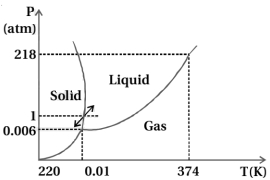
During summers in India,one of the common practices to keep cool is to make ice balls of crushed ice,dip them in flavoured sugar syrup,and sip them. For this,a stick is inserted into crushed ice,and it is squeezed in the palm to make it into a ball. Equivalently in winter,in those areas where it snows,people make snowballs and throw them around. Explain the formation of a ball out of crushed ice or snow in the light of the $p-T$ diagram of water.
Solution
(N/A) The $p-T$ phase diagram of water shows that the fusion curve (the boundary between solid and liquid phases) has a negative slope. This means that for water,an increase in pressure at a constant temperature near $0^{\circ}C$ lowers the melting point of ice.
When crushed ice or snow is squeezed in the palm,the pressure applied at the contact points between the ice particles increases. Due to the negative slope of the fusion curve,this increased pressure causes the ice to melt locally,even if the temperature is slightly below $0^{\circ}C$.
As the pressure is released (when the hand is opened or the pressure is redistributed),the local pressure drops back to atmospheric pressure. Consequently,the water that was formed by melting refreezes,acting as a binder that fuses the individual ice particles together into a solid,stable ball.
When crushed ice or snow is squeezed in the palm,the pressure applied at the contact points between the ice particles increases. Due to the negative slope of the fusion curve,this increased pressure causes the ice to melt locally,even if the temperature is slightly below $0^{\circ}C$.
As the pressure is released (when the hand is opened or the pressure is redistributed),the local pressure drops back to atmospheric pressure. Consequently,the water that was formed by melting refreezes,acting as a binder that fuses the individual ice particles together into a solid,stable ball.
0 likes
View Solution131
MediumMCQ
$A$ bullet of mass $5\, g$,travelling with a speed of $210\, m/s$,strikes a fixed wooden target. One half of its kinetic energy is converted into heat in the bullet while the other half is converted into heat in the wood. The rise of temperature of the bullet if the specific heat of its material is $0.030\, cal/(g \cdot ^{\circ}C)$ $(1\, cal = 4.2 \times 10^{7}\, ergs)$ is close to $.......^{\circ}C$.
A
$83.3$
B
$87.5$
C
$119.2$
D
$38.4$
Solution
(B) The initial kinetic energy of the bullet is $K = \frac{1}{2} m v^2$.
Given $m = 5\, g$ and $v = 210\, m/s = 21000\, cm/s$.
$K = \frac{1}{2} \times 5 \times (21000)^2 = 1.1025 \times 10^9\, ergs$.
One half of this energy is converted into heat in the bullet:
$Q = \frac{1}{2} K = \frac{1}{2} \times 1.1025 \times 10^9 = 5.5125 \times 10^8\, ergs$.
We know $Q = m s \Delta T$,where $s = 0.030\, cal/(g \cdot ^{\circ}C) = 0.030 \times 4.2 \times 10^7\, ergs/(g \cdot ^{\circ}C) = 1.26 \times 10^6\, ergs/(g \cdot ^{\circ}C)$.
Substituting the values:
$5.5125 \times 10^8 = 5 \times (1.26 \times 10^6) \times \Delta T$.
$\Delta T = \frac{5.5125 \times 10^8}{6.3 \times 10^6} = \frac{551.25}{6.3} = 87.5^{\circ}C$.
Given $m = 5\, g$ and $v = 210\, m/s = 21000\, cm/s$.
$K = \frac{1}{2} \times 5 \times (21000)^2 = 1.1025 \times 10^9\, ergs$.
One half of this energy is converted into heat in the bullet:
$Q = \frac{1}{2} K = \frac{1}{2} \times 1.1025 \times 10^9 = 5.5125 \times 10^8\, ergs$.
We know $Q = m s \Delta T$,where $s = 0.030\, cal/(g \cdot ^{\circ}C) = 0.030 \times 4.2 \times 10^7\, ergs/(g \cdot ^{\circ}C) = 1.26 \times 10^6\, ergs/(g \cdot ^{\circ}C)$.
Substituting the values:
$5.5125 \times 10^8 = 5 \times (1.26 \times 10^6) \times \Delta T$.
$\Delta T = \frac{5.5125 \times 10^8}{6.3 \times 10^6} = \frac{551.25}{6.3} = 87.5^{\circ}C$.
0 likes
View Solution132
MediumMCQ
The height of Victoria Falls is $63 \ m$. What is the difference in temperature of water at the top and at the bottom of the fall? (In $^{\circ}C$)
[Given $1 \ cal = 4.2 \ J$ and specific heat of water $= 1 \ cal \ g^{-1} \ ^{\circ}C^{-1}$]
[Given $1 \ cal = 4.2 \ J$ and specific heat of water $= 1 \ cal \ g^{-1} \ ^{\circ}C^{-1}$]
A
$0.147$
B
$14.76$
C
$1.476$
D
$0.014$
Solution
(A) The potential energy lost by the water as it falls is converted into heat energy,which increases the temperature of the water.
Change in potential energy $(P.E.)$ = Heat energy $(Q)$
$mgh = mS \Delta T$
$\Delta T = \frac{gh}{S}$
Given:
$g = 10 \ m/s^2$
$h = 63 \ m$
$S = 1 \ cal \ g^{-1} \ ^{\circ}C^{-1} = 1 \times 4.2 \ J \ g^{-1} \ ^{\circ}C^{-1} = 4200 \ J \ kg^{-1} \ ^{\circ}C^{-1}$
Substituting the values:
$\Delta T = \frac{10 \times 63}{4200}$
$\Delta T = \frac{630}{4200} = \frac{63}{420} = 0.15 \approx 0.147 \ ^{\circ}C$
Thus,the difference in temperature is $0.147 \ ^{\circ}C$.
Change in potential energy $(P.E.)$ = Heat energy $(Q)$
$mgh = mS \Delta T$
$\Delta T = \frac{gh}{S}$
Given:
$g = 10 \ m/s^2$
$h = 63 \ m$
$S = 1 \ cal \ g^{-1} \ ^{\circ}C^{-1} = 1 \times 4.2 \ J \ g^{-1} \ ^{\circ}C^{-1} = 4200 \ J \ kg^{-1} \ ^{\circ}C^{-1}$
Substituting the values:
$\Delta T = \frac{10 \times 63}{4200}$
$\Delta T = \frac{630}{4200} = \frac{63}{420} = 0.15 \approx 0.147 \ ^{\circ}C$
Thus,the difference in temperature is $0.147 \ ^{\circ}C$.
0 likes
View Solution133
MediumMCQ
$A$ $100 \, g$ of iron nail is hit by a $1.5 \, kg$ hammer striking at a velocity of $60 \, ms^{-1}$. What will be the rise in the temperature of the nail in $^{\circ}C$ if one-fourth of the energy of the hammer goes into heating the nail? [Specific heat capacity of iron $= 0.42 \, Jg^{-1} {}^{\circ}C^{-1}$]
A
$675$
B
$1600$
C
$16.07$
D
$6.75$
Solution
(C) The kinetic energy of the hammer is given by $K.E. = \frac{1}{2} mv^2 = \frac{1}{2} \times 1.5 \times (60)^2 = 0.75 \times 3600 = 2700 \, J$.
According to the problem,one-fourth of this energy is used to heat the iron nail.
Heat energy absorbed by the nail $Q = \frac{1}{4} \times 2700 = 675 \, J$.
The formula for heat absorbed is $Q = mc\Delta T$,where $m = 100 \, g$,$c = 0.42 \, Jg^{-1} {}^{\circ}C^{-1}$,and $\Delta T$ is the rise in temperature.
Substituting the values: $675 = 100 \times 0.42 \times \Delta T$.
$675 = 42 \times \Delta T$.
$\Delta T = \frac{675}{42} \approx 16.07 \, ^{\circ}C$.
According to the problem,one-fourth of this energy is used to heat the iron nail.
Heat energy absorbed by the nail $Q = \frac{1}{4} \times 2700 = 675 \, J$.
The formula for heat absorbed is $Q = mc\Delta T$,where $m = 100 \, g$,$c = 0.42 \, Jg^{-1} {}^{\circ}C^{-1}$,and $\Delta T$ is the rise in temperature.
Substituting the values: $675 = 100 \times 0.42 \times \Delta T$.
$675 = 42 \times \Delta T$.
$\Delta T = \frac{675}{42} \approx 16.07 \, ^{\circ}C$.
0 likes
View Solution134
MediumMCQ
$A$ steam engine intakes $50 \, g$ of steam at $100^{\circ} C$ per minute and cools it down to $20^{\circ} C$. If the latent heat of vaporization of steam is $540 \, cal \, g^{-1}$,then the heat rejected by the steam engine per minute is .........$\times 10^{3} \, cal$.
A
$91$
B
$71$
C
$31$
D
$39$
Solution
(C) The heat rejected consists of two parts: the heat released during condensation and the heat released during cooling of water.
$1$. Heat released during condensation $(Q_1)$: $Q_1 = m \times L_v = 50 \, g \times 540 \, cal/g = 27000 \, cal$.
$2$. Heat released during cooling of water from $100^{\circ} C$ to $20^{\circ} C$ $(Q_2)$: $Q_2 = m \times s \times \Delta T = 50 \, g \times 1 \, cal/g^{\circ} C \times (100^{\circ} C - 20^{\circ} C) = 50 \times 80 = 4000 \, cal$.
Total heat rejected $(Q_{total})$ = $Q_1 + Q_2 = 27000 + 4000 = 31000 \, cal$.
$Q_{total} = 31 \times 10^{3} \, cal$.
$1$. Heat released during condensation $(Q_1)$: $Q_1 = m \times L_v = 50 \, g \times 540 \, cal/g = 27000 \, cal$.
$2$. Heat released during cooling of water from $100^{\circ} C$ to $20^{\circ} C$ $(Q_2)$: $Q_2 = m \times s \times \Delta T = 50 \, g \times 1 \, cal/g^{\circ} C \times (100^{\circ} C - 20^{\circ} C) = 50 \times 80 = 4000 \, cal$.
Total heat rejected $(Q_{total})$ = $Q_1 + Q_2 = 27000 + 4000 = 31000 \, cal$.
$Q_{total} = 31 \times 10^{3} \, cal$.
0 likes
View Solution135
DifficultMCQ
$A$ geyser heats water flowing at a rate of $2.0 \; kg$ per minute from $30^{\circ} C$ to $70^{\circ} C$. If the geyser operates on a gas burner,the rate of combustion of fuel will be $\dots \; g \min^{-1}$.
[Heat of combustion $= 8 \times 10^{3} \; J \cdot g^{-1}$,Specific heat of water $= 4.2 \; J \cdot g^{-1} \cdot {}^{\circ} C^{-1}$]
[Heat of combustion $= 8 \times 10^{3} \; J \cdot g^{-1}$,Specific heat of water $= 4.2 \; J \cdot g^{-1} \cdot {}^{\circ} C^{-1}$]
A
$32$
B
$42$
C
$52$
D
$62$
Solution
(B) The mass flow rate of water is $m = 2.0 \; kg/min = 2000 \; g/min$.
The temperature change is $\Delta T = 70^{\circ} C - 30^{\circ} C = 40^{\circ} C$.
The specific heat capacity of water is $S = 4.2 \; J \cdot g^{-1} \cdot {}^{\circ} C^{-1}$.
The heat required per minute is $Q = m \cdot S \cdot \Delta T$.
$Q = 2000 \times 4.2 \times 40 = 336000 \; J/min$.
Let the rate of combustion of fuel be $R$ (in $g/min$) and the heat of combustion be $L = 8 \times 10^{3} \; J/g$.
The heat supplied by the fuel is $Q = R \times L$.
$336000 = R \times 8 \times 10^{3}$.
$R = \frac{336000}{8000} = 42 \; g/min$.
The temperature change is $\Delta T = 70^{\circ} C - 30^{\circ} C = 40^{\circ} C$.
The specific heat capacity of water is $S = 4.2 \; J \cdot g^{-1} \cdot {}^{\circ} C^{-1}$.
The heat required per minute is $Q = m \cdot S \cdot \Delta T$.
$Q = 2000 \times 4.2 \times 40 = 336000 \; J/min$.
Let the rate of combustion of fuel be $R$ (in $g/min$) and the heat of combustion be $L = 8 \times 10^{3} \; J/g$.
The heat supplied by the fuel is $Q = R \times L$.
$336000 = R \times 8 \times 10^{3}$.
$R = \frac{336000}{8000} = 42 \; g/min$.
0 likes
View Solution136
DifficultMCQ
$A$ closed bottle containing water at $30^{\circ} C$ is opened on the surface of the moon. Then,
A
the water will boil
B
the water will come out as a spherical ball
C
the water will freeze
D
the water will decompose into hydrogen and oxygen
Solution
(A) The correct answer is $(A)$.
On the surface of the moon,there is no atmosphere,which means the external atmospheric pressure is $0$.
$A$ liquid boils when its saturated vapour pressure becomes equal to the external atmospheric pressure.
Since the vapour pressure of water at $30^{\circ} C$ is greater than $0$,the condition for boiling is satisfied immediately upon opening the bottle.
Therefore,the water will start to boil as soon as the bottle is opened on the moon.
On the surface of the moon,there is no atmosphere,which means the external atmospheric pressure is $0$.
$A$ liquid boils when its saturated vapour pressure becomes equal to the external atmospheric pressure.
Since the vapour pressure of water at $30^{\circ} C$ is greater than $0$,the condition for boiling is satisfied immediately upon opening the bottle.
Therefore,the water will start to boil as soon as the bottle is opened on the moon.
0 likes
View Solution137
AdvancedMCQ
Consider two thermometers $T_1$ and $T_2$ of equal length,which can be used to measure temperature over the range $\theta_1$ to $\theta_2$. $T_1$ contains mercury as the thermometric liquid,while $T_2$ contains bromine. The volumes of the two liquids are the same at the temperature $\theta_1$. The volumetric coefficients of expansion of mercury and bromine are $18 \times 10^{-5} \, K^{-1}$ and $108 \times 10^{-5} \, K^{-1}$,respectively. The increase in length of each liquid is the same for the same increase in temperature. If the diameters of the capillary tubes of the two thermometers are $d_1$ and $d_2$,respectively,then the ratio $d_1: d_2$ is closest to:
A
$6.0$
B
$2.5$
C
$0.6$
D
$0.4$
Solution
(D) The change in volume $\Delta V$ of a liquid is given by $\Delta V = V_0 \gamma \Delta \theta$,where $V_0$ is the initial volume,$\gamma$ is the coefficient of volume expansion,and $\Delta \theta$ is the change in temperature.
Since the increase in length $\Delta l$ is the same for both thermometers,the change in volume is $\Delta V = A \Delta l = \frac{\pi d^2}{4} \Delta l$.
Given that the initial volumes $(V_0)_{Hg} = (V_0)_{Br}$ and the change in length $\Delta l$ is the same for both,we have:
$\Delta V_{Hg} = \frac{\pi d_1^2}{4} \Delta l = V_0 \gamma_{Hg} \Delta \theta$
$\Delta V_{Br} = \frac{\pi d_2^2}{4} \Delta l = V_0 \gamma_{Br} \Delta \theta$
Dividing the two equations:
$\frac{d_1^2}{d_2^2} = \frac{\gamma_{Hg}}{\gamma_{Br}}$
$\frac{d_1}{d_2} = \sqrt{\frac{\gamma_{Hg}}{\gamma_{Br}}}$
Substituting the given values:
$\frac{d_1}{d_2} = \sqrt{\frac{18 \times 10^{-5}}{108 \times 10^{-5}}} = \sqrt{\frac{1}{6}} \approx \sqrt{0.166} \approx 0.408$
Thus,the ratio $d_1: d_2$ is closest to $0.4$.
Since the increase in length $\Delta l$ is the same for both thermometers,the change in volume is $\Delta V = A \Delta l = \frac{\pi d^2}{4} \Delta l$.
Given that the initial volumes $(V_0)_{Hg} = (V_0)_{Br}$ and the change in length $\Delta l$ is the same for both,we have:
$\Delta V_{Hg} = \frac{\pi d_1^2}{4} \Delta l = V_0 \gamma_{Hg} \Delta \theta$
$\Delta V_{Br} = \frac{\pi d_2^2}{4} \Delta l = V_0 \gamma_{Br} \Delta \theta$
Dividing the two equations:
$\frac{d_1^2}{d_2^2} = \frac{\gamma_{Hg}}{\gamma_{Br}}$
$\frac{d_1}{d_2} = \sqrt{\frac{\gamma_{Hg}}{\gamma_{Br}}}$
Substituting the given values:
$\frac{d_1}{d_2} = \sqrt{\frac{18 \times 10^{-5}}{108 \times 10^{-5}}} = \sqrt{\frac{1}{6}} \approx \sqrt{0.166} \approx 0.408$
Thus,the ratio $d_1: d_2$ is closest to $0.4$.
0 likes
View Solution138
DifficultMCQ
An earthen pitcher used in summer cools water in it essentially by evaporation of water from its porous surface. If a pitcher carries $4 \,kg$ of water and the rate of evaporation is $20 \,g$ per hour,the temperature of water in it decreases by $\Delta T$ in two hours. The value of $\Delta T$ is close to ........... $^{\circ} C$ (ratio of latent heat of evaporation to specific heat of water is $540^{\circ} C$).
A
$2.7$
B
$4.2$
C
$5.4$
D
$10.8$
Solution
(C) Mass of water evaporated in two hours,$m = 2 \,h \times 20 \,g/h = 40 \,g = 40 \times 10^{-3} \,kg$.
Heat absorbed by water during evaporation is $Q = m L$,where $L$ is the latent heat of vaporization.
Assuming this heat is taken entirely from the remaining water in the earthen pot,the heat lost by the water is $Q = M s \Delta T$,where $M = 4 \,kg$ is the mass of water and $s$ is the specific heat of water.
Equating the heat absorbed and heat lost: $m L = M s \Delta T$.
Therefore,$\Delta T = \frac{m}{M} \times \frac{L}{s}$.
Given $\frac{L}{s} = 540^{\circ} C$,we have $\Delta T = \frac{40 \times 10^{-3}}{4} \times 540$.
$\Delta T = 0.01 \times 540 = 5.4^{\circ} C$.
Heat absorbed by water during evaporation is $Q = m L$,where $L$ is the latent heat of vaporization.
Assuming this heat is taken entirely from the remaining water in the earthen pot,the heat lost by the water is $Q = M s \Delta T$,where $M = 4 \,kg$ is the mass of water and $s$ is the specific heat of water.
Equating the heat absorbed and heat lost: $m L = M s \Delta T$.
Therefore,$\Delta T = \frac{m}{M} \times \frac{L}{s}$.
Given $\frac{L}{s} = 540^{\circ} C$,we have $\Delta T = \frac{40 \times 10^{-3}}{4} \times 540$.
$\Delta T = 0.01 \times 540 = 5.4^{\circ} C$.
0 likes
View Solution139
AdvancedMCQ
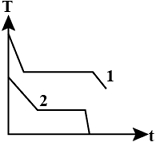
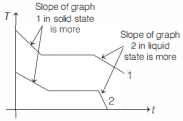
Two different liquids of same mass are kept in two identical vessels,which are placed in a freezer that extracts heat from them at the same rate,causing each liquid to transform into a solid. The schematic figure below shows the temperature $T$ versus time $t$ plot for the two materials. We denote the specific heat of materials in the liquid (solid) states to be $C_{L1}$ $(C_{S1})$ and $C_{L2}$ $(C_{S2})$,respectively. Choose the correct option given below.
A
$C_{L1} < C_{L2}$ and $C_{S1} < C_{S2}$
B
$C_{L1} > C_{L2}$ and $C_{S1} < C_{S2}$
C
$C_{L1} > C_{L2}$ and $C_{S1} > C_{S2}$
D
$C_{L1} < C_{L2}$ and $C_{S1} > C_{S2}$
Solution
(B) Let $P$ be the rate of heat removal (power). Since heat is extracted at the same rate,$P$ is constant for both.
The heat lost by a substance is given by $dQ = m \cdot c \cdot dT$,where $m$ is the mass and $c$ is the specific heat.
The rate of heat removal is $P = \frac{|dQ|}{dt} = m \cdot c \cdot \left| \frac{dT}{dt} \right|$.
Thus,the magnitude of the slope of the $T-t$ graph is $\left| \frac{dT}{dt} \right| = \frac{P}{m \cdot c}$.
Since $P$ and $m$ are constant,the slope is inversely proportional to the specific heat: $\text{Slope} \propto \frac{1}{c}$.
$1$. For the liquid state (the initial cooling phase): Looking at the graph,the slope of curve $1$ is smaller than the slope of curve $2$. Since $\text{Slope} \propto \frac{1}{C_L}$,a smaller slope implies a larger specific heat. Therefore,$C_{L1} > C_{L2}$.
$2$. For the solid state (the final cooling phase): Looking at the graph,the slope of curve $1$ is larger than the slope of curve $2$. Since $\text{Slope} \propto \frac{1}{C_S}$,a larger slope implies a smaller specific heat. Therefore,$C_{S1} < C_{S2}$.
Thus,the correct option is $C_{L1} > C_{L2}$ and $C_{S1} < C_{S2}$.
The heat lost by a substance is given by $dQ = m \cdot c \cdot dT$,where $m$ is the mass and $c$ is the specific heat.
The rate of heat removal is $P = \frac{|dQ|}{dt} = m \cdot c \cdot \left| \frac{dT}{dt} \right|$.
Thus,the magnitude of the slope of the $T-t$ graph is $\left| \frac{dT}{dt} \right| = \frac{P}{m \cdot c}$.
Since $P$ and $m$ are constant,the slope is inversely proportional to the specific heat: $\text{Slope} \propto \frac{1}{c}$.
$1$. For the liquid state (the initial cooling phase): Looking at the graph,the slope of curve $1$ is smaller than the slope of curve $2$. Since $\text{Slope} \propto \frac{1}{C_L}$,a smaller slope implies a larger specific heat. Therefore,$C_{L1} > C_{L2}$.
$2$. For the solid state (the final cooling phase): Looking at the graph,the slope of curve $1$ is larger than the slope of curve $2$. Since $\text{Slope} \propto \frac{1}{C_S}$,a larger slope implies a smaller specific heat. Therefore,$C_{S1} < C_{S2}$.
Thus,the correct option is $C_{L1} > C_{L2}$ and $C_{S1} < C_{S2}$.
0 likes
View Solution140
DifficultMCQ
$A$ $20 \,g$ bullet whose specific heat is $5000 \,J/(kg \cdot ^{\circ}C)$ and moving at $2000 \,m/s$ plunges into a $1.0 \,kg$ block of wax whose specific heat is $3000 \,J/(kg \cdot ^{\circ}C)$. Both the bullet and the wax are at $25^{\circ}C$. Assuming that $(i)$ the bullet comes to rest in the wax and $(ii)$ all its kinetic energy is converted into heat,the final temperature of the wax (in $^{\circ}C$) is close to:
A
$28.1$
B
$31.5$
C
$37.9$
D
$42.1$
Solution
(C) The kinetic energy of the bullet is converted into heat,which increases the temperature of both the bullet and the wax.
By the principle of energy conservation:
$\frac{1}{2} m_b v_b^2 = (m_w c_w + m_b c_b) \Delta T$
Given:
$m_b = 20 \,g = 0.02 \,kg$,$v_b = 2000 \,m/s$,$c_b = 5000 \,J/(kg \cdot ^{\circ}C)$
$m_w = 1.0 \,kg$,$c_w = 3000 \,J/(kg \cdot ^{\circ}C)$,$T_i = 25^{\circ}C$
Substituting the values:
$\frac{1}{2} \times 0.02 \times (2000)^2 = (1.0 \times 3000 + 0.02 \times 5000) \Delta T$
$0.01 \times 4,000,000 = (3000 + 100) \Delta T$
$40,000 = 3100 \Delta T$
$\Delta T = \frac{400}{31} \approx 12.9^{\circ}C$
Final temperature $T_f = T_i + \Delta T = 25 + 12.9 = 37.9^{\circ}C$.
By the principle of energy conservation:
$\frac{1}{2} m_b v_b^2 = (m_w c_w + m_b c_b) \Delta T$
Given:
$m_b = 20 \,g = 0.02 \,kg$,$v_b = 2000 \,m/s$,$c_b = 5000 \,J/(kg \cdot ^{\circ}C)$
$m_w = 1.0 \,kg$,$c_w = 3000 \,J/(kg \cdot ^{\circ}C)$,$T_i = 25^{\circ}C$
Substituting the values:
$\frac{1}{2} \times 0.02 \times (2000)^2 = (1.0 \times 3000 + 0.02 \times 5000) \Delta T$
$0.01 \times 4,000,000 = (3000 + 100) \Delta T$
$40,000 = 3100 \Delta T$
$\Delta T = \frac{400}{31} \approx 12.9^{\circ}C$
Final temperature $T_f = T_i + \Delta T = 25 + 12.9 = 37.9^{\circ}C$.
0 likes
View Solution141
DifficultMCQ
$A$ $10.0 \,W$ electrical heater is used to heat a container filled with $0.5 \,kg$ of water. It is found that the temperature of the water and the container rose by $3 \,K$ in $15 \,min$. The container is then emptied,dried,and filled with $2 \,kg$ of an oil. It is now observed that the same heater raises the temperature of the container-oil system by $2 \,K$ in $20 \,min$. Assuming no other heat losses in any of the processes,the specific heat capacity of the oil is ................ $\times 10^3 \,J K^{-1} kg^{-1}$.
A
$2.5$
B
$5.1$
C
$3.0$
D
$1.5$
Solution
(A) Let $C$ be the heat capacity of the container $(C = m_c s_c)$.
Case $1$: Water in the container.
Energy supplied = $P \times t_1 = 10 \times (15 \times 60) = 9000 \,J$.
Heat absorbed = $(m_w s_w + C) \Delta T_1 = (0.5 \times 4200 + C) \times 3 = 6300 + 3C$.
Equating energy: $6300 + 3C = 9000 \Rightarrow 3C = 2700 \Rightarrow C = 900 \,J K^{-1}$.
Case $2$: Oil in the container.
Energy supplied = $P \times t_2 = 10 \times (20 \times 60) = 12000 \,J$.
Heat absorbed = $(m_o s_o + C) \Delta T_2 = (2 \times s_o + 900) \times 2 = 4s_o + 1800$.
Equating energy: $4s_o + 1800 = 12000 \Rightarrow 4s_o = 10200 \Rightarrow s_o = 2550 \,J K^{-1} kg^{-1}$.
Expressing in terms of $10^3 \,J K^{-1} kg^{-1}$,we get $s_o = 2.55 \times 10^3 \,J K^{-1} kg^{-1}$. Given the options,the closest value is $2.5$.
Case $1$: Water in the container.
Energy supplied = $P \times t_1 = 10 \times (15 \times 60) = 9000 \,J$.
Heat absorbed = $(m_w s_w + C) \Delta T_1 = (0.5 \times 4200 + C) \times 3 = 6300 + 3C$.
Equating energy: $6300 + 3C = 9000 \Rightarrow 3C = 2700 \Rightarrow C = 900 \,J K^{-1}$.
Case $2$: Oil in the container.
Energy supplied = $P \times t_2 = 10 \times (20 \times 60) = 12000 \,J$.
Heat absorbed = $(m_o s_o + C) \Delta T_2 = (2 \times s_o + 900) \times 2 = 4s_o + 1800$.
Equating energy: $4s_o + 1800 = 12000 \Rightarrow 4s_o = 10200 \Rightarrow s_o = 2550 \,J K^{-1} kg^{-1}$.
Expressing in terms of $10^3 \,J K^{-1} kg^{-1}$,we get $s_o = 2.55 \times 10^3 \,J K^{-1} kg^{-1}$. Given the options,the closest value is $2.5$.
0 likes
View Solution142
MediumMCQ
The heat required to change $1 \,kg$ of ice at $-8^{\circ} C$ into water at $20^{\circ} C$ at $1 \,atm$ of pressure is closest to .............$\,kJ$. (Assume that ice has a specific heat capacity $2.1 \,kJ / kg \cdot K$,water has a specific heat capacity $4.2 \,kJ / kg \cdot K$,and the latent heat of fusion of ice is $333 \,kJ / kg$.)
A
$414$
B
$424$
C
$434$
D
$444$
Solution
(C) The process occurs in three stages:
$1$. Heating ice from $-8^{\circ} C$ to $0^{\circ} C$: $Q_1 = m \cdot c_{ice} \cdot \Delta T = 1 \,kg \times 2.1 \,kJ/kg \cdot K \times 8 \,K = 16.8 \,kJ$.
$2$. Melting ice at $0^{\circ} C$ to water at $0^{\circ} C$: $Q_2 = m \cdot L_f = 1 \,kg \times 333 \,kJ/kg = 333 \,kJ$.
$3$. Heating water from $0^{\circ} C$ to $20^{\circ} C$: $Q_3 = m \cdot c_{water} \cdot \Delta T = 1 \,kg \times 4.2 \,kJ/kg \cdot K \times 20 \,K = 84 \,kJ$.
Total heat required $Q = Q_1 + Q_2 + Q_3 = 16.8 + 333 + 84 = 433.8 \,kJ$.
Rounding to the nearest integer,we get $434 \,kJ$.
$1$. Heating ice from $-8^{\circ} C$ to $0^{\circ} C$: $Q_1 = m \cdot c_{ice} \cdot \Delta T = 1 \,kg \times 2.1 \,kJ/kg \cdot K \times 8 \,K = 16.8 \,kJ$.
$2$. Melting ice at $0^{\circ} C$ to water at $0^{\circ} C$: $Q_2 = m \cdot L_f = 1 \,kg \times 333 \,kJ/kg = 333 \,kJ$.
$3$. Heating water from $0^{\circ} C$ to $20^{\circ} C$: $Q_3 = m \cdot c_{water} \cdot \Delta T = 1 \,kg \times 4.2 \,kJ/kg \cdot K \times 20 \,K = 84 \,kJ$.
Total heat required $Q = Q_1 + Q_2 + Q_3 = 16.8 + 333 + 84 = 433.8 \,kJ$.
Rounding to the nearest integer,we get $434 \,kJ$.
0 likes
View Solution143
MediumMCQ
$A$ glass flask of volume $200 \, cm^3$ is just filled with mercury at $20^{\circ} C$. The amount of mercury that will overflow when the temperature of the system is raised to $100^{\circ} C$ is ........ $cm^3$ $(\gamma_{\text{glass}} = 1.2 \times 10^{-5} /^{\circ}C, \gamma_{\text{mercury}} = 1.8 \times 10^{-4} /^{\circ}C)$
A
$2.15$
B
$2.69$
C
$2.52$
D
$2.85$
Solution
(B) The volume of the flask $V_0 = 200 \, cm^3$ and the change in temperature $\Delta T = 100^{\circ} C - 20^{\circ} C = 80^{\circ} C$.
The expansion of the glass flask is given by $\Delta V_{\text{glass}} = V_0 \gamma_{\text{glass}} \Delta T$.
$\Delta V_{\text{glass}} = 200 \times (1.2 \times 10^{-5}) \times 80 = 0.192 \, cm^3$.
The expansion of the mercury is given by $\Delta V_{\text{mercury}} = V_0 \gamma_{\text{mercury}} \Delta T$.
$\Delta V_{\text{mercury}} = 200 \times (1.8 \times 10^{-4}) \times 80 = 2.88 \, cm^3$.
The amount of mercury that overflows is the difference between the expansion of mercury and the expansion of the glass flask:
$\Delta V_{\text{overflow}} = \Delta V_{\text{mercury}} - \Delta V_{\text{glass}} = 2.88 - 0.192 = 2.688 \, cm^3 \approx 2.69 \, cm^3$.
The expansion of the glass flask is given by $\Delta V_{\text{glass}} = V_0 \gamma_{\text{glass}} \Delta T$.
$\Delta V_{\text{glass}} = 200 \times (1.2 \times 10^{-5}) \times 80 = 0.192 \, cm^3$.
The expansion of the mercury is given by $\Delta V_{\text{mercury}} = V_0 \gamma_{\text{mercury}} \Delta T$.
$\Delta V_{\text{mercury}} = 200 \times (1.8 \times 10^{-4}) \times 80 = 2.88 \, cm^3$.
The amount of mercury that overflows is the difference between the expansion of mercury and the expansion of the glass flask:
$\Delta V_{\text{overflow}} = \Delta V_{\text{mercury}} - \Delta V_{\text{glass}} = 2.88 - 0.192 = 2.688 \, cm^3 \approx 2.69 \, cm^3$.
0 likes
View Solution144
DifficultMCQ
Work done in converting $1 \, g$ of ice at $-10^{\circ} C$ into steam at $100^{\circ} C$ is .......... $kJ$.
A
$3.04$
B
$6.05$
C
$0.721$
D
$0.616$
Solution
(A) The total heat required is the sum of heat for four processes:
$1$. Heating ice from $-10^{\circ} C$ to $0^{\circ} C$: $Q_1 = m c_{ice} \Delta T = 1 \times 2.1 \times 10 = 21 \, J$.
$2$. Melting ice at $0^{\circ} C$: $Q_2 = m L_f = 1 \times 334 = 334 \, J$.
$3$. Heating water from $0^{\circ} C$ to $100^{\circ} C$: $Q_3 = m c_{water} \Delta T = 1 \times 4.18 \times 100 = 418 \, J$.
$4$. Converting water to steam at $100^{\circ} C$: $Q_4 = m L_v = 1 \times 2260 = 2260 \, J$.
Total heat $Q = Q_1 + Q_2 + Q_3 + Q_4 = 21 + 334 + 418 + 2260 = 3033 \, J$.
Converting to $kJ$: $Q = 3.033 \, kJ \approx 3.04 \, kJ$.
$1$. Heating ice from $-10^{\circ} C$ to $0^{\circ} C$: $Q_1 = m c_{ice} \Delta T = 1 \times 2.1 \times 10 = 21 \, J$.
$2$. Melting ice at $0^{\circ} C$: $Q_2 = m L_f = 1 \times 334 = 334 \, J$.
$3$. Heating water from $0^{\circ} C$ to $100^{\circ} C$: $Q_3 = m c_{water} \Delta T = 1 \times 4.18 \times 100 = 418 \, J$.
$4$. Converting water to steam at $100^{\circ} C$: $Q_4 = m L_v = 1 \times 2260 = 2260 \, J$.
Total heat $Q = Q_1 + Q_2 + Q_3 + Q_4 = 21 + 334 + 418 + 2260 = 3033 \, J$.
Converting to $kJ$: $Q = 3.033 \, kJ \approx 3.04 \, kJ$.
0 likes
View Solution145
EasyMCQ
The surface of the lake is at $2^{\circ} C$. The temperature of the bottom of the lake is ....... $^{\circ} C$.
A
$2$
B
$3$
C
$4$
D
$1$
Solution
(C) The correct option is $C$.
Water exhibits anomalous expansion,meaning its density is maximum at $4^{\circ} C$.
In a deep lake,the water at the bottom remains at the temperature where its density is highest to maintain stability.
Therefore,regardless of the surface temperature (as long as it is below $4^{\circ} C$),the temperature at the bottom of the lake will be $4^{\circ} C$.
Water exhibits anomalous expansion,meaning its density is maximum at $4^{\circ} C$.
In a deep lake,the water at the bottom remains at the temperature where its density is highest to maintain stability.
Therefore,regardless of the surface temperature (as long as it is below $4^{\circ} C$),the temperature at the bottom of the lake will be $4^{\circ} C$.
0 likes
View Solution146
EasyMCQ
If in the winter season the surface temperature of a lake is $1^{\circ} C$,the temperature at the bottom of the lake will be ............
A
$1^{\circ} C$
B
$0^{\circ} C$
C
$4^{\circ} C$
D
All values less than $1^{\circ} C$ are possible
Solution
(C) Water exhibits anomalous expansion. The density of water is maximum at $4^{\circ} C$.
In winter,as the surface of the lake cools down,the water at the surface becomes denser and sinks to the bottom.
This process continues until the entire body of water reaches $4^{\circ} C$.
If the surface temperature drops further below $4^{\circ} C$,the water at the surface becomes less dense and stays at the top.
Therefore,the water at the bottom remains at $4^{\circ} C$ while the surface may freeze or reach lower temperatures.
Thus,the temperature at the bottom of the lake is $4^{\circ} C$.
In winter,as the surface of the lake cools down,the water at the surface becomes denser and sinks to the bottom.
This process continues until the entire body of water reaches $4^{\circ} C$.
If the surface temperature drops further below $4^{\circ} C$,the water at the surface becomes less dense and stays at the top.
Therefore,the water at the bottom remains at $4^{\circ} C$ while the surface may freeze or reach lower temperatures.
Thus,the temperature at the bottom of the lake is $4^{\circ} C$.
0 likes
View Solution147
EasyMCQ
$A$ block of ice at $-12^{\circ} C$ is slowly heated and converted into steam at $100^{\circ} C$. Which of the following curves best represents the event?
A
B
C
D
Solution
(A) The process of heating ice from $-12^{\circ} C$ to steam at $100^{\circ} C$ involves several stages:
$1$. Heating ice from $-12^{\circ} C$ to $0^{\circ} C$: The temperature increases linearly with heat added $(Q = mc\Delta T)$.
$2$. Melting ice at $0^{\circ} C$: The temperature remains constant at $0^{\circ} C$ while the phase changes from solid to liquid $(Q = mL_f)$.
$3$. Heating water from $0^{\circ} C$ to $100^{\circ} C$: The temperature increases linearly with heat added $(Q = mc\Delta T)$.
$4$. Boiling water at $100^{\circ} C$: The temperature remains constant at $100^{\circ} C$ while the phase changes from liquid to gas $(Q = mL_v)$.
The correct curve must show two sloped regions (temperature rise) and two horizontal regions (phase change at constant temperature). This corresponds to the provided solution image.
$1$. Heating ice from $-12^{\circ} C$ to $0^{\circ} C$: The temperature increases linearly with heat added $(Q = mc\Delta T)$.
$2$. Melting ice at $0^{\circ} C$: The temperature remains constant at $0^{\circ} C$ while the phase changes from solid to liquid $(Q = mL_f)$.
$3$. Heating water from $0^{\circ} C$ to $100^{\circ} C$: The temperature increases linearly with heat added $(Q = mc\Delta T)$.
$4$. Boiling water at $100^{\circ} C$: The temperature remains constant at $100^{\circ} C$ while the phase changes from liquid to gas $(Q = mL_v)$.
The correct curve must show two sloped regions (temperature rise) and two horizontal regions (phase change at constant temperature). This corresponds to the provided solution image.
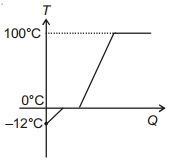
0 likes
View Solution148
MediumMCQ
Heat is being supplied at a constant rate to a sphere of ice which is melting at the rate of $0.1 \,g/s$. It melts completely in $100 \,s$. The rate of rise of temperature of the resulting water thereafter will be ............ $^{\circ}C/s$.
A
$0.4$
B
$2.1$
C
$3.2$
D
$0.8$
Solution
(D) The rate of heat supply is given by $\frac{dQ}{dt} = \frac{dm}{dt} \times L$,where $L$ is the latent heat of fusion of ice $(80 \,cal/g)$.
Given $\frac{dm}{dt} = 0.1 \,g/s$,we have $\frac{dQ}{dt} = 0.1 \times 80 = 8 \,cal/s$.
After the ice melts,the total mass of the water formed is $m = \frac{dm}{dt} \times t = 0.1 \,g/s \times 100 \,s = 10 \,g$.
The heat supplied to the water is $Q = ms\Delta T$,where $s$ is the specific heat capacity of water $(1 \,cal/g^{\circ}C)$.
Differentiating with respect to time,we get $\frac{dQ}{dt} = ms \frac{dT}{dt}$.
Substituting the values: $8 = 10 \times 1 \times \frac{dT}{dt}$.
Therefore,$\frac{dT}{dt} = \frac{8}{10} = 0.8 \,^{\circ}C/s$.
Given $\frac{dm}{dt} = 0.1 \,g/s$,we have $\frac{dQ}{dt} = 0.1 \times 80 = 8 \,cal/s$.
After the ice melts,the total mass of the water formed is $m = \frac{dm}{dt} \times t = 0.1 \,g/s \times 100 \,s = 10 \,g$.
The heat supplied to the water is $Q = ms\Delta T$,where $s$ is the specific heat capacity of water $(1 \,cal/g^{\circ}C)$.
Differentiating with respect to time,we get $\frac{dQ}{dt} = ms \frac{dT}{dt}$.
Substituting the values: $8 = 10 \times 1 \times \frac{dT}{dt}$.
Therefore,$\frac{dT}{dt} = \frac{8}{10} = 0.8 \,^{\circ}C/s$.
0 likes
View Solution149
MediumMCQ
$250\,g$ of water and an equal volume of alcohol of mass $200\,g$ are placed successively in the same calorimeter and cool from $60^{\circ}C$ to $55^{\circ}C$ in $130\,s$ and $67\,s$ respectively. If the water equivalent of the calorimeter is $10\,g$,then the specific heat of alcohol in $\text{cal/g}^{\circ}C$ is:
A
$1.30$
B
$0.67$
C
$0.62$
D
$0.985$
Solution
(C) According to Newton's law of cooling,the rate of loss of heat is proportional to the temperature difference between the body and the surroundings. Since the temperature range ($60^{\circ}C$ to $55^{\circ}C$) is the same for both,the average rate of heat loss is approximately constant.
Let $m_w = 250\,g$ (mass of water),$m_a = 200\,g$ (mass of alcohol),$W = 10\,g$ (water equivalent of calorimeter),and $s$ be the specific heat of alcohol. The specific heat of water $s_w = 1\,\text{cal/g}^{\circ}C$.
Heat lost by water and calorimeter: $Q_w = (m_w + W) s_w \Delta T = (250 + 10) \times 1 \times 5 = 1300\,\text{cal}$.
Rate of heat loss for water: $R_w = \frac{Q_w}{t_w} = \frac{1300}{130} = 10\,\text{cal/s}$.
Heat lost by alcohol and calorimeter: $Q_a = (m_a s + W) \Delta T = (200s + 10) \times 5 = 1000s + 50\,\text{cal}$.
Rate of heat loss for alcohol: $R_a = \frac{Q_a}{t_a} = \frac{1000s + 50}{67}$.
Since the rate of heat loss is the same in both cases $(R_w = R_a)$:
$10 = \frac{1000s + 50}{67}$
$670 = 1000s + 50$
$1000s = 620$
$s = 0.62\,\text{cal/g}^{\circ}C$.
Let $m_w = 250\,g$ (mass of water),$m_a = 200\,g$ (mass of alcohol),$W = 10\,g$ (water equivalent of calorimeter),and $s$ be the specific heat of alcohol. The specific heat of water $s_w = 1\,\text{cal/g}^{\circ}C$.
Heat lost by water and calorimeter: $Q_w = (m_w + W) s_w \Delta T = (250 + 10) \times 1 \times 5 = 1300\,\text{cal}$.
Rate of heat loss for water: $R_w = \frac{Q_w}{t_w} = \frac{1300}{130} = 10\,\text{cal/s}$.
Heat lost by alcohol and calorimeter: $Q_a = (m_a s + W) \Delta T = (200s + 10) \times 5 = 1000s + 50\,\text{cal}$.
Rate of heat loss for alcohol: $R_a = \frac{Q_a}{t_a} = \frac{1000s + 50}{67}$.
Since the rate of heat loss is the same in both cases $(R_w = R_a)$:
$10 = \frac{1000s + 50}{67}$
$670 = 1000s + 50$
$1000s = 620$
$s = 0.62\,\text{cal/g}^{\circ}C$.
0 likes
View Solution150
DifficultMCQ
Heat energy of $184\,kJ$ is given to ice of mass $600\,g$ at $-12^{\circ}\,C$. The specific heat of ice is $2222.3\,J\,kg^{-1\circ}C^{-1}$ and the latent heat of fusion of ice is $336\,kJ\,kg^{-1}$.
$(A)$ Final temperature of the system will be $0^{\circ}C$.
$(B)$ Final temperature of the system will be greater than $0^{\circ}C$.
$(C)$ The final system will have a mixture of ice and water in the ratio of $5:1$.
$(D)$ The final system will have a mixture of ice and water in the ratio of $1:5$.
$(E)$ The final system will have water only.
Choose the correct answer from the options given below:
$(A)$ Final temperature of the system will be $0^{\circ}C$.
$(B)$ Final temperature of the system will be greater than $0^{\circ}C$.
$(C)$ The final system will have a mixture of ice and water in the ratio of $5:1$.
$(D)$ The final system will have a mixture of ice and water in the ratio of $1:5$.
$(E)$ The final system will have water only.
Choose the correct answer from the options given below:
A
$A$ and $D$ only
B
$B$ and $D$ only
C
$A$ and $E$ only
D
$A$ and $C$ only
Solution
(A) Given: Heat $\Delta Q = 184 \times 10^3\,J$,mass $m = 0.6\,kg$,initial temperature $T_i = -12^{\circ}C$,specific heat $c_{ice} = 2222.3\,J\,kg^{-1\circ}C^{-1}$,latent heat $L = 336 \times 10^3\,J\,kg^{-1}$.
Step $1$: Heat required to raise the temperature of ice from $-12^{\circ}C$ to $0^{\circ}C$:
$Q_1 = m \cdot c_{ice} \cdot \Delta T = 0.6 \times 2222.3 \times 12 = 16000.56\,J$.
Step $2$: Remaining heat available for melting:
$Q_{rem} = \Delta Q - Q_1 = 184000 - 16000.56 = 167999.44\,J$.
Step $3$: Heat required to melt the entire mass of ice at $0^{\circ}C$:
$Q_{melt} = m \cdot L = 0.6 \times 336000 = 201600\,J$.
Since $Q_{rem} < Q_{melt}$,the ice will not melt completely,and the final temperature will be $0^{\circ}C$. Thus,statement $(A)$ is correct.
Step $4$: Calculate the mass of ice melted $(m_w)$:
$m_w = \frac{Q_{rem}}{L} = \frac{167999.44}{336000} \approx 0.5\,kg$.
Step $5$: Calculate the remaining mass of ice $(m_i)$:
$m_i = m - m_w = 0.6 - 0.5 = 0.1\,kg$.
Step $6$: Ratio of ice to water:
Ratio $= \frac{m_i}{m_w} = \frac{0.1}{0.5} = 1:5$. Thus,statement $(D)$ is correct.
Therefore,$(A)$ and $(D)$ are correct.
Step $1$: Heat required to raise the temperature of ice from $-12^{\circ}C$ to $0^{\circ}C$:
$Q_1 = m \cdot c_{ice} \cdot \Delta T = 0.6 \times 2222.3 \times 12 = 16000.56\,J$.
Step $2$: Remaining heat available for melting:
$Q_{rem} = \Delta Q - Q_1 = 184000 - 16000.56 = 167999.44\,J$.
Step $3$: Heat required to melt the entire mass of ice at $0^{\circ}C$:
$Q_{melt} = m \cdot L = 0.6 \times 336000 = 201600\,J$.
Since $Q_{rem} < Q_{melt}$,the ice will not melt completely,and the final temperature will be $0^{\circ}C$. Thus,statement $(A)$ is correct.
Step $4$: Calculate the mass of ice melted $(m_w)$:
$m_w = \frac{Q_{rem}}{L} = \frac{167999.44}{336000} \approx 0.5\,kg$.
Step $5$: Calculate the remaining mass of ice $(m_i)$:
$m_i = m - m_w = 0.6 - 0.5 = 0.1\,kg$.
Step $6$: Ratio of ice to water:
Ratio $= \frac{m_i}{m_w} = \frac{0.1}{0.5} = 1:5$. Thus,statement $(D)$ is correct.
Therefore,$(A)$ and $(D)$ are correct.
0 likes
View Solution10-1.Thermometry, Thermal Expansion and Calorimetry — Mix Examples-Thermometry, Thermal Expansion and Calorimetry · Frequently Asked Questions
1Are these 10-1.Thermometry, Thermal Expansion and Calorimetry questions useful for JEE and NEET?
Yes. All questions in this section are mapped to JEE Main and NEET exam patterns. Previous year questions from JEE Main, NEET, GUJCET and state-level exams are included with full solutions.
2Can I switch to Hindi or Gujarati for these questions?
Yes. Use the language tabs in the hero section or the sidebar to view the same questions and solutions in English, Hindi or Gujarati.
3How do I generate a question paper from this subtopic?
Use the Vedclass Exam Paper Generator — select the chapter and subtopic, set difficulty, and generate Sets A, B, C, D automatically. First 3 chapters of every subject are free.
Vedclass Products
For Students
Vedclass Test Series
Mock tests in real JEE/NEET style with performance analysis. 5-day free trial.
Start Free TrialFor Teachers
Exam Paper Generator
Generate Set A/B/C/D papers from this chapter in 2 minutes. 3 chapters free.
Try FreeFor Institutes
Online Exam Module
Live online exams with unlimited students, 360° analytics & white-label branding.
See DemoFor Teachers & Institutes
Generate a 10-1.Thermometry, Thermal Expansion and Calorimetry Exam Paper in 2 Minutes
Select subtopic & difficulty — Sets A, B, C, D auto-generated with No Repeat logic.
First 3 chapters of every subject are free — no payment required.