
A English
Thermal Expansion for fluid Questions in English
Class 11 Physics · 10-1.Thermometry, Thermal Expansion and Calorimetry · Thermal Expansion for fluid
63+
Questions
English
Language
100%
With Solutions
Showing 50 of 63 questions in English
1
MediumMCQ
With a rise in temperature,the density of a given body changes according to which of the following relations?
A
$\rho = \rho_0(1 + \gamma \Delta \theta)$
B
$\rho = \rho_0(1 - \gamma \Delta \theta)$
C
$\rho = \rho_0 \gamma \Delta \theta$
D
$\rho = \rho_0 / \gamma \Delta \theta$
Solution
(B) As the temperature increases,the volume $V$ of a body increases due to thermal expansion,while its mass $m$ remains constant. Since density $\rho = m/V$,the density decreases.
Given the relation for volume expansion: $V = V_0(1 + \gamma \Delta \theta)$,where $\gamma$ is the coefficient of volume expansion.
The density at temperature $\theta$ is $\rho = m/V$ and at initial temperature $\theta_0$ is $\rho_0 = m/V_0$.
Therefore,$\frac{\rho}{\rho_0} = \frac{V_0}{V} = \frac{V_0}{V_0(1 + \gamma \Delta \theta)} = (1 + \gamma \Delta \theta)^{-1}$.
Using the binomial approximation for small $\gamma \Delta \theta$,we get $(1 + \gamma \Delta \theta)^{-1} \approx (1 - \gamma \Delta \theta)$.
Thus,$\rho = \rho_0(1 - \gamma \Delta \theta)$.
Given the relation for volume expansion: $V = V_0(1 + \gamma \Delta \theta)$,where $\gamma$ is the coefficient of volume expansion.
The density at temperature $\theta$ is $\rho = m/V$ and at initial temperature $\theta_0$ is $\rho_0 = m/V_0$.
Therefore,$\frac{\rho}{\rho_0} = \frac{V_0}{V} = \frac{V_0}{V_0(1 + \gamma \Delta \theta)} = (1 + \gamma \Delta \theta)^{-1}$.
Using the binomial approximation for small $\gamma \Delta \theta$,we get $(1 + \gamma \Delta \theta)^{-1} \approx (1 - \gamma \Delta \theta)$.
Thus,$\rho = \rho_0(1 - \gamma \Delta \theta)$.
0 likes
View Solution2
MediumMCQ
$A$ vertical column $50 \ cm$ long at $50^{\circ}C$ balances another column of the same liquid $60 \ cm$ long at $100^{\circ}C$. The coefficient of absolute expansion of the liquid is:
A
$0.005 \ ^{\circ}C^{-1}$
B
$0.0005 \ ^{\circ}C^{-1}$
C
$0.002 \ ^{\circ}C^{-1}$
D
$0.0002 \ ^{\circ}C^{-1}$
Solution
(A) The pressure exerted by a liquid column is given by $P = h \rho g$. Since the two columns balance each other,their pressures are equal: $h_1 \rho_1 g = h_2 \rho_2 g$,which implies $h_1 \rho_1 = h_2 \rho_2$.
Using the relation for density variation with temperature,$\rho = \frac{\rho_0}{1 + \gamma \theta}$,we have $\frac{h_1}{h_2} = \frac{\rho_2}{\rho_1} = \frac{1 + \gamma \theta_1}{1 + \gamma \theta_2}$.
Given $h_1 = 50 \ cm$,$\theta_1 = 50^{\circ}C$,$h_2 = 60 \ cm$,and $\theta_2 = 100^{\circ}C$.
Substituting these values: $\frac{50}{60} = \frac{1 + 50\gamma}{1 + 100\gamma}$.
Cross-multiplying: $50(1 + 100\gamma) = 60(1 + 50\gamma)$.
$50 + 5000\gamma = 60 + 3000\gamma$.
$2000\gamma = 10$.
$\gamma = \frac{10}{2000} = 0.005 \ ^{\circ}C^{-1}$.
Using the relation for density variation with temperature,$\rho = \frac{\rho_0}{1 + \gamma \theta}$,we have $\frac{h_1}{h_2} = \frac{\rho_2}{\rho_1} = \frac{1 + \gamma \theta_1}{1 + \gamma \theta_2}$.
Given $h_1 = 50 \ cm$,$\theta_1 = 50^{\circ}C$,$h_2 = 60 \ cm$,and $\theta_2 = 100^{\circ}C$.
Substituting these values: $\frac{50}{60} = \frac{1 + 50\gamma}{1 + 100\gamma}$.
Cross-multiplying: $50(1 + 100\gamma) = 60(1 + 50\gamma)$.
$50 + 5000\gamma = 60 + 3000\gamma$.
$2000\gamma = 10$.
$\gamma = \frac{10}{2000} = 0.005 \ ^{\circ}C^{-1}$.
0 likes
View Solution3
MediumMCQ
The volume of a gas at $20^{\circ}C$ is $100 \, cm^3$ at normal pressure. If it is heated to $100^{\circ}C$,its volume becomes $125 \, cm^3$ at the same pressure,then the volume coefficient of the gas at normal pressure is:
A
$0.0015 \, ^{\circ}C^{-1}$
B
$0.0045 \, ^{\circ}C^{-1}$
C
$0.0025 \, ^{\circ}C^{-1}$
D
$0.0033 \, ^{\circ}C^{-1}$
Solution
(D) The relationship between volume and temperature at constant pressure is given by $V_t = V_0(1 + \gamma t)$,where $\gamma$ is the volume expansion coefficient.
For two different temperatures $t_1$ and $t_2$,we have $\frac{V_1}{V_2} = \frac{1 + \gamma t_1}{1 + \gamma t_2}$.
Given $V_1 = 100 \, cm^3$ at $t_1 = 20^{\circ}C$ and $V_2 = 125 \, cm^3$ at $t_2 = 100^{\circ}C$.
Substituting the values: $\frac{100}{125} = \frac{1 + 20\gamma}{1 + 100\gamma}$.
Simplifying the fraction: $0.8 = \frac{1 + 20\gamma}{1 + 100\gamma}$.
$0.8(1 + 100\gamma) = 1 + 20\gamma$.
$0.8 + 80\gamma = 1 + 20\gamma$.
$60\gamma = 0.2$.
$\gamma = \frac{0.2}{60} = \frac{1}{300} \approx 0.0033 \, ^{\circ}C^{-1}$.
For two different temperatures $t_1$ and $t_2$,we have $\frac{V_1}{V_2} = \frac{1 + \gamma t_1}{1 + \gamma t_2}$.
Given $V_1 = 100 \, cm^3$ at $t_1 = 20^{\circ}C$ and $V_2 = 125 \, cm^3$ at $t_2 = 100^{\circ}C$.
Substituting the values: $\frac{100}{125} = \frac{1 + 20\gamma}{1 + 100\gamma}$.
Simplifying the fraction: $0.8 = \frac{1 + 20\gamma}{1 + 100\gamma}$.
$0.8(1 + 100\gamma) = 1 + 20\gamma$.
$0.8 + 80\gamma = 1 + 20\gamma$.
$60\gamma = 0.2$.
$\gamma = \frac{0.2}{60} = \frac{1}{300} \approx 0.0033 \, ^{\circ}C^{-1}$.
0 likes
View Solution4
MediumMCQ
The coefficient of real expansion of mercury is $0.18 \times 10^{-3} \, ^{\circ}C^{-1}$. If the density of mercury at $0^{\circ}C$ is $13.6 \, g/cm^3$,what is its density at $473 \, K$?
A
$13.11 \, g/cm^3$
B
$26.22 \, g/cm^3$
C
$52.11 \, g/cm^3$
D
None of these
Solution
(A) The relationship between density and temperature is given by $\rho = \frac{\rho_0}{1 + \gamma \Delta \theta} \approx \rho_0(1 - \gamma \Delta \theta)$.
Given:
$\rho_0 = 13.6 \, g/cm^3$ at $0^{\circ}C$ $(273 \, K)$.
$\gamma = 0.18 \times 10^{-3} \, ^{\circ}C^{-1}$.
Final temperature $T = 473 \, K$,which is $473 - 273 = 200^{\circ}C$.
So,$\Delta \theta = 200^{\circ}C - 0^{\circ}C = 200^{\circ}C$.
Substituting the values:
$\rho = 13.6 \times [1 - (0.18 \times 10^{-3} \times 200)]$
$\rho = 13.6 \times [1 - 0.036]$
$\rho = 13.6 \times 0.964 = 13.1104 \, g/cm^3$.
Thus,the density at $473 \, K$ is approximately $13.11 \, g/cm^3$.
Given:
$\rho_0 = 13.6 \, g/cm^3$ at $0^{\circ}C$ $(273 \, K)$.
$\gamma = 0.18 \times 10^{-3} \, ^{\circ}C^{-1}$.
Final temperature $T = 473 \, K$,which is $473 - 273 = 200^{\circ}C$.
So,$\Delta \theta = 200^{\circ}C - 0^{\circ}C = 200^{\circ}C$.
Substituting the values:
$\rho = 13.6 \times [1 - (0.18 \times 10^{-3} \times 200)]$
$\rho = 13.6 \times [1 - 0.036]$
$\rho = 13.6 \times 0.964 = 13.1104 \, g/cm^3$.
Thus,the density at $473 \, K$ is approximately $13.11 \, g/cm^3$.
0 likes
View Solution5
MediumMCQ
The real coefficient of volume expansion of glycerine is $0.000597 \text{ /}^{\circ}\text{C}$ and the linear coefficient of expansion of glass is $0.000009 \text{ /}^{\circ}\text{C}$. The apparent volume coefficient of expansion of glycerine is:
A
$0.000558 \text{ /}^{\circ}\text{C}$
B
$0.00057 \text{ /}^{\circ}\text{C}$
C
$0.00027 \text{ /}^{\circ}\text{C}$
D
$0.00066 \text{ /}^{\circ}\text{C}$
Solution
(B) The apparent expansion of a liquid is the difference between its real expansion and the expansion of the container.
The volume expansion coefficient of the glass vessel $(\gamma_{vessel})$ is related to the linear expansion coefficient $(\alpha)$ by the formula $\gamma_{vessel} = 3\alpha$.
$\gamma_{vessel} = 3 \times 0.000009 = 0.000027 \text{ /}^{\circ}\text{C}$.
The apparent volume expansion coefficient $(\gamma_{app})$ is given by $\gamma_{app} = \gamma_{real} - \gamma_{vessel}$.
$\gamma_{app} = 0.000597 - 0.000027 = 0.00057 \text{ /}^{\circ}\text{C}$.
The volume expansion coefficient of the glass vessel $(\gamma_{vessel})$ is related to the linear expansion coefficient $(\alpha)$ by the formula $\gamma_{vessel} = 3\alpha$.
$\gamma_{vessel} = 3 \times 0.000009 = 0.000027 \text{ /}^{\circ}\text{C}$.
The apparent volume expansion coefficient $(\gamma_{app})$ is given by $\gamma_{app} = \gamma_{real} - \gamma_{vessel}$.
$\gamma_{app} = 0.000597 - 0.000027 = 0.00057 \text{ /}^{\circ}\text{C}$.
0 likes
View Solution6
MediumMCQ
$A$ beaker is completely filled with water at $4^{\circ}C$. It will overflow if
A
Heated above $4^{\circ}C$
B
Cooled below $4^{\circ}C$
C
Both heated and cooled above and below $4^{\circ}C$ respectively
D
None of the above
Solution
(C) Water exhibits anomalous expansion. It has maximum density at $4^{\circ}C$,which means it has minimum volume at this temperature.
If the water is heated above $4^{\circ}C$,its density decreases,causing its volume to increase.
If the water is cooled below $4^{\circ}C$,its density also decreases,causing its volume to increase.
Since the beaker is already completely filled at $4^{\circ}C$,any increase in volume due to heating or cooling will cause the water to overflow. Therefore,the water will overflow in both cases.
If the water is heated above $4^{\circ}C$,its density decreases,causing its volume to increase.
If the water is cooled below $4^{\circ}C$,its density also decreases,causing its volume to increase.
Since the beaker is already completely filled at $4^{\circ}C$,any increase in volume due to heating or cooling will cause the water to overflow. Therefore,the water will overflow in both cases.
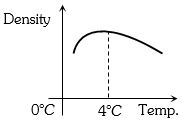
0 likes
View Solution7
MediumMCQ
If on heating a liquid through $80^{\circ}C$,the mass expelled is $(1/100)^{th}$ of the mass remaining,the coefficient of apparent expansion of the liquid is:
A
$1.25 \times 10^{-4} {^{\circ}C^{-1}}$
B
$12.5 \times 10^{-4} {^{\circ}C^{-1}}$
C
$1.25 \times 10^{-5} {^{\circ}C^{-1}}$
D
None of these
Solution
(A) The coefficient of apparent expansion $\gamma_{\text{app}}$ is defined by the formula:
$\gamma_{\text{app}} = \frac{\text{Mass expelled}}{\text{Mass remaining} \times \Delta T}$
Given that the mass expelled is $(1/100)$ of the mass remaining,let the mass remaining be $m$. Then the mass expelled is $m/100$.
The change in temperature $\Delta T = 80^{\circ}C$.
Substituting these values into the formula:
$\gamma_{\text{app}} = \frac{m/100}{m \times 80} = \frac{1}{100 \times 80} = \frac{1}{8000}$
$\gamma_{\text{app}} = 0.000125 = 1.25 \times 10^{-4} {^{\circ}C^{-1}}$
Thus,the correct option is $A$.
$\gamma_{\text{app}} = \frac{\text{Mass expelled}}{\text{Mass remaining} \times \Delta T}$
Given that the mass expelled is $(1/100)$ of the mass remaining,let the mass remaining be $m$. Then the mass expelled is $m/100$.
The change in temperature $\Delta T = 80^{\circ}C$.
Substituting these values into the formula:
$\gamma_{\text{app}} = \frac{m/100}{m \times 80} = \frac{1}{100 \times 80} = \frac{1}{8000}$
$\gamma_{\text{app}} = 0.000125 = 1.25 \times 10^{-4} {^{\circ}C^{-1}}$
Thus,the correct option is $A$.
0 likes
View Solution8
DifficultMCQ
$A$ glass flask is filled up to a mark with $50\, cc$ of mercury at $18^{\circ}C.$ If the flask and contents are heated to $38^{\circ}C,$ how much mercury will be above the mark? (Given: $\alpha$ for glass is $9 \times 10^{-6} {^{\circ}C}^{-1}$ and the coefficient of real expansion of mercury is $180 \times 10^{-6} {^{\circ}C}^{-1}$)
A
$0.85$
B
$0.46$
C
$0.15$
D
$0.05$
Solution
(C) The apparent expansion of mercury relative to the glass flask is given by the formula: $\Delta V = V_0 (\gamma_{real} - \gamma_{glass}) \Delta T$.
Since the coefficient of volume expansion of glass $\gamma_{glass} = 3\alpha_{glass}$,we have $\gamma_{glass} = 3 \times 9 \times 10^{-6} {^{\circ}C}^{-1} = 27 \times 10^{-6} {^{\circ}C}^{-1}$.
The change in temperature is $\Delta T = 38^{\circ}C - 18^{\circ}C = 20^{\circ}C$.
Substituting the values: $\Delta V = 50 \times (180 \times 10^{-6} - 27 \times 10^{-6}) \times 20$.
$\Delta V = 50 \times (153 \times 10^{-6}) \times 20 = 1000 \times 153 \times 10^{-6} = 0.153\, cc$.
Rounding to two decimal places,the amount of mercury above the mark is $0.15\, cc$.
Since the coefficient of volume expansion of glass $\gamma_{glass} = 3\alpha_{glass}$,we have $\gamma_{glass} = 3 \times 9 \times 10^{-6} {^{\circ}C}^{-1} = 27 \times 10^{-6} {^{\circ}C}^{-1}$.
The change in temperature is $\Delta T = 38^{\circ}C - 18^{\circ}C = 20^{\circ}C$.
Substituting the values: $\Delta V = 50 \times (180 \times 10^{-6} - 27 \times 10^{-6}) \times 20$.
$\Delta V = 50 \times (153 \times 10^{-6}) \times 20 = 1000 \times 153 \times 10^{-6} = 0.153\, cc$.
Rounding to two decimal places,the amount of mercury above the mark is $0.15\, cc$.
0 likes
View Solution9
DifficultMCQ
$A$ glass flask of volume $1 \, L$ at $0^{\circ}C$ is filled level full of mercury at this temperature. The flask and mercury are now heated to $100^{\circ}C$. How much mercury (in $cc$) will spill out,if the coefficient of volume expansion of mercury is $1.82 \times 10^{-4} \, ^{\circ}C^{-1}$ and the coefficient of linear expansion of glass is $0.1 \times 10^{-4} \, ^{\circ}C^{-1}$?
A
$21.2$
B
$15.2$
C
$1.52$
D
$2.12$
Solution
(B) The volume of mercury that spills out is equal to the difference in the increase in volume of the mercury and the increase in the internal volume of the glass flask.
Given:
Initial volume $V_0 = 1000 \, cc$ (since $1 \, L = 1000 \, cc$).
Change in temperature $\Delta \theta = 100^{\circ}C - 0^{\circ}C = 100^{\circ}C$.
Coefficient of volume expansion of mercury $\gamma_L = 1.82 \times 10^{-4} \, ^{\circ}C^{-1}$.
Coefficient of linear expansion of glass $\alpha_g = 0.1 \times 10^{-4} \, ^{\circ}C^{-1}$.
The coefficient of volume expansion of glass is $\gamma_g = 3\alpha_g = 3 \times 0.1 \times 10^{-4} = 0.3 \times 10^{-4} \, ^{\circ}C^{-1}$.
The volume of mercury that spills out is given by the formula:
$\Delta V = V_0 (\gamma_L - \gamma_g) \Delta \theta$
Substituting the values:
$\Delta V = 1000 \times (1.82 \times 10^{-4} - 0.3 \times 10^{-4}) \times 100$
$\Delta V = 1000 \times (1.52 \times 10^{-4}) \times 100$
$\Delta V = 15.2 \, cc$.
Thus,$15.2 \, cc$ of mercury will spill out.
Given:
Initial volume $V_0 = 1000 \, cc$ (since $1 \, L = 1000 \, cc$).
Change in temperature $\Delta \theta = 100^{\circ}C - 0^{\circ}C = 100^{\circ}C$.
Coefficient of volume expansion of mercury $\gamma_L = 1.82 \times 10^{-4} \, ^{\circ}C^{-1}$.
Coefficient of linear expansion of glass $\alpha_g = 0.1 \times 10^{-4} \, ^{\circ}C^{-1}$.
The coefficient of volume expansion of glass is $\gamma_g = 3\alpha_g = 3 \times 0.1 \times 10^{-4} = 0.3 \times 10^{-4} \, ^{\circ}C^{-1}$.
The volume of mercury that spills out is given by the formula:
$\Delta V = V_0 (\gamma_L - \gamma_g) \Delta \theta$
Substituting the values:
$\Delta V = 1000 \times (1.82 \times 10^{-4} - 0.3 \times 10^{-4}) \times 100$
$\Delta V = 1000 \times (1.52 \times 10^{-4}) \times 100$
$\Delta V = 15.2 \, cc$.
Thus,$15.2 \, cc$ of mercury will spill out.
0 likes
View Solution10
MediumMCQ
The coefficient of volumetric expansion of mercury is $18 \times 10^{-5} \, ^\circ C^{-1}$. $A$ thermometer bulb has a volume $10^{-6} \, m^3$ and the cross-section of the stem is $0.004 \, cm^2$. Assuming that the bulb is filled with mercury at $0 \, ^\circ C$,find the length of the mercury column at $100 \, ^\circ C$.
A
$18.8 \, mm$
B
$9.2 \, mm$
C
$7.4 \, cm$
D
$4.5 \, cm$
Solution
(D) The change in volume of the mercury is given by $\Delta V = V_0 \gamma \Delta \theta$.
This change in volume causes the mercury to rise in the stem,so $\Delta V = A \Delta l$,where $A$ is the cross-sectional area and $\Delta l$ is the change in length.
Equating the two,we get $A \Delta l = V_0 \gamma \Delta \theta$.
Given: $V_0 = 10^{-6} \, m^3$,$\gamma = 18 \times 10^{-5} \, ^\circ C^{-1}$,$\Delta \theta = 100 \, ^\circ C$,and $A = 0.004 \, cm^2 = 0.004 \times 10^{-4} \, m^2 = 4 \times 10^{-7} \, m^2$.
Substituting the values: $\Delta l = \frac{V_0 \gamma \Delta \theta}{A} = \frac{10^{-6} \times 18 \times 10^{-5} \times 100}{4 \times 10^{-7}}$.
$\Delta l = \frac{18 \times 10^{-9}}{4 \times 10^{-7}} = 4.5 \times 10^{-2} \, m = 4.5 \, cm$.
This change in volume causes the mercury to rise in the stem,so $\Delta V = A \Delta l$,where $A$ is the cross-sectional area and $\Delta l$ is the change in length.
Equating the two,we get $A \Delta l = V_0 \gamma \Delta \theta$.
Given: $V_0 = 10^{-6} \, m^3$,$\gamma = 18 \times 10^{-5} \, ^\circ C^{-1}$,$\Delta \theta = 100 \, ^\circ C$,and $A = 0.004 \, cm^2 = 0.004 \times 10^{-4} \, m^2 = 4 \times 10^{-7} \, m^2$.
Substituting the values: $\Delta l = \frac{V_0 \gamma \Delta \theta}{A} = \frac{10^{-6} \times 18 \times 10^{-5} \times 100}{4 \times 10^{-7}}$.
$\Delta l = \frac{18 \times 10^{-9}}{4 \times 10^{-7}} = 4.5 \times 10^{-2} \, m = 4.5 \, cm$.
0 likes
View Solution11
DifficultMCQ
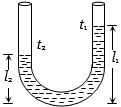
In a vertical $U-$tube containing a liquid,the two arms are maintained at different temperatures ${t_1}$ and ${t_2}$. The liquid columns in the two arms have heights ${l_1}$ and ${l_2}$ respectively. The coefficient of volume expansion of the liquid is equal to
A
$\frac{{{l_1} - {l_2}}}{{{l_2}{t_1} - {l_1}{t_2}}}$
B
$\frac{{{l_1} - {l_2}}}{{{l_1}{t_1} - {l_2}{t_2}}}$
C
$\frac{{{l_1} + {l_2}}}{{{l_2}{t_1} + {l_1}{t_2}}}$
D
$\frac{{{l_1} + {l_2}}}{{{l_1}{t_1} + {l_2}{t_2}}}$
Solution
(A) Let the initial height of the liquid in each arm at a reference temperature be $l_0$.
When the temperatures of the two arms are raised to $t_1$ and $t_2$ respectively,the new heights $l_1$ and $l_2$ are given by the thermal expansion formula $l = l_0(1 + \gamma \Delta t)$.
Assuming the reference temperature is $0^{\circ}C$,we have:
$l_1 = l_0(1 + \gamma t_1)$ and $l_2 = l_0(1 + \gamma t_2)$.
From these,we can write $l_0 = \frac{l_1}{1 + \gamma t_1} = \frac{l_2}{1 + \gamma t_2}$.
Equating the two expressions for $l_0$:
$l_1(1 + \gamma t_2) = l_2(1 + \gamma t_1)$
$l_1 + l_1 \gamma t_2 = l_2 + l_2 \gamma t_1$
$l_1 - l_2 = \gamma (l_2 t_1 - l_1 t_2)$
Therefore,the coefficient of volume expansion $\gamma$ is:
$\gamma = \frac{l_1 - l_2}{l_2 t_1 - l_1 t_2}$.
When the temperatures of the two arms are raised to $t_1$ and $t_2$ respectively,the new heights $l_1$ and $l_2$ are given by the thermal expansion formula $l = l_0(1 + \gamma \Delta t)$.
Assuming the reference temperature is $0^{\circ}C$,we have:
$l_1 = l_0(1 + \gamma t_1)$ and $l_2 = l_0(1 + \gamma t_2)$.
From these,we can write $l_0 = \frac{l_1}{1 + \gamma t_1} = \frac{l_2}{1 + \gamma t_2}$.
Equating the two expressions for $l_0$:
$l_1(1 + \gamma t_2) = l_2(1 + \gamma t_1)$
$l_1 + l_1 \gamma t_2 = l_2 + l_2 \gamma t_1$
$l_1 - l_2 = \gamma (l_2 t_1 - l_1 t_2)$
Therefore,the coefficient of volume expansion $\gamma$ is:
$\gamma = \frac{l_1 - l_2}{l_2 t_1 - l_1 t_2}$.
0 likes
View Solution12
MediumMCQ
$A$ gas at $20 \, ^\circ C$ and normal pressure has a volume of $100 \, cm^3$. If its temperature is increased to $100 \, ^\circ C$ at the same pressure,its volume becomes $125 \, cm^3$. Calculate the coefficient of volume expansion of the gas at normal pressure in $^\circ C^{-1}$.
A
$0.0015$
B
$0.0045$
C
$0.0025$
D
$0.0031$
Solution
(D) The formula for volume expansion is $\Delta V = \gamma V_1 \Delta T$.
Here,$\Delta V = V_2 - V_1 = 125 \, cm^3 - 100 \, cm^3 = 25 \, cm^3$.
The initial volume $V_1 = 100 \, cm^3$.
The change in temperature $\Delta T = 100 \, ^\circ C - 20 \, ^\circ C = 80 \, ^\circ C$.
Substituting these values into the formula: $\gamma = \frac{\Delta V}{V_1 \Delta T} = \frac{25}{100 \times 80} = \frac{25}{8000} = 0.003125 \, ^\circ C^{-1}$.
Rounding to the given options,the value is $0.0031 \, ^\circ C^{-1}$.
Here,$\Delta V = V_2 - V_1 = 125 \, cm^3 - 100 \, cm^3 = 25 \, cm^3$.
The initial volume $V_1 = 100 \, cm^3$.
The change in temperature $\Delta T = 100 \, ^\circ C - 20 \, ^\circ C = 80 \, ^\circ C$.
Substituting these values into the formula: $\gamma = \frac{\Delta V}{V_1 \Delta T} = \frac{25}{100 \times 80} = \frac{25}{8000} = 0.003125 \, ^\circ C^{-1}$.
Rounding to the given options,the value is $0.0031 \, ^\circ C^{-1}$.
0 likes
View Solution13
DifficultMCQ
$A$ glass flask of volume $1 \, L$ is completely filled with mercury at $0 \, ^\circ C$. The temperature of the glass flask and mercury is raised to $100 \, ^\circ C$. If the coefficient of volume expansion of mercury is $1.82 \times 10^{-4} \, ^\circ C^{-1}$ and the coefficient of linear expansion of glass is $0.1 \times 10^{-4} \, ^\circ C^{-1}$,how much mercury will overflow from the flask? (in $cm^3$)
A
$21.2$
B
$15.2$
C
$1.52$
D
$2.12$
Solution
(B) The volume of both the mercury and the glass flask increases with the rise in temperature.
The volume of mercury that overflows is the difference between the increase in the volume of mercury and the increase in the internal volume of the glass flask.
Given:
Initial volume $V_0 = 1 \, L = 1000 \, cm^3$
Change in temperature $\Delta \theta = 100 \, ^\circ C - 0 \, ^\circ C = 100 \, ^\circ C$
Coefficient of volume expansion of mercury $\gamma_l = 1.82 \times 10^{-4} \, ^\circ C^{-1}$
Coefficient of linear expansion of glass $\alpha_g = 0.1 \times 10^{-4} \, ^\circ C^{-1}$
Coefficient of volume expansion of glass $\gamma_g = 3 \alpha_g = 3 \times 0.1 \times 10^{-4} = 0.3 \times 10^{-4} \, ^\circ C^{-1}$
The volume of mercury that overflows is given by:
$\Delta V = V_0 (\gamma_l - \gamma_g) \Delta \theta$
$\Delta V = 1000 \times (1.82 \times 10^{-4} - 0.3 \times 10^{-4}) \times 100$
$\Delta V = 1000 \times (1.52 \times 10^{-4}) \times 100$
$\Delta V = 15.2 \, cm^3$
The volume of mercury that overflows is the difference between the increase in the volume of mercury and the increase in the internal volume of the glass flask.
Given:
Initial volume $V_0 = 1 \, L = 1000 \, cm^3$
Change in temperature $\Delta \theta = 100 \, ^\circ C - 0 \, ^\circ C = 100 \, ^\circ C$
Coefficient of volume expansion of mercury $\gamma_l = 1.82 \times 10^{-4} \, ^\circ C^{-1}$
Coefficient of linear expansion of glass $\alpha_g = 0.1 \times 10^{-4} \, ^\circ C^{-1}$
Coefficient of volume expansion of glass $\gamma_g = 3 \alpha_g = 3 \times 0.1 \times 10^{-4} = 0.3 \times 10^{-4} \, ^\circ C^{-1}$
The volume of mercury that overflows is given by:
$\Delta V = V_0 (\gamma_l - \gamma_g) \Delta \theta$
$\Delta V = 1000 \times (1.82 \times 10^{-4} - 0.3 \times 10^{-4}) \times 100$
$\Delta V = 1000 \times (1.52 \times 10^{-4}) \times 100$
$\Delta V = 15.2 \, cm^3$
0 likes
View Solution14
MediumMCQ
The value of the coefficient of volume expansion of glycerin is $5 \times 10^{-4} \ K^{-1}$. The fractional change in the density of glycerin for a rise of $40^{\circ}C$ in its temperature is:
A
$0.01$
B
$0.015$
C
$0.02$
D
$0.025$
Solution
(C) Let $\rho_0$ and $\rho_T$ be the densities of glycerin at initial temperature and final temperature respectively.
The relationship between density and temperature is given by $\rho_T = \rho_0(1 - \gamma \Delta T)$,where $\gamma$ is the coefficient of volume expansion and $\Delta T$ is the change in temperature.
Rearranging the equation,we get $\frac{\rho_T}{\rho_0} = 1 - \gamma \Delta T$.
The fractional change in density is defined as $\frac{\rho_0 - \rho_T}{\rho_0}$.
From the equation,$\frac{\rho_0 - \rho_T}{\rho_0} = \gamma \Delta T$.
Given $\gamma = 5 \times 10^{-4} \ K^{-1}$ and $\Delta T = 40 \ K$.
Substituting the values,the fractional change in density = $(5 \times 10^{-4} \ K^{-1}) \times (40 \ K) = 200 \times 10^{-4} = 0.02$.
The relationship between density and temperature is given by $\rho_T = \rho_0(1 - \gamma \Delta T)$,where $\gamma$ is the coefficient of volume expansion and $\Delta T$ is the change in temperature.
Rearranging the equation,we get $\frac{\rho_T}{\rho_0} = 1 - \gamma \Delta T$.
The fractional change in density is defined as $\frac{\rho_0 - \rho_T}{\rho_0}$.
From the equation,$\frac{\rho_0 - \rho_T}{\rho_0} = \gamma \Delta T$.
Given $\gamma = 5 \times 10^{-4} \ K^{-1}$ and $\Delta T = 40 \ K$.
Substituting the values,the fractional change in density = $(5 \times 10^{-4} \ K^{-1}) \times (40 \ K) = 200 \times 10^{-4} = 0.02$.
0 likes
View Solution15
MediumMCQ
The coefficient of volume expansion of glycerin is $5 \times 10^{-4} \ K^{-1}$. If the temperature of glycerin is raised by $40^{\circ} C$,the fractional change in its density will be . . . . . . .
A
$0.01$
B
$0.015$
C
$0.02$
D
$0.025$
Solution
(C) The density $\rho$ of a substance at temperature $T + \Delta T$ is related to its initial density $\rho_0$ at temperature $T$ by the formula: $\rho = \frac{\rho_0}{1 + \gamma \Delta T}$.
Since $\gamma \Delta T \ll 1$,we can use the binomial approximation: $\rho \approx \rho_0(1 - \gamma \Delta T)$.
The change in density is $\Delta \rho = \rho - \rho_0 = -\rho_0 \gamma \Delta T$.
The fractional change in density is given by $\frac{|\Delta \rho|}{\rho_0} = \gamma \Delta T$.
Given: $\gamma = 5 \times 10^{-4} \ K^{-1}$ and $\Delta T = 40^{\circ} C = 40 \ K$.
Therefore,the fractional change = $5 \times 10^{-4} \times 40 = 200 \times 10^{-4} = 0.02$.
Since $\gamma \Delta T \ll 1$,we can use the binomial approximation: $\rho \approx \rho_0(1 - \gamma \Delta T)$.
The change in density is $\Delta \rho = \rho - \rho_0 = -\rho_0 \gamma \Delta T$.
The fractional change in density is given by $\frac{|\Delta \rho|}{\rho_0} = \gamma \Delta T$.
Given: $\gamma = 5 \times 10^{-4} \ K^{-1}$ and $\Delta T = 40^{\circ} C = 40 \ K$.
Therefore,the fractional change = $5 \times 10^{-4} \times 40 = 200 \times 10^{-4} = 0.02$.
0 likes
View Solution16
MediumMCQ
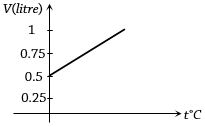
The graph between volume and temperature for a gas is shown in the figure. If $\alpha$ = volume coefficient of the gas = $\frac{1}{273} \text{ per } ^oC$,then what is the volume of the gas at a temperature of $819 ^oC$?
A
$1 \times 10^{-3} \text{ m}^3$
B
$2 \times 10^{-3} \text{ m}^3$
C
$3 \times 10^{-3} \text{ m}^3$
D
$4 \times 10^{-3} \text{ m}^3$
Solution
(B) From the given graph,the volume of the gas at $t = 0 ^oC$ is $V_0 = 0.5 \text{ litre}$.
Using the formula for volume expansion: $V_t = V_0(1 + \alpha t)$.
Given $\alpha = \frac{1}{273} \text{ per } ^oC$ and $t = 819 ^oC$.
Substituting the values: $V_t = 0.5 \times (1 + \frac{1}{273} \times 819)$.
$V_t = 0.5 \times (1 + 3) = 0.5 \times 4 = 2 \text{ litre}$.
Since $1 \text{ litre} = 10^{-3} \text{ m}^3$,the volume is $2 \times 10^{-3} \text{ m}^3$.
Using the formula for volume expansion: $V_t = V_0(1 + \alpha t)$.
Given $\alpha = \frac{1}{273} \text{ per } ^oC$ and $t = 819 ^oC$.
Substituting the values: $V_t = 0.5 \times (1 + \frac{1}{273} \times 819)$.
$V_t = 0.5 \times (1 + 3) = 0.5 \times 4 = 2 \text{ litre}$.
Since $1 \text{ litre} = 10^{-3} \text{ m}^3$,the volume is $2 \times 10^{-3} \text{ m}^3$.
0 likes
View Solution17
MediumMCQ
An open vessel is filled completely with oil which has the same coefficient of volume expansion as that of the vessel. On heating both the oil and the vessel,
A
the vessel can contain more volume and more mass of oil
B
the vessel can contain the same volume and the same mass of oil
C
the vessel can contain the same volume but more mass of oil
D
the vessel can contain more volume but the same mass of oil
Solution
(D) Let the initial volume of the vessel be $V_0$ and the coefficient of volume expansion for both the vessel and the oil be $\gamma$.
When the temperature increases by $\Delta T$,the new volume of the vessel is $V_v = V_0(1 + \gamma \Delta T)$.
The new volume of the oil is $V_o = V_0(1 + \gamma \Delta T)$.
Since the expansion is identical,the oil will continue to fill the vessel completely without any overflow.
Because the volume of the vessel has increased,it can now contain a larger volume of oil compared to the initial state.
However,since the density of the oil decreases as it expands,the mass $m = \rho V$ remains constant because the increase in volume is exactly compensated by the decrease in density.
Thus,the vessel contains a larger volume of oil,but the total mass of the oil remains the same.
When the temperature increases by $\Delta T$,the new volume of the vessel is $V_v = V_0(1 + \gamma \Delta T)$.
The new volume of the oil is $V_o = V_0(1 + \gamma \Delta T)$.
Since the expansion is identical,the oil will continue to fill the vessel completely without any overflow.
Because the volume of the vessel has increased,it can now contain a larger volume of oil compared to the initial state.
However,since the density of the oil decreases as it expands,the mass $m = \rho V$ remains constant because the increase in volume is exactly compensated by the decrease in density.
Thus,the vessel contains a larger volume of oil,but the total mass of the oil remains the same.
0 likes
View Solution18
AdvancedMCQ
The coefficient of apparent expansion of a liquid in a copper vessel is $C$ and in a silver vessel is $S$. The coefficient of volume expansion of copper is $\gamma_c$. What is the coefficient of linear expansion of silver?
A
$\frac{C + \gamma_c - S}{3}$
B
$\frac{C - \gamma_c + S}{3}$
C
$\frac{C + \gamma_c + S}{3}$
D
$\frac{C - \gamma_c - S}{3}$
Solution
(A) The coefficient of apparent expansion $\gamma_a$ is given by $\gamma_a = \gamma_l - \gamma_v$,where $\gamma_l$ is the real coefficient of volume expansion of the liquid and $\gamma_v$ is the coefficient of volume expansion of the vessel.
For the copper vessel: $C = \gamma_l - \gamma_c \implies \gamma_l = C + \gamma_c$.
For the silver vessel: $S = \gamma_l - \gamma_s$,where $\gamma_s$ is the coefficient of volume expansion of silver.
Substituting $\gamma_l$ from the first equation: $S = (C + \gamma_c) - \gamma_s$.
Rearranging for $\gamma_s$: $\gamma_s = C + \gamma_c - S$.
Since the coefficient of volume expansion is three times the coefficient of linear expansion $(\gamma_s = 3\alpha_s)$,we have $3\alpha_s = C + \gamma_c - S$.
Therefore,the coefficient of linear expansion of silver is $\alpha_s = \frac{C + \gamma_c - S}{3}$.
For the copper vessel: $C = \gamma_l - \gamma_c \implies \gamma_l = C + \gamma_c$.
For the silver vessel: $S = \gamma_l - \gamma_s$,where $\gamma_s$ is the coefficient of volume expansion of silver.
Substituting $\gamma_l$ from the first equation: $S = (C + \gamma_c) - \gamma_s$.
Rearranging for $\gamma_s$: $\gamma_s = C + \gamma_c - S$.
Since the coefficient of volume expansion is three times the coefficient of linear expansion $(\gamma_s = 3\alpha_s)$,we have $3\alpha_s = C + \gamma_c - S$.
Therefore,the coefficient of linear expansion of silver is $\alpha_s = \frac{C + \gamma_c - S}{3}$.
0 likes
View Solution19
AdvancedMCQ
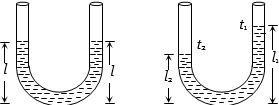
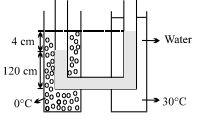
Two vertical glass tubes filled with a liquid are connected by a capillary tube as shown in the figure. The tube on the left is put in an ice bath at $0^{\circ}C$ while the tube on the right is kept at $30^{\circ}C$ in a water bath. The difference in the levels of the liquid in the two tubes is $4 \, cm$ while the height of the liquid column at $0^{\circ}C$ is $120 \, cm$. The coefficient of volume expansion of the liquid is (Ignore expansion of the glass tube):
A
$22 \times 10^{-4}/^{\circ}C$
B
$1.1 \times 10^{-4}/^{\circ}C$
C
$11 \times 10^{-4}/^{\circ}C$
D
$2.2 \times 10^{-4}/^{\circ}C$
Solution
(C) Let $h_1 = 120 \, cm$ be the height of the liquid at $0^{\circ}C$ (left tube).
Let $h_2 = 120 + 4 = 124 \, cm$ be the height of the liquid at $30^{\circ}C$ (right tube).
Since the pressure at the bottom of both tubes must be equal:
$h_1 \rho_1 g = h_2 \rho_2 g$
$\rho_1 h_1 = \rho_2 h_2$
Since $\rho_2 = \frac{\rho_1}{1 + \gamma \Delta T}$,where $\Delta T = 30^{\circ}C - 0^{\circ}C = 30^{\circ}C$:
$h_1 = h_2 \left( \frac{1}{1 + \gamma \Delta T} \right)$
$1 + \gamma \Delta T = \frac{h_2}{h_1} = \frac{124}{120}$
$\gamma \Delta T = \frac{124}{120} - 1 = \frac{4}{120} = \frac{1}{30}$
$\gamma = \frac{1}{30 \times 30} = \frac{1}{900} \approx 0.00111 \, /^{\circ}C$
$\gamma \approx 11.11 \times 10^{-4} /^{\circ}C$.
Let $h_2 = 120 + 4 = 124 \, cm$ be the height of the liquid at $30^{\circ}C$ (right tube).
Since the pressure at the bottom of both tubes must be equal:
$h_1 \rho_1 g = h_2 \rho_2 g$
$\rho_1 h_1 = \rho_2 h_2$
Since $\rho_2 = \frac{\rho_1}{1 + \gamma \Delta T}$,where $\Delta T = 30^{\circ}C - 0^{\circ}C = 30^{\circ}C$:
$h_1 = h_2 \left( \frac{1}{1 + \gamma \Delta T} \right)$
$1 + \gamma \Delta T = \frac{h_2}{h_1} = \frac{124}{120}$
$\gamma \Delta T = \frac{124}{120} - 1 = \frac{4}{120} = \frac{1}{30}$
$\gamma = \frac{1}{30 \times 30} = \frac{1}{900} \approx 0.00111 \, /^{\circ}C$
$\gamma \approx 11.11 \times 10^{-4} /^{\circ}C$.
0 likes
View Solution20
DifficultMCQ
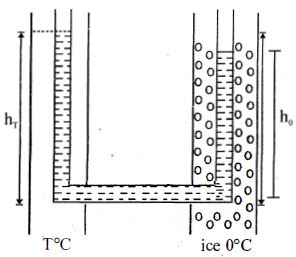
In an experiment to find the liquid expansion coefficient $(\gamma)$,a column of experimental liquid at $T\,^oC$ is balanced against another column of experimental liquid at $0\,^oC$ by taking them in a $U$-tube. The expansion coefficient $(\gamma)$ is?
A
$\frac{h_T}{ (h_T - h_0)T }$
B
$\frac{h_0}{ (h_T - h_0)T }$
C
$\frac{ (h_T - h_0) }{ h_0 T }$
D
$\frac{ h_T - h_0 }{ h_T T }$
Solution
(C) At the bottom of the $U$-tube,the pressure exerted by both liquid columns must be equal for equilibrium.
$P_T = P_0$
$\rho_T h_T g = \rho_0 h_0 g$
$\rho_T h_T = \rho_0 h_0 \quad \dots(1)$
The density of a liquid varies with temperature as $\rho_T = \frac{\rho_0}{1 + \gamma T}$,where $\gamma$ is the coefficient of volume expansion.
Substituting this into equation $(1)$:
$\left( \frac{\rho_0}{1 + \gamma T} \right) h_T = \rho_0 h_0$
$h_T = h_0 (1 + \gamma T)$
$h_T = h_0 + h_0 \gamma T$
$h_T - h_0 = h_0 \gamma T$
$\gamma = \frac{h_T - h_0}{h_0 T}$
$P_T = P_0$
$\rho_T h_T g = \rho_0 h_0 g$
$\rho_T h_T = \rho_0 h_0 \quad \dots(1)$
The density of a liquid varies with temperature as $\rho_T = \frac{\rho_0}{1 + \gamma T}$,where $\gamma$ is the coefficient of volume expansion.
Substituting this into equation $(1)$:
$\left( \frac{\rho_0}{1 + \gamma T} \right) h_T = \rho_0 h_0$
$h_T = h_0 (1 + \gamma T)$
$h_T = h_0 + h_0 \gamma T$
$h_T - h_0 = h_0 \gamma T$
$\gamma = \frac{h_T - h_0}{h_0 T}$
0 likes
View Solution21
MediumMCQ
$A$ liquid with a coefficient of volume expansion $\gamma$ is filled in a container of a material having a coefficient of linear expansion $\alpha$. If the liquid overflows on heating,then
A
$\gamma = 3 \alpha$
B
$\gamma > 3 \alpha$
C
$\gamma < 3 \alpha$
D
$\gamma > 3 \alpha^3$
Solution
(B) The coefficient of linear expansion of the container material is $\alpha$. Therefore,the coefficient of volume expansion of the container is $\gamma_{container} = 3 \alpha$.
When the system is heated,the liquid overflows if the increase in the volume of the liquid is greater than the increase in the volume of the container.
This implies that the coefficient of volume expansion of the liquid $(\gamma)$ must be greater than the coefficient of volume expansion of the container $(\gamma_{container})$.
Therefore,$\gamma > 3 \alpha$.
When the system is heated,the liquid overflows if the increase in the volume of the liquid is greater than the increase in the volume of the container.
This implies that the coefficient of volume expansion of the liquid $(\gamma)$ must be greater than the coefficient of volume expansion of the container $(\gamma_{container})$.
Therefore,$\gamma > 3 \alpha$.
0 likes
View Solution22
DifficultMCQ
The density of water at $20^oC$ is $0.998 \, g/cm^3$ and at $40^oC$ is $0.992 \, g/cm^3$. The mean coefficient of cubical expansion (in per $^oC$) is:
A
$1 \times 10^{-4}$
B
$2 \times 10^{-4}$
C
$3 \times 10^{-4}$
D
$6 \times 10^{-4}$
Solution
(C) The relationship between density $\rho$ and temperature $t$ is given by $\rho_t = \rho_0 (1 - \gamma \Delta t)$,where $\gamma$ is the coefficient of cubical expansion.
For a small change in temperature,the change in density is given by $\rho_2 = \rho_1 (1 - \gamma \Delta t)$.
Rearranging this,we get $\rho_2 - \rho_1 = -\rho_1 \gamma (t_2 - t_1)$.
Taking the magnitude,$\gamma = \frac{\rho_1 - \rho_2}{\rho_1 (t_2 - t_1)}$.
Given $\rho_1 = 0.998 \, g/cm^3$,$\rho_2 = 0.992 \, g/cm^3$,$t_1 = 20^oC$,and $t_2 = 40^oC$.
$\gamma = \frac{0.998 - 0.992}{0.998 \times (40 - 20)} = \frac{0.006}{0.998 \times 20} \approx \frac{0.006}{19.96} \approx 3.006 \times 10^{-4} \, ^oC^{-1}$.
Rounding to the nearest option,the value is $3 \times 10^{-4} \, ^oC^{-1}$.
For a small change in temperature,the change in density is given by $\rho_2 = \rho_1 (1 - \gamma \Delta t)$.
Rearranging this,we get $\rho_2 - \rho_1 = -\rho_1 \gamma (t_2 - t_1)$.
Taking the magnitude,$\gamma = \frac{\rho_1 - \rho_2}{\rho_1 (t_2 - t_1)}$.
Given $\rho_1 = 0.998 \, g/cm^3$,$\rho_2 = 0.992 \, g/cm^3$,$t_1 = 20^oC$,and $t_2 = 40^oC$.
$\gamma = \frac{0.998 - 0.992}{0.998 \times (40 - 20)} = \frac{0.006}{0.998 \times 20} \approx \frac{0.006}{19.96} \approx 3.006 \times 10^{-4} \, ^oC^{-1}$.
Rounding to the nearest option,the value is $3 \times 10^{-4} \, ^oC^{-1}$.
0 likes
View Solution23
DifficultMCQ
The coefficient of apparent expansion of a liquid when determined using two different vessels $A$ and $B$ are ${\gamma _1}$ and ${\gamma _2}$ respectively. If the coefficient of linear expansion of vessel $A$ is $\alpha $,the coefficient of linear expansion of vessel $B$ is
A
$\frac{{\alpha {\gamma _1}{\gamma _2}}}{{{\gamma _1} + {\gamma _2}}}$
B
$\frac{{{\gamma _1} - {\gamma _2}}}{{2\alpha }}$
C
$\frac{{{\gamma _1} - {\gamma _2} + \alpha }}{3}$
D
$\frac{{{\gamma _1} - {\gamma _2}}}{3} + \alpha $
Solution
(D) The real coefficient of expansion of a liquid is given by $\gamma_{\text{real}} = \gamma_{\text{app}} + \gamma_{\text{vessel}}$,where $\gamma_{\text{vessel}} = 3\alpha$ and $\alpha$ is the coefficient of linear expansion.
For vessel $A$,the real expansion is $\gamma_{\text{real}} = \gamma_1 + 3\alpha$.
For vessel $B$,the real expansion is $\gamma_{\text{real}} = \gamma_2 + 3\alpha_B$,where $\alpha_B$ is the coefficient of linear expansion of vessel $B$.
Since the liquid is the same,$\gamma_{\text{real}}$ is constant. Therefore,$\gamma_1 + 3\alpha = \gamma_2 + 3\alpha_B$.
Rearranging to solve for $\alpha_B$: $3\alpha_B = \gamma_1 - \gamma_2 + 3\alpha$.
Thus,$\alpha_B = \frac{\gamma_1 - \gamma_2}{3} + \alpha$.
For vessel $A$,the real expansion is $\gamma_{\text{real}} = \gamma_1 + 3\alpha$.
For vessel $B$,the real expansion is $\gamma_{\text{real}} = \gamma_2 + 3\alpha_B$,where $\alpha_B$ is the coefficient of linear expansion of vessel $B$.
Since the liquid is the same,$\gamma_{\text{real}}$ is constant. Therefore,$\gamma_1 + 3\alpha = \gamma_2 + 3\alpha_B$.
Rearranging to solve for $\alpha_B$: $3\alpha_B = \gamma_1 - \gamma_2 + 3\alpha$.
Thus,$\alpha_B = \frac{\gamma_1 - \gamma_2}{3} + \alpha$.
0 likes
View Solution24
MediumMCQ
$A$ liquid having a coefficient of cubical expansion $\gamma$ is filled in a container having a coefficient of linear expansion $\alpha$. If the liquid overflows upon heating,which of the following relations is correct?
A
$\gamma = 2\alpha$
B
$\gamma < 3\alpha$
C
$\gamma > 3\alpha$
D
$2\gamma = 3\alpha$
Solution
(C) When a liquid is heated in a container,the change in volume of the liquid is $\Delta V_{\ell} = V \gamma \Delta T$ and the change in volume of the container is $\Delta V_{c} = V \gamma_{c} \Delta T$,where $\gamma_{c} = 3\alpha$.
For the liquid to overflow,the expansion of the liquid must be greater than the expansion of the container,i.e.,$\Delta V_{\ell} > \Delta V_{c}$.
Substituting the expressions,we get $V \gamma \Delta T > V (3\alpha) \Delta T$.
Dividing both sides by $V \Delta T$,we obtain $\gamma > 3\alpha$.
For the liquid to overflow,the expansion of the liquid must be greater than the expansion of the container,i.e.,$\Delta V_{\ell} > \Delta V_{c}$.
Substituting the expressions,we get $V \gamma \Delta T > V (3\alpha) \Delta T$.
Dividing both sides by $V \Delta T$,we obtain $\gamma > 3\alpha$.
0 likes
View Solution25
DifficultMCQ
$A$ glass flask of volume $1 \, L$ at $0 \, ^oC$ is filled level full with mercury at this temperature. The flask and mercury are now heated to $100 \, ^oC$. How much mercury will spill out,if the coefficient of volume expansion of mercury is $1.82 \times 10^{-4} / ^oC$ and the coefficient of linear expansion of glass is $0.1 \times 10^{-4} / ^oC$? ............ $cc$
A
$21.2$
B
$15.2$
C
$1.52$
D
$2.12$
Solution
(B) The volume of the flask $V_0 = 1 \, L = 1000 \, cc$.
The change in temperature $\Delta \theta = 100 \, ^oC - 0 \, ^oC = 100 \, ^oC$.
The coefficient of volume expansion of mercury is $\gamma_m = 1.82 \times 10^{-4} / ^oC$.
The coefficient of linear expansion of glass is $\alpha_g = 0.1 \times 10^{-4} / ^oC$.
The coefficient of volume expansion of glass is $\gamma_g = 3 \alpha_g = 3 \times 0.1 \times 10^{-4} = 0.3 \times 10^{-4} / ^oC$.
The volume of mercury that spills out is the difference in the expansion of mercury and the expansion of the glass flask:
$\Delta V = V_0 (\gamma_m - \gamma_g) \Delta \theta$
$\Delta V = 1000 \times (1.82 \times 10^{-4} - 0.3 \times 10^{-4}) \times 100$
$\Delta V = 1000 \times (1.52 \times 10^{-4}) \times 100$
$\Delta V = 15.2 \, cc$.
The change in temperature $\Delta \theta = 100 \, ^oC - 0 \, ^oC = 100 \, ^oC$.
The coefficient of volume expansion of mercury is $\gamma_m = 1.82 \times 10^{-4} / ^oC$.
The coefficient of linear expansion of glass is $\alpha_g = 0.1 \times 10^{-4} / ^oC$.
The coefficient of volume expansion of glass is $\gamma_g = 3 \alpha_g = 3 \times 0.1 \times 10^{-4} = 0.3 \times 10^{-4} / ^oC$.
The volume of mercury that spills out is the difference in the expansion of mercury and the expansion of the glass flask:
$\Delta V = V_0 (\gamma_m - \gamma_g) \Delta \theta$
$\Delta V = 1000 \times (1.82 \times 10^{-4} - 0.3 \times 10^{-4}) \times 100$
$\Delta V = 1000 \times (1.52 \times 10^{-4}) \times 100$
$\Delta V = 15.2 \, cc$.
0 likes
View Solution26
MediumMCQ
The coefficient of apparent expansion of mercury in a glass vessel is $132 \times 10^{-6} /^{\circ}C$ and in a steel vessel is $114 \times 10^{-6} /^{\circ}C$. If $\alpha$ for steel is $12 \times 10^{-6} /^{\circ}C$,then that of glass is:
A
$9 \times 10^{-6} /^{\circ}C$
B
$6 \times 10^{-6} /^{\circ}C$
C
$36 \times 10^{-6} /^{\circ}C$
D
$27 \times 10^{-6} /^{\circ}C$
Solution
(B) The coefficient of apparent expansion $\gamma_{app}$ is related to the coefficient of real expansion of liquid $\gamma_r$ and the coefficient of volume expansion of the vessel $\gamma_v$ by the formula: $\gamma_{app} = \gamma_r - \gamma_v$.
For a vessel,the coefficient of volume expansion $\gamma_v = 3\alpha$,where $\alpha$ is the coefficient of linear expansion.
Thus,$\gamma_{app} = \gamma_r - 3\alpha$.
For steel: $\gamma_{app, steel} = 114 \times 10^{-6} /^{\circ}C$ and $\alpha_{steel} = 12 \times 10^{-6} /^{\circ}C$.
$\gamma_r = \gamma_{app, steel} + 3\alpha_{steel} = 114 \times 10^{-6} + 3(12 \times 10^{-6}) = 114 \times 10^{-6} + 36 \times 10^{-6} = 150 \times 10^{-6} /^{\circ}C$.
For glass: $\gamma_{app, glass} = 132 \times 10^{-6} /^{\circ}C$.
Using $\gamma_{app, glass} = \gamma_r - 3\alpha_{glass}$:
$132 \times 10^{-6} = 150 \times 10^{-6} - 3\alpha_{glass}$.
$3\alpha_{glass} = 150 \times 10^{-6} - 132 \times 10^{-6} = 18 \times 10^{-6} /^{\circ}C$.
$\alpha_{glass} = 6 \times 10^{-6} /^{\circ}C$.
For a vessel,the coefficient of volume expansion $\gamma_v = 3\alpha$,where $\alpha$ is the coefficient of linear expansion.
Thus,$\gamma_{app} = \gamma_r - 3\alpha$.
For steel: $\gamma_{app, steel} = 114 \times 10^{-6} /^{\circ}C$ and $\alpha_{steel} = 12 \times 10^{-6} /^{\circ}C$.
$\gamma_r = \gamma_{app, steel} + 3\alpha_{steel} = 114 \times 10^{-6} + 3(12 \times 10^{-6}) = 114 \times 10^{-6} + 36 \times 10^{-6} = 150 \times 10^{-6} /^{\circ}C$.
For glass: $\gamma_{app, glass} = 132 \times 10^{-6} /^{\circ}C$.
Using $\gamma_{app, glass} = \gamma_r - 3\alpha_{glass}$:
$132 \times 10^{-6} = 150 \times 10^{-6} - 3\alpha_{glass}$.
$3\alpha_{glass} = 150 \times 10^{-6} - 132 \times 10^{-6} = 18 \times 10^{-6} /^{\circ}C$.
$\alpha_{glass} = 6 \times 10^{-6} /^{\circ}C$.
0 likes
View Solution27
DifficultMCQ
The coefficient of apparent expansion of a liquid,when determined using two different vessels $A$ and $B$,are $\gamma_1$ and $\gamma_2$ respectively. If the coefficient of linear expansion of vessel $A$ is $\alpha$,then the coefficient of linear expansion of vessel $B$ is:
A
$\frac{\alpha \gamma_1 \gamma_2}{\gamma_1 + \gamma_2}$
B
$\frac{\gamma_1 - \gamma_2}{2\alpha}$
C
$\frac{\gamma_1 - \gamma_2 + \alpha}{3}$
D
$\frac{\gamma_1 - \gamma_2}{3} + \alpha$
Solution
(D) The real coefficient of expansion of a liquid is constant and is given by the relation: $\gamma_{\text{real}} = \gamma_{\text{apparent}} + \gamma_{\text{vessel}}$.
For vessel $A$,the coefficient of volume expansion is $\gamma_{v,A} = 3\alpha$. Thus,$\gamma_{\text{real}} = \gamma_1 + 3\alpha$.
For vessel $B$,let the coefficient of linear expansion be $\alpha_B$. Then the coefficient of volume expansion is $\gamma_{v,B} = 3\alpha_B$. Thus,$\gamma_{\text{real}} = \gamma_2 + 3\alpha_B$.
Since $\gamma_{\text{real}}$ is the same for the liquid in both cases,we equate the two expressions:
$\gamma_1 + 3\alpha = \gamma_2 + 3\alpha_B$.
Rearranging for $\alpha_B$:
$3\alpha_B = \gamma_1 - \gamma_2 + 3\alpha$.
$\alpha_B = \frac{\gamma_1 - \gamma_2}{3} + \alpha$.
For vessel $A$,the coefficient of volume expansion is $\gamma_{v,A} = 3\alpha$. Thus,$\gamma_{\text{real}} = \gamma_1 + 3\alpha$.
For vessel $B$,let the coefficient of linear expansion be $\alpha_B$. Then the coefficient of volume expansion is $\gamma_{v,B} = 3\alpha_B$. Thus,$\gamma_{\text{real}} = \gamma_2 + 3\alpha_B$.
Since $\gamma_{\text{real}}$ is the same for the liquid in both cases,we equate the two expressions:
$\gamma_1 + 3\alpha = \gamma_2 + 3\alpha_B$.
Rearranging for $\alpha_B$:
$3\alpha_B = \gamma_1 - \gamma_2 + 3\alpha$.
$\alpha_B = \frac{\gamma_1 - \gamma_2}{3} + \alpha$.
0 likes
View Solution28
MediumMCQ
On heating a liquid of coefficient of cubical expansion $\gamma$ in a container having coefficient of linear expansion $\gamma/3$,the level of liquid in the container will
A
Fall
B
Rise
C
Remain unchanged
D
It is difficult to say
Solution
(C) The coefficient of cubical expansion of the container $(\gamma_c)$ is related to its coefficient of linear expansion $(\alpha)$ by the formula $\gamma_c = 3\alpha$.
Given that the coefficient of linear expansion of the container is $\alpha = \gamma/3$,we have $\gamma_c = 3 \times (\gamma/3) = \gamma$.
Since the coefficient of cubical expansion of the liquid $(\gamma_l = \gamma)$ is equal to the coefficient of cubical expansion of the container $(\gamma_c = \gamma)$,the volume of the liquid and the internal volume of the container increase by the same amount upon heating.
Therefore,the level of the liquid in the container will remain unchanged.
Given that the coefficient of linear expansion of the container is $\alpha = \gamma/3$,we have $\gamma_c = 3 \times (\gamma/3) = \gamma$.
Since the coefficient of cubical expansion of the liquid $(\gamma_l = \gamma)$ is equal to the coefficient of cubical expansion of the container $(\gamma_c = \gamma)$,the volume of the liquid and the internal volume of the container increase by the same amount upon heating.
Therefore,the level of the liquid in the container will remain unchanged.
0 likes
View Solution29
DifficultMCQ
The value of the coefficient of volume expansion of glycerin is $5 \times 10^{-4} \, K^{-1}$. The fractional change in the density of glycerin for a rise of $40 \, ^oC$ in its temperature is:
A
$0.010$
B
$0.015$
C
$0.020$
D
$0.025$
Solution
(C) The density $d$ of a substance at temperature $T$ is related to its initial density $d_i$ at temperature $T_0$ by the relation $d_f = \frac{d_i}{1 + \gamma \Delta T}$,where $\gamma$ is the coefficient of volume expansion and $\Delta T$ is the change in temperature.
The fractional change in density is given by $\frac{d_i - d_f}{d_i} = 1 - \frac{d_f}{d_i}$.
Substituting the expression for $d_f$,we get: $1 - \frac{1}{1 + \gamma \Delta T} = \frac{1 + \gamma \Delta T - 1}{1 + \gamma \Delta T} = \frac{\gamma \Delta T}{1 + \gamma \Delta T}$.
Since $\gamma \Delta T$ is very small $(5 \times 10^{-4} \times 40 = 0.02)$,we can approximate $1 + \gamma \Delta T \approx 1$.
Therefore,the fractional change $\approx \gamma \Delta T$.
Substituting the given values: $\text{Fractional change} = 5 \times 10^{-4} \times 40 = 200 \times 10^{-4} = 0.020$.
The fractional change in density is given by $\frac{d_i - d_f}{d_i} = 1 - \frac{d_f}{d_i}$.
Substituting the expression for $d_f$,we get: $1 - \frac{1}{1 + \gamma \Delta T} = \frac{1 + \gamma \Delta T - 1}{1 + \gamma \Delta T} = \frac{\gamma \Delta T}{1 + \gamma \Delta T}$.
Since $\gamma \Delta T$ is very small $(5 \times 10^{-4} \times 40 = 0.02)$,we can approximate $1 + \gamma \Delta T \approx 1$.
Therefore,the fractional change $\approx \gamma \Delta T$.
Substituting the given values: $\text{Fractional change} = 5 \times 10^{-4} \times 40 = 200 \times 10^{-4} = 0.020$.
0 likes
View Solution30
MediumMCQ
The coefficient of volume expansion of glycerin is $49 \times 10^{-5} \; K^{-1}$. What is the fractional change in its density for a $30 \; ^{\circ}C$ rise in temperature?
A
$3.64 \times 10^{-1}$
B
$8.48 \times 10^{-2}$
C
$1.47 \times 10^{-2}$
D
$4.75 \times 10^{-3}$
Solution
(C) The coefficient of volume expansion of glycerin is given as $\alpha_V = 49 \times 10^{-5} \; K^{-1}$.
The rise in temperature is $\Delta T = 30 \; ^{\circ}C$.
The relationship between volume and density is $\rho = \frac{m}{V}$,where $m$ is the mass and $V$ is the volume.
For a small change in temperature,the volume changes as $V' = V(1 + \alpha_V \Delta T)$.
The new density $\rho'$ is given by $\rho' = \frac{m}{V'} = \frac{m}{V(1 + \alpha_V \Delta T)} = \rho(1 + \alpha_V \Delta T)^{-1}$.
Using the binomial approximation $(1 + x)^{-1} \approx 1 - x$ for small $x$,we get $\rho' \approx \rho(1 - \alpha_V \Delta T)$.
The change in density is $\Delta \rho = \rho' - \rho = -\rho \alpha_V \Delta T$.
The fractional change in density is $\frac{|\Delta \rho|}{\rho} = \alpha_V \Delta T$.
Substituting the values: $\frac{|\Delta \rho|}{\rho} = 49 \times 10^{-5} \times 30 = 1470 \times 10^{-5} = 1.47 \times 10^{-2}$.
The rise in temperature is $\Delta T = 30 \; ^{\circ}C$.
The relationship between volume and density is $\rho = \frac{m}{V}$,where $m$ is the mass and $V$ is the volume.
For a small change in temperature,the volume changes as $V' = V(1 + \alpha_V \Delta T)$.
The new density $\rho'$ is given by $\rho' = \frac{m}{V'} = \frac{m}{V(1 + \alpha_V \Delta T)} = \rho(1 + \alpha_V \Delta T)^{-1}$.
Using the binomial approximation $(1 + x)^{-1} \approx 1 - x$ for small $x$,we get $\rho' \approx \rho(1 - \alpha_V \Delta T)$.
The change in density is $\Delta \rho = \rho' - \rho = -\rho \alpha_V \Delta T$.
The fractional change in density is $\frac{|\Delta \rho|}{\rho} = \alpha_V \Delta T$.
Substituting the values: $\frac{|\Delta \rho|}{\rho} = 49 \times 10^{-5} \times 30 = 1470 \times 10^{-5} = 1.47 \times 10^{-2}$.
0 likes
View Solution31
Medium
"Anomalous expansion of water is a blessing for living organisms in water." Explain this statement. Explain the anomalous expansion of water.
Solution
(N/A) Anomalous expansion of water:
Thermal expansion of water is non-uniform with temperature.
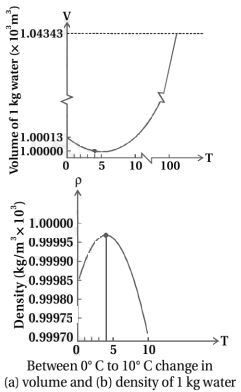
Water contracts on heating between $0^{\circ} C$ and $4^{\circ} C$. The volume of a given amount of water decreases as it is cooled from room temperature until its temperature reaches $4^{\circ} C$.
Below $4^{\circ} C$, the volume increases, and therefore the density decreases.
This means that water has a maximum density at $4^{\circ} C$.
This property has an important environmental effect: Bodies of water, such as lakes and ponds, freeze at the top first.
As a lake cools toward $4^{\circ} C$, water near the surface loses energy to the atmosphere, becomes denser, and sinks; the warmer, less dense water near the bottom rises. However, once the colder water on top reaches a temperature below $4^{\circ} C$, it becomes less dense and remains at the surface, where it freezes.
If water did not have this property, lakes and ponds would freeze from the bottom up, which would destroy much of their animal and plant life.
Thermal expansion of water is non-uniform with temperature.
Water contracts on heating between $0^{\circ} C$ and $4^{\circ} C$. The volume of a given amount of water decreases as it is cooled from room temperature until its temperature reaches $4^{\circ} C$.
Below $4^{\circ} C$, the volume increases, and therefore the density decreases.
This means that water has a maximum density at $4^{\circ} C$.
This property has an important environmental effect: Bodies of water, such as lakes and ponds, freeze at the top first.
As a lake cools toward $4^{\circ} C$, water near the surface loses energy to the atmosphere, becomes denser, and sinks; the warmer, less dense water near the bottom rises. However, once the colder water on top reaches a temperature below $4^{\circ} C$, it becomes less dense and remains at the surface, where it freezes.
If water did not have this property, lakes and ponds would freeze from the bottom up, which would destroy much of their animal and plant life.
0 likes
View Solution32
Easy
Obtain the coefficient of volume expansion for an ideal gas.
Solution
(N/A) The ideal gas equation is given by:
$PV = \mu RT$
Where $P$ is pressure,$V$ is volume,$\mu$ is the number of moles,$R$ is the gas constant,and $T$ is the absolute temperature.
At constant pressure,if the temperature changes by $\Delta T$,the volume changes by $\Delta V$:
$P(V + \Delta V) = \mu R(T + \Delta T)$
$PV + P\Delta V = \mu RT + \mu R\Delta T$
Since $PV = \mu RT$,we have:
$P\Delta V = \mu R\Delta T$
Dividing this equation by the original equation $PV = \mu RT$:
$\frac{P\Delta V}{PV} = \frac{\mu R\Delta T}{\mu RT}$
$\frac{\Delta V}{V} = \frac{\Delta T}{T}$
The coefficient of volume expansion $\alpha_V$ is defined as $\alpha_V = \frac{1}{V} \frac{\Delta V}{\Delta T}$.
Therefore,$\alpha_V = \frac{1}{T}$.
For an ideal gas,$\alpha_V$ depends on temperature and is inversely proportional to the absolute temperature $T$. As temperature increases,$\alpha_V$ decreases. At $0^{\circ}C$ $(273.15 \ K)$,$\alpha_V \approx 3.66 \times 10^{-3} \ K^{-1}$,which is significantly higher than that of solids and liquids.
$PV = \mu RT$
Where $P$ is pressure,$V$ is volume,$\mu$ is the number of moles,$R$ is the gas constant,and $T$ is the absolute temperature.
At constant pressure,if the temperature changes by $\Delta T$,the volume changes by $\Delta V$:
$P(V + \Delta V) = \mu R(T + \Delta T)$
$PV + P\Delta V = \mu RT + \mu R\Delta T$
Since $PV = \mu RT$,we have:
$P\Delta V = \mu R\Delta T$
Dividing this equation by the original equation $PV = \mu RT$:
$\frac{P\Delta V}{PV} = \frac{\mu R\Delta T}{\mu RT}$
$\frac{\Delta V}{V} = \frac{\Delta T}{T}$
The coefficient of volume expansion $\alpha_V$ is defined as $\alpha_V = \frac{1}{V} \frac{\Delta V}{\Delta T}$.
Therefore,$\alpha_V = \frac{1}{T}$.
For an ideal gas,$\alpha_V$ depends on temperature and is inversely proportional to the absolute temperature $T$. As temperature increases,$\alpha_V$ decreases. At $0^{\circ}C$ $(273.15 \ K)$,$\alpha_V \approx 3.66 \times 10^{-3} \ K^{-1}$,which is significantly higher than that of solids and liquids.
0 likes
View Solution33
Easy
What is volume expansion? Give the definition and unit of the coefficient of volume expansion.
Solution
(N/A) Volume expansion is the increase in the volume of a substance due to an increase in its temperature. When a solid,liquid,or gas is heated,its molecules vibrate more vigorously,causing the material to expand in all three dimensions.
The coefficient of volume expansion $(\gamma)$ is defined as the fractional change in volume per unit change in temperature.
Mathematically,it is expressed as: $\gamma = \frac{1}{V} \frac{\Delta V}{\Delta T}$,where $\Delta V$ is the change in volume,$V$ is the original volume,and $\Delta T$ is the change in temperature.
The $SI$ unit of the coefficient of volume expansion is per Kelvin $(K^{-1})$ or per degree Celsius $(^{\circ}C^{-1})$.
The coefficient of volume expansion $(\gamma)$ is defined as the fractional change in volume per unit change in temperature.
Mathematically,it is expressed as: $\gamma = \frac{1}{V} \frac{\Delta V}{\Delta T}$,where $\Delta V$ is the change in volume,$V$ is the original volume,and $\Delta T$ is the change in temperature.
The $SI$ unit of the coefficient of volume expansion is per Kelvin $(K^{-1})$ or per degree Celsius $(^{\circ}C^{-1})$.
0 likes
View Solution34
Easy
What is $\alpha_V$? On what value of $\alpha_V$ depends? Write its unit.
Solution
(N/A) $\alpha_V$ is defined as the coefficient of volume expansion. It represents the fractional change in volume per unit change in temperature.
Mathematically,$\alpha_V = \frac{1}{V} \frac{dV}{dT}$.
$\alpha_V$ depends on the nature of the material of the substance.
Its $SI$ unit is $\text{K}^{-1}$ or $^\circ\text{C}^{-1}$.
Mathematically,$\alpha_V = \frac{1}{V} \frac{dV}{dT}$.
$\alpha_V$ depends on the nature of the material of the substance.
Its $SI$ unit is $\text{K}^{-1}$ or $^\circ\text{C}^{-1}$.
0 likes
View Solution35
EasyMCQ
Where is the coefficient of volume expansion $\alpha_V$ greater: in alcohol or mercury?
A
Alcohol
B
Mercury
C
Both are equal
D
Cannot be determined
Solution
(A) The coefficient of volume expansion $\alpha_V$ represents the fractional change in volume per unit change in temperature.
Liquids generally expand more than solids,and among liquids,those with weaker intermolecular forces typically exhibit higher expansion coefficients.
Alcohol is an organic liquid with relatively weak intermolecular forces compared to the metallic bonding present in mercury.
Experimental values show that $\alpha_V$ for alcohol is approximately $1.1 \times 10^{-3} \ K^{-1}$,whereas for mercury,it is approximately $0.18 \times 10^{-3} \ K^{-1}$.
Therefore,the coefficient of volume expansion is greater for alcohol.
Liquids generally expand more than solids,and among liquids,those with weaker intermolecular forces typically exhibit higher expansion coefficients.
Alcohol is an organic liquid with relatively weak intermolecular forces compared to the metallic bonding present in mercury.
Experimental values show that $\alpha_V$ for alcohol is approximately $1.1 \times 10^{-3} \ K^{-1}$,whereas for mercury,it is approximately $0.18 \times 10^{-3} \ K^{-1}$.
Therefore,the coefficient of volume expansion is greater for alcohol.
0 likes
View Solution36
Easy
Why is the coefficient of volume expansion zero for water at $4\,^{\circ}C$?
Solution
(N/A) The coefficient of volume expansion $\gamma$ is defined as $\gamma = \frac{1}{V} \left( \frac{dV}{dT} \right)$. At $4\,^{\circ}C$,water reaches its maximum density,which implies that its volume $V$ is at a minimum. Since the volume is at a minimum at this temperature,the rate of change of volume with respect to temperature $\left( \frac{dV}{dT} \right)$ is equal to $0$. Therefore,the coefficient of volume expansion for water at $4\,^{\circ}C$ is $0$.
0 likes
View Solution37
MediumMCQ
What will be the difference in volume of water when it is heated from $0\,^{\circ}C$ to $10\,^{\circ}C$?
A
It will increase continuously.
B
It will decrease continuously.
C
It will first decrease and then increase.
D
It will first increase and then decrease.
Solution
(C) Water exhibits anomalous expansion. When water is heated from $0\,^{\circ}C$ to $4\,^{\circ}C$,its density increases,which means its volume decreases.
After reaching $4\,^{\circ}C$,the water behaves like a normal liquid,and its volume increases as it is heated from $4\,^{\circ}C$ to $10\,^{\circ}C$.
Therefore,the volume of water first decreases and then increases.
After reaching $4\,^{\circ}C$,the water behaves like a normal liquid,and its volume increases as it is heated from $4\,^{\circ}C$ to $10\,^{\circ}C$.
Therefore,the volume of water first decreases and then increases.
0 likes
View Solution38
Medium
Give the name of a substance that contracts with an increase in temperature.
Solution
(N/A) The substance that contracts when its temperature increases is $Ice$ (between $0^{\circ}C$ and $4^{\circ}C$). This phenomenon is known as the anomalous expansion of water.
0 likes
View Solution39
MediumMCQ
Give the value of the coefficient of volume expansion at $0\,^{\circ}\text{C}$ for an ideal gas.
A
$3.3 \times 10^{-3} \, \text{K}^{-1}$
B
$3.3 \times 10^{-2} \, \text{K}^{-1}$
C
$3.3 \times 10^{-4} \, \text{K}^{-1}$
D
$3.3 \times 10^{-1} \, \text{K}^{-1}$
Solution
(A) For an ideal gas,the equation of state is $PV = nRT$.
At constant pressure,$V = (nR/P)T$.
The coefficient of volume expansion $\alpha_V$ is defined as $\alpha_V = \frac{1}{V} \left( \frac{dV}{dT} \right)_P$.
Differentiating $V$ with respect to $T$ at constant pressure,we get $\frac{dV}{dT} = \frac{nR}{P}$.
Substituting this into the definition,$\alpha_V = \frac{1}{V} \left( \frac{nR}{P} \right) = \frac{1}{V} \left( \frac{V}{T} \right) = \frac{1}{T}$.
At $0\,^{\circ}\text{C}$,the absolute temperature is $T = 273.15 \, \text{K}$.
Therefore,$\alpha_V = \frac{1}{273.15} \approx 3.66 \times 10^{-3} \, \text{K}^{-1}$.
Rounding to the standard approximation used in physics problems,we get $\alpha_V \approx 3.3 \times 10^{-3} \, \text{K}^{-1}$ (often cited as $1/273 \, \text{K}^{-1}$).
At constant pressure,$V = (nR/P)T$.
The coefficient of volume expansion $\alpha_V$ is defined as $\alpha_V = \frac{1}{V} \left( \frac{dV}{dT} \right)_P$.
Differentiating $V$ with respect to $T$ at constant pressure,we get $\frac{dV}{dT} = \frac{nR}{P}$.
Substituting this into the definition,$\alpha_V = \frac{1}{V} \left( \frac{nR}{P} \right) = \frac{1}{V} \left( \frac{V}{T} \right) = \frac{1}{T}$.
At $0\,^{\circ}\text{C}$,the absolute temperature is $T = 273.15 \, \text{K}$.
Therefore,$\alpha_V = \frac{1}{273.15} \approx 3.66 \times 10^{-3} \, \text{K}^{-1}$.
Rounding to the standard approximation used in physics problems,we get $\alpha_V \approx 3.3 \times 10^{-3} \, \text{K}^{-1}$ (often cited as $1/273 \, \text{K}^{-1}$).
0 likes
View Solution40
MediumMCQ
Give the value of the coefficient of volume expansion at room temperature for an ideal gas.
A
$3.3 \times 10^{-3} \ K^{-1}$
B
$3.3 \times 10^{-2} \ K^{-1}$
C
$3.3 \times 10^{-4} \ K^{-1}$
D
$3.3 \times 10^{-5} \ K^{-1}$
Solution
(A) For an ideal gas, the equation of state is $PV = nRT$.
At constant pressure, $P \Delta V = nR \Delta T$.
The coefficient of volume expansion $\alpha_{V}$ is defined as $\alpha_{V} = \frac{1}{V} \frac{dV}{dT}$.
From the ideal gas law, $\frac{dV}{dT} = \frac{nR}{P} = \frac{V}{T}$.
Therefore, $\alpha_{V} = \frac{1}{V} (\frac{V}{T}) = \frac{1}{T}$.
At room temperature $(T \approx 300 \ K)$, $\alpha_{V} = \frac{1}{300} \approx 3.33 \times 10^{-3} \ K^{-1}$.
At constant pressure, $P \Delta V = nR \Delta T$.
The coefficient of volume expansion $\alpha_{V}$ is defined as $\alpha_{V} = \frac{1}{V} \frac{dV}{dT}$.
From the ideal gas law, $\frac{dV}{dT} = \frac{nR}{P} = \frac{V}{T}$.
Therefore, $\alpha_{V} = \frac{1}{V} (\frac{V}{T}) = \frac{1}{T}$.
At room temperature $(T \approx 300 \ K)$, $\alpha_{V} = \frac{1}{300} \approx 3.33 \times 10^{-3} \ K^{-1}$.
0 likes
View Solution41
DifficultMCQ
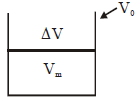
$A$ bakelite beaker has a volume capacity of $500\, cc$ at $30^{\circ} C$. When it is partially filled with $V_{m}$ volume (at $30^{\circ} C$) of mercury,it is found that the unfilled volume of the beaker remains constant as the temperature is varied. If $\gamma_{\text{beaker}} = 6 \times 10^{-6}{ }^{\circ} C^{-1}$ and $\gamma_{\text{mercury}} = 1.5 \times 10^{-4}{ }^{\circ} C^{-1}$,where $\gamma$ is the coefficient of volume expansion,then $V_{m}$ (in $cc$) is close to
A
$20$
B
$25$
C
$35$
D
$27$
Solution
(A) Let $V_{0}$ be the total capacity of the beaker and $V_{m}$ be the volume of mercury at $30^{\circ} C$. The unfilled volume is $\Delta V = V_{0} - V_{m}$.
When the temperature increases by $\Delta T$,the new capacity of the beaker is $V_{0}' = V_{0}(1 + \gamma_{b} \Delta T)$ and the new volume of mercury is $V_{m}' = V_{m}(1 + \gamma_{m} \Delta T)$.
The unfilled volume remains constant,so $\Delta V' = \Delta V$,which implies $V_{0}' - V_{m}' = V_{0} - V_{m}$.
Substituting the expressions for $V_{0}'$ and $V_{m}'$:
$V_{0}(1 + \gamma_{b} \Delta T) - V_{m}(1 + \gamma_{m} \Delta T) = V_{0} - V_{m}$
$V_{0} + V_{0} \gamma_{b} \Delta T - V_{m} - V_{m} \gamma_{m} \Delta T = V_{0} - V_{m}$
$V_{0} \gamma_{b} \Delta T = V_{m} \gamma_{m} \Delta T$
$V_{m} = \frac{V_{0} \gamma_{b}}{\gamma_{m}}$
Given $V_{0} = 500\, cc$,$\gamma_{b} = 6 \times 10^{-6}{ }^{\circ} C^{-1}$,and $\gamma_{m} = 1.5 \times 10^{-4}{ }^{\circ} C^{-1}$:
$V_{m} = \frac{500 \times 6 \times 10^{-6}}{1.5 \times 10^{-4}} = \frac{3000 \times 10^{-6}}{1.5 \times 10^{-4}} = \frac{3 \times 10^{-3}}{1.5 \times 10^{-4}} = 2 \times 10^{1} = 20\, cc$.
When the temperature increases by $\Delta T$,the new capacity of the beaker is $V_{0}' = V_{0}(1 + \gamma_{b} \Delta T)$ and the new volume of mercury is $V_{m}' = V_{m}(1 + \gamma_{m} \Delta T)$.
The unfilled volume remains constant,so $\Delta V' = \Delta V$,which implies $V_{0}' - V_{m}' = V_{0} - V_{m}$.
Substituting the expressions for $V_{0}'$ and $V_{m}'$:
$V_{0}(1 + \gamma_{b} \Delta T) - V_{m}(1 + \gamma_{m} \Delta T) = V_{0} - V_{m}$
$V_{0} + V_{0} \gamma_{b} \Delta T - V_{m} - V_{m} \gamma_{m} \Delta T = V_{0} - V_{m}$
$V_{0} \gamma_{b} \Delta T = V_{m} \gamma_{m} \Delta T$
$V_{m} = \frac{V_{0} \gamma_{b}}{\gamma_{m}}$
Given $V_{0} = 500\, cc$,$\gamma_{b} = 6 \times 10^{-6}{ }^{\circ} C^{-1}$,and $\gamma_{m} = 1.5 \times 10^{-4}{ }^{\circ} C^{-1}$:
$V_{m} = \frac{500 \times 6 \times 10^{-6}}{1.5 \times 10^{-4}} = \frac{3000 \times 10^{-6}}{1.5 \times 10^{-4}} = \frac{3 \times 10^{-3}}{1.5 \times 10^{-4}} = 2 \times 10^{1} = 20\, cc$.
0 likes
View Solution42
MediumMCQ
The apparent coefficient of expansion of a liquid when heated in a brass vessel is $X$ and when heated in a tin vessel is $Y$. If $\alpha$ is the coefficient of linear expansion for brass, the coefficient of linear expansion of tin is ..........
A
$\frac{X+Y+3 \alpha}{3}$
B
$\frac{X+3 \alpha-Y}{3}$
C
$\frac{X+Y-2 \alpha}{3}$
D
$\frac{X+Y-2 \alpha}{2}$
Solution
(B) The coefficient of real expansion of a liquid $(\gamma_r)$ is related to the apparent coefficient of expansion $(\gamma_a)$ and the coefficient of volume expansion of the vessel $(\gamma_v)$ by the relation: $\gamma_r = \gamma_a + \gamma_v$.
Let $\gamma_L$ be the coefficient of real volume expansion of the liquid.
For the brass vessel: $\gamma_L = X + 3\alpha$, where $3\alpha$ is the coefficient of volume expansion of brass.
For the tin vessel: $\gamma_L = Y + 3\alpha_{\text{tin}}$, where $\alpha_{\text{tin}}$ is the coefficient of linear expansion of tin.
Equating the two expressions for $\gamma_L$:
$X + 3\alpha = Y + 3\alpha_{\text{tin}}$
Rearranging to solve for $\alpha_{\text{tin}}$:
$3\alpha_{\text{tin}} = X + 3\alpha - Y$
$\alpha_{\text{tin}} = \frac{X + 3\alpha - Y}{3}$
Let $\gamma_L$ be the coefficient of real volume expansion of the liquid.
For the brass vessel: $\gamma_L = X + 3\alpha$, where $3\alpha$ is the coefficient of volume expansion of brass.
For the tin vessel: $\gamma_L = Y + 3\alpha_{\text{tin}}$, where $\alpha_{\text{tin}}$ is the coefficient of linear expansion of tin.
Equating the two expressions for $\gamma_L$:
$X + 3\alpha = Y + 3\alpha_{\text{tin}}$
Rearranging to solve for $\alpha_{\text{tin}}$:
$3\alpha_{\text{tin}} = X + 3\alpha - Y$
$\alpha_{\text{tin}} = \frac{X + 3\alpha - Y}{3}$
0 likes
View Solution43
EasyMCQ
The coefficient of volume expansion of glycerin is $49 \times 10^{-5} \, K^{-1}$. The fractional change in the density on a $30^{\circ} C$ rise in temperature is ..........
A
$1.47 \times 10^{-2}$
B
$1.47 \times 10^{-3}$
C
$1.47 \times 10^{-1}$
D
$1.47 \times 10^{-4}$
Solution
(A) Given: Coefficient of volume expansion $\gamma = 49 \times 10^{-5} \, K^{-1}$ and change in temperature $\Delta T = 30^{\circ} C = 30 \, K$.
The density $\rho$ of a substance at temperature $T + \Delta T$ is given by $\rho_2 = \frac{\rho_1}{1 + \gamma \Delta T} \approx \rho_1(1 - \gamma \Delta T)$ for small values of $\gamma \Delta T$.
Rearranging the terms,we get $\frac{\rho_1 - \rho_2}{\rho_1} = \gamma \Delta T$.
The fractional change in density is $\frac{\Delta \rho}{\rho_1} = \gamma \Delta T$.
Substituting the values: $\frac{\Delta \rho}{\rho_1} = (49 \times 10^{-5}) \times 30 = 1470 \times 10^{-5} = 1.47 \times 10^{-2}$.
The density $\rho$ of a substance at temperature $T + \Delta T$ is given by $\rho_2 = \frac{\rho_1}{1 + \gamma \Delta T} \approx \rho_1(1 - \gamma \Delta T)$ for small values of $\gamma \Delta T$.
Rearranging the terms,we get $\frac{\rho_1 - \rho_2}{\rho_1} = \gamma \Delta T$.
The fractional change in density is $\frac{\Delta \rho}{\rho_1} = \gamma \Delta T$.
Substituting the values: $\frac{\Delta \rho}{\rho_1} = (49 \times 10^{-5}) \times 30 = 1470 \times 10^{-5} = 1.47 \times 10^{-2}$.
0 likes
View Solution44
MediumMCQ
The coefficient of linear expansion of a vessel completely filled with $Hg$ is $1 \times 10^{-5} /^{\circ} C$. If there is no overflow of $Hg$ on heating the vessel,then the coefficient of cubical expansion of $Hg$ is:
A
$4 \times 10^{-5} /^{\circ} C$
B
$> 3 \times 10^{-5} /^{\circ} C$
C
$\leq 3 \times 10^{-5} /^{\circ} C$
D
Data is insufficient
Solution
(C) Let $\alpha$ be the coefficient of linear expansion of the vessel. Given $\alpha = 1 \times 10^{-5} /^{\circ} C$.
The coefficient of cubical expansion of the vessel is $\gamma_{\text{vessel}} = 3\alpha = 3 \times 1 \times 10^{-5} /^{\circ} C = 3 \times 10^{-5} /^{\circ} C$.
Let $\gamma_{\text{Hg}}$ be the coefficient of cubical expansion of $Hg$.
For no overflow to occur when the vessel is heated,the expansion of the $Hg$ must be less than or equal to the expansion of the vessel's volume.
Therefore,$\gamma_{\text{Hg}} \leq \gamma_{\text{vessel}}$.
Substituting the value,we get $\gamma_{\text{Hg}} \leq 3 \times 10^{-5} /^{\circ} C$.
The coefficient of cubical expansion of the vessel is $\gamma_{\text{vessel}} = 3\alpha = 3 \times 1 \times 10^{-5} /^{\circ} C = 3 \times 10^{-5} /^{\circ} C$.
Let $\gamma_{\text{Hg}}$ be the coefficient of cubical expansion of $Hg$.
For no overflow to occur when the vessel is heated,the expansion of the $Hg$ must be less than or equal to the expansion of the vessel's volume.
Therefore,$\gamma_{\text{Hg}} \leq \gamma_{\text{vessel}}$.
Substituting the value,we get $\gamma_{\text{Hg}} \leq 3 \times 10^{-5} /^{\circ} C$.
0 likes
View Solution45
MediumMCQ
$A$ liquid having a coefficient of cubical expansion $\gamma$ is kept in a copper vessel having a coefficient of linear expansion $\alpha = \frac{\gamma}{3}$. If heat is supplied to the vessel,the original level of the liquid in the vessel will
A
increase.
B
decrease.
C
remain almost the same.
D
may increase or decrease.
Solution
(C) The coefficient of cubical expansion of the vessel $(\gamma_v)$ is related to its coefficient of linear expansion $(\alpha)$ by the formula $\gamma_v = 3\alpha$.
Given that $\alpha = \frac{\gamma}{3}$,we have $\gamma_v = 3 \times (\frac{\gamma}{3}) = \gamma$.
Since the coefficient of cubical expansion of the liquid $(\gamma_l = \gamma)$ is equal to the coefficient of cubical expansion of the vessel $(\gamma_v = \gamma)$,both the liquid and the vessel expand by the same volume fraction for a given change in temperature.
Therefore,the level of the liquid in the vessel will remain almost the same.
Given that $\alpha = \frac{\gamma}{3}$,we have $\gamma_v = 3 \times (\frac{\gamma}{3}) = \gamma$.
Since the coefficient of cubical expansion of the liquid $(\gamma_l = \gamma)$ is equal to the coefficient of cubical expansion of the vessel $(\gamma_v = \gamma)$,both the liquid and the vessel expand by the same volume fraction for a given change in temperature.
Therefore,the level of the liquid in the vessel will remain almost the same.
0 likes
View Solution46
EasyMCQ
When water is heated from $0^{\circ} C$ to $10^{\circ} C$,its volume:
A
decreases
B
increases
C
does not change
D
first decreases and then increases
Solution
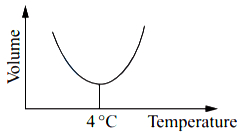
(D) Water exhibits anomalous expansion between $0^{\circ} C$ and $4^{\circ} C$.
As water is heated from $0^{\circ} C$ to $4^{\circ} C$,its density increases,which means its volume decreases.
At $4^{\circ} C$,water attains its maximum density and minimum volume.
When water is heated further from $4^{\circ} C$ to $10^{\circ} C$,it expands like a normal liquid,and its volume increases.
Therefore,the volume of water first decreases and then increases.
As water is heated from $0^{\circ} C$ to $4^{\circ} C$,its density increases,which means its volume decreases.
At $4^{\circ} C$,water attains its maximum density and minimum volume.
When water is heated further from $4^{\circ} C$ to $10^{\circ} C$,it expands like a normal liquid,and its volume increases.
Therefore,the volume of water first decreases and then increases.
0 likes
View Solution47
EasyMCQ
Which of the following curves represent the variation of coefficient of volume expansion of an ideal gas at constant pressure?
A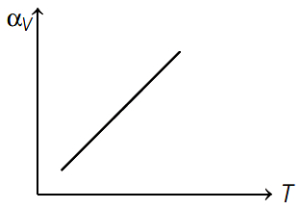
B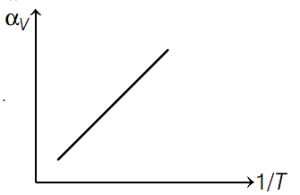
C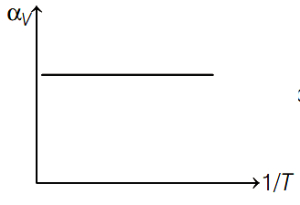
D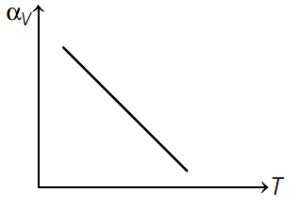
Solution
(B) Volume expansion is the expansion of the volume of a gas due to an increase in its temperature.
$\therefore$ The coefficient of volume expansion $\alpha_{V}$ is defined as:
$\alpha_{V} = \frac{1}{V} \left( \frac{\partial V}{\partial T} \right)_{p} ... (i)$
From the ideal gas equation,$pV = nRT$,we have $V = \frac{nRT}{p}$.
Differentiating with respect to $T$ at constant pressure $p$:
$\left( \frac{\partial V}{\partial T} \right)_{p} = \frac{nR}{p}$
Substituting this into equation $(i)$:
$\alpha_{V} = \frac{1}{V} \left( \frac{nR}{p} \right) = \frac{1}{V} \left( \frac{pV}{T} \cdot \frac{1}{p} \right) = \frac{1}{T}$
Thus,$\alpha_{V} = \frac{1}{T}$.
This implies that $\alpha_{V}$ is directly proportional to $\frac{1}{T}$. Therefore,a graph of $\alpha_{V}$ versus $\frac{1}{T}$ will be a straight line passing through the origin. This is correctly depicted in option $(b)$.
$\therefore$ The coefficient of volume expansion $\alpha_{V}$ is defined as:
$\alpha_{V} = \frac{1}{V} \left( \frac{\partial V}{\partial T} \right)_{p} ... (i)$
From the ideal gas equation,$pV = nRT$,we have $V = \frac{nRT}{p}$.
Differentiating with respect to $T$ at constant pressure $p$:
$\left( \frac{\partial V}{\partial T} \right)_{p} = \frac{nR}{p}$
Substituting this into equation $(i)$:
$\alpha_{V} = \frac{1}{V} \left( \frac{nR}{p} \right) = \frac{1}{V} \left( \frac{pV}{T} \cdot \frac{1}{p} \right) = \frac{1}{T}$
Thus,$\alpha_{V} = \frac{1}{T}$.
This implies that $\alpha_{V}$ is directly proportional to $\frac{1}{T}$. Therefore,a graph of $\alpha_{V}$ versus $\frac{1}{T}$ will be a straight line passing through the origin. This is correctly depicted in option $(b)$.
0 likes
View Solution48
EasyMCQ
The change in density of mercury,when it is heated from $10^{\circ} C$ to $60^{\circ} C$ is (The coefficient of volume expansion of mercury is $18.2 \times 10^{-5} \ K^{-1}$) (in $\%$)
A
$1.82$
B
$0.91$
C
$9.1$
D
$0.45$
Solution
(B) Density is given by $\rho = \frac{m}{V}$.
Since mass $m$ remains constant,$\rho \propto \frac{1}{V}$.
Taking the logarithmic derivative,we get $\frac{d\rho}{\rho} = -\frac{dV}{V}$.
For small changes,$\frac{\Delta \rho}{\rho} = -\frac{\Delta V}{V}$.
We know that $\Delta V = V_0 \gamma \Delta T$,where $\gamma$ is the coefficient of volume expansion.
Thus,$\frac{\Delta \rho}{\rho} = -\gamma \Delta T$.
The percentage change in density is $\frac{\Delta \rho}{\rho} \times 100 = -\gamma \Delta T \times 100$.
Given $\gamma = 18.2 \times 10^{-5} \ K^{-1}$ and $\Delta T = 60^{\circ} C - 10^{\circ} C = 50 \ K$.
Percentage change $= 18.2 \times 10^{-5} \times 50 \times 100 = 18.2 \times 10^{-5} \times 5000 = 0.91 \%$.
Since mass $m$ remains constant,$\rho \propto \frac{1}{V}$.
Taking the logarithmic derivative,we get $\frac{d\rho}{\rho} = -\frac{dV}{V}$.
For small changes,$\frac{\Delta \rho}{\rho} = -\frac{\Delta V}{V}$.
We know that $\Delta V = V_0 \gamma \Delta T$,where $\gamma$ is the coefficient of volume expansion.
Thus,$\frac{\Delta \rho}{\rho} = -\gamma \Delta T$.
The percentage change in density is $\frac{\Delta \rho}{\rho} \times 100 = -\gamma \Delta T \times 100$.
Given $\gamma = 18.2 \times 10^{-5} \ K^{-1}$ and $\Delta T = 60^{\circ} C - 10^{\circ} C = 50 \ K$.
Percentage change $= 18.2 \times 10^{-5} \times 50 \times 100 = 18.2 \times 10^{-5} \times 5000 = 0.91 \%$.
0 likes
View Solution49
MediumMCQ
$A$ glass vessel of volume $V_0$ is completely filled with a liquid and its temperature is raised by $\Delta T$. What volume of the liquid will flow over,if the coefficient of linear expansion of glass is $\alpha_g$ and the coefficient of volume expansion of the liquid is $\gamma_L$?
A
$V_0 \Delta T(\gamma_L - 3\alpha_g)$
B
$V_0 \Delta T(3\alpha_g - \gamma_L)$
C
$(\gamma_L - 3\alpha_g) \Delta T$
D
$(3\alpha_g - \gamma_L) \Delta T$
Solution
(A) The volume of the liquid that overflows is equal to the difference between the expansion of the liquid and the expansion of the glass vessel.
Increase in volume of liquid,$\Delta V_L = V_0 \gamma_L \Delta T$.
Increase in volume of the glass vessel,$\Delta V_g = V_0 \gamma_g \Delta T$.
Since the coefficient of volume expansion $\gamma_g = 3\alpha_g$,we have $\Delta V_g = V_0 (3\alpha_g) \Delta T$.
The volume of liquid that overflows is $\Delta V_{overflow} = \Delta V_L - \Delta V_g$.
$\Delta V_{overflow} = V_0 \gamma_L \Delta T - V_0 (3\alpha_g) \Delta T$.
$\Delta V_{overflow} = V_0 \Delta T (\gamma_L - 3\alpha_g)$.
Increase in volume of liquid,$\Delta V_L = V_0 \gamma_L \Delta T$.
Increase in volume of the glass vessel,$\Delta V_g = V_0 \gamma_g \Delta T$.
Since the coefficient of volume expansion $\gamma_g = 3\alpha_g$,we have $\Delta V_g = V_0 (3\alpha_g) \Delta T$.
The volume of liquid that overflows is $\Delta V_{overflow} = \Delta V_L - \Delta V_g$.
$\Delta V_{overflow} = V_0 \gamma_L \Delta T - V_0 (3\alpha_g) \Delta T$.
$\Delta V_{overflow} = V_0 \Delta T (\gamma_L - 3\alpha_g)$.
0 likes
View Solution50
DifficultMCQ
$A$ glass flask of volume $1 \text{ litre}$ is filled completely with mercury at $0^{\circ} C$. The flask is now heated to $100^{\circ} C$. The coefficient of volume expansion of mercury is $1.82 \times 10^{-4} /{ }^{\circ} C$ and the coefficient of linear expansion of glass is $0.1 \times 10^{-4} /{ }^{\circ} C$. During this process, the amount of mercury which overflows is (in $\text{ cc}$)
A
$21.2$
B
$15.2$
C
$2.12$
D
$18.2$
Solution
(B) The volume of mercury that overflows is equal to the difference in the volume expansion of mercury and the glass flask.
$\Delta V = V_0 (\gamma_m - \gamma_g) \Delta \theta$
Given that $\gamma_g = 3 \alpha_g$, where $\alpha_g$ is the coefficient of linear expansion of glass.
$\gamma_g = 3 \times (0.1 \times 10^{-4} /{ }^{\circ} C) = 0.3 \times 10^{-4} /{ }^{\circ} C = 30 \times 10^{-6} /{ }^{\circ} C$
Given $\gamma_m = 1.82 \times 10^{-4} /{ }^{\circ} C = 182 \times 10^{-6} /{ }^{\circ} C$, $V_0 = 1 \text{ litre} = 1000 \text{ cc}$, and $\Delta \theta = 100^{\circ} C$.
$\Delta V = 1000 \times (182 \times 10^{-6} - 30 \times 10^{-6}) \times 100$
$\Delta V = 1000 \times (152 \times 10^{-6}) \times 100 = 15.2 \text{ cc}$
Thus, the amount of mercury that overflows is $15.2 \text{ cc}$.
$\Delta V = V_0 (\gamma_m - \gamma_g) \Delta \theta$
Given that $\gamma_g = 3 \alpha_g$, where $\alpha_g$ is the coefficient of linear expansion of glass.
$\gamma_g = 3 \times (0.1 \times 10^{-4} /{ }^{\circ} C) = 0.3 \times 10^{-4} /{ }^{\circ} C = 30 \times 10^{-6} /{ }^{\circ} C$
Given $\gamma_m = 1.82 \times 10^{-4} /{ }^{\circ} C = 182 \times 10^{-6} /{ }^{\circ} C$, $V_0 = 1 \text{ litre} = 1000 \text{ cc}$, and $\Delta \theta = 100^{\circ} C$.
$\Delta V = 1000 \times (182 \times 10^{-6} - 30 \times 10^{-6}) \times 100$
$\Delta V = 1000 \times (152 \times 10^{-6}) \times 100 = 15.2 \text{ cc}$
Thus, the amount of mercury that overflows is $15.2 \text{ cc}$.
0 likes
View Solution10-1.Thermometry, Thermal Expansion and Calorimetry — Thermal Expansion for fluid · Frequently Asked Questions
1Are these 10-1.Thermometry, Thermal Expansion and Calorimetry questions useful for JEE and NEET?
Yes. All questions in this section are mapped to JEE Main and NEET exam patterns. Previous year questions from JEE Main, NEET, GUJCET and state-level exams are included with full solutions.
2Can I switch to Hindi or Gujarati for these questions?
Yes. Use the language tabs in the hero section or the sidebar to view the same questions and solutions in English, Hindi or Gujarati.
3How do I generate a question paper from this subtopic?
Use the Vedclass Exam Paper Generator — select the chapter and subtopic, set difficulty, and generate Sets A, B, C, D automatically. First 3 chapters of every subject are free.
Vedclass Products
For Students
Vedclass Test Series
Mock tests in real JEE/NEET style with performance analysis. 5-day free trial.
Start Free TrialFor Teachers
Exam Paper Generator
Generate Set A/B/C/D papers from this chapter in 2 minutes. 3 chapters free.
Try FreeFor Institutes
Online Exam Module
Live online exams with unlimited students, 360° analytics & white-label branding.
See DemoFor Teachers & Institutes
Generate a 10-1.Thermometry, Thermal Expansion and Calorimetry Exam Paper in 2 Minutes
Select subtopic & difficulty — Sets A, B, C, D auto-generated with No Repeat logic.
First 3 chapters of every subject are free — no payment required.