
A English
Latent Heat and Heating Curve Questions in English
Class 11 Physics · 10-1.Thermometry, Thermal Expansion and Calorimetry · Latent Heat and Heating Curve
63+
Questions
English
Language
100%
With Solutions
Showing 50 of 63 questions in English
1
EasyMCQ
When vapour condenses into liquid,
A
It absorbs heat
B
It liberates heat
C
Its temperature increases
D
Its temperature decreases
Solution
(B) During the phase transition from vapour to liquid,the substance releases energy in the form of latent heat of vaporization. Therefore,the system liberates heat to the surroundings while the temperature remains constant during the phase change process.
0 likes
View Solution2
EasyMCQ
$A$ quantity of heat required to change the unit mass of a solid substance,from solid state to liquid state,while the temperature remains constant,is known as
A
Latent heat
B
Sublimation
C
Hoar frost
D
Latent heat of fusion
Solution
(D) The quantity of heat required to change the unit mass of a solid substance from the solid state to the liquid state at its melting point,while the temperature remains constant,is defined as the latent heat of fusion. Therefore,the correct option is $D$.
0 likes
View Solution3
EasyMCQ
The latent heat of vaporization of a substance is always
A
Greater than its latent heat of fusion
B
Greater than its latent heat of sublimation
C
Equal to its latent heat of sublimation
D
Less than its latent heat of fusion
Solution
(A) The latent heat of vaporization $(L_v)$ is always greater than the latent heat of fusion $(L_f)$.
This is because,during the phase change from liquid to vapor,there is a significant increase in the volume of the substance,which requires a large amount of work to be done against external pressure.
Additionally,the intermolecular forces in a liquid must be completely overcome to transition into a gas,whereas in the solid-to-liquid transition,these forces are only partially weakened.
Therefore,more heat energy is required for vaporization compared to the fusion process.
This is because,during the phase change from liquid to vapor,there is a significant increase in the volume of the substance,which requires a large amount of work to be done against external pressure.
Additionally,the intermolecular forces in a liquid must be completely overcome to transition into a gas,whereas in the solid-to-liquid transition,these forces are only partially weakened.
Therefore,more heat energy is required for vaporization compared to the fusion process.
0 likes
View Solution4
EasyMCQ
Compared to a burn due to water at $100^{\circ}C$,a burn due to steam at $100^{\circ}C$ is
A
More dangerous
B
Less dangerous
C
Equally dangerous
D
None of these
Solution
(A) Steam at $100^{\circ}C$ contains an additional latent heat of vaporization,which is approximately $540 \ cal/g$,compared to water at the same temperature of $100^{\circ}C$.
When steam comes into contact with the skin,it releases this latent heat as it condenses into water at $100^{\circ}C$.
Therefore,the total energy released by steam is significantly higher than that released by water at the same temperature,making a burn from steam much more severe.
When steam comes into contact with the skin,it releases this latent heat as it condenses into water at $100^{\circ}C$.
Therefore,the total energy released by steam is significantly higher than that released by water at the same temperature,making a burn from steam much more severe.
0 likes
View Solution5
EasyMCQ
$A$ metallic ball and a highly stretched spring are made of the same material and have the same mass. They are heated so that they melt. The latent heat required:
A
Is the same for both
B
Is greater for the ball
C
Is greater for the spring
D
May or may not be the same depending upon the metal
Solution
(A) Latent heat is a property of the material that depends on the mass of the substance undergoing a phase change.
It is defined as $Q = mL$,where $m$ is the mass and $L$ is the specific latent heat of fusion.
Since both the metallic ball and the spring are made of the same material,their specific latent heat $L$ is identical.
Given that their masses $m$ are also the same,the total latent heat required $Q$ must be the same for both.
The energy spent in stretching the spring is stored as elastic potential energy,which is an ordered form of energy.
Latent heat,however,relates to the energy required to overcome intermolecular forces during a phase transition,which is independent of the initial configuration or the internal elastic energy of the object.
It is defined as $Q = mL$,where $m$ is the mass and $L$ is the specific latent heat of fusion.
Since both the metallic ball and the spring are made of the same material,their specific latent heat $L$ is identical.
Given that their masses $m$ are also the same,the total latent heat required $Q$ must be the same for both.
The energy spent in stretching the spring is stored as elastic potential energy,which is an ordered form of energy.
Latent heat,however,relates to the energy required to overcome intermolecular forces during a phase transition,which is independent of the initial configuration or the internal elastic energy of the object.
0 likes
View Solution6
MediumMCQ
$0.93 \, Wh$ of energy is supplied to a block of ice weighing $10 \, g$. It is found that:
A
Half of the block melts
B
The entire block melts and the water attains a temperature of $4^{\circ}C$
C
The entire block just melts
D
The block remains unchanged
Solution
(C) Energy supplied $E = 0.93 \, Wh = 0.93 \times 3600 \, J = 3348 \, J$.
Heat required to melt $10 \, g$ of ice at $0^{\circ}C$ is given by $Q = mL_f$,where $L_f = 80 \, cal/g = 80 \times 4.184 \, J/g = 334.72 \, J/g$.
$Q = 10 \, g \times 334.72 \, J/g = 3347.2 \, J$.
Since the energy supplied $(3348 \, J)$ is approximately equal to the heat required to melt the ice $(3347.2 \, J)$,the entire block of ice just melts.
Heat required to melt $10 \, g$ of ice at $0^{\circ}C$ is given by $Q = mL_f$,where $L_f = 80 \, cal/g = 80 \times 4.184 \, J/g = 334.72 \, J/g$.
$Q = 10 \, g \times 334.72 \, J/g = 3347.2 \, J$.
Since the energy supplied $(3348 \, J)$ is approximately equal to the heat required to melt the ice $(3347.2 \, J)$,the entire block of ice just melts.
0 likes
View Solution7
EasyMCQ
At $100^{\circ}C,$ the substance that causes the most severe burn is:
A
Oil
B
Steam
C
Water
D
Hot air
Solution
(B) The correct answer is $B$.
At $100^{\circ}C,$ steam causes more severe burns than boiling water because steam contains additional latent heat of vaporization.
When steam comes in contact with the skin,it releases this latent heat $(L_v \approx 2260 \ J/g)$ in addition to the heat released by cooling to $100^{\circ}C$ water,resulting in a much higher total energy transfer to the skin.
At $100^{\circ}C,$ steam causes more severe burns than boiling water because steam contains additional latent heat of vaporization.
When steam comes in contact with the skin,it releases this latent heat $(L_v \approx 2260 \ J/g)$ in addition to the heat released by cooling to $100^{\circ}C$ water,resulting in a much higher total energy transfer to the skin.
0 likes
View Solution8
EasyMCQ
Boiling water is changing into steam. At this stage,the specific heat of water is
A
$< 1$
B
$\infty$
C
$1$
D
$0$
Solution
(B) The formula for specific heat capacity is $c = \frac{Q}{m \cdot \Delta \theta}$.
During the phase change from water to steam (boiling),the temperature of the substance remains constant,meaning the change in temperature $\Delta \theta = 0$.
Substituting this into the formula,we get $c = \frac{Q}{m \cdot 0} = \infty$.
Therefore,the specific heat capacity of water during boiling is infinite.
During the phase change from water to steam (boiling),the temperature of the substance remains constant,meaning the change in temperature $\Delta \theta = 0$.
Substituting this into the formula,we get $c = \frac{Q}{m \cdot 0} = \infty$.
Therefore,the specific heat capacity of water during boiling is infinite.
0 likes
View Solution9
MediumMCQ
$A$ substance of mass $m \ kg$ requires a power input of $P \ W$ to remain in the molten state at its melting point. When the power is turned off,the sample completely solidifies in time $t \ s$. What is the latent heat of fusion of the substance?
A
$\frac{Pm}{t}$
B
$\frac{Pt}{m}$
C
$\frac{m}{Pt}$
D
$\frac{t}{Pm}$
Solution
(B) The power $P$ supplied is used to maintain the substance in the molten state by compensating for the heat lost to the surroundings.
When the power is turned off,the substance solidifies by releasing its latent heat of fusion $L$ over time $t$.
The total heat released during solidification is $Q = mL$.
The rate of heat loss is $\frac{Q}{t} = \frac{mL}{t}$.
Since the power $P$ was required to maintain the molten state,it must be equal to the rate of heat loss: $P = \frac{mL}{t}$.
Solving for $L$,we get $L = \frac{Pt}{m}$.
When the power is turned off,the substance solidifies by releasing its latent heat of fusion $L$ over time $t$.
The total heat released during solidification is $Q = mL$.
The rate of heat loss is $\frac{Q}{t} = \frac{mL}{t}$.
Since the power $P$ was required to maintain the molten state,it must be equal to the rate of heat loss: $P = \frac{mL}{t}$.
Solving for $L$,we get $L = \frac{Pt}{m}$.
0 likes
View Solution10
EasyMCQ
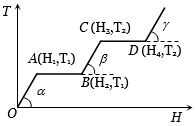
The graph shows the variation of temperature $(T)$ of one kilogram of a material with the heat $(H)$ supplied to it. At $O$,the substance is in the solid state. From the graph,we can conclude that
A
$T_1$ is the melting point of the solid
B
$BC$ represents the change of state from solid to liquid
C
$(H_2 - H_1)$ represents the latent heat of fusion of the substance
D
$(H_3 - H_1)$ represents the latent heat of vaporization of the liquid
Solution
(C) In the heating curve,the horizontal regions represent phase changes where the temperature remains constant.
$1$. In the region between $H_1$ and $H_2$,the temperature is constant at $T_1$. This indicates a phase change from solid to liquid. The heat absorbed during this process is $(H_2 - H_1)$,which is the latent heat of fusion.
$2$. In the region between $H_3$ and $H_4$,the temperature is constant at $T_2$. This indicates a phase change from liquid to gas. The heat absorbed during this process is $(H_4 - H_3)$,which is the latent heat of vaporization.
Therefore,option $(C)$ is correct because $(H_2 - H_1)$ represents the latent heat of fusion.
$1$. In the region between $H_1$ and $H_2$,the temperature is constant at $T_1$. This indicates a phase change from solid to liquid. The heat absorbed during this process is $(H_2 - H_1)$,which is the latent heat of fusion.
$2$. In the region between $H_3$ and $H_4$,the temperature is constant at $T_2$. This indicates a phase change from liquid to gas. The heat absorbed during this process is $(H_4 - H_3)$,which is the latent heat of vaporization.
Therefore,option $(C)$ is correct because $(H_2 - H_1)$ represents the latent heat of fusion.
0 likes
View Solution11
EasyMCQ
$A$ block of ice at $-10^{\circ}C$ is slowly heated and converted to steam at $100^{\circ}C$. Which of the following curves represents the phenomenon qualitatively?
A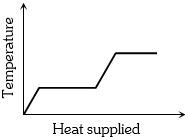
B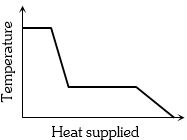
C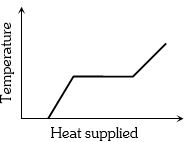
D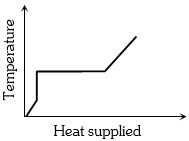
Solution
(A) The process of heating ice from $-10^{\circ}C$ to steam at $100^{\circ}C$ involves several stages:
$1$. Heating ice from $-10^{\circ}C$ to $0^{\circ}C$: The temperature rises linearly as heat is supplied.
$2$. Melting ice at $0^{\circ}C$: The temperature remains constant at $0^{\circ}C$ while the phase changes from solid to liquid (latent heat of fusion).
$3$. Heating water from $0^{\circ}C$ to $100^{\circ}C$: The temperature rises linearly as heat is supplied.
$4$. Boiling water at $100^{\circ}C$: The temperature remains constant at $100^{\circ}C$ while the phase changes from liquid to gas (latent heat of vaporization).
Therefore, the heating curve must show two linear rising segments separated by a horizontal segment (melting) and followed by another horizontal segment (boiling). Option $A$ correctly represents this sequence.
$1$. Heating ice from $-10^{\circ}C$ to $0^{\circ}C$: The temperature rises linearly as heat is supplied.
$2$. Melting ice at $0^{\circ}C$: The temperature remains constant at $0^{\circ}C$ while the phase changes from solid to liquid (latent heat of fusion).
$3$. Heating water from $0^{\circ}C$ to $100^{\circ}C$: The temperature rises linearly as heat is supplied.
$4$. Boiling water at $100^{\circ}C$: The temperature remains constant at $100^{\circ}C$ while the phase changes from liquid to gas (latent heat of vaporization).
Therefore, the heating curve must show two linear rising segments separated by a horizontal segment (melting) and followed by another horizontal segment (boiling). Option $A$ correctly represents this sequence.
1 likes
View Solution12
MediumMCQ
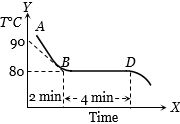
The figure given below shows the cooling curve of a pure wax material after heating. It cools from $A$ to $B$ and solidifies along $BD$. If $L$ and $C$ are the respective values of latent heat and the specific heat of the liquid wax,the ratio $L/C$ is
A
$40$
B
$80$
C
$100$
D
$20$
Solution
(D) Let $P$ be the rate of heat loss (power) per unit time.
During the cooling phase from $A$ to $B$,the temperature drops from $90^{\circ}C$ to $80^{\circ}C$ in $t_1 = 2 \text{ min}$. The heat lost is given by $Q_1 = mC\Delta T = mC(90 - 80) = 10mC$.
Since $Q_1 = P \times t_1$,we have $10mC = P \times 2$,which implies $P = 5mC$.
During the solidification phase from $B$ to $D$,the temperature remains constant at $80^{\circ}C$ for $t_2 = 4 \text{ min}$. The heat lost is the latent heat,given by $Q_2 = mL$.
Since $Q_2 = P \times t_2$,we have $mL = P \times 4$.
Substituting the value of $P$ from the first equation into the second:
$mL = (5mC) \times 4$
$mL = 20mC$
$\frac{L}{C} = 20$.
During the cooling phase from $A$ to $B$,the temperature drops from $90^{\circ}C$ to $80^{\circ}C$ in $t_1 = 2 \text{ min}$. The heat lost is given by $Q_1 = mC\Delta T = mC(90 - 80) = 10mC$.
Since $Q_1 = P \times t_1$,we have $10mC = P \times 2$,which implies $P = 5mC$.
During the solidification phase from $B$ to $D$,the temperature remains constant at $80^{\circ}C$ for $t_2 = 4 \text{ min}$. The heat lost is the latent heat,given by $Q_2 = mL$.
Since $Q_2 = P \times t_2$,we have $mL = P \times 4$.
Substituting the value of $P$ from the first equation into the second:
$mL = (5mC) \times 4$
$mL = 20mC$
$\frac{L}{C} = 20$.
0 likes
View Solution13
EasyMCQ
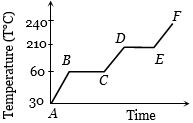
$A$ solid substance is at $30^{\circ}C$. To this substance,heat energy is supplied at a constant rate. The temperature versus time graph is as shown in the figure. The substance is in the liquid state for the portion of the graph:
A
$BC$
B
$CD$
C
$DE$
D
$EF$
Solution
(B) In a heating curve,the sloped portions represent a single phase where the temperature increases as heat is added,while the horizontal portions represent phase changes where the temperature remains constant.
$1$. The portion $AB$ represents the solid phase being heated.
$2$. The portion $BC$ represents the phase change from solid to liquid (melting) at a constant temperature of $60^{\circ}C$.
$3$. The portion $CD$ represents the liquid phase being heated from $60^{\circ}C$ to $210^{\circ}C$.
$4$. The portion $DE$ represents the phase change from liquid to gas (boiling) at a constant temperature of $210^{\circ}C$.
$5$. The portion $EF$ represents the gaseous phase being heated.
Therefore,the substance is in the liquid state during the portion $CD$.
$1$. The portion $AB$ represents the solid phase being heated.
$2$. The portion $BC$ represents the phase change from solid to liquid (melting) at a constant temperature of $60^{\circ}C$.
$3$. The portion $CD$ represents the liquid phase being heated from $60^{\circ}C$ to $210^{\circ}C$.
$4$. The portion $DE$ represents the phase change from liquid to gas (boiling) at a constant temperature of $210^{\circ}C$.
$5$. The portion $EF$ represents the gaseous phase being heated.
Therefore,the substance is in the liquid state during the portion $CD$.
0 likes
View Solution14
MediumMCQ
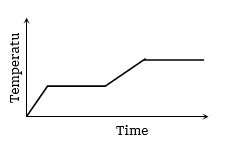
Heat is supplied to a certain homogeneous sample of matter at a uniform rate. Its temperature is plotted against time,as shown. Which of the following conclusions can be drawn?
A
Its specific heat capacity is greater in the solid state than in the liquid state.
B
Its specific heat capacity is greater in the liquid state than in the solid state.
C
Its latent heat of vaporization is greater than its latent heat of fusion.
D
Both $(b)$ and $(c)$.
Solution
(C) The horizontal parts of the heating curve represent phase changes where the temperature remains constant despite the continuous supply of heat. The length of these horizontal segments is proportional to the latent heat required for the phase change.
$1$. In the provided graph,there is one horizontal segment representing a phase change (e.g.,melting or vaporization). However,looking at the slope of the temperature-time graph,the slope is given by $\frac{dT}{dt} = \frac{P}{ms}$,where $P$ is the power (rate of heat supply),$m$ is the mass,and $s$ is the specific heat capacity.
$2$. Since $P$ and $m$ are constant,the specific heat capacity $s$ is inversely proportional to the slope $(s \propto \frac{1}{\text{slope}})$.
$3$. The graph shows a single sloping line. If we compare the latent heat segments (if multiple were present),we would compare their lengths. Given the options,we evaluate the latent heat of vaporization vs fusion. In standard heating curves for substances like water,the latent heat of vaporization is significantly larger than the latent heat of fusion. Thus,the horizontal segment corresponding to vaporization is longer than the one for fusion. Therefore,the conclusion that the latent heat of vaporization is greater than the latent heat of fusion is correct.
$1$. In the provided graph,there is one horizontal segment representing a phase change (e.g.,melting or vaporization). However,looking at the slope of the temperature-time graph,the slope is given by $\frac{dT}{dt} = \frac{P}{ms}$,where $P$ is the power (rate of heat supply),$m$ is the mass,and $s$ is the specific heat capacity.
$2$. Since $P$ and $m$ are constant,the specific heat capacity $s$ is inversely proportional to the slope $(s \propto \frac{1}{\text{slope}})$.
$3$. The graph shows a single sloping line. If we compare the latent heat segments (if multiple were present),we would compare their lengths. Given the options,we evaluate the latent heat of vaporization vs fusion. In standard heating curves for substances like water,the latent heat of vaporization is significantly larger than the latent heat of fusion. Thus,the horizontal segment corresponding to vaporization is longer than the one for fusion. Therefore,the conclusion that the latent heat of vaporization is greater than the latent heat of fusion is correct.
0 likes
View Solution15
EasyMCQ
The graph signifies:
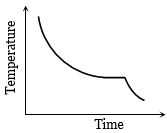
A
Adiabatic expansion of a gas
B
Isothermal expansion of a gas
C
Change of state from liquid to solid
D
Cooling of a heated solid
Solution
(C) The graph shows a cooling curve where the temperature decreases with time.
There is a horizontal portion in the graph where the temperature remains constant even as time passes.
This constant temperature region indicates a phase change,specifically the release of latent heat during the transition from liquid to solid (freezing).
Therefore,the graph represents the change of state from liquid to solid.
There is a horizontal portion in the graph where the temperature remains constant even as time passes.
This constant temperature region indicates a phase change,specifically the release of latent heat during the transition from liquid to solid (freezing).
Therefore,the graph represents the change of state from liquid to solid.
0 likes
View Solution16
MediumMCQ
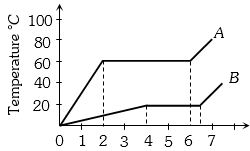
Two substances $A$ and $B$ of equal mass $m$ are heated at a uniform rate of $6 \, cal \, s^{-1}$ under similar conditions. $A$ graph between temperature and time is shown in the figure. The ratio of heat absorbed $H_A/H_B$ by them for complete fusion is
A
$\frac{9}{4}$
B
$\frac{4}{9}$
C
$\frac{8}{5}$
D
$\frac{5}{8}$
Solution
(C) From the given heating curve,the heat absorbed during fusion is given by $H = P \times t$,where $P$ is the power (rate of heating) and $t$ is the time taken for the phase change (fusion).
For substance $A$:
The fusion process occurs at a constant temperature of $60^\circ C$. The time interval for this phase change is from $t = 2 \, min$ to $t = 6 \, min$.
Time taken for fusion,$t_A = 6 - 2 = 4 \, min = 4 \times 60 \, s = 240 \, s$.
Heat absorbed by $A$,$H_A = P \times t_A = 6 \, cal \, s^{-1} \times 240 \, s = 1440 \, cal$.
For substance $B$:
The fusion process occurs at a constant temperature of $20^\circ C$. The time interval for this phase change is from $t = 4 \, min$ to $t = 6.5 \, min$.
Time taken for fusion,$t_B = 6.5 - 4 = 2.5 \, min = 2.5 \times 60 \, s = 150 \, s$.
Heat absorbed by $B$,$H_B = P \times t_B = 6 \, cal \, s^{-1} \times 150 \, s = 900 \, cal$.
Ratio of heat absorbed:
$\frac{H_A}{H_B} = \frac{1440}{900} = \frac{144}{90} = \frac{8}{5}$.
For substance $A$:
The fusion process occurs at a constant temperature of $60^\circ C$. The time interval for this phase change is from $t = 2 \, min$ to $t = 6 \, min$.
Time taken for fusion,$t_A = 6 - 2 = 4 \, min = 4 \times 60 \, s = 240 \, s$.
Heat absorbed by $A$,$H_A = P \times t_A = 6 \, cal \, s^{-1} \times 240 \, s = 1440 \, cal$.
For substance $B$:
The fusion process occurs at a constant temperature of $20^\circ C$. The time interval for this phase change is from $t = 4 \, min$ to $t = 6.5 \, min$.
Time taken for fusion,$t_B = 6.5 - 4 = 2.5 \, min = 2.5 \times 60 \, s = 150 \, s$.
Heat absorbed by $B$,$H_B = P \times t_B = 6 \, cal \, s^{-1} \times 150 \, s = 900 \, cal$.
Ratio of heat absorbed:
$\frac{H_A}{H_B} = \frac{1440}{900} = \frac{144}{90} = \frac{8}{5}$.
0 likes
View Solution17
EasyMCQ
The latent heat of vaporization of a substance is....
A
greater than its latent heat of fusion.
B
greater than its latent heat of sublimation.
C
equal to its latent heat of sublimation.
D
less than its latent heat of fusion.
Solution
(A) During the phase transition from liquid to gas,there is a significant increase in volume.
Therefore,to perform the phase transition at a constant temperature,more energy is required to overcome the intermolecular forces and expand the substance compared to the energy required for the phase transition from solid to liquid.
Therefore,to perform the phase transition at a constant temperature,more energy is required to overcome the intermolecular forces and expand the substance compared to the energy required for the phase transition from solid to liquid.
0 likes
View Solution18
DifficultMCQ
During an experiment,it takes $10 \text{ minutes}$ to raise the temperature of water from $0 \text{ °C}$ to $100 \text{ °C}$,and then it takes another $55 \text{ minutes}$ for the water to completely convert into steam. The value of the latent heat of vaporization is ....... $\text{cal/g}$.
A
$530$
B
$540$
C
$550$
D
$560$
Solution
(C) Let $m$ be the mass of water. The heat required to raise the temperature from $0 \text{ °C}$ to $100 \text{ °C}$ is $Q_1 = m \cdot c \cdot \Delta T = m \cdot 1 \cdot (100 - 0) = 100m \text{ cal}$.
Given that this process takes $10 \text{ minutes}$,the rate of heat supply is $P = \frac{100m}{10} = 10m \text{ cal/min}$.
Now,the water is converted into steam at $100 \text{ °C}$ in $55 \text{ minutes}$. The heat required for this phase change is $Q_2 = m \cdot L$.
The heat supplied in $55 \text{ minutes}$ is $Q_2 = P \times 55 = 10m \times 55 = 550m \text{ cal}$.
Equating $Q_2 = mL$,we get $mL = 550m$,which implies $L = 550 \text{ cal/g}$.
Given that this process takes $10 \text{ minutes}$,the rate of heat supply is $P = \frac{100m}{10} = 10m \text{ cal/min}$.
Now,the water is converted into steam at $100 \text{ °C}$ in $55 \text{ minutes}$. The heat required for this phase change is $Q_2 = m \cdot L$.
The heat supplied in $55 \text{ minutes}$ is $Q_2 = P \times 55 = 10m \times 55 = 550m \text{ cal}$.
Equating $Q_2 = mL$,we get $mL = 550m$,which implies $L = 550 \text{ cal/g}$.
1 likes
View Solution19
EasyMCQ
When boiling water converts into steam,what is the specific heat of water at this state?
A
$< 1$
B
$\infty$
C
$1$
D
$0$
Solution
(B) The process of converting boiling water into steam is a phase change process occurring at a constant temperature (isothermal process).
For any substance,the specific heat capacity $s$ is defined by the formula:
$Q = ms \Delta T$
Rearranging for $s$,we get:
$s = \frac{Q}{m \Delta T}$
In a phase change process,the temperature remains constant,so the change in temperature $\Delta T = 0$.
Substituting $\Delta T = 0$ into the formula:
$s = \frac{Q}{m \times 0} = \infty$
Therefore,the specific heat of water during the phase change from liquid to steam is infinite.
For any substance,the specific heat capacity $s$ is defined by the formula:
$Q = ms \Delta T$
Rearranging for $s$,we get:
$s = \frac{Q}{m \Delta T}$
In a phase change process,the temperature remains constant,so the change in temperature $\Delta T = 0$.
Substituting $\Delta T = 0$ into the formula:
$s = \frac{Q}{m \times 0} = \infty$
Therefore,the specific heat of water during the phase change from liquid to steam is infinite.
0 likes
View Solution20
DifficultMCQ
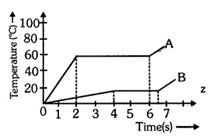
Two substances $A$ and $B$ of equal mass are heated at a constant rate of $6 \ cal \ s^{-1}$. The graph shows the temperature versus time. What is the ratio of the heat absorbed for complete melting $H_A/H_B$?
A
$9/4$
B
$4/9$
C
$8/5$
D
$5/8$
Solution
(C) The heat absorbed during the phase change (melting) is given by $H = mL$,where $m$ is the mass and $L$ is the latent heat of fusion.
Since the substances are heated at a constant rate $P = 6 \ cal \ s^{-1}$,the heat absorbed is $H = P \times \Delta t$,where $\Delta t$ is the time interval during which the substance is melting (the horizontal part of the graph).
For substance $A$,the melting occurs from $t = 2 \ s$ to $t = 6 \ s$,so $\Delta t_A = 6 - 2 = 4 \ s$.
For substance $B$,the melting occurs from $t = 4 \ s$ to $t = 6.5 \ s$,so $\Delta t_B = 6.5 - 4 = 2.5 \ s$.
Since the masses are equal,the ratio of heat absorbed is $H_A/H_B = (P \times \Delta t_A) / (P \times \Delta t_B) = \Delta t_A / \Delta t_B$.
$H_A/H_B = 4 / 2.5 = 40 / 25 = 8/5$.
Since the substances are heated at a constant rate $P = 6 \ cal \ s^{-1}$,the heat absorbed is $H = P \times \Delta t$,where $\Delta t$ is the time interval during which the substance is melting (the horizontal part of the graph).
For substance $A$,the melting occurs from $t = 2 \ s$ to $t = 6 \ s$,so $\Delta t_A = 6 - 2 = 4 \ s$.
For substance $B$,the melting occurs from $t = 4 \ s$ to $t = 6.5 \ s$,so $\Delta t_B = 6.5 - 4 = 2.5 \ s$.
Since the masses are equal,the ratio of heat absorbed is $H_A/H_B = (P \times \Delta t_A) / (P \times \Delta t_B) = \Delta t_A / \Delta t_B$.
$H_A/H_B = 4 / 2.5 = 40 / 25 = 8/5$.
0 likes
View Solution21
EasyMCQ
Fire is extinguished more effectively by
A
Hot water
B
Cold water
C
Equally by both
D
Ice
Solution
(A) Fire is extinguished primarily by the vaporization of water,which absorbs a large amount of latent heat from the burning body,thereby lowering its temperature below the ignition point.
Additionally,the water vapor produced forms a blanket around the burning material,cutting off the supply of oxygen,which is necessary for combustion.
Hot water is more effective than cold water because it is already closer to its boiling point,allowing it to vaporize much more rapidly upon contact with the fire,thus creating a larger volume of steam to displace oxygen and absorb heat more quickly.
Additionally,the water vapor produced forms a blanket around the burning material,cutting off the supply of oxygen,which is necessary for combustion.
Hot water is more effective than cold water because it is already closer to its boiling point,allowing it to vaporize much more rapidly upon contact with the fire,thus creating a larger volume of steam to displace oxygen and absorb heat more quickly.
0 likes
View Solution22
MediumMCQ
Latent heat of ice is $80 \, cal/g$. $A$ man melts $60 \, g$ of ice by chewing in $1 \, minute$. His power is ........ $W$.
A
$4800$
B
$336$
C
$1.33$
D
$0.75$
Solution
(B) The heat required to melt the ice is given by $Q = mL$,where $m = 60 \, g$ and $L = 80 \, cal/g$.
$Q = 60 \times 80 = 4800 \, cal$.
To convert this energy into Joules,we use the mechanical equivalent of heat $J = 4.2 \, J/cal$.
$Q_{joules} = 4800 \times 4.2 = 20160 \, J$.
The time taken is $t = 1 \, minute = 60 \, seconds$.
The power $P$ is given by $P = \frac{Q_{joules}}{t} = \frac{20160}{60} = 336 \, W$.
$Q = 60 \times 80 = 4800 \, cal$.
To convert this energy into Joules,we use the mechanical equivalent of heat $J = 4.2 \, J/cal$.
$Q_{joules} = 4800 \times 4.2 = 20160 \, J$.
The time taken is $t = 1 \, minute = 60 \, seconds$.
The power $P$ is given by $P = \frac{Q_{joules}}{t} = \frac{20160}{60} = 336 \, W$.
0 likes
View Solution23
MediumMCQ
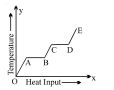
$A$ solid material is supplied with heat at a constant rate. The temperature of the material changes with heat input as shown in the figure. What does the slope of $DE$ represent?
A
latent heat of liquid
B
latent heat of vapour
C
heat capacity of vapour
D
inverse of heat capacity of vapour
Solution
(D) The graph shows the temperature versus heat input for a substance.
$OA$: The temperature increases while the substance is in the solid state.
$AB$: The temperature remains constant,indicating a phase change from solid to liquid (melting).
$BC$: The temperature increases while the substance is in the liquid state.
$CD$: The temperature remains constant,indicating a phase change from liquid to gas (boiling).
$DE$: The temperature increases while the substance is in the gaseous phase. Since the rate of heat supply is constant,the slope of the temperature-heat graph is given by $\frac{dT}{dQ} = \frac{1}{ms}$,where $m$ is the mass and $s$ is the specific heat capacity. Thus,the slope is inversely proportional to the heat capacity $(ms)$. However,in the context of such problems,the slope represents the reciprocal of the heat capacity of the substance in that phase. Given the options,$D$ is the most appropriate description as the slope is $\frac{1}{ms}$.
$OA$: The temperature increases while the substance is in the solid state.
$AB$: The temperature remains constant,indicating a phase change from solid to liquid (melting).
$BC$: The temperature increases while the substance is in the liquid state.
$CD$: The temperature remains constant,indicating a phase change from liquid to gas (boiling).
$DE$: The temperature increases while the substance is in the gaseous phase. Since the rate of heat supply is constant,the slope of the temperature-heat graph is given by $\frac{dT}{dQ} = \frac{1}{ms}$,where $m$ is the mass and $s$ is the specific heat capacity. Thus,the slope is inversely proportional to the heat capacity $(ms)$. However,in the context of such problems,the slope represents the reciprocal of the heat capacity of the substance in that phase. Given the options,$D$ is the most appropriate description as the slope is $\frac{1}{ms}$.
0 likes
View Solution24
MediumMCQ
$A$ block of ice with mass $m$ falls into a lake. After impact,a mass of ice $m/5$ melts. Both the block of ice and the lake have a temperature of $0^{\circ}C$. If $L$ represents the latent heat of fusion,the minimum distance the ice fell before striking the surface is
A
$\frac{L}{5g}$
B
$\frac{5L}{g}$
C
$\frac{gL}{5m}$
D
$\frac{mL}{5g}$
Solution
(A) Let the block of ice fall from a height $h$.
When the block of ice falls into the lake,its gravitational potential energy is converted into heat energy upon impact.
This heat energy is responsible for melting a portion of the ice.
The potential energy lost by the block is $PE = mgh$.
The heat required to melt a mass $m/5$ of ice is $Q = (m/5)L$.
Equating the potential energy to the heat energy,we get:
$mgh = \frac{m}{5}L$
Canceling $m$ from both sides,we have:
$gh = \frac{L}{5}$
Solving for $h$,we get:
$h = \frac{L}{5g}$
When the block of ice falls into the lake,its gravitational potential energy is converted into heat energy upon impact.
This heat energy is responsible for melting a portion of the ice.
The potential energy lost by the block is $PE = mgh$.
The heat required to melt a mass $m/5$ of ice is $Q = (m/5)L$.
Equating the potential energy to the heat energy,we get:
$mgh = \frac{m}{5}L$
Canceling $m$ from both sides,we have:
$gh = \frac{L}{5}$
Solving for $h$,we get:
$h = \frac{L}{5g}$
0 likes
View Solution25
MediumMCQ
The graph shown in the figure represents the change in the temperature of $5 \, kg$ of a substance as it absorbs heat at a constant rate of $42 \, kJ \, min^{-1}$. The latent heat of vaporization of the substance is ......... $kJ \, kg^{-1}$.
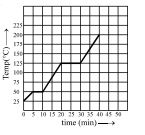
A
$630$
B
$126$
C
$84$
D
$12.6$
Solution
(C) From the graph,the substance undergoes a phase change (vaporization) at a constant temperature of $125^{\circ} C$. This phase change occurs from $t = 20 \, min$ to $t = 30 \, min$.
The duration of the vaporization process is $\Delta t = 30 - 20 = 10 \, min$.
The rate of heat absorption is $P = 42 \, kJ \, min^{-1}$.
The total heat absorbed during vaporization is $Q = P \times \Delta t = 42 \times 10 = 420 \, kJ$.
The mass of the substance is $m = 5 \, kg$.
The latent heat of vaporization $L$ is given by $Q = m \times L$.
Therefore,$L = \frac{Q}{m} = \frac{420}{5} = 84 \, kJ \, kg^{-1}$.
The duration of the vaporization process is $\Delta t = 30 - 20 = 10 \, min$.
The rate of heat absorption is $P = 42 \, kJ \, min^{-1}$.
The total heat absorbed during vaporization is $Q = P \times \Delta t = 42 \times 10 = 420 \, kJ$.
The mass of the substance is $m = 5 \, kg$.
The latent heat of vaporization $L$ is given by $Q = m \times L$.
Therefore,$L = \frac{Q}{m} = \frac{420}{5} = 84 \, kJ \, kg^{-1}$.
0 likes
View Solution26
AdvancedMCQ
An ice cube at temperature $-20^oC$ is kept in a room at temperature $20^oC$. The variation of temperature of the body with time is given by
A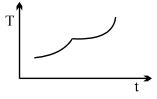
B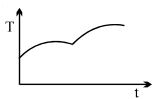
C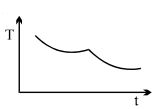
D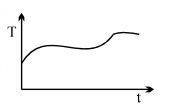
Solution
(B) When an ice cube at $-20^oC$ is placed in a room at $20^oC$,it absorbs heat from the surroundings.
First,the temperature of the ice increases from $-20^oC$ to $0^oC$. This is represented by a rising curve.
At $0^oC$,the ice starts melting into water. During the phase change (melting),the temperature remains constant at $0^oC$ even as heat is absorbed. This is represented by a horizontal line (plateau) on the temperature-time graph.
After all the ice has melted,the temperature of the water starts increasing from $0^oC$ towards the room temperature of $20^oC$. This is represented by another rising curve.
Therefore,the correct graph shows an initial rise,a horizontal plateau at $0^oC$,and a subsequent rise.
First,the temperature of the ice increases from $-20^oC$ to $0^oC$. This is represented by a rising curve.
At $0^oC$,the ice starts melting into water. During the phase change (melting),the temperature remains constant at $0^oC$ even as heat is absorbed. This is represented by a horizontal line (plateau) on the temperature-time graph.
After all the ice has melted,the temperature of the water starts increasing from $0^oC$ towards the room temperature of $20^oC$. This is represented by another rising curve.
Therefore,the correct graph shows an initial rise,a horizontal plateau at $0^oC$,and a subsequent rise.
0 likes
View Solution27
MediumMCQ
Liquid oxygen at $50\ K$ is heated to $300\ K$ at a constant pressure of $1\ atm$. The rate of heating is constant. Which of the following graphs represents the variation of temperature with time?
A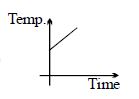
B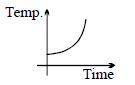
C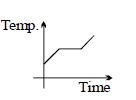
D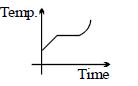
Solution
(C) The boiling point of oxygen at $1\ atm$ is approximately $90\ K$.
When liquid oxygen is heated from $50\ K$ to $300\ K$ at constant pressure, it first heats up as a liquid until it reaches its boiling point $(90\ K)$.
During this phase, the temperature increases linearly with time because the rate of heating is constant ($Q = mc\Delta T$, so $\frac{dT}{dt} = \frac{P}{mc} = \text{constant}$).
Once it reaches the boiling point, the temperature remains constant while the liquid undergoes a phase change (boiling) to become gas. This is represented by a horizontal line on the temperature-time graph.
After the phase change is complete, the oxygen is in the gaseous state and its temperature continues to rise as it is heated further to $300\ K$.
Graph $C$ shows a linear increase in temperature, followed by a constant temperature region during the phase change, and then a linear increase again as a gas. Therefore, graph $C$ is the correct representation.
When liquid oxygen is heated from $50\ K$ to $300\ K$ at constant pressure, it first heats up as a liquid until it reaches its boiling point $(90\ K)$.
During this phase, the temperature increases linearly with time because the rate of heating is constant ($Q = mc\Delta T$, so $\frac{dT}{dt} = \frac{P}{mc} = \text{constant}$).
Once it reaches the boiling point, the temperature remains constant while the liquid undergoes a phase change (boiling) to become gas. This is represented by a horizontal line on the temperature-time graph.
After the phase change is complete, the oxygen is in the gaseous state and its temperature continues to rise as it is heated further to $300\ K$.
Graph $C$ shows a linear increase in temperature, followed by a constant temperature region during the phase change, and then a linear increase again as a gas. Therefore, graph $C$ is the correct representation.
0 likes
View Solution28
MediumMCQ
Liquid oxygen at $50\ K$ is heated to $300\ K$ at a constant pressure of $1\ atm$. The rate of heating is constant. Which of the following graphs represents the variation of temperature with time?
A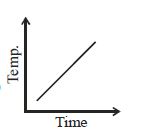
B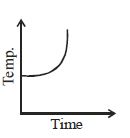
C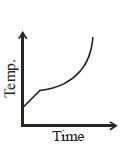
D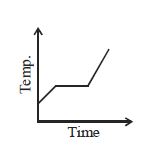
Solution
(D) When a substance is heated at a constant rate,its temperature increases until it reaches its boiling point. During the phase change (boiling),the temperature remains constant as the heat supplied is used to overcome the intermolecular forces (latent heat of vaporization). After the substance has completely turned into gas,the temperature increases again. Therefore,the temperature-time graph shows a linear increase,followed by a horizontal plateau during the phase change,and then another linear increase. This behavior is correctly represented by graph $D$.
0 likes
View Solution29
EasyMCQ
$A$ solid cube having certain fixed melting and boiling points takes heat from some source. The variation of temperature $\theta$ of the cube with the heat supplied $Q$ is shown in the adjoining graph. The portion $BC$ of the graph represents the conversion of
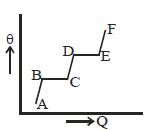
A
Solid into vapour
B
Solid into liquid
C
Liquid into vapour
D
Vapour into liquid
Solution
(B) In a heating curve,the temperature $\theta$ remains constant during a phase change because the heat supplied is used as latent heat to change the state of the substance rather than increasing its kinetic energy.
$1$. The segment $AB$ represents heating of the solid.
$2$. The segment $BC$ is a horizontal line where the temperature is constant,representing the melting process where the solid converts into liquid.
$3$. The segment $CD$ represents heating of the liquid.
$4$. The segment $DE$ is another horizontal line representing the boiling process where the liquid converts into vapour.
$5$. The segment $EF$ represents heating of the vapour.
Therefore,the portion $BC$ represents the conversion of solid into liquid.
$1$. The segment $AB$ represents heating of the solid.
$2$. The segment $BC$ is a horizontal line where the temperature is constant,representing the melting process where the solid converts into liquid.
$3$. The segment $CD$ represents heating of the liquid.
$4$. The segment $DE$ is another horizontal line representing the boiling process where the liquid converts into vapour.
$5$. The segment $EF$ represents heating of the vapour.
Therefore,the portion $BC$ represents the conversion of solid into liquid.
0 likes
View Solution30
MediumMCQ
$A$ substance of mass $m \ kg$ requires a power input of $P \ W$ to remain in the molten state at its melting point. When the power is turned off,the substance completely solidifies in time $t \ s$. The latent heat of fusion of the substance is
A
$\frac{Pm}{t}$
B
$\frac{Pt}{m}$
C
$\frac{m}{Pt}$
D
$\frac{t}{Pm}$
Solution
(B) The power $P$ supplied to the substance to keep it in the molten state at its melting point is equal to the rate at which heat is lost to the surroundings to maintain the phase change equilibrium.
When the power is turned off,the energy released by the substance as it solidifies is equal to the energy it would have absorbed to melt,which is given by $Q = P \times t$.
The heat required for the phase change (solidification) is given by $Q = mL$,where $L$ is the latent heat of fusion.
Equating the two expressions for energy: $mL = P \times t$.
Therefore,the latent heat of fusion is $L = \frac{Pt}{m}$.
When the power is turned off,the energy released by the substance as it solidifies is equal to the energy it would have absorbed to melt,which is given by $Q = P \times t$.
The heat required for the phase change (solidification) is given by $Q = mL$,where $L$ is the latent heat of fusion.
Equating the two expressions for energy: $mL = P \times t$.
Therefore,the latent heat of fusion is $L = \frac{Pt}{m}$.
0 likes
View Solution31
DifficultMCQ
Two substances $A$ and $B$ of equal mass $m$ are heated at a uniform rate of $6 \, cal \, s^{-1}$ under similar conditions. $A$ graph between temperature and time is shown in the figure. The ratio of heat absorbed $H_A/H_B$ by them for complete fusion is
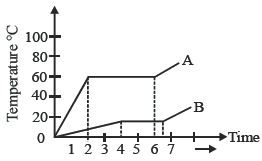
A
$9/4$
B
$4/9$
C
$8/5$
D
$5/8$
Solution
(C) The rate of heat supply is constant for both substances,given as $P = 6 \, cal \, s^{-1}$.
For a substance,the heat absorbed during the phase change (fusion) is given by $H = P \times \Delta t$,where $\Delta t$ is the time interval during which the temperature remains constant (the horizontal part of the graph).
For substance $A$,the temperature remains constant from $t = 2 \, s$ to $t = 6 \, s$. Thus,the time interval for fusion is $\Delta t_A = 6 - 2 = 4 \, s$.
The heat absorbed by $A$ is $H_A = P \times \Delta t_A = 6 \times 4 = 24 \, cal$.
For substance $B$,the temperature remains constant from $t = 4 \, s$ to $t = 6.5 \, s$ (as seen from the graph,the horizontal section ends between $6$ and $7$,specifically at $6.5$). Thus,the time interval for fusion is $\Delta t_B = 6.5 - 4 = 2.5 \, s$.
The heat absorbed by $B$ is $H_B = P \times \Delta t_B = 6 \times 2.5 = 15 \, cal$.
The ratio of heat absorbed is $\frac{H_A}{H_B} = \frac{P \times \Delta t_A}{P \times \Delta t_B} = \frac{4}{2.5} = \frac{40}{25} = \frac{8}{5}$.
For a substance,the heat absorbed during the phase change (fusion) is given by $H = P \times \Delta t$,where $\Delta t$ is the time interval during which the temperature remains constant (the horizontal part of the graph).
For substance $A$,the temperature remains constant from $t = 2 \, s$ to $t = 6 \, s$. Thus,the time interval for fusion is $\Delta t_A = 6 - 2 = 4 \, s$.
The heat absorbed by $A$ is $H_A = P \times \Delta t_A = 6 \times 4 = 24 \, cal$.
For substance $B$,the temperature remains constant from $t = 4 \, s$ to $t = 6.5 \, s$ (as seen from the graph,the horizontal section ends between $6$ and $7$,specifically at $6.5$). Thus,the time interval for fusion is $\Delta t_B = 6.5 - 4 = 2.5 \, s$.
The heat absorbed by $B$ is $H_B = P \times \Delta t_B = 6 \times 2.5 = 15 \, cal$.
The ratio of heat absorbed is $\frac{H_A}{H_B} = \frac{P \times \Delta t_A}{P \times \Delta t_B} = \frac{4}{2.5} = \frac{40}{25} = \frac{8}{5}$.
0 likes
View Solution32
MediumMCQ
Steam at $100\,^{\circ}C$ is more dangerous than the same mass of water at $100\,^{\circ}C$ because the steam
A
moves faster
B
is less dense
C
contains more heat
D
has a higher specific heat capacity
Solution
(C) When water at $100\,^{\circ}C$ turns into steam at $100\,^{\circ}C$,it absorbs an additional amount of energy known as the latent heat of vaporization. This energy is stored in the steam without any change in temperature. Therefore,when steam comes into contact with skin,it releases this extra latent heat in addition to the heat released by cooling the water,causing more severe burns compared to water at the same temperature.
0 likes
View Solution33
EasyMCQ
$A$ metallic ball and a highly stretched spring are made of the same material and have the same mass. They are heated so that they melt. The latent heat required:
A
is the same for both.
B
is greater for the ball.
C
is greater for the spring.
D
for the two may or may not be the same depending upon the metal.
Solution
(A) The latent heat $(L)$ required to melt a substance is given by the formula $Q = mL$,where $m$ is the mass and $L$ is the specific latent heat of fusion.
Since both the metallic ball and the spring are made of the same material,their specific latent heat of fusion $(L)$ is identical.
Given that both objects have the same mass $(m)$,the total heat required $(Q = mL)$ to melt them must be the same.
Therefore,the latent heat required is the same for both.
Since both the metallic ball and the spring are made of the same material,their specific latent heat of fusion $(L)$ is identical.
Given that both objects have the same mass $(m)$,the total heat required $(Q = mL)$ to melt them must be the same.
Therefore,the latent heat required is the same for both.
0 likes
View Solution34
EasyMCQ
If water at $0\,^{\circ}C$ kept in a container with an open mouth is placed in a large evacuated chamber,what will happen?
A
All the water will vaporise
B
All the water will freeze
C
Part of the water will vaporise and rest will freeze
D
Ice,water and water vapour will be formed and reach equilibrium at triple point
Solution
(C) When the container is placed in a large evacuated chamber,the pressure above the water surface drops significantly.
This causes rapid evaporation of the water molecules.
Since evaporation is an endothermic process,the latent heat required for vaporization is taken from the remaining water.
As the remaining water loses energy,its temperature drops below $0\,^{\circ}C$,causing it to freeze.
Thus,a portion of the water vaporizes,and the remaining portion freezes.
This causes rapid evaporation of the water molecules.
Since evaporation is an endothermic process,the latent heat required for vaporization is taken from the remaining water.
As the remaining water loses energy,its temperature drops below $0\,^{\circ}C$,causing it to freeze.
Thus,a portion of the water vaporizes,and the remaining portion freezes.
0 likes
View Solution35
MediumMCQ
An experiment takes $10\, minutes$ to raise the temperature of water in a container from $0\,^oC$ to $100\,^oC$ and another $55\, minutes$ to convert it totally into steam by a heater supplying heat at a uniform rate. Neglecting the specific heat of the container and taking the specific heat of water to be $1\, cal/g\,^oC$,the heat of vaporization according to this experiment will be ........ $cal/g$.
A
$560$
B
$550$
C
$540$
D
$530$
Solution
(B) Let $P$ be the power of the heater (heat supplied per unit time).
For heating water from $0\,^oC$ to $100\,^oC$:
$Q_1 = P \times t_1 = m \cdot c \cdot \Delta T$
$P \times 10 = m \times 1 \times (100 - 0) = 100m \quad ... (i)$
For converting water at $100\,^oC$ to steam at $100\,^oC$:
$Q_2 = P \times t_2 = m \cdot L$
$P \times 55 = m \cdot L \quad ... (ii)$
Dividing equation $(ii)$ by $(i)$:
$\frac{P \times 55}{P \times 10} = \frac{m \cdot L}{100m}$
$5.5 = \frac{L}{100}$
$L = 5.5 \times 100 = 550\, cal/g$.
For heating water from $0\,^oC$ to $100\,^oC$:
$Q_1 = P \times t_1 = m \cdot c \cdot \Delta T$
$P \times 10 = m \times 1 \times (100 - 0) = 100m \quad ... (i)$
For converting water at $100\,^oC$ to steam at $100\,^oC$:
$Q_2 = P \times t_2 = m \cdot L$
$P \times 55 = m \cdot L \quad ... (ii)$
Dividing equation $(ii)$ by $(i)$:
$\frac{P \times 55}{P \times 10} = \frac{m \cdot L}{100m}$
$5.5 = \frac{L}{100}$
$L = 5.5 \times 100 = 550\, cal/g$.
0 likes
View Solution36
MediumMCQ
When $0.93 \, W \cdot h$ of energy is supplied to a block of ice weighing $10 \, g,$ it is found that
A
half of the block melts
B
entire block just melts
C
entire block melts and water reaches $4 \, ^\circ C$
D
block remains unchanged
Solution
(B) The energy supplied is $Q_{\text{supplied}} = 0.93 \, W \cdot h = 0.93 \times 3600 \, J = 3348 \, J.$
The energy required to melt $10 \, g$ of ice at $0 \, ^\circ C$ is given by $Q_{\text{req}} = m \cdot L_f,$
where $L_f = 80 \, cal/g = 335.2 \, J/g$ (using $1 \, cal = 4.19 \, J$).
Thus,$Q_{\text{req}} = 10 \, g \times 335.2 \, J/g = 3352 \, J.$
Comparing the values,$Q_{\text{supplied}} \approx Q_{\text{req}} \approx 3350 \, J.$
Since the supplied energy is almost exactly equal to the latent heat required for phase change,the entire block of ice just melts.
The energy required to melt $10 \, g$ of ice at $0 \, ^\circ C$ is given by $Q_{\text{req}} = m \cdot L_f,$
where $L_f = 80 \, cal/g = 335.2 \, J/g$ (using $1 \, cal = 4.19 \, J$).
Thus,$Q_{\text{req}} = 10 \, g \times 335.2 \, J/g = 3352 \, J.$
Comparing the values,$Q_{\text{supplied}} \approx Q_{\text{req}} \approx 3350 \, J.$
Since the supplied energy is almost exactly equal to the latent heat required for phase change,the entire block of ice just melts.
0 likes
View Solution37
MediumMCQ
$A$ block of ice at $-10\,^oC$ is slowly heated and converted to steam at $100\,^oC.$ Which of the following curves represents the phenomenon qualitatively?
A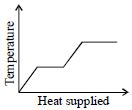
B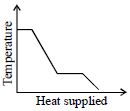
C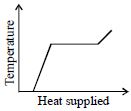
D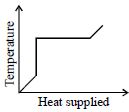
Solution
(A) The process of heating ice from $-10\,^oC$ to steam at $100\,^oC$ involves several stages:
$1$. Heating ice from $-10\,^oC$ to $0\,^oC$: The temperature increases linearly with heat supplied.
$2$. Melting ice at $0\,^oC$: The temperature remains constant at $0\,^oC$ as phase change occurs.
$3$. Heating water from $0\,^oC$ to $100\,^oC$: The temperature increases linearly with heat supplied.
$4$. Boiling water at $100\,^oC$: The temperature remains constant at $100\,^oC$ as phase change occurs.
Thus,the temperature-heat graph should show two regions of increasing temperature separated by two horizontal plateaus. Graph $A$ correctly depicts this behavior.
$1$. Heating ice from $-10\,^oC$ to $0\,^oC$: The temperature increases linearly with heat supplied.
$2$. Melting ice at $0\,^oC$: The temperature remains constant at $0\,^oC$ as phase change occurs.
$3$. Heating water from $0\,^oC$ to $100\,^oC$: The temperature increases linearly with heat supplied.
$4$. Boiling water at $100\,^oC$: The temperature remains constant at $100\,^oC$ as phase change occurs.
Thus,the temperature-heat graph should show two regions of increasing temperature separated by two horizontal plateaus. Graph $A$ correctly depicts this behavior.
0 likes
View Solution38
MediumMCQ
Compared to a burn due to water at $100\,^{\circ}C$,a burn due to steam at $100\,^{\circ}C$ is:
A
more dangerous
B
less dangerous
C
equally dangerous
D
depends on the person
Solution
(A) When water at $100\,^{\circ}C$ turns into steam at $100\,^{\circ}C$,it absorbs an additional amount of heat known as the latent heat of vaporization $(L_v = 2260\,kJ/kg)$.
Because steam contains this extra latent heat energy compared to liquid water at the same temperature,it releases significantly more energy upon contact with the skin.
Therefore,a burn caused by steam at $100\,^{\circ}C$ is more dangerous than a burn caused by water at the same temperature.
Because steam contains this extra latent heat energy compared to liquid water at the same temperature,it releases significantly more energy upon contact with the skin.
Therefore,a burn caused by steam at $100\,^{\circ}C$ is more dangerous than a burn caused by water at the same temperature.
0 likes
View Solution39
EasyMCQ
Boiling water is changing into steam. Under this condition,the specific heat of water is
A
zero
B
one
C
infinite
D
less than one
Solution
(C) The specific heat capacity $s$ is defined as $s = \frac{Q}{m \Delta T}$,where $Q$ is the heat supplied,$m$ is the mass,and $\Delta T$ is the change in temperature.
During a phase transition (like boiling water changing into steam),the temperature of the substance remains constant,meaning $\Delta T = 0$.
Since the denominator becomes zero,the specific heat capacity $s$ becomes infinite $(s = \infty)$.
During a phase transition (like boiling water changing into steam),the temperature of the substance remains constant,meaning $\Delta T = 0$.
Since the denominator becomes zero,the specific heat capacity $s$ becomes infinite $(s = \infty)$.
0 likes
View Solution40
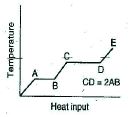
MediumMCQ
$A$ solid material is supplied with heat at a constant rate and the temperature of the material changes as shown in the graph. From the graph,the false conclusion drawn is:
A
$AB$ and $CD$ of the graph represent phase changes.
B
$AB$ represents the change of state from solid to liquid.
C
Latent heat of fusion is twice the latent heat of vaporization.
D
$CD$ represents the change of state from liquid to vapour.
Solution
(C) In a heating curve,the horizontal sections represent phase changes where temperature remains constant. Thus,$AB$ and $CD$ represent phase changes.
$AB$ corresponds to the melting process (solid to liquid),and $CD$ corresponds to the boiling process (liquid to vapour).
The heat supplied during a phase change is given by $Q = mL$,where $m$ is the mass and $L$ is the latent heat.
Since the heat is supplied at a constant rate,the length of the horizontal segment is proportional to the heat supplied $(Q)$.
From the graph,the length of $CD$ is twice the length of $AB$ $(CD = 2AB)$,which implies that the latent heat of vaporization $(L_v)$ is twice the latent heat of fusion $(L_f)$.
Therefore,the statement that 'latent heat of fusion is twice the latent heat of vaporization' is false.
$AB$ corresponds to the melting process (solid to liquid),and $CD$ corresponds to the boiling process (liquid to vapour).
The heat supplied during a phase change is given by $Q = mL$,where $m$ is the mass and $L$ is the latent heat.
Since the heat is supplied at a constant rate,the length of the horizontal segment is proportional to the heat supplied $(Q)$.
From the graph,the length of $CD$ is twice the length of $AB$ $(CD = 2AB)$,which implies that the latent heat of vaporization $(L_v)$ is twice the latent heat of fusion $(L_f)$.
Therefore,the statement that 'latent heat of fusion is twice the latent heat of vaporization' is false.
0 likes
View Solution41
EasyMCQ
$Assertion :$ Melting of a solid causes no change in internal energy.
$Reason :$ Latent heat is the heat required to melt a unit mass of a solid.
$Reason :$ Latent heat is the heat required to melt a unit mass of a solid.
A
If both Assertion and Reason are correct and the Reason is a correct explanation of the Assertion.
B
If both Assertion and Reason are correct but Reason is not a correct explanation of the Assertion.
C
If the Assertion is correct but Reason is incorrect.
D
If the Assertion is incorrect but the Reason is correct.
Solution
(D) During the melting process,the temperature of the substance remains constant,but the heat supplied (latent heat) is used to overcome the intermolecular forces of attraction between the particles of the solid.
This process increases the potential energy of the molecules,which in turn increases the total internal energy of the system.
Therefore,the Assertion is incorrect.
Latent heat is defined as the amount of heat energy required to change the state of a unit mass of a substance without changing its temperature,which makes the Reason correct.
Thus,the correct option is $D$.
This process increases the potential energy of the molecules,which in turn increases the total internal energy of the system.
Therefore,the Assertion is incorrect.
Latent heat is defined as the amount of heat energy required to change the state of a unit mass of a substance without changing its temperature,which makes the Reason correct.
Thus,the correct option is $D$.
0 likes
View Solution42
EasyMCQ
$Assertion :$ Perspiration from the human body helps in cooling the body.
$Reason :$ $A$ thin layer of water on the skin enhances its emissivity.
$Reason :$ $A$ thin layer of water on the skin enhances its emissivity.
A
If both Assertion and Reason are correct and the Reason is a correct explanation of the Assertion.
B
If both Assertion and Reason are correct but Reason is not a correct explanation of the Assertion.
C
If the Assertion is correct but Reason is incorrect.
D
If both the Assertion and Reason are incorrect.
Solution
(C) Perspiration involves the exchange of heat from the body to the surroundings.
Water absorbs latent heat from the body to undergo phase change from liquid to vapour.
This process removes thermal energy from the skin,causing the body to cool down.
Emissivity is a property of the surface material. $A$ thin layer of water on the skin does not enhance its emissivity; in fact,it does not significantly change the emissivity of the skin in the context of cooling.
Therefore,the Assertion is correct,but the Reason is incorrect.
Water absorbs latent heat from the body to undergo phase change from liquid to vapour.
This process removes thermal energy from the skin,causing the body to cool down.
Emissivity is a property of the surface material. $A$ thin layer of water on the skin does not enhance its emissivity; in fact,it does not significantly change the emissivity of the skin in the context of cooling.
Therefore,the Assertion is correct,but the Reason is incorrect.
0 likes
View Solution43
Medium
Explain the three states of matter and the process of change in states.
Solution
(N/A) Matter typically exists in three distinct states: $Solid$,$Liquid$,and $Gas$.
$A$ transition from one state to another is referred to as a change of state.
Common examples include the transition from $Solid$ to $Liquid$ (melting) and $Liquid$ to $Gas$ (vaporization),as well as their reverse processes ($Freezing$ and $Condensation$).
These changes occur due to the exchange of heat energy between the substance and its surroundings,which alters the internal energy of the molecules without changing the temperature during the phase transition.
$A$ transition from one state to another is referred to as a change of state.
Common examples include the transition from $Solid$ to $Liquid$ (melting) and $Liquid$ to $Gas$ (vaporization),as well as their reverse processes ($Freezing$ and $Condensation$).
These changes occur due to the exchange of heat energy between the substance and its surroundings,which alters the internal energy of the molecules without changing the temperature during the phase transition.
0 likes
View Solution44
Easy
Explain the process of change in the state of matter by heating or cooling it.
Solution
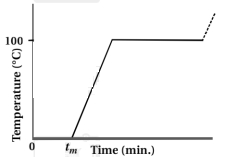
(N/A) To understand the change in the state of matter,consider the heating curve of water.
$1$. Take some ice cubes in a beaker and note the initial temperature,which is $0^{\circ} C$.
$2$. Place the beaker on a constant heat source and start heating it slowly.
$3$. Continuously stir the mixture of ice and water to ensure uniform temperature distribution.
$4$. Note the temperature of the mixture at regular intervals (e.g.,every minute) and plot a graph of temperature versus time.
$5$. You will observe that the temperature remains constant at $0^{\circ} C$ as long as there is ice present in the beaker,even though heat is being continuously supplied.
$6$. This constant temperature phase occurs because the heat supplied is being utilized as latent heat of fusion to overcome the intermolecular forces of attraction,changing the state from solid (ice) to liquid (water).
$7$. Once all the ice has melted,the temperature of the water will begin to rise until it reaches the boiling point $(100^{\circ} C)$,where another phase change (liquid to gas) occurs at a constant temperature.
$1$. Take some ice cubes in a beaker and note the initial temperature,which is $0^{\circ} C$.
$2$. Place the beaker on a constant heat source and start heating it slowly.
$3$. Continuously stir the mixture of ice and water to ensure uniform temperature distribution.
$4$. Note the temperature of the mixture at regular intervals (e.g.,every minute) and plot a graph of temperature versus time.
$5$. You will observe that the temperature remains constant at $0^{\circ} C$ as long as there is ice present in the beaker,even though heat is being continuously supplied.
$6$. This constant temperature phase occurs because the heat supplied is being utilized as latent heat of fusion to overcome the intermolecular forces of attraction,changing the state from solid (ice) to liquid (water).
$7$. Once all the ice has melted,the temperature of the water will begin to rise until it reaches the boiling point $(100^{\circ} C)$,where another phase change (liquid to gas) occurs at a constant temperature.
0 likes
View Solution45
Medium
Explain the process of melting of ice with an explanation of freezing,melting,and melting point.
Solution
(N/A) The change of state from solid to liquid is called melting,and the change of state from liquid to solid is called freezing (or fusion).
It is observed that the temperature remains constant until the entire amount of the solid substance melts.
Both the solid and liquid states of the substance coexist in thermal equilibrium during the change of states from solid to liquid.
The temperature at which the solid and the liquid states of the substance are in thermal equilibrium with each other is called its melting point.
It is a characteristic property of the substance and also depends on pressure.
The melting point of a substance at standard atmospheric pressure is called its normal melting point.
An activity to explain the process of melting of ice:
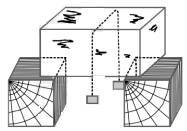
Take a slab of ice. Take a metallic wire and fix two weights,say $5 \ kg$ each,at its ends. Put the wire over the slab as shown in the figure. You will observe that the wire passes through the ice slab. This happens because,just below the wire,the ice melts at a lower temperature due to an increase in pressure.
When the wire has passed,the water above the wire freezes again. Thus,the wire passes through the slab,and the slab does not split. This phenomenon of refreezing is called regelation.
Skating is possible on snow due to the formation of water below the skates. Water is formed due to the increase of pressure and it acts as a lubricant.
It is observed that the temperature remains constant until the entire amount of the solid substance melts.
Both the solid and liquid states of the substance coexist in thermal equilibrium during the change of states from solid to liquid.
The temperature at which the solid and the liquid states of the substance are in thermal equilibrium with each other is called its melting point.
It is a characteristic property of the substance and also depends on pressure.
The melting point of a substance at standard atmospheric pressure is called its normal melting point.
An activity to explain the process of melting of ice:
Take a slab of ice. Take a metallic wire and fix two weights,say $5 \ kg$ each,at its ends. Put the wire over the slab as shown in the figure. You will observe that the wire passes through the ice slab. This happens because,just below the wire,the ice melts at a lower temperature due to an increase in pressure.
When the wire has passed,the water above the wire freezes again. Thus,the wire passes through the slab,and the slab does not split. This phenomenon of refreezing is called regelation.
Skating is possible on snow due to the formation of water below the skates. Water is formed due to the increase of pressure and it acts as a lubricant.
0 likes
View Solution46
Difficult
What are vaporization and boiling point? Explain the process of boiling of water.
Solution
(N/A) On heating,when ice is converted into water and we continue heating,the temperature begins to rise. The temperature continues to rise until it reaches nearly $100^{\circ} C$,at which point it becomes steady.
The heat supplied is now utilized to change water from the liquid state to the vapour or gaseous state.
The change of state from liquid to vapour (or gas) is called vaporization.
It is observed that the temperature remains constant until the entire amount of the liquid is converted into vapour.
Both the liquid and vapour states of the substance coexist in thermal equilibrium during the change of state from liquid to vapour.
The temperature at which the liquid and the vapour states of the substance coexist is called its boiling point.
The process of boiling of water:
$1$. Take a round-bottom flask,more than half-filled with water.
$2$. Place it over a burner and fix a thermometer and a steam outlet through the cork of the flask.
$3$. As water gets heated in the flask,note first that the air,which was dissolved in the water,will come out as small bubbles.
The heat supplied is now utilized to change water from the liquid state to the vapour or gaseous state.
The change of state from liquid to vapour (or gas) is called vaporization.
It is observed that the temperature remains constant until the entire amount of the liquid is converted into vapour.
Both the liquid and vapour states of the substance coexist in thermal equilibrium during the change of state from liquid to vapour.
The temperature at which the liquid and the vapour states of the substance coexist is called its boiling point.
The process of boiling of water:
$1$. Take a round-bottom flask,more than half-filled with water.
$2$. Place it over a burner and fix a thermometer and a steam outlet through the cork of the flask.
$3$. As water gets heated in the flask,note first that the air,which was dissolved in the water,will come out as small bubbles.
0 likes
View Solution47
Medium
What is latent heat? Explain with an example.
Solution
(N/A) certain amount of heat energy is transferred between a substance and its surroundings when it undergoes a change of state. The amount of heat per unit mass transferred during the change of state of the substance is called the latent heat of the substance for the process.
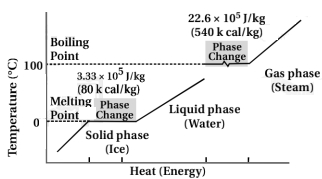
For example,if heat is added to a given quantity of ice at $-10^{\circ} C$,the temperature of the ice increases until it reaches its melting point $\left(0^{\circ} C\right)$. At this temperature,the addition of more heat does not increase the temperature but causes the ice to melt,or changes its state. Once the entire ice melts,adding more heat will cause the temperature of the water to rise. $A$ similar situation occurs during a liquid-gas change of state at the boiling point. Adding more heat to boiling water causes vaporisation,without an increase in temperature.
The heat required during a change of state depends upon the heat of transformation and the mass of the substance undergoing a change of state.
Thus,if mass $m$ of a substance undergoes a change from one state to the other,then the quantity of heat required is given by:
$Q = m L$ or $L = \frac{Q}{m}$
where $L$ is known as latent heat and is a characteristic of the substance.
Its $SI$ unit is $J \ kg^{-1}$.
The value of $L$ also depends on the pressure. Its value is usually quoted at standard atmospheric pressure.
The latent heat for a solid-liquid state change is called the latent heat of fusion $\left(L_{f}\right)$,and that for a liquid-gas state change is called the latent heat of vaporisation $\left(L_{v}\right)$.
These are often referred to as the heat of fusion $\left(L_{f}\right)$ and the heat of vaporisation $\left(L_{v}\right)$.
$A$ plot of temperature versus heat energy for a quantity of water is shown in the figure. When heat is added (or removed) during a change of state,the temperature remains constant.
For example,if heat is added to a given quantity of ice at $-10^{\circ} C$,the temperature of the ice increases until it reaches its melting point $\left(0^{\circ} C\right)$. At this temperature,the addition of more heat does not increase the temperature but causes the ice to melt,or changes its state. Once the entire ice melts,adding more heat will cause the temperature of the water to rise. $A$ similar situation occurs during a liquid-gas change of state at the boiling point. Adding more heat to boiling water causes vaporisation,without an increase in temperature.
The heat required during a change of state depends upon the heat of transformation and the mass of the substance undergoing a change of state.
Thus,if mass $m$ of a substance undergoes a change from one state to the other,then the quantity of heat required is given by:
$Q = m L$ or $L = \frac{Q}{m}$
where $L$ is known as latent heat and is a characteristic of the substance.
Its $SI$ unit is $J \ kg^{-1}$.
The value of $L$ also depends on the pressure. Its value is usually quoted at standard atmospheric pressure.
The latent heat for a solid-liquid state change is called the latent heat of fusion $\left(L_{f}\right)$,and that for a liquid-gas state change is called the latent heat of vaporisation $\left(L_{v}\right)$.
These are often referred to as the heat of fusion $\left(L_{f}\right)$ and the heat of vaporisation $\left(L_{v}\right)$.
$A$ plot of temperature versus heat energy for a quantity of water is shown in the figure. When heat is added (or removed) during a change of state,the temperature remains constant.
0 likes
View Solution48
MediumMCQ
What is the process of changing the state of matter called?
A
Thermal expansion
B
Phase transition
C
Calorimetry
D
Thermal equilibrium
Solution
(B) The process of changing the state of matter from one form (solid,liquid,or gas) to another is known as a phase transition or a change of state. This process typically occurs at a constant temperature when heat is added or removed,and the energy involved is known as latent heat.
0 likes
View Solution49
Difficult
What are fusion and melting point? On what does the value of melting point depend?
Solution
(N/A) Fusion is the process of phase transition in which a substance changes from a solid state to a liquid state by the absorption of heat at a constant temperature.
The melting point is the specific temperature at which a solid substance changes into its liquid state at a given pressure.
The value of the melting point depends on the following factors:
$1$. Nature of the substance: Different materials have different intermolecular forces,leading to different melting points.
$2$. External pressure: For most substances,an increase in pressure increases the melting point. However,for substances that contract upon melting (like ice),an increase in pressure decreases the melting point.
The melting point is the specific temperature at which a solid substance changes into its liquid state at a given pressure.
The value of the melting point depends on the following factors:
$1$. Nature of the substance: Different materials have different intermolecular forces,leading to different melting points.
$2$. External pressure: For most substances,an increase in pressure increases the melting point. However,for substances that contract upon melting (like ice),an increase in pressure decreases the melting point.
0 likes
View Solution50
Medium
What is vaporization? What is normal boiling point?
Solution
(N/A) Vaporization is the phase transition of a substance from the liquid state to the gaseous or vapor state. It occurs when molecules in a liquid gain enough kinetic energy to overcome the intermolecular forces holding them together,allowing them to escape into the surrounding space as gas.
The normal boiling point of a substance is defined as the temperature at which its vapor pressure equals the standard atmospheric pressure,which is $1.013 \times 10^5 \ Pa$ or $1 \ atm$.
The normal boiling point of a substance is defined as the temperature at which its vapor pressure equals the standard atmospheric pressure,which is $1.013 \times 10^5 \ Pa$ or $1 \ atm$.
0 likes
View Solution10-1.Thermometry, Thermal Expansion and Calorimetry — Latent Heat and Heating Curve · Frequently Asked Questions
1Are these 10-1.Thermometry, Thermal Expansion and Calorimetry questions useful for JEE and NEET?
Yes. All questions in this section are mapped to JEE Main and NEET exam patterns. Previous year questions from JEE Main, NEET, GUJCET and state-level exams are included with full solutions.
2Can I switch to Hindi or Gujarati for these questions?
Yes. Use the language tabs in the hero section or the sidebar to view the same questions and solutions in English, Hindi or Gujarati.
3How do I generate a question paper from this subtopic?
Use the Vedclass Exam Paper Generator — select the chapter and subtopic, set difficulty, and generate Sets A, B, C, D automatically. First 3 chapters of every subject are free.
Vedclass Products
For Students
Vedclass Test Series
Mock tests in real JEE/NEET style with performance analysis. 5-day free trial.
Start Free TrialFor Teachers
Exam Paper Generator
Generate Set A/B/C/D papers from this chapter in 2 minutes. 3 chapters free.
Try FreeFor Institutes
Online Exam Module
Live online exams with unlimited students, 360° analytics & white-label branding.
See DemoFor Teachers & Institutes
Generate a 10-1.Thermometry, Thermal Expansion and Calorimetry Exam Paper in 2 Minutes
Select subtopic & difficulty — Sets A, B, C, D auto-generated with No Repeat logic.
First 3 chapters of every subject are free — no payment required.