
A English
Mix Examples-Thermometry, Thermal Expansion and Calorimetry Questions in English
Class 11 Physics · 10-1.Thermometry, Thermal Expansion and Calorimetry · Mix Examples-Thermometry, Thermal Expansion and Calorimetry
198+
Questions
English
Language
100%
With Solutions
Showing 48 of 198 questions in English
151
DifficultMCQ
The resistances of the platinum wire of a platinum resistance thermometer at the ice point and steam point are $8 \Omega$ and $10 \Omega$ respectively. After inserting in a hot bath of temperature $400^{\circ} C$,the resistance of the platinum wire is: (in $Omega$)
A
$2$
B
$16$
C
$8$
D
$10$
Solution
(B) Given: Resistance at ice point $R_0 = 8 \Omega$,Resistance at steam point $R_{100} = 10 \Omega$.
The formula for resistance at temperature $T$ is $R_T = R_0(1 + \alpha T)$.
For the steam point $(100^{\circ} C)$:
$10 = 8(1 + \alpha \times 100)$
$1.25 = 1 + 100\alpha$
$100\alpha = 0.25 = 1/4$
$\alpha = 1/400 \text{ per } ^{\circ} C$.
Now,for the temperature $T = 400^{\circ} C$:
$R_{400} = R_0(1 + \alpha \times 400)$
$R_{400} = 8(1 + (1/400) \times 400)$
$R_{400} = 8(1 + 1) = 8 \times 2 = 16 \Omega$.
Therefore,the correct option is $B$.
The formula for resistance at temperature $T$ is $R_T = R_0(1 + \alpha T)$.
For the steam point $(100^{\circ} C)$:
$10 = 8(1 + \alpha \times 100)$
$1.25 = 1 + 100\alpha$
$100\alpha = 0.25 = 1/4$
$\alpha = 1/400 \text{ per } ^{\circ} C$.
Now,for the temperature $T = 400^{\circ} C$:
$R_{400} = R_0(1 + \alpha \times 400)$
$R_{400} = 8(1 + (1/400) \times 400)$
$R_{400} = 8(1 + 1) = 8 \times 2 = 16 \Omega$.
Therefore,the correct option is $B$.
0 likes
View Solution152
AdvancedMCQ
Column $I$ gives some devices and Column $II$ gives some processes on which the functioning of these devices depends. Match the devices in Column $I$ with the processes in Column $II$.
| Column $I$ | Column $II$ |
| $(A)$ Bimetallic strip | $(p)$ Radiation from a hot body |
| $(B)$ Steam engine | $(q)$ Energy conversion |
| $(C)$ Incandescent lamp | $(r)$ Melting |
| $(D)$ Electric fuse | $(s)$ Thermal expansion of solids |
A
$A \rightarrow (s), B \rightarrow (q), C \rightarrow (p), D \rightarrow (r)$
B
$A \rightarrow (p), B \rightarrow (q), C \rightarrow (s), D \rightarrow (r)$
C
$A \rightarrow (r), B \rightarrow (q), C \rightarrow (s), D \rightarrow (p)$
D
$A \rightarrow (q), B \rightarrow (r), C \rightarrow (p), D \rightarrow (s)$
Solution
$(A)$ Bimetallic strip works on the principle of thermal expansion of solids, where two different metals expand by different amounts when heated, causing the strip to bend. Thus, $A \rightarrow (s)$.
$(B)$ $A$ steam engine converts thermal energy (from steam) into mechanical work. Thus, $B \rightarrow (q)$.
$(C)$ An incandescent lamp works by heating a filament to a high temperature, causing it to emit light via radiation. Thus, $C \rightarrow (p)$.
$(D)$ An electric fuse is a safety device that melts when the current exceeds a specific limit, breaking the circuit. Thus, $D \rightarrow (r)$.
Therefore, the correct matching is $A \rightarrow (s), B \rightarrow (q), C \rightarrow (p), D \rightarrow (r)$.
$(B)$ $A$ steam engine converts thermal energy (from steam) into mechanical work. Thus, $B \rightarrow (q)$.
$(C)$ An incandescent lamp works by heating a filament to a high temperature, causing it to emit light via radiation. Thus, $C \rightarrow (p)$.
$(D)$ An electric fuse is a safety device that melts when the current exceeds a specific limit, breaking the circuit. Thus, $D \rightarrow (r)$.
Therefore, the correct matching is $A \rightarrow (s), B \rightarrow (q), C \rightarrow (p), D \rightarrow (r)$.
0 likes
View Solution153
DifficultMCQ
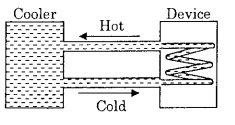
$A$ water cooler of storage capacity $120$ litres can cool water at a constant rate of $P$ watts. In a closed circulation system (as shown schematically in the figure),the water from the cooler is used to cool an external device that generates constantly $3 \text{ kW}$ of heat (thermal load). The temperature of water fed into the device cannot exceed $30^{\circ}\text{C}$ and the entire stored $120$ litres of water is initially cooled to $10^{\circ}\text{C}$. The entire system is thermally insulated. The minimum value of $P$ (in watts) for which the device can be operated for $3$ hours is (Specific heat of water is $4.2 \text{ kJ kg}^{-1} \text{K}^{-1}$ and the density of water is $1000 \text{ kg m}^{-3}$)
A
$1600$
B
$2067$
C
$2533$
D
$3933$
Solution
(B) Total heat generated by the device in $t = 3 \text{ hours} = 3 \times 3600 \text{ s} = 10800 \text{ s}$ is:
$Q_{\text{gen}} = P_{\text{device}} \times t = 3000 \text{ W} \times 10800 \text{ s} = 3.24 \times 10^7 \text{ J}$.
The heat absorbed by the $120 \text{ litres}$ $(120 \text{ kg})$ of water as its temperature rises from $10^{\circ}\text{C}$ to $30^{\circ}\text{C}$ is:
$Q_{\text{water}} = m \cdot c \cdot \Delta T = 120 \text{ kg} \times 4200 \text{ J kg}^{-1} \text{K}^{-1} \times (30 - 10) \text{ K} = 120 \times 4200 \times 20 = 1.008 \times 10^7 \text{ J}$.
The heat that must be removed by the cooler is:
$Q_{\text{cooler}} = Q_{\text{gen}} - Q_{\text{water}} = 3.24 \times 10^7 \text{ J} - 1.008 \times 10^7 \text{ J} = 2.232 \times 10^7 \text{ J}$.
The minimum power $P$ of the cooler is:
$P = \frac{Q_{\text{cooler}}}{t} = \frac{2.232 \times 10^7 \text{ J}}{10800 \text{ s}} \approx 2066.67 \text{ W} \approx 2067 \text{ W}$.
$Q_{\text{gen}} = P_{\text{device}} \times t = 3000 \text{ W} \times 10800 \text{ s} = 3.24 \times 10^7 \text{ J}$.
The heat absorbed by the $120 \text{ litres}$ $(120 \text{ kg})$ of water as its temperature rises from $10^{\circ}\text{C}$ to $30^{\circ}\text{C}$ is:
$Q_{\text{water}} = m \cdot c \cdot \Delta T = 120 \text{ kg} \times 4200 \text{ J kg}^{-1} \text{K}^{-1} \times (30 - 10) \text{ K} = 120 \times 4200 \times 20 = 1.008 \times 10^7 \text{ J}$.
The heat that must be removed by the cooler is:
$Q_{\text{cooler}} = Q_{\text{gen}} - Q_{\text{water}} = 3.24 \times 10^7 \text{ J} - 1.008 \times 10^7 \text{ J} = 2.232 \times 10^7 \text{ J}$.
The minimum power $P$ of the cooler is:
$P = \frac{Q_{\text{cooler}}}{t} = \frac{2.232 \times 10^7 \text{ J}}{10800 \text{ s}} \approx 2066.67 \text{ W} \approx 2067 \text{ W}$.
0 likes
View Solution154
AdvancedMCQ
$A$ liquid at $30^{\circ} C$ is poured very slowly into a calorimeter at $110^{\circ} C$. The boiling point of the liquid is $80^{\circ} C$. It is observed that the first $5 \ gm$ of the liquid evaporates completely. After adding another $80 \ gm$ of the liquid,the equilibrium temperature is found to be $50^{\circ} C$. What is the ratio of the latent heat of the liquid to its specific heat? [Neglect heat exchange with the surroundings]
A
$260$
B
$250$
C
$270$
D
$280$
Solution
(C) Let the mass of the calorimeter be $m$,the specific heat of the calorimeter be $x$,the specific heat of the liquid be $s$,and the latent heat of the liquid be $L$.
When $5 \ gm$ of liquid at $30^{\circ} C$ is added to the calorimeter at $110^{\circ} C$,the calorimeter cools down to $80^{\circ} C$ and the liquid evaporates:
$m \cdot x \cdot (110 - 80) = 5 \cdot s \cdot (80 - 30) + 5 \cdot L$
$30 \cdot mx = 250s + 5L$ ... $(i)$
Now,$80 \ gm$ of liquid at $30^{\circ} C$ is added to the calorimeter at $80^{\circ} C$ and the final equilibrium temperature becomes $50^{\circ} C$:
$m \cdot x \cdot (80 - 50) = 80 \cdot s \cdot (50 - 30)$
$30 \cdot mx = 1600s$ ... $(ii)$
Comparing equations $(i)$ and $(ii)$:
$250s + 5L = 1600s$
$5L = 1350s$
$\frac{L}{s} = \frac{1350}{5} = 270$
When $5 \ gm$ of liquid at $30^{\circ} C$ is added to the calorimeter at $110^{\circ} C$,the calorimeter cools down to $80^{\circ} C$ and the liquid evaporates:
$m \cdot x \cdot (110 - 80) = 5 \cdot s \cdot (80 - 30) + 5 \cdot L$
$30 \cdot mx = 250s + 5L$ ... $(i)$
Now,$80 \ gm$ of liquid at $30^{\circ} C$ is added to the calorimeter at $80^{\circ} C$ and the final equilibrium temperature becomes $50^{\circ} C$:
$m \cdot x \cdot (80 - 50) = 80 \cdot s \cdot (50 - 30)$
$30 \cdot mx = 1600s$ ... $(ii)$
Comparing equations $(i)$ and $(ii)$:
$250s + 5L = 1600s$
$5L = 1350s$
$\frac{L}{s} = \frac{1350}{5} = 270$
0 likes
View Solution155
MediumMCQ
An amount of ice of mass $10^{-3} \ kg$ and temperature $-10^{\circ} C$ is transformed to vapour of temperature $110^{\circ} C$ by applying heat. The total amount of heat required for this conversion is,(Take,specific heat of ice $= 2100 \ J \ kg^{-1} \ K^{-1}$,specific heat of water $= 4180 \ J \ kg^{-1} \ K^{-1}$,specific heat of steam $= 1920 \ J \ kg^{-1} \ K^{-1}$,Latent heat of ice $= 3.35 \times 10^5 \ J \ kg^{-1}$ and Latent heat of steam $= 2.25 \times 10^6 \ J \ kg^{-1}$) (in $J$)
A
$3022$
B
$3043$
C
$3003$
D
$3024$
Solution
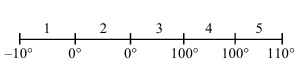
(B) The total heat required is the sum of heat absorbed in five stages:
$1$. Heating ice from $-10^{\circ} C$ to $0^{\circ} C$: $\Delta Q_1 = m \cdot S_{\text{ice}} \cdot \Delta T = 10^{-3} \times 2100 \times 10 = 21 \ J$
$2$. Melting ice at $0^{\circ} C$ to water at $0^{\circ} C$: $\Delta Q_2 = m \cdot L_f = 10^{-3} \times 3.35 \times 10^5 = 335 \ J$
$3$. Heating water from $0^{\circ} C$ to $100^{\circ} C$: $\Delta Q_3 = m \cdot S_{\text{water}} \cdot \Delta T = 10^{-3} \times 4180 \times 100 = 418 \ J$
$4$. Vaporizing water at $100^{\circ} C$ to steam at $100^{\circ} C$: $\Delta Q_4 = m \cdot L_v = 10^{-3} \times 2.25 \times 10^6 = 2250 \ J$
$5$. Heating steam from $100^{\circ} C$ to $110^{\circ} C$: $\Delta Q_5 = m \cdot S_{\text{steam}} \cdot \Delta T = 10^{-3} \times 1920 \times 10 = 19.2 \ J$
Total heat $\Delta Q_{\text{total}} = \Delta Q_1 + \Delta Q_2 + \Delta Q_3 + \Delta Q_4 + \Delta Q_5 = 21 + 335 + 418 + 2250 + 19.2 = 3043.2 \ J$.
Rounding to the nearest integer,we get $3043 \ J$.
$1$. Heating ice from $-10^{\circ} C$ to $0^{\circ} C$: $\Delta Q_1 = m \cdot S_{\text{ice}} \cdot \Delta T = 10^{-3} \times 2100 \times 10 = 21 \ J$
$2$. Melting ice at $0^{\circ} C$ to water at $0^{\circ} C$: $\Delta Q_2 = m \cdot L_f = 10^{-3} \times 3.35 \times 10^5 = 335 \ J$
$3$. Heating water from $0^{\circ} C$ to $100^{\circ} C$: $\Delta Q_3 = m \cdot S_{\text{water}} \cdot \Delta T = 10^{-3} \times 4180 \times 100 = 418 \ J$
$4$. Vaporizing water at $100^{\circ} C$ to steam at $100^{\circ} C$: $\Delta Q_4 = m \cdot L_v = 10^{-3} \times 2.25 \times 10^6 = 2250 \ J$
$5$. Heating steam from $100^{\circ} C$ to $110^{\circ} C$: $\Delta Q_5 = m \cdot S_{\text{steam}} \cdot \Delta T = 10^{-3} \times 1920 \times 10 = 19.2 \ J$
Total heat $\Delta Q_{\text{total}} = \Delta Q_1 + \Delta Q_2 + \Delta Q_3 + \Delta Q_4 + \Delta Q_5 = 21 + 335 + 418 + 2250 + 19.2 = 3043.2 \ J$.
Rounding to the nearest integer,we get $3043 \ J$.
0 likes
View Solution156
MediumMCQ
$A$ gun fires a lead bullet of temperature $300 \ K$ into a wooden block. The bullet having a melting temperature of $600 \ K$ penetrates into the block and melts down. If the total heat required for the process is $625 \ J$,then the mass of the bullet is . . . . . . grams. (Latent heat of fusion of lead $= 2.5 \times 10^4 \ J \ kg^{-1}$ and specific heat capacity of lead $= 125 \ J \ kg^{-1} K^{-1}$)
A
$20$
B
$15$
C
$10$
D
$5$
Solution
(C) The total heat required for the process consists of two parts: the heat required to raise the temperature of the bullet to its melting point and the heat required for the phase change (melting).
Let $m$ be the mass of the bullet in $kg$.
Heat required to raise the temperature from $300 \ K$ to $600 \ K$ is $Q_1 = ms \Delta T = m \times 125 \times (600 - 300) = m \times 125 \times 300 = 37500m \ J$.
Heat required for melting is $Q_2 = mL = m \times 2.5 \times 10^4 = 25000m \ J$.
Total heat $Q = Q_1 + Q_2 = 37500m + 25000m = 62500m \ J$.
Given $Q = 625 \ J$,we have $62500m = 625$.
$m = \frac{625}{62500} = 0.01 \ kg$.
Converting to grams,$m = 0.01 \times 1000 = 10 \ g$.
Let $m$ be the mass of the bullet in $kg$.
Heat required to raise the temperature from $300 \ K$ to $600 \ K$ is $Q_1 = ms \Delta T = m \times 125 \times (600 - 300) = m \times 125 \times 300 = 37500m \ J$.
Heat required for melting is $Q_2 = mL = m \times 2.5 \times 10^4 = 25000m \ J$.
Total heat $Q = Q_1 + Q_2 = 37500m + 25000m = 62500m \ J$.
Given $Q = 625 \ J$,we have $62500m = 625$.
$m = \frac{625}{62500} = 0.01 \ kg$.
Converting to grams,$m = 0.01 \times 1000 = 10 \ g$.
0 likes
View Solution157
MediumMCQ
Match List-$I$ with List-$II$.
Choose the correct answer from the options given below:
| List-$I$ | List-$II$ |
| $(A)$ Heat capacity of body | $(I)$ $J kg^{-1}$ |
| $(B)$ Specific heat capacity of body | $(II)$ $J K^{-1}$ |
| $(C)$ Latent heat | $(III)$ $J kg^{-1} K^{-1}$ |
| $(D)$ Thermal conductivity | $(IV)$ $J m^{-1} K^{-1} s^{-1}$ |
Choose the correct answer from the options given below:
A
$(A)-(III), (B)-(I), (C)-(II), (D)-(IV)$
B
$(A)-(IV), (B)-(III), (C)-(II), (D)-(I)$
C
$(A)-(III), (B)-(IV), (C)-(I), (D)-(II)$
D
$(A)-(II), (B)-(III), (C)-(I), (D)-(IV)$
Solution
(D) $1$. Heat capacity $(C^{\prime})$ is defined as the amount of heat required to raise the temperature of a body by $1 K$. Its unit is $J K^{-1}$. Thus,$(A)-(II)$.
$2$. Specific heat capacity $(S)$ is the amount of heat required to raise the temperature of $1 kg$ of a substance by $1 K$. Its unit is $J kg^{-1} K^{-1}$. Thus,$(B)-(III)$.
$3$. Latent heat $(L)$ is the heat required to change the state of $1 kg$ of a substance at constant temperature. Its unit is $J kg^{-1}$. Thus,$(C)-(I)$.
$4$. Thermal conductivity $(K)$ is given by the formula $\Delta Q = \frac{KA \Delta T}{L} t$. Rearranging for $K$,we get $K = \frac{\Delta Q \cdot L}{A \cdot \Delta T \cdot t}$. The unit is $J m^{-1} K^{-1} s^{-1}$. Thus,$(D)-(IV)$.
Therefore,the correct matching is $(A)-(II), (B)-(III), (C)-(I), (D)-(IV)$.
$2$. Specific heat capacity $(S)$ is the amount of heat required to raise the temperature of $1 kg$ of a substance by $1 K$. Its unit is $J kg^{-1} K^{-1}$. Thus,$(B)-(III)$.
$3$. Latent heat $(L)$ is the heat required to change the state of $1 kg$ of a substance at constant temperature. Its unit is $J kg^{-1}$. Thus,$(C)-(I)$.
$4$. Thermal conductivity $(K)$ is given by the formula $\Delta Q = \frac{KA \Delta T}{L} t$. Rearranging for $K$,we get $K = \frac{\Delta Q \cdot L}{A \cdot \Delta T \cdot t}$. The unit is $J m^{-1} K^{-1} s^{-1}$. Thus,$(D)-(IV)$.
Therefore,the correct matching is $(A)-(II), (B)-(III), (C)-(I), (D)-(IV)$.
0 likes
View Solution158
DifficultMCQ
Consider a rectangular sheet of solid material of length $l=9 \ cm$ and width $d=4 \ cm$. The coefficient of linear expansion is $\alpha=3.1 \times 10^{-5} \ K^{-1}$ at room temperature and one atmospheric pressure. The mass of the sheet is $m=0.1 \ kg$ and the specific heat capacity is $C_v=900 \ J \ kg^{-1} K^{-1}$. If the amount of heat supplied to the material is $8.1 \times 10^2 \ J$,then the change in area of the rectangular sheet is:
A
$2.0 \times 10^{-6} \ m^2$
B
$3.0 \times 10^{-7} \ m^2$
C
$6.0 \times 10^{-7} \ m^2$
D
$4.0 \times 10^{-7} \ m^2$
Solution
(A) The initial area of the sheet is $A_0 = l \times d = 9 \ cm \times 4 \ cm = 36 \ cm^2 = 36 \times 10^{-4} \ m^2$.
Using the heat formula $\Delta Q = m C_v \Delta T$,we find the change in temperature $\Delta T$:
$8.1 \times 10^2 = 0.1 \times 900 \times \Delta T$
$810 = 90 \times \Delta T$
$\Delta T = \frac{810}{90} = 9 \ K$.
The change in area $\Delta A$ due to thermal expansion is given by $\Delta A = A_0 \beta \Delta T$,where $\beta = 2\alpha$ is the coefficient of areal expansion.
$\Delta A = A_0 (2\alpha) \Delta T$
$\Delta A = (36 \times 10^{-4} \ m^2) \times (2 \times 3.1 \times 10^{-5} \ K^{-1}) \times (9 \ K)$
$\Delta A = 36 \times 10^{-4} \times 6.2 \times 10^{-5} \times 9$
$\Delta A = 2008.8 \times 10^{-9} \ m^2 \approx 2.0 \times 10^{-6} \ m^2$.
Using the heat formula $\Delta Q = m C_v \Delta T$,we find the change in temperature $\Delta T$:
$8.1 \times 10^2 = 0.1 \times 900 \times \Delta T$
$810 = 90 \times \Delta T$
$\Delta T = \frac{810}{90} = 9 \ K$.
The change in area $\Delta A$ due to thermal expansion is given by $\Delta A = A_0 \beta \Delta T$,where $\beta = 2\alpha$ is the coefficient of areal expansion.
$\Delta A = A_0 (2\alpha) \Delta T$
$\Delta A = (36 \times 10^{-4} \ m^2) \times (2 \times 3.1 \times 10^{-5} \ K^{-1}) \times (9 \ K)$
$\Delta A = 36 \times 10^{-4} \times 6.2 \times 10^{-5} \times 9$
$\Delta A = 2008.8 \times 10^{-9} \ m^2 \approx 2.0 \times 10^{-6} \ m^2$.
0 likes
View Solution159
MediumMCQ
Water falls from a height of $200 \ m$ into a pool. Calculate the rise in temperature of the water assuming no heat dissipation from the water in the pool. ($g = 10 \ m/s^2$,specific heat of water $s = 4200 \ J/(kg \ K)$) (in $K$)
A
$0.23$
B
$0.36$
C
$0.14$
D
$0.48$
Solution
(D) The potential energy of the water at height $h$ is converted into heat energy when it hits the pool.
$mgh = ms \Delta T$
Here,$m$ is the mass of water,$g = 10 \ m/s^2$ is the acceleration due to gravity,$h = 200 \ m$ is the height,and $s = 4200 \ J/(kg \ K)$ is the specific heat capacity of water.
Canceling $m$ from both sides,we get:
$gh = s \Delta T$
$\Delta T = \frac{gh}{s}$
Substituting the values:
$\Delta T = \frac{10 \times 200}{4200} = \frac{2000}{4200} = \frac{20}{42} = \frac{10}{21} \ K$
$\Delta T \approx 0.476 \ K \approx 0.48 \ K$
$mgh = ms \Delta T$
Here,$m$ is the mass of water,$g = 10 \ m/s^2$ is the acceleration due to gravity,$h = 200 \ m$ is the height,and $s = 4200 \ J/(kg \ K)$ is the specific heat capacity of water.
Canceling $m$ from both sides,we get:
$gh = s \Delta T$
$\Delta T = \frac{gh}{s}$
Substituting the values:
$\Delta T = \frac{10 \times 200}{4200} = \frac{2000}{4200} = \frac{20}{42} = \frac{10}{21} \ K$
$\Delta T \approx 0.476 \ K \approx 0.48 \ K$
0 likes
View Solution160
DifficultMCQ
$A$ lead bullet of $20 \ g$ travelling at $300 \ m/s$ strikes against a block of wood and comes to rest. Assuming $50 \%$ of heat is absorbed by the bullet,the increase in its temperature is $.....^{\circ} C$ (take specific heat of lead $= 150 \ J/kg \cdot K$).
A
$100$
B
$150$
C
$125$
D
$200$
Solution
(B) The kinetic energy of the bullet is $K.E. = \frac{1}{2} mv^2$.
Given: $m = 20 \ g = 0.02 \ kg$,$v = 300 \ m/s$,$S = 150 \ J/kg \cdot K$.
$K.E. = \frac{1}{2} \times 0.02 \times (300)^2 = 0.01 \times 90000 = 900 \ J$.
Since $50 \%$ of the heat is absorbed by the bullet,the heat absorbed $Q = 0.5 \times 900 = 450 \ J$.
Using the formula $Q = mS \Delta T$,we have $450 = 0.02 \times 150 \times \Delta T$.
$450 = 3 \times \Delta T$.
$\Delta T = \frac{450}{3} = 150^{\circ} C$.
Given: $m = 20 \ g = 0.02 \ kg$,$v = 300 \ m/s$,$S = 150 \ J/kg \cdot K$.
$K.E. = \frac{1}{2} \times 0.02 \times (300)^2 = 0.01 \times 90000 = 900 \ J$.
Since $50 \%$ of the heat is absorbed by the bullet,the heat absorbed $Q = 0.5 \times 900 = 450 \ J$.
Using the formula $Q = mS \Delta T$,we have $450 = 0.02 \times 150 \times \Delta T$.
$450 = 3 \times \Delta T$.
$\Delta T = \frac{450}{3} = 150^{\circ} C$.
0 likes
View Solution161
MediumMCQ
$A$ stationary object at $4^{\circ} C$ and weighing $3.5 \ kg$ falls from a height of $2000 \ m$ on a snow mountain at $0^{\circ} C$. If the temperature of the object just before hitting the snow is $0^{\circ} C$ and the object comes to rest immediately,then the quantity of ice that melts is (Acceleration due to gravity $= 10 \ m/s^2$,Latent heat of ice $= 3.5 \times 10^5 \ J/kg$)
A
$2 \ g$
B
$20 \ g$
C
$200 \ g$
D
$2 \ kg$
Solution
(C) The potential energy of the object at height $h$ is converted into heat energy upon impact.
Given: Mass $m = 3.5 \ kg$,height $h = 2000 \ m$,$g = 10 \ m/s^2$,Latent heat $L = 3.5 \times 10^5 \ J/kg$.
The potential energy $PE = mgh = 3.5 \times 10 \times 2000 = 70,000 \ J$.
The heat required to melt a mass $m'$ of ice is $Q = m'L$.
Since the object comes to rest,all potential energy is converted into heat: $mgh = m'L$.
$70,000 = m' \times 3.5 \times 10^5$.
$m' = \frac{70,000}{3.5 \times 10^5} = \frac{7 \times 10^4}{3.5 \times 10^5} = 2 \times 10^{-1} \ kg = 0.2 \ kg$.
Converting to grams: $0.2 \ kg = 200 \ g$.
Given: Mass $m = 3.5 \ kg$,height $h = 2000 \ m$,$g = 10 \ m/s^2$,Latent heat $L = 3.5 \times 10^5 \ J/kg$.
The potential energy $PE = mgh = 3.5 \times 10 \times 2000 = 70,000 \ J$.
The heat required to melt a mass $m'$ of ice is $Q = m'L$.
Since the object comes to rest,all potential energy is converted into heat: $mgh = m'L$.
$70,000 = m' \times 3.5 \times 10^5$.
$m' = \frac{70,000}{3.5 \times 10^5} = \frac{7 \times 10^4}{3.5 \times 10^5} = 2 \times 10^{-1} \ kg = 0.2 \ kg$.
Converting to grams: $0.2 \ kg = 200 \ g$.
0 likes
View Solution162
DifficultMCQ
$A$ lead bullet moving with velocity '$v$' strikes a wall and stops. If $50\%$ of its energy is converted into heat,then the increase in temperature is ($s =$ specific heat of lead,$J =$ mechanical equivalent of heat).
A
$\frac{v^2 s}{2 J}$
B
$\frac{v^2}{4 sJ}$
C
$\frac{v^2 s}{J}$
D
$\frac{2 v^2}{Js}$
Solution
(B) The kinetic energy of the bullet is $K.E. = \frac{1}{2} mv^2$.
Given that $50\%$ of this energy is converted into heat energy $(Q)$.
Therefore,the heat energy produced is $Q = \frac{1}{2} \times (\frac{1}{2} mv^2) = \frac{1}{4} mv^2$.
The heat required to raise the temperature of the bullet by $\Delta T$ is given by $Q = ms \Delta T$.
Since $J$ is the mechanical equivalent of heat,we use the relation $W = JQ$,where $W$ is the work done (or energy converted).
Equating the energy converted to heat: $\frac{1}{4} mv^2 = J(ms \Delta T)$.
Solving for $\Delta T$: $\Delta T = \frac{mv^2}{4 Jms} = \frac{v^2}{4 Js}$.
Given that $50\%$ of this energy is converted into heat energy $(Q)$.
Therefore,the heat energy produced is $Q = \frac{1}{2} \times (\frac{1}{2} mv^2) = \frac{1}{4} mv^2$.
The heat required to raise the temperature of the bullet by $\Delta T$ is given by $Q = ms \Delta T$.
Since $J$ is the mechanical equivalent of heat,we use the relation $W = JQ$,where $W$ is the work done (or energy converted).
Equating the energy converted to heat: $\frac{1}{4} mv^2 = J(ms \Delta T)$.
Solving for $\Delta T$: $\Delta T = \frac{mv^2}{4 Jms} = \frac{v^2}{4 Js}$.
0 likes
View Solution163
EasyMCQ
$A$ clock pendulum having a coefficient of linear expansion $\alpha = 9 \times 10^{-7} /^{\circ}C$ has a period of $0.5 \ s$ at $20^{\circ}C$. If the clock is used in a climate where the temperature is $30^{\circ}C$,how much time does the clock lose in each oscillation? (Assume $g$ is constant)
A
$2.5 \times 10^{-7} \ s$
B
$5 \times 10^{-7} \ s$
C
$1.125 \times 10^{-6} \ s$
D
$2.25 \times 10^{-6} \ s$
Solution
(D) The time period of a pendulum is given by $T = 2\pi \sqrt{\frac{L}{g}}$.
Taking the derivative,the change in time period is $\frac{dT}{T} = \frac{1}{2} \frac{dL}{L}$.
Since $\frac{dL}{L} = \alpha \Delta \theta$,we have $\frac{dT}{T} = \frac{1}{2} \alpha \Delta \theta$.
Here,$T = 0.5 \ s$,$\alpha = 9 \times 10^{-7} /^{\circ}C$,and $\Delta \theta = 30^{\circ}C - 20^{\circ}C = 10^{\circ}C$.
Substituting the values: $dT = T \times \frac{1}{2} \times \alpha \times \Delta \theta$.
$dT = 0.5 \times \frac{1}{2} \times (9 \times 10^{-7}) \times 10$.
$dT = 0.25 \times 9 \times 10^{-6} = 2.25 \times 10^{-6} \ s$.
Taking the derivative,the change in time period is $\frac{dT}{T} = \frac{1}{2} \frac{dL}{L}$.
Since $\frac{dL}{L} = \alpha \Delta \theta$,we have $\frac{dT}{T} = \frac{1}{2} \alpha \Delta \theta$.
Here,$T = 0.5 \ s$,$\alpha = 9 \times 10^{-7} /^{\circ}C$,and $\Delta \theta = 30^{\circ}C - 20^{\circ}C = 10^{\circ}C$.
Substituting the values: $dT = T \times \frac{1}{2} \times \alpha \times \Delta \theta$.
$dT = 0.5 \times \frac{1}{2} \times (9 \times 10^{-7}) \times 10$.
$dT = 0.25 \times 9 \times 10^{-6} = 2.25 \times 10^{-6} \ s$.
0 likes
View Solution164
MediumMCQ
$A$ lead bullet moving with velocity $V$ strikes a wall and stops. If $75 \%$ of its energy is converted into heat,then the increase in temperature is ($s=$ specific heat of lead,$J=$ mechanical equivalent of heat).
A
$\frac{3 V^2}{8 Js}$
B
$\frac{5 V^2}{8 Js}$
C
$\frac{3 V^2}{4 Js}$
D
$\frac{5 V^2}{4 Js}$
Solution
(A) The initial kinetic energy of the bullet is $K.E. = \frac{1}{2} MV^2$.
Given that $75 \%$ of this energy is converted into heat,the heat energy produced is $Q = 0.75 \times K.E. = \frac{3}{4} \times \frac{1}{2} MV^2 = \frac{3}{8} MV^2$.
The heat energy required to raise the temperature of the bullet by $\Delta T$ is given by $H = M s \Delta T$.
Using the mechanical equivalent of heat $J$,the relationship between heat energy in Joules $(W)$ and calories $(Q)$ is $W = JQ$.
Here,the work done (energy converted) is $W = \frac{3}{8} MV^2$ and the heat absorbed is $Q = M s \Delta T$.
Thus,$\frac{3}{8} MV^2 = J (M s \Delta T)$.
Solving for the increase in temperature $\Delta T$:
$\Delta T = \frac{3 MV^2}{8 J M s} = \frac{3 V^2}{8 Js}$.
Given that $75 \%$ of this energy is converted into heat,the heat energy produced is $Q = 0.75 \times K.E. = \frac{3}{4} \times \frac{1}{2} MV^2 = \frac{3}{8} MV^2$.
The heat energy required to raise the temperature of the bullet by $\Delta T$ is given by $H = M s \Delta T$.
Using the mechanical equivalent of heat $J$,the relationship between heat energy in Joules $(W)$ and calories $(Q)$ is $W = JQ$.
Here,the work done (energy converted) is $W = \frac{3}{8} MV^2$ and the heat absorbed is $Q = M s \Delta T$.
Thus,$\frac{3}{8} MV^2 = J (M s \Delta T)$.
Solving for the increase in temperature $\Delta T$:
$\Delta T = \frac{3 MV^2}{8 J M s} = \frac{3 V^2}{8 Js}$.
0 likes
View Solution165
MediumMCQ
$ 1 \text{ g} $ of ice is mixed with $ 1 \text{ g} $ of steam. At thermal equilibrium,the temperature of the mixture is (in $^{\circ} C$)
A
$0$
B
$100$
C
$50$
D
$55$
Solution
(B) Heat required to melt $ 1 \text{ g} $ of ice at $ 0^{\circ} C $ to water at $ 0^{\circ} C $ is $ Q_1 = m L_f = 1 \times 80 = 80 \text{ cal} $.
Heat required to raise the temperature of $ 1 \text{ g} $ of water from $ 0^{\circ} C $ to $ 100^{\circ} C $ is $ Q_2 = m c \Delta T = 1 \times 1 \times 100 = 100 \text{ cal} $.
Total heat required to convert $ 1 \text{ g} $ of ice at $ 0^{\circ} C $ to $ 1 \text{ g} $ of water at $ 100^{\circ} C $ is $ Q_{total} = 80 + 100 = 180 \text{ cal} $.
Heat released by $ 1 \text{ g} $ of steam at $ 100^{\circ} C $ to condense into water at $ 100^{\circ} C $ is $ Q_{steam} = m L_v = 1 \times 540 = 540 \text{ cal} $.
Since $ Q_{steam} > Q_{total} $,the steam has more than enough heat to melt the ice and raise the water to $ 100^{\circ} C $.
Therefore,the mixture will reach thermal equilibrium at $ 100^{\circ} C $ with some steam remaining.
Heat required to raise the temperature of $ 1 \text{ g} $ of water from $ 0^{\circ} C $ to $ 100^{\circ} C $ is $ Q_2 = m c \Delta T = 1 \times 1 \times 100 = 100 \text{ cal} $.
Total heat required to convert $ 1 \text{ g} $ of ice at $ 0^{\circ} C $ to $ 1 \text{ g} $ of water at $ 100^{\circ} C $ is $ Q_{total} = 80 + 100 = 180 \text{ cal} $.
Heat released by $ 1 \text{ g} $ of steam at $ 100^{\circ} C $ to condense into water at $ 100^{\circ} C $ is $ Q_{steam} = m L_v = 1 \times 540 = 540 \text{ cal} $.
Since $ Q_{steam} > Q_{total} $,the steam has more than enough heat to melt the ice and raise the water to $ 100^{\circ} C $.
Therefore,the mixture will reach thermal equilibrium at $ 100^{\circ} C $ with some steam remaining.
0 likes
View Solution166
MediumMCQ
$A$ solid cube of mass $m$ at a temperature $\theta_0$ is heated at a constant rate. It becomes liquid at temperature $\theta_1$ and vapour at temperature $\theta_2$. Let $s_1$ and $s_2$ be specific heats in its solid and liquid states respectively. If $L_f$ and $L_v$ are latent heats of fusion and vaporisation respectively,then the minimum heat energy supplied to the cube until it vaporises is
A
$m s_1(\theta_1-\theta_0)+m s_2(\theta_2-\theta_1)$
B
$m L_f+m s_2(\theta_2-\theta_1)+m L_v$
C
$m s_1(\theta_1-\theta_0)+m L_f+m s_2(\theta_2-\theta_1)+m L_v$
D
$m s_1(\theta_1-\theta_0)+m L_f+m s_2(\theta_2-\theta_0)+m L_v$
Solution
(C) The total heat energy $Q$ required to convert the solid cube at $\theta_0$ to vapour at $\theta_2$ is the sum of heat required for each phase change and temperature change step:
$1$. Heat to raise temperature of solid from $\theta_0$ to $\theta_1$: $Q_1 = m s_1(\theta_1 - \theta_0)$
$2$. Heat for fusion at $\theta_1$: $Q_2 = m L_f$
$3$. Heat to raise temperature of liquid from $\theta_1$ to $\theta_2$: $Q_3 = m s_2(\theta_2 - \theta_1)$
$4$. Heat for vaporisation at $\theta_2$: $Q_4 = m L_v$
Total heat $Q = Q_1 + Q_2 + Q_3 + Q_4 = m s_1(\theta_1 - \theta_0) + m L_f + m s_2(\theta_2 - \theta_1) + m L_v$.
$1$. Heat to raise temperature of solid from $\theta_0$ to $\theta_1$: $Q_1 = m s_1(\theta_1 - \theta_0)$
$2$. Heat for fusion at $\theta_1$: $Q_2 = m L_f$
$3$. Heat to raise temperature of liquid from $\theta_1$ to $\theta_2$: $Q_3 = m s_2(\theta_2 - \theta_1)$
$4$. Heat for vaporisation at $\theta_2$: $Q_4 = m L_v$
Total heat $Q = Q_1 + Q_2 + Q_3 + Q_4 = m s_1(\theta_1 - \theta_0) + m L_f + m s_2(\theta_2 - \theta_1) + m L_v$.
0 likes
View Solution167
EasyMCQ
$A$ metal block is made from a mixture of $2.4 \ kg$ of aluminium,$1.6 \ kg$ of brass,and $0.8 \ kg$ of copper. The metal block is initially at $20^{\circ} C$. If the heat supplied to the metal block is $44.4 \ cal$,find the final temperature of the block if the specific heats of aluminium,brass,and copper are $0.216, 0.0917, 0.0931 \ cal \cdot kg^{-1} \cdot ^{\circ}C^{-1}$ respectively. (in $^{\circ} C$)
A
$100$
B
$60$
C
$40$
D
$80$
Solution
(D) The total heat supplied $Q$ is given by the formula: $Q = (m_1 s_1 + m_2 s_2 + m_3 s_3) \Delta T$.
Here,$m_1 = 2.4 \ kg$,$s_1 = 0.216 \ cal \cdot kg^{-1} \cdot ^{\circ}C^{-1}$ (Aluminium).
$m_2 = 1.6 \ kg$,$s_2 = 0.0917 \ cal \cdot kg^{-1} \cdot ^{\circ}C^{-1}$ (Brass).
$m_3 = 0.8 \ kg$,$s_3 = 0.0931 \ cal \cdot kg^{-1} \cdot ^{\circ}C^{-1}$ (Copper).
$Q = 44.4 \ cal$.
Substituting the values: $44.4 = (2.4 \times 0.216 + 1.6 \times 0.0917 + 0.8 \times 0.0931) \Delta T$.
$44.4 = (0.5184 + 0.14672 + 0.07448) \Delta T$.
$44.4 = (0.7396) \Delta T$.
$\Delta T = 44.4 / 0.7396 \approx 60^{\circ} C$.
Since $\Delta T = T_{final} - T_{initial}$,we have $60 = T_{final} - 20$.
Therefore,$T_{final} = 80^{\circ} C$.
Here,$m_1 = 2.4 \ kg$,$s_1 = 0.216 \ cal \cdot kg^{-1} \cdot ^{\circ}C^{-1}$ (Aluminium).
$m_2 = 1.6 \ kg$,$s_2 = 0.0917 \ cal \cdot kg^{-1} \cdot ^{\circ}C^{-1}$ (Brass).
$m_3 = 0.8 \ kg$,$s_3 = 0.0931 \ cal \cdot kg^{-1} \cdot ^{\circ}C^{-1}$ (Copper).
$Q = 44.4 \ cal$.
Substituting the values: $44.4 = (2.4 \times 0.216 + 1.6 \times 0.0917 + 0.8 \times 0.0931) \Delta T$.
$44.4 = (0.5184 + 0.14672 + 0.07448) \Delta T$.
$44.4 = (0.7396) \Delta T$.
$\Delta T = 44.4 / 0.7396 \approx 60^{\circ} C$.
Since $\Delta T = T_{final} - T_{initial}$,we have $60 = T_{final} - 20$.
Therefore,$T_{final} = 80^{\circ} C$.
0 likes
View Solution168
MediumMCQ
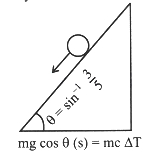
$A$ block of steel of mass $2 \,kg$ slides down a rough inclined plane of inclination $\sin ^{-1}\left(\frac{3}{5}\right)$ at a constant speed. Assuming that the mechanical energy lost due to friction is used to increase the temperature of the block, calculate the rise in temperature of the block as it slides through $80 \,cm$. (Specific heat capacity of steel $= 420 \,J kg^{-1} K^{-1}$ and acceleration due to gravity $= 10 \,ms^{-2}$) (in $^{\circ} C$)
A
$0.0190$
B
$0.0114$
C
$0.0152$
D
$0.0952$
Solution
(B) Given: Mass $m = 2 \,kg$, inclination $\theta = \sin^{-1}(3/5)$, so $\sin \theta = 3/5$ and $\cos \theta = 4/5$. Distance $s = 80 \,cm = 0.8 \,m$. Specific heat $c = 420 \,J kg^{-1} K^{-1}$. Acceleration due to gravity $g = 10 \,ms^{-2}$.
Since the block slides at a constant speed, the work done by friction equals the loss in potential energy. The work done by friction $W_f = f_k \cdot s$, where $f_k = \mu_k N = \mu_k mg \cos \theta$. Since the speed is constant, $mg \sin \theta = f_k$.
Thus, the heat generated $Q = W_f = (mg \sin \theta) \cdot s$.
Equating heat generated to heat absorbed: $Q = mc \Delta T$.
$mc \Delta T = (mg \sin \theta) s$.
$\Delta T = \frac{g \sin \theta \cdot s}{c} = \frac{10 \times (3/5) \times 0.8}{420}$.
$\Delta T = \frac{10 \times 0.6 \times 0.8}{420} = \frac{4.8}{420} \approx 0.0114^{\circ} C$.
Since the block slides at a constant speed, the work done by friction equals the loss in potential energy. The work done by friction $W_f = f_k \cdot s$, where $f_k = \mu_k N = \mu_k mg \cos \theta$. Since the speed is constant, $mg \sin \theta = f_k$.
Thus, the heat generated $Q = W_f = (mg \sin \theta) \cdot s$.
Equating heat generated to heat absorbed: $Q = mc \Delta T$.
$mc \Delta T = (mg \sin \theta) s$.
$\Delta T = \frac{g \sin \theta \cdot s}{c} = \frac{10 \times (3/5) \times 0.8}{420}$.
$\Delta T = \frac{10 \times 0.6 \times 0.8}{420} = \frac{4.8}{420} \approx 0.0114^{\circ} C$.
0 likes
View Solution169
EasyMCQ
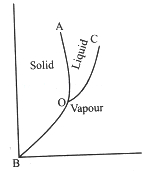
In the given triple point curve as shown in the figure,the curves $AO$,$BO$,and $CO$ represent:
A
$AO =$ Sublimation curve,$BO =$ Fusion curve,$CO =$ Vaporization curve
B
$AO =$ Fusion curve,$BO =$ Sublimation curve,$CO =$ Vaporization curve
C
$AO =$ Fusion curve,$BO =$ Vaporization curve,$CO =$ Sublimation curve
D
$AO =$ Vaporization curve,$BO =$ Fusion curve,$CO =$ Sublimation curve
Solution
(B) In a standard phase diagram (Pressure vs Temperature):
$1$. The curve separating the Solid and Liquid phases is the Fusion (or Melting) curve. In the figure,$AO$ separates the Solid and Liquid regions,so $AO$ is the Fusion curve.
$2$. The curve separating the Solid and Vapour phases is the Sublimation curve. In the figure,$BO$ separates the Solid and Vapour regions,so $BO$ is the Sublimation curve.
$3$. The curve separating the Liquid and Vapour phases is the Vaporization (or Boiling) curve. In the figure,$CO$ separates the Liquid and Vapour regions,so $CO$ is the Vaporization curve.
Therefore,$AO =$ Fusion curve,$BO =$ Sublimation curve,and $CO =$ Vaporization curve.
$1$. The curve separating the Solid and Liquid phases is the Fusion (or Melting) curve. In the figure,$AO$ separates the Solid and Liquid regions,so $AO$ is the Fusion curve.
$2$. The curve separating the Solid and Vapour phases is the Sublimation curve. In the figure,$BO$ separates the Solid and Vapour regions,so $BO$ is the Sublimation curve.
$3$. The curve separating the Liquid and Vapour phases is the Vaporization (or Boiling) curve. In the figure,$CO$ separates the Liquid and Vapour regions,so $CO$ is the Vaporization curve.
Therefore,$AO =$ Fusion curve,$BO =$ Sublimation curve,and $CO =$ Vaporization curve.
0 likes
View Solution170
MediumMCQ
$A$ steel ball of mass $200 \,g$ falls freely from a height of $20 \,m$ and bounces to a height of $10.8 \,m$ from the ground. If the energy lost in this process is absorbed by the ball, the rise in its temperature is ($g = 10 \,ms^{-2}$, specific heat capacity of steel is $460 \,Jkg^{-1} K^{-1}$). (in $^{\circ} C$)
A
$0.1$
B
$1$
C
$0.2$
D
$2$
Solution
(C) The energy lost by the ball during the bounce is equal to the difference in potential energy at the two heights.
Energy lost $\Delta E = mg(h_1 - h_2)$.
Given $m = 200 \,g = 0.2 \,kg$, $h_1 = 20 \,m$, $h_2 = 10.8 \,m$, $g = 10 \,ms^{-2}$, and $c = 460 \,Jkg^{-1} K^{-1}$.
Assuming the lost energy is absorbed by the ball, $\Delta E = mc \Delta T$.
Equating the two: $mg(h_1 - h_2) = mc \Delta T$.
Canceling $m$ from both sides: $g(h_1 - h_2) = c \Delta T$.
Substituting the values: $10 \times (20 - 10.8) = 460 \times \Delta T$.
$10 \times 9.2 = 460 \times \Delta T$.
$92 = 460 \times \Delta T$.
$\Delta T = \frac{92}{460} = 0.2^{\circ} C$.
Energy lost $\Delta E = mg(h_1 - h_2)$.
Given $m = 200 \,g = 0.2 \,kg$, $h_1 = 20 \,m$, $h_2 = 10.8 \,m$, $g = 10 \,ms^{-2}$, and $c = 460 \,Jkg^{-1} K^{-1}$.
Assuming the lost energy is absorbed by the ball, $\Delta E = mc \Delta T$.
Equating the two: $mg(h_1 - h_2) = mc \Delta T$.
Canceling $m$ from both sides: $g(h_1 - h_2) = c \Delta T$.
Substituting the values: $10 \times (20 - 10.8) = 460 \times \Delta T$.
$10 \times 9.2 = 460 \times \Delta T$.
$92 = 460 \times \Delta T$.
$\Delta T = \frac{92}{460} = 0.2^{\circ} C$.
0 likes
View Solution171
EasyMCQ
The amount of heat needed to heat $200 \ g$ of ice at $-10^{\circ}C$ to convert it into water at $30^{\circ}C$ is:
Specific heat capacity of ice $= 2100 \ J \ kg^{-1} \ K^{-1}$
Specific heat capacity of water $= 4186 \ J \ kg^{-1} \ K^{-1}$
Latent heat of fusion of ice $= 3.35 \times 10^5 \ J \ kg^{-1}$ (in $J$)
Specific heat capacity of ice $= 2100 \ J \ kg^{-1} \ K^{-1}$
Specific heat capacity of water $= 4186 \ J \ kg^{-1} \ K^{-1}$
Latent heat of fusion of ice $= 3.35 \times 10^5 \ J \ kg^{-1}$ (in $J$)
A
$96316$
B
$67000$
C
$92116$
D
$71200$
Solution
(A) The process involves three steps:
$1$. Heating ice from $-10^{\circ}C$ to $0^{\circ}C$: $Q_1 = m \cdot S_{ice} \cdot \Delta T = 0.2 \ kg \times 2100 \ J \ kg^{-1} K^{-1} \times 10 \ K = 4200 \ J$
$2$. Melting ice at $0^{\circ}C$ to water at $0^{\circ}C$: $Q_2 = m \cdot L_f = 0.2 \ kg \times 3.35 \times 10^5 \ J \ kg^{-1} = 67000 \ J$
$3$. Heating water from $0^{\circ}C$ to $30^{\circ}C$: $Q_3 = m \cdot S_{water} \cdot \Delta T = 0.2 \ kg \times 4186 \ J \ kg^{-1} K^{-1} \times 30 \ K = 25116 \ J$
Total heat required $Q = Q_1 + Q_2 + Q_3 = 4200 + 67000 + 25116 = 96316 \ J$.
$1$. Heating ice from $-10^{\circ}C$ to $0^{\circ}C$: $Q_1 = m \cdot S_{ice} \cdot \Delta T = 0.2 \ kg \times 2100 \ J \ kg^{-1} K^{-1} \times 10 \ K = 4200 \ J$
$2$. Melting ice at $0^{\circ}C$ to water at $0^{\circ}C$: $Q_2 = m \cdot L_f = 0.2 \ kg \times 3.35 \times 10^5 \ J \ kg^{-1} = 67000 \ J$
$3$. Heating water from $0^{\circ}C$ to $30^{\circ}C$: $Q_3 = m \cdot S_{water} \cdot \Delta T = 0.2 \ kg \times 4186 \ J \ kg^{-1} K^{-1} \times 30 \ K = 25116 \ J$
Total heat required $Q = Q_1 + Q_2 + Q_3 = 4200 + 67000 + 25116 = 96316 \ J$.
0 likes
View Solution172
MediumMCQ
$5 \text{ g}$ of steam at $100^{\circ} \text{C}$ is mixed with $5 \text{ g}$ of ice at $0^{\circ} \text{C}$. What is the final temperature of the mixture (in $^{\circ} \text{C}$)?
A
$100$
B
$95$
C
$90$
D
$80$
Solution
(A) Given: Mass of steam,$m_s = 5 \text{ g}$,Temperature of steam,$T_s = 100^{\circ} \text{C}$.
Mass of ice,$m_i = 5 \text{ g}$,Temperature of ice,$T_i = 0^{\circ} \text{C}$.
Latent heat of vaporization,$L_v = 540 \text{ cal/g}$.
Latent heat of fusion,$L_f = 80 \text{ cal/g}$.
Specific heat of water,$s = 1 \text{ cal/g}^{\circ} \text{C}$.
Step $1$: Calculate heat released by steam to condense into water at $100^{\circ} \text{C}$:
$Q_1 = m_s \times L_v = 5 \times 540 = 2700 \text{ cal}$.
Step $2$: Calculate heat required by ice to melt and reach $100^{\circ} \text{C}$:
Heat to melt ice: $Q_{melt} = m_i \times L_f = 5 \times 80 = 400 \text{ cal}$.
Heat to raise water temperature from $0^{\circ} \text{C}$ to $100^{\circ} \text{C}$: $Q_{rise} = m_i \times s \times \Delta T = 5 \times 1 \times 100 = 500 \text{ cal}$.
Total heat required by ice: $Q_2 = 400 + 500 = 900 \text{ cal}$.
Step $3$: Compare $Q_1$ and $Q_2$:
Since $Q_1 > Q_2$,the steam has more than enough energy to melt the ice and heat the resulting water to $100^{\circ} \text{C}$.
Therefore,the final mixture will be at $100^{\circ} \text{C}$ with some steam remaining.
Mass of ice,$m_i = 5 \text{ g}$,Temperature of ice,$T_i = 0^{\circ} \text{C}$.
Latent heat of vaporization,$L_v = 540 \text{ cal/g}$.
Latent heat of fusion,$L_f = 80 \text{ cal/g}$.
Specific heat of water,$s = 1 \text{ cal/g}^{\circ} \text{C}$.
Step $1$: Calculate heat released by steam to condense into water at $100^{\circ} \text{C}$:
$Q_1 = m_s \times L_v = 5 \times 540 = 2700 \text{ cal}$.
Step $2$: Calculate heat required by ice to melt and reach $100^{\circ} \text{C}$:
Heat to melt ice: $Q_{melt} = m_i \times L_f = 5 \times 80 = 400 \text{ cal}$.
Heat to raise water temperature from $0^{\circ} \text{C}$ to $100^{\circ} \text{C}$: $Q_{rise} = m_i \times s \times \Delta T = 5 \times 1 \times 100 = 500 \text{ cal}$.
Total heat required by ice: $Q_2 = 400 + 500 = 900 \text{ cal}$.
Step $3$: Compare $Q_1$ and $Q_2$:
Since $Q_1 > Q_2$,the steam has more than enough energy to melt the ice and heat the resulting water to $100^{\circ} \text{C}$.
Therefore,the final mixture will be at $100^{\circ} \text{C}$ with some steam remaining.
0 likes
View Solution173
MediumMCQ
$A$ beaker is filled completely with water at $4^{\circ} C$. Identify the incorrect statement.
A
Water overflows when heated above $4^{\circ} C$.
B
Water overflows when cooled below $4^{\circ} C$.
C
Water overflows either when heated above $4^{\circ} C$ or cooled below $4^{\circ} C$.
D
Water will not overflow when cooled below $4^{\circ} C$.
Solution
(D) The density of water is maximum at $4^{\circ} C$.
As the temperature increases above $4^{\circ} C$,the density of water decreases,causing the volume to increase.
Similarly,as the temperature decreases below $4^{\circ} C$,the density of water also decreases due to anomalous expansion,which again causes the volume to increase.
Since the beaker is already full,any increase in volume leads to overflow.
Therefore,water overflows when heated above $4^{\circ} C$ or cooled below $4^{\circ} C$.
Statement $D$ is incorrect because water does overflow when cooled below $4^{\circ} C$.
As the temperature increases above $4^{\circ} C$,the density of water decreases,causing the volume to increase.
Similarly,as the temperature decreases below $4^{\circ} C$,the density of water also decreases due to anomalous expansion,which again causes the volume to increase.
Since the beaker is already full,any increase in volume leads to overflow.
Therefore,water overflows when heated above $4^{\circ} C$ or cooled below $4^{\circ} C$.
Statement $D$ is incorrect because water does overflow when cooled below $4^{\circ} C$.
0 likes
View Solution174
DifficultMCQ
If $60 \%$ of the kinetic energy of water falling from a $210 \ m$ high waterfall is converted into heat,the rise in temperature of the water at the bottom of the fall is nearly (specific heat of water $= 4.2 \times 10^3 \ J \ kg^{-1} \ K^{-1}$ and $g = 10 \ m/s^2$):
A
$0.6^{\circ} C$
B
$0.3^{\circ} C$
C
$1.2 \ K$
D
$2.4 \ K$
Solution
(B) Given: Height $h = 210 \ m$,Specific heat $c = 4.2 \times 10^3 \ J \ kg^{-1} \ K^{-1}$,Acceleration due to gravity $g = 10 \ m/s^2$.
When water falls,its potential energy is converted into kinetic energy.
Potential Energy $(PE) = mgh$.
According to the problem,$60 \%$ of the kinetic energy is converted into heat energy $(Q)$.
$Q = 0.6 \times PE = 0.6 \times mgh$.
Also,the heat produced is given by $Q = mc\Delta T$,where $\Delta T$ is the rise in temperature.
Equating the two expressions for $Q$:
$mc\Delta T = 0.6 \times mgh$.
Canceling mass $m$ from both sides:
$c\Delta T = 0.6 \times g \times h$.
$\Delta T = \frac{0.6 \times g \times h}{c}$.
Substituting the values:
$\Delta T = \frac{0.6 \times 10 \times 210}{4.2 \times 10^3} = \frac{1260}{4200} = 0.3^{\circ} C$.
Thus,the rise in temperature is $0.3^{\circ} C$.
When water falls,its potential energy is converted into kinetic energy.
Potential Energy $(PE) = mgh$.
According to the problem,$60 \%$ of the kinetic energy is converted into heat energy $(Q)$.
$Q = 0.6 \times PE = 0.6 \times mgh$.
Also,the heat produced is given by $Q = mc\Delta T$,where $\Delta T$ is the rise in temperature.
Equating the two expressions for $Q$:
$mc\Delta T = 0.6 \times mgh$.
Canceling mass $m$ from both sides:
$c\Delta T = 0.6 \times g \times h$.
$\Delta T = \frac{0.6 \times g \times h}{c}$.
Substituting the values:
$\Delta T = \frac{0.6 \times 10 \times 210}{4.2 \times 10^3} = \frac{1260}{4200} = 0.3^{\circ} C$.
Thus,the rise in temperature is $0.3^{\circ} C$.
0 likes
View Solution175
MediumMCQ
$A$ hammer of mass $200 \ kg$ strikes a steel block of mass $200 \ g$ with a velocity $8 \ ms^{-1}$. If $23 \%$ of the energy is utilized to heat the steel block,the rise in temperature of the block is (specific heat capacity of steel,$s = 460 \ J \ kg^{-1} \ K^{-1}$) (in $K$)
A
$8$
B
$16$
C
$12$
D
$24$
Solution
(B) Given: Mass of hammer $M = 200 \ kg$,mass of steel block $m = 200 \ g = 0.2 \ kg$,velocity of hammer $v = 8 \ ms^{-1}$,and specific heat capacity of steel $s = 460 \ J \ kg^{-1} \ K^{-1}$.
The kinetic energy of the hammer is given by $KE = \frac{1}{2} M v^2$.
Substituting the values: $KE = \frac{1}{2} \times 200 \times 8^2 = 100 \times 64 = 6400 \ J$.
Only $23 \%$ of this energy is utilized to heat the steel block.
Heat energy $H = 23 \% \text{ of } 6400 \ J = \frac{23}{100} \times 6400 = 1472 \ J$.
The heat absorbed by the block is given by $H = m s \Delta T$,where $\Delta T$ is the rise in temperature.
$\Delta T = \frac{H}{m s} = \frac{1472}{0.2 \times 460} = \frac{1472}{92} = 16 \ K$.
Thus,the rise in temperature of the block is $16 \ K$.
The kinetic energy of the hammer is given by $KE = \frac{1}{2} M v^2$.
Substituting the values: $KE = \frac{1}{2} \times 200 \times 8^2 = 100 \times 64 = 6400 \ J$.
Only $23 \%$ of this energy is utilized to heat the steel block.
Heat energy $H = 23 \% \text{ of } 6400 \ J = \frac{23}{100} \times 6400 = 1472 \ J$.
The heat absorbed by the block is given by $H = m s \Delta T$,where $\Delta T$ is the rise in temperature.
$\Delta T = \frac{H}{m s} = \frac{1472}{0.2 \times 460} = \frac{1472}{92} = 16 \ K$.
Thus,the rise in temperature of the block is $16 \ K$.
0 likes
View Solution176
EasyMCQ
Match the following List-$I$ with List-$II$.
| List-$I$ | List-$II$ |
| $A$. When ice melts into water | $I$. Volume increases |
| $B$. When water changes into steam | $II$. Volume decreases |
| $C$. Melting point of ice | $III$. Increases with increase of pressure |
| $D$. Boiling point of water | $IV$. Decreases with increase in pressure |
A
$A-II, B-I, C-IV, D-III$
B
$A-II, B-I, C-III, D-IV$
C
$A-I, B-II, C-IV, D-III$
D
$A-II, B-IV, C-I, D-III$
Solution
(A) . When ice melts into water,the hydrogen-bonded structure of ice collapses,leading to a more compact arrangement of molecules. Thus,the density increases and the volume decreases. $(A-II)$
$B$. When water changes into steam,the molecules move far apart,resulting in a significant increase in volume. $(B-I)$
$C$. Since ice contracts upon melting,according to Clausius-Clapeyron relation,its melting point decreases with an increase in pressure. $(C-IV)$
$D$. Boiling involves a large increase in volume,so increasing the pressure makes it harder for molecules to escape into the vapor phase,thus increasing the boiling point. $(D-III)$
Therefore,the correct matching is $A-II, B-I, C-IV, D-III$.
$B$. When water changes into steam,the molecules move far apart,resulting in a significant increase in volume. $(B-I)$
$C$. Since ice contracts upon melting,according to Clausius-Clapeyron relation,its melting point decreases with an increase in pressure. $(C-IV)$
$D$. Boiling involves a large increase in volume,so increasing the pressure makes it harder for molecules to escape into the vapor phase,thus increasing the boiling point. $(D-III)$
Therefore,the correct matching is $A-II, B-I, C-IV, D-III$.
0 likes
View Solution177
MediumMCQ
$A$ hailstone of mass $42 \,g$ falls from a height of $1.8 \,km$. If its entire potential energy is converted into latent heat, what is the mass of the hailstone remaining when it reaches the ground (in $\,g$)? $\left(g=10 \,ms^{-2}, L_{\text{ice}}=3.36 \times 10^5 \,J \,kg^{-1}\right)$
A
$40.75$
B
$39.75$
C
$38.75$
D
$37.75$
Solution
(B) The potential energy $(PE)$ of the hailstone at height $h$ is given by $PE = mgh$.
Given: $m = 42 \,g = 0.042 \,kg$, $h = 1.8 \,km = 1800 \,m$, $g = 10 \,ms^{-2}$.
$PE = 0.042 \times 10 \times 1800 = 756 \,J$.
This energy is converted into latent heat $(Q)$ to melt a mass $m'$ of the ice: $Q = m' L_{\text{ice}}$.
$756 = m' \times 3.36 \times 10^5$.
$m' = \frac{756}{3.36 \times 10^5} = 225 \times 10^{-5} \,kg = 2.25 \times 10^{-3} \,kg = 2.25 \,g$.
The remaining mass of the hailstone is $m_{remaining} = m - m' = 42 \,g - 2.25 \,g = 39.75 \,g$.
Given: $m = 42 \,g = 0.042 \,kg$, $h = 1.8 \,km = 1800 \,m$, $g = 10 \,ms^{-2}$.
$PE = 0.042 \times 10 \times 1800 = 756 \,J$.
This energy is converted into latent heat $(Q)$ to melt a mass $m'$ of the ice: $Q = m' L_{\text{ice}}$.
$756 = m' \times 3.36 \times 10^5$.
$m' = \frac{756}{3.36 \times 10^5} = 225 \times 10^{-5} \,kg = 2.25 \times 10^{-3} \,kg = 2.25 \,g$.
The remaining mass of the hailstone is $m_{remaining} = m - m' = 42 \,g - 2.25 \,g = 39.75 \,g$.
0 likes
View Solution178
DifficultMCQ
$M \ kg$ of water at $t^{\circ} C$ is divided into two parts so that one part of mass $m \ kg$ when converted into ice at $0^{\circ} C$ would release enough heat to vaporize the other part. Then $\frac{m}{M}$ is equal to (Specific heat of water $= 1 \ cal \ g^{-1} {}^{\circ} C^{-1}$,Latent heat of fusion of ice $= 80 \ cal \ g^{-1}$,Latent heat of steam $= 540 \ cal \ g^{-1}$)
A
$\frac{640 - t}{720}$
B
$\frac{720 - t}{640}$
C
$\frac{640 + t}{720}$
D
$\frac{720 + t}{640}$
Solution
(A) Let the mass of the first part be $m$ and the mass of the second part be $(M - m)$.
Heat released by $m \ kg$ of water at $t^{\circ} C$ to become ice at $0^{\circ} C$ is:
$Q_1 = m \times c \times (t - 0) + m \times L_f = m \times 1 \times t + m \times 80 = m(t + 80)$.
Heat absorbed by $(M - m) \ kg$ of water at $t^{\circ} C$ to become steam at $100^{\circ} C$ is:
$Q_2 = (M - m) \times c \times (100 - t) + (M - m) \times L_v = (M - m) \times 1 \times (100 - t) + (M - m) \times 540 = (M - m)(640 - t)$.
Equating $Q_1 = Q_2$:
$m(t + 80) = (M - m)(640 - t)$
$mt + 80m = 640M - Mt - 640m + mt$
$80m + 640m = 640M - Mt$
$720m = M(640 - t)$
$\frac{m}{M} = \frac{640 - t}{720}$.
Heat released by $m \ kg$ of water at $t^{\circ} C$ to become ice at $0^{\circ} C$ is:
$Q_1 = m \times c \times (t - 0) + m \times L_f = m \times 1 \times t + m \times 80 = m(t + 80)$.
Heat absorbed by $(M - m) \ kg$ of water at $t^{\circ} C$ to become steam at $100^{\circ} C$ is:
$Q_2 = (M - m) \times c \times (100 - t) + (M - m) \times L_v = (M - m) \times 1 \times (100 - t) + (M - m) \times 540 = (M - m)(640 - t)$.
Equating $Q_1 = Q_2$:
$m(t + 80) = (M - m)(640 - t)$
$mt + 80m = 640M - Mt - 640m + mt$
$80m + 640m = 640M - Mt$
$720m = M(640 - t)$
$\frac{m}{M} = \frac{640 - t}{720}$.
0 likes
View Solution179
DifficultMCQ
$A$ hunter fired a metallic bullet of mass $m \ kg$ from a gun towards an obstacle and it just melts when it is stopped by the obstacle. The initial temperature of the bullet is $300 \ K$. If $\frac{1}{4}$ th of the heat is absorbed by the obstacle,then the minimum velocity of the bullet is (Melting point of bullet $= 600 \ K$,Specific heat of bullet $= 0.03 \ cal \ g^{-1} {}^{\circ} C^{-1}$,Latent heat of fusion of bullet $= 6 \ cal \ g^{-1}$) (in $ms^{-1}$)
A
$410$
B
$260$
C
$460$
D
$310$
Solution
(A) The kinetic energy of the bullet is converted into heat. Since $\frac{1}{4}$ of the heat is absorbed by the obstacle,$\frac{3}{4}$ of the kinetic energy is used to heat and melt the bullet.
The energy balance equation is: $\frac{3}{4} (\frac{1}{2} m v^2) = m s \Delta \theta + m L$.
Given: $s = 0.03 \ cal \ g^{-1} {}^{\circ} C^{-1} = 0.03 \times 4200 \ J \ kg^{-1} K^{-1} = 126 \ J \ kg^{-1} K^{-1}$.
$\Delta \theta = 600 \ K - 300 \ K = 300 \ K$.
$L = 6 \ cal \ g^{-1} = 6 \times 4200 \ J \ kg^{-1} = 25200 \ J \ kg^{-1}$.
Substituting the values: $\frac{3}{8} v^2 = (126 \times 300) + 25200$.
$\frac{3}{8} v^2 = 37800 + 25200 = 63000$.
$v^2 = \frac{63000 \times 8}{3} = 21000 \times 8 = 168000$.
$v = \sqrt{168000} \approx 409.88 \ ms^{-1} \approx 410 \ ms^{-1}$.
The energy balance equation is: $\frac{3}{4} (\frac{1}{2} m v^2) = m s \Delta \theta + m L$.
Given: $s = 0.03 \ cal \ g^{-1} {}^{\circ} C^{-1} = 0.03 \times 4200 \ J \ kg^{-1} K^{-1} = 126 \ J \ kg^{-1} K^{-1}$.
$\Delta \theta = 600 \ K - 300 \ K = 300 \ K$.
$L = 6 \ cal \ g^{-1} = 6 \times 4200 \ J \ kg^{-1} = 25200 \ J \ kg^{-1}$.
Substituting the values: $\frac{3}{8} v^2 = (126 \times 300) + 25200$.
$\frac{3}{8} v^2 = 37800 + 25200 = 63000$.
$v^2 = \frac{63000 \times 8}{3} = 21000 \times 8 = 168000$.
$v = \sqrt{168000} \approx 409.88 \ ms^{-1} \approx 410 \ ms^{-1}$.
0 likes
View Solution180
EasyMCQ
Expansion during heating:
A
increases the weight of a material
B
decreases density of material
C
occurs only in solids
D
occurs at the same rate for all liquids and solids
Solution
(B) Thermal expansion is the process where the volume of matter changes in response to a change in temperature.
When a substance is heated,its particles gain kinetic energy and move further apart,leading to an increase in volume.
Since density is defined as $\rho = \frac{m}{V}$,where $m$ is mass and $V$ is volume,an increase in volume $V$ for a constant mass $m$ results in a decrease in density $\rho$.
Therefore,expansion during heating decreases the density of the material.
When a substance is heated,its particles gain kinetic energy and move further apart,leading to an increase in volume.
Since density is defined as $\rho = \frac{m}{V}$,where $m$ is mass and $V$ is volume,an increase in volume $V$ for a constant mass $m$ results in a decrease in density $\rho$.
Therefore,expansion during heating decreases the density of the material.
0 likes
View Solution181
MediumMCQ
The densities of wood and benzene at $0^{\circ} C$ are $880 \ kg \ m^{-3}$ and $900 \ kg \ m^{-3}$,respectively. The coefficients of volume expansion are $1.2 \times 10^{-3} \ ^{\circ}C^{-1}$ for wood and $1.5 \times 10^{-3} \ ^{\circ}C^{-1}$ for benzene. The temperature at which a piece of wood just sinks in benzene is (in $^{\circ} C$)
A
$88$
B
$90$
C
$83.3$
D
$90.3$
Solution
(C) Given: Density of wood at $0^{\circ} C$,$\rho_w = 880 \ kg \ m^{-3}$.
Density of benzene at $0^{\circ} C$,$\rho_b = 900 \ kg \ m^{-3}$.
Coefficient of volume expansion of wood,$\gamma_w = 1.2 \times 10^{-3} \ ^{\circ}C^{-1}$.
Coefficient of volume expansion of benzene,$\gamma_b = 1.5 \times 10^{-3} \ ^{\circ}C^{-1}$.
Initial temperature,$T_1 = 0^{\circ} C$.
Let $T_2$ be the temperature at which the wood just sinks,and $\Delta T = T_2 - T_1$.
The wood sinks when its density equals the density of benzene at temperature $T_2$.
Density at temperature $T$ is given by $\rho_T = \frac{\rho_0}{1 + \gamma \Delta T}$.
Equating densities: $\frac{\rho_w}{1 + \gamma_w \Delta T} = \frac{\rho_b}{1 + \gamma_b \Delta T}$.
Substituting values: $\frac{880}{1 + 1.2 \times 10^{-3} \Delta T} = \frac{900}{1 + 1.5 \times 10^{-3} \Delta T}$.
$880(1 + 1.5 \times 10^{-3} \Delta T) = 900(1 + 1.2 \times 10^{-3} \Delta T)$.
$880 + 1.32 \Delta T = 900 + 1.08 \Delta T$.
$(1.32 - 1.08) \Delta T = 900 - 880$.
$0.24 \Delta T = 20$.
$\Delta T = \frac{20}{0.24} \approx 83.3^{\circ} C$.
Since $T_1 = 0^{\circ} C$,$T_2 = 83.3^{\circ} C$.
Density of benzene at $0^{\circ} C$,$\rho_b = 900 \ kg \ m^{-3}$.
Coefficient of volume expansion of wood,$\gamma_w = 1.2 \times 10^{-3} \ ^{\circ}C^{-1}$.
Coefficient of volume expansion of benzene,$\gamma_b = 1.5 \times 10^{-3} \ ^{\circ}C^{-1}$.
Initial temperature,$T_1 = 0^{\circ} C$.
Let $T_2$ be the temperature at which the wood just sinks,and $\Delta T = T_2 - T_1$.
The wood sinks when its density equals the density of benzene at temperature $T_2$.
Density at temperature $T$ is given by $\rho_T = \frac{\rho_0}{1 + \gamma \Delta T}$.
Equating densities: $\frac{\rho_w}{1 + \gamma_w \Delta T} = \frac{\rho_b}{1 + \gamma_b \Delta T}$.
Substituting values: $\frac{880}{1 + 1.2 \times 10^{-3} \Delta T} = \frac{900}{1 + 1.5 \times 10^{-3} \Delta T}$.
$880(1 + 1.5 \times 10^{-3} \Delta T) = 900(1 + 1.2 \times 10^{-3} \Delta T)$.
$880 + 1.32 \Delta T = 900 + 1.08 \Delta T$.
$(1.32 - 1.08) \Delta T = 900 - 880$.
$0.24 \Delta T = 20$.
$\Delta T = \frac{20}{0.24} \approx 83.3^{\circ} C$.
Since $T_1 = 0^{\circ} C$,$T_2 = 83.3^{\circ} C$.
0 likes
View Solution182
MediumMCQ
$A$ metal sphere immersed in water weighs $w_1$ at $0^{\circ} C$ and $w_2$ at $50^{\circ} C$. The coefficient of cubical expansion of the metal is less than that of water. Then
A
$w_1 > w_2$
B
$w_1 < w_2$
C
$w_1 = w_2$
D
$w_1 = 2w_2$
Solution
(B) The apparent weight $w$ of a body immersed in a liquid is given by $w = V_s(\rho_s - \rho_w)g$,where $V_s$ is the volume of the sphere,$\rho_s$ is the density of the sphere,and $\rho_w$ is the density of water.
Since the volume $V_s$ increases with temperature,we consider the mass $M = V_s \rho_s$ to be constant. Thus,$w = Mg - V_s \rho_w g$.
As temperature increases from $0^{\circ} C$ to $50^{\circ} C$,the volume of the sphere $V_s$ increases,and the density of water $\rho_w$ decreases significantly because the coefficient of cubical expansion of water is greater than that of the metal.
Since $\rho_w$ decreases more rapidly than the volume $V_s$ increases,the buoyant force $F_B = V_s \rho_w g$ decreases as temperature increases.
Therefore,the apparent weight $w = Mg - F_B$ increases with temperature.
Thus,$w_2 > w_1$ or $w_1 < w_2$.
Since the volume $V_s$ increases with temperature,we consider the mass $M = V_s \rho_s$ to be constant. Thus,$w = Mg - V_s \rho_w g$.
As temperature increases from $0^{\circ} C$ to $50^{\circ} C$,the volume of the sphere $V_s$ increases,and the density of water $\rho_w$ decreases significantly because the coefficient of cubical expansion of water is greater than that of the metal.
Since $\rho_w$ decreases more rapidly than the volume $V_s$ increases,the buoyant force $F_B = V_s \rho_w g$ decreases as temperature increases.
Therefore,the apparent weight $w = Mg - F_B$ increases with temperature.
Thus,$w_2 > w_1$ or $w_1 < w_2$.
0 likes
View Solution183
EasyMCQ
$A$ pellet of mass $m$ and specific heat capacity $c$ fired from an air gun hits a steel plate with speed $v$. During the impact,$50\%$ of the pellet's kinetic energy is converted to thermal energy in it. The rise in the temperature of the pellet is
A
$\frac{v^2}{2 c}$
B
$\frac{v^2}{4 c}$
C
$\frac{m v^2}{2 c}$
D
$\frac{m v^2}{4 c}$
Solution
(B) The initial kinetic energy of the pellet is $K = \frac{1}{2} m v^2$.
According to the problem,$50\%$ of this kinetic energy is converted into thermal energy $(Q)$ within the pellet.
Thus,$Q = 0.5 \times K = 0.5 \times \frac{1}{2} m v^2 = \frac{1}{4} m v^2$.
The thermal energy gained by the pellet is also given by the formula $Q = m c \Delta T$,where $\Delta T$ is the rise in temperature.
Equating the two expressions for $Q$: $m c \Delta T = \frac{1}{4} m v^2$.
Solving for $\Delta T$: $\Delta T = \frac{m v^2}{4 m c} = \frac{v^2}{4 c}$.
According to the problem,$50\%$ of this kinetic energy is converted into thermal energy $(Q)$ within the pellet.
Thus,$Q = 0.5 \times K = 0.5 \times \frac{1}{2} m v^2 = \frac{1}{4} m v^2$.
The thermal energy gained by the pellet is also given by the formula $Q = m c \Delta T$,where $\Delta T$ is the rise in temperature.
Equating the two expressions for $Q$: $m c \Delta T = \frac{1}{4} m v^2$.
Solving for $\Delta T$: $\Delta T = \frac{m v^2}{4 m c} = \frac{v^2}{4 c}$.
0 likes
View Solution184
MediumMCQ
The heat required to convert $8 \ g$ of ice at a temperature of $-20^{\circ}C$ to steam at $100^{\circ}C$ is (Specific heat capacity of ice $= 2100 \ J \ kg^{-1} \ K^{-1}$,specific heat capacity of water $= 4200 \ J \ kg^{-1} \ K^{-1}$,latent heat of fusion of ice $= 336 \times 10^3 \ J \ kg^{-1}$ and latent heat of steam $= 2.268 \times 10^6 \ J \ kg^{-1}$) (in $kJ$)
A
$24.5$
B
$25.2$
C
$26.8$
D
$28.4$
Solution
(A) Mass of ice $m = 8 \ g = 0.008 \ kg$.
Step $1$: Heat to raise ice from $-20^{\circ}C$ to $0^{\circ}C$: $Q_1 = m \cdot c_{ice} \cdot \Delta T = 0.008 \times 2100 \times 20 = 336 \ J$.
Step $2$: Heat to melt ice at $0^{\circ}C$ to water at $0^{\circ}C$: $Q_2 = m \cdot L_f = 0.008 \times 336 \times 10^3 = 2688 \ J$.
Step $3$: Heat to raise water from $0^{\circ}C$ to $100^{\circ}C$: $Q_3 = m \cdot c_{water} \cdot \Delta T = 0.008 \times 4200 \times 100 = 3360 \ J$.
Step $4$: Heat to convert water at $100^{\circ}C$ to steam at $100^{\circ}C$: $Q_4 = m \cdot L_v = 0.008 \times 2.268 \times 10^6 = 18144 \ J$.
Total heat $Q = Q_1 + Q_2 + Q_3 + Q_4 = 336 + 2688 + 3360 + 18144 = 24528 \ J \approx 24.5 \ kJ$.
Step $1$: Heat to raise ice from $-20^{\circ}C$ to $0^{\circ}C$: $Q_1 = m \cdot c_{ice} \cdot \Delta T = 0.008 \times 2100 \times 20 = 336 \ J$.
Step $2$: Heat to melt ice at $0^{\circ}C$ to water at $0^{\circ}C$: $Q_2 = m \cdot L_f = 0.008 \times 336 \times 10^3 = 2688 \ J$.
Step $3$: Heat to raise water from $0^{\circ}C$ to $100^{\circ}C$: $Q_3 = m \cdot c_{water} \cdot \Delta T = 0.008 \times 4200 \times 100 = 3360 \ J$.
Step $4$: Heat to convert water at $100^{\circ}C$ to steam at $100^{\circ}C$: $Q_4 = m \cdot L_v = 0.008 \times 2.268 \times 10^6 = 18144 \ J$.
Total heat $Q = Q_1 + Q_2 + Q_3 + Q_4 = 336 + 2688 + 3360 + 18144 = 24528 \ J \approx 24.5 \ kJ$.
0 likes
View Solution185
EasyMCQ
When $54 \ g$ of ice at $-20^{\circ} C$ is mixed with $25 \ g$ of steam at $100^{\circ} C$,then the final mixture at thermal equilibrium contains
A
$20 \ g$ water at $1.00^{\circ} C$
B
$73 \ g$ water at $100^{\circ} C$ and $6 \ g$ steam at $100^{\circ} C$
C
$8 \ g$ steam at $100^{\circ} C$ and $12 \ g$ water at $0^{\circ} C$
D
$20 \ g$ water at $50^{\circ} C$
Solution
(B) Given: $m_{\text{ice}} = 54 \ g$,$T_{\text{ice}} = -20^{\circ} C$,$m_{\text{steam}} = 25 \ g$,$T_{\text{steam}} = 100^{\circ} C$.
Heat required to bring ice to $0^{\circ} C$: $Q_1 = m_{\text{ice}} \cdot c_{\text{ice}} \cdot \Delta T = 54 \times 2.1 \times 20 = 2268 \ J$.
Heat required to melt the ice at $0^{\circ} C$: $Q_2 = m_{\text{ice}} \cdot L_f = 54 \times 334 = 18036 \ J$.
Total heat required to convert ice at $-20^{\circ} C$ to water at $0^{\circ} C$: $Q_{\text{total}} = Q_1 + Q_2 = 2268 + 18036 = 20304 \ J$.
Heat released by condensing $25 \ g$ of steam at $100^{\circ} C$ to water at $100^{\circ} C$: $Q_{\text{condense}} = m_{\text{steam}} \cdot L_v = 25 \times 2260 = 56500 \ J$.
Since $Q_{\text{condense}} > Q_{\text{total}}$,all ice melts and the water temperature rises to $100^{\circ} C$.
Heat required to raise the temperature of $54 \ g$ of water from $0^{\circ} C$ to $100^{\circ} C$: $Q_3 = m_{\text{ice}} \cdot c_{\text{water}} \cdot \Delta T = 54 \times 4.2 \times 100 = 22680 \ J$.
Remaining heat available for condensation: $Q_{\text{rem}} = Q_{\text{condense}} - (Q_{\text{total}} + Q_3) = 56500 - (20304 + 22680) = 56500 - 42984 = 13516 \ J$.
Mass of steam condensed by this remaining heat: $m_{\text{condensed}} = Q_{\text{rem}} / L_v = 13516 / 2260 \approx 6 \ g$.
Final mass of water = $54 \ g$ (melted ice) + $(25 - 6) \ g$ (condensed steam) = $73 \ g$.
Final mass of steam = $6 \ g$ (remaining steam).
Thus,the mixture contains $73 \ g$ of water and $6 \ g$ of steam at $100^{\circ} C$.
Heat required to bring ice to $0^{\circ} C$: $Q_1 = m_{\text{ice}} \cdot c_{\text{ice}} \cdot \Delta T = 54 \times 2.1 \times 20 = 2268 \ J$.
Heat required to melt the ice at $0^{\circ} C$: $Q_2 = m_{\text{ice}} \cdot L_f = 54 \times 334 = 18036 \ J$.
Total heat required to convert ice at $-20^{\circ} C$ to water at $0^{\circ} C$: $Q_{\text{total}} = Q_1 + Q_2 = 2268 + 18036 = 20304 \ J$.
Heat released by condensing $25 \ g$ of steam at $100^{\circ} C$ to water at $100^{\circ} C$: $Q_{\text{condense}} = m_{\text{steam}} \cdot L_v = 25 \times 2260 = 56500 \ J$.
Since $Q_{\text{condense}} > Q_{\text{total}}$,all ice melts and the water temperature rises to $100^{\circ} C$.
Heat required to raise the temperature of $54 \ g$ of water from $0^{\circ} C$ to $100^{\circ} C$: $Q_3 = m_{\text{ice}} \cdot c_{\text{water}} \cdot \Delta T = 54 \times 4.2 \times 100 = 22680 \ J$.
Remaining heat available for condensation: $Q_{\text{rem}} = Q_{\text{condense}} - (Q_{\text{total}} + Q_3) = 56500 - (20304 + 22680) = 56500 - 42984 = 13516 \ J$.
Mass of steam condensed by this remaining heat: $m_{\text{condensed}} = Q_{\text{rem}} / L_v = 13516 / 2260 \approx 6 \ g$.
Final mass of water = $54 \ g$ (melted ice) + $(25 - 6) \ g$ (condensed steam) = $73 \ g$.
Final mass of steam = $6 \ g$ (remaining steam).
Thus,the mixture contains $73 \ g$ of water and $6 \ g$ of steam at $100^{\circ} C$.
0 likes
View Solution186
MediumMCQ
Two objects made of the same material have masses $m$ and $2m$ and are at temperatures $2T$ and $T$ respectively. When heat $Q$ is supplied to the object of mass $2m$,its temperature rises to $2T$. If the same heat $Q$ is supplied to the object of mass $m$,its temperature rises to:
A
$2T$
B
$\frac{3T}{2}$
C
$4T$
D
$3T$
Solution
(C) Let $c$ be the specific heat capacity of the material. The heat supplied is given by the formula $Q = mc\Delta T$.
For the object of mass $2m$,the initial temperature is $T$ and the final temperature is $2T$. The change in temperature is $\Delta T_1 = 2T - T = T$.
Thus,the heat supplied is $Q = (2m)c(T) = 2mcT$.
For the object of mass $m$,the initial temperature is $2T$. Let the final temperature be $T_f$. The change in temperature is $\Delta T_2 = T_f - 2T$.
Since the same heat $Q$ is supplied,we have $Q = m c (T_f - 2T)$.
Equating the two expressions for $Q$: $2mcT = mc(T_f - 2T)$.
Dividing both sides by $mc$: $2T = T_f - 2T$.
Solving for $T_f$: $T_f = 2T + 2T = 4T$.
For the object of mass $2m$,the initial temperature is $T$ and the final temperature is $2T$. The change in temperature is $\Delta T_1 = 2T - T = T$.
Thus,the heat supplied is $Q = (2m)c(T) = 2mcT$.
For the object of mass $m$,the initial temperature is $2T$. Let the final temperature be $T_f$. The change in temperature is $\Delta T_2 = T_f - 2T$.
Since the same heat $Q$ is supplied,we have $Q = m c (T_f - 2T)$.
Equating the two expressions for $Q$: $2mcT = mc(T_f - 2T)$.
Dividing both sides by $mc$: $2T = T_f - 2T$.
Solving for $T_f$: $T_f = 2T + 2T = 4T$.
0 likes
View Solution187
MediumMCQ
The heat energy required to convert $10 \,kg$ of ice at $-10^{\circ} C$ into water at $0^{\circ} C$ is (specific heat capacity of ice $=0.5 \,cal \,g^{-1} \,^{\circ}C^{-1}$ and latent heat of fusion of ice $=80 \,cal \,g^{-1}$)
A
$357 \times 10^4 \,J$
B
$357 \times 10^3 \,J$
C
$357 \times 10^2 \,J$
D
$357 \times 10^5 \,J$
Solution
(A) Mass of ice,$m = 10 \,kg = 10^4 \,g$.
Specific heat capacity of ice,$c = 0.5 \,cal \,g^{-1} \,^{\circ}C^{-1} = 2093.4 \,J \,kg^{-1} \,K^{-1}$.
Latent heat of fusion of ice,$L = 80 \,cal \,g^{-1} = 334944 \,J \,kg^{-1}$.
The total heat energy $Q$ required is the sum of heat to raise the temperature of ice to $0^{\circ}C$ and the heat to melt the ice at $0^{\circ}C$.
$Q = m c \Delta T + m L$
$Q = 10 \,kg \times 2093.4 \,J \,kg^{-1} \,K^{-1} \times (0 - (-10)) \,K + 10 \,kg \times 334944 \,J \,kg^{-1}$
$Q = 10 \times 2093.4 \times 10 + 3349440$
$Q = 209340 + 3349440$
$Q = 3558780 \,J \approx 357 \times 10^4 \,J$.
Specific heat capacity of ice,$c = 0.5 \,cal \,g^{-1} \,^{\circ}C^{-1} = 2093.4 \,J \,kg^{-1} \,K^{-1}$.
Latent heat of fusion of ice,$L = 80 \,cal \,g^{-1} = 334944 \,J \,kg^{-1}$.
The total heat energy $Q$ required is the sum of heat to raise the temperature of ice to $0^{\circ}C$ and the heat to melt the ice at $0^{\circ}C$.
$Q = m c \Delta T + m L$
$Q = 10 \,kg \times 2093.4 \,J \,kg^{-1} \,K^{-1} \times (0 - (-10)) \,K + 10 \,kg \times 334944 \,J \,kg^{-1}$
$Q = 10 \times 2093.4 \times 10 + 3349440$
$Q = 209340 + 3349440$
$Q = 3558780 \,J \approx 357 \times 10^4 \,J$.
0 likes
View Solution188
MediumMCQ
If the ratio of densities of two substances is $5:6$ and the ratio of their specific heat capacities is $3:5$,then the ratio of heat energies required per unit volume so that the two substances can have the same temperature rise is
A
$1$:$1$
B
$1$:$4$
C
$1$:$2$
D
$1$:$3$
Solution
(C) The heat energy required to raise the temperature of a substance is given by $\Delta Q = m c \Delta T$.
Since mass $m = d V$ (where $d$ is density and $V$ is volume),we have $\Delta Q = d V c \Delta T$.
The heat energy required per unit volume is $\frac{\Delta Q}{V} = d c \Delta T$.
Given the ratio of densities $\frac{d_1}{d_2} = \frac{5}{6}$ and the ratio of specific heat capacities $\frac{c_1}{c_2} = \frac{3}{5}$.
For the same temperature rise,$\Delta T_1 = \Delta T_2 = \Delta T$.
The ratio of heat energies required per unit volume is $\frac{(\Delta Q/V)_1}{(\Delta Q/V)_2} = \frac{d_1 c_1 \Delta T}{d_2 c_2 \Delta T} = \frac{d_1}{d_2} \times \frac{c_1}{c_2}$.
Substituting the given values: $\frac{5}{6} \times \frac{3}{5} = \frac{15}{30} = \frac{1}{2}$.
Since mass $m = d V$ (where $d$ is density and $V$ is volume),we have $\Delta Q = d V c \Delta T$.
The heat energy required per unit volume is $\frac{\Delta Q}{V} = d c \Delta T$.
Given the ratio of densities $\frac{d_1}{d_2} = \frac{5}{6}$ and the ratio of specific heat capacities $\frac{c_1}{c_2} = \frac{3}{5}$.
For the same temperature rise,$\Delta T_1 = \Delta T_2 = \Delta T$.
The ratio of heat energies required per unit volume is $\frac{(\Delta Q/V)_1}{(\Delta Q/V)_2} = \frac{d_1 c_1 \Delta T}{d_2 c_2 \Delta T} = \frac{d_1}{d_2} \times \frac{c_1}{c_2}$.
Substituting the given values: $\frac{5}{6} \times \frac{3}{5} = \frac{15}{30} = \frac{1}{2}$.
0 likes
View Solution189
EasyMCQ
Find the difference in temperature between the water at the top and the bottom of a $20 \ m$ high waterfall,assuming $10 \%$ of the energy of the fall is spent in heating the water. [Use specific heat capacity of water $= 4000 \ J \ kg^{-1} K^{-1}$ and $g = 10 \ m/s^2$]. (in $^{\circ} C$)
A
$0.002$
B
$0.004$
C
$0.005$
D
$0.006$
Solution
(C) The potential energy lost by the water in falling from a height $h$ is given by $\Delta U = mgh$.
According to the problem,$10 \%$ of this energy is converted into heat $(\Delta Q)$ to raise the temperature of the water.
Thus,$\Delta Q = 0.1 \times \Delta U$.
Substituting the formulas for heat and potential energy: $ms \Delta T = 0.1 \times mgh$.
Canceling mass $m$ from both sides: $s \Delta T = 0.1 \times gh$.
Rearranging for $\Delta T$: $\Delta T = \frac{0.1 \times g \times h}{s}$.
Substituting the given values: $\Delta T = \frac{0.1 \times 10 \times 20}{4000}$.
$\Delta T = \frac{20}{4000} = \frac{1}{200} = 0.005^{\circ} C$.
According to the problem,$10 \%$ of this energy is converted into heat $(\Delta Q)$ to raise the temperature of the water.
Thus,$\Delta Q = 0.1 \times \Delta U$.
Substituting the formulas for heat and potential energy: $ms \Delta T = 0.1 \times mgh$.
Canceling mass $m$ from both sides: $s \Delta T = 0.1 \times gh$.
Rearranging for $\Delta T$: $\Delta T = \frac{0.1 \times g \times h}{s}$.
Substituting the given values: $\Delta T = \frac{0.1 \times 10 \times 20}{4000}$.
$\Delta T = \frac{20}{4000} = \frac{1}{200} = 0.005^{\circ} C$.
0 likes
View Solution190
EasyMCQ
How much thermal energy is required to change a $40 \ g$ ice cube from solid at $-10^{\circ} C$ to steam at $110^{\circ} C$ (in $kcal$)?
[Assume,latent heat of fusion for water $= 80 \ kcal/kg$,specific heat of water $= 1 \ kcal/kg^{\circ} C$,specific heat of ice $= 0.5 \ kcal/kg^{\circ} C$,specific heat of steam $= 0.48 \ kcal/kg^{\circ} C$,latent heat of vaporisation of water $= 540 \ kcal/kg$]
[Assume,latent heat of fusion for water $= 80 \ kcal/kg$,specific heat of water $= 1 \ kcal/kg^{\circ} C$,specific heat of ice $= 0.5 \ kcal/kg^{\circ} C$,specific heat of steam $= 0.48 \ kcal/kg^{\circ} C$,latent heat of vaporisation of water $= 540 \ kcal/kg$]
A
$29.192$
B
$40.288$
C
$35.188$
D
$30.188$
Solution
(A) The process involves several steps to convert ice at $-10^{\circ} C$ to steam at $110^{\circ} C$:
$1$. Heating ice from $-10^{\circ} C$ to $0^{\circ} C$: $Q_1 = m \cdot c_{\text{ice}} \cdot \Delta T = 0.04 \ kg \times 0.5 \ kcal/kg^{\circ} C \times 10^{\circ} C = 0.2 \ kcal$.
$2$. Melting ice at $0^{\circ} C$ to water at $0^{\circ} C$: $Q_2 = m \cdot L_{\text{fusion}} = 0.04 \ kg \times 80 \ kcal/kg = 3.2 \ kcal$.
$3$. Heating water from $0^{\circ} C$ to $100^{\circ} C$: $Q_3 = m \cdot c_{\text{water}} \cdot \Delta T = 0.04 \ kg \times 1 \ kcal/kg^{\circ} C \times 100^{\circ} C = 4.0 \ kcal$.
$4$. Vaporizing water at $100^{\circ} C$ to steam at $100^{\circ} C$: $Q_4 = m \cdot L_{\text{vap}} = 0.04 \ kg \times 540 \ kcal/kg = 21.6 \ kcal$.
$5$. Heating steam from $100^{\circ} C$ to $110^{\circ} C$: $Q_5 = m \cdot c_{\text{steam}} \cdot \Delta T = 0.04 \ kg \times 0.48 \ kcal/kg^{\circ} C \times 10^{\circ} C = 0.192 \ kcal$.
Total thermal energy $Q = Q_1 + Q_2 + Q_3 + Q_4 + Q_5 = 0.2 + 3.2 + 4.0 + 21.6 + 0.192 = 29.192 \ kcal$.
$1$. Heating ice from $-10^{\circ} C$ to $0^{\circ} C$: $Q_1 = m \cdot c_{\text{ice}} \cdot \Delta T = 0.04 \ kg \times 0.5 \ kcal/kg^{\circ} C \times 10^{\circ} C = 0.2 \ kcal$.
$2$. Melting ice at $0^{\circ} C$ to water at $0^{\circ} C$: $Q_2 = m \cdot L_{\text{fusion}} = 0.04 \ kg \times 80 \ kcal/kg = 3.2 \ kcal$.
$3$. Heating water from $0^{\circ} C$ to $100^{\circ} C$: $Q_3 = m \cdot c_{\text{water}} \cdot \Delta T = 0.04 \ kg \times 1 \ kcal/kg^{\circ} C \times 100^{\circ} C = 4.0 \ kcal$.
$4$. Vaporizing water at $100^{\circ} C$ to steam at $100^{\circ} C$: $Q_4 = m \cdot L_{\text{vap}} = 0.04 \ kg \times 540 \ kcal/kg = 21.6 \ kcal$.
$5$. Heating steam from $100^{\circ} C$ to $110^{\circ} C$: $Q_5 = m \cdot c_{\text{steam}} \cdot \Delta T = 0.04 \ kg \times 0.48 \ kcal/kg^{\circ} C \times 10^{\circ} C = 0.192 \ kcal$.
Total thermal energy $Q = Q_1 + Q_2 + Q_3 + Q_4 + Q_5 = 0.2 + 3.2 + 4.0 + 21.6 + 0.192 = 29.192 \ kcal$.
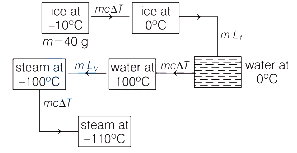
0 likes
View Solution191
MediumMCQ
An electric heater with a constant heat supply rate is used to convert a certain amount of liquid ammonia to saturated vapour at high pressure. The heater takes $14 \text{ minutes}$ to bring the liquid at $15^{\circ}C$ to the boiling point of $50^{\circ}C$ and $92 \text{ minutes}$ to convert the liquid at the boiling point wholly to vapour. If the specific heat capacity of liquid ammonia is $4.9 \text{ kJ/kg K}$,the latent heat of vaporisation of ammonia in $\text{kJ/kg}$ is:
A
$557$
B
$981$
C
$1127$
D
$2250$
Solution
(C) Let the mass of liquid ammonia be $m$ and the rate of heat supplied by the heater be $r$.
According to the principle of calorimetry,the heat supplied to raise the temperature is given by $Q_1 = r \times 14 = m \times c \times \Delta T$.
Substituting the values: $r \times 14 = m \times 4.9 \times (50 - 15)$.
$r \times 14 = m \times 4.9 \times 35$ --- (Equation $1$).
The heat supplied to convert the liquid to vapour at the boiling point is $Q_2 = r \times 92 = m \times L$.
$r \times 92 = m \times L$ --- (Equation $2$).
Dividing Equation $2$ by Equation $1$:
$\frac{r \times 92}{r \times 14} = \frac{m \times L}{m \times 4.9 \times 35}$.
$\frac{92}{14} = \frac{L}{4.9 \times 35}$.
$L = \frac{92 \times 4.9 \times 35}{14}$.
$L = 92 \times 4.9 \times 2.5 = 1127 \text{ kJ/kg}$.
According to the principle of calorimetry,the heat supplied to raise the temperature is given by $Q_1 = r \times 14 = m \times c \times \Delta T$.
Substituting the values: $r \times 14 = m \times 4.9 \times (50 - 15)$.
$r \times 14 = m \times 4.9 \times 35$ --- (Equation $1$).
The heat supplied to convert the liquid to vapour at the boiling point is $Q_2 = r \times 92 = m \times L$.
$r \times 92 = m \times L$ --- (Equation $2$).
Dividing Equation $2$ by Equation $1$:
$\frac{r \times 92}{r \times 14} = \frac{m \times L}{m \times 4.9 \times 35}$.
$\frac{92}{14} = \frac{L}{4.9 \times 35}$.
$L = \frac{92 \times 4.9 \times 35}{14}$.
$L = 92 \times 4.9 \times 2.5 = 1127 \text{ kJ/kg}$.
0 likes
View Solution192
MediumMCQ
$A$ steel pendulum clock manufactured at $32^{\circ} C$ and working at $47^{\circ} C$ is nearly (Coefficient of linear expansion of steel $= 12 \times 10^{-6} /{ }^{\circ} C$)
A
$7.8 \ s$ slow per day
B
$7.8 \ s$ fast per day
C
$15.6 \ s$ slow per day
D
$15.6 \ s$ fast per day
Solution
(A) The time period of a pendulum clock is given by $T = 2\pi \sqrt{\frac{L}{g}}$.
The fractional change in time period due to a change in temperature $\Delta \theta$ is given by $\frac{\Delta T}{T} = \frac{1}{2} \alpha \Delta \theta$,where $\alpha$ is the coefficient of linear expansion.
Given: $\alpha = 12 \times 10^{-6} /{ }^{\circ} C$,$\Delta \theta = 47^{\circ} C - 32^{\circ} C = 15^{\circ} C$.
$\frac{\Delta T}{T} = \frac{1}{2} \times 12 \times 10^{-6} \times 15 = 90 \times 10^{-6}$.
The time lost or gained in a day $(86400 \ s)$ is $\Delta t = \frac{\Delta T}{T} \times 86400$.
$\Delta t = 90 \times 10^{-6} \times 86400 = 7.776 \ s \approx 7.8 \ s$.
Since the temperature increases,the length of the pendulum increases,the time period increases,and the clock runs slow.
The fractional change in time period due to a change in temperature $\Delta \theta$ is given by $\frac{\Delta T}{T} = \frac{1}{2} \alpha \Delta \theta$,where $\alpha$ is the coefficient of linear expansion.
Given: $\alpha = 12 \times 10^{-6} /{ }^{\circ} C$,$\Delta \theta = 47^{\circ} C - 32^{\circ} C = 15^{\circ} C$.
$\frac{\Delta T}{T} = \frac{1}{2} \times 12 \times 10^{-6} \times 15 = 90 \times 10^{-6}$.
The time lost or gained in a day $(86400 \ s)$ is $\Delta t = \frac{\Delta T}{T} \times 86400$.
$\Delta t = 90 \times 10^{-6} \times 86400 = 7.776 \ s \approx 7.8 \ s$.
Since the temperature increases,the length of the pendulum increases,the time period increases,and the clock runs slow.
0 likes
View Solution193
DifficultMCQ
Statement $(I)$: $A$ device in which heat measurement can be made is called a calorimeter.
Statement $(II)$: Skating is possible on snow due to the formation of water below the skates. Water is formed due to the increase of temperature and ice melts.
Statement $(III)$: Two bodies at different temperatures are mixed in a calorimeter. The total internal energy of the two bodies remains conserved.
Which of the following is correct?
Statement $(II)$: Skating is possible on snow due to the formation of water below the skates. Water is formed due to the increase of temperature and ice melts.
Statement $(III)$: Two bodies at different temperatures are mixed in a calorimeter. The total internal energy of the two bodies remains conserved.
Which of the following is correct?
A
Statements $I$,$II$ and $III$ are true
B
Statement $I$ is true,but statements $II$ and $III$ are false
C
Both statements $I$ and $II$ are true,but statement $III$ is false
D
Both statements $I$ and $III$ are true,but statement $II$ is false
Solution
(D) Statement $(I)$ is true: $A$ calorimeter is indeed a device used for measuring the heat involved in physical or chemical processes.
Statement $(II)$ is false: While skating,the pressure applied by the skates on the ice lowers the melting point of the ice (Regelation),causing it to melt into a thin layer of water that acts as a lubricant. The statement incorrectly attributes this to an increase in temperature.
Statement $(III)$ is true: In an isolated system like a calorimeter,the heat lost by the hot body equals the heat gained by the cold body,meaning the total internal energy of the system is conserved.
Therefore,statements $(I)$ and $(III)$ are true,while statement $(II)$ is false.
Statement $(II)$ is false: While skating,the pressure applied by the skates on the ice lowers the melting point of the ice (Regelation),causing it to melt into a thin layer of water that acts as a lubricant. The statement incorrectly attributes this to an increase in temperature.
Statement $(III)$ is true: In an isolated system like a calorimeter,the heat lost by the hot body equals the heat gained by the cold body,meaning the total internal energy of the system is conserved.
Therefore,statements $(I)$ and $(III)$ are true,while statement $(II)$ is false.
0 likes
View Solution194
DifficultMCQ
$22320 \ cal$ of heat is supplied to $100 \ g$ of ice at $0^{\circ} C$. If the latent heat of fusion of ice is $80 \ cal \ g^{-1}$ and latent heat of vaporization of water is $540 \ cal \ g^{-1}$,the final amount of water thus obtained and its temperature respectively are:
A
$8 \ g, 100^{\circ} C$
B
$100 \ g, 90^{\circ} C$
C
$92 \ g, 100^{\circ} C$
D
$82 \ g, 100^{\circ} C$
Solution
(C) $1$. Heat required to melt $100 \ g$ of ice at $0^{\circ} C$ to water at $0^{\circ} C$: $Q_1 = m \times L_f = 100 \ g \times 80 \ cal/g = 8000 \ cal$.
$2$. Heat required to raise the temperature of $100 \ g$ of water from $0^{\circ} C$ to $100^{\circ} C$: $Q_2 = m \times s \times \Delta T = 100 \ g \times 1 \ cal/g^{\circ} C \times 100^{\circ} C = 10000 \ cal$.
$3$. Total heat used so far: $Q_{total} = Q_1 + Q_2 = 8000 + 10000 = 18000 \ cal$.
$4$. Remaining heat: $Q_{rem} = 22320 \ cal - 18000 \ cal = 4320 \ cal$.
$5$. This remaining heat will convert some water at $100^{\circ} C$ into steam: $m_{steam} = Q_{rem} / L_v = 4320 \ cal / 540 \ cal/g = 8 \ g$.
$6$. Final amount of water remaining: $100 \ g - 8 \ g = 92 \ g$ of water at $100^{\circ} C$.
$2$. Heat required to raise the temperature of $100 \ g$ of water from $0^{\circ} C$ to $100^{\circ} C$: $Q_2 = m \times s \times \Delta T = 100 \ g \times 1 \ cal/g^{\circ} C \times 100^{\circ} C = 10000 \ cal$.
$3$. Total heat used so far: $Q_{total} = Q_1 + Q_2 = 8000 + 10000 = 18000 \ cal$.
$4$. Remaining heat: $Q_{rem} = 22320 \ cal - 18000 \ cal = 4320 \ cal$.
$5$. This remaining heat will convert some water at $100^{\circ} C$ into steam: $m_{steam} = Q_{rem} / L_v = 4320 \ cal / 540 \ cal/g = 8 \ g$.
$6$. Final amount of water remaining: $100 \ g - 8 \ g = 92 \ g$ of water at $100^{\circ} C$.
0 likes
View Solution195
EasyMCQ
$A$ block of ice at temperature $-20^{\circ} C$ is slowly heated and converted to steam at $100^{\circ} C$. Which of the following diagrams is most appropriate?
A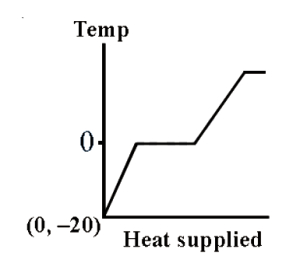
B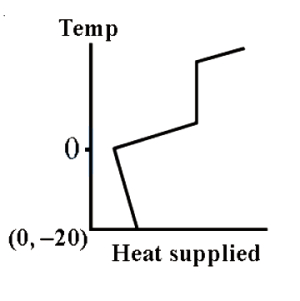
C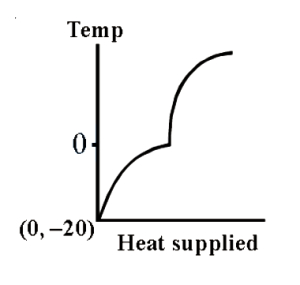
D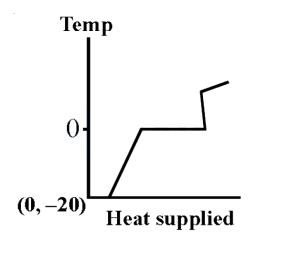
Solution
(A) The process of heating ice from $-20^{\circ} C$ to steam at $100^{\circ} C$ involves several stages:
$1$. Heating ice from $-20^{\circ} C$ to $0^{\circ} C$: The temperature increases linearly with heat supplied.
$2$. Melting ice at $0^{\circ} C$ to water at $0^{\circ} C$: The temperature remains constant (phase change).
$3$. Heating water from $0^{\circ} C$ to $100^{\circ} C$: The temperature increases linearly with heat supplied.
$4$. Boiling water at $100^{\circ} C$ to steam at $100^{\circ} C$: The temperature remains constant (phase change).
Therefore,the temperature-heat graph should show two linear increases and two horizontal constant-temperature segments. Option $A$ correctly represents this behavior.
$1$. Heating ice from $-20^{\circ} C$ to $0^{\circ} C$: The temperature increases linearly with heat supplied.
$2$. Melting ice at $0^{\circ} C$ to water at $0^{\circ} C$: The temperature remains constant (phase change).
$3$. Heating water from $0^{\circ} C$ to $100^{\circ} C$: The temperature increases linearly with heat supplied.
$4$. Boiling water at $100^{\circ} C$ to steam at $100^{\circ} C$: The temperature remains constant (phase change).
Therefore,the temperature-heat graph should show two linear increases and two horizontal constant-temperature segments. Option $A$ correctly represents this behavior.
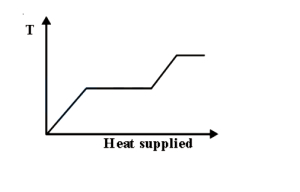
0 likes
View Solution196
DifficultMCQ
The height of a waterfall is $50 \ m$. If $g = 9.8 \ m/s^2$,the difference between the temperature at the top and the bottom of the waterfall is: (in $^{\circ} C$)
A
$1.17$
B
$2.17$
C
$0.117$
D
$1.43$
Solution
(C) The potential energy of the water at the top is converted into heat energy at the bottom.
Using the principle of conservation of energy: $mgh = J \cdot ms \Delta t$,where $J$ is the mechanical equivalent of heat ($J = 4.2 \ J/cal$ or $4186 \ J/kg^{\circ}C$).
Here,$s$ is the specific heat capacity of water,$s = 4186 \ J/kg^{\circ}C$.
Rearranging for $\Delta t$: $\Delta t = \frac{gh}{s}$.
Substituting the values: $\Delta t = \frac{9.8 \times 50}{4186} \approx 0.117^{\circ} C$.
Using the principle of conservation of energy: $mgh = J \cdot ms \Delta t$,where $J$ is the mechanical equivalent of heat ($J = 4.2 \ J/cal$ or $4186 \ J/kg^{\circ}C$).
Here,$s$ is the specific heat capacity of water,$s = 4186 \ J/kg^{\circ}C$.
Rearranging for $\Delta t$: $\Delta t = \frac{gh}{s}$.
Substituting the values: $\Delta t = \frac{9.8 \times 50}{4186} \approx 0.117^{\circ} C$.
0 likes
View Solution197
DifficultMCQ
Which of the following best represents the temperature versus heat supplied graph for water,in the range of $-20^{\circ}C$ to $120^{\circ}C$?
A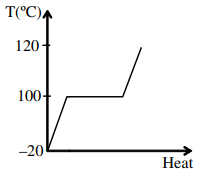
B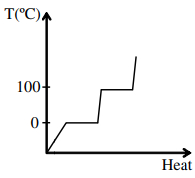
C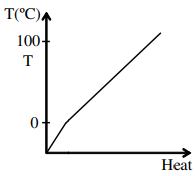
D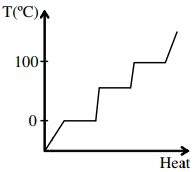
Solution
(B) When heating water from $-20^{\circ}C$ to $120^{\circ}C$,the following phase changes occur:
$1$. From $-20^{\circ}C$ to $0^{\circ}C$,ice is heated (temperature increases).
$2$. At $0^{\circ}C$,ice melts into water (phase change,temperature remains constant,creating a plateau).
$3$. From $0^{\circ}C$ to $100^{\circ}C$,water is heated (temperature increases).
$4$. At $100^{\circ}C$,water boils into steam (phase change,temperature remains constant,creating a second plateau).
$5$. From $100^{\circ}C$ to $120^{\circ}C$,steam is heated (temperature increases).
Therefore,the graph must show two horizontal plateaus at $0^{\circ}C$ and $100^{\circ}C$. This corresponds to the graph shown in option $B$.
$1$. From $-20^{\circ}C$ to $0^{\circ}C$,ice is heated (temperature increases).
$2$. At $0^{\circ}C$,ice melts into water (phase change,temperature remains constant,creating a plateau).
$3$. From $0^{\circ}C$ to $100^{\circ}C$,water is heated (temperature increases).
$4$. At $100^{\circ}C$,water boils into steam (phase change,temperature remains constant,creating a second plateau).
$5$. From $100^{\circ}C$ to $120^{\circ}C$,steam is heated (temperature increases).
Therefore,the graph must show two horizontal plateaus at $0^{\circ}C$ and $100^{\circ}C$. This corresponds to the graph shown in option $B$.
0 likes
View Solution198
DifficultMCQ
The heat extracted out of $x \ \text{g}$ of water initially at $50^\circ \text{C}$ to cool it down to $0^\circ \text{C}$ is sufficient to evaporate $(1000 - x) \ \text{g}$ of water also initially at $50^\circ \text{C}$. The value of $x$ (closest integer) is . . . . . . . (Take latent heat of water $L = 2256 \ \text{kJ/kg}$,specific heat capacity of water $c = 4200 \ \text{J/kg}\cdot \text{K}$)
A
$800$
B
$850$
C
$900$
D
$950$
Solution
(C) Step $1$: Calculate the heat released by $x \ \text{g}$ of water cooling from $50^\circ \text{C}$ to $0^\circ \text{C}$.
$Q_1 = m c \Delta T = (x \times 10^{-3} \ \text{kg}) \times 4200 \ \text{J/kg}\cdot \text{K} \times (50 - 0) \ \text{K} = 210x \ \text{J}$.
Step $2$: Calculate the heat required to evaporate $(1000 - x) \ \text{g}$ of water initially at $50^\circ \text{C}$. This involves heating the water to $100^\circ \text{C}$ and then vaporizing it.
$Q_2 = m' c \Delta T' + m' L = [(1000 - x) \times 10^{-3} \ \text{kg}] \times [4200 \ \text{J/kg}\cdot \text{K} \times (100 - 50) \ \text{K} + 2256000 \ \text{J/kg}]$.
$Q_2 = (1000 - x) \times 10^{-3} \times [210000 + 2256000] = (1000 - x) \times 10^{-3} \times 2466000 = 2466(1000 - x) \ \text{J}$.
Step $3$: Equate $Q_1$ and $Q_2$ to find $x$.
$210x = 2466(1000 - x) \implies 210x = 2466000 - 2466x$.
$2676x = 2466000 \implies x = \frac{2466000}{2676} \approx 921.52$.
The closest integer value is $922$.
$Q_1 = m c \Delta T = (x \times 10^{-3} \ \text{kg}) \times 4200 \ \text{J/kg}\cdot \text{K} \times (50 - 0) \ \text{K} = 210x \ \text{J}$.
Step $2$: Calculate the heat required to evaporate $(1000 - x) \ \text{g}$ of water initially at $50^\circ \text{C}$. This involves heating the water to $100^\circ \text{C}$ and then vaporizing it.
$Q_2 = m' c \Delta T' + m' L = [(1000 - x) \times 10^{-3} \ \text{kg}] \times [4200 \ \text{J/kg}\cdot \text{K} \times (100 - 50) \ \text{K} + 2256000 \ \text{J/kg}]$.
$Q_2 = (1000 - x) \times 10^{-3} \times [210000 + 2256000] = (1000 - x) \times 10^{-3} \times 2466000 = 2466(1000 - x) \ \text{J}$.
Step $3$: Equate $Q_1$ and $Q_2$ to find $x$.
$210x = 2466(1000 - x) \implies 210x = 2466000 - 2466x$.
$2676x = 2466000 \implies x = \frac{2466000}{2676} \approx 921.52$.
The closest integer value is $922$.
0 likes
View Solution10-1.Thermometry, Thermal Expansion and Calorimetry — Mix Examples-Thermometry, Thermal Expansion and Calorimetry · Frequently Asked Questions
1Are these 10-1.Thermometry, Thermal Expansion and Calorimetry questions useful for JEE and NEET?
Yes. All questions in this section are mapped to JEE Main and NEET exam patterns. Previous year questions from JEE Main, NEET, GUJCET and state-level exams are included with full solutions.
2Can I switch to Hindi or Gujarati for these questions?
Yes. Use the language tabs in the hero section or the sidebar to view the same questions and solutions in English, Hindi or Gujarati.
3How do I generate a question paper from this subtopic?
Use the Vedclass Exam Paper Generator — select the chapter and subtopic, set difficulty, and generate Sets A, B, C, D automatically. First 3 chapters of every subject are free.
Vedclass Products
For Students
Vedclass Test Series
Mock tests in real JEE/NEET style with performance analysis. 5-day free trial.
Start Free TrialFor Teachers
Exam Paper Generator
Generate Set A/B/C/D papers from this chapter in 2 minutes. 3 chapters free.
Try FreeFor Institutes
Online Exam Module
Live online exams with unlimited students, 360° analytics & white-label branding.
See DemoFor Teachers & Institutes
Generate a 10-1.Thermometry, Thermal Expansion and Calorimetry Exam Paper in 2 Minutes
Select subtopic & difficulty — Sets A, B, C, D auto-generated with No Repeat logic.
First 3 chapters of every subject are free — no payment required.