
A English
Thermal Expansion for Solid Questions in English
Class 11 Physics · 10-1.Thermometry, Thermal Expansion and Calorimetry · Thermal Expansion for Solid
231+
Questions
English
Language
100%
With Solutions
Showing 50 of 231 questions in English
1
MediumMCQ
$A$ thin copper wire of length $l$ metre increases in length by $2\%$ when heated through $10^{\circ}C$. The percentage increase in area when a square copper sheet of side $l$ metre is heated through $10^{\circ}C$ is:
A
$4$
B
$8$
C
$16$
D
None of the above
Solution
(A) The percentage increase in length is given by $\frac{\Delta l}{l} \times 100 = 2\%$.
For a square sheet of side $l$,the area is $A = l^2$.
Using the concept of relative error,the fractional change in area is $\frac{\Delta A}{A} = 2 \frac{\Delta l}{l}$.
Therefore,the percentage increase in area is $\frac{\Delta A}{A} \times 100 = 2 \times (\frac{\Delta l}{l} \times 100)$.
Substituting the given value: $2 \times 2\% = 4\%$.
For a square sheet of side $l$,the area is $A = l^2$.
Using the concept of relative error,the fractional change in area is $\frac{\Delta A}{A} = 2 \frac{\Delta l}{l}$.
Therefore,the percentage increase in area is $\frac{\Delta A}{A} \times 100 = 2 \times (\frac{\Delta l}{l} \times 100)$.
Substituting the given value: $2 \times 2\% = 4\%$.
1 likes
View Solution2
MediumMCQ
The temperature of a wire of length $1 \, m$ and area of cross-section $1 \, cm^2$ is increased from $0^\circ C$ to $100^\circ C$. If the rod is not allowed to increase in length,the force required will be $(\alpha = 10^{-5} /^\circ C$ and $Y = 10^{11} \, N/m^2)$.
A
$10^3 \, N$
B
$10^4 \, N$
C
$10^5 \, N$
D
$10^9 \, N$
Solution
(B) The thermal stress developed in a rod when its expansion is prevented is given by $\sigma = Y \alpha \Delta \theta$.
Since stress $\sigma = F/A$,the force $F$ is given by $F = Y A \alpha \Delta \theta$.
Given:
$Y = 10^{11} \, N/m^2$
$A = 1 \, cm^2 = 10^{-4} \, m^2$
$\alpha = 10^{-5} /^\circ C$
$\Delta \theta = 100 - 0 = 100^\circ C = 10^2 \, ^\circ C$
Substituting these values into the formula:
$F = 10^{11} \times 10^{-4} \times 10^{-5} \times 10^2$
$F = 10^{11 - 4 - 5 + 2} = 10^4 \, N$.
Since stress $\sigma = F/A$,the force $F$ is given by $F = Y A \alpha \Delta \theta$.
Given:
$Y = 10^{11} \, N/m^2$
$A = 1 \, cm^2 = 10^{-4} \, m^2$
$\alpha = 10^{-5} /^\circ C$
$\Delta \theta = 100 - 0 = 100^\circ C = 10^2 \, ^\circ C$
Substituting these values into the formula:
$F = 10^{11} \times 10^{-4} \times 10^{-5} \times 10^2$
$F = 10^{11 - 4 - 5 + 2} = 10^4 \, N$.
0 likes
View Solution3
EasyMCQ
To keep constant time,watches are fitted with a balance wheel made of:
A
Invar
B
Stainless steel
C
Tungsten
D
Platinum
Solution
(A) The balance wheel in a watch is responsible for regulating the timekeeping mechanism.
For the watch to maintain constant time,the dimensions of the balance wheel must remain unchanged despite fluctuations in ambient temperature.
Invar is a nickel-iron alloy known for its uniquely low coefficient of thermal expansion.
Because the dimensions of Invar do not vary significantly with temperature,it is used to ensure the watch's period of oscillation remains constant.
For the watch to maintain constant time,the dimensions of the balance wheel must remain unchanged despite fluctuations in ambient temperature.
Invar is a nickel-iron alloy known for its uniquely low coefficient of thermal expansion.
Because the dimensions of Invar do not vary significantly with temperature,it is used to ensure the watch's period of oscillation remains constant.
0 likes
View Solution4
DifficultMCQ
The coefficients of linear expansion of brass and steel are ${\alpha _1}$ and ${\alpha _2}$ respectively. If we take a brass rod of length ${l_1}$ and a steel rod of length ${l_2}$ at $0^{\circ}C$,their difference in length $({l_2} - {l_1})$ will remain the same at any temperature if:
A
${\alpha _1}{l_2} = {\alpha _2}{l_1}$
B
${\alpha _1}l_2^2 = {\alpha _2}l_1^2$
C
$\alpha _1^2{l_1} = \alpha _2^2{l_2}$
D
${\alpha _1}{l_1} = {\alpha _2}{l_2}$
Solution
(D) Let the length of the brass rod at temperature $\Delta \theta$ be ${L_1}$ and the steel rod be ${L_2}$.
${L_1} = {l_1}(1 + {\alpha _1}\Delta \theta )$
${L_2} = {l_2}(1 + {\alpha _2}\Delta \theta )$
The difference in length at temperature $\Delta \theta$ is ${L_2} - {L_1} = {l_2}(1 + {\alpha _2}\Delta \theta ) - {l_1}(1 + {\alpha _1}\Delta \theta )$.
${L_2} - {L_1} = ({l_2} - {l_1}) + \Delta \theta ({l_2}{\alpha _2} - {l_1}{\alpha _1})$.
For the difference in length to remain the same as at $0^{\circ}C$,we require ${L_2} - {L_1} = {l_2} - {l_1}$.
This implies $\Delta \theta ({l_2}{\alpha _2} - {l_1}{\alpha _1}) = 0$.
Since $\Delta \theta \neq 0$,we must have ${l_2}{\alpha _2} - {l_1}{\alpha _1} = 0$,or ${l_1}{\alpha _1} = {l_2}{\alpha _2}$.
${L_1} = {l_1}(1 + {\alpha _1}\Delta \theta )$
${L_2} = {l_2}(1 + {\alpha _2}\Delta \theta )$
The difference in length at temperature $\Delta \theta$ is ${L_2} - {L_1} = {l_2}(1 + {\alpha _2}\Delta \theta ) - {l_1}(1 + {\alpha _1}\Delta \theta )$.
${L_2} - {L_1} = ({l_2} - {l_1}) + \Delta \theta ({l_2}{\alpha _2} - {l_1}{\alpha _1})$.
For the difference in length to remain the same as at $0^{\circ}C$,we require ${L_2} - {L_1} = {l_2} - {l_1}$.
This implies $\Delta \theta ({l_2}{\alpha _2} - {l_1}{\alpha _1}) = 0$.
Since $\Delta \theta \neq 0$,we must have ${l_2}{\alpha _2} - {l_1}{\alpha _1} = 0$,or ${l_1}{\alpha _1} = {l_2}{\alpha _2}$.
0 likes
View Solution5
EasyMCQ
When a copper ball is heated,the largest percentage increase will occur in its
A
Diameter
B
Area
C
Volume
D
Density
Solution
(C) When a solid object is heated,it undergoes thermal expansion.
Let the linear expansion coefficient be $\alpha$.
The change in length is $\Delta L = L_0 \alpha \Delta T$,so the fractional change is $\frac{\Delta L}{L_0} = \alpha \Delta T$.
The change in area is $\Delta A = A_0 (2\alpha) \Delta T$,so the fractional change is $\frac{\Delta A}{A_0} = 2\alpha \Delta T$.
The change in volume is $\Delta V = V_0 (3\alpha) \Delta T$,so the fractional change is $\frac{\Delta V}{V_0} = 3\alpha \Delta T$.
Comparing the coefficients,$3\alpha > 2\alpha > \alpha$.
Therefore,the percentage increase is largest for the volume.
Density decreases upon heating because volume increases while mass remains constant.
Let the linear expansion coefficient be $\alpha$.
The change in length is $\Delta L = L_0 \alpha \Delta T$,so the fractional change is $\frac{\Delta L}{L_0} = \alpha \Delta T$.
The change in area is $\Delta A = A_0 (2\alpha) \Delta T$,so the fractional change is $\frac{\Delta A}{A_0} = 2\alpha \Delta T$.
The change in volume is $\Delta V = V_0 (3\alpha) \Delta T$,so the fractional change is $\frac{\Delta V}{V_0} = 3\alpha \Delta T$.
Comparing the coefficients,$3\alpha > 2\alpha > \alpha$.
Therefore,the percentage increase is largest for the volume.
Density decreases upon heating because volume increases while mass remains constant.
0 likes
View Solution6
MediumMCQ
$A$ uniform metal rod is used as a bar pendulum. If the room temperature rises by $10^{\circ}C$,and the coefficient of linear expansion of the metal of the rod is $2 \times 10^{-6} /^{\circ}C$,the period of the pendulum will have a percentage increase of:
A
$-2 \times 10^{-3} \%$
B
$-1 \times 10^{-3} \%$
C
$2 \times 10^{-3} \%$
D
$1 \times 10^{-3} \%$
Solution
(D) The time period of a physical pendulum is given by $T = 2\pi \sqrt{\frac{I}{mgd}}$. For a uniform rod of length $L$,$T \propto \sqrt{L}$.
Taking the derivative,the fractional change in the time period is given by $\frac{\Delta T}{T} = \frac{1}{2} \frac{\Delta L}{L}$.
Since $\Delta L = L \alpha \Delta \theta$,we have $\frac{\Delta L}{L} = \alpha \Delta \theta$.
Therefore,$\frac{\Delta T}{T} = \frac{1}{2} \alpha \Delta \theta$.
Given $\alpha = 2 \times 10^{-6} /^{\circ}C$ and $\Delta \theta = 10^{\circ}C$:
$\frac{\Delta T}{T} = \frac{1}{2} \times (2 \times 10^{-6}) \times 10 = 10^{-5}$.
The percentage increase is $\frac{\Delta T}{T} \times 100 = 10^{-5} \times 100 = 10^{-3} \%$.
Taking the derivative,the fractional change in the time period is given by $\frac{\Delta T}{T} = \frac{1}{2} \frac{\Delta L}{L}$.
Since $\Delta L = L \alpha \Delta \theta$,we have $\frac{\Delta L}{L} = \alpha \Delta \theta$.
Therefore,$\frac{\Delta T}{T} = \frac{1}{2} \alpha \Delta \theta$.
Given $\alpha = 2 \times 10^{-6} /^{\circ}C$ and $\Delta \theta = 10^{\circ}C$:
$\frac{\Delta T}{T} = \frac{1}{2} \times (2 \times 10^{-6}) \times 10 = 10^{-5}$.
The percentage increase is $\frac{\Delta T}{T} \times 100 = 10^{-5} \times 100 = 10^{-3} \%$.
0 likes
View Solution7
MediumMCQ
$A$ bar of iron is $10 \, cm$ at $20^{\circ}C$. At $19^{\circ}C$ it will be ($\alpha$ of iron $= 11 \times 10^{-6}/^{\circ}C$)
A
$11 \times 10^{-6} \, cm$ longer
B
$11 \times 10^{-6} \, cm$ shorter
C
$11 \times 10^{-5} \, cm$ shorter
D
$11 \times 10^{-4} \, cm$ shorter
Solution
(C) The change in length $\Delta L$ is given by the formula: $\Delta L = L_0 \alpha \Delta T$.
Here,$L_0 = 10 \, cm$,$\alpha = 11 \times 10^{-6} /^{\circ}C$,and $\Delta T = 19^{\circ}C - 20^{\circ}C = -1^{\circ}C$.
Substituting the values:
$\Delta L = 10 \times (11 \times 10^{-6}) \times (-1) \, cm$.
$\Delta L = -110 \times 10^{-6} \, cm = -1.1 \times 10^{-4} \, cm = -11 \times 10^{-5} \, cm$.
The negative sign indicates that the bar becomes shorter.
Therefore,the bar is $11 \times 10^{-5} \, cm$ shorter.
Here,$L_0 = 10 \, cm$,$\alpha = 11 \times 10^{-6} /^{\circ}C$,and $\Delta T = 19^{\circ}C - 20^{\circ}C = -1^{\circ}C$.
Substituting the values:
$\Delta L = 10 \times (11 \times 10^{-6}) \times (-1) \, cm$.
$\Delta L = -110 \times 10^{-6} \, cm = -1.1 \times 10^{-4} \, cm = -11 \times 10^{-5} \, cm$.
The negative sign indicates that the bar becomes shorter.
Therefore,the bar is $11 \times 10^{-5} \, cm$ shorter.
0 likes
View Solution8
EasyMCQ
What happens during the thermal expansion of a material when it is heated?
A
It occurs only in solids.
B
It increases the weight of the material.
C
It decreases the density of the material.
D
It occurs at the same rate for all liquids and solids.
Solution
(C) When a material is heated,its particles gain kinetic energy and move further apart,which causes the material to expand.
Since the mass of the material remains constant while the volume increases,the density,defined as $\rho = \frac{m}{V}$,must decrease.
Therefore,thermal expansion leads to a decrease in the density of the material.
Since the mass of the material remains constant while the volume increases,the density,defined as $\rho = \frac{m}{V}$,must decrease.
Therefore,thermal expansion leads to a decrease in the density of the material.
0 likes
View Solution9
EasyMCQ
When a bimetallic strip is heated, it
A
Does not bend at all
B
Gets twisted in the form of a helix
C
Bends in the form of an arc with the more expandable metal outside
D
Bends in the form of an arc with the more expandable metal inside
Solution
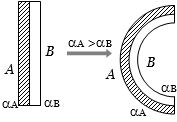
(C) bimetallic strip consists of two different metals with different coefficients of linear expansion ($\alpha_A$ and $\alpha_B$).
When the strip is heated, both metals expand, but the metal with the higher coefficient of linear expansion expands more than the other.
As shown in the figure, if $\alpha_A > \alpha_B$, metal $A$ will expand more than metal $B$.
To accommodate this difference in length while remaining bonded together, the strip must bend.
The metal with the higher expansion coefficient $(A)$ forms the outer side of the arc, while the metal with the lower expansion coefficient $(B)$ forms the inner side.
Therefore, the correct option is $C$.
When the strip is heated, both metals expand, but the metal with the higher coefficient of linear expansion expands more than the other.
As shown in the figure, if $\alpha_A > \alpha_B$, metal $A$ will expand more than metal $B$.
To accommodate this difference in length while remaining bonded together, the strip must bend.
The metal with the higher expansion coefficient $(A)$ forms the outer side of the arc, while the metal with the lower expansion coefficient $(B)$ forms the inner side.
Therefore, the correct option is $C$.
0 likes
View Solution10
EasyMCQ
$A$ solid ball of metal has a concentric spherical cavity within it. If the ball is heated,the volume of the cavity will
A
Increase
B
Decrease
C
Remain unaffected
D
None of these
Solution
(A) When a solid object with a cavity is heated,the material of the object expands in all directions.
This expansion follows the same laws as if the cavity were filled with the same material.
Since the material expands outward,the inner boundary of the cavity also moves outward,effectively increasing the volume of the cavity.
Therefore,the volume of the cavity increases.
This expansion follows the same laws as if the cavity were filled with the same material.
Since the material expands outward,the inner boundary of the cavity also moves outward,effectively increasing the volume of the cavity.
Therefore,the volume of the cavity increases.
0 likes
View Solution11
EasyMCQ
At some temperature $T$,a bronze pin is slightly too large to fit into a hole drilled in a steel block. The change in temperature required for an exact fit is minimum when:
A
Only the block is heated
B
Both block and pin are heated together
C
Both block and pin are cooled together
D
Only the pin is cooled
Solution
(A) Let the initial diameter of the pin be $D_p$ and the diameter of the hole be $D_h$. We are given $D_p > D_h$ at temperature $T$.
To make them fit,we need the diameters to be equal at some temperature $T + \Delta T$.
Using the linear expansion formula $D' = D(1 + \alpha \Delta T)$,we have $D_p(1 + \alpha_b \Delta T) = D_h(1 + \alpha_s \Delta T)$,where $\alpha_b$ is the coefficient of linear expansion for bronze and $\alpha_s$ is for steel.
Since $\alpha_s > \alpha_b$,heating the block increases the hole diameter $D_h$ faster than the pin diameter $D_p$ increases.
Therefore,heating only the block is the most efficient way to achieve the fit with the minimum temperature change.
To make them fit,we need the diameters to be equal at some temperature $T + \Delta T$.
Using the linear expansion formula $D' = D(1 + \alpha \Delta T)$,we have $D_p(1 + \alpha_b \Delta T) = D_h(1 + \alpha_s \Delta T)$,where $\alpha_b$ is the coefficient of linear expansion for bronze and $\alpha_s$ is for steel.
Since $\alpha_s > \alpha_b$,heating the block increases the hole diameter $D_h$ faster than the pin diameter $D_p$ increases.
Therefore,heating only the block is the most efficient way to achieve the fit with the minimum temperature change.
0 likes
View Solution12
MediumMCQ
If the length of a cylinder on heating increases by $2\%$,the area of its base will increase by ....... $\%$
A
$0.5$
B
$2$
C
$1$
D
$4$
Solution
(D) The area of the base of a cylinder is given by $A = \pi r^2$.
Since the material is the same,the radius $r$ is proportional to the length $L$ (linear expansion),so $r \propto L$.
Therefore,the area $A$ is proportional to the square of the length: $A \propto L^2$.
Using the error analysis formula for small changes,we have $\frac{\Delta A}{A} \approx 2 \cdot \frac{\Delta L}{L}$.
Given that the percentage increase in length is $\frac{\Delta L}{L} \times 100 = 2\%$,
the percentage increase in area is $\frac{\Delta A}{A} \times 100 = 2 \times (\frac{\Delta L}{L} \times 100) = 2 \times 2\% = 4\%$.
Thus,the area of the base will increase by $4\%$.
Since the material is the same,the radius $r$ is proportional to the length $L$ (linear expansion),so $r \propto L$.
Therefore,the area $A$ is proportional to the square of the length: $A \propto L^2$.
Using the error analysis formula for small changes,we have $\frac{\Delta A}{A} \approx 2 \cdot \frac{\Delta L}{L}$.
Given that the percentage increase in length is $\frac{\Delta L}{L} \times 100 = 2\%$,
the percentage increase in area is $\frac{\Delta A}{A} \times 100 = 2 \times (\frac{\Delta L}{L} \times 100) = 2 \times 2\% = 4\%$.
Thus,the area of the base will increase by $4\%$.
0 likes
View Solution13
EasyMCQ
The coefficient of superficial expansion of a solid is $2 \times 10^{-5} \text{ °C}^{-1}$. Its coefficient of linear expansion is:
A
$4 \times 10^{-5} \text{ °C}^{-1}$
B
$3 \times 10^{-5} \text{ °C}^{-1}$
C
$2 \times 10^{-5} \text{ °C}^{-1}$
D
$1 \times 10^{-5} \text{ °C}^{-1}$
Solution
(D) The coefficient of superficial expansion (area expansion) is denoted by $\beta$ and the coefficient of linear expansion is denoted by $\alpha$.
These two coefficients are related by the formula $\beta = 2\alpha$.
Given,$\beta = 2 \times 10^{-5} \text{ °C}^{-1}$.
Therefore,$\alpha = \frac{\beta}{2} = \frac{2 \times 10^{-5}}{2} = 1 \times 10^{-5} \text{ °C}^{-1}$.
Thus,the correct option is $D$.
These two coefficients are related by the formula $\beta = 2\alpha$.
Given,$\beta = 2 \times 10^{-5} \text{ °C}^{-1}$.
Therefore,$\alpha = \frac{\beta}{2} = \frac{2 \times 10^{-5}}{2} = 1 \times 10^{-5} \text{ °C}^{-1}$.
Thus,the correct option is $D$.
0 likes
View Solution14
MediumMCQ
The density of a substance at $0^{\circ}C$ is $10 \, g/cm^3$ and at $100^{\circ}C$,its density is $9.7 \, g/cm^3$. The coefficient of linear expansion of the substance is:
A
$10^{-2} \, ^{\circ}C^{-1}$
B
$10^{-3} \, ^{\circ}C^{-1}$
C
$10^{-4} \, ^{\circ}C^{-1}$
D
$10^{-5} \, ^{\circ}C^{-1}$
Solution
(C) The density $\rho$ is related to temperature $T$ by the relation $\rho = \frac{\rho_0}{1 + \gamma \Delta T} \approx \rho_0 (1 - \gamma \Delta T)$.
Thus,the coefficient of volume expansion $\gamma$ is given by $\gamma = \frac{\rho_0 - \rho}{\rho \Delta T}$.
Given $\rho_0 = 10 \, g/cm^3$,$\rho = 9.7 \, g/cm^3$,and $\Delta T = 100^{\circ}C - 0^{\circ}C = 100^{\circ}C$.
$\gamma = \frac{10 - 9.7}{9.7 \times 100} \approx \frac{0.3}{970} \approx 3.09 \times 10^{-4} \, ^{\circ}C^{-1}$.
Using the approximation $\gamma \approx 3 \times 10^{-4} \, ^{\circ}C^{-1}$.
The coefficient of linear expansion $\alpha$ is related to $\gamma$ by $\alpha = \frac{\gamma}{3}$.
$\alpha = \frac{3 \times 10^{-4}}{3} = 10^{-4} \, ^{\circ}C^{-1}$.
Thus,the coefficient of volume expansion $\gamma$ is given by $\gamma = \frac{\rho_0 - \rho}{\rho \Delta T}$.
Given $\rho_0 = 10 \, g/cm^3$,$\rho = 9.7 \, g/cm^3$,and $\Delta T = 100^{\circ}C - 0^{\circ}C = 100^{\circ}C$.
$\gamma = \frac{10 - 9.7}{9.7 \times 100} \approx \frac{0.3}{970} \approx 3.09 \times 10^{-4} \, ^{\circ}C^{-1}$.
Using the approximation $\gamma \approx 3 \times 10^{-4} \, ^{\circ}C^{-1}$.
The coefficient of linear expansion $\alpha$ is related to $\gamma$ by $\alpha = \frac{\gamma}{3}$.
$\alpha = \frac{3 \times 10^{-4}}{3} = 10^{-4} \, ^{\circ}C^{-1}$.
0 likes
View Solution15
MediumMCQ
The volume of a metal sphere increases by $0.24\%$ when its temperature is raised by $40^{\circ}C$. The coefficient of linear expansion of the metal is .......... $^{\circ}C^{-1}$.
A
$2 \times 10^{-5}$
B
$6 \times 10^{-5}$
C
$2.1 \times 10^{-5}$
D
$1.2 \times 10^{-5}$
Solution
(A) The coefficient of volume expansion $\gamma$ is given by the formula: $\gamma = \frac{\Delta V}{V \cdot \Delta T}$.
Given, $\frac{\Delta V}{V} = 0.24\% = \frac{0.24}{100}$ and $\Delta T = 40^{\circ}C$.
Substituting the values: $\gamma = \frac{0.24}{100 \times 40} = \frac{0.24}{4000} = 0.00006 = 6 \times 10^{-5} \text{ } ^\circ\text{C}^{-1}$.
The relationship between the coefficient of linear expansion $\alpha$ and volume expansion $\gamma$ is $\alpha = \frac{\gamma}{3}$.
Therefore, $\alpha = \frac{6 \times 10^{-5}}{3} = 2 \times 10^{-5} \text{ } ^\circ\text{C}^{-1}$.
Given, $\frac{\Delta V}{V} = 0.24\% = \frac{0.24}{100}$ and $\Delta T = 40^{\circ}C$.
Substituting the values: $\gamma = \frac{0.24}{100 \times 40} = \frac{0.24}{4000} = 0.00006 = 6 \times 10^{-5} \text{ } ^\circ\text{C}^{-1}$.
The relationship between the coefficient of linear expansion $\alpha$ and volume expansion $\gamma$ is $\alpha = \frac{\gamma}{3}$.
Therefore, $\alpha = \frac{6 \times 10^{-5}}{3} = 2 \times 10^{-5} \text{ } ^\circ\text{C}^{-1}$.
0 likes
View Solution16
EasyMCQ
The ratio among the linear expansion coefficient $(\alpha)$,areal expansion coefficient $(\beta)$,and volume expansion coefficient $(\gamma)$ is:
A
$1:2:3$
B
$3:2:1$
C
$4:3:2$
D
None of these
Solution
(A) The coefficient of linear expansion $(\alpha)$ is defined as the fractional change in length per unit change in temperature.
The coefficient of areal expansion $(\beta)$ is defined as the fractional change in area per unit change in temperature,where $\beta = 2\alpha$.
The coefficient of volume expansion $(\gamma)$ is defined as the fractional change in volume per unit change in temperature,where $\gamma = 3\alpha$.
Therefore,the relationship is $\alpha : \beta : \gamma = \alpha : 2\alpha : 3\alpha$.
Dividing by $\alpha$,we get the ratio $1:2:3$.
The coefficient of areal expansion $(\beta)$ is defined as the fractional change in area per unit change in temperature,where $\beta = 2\alpha$.
The coefficient of volume expansion $(\gamma)$ is defined as the fractional change in volume per unit change in temperature,where $\gamma = 3\alpha$.
Therefore,the relationship is $\alpha : \beta : \gamma = \alpha : 2\alpha : 3\alpha$.
Dividing by $\alpha$,we get the ratio $1:2:3$.
0 likes
View Solution17
DifficultMCQ
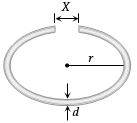
$A$ cylindrical metal rod of length $L_0$ is shaped into a ring with a small gap $x$ as shown. On heating the system:
A
$x$ decreases,$r$ and $d$ increase
B
$x$ and $r$ increase,$d$ decreases
C
$x$,$r$ and $d$ all increase
D
Data insufficient to arrive at a conclusion
Solution
(C) When an object made of an isotropic material is heated,it undergoes thermal expansion in all dimensions. This expansion is equivalent to a photographic enlargement of the object.
$1$. The length of the rod,the gap $x$,the radius $r$,and the thickness $d$ are all linear dimensions of the object.
$2$. According to the principle of linear thermal expansion,any linear dimension $L$ changes as $L' = L(1 + \alpha \Delta T)$,where $\alpha$ is the coefficient of linear expansion and $\Delta T$ is the change in temperature.
$3$. Since $\alpha > 0$ for metals and $\Delta T > 0$ during heating,all linear dimensions $x$,$r$,and $d$ will increase.
Therefore,the correct option is $(c)$.
$1$. The length of the rod,the gap $x$,the radius $r$,and the thickness $d$ are all linear dimensions of the object.
$2$. According to the principle of linear thermal expansion,any linear dimension $L$ changes as $L' = L(1 + \alpha \Delta T)$,where $\alpha$ is the coefficient of linear expansion and $\Delta T$ is the change in temperature.
$3$. Since $\alpha > 0$ for metals and $\Delta T > 0$ during heating,all linear dimensions $x$,$r$,and $d$ will increase.
Therefore,the correct option is $(c)$.
0 likes
View Solution18
EasyMCQ
The length of a metallic rod is $5 \, m$ at $0^{\circ}C$ and becomes $5.01 \, m$ on heating up to $100^{\circ}C$. The coefficient of linear expansion of the metal is:
A
$2.33 \times 10^{-5} \, ^{\circ}C^{-1}$
B
$6.0 \times 10^{-5} \, ^{\circ}C^{-1}$
C
$4.0 \times 10^{-5} \, ^{\circ}C^{-1}$
D
$2.0 \times 10^{-5} \, ^{\circ}C^{-1}$
Solution
(D) The formula for the coefficient of linear expansion is $\alpha = \frac{\Delta L}{L_0 \times \Delta \theta}$.
Given:
Initial length $L_0 = 5 \, m$
Change in length $\Delta L = 5.01 \, m - 5 \, m = 0.01 \, m$
Change in temperature $\Delta \theta = 100^{\circ}C - 0^{\circ}C = 100^{\circ}C$
Substituting the values:
$\alpha = \frac{0.01}{5 \times 100} = \frac{0.01}{500} = \frac{1}{50000} = 2 \times 10^{-5} \, ^{\circ}C^{-1}$.
Given:
Initial length $L_0 = 5 \, m$
Change in length $\Delta L = 5.01 \, m - 5 \, m = 0.01 \, m$
Change in temperature $\Delta \theta = 100^{\circ}C - 0^{\circ}C = 100^{\circ}C$
Substituting the values:
$\alpha = \frac{0.01}{5 \times 100} = \frac{0.01}{500} = \frac{1}{50000} = 2 \times 10^{-5} \, ^{\circ}C^{-1}$.
0 likes
View Solution19
DifficultMCQ
$A$ metal rod of silver at $0^{\circ}C$ is heated to $100^{\circ}C$. Its length increases by $0.19\, cm$. If the original length of the rod is $100\, cm$,the coefficient of cubical expansion of the silver rod is:
A
$5.7 \times 10^{-5} {^{\circ}C^{-1}}$
B
$0.63 \times 10^{-5} {^{\circ}C^{-1}}$
C
$1.9 \times 10^{-5} {^{\circ}C^{-1}}$
D
$16.1 \times 10^{-5} {^{\circ}C^{-1}}$
Solution
(A) Given: Initial length $L_0 = 100\, cm$,Change in temperature $\Delta \theta = 100^{\circ}C - 0^{\circ}C = 100^{\circ}C$,Change in length $\Delta L = 0.19\, cm$.
First,calculate the coefficient of linear expansion $(\alpha)$:
$\alpha = \frac{\Delta L}{L_0 \Delta \theta} = \frac{0.19}{100 \times 100} = \frac{0.19}{10000} = 1.9 \times 10^{-5} {^{\circ}C^{-1}}$.
Now,calculate the coefficient of cubical expansion $(\gamma)$:
$\gamma = 3\alpha = 3 \times 1.9 \times 10^{-5} {^{\circ}C^{-1}} = 5.7 \times 10^{-5} {^{\circ}C^{-1}}$.
Therefore,the correct option is $A$.
First,calculate the coefficient of linear expansion $(\alpha)$:
$\alpha = \frac{\Delta L}{L_0 \Delta \theta} = \frac{0.19}{100 \times 100} = \frac{0.19}{10000} = 1.9 \times 10^{-5} {^{\circ}C^{-1}}$.
Now,calculate the coefficient of cubical expansion $(\gamma)$:
$\gamma = 3\alpha = 3 \times 1.9 \times 10^{-5} {^{\circ}C^{-1}} = 5.7 \times 10^{-5} {^{\circ}C^{-1}}$.
Therefore,the correct option is $A$.
0 likes
View Solution20
EasyMCQ
$A$ brass disc fits snugly in a hole of a steel plate. The disc can be loosened from the hole if the system:
A
Is first heated then cooled
B
Is first cooled then heated
C
Is heated
D
Is cooled
Solution
(D) The coefficient of linear expansion of brass $(\alpha_{brass})$ is greater than that of steel $(\alpha_{steel})$.
When the system is cooled, both the brass disc and the steel plate contract.
Since $\alpha_{brass} > \alpha_{steel}$, the brass disc contracts more than the steel plate.
As a result, the gap between the disc and the hole increases, and the disc becomes loose.
When the system is cooled, both the brass disc and the steel plate contract.
Since $\alpha_{brass} > \alpha_{steel}$, the brass disc contracts more than the steel plate.
As a result, the gap between the disc and the hole increases, and the disc becomes loose.
0 likes
View Solution21
MediumMCQ
An iron bar of length $10\, m$ is heated from $0^{\circ}C$ to $100^{\circ}C$. If the coefficient of linear thermal expansion of iron is $10 \times 10^{-6} {^{\circ}C^{-1}}$,the increase in the length of the bar is .......... $cm$.
A
$0.5$
B
$1.0$
C
$1.5$
D
$2.0$
Solution
(B) The formula for the increase in length due to thermal expansion is given by $\Delta L = L_0 \alpha \Delta \theta$.
Here,the initial length $L_0 = 10\, m$,the coefficient of linear expansion $\alpha = 10 \times 10^{-6} {^{\circ}C^{-1}}$,and the change in temperature $\Delta \theta = 100^{\circ}C - 0^{\circ}C = 100^{\circ}C$.
Substituting these values into the formula:
$\Delta L = 10 \times (10 \times 10^{-6}) \times 100$
$\Delta L = 10 \times 10^{-5} \times 100 = 10^{-2}\, m$.
Since $1\, m = 100\, cm$,we have $\Delta L = 10^{-2} \times 100 = 1\, cm$.
Therefore,the increase in the length of the bar is $1.0\, cm$.
Here,the initial length $L_0 = 10\, m$,the coefficient of linear expansion $\alpha = 10 \times 10^{-6} {^{\circ}C^{-1}}$,and the change in temperature $\Delta \theta = 100^{\circ}C - 0^{\circ}C = 100^{\circ}C$.
Substituting these values into the formula:
$\Delta L = 10 \times (10 \times 10^{-6}) \times 100$
$\Delta L = 10 \times 10^{-5} \times 100 = 10^{-2}\, m$.
Since $1\, m = 100\, cm$,we have $\Delta L = 10^{-2} \times 100 = 1\, cm$.
Therefore,the increase in the length of the bar is $1.0\, cm$.
0 likes
View Solution22
EasyMCQ
If a cylinder of diameter $1.0 \, cm$ at $30^{\circ}C$ is to be slid into a hole of diameter $0.9997 \, cm$ in a steel plate at the same temperature,then the minimum required rise in the temperature of the plate is ........ $^{\circ}C$ (Coefficient of linear expansion of steel $\alpha = 12 \times 10^{-6} \, ^{\circ}C^{-1}$).
A
$25$
B
$35$
C
$45$
D
$55$
Solution
(A) The diameter of the hole $D_0 = 0.9997 \, cm$ must increase to $D = 1.0 \, cm$ to allow the cylinder to fit.
Using the formula for linear expansion: $\Delta D = D_0 \alpha \Delta T$.
Here,$\Delta D = D - D_0 = 1.0 - 0.9997 = 0.0003 \, cm$.
Substituting the values: $0.0003 = 0.9997 \times (12 \times 10^{-6}) \times \Delta T$.
$\Delta T = \frac{0.0003}{0.9997 \times 12 \times 10^{-6}} \approx \frac{0.0003}{0.0000119964} \approx 25.007^{\circ}C$.
Rounding to the nearest integer,the minimum required rise in temperature is $25^{\circ}C$.
Using the formula for linear expansion: $\Delta D = D_0 \alpha \Delta T$.
Here,$\Delta D = D - D_0 = 1.0 - 0.9997 = 0.0003 \, cm$.
Substituting the values: $0.0003 = 0.9997 \times (12 \times 10^{-6}) \times \Delta T$.
$\Delta T = \frac{0.0003}{0.9997 \times 12 \times 10^{-6}} \approx \frac{0.0003}{0.0000119964} \approx 25.007^{\circ}C$.
Rounding to the nearest integer,the minimum required rise in temperature is $25^{\circ}C$.
0 likes
View Solution23
MediumMCQ
Two rods,one of aluminum and the other made of steel,having initial lengths $l_1$ and $l_2$ are connected together to form a single rod of length $l_1 + l_2$. The coefficients of linear expansion for aluminum and steel are $\alpha_a$ and $\alpha_s$ respectively. If the length of each rod increases by the same amount when their temperature is raised by $t ^\circ C$,then find the ratio $\frac{l_1}{l_1 + l_2}$.
A
$\frac{\alpha_s}{\alpha_a}$
B
$\frac{\alpha_a}{\alpha_s}$
C
$\frac{\alpha_s}{\alpha_a + \alpha_s}$
D
$\frac{\alpha_a}{\alpha_a + \alpha_s}$
Solution
(C) The change in length of a rod due to thermal expansion is given by $\Delta l = l \alpha \Delta T$.
Given that the change in length for both rods is the same,we have $\Delta l_1 = \Delta l_2$.
Substituting the formula,we get $l_1 \alpha_a t = l_2 \alpha_s t$.
Canceling $t$ from both sides,we get $l_1 \alpha_a = l_2 \alpha_s$,which implies $\frac{l_1}{l_2} = \frac{\alpha_s}{\alpha_a}$.
To find the ratio $\frac{l_1}{l_1 + l_2}$,we use the property of ratios: if $\frac{a}{b} = \frac{c}{d}$,then $\frac{a}{a+b} = \frac{c}{c+d}$.
Applying this to our equation,we get $\frac{l_1}{l_1 + l_2} = \frac{\alpha_s}{\alpha_a + \alpha_s}$.
Given that the change in length for both rods is the same,we have $\Delta l_1 = \Delta l_2$.
Substituting the formula,we get $l_1 \alpha_a t = l_2 \alpha_s t$.
Canceling $t$ from both sides,we get $l_1 \alpha_a = l_2 \alpha_s$,which implies $\frac{l_1}{l_2} = \frac{\alpha_s}{\alpha_a}$.
To find the ratio $\frac{l_1}{l_1 + l_2}$,we use the property of ratios: if $\frac{a}{b} = \frac{c}{d}$,then $\frac{a}{a+b} = \frac{c}{c+d}$.
Applying this to our equation,we get $\frac{l_1}{l_1 + l_2} = \frac{\alpha_s}{\alpha_a + \alpha_s}$.
0 likes
View Solution24
DifficultMCQ
The coefficient of apparent expansion of mercury in a glass vessel is $153 \times 10^{-6} \, ^{\circ}C^{-1}$ and in a steel vessel is $144 \times 10^{-6} \, ^{\circ}C^{-1}$. If $\alpha$ for steel is $12 \times 10^{-6} \, ^{\circ}C^{-1}$,then that of glass is:
A
$9 \times 10^{-6} \, ^{\circ}C^{-1}$
B
$6 \times 10^{-6} \, ^{\circ}C^{-1}$
C
$36 \times 10^{-6} \, ^{\circ}C^{-1}$
D
$27 \times 10^{-6} \, ^{\circ}C^{-1}$
Solution
(A) The coefficient of real expansion of mercury $(\gamma_{real})$ is constant regardless of the vessel used.
We know the relation: $\gamma_{real} = \gamma_{app} + \gamma_{vessel}$,where $\gamma_{vessel} = 3\alpha$.
For the glass vessel: $\gamma_{real} = 153 \times 10^{-6} + \gamma_{glass}$.
For the steel vessel: $\gamma_{real} = 144 \times 10^{-6} + 3\alpha_{steel}$.
Given $\alpha_{steel} = 12 \times 10^{-6} \, ^{\circ}C^{-1}$,so $\gamma_{steel} = 3 \times 12 \times 10^{-6} = 36 \times 10^{-6} \, ^{\circ}C^{-1}$.
Equating the two expressions for $\gamma_{real}$:
$153 \times 10^{-6} + \gamma_{glass} = 144 \times 10^{-6} + 36 \times 10^{-6}$.
$153 \times 10^{-6} + \gamma_{glass} = 180 \times 10^{-6}$.
$\gamma_{glass} = (180 - 153) \times 10^{-6} = 27 \times 10^{-6} \, ^{\circ}C^{-1}$.
Since $\gamma_{glass} = 3\alpha_{glass}$,we have $3\alpha_{glass} = 27 \times 10^{-6} \, ^{\circ}C^{-1}$.
Therefore,$\alpha_{glass} = 9 \times 10^{-6} \, ^{\circ}C^{-1}$.
We know the relation: $\gamma_{real} = \gamma_{app} + \gamma_{vessel}$,where $\gamma_{vessel} = 3\alpha$.
For the glass vessel: $\gamma_{real} = 153 \times 10^{-6} + \gamma_{glass}$.
For the steel vessel: $\gamma_{real} = 144 \times 10^{-6} + 3\alpha_{steel}$.
Given $\alpha_{steel} = 12 \times 10^{-6} \, ^{\circ}C^{-1}$,so $\gamma_{steel} = 3 \times 12 \times 10^{-6} = 36 \times 10^{-6} \, ^{\circ}C^{-1}$.
Equating the two expressions for $\gamma_{real}$:
$153 \times 10^{-6} + \gamma_{glass} = 144 \times 10^{-6} + 36 \times 10^{-6}$.
$153 \times 10^{-6} + \gamma_{glass} = 180 \times 10^{-6}$.
$\gamma_{glass} = (180 - 153) \times 10^{-6} = 27 \times 10^{-6} \, ^{\circ}C^{-1}$.
Since $\gamma_{glass} = 3\alpha_{glass}$,we have $3\alpha_{glass} = 27 \times 10^{-6} \, ^{\circ}C^{-1}$.
Therefore,$\alpha_{glass} = 9 \times 10^{-6} \, ^{\circ}C^{-1}$.
0 likes
View Solution25
DifficultMCQ
Solids expand on heating because
A
Kinetic energy of the atoms increases
B
Potential energy of the atoms increases
C
Total energy of the atoms increases
D
The potential energy curve is asymmetric about the equilibrium distance between neighbouring atoms
Solution
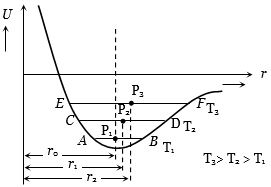
(D) The expansion of solids can be well understood by the potential energy curve for two adjacent atoms in a crystalline solid as a function of their internuclear separation $(r)$.
At ordinary temperature: Each molecule of the solid vibrates about its equilibrium position $P_1$ between $A$ and $B$,where $r_0$ is the equilibrium distance from another molecule.
At high temperature: The amplitude of vibration increases (e.g.,$C \leftrightarrow D$ and $E \leftrightarrow F$). Due to the asymmetry of the potential energy curve,the average equilibrium positions ($P_2$ and $P_3$) of the molecules are displaced. Hence,the average distance from other molecules increases $(r_2 > r_1 > r_0)$.
Thus,on raising the temperature,the average equilibrium distance between the molecules increases and the solid as a whole expands.
At ordinary temperature: Each molecule of the solid vibrates about its equilibrium position $P_1$ between $A$ and $B$,where $r_0$ is the equilibrium distance from another molecule.
At high temperature: The amplitude of vibration increases (e.g.,$C \leftrightarrow D$ and $E \leftrightarrow F$). Due to the asymmetry of the potential energy curve,the average equilibrium positions ($P_2$ and $P_3$) of the molecules are displaced. Hence,the average distance from other molecules increases $(r_2 > r_1 > r_0)$.
Thus,on raising the temperature,the average equilibrium distance between the molecules increases and the solid as a whole expands.
0 likes
View Solution26
DifficultMCQ
An iron tyre is to be fitted onto a wooden wheel $1 \, m$ in diameter. The diameter of the tyre is $6 \, mm$ smaller than that of the wheel. The tyre should be heated so that its temperature increases by a minimum of ........ $^oC$ (the coefficient of cubical expansion of iron is $3.6 \times 10^{-5} \, ^oC^{-1}$).
A
$167$
B
$334$
C
$500$
D
$1000$
Solution
(C) Initial diameter of the wheel $D_w = 1000 \, mm$.
Initial diameter of the tyre $D_t = 1000 - 6 = 994 \, mm$.
Initial radius of the tyre $R = 497 \, mm$.
Change in radius required $\Delta R = 3 \, mm$.
The coefficient of linear expansion $\alpha$ is related to the coefficient of cubical expansion $\gamma$ by $\alpha = \frac{\gamma}{3}$.
Given $\gamma = 3.6 \times 10^{-5} \, ^oC^{-1}$,so $\alpha = \frac{3.6 \times 10^{-5}}{3} = 1.2 \times 10^{-5} \, ^oC^{-1}$.
The change in circumference $\Delta L$ is given by $\Delta L = 2\pi \Delta R = L \alpha \Delta \theta = (2\pi R) \alpha \Delta \theta$.
Thus,$\Delta R = R \alpha \Delta \theta$.
$\Delta \theta = \frac{\Delta R}{R \alpha} = \frac{3}{497 \times 1.2 \times 10^{-5}} \approx \frac{3}{0.005964} \approx 503 \, ^oC$.
Rounding to the nearest provided option,the required temperature increase is $500 \, ^oC$.
Initial diameter of the tyre $D_t = 1000 - 6 = 994 \, mm$.
Initial radius of the tyre $R = 497 \, mm$.
Change in radius required $\Delta R = 3 \, mm$.
The coefficient of linear expansion $\alpha$ is related to the coefficient of cubical expansion $\gamma$ by $\alpha = \frac{\gamma}{3}$.
Given $\gamma = 3.6 \times 10^{-5} \, ^oC^{-1}$,so $\alpha = \frac{3.6 \times 10^{-5}}{3} = 1.2 \times 10^{-5} \, ^oC^{-1}$.
The change in circumference $\Delta L$ is given by $\Delta L = 2\pi \Delta R = L \alpha \Delta \theta = (2\pi R) \alpha \Delta \theta$.
Thus,$\Delta R = R \alpha \Delta \theta$.
$\Delta \theta = \frac{\Delta R}{R \alpha} = \frac{3}{497 \times 1.2 \times 10^{-5}} \approx \frac{3}{0.005964} \approx 503 \, ^oC$.
Rounding to the nearest provided option,the required temperature increase is $500 \, ^oC$.
0 likes
View Solution27
MediumMCQ
$A$ steel scale measures the length of a copper wire as $80.0\,cm$ when both are at $20^\circ C$ (the calibration temperature for the scale). What would be the scale reading for the length of the wire when both are at $40^\circ C$ (in $,cm$)?
A
$80.0096$
B
$80.0272$
C
$80.0120$
D
$80.0048$
Solution
(A) Let the initial length be $L_0 = 80.0\,cm$ at $T_1 = 20^\circ C$. The temperature change is $\Delta T = 40^\circ C - 20^\circ C = 20^\circ C$.
The actual length of the copper wire at $40^\circ C$ is $L_{Cu} = L_0(1 + \alpha_{Cu} \Delta T)$.
The length marked on the steel scale at $40^\circ C$ is $L_{steel} = L_0(1 + \alpha_{steel} \Delta T)$.
The scale reading is the ratio of the actual length of the wire to the length of a unit division on the scale at $40^\circ C$. Since the scale itself expands,the reading $L'$ is given by:
$L' = \frac{L_{Cu}}{1 + \alpha_{steel} \Delta T} = \frac{L_0(1 + \alpha_{Cu} \Delta T)}{1 + \alpha_{steel} \Delta T}$.
Using the binomial approximation $(1+x)^{-1} \approx 1-x$ for small $\alpha \Delta T$:
$L' \approx L_0(1 + \alpha_{Cu} \Delta T)(1 - \alpha_{steel} \Delta T) \approx L_0(1 + (\alpha_{Cu} - \alpha_{steel}) \Delta T)$.
Substituting the values:
$L' = 80.0 \times (1 + (17 \times 10^{-6} - 11 \times 10^{-6}) \times 20)$
$L' = 80.0 \times (1 + 6 \times 10^{-6} \times 20) = 80.0 \times (1 + 120 \times 10^{-6})$
$L' = 80.0 + 80.0 \times 0.00012 = 80.0 + 0.0096 = 80.0096\,cm$.
The actual length of the copper wire at $40^\circ C$ is $L_{Cu} = L_0(1 + \alpha_{Cu} \Delta T)$.
The length marked on the steel scale at $40^\circ C$ is $L_{steel} = L_0(1 + \alpha_{steel} \Delta T)$.
The scale reading is the ratio of the actual length of the wire to the length of a unit division on the scale at $40^\circ C$. Since the scale itself expands,the reading $L'$ is given by:
$L' = \frac{L_{Cu}}{1 + \alpha_{steel} \Delta T} = \frac{L_0(1 + \alpha_{Cu} \Delta T)}{1 + \alpha_{steel} \Delta T}$.
Using the binomial approximation $(1+x)^{-1} \approx 1-x$ for small $\alpha \Delta T$:
$L' \approx L_0(1 + \alpha_{Cu} \Delta T)(1 - \alpha_{steel} \Delta T) \approx L_0(1 + (\alpha_{Cu} - \alpha_{steel}) \Delta T)$.
Substituting the values:
$L' = 80.0 \times (1 + (17 \times 10^{-6} - 11 \times 10^{-6}) \times 20)$
$L' = 80.0 \times (1 + 6 \times 10^{-6} \times 20) = 80.0 \times (1 + 120 \times 10^{-6})$
$L' = 80.0 + 80.0 \times 0.00012 = 80.0 + 0.0096 = 80.0096\,cm$.
0 likes
View Solution28
DifficultMCQ
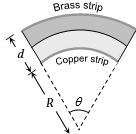
$A$ bimetallic strip is formed out of two identical strips,one of copper and the other of brass. The coefficients of linear expansion of the two metals are $\alpha_C$ and $\alpha_B$. On heating,the temperature of the strip increases by $\Delta T$ and the strip bends to form an arc of radius of curvature $R$. Then $R$ is:
A
Proportional to $\Delta T$
B
Inversely proportional to $\Delta T$
C
Inversely proportional to $|\alpha_B - \alpha_C|$
D
Both $(B)$ and $(C)$
Solution
(D) Let $L_0$ be the initial length of each strip before heating.
Let $d$ be the total thickness of the bimetallic strip.
After heating,the lengths of the brass and copper strips are:
$L_B = L_0(1 + \alpha_B \Delta T) = (R + d)\theta$
$L_C = L_0(1 + \alpha_C \Delta T) = R\theta$
Dividing the two equations:
$\frac{R + d}{R} = \frac{1 + \alpha_B \Delta T}{1 + \alpha_C \Delta T}$
$1 + \frac{d}{R} = \frac{1 + \alpha_B \Delta T}{1 + \alpha_C \Delta T}$
$\frac{d}{R} = \frac{1 + \alpha_B \Delta T}{1 + \alpha_C \Delta T} - 1 = \frac{1 + \alpha_B \Delta T - 1 - \alpha_C \Delta T}{1 + \alpha_C \Delta T} = \frac{(\alpha_B - \alpha_C)\Delta T}{1 + \alpha_C \Delta T}$
Since $\alpha \Delta T \ll 1$,we can approximate $1 + \alpha_C \Delta T \approx 1$.
Thus,$R = \frac{d}{(\alpha_B - \alpha_C)\Delta T}$.
Therefore,$R \propto \frac{1}{\Delta T}$ and $R \propto \frac{1}{|\alpha_B - \alpha_C|}$.
Hence,both $(B)$ and $(C)$ are correct.
Let $d$ be the total thickness of the bimetallic strip.
After heating,the lengths of the brass and copper strips are:
$L_B = L_0(1 + \alpha_B \Delta T) = (R + d)\theta$
$L_C = L_0(1 + \alpha_C \Delta T) = R\theta$
Dividing the two equations:
$\frac{R + d}{R} = \frac{1 + \alpha_B \Delta T}{1 + \alpha_C \Delta T}$
$1 + \frac{d}{R} = \frac{1 + \alpha_B \Delta T}{1 + \alpha_C \Delta T}$
$\frac{d}{R} = \frac{1 + \alpha_B \Delta T}{1 + \alpha_C \Delta T} - 1 = \frac{1 + \alpha_B \Delta T - 1 - \alpha_C \Delta T}{1 + \alpha_C \Delta T} = \frac{(\alpha_B - \alpha_C)\Delta T}{1 + \alpha_C \Delta T}$
Since $\alpha \Delta T \ll 1$,we can approximate $1 + \alpha_C \Delta T \approx 1$.
Thus,$R = \frac{d}{(\alpha_B - \alpha_C)\Delta T}$.
Therefore,$R \propto \frac{1}{\Delta T}$ and $R \propto \frac{1}{|\alpha_B - \alpha_C|}$.
Hence,both $(B)$ and $(C)$ are correct.
0 likes
View Solution29
EasyMCQ
Two metal strips that constitute a thermostat must necessarily differ in their
A
Mass
B
Length
C
Resistivity
D
Coefficient of linear expansion
Solution
(D) thermostat is a device used in electric appliances like refrigerators and irons for automatic temperature control.
It consists of a bimetallic strip made of two different metals joined together.
When the temperature changes, the two metals expand by different amounts because they have different coefficients of linear expansion $(\alpha)$.
This difference in expansion causes the strip to bend, which triggers the switching mechanism to turn the appliance on or off.
Therefore, the two metal strips must necessarily differ in their coefficient of linear expansion.
It consists of a bimetallic strip made of two different metals joined together.
When the temperature changes, the two metals expand by different amounts because they have different coefficients of linear expansion $(\alpha)$.
This difference in expansion causes the strip to bend, which triggers the switching mechanism to turn the appliance on or off.
Therefore, the two metal strips must necessarily differ in their coefficient of linear expansion.
0 likes
View Solution30
MediumMCQ
The coefficient of linear expansion of a crystal in one direction is ${\alpha _1}$ and that in every direction perpendicular to it is ${\alpha _2}$. The coefficient of cubical expansion is
A
${\alpha _1} + {\alpha _2}$
B
$2{\alpha _1} + {\alpha _2}$
C
${\alpha _1} + 2{\alpha _2}$
D
None of these
Solution
(C) Let the dimensions of the crystal be $L_0, L_0, L_0$. After a temperature change $\Delta \theta$,the new dimensions are $L_0(1 + \alpha_1 \Delta \theta)$,$L_0(1 + \alpha_2 \Delta \theta)$,and $L_0(1 + \alpha_2 \Delta \theta)$.
The new volume $V$ is given by $V = L_0(1 + \alpha_1 \Delta \theta) \times L_0(1 + \alpha_2 \Delta \theta) \times L_0(1 + \alpha_2 \Delta \theta)$.
$V = L_0^3(1 + \alpha_1 \Delta \theta)(1 + \alpha_2 \Delta \theta)^2$.
Since $V_0 = L_0^3$ and $V = V_0(1 + \gamma \Delta \theta)$,we have:
$1 + \gamma \Delta \theta = (1 + \alpha_1 \Delta \theta)(1 + 2\alpha_2 \Delta \theta + \alpha_2^2 \Delta \theta^2)$.
Neglecting higher-order terms of $\Delta \theta$,we get:
$1 + \gamma \Delta \theta \approx 1 + \alpha_1 \Delta \theta + 2\alpha_2 \Delta \theta$.
Comparing the coefficients of $\Delta \theta$,we find $\gamma = \alpha_1 + 2\alpha_2$.
The new volume $V$ is given by $V = L_0(1 + \alpha_1 \Delta \theta) \times L_0(1 + \alpha_2 \Delta \theta) \times L_0(1 + \alpha_2 \Delta \theta)$.
$V = L_0^3(1 + \alpha_1 \Delta \theta)(1 + \alpha_2 \Delta \theta)^2$.
Since $V_0 = L_0^3$ and $V = V_0(1 + \gamma \Delta \theta)$,we have:
$1 + \gamma \Delta \theta = (1 + \alpha_1 \Delta \theta)(1 + 2\alpha_2 \Delta \theta + \alpha_2^2 \Delta \theta^2)$.
Neglecting higher-order terms of $\Delta \theta$,we get:
$1 + \gamma \Delta \theta \approx 1 + \alpha_1 \Delta \theta + 2\alpha_2 \Delta \theta$.
Comparing the coefficients of $\Delta \theta$,we find $\gamma = \alpha_1 + 2\alpha_2$.
0 likes
View Solution31
MediumMCQ
$A$ $1$ litre glass flask contains some mercury. It is found that at different temperatures,the volume of air inside the flask remains the same. What is the volume of mercury in this flask in $cc$ if the coefficient of linear expansion of glass is $9 \times 10^{-6} /^{\circ}C$ and the coefficient of volume expansion of mercury is $1.8 \times 10^{-4} /^{\circ}C$?
A
$50$
B
$100$
C
$150$
D
$200$
Solution
(C) The volume of air in the flask remains constant at different temperatures. This implies that the increase in the volume of the glass flask must be exactly equal to the increase in the volume of the mercury contained within it.
Let $V_g$ be the total volume of the glass flask $(1000 \, cc)$ and $V_L$ be the volume of mercury.
The condition for constant air volume is $\Delta V_g = \Delta V_L$.
Using the formula for volume expansion,$\Delta V = V \gamma \Delta \theta$,we have:
$V_g \gamma_g \Delta \theta = V_L \gamma_L \Delta \theta$
Given that the coefficient of linear expansion of glass is $\alpha_g = 9 \times 10^{-6} /^{\circ}C$,the coefficient of volume expansion of glass is $\gamma_g = 3 \alpha_g = 3 \times 9 \times 10^{-6} = 27 \times 10^{-6} /^{\circ}C$.
The coefficient of volume expansion of mercury is $\gamma_L = 1.8 \times 10^{-4} /^{\circ}C$.
Substituting the values:
$V_L = \frac{V_g \gamma_g}{\gamma_L} = \frac{1000 \times 27 \times 10^{-6}}{1.8 \times 10^{-4}}$
$V_L = \frac{27 \times 10^{-3}}{1.8 \times 10^{-4}} = \frac{270}{1.8} = 150 \, cc$.
Let $V_g$ be the total volume of the glass flask $(1000 \, cc)$ and $V_L$ be the volume of mercury.
The condition for constant air volume is $\Delta V_g = \Delta V_L$.
Using the formula for volume expansion,$\Delta V = V \gamma \Delta \theta$,we have:
$V_g \gamma_g \Delta \theta = V_L \gamma_L \Delta \theta$
Given that the coefficient of linear expansion of glass is $\alpha_g = 9 \times 10^{-6} /^{\circ}C$,the coefficient of volume expansion of glass is $\gamma_g = 3 \alpha_g = 3 \times 9 \times 10^{-6} = 27 \times 10^{-6} /^{\circ}C$.
The coefficient of volume expansion of mercury is $\gamma_L = 1.8 \times 10^{-4} /^{\circ}C$.
Substituting the values:
$V_L = \frac{V_g \gamma_g}{\gamma_L} = \frac{1000 \times 27 \times 10^{-6}}{1.8 \times 10^{-4}}$
$V_L = \frac{27 \times 10^{-3}}{1.8 \times 10^{-4}} = \frac{270}{1.8} = 150 \, cc$.
0 likes
View Solution32
DifficultMCQ
$A$ clock which keeps correct time at $20^\circ C$ is subjected to $40^\circ C$. If the coefficient of linear expansion of the pendulum is $12 \times 10^{-6} /^\circ C$,how much time will it gain or lose per day?
A
$10.3$ seconds / day
B
$20.6$ seconds / day
C
$5$ seconds / day
D
$20$ minutes / day
Solution
(A) The time period of a simple pendulum is given by $T = 2\pi \sqrt{\frac{l}{g}}$.
Taking the derivative,the fractional change in time period is $\frac{\Delta T}{T} = \frac{1}{2} \frac{\Delta l}{l}$.
Since $\Delta l = l \alpha \Delta \theta$,we have $\frac{\Delta l}{l} = \alpha \Delta \theta$.
Therefore,$\frac{\Delta T}{T} = \frac{1}{2} \alpha \Delta \theta$.
Given $\alpha = 12 \times 10^{-6} /^\circ C$ and $\Delta \theta = 40^\circ C - 20^\circ C = 20^\circ C$.
$\frac{\Delta T}{T} = \frac{1}{2} \times 12 \times 10^{-6} \times 20 = 120 \times 10^{-6} = 1.2 \times 10^{-4}$.
The time lost or gained in a day ($86400$ seconds) is $\Delta T = \frac{\Delta T}{T} \times 86400$.
$\Delta T = 1.2 \times 10^{-4} \times 86400 = 10.368$ seconds.
Since the temperature increases,the length of the pendulum increases,the time period increases,and the clock loses time. Thus,it loses approximately $10.3$ seconds per day.
Taking the derivative,the fractional change in time period is $\frac{\Delta T}{T} = \frac{1}{2} \frac{\Delta l}{l}$.
Since $\Delta l = l \alpha \Delta \theta$,we have $\frac{\Delta l}{l} = \alpha \Delta \theta$.
Therefore,$\frac{\Delta T}{T} = \frac{1}{2} \alpha \Delta \theta$.
Given $\alpha = 12 \times 10^{-6} /^\circ C$ and $\Delta \theta = 40^\circ C - 20^\circ C = 20^\circ C$.
$\frac{\Delta T}{T} = \frac{1}{2} \times 12 \times 10^{-6} \times 20 = 120 \times 10^{-6} = 1.2 \times 10^{-4}$.
The time lost or gained in a day ($86400$ seconds) is $\Delta T = \frac{\Delta T}{T} \times 86400$.
$\Delta T = 1.2 \times 10^{-4} \times 86400 = 10.368$ seconds.
Since the temperature increases,the length of the pendulum increases,the time period increases,and the clock loses time. Thus,it loses approximately $10.3$ seconds per day.
0 likes
View Solution33
MediumMCQ
If the temperature of a rod is increased in such a way that no linear expansion occurs,then the stress developed in the rod does not depend on .......
A
Material of the rod
B
Increase in temperature
C
Length of the rod
D
None of these
Solution
(C) The Young's modulus of the rod is given by $Y = \frac{\text{Stress}}{\text{Linear Strain}}$.
Therefore,$\text{Stress} = Y \times \text{Linear Strain} = Y \times \left( \frac{\Delta l}{l} \right)$.
Since the linear expansion is prevented,the thermal strain is $\frac{\Delta l}{l} = \alpha \Delta \theta$,where $\alpha$ is the coefficient of linear expansion and $\Delta \theta$ is the change in temperature.
Substituting this,we get $\text{Stress} = Y \alpha \Delta \theta$.
Thus,the stress developed in the rod is independent of the initial length $l$ of the rod.
Therefore,$\text{Stress} = Y \times \text{Linear Strain} = Y \times \left( \frac{\Delta l}{l} \right)$.
Since the linear expansion is prevented,the thermal strain is $\frac{\Delta l}{l} = \alpha \Delta \theta$,where $\alpha$ is the coefficient of linear expansion and $\Delta \theta$ is the change in temperature.
Substituting this,we get $\text{Stress} = Y \alpha \Delta \theta$.
Thus,the stress developed in the rod is independent of the initial length $l$ of the rod.
0 likes
View Solution34
MediumMCQ
Two brass rods $A$ and $B$ have lengths $l$ and $2l$ and radii $2r$ and $r$ respectively. If both are heated to the same temperature,the ratio of the increase in their volumes is:
A
$1 : 1$
B
$1 : 2$
C
$2 : 1$
D
$1 : 4$
Solution
(C) The change in volume is given by the formula $\Delta V = \gamma V \Delta T$,where $V = \pi r^2 l$.
Since both rods are made of the same material (brass),the coefficient of volume expansion $\gamma$ is the same for both.
For rod $A$: $V_A = \pi (2r)^2 l = 4\pi r^2 l$.
For rod $B$: $V_B = \pi (r)^2 (2l) = 2\pi r^2 l$.
Since the change in temperature $\Delta T$ is the same for both,the ratio of the increase in volume is:
$\frac{\Delta V_A}{\Delta V_B} = \frac{\gamma V_A \Delta T}{\gamma V_B \Delta T} = \frac{V_A}{V_B} = \frac{4\pi r^2 l}{2\pi r^2 l} = \frac{2}{1}$.
Therefore,the ratio is $2 : 1$.
Since both rods are made of the same material (brass),the coefficient of volume expansion $\gamma$ is the same for both.
For rod $A$: $V_A = \pi (2r)^2 l = 4\pi r^2 l$.
For rod $B$: $V_B = \pi (r)^2 (2l) = 2\pi r^2 l$.
Since the change in temperature $\Delta T$ is the same for both,the ratio of the increase in volume is:
$\frac{\Delta V_A}{\Delta V_B} = \frac{\gamma V_A \Delta T}{\gamma V_B \Delta T} = \frac{V_A}{V_B} = \frac{4\pi r^2 l}{2\pi r^2 l} = \frac{2}{1}$.
Therefore,the ratio is $2 : 1$.
0 likes
View Solution35
MediumMCQ
$A$ pendulum clock shows the correct time at $20^{\circ}C$. During summer days,when the temperature rises to $40^{\circ}C$,what will be the time change in the clock in one day (in $.64$)? (Given: $\alpha = 10^{-5} {^{\circ}C}^{-1}$)
A
$7$
B
$5$
C
$6$
D
$8$
Solution
(D) The time period of a pendulum is given by $T = 2\pi \sqrt{\frac{L}{g}}$.
When the temperature increases,the length $L$ of the pendulum increases as $L' = L(1 + \alpha \Delta \theta)$.
The change in time $\Delta t$ for a total time $t$ is given by the formula $\Delta t = \frac{1}{2} \alpha \Delta \theta \times t$.
Here,$\alpha = 10^{-5} {^{\circ}C}^{-1}$,$\Delta \theta = (40 - 20) = 20^{\circ}C$,and $t = 86400 \, s$ (number of seconds in a day).
Substituting the values:
$\Delta t = \frac{1}{2} \times 10^{-5} \times 20 \times 86400$
$\Delta t = 10^{-5} \times 10 \times 86400$
$\Delta t = 10^{-4} \times 86400 = 8.64 \, s$.
When the temperature increases,the length $L$ of the pendulum increases as $L' = L(1 + \alpha \Delta \theta)$.
The change in time $\Delta t$ for a total time $t$ is given by the formula $\Delta t = \frac{1}{2} \alpha \Delta \theta \times t$.
Here,$\alpha = 10^{-5} {^{\circ}C}^{-1}$,$\Delta \theta = (40 - 20) = 20^{\circ}C$,and $t = 86400 \, s$ (number of seconds in a day).
Substituting the values:
$\Delta t = \frac{1}{2} \times 10^{-5} \times 20 \times 86400$
$\Delta t = 10^{-5} \times 10 \times 86400$
$\Delta t = 10^{-4} \times 86400 = 8.64 \, s$.
0 likes
View Solution36
EasyMCQ
The coefficient of area expansion of a solid is $2 \times 10^{-5} \, ^{\circ}C^{-1}$. Its coefficient of linear expansion is:
A
$4 \times 10^{-5} \, ^{\circ}C^{-1}$
B
$3 \times 10^{-5} \, ^{\circ}C^{-1}$
C
$2 \times 10^{-5} \, ^{\circ}C^{-1}$
D
$1 \times 10^{-5} \, ^{\circ}C^{-1}$
Solution
(D) The relationship between the coefficient of area expansion $(\beta)$ and the coefficient of linear expansion $(\alpha)$ is given by $\beta = 2\alpha$.
Given,$\beta = 2 \times 10^{-5} \, ^{\circ}C^{-1}$.
Therefore,$\alpha = \frac{\beta}{2}$.
$\alpha = \frac{2 \times 10^{-5}}{2} = 1 \times 10^{-5} \, ^{\circ}C^{-1}$.
Given,$\beta = 2 \times 10^{-5} \, ^{\circ}C^{-1}$.
Therefore,$\alpha = \frac{\beta}{2}$.
$\alpha = \frac{2 \times 10^{-5}}{2} = 1 \times 10^{-5} \, ^{\circ}C^{-1}$.
0 likes
View Solution37
MediumMCQ
The density of a substance at $0 \, ^\circ C$ is $10 \, g/cm^3$ and at $100 \, ^\circ C$ is $9.7 \, g/cm^3$. The coefficient of linear expansion of the substance is ..... $^\circ C^{-1}$.
A
$10^{-2}$
B
$10^{-3}$
C
$10^{-4}$
D
$10^{-5}$
Solution
(C) The density $\rho$ at temperature $\theta$ is given by $\rho = \frac{\rho_0}{1 + \gamma \Delta \theta}$,where $\gamma$ is the coefficient of volume expansion.
For small changes,$\gamma \approx \frac{\rho_0 - \rho}{\rho \Delta \theta}$.
Given $\rho_0 = 10 \, g/cm^3$,$\rho = 9.7 \, g/cm^3$,and $\Delta \theta = 100 \, ^\circ C$.
$\gamma = \frac{10 - 9.7}{9.7 \times 100} \approx \frac{0.3}{970} \approx 3.09 \times 10^{-4} \, ^\circ C^{-1}$.
Using the approximation $\gamma \approx \frac{\rho_0 - \rho}{\rho_0 \Delta \theta}$ (often used in textbooks for small expansion):
$\gamma = \frac{10 - 9.7}{10 \times 100} = \frac{0.3}{1000} = 3 \times 10^{-4} \, ^\circ C^{-1}$.
The coefficient of linear expansion $\alpha = \frac{\gamma}{3}$.
$\alpha = \frac{3 \times 10^{-4}}{3} = 10^{-4} \, ^\circ C^{-1}$.
For small changes,$\gamma \approx \frac{\rho_0 - \rho}{\rho \Delta \theta}$.
Given $\rho_0 = 10 \, g/cm^3$,$\rho = 9.7 \, g/cm^3$,and $\Delta \theta = 100 \, ^\circ C$.
$\gamma = \frac{10 - 9.7}{9.7 \times 100} \approx \frac{0.3}{970} \approx 3.09 \times 10^{-4} \, ^\circ C^{-1}$.
Using the approximation $\gamma \approx \frac{\rho_0 - \rho}{\rho_0 \Delta \theta}$ (often used in textbooks for small expansion):
$\gamma = \frac{10 - 9.7}{10 \times 100} = \frac{0.3}{1000} = 3 \times 10^{-4} \, ^\circ C^{-1}$.
The coefficient of linear expansion $\alpha = \frac{\gamma}{3}$.
$\alpha = \frac{3 \times 10^{-4}}{3} = 10^{-4} \, ^\circ C^{-1}$.
0 likes
View Solution38
EasyMCQ
When a cylinder is heated,its length increases by $2\%$. What is the percentage increase in its surface area (in $\%$)?
A
$0.05$
B
$2$
C
$1$
D
$4$
Solution
(D) The surface area $A$ of a cylinder is given by $A = 2\pi r^2 + 2\pi rL$. For a thin cylinder or considering the dominant change in length,the surface area is proportional to the square of the length $(A \propto L^2)$.
Taking the derivative,we get $\Delta A = 2L \Delta L$.
Dividing by $A$ (where $A = L^2$ for proportionality),we get $\frac{\Delta A}{A} = \frac{2L \Delta L}{L^2} = 2 \frac{\Delta L}{L}$.
Given $\frac{\Delta L}{L} = 2\%$,the percentage increase in surface area is $\frac{\Delta A}{A} \times 100 = 2 \times 2\% = 4\%$.
Taking the derivative,we get $\Delta A = 2L \Delta L$.
Dividing by $A$ (where $A = L^2$ for proportionality),we get $\frac{\Delta A}{A} = \frac{2L \Delta L}{L^2} = 2 \frac{\Delta L}{L}$.
Given $\frac{\Delta L}{L} = 2\%$,the percentage increase in surface area is $\frac{\Delta A}{A} \times 100 = 2 \times 2\% = 4\%$.
1 likes
View Solution39
EasyMCQ
An iron rod of length $10 \ m$ is heated from $0 \ ^{\circ}C$ to $100 \ ^{\circ}C$. If the coefficient of linear expansion of iron is $10 \times 10^{-6} \ ^{\circ}C^{-1}$,then the increase in the length of the rod is ..... $cm$.
A
$0.5$
B
$1.0$
C
$1.5$
D
$2.0$
Solution
(B) The formula for linear expansion is given by $\Delta l = \alpha l \Delta T$.
Here,the initial length $l = 10 \ m$,the coefficient of linear expansion $\alpha = 10 \times 10^{-6} \ ^{\circ}C^{-1}$,and the change in temperature $\Delta T = 100 \ ^{\circ}C - 0 \ ^{\circ}C = 100 \ ^{\circ}C$.
Substituting these values into the formula:
$\Delta l = (10 \times 10^{-6} \ ^{\circ}C^{-1}) \times (10 \ \text{m}) \times (100 \ ^{\circ}C)$
$\Delta l = 10 \times 10^{-6} \times 10 \times 100 \ \text{m}$
$\Delta l = 10^{-2} \ \text{m}$
Since $1 \ \text{m} = 100 \ \text{cm}$,we have $\Delta l = 10^{-2} \times 100 \ \text{cm} = 1.0 \ \text{cm}$.
Thus,the increase in length is $1.0 \ \text{cm}$.
Here,the initial length $l = 10 \ m$,the coefficient of linear expansion $\alpha = 10 \times 10^{-6} \ ^{\circ}C^{-1}$,and the change in temperature $\Delta T = 100 \ ^{\circ}C - 0 \ ^{\circ}C = 100 \ ^{\circ}C$.
Substituting these values into the formula:
$\Delta l = (10 \times 10^{-6} \ ^{\circ}C^{-1}) \times (10 \ \text{m}) \times (100 \ ^{\circ}C)$
$\Delta l = 10 \times 10^{-6} \times 10 \times 100 \ \text{m}$
$\Delta l = 10^{-2} \ \text{m}$
Since $1 \ \text{m} = 100 \ \text{cm}$,we have $\Delta l = 10^{-2} \times 100 \ \text{cm} = 1.0 \ \text{cm}$.
Thus,the increase in length is $1.0 \ \text{cm}$.
0 likes
View Solution40
DifficultMCQ
Two rods,one of aluminum and another of steel,have initial lengths $l_1$ and $l_2$ respectively. They are joined together to form a single rod of length $(l_1 + l_2)$. If the coefficients of linear expansion for aluminum and steel are $\alpha_a$ and $\alpha_s$ respectively,and the increase in length for both rods is the same when the temperature of both is increased by $t \ ^\circ C$,then $\frac{l_1}{l_1 + l_2} = \dots$
A
$\frac{\alpha_s}{\alpha_a}$
B
$\frac{\alpha_a}{\alpha_s}$
C
$\frac{\alpha_s}{(\alpha_a + \alpha_s)}$
D
$\frac{\alpha_a}{(\alpha_a + \alpha_s)}$
Solution
(C) The change in length for a rod is given by $\Delta l = l \alpha \Delta T$.
Given that the increase in length for both rods is the same,we have $\Delta l_a = \Delta l_s$.
Substituting the formula,we get $l_1 \alpha_a \Delta T = l_2 \alpha_s \Delta T$.
Since $\Delta T$ is the same for both,we can cancel it out: $l_1 \alpha_a = l_2 \alpha_s$.
This implies $\frac{l_1}{l_2} = \frac{\alpha_s}{\alpha_a}$.
To find $\frac{l_1}{l_1 + l_2}$,we use the property of ratios: $\frac{l_1}{l_1 + l_2} = \frac{\alpha_s}{\alpha_s + \alpha_a}$.
Thus,the correct option is $C$.
Given that the increase in length for both rods is the same,we have $\Delta l_a = \Delta l_s$.
Substituting the formula,we get $l_1 \alpha_a \Delta T = l_2 \alpha_s \Delta T$.
Since $\Delta T$ is the same for both,we can cancel it out: $l_1 \alpha_a = l_2 \alpha_s$.
This implies $\frac{l_1}{l_2} = \frac{\alpha_s}{\alpha_a}$.
To find $\frac{l_1}{l_1 + l_2}$,we use the property of ratios: $\frac{l_1}{l_1 + l_2} = \frac{\alpha_s}{\alpha_s + \alpha_a}$.
Thus,the correct option is $C$.
0 likes
View Solution41
MediumMCQ
An iron rod has a length of $10 \ cm$ at $20^{\circ}C$. What will be the change in length of the iron rod at $19^{\circ}C$? (Given for iron,$\alpha = 11 \times 10^{-6} \ ^{\circ}C^{-1}$)
A
$11 \times 10^{-6} \ cm$ increase.
B
$11 \times 10^{-6} \ cm$ decrease.
C
$11 \times 10^{-5} \ cm$ decrease.
D
$11 \times 10^{-5} \ cm$ increase.
Solution
(C) The change in length due to thermal expansion is given by $\Delta l = l_0 \alpha \Delta T$.
Here,$l_0 = 10 \ cm$,$\alpha = 11 \times 10^{-6} \ ^{\circ}C^{-1}$,and $\Delta T = 20^{\circ}C - 19^{\circ}C = 1^{\circ}C$.
Substituting the values:
$\Delta l = 10 \ cm \times (11 \times 10^{-6} \ ^{\circ}C^{-1}) \times 1^{\circ}C$.
$\Delta l = 110 \times 10^{-6} \ cm = 11 \times 10^{-5} \ cm$.
Since the temperature decreases,the length of the rod will decrease by $11 \times 10^{-5} \ cm$.
Here,$l_0 = 10 \ cm$,$\alpha = 11 \times 10^{-6} \ ^{\circ}C^{-1}$,and $\Delta T = 20^{\circ}C - 19^{\circ}C = 1^{\circ}C$.
Substituting the values:
$\Delta l = 10 \ cm \times (11 \times 10^{-6} \ ^{\circ}C^{-1}) \times 1^{\circ}C$.
$\Delta l = 110 \times 10^{-6} \ cm = 11 \times 10^{-5} \ cm$.
Since the temperature decreases,the length of the rod will decrease by $11 \times 10^{-5} \ cm$.
0 likes
View Solution42
MediumMCQ
When a bimetallic strip is heated, it . . . . . . .
A
does not bend.
B
bends in the form of an arc.
C
bends with the metal having a higher coefficient of linear expansion on the outside of the arc.
D
bends with the metal having a higher coefficient of linear expansion on the inside of the arc.
Solution
(C) bimetallic strip consists of two different metals with different coefficients of linear expansion $(\alpha)$.
When the strip is heated, both metals expand, but the metal with the higher coefficient of linear expansion $(\alpha)$ expands more than the other.
Because the two metals are bonded together, the one that expands more must form the outer part of the curve to accommodate its greater length.
Therefore, the strip bends such that the metal with the higher coefficient of linear expansion is on the outside of the arc.
When the strip is heated, both metals expand, but the metal with the higher coefficient of linear expansion $(\alpha)$ expands more than the other.
Because the two metals are bonded together, the one that expands more must form the outer part of the curve to accommodate its greater length.
Therefore, the strip bends such that the metal with the higher coefficient of linear expansion is on the outside of the arc.
0 likes
View Solution43
EasyMCQ
When a copper ball is heated,which of the following will show the maximum percentage increase?
A
Diameter
B
Surface area
C
Volume
D
Density
Solution
(C) The coefficient of volume expansion $(\gamma)$ is related to the coefficient of area expansion $(\beta)$ and the coefficient of linear expansion $(\alpha)$ by the relations $\gamma = 3\alpha$ and $\gamma = 1.5\beta$.
$1$. The percentage increase in length (diameter) is proportional to $\alpha \Delta T$.
$2$. The percentage increase in surface area is proportional to $\beta \Delta T = 2\alpha \Delta T$.
$3$. The percentage increase in volume is proportional to $\gamma \Delta T = 3\alpha \Delta T$.
Since $3\alpha > 2\alpha > \alpha$,the percentage increase in volume is the largest. Density decreases upon heating,so it does not show a percentage increase.
$1$. The percentage increase in length (diameter) is proportional to $\alpha \Delta T$.
$2$. The percentage increase in surface area is proportional to $\beta \Delta T = 2\alpha \Delta T$.
$3$. The percentage increase in volume is proportional to $\gamma \Delta T = 3\alpha \Delta T$.
Since $3\alpha > 2\alpha > \alpha$,the percentage increase in volume is the largest. Density decreases upon heating,so it does not show a percentage increase.
0 likes
View Solution44
MediumMCQ
The ratio of linear expansion coefficient,area expansion coefficient,and volume expansion coefficient is ...............
A
$1:2:3$
B
$3:2:1$
C
$4:3:2$
D
None of the above
Solution
(A) Let the linear expansion coefficient be $\alpha$.
Then,the area expansion coefficient $\beta = 2\alpha$.
And the volume expansion coefficient $\gamma = 3\alpha$.
Therefore,the ratio $\alpha : \beta : \gamma = \alpha : 2\alpha : 3\alpha = 1 : 2 : 3$.
Then,the area expansion coefficient $\beta = 2\alpha$.
And the volume expansion coefficient $\gamma = 3\alpha$.
Therefore,the ratio $\alpha : \beta : \gamma = \alpha : 2\alpha : 3\alpha = 1 : 2 : 3$.
0 likes
View Solution45
EasyMCQ
$A$ brass disc fits snugly in a hole of a steel plate. To loosen the disc from the hole, the system should be:
A
Heated then cooled
B
Cooled then heated
C
Heated
D
Cooled
Solution
(D) The coefficient of linear expansion of brass $(\alpha_b)$ is greater than that of steel $(\alpha_s)$.
When the system is cooled, both materials contract.
Since $\alpha_b > \alpha_s$, the brass disc contracts more than the steel plate hole.
As a result, the disc becomes loose in the hole.
When the system is cooled, both materials contract.
Since $\alpha_b > \alpha_s$, the brass disc contracts more than the steel plate hole.
As a result, the disc becomes loose in the hole.
0 likes
View Solution46
EasyMCQ
$A$ solid metal sphere has a spherical cavity inside it. If the sphere is heated,the volume of the cavity will.....
A
increase
B
decrease
C
remain the same
D
change its shape
Solution
(A) When a solid object with a cavity is heated,the material expands as if the cavity were also made of the same material.
According to the principle of thermal expansion,the distance between any two points in the solid increases upon heating.
Since the cavity is defined by the surrounding metal,as the metal expands outward,the boundary of the cavity moves outward as well.
Therefore,the radius of the spherical cavity increases,which leads to an increase in the volume of the cavity $(V = \frac{4}{3} \pi r^3)$.
According to the principle of thermal expansion,the distance between any two points in the solid increases upon heating.
Since the cavity is defined by the surrounding metal,as the metal expands outward,the boundary of the cavity moves outward as well.
Therefore,the radius of the spherical cavity increases,which leads to an increase in the volume of the cavity $(V = \frac{4}{3} \pi r^3)$.
0 likes
View Solution47
MediumMCQ
An aluminium sphere of $20 \; cm$ diameter is heated from $0^{\circ} C$ to $100^{\circ} C$. Its volume changes by (given that coefficient of linear expansion for aluminium $\alpha_{Al} = 23 \times 10^{-6} \; /^{\circ} C$): (in $; cm^3$)
A
$28.9$
B
$2.89$
C
$9.28$
D
$49.8$
Solution
(A) The change in volume $\Delta V$ is given by the formula $\Delta V = \gamma \cdot V \cdot \Delta T$,where $\gamma$ is the coefficient of volume expansion.
For a solid,$\gamma = 3\alpha$,where $\alpha$ is the coefficient of linear expansion.
Given: Diameter $d = 20 \; cm$,so radius $r = 10 \; cm$.
Initial volume $V = \frac{4}{3} \pi r^3 = \frac{4}{3} \pi (10)^3 = \frac{4000}{3} \pi \; cm^3$.
Change in temperature $\Delta T = 100^{\circ} C - 0^{\circ} C = 100^{\circ} C$.
Coefficient of linear expansion $\alpha = 23 \times 10^{-6} \; /^{\circ} C$.
Substituting the values:
$\Delta V = 3 \times (23 \times 10^{-6}) \times (\frac{4}{3} \pi \times 10^3) \times 100$
$\Delta V = 3 \times 23 \times 10^{-6} \times \frac{4}{3} \times 3.14159 \times 1000 \times 100$
$\Delta V = 23 \times 4 \times 3.14159 \times 10^{-1} = 92 \times 3.14159 \times 0.1 \approx 28.9 \; cm^3$.
For a solid,$\gamma = 3\alpha$,where $\alpha$ is the coefficient of linear expansion.
Given: Diameter $d = 20 \; cm$,so radius $r = 10 \; cm$.
Initial volume $V = \frac{4}{3} \pi r^3 = \frac{4}{3} \pi (10)^3 = \frac{4000}{3} \pi \; cm^3$.
Change in temperature $\Delta T = 100^{\circ} C - 0^{\circ} C = 100^{\circ} C$.
Coefficient of linear expansion $\alpha = 23 \times 10^{-6} \; /^{\circ} C$.
Substituting the values:
$\Delta V = 3 \times (23 \times 10^{-6}) \times (\frac{4}{3} \pi \times 10^3) \times 100$
$\Delta V = 3 \times 23 \times 10^{-6} \times \frac{4}{3} \times 3.14159 \times 1000 \times 100$
$\Delta V = 23 \times 4 \times 3.14159 \times 10^{-1} = 92 \times 3.14159 \times 0.1 \approx 28.9 \; cm^3$.
0 likes
View Solution48
DifficultMCQ
Two rods,one of aluminum and another of steel,have initial lengths $ℓ_1$ and $ℓ_2$ respectively. They are joined to form a single rod of length $ℓ_1 + ℓ_2$. The coefficients of linear expansion for aluminum and steel are $\alpha_a$ and $\alpha_s$ respectively. If the increase in length of both rods is the same when the temperature is increased by $t \ ^\circ C$,find the ratio $\frac{ℓ_1}{ℓ_1 + ℓ_2}$.
A
$\frac{\alpha_s}{\alpha_a}$
B
$\frac{\alpha_a}{\alpha_s}$
C
$\frac{\alpha_s}{\alpha_a + \alpha_s}$
D
$\frac{\alpha_a}{\alpha_a + \alpha_s}$
Solution
(C) The change in length for a rod is given by $\Delta \ell = \ell \alpha \Delta T$.
Given that the increase in length for both rods is the same: $\Delta \ell_1 = \Delta \ell_2$.
Therefore,$\ell_1 \alpha_a t = \ell_2 \alpha_s t$.
This simplifies to $\ell_1 \alpha_a = \ell_2 \alpha_s$,which means $\frac{\ell_1}{\ell_2} = \frac{\alpha_s}{\alpha_a}$.
To find the ratio $\frac{\ell_1}{\ell_1 + \ell_2}$,we use the property of ratios:
$\frac{\ell_1}{\ell_1 + \ell_2} = \frac{\alpha_s}{\alpha_a + \alpha_s}$.
Given that the increase in length for both rods is the same: $\Delta \ell_1 = \Delta \ell_2$.
Therefore,$\ell_1 \alpha_a t = \ell_2 \alpha_s t$.
This simplifies to $\ell_1 \alpha_a = \ell_2 \alpha_s$,which means $\frac{\ell_1}{\ell_2} = \frac{\alpha_s}{\alpha_a}$.
To find the ratio $\frac{\ell_1}{\ell_1 + \ell_2}$,we use the property of ratios:
$\frac{\ell_1}{\ell_1 + \ell_2} = \frac{\alpha_s}{\alpha_a + \alpha_s}$.
0 likes
View Solution49
EasyMCQ
If a cylinder is heated such that its length increases by $2\%$,then its base area will increase by ......... $(\%)$.
A
$0.5$
B
$2$
C
$1$
D
$4$
Solution
(D) The volume of a cylinder is given by $V = A \times L$,where $A$ is the base area and $L$ is the length.
Assuming the volume of the cylinder remains constant during heating (or considering the relationship between dimensions),if the length $L$ increases by $2\%$,the cross-sectional area $A$ must decrease to keep the volume constant.
However,in the context of thermal expansion,if we consider the linear expansion of the radius $r$ due to temperature change,the area $A = \pi r^2$ changes as $\frac{\Delta A}{A} = 2 \frac{\Delta r}{r}$.
If the question implies that the radius also expands by the same coefficient as the length (isotropic expansion),then $\frac{\Delta r}{r} = \frac{\Delta L}{L} = 2\%$.
Therefore,the percentage increase in area is $\frac{\Delta A}{A} \times 100 = 2 \times (2\%) = 4\%$.
Assuming the volume of the cylinder remains constant during heating (or considering the relationship between dimensions),if the length $L$ increases by $2\%$,the cross-sectional area $A$ must decrease to keep the volume constant.
However,in the context of thermal expansion,if we consider the linear expansion of the radius $r$ due to temperature change,the area $A = \pi r^2$ changes as $\frac{\Delta A}{A} = 2 \frac{\Delta r}{r}$.
If the question implies that the radius also expands by the same coefficient as the length (isotropic expansion),then $\frac{\Delta r}{r} = \frac{\Delta L}{L} = 2\%$.
Therefore,the percentage increase in area is $\frac{\Delta A}{A} \times 100 = 2 \times (2\%) = 4\%$.
0 likes
View Solution50
MediumMCQ
When the temperature of a metal sphere is increased by $40^{\circ}C$,its volume increases by $0.24\%$. The coefficient of linear expansion of the metal is ....... $^{\circ}C^{-1}$.
A
$2 \times 10^{-5}$
B
$6 \times 10^{-5}$
C
$2.1 \times 10^{-5}$
D
$1.2 \times 10^{-5}$
Solution
(A) The formula for volume expansion is given by $\frac{\Delta V}{V} = \gamma \Delta \theta$,where $\gamma$ is the coefficient of volume expansion and $\Delta \theta$ is the change in temperature.
Given $\frac{\Delta V}{V} = 0.24\% = \frac{0.24}{100} = 2.4 \times 10^{-3}$ and $\Delta \theta = 40^{\circ}C$.
Substituting the values: $2.4 \times 10^{-3} = \gamma \times 40$.
Solving for $\gamma$: $\gamma = \frac{2.4 \times 10^{-3}}{40} = 0.06 \times 10^{-3} = 6 \times 10^{-5} \, ^{\circ}C^{-1}$.
The relationship between the coefficient of linear expansion $(\alpha)$ and the coefficient of volume expansion $(\gamma)$ is $\alpha = \frac{\gamma}{3}$.
Therefore,$\alpha = \frac{6 \times 10^{-5}}{3} = 2 \times 10^{-5} \, ^{\circ}C^{-1}$.
Given $\frac{\Delta V}{V} = 0.24\% = \frac{0.24}{100} = 2.4 \times 10^{-3}$ and $\Delta \theta = 40^{\circ}C$.
Substituting the values: $2.4 \times 10^{-3} = \gamma \times 40$.
Solving for $\gamma$: $\gamma = \frac{2.4 \times 10^{-3}}{40} = 0.06 \times 10^{-3} = 6 \times 10^{-5} \, ^{\circ}C^{-1}$.
The relationship between the coefficient of linear expansion $(\alpha)$ and the coefficient of volume expansion $(\gamma)$ is $\alpha = \frac{\gamma}{3}$.
Therefore,$\alpha = \frac{6 \times 10^{-5}}{3} = 2 \times 10^{-5} \, ^{\circ}C^{-1}$.
0 likes
View Solution10-1.Thermometry, Thermal Expansion and Calorimetry — Thermal Expansion for Solid · Frequently Asked Questions
1Are these 10-1.Thermometry, Thermal Expansion and Calorimetry questions useful for JEE and NEET?
Yes. All questions in this section are mapped to JEE Main and NEET exam patterns. Previous year questions from JEE Main, NEET, GUJCET and state-level exams are included with full solutions.
2Can I switch to Hindi or Gujarati for these questions?
Yes. Use the language tabs in the hero section or the sidebar to view the same questions and solutions in English, Hindi or Gujarati.
3How do I generate a question paper from this subtopic?
Use the Vedclass Exam Paper Generator — select the chapter and subtopic, set difficulty, and generate Sets A, B, C, D automatically. First 3 chapters of every subject are free.
Vedclass Products
For Students
Vedclass Test Series
Mock tests in real JEE/NEET style with performance analysis. 5-day free trial.
Start Free TrialFor Teachers
Exam Paper Generator
Generate Set A/B/C/D papers from this chapter in 2 minutes. 3 chapters free.
Try FreeFor Institutes
Online Exam Module
Live online exams with unlimited students, 360° analytics & white-label branding.
See DemoFor Teachers & Institutes
Generate a 10-1.Thermometry, Thermal Expansion and Calorimetry Exam Paper in 2 Minutes
Select subtopic & difficulty — Sets A, B, C, D auto-generated with No Repeat logic.
First 3 chapters of every subject are free — no payment required.