
A English
Heat Capacity, Specific Heat and Molar Specific Heat Questions in English
Class 11 Physics · 10-1.Thermometry, Thermal Expansion and Calorimetry · Heat Capacity, Specific Heat and Molar Specific Heat
107+
Questions
English
Language
100%
With Solutions
Showing 50 of 107 questions in English
1
EasyMCQ
If the specific heat of a substance is infinite,it means
A
Heat is given out
B
Heat is taken in
C
No change in temperature takes place whether heat is taken in or given out
D
All of the above
Solution
(C) The formula for heat exchange is given by $Q = m \cdot c \cdot \Delta \theta$,where $Q$ is the heat,$m$ is the mass,$c$ is the specific heat,and $\Delta \theta$ is the change in temperature.
Rearranging for specific heat,we get $c = \frac{Q}{m \cdot \Delta \theta}$.
If the specific heat $c$ is infinite $(c = \infty)$,then the denominator $m \cdot \Delta \theta$ must be zero.
Since mass $m$ cannot be zero,it implies that $\Delta \theta = 0$.
This means that there is no change in temperature regardless of whether heat is absorbed or released by the substance,which is characteristic of a phase change process.
Rearranging for specific heat,we get $c = \frac{Q}{m \cdot \Delta \theta}$.
If the specific heat $c$ is infinite $(c = \infty)$,then the denominator $m \cdot \Delta \theta$ must be zero.
Since mass $m$ cannot be zero,it implies that $\Delta \theta = 0$.
This means that there is no change in temperature regardless of whether heat is absorbed or released by the substance,which is characteristic of a phase change process.
0 likes
View Solution2
EasyMCQ
The factor not needed to calculate heat lost or gained when there is no change of state is
A
Weight
B
Specific heat
C
Relative density
D
Temperature change
Solution
(C) The formula for heat lost or gained without a change of state is given by $\Delta Q = mc \Delta \theta$,where $m$ is the mass,$c$ is the specific heat capacity,and $\Delta \theta$ is the change in temperature.
Since the formula depends on mass $(m)$,specific heat $(c)$,and temperature change $(\Delta \theta)$,the factor 'Relative density' is not required for this calculation.
Therefore,the correct option is $C$.
Since the formula depends on mass $(m)$,specific heat $(c)$,and temperature change $(\Delta \theta)$,the factor 'Relative density' is not required for this calculation.
Therefore,the correct option is $C$.
0 likes
View Solution3
EasyMCQ
Water is used to cool radiators of engines,because
A
Of its lower density
B
It is easily available
C
It is cheap
D
It has high specific heat
Solution
(D) Water is used as a coolant in engine radiators primarily because it has a very high specific heat capacity $(c \approx 4186 \ J/kg \cdot K)$.
This property allows water to absorb a large amount of heat energy from the engine with a relatively small rise in its own temperature.
Consequently,it is highly efficient at transferring heat away from the engine components to the radiator,where it can be dissipated into the atmosphere.
This property allows water to absorb a large amount of heat energy from the engine with a relatively small rise in its own temperature.
Consequently,it is highly efficient at transferring heat away from the engine components to the radiator,where it can be dissipated into the atmosphere.
0 likes
View Solution4
MediumMCQ
How much heat energy is gained when $5\, kg$ of water at $20^{\circ}C$ is brought to its boiling point? (Specific heat of water $= 4.2\, kJ\, kg^{-1} {^{\circ}C}^{-1}$)
A
$1680$
B
$1700$
C
$1720$
D
$1740$
Solution
(A) The formula for heat energy gained is $Q = m \cdot c \cdot \Delta \theta$.
Given:
Mass of water,$m = 5\, kg$.
Specific heat of water,$c = 4.2\, kJ\, kg^{-1} {^{\circ}C}^{-1}$.
Initial temperature,$\theta_1 = 20^{\circ}C$.
Final temperature (boiling point),$\theta_2 = 100^{\circ}C$.
Change in temperature,$\Delta \theta = \theta_2 - \theta_1 = 100^{\circ}C - 20^{\circ}C = 80^{\circ}C$.
Substituting the values into the formula:
$Q = 5\, kg \times 4.2\, kJ\, kg^{-1} {^{\circ}C}^{-1} \times 80^{\circ}C$.
$Q = 5 \times 4.2 \times 80\, kJ$.
$Q = 21 \times 80\, kJ$.
$Q = 1680\, kJ$.
Given:
Mass of water,$m = 5\, kg$.
Specific heat of water,$c = 4.2\, kJ\, kg^{-1} {^{\circ}C}^{-1}$.
Initial temperature,$\theta_1 = 20^{\circ}C$.
Final temperature (boiling point),$\theta_2 = 100^{\circ}C$.
Change in temperature,$\Delta \theta = \theta_2 - \theta_1 = 100^{\circ}C - 20^{\circ}C = 80^{\circ}C$.
Substituting the values into the formula:
$Q = 5\, kg \times 4.2\, kJ\, kg^{-1} {^{\circ}C}^{-1} \times 80^{\circ}C$.
$Q = 5 \times 4.2 \times 80\, kJ$.
$Q = 21 \times 80\, kJ$.
$Q = 1680\, kJ$.
0 likes
View Solution5
MediumMCQ
Two spheres made of the same substance have diameters in the ratio $1:2$. Their thermal capacities are in the ratio of:
A
$1:2$
B
$1:8$
C
$1:4$
D
$2:1$
Solution
(B) Thermal capacity is defined as the product of mass $(m)$ and specific heat capacity $(c)$.
Thermal Capacity $= m \times c = (V \times \rho) \times c$,where $V$ is volume,$\rho$ is density,and $c$ is specific heat.
Since both spheres are made of the same substance,their density $(\rho)$ and specific heat $(c)$ are identical.
Therefore,the ratio of thermal capacities is equal to the ratio of their volumes.
Volume of a sphere is given by $V = \frac{4}{3}\pi r^3$.
Given the ratio of diameters is $1:2$,the ratio of radii $(r_1:r_2)$ is also $1:2$.
Ratio of thermal capacities $= \frac{V_1}{V_2} = \frac{\frac{4}{3}\pi r_1^3}{\frac{4}{3}\pi r_2^3} = \left(\frac{r_1}{r_2}\right)^3 = \left(\frac{1}{2}\right)^3 = \frac{1}{8}$.
Thus,the ratio is $1:8$.
Thermal Capacity $= m \times c = (V \times \rho) \times c$,where $V$ is volume,$\rho$ is density,and $c$ is specific heat.
Since both spheres are made of the same substance,their density $(\rho)$ and specific heat $(c)$ are identical.
Therefore,the ratio of thermal capacities is equal to the ratio of their volumes.
Volume of a sphere is given by $V = \frac{4}{3}\pi r^3$.
Given the ratio of diameters is $1:2$,the ratio of radii $(r_1:r_2)$ is also $1:2$.
Ratio of thermal capacities $= \frac{V_1}{V_2} = \frac{\frac{4}{3}\pi r_1^3}{\frac{4}{3}\pi r_2^3} = \left(\frac{r_1}{r_2}\right)^3 = \left(\frac{1}{2}\right)^3 = \frac{1}{8}$.
Thus,the ratio is $1:8$.
0 likes
View Solution6
EasyMCQ
The amount of heat required to raise the temperature of a body by $1^oC$ is called its
A
Water equivalent
B
Thermal capacity
C
Entropy
D
Specific heat
Solution
(B) The heat energy $Q$ required to change the temperature of a body of mass $m$ and specific heat $c$ by an amount $\Delta \theta$ is given by the formula: $Q = m \cdot c \cdot \Delta \theta$.
If we set the change in temperature $\Delta \theta = 1^oC$ (or $1\,K$),the equation becomes $Q = m \cdot c$.
The product $m \cdot c$ is defined as the thermal capacity (or heat capacity) of the body.
Therefore,the amount of heat required to raise the temperature of a body by $1^oC$ is its thermal capacity.
If we set the change in temperature $\Delta \theta = 1^oC$ (or $1\,K$),the equation becomes $Q = m \cdot c$.
The product $m \cdot c$ is defined as the thermal capacity (or heat capacity) of the body.
Therefore,the amount of heat required to raise the temperature of a body by $1^oC$ is its thermal capacity.
1 likes
View Solution7
EasyMCQ
The thermal capacity of $40\, g$ of aluminium (specific heat $= 0.2\, cal/g/^{\circ}C$) is ........ $cal/^{\circ}C$.
A
$40$
B
$160$
C
$200$
D
$8$
Solution
(D) Thermal capacity is defined as the product of the mass of the substance $(m)$ and its specific heat capacity $(c)$.
Given:
Mass $(m)$ $= 40\, g$
Specific heat $(c)$ $= 0.2\, cal/g/^{\circ}C$
Thermal capacity $= m \times c$
Thermal capacity $= 40\, g \times 0.2\, cal/g/^{\circ}C = 8\, cal/^{\circ}C$.
Therefore, the correct option is $D$.
Given:
Mass $(m)$ $= 40\, g$
Specific heat $(c)$ $= 0.2\, cal/g/^{\circ}C$
Thermal capacity $= m \times c$
Thermal capacity $= 40\, g \times 0.2\, cal/g/^{\circ}C = 8\, cal/^{\circ}C$.
Therefore, the correct option is $D$.
0 likes
View Solution8
EasyMCQ
If the temperature scale is changed from $^\circ C$ to $^\circ F$, the numerical value of specific heat will
A
Increase
B
Decrease
C
Remain unchanged
D
None of the above
Solution
(B) The formula for heat energy is $Q = m \cdot c \cdot \Delta \theta$, where $c$ is the specific heat capacity.
Rearranging for $c$, we get $c = \frac{Q}{m \cdot \Delta \theta}$.
Here, $Q$ is the heat energy (a constant) and $m$ is the mass (a constant).
Therefore, $c \propto \frac{1}{\Delta \theta}$.
Since the size of one degree on the Fahrenheit scale is smaller than the size of one degree on the Celsius scale $(1^\circ C = 1.8^\circ F)$, a temperature interval $\Delta \theta$ expressed in $^\circ F$ will have a larger numerical value than the same interval expressed in $^\circ C$.
Because the denominator $\Delta \theta$ increases when changing from $^\circ C$ to $^\circ F$, the numerical value of specific heat $c$ must decrease.
Rearranging for $c$, we get $c = \frac{Q}{m \cdot \Delta \theta}$.
Here, $Q$ is the heat energy (a constant) and $m$ is the mass (a constant).
Therefore, $c \propto \frac{1}{\Delta \theta}$.
Since the size of one degree on the Fahrenheit scale is smaller than the size of one degree on the Celsius scale $(1^\circ C = 1.8^\circ F)$, a temperature interval $\Delta \theta$ expressed in $^\circ F$ will have a larger numerical value than the same interval expressed in $^\circ C$.
Because the denominator $\Delta \theta$ increases when changing from $^\circ C$ to $^\circ F$, the numerical value of specific heat $c$ must decrease.
0 likes
View Solution9
MediumMCQ
$4200\, J$ of work is required for:
A
Increasing the temperature of $10\, g$ of water by $10^{\circ}C$
B
Increasing the temperature of $100\, g$ of water by $10^{\circ}C$
C
Increasing the temperature of $1\, kg$ of water by $10^{\circ}C$
D
Increasing the temperature of $10\, kg$ of water by $10^{\circ}C$
Solution
(B) The heat energy $Q$ required to raise the temperature of a mass $m$ of water by $\Delta T$ is given by the formula $Q = mc\Delta T$.
Here,the specific heat capacity of water $c = 4200\, J/(kg \cdot ^{\circ}C)$ or $4.2\, J/(g \cdot ^{\circ}C)$.
For option $(B)$: $m = 100\, g = 0.1\, kg$ and $\Delta T = 10^{\circ}C$.
$Q = 0.1\, kg \times 4200\, J/(kg \cdot ^{\circ}C) \times 10^{\circ}C = 4200\, J$.
Thus,$4200\, J$ of energy is required to increase the temperature of $100\, g$ of water by $10^{\circ}C$.
Here,the specific heat capacity of water $c = 4200\, J/(kg \cdot ^{\circ}C)$ or $4.2\, J/(g \cdot ^{\circ}C)$.
For option $(B)$: $m = 100\, g = 0.1\, kg$ and $\Delta T = 10^{\circ}C$.
$Q = 0.1\, kg \times 4200\, J/(kg \cdot ^{\circ}C) \times 10^{\circ}C = 4200\, J$.
Thus,$4200\, J$ of energy is required to increase the temperature of $100\, g$ of water by $10^{\circ}C$.
0 likes
View Solution10
EasyMCQ
Which of the following is the unit of specific heat?
A
$J/kg\,^\circ C$
B
$J\,kg\,^\circ C^{-1}$
C
$kg\,^\circ C/J$
D
$J/kg\,^\circ C^{-2}$
Solution
(A) The formula for specific heat capacity $(c)$ is given by $c = \frac{Q}{m \cdot \Delta \theta}$,where $Q$ is the heat energy,$m$ is the mass,and $\Delta \theta$ is the change in temperature.
Substituting the $SI$ units: $Q$ is measured in Joules $(J)$,$m$ is measured in kilograms $(kg)$,and $\Delta \theta$ is measured in degrees Celsius $(^\circ C)$ or Kelvin $(K)$.
Therefore,the unit of specific heat is $\frac{J}{kg \cdot ^\circ C}$ or $J/kg\,^\circ C$.
Substituting the $SI$ units: $Q$ is measured in Joules $(J)$,$m$ is measured in kilograms $(kg)$,and $\Delta \theta$ is measured in degrees Celsius $(^\circ C)$ or Kelvin $(K)$.
Therefore,the unit of specific heat is $\frac{J}{kg \cdot ^\circ C}$ or $J/kg\,^\circ C$.
0 likes
View Solution11
EasyMCQ
Which of the following substances has the maximum specific heat capacity?
A
Water
B
Alcohol
C
Glycerine
D
Oil
Solution
(A) The specific heat capacity is defined as the amount of heat required to raise the temperature of $1 \ kg$ of a substance by $1 \ K$.
Among the given options,water has the highest specific heat capacity,which is approximately $4186 \ J/(kg \cdot K)$.
Alcohol,glycerine,and oil have significantly lower specific heat capacities compared to water.
Therefore,the correct option is $A$.
Among the given options,water has the highest specific heat capacity,which is approximately $4186 \ J/(kg \cdot K)$.
Alcohol,glycerine,and oil have significantly lower specific heat capacities compared to water.
Therefore,the correct option is $A$.
0 likes
View Solution12
MediumMCQ
The temperature of $5$ moles of a gas which was held at constant volume was changed from $100^{\circ}C$ to $120^{\circ}C$. The change in internal energy was found to be $80$ Joules. The total heat capacity of the gas at constant volume will be equal to ...... $J/K$.
A
$8$
B
$0.8$
C
$4.0$
D
$0.4$
Solution
(C) For a process at constant volume,the heat supplied $(\Delta Q)_V$ is equal to the change in internal energy $(\Delta U)$.
Given: $\Delta U = 80 \ J$,$\Delta T = 120^{\circ}C - 100^{\circ}C = 20 \ K$.
The total heat capacity at constant volume $(C_{total})$ is defined as $C_{total} = \frac{(\Delta Q)_V}{\Delta T}$.
Since $(\Delta Q)_V = \Delta U$,we have $C_{total} = \frac{\Delta U}{\Delta T}$.
Substituting the values: $C_{total} = \frac{80 \ J}{20 \ K} = 4 \ J/K$.
Given: $\Delta U = 80 \ J$,$\Delta T = 120^{\circ}C - 100^{\circ}C = 20 \ K$.
The total heat capacity at constant volume $(C_{total})$ is defined as $C_{total} = \frac{(\Delta Q)_V}{\Delta T}$.
Since $(\Delta Q)_V = \Delta U$,we have $C_{total} = \frac{\Delta U}{\Delta T}$.
Substituting the values: $C_{total} = \frac{80 \ J}{20 \ K} = 4 \ J/K$.
0 likes
View Solution13
MediumMCQ
The radiator of an engine is cooled by water because:
A
It has low density.
B
It is easily available.
C
It is cheap.
D
It has a very high specific heat capacity.
Solution
(D) Water is used to cool the radiators of engines because water has a very high specific heat capacity $(c = 4186 \ J/kg \cdot K)$.
Due to this high specific heat,water can absorb a large amount of heat energy from the engine with a relatively small increase in its own temperature.
This makes it an extremely efficient coolant for maintaining the operating temperature of an engine.
Due to this high specific heat,water can absorb a large amount of heat energy from the engine with a relatively small increase in its own temperature.
This makes it an extremely efficient coolant for maintaining the operating temperature of an engine.
0 likes
View Solution14
EasyMCQ
The heat required to increase the temperature of a body by $1^{\circ}C$ is called........
A
Water equivalent
B
Thermal capacity
C
Specific heat
D
Temperature gradient
Solution
(B) The thermal capacity (or heat capacity) of a body is defined as the amount of heat required to raise the temperature of the entire body by $1^{\circ}C$ (or $1 \ K$).
Mathematically,$C = m \times s$,where $m$ is the mass of the body and $s$ is the specific heat capacity of the material.
Therefore,the correct option is $B$.
Mathematically,$C = m \times s$,where $m$ is the mass of the body and $s$ is the specific heat capacity of the material.
Therefore,the correct option is $B$.
0 likes
View Solution15
EasyMCQ
The amount of heat required to raise the temperature of a body by $1 ^\circ C$ is called its
A
Water equivalent
B
Thermal capacity
C
Specific heat
D
Temperature gradient
Solution
(B) The heat required to change the temperature of a body is given by the formula $Q = m \cdot c \cdot \Delta \theta$,where $m$ is the mass,$c$ is the specific heat capacity,and $\Delta \theta$ is the change in temperature.
If the change in temperature $\Delta \theta = 1 ^\circ C$ (or $1 \, K$),then the heat required is $Q = m \cdot c$.
This product $m \cdot c$ is defined as the thermal capacity (or heat capacity) of the body.
If the change in temperature $\Delta \theta = 1 ^\circ C$ (or $1 \, K$),then the heat required is $Q = m \cdot c$.
This product $m \cdot c$ is defined as the thermal capacity (or heat capacity) of the body.
0 likes
View Solution16
MediumMCQ
Two spheres are made of the same material and have a diameter ratio of $1 : 2$. The ratio of their heat capacities is equal to ......
A
$1 : 2$
B
$1 : 8$
C
$1 : 4$
D
$2 : 1$
Solution
(B) Heat capacity $H_C$ is defined as the product of mass $m$ and specific heat capacity $c$,i.e.,$H_C = m \cdot c$.
Since both spheres are made of the same material,their specific heat capacities $c$ are equal.
Therefore,the heat capacity is directly proportional to the mass: $H_C \propto m$.
Since $m = V \cdot \rho$ (where $V$ is volume and $\rho$ is density),and density $\rho$ is the same for both,we have $H_C \propto V$.
The volume of a sphere is $V = \frac{4}{3} \pi r^3$,so $H_C \propto r^3$.
Given the ratio of diameters $d_1 : d_2 = 1 : 2$,the ratio of radii $r_1 : r_2$ is also $1 : 2$.
Thus,the ratio of heat capacities is $\frac{(H_C)_1}{(H_C)_2} = \left( \frac{r_1}{r_2} \right)^3 = \left( \frac{1}{2} \right)^3 = \frac{1}{8}$.
Since both spheres are made of the same material,their specific heat capacities $c$ are equal.
Therefore,the heat capacity is directly proportional to the mass: $H_C \propto m$.
Since $m = V \cdot \rho$ (where $V$ is volume and $\rho$ is density),and density $\rho$ is the same for both,we have $H_C \propto V$.
The volume of a sphere is $V = \frac{4}{3} \pi r^3$,so $H_C \propto r^3$.
Given the ratio of diameters $d_1 : d_2 = 1 : 2$,the ratio of radii $r_1 : r_2$ is also $1 : 2$.
Thus,the ratio of heat capacities is $\frac{(H_C)_1}{(H_C)_2} = \left( \frac{r_1}{r_2} \right)^3 = \left( \frac{1}{2} \right)^3 = \frac{1}{8}$.
0 likes
View Solution17
EasyMCQ
The ratio of the heat capacities of two bodies is $1:4$. If the rate of heat loss is the same for both bodies under similar environmental conditions,then the ratio of the rate of fall of their temperatures is:
A
$1 : 4$
B
$4 : 1$
C
$1 : 8$
D
$8 : 1$
Solution
(B) The rate of heat loss is given by $P = \frac{dQ}{dt}$.
We know that $dQ = C \cdot dT$,where $C$ is the heat capacity and $dT$ is the change in temperature.
Therefore,the rate of heat loss is $P = C \cdot \frac{dT}{dt}$.
Given that the rate of heat loss $P$ is the same for both bodies,we have $C_1 \cdot \left(\frac{dT}{dt}\right)_1 = C_2 \cdot \left(\frac{dT}{dt}\right)_2$.
This implies $\frac{(\frac{dT}{dt})_1}{(\frac{dT}{dt})_2} = \frac{C_2}{C_1}$.
Given the ratio of heat capacities $\frac{C_1}{C_2} = \frac{1}{4}$,we find $\frac{C_2}{C_1} = \frac{4}{1}$.
Thus,the ratio of the rate of fall of temperatures is $4:1$.
We know that $dQ = C \cdot dT$,where $C$ is the heat capacity and $dT$ is the change in temperature.
Therefore,the rate of heat loss is $P = C \cdot \frac{dT}{dt}$.
Given that the rate of heat loss $P$ is the same for both bodies,we have $C_1 \cdot \left(\frac{dT}{dt}\right)_1 = C_2 \cdot \left(\frac{dT}{dt}\right)_2$.
This implies $\frac{(\frac{dT}{dt})_1}{(\frac{dT}{dt})_2} = \frac{C_2}{C_1}$.
Given the ratio of heat capacities $\frac{C_1}{C_2} = \frac{1}{4}$,we find $\frac{C_2}{C_1} = \frac{4}{1}$.
Thus,the ratio of the rate of fall of temperatures is $4:1$.
0 likes
View Solution18
MediumMCQ
The specific heat of a substance at temperature $T^{\circ}C$ is given by $C = \alpha T^2 + \beta T + \gamma$. The amount of heat required to raise the temperature of a mass $m \, g$ of the substance from $0^{\circ}C$ to $T_o^{\circ}C$ is .......
A
$\frac{m T_o^3 \alpha}{3} + \frac{\beta T_o^2}{2} + \gamma T_o$
B
$\frac{m T_o^3 \alpha}{3} + \frac{m \beta T_o^2}{2} + m \gamma T_o$
C
$\frac{m T_o^3 \alpha}{3} + \frac{m \beta T_o^2}{2}$
D
None of these
Solution
(B) The heat required to change the temperature of a substance by $dT$ is given by $dQ = m C dT$.
Substituting the given expression for specific heat $C = \alpha T^2 + \beta T + \gamma$,we get:
$dQ = m (\alpha T^2 + \beta T + \gamma) dT$
To find the total heat $Q$ required to raise the temperature from $0^{\circ}C$ to $T_o^{\circ}C$,we integrate the expression:
$Q = \int_{0}^{T_o} m (\alpha T^2 + \beta T + \gamma) dT$
$Q = m \left[ \frac{\alpha T^3}{3} + \frac{\beta T^2}{2} + \gamma T \right]_{0}^{T_o}$
$Q = m \left( \frac{\alpha T_o^3}{3} + \frac{\beta T_o^2}{2} + \gamma T_o \right)$
$Q = \frac{m \alpha T_o^3}{3} + \frac{m \beta T_o^2}{2} + m \gamma T_o$
Substituting the given expression for specific heat $C = \alpha T^2 + \beta T + \gamma$,we get:
$dQ = m (\alpha T^2 + \beta T + \gamma) dT$
To find the total heat $Q$ required to raise the temperature from $0^{\circ}C$ to $T_o^{\circ}C$,we integrate the expression:
$Q = \int_{0}^{T_o} m (\alpha T^2 + \beta T + \gamma) dT$
$Q = m \left[ \frac{\alpha T^3}{3} + \frac{\beta T^2}{2} + \gamma T \right]_{0}^{T_o}$
$Q = m \left( \frac{\alpha T_o^3}{3} + \frac{\beta T_o^2}{2} + \gamma T_o \right)$
$Q = \frac{m \alpha T_o^3}{3} + \frac{m \beta T_o^2}{2} + m \gamma T_o$
0 likes
View Solution19
EasyMCQ
Which of the substances $A, B$,or $C$ has the highest specific heat? The temperature-time graph is shown.
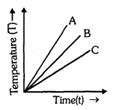
A
$A$
B
$B$
C
$C$
D
All have the same specific heat.
Solution
(C) The heat supplied $Q$ is given by $Q = mc\Delta T$,where $m$ is the mass,$c$ is the specific heat,and $\Delta T$ is the change in temperature.
Assuming the rate of heat supply $P = Q/t$ is constant,we have $P \cdot t = mc\Delta T$.
Therefore,$c = \frac{P \cdot t}{m \cdot \Delta T}$.
For a given mass $m$ and a fixed temperature change $\Delta T$,the specific heat $c$ is directly proportional to the time $t$ taken $(c \propto t)$.
From the graph,for a given temperature increase $\Delta T$,the substance $C$ takes the maximum time $t$.
Thus,substance $C$ has the highest specific heat.
Assuming the rate of heat supply $P = Q/t$ is constant,we have $P \cdot t = mc\Delta T$.
Therefore,$c = \frac{P \cdot t}{m \cdot \Delta T}$.
For a given mass $m$ and a fixed temperature change $\Delta T$,the specific heat $c$ is directly proportional to the time $t$ taken $(c \propto t)$.
From the graph,for a given temperature increase $\Delta T$,the substance $C$ takes the maximum time $t$.
Thus,substance $C$ has the highest specific heat.
0 likes
View Solution20
MediumMCQ
If the specific heat of a substance is infinite,it means that:
A
Heat is released.
B
Heat is absorbed.
C
There is no change in temperature when heat is absorbed or released.
D
All of the above.
Solution
(C) The specific heat capacity $C$ is defined as $C = \frac{dQ}{m \cdot dT}$.
If the specific heat $C$ is infinite,then $dT$ must be zero for any non-zero heat exchange $dQ$.
This implies that the temperature of the substance remains constant even when heat is added or removed.
This is characteristic of a phase change (e.g.,melting or boiling) where the substance absorbs or releases latent heat without a change in temperature.
If the specific heat $C$ is infinite,then $dT$ must be zero for any non-zero heat exchange $dQ$.
This implies that the temperature of the substance remains constant even when heat is added or removed.
This is characteristic of a phase change (e.g.,melting or boiling) where the substance absorbs or releases latent heat without a change in temperature.
0 likes
View Solution21
DifficultMCQ
The molar mass of a substance is $50 \, g/mol$. When $300 \, J$ of heat is supplied to a $25 \, g$ sample of this substance,its temperature increases from $30^{\circ}C$ to $50^{\circ}C$. The value of its molar heat capacity is ..... $J/mol \cdot ^{\circ}C$.
A
$15$
B
$30$
C
$25$
D
$10$
Solution
(B) Given: Molar mass $M_w = 50 \, g/mol$,mass of sample $m = 25 \, g$,heat supplied $Q = 300 \, J$,change in temperature $\Delta \theta = 50^{\circ}C - 30^{\circ}C = 20^{\circ}C$.
First,calculate the specific heat capacity $(S)$:
$Q = m \cdot S \cdot \Delta \theta$
$300 = 25 \cdot S \cdot 20$
$300 = 500 \cdot S$
$S = \frac{300}{500} = 0.6 \, J/g \cdot ^{\circ}C$.
Now,calculate the molar heat capacity $(C_m)$:
$C_m = M_w \cdot S$
$C_m = 50 \, g/mol \cdot 0.6 \, J/g \cdot ^{\circ}C$
$C_m = 30 \, J/mol \cdot ^{\circ}C$.
Thus,the correct option is $B$.
First,calculate the specific heat capacity $(S)$:
$Q = m \cdot S \cdot \Delta \theta$
$300 = 25 \cdot S \cdot 20$
$300 = 500 \cdot S$
$S = \frac{300}{500} = 0.6 \, J/g \cdot ^{\circ}C$.
Now,calculate the molar heat capacity $(C_m)$:
$C_m = M_w \cdot S$
$C_m = 50 \, g/mol \cdot 0.6 \, J/g \cdot ^{\circ}C$
$C_m = 30 \, J/mol \cdot ^{\circ}C$.
Thus,the correct option is $B$.
0 likes
View Solution22
MediumMCQ
How much energy in $kJ$ is required to heat $5 \, kg$ of water from $20^oC$ to its boiling point? (Specific heat of water = $4.2 \, kJ \, kg^{-1} \, ^oC^{-1}$)
A
$1680$
B
$7100$
C
$1720$
D
$1740$
Solution
(A) The mass of water is $m = 5 \, kg$.
Initial temperature $T_i = 20^oC$.
Final temperature (boiling point) $T_f = 100^oC$.
Specific heat capacity of water $c = 4.2 \, kJ \, kg^{-1} \, ^oC^{-1}$.
The heat required $Q$ is given by the formula $Q = mc\Delta T$.
Change in temperature $\Delta T = T_f - T_i = 100^oC - 20^oC = 80^oC$.
Substituting the values: $Q = 5 \, kg \times 4.2 \, kJ \, kg^{-1} \, ^oC^{-1} \times 80^oC$.
$Q = 5 \times 4.2 \times 80 = 1680 \, kJ$.
Initial temperature $T_i = 20^oC$.
Final temperature (boiling point) $T_f = 100^oC$.
Specific heat capacity of water $c = 4.2 \, kJ \, kg^{-1} \, ^oC^{-1}$.
The heat required $Q$ is given by the formula $Q = mc\Delta T$.
Change in temperature $\Delta T = T_f - T_i = 100^oC - 20^oC = 80^oC$.
Substituting the values: $Q = 5 \, kg \times 4.2 \, kJ \, kg^{-1} \, ^oC^{-1} \times 80^oC$.
$Q = 5 \times 4.2 \times 80 = 1680 \, kJ$.
0 likes
View Solution23
MediumMCQ
The molar mass of a substance is $50 \, g/mol$. When $300 \, J$ of heat is supplied to a $25 \, g$ sample of this substance,its temperature increases from $30^{\circ}C$ to $50^{\circ}C$. The values of heat capacity and specific heat capacity are,respectively:
A
$15 \, J/^{\circ}C, 600 \, J/kg^{\circ}C$
B
$30 \, J/^{\circ}C, 650 \, J/kg^{\circ}C$
C
$25 \, J/^{\circ}C, 500 \, J/kg^{\circ}C$
D
$10 \, J/^{\circ}C, 400 \, J/kg^{\circ}C$
Solution
(A) Given: Mass $m = 25 \, g = 0.025 \, kg$,Heat $Q = 300 \, J$,Change in temperature $\Delta T = 50^{\circ}C - 30^{\circ}C = 20^{\circ}C$.
First,calculate the specific heat capacity $(s)$:
$Q = ms\Delta T \implies s = \frac{Q}{m\Delta T} = \frac{300 \, J}{0.025 \, kg \times 20^{\circ}C} = \frac{300}{0.5} = 600 \, J/kg^{\circ}C$.
Next,calculate the heat capacity $(C)$:
$C = ms = 0.025 \, kg \times 600 \, J/kg^{\circ}C = 15 \, J/^{\circ}C$.
Thus,the heat capacity is $15 \, J/^{\circ}C$ and the specific heat capacity is $600 \, J/kg^{\circ}C$.
First,calculate the specific heat capacity $(s)$:
$Q = ms\Delta T \implies s = \frac{Q}{m\Delta T} = \frac{300 \, J}{0.025 \, kg \times 20^{\circ}C} = \frac{300}{0.5} = 600 \, J/kg^{\circ}C$.
Next,calculate the heat capacity $(C)$:
$C = ms = 0.025 \, kg \times 600 \, J/kg^{\circ}C = 15 \, J/^{\circ}C$.
Thus,the heat capacity is $15 \, J/^{\circ}C$ and the specific heat capacity is $600 \, J/kg^{\circ}C$.
0 likes
View Solution24
MediumMCQ
If the ratio of the diameters of two spheres made of the same material is $1:2$,what is the ratio of their heat capacities?
A
$1:2$
B
$1:8$
C
$1:4$
D
$2:1$
Solution
(B) The heat capacity $C$ of an object is given by $C = mc$,where $m$ is the mass and $c$ is the specific heat capacity.
Since both spheres are made of the same material,their specific heat capacity $c$ is the same.
Mass $m$ can be expressed as $m = V \rho$,where $V$ is the volume and $\rho$ is the density.
For a sphere,$V = \frac{4}{3} \pi r^3$.
Therefore,the ratio of heat capacities is $\frac{C_1}{C_2} = \frac{m_1 c}{m_2 c} = \frac{m_1}{m_2} = \frac{V_1 \rho}{V_2 \rho} = \frac{V_1}{V_2}$.
Substituting the volume formula,$\frac{C_1}{C_2} = \frac{\frac{4}{3} \pi r_1^3}{\frac{4}{3} \pi r_2^3} = \left( \frac{r_1}{r_2} \right)^3$.
Given the ratio of diameters is $1:2$,the ratio of radii is also $r_1:r_2 = 1:2$.
Thus,$\frac{C_1}{C_2} = \left( \frac{1}{2} \right)^3 = \frac{1}{8}$.
The ratio of their heat capacities is $1:8$.
Since both spheres are made of the same material,their specific heat capacity $c$ is the same.
Mass $m$ can be expressed as $m = V \rho$,where $V$ is the volume and $\rho$ is the density.
For a sphere,$V = \frac{4}{3} \pi r^3$.
Therefore,the ratio of heat capacities is $\frac{C_1}{C_2} = \frac{m_1 c}{m_2 c} = \frac{m_1}{m_2} = \frac{V_1 \rho}{V_2 \rho} = \frac{V_1}{V_2}$.
Substituting the volume formula,$\frac{C_1}{C_2} = \frac{\frac{4}{3} \pi r_1^3}{\frac{4}{3} \pi r_2^3} = \left( \frac{r_1}{r_2} \right)^3$.
Given the ratio of diameters is $1:2$,the ratio of radii is also $r_1:r_2 = 1:2$.
Thus,$\frac{C_1}{C_2} = \left( \frac{1}{2} \right)^3 = \frac{1}{8}$.
The ratio of their heat capacities is $1:8$.
0 likes
View Solution25
DifficultMCQ
When $300 \, J$ of heat is given to a body of mass $25 \, g$,its temperature rises from $25^{\circ}C$ to $45^{\circ}C$. What are the heat capacity and specific heat capacity,respectively?
A
$15 \, J/^{\circ}C, 600 \, J/kg \cdot ^{\circ}C$
B
$600 \, J/^{\circ}C, 15 \, J/kg \cdot ^{\circ}C$
C
$150 \, J/^{\circ}C, 60 \, J/kg \cdot ^{\circ}C$
D
None of these
Solution
(A) Given: Mass $m = 25 \, g = 0.025 \, kg$,Heat $Q = 300 \, J$,Change in temperature $\Delta T = 45^{\circ}C - 25^{\circ}C = 20^{\circ}C$.
Heat capacity $(C)$ is defined as $C = \frac{Q}{\Delta T} = \frac{300}{20} = 15 \, J/^{\circ}C$.
Specific heat capacity $(c)$ is defined as $c = \frac{C}{m} = \frac{15}{0.025} = 600 \, J/kg \cdot ^{\circ}C$.
Therefore,the heat capacity is $15 \, J/^{\circ}C$ and the specific heat capacity is $600 \, J/kg \cdot ^{\circ}C$.
Heat capacity $(C)$ is defined as $C = \frac{Q}{\Delta T} = \frac{300}{20} = 15 \, J/^{\circ}C$.
Specific heat capacity $(c)$ is defined as $c = \frac{C}{m} = \frac{15}{0.025} = 600 \, J/kg \cdot ^{\circ}C$.
Therefore,the heat capacity is $15 \, J/^{\circ}C$ and the specific heat capacity is $600 \, J/kg \cdot ^{\circ}C$.
0 likes
View Solution26
MediumMCQ
The specific heat of a substance varies with temperature as $c = 0.20 + 0.14t + 0.023t^2 \, (cal/g \cdot ^\circ C)$. The amount of heat required to raise the temperature of $2 \, g$ of the substance from $5 \, ^\circ C$ to $15 \, ^\circ C$ is: (in $, cal$)
A
$24$
B
$56$
C
$82$
D
$100$
Solution
(C) The heat required $Q$ is given by the integral $Q = \int m c \, dt$.
Given $m = 2 \, g$,$c = 0.20 + 0.14t + 0.023t^2$,and temperature limits $t_1 = 5 \, ^\circ C$ to $t_2 = 15 \, ^\circ C$.
$Q = \int_{5}^{15} 2 \times (0.20 + 0.14t + 0.023t^2) \, dt$
$Q = 2 \times [0.20t + 0.07t^2 + \frac{0.023}{3}t^3]_{5}^{15}$
$Q = 2 \times [(0.20(15) + 0.07(15^2) + \frac{0.023}{3}(15^3)) - (0.20(5) + 0.07(5^2) + \frac{0.023}{3}(5^3))]$
$Q = 2 \times [(3 + 15.75 + 25.875) - (1 + 1.75 + 0.9583)]$
$Q = 2 \times [44.625 - 3.7083] = 2 \times 40.9167 \approx 81.83 \, cal$.
Rounding to the nearest integer,we get $82 \, cal$.
Given $m = 2 \, g$,$c = 0.20 + 0.14t + 0.023t^2$,and temperature limits $t_1 = 5 \, ^\circ C$ to $t_2 = 15 \, ^\circ C$.
$Q = \int_{5}^{15} 2 \times (0.20 + 0.14t + 0.023t^2) \, dt$
$Q = 2 \times [0.20t + 0.07t^2 + \frac{0.023}{3}t^3]_{5}^{15}$
$Q = 2 \times [(0.20(15) + 0.07(15^2) + \frac{0.023}{3}(15^3)) - (0.20(5) + 0.07(5^2) + \frac{0.023}{3}(5^3))]$
$Q = 2 \times [(3 + 15.75 + 25.875) - (1 + 1.75 + 0.9583)]$
$Q = 2 \times [44.625 - 3.7083] = 2 \times 40.9167 \approx 81.83 \, cal$.
Rounding to the nearest integer,we get $82 \, cal$.
0 likes
View Solution27
MediumMCQ
How many $sec$ are required to raise the temperature of $1\, litre$ of water from $20\,^oC$ to $40\,^oC$ using an $836\, W$ heater?
A
$200$
B
$100$
C
$836$
D
$418$
Solution
(B) The heat energy required to raise the temperature of water is given by $Q = mc\Delta\theta$.
Here,mass $m = 1\, kg$ (since $1\, litre$ of water has a mass of $1\, kg$),specific heat capacity $c = 4180\, J/(kg\cdot ^oC)$,and change in temperature $\Delta\theta = 40\, ^oC - 20\, ^oC = 20\, ^oC$.
So,$Q = 1 \times 4180 \times 20 = 83600\, J$.
The power of the heater is $P = 836\, W$.
The time $t$ required is given by $t = \frac{Q}{P}$.
$t = \frac{83600}{836} = 100\, sec$.
Here,mass $m = 1\, kg$ (since $1\, litre$ of water has a mass of $1\, kg$),specific heat capacity $c = 4180\, J/(kg\cdot ^oC)$,and change in temperature $\Delta\theta = 40\, ^oC - 20\, ^oC = 20\, ^oC$.
So,$Q = 1 \times 4180 \times 20 = 83600\, J$.
The power of the heater is $P = 836\, W$.
The time $t$ required is given by $t = \frac{Q}{P}$.
$t = \frac{83600}{836} = 100\, sec$.
0 likes
View Solution28
MediumMCQ
During illness,an $80 \, kg$ man had a fever of $102.2^\circ F$ instead of his normal body temperature of $98.6^\circ F$. Assuming that the human body is mostly water,how much heat is required to raise his temperature by that amount in $kcal$?
A
$100$
B
$160$
C
$50$
D
$92$
Solution
(B) First,convert the temperatures from Fahrenheit to Celsius using the formula $C = (F - 32) \times \frac{5}{9}$.
Normal temperature: $98.6^\circ F = (98.6 - 32) \times \frac{5}{9} = 66.6 \times \frac{5}{9} = 37^\circ C$.
Fever temperature: $102.2^\circ F = (102.2 - 32) \times \frac{5}{9} = 70.2 \times \frac{5}{9} = 39^\circ C$.
The change in temperature is $\Delta \theta = 39^\circ C - 37^\circ C = 2^\circ C$.
The mass of the man is $m = 80 \, kg = 80,000 \, g$.
The specific heat capacity of water is $s = 1 \, cal/g^\circ C$.
The heat required is given by $\Delta Q = m \cdot s \cdot \Delta \theta$.
$\Delta Q = 80,000 \, g \times 1 \, cal/g^\circ C \times 2^\circ C = 160,000 \, cal$.
Since $1,000 \, cal = 1 \, kcal$,we have $\Delta Q = 160 \, kcal$.
Normal temperature: $98.6^\circ F = (98.6 - 32) \times \frac{5}{9} = 66.6 \times \frac{5}{9} = 37^\circ C$.
Fever temperature: $102.2^\circ F = (102.2 - 32) \times \frac{5}{9} = 70.2 \times \frac{5}{9} = 39^\circ C$.
The change in temperature is $\Delta \theta = 39^\circ C - 37^\circ C = 2^\circ C$.
The mass of the man is $m = 80 \, kg = 80,000 \, g$.
The specific heat capacity of water is $s = 1 \, cal/g^\circ C$.
The heat required is given by $\Delta Q = m \cdot s \cdot \Delta \theta$.
$\Delta Q = 80,000 \, g \times 1 \, cal/g^\circ C \times 2^\circ C = 160,000 \, cal$.
Since $1,000 \, cal = 1 \, kcal$,we have $\Delta Q = 160 \, kcal$.
0 likes
View Solution29
MediumMCQ
The specific heat of a metal at low temperatures varies according to $S = aT^3$,where $a$ is a constant and $T$ is the absolute temperature. The heat energy needed to raise unit mass of the metal from $T = 1 \ K$ to $T = 2 \ K$ is:
A
$3 \ a$
B
$\frac{15 \ a}{4}$
C
$\frac{2 \ a}{3}$
D
$\frac{12 \ a}{5}$
Solution
(B) The heat energy $dQ$ required to raise the temperature of a unit mass $(m = 1)$ by a small amount $dT$ is given by $dQ = m \cdot S \cdot dT$.
Substituting $S = aT^3$ and $m = 1$,we get $dQ = aT^3 \ dT$.
To find the total heat energy $Q$ required to raise the temperature from $T_1 = 1 \ K$ to $T_2 = 2 \ K$,we integrate the expression:
$Q = \int_{1}^{2} aT^3 \ dT$
$Q = a \left[ \frac{T^4}{4} \right]_{1}^{2}$
$Q = \frac{a}{4} (2^4 - 1^4)$
$Q = \frac{a}{4} (16 - 1)$
$Q = \frac{15 \ a}{4}$
Substituting $S = aT^3$ and $m = 1$,we get $dQ = aT^3 \ dT$.
To find the total heat energy $Q$ required to raise the temperature from $T_1 = 1 \ K$ to $T_2 = 2 \ K$,we integrate the expression:
$Q = \int_{1}^{2} aT^3 \ dT$
$Q = a \left[ \frac{T^4}{4} \right]_{1}^{2}$
$Q = \frac{a}{4} (2^4 - 1^4)$
$Q = \frac{a}{4} (16 - 1)$
$Q = \frac{15 \ a}{4}$
0 likes
View Solution30
DifficultMCQ
The density of a material $A$ is $1500 \ kg/m^3$ and that of another material $B$ is $2000 \ kg/m^3$. It is found that the heat capacity of $8$ volumes of $A$ is equal to the heat capacity of $12$ volumes of $B$. The ratio of specific heats of $A$ and $B$ will be
A
$1 : 2$
B
$3 : 1$
C
$3 : 2$
D
$2 : 1$
Solution
(D) Heat capacity $(C)$ is defined as the product of mass $(m)$ and specific heat capacity $(c)$,i.e.,$C = mc$.
Mass is given by the product of density $(\rho)$ and volume $(V)$,i.e.,$m = \rho V$.
For material $A$: Density $\rho_A = 1500 \ kg/m^3$,Volume $V_A = 8 \ units$. Mass $m_A = 1500 \times 8 = 12000 \ units$.
For material $B$: Density $\rho_B = 2000 \ kg/m^3$,Volume $V_B = 12 \ units$. Mass $m_B = 2000 \times 12 = 24000 \ units$.
Given that the heat capacity of $8$ volumes of $A$ is equal to the heat capacity of $12$ volumes of $B$:
$m_A \times c_A = m_B \times c_B$
$12000 \times c_A = 24000 \times c_B$
$c_A = 2 c_B$
Therefore,the ratio of specific heats $c_A : c_B = 2 : 1$.
Mass is given by the product of density $(\rho)$ and volume $(V)$,i.e.,$m = \rho V$.
For material $A$: Density $\rho_A = 1500 \ kg/m^3$,Volume $V_A = 8 \ units$. Mass $m_A = 1500 \times 8 = 12000 \ units$.
For material $B$: Density $\rho_B = 2000 \ kg/m^3$,Volume $V_B = 12 \ units$. Mass $m_B = 2000 \times 12 = 24000 \ units$.
Given that the heat capacity of $8$ volumes of $A$ is equal to the heat capacity of $12$ volumes of $B$:
$m_A \times c_A = m_B \times c_B$
$12000 \times c_A = 24000 \times c_B$
$c_A = 2 c_B$
Therefore,the ratio of specific heats $c_A : c_B = 2 : 1$.
0 likes
View Solution31
EasyMCQ
$100 \ g$ of water is heated from $30^\circ C$ to $50^\circ C$. Ignoring the slight expansion of the water,the change in its internal energy is .......$kJ$ (specific heat of water is $4184 \ J/kg/K$):
A
$8.4$
B
$84$
C
$2.1$
D
$4.2$
Solution
(A) The change in internal energy $\Delta U$ for a liquid undergoing heating,while ignoring expansion,is equal to the heat supplied $\Delta Q$.
Given:
Mass $m = 100 \ g = 0.1 \ kg$
Specific heat $c = 4184 \ J/kg/K$
Change in temperature $\Delta T = 50^\circ C - 30^\circ C = 20 \ K$
Using the formula $\Delta U = mc\Delta T$:
$\Delta U = 0.1 \ kg \times 4184 \ J/kg/K \times 20 \ K$
$\Delta U = 8368 \ J$
Converting to $kJ$:
$\Delta U = 8.368 \ kJ \approx 8.4 \ kJ$.
Given:
Mass $m = 100 \ g = 0.1 \ kg$
Specific heat $c = 4184 \ J/kg/K$
Change in temperature $\Delta T = 50^\circ C - 30^\circ C = 20 \ K$
Using the formula $\Delta U = mc\Delta T$:
$\Delta U = 0.1 \ kg \times 4184 \ J/kg/K \times 20 \ K$
$\Delta U = 8368 \ J$
Converting to $kJ$:
$\Delta U = 8.368 \ kJ \approx 8.4 \ kJ$.
0 likes
View Solution32
DifficultMCQ
At temperatures close to $0\ K$, the heat capacity $C$ of a certain solid is related to its temperature $T$ by the equation $C = aT^3$, where $a$ is a constant characteristic of the solid. Heat is supplied to the solid at a steady rate. Which graph best represents the variation of its temperature $T$ with time $t$?
A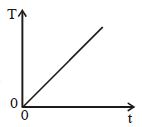
B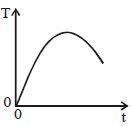
C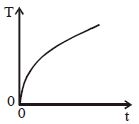
D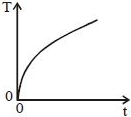
Solution
(C) The rate of heat supply is constant, so $\frac{dQ}{dt} = P$ (where $P$ is a constant).
By definition, $C = \frac{dQ}{dT}$, so $dQ = C \cdot dT = aT^3 \cdot dT$.
Substituting this into the rate equation: $\frac{dQ}{dt} = aT^3 \frac{dT}{dt} = P$.
Rearranging gives $T^3 \cdot dT = \frac{P}{a} \cdot dt$.
Integrating both sides: $\int T^3 \cdot dT = \int \frac{P}{a} \cdot dt$.
This yields $\frac{T^4}{4} = \frac{P}{a} \cdot t + \text{constant}$.
Assuming $T = 0$ at $t = 0$, the constant is $0$, so $T^4 = \frac{4P}{a} \cdot t$.
Thus, $T = \left( \frac{4P}{a} \right)^{1/4} \cdot t^{1/4}$.
Since $T \propto t^{1/4}$, the graph of $T$ versus $t$ will be a curve that starts at the origin and has a decreasing slope as $t$ increases (concave down), which corresponds to Graph $C$.
By definition, $C = \frac{dQ}{dT}$, so $dQ = C \cdot dT = aT^3 \cdot dT$.
Substituting this into the rate equation: $\frac{dQ}{dt} = aT^3 \frac{dT}{dt} = P$.
Rearranging gives $T^3 \cdot dT = \frac{P}{a} \cdot dt$.
Integrating both sides: $\int T^3 \cdot dT = \int \frac{P}{a} \cdot dt$.
This yields $\frac{T^4}{4} = \frac{P}{a} \cdot t + \text{constant}$.
Assuming $T = 0$ at $t = 0$, the constant is $0$, so $T^4 = \frac{4P}{a} \cdot t$.
Thus, $T = \left( \frac{4P}{a} \right)^{1/4} \cdot t^{1/4}$.
Since $T \propto t^{1/4}$, the graph of $T$ versus $t$ will be a curve that starts at the origin and has a decreasing slope as $t$ increases (concave down), which corresponds to Graph $C$.
0 likes
View Solution33
EasyMCQ
Heat given to a body which raises its temperature by $1\ ^oC$ is
A
Water equivalent
B
Heat capacity
C
Specific heat
D
Temperature gradient
Solution
(B) The heat capacity of a body is defined as the amount of heat required to raise the temperature of the entire body by $1\ ^oC$.
Mathematically,it is given by $C = \frac{Q}{\Delta T}$,where $Q$ is the heat supplied and $\Delta T$ is the change in temperature.
Since the question asks for the heat required to raise the temperature of the body (not per unit mass) by $1\ ^oC$,the correct term is heat capacity.
Mathematically,it is given by $C = \frac{Q}{\Delta T}$,where $Q$ is the heat supplied and $\Delta T$ is the change in temperature.
Since the question asks for the heat required to raise the temperature of the body (not per unit mass) by $1\ ^oC$,the correct term is heat capacity.
0 likes
View Solution34
MediumMCQ
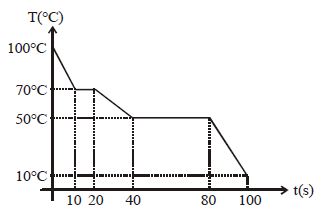
$A$ substance is cooled at a constant power. Its temperature vs time graph is shown. The value of $S_{solid} : S_{liquid} : S_{gas}$ is:
A
$2 : 3 : 3$
B
$3 : 6 : 2$
C
$2 : 6 : 3$
D
$1 : 3 : 2$
Solution
(B) The rate of cooling is given by $P = \frac{dQ}{dt} = mS \left| \frac{dT}{dt} \right|$,where $P$ is constant power,$m$ is mass,and $S$ is specific heat capacity.
Thus,$S = \frac{P}{m} \left| \frac{dt}{dT} \right|$. Since $P$ and $m$ are constant,$S \propto \left| \frac{dt}{dT} \right|$.
For the gas phase (from $t=0$ to $t=10$ s,$T=100^{\circ}C$ to $70^{\circ}C$): $\Delta t = 10$ s,$\Delta T = 30^{\circ}C$. So,$S_{gas} \propto \frac{10}{30} = \frac{1}{3}$.
For the liquid phase (from $t=20$ to $t=40$ s,$T=70^{\circ}C$ to $50^{\circ}C$): $\Delta t = 20$ s,$\Delta T = 20^{\circ}C$. So,$S_{liquid} \propto \frac{20}{20} = 1$.
For the solid phase (from $t=80$ to $t=100$ s,$T=50^{\circ}C$ to $10^{\circ}C$): $\Delta t = 20$ s,$\Delta T = 40^{\circ}C$. So,$S_{solid} \propto \frac{20}{40} = \frac{1}{2}$.
Now,$S_{solid} : S_{liquid} : S_{gas} = \frac{1}{2} : 1 : \frac{1}{3}$.
Multiplying by $6$,we get $3 : 6 : 2$.
Thus,$S = \frac{P}{m} \left| \frac{dt}{dT} \right|$. Since $P$ and $m$ are constant,$S \propto \left| \frac{dt}{dT} \right|$.
For the gas phase (from $t=0$ to $t=10$ s,$T=100^{\circ}C$ to $70^{\circ}C$): $\Delta t = 10$ s,$\Delta T = 30^{\circ}C$. So,$S_{gas} \propto \frac{10}{30} = \frac{1}{3}$.
For the liquid phase (from $t=20$ to $t=40$ s,$T=70^{\circ}C$ to $50^{\circ}C$): $\Delta t = 20$ s,$\Delta T = 20^{\circ}C$. So,$S_{liquid} \propto \frac{20}{20} = 1$.
For the solid phase (from $t=80$ to $t=100$ s,$T=50^{\circ}C$ to $10^{\circ}C$): $\Delta t = 20$ s,$\Delta T = 40^{\circ}C$. So,$S_{solid} \propto \frac{20}{40} = \frac{1}{2}$.
Now,$S_{solid} : S_{liquid} : S_{gas} = \frac{1}{2} : 1 : \frac{1}{3}$.
Multiplying by $6$,we get $3 : 6 : 2$.
0 likes
View Solution35
DifficultMCQ
Three bodies $A, B$ and $C$ of masses $m, m$ and $\sqrt{3}m$ respectively are supplied heat at a constant rate. The change in temperature $\theta$ versus time $t$ graph for $A, B$ and $C$ are shown by $I, II$ and $III$ respectively. If their specific heat capacities are $S_A, S_B$ and $S_C$ respectively,then which of the following relations is correct? (Initial temperature of body is $0\,^{\circ}C$)
A
$S_A > S_B > S_C$
B
$S_B = S_C < S_A$
C
$S_A = S_B = S_C$
D
$S_B = S_C > S_A$
Solution
(D) Let the constant rate of heat supply be $\frac{dQ}{dt} = K$.
From the principle of calorimetry,$dQ = ms \Delta \theta$.
Since $\theta_0 = 0$,we have $dQ = ms \theta$.
Integrating or considering the rate,$K t = ms \theta$,which gives $\theta = \left( \frac{K}{ms} \right) t$.
Comparing this with the equation of a line $y = mx$,the slope is $\text{slope} = \frac{K}{ms} = \tan \alpha$,where $\alpha$ is the angle the graph makes with the time axis.
Thus,$S = \frac{K}{m \tan \alpha}$.
For body $A$ (mass $m$,angle $60^{\circ}$): $S_A = \frac{K}{m \tan 60^{\circ}} = \frac{K}{m \sqrt{3}}$.
For body $B$ (mass $m$,angle $45^{\circ}$): $S_B = \frac{K}{m \tan 45^{\circ}} = \frac{K}{m}$.
For body $C$ (mass $\sqrt{3}m$,angle $30^{\circ}$): $S_C = \frac{K}{(\sqrt{3}m) \tan 30^{\circ}} = \frac{K}{\sqrt{3}m \times \frac{1}{\sqrt{3}}} = \frac{K}{m}$.
Comparing the values,we get $S_B = S_C = \frac{K}{m}$ and $S_A = \frac{K}{m \sqrt{3}}$.
Since $\sqrt{3} > 1$,it follows that $\frac{K}{m \sqrt{3}} < \frac{K}{m}$.
Therefore,$S_A < S_B = S_C$,which is equivalent to $S_B = S_C > S_A$.
From the principle of calorimetry,$dQ = ms \Delta \theta$.
Since $\theta_0 = 0$,we have $dQ = ms \theta$.
Integrating or considering the rate,$K t = ms \theta$,which gives $\theta = \left( \frac{K}{ms} \right) t$.
Comparing this with the equation of a line $y = mx$,the slope is $\text{slope} = \frac{K}{ms} = \tan \alpha$,where $\alpha$ is the angle the graph makes with the time axis.
Thus,$S = \frac{K}{m \tan \alpha}$.
For body $A$ (mass $m$,angle $60^{\circ}$): $S_A = \frac{K}{m \tan 60^{\circ}} = \frac{K}{m \sqrt{3}}$.
For body $B$ (mass $m$,angle $45^{\circ}$): $S_B = \frac{K}{m \tan 45^{\circ}} = \frac{K}{m}$.
For body $C$ (mass $\sqrt{3}m$,angle $30^{\circ}$): $S_C = \frac{K}{(\sqrt{3}m) \tan 30^{\circ}} = \frac{K}{\sqrt{3}m \times \frac{1}{\sqrt{3}}} = \frac{K}{m}$.
Comparing the values,we get $S_B = S_C = \frac{K}{m}$ and $S_A = \frac{K}{m \sqrt{3}}$.
Since $\sqrt{3} > 1$,it follows that $\frac{K}{m \sqrt{3}} < \frac{K}{m}$.
Therefore,$S_A < S_B = S_C$,which is equivalent to $S_B = S_C > S_A$.
0 likes
View Solution36
DifficultMCQ
$50\,g$ of copper is heated to increase its temperature by $10\,^{\circ}C$. If the same quantity of heat is given to $10\,g$ of water,the rise in its temperature is ........ $^{\circ}C$. (Specific heat of copper $= 420\,J\,kg^{-1}\,^{\circ}C^{-1}$,Specific heat of water $= 4200\,J\,kg^{-1}\,^{\circ}C^{-1}$)
A
$5$
B
$6$
C
$7$
D
$8$
Solution
(A) The heat supplied to the copper is given by $Q = m_C c_C \Delta \theta_C$.
Given: $m_C = 50\,g = 0.05\,kg$,$c_C = 420\,J\,kg^{-1}\,^{\circ}C^{-1}$,$\Delta \theta_C = 10\,^{\circ}C$.
$Q = 0.05 \times 420 \times 10 = 210\,J$.
Now,the same quantity of heat $Q$ is given to $10\,g$ of water $(m_W = 0.01\,kg)$.
Using $Q = m_W c_W \Delta \theta_W$,where $c_W = 4200\,J\,kg^{-1}\,^{\circ}C^{-1}$:
$\Delta \theta_W = \frac{Q}{m_W c_W} = \frac{210}{0.01 \times 4200} = \frac{210}{42} = 5\,^{\circ}C$.
Given: $m_C = 50\,g = 0.05\,kg$,$c_C = 420\,J\,kg^{-1}\,^{\circ}C^{-1}$,$\Delta \theta_C = 10\,^{\circ}C$.
$Q = 0.05 \times 420 \times 10 = 210\,J$.
Now,the same quantity of heat $Q$ is given to $10\,g$ of water $(m_W = 0.01\,kg)$.
Using $Q = m_W c_W \Delta \theta_W$,where $c_W = 4200\,J\,kg^{-1}\,^{\circ}C^{-1}$:
$\Delta \theta_W = \frac{Q}{m_W c_W} = \frac{210}{0.01 \times 4200} = \frac{210}{42} = 5\,^{\circ}C$.
0 likes
View Solution37
MediumMCQ
Water is used to cool radiators of engines in cars because
A
of its lower density
B
it is easily available
C
it is cheap
D
it has high specific heat
Solution
(D) Water is used as a coolant in car radiators because it has a very high specific heat capacity $(4200 \, J/kg \cdot K)$.
This property allows water to absorb a large amount of heat energy from the engine with a relatively small rise in its own temperature,making it highly efficient at transferring heat away from the engine block.
This property allows water to absorb a large amount of heat energy from the engine with a relatively small rise in its own temperature,making it highly efficient at transferring heat away from the engine block.
0 likes
View Solution38
EasyMCQ
Thermal capacity of a body depends on
A
Heat given
B
The temperature raised
C
The mass of body
D
None
Solution
(C) Thermal capacity $(C')$ is defined as the amount of heat required to raise the temperature of a body by $1^{\circ}C$ or $1 \ K$.
It is mathematically expressed as $C' = m \times s$,where $m$ is the mass of the body and $s$ is the specific heat capacity of the material.
Since the specific heat capacity $(s)$ is a property of the material,the thermal capacity of a specific body depends directly on its mass $(m)$.
It is mathematically expressed as $C' = m \times s$,where $m$ is the mass of the body and $s$ is the specific heat capacity of the material.
Since the specific heat capacity $(s)$ is a property of the material,the thermal capacity of a specific body depends directly on its mass $(m)$.
0 likes
View Solution39
MediumMCQ
$A$ $10\, kW$ drilling machine is used to drill a bore in a small aluminium block of mass $8.0\, kg$. How much is the rise in temperature of the block in $2.5$ minutes,assuming $50\, \%$ of power is used up in heating the machine itself or lost to the surroundings? (Specific heat of aluminium $= 0.91\, J\, g^{-1}\, K^{-1}$)
A
$206\, ^{\circ}C$
B
$476\, ^{\circ}C$
C
$342\, ^{\circ}C$
D
$103\, ^{\circ}C$
Solution
(D) Power of the drilling machine,$P = 10\, kW = 10 \times 10^{3}\, W$.
Mass of the aluminium block,$m = 8.0\, kg = 8 \times 10^{3}\, g$.
Time for which the machine is used,$t = 2.5\, min = 2.5 \times 60 = 150\, s$.
Specific heat of aluminium,$c = 0.91\, J\, g^{-1}\, K^{-1}$.
Total energy supplied by the drilling machine $= P \times t = 10 \times 10^{3} \times 150 = 1.5 \times 10^{6}\, J$.
Since $50\, \%$ of the power is lost,the useful energy $\Delta Q$ used to heat the block is $50\, \%$ of the total energy.
$\Delta Q = 0.50 \times 1.5 \times 10^{6} = 7.5 \times 10^{5}\, J$.
Using the formula $\Delta Q = m c \Delta T$,where $\Delta T$ is the rise in temperature:
$\Delta T = \frac{\Delta Q}{m c} = \frac{7.5 \times 10^{5}}{8 \times 10^{3} \times 0.91} = \frac{750}{8 \times 0.91} = \frac{750}{7.28} \approx 103\, ^{\circ}C$.
Thus,the rise in temperature of the block is $103\, ^{\circ}C$.
Mass of the aluminium block,$m = 8.0\, kg = 8 \times 10^{3}\, g$.
Time for which the machine is used,$t = 2.5\, min = 2.5 \times 60 = 150\, s$.
Specific heat of aluminium,$c = 0.91\, J\, g^{-1}\, K^{-1}$.
Total energy supplied by the drilling machine $= P \times t = 10 \times 10^{3} \times 150 = 1.5 \times 10^{6}\, J$.
Since $50\, \%$ of the power is lost,the useful energy $\Delta Q$ used to heat the block is $50\, \%$ of the total energy.
$\Delta Q = 0.50 \times 1.5 \times 10^{6} = 7.5 \times 10^{5}\, J$.
Using the formula $\Delta Q = m c \Delta T$,where $\Delta T$ is the rise in temperature:
$\Delta T = \frac{\Delta Q}{m c} = \frac{7.5 \times 10^{5}}{8 \times 10^{3} \times 0.91} = \frac{750}{8 \times 0.91} = \frac{750}{7.28} \approx 103\, ^{\circ}C$.
Thus,the rise in temperature of the block is $103\, ^{\circ}C$.
0 likes
View Solution40
MediumMCQ
On which does the heat in a substance depend?
A
Mass of the substance
B
Specific heat capacity of the substance
C
Change in temperature of the substance
D
All of the above
Solution
(D) The formula for heat $(Q)$ given to or taken from a substance is $Q = mc\Delta T$.
Here, $m$ is the mass of the substance, $c$ is the specific heat capacity of the substance, and $\Delta T$ is the change in temperature.
Thus, heat depends on these three factors.
Therefore, the correct option is $D$.
Here, $m$ is the mass of the substance, $c$ is the specific heat capacity of the substance, and $\Delta T$ is the change in temperature.
Thus, heat depends on these three factors.
Therefore, the correct option is $D$.
0 likes
View Solution41
EasyMCQ
How much energy is produced in the burning of $1\, kg$ of coal?
A
$3 \times 10^7 \, J$
B
$3 \times 10^8 \, J$
C
$3 \times 10^6 \, J$
D
$3 \times 10^9 \, J$
Solution
(A) The energy produced by burning coal is determined by its calorific value.
The calorific value of coal is approximately $30 \, MJ/kg$ or $3 \times 10^7 \, J/kg$.
Therefore,burning $1\, kg$ of coal produces $3 \times 10^7 \, J$ of energy.
Thus,the correct option is $A$.
The calorific value of coal is approximately $30 \, MJ/kg$ or $3 \times 10^7 \, J/kg$.
Therefore,burning $1\, kg$ of coal produces $3 \times 10^7 \, J$ of energy.
Thus,the correct option is $A$.
0 likes
View Solution42
Easy
Explain the heat capacity of a substance and write its equation and unit.
Solution
(A) The quantity of heat required to warm a given substance depends on its mass $(m)$,the change in temperature $(\Delta T)$,and the nature of the substance.
The change in temperature of a substance,when a given quantity of heat is absorbed or rejected by it,is characterized by a quantity called the heat capacity of that substance.
Heat capacity $(S)$: Heat capacity is defined as the ratio of the heat supplied to a substance $(\Delta Q)$ to the corresponding change in its temperature $(\Delta T)$.
Mathematically,it is expressed as:
$S = \frac{\Delta Q}{\Delta T}$
Where $\Delta Q$ is the amount of heat supplied to the substance to change its temperature from $T$ to $T + \Delta T$.
The value of heat capacity depends on the type of material and its mass. Heat capacity of substances of the same material but different mass can be different.
The $SI$ unit of heat capacity is $J K^{-1}$ or $J/K$.
The change in temperature of a substance,when a given quantity of heat is absorbed or rejected by it,is characterized by a quantity called the heat capacity of that substance.
Heat capacity $(S)$: Heat capacity is defined as the ratio of the heat supplied to a substance $(\Delta Q)$ to the corresponding change in its temperature $(\Delta T)$.
Mathematically,it is expressed as:
$S = \frac{\Delta Q}{\Delta T}$
Where $\Delta Q$ is the amount of heat supplied to the substance to change its temperature from $T$ to $T + \Delta T$.
The value of heat capacity depends on the type of material and its mass. Heat capacity of substances of the same material but different mass can be different.
The $SI$ unit of heat capacity is $J K^{-1}$ or $J/K$.
0 likes
View Solution43
MediumMCQ
On which factor does the required amount of heat depend to increase the temperature of a substance?
A
Mass of the substance
B
Change in temperature
C
Nature of the substance
D
All of the above
Solution
(D) The quantity of heat $Q$ required to change the temperature of a substance is given by the formula $Q = mc\Delta T$,where $m$ is the mass of the substance,$c$ is the specific heat capacity (which depends on the nature of the substance),and $\Delta T$ is the change in temperature.
$1$. Mass $(m)$: The heat required is directly proportional to the mass of the substance. Doubling the mass requires double the heat for the same temperature rise.
$2$. Change in temperature $(\Delta T)$: The heat required is directly proportional to the change in temperature. Doubling the temperature rise requires double the heat for the same mass.
$3$. Nature of the substance $(c)$: Different substances have different specific heat capacities. For the same mass and same temperature rise,different materials require different amounts of heat.
Therefore,the required amount of heat depends on all three factors: mass,change in temperature,and the nature of the substance.
$1$. Mass $(m)$: The heat required is directly proportional to the mass of the substance. Doubling the mass requires double the heat for the same temperature rise.
$2$. Change in temperature $(\Delta T)$: The heat required is directly proportional to the change in temperature. Doubling the temperature rise requires double the heat for the same mass.
$3$. Nature of the substance $(c)$: Different substances have different specific heat capacities. For the same mass and same temperature rise,different materials require different amounts of heat.
Therefore,the required amount of heat depends on all three factors: mass,change in temperature,and the nature of the substance.
0 likes
View Solution44
Easy
What is specific heat? Write its equation and unit,and on what does it depend?
Solution
(N/A) Specific heat capacity is defined as the amount of heat energy required to change the temperature of a unit mass of a substance by one unit (degree).
If $\Delta Q$ is the amount of heat absorbed or rejected by a substance of mass $m$ undergoing a temperature change $\Delta T$,then the specific heat capacity $s$ is given by:
$s = \frac{\Delta Q}{m \Delta T}$
Rearranging this,we get the equation: $\Delta Q = m s \Delta T$.
Specific heat capacity is a characteristic property of a substance. It depends on the nature of the substance and its temperature.
The $SI$ unit of specific heat capacity is $J \ kg^{-1} \ K^{-1}$.
The dimensional formula is $[M^0 L^2 T^{-2} K^{-1}]$.
If $\Delta Q$ is the amount of heat absorbed or rejected by a substance of mass $m$ undergoing a temperature change $\Delta T$,then the specific heat capacity $s$ is given by:
$s = \frac{\Delta Q}{m \Delta T}$
Rearranging this,we get the equation: $\Delta Q = m s \Delta T$.
Specific heat capacity is a characteristic property of a substance. It depends on the nature of the substance and its temperature.
The $SI$ unit of specific heat capacity is $J \ kg^{-1} \ K^{-1}$.
The dimensional formula is $[M^0 L^2 T^{-2} K^{-1}]$.
0 likes
View Solution45
EasyMCQ
On what does the heat required to increase the temperature of a substance depend?
A
Mass of the substance
B
Change in temperature
C
Nature of the substance
D
All of the above
Solution
(D) The heat $Q$ required to increase the temperature of a substance depends on the following factors:
$1$. Mass of the substance $(m)$: $Q \propto m$
$2$. Change in temperature $(\Delta T)$: $Q \propto \Delta T$
$3$. Nature of the substance,represented by its specific heat capacity $(c)$: $Q \propto c$
Combining these factors,we get the formula: $Q = mc\Delta T$.
Therefore,the heat required depends on all the given factors.
$1$. Mass of the substance $(m)$: $Q \propto m$
$2$. Change in temperature $(\Delta T)$: $Q \propto \Delta T$
$3$. Nature of the substance,represented by its specific heat capacity $(c)$: $Q \propto c$
Combining these factors,we get the formula: $Q = mc\Delta T$.
Therefore,the heat required depends on all the given factors.
0 likes
View Solution46
Medium
Give the $SI$ unit of heat capacity. Write the dimensional formula of heat capacity.
Solution
(N/A) Heat capacity $(C)$ is defined as the amount of heat energy required to raise the temperature of a given body by $1 \ K$ (or $1 \ ^\circ C$).
Mathematically, $C = \frac{Q}{\Delta T}$, where $Q$ is the heat energy and $\Delta T$ is the change in temperature.
$1$. $SI$ unit: Since heat energy $(Q)$ is measured in Joules $(J)$ and temperature $(\Delta T)$ in Kelvin $(K)$, the $SI$ unit of heat capacity is $J/K$ or $J \cdot K^{-1}$.
$2$. Dimensional formula: The dimension of heat energy $(Q)$ is $[ML^2T^{-2}]$ and the dimension of temperature $(\Delta T)$ is $[K]$.
Therefore, the dimensional formula of heat capacity is $\frac{[ML^2T^{-2}]}{[K]} = [ML^2T^{-2}K^{-1}]$.
Mathematically, $C = \frac{Q}{\Delta T}$, where $Q$ is the heat energy and $\Delta T$ is the change in temperature.
$1$. $SI$ unit: Since heat energy $(Q)$ is measured in Joules $(J)$ and temperature $(\Delta T)$ in Kelvin $(K)$, the $SI$ unit of heat capacity is $J/K$ or $J \cdot K^{-1}$.
$2$. Dimensional formula: The dimension of heat energy $(Q)$ is $[ML^2T^{-2}]$ and the dimension of temperature $(\Delta T)$ is $[K]$.
Therefore, the dimensional formula of heat capacity is $\frac{[ML^2T^{-2}]}{[K]} = [ML^2T^{-2}K^{-1}]$.
0 likes
View Solution47
Medium
Define molar specific heat and state its $SI$ unit.
Solution
(N/A) Molar specific heat is defined as the amount of heat energy required to raise the temperature of $1 \ mole$ of a substance by $1 \ K$ (or $1 \ ^\circ C$).
Mathematically,it is expressed as $C = \frac{1}{n} \frac{dQ}{dT}$,where $n$ is the number of moles,$dQ$ is the heat supplied,and $dT$ is the change in temperature.
The $SI$ unit of molar specific heat is $\text{J} \cdot \text{mol}^{-1} \cdot \text{K}^{-1}$.
Mathematically,it is expressed as $C = \frac{1}{n} \frac{dQ}{dT}$,where $n$ is the number of moles,$dQ$ is the heat supplied,and $dT$ is the change in temperature.
The $SI$ unit of molar specific heat is $\text{J} \cdot \text{mol}^{-1} \cdot \text{K}^{-1}$.
0 likes
View Solution48
MediumMCQ
Why is water used as a coolant in automobile radiators?
A
High specific heat capacity
B
Low density
C
High boiling point
D
Low viscosity
Solution
(A) Water is used as a coolant in automobile radiators primarily because it has a very high specific heat capacity $(c = 4186 \ J/kg \cdot K)$.
This means that water can absorb a large amount of heat energy for a relatively small increase in its temperature.
Because of this property,water is highly effective at carrying heat away from the engine block to the radiator,where it can be dissipated into the atmosphere.
Additionally,water is readily available,inexpensive,and has a high thermal conductivity,making it an ideal heat transfer fluid.
This means that water can absorb a large amount of heat energy for a relatively small increase in its temperature.
Because of this property,water is highly effective at carrying heat away from the engine block to the radiator,where it can be dissipated into the atmosphere.
Additionally,water is readily available,inexpensive,and has a high thermal conductivity,making it an ideal heat transfer fluid.
0 likes
View Solution49
Easy
Why are the winds coming from the sea cool in summer?
Solution
(N/A) The specific heat capacity of water is significantly higher than that of land. During summer,water absorbs heat and its temperature increases much more slowly than land. Consequently,the air above the sea remains at a lower temperature compared to the air above the land. Therefore,when this air moves from the sea towards the land,it is felt as a cool breeze.
0 likes
View Solution50
MediumMCQ
Whose specific heat is high? Sand or water?
A
Sand
B
Water
C
Both are equal
D
None of these
Solution
(B) The specific heat capacity of water is approximately $4186 \ J/(kg \cdot K)$,whereas the specific heat capacity of sand is approximately $830 \ J/(kg \cdot K)$.
Since $4186 \ J/(kg \cdot K) > 830 \ J/(kg \cdot K)$,water has a significantly higher specific heat capacity than sand.
Since $4186 \ J/(kg \cdot K) > 830 \ J/(kg \cdot K)$,water has a significantly higher specific heat capacity than sand.
0 likes
View Solution10-1.Thermometry, Thermal Expansion and Calorimetry — Heat Capacity, Specific Heat and Molar Specific Heat · Frequently Asked Questions
1Are these 10-1.Thermometry, Thermal Expansion and Calorimetry questions useful for JEE and NEET?
Yes. All questions in this section are mapped to JEE Main and NEET exam patterns. Previous year questions from JEE Main, NEET, GUJCET and state-level exams are included with full solutions.
2Can I switch to Hindi or Gujarati for these questions?
Yes. Use the language tabs in the hero section or the sidebar to view the same questions and solutions in English, Hindi or Gujarati.
3How do I generate a question paper from this subtopic?
Use the Vedclass Exam Paper Generator — select the chapter and subtopic, set difficulty, and generate Sets A, B, C, D automatically. First 3 chapters of every subject are free.
Vedclass Products
For Students
Vedclass Test Series
Mock tests in real JEE/NEET style with performance analysis. 5-day free trial.
Start Free TrialFor Teachers
Exam Paper Generator
Generate Set A/B/C/D papers from this chapter in 2 minutes. 3 chapters free.
Try FreeFor Institutes
Online Exam Module
Live online exams with unlimited students, 360° analytics & white-label branding.
See DemoFor Teachers & Institutes
Generate a 10-1.Thermometry, Thermal Expansion and Calorimetry Exam Paper in 2 Minutes
Select subtopic & difficulty — Sets A, B, C, D auto-generated with No Repeat logic.
First 3 chapters of every subject are free — no payment required.