
A English
Mix Examples-Thermometry, Thermal Expansion and Calorimetry Questions in English
Class 11 Physics · 10-1.Thermometry, Thermal Expansion and Calorimetry · Mix Examples-Thermometry, Thermal Expansion and Calorimetry
198+
Questions
English
Language
100%
With Solutions
Showing 50 of 198 questions in English
51
MediumMCQ
Two different metal wires are joined to form a thermocouple. One junction is kept at a constant temperature,while the other junction is heated to a higher temperature. Which graph represents the variation of thermo $e.m.f.$ $(E)$ with temperature $(t)$?
A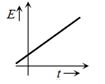
B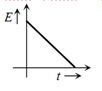
C
D
Solution
(D) The thermo $e.m.f.$ $(E)$ in a thermocouple is given by the relation: $E = \alpha t + \frac{1}{2} \beta t^2$,where $t$ is the temperature difference between the junctions.
This equation represents a parabola.
As the temperature difference $t$ increases,the $e.m.f.$ $(E)$ first increases,reaches a maximum value,and then decreases.
Therefore,the graph that represents this variation is a parabolic curve that opens downwards,which corresponds to the shape shown in Graph $D$.
This equation represents a parabola.
As the temperature difference $t$ increases,the $e.m.f.$ $(E)$ first increases,reaches a maximum value,and then decreases.
Therefore,the graph that represents this variation is a parabolic curve that opens downwards,which corresponds to the shape shown in Graph $D$.
0 likes
View Solution52
MediumMCQ
Which of the following graphs shows the variation of thermoelectric power of a thermocouple with the temperature difference between the hot and cold junctions?
A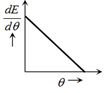
B
C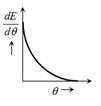
D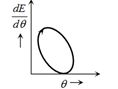
Solution
(A) The thermoelectric electromotive force $(E)$ in a thermocouple is given by the relation $E = \alpha \theta + \frac{1}{2} \beta \theta^2$,where $\theta$ is the temperature difference between the hot and cold junctions.
The thermoelectric power $(P)$ is defined as the rate of change of thermoelectric $EMF$ with respect to the temperature difference:
$P = \frac{dE}{d\theta} = \frac{d}{d\theta} (\alpha \theta + \frac{1}{2} \beta \theta^2) = \alpha + \beta \theta$.
Comparing this equation with the linear equation $y = mx + c$,where $y = P$,$x = \theta$,$m = \beta$ (which is negative for a thermocouple),and $c = \alpha$,we see that the thermoelectric power varies linearly with the temperature difference $\theta$.
Therefore,the graph representing this linear relationship is a straight line with a negative slope,which corresponds to option $A$.
The thermoelectric power $(P)$ is defined as the rate of change of thermoelectric $EMF$ with respect to the temperature difference:
$P = \frac{dE}{d\theta} = \frac{d}{d\theta} (\alpha \theta + \frac{1}{2} \beta \theta^2) = \alpha + \beta \theta$.
Comparing this equation with the linear equation $y = mx + c$,where $y = P$,$x = \theta$,$m = \beta$ (which is negative for a thermocouple),and $c = \alpha$,we see that the thermoelectric power varies linearly with the temperature difference $\theta$.
Therefore,the graph representing this linear relationship is a straight line with a negative slope,which corresponds to option $A$.
0 likes
View Solution53
DifficultMCQ
The thermo $e.m.f.$ produced in a thermocouple is given by the equation $E = 40\theta - \frac{\theta^2}{20}$,where $\theta$ is the temperature difference between the two junctions. The neutral temperature is ............. $^oC$.
A
$100$
B
$200$
C
$300$
D
$400$
Solution
(D) The thermo $e.m.f.$ is given by $E = \alpha\theta + \frac{1}{2}\beta\theta^2$.
Comparing the given equation $E = 40\theta - \frac{\theta^2}{20}$ with the standard equation,we get $\alpha = 40$ and $\frac{1}{2}\beta = -\frac{1}{20}$,which implies $\beta = -\frac{1}{10}$.
The neutral temperature $\theta_n$ is the temperature at which the thermo $e.m.f.$ is maximum,given by the condition $\frac{dE}{d\theta} = 0$.
$\frac{d}{d\theta}(40\theta - \frac{\theta^2}{20}) = 40 - \frac{2\theta}{20} = 40 - \frac{\theta}{10} = 0$.
Solving for $\theta$,we get $\theta = 40 \times 10 = 400\,^oC$.
Comparing the given equation $E = 40\theta - \frac{\theta^2}{20}$ with the standard equation,we get $\alpha = 40$ and $\frac{1}{2}\beta = -\frac{1}{20}$,which implies $\beta = -\frac{1}{10}$.
The neutral temperature $\theta_n$ is the temperature at which the thermo $e.m.f.$ is maximum,given by the condition $\frac{dE}{d\theta} = 0$.
$\frac{d}{d\theta}(40\theta - \frac{\theta^2}{20}) = 40 - \frac{2\theta}{20} = 40 - \frac{\theta}{10} = 0$.
Solving for $\theta$,we get $\theta = 40 \times 10 = 400\,^oC$.
0 likes
View Solution54
MediumMCQ
$A$ cube is subjected to a pressure $P$ on all its faces at a temperature of $0 \, ^\circ C$. By what temperature should the cube be heated so that it regains its original volume? Let the bulk modulus of the cube be $\beta$ and the coefficient of volume expansion be $\alpha$.
A
$\frac{P}{\alpha \beta}$
B
$\frac{P \alpha}{\beta}$
C
$\frac{P \beta}{\alpha}$
D
$\frac{\alpha \beta}{P}$
Solution
(A) The change in volume due to thermal expansion is given by $\Delta V_{thermal} = V \alpha \Delta \theta$,where $\Delta \theta$ is the change in temperature.
The change in volume due to pressure $P$ is given by the definition of bulk modulus: $\beta = -\frac{P}{\Delta V / V}$,which implies $\Delta V_{pressure} = -\frac{PV}{\beta}$.
For the cube to regain its original volume,the net change in volume must be zero: $\Delta V_{thermal} + \Delta V_{pressure} = 0$.
$V \alpha \Delta \theta - \frac{PV}{\beta} = 0$.
$V \alpha \Delta \theta = \frac{PV}{\beta}$.
$\Delta \theta = \frac{P}{\alpha \beta}$.
The change in volume due to pressure $P$ is given by the definition of bulk modulus: $\beta = -\frac{P}{\Delta V / V}$,which implies $\Delta V_{pressure} = -\frac{PV}{\beta}$.
For the cube to regain its original volume,the net change in volume must be zero: $\Delta V_{thermal} + \Delta V_{pressure} = 0$.
$V \alpha \Delta \theta - \frac{PV}{\beta} = 0$.
$V \alpha \Delta \theta = \frac{PV}{\beta}$.
$\Delta \theta = \frac{P}{\alpha \beta}$.
0 likes
View Solution55
MediumMCQ
How many $J$ of heat energy is required to convert $1\,g$ of ice at $-10^{\circ}C$ into steam at $100^{\circ}C$?
A
$3045$
B
$6056$
C
$721$
D
$616$
Solution
(A) The total heat $Q$ required is the sum of heat for four stages:
$1$. Heating ice from $-10^{\circ}C$ to $0^{\circ}C$: $Q_1 = m \cdot c_{ice} \cdot \Delta T = 1 \cdot 0.5 \cdot 10 = 5\,cal$.
$2$. Melting ice at $0^{\circ}C$: $Q_2 = m \cdot L_{f} = 1 \cdot 80 = 80\,cal$.
$3$. Heating water from $0^{\circ}C$ to $100^{\circ}C$: $Q_3 = m \cdot c_{water} \cdot \Delta T = 1 \cdot 1 \cdot 100 = 100\,cal$.
$4$. Vaporizing water at $100^{\circ}C$: $Q_4 = m \cdot L_{v} = 1 \cdot 540 = 540\,cal$.
Total heat $Q = 5 + 80 + 100 + 540 = 725\,cal$.
Converting to Joules: $Q = 725 \cdot 4.2 = 3045\,J$.
$1$. Heating ice from $-10^{\circ}C$ to $0^{\circ}C$: $Q_1 = m \cdot c_{ice} \cdot \Delta T = 1 \cdot 0.5 \cdot 10 = 5\,cal$.
$2$. Melting ice at $0^{\circ}C$: $Q_2 = m \cdot L_{f} = 1 \cdot 80 = 80\,cal$.
$3$. Heating water from $0^{\circ}C$ to $100^{\circ}C$: $Q_3 = m \cdot c_{water} \cdot \Delta T = 1 \cdot 1 \cdot 100 = 100\,cal$.
$4$. Vaporizing water at $100^{\circ}C$: $Q_4 = m \cdot L_{v} = 1 \cdot 540 = 540\,cal$.
Total heat $Q = 5 + 80 + 100 + 540 = 725\,cal$.
Converting to Joules: $Q = 725 \cdot 4.2 = 3045\,J$.
0 likes
View Solution56
DifficultMCQ
In a thermocouple,if the thermo $EMF$ is given by $E = 40\theta - \frac{\theta^2}{20}$,then the neutral temperature will be .......... $^oC$.
A
$100$
B
$200$
C
$300$
D
$400$
Solution
(D) The thermo $EMF$ in a thermocouple is given by the equation $E = a\theta + \frac{1}{2}b\theta^2$.
Comparing this with the given equation $E = 40\theta - \frac{1}{20}\theta^2$,we get $a = 40$ and $b = -\frac{1}{10}$.
The neutral temperature $\theta_n$ is the temperature at which the $EMF$ is maximum,which occurs when $\frac{dE}{d\theta} = 0$.
$\frac{dE}{d\theta} = 40 - \frac{2\theta}{20} = 40 - \frac{\theta}{10}$.
Setting $\frac{dE}{d\theta} = 0$,we get $40 - \frac{\theta}{10} = 0$.
Therefore,$\theta = 400\;^oC$.
Comparing this with the given equation $E = 40\theta - \frac{1}{20}\theta^2$,we get $a = 40$ and $b = -\frac{1}{10}$.
The neutral temperature $\theta_n$ is the temperature at which the $EMF$ is maximum,which occurs when $\frac{dE}{d\theta} = 0$.
$\frac{dE}{d\theta} = 40 - \frac{2\theta}{20} = 40 - \frac{\theta}{10}$.
Setting $\frac{dE}{d\theta} = 0$,we get $40 - \frac{\theta}{10} = 0$.
Therefore,$\theta = 400\;^oC$.
0 likes
View Solution57
DifficultMCQ
$A$ thermoelectric emf of $200 \, \mu V$ is generated between $0 \, ^oC$ and $100 \, ^oC$. The emf generated between $(0 \, ^oC - 32 \, ^oC)$ and $(32 \, ^oC - 70 \, ^oC)$ are $64 \, \mu V$ and $76 \, \mu V$ respectively. What is the thermo $emf$ generated between $(70 \, ^oC - 100 \, ^oC)$ in $\mu V$?
A
$65$
B
$60$
C
$55$
D
$50$
Solution
(B) The total thermoelectric $emf$ generated between $0 \, ^oC$ and $100 \, ^oC$ is the sum of the $emf$ generated in the intermediate temperature intervals.
Given:
$e_0^{100} = 200 \, \mu V$
$e_0^{32} = 64 \, \mu V$
$e_{32}^{70} = 76 \, \mu V$
Using the additive property of thermoelectric $emf$:
$e_0^{100} = e_0^{32} + e_{32}^{70} + e_{70}^{100}$
Substituting the given values:
$200 = 64 + 76 + e_{70}^{100}$
$200 = 140 + e_{70}^{100}$
$e_{70}^{100} = 200 - 140 = 60 \, \mu V$
Therefore,the $emf$ generated between $70 \, ^oC$ and $100 \, ^oC$ is $60 \, \mu V$.
Given:
$e_0^{100} = 200 \, \mu V$
$e_0^{32} = 64 \, \mu V$
$e_{32}^{70} = 76 \, \mu V$
Using the additive property of thermoelectric $emf$:
$e_0^{100} = e_0^{32} + e_{32}^{70} + e_{70}^{100}$
Substituting the given values:
$200 = 64 + 76 + e_{70}^{100}$
$200 = 140 + e_{70}^{100}$
$e_{70}^{100} = 200 - 140 = 60 \, \mu V$
Therefore,the $emf$ generated between $70 \, ^oC$ and $100 \, ^oC$ is $60 \, \mu V$.
0 likes
View Solution58
DifficultMCQ
$A$ thermocouple produces $40 \, \mu V/K$. The temperatures of the cold and hot junctions are $40 \, ^\circ C$ and $20 \, ^\circ C$ respectively. If $150$ such thermocouples are connected in series,what is the total thermo-emf produced in $mV$?
A
$150$
B
$80$
C
$144$
D
$120$
Solution
(D) The thermo-emf $(E)$ produced by a single thermocouple is given by $E = \alpha \Delta T$,where $\alpha$ is the Seebeck coefficient and $\Delta T$ is the temperature difference.
Given $\alpha = 40 \, \mu V/K$.
The temperature difference $\Delta T = |40 \, ^\circ C - 20 \, ^\circ C| = 20 \, ^\circ C = 20 \, K$.
Thus,$E = 40 \, \mu V/K \times 20 \, K = 800 \, \mu V$.
For $N = 150$ thermocouples connected in series,the total emf $(E_{total})$ is $E_{total} = N \times E$.
$E_{total} = 150 \times 800 \, \mu V = 120,000 \, \mu V$.
Since $1 \, mV = 1000 \, \mu V$,we have $E_{total} = 120 \, mV$.
Given $\alpha = 40 \, \mu V/K$.
The temperature difference $\Delta T = |40 \, ^\circ C - 20 \, ^\circ C| = 20 \, ^\circ C = 20 \, K$.
Thus,$E = 40 \, \mu V/K \times 20 \, K = 800 \, \mu V$.
For $N = 150$ thermocouples connected in series,the total emf $(E_{total})$ is $E_{total} = N \times E$.
$E_{total} = 150 \times 800 \, \mu V = 120,000 \, \mu V$.
Since $1 \, mV = 1000 \, \mu V$,we have $E_{total} = 120 \, mV$.
0 likes
View Solution59
MediumMCQ
Liquid oxygen at $50 \, K$ is heated to $300 \, K$ at a constant pressure of $1 \, atm$. If the rate of heating is constant,which of the following graphs represents the variation of temperature with time?
A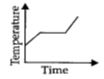
B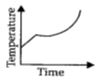
C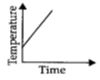
D
Solution
(A) When a substance is heated at a constant rate,its temperature increases until it reaches a phase transition point (melting or boiling). During the phase transition,the temperature remains constant as the heat supplied is used to change the state of the substance (latent heat).
For oxygen,the melting point is approximately $54 \, K$ and the boiling point is approximately $90 \, K$.
As the substance is heated from $50 \, K$ to $300 \, K$,it will undergo phase changes (melting and boiling).
$1$. Initially,the temperature of solid/liquid oxygen increases linearly with time.
$2$. At the melting point,the temperature remains constant while the solid melts.
$3$. Then,the temperature of the liquid increases until it reaches the boiling point.
$4$. At the boiling point,the temperature remains constant while the liquid boils into gas.
$5$. Finally,the temperature of the gas increases.
The graph that shows these plateaus (constant temperature regions) during phase changes is the correct representation. Among the given options,the graph showing a linear increase,a plateau,and another linear increase corresponds to the heating curve of a substance undergoing phase changes.
For oxygen,the melting point is approximately $54 \, K$ and the boiling point is approximately $90 \, K$.
As the substance is heated from $50 \, K$ to $300 \, K$,it will undergo phase changes (melting and boiling).
$1$. Initially,the temperature of solid/liquid oxygen increases linearly with time.
$2$. At the melting point,the temperature remains constant while the solid melts.
$3$. Then,the temperature of the liquid increases until it reaches the boiling point.
$4$. At the boiling point,the temperature remains constant while the liquid boils into gas.
$5$. Finally,the temperature of the gas increases.
The graph that shows these plateaus (constant temperature regions) during phase changes is the correct representation. Among the given options,the graph showing a linear increase,a plateau,and another linear increase corresponds to the heating curve of a substance undergoing phase changes.
0 likes
View Solution60
DifficultMCQ
$A$ piece of ice falls from a height $h$ so that it melts completely. Only one-quarter of the heat produced is absorbed by the ice and all energy of ice gets converted into heat during its fall. The value of $h$ is (Latent heat of ice is $L = 3.4 \times 10^{5} \text{ J/kg}$ and $g = 10 \text{ N/kg}$) (in $\text{ km}$)
A
$544$
B
$136$
C
$68$
D
$34$
Solution
(B) The potential energy of the ice at height $h$ is $PE = mgh$.
According to the problem, all this energy is converted into heat during the fall.
Only one-quarter of this heat is absorbed by the ice to melt it completely.
The heat required to melt a mass $m$ of ice is $Q = mL$, where $L$ is the latent heat of fusion.
Therefore, the energy balance equation is $\frac{1}{4} (mgh) = mL$.
Canceling $m$ from both sides, we get $\frac{gh}{4} = L$.
Solving for $h$, we get $h = \frac{4L}{g}$.
Substituting the given values: $h = \frac{4 \times 3.4 \times 10^{5}}{10} \text{ m}$.
$h = 4 \times 3.4 \times 10^{4} \text{ m} = 13.6 \times 10^{4} \text{ m} = 136,000 \text{ m}$.
Converting to kilometers, $h = 136 \text{ km}$.
According to the problem, all this energy is converted into heat during the fall.
Only one-quarter of this heat is absorbed by the ice to melt it completely.
The heat required to melt a mass $m$ of ice is $Q = mL$, where $L$ is the latent heat of fusion.
Therefore, the energy balance equation is $\frac{1}{4} (mgh) = mL$.
Canceling $m$ from both sides, we get $\frac{gh}{4} = L$.
Solving for $h$, we get $h = \frac{4L}{g}$.
Substituting the given values: $h = \frac{4 \times 3.4 \times 10^{5}}{10} \text{ m}$.
$h = 4 \times 3.4 \times 10^{4} \text{ m} = 13.6 \times 10^{4} \text{ m} = 136,000 \text{ m}$.
Converting to kilometers, $h = 136 \text{ km}$.
1 likes
View Solution61
EasyMCQ
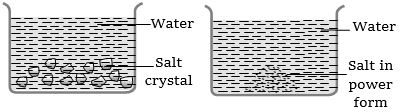
Out of the following,in which vessel will the temperature of the solution be higher after the salt is completely dissolved?
A
$A$
B
$B$
C
Equal in both
D
Information is not sufficient
Solution
(B) When salt crystals dissolve,the crystal lattice is destroyed. This process requires a certain amount of energy (latent heat of dissolution),which is absorbed from the water,causing the temperature to drop.
In vessel $B$,the salt is in powder form,meaning a significant part of the intermolecular bonds has already been destroyed during the crushing process. Consequently,less energy is required to dissolve the powder compared to the large crystals in vessel $A$. Since less energy is absorbed from the water in vessel $B$,the final temperature of the solution in vessel $B$ will be higher than in vessel $A$.
In vessel $B$,the salt is in powder form,meaning a significant part of the intermolecular bonds has already been destroyed during the crushing process. Consequently,less energy is required to dissolve the powder compared to the large crystals in vessel $A$. Since less energy is absorbed from the water in vessel $B$,the final temperature of the solution in vessel $B$ will be higher than in vessel $A$.
0 likes
View Solution62
DifficultMCQ
If there are no heat losses,the heat released by the condensation of $x \, g$ of steam at $100^\circ C$ into water at $100^\circ C$ can be used to convert $y \, g$ of ice at $0^\circ C$ into water at $100^\circ C$. Then the ratio $y : x$ is nearly (in $:1$)
A
$1$
B
$2.5$
C
$2$
D
$3$
Solution
(D) The heat released by $x \, g$ of steam at $100^\circ C$ condensing into water at $100^\circ C$ is given by $Q_{released} = x \times L_v$,where $L_v = 540 \, cal/g$.
So,$Q_{released} = 540x \, cal$.
The heat required to convert $y \, g$ of ice at $0^\circ C$ into water at $100^\circ C$ involves two steps: melting the ice and heating the resulting water.
$Q_{absorbed} = (y \times L_f) + (y \times c_w \times \Delta T)$,where $L_f = 80 \, cal/g$,$c_w = 1 \, cal/g^\circ C$,and $\Delta T = 100^\circ C$.
$Q_{absorbed} = 80y + 100y = 180y \, cal$.
Equating the heat released and absorbed: $540x = 180y$.
Therefore,$\frac{y}{x} = \frac{540}{180} = \frac{3}{1}$.
The ratio $y:x$ is $3:1$.
So,$Q_{released} = 540x \, cal$.
The heat required to convert $y \, g$ of ice at $0^\circ C$ into water at $100^\circ C$ involves two steps: melting the ice and heating the resulting water.
$Q_{absorbed} = (y \times L_f) + (y \times c_w \times \Delta T)$,where $L_f = 80 \, cal/g$,$c_w = 1 \, cal/g^\circ C$,and $\Delta T = 100^\circ C$.
$Q_{absorbed} = 80y + 100y = 180y \, cal$.
Equating the heat released and absorbed: $540x = 180y$.
Therefore,$\frac{y}{x} = \frac{540}{180} = \frac{3}{1}$.
The ratio $y:x$ is $3:1$.
0 likes
View Solution63
DifficultMCQ
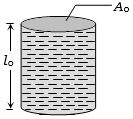
The figure shows a glass tube (linear coefficient of expansion is $\alpha$) completely filled with a liquid of volume expansion coefficient $\gamma$. On heating,the length of the liquid column does not change. Choose the correct relation between $\gamma$ and $\alpha$.
A
$\gamma = \alpha$
B
$\gamma = 2\alpha$
C
$\gamma = 3\alpha$
D
$\gamma = \frac{\alpha}{3}$
Solution
(B) Let the initial volume of the liquid be $V_0 = A_0 l_0$,where $A_0$ is the cross-sectional area and $l_0$ is the length of the liquid column.
When the system is heated by a temperature change $\Delta T$,the new volume of the liquid is $V_L = V_0(1 + \gamma \Delta T)$.
The new cross-sectional area of the glass tube is $A = A_0(1 + 2\alpha \Delta T)$,where $2\alpha$ is the coefficient of area expansion.
Since the length of the liquid column remains constant at $l_0$,the new volume of the liquid must be equal to the new volume of the tube up to height $l_0$,which is $V_{tube} = A \times l_0 = A_0(1 + 2\alpha \Delta T)l_0 = V_0(1 + 2\alpha \Delta T)$.
Equating the two volumes: $V_0(1 + \gamma \Delta T) = V_0(1 + 2\alpha \Delta T)$.
This simplifies to $1 + \gamma \Delta T = 1 + 2\alpha \Delta T$,which gives $\gamma = 2\alpha$.
When the system is heated by a temperature change $\Delta T$,the new volume of the liquid is $V_L = V_0(1 + \gamma \Delta T)$.
The new cross-sectional area of the glass tube is $A = A_0(1 + 2\alpha \Delta T)$,where $2\alpha$ is the coefficient of area expansion.
Since the length of the liquid column remains constant at $l_0$,the new volume of the liquid must be equal to the new volume of the tube up to height $l_0$,which is $V_{tube} = A \times l_0 = A_0(1 + 2\alpha \Delta T)l_0 = V_0(1 + 2\alpha \Delta T)$.
Equating the two volumes: $V_0(1 + \gamma \Delta T) = V_0(1 + 2\alpha \Delta T)$.
This simplifies to $1 + \gamma \Delta T = 1 + 2\alpha \Delta T$,which gives $\gamma = 2\alpha$.
0 likes
View Solution64
MediumMCQ
Water falls from a height of $500 \ m$. What is the rise in temperature of water at the bottom if the whole energy remains in the water? (Assume $g = 9.8 \ m/s^2$ and specific heat capacity of water $c = 4200 \ J/kg \cdot ^\circ C$)
A
$0.96$
B
$1.02$
C
$1.16$
D
$0.23$
Solution
(C) The potential energy of the water at the top is converted into heat energy at the bottom.
$mgh = mc\Delta \theta$
Here,$m$ is the mass of water,$g = 9.8 \ m/s^2$,$h = 500 \ m$,and $c = 4200 \ J/kg \cdot ^\circ C$.
Canceling $m$ from both sides,we get $\Delta \theta = \frac{gh}{c}$.
Substituting the values: $\Delta \theta = \frac{9.8 \times 500}{4200} = \frac{4900}{4200} = \frac{49}{42} = \frac{7}{6} \approx 1.166 \ ^\circ C$.
Rounding to the nearest option,the rise in temperature is $1.16 \ ^\circ C$.
$mgh = mc\Delta \theta$
Here,$m$ is the mass of water,$g = 9.8 \ m/s^2$,$h = 500 \ m$,and $c = 4200 \ J/kg \cdot ^\circ C$.
Canceling $m$ from both sides,we get $\Delta \theta = \frac{gh}{c}$.
Substituting the values: $\Delta \theta = \frac{9.8 \times 500}{4200} = \frac{4900}{4200} = \frac{49}{42} = \frac{7}{6} \approx 1.166 \ ^\circ C$.
Rounding to the nearest option,the rise in temperature is $1.16 \ ^\circ C$.
0 likes
View Solution65
DifficultMCQ
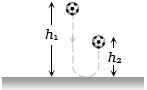
$A$ steel ball of mass $0.1 \, kg$ falls freely from a height of $10 \, m$ and bounces to a height of $5.4 \, m$ from the ground. If the dissipated energy in this process is absorbed by the ball,the rise in its temperature is ........... $^\circ C$ (Specific heat of steel $= 460 \, J \, kg^{-1} \, ^\circ C^{-1}, \; g = 10 \, m \, s^{-2}$)
A
$0.01$
B
$0.1$
C
$1$
D
$1.1$
Solution
(B) According to the law of conservation of energy,the loss in potential energy of the ball is converted into heat energy,which is absorbed by the ball,causing a rise in its temperature.
The loss in potential energy is given by:
$\Delta PE = mg(h_1 - h_2)$
This energy is equal to the heat absorbed by the ball:
$Q = mc\Delta \theta$
Equating the two:
$mg(h_1 - h_2) = mc\Delta \theta$
Solving for the rise in temperature $\Delta \theta$:
$\Delta \theta = \frac{g(h_1 - h_2)}{c}$
Given:
$g = 10 \, m \, s^{-2}$
$h_1 = 10 \, m$
$h_2 = 5.4 \, m$
$c = 460 \, J \, kg^{-1} \, ^\circ C^{-1}$
$\Delta \theta = \frac{10 \times (10 - 5.4)}{460}$
$\Delta \theta = \frac{10 \times 4.6}{460}$
$\Delta \theta = \frac{46}{460} = 0.1 \, ^\circ C$
The loss in potential energy is given by:
$\Delta PE = mg(h_1 - h_2)$
This energy is equal to the heat absorbed by the ball:
$Q = mc\Delta \theta$
Equating the two:
$mg(h_1 - h_2) = mc\Delta \theta$
Solving for the rise in temperature $\Delta \theta$:
$\Delta \theta = \frac{g(h_1 - h_2)}{c}$
Given:
$g = 10 \, m \, s^{-2}$
$h_1 = 10 \, m$
$h_2 = 5.4 \, m$
$c = 460 \, J \, kg^{-1} \, ^\circ C^{-1}$
$\Delta \theta = \frac{10 \times (10 - 5.4)}{460}$
$\Delta \theta = \frac{10 \times 4.6}{460}$
$\Delta \theta = \frac{46}{460} = 0.1 \, ^\circ C$
0 likes
View Solution66
DifficultMCQ
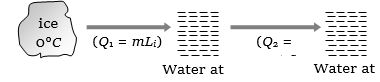
The amount of heat required to change $1 \, g$ of ice at $0^\circ C$ into water at $100^\circ C$ is ............ $cal$.
A
$716$
B
$500$
C
$180$
D
$100$
Solution
(C) The process of converting ice at $0^\circ C$ to water at $100^\circ C$ occurs in two steps:
Step $1$: Melting of ice at $0^\circ C$ to water at $0^\circ C$.
The heat required is $Q_1 = m \cdot L_f$,where $m = 1 \, g$ and $L_f = 80 \, cal/g$.
$Q_1 = 1 \times 80 = 80 \, cal$.
Step $2$: Heating water from $0^\circ C$ to $100^\circ C$.
The heat required is $Q_2 = m \cdot c \cdot \Delta T$,where $m = 1 \, g$,$c = 1 \, cal/g^\circ C$,and $\Delta T = (100 - 0) = 100^\circ C$.
$Q_2 = 1 \times 1 \times 100 = 100 \, cal$.
Total heat required $Q = Q_1 + Q_2 = 80 + 100 = 180 \, cal$.
Step $1$: Melting of ice at $0^\circ C$ to water at $0^\circ C$.
The heat required is $Q_1 = m \cdot L_f$,where $m = 1 \, g$ and $L_f = 80 \, cal/g$.
$Q_1 = 1 \times 80 = 80 \, cal$.
Step $2$: Heating water from $0^\circ C$ to $100^\circ C$.
The heat required is $Q_2 = m \cdot c \cdot \Delta T$,where $m = 1 \, g$,$c = 1 \, cal/g^\circ C$,and $\Delta T = (100 - 0) = 100^\circ C$.
$Q_2 = 1 \times 1 \times 100 = 100 \, cal$.
Total heat required $Q = Q_1 + Q_2 = 80 + 100 = 180 \, cal$.
0 likes
View Solution67
DifficultMCQ
$A$ cylinder of mass $1\,kg$ is given heat of $20000\,J$ at atmospheric pressure. If the initial temperature of the cylinder is $20\,^oC$,then the work done by the cylinder will be .......$J$. (Given: Specific heat of cylinder $= 400\,J\,kg^{-1}\,^oC^{-1}$,Coefficient of volume expansion $= 9 \times 10^{-5}\,^oC^{-1}$,Atmospheric pressure $= 10^5\,N/m^2$,and density of cylinder $= 9000\,kg/m^3$)
A
$0.02$
B
$0.05$
C
$0.08$
D
$0.1$
Solution
(B) The heat supplied is given by $\Delta Q = mc\Delta T$.
Substituting the values: $20000 = 1 \times 400 \times \Delta T$.
Thus,$\Delta T = \frac{20000}{400} = 50\,^oC$.
The work done at constant atmospheric pressure is $W = P\Delta V$.
Since $\Delta V = V_0 \gamma \Delta T$,we have $W = P V_0 \gamma \Delta T$.
The initial volume $V_0 = \frac{m}{\rho} = \frac{1}{9000}\,m^3$.
Substituting the values: $W = (10^5) \times (\frac{1}{9000}) \times (9 \times 10^{-5}) \times 50$.
$W = 10^5 \times \frac{1}{9 \times 10^3} \times 9 \times 10^{-5} \times 50 = 10^5 \times 10^{-8} \times 50 = 10^{-3} \times 50 = 0.05\,J$.
Substituting the values: $20000 = 1 \times 400 \times \Delta T$.
Thus,$\Delta T = \frac{20000}{400} = 50\,^oC$.
The work done at constant atmospheric pressure is $W = P\Delta V$.
Since $\Delta V = V_0 \gamma \Delta T$,we have $W = P V_0 \gamma \Delta T$.
The initial volume $V_0 = \frac{m}{\rho} = \frac{1}{9000}\,m^3$.
Substituting the values: $W = (10^5) \times (\frac{1}{9000}) \times (9 \times 10^{-5}) \times 50$.
$W = 10^5 \times \frac{1}{9 \times 10^3} \times 9 \times 10^{-5} \times 50 = 10^5 \times 10^{-8} \times 50 = 10^{-3} \times 50 = 0.05\,J$.
0 likes
View Solution68
DifficultMCQ
$A$ thermocouple develops $40\,\mu V/K$. If the hot and cold junctions are at $40\,^{\circ}C$ and $20\,^{\circ}C$ respectively,then the emf developed by a thermopile using $150$ such thermocouples in series shall be ............... $mV$.
A
$150$
B
$80$
C
$144$
D
$120$
Solution
(D) The temperature difference $\Delta T = T_{hot} - T_{cold} = 40\,^{\circ}C - 20\,^{\circ}C = 20\,^{\circ}C = 20\,K$.
The emf developed by a single thermocouple is $E_1 = \alpha \times \Delta T = 40\,\mu V/K \times 20\,K = 800\,\mu V$.
Since $150$ thermocouples are connected in series,the total emf $E_{total} = n \times E_1 = 150 \times 800\,\mu V$.
$E_{total} = 120,000\,\mu V = 120\,mV$.
The emf developed by a single thermocouple is $E_1 = \alpha \times \Delta T = 40\,\mu V/K \times 20\,K = 800\,\mu V$.
Since $150$ thermocouples are connected in series,the total emf $E_{total} = n \times E_1 = 150 \times 800\,\mu V$.
$E_{total} = 120,000\,\mu V = 120\,mV$.
0 likes
View Solution69
DifficultMCQ
$A$ thin-walled cylindrical metal vessel with a linear coefficient of expansion $10^{-3} \ ^\circ C^{-1}$ contains benzene with a volume expansion coefficient of $10^{-3} \ ^\circ C^{-1}$. If the vessel and its contents are heated by $10 \ ^\circ C$,the pressure due to the liquid at the bottom:
A
increases by $2\%$
B
decreases by $1\%$
C
decreases by $2\%$
D
remains unchanged
Solution
(C) The coefficient of volume expansion of the vessel is $\gamma_{\text{vessel}} = 3 \alpha_{\text{vessel}} = 3 \times 10^{-3} \ ^\circ C^{-1}$.
The coefficient of volume expansion of the liquid is $\gamma_{\text{liquid}} = 10^{-3} \ ^\circ C^{-1}$.
Since $\gamma_{\text{vessel}} > \gamma_{\text{liquid}}$,the volume of the vessel increases more than the volume of the liquid upon heating. This causes the liquid level to fall,resulting in a decrease in pressure at the bottom.
The change in volume of the vessel relative to the liquid is given by $\Delta V_{\text{rel}} = V(\gamma_{\text{vessel}} - \gamma_{\text{liquid}}) \Delta T$.
Substituting the values: $\Delta V_{\text{rel}} = V(3 \times 10^{-3} - 1 \times 10^{-3}) \times 10 = V(2 \times 10^{-3}) \times 10 = 0.02 V$.
Since the cross-sectional area $A$ of the cylinder also increases,the change in height $\Delta h$ is related to the change in volume. For a thin-walled vessel,the fractional change in height is $\frac{\Delta h}{h} \approx \frac{\Delta V}{V} = 0.02$.
Pressure $P = h \rho g$. The fractional change in pressure is $\frac{\Delta P}{P} = \frac{\Delta h}{h} = 0.02$.
Therefore,the pressure decreases by $0.02 \times 100\% = 2\%$.
The coefficient of volume expansion of the liquid is $\gamma_{\text{liquid}} = 10^{-3} \ ^\circ C^{-1}$.
Since $\gamma_{\text{vessel}} > \gamma_{\text{liquid}}$,the volume of the vessel increases more than the volume of the liquid upon heating. This causes the liquid level to fall,resulting in a decrease in pressure at the bottom.
The change in volume of the vessel relative to the liquid is given by $\Delta V_{\text{rel}} = V(\gamma_{\text{vessel}} - \gamma_{\text{liquid}}) \Delta T$.
Substituting the values: $\Delta V_{\text{rel}} = V(3 \times 10^{-3} - 1 \times 10^{-3}) \times 10 = V(2 \times 10^{-3}) \times 10 = 0.02 V$.
Since the cross-sectional area $A$ of the cylinder also increases,the change in height $\Delta h$ is related to the change in volume. For a thin-walled vessel,the fractional change in height is $\frac{\Delta h}{h} \approx \frac{\Delta V}{V} = 0.02$.
Pressure $P = h \rho g$. The fractional change in pressure is $\frac{\Delta P}{P} = \frac{\Delta h}{h} = 0.02$.
Therefore,the pressure decreases by $0.02 \times 100\% = 2\%$.
0 likes
View Solution70
AdvancedMCQ
$A$ copper ring has a diameter of exactly $25 \, mm$ at its temperature of $0^o C$. An aluminium sphere has a diameter of exactly $25.05 \, mm$ at its temperature of $100^o C$. The sphere is placed on top of the ring and the two are allowed to come to thermal equilibrium,with no heat being lost to the surroundings. The sphere just passes through the ring at the equilibrium temperature. The ratio of the mass of the sphere to the ring is: (Given: $\alpha_{Cu} = 17 \times 10^{-6} /^o C$,$\alpha_{Al} = 2.3 \times 10^{-5} /^o C$,specific heat of $Cu = 0.0923 \, cal/g^o C$,and specific heat of $Al = 0.215 \, cal/g^o C$)
A
$1/5$
B
$23/108$
C
$23/54$
D
$216/23$
Solution
(C) Let $T$ be the equilibrium temperature.
At equilibrium,the diameter of the copper ring equals the diameter of the aluminium sphere:
$D_{Cu}(T) = D_{Al}(T) \implies 25(1 + \alpha_{Cu}T) = 25.05(1 + \alpha_{Al}(T - 100))$.
Substituting values: $25(1 + 17 \times 10^{-6}T) = 25.05(1 + 2.3 \times 10^{-5}(T - 100))$.
Solving for $T$: $25 + 4.25 \times 10^{-4}T = 25.05 + 5.7615 \times 10^{-4}(T - 100)$.
$25 + 4.25 \times 10^{-4}T = 25.05 + 5.7615 \times 10^{-4}T - 0.057615$.
$0.007615 = 1.5115 \times 10^{-4}T \implies T \approx 50.38^o C$.
By calorimetry: $m_{Cu} s_{Cu} (T - 0) = m_{Al} s_{Al} (100 - T)$.
$m_{Cu} (0.0923)(50.38) = m_{Al} (0.215)(100 - 50.38)$.
$m_{Cu} (4.65) = m_{Al} (10.67)$.
Ratio $m_{Al} / m_{Cu} = 4.65 / 10.67 \approx 0.435 \approx 23/54$.
At equilibrium,the diameter of the copper ring equals the diameter of the aluminium sphere:
$D_{Cu}(T) = D_{Al}(T) \implies 25(1 + \alpha_{Cu}T) = 25.05(1 + \alpha_{Al}(T - 100))$.
Substituting values: $25(1 + 17 \times 10^{-6}T) = 25.05(1 + 2.3 \times 10^{-5}(T - 100))$.
Solving for $T$: $25 + 4.25 \times 10^{-4}T = 25.05 + 5.7615 \times 10^{-4}(T - 100)$.
$25 + 4.25 \times 10^{-4}T = 25.05 + 5.7615 \times 10^{-4}T - 0.057615$.
$0.007615 = 1.5115 \times 10^{-4}T \implies T \approx 50.38^o C$.
By calorimetry: $m_{Cu} s_{Cu} (T - 0) = m_{Al} s_{Al} (100 - T)$.
$m_{Cu} (0.0923)(50.38) = m_{Al} (0.215)(100 - 50.38)$.
$m_{Cu} (4.65) = m_{Al} (10.67)$.
Ratio $m_{Al} / m_{Cu} = 4.65 / 10.67 \approx 0.435 \approx 23/54$.
0 likes
View Solution71
DifficultMCQ
$A$ metal ball immersed in alcohol weighs $W_1$ at $0^{\circ}C$ and $W_2$ at $50^{\circ}C$. The coefficient of cubical expansion of the metal $(\gamma)_m$ is less than that of alcohol $(\gamma)_{Al}$. Assuming that the density of the metal is large compared to that of alcohol,it can be shown that:
A
$W_1 > W_2$
B
$W_1 = W_2$
C
$W_1 < W_2$
D
any of $(a), (b)$ or $(c)$
Solution
(C) The apparent weight of a body immersed in a liquid is given by $W_{app} = W_{actual} - F_B$,where $F_B$ is the buoyant force.
The buoyant force is given by $F_B = V_{sub} \cdot \rho_{liquid} \cdot g$,where $V_{sub}$ is the volume of the submerged body and $\rho_{liquid}$ is the density of the liquid.
As the temperature increases,both the volume of the metal ball and the density of the alcohol change. The volume of the metal ball increases as $V_m(T) = V_0(1 + \gamma_m \Delta T)$ and the density of alcohol decreases as $\rho_{Al}(T) = \frac{\rho_0}{1 + \gamma_{Al} \Delta T}$.
The buoyant force at temperature $T$ is $F_B(T) = V_m(T) \cdot \rho_{Al}(T) \cdot g = V_0(1 + \gamma_m \Delta T) \cdot \frac{\rho_0}{1 + \gamma_{Al} \Delta T} \cdot g$.
Since it is given that $\gamma_{Al} > \gamma_m$,the denominator $(1 + \gamma_{Al} \Delta T)$ increases more than the numerator $(1 + \gamma_m \Delta T)$. Therefore,the buoyant force $F_B$ decreases as the temperature increases.
Since $W_{app} = W_{actual} - F_B$ and $F_B$ decreases,the apparent weight $W_{app}$ must increase. Thus,$W_2 > W_1$ or $W_1 < W_2$.
The buoyant force is given by $F_B = V_{sub} \cdot \rho_{liquid} \cdot g$,where $V_{sub}$ is the volume of the submerged body and $\rho_{liquid}$ is the density of the liquid.
As the temperature increases,both the volume of the metal ball and the density of the alcohol change. The volume of the metal ball increases as $V_m(T) = V_0(1 + \gamma_m \Delta T)$ and the density of alcohol decreases as $\rho_{Al}(T) = \frac{\rho_0}{1 + \gamma_{Al} \Delta T}$.
The buoyant force at temperature $T$ is $F_B(T) = V_m(T) \cdot \rho_{Al}(T) \cdot g = V_0(1 + \gamma_m \Delta T) \cdot \frac{\rho_0}{1 + \gamma_{Al} \Delta T} \cdot g$.
Since it is given that $\gamma_{Al} > \gamma_m$,the denominator $(1 + \gamma_{Al} \Delta T)$ increases more than the numerator $(1 + \gamma_m \Delta T)$. Therefore,the buoyant force $F_B$ decreases as the temperature increases.
Since $W_{app} = W_{actual} - F_B$ and $F_B$ decreases,the apparent weight $W_{app}$ must increase. Thus,$W_2 > W_1$ or $W_1 < W_2$.
0 likes
View Solution72
AdvancedMCQ
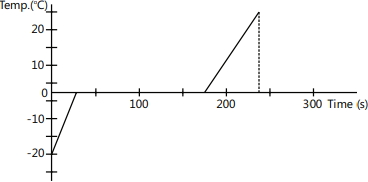
An aluminium container of mass $100 \, g$ contains $200 \, g$ of ice at $-20^{\circ} C$. Heat is added to the system at the rate of $100 \, cal/s$. The temperature of the system after $4$ minutes will be ....... $^{\circ} C$ (specific heat of ice $= 0.5 \, cal/g^{\circ} C$,latent heat of fusion $L = 80 \, cal/g$,specific heat of $Al = 0.2 \, cal/g^{\circ} C$,specific heat of water $= 1 \, cal/g^{\circ} C$)
A
$40.5$
B
$25.5$
C
$30.3$
D
$35.0$
Solution
(B) Total heat supplied in $4$ minutes $(240 \, s)$ is $Q = 100 \, cal/s \times 240 \, s = 24000 \, cal$.
Step $1$: Heat required to raise the temperature of the system from $-20^{\circ} C$ to $0^{\circ} C$:
$Q_1 = m_{Al} c_{Al} \Delta T + m_{ice} c_{ice} \Delta T = (100 \times 0.2 \times 20) + (200 \times 0.5 \times 20) = 400 + 2000 = 2400 \, cal$.
Time taken for this step $= 2400 / 100 = 24 \, s$.
Step $2$: Heat required to melt the ice at $0^{\circ} C$:
$Q_2 = m_{ice} L = 200 \times 80 = 16000 \, cal$.
Time taken for this step $= 16000 / 100 = 160 \, s$.
Total time elapsed $= 24 + 160 = 184 \, s$. Remaining time $= 240 - 184 = 56 \, s$.
Remaining heat available $= 24000 - (2400 + 16000) = 5600 \, cal$.
Step $3$: Heat used to raise the temperature of the system (water + container) from $0^{\circ} C$ to $\theta$:
$Q_3 = (m_{Al} c_{Al} + m_{water} c_{water}) \Delta \theta = (100 \times 0.2 + 200 \times 1) \theta = (20 + 200) \theta = 220 \theta$.
$220 \theta = 5600 \implies \theta = 5600 / 220 \approx 25.45^{\circ} C \approx 25.5^{\circ} C$.
Step $1$: Heat required to raise the temperature of the system from $-20^{\circ} C$ to $0^{\circ} C$:
$Q_1 = m_{Al} c_{Al} \Delta T + m_{ice} c_{ice} \Delta T = (100 \times 0.2 \times 20) + (200 \times 0.5 \times 20) = 400 + 2000 = 2400 \, cal$.
Time taken for this step $= 2400 / 100 = 24 \, s$.
Step $2$: Heat required to melt the ice at $0^{\circ} C$:
$Q_2 = m_{ice} L = 200 \times 80 = 16000 \, cal$.
Time taken for this step $= 16000 / 100 = 160 \, s$.
Total time elapsed $= 24 + 160 = 184 \, s$. Remaining time $= 240 - 184 = 56 \, s$.
Remaining heat available $= 24000 - (2400 + 16000) = 5600 \, cal$.
Step $3$: Heat used to raise the temperature of the system (water + container) from $0^{\circ} C$ to $\theta$:
$Q_3 = (m_{Al} c_{Al} + m_{water} c_{water}) \Delta \theta = (100 \times 0.2 + 200 \times 1) \theta = (20 + 200) \theta = 220 \theta$.
$220 \theta = 5600 \implies \theta = 5600 / 220 \approx 25.45^{\circ} C \approx 25.5^{\circ} C$.
0 likes
View Solution73
AdvancedMCQ
$A$ thermally insulated vessel contains some water at $0^{\circ}C$. The vessel is connected to a vacuum pump to pump out water vapour. This results in some water getting frozen. It is given that the latent heat of vaporization of water at $0^{\circ}C = 21 \times 10^5 \text{ J/kg}$ and the latent heat of fusion of water $= 3.36 \times 10^5 \text{ J/kg}$. The maximum percentage amount of water that will be solidified in this manner will be ...... $\%$
A
$86.2$
B
$33.6$
C
$21$
D
$24.36$
Solution
(A) Let $m_1$ be the mass of water that freezes and $m_2$ be the mass of water that vaporizes.
Since the vessel is thermally insulated, the heat released by the freezing water is equal to the heat absorbed by the vaporizing water.
$m_1 L_f = m_2 L_v$
Given $L_f = 3.36 \times 10^5 \text{ J/kg}$ and $L_v = 21 \times 10^5 \text{ J/kg}$.
$m_1 (3.36 \times 10^5) = m_2 (21 \times 10^5)$
$m_2 = \frac{3.36}{21} m_1 = 0.16 m_1$
The total initial mass of water is $M = m_1 + m_2 = m_1 + 0.16 m_1 = 1.16 m_1$.
The percentage of water solidified is $\frac{m_1}{M} \times 100\% = \frac{m_1}{1.16 m_1} \times 100\%$.
$= \frac{100}{1.16} \% \approx 86.2 \%$.
Since the vessel is thermally insulated, the heat released by the freezing water is equal to the heat absorbed by the vaporizing water.
$m_1 L_f = m_2 L_v$
Given $L_f = 3.36 \times 10^5 \text{ J/kg}$ and $L_v = 21 \times 10^5 \text{ J/kg}$.
$m_1 (3.36 \times 10^5) = m_2 (21 \times 10^5)$
$m_2 = \frac{3.36}{21} m_1 = 0.16 m_1$
The total initial mass of water is $M = m_1 + m_2 = m_1 + 0.16 m_1 = 1.16 m_1$.
The percentage of water solidified is $\frac{m_1}{M} \times 100\% = \frac{m_1}{1.16 m_1} \times 100\%$.
$= \frac{100}{1.16} \% \approx 86.2 \%$.
0 likes
View Solution74
MediumMCQ
$10 \, g$ of ice at $0^{\circ} C$ is kept in a calorimeter of water equivalent $10 \, g$. How much heat (in $cal$) should be supplied to the apparatus to evaporate the water thus formed? (Neglect loss of heat)
A
$6200$
B
$7200$
C
$13600$
D
$8200$
Solution
(D) The total heat required consists of the heat to melt the ice,heat to raise the temperature of the resulting water and the calorimeter to $100^{\circ} C$,and the heat to vaporize the water.
$1$. Heat to melt $10 \, g$ of ice: $Q_1 = m L_f = 10 \, g \times 80 \, cal/g = 800 \, cal$.
$2$. Heat to raise the temperature of $10 \, g$ of water (from ice) and $10 \, g$ of water equivalent (calorimeter) from $0^{\circ} C$ to $100^{\circ} C$: $Q_2 = (m_{water} + m_{eq}) C \Delta T = (10 + 10) \times 1 \times 100 = 2000 \, cal$.
$3$. Heat to vaporize $10 \, g$ of water at $100^{\circ} C$: $Q_3 = m L_v = 10 \, g \times 540 \, cal/g = 5400 \, cal$.
Total heat $Q = Q_1 + Q_2 + Q_3 = 800 + 2000 + 5400 = 8200 \, cal$.
$1$. Heat to melt $10 \, g$ of ice: $Q_1 = m L_f = 10 \, g \times 80 \, cal/g = 800 \, cal$.
$2$. Heat to raise the temperature of $10 \, g$ of water (from ice) and $10 \, g$ of water equivalent (calorimeter) from $0^{\circ} C$ to $100^{\circ} C$: $Q_2 = (m_{water} + m_{eq}) C \Delta T = (10 + 10) \times 1 \times 100 = 2000 \, cal$.
$3$. Heat to vaporize $10 \, g$ of water at $100^{\circ} C$: $Q_3 = m L_v = 10 \, g \times 540 \, cal/g = 5400 \, cal$.
Total heat $Q = Q_1 + Q_2 + Q_3 = 800 + 2000 + 5400 = 8200 \, cal$.
0 likes
View Solution75
DifficultMCQ
Heat is being supplied at a constant rate to a sphere of ice which is melting at the rate of $0.1 \, g/s$. It melts completely in $100 \, s$. The rate of rise of temperature thereafter will be ........ $^\circ C/s$ (Assume no loss of heat.)
A
$0.8$
B
$5.4$
C
$3.6$
D
will change with time
Solution
(A) The mass of ice melted in $100 \, s$ is $m = 0.1 \, g/s \times 100 \, s = 10 \, g$.
The heat supplied to melt the ice is $Q = m L_f$,where $L_f = 80 \, cal/g$ (latent heat of fusion of ice).
$Q = 10 \, g \times 80 \, cal/g = 800 \, cal$.
The rate of heat supply is $P = Q / t = 800 \, cal / 100 \, s = 8 \, cal/s$.
After the ice melts,we have $10 \, g$ of water. The rate of rise of temperature is given by $P = m_{water} c_{water} (dT/dt)$.
$8 \, cal/s = 10 \, g \times 1 \, cal/(g \cdot ^\circ C) \times (dT/dt)$.
$(dT/dt) = 8 / 10 = 0.8 \, ^\circ C/s$.
The heat supplied to melt the ice is $Q = m L_f$,where $L_f = 80 \, cal/g$ (latent heat of fusion of ice).
$Q = 10 \, g \times 80 \, cal/g = 800 \, cal$.
The rate of heat supply is $P = Q / t = 800 \, cal / 100 \, s = 8 \, cal/s$.
After the ice melts,we have $10 \, g$ of water. The rate of rise of temperature is given by $P = m_{water} c_{water} (dT/dt)$.
$8 \, cal/s = 10 \, g \times 1 \, cal/(g \cdot ^\circ C) \times (dT/dt)$.
$(dT/dt) = 8 / 10 = 0.8 \, ^\circ C/s$.
0 likes
View Solution76
DifficultMCQ
$A$ continuous flow water heater (geyser) has an electrical power rating $= 2 \, kW$ and efficiency of conversion of electrical power into heat $= 80 \%$. If water is flowing through the device at the rate of $100 \, cc/sec$,and the inlet temperature is $10^{\circ} C$,the outlet temperature will be ....... $^{\circ} C$.
A
$12.2$
B
$13.8$
C
$20$
D
$16.5$
Solution
(B) Given: Power rating $P = 2000 \, W$,Efficiency $\eta = 0.8$,Flow rate $v = 100 \, cc/s$,Inlet temperature $T_i = 10^{\circ} C$.
Since $1 \, cc$ of water has a mass of $1 \, g$,the mass flow rate is $m = 100 \, g/s = 0.1 \, kg/s$.
The effective heat power supplied to the water is $Q = P \times \eta = 2000 \times 0.8 = 1600 \, J/s$.
The formula for heat transfer is $Q = m \cdot c \cdot \Delta T$,where $c$ is the specific heat capacity of water $(4200 \, J/kg \cdot ^{\circ} C)$.
Substituting the values: $1600 = 0.1 \times 4200 \times (T_o - 10)$.
$1600 = 420 \times (T_o - 10)$.
$T_o - 10 = 1600 / 420 \approx 3.81$.
$T_o = 13.81^{\circ} C$. Thus,the outlet temperature is approximately $13.8^{\circ} C$.
Since $1 \, cc$ of water has a mass of $1 \, g$,the mass flow rate is $m = 100 \, g/s = 0.1 \, kg/s$.
The effective heat power supplied to the water is $Q = P \times \eta = 2000 \times 0.8 = 1600 \, J/s$.
The formula for heat transfer is $Q = m \cdot c \cdot \Delta T$,where $c$ is the specific heat capacity of water $(4200 \, J/kg \cdot ^{\circ} C)$.
Substituting the values: $1600 = 0.1 \times 4200 \times (T_o - 10)$.
$1600 = 420 \times (T_o - 10)$.
$T_o - 10 = 1600 / 420 \approx 3.81$.
$T_o = 13.81^{\circ} C$. Thus,the outlet temperature is approximately $13.8^{\circ} C$.
0 likes
View Solution77
DifficultMCQ
Find the amount of heat supplied to decrease the volume of an ice-water mixture by $1 \, cm^3$ without any change in temperature. (Given: $\rho_{ice} = 0.9 \rho_{water}$,$L_{ice} = 80 \, cal/g$).
A
$360$
B
$500$
C
$720$
D
none of these
Solution
(C) Let $x$ be the mass of ice that melts into water.
When ice melts into water,the volume decreases because the density of water is higher than that of ice.
The volume of $x \, g$ of ice is $V_{ice} = \frac{x}{\rho_{ice}} = \frac{x}{0.9 \rho_{water}}$.
The volume of $x \, g$ of water is $V_{water} = \frac{x}{\rho_{water}}$.
The change in volume is $\Delta V = V_{ice} - V_{water} = \frac{x}{0.9 \rho_{water}} - \frac{x}{\rho_{water}} = 1 \, cm^3$.
Assuming $\rho_{water} = 1 \, g/cm^3$,we have $\frac{x}{0.9} - x = 1$.
$x(1.111 - 1) = 1 \Rightarrow x(0.1/0.9) = 1 \Rightarrow x = 9 \, g$.
The heat required to melt $9 \, g$ of ice is $Q = m \times L = 9 \, g \times 80 \, cal/g = 720 \, cal$.
When ice melts into water,the volume decreases because the density of water is higher than that of ice.
The volume of $x \, g$ of ice is $V_{ice} = \frac{x}{\rho_{ice}} = \frac{x}{0.9 \rho_{water}}$.
The volume of $x \, g$ of water is $V_{water} = \frac{x}{\rho_{water}}$.
The change in volume is $\Delta V = V_{ice} - V_{water} = \frac{x}{0.9 \rho_{water}} - \frac{x}{\rho_{water}} = 1 \, cm^3$.
Assuming $\rho_{water} = 1 \, g/cm^3$,we have $\frac{x}{0.9} - x = 1$.
$x(1.111 - 1) = 1 \Rightarrow x(0.1/0.9) = 1 \Rightarrow x = 9 \, g$.
The heat required to melt $9 \, g$ of ice is $Q = m \times L = 9 \, g \times 80 \, cal/g = 720 \, cal$.
0 likes
View Solution78
AdvancedMCQ
$A$ sphere of ice at $0^{\circ}C$ having initial radius $R$ is placed in an environment having ambient temperature $> 0^{\circ}C$. The ice melts uniformly,such that the shape remains spherical. After a time $t$,the radius of the sphere has reduced to $r$. Assuming the rate of heat absorption is proportional to the surface area of the sphere at any moment,which graph best depicts $r(t)$?
A
B
C
D
Solution
(B) The rate of heat absorption is proportional to the surface area $A$ of the sphere.
$Q = mL$,where $m$ is the mass and $L$ is the latent heat of fusion.
Rate of heat absorption $\frac{dQ}{dt} = L \frac{dm}{dt} = L \rho \frac{dV}{dt}$,where $\rho$ is the density and $V$ is the volume.
Since $V = \frac{4}{3} \pi r^3$,we have $\frac{dV}{dt} = 4 \pi r^2 \frac{dr}{dt}$.
Given $\frac{dQ}{dt} \propto A$,where $A = 4 \pi r^2$,we have $L \rho (4 \pi r^2 \frac{dr}{dt}) = -k (4 \pi r^2)$,where $k$ is a constant.
Simplifying this,we get $\frac{dr}{dt} = -\frac{k}{L \rho} = -C$,where $C$ is a positive constant.
Integrating this,$r(t) = R - Ct$.
This represents a linear decrease in radius with time,which is depicted by graph $B$.
$Q = mL$,where $m$ is the mass and $L$ is the latent heat of fusion.
Rate of heat absorption $\frac{dQ}{dt} = L \frac{dm}{dt} = L \rho \frac{dV}{dt}$,where $\rho$ is the density and $V$ is the volume.
Since $V = \frac{4}{3} \pi r^3$,we have $\frac{dV}{dt} = 4 \pi r^2 \frac{dr}{dt}$.
Given $\frac{dQ}{dt} \propto A$,where $A = 4 \pi r^2$,we have $L \rho (4 \pi r^2 \frac{dr}{dt}) = -k (4 \pi r^2)$,where $k$ is a constant.
Simplifying this,we get $\frac{dr}{dt} = -\frac{k}{L \rho} = -C$,where $C$ is a positive constant.
Integrating this,$r(t) = R - Ct$.
This represents a linear decrease in radius with time,which is depicted by graph $B$.
0 likes
View Solution79
MediumMCQ
$A$ piece of ice (heat capacity = $2100 \text{ J kg}^{-1} \text{ }^\circ\text{C}^{-1}$ and latent heat = $3.36 \times 10^5 \ J kg^{-1}$) of mass $m$ grams is at $-5^oC$ at atmospheric pressure. It is given $420 \ J$ of heat so that the ice starts melting. Finally, when the ice-water mixture is in equilibrium, it is found that $1 \ gm$ of ice has melted. Assuming there is no other heat exchange in the process, the value of $m$ is ...... $gm$.
A
$2$
B
$4$
C
$6$
D
$8$
Solution
(D) The process involves two stages:
$1$. Heating the ice from $-5^oC$ to $0^oC$: $Q_1 = m_{ice} \cdot c_{ice} \cdot \Delta T$.
Given $m$ is in grams, $m_{ice} = m \times 10^{-3} \ kg$.
$Q_1 = (m \times 10^{-3}) \times 2100 \times 5 = 10.5m \ J$.
$2$. Melting $1 \ gm$ of ice at $0^oC$: $Q_2 = m_{melted} \cdot L_f$.
$Q_2 = (1 \times 10^{-3}) \times 3.36 \times 10^5 = 336 \ J$.
Total heat given $Q = Q_1 + Q_2 = 420 \ J$.
$10.5m + 336 = 420$.
$10.5m = 84$.
$m = 84 / 10.5 = 8 \ gm$.
$1$. Heating the ice from $-5^oC$ to $0^oC$: $Q_1 = m_{ice} \cdot c_{ice} \cdot \Delta T$.
Given $m$ is in grams, $m_{ice} = m \times 10^{-3} \ kg$.
$Q_1 = (m \times 10^{-3}) \times 2100 \times 5 = 10.5m \ J$.
$2$. Melting $1 \ gm$ of ice at $0^oC$: $Q_2 = m_{melted} \cdot L_f$.
$Q_2 = (1 \times 10^{-3}) \times 3.36 \times 10^5 = 336 \ J$.
Total heat given $Q = Q_1 + Q_2 = 420 \ J$.
$10.5m + 336 = 420$.
$10.5m = 84$.
$m = 84 / 10.5 = 8 \ gm$.
0 likes
View Solution80
MediumMCQ
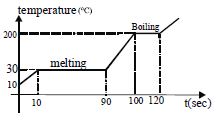
$A$ given mass $m$ of a hypothetical solid is supplied with heat continuously at a constant rate and the graph shown in the figure is plotted. If $L_f$ and $L_v$ are latent heats of fusion and vaporization,and $S_l$ and $S_s$ are specific heats of liquid and solid respectively,it can be concluded that:
A
$L_f > L_v, S_l = S_s$
B
$L_f < L_v, S_l > S_s$
C
$L_f > L_v, S_l < S_s$
D
$L_f = L_v, S_l > S_s$
Solution
(C) Let the constant rate of heat supply be $P$ $(J/s)$.
Heat required for melting (fusion) is $Q_f = P \times (90 - 10) = 80P$. Since $Q_f = mL_f$,we have $mL_f = 80P$.
Heat required for vaporization is $Q_v = P \times (120 - 100) = 20P$. Since $Q_v = mL_v$,we have $mL_v = 20P$.
Comparing the two,$mL_f = 80P$ and $mL_v = 20P$,so $L_f > L_v$.
For the heating phases,the slope of the temperature-time graph is given by $\frac{dT}{dt} = \frac{P}{mS}$. Thus,$S = \frac{P}{m(dT/dt)}$.
The slope for the solid phase is $m_s = \frac{30 - 10}{10} = 2 \, ^\circ C/s$.
The slope for the liquid phase is $m_l = \frac{200 - 30}{100 - 90} = \frac{170}{10} = 17 \, ^\circ C/s$.
Since $m_l > m_s$,and $S \propto \frac{1}{\text{slope}}$,it follows that $S_s > S_l$,or $S_l < S_s$.
Therefore,$L_f > L_v$ and $S_l < S_s$.
Heat required for melting (fusion) is $Q_f = P \times (90 - 10) = 80P$. Since $Q_f = mL_f$,we have $mL_f = 80P$.
Heat required for vaporization is $Q_v = P \times (120 - 100) = 20P$. Since $Q_v = mL_v$,we have $mL_v = 20P$.
Comparing the two,$mL_f = 80P$ and $mL_v = 20P$,so $L_f > L_v$.
For the heating phases,the slope of the temperature-time graph is given by $\frac{dT}{dt} = \frac{P}{mS}$. Thus,$S = \frac{P}{m(dT/dt)}$.
The slope for the solid phase is $m_s = \frac{30 - 10}{10} = 2 \, ^\circ C/s$.
The slope for the liquid phase is $m_l = \frac{200 - 30}{100 - 90} = \frac{170}{10} = 17 \, ^\circ C/s$.
Since $m_l > m_s$,and $S \propto \frac{1}{\text{slope}}$,it follows that $S_s > S_l$,or $S_l < S_s$.
Therefore,$L_f > L_v$ and $S_l < S_s$.
0 likes
View Solution81
DifficultMCQ
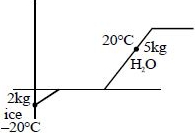
$2 \ kg$ of ice at $-20^{\circ} C$ is mixed with $5 \ kg$ of water at $20^{\circ} C$. What is the final amount of water in the mixture (in $kg$)? (Given: specific heat of ice $= 0.5 \ cal/g^{\circ} C$,specific heat of water $= 1 \ cal/g^{\circ} C$,latent heat of fusion of ice $= 80 \ cal/g$)
A
$6$
B
$5$
C
$4$
D
$2$
Solution
(A) Heat required to raise the temperature of $2 \ kg$ ice from $-20^{\circ} C$ to $0^{\circ} C$ is $Q_1 = m_i c_i \Delta T = 2000 \ g \times 0.5 \ cal/g^{\circ} C \times 20^{\circ} C = 20000 \ cal$.
Heat released by $5 \ kg$ water cooling from $20^{\circ} C$ to $0^{\circ} C$ is $Q_2 = m_w c_w \Delta T = 5000 \ g \times 1 \ cal/g^{\circ} C \times 20^{\circ} C = 100000 \ cal$.
Remaining heat available to melt the ice is $Q_{rem} = Q_2 - Q_1 = 100000 - 20000 = 80000 \ cal$.
Mass of ice that melts is $m = Q_{rem} / L_f = 80000 \ cal / 80 \ cal/g = 1000 \ g = 1 \ kg$.
Final amount of water $= \text{Initial water} + \text{Melted ice} = 5 \ kg + 1 \ kg = 6 \ kg$.
Heat released by $5 \ kg$ water cooling from $20^{\circ} C$ to $0^{\circ} C$ is $Q_2 = m_w c_w \Delta T = 5000 \ g \times 1 \ cal/g^{\circ} C \times 20^{\circ} C = 100000 \ cal$.
Remaining heat available to melt the ice is $Q_{rem} = Q_2 - Q_1 = 100000 - 20000 = 80000 \ cal$.
Mass of ice that melts is $m = Q_{rem} / L_f = 80000 \ cal / 80 \ cal/g = 1000 \ g = 1 \ kg$.
Final amount of water $= \text{Initial water} + \text{Melted ice} = 5 \ kg + 1 \ kg = 6 \ kg$.
0 likes
View Solution82
DifficultMCQ
$A$ beaker of height $H$ is made up of a material whose coefficient of linear thermal expansion is $3\alpha$. It is filled up to the brim by a liquid whose coefficient of thermal expansion is $\alpha$. If now the beaker along with its contents is uniformly heated through a small temperature $T$,the level of liquid will reduce by (given $\alpha T << 1$):
A
$5 \alpha TH$
B
$3 \alpha TH$
C
$2 \alpha TH$
D
$8 \alpha TH$
Solution
(D) Let the cross-sectional area of the beaker be $A$. The initial volume of the liquid is $V_0 = A H$.
When heated by temperature $T$,the new volume of the liquid is $V_L = V_0(1 + \gamma_L T) = AH(1 + \alpha T)$,where $\gamma_L = \alpha$ is the volume expansion coefficient of the liquid.
The new cross-sectional area of the beaker is $A' = A(1 + 2\alpha_s T)$,where $\alpha_s = 3\alpha$ is the linear expansion coefficient of the beaker material. Thus,$A' = A(1 + 2(3\alpha)T) = A(1 + 6\alpha T)$.
The new height of the beaker is $H' = H(1 + \alpha_s T) = H(1 + 3\alpha T)$.
The new height of the liquid $H_L$ in the beaker is $H_L = V_L / A' = AH(1 + \alpha T) / [A(1 + 6\alpha T)]$.
Using the binomial approximation $(1 + x)^{-1} \approx 1 - x$ for small $x$,we get $H_L \approx H(1 + \alpha T)(1 - 6\alpha T) \approx H(1 + \alpha T - 6\alpha T) = H(1 - 5\alpha T)$.
The reduction in the level of the liquid is $\Delta H = H' - H_L = H(1 + 3\alpha T) - H(1 - 5\alpha T) = H(1 + 3\alpha T - 1 + 5\alpha T) = 8\alpha TH$.
When heated by temperature $T$,the new volume of the liquid is $V_L = V_0(1 + \gamma_L T) = AH(1 + \alpha T)$,where $\gamma_L = \alpha$ is the volume expansion coefficient of the liquid.
The new cross-sectional area of the beaker is $A' = A(1 + 2\alpha_s T)$,where $\alpha_s = 3\alpha$ is the linear expansion coefficient of the beaker material. Thus,$A' = A(1 + 2(3\alpha)T) = A(1 + 6\alpha T)$.
The new height of the beaker is $H' = H(1 + \alpha_s T) = H(1 + 3\alpha T)$.
The new height of the liquid $H_L$ in the beaker is $H_L = V_L / A' = AH(1 + \alpha T) / [A(1 + 6\alpha T)]$.
Using the binomial approximation $(1 + x)^{-1} \approx 1 - x$ for small $x$,we get $H_L \approx H(1 + \alpha T)(1 - 6\alpha T) \approx H(1 + \alpha T - 6\alpha T) = H(1 - 5\alpha T)$.
The reduction in the level of the liquid is $\Delta H = H' - H_L = H(1 + 3\alpha T) - H(1 - 5\alpha T) = H(1 + 3\alpha T - 1 + 5\alpha T) = 8\alpha TH$.
0 likes
View Solution83
DifficultMCQ
$A$ mass $m$ of material exists in its solid state at its melting temperature $0^\circ C$. The following processes occur to the material:
Process-$1$: An amount of thermal energy $Q$ is added to the material, and $\frac{2}{3}$ of the material melts.
Process-$2$: An identical additional amount of thermal energy $Q$ is added to the material, and the material is now a liquid at $40^\circ C$.
What is the ratio of the latent heat of fusion $(L)$ to the specific heat of the liquid $(s)$ for this material?
Process-$1$: An amount of thermal energy $Q$ is added to the material, and $\frac{2}{3}$ of the material melts.
Process-$2$: An identical additional amount of thermal energy $Q$ is added to the material, and the material is now a liquid at $40^\circ C$.
What is the ratio of the latent heat of fusion $(L)$ to the specific heat of the liquid $(s)$ for this material?
A
$120$
B
$60$
C
$40$
D
$20$
Solution
(A) Let $m$ be the total mass of the material, $L$ be the latent heat of fusion, and $s$ be the specific heat of the liquid.
In Process-$1$, the energy $Q$ melts $\frac{2}{3}$ of the mass:
$Q = \frac{2}{3} m L$ --- (Equation $1$)
In Process-$2$, an additional energy $Q$ is added. This energy first melts the remaining $\frac{1}{3}$ of the solid and then raises the temperature of the entire liquid mass $m$ from $0^\circ C$ to $40^\circ C$:
$Q = \frac{1}{3} m L + m s (40 - 0)$
$Q = \frac{1}{3} m L + 40 m s$ --- (Equation $2$)
Equating Equation $1$ and Equation $2$:
$\frac{2}{3} m L = \frac{1}{3} m L + 40 m s$
$\frac{1}{3} m L = 40 m s$
$\frac{L}{s} = 40 \times 3 = 120$
Thus, the ratio of the latent heat of fusion to the specific heat of the liquid is $120$.
In Process-$1$, the energy $Q$ melts $\frac{2}{3}$ of the mass:
$Q = \frac{2}{3} m L$ --- (Equation $1$)
In Process-$2$, an additional energy $Q$ is added. This energy first melts the remaining $\frac{1}{3}$ of the solid and then raises the temperature of the entire liquid mass $m$ from $0^\circ C$ to $40^\circ C$:
$Q = \frac{1}{3} m L + m s (40 - 0)$
$Q = \frac{1}{3} m L + 40 m s$ --- (Equation $2$)
Equating Equation $1$ and Equation $2$:
$\frac{2}{3} m L = \frac{1}{3} m L + 40 m s$
$\frac{1}{3} m L = 40 m s$
$\frac{L}{s} = 40 \times 3 = 120$
Thus, the ratio of the latent heat of fusion to the specific heat of the liquid is $120$.
0 likes
View Solution84
DifficultMCQ
An iron rod of heat capacity $C$ is heated to temperature $8T_0$. It is then put in a cylindrical vessel of adiabatic walls having two moles of air which can be treated as a diatomic ideal gas at temperature $T_0$ and closed by a movable piston which is also adiabatic. The atmospheric pressure is $P_0$. The cylinder with the piston combined have a heat capacity $2C$. Find the equilibrium temperature. (Assume the temperature of air to be uniform and equal to the vessel at all times).
A
$\left( \frac{8C + 7R}{3C + 7R} \right) T_0$
B
$\left( \frac{10C + 7R}{C + 7R} \right) T_0$
C
$\left( \frac{8C + 7R}{C + 7R} \right) T_0$
D
$\left( \frac{10C + 7R}{3C + 7R} \right) T_0$
Solution
(D) Let the equilibrium temperature be $T$. Since the system is adiabatic,the total heat lost by the iron rod equals the total heat gained by the air and the vessel-piston assembly.
Heat lost by the iron rod = $C(8T_0 - T)$.
Heat gained by the vessel and piston = $2C(T - T_0)$.
Heat gained by $2$ moles of diatomic gas (at constant pressure,as the piston is movable and atmospheric pressure $P_0$ is constant) = $n C_p (T - T_0) = 2 \times \frac{7R}{2} (T - T_0) = 7R(T - T_0)$.
Equating heat lost and gained: $C(8T_0 - T) = 2C(T - T_0) + 7R(T - T_0)$.
$8CT_0 - CT = 2CT - 2CT_0 + 7RT - 7RT_0$.
$8CT_0 + 2CT_0 + 7RT_0 = CT + 2CT + 7RT$.
$T_0(10C + 7R) = T(3C + 7R)$.
$T = \left( \frac{10C + 7R}{3C + 7R} \right) T_0$.
Heat lost by the iron rod = $C(8T_0 - T)$.
Heat gained by the vessel and piston = $2C(T - T_0)$.
Heat gained by $2$ moles of diatomic gas (at constant pressure,as the piston is movable and atmospheric pressure $P_0$ is constant) = $n C_p (T - T_0) = 2 \times \frac{7R}{2} (T - T_0) = 7R(T - T_0)$.
Equating heat lost and gained: $C(8T_0 - T) = 2C(T - T_0) + 7R(T - T_0)$.
$8CT_0 - CT = 2CT - 2CT_0 + 7RT - 7RT_0$.
$8CT_0 + 2CT_0 + 7RT_0 = CT + 2CT + 7RT$.
$T_0(10C + 7R) = T(3C + 7R)$.
$T = \left( \frac{10C + 7R}{3C + 7R} \right) T_0$.
0 likes
View Solution85
DifficultMCQ
$A$ lead bullet at $27\ ^oC$ just melts when stopped by an obstacle. Assuming that $25\%$ of heat is absorbed by the obstacle,the velocity of the bullet at the time of striking is ....... $m/s$. (Melting point of lead $= 327\ ^oC$,specific heat of lead $= 0.03\ cal/g\ ^oC$,latent heat of fusion of lead $= 6\ cal/g$,and $J = 4.2\ J/cal$)
A
$410$
B
$1230$
C
$307.5$
D
None of the above
Solution
(A) Let the mass of the bullet be $m\ g$.
The total heat required for the bullet to just melt is given by $Q_1 = mc\Delta T + mL$.
Substituting the values: $Q_1 = m \times 0.03 \times (327 - 27) + m \times 6 = m \times 0.03 \times 300 + 6m = 9m + 6m = 15m\ cal$.
Converting this to Joules: $Q_1 = 15m \times 4.2 = 63m\ J$.
When the bullet is stopped,the loss in its kinetic energy is $\Delta K = \frac{1}{2} m_{kg} v^2 = \frac{1}{2} (m \times 10^{-3}) v^2\ J$.
Since $25\%$ of the heat is absorbed by the obstacle,$75\%$ of the kinetic energy is absorbed by the bullet.
Energy absorbed by the bullet $Q_2 = 0.75 \times \frac{1}{2} \times m \times 10^{-3} \times v^2 = \frac{3}{8} \times 10^{-3} \times m v^2\ J$.
For the bullet to just melt,$Q_2 = Q_1$.
$\frac{3}{8} \times 10^{-3} \times m v^2 = 63m$.
$v^2 = \frac{63 \times 8 \times 1000}{3} = 21 \times 8000 = 168000$.
$v = \sqrt{168000} \approx 409.87\ m/s \approx 410\ m/s$.
The total heat required for the bullet to just melt is given by $Q_1 = mc\Delta T + mL$.
Substituting the values: $Q_1 = m \times 0.03 \times (327 - 27) + m \times 6 = m \times 0.03 \times 300 + 6m = 9m + 6m = 15m\ cal$.
Converting this to Joules: $Q_1 = 15m \times 4.2 = 63m\ J$.
When the bullet is stopped,the loss in its kinetic energy is $\Delta K = \frac{1}{2} m_{kg} v^2 = \frac{1}{2} (m \times 10^{-3}) v^2\ J$.
Since $25\%$ of the heat is absorbed by the obstacle,$75\%$ of the kinetic energy is absorbed by the bullet.
Energy absorbed by the bullet $Q_2 = 0.75 \times \frac{1}{2} \times m \times 10^{-3} \times v^2 = \frac{3}{8} \times 10^{-3} \times m v^2\ J$.
For the bullet to just melt,$Q_2 = Q_1$.
$\frac{3}{8} \times 10^{-3} \times m v^2 = 63m$.
$v^2 = \frac{63 \times 8 \times 1000}{3} = 21 \times 8000 = 168000$.
$v = \sqrt{168000} \approx 409.87\ m/s \approx 410\ m/s$.
0 likes
View Solution86
DifficultMCQ
$1 \ gm$ of ice at $0^o C$ is mixed with $1 \ gm$ of steam at $100^o C$. What will be the final temperature $(^o C)$?
A
$100$
B
$230$
C
$130$
D
$50$
Solution
(A) Step $1$: Calculate heat required to melt $1 \ gm$ of ice at $0^o C$ to water at $0^o C$: $Q_1 = m \cdot L_f = 1 \ gm \times 80 \ cal/gm = 80 \ cal$.
Step $2$: Calculate heat released by $1 \ gm$ of steam at $100^o C$ condensing to water at $100^o C$: $Q_2 = m \cdot L_v = 1 \ gm \times 540 \ cal/gm = 540 \ cal$.
Step $3$: Since $Q_2 > Q_1$,the ice melts completely and the resulting water at $0^o C$ is heated by the remaining heat from the steam.
Step $4$: Heat available to raise the temperature of the water: $Q_{rem} = Q_2 - Q_1 = 540 - 80 = 460 \ cal$.
Step $5$: Total mass of water is $2 \ gm$. Let the final temperature be $T$. The heat absorbed by $2 \ gm$ of water to reach $T$ is $Q = m \cdot c \cdot \Delta T = 2 \ gm \times 1 \ cal/gm^o C \times (T - 0) = 2T$.
Step $6$: Equating heat gained and lost: $2T = 460$,which gives $T = 230^o C$. However,since the steam is at $100^o C$,the final temperature cannot exceed $100^o C$. This implies all steam condenses and the mixture reaches equilibrium at $100^o C$ with some steam remaining.
Step $2$: Calculate heat released by $1 \ gm$ of steam at $100^o C$ condensing to water at $100^o C$: $Q_2 = m \cdot L_v = 1 \ gm \times 540 \ cal/gm = 540 \ cal$.
Step $3$: Since $Q_2 > Q_1$,the ice melts completely and the resulting water at $0^o C$ is heated by the remaining heat from the steam.
Step $4$: Heat available to raise the temperature of the water: $Q_{rem} = Q_2 - Q_1 = 540 - 80 = 460 \ cal$.
Step $5$: Total mass of water is $2 \ gm$. Let the final temperature be $T$. The heat absorbed by $2 \ gm$ of water to reach $T$ is $Q = m \cdot c \cdot \Delta T = 2 \ gm \times 1 \ cal/gm^o C \times (T - 0) = 2T$.
Step $6$: Equating heat gained and lost: $2T = 460$,which gives $T = 230^o C$. However,since the steam is at $100^o C$,the final temperature cannot exceed $100^o C$. This implies all steam condenses and the mixture reaches equilibrium at $100^o C$ with some steam remaining.
0 likes
View Solution87
MediumMCQ
Heat required to convert $5\ kg$ of ice at $0\ ^oC$ into water at $100\ ^oC$ is:
A
$900\ cal$
B
$900\ kcal$
C
$500\ cal$
D
$500\ kcal$
Solution
(B) The process involves two steps:
$1$. Melting $5\ kg$ of ice at $0\ ^oC$ to water at $0\ ^oC$. The latent heat of fusion of ice is $L_f = 80\ kcal/kg$.
Heat required $Q_1 = m \times L_f = 5\ kg \times 80\ kcal/kg = 400\ kcal$.
$2$. Heating $5\ kg$ of water from $0\ ^oC$ to $100\ ^oC$. The specific heat capacity of water is $c = 1\ kcal/(kg \cdot ^oC)$.
Heat required $Q_2 = m \times c \times \Delta T = 5\ kg \times 1\ kcal/(kg \cdot ^oC) \times (100\ ^oC - 0\ ^oC) = 500\ kcal$.
Total heat required $Q = Q_1 + Q_2 = 400\ kcal + 500\ kcal = 900\ kcal$.
$1$. Melting $5\ kg$ of ice at $0\ ^oC$ to water at $0\ ^oC$. The latent heat of fusion of ice is $L_f = 80\ kcal/kg$.
Heat required $Q_1 = m \times L_f = 5\ kg \times 80\ kcal/kg = 400\ kcal$.
$2$. Heating $5\ kg$ of water from $0\ ^oC$ to $100\ ^oC$. The specific heat capacity of water is $c = 1\ kcal/(kg \cdot ^oC)$.
Heat required $Q_2 = m \times c \times \Delta T = 5\ kg \times 1\ kcal/(kg \cdot ^oC) \times (100\ ^oC - 0\ ^oC) = 500\ kcal$.
Total heat required $Q = Q_1 + Q_2 = 400\ kcal + 500\ kcal = 900\ kcal$.
0 likes
View Solution88
MediumMCQ
Heat needed to convert $1 \ kg$ of ice at $0^{\circ} C$ to steam at $100^{\circ} C$ is
A
$1 \ kcal$
B
$720 \ kcal$
C
$1 \ cal$
D
$720 \ cal$
Solution
(B) Heat required to melt $1 \ kg$ of ice into water at $0^{\circ} C = 80 \ kcal$.
Heat required to raise the temperature of $1 \ kg$ of water from $0^{\circ} C$ to $100^{\circ} C = mS \Delta t = (1 \ kg) \times (1 \ kcal/kg^{\circ} C) \times (100 - 0) = 100 \ kcal$.
Heat required to convert $1 \ kg$ of boiling water into steam at $100^{\circ} C = mL = 1 \ kg \times 540 \ kcal/kg = 540 \ kcal$.
Thus,the total heat required to convert $1 \ kg$ of ice at $0^{\circ} C$ into steam at $100^{\circ} C = 80 + 100 + 540 = 720 \ kcal$.
Heat required to raise the temperature of $1 \ kg$ of water from $0^{\circ} C$ to $100^{\circ} C = mS \Delta t = (1 \ kg) \times (1 \ kcal/kg^{\circ} C) \times (100 - 0) = 100 \ kcal$.
Heat required to convert $1 \ kg$ of boiling water into steam at $100^{\circ} C = mL = 1 \ kg \times 540 \ kcal/kg = 540 \ kcal$.
Thus,the total heat required to convert $1 \ kg$ of ice at $0^{\circ} C$ into steam at $100^{\circ} C = 80 + 100 + 540 = 720 \ kcal$.
0 likes
View Solution89
DifficultMCQ
$A$ flask of volume $10^3 \ cc$ is completely filled with mercury at $0 \, ^oC$. The coefficient of cubical expansion of mercury is $180 \times 10^{-6} / ^oC$ and that of glass is $40 \times 10^{-6} / ^oC$. If the flask is now placed in boiling water at $100 \, ^oC$,how much mercury (in $cc$) will overflow?
A
$7$
B
$14$
C
$21$
D
$28$
Solution
(B) The initial volume of the flask and mercury is $V_0 = 10^3 \ cc$.
The change in temperature is $\Delta T = 100 \, ^oC - 0 \, ^oC = 100 \, ^oC$.
The increase in the volume of the glass flask is given by $\Delta V_g = V_0 \gamma_g \Delta T$.
$\Delta V_g = 10^3 \times 40 \times 10^{-6} \times 100 = 4 \, cc$.
The increase in the volume of the mercury is given by $\Delta V_m = V_0 \gamma_m \Delta T$.
$\Delta V_m = 10^3 \times 180 \times 10^{-6} \times 100 = 18 \, cc$.
The volume of mercury that overflows is the difference between the expansion of mercury and the expansion of the flask:
$\Delta V_{overflow} = \Delta V_m - \Delta V_g = 18 \, cc - 4 \, cc = 14 \, cc$.
The change in temperature is $\Delta T = 100 \, ^oC - 0 \, ^oC = 100 \, ^oC$.
The increase in the volume of the glass flask is given by $\Delta V_g = V_0 \gamma_g \Delta T$.
$\Delta V_g = 10^3 \times 40 \times 10^{-6} \times 100 = 4 \, cc$.
The increase in the volume of the mercury is given by $\Delta V_m = V_0 \gamma_m \Delta T$.
$\Delta V_m = 10^3 \times 180 \times 10^{-6} \times 100 = 18 \, cc$.
The volume of mercury that overflows is the difference between the expansion of mercury and the expansion of the flask:
$\Delta V_{overflow} = \Delta V_m - \Delta V_g = 18 \, cc - 4 \, cc = 14 \, cc$.
0 likes
View Solution90
EasyMCQ
Water is fully filled in a container at $4^{\circ}C$. What happens to the water level when the temperature changes?
A
Water overflows on heating but its level falls on cooling
B
Water overflows on cooling but its level falls on heating
C
Overflows on both heating and cooling
D
Level falls on both heating and cooling
Solution
(C) The density of water is maximum at $4^{\circ}C$,which implies that the volume of a given mass of water is minimum at this temperature.
When the temperature increases above $4^{\circ}C$,water expands,causing the volume to increase,which leads to overflow.
When the temperature decreases below $4^{\circ}C$,water also expands (anomalous expansion of water),causing the volume to increase,which again leads to overflow.
Therefore,water overflows on both heating and cooling from $4^{\circ}C$.
When the temperature increases above $4^{\circ}C$,water expands,causing the volume to increase,which leads to overflow.
When the temperature decreases below $4^{\circ}C$,water also expands (anomalous expansion of water),causing the volume to increase,which again leads to overflow.
Therefore,water overflows on both heating and cooling from $4^{\circ}C$.
0 likes
View Solution91
MediumMCQ
Work done (heat energy required) in converting $1\,g$ of ice at $-10\,^{\circ}C$ into steam at $100\,^{\circ}C$ is ......... $J$. (Take specific heat of ice $= 0.5\,cal/g^{\circ}C$,latent heat of fusion $= 80\,cal/g$,specific heat of water $= 1\,cal/g^{\circ}C$,latent heat of vaporization $= 540\,cal/g$,and $1\,cal = 4.2\,J$)
A
$3045$
B
$6056$
C
$725$
D
$6$
Solution
(A) The process involves four stages:
$1$. Heating ice from $-10\,^{\circ}C$ to $0\,^{\circ}C$: $Q_1 = m \cdot s_{ice} \cdot \Delta T = 1 \times 0.5 \times 10 = 5\,cal$.
$2$. Melting ice at $0\,^{\circ}C$ to water at $0\,^{\circ}C$: $Q_2 = m \cdot L_f = 1 \times 80 = 80\,cal$.
$3$. Heating water from $0\,^{\circ}C$ to $100\,^{\circ}C$: $Q_3 = m \cdot s_{water} \cdot \Delta T = 1 \times 1 \times 100 = 100\,cal$.
$4$. Converting water at $100\,^{\circ}C$ to steam at $100\,^{\circ}C$: $Q_4 = m \cdot L_v = 1 \times 540 = 540\,cal$.
Total heat $Q = Q_1 + Q_2 + Q_3 + Q_4 = 5 + 80 + 100 + 540 = 725\,cal$.
Converting to Joules: $Q = 725 \times 4.2 = 3045\,J$.
$1$. Heating ice from $-10\,^{\circ}C$ to $0\,^{\circ}C$: $Q_1 = m \cdot s_{ice} \cdot \Delta T = 1 \times 0.5 \times 10 = 5\,cal$.
$2$. Melting ice at $0\,^{\circ}C$ to water at $0\,^{\circ}C$: $Q_2 = m \cdot L_f = 1 \times 80 = 80\,cal$.
$3$. Heating water from $0\,^{\circ}C$ to $100\,^{\circ}C$: $Q_3 = m \cdot s_{water} \cdot \Delta T = 1 \times 1 \times 100 = 100\,cal$.
$4$. Converting water at $100\,^{\circ}C$ to steam at $100\,^{\circ}C$: $Q_4 = m \cdot L_v = 1 \times 540 = 540\,cal$.
Total heat $Q = Q_1 + Q_2 + Q_3 + Q_4 = 5 + 80 + 100 + 540 = 725\,cal$.
Converting to Joules: $Q = 725 \times 4.2 = 3045\,J$.
0 likes
View Solution92
DifficultMCQ
$A$ pendulum clock (fitted with a small heavy bob that is connected with a metal rod) is $5 \ s$ fast each day at a temperature of $15 \ ^oC$ and $10 \ s$ slow at a temperature of $30 \ ^oC$. The temperature at which it is designed to give correct time is ........ $^oC$.
A
$18$
B
$20$
C
$24$
D
$25$
Solution
(B) The time period of a pendulum is given by $T = 2\pi \sqrt{\frac{L}{g}}$. The change in time period due to temperature change is given by $\Delta t = \frac{1}{2} \alpha \Delta \theta t$,where $\alpha$ is the coefficient of linear expansion,$\Delta \theta$ is the change in temperature,and $t$ is the total time.
Let $\theta$ be the temperature at which the clock gives the correct time.
At $15 \ ^oC$,the clock is $5 \ s$ fast,so $\Delta t_1 = 5 = \frac{1}{2} \alpha (\theta - 15) \times (24 \times 3600) \quad ...(1)$
At $30 \ ^oC$,the clock is $10 \ s$ slow,so $\Delta t_2 = 10 = \frac{1}{2} \alpha (30 - \theta) \times (24 \times 3600) \quad ...(2)$
Dividing equation $(1)$ by equation $(2)$:
$\frac{5}{10} = \frac{\theta - 15}{30 - \theta}$
$\frac{1}{2} = \frac{\theta - 15}{30 - \theta}$
$30 - \theta = 2(\theta - 15)$
$30 - \theta = 2\theta - 30$
$3\theta = 60$
$\theta = 20 \ ^oC$.
Let $\theta$ be the temperature at which the clock gives the correct time.
At $15 \ ^oC$,the clock is $5 \ s$ fast,so $\Delta t_1 = 5 = \frac{1}{2} \alpha (\theta - 15) \times (24 \times 3600) \quad ...(1)$
At $30 \ ^oC$,the clock is $10 \ s$ slow,so $\Delta t_2 = 10 = \frac{1}{2} \alpha (30 - \theta) \times (24 \times 3600) \quad ...(2)$
Dividing equation $(1)$ by equation $(2)$:
$\frac{5}{10} = \frac{\theta - 15}{30 - \theta}$
$\frac{1}{2} = \frac{\theta - 15}{30 - \theta}$
$30 - \theta = 2(\theta - 15)$
$30 - \theta = 2\theta - 30$
$3\theta = 60$
$\theta = 20 \ ^oC$.
0 likes
View Solution93
MediumMCQ
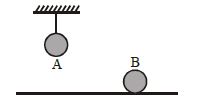
Two identical balls,$A$ and $B$,of uniform composition and initially at the same temperature,each absorb exactly the same amount of heat. $A$ is hanging from the ceiling while $B$ rests on the horizontal floor in the same room. Assuming no subsequent heat loss by the balls,which of the following statements is correct about their final temperatures,$T_A$ and $T_B$,once the balls have reached their final state?
A
$T_A < T_B$
B
$T_A > T_B$
C
$T_A = T_B$
D
$T_A \leq T_B$
Solution
(B) When the balls are heated,they expand,and their radii increase. This causes the center of mass of each ball to shift.
For ball $A$,which is suspended from the ceiling,the expansion causes its center of mass to move downward. As the center of mass moves downward,the gravitational potential energy of ball $A$ decreases. This decrease in potential energy is converted into internal energy,providing additional heating to the ball.
For ball $B$,which rests on the floor,the expansion causes its center of mass to move upward. As the center of mass moves upward,the gravitational potential energy of ball $B$ increases. This increase in potential energy requires energy,which is taken from the absorbed heat,effectively reducing the energy available for increasing the temperature of the ball.
Since ball $A$ gains additional internal energy from its gravitational potential energy change while ball $B$ loses some of its absorbed heat to increase its gravitational potential energy,the final temperature of ball $A$ will be higher than that of ball $B$. Therefore,$T_A > T_B$.
For ball $A$,which is suspended from the ceiling,the expansion causes its center of mass to move downward. As the center of mass moves downward,the gravitational potential energy of ball $A$ decreases. This decrease in potential energy is converted into internal energy,providing additional heating to the ball.
For ball $B$,which rests on the floor,the expansion causes its center of mass to move upward. As the center of mass moves upward,the gravitational potential energy of ball $B$ increases. This increase in potential energy requires energy,which is taken from the absorbed heat,effectively reducing the energy available for increasing the temperature of the ball.
Since ball $A$ gains additional internal energy from its gravitational potential energy change while ball $B$ loses some of its absorbed heat to increase its gravitational potential energy,the final temperature of ball $A$ will be higher than that of ball $B$. Therefore,$T_A > T_B$.
0 likes
View Solution94
MediumMCQ
The top of a lake gets frozen at a place where the surrounding air is at a temperature of $-20\,^oC$. Then
A
The temperature of the layer of water in contact with the lower surface of the ice block will be at $0\,^oC$ and that at the bottom of the lake will be $4\,^oC$
B
The temperature of water below the lower surface of ice will be $4\,^oC$ right up to the bottom of the lake
C
The temperature of the water below the lower surface of ice will be $0\,^oC$ right up to the bottom of the lake
D
The temperature of the layer of water immediately in contact with the lower surface of ice will be about $-20\,^oC$ and that of water at the bottom will be $0\,^oC$
Solution
(A) When the surface of a lake freezes,the ice acts as an insulator.
Since the density of water is maximum at $4\,^oC$,the water at the bottom of the lake remains at $4\,^oC$ due to convection currents that stop once the water reaches this temperature.
The layer of water in direct contact with the lower surface of the ice is in thermal equilibrium with the ice,which is at $0\,^oC$.
Therefore,the temperature gradient exists from $0\,^oC$ at the ice-water interface to $4\,^oC$ at the bottom of the lake.
Since the density of water is maximum at $4\,^oC$,the water at the bottom of the lake remains at $4\,^oC$ due to convection currents that stop once the water reaches this temperature.
The layer of water in direct contact with the lower surface of the ice is in thermal equilibrium with the ice,which is at $0\,^oC$.
Therefore,the temperature gradient exists from $0\,^oC$ at the ice-water interface to $4\,^oC$ at the bottom of the lake.
0 likes
View Solution95
MediumMCQ
$A$ refrigerator converts $500\,g$ of water at $25\,^{\circ}C$ into ice at $-10\,^{\circ}C$ in $3\,hours\,40\,minutes$. The quantity of heat removed per minute is ........ $cal/\min$.
(Specific heat of water $= 1\,cal/g\,^{\circ}C$,Specific heat of ice $= 0.5\,cal/g\,^{\circ}C$,Latent heat of fusion $= 80\,cal/g$)
(Specific heat of water $= 1\,cal/g\,^{\circ}C$,Specific heat of ice $= 0.5\,cal/g\,^{\circ}C$,Latent heat of fusion $= 80\,cal/g$)
A
$100$
B
$150$
C
$200$
D
$250$
Solution
(D) The total heat removed $(Q)$ consists of three parts:
$1$. Heat to cool water from $25\,^{\circ}C$ to $0\,^{\circ}C$: $Q_1 = m \cdot c_w \cdot \Delta T = 500 \times 1 \times 25 = 12500\,cal$.
$2$. Heat to freeze water at $0\,^{\circ}C$ to ice at $0\,^{\circ}C$: $Q_2 = m \cdot L_f = 500 \times 80 = 40000\,cal$.
$3$. Heat to cool ice from $0\,^{\circ}C$ to $-10\,^{\circ}C$: $Q_3 = m \cdot c_i \cdot \Delta T = 500 \times 0.5 \times 10 = 2500\,cal$.
Total heat $Q = Q_1 + Q_2 + Q_3 = 12500 + 40000 + 2500 = 55000\,cal$.
Total time $t = 3\,hours\,40\,minutes = (3 \times 60) + 40 = 220\,minutes$.
Heat removed per minute = $\frac{Q}{t} = \frac{55000}{220} = 250\,cal/min$.
$1$. Heat to cool water from $25\,^{\circ}C$ to $0\,^{\circ}C$: $Q_1 = m \cdot c_w \cdot \Delta T = 500 \times 1 \times 25 = 12500\,cal$.
$2$. Heat to freeze water at $0\,^{\circ}C$ to ice at $0\,^{\circ}C$: $Q_2 = m \cdot L_f = 500 \times 80 = 40000\,cal$.
$3$. Heat to cool ice from $0\,^{\circ}C$ to $-10\,^{\circ}C$: $Q_3 = m \cdot c_i \cdot \Delta T = 500 \times 0.5 \times 10 = 2500\,cal$.
Total heat $Q = Q_1 + Q_2 + Q_3 = 12500 + 40000 + 2500 = 55000\,cal$.
Total time $t = 3\,hours\,40\,minutes = (3 \times 60) + 40 = 220\,minutes$.
Heat removed per minute = $\frac{Q}{t} = \frac{55000}{220} = 250\,cal/min$.
0 likes
View Solution96
EasyMCQ
On which of the following four processes does the functioning of a bimetallic strip depend?
$(i)$ Radiation
$(ii)$ Energy conversion
$(iii)$ Melting
$(iv)$ Thermal expansion
$(i)$ Radiation
$(ii)$ Energy conversion
$(iii)$ Melting
$(iv)$ Thermal expansion
A
$(i), (iv)$
B
$(ii), (iv)$
C
$(iii), (iv)$
D
$(iv)$
Solution
(B) bimetallic strip consists of two different metals joined together,which have different coefficients of linear expansion.
When the temperature changes,the two metals expand or contract by different amounts due to the principle of thermal expansion $(iv)$.
This difference in expansion causes the strip to bend,which is a form of energy conversion $(ii)$ where thermal energy is converted into mechanical work (bending).
Therefore,the functioning of a bimetallic strip depends on both energy conversion and thermal expansion.
When the temperature changes,the two metals expand or contract by different amounts due to the principle of thermal expansion $(iv)$.
This difference in expansion causes the strip to bend,which is a form of energy conversion $(ii)$ where thermal energy is converted into mechanical work (bending).
Therefore,the functioning of a bimetallic strip depends on both energy conversion and thermal expansion.
0 likes
View Solution97
MediumMCQ
$A$ block of ice at $-20\,^oC$ having a mass of $2\, kg$ is added to $3\, kg$ of water at $15\,^oC$. Neglecting heat losses and the heat capacity of the container,which of the following is true?
A
The final temperature will be $0\,^oC$.
B
Ice will completely melt.
C
Water will partially freeze.
D
Final temperature will be more than $0\,^oC$.
Solution
(A) Heat required to raise the temperature of $2\, kg$ of ice from $-20\,^oC$ to $0\,^oC$ is $Q_1 = m_i c_i \Delta T = 2000 \, g \times 0.5 \, cal/g^oC \times 20^oC = 20,000 \, cal$.
Heat released by $3\, kg$ of water cooling from $15\,^oC$ to $0\,^oC$ is $Q_2 = m_w c_w \Delta T = 3000 \, g \times 1 \, cal/g^oC \times 15^oC = 45,000 \, cal$.
Net heat available to melt the ice at $0\,^oC$ is $Q_{net} = Q_2 - Q_1 = 45,000 - 20,000 = 25,000 \, cal$.
Heat required to melt all the ice is $Q_{melt} = m_i L_f = 2000 \, g \times 80 \, cal/g = 160,000 \, cal$.
Since $Q_{net} < Q_{melt}$,the ice will not melt completely. The system will reach an equilibrium state at $0\,^oC$ with a mixture of ice and water.
Heat released by $3\, kg$ of water cooling from $15\,^oC$ to $0\,^oC$ is $Q_2 = m_w c_w \Delta T = 3000 \, g \times 1 \, cal/g^oC \times 15^oC = 45,000 \, cal$.
Net heat available to melt the ice at $0\,^oC$ is $Q_{net} = Q_2 - Q_1 = 45,000 - 20,000 = 25,000 \, cal$.
Heat required to melt all the ice is $Q_{melt} = m_i L_f = 2000 \, g \times 80 \, cal/g = 160,000 \, cal$.
Since $Q_{net} < Q_{melt}$,the ice will not melt completely. The system will reach an equilibrium state at $0\,^oC$ with a mixture of ice and water.
0 likes
View Solution98
MediumMCQ
The ratio of the coefficient of volume expansion of a glass container to that of a viscous liquid kept inside the container is $1 : 4$. What fraction of the inner volume of the container should the liquid occupy so that the volume of the remaining vacant space will be same at all temperatures?
A
$2 : 5$
B
$1 : 4$
C
$1 : 64$
D
$1 : 8$
Solution
(B) Let $V_g$ be the volume of the glass container and $V_l$ be the volume of the liquid at temperature $T$. Let $\gamma_g$ and $\gamma_l$ be the coefficients of volume expansion of the glass and liquid,respectively.
Given $\gamma_g : \gamma_l = 1 : 4$,so $\gamma_l = 4\gamma_g$.
The vacant space is $V_v = V_g - V_l$.
For the vacant space to remain constant at all temperatures,the change in volume of the container must equal the change in volume of the liquid.
$\Delta V_g = \Delta V_l$
$V_g \gamma_g \Delta T = V_l \gamma_l \Delta T$
$V_g \gamma_g = V_l (4\gamma_g)$
$V_g = 4V_l$
Therefore,the fraction of the volume occupied by the liquid is $\frac{V_l}{V_g} = \frac{1}{4}$.
Given $\gamma_g : \gamma_l = 1 : 4$,so $\gamma_l = 4\gamma_g$.
The vacant space is $V_v = V_g - V_l$.
For the vacant space to remain constant at all temperatures,the change in volume of the container must equal the change in volume of the liquid.
$\Delta V_g = \Delta V_l$
$V_g \gamma_g \Delta T = V_l \gamma_l \Delta T$
$V_g \gamma_g = V_l (4\gamma_g)$
$V_g = 4V_l$
Therefore,the fraction of the volume occupied by the liquid is $\frac{V_l}{V_g} = \frac{1}{4}$.
0 likes
View Solution99
MediumMCQ
$500\, g$ of water and $100\, g$ of ice at $0\,^{\circ}C$ are in a calorimeter whose water equivalent is $40\, g$. $10\, g$ of steam at $100\,^{\circ}C$ is added to it. Then the final amount of water in the calorimeter is ....... $g$ (Latent heat of ice $= 80\, cal/g$,Latent heat of steam $= 540\, cal/g$).
A
$580$
B
$590$
C
$600$
D
$610$
Solution
(B) $1$. Heat released by $10\, g$ of steam at $100\,^{\circ}C$ to become water at $100\,^{\circ}C$: $Q_1 = m_s L_v = 10 \times 540 = 5400\, cal$.
$2$. Heat released by $10\, g$ of hot water at $100\,^{\circ}C$ to reach $0\,^{\circ}C$: $Q_2 = m_s c_w \Delta T = 10 \times 1 \times 100 = 1000\, cal$.
$3$. Total heat available to melt ice: $Q_{total} = 5400 + 1000 = 6400\, cal$.
$4$. Heat required to melt $100\, g$ of ice at $0\,^{\circ}C$: $Q_{ice} = m_i L_f = 100 \times 80 = 8000\, cal$.
$5$. Since $Q_{total} < Q_{ice}$,only a portion of ice melts. Mass of ice melted: $m_{melted} = Q_{total} / L_f = 6400 / 80 = 80\, g$.
$6$. Total water in the calorimeter = (Initial water) + (Mass of ice melted) + (Mass of condensed steam) = $500 + 80 + 10 = 590\, g$.
$2$. Heat released by $10\, g$ of hot water at $100\,^{\circ}C$ to reach $0\,^{\circ}C$: $Q_2 = m_s c_w \Delta T = 10 \times 1 \times 100 = 1000\, cal$.
$3$. Total heat available to melt ice: $Q_{total} = 5400 + 1000 = 6400\, cal$.
$4$. Heat required to melt $100\, g$ of ice at $0\,^{\circ}C$: $Q_{ice} = m_i L_f = 100 \times 80 = 8000\, cal$.
$5$. Since $Q_{total} < Q_{ice}$,only a portion of ice melts. Mass of ice melted: $m_{melted} = Q_{total} / L_f = 6400 / 80 = 80\, g$.
$6$. Total water in the calorimeter = (Initial water) + (Mass of ice melted) + (Mass of condensed steam) = $500 + 80 + 10 = 590\, g$.
0 likes
View Solution100
DifficultMCQ
$A$ thermally insulated vessel contains $150\, g$ of water at $0\, ^oC$. Then the air from the vessel is pumped out adiabatically. $A$ fraction of water turns into ice and the rest evaporates at $0\, ^oC$ itself. The mass of evaporated water will be closest to ....... $g$ (Latent heat of vaporization of water $= 2.10 \times 10^6\, J/kg$ and Latent heat of fusion of water $= 3.36 \times 10^5\, J/kg$).
A
$35$
B
$150$
C
$130$
D
$20$
Solution
(D) Let $m$ be the mass of water that evaporates in grams.
Since the process is adiabatic and no external heat is supplied,the heat released by the freezing of a portion of the water must be equal to the heat absorbed by the portion that evaporates.
Mass of water that turns into ice $= (150 - m)\, g$.
Heat released during freezing $\Delta Q_{rel} = (150 - m) \times L_f$.
Heat absorbed during evaporation $\Delta Q_{req} = m \times L_v$.
Equating the two: $(150 - m) \times L_f = m \times L_v$.
Substituting the values $L_f = 3.36 \times 10^5\, J/kg$ and $L_v = 2.10 \times 10^6\, J/kg$:
$(150 - m) \times 3.36 \times 10^5 = m \times 21.0 \times 10^5$.
$150 \times 3.36 = m \times (21.0 + 3.36)$.
$504 = m \times 24.36$.
$m = 504 / 24.36 \approx 20.69\, g$.
The mass of evaporated water is closest to $20\, g$.
Since the process is adiabatic and no external heat is supplied,the heat released by the freezing of a portion of the water must be equal to the heat absorbed by the portion that evaporates.
Mass of water that turns into ice $= (150 - m)\, g$.
Heat released during freezing $\Delta Q_{rel} = (150 - m) \times L_f$.
Heat absorbed during evaporation $\Delta Q_{req} = m \times L_v$.
Equating the two: $(150 - m) \times L_f = m \times L_v$.
Substituting the values $L_f = 3.36 \times 10^5\, J/kg$ and $L_v = 2.10 \times 10^6\, J/kg$:
$(150 - m) \times 3.36 \times 10^5 = m \times 21.0 \times 10^5$.
$150 \times 3.36 = m \times (21.0 + 3.36)$.
$504 = m \times 24.36$.
$m = 504 / 24.36 \approx 20.69\, g$.
The mass of evaporated water is closest to $20\, g$.
0 likes
View Solution10-1.Thermometry, Thermal Expansion and Calorimetry — Mix Examples-Thermometry, Thermal Expansion and Calorimetry · Frequently Asked Questions
1Are these 10-1.Thermometry, Thermal Expansion and Calorimetry questions useful for JEE and NEET?
Yes. All questions in this section are mapped to JEE Main and NEET exam patterns. Previous year questions from JEE Main, NEET, GUJCET and state-level exams are included with full solutions.
2Can I switch to Hindi or Gujarati for these questions?
Yes. Use the language tabs in the hero section or the sidebar to view the same questions and solutions in English, Hindi or Gujarati.
3How do I generate a question paper from this subtopic?
Use the Vedclass Exam Paper Generator — select the chapter and subtopic, set difficulty, and generate Sets A, B, C, D automatically. First 3 chapters of every subject are free.
Vedclass Products
For Students
Vedclass Test Series
Mock tests in real JEE/NEET style with performance analysis. 5-day free trial.
Start Free TrialFor Teachers
Exam Paper Generator
Generate Set A/B/C/D papers from this chapter in 2 minutes. 3 chapters free.
Try FreeFor Institutes
Online Exam Module
Live online exams with unlimited students, 360° analytics & white-label branding.
See DemoFor Teachers & Institutes
Generate a 10-1.Thermometry, Thermal Expansion and Calorimetry Exam Paper in 2 Minutes
Select subtopic & difficulty — Sets A, B, C, D auto-generated with No Repeat logic.
First 3 chapters of every subject are free — no payment required.