
અ Gujarati
Height and Distance Questions in Gujarati
Class 11 Mathematics · Trigonometrical Equations · Height and Distance
159+
Questions
Gujarati
Language
100%
With Solutions
Showing 41 of 159 questions in Gujarati
101
DifficultMCQ
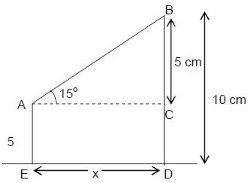
ક્ષૈતિજ જમીન પર ઉભેલા બે થાંભલાઓની ઊંચાઈ અનુક્રમે $5 \, m$ અને $10 \, m$ છે. તેમના ટોચના બિંદુઓને જોડતી રેખા જમીન સાથે $15^o$ નો ખૂણો બનાવે છે. તો થાંભલાઓ વચ્ચેનું અંતર ($m$ માં) કેટલું હશે?
A
$\frac{5}{2} \, (2 + \sqrt{3})$
B
$5 \, (\sqrt{3} + 1)$
C
$5 \, (2 + \sqrt{3})$
D
$10 \, (\sqrt{3} - 1)$
Solution
(C) ધારો કે બે થાંભલાઓની ઊંચાઈ $h_1 = 5 \, m$ અને $h_2 = 10 \, m$ છે. તેમની વચ્ચેનું અંતર $x$ છે.
નાના થાંભલાની ટોચથી મોટા થાંભલા પર એક આડી રેખા દોરતા,આપણને એક કાટકોણ ત્રિકોણ મળે છે જેની ઊભી બાજુની લંબાઈ $h_2 - h_1 = 10 - 5 = 5 \, m$ છે.
નાના થાંભલાની ટોચથી મોટા થાંભલાની ટોચનો ઉત્સેધકોણ $15^o$ છે.
કાટકોણ ત્રિકોણમાં:
$\tan(15^o) = \frac{\text{સામેની બાજુ}}{\text{પાસેની બાજુ}} = \frac{5}{x}$
$\tan(15^o) = 2 - \sqrt{3}$ હોવાથી:
$2 - \sqrt{3} = \frac{5}{x}$
$x = \frac{5}{2 - \sqrt{3}}$
છેદનું સંમેયીકરણ કરતા:
$x = \frac{5(2 + \sqrt{3})}{4 - 3} = 5(2 + \sqrt{3}) \, m$.
નાના થાંભલાની ટોચથી મોટા થાંભલા પર એક આડી રેખા દોરતા,આપણને એક કાટકોણ ત્રિકોણ મળે છે જેની ઊભી બાજુની લંબાઈ $h_2 - h_1 = 10 - 5 = 5 \, m$ છે.
નાના થાંભલાની ટોચથી મોટા થાંભલાની ટોચનો ઉત્સેધકોણ $15^o$ છે.
કાટકોણ ત્રિકોણમાં:
$\tan(15^o) = \frac{\text{સામેની બાજુ}}{\text{પાસેની બાજુ}} = \frac{5}{x}$
$\tan(15^o) = 2 - \sqrt{3}$ હોવાથી:
$2 - \sqrt{3} = \frac{5}{x}$
$x = \frac{5}{2 - \sqrt{3}}$
છેદનું સંમેયીકરણ કરતા:
$x = \frac{5(2 + \sqrt{3})}{4 - 3} = 5(2 + \sqrt{3}) \, m$.
0 likes
View Solution102
DifficultMCQ
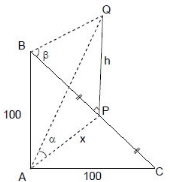
$ABC$ એક ત્રિકોણાકાર પાર્ક છે જેમાં $AB = AC = 100 \text{ મીટર}$ છે. $BC$ ના મધ્યબિંદુ $P$ પર એક શિરોલંબ ટાવર આવેલો છે. જો ટાવરની ટોચ $Q$ ના $A$ અને $B$ આગળના ઉત્સેધકોણ અનુક્રમે $\cot^{-1}(3\sqrt{2})$ અને $\csc^{-1}(2\sqrt{2})$ હોય,તો ટાવરની ઊંચાઈ (મીટરમાં) શોધો.
A
$25$
B
$10\sqrt{5}$
C
$\frac{100}{3\sqrt{3}}$
D
$20$
Solution
(D) $P$ એ $BC$ નું મધ્યબિંદુ છે. $\triangle ABC$ માં,$AB=AC=100$. ધારો કે $AP = x$. $P$ એ $BC$ નું મધ્યબિંદુ હોવાથી,$AP \perp BC$.
$\triangle ABP$ માં,$BP^2 = AB^2 - AP^2 = 100^2 - x^2$. તેથી $BP = \sqrt{10000 - x^2}$.
ટાવરની ઊંચાઈ $PQ = h$ છે.
$A$ આગળ ઉત્સેધકોણ $\alpha = \cot^{-1}(3\sqrt{2})$ છે,તેથી $\cot \alpha = \frac{AP}{PQ} = \frac{x}{h} = 3\sqrt{2} \implies x = 3\sqrt{2}h$.
$B$ આગળ ઉત્સેધકોણ $\beta = \csc^{-1}(2\sqrt{2})$ છે,તેથી $\csc \beta = \frac{BQ}{PQ} = \frac{\sqrt{BP^2 + h^2}}{h} = 2\sqrt{2}$.
બંને બાજુ વર્ગ કરતા: $\frac{BP^2 + h^2}{h^2} = 8 \implies BP^2 + h^2 = 8h^2 \implies BP^2 = 7h^2$.
$BP^2 = 100^2 - x^2$ મૂકતા: $10000 - x^2 = 7h^2$.
$x = 3\sqrt{2}h$ મૂકતા: $10000 - (3\sqrt{2}h)^2 = 7h^2 \implies 10000 - 18h^2 = 7h^2$.
$25h^2 = 10000 \implies h^2 = 400 \implies h = 20$.
$\triangle ABP$ માં,$BP^2 = AB^2 - AP^2 = 100^2 - x^2$. તેથી $BP = \sqrt{10000 - x^2}$.
ટાવરની ઊંચાઈ $PQ = h$ છે.
$A$ આગળ ઉત્સેધકોણ $\alpha = \cot^{-1}(3\sqrt{2})$ છે,તેથી $\cot \alpha = \frac{AP}{PQ} = \frac{x}{h} = 3\sqrt{2} \implies x = 3\sqrt{2}h$.
$B$ આગળ ઉત્સેધકોણ $\beta = \csc^{-1}(2\sqrt{2})$ છે,તેથી $\csc \beta = \frac{BQ}{PQ} = \frac{\sqrt{BP^2 + h^2}}{h} = 2\sqrt{2}$.
બંને બાજુ વર્ગ કરતા: $\frac{BP^2 + h^2}{h^2} = 8 \implies BP^2 + h^2 = 8h^2 \implies BP^2 = 7h^2$.
$BP^2 = 100^2 - x^2$ મૂકતા: $10000 - x^2 = 7h^2$.
$x = 3\sqrt{2}h$ મૂકતા: $10000 - (3\sqrt{2}h)^2 = 7h^2 \implies 10000 - 18h^2 = 7h^2$.
$25h^2 = 10000 \implies h^2 = 400 \implies h = 20$.
0 likes
View Solution103
DifficultMCQ
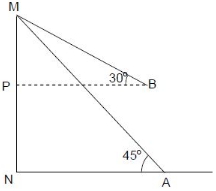
એક સમક્ષિતિજ સમતલ પર ઉભેલા ઉભા ટાવરની ટોચનો ઉત્સેધકોણ સમતલ પરના બિંદુ $A$ થી $45^o$ માલૂમ પડે છે. ધારો કે $B$ એ બિંદુ $A$ ની ઉપર $30 \, m$ ઉંચાઈએ આવેલું બિંદુ છે. જો $B$ થી ટાવરની ટોચનો ઉત્સેધકોણ $30^o$ હોય,તો ટાવરના પાયાથી બિંદુ $A$ નું અંતર ($m$ માં) કેટલું છે?
A
$15(1 + \sqrt{3})$
B
$15(3 - \sqrt{3})$
C
$15(3 + \sqrt{3})$
D
$15(5 - \sqrt{3})$
Solution
(C) ધારો કે $MN$ એ $h$ ઊંચાઈનો ટાવર છે અને $AN = x$ એ ટાવરના પાયાથી બિંદુ $A$ નું અંતર છે.
$\Delta ANM$ માં,$\tan(45^o) = \frac{MN}{AN} = \frac{h}{x} = 1 \Rightarrow h = x$.
બિંદુ $B$ એ $A$ થી $30 \, m$ ઉપર છે,તેથી $PB = AN = x$ અને $PM = MN - NP = h - 30 = x - 30$.
$\Delta BPM$ માં,$\tan(30^o) = \frac{PM}{PB} = \frac{x - 30}{x}$.
$\frac{1}{\sqrt{3}} = \frac{x - 30}{x} \Rightarrow x = \sqrt{3}x - 30\sqrt{3}$.
$x(\sqrt{3} - 1) = 30\sqrt{3} \Rightarrow x = \frac{30\sqrt{3}}{\sqrt{3} - 1}$.
છેદનું સંમેયીકરણ કરતા: $x = \frac{30\sqrt{3}(\sqrt{3} + 1)}{(\sqrt{3} - 1)(\sqrt{3} + 1)} = \frac{30(3 + \sqrt{3})}{3 - 1} = \frac{30(3 + \sqrt{3})}{2} = 15(3 + \sqrt{3}) \, m$.
$\Delta ANM$ માં,$\tan(45^o) = \frac{MN}{AN} = \frac{h}{x} = 1 \Rightarrow h = x$.
બિંદુ $B$ એ $A$ થી $30 \, m$ ઉપર છે,તેથી $PB = AN = x$ અને $PM = MN - NP = h - 30 = x - 30$.
$\Delta BPM$ માં,$\tan(30^o) = \frac{PM}{PB} = \frac{x - 30}{x}$.
$\frac{1}{\sqrt{3}} = \frac{x - 30}{x} \Rightarrow x = \sqrt{3}x - 30\sqrt{3}$.
$x(\sqrt{3} - 1) = 30\sqrt{3} \Rightarrow x = \frac{30\sqrt{3}}{\sqrt{3} - 1}$.
છેદનું સંમેયીકરણ કરતા: $x = \frac{30\sqrt{3}(\sqrt{3} + 1)}{(\sqrt{3} - 1)(\sqrt{3} + 1)} = \frac{30(3 + \sqrt{3})}{3 - 1} = \frac{30(3 + \sqrt{3})}{2} = 15(3 + \sqrt{3}) \, m$.
0 likes
View Solution104
DifficultMCQ
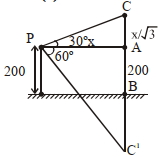
એક શાંત સરોવરની સપાટીથી $200 \ m$ ઊંચાઈએ આવેલા બિંદુ $P$ થી એક વાદળ $C$ નો ઉત્સેધકોણ $30^{\circ}$ છે. જો બિંદુ $P$ થી સરોવરમાં વાદળના પ્રતિબિંબનો અવસેધકોણ $60^{\circ}$ હોય,તો $PC$ ($m$ માં) કેટલું થાય?
A
$400$
B
$400 \sqrt{3}$
C
$100$
D
$200 \sqrt{3}$
Solution
(A) ધારો કે $PA = x$ એ $P$ થી વાદળ $C$ માંથી પસાર થતી શિરોલંબ રેખા સુધીનું સમક્ષિતિજ અંતર છે.
$\Delta PAC$ માં,$\tan(30^{\circ}) = \frac{AC}{PA} \Rightarrow AC = \frac{x}{\sqrt{3}}$.
વાદળની સરોવરની સપાટીથી ઊંચાઈ $H = AC + 200 = \frac{x}{\sqrt{3}} + 200$ છે.
પ્રતિબિંબ $C'$ સપાટીથી $H$ ઊંડાઈએ છે,તેથી $BC' = \frac{x}{\sqrt{3}} + 200$.
$\Delta PBC'$ માં,કુલ શિરોલંબ અંતર $AC' = 200 + (\frac{x}{\sqrt{3}} + 200) = 400 + \frac{x}{\sqrt{3}}$.
અવસેધકોણ $60^{\circ}$ હોવાથી,$\tan(60^{\circ}) = \frac{AC'}{PA} = \frac{400 + x/\sqrt{3}}{x}$.
$\sqrt{3}x = 400 + \frac{x}{\sqrt{3}}$ $\Rightarrow 3x = 400\sqrt{3} + x$ $\Rightarrow 2x = 400\sqrt{3}$ $\Rightarrow x = 200\sqrt{3}$.
$\Delta PAC$ માં,$PC = \frac{PA}{\cos(30^{\circ})} = \frac{2x}{\sqrt{3}} = \frac{2(200\sqrt{3})}{\sqrt{3}} = 400 \ m$.
$\Delta PAC$ માં,$\tan(30^{\circ}) = \frac{AC}{PA} \Rightarrow AC = \frac{x}{\sqrt{3}}$.
વાદળની સરોવરની સપાટીથી ઊંચાઈ $H = AC + 200 = \frac{x}{\sqrt{3}} + 200$ છે.
પ્રતિબિંબ $C'$ સપાટીથી $H$ ઊંડાઈએ છે,તેથી $BC' = \frac{x}{\sqrt{3}} + 200$.
$\Delta PBC'$ માં,કુલ શિરોલંબ અંતર $AC' = 200 + (\frac{x}{\sqrt{3}} + 200) = 400 + \frac{x}{\sqrt{3}}$.
અવસેધકોણ $60^{\circ}$ હોવાથી,$\tan(60^{\circ}) = \frac{AC'}{PA} = \frac{400 + x/\sqrt{3}}{x}$.
$\sqrt{3}x = 400 + \frac{x}{\sqrt{3}}$ $\Rightarrow 3x = 400\sqrt{3} + x$ $\Rightarrow 2x = 400\sqrt{3}$ $\Rightarrow x = 200\sqrt{3}$.
$\Delta PAC$ માં,$PC = \frac{PA}{\cos(30^{\circ})} = \frac{2x}{\sqrt{3}} = \frac{2(200\sqrt{3})}{\sqrt{3}} = 400 \ m$.
0 likes
View Solution105
MediumMCQ
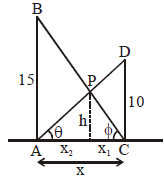
બે શિરોલંબ થાંભલા $AB = 15 \ m$ અને $CD = 10 \ m$ સમક્ષિતિજ જમીન પર એકબીજાથી દૂર ઉભા છે,જેમાં બિંદુઓ $A$ અને $C$ જમીન પર છે. જો $P$ એ $BC$ અને $AD$ નું છેદબિંદુ હોય,તો રેખા $AC$ થી ઉપર $P$ ની ઊંચાઈ ($m$ માં) કેટલી થાય?
A
$\frac{20}{3}$
B
$5$
C
$\frac{10}{3}$
D
$6$
Solution
(D) ધારો કે થાંભલાઓ વચ્ચેનું સમક્ષિતિજ અંતર $x$ છે. ધારો કે જમીન $AC$ થી ઉપર છેદબિંદુ $P$ ની ઊંચાઈ $h$ છે.
ધારો કે $P$ થી $AC$ પરના લંબનો પગ $M$ છે. ધારો કે $AM = x_2$ અને $MC = x_1$,તેથી $x_1 + x_2 = x$.
$\triangle AMC$ અને $\triangle BCD$ માં,આપણી પાસે $\triangle PMC \sim \triangle ABC$ અને $\triangle PMA \sim \triangle ADC$ છે.
સમરૂપતા પરથી,$\frac{h}{15} = \frac{x_1}{x}$ અને $\frac{h}{10} = \frac{x_2}{x}$.
આ બે સમીકરણોનો સરવાળો કરતા: $\frac{h}{15} + \frac{h}{10} = \frac{x_1 + x_2}{x} = \frac{x}{x} = 1$.
$\frac{2h + 3h}{30} = 1$ $\Rightarrow \frac{5h}{30} = 1$ $\Rightarrow \frac{h}{6} = 1$.
તેથી,$h = 6 \ m$.
ધારો કે $P$ થી $AC$ પરના લંબનો પગ $M$ છે. ધારો કે $AM = x_2$ અને $MC = x_1$,તેથી $x_1 + x_2 = x$.
$\triangle AMC$ અને $\triangle BCD$ માં,આપણી પાસે $\triangle PMC \sim \triangle ABC$ અને $\triangle PMA \sim \triangle ADC$ છે.
સમરૂપતા પરથી,$\frac{h}{15} = \frac{x_1}{x}$ અને $\frac{h}{10} = \frac{x_2}{x}$.
આ બે સમીકરણોનો સરવાળો કરતા: $\frac{h}{15} + \frac{h}{10} = \frac{x_1 + x_2}{x} = \frac{x}{x} = 1$.
$\frac{2h + 3h}{30} = 1$ $\Rightarrow \frac{5h}{30} = 1$ $\Rightarrow \frac{h}{6} = 1$.
તેથી,$h = 6 \ m$.
0 likes
View Solution106
DifficultMCQ
જમીન પરના એક બિંદુથી પર્વતના શિખરનો ઉત્સેધકોણ $45^{\circ}$ છે. જમીનથી $30^{\circ}$ ના ખૂણે શિખર તરફ $1 \ km$ ઉપર ચઢ્યા પછી,શિખરનો ઉત્સેધકોણ $60^{\circ}$ માલૂમ પડે છે. તો જમીનથી શિખરની ઊંચાઈ ($km$ માં) કેટલી છે?
A
$\frac{1}{\sqrt{3}-1}$
B
$\frac{1}{\sqrt{3}+1}$
C
$\frac{\sqrt{3}-1}{\sqrt{3}+1}$
D
$\frac{\sqrt{3}+1}{\sqrt{3}-1}$
Solution
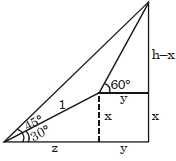
(A) ધારો કે શિખરની ઊંચાઈ $h$ છે. શરૂઆતના બિંદુથી,$\tan 45^{\circ} = \frac{h}{d} \Rightarrow d = h$,જ્યાં $d$ એ પર્વતના પાયા સુધીનું આડું અંતર છે.
$30^{\circ}$ ના ખૂણે $1 \ km$ ચઢ્યા પછી,નવું સ્થાન ઊંચાઈ $x = 1 \cdot \sin 30^{\circ} = \frac{1}{2} \ km$ અને શરૂઆતના બિંદુથી આડું અંતર $z = 1 \cdot \cos 30^{\circ} = \frac{\sqrt{3}}{2} \ km$ પર છે.
પર્વત સુધીનું નવું આડું અંતર $y = d - z = h - \frac{\sqrt{3}}{2}$ છે.
વર્તમાન સ્થાનની સાપેક્ષમાં નવી ઊંચાઈ $h - x = h - \frac{1}{2}$ છે.
નવો ઉત્સેધકોણ $60^{\circ}$ આપેલ હોવાથી,$\tan 60^{\circ} = \frac{h - x}{y}$ થાય.
$\sqrt{3} = \frac{h - 1/2}{h - \sqrt{3}/2}$.
$\sqrt{3}(h - \frac{\sqrt{3}}{2}) = h - \frac{1}{2}$.
$\sqrt{3}h - \frac{3}{2} = h - \frac{1}{2}$.
$h(\sqrt{3} - 1) = \frac{3}{2} - \frac{1}{2} = 1$.
$h = \frac{1}{\sqrt{3} - 1}$.
$30^{\circ}$ ના ખૂણે $1 \ km$ ચઢ્યા પછી,નવું સ્થાન ઊંચાઈ $x = 1 \cdot \sin 30^{\circ} = \frac{1}{2} \ km$ અને શરૂઆતના બિંદુથી આડું અંતર $z = 1 \cdot \cos 30^{\circ} = \frac{\sqrt{3}}{2} \ km$ પર છે.
પર્વત સુધીનું નવું આડું અંતર $y = d - z = h - \frac{\sqrt{3}}{2}$ છે.
વર્તમાન સ્થાનની સાપેક્ષમાં નવી ઊંચાઈ $h - x = h - \frac{1}{2}$ છે.
નવો ઉત્સેધકોણ $60^{\circ}$ આપેલ હોવાથી,$\tan 60^{\circ} = \frac{h - x}{y}$ થાય.
$\sqrt{3} = \frac{h - 1/2}{h - \sqrt{3}/2}$.
$\sqrt{3}(h - \frac{\sqrt{3}}{2}) = h - \frac{1}{2}$.
$\sqrt{3}h - \frac{3}{2} = h - \frac{1}{2}$.
$h(\sqrt{3} - 1) = \frac{3}{2} - \frac{1}{2} = 1$.
$h = \frac{1}{\sqrt{3} - 1}$.
0 likes
View Solution107
DifficultMCQ
ટેકરીના તળિયામાંથી પસાર થતા સમક્ષિતિજ સમતલ પરના એક બિંદુથી ટેકરીની ટોચનો ઉત્સેધકોણ $45^{\circ}$ માલૂમ પડે છે. સમક્ષિતિજ સમતલ સાથે $30^{\circ}$ ના ખૂણે ઢળેલા ઢોળાવ પર ટોચ તરફ $80 \ m$ અંતર ચાલ્યા પછી,ટેકરીની ટોચનો ઉત્સેધકોણ $75^{\circ}$ થાય છે. તો ટેકરીની ઊંચાઈ (મીટરમાં) કેટલી હશે?
A
$40$
B
$80$
C
$120$
D
$160$
Solution
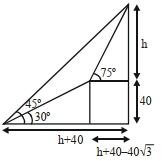
(B) ધારો કે ટેકરીની ઊંચાઈ $H$ છે. શરૂઆતનું બિંદુ ટેકરીના તળિયાથી $H$ અંતરે છે કારણ કે ઉત્સેધકોણ $45^{\circ}$ છે.
$30^{\circ}$ ના ઢોળાવ પર $80 \ m$ ચાલ્યા પછી,નવું સ્થાન શરૂઆતના બિંદુથી $80 \cos 30^{\circ} = 40\sqrt{3} \ m$ સમક્ષિતિજ અંતરે અને સમક્ષિતિજ સમતલથી $80 \sin 30^{\circ} = 40 \ m$ ઊંચાઈએ છે.
ટેકરીના તળિયા સુધીનું બાકીનું સમક્ષિતિજ અંતર $H - 40\sqrt{3}$ છે.
વર્તમાન સ્થાનથી નવી ઊંચાઈ $H - 40$ છે.
નવો ઉત્સેધકોણ $75^{\circ}$ હોવાથી,$\tan 75^{\circ} = \frac{H - 40}{H - 40\sqrt{3}}$.
$\tan 75^{\circ} = 2 + \sqrt{3}$ હોવાથી,$2 + \sqrt{3} = \frac{H - 40}{H - 40\sqrt{3}}$.
$(2 + \sqrt{3})(H - 40\sqrt{3}) = H - 40$.
$2H - 80\sqrt{3} + \sqrt{3}H - 120 = H - 40$.
$H(1 + \sqrt{3}) = 80 + 80\sqrt{3} = 80(1 + \sqrt{3})$.
$H = 80 \ m$.
$30^{\circ}$ ના ઢોળાવ પર $80 \ m$ ચાલ્યા પછી,નવું સ્થાન શરૂઆતના બિંદુથી $80 \cos 30^{\circ} = 40\sqrt{3} \ m$ સમક્ષિતિજ અંતરે અને સમક્ષિતિજ સમતલથી $80 \sin 30^{\circ} = 40 \ m$ ઊંચાઈએ છે.
ટેકરીના તળિયા સુધીનું બાકીનું સમક્ષિતિજ અંતર $H - 40\sqrt{3}$ છે.
વર્તમાન સ્થાનથી નવી ઊંચાઈ $H - 40$ છે.
નવો ઉત્સેધકોણ $75^{\circ}$ હોવાથી,$\tan 75^{\circ} = \frac{H - 40}{H - 40\sqrt{3}}$.
$\tan 75^{\circ} = 2 + \sqrt{3}$ હોવાથી,$2 + \sqrt{3} = \frac{H - 40}{H - 40\sqrt{3}}$.
$(2 + \sqrt{3})(H - 40\sqrt{3}) = H - 40$.
$2H - 80\sqrt{3} + \sqrt{3}H - 120 = H - 40$.
$H(1 + \sqrt{3}) = 80 + 80\sqrt{3} = 80(1 + \sqrt{3})$.
$H = 80 \ m$.
0 likes
View Solution108
MediumMCQ
એક થાંભલો ત્રિકોણાકાર બગીચા $\Delta ABC$ ની અંદર ઉભો છે. ધારો કે બગીચાના દરેક ખૂણેથી થાંભલાની ટોચનો ઉત્સેધકોણ $\frac{\pi}{3}$ છે. જો $\Delta ABC$ ના પરિવૃતની ત્રિજ્યા $2$ હોય,તો થાંભલાની ઊંચાઈ કેટલી થાય?
A
$\frac{2 \sqrt{3}}{3}$
B
$2 \sqrt{3}$
C
$\sqrt{3}$
D
$\frac{1}{\sqrt{3}}$
Solution
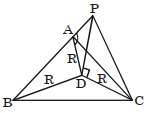
(B) ધારો કે થાંભલાની ઊંચાઈ $h = PD$ છે,જ્યાં $P$ એ થાંભલાની ટોચ છે અને $D$ એ જમીન પર થાંભલાનો આધાર છે.
બગીચાના દરેક ખૂણા $A, B, C$ થી થાંભલાની ટોચ $P$ નો ઉત્સેધકોણ સમાન $(\frac{\pi}{3})$ હોવાથી,$D$ થી દરેક શિરોબિંદુ $A, B, C$ સુધીનું અંતર સમાન હોવું જોઈએ.
આમ,$DA = DB = DC = R$,જ્યાં $R$ એ $\Delta ABC$ ની પરિત્રિજ્યા છે.
આપેલ છે કે $R = 2$.
કાટકોણ ત્રિકોણ $\Delta PDA$ માં,આપણી પાસે છે:
$\tan\left(\frac{\pi}{3}\right) = \frac{PD}{DA} = \frac{h}{R}$
$h = R \tan\left(\frac{\pi}{3}\right) = 2 \times \sqrt{3} = 2\sqrt{3}$.
બગીચાના દરેક ખૂણા $A, B, C$ થી થાંભલાની ટોચ $P$ નો ઉત્સેધકોણ સમાન $(\frac{\pi}{3})$ હોવાથી,$D$ થી દરેક શિરોબિંદુ $A, B, C$ સુધીનું અંતર સમાન હોવું જોઈએ.
આમ,$DA = DB = DC = R$,જ્યાં $R$ એ $\Delta ABC$ ની પરિત્રિજ્યા છે.
આપેલ છે કે $R = 2$.
કાટકોણ ત્રિકોણ $\Delta PDA$ માં,આપણી પાસે છે:
$\tan\left(\frac{\pi}{3}\right) = \frac{PD}{DA} = \frac{h}{R}$
$h = R \tan\left(\frac{\pi}{3}\right) = 2 \times \sqrt{3} = 2\sqrt{3}$.
0 likes
View Solution109
EasyMCQ
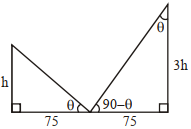
બે શિરોલંબ થાંભલાઓ એકબીજાથી $150 \ m$ દૂર છે અને એકની ઊંચાઈ બીજા કરતાં ત્રણ ગણી છે. જો તેમના પાયાને જોડતી રેખાના મધ્યબિંદુથી,એક નિરીક્ષક તેમના ટોચના ઉત્સેધકોણ કોટિકોણ હોવાનું માલૂમ કરે,તો ટૂંકા થાંભલાની ઊંચાઈ (મીટરમાં) કેટલી થાય?
A
$20 \sqrt{3}$
B
$25 \sqrt{3}$
C
$30$
D
$25$
Solution
(B) ધારો કે ટૂંકા થાંભલાની ઊંચાઈ $h$ છે અને ઊંચા થાંભલાની ઊંચાઈ $3h$ છે. થાંભલાઓ વચ્ચેનું અંતર $150 \ m$ છે. નિરીક્ષક મધ્યબિંદુ પર છે,તેથી નિરીક્ષકથી દરેક થાંભલાનું અંતર $75 \ m$ છે.
ધારો કે ટૂંકા થાંભલાનો ઉત્સેધકોણ $\theta$ છે. ખૂણાઓ કોટિકોણ હોવાથી,ઊંચા થાંભલાનો ઉત્સેધકોણ $90^\circ - \theta$ છે.
ટૂંકા થાંભલા માટે: $\tan \theta = \frac{h}{75}$.
ઊંચા થાંભલા માટે: $\tan(90^\circ - \theta) = \frac{3h}{75} \Rightarrow \cot \theta = \frac{3h}{75} = \frac{h}{25}$.
બંને સમીકરણોનો ગુણાકાર કરતા: $\tan \theta \cdot \cot \theta = \left(\frac{h}{75}\right) \cdot \left(\frac{h}{25}\right)$.
$1 = \frac{h^2}{1875} \Rightarrow h^2 = 1875$.
$h = \sqrt{1875} = \sqrt{625 \times 3} = 25 \sqrt{3} \ m$.
ધારો કે ટૂંકા થાંભલાનો ઉત્સેધકોણ $\theta$ છે. ખૂણાઓ કોટિકોણ હોવાથી,ઊંચા થાંભલાનો ઉત્સેધકોણ $90^\circ - \theta$ છે.
ટૂંકા થાંભલા માટે: $\tan \theta = \frac{h}{75}$.
ઊંચા થાંભલા માટે: $\tan(90^\circ - \theta) = \frac{3h}{75} \Rightarrow \cot \theta = \frac{3h}{75} = \frac{h}{25}$.
બંને સમીકરણોનો ગુણાકાર કરતા: $\tan \theta \cdot \cot \theta = \left(\frac{h}{75}\right) \cdot \left(\frac{h}{25}\right)$.
$1 = \frac{h^2}{1875} \Rightarrow h^2 = 1875$.
$h = \sqrt{1875} = \sqrt{625 \times 3} = 25 \sqrt{3} \ m$.
0 likes
View Solution110
DifficultMCQ
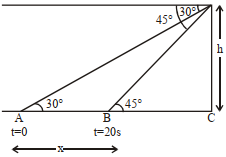
એક માણસ ટાવરની ટોચ પરથી એક હોડીને અમુક બિંદુ $A$ થી ટાવર તરફ સમાન ઝડપે આવતી જોઈ રહ્યો છે. તે બિંદુએ,માણસની આંખથી હોડીનો અવસેધકોણ $30^{\circ}$ છે (માણસની ઊંચાઈને અવગણો). ટાવરના પાયા તરફ (જે પાણીની સપાટી પર છે) $20 \text{ સેકન્ડ}$ સુધી મુસાફરી કર્યા પછી,હોડી બિંદુ $B$ પર પહોંચે છે,જ્યાં અવસેધકોણ $45^{\circ}$ છે. તો હોડીને $B$ થી ટાવરના પાયા સુધી પહોંચતા લાગતો સમય (સેકન્ડમાં) કેટલો હશે?
A
$10$
B
$10 \sqrt{3}$
C
$10(\sqrt{3}+1)$
D
$10(\sqrt{3}-1)$
Solution
(C) ધારો કે ટાવરની ઊંચાઈ $h$ છે અને હોડીની ઝડપ $v \text{ m/s}$ છે.
ધારો કે $C$ એ ટાવરનો પાયો છે.
$\triangle ADC$ માં,$\tan 30^{\circ} = \frac{h}{AC} \implies AC = h \cot 30^{\circ} = h\sqrt{3}$.
$\triangle BDC$ માં,$\tan 45^{\circ} = \frac{h}{BC} \implies BC = h \cot 45^{\circ} = h$.
અંતર $AB = AC - BC = h\sqrt{3} - h = h(\sqrt{3}-1)$.
હોડી $AB$ અંતર $20 \text{ સેકન્ડ}$ માં કાપે છે,તેથી ઝડપ $v = \frac{AB}{20} = \frac{h(\sqrt{3}-1)}{20}$.
$B$ થી $C$ સુધી મુસાફરી કરવા માટે લાગતો સમય $t = \frac{BC}{v} = \frac{h}{\frac{h(\sqrt{3}-1)}{20}} = \frac{20}{\sqrt{3}-1}$.
છેદનું સંમેયીકરણ કરતા: $t = \frac{20(\sqrt{3}+1)}{(\sqrt{3}-1)(\sqrt{3}+1)} = \frac{20(\sqrt{3}+1)}{3-1} = \frac{20(\sqrt{3}+1)}{2} = 10(\sqrt{3}+1) \text{ સેકન્ડ}$.
ધારો કે $C$ એ ટાવરનો પાયો છે.
$\triangle ADC$ માં,$\tan 30^{\circ} = \frac{h}{AC} \implies AC = h \cot 30^{\circ} = h\sqrt{3}$.
$\triangle BDC$ માં,$\tan 45^{\circ} = \frac{h}{BC} \implies BC = h \cot 45^{\circ} = h$.
અંતર $AB = AC - BC = h\sqrt{3} - h = h(\sqrt{3}-1)$.
હોડી $AB$ અંતર $20 \text{ સેકન્ડ}$ માં કાપે છે,તેથી ઝડપ $v = \frac{AB}{20} = \frac{h(\sqrt{3}-1)}{20}$.
$B$ થી $C$ સુધી મુસાફરી કરવા માટે લાગતો સમય $t = \frac{BC}{v} = \frac{h}{\frac{h(\sqrt{3}-1)}{20}} = \frac{20}{\sqrt{3}-1}$.
છેદનું સંમેયીકરણ કરતા: $t = \frac{20(\sqrt{3}+1)}{(\sqrt{3}-1)(\sqrt{3}+1)} = \frac{20(\sqrt{3}+1)}{3-1} = \frac{20(\sqrt{3}+1)}{2} = 10(\sqrt{3}+1) \text{ સેકન્ડ}$.
1 likes
View Solution111
DifficultMCQ
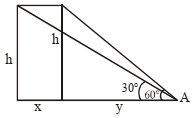
જમીન પરના બિંદુ $A$ થી જેટ પ્લેનનો ઉત્સેધકોણ $60^{\circ}$ છે। $432 \, km/h$ ની ઝડપે $20 \, s$ ની ઉડાન પછી, ઉત્સેધકોણ બદલાઈને $30^{\circ}$ થાય છે। જો જેટ પ્લેન અચળ ઊંચાઈએ ઉડી રહ્યું હોય, તો તેની ઊંચાઈ ..... $m$ છે। ($\sqrt{3}$ માં)
A
$1800$
B
$3600$
C
$2400$
D
$1200$
Solution
(D) ધારો કે જેટ પ્લેનની ઊંચાઈ $h \, m$ છે। જમીન પરનું બિંદુ $A$ છે।
પ્રથમ સ્થિતિ પરથી, $\tan 60^{\circ} = \frac{h}{y}$ $\Rightarrow \sqrt{3} = \frac{h}{y}$ $\Rightarrow y = \frac{h}{\sqrt{3}} \quad \dots (1)$
$20 \, s$ પછી, પ્લેન $x$ જેટલું અંતર કાપે છે।
ઝડપ $= 432 \, km/h = 432 \times \frac{5}{18} \, m/s = 120 \, m/s$.
અંતર $x = \text{ઝડપ} \times \text{સમય} = 120 \times 20 = 2400 \, m$.
બીજી સ્થિતિ પરથી, $\tan 30^{\circ} = \frac{h}{x + y}$ $\Rightarrow \frac{1}{\sqrt{3}} = \frac{h}{2400 + y}$ $\Rightarrow 2400 + y = h\sqrt{3} \quad \dots (2)$
$(1)$ માંથી $y$ ની કિંમત $(2)$ માં મૂકતા:
$2400 + \frac{h}{\sqrt{3}} = h\sqrt{3}$
$2400 = h\sqrt{3} - \frac{h}{\sqrt{3}} = h \left( \frac{3 - 1}{\sqrt{3}} \right) = \frac{2h}{\sqrt{3}}$
$h = \frac{2400 \times \sqrt{3}}{2} = 1200 \sqrt{3} \, m$.
પ્રથમ સ્થિતિ પરથી, $\tan 60^{\circ} = \frac{h}{y}$ $\Rightarrow \sqrt{3} = \frac{h}{y}$ $\Rightarrow y = \frac{h}{\sqrt{3}} \quad \dots (1)$
$20 \, s$ પછી, પ્લેન $x$ જેટલું અંતર કાપે છે।
ઝડપ $= 432 \, km/h = 432 \times \frac{5}{18} \, m/s = 120 \, m/s$.
અંતર $x = \text{ઝડપ} \times \text{સમય} = 120 \times 20 = 2400 \, m$.
બીજી સ્થિતિ પરથી, $\tan 30^{\circ} = \frac{h}{x + y}$ $\Rightarrow \frac{1}{\sqrt{3}} = \frac{h}{2400 + y}$ $\Rightarrow 2400 + y = h\sqrt{3} \quad \dots (2)$
$(1)$ માંથી $y$ ની કિંમત $(2)$ માં મૂકતા:
$2400 + \frac{h}{\sqrt{3}} = h\sqrt{3}$
$2400 = h\sqrt{3} - \frac{h}{\sqrt{3}} = h \left( \frac{3 - 1}{\sqrt{3}} \right) = \frac{2h}{\sqrt{3}}$
$h = \frac{2400 \times \sqrt{3}}{2} = 1200 \sqrt{3} \, m$.
0 likes
View Solution112
DifficultMCQ
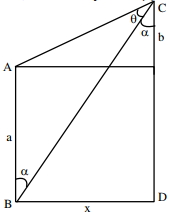
$a$ મીટર લંબાઈનો $AB$ અને $a+b$ $(b \neq a)$ મીટર લંબાઈનો $CD$ એમ બે થાંભલા સમાન સમક્ષિતિજ સપાટી પર $B$ અને $D$ પાયા સાથે ઉભા કરવામાં આવ્યા છે. જો $BD=x$ અને $\tan \angle ACB = \frac{1}{2}$ હોય,તો:
A
$x^{2}+2(a+2 b) x-b(a+b)=0$
B
$x^{2}+2(a+2 b) x+a(a+b)=0$
C
$x^{2}-2 a x+b(a+b)=0$
D
$x^{2}-2 a x+a(a+b)=0$
Solution
(C) ધારો કે $\angle ACB = \theta$ અને $\angle BCD = \alpha$. આકૃતિ પરથી,$\tan \theta = \frac{1}{2}$.
$\triangle BCD$ માં,$\tan(\theta + \alpha) = \frac{BD}{CD} = \frac{x}{a+b}$.
આકૃતિ મુજબ,$\tan(\theta + \alpha) = \frac{x}{a}$ મળે છે.
$\tan(\theta + \alpha) = \frac{\tan \theta + \tan \alpha}{1 - \tan \theta \tan \alpha} = \frac{x}{a}$ નો ઉપયોગ કરતા.
$\tan \theta = \frac{1}{2}$ મૂકતા:
$\frac{1/2 + x/(a+b)}{1 - (1/2)(x/(a+b))} = \frac{x}{a}$
સાદુરૂપ આપતા,$x^2 - 2ax + b(a+b) = 0$ મળે છે,જે વિકલ્પ $C$ છે.
$\triangle BCD$ માં,$\tan(\theta + \alpha) = \frac{BD}{CD} = \frac{x}{a+b}$.
આકૃતિ મુજબ,$\tan(\theta + \alpha) = \frac{x}{a}$ મળે છે.
$\tan(\theta + \alpha) = \frac{\tan \theta + \tan \alpha}{1 - \tan \theta \tan \alpha} = \frac{x}{a}$ નો ઉપયોગ કરતા.
$\tan \theta = \frac{1}{2}$ મૂકતા:
$\frac{1/2 + x/(a+b)}{1 - (1/2)(x/(a+b))} = \frac{x}{a}$
સાદુરૂપ આપતા,$x^2 - 2ax + b(a+b) = 0$ મળે છે,જે વિકલ્પ $C$ છે.
0 likes
View Solution113
DifficultMCQ
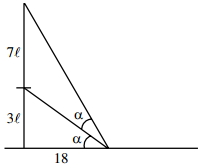
ક્ષિતિજ સમાંતર જમીન પર સ્થિત એક ઉભો થાંભલો તેના પરના એક નિશાન દ્વારા $3:7$ ના ગુણોત્તરમાં વિભાજિત થાય છે,જેમાં નીચેનો ભાગ ઉપરના ભાગ કરતા ટૂંકો છે. જો બંને ભાગો થાંભલાના પાયાથી $18 \ m$ દૂર જમીન પરના એક બિંદુએ સમાન ખૂણા બનાવે છે,તો થાંભલાની ઊંચાઈ ($meters$ માં) કેટલી છે?
A
$12 \sqrt{15}$
B
$12 \sqrt{10}$
C
$8 \sqrt{10}$
D
$6 \sqrt{10}$
Solution
(B) ધારો કે થાંભલાની ઊંચાઈ $H = 10\ell$ છે. થાંભલો $3\ell$ અને $7\ell$ લંબાઈના બે ભાગમાં વહેંચાયેલ છે.
ધારો કે જમીન પરનું બિંદુ $P$ છે,જે થાંભલાના પાયાથી $18 \ m$ દૂર છે.
ધારો કે નીચેનો ભાગ $P$ પર $\alpha$ ખૂણો બનાવે છે. તેથી $\tan \alpha = \frac{3\ell}{18} = \frac{\ell}{6}$.
ધારો કે કુલ ઊંચાઈ $P$ પર $2\alpha$ ખૂણો બનાવે છે. તેથી $\tan 2\alpha = \frac{10\ell}{18} = \frac{5\ell}{9}$.
સૂત્ર $\tan 2\alpha = \frac{2 \tan \alpha}{1 - \tan^2 \alpha}$ નો ઉપયોગ કરતા:
$\frac{5\ell}{9} = \frac{2(\ell/6)}{1 - (\ell/6)^2} = \frac{\ell/3}{1 - \ell^2/36} = \frac{12\ell}{36 - \ell^2}$.
$\ell \neq 0$ હોવાથી,આપણે $\ell$ વડે ભાગી શકીએ:
$\frac{5}{9} = \frac{12}{36 - \ell^2}$ $\Rightarrow 5(36 - \ell^2) = 108$ $\Rightarrow 180 - 5\ell^2 = 108$ $\Rightarrow 5\ell^2 = 72$ $\Rightarrow \ell^2 = \frac{72}{5}$.
આમ,$\ell = \sqrt{\frac{72}{5}} = \frac{6\sqrt{10}}{5}$.
થાંભલાની કુલ ઊંચાઈ $10\ell = 10 \times \frac{6\sqrt{10}}{5} = 12\sqrt{10} \ m$ છે.
ધારો કે જમીન પરનું બિંદુ $P$ છે,જે થાંભલાના પાયાથી $18 \ m$ દૂર છે.
ધારો કે નીચેનો ભાગ $P$ પર $\alpha$ ખૂણો બનાવે છે. તેથી $\tan \alpha = \frac{3\ell}{18} = \frac{\ell}{6}$.
ધારો કે કુલ ઊંચાઈ $P$ પર $2\alpha$ ખૂણો બનાવે છે. તેથી $\tan 2\alpha = \frac{10\ell}{18} = \frac{5\ell}{9}$.
સૂત્ર $\tan 2\alpha = \frac{2 \tan \alpha}{1 - \tan^2 \alpha}$ નો ઉપયોગ કરતા:
$\frac{5\ell}{9} = \frac{2(\ell/6)}{1 - (\ell/6)^2} = \frac{\ell/3}{1 - \ell^2/36} = \frac{12\ell}{36 - \ell^2}$.
$\ell \neq 0$ હોવાથી,આપણે $\ell$ વડે ભાગી શકીએ:
$\frac{5}{9} = \frac{12}{36 - \ell^2}$ $\Rightarrow 5(36 - \ell^2) = 108$ $\Rightarrow 180 - 5\ell^2 = 108$ $\Rightarrow 5\ell^2 = 72$ $\Rightarrow \ell^2 = \frac{72}{5}$.
આમ,$\ell = \sqrt{\frac{72}{5}} = \frac{6\sqrt{10}}{5}$.
થાંભલાની કુલ ઊંચાઈ $10\ell = 10 \times \frac{6\sqrt{10}}{5} = 12\sqrt{10} \ m$ છે.
0 likes
View Solution114
DifficultMCQ
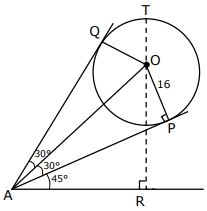
$16 \ m$ ત્રિજ્યા ધરાવતો એક ગોળાકાર ગેસનો ફુગ્ગો નિરીક્ષક $A$ ની આંખ પાસે $60^{\circ}$ નો ખૂણો આંતરે છે,જ્યારે તેની આંખ $A$ થી તેના કેન્દ્રનો ઉત્સેધકોણ $75^{\circ}$ છે. તો નિરીક્ષકની આંખના સ્તરથી ફુગ્ગાના સૌથી ઉપરના બિંદુની ઊંચાઈ ($m$ માં) કેટલી છે?
A
$8(\sqrt{2}+2+\sqrt{3})$
B
$8(\sqrt{6}+\sqrt{2}+2)$
C
$8(2+2\sqrt{3}+\sqrt{2})$
D
$8(\sqrt{6}-\sqrt{2}+2)$
Solution
(B) ધારો કે $O$ એ ગોળાનું કેન્દ્ર છે અને $A$ એ નિરીક્ષકની આંખ છે. ત્રિજ્યા $r = 16 \ m$ છે. $A$ થી ગોળા પરના સ્પર્શકો $P$ અને $Q$ બિંદુએ સ્પર્શે છે. ખૂણો $\angle PAQ = 60^{\circ}$ છે,તેથી $\angle OAP = 30^{\circ}$.
$\triangle OAP$ માં,$\sin(30^{\circ}) = \frac{OP}{OA} \implies \frac{1}{2} = \frac{16}{OA} \implies OA = 32 \ m$.
$A$ થી કેન્દ્ર $O$ નો ઉત્સેધકોણ $75^{\circ}$ છે. ધારો કે $H$ એ નિરીક્ષકની આંખના સમતલથી કેન્દ્ર $O$ ની ઊંચાઈ છે. તેથી $H = OA \sin(75^{\circ}) = 32 \sin(45^{\circ} + 30^{\circ}) = 32 \left( \frac{1}{\sqrt{2}} \cdot \frac{\sqrt{3}}{2} + \frac{1}{\sqrt{2}} \cdot \frac{1}{2} \right) = 32 \left( \frac{\sqrt{3}+1}{2\sqrt{2}} \right) = 8\sqrt{2}(\sqrt{3}+1) = 8(\sqrt{6}+\sqrt{2}) \ m$.
નિરીક્ષકની આંખના સ્તરથી સૌથી ઉપરના બિંદુ $T$ ની ઊંચાઈ $H + r = 8(\sqrt{6}+\sqrt{2}) + 16 = 8(\sqrt{6}+\sqrt{2}+2) \ m$ છે.
$\triangle OAP$ માં,$\sin(30^{\circ}) = \frac{OP}{OA} \implies \frac{1}{2} = \frac{16}{OA} \implies OA = 32 \ m$.
$A$ થી કેન્દ્ર $O$ નો ઉત્સેધકોણ $75^{\circ}$ છે. ધારો કે $H$ એ નિરીક્ષકની આંખના સમતલથી કેન્દ્ર $O$ ની ઊંચાઈ છે. તેથી $H = OA \sin(75^{\circ}) = 32 \sin(45^{\circ} + 30^{\circ}) = 32 \left( \frac{1}{\sqrt{2}} \cdot \frac{\sqrt{3}}{2} + \frac{1}{\sqrt{2}} \cdot \frac{1}{2} \right) = 32 \left( \frac{\sqrt{3}+1}{2\sqrt{2}} \right) = 8\sqrt{2}(\sqrt{3}+1) = 8(\sqrt{6}+\sqrt{2}) \ m$.
નિરીક્ષકની આંખના સ્તરથી સૌથી ઉપરના બિંદુ $T$ ની ઊંચાઈ $H + r = 8(\sqrt{6}+\sqrt{2}) + 16 = 8(\sqrt{6}+\sqrt{2}+2) \ m$ છે.
0 likes
View Solution115
DifficultMCQ
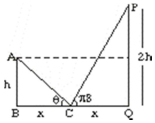
ધારો કે $AB$ અને $PQ$ બે શિરોલંબ સ્તંભો છે,જે એકબીજાથી $160 \ m$ દૂર છે. ધારો કે $C$ એ $B$ અને $Q$ નું મધ્યબિંદુ છે,જે આ બે સ્તંભોના પાયા છે. ધારો કે $C$ થી $P$ અને $A$ ના ઉત્સેધકોણ અનુક્રમે $\frac{\pi}{8}$ અને $\theta$ છે. જો સ્તંભ $PQ$ ની ઊંચાઈ સ્તંભ $AB$ ની ઊંચાઈ કરતા બમણી હોય,તો $\tan^{2} \theta$ ની કિંમત શોધો.
A
$\frac{3-2 \sqrt{2}}{2}$
B
$\frac{3+\sqrt{2}}{2}$
C
$\frac{3-2 \sqrt{2}}{4}$
D
$\frac{3-\sqrt{2}}{4}$
Solution
(C) ધારો કે $BC = CQ = x$,$AB = h$,અને $PQ = 2h$.
કાટકોણ ત્રિકોણ $\triangle ABC$ અને $\triangle PQC$ પરથી:
$\tan \theta = \frac{AB}{BC} = \frac{h}{x}$
$\tan \left(\frac{\pi}{8}\right) = \frac{PQ}{CQ} = \frac{2h}{x}$
બંને સમીકરણોનો ભાગાકાર કરતા:
$\frac{\tan \theta}{\tan \left(\frac{\pi}{8}\right)} = \frac{h/x}{2h/x} = \frac{1}{2}$
આમ,$\tan \theta = \frac{1}{2} \tan \left(\frac{\pi}{8}\right)$.
આપણે જાણીએ છીએ કે $\tan \left(\frac{\pi}{8}\right) = \sqrt{2} - 1$.
તેથી,$\tan \theta = \frac{1}{2}(\sqrt{2} - 1)$.
બંને બાજુ વર્ગ કરતા:
$\tan^{2} \theta = \frac{1}{4}(\sqrt{2} - 1)^{2} = \frac{1}{4}(2 + 1 - 2\sqrt{2}) = \frac{3 - 2\sqrt{2}}{4}$.
કાટકોણ ત્રિકોણ $\triangle ABC$ અને $\triangle PQC$ પરથી:
$\tan \theta = \frac{AB}{BC} = \frac{h}{x}$
$\tan \left(\frac{\pi}{8}\right) = \frac{PQ}{CQ} = \frac{2h}{x}$
બંને સમીકરણોનો ભાગાકાર કરતા:
$\frac{\tan \theta}{\tan \left(\frac{\pi}{8}\right)} = \frac{h/x}{2h/x} = \frac{1}{2}$
આમ,$\tan \theta = \frac{1}{2} \tan \left(\frac{\pi}{8}\right)$.
આપણે જાણીએ છીએ કે $\tan \left(\frac{\pi}{8}\right) = \sqrt{2} - 1$.
તેથી,$\tan \theta = \frac{1}{2}(\sqrt{2} - 1)$.
બંને બાજુ વર્ગ કરતા:
$\tan^{2} \theta = \frac{1}{4}(\sqrt{2} - 1)^{2} = \frac{1}{4}(2 + 1 - 2\sqrt{2}) = \frac{3 - 2\sqrt{2}}{4}$.
0 likes
View Solution116
MediumMCQ
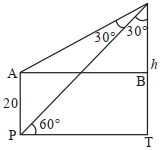
$20 \text{ m}$ ઊંચાઈ ધરાવતા થાંભલાના પાયાથી,ટાવરની ટોચનો ઉત્સેધકોણ $60^{\circ}$ છે. થાંભલો ટાવરની ટોચ પર $30^{\circ}$ નો ખૂણો આંતરે છે. તો ટાવરની ઊંચાઈ શોધો.
A
$15 \sqrt{3}$
B
$20 \sqrt{3}$
C
$20+10 \sqrt{3}$
D
$30$
Solution
(D) ધારો કે ટાવરની ઊંચાઈ $h$ છે અને થાંભલા અને ટાવર વચ્ચેનું અંતર $x$ છે.
$\tan(60^{\circ}) = \frac{h}{x} \implies x = \frac{h}{\sqrt{3}}$.
$\tan(30^{\circ}) = \frac{x}{h - 20} \implies \frac{1}{\sqrt{3}} = \frac{h - 20}{x} \implies x = \sqrt{3}(h - 20)$.
$\frac{h}{\sqrt{3}} = \sqrt{3}(h - 20) \implies h = 3(h - 20) \implies h = 3h - 60 \implies 2h = 60 \implies h = 30$.
$\tan(60^{\circ}) = \frac{h}{x} \implies x = \frac{h}{\sqrt{3}}$.
$\tan(30^{\circ}) = \frac{x}{h - 20} \implies \frac{1}{\sqrt{3}} = \frac{h - 20}{x} \implies x = \sqrt{3}(h - 20)$.
$\frac{h}{\sqrt{3}} = \sqrt{3}(h - 20) \implies h = 3(h - 20) \implies h = 3h - 60 \implies 2h = 60 \implies h = 30$.
0 likes
View Solution117
DifficultMCQ
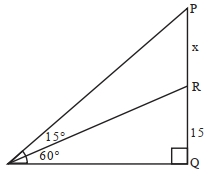
એક ટાવર $PQ$ સમક્ષિતિજ જમીન પર ઉભો છે,જેનો પાયો $Q$ જમીન પર છે. બિંદુ $R$ ટાવરને બે ભાગમાં એવી રીતે વિભાજિત કરે છે કે જેથી $QR = 15 \, m$ થાય. જો જમીન પરના બિંદુ $A$ થી $R$ નો ઉત્સેધકોણ $60^{\circ}$ હોય અને ટાવરનો ભાગ $PR$ એ $A$ આગળ $15^{\circ}$ નો ખૂણો આંતરે,તો ટાવરની ઊંચાઈ શોધો.
A
$5(2 \sqrt{3} + 3) \, m$
B
$5(\sqrt{3} + 3) \, m$
C
$10(\sqrt{3} + 1) \, m$
D
$10(2 \sqrt{3} + 1) \, m$
Solution
(A) ધારો કે $AQ = d$. $\triangle AQR$ માં,$\tan 60^{\circ} = \frac{QR}{AQ} = \frac{15}{d}$.
તેથી,$d = \frac{15}{\tan 60^{\circ}} = \frac{15}{\sqrt{3}} = 5\sqrt{3} \, m$.
$\triangle AQP$ માં,$P$ નો ઉત્સેધકોણ $60^{\circ} + 15^{\circ} = 75^{\circ}$ છે.
તેથી,$\tan 75^{\circ} = \frac{PQ}{AQ} = \frac{15 + x}{5\sqrt{3}}$,જ્યાં $x = PR$.
$\tan 75^{\circ} = 2 + \sqrt{3}$ હોવાથી,
$15 + x = 5\sqrt{3}(2 + \sqrt{3}) = 10\sqrt{3} + 15$.
આથી $x = 10\sqrt{3} \, m$.
ટાવરની કુલ ઊંચાઈ $PQ = QR + PR = 15 + 10\sqrt{3} = 5(3 + 2\sqrt{3}) \, m$.
તેથી,$d = \frac{15}{\tan 60^{\circ}} = \frac{15}{\sqrt{3}} = 5\sqrt{3} \, m$.
$\triangle AQP$ માં,$P$ નો ઉત્સેધકોણ $60^{\circ} + 15^{\circ} = 75^{\circ}$ છે.
તેથી,$\tan 75^{\circ} = \frac{PQ}{AQ} = \frac{15 + x}{5\sqrt{3}}$,જ્યાં $x = PR$.
$\tan 75^{\circ} = 2 + \sqrt{3}$ હોવાથી,
$15 + x = 5\sqrt{3}(2 + \sqrt{3}) = 10\sqrt{3} + 15$.
આથી $x = 10\sqrt{3} \, m$.
ટાવરની કુલ ઊંચાઈ $PQ = QR + PR = 15 + 10\sqrt{3} = 5(3 + 2\sqrt{3}) \, m$.
1 likes
View Solution118
DifficultMCQ
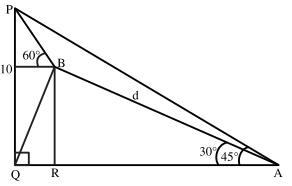
ક્ષિતિજ સમાંતર જમીન પરના બિંદુ $A$ થી $10$ ઊંચાઈ ધરાવતા શિરોલંબ ટાવર $PQ$ ની ટોચ $P$ નો ઉત્સેધકોણ $45^{\circ}$ છે. ધારો કે $R$ એ $AQ$ પરનું એક બિંદુ છે અને $R$ ની શિરોલંબ ઉપર આવેલા બિંદુ $B$ થી $P$ નો ઉત્સેધકોણ $60^{\circ}$ છે. જો $\angle BAQ = 30^{\circ}$,$AB = d$ અને સમલંબ ચતુષ્કોણ $PQRB$ નું ક્ષેત્રફળ $\alpha$ હોય,તો ક્રમયુક્ત જોડ $(d, \alpha)$ શોધો.
A
$(10(\sqrt{3}-1), 25)$
B
$\left(10(\sqrt{3}-1), \frac{25}{2}\right)$
C
$(10(\sqrt{3}+1), 25)$
D
$\left(10(\sqrt{3}+1), \frac{25}{2}\right)$
Solution
(A) $\triangle PQA$ માં,$\angle PAQ = 45^{\circ}$ અને $PQ = 10$,તેથી $QA = \frac{PQ}{\tan 45^{\circ}} = 10$.
$\triangle BRA$ માં,$RA = d \cos 30^{\circ} = \frac{\sqrt{3}d}{2}$ અને $BR = d \sin 30^{\circ} = \frac{d}{2}$.
$R$ એ $AQ$ પર હોવાથી,$QR = QA - RA = 10 - \frac{\sqrt{3}d}{2}$.
$\triangle PRB$ માં,$B$ થી $P$ નો ઉત્સેધકોણ $60^{\circ}$ છે,તેથી $\tan 60^{\circ} = \frac{PQ - BR}{QR} = \frac{10 - d/2}{10 - \sqrt{3}d/2}$.
$\sqrt{3} = \frac{20 - d}{20 - \sqrt{3}d} \implies 20\sqrt{3} - 3d = 20 - d \implies 2d = 20(\sqrt{3} - 1) \implies d = 10(\sqrt{3} - 1)$.
સમલંબ ચતુષ્કોણ $PQRB$ નું ક્ષેત્રફળ $\alpha = \frac{1}{2}(PQ + BR) \cdot QR = \frac{1}{2}(10 + d/2)(10 - \sqrt{3}d/2)$.
$d = 10(\sqrt{3} - 1)$ મૂકતા,$BR = 5(\sqrt{3} - 1)$ અને $QR = 10 - 5\sqrt{3}(\sqrt{3} - 1) = 10 - 15 + 5\sqrt{3} = 5\sqrt{3} - 5$ મળે.
$\alpha = \frac{1}{2}(10 + 5\sqrt{3} - 5)(5\sqrt{3} - 5) = \frac{1}{2}(5\sqrt{3} + 5)(5\sqrt{3} - 5) = \frac{1}{2}(75 - 25) = 25$.
આમ,$(d, \alpha) = (10(\sqrt{3} - 1), 25)$.
$\triangle BRA$ માં,$RA = d \cos 30^{\circ} = \frac{\sqrt{3}d}{2}$ અને $BR = d \sin 30^{\circ} = \frac{d}{2}$.
$R$ એ $AQ$ પર હોવાથી,$QR = QA - RA = 10 - \frac{\sqrt{3}d}{2}$.
$\triangle PRB$ માં,$B$ થી $P$ નો ઉત્સેધકોણ $60^{\circ}$ છે,તેથી $\tan 60^{\circ} = \frac{PQ - BR}{QR} = \frac{10 - d/2}{10 - \sqrt{3}d/2}$.
$\sqrt{3} = \frac{20 - d}{20 - \sqrt{3}d} \implies 20\sqrt{3} - 3d = 20 - d \implies 2d = 20(\sqrt{3} - 1) \implies d = 10(\sqrt{3} - 1)$.
સમલંબ ચતુષ્કોણ $PQRB$ નું ક્ષેત્રફળ $\alpha = \frac{1}{2}(PQ + BR) \cdot QR = \frac{1}{2}(10 + d/2)(10 - \sqrt{3}d/2)$.
$d = 10(\sqrt{3} - 1)$ મૂકતા,$BR = 5(\sqrt{3} - 1)$ અને $QR = 10 - 5\sqrt{3}(\sqrt{3} - 1) = 10 - 15 + 5\sqrt{3} = 5\sqrt{3} - 5$ મળે.
$\alpha = \frac{1}{2}(10 + 5\sqrt{3} - 5)(5\sqrt{3} - 5) = \frac{1}{2}(5\sqrt{3} + 5)(5\sqrt{3} - 5) = \frac{1}{2}(75 - 25) = 25$.
આમ,$(d, \alpha) = (10(\sqrt{3} - 1), 25)$.
0 likes
View Solution119
DifficultMCQ
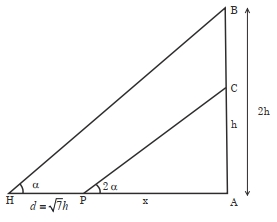
ધારો કે $2h$ ઊંચાઈનો એક ઊભો ટાવર $AB$ સમક્ષિતિજ જમીન પર છે. જમીન પરના બિંદુ $P$ થી,એક માણસ ટાવરની $h$ ઊંચાઈ સુધી $2\alpha$ ના ઉત્સેધકોણ સાથે જોઈ શકે છે. જ્યારે તે $P$ થી $\overline{AP}$ ની દિશામાં $d$ અંતર કાપે છે,ત્યારે તે ટાવરની ટોચ $B$ ને $\alpha$ ના ઉત્સેધકોણ સાથે જોઈ શકે છે. જો $d=\sqrt{7}h$ હોય,તો $\tan \alpha$ ની કિંમત શોધો.
A
$\sqrt{5}-2$
B
$\sqrt{3}-1$
C
$\sqrt{7}-2$
D
$\sqrt{7}-\sqrt{3}$
Solution
(C) ધારો કે $A$ ટાવરનો પાયો છે અને $B$ ટોચ છે. ટાવરની ઊંચાઈ $AB = 2h$ છે. ધારો કે $C$ ટાવર પરનું એવું બિંદુ છે કે જેથી $AC = h$ થાય.
જમીન પરના બિંદુ $P$ થી $C$ નો ઉત્સેધકોણ $2\alpha$ છે. ધારો કે $AP = x$. $\triangle PAC$ માં,$\tan 2\alpha = \frac{AC}{AP} = \frac{h}{x}$. તેથી,$x = h \cot 2\alpha$.
જ્યારે માણસ ટાવર તરફ $d = \sqrt{7}h$ અંતર કાપીને બિંદુ $H$ પર પહોંચે છે,ત્યારે અંતર $AH = x + \sqrt{7}h$ થાય છે. ટોચ $B$ નો ઉત્સેધકોણ $\alpha$ છે. $\triangle HAB$ માં,$\tan \alpha = \frac{AB}{AH} = \frac{2h}{x + \sqrt{7}h}$.
$x = h \cot 2\alpha$ મૂકતા,આપણને મળે $\tan \alpha = \frac{2h}{h \cot 2\alpha + \sqrt{7}h} = \frac{2}{\cot 2\alpha + \sqrt{7}}$.
કારણ કે $\cot 2\alpha = \frac{1 - \tan^2 \alpha}{2 \tan \alpha}$,તેથી $\tan \alpha = \frac{2}{\frac{1 - \tan^2 \alpha}{2 \tan \alpha} + \sqrt{7}}$.
ધારો કે $t = \tan \alpha$. તો $t = \frac{4t}{1 - t^2 + 2\sqrt{7}t}$.
$t \neq 0$ હોવાથી,$1 = \frac{4}{1 - t^2 + 2\sqrt{7}t}$,એટલે કે $1 - t^2 + 2\sqrt{7}t = 4$.
$t^2 - 2\sqrt{7}t + 3 = 0$.
દ્વિઘાત સૂત્રનો ઉપયોગ કરતા,$t = \frac{2\sqrt{7} \pm \sqrt{(2\sqrt{7})^2 - 4(1)(3)}}{2} = \frac{2\sqrt{7} \pm \sqrt{28 - 12}}{2} = \frac{2\sqrt{7} \pm 4}{2} = \sqrt{7} \pm 2$.
$\alpha$ ઉત્સેધકોણ હોવાથી,$\tan \alpha$ ધન હોવો જોઈએ. વળી,$\tan 2\alpha$ વ્યાખ્યાયિત અને ધન હોવા માટે,$2\alpha < 90^\circ$,તેથી $\alpha < 45^\circ$,એટલે કે $\tan \alpha < 1$. $\sqrt{7} + 2 > 1$ હોવાથી,આપણે $\tan \alpha = \sqrt{7} - 2$ લઈશું.
જમીન પરના બિંદુ $P$ થી $C$ નો ઉત્સેધકોણ $2\alpha$ છે. ધારો કે $AP = x$. $\triangle PAC$ માં,$\tan 2\alpha = \frac{AC}{AP} = \frac{h}{x}$. તેથી,$x = h \cot 2\alpha$.
જ્યારે માણસ ટાવર તરફ $d = \sqrt{7}h$ અંતર કાપીને બિંદુ $H$ પર પહોંચે છે,ત્યારે અંતર $AH = x + \sqrt{7}h$ થાય છે. ટોચ $B$ નો ઉત્સેધકોણ $\alpha$ છે. $\triangle HAB$ માં,$\tan \alpha = \frac{AB}{AH} = \frac{2h}{x + \sqrt{7}h}$.
$x = h \cot 2\alpha$ મૂકતા,આપણને મળે $\tan \alpha = \frac{2h}{h \cot 2\alpha + \sqrt{7}h} = \frac{2}{\cot 2\alpha + \sqrt{7}}$.
કારણ કે $\cot 2\alpha = \frac{1 - \tan^2 \alpha}{2 \tan \alpha}$,તેથી $\tan \alpha = \frac{2}{\frac{1 - \tan^2 \alpha}{2 \tan \alpha} + \sqrt{7}}$.
ધારો કે $t = \tan \alpha$. તો $t = \frac{4t}{1 - t^2 + 2\sqrt{7}t}$.
$t \neq 0$ હોવાથી,$1 = \frac{4}{1 - t^2 + 2\sqrt{7}t}$,એટલે કે $1 - t^2 + 2\sqrt{7}t = 4$.
$t^2 - 2\sqrt{7}t + 3 = 0$.
દ્વિઘાત સૂત્રનો ઉપયોગ કરતા,$t = \frac{2\sqrt{7} \pm \sqrt{(2\sqrt{7})^2 - 4(1)(3)}}{2} = \frac{2\sqrt{7} \pm \sqrt{28 - 12}}{2} = \frac{2\sqrt{7} \pm 4}{2} = \sqrt{7} \pm 2$.
$\alpha$ ઉત્સેધકોણ હોવાથી,$\tan \alpha$ ધન હોવો જોઈએ. વળી,$\tan 2\alpha$ વ્યાખ્યાયિત અને ધન હોવા માટે,$2\alpha < 90^\circ$,તેથી $\alpha < 45^\circ$,એટલે કે $\tan \alpha < 1$. $\sqrt{7} + 2 > 1$ હોવાથી,આપણે $\tan \alpha = \sqrt{7} - 2$ લઈશું.
0 likes
View Solution120
DifficultMCQ
એક આડો પાર્ક ત્રિકોણ $OAB$ ના આકારમાં છે જેમાં $AB = 16$ છે. બિંદુ $O$ પર એક ઊભો લેમ્પ પોસ્ટ $OP$ એવી રીતે ઉભો કરવામાં આવ્યો છે કે જેથી $\angle PAO = \angle PBO = 15^{\circ}$ અને $\angle PCO = 45^{\circ}$ થાય,જ્યાં $C$ એ $AB$ નું મધ્યબિંદુ છે. તો $(OP)^{2}$ ની કિંમત શોધો.
A
$\frac{32}{\sqrt{3}}(\sqrt{3}-1)$
B
$\frac{32}{\sqrt{3}}(2-\sqrt{3})$
C
$\frac{16}{\sqrt{3}}(\sqrt{3}-1)$
D
$\frac{16}{\sqrt{3}}(2-\sqrt{3})$
Solution
(B) ધારો કે $OP = h$. $OP$ શિરોલંબ હોવાથી,$\triangle OPA$,$\triangle OPB$,અને $\triangle OPC$ એ $O$ પર કાટખૂણો બનાવે છે.
$AB = 16$ અને $C$ મધ્યબિંદુ હોવાથી,$AC = CB = 8$.
$\triangle OPA$ માં,$\tan 15^{\circ} = \frac{OP}{OA} \Rightarrow OA = h \cot 15^{\circ}$.
$\triangle OPC$ માં,$\tan 45^{\circ} = \frac{OP}{OC} \Rightarrow OC = h$.
$\triangle OAC$ માં,$\angle OCA = 90^{\circ}$ હોવાથી,$OA^{2} = OC^{2} + AC^{2}$.
કિંમતો મૂકતા: $(h \cot 15^{\circ})^{2} = h^{2} + 8^{2}$.
$h^{2} (\cot^{2} 15^{\circ} - 1) = 64$.
$\cot 15^{\circ} = 2 + \sqrt{3}$ નો ઉપયોગ કરતા,$\cot^{2} 15^{\circ} = 7 + 4\sqrt{3}$.
$h^{2} (6 + 4\sqrt{3}) = 64 \Rightarrow h^{2} = \frac{32}{3 + 2\sqrt{3}}$.
છેદનું સંમેયીકરણ કરતા: $h^{2} = \frac{32}{\sqrt{3}}(2 - \sqrt{3})$.
$AB = 16$ અને $C$ મધ્યબિંદુ હોવાથી,$AC = CB = 8$.
$\triangle OPA$ માં,$\tan 15^{\circ} = \frac{OP}{OA} \Rightarrow OA = h \cot 15^{\circ}$.
$\triangle OPC$ માં,$\tan 45^{\circ} = \frac{OP}{OC} \Rightarrow OC = h$.
$\triangle OAC$ માં,$\angle OCA = 90^{\circ}$ હોવાથી,$OA^{2} = OC^{2} + AC^{2}$.
કિંમતો મૂકતા: $(h \cot 15^{\circ})^{2} = h^{2} + 8^{2}$.
$h^{2} (\cot^{2} 15^{\circ} - 1) = 64$.
$\cot 15^{\circ} = 2 + \sqrt{3}$ નો ઉપયોગ કરતા,$\cot^{2} 15^{\circ} = 7 + 4\sqrt{3}$.
$h^{2} (6 + 4\sqrt{3}) = 64 \Rightarrow h^{2} = \frac{32}{3 + 2\sqrt{3}}$.
છેદનું સંમેયીકરણ કરતા: $h^{2} = \frac{32}{\sqrt{3}}(2 - \sqrt{3})$.
0 likes
View Solution121
AdvancedMCQ
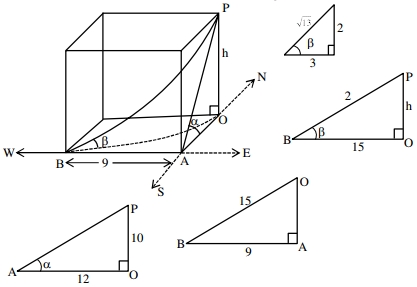
એક ટાવરની ટોચનો ઉત્તર દિશામાં આવેલા બિંદુ $A$ થી ઉત્સેધકોણ $\alpha$ છે અને $A$ થી પશ્ચિમ દિશામાં $9$ એકમ દૂર આવેલા બિંદુ $B$ થી તે $\cos^{-1}\left(\frac{3}{\sqrt{13}}\right)$ છે. જો ટાવરથી બિંદુ $B$ નું અંતર $15$ એકમ હોય,તો $\cot \alpha$ ની કિંમત શોધો.
A
$\frac{6}{5}$
B
$\frac{9}{5}$
C
$\frac{4}{3}$
D
$\frac{7}{3}$
Solution
(A) ધારો કે ટાવર $OP$ છે,જ્યાં $O$ ટાવરનો પાયો છે. બિંદુ $A$ એ $O$ ની ઉત્તરે છે,તેથી $\triangle OAP$ કાટકોણ ત્રિકોણ છે જ્યાં $\angle OAP = \alpha$.
આપેલ છે કે $AB = 9$ એકમ,જ્યાં $B$ એ $A$ ની પશ્ચિમે છે. $A$ એ $O$ ની ઉત્તરે હોવાથી,$OA \perp AB$.
$\triangle OAB$ માં,$\angle OAB = 90^\circ$. $OB = 15$ આપેલ છે,પાયથાગોરસના પ્રમેય મુજબ,$OA^2 + AB^2 = OB^2 \implies OA^2 + 9^2 = 15^2 \implies OA^2 = 225 - 81 = 144 \implies OA = 12$.
ધારો કે $\beta = \cos^{-1}\left(\frac{3}{\sqrt{13}}\right)$ એ $B$ થી ઉત્સેધકોણ છે. તેથી $\cos \beta = \frac{3}{\sqrt{13}}$.
$\sin^2 \beta + \cos^2 \beta = 1$ હોવાથી,$\sin \beta = \sqrt{1 - \frac{9}{13}} = \frac{2}{\sqrt{13}}$.
તેથી,$\tan \beta = \frac{\sin \beta}{\cos \beta} = \frac{2}{3}$.
$\triangle OBP$ માં,$\tan \beta = \frac{OP}{OB} = \frac{h}{15}$.
તેથી,$\frac{h}{15} = \frac{2}{3} \implies h = 10$.
$\triangle OAP$ માં,$\tan \alpha = \frac{OP}{OA} = \frac{h}{OA} = \frac{10}{12} = \frac{5}{6}$.
તેથી,$\cot \alpha = \frac{1}{\tan \alpha} = \frac{6}{5}$.
આપેલ છે કે $AB = 9$ એકમ,જ્યાં $B$ એ $A$ ની પશ્ચિમે છે. $A$ એ $O$ ની ઉત્તરે હોવાથી,$OA \perp AB$.
$\triangle OAB$ માં,$\angle OAB = 90^\circ$. $OB = 15$ આપેલ છે,પાયથાગોરસના પ્રમેય મુજબ,$OA^2 + AB^2 = OB^2 \implies OA^2 + 9^2 = 15^2 \implies OA^2 = 225 - 81 = 144 \implies OA = 12$.
ધારો કે $\beta = \cos^{-1}\left(\frac{3}{\sqrt{13}}\right)$ એ $B$ થી ઉત્સેધકોણ છે. તેથી $\cos \beta = \frac{3}{\sqrt{13}}$.
$\sin^2 \beta + \cos^2 \beta = 1$ હોવાથી,$\sin \beta = \sqrt{1 - \frac{9}{13}} = \frac{2}{\sqrt{13}}$.
તેથી,$\tan \beta = \frac{\sin \beta}{\cos \beta} = \frac{2}{3}$.
$\triangle OBP$ માં,$\tan \beta = \frac{OP}{OB} = \frac{h}{15}$.
તેથી,$\frac{h}{15} = \frac{2}{3} \implies h = 10$.
$\triangle OAP$ માં,$\tan \alpha = \frac{OP}{OA} = \frac{h}{OA} = \frac{10}{12} = \frac{5}{6}$.
તેથી,$\cot \alpha = \frac{1}{\tan \alpha} = \frac{6}{5}$.
0 likes
View Solution122
DifficultMCQ
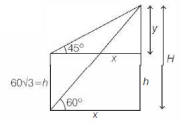
$60 \sqrt{3}$ ફૂટ ઊંચાઈ ધરાવતી ઇમારતની ટોચ પર ઉભેલી વ્યક્તિએ ટાવરની ટોચને $45^{\circ}$ ના ઉત્સેધકોણે જોઈ. તે વ્યક્તિ ઇમારતના તળિયે ઉતરી અને જોયું કે તે જ ટાવરની ટોચ હવે $60^{\circ}$ ના ઉત્સેધકોણે છે. ટાવરની ઊંચાઈ (ફૂટમાં) કેટલી છે?
A
$30$
B
$30(\sqrt{3}+1)$
C
$90(\sqrt{3}+1)$
D
$150(\sqrt{3}+1)$
Solution
(C) ધારો કે ટાવરની ઊંચાઈ $H$ છે અને ઇમારત અને ટાવર વચ્ચેનું અંતર $x$ છે.
ઇમારતની ટોચ પરથી (ઊંચાઈ $h = 60\sqrt{3}$ ફૂટ),ટાવરની ટોચનો ઉત્સેધકોણ $45^{\circ}$ છે. તેથી,$\tan 45^{\circ} = \frac{H - h}{x} \implies 1 = \frac{H - 60\sqrt{3}}{x} \implies x = H - 60\sqrt{3}$.
ઇમારતના તળિયેથી,ટાવરની ટોચનો ઉત્સેધકોણ $60^{\circ}$ છે. તેથી,$\tan 60^{\circ} = \frac{H}{x} \implies \sqrt{3} = \frac{H}{x} \implies x = \frac{H}{\sqrt{3}}$.
$x$ માટેના બંને સમીકરણોને સરખાવતા: $H - 60\sqrt{3} = \frac{H}{\sqrt{3}}$.
$\sqrt{3}$ વડે ગુણતા: $\sqrt{3}H - 60(3) = H \implies \sqrt{3}H - H = 180 \implies H(\sqrt{3} - 1) = 180$.
$H = \frac{180}{\sqrt{3} - 1} = \frac{180(\sqrt{3} + 1)}{3 - 1} = \frac{180(\sqrt{3} + 1)}{2} = 90(\sqrt{3} + 1)$ ફૂટ.
ઇમારતની ટોચ પરથી (ઊંચાઈ $h = 60\sqrt{3}$ ફૂટ),ટાવરની ટોચનો ઉત્સેધકોણ $45^{\circ}$ છે. તેથી,$\tan 45^{\circ} = \frac{H - h}{x} \implies 1 = \frac{H - 60\sqrt{3}}{x} \implies x = H - 60\sqrt{3}$.
ઇમારતના તળિયેથી,ટાવરની ટોચનો ઉત્સેધકોણ $60^{\circ}$ છે. તેથી,$\tan 60^{\circ} = \frac{H}{x} \implies \sqrt{3} = \frac{H}{x} \implies x = \frac{H}{\sqrt{3}}$.
$x$ માટેના બંને સમીકરણોને સરખાવતા: $H - 60\sqrt{3} = \frac{H}{\sqrt{3}}$.
$\sqrt{3}$ વડે ગુણતા: $\sqrt{3}H - 60(3) = H \implies \sqrt{3}H - H = 180 \implies H(\sqrt{3} - 1) = 180$.
$H = \frac{180}{\sqrt{3} - 1} = \frac{180(\sqrt{3} + 1)}{3 - 1} = \frac{180(\sqrt{3} + 1)}{2} = 90(\sqrt{3} + 1)$ ફૂટ.
0 likes
View Solution123
AdvancedMCQ
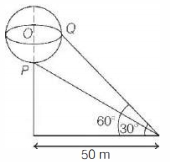
આકૃતિમાં દર્શાવ્યા મુજબ $O$ કેન્દ્ર ધરાવતો એક ગોળો થાંભલાની ટોચ પર છે. જમીન પરનો એક નિરીક્ષક થાંભલાના પાયાથી $50 \ m$ ના અંતરે છે. તે નોંધે છે કે નિરીક્ષકથી ગોળા પરના બિંદુઓ $P$ અને $Q$ ના ઉત્સેધકોણ અનુક્રમે $30^{\circ}$ અને $60^{\circ}$ છે. તો,મીટરમાં ગોળાની ત્રિજ્યા કેટલી થાય?
A
$100 \left(1-\frac{1}{\sqrt{3}}\right)$
B
$\frac{50 \sqrt{6}}{3}$
C
$50 \left(1-\frac{1}{\sqrt{3}}\right)$
D
$\frac{100 \sqrt{6}}{3}$
Solution
(C) ધારો કે થાંભલાની ઊંચાઈ $h$ છે અને ગોળાની ત્રિજ્યા $r$ છે. બિંદુ $P$ એ ગોળાનો નીચેનો ભાગ છે,તેથી જમીનથી $P$ ની ઊંચાઈ $h$ છે. બિંદુ $Q$ એ કેન્દ્ર $O$ ની સપાટી પર છે,તેથી જમીનથી $Q$ ની ઊંચાઈ $h+r$ છે. નિરીક્ષક $B$ થી થાંભલાનું આડું અંતર $AB = 50 \ m$ છે.
$\triangle APB$ માં,$\tan 30^{\circ} = \frac{AP}{AB} = \frac{h}{50}$.
$\Rightarrow h = 50 \tan 30^{\circ} = \frac{50}{\sqrt{3}}$.
નિરીક્ષક,બિંદુ $Q$ અને બિંદુ $R$ (જ્યાં $R$ એ જમીન પર $Q$ નો પ્રક્ષેપ છે) દ્વારા બનતા ત્રિકોણમાં,આડું અંતર $BR = AB - r = 50 - r$ છે અને ઊભી ઊંચાઈ $RQ = h+r$ છે.
$\tan 60^{\circ} = \frac{RQ}{BR} = \frac{h+r}{50-r}$.
$\Rightarrow \sqrt{3}(50-r) = h+r$.
$h = \frac{50}{\sqrt{3}}$ મૂકતા:
$\sqrt{3}(50-r) = \frac{50}{\sqrt{3}} + r$.
$50\sqrt{3} - r\sqrt{3} = \frac{50}{\sqrt{3}} + r$.
$50\sqrt{3} - \frac{50}{\sqrt{3}} = r(1+\sqrt{3})$.
$50 \left( \frac{3-1}{\sqrt{3}} \right) = r(1+\sqrt{3})$.
$r = \frac{50 \times 2}{\sqrt{3}(1+\sqrt{3})} = 50 \left( 1 - \frac{1}{\sqrt{3}} \right)$.
$\triangle APB$ માં,$\tan 30^{\circ} = \frac{AP}{AB} = \frac{h}{50}$.
$\Rightarrow h = 50 \tan 30^{\circ} = \frac{50}{\sqrt{3}}$.
નિરીક્ષક,બિંદુ $Q$ અને બિંદુ $R$ (જ્યાં $R$ એ જમીન પર $Q$ નો પ્રક્ષેપ છે) દ્વારા બનતા ત્રિકોણમાં,આડું અંતર $BR = AB - r = 50 - r$ છે અને ઊભી ઊંચાઈ $RQ = h+r$ છે.
$\tan 60^{\circ} = \frac{RQ}{BR} = \frac{h+r}{50-r}$.
$\Rightarrow \sqrt{3}(50-r) = h+r$.
$h = \frac{50}{\sqrt{3}}$ મૂકતા:
$\sqrt{3}(50-r) = \frac{50}{\sqrt{3}} + r$.
$50\sqrt{3} - r\sqrt{3} = \frac{50}{\sqrt{3}} + r$.
$50\sqrt{3} - \frac{50}{\sqrt{3}} = r(1+\sqrt{3})$.
$50 \left( \frac{3-1}{\sqrt{3}} \right) = r(1+\sqrt{3})$.
$r = \frac{50 \times 2}{\sqrt{3}(1+\sqrt{3})} = 50 \left( 1 - \frac{1}{\sqrt{3}} \right)$.
0 likes
View Solution124
DifficultMCQ
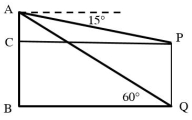
$30 \ m$ ઊંચાઈ ધરાવતી એક શિરોલંબ દીવાલ $AB$ ની ટોચ $A$ પરથી,એક શિરોલંબ ટાવર $PQ$ ની ટોચ $P$ અને તળિયા $Q$ ના અવસેધકોણ અનુક્રમે $15^{\circ}$ અને $60^{\circ}$ છે. $B$ અને $Q$ એક જ સમક્ષિતિજ સપાટી પર છે. જો $AB$ પર $C$ એવું બિંદુ હોય કે જેથી $CB = PQ$ થાય,તો ચતુષ્કોણ $BCPQ$ નું ક્ષેત્રફળ ($m^2$ માં) કેટલું થાય?
A
$600(\sqrt{3}-1)$
B
$300(\sqrt{3}+1)$
C
$200(3-\sqrt{3})$
D
$300(\sqrt{3}-1)$
Solution
(A) ધારો કે $AB = 30 \ m$ અને $BQ = x$. $\triangle ABQ$ માં,$\tan 60^{\circ} = \frac{AB}{BQ} = \frac{30}{x}$.
તેથી,$x = \frac{30}{\sqrt{3}} = 10\sqrt{3} \ m$. આમ,$BQ = 10\sqrt{3} \ m$.
$BCPQ$ લંબચોરસ હોવાથી,$CP = BQ = 10\sqrt{3} \ m$ અને $PQ = BC$.
$\triangle ACP$ માં,$P$ નો અવસેધકોણ $15^{\circ}$ છે,તેથી $\tan 15^{\circ} = \frac{AC}{CP} = \frac{AC}{10\sqrt{3}}$.
$\tan 15^{\circ} = 2 - \sqrt{3}$ હોવાથી,$AC = 10\sqrt{3}(2 - \sqrt{3}) = 20\sqrt{3} - 30$.
તેથી $BC = AB - AC = 30 - (20\sqrt{3} - 30) = 60 - 20\sqrt{3}$.
લંબચોરસ $BCPQ$ નું ક્ષેત્રફળ $= BQ \times BC = (10\sqrt{3})(60 - 20\sqrt{3}) = 600\sqrt{3} - 600 = 600(\sqrt{3} - 1) \ m^2$.
તેથી,$x = \frac{30}{\sqrt{3}} = 10\sqrt{3} \ m$. આમ,$BQ = 10\sqrt{3} \ m$.
$BCPQ$ લંબચોરસ હોવાથી,$CP = BQ = 10\sqrt{3} \ m$ અને $PQ = BC$.
$\triangle ACP$ માં,$P$ નો અવસેધકોણ $15^{\circ}$ છે,તેથી $\tan 15^{\circ} = \frac{AC}{CP} = \frac{AC}{10\sqrt{3}}$.
$\tan 15^{\circ} = 2 - \sqrt{3}$ હોવાથી,$AC = 10\sqrt{3}(2 - \sqrt{3}) = 20\sqrt{3} - 30$.
તેથી $BC = AB - AC = 30 - (20\sqrt{3} - 30) = 60 - 20\sqrt{3}$.
લંબચોરસ $BCPQ$ નું ક્ષેત્રફળ $= BQ \times BC = (10\sqrt{3})(60 - 20\sqrt{3}) = 600\sqrt{3} - 600 = 600(\sqrt{3} - 1) \ m^2$.
0 likes
View Solution125
AdvancedMCQ
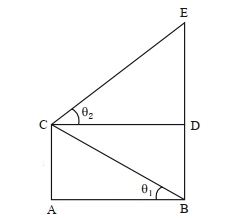
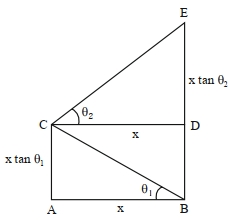
આકૃતિમાં,$\theta_1+\theta_2=\frac{\pi}{2}$ અને $\sqrt{3}(BE)=4(AB)$ છે. જો $\triangle CAB$ નું ક્ષેત્રફળ $2\sqrt{3}-3 \text{ unit}^2$ હોય,જ્યારે $\frac{\theta_2}{\theta_1}$ મહત્તમ હોય,ત્યારે $\triangle CED$ ની પરિમિતિ (unit માં) $...........$ થાય.
A
$5$
B
$4$
C
$6$
D
$3$
Solution
(C) ધારો કે $AB = x$. આકૃતિ પરથી,$AC = x \tan \theta_1$ અને $CD = x$. તેમજ,$BD = AC = x \tan \theta_1$ અને $DE = CD \tan \theta_2 = x \tan \theta_2$.
આપેલ છે કે $\sqrt{3}(BE) = 4(AB)$,તેથી $\sqrt{3}(BD + DE) = 4x$.
$\sqrt{3}(x \tan \theta_1 + x \tan \theta_2) = 4x \implies \sqrt{3}(\tan \theta_1 + \cot \theta_1) = 4$ (કારણ કે $\theta_1 + \theta_2 = \frac{\pi}{2}, \tan \theta_2 = \cot \theta_1$).
$\sqrt{3}(\tan \theta_1 + \frac{1}{\tan \theta_1}) = 4 \implies 3 \tan^2 \theta_1 - 4\sqrt{3} \tan \theta_1 + 3 = 0$.
$\tan \theta_1$ માટે ઉકેલતા,આપણને $\tan \theta_1 = \sqrt{3}$ અથવા $\tan \theta_1 = \frac{1}{\sqrt{3}}$ મળે છે.
જો $\tan \theta_1 = \sqrt{3}$,તો $\theta_1 = \frac{\pi}{3}$ અને $\theta_2 = \frac{\pi}{6}$. તેથી $\frac{\theta_2}{\theta_1} = \frac{1}{2}$.
જો $\tan \theta_1 = \frac{1}{\sqrt{3}}$,તો $\theta_1 = \frac{\pi}{6}$ અને $\theta_2 = \frac{\pi}{3}$. તેથી $\frac{\theta_2}{\theta_1} = 2$.
જેમ કે $\frac{\theta_2}{\theta_1}$ મહત્તમ છે,આપણે $\theta_1 = \frac{\pi}{6}$ લઈએ છીએ.
$\triangle CAB$ નું ક્ષેત્રફળ $= \frac{1}{2} \times AB \times AC = \frac{1}{2} \times x \times (x \tan \frac{\pi}{6}) = \frac{1}{2} x^2 \frac{1}{\sqrt{3}} = 2\sqrt{3}-3$.
$x^2 = 2\sqrt{3}(2\sqrt{3}-3) = 12 - 6\sqrt{3} = (3-\sqrt{3})^2 \implies x = 3-\sqrt{3}$.
$\triangle CED$ ની પરિમિતિ $= CD + DE + CE = x + x \tan \theta_2 + \sqrt{x^2 + (x \tan \theta_2)^2} = x(1 + \tan \frac{\pi}{3} + \sec \frac{\pi}{3}) = x(1 + \sqrt{3} + 2) = x(3+\sqrt{3})$.
પરિમિતિ $= (3-\sqrt{3})(3+\sqrt{3}) = 9 - 3 = 6$.
આપેલ છે કે $\sqrt{3}(BE) = 4(AB)$,તેથી $\sqrt{3}(BD + DE) = 4x$.
$\sqrt{3}(x \tan \theta_1 + x \tan \theta_2) = 4x \implies \sqrt{3}(\tan \theta_1 + \cot \theta_1) = 4$ (કારણ કે $\theta_1 + \theta_2 = \frac{\pi}{2}, \tan \theta_2 = \cot \theta_1$).
$\sqrt{3}(\tan \theta_1 + \frac{1}{\tan \theta_1}) = 4 \implies 3 \tan^2 \theta_1 - 4\sqrt{3} \tan \theta_1 + 3 = 0$.
$\tan \theta_1$ માટે ઉકેલતા,આપણને $\tan \theta_1 = \sqrt{3}$ અથવા $\tan \theta_1 = \frac{1}{\sqrt{3}}$ મળે છે.
જો $\tan \theta_1 = \sqrt{3}$,તો $\theta_1 = \frac{\pi}{3}$ અને $\theta_2 = \frac{\pi}{6}$. તેથી $\frac{\theta_2}{\theta_1} = \frac{1}{2}$.
જો $\tan \theta_1 = \frac{1}{\sqrt{3}}$,તો $\theta_1 = \frac{\pi}{6}$ અને $\theta_2 = \frac{\pi}{3}$. તેથી $\frac{\theta_2}{\theta_1} = 2$.
જેમ કે $\frac{\theta_2}{\theta_1}$ મહત્તમ છે,આપણે $\theta_1 = \frac{\pi}{6}$ લઈએ છીએ.
$\triangle CAB$ નું ક્ષેત્રફળ $= \frac{1}{2} \times AB \times AC = \frac{1}{2} \times x \times (x \tan \frac{\pi}{6}) = \frac{1}{2} x^2 \frac{1}{\sqrt{3}} = 2\sqrt{3}-3$.
$x^2 = 2\sqrt{3}(2\sqrt{3}-3) = 12 - 6\sqrt{3} = (3-\sqrt{3})^2 \implies x = 3-\sqrt{3}$.
$\triangle CED$ ની પરિમિતિ $= CD + DE + CE = x + x \tan \theta_2 + \sqrt{x^2 + (x \tan \theta_2)^2} = x(1 + \tan \frac{\pi}{3} + \sec \frac{\pi}{3}) = x(1 + \sqrt{3} + 2) = x(3+\sqrt{3})$.
પરિમિતિ $= (3-\sqrt{3})(3+\sqrt{3}) = 9 - 3 = 6$.
0 likes
View Solution126
MediumMCQ
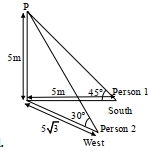
ટાવરની દક્ષિણ દિશામાં ઉભેલા એક વ્યક્તિથી ટાવરની ટોચ $P$ નો ઉત્સેધકોણ $45^{\circ}$ છે અને ટાવરની પશ્ચિમ દિશામાં ઉભેલા બીજા વ્યક્તિથી તે $30^{\circ}$ છે. જો ટાવરની ઊંચાઈ $5 \text{ m}$ હોય,તો બંને વ્યક્તિઓ વચ્ચેનું અંતર (મીટરમાં) $..........$ છે.
A
$10$
B
$5$
C
$5 \sqrt{5}$
D
$5 \sqrt{2}$
Solution
(A) ધારો કે ટાવરની ઊંચાઈ $h = 5 \text{ m}$ છે. ટાવરનો પાયો $O$ છે. પ્રથમ વ્યક્તિનું સ્થાન $A$ (દક્ષિણ) અને બીજા વ્યક્તિનું સ્થાન $B$ (પશ્ચિમ) છે.
$\triangle POA$ માં,$\tan(45^{\circ}) = \frac{PO}{OA} \implies 1 = \frac{5}{OA} \implies OA = 5 \text{ m}$.
$\triangle POB$ માં,$\tan(30^{\circ}) = \frac{PO}{OB} \implies \frac{1}{\sqrt{3}} = \frac{5}{OB} \implies OB = 5\sqrt{3} \text{ m}$.
દક્ષિણ અને પશ્ચિમ દિશાઓ પરસ્પર લંબ હોવાથી,$\triangle AOB$ એ $O$ આગળ કાટકોણ ત્રિકોણ છે.
બંને વ્યક્તિઓ વચ્ચેનું અંતર $AB = \sqrt{OA^2 + OB^2} = \sqrt{5^2 + (5\sqrt{3})^2} = \sqrt{25 + 75} = \sqrt{100} = 10 \text{ m}$ થાય.
$\triangle POA$ માં,$\tan(45^{\circ}) = \frac{PO}{OA} \implies 1 = \frac{5}{OA} \implies OA = 5 \text{ m}$.
$\triangle POB$ માં,$\tan(30^{\circ}) = \frac{PO}{OB} \implies \frac{1}{\sqrt{3}} = \frac{5}{OB} \implies OB = 5\sqrt{3} \text{ m}$.
દક્ષિણ અને પશ્ચિમ દિશાઓ પરસ્પર લંબ હોવાથી,$\triangle AOB$ એ $O$ આગળ કાટકોણ ત્રિકોણ છે.
બંને વ્યક્તિઓ વચ્ચેનું અંતર $AB = \sqrt{OA^2 + OB^2} = \sqrt{5^2 + (5\sqrt{3})^2} = \sqrt{25 + 75} = \sqrt{100} = 10 \text{ m}$ થાય.
0 likes
View Solution127
EasyMCQ
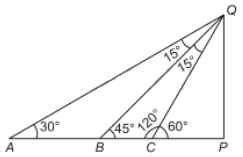
ટાવરના તળિયા તરફ જતા રસ્તા પરના ત્રણ સમરેખ બિંદુઓ $A, B$ અને $C$ થી ટાવરની ટોચના ઉત્સેધકોણ અનુક્રમે $30^{\circ}, 45^{\circ}$ અને $60^{\circ}$ છે. $AB$ અને $BC$ નો ગુણોત્તર શોધો.
A
$\sqrt{3}: 1$
B
$\sqrt{3}: 2$
C
$1: 2$
D
$2: \sqrt{3}$
Solution
(A) ધારો કે ટાવરની ઊંચાઈ $h$ છે અને ટાવરનું તળિયું $P$ છે. ધારો કે $CP = x$,$BC = y$,અને $AB = z$ છે.
$\triangle QCP$ માં,$\tan 60^{\circ} = \frac{h}{x} \Rightarrow x = \frac{h}{\sqrt{3}}$.
$\triangle QBP$ માં,$\tan 45^{\circ} = \frac{h}{x+y}$ $\Rightarrow x+y = h$ $\Rightarrow y = h - \frac{h}{\sqrt{3}} = h\left(1 - \frac{1}{\sqrt{3}}\right) = h\left(\frac{\sqrt{3}-1}{\sqrt{3}}\right)$.
$\triangle QAP$ માં,$\tan 30^{\circ} = \frac{h}{x+y+z}$ $\Rightarrow x+y+z = h\sqrt{3}$ $\Rightarrow z = h\sqrt{3} - (x+y) = h\sqrt{3} - h = h(\sqrt{3}-1)$.
હવે,ગુણોત્તર $\frac{AB}{BC} = \frac{z}{y} = \frac{h(\sqrt{3}-1)}{h\left(\frac{\sqrt{3}-1}{\sqrt{3}}\right)} = \sqrt{3}$.
આમ,$AB: BC = \sqrt{3}: 1$.
$\triangle QCP$ માં,$\tan 60^{\circ} = \frac{h}{x} \Rightarrow x = \frac{h}{\sqrt{3}}$.
$\triangle QBP$ માં,$\tan 45^{\circ} = \frac{h}{x+y}$ $\Rightarrow x+y = h$ $\Rightarrow y = h - \frac{h}{\sqrt{3}} = h\left(1 - \frac{1}{\sqrt{3}}\right) = h\left(\frac{\sqrt{3}-1}{\sqrt{3}}\right)$.
$\triangle QAP$ માં,$\tan 30^{\circ} = \frac{h}{x+y+z}$ $\Rightarrow x+y+z = h\sqrt{3}$ $\Rightarrow z = h\sqrt{3} - (x+y) = h\sqrt{3} - h = h(\sqrt{3}-1)$.
હવે,ગુણોત્તર $\frac{AB}{BC} = \frac{z}{y} = \frac{h(\sqrt{3}-1)}{h\left(\frac{\sqrt{3}-1}{\sqrt{3}}\right)} = \sqrt{3}$.
આમ,$AB: BC = \sqrt{3}: 1$.
0 likes
View Solution128
DifficultMCQ
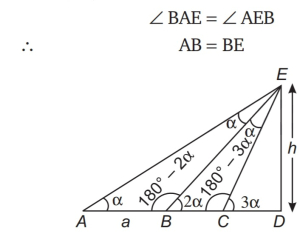
ટાવરના પાયામાંથી પસાર થતી સીધી રેખા પરના ત્રણ બિંદુઓ $A$,$B$ અને $C$ થી ટીવી ટાવરની ટોચનો ઉત્સેધકોણ અનુક્રમે $\alpha, 2 \alpha$ અને $3 \alpha$ છે. જો $AB = a$ હોય,તો ટાવરની ઊંચાઈ શોધો.
A
$a \tan \alpha$
B
$a \sin \alpha$
C
$a \sin 2 \alpha$
D
$a \sin 3 \alpha$
Solution
(C) ધારો કે $ED = h$ એ ટાવરની ઊંચાઈ છે. બિંદુઓ $A, B, C, D$ એક રેખસ્થ છે જ્યાં $D$ એ ટાવરનો પાયો છે.
$\triangle ADE$ માં,$\angle EAD = \alpha$,$\angle EBD = 2\alpha$,$\angle ECD = 3\alpha$.
$\triangle ABE$ માં,$\angle EAB = \alpha$ અને $\angle EBA = 180^{\circ} - 2\alpha$.
તેથી,$\angle AEB = 180^{\circ} - (\alpha + 180^{\circ} - 2\alpha) = \alpha$.
$\angle EAB = \angle AEB = \alpha$ હોવાથી,$\triangle ABE$ સમદ્વિબાજુ ત્રિકોણ છે,જેમાં $BE = AB = a$.
$\triangle BCE$ માં,સાઈન નિયમ મુજબ:
$\frac{BE}{\sin 3\alpha} = \frac{CE}{\sin(180^{\circ} - 2\alpha)}$
$\frac{a}{\sin 3\alpha} = \frac{CE}{\sin 2\alpha} \Rightarrow CE = \frac{a \sin 2\alpha}{\sin 3\alpha}$.
$\triangle CDE$ માં,$\sin 3\alpha = \frac{h}{CE}$.
$h = CE \sin 3\alpha = \left(\frac{a \sin 2\alpha}{\sin 3\alpha}\right) \sin 3\alpha = a \sin 2\alpha$.
$\triangle ADE$ માં,$\angle EAD = \alpha$,$\angle EBD = 2\alpha$,$\angle ECD = 3\alpha$.
$\triangle ABE$ માં,$\angle EAB = \alpha$ અને $\angle EBA = 180^{\circ} - 2\alpha$.
તેથી,$\angle AEB = 180^{\circ} - (\alpha + 180^{\circ} - 2\alpha) = \alpha$.
$\angle EAB = \angle AEB = \alpha$ હોવાથી,$\triangle ABE$ સમદ્વિબાજુ ત્રિકોણ છે,જેમાં $BE = AB = a$.
$\triangle BCE$ માં,સાઈન નિયમ મુજબ:
$\frac{BE}{\sin 3\alpha} = \frac{CE}{\sin(180^{\circ} - 2\alpha)}$
$\frac{a}{\sin 3\alpha} = \frac{CE}{\sin 2\alpha} \Rightarrow CE = \frac{a \sin 2\alpha}{\sin 3\alpha}$.
$\triangle CDE$ માં,$\sin 3\alpha = \frac{h}{CE}$.
$h = CE \sin 3\alpha = \left(\frac{a \sin 2\alpha}{\sin 3\alpha}\right) \sin 3\alpha = a \sin 2\alpha$.
0 likes
View Solution129
MediumMCQ
એક ટાવર અને બિલ્ડિંગ વચ્ચેનું આડું અંતર $10 \sqrt{3}$ એકમ છે. જો ટાવરની ટોચ પરથી બિલ્ડિંગના પાયાનો અવસેધકોણ $60^{\circ}$ હોય અને ટાવરના પાયાથી બિલ્ડિંગની ટોચનો ઉત્સેધકોણ $30^{\circ}$ હોય,તો ટાવર અને બિલ્ડિંગની ઊંચાઈનો સરવાળો કેટલો થાય?
A
$60$
B
$50$
C
$40$
D
$30$
Solution
(C) ધારો કે ટાવરની ઊંચાઈ $H$ છે અને બિલ્ડિંગની ઊંચાઈ $h$ છે. આડું અંતર $d = 10 \sqrt{3}$ છે.
ટાવરની ટોચ પરથી બિલ્ડિંગના પાયાનો અવસેધકોણ $60^{\circ}$ છે. તેથી,$\tan(60^{\circ}) = \frac{H}{d}$.
$H = d \times \tan(60^{\circ}) = 10 \sqrt{3} \times \sqrt{3} = 10 \times 3 = 30$ એકમ.
ટાવરના પાયાથી બિલ્ડિંગની ટોચનો ઉત્સેધકોણ $30^{\circ}$ છે. તેથી,$\tan(30^{\circ}) = \frac{h}{d}$.
$h = d \times \tan(30^{\circ}) = 10 \sqrt{3} \times \frac{1}{\sqrt{3}} = 10$ એકમ.
ઊંચાઈઓનો સરવાળો $H + h = 30 + 10 = 40$ એકમ થાય.
ટાવરની ટોચ પરથી બિલ્ડિંગના પાયાનો અવસેધકોણ $60^{\circ}$ છે. તેથી,$\tan(60^{\circ}) = \frac{H}{d}$.
$H = d \times \tan(60^{\circ}) = 10 \sqrt{3} \times \sqrt{3} = 10 \times 3 = 30$ એકમ.
ટાવરના પાયાથી બિલ્ડિંગની ટોચનો ઉત્સેધકોણ $30^{\circ}$ છે. તેથી,$\tan(30^{\circ}) = \frac{h}{d}$.
$h = d \times \tan(30^{\circ}) = 10 \sqrt{3} \times \frac{1}{\sqrt{3}} = 10$ એકમ.
ઊંચાઈઓનો સરવાળો $H + h = 30 + 10 = 40$ એકમ થાય.
0 likes
View Solution130
MediumMCQ
એક વિમાન $5 \text{ km}$ ની ઊંચાઈએ જમીનને સમાંતર અચળ ઝડપે ઉડી રહ્યું છે. જમીન પરના એક વ્યક્તિએ અવલોકન કર્યું કે વિમાનનો ઉત્સેધકોણ $50 \text{ સેકન્ડ}$ ના સમયગાળામાં $15^{\circ}$ થી બદલાઈને $30^{\circ}$ થાય છે,તો વિમાનની ઝડપ ($\text{kmph}$ માં) કેટલી હશે?
A
$100$
B
$720$
C
$360$
D
$540$
Solution
(B) ધારો કે વિમાનની ઊંચાઈ $h = 5 \text{ km}$ છે.
વિમાનના સ્થાનો $A$ અને $B$ છે જ્યાં ખૂણા અનુક્રમે $15^{\circ}$ અને $30^{\circ}$ છે.
જમીન પરના અવલોકનકારને $O$ કહો.
$\triangle ODA$ માં,$\tan(15^{\circ}) = \frac{h}{OD} \implies OD = 5 \cot(15^{\circ}) = 10 + 5\sqrt{3} \text{ km}$.
$\triangle OEB$ માં,$\tan(30^{\circ}) = \frac{h}{OE} \implies OE = 5\sqrt{3} \text{ km}$.
કાપેલું અંતર $d = OD - OE = 10 \text{ km}$.
સમય $t = 50 \text{ સેકન્ડ} = \frac{1}{72} \text{ કલાક}$.
ઝડપ $v = \frac{d}{t} = 720 \text{ kmph}$.
વિમાનના સ્થાનો $A$ અને $B$ છે જ્યાં ખૂણા અનુક્રમે $15^{\circ}$ અને $30^{\circ}$ છે.
જમીન પરના અવલોકનકારને $O$ કહો.
$\triangle ODA$ માં,$\tan(15^{\circ}) = \frac{h}{OD} \implies OD = 5 \cot(15^{\circ}) = 10 + 5\sqrt{3} \text{ km}$.
$\triangle OEB$ માં,$\tan(30^{\circ}) = \frac{h}{OE} \implies OE = 5\sqrt{3} \text{ km}$.
કાપેલું અંતર $d = OD - OE = 10 \text{ km}$.
સમય $t = 50 \text{ સેકન્ડ} = \frac{1}{72} \text{ કલાક}$.
ઝડપ $v = \frac{d}{t} = 720 \text{ kmph}$.
0 likes
View Solution131
DifficultMCQ
એક ટાવરના તળિયેથી $a$ અને $b$ અંતરે આવેલા અને તેની સાથે એક જ સીધી રેખામાં રહેલા બે બિંદુઓથી ટાવરની ટોચના ઉત્સેધકોણનો સરવાળો $90^{\circ}$ છે. તો,ટાવરની ઊંચાઈ કેટલી હશે?
A
$a^2 b$
B
$a b^2$
C
$\sqrt{a b}$
D
$a b$
Solution
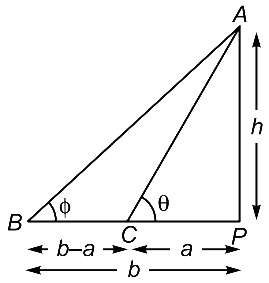
(C) ધારો કે ટાવરની ઊંચાઈ $h$ છે અને પાયો $P$ છે. બે બિંદુઓ $C$ અને $B$ એવા છે કે જેથી $PC = a$ અને $PB = b$ થાય. ઉત્સેધકોણ $\angle ACP = \theta$ અને $\angle ABP = \phi$ છે. આપેલ છે કે $\theta + \phi = 90^{\circ}$.
$\triangle ACP$ માં,$\tan \theta = \frac{h}{a}$.
$\triangle ABP$ માં,$\tan \phi = \frac{h}{b}$.
કારણ કે $\theta + \phi = 90^{\circ}$,તેથી $\phi = 90^{\circ} - \theta$,એટલે કે $\tan \phi = \tan(90^{\circ} - \theta) = \cot \theta = \frac{1}{\tan \theta}$.
કિંમતો મૂકતા,$\frac{h}{b} = \frac{1}{h/a} = \frac{a}{h}$.
તેથી,$h^2 = ab$,જે આપણને $h = \sqrt{ab}$ આપે છે.
$\triangle ACP$ માં,$\tan \theta = \frac{h}{a}$.
$\triangle ABP$ માં,$\tan \phi = \frac{h}{b}$.
કારણ કે $\theta + \phi = 90^{\circ}$,તેથી $\phi = 90^{\circ} - \theta$,એટલે કે $\tan \phi = \tan(90^{\circ} - \theta) = \cot \theta = \frac{1}{\tan \theta}$.
કિંમતો મૂકતા,$\frac{h}{b} = \frac{1}{h/a} = \frac{a}{h}$.
તેથી,$h^2 = ab$,જે આપણને $h = \sqrt{ab}$ આપે છે.
0 likes
View Solution132
MediumMCQ
સપાટ જમીન પર ઉભેલા ટાવરનો પડછાયો જ્યારે સૂર્યનો ઉન્નતકોણ $30^{\circ}$ હોય ત્યારે $45^{\circ}$ હોય તેના કરતા $60 \ m$ લાંબો જોવા મળે છે. ટાવરની ઊંચાઈ શોધો.
A
$30 \ m$
B
$90 \ m$
C
$60 \sqrt{3} \ m$
D
$30(\sqrt{3}+1) \ m$
Solution
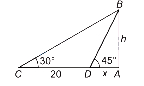
(D) ધારો કે ટાવરની ઊંચાઈ $h$ છે અને જ્યારે સૂર્યનો ઉન્નતકોણ $45^{\circ}$ હોય ત્યારે પડછાયાની લંબાઈ $x$ છે.
$\triangle BAD$ માં,$\tan 45^{\circ} = \frac{h}{x}$ $\Rightarrow 1 = \frac{h}{x}$ $\Rightarrow x = h$.
જ્યારે સૂર્યનો ઉન્નતકોણ $30^{\circ}$ હોય,ત્યારે પડછાયાની લંબાઈ $x + 60$ થાય છે.
$\triangle BAC$ માં,$\tan 30^{\circ} = \frac{h}{x+60} \Rightarrow \frac{1}{\sqrt{3}} = \frac{h}{h+60}$.
$\Rightarrow h + 60 = h\sqrt{3}$
$\Rightarrow h(\sqrt{3} - 1) = 60$
$\Rightarrow h = \frac{60}{\sqrt{3}-1} \times \frac{\sqrt{3}+1}{\sqrt{3}+1}$
$\Rightarrow h = \frac{60(\sqrt{3}+1)}{3-1} = \frac{60(\sqrt{3}+1)}{2} = 30(\sqrt{3}+1) \ m$.
$\triangle BAD$ માં,$\tan 45^{\circ} = \frac{h}{x}$ $\Rightarrow 1 = \frac{h}{x}$ $\Rightarrow x = h$.
જ્યારે સૂર્યનો ઉન્નતકોણ $30^{\circ}$ હોય,ત્યારે પડછાયાની લંબાઈ $x + 60$ થાય છે.
$\triangle BAC$ માં,$\tan 30^{\circ} = \frac{h}{x+60} \Rightarrow \frac{1}{\sqrt{3}} = \frac{h}{h+60}$.
$\Rightarrow h + 60 = h\sqrt{3}$
$\Rightarrow h(\sqrt{3} - 1) = 60$
$\Rightarrow h = \frac{60}{\sqrt{3}-1} \times \frac{\sqrt{3}+1}{\sqrt{3}+1}$
$\Rightarrow h = \frac{60(\sqrt{3}+1)}{3-1} = \frac{60(\sqrt{3}+1)}{2} = 30(\sqrt{3}+1) \ m$.
0 likes
View Solution133
EasyMCQ
જો એક ઊંચી ઇમારતની ટોચ પરથી એક ટૂંકી ઇમારતની ટોચ અને તળિયાના અવસેધકોણ અનુક્રમે $30^{\circ}$ અને $60^{\circ}$ હોય,તો ટૂંકી અને ઊંચી ઇમારતની ઊંચાઈનો ગુણોત્તર શોધો.
A
$2: 3$
B
$1: 2$
C
$1: 3$
D
$1: 4$
Solution
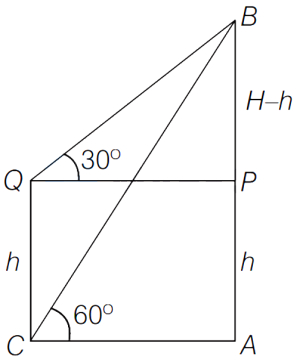
(A) ધારો કે $AB$ એ $H$ ઊંચાઈની ઊંચી ઇમારત છે અને $CQ$ એ $h$ ઊંચાઈની ટૂંકી ઇમારત છે. ધારો કે $A$ એ ઊંચી ઇમારતનો પાયો છે અને $C$ એ ટૂંકી ઇમારતનો પાયો છે.
$\triangle ABC$ માં,$\tan 60^{\circ} = \frac{AB}{AC} = \frac{H}{AC}$. તેથી,$AC = \frac{H}{\sqrt{3}}$.
કારણ કે $AC = QP$,તેથી $QP = \frac{H}{\sqrt{3}}$.
$\triangle BQP$ માં,$\tan 30^{\circ} = \frac{BP}{QP} = \frac{H-h}{QP}$.
$QP = \frac{H}{\sqrt{3}}$ મૂકતા,આપણને મળે $\frac{1}{\sqrt{3}} = \frac{H-h}{H/\sqrt{3}}$.
આનું સાદું રૂપ આપતા $\frac{1}{\sqrt{3}} = \frac{(H-h)\sqrt{3}}{H}$.
$H = 3(H-h)$ $\Rightarrow H = 3H - 3h$ $\Rightarrow 2H = 3h$.
તેથી,ટૂંકી ઇમારત અને ઊંચી ઇમારતની ઊંચાઈનો ગુણોત્તર $\frac{h}{H} = \frac{2}{3}$ એટલે કે $2:3$ છે.
$\triangle ABC$ માં,$\tan 60^{\circ} = \frac{AB}{AC} = \frac{H}{AC}$. તેથી,$AC = \frac{H}{\sqrt{3}}$.
કારણ કે $AC = QP$,તેથી $QP = \frac{H}{\sqrt{3}}$.
$\triangle BQP$ માં,$\tan 30^{\circ} = \frac{BP}{QP} = \frac{H-h}{QP}$.
$QP = \frac{H}{\sqrt{3}}$ મૂકતા,આપણને મળે $\frac{1}{\sqrt{3}} = \frac{H-h}{H/\sqrt{3}}$.
આનું સાદું રૂપ આપતા $\frac{1}{\sqrt{3}} = \frac{(H-h)\sqrt{3}}{H}$.
$H = 3(H-h)$ $\Rightarrow H = 3H - 3h$ $\Rightarrow 2H = 3h$.
તેથી,ટૂંકી ઇમારત અને ઊંચી ઇમારતની ઊંચાઈનો ગુણોત્તર $\frac{h}{H} = \frac{2}{3}$ એટલે કે $2:3$ છે.
0 likes
View Solution134
DifficultMCQ
એક વ્યક્તિ જમીન પરના બિંદુ $A$ થી ટાવરની ટોચનું અવલોકન કરે છે. આ બિંદુથી ટાવરનો ઉત્સેધકોણ $60^{\circ}$ છે. તે $A$ અને ટાવરના પાયાને જોડતી રેખાને લંબ દિશામાં $60 \ m$ ચાલે છે. આ બિંદુથી ટાવરનો ઉત્સેધકોણ $45^{\circ}$ છે. તો,ટાવરની ઊંચાઈ (મીટરમાં) કેટલી છે?
A
$60 \sqrt{\frac{3}{2}}$
B
$60 \sqrt{2}$
C
$60 \sqrt{3}$
D
$30 \sqrt{6}$
Solution
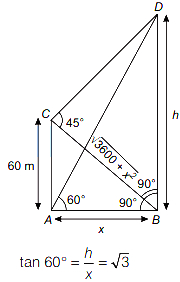
(D) ધારો કે ટાવરની ઊંચાઈ $h$ છે અને ટાવરના પાયા $(B)$ થી બિંદુ $A$ નું અંતર $x$ છે.
$\triangle ABD$ માં,$\tan 60^{\circ} = \frac{h}{x}$ $\Rightarrow \sqrt{3} = \frac{h}{x}$ $\Rightarrow x = \frac{h}{\sqrt{3}}$.
હવે,વ્યક્તિ $AB$ ને લંબ દિશામાં $60 \ m$ ચાલીને બિંદુ $C$ પર પહોંચે છે. આમ,$AC = 60 \ m$ અને $\triangle ABC$ એ $A$ આગળ કાટકોણ ત્રિકોણ છે.
બિંદુ $C$ થી પાયા $B$ સુધીનું અંતર $BC = \sqrt{AC^2 + AB^2} = \sqrt{60^2 + x^2} = \sqrt{3600 + x^2}$ છે.
$\triangle CBD$ માં,ઉત્સેધકોણ $45^{\circ}$ છે,તેથી $\tan 45^{\circ} = \frac{h}{BC} \Rightarrow 1 = \frac{h}{\sqrt{3600 + x^2}}$.
તેથી,$h^2 = 3600 + x^2$.
સમીકરણમાં $x^2 = \frac{h^2}{3}$ મૂકતા: $h^2 = 3600 + \frac{h^2}{3}$.
$h^2 - \frac{h^2}{3} = 3600 \Rightarrow \frac{2h^2}{3} = 3600$.
$h^2 = 1800 \times 3 = 5400$.
$h = \sqrt{5400} = \sqrt{900 \times 6} = 30 \sqrt{6} \ m$.
$\triangle ABD$ માં,$\tan 60^{\circ} = \frac{h}{x}$ $\Rightarrow \sqrt{3} = \frac{h}{x}$ $\Rightarrow x = \frac{h}{\sqrt{3}}$.
હવે,વ્યક્તિ $AB$ ને લંબ દિશામાં $60 \ m$ ચાલીને બિંદુ $C$ પર પહોંચે છે. આમ,$AC = 60 \ m$ અને $\triangle ABC$ એ $A$ આગળ કાટકોણ ત્રિકોણ છે.
બિંદુ $C$ થી પાયા $B$ સુધીનું અંતર $BC = \sqrt{AC^2 + AB^2} = \sqrt{60^2 + x^2} = \sqrt{3600 + x^2}$ છે.
$\triangle CBD$ માં,ઉત્સેધકોણ $45^{\circ}$ છે,તેથી $\tan 45^{\circ} = \frac{h}{BC} \Rightarrow 1 = \frac{h}{\sqrt{3600 + x^2}}$.
તેથી,$h^2 = 3600 + x^2$.
સમીકરણમાં $x^2 = \frac{h^2}{3}$ મૂકતા: $h^2 = 3600 + \frac{h^2}{3}$.
$h^2 - \frac{h^2}{3} = 3600 \Rightarrow \frac{2h^2}{3} = 3600$.
$h^2 = 1800 \times 3 = 5400$.
$h = \sqrt{5400} = \sqrt{900 \times 6} = 30 \sqrt{6} \ m$.
0 likes
View Solution135
MediumMCQ
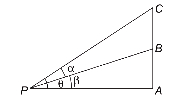
એક ઉભો થાંભલો જમીન પરના બિંદુ $P$ આગળ $\tan ^{-1}\left(\frac{1}{2}\right)$ જેટલો ખૂણો આંતરે છે. જો થાંભલાના ઉપરના અડધા ભાગ અને નીચેના અડધા ભાગ દ્વારા $P$ આગળ આંતરેલા ખૂણા અનુક્રમે $\alpha$ અને $\beta$ હોય,તો $(\tan \alpha, \tan \beta)$ ની કિંમત શોધો.
A
$\left(\frac{1}{4}, \frac{1}{5}\right)$
B
$\left(\frac{1}{5}, \frac{2}{9}\right)$
C
$\left(\frac{2}{9}, \frac{1}{4}\right)$
D
$\left(\frac{1}{4}, \frac{2}{9}\right)$
Solution
(C) ધારો કે થાંભલાની ઊંચાઈ $2h$ છે,જ્યાં $B$ એ મધ્યબિંદુ છે જેથી $AB = BC = h$. ધારો કે $PA = x$. આખા થાંભલા દ્વારા આંતરેલો ખૂણો $\theta = \tan^{-1}\left(\frac{1}{2}\right)$ છે,તેથી $\tan \theta = \frac{2h}{x} = \frac{1}{2}$,જેનો અર્થ છે કે $x = 4h$.
હવે,$\tan \beta = \frac{h}{x} = \frac{h}{4h} = \frac{1}{4}$.
આપેલ છે કે $\theta = \alpha + \beta$,તેથી $\alpha = \theta - \beta$.
સૂત્ર $\tan \alpha = \tan(\theta - \beta) = \frac{\tan \theta - \tan \beta}{1 + \tan \theta \tan \beta} = \frac{\frac{1}{2} - \frac{1}{4}}{1 + (\frac{1}{2})(\frac{1}{4})} = \frac{\frac{1}{4}}{\frac{9}{8}} = \frac{2}{9}$.
આમ,$(\tan \alpha, \tan \beta) = \left(\frac{2}{9}, \frac{1}{4}\right)$.
હવે,$\tan \beta = \frac{h}{x} = \frac{h}{4h} = \frac{1}{4}$.
આપેલ છે કે $\theta = \alpha + \beta$,તેથી $\alpha = \theta - \beta$.
સૂત્ર $\tan \alpha = \tan(\theta - \beta) = \frac{\tan \theta - \tan \beta}{1 + \tan \theta \tan \beta} = \frac{\frac{1}{2} - \frac{1}{4}}{1 + (\frac{1}{2})(\frac{1}{4})} = \frac{\frac{1}{4}}{\frac{9}{8}} = \frac{2}{9}$.
આમ,$(\tan \alpha, \tan \beta) = \left(\frac{2}{9}, \frac{1}{4}\right)$.
0 likes
View Solution136
DifficultMCQ
એક સરોવરની સપાટીથી $2500 \ m$ ઊંચાઈએ આવેલા એક બિંદુથી વાદળનો ઉત્સેધકોણ $15^{\circ}$ છે અને તે જ બિંદુથી સરોવરમાં તેના પ્રતિબિંબનો અવસેધકોણ $45^{\circ}$ છે. જો $\cot 15^{\circ}=2+\sqrt{3}$ હોય,તો સરોવરની સપાટીથી વાદળની ઊંચાઈ (મીટરમાં) કેટલી હશે?
A
$2500$
B
$2500 \sqrt{2}$
C
$2500 \sqrt{3}$
D
$5000$
Solution
(C) ધારો કે $h = 2500 \ m$ એ સરોવરની સપાટીથી અવલોકન બિંદુની ઊંચાઈ છે. ધારો કે $H$ એ સરોવરની સપાટીથી વાદળની ઊંચાઈ છે. અવલોકન બિંદુથી વાદળનું અંતર $H-h$ છે. અવલોકન બિંદુથી વાદળના પ્રતિબિંબનું અંતર $H+h$ છે.
ધારો કે અવલોકન બિંદુથી વાદળનું સમક્ષિતિજ અંતર $x$ છે.
અવલોકન બિંદુ,વાદળ અને સમક્ષિતિજ રેખા દ્વારા બનતા ત્રિકોણમાં,$\cot 15^{\circ} = \frac{x}{H-h} \Rightarrow x = (H-h)(2+\sqrt{3}) \quad (i)$
અવલોકન બિંદુ,વાદળના પ્રતિબિંબ અને સમક્ષિતિજ રેખા દ્વારા બનતા ત્રિકોણમાં,$\cot 45^{\circ} = \frac{x}{H+h} \Rightarrow x = H+h \quad (ii)$
$(i)$ અને $(ii)$ ને સરખાવતા:
$(H-h)(2+\sqrt{3}) = H+h$
$H(2+\sqrt{3}) - h(2+\sqrt{3}) = H+h$
$H(2+\sqrt{3}-1) = h(2+\sqrt{3}+1)$
$H(1+\sqrt{3}) = h(3+\sqrt{3})$
$H = h \frac{\sqrt{3}(\sqrt{3}+1)}{\sqrt{3}+1} = h\sqrt{3}$
અહીં $h = 2500 \ m$ આપેલ છે,તેથી $H = 2500\sqrt{3} \ m$.
ધારો કે અવલોકન બિંદુથી વાદળનું સમક્ષિતિજ અંતર $x$ છે.
અવલોકન બિંદુ,વાદળ અને સમક્ષિતિજ રેખા દ્વારા બનતા ત્રિકોણમાં,$\cot 15^{\circ} = \frac{x}{H-h} \Rightarrow x = (H-h)(2+\sqrt{3}) \quad (i)$
અવલોકન બિંદુ,વાદળના પ્રતિબિંબ અને સમક્ષિતિજ રેખા દ્વારા બનતા ત્રિકોણમાં,$\cot 45^{\circ} = \frac{x}{H+h} \Rightarrow x = H+h \quad (ii)$
$(i)$ અને $(ii)$ ને સરખાવતા:
$(H-h)(2+\sqrt{3}) = H+h$
$H(2+\sqrt{3}) - h(2+\sqrt{3}) = H+h$
$H(2+\sqrt{3}-1) = h(2+\sqrt{3}+1)$
$H(1+\sqrt{3}) = h(3+\sqrt{3})$
$H = h \frac{\sqrt{3}(\sqrt{3}+1)}{\sqrt{3}+1} = h\sqrt{3}$
અહીં $h = 2500 \ m$ આપેલ છે,તેથી $H = 2500\sqrt{3} \ m$.
0 likes
View Solution137
MediumMCQ
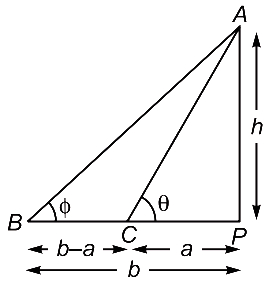
એક ટાવરના પાયાથી $a$ અને $b$ અંતરે આવેલા અને તેની સાથે એક જ સીધી રેખામાં રહેલા બે બિંદુઓથી ટાવરની ટોચના ઉત્સેધકોણનો સરવાળો $90^{\circ}$ છે. તો,ટાવરની ઊંચાઈ શોધો.
A
$a^2 b$
B
$a b^2$
C
$\sqrt{a b}$
D
$a b$
Solution
(C) ધારો કે ટાવરની ઊંચાઈ $h$ છે અને બિંદુઓ $C$ અને $B$ પાયા $P$ થી અનુક્રમે $a$ અને $b$ અંતરે છે.
$\triangle ACP$ માં,$\tan \theta = \frac{h}{a} \implies \theta = \arctan(\frac{h}{a})$.
$\triangle ABP$ માં,$\tan \phi = \frac{h}{b} \implies \phi = \arctan(\frac{h}{b})$.
આપેલ છે કે $\theta + \phi = 90^{\circ}$,તેથી $\theta = 90^{\circ} - \phi$.
બંને બાજુ ટેન્જન્ટ લેતા,$\tan \theta = \tan(90^{\circ} - \phi) = \cot \phi = \frac{1}{\tan \phi}$.
કિંમતો મૂકતા,$\frac{h}{a} = \frac{1}{h/b} = \frac{b}{h}$.
તેથી,$h^2 = ab$,જે આપે છે $h = \sqrt{ab}$.
$\triangle ACP$ માં,$\tan \theta = \frac{h}{a} \implies \theta = \arctan(\frac{h}{a})$.
$\triangle ABP$ માં,$\tan \phi = \frac{h}{b} \implies \phi = \arctan(\frac{h}{b})$.
આપેલ છે કે $\theta + \phi = 90^{\circ}$,તેથી $\theta = 90^{\circ} - \phi$.
બંને બાજુ ટેન્જન્ટ લેતા,$\tan \theta = \tan(90^{\circ} - \phi) = \cot \phi = \frac{1}{\tan \phi}$.
કિંમતો મૂકતા,$\frac{h}{a} = \frac{1}{h/b} = \frac{b}{h}$.
તેથી,$h^2 = ab$,જે આપે છે $h = \sqrt{ab}$.
0 likes
View Solution138
DifficultMCQ
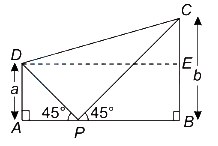
$P$ એ $a$ અને $b$ ઊંચાઈ ધરાવતા બે શિરોલંબ થાંભલાઓના પાયાને જોડતા રેખાખંડ પરનું એક બિંદુ છે. $P$ થી થાંભલાઓની ટોચના ઉત્સેધકોણ દરેક $45^{\circ}$ છે. તો,થાંભલાઓની ટોચ વચ્ચેના અંતરનો વર્ગ કેટલો થાય?
A
$\frac{a^2+b^2}{2}$
B
$a^2+b^2$
C
$2(a^2+b^2)$
D
$4(a^2+b^2)$
Solution
(C) ધારો કે બે થાંભલા $AD$ અને $BC$ છે જેમની ઊંચાઈ અનુક્રમે $a$ અને $b$ છે,જે સમક્ષિતિજ રેખા $AB$ પર આવેલા છે.
$P$ એ $AB$ પરનું બિંદુ છે જેથી $\angle DPA = 45^{\circ}$ અને $\angle CPB = 45^{\circ}$ થાય.
$\triangle APD$ માં,$\tan 45^{\circ} = \frac{AD}{AP} = \frac{a}{AP} \Rightarrow AP = a$.
$\triangle BPC$ માં,$\tan 45^{\circ} = \frac{BC}{BP} = \frac{b}{BP} \Rightarrow BP = b$.
થાંભલાઓ વચ્ચેનું સમક્ષિતિજ અંતર $AB = AP + PB = a + b$ છે.
$AB$ ને સમાંતર રેખા $DE$ દોરો જેથી $E$ એ $BC$ પર આવે. તો $DE = AB = a + b$ અને $CE = BC - BE = BC - AD = b - a$ થાય.
કાટકોણ ત્રિકોણ $\triangle DEC$ માં,પાયથાગોરસના પ્રમેય મુજબ:
$DC^2 = DE^2 + CE^2$
$DC^2 = (a + b)^2 + (b - a)^2$
$DC^2 = (a^2 + 2ab + b^2) + (b^2 - 2ab + a^2)$
$DC^2 = 2(a^2 + b^2)$.
$P$ એ $AB$ પરનું બિંદુ છે જેથી $\angle DPA = 45^{\circ}$ અને $\angle CPB = 45^{\circ}$ થાય.
$\triangle APD$ માં,$\tan 45^{\circ} = \frac{AD}{AP} = \frac{a}{AP} \Rightarrow AP = a$.
$\triangle BPC$ માં,$\tan 45^{\circ} = \frac{BC}{BP} = \frac{b}{BP} \Rightarrow BP = b$.
થાંભલાઓ વચ્ચેનું સમક્ષિતિજ અંતર $AB = AP + PB = a + b$ છે.
$AB$ ને સમાંતર રેખા $DE$ દોરો જેથી $E$ એ $BC$ પર આવે. તો $DE = AB = a + b$ અને $CE = BC - BE = BC - AD = b - a$ થાય.
કાટકોણ ત્રિકોણ $\triangle DEC$ માં,પાયથાગોરસના પ્રમેય મુજબ:
$DC^2 = DE^2 + CE^2$
$DC^2 = (a + b)^2 + (b - a)^2$
$DC^2 = (a^2 + 2ab + b^2) + (b^2 - 2ab + a^2)$
$DC^2 = 2(a^2 + b^2)$.
0 likes
View Solution139
MediumMCQ
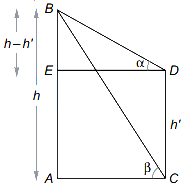
$h$ મીટર ઊંચી ટેકરીની ટોચ પરથી એક સ્તંભની ટોચ અને તળિયાના અવસેધકોણ અનુક્રમે $\alpha$ અને $\beta$ છે. સ્તંભની ઊંચાઈ (મીટરમાં) કેટલી થાય?
A
$\frac{h(\tan \beta-\tan \alpha)}{\tan \beta}$
B
$\frac{h(\tan \alpha-\tan \beta)}{\tan \alpha}$
C
$\frac{h(\tan \beta+\tan \alpha)}{\tan \beta}$
D
$\frac{h(\tan \beta+\tan \alpha)}{\tan \alpha}$
Solution
(A) ધારો કે $AB$ એ $h$ ઊંચાઈની ટેકરી છે અને $CD$ એ $h^{\prime}$ ઊંચાઈનો સ્તંભ છે.
ધારો કે $E$ એ $AB$ પરનું બિંદુ છે જેથી $ED$ સમક્ષિતિજ રહે.
$\triangle EBD$ માં,$\tan \alpha = \frac{BE}{ED} = \frac{h-h^{\prime}}{ED}$,તેથી $ED = \frac{h-h^{\prime}}{\tan \alpha}$.
$\triangle ABC$ માં,$\tan \beta = \frac{AB}{AC} = \frac{h}{ED}$,તેથી $ED = \frac{h}{\tan \beta}$.
$ED$ માટેના બંને સમીકરણોને સરખાવતા:
$\frac{h-h^{\prime}}{\tan \alpha} = \frac{h}{\tan \beta}$
$h-h^{\prime} = \frac{h \tan \alpha}{\tan \beta}$
$h^{\prime} = h - \frac{h \tan \alpha}{\tan \beta} = h \left(1 - \frac{\tan \alpha}{\tan \beta}\right) = \frac{h(\tan \beta - \tan \alpha)}{\tan \beta}$.
ધારો કે $E$ એ $AB$ પરનું બિંદુ છે જેથી $ED$ સમક્ષિતિજ રહે.
$\triangle EBD$ માં,$\tan \alpha = \frac{BE}{ED} = \frac{h-h^{\prime}}{ED}$,તેથી $ED = \frac{h-h^{\prime}}{\tan \alpha}$.
$\triangle ABC$ માં,$\tan \beta = \frac{AB}{AC} = \frac{h}{ED}$,તેથી $ED = \frac{h}{\tan \beta}$.
$ED$ માટેના બંને સમીકરણોને સરખાવતા:
$\frac{h-h^{\prime}}{\tan \alpha} = \frac{h}{\tan \beta}$
$h-h^{\prime} = \frac{h \tan \alpha}{\tan \beta}$
$h^{\prime} = h - \frac{h \tan \alpha}{\tan \beta} = h \left(1 - \frac{\tan \alpha}{\tan \beta}\right) = \frac{h(\tan \beta - \tan \alpha)}{\tan \beta}$.
0 likes
View Solution140
DifficultMCQ
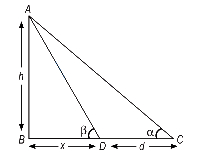
સપાટ જમીન પરના બિંદુ $P$ થી એક વસ્તુનો ઉત્સેધકોણ $\alpha$ છે. જમીન પર વસ્તુ તરફ $d$ મીટર આગળ વધતા,ઉત્સેધકોણ $\beta$ માલૂમ પડે છે. તો વસ્તુની ઊંચાઈ (મીટરમાં) કેટલી થાય?
A
$d \tan \alpha$
B
$d \cot \beta$
C
$\frac{d}{\cot \alpha+\cot \beta}$
D
$\frac{d}{\cot \alpha-\cot \beta}$
Solution
(D) ધારો કે વસ્તુની ઊંચાઈ $h$ છે. ધારો કે $B$ એ જમીન પરનું બિંદુ છે જે વસ્તુ $A$ ની બરાબર નીચે છે,અને $C$ તથા $D$ એ જમીન પરના બે બિંદુઓ છે જેથી $CD = d$ અને $BD = x$ થાય.
$\triangle ABC$ માં,$\tan \alpha = \frac{h}{x+d} \Rightarrow x+d = h \cot \alpha$ $(i)$
$\triangle ABD$ માં,$\tan \beta = \frac{h}{x} \Rightarrow x = h \cot \beta$ (ii)
(ii) માંથી $x$ ની કિંમત $(i)$ માં મૂકતા:
$h \cot \beta + d = h \cot \alpha$
$d = h \cot \alpha - h \cot \beta$
$d = h(\cot \alpha - \cot \beta)$
$h = \frac{d}{\cot \alpha - \cot \beta}$
$\triangle ABC$ માં,$\tan \alpha = \frac{h}{x+d} \Rightarrow x+d = h \cot \alpha$ $(i)$
$\triangle ABD$ માં,$\tan \beta = \frac{h}{x} \Rightarrow x = h \cot \beta$ (ii)
(ii) માંથી $x$ ની કિંમત $(i)$ માં મૂકતા:
$h \cot \beta + d = h \cot \alpha$
$d = h \cot \alpha - h \cot \beta$
$d = h(\cot \alpha - \cot \beta)$
$h = \frac{d}{\cot \alpha - \cot \beta}$
0 likes
View Solution141
MediumMCQ
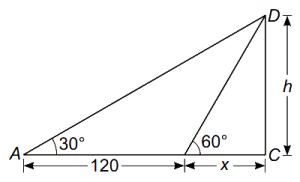
એક ટેકરી પરના પદાર્થનો ઉત્સેધકોણ તેના પાયામાંથી પસાર થતા સમક્ષિતિજ સમતલના એક બિંદુએથી $30^{\circ}$ માલૂમ પડે છે. સમતલ જમીન પર તેની તરફ $120 \ m$ ચાલ્યા પછી ઉત્સેધકોણ $60^{\circ}$ માલૂમ પડે છે. તો પદાર્થની ઊંચાઈ (મીટરમાં) કેટલી હશે?
A
$120$
B
$60 \sqrt{3}$
C
$120 \sqrt{3}$
D
$60$
Solution
(B) ધારો કે પદાર્થની ઊંચાઈ $h$ છે અને બીજા અવલોકન બિંદુથી ટેકરીના પાયા સુધીનું અંતર $x$ છે.
$\triangle BCD$ માં,$\tan 60^{\circ} = \frac{h}{x}$ $\Rightarrow \sqrt{3} = \frac{h}{x}$ $\Rightarrow x = \frac{h}{\sqrt{3}}$.
$\triangle ACD$ માં,$\tan 30^{\circ} = \frac{h}{120 + x}$ $\Rightarrow \frac{1}{\sqrt{3}} = \frac{h}{120 + x}$ $\Rightarrow 120 + x = h\sqrt{3}$.
$x = \frac{h}{\sqrt{3}}$ ને સમીકરણમાં મૂકતા:
$120 + \frac{h}{\sqrt{3}} = h\sqrt{3}$
$120 = h\sqrt{3} - \frac{h}{\sqrt{3}} = h \left( \frac{3 - 1}{\sqrt{3}} \right) = \frac{2h}{\sqrt{3}}$
$h = \frac{120 \times \sqrt{3}}{2} = 60\sqrt{3} \ m$.
$\triangle BCD$ માં,$\tan 60^{\circ} = \frac{h}{x}$ $\Rightarrow \sqrt{3} = \frac{h}{x}$ $\Rightarrow x = \frac{h}{\sqrt{3}}$.
$\triangle ACD$ માં,$\tan 30^{\circ} = \frac{h}{120 + x}$ $\Rightarrow \frac{1}{\sqrt{3}} = \frac{h}{120 + x}$ $\Rightarrow 120 + x = h\sqrt{3}$.
$x = \frac{h}{\sqrt{3}}$ ને સમીકરણમાં મૂકતા:
$120 + \frac{h}{\sqrt{3}} = h\sqrt{3}$
$120 = h\sqrt{3} - \frac{h}{\sqrt{3}} = h \left( \frac{3 - 1}{\sqrt{3}} \right) = \frac{2h}{\sqrt{3}}$
$h = \frac{120 \times \sqrt{3}}{2} = 60\sqrt{3} \ m$.
0 likes
View SolutionTrigonometrical Equations — Height and Distance · Frequently Asked Questions
1Are these Trigonometrical Equations questions useful for JEE and NEET?
Yes. All questions in this section are mapped to JEE Main and NEET exam patterns. Previous year questions from JEE Main, NEET, GUJCET and state-level exams are included with full solutions.
2Can I switch to Hindi or Gujarati for these questions?
Yes. Use the language tabs in the hero section or the sidebar to view the same questions and solutions in English, Hindi or Gujarati.
3How do I generate a question paper from this subtopic?
Use the Vedclass Exam Paper Generator — select the chapter and subtopic, set difficulty, and generate Sets A, B, C, D automatically. First 3 chapters of every subject are free.
Vedclass Products
For Students
Vedclass Test Series
Mock tests in real JEE/NEET style with performance analysis. 5-day free trial.
Start Free TrialFor Teachers
Exam Paper Generator
Generate Set A/B/C/D papers from this chapter in 2 minutes. 3 chapters free.
Try FreeFor Institutes
Online Exam Module
Live online exams with unlimited students, 360° analytics & white-label branding.
See DemoFor Teachers & Institutes
Generate a Trigonometrical Equations Exam Paper in 2 Minutes
Select subtopic & difficulty — Sets A, B, C, D auto-generated with No Repeat logic.
First 3 chapters of every subject are free — no payment required.