
A English
Alkene Questions in English
Class 11 Chemistry · Hydrocarbons · Alkene
1080+
Questions
English
Language
100%
With Solutions
Showing 50 of 1080 questions in English
151
AdvancedMCQ
An alkyl bromide produces a single alkene when it reacts with sodium ethoxide and ethanol. This alkene undergoes hydrogenation and produces $2-$methylbutane. What is the identity of the alkyl bromide?
A
$1-$bromo$-2,2-$dimethylpropane
B
$1-$bromobutane
C
$1-$bromo$-2-$methylbutane
D
$2-$bromo$-2-$methylbutane
Solution
(C) The reaction of an alkyl bromide with sodium ethoxide $(C_2H_5ONa)$ in ethanol $(C_2H_5OH)$ is a dehydrohalogenation reaction (elimination reaction).
For the alkyl bromide to produce a single alkene,it must have only one possible $\beta-$hydrogen elimination path.
$1-$bromo$-2-$methylbutane $(CH_3-CH_2-CH(CH_3)-CH_2Br)$ undergoes elimination to form $2-$methylbut$-1-$ene $(CH_3-CH_2-C(CH_3)=CH_2)$.
Hydrogenation of $2-$methylbut$-1-$ene $(CH_3-CH_2-C(CH_3)=CH_2 + H_2 \rightarrow CH_3-CH_2-CH(CH_3)-CH_3)$ yields $2-$methylbutane.
Therefore,the correct alkyl bromide is $1-$bromo$-2-$methylbutane.
For the alkyl bromide to produce a single alkene,it must have only one possible $\beta-$hydrogen elimination path.
$1-$bromo$-2-$methylbutane $(CH_3-CH_2-CH(CH_3)-CH_2Br)$ undergoes elimination to form $2-$methylbut$-1-$ene $(CH_3-CH_2-C(CH_3)=CH_2)$.
Hydrogenation of $2-$methylbut$-1-$ene $(CH_3-CH_2-C(CH_3)=CH_2 + H_2 \rightarrow CH_3-CH_2-CH(CH_3)-CH_3)$ yields $2-$methylbutane.
Therefore,the correct alkyl bromide is $1-$bromo$-2-$methylbutane.
0 likes
View Solution152
MediumMCQ
$1, 2$-dibromocyclohexane on dehydrohalogenation gives
A
None of these
B
Cyclohexene
C
$1,3-$Cyclohexadiene
D
$1,4-$Cyclohexadiene
Solution
(C) Dehydrohalogenation of $1, 2$-dibromocyclohexane involves the removal of two molecules of $HBr$ in the presence of a strong base (like alcoholic $KOH$).
Initially,$1, 2$-dibromocyclohexane undergoes elimination to form bromocyclohexene.
Further elimination of the second $HBr$ molecule leads to the formation of $1, 3$-cyclohexadiene as the major product due to the conjugation of the double bonds,which provides extra stability.
Initially,$1, 2$-dibromocyclohexane undergoes elimination to form bromocyclohexene.
Further elimination of the second $HBr$ molecule leads to the formation of $1, 3$-cyclohexadiene as the major product due to the conjugation of the double bonds,which provides extra stability.
0 likes
View Solution153
DifficultMCQ
Propene,$CH_3-CH=CH_2$ can be converted to $1-propanol$ by oxidation. Which set of reagents among the following is ideal to effect the conversion?
A
Alkaline $KMnO_4$
B
$B_2H_6$ and alkaline $H_2O_2$
C
$O_3/Zn$ dust
D
$OsO_4/CH_4, Cl_2$
Solution
(B) The conversion of propene to $1-propanol$ is an anti-Markovnikov hydration reaction,which is achieved via hydroboration-oxidation.
Step $1$: Hydroboration: $3CH_3-CH=CH_2 + \frac{1}{2}B_2H_6 \rightarrow (CH_3-CH_2-CH_2)_3B$
Step $2$: Oxidation: $(CH_3-CH_2-CH_2)_3B + 3H_2O_2 \xrightarrow{OH^-} 3CH_3-CH_2-CH_2-OH + B(OH)_3$
Thus,the reagents $B_2H_6$ and alkaline $H_2O_2$ are ideal for this conversion.
Step $1$: Hydroboration: $3CH_3-CH=CH_2 + \frac{1}{2}B_2H_6 \rightarrow (CH_3-CH_2-CH_2)_3B$
Step $2$: Oxidation: $(CH_3-CH_2-CH_2)_3B + 3H_2O_2 \xrightarrow{OH^-} 3CH_3-CH_2-CH_2-OH + B(OH)_3$
Thus,the reagents $B_2H_6$ and alkaline $H_2O_2$ are ideal for this conversion.
0 likes
View Solution154
MediumMCQ
$CH_2 = CH_2 + B_2H_6 \xrightarrow[H_2O_2]{NaOH} \text{Product}$.
The product in the above reaction is:
The product in the above reaction is:
A
$CH_3CH_2CHO$
B
$CH_3CH_2OH$
C
$CH_3CHO$
D
None of these
Solution
(B) The reaction given is the hydroboration-oxidation of ethene.
$1$. In the first step,$B_2H_6$ (diborane) adds across the double bond of ethene $(CH_2=CH_2)$ to form a trialkylborane intermediate.
$2$. In the second step,the trialkylborane is oxidized by hydrogen peroxide $(H_2O_2)$ in the presence of an aqueous base $(NaOH)$.
$3$. This process results in the anti-Markovnikov addition of water across the double bond,yielding ethanol $(CH_3CH_2OH)$ as the final product.
$1$. In the first step,$B_2H_6$ (diborane) adds across the double bond of ethene $(CH_2=CH_2)$ to form a trialkylborane intermediate.
$2$. In the second step,the trialkylborane is oxidized by hydrogen peroxide $(H_2O_2)$ in the presence of an aqueous base $(NaOH)$.
$3$. This process results in the anti-Markovnikov addition of water across the double bond,yielding ethanol $(CH_3CH_2OH)$ as the final product.
0 likes
View Solution155
MediumMCQ
The action of water in the presence of sulphuric acid on the following alkenes gives:
$(i)$ $CH_3-CH=C(CH_3)_2$
(ii) $CH_3-CH=CH_2$
$(i)$ $CH_3-CH=C(CH_3)_2$
(ii) $CH_3-CH=CH_2$
A
$(i)$ $CH_3-CH_2-C(OH)(CH_3)_2$
(ii) $CH_3-CH(OH)-CH_3$
(ii) $CH_3-CH(OH)-CH_3$
B
$(i)$ $CH_3-CH(OH)-CH(CH_3)_2$
(ii) $CH_3-CH_2-CH_2OH$
(ii) $CH_3-CH_2-CH_2OH$
C
$(i)$ $CH_3-CH(OH)-CH(CH_3)_2$
(ii) $CH_3-CH(OH)-CH_3$
(ii) $CH_3-CH(OH)-CH_3$
D
$(i)$ $CH_3-CH_2-C(OH)(CH_3)_2$
(ii) $CH_3-CH_2-CH_2OH$
(ii) $CH_3-CH_2-CH_2OH$
Solution
(A) The hydration of alkenes in the presence of $H_2SO_4$ follows the Markownikoff rule,where the hydroxyl group $(-OH)$ attaches to the more substituted carbon atom.
$(i)$ For $CH_3-CH=C(CH_3)_2$ ($2$-methylbut$-2-$ene):
The double bond is between $C2$ and $C3$. The $C3$ atom is more substituted than $C2$. Thus,the $-OH$ group attaches to $C3$,yielding $CH_3-CH_2-C(OH)(CH_3)_2$ ($2$-methylbutan$-2-$ol).
(ii) For $CH_3-CH=CH_2$ (propene):
The double bond is between $C1$ and $C2$. The $C2$ atom is more substituted than $C1$. Thus,the $-OH$ group attaches to $C2$,yielding $CH_3-CH(OH)-CH_3$ (propan$-2-$ol).
Therefore,the correct products are:
$(i)$ $CH_3-CH_2-C(OH)(CH_3)_2$
(ii) $CH_3-CH(OH)-CH_3$
$(i)$ For $CH_3-CH=C(CH_3)_2$ ($2$-methylbut$-2-$ene):
The double bond is between $C2$ and $C3$. The $C3$ atom is more substituted than $C2$. Thus,the $-OH$ group attaches to $C3$,yielding $CH_3-CH_2-C(OH)(CH_3)_2$ ($2$-methylbutan$-2-$ol).
(ii) For $CH_3-CH=CH_2$ (propene):
The double bond is between $C1$ and $C2$. The $C2$ atom is more substituted than $C1$. Thus,the $-OH$ group attaches to $C2$,yielding $CH_3-CH(OH)-CH_3$ (propan$-2-$ol).
Therefore,the correct products are:
$(i)$ $CH_3-CH_2-C(OH)(CH_3)_2$
(ii) $CH_3-CH(OH)-CH_3$
0 likes
View Solution156
MediumMCQ
Alkenes convert into alcohols by:
A
Hydrolysis by dil. $H_{2}SO_{4}$
B
Hydration of alkene by alkaline $KMnO_{4}$
C
Hydrolysis by water vapours and conc. $H_{2}SO_{4}$
D
Both $(b)$ and $(c)$
Solution
(D) Alkenes can be converted into alcohols or diols through various hydration processes.
$1$. Alkaline $KMnO_{4}$ (Baeyer's reagent) causes syn-hydroxylation of alkenes to form vicinal diols (glycols): $CH_{2}=CH_{2} + H_{2}O + [O] \xrightarrow{\text{alk. } KMnO_{4}} CH_{2}(OH)-CH_{2}(OH)$.
$2$. Hydration of alkenes using conc. $H_{2}SO_{4}$ followed by hydrolysis with water vapours yields alcohols: $CH_{2}=CH_{2} + H_{2}O \xrightarrow{\text{conc. } H_{2}SO_{4}} CH_{3}-CH_{2}-OH$.
Since both processes result in the formation of hydroxyl-containing compounds,the correct answer is $(d)$.
$1$. Alkaline $KMnO_{4}$ (Baeyer's reagent) causes syn-hydroxylation of alkenes to form vicinal diols (glycols): $CH_{2}=CH_{2} + H_{2}O + [O] \xrightarrow{\text{alk. } KMnO_{4}} CH_{2}(OH)-CH_{2}(OH)$.
$2$. Hydration of alkenes using conc. $H_{2}SO_{4}$ followed by hydrolysis with water vapours yields alcohols: $CH_{2}=CH_{2} + H_{2}O \xrightarrow{\text{conc. } H_{2}SO_{4}} CH_{3}-CH_{2}-OH$.
Since both processes result in the formation of hydroxyl-containing compounds,the correct answer is $(d)$.
0 likes
View Solution157
MediumMCQ
Acid-catalyzed hydration of alkenes,except ethene,leads to the formation of:
A
Primary alcohol
B
Secondary or tertiary alcohol
C
Mixture of primary and secondary alcohols
D
Mixture of secondary and tertiary alcohols
Solution
(B) Acid-catalyzed hydration of alkenes follows Markovnikov's rule,where the $-OH$ group adds to the more substituted carbon atom of the $C=C$ double bond.
For ethene $(CH_2=CH_2)$,hydration yields primary alcohol (ethanol).
For other alkenes (e.g.,prop$-1-$ene,$2$-methylprop$-1-$ene),the addition of water results in the formation of secondary or tertiary alcohols,as shown in the reaction schemes:
$1$. Prop$-1-$ene $(CH_3-CH=CH_2)$ $\xrightarrow{H_2O/H^+}$ Propan$-2-$ol (Secondary alcohol).
$2$. $2-$Methylprop$-1-$ene $((CH_3)_2C=CH_2)$ $\xrightarrow{H_2O/H^+}$ $2-$Methylpropan$-2-$ol (Tertiary alcohol).
For ethene $(CH_2=CH_2)$,hydration yields primary alcohol (ethanol).
For other alkenes (e.g.,prop$-1-$ene,$2$-methylprop$-1-$ene),the addition of water results in the formation of secondary or tertiary alcohols,as shown in the reaction schemes:
$1$. Prop$-1-$ene $(CH_3-CH=CH_2)$ $\xrightarrow{H_2O/H^+}$ Propan$-2-$ol (Secondary alcohol).
$2$. $2-$Methylprop$-1-$ene $((CH_3)_2C=CH_2)$ $\xrightarrow{H_2O/H^+}$ $2-$Methylpropan$-2-$ol (Tertiary alcohol).
0 likes
View Solution158
MediumMCQ
Final product formed on reduction of glycerol by hydroiodic acid is
A
Propane
B
Propanoic acid
C
Propene
D
Propyne
Solution
(C) When glycerol $(CH_2OH-CHOH-CH_2OH)$ is treated with excess hydroiodic acid $(HI)$,it undergoes a series of reactions:
$1.$ First,it forms $1,2,3-triiodopropane$,which is unstable and loses $I_2$ to form allyl iodide $(CH_2=CH-CH_2I)$.
$2.$ Allyl iodide reacts with another molecule of $HI$ to form $1,2-diiodopropane$,which is also unstable and loses $I_2$ to form propene $(CH_3-CH=CH_2)$.
$3.$ Thus,the final stable product obtained under these conditions is propene.
$1.$ First,it forms $1,2,3-triiodopropane$,which is unstable and loses $I_2$ to form allyl iodide $(CH_2=CH-CH_2I)$.
$2.$ Allyl iodide reacts with another molecule of $HI$ to form $1,2-diiodopropane$,which is also unstable and loses $I_2$ to form propene $(CH_3-CH=CH_2)$.
$3.$ Thus,the final stable product obtained under these conditions is propene.
0 likes
View Solution159
EasyMCQ
Dehydration of ethanol gives
A
Acetic acid
B
Ethane
C
Ethylene
D
Acetylene
Solution
(C) The dehydration of ethanol $(CH_{3}CH_{2}OH)$ in the presence of concentrated sulfuric acid $(H_{2}SO_{4})$ at $170 \ ^{o}C$ leads to the formation of ethylene $(CH_{2}=CH_{2})$ and water.
$CH_{3}CH_{2}OH \xrightarrow[170 \ ^{o}C]{\text{Conc. } H_{2}SO_{4}} CH_{2}=CH_{2} + H_{2}O$
$CH_{3}CH_{2}OH \xrightarrow[170 \ ^{o}C]{\text{Conc. } H_{2}SO_{4}} CH_{2}=CH_{2} + H_{2}O$
0 likes
View Solution160
DifficultMCQ
Conc. $H_2SO_4$ reacts with $C_2H_5OH$ at $170\,^{\circ}C$ to form
A
$CH_3COCH_3$
B
$CH_3COOH$
C
$CH_3CHO$
D
$C_2H_4$
Solution
(D) The reaction of ethanol with concentrated $H_2SO_4$ at $170\,^{\circ}C$ is a dehydration reaction.
In this process,ethanol undergoes elimination of a water molecule to form ethene.
The chemical equation is:
$C_2H_5OH \xrightarrow{\text{Conc. } H_2SO_4, 170\,^{\circ}C} C_2H_4 + H_2O$
Therefore,the correct option is $D$.
In this process,ethanol undergoes elimination of a water molecule to form ethene.
The chemical equation is:
$C_2H_5OH \xrightarrow{\text{Conc. } H_2SO_4, 170\,^{\circ}C} C_2H_4 + H_2O$
Therefore,the correct option is $D$.
0 likes
View Solution161
MediumMCQ
With oxalic acid,glycerol at $260\,^\circ C$ gives
A
Allyl alcohol
B
Glyceryl mono-oxalate
C
Formic acid
D
Glyceraldehyde
Solution
(A) At $260\,^\circ C$,glycerol reacts with oxalic acid to produce allyl alcohol.
The reaction proceeds through the formation of glycerol dioxalate,which then undergoes decarboxylation and elimination to yield allyl alcohol $(CH_2=CH-CH_2OH)$.
The reaction proceeds through the formation of glycerol dioxalate,which then undergoes decarboxylation and elimination to yield allyl alcohol $(CH_2=CH-CH_2OH)$.
0 likes
View Solution162
MediumMCQ
Alcohols can be distinguished from alkenes by
A
Dissolving in cold concentrated $H_2SO_4$
B
Decolourizing with bromine in $CCl_4$
C
Oxidizing with neutral permanganate solution
D
None of the above
Solution
(B) Alkenes react with bromine in $CCl_4$ to undergo electrophilic addition,resulting in the decolourisation of the reddish-brown bromine solution. $CH_2=CH_2 + Br_2/CCl_4 \rightarrow CH_2Br-CH_2Br$ (colourless).
Alcohols do not react with bromine in $CCl_4$ under these conditions.
Therefore,decolourising with bromine in $CCl_4$ is a standard test to distinguish alkenes from alcohols.
Alcohols do not react with bromine in $CCl_4$ under these conditions.
Therefore,decolourising with bromine in $CCl_4$ is a standard test to distinguish alkenes from alcohols.
0 likes
View Solution163
DifficultMCQ
At $530 \ K$,glycerol reacts with oxalic acid to produce:
A
Allyl alcohol
B
Formic acid
C
Glyceraldehyde
D
Glycerol monooxalate
Solution
(A) When glycerol is heated with oxalic acid at $380 \ K$,it produces formic acid and carbon dioxide.
However,when the reaction is carried out at a higher temperature of $530 \ K$,glycerol reacts with oxalic acid to form allyl alcohol $(CH_2=CH-CH_2OH)$.
Therefore,the correct product at $530 \ K$ is allyl alcohol.
However,when the reaction is carried out at a higher temperature of $530 \ K$,glycerol reacts with oxalic acid to form allyl alcohol $(CH_2=CH-CH_2OH)$.
Therefore,the correct product at $530 \ K$ is allyl alcohol.
0 likes
View Solution164
MediumMCQ
With anhydrous zinc chloride,ethylene glycol gives:
A
Formaldehyde
B
Acetylene
C
Acetaldehyde
D
Acetone
Solution
(C) Ethylene glycol $(HO-CH_2-CH_2-OH)$ when heated with anhydrous $ZnCl_2$ undergoes dehydration to form vinyl alcohol $(CH_2=CH-OH)$,which tautomerizes to form acetaldehyde $(CH_3-CHO)$.
$HO-CH_2-CH_2-OH$ $\xrightarrow{ZnCl_2, \Delta} [CH_2=CH-OH]$ $\rightarrow CH_3-CHO$
$HO-CH_2-CH_2-OH$ $\xrightarrow{ZnCl_2, \Delta} [CH_2=CH-OH]$ $\rightarrow CH_3-CHO$
0 likes
View Solution165
MediumMCQ
The dehydration of $2-methylbutanol$ with conc. $H_2SO_4$ gives:
A
$2-methylbut-1-ene$ as major product
B
$Pentene$
C
$2-methylbut-2-ene$ as major product
D
$2-methylpent-2-ene$
Solution
(C) $1.$ The dehydration of $2-methylbutanol$ $(CH_3CH_2CH(CH_3)CH_2OH)$ with conc. $H_2SO_4$ proceeds via the formation of a carbocation intermediate.
$2.$ Initially,a primary carbocation is formed,which undergoes a $1,2-hydride$ shift to form a more stable tertiary carbocation $(CH_3CH_2C^+(CH_3)CH_3)$.
$3.$ According to Saytzeff's rule,the more substituted alkene is the major product.
$4.$ Elimination of a proton from the tertiary carbocation yields $2-methylbut-2-ene$ $(CH_3CH=C(CH_3)CH_3)$ as the major product.
$2.$ Initially,a primary carbocation is formed,which undergoes a $1,2-hydride$ shift to form a more stable tertiary carbocation $(CH_3CH_2C^+(CH_3)CH_3)$.
$3.$ According to Saytzeff's rule,the more substituted alkene is the major product.
$4.$ Elimination of a proton from the tertiary carbocation yields $2-methylbut-2-ene$ $(CH_3CH=C(CH_3)CH_3)$ as the major product.
0 likes
View Solution166
MediumMCQ
$A \xleftarrow[\Delta]{Cu} CH_3CH_2OH \xrightarrow[\Delta]{Al_2O_3} B$. $A$ and $B$ respectively are
A
Alkene,alkanal
B
Alkyne,alkanal
C
Alkanal,alkene
D
Alkene,alkyne
Solution
(C) The reaction of ethanol $(CH_3CH_2OH)$ with $Cu$ at $573 \ K$ $(\Delta)$ is a dehydrogenation reaction that produces an aldehyde (alkanal),$CH_3CHO$ $(A)$.
The reaction of ethanol $(CH_3CH_2OH)$ with $Al_2O_3$ at $623 \ K$ $(\Delta)$ is a dehydration reaction that produces an alkene,$CH_2=CH_2$ $(B)$.
Therefore,$A$ is an alkanal and $B$ is an alkene.
The reaction of ethanol $(CH_3CH_2OH)$ with $Al_2O_3$ at $623 \ K$ $(\Delta)$ is a dehydration reaction that produces an alkene,$CH_2=CH_2$ $(B)$.
Therefore,$A$ is an alkanal and $B$ is an alkene.
0 likes
View Solution167
MediumMCQ
On reaction with hot conc. $H_2SO_4$,which one of the following compounds loses a molecule of water?
A
$CH_3COCH_3$
B
$CH_3COOH$
C
$CH_3OCH_3$
D
$CH_3CH_2OH$
Solution
(D) The reaction of ethanol $(CH_3CH_2OH)$ with hot concentrated $H_2SO_4$ at $170 \ ^oC$ leads to dehydration,where a molecule of water is eliminated to form ethene.
The reaction is: $CH_3CH_2OH \xrightarrow{Conc. H_2SO_4, 170 \ ^oC} CH_2=CH_2 + H_2O$.
The reaction is: $CH_3CH_2OH \xrightarrow{Conc. H_2SO_4, 170 \ ^oC} CH_2=CH_2 + H_2O$.
0 likes
View Solution168
MediumMCQ
Ethylene reacts with Baeyer's reagent to give
A
Ethane
B
Ethyl alcohol
C
Ethylene glycol
D
None of these
Solution
(C) $Ethylene$ $(CH_2=CH_2)$ reacts with Baeyer's reagent (cold,dilute,alkaline $KMnO_4$) to undergo hydroxylation,forming $Ethylene$ $glycol$ $(HO-CH_2-CH_2-OH)$.
$CH_2=CH_2 + H_2O + [O] \xrightarrow{\text{cold alk. } KMnO_4} HO-CH_2-CH_2-OH$
$CH_2=CH_2 + H_2O + [O] \xrightarrow{\text{cold alk. } KMnO_4} HO-CH_2-CH_2-OH$
0 likes
View Solution169
MediumMCQ
Which of the following reagents is used to prepare $Propan-1-ol$ from $propene$?
A
$H_2O/H_2SO_4$
B
$Hg(OAc)_2/H_2O$ followed by $NaBH_4$
C
$B_2H_6$ followed by $H_2O_2/OH^-$
D
$CH_3CO_2H/H_2SO_4$
Solution
(C) The preparation of $Propan-1-ol$ from $propene$ is an example of anti-Markovnikov hydration.
This is achieved via hydroboration-oxidation using $B_2H_6$ followed by $H_2O_2/OH^-$.
The reaction is:
$CH_3-CH=CH_2 + B_2H_6 \xrightarrow{H_2O_2/OH^-} CH_3-CH_2-CH_2OH$.
This is achieved via hydroboration-oxidation using $B_2H_6$ followed by $H_2O_2/OH^-$.
The reaction is:
$CH_3-CH=CH_2 + B_2H_6 \xrightarrow{H_2O_2/OH^-} CH_3-CH_2-CH_2OH$.
0 likes
View Solution170
MediumMCQ
Which of the following compounds gives acetone on ozonolysis?
A
$CH_3-CH=CH-CH_3$
B
$(CH_3)_2C=C(CH_3)_2$
C
$C_6H_5CH=CH_2$
D
$CH_3CH=CH_2$
Solution
(B) Ozonolysis of alkenes involves the cleavage of the $C=C$ double bond to form carbonyl compounds.
For the formation of acetone $(CH_3COCH_3)$,the alkene must have two methyl groups attached to each of the doubly bonded carbon atoms.
In the reaction: $(CH_3)_2C=C(CH_3)_2 \xrightarrow{O_3, Zn/H_2O} 2CH_3COCH_3$.
Thus,$2,3-dimethylbut-2-ene$ gives two molecules of acetone upon ozonolysis.
For the formation of acetone $(CH_3COCH_3)$,the alkene must have two methyl groups attached to each of the doubly bonded carbon atoms.
In the reaction: $(CH_3)_2C=C(CH_3)_2 \xrightarrow{O_3, Zn/H_2O} 2CH_3COCH_3$.
Thus,$2,3-dimethylbut-2-ene$ gives two molecules of acetone upon ozonolysis.
0 likes
View Solution171
MediumMCQ
Hydrolysis of ozonide of $but-1-ene$ gives
A
Ethylene only
B
Acetaldehyde and Formaldehyde
C
Propionaldehyde and Formaldehyde
D
Acetaldehyde only
Solution
(C) The ozonolysis of $but-1-ene$ $(CH_3CH_2CH=CH_2)$ involves the addition of ozone to form an ozonide intermediate.
Upon hydrolysis,the ozonide breaks down to form carbonyl compounds. The cleavage occurs at the double bond site:
$CH_3CH_2CH=CH_2$ $\xrightarrow{O_3} \text{Ozonide}$ $\xrightarrow{H_2O/Zn} CH_3CH_2CHO + HCHO$
Here,$CH_3CH_2CHO$ is propionaldehyde (propanal) and $HCHO$ is formaldehyde (methanal). Therefore,the hydrolysis of the ozonide of $but-1-ene$ yields propionaldehyde and formaldehyde.
Upon hydrolysis,the ozonide breaks down to form carbonyl compounds. The cleavage occurs at the double bond site:
$CH_3CH_2CH=CH_2$ $\xrightarrow{O_3} \text{Ozonide}$ $\xrightarrow{H_2O/Zn} CH_3CH_2CHO + HCHO$
Here,$CH_3CH_2CHO$ is propionaldehyde (propanal) and $HCHO$ is formaldehyde (methanal). Therefore,the hydrolysis of the ozonide of $but-1-ene$ yields propionaldehyde and formaldehyde.
0 likes
View Solution172
MediumMCQ
$O_3$ reacts with $CH_2 = CH_2$ to form an ozonide. On hydrolysis,it forms:
A
Ethylene oxide
B
$HCHO$
C
Ethylene glycol
D
Ethyl alcohol
Solution
(B) The reaction of ethene $(CH_2=CH_2)$ with ozone $(O_3)$ forms an ozonide intermediate.
Upon reductive hydrolysis with $Zn/H_2O$,the ozonide undergoes cleavage to produce two molecules of formaldehyde $(HCHO)$.
Upon reductive hydrolysis with $Zn/H_2O$,the ozonide undergoes cleavage to produce two molecules of formaldehyde $(HCHO)$.
0 likes
View Solution173
MediumMCQ
On reductive ozonolysis,$1-$methylcyclohexene yields:
A
$6-$oxoheptanal
B
$6-$oxoheptanoic acid
C
$6-$hydroxyheptanal
D
$3-$hydroxypentanal
Solution
(A) Reductive ozonolysis of an alkene involves the cleavage of the $C=C$ double bond and the addition of oxygen atoms to each carbon to form carbonyl compounds.
For $1-$methylcyclohexene,the $C=C$ bond breaks,opening the ring to form a linear chain.
The carbon atom originally attached to the methyl group becomes a ketone $(C=O)$,and the other carbon of the double bond becomes an aldehyde $(-CHO)$.
The resulting product is a $7-$carbon chain with a ketone group at position $6$ and an aldehyde group at position $1$,which is $6-$oxoheptanal.
For $1-$methylcyclohexene,the $C=C$ bond breaks,opening the ring to form a linear chain.
The carbon atom originally attached to the methyl group becomes a ketone $(C=O)$,and the other carbon of the double bond becomes an aldehyde $(-CHO)$.
The resulting product is a $7-$carbon chain with a ketone group at position $6$ and an aldehyde group at position $1$,which is $6-$oxoheptanal.
0 likes
View Solution174
DifficultMCQ
An alkene of molecular formula $C_9H_{18}$ on ozonolysis gives $2,2$-dimethylpropanal and butan$-2$-one. The alkene is:
A
$2,2,4$-trimethylhex$-3$-ene
B
$2,2,6$-trimethylhex$-3$-ene
C
$2,3,4$-trimethylhex$-2$-ene
D
$2,2,4$-trimethylhex$-2$-ene
Solution
(A) Ozonolysis of an alkene involves the cleavage of the $C=C$ double bond and the addition of oxygen atoms to each carbon atom to form carbonyl compounds.
Given products are $2,2$-dimethylpropanal $(CH_3)_3C-CHO$ and butan$-2$-one $(CH_3-CO-CH_2CH_3)$.
To find the original alkene,we join the carbonyl carbons by removing the oxygen atoms and forming a double bond between them:
$(CH_3)_3C-CH=O + O=C(CH_3)CH_2CH_3 \rightarrow (CH_3)_3C-CH=C(CH_3)CH_2CH_3$.
The resulting structure is $2,2,4$-trimethylhex$-3$-ene.
Given products are $2,2$-dimethylpropanal $(CH_3)_3C-CHO$ and butan$-2$-one $(CH_3-CO-CH_2CH_3)$.
To find the original alkene,we join the carbonyl carbons by removing the oxygen atoms and forming a double bond between them:
$(CH_3)_3C-CH=O + O=C(CH_3)CH_2CH_3 \rightarrow (CH_3)_3C-CH=C(CH_3)CH_2CH_3$.
The resulting structure is $2,2,4$-trimethylhex$-3$-ene.
0 likes
View Solution175
MediumMCQ
Which alkene is formed from the following reaction: $CH_3-CH_2-CH_2-CH=PPh_3 + CH_3-CO-CH_2-CH_3$?
A
$3-\text{Methylhept-3-ene}$
B
$4-\text{Methylhept-3-ene}$
C
$5-\text{Methylhept-3-ene}$
D
$3-\text{Ethylhex-2-ene}$
Solution
(A) This is a $Wittig$ reaction where a phosphorus ylide reacts with a ketone $(2-\text{Butanone})$ to form an alkene.
$CH_3-CH_2-CH_2-CH=PPh_3 + CH_3-CO-CH_2-CH_3 \rightarrow CH_3-CH_2-CH_2-CH=C(CH_3)-CH_2-CH_3 + Ph_3P=O$
The resulting product is $3-\text{Methylhept-3-ene}$.
$CH_3-CH_2-CH_2-CH=PPh_3 + CH_3-CO-CH_2-CH_3 \rightarrow CH_3-CH_2-CH_2-CH=C(CH_3)-CH_2-CH_3 + Ph_3P=O$
The resulting product is $3-\text{Methylhept-3-ene}$.
0 likes
View Solution176
DifficultMCQ
On vigorous oxidation by permanganate solution,$(CH_3)_2C = CH - CH_2CH_2CH_3$ gives:
A
$(CH_3)_2C(OH) - CH(OH) - CH_2CH_2CH_3$
B
$\begin{array}{c} CH_3 \\ CH_3 \end{array} > CHCO_2H + CH_3COOH$
C
$\begin{array}{c} CH_3 \\ CH_3 \end{array} > CHOH + CH_3CH_2CH_2OH$
D
$\begin{array}{c} CH_3 \\ CH_3 \end{array} > C = O + CH_3CH_2COOH$
Solution
(D) Vigorous oxidation of alkenes with hot alkaline $KMnO_4$ leads to the cleavage of the $C=C$ double bond.
For the alkene $(CH_3)_2C = CH - CH_2CH_2CH_3$ ($2$-methylhex$-2-$ene),the cleavage occurs at the double bond:
$1$. The $(CH_3)_2C=$ part is oxidized to acetone,$(CH_3)_2C=O$.
$2$. The $=CH-CH_2CH_2CH_3$ part is oxidized to a carboxylic acid,$CH_3CH_2CH_2COOH$ (butanoic acid).
Looking at the options,option $D$ shows the formation of acetone and propanoic acid,which is a common error in such questions if the carbon chain length is miscounted. However,based on the structure $(CH_3)_2C = CH - CH_2CH_2CH_3$,the products are acetone and butanoic acid. Given the provided options,option $D$ is the closest structural match representing the cleavage products $R_2C=O$ and $R'COOH$.
For the alkene $(CH_3)_2C = CH - CH_2CH_2CH_3$ ($2$-methylhex$-2-$ene),the cleavage occurs at the double bond:
$1$. The $(CH_3)_2C=$ part is oxidized to acetone,$(CH_3)_2C=O$.
$2$. The $=CH-CH_2CH_2CH_3$ part is oxidized to a carboxylic acid,$CH_3CH_2CH_2COOH$ (butanoic acid).
Looking at the options,option $D$ shows the formation of acetone and propanoic acid,which is a common error in such questions if the carbon chain length is miscounted. However,based on the structure $(CH_3)_2C = CH - CH_2CH_2CH_3$,the products are acetone and butanoic acid. Given the provided options,option $D$ is the closest structural match representing the cleavage products $R_2C=O$ and $R'COOH$.
0 likes
View Solution177
DifficultMCQ
What is obtained when propene is treated with $N$-bromosuccinimide?
A
$CH_3 - C(Br) = CH_2$
B
$BrCH_2 - CH = CH_2$
C
$BrCH_2 - CH = CHBr$
D
$BrCH_2 - CH(Br) - CH_2Br$
Solution
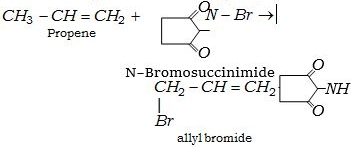
(B) $N$-bromosuccinimide $(NBS)$ is a reagent used for allylic bromination. When propene $(CH_3 - CH = CH_2)$ reacts with $NBS$, it undergoes free radical substitution at the allylic position (the carbon atom adjacent to the double bond).
The reaction is as follows:
$CH_3 - CH = CH_2 + NBS \rightarrow BrCH_2 - CH = CH_2 + \text{succinimide}$
The product formed is allyl bromide $(BrCH_2 - CH = CH_2)$.
The reaction is as follows:
$CH_3 - CH = CH_2 + NBS \rightarrow BrCH_2 - CH = CH_2 + \text{succinimide}$
The product formed is allyl bromide $(BrCH_2 - CH = CH_2)$.
0 likes
View Solution178
DifficultMCQ
$CH_2 = CH - (CH_2)_5COOH \xrightarrow[HBr]{\text{Peroxide}} Z$,where $Z$ is:
A
$CH_3 - CH(Br) - (CH_2)_5COOH$
B
$BrCH_2 - (CH_2)_6COOH$
C
$CH_2 = CH - (CH_2)_5 - CH_2OH$
D
$C_6H_5COOH$
Solution
(B) In the presence of peroxide,the addition of $HBr$ to an unsymmetrical alkene follows the anti-Markovnikov rule (Kharasch effect).
The bromine atom attaches to the terminal carbon atom of the double bond.
$CH_2 = CH - (CH_2)_5COOH + HBr \xrightarrow{\text{Peroxide}} BrCH_2 - CH_2 - (CH_2)_5COOH$,which is $BrCH_2 - (CH_2)_6COOH$.
The bromine atom attaches to the terminal carbon atom of the double bond.
$CH_2 = CH - (CH_2)_5COOH + HBr \xrightarrow{\text{Peroxide}} BrCH_2 - CH_2 - (CH_2)_5COOH$,which is $BrCH_2 - (CH_2)_6COOH$.
0 likes
View Solution179
DifficultMCQ
The principal organic product formed in the following reaction is
$CH_2=CH(CH_2)_8COOH + HBr \xrightarrow{\text{peroxide}}$
$CH_2=CH(CH_2)_8COOH + HBr \xrightarrow{\text{peroxide}}$
A
$CH_3CHBr(CH_2)_8COOH$
B
$CH_2=CH(CH_2)_8COBr$
C
$BrCH_2CH_2(CH_2)_8COOH$
D
$CH_2=CH(CH_2)_7CHBrCOOH$
Solution
(C) The reaction of an alkene with $HBr$ in the presence of a peroxide follows the anti-Markovnikov addition mechanism (Kharasch effect or peroxide effect).
In this reaction,the $Br^\bullet$ radical adds to the carbon atom of the double bond that has more hydrogen atoms,resulting in the formation of the less substituted radical.
For the reactant $CH_2=CH(CH_2)_8COOH$,the terminal carbon $(CH_2=)$ has two hydrogen atoms,while the internal carbon $(-CH=)$ has one.
Therefore,the $Br$ atom attaches to the terminal $CH_2$ group,and the $H$ atom attaches to the internal $CH$ group.
The product formed is $BrCH_2CH_2(CH_2)_8COOH$.
In this reaction,the $Br^\bullet$ radical adds to the carbon atom of the double bond that has more hydrogen atoms,resulting in the formation of the less substituted radical.
For the reactant $CH_2=CH(CH_2)_8COOH$,the terminal carbon $(CH_2=)$ has two hydrogen atoms,while the internal carbon $(-CH=)$ has one.
Therefore,the $Br$ atom attaches to the terminal $CH_2$ group,and the $H$ atom attaches to the internal $CH$ group.
The product formed is $BrCH_2CH_2(CH_2)_8COOH$.
0 likes
View Solution180
DifficultMCQ
Lactic acid on heating with conc. $H_2SO_4$ gives
A
Acetic acid
B
Propionic acid
C
Acrylic acid
D
Formic acid
Solution
(C) . Lactic acid $(CH_3-CH(OH)-COOH)$ on heating with concentrated $H_2SO_4$ undergoes dehydration to form acrylic acid $(CH_2=CH-COOH)$.
$CH_3-CH(OH)-COOH \xrightarrow{\text{conc. } H_2SO_4, \Delta} CH_2=CH-COOH + H_2O$
$CH_3-CH(OH)-COOH \xrightarrow{\text{conc. } H_2SO_4, \Delta} CH_2=CH-COOH + H_2O$
0 likes
View Solution181
MediumMCQ
Coloration of $Br_2/CCl_4$ will be discharged by
A
Cinnamic acid
B
Benzoic acid
C
$o-$phthalic acid
D
Acetophenone
Solution
(A) The decolorization of $Br_2/CCl_4$ is a characteristic test for the presence of an unsaturated carbon-carbon double bond $(C=C)$.
Cinnamic acid $(C_6H_5CH=CHCOOH)$ contains a carbon-carbon double bond in its side chain.
It reacts with bromine in carbon tetrachloride via electrophilic addition to form dibromocinnamic acid,which is colorless.
$C_6H_5CH=CHCOOH + Br_2 \xrightarrow{CCl_4} C_6H_5CH(Br)-CH(Br)COOH$
Benzoic acid,$o-$phthalic acid,and acetophenone do not contain $C=C$ bonds that undergo this addition reaction under these conditions.
Cinnamic acid $(C_6H_5CH=CHCOOH)$ contains a carbon-carbon double bond in its side chain.
It reacts with bromine in carbon tetrachloride via electrophilic addition to form dibromocinnamic acid,which is colorless.
$C_6H_5CH=CHCOOH + Br_2 \xrightarrow{CCl_4} C_6H_5CH(Br)-CH(Br)COOH$
Benzoic acid,$o-$phthalic acid,and acetophenone do not contain $C=C$ bonds that undergo this addition reaction under these conditions.
0 likes
View Solution182
MediumMCQ
When $CH_2=CH-COOH$ is reduced with $LiAlH_4$,the compound obtained will be:
A
$CH_3-CH_2-COOH$
B
$CH_2=CH-CH_2OH$
C
$CH_3-CH_2-CH_2OH$
D
$CH_3-CH_2-CHO$
Solution
(B) $LiAlH_4$ is a strong reducing agent that reduces carboxylic acids to primary alcohols but does not reduce isolated carbon-carbon double bonds.
Therefore,$CH_2=CH-COOH \xrightarrow{LiAlH_4} CH_2=CH-CH_2OH$.
Therefore,$CH_2=CH-COOH \xrightarrow{LiAlH_4} CH_2=CH-CH_2OH$.
0 likes
View Solution183
DifficultMCQ
Mustard gas is obtained by
A
The action of dilute acids on mustard seeds
B
Treating ethylene with mustard oil
C
Treating sulphur chloride with ethylene
D
None of these
Solution
(C) Mustard gas,also known as $1,1'$-thiobis($2$-chloroethane),is synthesized by the reaction of ethylene $(CH_2=CH_2)$ with sulfur dichloride $(SCl_2)$.
The chemical equation is: $2CH_2=CH_2 + SCl_2 \rightarrow (ClCH_2CH_2)_2S$.
The chemical equation is: $2CH_2=CH_2 + SCl_2 \rightarrow (ClCH_2CH_2)_2S$.
0 likes
View Solution184
EasyMCQ
Which of the following reagents is used to test for the unsaturation of an alkene?
A
$NaOH + CaO$
B
$Cl_2 / hv$
C
Cold dilute alkaline $KMnO_4$ (Baeyer's reagent)
D
$KOH / EtOH$
Solution
(C) The test for unsaturation in alkenes is performed using Baeyer's reagent,which is cold dilute alkaline $KMnO_4$ solution.
During this reaction,the purple color of $KMnO_4$ disappears,and a brown precipitate of $MnO_2$ is formed,indicating the presence of a double bond.
This reaction is known as the hydroxylation of alkenes to form vicinal glycols.
During this reaction,the purple color of $KMnO_4$ disappears,and a brown precipitate of $MnO_2$ is formed,indicating the presence of a double bond.
This reaction is known as the hydroxylation of alkenes to form vicinal glycols.
0 likes
View Solution185
EasyMCQ
Baeyer's reagent is ....
A
$KMnO_4 + H_2SO_4$
B
$KMnO_4 + KOH$
C
$K_2Cr_2O_7 + H_2SO_4$
D
$K_2Cr_2O_7 + KOH$
Solution
(B) Baeyer's reagent is defined as a cold,dilute,alkaline solution of potassium permanganate $(KMnO_4)$.
It is used as an oxidizing agent to test for the presence of unsaturation (double or triple bonds) in organic compounds.
When an alkene reacts with Baeyer's reagent,the purple color of $KMnO_4$ disappears,and a brown precipitate of $MnO_2$ is formed,indicating the formation of a vicinal diol.
Therefore,the correct composition is $KMnO_4 + KOH$.
It is used as an oxidizing agent to test for the presence of unsaturation (double or triple bonds) in organic compounds.
When an alkene reacts with Baeyer's reagent,the purple color of $KMnO_4$ disappears,and a brown precipitate of $MnO_2$ is formed,indicating the formation of a vicinal diol.
Therefore,the correct composition is $KMnO_4 + KOH$.
0 likes
View Solution186
DifficultMCQ
In the reaction $CH_3CH_2CH_2Br$ $\xrightarrow{aq. NaOH} (X)$ $\xrightarrow{Al_2O_3, \text{Heat}} (Y)$ $\xrightarrow{HOCl} (Z)$,what is $Z$?
A
$CH_3-CH(OH)-CH_2Cl$
B
$CH_3-CH(Cl)-CH_2OH$
C
$CH_3-CH(OH)-CH_2Cl$ and $CH_3-CH(Cl)-CH_2OH$ mixture
D
$CH_3-CH(Cl)-CH_2Cl$
Solution
(A) Step $1$: $CH_3CH_2CH_2Br + aq. NaOH \rightarrow CH_3CH_2CH_2OH$ ($X$ is propan$-1-$ol).
Step $2$: $CH_3CH_2CH_2OH \xrightarrow{Al_2O_3, \text{Heat}} CH_3CH=CH_2$ ($Y$ is propene).
Step $3$: $CH_3CH=CH_2 + HOCl \rightarrow CH_3CH(OH)CH_2Cl$ (major product) and $CH_3CH(Cl)CH_2OH$ (minor product).
According to Markovnikov's rule,the electrophile $Cl^+$ attacks the double bond to form the more stable carbocation,followed by the attack of $OH^-$. The major product is $CH_3CH(OH)CH_2Cl$.
Step $2$: $CH_3CH_2CH_2OH \xrightarrow{Al_2O_3, \text{Heat}} CH_3CH=CH_2$ ($Y$ is propene).
Step $3$: $CH_3CH=CH_2 + HOCl \rightarrow CH_3CH(OH)CH_2Cl$ (major product) and $CH_3CH(Cl)CH_2OH$ (minor product).
According to Markovnikov's rule,the electrophile $Cl^+$ attacks the double bond to form the more stable carbocation,followed by the attack of $OH^-$. The major product is $CH_3CH(OH)CH_2Cl$.
0 likes
View Solution187
DifficultMCQ
Which intermediate is formed during the addition of $HCl$ to propene in the presence of peroxide?
A
$CH_3\dot{C}HCH_2Cl$
B
$CH_3\dot{C}HCH_3$
C
$CH_3CH_2\dot{C}H_2$
D
$CH_3\dot{C}HCH_3$ is not formed,the reaction follows Markovnikov's rule as peroxide effect is only applicable for $HBr$.
Solution
(B) The peroxide effect (Kharasch effect) is only applicable to the addition of $HBr$ to unsymmetrical alkenes.
For $HCl$,the addition follows Markovnikov's rule even in the presence of peroxide.
In the addition of $HCl$ to propene $(CH_3-CH=CH_2)$,the electrophile $H^+$ attacks the double bond to form the more stable secondary carbocation,$CH_3-CH^+-CH_3$.
Therefore,the intermediate formed is the secondary carbocation,$CH_3-CH^+-CH_3$.
For $HCl$,the addition follows Markovnikov's rule even in the presence of peroxide.
In the addition of $HCl$ to propene $(CH_3-CH=CH_2)$,the electrophile $H^+$ attacks the double bond to form the more stable secondary carbocation,$CH_3-CH^+-CH_3$.
Therefore,the intermediate formed is the secondary carbocation,$CH_3-CH^+-CH_3$.
0 likes
View Solution188
MediumMCQ
In the absence of peroxide,what is the first step in the addition of $HBr$ to propene?
A
$H^{+}$
B
$Br^{-}$
C
$H^{\cdot}$
D
$Br^{\cdot}$
Solution
(A) The addition of $HBr$ to propene follows an electrophilic addition mechanism.
In the first step,the electrophile $H^{+}$ attacks the double bond of the propene molecule to form a carbocation intermediate.
In the first step,the electrophile $H^{+}$ attacks the double bond of the propene molecule to form a carbocation intermediate.
0 likes
View Solution189
DifficultMCQ
What is the major product formed during the debromination of $meso-2,3-dibromobutane$?
A
$n-butane$
B
$1-butene$
C
$cis-2-butene$
D
$trans-2-butene$
Solution
(C) The debromination of $meso-2,3-dibromobutane$ occurs via an $E2$ elimination mechanism using zinc dust in ethanol.
In the $meso$ isomer,the two bromine atoms are in an anti-periplanar conformation when the molecule is in its eclipsed or gauche-like state,but specifically,the $meso$ form allows for the anti-elimination of the two bromine atoms to yield the $cis-2-butene$ isomer.
Therefore,the major product is $cis-2-butene$.
In the $meso$ isomer,the two bromine atoms are in an anti-periplanar conformation when the molecule is in its eclipsed or gauche-like state,but specifically,the $meso$ form allows for the anti-elimination of the two bromine atoms to yield the $cis-2-butene$ isomer.
Therefore,the major product is $cis-2-butene$.
0 likes
View Solution190
EasyMCQ
The bond length of the $C-H$ bond in ethene is ...... $pm$.
A
$112$
B
$134$
C
$110$
D
$154$
Solution
(C) In ethene $(CH_2=CH_2)$, the carbon atoms are $sp^2$ hybridized.
The $C-H$ bond length in ethene is approximately $108 \ pm$ to $110 \ pm$.
Among the given options, $110 \ pm$ is the most accurate value for the $C-H$ bond length in ethene.
The $C-H$ bond length in ethene is approximately $108 \ pm$ to $110 \ pm$.
Among the given options, $110 \ pm$ is the most accurate value for the $C-H$ bond length in ethene.
0 likes
View Solution191
MediumMCQ
What is the product formed when propene reacts with $HCl$ in the presence of peroxide?
A
$1$-chloropropane
B
$2$-chloropropane
C
$3$-chloropropane
D
Propene dichloride
Solution
(B) The reaction of propene $(CH_3-CH=CH_2)$ with $HCl$ follows the Markovnikov addition rule.
Peroxide effect (Kharasch effect) is only applicable to $HBr$ and not to $HCl$ or $HI$.
Therefore,the addition of $HCl$ to propene in the presence of peroxide still follows the Markovnikov rule,where the $Cl^-$ ion attaches to the more substituted carbon atom.
Thus,the major product is $2$-chloropropane $(CH_3-CHCl-CH_3)$.
Peroxide effect (Kharasch effect) is only applicable to $HBr$ and not to $HCl$ or $HI$.
Therefore,the addition of $HCl$ to propene in the presence of peroxide still follows the Markovnikov rule,where the $Cl^-$ ion attaches to the more substituted carbon atom.
Thus,the major product is $2$-chloropropane $(CH_3-CHCl-CH_3)$.
0 likes
View Solution192
DifficultMCQ
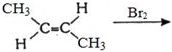
What is the product formed in the given reaction?
A
$A$
B
$B$
C
$C$
D
$D$
Solution
(C) The reaction involves the anti-addition of $Br_2$ to trans-but$-2-$ene.
Trans-alkene + $Br_2$ (anti-addition) yields a meso compound.
Starting with trans-but$-2-$ene,the anti-addition of bromine results in the formation of meso$-2,3-$dibromobutane.
Looking at the Fischer projections provided,option $C$ represents the meso$-2,3-$dibromobutane structure,which has a plane of symmetry.
Trans-alkene + $Br_2$ (anti-addition) yields a meso compound.
Starting with trans-but$-2-$ene,the anti-addition of bromine results in the formation of meso$-2,3-$dibromobutane.
Looking at the Fischer projections provided,option $C$ represents the meso$-2,3-$dibromobutane structure,which has a plane of symmetry.
0 likes
View Solution193
MediumMCQ
What is the product obtained by the reaction of $1$-butene with $HBr$ in the presence of peroxide?
A
$2$-bromobutane
B
$1$-bromobutane
C
$1,1$-dibromobutane
D
$1,2$-dibromobutane
Solution
(B) The reaction of $1$-butene $(CH_3-CH_2-CH=CH_2)$ with $HBr$ in the presence of peroxide follows the anti-Markovnikov addition rule (Kharasch effect or peroxide effect).
According to this rule,the negative part of the addendum $(Br^-)$ attaches to the carbon atom of the double bond that has the greater number of hydrogen atoms.
Therefore,the reaction is: $CH_3-CH_2-CH=CH_2 + HBr \xrightarrow{\text{peroxide}} CH_3-CH_2-CH_2-CH_2Br$.
The product formed is $1$-bromobutane.
According to this rule,the negative part of the addendum $(Br^-)$ attaches to the carbon atom of the double bond that has the greater number of hydrogen atoms.
Therefore,the reaction is: $CH_3-CH_2-CH=CH_2 + HBr \xrightarrow{\text{peroxide}} CH_3-CH_2-CH_2-CH_2Br$.
The product formed is $1$-bromobutane.
0 likes
View Solution194
MediumMCQ
Which major product is obtained by the addition of $1 \ mol$ of $HCl$ to $1,3$-butadiene at low temperature ($0^{\circ}C$ or below)?
A
$3$-chloro-$1$-butene
B
$1$-chloro-$2$-butene
C
$2$-chloro-$2$-butene
D
Chlorocyclobutane
Solution
(A) The addition of $HCl$ to $1,3$-butadiene is a classic example of kinetic versus thermodynamic control.
At low temperatures ($0^{\circ}C$ or below),the reaction is under kinetic control,which favors the formation of the $1,2$-addition product.
The product formed is $3$-chloro-$1$-butene.
At low temperatures ($0^{\circ}C$ or below),the reaction is under kinetic control,which favors the formation of the $1,2$-addition product.
The product formed is $3$-chloro-$1$-butene.
0 likes
View Solution195
MediumMCQ
What is the correct order of stability for the following alkenes?
A
$1$-Butene > trans-$2$-Butene > cis-$2$-Butene
B
trans-$2$-Butene > $1$-Butene > cis-$2$-Butene
C
trans-$2$-Butene > cis-$2$-Butene > $1$-Butene
D
cis-$2$-Butene > trans-$2$-Butene > $1$-Butene
Solution
(C) The stability of alkenes is determined by the number of alkyl groups attached to the double-bonded carbons (hyperconjugation) and steric hindrance.
$1$-Butene is a monosubstituted alkene,making it the least stable.
Between cis-$2$-Butene and trans-$2$-Butene,both are disubstituted,but trans-$2$-Butene is more stable than cis-$2$-Butene due to lower steric repulsion between the methyl groups.
Therefore,the order of stability is: trans-$2$-Butene > cis-$2$-Butene > $1$-Butene.
$1$-Butene is a monosubstituted alkene,making it the least stable.
Between cis-$2$-Butene and trans-$2$-Butene,both are disubstituted,but trans-$2$-Butene is more stable than cis-$2$-Butene due to lower steric repulsion between the methyl groups.
Therefore,the order of stability is: trans-$2$-Butene > cis-$2$-Butene > $1$-Butene.
0 likes
View Solution196
MediumMCQ
What is the major product obtained from the debromination of meso-$2,3$-dibromobutane?
A
$n$-butane
B
$1$-butene
C
trans-$2$-butene
D
cis-$2$-butene
Solution
(C) The debromination of vicinal dihalides using zinc dust $(Zn)$ in an alcoholic solvent follows an $E2$ elimination mechanism.
For meso-$2,3$-dibromobutane,the molecule can adopt a conformation where the two bromine atoms are anti-periplanar to each other.
Upon elimination of $ZnBr_2$,the anti-elimination process leads to the formation of trans-$2$-butene as the major product because the methyl groups are positioned opposite to each other in the transition state.
For meso-$2,3$-dibromobutane,the molecule can adopt a conformation where the two bromine atoms are anti-periplanar to each other.
Upon elimination of $ZnBr_2$,the anti-elimination process leads to the formation of trans-$2$-butene as the major product because the methyl groups are positioned opposite to each other in the transition state.
0 likes
View Solution197
EasyMCQ
Indirect hydration of an alkene cannot produce only one alcohol. This alcohol is $......$.
A
$Ethyl \ alcohol$
B
$Propyl \ alcohol$
C
$Isobutyl \ alcohol$
D
$Methyl \ alcohol$
Solution
(D) Indirect hydration of an alkene involves the addition of water across the double bond,typically following Markovnikov's rule.
$Methyl \ alcohol$ $(CH_3OH)$ cannot be prepared by the indirect hydration of any alkene because the simplest alkene,$ethene$ $(CH_2=CH_2)$,produces $ethanol$ $(CH_3CH_2OH)$ upon hydration.
Since $methyl \ alcohol$ contains only one carbon atom,it is impossible to obtain it from an alkene,as the smallest alkene contains two carbon atoms.
$Methyl \ alcohol$ $(CH_3OH)$ cannot be prepared by the indirect hydration of any alkene because the simplest alkene,$ethene$ $(CH_2=CH_2)$,produces $ethanol$ $(CH_3CH_2OH)$ upon hydration.
Since $methyl \ alcohol$ contains only one carbon atom,it is impossible to obtain it from an alkene,as the smallest alkene contains two carbon atoms.
0 likes
View Solution198
MediumMCQ
Markovnikov's rule guides the addition of $HBr$ to which of the following compounds?
A
$CH_2 = CH_2$
B
$CH_3 - CH_2 - CH_3$
C
$CH_3 - CH = CH - CH_3$
D
$CH_3 - CH = CH_2$
Solution
(D) Markovnikov's rule is applicable to unsymmetrical alkenes.
In an unsymmetrical alkene,the negative part of the addendum $(Br^-)$ attaches to the carbon atom of the double bond that has the fewer number of hydrogen atoms.
Among the given options,$CH_3 - CH = CH_2$ (propene) is an unsymmetrical alkene,whereas $CH_2 = CH_2$ and $CH_3 - CH = CH - CH_3$ are symmetrical alkenes.
Therefore,the correct answer is $CH_3 - CH = CH_2$.
In an unsymmetrical alkene,the negative part of the addendum $(Br^-)$ attaches to the carbon atom of the double bond that has the fewer number of hydrogen atoms.
Among the given options,$CH_3 - CH = CH_2$ (propene) is an unsymmetrical alkene,whereas $CH_2 = CH_2$ and $CH_3 - CH = CH - CH_3$ are symmetrical alkenes.
Therefore,the correct answer is $CH_3 - CH = CH_2$.
0 likes
View Solution199
MediumMCQ
What is the major product formed when propene reacts with $ICl$?
A
$1$-chloro-$2$-iodopropane
B
$2$-chloro-$1$-iodopropane
C
$(\pm)-2$-chloro-$1$-iodopropane
D
$(\pm)-1$-chloro-$2$-iodopropane
Solution
(B) The reaction of $ICl$ with propene follows Markovnikov's rule,where the electrophile $I^+$ attacks the double bond to form the more stable carbocation.
Since $I$ is less electronegative than $Cl$,$ICl$ polarizes as $I^{\delta+} - Cl^{\delta-}$.
The $I^+$ electrophile adds to the terminal carbon $(C_1)$ to form a more stable secondary carbocation at $C_2$.
Then,the nucleophile $Cl^-$ attacks the $C_2$ carbocation.
Thus,the major product is $2$-chloro-$1$-iodopropane.
Since $I$ is less electronegative than $Cl$,$ICl$ polarizes as $I^{\delta+} - Cl^{\delta-}$.
The $I^+$ electrophile adds to the terminal carbon $(C_1)$ to form a more stable secondary carbocation at $C_2$.
Then,the nucleophile $Cl^-$ attacks the $C_2$ carbocation.
Thus,the major product is $2$-chloro-$1$-iodopropane.
0 likes
View Solution200
MediumMCQ
Which process converts $1$-butene into butane?
A
$H_2 / Pd$
B
$Zn - HCl$
C
$Sn - HCl$
D
$Zn - Hg / HCl$
Solution
(A) The conversion of $1$-butene $(CH_3CH_2CH=CH_2)$ to butane $(CH_3CH_2CH_2CH_3)$ is a hydrogenation reaction.
Hydrogenation of alkenes is typically carried out using hydrogen gas $(H_2)$ in the presence of a metal catalyst such as $Pd$,$Pt$,or $Ni$.
$H_2 / Pd$ is a standard reagent for the catalytic hydrogenation of alkenes to alkanes.
$Zn - HCl$ and $Sn - HCl$ are typically used for the reduction of nitro compounds to amines.
$Zn - Hg / HCl$ is the Clemmensen reduction reagent,used for the reduction of carbonyl groups $(C=O)$ to methylene groups $(CH_2)$.
Hydrogenation of alkenes is typically carried out using hydrogen gas $(H_2)$ in the presence of a metal catalyst such as $Pd$,$Pt$,or $Ni$.
$H_2 / Pd$ is a standard reagent for the catalytic hydrogenation of alkenes to alkanes.
$Zn - HCl$ and $Sn - HCl$ are typically used for the reduction of nitro compounds to amines.
$Zn - Hg / HCl$ is the Clemmensen reduction reagent,used for the reduction of carbonyl groups $(C=O)$ to methylene groups $(CH_2)$.
0 likes
View SolutionHydrocarbons — Alkene · Frequently Asked Questions
1Are these Hydrocarbons questions useful for JEE and NEET?
Yes. All questions in this section are mapped to JEE Main and NEET exam patterns. Previous year questions from JEE Main, NEET, GUJCET and state-level exams are included with full solutions.
2Can I switch to Hindi or Gujarati for these questions?
Yes. Use the language tabs in the hero section or the sidebar to view the same questions and solutions in English, Hindi or Gujarati.
3How do I generate a question paper from this subtopic?
Use the Vedclass Exam Paper Generator — select the chapter and subtopic, set difficulty, and generate Sets A, B, C, D automatically. First 3 chapters of every subject are free.
Vedclass Products
For Students
Vedclass Test Series
Mock tests in real JEE/NEET style with performance analysis. 5-day free trial.
Start Free TrialFor Teachers
Exam Paper Generator
Generate Set A/B/C/D papers from this chapter in 2 minutes. 3 chapters free.
Try FreeFor Institutes
Online Exam Module
Live online exams with unlimited students, 360° analytics & white-label branding.
See DemoFor Teachers & Institutes
Generate a Hydrocarbons Exam Paper in 2 Minutes
Select subtopic & difficulty — Sets A, B, C, D auto-generated with No Repeat logic.
First 3 chapters of every subject are free — no payment required.