
A English
Alkene Questions in English
Class 11 Chemistry · Hydrocarbons · Alkene
1080+
Questions
English
Language
100%
With Solutions
Showing 50 of 1080 questions in English
201
MediumMCQ
The product obtained by the reaction of propene with $HI$ in the presence of peroxide is.....
A
Isopropyl iodide
B
$2$-Iodopropene
C
$2$-Iodopropane
D
$1$-Iodopropane
Solution
(C) The reaction of propene $(CH_3-CH=CH_2)$ with $HI$ in the presence of peroxide is an electrophilic addition reaction.
However,the peroxide effect (Kharasch effect or anti-Markovnikov addition) is only applicable to $HBr$.
$HI$ does not show the peroxide effect because the step involving the addition of the iodine radical is endothermic and reversible.
Therefore,the reaction follows Markovnikov's rule,where the electrophile $H^+$ adds to the carbon with more hydrogen atoms,and the nucleophile $I^-$ adds to the carbon with fewer hydrogen atoms.
Thus,the product is $2$-iodopropane $(CH_3-CH(I)-CH_3)$.
However,the peroxide effect (Kharasch effect or anti-Markovnikov addition) is only applicable to $HBr$.
$HI$ does not show the peroxide effect because the step involving the addition of the iodine radical is endothermic and reversible.
Therefore,the reaction follows Markovnikov's rule,where the electrophile $H^+$ adds to the carbon with more hydrogen atoms,and the nucleophile $I^-$ adds to the carbon with fewer hydrogen atoms.
Thus,the product is $2$-iodopropane $(CH_3-CH(I)-CH_3)$.
0 likes
View Solution202
DifficultMCQ
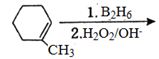
$1$-Methylcyclohexene reacts with $B_2H_6$. The product is then treated with $H_2O_2$ and $NaOH$. What will be the product of the reaction?
A
$1$-Methylcyclohexanol
B
$2$-Methylcyclohexanol
C
$(\pm)$ trans-$2$-Methylcyclohexanol
D
cis-$2$-Methylcyclohexanol
Solution
(D) The reaction of $1$-methylcyclohexene with $B_2H_6$ followed by oxidation with $H_2O_2/OH^-$ is a hydroboration-oxidation reaction.
This reaction follows anti-Markovnikov addition of water across the double bond.
Hydroboration is a syn-addition,meaning the $H$ and $OH$ groups add to the same side of the double bond.
In $1$-methylcyclohexene,the $OH$ group adds to the less substituted carbon $(C_2)$ and the $H$ atom adds to the more substituted carbon $(C_1)$.
Since the addition is syn,the $H$ and $OH$ groups will be on the same side of the ring,resulting in cis-$2$-methylcyclohexanol.
This reaction follows anti-Markovnikov addition of water across the double bond.
Hydroboration is a syn-addition,meaning the $H$ and $OH$ groups add to the same side of the double bond.
In $1$-methylcyclohexene,the $OH$ group adds to the less substituted carbon $(C_2)$ and the $H$ atom adds to the more substituted carbon $(C_1)$.
Since the addition is syn,the $H$ and $OH$ groups will be on the same side of the ring,resulting in cis-$2$-methylcyclohexanol.
0 likes
View Solution203
DifficultMCQ
What is the product formed when propene reacts with $N$-bromosuccinimide $(NBS)$ in $CCl_4$?
A
$1, 2$-dibromopropane
B
$3$-bromopropene
C
$1$-bromopropane
D
$2$-bromopropane
Solution
(B) $NBS$ ($N$-bromosuccinimide) is a reagent used for allylic bromination.
In the reaction of propene $(CH_3-CH=CH_2)$ with $NBS$ in $CCl_4$,the hydrogen atom at the allylic position is replaced by a bromine atom.
The reaction is: $CH_3-CH=CH_2 + NBS \xrightarrow{CCl_4} Br-CH_2-CH=CH_2 + \text{succinimide}$.
The product formed is $3$-bromopropene (also known as allyl bromide).
In the reaction of propene $(CH_3-CH=CH_2)$ with $NBS$ in $CCl_4$,the hydrogen atom at the allylic position is replaced by a bromine atom.
The reaction is: $CH_3-CH=CH_2 + NBS \xrightarrow{CCl_4} Br-CH_2-CH=CH_2 + \text{succinimide}$.
The product formed is $3$-bromopropene (also known as allyl bromide).
0 likes
View Solution204
MediumMCQ
What is the product formed by the reaction of propene with $Br_2$ in $CCl_4$?
A
$1,2$-dibromopropane
B
trans-$1,2$-dibromopropane
C
$1,2$-dibromopropene
D
$3$-bromopropane
Solution
(A) The reaction of propene $(CH_3-CH=CH_2)$ with bromine $(Br_2)$ in the presence of carbon tetrachloride $(CCl_4)$ is an electrophilic addition reaction.
The bromine molecule adds across the double bond to form a vicinal dihalide.
The reaction proceeds as follows:
$CH_3-CH=CH_2 + Br_2 \xrightarrow{CCl_4} CH_3-CH(Br)-CH_2Br$
The product formed is $1,2$-dibromopropane.
The bromine molecule adds across the double bond to form a vicinal dihalide.
The reaction proceeds as follows:
$CH_3-CH=CH_2 + Br_2 \xrightarrow{CCl_4} CH_3-CH(Br)-CH_2Br$
The product formed is $1,2$-dibromopropane.
0 likes
View Solution205
MediumMCQ
Ethylene reacts with $Br_2$ to give $1, 2$-dibromoethane. Which intermediate is formed that leads to anti-addition?
A
$CH_2Br-CH_2^+$
B
Cyclic bromonium ion
C
$BrCH=CH^+$
D
Cyclic bromonium ion with a bromine substituent
Solution
(B) The reaction of ethylene with $Br_2$ proceeds via the formation of a cyclic bromonium ion intermediate.
When $Br_2$ approaches the double bond of ethylene,the electron-rich double bond attacks one of the bromine atoms,displacing the other as a bromide ion $(Br^-)$.
This results in the formation of a three-membered cyclic bromonium ion.
The subsequent nucleophilic attack by the bromide ion $(Br^-)$ occurs from the side opposite to the cyclic bromonium ion,which leads to anti-addition.
When $Br_2$ approaches the double bond of ethylene,the electron-rich double bond attacks one of the bromine atoms,displacing the other as a bromide ion $(Br^-)$.
This results in the formation of a three-membered cyclic bromonium ion.
The subsequent nucleophilic attack by the bromide ion $(Br^-)$ occurs from the side opposite to the cyclic bromonium ion,which leads to anti-addition.
0 likes
View Solution206
MediumMCQ
In the presence of peroxide,hydrogen chloride and hydrogen iodide do not give anti-Markovnikov addition to alkenes because:
A
Both are highly ionic.
B
One is an oxidizing agent and the other is a reducing agent.
C
One step in both cases is endothermic.
D
All steps in both cases are exothermic.
0 likes
View Solution207
EasyMCQ
The rule which states that 'the more electronegative part of the reagent adds to the carbon atom of the unsymmetrical ethylenic double bond which has fewer hydrogen atoms' is known as:
A
Baeyer's rule
B
Peroxide effect
C
Markownikoff's rule
D
Pail's rule
Solution
(C) According to $Markownikoff's$ rule,when an unsymmetrical reagent (like $HX$,$H_2O$,etc.) adds to an unsymmetrical alkene,the negative part of the reagent attaches to the carbon atom of the double bond that carries the lesser number of hydrogen atoms.
0 likes
View Solution208
MediumMCQ
The reaction of $3$-phenylpropene with $HBr$ gives (as the major product):
A
$C_6H_5CH(Br)CH_2CH_3$
B
$C_6H_5CH_2CH(Br)CH_3$
C
$C_6H_5CH_2CH_2CH_2Br$
D
$C_6H_5CH(Br)CH=CH_2$
Solution
(B) The reaction of $3$-phenylpropene $(C_6H_5CH_2CH=CH_2)$ with $HBr$ follows Markovnikov's rule.
In the first step,the electrophile $H^+$ attacks the terminal carbon $(C_3)$ to form a more stable carbocation.
The intermediate formed is a secondary benzylic carbocation $(C_6H_5CH_2CH^+CH_3)$,which is stabilized by resonance with the phenyl ring.
Subsequently,the nucleophile $Br^-$ attacks the carbocation to form the major product,$1$-phenyl-$2$-bromopropane $(C_6H_5CH_2CH(Br)CH_3)$.
In the first step,the electrophile $H^+$ attacks the terminal carbon $(C_3)$ to form a more stable carbocation.
The intermediate formed is a secondary benzylic carbocation $(C_6H_5CH_2CH^+CH_3)$,which is stabilized by resonance with the phenyl ring.
Subsequently,the nucleophile $Br^-$ attacks the carbocation to form the major product,$1$-phenyl-$2$-bromopropane $(C_6H_5CH_2CH(Br)CH_3)$.
0 likes
View Solution209
MediumMCQ
The reaction of propene with $HOCl$ proceeds via the addition of which of the following in the first step?
A
$H^{+}$ in the first step
B
$Cl^{+}$ in the first step
C
$OH^{-}$ in the first step
D
$Cl^{+}$ and $OH^{-}$ in a single step
Solution
(B) The reaction of propene $(CH_3-CH=CH_2)$ with $HOCl$ (hypochlorous acid) is an electrophilic addition reaction.
$HOCl$ dissociates to provide the electrophile $Cl^{+}$ and the nucleophile $OH^{-}$.
In the first step,the electrophile $Cl^{+}$ attacks the double bond of propene to form a cyclic chloronium ion intermediate.
Therefore,the reaction proceeds via the addition of $Cl^{+}$ in the first step.
$HOCl$ dissociates to provide the electrophile $Cl^{+}$ and the nucleophile $OH^{-}$.
In the first step,the electrophile $Cl^{+}$ attacks the double bond of propene to form a cyclic chloronium ion intermediate.
Therefore,the reaction proceeds via the addition of $Cl^{+}$ in the first step.
0 likes
View Solution210
MediumMCQ
Acetone is formed by the ozonolysis of which of the following?
A
$1$-Butene
B
$2$-Butene
C
Isobutylene ($2$-methylpropene)
D
Butyne
Solution
(C) Ozonolysis of alkenes involves the cleavage of the $C=C$ double bond to form carbonyl compounds.
Acetone $(CH_3COCH_3)$ is a ketone with three carbon atoms.
For acetone to be formed,the alkene must have a $(CH_3)_2C=$ group.
Isobutylene $(CH_2=C(CH_3)_2)$ undergoes ozonolysis to produce acetone $(CH_3COCH_3)$ and formaldehyde $(HCHO)$.
Therefore,the correct option is $C$.
Acetone $(CH_3COCH_3)$ is a ketone with three carbon atoms.
For acetone to be formed,the alkene must have a $(CH_3)_2C=$ group.
Isobutylene $(CH_2=C(CH_3)_2)$ undergoes ozonolysis to produce acetone $(CH_3COCH_3)$ and formaldehyde $(HCHO)$.
Therefore,the correct option is $C$.
0 likes
View Solution211
DifficultMCQ
Ozonolysis of compound $X$ followed by reduction yields two moles of the same aldehyde. What is $X$?
A
$2$-Butene
B
$1,3$-Butadiene
C
$1$-Butene
D
Isobutene
Solution
(A) Ozonolysis of an alkene followed by reduction with $Zn/H_2O$ breaks the $C=C$ double bond and adds an oxygen atom to each carbon atom.
If the product is two moles of the same aldehyde,the alkene must be symmetric.
For $2$-Butene $(CH_3-CH=CH-CH_3)$,ozonolysis yields:
$CH_3-CH=CH-CH_3 + O_3 \rightarrow 2CH_3CHO$ (Acetaldehyde).
Thus,$X$ is $2$-Butene.
If the product is two moles of the same aldehyde,the alkene must be symmetric.
For $2$-Butene $(CH_3-CH=CH-CH_3)$,ozonolysis yields:
$CH_3-CH=CH-CH_3 + O_3 \rightarrow 2CH_3CHO$ (Acetaldehyde).
Thus,$X$ is $2$-Butene.
0 likes
View Solution212
MediumMCQ
What is formed when $cis-2-butene$ is reacted with cold dilute $KMnO_4$?
A
$meso-2,3-butanediol$
B
$(\pm)-2,3-butanediol$
C
$2,3-butanediol$
D
$1,2-butanediol$
Solution
(A) The reaction of $cis-2-butene$ with cold dilute $KMnO_4$ (Baeyer's reagent) involves a $syn$-hydroxylation of the double bond.
Since the addition is $syn$ and the starting material is $cis-2-butene$,the product formed is $meso-2,3-butanediol$.
Since the addition is $syn$ and the starting material is $cis-2-butene$,the product formed is $meso-2,3-butanediol$.
0 likes
View Solution213
MediumMCQ
What is the product formed when $CH_2 = CH(CH_2)_2COOH$ reacts with $HBr$?
A
$CH_3-CH(Br)-(CH_2)_2COOH$
B
$CH_2(Br)-CH_2-(CH_2)_2COOH$
C
$CH_3-CH_2-CH(Br)-CH_2COOH$
D
$CH_3-CH_2-CH_2-CH(Br)COOH$
Solution
(A) The reaction of $CH_2 = CH(CH_2)_2COOH$ with $HBr$ follows Markovnikov's rule.
According to Markovnikov's rule,the negative part of the addendum $(Br^-)$ attaches to the carbon atom of the double bond that has fewer hydrogen atoms.
In the given molecule $CH_2 = CH(CH_2)_2COOH$,the double bond is between $C_1$ and $C_2$.
$C_1$ has $2$ hydrogens and $C_2$ has $1$ hydrogen.
Therefore,$Br^-$ will attach to $C_2$ and $H^+$ will attach to $C_1$.
The resulting product is $CH_3-CH(Br)-(CH_2)_2COOH$.
According to Markovnikov's rule,the negative part of the addendum $(Br^-)$ attaches to the carbon atom of the double bond that has fewer hydrogen atoms.
In the given molecule $CH_2 = CH(CH_2)_2COOH$,the double bond is between $C_1$ and $C_2$.
$C_1$ has $2$ hydrogens and $C_2$ has $1$ hydrogen.
Therefore,$Br^-$ will attach to $C_2$ and $H^+$ will attach to $C_1$.
The resulting product is $CH_3-CH(Br)-(CH_2)_2COOH$.
0 likes
View Solution214
DifficultMCQ
What is the product formed when one molecule of $HBr$ reacts with one molecule of $1,3$-butadiene at $40^{\circ}C$?
A
$1$-bromo-$2$-butene under thermodynamic control
B
$3$-bromo-$1$-butene under kinetic control
C
$1$-bromo-$2$-butene under kinetic control
D
$3$-bromo-$1$-butene under thermodynamic control
Solution
(A) The reaction of $1,3$-butadiene with $HBr$ at $40^{\circ}C$ (higher temperature) leads to the thermodynamic product.
Under thermodynamic control,the more stable $1,4$-addition product,$1$-bromo-$2$-butene,is the major product.
At lower temperatures (e.g.,$-80^{\circ}C$),the kinetic product,$3$-bromo-$1$-butene,is favored.
Under thermodynamic control,the more stable $1,4$-addition product,$1$-bromo-$2$-butene,is the major product.
At lower temperatures (e.g.,$-80^{\circ}C$),the kinetic product,$3$-bromo-$1$-butene,is favored.
0 likes
View Solution215
EasyMCQ
Which reagent converts propene into $1$-propanol?
A
$H_2O, H_2SO_4$
B
$B_2H_6, H_2O_2, OH^-$
C
$Hg(OAc)_2, NaBH_4/H_2O$
D
$Aq. KOH$
Solution
(B) The conversion of propene $(CH_3-CH=CH_2)$ to $1$-propanol $(CH_3-CH_2-CH_2-OH)$ requires anti-Markovnikov addition of water.
This is achieved via hydroboration-oxidation using $B_2H_6$ followed by $H_2O_2$ in the presence of $OH^-$.
This is achieved via hydroboration-oxidation using $B_2H_6$ followed by $H_2O_2$ in the presence of $OH^-$.
0 likes
View Solution216
DifficultMCQ
Catalytic hydrogenation of an optically active hydrocarbon $(X)$ yields an optically inactive compound $(Y), C_6H_{14}$. What is the hydrocarbon $(X)$?
A
$3$-methyl-$1$-pentene
B
$3$-methyl-$2$-pentene
C
$2$-methyl-$1$-butene
D
$3$-methylcyclopentene
Solution
(A) The molecular formula of $(Y)$ is $C_6H_{14}$,which corresponds to an alkane. Since $(X)$ is a hydrocarbon that undergoes hydrogenation to form $C_6H_{14}$,$(X)$ must be an alkene with the formula $C_6H_{12}$.
$(X)$ is optically active,meaning it must contain a chiral center. In $3$-methyl-$1$-pentene $(CH_2=CH-CH(CH_3)-CH_2-CH_3)$,the carbon at position $3$ is chiral because it is bonded to a hydrogen atom,a methyl group,an ethyl group,and a vinyl group.
Upon catalytic hydrogenation,$3$-methyl-$1$-pentene forms $3$-methylpentane. In $3$-methylpentane,the carbon at position $3$ is bonded to two identical ethyl groups $(-CH_2CH_3)$,making it achiral. Thus,the product is optically inactive.
$(X)$ is optically active,meaning it must contain a chiral center. In $3$-methyl-$1$-pentene $(CH_2=CH-CH(CH_3)-CH_2-CH_3)$,the carbon at position $3$ is chiral because it is bonded to a hydrogen atom,a methyl group,an ethyl group,and a vinyl group.
Upon catalytic hydrogenation,$3$-methyl-$1$-pentene forms $3$-methylpentane. In $3$-methylpentane,the carbon at position $3$ is bonded to two identical ethyl groups $(-CH_2CH_3)$,making it achiral. Thus,the product is optically inactive.
0 likes
View Solution217
MediumMCQ
What is the major product obtained when $1$-butanol is heated with concentrated $H_2SO_4$?
A
trans-$2$-butene
B
cis-$2$-butene
C
$1$-butene
D
$1,3$-butadiene
Solution
(A) The dehydration of $1$-butanol $(CH_3CH_2CH_2CH_2OH)$ with concentrated $H_2SO_4$ proceeds via an $E1$ mechanism.
First,the hydroxyl group is protonated to form a good leaving group,which leaves to form a primary carbocation $(CH_3CH_2CH_2CH_2^+)$.
This primary carbocation undergoes a $1,2$-hydride shift to form a more stable secondary carbocation $(CH_3CH_2CH^+CH_3)$.
Elimination of a proton from the secondary carbocation yields $2$-butene as the major product,which exists primarily as the more stable trans-$2$-butene isomer.
First,the hydroxyl group is protonated to form a good leaving group,which leaves to form a primary carbocation $(CH_3CH_2CH_2CH_2^+)$.
This primary carbocation undergoes a $1,2$-hydride shift to form a more stable secondary carbocation $(CH_3CH_2CH^+CH_3)$.
Elimination of a proton from the secondary carbocation yields $2$-butene as the major product,which exists primarily as the more stable trans-$2$-butene isomer.
0 likes
View Solution218
MediumMCQ
$CH_2 = CH_2 \xrightarrow[KOH/H_2O]{KMnO_4} X = ......$
A
Ethylene glycol
B
Glucose
C
Ethanol
D
All of the above
Solution
(A) The reaction of ethene $(CH_2 = CH_2)$ with cold,dilute alkaline potassium permanganate $(KMnO_4)$ solution is known as Baeyer's reagent test.
This reaction results in the hydroxylation of the double bond to form a vicinal diol.
$CH_2 = CH_2 + H_2O + [O] \xrightarrow{KMnO_4/OH^-} HO-CH_2-CH_2-OH$ (Ethylene glycol).
Thus,the product $X$ is ethylene glycol.
This reaction results in the hydroxylation of the double bond to form a vicinal diol.
$CH_2 = CH_2 + H_2O + [O] \xrightarrow{KMnO_4/OH^-} HO-CH_2-CH_2-OH$ (Ethylene glycol).
Thus,the product $X$ is ethylene glycol.
0 likes
View Solution219
MediumMCQ
According to Markovnikov's rule,what is the product formed when $1$-butene reacts with water?
A
Primary alcohol
B
Secondary alcohol
C
Tertiary alcohol
D
None of these
Solution
(B) The reaction of $1$-butene $(CH_3-CH_2-CH=CH_2)$ with water in the presence of an acid catalyst $(H^+)$ follows Markovnikov's rule.
According to Markovnikov's rule,the negative part of the addendum $(OH^-)$ attaches to the carbon atom with fewer hydrogen atoms.
In $1$-butene,the double bond is between $C_1$ and $C_2$. $C_2$ has one hydrogen atom,while $C_1$ has two.
Therefore,the $OH$ group attaches to $C_2$,resulting in the formation of $2$-butanol $(CH_3-CH_2-CH(OH)-CH_3)$.
Since the $OH$ group is attached to a secondary carbon atom,the product is a secondary alcohol.
According to Markovnikov's rule,the negative part of the addendum $(OH^-)$ attaches to the carbon atom with fewer hydrogen atoms.
In $1$-butene,the double bond is between $C_1$ and $C_2$. $C_2$ has one hydrogen atom,while $C_1$ has two.
Therefore,the $OH$ group attaches to $C_2$,resulting in the formation of $2$-butanol $(CH_3-CH_2-CH(OH)-CH_3)$.
Since the $OH$ group is attached to a secondary carbon atom,the product is a secondary alcohol.
0 likes
View Solution220
DifficultMCQ
What is the major product formed when $cis-2-butene$ reacts with $Br_2$ in $CCl_4$?
A
$1-bromo-2-butene$
B
$2,3-dibromobutane$
C
$meso-2,3-dibromobutane$
D
$(\pm)-2,3-dibromobutane$
Solution
(C) The reaction of $Br_2$ with an alkene involves the formation of a cyclic bromonium ion intermediate.
In the case of $cis-2-butene$,the $anti$-addition of $Br_2$ leads to the formation of the $meso-2,3-dibromobutane$ isomer because the molecule has a plane of symmetry.
In the case of $cis-2-butene$,the $anti$-addition of $Br_2$ leads to the formation of the $meso-2,3-dibromobutane$ isomer because the molecule has a plane of symmetry.
0 likes
View Solution221
MediumMCQ
Which of the following compounds does not follow the Markovnikov rule when reacting with $HBr$?
A
Propene
B
But-$1$-ene
C
But-$2$-ene
D
Pent-$2$-ene
Solution
(C) The Markovnikov rule states that when an unsymmetrical reagent adds to an unsymmetrical alkene,the negative part of the reagent attaches to the carbon atom with fewer hydrogen atoms.
But-$2$-ene $(CH_3-CH=CH-CH_3)$ is a symmetrical alkene.
Because it is symmetrical,the addition of $HBr$ results in the same product regardless of which carbon the bromine atom attaches to.
Therefore,the concept of the Markovnikov rule is not applicable to symmetrical alkenes like but-$2$-ene.
But-$2$-ene $(CH_3-CH=CH-CH_3)$ is a symmetrical alkene.
Because it is symmetrical,the addition of $HBr$ results in the same product regardless of which carbon the bromine atom attaches to.
Therefore,the concept of the Markovnikov rule is not applicable to symmetrical alkenes like but-$2$-ene.
0 likes
View Solution222
DifficultMCQ
$A$ hydrocarbon $C_6H_{10}$ absorbs only one molecule of $H_2$ upon catalytic hydrogenation. Upon ozonolysis,it yields $CHO(CH_2)_4CHO$. What is the hydrocarbon?
A
Cyclohexene
B
$1,5$-Hexadiene
C
$1,3$-Cyclohexadiene
D
$1$-Methylcyclopentene
Solution
(A) $1$. The molecular formula $C_6H_{10}$ corresponds to the general formula $C_nH_{2n-2}$,indicating the presence of either one triple bond or two double bonds or a ring with one double bond.
$2$. Since it absorbs only one molecule of $H_2$,it must contain exactly one double bond (or one triple bond that is reduced to a double bond,but the ozonolysis product suggests a cyclic structure).
$3$. Ozonolysis of the hydrocarbon yields $CHO(CH_2)_4CHO$,which is hexanedial. This indicates that the original molecule was a cyclic compound with a double bond in the ring.
$4$. $A$ cyclic $C_6$ hydrocarbon with one double bond is cyclohexene. Ozonolysis of cyclohexene breaks the double bond to form the open-chain dialdehyde $CHO(CH_2)_4CHO$.
$2$. Since it absorbs only one molecule of $H_2$,it must contain exactly one double bond (or one triple bond that is reduced to a double bond,but the ozonolysis product suggests a cyclic structure).
$3$. Ozonolysis of the hydrocarbon yields $CHO(CH_2)_4CHO$,which is hexanedial. This indicates that the original molecule was a cyclic compound with a double bond in the ring.
$4$. $A$ cyclic $C_6$ hydrocarbon with one double bond is cyclohexene. Ozonolysis of cyclohexene breaks the double bond to form the open-chain dialdehyde $CHO(CH_2)_4CHO$.
0 likes
View Solution223
MediumMCQ
For which of the following reactions is the anti-Markovnikov addition most suitable?
A
$C_2H_4 + HCl$
B
$C_3H_6 + Br_2$
C
$C_3H_6 + HBr$
D
$C_3H_8 + Cl_2$
Solution
(C) The anti-Markovnikov addition (also known as the peroxide effect or Kharasch effect) is specifically observed in the addition of $HBr$ to unsymmetrical alkenes like propene $(C_3H_6)$ in the presence of organic peroxides.
In this reaction,the bromine atom attaches to the carbon atom with more hydrogen atoms.
$C_3H_6 + HBr \xrightarrow{\text{peroxide}} CH_3-CH_2-CH_2Br$ ($1$-bromopropane).
Other hydrogen halides like $HCl$ and $HI$ do not show this effect due to the energetics of the reaction steps.
In this reaction,the bromine atom attaches to the carbon atom with more hydrogen atoms.
$C_3H_6 + HBr \xrightarrow{\text{peroxide}} CH_3-CH_2-CH_2Br$ ($1$-bromopropane).
Other hydrogen halides like $HCl$ and $HI$ do not show this effect due to the energetics of the reaction steps.
0 likes
View Solution224
MediumMCQ
In the presence of peroxide,hydrogen chloride or hydrogen iodide do not give anti-Markovnikov addition to alkenes because...
A
Both are strongly ionic.
B
One is an oxidizing agent and the other is a reducing agent.
C
One step in both cases is endothermic.
D
All steps in both cases are exothermic.
0 likes
View Solution225
MediumMCQ
The gas evolved by the reaction of ethyl iodide with alcoholic $KOH$,which decolorizes basic $KMnO_4$ solution,is........
A
$CH_4$
B
$C_2H_6$
C
$C_2H_4$
D
$C_2H_2$
Solution
(C) The reaction of ethyl iodide $(C_2H_5I)$ with alcoholic $KOH$ undergoes a dehydrohalogenation reaction (elimination reaction) to form ethene $(C_2H_4)$.
$C_2H_5I + KOH (\text{alc.}) \rightarrow C_2H_4 + KI + H_2O$
Ethene $(C_2H_4)$ is an unsaturated hydrocarbon containing a double bond.
Unsaturated hydrocarbons react with Baeyer's reagent (alkaline $KMnO_4$ solution) to decolorize the purple color of $KMnO_4$ due to the formation of ethylene glycol.
$C_2H_5I + KOH (\text{alc.}) \rightarrow C_2H_4 + KI + H_2O$
Ethene $(C_2H_4)$ is an unsaturated hydrocarbon containing a double bond.
Unsaturated hydrocarbons react with Baeyer's reagent (alkaline $KMnO_4$ solution) to decolorize the purple color of $KMnO_4$ due to the formation of ethylene glycol.
0 likes
View Solution226
DifficultMCQ
What is the product of the reaction $CH_3CH_2CH=CH_2$ $\xrightarrow{1. Hg(OAc)_2, H_2O}$ $\xrightarrow{2. NaBD_4}$?
A
$CH_3CH_2CH(OH)CH_2D$
B
$CH_3CH_2CH(D)CH_2OH$
C
$CH_3CH_2CD(OH)CH_3$
D
$CH_3CH_2CD_2CH_2OH$
Solution
(A) The reaction is an oxymercuration-demercuration process.
$1$. Oxymercuration with $Hg(OAc)_2$ and $H_2O$ adds $OH$ to the more substituted carbon (Markovnikov addition) and $HgOAc$ to the less substituted carbon.
$2$. Demercuration with $NaBD_4$ replaces the $HgOAc$ group with a deuterium atom $(D)$.
$3$. The reaction follows Markovnikov's rule,placing the $OH$ group on the $C-2$ position and the $D$ atom on the $C-1$ position.
$4$. The final product is $CH_3CH_2CH(OH)CH_2D$.
$1$. Oxymercuration with $Hg(OAc)_2$ and $H_2O$ adds $OH$ to the more substituted carbon (Markovnikov addition) and $HgOAc$ to the less substituted carbon.
$2$. Demercuration with $NaBD_4$ replaces the $HgOAc$ group with a deuterium atom $(D)$.
$3$. The reaction follows Markovnikov's rule,placing the $OH$ group on the $C-2$ position and the $D$ atom on the $C-1$ position.
$4$. The final product is $CH_3CH_2CH(OH)CH_2D$.
0 likes
View Solution227
MediumMCQ
For which of the following reactions is Markovnikov's rule most applicable?
A
$C_2H_4 + HCl$
B
$C_3H_6 + Br_2$
C
$C_3H_6 + HBr$
D
$C_2H_4 + I_2$
Solution
(C) Markovnikov's rule states that in the addition of a polar reagent (like $HX$) to an unsymmetrical alkene,the negative part of the reagent attaches to the carbon atom of the double bond that has the fewer number of hydrogen atoms.
$C_2H_4$ is a symmetrical alkene,so it does not follow Markovnikov's rule.
$C_3H_6$ (propene) is an unsymmetrical alkene.
$Br_2$ and $I_2$ are symmetrical reagents,so they do not follow Markovnikov's rule.
$HBr$ is an unsymmetrical reagent.
Therefore,the reaction between $C_3H_6$ and $HBr$ is the correct choice where Markovnikov's rule is applicable.
$C_2H_4$ is a symmetrical alkene,so it does not follow Markovnikov's rule.
$C_3H_6$ (propene) is an unsymmetrical alkene.
$Br_2$ and $I_2$ are symmetrical reagents,so they do not follow Markovnikov's rule.
$HBr$ is an unsymmetrical reagent.
Therefore,the reaction between $C_3H_6$ and $HBr$ is the correct choice where Markovnikov's rule is applicable.
0 likes
View Solution228
DifficultMCQ
In the reaction $CH_3CH=CH_2 + H_2O + [O]$ $\xrightarrow{KMnO_4/Acid} CH_3-CH(OH)-CH_2(OH)$ $\xrightarrow{[O]} X + HCOOH$,what is $X$?
A
$CH_3CH_2COOH$
B
$CH_3COOH$
C
$CH_3CH_2CHO$
D
$CH_3CH_2OH$
Solution
(B) The reaction involves the oxidative cleavage of propene$-1,2-$diol using $KMnO_4$ in an acidic medium.
The initial step is the hydroxylation of propene to form propane$-1,2-$diol $(CH_3-CH(OH)-CH_2OH)$.
Further oxidation of propane$-1,2-$diol with $KMnO_4$ leads to the cleavage of the $C-C$ bond between the two hydroxyl-bearing carbons.
The cleavage of $CH_3-CH(OH)-CH_2OH$ results in the formation of acetic acid $(CH_3COOH)$ and formic acid $(HCOOH)$.
Therefore,$X$ is $CH_3COOH$.
The initial step is the hydroxylation of propene to form propane$-1,2-$diol $(CH_3-CH(OH)-CH_2OH)$.
Further oxidation of propane$-1,2-$diol with $KMnO_4$ leads to the cleavage of the $C-C$ bond between the two hydroxyl-bearing carbons.
The cleavage of $CH_3-CH(OH)-CH_2OH$ results in the formation of acetic acid $(CH_3COOH)$ and formic acid $(HCOOH)$.
Therefore,$X$ is $CH_3COOH$.
0 likes
View Solution229
EasyMCQ
Which hydrogen halide adds to propene in the presence of peroxide following the anti-Markovnikov rule?
A
$HF$
B
$HCl$
C
$HBr$
D
$HI$
Solution
(C) The addition of hydrogen halides to unsymmetrical alkenes in the presence of organic peroxides follows the anti-Markovnikov rule,also known as the peroxide effect or Kharasch effect.
This effect is only observed with $HBr$.
For $HF$ and $HCl$,the bond dissociation energy is too high for the free radical mechanism to proceed.
For $HI$,the iodine free radical $(I^{\bullet})$ is formed,but it tends to combine with another iodine radical to form $I_2$ rather than adding to the double bond.
Therefore,only $HBr$ undergoes this reaction.
This effect is only observed with $HBr$.
For $HF$ and $HCl$,the bond dissociation energy is too high for the free radical mechanism to proceed.
For $HI$,the iodine free radical $(I^{\bullet})$ is formed,but it tends to combine with another iodine radical to form $I_2$ rather than adding to the double bond.
Therefore,only $HBr$ undergoes this reaction.
0 likes
View Solution230
MediumMCQ
In which of the following reactions does the product contain a chiral center?
A
$CH_3CH = CH_2 + HBr \rightarrow$
B
$CH_2 = CH_2 + HOBr \rightarrow$
C
$CH_3CH_2CH = CH_2 + HBr \xrightarrow{H_2O_2}$
D
$CH_3CH_2CH = CH_2 + HBr \rightarrow$
Solution
(D) $1$. In reaction $A$,$CH_3CH=CH_2 + HBr \rightarrow CH_3CH(Br)CH_3$ ($2$-bromopropane),which is achiral.
$2$. In reaction $B$,$CH_2=CH_2 + HOBr \rightarrow HO-CH_2-CH_2-Br$ ($2$-bromoethanol),which is achiral.
$3$. In reaction $C$,$CH_3CH_2CH=CH_2 + HBr \xrightarrow{H_2O_2} CH_3CH_2CH_2CH_2Br$ ($1$-bromobutane),which is achiral.
$4$. In reaction $D$,$CH_3CH_2CH=CH_2 + HBr \rightarrow CH_3CH_2CH(Br)CH_3$ ($2$-bromobutane). The carbon atom attached to the bromine atom is bonded to four different groups $(-H, -Br, -CH_3, -CH_2CH_3)$,making it a chiral center.
$2$. In reaction $B$,$CH_2=CH_2 + HOBr \rightarrow HO-CH_2-CH_2-Br$ ($2$-bromoethanol),which is achiral.
$3$. In reaction $C$,$CH_3CH_2CH=CH_2 + HBr \xrightarrow{H_2O_2} CH_3CH_2CH_2CH_2Br$ ($1$-bromobutane),which is achiral.
$4$. In reaction $D$,$CH_3CH_2CH=CH_2 + HBr \rightarrow CH_3CH_2CH(Br)CH_3$ ($2$-bromobutane). The carbon atom attached to the bromine atom is bonded to four different groups $(-H, -Br, -CH_3, -CH_2CH_3)$,making it a chiral center.
0 likes
View Solution231
EasyMCQ
What is the product formed when $RCH = CH_2$ is treated with $B_2H_6$ followed by oxidation with alkaline $H_2O_2$?
A
$RCH(OH)CH_2OH$
B
$RCOCH_3$
C
$RCH_2CH_2OH$
D
$RCH_2CHO$
Solution
(C) The reaction of an alkene with $B_2H_6$ followed by oxidation with alkaline $H_2O_2$ is known as Hydroboration-Oxidation.
This reaction follows the Anti-Markovnikov rule,where the $OH$ group is added to the less substituted carbon atom.
The reaction proceeds as follows: $RCH = CH_2 + B_2H_6$ $\rightarrow (RCH_2CH_2)_3B$ $\xrightarrow{H_2O_2/OH^-} RCH_2CH_2OH$.
Thus,the product is a primary alcohol,$RCH_2CH_2OH$.
This reaction follows the Anti-Markovnikov rule,where the $OH$ group is added to the less substituted carbon atom.
The reaction proceeds as follows: $RCH = CH_2 + B_2H_6$ $\rightarrow (RCH_2CH_2)_3B$ $\xrightarrow{H_2O_2/OH^-} RCH_2CH_2OH$.
Thus,the product is a primary alcohol,$RCH_2CH_2OH$.
0 likes
View Solution232
MediumMCQ
What is the product obtained when the compound $CH_3-C(CH_3)=CH-CH_3$ reacts in the presence of $NaIO_4/KMnO_4$?
A
$CH_3CHO + CO_2$
B
$CH_3COCH_3$
C
$CH_3COCH_3 + CH_3COOH$
D
$CH_3COCH_3 + CH_3CHO$
Solution
(D) The reaction of an alkene with $NaIO_4$ in the presence of a catalytic amount of $KMnO_4$ is a method of oxidative cleavage of the double bond.
For the given compound $CH_3-C(CH_3)=CH-CH_3$ ($2$-methylbut$-2-$ene):
$1$. The double bond breaks between the $C_2$ and $C_3$ carbons.
$2$. The $C_2$ carbon is bonded to two methyl groups,forming acetone $(CH_3COCH_3)$.
$3$. The $C_3$ carbon is bonded to one hydrogen and one methyl group,forming acetaldehyde $(CH_3CHO)$.
Thus,the reaction is: $CH_3-C(CH_3)=CH-CH_3 \xrightarrow{NaIO_4/KMnO_4} CH_3COCH_3 + CH_3CHO$.
For the given compound $CH_3-C(CH_3)=CH-CH_3$ ($2$-methylbut$-2-$ene):
$1$. The double bond breaks between the $C_2$ and $C_3$ carbons.
$2$. The $C_2$ carbon is bonded to two methyl groups,forming acetone $(CH_3COCH_3)$.
$3$. The $C_3$ carbon is bonded to one hydrogen and one methyl group,forming acetaldehyde $(CH_3CHO)$.
Thus,the reaction is: $CH_3-C(CH_3)=CH-CH_3 \xrightarrow{NaIO_4/KMnO_4} CH_3COCH_3 + CH_3CHO$.
0 likes
View Solution233
MediumMCQ
What is the use of $Baeyer's$ reagent in the laboratory?
A
To test for the presence of a double bond
B
To test for the presence of glucose
C
Reduction
D
Oxidation
Solution
(A) $Baeyer's$ reagent is an alkaline solution of potassium permanganate $(KMnO_4)$.
It is used in the laboratory to test for the presence of unsaturation (double or triple bonds) in organic compounds.
When an alkene reacts with $Baeyer's$ reagent,the purple color of $KMnO_4$ disappears,and a brown precipitate of manganese dioxide $(MnO_2)$ is formed,indicating the presence of a double bond.
It is used in the laboratory to test for the presence of unsaturation (double or triple bonds) in organic compounds.
When an alkene reacts with $Baeyer's$ reagent,the purple color of $KMnO_4$ disappears,and a brown precipitate of manganese dioxide $(MnO_2)$ is formed,indicating the presence of a double bond.
0 likes
View Solution234
MediumMCQ
What is the product formed when isobutylene reacts with $HOCl$?
A
$(CH_3)_2C(OH)CH_2Cl$
B
$(CH_3)_2C(Cl)CH_2OH$
C
$CH_3CH(CH_2Cl)CH_2OH$
D
$CH_3COCH_3 + CH_3Cl$
Solution
(A) The reaction of isobutylene $(CH_3)_2C=CH_2$ with $HOCl$ (hypochlorous acid) is an electrophilic addition reaction.
$HOCl$ dissociates into $OH^-$ and $Cl^+$.
The electrophile $Cl^+$ attacks the double bond to form a more stable carbocation.
In isobutylene,the tertiary carbocation $(CH_3)_2C^+-CH_2Cl$ is more stable than the primary one.
Then,the nucleophile $OH^-$ attacks the tertiary carbocation to form the final product,$1$-chloro-$2$-methylpropan-$2$-ol,which is $(CH_3)_2C(OH)CH_2Cl$.
$HOCl$ dissociates into $OH^-$ and $Cl^+$.
The electrophile $Cl^+$ attacks the double bond to form a more stable carbocation.
In isobutylene,the tertiary carbocation $(CH_3)_2C^+-CH_2Cl$ is more stable than the primary one.
Then,the nucleophile $OH^-$ attacks the tertiary carbocation to form the final product,$1$-chloro-$2$-methylpropan-$2$-ol,which is $(CH_3)_2C(OH)CH_2Cl$.
0 likes
View Solution235
MediumMCQ
$CH_3CH=CH_2$ $\xrightarrow{Cl_2, 700 \ K} A$ $\xrightarrow{Na_2CO_3, 420 \ K, 12 \ atm} B$ $\xrightarrow[(ii) NaOH]{(i) HOCl} C$. Considering the reaction sequence,what is the product $C$?
A
$CH_2(OH)-CH_2(OH)$
B
$CH_3-CH(OH)-COCl$
C
$HOCH_2-CH=CH_2$
D
$CH_3-CH(OH)-COOH$
Solution
(A) Step $1$: Reaction of propene with $Cl_2$ at $700 \ K$ is an allylic substitution reaction. $CH_3-CH=CH_2 + Cl_2 \xrightarrow{700 \ K} ClCH_2-CH=CH_2 (A) + HCl$.
Step $2$: Reaction of allyl chloride $(A)$ with $Na_2CO_3$ at $420 \ K$ and $12 \ atm$ is a hydrolysis reaction. $ClCH_2-CH=CH_2 + Na_2CO_3 + H_2O \rightarrow HOCH_2-CH=CH_2 (B) + NaCl + NaHCO_3$.
Step $3$: Reaction of allyl alcohol $(B)$ with $HOCl$ followed by $NaOH$ is a chlorohydrin formation followed by epoxide formation or direct addition. However,in this specific sequence,$HOCl$ adds across the double bond to form $HOCH_2-CH(OH)-CH_2Cl$,and subsequent treatment with $NaOH$ leads to the formation of glycerol or related diols. Given the options,the product $C$ is $CH_2(OH)-CH(OH)-CH_2(OH)$ (glycerol) or a related derivative. Re-evaluating the standard industrial process for glycerol synthesis from propene,the correct product $C$ is $CH_2(OH)-CH(OH)-CH_2(OH)$.
Step $2$: Reaction of allyl chloride $(A)$ with $Na_2CO_3$ at $420 \ K$ and $12 \ atm$ is a hydrolysis reaction. $ClCH_2-CH=CH_2 + Na_2CO_3 + H_2O \rightarrow HOCH_2-CH=CH_2 (B) + NaCl + NaHCO_3$.
Step $3$: Reaction of allyl alcohol $(B)$ with $HOCl$ followed by $NaOH$ is a chlorohydrin formation followed by epoxide formation or direct addition. However,in this specific sequence,$HOCl$ adds across the double bond to form $HOCH_2-CH(OH)-CH_2Cl$,and subsequent treatment with $NaOH$ leads to the formation of glycerol or related diols. Given the options,the product $C$ is $CH_2(OH)-CH(OH)-CH_2(OH)$ (glycerol) or a related derivative. Re-evaluating the standard industrial process for glycerol synthesis from propene,the correct product $C$ is $CH_2(OH)-CH(OH)-CH_2(OH)$.
0 likes
View Solution236
MediumMCQ
Ozonolysis of an organic compound gives formaldehyde as one of the products. This indicates the presence of:
A
Isopropyl group
B
Acetylenic triple bond
C
Two ethylenic double bonds
D
Vinyl group
Solution
(D) Ozonolysis of an alkene involves the cleavage of the $C=C$ double bond to form carbonyl compounds.
If one of the products is formaldehyde $(HCHO)$,it implies that the original compound must have a terminal double bond,specifically a $CH_2=C < $ group.
This structural unit is known as a vinyl group $(CH_2=CH-)$ or a terminal methylene group.
Therefore,the formation of formaldehyde during ozonolysis is a characteristic test for the presence of a terminal vinyl group.
If one of the products is formaldehyde $(HCHO)$,it implies that the original compound must have a terminal double bond,specifically a $CH_2=C < $ group.
This structural unit is known as a vinyl group $(CH_2=CH-)$ or a terminal methylene group.
Therefore,the formation of formaldehyde during ozonolysis is a characteristic test for the presence of a terminal vinyl group.
0 likes
View Solution237
MediumMCQ
What is the product formed when $1$-butene is heated with $Al_2(SO_4)_3$ at $500 \ K$?
A
$CH_3CH_2CH_2CH_3$
B
$CH_2 = CH - CH = CH_2$
C
$(CH_3)_2C = CH_2$
D
$(C_4H_8)_n$
Solution
(C) When $1$-butene $(CH_3CH_2CH=CH_2)$ is heated with $Al_2(SO_4)_3$ at $500 \ K$,it undergoes isomerization to form a more stable alkene.
The terminal alkene $1$-butene isomerizes to the more stable branched alkene,$2$-methylpropene (isobutylene),which is $(CH_3)_2C=CH_2$.
The terminal alkene $1$-butene isomerizes to the more stable branched alkene,$2$-methylpropene (isobutylene),which is $(CH_3)_2C=CH_2$.
0 likes
View Solution238
MediumMCQ
In the acid-catalyzed hydration of alkenes,other than ethene,which of the following is formed?
A
Secondary or tertiary alcohol
B
Primary alcohol
C
$A$ mixture of secondary and tertiary alcohols
D
Primary and secondary alcohols
Solution
(A) The acid-catalyzed hydration of alkenes follows $Markovnikov's$ rule.
For alkenes other than ethene (e.g.,propene),the addition of water occurs such that the hydroxyl group $(-OH)$ attaches to the more substituted carbon atom.
This leads to the formation of secondary or tertiary alcohols depending on the structure of the alkene.
For example,propene $(CH_3-CH=CH_2)$ reacts with water in the presence of an acid to form propan$-2-$ol,which is a secondary alcohol.
For alkenes other than ethene (e.g.,propene),the addition of water occurs such that the hydroxyl group $(-OH)$ attaches to the more substituted carbon atom.
This leads to the formation of secondary or tertiary alcohols depending on the structure of the alkene.
For example,propene $(CH_3-CH=CH_2)$ reacts with water in the presence of an acid to form propan$-2-$ol,which is a secondary alcohol.
0 likes
View Solution239
MediumMCQ
What will be the product of the reaction: $CH_3-CH=C(CH_3)_2 + HCl \to$ ?
A
$CH_3-CH_2-C(Cl)(CH_3)_2$
B
$CH_3-CHCl-CH(CH_3)_2$
C
$CH_3-CH_2-CH(CH_3)-CH_2Cl$
D
$Cl-CH_2-CH_2-CH(CH_3)-CH_3$
Solution
(A) The reaction follows $Markovnikov's$ rule,where the electrophile $H^+$ adds to the carbon atom with more hydrogen atoms,and the nucleophile $Cl^-$ adds to the more substituted carbon atom (forming a more stable carbocation).
$1$. The reactant is $2-methylbut-2-ene$.
$2$. The addition of $HCl$ leads to the formation of $2-chloro-2-methylbutane$ as the major product.
$3$. The structure is $CH_3-CH_2-C(Cl)(CH_3)_2$.
$1$. The reactant is $2-methylbut-2-ene$.
$2$. The addition of $HCl$ leads to the formation of $2-chloro-2-methylbutane$ as the major product.
$3$. The structure is $CH_3-CH_2-C(Cl)(CH_3)_2$.
0 likes
View Solution240
DifficultMCQ
Consider the following reaction: $CH_2 = CH_2 \xrightarrow[H_2O, NaOH]{dilute \ KMnO_4} HOCH_2 - CH_2OH$. Which statement is incorrect regarding the two oxygen atoms obtained in the product?
A
Both are obtained from $KMnO_4$.
B
Both are obtained from $H_2O$.
C
Both are obtained from $NaOH$.
D
One is obtained from $KMnO_4$ and the other from $NaOH$.
Solution
(B) The reaction of ethene with dilute alkaline $KMnO_4$ (Baeyer's reagent) is a syn-hydroxylation reaction.
In this mechanism,the two oxygen atoms added to the double bond are derived from the permanganate ion $(MnO_4^-)$.
Therefore,the statement that both oxygen atoms are obtained from $KMnO_4$ is correct.
Statements $B$,$C$,and $D$ are incorrect as they suggest the oxygen atoms come from $H_2O$ or $NaOH$.
In this mechanism,the two oxygen atoms added to the double bond are derived from the permanganate ion $(MnO_4^-)$.
Therefore,the statement that both oxygen atoms are obtained from $KMnO_4$ is correct.
Statements $B$,$C$,and $D$ are incorrect as they suggest the oxygen atoms come from $H_2O$ or $NaOH$.
0 likes
View Solution241
MediumMCQ
The product obtained by the reaction of $1,2$-dibromoethane with zinc metal at high temperature is........
A
Ethane
B
Ethene
C
Bromoethene
D
Bromoethane
Solution
(B) The reaction of $1,2$-dibromoethane $(BrCH_2-CH_2Br)$ with zinc dust in an alcoholic solution leads to a dehalogenation reaction.
In this reaction,zinc removes two bromine atoms from adjacent carbon atoms,resulting in the formation of a double bond between them.
The chemical equation is: $BrCH_2-CH_2Br + Zn \rightarrow CH_2=CH_2 + ZnBr_2$.
Thus,the product obtained is ethene $(CH_2=CH_2)$.
In this reaction,zinc removes two bromine atoms from adjacent carbon atoms,resulting in the formation of a double bond between them.
The chemical equation is: $BrCH_2-CH_2Br + Zn \rightarrow CH_2=CH_2 + ZnBr_2$.
Thus,the product obtained is ethene $(CH_2=CH_2)$.
0 likes
View Solution242
MediumMCQ
$HCl$ does not follow the anti-Markovnikov rule because...
A
It is a strong acid.
B
It is in gaseous state.
C
Its bond dissociation energy is high.
D
It is in solid state.
Solution
(C) The anti-Markovnikov addition (peroxide effect) is only observed with $HBr$ in the presence of organic peroxides.
This is because the $H-Cl$ bond is very strong $(431 \ kJ \ mol^{-1})$,and the enthalpy change for the homolytic cleavage of $HCl$ by free radicals is endothermic,making the reaction energetically unfavorable.
In contrast,the $H-Br$ bond is weaker,allowing for the formation of bromine free radicals which facilitate the anti-Markovnikov addition.
This is because the $H-Cl$ bond is very strong $(431 \ kJ \ mol^{-1})$,and the enthalpy change for the homolytic cleavage of $HCl$ by free radicals is endothermic,making the reaction energetically unfavorable.
In contrast,the $H-Br$ bond is weaker,allowing for the formation of bromine free radicals which facilitate the anti-Markovnikov addition.
0 likes
View Solution243
MediumMCQ
What is the product obtained when the compound $CH_3-C(CH_3)=CH-CH_3$ is treated with $KMnO_4$ in the presence of $NaIO_4$?
A
$CH_3COCH_3$
B
$CH_3COCH_3 + CH_3COOH$
C
$CH_3COCH_3 + CH_3CHO$
D
$CH_3CHO + CO_2$
Solution
(B) The reaction of an alkene with $KMnO_4$ in the presence of $NaIO_4$ is a form of oxidative cleavage,similar to ozonolysis.
In this reaction,the double bond is broken,and each carbon atom of the double bond is oxidized to a carbonyl group.
For the alkene $CH_3-C(CH_3)=CH-CH_3$:
$1$. The bond between $C_2$ and $C_3$ breaks.
$2$. The $C_2$ atom (which is bonded to two methyl groups) is oxidized to acetone $(CH_3COCH_3)$.
$3$. The $C_3$ atom (which is bonded to one hydrogen and one methyl group) is oxidized to acetaldehyde $(CH_3CHO)$,which is further oxidized to acetic acid $(CH_3COOH)$ in the presence of $KMnO_4$.
Therefore,the products are $CH_3COCH_3$ and $CH_3COOH$.
In this reaction,the double bond is broken,and each carbon atom of the double bond is oxidized to a carbonyl group.
For the alkene $CH_3-C(CH_3)=CH-CH_3$:
$1$. The bond between $C_2$ and $C_3$ breaks.
$2$. The $C_2$ atom (which is bonded to two methyl groups) is oxidized to acetone $(CH_3COCH_3)$.
$3$. The $C_3$ atom (which is bonded to one hydrogen and one methyl group) is oxidized to acetaldehyde $(CH_3CHO)$,which is further oxidized to acetic acid $(CH_3COOH)$ in the presence of $KMnO_4$.
Therefore,the products are $CH_3COCH_3$ and $CH_3COOH$.
0 likes
View Solution244
MediumMCQ
The product of the addition reaction of ethene with $Br_2$ is......
A
$1,2$-dibromoethane
B
$1$-bromo-$2$-chloroethane
C
Both $1,2$-dibromoethane and $1$-bromo-$2$-chloroethane
D
$1,1,1$-tribromoethane
Solution
(A) The reaction of ethene $(CH_2=CH_2)$ with bromine $(Br_2)$ in an inert solvent like $CCl_4$ is an electrophilic addition reaction.
The double bond breaks,and one bromine atom attaches to each carbon atom.
The reaction is: $CH_2=CH_2 + Br_2 \xrightarrow{CCl_4} CH_2Br-CH_2Br$.
The product formed is $1,2$-dibromoethane.
The double bond breaks,and one bromine atom attaches to each carbon atom.
The reaction is: $CH_2=CH_2 + Br_2 \xrightarrow{CCl_4} CH_2Br-CH_2Br$.
The product formed is $1,2$-dibromoethane.
0 likes
View Solution245
MediumMCQ
What is the product of the reaction: $CH_3-CH=CH_2 \xrightarrow{NOCl}$?
A
$CH_3-CH(Cl)-CH_2(NO)$
B
$CH_3-CH(NO)-CH_2(Cl)$
C
$CH_3-CH_2-CH_2-Cl$
D
$NO-CH_2-CH_2-CH_2-Cl$
Solution
(A) The reaction of $NOCl$ (Tilden's reagent) with an alkene follows Markovnikov's rule.
$NOCl$ dissociates into $NO^+$ (electrophile) and $Cl^-$ (nucleophile).
In propene $(CH_3-CH=CH_2)$,the electrophilic addition of $NO^+$ occurs at the terminal carbon $(CH_2)$ to form a more stable secondary carbocation $(CH_3-CH^+-CH_2-NO)$.
Subsequently,the nucleophile $Cl^-$ attacks the carbocation to form $CH_3-CH(Cl)-CH_2(NO)$.
$NOCl$ dissociates into $NO^+$ (electrophile) and $Cl^-$ (nucleophile).
In propene $(CH_3-CH=CH_2)$,the electrophilic addition of $NO^+$ occurs at the terminal carbon $(CH_2)$ to form a more stable secondary carbocation $(CH_3-CH^+-CH_2-NO)$.
Subsequently,the nucleophile $Cl^-$ attacks the carbocation to form $CH_3-CH(Cl)-CH_2(NO)$.
0 likes
View Solution246
DifficultMCQ
Which alkene on ozonolysis gives $CH_3CH_2CHO$ and $CH_3COCH_3$?
A
$CH_3CH_2CH = C(CH_3)_2$
B
$CH_3CH_2CH = CHCH_2CH_3$
C
$CH_3CH_2CH = CHCH_3$
D
$CH_3CH = C(CH_3)_2$
Solution
(A) Ozonolysis of an alkene involves the cleavage of the $C=C$ double bond to form carbonyl compounds.
Given products are propanal $(CH_3CH_2CHO)$ and propanone $(CH_3COCH_3)$.
To find the parent alkene,remove the oxygen atoms from the carbonyl groups and join the carbon atoms with a double bond:
$CH_3CH_2CH = O + O = C(CH_3)_2 \rightarrow CH_3CH_2CH = C(CH_3)_2$.
The parent alkene is $2\text{-methylpent-2-ene}$ $(CH_3CH_2CH = C(CH_3)_2)$.
Given products are propanal $(CH_3CH_2CHO)$ and propanone $(CH_3COCH_3)$.
To find the parent alkene,remove the oxygen atoms from the carbonyl groups and join the carbon atoms with a double bond:
$CH_3CH_2CH = O + O = C(CH_3)_2 \rightarrow CH_3CH_2CH = C(CH_3)_2$.
The parent alkene is $2\text{-methylpent-2-ene}$ $(CH_3CH_2CH = C(CH_3)_2)$.
0 likes
View Solution247
MediumMCQ
If the products of ozonolysis are acetone and formaldehyde,what is the starting substance?
A
$CH_3-C(CH_3)=C(CH_3)-CH_3$
B
$CH_3-C(CH_3)=CH-CH_3$
C
$CH_3-C(CH_3)=CH_2$
D
$CH_3-C(CH_3)=CH-C_2H_5$
Solution
(C) Ozonolysis of an alkene involves the cleavage of the $C=C$ double bond to form carbonyl compounds.
Acetone is $CH_3-CO-CH_3$ and formaldehyde is $H-CHO$.
By removing the oxygen atoms from these products and joining the carbonyl carbons with a double bond,we get the structure of the alkene:
$(CH_3)_2C=O + O=CH_2 \rightarrow (CH_3)_2C=CH_2$.
The starting substance is $2-\text{methylpropene}$,which is $CH_3-C(CH_3)=CH_2$.
Acetone is $CH_3-CO-CH_3$ and formaldehyde is $H-CHO$.
By removing the oxygen atoms from these products and joining the carbonyl carbons with a double bond,we get the structure of the alkene:
$(CH_3)_2C=O + O=CH_2 \rightarrow (CH_3)_2C=CH_2$.
The starting substance is $2-\text{methylpropene}$,which is $CH_3-C(CH_3)=CH_2$.
0 likes
View Solution248
MediumMCQ
The reaction of isobutene with $HBr$ yields:
A
$tert$-Butyl bromide
B
Isobutyl bromide
C
$tert$-Butyl alcohol
D
Isobutyl alcohol
Solution
(A) The reaction of isobutene $(CH_3)_2C=CH_2$ with $HBr$ follows Markovnikov's rule.
In this reaction,the electrophile $H^+$ attacks the double bond to form the more stable $3^{\circ}$ carbocation,$(CH_3)_3C^+$.
Subsequently,the nucleophile $Br^-$ attacks the carbocation to form $2$-bromo-$2$-methylpropane,which is commonly known as $tert$-butyl bromide.
In this reaction,the electrophile $H^+$ attacks the double bond to form the more stable $3^{\circ}$ carbocation,$(CH_3)_3C^+$.
Subsequently,the nucleophile $Br^-$ attacks the carbocation to form $2$-bromo-$2$-methylpropane,which is commonly known as $tert$-butyl bromide.
0 likes
View Solution249
MediumMCQ
What is the product formed when $trans-2$-butene reacts with $D_2$ in the presence of a $Ni$ catalyst?
A
$(\pm)-2,3$-dideuteriobutane
B
$meso-2,3$-dideuteriobutane
C
$1,4$-dideuterio-trans$-2-$butene
D
$2,3$-dideuteriobutane
Solution
(B) The catalytic hydrogenation of alkenes using $Ni$,$Pd$,or $Pt$ catalysts involves syn-addition of hydrogen (or deuterium) to the double bond.
For $trans-2$-butene,the addition of $D_2$ occurs from the same side (syn-addition).
Since the starting material is $trans-2$-butene,the syn-addition of $D_2$ results in the formation of $meso-2,3$-dideuteriobutane.
This is because the resulting molecule has a plane of symmetry,making it a $meso$ compound.
For $trans-2$-butene,the addition of $D_2$ occurs from the same side (syn-addition).
Since the starting material is $trans-2$-butene,the syn-addition of $D_2$ results in the formation of $meso-2,3$-dideuteriobutane.
This is because the resulting molecule has a plane of symmetry,making it a $meso$ compound.
0 likes
View Solution250
MediumMCQ
What is obtained when a mixture of ethylene,carbon monoxide,and water is heated at high temperature?
A
$C_4H_8O_2$
B
$C_2H_5COOH$
C
$CH_3COOH$
D
$CH_2=CH-COOH$
Solution
(B) The reaction of ethylene with carbon monoxide and water in the presence of a catalyst at high temperature and pressure is known as the hydrocarboxylation reaction.
The chemical equation is: $C_2H_4 + CO + H_2O \xrightarrow{\text{High temp.}} C_2H_5COOH$.
The product formed is propionic acid $(C_2H_5COOH)$.
The chemical equation is: $C_2H_4 + CO + H_2O \xrightarrow{\text{High temp.}} C_2H_5COOH$.
The product formed is propionic acid $(C_2H_5COOH)$.
0 likes
View SolutionHydrocarbons — Alkene · Frequently Asked Questions
1Are these Hydrocarbons questions useful for JEE and NEET?
Yes. All questions in this section are mapped to JEE Main and NEET exam patterns. Previous year questions from JEE Main, NEET, GUJCET and state-level exams are included with full solutions.
2Can I switch to Hindi or Gujarati for these questions?
Yes. Use the language tabs in the hero section or the sidebar to view the same questions and solutions in English, Hindi or Gujarati.
3How do I generate a question paper from this subtopic?
Use the Vedclass Exam Paper Generator — select the chapter and subtopic, set difficulty, and generate Sets A, B, C, D automatically. First 3 chapters of every subject are free.
Vedclass Products
For Students
Vedclass Test Series
Mock tests in real JEE/NEET style with performance analysis. 5-day free trial.
Start Free TrialFor Teachers
Exam Paper Generator
Generate Set A/B/C/D papers from this chapter in 2 minutes. 3 chapters free.
Try FreeFor Institutes
Online Exam Module
Live online exams with unlimited students, 360° analytics & white-label branding.
See DemoFor Teachers & Institutes
Generate a Hydrocarbons Exam Paper in 2 Minutes
Select subtopic & difficulty — Sets A, B, C, D auto-generated with No Repeat logic.
First 3 chapters of every subject are free — no payment required.