
A English
Alkene Questions in English
Class 11 Chemistry · Hydrocarbons · Alkene
1080+
Questions
English
Language
100%
With Solutions
Showing 50 of 1080 questions in English
251
EasyMCQ
Which method can be used to prepare $Propane$ from $Propene$?
A
$Wurtz$ reaction
B
$Dehydrogenation$
C
$Frankland$ reaction
D
Catalytic hydrogenation
Solution
(D) The conversion of $Propene$ $(CH_3-CH=CH_2)$ to $Propane$ $(CH_3-CH_2-CH_3)$ involves the addition of hydrogen across the double bond.
This process is known as catalytic hydrogenation.
In this reaction,$Propene$ reacts with hydrogen gas in the presence of a metal catalyst like $Ni$,$Pd$,or $Pt$ to form $Propane$.
This process is known as catalytic hydrogenation.
In this reaction,$Propene$ reacts with hydrogen gas in the presence of a metal catalyst like $Ni$,$Pd$,or $Pt$ to form $Propane$.
0 likes
View Solution252
MediumMCQ
The reaction of $CH_3-CH=CH_2$ (propene) with $HI$ gives isopropyl iodide instead of $n$-propyl iodide because:
A
The reaction proceeds through a more stable carbocation.
B
The reaction proceeds through a more stable carbanion.
C
The reaction proceeds through a more stable free radical.
D
None of these.
Solution
(A) The addition of $HI$ to propene follows Markovnikov's rule.
In the first step,the electrophile $H^+$ attacks the double bond to form a carbocation intermediate.
Two possible carbocations can be formed:
$1$. $CH_3-CH^+-CH_3$ (secondary carbocation,more stable)
$2$. $CH_3-CH_2-CH_2^+$ (primary carbocation,less stable)
Since the secondary carbocation is more stable due to the inductive effect and hyperconjugation,the reaction proceeds through this intermediate.
Finally,the nucleophile $I^-$ attacks the secondary carbocation to form $CH_3-CH(I)-CH_3$ (isopropyl iodide).
In the first step,the electrophile $H^+$ attacks the double bond to form a carbocation intermediate.
Two possible carbocations can be formed:
$1$. $CH_3-CH^+-CH_3$ (secondary carbocation,more stable)
$2$. $CH_3-CH_2-CH_2^+$ (primary carbocation,less stable)
Since the secondary carbocation is more stable due to the inductive effect and hyperconjugation,the reaction proceeds through this intermediate.
Finally,the nucleophile $I^-$ attacks the secondary carbocation to form $CH_3-CH(I)-CH_3$ (isopropyl iodide).
0 likes
View Solution253
MediumMCQ
What is the major product formed when $1, 3$-butadiene reacts with $1 \ mol$ of $HCl$ at high temperature ($100^{\circ}C$ or above)?
A
$3, 4$-dichloro-$1$-butene
B
$3$-chloro-$1$-butene
C
$1$-chloro-$2$-butene
D
$2$-chloro-$2$-butene
Solution
(C) Under thermodynamic control conditions (high temperature),the $1, 4$-addition product is the major product in the reaction of conjugated dienes with electrophiles.
For $1, 3$-butadiene,the $1, 4$-addition of $HCl$ results in the formation of $1$-chloro-$2$-butene.
For $1, 3$-butadiene,the $1, 4$-addition of $HCl$ results in the formation of $1$-chloro-$2$-butene.
0 likes
View Solution254
DifficultMCQ
What is the product of the reaction: ${H_2}C = CH{(CH_2)_6}CH_3 \xrightarrow[peroxide]{HBr} ?$
A
$CH_3-CH(Br)-(CH_2)_6-CH_3$
B
$Br-CH_2-CH_2-(CH_2)_6-CH_3$
C
$CH_3-CH_2-CH(Br)-(CH_2)_6-CH_3$
D
None of these
Solution
(B) The reaction of an alkene with $HBr$ in the presence of peroxide follows the anti-Markovnikov addition rule (Kharasch effect or peroxide effect).
In this reaction,the $Br^-$ radical attacks the less substituted carbon atom of the double bond.
The reaction proceeds as follows:
${H_2}C = CH-(CH_2)_6-CH_3 + HBr \xrightarrow{peroxide} Br-CH_2-CH_2-(CH_2)_6-CH_3$.
Therefore,the product is $1-bromodecane$.
In this reaction,the $Br^-$ radical attacks the less substituted carbon atom of the double bond.
The reaction proceeds as follows:
${H_2}C = CH-(CH_2)_6-CH_3 + HBr \xrightarrow{peroxide} Br-CH_2-CH_2-(CH_2)_6-CH_3$.
Therefore,the product is $1-bromodecane$.
0 likes
View Solution255
MediumMCQ
What is the major product formed by the reaction of $2$-methylpropene with $HBr$?
A
$1$-bromobutane
B
$1$-bromo-$2$-methylpropane
C
$2$-bromobutane
D
$2$-bromo-$2$-methylpropane
Solution
(D) The reaction of $2$-methylpropene $(CH_3)_2C=CH_2$ with $HBr$ follows Markovnikov's rule.
According to Markovnikov's rule,the electrophile $H^+$ adds to the carbon atom with more hydrogen atoms,and the nucleophile $Br^-$ adds to the carbon atom with fewer hydrogen atoms.
This leads to the formation of a stable tertiary carbocation intermediate $(CH_3)_3C^+$.
Finally,the bromide ion attacks the tertiary carbocation to form $2$-bromo-$2$-methylpropane $(CH_3)_3CBr$ as the major product.
According to Markovnikov's rule,the electrophile $H^+$ adds to the carbon atom with more hydrogen atoms,and the nucleophile $Br^-$ adds to the carbon atom with fewer hydrogen atoms.
This leads to the formation of a stable tertiary carbocation intermediate $(CH_3)_3C^+$.
Finally,the bromide ion attacks the tertiary carbocation to form $2$-bromo-$2$-methylpropane $(CH_3)_3CBr$ as the major product.
0 likes
View Solution256
MediumMCQ
Which of the following compounds gives $CH_3CHO$ and $CH_3CH_2CHO$ upon ozonolysis followed by hydrolysis?
A
$2$-Pentene
B
$2$-Butene
C
$1$-Pentene
D
$1$-Butene
Solution
(A) Ozonolysis of an alkene involves the cleavage of the $C=C$ double bond to form carbonyl compounds.
Given products are $CH_3CHO$ (acetaldehyde) and $CH_3CH_2CHO$ (propanal).
By joining the oxygen atoms of these two carbonyl groups,we can reconstruct the original alkene:
$CH_3CH=O + O=CHCH_2CH_3 \rightarrow CH_3CH=CHCH_2CH_3 + H_2O$.
The resulting alkene is $CH_3CH=CHCH_2CH_3$,which is $2$-pentene.
Therefore,the correct option is $A$.
Given products are $CH_3CHO$ (acetaldehyde) and $CH_3CH_2CHO$ (propanal).
By joining the oxygen atoms of these two carbonyl groups,we can reconstruct the original alkene:
$CH_3CH=O + O=CHCH_2CH_3 \rightarrow CH_3CH=CHCH_2CH_3 + H_2O$.
The resulting alkene is $CH_3CH=CHCH_2CH_3$,which is $2$-pentene.
Therefore,the correct option is $A$.
0 likes
View Solution257
MediumMCQ
Ozonolysis of one mole of a symmetrical alkene yields two moles of an aldehyde with a molar mass of $44 \ u$. Identify the alkene.
A
Ethene
B
Propene
C
$1$-Butene
D
$2$-Butene
Solution
(D) The general reaction for the ozonolysis of a symmetrical alkene is: $R-CH=CH-R + O_3 \rightarrow 2R-CHO$.
Given that the product is an aldehyde with a molar mass of $44 \ u$.
The general formula for an aldehyde is $R-CHO$.
The molar mass of $CHO$ is $12 + 1 + 16 = 29 \ u$.
Therefore,the mass of the alkyl group $R$ is $44 - 29 = 15 \ u$.
An alkyl group with a mass of $15 \ u$ is a methyl group $(-CH_3)$.
Thus,the aldehyde is acetaldehyde $(CH_3CHO)$.
Substituting this back into the reaction: $CH_3-CH=CH-CH_3 + O_3 \rightarrow 2CH_3CHO$.
The reactant is $2$-butene.
Given that the product is an aldehyde with a molar mass of $44 \ u$.
The general formula for an aldehyde is $R-CHO$.
The molar mass of $CHO$ is $12 + 1 + 16 = 29 \ u$.
Therefore,the mass of the alkyl group $R$ is $44 - 29 = 15 \ u$.
An alkyl group with a mass of $15 \ u$ is a methyl group $(-CH_3)$.
Thus,the aldehyde is acetaldehyde $(CH_3CHO)$.
Substituting this back into the reaction: $CH_3-CH=CH-CH_3 + O_3 \rightarrow 2CH_3CHO$.
The reactant is $2$-butene.
0 likes
View Solution258
DifficultMCQ
In the reaction sequence $CH_3CH = CHCH_3$ $\xrightarrow{O_3} A$ $\xrightarrow{H_2O/Zn} B$,the alkene forms product $B$. What is product $B$?
A
$CH_3CH_2CHO$
B
$CH_3COCH_3$
C
$CH_3CH_2COCH_3$
D
$CH_3CHO$
Solution
(D) The reaction is an ozonolysis of but$-2-$ene.
Step $1$: $CH_3CH = CHCH_3$ reacts with $O_3$ to form an ozonide intermediate $(A)$.
Step $2$: The ozonide intermediate $(A)$ undergoes reductive cleavage with $H_2O/Zn$ to produce carbonyl compounds.
Reaction: $CH_3CH = CHCH_3 + O_3$ $\rightarrow \text{ozonide}$ $\xrightarrow{H_2O/Zn} 2CH_3CHO$.
Thus,the product $B$ is acetaldehyde $(CH_3CHO)$.
Step $1$: $CH_3CH = CHCH_3$ reacts with $O_3$ to form an ozonide intermediate $(A)$.
Step $2$: The ozonide intermediate $(A)$ undergoes reductive cleavage with $H_2O/Zn$ to produce carbonyl compounds.
Reaction: $CH_3CH = CHCH_3 + O_3$ $\rightarrow \text{ozonide}$ $\xrightarrow{H_2O/Zn} 2CH_3CHO$.
Thus,the product $B$ is acetaldehyde $(CH_3CHO)$.
0 likes
View Solution259
MediumMCQ
The number of sigma $(\sigma)$ bonds in but-$1$-ene is.......
A
$8$
B
$10$
C
$11$
D
$12$
Solution
(C) The chemical formula for but-$1$-ene is $CH_2=CH-CH_2-CH_3$.
To find the number of sigma $(\sigma)$ bonds,we count the bonds in the structure:
$1$. $C=C$ bond contains $1$ $\sigma$ bond and $1$ $\pi$ bond.
$2$. $C-C$ single bonds: $2$ bonds.
$3$. $C-H$ bonds: $2$ (on $C_1$) + $1$ (on $C_2$) + $2$ (on $C_3$) + $3$ (on $C_4$) = $8$ $\sigma$ bonds.
Total $\sigma$ bonds = $1$ (from $C=C$) + $2$ (from $C-C$) + $8$ (from $C-H$) = $11$ $\sigma$ bonds.
To find the number of sigma $(\sigma)$ bonds,we count the bonds in the structure:
$1$. $C=C$ bond contains $1$ $\sigma$ bond and $1$ $\pi$ bond.
$2$. $C-C$ single bonds: $2$ bonds.
$3$. $C-H$ bonds: $2$ (on $C_1$) + $1$ (on $C_2$) + $2$ (on $C_3$) + $3$ (on $C_4$) = $8$ $\sigma$ bonds.
Total $\sigma$ bonds = $1$ (from $C=C$) + $2$ (from $C-C$) + $8$ (from $C-H$) = $11$ $\sigma$ bonds.
0 likes
View Solution260
MediumMCQ
What is the first step of the addition reaction when $HBr$ is added to propene in the absence of peroxide?
A
$H^+$
B
$Br^-$
C
$H^.$
D
$Br^.$
Solution
(A) In the absence of peroxide,the addition of $HBr$ to propene follows the electrophilic addition mechanism (Markovnikov's rule).
The first step is the attack of the electrophile,which is the proton $(H^+)$,on the double bond of the alkene to form a carbocation intermediate.
Therefore,the species involved in the first step is $H^+$.
The first step is the attack of the electrophile,which is the proton $(H^+)$,on the double bond of the alkene to form a carbocation intermediate.
Therefore,the species involved in the first step is $H^+$.
0 likes
View Solution261
MediumMCQ
The addition of $HI$ to the double bond of propene yields isopropyl iodide and not $n$-propyl iodide because the addition proceeds through the formation of:
A
More stable carbanion
B
More stable carbocation
C
More stable free radical
D
None of these
Solution
(B) The addition of $HI$ to propene $(CH_3-CH=CH_2)$ follows Markovnikov's rule.
In the first step,the electrophile $H^+$ attacks the double bond to form a carbocation intermediate.
Two possible carbocations can be formed: $CH_3-CH^+-CH_3$ (secondary carbocation) and $CH_3-CH_2-CH_2^+$ (primary carbocation).
The secondary carbocation is more stable due to the inductive effect and hyperconjugation of the two methyl groups.
Therefore,the nucleophile $I^-$ attacks the secondary carbocation to form isopropyl iodide $(CH_3-CH(I)-CH_3)$.
In the first step,the electrophile $H^+$ attacks the double bond to form a carbocation intermediate.
Two possible carbocations can be formed: $CH_3-CH^+-CH_3$ (secondary carbocation) and $CH_3-CH_2-CH_2^+$ (primary carbocation).
The secondary carbocation is more stable due to the inductive effect and hyperconjugation of the two methyl groups.
Therefore,the nucleophile $I^-$ attacks the secondary carbocation to form isopropyl iodide $(CH_3-CH(I)-CH_3)$.
0 likes
View Solution262
EasyMCQ
Butane can be prepared from butene by reaction with........
A
$Zn - HCl$
B
$Sn - HCl$
C
$Zn - Hg$
D
$Pd/H_2$
Solution
(D) The conversion of an alkene (butene) to an alkane (butane) is a hydrogenation reaction.
This reaction involves the addition of hydrogen across the double bond in the presence of a metal catalyst such as $Pd$,$Pt$,or $Ni$.
The reaction is: $CH_3-CH_2-CH=CH_2 + H_2 \xrightarrow{Pd} CH_3-CH_2-CH_2-CH_3$.
Therefore,$Pd/H_2$ is the correct reagent for this reduction.
This reaction involves the addition of hydrogen across the double bond in the presence of a metal catalyst such as $Pd$,$Pt$,or $Ni$.
The reaction is: $CH_3-CH_2-CH=CH_2 + H_2 \xrightarrow{Pd} CH_3-CH_2-CH_2-CH_3$.
Therefore,$Pd/H_2$ is the correct reagent for this reduction.
0 likes
View Solution263
MediumMCQ
Find the product of the reaction: $CH_3 - CH = CH_2 + HBr \rightarrow$ ?
A
$CH_3 - CH_2 - CH_2 - Br$
B
$CH_3 - CH(Br) - CH_3$
C
$Br - CH_2 - CH = CH_2$
D
$CH_2 = C - CH_3$ (Incorrect structure)
Solution
(B) The reaction of propene $(CH_3 - CH = CH_2)$ with $HBr$ follows Markovnikov's rule.
According to Markovnikov's rule,the negative part of the addendum $(Br^-)$ attaches to the carbon atom with the fewer number of hydrogen atoms.
Therefore,the major product is $2$-bromopropane: $CH_3 - CH(Br) - CH_3$.
According to Markovnikov's rule,the negative part of the addendum $(Br^-)$ attaches to the carbon atom with the fewer number of hydrogen atoms.
Therefore,the major product is $2$-bromopropane: $CH_3 - CH(Br) - CH_3$.
0 likes
View Solution264
MediumMCQ
The addition reaction of $1,3$-butadiene with bromine yields ........
A
Only $1,2$-addition product
B
Only $1,4$-addition product
C
$1,2$- and $1,4$-addition products
D
Reaction is not possible
Solution
(C) The reaction of $1,3$-butadiene with bromine $(Br_2)$ is an electrophilic addition reaction.
Due to the resonance stabilization of the allylic carbocation intermediate,the addition can occur at the $1,2$-position (kinetic product) or the $1,4$-position (thermodynamic product).
Therefore,a mixture of $3,4$-dibromobut-$1$-ene ($1,2$-addition product) and $1,4$-dibromobut-$2$-ene ($1,4$-addition product) is formed.
Due to the resonance stabilization of the allylic carbocation intermediate,the addition can occur at the $1,2$-position (kinetic product) or the $1,4$-position (thermodynamic product).
Therefore,a mixture of $3,4$-dibromobut-$1$-ene ($1,2$-addition product) and $1,4$-dibromobut-$2$-ene ($1,4$-addition product) is formed.
0 likes
View Solution265
MediumMCQ
The product obtained by the reaction of propene with $HBr$ in the presence of peroxide is......
A
$1$-Bromopropane
B
$2$-Bromopropane
C
$3$-Bromopropane
D
Propene dibromide
Solution
(A) The reaction of propene $(CH_3-CH=CH_2)$ with $HBr$ in the presence of an organic peroxide (like benzoyl peroxide) follows the anti-Markovnikov addition rule (also known as the Kharasch effect or peroxide effect).
In this reaction,the bromine atom attaches to the carbon atom of the double bond that has more hydrogen atoms.
Thus,the reaction proceeds as: $CH_3-CH=CH_2 + HBr \xrightarrow{\text{peroxide}} CH_3-CH_2-CH_2Br$.
The final product is $1$-bromopropane.
In this reaction,the bromine atom attaches to the carbon atom of the double bond that has more hydrogen atoms.
Thus,the reaction proceeds as: $CH_3-CH=CH_2 + HBr \xrightarrow{\text{peroxide}} CH_3-CH_2-CH_2Br$.
The final product is $1$-bromopropane.
0 likes
View Solution266
EasyMCQ
What is the number of $\sigma$ bonds in $1$-butene?
A
$8$
B
$10$
C
$11$
D
$12$
Solution
(C) The structural formula of $1$-butene $(CH_2=CH-CH_2-CH_3)$ is:
$H-C(H)=C(H)-C(H)_2-C(H)_3$
Counting the bonds:
There are $11$ $\sigma$ bonds (single bonds) and $1$ $\pi$ bond (the second bond in the double bond).
Total $\sigma$ bonds = $11$.
$H-C(H)=C(H)-C(H)_2-C(H)_3$
Counting the bonds:
There are $11$ $\sigma$ bonds (single bonds) and $1$ $\pi$ bond (the second bond in the double bond).
Total $\sigma$ bonds = $11$.
0 likes
View Solution267
MediumMCQ
Which is the correct order of stability for the given isomers of butene?
A
$1-\text{butene} > \text{trans-}2-\text{butene} > \text{cis-}2-\text{butene}$
B
$\text{trans-}2-\text{butene} > 1-\text{butene} > \text{cis-}2-\text{butene}$
C
$\text{trans-}2-\text{butene} > \text{cis-}2-\text{butene} > 1-\text{butene}$
D
$\text{cis-}2-\text{butene} > \text{trans-}2-\text{butene} > 1-\text{butene}$
Solution
(C) The stability of alkenes is determined by the number of alkyl groups attached to the double-bonded carbons (hyperconjugation) and steric hindrance.
$1-\text{butene}$ is a monosubstituted alkene,which is less stable than disubstituted alkenes.
Between $\text{cis-}2-\text{butene}$ and $\text{trans-}2-\text{butene}$,the $\text{trans}$ isomer is more stable due to lower steric repulsion between the methyl groups.
Therefore,the order of stability is: $\text{trans-}2-\text{butene} > \text{cis-}2-\text{butene} > 1-\text{butene}$.
$1-\text{butene}$ is a monosubstituted alkene,which is less stable than disubstituted alkenes.
Between $\text{cis-}2-\text{butene}$ and $\text{trans-}2-\text{butene}$,the $\text{trans}$ isomer is more stable due to lower steric repulsion between the methyl groups.
Therefore,the order of stability is: $\text{trans-}2-\text{butene} > \text{cis-}2-\text{butene} > 1-\text{butene}$.
0 likes
View Solution268
EasyMCQ
The formation of isopropyl chloride from the reaction between propene and $HCl$ is based on which of the following?
A
Nucleophilic addition reaction
B
Electrophilic addition reaction
C
Nucleophilic substitution reaction
D
Electrophilic substitution reaction
Solution
(B) The reaction between propene $(CH_3-CH=CH_2)$ and $HCl$ is an example of an electrophilic addition reaction.
In the first step,the electrophile $H^+$ attacks the double bond to form a more stable carbocation (isopropyl carbocation).
In the second step,the nucleophile $Cl^-$ attacks the carbocation to form isopropyl chloride $(CH_3-CHCl-CH_3)$.
This follows Markovnikov's rule.
In the first step,the electrophile $H^+$ attacks the double bond to form a more stable carbocation (isopropyl carbocation).
In the second step,the nucleophile $Cl^-$ attacks the carbocation to form isopropyl chloride $(CH_3-CHCl-CH_3)$.
This follows Markovnikov's rule.
0 likes
View Solution269
EasyMCQ
Which of the following alkenes is the most stable?
A
$R_2C = CR_2$
B
$R_2C = CHR$
C
$RCH = CHR$
D
$RCH = CH_2$
Solution
(A) The stability of alkenes increases with the number of alkyl groups attached to the double-bonded carbon atoms due to the hyperconjugation and inductive effect.
$R_2C = CR_2$ is a tetra-substituted alkene,which is the most stable among the given options.
$R_2C = CR_2$ is a tetra-substituted alkene,which is the most stable among the given options.
0 likes
View Solution270
MediumMCQ
Provide the structural formula for $2$-methyl-$2$-butene.
A
$CH_3-CH(CH_3)-CH=CH_2$
B
$CH_3-CH_2-C(CH_3)=CH_2$
C
$CH_3-CH=CH-CH_3$
D
$CH_3-C(CH_3)=CH-CH_3$
Solution
(D) The $IUPAC$ name $2$-methyl-$2$-butene indicates a parent chain of $4$ carbon atoms (butene) with a double bond at the $2^{nd}$ position and a methyl group at the $2^{nd}$ position.
The structure is $CH_3-C(CH_3)=CH-CH_3$.
The structure is $CH_3-C(CH_3)=CH-CH_3$.
0 likes
View Solution271
MediumMCQ
Which intermediate is formed when $HCl$ is added to propene in the presence of peroxide?
A
$CH_3-CH^+-CH_3$
B
$CH_3-CH_2-CH_2^+$
C
No peroxide effect is observed for $HCl$
D
Free radical intermediate
Solution
(A) The peroxide effect (Kharasch effect) is only applicable to $HBr$ and not to $HCl$ or $HI$. $HCl$ does not show the anti-Markovnikov addition in the presence of peroxide because the $H-Cl$ bond is too strong to be broken by free radicals. Therefore,the reaction follows the standard Markovnikov addition mechanism,forming the more stable secondary carbocation intermediate: $CH_3-CH^+-CH_3$.
0 likes
View Solution272
MediumMCQ
Which of the following does not follow $M.K.$ (Markownikoff's) rule?
A
$CH_2 = CH_2$
B
$CH_3 - CH = CH_2$
C
$CH_3 - CH = CH - CH_3$
D
$CH_3 - CH = CH - CH_2 - CH_3$
Solution
(A) Markownikoff's rule is applicable to unsymmetrical alkenes where the negative part of the addendum adds to the carbon atom with fewer hydrogen atoms.
$CH_2 = CH_2$ (Ethene) is a symmetrical alkene,so it does not follow Markownikoff's rule.
$CH_3 - CH = CH - CH_3$ (But$-2-$ene) is also a symmetrical alkene.
However,in the context of standard multiple-choice questions,$CH_2 = CH_2$ is the simplest symmetrical alkene that does not show regioselectivity,making it the primary answer.
$CH_2 = CH_2$ (Ethene) is a symmetrical alkene,so it does not follow Markownikoff's rule.
$CH_3 - CH = CH - CH_3$ (But$-2-$ene) is also a symmetrical alkene.
However,in the context of standard multiple-choice questions,$CH_2 = CH_2$ is the simplest symmetrical alkene that does not show regioselectivity,making it the primary answer.
0 likes
View Solution273
MediumMCQ
What is the product of the reaction of $CH_3CH=CH-C_6H_4-OH$ with $HBr$?
A
$CH_3CHBrCH_2-C_6H_4-OH$
B
$CH_3CH_2CHBr-C_6H_4-OH$
C
$CH_3CHBrCH_2-C_6H_4-Br$
D
$CH_3CH_2CHBr-C_6H_4-Br$
Solution
(B) The reaction of $CH_3CH=CH-C_6H_4-OH$ with $HBr$ is an electrophilic addition reaction across the double bond.
According to Markovnikov's rule,the proton $(H^+)$ adds to the carbon atom with more hydrogen atoms,and the bromide ion $(Br^-)$ adds to the more substituted carbon atom to form a more stable carbocation intermediate.
The carbocation formed at the benzylic position (adjacent to the phenyl ring) is stabilized by resonance with the benzene ring.
Therefore,the $Br^-$ attacks the carbon adjacent to the benzene ring,resulting in the product $CH_3CH_2CHBr-C_6H_4-OH$.
According to Markovnikov's rule,the proton $(H^+)$ adds to the carbon atom with more hydrogen atoms,and the bromide ion $(Br^-)$ adds to the more substituted carbon atom to form a more stable carbocation intermediate.
The carbocation formed at the benzylic position (adjacent to the phenyl ring) is stabilized by resonance with the benzene ring.
Therefore,the $Br^-$ attacks the carbon adjacent to the benzene ring,resulting in the product $CH_3CH_2CHBr-C_6H_4-OH$.
0 likes
View Solution274
MediumMCQ
Which of the following is the most stable?
A
Conjugated alkadiene $(CH_2=CH-CH=CH_2)$
B
Isolated alkadiene $(CH_2=CH-CH_2-CH=CH_2)$
C
Cumulated alkadiene $(CH_2=C=CH_2)$
D
All are equally stable
Solution
(A) Conjugated alkadienes are the most stable due to resonance stabilization and delocalization of $\pi$-electrons.
Isolated alkadienes are less stable than conjugated ones but more stable than cumulated ones.
Cumulated alkadienes are the least stable due to the presence of $sp$-hybridized carbon atoms and steric strain.
Therefore,the order of stability is: $\text{Conjugated} > \text{Isolated} > \text{Cumulated}$.
Isolated alkadienes are less stable than conjugated ones but more stable than cumulated ones.
Cumulated alkadienes are the least stable due to the presence of $sp$-hybridized carbon atoms and steric strain.
Therefore,the order of stability is: $\text{Conjugated} > \text{Isolated} > \text{Cumulated}$.
0 likes
View Solution275
EasyMCQ
Which of the following compounds has the minimum heat of hydrogenation?
A
Ethene
B
Propene
C
cis-$2$-Butene
D
trans-$2$-Butene
Solution
(D) The heat of hydrogenation is inversely proportional to the stability of the alkene.
More substituted alkenes are more stable.
Among the given options,trans-$2$-Butene is the most stable alkene due to minimum steric hindrance and maximum hyperconjugation.
Therefore,it releases the minimum amount of energy upon hydrogenation.
More substituted alkenes are more stable.
Among the given options,trans-$2$-Butene is the most stable alkene due to minimum steric hindrance and maximum hyperconjugation.
Therefore,it releases the minimum amount of energy upon hydrogenation.
0 likes
View Solution276
DifficultMCQ
Which of the following has the lowest heat of hydrogenation per mole?
A
$1$-Butene
B
trans-$2$-Butene
C
cis-$2$-Butene
D
$1,3$-Butadiene
Solution
(B) The heat of hydrogenation is inversely proportional to the stability of the alkene.
More substituted alkenes are more stable.
Among the given options,trans-$2$-Butene is the most stable isomer due to minimal steric hindrance.
Therefore,trans-$2$-Butene has the lowest heat of hydrogenation per mole.
More substituted alkenes are more stable.
Among the given options,trans-$2$-Butene is the most stable isomer due to minimal steric hindrance.
Therefore,trans-$2$-Butene has the lowest heat of hydrogenation per mole.
0 likes
View Solution277
MediumMCQ
The reaction of bromine with an alkene is an example of which of the following?
A
Elimination
B
Electrophilic addition
C
Nucleophilic substitution
D
Free radical addition
Solution
(B) The reaction of bromine $(Br_2)$ with an alkene $(R-CH=CH-R)$ is a classic example of an electrophilic addition reaction.
In this process,the $\pi$-bond of the alkene acts as a nucleophile and attacks the bromine molecule,leading to the formation of a cyclic bromonium ion intermediate.
Subsequently,the bromide ion $(Br^-)$ attacks the cyclic intermediate to form a vicinal dibromide $(R-CH(Br)-CH(Br)-R)$.
In this process,the $\pi$-bond of the alkene acts as a nucleophile and attacks the bromine molecule,leading to the formation of a cyclic bromonium ion intermediate.
Subsequently,the bromide ion $(Br^-)$ attacks the cyclic intermediate to form a vicinal dibromide $(R-CH(Br)-CH(Br)-R)$.
0 likes
View Solution278
EasyMCQ
Which of the following alkenes reacts fastest with $H_2$ under catalytic hydrogenation conditions?
A
$A$ trans-disubstituted alkene $(R-CH=CH-R)$
B
$A$ cis-disubstituted alkene $(R-CH=CH-R)$
C
$A$ trisubstituted alkene $(R_2C=CH-R)$
D
$A$ tetrasubstituted alkene $(R_2C=CR_2)$
Solution
(B) The rate of catalytic hydrogenation of alkenes is inversely proportional to the steric hindrance around the double bond.
More substituted alkenes have greater steric hindrance,which makes it difficult for the alkene to approach the metal catalyst surface.
Therefore,the order of reactivity is: monosubstituted > disubstituted > trisubstituted > tetrasubstituted.
Among the given options,the cis-disubstituted alkene $(R-CH=CH-R)$ is generally more reactive than the trans-disubstituted alkene due to less steric crowding on one side,but in terms of general substitution,the least substituted alkene is the fastest. Comparing the options provided,the disubstituted alkenes are more reactive than tri- and tetra-substituted ones. Between cis and trans,the cis-isomer is often more reactive in hydrogenation due to the accessibility of the double bond.
More substituted alkenes have greater steric hindrance,which makes it difficult for the alkene to approach the metal catalyst surface.
Therefore,the order of reactivity is: monosubstituted > disubstituted > trisubstituted > tetrasubstituted.
Among the given options,the cis-disubstituted alkene $(R-CH=CH-R)$ is generally more reactive than the trans-disubstituted alkene due to less steric crowding on one side,but in terms of general substitution,the least substituted alkene is the fastest. Comparing the options provided,the disubstituted alkenes are more reactive than tri- and tetra-substituted ones. Between cis and trans,the cis-isomer is often more reactive in hydrogenation due to the accessibility of the double bond.
0 likes
View Solution279
EasyMCQ
The reaction of propene with $HOCl$ proceeds via the addition of which of the following in the first step?
A
First step $H^{+}$
B
First step $Cl^{+}$
C
First step $OH^{-}$
D
Single step $Cl^{+}$ and $H^{+}$
Solution
(B) The reaction of propene $(CH_3-CH=CH_2)$ with $HOCl$ (hypochlorous acid) is an electrophilic addition reaction.
$HOCl$ dissociates to provide the electrophile $Cl^{+}$ and the nucleophile $OH^{-}$.
In the first step,the electrophile $Cl^{+}$ attacks the double bond of propene to form a cyclic chloronium ion intermediate.
Therefore,the reaction proceeds via the addition of $Cl^{+}$ in the first step.
$HOCl$ dissociates to provide the electrophile $Cl^{+}$ and the nucleophile $OH^{-}$.
In the first step,the electrophile $Cl^{+}$ attacks the double bond of propene to form a cyclic chloronium ion intermediate.
Therefore,the reaction proceeds via the addition of $Cl^{+}$ in the first step.
0 likes
View Solution280
EasyMCQ
What is the structure of the $2$-butenyl radical?
A
$CH_3 - CH = C(CH_3) -$
B
$CH_3 - CH = CH - CH_2 -$
C
$CH_3 - CH_2 - C(=CH_2) -$
D
$CH_2 = CH - CH(CH_3) -$
Solution
(B) The $2$-butenyl radical is derived from $2$-butene $(CH_3-CH=CH-CH_3)$ by removing a hydrogen atom from the carbon adjacent to the double bond.
Specifically,the $2$-butenyl group is represented by the structure $CH_3-CH=CH-CH_2-$.
This corresponds to option $B$.
Specifically,the $2$-butenyl group is represented by the structure $CH_3-CH=CH-CH_2-$.
This corresponds to option $B$.
0 likes
View Solution281
MediumMCQ
Which of the following reagents is used to convert propene to propan-$1$-ol?
A
$H_2O/H_2SO_4$
B
$Hg(OAc)_2/H_2O$ followed by $NaBH_4$
C
$B_2H_6$ followed by $H_2O_2/OH^-$
D
$CH_3CO_2H/H_2SO_4$
Solution
(C) The conversion of propene to propan-$1$-ol is an anti-Markovnikov addition of water across the double bond.
This is achieved via the hydroboration-oxidation reaction.
$CH_3-CH=CH_2 \xrightarrow[(ii) H_2O_2/OH^-]{(i) B_2H_6} CH_3-CH_2-CH_2OH$
Propene $\rightarrow$ Propan-$1$-ol.
This is achieved via the hydroboration-oxidation reaction.
$CH_3-CH=CH_2 \xrightarrow[(ii) H_2O_2/OH^-]{(i) B_2H_6} CH_3-CH_2-CH_2OH$
Propene $\rightarrow$ Propan-$1$-ol.
0 likes
View Solution282
MediumMCQ
What will be the product $B$ formed in the following reaction sequence?
$CH_3CH_2CH_2OH$ $\xrightarrow{PCl_5} A$ $\xrightarrow{alc. KOH} B$
$CH_3CH_2CH_2OH$ $\xrightarrow{PCl_5} A$ $\xrightarrow{alc. KOH} B$
A
Propyne
B
Propene
C
Propyl
D
Propane
Solution
(B) The reaction sequence is as follows:
$CH_3CH_2CH_2OH \xrightarrow{PCl_5} CH_3CH_2CH_2Cl (A)$
$CH_3CH_2CH_2Cl \xrightarrow{alc. KOH} CH_3CH=CH_2 (B)$
Here,$A$ is $1$-chloropropane and $B$ is propene. The alcoholic $KOH$ causes dehydrohalogenation (elimination reaction) to form an alkene.
$CH_3CH_2CH_2OH \xrightarrow{PCl_5} CH_3CH_2CH_2Cl (A)$
$CH_3CH_2CH_2Cl \xrightarrow{alc. KOH} CH_3CH=CH_2 (B)$
Here,$A$ is $1$-chloropropane and $B$ is propene. The alcoholic $KOH$ causes dehydrohalogenation (elimination reaction) to form an alkene.
0 likes
View Solution283
MediumMCQ
What product is formed when the alkene $R-CH=CH_2$ reacts with $B_2H_6$ in the presence of $H_2O_2$?
A
$R-CO-CH_3$
B
$R-CH(OH)-CH_2OH$
C
$R-CH_2-CHO$
D
$R-CH_2-CH_2-OH$
Solution
(D) The reaction of an alkene with $B_2H_6$ followed by oxidation with $H_2O_2/OH^-$ is known as hydroboration-oxidation.
This reaction follows anti-Markovnikov addition of water across the double bond.
$R-CH=CH_2 + (i) B_2H_6, (ii) H_2O_2/OH^- \rightarrow R-CH_2-CH_2OH$.
This reaction follows anti-Markovnikov addition of water across the double bond.
$R-CH=CH_2 + (i) B_2H_6, (ii) H_2O_2/OH^- \rightarrow R-CH_2-CH_2OH$.
0 likes
View Solution284
MediumMCQ
When glycerol is heated with concentrated sulfuric acid,a substance with a pungent smell is obtained. Which of the following is that compound?
A
Methyl alcohol
B
Formic acid
C
Prop$-2-$enal
D
Glycerol sulfate
Solution
(C) When glycerol is heated with concentrated $H_2SO_4$,it undergoes dehydration to form $CH_2=CH-CHO$,which is known as $Prop-2-enal$ (acrolein). This compound has a characteristic pungent,irritating smell.
$CH_2OH-CHOH-CH_2OH \xrightarrow{H_2SO_4} CH_2=CH-CHO + 2H_2O$
$CH_2OH-CHOH-CH_2OH \xrightarrow{H_2SO_4} CH_2=CH-CHO + 2H_2O$
0 likes
View Solution285
MediumMCQ
In the following reaction sequence,what are $A$ and $R$ respectively?
$CH_2 = CH_2$ $\xrightarrow{HOCl} A$ $\xrightarrow{R} \begin{array}{c} CH_2OH \\ | \\ CH_2OH \end{array}$
$CH_2 = CH_2$ $\xrightarrow{HOCl} A$ $\xrightarrow{R} \begin{array}{c} CH_2OH \\ | \\ CH_2OH \end{array}$
A
$CH_2-CH_2$ (epoxide) and heat
B
$CH_3CH_2Cl$ and $NaOH$
C
$CH_3CH_2OH$ and $H_2SO_4$
D
$CH_2Cl-CH_2OH$ and $NaHCO_3$
Solution
(D) The reaction of ethene with $HOCl$ (hypochlorous acid) follows electrophilic addition to form ethylene chlorohydrin $(CH_2Cl-CH_2OH)$,which is $A$.
$CH_2=CH_2 + HOCl \rightarrow CH_2Cl-CH_2OH$ $(A)$
Subsequently,the treatment of $CH_2Cl-CH_2OH$ with an aqueous base like $NaHCO_3$ $(R)$ leads to the hydrolysis of the alkyl chloride to form ethylene glycol $(CH_2OH-CH_2OH)$.
$CH_2=CH_2 + HOCl \rightarrow CH_2Cl-CH_2OH$ $(A)$
Subsequently,the treatment of $CH_2Cl-CH_2OH$ with an aqueous base like $NaHCO_3$ $(R)$ leads to the hydrolysis of the alkyl chloride to form ethylene glycol $(CH_2OH-CH_2OH)$.
0 likes
View Solution286
MediumMCQ
What are the steps involved in the synthesis of glycerol from propene?
A
Glycerol-$\beta$-chlorohydrin and allyl chloride
B
Glyceryl trichloride and glycerol-$\alpha$-chlorohydrin
C
Allyl alcohol and glycerol-$\beta$-chlorohydrin
D
Allyl alcohol and mono sodium glycerolate
Solution
(C) The synthesis of glycerol from propene involves the following steps:
$1$. Propene is chlorinated at $500 \ ^\circ C$ to form allyl chloride: $CH_3-CH=CH_2 + Cl_2 \xrightarrow{500 \ ^\circ C} ClCH_2-CH=CH_2 + HCl$.
$2$. Allyl chloride is hydrolyzed with $Na_2CO_3$ at $150 \ ^\circ C$ to form allyl alcohol: $ClCH_2-CH=CH_2 + H_2O \xrightarrow{Na_2CO_3} HOCH_2-CH=CH_2$.
$3$. Allyl alcohol reacts with $HOCl$ to form glycerol-$\beta$-chlorohydrin: $HOCH_2-CH=CH_2 + HOCl \rightarrow HOCH_2-CHCl-CH_2OH$.
$4$. Finally,glycerol-$\beta$-chlorohydrin is treated with $NaOH$ to yield glycerol: $HOCH_2-CHCl-CH_2OH + NaOH \rightarrow HOCH_2-CH(OH)-CH_2OH + NaCl$.
$1$. Propene is chlorinated at $500 \ ^\circ C$ to form allyl chloride: $CH_3-CH=CH_2 + Cl_2 \xrightarrow{500 \ ^\circ C} ClCH_2-CH=CH_2 + HCl$.
$2$. Allyl chloride is hydrolyzed with $Na_2CO_3$ at $150 \ ^\circ C$ to form allyl alcohol: $ClCH_2-CH=CH_2 + H_2O \xrightarrow{Na_2CO_3} HOCH_2-CH=CH_2$.
$3$. Allyl alcohol reacts with $HOCl$ to form glycerol-$\beta$-chlorohydrin: $HOCH_2-CH=CH_2 + HOCl \rightarrow HOCH_2-CHCl-CH_2OH$.
$4$. Finally,glycerol-$\beta$-chlorohydrin is treated with $NaOH$ to yield glycerol: $HOCH_2-CHCl-CH_2OH + NaOH \rightarrow HOCH_2-CH(OH)-CH_2OH + NaCl$.
0 likes
View Solution287
MediumMCQ
What is Baeyer's reagent?
A
Alkaline $KMnO_4$
B
Ammoniacal $AgNO_3$
C
Ammoniacal $CuSO_4$
D
$CaSO_4/Ca(OH)_2$
Solution
(A) Alkaline $KMnO_4$ is known as Baeyer's reagent. It is used for the detection of unsaturation in organic compounds.
0 likes
View Solution288
MediumMCQ
What is the product formed when ethylene reacts with $1\%$ cold alkaline $KMnO_4$?
A
Oxalic acid
B
Acetone
C
Ethylene glycol
D
Formaldehyde
Solution
(C) $1\%$ cold alkaline $KMnO_4$ is known as Baeyer's reagent.
It reacts with ethylene $(CH_2=CH_2)$ to undergo syn-hydroxylation,resulting in the formation of ethylene glycol $(CH_2OH-CH_2OH)$.
The reaction is: $CH_2=CH_2 + H_2O + [O] \xrightarrow{KMnO_4} CH_2OH-CH_2OH$.
It reacts with ethylene $(CH_2=CH_2)$ to undergo syn-hydroxylation,resulting in the formation of ethylene glycol $(CH_2OH-CH_2OH)$.
The reaction is: $CH_2=CH_2 + H_2O + [O] \xrightarrow{KMnO_4} CH_2OH-CH_2OH$.
0 likes
View Solution289
DifficultMCQ
What is the product of the acid-catalyzed hydration of $2-$phenylpropene?
A
$3-$phenylpropan$-1-$ol
B
$1-$phenylpropan$-2-$ol
C
$2-$phenylpropan$-2-$ol
D
$2-$phenylpropan$-1-$ol
Solution
(C) The acid-catalyzed hydration of alkenes follows $Markownikoff's$ rule,where the hydroxyl group $(-OH)$ attaches to the more substituted carbon atom of the double bond.
In $2-$phenylpropene $(C_6H_5-C(CH_3)=CH_2)$,the carbon atom at position $2$ is more substituted (bonded to a phenyl group and a methyl group) than the terminal carbon atom.
Therefore,the electrophilic addition of $H^+$ followed by the nucleophilic attack of $H_2O$ results in the formation of $2-$phenylpropan$-2-$ol as the major product.
In $2-$phenylpropene $(C_6H_5-C(CH_3)=CH_2)$,the carbon atom at position $2$ is more substituted (bonded to a phenyl group and a methyl group) than the terminal carbon atom.
Therefore,the electrophilic addition of $H^+$ followed by the nucleophilic attack of $H_2O$ results in the formation of $2-$phenylpropan$-2-$ol as the major product.
0 likes
View Solution290
DifficultMCQ
What is the product formed when glycerol reacts with excess $HI$?
A
$CH_2OH-CO-CH_3$
B
$CH_3-CH_2-CH_3$
C
$CH_2=CH-CH_2I$
D
$CH_2OH-CHI-CH_2OH$
Solution
(C) When glycerol $(CH_2OH-CHOH-CH_2OH)$ reacts with excess $HI$,it first forms $1,2,3-triiodopropane$ $(CH_2I-CHI-CH_2I)$.
This compound is unstable and loses a molecule of $I_2$ to form allyl iodide $(CH_2=CH-CH_2I)$.
This compound is unstable and loses a molecule of $I_2$ to form allyl iodide $(CH_2=CH-CH_2I)$.
0 likes
View Solution291
DifficultMCQ
Which alkene is formed from the following pair of alkylidene phosphorane and carbonyl compound?
A
$2-\text{methylhept-3-ene}$
B
$4-\text{methylhept-3-ene}$
C
$5-\text{methylhept-3-ene}$
D
$1-\text{methyl-5-methane}$
Solution
(B) The reaction is a Wittig reaction between a carbonyl compound and an alkylidene phosphorane (phosphorus ylide).
The reactants are $CH_3CH_2C(=O)CH_3$ (butanone) and $Ph_3P=CHCH_2CH_2CH_3$ (propylidene triphenylphosphorane).
The mechanism involves the formation of an oxaphosphetane intermediate,which decomposes to form the alkene and triphenylphosphine oxide $(Ph_3P=O)$.
The reaction is: $CH_3CH_2C(=O)CH_3 + Ph_3P=CHCH_2CH_2CH_3 \rightarrow CH_3CH_2C(CH_3)=CHCH_2CH_2CH_3 + Ph_3P=O$.
The product is $3-\text{methylhept-3-ene}$.
The reactants are $CH_3CH_2C(=O)CH_3$ (butanone) and $Ph_3P=CHCH_2CH_2CH_3$ (propylidene triphenylphosphorane).
The mechanism involves the formation of an oxaphosphetane intermediate,which decomposes to form the alkene and triphenylphosphine oxide $(Ph_3P=O)$.
The reaction is: $CH_3CH_2C(=O)CH_3 + Ph_3P=CHCH_2CH_2CH_3 \rightarrow CH_3CH_2C(CH_3)=CHCH_2CH_2CH_3 + Ph_3P=O$.
The product is $3-\text{methylhept-3-ene}$.
0 likes
View Solution292
MediumMCQ
Which of the following alkenes will give $CH_3CH_2CHO$ and $CH_3COCH_3$ upon ozonolysis?
A
$CH_3CH_2CH=C(CH_3)_2$
B
$CH_3CH_2CH=CHCH_2CH_3$
C
$CH_3CH_2CH=CHCH_3$
D
$CH_3-C(CH_3)=CHCH_3$
Solution
(A) Ozonolysis involves the cleavage of the $C=C$ double bond to form carbonyl compounds. The reaction is represented as: $R_1R_2C=CR_3R_4 \xrightarrow{(i)O_3, (ii)Zn, H_2O} R_1R_2C=O + O=CR_3R_4$.
For the given products $CH_3CH_2CHO$ (propanal) and $CH_3COCH_3$ (acetone),the alkene must be $CH_3CH_2CH=C(CH_3)_2$.
Upon ozonolysis: $CH_3CH_2CH=C(CH_3)_2 \xrightarrow{(i)O_3, (ii)Zn, H_2O} CH_3CH_2CHO + CH_3COCH_3$.
For the given products $CH_3CH_2CHO$ (propanal) and $CH_3COCH_3$ (acetone),the alkene must be $CH_3CH_2CH=C(CH_3)_2$.
Upon ozonolysis: $CH_3CH_2CH=C(CH_3)_2 \xrightarrow{(i)O_3, (ii)Zn, H_2O} CH_3CH_2CHO + CH_3COCH_3$.
0 likes
View Solution293
MediumMCQ
What is the product formed by the vigorous oxidation of $(CH_3)_2C=CHCH_2CH_3$ with a permanganate solution?
A
$(CH_3)_2C(OH)-CH(OH)CH_2CH_3$
B
$(CH_3)_2CHCOOH + CH_3CH_2COOH$
C
$(CH_3)_2CHOH + CH_3CH_2CH_2CH_2OH$
D
$(CH_3)_2C=O + CH_3CH_2COOH$
Solution
(D) Vigorous oxidation of alkenes with hot alkaline $KMnO_4$ (permanganate solution) leads to the cleavage of the double bond.
For the alkene $(CH_3)_2C=CHCH_2CH_3$:
$1$. The double bond breaks between the $C_2$ and $C_3$ carbons.
$2$. The $(CH_3)_2C=$ part is oxidized to acetone,$(CH_3)_2C=O$.
$3$. The $=CHCH_2CH_3$ part is oxidized to propanoic acid,$CH_3CH_2COOH$.
Therefore,the products are acetone and propanoic acid.
For the alkene $(CH_3)_2C=CHCH_2CH_3$:
$1$. The double bond breaks between the $C_2$ and $C_3$ carbons.
$2$. The $(CH_3)_2C=$ part is oxidized to acetone,$(CH_3)_2C=O$.
$3$. The $=CHCH_2CH_3$ part is oxidized to propanoic acid,$CH_3CH_2COOH$.
Therefore,the products are acetone and propanoic acid.
0 likes
View Solution294
MediumMCQ
The reaction,$H_2C=CH_2$ (Ethylene) $+ H_2O$ (water) $\xrightarrow{H_3PO_4, 300 \ ^\circ C/60 \ atm}$ $C_2H_5OH$ (Ethyl alcohol) is called:
A
Hydration
B
Sublimation
C
Dehydration
D
Substitution
Solution
(A) . Alkenes react with water in the presence of an acid catalyst to form alcohols. This process is known as hydration.
$H_2C=CH_2 + H_2O \xrightarrow{H_3PO_4, 300 \ ^\circ C/60 \ atm} C_2H_5OH$
$H_2C=CH_2 + H_2O \xrightarrow{H_3PO_4, 300 \ ^\circ C/60 \ atm} C_2H_5OH$
0 likes
View Solution295
MediumMCQ
$CH_2=CH_2 \xrightarrow{Br_2/H_2O} A$. In the above reaction,the compound $A$ is:
A
Ethylene bromohydrin
B
$1, 2-$dibromoethane
C
Ethanol
D
None of these
Solution
(A) The reaction of ethene $(CH_2=CH_2)$ with bromine water $(Br_2/H_2O)$ is an electrophilic addition reaction.
In the presence of water,the bromonium ion intermediate is attacked by the water molecule (nucleophile) instead of the bromide ion.
The reaction is: $CH_2=CH_2 + Br_2 + H_2O \rightarrow CH_2(Br)-CH_2(OH) + HBr$.
The product $CH_2(Br)-CH_2(OH)$ is known as ethylene bromohydrin (or $2-$bromoethanol).
Therefore,the correct option is $A$.
In the presence of water,the bromonium ion intermediate is attacked by the water molecule (nucleophile) instead of the bromide ion.
The reaction is: $CH_2=CH_2 + Br_2 + H_2O \rightarrow CH_2(Br)-CH_2(OH) + HBr$.
The product $CH_2(Br)-CH_2(OH)$ is known as ethylene bromohydrin (or $2-$bromoethanol).
Therefore,the correct option is $A$.
0 likes
View Solution296
DifficultMCQ
Identify $Z$ in the following series: $C_2H_5I$ $\xrightarrow{Alco. KOH} X$ $\xrightarrow{Br_2} Y$ $\xrightarrow{KCN} Z$
A
$CH_3-CH_2-CN$
B
$NC-CH_2-CH_2-CN$
C
$Br-CH_2-CH_2-CN$
D
$Br-CH=CH-CN$
Solution
(B) The reaction sequence is as follows:
$1.$ $C_2H_5I \xrightarrow{Alco. KOH} CH_2=CH_2$ $(X)$
$2.$ $CH_2=CH_2 \xrightarrow{Br_2} Br-CH_2-CH_2-Br$ $(Y)$
$3.$ $Br-CH_2-CH_2-Br \xrightarrow{KCN} NC-CH_2-CH_2-CN$ $(Z)$
Therefore,$Z$ is $NC-CH_2-CH_2-CN$.
$1.$ $C_2H_5I \xrightarrow{Alco. KOH} CH_2=CH_2$ $(X)$
$2.$ $CH_2=CH_2 \xrightarrow{Br_2} Br-CH_2-CH_2-Br$ $(Y)$
$3.$ $Br-CH_2-CH_2-Br \xrightarrow{KCN} NC-CH_2-CH_2-CN$ $(Z)$
Therefore,$Z$ is $NC-CH_2-CH_2-CN$.
0 likes
View Solution297
MediumMCQ
The compound that will react most readily with gaseous bromine has the formula
A
$C_3H_6$
B
$C_2H_2$
C
$C_4H_{10}$
D
$C_2H_4$
Solution
(A) The reaction of alkenes with bromine is an electrophilic addition reaction.
Among the given options,$C_3H_6$ (propene) is an alkene with an electron-donating methyl group $(-CH_3)$ attached to the double bond.
This methyl group increases the electron density of the double bond via the inductive effect,making it more nucleophilic and thus more reactive towards the electrophilic bromine compared to $C_2H_4$ (ethene) or $C_2H_2$ (ethyne).
$C_4H_{10}$ (butane) is an alkane and does not undergo addition reactions with bromine under normal conditions.
Among the given options,$C_3H_6$ (propene) is an alkene with an electron-donating methyl group $(-CH_3)$ attached to the double bond.
This methyl group increases the electron density of the double bond via the inductive effect,making it more nucleophilic and thus more reactive towards the electrophilic bromine compared to $C_2H_4$ (ethene) or $C_2H_2$ (ethyne).
$C_4H_{10}$ (butane) is an alkane and does not undergo addition reactions with bromine under normal conditions.
0 likes
View Solution298
MediumMCQ
In the reaction with $HCl$,an alkene reacts in accordance with the Markovnikov's rule to give a product $1-$chloro$-1-$methylcyclohexane. The possible alkene is
A
Methylenecyclohexane
B
$1-$Methylcyclohexene
C
Both $(A)$ and $(B)$
D
$3-$Methylcyclohexene
Solution
(C) Markovnikov's rule states that in the addition of a protic acid to an asymmetric alkene,the acid hydrogen attaches to the carbon with the smaller number of hydrogen atoms and the halide group attaches to the carbon with the larger number of hydrogen atoms. However,the product $1-$chloro$-1-$methylcyclohexane can be formed from both methylenecyclohexane and $1-$methylcyclohexene.
For methylenecyclohexane: The protonation of the double bond leads to a $3^{\circ}$ carbocation at the $1-$position,which then reacts with $Cl^-$ to give $1-$chloro$-1-$methylcyclohexane.
For $1-$methylcyclohexene: The protonation leads to a $2^{\circ}$ carbocation,which undergoes rearrangement to form a more stable $3^{\circ}$ carbocation,which then reacts with $Cl^-$ to give $1-$chloro$-1-$methylcyclohexane.
Since both alkenes yield the same product,the correct answer is $(C)$.
For methylenecyclohexane: The protonation of the double bond leads to a $3^{\circ}$ carbocation at the $1-$position,which then reacts with $Cl^-$ to give $1-$chloro$-1-$methylcyclohexane.
For $1-$methylcyclohexene: The protonation leads to a $2^{\circ}$ carbocation,which undergoes rearrangement to form a more stable $3^{\circ}$ carbocation,which then reacts with $Cl^-$ to give $1-$chloro$-1-$methylcyclohexane.
Since both alkenes yield the same product,the correct answer is $(C)$.
0 likes
View Solution299
MediumMCQ
$2,3-$Dimethyl$-2-$butene can be prepared by heating which of the following compounds with a strong acid?
A
$CH_3-C(CH_3)_2-CH=CH_2$
B
$CH_3-C(CH_3)=CH-CH_2-CH_3$
C
$(CH_3)_2CH-CH_2-CH=CH_2$
D
$(CH_3)_2CH-CH(CH_3)-CH=CH_2$
Solution
(A) $3,3-$Dimethyl$-1-$butene $(CH_3-C(CH_3)_2-CH=CH_2)$ on treatment with a strong acid undergoes protonation to form a secondary carbocation: $CH_3-C(CH_3)_2-C^+H-CH_3$.
This carbocation undergoes a $1,2-$methyl shift to form a more stable tertiary carbocation: $CH_3-C^+(CH_3)-CH(CH_3)-CH_3$.
Finally,it loses a proton (deprotonation) to form the more substituted alkene,$2,3-$dimethyl$-2-$butene $(CH_3-C(CH_3)=C(CH_3)-CH_3)$,as the major product.
This carbocation undergoes a $1,2-$methyl shift to form a more stable tertiary carbocation: $CH_3-C^+(CH_3)-CH(CH_3)-CH_3$.
Finally,it loses a proton (deprotonation) to form the more substituted alkene,$2,3-$dimethyl$-2-$butene $(CH_3-C(CH_3)=C(CH_3)-CH_3)$,as the major product.
0 likes
View Solution300
AdvancedMCQ
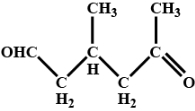
$A$ single compound of the structure $CH_3-CO-CH_2-CH_2-CH_2-CHO$ is obtainable from the ozonolysis of which of the following cyclic compounds?
A
$1,1-dimethylcyclopent-1-ene$
B
$1,2-dimethylcyclopent-1-ene$
C
$1,5-dimethylcyclopent-1-ene$
D
$1,2-dimethylcyclopent-3-ene$
Solution
(A) Ozonolysis of a cyclic alkene involves the cleavage of the double bond to form a dicarbonyl compound. The given product is $CH_3-CO-CH_2-CH_2-CH_2-CHO$. This is a $6$-carbon chain with a ketone group at position $2$ and an aldehyde group at position $6$. This implies the original cyclic compound must have been a $6$-membered ring,specifically $1-methylcyclohex-1-ene$. However,looking at the options provided,we must evaluate which cyclic compound yields this specific structure. The structure $CH_3-CO-CH_2-CH_2-CH_2-CHO$ is $6-oxohexanal$. This is formed by the oxidative cleavage of $1-methylcyclohex-1-ene$. Given the options are all $5$-membered rings,there might be a discrepancy in the question's structure. Re-evaluating the product $CH_3-CO-CH_2-CH_2-CH_2-CHO$,it corresponds to the ozonolysis of $1-methylcyclohex-1-ene$. If the question implies a $5$-membered ring,the product would be different. Based on standard chemistry problems of this type,$1-methylcyclohex-1-ene$ is the correct precursor for this specific linear dicarbonyl.
0 likes
View SolutionHydrocarbons — Alkene · Frequently Asked Questions
1Are these Hydrocarbons questions useful for JEE and NEET?
Yes. All questions in this section are mapped to JEE Main and NEET exam patterns. Previous year questions from JEE Main, NEET, GUJCET and state-level exams are included with full solutions.
2Can I switch to Hindi or Gujarati for these questions?
Yes. Use the language tabs in the hero section or the sidebar to view the same questions and solutions in English, Hindi or Gujarati.
3How do I generate a question paper from this subtopic?
Use the Vedclass Exam Paper Generator — select the chapter and subtopic, set difficulty, and generate Sets A, B, C, D automatically. First 3 chapters of every subject are free.
Vedclass Products
For Students
Vedclass Test Series
Mock tests in real JEE/NEET style with performance analysis. 5-day free trial.
Start Free TrialFor Teachers
Exam Paper Generator
Generate Set A/B/C/D papers from this chapter in 2 minutes. 3 chapters free.
Try FreeFor Institutes
Online Exam Module
Live online exams with unlimited students, 360° analytics & white-label branding.
See DemoFor Teachers & Institutes
Generate a Hydrocarbons Exam Paper in 2 Minutes
Select subtopic & difficulty — Sets A, B, C, D auto-generated with No Repeat logic.
First 3 chapters of every subject are free — no payment required.