
A English
Alkene Questions in English
Class 11 Chemistry · Hydrocarbons · Alkene
1080+
Questions
English
Language
100%
With Solutions
Showing 47 of 1080 questions in English
1
MediumMCQ
$A$ hydrocarbon contains $86\%$ carbon. $488 \ mL$ of the hydrocarbon weighs $1.68 \ g$ at $STP$. Then the hydrocarbon is an:
A
Alkane
B
Alkene
C
Alkyne
D
Arene
Solution
(B) $1$. Calculate the molar mass of the hydrocarbon:
At $STP$,$22400 \ mL$ corresponds to $1 \ mole$ of gas.
Given $488 \ mL$ weighs $1.68 \ g$,so $22400 \ mL$ weighs: $\frac{1.68 \times 22400}{488} \approx 77.14 \ g/mol$.
$2$. Determine the empirical formula:
Carbon = $86\%$,Hydrogen = $100 - 86 = 14\%$.
Moles of $C = \frac{86}{12} \approx 7.17$.
Moles of $H = \frac{14}{1} = 14$.
Ratio $C:H = 7.17:14 \approx 1:2$.
Empirical formula is $CH_2$.
$3$. Determine molecular formula:
Empirical formula mass = $12 + 2 = 14 \ g/mol$.
$n = \frac{\text{Molar mass}}{\text{Empirical mass}} = \frac{77.14}{14} \approx 5.5$.
Since the hydrocarbon is a gas at $STP$ and follows $C_nH_{2n}$,it belongs to the alkene series.
At $STP$,$22400 \ mL$ corresponds to $1 \ mole$ of gas.
Given $488 \ mL$ weighs $1.68 \ g$,so $22400 \ mL$ weighs: $\frac{1.68 \times 22400}{488} \approx 77.14 \ g/mol$.
$2$. Determine the empirical formula:
Carbon = $86\%$,Hydrogen = $100 - 86 = 14\%$.
Moles of $C = \frac{86}{12} \approx 7.17$.
Moles of $H = \frac{14}{1} = 14$.
Ratio $C:H = 7.17:14 \approx 1:2$.
Empirical formula is $CH_2$.
$3$. Determine molecular formula:
Empirical formula mass = $12 + 2 = 14 \ g/mol$.
$n = \frac{\text{Molar mass}}{\text{Empirical mass}} = \frac{77.14}{14} \approx 5.5$.
Since the hydrocarbon is a gas at $STP$ and follows $C_nH_{2n}$,it belongs to the alkene series.
0 likes
View Solution2
EasyMCQ
The bond angle in ethylene is $............$ $^o$.
A
$180$
B
$120$
C
$109$
D
$90$
Solution
(B) In ethylene $(CH_2=CH_2)$,both carbon atoms are $sp^2$-hybridized.
The geometry around each carbon atom is trigonal planar,which corresponds to a bond angle of $120^o$.
The geometry around each carbon atom is trigonal planar,which corresponds to a bond angle of $120^o$.
0 likes
View Solution3
EasyMCQ
Number of shared electrons between carbon-carbon atoms in an ethylene molecule is
A
$2$
B
$6$
C
$4$
D
$3$
Solution
(C) The chemical formula of ethylene is $C_2H_4$ or $CH_2=CH_2$.
In the ethylene molecule,there is a double bond between the two carbon atoms.
$A$ double bond consists of $2$ shared electron pairs.
Since each shared pair contains $2$ electrons,the total number of shared electrons between the two carbon atoms is $2 \times 2 = 4$.
In the ethylene molecule,there is a double bond between the two carbon atoms.
$A$ double bond consists of $2$ shared electron pairs.
Since each shared pair contains $2$ electrons,the total number of shared electrons between the two carbon atoms is $2 \times 2 = 4$.
0 likes
View Solution4
EasyMCQ
$H_2O_2$ on reacting with ethene gives:
A
Ethane
B
Ethanal
C
Ethylene glycol
D
Ethanol
Solution
(C) $H_2O_2$ reacts with ethene $(CH_2=CH_2)$ to form ethylene glycol $(CH_2(OH)-CH_2(OH))$.
This is a hydroxylation reaction.
This is a hydroxylation reaction.
0 likes
View Solution5
EasyMCQ
Which one of the following reagents is used for the detection of unsaturation in alkenes?
A
$NaOH + CaO$
B
Cold dilute alkaline $KMnO_4$
C
$Cl_2 / hv$
D
$KOH / C_2H_5OH$
Solution
(B) The test for unsaturation in alkenes is known as the Baeyer's test.
In this test,alkenes react with cold dilute alkaline $KMnO_4$ solution (Baeyer's reagent).
The purple/pink colour of the $KMnO_4$ solution disappears,and a brown precipitate of $MnO_2$ is formed,indicating the presence of a double bond (unsaturation).
Therefore,cold dilute alkaline $KMnO_4$ is the correct reagent.
In this test,alkenes react with cold dilute alkaline $KMnO_4$ solution (Baeyer's reagent).
The purple/pink colour of the $KMnO_4$ solution disappears,and a brown precipitate of $MnO_2$ is formed,indicating the presence of a double bond (unsaturation).
Therefore,cold dilute alkaline $KMnO_4$ is the correct reagent.
0 likes
View Solution6
MediumMCQ
$2$-methyl-$2$-butene will be represented as:
A
$CH_3-C(CH_3)=CH-CH_3$
B
$CH_3-CH_2-C(CH_3)=CH_2$
C
$CH_3-CH(CH_3)-CH=CH_2$
D
$CH_3-C(CH_3)_2-CH_3$
Solution
(A) The $IUPAC$ name $2$-methyl-$2$-butene indicates a $4$-carbon chain (but-ene) with a double bond at the $2^{nd}$ position and a methyl group at the $2^{nd}$ position.
The structure is $CH_3-C(CH_3)=CH-CH_3$.
The structure is $CH_3-C(CH_3)=CH-CH_3$.
0 likes
View Solution7
EasyMCQ
Name the alkene with molecular formula $C_{10}H_{20}$.
A
Dodecene
B
Undecene
C
Decene
D
Heptene
Solution
(C) The general formula for an alkene is $C_nH_{2n}$.
For $n = 10$,the molecular formula is $C_{10}H_{20}$.
The prefix for $10$ carbon atoms is 'dec-'.
Since it is an alkene,the suffix is '-ene'.
Therefore,the name of the compound is $Decene$.
For $n = 10$,the molecular formula is $C_{10}H_{20}$.
The prefix for $10$ carbon atoms is 'dec-'.
Since it is an alkene,the suffix is '-ene'.
Therefore,the name of the compound is $Decene$.
0 likes
View Solution8
MediumMCQ
In alkene (ethene),the number of $sp^2$ hybridized carbon atoms is:
A
$1$
B
$2$
C
$3$
D
$0$
Solution
(B) The structure of ethene is $CH_2 = CH_2$.
In this molecule,each carbon atom is bonded to two hydrogen atoms and one other carbon atom via a double bond.
Since each carbon atom is attached to three sigma bonds and zero lone pairs,the hybridization of each carbon atom is $sp^2$.
Therefore,there are $2$ $sp^2$ hybridized carbon atoms.
In this molecule,each carbon atom is bonded to two hydrogen atoms and one other carbon atom via a double bond.
Since each carbon atom is attached to three sigma bonds and zero lone pairs,the hybridization of each carbon atom is $sp^2$.
Therefore,there are $2$ $sp^2$ hybridized carbon atoms.
0 likes
View Solution9
MediumMCQ
The number of $sp^3$ hybridized carbon atoms in cyclohexene is
A
$2$
B
$3$
C
$4$
D
$6$
Solution
(C) Cyclohexene has the molecular formula $C_6H_{10}$.
It contains one double bond between two carbon atoms.
The two carbon atoms involved in the double bond are $sp^2$-hybridized.
The remaining $4$ carbon atoms are bonded only by single bonds and are therefore $sp^3$-hybridized.
Thus,there are $4$ $sp^3$-hybridized carbon atoms in cyclohexene.
It contains one double bond between two carbon atoms.
The two carbon atoms involved in the double bond are $sp^2$-hybridized.
The remaining $4$ carbon atoms are bonded only by single bonds and are therefore $sp^3$-hybridized.
Thus,there are $4$ $sp^3$-hybridized carbon atoms in cyclohexene.
0 likes
View Solution10
EasyMCQ
Ethylene possesses:
A
Two sigma and two pi bonds
B
Two pi bonds
C
Five sigma and one pi bond
D
Four sigma and one pi bond
Solution
(C) The structure of ethylene is $CH_2=CH_2$.
In this molecule,there are $4$ $C-H$ sigma bonds and $1$ $C-C$ sigma bond,totaling $5$ sigma bonds.
There is also $1$ $C-C$ pi bond.
Therefore,ethylene contains $5$ sigma and $1$ pi bond.
In this molecule,there are $4$ $C-H$ sigma bonds and $1$ $C-C$ sigma bond,totaling $5$ sigma bonds.
There is also $1$ $C-C$ pi bond.
Therefore,ethylene contains $5$ sigma and $1$ pi bond.
0 likes
View Solution11
MediumMCQ
Conjugated double bond is present in
A
$1, 2-$butadiene
B
$1, 3-$butadiene
C
$1, 3-$pentadiene
D
$\beta-$butylene
Solution
(B) conjugated system is defined as a system of connected $p-$orbitals with delocalized electrons in a molecule,which in general lowers the overall energy of the molecule and increases stability.
In conjugated dienes,two double bonds are separated by exactly one single bond,represented as $C=C-C=C$.
$1, 3-$butadiene $(CH_2=CH-CH=CH_2)$ and $1, 3-$pentadiene $(CH_2=CH-CH=CH-CH_3)$ both contain conjugated double bonds.
However,in standard multiple-choice questions of this type,$1, 3-$butadiene is the fundamental example of a conjugated diene.
Note: Both $B$ and $C$ are technically correct,but $1, 3-$butadiene is the most common textbook example.
In conjugated dienes,two double bonds are separated by exactly one single bond,represented as $C=C-C=C$.
$1, 3-$butadiene $(CH_2=CH-CH=CH_2)$ and $1, 3-$pentadiene $(CH_2=CH-CH=CH-CH_3)$ both contain conjugated double bonds.
However,in standard multiple-choice questions of this type,$1, 3-$butadiene is the fundamental example of a conjugated diene.
Note: Both $B$ and $C$ are technically correct,but $1, 3-$butadiene is the most common textbook example.
0 likes
View Solution12
MediumMCQ
Which of the following reactions proceeds via a radical intermediate?
A
$CH_3-CH=CH_2+HBr \to CH_3-CH(Br)-CH_3$
B
$CH_3-CHO+HCN \to CH_3-CH(OH)CN$
C
$CH_3-CH=CH_2+HBr \xrightarrow{\text{peroxide}} CH_3-CH_2-CH_2-Br$
D
$CH_3CHO+NH_2OH \xrightarrow{H^+} CH_3-CH=N-OH+H_2O$
Solution
(C) The reaction of $CH_3-CH=CH_2$ with $HBr$ in the presence of peroxide (Kharasch effect) proceeds via a free radical mechanism.
In this reaction,the peroxide undergoes homolytic cleavage to form radicals,which then initiate the chain reaction,leading to anti-Markovnikov addition.
In this reaction,the peroxide undergoes homolytic cleavage to form radicals,which then initiate the chain reaction,leading to anti-Markovnikov addition.
0 likes
View Solution13
MediumMCQ
Addition of $HCl$ to vinyl chloride $(CH_2=CHCl)$ gives $1, 1-$dichloroethane $(CH_3-CHCl_2)$ because of:
A
Mesomeric effect of $Cl$
B
Inductive effect of $Cl$
C
Restricted rotation around double bond
D
Markovnikov's rule
Solution
(D) The addition of $HCl$ to vinyl chloride $(CH_2=CHCl)$ follows Markovnikov's rule.
According to Markovnikov's rule,the negative part of the addendum $(Cl^-)$ attaches to the carbon atom of the double bond that has the fewer number of hydrogen atoms.
In $CH_2=CHCl$,the $CH$ group has one hydrogen atom,while the $CH_2$ group has two.
Therefore,the $Cl^-$ ion attacks the $CH$ carbon,leading to the formation of $1, 1-$dichloroethane $(CH_3-CHCl_2)$.
According to Markovnikov's rule,the negative part of the addendum $(Cl^-)$ attaches to the carbon atom of the double bond that has the fewer number of hydrogen atoms.
In $CH_2=CHCl$,the $CH$ group has one hydrogen atom,while the $CH_2$ group has two.
Therefore,the $Cl^-$ ion attacks the $CH$ carbon,leading to the formation of $1, 1-$dichloroethane $(CH_3-CHCl_2)$.
0 likes
View Solution14
EasyMCQ
Which one of the following is an electrophilic addition reaction?
A
$CH_3-CH_3 + Cl_2 \to C_2H_5Cl + HCl$
B
$CH_3CH=O + HCN \to CH_3CH(OH)CN$
C
$Br_2 \to Br^{\bullet} + Br^{\bullet}$
D
$CH_2=CH_2 + Br_2 \to CH_2Br-CH_2Br$
Solution
(D) The reaction of ethene $(CH_2=CH_2)$ with bromine $(Br_2)$ is a classic example of electrophilic addition.
In this reaction,the $\pi$-bond of the alkene acts as a nucleophile and attacks the electrophilic bromine molecule,leading to the formation of a cyclic bromonium ion intermediate,followed by the attack of the bromide ion to form $CH_2Br-CH_2Br$.
In this reaction,the $\pi$-bond of the alkene acts as a nucleophile and attacks the electrophilic bromine molecule,leading to the formation of a cyclic bromonium ion intermediate,followed by the attack of the bromide ion to form $CH_2Br-CH_2Br$.
0 likes
View Solution15
MediumMCQ
In the catalytic reduction of hydrocarbons,which catalyst is mostly used?
A
$Pt/Ni$
B
$Pd$
C
$SiO_2$
D
Misch Metal
Solution
(A) The catalytic reduction of unsaturated hydrocarbons (alkenes or alkynes) to alkanes is typically carried out using finely divided metals like $Pt$,$Pd$,or $Ni$ as catalysts. Among the given options,$Pt/Ni$ represents the commonly used catalysts for this process.
0 likes
View Solution16
MediumMCQ
Ethylene reacts with bromine to form
A
$Br - CH_2 - CH_3$
B
$CH_3 - CBr_3$
C
$Br - CH_2 - CH_2Br$
D
$CHBr_3$
Solution
(C) The reaction of ethylene $(CH_2=CH_2)$ with bromine $(Br_2)$ is an electrophilic addition reaction.
In this reaction,the $\pi$-bond of the alkene breaks,and two bromine atoms add across the double bond.
The reaction proceeds as follows:
$CH_2=CH_2 + Br_2 \rightarrow Br-CH_2-CH_2-Br$
The product formed is $1,2-dibromoethane$.
In this reaction,the $\pi$-bond of the alkene breaks,and two bromine atoms add across the double bond.
The reaction proceeds as follows:
$CH_2=CH_2 + Br_2 \rightarrow Br-CH_2-CH_2-Br$
The product formed is $1,2-dibromoethane$.
0 likes
View Solution17
MediumMCQ
Propane is obtained from propene by which method?
A
Catalytic hydrogenation
B
Wurtz reaction
C
Dehydrogenation
D
Frankland reaction
Solution
(A) The conversion of propene to propane involves the addition of hydrogen across the double bond,which is known as catalytic hydrogenation.
$CH_3-CH=CH_2 + H_2 \xrightarrow{Ni, 300 \ ^oC} CH_3-CH_2-CH_3$
Thus,the correct option is $(A)$.
$CH_3-CH=CH_2 + H_2 \xrightarrow{Ni, 300 \ ^oC} CH_3-CH_2-CH_3$
Thus,the correct option is $(A)$.
0 likes
View Solution18
MediumMCQ
Propane-$1$-ol can be prepared from propene by its reaction with
A
$CH_3COOH$
B
$H_3BO_3$
C
$B_2H_6 / NaOH, H_2O_2$
D
$H_2SO_4 / H_2O$
Solution
(C) The preparation of propane-$1$-ol from propene $(CH_3-CH=CH_2)$ is an example of hydroboration-oxidation reaction.
In this reaction,propene reacts with diborane $(B_2H_6)$ in the presence of an ether solvent to form a trialkylborane intermediate.
This intermediate is then oxidized using hydrogen peroxide $(H_2O_2)$ in the presence of an aqueous base $(NaOH)$ to yield the anti-Markovnikov product,propane-$1$-ol $(CH_3-CH_2-CH_2OH)$.
In this reaction,propene reacts with diborane $(B_2H_6)$ in the presence of an ether solvent to form a trialkylborane intermediate.
This intermediate is then oxidized using hydrogen peroxide $(H_2O_2)$ in the presence of an aqueous base $(NaOH)$ to yield the anti-Markovnikov product,propane-$1$-ol $(CH_3-CH_2-CH_2OH)$.
0 likes
View Solution19
MediumMCQ
Addition of bromine to $1,3-$butadiene gives
A
$1,2-$addition product only
B
$1,4-$addition product only
C
Both $1,2-$ and $1,4-$addition products
D
No reaction
Solution
(C) The electrophilic addition of bromine to $1,3-$butadiene proceeds through the formation of a resonance-stabilized allylic carbocation intermediate.
This intermediate can be attacked by the bromide ion at the $C-2$ position to form the $1,2-$addition product ($3,4-$dibromobut-$1-$ene) or at the $C-4$ position to form the $1,4-$addition product ($1,4-$dibromobut-$2-$ene).
Therefore,both $1,2-$ and $1,4-$addition products are formed.
This intermediate can be attacked by the bromide ion at the $C-2$ position to form the $1,2-$addition product ($3,4-$dibromobut-$1-$ene) or at the $C-4$ position to form the $1,4-$addition product ($1,4-$dibromobut-$2-$ene).
Therefore,both $1,2-$ and $1,4-$addition products are formed.
0 likes
View Solution20
MediumMCQ
When ethylene bromide is treated with $Zn$,we get
A
Alkane
B
Alkene
C
Alkyne
D
All
Solution
(B) When ethylene bromide $(Br-CH_2-CH_2-Br)$ is treated with $Zn$ dust,it undergoes dehalogenation to form ethylene $(CH_2=CH_2)$,which is an alkene.
Reaction: $Br-CH_2-CH_2-Br + Zn \rightarrow CH_2=CH_2 + ZnBr_2$
Reaction: $Br-CH_2-CH_2-Br + Zn \rightarrow CH_2=CH_2 + ZnBr_2$
0 likes
View Solution21
MediumMCQ
Ethene when treated with $Br_2$ in the presence of $CCl_4$,which compound is formed?
A
$1, 2-$dibromoethane
B
$1-$bromo$-2-$chloroethane
C
Both $(a)$ and $(b)$
D
$1, 1, 1-$tribromoethane
Solution
(A) The reaction of ethene with bromine in the presence of carbon tetrachloride $(CCl_4)$ is an electrophilic addition reaction.
$CH_2=CH_2 + Br_2 \xrightarrow{CCl_4} CH_2(Br)-CH_2(Br)$
This reaction results in the formation of $1, 2-$dibromoethane.
$CH_2=CH_2 + Br_2 \xrightarrow{CCl_4} CH_2(Br)-CH_2(Br)$
This reaction results in the formation of $1, 2-$dibromoethane.
0 likes
View Solution22
DifficultMCQ
In the reaction $CH_2=CH_2$ $\xrightarrow{HOCl} M$ $\xrightarrow{R} HO-CH_2-CH_2-OH$,where $M$ is a molecule and $R$ is a reagent,$M$ and $R$ are:
A
$CH_3-CH_2-Cl$ and $NaOH$
B
$Cl-CH_2-CH_2-OH$ and $aq. NaHCO_3$
C
$CH_3-CH_2-OH$ and $HCl$
D
$CH_2=CH_2$ and heat
Solution
(B) The reaction of ethene $(CH_2=CH_2)$ with hypochlorous acid $(HOCl)$ follows an electrophilic addition mechanism to form ethylene chlorohydrin $(Cl-CH_2-CH_2-OH)$,which is molecule $M$.
Ethylene chlorohydrin then undergoes hydrolysis in the presence of a mild base like aqueous sodium bicarbonate $(aq. NaHCO_3)$,which acts as reagent $R$,to produce ethylene glycol $(HO-CH_2-CH_2-OH)$.
Ethylene chlorohydrin then undergoes hydrolysis in the presence of a mild base like aqueous sodium bicarbonate $(aq. NaHCO_3)$,which acts as reagent $R$,to produce ethylene glycol $(HO-CH_2-CH_2-OH)$.
0 likes
View Solution23
MediumMCQ
Alkenes usually show which type of reaction?
A
Addition
B
Substitution
C
Elimination
D
Superposition
Solution
(A) Alkenes are unsaturated hydrocarbons containing a carbon-carbon double bond $(C=C)$.
Due to the presence of the $\pi$-bond,they are electron-rich and generally undergo electrophilic addition reactions.
Due to the presence of the $\pi$-bond,they are electron-rich and generally undergo electrophilic addition reactions.
0 likes
View Solution24
MediumMCQ
The propene reacts with $HBr$ to form
A
Ethane
B
Hexane
C
$1-$bromopropane
D
$2-$bromopropane
Solution
(D) The reaction of propene $(CH_3-CH=CH_2)$ with $HBr$ follows Markovnikov's rule.
According to this rule,the negative part of the addendum $(Br^-)$ attaches to the carbon atom having a lesser number of hydrogen atoms.
Thus,the major product formed is $2-$bromopropane $(CH_3-CH(Br)-CH_3)$.
According to this rule,the negative part of the addendum $(Br^-)$ attaches to the carbon atom having a lesser number of hydrogen atoms.
Thus,the major product formed is $2-$bromopropane $(CH_3-CH(Br)-CH_3)$.
0 likes
View Solution25
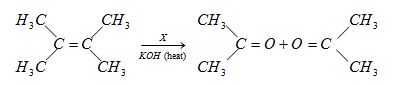
MediumMCQ
$X$ in the above reaction is
A
$HNO_3$
B
$O_2$
C
$O_3$
D
$KMnO_4$
Solution
(D) The reaction shows the oxidative cleavage of an alkene,$2,3-dimethylbut-2-ene$,into two molecules of acetone $(propanone)$.
This is a strong oxidation reaction typically carried out using an oxidizing agent like alkaline $KMnO_4$ under heating conditions.
Therefore,$X$ is $KMnO_4$.
This is a strong oxidation reaction typically carried out using an oxidizing agent like alkaline $KMnO_4$ under heating conditions.
Therefore,$X$ is $KMnO_4$.
0 likes
View Solution26
MediumMCQ
The disappearance of the characteristic purple colour of $KMnO_4$ in its reaction with an alkene is the test for unsaturation. It is known as
A
Markownikoff's test
B
Baeyer's test
C
Wurtz's test
D
Grignard test
Solution
(B) The reaction of an alkene with cold,dilute,alkaline $KMnO_4$ solution (Baeyer's reagent) results in the formation of a vicinal diol.
During this reaction,the purple colour of $KMnO_4$ disappears,which serves as a qualitative test for the presence of a double or triple bond (unsaturation).
This specific test is known as $Baeyer's$ test.
During this reaction,the purple colour of $KMnO_4$ disappears,which serves as a qualitative test for the presence of a double or triple bond (unsaturation).
This specific test is known as $Baeyer's$ test.
0 likes
View Solution27
DifficultMCQ
The intermediate during the addition of $HCl$ to propene in the presence of peroxide is
A
$CH_3-CH(Cl)-CH_2^\bullet$
B
$CH_3-CH^{+}-CH_3$
C
$CH_3-CH_2-CH_2^\bullet$
D
$CH_3-CH_2-CH_2^+$
Solution
(B) The addition of $HCl$ to propene follows Markovnikov's rule,even in the presence of peroxide.
Peroxide effect (Kharasch effect) is only applicable to $HBr$ and not to $HCl$ or $HI$.
In the reaction,the electrophile $H^+$ attacks the double bond to form the more stable secondary carbocation,$CH_3-CH^{+}-CH_3$,as the reaction intermediate.
Therefore,the correct intermediate is $CH_3-CH^{+}-CH_3$.
Peroxide effect (Kharasch effect) is only applicable to $HBr$ and not to $HCl$ or $HI$.
In the reaction,the electrophile $H^+$ attacks the double bond to form the more stable secondary carbocation,$CH_3-CH^{+}-CH_3$,as the reaction intermediate.
Therefore,the correct intermediate is $CH_3-CH^{+}-CH_3$.
0 likes
View Solution28
MediumMCQ
$CH_2 = CH_2 \xrightarrow[KOH / H_2O]{KMnO_4} X$. The product $X$ in the above reaction is:
A
Ethylene glycol
B
Glucose
C
Ethanol
D
All of these
Solution
(A) The reaction of ethene $(CH_2=CH_2)$ with cold,dilute alkaline $KMnO_4$ (Baeyer's reagent) is an oxidation reaction.
$CH_2 = CH_2 + [O] + H_2O \xrightarrow{KMnO_4 / OH^-} HO-CH_2-CH_2-OH$
The product formed is $Ethane-1,2-diol$,commonly known as $Ethylene \ glycol$.
This reaction is used as a test for unsaturation,where the purple color of $KMnO_4$ disappears.
$CH_2 = CH_2 + [O] + H_2O \xrightarrow{KMnO_4 / OH^-} HO-CH_2-CH_2-OH$
The product formed is $Ethane-1,2-diol$,commonly known as $Ethylene \ glycol$.
This reaction is used as a test for unsaturation,where the purple color of $KMnO_4$ disappears.
0 likes
View Solution29
MediumMCQ
Ozonolysis of which one of the following will give two molecules of acetaldehyde?
A
but$-1-$ene
B
but$-2-$ene
C
pent$-1-$ene
D
pent$-2-$ene
Solution
(B) Ozonolysis of alkenes involves the cleavage of the $C=C$ double bond to form carbonyl compounds.
For $but-2-ene$ $(CH_3-CH=CH-CH_3)$,the reaction with $O_3$ followed by $Zn/H_2O$ proceeds as follows:
$CH_3-CH=CH-CH_3 + O_3 \rightarrow CH_3-CH(O_2)CH-CH_3$ (ozonide intermediate)
$CH_3-CH(O_2)CH-CH_3 + Zn/H_2O \rightarrow 2CH_3CHO$ (acetaldehyde or ethanal).
Thus,$but-2-ene$ yields two molecules of acetaldehyde.
For $but-2-ene$ $(CH_3-CH=CH-CH_3)$,the reaction with $O_3$ followed by $Zn/H_2O$ proceeds as follows:
$CH_3-CH=CH-CH_3 + O_3 \rightarrow CH_3-CH(O_2)CH-CH_3$ (ozonide intermediate)
$CH_3-CH(O_2)CH-CH_3 + Zn/H_2O \rightarrow 2CH_3CHO$ (acetaldehyde or ethanal).
Thus,$but-2-ene$ yields two molecules of acetaldehyde.
0 likes
View Solution30
MediumMCQ
In which of the following,addition of $HBr$ does not take place against Markownikoff's rule,or for which is the Anti-Markownikoff addition of $HBr$ not observed?
A
$Propene$
B
$But-1-ene$
C
$But-2-ene$
D
$Pent-2-ene$
Solution
(C) The Anti-Markownikoff addition of $HBr$ (also known as the peroxide effect or Kharasch effect) is only observed in unsymmetrical alkenes.
$But-2-ene$ $(CH_3-CH=CH-CH_3)$ is a symmetrical alkene.
In a symmetrical alkene,the addition of $HBr$ results in the same product regardless of whether it follows Markownikoff's rule or the Anti-Markownikoff mechanism.
Therefore,the Anti-Markownikoff addition is not observed for $But-2-ene$.
$But-2-ene$ $(CH_3-CH=CH-CH_3)$ is a symmetrical alkene.
In a symmetrical alkene,the addition of $HBr$ results in the same product regardless of whether it follows Markownikoff's rule or the Anti-Markownikoff mechanism.
Therefore,the Anti-Markownikoff addition is not observed for $But-2-ene$.
0 likes
View Solution31
MediumMCQ
Dilute aqueous $KMnO_4$ at room temperature reacts with $R-CH=CH-R$ to give:
A
$R-CHO$
B
$R-COOH$
C
$R-CH(OH)-CH(OH)-R$
D
$CO_2 + H_2O$
Solution
(C) The reaction of an alkene with dilute aqueous $KMnO_4$ (Baeyer's reagent) at room temperature is a syn-hydroxylation reaction.
$R-CH=CH-R \xrightarrow[\text{room temp.}]{\text{dil. aqueous } KMnO_4} R-CH(OH)-CH(OH)-R$ (vicinal diol).
In contrast,concentrated $KMnO_4$ with heat causes oxidative cleavage of the double bond to form carboxylic acids.
$R-CH=CH-R \xrightarrow[\text{room temp.}]{\text{dil. aqueous } KMnO_4} R-CH(OH)-CH(OH)-R$ (vicinal diol).
In contrast,concentrated $KMnO_4$ with heat causes oxidative cleavage of the double bond to form carboxylic acids.
0 likes
View Solution32
MediumMCQ
Aqueous sulphuric acid reacts with $2-$methyl$-1-$butene to give predominantly
A
Isobutyl hydrogen sulphate
B
$2-$methyl$-2-$butanol
C
$2-$methyl$-1-$butanol
D
Secondary butyl hydrogen sulphate
Solution
(B) The reaction of $2-$methyl$-1-$butene $(CH_2=C(CH_3)CH_2CH_3)$ with aqueous $H_2SO_4$ is an acid-catalyzed hydration.
It follows Markovnikov's rule,where the $H^{+}$ adds to the carbon with more hydrogens to form a stable tertiary carbocation $(CH_3-C^{+}(CH_3)CH_2CH_3)$.
Subsequent attack by $H_2O$ and loss of a proton yields $2-$methyl$-2-$butanol $(CH_3-C(OH)(CH_3)CH_2CH_3)$ as the major product.
It follows Markovnikov's rule,where the $H^{+}$ adds to the carbon with more hydrogens to form a stable tertiary carbocation $(CH_3-C^{+}(CH_3)CH_2CH_3)$.
Subsequent attack by $H_2O$ and loss of a proton yields $2-$methyl$-2-$butanol $(CH_3-C(OH)(CH_3)CH_2CH_3)$ as the major product.
0 likes
View Solution33
MediumMCQ
How can ethene be produced from ethanol?
A
By dehydrohalogenation
B
By dehydrogenation
C
By dehydration with conc. $H_2SO_4$ at $170\,^{\circ}C$
D
By reduction with hydrogen iodide
Solution
(C) When ethanol is heated in the presence of conc. $H_2SO_4$,dehydration takes place to give ethene.
This process involves the removal of a water molecule from the ethanol molecule,which is why it is called a dehydration reaction.
$\underset{\text{Ethanol}}{C_2H_5OH}$ $\xrightarrow[160^{\circ}C - 170^{\circ}C]{\text{Conc. } H_2SO_4} \underset{\text{Ethene}}{CH_2=CH_2} + \underset{\text{Water}}{H_2O}$
This process involves the removal of a water molecule from the ethanol molecule,which is why it is called a dehydration reaction.
$\underset{\text{Ethanol}}{C_2H_5OH}$ $\xrightarrow[160^{\circ}C - 170^{\circ}C]{\text{Conc. } H_2SO_4} \underset{\text{Ethene}}{CH_2=CH_2} + \underset{\text{Water}}{H_2O}$
0 likes
View Solution34
MediumMCQ
Baeyer's reagent is used in the laboratory for
A
Detection of double bonds
B
Detection of glucose
C
Reduction
D
Oxidation
Solution
(A) Baeyer's reagent is an alkaline solution of cold $KMnO_4$.
It is primarily used for the detection of unsaturation (double or triple bonds) in a molecule,as it causes the purple color of $KMnO_4$ to disappear.
It is primarily used for the detection of unsaturation (double or triple bonds) in a molecule,as it causes the purple color of $KMnO_4$ to disappear.
0 likes
View Solution35
MediumMCQ
Isopropyl alcohol is obtained by reacting which of the following alkenes with conc. $H_2SO_4$ and $H_2O$?
A
Ethylene
B
Propylene
C
$2-$methyl propene
D
Isoprene
Solution
(B) The hydration of alkenes in the presence of concentrated $H_2SO_4$ follows $Markownikoff's$ rule.
Propylene $(CH_3-CH=CH_2)$ reacts with water in the presence of concentrated $H_2SO_4$ to form isopropyl alcohol $(CH_3-CH(OH)-CH_3)$.
Reaction: $CH_3-CH=CH_2 + H_2O \xrightarrow[Conc. H_2SO_4]{Markownikoff's \, rule} CH_3-CH(OH)-CH_3$.
Propylene $(CH_3-CH=CH_2)$ reacts with water in the presence of concentrated $H_2SO_4$ to form isopropyl alcohol $(CH_3-CH(OH)-CH_3)$.
Reaction: $CH_3-CH=CH_2 + H_2O \xrightarrow[Conc. H_2SO_4]{Markownikoff's \, rule} CH_3-CH(OH)-CH_3$.
0 likes
View Solution36
MediumMCQ
Which of the following compounds is produced when $CH_2 = CH - (CH_2)_2COOH$ reacts with $HBr$ in the presence of peroxides?
A
$CH_3CH(Br)(CH_2)_2COOH$
B
$CH_3CH_2CH(Br)CH_2COOH$
C
$Br(CH_2)_3CH_2COOH$
D
$BrCH_2CH_2(CH_2)_2COOH$
Solution
(D) $(D)$ In the presence of organic peroxides, the addition of $HBr$ to an alkene follows the Anti-Markovnikov rule (Kharasch effect).
The bromine atom adds to the carbon atom of the double bond that has more hydrogen atoms.
Therefore, $Br$ adds to the terminal $CH_2$ group of $CH_2 = CH - (CH_2)_2COOH$, resulting in $BrCH_2CH_2(CH_2)_2COOH$.
The bromine atom adds to the carbon atom of the double bond that has more hydrogen atoms.
Therefore, $Br$ adds to the terminal $CH_2$ group of $CH_2 = CH - (CH_2)_2COOH$, resulting in $BrCH_2CH_2(CH_2)_2COOH$.
0 likes
View Solution37
DifficultMCQ
One mole of each of the following alkenes is catalytically hydrogenated. The quantity of heat evolved will be the lowest in the case of
A
$1-$butene
B
$Trans-2-$butene
C
$Cis-2-$butene
D
$1,3-$butadiene
Solution
(B) The heat of hydrogenation is inversely proportional to the stability of the alkene.
More substituted or more stable alkenes release less heat upon hydrogenation.
Among the given options,$Trans-2-$butene is the most stable isomer due to minimal steric hindrance and greater symmetry compared to $Cis-2-$butene and $1-$butene.
Therefore,$Trans-2-$butene releases the lowest quantity of heat upon catalytic hydrogenation.
More substituted or more stable alkenes release less heat upon hydrogenation.
Among the given options,$Trans-2-$butene is the most stable isomer due to minimal steric hindrance and greater symmetry compared to $Cis-2-$butene and $1-$butene.
Therefore,$Trans-2-$butene releases the lowest quantity of heat upon catalytic hydrogenation.
0 likes
View Solution38
DifficultMCQ
$A$ hydrocarbon $X$ adds one mole of hydrogen to give another hydrocarbon and decolourises bromine water. $X$ reacts with $KMnO_4$ in the presence of acid to give two moles of the same carboxylic acid. The structure of $X$ is:
A
$CH_2=CH-CH_2CH_2CH_3$
B
$CH_3CH_2CH_2-CH=CHCH_3$
C
$CH_3CH_2CH=CHCH_2CH_3$
D
$CH_3CH=CHCH_2CH_2CH_3$
Solution
(C) $1$. The hydrocarbon $X$ decolourises bromine water,indicating it is an unsaturated hydrocarbon (alkene).
$2$. $X$ reacts with acidic $KMnO_4$ (a strong oxidizing agent) to produce two moles of the same carboxylic acid. This indicates that the double bond is located in the middle of a symmetrical alkene.
$3$. The reaction is: $CH_3CH_2CH=CHCH_2CH_3 + [O] \xrightarrow{H^+} 2 CH_3CH_2COOH$ (Propanoic acid).
$4$. Among the given options,$CH_3CH_2CH=CHCH_2CH_3$ (Hex$-3-$ene) is the only symmetrical alkene that cleaves to form two identical carboxylic acid molecules.
$2$. $X$ reacts with acidic $KMnO_4$ (a strong oxidizing agent) to produce two moles of the same carboxylic acid. This indicates that the double bond is located in the middle of a symmetrical alkene.
$3$. The reaction is: $CH_3CH_2CH=CHCH_2CH_3 + [O] \xrightarrow{H^+} 2 CH_3CH_2COOH$ (Propanoic acid).
$4$. Among the given options,$CH_3CH_2CH=CHCH_2CH_3$ (Hex$-3-$ene) is the only symmetrical alkene that cleaves to form two identical carboxylic acid molecules.
0 likes
View Solution39
MediumMCQ
$1, 3-$butadiene reacts with ethylene to form:
A
Benzene
B
Cyclohexane
C
Cyclohexene
D
$2, 3-$dimethyl butane
Solution
(C) The reaction between $1, 3-$butadiene and ethylene (ethene) is a Diels-Alder reaction.
This is a $[4+2]$ cycloaddition reaction.
$CH_2=CH-CH=CH_2 + CH_2=CH_2 \xrightarrow{\Delta} \text{Cyclohexene}$
The product formed is cyclohexene.
This is a $[4+2]$ cycloaddition reaction.
$CH_2=CH-CH=CH_2 + CH_2=CH_2 \xrightarrow{\Delta} \text{Cyclohexene}$
The product formed is cyclohexene.
0 likes
View Solution40
MediumMCQ
Ethylene reacts with ozone gas to form the compound
A
$HCHO$
B
$C_2H_5OH$
C
$\text{Ethylene ozonide}$
D
$CH_3CHO$
Solution
(C) The reaction of ethylene $(CH_2=CH_2)$ with ozone $(O_3)$ leads to the formation of an unstable intermediate known as ethylene ozonide.
The reaction is:
$CH_2=CH_2 + O_3 \rightarrow \text{Ethylene ozonide}$
This ozonide further undergoes reductive cleavage to form formaldehyde $(HCHO)$.
The reaction is:
$CH_2=CH_2 + O_3 \rightarrow \text{Ethylene ozonide}$
This ozonide further undergoes reductive cleavage to form formaldehyde $(HCHO)$.
0 likes
View Solution41
MediumMCQ
Oils are converted into fats by
A
Hydration
B
Decarboxylation
C
Hydrogenation
D
Dehydrogenation
Solution
(C) $(C)$ Oils are unsaturated esters containing double bonds in their fatty acid chains. They are converted into saturated fats by the process of catalytic hydrogenation, where hydrogen is added across the double bonds in the presence of a catalyst like $Ni$ or $Pd$.
0 likes
View Solution42
MediumMCQ
Which process converts olefins into paraffins?
A
Halogenation
B
Dehydration
C
Hydrogenation
D
Hydrolysis
Solution
(C) The process of adding hydrogen to an unsaturated hydrocarbon (olefin) to convert it into a saturated hydrocarbon (paraffin) is known as hydrogenation.
The reaction is represented as:
$R-CH=CH-R + H_2 \xrightarrow{Ni/Pd/Pt} R-CH_2-CH_2-R$
Thus,the correct option is $(C)$.
The reaction is represented as:
$R-CH=CH-R + H_2 \xrightarrow{Ni/Pd/Pt} R-CH_2-CH_2-R$
Thus,the correct option is $(C)$.
0 likes
View Solution43
MediumMCQ
Which of the following products are formed upon the addition reaction of $DCl$ with $3-methyl-1-butene$?
A
$CH_2D-CHCl-CH(CH_3)_2$
B
$CH_2D-CH_2-CCl(CH_3)_2$
C
$CH_3-CDCl-CH(CH_3)_2$
D
Both $(a)$ and $(c)$
Solution
(D) The reaction of $3-methyl-1-butene$ $(CH_2=CH-CH(CH_3)_2)$ with $DCl$ proceeds via the formation of a carbocation intermediate.
$1$. Protonation (or deuteration) of the double bond occurs to form the most stable carbocation.
$2$. Addition of $D^+$ to the terminal carbon $(C_1)$ leads to a secondary carbocation: $CH_2D-CH^+-CH(CH_3)_2$.
$3$. Subsequent attack by $Cl^-$ yields the product $CH_2D-CHCl-CH(CH_3)_2$ (Option $a$).
$4$. Alternatively,a $1,2-$hydride shift can occur in the secondary carbocation to form a more stable tertiary carbocation: $CH_3-CH^+-C(CH_3)_2$.
$5$. Attack by $Cl^-$ on this tertiary carbocation yields $CH_3-CHCl-C(CH_3)_2$ (not listed).
$6$. If $D^+$ adds to $C_2$,it forms a primary carbocation,which is unstable. However,if the mechanism involves rearrangement or specific pathways,$CH_3-CDCl-CH(CH_3)_2$ (Option $c$) can be formed via different intermediates or pathways involving hydride shifts.
Given the standard electrophilic addition mechanism,both $(a)$ and $(c)$ are considered possible products due to carbocation rearrangements.
$1$. Protonation (or deuteration) of the double bond occurs to form the most stable carbocation.
$2$. Addition of $D^+$ to the terminal carbon $(C_1)$ leads to a secondary carbocation: $CH_2D-CH^+-CH(CH_3)_2$.
$3$. Subsequent attack by $Cl^-$ yields the product $CH_2D-CHCl-CH(CH_3)_2$ (Option $a$).
$4$. Alternatively,a $1,2-$hydride shift can occur in the secondary carbocation to form a more stable tertiary carbocation: $CH_3-CH^+-C(CH_3)_2$.
$5$. Attack by $Cl^-$ on this tertiary carbocation yields $CH_3-CHCl-C(CH_3)_2$ (not listed).
$6$. If $D^+$ adds to $C_2$,it forms a primary carbocation,which is unstable. However,if the mechanism involves rearrangement or specific pathways,$CH_3-CDCl-CH(CH_3)_2$ (Option $c$) can be formed via different intermediates or pathways involving hydride shifts.
Given the standard electrophilic addition mechanism,both $(a)$ and $(c)$ are considered possible products due to carbocation rearrangements.
0 likes
View Solution44
MediumMCQ
The major product of the following reaction is $CH_3-CH(Br)-CH_2-CH_3 + \text{alc. } KOH \to $
A
But$-1-$ene
B
But$-2-$ene
C
Butane
D
But$-1-$yne
Solution
(B) The reaction of $2\text{-bromobutane}$ with alcoholic $KOH$ is a dehydrohalogenation reaction (elimination reaction).
According to $Saytzeff's$ rule,the more substituted alkene is the major product.
$CH_3-CH(Br)-CH_2-CH_3 + KOH (\text{alc.}) \to CH_3-CH=CH-CH_3 (\text{But-2-ene}) + KBr + H_2O$.
Since $But-2-ene$ is more stable than $But-1-ene$,it is the major product.
According to $Saytzeff's$ rule,the more substituted alkene is the major product.
$CH_3-CH(Br)-CH_2-CH_3 + KOH (\text{alc.}) \to CH_3-CH=CH-CH_3 (\text{But-2-ene}) + KBr + H_2O$.
Since $But-2-ene$ is more stable than $But-1-ene$,it is the major product.
0 likes
View Solution45
MediumMCQ
Cyclopentene on treatment with alkaline $KMnO_4$ gives
A
Cyclopentanol
B
trans $1, 2-$cyclopentanediol
C
cis $1, 2-$cyclopentanediol
D
$1 : 1$ mixture of cis and trans $1, 2-$cyclopentanediol
Solution
(C) The reaction of alkenes with cold,dilute alkaline $KMnO_4$ (Baeyer's reagent) is a syn-hydroxylation reaction.
In this reaction,two hydroxyl $(-OH)$ groups are added to the same side of the double bond.
Therefore,cyclopentene reacts with alkaline $KMnO_4$ to form cis-$1, 2-$cyclopentanediol.
In this reaction,two hydroxyl $(-OH)$ groups are added to the same side of the double bond.
Therefore,cyclopentene reacts with alkaline $KMnO_4$ to form cis-$1, 2-$cyclopentanediol.
0 likes
View Solution46
MediumMCQ
Which of the following is the most stable alkene?
A
$R_2C=CR_2$
B
$RCH=CHR$
C
$RCH_2=CH_2R$
D
$CH_2=CH_2$
Solution
(A) The stability of an alkene is directly proportional to the number of alkyl groups attached to the double-bonded carbon atoms due to the hyperconjugation effect and inductive effect.
$A$ represents a tetra-substituted alkene $(R_2C=CR_2)$,which has the maximum number of alkyl groups.
$B$ represents a di-substituted alkene.
$C$ is chemically incorrect as written.
$D$ represents ethene,which is unsubstituted.
Therefore,$R_2C=CR_2$ is the most stable alkene.
$A$ represents a tetra-substituted alkene $(R_2C=CR_2)$,which has the maximum number of alkyl groups.
$B$ represents a di-substituted alkene.
$C$ is chemically incorrect as written.
$D$ represents ethene,which is unsubstituted.
Therefore,$R_2C=CR_2$ is the most stable alkene.
0 likes
View Solution47
MediumMCQ
What is the product formed when ethene reacts with acidic $KMnO_4$ solution?
A
Ethylene glycol
B
Ethylene oxide
C
Formaldehyde
D
Acetaldehyde
Solution
(C) The reaction of ethene with acidic $KMnO_4$ is an oxidative cleavage reaction.
$CH_2=CH_2 + 2[O] \xrightarrow{KMnO_4/H^+} HCHO + HCHO$
Since ethene is a terminal alkene,the oxidative cleavage of the double bond results in the formation of formaldehyde $(HCHO)$.
$CH_2=CH_2 + 2[O] \xrightarrow{KMnO_4/H^+} HCHO + HCHO$
Since ethene is a terminal alkene,the oxidative cleavage of the double bond results in the formation of formaldehyde $(HCHO)$.
0 likes
View SolutionHydrocarbons — Alkene · Frequently Asked Questions
1Are these Hydrocarbons questions useful for JEE and NEET?
Yes. All questions in this section are mapped to JEE Main and NEET exam patterns. Previous year questions from JEE Main, NEET, GUJCET and state-level exams are included with full solutions.
2Can I switch to Hindi or Gujarati for these questions?
Yes. Use the language tabs in the hero section or the sidebar to view the same questions and solutions in English, Hindi or Gujarati.
3How do I generate a question paper from this subtopic?
Use the Vedclass Exam Paper Generator — select the chapter and subtopic, set difficulty, and generate Sets A, B, C, D automatically. First 3 chapters of every subject are free.
Vedclass Products
For Students
Vedclass Test Series
Mock tests in real JEE/NEET style with performance analysis. 5-day free trial.
Start Free TrialFor Teachers
Exam Paper Generator
Generate Set A/B/C/D papers from this chapter in 2 minutes. 3 chapters free.
Try FreeFor Institutes
Online Exam Module
Live online exams with unlimited students, 360° analytics & white-label branding.
See DemoFor Teachers & Institutes
Generate a Hydrocarbons Exam Paper in 2 Minutes
Select subtopic & difficulty — Sets A, B, C, D auto-generated with No Repeat logic.
First 3 chapters of every subject are free — no payment required.