
A English
Alkene Questions in English
Class 11 Chemistry · Hydrocarbons · Alkene
1080+
Questions
English
Language
100%
With Solutions
Showing 50 of 1080 questions in English
101
MediumMCQ
An alkene on ozonolysis gave acetaldehyde. The alkene is:
A
Ethylene
B
Propene
C
$2-$butene
D
Both $(b)$ and $(c)$
Solution
(D) Ozonolysis of an alkene involves the cleavage of the $C=C$ double bond to form carbonyl compounds.
$1$. $CH_3-CH=CH_2$ (Propene) on ozonolysis gives $CH_3CHO$ (acetaldehyde) and $HCHO$ (formaldehyde).
$2$. $CH_3-CH=CH-CH_3$ ($2-$butene) on ozonolysis gives two molecules of $CH_3CHO$ (acetaldehyde).
Since the question asks for an alkene that gives acetaldehyde,both $2-$butene (which gives two molecules of acetaldehyde) and propene (which gives one molecule of acetaldehyde along with formaldehyde) are technically sources of acetaldehyde. However,in standard textbook contexts,$2-$butene is the primary answer for producing acetaldehyde as the sole product. Given the options,$(d)$ is the most comprehensive choice.
$1$. $CH_3-CH=CH_2$ (Propene) on ozonolysis gives $CH_3CHO$ (acetaldehyde) and $HCHO$ (formaldehyde).
$2$. $CH_3-CH=CH-CH_3$ ($2-$butene) on ozonolysis gives two molecules of $CH_3CHO$ (acetaldehyde).
Since the question asks for an alkene that gives acetaldehyde,both $2-$butene (which gives two molecules of acetaldehyde) and propene (which gives one molecule of acetaldehyde along with formaldehyde) are technically sources of acetaldehyde. However,in standard textbook contexts,$2-$butene is the primary answer for producing acetaldehyde as the sole product. Given the options,$(d)$ is the most comprehensive choice.
0 likes
View Solution102
MediumMCQ
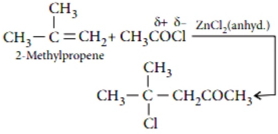
Indicate the organic structure for the product expected when $2-$methylpropene is heated with acetyl chloride in the presence of anhydrous zinc chloride.
A
$CH_3-C(Cl)(CH_3)-CH_2-COCH_3$
B
$CH_3-CH(CH_3)-CH_2-COCH_3$
C
$CH_3-COO-C(CH_3)_3$
D
$CH_3-CO-C(CH_3)=CH_2$
Solution
(A) The reaction is an electrophilic addition of acetyl chloride to the alkene catalyzed by a Lewis acid $(ZnCl_2)$.
The acetyl cation $(CH_3CO^+)$ attacks the terminal carbon of $2-$methylpropene to form a stable tertiary carbocation intermediate,$(CH_3)_2C^+-CH_2-COCH_3$.
This intermediate then reacts with the chloride ion $(Cl^-)$ to give $4-$chloro$-4-$methylpentan$-2-$one,$CH_3-C(Cl)(CH_3)-CH_2-COCH_3$.
The acetyl cation $(CH_3CO^+)$ attacks the terminal carbon of $2-$methylpropene to form a stable tertiary carbocation intermediate,$(CH_3)_2C^+-CH_2-COCH_3$.
This intermediate then reacts with the chloride ion $(Cl^-)$ to give $4-$chloro$-4-$methylpentan$-2-$one,$CH_3-C(Cl)(CH_3)-CH_2-COCH_3$.
0 likes
View Solution103
MediumMCQ
Olefins can be hydrogenated by
A
$Zinc$ and $HCl$
B
Nascent hydrogen
C
Raney $Ni$ and $H_2$
D
$Lithium$ $hydride$ in ether
Solution
(C) The hydrogenation of olefins (alkenes) is a catalytic process.
$(C)$: $CH_2=CH_2 + H_2 \xrightarrow{Raney \ Ni, \Delta} CH_3-CH_3$.
Raney $Ni$ acts as a catalyst in the presence of hydrogen gas to facilitate the addition of hydrogen across the double bond.
$(C)$: $CH_2=CH_2 + H_2 \xrightarrow{Raney \ Ni, \Delta} CH_3-CH_3$.
Raney $Ni$ acts as a catalyst in the presence of hydrogen gas to facilitate the addition of hydrogen across the double bond.
0 likes
View Solution104
MediumMCQ
Electrolysis of cold concentrated aqueous solution of potassium succinate yields:
A
$Ethane$
B
$Ethyne$
C
$Ethene$
D
$Ethane-1, 2-diol$
Solution
(C) The electrolysis of potassium succinate $(KOOC-CH_2-CH_2-COOK)$ via Kolbe's electrolytic method results in the formation of ethene $(CH_2=CH_2)$ at the anode.
The chemical reaction is as follows:
$KOOC-CH_2-CH_2-COOK + 2H_2O \xrightarrow{\text{Electrolysis}} CH_2=CH_2 + 2CO_2 + H_2 + 2KOH$.
The chemical reaction is as follows:
$KOOC-CH_2-CH_2-COOK + 2H_2O \xrightarrow{\text{Electrolysis}} CH_2=CH_2 + 2CO_2 + H_2 + 2KOH$.
0 likes
View Solution105
DifficultMCQ
$A$ hydrocarbon containing $2$ carbon atoms gives Sabatier and Senderen's reaction but does not give a precipitate with ammoniacal silver nitrate solution. The hydrocarbon is:
A
Ethane
B
Acetylene
C
Ethylene
D
None of these
Solution
(C) The hydrocarbon is Ethylene $(CH_2=CH_2)$.
$1$. Sabatier and Senderen's reaction involves the catalytic hydrogenation of unsaturated hydrocarbons using $Ni$ catalyst at $300\ ^oC$. Ethylene undergoes this reaction: $CH_2=CH_2 + H_2 \xrightarrow[300\ ^oC]{Ni} CH_3-CH_3$.
$2$. Ammoniacal silver nitrate (Tollens' reagent) reacts only with terminal alkynes (having acidic hydrogen) to form a white precipitate. Ethylene does not contain acidic hydrogen,so it does not form a precipitate.
$1$. Sabatier and Senderen's reaction involves the catalytic hydrogenation of unsaturated hydrocarbons using $Ni$ catalyst at $300\ ^oC$. Ethylene undergoes this reaction: $CH_2=CH_2 + H_2 \xrightarrow[300\ ^oC]{Ni} CH_3-CH_3$.
$2$. Ammoniacal silver nitrate (Tollens' reagent) reacts only with terminal alkynes (having acidic hydrogen) to form a white precipitate. Ethylene does not contain acidic hydrogen,so it does not form a precipitate.
0 likes
View Solution106
MediumMCQ
The reaction $CH_2 = CH - CH_3 + HBr \rightarrow CH_3CHBr - CH_3$ is
A
Nucleophilic addition
B
Electrophilic addition
C
Electrophilic substitution
D
Free radical addition
Solution
(B) In this reaction,$HBr$ undergoes heterolytic fission to produce an electrophile $H^{+}$:
$HBr \rightarrow H^{+} + Br^{-}$
The electrophile $H^{+}$ attacks the double bond of propene to form a stable carbocation intermediate $(CH_3-\stackrel{+}{C}H - CH_3)$.
Subsequently,the nucleophile $Br^{-}$ attacks the carbocation to form $2$-bromopropane.
Since the initial step involves the attack of an electrophile on the alkene,this is an electrophilic addition reaction.
$HBr \rightarrow H^{+} + Br^{-}$
The electrophile $H^{+}$ attacks the double bond of propene to form a stable carbocation intermediate $(CH_3-\stackrel{+}{C}H - CH_3)$.
Subsequently,the nucleophile $Br^{-}$ attacks the carbocation to form $2$-bromopropane.
Since the initial step involves the attack of an electrophile on the alkene,this is an electrophilic addition reaction.
0 likes
View Solution107
MediumMCQ
What is the product of the reaction of $1,3-$butadiene with $Br_2$?
A
$1,4-$dibromobut$-2-$ene
B
$1,2-$dibromobut$-3-$ene
C
$3,4-$dibromobut$-1-$ene
D
$2,3-$dibromo$-2-$butene
Solution
(A) The reaction of $1,3-$butadiene with $Br_2$ is an electrophilic addition reaction.
At low temperatures,$1,2-$addition is favored,but at higher temperatures or under thermodynamic control,$1,4-$addition is the major product.
The reaction is: $CH_2=CH-CH=CH_2 + Br_2 \rightarrow Br-CH_2-CH=CH-CH_2-Br$.
Thus,the product is $1,4-$dibromobut$-2-$ene.
At low temperatures,$1,2-$addition is favored,but at higher temperatures or under thermodynamic control,$1,4-$addition is the major product.
The reaction is: $CH_2=CH-CH=CH_2 + Br_2 \rightarrow Br-CH_2-CH=CH-CH_2-Br$.
Thus,the product is $1,4-$dibromobut$-2-$ene.
0 likes
View Solution108
MediumMCQ
An alkene gives two moles of $HCHO$,one mole of $CO_2$,and one mole of $CH_3COCHO$ on ozonolysis. What is its structure?
A
$CH_2=C=CH-CH_2-CH_3$
B
$CH_2=CH-CH(CH_3)-CH=CH_2$
C
$CH_2=C=C(CH_3)-CH_3$
D
$CH_2=C=C(CH_3)-CH=CH_2$
Solution
(D) The products of ozonolysis are $2$ moles of $HCHO$,$1$ mole of $CO_2$,and $1$ mole of $CH_3COCHO$.
By joining the carbonyl groups of these products with double bonds,we can reconstruct the original alkene structure.
The fragments are: $H_2C=O$,$O=C=O$,$O=C(CH_3)-CH=O$,and $O=CH_2$.
Removing the oxygen atoms and connecting the carbon atoms at the carbonyl sites with double bonds results in the structure: $CH_2=C=C(CH_3)-CH=CH_2$.
Thus,the correct structure is $CH_2=C=C(CH_3)-CH=CH_2$.
By joining the carbonyl groups of these products with double bonds,we can reconstruct the original alkene structure.
The fragments are: $H_2C=O$,$O=C=O$,$O=C(CH_3)-CH=O$,and $O=CH_2$.
Removing the oxygen atoms and connecting the carbon atoms at the carbonyl sites with double bonds results in the structure: $CH_2=C=C(CH_3)-CH=CH_2$.
Thus,the correct structure is $CH_2=C=C(CH_3)-CH=CH_2$.
0 likes
View Solution109
DifficultMCQ
In the reaction $CH_3-CH=CH_2 + H_2O + [O]$ $\xrightarrow[Acid]{KMnO_4} CH_3-CH(OH)-CH_2(OH)$ $\xrightarrow{[O]} X + HCOOH$,$X$ is:
A
$CH_3-CH_2-COOH$
B
$CH_3-COOH$
C
$CH_3-CH_2-CHO$
D
$CH_3-CH_2-OH$
Solution
(B) The reaction involves the oxidation of propene to propane-$1,2$-diol,followed by oxidative cleavage.
The cleavage of propane-$1,2$-diol $(CH_3-CH(OH)-CH_2(OH))$ using an oxidizing agent leads to the breaking of the $C-C$ bond between the two hydroxyl-bearing carbons.
This process yields ethanoic acid $(CH_3COOH)$ and methanoic acid $(HCOOH)$.
Therefore,$X$ is $CH_3COOH$.
The cleavage of propane-$1,2$-diol $(CH_3-CH(OH)-CH_2(OH))$ using an oxidizing agent leads to the breaking of the $C-C$ bond between the two hydroxyl-bearing carbons.
This process yields ethanoic acid $(CH_3COOH)$ and methanoic acid $(HCOOH)$.
Therefore,$X$ is $CH_3COOH$.
0 likes
View Solution110
MediumMCQ
Which of the following alkenes gives only acetic acid on oxidation with potassium permanganate solution?
A
Ethylene
B
$1-$Butene
C
Propene
D
$2-$Butene
Solution
(D) Oxidation of alkenes with acidic potassium permanganate $(KMnO_4)$ leads to the cleavage of the double bond.
For $2-$butene $(CH_3-CH=CH-CH_3)$,the double bond breaks at the center,resulting in two molecules of acetic acid $(CH_3COOH)$.
The reaction is: $CH_3-CH=CH-CH_3 + 4[O] \xrightarrow{KMnO_4} 2CH_3COOH$.
For $2-$butene $(CH_3-CH=CH-CH_3)$,the double bond breaks at the center,resulting in two molecules of acetic acid $(CH_3COOH)$.
The reaction is: $CH_3-CH=CH-CH_3 + 4[O] \xrightarrow{KMnO_4} 2CH_3COOH$.
0 likes
View Solution111
MediumMCQ
$But-1-ene$ may be converted to $butane$ by reaction with:
A
$Zn-HCl$
B
$Sn-HCl$
C
$Zn-Hg$
D
$Pd / H_2$
Solution
(D) The conversion of an alkene to an alkane is a hydrogenation reaction.
$But-1-ene$ $(CH_3CH_2CH=CH_2)$ reacts with hydrogen gas in the presence of a metal catalyst like $Pd$,$Pt$,or $Ni$ to form $butane$ $(CH_3CH_2CH_2CH_3)$.
This process is known as catalytic hydrogenation.
Therefore,the correct reagent is $Pd / H_2$.
$But-1-ene$ $(CH_3CH_2CH=CH_2)$ reacts with hydrogen gas in the presence of a metal catalyst like $Pd$,$Pt$,or $Ni$ to form $butane$ $(CH_3CH_2CH_2CH_3)$.
This process is known as catalytic hydrogenation.
Therefore,the correct reagent is $Pd / H_2$.
0 likes
View Solution112
MediumMCQ
The major product formed when propene reacts with $HBr$ in the presence of peroxides is
A
$n-$propyl bromide
B
Isopropyl bromide
C
$n-$propyl alcohol
D
$1, 3-$dibromopropane
Solution
(A) In the presence of peroxide,the addition of $HBr$ to an unsymmetrical alkene like propene follows the Anti-Markownikoff's rule.
According to this rule,the negative part of the reagent $(Br^-)$ attaches to the carbon atom with the greater number of hydrogen atoms.
Reaction: $CH_3-CH=CH_2 + HBr \xrightarrow{\text{peroxide}} CH_3-CH_2-CH_2-Br$ ($n-$propyl bromide).
Therefore,the major product is $n-$propyl bromide.
According to this rule,the negative part of the reagent $(Br^-)$ attaches to the carbon atom with the greater number of hydrogen atoms.
Reaction: $CH_3-CH=CH_2 + HBr \xrightarrow{\text{peroxide}} CH_3-CH_2-CH_2-Br$ ($n-$propyl bromide).
Therefore,the major product is $n-$propyl bromide.
0 likes
View Solution113
MediumMCQ
Ethylene reacts with ozone to give
A
Formaldehyde
B
Ethyl alcohol
C
Ozonide
D
Acetaldehyde
Solution
(A) The reaction of ethylene $(CH_2=CH_2)$ with ozone $(O_3)$ followed by reductive cleavage with zinc and water $(Zn/H_2O)$ is known as ozonolysis.
$CH_2=CH_2 + O_3 \rightarrow CH_2CH_2O_3 \text{ (Ethylene ozonide)}$
$CH_2CH_2O_3 \xrightarrow{Zn/H_2O} 2HCHO \text{ (Formaldehyde)}$
Thus,the final product obtained is formaldehyde.
$CH_2=CH_2 + O_3 \rightarrow CH_2CH_2O_3 \text{ (Ethylene ozonide)}$
$CH_2CH_2O_3 \xrightarrow{Zn/H_2O} 2HCHO \text{ (Formaldehyde)}$
Thus,the final product obtained is formaldehyde.
0 likes
View Solution114
MediumMCQ
Which of the following aliphatic compounds will discharge the red colour of bromine?
A
$C_2H_4$
B
$C_3H_6$
C
$C_4H_8$
D
All of these
Solution
(D) . $C_2H_4$ (ethene),$C_3H_6$ (propene),and $C_4H_8$ (butene) are all alkenes.
Alkenes contain a carbon-carbon double bond $(C=C)$,which undergoes an electrophilic addition reaction with bromine $(Br_2)$.
This reaction results in the decolourisation of the reddish-brown bromine solution,forming a vicinal dibromide.
Since all the given compounds are alkenes,they will all discharge the red colour of bromine.
Alkenes contain a carbon-carbon double bond $(C=C)$,which undergoes an electrophilic addition reaction with bromine $(Br_2)$.
This reaction results in the decolourisation of the reddish-brown bromine solution,forming a vicinal dibromide.
Since all the given compounds are alkenes,they will all discharge the red colour of bromine.
0 likes
View Solution115
DifficultMCQ
Addition of $HI$ on the double bond of propene yields isopropyl iodide and not $n$-propyl iodide as the major product. This is because the addition proceeds through
A
$A$ more stable carbonium ion
B
$A$ more stable carbanion
C
$A$ more stable free radical
D
None of the above being a concerted reaction
Solution
(A) $HI \to H^{+} + I^{-}$
$CH_3-CH=CH_2 + H^{+} \to CH_3-CH_2-CH_2^{+}$ ($1^o$ carbonium ion,less stable) and $CH_3-CH^{+}-CH_3$ ($2^o$ carbonium ion,more stable).
The reaction proceeds through the formation of a more stable $2^o$ carbonium ion intermediate.
$CH_3-CH^{+}-CH_3 + I^{-} \to CH_3-CH(I)-CH_3$ (isopropyl iodide,major product).
$CH_3-CH=CH_2 + H^{+} \to CH_3-CH_2-CH_2^{+}$ ($1^o$ carbonium ion,less stable) and $CH_3-CH^{+}-CH_3$ ($2^o$ carbonium ion,more stable).
The reaction proceeds through the formation of a more stable $2^o$ carbonium ion intermediate.
$CH_3-CH^{+}-CH_3 + I^{-} \to CH_3-CH(I)-CH_3$ (isopropyl iodide,major product).
0 likes
View Solution116
MediumMCQ
When $but-1-ene$ is mixed with an excess of bromine,the expected reaction product is:
A
$1, 2-dibromobutane$
B
$1, 1-dibromobutane$
C
$2, 2-dibromobutane$
D
$Perbromobutane$
Solution
(A) The reaction of an alkene with bromine $(Br_2)$ is an electrophilic addition reaction.
When $but-1-ene$ $(CH_3-CH_2-CH=CH_2)$ reacts with $Br_2$,the bromine atoms add across the double bond.
$CH_3-CH_2-CH=CH_2 + Br_2 \to CH_3-CH_2-CH(Br)-CH_2Br$.
The product formed is $1, 2-dibromobutane$.
When $but-1-ene$ $(CH_3-CH_2-CH=CH_2)$ reacts with $Br_2$,the bromine atoms add across the double bond.
$CH_3-CH_2-CH=CH_2 + Br_2 \to CH_3-CH_2-CH(Br)-CH_2Br$.
The product formed is $1, 2-dibromobutane$.
0 likes
View Solution117
MediumMCQ
$A$ compound '$X$' on ozonolysis forms two molecules of $HCHO$. Compound '$X$' is
A
$C_2H_4$
B
$C_2H_2$
C
$C_2H_6$
D
$C_6H_6$
Solution
(A) Ozonolysis of an alkene involves the cleavage of the $C=C$ double bond to form carbonyl compounds.
For a compound '$X$' to yield two molecules of formaldehyde $(HCHO)$ upon ozonolysis,the structure must be ethene $(CH_2=CH_2)$.
The reaction is: $CH_2=CH_2 \xrightarrow[(2) Zn/H_2O]{(1) O_3} 2HCHO$.
Therefore,the compound '$X$' is $C_2H_4$.
For a compound '$X$' to yield two molecules of formaldehyde $(HCHO)$ upon ozonolysis,the structure must be ethene $(CH_2=CH_2)$.
The reaction is: $CH_2=CH_2 \xrightarrow[(2) Zn/H_2O]{(1) O_3} 2HCHO$.
Therefore,the compound '$X$' is $C_2H_4$.
0 likes
View Solution118
MediumMCQ
For the reaction $CH_3-CH=CH_2 + HOCl \to A$,the product $A$ is:
A
$CH_3-CHCl-CH_2OH$
B
$CH_3-CH(OH)-CH_2Cl$
C
$CH_3-CH_2-CH_2-COCl$
D
$CH_3-C(OH)(Cl)-CH_3$
Solution
(B) The addition of $HOCl$ to propene follows Markovnikov's rule.
$HOCl$ dissociates as $HO^{\delta-} - Cl^{\delta+}$.
The electrophile $Cl^{+}$ attacks the double bond to form a cyclic chloronium ion intermediate.
The nucleophile $OH^{-}$ then attacks the more substituted carbon atom $(C-2)$ to open the ring.
Thus,the reaction is: $CH_3-CH=CH_2 + HOCl \to CH_3-CH(OH)-CH_2Cl$.
Therefore,Option $B$ is the correct answer.
$HOCl$ dissociates as $HO^{\delta-} - Cl^{\delta+}$.
The electrophile $Cl^{+}$ attacks the double bond to form a cyclic chloronium ion intermediate.
The nucleophile $OH^{-}$ then attacks the more substituted carbon atom $(C-2)$ to open the ring.
Thus,the reaction is: $CH_3-CH=CH_2 + HOCl \to CH_3-CH(OH)-CH_2Cl$.
Therefore,Option $B$ is the correct answer.
0 likes
View Solution119
MediumMCQ
$(CH_3)_2C=C(CH_3)_2 \xrightarrow{\text{Catalyst}, H_2} \text{Number of optical isomers in the product?}$
A
$2$
B
$4$
C
$0$
D
$3$
Solution
(C) The reaction is the catalytic hydrogenation of $2,3-\text{dimethylbut-2-ene}$.
$(CH_3)_2C=C(CH_3)_2 + H_2 \xrightarrow{\text{Catalyst}} (CH_3)_2CH-CH(CH_3)_2$.
The product formed is $2,3-\text{dimethylbutane}$.
In $2,3-\text{dimethylbutane}$,there are no chiral carbon atoms present because the molecule is symmetric and each carbon atom is bonded to at least two identical groups.
Since there are no chiral centers,the molecule is achiral and exhibits $0$ optical isomers.
$(CH_3)_2C=C(CH_3)_2 + H_2 \xrightarrow{\text{Catalyst}} (CH_3)_2CH-CH(CH_3)_2$.
The product formed is $2,3-\text{dimethylbutane}$.
In $2,3-\text{dimethylbutane}$,there are no chiral carbon atoms present because the molecule is symmetric and each carbon atom is bonded to at least two identical groups.
Since there are no chiral centers,the molecule is achiral and exhibits $0$ optical isomers.
0 likes
View Solution120
MediumMCQ
$Isobutene + HBr \xrightarrow{\text{Peroxide}} \text{Product}$ is:
A
Tertiary butyl bromide
B
Isobutyl bromide
C
Tertiary butyl alcohol
D
Isobutyl alcohol
Solution
(B) In the presence of peroxide,the addition of $HBr$ to an unsymmetrical alkene like isobutene $(CH_2=C(CH_3)_2)$ follows the Anti-Markovnikov rule (Kharasch effect).
The bromine atom attaches to the less substituted (primary) carbon atom.
$CH_2=C(CH_3)_2 + HBr \xrightarrow{\text{Peroxide}} Br-CH_2-CH(CH_3)_2$ (Isobutyl bromide).
The bromine atom attaches to the less substituted (primary) carbon atom.
$CH_2=C(CH_3)_2 + HBr \xrightarrow{\text{Peroxide}} Br-CH_2-CH(CH_3)_2$ (Isobutyl bromide).
0 likes
View Solution121
MediumMCQ
"The negative part of the addendum adds on to the carbon atom linked with the least number of hydrogen atoms." This statement is called:
A
Thiele's principle
B
Bayer's strain theory
C
Markownikoff's rule
D
Peroxide effect
Solution
(C) The given statement is the definition of $Markownikoff's \ rule$.
According to this rule,during the electrophilic addition of an unsymmetrical reagent to an unsymmetrical alkene,the negative part of the addendum attaches to the carbon atom of the double bond that has the fewer number of hydrogen atoms.
Example: $CH_3-CH=CH_2 + HBr \rightarrow CH_3-CH(Br)-CH_3$ $(2-Bromopropane)$.
According to this rule,during the electrophilic addition of an unsymmetrical reagent to an unsymmetrical alkene,the negative part of the addendum attaches to the carbon atom of the double bond that has the fewer number of hydrogen atoms.
Example: $CH_3-CH=CH_2 + HBr \rightarrow CH_3-CH(Br)-CH_3$ $(2-Bromopropane)$.
0 likes
View Solution122
MediumMCQ
Which of the following is the most stable?
A
$1-$butene
B
$2-$butene
C
$1-$pentene
D
$2-$pentene
Solution
(D) The stability of alkenes is determined by the number of alkyl groups attached to the double-bonded carbon atoms (hyperconjugation effect).
$1-$butene $(CH_3-CH_2-CH=CH_2)$ has $1$ alkyl group.
$2-$butene $(CH_3-CH=CH-CH_3)$ has $2$ alkyl groups.
$1-$pentene $(CH_3-CH_2-CH_2-CH=CH_2)$ has $1$ alkyl group.
$2-$pentene $(CH_3-CH_2-CH=CH-CH_3)$ has $2$ alkyl groups.
Among the options,$2-$pentene is the most stable because it has a higher degree of substitution compared to $1-$butene and $1-$pentene,and the alkyl groups provide greater stabilization through hyperconjugation compared to $2-$butene due to the longer chain length.
$1-$butene $(CH_3-CH_2-CH=CH_2)$ has $1$ alkyl group.
$2-$butene $(CH_3-CH=CH-CH_3)$ has $2$ alkyl groups.
$1-$pentene $(CH_3-CH_2-CH_2-CH=CH_2)$ has $1$ alkyl group.
$2-$pentene $(CH_3-CH_2-CH=CH-CH_3)$ has $2$ alkyl groups.
Among the options,$2-$pentene is the most stable because it has a higher degree of substitution compared to $1-$butene and $1-$pentene,and the alkyl groups provide greater stabilization through hyperconjugation compared to $2-$butene due to the longer chain length.
0 likes
View Solution123
MediumMCQ
Which of the following does not follow Markownikoff’s rule?
A
$CH_3 - CH = CH_2$
B
$CH_3 - CH = CH - CH_3$
C
$CH_3 - CH(CH_3) - CH = CH_2$
D
$CH_3 - CH_2 - CH = CH_2$
Solution
(B) Markownikoff’s rule is applicable to unsymmetrical alkenes where the addition of a polar reagent occurs across the double bond.
$B$ $(CH_3 - CH = CH - CH_3)$ is a symmetrical alkene (but$-2-$ene),therefore,the addition of a polar reagent to it does not require Markownikoff’s rule as the product formed is the same regardless of the orientation of the addition.
$B$ $(CH_3 - CH = CH - CH_3)$ is a symmetrical alkene (but$-2-$ene),therefore,the addition of a polar reagent to it does not require Markownikoff’s rule as the product formed is the same regardless of the orientation of the addition.
0 likes
View Solution124
MediumMCQ
The product of acid catalyzed hydration of $2-$phenylpropene is
A
$3-$phenylpropan$-2-$ol
B
$1-$phenylpropan$-2-$ol
C
$2-$phenylpropan$-2-$ol
D
$2-$phenylpropan$-1-$ol
Solution
(C) Acid catalyzed hydration of alkenes follows Markovnikov's rule.
$2-$phenylpropene $(CH_3-C(Ph)=CH_2)$ reacts with $H_3O^{+}$ to form a stable carbocation intermediate.
The proton $(H^{+})$ adds to the terminal carbon $(CH_2)$ to form a tertiary benzylic carbocation $(CH_3-C^{+}(Ph)-CH_3)$.
Water then attacks this carbocation to form $2-$phenylpropan$-2-$ol $(CH_3-C(OH)(Ph)-CH_3)$.
$2-$phenylpropene $(CH_3-C(Ph)=CH_2)$ reacts with $H_3O^{+}$ to form a stable carbocation intermediate.
The proton $(H^{+})$ adds to the terminal carbon $(CH_2)$ to form a tertiary benzylic carbocation $(CH_3-C^{+}(Ph)-CH_3)$.
Water then attacks this carbocation to form $2-$phenylpropan$-2-$ol $(CH_3-C(OH)(Ph)-CH_3)$.
0 likes
View Solution125
MediumMCQ
$A$ reagent used to test for unsaturation of alkene is
A
conc. $H_2SO_4$
B
Ammoniacal $Cu_2Cl_2$
C
Ammoniacal $AgNO_3$
D
Solution of $Br_2$ in $CCl_4$
Solution
(D) . Solution of bromine in carbon tetrachloride is used to test for unsaturation of alkene.
The red colour of bromine disappears due to the formation of a colourless dibromoalkane (e.g.,for ethene,$C_2H_4Br_2$ is formed).
The red colour of bromine disappears due to the formation of a colourless dibromoalkane (e.g.,for ethene,$C_2H_4Br_2$ is formed).
0 likes
View Solution126
MediumMCQ
Propylene on hydrolysis with sulphuric acid forms
A
$n-$propyl alcohol
B
Isopropyl alcohol
C
Ethyl alcohol
D
Butyl alcohol
Solution
(B) The reaction of propylene with sulphuric acid follows Markovnikov's rule.
$CH_3-CH=CH_2 + H_2O \xrightarrow{H_2SO_4} CH_3-CH(OH)-CH_3$
Thus,in this reaction,isopropyl alcohol is formed.
$CH_3-CH=CH_2 + H_2O \xrightarrow{H_2SO_4} CH_3-CH(OH)-CH_3$
Thus,in this reaction,isopropyl alcohol is formed.
0 likes
View Solution127
MediumMCQ
An alkene,on ozonolysis,gives formaldehyde and acetaldehyde. The alkene is:
A
Ethene
B
Propene
C
Butene-$1$
D
Butene-$2$
Solution
(B) Ozonolysis of an alkene involves the cleavage of the $C=C$ double bond to form carbonyl compounds.
For propene $(CH_2=CH-CH_3)$:
$CH_2=CH-CH_3 + O_3 \rightarrow \text{ozonide intermediate}$
$\text{Ozonide} + Zn/H_2O \rightarrow HCHO + CH_3CHO$
Formaldehyde $(HCHO)$ and acetaldehyde $(CH_3CHO)$ are produced.
Therefore,the correct option is $(B)$.
For propene $(CH_2=CH-CH_3)$:
$CH_2=CH-CH_3 + O_3 \rightarrow \text{ozonide intermediate}$
$\text{Ozonide} + Zn/H_2O \rightarrow HCHO + CH_3CHO$
Formaldehyde $(HCHO)$ and acetaldehyde $(CH_3CHO)$ are produced.
Therefore,the correct option is $(B)$.
0 likes
View Solution128
MediumMCQ
In the reaction,$H_2C = CH_2 \xrightarrow{\text{cold alkaline } KMnO_4} (A)$. Product $A$ is :
A
Ethylene glycol
B
Acetic acid
C
Ethane
D
Butyric acid
Solution
(A) The reaction of ethene $(H_2C=CH_2)$ with cold alkaline $KMnO_4$ (Baeyer's reagent) is an oxidation reaction.
This process results in the syn-hydroxylation of the double bond to form a vicinal diol.
The product formed is ethylene glycol $(HOCH_2-CH_2OH)$.
This process results in the syn-hydroxylation of the double bond to form a vicinal diol.
The product formed is ethylene glycol $(HOCH_2-CH_2OH)$.
0 likes
View Solution129
MediumMCQ
Which of these does not follow Anti-Markownikoff's rule?
A
$2-$butene
B
$1-$butene
C
$2-$pentene
D
$2-$hexene
Solution
(A) The Anti-Markownikoff's rule (also known as the peroxide effect or Kharasch effect) is applicable only to unsymmetrical alkenes.
$2-$butene is a symmetrical alkene because the double bond is located between the $2^{nd}$ and $3^{rd}$ carbon atoms,resulting in identical groups on both sides of the double bond $(CH_3-CH=CH-CH_3)$.
Therefore,$2-$butene does not show Anti-Markownikoff's addition.
$1-$butene,$2-$pentene,and $2-$hexene are unsymmetrical alkenes and can follow the rule.
$2-$butene is a symmetrical alkene because the double bond is located between the $2^{nd}$ and $3^{rd}$ carbon atoms,resulting in identical groups on both sides of the double bond $(CH_3-CH=CH-CH_3)$.
Therefore,$2-$butene does not show Anti-Markownikoff's addition.
$1-$butene,$2-$pentene,and $2-$hexene are unsymmetrical alkenes and can follow the rule.
0 likes
View Solution130
MediumMCQ
Reaction of $HBr$ with propene in the presence of peroxide gives
A
$Allyl$ bromide
B
$n-propyl$ bromide
C
$Isopropyl$ bromide
D
$3-bromo$ propane
Solution
(B) The reaction of $HBr$ with propene in the presence of peroxide follows the Anti-Markovnikov rule (Kharasch effect).
The bromine atom attaches to the terminal carbon atom.
$CH_3-CH=CH_2 + HBr \xrightarrow{\text{Peroxide}} CH_3-CH_2-CH_2Br$ ($n-propyl$ bromide).
The bromine atom attaches to the terminal carbon atom.
$CH_3-CH=CH_2 + HBr \xrightarrow{\text{Peroxide}} CH_3-CH_2-CH_2Br$ ($n-propyl$ bromide).
0 likes
View Solution131
MediumMCQ
Which of the following reacts with $KMnO_4$ but does not react with $AgNO_3$?
A
$C_2H_6$
B
$CH_4$
C
$C_2H_4$
D
$C_2H_2$
Solution
(C) $C_2H_4$ (ethene) is an alkene.
Alkenes react with $KMnO_4$ (Baeyer's reagent) to undergo oxidation,resulting in the decolorization of the purple solution.
However,they do not react with ammoniacal $AgNO_3$ (Tollens' reagent) because they lack acidic terminal hydrogen atoms.
Terminal alkynes like $C_2H_2$ react with both $KMnO_4$ and ammoniacal $AgNO_3$.
Alkanes like $CH_4$ and $C_2H_6$ are saturated hydrocarbons and do not react with either reagent.
Alkenes react with $KMnO_4$ (Baeyer's reagent) to undergo oxidation,resulting in the decolorization of the purple solution.
However,they do not react with ammoniacal $AgNO_3$ (Tollens' reagent) because they lack acidic terminal hydrogen atoms.
Terminal alkynes like $C_2H_2$ react with both $KMnO_4$ and ammoniacal $AgNO_3$.
Alkanes like $CH_4$ and $C_2H_6$ are saturated hydrocarbons and do not react with either reagent.
0 likes
View Solution132
MediumMCQ
Reaction of one molecule of $HBr$ with one molecule of $1,3-$butadiene at $40\,^{\circ}C$ gives predominantly
A
$3-$bromobutene under kinetically controlled conditions
B
$1-$bromo$-2-$butene under thermodynamically controlled conditions
C
$3-$bromobutene under thermodynamically controlled conditions
D
$1-$bromo$-2-$butene under kinetically controlled conditions
Solution
(B) The reaction of $1,3-$butadiene with $HBr$ produces two isomers: $3-$bromobutene ($1,2-$addition product) and $1-$bromo$-2-$butene ($1,4-$addition product).
At low temperatures (e.g.,$-80\,^{\circ}C$),the reaction is kinetically controlled,favoring the $1,2-$addition product ($3-$bromobutene) due to the proximity of the intermediate carbocation.
At higher temperatures (e.g.,$40\,^{\circ}C$),the reaction is thermodynamically controlled,favoring the more stable $1,4-$addition product ($1-$bromo$-2-$butene) because the double bond in the $1,4-$product is more substituted and thus more stable.
Therefore,at $40\,^{\circ}C$,$1-$bromo$-2-$butene is the major product.
At low temperatures (e.g.,$-80\,^{\circ}C$),the reaction is kinetically controlled,favoring the $1,2-$addition product ($3-$bromobutene) due to the proximity of the intermediate carbocation.
At higher temperatures (e.g.,$40\,^{\circ}C$),the reaction is thermodynamically controlled,favoring the more stable $1,4-$addition product ($1-$bromo$-2-$butene) because the double bond in the $1,4-$product is more substituted and thus more stable.
Therefore,at $40\,^{\circ}C$,$1-$bromo$-2-$butene is the major product.
0 likes
View Solution133
MediumMCQ
The reaction of $HBr$ with $CH_3-C(CH_3)=CH_2$ in the presence of peroxide will give:
A
$CH_3-C(Br)(CH_3)-CH_3$
B
$CH_3-CH_2-CH_2-CH_2-Br$
C
$CH_3-CH(CH_3)-CH_2Br$
D
$CH_3-CH_2-CH(CH_3)-CH_3$
Solution
(C) In the presence of peroxide,the addition of $HBr$ to an unsymmetrical alkene follows the Anti-Markovnikov rule (also known as the Kharasch effect).
In this reaction,the bromine atom attaches to the carbon atom of the double bond that has more hydrogen atoms.
Reaction: $CH_3-C(CH_3)=CH_2 + HBr \xrightarrow{\text{Peroxide}} CH_3-CH(CH_3)-CH_2Br$.
In this reaction,the bromine atom attaches to the carbon atom of the double bond that has more hydrogen atoms.
Reaction: $CH_3-C(CH_3)=CH_2 + HBr \xrightarrow{\text{Peroxide}} CH_3-CH(CH_3)-CH_2Br$.
0 likes
View Solution134
MediumMCQ
$A$ gas that decolourises $KMnO_4$ solution but gives no precipitate with ammoniacal cuprous chloride is
A
Ethane
B
Methane
C
Ethene
D
Acetylene
Solution
(C) $1$. $KMnO_4$ solution (Baeyer's reagent) is decolourised by unsaturated hydrocarbons like alkenes and alkynes due to the presence of multiple bonds.
$2$. Ammoniacal cuprous chloride $(Cu_2Cl_2 + NH_4OH)$ reacts specifically with terminal alkynes to form a red precipitate of copper acetylide.
$3$. Ethane and methane are saturated hydrocarbons (alkanes) and do not decolourise $KMnO_4$.
$4$. Acetylene (ethyne) is a terminal alkyne and gives a red precipitate with ammoniacal cuprous chloride.
$5$. Ethene $(CH_2=CH_2)$ is an alkene; it decolourises $KMnO_4$ but does not react with ammoniacal cuprous chloride to form a precipitate.
$6$. Therefore,the correct answer is Ethene.
$2$. Ammoniacal cuprous chloride $(Cu_2Cl_2 + NH_4OH)$ reacts specifically with terminal alkynes to form a red precipitate of copper acetylide.
$3$. Ethane and methane are saturated hydrocarbons (alkanes) and do not decolourise $KMnO_4$.
$4$. Acetylene (ethyne) is a terminal alkyne and gives a red precipitate with ammoniacal cuprous chloride.
$5$. Ethene $(CH_2=CH_2)$ is an alkene; it decolourises $KMnO_4$ but does not react with ammoniacal cuprous chloride to form a precipitate.
$6$. Therefore,the correct answer is Ethene.
0 likes
View Solution135
DifficultMCQ
Cyclohexene on reaction with $OsO_4$ followed by reaction with $NaHSO_3$ gives
A
cis-diol
B
trans-diol
C
epoxy
D
alcohol
Solution
(A) The reaction of cyclohexene with $OsO_4$ (osmium tetroxide) is a syn-hydroxylation reaction.
$OsO_4$ adds to the double bond of the alkene to form a cyclic osmate ester intermediate.
Subsequent treatment with $NaHSO_3$ (sodium bisulfite) or $H_2O$ hydrolyzes the osmate ester to yield a $cis$-diol.
Therefore,the correct product is a $cis$-diol.
$OsO_4$ adds to the double bond of the alkene to form a cyclic osmate ester intermediate.
Subsequent treatment with $NaHSO_3$ (sodium bisulfite) or $H_2O$ hydrolyzes the osmate ester to yield a $cis$-diol.
Therefore,the correct product is a $cis$-diol.
0 likes
View Solution136
DifficultMCQ
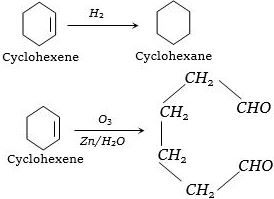
$A$ hydrocarbon of formula $C_6H_{10}$ absorbs only one molecule of $H_2$ upon catalytic hydrogenation. Upon ozonolysis,the hydrocarbon yields $OHC-CH_2-CH_2-CH_2-CH_2-CHO$. The hydrocarbon is:
A
Cyclohexane
B
Benzene
C
Cyclohexene
D
Cyclobutane
Solution
(C) The hydrocarbon $C_6H_{10}$ has a degree of unsaturation of $2$.
Since it absorbs only one molecule of $H_2$,it contains one double bond and one ring.
Ozonolysis of cyclohexene breaks the $C=C$ bond to form hexane$-1,6-$dial $(OHC-CH_2-CH_2-CH_2-CH_2-CHO)$.
Therefore,the hydrocarbon is cyclohexene.
Since it absorbs only one molecule of $H_2$,it contains one double bond and one ring.
Ozonolysis of cyclohexene breaks the $C=C$ bond to form hexane$-1,6-$dial $(OHC-CH_2-CH_2-CH_2-CH_2-CHO)$.
Therefore,the hydrocarbon is cyclohexene.
0 likes
View Solution137
MediumMCQ
The reaction of propene with $HOCl$ proceeds via the addition of
A
$H^{+}$ in the first step
B
$Cl^{+}$ in the first step
C
$OH^{-}$ in the first step
D
$Cl^{+}$ and $OH^{-}$ in a single step
Solution
(B) Alkenes undergo electrophilic addition reactions.
$HOCl$ acts as a source of the electrophile $Cl^{+}$.
In the first step,the electrophile $Cl^{+}$ attacks the double bond of propene to form a cyclic chloronium ion intermediate.
Subsequently,the nucleophile $OH^{-}$ attacks the more substituted carbon atom to form the final product,chlorohydrin.
$HOCl$ acts as a source of the electrophile $Cl^{+}$.
In the first step,the electrophile $Cl^{+}$ attacks the double bond of propene to form a cyclic chloronium ion intermediate.
Subsequently,the nucleophile $OH^{-}$ attacks the more substituted carbon atom to form the final product,chlorohydrin.
0 likes
View Solution138
MediumMCQ
The alkene $C_6H_{10}$ producing $OHC-(CH_2)_4-CHO$ on ozonolysis is
A
Hex$-1-$ene
B
Hex$-3-$ene
C
Cyclohexene
D
$1-$methylcyclohex$-1-$ene
Solution
(C) Ozonolysis of an alkene involves the cleavage of the $C=C$ double bond to form carbonyl compounds.
For a cyclic alkene like $C_6H_{10}$ (cyclohexene),the ring opens during ozonolysis.
The reaction is: $\text{Cyclohexene} + O_3$ $\rightarrow \text{Ozonide}$ $\xrightarrow{Zn/H_2O} OHC-(CH_2)_4-CHO$ (hexane-$1,6-$dial).
Thus,the starting alkene is cyclohexene.
For a cyclic alkene like $C_6H_{10}$ (cyclohexene),the ring opens during ozonolysis.
The reaction is: $\text{Cyclohexene} + O_3$ $\rightarrow \text{Ozonide}$ $\xrightarrow{Zn/H_2O} OHC-(CH_2)_4-CHO$ (hexane-$1,6-$dial).
Thus,the starting alkene is cyclohexene.
0 likes
View Solution139
MediumMCQ
The compound $CH_3-C(CH_3)=CH-CH_3$ on reaction with $NaIO_4$ in the presence of $KMnO_4$ gives:
A
$CH_3CHO + CO_2$
B
$CH_3COCH_3$
C
$CH_3COCH_3 + CH_3CHO$
D
$CH_3COCH_3 + CH_3COOH$
Solution
(D) The reaction of an alkene with $NaIO_4$ in the presence of $KMnO_4$ (Lemieux-von Rudloff reagent) results in the oxidative cleavage of the $C=C$ double bond.
In the compound $CH_3-C(CH_3)=CH-CH_3$,the double bond is cleaved.
The substituted carbon $CH_3-C(CH_3)=$ is oxidized to a ketone,$CH_3COCH_3$ (acetone).
The $=CH-CH_3$ part is oxidized to an aldehyde,which is further oxidized to a carboxylic acid,$CH_3COOH$ (acetic acid),under these conditions.
Therefore,the final products are $CH_3COCH_3 + CH_3COOH$.
In the compound $CH_3-C(CH_3)=CH-CH_3$,the double bond is cleaved.
The substituted carbon $CH_3-C(CH_3)=$ is oxidized to a ketone,$CH_3COCH_3$ (acetone).
The $=CH-CH_3$ part is oxidized to an aldehyde,which is further oxidized to a carboxylic acid,$CH_3COOH$ (acetic acid),under these conditions.
Therefore,the final products are $CH_3COCH_3 + CH_3COOH$.
0 likes
View Solution140
MediumMCQ
Write the products of the addition reaction $ >C = C < + XY \to $
A
$ > \mathop {\mathop C\limits_| }\limits_X - \mathop {\mathop C\limits_| }\limits_Y < $
B
$X - \mathop C\limits_| = \mathop C\limits_| - Y$
C
$\mathop C\limits_|^| = \mathop {\mathop C\limits_| }\limits_Y - $
D
$X - C - C - X$
Solution
(A) The addition reaction across a double bond involves the breaking of the $\pi$-bond and the formation of two new $\sigma$-bonds.
In the reaction $ >C = C < + XY \to >C(X)-C(Y) < $,the reagent $XY$ adds across the double bond,resulting in the saturated product where $X$ and $Y$ are attached to the adjacent carbon atoms.
In the reaction $ >C = C < + XY \to >C(X)-C(Y) < $,the reagent $XY$ adds across the double bond,resulting in the saturated product where $X$ and $Y$ are attached to the adjacent carbon atoms.
0 likes
View Solution141
MediumMCQ
The addition of $HBr$ is easiest with
A
$ClCH_2 = CHCl$
B
$ClCH = CHCl$
C
$CH_3 - CH = CH_2$
D
$(CH_3)_2C = CH_2$
Solution
(D) The addition of $HBr$ to alkenes is an electrophilic addition reaction,which proceeds via the formation of a carbocation intermediate.
Greater stability of the carbocation leads to a faster reaction rate.
In $(CH_3)_2C = CH_2$,the addition of $H^+$ leads to the formation of a tertiary carbocation,$(CH_3)_3C^+$,which is the most stable among the given options due to the inductive effect and hyperconjugation of six $\alpha$-hydrogens.
Therefore,$(CH_3)_2C = CH_2$ reacts most easily with $HBr$.
Greater stability of the carbocation leads to a faster reaction rate.
In $(CH_3)_2C = CH_2$,the addition of $H^+$ leads to the formation of a tertiary carbocation,$(CH_3)_3C^+$,which is the most stable among the given options due to the inductive effect and hyperconjugation of six $\alpha$-hydrogens.
Therefore,$(CH_3)_2C = CH_2$ reacts most easily with $HBr$.
0 likes
View Solution142
MediumMCQ
Identify the species $X$ in the reaction: $CH_3-CH=CH_2 + [O] \xrightarrow{\text{conc. acidic } KMnO_4} X + HCOOH$
A
Acetone
B
Acetaldehyde
C
Isopropanol
D
Acetic acid
Solution
(D) The reaction of propene with concentrated acidic $KMnO_4$ is an oxidative cleavage reaction.
$CH_3-CH=CH_2$ undergoes cleavage at the double bond.
The terminal $CH_2$ group is oxidized to $CO_2$ and $H_2O$,but under specific conditions or depending on the representation of the cleavage of the terminal carbon,it yields $HCOOH$ (formic acid).
The $CH_3-CH=$ part is oxidized to acetic acid $(CH_3COOH)$.
Therefore,the reaction is: $CH_3-CH=CH_2 + 4[O] \xrightarrow{KMnO_4/H^+} CH_3COOH + HCOOH$.
$CH_3-CH=CH_2$ undergoes cleavage at the double bond.
The terminal $CH_2$ group is oxidized to $CO_2$ and $H_2O$,but under specific conditions or depending on the representation of the cleavage of the terminal carbon,it yields $HCOOH$ (formic acid).
The $CH_3-CH=$ part is oxidized to acetic acid $(CH_3COOH)$.
Therefore,the reaction is: $CH_3-CH=CH_2 + 4[O] \xrightarrow{KMnO_4/H^+} CH_3COOH + HCOOH$.
0 likes
View Solution143
DifficultMCQ
What is the main product of the reaction between $2-methylpropene$ and $HBr$?
A
$1-bromobutane$
B
$1-bromo-2-methylpropane$
C
$2-bromobutane$
D
$2-bromo-2-methylpropane$
Solution
(D) The reaction of $2-methylpropene$ $(CH_2=C(CH_3)-CH_3)$ with $HBr$ follows Markovnikov's rule.
$H^{+}$ adds to the carbon with more hydrogen atoms,forming a stable tertiary carbocation $(CH_3-C^{+}(CH_3)-CH_3)$.
Subsequently,$Br^{-}$ attacks this carbocation to yield $2-bromo-2-methylpropane$ $(CH_3-C(Br)(CH_3)-CH_3)$.
$H^{+}$ adds to the carbon with more hydrogen atoms,forming a stable tertiary carbocation $(CH_3-C^{+}(CH_3)-CH_3)$.
Subsequently,$Br^{-}$ attacks this carbocation to yield $2-bromo-2-methylpropane$ $(CH_3-C(Br)(CH_3)-CH_3)$.
0 likes
View Solution144
DifficultMCQ
The product of the following reaction: $CH_2=CH-CCl_3 + HBr$ is:
A
$CH_2(Br)-CH_2-CCl_3$
B
$CH_3-CH(Br)-CCl_3$
C
$BrCH_2-CHCl-CHCl_2$
D
$CH_3-CH_2-CCl_3$
Solution
(B) The reaction involves the electrophilic addition of $HBr$ to an alkene. According to Markovnikov's rule,the proton $(H^+)$ adds to the carbon atom with more hydrogen atoms,and the bromide ion $(Br^-)$ adds to the more substituted carbon atom to form a more stable carbocation intermediate.
In $CH_2=CH-CCl_3$,the $CCl_3$ group is strongly electron-withdrawing due to the inductive effect. However,the addition follows the standard Markovnikov rule where $H^+$ attaches to the terminal $CH_2$ group to form the stable carbocation $CH_3-CH^+-CCl_3$.
Then,the $Br^-$ ion attacks this carbocation to yield the final product: $CH_3-CH(Br)-CCl_3$.
In $CH_2=CH-CCl_3$,the $CCl_3$ group is strongly electron-withdrawing due to the inductive effect. However,the addition follows the standard Markovnikov rule where $H^+$ attaches to the terminal $CH_2$ group to form the stable carbocation $CH_3-CH^+-CCl_3$.
Then,the $Br^-$ ion attacks this carbocation to yield the final product: $CH_3-CH(Br)-CCl_3$.
0 likes
View Solution145
DifficultMCQ
In methyl alcohol solution,bromine reacts with ethylene to yield $BrCH_2CH_2OCH_3$ in addition to $1, 2-dibromoethane$ because:
A
The ion formed initially may react with $Br^{-}$ or $CH_3OH$
B
The methyl alcohol solvates the bromine
C
The reaction follows Markownikoff's rule
D
This is a free-radical mechanism
Solution
(A) The reaction of ethylene with bromine in the presence of a nucleophilic solvent like methanol $(CH_3OH)$ proceeds through the formation of a cyclic bromonium ion intermediate.
This cyclic bromonium ion is electrophilic in nature.
It can be attacked by the bromide ion $(Br^-)$ to form $1, 2-dibromoethane$ or by the solvent molecule $(CH_3OH)$ to form $BrCH_2CH_2OCH_3$ after the loss of a proton.
Thus,the product depends on which nucleophile attacks the intermediate.
This cyclic bromonium ion is electrophilic in nature.
It can be attacked by the bromide ion $(Br^-)$ to form $1, 2-dibromoethane$ or by the solvent molecule $(CH_3OH)$ to form $BrCH_2CH_2OCH_3$ after the loss of a proton.
Thus,the product depends on which nucleophile attacks the intermediate.
0 likes
View Solution146
MediumMCQ
Which of the following acids adds to propene in the presence of peroxide to give anti-Markownikoff's product?
A
$HF$
B
$HCl$
C
$HBr$
D
$HI$
Solution
(C) The addition of hydrogen halides $(HX)$ to alkenes in the presence of peroxide follows the anti-Markownikoff rule only for $HBr$.
For $HCl$,the $H-Cl$ bond is too strong to be broken by free radicals.
For $HI$,the iodine free radical $(I^{\bullet})$ formed is stable,but the step involving the formation of the $C-I$ bond is endothermic,and $I^{\bullet}$ radicals tend to combine to form $I_2$ instead of adding to the alkene.
Thus,only $HBr$ undergoes free radical addition to give the anti-Markownikoff product.
For $HCl$,the $H-Cl$ bond is too strong to be broken by free radicals.
For $HI$,the iodine free radical $(I^{\bullet})$ formed is stable,but the step involving the formation of the $C-I$ bond is endothermic,and $I^{\bullet}$ radicals tend to combine to form $I_2$ instead of adding to the alkene.
Thus,only $HBr$ undergoes free radical addition to give the anti-Markownikoff product.
0 likes
View Solution147
MediumMCQ
Propene on treatment with $HBr$ gives
A
Isopropyl bromide
B
Propyl bromide
C
$1, 2-$ dibromoethane
D
None of the above
Solution
(A) The reaction of propene $(CH_3-CH=CH_2)$ with $HBr$ follows Markownikoff's rule.
According to this rule,the negative part of the addendum $(Br^-)$ attaches to the carbon atom with the lesser number of hydrogen atoms.
$CH_3-CH=CH_2 + HBr \rightarrow CH_3-CH(Br)-CH_3$ (Isopropyl bromide).
According to this rule,the negative part of the addendum $(Br^-)$ attaches to the carbon atom with the lesser number of hydrogen atoms.
$CH_3-CH=CH_2 + HBr \rightarrow CH_3-CH(Br)-CH_3$ (Isopropyl bromide).
0 likes
View Solution148
MediumMCQ
Ethylene reacts with bromine to form
A
Chloroethane
B
Ethylene dibromide
C
Cyclohexane
D
$1$-bromopropane
Solution
(B) Ethylene $(CH_2=CH_2)$ reacts with bromine $(Br_2)$ in an addition reaction to form ethylene dibromide $(CH_2Br-CH_2Br)$.
0 likes
View Solution149
DifficultMCQ
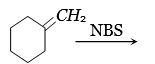
What will be the product in the following reaction?
(Image of methylenecyclohexane reacting with $NBS$)
(Image of methylenecyclohexane reacting with $NBS$)
A
$1-$(bromomethyl)cyclohex$-1-$ene
B
$3-$bromomethylenecyclohexane
C
$1-$bromo$-1-$methylcyclohexane
D
$4-$bromo$-1-$methylcyclohexene
Solution
(A) $NBS$ ($N$-bromosuccinimide) is a selective brominating reagent that performs allylic bromination in the presence of light or a radical initiator.
In methylenecyclohexane,the carbon atom adjacent to the double bond (the allylic position) is the carbon of the exocyclic methylene group.
Therefore,the bromine atom replaces one of the hydrogen atoms on the exocyclic carbon,resulting in the formation of $1-$(bromomethyl)cyclohex$-1-$ene.
In methylenecyclohexane,the carbon atom adjacent to the double bond (the allylic position) is the carbon of the exocyclic methylene group.
Therefore,the bromine atom replaces one of the hydrogen atoms on the exocyclic carbon,resulting in the formation of $1-$(bromomethyl)cyclohex$-1-$ene.
0 likes
View Solution150
DifficultMCQ
Allyl chloride on dehydrochlorination gives:
A
Propadiene
B
Propylene
C
Acetyl chloride
D
Acetone
Solution
(A) Dehydrochlorination of allyl chloride $(CH_2=CHCH_2Cl)$ involves the removal of a hydrogen atom from the $C_2$ position and the chlorine atom from the $C_3$ position,leading to the formation of propadiene $(CH_2=C=CH_2)$.
$CH_2=CHCH_2Cl \xrightarrow{\text{dehydrochlorination}} CH_2=C=CH_2$
$CH_2=CHCH_2Cl \xrightarrow{\text{dehydrochlorination}} CH_2=C=CH_2$
0 likes
View SolutionHydrocarbons — Alkene · Frequently Asked Questions
1Are these Hydrocarbons questions useful for JEE and NEET?
Yes. All questions in this section are mapped to JEE Main and NEET exam patterns. Previous year questions from JEE Main, NEET, GUJCET and state-level exams are included with full solutions.
2Can I switch to Hindi or Gujarati for these questions?
Yes. Use the language tabs in the hero section or the sidebar to view the same questions and solutions in English, Hindi or Gujarati.
3How do I generate a question paper from this subtopic?
Use the Vedclass Exam Paper Generator — select the chapter and subtopic, set difficulty, and generate Sets A, B, C, D automatically. First 3 chapters of every subject are free.
Vedclass Products
For Students
Vedclass Test Series
Mock tests in real JEE/NEET style with performance analysis. 5-day free trial.
Start Free TrialFor Teachers
Exam Paper Generator
Generate Set A/B/C/D papers from this chapter in 2 minutes. 3 chapters free.
Try FreeFor Institutes
Online Exam Module
Live online exams with unlimited students, 360° analytics & white-label branding.
See DemoFor Teachers & Institutes
Generate a Hydrocarbons Exam Paper in 2 Minutes
Select subtopic & difficulty — Sets A, B, C, D auto-generated with No Repeat logic.
First 3 chapters of every subject are free — no payment required.