
A English
Alkyne Questions in English
Class 11 Chemistry · Hydrocarbons · Alkyne
545+
Questions
English
Language
100%
With Solutions
Showing 49 of 545 questions in English
1
EasyMCQ
The triple bond in ethyne $(C_2H_2)$ is formed from:
A
Three sigma bonds
B
Three pi bonds
C
One sigma and two pi bonds
D
Two sigma and one pi bond
Solution
(C) The structure of ethyne is $H-C \equiv C-H$.
In a triple bond,there is one strong sigma $(\sigma)$ bond formed by the head-on overlap of orbitals and two weak pi $(\pi)$ bonds formed by the lateral overlap of $p$-orbitals.
Therefore,a triple bond consists of one sigma bond and two pi bonds.
In a triple bond,there is one strong sigma $(\sigma)$ bond formed by the head-on overlap of orbitals and two weak pi $(\pi)$ bonds formed by the lateral overlap of $p$-orbitals.
Therefore,a triple bond consists of one sigma bond and two pi bonds.
0 likes
View Solution2
MediumMCQ
Which of the following has the shortest $C-C$ bond length?
A
$C_2H_5OH$
B
$C_2H_6$
C
$C_2H_2$
D
$C_2H_4$
Solution
(C) The bond length depends on the bond order and the hybridization of the carbon atoms.
$C_2H_6$ $(ethane)$ has $sp^3$ hybridization with a $C-C$ single bond (bond length $\approx 154 \text{ pm}$).
$C_2H_4$ $(ethene)$ has $sp^2$ hybridization with a $C=C$ double bond (bond length $\approx 134 \text{ pm}$).
$C_2H_2$ $(ethyne)$ has $sp$ hybridization with a $C \equiv C$ triple bond (bond length $\approx 120 \text{ pm}$).
As the bond order increases, the bond length decreases.
Therefore, $C_2H_2$ has the shortest $C-C$ bond length.
$C_2H_6$ $(ethane)$ has $sp^3$ hybridization with a $C-C$ single bond (bond length $\approx 154 \text{ pm}$).
$C_2H_4$ $(ethene)$ has $sp^2$ hybridization with a $C=C$ double bond (bond length $\approx 134 \text{ pm}$).
$C_2H_2$ $(ethyne)$ has $sp$ hybridization with a $C \equiv C$ triple bond (bond length $\approx 120 \text{ pm}$).
As the bond order increases, the bond length decreases.
Therefore, $C_2H_2$ has the shortest $C-C$ bond length.
0 likes
View Solution3
MediumMCQ
The two carbon atoms in acetylene are
A
$sp^3$ hybridized
B
$sp^2$ hybridized
C
$sp$ hybridized
D
Unhybridized
Solution
(C) Acetylene $(C_2H_2)$ contains a carbon-carbon triple bond.
In the structure $H-C \equiv C-H$,each carbon atom is bonded to one hydrogen atom and one carbon atom via a triple bond.
According to the valence bond theory,each carbon atom undergoes $sp$ hybridization by mixing one $2s$ and one $2p$ orbital.
These two $sp$ hybrid orbitals are oriented at an angle of $180^{\circ}$ to each other,resulting in a linear geometry.
In the structure $H-C \equiv C-H$,each carbon atom is bonded to one hydrogen atom and one carbon atom via a triple bond.
According to the valence bond theory,each carbon atom undergoes $sp$ hybridization by mixing one $2s$ and one $2p$ orbital.
These two $sp$ hybrid orbitals are oriented at an angle of $180^{\circ}$ to each other,resulting in a linear geometry.
0 likes
View Solution4
EasyMCQ
Which one of the following statements is false?
A
Each carbon in ethylene is in $sp^2$ hybridisation.
B
Each carbon in acetylene is in $sp^3$ hybridisation.
C
Each carbon in benzene is in $sp^2$ hybridisation.
D
Each carbon in ethane is in $sp^3$ hybridisation.
Solution
(B) The correct answer is $(B)$.
In acetylene $(C_2H_2)$,each carbon atom is bonded to one hydrogen atom and one other carbon atom via a triple bond.
The steric number for each carbon is $2$ (one sigma bond with $H$ and one sigma bond with $C$),which corresponds to $sp$ hybridisation.
Structure: $H - \mathop{C}\limits_{sp} \equiv \mathop{C}\limits_{sp} - H$.
In acetylene $(C_2H_2)$,each carbon atom is bonded to one hydrogen atom and one other carbon atom via a triple bond.
The steric number for each carbon is $2$ (one sigma bond with $H$ and one sigma bond with $C$),which corresponds to $sp$ hybridisation.
Structure: $H - \mathop{C}\limits_{sp} \equiv \mathop{C}\limits_{sp} - H$.
0 likes
View Solution5
EasyMCQ
In which of the following cases is the bond length between carbon and nitrogen minimum?
A
$CH_3NH_2$
B
$C_6H_5CH=NOH$
C
$CH_3CONH_2$
D
$CH_3CN$
Solution
(D) The bond length is inversely proportional to the bond order.
In $CH_3NH_2$,the bond is $C-N$ (single bond,bond order = $1$).
In $C_6H_5CH=NOH$,the bond is $C=N$ (double bond,bond order = $2$).
In $CH_3CONH_2$,the bond has partial double bond character due to resonance (bond order between $1$ and $2$).
In $CH_3CN$,the bond is $C \equiv N$ (triple bond,bond order = $3$).
Since $CH_3CN$ has the highest bond order $(3)$,it has the minimum bond length between carbon and nitrogen. Therefore,the correct option is $(D)$.
In $CH_3NH_2$,the bond is $C-N$ (single bond,bond order = $1$).
In $C_6H_5CH=NOH$,the bond is $C=N$ (double bond,bond order = $2$).
In $CH_3CONH_2$,the bond has partial double bond character due to resonance (bond order between $1$ and $2$).
In $CH_3CN$,the bond is $C \equiv N$ (triple bond,bond order = $3$).
Since $CH_3CN$ has the highest bond order $(3)$,it has the minimum bond length between carbon and nitrogen. Therefore,the correct option is $(D)$.
0 likes
View Solution6
EasyMCQ
What is formed when calcium carbide reacts with heavy water?
A
$C_2D_2$
B
$CaD_2$
C
$Ca_2D_2O$
D
$CD_2$
Solution
(A) The reaction between calcium carbide $(CaC_2)$ and heavy water $(D_2O)$ is analogous to the reaction with ordinary water $(H_2O)$.
$CaC_2 + 2D_2O \to C_2D_2 + Ca(OD)_2$
Thus,the product formed is dideuteroacetylene $(C_2D_2)$.
$CaC_2 + 2D_2O \to C_2D_2 + Ca(OD)_2$
Thus,the product formed is dideuteroacetylene $(C_2D_2)$.
0 likes
View Solution7
EasyMCQ
Which of the following gives propyne on hydrolysis?
A
$Al_4C_3$
B
$Mg_2C_3$
C
$B_4C$
D
$La_4C_3$
Solution
(B) The hydrolysis of magnesium carbide $(Mg_2C_3)$ yields propyne $(CH_3C \equiv CH)$.
The chemical reaction is as follows:
$Mg_2C_3 + 4H_2O \to CH_3C \equiv CH + 2Mg(OH)_2$
Therefore,the correct option is $(B)$.
The chemical reaction is as follows:
$Mg_2C_3 + 4H_2O \to CH_3C \equiv CH + 2Mg(OH)_2$
Therefore,the correct option is $(B)$.
0 likes
View Solution8
EasyMCQ
The general formula of an alkyne is:
A
$C_nH_{2n + 2}$
B
$C_nH_{2n}$
C
$C_nH_{2n - 2}$
D
$C_nH_n$
Solution
(C) Alkynes are unsaturated hydrocarbons containing at least one carbon-carbon triple bond.
The general formula for an acyclic alkyne is given by $C_nH_{2n - 2}$,where $n$ is the number of carbon atoms $(n \ge 2)$.
The general formula for an acyclic alkyne is given by $C_nH_{2n - 2}$,where $n$ is the number of carbon atoms $(n \ge 2)$.
0 likes
View Solution9
MediumMCQ
The number of $\pi$ bonds in $3$-hexyne-$1$-ene is
A
$1$
B
$2$
C
$3$
D
$4$
Solution
(C) The structure of $3$-hexyne-$1$-ene is $CH_2=CH-CH_2-C \equiv C-CH_3$.
$A$ double bond contains $1$ $\pi$ bond and a triple bond contains $2$ $\pi$ bonds.
Therefore,the total number of $\pi$ bonds is $1 + 2 = 3$.
$A$ double bond contains $1$ $\pi$ bond and a triple bond contains $2$ $\pi$ bonds.
Therefore,the total number of $\pi$ bonds is $1 + 2 = 3$.
0 likes
View Solution10
MediumMCQ
Acetylene molecules contain
A
$5\sigma$ bonds
B
$4\sigma$ bonds and $1\pi$ bond
C
$3\sigma$ bonds and $2\pi$ bonds
D
$3\sigma$ bonds and $3\pi$ bonds
Solution
(C) The structure of acetylene $(HC \equiv CH)$ is $H - C \equiv C - H$.
In this molecule, there are two $C-H$ sigma bonds and one $C-C$ sigma bond, totaling $3\sigma$ bonds.
Additionally, there are two $\pi$ bonds between the two carbon atoms.
Thus, the molecule contains $3\sigma$ and $2\pi$ bonds.
In this molecule, there are two $C-H$ sigma bonds and one $C-C$ sigma bond, totaling $3\sigma$ bonds.
Additionally, there are two $\pi$ bonds between the two carbon atoms.
Thus, the molecule contains $3\sigma$ and $2\pi$ bonds.
0 likes
View Solution11
EasyMCQ
Maximum bond energy of $C-H$ bonds is found in the compound:
A
Ethane
B
Ethene
C
Ethyne
D
Equal in all the three
Solution
(C) The bond energy of a $C-H$ bond depends on the hybridization of the carbon atom.
As the $s$-character in the hybrid orbital increases,the electronegativity of the carbon atom increases,making the $C-H$ bond shorter and stronger.
In $Ethane$ $(C_2H_6)$,carbon is $sp^3$ hybridized ($25\% \ s$-character).
In $Ethene$ $(C_2H_4)$,carbon is $sp^2$ hybridized ($33.3\% \ s$-character).
In $Ethyne$ $(C_2H_2)$,carbon is $sp$ hybridized ($50\% \ s$-character).
Since $Ethyne$ has the highest $s$-character,it has the strongest and shortest $C-H$ bond,resulting in the maximum bond energy.
As the $s$-character in the hybrid orbital increases,the electronegativity of the carbon atom increases,making the $C-H$ bond shorter and stronger.
In $Ethane$ $(C_2H_6)$,carbon is $sp^3$ hybridized ($25\% \ s$-character).
In $Ethene$ $(C_2H_4)$,carbon is $sp^2$ hybridized ($33.3\% \ s$-character).
In $Ethyne$ $(C_2H_2)$,carbon is $sp$ hybridized ($50\% \ s$-character).
Since $Ethyne$ has the highest $s$-character,it has the strongest and shortest $C-H$ bond,resulting in the maximum bond energy.
0 likes
View Solution12
MediumMCQ
Number of $\sigma$ and $\pi$ bonds present in $but-1-ene-3-yne$ respectively are
A
$7\sigma, 3\pi$
B
$5\sigma, 2\pi$
C
$8\sigma, 3\pi$
D
$6\sigma, 2\pi$
Solution
(A) The structure of $but-1-ene-3-yne$ is $CH_2=CH-C\equiv CH$.
Counting the bonds:
There are $4$ $C-H$ sigma bonds.
There are $3$ $C-C$ sigma bonds.
Total sigma bonds = $4 + 3 = 7$.
There is $1$ $\pi$ bond in the double bond and $2$ $\pi$ bonds in the triple bond.
Total $\pi$ bonds = $1 + 2 = 3$.
Therefore,the molecule contains $7\sigma$ and $3\pi$ bonds.
Counting the bonds:
There are $4$ $C-H$ sigma bonds.
There are $3$ $C-C$ sigma bonds.
Total sigma bonds = $4 + 3 = 7$.
There is $1$ $\pi$ bond in the double bond and $2$ $\pi$ bonds in the triple bond.
Total $\pi$ bonds = $1 + 2 = 3$.
Therefore,the molecule contains $7\sigma$ and $3\pi$ bonds.
0 likes
View Solution13
MediumMCQ
Which of the following is an acidic hydrocarbon?
A
$CH_3CH_2CH_2CH_3$
B
$CH_3C \equiv CCH_3$
C
$CH_3C \equiv CH$
D
$CH_2 = CH - CH = CH_2$
Solution
(C) The acidity of a hydrocarbon depends on the $s$-character of the hybrid orbital of the carbon atom attached to the hydrogen atom.
Terminal alkynes,such as $CH_3C \equiv CH$ (propyne),have a hydrogen atom attached to an $sp$-hybridized carbon atom.
Due to the high $s$-character $(50\%)$ of the $sp$-hybrid orbital,the electron density is held more tightly by the carbon,making the $C-H$ bond polar and the hydrogen atom acidic.
Therefore,$CH_3C \equiv CH$ is an acidic hydrocarbon.
Terminal alkynes,such as $CH_3C \equiv CH$ (propyne),have a hydrogen atom attached to an $sp$-hybridized carbon atom.
Due to the high $s$-character $(50\%)$ of the $sp$-hybrid orbital,the electron density is held more tightly by the carbon,making the $C-H$ bond polar and the hydrogen atom acidic.
Therefore,$CH_3C \equiv CH$ is an acidic hydrocarbon.
0 likes
View Solution14
MediumMCQ
The number of $\sigma$ and $\pi$ bonds present in $pent-4-en-1-yne$ is
A
$10, 3$
B
$3, 10$
C
$4, 9$
D
$9, 4$
Solution
(A) The structure of $pent-4-en-1-yne$ is $HC \equiv C-CH_2-CH=CH_2$.
Number of $\sigma$ bonds = $4$ ($C-C$ bonds) + $6$ ($C-H$ bonds) = $10$.
Number of $\pi$ bonds = $2$ (from $C \equiv C$) + $1$ (from $C=C$) = $3$.
Number of $\sigma$ bonds = $4$ ($C-C$ bonds) + $6$ ($C-H$ bonds) = $10$.
Number of $\pi$ bonds = $2$ (from $C \equiv C$) + $1$ (from $C=C$) = $3$.
0 likes
View Solution15
MediumMCQ
Which one of the following is more acidic?
A
Butane
B
$1-$butene
C
$2-$butyne
D
$1-$butyne
Solution
(D) The acidity of hydrocarbons depends on the $s$-character of the hybridised carbon atom to which the hydrogen is attached.
$1-$butyne $(CH_3-CH_2-C \equiv CH)$ contains a terminal hydrogen atom attached to an $sp$ hybridised carbon atom.
Since $sp$ hybridised carbon has $50\% \ s$-character,it is more electronegative,making the $C-H$ bond more polar and the hydrogen more acidic.
Butane $(sp^3)$,$1-$butene $(sp^2)$,and $2-$butyne (no acidic hydrogen) are significantly less acidic than $1-$butyne.
$1-$butyne $(CH_3-CH_2-C \equiv CH)$ contains a terminal hydrogen atom attached to an $sp$ hybridised carbon atom.
Since $sp$ hybridised carbon has $50\% \ s$-character,it is more electronegative,making the $C-H$ bond more polar and the hydrogen more acidic.
Butane $(sp^3)$,$1-$butene $(sp^2)$,and $2-$butyne (no acidic hydrogen) are significantly less acidic than $1-$butyne.
0 likes
View Solution16
EasyMCQ
The $-C \equiv C-$ bond is found in
A
Ethene
B
Butene
C
Ethyne
D
Glycerine
Solution
(C) The $-C \equiv C-$ bond represents a carbon-carbon triple bond.
Ethyne $(C_2H_2)$,also known as acetylene,has the structure $HC \equiv CH$,which contains a carbon-carbon triple bond.
Therefore,the correct option is $(C)$.
Ethyne $(C_2H_2)$,also known as acetylene,has the structure $HC \equiv CH$,which contains a carbon-carbon triple bond.
Therefore,the correct option is $(C)$.
0 likes
View Solution17
MediumMCQ
Which is the most acidic of the following?
A
Methane
B
Acetylene
C
$1-$butene
D
Neo-pentane
Solution
(B) The $s-$character of the $C-H$ bond in acetylene ($sp$ hybridized) is $50\%$,which is higher in comparison to $sp^2$ hybridized ethene $(33.3\%)$ and $sp^3$ hybridized ethane $(25\%)$.
Due to higher $s-$character,the electrons of the $C-H$ bond in acetylene are more strongly held by the carbon nucleus.
This increases the electronegativity of the carbon atom,which facilitates the removal of the hydrogen atom as a proton $(H^+)$,making acetylene the most acidic among the given options.
Due to higher $s-$character,the electrons of the $C-H$ bond in acetylene are more strongly held by the carbon nucleus.
This increases the electronegativity of the carbon atom,which facilitates the removal of the hydrogen atom as a proton $(H^+)$,making acetylene the most acidic among the given options.
0 likes
View Solution18
EasyMCQ
Formation of ethylene from acetylene is an example of
A
Elimination reaction
B
Substitution reaction
C
Addition reaction
D
Condensation reaction
Solution
(C)
The reaction is: $CH \equiv CH + H_2 \xrightarrow{Ni/Pd/Pt} CH_2 = CH_2$
In this reaction,hydrogen atoms are added across the triple bond of acetylene to form ethylene. Therefore,it is an example of an addition reaction.
The reaction is: $CH \equiv CH + H_2 \xrightarrow{Ni/Pd/Pt} CH_2 = CH_2$
In this reaction,hydrogen atoms are added across the triple bond of acetylene to form ethylene. Therefore,it is an example of an addition reaction.
0 likes
View Solution19
MediumMCQ
The number of possible alkynes with the molecular formula $C_5H_8$ is
A
$2$
B
$3$
C
$4$
D
$5$
Solution
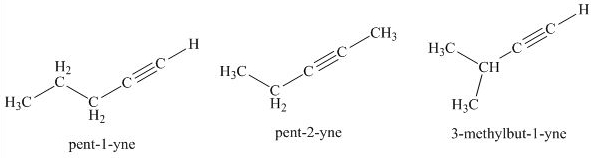
(B) The molecular formula $C_5H_8$ corresponds to the general formula $C_nH_{2n-2}$,which indicates an alkyne.
The possible structural isomers for $C_5H_8$ are:
$1$. $Pent-1-yne$ $(CH_3-CH_2-CH_2-C \equiv CH)$
$2$. $Pent-2-yne$ $(CH_3-CH_2-C \equiv C-CH_3)$
$3$. $3-Methylbut-1-yne$ $(CH_3-CH(CH_3)-C \equiv CH)$
Thus,there are $3$ possible alkynes.
The possible structural isomers for $C_5H_8$ are:
$1$. $Pent-1-yne$ $(CH_3-CH_2-CH_2-C \equiv CH)$
$2$. $Pent-2-yne$ $(CH_3-CH_2-C \equiv C-CH_3)$
$3$. $3-Methylbut-1-yne$ $(CH_3-CH(CH_3)-C \equiv CH)$
Thus,there are $3$ possible alkynes.
0 likes
View Solution20
AdvancedMCQ
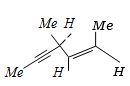
Hydrogenation of the compound shown below in the presence of a poisoned palladium catalyst (Lindlar's catalyst) gives:
A
An optically active compound
B
An optically inactive compound
C
$A$ racemic mixture
D
$A$ diastereomeric mixture
Solution
(B) The given compound is $CH_3-C \equiv C-CH(CH_3)-CH=CH_2$.
Hydrogenation with a poisoned palladium catalyst (Lindlar's catalyst) results in $syn$-addition of hydrogen to the triple bond,converting it into a $cis$-double bond.
The resulting product is $CH_3-CH=CH-CH(CH_3)-CH=CH_2$.
Due to the specific geometry and the presence of internal symmetry elements or the formation of a meso-like structure depending on the configuration,the product formed is optically inactive.
Hydrogenation with a poisoned palladium catalyst (Lindlar's catalyst) results in $syn$-addition of hydrogen to the triple bond,converting it into a $cis$-double bond.
The resulting product is $CH_3-CH=CH-CH(CH_3)-CH=CH_2$.
Due to the specific geometry and the presence of internal symmetry elements or the formation of a meso-like structure depending on the configuration,the product formed is optically inactive.
0 likes
View Solution21
DifficultMCQ
$A$ mixture of methane,ethylene,and acetylene gases is passed through a Wolf's bottle containing ammoniacal cuprous chloride. The gas coming out is
A
Methane
B
Acetylene
C
$A$ mixture of methane and ethylene
D
The original mixture
Solution
(C) Acetylene $(CH \equiv CH)$ reacts with ammoniacal cuprous chloride to form a red precipitate of copper acetylide $(Cu-C \equiv C-Cu)$.
$CH \equiv CH + 2[Cu(NH_3)_2]OH \to Cu-C \equiv C-Cu + 4NH_3 + 2H_2O$
Methane $(CH_4)$ and ethylene $(C_2H_4)$ do not possess acidic hydrogen atoms and therefore do not react with ammoniacal cuprous chloride.
$CH_4 + \text{Ammoniacal } Cu_2Cl_2 \to \text{No reaction}$
$C_2H_4 + \text{Ammoniacal } Cu_2Cl_2 \to \text{No reaction}$
Thus,the gases that pass through the bottle without reacting are methane and ethylene.
$CH \equiv CH + 2[Cu(NH_3)_2]OH \to Cu-C \equiv C-Cu + 4NH_3 + 2H_2O$
Methane $(CH_4)$ and ethylene $(C_2H_4)$ do not possess acidic hydrogen atoms and therefore do not react with ammoniacal cuprous chloride.
$CH_4 + \text{Ammoniacal } Cu_2Cl_2 \to \text{No reaction}$
$C_2H_4 + \text{Ammoniacal } Cu_2Cl_2 \to \text{No reaction}$
Thus,the gases that pass through the bottle without reacting are methane and ethylene.
0 likes
View Solution22
MediumMCQ
Silver acetylide when heated with $HCl$ gives:
A
$C_2H_2$
B
$H_2$
C
$C_2H_4$
D
None of these
Solution
(A) Silver acetylide $(Ag-C \equiv C-Ag)$ reacts with hydrochloric acid $(HCl)$ to undergo a double displacement reaction.
The reaction is: $Ag-C \equiv C-Ag + 2HCl \to HC \equiv CH + 2AgCl$.
Thus,the product formed is acetylene $(C_2H_2)$.
The reaction is: $Ag-C \equiv C-Ag + 2HCl \to HC \equiv CH + 2AgCl$.
Thus,the product formed is acetylene $(C_2H_2)$.
0 likes
View Solution23
MediumMCQ
When acetylene reacts with arsenic trichloride in the presence of anhydrous aluminium chloride,it produces
A
Lewisite
B
$ \beta- $chlorovinyl dichloroarsine
C
Nitrobenzene
D
Both $(a)$ and $(b)$
Solution
(D) The reaction between acetylene $(C_2H_2)$ and arsenic trichloride $(AsCl_3)$ in the presence of anhydrous aluminium chloride $(AlCl_3)$ is an addition reaction.
$C_2H_2 + AsCl_3 \xrightarrow{AlCl_3} ClCH=CHAsCl_2$
This product is known as Lewisite or $ \beta- $chlorovinyl dichloroarsine.
Therefore,both $(a)$ and $(b)$ are correct.
$C_2H_2 + AsCl_3 \xrightarrow{AlCl_3} ClCH=CHAsCl_2$
This product is known as Lewisite or $ \beta- $chlorovinyl dichloroarsine.
Therefore,both $(a)$ and $(b)$ are correct.
0 likes
View Solution24
MediumMCQ
At low temperatures,the slow addition of molecular bromine to $CH_2=CH-CH_2-C \equiv CH$ gives:
A
$CH_2=CH-CH_2-CBr=CHBr$
B
$BrCH_2-CHBr-CH_2-C \equiv CH$
C
$CH_2=CH-CH_2-CH_2-CBr_3$
D
$CH_3-CBr_2-CH_2-C \equiv CH$
Solution
(A) The reaction of molecular bromine $(Br_2)$ with an enyne $(CH_2=CH-CH_2-C \equiv CH)$ is regioselective.
At low temperatures,the electrophilic addition of $Br_2$ occurs preferentially at the more nucleophilic site.
In this molecule,the terminal alkyne group is less reactive towards electrophilic addition compared to the alkene group,but the addition of $Br_2$ to the triple bond is a characteristic reaction.
However,under controlled conditions,the addition occurs across the triple bond to form a dibromoalkene:
$CH_2=CH-CH_2-C \equiv CH + Br_2 \to CH_2=CH-CH_2-CBr=CHBr$.
At low temperatures,the electrophilic addition of $Br_2$ occurs preferentially at the more nucleophilic site.
In this molecule,the terminal alkyne group is less reactive towards electrophilic addition compared to the alkene group,but the addition of $Br_2$ to the triple bond is a characteristic reaction.
However,under controlled conditions,the addition occurs across the triple bond to form a dibromoalkene:
$CH_2=CH-CH_2-C \equiv CH + Br_2 \to CH_2=CH-CH_2-CBr=CHBr$.
0 likes
View Solution25
MediumMCQ
Which of the following is(are) example$(s)$ of nucleophilic addition reaction in the case of acetylene?
A
Addition of water
B
Addition of $HCN$
C
Addition of $AsCl_3$
D
All
Solution
(D) Acetylene $(HC \equiv CH)$ undergoes nucleophilic addition reactions due to the presence of $\pi$-electrons.
$1$. Addition of water: In the presence of $Hg^{2+}$ and $H_2SO_4$,water adds to acetylene to form vinyl alcohol,which tautomerizes to acetaldehyde. This is a nucleophilic addition process.
$2$. Addition of $HCN$: The cyanide ion $(CN^-)$ acts as a nucleophile and attacks the triple bond of acetylene.
$3$. Addition of $AsCl_3$: The reaction of acetylene with $AsCl_3$ in the presence of $AlCl_3$ (Lewis acid) is known as the Lewis-Arsenic reaction,which is a type of nucleophilic addition resulting in the formation of $\beta$-chlorovinylarsine derivatives.
Since all the given reactions involve nucleophilic attack on the alkyne,the correct option is $D$.
$1$. Addition of water: In the presence of $Hg^{2+}$ and $H_2SO_4$,water adds to acetylene to form vinyl alcohol,which tautomerizes to acetaldehyde. This is a nucleophilic addition process.
$2$. Addition of $HCN$: The cyanide ion $(CN^-)$ acts as a nucleophile and attacks the triple bond of acetylene.
$3$. Addition of $AsCl_3$: The reaction of acetylene with $AsCl_3$ in the presence of $AlCl_3$ (Lewis acid) is known as the Lewis-Arsenic reaction,which is a type of nucleophilic addition resulting in the formation of $\beta$-chlorovinylarsine derivatives.
Since all the given reactions involve nucleophilic attack on the alkyne,the correct option is $D$.
0 likes
View Solution26
MediumMCQ
Which is the most reactive hydrocarbon among the following?
A
Ethane
B
Ethyne
C
Ethene
D
Methane
Solution
(B) The reactivity of hydrocarbons towards electrophilic addition reactions follows the order: $Alkyne > Alkene > Alkane$.
Ethyne $(C_2H_2)$ is an alkyne,Ethene $(C_2H_4)$ is an alkene,and Ethane $(C_2H_6)$ and Methane $(CH_4)$ are alkanes.
Due to the presence of a triple bond,Ethyne is highly reactive compared to the others.
Ethyne $(C_2H_2)$ is an alkyne,Ethene $(C_2H_4)$ is an alkene,and Ethane $(C_2H_6)$ and Methane $(CH_4)$ are alkanes.
Due to the presence of a triple bond,Ethyne is highly reactive compared to the others.
0 likes
View Solution27
MediumMCQ
The catalyst used in the dimerization of acetylene to prepare chloroprene is:
A
$HgSO_4 + H_2SO_4$
B
$Cu_2Cl_2$
C
$Cu_2Cl_2 + NH_4Cl$
D
$Cu_2Cl_2 + NH_4OH$
Solution
(C) The dimerization of acetylene $(HC \equiv CH)$ in the presence of a catalyst system consisting of cuprous chloride $(Cu_2Cl_2)$ and ammonium chloride $(NH_4Cl)$ yields vinyl acetylene $(HC \equiv C-CH=CH_2)$.
This vinyl acetylene then reacts with hydrogen chloride $(HCl)$ to form $4$-chloro-$1,2$-butadiene,which subsequently rearranges to form $2$-chloro-$1,3$-butadiene,commonly known as chloroprene.
This vinyl acetylene then reacts with hydrogen chloride $(HCl)$ to form $4$-chloro-$1,2$-butadiene,which subsequently rearranges to form $2$-chloro-$1,3$-butadiene,commonly known as chloroprene.
0 likes
View Solution28
MediumMCQ
The reagent which is used to distinguish between propene and propyne is
A
Bromine
B
Alkaline $KMnO_4$
C
Ammoniacal $AgNO_3$
D
Ozone
Solution
(C) Propene and propyne can be distinguished by using the Ammoniacal silver nitrate test.
Propyne $(CH_3-C \equiv CH)$ contains a terminal acidic hydrogen atom.
Due to the $sp$ hybridization of the terminal carbon,the hydrogen is acidic and reacts with Ammoniacal $AgNO_3$ (Tollens' reagent) to form a white precipitate of silver propynide $(CH_3-C \equiv CAg)$.
Propene $(CH_3-CH=CH_2)$ does not contain an acidic hydrogen and therefore does not react with Ammoniacal $AgNO_3$ to form a precipitate.
Propyne $(CH_3-C \equiv CH)$ contains a terminal acidic hydrogen atom.
Due to the $sp$ hybridization of the terminal carbon,the hydrogen is acidic and reacts with Ammoniacal $AgNO_3$ (Tollens' reagent) to form a white precipitate of silver propynide $(CH_3-C \equiv CAg)$.
Propene $(CH_3-CH=CH_2)$ does not contain an acidic hydrogen and therefore does not react with Ammoniacal $AgNO_3$ to form a precipitate.
0 likes
View Solution29
MediumMCQ
Which of the following gases is used for welding?
A
Methane
B
Ethane
C
Acetylene
D
Ethene
Solution
(C) $2 \, CH \equiv CH + 5O_2 \to 4 \, CO_2 + 2H_2O$,$\Delta H = -1300 \, kJ$
The combustion of acetylene is highly exothermic,and the heat produced during the combustion is used for welding purposes in the form of an oxy-acetylene flame.
The combustion of acetylene is highly exothermic,and the heat produced during the combustion is used for welding purposes in the form of an oxy-acetylene flame.
0 likes
View Solution30
DifficultMCQ
$A$ metallic carbide on treatment with water gives a colourless gas which burns readily in air and which gives a precipitate with ammoniacal silver nitrate solution. The gas evolved is:
A
Methane
B
Ethane
C
Acetylene
D
Ethylene
Solution
(C) The metallic carbide is calcium carbide $(CaC_2)$.
When $CaC_2$ reacts with water,it produces acetylene ($C_2H_2$ or $CH \equiv CH$):
$CaC_2 + 2\,H_2O \to Ca(OH)_2 + C_2H_2$
Acetylene is a colourless gas that burns readily in air.
It reacts with ammoniacal silver nitrate (Tollens' reagent) to form a white precipitate of silver acetylide:
$CH \equiv CH + 2\,[Ag(NH_3)_2]OH \to AgC \equiv CAg \downarrow (\text{white ppt.}) + 4\,NH_3 + 2\,H_2O$
Therefore,the gas evolved is acetylene.
When $CaC_2$ reacts with water,it produces acetylene ($C_2H_2$ or $CH \equiv CH$):
$CaC_2 + 2\,H_2O \to Ca(OH)_2 + C_2H_2$
Acetylene is a colourless gas that burns readily in air.
It reacts with ammoniacal silver nitrate (Tollens' reagent) to form a white precipitate of silver acetylide:
$CH \equiv CH + 2\,[Ag(NH_3)_2]OH \to AgC \equiv CAg \downarrow (\text{white ppt.}) + 4\,NH_3 + 2\,H_2O$
Therefore,the gas evolved is acetylene.
0 likes
View Solution31
MediumMCQ
$But-1-yne$ reacts with cold alkaline $KMnO_4$ to produce:
A
$CH_3CH_2COOH$
B
$CH_3CH_2CH_2COOH$
C
$CH_3CH_2COOH + CO_2$
D
$CH_3CH_2COOH + HCOOH$
Solution
(C) The reaction of $but-1-yne$ $(CH_3-CH_2-C \equiv CH)$ with cold alkaline $KMnO_4$ (Baeyer's reagent) leads to the oxidative cleavage of the triple bond.
Since the terminal carbon is involved,it is oxidized to $CO_2$ and $H_2O$,while the remaining part forms a carboxylic acid.
The reaction is: $CH_3-CH_2-C \equiv CH \xrightarrow{\text{Cold alk. } KMnO_4} CH_3CH_2COOH + CO_2$.
Since the terminal carbon is involved,it is oxidized to $CO_2$ and $H_2O$,while the remaining part forms a carboxylic acid.
The reaction is: $CH_3-CH_2-C \equiv CH \xrightarrow{\text{Cold alk. } KMnO_4} CH_3CH_2COOH + CO_2$.
0 likes
View Solution32
DifficultMCQ
Identify the product $D$ in the following series of reaction: $CH_3COOH$ $\xrightarrow{LiAlH_4} A$ $\xrightarrow{H^{+}, 443 \ K} B$ $\xrightarrow{Br_2} C$ $\xrightarrow{alc. KOH} D$
A
Methane
B
Alcohol
C
Acetylene
D
Benzaldehyde
Solution
(C) $1$. $CH_3COOH \xrightarrow{LiAlH_4} CH_3CH_2OH$ $(A)$
$2$. $CH_3CH_2OH \xrightarrow{H^{+}, 443 \ K} CH_2=CH_2$ $(B)$
$3$. $CH_2=CH_2 \xrightarrow{Br_2} CH_2Br-CH_2Br$ $(C)$
$4$. $CH_2Br-CH_2Br \xrightarrow{alc. KOH} CH \equiv CH$ $(D)$
The product $D$ is $CH \equiv CH$,which is Acetylene.
$2$. $CH_3CH_2OH \xrightarrow{H^{+}, 443 \ K} CH_2=CH_2$ $(B)$
$3$. $CH_2=CH_2 \xrightarrow{Br_2} CH_2Br-CH_2Br$ $(C)$
$4$. $CH_2Br-CH_2Br \xrightarrow{alc. KOH} CH \equiv CH$ $(D)$
The product $D$ is $CH \equiv CH$,which is Acetylene.
0 likes
View Solution33
MediumMCQ
Acetylenic hydrogens are acidic because
A
Sigma electron density of $C-H$ bond in acetylene is nearer to carbon,which has $50\%$ $s-$character
B
Acetylene has only one hydrogen on each carbon
C
Acetylene contains least number of hydrogens among the possible hydrocarbons having two carbons
D
Acetylene belongs to the class of alkynes with molecular formula $C_nH_{2n-2}$
Solution
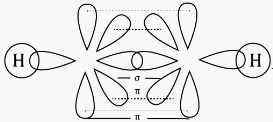
(A) The formation of $C-H$ bond in acetylene involves $sp-$hybridised carbon atom.
Since $s-$electrons are closer to the nucleus than $p$ electrons,$sp$ hybrid orbitals are more electronegative due to their smaller (in length) and thicker lobes,which increases the time spent by electrons near the nucleus compared to $sp^2$ and $sp^3$ orbitals.
Thus,the electrons present in a bond having more $s-$character will be closer to the nucleus.
In alkynes $(C \equiv C-H)$ bond,the $s-$character is $50\%$,so the electrons constituting this bond are more strongly attracted by the carbon nucleus.
Thus,the acetylenic carbon atom becomes more electronegative in comparison to $sp^2$ and $sp^3$ hybridized carbons,and hence the hydrogen atom present on the carbon atom $(C \equiv C-H)$ can be easily removed as a proton $(H^+)$.
Since $s-$electrons are closer to the nucleus than $p$ electrons,$sp$ hybrid orbitals are more electronegative due to their smaller (in length) and thicker lobes,which increases the time spent by electrons near the nucleus compared to $sp^2$ and $sp^3$ orbitals.
Thus,the electrons present in a bond having more $s-$character will be closer to the nucleus.
In alkynes $(C \equiv C-H)$ bond,the $s-$character is $50\%$,so the electrons constituting this bond are more strongly attracted by the carbon nucleus.
Thus,the acetylenic carbon atom becomes more electronegative in comparison to $sp^2$ and $sp^3$ hybridized carbons,and hence the hydrogen atom present on the carbon atom $(C \equiv C-H)$ can be easily removed as a proton $(H^+)$.
0 likes
View Solution34
MediumMCQ
Which is the most suitable reagent among the following to distinguish compound $(iii)$ from the rest of the compounds?
$(i)$ $CH_3-C\equiv C-CH_3$
$(ii)$ $CH_3-CH_2-CH_2-CH_3$
$(iii)$ $CH_3-CH_2-C\equiv CH$
$(iv)$ $CH_3-CH=CH_2$
$(i)$ $CH_3-C\equiv C-CH_3$
$(ii)$ $CH_3-CH_2-CH_2-CH_3$
$(iii)$ $CH_3-CH_2-C\equiv CH$
$(iv)$ $CH_3-CH=CH_2$
A
Bromine in carbon tetrachloride
B
Bromine in acetic acid
C
Alkaline $KMnO_4$
D
Ammoniacal silver nitrate reagent
Solution
(D) Terminal alkynes,such as compound $(iii)$,contain an acidic hydrogen atom attached to the $sp$-hybridized carbon.
Ammoniacal silver nitrate (Tollens' reagent) reacts with terminal alkynes to form a white precipitate of silver acetylide.
$CH_3-CH_2-C\equiv CH + [Ag(NH_3)_2]^+ + OH^-$ $\rightarrow CH_3-CH_2-C\equiv C^- Ag^+ \text{ (white precipitate)} + 2NH_3 + H_2O$
Compounds $(i)$,$(ii)$,and $(iv)$ do not possess acidic terminal hydrogen atoms and therefore do not form a precipitate with this reagent.
Ammoniacal silver nitrate (Tollens' reagent) reacts with terminal alkynes to form a white precipitate of silver acetylide.
$CH_3-CH_2-C\equiv CH + [Ag(NH_3)_2]^+ + OH^-$ $\rightarrow CH_3-CH_2-C\equiv C^- Ag^+ \text{ (white precipitate)} + 2NH_3 + H_2O$
Compounds $(i)$,$(ii)$,and $(iv)$ do not possess acidic terminal hydrogen atoms and therefore do not form a precipitate with this reagent.
0 likes
View Solution35
MediumMCQ
The poisonous gas 'Lewisite' is obtained by the reaction of:
A
$CH \equiv CH$ and $AsCl_3$
B
$CH_2 = CH_2$ and $AsCl_3$
C
$CH \equiv CH$ and $S_2Cl_2$
D
$CH_2 = CH_2$ and $NOCl$
Solution
(A) The synthesis of the chemical warfare agent $Lewisite$ involves the reaction of acetylene $(CH \equiv CH)$ with arsenic trichloride $(AsCl_3)$ in the presence of a catalyst like anhydrous aluminum chloride $(AlCl_3)$.
The reaction is: $HC \equiv CH + AsCl_3 \rightarrow ClCH = CHAsCl_2$ (Lewisite or $2-$chlorovinyl dichloroarsine).
The reaction is: $HC \equiv CH + AsCl_3 \rightarrow ClCH = CHAsCl_2$ (Lewisite or $2-$chlorovinyl dichloroarsine).
0 likes
View Solution36
DifficultMCQ
The products of the following reaction $CH_3-C \equiv C-CH_2-CH_3 \xrightarrow[(2)\ H_2O]{(1)\ O_3}$ are:
A
$CH_3CHO + CH_3CH_2CHO$
B
$CH_3COOH + CH_3CH_2CHO$
C
$CH_3COOH + CH_3CH_2COOH$
D
$CH_3COOH + CO_2$
Solution
(C) Ozonolysis of an internal alkyne followed by hydrolysis yields diketones as intermediate products,which are further oxidized to carboxylic acids.
The reaction proceeds as follows:
$CH_3-C \equiv C-CH_2-CH_3$ $\xrightarrow{O_3} \text{ozonide intermediate}$ $\xrightarrow{H_2O} CH_3-CO-CO-CH_2-CH_3 + H_2O_2$
The diketone $CH_3-CO-CO-CH_2-CH_3$ is then cleaved to form carboxylic acids:
$CH_3-CO-CO-CH_2-CH_3 \rightarrow CH_3COOH + CH_3CH_2COOH$
Thus,the final products are acetic acid and propanoic acid.
The reaction proceeds as follows:
$CH_3-C \equiv C-CH_2-CH_3$ $\xrightarrow{O_3} \text{ozonide intermediate}$ $\xrightarrow{H_2O} CH_3-CO-CO-CH_2-CH_3 + H_2O_2$
The diketone $CH_3-CO-CO-CH_2-CH_3$ is then cleaved to form carboxylic acids:
$CH_3-CO-CO-CH_2-CH_3 \rightarrow CH_3COOH + CH_3CH_2COOH$
Thus,the final products are acetic acid and propanoic acid.
0 likes
View Solution37
MediumMCQ
Which of the following bonds makes a hydrocarbon most reactive?
A
$C \equiv C$
B
$C = C$
C
$C - C$
D
All of these
Solution
(A) The correct answer is $A$. The $C \equiv C$ bond (alkyne) is generally considered more reactive towards electrophilic addition reactions compared to $C = C$ (alkene) and $C - C$ (alkane) due to the presence of two $\pi$-bonds and the nature of $sp$-hybridized carbon atoms.
0 likes
View Solution38
MediumMCQ
To synthesize the unsymmetrical alkyne $CH_3-C\equiv C-CH_2-CH_3$,the reagents needed would be:
A
Ethene,iodoethane,iodomethane and potassium hydroxide
B
Acetaldehyde,$1-$bromopropane and conc. $H_2SO_4$
C
$1, 2-$dichloroethane,$1-$propanol and alcoholic potassium hydroxide
D
Ethyne,iodomethane,iodoethane and sodamide
Solution
(D) The synthesis of the unsymmetrical alkyne $CH_3-C\equiv C-CH_2-CH_3$ involves the stepwise alkylation of ethyne $(CH\equiv CH)$.
Step $1$: Ethyne reacts with sodamide $(NaNH_2)$ to form sodium acetylide $(CH\equiv C^{-}Na^{+})$.
Step $2$: Sodium acetylide reacts with iodomethane $(CH_3I)$ to form propyne $(CH\equiv C-CH_3)$.
Step $3$: Propyne is treated with another equivalent of $NaNH_2$ to form the sodium salt of propyne $(CH_3-C\equiv C^{-}Na^{+})$.
Step $4$: This salt reacts with iodoethane $(C_2H_5I)$ via an $S_N2$ reaction to yield the final product $CH_3-C\equiv C-CH_2-CH_3$.
Step $1$: Ethyne reacts with sodamide $(NaNH_2)$ to form sodium acetylide $(CH\equiv C^{-}Na^{+})$.
Step $2$: Sodium acetylide reacts with iodomethane $(CH_3I)$ to form propyne $(CH\equiv C-CH_3)$.
Step $3$: Propyne is treated with another equivalent of $NaNH_2$ to form the sodium salt of propyne $(CH_3-C\equiv C^{-}Na^{+})$.
Step $4$: This salt reacts with iodoethane $(C_2H_5I)$ via an $S_N2$ reaction to yield the final product $CH_3-C\equiv C-CH_2-CH_3$.
0 likes
View Solution39
MediumMCQ
When propyne is treated with dilute $H_2SO_4$ and $HgSO_4$,the major product is
A
Propanal
B
Propanol
C
Propyl hydrogen sulphate
D
Propanone
Solution
(D) When propyne $(CH_3-C \equiv CH)$ is treated with dilute $H_2SO_4$ and $HgSO_4$ (Kucherov reaction),hydration occurs according to Markovnikov's rule to form an unstable enol,which then tautomerizes to form propanone (acetone).
$CH_3-C \equiv CH + H_2O$ $\xrightarrow{HgSO_4/H_2SO_4} [CH_3-C(OH)=CH_2]$ $\rightarrow CH_3-CO-CH_3$
$CH_3-C \equiv CH + H_2O$ $\xrightarrow{HgSO_4/H_2SO_4} [CH_3-C(OH)=CH_2]$ $\rightarrow CH_3-CO-CH_3$
0 likes
View Solution40
MediumMCQ
Which of the following will be the final product when $C_2H_2$ reacts with $HCl$?
A
$CH_2=CHCl$
B
$CH_3-CHCl_2$
C
$CHCl=CHCl$
D
None of these
Solution
(B) The reaction of ethyne $(C_2H_2)$ with $HCl$ occurs in two steps.
In the first step,vinyl chloride is formed.
In the second step,another molecule of $HCl$ adds to vinyl chloride according to Markovnikov's rule to give $1,1$-dichloroethane $(CH_3-CHCl_2)$ as the final product.
$CH \equiv CH + HCl$ $\rightarrow CH_2=CHCl$ $\xrightarrow{HCl} CH_3-CHCl_2$
In the first step,vinyl chloride is formed.
In the second step,another molecule of $HCl$ adds to vinyl chloride according to Markovnikov's rule to give $1,1$-dichloroethane $(CH_3-CHCl_2)$ as the final product.
$CH \equiv CH + HCl$ $\rightarrow CH_2=CHCl$ $\xrightarrow{HCl} CH_3-CHCl_2$
0 likes
View Solution41
MediumMCQ
What is the end product of the following sequence of operations?
$CaC_2$ $\xrightarrow{H_2O} A$ $\xrightarrow[Hg^{2+}]{dil. H_2SO_4} B$ $\xrightarrow[H_2]{Ni} C$
$CaC_2$ $\xrightarrow{H_2O} A$ $\xrightarrow[Hg^{2+}]{dil. H_2SO_4} B$ $\xrightarrow[H_2]{Ni} C$
A
Methyl alcohol
B
Acetaldehyde
C
$C_2H_5OH$
D
$C_2H_4$
Solution
(C) The reaction sequence is as follows:
$1$. $CaC_2 + 2H_2O \rightarrow HC \equiv CH (A) + Ca(OH)_2$
$2$. $HC \equiv CH + H_2O \xrightarrow{Hg^{2+}, dil. H_2SO_4} CH_3CHO (B)$ (Kucherov reaction)
$3$. $CH_3CHO + H_2 \xrightarrow{Ni} CH_3CH_2OH (C)$ (Reduction of acetaldehyde to ethanol).
Therefore,the end product $C$ is $C_2H_5OH$.
$1$. $CaC_2 + 2H_2O \rightarrow HC \equiv CH (A) + Ca(OH)_2$
$2$. $HC \equiv CH + H_2O \xrightarrow{Hg^{2+}, dil. H_2SO_4} CH_3CHO (B)$ (Kucherov reaction)
$3$. $CH_3CHO + H_2 \xrightarrow{Ni} CH_3CH_2OH (C)$ (Reduction of acetaldehyde to ethanol).
Therefore,the end product $C$ is $C_2H_5OH$.
0 likes
View Solution42
MediumMCQ
$R-CH_2-CCl_2-R \xrightarrow{\text{Reagent}} R-C \equiv C-R$
The reagent is
The reagent is
A
$Na$
B
$HCl \text{ and } H_2O$
C
$KOH \text{ in } C_2H_5OH$
D
$Zn$
Solution
(C) $(C) \, R-CH_2-CCl_2-R \xrightarrow{KOH \text{ (alc.)}} R-C \equiv C-R + 2HCl$
This reaction is an example of dehydrohalogenation,where two molecules of $HCl$ are removed from a gem-dihalide to form an alkyne.
Alcoholic $KOH$ acts as a strong base to facilitate this elimination reaction.
This reaction is an example of dehydrohalogenation,where two molecules of $HCl$ are removed from a gem-dihalide to form an alkyne.
Alcoholic $KOH$ acts as a strong base to facilitate this elimination reaction.
0 likes
View Solution43
MediumMCQ
Acetylene can be prepared from
A
Potassium fumarate
B
Calcium carbide
C
Ethylene bromide
D
All of these
Solution
(D) $1.$ Kolbe's electrolysis of potassium fumarate yields acetylene.
$2.$ Hydrolysis of calcium carbide $(CaC_2 + 2H_2O \rightarrow Ca(OH)_2 + CH \equiv CH)$ produces acetylene.
$3.$ Dehydrohalogenation of ethylene bromide $(Br-CH_2-CH_2-Br)$ using alcoholic $KOH$ also yields acetylene.
Therefore,all the given options are correct.
$2.$ Hydrolysis of calcium carbide $(CaC_2 + 2H_2O \rightarrow Ca(OH)_2 + CH \equiv CH)$ produces acetylene.
$3.$ Dehydrohalogenation of ethylene bromide $(Br-CH_2-CH_2-Br)$ using alcoholic $KOH$ also yields acetylene.
Therefore,all the given options are correct.
0 likes
View Solution44
MediumMCQ
Acetylene is obtained by the electrolysis of
A
$a.$ Sodium succinate
B
$b.$ Potassium fumarate
C
$c.$ Both $(a)$ and $(b)$
D
$d.$ None of these
Solution
(B) The electrolysis of an aqueous solution of potassium fumarate or potassium maleate yields acetylene at the anode via the Kolbe electrolysis mechanism.
$KOOC-CH=CH-COOK + 2H_2O \xrightarrow{\text{Electrolysis}} CH \equiv CH + 2CO_2 + 2KOH + H_2$
$KOOC-CH=CH-COOK + 2H_2O \xrightarrow{\text{Electrolysis}} CH \equiv CH + 2CO_2 + 2KOH + H_2$
0 likes
View Solution45
MediumMCQ
The compound $C_3H_4$ has a triple bond,which is indicated by its reaction with
A
Bromine water
B
Bayer's reagent
C
Fehling solution
D
Ammonical silver nitrate
Solution
(D) . The compound $C_3H_4$ is propyne $(CH_3-C\equiv CH)$.
Terminal alkynes contain an acidic hydrogen atom attached to the $sp$-hybridized carbon.
This acidic hydrogen reacts with ammoniacal silver nitrate (Tollens' reagent) to form a white precipitate of silver acetylide,which confirms the presence of a terminal triple bond.
$CH_3-C\equiv CH + [Ag(NH_3)_2]^+ OH^- \to CH_3-C\equiv C^-Ag^+ \downarrow + 2NH_3 + H_2O$.
Terminal alkynes contain an acidic hydrogen atom attached to the $sp$-hybridized carbon.
This acidic hydrogen reacts with ammoniacal silver nitrate (Tollens' reagent) to form a white precipitate of silver acetylide,which confirms the presence of a terminal triple bond.
$CH_3-C\equiv CH + [Ag(NH_3)_2]^+ OH^- \to CH_3-C\equiv C^-Ag^+ \downarrow + 2NH_3 + H_2O$.
0 likes
View Solution46
MediumMCQ
$CH \equiv CH$ $\xrightarrow[H_2SO_4]{H_2O/Hg^{2+}} X$ $\xrightarrow{LiAlH_4} Y$ $\xrightarrow{P_4/Br_2} Z$. Here $Z$ is
A
Ethylene bromide
B
Ethanol
C
Ethyl bromide
D
Ethylidene bromide
Solution
(C) The reaction sequence is as follows:
$1$. $CH \equiv CH$ undergoes hydration in the presence of $Hg^{2+}/H_2SO_4$ (Kucherov reaction) to form acetaldehyde $(X)$: $CH \equiv CH + H_2O \xrightarrow{Hg^{2+}/H_2SO_4} CH_3-CHO$.
$2$. Acetaldehyde $(X)$ is reduced by $LiAlH_4$ to form ethanol $(Y)$: $CH_3-CHO \xrightarrow{LiAlH_4} CH_3-CH_2OH$.
$3$. Ethanol $(Y)$ reacts with $P_4/Br_2$ (which generates $PBr_3$ in situ) to form ethyl bromide $(Z)$: $CH_3-CH_2OH \xrightarrow{P_4/Br_2} CH_3-CH_2Br$.
$1$. $CH \equiv CH$ undergoes hydration in the presence of $Hg^{2+}/H_2SO_4$ (Kucherov reaction) to form acetaldehyde $(X)$: $CH \equiv CH + H_2O \xrightarrow{Hg^{2+}/H_2SO_4} CH_3-CHO$.
$2$. Acetaldehyde $(X)$ is reduced by $LiAlH_4$ to form ethanol $(Y)$: $CH_3-CHO \xrightarrow{LiAlH_4} CH_3-CH_2OH$.
$3$. Ethanol $(Y)$ reacts with $P_4/Br_2$ (which generates $PBr_3$ in situ) to form ethyl bromide $(Z)$: $CH_3-CH_2OH \xrightarrow{P_4/Br_2} CH_3-CH_2Br$.
0 likes
View Solution47
MediumMCQ
$CH \equiv CH \mathop {\xrightarrow{Ni(CN)_2}}\limits_{Pressure} X$. Here,$X$ in the reaction is:
A
Benzene
B
Ethane
C
Cyclooctatetraene
D
Cyclohexane
Solution
(C) The reaction of acetylene $(CH \equiv CH)$ in the presence of a nickel catalyst like $Ni(CN)_2$ under high pressure leads to the cyclic tetramerization of acetylene.
$4 \ CH \equiv CH \xrightarrow{Ni(CN)_2, \text{Pressure}} C_8H_8$ (Cyclooctatetraene).
Therefore,the correct option is $C$.
$4 \ CH \equiv CH \xrightarrow{Ni(CN)_2, \text{Pressure}} C_8H_8$ (Cyclooctatetraene).
Therefore,the correct option is $C$.
0 likes
View Solution48
MediumMCQ
$A$ salt-producing hydrocarbon among these compounds is
A
Ethane
B
Methane
C
Ethene
D
Ethyne
Solution
(D) . Ethyne $(CH \equiv CH)$ contains acidic hydrogen atoms attached to $sp$-hybridized carbon atoms.
These hydrogen atoms can be easily removed by strong bases like $NaNH_2$ to form acetylide salts (e.g.,$NaC \equiv CNa$).
These hydrogen atoms can be easily removed by strong bases like $NaNH_2$ to form acetylide salts (e.g.,$NaC \equiv CNa$).
0 likes
View Solution49
DifficultMCQ
An unknown compound $A$ has a molecular formula $C_4H_6$. When $A$ is treated with an excess of $Br_2$,a new substance $B$ with formula $C_4H_6Br_4$ is formed. $A$ forms a white precipitate with ammoniacal silver nitrate solution. $A$ may be
A
But-$1$-yne
B
But-$2$-yne
C
But-$1$-ene
D
But-$2$-ene
Solution
(A) The molecular formula $C_4H_6$ corresponds to the general formula $C_nH_{2n-2}$,which indicates an alkyne or a diene.
When $A$ reacts with excess $Br_2$ to form $C_4H_6Br_4$,it indicates the addition of $2$ moles of $Br_2$,confirming the presence of a triple bond (alkyne).
The formation of a white precipitate with ammoniacal silver nitrate (Tollen's reagent) indicates the presence of a terminal alkyne (acidic hydrogen).
Therefore,the compound $A$ is $But-1-yne$ $(CH_3-CH_2-C \equiv CH)$.
When $A$ reacts with excess $Br_2$ to form $C_4H_6Br_4$,it indicates the addition of $2$ moles of $Br_2$,confirming the presence of a triple bond (alkyne).
The formation of a white precipitate with ammoniacal silver nitrate (Tollen's reagent) indicates the presence of a terminal alkyne (acidic hydrogen).
Therefore,the compound $A$ is $But-1-yne$ $(CH_3-CH_2-C \equiv CH)$.
0 likes
View SolutionHydrocarbons — Alkyne · Frequently Asked Questions
1Are these Hydrocarbons questions useful for JEE and NEET?
Yes. All questions in this section are mapped to JEE Main and NEET exam patterns. Previous year questions from JEE Main, NEET, GUJCET and state-level exams are included with full solutions.
2Can I switch to Hindi or Gujarati for these questions?
Yes. Use the language tabs in the hero section or the sidebar to view the same questions and solutions in English, Hindi or Gujarati.
3How do I generate a question paper from this subtopic?
Use the Vedclass Exam Paper Generator — select the chapter and subtopic, set difficulty, and generate Sets A, B, C, D automatically. First 3 chapters of every subject are free.
Vedclass Products
For Students
Vedclass Test Series
Mock tests in real JEE/NEET style with performance analysis. 5-day free trial.
Start Free TrialFor Teachers
Exam Paper Generator
Generate Set A/B/C/D papers from this chapter in 2 minutes. 3 chapters free.
Try FreeFor Institutes
Online Exam Module
Live online exams with unlimited students, 360° analytics & white-label branding.
See DemoFor Teachers & Institutes
Generate a Hydrocarbons Exam Paper in 2 Minutes
Select subtopic & difficulty — Sets A, B, C, D auto-generated with No Repeat logic.
First 3 chapters of every subject are free — no payment required.