
A English
Alkene Questions in English
Class 11 Chemistry · Hydrocarbons · Alkene
1080+
Questions
English
Language
100%
With Solutions
Showing 50 of 1080 questions in English
51
MediumMCQ
When an alcoholic solution of ethylene dibromide $(Br-CH_2-CH_2-Br)$ is heated with granulated zinc,the compound formed is:
A
$Ethylene$
B
$Ethyne$
C
$Cyclobutane$
D
$Butane$
Solution
(A) When ethylene dibromide $(Br-CH_2-CH_2-Br)$ is heated with granulated zinc in the presence of alcohol,it undergoes a dehalogenation reaction to form ethylene $(CH_2=CH_2)$.
The reaction is as follows:
$Br-CH_2-CH_2-Br + Zn \xrightarrow{\Delta, \text{alcohol}} CH_2=CH_2 + ZnBr_2$
The reaction is as follows:
$Br-CH_2-CH_2-Br + Zn \xrightarrow{\Delta, \text{alcohol}} CH_2=CH_2 + ZnBr_2$
0 likes
View Solution52
MediumMCQ
$A$ gas formed by the action of alcoholic $KOH$ on ethyl iodide,decolorises alkaline $KMnO_4$ solution. The gas is
A
$CH_4$
B
$C_2H_6$
C
$C_2H_4$
D
$C_2H_2$
Solution
(C) When ethyl iodide $(CH_3-CH_2-I)$ reacts with alcoholic $KOH$,it undergoes dehydrohalogenation to form ethene $(C_2H_4)$.
Ethene is an unsaturated hydrocarbon that decolorizes alkaline $KMnO_4$ solution (Baeyer's reagent).
The reaction is: $CH_3-CH_2-I + KOH (\text{alc.}) \rightarrow CH_2=CH_2 + KI + H_2O$.
Ethene is an unsaturated hydrocarbon that decolorizes alkaline $KMnO_4$ solution (Baeyer's reagent).
The reaction is: $CH_3-CH_2-I + KOH (\text{alc.}) \rightarrow CH_2=CH_2 + KI + H_2O$.
0 likes
View Solution53
MediumMCQ
Markownikoff's rule provides guidance for the addition of $HBr$ on:
A
$CH_2 = CH_2$
B
$CH_3 - CH_2 - CH_3$
C
$CH_3CH = CHCH_3$
D
$CH_2 = CHBr$
Solution
(D) Markownikoff's rule is applicable to the addition of unsymmetrical reagents to unsymmetrical alkenes.
In the case of $CH_2 = CHBr$ (vinyl bromide),the alkene is unsymmetrical.
According to Markownikoff's rule,the positive part of the reagent $(H^+)$ attaches to the carbon atom of the double bond that has a greater number of hydrogen atoms,while the negative part $(Br^-)$ attaches to the carbon atom with fewer hydrogen atoms.
Thus,the reaction proceeds as: $CH_2 = CHBr + HBr \rightarrow CH_3 - CH(Br)_2$.
In the case of $CH_2 = CHBr$ (vinyl bromide),the alkene is unsymmetrical.
According to Markownikoff's rule,the positive part of the reagent $(H^+)$ attaches to the carbon atom of the double bond that has a greater number of hydrogen atoms,while the negative part $(Br^-)$ attaches to the carbon atom with fewer hydrogen atoms.
Thus,the reaction proceeds as: $CH_2 = CHBr + HBr \rightarrow CH_3 - CH(Br)_2$.
0 likes
View Solution54
MediumMCQ
Ethylene is prepared by the dehydration of
A
Ethyl alcohol
B
Methyl alcohol
C
Acetic acid
D
Oxalic acid
Solution
(A) The dehydration of ethyl alcohol $(CH_3-CH_2-OH)$ in the presence of concentrated $H_2SO_4$ at $443 \ K$ yields ethylene $(CH_2=CH_2)$.
$CH_3-CH_2-OH \xrightarrow[Conc. \ H_2SO_4, \ 443 \ K]{Dehydration} CH_2=CH_2 + H_2O$
$CH_3-CH_2-OH \xrightarrow[Conc. \ H_2SO_4, \ 443 \ K]{Dehydration} CH_2=CH_2 + H_2O$
0 likes
View Solution55
MediumMCQ
Which reactions are most common in alkenes?
A
Electrophilic substitution reactions
B
Nucleophilic substitution reactions
C
Electrophilic addition reactions
D
Nucleophilic addition reactions
Solution
(C) Alkenes contain a carbon-carbon double bond $(C=C)$.
The $\pi$ electrons of the double bond are loosely held and act as a source of electrons,making alkenes susceptible to attack by electrophiles.
Therefore,electrophilic addition reactions are the most common reactions for alkenes.
The $\pi$ electrons of the double bond are loosely held and act as a source of electrons,making alkenes susceptible to attack by electrophiles.
Therefore,electrophilic addition reactions are the most common reactions for alkenes.
0 likes
View Solution56
MediumMCQ
The compound formed by passing ethylene gas into a cold alkaline solution of $KMnO_4$ is:
A
Ethyl alcohol
B
Acetaldehyde
C
Acetic acid
D
Ethylene glycol
Solution
(D) The reaction of ethylene $(CH_2=CH_2)$ with cold,dilute alkaline $KMnO_4$ (Baeyer's reagent) is an oxidation reaction.
This process results in the hydroxylation of the double bond to form a vicinal diol.
The reaction is: $CH_2=CH_2 + H_2O + [O] \xrightarrow{Cold, \ alk. \ KMnO_4} CH_2(OH)-CH_2(OH)$ (Ethylene glycol).
This process results in the hydroxylation of the double bond to form a vicinal diol.
The reaction is: $CH_2=CH_2 + H_2O + [O] \xrightarrow{Cold, \ alk. \ KMnO_4} CH_2(OH)-CH_2(OH)$ (Ethylene glycol).
0 likes
View Solution57
DifficultMCQ
Which of the following gases decolourises $KMnO_4$ solution but does not give a precipitate with ammoniacal cuprous chloride?
A
Ethane
B
Methane
C
Ethene
D
Acetylene
Solution
(C) . Ethane $(C_2H_6)$ and Methane $(CH_4)$ are saturated hydrocarbons and do not decolourise $KMnO_4$ solution.
$B$. Acetylene $(C_2H_2)$ is a terminal alkyne; it decolourises $KMnO_4$ solution and forms a red precipitate with ammoniacal cuprous chloride $(Cu_2Cl_2)$.
$C$. Ethene $(C_2H_4)$ is an alkene; it decolourises $KMnO_4$ solution (Baeyer's reagent) due to the presence of a double bond,but it does not react with ammoniacal cuprous chloride because it lacks acidic hydrogen atoms.
$D$. Therefore,the correct answer is Ethene.
$B$. Acetylene $(C_2H_2)$ is a terminal alkyne; it decolourises $KMnO_4$ solution and forms a red precipitate with ammoniacal cuprous chloride $(Cu_2Cl_2)$.
$C$. Ethene $(C_2H_4)$ is an alkene; it decolourises $KMnO_4$ solution (Baeyer's reagent) due to the presence of a double bond,but it does not react with ammoniacal cuprous chloride because it lacks acidic hydrogen atoms.
$D$. Therefore,the correct answer is Ethene.
0 likes
View Solution58
MediumMCQ
$A$ hydrocarbon reacts with hypochlorous acid to give $1-$chloro$-2-$hydroxyethane. The hydrocarbon is
A
Ethylene
B
Methane
C
Ethane
D
Acetylene
Solution
(A) The reaction of an alkene with hypochlorous acid $(HOCl)$ follows electrophilic addition.
$CH_2=CH_2 + HOCl \to CH_2(OH)-CH_2Cl$
This product is $1-$chloro$-2-$hydroxyethane.
Therefore,the hydrocarbon is ethylene $(CH_2=CH_2)$.
$CH_2=CH_2 + HOCl \to CH_2(OH)-CH_2Cl$
This product is $1-$chloro$-2-$hydroxyethane.
Therefore,the hydrocarbon is ethylene $(CH_2=CH_2)$.
0 likes
View Solution59
DifficultMCQ
During the debromination of $meso-2,3-dibromobutane$,the major compound formed is:
A
$n-butane$
B
$1-butene$
C
$cis-2-butene$
D
$trans-2-butene$
Solution
(D) The debromination of $meso-2,3-dibromobutane$ proceeds via an $E2$ mechanism,which is stereospecific.
In the $meso$ form,the two bromine atoms are anti to each other in the staggered conformation.
Elimination of $Br_2$ from this conformation leads to the formation of $trans-2-butene$.
$trans-2-butene$ is more stable than $cis-2-butene$ due to reduced steric hindrance between the methyl groups.
In the $meso$ form,the two bromine atoms are anti to each other in the staggered conformation.
Elimination of $Br_2$ from this conformation leads to the formation of $trans-2-butene$.
$trans-2-butene$ is more stable than $cis-2-butene$ due to reduced steric hindrance between the methyl groups.
0 likes
View Solution60
MediumMCQ
The olefin which on ozonolysis gives $CH_3CH_2CHO$ and $CH_3CHO$ is
A
$1-$butene
B
$2-$butene
C
$1-$pentene
D
$2-$pentene
Solution
(D) Ozonolysis of an alkene involves the cleavage of the $C=C$ double bond to form carbonyl compounds.
Given products are $CH_3CH_2CHO$ (propanal) and $CH_3CHO$ (ethanal).
By joining these two fragments by removing the oxygen atoms and forming a double bond between the carbonyl carbons,we get the structure:
$CH_3CH_2CH=O + O=CHCH_3 \rightarrow CH_3CH_2CH=CHCH_3$.
The resulting alkene is $pent-2-ene$ $(CH_3CH_2CH=CHCH_3)$.
Given products are $CH_3CH_2CHO$ (propanal) and $CH_3CHO$ (ethanal).
By joining these two fragments by removing the oxygen atoms and forming a double bond between the carbonyl carbons,we get the structure:
$CH_3CH_2CH=O + O=CHCH_3 \rightarrow CH_3CH_2CH=CHCH_3$.
The resulting alkene is $pent-2-ene$ $(CH_3CH_2CH=CHCH_3)$.
0 likes
View Solution61
MediumMCQ
The carbon-carbon bond length in an ethylene molecule is:
A
$1.54 \ \mathring{A}$
B
$1.34 \ \mathring{A}$
C
$1.19 \ \mathring{A}$
D
$2.4 \ \mathring{A}$
Solution
(B) In an ethylene $(C_2H_4)$ molecule, the carbon atoms are connected by a double bond.
The bond length of a carbon-carbon single bond is $1.54 \ \mathring{A}$.
The bond length of a carbon-carbon double bond is $1.34 \ \mathring{A}$ (or $134 \ pm$).
The bond length of a carbon-carbon triple bond is $1.20 \ \mathring{A}$ (or $120 \ pm$).
Therefore, the correct bond length for ethylene is $1.34 \ \mathring{A}$.
The bond length of a carbon-carbon single bond is $1.54 \ \mathring{A}$.
The bond length of a carbon-carbon double bond is $1.34 \ \mathring{A}$ (or $134 \ pm$).
The bond length of a carbon-carbon triple bond is $1.20 \ \mathring{A}$ (or $120 \ pm$).
Therefore, the correct bond length for ethylene is $1.34 \ \mathring{A}$.
0 likes
View Solution62
MediumMCQ
When ethene reacts with bromine,it forms
A
Chloroethane
B
Ethylene dibromide
C
$1$-bromopropane
D
$1,2$-dichloroethene
Solution
(B) The reaction of ethene $(CH_2=CH_2)$ with bromine $(Br_2)$ is an electrophilic addition reaction.
The bromine water loses its characteristic red-brown colour to form a colourless liquid.
The reaction is: $CH_2=CH_2 + Br_2 \rightarrow CH_2Br-CH_2Br$.
The product formed is $1,2$-dibromoethane,which is commonly known as ethylene dibromide.
This reaction is used as a standard test for the presence of a carbon-carbon double bond.
The bromine water loses its characteristic red-brown colour to form a colourless liquid.
The reaction is: $CH_2=CH_2 + Br_2 \rightarrow CH_2Br-CH_2Br$.
The product formed is $1,2$-dibromoethane,which is commonly known as ethylene dibromide.
This reaction is used as a standard test for the presence of a carbon-carbon double bond.
0 likes
View Solution63
MediumMCQ
Addition of $HCl$ to propene in the presence of peroxides gives:
A
$1-$Chloropropane
B
$2-$Chloropropane
C
$3-$Chloropropane
D
Propene dichloride
Solution
(B) The peroxide effect (anti-Markovnikov addition) is only applicable to $HBr$.
$HCl$ and $HI$ do not show the peroxide effect because the radical chain steps are not both exothermic.
Therefore,$HCl$ adds to propene $(CH_3-CH=CH_2)$ according to Markovnikov's rule to give $2-$chloropropane $(CH_3-CHCl-CH_3)$.
$HCl$ and $HI$ do not show the peroxide effect because the radical chain steps are not both exothermic.
Therefore,$HCl$ adds to propene $(CH_3-CH=CH_2)$ according to Markovnikov's rule to give $2-$chloropropane $(CH_3-CHCl-CH_3)$.
0 likes
View Solution64
MediumMCQ
The name of the product obtained by the addition of $HI$ to propene in the presence of a peroxide catalyst is:
A
Isopropyl iodide
B
$2-$Iodopropane
C
$3-$Iodopropane
D
$1-$Iodopropane
Solution
(B) The addition of $HI$ to alkenes in the presence of peroxide does not follow the anti-Markovnikov rule because the free radical mechanism is not feasible for $HI$ due to the endothermic nature of the iodine radical formation step.
Therefore,the reaction follows the Markovnikov addition rule,where the electrophile $H^+$ adds to the carbon with more hydrogen atoms.
$CH_3-CH=CH_2 + HI \rightarrow CH_3-CH(I)-CH_3$
The product formed is $2-$iodopropane (also known as isopropyl iodide).
Therefore,the reaction follows the Markovnikov addition rule,where the electrophile $H^+$ adds to the carbon with more hydrogen atoms.
$CH_3-CH=CH_2 + HI \rightarrow CH_3-CH(I)-CH_3$
The product formed is $2-$iodopropane (also known as isopropyl iodide).
0 likes
View Solution65
MediumMCQ
In the reaction $C_2H_5CH = CH_2 + H - X \rightarrow$ Product,what is the major product?
A
$C_2H_5 - CH_2 - CH_3$
B
$C_2H_5 - CH_2 - CH_2X$
C
$C_2H_5 - CHX - CH_3$
D
$CH_3 - CH_2 - CHX - CH_3$
Solution
(C) The reaction of $1-$butene $(C_2H_5CH = CH_2)$ with hydrogen halide $(HX)$ follows Markovnikov's rule.
According to Markovnikov's rule,the negative part of the addendum $(X^-)$ attaches to the carbon atom of the double bond that has the fewer number of hydrogen atoms.
In $C_2H_5 - CH = CH_2$,the $CH$ group has one hydrogen and the $CH_2$ group has two hydrogens.
Therefore,the $X$ atom attaches to the $CH$ group,forming $C_2H_5 - CHX - CH_3$ as the major product.
This is the more stable product because it involves the formation of a more stable secondary carbocation intermediate.
According to Markovnikov's rule,the negative part of the addendum $(X^-)$ attaches to the carbon atom of the double bond that has the fewer number of hydrogen atoms.
In $C_2H_5 - CH = CH_2$,the $CH$ group has one hydrogen and the $CH_2$ group has two hydrogens.
Therefore,the $X$ atom attaches to the $CH$ group,forming $C_2H_5 - CHX - CH_3$ as the major product.
This is the more stable product because it involves the formation of a more stable secondary carbocation intermediate.
0 likes
View Solution66
MediumMCQ
Alkene can be prepared from alkyl halide by the following reagent: $R-CH_2-CH_2-X + \text{Base} o \text{Alkene} + \text{Base-H} + X^-$
A
Alc. $KOH$ + heat
B
Aq. $KOH$ + cold water
C
$NaOH$
D
$LiOH$
Solution
(A) When alkyl halides are heated with strong bases in an alcoholic solvent,they undergo a $1,2$-elimination reaction (specifically a dehydrohalogenation reaction) to form alkenes.
Alcoholic $KOH$ (Alc. $KOH$) is a standard reagent used for this purpose because the ethoxide or hydroxide ion acts as a strong base to abstract a proton from the $\beta$-carbon,leading to the elimination of $HX$.
Alcoholic $KOH$ (Alc. $KOH$) is a standard reagent used for this purpose because the ethoxide or hydroxide ion acts as a strong base to abstract a proton from the $\beta$-carbon,leading to the elimination of $HX$.
0 likes
View Solution67
MediumMCQ
$2-$chlorobutane is heated with alcoholic $NaOH$. The product formed in larger amount is:
A
$1-$Butene
B
$1-$Butyne
C
$2-$Butene
D
All of these
Solution
(C) The reaction of $2-$chlorobutane with alcoholic $NaOH$ is a dehydrohalogenation reaction,which follows $Saytzeff$ rule.
According to $Saytzeff$ rule,the more substituted alkene is the major product.
$CH_3-CH_2-CH(Cl)-CH_3 \xrightarrow{alc. NaOH} CH_3-CH=CH-CH_3$ ($2-$Butene,major product) + $CH_3-CH_2-CH=CH_2$ ($1-$Butene,minor product).
Thus,$2-$Butene is formed in a larger amount.
According to $Saytzeff$ rule,the more substituted alkene is the major product.
$CH_3-CH_2-CH(Cl)-CH_3 \xrightarrow{alc. NaOH} CH_3-CH=CH-CH_3$ ($2-$Butene,major product) + $CH_3-CH_2-CH=CH_2$ ($1-$Butene,minor product).
Thus,$2-$Butene is formed in a larger amount.
0 likes
View Solution68
DifficultMCQ
Addition of bromine to $1, 3-$butadiene gives
A
$1, 4-$addition product only
B
$1, 2-$addition product only
C
Both $1, 2-$ and $1, 4-$addition product
D
None of these
Solution
(C) The electrophilic addition of bromine $(Br_2)$ to $1, 3-$butadiene $(CH_2=CH-CH=CH_2)$ is a classic example of conjugated diene reactivity.
The reaction proceeds through a common allylic carbocation intermediate.
Depending on the reaction conditions (temperature),two products are formed:
$1$. $1, 2-$addition product: $3, 4-$dibromobut-$1-$ene.
$2$. $1, 4-$addition product: $1, 4-$dibromobut-$2-$ene.
At low temperatures,the $1, 2-$addition product is the kinetic product (formed faster),while at higher temperatures,the $1, 4-$addition product is the thermodynamic product (more stable due to the more substituted double bond).
The reaction proceeds through a common allylic carbocation intermediate.
Depending on the reaction conditions (temperature),two products are formed:
$1$. $1, 2-$addition product: $3, 4-$dibromobut-$1-$ene.
$2$. $1, 4-$addition product: $1, 4-$dibromobut-$2-$ene.
At low temperatures,the $1, 2-$addition product is the kinetic product (formed faster),while at higher temperatures,the $1, 4-$addition product is the thermodynamic product (more stable due to the more substituted double bond).
0 likes
View Solution69
MediumMCQ
In the presence of peroxide,hydrogen chloride and hydrogen iodide do not give anti-Markovnikov's addition to alkenes because
A
Both are highly ionic
B
One is oxidising and the other is reducing
C
One of the steps is endothermic in both the cases
D
All the steps are exothermic in both the cases
Solution
(C) The anti-Markovnikov addition of $HX$ to alkenes proceeds via a free radical mechanism.
For $HCl$,the bond dissociation energy is very high,making the homolytic cleavage of the $H-Cl$ bond endothermic.
For $HI$,the addition of the iodine radical to the alkene is an endothermic step.
Since one of the propagation steps is endothermic for both $HCl$ and $HI$,the overall reaction does not proceed via the anti-Markovnikov pathway in the presence of peroxide.
For $HCl$,the bond dissociation energy is very high,making the homolytic cleavage of the $H-Cl$ bond endothermic.
For $HI$,the addition of the iodine radical to the alkene is an endothermic step.
Since one of the propagation steps is endothermic for both $HCl$ and $HI$,the overall reaction does not proceed via the anti-Markovnikov pathway in the presence of peroxide.
0 likes
View Solution70
MediumMCQ
The compound most likely to decolourize a solution of potassium permanganate is
A
$CH_3-CH_3$
B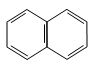
C
$CH_3-CH=CH-CH_2-CH_3$
D
$(CH_3)_4C$
Solution
(C) The correct answer is $C$.
$CH_3-CH=CH-CH_2-CH_3$ is an alkene (pent$-2-$ene).
Alkenes contain a carbon-carbon double bond,which undergoes oxidation with cold dilute alkaline $KMnO_4$ (Baeyer's reagent) to form vicinal diols,resulting in the decolourization of the purple $KMnO_4$ solution.
Option $A$ is an alkane,option $B$ is naphthalene (an aromatic hydrocarbon),and option $D$ is an alkane,none of which react with cold dilute $KMnO_4$ under standard conditions.
$CH_3-CH=CH-CH_2-CH_3$ is an alkene (pent$-2-$ene).
Alkenes contain a carbon-carbon double bond,which undergoes oxidation with cold dilute alkaline $KMnO_4$ (Baeyer's reagent) to form vicinal diols,resulting in the decolourization of the purple $KMnO_4$ solution.
Option $A$ is an alkane,option $B$ is naphthalene (an aromatic hydrocarbon),and option $D$ is an alkane,none of which react with cold dilute $KMnO_4$ under standard conditions.
0 likes
View Solution71
MediumMCQ
Addition of $HCl$ does not obey Anti-Markovnikov's rule because
A
It is a strong acid
B
It is a gas
C
Its bond energy is high
D
Its bond energy is less
Solution
(C) Anti-Markovnikov's addition (peroxide effect) involves the formation of free radicals.
For the reaction to proceed via a free radical mechanism,the $H-Cl$ bond must undergo homolytic cleavage.
However,the $H-Cl$ bond has a very high bond dissociation energy.
Therefore,the energy required to form $H^{\bullet}$ and $Cl^{\bullet}$ free radicals is not available,making the initiation step endothermic and unfavorable.
Consequently,$HCl$ does not show the peroxide effect.
For the reaction to proceed via a free radical mechanism,the $H-Cl$ bond must undergo homolytic cleavage.
However,the $H-Cl$ bond has a very high bond dissociation energy.
Therefore,the energy required to form $H^{\bullet}$ and $Cl^{\bullet}$ free radicals is not available,making the initiation step endothermic and unfavorable.
Consequently,$HCl$ does not show the peroxide effect.
0 likes
View Solution72
MediumMCQ
Which of the following statements is correct about $1, 3-$butadiene?
A
Conjugated double bonds are present
B
Reacts with $HBr$
C
Forms polymer
D
All of these
Solution
(D) $1, 3-$butadiene $(CH_2=CH-CH=CH_2)$ contains two double bonds separated by a single bond,which is the definition of conjugated double bonds.
It undergoes electrophilic addition reactions with $HBr$ to form products like $3-$bromo-$1-$butene and $1-$bromo-$2-$butene.
It is a key monomer used in the production of synthetic rubber (polybutadiene),thus it forms polymers.
Since all three statements are correct,the correct option is $D$.
It undergoes electrophilic addition reactions with $HBr$ to form products like $3-$bromo-$1-$butene and $1-$bromo-$2-$butene.
It is a key monomer used in the production of synthetic rubber (polybutadiene),thus it forms polymers.
Since all three statements are correct,the correct option is $D$.
0 likes
View Solution73
MediumMCQ
The compounds that will give an isomer of $2,2$-dimethylpropane on catalytic hydrogenation are:
$(1)$ $CH_3-CH=C(CH_3)_2$
$(2)$ $CH_3-CH=CH-CH_3$
$(3)$ $CH_3-CH=CH-CH_2-CH_3$
$(4)$ $CH_3-C(CH_3)=C(CH_3)-CH_3$
$(1)$ $CH_3-CH=C(CH_3)_2$
$(2)$ $CH_3-CH=CH-CH_3$
$(3)$ $CH_3-CH=CH-CH_2-CH_3$
$(4)$ $CH_3-C(CH_3)=C(CH_3)-CH_3$
A
$1$ and $4$
B
$2$ and $4$
C
$1$ and $3$
D
$1$ and $2$
Solution
(C) $2,2$-dimethylpropane (neopentane) has the molecular formula $C_5H_{12}$. Isomers of $C_5H_{12}$ are $n$-pentane,isopentane ($2$-methylbutane),and neopentane ($2,2$-dimethylpropane).
$(1)$ $CH_3-CH=C(CH_3)_2$ ($2$-methylbut-$2$-ene) has the formula $C_5H_{10}$. On catalytic hydrogenation,it gives $2$-methylbutane $(C_5H_{12})$,which is an isomer of $2,2$-dimethylpropane.
$(2)$ $CH_3-CH=CH-CH_3$ (but-$2$-ene) has the formula $C_4H_8$. On hydrogenation,it gives butane $(C_4H_{10})$,which is not an isomer of $C_5H_{12}$.
$(3)$ $CH_3-CH=CH-CH_2-CH_3$ (pent-$2$-ene) has the formula $C_5H_{10}$. On catalytic hydrogenation,it gives $n$-pentane $(C_5H_{12})$,which is an isomer of $2,2$-dimethylpropane.
$(4)$ $CH_3-C(CH_3)=C(CH_3)-CH_3$ ($2,3$-dimethylbut-$2$-ene) has the formula $C_6H_{12}$. On hydrogenation,it gives $2,3$-dimethylbutane $(C_6H_{14})$,which is not an isomer of $C_5H_{12}$.
Thus,compounds $(1)$ and $(3)$ yield isomers of $2,2$-dimethylpropane.
$(1)$ $CH_3-CH=C(CH_3)_2$ ($2$-methylbut-$2$-ene) has the formula $C_5H_{10}$. On catalytic hydrogenation,it gives $2$-methylbutane $(C_5H_{12})$,which is an isomer of $2,2$-dimethylpropane.
$(2)$ $CH_3-CH=CH-CH_3$ (but-$2$-ene) has the formula $C_4H_8$. On hydrogenation,it gives butane $(C_4H_{10})$,which is not an isomer of $C_5H_{12}$.
$(3)$ $CH_3-CH=CH-CH_2-CH_3$ (pent-$2$-ene) has the formula $C_5H_{10}$. On catalytic hydrogenation,it gives $n$-pentane $(C_5H_{12})$,which is an isomer of $2,2$-dimethylpropane.
$(4)$ $CH_3-C(CH_3)=C(CH_3)-CH_3$ ($2,3$-dimethylbut-$2$-ene) has the formula $C_6H_{12}$. On hydrogenation,it gives $2,3$-dimethylbutane $(C_6H_{14})$,which is not an isomer of $C_5H_{12}$.
Thus,compounds $(1)$ and $(3)$ yield isomers of $2,2$-dimethylpropane.
0 likes
View Solution74
DifficultMCQ
Alkene $R-CH=CH_2$ reacts readily with $B_2H_6$ and the product on oxidation with alkaline hydrogen peroxide produces:
A
$R-CH_2-CHO$
B
$R-CH_2-CH_2-OH$
C
$R-CO-CH_3$
D
$R-CH(OH)-CH_2(OH)$
Solution
(B) The hydroboration-oxidation of alkenes follows anti-Markovnikov regioselectivity to yield primary alcohols.
The reaction proceeds as follows:
$3R-CH=CH_2 + 1/2 B_2H_6 \rightarrow (R-CH_2-CH_2)_3B$
$(R-CH_2-CH_2)_3B + 3H_2O_2 \xrightarrow{OH^-} 3R-CH_2-CH_2-OH + H_3BO_3$
Thus,the final product is a primary alcohol,$R-CH_2-CH_2-OH$.
The reaction proceeds as follows:
$3R-CH=CH_2 + 1/2 B_2H_6 \rightarrow (R-CH_2-CH_2)_3B$
$(R-CH_2-CH_2)_3B + 3H_2O_2 \xrightarrow{OH^-} 3R-CH_2-CH_2-OH + H_3BO_3$
Thus,the final product is a primary alcohol,$R-CH_2-CH_2-OH$.
0 likes
View Solution75
MediumMCQ
Baeyer's reagent is used for the detection of
A
Amines
B
Glucose
C
Unsaturated bond
D
Alcohol
Solution
(C) Baeyer's reagent is an alkaline solution of cold $KMnO_4$.
It is used for the detection of unsaturation (double or triple bonds) in a molecule,as it undergoes a color change from purple to brown $MnO_2$ precipitate.
It is used for the detection of unsaturation (double or triple bonds) in a molecule,as it undergoes a color change from purple to brown $MnO_2$ precipitate.
0 likes
View Solution76
MediumMCQ
Propene,when heated with chlorine at approximately $500^\circ C$,forms:
A
$CH_2Cl-CH=CH_2$
B
$CH_3-CHCl-CH_2Cl$
C
$CH_2Cl-CHCl-CH_2Cl$
D
All the three
Solution
(A) At high temperatures $(500^\circ C)$,chlorine reacts with propene via free radical allylic substitution to produce allyl chloride $(CH_2Cl-CH=CH_2)$.
At such high temperatures,the electrophilic addition reaction across the double bond is suppressed in favor of the free radical substitution at the allylic carbon.
At such high temperatures,the electrophilic addition reaction across the double bond is suppressed in favor of the free radical substitution at the allylic carbon.
0 likes
View Solution77
MediumMCQ
Reaction of $Br_2$ on ethylene in the presence of $NaCl$ gives:
A
$BrCH_2-CH_2Br$
B
$ClCH_2-CH_2Br$
C
Both $(a)$ and $(b)$
D
None of these
Solution
(C) The reaction of ethylene $(CH_2=CH_2)$ with $Br_2$ in the presence of $NaCl$ involves the formation of a cyclic bromonium ion intermediate.
This intermediate can be attacked by either the bromide ion $(Br^-)$ or the chloride ion $(Cl^-)$ present in the solution.
Therefore,the products formed are $1,2$-dibromoethane $(BrCH_2-CH_2Br)$ and $1$-bromo-$2$-chloroethane $(ClCH_2-CH_2Br)$.
This intermediate can be attacked by either the bromide ion $(Br^-)$ or the chloride ion $(Cl^-)$ present in the solution.
Therefore,the products formed are $1,2$-dibromoethane $(BrCH_2-CH_2Br)$ and $1$-bromo-$2$-chloroethane $(ClCH_2-CH_2Br)$.
0 likes
View Solution78
MediumMCQ
$CH_3-CH=CH_2 + HBr \xrightarrow{\ \ } .........$,the product formed is
A
$CH_3-CH_2-CH_2-Br$
B
$CH_3-CH(Br)-CH_3$
C
$BrCH_2-CH=CH_2$
D
$CH_2=C=CH_2$
Solution
(B) The reaction of propene $(CH_3-CH=CH_2)$ with hydrogen bromide $(HBr)$ follows Markovnikov's rule.
According to Markovnikov's rule,the negative part of the addendum $(Br^-)$ attaches to the carbon atom of the double bond that has the lesser number of hydrogen atoms.
Therefore,the reaction is: $CH_3-CH=CH_2 + HBr \rightarrow CH_3-CH(Br)-CH_3$.
The product formed is $2-$bromopropane.
According to Markovnikov's rule,the negative part of the addendum $(Br^-)$ attaches to the carbon atom of the double bond that has the lesser number of hydrogen atoms.
Therefore,the reaction is: $CH_3-CH=CH_2 + HBr \rightarrow CH_3-CH(Br)-CH_3$.
The product formed is $2-$bromopropane.
0 likes
View Solution79
MediumMCQ
The product of the reaction between propene and $HBr$ in the presence of a peroxide is:
A
$CH_3-CH_2-CH_2Br$
B
$CH_3-CHBr-CH_3$
C
$CH_3-CH_2Br$
D
$CH_3-CH=CHBr$
Solution
(A) The reaction of propene with $HBr$ in the presence of a peroxide follows the anti-Markovnikov addition rule (also known as the Kharasch effect or peroxide effect).
In this reaction,the $Br$ atom attaches to the carbon atom with more hydrogen atoms.
$CH_3-CH=CH_2 + HBr \xrightarrow{\text{peroxide}} CH_3-CH_2-CH_2Br$ ($1$-bromopropane).
In this reaction,the $Br$ atom attaches to the carbon atom with more hydrogen atoms.
$CH_3-CH=CH_2 + HBr \xrightarrow{\text{peroxide}} CH_3-CH_2-CH_2Br$ ($1$-bromopropane).
0 likes
View Solution80
MediumMCQ
Ozonolysis of $2$-methylbut-$2$-ene yields
A
Only aldehyde
B
Only ketone
C
Both aldehyde and ketone
D
None of these
Solution
(C) The ozonolysis of $2$-methylbut-$2$-ene $(CH_3-C(CH_3)=CH-CH_3)$ proceeds as follows:
$(1) \ O_3$
$(2) \ Zn/H_2O$
The reaction breaks the double bond to form $CH_3COCH_3$ (acetone,a ketone) and $CH_3CHO$ (acetaldehyde,an aldehyde).
Therefore,the products are both an aldehyde and a ketone.
$(1) \ O_3$
$(2) \ Zn/H_2O$
The reaction breaks the double bond to form $CH_3COCH_3$ (acetone,a ketone) and $CH_3CHO$ (acetaldehyde,an aldehyde).
Therefore,the products are both an aldehyde and a ketone.
0 likes
View Solution81
MediumMCQ
The final product formed by the ozonolysis of compound $RCH=CR_2$ is
A
$RCHO$
B
$R_2CO$
C
Both $(a)$ and $(b)$
D
None of these
Solution
(C) Ozonolysis of an alkene involves the cleavage of the $C=C$ double bond to form carbonyl compounds.
For the compound $RCH=CR_2$,the cleavage results in $RCHO$ and $R_2CO$.
$RCH=CR_2 \xrightarrow[2. Zn/H_2O]{1. O_3} RCHO + R_2CO$
For the compound $RCH=CR_2$,the cleavage results in $RCHO$ and $R_2CO$.
$RCH=CR_2 \xrightarrow[2. Zn/H_2O]{1. O_3} RCHO + R_2CO$
0 likes
View Solution82
MediumMCQ
Which one is an unsaturated compound?
A
$C_6H_{14}$
B
$C_4H_8$
C
$C_3H_7OH$
D
$CH_3OH$
Solution
(B) An unsaturated compound contains at least one carbon-carbon double or triple bond.
$C_6H_{14}$ is an alkane $(C_nH_{2n+2})$,which is saturated.
$C_4H_8$ follows the general formula $C_nH_{2n}$,indicating it is an alkene,which is an unsaturated compound.
$C_3H_7OH$ and $CH_3OH$ are alcohols,which are saturated compounds.
$C_6H_{14}$ is an alkane $(C_nH_{2n+2})$,which is saturated.
$C_4H_8$ follows the general formula $C_nH_{2n}$,indicating it is an alkene,which is an unsaturated compound.
$C_3H_7OH$ and $CH_3OH$ are alcohols,which are saturated compounds.
0 likes
View Solution83
MediumMCQ
Ethylene is a member of the $.....$ series.
A
Alkyne
B
Olefin
C
Paraffin
D
Amine
Solution
(B) Olefin,because a carbon-carbon double bond is present in ethylene $(CH_2=CH_2)$.
0 likes
View Solution84
MediumMCQ
The compound $B$ formed in the following sequence of reactions is:
$CH_3-CH_2-CH_2-OH$ $\xrightarrow{PCl_3} A$ $\xrightarrow{Alco. KOH} B$
$CH_3-CH_2-CH_2-OH$ $\xrightarrow{PCl_3} A$ $\xrightarrow{Alco. KOH} B$
A
Propyne
B
Propene
C
Propanol
D
Propane
Solution
(B) Step $1$: $CH_3-CH_2-CH_2-OH$ reacts with $PCl_3$ to form $1$-chloropropane $(A)$ via nucleophilic substitution.
$CH_3-CH_2-CH_2-OH + PCl_3 \rightarrow CH_3-CH_2-CH_2-Cl (A) + H_3PO_3$
Step $2$: $1$-chloropropane $(A)$ reacts with alcoholic $KOH$ to undergo dehydrohalogenation (elimination reaction) to form propene $(B)$.
$CH_3-CH_2-CH_2-Cl + Alco. KOH \rightarrow CH_3-CH=CH_2 (B) + KCl + H_2O$
Therefore,the compound $B$ is propene.
$CH_3-CH_2-CH_2-OH + PCl_3 \rightarrow CH_3-CH_2-CH_2-Cl (A) + H_3PO_3$
Step $2$: $1$-chloropropane $(A)$ reacts with alcoholic $KOH$ to undergo dehydrohalogenation (elimination reaction) to form propene $(B)$.
$CH_3-CH_2-CH_2-Cl + Alco. KOH \rightarrow CH_3-CH=CH_2 (B) + KCl + H_2O$
Therefore,the compound $B$ is propene.
0 likes
View Solution85
MediumMCQ
Electrophilic addition on a carbon-carbon double bond involves the intermediate formation of a more stable carbocation. This statement is called
A
Saytzeff's rule
B
Baeyer's effect
C
Markownikoff's rule
D
None of these
Solution
(C) The statement describes the mechanism of electrophilic addition to an asymmetric alkene,which is governed by Markownikoff's rule.
According to Markownikoff's rule,when a protic acid $HX$ adds to an asymmetric alkene,the hydrogen atom $(H)$ attaches to the carbon atom of the double bond that already has a greater number of hydrogen atoms,while the halide $(X)$ attaches to the more substituted carbon atom.
This occurs because the reaction proceeds through the formation of the most stable carbocation intermediate.
According to Markownikoff's rule,when a protic acid $HX$ adds to an asymmetric alkene,the hydrogen atom $(H)$ attaches to the carbon atom of the double bond that already has a greater number of hydrogen atoms,while the halide $(X)$ attaches to the more substituted carbon atom.
This occurs because the reaction proceeds through the formation of the most stable carbocation intermediate.
0 likes
View Solution86
MediumMCQ
$CH_2=CHCl$ reacts with $HCl$ to form
A
$CH_2Cl-CH_2Cl$
B
$CH_3-CHCl_2$
C
$CH_2=CHCl \cdot HCl$
D
None of these
Solution
(B) The reaction is an electrophilic addition of $HCl$ to vinyl chloride $(CH_2=CHCl)$.
According to Markownikoff's rule,the electrophile $(H^+)$ attaches to the carbon atom with more hydrogen atoms,and the nucleophile $(Cl^-)$ attaches to the carbon atom with fewer hydrogen atoms.
The reaction proceeds as follows:
$CH_2=CHCl + HCl \rightarrow CH_3-CHCl_2$ ($1$,$1$-dichloroethane).
Therefore,the correct option is $(B)$.
According to Markownikoff's rule,the electrophile $(H^+)$ attaches to the carbon atom with more hydrogen atoms,and the nucleophile $(Cl^-)$ attaches to the carbon atom with fewer hydrogen atoms.
The reaction proceeds as follows:
$CH_2=CHCl + HCl \rightarrow CH_3-CHCl_2$ ($1$,$1$-dichloroethane).
Therefore,the correct option is $(B)$.
0 likes
View Solution87
MediumMCQ
Deviation from Markownikoff's rule occurs in the presence of
A
Zinc
B
Peroxides
C
$Hg - Zn/HCl$
D
All of these
Solution
(B) The addition of $HBr$ to unsymmetrical alkenes follows Markownikoff's rule in the absence of peroxides,leading to the formation of the more stable carbocation intermediate.
In the presence of peroxides $(R_2O_2)$,the reaction proceeds via a free radical mechanism,which results in anti-Markownikoff addition.
For example,the reaction of propene with $HBr$ in the presence of peroxide yields $1$-bromopropane instead of $2$-bromopropane.
Therefore,the correct option is $(B)$.
In the presence of peroxides $(R_2O_2)$,the reaction proceeds via a free radical mechanism,which results in anti-Markownikoff addition.
For example,the reaction of propene with $HBr$ in the presence of peroxide yields $1$-bromopropane instead of $2$-bromopropane.
Therefore,the correct option is $(B)$.
0 likes
View Solution88
MediumMCQ
Presence of peroxides affects the addition of
A
$HBr$
B
$HCl$
C
$HI$
D
All of these
Solution
(A) The peroxide effect,also known as the $Kharasch$ effect or anti-$Markownikoff$ addition,is specifically applicable only to $HBr$ in the presence of organic peroxides.
For $HCl$ and $HI$,the peroxide effect is not observed because the bond dissociation energy of $HCl$ is too high to be cleaved by free radicals,and the iodine radical formed in the case of $HI$ tends to combine to form $I_2$ rather than adding to the double bond.
Therefore,the correct option is $A$.
For $HCl$ and $HI$,the peroxide effect is not observed because the bond dissociation energy of $HCl$ is too high to be cleaved by free radicals,and the iodine radical formed in the case of $HI$ tends to combine to form $I_2$ rather than adding to the double bond.
Therefore,the correct option is $A$.
0 likes
View Solution89
MediumMCQ
The predominant product formed when $3$-methyl-$2$-pentene reacts with $HOCl$ is:
A
$CH_3-CH_2-C(Cl)(CH_3)-CH(OH)-CH_3$
B
$CH_3-CH_2-C(Cl)(CH_3)-CH(Cl)-CH_3$
C
$CH_3-CH_2-C(OH)(CH_3)-CH(Cl)-CH_3$
D
$CH_3-CH_2-C(CH_3)_2-CH(OH)-CH_3$
Solution
(C) The reaction of $3$-methyl-$2$-pentene $(CH_3-CH=C(CH_3)-CH_2-CH_3)$ with $HOCl$ proceeds via the formation of a cyclic chloronium ion intermediate.
$HOCl$ dissociates to provide $Cl^+$ (electrophile) and $OH^-$ (nucleophile).
The $Cl^+$ ion attacks the double bond to form a cyclic chloronium ion.
The nucleophile $(OH^-)$ then attacks the more substituted carbon atom $(C3)$ due to its higher carbocation-like character in the transition state,following Markovnikov's rule.
Therefore,the major product is $3$-chloro-$3$-methylpentan-$2$-ol,which corresponds to the structure $CH_3-CH(Cl)-C(OH)(CH_3)-CH_2-CH_3$.
$HOCl$ dissociates to provide $Cl^+$ (electrophile) and $OH^-$ (nucleophile).
The $Cl^+$ ion attacks the double bond to form a cyclic chloronium ion.
The nucleophile $(OH^-)$ then attacks the more substituted carbon atom $(C3)$ due to its higher carbocation-like character in the transition state,following Markovnikov's rule.
Therefore,the major product is $3$-chloro-$3$-methylpentan-$2$-ol,which corresponds to the structure $CH_3-CH(Cl)-C(OH)(CH_3)-CH_2-CH_3$.
0 likes
View Solution90
MediumMCQ
Which of the following reactions occurs easily in ethylene?
A
Addition
B
Substitution
C
Elimination
D
Rearrangement
Solution
(A) . Ethylene $(CH_2=CH_2)$ contains a carbon-carbon double bond,which consists of one strong $\sigma$-bond and one weak $\pi$-bond.
Due to the presence of the electron-rich $\pi$-bond,ethylene is highly susceptible to electrophilic attack,making addition reactions the characteristic and most easily occurring reactions for alkenes.
Due to the presence of the electron-rich $\pi$-bond,ethylene is highly susceptible to electrophilic attack,making addition reactions the characteristic and most easily occurring reactions for alkenes.
0 likes
View Solution91
MediumMCQ
Conjugate double bond is present in
A
Propylene
B
Butadiene
C
Isobutylene
D
Butylene
Solution
(B) Butadiene $CH_2=CH-CH=CH_2$
$A$ system where two double bonds are separated by a single bond is known as a conjugated double bond system.
$A$ system where two double bonds are separated by a single bond is known as a conjugated double bond system.
0 likes
View Solution92
MediumMCQ
The general formula of alkenes is:
A
$C_nH_{2n}$
B
$C_nH_{2n-2}$
C
$C_nH_{2n+2}$
D
$C_nH_{2n-1}$
Solution
(A) Alkenes are unsaturated hydrocarbons containing at least one carbon-carbon double bond.
The general formula for acyclic alkenes is $C_nH_{2n}$,where $n$ is the number of carbon atoms $(n \geq 2)$.
The general formula for acyclic alkenes is $C_nH_{2n}$,where $n$ is the number of carbon atoms $(n \geq 2)$.
0 likes
View Solution93
DifficultMCQ
The product of the following reaction is: $CH_3-C(CH_3)_2-CH=CH_2 \xrightarrow[(ii) NaBH_4]{(i) Hg(OAc)_2, H_2O}$
A
$CH_3-C(CH_3)_2-CH(OH)-CH_3$
B
$CH_3-C(CH_3)_2-CH_2-CH_2OH$
C
$CH_3-C(OH)(CH_3)-CH(CH_3)-CH_3$
D
$HO-CH_2-C(CH_3)_2-CH_2-CH_3$
Solution
(A) The given reaction is Oxymercuration-Demercuration $(OMDM)$.
$1$. This reaction involves the Markovnikov addition of water ($H$ and $OH$) across the double bond.
$2$. Crucially,no carbocation rearrangement occurs in this process because a bridged mercurinium ion intermediate is formed.
$3$. The $-OH$ group adds to the more substituted carbon of the double bond,and the $-H$ atom adds to the less substituted carbon.
$4$. Therefore,$3,3$-dimethyl-$1$-butene $(CH_3-C(CH_3)_2-CH=CH_2)$ reacts to form $3,3$-dimethyl-$2$-butanol $(CH_3-C(CH_3)_2-CH(OH)-CH_3)$.
$1$. This reaction involves the Markovnikov addition of water ($H$ and $OH$) across the double bond.
$2$. Crucially,no carbocation rearrangement occurs in this process because a bridged mercurinium ion intermediate is formed.
$3$. The $-OH$ group adds to the more substituted carbon of the double bond,and the $-H$ atom adds to the less substituted carbon.
$4$. Therefore,$3,3$-dimethyl-$1$-butene $(CH_3-C(CH_3)_2-CH=CH_2)$ reacts to form $3,3$-dimethyl-$2$-butanol $(CH_3-C(CH_3)_2-CH(OH)-CH_3)$.
0 likes
View Solution94
MediumMCQ
Which one of the following organic compounds decolourizes an alkaline $KMnO_4$ solution?
A
$CS_2$
B
$C_3H_6$
C
$C_3H_8$
D
$CH_3OH$
Solution
(B) The alkaline $KMnO_4$ solution is known as $Baeyer's$ reagent.
It is used to test for the presence of unsaturation (double or triple bonds) in organic compounds.
$C_3H_6$ (propene) is an alkene,which contains a carbon-carbon double bond.
Therefore,it reacts with alkaline $KMnO_4$ to undergo oxidation,resulting in the decolourization of the purple $KMnO_4$ solution.
It is used to test for the presence of unsaturation (double or triple bonds) in organic compounds.
$C_3H_6$ (propene) is an alkene,which contains a carbon-carbon double bond.
Therefore,it reacts with alkaline $KMnO_4$ to undergo oxidation,resulting in the decolourization of the purple $KMnO_4$ solution.
0 likes
View Solution95
MediumMCQ
Decolourization of alkaline $KMnO_4$ is used as a test for
A
Aromatic hydrocarbons
B
Olefinic hydrocarbons
C
Acetylenic hydrocarbons
D
Cycloalkanes
Solution
(B) The decolourization of the pink colour of alkaline $KMnO_4$ (Baeyer's reagent) is used to detect the presence of unsaturation (double or triple bonds) in organic compounds.
Both alkenes (olefinic) and alkynes (acetylenic) undergo this reaction,but the term 'olefinic' is the most common classification associated with this test in general contexts.
Since both $B$ and $C$ are unsaturated,but the question typically refers to the Baeyer's test for alkenes,$B$ is the primary answer.
Both alkenes (olefinic) and alkynes (acetylenic) undergo this reaction,but the term 'olefinic' is the most common classification associated with this test in general contexts.
Since both $B$ and $C$ are unsaturated,but the question typically refers to the Baeyer's test for alkenes,$B$ is the primary answer.
0 likes
View Solution96
MediumMCQ
The alkene which on ozonolysis yields acetone is
A
$CH_2=CH_2$
B
$CH_3-CH=CH_2$
C
$CH_3-C(CH_3)=C(CH_3)-CH_3$
D
$CH_3-CH=CH-CH_3$
Solution
(C) Ozonolysis of $2,3$-dimethyl-$2$-butene $(CH_3-C(CH_3)=C(CH_3)-CH_3)$ involves the cleavage of the $C=C$ double bond and the addition of oxygen atoms to each carbon atom,resulting in the formation of two molecules of acetone $(CH_3-CO-CH_3)$.
$CH_3-C(CH_3)=C(CH_3)-CH_3 + O_3 \xrightarrow{Zn/H_2O} 2 CH_3-CO-CH_3$.
$CH_3-C(CH_3)=C(CH_3)-CH_3 + O_3 \xrightarrow{Zn/H_2O} 2 CH_3-CO-CH_3$.
0 likes
View Solution97
MediumMCQ
The order of increasing reactivity towards $HCl$ of the following compounds will be:
$(1)$ $CH_2 = CH_2$
$(2)$ $(CH_3)_2C = CH_2$
$(3)$ $CH_3CH = CHCH_3$
$(1)$ $CH_2 = CH_2$
$(2)$ $(CH_3)_2C = CH_2$
$(3)$ $CH_3CH = CHCH_3$
A
$1 < 3 < 2$
B
$3 < 2 < 1$
C
$1 < 2 < 3$
D
$2 < 1 < 3$
Solution
(A) The reactivity of alkenes towards electrophilic addition of $HCl$ depends on the stability of the intermediate carbocation formed.
$(1)$ $CH_2 = CH_2$ forms a primary carbocation $(CH_3-CH_2^+)$,which is the least stable.
$(3)$ $CH_3CH = CHCH_3$ forms a secondary carbocation $(CH_3-CH_2-CH^+-CH_3)$,which is more stable than the primary one.
$(2)$ $(CH_3)_2C = CH_2$ forms a tertiary carbocation $((CH_3)_2C^+-CH_3)$,which is the most stable.
Since the stability of the carbocation intermediate follows the order: $1^\circ < 2^\circ < 3^\circ$,the reactivity towards $HCl$ follows the same order: $(1) < (3) < (2)$.
$(1)$ $CH_2 = CH_2$ forms a primary carbocation $(CH_3-CH_2^+)$,which is the least stable.
$(3)$ $CH_3CH = CHCH_3$ forms a secondary carbocation $(CH_3-CH_2-CH^+-CH_3)$,which is more stable than the primary one.
$(2)$ $(CH_3)_2C = CH_2$ forms a tertiary carbocation $((CH_3)_2C^+-CH_3)$,which is the most stable.
Since the stability of the carbocation intermediate follows the order: $1^\circ < 2^\circ < 3^\circ$,the reactivity towards $HCl$ follows the same order: $(1) < (3) < (2)$.
0 likes
View Solution98
DifficultMCQ
If $HCl$ is added to the following substance,what is formed?
A
$CH_2(Cl)-CH_2-CH(CH_3)_2$
B
$CH_3-CH(Cl)-CH(CH_3)_2$
C
$CH_3-C(Cl)(CH_3)_2$
D
None of these
Solution
(C) The given substance is $2-$methylpropene,which has the structure $CH_2=C(CH_3)_2$.
When $HCl$ is added to $2-$methylpropene,the reaction follows Markovnikov's rule.
According to Markovnikov's rule,the electrophile $(H^+)$ adds to the carbon atom with more hydrogen atoms,and the nucleophile $(Cl^-)$ adds to the carbon atom with fewer hydrogen atoms.
$CH_2=C(CH_3)_2 + HCl \rightarrow CH_3-C(Cl)(CH_3)_2$.
The product formed is $2-$chloro$-2-$methylpropane.
When $HCl$ is added to $2-$methylpropene,the reaction follows Markovnikov's rule.
According to Markovnikov's rule,the electrophile $(H^+)$ adds to the carbon atom with more hydrogen atoms,and the nucleophile $(Cl^-)$ adds to the carbon atom with fewer hydrogen atoms.
$CH_2=C(CH_3)_2 + HCl \rightarrow CH_3-C(Cl)(CH_3)_2$.
The product formed is $2-$chloro$-2-$methylpropane.
0 likes
View Solution99
MediumMCQ
Position of a double bond in an organic compound is determined by
A
Ozonolysis
B
Oxidation
C
Reduction
D
Hydrogenation
Solution
(A) . Ozonolysis is a chemical process used to locate the position of a double bond in an alkene.
In this reaction,the alkene reacts with ozone $(O_3)$ followed by reductive cleavage (using $Zn/H_2O$) to form carbonyl compounds.
The position of the original double bond can be determined by joining the carbonyl carbon atoms of the resulting products.
For example,if the products of ozonolysis are two molecules of ethanal $(CH_3CHO)$,the original alkene was $CH_3-CH=CH-CH_3$ ($2$-Butene).
In this reaction,the alkene reacts with ozone $(O_3)$ followed by reductive cleavage (using $Zn/H_2O$) to form carbonyl compounds.
The position of the original double bond can be determined by joining the carbonyl carbon atoms of the resulting products.
For example,if the products of ozonolysis are two molecules of ethanal $(CH_3CHO)$,the original alkene was $CH_3-CH=CH-CH_3$ ($2$-Butene).
0 likes
View Solution100
MediumMCQ
$A$ gas decolourises Bayer's reagent but does not react with Tollen's reagent. This gas is:
A
Ethene
B
Ethyne
C
Ethane
D
Methane
Solution
(A) Bayer's reagent $(1\% \text{ alkaline } KMnO_4 \text{ solution})$ is used to detect the presence of unsaturation (double or triple bonds) in organic compounds. Both alkenes and alkynes decolourise it.
Tollen's reagent (ammoniacal silver nitrate) reacts only with terminal alkynes (alkynes having a hydrogen atom attached to a triply bonded carbon) to form a white precipitate of silver acetylide.
$1.$ Ethene $(CH_2=CH_2)$ is an alkene. It decolourises Bayer's reagent due to the presence of a double bond but does not react with Tollen's reagent because it is not a terminal alkyne.
$2.$ Ethyne $(CH \equiv CH)$ is a terminal alkyne. It decolourises Bayer's reagent and also reacts with Tollen's reagent.
$3.$ Ethane and Methane are saturated hydrocarbons (alkanes) and do not react with either reagent.
Therefore,the gas that decolourises Bayer's reagent but does not react with Tollen's reagent is Ethene.
Tollen's reagent (ammoniacal silver nitrate) reacts only with terminal alkynes (alkynes having a hydrogen atom attached to a triply bonded carbon) to form a white precipitate of silver acetylide.
$1.$ Ethene $(CH_2=CH_2)$ is an alkene. It decolourises Bayer's reagent due to the presence of a double bond but does not react with Tollen's reagent because it is not a terminal alkyne.
$2.$ Ethyne $(CH \equiv CH)$ is a terminal alkyne. It decolourises Bayer's reagent and also reacts with Tollen's reagent.
$3.$ Ethane and Methane are saturated hydrocarbons (alkanes) and do not react with either reagent.
Therefore,the gas that decolourises Bayer's reagent but does not react with Tollen's reagent is Ethene.
0 likes
View SolutionHydrocarbons — Alkene · Frequently Asked Questions
1Are these Hydrocarbons questions useful for JEE and NEET?
Yes. All questions in this section are mapped to JEE Main and NEET exam patterns. Previous year questions from JEE Main, NEET, GUJCET and state-level exams are included with full solutions.
2Can I switch to Hindi or Gujarati for these questions?
Yes. Use the language tabs in the hero section or the sidebar to view the same questions and solutions in English, Hindi or Gujarati.
3How do I generate a question paper from this subtopic?
Use the Vedclass Exam Paper Generator — select the chapter and subtopic, set difficulty, and generate Sets A, B, C, D automatically. First 3 chapters of every subject are free.
Vedclass Products
For Students
Vedclass Test Series
Mock tests in real JEE/NEET style with performance analysis. 5-day free trial.
Start Free TrialFor Teachers
Exam Paper Generator
Generate Set A/B/C/D papers from this chapter in 2 minutes. 3 chapters free.
Try FreeFor Institutes
Online Exam Module
Live online exams with unlimited students, 360° analytics & white-label branding.
See DemoFor Teachers & Institutes
Generate a Hydrocarbons Exam Paper in 2 Minutes
Select subtopic & difficulty — Sets A, B, C, D auto-generated with No Repeat logic.
First 3 chapters of every subject are free — no payment required.