
A English
Mix Examples-Hydrocarbon Questions in English
Class 11 Chemistry · Hydrocarbons · Mix Examples-Hydrocarbon
317+
Questions
English
Language
100%
With Solutions
Showing 50 of 317 questions in English
1
MediumMCQ
The number of sigma and pi bonds in $but-1-ene-3-yne$ are
A
$5$ sigma and $5$ pi
B
$7$ sigma and $3$ pi
C
$8$ sigma and $2$ pi
D
$6$ sigma and $4$ pi
Solution
(B) The structure of $but-1-ene-3-yne$ is $CH_2=CH-C \equiv CH$.
Counting the bonds:
Sigma $( \sigma )$ bonds: There are $3$ $C-H$ bonds,$1$ $C-C$ single bond,$1$ $C=C$ double bond (contains $1$ $ \sigma $),and $1$ $C \equiv C$ triple bond (contains $1$ $ \sigma $). Total $ \sigma $ bonds = $3 + 1 + 1 + 1 + 1 = 7$.
Pi $( \pi )$ bonds: The $C=C$ bond contains $1$ $ \pi $ bond,and the $C \equiv C$ bond contains $2$ $ \pi $ bonds. Total $ \pi $ bonds = $1 + 2 = 3$.
Thus,the molecule has $7$ $ \sigma $ bonds and $3$ $ \pi $ bonds.
Counting the bonds:
Sigma $( \sigma )$ bonds: There are $3$ $C-H$ bonds,$1$ $C-C$ single bond,$1$ $C=C$ double bond (contains $1$ $ \sigma $),and $1$ $C \equiv C$ triple bond (contains $1$ $ \sigma $). Total $ \sigma $ bonds = $3 + 1 + 1 + 1 + 1 = 7$.
Pi $( \pi )$ bonds: The $C=C$ bond contains $1$ $ \pi $ bond,and the $C \equiv C$ bond contains $2$ $ \pi $ bonds. Total $ \pi $ bonds = $1 + 2 = 3$.
Thus,the molecule has $7$ $ \sigma $ bonds and $3$ $ \pi $ bonds.
0 likes
View Solution2
MediumMCQ
The enolic form of acetone contains
A
$9$ sigma bonds,$1$ pi bond and $2$ lone pairs
B
$8$ sigma bonds,$2$ pi bonds and $2$ lone pairs
C
$10$ sigma bonds,$1$ pi bond and $1$ lone pair
D
$9$ sigma bonds,$2$ pi bonds and $1$ lone pair
Solution
(A) The enolic form of acetone is propen$-2-$ol,which has the structure $CH_2=C(OH)-CH_3$.
Counting the bonds: there are $3$ $C-H$ bonds in the methyl group,$2$ $C-H$ bonds in the methylene group,$1$ $O-H$ bond,$1$ $C-O$ bond,$1$ $C-C$ bond,and $1$ $C=C$ bond (which consists of $1$ $\sigma$ and $1$ $\pi$ bond).
Total $\sigma$ bonds = $3 + 2 + 1 + 1 + 1 + 1 = 9$.
Total $\pi$ bonds = $1$.
Oxygen atom in the hydroxyl group has $2$ lone pairs.
Thus,the structure contains $9$ $\sigma$ bonds,$1$ $\pi$ bond,and $2$ lone pairs.
Counting the bonds: there are $3$ $C-H$ bonds in the methyl group,$2$ $C-H$ bonds in the methylene group,$1$ $O-H$ bond,$1$ $C-O$ bond,$1$ $C-C$ bond,and $1$ $C=C$ bond (which consists of $1$ $\sigma$ and $1$ $\pi$ bond).
Total $\sigma$ bonds = $3 + 2 + 1 + 1 + 1 + 1 = 9$.
Total $\pi$ bonds = $1$.
Oxygen atom in the hydroxyl group has $2$ lone pairs.
Thus,the structure contains $9$ $\sigma$ bonds,$1$ $\pi$ bond,and $2$ lone pairs.
0 likes
View Solution3
EasyMCQ
In the combustion of hydrocarbons,$\Delta H$ is
A
Negative
B
Zero
C
Positive
D
Undeterminate
Solution
(A) The combustion of hydrocarbons is an exothermic process.
In an exothermic reaction,heat is released into the surroundings.
Therefore,the change in enthalpy,$\Delta H$,is always negative.
In an exothermic reaction,heat is released into the surroundings.
Therefore,the change in enthalpy,$\Delta H$,is always negative.
0 likes
View Solution4
EasyMCQ
The formation of an innumerable number of carbon compounds is due to its:
A
High reactivity
B
Catenation tendency
C
Covalent and ionic tendency
D
Different valency
Solution
(B) The formation of a vast number of carbon compounds is primarily due to its unique property of $catenation$,which is the ability of atoms of the same element to link together to form long chains or rings.
Carbon exhibits the highest $catenation$ tendency among all elements in group $IV$ due to its small size and strong $C-C$ bond energy.
Carbon exhibits the highest $catenation$ tendency among all elements in group $IV$ due to its small size and strong $C-C$ bond energy.
0 likes
View Solution5
MediumMCQ
The product obtained by heating $(NH_4)_2SO_4$ and $KCNO$ is
A
Hydrocyanic acid
B
Ammonia
C
Ammonium cyanide
D
Urea
Solution
(D) The reaction between $(NH_4)_2SO_4$ and $KCNO$ proceeds as follows:
$(NH_4)_2SO_4 + 2KCNO \to 2NH_4CNO + K_2SO_4$
Upon heating,the ammonium cyanate $(NH_4CNO)$ undergoes rearrangement to form urea:
$NH_4CNO \xrightarrow{\Delta} NH_2CONH_2$
Therefore,the final product is urea.
$(NH_4)_2SO_4 + 2KCNO \to 2NH_4CNO + K_2SO_4$
Upon heating,the ammonium cyanate $(NH_4CNO)$ undergoes rearrangement to form urea:
$NH_4CNO \xrightarrow{\Delta} NH_2CONH_2$
Therefore,the final product is urea.
0 likes
View Solution6
MediumMCQ
In laboratory burners,we use
A
Producer gas
B
Oil gas
C
Gobar gas
D
Coal gas
Solution
(B) In laboratory burners,oil gas is generally used. Oil gas is a mixture of $CH_4$,$CO$,$CO_2$,and $H_2$.
0 likes
View Solution7
MediumMCQ
$A$ straight chain hydrocarbon has the molecular formula $C_8H_{10}$. The hybridisation for the carbon atoms from one end of the chain to the other are respectively $sp^3$,$sp^2$,$sp^2$,$sp^3$,$sp^2$,$sp^2$,$sp$ and $sp$. The structural formula of the hydrocarbon would be
A
$CH_3-C\equiv C-CH_2-CH=CH-CH=CH_2$
B
$CH_3-CH_2-CH=CH-CH_2-C\equiv C-CH=CH_2$
C
$CH_3-CH=CH-CH_2-C\equiv C-CH=CH_2$
D
$CH_3-CH=CH-CH_2-CH=CH-C\equiv CH$
Solution
(D) The given hybridisation sequence is $sp^3, sp^2, sp^2, sp^3, sp^2, sp^2, sp, sp$.
Counting the carbons:
$1(sp^3): CH_3-$
$2(sp^2): -CH=$
$3(sp^2): =CH-$
$4(sp^3): -CH_2-$
$5(sp^2): -CH=$
$6(sp^2): =CH-$
$7(sp): -C\equiv$
$8(sp): \equiv CH$
Combining these,we get $CH_3-CH=CH-CH_2-CH=CH-C\equiv CH$.
This matches option $D$.
Counting the carbons:
$1(sp^3): CH_3-$
$2(sp^2): -CH=$
$3(sp^2): =CH-$
$4(sp^3): -CH_2-$
$5(sp^2): -CH=$
$6(sp^2): =CH-$
$7(sp): -C\equiv$
$8(sp): \equiv CH$
Combining these,we get $CH_3-CH=CH-CH_2-CH=CH-C\equiv CH$.
This matches option $D$.
0 likes
View Solution8
EasyMCQ
Number of $\pi$ bonds in $CH_2=CH-CH=CH-C\equiv CH$ is
A
$2$
B
$3$
C
$4$
D
$5$
Solution
(C)
In the given compound $CH_2=CH-CH=CH-C\equiv CH$:
There are two double bonds,each containing $1 \pi$ bond ($2 \times 1 = 2 \pi$ bonds).
There is one triple bond,which contains $2 \pi$ bonds ($1 \times 2 = 2 \pi$ bonds).
Total number of $\pi$ bonds = $2 + 2 = 4$.
| $\text{Nature of bond}$ | $\text{Number of sigma and } \pi \text{ bonds}$ |
| $\text{Single bond}$ | $1 \sigma, 0 \pi$ |
| $\text{Double bond}$ | $1 \sigma, 1 \pi$ |
| $\text{Triple bond}$ | $1 \sigma, 2 \pi$ |
In the given compound $CH_2=CH-CH=CH-C\equiv CH$:
There are two double bonds,each containing $1 \pi$ bond ($2 \times 1 = 2 \pi$ bonds).
There is one triple bond,which contains $2 \pi$ bonds ($1 \times 2 = 2 \pi$ bonds).
Total number of $\pi$ bonds = $2 + 2 = 4$.
0 likes
View Solution9
MediumMCQ
The petrol having octane number $80$ has
A
$20\% \, n$-heptane + $80\%$ iso-octane
B
$80\% \, n$-heptane + $20\%$ iso-octane
C
$20\% \, n$-heptane + $80\%$ normal octane
D
$80\% \, n$-heptane + $20\%$ normal octane
Solution
(A) The octane number of a fuel is defined as the percentage of iso-octane in a mixture of iso-octane and $n$-heptane that has the same knocking characteristics as the fuel being tested.
Therefore,a petrol with an octane number of $80$ contains $80\%$ iso-octane and $20\% \, n$-heptane.
Therefore,a petrol with an octane number of $80$ contains $80\%$ iso-octane and $20\% \, n$-heptane.
0 likes
View Solution10
MediumMCQ
Petroleum refining is:
A
Distillation of petroleum to get different fractions
B
Obtaining aromatic compounds from aliphatic compounds present in petroleum
C
Cracking of petroleum to get gaseous hydrocarbons
D
Purification of petroleum
Solution
(A) Petroleum refining is the process of separating crude oil into various useful products such as gasoline,diesel,kerosene,and lubricating oils. This is primarily achieved through fractional distillation,where the components are separated based on their different boiling points.
0 likes
View Solution11
MediumMCQ
When petroleum is heated,the vapours contain mainly:
A
Kerosene
B
Petroleum ether
C
Diesel
D
Machine oil
Solution
(B) Petroleum ether is the correct answer because it has the lowest boiling point among the given fractions of petroleum.
During the fractional distillation of petroleum,components with lower boiling points vaporize first.
During the fractional distillation of petroleum,components with lower boiling points vaporize first.
0 likes
View Solution12
MediumMCQ
Cyclohexane,a hydrocarbon,floats on water because:
A
It is immiscible with water
B
Its density is lower compared to water
C
It is a non-polar substance
D
It is immiscible and lighter than water
Solution
(D) Cyclohexane $(C_6H_{12})$ is a non-polar hydrocarbon.
It is immiscible with water and has a lower density than water $(d_{cyclohexane} \approx 0.779 \ g/cm^3 < d_{water} = 1.0 \ g/cm^3)$.
Therefore,it floats on the surface of water.
It is immiscible with water and has a lower density than water $(d_{cyclohexane} \approx 0.779 \ g/cm^3 < d_{water} = 1.0 \ g/cm^3)$.
Therefore,it floats on the surface of water.
0 likes
View Solution13
MediumMCQ
Natural petroleum contains
A
Saturated hydrocarbons
B
Cyclic saturated hydrocarbons
C
Compounds of sulphur
D
All of these
Solution
(D) Natural petroleum (crude oil) is a complex mixture of various hydrocarbons and other organic compounds.
It primarily consists of saturated hydrocarbons (alkanes),cyclic saturated hydrocarbons (cycloalkanes or naphthenes),and aromatic hydrocarbons.
Additionally,it contains non-hydrocarbon organic compounds that include elements like nitrogen,oxygen,and sulfur,along with trace amounts of metals such as iron,nickel,copper,and vanadium.
Therefore,all the given options are present in natural petroleum.
It primarily consists of saturated hydrocarbons (alkanes),cyclic saturated hydrocarbons (cycloalkanes or naphthenes),and aromatic hydrocarbons.
Additionally,it contains non-hydrocarbon organic compounds that include elements like nitrogen,oxygen,and sulfur,along with trace amounts of metals such as iron,nickel,copper,and vanadium.
Therefore,all the given options are present in natural petroleum.
0 likes
View Solution14
MediumMCQ
Action of hydrogen chloride on $CH_3-C(CH_3)=CH_2$ and on $CH \equiv CH$ will predominantly give the compounds,respectively
A
$CH_3-C(CH_3)=CHCl$ and $ClCH_2-CH_2Cl$
B
$CH_3-CCl(CH_3)-CH_3$ and $CH_3-CHCl_2$
C
$CH_3-C(CH_3)=CHCl$ and $CH_3-CHCl_2$
D
$CH_3-C(CH_3)=CH_2$ and $ClCH_2-CH_2Cl$
Solution
(B) The addition of $HCl$ to isobutylene $(CH_3-C(CH_3)=CH_2)$ follows Markovnikov's rule,where the electrophile $H^+$ adds to the terminal carbon to form a stable tertiary carbocation,which then reacts with $Cl^-$ to form $2$-chloro-$2$-methylpropane $(CH_3-CCl(CH_3)-CH_3)$.
For acetylene $(CH \equiv CH)$,the addition of $HCl$ occurs in two steps. The first step yields vinyl chloride $(CH_2=CHCl)$. The second step follows Markovnikov's rule,where the $H^+$ adds to the carbon already bearing the hydrogen,resulting in the formation of $1,1$-dichloroethane $(CH_3-CHCl_2)$.
For acetylene $(CH \equiv CH)$,the addition of $HCl$ occurs in two steps. The first step yields vinyl chloride $(CH_2=CHCl)$. The second step follows Markovnikov's rule,where the $H^+$ adds to the carbon already bearing the hydrogen,resulting in the formation of $1,1$-dichloroethane $(CH_3-CHCl_2)$.
0 likes
View Solution15
MediumMCQ
Gasoline is the name of
A
Crude oil
B
The gaseous constituents of petroleum
C
The mixture of volatile,flammable liquid hydrocarbons derived from petroleum
D
The mixture of the residue and gas oil obtained in the distillation of crude oil
Solution
(C) Gasoline,also known as petrol,is a mixture of volatile,flammable liquid hydrocarbons derived from petroleum. It is primarily used as a fuel for internal-combustion engines and also serves as a solvent for oils and fats.
0 likes
View Solution16
MediumMCQ
Which of the following fractions of petroleum refining contains kerosene? (Boiling ranges in $^circ C$ are given below)
A
$40 - 80$
B
$80 - 200$
C
$200 - 300$
D
Above $300$
Solution
(C) Petroleum refining involves the fractional distillation of crude oil based on boiling point ranges.
Kerosene is a middle distillate fraction obtained from petroleum.
The boiling range for the kerosene fraction is typically between $200 - 300 \ ^circ C$.
Therefore,the correct option is $C$.
Kerosene is a middle distillate fraction obtained from petroleum.
The boiling range for the kerosene fraction is typically between $200 - 300 \ ^circ C$.
Therefore,the correct option is $C$.
0 likes
View Solution17
MediumMCQ
The order of appearance of the following with rising temperature during the refining of crude oil is:
A
Gasoline,kerosene oil,diesel
B
Diesel,gasoline,kerosene oil
C
Gasoline,diesel,kerosene oil
D
Gasoline,kerosene oil,diesel
Solution
(A) During the fractional distillation of crude oil,components are separated based on their boiling points.
As the temperature increases,the fractions with lower boiling points are collected first,followed by those with higher boiling points.
The boiling point ranges are approximately:
$1$. Gasoline: $40-175 \ ^\circ C$
$2$. Kerosene oil: $175-250 \ ^\circ C$
$3$. Diesel: $250-350 \ ^\circ C$
Therefore,the order of appearance with rising temperature is Gasoline,kerosene oil,and diesel.
As the temperature increases,the fractions with lower boiling points are collected first,followed by those with higher boiling points.
The boiling point ranges are approximately:
$1$. Gasoline: $40-175 \ ^\circ C$
$2$. Kerosene oil: $175-250 \ ^\circ C$
$3$. Diesel: $250-350 \ ^\circ C$
Therefore,the order of appearance with rising temperature is Gasoline,kerosene oil,and diesel.
0 likes
View Solution18
MediumMCQ
The final product of complete oxidation of hydrocarbons is
A
Acid
B
Aldehyde
C
$H_2O + CO_2$
D
Dihydric alcohol
Solution
(C) The complete oxidation (combustion) of any hydrocarbon,whether saturated or unsaturated,results in the formation of carbon dioxide and water as the final products.
For example,for methane $(CH_4)$:
$CH_4 + 2O_2 \to CO_2 + 2H_2O$
For ethene $(C_2H_4)$:
$C_2H_4 + 3O_2 \to 2CO_2 + 2H_2O$
Therefore,the correct option is $C$.
For example,for methane $(CH_4)$:
$CH_4 + 2O_2 \to CO_2 + 2H_2O$
For ethene $(C_2H_4)$:
$C_2H_4 + 3O_2 \to 2CO_2 + 2H_2O$
Therefore,the correct option is $C$.
0 likes
View Solution19
MediumMCQ
The inorganic origin of petroleum is indicated by the fact that
A
Its constituents can be separated by fractional distillation
B
Carbon and hydrocarbon can combine by absorption of solar energy to give hydrocarbons
C
Petroleum contains traces of chlorophyll
D
Oil fields are located with the help of seismograph
Solution
(B) The inorganic origin of petroleum,also known as the abiogenic theory,suggests that hydrocarbons were formed deep within the Earth's mantle long before the existence of life. One of the arguments for this theory is that $C$ and $H$ can combine by the absorption of solar energy to produce hydrocarbons.
0 likes
View Solution20
MediumMCQ
Most of the hydrocarbons from petroleum are obtained by
A
Fractional distillation
B
Fractional crystallization
C
Vaporization
D
Polymerization
Solution
(A) . Fractional distillation is the process used to separate hydrocarbons from petroleum based on the difference in their boiling points.
0 likes
View Solution21
MediumMCQ
$A$ sample of petrol is a mixture of $30\%$ $n$-heptane and $70\%$ iso-octane. The sample has an octane number of:
A
$30$
B
$70$
C
$15$
D
$35$
Solution
(B) The octane number of a fuel is defined as the percentage of iso-octane in a mixture of iso-octane and $n$-heptane that has the same knocking characteristics as the fuel sample.
Since the given sample contains $70\%$ iso-octane and $30\%$ $n$-heptane,the octane number of the sample is $70$.
Since the given sample contains $70\%$ iso-octane and $30\%$ $n$-heptane,the octane number of the sample is $70$.
0 likes
View Solution22
MediumMCQ
$A$ petroleum fraction having a boiling range of $70-200 \ ^\circ C$ and containing $6-10$ carbon atoms per molecule is called:
A
Natural gas
B
Gas oil
C
Gasoline
D
Kerosene
Solution
(C) Petroleum fractions are separated based on their boiling points during fractional distillation.
Gasoline (also known as petrol) typically consists of hydrocarbons with $6-10$ carbon atoms and has a boiling range of approximately $70-200 \ ^\circ C$.
Natural gas consists of lower hydrocarbons $(C_1-C_4)$.
Gas oil and Kerosene have higher boiling ranges and higher carbon counts compared to gasoline.
Gasoline (also known as petrol) typically consists of hydrocarbons with $6-10$ carbon atoms and has a boiling range of approximately $70-200 \ ^\circ C$.
Natural gas consists of lower hydrocarbons $(C_1-C_4)$.
Gas oil and Kerosene have higher boiling ranges and higher carbon counts compared to gasoline.
0 likes
View Solution23
MediumMCQ
Which one of the following has the minimum boiling point?
A
$1-$Butene
B
$1-$Butyne
C
$n-$Butane
D
Isobutane
Solution
(D) The boiling point of hydrocarbons depends on molecular weight,molecular shape,and branching.
For isomers,the boiling point decreases as the degree of branching increases because the surface area decreases,leading to weaker van der Waals forces.
Comparing the given compounds: $1-$Butene $(C_4H_8)$,$1-$Butyne $(C_4H_6)$,$n-$Butane $(C_4H_{10})$,and Isobutane $(C_4H_{10})$.
Isobutane ($2-$methylpropane) is a branched isomer of $n-$butane.
Among the alkanes,branched isomers have lower boiling points than straight-chain isomers.
Comparing the boiling points: $n-$Butane $(\approx 272.5 \ K) > \text{Isobutane} (\approx 261.4 \ K)$.
$1-$Butyne and $1-$Butene have higher boiling points due to the presence of $\pi$ bonds and higher molecular polarity compared to alkanes.
Therefore,Isobutane has the minimum boiling point among the given options.
For isomers,the boiling point decreases as the degree of branching increases because the surface area decreases,leading to weaker van der Waals forces.
Comparing the given compounds: $1-$Butene $(C_4H_8)$,$1-$Butyne $(C_4H_6)$,$n-$Butane $(C_4H_{10})$,and Isobutane $(C_4H_{10})$.
Isobutane ($2-$methylpropane) is a branched isomer of $n-$butane.
Among the alkanes,branched isomers have lower boiling points than straight-chain isomers.
Comparing the boiling points: $n-$Butane $(\approx 272.5 \ K) > \text{Isobutane} (\approx 261.4 \ K)$.
$1-$Butyne and $1-$Butene have higher boiling points due to the presence of $\pi$ bonds and higher molecular polarity compared to alkanes.
Therefore,Isobutane has the minimum boiling point among the given options.
0 likes
View Solution24
MediumMCQ
Octane number can be changed by
A
Isomerisation
B
Alkylation
C
Cyclisation
D
All of these
Solution
(D) The octane number of fuel can be improved by increasing the percentage of branched-chain alkanes,alkenes,and aromatic hydrocarbons.
Thus,the octane number can be changed by processes such as isomerisation (reforming),alkylation,and aromatisation (cyclisation).
Thus,the octane number can be changed by processes such as isomerisation (reforming),alkylation,and aromatisation (cyclisation).
0 likes
View Solution25
MediumMCQ
Gasoline has a composition of:
A
$C_8-C_{12}$
B
$C_2-C_5$
C
$C_6-C_{11}$
D
None of these
Solution
(C) The approximate composition of gasoline is $C_6-C_{11}$.
It has a boiling point range of $70-200\, ^\circ C$.
It is primarily used as motor fuel,in dry cleaning,and for the production of petrol gas.
It has a boiling point range of $70-200\, ^\circ C$.
It is primarily used as motor fuel,in dry cleaning,and for the production of petrol gas.
0 likes
View Solution26
MediumMCQ
Which of the following compounds represents acrylonitrile?
A
Vinyl cyanide
B
Cyanoethene
C
Prop-$2$-ene nitrile
D
All of them
Solution
(D) Acrylonitrile is an organic compound with the formula $CH_2=CHCN$.
It is also known as vinyl cyanide,cyanoethene,or prop-$2$-ene nitrile.
All these names refer to the same chemical structure where a vinyl group $(CH_2=CH-)$ is attached to a nitrile group $(-CN)$.
Therefore,all the given options are correct names for acrylonitrile.
It is also known as vinyl cyanide,cyanoethene,or prop-$2$-ene nitrile.
All these names refer to the same chemical structure where a vinyl group $(CH_2=CH-)$ is attached to a nitrile group $(-CN)$.
Therefore,all the given options are correct names for acrylonitrile.
0 likes
View Solution27
DifficultMCQ
Which one of the following characteristics applies to both ethene and ethyne?
A
Explode when mixed with chlorine
B
Decolourise Baeyer's reagent giving brown precipitate
C
Rapidly absorbed by cold conc. $H_2SO_4$
D
Form white precipitate with silver nitrate solution
Solution
(B) Both ethene $(CH_2=CH_2)$ and ethyne $(CH \equiv CH)$ are unsaturated hydrocarbons.
They both react with Baeyer's reagent (cold alkaline $KMnO_4$ solution),which results in the decolourisation of the purple solution and the formation of a brown precipitate of manganese dioxide $(MnO_2)$.
They both react with Baeyer's reagent (cold alkaline $KMnO_4$ solution),which results in the decolourisation of the purple solution and the formation of a brown precipitate of manganese dioxide $(MnO_2)$.
0 likes
View Solution28
MediumMCQ
Which of the following is not used to distinguish ethene from ethane?
A
Iodine in $CCl_4$
B
Bromine in $CCl_4$
C
Alkaline $KMnO_4$
D
Ammoniacal $Cu_2Cl_2$
Solution
(A) Ethene is an alkene $(C_2H_4)$ and ethane is an alkane $(C_2H_6)$.
$A.$ Iodine in $CCl_4$ is generally not used for unsaturation tests because the reaction is reversible and slow.
$B.$ Bromine in $CCl_4$ (Bromine water test) is used to distinguish alkenes from alkanes. Alkenes decolorize the reddish-brown color of bromine,while alkanes do not.
$C.$ Alkaline $KMnO_4$ (Baeyer's reagent) is used to distinguish alkenes from alkanes. Alkenes decolorize the purple color of $KMnO_4$ to form a brown precipitate of $MnO_2$,while alkanes do not react.
$D.$ Ammoniacal $Cu_2Cl_2$ (Cuprous chloride) is used specifically to identify terminal alkynes (forming red precipitates of copper acetylides). It does not react with ethene or ethane.
Since both $A$ and $D$ are not used to distinguish ethene from ethane,but $D$ is a specific reagent for terminal alkynes,$A$ is the most appropriate choice in the context of standard laboratory tests for unsaturation where iodine is ineffective.
$A.$ Iodine in $CCl_4$ is generally not used for unsaturation tests because the reaction is reversible and slow.
$B.$ Bromine in $CCl_4$ (Bromine water test) is used to distinguish alkenes from alkanes. Alkenes decolorize the reddish-brown color of bromine,while alkanes do not.
$C.$ Alkaline $KMnO_4$ (Baeyer's reagent) is used to distinguish alkenes from alkanes. Alkenes decolorize the purple color of $KMnO_4$ to form a brown precipitate of $MnO_2$,while alkanes do not react.
$D.$ Ammoniacal $Cu_2Cl_2$ (Cuprous chloride) is used specifically to identify terminal alkynes (forming red precipitates of copper acetylides). It does not react with ethene or ethane.
Since both $A$ and $D$ are not used to distinguish ethene from ethane,but $D$ is a specific reagent for terminal alkynes,$A$ is the most appropriate choice in the context of standard laboratory tests for unsaturation where iodine is ineffective.
0 likes
View Solution29
MediumMCQ
Chlorination can be done on
A
$CH_3-CH=CH_2$
B
$CH_2=CH_2$
C
$CH\equiv CH$
D
All of the above
Solution
(D) Unsaturated hydrocarbons,such as alkenes ($CH_2=CH_2$,$CH_3-CH=CH_2$) and alkynes $(CH\equiv CH)$,undergo electrophilic addition reactions with halogens like chlorine $(Cl_2)$.
In these reactions,the $\pi$-bond breaks,and chlorine atoms are added across the double or triple bond.
In these reactions,the $\pi$-bond breaks,and chlorine atoms are added across the double or triple bond.
0 likes
View Solution30
MediumMCQ
Which of the following is not a member of the same homologous series?
A
Ethene
B
$1-$butene
C
$2-$butene
D
$2-$butyne
Solution
(D) The general formula for the alkene homologous series is $C_nH_{2n}$.
$Ethene$ $(C_2H_4)$,$1-$butene $(C_4H_8)$,and $2-$butene $(C_4H_8)$ all belong to the alkene series.
$2-$butyne $(C_4H_6)$ belongs to the alkyne series with the general formula $C_nH_{2n-2}$.
Therefore,$2-$butyne is not a member of the alkene homologous series.
$Ethene$ $(C_2H_4)$,$1-$butene $(C_4H_8)$,and $2-$butene $(C_4H_8)$ all belong to the alkene series.
$2-$butyne $(C_4H_6)$ belongs to the alkyne series with the general formula $C_nH_{2n-2}$.
Therefore,$2-$butyne is not a member of the alkene homologous series.
0 likes
View Solution31
MediumMCQ
Order of reactivity of $C_2H_6, C_2H_4$ and $C_2H_2$ is
A
$C_2H_6 > C_2H_4 > C_2H_2$
B
$C_2H_2 > C_2H_6 > C_2H_4$
C
$C_2H_2 > C_2H_4 > C_2H_6$
D
All are equally reactive
Solution
(C) The reactivity of hydrocarbons towards electrophilic addition reactions depends on the degree of unsaturation.
$C_2H_6$ (ethane) is a saturated hydrocarbon and is the least reactive.
$C_2H_4$ (ethene) and $C_2H_2$ (ethyne) are unsaturated.
Generally,the reactivity order for electrophilic addition is $C_2H_4 > C_2H_2$ because the $\pi$-electron density in the double bond of ethene is more accessible than in the triple bond of ethyne.
However,in the context of general chemical reactivity (acidity and addition),$C_2H_2$ is often considered more reactive than $C_2H_4$ due to the presence of acidic hydrogens and the high energy of the $\pi$-bonds.
Thus,the correct order is $C_2H_2 > C_2H_4 > C_2H_6$.
$C_2H_6$ (ethane) is a saturated hydrocarbon and is the least reactive.
$C_2H_4$ (ethene) and $C_2H_2$ (ethyne) are unsaturated.
Generally,the reactivity order for electrophilic addition is $C_2H_4 > C_2H_2$ because the $\pi$-electron density in the double bond of ethene is more accessible than in the triple bond of ethyne.
However,in the context of general chemical reactivity (acidity and addition),$C_2H_2$ is often considered more reactive than $C_2H_4$ due to the presence of acidic hydrogens and the high energy of the $\pi$-bonds.
Thus,the correct order is $C_2H_2 > C_2H_4 > C_2H_6$.
0 likes
View Solution32
MediumMCQ
The octane number of a sample of petrol is $40$. It means that its knocking property is equal to the mixture of
A
$40\%$ $n$-heptane + $60\%$ iso-octane
B
$40\%$ petrol + $60\%$ iso-octane
C
$60\%$ $n$-heptane + $40\%$ iso-octane
D
$60\%$ petrol + $40\%$ iso-octane
Solution
(C) The octane number is defined as the percentage by volume of iso-octane in a mixture of iso-octane and $n$-heptane that has the same knocking characteristics as the fuel being tested.
An octane number of $40$ means the mixture contains $40\%$ iso-octane and $(100 - 40) = 60\%$ $n$-heptane.
Therefore,the correct option is $C$.
An octane number of $40$ means the mixture contains $40\%$ iso-octane and $(100 - 40) = 60\%$ $n$-heptane.
Therefore,the correct option is $C$.
0 likes
View Solution33
EasyMCQ
Which of the following gases is poisonous?
A
$CHCl_3$
B
$CO_2$
C
None of these
D
$CO$
Solution
(D) $CO$ (carbon monoxide) is a highly poisonous gas that binds to hemoglobin in the blood,preventing oxygen transport.
0 likes
View Solution34
DifficultMCQ
Acetic acid and $CH_3OH$ are obtained on a large scale by the destructive distillation of:
A
Wood
B
Coal
C
Turpentine
D
Crude oil
Solution
(A) The destructive distillation of wood involves heating wood in the absence of air.
This process yields wood gas,tar,charcoal,$CH_3OH$ (commonly known as wood alcohol),and $CH_3COOH$ (acetic acid or vinegar).
Therefore,the correct answer is $Wood$.
This process yields wood gas,tar,charcoal,$CH_3OH$ (commonly known as wood alcohol),and $CH_3COOH$ (acetic acid or vinegar).
Therefore,the correct answer is $Wood$.
0 likes
View Solution35
DifficultMCQ
When glycerol is heated with $KHSO_4$,it gives:
A
$CH_2 = CH - CH_3$
B
$CH_2 = CH - CH_2OH$
C
$CH_2 = CH - CHO$
D
$CH_2 = C = CH_2$
Solution
(C) Glycerol $(CH_2(OH)CH(OH)CH_2OH)$ undergoes dehydration when heated with $KHSO_4$ (a dehydrating agent).
This reaction involves the loss of two molecules of water to form $CH_2 = CH - CHO$,which is known as $Acrolein$.
This reaction involves the loss of two molecules of water to form $CH_2 = CH - CHO$,which is known as $Acrolein$.
0 likes
View Solution36
MediumMCQ
Power alcohol is:
A
An alcohol of $95\%$ purity
B
$A$ mixture of petrol hydrocarbons and ethanol
C
Rectified spirit
D
$A$ mixture of methanol and ethanol
Solution
(B) Power alcohol is a mixture of $80\%$ petrol and $20\%$ ethyl alcohol (ethanol). It is used as a fuel in internal combustion engines.
0 likes
View Solution37
DifficultMCQ
$A \xrightarrow{\Delta, 800^\circ C} CH_2=C=O$. Reactant '$A$' in the reaction is:
A
$CH_3-CH_2-CHO$
B
$CH_3-CHO$
C
$CH_3-CO-CH_3$
D
$CH_3-CH_2-OH$
Solution
(C) Ketene $(CH_2=C=O)$ is produced by the thermal decomposition (pyrolysis) of acetone $(CH_3-CO-CH_3)$ at high temperatures $(700-800^\circ C)$.
The reaction is:
$CH_3-CO-CH_3 \xrightarrow{800^\circ C} CH_2=C=O + CH_4$.
The reaction is:
$CH_3-CO-CH_3 \xrightarrow{800^\circ C} CH_2=C=O + CH_4$.
0 likes
View Solution38
MediumMCQ
What is the number of $\sigma$ and $\pi$ bonds in $Pent-1-en-4-yne$?
A
$10, 3$
B
$9, 4$
C
$4, 9$
D
$3, 10$
Solution
(A) The chemical structure of $Pent-1-en-4-yne$ is $CH_2=CH-CH_2-C\equiv CH$.
Counting the bonds:
- $C-H$ bonds: $2+1+2+1 = 6$ $\sigma$ bonds.
- $C-C$ bonds: $4$ $\sigma$ bonds.
- Total $\sigma$ bonds = $6 + 4 = 10$.
- $\pi$ bonds: One in the double bond and two in the triple bond = $1 + 2 = 3$ $\pi$ bonds.
Therefore,there are $10$ $\sigma$ bonds and $3$ $\pi$ bonds.
Counting the bonds:
- $C-H$ bonds: $2+1+2+1 = 6$ $\sigma$ bonds.
- $C-C$ bonds: $4$ $\sigma$ bonds.
- Total $\sigma$ bonds = $6 + 4 = 10$.
- $\pi$ bonds: One in the double bond and two in the triple bond = $1 + 2 = 3$ $\pi$ bonds.
Therefore,there are $10$ $\sigma$ bonds and $3$ $\pi$ bonds.
0 likes
View Solution39
MediumMCQ
Which of the following hydrocarbons has the lowest dipole moment?
A
$CH_3-CH=CH-CH_3$ (cis$-2-$butene)
B
$CH_3-C \equiv C-CH_3$
C
$CH_3-CH_2-C \equiv CH$
D
$CH_2=CH-C \equiv CH$
Solution
(B) The dipole moment of a molecule depends on its symmetry and the polarity of its bonds.
$CH_3-C \equiv C-CH_3$ (but$-2-$yne) is a symmetric,linear molecule.
Due to its high degree of symmetry,the bond dipoles cancel each other out,resulting in a net dipole moment of zero.
Therefore,it has the lowest dipole moment among the given options.
$CH_3-C \equiv C-CH_3$ (but$-2-$yne) is a symmetric,linear molecule.
Due to its high degree of symmetry,the bond dipoles cancel each other out,resulting in a net dipole moment of zero.
Therefore,it has the lowest dipole moment among the given options.
0 likes
View Solution40
MediumMCQ
When the hydrogen atom in isocyanic acid $(HNCO)$ is replaced by a methyl group,the resulting compound undergoes rearrangement to form which product?
A
Acetyl nitrene
B
Methyl isocyanate
C
Cyanic acid
D
Ethyl nitrate
Solution
(B) The chemical formula for isocyanic acid is $HNCO$.
When the hydrogen atom is replaced by a methyl group $(-CH_3)$,we get methyl isocyanate $(CH_3-N=C=O)$.
This compound is stable and is a well-known chemical intermediate.
Therefore,the product formed is methyl isocyanate.
When the hydrogen atom is replaced by a methyl group $(-CH_3)$,we get methyl isocyanate $(CH_3-N=C=O)$.
This compound is stable and is a well-known chemical intermediate.
Therefore,the product formed is methyl isocyanate.
0 likes
View Solution41
MediumMCQ
What is the number of bonds in allyl isocyanide?
A
$9\sigma$ bonds and $4\pi$ bonds
B
$8\sigma$ bonds and $5\pi$ bonds
C
$8\sigma$ bonds,$3\pi$ bonds and $4$ lone pairs
D
$9\sigma$ bonds,$3\pi$ bonds and $1$ lone pair
Solution
(D) The structure of allyl isocyanide is $CH_2=CH-CH_2-N\equiv C:$.
Counting the bonds:
$1$. $C-H$ bonds: $5$
$2$. $C-C$ bonds: $2$
$3$. $C-N$ bond: $1$
$4$. $N\equiv C$ bond: $1$
Total $\sigma$ bonds = $5 + 2 + 1 + 1 = 9$.
Total $\pi$ bonds = $1$ (in $C=C$) + $2$ (in $N\equiv C$) = $3$.
There is $1$ lone pair on the terminal carbon atom of the isocyanide group.
Counting the bonds:
$1$. $C-H$ bonds: $5$
$2$. $C-C$ bonds: $2$
$3$. $C-N$ bond: $1$
$4$. $N\equiv C$ bond: $1$
Total $\sigma$ bonds = $5 + 2 + 1 + 1 = 9$.
Total $\pi$ bonds = $1$ (in $C=C$) + $2$ (in $N\equiv C$) = $3$.
There is $1$ lone pair on the terminal carbon atom of the isocyanide group.
0 likes
View Solution42
MediumMCQ
What is the major product of the following reaction?
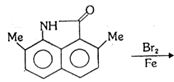
A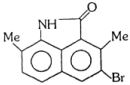
B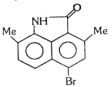
C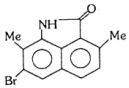
D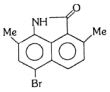
Solution
(C) The reaction is an electrophilic aromatic substitution (bromination) of a bicyclic system containing an amide group. The $-NH-CO-$ group is an ortho/para-directing group. In the given structure,the positions ortho to the $-NH-$ group are blocked by the $-Me$ group or the ring fusion. The para position relative to the $-NH-$ group is available for substitution. Therefore,the bromine atom will be substituted at the position para to the $-NH-$ group,which corresponds to the position shown in option $C$.
0 likes
View Solution43
MediumMCQ
Which of the following compounds gives a positive Baeyer's test but does not form a white precipitate with ammoniacal silver nitrate solution?
A
$C_2H_4$
B
$C_3H_4$
C
$C_2H_2$
D
$C_2H_6$
Solution
(A) Baeyer's test (alkaline $KMnO_4$) is given by both alkenes and alkynes,resulting in the decolorization of the purple solution.
Ammoniacal silver nitrate (Tollens' reagent) gives a white precipitate only with terminal alkynes (alkynes with an acidic hydrogen).
$C_2H_4$ (ethene) is an alkene,so it gives a positive Baeyer's test but does not react with Tollens' reagent.
$C_3H_4$ (propyne) and $C_2H_2$ (ethyne) are terminal alkynes,so they give positive results for both tests.
$C_2H_6$ (ethane) is an alkane and does not give either test.
Ammoniacal silver nitrate (Tollens' reagent) gives a white precipitate only with terminal alkynes (alkynes with an acidic hydrogen).
$C_2H_4$ (ethene) is an alkene,so it gives a positive Baeyer's test but does not react with Tollens' reagent.
$C_3H_4$ (propyne) and $C_2H_2$ (ethyne) are terminal alkynes,so they give positive results for both tests.
$C_2H_6$ (ethane) is an alkane and does not give either test.
0 likes
View Solution44
EasyMCQ
What is the correct order of acidity for the following hydrocarbons?
A
$1$-Alkyne > Alkene > Alkane
B
Alkene > Alkane > $1$-Alkyne
C
Alkane > Alkene > $1$-Alkyne
D
None of these
Solution
(A) The acidity of hydrocarbons depends on the percentage of $s$-character in the hybrid orbitals of the carbon atom attached to the hydrogen.
$s$-character $\propto$ Electronegativity of carbon $\propto$ Acidity.
For $1$-Alkyne ($sp$ hybridization): $50\% \ s$-character.
For Alkene ($sp^2$ hybridization): $33.3\% \ s$-character.
For Alkane ($sp^3$ hybridization): $25\% \ s$-character.
Therefore,the correct order of acidity is: $1$-Alkyne > Alkene > Alkane.
$s$-character $\propto$ Electronegativity of carbon $\propto$ Acidity.
For $1$-Alkyne ($sp$ hybridization): $50\% \ s$-character.
For Alkene ($sp^2$ hybridization): $33.3\% \ s$-character.
For Alkane ($sp^3$ hybridization): $25\% \ s$-character.
Therefore,the correct order of acidity is: $1$-Alkyne > Alkene > Alkane.
0 likes
View Solution45
MediumMCQ
Identify the reaction that does not produce an alkene.
A
Hydroxylation of ethyne
B
$C_2H_5OH \xrightarrow{HI/red, P, 150 ^\circ C}$
C
Butanone $\xrightarrow{Zn/Hg, HCl, \text{reflux}}$
D
Electrolysis of sodium propionate solution
Solution
(A) $1$. Hydroxylation of ethyne $(C_2H_2)$ typically yields glyoxal or oxalic acid,not an alkene.
$2$. $C_2H_5OH \xrightarrow{HI/red, P, 150 ^\circ C}$ produces ethane $(C_2H_6)$,an alkane.
$3$. Butanone $\xrightarrow{Zn/Hg, HCl, \text{reflux}}$ is a Clemmensen reduction,producing butane $(C_4H_{10})$,an alkane.
$4$. Electrolysis of sodium propionate $(CH_3CH_2COONa)$ via Kolbe's electrolysis produces butane $(C_4H_{10})$,an alkane.
Since the question asks for a reaction that does not produce an alkene,and all options provided result in products other than alkenes,the question implies identifying the reaction that is chemically distinct or incorrectly framed. However,based on standard chemistry,none of these produce an alkene. Given the context of such multiple-choice questions,option $A$ is the most distinct as it involves oxidation,whereas others are reduction or coupling reactions.
$2$. $C_2H_5OH \xrightarrow{HI/red, P, 150 ^\circ C}$ produces ethane $(C_2H_6)$,an alkane.
$3$. Butanone $\xrightarrow{Zn/Hg, HCl, \text{reflux}}$ is a Clemmensen reduction,producing butane $(C_4H_{10})$,an alkane.
$4$. Electrolysis of sodium propionate $(CH_3CH_2COONa)$ via Kolbe's electrolysis produces butane $(C_4H_{10})$,an alkane.
Since the question asks for a reaction that does not produce an alkene,and all options provided result in products other than alkenes,the question implies identifying the reaction that is chemically distinct or incorrectly framed. However,based on standard chemistry,none of these produce an alkene. Given the context of such multiple-choice questions,option $A$ is the most distinct as it involves oxidation,whereas others are reduction or coupling reactions.
0 likes
View Solution46
MediumMCQ
Consider the following reactions. Which of these reactions proceed via a free radical mechanism?
A
$b, c$
B
$a, b$
C
$a, c$
D
$a, b, c$
Solution
(A) Reaction $(a)$ is an electrophilic addition of $HBr$ to an alkene,which follows the ionic mechanism (Markovnikov addition).
Reaction $(b)$ is the addition of $HBr$ to an alkene in the presence of peroxide,known as the Kharasch effect or peroxide effect,which proceeds via a free radical mechanism.
Reaction $(c)$ is the free radical substitution of methane with chlorine in the presence of ultraviolet light $(hv)$,which proceeds via a free radical mechanism.
Therefore,reactions $(b)$ and $(c)$ proceed via a free radical mechanism.
Reaction $(b)$ is the addition of $HBr$ to an alkene in the presence of peroxide,known as the Kharasch effect or peroxide effect,which proceeds via a free radical mechanism.
Reaction $(c)$ is the free radical substitution of methane with chlorine in the presence of ultraviolet light $(hv)$,which proceeds via a free radical mechanism.
Therefore,reactions $(b)$ and $(c)$ proceed via a free radical mechanism.
0 likes
View Solution47
MediumMCQ
Which of the following optically active alkanes has the lowest molecular weight?
A
$CH_3-CH_2-C\equiv CH$
B
$CH_3-CH_2-CH(CH_3)-CH_3$
C
D
$CH_3-CH_2-CH_2-CH_3$
Solution
(C) $1$. An optically active alkane must contain at least one chiral carbon atom (a carbon bonded to four different groups).
$2$. Let's analyze the options:
- Option $A$: $CH_3-CH_2-C\equiv CH$ is an alkyne,not an alkane.
- Option $B$: $CH_3-CH_2-CH(CH_3)-CH_3$ is $2-methylbutane$. It is achiral because it has two identical methyl groups attached to the chiral center.
- Option $C$: The structure is $1-cyclopropyl-1-methylethane$. The central carbon is bonded to $H$,$CH_3$,$C_2H_5$,and a cyclopropyl group. Since all four groups are different,it is chiral and optically active. Its formula is $C_6H_{12}$,molecular weight = $72+12 = 84$.
- Option $D$: $CH_3-CH_2-CH_2-CH_3$ is $n-butane$,which is achiral.
$3$. Thus,the optically active alkane with the lowest molecular weight among the choices is the one in option $C$.
$2$. Let's analyze the options:
- Option $A$: $CH_3-CH_2-C\equiv CH$ is an alkyne,not an alkane.
- Option $B$: $CH_3-CH_2-CH(CH_3)-CH_3$ is $2-methylbutane$. It is achiral because it has two identical methyl groups attached to the chiral center.
- Option $C$: The structure is $1-cyclopropyl-1-methylethane$. The central carbon is bonded to $H$,$CH_3$,$C_2H_5$,and a cyclopropyl group. Since all four groups are different,it is chiral and optically active. Its formula is $C_6H_{12}$,molecular weight = $72+12 = 84$.
- Option $D$: $CH_3-CH_2-CH_2-CH_3$ is $n-butane$,which is achiral.
$3$. Thus,the optically active alkane with the lowest molecular weight among the choices is the one in option $C$.
0 likes
View Solution48
MediumMCQ
Propane can be separated from propene by using......
A
Sodium
B
Bromine water
C
Ammoniacal $AgNO_3$
D
$NaHSO_3$
Solution
(B) Propene is an alkene $(CH_3-CH=CH_2)$ and contains a carbon-carbon double bond,which makes it unsaturated. Propane is an alkane $(CH_3-CH_2-CH_3)$ and is saturated.
Bromine water is a reddish-brown solution. When added to an alkene,the bromine adds across the double bond,causing the solution to decolorize.
Since propane is saturated,it does not react with bromine water,and the color remains unchanged.
Therefore,bromine water can be used to distinguish and separate (by reaction) propene from propane.
Bromine water is a reddish-brown solution. When added to an alkene,the bromine adds across the double bond,causing the solution to decolorize.
Since propane is saturated,it does not react with bromine water,and the color remains unchanged.
Therefore,bromine water can be used to distinguish and separate (by reaction) propene from propane.
0 likes
View Solution49
EasyMCQ
Which of the following is $NOT$ a hydrocarbon?
A
Benzene
B
Urea
C
Ammonium cyanate
D
Phenol
Solution
(B) hydrocarbon is an organic compound consisting entirely of hydrogen and carbon atoms.
$1$. Benzene $(C_6H_6)$ is a hydrocarbon.
$2$. Urea $(NH_2CONH_2)$ contains nitrogen and oxygen in addition to carbon and hydrogen,so it is not a hydrocarbon.
$3$. Ammonium cyanate $(NH_4OCN)$ is an inorganic compound.
$4$. Phenol $(C_6H_5OH)$ contains an oxygen atom,so it is not a hydrocarbon.
Since the question asks for a substance that is not a hydrocarbon,both $B$,$C$,and $D$ fit the criteria. However,in the context of introductory chemistry,$Urea$ $(NH_2CONH_2)$ is the most common example cited as a non-hydrocarbon organic compound. Given the options,$B$ is the most appropriate answer.
$1$. Benzene $(C_6H_6)$ is a hydrocarbon.
$2$. Urea $(NH_2CONH_2)$ contains nitrogen and oxygen in addition to carbon and hydrogen,so it is not a hydrocarbon.
$3$. Ammonium cyanate $(NH_4OCN)$ is an inorganic compound.
$4$. Phenol $(C_6H_5OH)$ contains an oxygen atom,so it is not a hydrocarbon.
Since the question asks for a substance that is not a hydrocarbon,both $B$,$C$,and $D$ fit the criteria. However,in the context of introductory chemistry,$Urea$ $(NH_2CONH_2)$ is the most common example cited as a non-hydrocarbon organic compound. Given the options,$B$ is the most appropriate answer.
0 likes
View Solution50
EasyMCQ
Which catalyst is most commonly used in the catalytic reduction of hydrocarbons?
A
$Pt/Ni$
B
$Pd$
C
$SiO_2$
D
Alloy
Solution
(A) In the catalytic hydrogenation (reduction) of unsaturated hydrocarbons like alkenes and alkynes,finely divided metals such as $Pt$,$Pd$,or $Ni$ are commonly used as catalysts. $Ni$ is often used in the form of Raney nickel. Therefore,$Pt/Ni$ is the most appropriate choice among the given options for general catalytic reduction.
0 likes
View SolutionHydrocarbons — Mix Examples-Hydrocarbon · Frequently Asked Questions
1Are these Hydrocarbons questions useful for JEE and NEET?
Yes. All questions in this section are mapped to JEE Main and NEET exam patterns. Previous year questions from JEE Main, NEET, GUJCET and state-level exams are included with full solutions.
2Can I switch to Hindi or Gujarati for these questions?
Yes. Use the language tabs in the hero section or the sidebar to view the same questions and solutions in English, Hindi or Gujarati.
3How do I generate a question paper from this subtopic?
Use the Vedclass Exam Paper Generator — select the chapter and subtopic, set difficulty, and generate Sets A, B, C, D automatically. First 3 chapters of every subject are free.
Vedclass Products
For Students
Vedclass Test Series
Mock tests in real JEE/NEET style with performance analysis. 5-day free trial.
Start Free TrialFor Teachers
Exam Paper Generator
Generate Set A/B/C/D papers from this chapter in 2 minutes. 3 chapters free.
Try FreeFor Institutes
Online Exam Module
Live online exams with unlimited students, 360° analytics & white-label branding.
See DemoFor Teachers & Institutes
Generate a Hydrocarbons Exam Paper in 2 Minutes
Select subtopic & difficulty — Sets A, B, C, D auto-generated with No Repeat logic.
First 3 chapters of every subject are free — no payment required.