
A English
Alkene Questions in English
Class 11 Chemistry · Hydrocarbons · Alkene
1080+
Questions
English
Language
100%
With Solutions
Showing 50 of 1080 questions in English
851
MediumMCQ
The reaction of an alkene $X$ with bromine produces a compound $Y$,which has $22.22 \% \ C$,$3.71 \% \ H$ and $74.07 \% \ Br$. The ozonolysis of alkene $X$ gives only one product. The alkene $X$ is,
[Given,atomic mass of $C = 12$; $H = 1$; $Br = 80$ ]
[Given,atomic mass of $C = 12$; $H = 1$; $Br = 80$ ]
A
ethylene
B
$1$-butene
C
$2$-butene
D
$3$-hexene
Solution
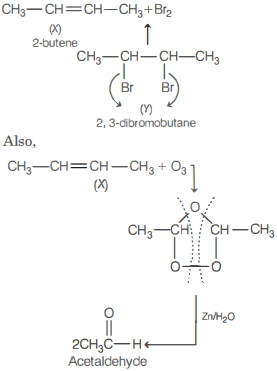
(C) The empirical formula of $Y$ is calculated as follows:
The empirical formula is $C_2H_4Br$. Since the reaction is $X + Br_2 \rightarrow Y$,the molecular formula of $Y$ is $C_4H_8Br_2$.
The alkene $X$ is $C_4H_8$. Ozonolysis of $X$ gives only one product,which implies $X$ is symmetric. Among the options,$2$-butene $(CH_3-CH=CH-CH_3)$ is symmetric and yields two molecules of acetaldehyde upon ozonolysis.
| Element | $\%$ of element | At mass | Moles | Ratio |
| $C$ | $22.22$ | $12$ | $1.85$ | $2$ |
| $H$ | $3.71$ | $1$ | $3.71$ | $4$ |
| $Br$ | $74.07$ | $80$ | $0.92$ | $1$ |
The empirical formula is $C_2H_4Br$. Since the reaction is $X + Br_2 \rightarrow Y$,the molecular formula of $Y$ is $C_4H_8Br_2$.
The alkene $X$ is $C_4H_8$. Ozonolysis of $X$ gives only one product,which implies $X$ is symmetric. Among the options,$2$-butene $(CH_3-CH=CH-CH_3)$ is symmetric and yields two molecules of acetaldehyde upon ozonolysis.
0 likes
View Solution852
MediumMCQ
The major product formed when $but-2-ene$ is reacted with $O_3$ followed by treatment with $Zn / H_2O$ is:
A
$CH_3COOH$
B
$CH_3CHO$
C
$CH_3CH_2OH$
D
$CH_2=CH_2$
Solution
(B) The reaction of $but-2-ene$ $(CH_3-CH=CH-CH_3)$ with $O_3$ followed by reductive workup with $Zn / H_2O$ is known as reductive ozonolysis.
In this reaction,the double bond is cleaved to form two molecules of acetaldehyde $(CH_3CHO)$.
The reaction mechanism is as follows:
$CH_3-CH=CH-CH_3 + O_3 \rightarrow \text{Ozonide intermediate}$
$\text{Ozonide} + Zn / H_2O \rightarrow 2CH_3CHO + ZnO + H_2O$
Therefore,the major product is acetaldehyde $(CH_3CHO)$.
In this reaction,the double bond is cleaved to form two molecules of acetaldehyde $(CH_3CHO)$.
The reaction mechanism is as follows:
$CH_3-CH=CH-CH_3 + O_3 \rightarrow \text{Ozonide intermediate}$
$\text{Ozonide} + Zn / H_2O \rightarrow 2CH_3CHO + ZnO + H_2O$
Therefore,the major product is acetaldehyde $(CH_3CHO)$.
0 likes
View Solution853
MediumMCQ
Reaction of but$-2-$ene with acidic $KMnO_4$ gives:
A
$CH_3CHO$
B
$HCOOH$
C
$CH_3CH_2OH$
D
$CH_3COOH$
Solution
(D) The reaction of but$-2-$ene $(CH_3-CH=CH-CH_3)$ with acidic $KMnO_4$ is an oxidative cleavage reaction.
Acidic $KMnO_4$ is a strong oxidizing agent that breaks the carbon-carbon double bond.
Since but$-2-$ene is a symmetrical alkene,the oxidative cleavage of the double bond results in the formation of two molecules of acetic acid $(CH_3COOH)$.
The reaction is: $CH_3-CH=CH-CH_3 + [O] \xrightarrow{KMnO_4/H^+} 2CH_3COOH$.
Acidic $KMnO_4$ is a strong oxidizing agent that breaks the carbon-carbon double bond.
Since but$-2-$ene is a symmetrical alkene,the oxidative cleavage of the double bond results in the formation of two molecules of acetic acid $(CH_3COOH)$.
The reaction is: $CH_3-CH=CH-CH_3 + [O] \xrightarrow{KMnO_4/H^+} 2CH_3COOH$.
0 likes
View Solution854
MediumMCQ
Reaction of ethanol with conc. sulphuric acid at $170^{\circ} C$ produces a gas which is then treated with bromine in carbon tetrachloride. The major product obtained in this reaction is
A
$1,2$-dibromoethane
B
ethylene glycol
C
bromoethane
D
ethyl sulphate
Solution
(A) Step $1$: Ethanol $(CH_3CH_2OH)$ undergoes dehydration in the presence of concentrated sulphuric acid $(H_2SO_4)$ at $170^{\circ} C$ to produce ethene $(CH_2=CH_2)$ gas.
$CH_3CH_2OH \xrightarrow{Conc. H_2SO_4, 170^{\circ} C} CH_2=CH_2 + H_2O$
Step $2$: The ethene gas is then treated with bromine $(Br_2)$ in carbon tetrachloride $(CCl_4)$,which is an electrophilic addition reaction,resulting in the formation of $1,2$-dibromoethane.
$CH_2=CH_2 + Br_2 \xrightarrow{CCl_4} CH_2Br-CH_2Br$
Therefore,the major product is $1,2$-dibromoethane.
$CH_3CH_2OH \xrightarrow{Conc. H_2SO_4, 170^{\circ} C} CH_2=CH_2 + H_2O$
Step $2$: The ethene gas is then treated with bromine $(Br_2)$ in carbon tetrachloride $(CCl_4)$,which is an electrophilic addition reaction,resulting in the formation of $1,2$-dibromoethane.
$CH_2=CH_2 + Br_2 \xrightarrow{CCl_4} CH_2Br-CH_2Br$
Therefore,the major product is $1,2$-dibromoethane.
0 likes
View Solution855
MediumMCQ
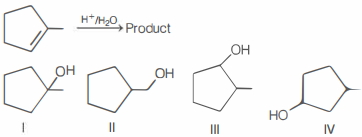
The major product of the reaction is:
A
$I$
B
$II$
C
$III$
D
$IV$
Solution
(A) The reaction involves the acid-catalyzed hydration of $1$-methylcyclopentene.
In the presence of an acid catalyst $(H^+)$,water adds across the double bond of the alkene.
This reaction proceeds via an electrophilic addition mechanism,where the proton $(H^+)$ first adds to the less substituted carbon of the double bond to form the more stable carbocation intermediate.
For $1$-methylcyclopentene,the proton adds to the $CH$ group,resulting in a tertiary carbocation at the carbon atom already bearing the methyl group.
Subsequently,a water molecule attacks this tertiary carbocation,followed by deprotonation to yield $1$-methylcyclopentan-$1$-ol.
This follows the Markownikoff rule,which states that the nucleophile $(-OH)$ attaches to the more substituted carbon atom.
Therefore,the major product is structure $I$.
In the presence of an acid catalyst $(H^+)$,water adds across the double bond of the alkene.
This reaction proceeds via an electrophilic addition mechanism,where the proton $(H^+)$ first adds to the less substituted carbon of the double bond to form the more stable carbocation intermediate.
For $1$-methylcyclopentene,the proton adds to the $CH$ group,resulting in a tertiary carbocation at the carbon atom already bearing the methyl group.
Subsequently,a water molecule attacks this tertiary carbocation,followed by deprotonation to yield $1$-methylcyclopentan-$1$-ol.
This follows the Markownikoff rule,which states that the nucleophile $(-OH)$ attaches to the more substituted carbon atom.
Therefore,the major product is structure $I$.
0 likes
View Solution856
MediumMCQ
The major product of the reaction of $2$-butene with alkaline $KMnO_4$ solution is
A
B
C
D
Solution
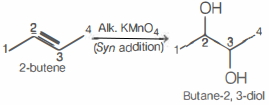
(D) The reaction of $2$-butene $(CH_3-CH=CH-CH_3)$ with cold,dilute alkaline $KMnO_4$ (Baeyer's reagent) is a syn-hydroxylation reaction.
This reaction adds two hydroxyl $(-OH)$ groups across the double bond to form a vicinal glycol.
The product formed is butane-$2,3$-diol.
This reaction adds two hydroxyl $(-OH)$ groups across the double bond to form a vicinal glycol.
The product formed is butane-$2,3$-diol.
0 likes
View Solution857
MediumMCQ
Compound $X$ on heating with $Zn$ dust gives compound $Y$,which on treatment with $O_3$ followed by reaction with $Zn$ dust and $H_2O$ gives propionaldehyde. The structure of $X$ is:
A
$3,4-$dibromohexane
B
$3,4-$dibromo$-3-$hexene
C
$3,4-$dibromohexane (vicinal)
D
$2,3-$dibromohexane
Solution
(C) The reaction sequence is as follows:
$X$ $\xrightarrow{\Delta, Zn} Y$ $\xrightarrow{O_3, Zn/H_2O} 2 CH_3CH_2CHO$ (Propionaldehyde)
Since the ozonolysis product is two moles of propionaldehyde $(CH_3CH_2CHO)$,the alkene $Y$ must be hex$-3-$ene $(CH_3CH_2CH=CHCH_2CH_3)$.
Heating a vicinal dibromide with $Zn$ dust causes debromination to form an alkene.
Therefore,$X$ must be $3,4-$dibromohexane $(CH_3CH_2CH(Br)CH(Br)CH_2CH_3)$.
Comparing this with the given options,the structure corresponds to $3,4-$dibromohexane.
$X$ $\xrightarrow{\Delta, Zn} Y$ $\xrightarrow{O_3, Zn/H_2O} 2 CH_3CH_2CHO$ (Propionaldehyde)
Since the ozonolysis product is two moles of propionaldehyde $(CH_3CH_2CHO)$,the alkene $Y$ must be hex$-3-$ene $(CH_3CH_2CH=CHCH_2CH_3)$.
Heating a vicinal dibromide with $Zn$ dust causes debromination to form an alkene.
Therefore,$X$ must be $3,4-$dibromohexane $(CH_3CH_2CH(Br)CH(Br)CH_2CH_3)$.
Comparing this with the given options,the structure corresponds to $3,4-$dibromohexane.
0 likes
View Solution858
MediumMCQ
$2,3$-dimethylbut-$2$-ene when reacted with bromine forms a compound which upon heating with alcoholic $KOH$ produces the following major product.
A
B
C
D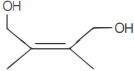
Solution
(B) The reaction of $2,3$-dimethylbut-$2$-ene with bromine $(Br_2)$ in $CCl_4$ is an electrophilic addition reaction,which yields $2,3$-dibromo-$2,3$-dimethylbutane.
$CH_3-C(CH_3)=C(CH_3)-CH_3 + Br_2 \rightarrow CH_3-C(CH_3)(Br)-C(CH_3)(Br)-CH_3$
When $2,3$-dibromo-$2,3$-dimethylbutane is heated with alcoholic $KOH$,it undergoes a dehydrohalogenation reaction (elimination of two molecules of $HBr$) to form the conjugated diene,$2,3$-dimethylbuta-$1,3$-diene.
$CH_3-C(CH_3)(Br)-C(CH_3)(Br)-CH_3 \xrightarrow{\text{alc. } KOH, \Delta} CH_2=C(CH_3)-C(CH_3)=CH_2 + 2HBr$
Thus,the major product is $2,3$-dimethylbuta-$1,3$-diene.
$CH_3-C(CH_3)=C(CH_3)-CH_3 + Br_2 \rightarrow CH_3-C(CH_3)(Br)-C(CH_3)(Br)-CH_3$
When $2,3$-dibromo-$2,3$-dimethylbutane is heated with alcoholic $KOH$,it undergoes a dehydrohalogenation reaction (elimination of two molecules of $HBr$) to form the conjugated diene,$2,3$-dimethylbuta-$1,3$-diene.
$CH_3-C(CH_3)(Br)-C(CH_3)(Br)-CH_3 \xrightarrow{\text{alc. } KOH, \Delta} CH_2=C(CH_3)-C(CH_3)=CH_2 + 2HBr$
Thus,the major product is $2,3$-dimethylbuta-$1,3$-diene.
0 likes
View Solution859
MediumMCQ
The reaction of $1-$ethylcyclopentene with $BH_3 / THF$ followed by treatment with $H_2O_2 / NaOH$ produces:
A
B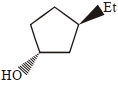
C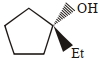
D
Solution
(D) The reaction of $1-$ethylcyclopentene with $BH_3 / THF$ followed by $H_2O_2 / NaOH$ is a hydroboration-oxidation reaction.
This reaction proceeds via the syn-addition of $H$ and $OH$ across the double bond.
Since the addition is syn,the $H$ atom and the $OH$ group add to the same face of the double bond.
This results in the formation of a mixture of enantiomers where the $OH$ group and the ethyl group are in a cis-relationship.
Specifically,the product is $2-$ethylcyclopentan-$1-$ol,where the $OH$ and ethyl groups are cis to each other.
Looking at the options,the structure representing the cis-isomer is the correct product.
This reaction proceeds via the syn-addition of $H$ and $OH$ across the double bond.
Since the addition is syn,the $H$ atom and the $OH$ group add to the same face of the double bond.
This results in the formation of a mixture of enantiomers where the $OH$ group and the ethyl group are in a cis-relationship.
Specifically,the product is $2-$ethylcyclopentan-$1-$ol,where the $OH$ and ethyl groups are cis to each other.
Looking at the options,the structure representing the cis-isomer is the correct product.
0 likes
View Solution860
MediumMCQ
$A$ hydrocarbon having molecular formula $C_5H_{10}$ produced a tertiary alcohol upon treatment with a few drops of conc. sulphuric acid and water. The same hydrocarbon when reacted with acidic potassium permanganate produced a ketone and a carboxylic acid. The hydrocarbon is $....$
A
cyclopentane
B
$1$-pentene
C
$2$-methyl$-2$-butene
D
$2$-pentene
Solution
(C) The hydrocarbon with molecular formula $C_5H_{10}$ is an alkene.
Acid-catalyzed hydration of $2$-methyl$-2$-butene $(CH_3-C(CH_3)=CH-CH_3)$ follows Markovnikov's rule to form $2$-methyl$-2$-butanol,which is a tertiary $(3^{\circ})$ alcohol.
Oxidative cleavage of $2$-methyl$-2$-butene with acidic $KMnO_4$ breaks the double bond to produce acetone $(CH_3COCH_3)$ and acetic acid $(CH_3COOH)$,which are a ketone and a carboxylic acid respectively.
Therefore,the correct hydrocarbon is $2$-methyl$-2$-butene.
Acid-catalyzed hydration of $2$-methyl$-2$-butene $(CH_3-C(CH_3)=CH-CH_3)$ follows Markovnikov's rule to form $2$-methyl$-2$-butanol,which is a tertiary $(3^{\circ})$ alcohol.
Oxidative cleavage of $2$-methyl$-2$-butene with acidic $KMnO_4$ breaks the double bond to produce acetone $(CH_3COCH_3)$ and acetic acid $(CH_3COOH)$,which are a ketone and a carboxylic acid respectively.
Therefore,the correct hydrocarbon is $2$-methyl$-2$-butene.
0 likes
View Solution861
MediumMCQ
In the following given reaction,'$A$' is the major product:
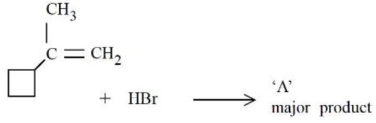
A
$1-$bromo$-1-$methylcyclohexane
B
$2-$bromo$-1-$methylcyclohexane
C
$1-$bromo$-1,2-$dimethylcyclopentane
D
$1-$bromo$-2,2-$dimethylcyclopentane
Solution
(C) The reaction involves the electrophilic addition of $HBr$ to $1$-cyclobutyl$-1-$methylethene.
Step $1$: Protonation of the double bond by $H^+$ from $HBr$ forms a more stable tertiary carbocation.
Step $2$: The cyclobutyl ring undergoes a ring expansion to form a more stable $5$-membered cyclopentyl ring carbocation.
Step $3$: The $Br^-$ ion attacks the carbocation to form the final major product,which is $1$-bromo$-1,2-$dimethylcyclopentane.
Step $1$: Protonation of the double bond by $H^+$ from $HBr$ forms a more stable tertiary carbocation.
Step $2$: The cyclobutyl ring undergoes a ring expansion to form a more stable $5$-membered cyclopentyl ring carbocation.
Step $3$: The $Br^-$ ion attacks the carbocation to form the final major product,which is $1$-bromo$-1,2-$dimethylcyclopentane.
1 likes
View Solution862
MediumMCQ
Find out the major products $A$ and $B$ from the following reactions.
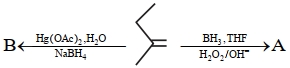
A
$A$ = $2-$methylbutan$-1-$ol,$B$ = $2-$methylbutan$-2-$ol
B
$A$ = $2-$methylbutan$-2-$ol,$B$ = $2-$methylbutan$-1-$ol
C
$A$ = $2-$methylbutan$-2-$ol,$B$ = $2-$methylbutan$-2-$ol
D
$A$ = $2-$methylbutan$-1-$ol,$B$ = $2-$methylbutan$-1-$ol
Solution
(A) The reaction of $2$-methylbut-$1$-ene with $BH_3, THF$ followed by $H_2O_2/OH^-$ is a hydroboration-oxidation reaction,which follows Anti-Markovnikov addition of water to the double bond. This yields $2$-methylbutan-$1$-ol as product $A$.
The reaction of $2$-methylbut-$1$-ene with $Hg(OAc)_2, H_2O$ followed by $NaBH_4$ is an oxymercuration-demercuration reaction,which follows Markovnikov addition of water to the double bond. This yields $2$-methylbutan-$2$-ol as product $B$.
The reaction of $2$-methylbut-$1$-ene with $Hg(OAc)_2, H_2O$ followed by $NaBH_4$ is an oxymercuration-demercuration reaction,which follows Markovnikov addition of water to the double bond. This yields $2$-methylbutan-$2$-ol as product $B$.
0 likes
View Solution863
DifficultMCQ
$17 \, mg$ of a hydrocarbon ($M$.$F$. $C_{10}H_{16}$) takes up $8.40 \, mL$ of $H_2$ gas measured at $0^{\circ}C$ and $760 \, mm$ of $Hg$. Ozonolysis of the same hydrocarbon yields acetone,formaldehyde,and a compound with the structure $CH_3-CO-CH_2-CH_2-CHO$. The number of double bonds present in the hydrocarbon is $...........$.
A
$3$
B
$6$
C
$9$
D
$12$
Solution
(A) $1$. Calculate the moles of the hydrocarbon: Molar mass of $C_{10}H_{16} = (10 \times 12) + (16 \times 1) = 136 \, g/mol$. Moles of hydrocarbon $= \frac{17 \times 10^{-3} \, g}{136 \, g/mol} = 1.25 \times 10^{-4} \, mol$.
$2$. Calculate the moles of $H_2$ gas: At $STP$ ($0^{\circ}C$,$760 \, mm \, Hg$),$22400 \, mL$ corresponds to $1 \, mol$. Moles of $H_2 = \frac{8.40 \, mL}{22400 \, mL/mol} = 3.75 \times 10^{-4} \, mol$.
$3$. Determine the number of double bonds: Each double bond consumes $1 \, mol$ of $H_2$ for hydrogenation. Number of double bonds $= \frac{\text{moles of } H_2}{\text{moles of hydrocarbon}} = \frac{3.75 \times 10^{-4}}{1.25 \times 10^{-4}} = 3$.
$2$. Calculate the moles of $H_2$ gas: At $STP$ ($0^{\circ}C$,$760 \, mm \, Hg$),$22400 \, mL$ corresponds to $1 \, mol$. Moles of $H_2 = \frac{8.40 \, mL}{22400 \, mL/mol} = 3.75 \times 10^{-4} \, mol$.
$3$. Determine the number of double bonds: Each double bond consumes $1 \, mol$ of $H_2$ for hydrogenation. Number of double bonds $= \frac{\text{moles of } H_2}{\text{moles of hydrocarbon}} = \frac{3.75 \times 10^{-4}}{1.25 \times 10^{-4}} = 3$.
0 likes
View Solution864
MediumMCQ
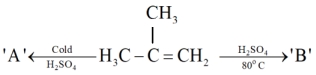
The major products '$A$' and '$B$',respectively,are
A
$H_3C-C(CH_3)_2-OSO_3H$ & $CH_3-C(CH_3)=CH-C(CH_3)_3$
B
$CH_3-C(CH_3)=CH-C(CH_3)_3$ & $H_3C-C(CH_3)_2-OSO_3H$
C
$CH_3-CH(CH_3)-CH_2-CH_2-CH(CH_3)-CH_3$ & $H_3C-C(CH_3)_2-OSO_3H$
D
$H_3C-C(CH_3)_2-OSO_3H$ & $CH_3-CH(CH_3)-CH_2-CH_2-CH(CH_3)-CH_3$
Solution
(A) The reaction of $2$-methylpropene with cold $H_2SO_4$ follows Markovnikov's addition,where the proton $H^+$ adds to the terminal carbon to form a stable tertiary carbocation $(CH_3)_3C^+$. This carbocation then reacts with the hydrogen sulfate ion $HSO_4^-$ to form the alkyl hydrogen sulfate,$2$-methyl$-2-$propyl hydrogen sulfate,which is product '$A$'.
At higher temperatures $(80^{\circ}C)$,the reaction involves the dimerization of the alkene. The tertiary carbocation $(CH_3)_3C^+$ formed initially attacks another molecule of $2$-methylpropene to form a more stable carbocation,which then undergoes deprotonation to yield the dimer,$2,4,4$-trimethylpent-$2$-ene,which is product '$B$'.
At higher temperatures $(80^{\circ}C)$,the reaction involves the dimerization of the alkene. The tertiary carbocation $(CH_3)_3C^+$ formed initially attacks another molecule of $2$-methylpropene to form a more stable carbocation,which then undergoes deprotonation to yield the dimer,$2,4,4$-trimethylpent-$2$-ene,which is product '$B$'.
0 likes
View Solution865
DifficultMCQ
$A$ hydrocarbon '$X$' with formula $C_6H_8$ uses two moles of $H_2$ on catalytic hydrogenation of its one mole. On ozonolysis,'$X$' yields two moles of methane dicarbaldehyde (malonaldehyde). The hydrocarbon '$X$' is :
A
hexa$-1, 3, 5-$triene
B
$1-$methylcyclopenta$-1, 4-$diene
C
cyclohexa$-1, 3-$diene
D
cyclohexa$-1, 4-$diene
Solution
(D) $1$. The hydrocarbon '$X$' has the molecular formula $C_6H_8$.
$2$. It consumes two moles of $H_2$ upon catalytic hydrogenation,indicating the presence of two double bonds.
$3$. Ozonolysis of '$X$' yields two moles of methane dicarbaldehyde $(OHC-CH_2-CHO)$.
$4$. Methane dicarbaldehyde is also known as malonaldehyde.
$5$. Cyclohexa$-1, 4-$diene undergoes ozonolysis to break the two double bonds,resulting in two molecules of $OHC-CH_2-CHO$.
$6$. Therefore,the hydrocarbon '$X$' is cyclohexa$-1, 4-$diene.
$2$. It consumes two moles of $H_2$ upon catalytic hydrogenation,indicating the presence of two double bonds.
$3$. Ozonolysis of '$X$' yields two moles of methane dicarbaldehyde $(OHC-CH_2-CHO)$.
$4$. Methane dicarbaldehyde is also known as malonaldehyde.
$5$. Cyclohexa$-1, 4-$diene undergoes ozonolysis to break the two double bonds,resulting in two molecules of $OHC-CH_2-CHO$.
$6$. Therefore,the hydrocarbon '$X$' is cyclohexa$-1, 4-$diene.
0 likes
View Solution866
DifficultMCQ
$but-2-yne$ is reacted separately with one mole of $H_2$ as shown below:
$\underline{ B } \xleftarrow[\text{liq } NH_3]{Na} CH_3-C \equiv C-CH_3 \xrightarrow[\Delta]{Pd/C} \underline{ A }$
Identify the incorrect statements from the options given below:
$A.$ $A$ is more soluble than $B$.
$B.$ The boiling point and melting point of $A$ are higher and lower than $B$ respectively.
$C.$ $A$ is more polar than $B$ because dipole moment of $A$ is zero.
$D.$ $Br_2$ adds easily to $B$ than $A$.
$\underline{ B } \xleftarrow[\text{liq } NH_3]{Na} CH_3-C \equiv C-CH_3 \xrightarrow[\Delta]{Pd/C} \underline{ A }$
Identify the incorrect statements from the options given below:
$A.$ $A$ is more soluble than $B$.
$B.$ The boiling point and melting point of $A$ are higher and lower than $B$ respectively.
$C.$ $A$ is more polar than $B$ because dipole moment of $A$ is zero.
$D.$ $Br_2$ adds easily to $B$ than $A$.
A
$B$ and $C$ only
B
$B, C$ and $D$ only
C
$A, C$ and $D$ only
D
$A$ and $B$ only
Solution
(C, D) The reaction of $but-2-yne$ with $Na/liq. NH_3$ (Birch reduction) yields $trans-but-2-ene$ $(B)$.
The reaction of $but-2-yne$ with $Pd/C$ (Lindlar's catalyst) yields $cis-but-2-ene$ $(A)$.
$A$ $(cis-but-2-ene)$ has a dipole moment $\mu \neq 0$,while $B$ $(trans-but-2-ene)$ has $\mu = 0$.
Statement $A$: $cis$ isomers are generally more polar and have higher boiling points,but solubility depends on crystal packing; $trans$ isomers $(B)$ pack better,leading to higher melting points.
Statement $B$: $A$ $(cis)$ has a higher boiling point than $B$ $(trans)$,but $B$ has a higher melting point due to better symmetry.
Statement $C$: $A$ is more polar than $B$ because $A$ has a non-zero dipole moment,while $B$ is zero. The statement claims $A$ is more polar because its dipole moment is zero,which is false.
Statement $D$: Both $A$ and $B$ are alkenes and react similarly with $Br_2$; there is no significant difference in ease of addition. Thus,$D$ is also incorrect.
Since $C$ and $D$ are incorrect,and no option matches,the question is flawed.
The reaction of $but-2-yne$ with $Pd/C$ (Lindlar's catalyst) yields $cis-but-2-ene$ $(A)$.
$A$ $(cis-but-2-ene)$ has a dipole moment $\mu \neq 0$,while $B$ $(trans-but-2-ene)$ has $\mu = 0$.
Statement $A$: $cis$ isomers are generally more polar and have higher boiling points,but solubility depends on crystal packing; $trans$ isomers $(B)$ pack better,leading to higher melting points.
Statement $B$: $A$ $(cis)$ has a higher boiling point than $B$ $(trans)$,but $B$ has a higher melting point due to better symmetry.
Statement $C$: $A$ is more polar than $B$ because $A$ has a non-zero dipole moment,while $B$ is zero. The statement claims $A$ is more polar because its dipole moment is zero,which is false.
Statement $D$: Both $A$ and $B$ are alkenes and react similarly with $Br_2$; there is no significant difference in ease of addition. Thus,$D$ is also incorrect.
Since $C$ and $D$ are incorrect,and no option matches,the question is flawed.
0 likes
View Solution867
MediumMCQ
The incorrect method for the synthesis of alkenes is:
A
treatment of alkynes with $Na$ in liquid $NH_3$
B
heating alkyl halides with alcoholic $KOH$
C
treating alkyl halides in aqueous $KOH$ solution
D
treating vicinal dihalides with $Zn$ metal
Solution
(C) The synthesis of alkenes involves elimination reactions.
$(A)$ Treatment of alkynes with $Na$ in liquid $NH_3$ (Birch reduction) produces trans-alkenes.
$(B)$ Heating alkyl halides with alcoholic $KOH$ undergoes dehydrohalogenation to form alkenes.
$(C)$ Treating alkyl halides with aqueous $KOH$ results in nucleophilic substitution,producing alcohols $(R-X + KOH_{(aq)} \rightarrow R-OH + KX)$,not alkenes.
$(D)$ Treating vicinal dihalides with $Zn$ metal undergoes debromination/dehalogenation to form alkenes.
Therefore,option $C$ is the incorrect method for alkene synthesis.
$(A)$ Treatment of alkynes with $Na$ in liquid $NH_3$ (Birch reduction) produces trans-alkenes.
$(B)$ Heating alkyl halides with alcoholic $KOH$ undergoes dehydrohalogenation to form alkenes.
$(C)$ Treating alkyl halides with aqueous $KOH$ results in nucleophilic substitution,producing alcohols $(R-X + KOH_{(aq)} \rightarrow R-OH + KX)$,not alkenes.
$(D)$ Treating vicinal dihalides with $Zn$ metal undergoes debromination/dehalogenation to form alkenes.
Therefore,option $C$ is the incorrect method for alkene synthesis.
0 likes
View Solution868
MediumMCQ
Molar mass of the hydrocarbon $(X)$ which on ozonolysis consumes one mole of $O_3$ per mole of $(X)$ and gives one mole each of ethanal and propanone is $...... g\ mol^{-1}$ (Molar mass of $C: 12\ g\ mol^{-1}, H: 1\ g\ mol^{-1}$)
A
$71$
B
$70$
C
$69$
D
$68$
Solution
(B) The ozonolysis of an alkene involves the cleavage of the $C=C$ double bond to form carbonyl compounds.
Ethanal is $CH_3CHO$ and propanone is $(CH_3)_2CO$.
By joining these two fragments at the carbonyl carbons,we get the structure of the alkene $(X)$:
$CH_3-CH=C(CH_3)_2$.
The chemical formula of this hydrocarbon is $C_5H_{10}$.
The molar mass of $C_5H_{10} = (5 \times 12) + (10 \times 1) = 60 + 10 = 70 \ g\ mol^{-1}$.
Ethanal is $CH_3CHO$ and propanone is $(CH_3)_2CO$.
By joining these two fragments at the carbonyl carbons,we get the structure of the alkene $(X)$:
$CH_3-CH=C(CH_3)_2$.
The chemical formula of this hydrocarbon is $C_5H_{10}$.
The molar mass of $C_5H_{10} = (5 \times 12) + (10 \times 1) = 60 + 10 = 70 \ g\ mol^{-1}$.
0 likes
View Solution869
DifficultMCQ
Major product '$P$' formed in the following reaction is:-

A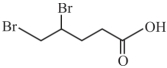
B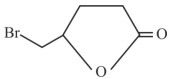
C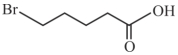
D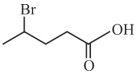
Solution
(B) The reaction involves the electrophilic addition of $Br_2$ to the alkene group of pent$-4-$enoic acid.
$1$. $Br_2$ reacts with the double bond to form a cyclic bromonium ion intermediate.
$2$. The base $NaHCO_3$ deprotonates the carboxylic acid group to form a carboxylate anion $(R-COO^-)$.
$3$. This carboxylate anion acts as an internal nucleophile and attacks the more substituted carbon of the bromonium ion,leading to an intramolecular cyclization (halolactonization).
$4$. This results in the formation of a five-membered lactone ring with a bromomethyl group attached,which is the major product $P$.
$1$. $Br_2$ reacts with the double bond to form a cyclic bromonium ion intermediate.
$2$. The base $NaHCO_3$ deprotonates the carboxylic acid group to form a carboxylate anion $(R-COO^-)$.
$3$. This carboxylate anion acts as an internal nucleophile and attacks the more substituted carbon of the bromonium ion,leading to an intramolecular cyclization (halolactonization).
$4$. This results in the formation of a five-membered lactone ring with a bromomethyl group attached,which is the major product $P$.
0 likes
View Solution870
MediumMCQ
$2-$hexene $\xrightarrow[(i) O_3]{(ii) H_2O}$ Products
The two products formed in the above reaction are -
The two products formed in the above reaction are -
A
Butanoic acid and acetic acid
B
Butanal and acetic acid
C
Butanal and acetaldehyde
D
Butanoic acid and acetaldehyde
Solution
(A) The reaction of $2-$hexene $(CH_3-CH=CH-CH_2-CH_2-CH_3)$ with $O_3$ followed by $H_2O$ is an oxidative ozonolysis.
In oxidative ozonolysis,the double bond is cleaved,and the resulting aldehydes are further oxidized to carboxylic acids.
$CH_3-CH=CH-CH_2-CH_2-CH_3 \xrightarrow[(i) O_3]{(ii) H_2O} CH_3COOH + CH_3CH_2CH_2COOH$
The products formed are acetic acid $(CH_3COOH)$ and butanoic acid $(CH_3CH_2CH_2COOH)$.
In oxidative ozonolysis,the double bond is cleaved,and the resulting aldehydes are further oxidized to carboxylic acids.
$CH_3-CH=CH-CH_2-CH_2-CH_3 \xrightarrow[(i) O_3]{(ii) H_2O} CH_3COOH + CH_3CH_2CH_2COOH$
The products formed are acetic acid $(CH_3COOH)$ and butanoic acid $(CH_3CH_2CH_2COOH)$.
0 likes
View Solution871
DifficultMCQ
$3-$Methylhex$-2-$ene on reaction with $HBr$ in the presence of peroxide forms an addition product $(A)$. The number of possible stereoisomers for '$A$' is $....$.
A
$4$
B
$6$
C
$8$
D
$12$
Solution
(A) The reaction of $3-$methylhex$-2-$ene with $HBr$ in the presence of peroxide follows the anti-Markovnikov addition mechanism.
The product $(A)$ formed is $2-$bromo$-3-$methylhexane.
The structure of $2-$bromo$-3-$methylhexane is $CH_3-CH(Br)-CH(CH_3)-CH_2-CH_2-CH_3$.
This molecule contains $2$ chiral centers at $C-2$ and $C-3$.
Since the two chiral centers are not equivalent (the groups attached to them are different),the number of stereoisomers is given by $2^n$,where $n$ is the number of chiral centers.
Number of stereoisomers $= 2^2 = 4$.
The product $(A)$ formed is $2-$bromo$-3-$methylhexane.
The structure of $2-$bromo$-3-$methylhexane is $CH_3-CH(Br)-CH(CH_3)-CH_2-CH_2-CH_3$.
This molecule contains $2$ chiral centers at $C-2$ and $C-3$.
Since the two chiral centers are not equivalent (the groups attached to them are different),the number of stereoisomers is given by $2^n$,where $n$ is the number of chiral centers.
Number of stereoisomers $= 2^2 = 4$.
0 likes
View Solution872
DifficultMCQ
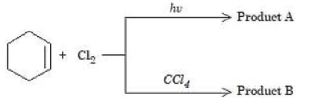
Identify product $A$ and product $B$ for the following reaction:
A
$A$: $1,2-$dichlorocyclohexane,$B$: $1,4-$dichlorocyclohex$-2-$ene
B
$A$: $1,4-$dichlorocyclohex$-2-$ene,$B$: $1,4-$dichlorocyclohex$-2-$ene
C
$A$: $1,2-$dichlorocyclohexane,$B$: $1,2-$dichlorocyclohexane
D
$A$: $1,4-$dichlorocyclohex$-2-$ene,$B$: $1,2-$dichlorocyclohexane
Solution
(D) $1$. In the presence of $h\nu$ (ultraviolet light),$Cl_2$ undergoes homolytic cleavage to form chlorine free radicals. These radicals perform allylic substitution on cyclohexene to form $1,4-\text{dichlorocyclohex-2-ene}$ as product $A$.
$2$. In the presence of $CCl_4$ (an inert solvent),$Cl_2$ undergoes electrophilic addition across the double bond of cyclohexene to form $1,2-\text{dichlorocyclohexane}$ as product $B$.
$2$. In the presence of $CCl_4$ (an inert solvent),$Cl_2$ undergoes electrophilic addition across the double bond of cyclohexene to form $1,2-\text{dichlorocyclohexane}$ as product $B$.
0 likes
View Solution873
DifficultMCQ
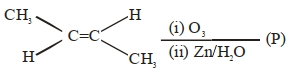
Consider the given reaction. The total number of oxygen atoms present per molecule of the product $(P)$ is . . . . . .
A
$2$
B
$1$
C
$7$
D
$5$
Solution
(B) The reaction is the ozonolysis of but$-2-$ene.
$CH_3-CH=CH-CH_3 \xrightarrow[(ii) Zn/H_2O]{(i) O_3} 2CH_3CHO$
Here,the product $(P)$ is acetaldehyde $(CH_3CHO)$.
In one molecule of acetaldehyde $(CH_3CHO)$,there is $1$ oxygen atom.
Therefore,the total number of oxygen atoms present per molecule of the product is $1$.
$CH_3-CH=CH-CH_3 \xrightarrow[(ii) Zn/H_2O]{(i) O_3} 2CH_3CHO$
Here,the product $(P)$ is acetaldehyde $(CH_3CHO)$.
In one molecule of acetaldehyde $(CH_3CHO)$,there is $1$ oxygen atom.
Therefore,the total number of oxygen atoms present per molecule of the product is $1$.
0 likes
View Solution874
DifficultMCQ
Which of the following reactions is correct?
A
$1-$methylcyclohexene + $HI$ $\rightarrow$ $1-$iodo$-1-$methylcyclohexane (Markovnikov addition)
B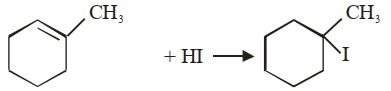
C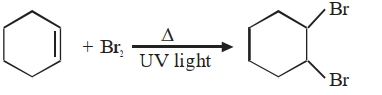
D
$CH_3CH_2CH_2NH_2 + CHCl_3 + 3KOH \rightarrow CH_3CH_2CH_2NC + 3KCl + 3H_2O$
Solution
(A) Option $A$ is correct. The reaction of $1-$methylcyclohexene with $HI$ follows Markovnikov's rule,where the nucleophile $(I^-)$ attaches to the more substituted carbon atom of the double bond,resulting in $1-$iodo$-1-$methylcyclohexane.
Option $B$ is incorrect because the reaction of cyclohexene with $Br_2$ in the presence of $UV$ light/heat typically leads to allylic bromination,not addition.
Option $C$ represents the Hofmann bromamide degradation reaction,which is correctly balanced as: $CH_3CH_2CONH_2 + Br_2 + 4NaOH \rightarrow CH_3CH_2NH_2 + Na_2CO_3 + 2NaBr + 2H_2O$.
Option $D$ represents the carbylamine reaction,which is also correctly written.
Given the provided images,the question likely intends to identify the correct chemical transformation shown in the diagrams. Since both $A$ and $C$ are chemically correct,$A$ is the primary reaction depicted in the solution image.
Option $B$ is incorrect because the reaction of cyclohexene with $Br_2$ in the presence of $UV$ light/heat typically leads to allylic bromination,not addition.
Option $C$ represents the Hofmann bromamide degradation reaction,which is correctly balanced as: $CH_3CH_2CONH_2 + Br_2 + 4NaOH \rightarrow CH_3CH_2NH_2 + Na_2CO_3 + 2NaBr + 2H_2O$.
Option $D$ represents the carbylamine reaction,which is also correctly written.
Given the provided images,the question likely intends to identify the correct chemical transformation shown in the diagrams. Since both $A$ and $C$ are chemically correct,$A$ is the primary reaction depicted in the solution image.
0 likes
View Solution875
DifficultMCQ
The products $A$ and $B$ formed in the following set of reactions are:

A
$A = \text{1-methylcyclohexanol}$,$B = \text{2-methylcyclohexanol}$
B
$A = \text{1-methylcyclohexanol}$,$B = \text{2-methylcyclohexanol}$
C
$A = \text{1-methylcyclohexanol}$,$B = \text{2-methylcyclohexanol}$
D
$A = \text{2-methylcyclohexanol}$,$B = \text{1-methylcyclohexanol}$
Solution
(C) The reaction of $1\text{-methylcyclohexene}$ with $H^+/H_2O$ is an acid-catalyzed hydration reaction,which follows Markovnikov's rule. The carbocation formed is more stable at the tertiary position,leading to the formation of $1\text{-methylcyclohexanol}$ as product $A$.
The reaction of $1\text{-methylcyclohexene}$ with $B_2H_6$ followed by $H_2O_2/NaOH$ is a hydroboration-oxidation reaction,which is an anti-Markovnikov addition of water across the double bond. This leads to the formation of $2\text{-methylcyclohexanol}$ as product $B$.
The reaction of $1\text{-methylcyclohexene}$ with $B_2H_6$ followed by $H_2O_2/NaOH$ is a hydroboration-oxidation reaction,which is an anti-Markovnikov addition of water across the double bond. This leads to the formation of $2\text{-methylcyclohexanol}$ as product $B$.
0 likes
View Solution876
DifficultMCQ
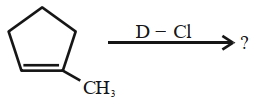
The major product of the following reaction is $-$
A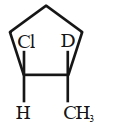
B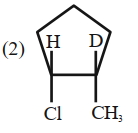
C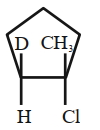
D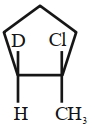
Solution
(D) The reaction is an electrophilic addition of $D-Cl$ to $1-methylcyclopentene$.
First,the electrophile $D^+$ attacks the double bond to form the more stable tertiary carbocation.
The $D^+$ adds to the $CH$ group (the carbon with more hydrogens) to form a tertiary carbocation at the carbon bearing the $CH_3$ group.
Then,the nucleophile $Cl^-$ attacks the planar carbocation from either the top or bottom face,resulting in a racemic mixture of $1-chloro-1-methyl-2-deuteriocyclopentane$ (where $D$ and $CH_3$ are trans or cis).
Based on the options provided,the structure representing the addition of $D$ and $Cl$ across the double bond is the correct product.
First,the electrophile $D^+$ attacks the double bond to form the more stable tertiary carbocation.
The $D^+$ adds to the $CH$ group (the carbon with more hydrogens) to form a tertiary carbocation at the carbon bearing the $CH_3$ group.
Then,the nucleophile $Cl^-$ attacks the planar carbocation from either the top or bottom face,resulting in a racemic mixture of $1-chloro-1-methyl-2-deuteriocyclopentane$ (where $D$ and $CH_3$ are trans or cis).
Based on the options provided,the structure representing the addition of $D$ and $Cl$ across the double bond is the correct product.
0 likes
View Solution877
MediumMCQ
Find out the major product formed from the following reaction. $[Me = -CH_3]$
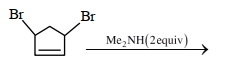
A
$3,4-$bis(dimethylamino)cyclopent$-1-$ene
B
$3,5-$bis(dimethylamino)cyclopent$-1-$ene
C
$1,2-$bis(dimethylamino)cyclopent$-3-$ene
D
$1,5-$bis(dimethylamino)cyclopent$-2-$ene
Solution
(A) The reaction involves the nucleophilic substitution of bromine atoms by dimethylamine $(Me_2NH)$.
First,one $Me_2NH$ molecule attacks the allylic position,displacing one $Br^-$ ion.
Then,the lone pair on the nitrogen atom of the newly attached dimethylamino group participates in the formation of an aziridinium ion intermediate by displacing the second $Br^-$ ion.
Finally,a second molecule of $Me_2NH$ attacks the aziridinium ring,opening it to form the final product,which is $3,4$-bis(dimethylamino)cyclopent-$1$-ene.
First,one $Me_2NH$ molecule attacks the allylic position,displacing one $Br^-$ ion.
Then,the lone pair on the nitrogen atom of the newly attached dimethylamino group participates in the formation of an aziridinium ion intermediate by displacing the second $Br^-$ ion.
Finally,a second molecule of $Me_2NH$ attacks the aziridinium ring,opening it to form the final product,which is $3,4$-bis(dimethylamino)cyclopent-$1$-ene.
0 likes
View Solution878
MediumMCQ
Given below are two statements: one is labelled as Assertion $(A)$ and the other is labelled as Reason $(R)$.
Assertion $(A)$: Cis form of alkene is found to be more polar than the trans form.
Reason $(R)$: Dipole moment of trans isomer of $2$-butene is zero.
In the light of the above statements,choose the correct answer from the options given below:
Assertion $(A)$: Cis form of alkene is found to be more polar than the trans form.
Reason $(R)$: Dipole moment of trans isomer of $2$-butene is zero.
In the light of the above statements,choose the correct answer from the options given below:
A
Both $(A)$ and $(R)$ are true but $(R)$ is $NOT$ the correct explanation of $(A)$
B
$(A)$ is true but $(R)$ is false
C
Both $(A)$ and $(R)$ are true and $(R)$ is the correct explanation of $(A)$
D
$(A)$ is false but $(R)$ is true
Solution
(C) Dipole moment is a vector quantity. In the $cis$-isomer,the bond dipoles of the two $C-CH_3$ bonds are in the same direction,leading to a non-zero net dipole moment.
In the $trans$-isomer,the bond dipoles of the two $C-CH_3$ bonds are equal in magnitude and opposite in direction,which cancel each other out,resulting in a net dipole moment of zero.
Since the $cis$-isomer has a non-zero dipole moment and the $trans$-isomer has a zero dipole moment,the $cis$-isomer is more polar.
Therefore,both Assertion $(A)$ and Reason $(R)$ are true,and $(R)$ is the correct explanation of $(A)$.
In the $trans$-isomer,the bond dipoles of the two $C-CH_3$ bonds are equal in magnitude and opposite in direction,which cancel each other out,resulting in a net dipole moment of zero.
Since the $cis$-isomer has a non-zero dipole moment and the $trans$-isomer has a zero dipole moment,the $cis$-isomer is more polar.
Therefore,both Assertion $(A)$ and Reason $(R)$ are true,and $(R)$ is the correct explanation of $(A)$.
0 likes
View Solution879
MediumMCQ
Consider the given chemical reaction:
$Cyclohexene \xrightarrow[Heat]{KMnO_4, H_2SO_4} \text{Product } A$
Product $A$ is:
$Cyclohexene \xrightarrow[Heat]{KMnO_4, H_2SO_4} \text{Product } A$
Product $A$ is:
A
picric acid
B
oxalic acid
C
acetic acid
D
adipic acid
Solution
(D) The reaction of cyclohexene with hot acidic potassium permanganate $(KMnO_4, H_2SO_4)$ is an oxidative cleavage reaction.
The double bond in the cyclic alkene is broken,and the carbon atoms at the double bond are oxidized to carboxylic acid groups.
Cyclohexene $(C_6H_{10})$ undergoes oxidative cleavage to form hexanedioic acid,which is commonly known as adipic acid $(HOOC-(CH_2)_4-COOH)$.
The double bond in the cyclic alkene is broken,and the carbon atoms at the double bond are oxidized to carboxylic acid groups.
Cyclohexene $(C_6H_{10})$ undergoes oxidative cleavage to form hexanedioic acid,which is commonly known as adipic acid $(HOOC-(CH_2)_4-COOH)$.
0 likes
View Solution880
MediumMCQ
Identify the major product $A$ and major product $B$ in the following set of reactions:
$CH_3-CH=CH_2 \xrightarrow{H_2O, H^+} \text{Major product } A$
$CH_3-CH=CH_2 \xrightarrow{(BH_3)_2, H_2O_2, OH^-} \text{Major product } B$
$CH_3-CH=CH_2 \xrightarrow{H_2O, H^+} \text{Major product } A$
$CH_3-CH=CH_2 \xrightarrow{(BH_3)_2, H_2O_2, OH^-} \text{Major product } B$
A
$A: CH_3CH_2CH_2-OH, B: CH_3CH_2CH_2-OH$
B
$A: CH_3CH_2CH_2-OH, B: CH_3CH(OH)CH_3$
C
$A: CH_3CH(OH)CH_3, B: CH_3CH_2CH_2-OH$
D
$A: CH_3CH_2CH_3, B: CH_3CH_2CH_3$
Solution
(C) $(1)$ Acid-catalyzed hydration of propene follows Markovnikov's rule,where the electrophile $H^+$ adds to the terminal carbon to form the more stable secondary carbocation $(CH_3-CH^+-CH_3)$,which is then attacked by $H_2O$ to form propan-$2$-ol as the major product $A$.
$(2)$ Hydroboration-oxidation of propene follows anti-Markovnikov's rule,where the boron atom adds to the terminal carbon,and subsequent oxidation with $H_2O_2/OH^-$ replaces boron with an $-OH$ group,resulting in propan-$1$-ol as the major product $B$.
$(2)$ Hydroboration-oxidation of propene follows anti-Markovnikov's rule,where the boron atom adds to the terminal carbon,and subsequent oxidation with $H_2O_2/OH^-$ replaces boron with an $-OH$ group,resulting in propan-$1$-ol as the major product $B$.
0 likes
View Solution881
MediumMCQ
For the given reaction:
(Cyclohexyl)-$CH$=$CH$-(Cyclohexyl) $\xrightarrow{KMnO_4/H^+}$ '$P$' (major product)
'$P$' is:
(Cyclohexyl)-$CH$=$CH$-(Cyclohexyl) $\xrightarrow{KMnO_4/H^+}$ '$P$' (major product)
'$P$' is:
A
Cyclohexanecarboxylic acid
B
$1,2-$dicyclohexylethane$-1,2-$diol
C
Dicyclohexyl diketone
D
Cyclohexanecarbaldehyde
Solution
(A) The reaction of an alkene with hot acidic $KMnO_4$ (oxidative cleavage) results in the cleavage of the $C=C$ double bond.
For the given reactant,$1,2$-dicyclohexylethane,the oxidative cleavage of the double bond yields two molecules of cyclohexanecarboxylic acid as the major product.
The reaction is:
$(C_6H_{11})CH=CH(C_6H_{11}) \xrightarrow{KMnO_4/H^+} 2 C_6H_{11}COOH$
Thus,the major product '$P$' is cyclohexanecarboxylic acid.
For the given reactant,$1,2$-dicyclohexylethane,the oxidative cleavage of the double bond yields two molecules of cyclohexanecarboxylic acid as the major product.
The reaction is:
$(C_6H_{11})CH=CH(C_6H_{11}) \xrightarrow{KMnO_4/H^+} 2 C_6H_{11}COOH$
Thus,the major product '$P$' is cyclohexanecarboxylic acid.
0 likes
View Solution882
AdvancedMCQ
$CH_3-CH=CH_2 + NOCl \rightarrow P$
Identify the adduct.
Identify the adduct.
A
$CH_3-CH(Cl)-CH_2(NO)$
B
$CH_3-CH(NO)-CH_2(Cl)$
C
$CH_3-CH_2-CH(NO)(Cl)$
D
$CH_2(NO)-CH_2-CH_2(Cl)$
Solution
(A) The reaction of $NOCl$ with an alkene follows Markovnikov's rule.
$NOCl$ dissociates as $NO^{+}$ and $Cl^{-}$.
The electrophile $NO^{+}$ attacks the carbon atom with more hydrogen atoms (the terminal $CH_2$ group) to form a more stable carbocation intermediate.
The nucleophile $Cl^{-}$ then attacks the more substituted carbon atom ($CH$ group).
Thus,the product $P$ is $CH_3-CH(Cl)-CH_2(NO)$.
$NOCl$ dissociates as $NO^{+}$ and $Cl^{-}$.
The electrophile $NO^{+}$ attacks the carbon atom with more hydrogen atoms (the terminal $CH_2$ group) to form a more stable carbocation intermediate.
The nucleophile $Cl^{-}$ then attacks the more substituted carbon atom ($CH$ group).
Thus,the product $P$ is $CH_3-CH(Cl)-CH_2(NO)$.
0 likes
View Solution883
AdvancedMCQ
The reaction of $4$-methyloct$-1-$ene $(P, 2.52 \ g)$ with $HBr$ in the presence of $(C_6H_5CO_2)_2O_2$ gives two isomeric bromides in a $9:1$ ratio,with a combined yield of $50 \%$. Of these,the entire amount of the primary alkyl bromide was reacted with an appropriate amount of diethylamine followed by treatment with aqueous $K_2CO_3$ to give a non-ionic product $S$ in $100 \% $ yield. The mass (in $mg$) of $S$ obtained is. . . . . . . [Use molar mass (in $g \ mol^{-1}$) : $H=1, C=12, N=14, Br=80$]
A
$1700$
B
$1791$
C
$1780$
D
$1785$
Solution
(B) $1$. Moles of $P$ ($4$-methyloct$-1-$ene) = $\frac{2.52 \ g}{126 \ g \ mol^{-1}} = 0.02 \ mol$.
$2$. The reaction with $HBr$ in the presence of peroxide follows anti-Markovnikov addition. The combined yield is $50 \%$,so the total moles of bromides formed = $0.02 \times 0.50 = 0.01 \ mol$.
$3$. The bromides are formed in a $9:1$ ratio. The primary alkyl bromide is the major product ($9$ parts out of $10$).
$4$. Moles of primary alkyl bromide = $\frac{9}{10} \times 0.01 \ mol = 0.009 \ mol$.
$5$. The primary alkyl bromide reacts with diethylamine to form a quaternary ammonium salt,which upon treatment with aqueous $K_2CO_3$ yields the non-ionic amine product $S$.
$6$. The molar mass of $S$ ($N,N$-diethyl$-4$-methyloctan$-1-$amine) is $199 \ g \ mol^{-1}$.
$7$. Mass of $S$ = $\text{moles} \times \text{molar mass} = 0.009 \ mol \times 199 \ g \ mol^{-1} = 1.791 \ g = 1791 \ mg$.
$2$. The reaction with $HBr$ in the presence of peroxide follows anti-Markovnikov addition. The combined yield is $50 \%$,so the total moles of bromides formed = $0.02 \times 0.50 = 0.01 \ mol$.
$3$. The bromides are formed in a $9:1$ ratio. The primary alkyl bromide is the major product ($9$ parts out of $10$).
$4$. Moles of primary alkyl bromide = $\frac{9}{10} \times 0.01 \ mol = 0.009 \ mol$.
$5$. The primary alkyl bromide reacts with diethylamine to form a quaternary ammonium salt,which upon treatment with aqueous $K_2CO_3$ yields the non-ionic amine product $S$.
$6$. The molar mass of $S$ ($N,N$-diethyl$-4$-methyloctan$-1-$amine) is $199 \ g \ mol^{-1}$.
$7$. Mass of $S$ = $\text{moles} \times \text{molar mass} = 0.009 \ mol \times 199 \ g \ mol^{-1} = 1.791 \ g = 1791 \ mg$.
0 likes
View Solution884
MediumMCQ
The correct statement$(s)$ for the following addition reactions is(are):
$(i)$ $trans-but-2-ene \xrightarrow{Br_2/CHCl_3} M \text{ and } N$
(ii) $cis-but-2-ene \xrightarrow{Br_2/CHCl_3} O \text{ and } P$
[$A$] ($M$ and $O$) and ($N$ and $P$) are two pairs of diastereomers
[$B$] Bromination proceeds through trans-addition in both the reactions
[$C$] $O$ and $P$ are identical molecules
[$D$] ($M$ and $O$) and ($N$ and $P$) are two pairs of enantiomers
$(i)$ $trans-but-2-ene \xrightarrow{Br_2/CHCl_3} M \text{ and } N$
(ii) $cis-but-2-ene \xrightarrow{Br_2/CHCl_3} O \text{ and } P$
[$A$] ($M$ and $O$) and ($N$ and $P$) are two pairs of diastereomers
[$B$] Bromination proceeds through trans-addition in both the reactions
[$C$] $O$ and $P$ are identical molecules
[$D$] ($M$ and $O$) and ($N$ and $P$) are two pairs of enantiomers
A
$C, D$
B
$C, A$
C
$C, B$
D
$A, B$
Solution
(C) Bromination of alkenes proceeds via anti-addition (trans-addition) of $Br_2$.
$(i)$ $trans-but-2-ene$ gives a racemic mixture of $(2R, 3R)$-$2,3-dibromobutane$ $(M)$ and $(2S, 3S)$-$2,3-dibromobutane$ $(N)$.
(ii) $cis-but-2-ene$ gives the meso compound $(2R, 3S)$-$2,3-dibromobutane$. Since the meso compound is achiral,$O$ and $P$ represent the same molecule (meso form).
Statement [$B$] is correct because bromination is a stereospecific anti-addition.
Statement [$C$] is correct because $O$ and $P$ are the same meso compound.
Therefore,the correct statements are [$B$] and [$C$].
$(i)$ $trans-but-2-ene$ gives a racemic mixture of $(2R, 3R)$-$2,3-dibromobutane$ $(M)$ and $(2S, 3S)$-$2,3-dibromobutane$ $(N)$.
(ii) $cis-but-2-ene$ gives the meso compound $(2R, 3S)$-$2,3-dibromobutane$. Since the meso compound is achiral,$O$ and $P$ represent the same molecule (meso form).
Statement [$B$] is correct because bromination is a stereospecific anti-addition.
Statement [$C$] is correct because $O$ and $P$ are the same meso compound.
Therefore,the correct statements are [$B$] and [$C$].
0 likes
View Solution885
DifficultMCQ
The total number of alkenes possible by dehydrobromination of $3$-bromo-$3$-cyclopentylhexane using alcoholic $KOH$ is
A
$5$
B
$6$
C
$7$
D
$3$
Solution
(A) $3$-Bromo-$3$-cyclopentylhexane has three different types of $\beta$-hydrogens (not $\alpha$-hydrogens as $\alpha$ is the carbon attached to $Br$). These are marked as $(a)$,$(b)$,and $(c)$ in the structure.
Dehydrobromination leads to the formation of three structurally isomeric alkenes:
$1$. From $\beta$-hydrogen $(a)$: $CH_3CH_2CH=C(cyclopentyl)CH_2CH_3$ (exists as $E$ and $Z$ isomers).
$2$. From $\beta$-hydrogen $(b)$: $CH_3CH_2CH_2C(cyclopentyl)=CHCH_3$ (exists as $E$ and $Z$ isomers).
$3$. From $\beta$-hydrogen $(c)$: $CH_3CH_2CH_2C(cyclopentyl)=CHCH_2CH_3$ (this is the same as the product from $(b)$).
Wait,re-evaluating the structure: The $\beta$-carbons are the two $CH_2$ groups of the hexane chain and the $CH$ group of the cyclopentyl ring.
- Removal of $H$ from $CH_2$ (position $a$): $CH_3CH_2CH=C(cyclopentyl)CH_2CH_3$ ($E/Z$ isomers).
- Removal of $H$ from $CH_2$ (position $b$): $CH_3CH_2CH_2C(cyclopentyl)=CHCH_3$ ($E/Z$ isomers).
- Removal of $H$ from $CH$ (position $c$): $CH_3CH_2CH_2C(cyclopentyl)=C(CH_2CH_3)_2$ (this is a different alkene,no $E/Z$ isomerism).
Total alkenes = $2 (E/Z) + 2 (E/Z) + 1 = 5$.
Dehydrobromination leads to the formation of three structurally isomeric alkenes:
$1$. From $\beta$-hydrogen $(a)$: $CH_3CH_2CH=C(cyclopentyl)CH_2CH_3$ (exists as $E$ and $Z$ isomers).
$2$. From $\beta$-hydrogen $(b)$: $CH_3CH_2CH_2C(cyclopentyl)=CHCH_3$ (exists as $E$ and $Z$ isomers).
$3$. From $\beta$-hydrogen $(c)$: $CH_3CH_2CH_2C(cyclopentyl)=CHCH_2CH_3$ (this is the same as the product from $(b)$).
Wait,re-evaluating the structure: The $\beta$-carbons are the two $CH_2$ groups of the hexane chain and the $CH$ group of the cyclopentyl ring.
- Removal of $H$ from $CH_2$ (position $a$): $CH_3CH_2CH=C(cyclopentyl)CH_2CH_3$ ($E/Z$ isomers).
- Removal of $H$ from $CH_2$ (position $b$): $CH_3CH_2CH_2C(cyclopentyl)=CHCH_3$ ($E/Z$ isomers).
- Removal of $H$ from $CH$ (position $c$): $CH_3CH_2CH_2C(cyclopentyl)=C(CH_2CH_3)_2$ (this is a different alkene,no $E/Z$ isomerism).
Total alkenes = $2 (E/Z) + 2 (E/Z) + 1 = 5$.
0 likes
View Solution886
DifficultMCQ
Compound$(s)$ that on hydrogenation produce$(s)$ optically inactive compound$(s)$ is (are)
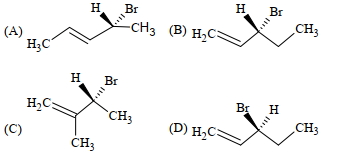
A
$(A, D)$
B
$(A, C)$
C
$(B, C)$
D
$(B, D)$
Solution
(D) Hydrogenation of the given compounds results in the following products:
$(A)$ $CH_3-CH=CH-CH(Br)CH_3 \xrightarrow{H_2/Pt} CH_3-CH_2-CH_2-CH(Br)CH_3$. The product has a chiral center and is optically active.
$(B)$ $H_2C=CH-CH(Br)CH_2CH_3 \xrightarrow{H_2/Pt} CH_3-CH_2-CH(Br)CH_2CH_3$. The product is $3$-bromopentane,which has a plane of symmetry and is optically inactive.
$(C)$ $H_2C=C(CH_3)-CH(Br)CH_3 \xrightarrow{H_2/Pt} CH_3-CH(CH_3)-CH(Br)CH_3$. The product has two chiral centers and is optically active.
$(D)$ $H_2C=CH-C(Br)(H)CH_2CH_3 \xrightarrow{H_2/Pt} CH_3-CH_2-CH(Br)CH_2CH_3$. The product is $3$-bromopentane,which is optically inactive.
Thus,compounds $(B)$ and $(D)$ produce optically inactive compounds upon hydrogenation.
$(A)$ $CH_3-CH=CH-CH(Br)CH_3 \xrightarrow{H_2/Pt} CH_3-CH_2-CH_2-CH(Br)CH_3$. The product has a chiral center and is optically active.
$(B)$ $H_2C=CH-CH(Br)CH_2CH_3 \xrightarrow{H_2/Pt} CH_3-CH_2-CH(Br)CH_2CH_3$. The product is $3$-bromopentane,which has a plane of symmetry and is optically inactive.
$(C)$ $H_2C=C(CH_3)-CH(Br)CH_3 \xrightarrow{H_2/Pt} CH_3-CH(CH_3)-CH(Br)CH_3$. The product has two chiral centers and is optically active.
$(D)$ $H_2C=CH-C(Br)(H)CH_2CH_3 \xrightarrow{H_2/Pt} CH_3-CH_2-CH(Br)CH_2CH_3$. The product is $3$-bromopentane,which is optically inactive.
Thus,compounds $(B)$ and $(D)$ produce optically inactive compounds upon hydrogenation.
0 likes
View Solution887
MediumMCQ
In the following reaction,the major product is
$H_2C=C(CH_3)-CH=CH_2 \xrightarrow{1 \text{ equivalent } HBr}$
$H_2C=C(CH_3)-CH=CH_2 \xrightarrow{1 \text{ equivalent } HBr}$
A
$H_2C=C(CH_3)-CH(Br)-CH_3$
B
$H_2C=C(CH_3)-CH_2-CH_2Br$
C
$Br-CH_2-C(CH_3)=CH-CH_3$
D
$H_3C-C(Br)(CH_3)-CH=CH_2$
Solution
(C) The reaction is an electrophilic addition of $HBr$ to a conjugated diene,$2-\text{methylbuta}-1,3-\text{diene}$ (isoprene).
$1$. Protonation of the terminal double bond $(C_1)$ occurs to form the most stable carbocation.
$2$. Protonation at $C_1$ gives a tertiary allylic carbocation: $H_3C-C^+(CH_3)-CH=CH_2$,which is resonance stabilized.
$3$. The resonance structure is $H_3C-C(CH_3)=CH-CH_2^+$.
$4$. The bromide ion $(Br^-)$ attacks the primary carbocation site $(C_4)$ to give the thermodynamically more stable product (more substituted alkene).
$5$. The major product is $1-\text{bromo}-3-\text{methylbut}-2-\text{ene}$,which corresponds to option $C$.
$1$. Protonation of the terminal double bond $(C_1)$ occurs to form the most stable carbocation.
$2$. Protonation at $C_1$ gives a tertiary allylic carbocation: $H_3C-C^+(CH_3)-CH=CH_2$,which is resonance stabilized.
$3$. The resonance structure is $H_3C-C(CH_3)=CH-CH_2^+$.
$4$. The bromide ion $(Br^-)$ attacks the primary carbocation site $(C_4)$ to give the thermodynamically more stable product (more substituted alkene).
$5$. The major product is $1-\text{bromo}-3-\text{methylbut}-2-\text{ene}$,which corresponds to option $C$.
0 likes
View Solution888
AdvancedMCQ
The number of hydroxyl group$(s)$ in $Q$ is
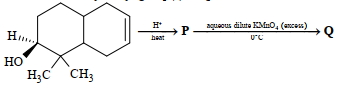
A
$1$
B
$2$
C
$3$
D
$4$
Solution
(D) Step $1$: Acid-catalyzed dehydration of the starting alcohol leads to the formation of a carbocation,which then undergoes rearrangement and elimination to form the diene $P$ (a decalin derivative with two double bonds).
Step $2$: The diene $P$ reacts with aqueous dilute $KMnO_4$ (Baeyer's reagent) at $0^{\circ}C$. This reagent performs syn-dihydroxylation of double bonds.
Step $3$: Since $P$ has two double bonds,both are converted into diols. The resulting product $Q$ contains four hydroxyl groups (two from each double bond).
Thus,the number of hydroxyl groups in $Q$ is $4$.
Step $2$: The diene $P$ reacts with aqueous dilute $KMnO_4$ (Baeyer's reagent) at $0^{\circ}C$. This reagent performs syn-dihydroxylation of double bonds.
Step $3$: Since $P$ has two double bonds,both are converted into diols. The resulting product $Q$ contains four hydroxyl groups (two from each double bond).
Thus,the number of hydroxyl groups in $Q$ is $4$.
0 likes
View Solution889
MediumMCQ
Match List-$I$ with List-$II$. Choose the correct answer from the options given below:
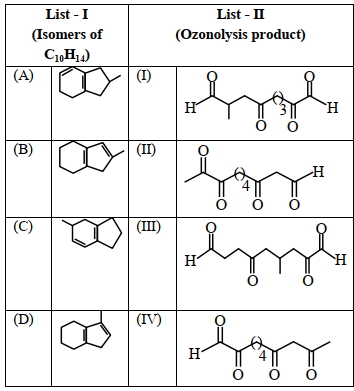
A
$A-II, B-III, C-I, D-IV$
B
$A-III, B-IV, C-I, D-II$
C
$A-III, B-II, C-I, D-IV$
D
$A-I, B-IV, C-III, D-II$
Solution
(B) Ozonolysis involves the cleavage of double bonds to form carbonyl compounds. By analyzing the structure of each isomer in List-$I$ and performing the oxidative cleavage of the double bonds,we can determine the corresponding products in List-$II$.
$(A)$ The isomer has two double bonds,which upon ozonolysis yield a dialdehyde with a methyl substituent. This matches product $(III)$.
$(B)$ The isomer has two double bonds,which upon ozonolysis yield a keto-aldehyde. This matches product $(IV)$.
$(C)$ The isomer has two double bonds,which upon ozonolysis yield a dialdehyde. This matches product $(I)$.
$(D)$ The isomer has two double bonds,which upon ozonolysis yield a keto-aldehyde. This matches product $(II)$.
Thus,the correct matching is $A-III, B-IV, C-I, D-II$.
$(A)$ The isomer has two double bonds,which upon ozonolysis yield a dialdehyde with a methyl substituent. This matches product $(III)$.
$(B)$ The isomer has two double bonds,which upon ozonolysis yield a keto-aldehyde. This matches product $(IV)$.
$(C)$ The isomer has two double bonds,which upon ozonolysis yield a dialdehyde. This matches product $(I)$.
$(D)$ The isomer has two double bonds,which upon ozonolysis yield a keto-aldehyde. This matches product $(II)$.
Thus,the correct matching is $A-III, B-IV, C-I, D-II$.
0 likes
View Solution890
DifficultMCQ
$A$ compound $X$ absorbs $2$ moles of hydrogen and $X$ upon oxidation with $KMnO_4 \mid H^{+}$ gives the products shown below:
$CH_3-CO-CH_3$,$CH_3-COOH$ and $CH_3-CO-CH_2-CH_2-COOH$.
The total number of $\sigma$ bonds present in the compound $X$ is . . . . . .
$CH_3-CO-CH_3$,$CH_3-COOH$ and $CH_3-CO-CH_2-CH_2-COOH$.
The total number of $\sigma$ bonds present in the compound $X$ is . . . . . .
A
$27$
B
$28$
C
$29$
D
$30$
Solution
(A) The oxidation products are $CH_3-CO-CH_3$,$CH_3-COOH$,and $CH_3-CO-CH_2-CH_2-COOH$.
By analyzing the cleavage products,the structure of compound $X$ is determined to be $CH_3-C(CH_3)=CH-CH_2-CH_2-CH=C(CH_3)_2$.
This structure contains $2$ double bonds,which is consistent with the absorption of $2$ moles of hydrogen.
To count the $\sigma$ bonds:
- The carbon skeleton has $10$ carbon atoms,which implies $9$ $C$-$C$ $\sigma$ bonds.
- The number of hydrogen atoms is $3+3+1+2+2+1+3+3 = 18$.
- Thus,there are $18$ $C$-$H$ $\sigma$ bonds.
- Total $\sigma$ bonds = $9$ ($C$-$C$) + $18$ ($C$-$H$) = $27$.
By analyzing the cleavage products,the structure of compound $X$ is determined to be $CH_3-C(CH_3)=CH-CH_2-CH_2-CH=C(CH_3)_2$.
This structure contains $2$ double bonds,which is consistent with the absorption of $2$ moles of hydrogen.
To count the $\sigma$ bonds:
- The carbon skeleton has $10$ carbon atoms,which implies $9$ $C$-$C$ $\sigma$ bonds.
- The number of hydrogen atoms is $3+3+1+2+2+1+3+3 = 18$.
- Thus,there are $18$ $C$-$H$ $\sigma$ bonds.
- Total $\sigma$ bonds = $9$ ($C$-$C$) + $18$ ($C$-$H$) = $27$.
0 likes
View Solution891
DifficultMCQ
Following are the four molecules $P$,$Q$,$R$ and $S$. Which one among the four molecules will react with $HBr_{(aq)}$ at the fastest rate?
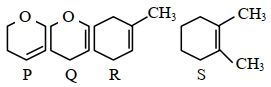
A
$S$
B
$Q$
C
$R$
D
$P$
Solution
(B) The reaction of alkenes with $HBr_{(aq)}$ proceeds via an electrophilic addition mechanism,where the rate-determining step involves the formation of a carbocation intermediate.
Greater stability of the carbocation intermediate leads to a faster reaction rate.
In molecule $Q$,the protonation of the double bond leads to a carbocation that is stabilized by resonance from the lone pair of the adjacent oxygen atom (forming an oxocarbenium ion).
This resonance stabilization makes the carbocation derived from $Q$ significantly more stable than the alkyl carbocations formed from $P$,$R$,or $S$.
Therefore,molecule $Q$ reacts at the fastest rate.
Greater stability of the carbocation intermediate leads to a faster reaction rate.
In molecule $Q$,the protonation of the double bond leads to a carbocation that is stabilized by resonance from the lone pair of the adjacent oxygen atom (forming an oxocarbenium ion).
This resonance stabilization makes the carbocation derived from $Q$ significantly more stable than the alkyl carbocations formed from $P$,$R$,or $S$.
Therefore,molecule $Q$ reacts at the fastest rate.
0 likes
View Solution892
MediumMCQ
The product $(A)$ formed in the following reaction sequence is :
$CH_3-C \equiv CH$ $\rightarrow[(ii) HCN]{(i) Hg^{2+}, H_2SO_4}$ $\xrightarrow[(iii) H_2 / Ni]{} (A)$
$CH_3-C \equiv CH$ $\rightarrow[(ii) HCN]{(i) Hg^{2+}, H_2SO_4}$ $\xrightarrow[(iii) H_2 / Ni]{} (A)$
A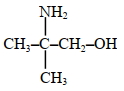
B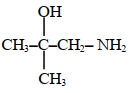
C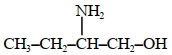
D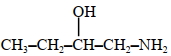
Solution
(B) Step $(i)$: Hydration of propyne $(CH_3-C \equiv CH)$ in the presence of $Hg^{2+}$ and $H_2SO_4$ follows Markovnikov's rule to form acetone $(CH_3-CO-CH_3)$.
Step $(ii)$: Nucleophilic addition of $HCN$ to acetone forms a cyanohydrin $(CH_3-C(OH)(CN)-CH_3)$.
Step $(iii)$: Catalytic hydrogenation of the cyanohydrin using $H_2/Ni$ reduces the $-CN$ group to a primary amine group $(-CH_2NH_2)$.
The final product $(A)$ is $2-hydroxy-2-methylpropan-1-amine$,which corresponds to the structure shown in option $(B)$.
Step $(ii)$: Nucleophilic addition of $HCN$ to acetone forms a cyanohydrin $(CH_3-C(OH)(CN)-CH_3)$.
Step $(iii)$: Catalytic hydrogenation of the cyanohydrin using $H_2/Ni$ reduces the $-CN$ group to a primary amine group $(-CH_2NH_2)$.
The final product $(A)$ is $2-hydroxy-2-methylpropan-1-amine$,which corresponds to the structure shown in option $(B)$.
0 likes
View Solution893
MediumMCQ
Identify products $[A]$,$[B]$,and $[C]$ in the following reaction sequence:
$CH_3-C \equiv CH$ $\xrightarrow{H_2, Pd/C} [A]$ $\xrightarrow[(ii) Zn, H_2O]{(i) O_3} [B] + [C]$
$CH_3-C \equiv CH$ $\xrightarrow{H_2, Pd/C} [A]$ $\xrightarrow[(ii) Zn, H_2O]{(i) O_3} [B] + [C]$
A
$[A]: CH_3-CH=CH_2, [B]: CH_3CHO, [C]: HCHO$
B
$[A]: CH_2=CH_2, [B]: CH_3CHO, [C]: HCHO$
C
$[A]: CH_3-CH=CH_2, [B]: CH_3CHO, [C]: CH_3CH_2OH$
D
$[A]: CH_3CH_2CH_3, [B]: CH_3CHO, [C]: HCHO$
Solution
(A) Step $1$: The partial hydrogenation of propyne $(CH_3-C \equiv CH)$ using $H_2$ over $Pd/C$ (Lindlar's catalyst or similar controlled hydrogenation) yields propene $(CH_3-CH=CH_2)$ as product $[A]$.
Step $2$: Ozonolysis of propene $(CH_3-CH=CH_2)$ followed by reductive workup with $Zn/H_2O$ cleaves the double bond to form acetaldehyde $(CH_3CHO)$ as product $[B]$ and formaldehyde $(HCHO)$ as product $[C]$.
Therefore,the correct sequence is $[A]: CH_3-CH=CH_2, [B]: CH_3CHO, [C]: HCHO$.
Step $2$: Ozonolysis of propene $(CH_3-CH=CH_2)$ followed by reductive workup with $Zn/H_2O$ cleaves the double bond to form acetaldehyde $(CH_3CHO)$ as product $[B]$ and formaldehyde $(HCHO)$ as product $[C]$.
Therefore,the correct sequence is $[A]: CH_3-CH=CH_2, [B]: CH_3CHO, [C]: HCHO$.
0 likes
View Solution894
MediumMCQ
The major product of the following reaction is $:$
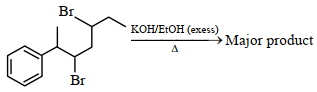
A
$6-$Phenylhepta$-2,4-$diene
B
$2-$Phenylhepta$-2,5-$diene
C
$6-$Phenylhepta$-3,5-$diene
D
$2-$Phenylhepta$-2,4-$diene
Solution
(D) The reaction involves the dehydrohalogenation of a vicinal dibromide using an excess of alcoholic $KOH$ (a strong base) under heating conditions. This is an $E2$ elimination reaction that proceeds twice to form a conjugated diene. The elimination occurs to form the most stable,highly substituted,and conjugated product. The structure formed is $2-$phenylhepta$-2,4-$diene,which is stabilized by conjugation with the phenyl ring and the double bonds.
0 likes
View Solution895
MediumMCQ
Which compound would give $3-$methyl$-6-$oxoheptanal upon ozonolysis?
A
$1,4-$dimethylcyclohex$-1-$ene
B
$1,4-$dimethylcyclohex$-1-$ene (isomer)
C
$3,6-$dimethylcyclohex$-1-$ene
D
$1,2-$dimethylcyclohex$-1-$ene
Solution
(A) Ozonolysis of a cyclic alkene involves the cleavage of the double bond to form a dicarbonyl compound.
To determine the starting material for $3-$methyl$-6-$oxoheptanal,we can reverse the process by connecting the carbonyl carbons with a double bond.
The product $3-$methyl$-6-$oxoheptanal has a chain of $7$ carbons.
Connecting the aldehyde carbon $(C_1)$ and the ketone carbon $(C_6)$ with a double bond forms a $6-$membered ring with a methyl group at the $4-$position relative to the double bond (or $1,4-$dimethylcyclohex$-1-$ene).
Thus,$1,4-$dimethylcyclohex$-1-$ene undergoes ozonolysis to yield $3-$methyl$-6-$oxoheptanal.
To determine the starting material for $3-$methyl$-6-$oxoheptanal,we can reverse the process by connecting the carbonyl carbons with a double bond.
The product $3-$methyl$-6-$oxoheptanal has a chain of $7$ carbons.
Connecting the aldehyde carbon $(C_1)$ and the ketone carbon $(C_6)$ with a double bond forms a $6-$membered ring with a methyl group at the $4-$position relative to the double bond (or $1,4-$dimethylcyclohex$-1-$ene).
Thus,$1,4-$dimethylcyclohex$-1-$ene undergoes ozonolysis to yield $3-$methyl$-6-$oxoheptanal.
0 likes
View Solution896
DifficultMCQ
Consider the following molecule $(X)$. The reaction of $(X)$ with $HBr$ gives the major product:
A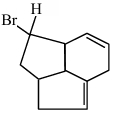
B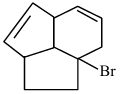
C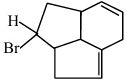
D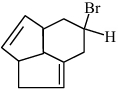
Solution
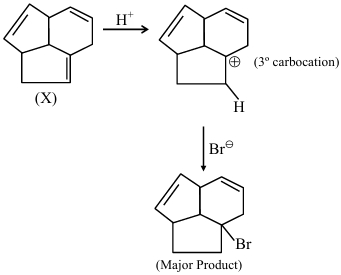
0 likes
View Solution897
MediumMCQ
Given below are two statements $:$
Statement $I :$ Ozonolysis followed by treatment with $Zn, H_2O$ of $cis-2-butene$ gives ethanal.
Statement $II :$ The product obtained by ozonolysis followed by treatment with $Zn, H_2O$ of $3,6-dimethyloct-4-ene$ has no chiral carbon atom.
In the light of the above statements,choose the correct answer from the options given below.
Statement $I :$ Ozonolysis followed by treatment with $Zn, H_2O$ of $cis-2-butene$ gives ethanal.
Statement $II :$ The product obtained by ozonolysis followed by treatment with $Zn, H_2O$ of $3,6-dimethyloct-4-ene$ has no chiral carbon atom.
In the light of the above statements,choose the correct answer from the options given below.
A
Both Statement $I$ and Statement $II$ are true
B
Statement $I$ is false but Statement $II$ is true
C
Statement $I$ is true but Statement $II$ is false
D
Both Statement $I$ and Statement $II$ are false
Solution
(C) Statement $I :$ Ozonolysis of $cis-2-butene$ $(CH_3-CH=CH-CH_3)$ followed by reductive workup $(Zn, H_2O)$ yields two molecules of ethanal $(CH_3CHO)$. This statement is true.
Statement $II :$ Ozonolysis of $3,6-dimethyloct-4-ene$ $(CH_3-CH_2-CH(CH_3)-CH=CH-CH(CH_3)-CH_2-CH_3)$ yields two molecules of $2-methylbutanal$ $(CH_3-CH_2-CH(CH_3)-CHO)$. The carbon atom at the $2-position$ of $2-methylbutanal$ is bonded to four different groups $(-H, -CH_3, -CH_2CH_3, -CHO)$,making it a chiral carbon atom. Thus,the product contains a chiral center. This statement is false.
Statement $II :$ Ozonolysis of $3,6-dimethyloct-4-ene$ $(CH_3-CH_2-CH(CH_3)-CH=CH-CH(CH_3)-CH_2-CH_3)$ yields two molecules of $2-methylbutanal$ $(CH_3-CH_2-CH(CH_3)-CHO)$. The carbon atom at the $2-position$ of $2-methylbutanal$ is bonded to four different groups $(-H, -CH_3, -CH_2CH_3, -CHO)$,making it a chiral carbon atom. Thus,the product contains a chiral center. This statement is false.
0 likes
View Solution898
MediumMCQ
Which of the following will not give the same product on hydroboration-oxidation and acid-catalysed hydration?
A
Cyclohexene
B
$1-$Methylcyclohexene
C
$CH_2=CH_2$
D
$CH_3-CH=CH-CH_3$
Solution
(B) Hydroboration-oxidation follows anti-Markownikoff's rule (syn-addition of $H$ and $OH$),while acid-catalysed hydration follows Markownikoff's rule and involves a carbocation intermediate,which may undergo rearrangement.
For symmetric alkenes like $CH_2=CH_2$ or $CH_3-CH=CH-CH_3$,both processes yield the same product.
For cyclic alkenes like cyclohexene,the products are the same (cyclohexanol).
However,for unsymmetrical alkenes like $1$-methylcyclohexene,acid-catalysed hydration leads to a more stable tertiary carbocation,resulting in $1$-methylcyclohexanol,whereas hydroboration-oxidation adds $OH$ to the less substituted carbon,resulting in $2$-methylcyclohexanol. Thus,they give different products.
For symmetric alkenes like $CH_2=CH_2$ or $CH_3-CH=CH-CH_3$,both processes yield the same product.
For cyclic alkenes like cyclohexene,the products are the same (cyclohexanol).
However,for unsymmetrical alkenes like $1$-methylcyclohexene,acid-catalysed hydration leads to a more stable tertiary carbocation,resulting in $1$-methylcyclohexanol,whereas hydroboration-oxidation adds $OH$ to the less substituted carbon,resulting in $2$-methylcyclohexanol. Thus,they give different products.
0 likes
View Solution899
MediumMCQ
Statement-$I$ :- Ozonolysis reaction is used to locate the position of a double bond in an alkene.
Statement-$II$ :- When $but-1-ene$ and $but-2-ene$ are subjected to ozonolysis separately,both yield the same product.
In the light of the above statements,select the correct option.
Statement-$II$ :- When $but-1-ene$ and $but-2-ene$ are subjected to ozonolysis separately,both yield the same product.
In the light of the above statements,select the correct option.
A
Both statement $I$ and $II$ are correct
B
Both statement $I$ and $II$ are incorrect
C
Statement-$I$ is correct but $II$ is incorrect
D
Statement-$II$ is correct but $I$ is incorrect
Solution
(C) Statement-$I$ is correct because ozonolysis involves the cleavage of a $C=C$ double bond to form carbonyl compounds,which helps in identifying the position of the double bond.
Statement-$II$ is incorrect because $but-1-ene$ $(CH_3CH_2CH=CH_2)$ on ozonolysis yields propanal $(CH_3CH_2CHO)$ and methanal $(HCHO)$,whereas $but-2-ene$ $(CH_3CH=CHCH_3)$ on ozonolysis yields two moles of ethanal $(CH_3CHO)$.
Therefore,Statement-$I$ is correct but Statement-$II$ is incorrect.
Statement-$II$ is incorrect because $but-1-ene$ $(CH_3CH_2CH=CH_2)$ on ozonolysis yields propanal $(CH_3CH_2CHO)$ and methanal $(HCHO)$,whereas $but-2-ene$ $(CH_3CH=CHCH_3)$ on ozonolysis yields two moles of ethanal $(CH_3CHO)$.
Therefore,Statement-$I$ is correct but Statement-$II$ is incorrect.
0 likes
View Solution900
MediumMCQ
$CH_3-CH=CH-CH=CH_2 \xrightarrow[Zn]{O_3 / H_2O}$ Which will not form?
A
$CH_3-CHO$
B
$CH_3-CH_2-CHO$
C
$CHO-CHO$
D
$HCHO$
Solution
(B) The ozonolysis of $CH_3-CH=CH-CH=CH_2$ involves the cleavage of both double bonds.
Step $1$: The first double bond $(CH_3-CH=CH-)$ cleaves to form $CH_3-CHO$ and $OHC-$.
Step $2$: The second double bond $(-CH=CH_2)$ cleaves to form $OHC-$ and $HCHO$.
Step $3$: Combining the fragments,the products are $CH_3-CHO$,$OHC-CHO$ (glyoxal),and $HCHO$.
Therefore,$CH_3-CH_2-CHO$ is not formed.
Step $1$: The first double bond $(CH_3-CH=CH-)$ cleaves to form $CH_3-CHO$ and $OHC-$.
Step $2$: The second double bond $(-CH=CH_2)$ cleaves to form $OHC-$ and $HCHO$.
Step $3$: Combining the fragments,the products are $CH_3-CHO$,$OHC-CHO$ (glyoxal),and $HCHO$.
Therefore,$CH_3-CH_2-CHO$ is not formed.
0 likes
View SolutionHydrocarbons — Alkene · Frequently Asked Questions
1Are these Hydrocarbons questions useful for JEE and NEET?
Yes. All questions in this section are mapped to JEE Main and NEET exam patterns. Previous year questions from JEE Main, NEET, GUJCET and state-level exams are included with full solutions.
2Can I switch to Hindi or Gujarati for these questions?
Yes. Use the language tabs in the hero section or the sidebar to view the same questions and solutions in English, Hindi or Gujarati.
3How do I generate a question paper from this subtopic?
Use the Vedclass Exam Paper Generator — select the chapter and subtopic, set difficulty, and generate Sets A, B, C, D automatically. First 3 chapters of every subject are free.
Vedclass Products
For Students
Vedclass Test Series
Mock tests in real JEE/NEET style with performance analysis. 5-day free trial.
Start Free TrialFor Teachers
Exam Paper Generator
Generate Set A/B/C/D papers from this chapter in 2 minutes. 3 chapters free.
Try FreeFor Institutes
Online Exam Module
Live online exams with unlimited students, 360° analytics & white-label branding.
See DemoFor Teachers & Institutes
Generate a Hydrocarbons Exam Paper in 2 Minutes
Select subtopic & difficulty — Sets A, B, C, D auto-generated with No Repeat logic.
First 3 chapters of every subject are free — no payment required.