
A English
Alkene Questions in English
Class 11 Chemistry · Hydrocarbons · Alkene
1080+
Questions
English
Language
100%
With Solutions
Showing 47 of 1080 questions in English
951
MediumMCQ
In the following sequence of reactions,the alkene affords the compound $B$.
$CH_3-CH=CH-CH_3$ $\xrightarrow{O_3} A$ $\xrightarrow[Zn]{H_2O} B$
The compound $B$ is:
$CH_3-CH=CH-CH_3$ $\xrightarrow{O_3} A$ $\xrightarrow[Zn]{H_2O} B$
The compound $B$ is:
A
$CH_3CH_2CHO$
B
$CH_3COCH_3$
C
$CH_3CH_2COCH_3$
D
$CH_3CHO$
Solution
(D) The reaction is an ozonolysis of but$-2-$ene.
$1$. The alkene $CH_3-CH=CH-CH_3$ reacts with $O_3$ to form an ozonide intermediate $(A)$.
$2$. The ozonide undergoes reductive cleavage with $Zn/H_2O$ to yield two molecules of acetaldehyde $(CH_3CHO)$.
Therefore,the compound $B$ is $CH_3CHO$.
$1$. The alkene $CH_3-CH=CH-CH_3$ reacts with $O_3$ to form an ozonide intermediate $(A)$.
$2$. The ozonide undergoes reductive cleavage with $Zn/H_2O$ to yield two molecules of acetaldehyde $(CH_3CHO)$.
Therefore,the compound $B$ is $CH_3CHO$.
0 likes
View Solution952
DifficultMCQ
What is the product formed when $CH_3-CH=CH_2$ is treated with $B_2H_6$ followed by the action of $H_2O_2$?
A
$CH_3CH_2CH_3$
B
$CH_3CH_2CHO$
C
$CH_3CH_2CH_2OH$
D
$CH_3CH(OH)CH_3$
Solution
(C) The reaction of propene $(CH_3-CH=CH_2)$ with $B_2H_6$ followed by oxidation with $H_2O_2$ in the presence of $OH^-$ is known as Hydroboration-Oxidation $(HBO)$.
This reaction follows the anti-Markovnikov rule,where the $OH$ group attaches to the less substituted carbon atom.
The overall reaction is: $CH_3-CH=CH_2 \xrightarrow[(ii) \ H_2O_2 / OH^-]{(i) \ B_2H_6} CH_3-CH_2-CH_2-OH$ (propan$-1-$ol).
This reaction follows the anti-Markovnikov rule,where the $OH$ group attaches to the less substituted carbon atom.
The overall reaction is: $CH_3-CH=CH_2 \xrightarrow[(ii) \ H_2O_2 / OH^-]{(i) \ B_2H_6} CH_3-CH_2-CH_2-OH$ (propan$-1-$ol).
0 likes
View Solution953
EasyMCQ
When $2-$Methylbut$-2-$ene is treated with hydrogen chloride,the major product obtained is
A
$2-$Chlorobutane
B
$2-$Chloro$-2-$methylbutane
C
$1-$Chloro$-2-$methylbutane
D
$2-$Chloro$-3-$methylbutane
Solution
(B) The reaction of $2-$Methylbut$-2-$ene with $HCl$ follows Markovnikov's rule.
According to Markovnikov's rule,the negative part of the addendum $(Cl^-)$ attaches to the carbon atom of the double bond that has fewer hydrogen atoms.
In $CH_3-C(CH_3)=CH-CH_3$,the carbon at position $2$ has no hydrogen,while the carbon at position $3$ has one hydrogen.
Therefore,the $Cl^-$ ion attacks the carbon at position $2$,leading to the formation of $2-$Chloro$-2-$methylbutane as the major product.
According to Markovnikov's rule,the negative part of the addendum $(Cl^-)$ attaches to the carbon atom of the double bond that has fewer hydrogen atoms.
In $CH_3-C(CH_3)=CH-CH_3$,the carbon at position $2$ has no hydrogen,while the carbon at position $3$ has one hydrogen.
Therefore,the $Cl^-$ ion attacks the carbon at position $2$,leading to the formation of $2-$Chloro$-2-$methylbutane as the major product.
0 likes
View Solution954
EasyMCQ
The major product obtained in the following reaction is
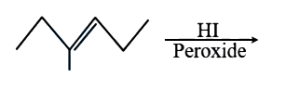
A
$3-$Iodo$-3-$methylhexane
B
$4-$Iodo$-3-$methylhexane
C
$3-$Iodo$-4-$methylhexane
D
$4-$Iodo$-4-$methylhexane
Solution
(A) The reaction of $HI$ with an alkene in the presence of peroxide does not follow the anti-Markownikoff rule because the addition of $I^{\bullet}$ radical is endothermic and reversible. Therefore,the reaction proceeds via the standard electrophilic addition mechanism following the Markownikoff rule.
According to the Markownikoff rule,the hydrogen atom attaches to the carbon atom of the double bond that already has more hydrogen atoms,and the iodine atom attaches to the more substituted carbon atom.
The reactant is $3-$methylhex$-3-$ene. Upon reaction with $HI$,the iodine atom attaches to the $C3$ position,which is more substituted,resulting in $3-$iodo$-3-$methylhexane as the major product.
According to the Markownikoff rule,the hydrogen atom attaches to the carbon atom of the double bond that already has more hydrogen atoms,and the iodine atom attaches to the more substituted carbon atom.
The reactant is $3-$methylhex$-3-$ene. Upon reaction with $HI$,the iodine atom attaches to the $C3$ position,which is more substituted,resulting in $3-$iodo$-3-$methylhexane as the major product.
0 likes
View Solution955
MediumMCQ
Which of the following catalysts is used to convert an alkyne $(-C \equiv C-)$ to form a $cis$-alkene?
A
$ZnCl_2 / HCl$
B
$Pd-C / \text{quinoline}$
C
$Na / \text{liquid } NH_3$
D
$Na / Hg \text{ in } H_2O$
Solution
(B) The partial hydrogenation of an alkyne to a $cis$-alkene is achieved using Lindlar's catalyst,which consists of $Pd$ supported on $CaCO_3$ or $BaSO_4$ and poisoned with quinoline or lead acetate.
This catalyst prevents the further reduction of the alkene to an alkane.
Therefore,the correct catalyst is $Pd-C / \text{quinoline}$ (often referred to as Lindlar's catalyst).
This catalyst prevents the further reduction of the alkene to an alkane.
Therefore,the correct catalyst is $Pd-C / \text{quinoline}$ (often referred to as Lindlar's catalyst).
0 likes
View Solution956
MediumMCQ
$1-$butylene when subjected to hydroboration-oxidation reaction,yields:
A
iso-butyl alcohol
B
sec-butyl alcohol
C
n-butyl alcohol
D
tert-butyl alcohol
Solution
(C) The hydroboration-oxidation of $1-$butylene $(CH_2=CH-CH_2-CH_3)$ follows anti-Markovnikov addition of water.
$CH_2=CH-CH_2-CH_3 + (i) B_2H_6, THF / (ii) H_2O_2, OH^- \rightarrow CH_2(OH)-CH_2-CH_2-CH_3$.
The product formed is $n-$butyl alcohol (butan-$1-$ol).
$CH_2=CH-CH_2-CH_3 + (i) B_2H_6, THF / (ii) H_2O_2, OH^- \rightarrow CH_2(OH)-CH_2-CH_2-CH_3$.
The product formed is $n-$butyl alcohol (butan-$1-$ol).
0 likes
View Solution957
DifficultMCQ
Which of the following compounds is obtained when cyclohexene is oxidized using $KMnO_4$ in dilute $H_2SO_4$?
A
Cyclohexanol
B
Cyclohexanone
C
Benzoic acid
D
Adipic acid
Solution
(D) When cyclohexene is treated with a strong oxidizing agent like $KMnO_4$ in the presence of dilute $H_2SO_4$ (acidic medium),the double bond undergoes oxidative cleavage.
This reaction breaks the ring and oxidizes the carbons at the double bond to carboxylic acid groups.
The product formed is hexanedioic acid,commonly known as Adipic acid,with the formula $HOOC-(CH_2)_4-COOH$.
This reaction breaks the ring and oxidizes the carbons at the double bond to carboxylic acid groups.
The product formed is hexanedioic acid,commonly known as Adipic acid,with the formula $HOOC-(CH_2)_4-COOH$.
0 likes
View Solution958
MediumMCQ
Which of the following compounds on heating with potassium permanganate $(KMnO_4)$ and dilute sulphuric acid $(H_2SO_4)$ forms adipic acid?
A
$Methylbenzene$
B
$Phenylethene$
C
$Cyclohexene$
D
$n-butylbenzene$
Solution
(C) The oxidation of $Cyclohexene$ with strong oxidizing agents like acidic $KMnO_4$ leads to the oxidative cleavage of the double bond.
This reaction breaks the ring and results in the formation of a dicarboxylic acid.
Specifically,$Cyclohexene$ reacts with $KMnO_4$ and dilute $H_2SO_4$ to produce $Hexanedioic$ acid,which is commonly known as adipic acid.
The reaction is represented as: $Cyclohexene + 4[O] \xrightarrow{KMnO_4 / dil. H_2SO_4, \Delta} HOOC-(CH_2)_4-COOH$ (Adipic acid).
This reaction breaks the ring and results in the formation of a dicarboxylic acid.
Specifically,$Cyclohexene$ reacts with $KMnO_4$ and dilute $H_2SO_4$ to produce $Hexanedioic$ acid,which is commonly known as adipic acid.
The reaction is represented as: $Cyclohexene + 4[O] \xrightarrow{KMnO_4 / dil. H_2SO_4, \Delta} HOOC-(CH_2)_4-COOH$ (Adipic acid).
0 likes
View Solution959
EasyMCQ
The volume of dihydrogen required for complete hydrogenation of $0.5 \ dm^{3}$ of ethene at $\text{S.T.P.}$ is (in $dm^{3}$)
A
$1.0$
B
$0.5$
C
$0.75$
D
$0.25$
Solution
(B) The hydrogenation reaction of ethene is given by:
$CH_{2}=CH_{2} + H_{2} \longrightarrow CH_{3}-CH_{3}$
According to the stoichiometry of the reaction,$1 \ mole$ of ethene reacts with $1 \ mole$ of $H_{2}$ gas.
Since volumes of gases are directly proportional to the number of moles at $\text{S.T.P.}$,$0.5 \ dm^{3}$ of ethene will require $0.5 \ dm^{3}$ of dihydrogen for complete hydrogenation.
$CH_{2}=CH_{2} + H_{2} \longrightarrow CH_{3}-CH_{3}$
According to the stoichiometry of the reaction,$1 \ mole$ of ethene reacts with $1 \ mole$ of $H_{2}$ gas.
Since volumes of gases are directly proportional to the number of moles at $\text{S.T.P.}$,$0.5 \ dm^{3}$ of ethene will require $0.5 \ dm^{3}$ of dihydrogen for complete hydrogenation.
0 likes
View Solution960
EasyMCQ
Which of the following reagents reacts with $but-1-ene$ to give an optically inactive product?
A
$Br_2 / CCl_4$
B
$HBr$
C
$H_2O / H^{+}$
D
$(BH_3)_2 / H_2O_2, OH^{-}$
Solution
(D) The reaction of $but-1-ene$ $(CH_3CH_2CH=CH_2)$ with various reagents is analyzed as follows:
$1$. $Br_2 / CCl_4$: Forms $1,2-dibromobutane$. The carbon at $C-2$ becomes chiral,resulting in a racemic mixture (optically inactive).
$2$. $HBr$: Forms $2-bromobutane$. The carbon at $C-2$ is chiral,resulting in a racemic mixture (optically inactive).
$3$. $H_2O / H^{+}$: Forms $butan-2-ol$. The carbon at $C-2$ is chiral,resulting in a racemic mixture (optically inactive).
$4$. $(BH_3)_2 / H_2O_2, OH^{-}$: Forms $butan-1-ol$. The product $CH_3CH_2CH_2CH_2OH$ does not contain any chiral carbon atom,making it inherently optically inactive.
While options $A$,$B$,and $C$ produce racemic mixtures (which are optically inactive),option $D$ produces a molecule that is achiral by structure. In standard competitive chemistry contexts,the formation of an achiral molecule is the definitive answer for 'optically inactive product'.
$1$. $Br_2 / CCl_4$: Forms $1,2-dibromobutane$. The carbon at $C-2$ becomes chiral,resulting in a racemic mixture (optically inactive).
$2$. $HBr$: Forms $2-bromobutane$. The carbon at $C-2$ is chiral,resulting in a racemic mixture (optically inactive).
$3$. $H_2O / H^{+}$: Forms $butan-2-ol$. The carbon at $C-2$ is chiral,resulting in a racemic mixture (optically inactive).
$4$. $(BH_3)_2 / H_2O_2, OH^{-}$: Forms $butan-1-ol$. The product $CH_3CH_2CH_2CH_2OH$ does not contain any chiral carbon atom,making it inherently optically inactive.
While options $A$,$B$,and $C$ produce racemic mixtures (which are optically inactive),option $D$ produces a molecule that is achiral by structure. In standard competitive chemistry contexts,the formation of an achiral molecule is the definitive answer for 'optically inactive product'.
0 likes
View Solution961
EasyMCQ
What is $X$ in this reaction?
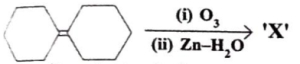
A
Cyclohexanone + Cyclohexanol
B
Cyclohexanone + Cyclohexanone
C
Cyclohexanecarbaldehyde + Cyclohexanone
D
Cyclohexanol + Cyclohexanol
Solution
(B) The given reaction is the reductive ozonolysis of $1,1'$-bicyclohexylidene.
Ozonolysis of an alkene involves the cleavage of the $C=C$ double bond to form two carbonyl compounds.
When the alkene is $1,1'$-bicyclohexylidene,the double bond connects two cyclohexane rings.
Cleavage of this double bond results in the formation of two molecules of cyclohexanone $(C_6H_{10}O)$.
Therefore,the product $X$ is two molecules of cyclohexanone.
Ozonolysis of an alkene involves the cleavage of the $C=C$ double bond to form two carbonyl compounds.
When the alkene is $1,1'$-bicyclohexylidene,the double bond connects two cyclohexane rings.
Cleavage of this double bond results in the formation of two molecules of cyclohexanone $(C_6H_{10}O)$.
Therefore,the product $X$ is two molecules of cyclohexanone.
0 likes
View Solution962
EasyMCQ
$2-$methylbut$-2-$ene $\xrightarrow[\text{(ii) } Zn / H_2 O]{\text{(i) } O_3}$ products here are . . . . . . .
A
$CH_3COCH_3 + CH_3CHO$
B
$CH_3CHO + CH_3CH_2CHO$
C
$CH_3COCH_3 + CH_3CH_2CHO$
D
$CH_3COCH_3 + CH_3CHO$
Solution
(A) The reaction of $2-$methylbut$-2-$ene with ozone $(O_3)$ followed by reductive workup with $Zn / H_2 O$ is known as ozonolysis.
In this reaction,the double bond $(C=C)$ is cleaved to form carbonyl compounds.
The structure of $2-$methylbut$-2-$ene is $CH_3-C(CH_3)=CH-CH_3$.
Upon ozonolysis,the bond breaks at the double bond position:
$CH_3-C(CH_3)=CH-CH_3 \rightarrow CH_3COCH_3 + CH_3CHO$.
The products formed are acetone $(CH_3COCH_3)$ and acetaldehyde $(CH_3CHO)$.
In this reaction,the double bond $(C=C)$ is cleaved to form carbonyl compounds.
The structure of $2-$methylbut$-2-$ene is $CH_3-C(CH_3)=CH-CH_3$.
Upon ozonolysis,the bond breaks at the double bond position:
$CH_3-C(CH_3)=CH-CH_3 \rightarrow CH_3COCH_3 + CH_3CHO$.
The products formed are acetone $(CH_3COCH_3)$ and acetaldehyde $(CH_3CHO)$.
0 likes
View Solution963
EasyMCQ
What is the major product in the following reaction?
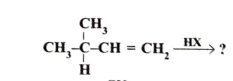
A
$CH_3-C(CH_3)(X)-CH_2-CH_3$
B
$CH_3-CH(CH_3)-CH(X)-CH_3$
C
$CH_3-CH(CH_3)-CH_2-CH_2-X$
D
$X-CH_2-CH(CH_3)-CH_2-CH_3$
Solution
(A) The reaction is the electrophilic addition of $HX$ to an alkene,which follows Markovnikov's rule.
According to Markovnikov's rule,the negative part of the addendum $(X^-)$ attaches to the carbon atom of the double bond that has fewer hydrogen atoms.
The starting material is $3,3-\text{dimethylbut-1-ene}$ (or a similar branched alkene structure as shown).
Upon protonation of the double bond,a carbocation is formed. The proton $(H^+)$ adds to the terminal $CH_2$ group to form a more stable secondary or tertiary carbocation.
In this specific structure,the addition of $H^+$ to the terminal carbon creates a secondary carbocation at the $C-2$ position,which can undergo a hydride or methyl shift to form a more stable tertiary carbocation.
However,looking at the options provided,the product formed by direct Markovnikov addition to the double bond is $CH_3-C(CH_3)(X)-CH_2-CH_3$ (where $X$ is at the $C-2$ position).
Thus,the major product is $CH_3-C(CH_3)(X)-CH_2-CH_3$.
According to Markovnikov's rule,the negative part of the addendum $(X^-)$ attaches to the carbon atom of the double bond that has fewer hydrogen atoms.
The starting material is $3,3-\text{dimethylbut-1-ene}$ (or a similar branched alkene structure as shown).
Upon protonation of the double bond,a carbocation is formed. The proton $(H^+)$ adds to the terminal $CH_2$ group to form a more stable secondary or tertiary carbocation.
In this specific structure,the addition of $H^+$ to the terminal carbon creates a secondary carbocation at the $C-2$ position,which can undergo a hydride or methyl shift to form a more stable tertiary carbocation.
However,looking at the options provided,the product formed by direct Markovnikov addition to the double bond is $CH_3-C(CH_3)(X)-CH_2-CH_3$ (where $X$ is at the $C-2$ position).
Thus,the major product is $CH_3-C(CH_3)(X)-CH_2-CH_3$.
0 likes
View Solution964
EasyMCQ
What is $A$ in the following reaction?
$C_6H_5-CH_2-CH=CH_2 + HCl \rightarrow A$
$C_6H_5-CH_2-CH=CH_2 + HCl \rightarrow A$
A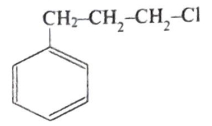
B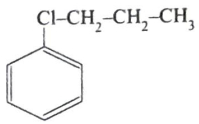
C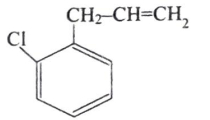
D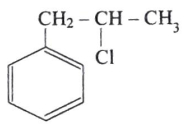
Solution
(D) The reaction is the electrophilic addition of $HCl$ to allylbenzene $(C_6H_5-CH_2-CH=CH_2)$.
According to Markovnikov's rule,the electrophile $(H^+)$ adds to the carbon atom of the double bond that has more hydrogen atoms.
In allylbenzene,the double bond is between $C_2$ and $C_3$ (where $C_1$ is attached to the phenyl ring: $C_6H_5-CH_2-CH=CH_2$).
$H^+$ adds to the terminal $CH_2$ group,forming a stable benzylic carbocation intermediate $(C_6H_5-CH_2-CH^+-CH_3)$.
Then,the nucleophile $(Cl^-)$ attacks this carbocation to form the final product: $C_6H_5-CH_2-CHCl-CH_3$ ($1$-phenyl$-2-$chloropropane).
Therefore,the correct option is $D$.
According to Markovnikov's rule,the electrophile $(H^+)$ adds to the carbon atom of the double bond that has more hydrogen atoms.
In allylbenzene,the double bond is between $C_2$ and $C_3$ (where $C_1$ is attached to the phenyl ring: $C_6H_5-CH_2-CH=CH_2$).
$H^+$ adds to the terminal $CH_2$ group,forming a stable benzylic carbocation intermediate $(C_6H_5-CH_2-CH^+-CH_3)$.
Then,the nucleophile $(Cl^-)$ attacks this carbocation to form the final product: $C_6H_5-CH_2-CHCl-CH_3$ ($1$-phenyl$-2-$chloropropane).
Therefore,the correct option is $D$.
0 likes
View Solution965
DifficultMCQ
When a tertiary alcohol $A$ $(C_4H_{10}O)$ reacts with $20\% \ H_3PO_4$ at $358 \ K$,it gives a compound $B$ $(C_4H_8)$ as a major product. The $IUPAC$ name of the compound $B$ is
A
but$-1-$ene
B
but$-2-$ene
C
cyclobutane
D
$2-$methylpropene
Solution
(D) The reaction is a dehydration of a tertiary alcohol ($tert$-butyl alcohol) via $\beta$-elimination.
When $2$-methylpropan$-2-$ol $(A)$ is heated with $20\% \ H_3PO_4$ at $358 \ K$,it undergoes dehydration to form $2$-methylpropene $(B)$ as the major product.
The reaction is:
$(CH_3)_3C-OH \xrightarrow{20\% \ H_3PO_4, 358 \ K} CH_2=C(CH_3)_2 + H_2O$
Thus,the $IUPAC$ name of the product $B$ is $2$-methylpropene.
When $2$-methylpropan$-2-$ol $(A)$ is heated with $20\% \ H_3PO_4$ at $358 \ K$,it undergoes dehydration to form $2$-methylpropene $(B)$ as the major product.
The reaction is:
$(CH_3)_3C-OH \xrightarrow{20\% \ H_3PO_4, 358 \ K} CH_2=C(CH_3)_2 + H_2O$
Thus,the $IUPAC$ name of the product $B$ is $2$-methylpropene.
0 likes
View Solution966
MediumMCQ
Identify $A$ and $B$ in the following reaction:
Propene $\xrightarrow{\text{HBr (Benzoyl peroxide)}}$ $A$ (Major product)
Propene $\xrightarrow{\text{HI}}$ $B$ (Major product)
Propene $\xrightarrow{\text{HBr (Benzoyl peroxide)}}$ $A$ (Major product)
Propene $\xrightarrow{\text{HI}}$ $B$ (Major product)
A
$A: CH_3-CH_2-CH_2-Br$
$B: CH_3-CH(I)-CH_3$
$B: CH_3-CH(I)-CH_3$
B
$A: CH_3-CH(Br)-CH_3$
$B: CH_3-CH_2-CH_2-I$
$B: CH_3-CH_2-CH_2-I$
C
$A: CH_3-CH(Br)-CH_3$
$B: CH_3-CH(I)-CH_3$
$B: CH_3-CH(I)-CH_3$
D
$A: CH_3-CH_2-CH_2-Br$
$B: CH_3-CH_2-CH_2-I$
$B: CH_3-CH_2-CH_2-I$
Solution
(A) $1$. The reaction of propene with $HBr$ in the presence of benzoyl peroxide follows the anti-Markovnikov addition (peroxide effect or Kharasch effect). In this reaction,the $Br^-$ adds to the less substituted carbon atom of the double bond,resulting in $1$-bromopropane $(CH_3-CH_2-CH_2-Br)$ as the major product $(A)$.
$2$. The reaction of propene with $HI$ follows the Markovnikov addition rule. In this reaction,the $H^+$ adds to the carbon with more hydrogen atoms,and the $I^-$ adds to the more substituted carbon atom,resulting in $2$-iodopropane $(CH_3-CH(I)-CH_3)$ as the major product $(B)$.
$2$. The reaction of propene with $HI$ follows the Markovnikov addition rule. In this reaction,the $H^+$ adds to the carbon with more hydrogen atoms,and the $I^-$ adds to the more substituted carbon atom,resulting in $2$-iodopropane $(CH_3-CH(I)-CH_3)$ as the major product $(B)$.
0 likes
View Solution967
DifficultMCQ
Peroxide effect is observed with the addition of $HBr$ but not with the addition of $HI$ to unsymmetrical alkene because
A
$H-I$ bond is stronger than $H-Br$ and is not cleaved by the free radical
B
$H-I$ bond is weaker than $H-Br$ bond so that iodine free radicals combine to form iodine molecules
C
Bond strength of $HI$ and $HBr$ are same but free radicals are formed in $HBr$
D
All of the above
Solution
(B) The peroxide effect (Kharasch effect) is observed with the addition of $HBr$ to unsymmetrical alkenes because the $H-Br$ bond can be homolytically cleaved by free radicals generated from the peroxide.
However,in the case of $HI$,the $H-I$ bond is very weak.
When iodine free radicals are generated,they are highly unstable and rapidly combine with each other to form stable $I_2$ molecules instead of attacking the alkene double bond.
The reaction is:
$I^{\bullet} + I^{\bullet} \rightarrow I_2$
(Unstable) (Stable)
Therefore,the anti-Markovnikov addition is not observed for $HI$.
However,in the case of $HI$,the $H-I$ bond is very weak.
When iodine free radicals are generated,they are highly unstable and rapidly combine with each other to form stable $I_2$ molecules instead of attacking the alkene double bond.
The reaction is:
$I^{\bullet} + I^{\bullet} \rightarrow I_2$
(Unstable) (Stable)
Therefore,the anti-Markovnikov addition is not observed for $HI$.
0 likes
View Solution968
EasyMCQ
Dalda is prepared from oils by
A
oxidation
B
reduction
C
hydrolysis
D
distillation
Solution
(B) Oils (liquid glycerides) react with hydrogen in the presence of a metal catalyst (like $Ni$) to give saturated glycerides (semi-solid fats). This process is known as hydrogenation,which is a type of reduction reaction. Thus,vegetable ghee (Dalda) is obtained by the hydrogenation (reduction) of oils.
$Oils + H_{2} \xrightarrow{Ni} Dalda$
$Oils + H_{2} \xrightarrow{Ni} Dalda$
0 likes
View Solution969
MediumMCQ
What is $X$ in the following reaction?

A
$3-$bromocyclohex$-1-$ene
B
$1,2-$dibromocyclohexane
C
$1-$bromocyclohex$-1-$ene
D
Bromocyclohexane
Solution
(A) The given reaction shows that $C_6H_{10}$ (cyclohexene) reacts with $KMnO_4-H_2SO_4$ to form adipic acid (hexanedioic acid),which is a standard oxidative cleavage reaction of cyclohexene.
When cyclohexene $(C_6H_{10})$ reacts with $Br_2$ in the presence of $UV$ light,it undergoes allylic bromination.
The allylic position in cyclohexene is the carbon adjacent to the double bond.
Therefore,the product $X$ is $3$-bromocyclohex-$1$-ene.
When cyclohexene $(C_6H_{10})$ reacts with $Br_2$ in the presence of $UV$ light,it undergoes allylic bromination.
The allylic position in cyclohexene is the carbon adjacent to the double bond.
Therefore,the product $X$ is $3$-bromocyclohex-$1$-ene.
0 likes
View Solution970
MediumMCQ
Which reaction of ethanol will decolourise bromine water?
A
$C_2H_5OH + HBr \longrightarrow C_2H_5Br + H_2O$
B
$2 C_2H_5OH \xrightarrow[413 \ K]{H^{+}} C_2H_5-O-C_2H_5 + H_2O$
C
$C_2H_5OH + Na \longrightarrow C_2H_5ONa + \frac{1}{2} H_2$
D
$C_2H_5OH \xrightarrow[443 \ K]{H^{+}} C_2H_4 + H_2O$
Solution
(D) The reaction in option $D$ produces ethene $(C_2H_4)$,which is an unsaturated hydrocarbon containing a carbon-carbon double bond.
Unsaturated hydrocarbons undergo addition reactions with bromine,which results in the decolourisation of the reddish-brown bromine water.
This is a standard test for the detection of unsaturation in organic compounds.
The reaction is: $C_2H_5OH \xrightarrow[443 \ K]{H^{+}} CH_2=CH_2 + H_2O$.
Unsaturated hydrocarbons undergo addition reactions with bromine,which results in the decolourisation of the reddish-brown bromine water.
This is a standard test for the detection of unsaturation in organic compounds.
The reaction is: $C_2H_5OH \xrightarrow[443 \ K]{H^{+}} CH_2=CH_2 + H_2O$.
0 likes
View Solution971
EasyMCQ
An organic compound $(A)$ on ozonolysis followed by treatment with zinc dust and water gives product $(P)$,which can be used to preserve biological specimens. Identify $(A)$.
A
$2,3$-dimethylbut-$2$-ene
B
but-$2$-ene
C
ethene
D
cyclohexene
Solution
(C) Formaldehyde $(HCHO)$ is commonly used to preserve biological specimens as it acts as a fixative by cross-linking proteins.
Ozonolysis of an alkene followed by treatment with zinc dust and water (reductive ozonolysis) cleaves the $C=C$ double bond to form carbonyl compounds.
For the product $(P)$ to be formaldehyde $(HCHO)$,the starting alkene $(A)$ must be ethene $(CH_2=CH_2)$.
The reaction is as follows:
$CH_2=CH_2 + O_3 \xrightarrow{Zn/H_2O} 2HCHO$ (Formaldehyde).
Ozonolysis of an alkene followed by treatment with zinc dust and water (reductive ozonolysis) cleaves the $C=C$ double bond to form carbonyl compounds.
For the product $(P)$ to be formaldehyde $(HCHO)$,the starting alkene $(A)$ must be ethene $(CH_2=CH_2)$.
The reaction is as follows:
$CH_2=CH_2 + O_3 \xrightarrow{Zn/H_2O} 2HCHO$ (Formaldehyde).
0 likes
View Solution972
EasyMCQ
The products $Q$ and $R$ in the following reactions respectively are:
$H_2 + CH_3-C \equiv CH$ $\xrightarrow{\text{Lindlar's catalyst}} P$ $\xrightarrow[Zn + H_2O]{O_3} Q + R$
$H_2 + CH_3-C \equiv CH$ $\xrightarrow{\text{Lindlar's catalyst}} P$ $\xrightarrow[Zn + H_2O]{O_3} Q + R$
A
$Ethanol$,$Methanoic \ acid$
B
$Ethanoic \ acid$,$Methanol$
C
$Ethanal$,$Methanal$
D
$Ethanoic \ acid$,$Methanoic \ acid$
Solution
(C) $1$. The reaction of $CH_3-C \equiv CH$ (propyne) with $H_2$ in the presence of Lindlar's catalyst results in the formation of $CH_3-CH=CH_2$ (propene) as product $P$.
$2$. The ozonolysis of propene $(CH_3-CH=CH_2)$ in the presence of $Zn/H_2O$ (reductive ozonolysis) leads to the cleavage of the double bond.
$3$. The reaction is: $CH_3-CH=CH_2 + O_3 \xrightarrow{Zn/H_2O} CH_3CHO + HCHO$.
$4$. Thus,the products $Q$ and $R$ are $CH_3CHO$ $(Ethanal)$ and $HCHO$ $(Methanal)$.
$2$. The ozonolysis of propene $(CH_3-CH=CH_2)$ in the presence of $Zn/H_2O$ (reductive ozonolysis) leads to the cleavage of the double bond.
$3$. The reaction is: $CH_3-CH=CH_2 + O_3 \xrightarrow{Zn/H_2O} CH_3CHO + HCHO$.
$4$. Thus,the products $Q$ and $R$ are $CH_3CHO$ $(Ethanal)$ and $HCHO$ $(Methanal)$.
0 likes
View Solution973
DifficultMCQ
An alkene $X$ $(C_4H_8)$ does not exhibit cis-trans isomerism. Reaction of $X$ with $Br_2$ in the presence of $UV$ light gives $Y$. What is $Y$?
A
$3,4-$dibromohexane
B
$1-$bromobut$-2-$ene
C
$3-$bromobut$-1-$ene
D
$1-$bromobutane
Solution
(C) $1$. The alkene $X$ is $C_4H_8$. The isomers of $C_4H_8$ are but$-1-$ene,but$-2-$ene,and $2-$methylpropene.
$2$. But$-2-$ene exhibits cis-trans isomerism. But$-1-$ene does not exhibit cis-trans isomerism.
$3$. $2-$methylpropene $(CH_2=C(CH_3)_2)$ also does not exhibit cis-trans isomerism.
$4$. However,the reaction of $X$ with $Br_2$ in the presence of $UV$ light is a free-radical substitution reaction (allylic bromination).
$5$. For but$-1-$ene $(CH_2=CH-CH_2-CH_3)$,the allylic position is $C_3$. Bromination at the allylic position gives $3-$bromobut$-1-$ene.
$6$. Therefore,$X$ is but$-1-$ene and $Y$ is $3-$bromobut$-1-$ene.
$2$. But$-2-$ene exhibits cis-trans isomerism. But$-1-$ene does not exhibit cis-trans isomerism.
$3$. $2-$methylpropene $(CH_2=C(CH_3)_2)$ also does not exhibit cis-trans isomerism.
$4$. However,the reaction of $X$ with $Br_2$ in the presence of $UV$ light is a free-radical substitution reaction (allylic bromination).
$5$. For but$-1-$ene $(CH_2=CH-CH_2-CH_3)$,the allylic position is $C_3$. Bromination at the allylic position gives $3-$bromobut$-1-$ene.
$6$. Therefore,$X$ is but$-1-$ene and $Y$ is $3-$bromobut$-1-$ene.
0 likes
View Solution974
EasyMCQ
Identify the correct statements with respect to $cis/trans$-but$-2$-ene from the following:
$I$. $cis$-but$-2$-ene is more polar than $trans$-but$-2$-ene
$II$. Melting point of $cis$-but$-2$-ene is greater than that of $trans$-but$-2$-ene
$III$. Boiling point of $cis$-but$-2$-ene is greater than that of $trans$-but$-2$-ene
Correct answer is
$I$. $cis$-but$-2$-ene is more polar than $trans$-but$-2$-ene
$II$. Melting point of $cis$-but$-2$-ene is greater than that of $trans$-but$-2$-ene
$III$. Boiling point of $cis$-but$-2$-ene is greater than that of $trans$-but$-2$-ene
Correct answer is
A
$I, II$ only
B
$II, III$ only
C
$I, III$ only
D
$I, II, III$
Solution
(C) $cis$-but$-2$-ene is more polar than $trans$-but$-2$-ene because the bond dipole moments cancel out in the symmetric $trans$-but$-2$-ene isomer. Thus,statement $I$ is correct.
Due to its higher polarity,$cis$-but$-2$-ene has stronger intermolecular dipole-dipole interactions,resulting in a higher boiling point. Thus,statement $III$ is correct.
The $trans$-isomer is more symmetric and packs better in the crystal lattice,leading to a higher melting point compared to the $cis$-isomer. Thus,statement $II$ is incorrect.
Due to its higher polarity,$cis$-but$-2$-ene has stronger intermolecular dipole-dipole interactions,resulting in a higher boiling point. Thus,statement $III$ is correct.
The $trans$-isomer is more symmetric and packs better in the crystal lattice,leading to a higher melting point compared to the $cis$-isomer. Thus,statement $II$ is incorrect.
0 likes
View Solution975
MediumMCQ
$A$ dibromide $X$ $(C_4H_8Br_2)$ on dehydrohalogenation gave $Y$,which on reduction with $Z$ gave a non-polar isomer of $C_4H_8$. What are $X$ and $Z$ respectively?
A
$X = \text{2,3-dibromobutane}, Z = \text{Na/NH}_3(l)$
B
$X = \text{2,3-dibromobutane}, Z = \text{Pd/C}$
C
$X = \text{1,2-dibromobutane}, Z = \text{Na/NH}_3(l)$
D
$X = \text{1,2-dibromobutane}, Z = \text{Pd/C}$
Solution
(A) $1$. The dibromide $X$ is $2,3-\text{dibromobutane}$ $(CH_3-CH(Br)-CH(Br)-CH_3)$.
$2$. Dehydrohalogenation of $2,3-\text{dibromobutane}$ removes two molecules of $HBr$ to form $Y$,which is $2-\text{butyne}$ $(CH_3-C \equiv C-CH_3)$.
$3$. Reduction of $2-\text{butyne}$ with $Z = \text{Na/NH}_3(l)$ (Birch reduction) yields $trans-2-\text{butene}$.
$4$. $trans-2-\text{butene}$ is a non-polar isomer of $C_4H_8$ because its dipole moment $\mu = 0$ due to symmetry.
$5$. Therefore,$X$ is $2,3-\text{dibromobutane}$ and $Z$ is $\text{Na/NH}_3(l)$.
$2$. Dehydrohalogenation of $2,3-\text{dibromobutane}$ removes two molecules of $HBr$ to form $Y$,which is $2-\text{butyne}$ $(CH_3-C \equiv C-CH_3)$.
$3$. Reduction of $2-\text{butyne}$ with $Z = \text{Na/NH}_3(l)$ (Birch reduction) yields $trans-2-\text{butene}$.
$4$. $trans-2-\text{butene}$ is a non-polar isomer of $C_4H_8$ because its dipole moment $\mu = 0$ due to symmetry.
$5$. Therefore,$X$ is $2,3-\text{dibromobutane}$ and $Z$ is $\text{Na/NH}_3(l)$.
0 likes
View Solution976
MediumMCQ
How many distinct alkenes are obtained from $3-$bromo$-3-$methylhexane upon treatment with alcoholic $KOH$?
A
$2$
B
$3$
C
$4$
D
$5$
Solution
(B) The reaction of $3-$bromo$-3-$methylhexane with alcoholic $KOH$ proceeds via an $E2$ elimination mechanism.
$3-$bromo$-3-$methylhexane has the structure $CH_3-CH_2-C(Br)(CH_3)-CH_2-CH_2-CH_3$.
The $\beta$-carbons are the carbons adjacent to the carbon bearing the bromine atom.
There are three distinct types of $\beta$-hydrogens available for elimination:
$1$. Elimination from the $C2$ position ($CH_2$ group) gives $3-$methylhex$-2-$ene.
$2$. Elimination from the $C4$ position ($CH_2$ group) gives $3-$methylhex$-3-$ene.
$3$. Elimination from the methyl group attached to $C3$ gives $2-$ethylpent$-1-$ene.
Thus,$3$ distinct alkenes are obtained.
$3-$bromo$-3-$methylhexane has the structure $CH_3-CH_2-C(Br)(CH_3)-CH_2-CH_2-CH_3$.
The $\beta$-carbons are the carbons adjacent to the carbon bearing the bromine atom.
There are three distinct types of $\beta$-hydrogens available for elimination:
$1$. Elimination from the $C2$ position ($CH_2$ group) gives $3-$methylhex$-2-$ene.
$2$. Elimination from the $C4$ position ($CH_2$ group) gives $3-$methylhex$-3-$ene.
$3$. Elimination from the methyl group attached to $C3$ gives $2-$ethylpent$-1-$ene.
Thus,$3$ distinct alkenes are obtained.
0 likes
View Solution977
EasyMCQ
Which of the following alkenes does not undergo anti-Markovnikov addition of $HBr$?
A
Propene
B
$1-$Butene
C
$2-$Butene
D
$3-$Methyl$-2-$Pentene
Solution
(C) Anti-Markovnikov addition of $HBr$ (peroxide effect) occurs in unsymmetrical alkenes where the addition of $H$ and $Br$ can lead to different products based on the stability of the free radical intermediate.
$2-$Butene $(CH_3-CH=CH-CH_3)$ is a symmetrical alkene.
Due to its symmetry,the addition of $H$ and $Br$ to either carbon of the double bond results in the same product,$2-$bromobutane.
Therefore,$2-$Butene does not show a distinct anti-Markovnikov addition product compared to the Markovnikov product.
$2-$Butene $(CH_3-CH=CH-CH_3)$ is a symmetrical alkene.
Due to its symmetry,the addition of $H$ and $Br$ to either carbon of the double bond results in the same product,$2-$bromobutane.
Therefore,$2-$Butene does not show a distinct anti-Markovnikov addition product compared to the Markovnikov product.
0 likes
View Solution978
MediumMCQ
An unsaturated organic compound,$X$ on reaction with hot,acidified $KMnO_4$ gives succinic acid. What is $X$?
A
Cyclopentene
B
Cyclopropene
C
Cyclobutene
D
$2-$Butene
Solution
(C) The reaction of an alkene with hot,acidified $KMnO_4$ leads to oxidative cleavage of the double bond.
Succinic acid is a dicarboxylic acid with the formula $HOOC-CH_2-CH_2-COOH$.
Since the product is a four-carbon dicarboxylic acid,the starting cyclic alkene must be cyclobutene.
The reaction is as follows:
Cyclobutene + $KMnO_4/H_2SO_4$ (hot) $\rightarrow$ Succinic acid $(HOOC-CH_2-CH_2-COOH)$.
Succinic acid is a dicarboxylic acid with the formula $HOOC-CH_2-CH_2-COOH$.
Since the product is a four-carbon dicarboxylic acid,the starting cyclic alkene must be cyclobutene.
The reaction is as follows:
Cyclobutene + $KMnO_4/H_2SO_4$ (hot) $\rightarrow$ Succinic acid $(HOOC-CH_2-CH_2-COOH)$.
0 likes
View Solution979
EasyMCQ
One mole of $2-$methylbuta$-1, 3-$diene on ozonolysis gives:
A
$2$ moles of methanal and $1$ mole of propanone.
B
$2$ moles of methanal and $1$ mole of $2-$oxopropanal.
C
$1$ mole of methanal,$1$ mole of ethanal,and $1$ mole of propanone.
D
$2$ moles of ethanal and $1$ mole of $2-$oxopropanal.
Solution
(B) The structure of $2-$methylbuta$-1, 3-$diene is $CH_2=C(CH_3)-CH=CH_2$.
Ozonolysis of this diene involves the cleavage of both double bonds.
The reaction is as follows:
$CH_2=C(CH_3)-CH=CH_2 \xrightarrow{O_3/Zn, H_2O} HCHO + CH_3-CO-CHO + HCHO$
Thus,the products formed are $2$ moles of methanal $(HCHO)$ and $1$ mole of $2-$oxopropanal $(CH_3-CO-CHO)$.
Ozonolysis of this diene involves the cleavage of both double bonds.
The reaction is as follows:
$CH_2=C(CH_3)-CH=CH_2 \xrightarrow{O_3/Zn, H_2O} HCHO + CH_3-CO-CHO + HCHO$
Thus,the products formed are $2$ moles of methanal $(HCHO)$ and $1$ mole of $2-$oxopropanal $(CH_3-CO-CHO)$.
0 likes
View Solution980
MediumMCQ
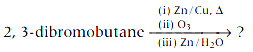
The major product$(s)$ formed in the following reaction sequence is (are):
A
$2 \ CH_3COOH$
B
$CH_3COCOCH_3$
C
$2 \ CH_3CHO$
D
$2 \ HCHO + CHO-CHO$
Solution
(C) Step $1$: $2, 3-$dibromobutane reacts with $Zn / Cu$ in the presence of heat to undergo debromination,forming $trans-$but$-2-$ene.
Step $2$: The $trans-$but$-2-$ene undergoes reductive ozonolysis with $O_3$ followed by $Zn / H_2O$.
Step $3$: The double bond breaks to form two molecules of acetaldehyde $(CH_3CHO)$.
Thus,the final product is $2 \ CH_3CHO$.
Step $2$: The $trans-$but$-2-$ene undergoes reductive ozonolysis with $O_3$ followed by $Zn / H_2O$.
Step $3$: The double bond breaks to form two molecules of acetaldehyde $(CH_3CHO)$.
Thus,the final product is $2 \ CH_3CHO$.
0 likes
View Solution981
MediumMCQ
Identify '$X$' in the following reaction.
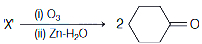
A
Methylenecyclohexane
B
Cyclohexanol
C
$1,2-$Dicyclohexylethylene
D
Bicyclohexylidene
Solution
(D) The reaction given is reductive ozonolysis,which involves the cleavage of a carbon-carbon double bond $(C=C)$ to form two carbonyl groups $(C=O)$.
The product is $2$ moles of cyclohexanone. This means the starting material must be an alkene that,upon cleavage of its double bond,yields two molecules of cyclohexanone.
Structure of cyclohexanone is a six-membered ring with a ketone group at one position. To get two such molecules,the starting alkene must be bicyclohexylidene,where two cyclohexane rings are connected by a double bond at the same carbon atom.
Reaction: $\text{Bicyclohexylidene} + O_3 \xrightarrow{Zn-H_2O} 2 \times \text{Cyclohexanone}$.
Therefore,'$X$' is bicyclohexylidene.
The product is $2$ moles of cyclohexanone. This means the starting material must be an alkene that,upon cleavage of its double bond,yields two molecules of cyclohexanone.
Structure of cyclohexanone is a six-membered ring with a ketone group at one position. To get two such molecules,the starting alkene must be bicyclohexylidene,where two cyclohexane rings are connected by a double bond at the same carbon atom.
Reaction: $\text{Bicyclohexylidene} + O_3 \xrightarrow{Zn-H_2O} 2 \times \text{Cyclohexanone}$.
Therefore,'$X$' is bicyclohexylidene.
0 likes
View Solution982
MediumMCQ
Which of the following alkenes will yield $2-$methyl propanal on reductive ozonolysis (addition with ozone followed by the reaction with $Zn / H_2 O$)?
A
$3,4-$dimethylhex$-3-$ene
B
hex$-3-$ene
C
$2,5-$dimethylhex$-3-$ene
D
$3,4-$diethylhex$-3-$ene
Solution
(C) Reductive ozonolysis of an alkene involves breaking the $C=C$ double bond and replacing it with two $C=O$ bonds.
For $2-$methyl propanal $(CH_3-CH(CH_3)-CHO)$,the structure is a $4-$carbon chain with a methyl group on the $2^{nd}$ carbon and an aldehyde group on the $1^{st}$ carbon.
If we take $2,5-$dimethylhex$-3-$ene,the structure is $(CH_3)_2CH-CH=CH-CH(CH_3)_2$.
Upon reductive ozonolysis,the double bond breaks to form two molecules of $2-$methyl propanal,$(CH_3)_2CH-CHO$.
Thus,the correct option is $(C)$.
For $2-$methyl propanal $(CH_3-CH(CH_3)-CHO)$,the structure is a $4-$carbon chain with a methyl group on the $2^{nd}$ carbon and an aldehyde group on the $1^{st}$ carbon.
If we take $2,5-$dimethylhex$-3-$ene,the structure is $(CH_3)_2CH-CH=CH-CH(CH_3)_2$.
Upon reductive ozonolysis,the double bond breaks to form two molecules of $2-$methyl propanal,$(CH_3)_2CH-CHO$.
Thus,the correct option is $(C)$.
0 likes
View Solution983
MediumMCQ
Ozonolysis of an organic compound '$A$' produces acetone and propanal in equimolar mixture. Identify '$A$' from the following compounds.
A
$1-$pentene
B
$2-$methyl$-1-$pentene
C
$2-$methyl$-2-$pentene
D
$2-$pentene
Solution
(C) Ozonolysis of an alkene involves the cleavage of the $C=C$ double bond and the addition of oxygen atoms to each carbon atom to form carbonyl compounds.
Acetone is $CH_3COCH_3$ and propanal is $CH_3CH_2CHO$.
Combining these two fragments by removing the oxygen atoms and joining the carbons with a double bond gives the structure of the original alkene:
$(CH_3)_2C=O + O=CHCH_2CH_3 \rightarrow (CH_3)_2C=CHCH_2CH_3$.
The structure $(CH_3)_2C=CHCH_2CH_3$ corresponds to $2-$methyl$-2-$pentene.
Therefore,the correct option is $C$.
Acetone is $CH_3COCH_3$ and propanal is $CH_3CH_2CHO$.
Combining these two fragments by removing the oxygen atoms and joining the carbons with a double bond gives the structure of the original alkene:
$(CH_3)_2C=O + O=CHCH_2CH_3 \rightarrow (CH_3)_2C=CHCH_2CH_3$.
The structure $(CH_3)_2C=CHCH_2CH_3$ corresponds to $2-$methyl$-2-$pentene.
Therefore,the correct option is $C$.
0 likes
View Solution984
MediumMCQ
For the reaction given below,which of the following is not a possible product?
$H_2C=CH_2 + Br_{2(aq)} \xrightarrow{NaCl} \text{Products}$
$H_2C=CH_2 + Br_{2(aq)} \xrightarrow{NaCl} \text{Products}$
A
$CH_2(Br)-CH_2(Br)$
B
$CH_2(Br)-CH_2(Cl)$
C
$CH_2(Br)-CH_2(OH)$
D
$CH_2(Cl)-CH_2(Cl)$
Solution
(D) The reaction of ethene with aqueous bromine in the presence of $NaCl$ proceeds via the formation of a cyclic bromonium ion intermediate.
$1$. The $\pi$-electrons of ethene attack the electrophile $(Br^+)$ to form a cyclic bromonium ion.
$2$. This intermediate is then attacked by nucleophiles present in the reaction medium,which include $Br^-$,$Cl^-$,and $H_2O$.
$3$. The possible products are:
- $Br-CH_2-CH_2-Br$ (from $Br^-$ attack)
- $Br-CH_2-CH_2-Cl$ (from $Cl^-$ attack)
- $Br-CH_2-CH_2-OH$ (from $H_2O$ attack)
$Cl-CH_2-CH_2-Cl$ is not a possible product because the reaction mechanism involves the initial formation of a bromonium ion,meaning at least one bromine atom must be incorporated into the final product. Thus,the correct option is $D$.
$1$. The $\pi$-electrons of ethene attack the electrophile $(Br^+)$ to form a cyclic bromonium ion.
$2$. This intermediate is then attacked by nucleophiles present in the reaction medium,which include $Br^-$,$Cl^-$,and $H_2O$.
$3$. The possible products are:
- $Br-CH_2-CH_2-Br$ (from $Br^-$ attack)
- $Br-CH_2-CH_2-Cl$ (from $Cl^-$ attack)
- $Br-CH_2-CH_2-OH$ (from $H_2O$ attack)
$Cl-CH_2-CH_2-Cl$ is not a possible product because the reaction mechanism involves the initial formation of a bromonium ion,meaning at least one bromine atom must be incorporated into the final product. Thus,the correct option is $D$.
0 likes
View Solution985
MediumMCQ
What are $X$ and $Y$ in the following reaction? $Hex-2-ene$ $\xrightarrow{O_3} \text{Ozonide}$ $\xrightarrow{Zn + H_2O} X + Y$
A
$X = CH_3-CH_2-CHO, Y = (CH_3)_2CO$
B
$X = CH_3-CH(CH_3)-COOH, Y = CH_3-COOH$
C
$X = CH_3-CH_2-CH_2-CHO, Y = CH_3-CHO$
D
$X = CH_3-CH(CH_3)-CHO, Y = CH_3-CHO$
Solution
(C) Reductive ozonolysis of $Hex-2-ene$ $(CH_3-CH_2-CH_2-CH=CH-CH_3)$ involves the addition of ozone across the double bond followed by cleavage with $Zn/H_2O$ to produce two carbonyl compounds.
Cleavage of the $C=C$ bond in $Hex-2-ene$ occurs at the $2^{nd}$ position.
The reaction is: $CH_3-CH_2-CH_2-CH=CH-CH_3 \xrightarrow{O_3, Zn/H_2O} CH_3-CH_2-CH_2-CHO + CH_3-CHO$.
Thus,$X = CH_3-CH_2-CH_2-CHO$ $(Butanal)$ and $Y = CH_3-CHO$ $(Ethanal)$.
Cleavage of the $C=C$ bond in $Hex-2-ene$ occurs at the $2^{nd}$ position.
The reaction is: $CH_3-CH_2-CH_2-CH=CH-CH_3 \xrightarrow{O_3, Zn/H_2O} CH_3-CH_2-CH_2-CHO + CH_3-CHO$.
Thus,$X = CH_3-CH_2-CH_2-CHO$ $(Butanal)$ and $Y = CH_3-CHO$ $(Ethanal)$.
0 likes
View Solution986
MediumMCQ
Identify the major products $X$ and $Y$ in the following reactions:
$(i)$ $C_6H_5-CH=CH_2 + HBr \rightarrow X$
(ii) $C_6H_5-CH_2-CH=CH_2 + HBr \xrightarrow{\text{Peroxide}} Y$
$(i)$ $C_6H_5-CH=CH_2 + HBr \rightarrow X$
(ii) $C_6H_5-CH_2-CH=CH_2 + HBr \xrightarrow{\text{Peroxide}} Y$
A
For $(i)$,$X = C_6H_5-CH_2-CH_2Br$; For (ii),$Y = C_6H_5-CH_2-CH_2-CH_2Br$
B
For $(i)$,$X = C_6H_5-CH(Br)-CH_3$; For (ii),$Y = C_6H_5-CH_2-CH(Br)-CH_3$
C
For $(i)$,$X = C_6H_5-CH(Br)-CH_3$; For (ii),$Y = C_6H_5-CH_2-CH_2-CH_2Br$
D
For $(i)$,$X = C_6H_5-CH_2-CH_2Br$; For (ii),$Y = C_6H_5-CH_2-CH(Br)-CH_3$
Solution
(C) In reaction $(i)$,the addition of $HBr$ to styrene $(C_6H_5-CH=CH_2)$ follows Markovnikov's rule. The electrophile $H^+$ adds to the terminal carbon to form the more stable benzylic carbocation $(C_6H_5-CH^+-CH_3)$,which then reacts with $Br^-$ to give $X = C_6H_5-CH(Br)-CH_3$.
In reaction (ii),the addition of $HBr$ to allylbenzene $(C_6H_5-CH_2-CH=CH_2)$ in the presence of peroxide follows the anti-Markovnikov addition (Kharasch effect). The bromine radical adds to the terminal carbon to form the more stable radical,resulting in $Y = C_6H_5-CH_2-CH_2-CH_2Br$.
Thus,the correct products are $X = C_6H_5-CH(Br)-CH_3$ and $Y = C_6H_5-CH_2-CH_2-CH_2Br$.
In reaction (ii),the addition of $HBr$ to allylbenzene $(C_6H_5-CH_2-CH=CH_2)$ in the presence of peroxide follows the anti-Markovnikov addition (Kharasch effect). The bromine radical adds to the terminal carbon to form the more stable radical,resulting in $Y = C_6H_5-CH_2-CH_2-CH_2Br$.
Thus,the correct products are $X = C_6H_5-CH(Br)-CH_3$ and $Y = C_6H_5-CH_2-CH_2-CH_2Br$.
0 likes
View Solution987
MediumMCQ
What are $X$ and $Y$ in the following reaction?
Pent-$2$-ene $\xrightarrow[(ii) Zn / H_2O]{(i) O_3} X + Y$
Pent-$2$-ene $\xrightarrow[(ii) Zn / H_2O]{(i) O_3} X + Y$
A
$CH_3CHO$ and $CH_3CH_2CHO$
B
$CH_3CH_2CHO$ and $CH_3CH_2CHO$
C
$CH_3CHO$ and $(CH_3)_2CO$
D
$CH_3CHO$ and $CH_3CHO$
Solution
(A) The reaction of Pent-$2$-ene $(CH_3-CH_2-CH=CH-CH_3)$ with ozone $(O_3)$ followed by reductive cleavage with $Zn/H_2O$ is known as ozonolysis.
The double bond breaks at the position of the alkene,and each carbon atom of the double bond is converted into a carbonyl group $(C=O)$.
The reaction is:
$CH_3-CH_2-CH=CH-CH_3 \xrightarrow[(ii) Zn / H_2O]{(i) O_3} CH_3-CH_2-CHO + CH_3-CHO$
Here,$CH_3-CH_2-CHO$ is propanal and $CH_3-CHO$ is ethanal.
Thus,$X$ and $Y$ are $CH_3CHO$ and $CH_3CH_2CHO$.
The double bond breaks at the position of the alkene,and each carbon atom of the double bond is converted into a carbonyl group $(C=O)$.
The reaction is:
$CH_3-CH_2-CH=CH-CH_3 \xrightarrow[(ii) Zn / H_2O]{(i) O_3} CH_3-CH_2-CHO + CH_3-CHO$
Here,$CH_3-CH_2-CHO$ is propanal and $CH_3-CHO$ is ethanal.
Thus,$X$ and $Y$ are $CH_3CHO$ and $CH_3CH_2CHO$.
0 likes
View Solution988
EasyMCQ
Assertion $(A)$: Propene on addition with hydrogen bromide in the presence of peroxide gives $1-$bromopropane as the major product.
Reason $(R)$: $1-$bromopropane is the major product because it is formed through the stable carbocation.
The correct answer is
Reason $(R)$: $1-$bromopropane is the major product because it is formed through the stable carbocation.
The correct answer is
A
$(A)$ and $(R)$ are correct,$(R)$ is the correct explanation of $(A)$
B
$(A)$ and $(R)$ are correct but $(R)$ is not the correct explanation of $(A)$
C
$(A)$ is correct but $(R)$ is not correct
D
$(A)$ is not correct but $(R)$ is correct
Solution
(C) The addition of $HBr$ to propene in the presence of peroxide follows the anti-Markownikoff's rule (peroxide effect or Kharasch effect).
In this mechanism,the reaction proceeds via a free radical intermediate,not a carbocation intermediate.
Therefore,the Assertion $(A)$ is correct because $1-$bromopropane is indeed the major product under these conditions.
However,the Reason $(R)$ is incorrect because the reaction does not involve a carbocation intermediate,and the stability of a carbocation is not the reason for the formation of $1-$bromopropane.
Thus,$(A)$ is correct but $(R)$ is not correct.
In this mechanism,the reaction proceeds via a free radical intermediate,not a carbocation intermediate.
Therefore,the Assertion $(A)$ is correct because $1-$bromopropane is indeed the major product under these conditions.
However,the Reason $(R)$ is incorrect because the reaction does not involve a carbocation intermediate,and the stability of a carbocation is not the reason for the formation of $1-$bromopropane.
Thus,$(A)$ is correct but $(R)$ is not correct.
0 likes
View Solution989
DifficultMCQ
Pent-$1$-ene reacts with diborane to form $X$. $X$ on oxidation using $H_2O_2$ in the presence of aqueous $NaOH$ gives $Y$. Compound $Y$ is
A
$CH_3CH_2CH_2CH(OH)CH_3$
B
$CH_3CH_2CH_2CH_2CH_2OH$
C
$CH_3CH_2CH(OH)CH_2CH_3$
D
$CH_3CH_2C(OH)(CH_3)CH_3$
Solution
(B) The reaction of pent-$1$-ene $(CH_3CH_2CH_2CH=CH_2)$ with diborane $(B_2H_6)$ followed by oxidation with $H_2O_2$ in the presence of aqueous $NaOH$ is known as hydroboration-oxidation.
This reaction follows anti-Markovnikov addition of water ($H$ and $OH$) across the double bond.
The terminal carbon atom gets the $-OH$ group,resulting in the formation of pentan-$1$-ol $(CH_3CH_2CH_2CH_2CH_2OH)$.
This reaction follows anti-Markovnikov addition of water ($H$ and $OH$) across the double bond.
The terminal carbon atom gets the $-OH$ group,resulting in the formation of pentan-$1$-ol $(CH_3CH_2CH_2CH_2CH_2OH)$.
0 likes
View Solution990
EasyMCQ
Assertion $(A)$: Reaction of $but-1-ene$ with $HBr$ gives $1-bromobutane$ as the major product.
Reason $(R)$: Addition of $HBr$ to unsymmetrical alkenes proceeds according to Markovnikov's rule.
The correct answer is
Reason $(R)$: Addition of $HBr$ to unsymmetrical alkenes proceeds according to Markovnikov's rule.
The correct answer is
A
$(A)$ and $(R)$ are correct,$(R)$ is the correct explanation of $(A)$
B
$(A)$ and $(R)$ are correct but $(R)$ is not the correct explanation of $(A)$
C
$(A)$ is correct but $(R)$ is not correct
D
$(A)$ is not correct but $(R)$ is correct
Solution
(D) According to Markovnikov's rule,the addition of $HBr$ to an unsymmetrical alkene like $but-1-ene$ $(CH_3-CH_2-CH=CH_2)$ results in the hydrogen atom attaching to the carbon with more hydrogen atoms,and the bromine atom attaching to the carbon with fewer hydrogen atoms.
Therefore,the major product formed is $2-bromobutane$ $(CH_3-CH_2-CH(Br)-CH_3)$,not $1-bromobutane$.
Thus,Assertion $(A)$ is incorrect.
However,the Reason $(R)$ stating that the addition of $HBr$ to unsymmetrical alkenes follows Markovnikov's rule is correct.
Therefore,$(A)$ is incorrect but $(R)$ is correct.
Therefore,the major product formed is $2-bromobutane$ $(CH_3-CH_2-CH(Br)-CH_3)$,not $1-bromobutane$.
Thus,Assertion $(A)$ is incorrect.
However,the Reason $(R)$ stating that the addition of $HBr$ to unsymmetrical alkenes follows Markovnikov's rule is correct.
Therefore,$(A)$ is incorrect but $(R)$ is correct.
0 likes
View Solution991
EasyMCQ
Assertion $(A)$: Propene on addition with hydrogen bromide in the presence of peroxide gives $1-$bromopropane as the major product.
Reason $(R)$: $1-$bromopropane is the major product because it is formed through the stable carbocation.
Reason $(R)$: $1-$bromopropane is the major product because it is formed through the stable carbocation.
A
$(A)$ and $(R)$ are correct,$(R)$ is the correct explanation of $(A)$
B
$(A)$ and $(R)$ are correct but $(R)$ is not the correct explanation of $(A)$
C
$(A)$ is correct but $(R)$ is not correct
D
$(A)$ is not correct but $(R)$ is correct
Solution
(C) The addition of $HBr$ to propene in the presence of peroxide follows the anti-Markovnikov rule,which proceeds via a free radical mechanism,not a carbocation mechanism.
Thus,the assertion $(A)$ is correct as it correctly identifies $1-$bromopropane as the major product.
The reason $(R)$ is incorrect because the reaction does not involve a carbocation intermediate; it involves a free radical intermediate.
Therefore,$(A)$ is correct but $(R)$ is not correct.
Thus,the assertion $(A)$ is correct as it correctly identifies $1-$bromopropane as the major product.
The reason $(R)$ is incorrect because the reaction does not involve a carbocation intermediate; it involves a free radical intermediate.
Therefore,$(A)$ is correct but $(R)$ is not correct.
0 likes
View Solution992
MediumMCQ
$But-1-ene$ reacts with diborane to give '$X$'. On oxidation of '$X$' with $H_2O_2$ in the presence of aqueous $NaOH$,it forms alcohol '$Y$'. What are '$X$' and '$Y$'?
A
$X = (CH_3CH_2CH(CH_3))_3B, Y = CH_3CH_2CH(OH)CH_3$
B
$X = [(CH_3)_2CH-CH_2]_3B, Y = (CH_3)_2CH-CH_2OH$
C
$X = (CH_3CH_2CH_2CH_2)_3B, Y = CH_3CH_2CH_2CH_2OH$
D
$X = (CH_3CH_2CH_2)_3B, Y = CH_3CH_2CH_2OH$
Solution
(C) The reaction of $but-1-ene$ $(CH_3CH_2CH=CH_2)$ with diborane $(B_2H_6)$ is a hydroboration reaction,which follows anti-Markovnikov addition.
This results in the formation of a trialkylborane '$X$'.
$6CH_3CH_2CH=CH_2 + B_2H_6 \rightarrow 2(CH_3CH_2CH_2CH_2)_3B$ (where $X = (CH_3CH_2CH_2CH_2)_3B$).
Subsequent oxidation of '$X$' with $H_2O_2$ in the presence of aqueous $NaOH$ replaces the boron atom with a hydroxyl group $(-OH)$,yielding a primary alcohol '$Y$'.
$(CH_3CH_2CH_2CH_2)_3B + 3H_2O_2 \xrightarrow{NaOH} 3CH_3CH_2CH_2CH_2OH + B(OH)_3$.
Thus,'$X$' is $(CH_3CH_2CH_2CH_2)_3B$ and '$Y$' is $butan-1-ol$ $(CH_3CH_2CH_2CH_2OH)$.
This results in the formation of a trialkylborane '$X$'.
$6CH_3CH_2CH=CH_2 + B_2H_6 \rightarrow 2(CH_3CH_2CH_2CH_2)_3B$ (where $X = (CH_3CH_2CH_2CH_2)_3B$).
Subsequent oxidation of '$X$' with $H_2O_2$ in the presence of aqueous $NaOH$ replaces the boron atom with a hydroxyl group $(-OH)$,yielding a primary alcohol '$Y$'.
$(CH_3CH_2CH_2CH_2)_3B + 3H_2O_2 \xrightarrow{NaOH} 3CH_3CH_2CH_2CH_2OH + B(OH)_3$.
Thus,'$X$' is $(CH_3CH_2CH_2CH_2)_3B$ and '$Y$' is $butan-1-ol$ $(CH_3CH_2CH_2CH_2OH)$.
0 likes
View Solution993
MediumMCQ
Alkenes react with water in the presence of acid to form alcohols. Identify the steps involved in the mechanism of the reaction from the following :
a) Nucleophilic addition of hydroxide ion to alkene
b) Protonation of alkene by electrophilic attack of $H_3O^{+}$
c) Electrophilic attack of $H_2O$ on carbanion
d) Nucleophilic attack of $H_2O$ on carbocation
e) Loss of $^{\ominus}OH$ to form an alcohol
f) Loss of $H^{\oplus}$ to form an alcohol
a) Nucleophilic addition of hydroxide ion to alkene
b) Protonation of alkene by electrophilic attack of $H_3O^{+}$
c) Electrophilic attack of $H_2O$ on carbanion
d) Nucleophilic attack of $H_2O$ on carbocation
e) Loss of $^{\ominus}OH$ to form an alcohol
f) Loss of $H^{\oplus}$ to form an alcohol
A
$a, c, e$
B
$b, c, e$
C
$b, d, f$
D
$a, c, f$
Solution
(C) The acid-catalyzed hydration of alkenes follows an electrophilic addition mechanism. The steps are as follows:
$1$. Protonation of the alkene by the electrophilic attack of $H_3O^{+}$ to form a carbocation intermediate (Step $b$).
$2$. Nucleophilic attack of $H_2O$ on the carbocation to form a protonated alcohol (Step $d$).
$3$. Deprotonation (loss of $H^{\oplus}$) to form the final alcohol product (Step $f$).
Therefore,the correct sequence is $b, d, f$.
$1$. Protonation of the alkene by the electrophilic attack of $H_3O^{+}$ to form a carbocation intermediate (Step $b$).
$2$. Nucleophilic attack of $H_2O$ on the carbocation to form a protonated alcohol (Step $d$).
$3$. Deprotonation (loss of $H^{\oplus}$) to form the final alcohol product (Step $f$).
Therefore,the correct sequence is $b, d, f$.
0 likes
View Solution994
EasyMCQ
Which of the following intermediates is formed to produce the major product in the addition of $HBr$ to propene in the presence of peroxide?
A
$CH_3-CH_2-\dot{C}H_2$
B
$CH_3-\dot{C}H-CH_3$
C
$CH_3-\dot{C}H-CH_2Br$
D
$CH_3-CH_2-CH_2-\dot{C}H_2$
Solution
(C) The addition of $HBr$ to propene in the presence of peroxide follows the anti-Markovnikov rule via a free radical mechanism.
In the propagation step,the bromine radical $(\dot{B}r)$ attacks the double bond of propene.
There are two possibilities for the attack of the bromine radical:
$1$. Attack at $C_1$ leads to the formation of a secondary free radical: $CH_3-\dot{C}H-CH_2Br$.
$2$. Attack at $C_2$ leads to the formation of a primary free radical: $CH_3-CH(Br)-\dot{C}H_2$.
Since a secondary free radical is more stable than a primary free radical,the intermediate $CH_3-\dot{C}H-CH_2Br$ is formed preferentially,leading to the major product $CH_3-CH_2-CH_2Br$.
In the propagation step,the bromine radical $(\dot{B}r)$ attacks the double bond of propene.
There are two possibilities for the attack of the bromine radical:
$1$. Attack at $C_1$ leads to the formation of a secondary free radical: $CH_3-\dot{C}H-CH_2Br$.
$2$. Attack at $C_2$ leads to the formation of a primary free radical: $CH_3-CH(Br)-\dot{C}H_2$.
Since a secondary free radical is more stable than a primary free radical,the intermediate $CH_3-\dot{C}H-CH_2Br$ is formed preferentially,leading to the major product $CH_3-CH_2-CH_2Br$.
0 likes
View Solution995
MediumMCQ
The reaction conditions used for converting $1, 2-$dibromoethane to ethene are
A
$Zn$,alcohol,$\Delta$
B
$KOH$,alcohol,$\Delta$
C
$KOH$,water,$\Delta$
D
$Na$,alcohol,$\Delta$
Solution
(A) The conversion of $1, 2-$dibromoethane to ethene is a dehalogenation reaction.
This reaction involves the removal of two bromine atoms from adjacent carbon atoms using zinc dust in the presence of alcohol under heating $(\Delta)$.
The chemical equation is: $BrCH_2-CH_2Br + Zn \xrightarrow{\text{alcohol}, \Delta} CH_2=CH_2 + ZnBr_2$.
Thus,the correct reaction conditions are $Zn$,alcohol,$\Delta$.
This reaction involves the removal of two bromine atoms from adjacent carbon atoms using zinc dust in the presence of alcohol under heating $(\Delta)$.
The chemical equation is: $BrCH_2-CH_2Br + Zn \xrightarrow{\text{alcohol}, \Delta} CH_2=CH_2 + ZnBr_2$.
Thus,the correct reaction conditions are $Zn$,alcohol,$\Delta$.
0 likes
View Solution996
EasyMCQ
Which of the following reagents is used to detect carbon-carbon multiple bonds?
A
Grignard reagent
B
Baeyer’s reagent
C
Sandmeyer’s reagent
D
Gattermann reagent
Solution
(B) Baeyer's reagent is a cold,dilute,alkaline solution of $KMnO_4$.
It reacts with alkenes and alkynes to form vicinal diols,causing the characteristic purple color of $KMnO_4$ to disappear,which serves as a test for unsaturation.
It reacts with alkenes and alkynes to form vicinal diols,causing the characteristic purple color of $KMnO_4$ to disappear,which serves as a test for unsaturation.
0 likes
View Solution997
DifficultMCQ
The Diels-Alder reaction will not take place with which of the following reactants?
A
$1,4-$pentadiene and ethene
B
$1,3-$pentadiene and ethene
C
$1,3-$butadiene and propene
D
$1,3-$butadiene and ethene
Solution
(A) The Diels-Alder reaction requires a conjugated diene and a dienophile (an alkene or alkyne).
In option $A$,$1,4$-pentadiene is an isolated diene,not a conjugated diene.
Conjugated dienes have alternating single and double bonds (e.g.,$CH_2=CH-CH=CH_2$).
Since $1,4$-pentadiene lacks the necessary conjugated system,it cannot participate in the Diels-Alder reaction.
In option $A$,$1,4$-pentadiene is an isolated diene,not a conjugated diene.
Conjugated dienes have alternating single and double bonds (e.g.,$CH_2=CH-CH=CH_2$).
Since $1,4$-pentadiene lacks the necessary conjugated system,it cannot participate in the Diels-Alder reaction.
0 likes
View SolutionHydrocarbons — Alkene · Frequently Asked Questions
1Are these Hydrocarbons questions useful for JEE and NEET?
Yes. All questions in this section are mapped to JEE Main and NEET exam patterns. Previous year questions from JEE Main, NEET, GUJCET and state-level exams are included with full solutions.
2Can I switch to Hindi or Gujarati for these questions?
Yes. Use the language tabs in the hero section or the sidebar to view the same questions and solutions in English, Hindi or Gujarati.
3How do I generate a question paper from this subtopic?
Use the Vedclass Exam Paper Generator — select the chapter and subtopic, set difficulty, and generate Sets A, B, C, D automatically. First 3 chapters of every subject are free.
Vedclass Products
For Students
Vedclass Test Series
Mock tests in real JEE/NEET style with performance analysis. 5-day free trial.
Start Free TrialFor Teachers
Exam Paper Generator
Generate Set A/B/C/D papers from this chapter in 2 minutes. 3 chapters free.
Try FreeFor Institutes
Online Exam Module
Live online exams with unlimited students, 360° analytics & white-label branding.
See DemoFor Teachers & Institutes
Generate a Hydrocarbons Exam Paper in 2 Minutes
Select subtopic & difficulty — Sets A, B, C, D auto-generated with No Repeat logic.
First 3 chapters of every subject are free — no payment required.