
A English
Alkene Questions in English
Class 11 Chemistry · Hydrocarbons · Alkene
1080+
Questions
English
Language
100%
With Solutions
Showing 49 of 1080 questions in English
901
EasyMCQ
Ozonolysis of $2-$methyl$-2-$butene,in presence of $Zn,$ yields $--$
A
Only aldehyde
B
Only ketone
C
Both aldehyde and ketone
D
Only carboxylic acid
Solution
(C) The structure of $2-$methyl$-2-$butene is $(CH_3)_2C=CH-CH_3$.
Ozonolysis involves the cleavage of the $C=C$ double bond to form carbonyl compounds.
When $2-$methyl$-2-$butene reacts with $O_3$ followed by $Zn/H_2O$,the double bond breaks to form acetone $(CH_3)_2C=O$ and acetaldehyde $CH_3CHO$.
Since the products are both a ketone (acetone) and an aldehyde (acetaldehyde),the correct option is $C$.
Ozonolysis involves the cleavage of the $C=C$ double bond to form carbonyl compounds.
When $2-$methyl$-2-$butene reacts with $O_3$ followed by $Zn/H_2O$,the double bond breaks to form acetone $(CH_3)_2C=O$ and acetaldehyde $CH_3CHO$.
Since the products are both a ketone (acetone) and an aldehyde (acetaldehyde),the correct option is $C$.
0 likes
View Solution902
MediumMCQ
In hydroboration-oxidation reaction $:-$
$I$. Syn addition takes place
$II$. Reaction proceeds through the formation of a cyclic transition state
$III$. Vicinal diol is obtained as a product
$IV$. Anti-addition takes place and Anti-Markovnikov rule is followed
Which of the following statement$(s)$ is/are correct $:-$
$I$. Syn addition takes place
$II$. Reaction proceeds through the formation of a cyclic transition state
$III$. Vicinal diol is obtained as a product
$IV$. Anti-addition takes place and Anti-Markovnikov rule is followed
Which of the following statement$(s)$ is/are correct $:-$
A
$III$
B
$I, II$
C
$II, III, IV$
D
All of them are correct
Solution
(B) In hydroboration-oxidation reaction:
$1$. The reaction involves the syn-addition of $BH_3$ across the double bond.
$2$. The reaction proceeds through a concerted mechanism involving a four-membered cyclic transition state.
$3$. The product obtained is an alcohol (specifically,an anti-Markovnikov alcohol),not a vicinal diol.
$4$. The reaction follows the Anti-Markovnikov rule,but it is a syn-addition,not anti-addition.
Therefore,statements $I$ and $II$ are correct.
$1$. The reaction involves the syn-addition of $BH_3$ across the double bond.
$2$. The reaction proceeds through a concerted mechanism involving a four-membered cyclic transition state.
$3$. The product obtained is an alcohol (specifically,an anti-Markovnikov alcohol),not a vicinal diol.
$4$. The reaction follows the Anti-Markovnikov rule,but it is a syn-addition,not anti-addition.
Therefore,statements $I$ and $II$ are correct.
0 likes
View Solution903
MediumMCQ
For the given reaction sequence,identify $C$ and $D$:
$3\text{-methylbut-1-ene}$ $\xrightarrow[(ii) NaBH_4]{(i) Hg(OAc)_2/H_2O} A$ $\xrightarrow{H^\oplus/\Delta} B$ $\xrightarrow{O_3/Zn/H_2O} C + D$
$3\text{-methylbut-1-ene}$ $\xrightarrow[(ii) NaBH_4]{(i) Hg(OAc)_2/H_2O} A$ $\xrightarrow{H^\oplus/\Delta} B$ $\xrightarrow{O_3/Zn/H_2O} C + D$
A
$CH_3COCH_3, CH_3CHO$
B
$CH_3COCH_3, HCHO$
C
$CH_3COCH_2CH_3, HCHO$
D
$HCHO, CH_3COCH_2CH_3$
Solution
(A) $1$. The first step is oxymercuration-demercuration of $3\text{-methylbut-1-ene}$,which follows Markovnikov's rule to give $3\text{-methylbutan-2-ol}$ as product $A$.
$2$. The second step is acid-catalyzed dehydration of $A$ $(H^\oplus/\Delta)$. The major product $B$ is the more stable alkene,$2\text{-methylbut-2-ene}$,formed via the Saytzeff rule.
$3$. The third step is ozonolysis of $B$ $(2\text{-methylbut-2-ene})$ using $O_3/Zn/H_2O$. Ozonolysis of $CH_3-C(CH_3)=CH-CH_3$ cleaves the double bond to yield acetone $(CH_3COCH_3)$ and acetaldehyde $(CH_3CHO)$.
$4$. Thus,$C$ and $D$ are $CH_3COCH_3$ and $CH_3CHO$.
$2$. The second step is acid-catalyzed dehydration of $A$ $(H^\oplus/\Delta)$. The major product $B$ is the more stable alkene,$2\text{-methylbut-2-ene}$,formed via the Saytzeff rule.
$3$. The third step is ozonolysis of $B$ $(2\text{-methylbut-2-ene})$ using $O_3/Zn/H_2O$. Ozonolysis of $CH_3-C(CH_3)=CH-CH_3$ cleaves the double bond to yield acetone $(CH_3COCH_3)$ and acetaldehyde $(CH_3CHO)$.
$4$. Thus,$C$ and $D$ are $CH_3COCH_3$ and $CH_3CHO$.
0 likes
View Solution904
MediumMCQ
Unbranched alkenes on ozonolysis give $:-$
A
Only ketones
B
Only aldehydes
C
Aldehyde and ketone both
D
Alcohols
Solution
(B) Ozonolysis of an unbranched alkene involves the cleavage of the $C=C$ double bond.
For an unbranched alkene of the general form $R_1-CH=CH-R_2$,the reaction with $O_3$ followed by reductive workup $(Zn/H_2O)$ results in the formation of two aldehyde molecules.
The general reaction is: $R_1-CH=CH-R_2 \xrightarrow{O_3, Zn/H_2O} R_1-CHO + R_2-CHO$.
Since the carbon atoms involved in the double bond are bonded to at least one hydrogen atom,the products are aldehydes.
For an unbranched alkene of the general form $R_1-CH=CH-R_2$,the reaction with $O_3$ followed by reductive workup $(Zn/H_2O)$ results in the formation of two aldehyde molecules.
The general reaction is: $R_1-CH=CH-R_2 \xrightarrow{O_3, Zn/H_2O} R_1-CHO + R_2-CHO$.
Since the carbon atoms involved in the double bond are bonded to at least one hydrogen atom,the products are aldehydes.
0 likes
View Solution905
EasyMCQ
Hydroboration-oxidation of but$-1-$ene forms
A
Butanal
B
Butanone
C
Butan$-1-$ol
D
Butan$-2-$ol
Solution
(C) Hydroboration-oxidation of alkenes is an anti-Markovnikov addition of water $(H_2O)$ across the double bond.
For but$-1-$ene $(CH_3CH_2CH=CH_2)$,the reaction proceeds as follows:
$CH_3CH_2CH=CH_2 + (BH_3)_2 \rightarrow CH_3CH_2CH_2CH_2BH_2$
Followed by oxidation with $H_2O_2/OH^-$:
$CH_3CH_2CH_2CH_2BH_2 + 3H_2O_2 + OH^- \rightarrow CH_3CH_2CH_2CH_2OH + B(OH)_4^-$
The final product is butan$-1-$ol.
For but$-1-$ene $(CH_3CH_2CH=CH_2)$,the reaction proceeds as follows:
$CH_3CH_2CH=CH_2 + (BH_3)_2 \rightarrow CH_3CH_2CH_2CH_2BH_2$
Followed by oxidation with $H_2O_2/OH^-$:
$CH_3CH_2CH_2CH_2BH_2 + 3H_2O_2 + OH^- \rightarrow CH_3CH_2CH_2CH_2OH + B(OH)_4^-$
The final product is butan$-1-$ol.
0 likes
View Solution906
EasyMCQ
What is the product of Hydroboration-oxidation of but-$1$-ene?
A
Butanal
B
Butanone
C
Butan-$1$-ol
D
Butan-$2$-ol
Solution
(C) Hydroboration-oxidation of alkenes follows anti-Markovnikov addition of water across the double bond.
For but-$1$-ene $(CH_3CH_2CH=CH_2)$,the hydroxyl group $(-OH)$ attaches to the terminal carbon atom.
Therefore,the product formed is butan-$1$-ol $(CH_3CH_2CH_2CH_2OH)$.
For but-$1$-ene $(CH_3CH_2CH=CH_2)$,the hydroxyl group $(-OH)$ attaches to the terminal carbon atom.
Therefore,the product formed is butan-$1$-ol $(CH_3CH_2CH_2CH_2OH)$.
0 likes
View Solution907
MediumMCQ
Propene when treated with cold conc. $H_2SO_4$ forms a compound which on heating with water gives
A
Propan$-2-$ol
B
Butan$-1-$ol
C
Ethanol
D
Propan$-1-$ol
Solution
(A) The reaction proceeds via the electrophilic addition of $H_2SO_4$ to propene according to Markovnikov's rule.
$CH_3-CH=CH_2 + HOSO_3H \rightarrow CH_3-CH(OSO_3H)-CH_3$ (Isopropyl hydrogen sulphate).
On heating with water (hydrolysis),the isopropyl hydrogen sulphate yields propan$-2-$ol.
$CH_3-CH(OSO_3H)-CH_3 + H_2O \xrightarrow{\Delta} CH_3-CH(OH)-CH_3 + H_2SO_4$.
$CH_3-CH=CH_2 + HOSO_3H \rightarrow CH_3-CH(OSO_3H)-CH_3$ (Isopropyl hydrogen sulphate).
On heating with water (hydrolysis),the isopropyl hydrogen sulphate yields propan$-2-$ol.
$CH_3-CH(OSO_3H)-CH_3 + H_2O \xrightarrow{\Delta} CH_3-CH(OH)-CH_3 + H_2SO_4$.
0 likes
View Solution908
MediumMCQ
Identify the major product formed when $2-$Methylhexan$-3-$ol is heated with concentrated sulphuric acid.
A
$2-$Methylhex$-2-$ene
B
$2-$Methylhex$-3-$ene
C
$3-$Methylhex$-2-$ene
D
$2-$Methylhex$-1-$ene
Solution
(A) The dehydration of $2-$Methylhexan$-3-$ol $(CH_3-CH(CH_3)-CH(OH)-CH_2-CH_2-CH_3)$ with concentrated $H_2SO_4$ proceeds via an $E1$ mechanism involving a carbocation intermediate.
$1$. Protonation of the $-OH$ group followed by the loss of water generates a secondary carbocation at the $C3$ position: $CH_3-CH(CH_3)-CH^+-CH_2-CH_2-CH_3$.
$2$. This secondary carbocation can undergo a $1,2-$hydride shift to form a more stable tertiary carbocation at the $C2$ position: $CH_3-C^+(CH_3)-CH_2-CH_2-CH_2-CH_3$.
$3$. Elimination of a proton from the adjacent carbon atoms leads to the formation of alkenes. According to Saytzeff's rule,the most substituted alkene is the major product.
$4$. The tertiary carbocation can lose a proton from $C3$ to form $2-$Methylhex$-2-$ene $(CH_3-C(CH_3)=CH-CH_2-CH_2-CH_3)$,which is a trisubstituted alkene and the most stable product.
Therefore,the major product is $2-$Methylhex$-2-$ene.
$1$. Protonation of the $-OH$ group followed by the loss of water generates a secondary carbocation at the $C3$ position: $CH_3-CH(CH_3)-CH^+-CH_2-CH_2-CH_3$.
$2$. This secondary carbocation can undergo a $1,2-$hydride shift to form a more stable tertiary carbocation at the $C2$ position: $CH_3-C^+(CH_3)-CH_2-CH_2-CH_2-CH_3$.
$3$. Elimination of a proton from the adjacent carbon atoms leads to the formation of alkenes. According to Saytzeff's rule,the most substituted alkene is the major product.
$4$. The tertiary carbocation can lose a proton from $C3$ to form $2-$Methylhex$-2-$ene $(CH_3-C(CH_3)=CH-CH_2-CH_2-CH_3)$,which is a trisubstituted alkene and the most stable product.
Therefore,the major product is $2-$Methylhex$-2-$ene.
0 likes
View Solution909
EasyMCQ
The product obtained when $2-$methylpropan$-2-$ol is treated with alumina $(Al_2O_3)$ at $423 \ K$ is
A
Propanone
B
Propene
C
Propanoic acid
D
Isobutylene
Solution
(D) When $2-$methylpropan$-2-$ol (tert-butyl alcohol) is passed over heated alumina $(Al_2O_3)$ at $423 \ K$,it undergoes dehydration to form $2-$methylpropene (isobutylene).
The reaction is: $(CH_3)_3C-OH \xrightarrow{Al_2O_3, 423 \ K} CH_3-C(CH_3)=CH_2 + H_2O$.
$2-$methylpropene is commonly known as isobutylene.
The reaction is: $(CH_3)_3C-OH \xrightarrow{Al_2O_3, 423 \ K} CH_3-C(CH_3)=CH_2 + H_2O$.
$2-$methylpropene is commonly known as isobutylene.
0 likes
View Solution910
MediumMCQ
Identify the product obtained when alkenes react with cold and dilute alkaline potassium permanganate.
A
Alkanols
B
Glycols
C
Glycerols
D
Alkanoic acids
Solution
(B) The reaction of alkenes with cold and dilute alkaline $KMnO_4$ (Baeyer's reagent) results in the syn-hydroxylation of the double bond to form vicinal diols,commonly known as glycols.
For example,the reaction of ethene with cold and dilute alkaline $KMnO_4$ yields ethane$-1,2-$diol (ethylene glycol):
$CH_2=CH_2 + H_2O + [O] \xrightarrow{\text{alkaline } KMnO_4} HOCH_2-CH_2OH$
For example,the reaction of ethene with cold and dilute alkaline $KMnO_4$ yields ethane$-1,2-$diol (ethylene glycol):
$CH_2=CH_2 + H_2O + [O] \xrightarrow{\text{alkaline } KMnO_4} HOCH_2-CH_2OH$
0 likes
View Solution911
MediumMCQ
What are the final products obtained by ozonolysis of propene?
A
$2$ molecules of acetaldehyde
B
acetone
C
$2$ molecules of formaldehyde
D
formaldehyde and acetaldehyde
Solution
(D) Ozonolysis of propene $(CH_3-CH=CH_2)$ involves the reaction with ozone $(O_3)$ followed by reductive cleavage with zinc and water $(Zn/H_2O)$.
The reaction breaks the double bond and forms carbonyl compounds:
$CH_3-CH=CH_2 \xrightarrow[(ii) Zn/H_2O]{(i) O_3} CH_3CHO + HCHO$
The products obtained are acetaldehyde $(CH_3CHO)$ and formaldehyde $(HCHO)$.
The reaction breaks the double bond and forms carbonyl compounds:
$CH_3-CH=CH_2 \xrightarrow[(ii) Zn/H_2O]{(i) O_3} CH_3CHO + HCHO$
The products obtained are acetaldehyde $(CH_3CHO)$ and formaldehyde $(HCHO)$.
0 likes
View Solution912
MediumMCQ
Hardening of oil is done by
A
dehydrogenation
B
hydrogenation
C
dehydrohalogenation
D
dehydration
Solution
(B) Hardening of oil involves the addition of hydrogen $(H_2)$ to unsaturated vegetable oils in the presence of a catalyst such as $Ni$,$Pd$,or $Pt$ to form saturated solid fats.
This process is called hydrogenation.
This process is called hydrogenation.
0 likes
View Solution913
MediumMCQ
Which of the following is obtained on oxidation of $prop-1-ene$ with acidic $KMnO_4$?
A
Ethanoic acid
B
Propanol
C
Propanoic acid
D
Propanone
Solution
(A) The oxidation of $prop-1-ene$ $(CH_3-CH=CH_2)$ with acidic $KMnO_4$ leads to the cleavage of the double bond.
The terminal $CH_2$ group is oxidized to $CO_2$ and $H_2O$,while the $CH_3-CH=$ group is oxidized to ethanoic acid $(CH_3COOH)$.
The reaction is: $CH_3-CH=CH_2 + [O] \xrightarrow{acidic \ KMnO_4} CH_3COOH + CO_2 + H_2O$.
The terminal $CH_2$ group is oxidized to $CO_2$ and $H_2O$,while the $CH_3-CH=$ group is oxidized to ethanoic acid $(CH_3COOH)$.
The reaction is: $CH_3-CH=CH_2 + [O] \xrightarrow{acidic \ KMnO_4} CH_3COOH + CO_2 + H_2O$.
0 likes
View Solution914
MediumMCQ
What is the product obtained when phenylethene is treated with $KMnO_4$ in dilute $H_2SO_4$?
A
$C_6H_5CH_2CHO$
B
$C_6H_5CH_2COOH$
C
$C_6H_5COOH$
D
$C_6H_5COCH_3$
Solution
(C) When phenylethene $(C_6H_5CH=CH_2)$ is treated with acidic potassium permanganate ($KMnO_4$ in dilute $H_2SO_4$),it undergoes oxidative cleavage.
The double bond is broken,and the terminal $CH_2$ group is oxidized to $CO_2$ and $H_2O$,while the phenyl-substituted carbon is oxidized to a carboxylic acid group.
Thus,phenylethene is oxidized to benzoic acid $(C_6H_5COOH)$.
The double bond is broken,and the terminal $CH_2$ group is oxidized to $CO_2$ and $H_2O$,while the phenyl-substituted carbon is oxidized to a carboxylic acid group.
Thus,phenylethene is oxidized to benzoic acid $(C_6H_5COOH)$.
0 likes
View Solution915
MediumMCQ
Identify the product in the following reaction.
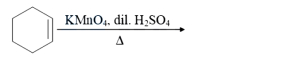
A
Hexane$-1,6-$dicarboxylic acid with a methyl group
B
Hexane$-1,6-$dicarboxylic acid with a hydroxymethyl group
C
Cyclohexane with two methyl groups
D
Hexane$-1,6-$dioic acid (Adipic acid)
Solution
(D) The reaction of cyclohexene with hot acidic $KMnO_4$ (oxidative cleavage) leads to the breaking of the double bond.
Since the double bond is part of a ring,the ring opens to form a dicarboxylic acid.
The product formed is hexane$-1,6-$dioic acid,commonly known as adipic acid.
Since the double bond is part of a ring,the ring opens to form a dicarboxylic acid.
The product formed is hexane$-1,6-$dioic acid,commonly known as adipic acid.
0 likes
View Solution916
MediumMCQ
Which of the following alkenes on oxidation by $KMnO_4$ in dil. $H_2SO_4$ forms adipic acid?
A
Hex$-3-$ene
B
Hex$-1-$ene
C
Hex$-2-$ene
D
Cyclohexene
Solution
(D) Adipic acid is a dicarboxylic acid with the formula $HOOC-(CH_2)_4-COOH$.
Oxidation of cyclic alkenes with strong oxidizing agents like $KMnO_4$ in acidic medium leads to the cleavage of the double bond and the ring,resulting in the formation of dicarboxylic acids.
Cyclohexene,when treated with $KMnO_4$ in dil. $H_2SO_4$,undergoes oxidative cleavage to form adipic acid (hexanedioic acid).
The reaction is: $\text{Cyclohexene} + [O] \xrightarrow{KMnO_4/H^+} HOOC-(CH_2)_4-COOH$.
Oxidation of cyclic alkenes with strong oxidizing agents like $KMnO_4$ in acidic medium leads to the cleavage of the double bond and the ring,resulting in the formation of dicarboxylic acids.
Cyclohexene,when treated with $KMnO_4$ in dil. $H_2SO_4$,undergoes oxidative cleavage to form adipic acid (hexanedioic acid).
The reaction is: $\text{Cyclohexene} + [O] \xrightarrow{KMnO_4/H^+} HOOC-(CH_2)_4-COOH$.
0 likes
View Solution917
EasyMCQ
Which of the following is Baeyer's reagent?
A
Alkaline $KMnO_4$
B
Acidic $K_2Cr_2O_7$
C
Alkaline $Na_2Cr_2O_7$
D
$MnO_2$
Solution
(A) Alkaline $KMnO_4$ is known as Baeyer's reagent.
It is used as an oxidizing agent in organic chemistry to test for the presence of unsaturation (double or triple bonds) in organic compounds.
It is used as an oxidizing agent in organic chemistry to test for the presence of unsaturation (double or triple bonds) in organic compounds.
0 likes
View Solution918
EasyMCQ
The correct stability order of alkyl substituted alkenes is
A
$R_2C=CHR > R_2C=CH_2 > R_2C=CR_2$
B
$R_2C=CR_2 > R_2C=CHR > R_2C=CH_2$
C
$R_2C=CH_2 > R_2C=CR_2 > R_2C=CHR$
D
$R_2C=CR_2 > R_2C=CH_2 > R_2C=CHR$
Solution
(B) The stability of alkenes increases with an increase in the number of alkyl groups attached to the doubly bonded carbon atoms due to the hyperconjugation effect and inductive effect.
The order of stability is:
$R_2C=CR_2 > R_2C=CHR > R_2C=CH_2$
Thus,the correct option is $B$.
The order of stability is:
$R_2C=CR_2 > R_2C=CHR > R_2C=CH_2$
Thus,the correct option is $B$.
0 likes
View Solution919
MediumMCQ
What is the number of structural isomers possible for alkene with molecular formula $C_5H_{10}$?
A
$2$
B
$3$
C
$4$
D
$5$
Solution
(D) The molecular formula $C_5H_{10}$ corresponds to the general formula $C_nH_{2n}$,which represents an alkene.
To find the structural isomers,we consider the position of the double bond and the carbon chain branching:
$1$. $Pent-1-ene$ $(CH_2=CH-CH_2-CH_2-CH_3)$
$2$. $Pent-2-ene$ $(CH_3-CH=CH-CH_2-CH_3)$
$3$. $2-Methylbut-1-ene$ $(CH_2=C(CH_3)-CH_2-CH_3)$
$4$. $3-Methylbut-1-ene$ $(CH_2=CH-CH(CH_3)_2)$
$5$. $2-Methylbut-2-ene$ $(CH_3-C(CH_3)=CH-CH_3)$
Thus,there are $5$ possible structural isomers for $C_5H_{10}$.
To find the structural isomers,we consider the position of the double bond and the carbon chain branching:
$1$. $Pent-1-ene$ $(CH_2=CH-CH_2-CH_2-CH_3)$
$2$. $Pent-2-ene$ $(CH_3-CH=CH-CH_2-CH_3)$
$3$. $2-Methylbut-1-ene$ $(CH_2=C(CH_3)-CH_2-CH_3)$
$4$. $3-Methylbut-1-ene$ $(CH_2=CH-CH(CH_3)_2)$
$5$. $2-Methylbut-2-ene$ $(CH_3-C(CH_3)=CH-CH_3)$
Thus,there are $5$ possible structural isomers for $C_5H_{10}$.
0 likes
View Solution920
EasyMCQ
Which of the following alkenes does $\underline{NOT}$ exhibit cis-trans isomerism?
A
but$-1-$ene
B
but$-2-$ene
C
$3,4-$Dimethylhex$-3-$ene
D
pent$-2-$ene
Solution
(A) For an alkene to exhibit cis-trans isomerism,each carbon atom of the double bond must be attached to two different groups.
In but$-1-$ene $(CH_3-CH_2-CH=CH_2)$,the terminal carbon atom $(C_1)$ is bonded to two identical hydrogen atoms.
Therefore,it cannot exhibit cis-trans isomerism.
In but$-1-$ene $(CH_3-CH_2-CH=CH_2)$,the terminal carbon atom $(C_1)$ is bonded to two identical hydrogen atoms.
Therefore,it cannot exhibit cis-trans isomerism.
0 likes
View Solution921
MediumMCQ
The number of alkenyl groups possible from $C_{4}H_{7}$ are
A
$7$
B
$5$
C
$3$
D
$8$
Solution
(B) The alkenyl groups are derived by removing one hydrogen atom from an alkene. For $C_{4}H_{8}$ (butenes),the possible isomers are $1$-butene,$2$-butene,and $2$-methylpropene.
Removing a hydrogen atom from these structures gives the following $C_{4}H_{7}$ groups:
$(i)$ $CH_{3}CH_{2}CH=CH-$ ($1$-butenyl)
$(ii)$ $CH_{3}CH=CHCH_{2}-$ ($2$-butenyl)
$(iii)$ $CH_{2}=CHCH_{2}CH_{2}-$ ($3$-butenyl)
$(iv)$ $CH_{3}C(CH_{3})=CH-$ ($2$-methyl$-1-$propenyl)
$(v)$ $CH_{2}=C(CH_{3})CH_{2}-$ ($2$-methyl$-2-$propenyl)
Thus,there are $5$ possible alkenyl groups.
Removing a hydrogen atom from these structures gives the following $C_{4}H_{7}$ groups:
$(i)$ $CH_{3}CH_{2}CH=CH-$ ($1$-butenyl)
$(ii)$ $CH_{3}CH=CHCH_{2}-$ ($2$-butenyl)
$(iii)$ $CH_{2}=CHCH_{2}CH_{2}-$ ($3$-butenyl)
$(iv)$ $CH_{3}C(CH_{3})=CH-$ ($2$-methyl$-1-$propenyl)
$(v)$ $CH_{2}=C(CH_{3})CH_{2}-$ ($2$-methyl$-2-$propenyl)
Thus,there are $5$ possible alkenyl groups.
0 likes
View Solution922
MediumMCQ
Which of the following alkenes is most easily formed by dehydrohalogenation of alkyl halides?
A
$R_2C=CH_2$
B
$RCH=CHR$
C
$R_2C=CHR$
D
$R_2C=CR_2$
Solution
(D) The ease of formation of an alkene by dehydrohalogenation follows the stability of the resulting alkene. According to $Saytzeff$ rule,the more substituted alkene is more stable due to hyperconjugation and inductive effects. The stability order of alkenes is: $R_2C=CR_2 > R_2C=CHR > RCH=CHR > R_2C=CH_2$. Therefore,the most substituted alkene,$R_2C=CR_2$,is formed most easily.
0 likes
View Solution923
MediumMCQ
Which of the following is the major product obtained in the reaction of isobutylene with hydrogen bromide?
A
$tert-$butyl bromide
B
$sec-$butyl bromide
C
$n-$butyl bromide
D
Isobutyl bromide
Solution
(A) The reaction of isobutylene $(CH_3)_2C=CH_2$ with hydrogen bromide $(HBr)$ follows Markovnikov's rule.
According to this rule,the negative part of the addendum $(Br^-)$ attaches to the carbon atom having a lesser number of hydrogen atoms.
The reaction proceeds via the formation of a more stable $3^{\circ}$ carbocation intermediate.
$(CH_3)_2C=CH_2 + HBr \rightarrow (CH_3)_3C-Br$
The major product formed is $tert-$butyl bromide.
According to this rule,the negative part of the addendum $(Br^-)$ attaches to the carbon atom having a lesser number of hydrogen atoms.
The reaction proceeds via the formation of a more stable $3^{\circ}$ carbocation intermediate.
$(CH_3)_2C=CH_2 + HBr \rightarrow (CH_3)_3C-Br$
The major product formed is $tert-$butyl bromide.
0 likes
View Solution924
MediumMCQ
When $HCl$ is treated with propene in the presence of sodium peroxide,the major product obtained is
A
$1-$Chloropropane
B
$1, 2-$dichloropropane
C
$2-$Chloropropane
D
$2, 2-$dichloropropane
Solution
(C) The peroxide effect (Kharasch effect) is only applicable to the addition of $HBr$ to unsymmetrical alkenes.
It does not apply to $HCl$ or $HI$.
Therefore,the addition of $HCl$ to propene follows Markovnikov's rule $(M.R.)$ even in the presence of peroxide.
According to Markovnikov's rule,the negative part of the addendum $(Cl^-)$ attaches to the carbon atom with fewer hydrogen atoms.
Reaction: $CH_3-CH=CH_2 + HCl \xrightarrow{Na_2O_2} CH_3-CHCl-CH_3$ ($2-$Chloropropane).
It does not apply to $HCl$ or $HI$.
Therefore,the addition of $HCl$ to propene follows Markovnikov's rule $(M.R.)$ even in the presence of peroxide.
According to Markovnikov's rule,the negative part of the addendum $(Cl^-)$ attaches to the carbon atom with fewer hydrogen atoms.
Reaction: $CH_3-CH=CH_2 + HCl \xrightarrow{Na_2O_2} CH_3-CHCl-CH_3$ ($2-$Chloropropane).
0 likes
View Solution925
EasyMCQ
When propene reacts with $HCl$ in the presence of peroxide,the product is
A
$1-$chloropropane
B
$1,1-$dichloropropane
C
$2-$chloropropane
D
$1,2-$dichloropropane
Solution
(C) The reaction of $HCl$ with an unsymmetrical alkene like propene follows Markovnikov's rule,even in the presence of peroxide.
Peroxide effect (Kharasch effect) is only applicable to $HBr$ and not to $HCl$ or $HI$.
According to Markovnikov's rule,the negative part of the reagent $(Cl^-)$ attaches to the carbon atom with fewer hydrogen atoms.
Thus,$CH_3-CH=CH_2 + HCl \rightarrow CH_3-CHCl-CH_3$ ($2-$chloropropane).
Peroxide effect (Kharasch effect) is only applicable to $HBr$ and not to $HCl$ or $HI$.
According to Markovnikov's rule,the negative part of the reagent $(Cl^-)$ attaches to the carbon atom with fewer hydrogen atoms.
Thus,$CH_3-CH=CH_2 + HCl \rightarrow CH_3-CHCl-CH_3$ ($2-$chloropropane).
0 likes
View Solution926
DifficultMCQ
Identify product $C$ in the following reaction: Propylene dibromide $\xrightarrow[\text{Alcohol}]{Zn, \Delta} A$ $\xrightarrow{HBr} B$ $\xrightarrow{Na, \text{ether}} C$
A
$2-$Bromobutane
B
Isobutane
C
$2,3-$Dimethylbutane
D
$1,2-$Dibromobutane
Solution
(C) $(i)$ Propylene dibromide $(CH_3-CHBr-CH_2Br)$ $\xrightarrow{Zn, \Delta}$ Propene $(CH_3-CH=CH_2)$ $(A)$.
$(ii)$ Propene $(A)$ $\xrightarrow{HBr}$ $2-$Bromopropane $(CH_3-CHBr-CH_3)$ $(B)$ (following Markovnikov's rule).
$(iii)$ $2-$Bromopropane $(B)$ $\xrightarrow{Na, \text{ether}}$ $2,3-$Dimethylbutane $(CH_3-CH(CH_3)-CH(CH_3)-CH_3)$ $(C)$ (Wurtz reaction).
$(ii)$ Propene $(A)$ $\xrightarrow{HBr}$ $2-$Bromopropane $(CH_3-CHBr-CH_3)$ $(B)$ (following Markovnikov's rule).
$(iii)$ $2-$Bromopropane $(B)$ $\xrightarrow{Na, \text{ether}}$ $2,3-$Dimethylbutane $(CH_3-CH(CH_3)-CH(CH_3)-CH_3)$ $(C)$ (Wurtz reaction).
0 likes
View Solution927
MediumMCQ
For the synthesis of $but-1-ene$,$CH_3MgI$ should be treated with:
A
propene
B
$2-chloropropene$
C
allyl chloride
D
ethyl chloride
Solution
(C) The synthesis of $but-1-ene$ $(CH_2=CH-CH_2-CH_3)$ from $CH_3MgI$ (a Grignard reagent) involves a nucleophilic substitution reaction with an alkyl halide containing a terminal double bond.
Specifically,$CH_3MgI$ reacts with allyl chloride $(CH_2=CH-CH_2Cl)$ to form $but-1-ene$ and magnesium salts $(Mg(Cl)I)$:
$CH_2=CH-CH_2Cl + CH_3MgI \rightarrow CH_2=CH-CH_2-CH_3 + Mg(Cl)I$
Thus,the correct reagent is allyl chloride.
Specifically,$CH_3MgI$ reacts with allyl chloride $(CH_2=CH-CH_2Cl)$ to form $but-1-ene$ and magnesium salts $(Mg(Cl)I)$:
$CH_2=CH-CH_2Cl + CH_3MgI \rightarrow CH_2=CH-CH_2-CH_3 + Mg(Cl)I$
Thus,the correct reagent is allyl chloride.
0 likes
View Solution928
MediumMCQ
Which of the following is obtained as a product when ethylene reacts with oxygen in the presence of $Pd / Al_2O_3$?
A
Acetaldehyde
B
Acetic acid
C
Methane
D
Methyl alcohol
Solution
(A) The reaction of ethylene $(C_2H_4)$ with oxygen $(O_2)$ in the presence of a palladium catalyst supported on alumina $(Pd / Al_2O_3)$ is a catalytic oxidation process.
The chemical equation for this reaction is:
$2C_2H_4(g) + O_2(g) \xrightarrow{Pd / Al_2O_3} 2CH_3CHO(g)$
As shown in the reaction,the product formed is acetaldehyde $(CH_3CHO)$.
The chemical equation for this reaction is:
$2C_2H_4(g) + O_2(g) \xrightarrow{Pd / Al_2O_3} 2CH_3CHO(g)$
As shown in the reaction,the product formed is acetaldehyde $(CH_3CHO)$.
0 likes
View Solution929
MediumMCQ
Select the catalyst used in the hydrogenation of ethene.
A
$Fe-Cr$
B
$MnO_2$
C
$Ni$ (finely divided)
D
$Co-Th$ alloy
Solution
(C) The hydrogenation of ethene $(CH_2=CH_2)$ involves the addition of hydrogen in the presence of a metal catalyst such as finely divided $Ni$,$Pd$,or $Pt$.
The reaction is: $CH_2=CH_2 + H_2 \xrightarrow{Ni} CH_3-CH_3$.
The reaction is: $CH_2=CH_2 + H_2 \xrightarrow{Ni} CH_3-CH_3$.
0 likes
View Solution930
MediumMCQ
Which of the following is formed when propene is heated with bromine at high temperature?
A
$1, 2-$Dibromopropane
B
$1-$Bromopropane
C
$2-$Bromopropene
D
$3-$Bromopropene
Solution
(D) When alkenes are heated with $Br_2$ at high temperature,the hydrogen atom of the allylic carbon is substituted by a halogen atom,resulting in the formation of an allyl halide.
$CH_2=CH-CH_3 + Br_2 \xrightarrow{\Delta} CH_2=CH-CH_2Br + HBr$
This reaction is known as allylic substitution.
The product formed is $3-$bromopropene.
$CH_2=CH-CH_3 + Br_2 \xrightarrow{\Delta} CH_2=CH-CH_2Br + HBr$
This reaction is known as allylic substitution.
The product formed is $3-$bromopropene.
0 likes
View Solution931
MediumMCQ
Which of the following alkyl-substituted alkenes is the most stable?
A
$R_2C=CR_2$
B
$R_2C=CHR$
C
$R_2C=CH_2$
D
$RCH=CH_2$
Solution
(A) The stability of an alkene increases with the number of alkyl groups attached to the doubly bonded carbon atoms due to the hyperconjugation effect and inductive effect.
$R_2C=CR_2$ is a tetra-substituted alkene,which has the maximum number of alkyl groups.
Therefore,$R_2C=CR_2$ is the most stable alkene.
$R_2C=CR_2$ is a tetra-substituted alkene,which has the maximum number of alkyl groups.
Therefore,$R_2C=CR_2$ is the most stable alkene.
0 likes
View Solution932
DifficultMCQ
Identify the correct stability order of the following alkenes:
$I) (CH_3)_2C=C(CH_3)_2$
$II) (CH_3)_2C=CH_2$
$III) (CH_3)_2C=CHCH_3$
$I) (CH_3)_2C=C(CH_3)_2$
$II) (CH_3)_2C=CH_2$
$III) (CH_3)_2C=CHCH_3$
A
$III > II > I$
B
$I > III > II$
C
$II > I > III$
D
$I > II > III$
Solution
(B) The stability of alkenes is determined by the number of alkyl groups attached to the doubly bonded carbon atoms (hyperconjugation effect).
More alkyl groups lead to greater stability.
$I) (CH_3)_2C=C(CH_3)_2$ has $12$ alpha-hydrogens.
$II) (CH_3)_2C=CH_2$ has $6$ alpha-hydrogens.
$III) (CH_3)_2C=CHCH_3$ has $9$ alpha-hydrogens.
Therefore,the order of stability is $I > III > II$.
More alkyl groups lead to greater stability.
$I) (CH_3)_2C=C(CH_3)_2$ has $12$ alpha-hydrogens.
$II) (CH_3)_2C=CH_2$ has $6$ alpha-hydrogens.
$III) (CH_3)_2C=CHCH_3$ has $9$ alpha-hydrogens.
Therefore,the order of stability is $I > III > II$.
0 likes
View Solution933
MediumMCQ
Identify the alkadiene molecule from the following.
A
Isoprene
B
$ \beta $-Phellandrene
C
but-$2$-ene
D
pent-$1$-ene
Solution
(A) An alkadiene is a hydrocarbon containing two double bonds.
$1$. Isoprene ($2$-methylbuta-$1,3$-diene) has two double bonds,making it an alkadiene.
$2$. $\beta$-Phellandrene is an alkatriene as it contains three double bonds.
$3$. But-$2$-ene and pent-$1$-ene are monoalkenes containing only one double bond.
Therefore,the correct option is $A$.
$1$. Isoprene ($2$-methylbuta-$1,3$-diene) has two double bonds,making it an alkadiene.
$2$. $\beta$-Phellandrene is an alkatriene as it contains three double bonds.
$3$. But-$2$-ene and pent-$1$-ene are monoalkenes containing only one double bond.
Therefore,the correct option is $A$.
0 likes
View Solution934
EasyMCQ
Which among the following alkenes is most stable?
A
$R_2C=CH_2$
B
$H_2C=CH_2$
C
$RCH=CHR$
D
$R_2C=CR_2$
Solution
(D) The stability of alkenes is determined by the number of alkyl groups attached to the doubly bonded carbon atoms due to the hyperconjugation effect and inductive effect.
Greater the number of alkyl groups attached to the $C=C$ bond,greater is the stability of the alkene.
The order of stability is: $R_2C=CR_2 > R_2C=CHR > RCH=CHR > R_2C=CH_2 > RCH=CH_2 > CH_2=CH_2$.
Therefore,the alkene with the maximum number of alkyl groups,$R_2C=CR_2$,is the most stable.
Greater the number of alkyl groups attached to the $C=C$ bond,greater is the stability of the alkene.
The order of stability is: $R_2C=CR_2 > R_2C=CHR > RCH=CHR > R_2C=CH_2 > RCH=CH_2 > CH_2=CH_2$.
Therefore,the alkene with the maximum number of alkyl groups,$R_2C=CR_2$,is the most stable.
0 likes
View Solution935
EasyMCQ
Identify the major product $A$ in the following reaction.
$3-$Bromo$-2-$methylpentane $\xrightarrow{alc. KOH} A$
$3-$Bromo$-2-$methylpentane $\xrightarrow{alc. KOH} A$
A
$2-$Methylpentan$-3-$ol
B
$2-$Methylpent$-2-$ene
C
$4-$Methylpent$-3-$ene
D
$4-$Methylpentan$-3-$ol
Solution
(B) The reaction of $3-$bromo$-2-$methylpentane with alcoholic $KOH$ is a dehydrohalogenation reaction ($\beta-$elimination).
In this reaction,a hydrogen atom is removed from the $\beta-$carbon and a bromine atom is removed from the $\alpha-$carbon to form an alkene.
According to Saytzeff's rule,the major product is the more substituted alkene.
For $3-$bromo$-2-$methylpentane,elimination can occur at $C-2$ or $C-4$.
Elimination at $C-2$ gives $2-$methylpent$-2-$ene (a trisubstituted alkene),while elimination at $C-4$ gives $3-$methylpent$-2-$ene (a disubstituted alkene).
Thus,$2-$methylpent$-2-$ene is the major product.
In this reaction,a hydrogen atom is removed from the $\beta-$carbon and a bromine atom is removed from the $\alpha-$carbon to form an alkene.
According to Saytzeff's rule,the major product is the more substituted alkene.
For $3-$bromo$-2-$methylpentane,elimination can occur at $C-2$ or $C-4$.
Elimination at $C-2$ gives $2-$methylpent$-2-$ene (a trisubstituted alkene),while elimination at $C-4$ gives $3-$methylpent$-2-$ene (a disubstituted alkene).
Thus,$2-$methylpent$-2-$ene is the major product.
0 likes
View Solution936
EasyMCQ
Cyclohexene on oxidation with $KMnO_4$ in dil. $H_2SO_4$ forms.
A
Cyclohexanol
B
Cyclohexanone
C
Hexanoic acid
D
Adipic acid
Solution
(D) The oxidation of cyclohexene with $KMnO_4$ in the presence of dilute $H_2SO_4$ is a vigorous reaction that causes the cleavage of the double bond.
Initially,the double bond is broken to form an intermediate,which is further oxidized to a dicarboxylic acid.
Specifically,cyclohexene undergoes oxidative cleavage to yield $Hexanedioic \ acid$,commonly known as $Adipic \ acid$ $(HOOC-(CH_2)_4-COOH)$.
Initially,the double bond is broken to form an intermediate,which is further oxidized to a dicarboxylic acid.
Specifically,cyclohexene undergoes oxidative cleavage to yield $Hexanedioic \ acid$,commonly known as $Adipic \ acid$ $(HOOC-(CH_2)_4-COOH)$.
0 likes
View Solution937
EasyMCQ
Propene on hydroboration followed by oxidation with alkaline peroxide forms.
A
Tri-$n$-propylborane
B
Tri-isopropylborane
C
Propan-$1$-ol
D
Propan-$2$-ol
Solution
(C) Hydroboration-oxidation of propene $(CH_3-CH=CH_2)$ involves the addition of borane $(BH_3)$ to the double bond,followed by oxidation with alkaline hydrogen peroxide $(H_2O_2/OH^-)$.
This reaction follows anti-Markovnikov addition,where the hydroxyl group $(-OH)$ attaches to the less substituted carbon atom.
Therefore,propene yields propan-$1$-ol $(CH_3-CH_2-CH_2OH)$ as the final product.
This reaction follows anti-Markovnikov addition,where the hydroxyl group $(-OH)$ attaches to the less substituted carbon atom.
Therefore,propene yields propan-$1$-ol $(CH_3-CH_2-CH_2OH)$ as the final product.
0 likes
View Solution938
EasyMCQ
Identify the product obtained when alkenes are oxidised with $KMnO_4$ in dil. $H_2SO_4$.
A
Alkanol
B
Alkanal
C
Alkanone
D
Alkanoic acid
Solution
(D) When alkenes are oxidized with strong oxidizing agents like $KMnO_4$ in the presence of dilute $H_2SO_4$ (acidic medium),the double bond undergoes oxidative cleavage.
Depending on the structure of the alkene,the products formed are ketones $(Alkanones)$,carboxylic acids $(Alkanoic \text{ } acids)$,or carbon dioxide and water.
Specifically,if the alkene has a $R_2C=CR_2$ structure,it yields ketones $(Alkanones)$.
If it has $RCH=CR_2$ or $RCH=CHR$ structures,it yields carboxylic acids $(Alkanoic \text{ } acids)$.
However,in the context of general oxidative cleavage of alkenes by $KMnO_4/H^+$,the formation of $Alkanoic \text{ } acids$ is the most common outcome for terminal and internal alkenes that are not fully substituted.
Given the options provided,$Alkanoic \text{ } acid$ is the most appropriate product for general oxidative cleavage.
Depending on the structure of the alkene,the products formed are ketones $(Alkanones)$,carboxylic acids $(Alkanoic \text{ } acids)$,or carbon dioxide and water.
Specifically,if the alkene has a $R_2C=CR_2$ structure,it yields ketones $(Alkanones)$.
If it has $RCH=CR_2$ or $RCH=CHR$ structures,it yields carboxylic acids $(Alkanoic \text{ } acids)$.
However,in the context of general oxidative cleavage of alkenes by $KMnO_4/H^+$,the formation of $Alkanoic \text{ } acids$ is the most common outcome for terminal and internal alkenes that are not fully substituted.
Given the options provided,$Alkanoic \text{ } acid$ is the most appropriate product for general oxidative cleavage.
0 likes
View Solution939
MediumMCQ
Which of the following compounds is formed as the major product in the following reaction?
$2-\text{methylbut-}2-\text{ene} \xrightarrow[\text{Peroxide}]{HBr} \text{Product}$
$2-\text{methylbut-}2-\text{ene} \xrightarrow[\text{Peroxide}]{HBr} \text{Product}$
A
$3-\text{Bromo-}2-\text{methylbutane}$
B
$2-\text{Bromo-}2-\text{methylbutane}$
C
$2-\text{Bromo-}3-\text{methylbutane}$
D
$1-\text{Bromo-}2-\text{methylbutane}$
Solution
(C) The reaction of $2-\text{methylbut-}2-\text{ene}$ with $HBr$ in the presence of peroxide follows the anti-Markovnikov addition mechanism (Kharasch effect).
In this mechanism,the $Br^\bullet$ radical attacks the double bond to form the more stable free radical intermediate.
For $CH_3-C(CH_3)=CH-CH_3$,the $Br$ radical adds to the $CH$ carbon to form a tertiary radical intermediate $(CH_3-C^\bullet(CH_3)-CH(Br)-CH_3)$,which is more stable than the secondary radical.
However,in the presence of peroxide,the addition of $HBr$ to alkenes typically follows anti-Markovnikov's rule,where the $Br$ atom attaches to the carbon with more hydrogen atoms.
For $2-\text{methylbut-}2-\text{ene}$,the structure is $CH_3-C(CH_3)=CH-CH_3$. The carbon atoms of the double bond are $C_2$ (which has no $H$) and $C_3$ (which has one $H$).
According to the anti-Markovnikov rule,the $Br$ atom adds to the $C_3$ position,resulting in $2-\text{bromo-}3-\text{methylbutane}$ as the major product.
In this mechanism,the $Br^\bullet$ radical attacks the double bond to form the more stable free radical intermediate.
For $CH_3-C(CH_3)=CH-CH_3$,the $Br$ radical adds to the $CH$ carbon to form a tertiary radical intermediate $(CH_3-C^\bullet(CH_3)-CH(Br)-CH_3)$,which is more stable than the secondary radical.
However,in the presence of peroxide,the addition of $HBr$ to alkenes typically follows anti-Markovnikov's rule,where the $Br$ atom attaches to the carbon with more hydrogen atoms.
For $2-\text{methylbut-}2-\text{ene}$,the structure is $CH_3-C(CH_3)=CH-CH_3$. The carbon atoms of the double bond are $C_2$ (which has no $H$) and $C_3$ (which has one $H$).
According to the anti-Markovnikov rule,the $Br$ atom adds to the $C_3$ position,resulting in $2-\text{bromo-}3-\text{methylbutane}$ as the major product.
0 likes
View Solution940
MediumMCQ
Which of the following compounds forms $1-$bromo$-1-$methylcyclohexane when treated with $HBr$?
A
$1-$methylcyclohexene
B
$3-$methylcyclohexene
C
$4-$methylcyclohexene
D
$1-$methyl$-1,3-$cyclohexadiene
Solution
(A) The reaction of alkenes with $HBr$ follows Markovnikov's rule,where the electrophile $(H^+)$ adds to the carbon with more hydrogen atoms,and the nucleophile $(Br^-)$ adds to the more substituted carbon to form the most stable carbocation intermediate.
For $1-$methylcyclohexene,the double bond is between $C1$ and $C2$. Adding $H^+$ to $C2$ creates a stable tertiary carbocation at $C1$. Then,$Br^-$ attacks the $C1$ carbocation to form $1-$bromo$-1-$methylcyclohexane.
Therefore,$1-$methylcyclohexene is the correct reactant.
For $1-$methylcyclohexene,the double bond is between $C1$ and $C2$. Adding $H^+$ to $C2$ creates a stable tertiary carbocation at $C1$. Then,$Br^-$ attacks the $C1$ carbocation to form $1-$bromo$-1-$methylcyclohexane.
Therefore,$1-$methylcyclohexene is the correct reactant.
0 likes
View Solution941
MediumMCQ
Which of the following alkenes,on oxidation by $KMnO_4$ in dil. $H_2SO_4$,forms adipic acid?
A
Hex$-1-$ene
B
Hex$-2-$ene
C
Hex$-3-$ene
D
Cyclohexene
Solution
(D) Adipic acid is a dicarboxylic acid with the formula $HOOC-(CH_2)_4-COOH$.
Oxidation of cyclic alkenes with strong oxidizing agents like $KMnO_4$ in acidic medium leads to the cleavage of the double bond and the formation of dicarboxylic acids.
Cyclohexene $(C_6H_{10})$ undergoes oxidative cleavage of the $C=C$ bond to form hexanedioic acid,which is commonly known as adipic acid.
The reaction is: $Cyclohexene + [O] \xrightarrow{KMnO_4/H^+} HOOC-(CH_2)_4-COOH$.
Oxidation of cyclic alkenes with strong oxidizing agents like $KMnO_4$ in acidic medium leads to the cleavage of the double bond and the formation of dicarboxylic acids.
Cyclohexene $(C_6H_{10})$ undergoes oxidative cleavage of the $C=C$ bond to form hexanedioic acid,which is commonly known as adipic acid.
The reaction is: $Cyclohexene + [O] \xrightarrow{KMnO_4/H^+} HOOC-(CH_2)_4-COOH$.
0 likes
View Solution942
MediumMCQ
When $2-$Methylbut$-2-$ene is treated with hydrogen chloride,the major product formed is
A
$3-$chloro$-2-$methylbutane
B
$2-$chloro$-2-$methylbutane
C
$2-$chloro$-3-$methylbutane
D
$2-$chlorobutane
Solution
(B) The reaction of $2-$methylbut$-2-$ene $(CH_3-C(CH_3)=CH-CH_3)$ with $HCl$ follows Markovnikov's rule.
The electrophilic addition of $H^+$ to the double bond forms the most stable carbocation.
The protonation of the double bond leads to the formation of a $3^{\circ}$ carbocation,$(CH_3)_2C^+-CH_2-CH_3$,which is more stable than a $2^{\circ}$ carbocation.
The chloride ion $(Cl^-)$ then attacks the $3^{\circ}$ carbocation to form $2-$chloro$-2-$methylbutane as the major product.
The electrophilic addition of $H^+$ to the double bond forms the most stable carbocation.
The protonation of the double bond leads to the formation of a $3^{\circ}$ carbocation,$(CH_3)_2C^+-CH_2-CH_3$,which is more stable than a $2^{\circ}$ carbocation.
The chloride ion $(Cl^-)$ then attacks the $3^{\circ}$ carbocation to form $2-$chloro$-2-$methylbutane as the major product.
0 likes
View Solution943
EasyMCQ
Identify the product '$A$' formed in the following reaction: $2-$methylbut$-2-$ene $+ Br_2 \rightarrow A$
A
$2,3-$Dibromo$-2-$methylbutane
B
$2-$Bromo$-3-$methylbutane
C
$3-$Bromo$-2-$methylbutane
D
$2,3-$dibromopentane
Solution
(A) The reaction is the electrophilic addition of bromine $(Br_2)$ to an alkene,specifically $2-$methylbut$-2-$ene.
In this reaction,the double bond breaks,and one bromine atom attaches to each of the two carbon atoms that were previously part of the double bond.
The starting material is $CH_3-C(CH_3)=CH-CH_3$.
Upon addition of $Br_2$,the product formed is $CH_3-C(Br)(CH_3)-CH(Br)-CH_3$.
This compound is named $2,3-$dibromo$-2-$methylbutane.
In this reaction,the double bond breaks,and one bromine atom attaches to each of the two carbon atoms that were previously part of the double bond.
The starting material is $CH_3-C(CH_3)=CH-CH_3$.
Upon addition of $Br_2$,the product formed is $CH_3-C(Br)(CH_3)-CH(Br)-CH_3$.
This compound is named $2,3-$dibromo$-2-$methylbutane.
0 likes
View Solution944
EasyMCQ
What is the product obtained when an alkene is reacted with cold and dilute alkaline potassium permanganate $(KMnO_4)$?
A
Alkanol
B
Glycol
C
Glycerol
D
Alkanoic acid
Solution
(B) The reaction of an alkene with cold and dilute alkaline $KMnO_4$ (also known as Baeyer's reagent) is an oxidation reaction.
In this reaction,the double bond of the alkene is cleaved,and two hydroxyl $(-OH)$ groups are added to the adjacent carbon atoms,resulting in the formation of a vicinal diol,commonly known as a glycol.
For example,ethene $(CH_2=CH_2)$ reacts with cold dilute alkaline $KMnO_4$ to form ethane$-1,2-$diol $(HO-CH_2-CH_2-OH)$.
In this reaction,the double bond of the alkene is cleaved,and two hydroxyl $(-OH)$ groups are added to the adjacent carbon atoms,resulting in the formation of a vicinal diol,commonly known as a glycol.
For example,ethene $(CH_2=CH_2)$ reacts with cold dilute alkaline $KMnO_4$ to form ethane$-1,2-$diol $(HO-CH_2-CH_2-OH)$.
0 likes
View Solution945
MediumMCQ
Identify the products obtained in the ozonolysis of propene.
A
Methanol and Ethanol
B
Methanal and Ethanol
C
Methanal and Ethanal
D
Methanol and Ethanal
Solution
(C) The ozonolysis of propene $(CH_3-CH=CH_2)$ involves the reaction with ozone $(O_3)$ to form a cyclic ozonide intermediate.
This intermediate is then cleaved using zinc dust and water $(Zn/H_2O)$ to produce carbonyl compounds.
The reaction is as follows:
$CH_3-CH=CH_2 + O_3 \rightarrow \text{Propene ozonide}$
$\text{Propene ozonide} + H_2O/Zn \rightarrow CH_3CHO + HCHO + ZnO$
The products formed are $CH_3CHO$ (Ethanal) and $HCHO$ (Methanal).
This intermediate is then cleaved using zinc dust and water $(Zn/H_2O)$ to produce carbonyl compounds.
The reaction is as follows:
$CH_3-CH=CH_2 + O_3 \rightarrow \text{Propene ozonide}$
$\text{Propene ozonide} + H_2O/Zn \rightarrow CH_3CHO + HCHO + ZnO$
The products formed are $CH_3CHO$ (Ethanal) and $HCHO$ (Methanal).
0 likes
View Solution946
MediumMCQ
Identify the product of ozonolysis of $but-2-ene$ from the following:
A
$Acetone$ and $formaldehyde$
B
$Acetaldehyde$ and $formaldehyde$
C
$Acetone$
D
$Acetaldehyde$
Solution
(D) The ozonolysis of $but-2-ene$ $(CH_3-CH=CH-CH_3)$ involves the addition of ozone $(O_3)$ to form an ozonide intermediate.
This ozonide is then cleaved by $Zn$ dust and $H_2O$ (reductive cleavage).
The reaction is: $CH_3-CH=CH-CH_3 + O_3$ $\rightarrow \text{ozonide}$ $\xrightarrow{Zn/H_2O} 2CH_3CHO$.
The product formed is $2$ moles of $acetaldehyde$ $(CH_3CHO)$.
This ozonide is then cleaved by $Zn$ dust and $H_2O$ (reductive cleavage).
The reaction is: $CH_3-CH=CH-CH_3 + O_3$ $\rightarrow \text{ozonide}$ $\xrightarrow{Zn/H_2O} 2CH_3CHO$.
The product formed is $2$ moles of $acetaldehyde$ $(CH_3CHO)$.
0 likes
View Solution947
EasyMCQ
Which of the following compounds reacts with $HBr$ to form $1$-Bromo-$1$-methylcyclohexane?
A
Methylcyclohexane
B
$1,2$-Dimethylcyclohexane
C
$1$-Methylcyclohexene
D
Toluene
Solution
(C) The reaction of $1$-methylcyclohexene with $HBr$ follows Markovnikov's rule.
In this reaction,the electrophilic $H^+$ adds to the carbon atom of the double bond that has more hydrogen atoms,and the nucleophilic $Br^-$ adds to the more substituted carbon atom,resulting in the formation of $1$-bromo-$1$-methylcyclohexane.
In this reaction,the electrophilic $H^+$ adds to the carbon atom of the double bond that has more hydrogen atoms,and the nucleophilic $Br^-$ adds to the more substituted carbon atom,resulting in the formation of $1$-bromo-$1$-methylcyclohexane.
0 likes
View Solution948
EasyMCQ
What are $X$ and $Y$ in the following reaction?
$Pent-2-ene \xrightarrow[(ii) Zn / H_2O]{(i) O_3} X + Y$
$Pent-2-ene \xrightarrow[(ii) Zn / H_2O]{(i) O_3} X + Y$
A
| $X$ | $Y$ |
| $CH_3CHO$ | $CH_3CH_2CHO$ |
B
| $X$ | $Y$ |
| $CH_3CH_2CHO$ | $CH_3CH_2CHO$ |
C
| $X$ | $Y$ |
| $CH_3CHO$ | $(CH_3)_2CO$ |
D
| $X$ | $Y$ |
| $CH_3CHO$ | $CH_3CHO$ |
Solution
(A) The reaction of $Pent-2-ene$ $(CH_3-CH_2-CH=CH-CH_3)$ with ozone $(O_3)$ followed by reductive cleavage with $Zn/H_2O$ is known as ozonolysis.
In this reaction,the double bond is cleaved to form two carbonyl compounds.
$CH_3-CH_2-CH=CH-CH_3 \xrightarrow[(ii) Zn / H_2O]{(i) O_3} CH_3-CH_2-CHO + CH_3-CHO$
Here,$CH_3-CH_2-CHO$ is $Propanal$ and $CH_3-CHO$ is $Ethanal$.
Thus,$X$ and $Y$ are $CH_3CHO$ and $CH_3CH_2CHO$ respectively.
In this reaction,the double bond is cleaved to form two carbonyl compounds.
$CH_3-CH_2-CH=CH-CH_3 \xrightarrow[(ii) Zn / H_2O]{(i) O_3} CH_3-CH_2-CHO + CH_3-CHO$
Here,$CH_3-CH_2-CHO$ is $Propanal$ and $CH_3-CHO$ is $Ethanal$.
Thus,$X$ and $Y$ are $CH_3CHO$ and $CH_3CH_2CHO$ respectively.
0 likes
View Solution949
MediumMCQ
Which of the following is formed when propene is heated with chlorine at high temperature?
A
$1,2-$Dichloropropane
B
$1-$Chloropropane
C
$2-$Chloropropane
D
$3-$Chloropropene
Solution
(D) When an alkene is heated with $Cl_2$ at high temperature,the hydrogen atom of the allylic carbon is substituted by a halogen atom,resulting in the formation of an allyl halide.
$CH_2=CH-CH_3 + Cl_2 \xrightarrow{\Delta} CH_2=CH-CH_2Cl + HCl$
This product is $3-$Chloropropene (also known as allyl chloride).
$CH_2=CH-CH_3 + Cl_2 \xrightarrow{\Delta} CH_2=CH-CH_2Cl + HCl$
This product is $3-$Chloropropene (also known as allyl chloride).
0 likes
View SolutionHydrocarbons — Alkene · Frequently Asked Questions
1Are these Hydrocarbons questions useful for JEE and NEET?
Yes. All questions in this section are mapped to JEE Main and NEET exam patterns. Previous year questions from JEE Main, NEET, GUJCET and state-level exams are included with full solutions.
2Can I switch to Hindi or Gujarati for these questions?
Yes. Use the language tabs in the hero section or the sidebar to view the same questions and solutions in English, Hindi or Gujarati.
3How do I generate a question paper from this subtopic?
Use the Vedclass Exam Paper Generator — select the chapter and subtopic, set difficulty, and generate Sets A, B, C, D automatically. First 3 chapters of every subject are free.
Vedclass Products
For Students
Vedclass Test Series
Mock tests in real JEE/NEET style with performance analysis. 5-day free trial.
Start Free TrialFor Teachers
Exam Paper Generator
Generate Set A/B/C/D papers from this chapter in 2 minutes. 3 chapters free.
Try FreeFor Institutes
Online Exam Module
Live online exams with unlimited students, 360° analytics & white-label branding.
See DemoFor Teachers & Institutes
Generate a Hydrocarbons Exam Paper in 2 Minutes
Select subtopic & difficulty — Sets A, B, C, D auto-generated with No Repeat logic.
First 3 chapters of every subject are free — no payment required.