
A English
Alkene Questions in English
Class 11 Chemistry · Hydrocarbons · Alkene
1080+
Questions
English
Language
100%
With Solutions
Showing 50 of 1080 questions in English
751
Medium
Provide information about the structure and isomerism of alkenes.
Solution
(N/A) Alkenes are unsaturated hydrocarbons containing at least one carbon-carbon double bond $(C=C)$. The general formula is $C_nH_{2n}$.
$1$. Isomerism in Alkenes:
Alkenes with $4$ or more carbon atoms exhibit structural isomerism.
$(a)$ Position Isomerism:
This arises due to the different positions of the double bond in the carbon chain. For example,butene $(C_4H_8)$ shows position isomerism:
$(I)$ $CH_2=CH-CH_2-CH_3$ (But-$1$-ene)
$(II)$ $CH_3-CH=CH-CH_3$ (But-$2$-ene)
$(b)$ Chain Isomerism:
This arises due to the difference in the structure of the carbon chain. For example,butene $(C_4H_8)$ and $2$-methylprop-$1$-ene $(C_4H_8)$ are chain isomers:
$(I)$ $CH_2=CH-CH_2-CH_3$ (But-$1$-ene)
$(III)$ $CH_2=C(CH_3)-CH_3$ ($2$-Methylprop-$1$-ene)
Chain isomers possess the same molecular formula but different carbon skeletons.
$1$. Isomerism in Alkenes:
Alkenes with $4$ or more carbon atoms exhibit structural isomerism.
$(a)$ Position Isomerism:
This arises due to the different positions of the double bond in the carbon chain. For example,butene $(C_4H_8)$ shows position isomerism:
$(I)$ $CH_2=CH-CH_2-CH_3$ (But-$1$-ene)
$(II)$ $CH_3-CH=CH-CH_3$ (But-$2$-ene)
$(b)$ Chain Isomerism:
This arises due to the difference in the structure of the carbon chain. For example,butene $(C_4H_8)$ and $2$-methylprop-$1$-ene $(C_4H_8)$ are chain isomers:
$(I)$ $CH_2=CH-CH_2-CH_3$ (But-$1$-ene)
$(III)$ $CH_2=C(CH_3)-CH_3$ ($2$-Methylprop-$1$-ene)
Chain isomers possess the same molecular formula but different carbon skeletons.
0 likes
View Solution752
Medium
Explain the preparation of alkenes by the hydrogenation of alkynes with examples.
Solution
(N/A) Alkenes can be prepared from alkynes by partial hydrogenation using specific catalysts:
$(a)$ Formation of $cis$-alkene:
Alkynes on partial reduction with dihydrogen in the presence of Lindlar's catalyst (palladised charcoal partially deactivated with poisons like sulphur compounds or quinoline) give $cis$-alkenes.
General reaction: $RC \equiv CR' + H_2 \xrightarrow{Pd/C, \text{poison}} \text{cis-alkene}$
Example: $CH_3-C \equiv C-CH_3 + H_2 \xrightarrow{Pd/C, \text{poison}} \text{cis-but-2-ene}$
$(b)$ Formation of $trans$-alkene (Birch Reduction):
Alkynes on reduction with sodium in liquid ammonia $(Na/NH_3(l))$ give $trans$-alkenes.
General reaction: $RC \equiv CR' + H_2 \xrightarrow{Na/NH_3(l)} \text{trans-alkene}$
Example: $CH_3-C \equiv C-CH_3 + H_2 \xrightarrow{Na/NH_3(l)} \text{trans-but-2-ene}$
$(a)$ Formation of $cis$-alkene:
Alkynes on partial reduction with dihydrogen in the presence of Lindlar's catalyst (palladised charcoal partially deactivated with poisons like sulphur compounds or quinoline) give $cis$-alkenes.
General reaction: $RC \equiv CR' + H_2 \xrightarrow{Pd/C, \text{poison}} \text{cis-alkene}$
Example: $CH_3-C \equiv C-CH_3 + H_2 \xrightarrow{Pd/C, \text{poison}} \text{cis-but-2-ene}$
$(b)$ Formation of $trans$-alkene (Birch Reduction):
Alkynes on reduction with sodium in liquid ammonia $(Na/NH_3(l))$ give $trans$-alkenes.
General reaction: $RC \equiv CR' + H_2 \xrightarrow{Na/NH_3(l)} \text{trans-alkene}$
Example: $CH_3-C \equiv C-CH_3 + H_2 \xrightarrow{Na/NH_3(l)} \text{trans-but-2-ene}$
0 likes
View Solution753
Medium
Explain the preparation of alkene from alkyl halide via dehydrohalogenation in detail.
Solution
(N/A) Preparation: Alkyl halides $(RX)$ undergo $\beta$-elimination when heated with alcoholic potassium hydroxide (potassium hydroxide dissolved in ethanol).
Reaction Mechanism: In this reaction,a hydrogen atom is removed from the $\beta$-carbon and a halogen atom is removed from the $\alpha$-carbon,resulting in the release of $HX$ and the formation of an alkene. This process is known as dehydrohalogenation or $\beta$-elimination.
General Reaction: $R-CH_2-CH_2-X + KOH (\text{alc.}) \xrightarrow{\Delta} R-CH=CH_2 + KX + H_2O$.
Factors affecting the rate of reaction:
$(i)$ Nature of the halogen: The rate follows the order $I > Br > Cl$.
$(ii)$ Nature of the alkyl group: The rate follows the order $3^{\circ} > 2^{\circ} > 1^{\circ}$.
Reaction Mechanism: In this reaction,a hydrogen atom is removed from the $\beta$-carbon and a halogen atom is removed from the $\alpha$-carbon,resulting in the release of $HX$ and the formation of an alkene. This process is known as dehydrohalogenation or $\beta$-elimination.
General Reaction: $R-CH_2-CH_2-X + KOH (\text{alc.}) \xrightarrow{\Delta} R-CH=CH_2 + KX + H_2O$.
Factors affecting the rate of reaction:
$(i)$ Nature of the halogen: The rate follows the order $I > Br > Cl$.
$(ii)$ Nature of the alkyl group: The rate follows the order $3^{\circ} > 2^{\circ} > 1^{\circ}$.
0 likes
View Solution754
Medium
Write in brief about the preparation of alkene from vicinal dihalide.
Solution
(N/A) Vicinal dihalides are compounds in which two halogen atoms are attached to two adjacent carbon atoms.
Dehalogenation: When vicinal dihalides are treated with zinc metal,they lose a molecule of $ZnX_2$ to form an alkene. This reaction is known as dehalogenation.
Examples:
$(i) \ CH_2Br-CH_2Br + Zn \xrightarrow{\Delta, \text{Ethanol}} CH_2=CH_2 + ZnBr_2 \ (\text{Ethene})$
$(ii) \ CH_3-CHBr-CH_2Br + Zn \xrightarrow{\Delta, \text{Ethanol}} CH_3CH=CH_2 + ZnBr_2 \ (\text{Propene})$
Dehalogenation: When vicinal dihalides are treated with zinc metal,they lose a molecule of $ZnX_2$ to form an alkene. This reaction is known as dehalogenation.
Examples:
$(i) \ CH_2Br-CH_2Br + Zn \xrightarrow{\Delta, \text{Ethanol}} CH_2=CH_2 + ZnBr_2 \ (\text{Ethene})$
$(ii) \ CH_3-CHBr-CH_2Br + Zn \xrightarrow{\Delta, \text{Ethanol}} CH_3CH=CH_2 + ZnBr_2 \ (\text{Propene})$
0 likes
View Solution755
Medium
Explain the dehalogenation of vicinal dihalides with an example.
Solution
Vicinal dihalides are compounds in which two halogen atoms are attached to two adjacent carbon atoms.
Dehalogenation: When vicinal dihalides are treated with zinc metal,they lose a molecule of $ZnX_2$ to form an alkene. This reaction is known as dehalogenation.
Examples:
$(i)$ $CH_2Br-CH_2Br + Zn \xrightarrow{\Delta, \text{Ethanol}} CH_2=CH_2 + ZnBr_2$
($1,2$-Dibromoethane gives Ethene)
(ii) $CH_3-CHBr-CH_2Br + Zn \xrightarrow{\Delta, \text{Ethanol}} CH_3CH=CH_2 + ZnBr_2$
($1,2$-Dibromopropane gives Propene)
Dehalogenation: When vicinal dihalides are treated with zinc metal,they lose a molecule of $ZnX_2$ to form an alkene. This reaction is known as dehalogenation.
Examples:
$(i)$ $CH_2Br-CH_2Br + Zn \xrightarrow{\Delta, \text{Ethanol}} CH_2=CH_2 + ZnBr_2$
($1,2$-Dibromoethane gives Ethene)
(ii) $CH_3-CHBr-CH_2Br + Zn \xrightarrow{\Delta, \text{Ethanol}} CH_3CH=CH_2 + ZnBr_2$
($1,2$-Dibromopropane gives Propene)
0 likes
View Solution756
Medium
Explain the preparation of alkenes from alcohols by acidic dehydration.
Solution
(N/A) Alcohols ($C_{n}H_{2n+1}OH$,where $n \geq 2$) react with concentrated mineral acids such as $H_{2}SO_{4}$ or $H_{3}PO_{4}$ at high temperatures to undergo dehydration,resulting in the formation of alkenes.
Reaction Mechanism:
In this reaction,the $-OH$ group from the $\alpha$-carbon and a hydrogen atom from the $\beta$-carbon are removed as a water molecule $(H_{2}O)$. This leads to the formation of a $\pi$-bond between the $\alpha$ and $\beta$-carbons. Because this process involves the elimination of a water molecule,it is called acidic dehydration. It is also known as a $\beta$-elimination reaction.
General Reaction:
$CH_{3}-CH_{2}-OH \xrightarrow[\Delta, 443 \ K]{Conc. \ H_{2}SO_{4} \ / \ H_{3}PO_{4}} CH_{2}=CH_{2} + H_{2}O$
Reaction Mechanism:
In this reaction,the $-OH$ group from the $\alpha$-carbon and a hydrogen atom from the $\beta$-carbon are removed as a water molecule $(H_{2}O)$. This leads to the formation of a $\pi$-bond between the $\alpha$ and $\beta$-carbons. Because this process involves the elimination of a water molecule,it is called acidic dehydration. It is also known as a $\beta$-elimination reaction.
General Reaction:
$CH_{3}-CH_{2}-OH \xrightarrow[\Delta, 443 \ K]{Conc. \ H_{2}SO_{4} \ / \ H_{3}PO_{4}} CH_{2}=CH_{2} + H_{2}O$
0 likes
View Solution757
Difficult
Identify the type of the given reactions:
$(a) \ CH_3CH_2OH \xrightarrow[\Delta]{\text{Conc. } H_2SO_4} CH_2 = CH_2 + H_2O$
$(b) \ CH_2BrCH_2Br + Zn \xrightarrow{\Delta} CH_2 = CH_2 + ZnBr_2$
$(c) \ CH_3CHBr - CH_2Br + Zn \xrightarrow{\Delta} CH_3CH = CH_2 + ZnBr_2$
$(d) \ RC \equiv CR' + H_2 \xrightarrow{Na, \text{liquid } NH_3} RCH = CHR'$
$(e) \ CH_3CH_2Cl + KOH \xrightarrow{\text{ethanol, } KOH} CH_2 = CH_2 + KCl + H_2O$
$(a) \ CH_3CH_2OH \xrightarrow[\Delta]{\text{Conc. } H_2SO_4} CH_2 = CH_2 + H_2O$
$(b) \ CH_2BrCH_2Br + Zn \xrightarrow{\Delta} CH_2 = CH_2 + ZnBr_2$
$(c) \ CH_3CHBr - CH_2Br + Zn \xrightarrow{\Delta} CH_3CH = CH_2 + ZnBr_2$
$(d) \ RC \equiv CR' + H_2 \xrightarrow{Na, \text{liquid } NH_3} RCH = CHR'$
$(e) \ CH_3CH_2Cl + KOH \xrightarrow{\text{ethanol, } KOH} CH_2 = CH_2 + KCl + H_2O$
Solution
(N/A) Dehydration or $\beta$-Elimination.
$(b)$ Dehalogenation.
$(c)$ Dehalogenation.
$(d)$ Reduction (Birch reduction or partial hydrogenation).
$(e)$ Dehydrohalogenation or $\beta$-Elimination.
$(b)$ Dehalogenation.
$(c)$ Dehalogenation.
$(d)$ Reduction (Birch reduction or partial hydrogenation).
$(e)$ Dehydrohalogenation or $\beta$-Elimination.
0 likes
View Solution758
Easy
Describe the physical properties of alkenes.
Solution
(N/A) Physical properties: Alkenes resemble alkanes in their physical properties,except for differences in isomerism and polarity.
Physical state: The first three members are gases,the next fourteen are liquids,and higher members are solids. $Ethene$ is a colourless gas with a faint sweet smell. All other alkenes are colourless and odourless,insoluble in water,but fairly soluble in nonpolar solvents like benzene and petroleum ether.
Boiling point: Boiling point increases with an increase in molecular size and weight. Adding a $-CH_{2}-$ group increases the boiling point by $20-30 \ K$.
General trends: Boiling and melting points of alkenes are generally higher than those of corresponding alkanes. Straight-chain isomers have higher boiling points than branched isomers. The boiling point of the $trans$ isomer is typically higher than that of the $cis$ isomer,while the melting point of the $trans$ isomer is often lower than that of the $cis$ isomer.
Physical state: The first three members are gases,the next fourteen are liquids,and higher members are solids. $Ethene$ is a colourless gas with a faint sweet smell. All other alkenes are colourless and odourless,insoluble in water,but fairly soluble in nonpolar solvents like benzene and petroleum ether.
Boiling point: Boiling point increases with an increase in molecular size and weight. Adding a $-CH_{2}-$ group increases the boiling point by $20-30 \ K$.
General trends: Boiling and melting points of alkenes are generally higher than those of corresponding alkanes. Straight-chain isomers have higher boiling points than branched isomers. The boiling point of the $trans$ isomer is typically higher than that of the $cis$ isomer,while the melting point of the $trans$ isomer is often lower than that of the $cis$ isomer.
| $IUPAC$ Name and Structure | $B.P. \ (K)$ and $M.P. \ (K)$ |
|---|---|
| $Ethene$: $CH_{2}=CH_{2}$ | $B.P.: 104 \ K, M.P.: 171 \ K$ |
| $Prop-1-ene$: $CH_{2}=CH-CH_{3}$ | $B.P.: 225 \ K, M.P.: 108 \ K$ |
| $But-1-ene$: $CH_{2}=CH-CH_{2}-CH_{3}$ | $B.P.: 266.5 \ K, M.P.: 88 \ K$ |
| $Pent-1-ene$: $CH_{2}=CH(CH_{2})_{2}-CH_{3}$ | $B.P.: 303 \ K, M.P.: 108 \ K$ |
| $Hex-1-ene$: $CH_{2}=CH(CH_{2})_{3}-CH_{3}$ | $B.P.: 336.5 \ K, M.P.: 135 \ K$ |
| $Hept-1-ene$: $CH_{2}=CH(CH_{2})_{4}-CH_{3}$ | $B.P.: 366.0 \ K, M.P.: 154 \ K$ |
| $Oct-1-ene$: $CH_{2}=CH(CH_{2})_{5}-CH_{3}$ | $B.P.: 395.5 \ K, M.P.: 169 \ K$ |
| $2-Methylbut-2-ene$: $CH_{3}-CH=C(CH_{3})_{2}$ | $B.P.: 312.0 \ K, M.P.: 150 \ K$ |
| $2,3\text{-Dimethylbut-2-ene}: (CH_3)_2C=C(CH_3)_2$ | B.P.: $346 \text{ K}$, M.P.: $199 \text{ K}$ |
0 likes
View Solution759
Medium
Classify the types of chemical reactions that alkenes undergo and provide examples for each.
Solution
(N/A) Alkenes primarily undergo the following types of chemical reactions:
$1$. $\text{Electrophilic addition reactions}$:
$(i)$ $\text{Hydrogenation}$
$(ii)$ $\text{Halogenation}$
$(iii)$ $\text{Hydrohalogenation}$
$(iv)$ $\text{Markovnikov addition}$
$(v)$ $\text{Acidic hydration}$
$2$. $\text{Free radical substitution reactions}$:
$(i)$ $\text{Hydrohalogenation in the presence of peroxide (Anti-Markovnikov addition)}$
$3$. $\text{Oxidation reactions}$:
$(i)$ $\text{Reaction with } KMnO_4$
$(ii)$ $\text{Ozonolysis}$
$1$. $\text{Electrophilic addition reactions}$:
$(i)$ $\text{Hydrogenation}$
$(ii)$ $\text{Halogenation}$
$(iii)$ $\text{Hydrohalogenation}$
$(iv)$ $\text{Markovnikov addition}$
$(v)$ $\text{Acidic hydration}$
$2$. $\text{Free radical substitution reactions}$:
$(i)$ $\text{Hydrohalogenation in the presence of peroxide (Anti-Markovnikov addition)}$
$3$. $\text{Oxidation reactions}$:
$(i)$ $\text{Reaction with } KMnO_4$
$(ii)$ $\text{Ozonolysis}$
0 likes
View Solution760
Medium
Which reaction is known as the addition of dihydrogen to an alkene? Explain briefly.
Solution
(N/A) The addition of dihydrogen $(H_2)$ to an alkene is known as hydrogenation.
In this reaction,alkenes react with dihydrogen in the presence of finely divided catalysts like nickel $(Ni)$,palladium $(Pd)$,or platinum $(Pt)$ to form alkanes.
This is an example of a catalytic reduction reaction.
For example: $CH_2=CH_2 + H_2 \xrightarrow{Ni/Pd/Pt} CH_3-CH_3$ (Ethane).
In this reaction,alkenes react with dihydrogen in the presence of finely divided catalysts like nickel $(Ni)$,palladium $(Pd)$,or platinum $(Pt)$ to form alkanes.
This is an example of a catalytic reduction reaction.
For example: $CH_2=CH_2 + H_2 \xrightarrow{Ni/Pd/Pt} CH_3-CH_3$ (Ethane).
0 likes
View Solution761
Medium
Write the halogenation reaction of alkenes.
Solution
(N/A) $(i)$ Common reaction: In this reaction,the $\pi$-bond breaks,and halogen atoms are attached to the adjacent carbon atoms via $\sigma$-bonds.
$(ii)$ Type of reaction: When an alkene reacts with $X_2$ ($X = Cl$ or $Br$),a vicinal dihalide is formed. This is an electrophilic addition reaction. In this process,an unsaturated hydrocarbon is converted into a saturated dihalide. $A$ cyclic halonium ion intermediate is formed during the reaction.
$(iii)$ Alkenes react with chlorine $(Cl_2)$ and bromine $(Br_2)$ to give addition products,forming vicinal dihalides and vicinal dibromides,respectively.
Example $(a)$ Chlorination:
$CH_2=CH_2 + Cl_2 \rightarrow CH_2(Cl)-CH_2(Cl)$ ($1,2$-dichloroethane)
$CH_3-CH=CH_2 + Cl_2 \rightarrow CH_3-CH(Cl)-CH_2(Cl)$ ($1,2$-dichloropropane)
Example $(b)$ Bromination (Test for unsaturation):
$CH_2=CH_2 + Br_2 \xrightarrow{CCl_4} CH_2(Br)-CH_2(Br)$ ($1,2$-dibromoethane)
$CH_3-CH=CH_2 + Br_2 \xrightarrow{CCl_4} CH_3-CH(Br)-CH_2(Br)$ ($1,2$-dibromopropane)
General reaction:
$R_2C=CR_2 + X_2 \rightarrow R_2C(X)-CR_2(X)$ (Vicinal dihalide)
$(ii)$ Type of reaction: When an alkene reacts with $X_2$ ($X = Cl$ or $Br$),a vicinal dihalide is formed. This is an electrophilic addition reaction. In this process,an unsaturated hydrocarbon is converted into a saturated dihalide. $A$ cyclic halonium ion intermediate is formed during the reaction.
$(iii)$ Alkenes react with chlorine $(Cl_2)$ and bromine $(Br_2)$ to give addition products,forming vicinal dihalides and vicinal dibromides,respectively.
Example $(a)$ Chlorination:
$CH_2=CH_2 + Cl_2 \rightarrow CH_2(Cl)-CH_2(Cl)$ ($1,2$-dichloroethane)
$CH_3-CH=CH_2 + Cl_2 \rightarrow CH_3-CH(Cl)-CH_2(Cl)$ ($1,2$-dichloropropane)
Example $(b)$ Bromination (Test for unsaturation):
$CH_2=CH_2 + Br_2 \xrightarrow{CCl_4} CH_2(Br)-CH_2(Br)$ ($1,2$-dibromoethane)
$CH_3-CH=CH_2 + Br_2 \xrightarrow{CCl_4} CH_3-CH(Br)-CH_2(Br)$ ($1,2$-dibromopropane)
General reaction:
$R_2C=CR_2 + X_2 \rightarrow R_2C(X)-CR_2(X)$ (Vicinal dihalide)
0 likes
View Solution762
Medium
Explain the Markovnikov hydrohalogenation of an alkene.
Solution
(N/A) The hydrohalogenation of an alkene is an electrophilic addition reaction where a hydrogen halide ($HX$,where $X = Cl, Br, I$) adds across the double bond of an alkene to form an alkyl halide.
Markovnikov's rule,formulated in $1869$,states that when an unsymmetrical reagent adds to an unsymmetrical alkene,the negative part of the addendum (the nucleophilic part of the reagent) attaches itself to the carbon atom of the double bond that possesses the lesser number of hydrogen atoms.
Example: The reaction of propene $(CH_3-CH=CH_2)$ with $HBr$:
$CH_3-CH=CH_2 + HBr \rightarrow CH_3-CH(Br)-CH_3$ ($2$-Bromopropane,major product) and $CH_3-CH_2-CH_2Br$ ($1$-Bromopropane,minor product).
According to Markovnikov's rule,the $Br^-$ ion from $HBr$ attacks the central carbon atom (which has fewer hydrogen atoms),leading to the formation of $2$-Bromopropane as the major product.
Markovnikov's rule,formulated in $1869$,states that when an unsymmetrical reagent adds to an unsymmetrical alkene,the negative part of the addendum (the nucleophilic part of the reagent) attaches itself to the carbon atom of the double bond that possesses the lesser number of hydrogen atoms.
Example: The reaction of propene $(CH_3-CH=CH_2)$ with $HBr$:
$CH_3-CH=CH_2 + HBr \rightarrow CH_3-CH(Br)-CH_3$ ($2$-Bromopropane,major product) and $CH_3-CH_2-CH_2Br$ ($1$-Bromopropane,minor product).
According to Markovnikov's rule,the $Br^-$ ion from $HBr$ attacks the central carbon atom (which has fewer hydrogen atoms),leading to the formation of $2$-Bromopropane as the major product.
0 likes
View Solution763
Difficult
Explain the reaction of propene with $HBr$.
Solution
(N/A) The reaction of propene $(CH_3CH=CH_2)$ with $HBr$ is an electrophilic addition reaction that follows Markovnikov's rule.
$1$. Markovnikov's rule states that when an unsymmetrical reagent adds to an unsymmetrical alkene,the negative part of the addendum attaches to the carbon atom of the double bond that has the lesser number of hydrogen atoms.
$2$. In the reaction of propene with $HBr$,the $Br^-$ ion (negative part) attaches to the central carbon atom (which has one $H$ atom),while the $H^+$ ion attaches to the terminal carbon atom (which has two $H$ atoms).
$3$. This leads to the formation of $2$-bromopropane as the major product $(90\%)$ and $1$-bromopropane as the minor product $(10\%)$.
The reaction is: $CH_3CH=CH_2 + HBr \rightarrow CH_3CH(Br)CH_3$ ($2$-bromopropane).
$1$. Markovnikov's rule states that when an unsymmetrical reagent adds to an unsymmetrical alkene,the negative part of the addendum attaches to the carbon atom of the double bond that has the lesser number of hydrogen atoms.
$2$. In the reaction of propene with $HBr$,the $Br^-$ ion (negative part) attaches to the central carbon atom (which has one $H$ atom),while the $H^+$ ion attaches to the terminal carbon atom (which has two $H$ atoms).
$3$. This leads to the formation of $2$-bromopropane as the major product $(90\%)$ and $1$-bromopropane as the minor product $(10\%)$.
The reaction is: $CH_3CH=CH_2 + HBr \rightarrow CH_3CH(Br)CH_3$ ($2$-bromopropane).
0 likes
View Solution764
Medium
State Markovnikov's rule and explain it with an example.
Solution
(N/A) Markovnikov's rule states that when an unsymmetrical reagent (like $HX$) adds to an unsymmetrical alkene,the negative part of the addendum attaches itself to the carbon atom of the double bond that possesses the lesser number of hydrogen atoms.
Example: Addition of $HBr$ to propene $(CH_3-CH=CH_2)$.
When $HBr$ reacts with propene,two products are possible:
$1$. $CH_3-CH(Br)-CH_3$ ($2$-Bromopropane) - Major product
$2$. $CH_3-CH_2-CH_2Br$ ($1$-Bromopropane) - Minor product
According to Markovnikov's rule,the $Br^-$ ion (negative part) attaches to the central carbon atom (which has only one $H$ atom),leading to the formation of $2$-Bromopropane as the major product. This reaction proceeds via an electrophilic addition mechanism.
Example: Addition of $HBr$ to propene $(CH_3-CH=CH_2)$.
When $HBr$ reacts with propene,two products are possible:
$1$. $CH_3-CH(Br)-CH_3$ ($2$-Bromopropane) - Major product
$2$. $CH_3-CH_2-CH_2Br$ ($1$-Bromopropane) - Minor product
According to Markovnikov's rule,the $Br^-$ ion (negative part) attaches to the central carbon atom (which has only one $H$ atom),leading to the formation of $2$-Bromopropane as the major product. This reaction proceeds via an electrophilic addition mechanism.
0 likes
View Solution765
Medium
Explain the Anti-Markovnikov rule or peroxide effect (Kharasch effect) or free radical addition reaction with an example.
Solution
(N/A) The Kharasch effect or peroxide effect is observed in the addition of $HBr$ to unsymmetrical alkenes in the presence of organic peroxides.
Rule: In the presence of peroxide,the addition of $HBr$ to unsymmetrical alkenes (like propene) occurs contrary to the Markovnikov rule. This effect is specific to $HBr$ and is not observed with $HCl$ or $HI$.
Example: $CH_3-CH=CH_2 + HBr \xrightarrow{(C_6H_5CO)_2O_2} CH_3-CH_2-CH_2Br$ ($1$-bromopropane).
Mechanism:
Step $(i)$ Formation of phenyl free radical: $(C_6H_5CO)_2O_2$ $\rightarrow 2C_6H_5COO^{\bullet}$ $\rightarrow 2C_6H_5^{\bullet} + 2CO_2$.
Step $(ii)$ Formation of bromine free radical: $H-Br + C_6H_5^{\bullet} \rightarrow C_6H_6 + Br^{\bullet}$.
Step $(iii)$ Addition of $Br^{\bullet}$ to the alkene: $CH_3-CH=CH_2 + Br^{\bullet} \rightarrow CH_3-dot{C}H-CH_2Br$ (secondary free radical,which is more stable).
Step $(iv)$ Formation of product: $CH_3-dot{C}H-CH_2Br + H-Br \rightarrow CH_3-CH_2-CH_2Br + Br^{\bullet}$.
The stability of free radicals follows the order: $3^{\circ} > 2^{\circ} > 1^{\circ} > dot{C}H_3$.
Rule: In the presence of peroxide,the addition of $HBr$ to unsymmetrical alkenes (like propene) occurs contrary to the Markovnikov rule. This effect is specific to $HBr$ and is not observed with $HCl$ or $HI$.
Example: $CH_3-CH=CH_2 + HBr \xrightarrow{(C_6H_5CO)_2O_2} CH_3-CH_2-CH_2Br$ ($1$-bromopropane).
Mechanism:
Step $(i)$ Formation of phenyl free radical: $(C_6H_5CO)_2O_2$ $\rightarrow 2C_6H_5COO^{\bullet}$ $\rightarrow 2C_6H_5^{\bullet} + 2CO_2$.
Step $(ii)$ Formation of bromine free radical: $H-Br + C_6H_5^{\bullet} \rightarrow C_6H_6 + Br^{\bullet}$.
Step $(iii)$ Addition of $Br^{\bullet}$ to the alkene: $CH_3-CH=CH_2 + Br^{\bullet} \rightarrow CH_3-dot{C}H-CH_2Br$ (secondary free radical,which is more stable).
Step $(iv)$ Formation of product: $CH_3-dot{C}H-CH_2Br + H-Br \rightarrow CH_3-CH_2-CH_2Br + Br^{\bullet}$.
The stability of free radicals follows the order: $3^{\circ} > 2^{\circ} > 1^{\circ} > dot{C}H_3$.
0 likes
View Solution766
Medium
Explain the addition of sulphuric acid to alkenes with the help of a reaction.
Solution
(N/A) The addition of concentrated sulphuric acid to alkenes follows the electrophilic addition mechanism.
$(i)$ For ethene:
$CH_2=CH_2 + H-OSO_3H \xrightarrow{298 \ K} CH_3-CH_2-OSO_3H$ (Ethyl hydrogen sulphate)
$(ii)$ For propene:
$CH_3-CH=CH_2 + H-OSO_3H \xrightarrow{298 \ K} CH_3-CH(OSO_3H)-CH_3$ (Isopropyl hydrogen sulphate)
Mechanism:
$1$. The sulphuric acid dissociates to provide an electrophile $H^{\delta+}$ and a nucleophile $^{-}OSO_3H$.
$2$. The electrophile $H^{\delta+}$ attacks the $\pi$-bond to form a carbocation.
$3$. In the case of unsymmetrical alkenes like propene,the reaction follows Markovnikov's rule,where the more stable carbocation $(CH_3-CH^+-CH_3)$ is formed.
$4$. The nucleophile $^{-}OSO_3H$ then attacks the carbocation to form the final alkyl hydrogen sulphate product.
$(i)$ For ethene:
$CH_2=CH_2 + H-OSO_3H \xrightarrow{298 \ K} CH_3-CH_2-OSO_3H$ (Ethyl hydrogen sulphate)
$(ii)$ For propene:
$CH_3-CH=CH_2 + H-OSO_3H \xrightarrow{298 \ K} CH_3-CH(OSO_3H)-CH_3$ (Isopropyl hydrogen sulphate)
Mechanism:
$1$. The sulphuric acid dissociates to provide an electrophile $H^{\delta+}$ and a nucleophile $^{-}OSO_3H$.
$2$. The electrophile $H^{\delta+}$ attacks the $\pi$-bond to form a carbocation.
$3$. In the case of unsymmetrical alkenes like propene,the reaction follows Markovnikov's rule,where the more stable carbocation $(CH_3-CH^+-CH_3)$ is formed.
$4$. The nucleophile $^{-}OSO_3H$ then attacks the carbocation to form the final alkyl hydrogen sulphate product.
0 likes
View Solution767
Medium
Explain the addition of $H_2O$ to an alkene.
Solution
(N/A) The addition of $H_2O$ to an alkene in the presence of an acid catalyst (like $H_2SO_4$) is known as acid-catalyzed hydration.
$H_2O$ acts as a nucleophile,represented as $\stackrel{+\delta}{H}-\stackrel{-\delta}{OH}$.
This reaction proceeds via an electrophilic addition mechanism,where the proton $(H^+)$ from the acid attacks the double bond to form a carbocation intermediate.
Subsequently,the water molecule attacks the carbocation,followed by deprotonation to yield an alcohol.
For unsymmetrical alkenes,the reaction follows Markovnikov's rule,where the hydroxyl group $(-OH)$ attaches to the more substituted carbon atom.
Examples:
$1$. $CH_2=CH_2 + H_2O \xrightarrow{H^+, \Delta} CH_3-CH_2OH$ (Ethanol)
$2$. $CH_3CH=CH_2 + H_2O \xrightarrow{H^+} CH_3-CH(OH)-CH_3$ (Propane$-2-$ol)
$3$. $CH_3-C(CH_3)=CH_2 + H_2O \xrightarrow{H^+} CH_3-C(OH)(CH_3)-CH_3$ ($2$-Methylpropan$-2-$ol)
$H_2O$ acts as a nucleophile,represented as $\stackrel{+\delta}{H}-\stackrel{-\delta}{OH}$.
This reaction proceeds via an electrophilic addition mechanism,where the proton $(H^+)$ from the acid attacks the double bond to form a carbocation intermediate.
Subsequently,the water molecule attacks the carbocation,followed by deprotonation to yield an alcohol.
For unsymmetrical alkenes,the reaction follows Markovnikov's rule,where the hydroxyl group $(-OH)$ attaches to the more substituted carbon atom.
Examples:
$1$. $CH_2=CH_2 + H_2O \xrightarrow{H^+, \Delta} CH_3-CH_2OH$ (Ethanol)
$2$. $CH_3CH=CH_2 + H_2O \xrightarrow{H^+} CH_3-CH(OH)-CH_3$ (Propane$-2-$ol)
$3$. $CH_3-C(CH_3)=CH_2 + H_2O \xrightarrow{H^+} CH_3-C(OH)(CH_3)-CH_3$ ($2$-Methylpropan$-2-$ol)
0 likes
View Solution768
Medium
Explain the hydrolysis of alkenes.
Solution
(N/A) $H_{2}O$ acts as a source of $H^{+}$ and $OH^{-}$. Alkenes react with water in the presence of an acid catalyst like $H_{2}SO_{4}$ to form alcohols through an electrophilic addition reaction. This process follows the Markovnikov rule,where the hydroxyl group $(-OH)$ attaches to the more substituted carbon atom. Examples include:
$1$. $CH_{2}=CH_{2} + H_{2}O \xrightarrow{H^{+}, \Delta} CH_{3}-CH_{2}OH$ (Ethanol)
$2$. $CH_{3}CH=CH_{2} + H_{2}O \xrightarrow{H^{+}} CH_{3}-CH(OH)-CH_{3}$ (Propane$-2-$ol)
$3$. $CH_{3}-C(CH_{3})=CH_{2} + H_{2}O \xrightarrow{H^{+}} CH_{3}-C(OH)(CH_{3})-CH_{3}$ ($2$-Methylpropane$-2-$ol)
$1$. $CH_{2}=CH_{2} + H_{2}O \xrightarrow{H^{+}, \Delta} CH_{3}-CH_{2}OH$ (Ethanol)
$2$. $CH_{3}CH=CH_{2} + H_{2}O \xrightarrow{H^{+}} CH_{3}-CH(OH)-CH_{3}$ (Propane$-2-$ol)
$3$. $CH_{3}-C(CH_{3})=CH_{2} + H_{2}O \xrightarrow{H^{+}} CH_{3}-C(OH)(CH_{3})-CH_{3}$ ($2$-Methylpropane$-2-$ol)
0 likes
View Solution769
Medium
Write about ozonolysis of alkene.
Solution
(N/A) Definition: Ozonolysis of alkenes involves the addition of an ozone molecule to an alkene to form an ozonide,followed by the cleavage of the ozonide using $Zn/H_{2}O$ to yield smaller carbonyl molecules. This reaction is highly useful in detecting the position of the double bond in alkenes or other unsaturated compounds.
$(b)$ General reaction:
$R_{2}C=CR_{2} + O_{3}$ $\xrightarrow{CH_{2}Cl_{2}/CHCl_{3}/CCl_{4}, \approx 200K} \text{Ozonide}$ $\xrightarrow{Zn, H_{2}O} R_{2}C=O + O=CR_{2} + H_{2}O_{2}$
$(c)$ Example: Ozonolysis of propene:
$CH_{3}-CH=CH_{2} + O_{3}$ $\xrightarrow{CCl_{4}} \text{Propene ozonide}$ $\xrightarrow{Zn, H_{2}O} CH_{3}CHO (\text{Ethanal}) + HCHO (\text{Methanal}) + H_{2}O_{2}$
$(b)$ General reaction:
$R_{2}C=CR_{2} + O_{3}$ $\xrightarrow{CH_{2}Cl_{2}/CHCl_{3}/CCl_{4}, \approx 200K} \text{Ozonide}$ $\xrightarrow{Zn, H_{2}O} R_{2}C=O + O=CR_{2} + H_{2}O_{2}$
$(c)$ Example: Ozonolysis of propene:
$CH_{3}-CH=CH_{2} + O_{3}$ $\xrightarrow{CCl_{4}} \text{Propene ozonide}$ $\xrightarrow{Zn, H_{2}O} CH_{3}CHO (\text{Ethanal}) + HCHO (\text{Methanal}) + H_{2}O_{2}$
0 likes
View Solution770
Medium
Explain the oxidation of alkenes in different situations with examples.
Solution
(N/A) Bayer's test (Test for unsaturation):
$KMnO_4$ (Potassium permanganate) is a purple-coloured solution. When alkenes react with cold,dilute alkaline $KMnO_4$ solution,the purple colour disappears,and a vicinal diol is formed. This process is known as hydroxylation.
Example: $CH_2=CH_2 + H_2O + [O] \xrightarrow{dil. KMnO_4, 273K} CH_2(OH)-CH_2(OH)$ (Ethane$-1,2-$diol).
$(b)$ Oxidation with strong oxidizing agents:
When alkenes are treated with strong oxidizing agents like acidic $KMnO_4$ or $K_2Cr_2O_7$ at high temperatures,the double bond is cleaved to form ketones or carboxylic acids,depending on the structure of the alkene.
Example: $CH_3-CH=CH-CH_3 \xrightarrow{KMnO_4/H^+} 2CH_3COOH$ (Ethanoic acid).
$KMnO_4$ (Potassium permanganate) is a purple-coloured solution. When alkenes react with cold,dilute alkaline $KMnO_4$ solution,the purple colour disappears,and a vicinal diol is formed. This process is known as hydroxylation.
Example: $CH_2=CH_2 + H_2O + [O] \xrightarrow{dil. KMnO_4, 273K} CH_2(OH)-CH_2(OH)$ (Ethane$-1,2-$diol).
$(b)$ Oxidation with strong oxidizing agents:
When alkenes are treated with strong oxidizing agents like acidic $KMnO_4$ or $K_2Cr_2O_7$ at high temperatures,the double bond is cleaved to form ketones or carboxylic acids,depending on the structure of the alkene.
Example: $CH_3-CH=CH-CH_3 \xrightarrow{KMnO_4/H^+} 2CH_3COOH$ (Ethanoic acid).
0 likes
View Solution771
Medium
Addition of $HBr$ to propene yields $2-$bromopropane,while in the presence of benzoyl peroxide,the same reaction yields $1-$bromopropane. Explain and give the mechanism.
Solution
(N/A) $1$. Addition of $HBr$ to propene in the absence of peroxide follows Markovnikov's rule. The reaction proceeds via an electrophilic addition mechanism involving a carbocation intermediate. The secondary carbocation $(CH_3-CH^+-CH_3)$ is more stable than the primary carbocation $(CH_3-CH_2-CH_2^+)$,leading to the formation of $2-$bromopropane.
$2$. In the presence of benzoyl peroxide,the reaction follows the anti-Markovnikov rule (peroxide effect or Kharasch effect). This proceeds via a free radical mechanism. The benzoyl peroxide generates bromine radicals $(Br^\bullet)$. The bromine radical attacks the double bond to form the more stable secondary free radical $(CH_3-CH^\bullet-CH_2Br)$,which then abstracts a hydrogen atom from $HBr$ to yield $1-$bromopropane.
$2$. In the presence of benzoyl peroxide,the reaction follows the anti-Markovnikov rule (peroxide effect or Kharasch effect). This proceeds via a free radical mechanism. The benzoyl peroxide generates bromine radicals $(Br^\bullet)$. The bromine radical attacks the double bond to form the more stable secondary free radical $(CH_3-CH^\bullet-CH_2Br)$,which then abstracts a hydrogen atom from $HBr$ to yield $1-$bromopropane.
0 likes
View Solution772
MediumMCQ
Which of the products will be the major product in the reaction given below?
$CH_3CH=CH_2 + HI \to CH_3CH_2CH_2I_{(A)} + CH_3CHICH_{3(B)}$
$CH_3CH=CH_2 + HI \to CH_3CH_2CH_2I_{(A)} + CH_3CHICH_{3(B)}$
A
$A$
B
$B$
C
Both $A$ and $B$ are equal
D
None of these
Solution
(B) The reaction proceeds via the formation of a carbocation intermediate.
When $H^+$ attacks the double bond of $CH_3CH=CH_2$,it forms either a $2^\circ$ carbocation $(CH_3CH^+CH_3)$ or a $1^\circ$ carbocation $(CH_3CH_2CH_2^+)$.
The $2^\circ$ carbocation is more stable than the $1^\circ$ carbocation due to the inductive effect and hyperconjugation.
Therefore,the $I^-$ ion attacks the $2^\circ$ carbocation to form $CH_3CHICH_3$ $(B)$ as the major product.
This is in accordance with Markovnikov's Rule,which states that the negative part of the addendum adds to the carbon atom of the double bond having a lesser number of hydrogen atoms.
When $H^+$ attacks the double bond of $CH_3CH=CH_2$,it forms either a $2^\circ$ carbocation $(CH_3CH^+CH_3)$ or a $1^\circ$ carbocation $(CH_3CH_2CH_2^+)$.
The $2^\circ$ carbocation is more stable than the $1^\circ$ carbocation due to the inductive effect and hyperconjugation.
Therefore,the $I^-$ ion attacks the $2^\circ$ carbocation to form $CH_3CHICH_3$ $(B)$ as the major product.
This is in accordance with Markovnikov's Rule,which states that the negative part of the addendum adds to the carbon atom of the double bond having a lesser number of hydrogen atoms.
0 likes
View Solution773
Medium
Identify the products $A$ and $B$ formed in the following reaction:
$CH_3 - CH_2 - CH = CH - CH_3 + HCl \to A + B$
$CH_3 - CH_2 - CH = CH - CH_3 + HCl \to A + B$
Solution
(A) The reaction of $CH_3-CH_2-CH=CH-CH_3$ (pent$-2-$ene) with $HCl$ is an electrophilic addition reaction.
The reaction proceeds via the formation of carbocation intermediates.
$1$. Protonation of the double bond by $H^+$ leads to two possible carbocations:
- $CH_3-CH_2-CH^+-CH_2-CH_3$ (a secondary carbocation).
- $CH_3-CH_2-CH_2-CH^+-CH_3$ (also a secondary carbocation,but more stable due to the inductive effect of the propyl group).
$2$. Attack by the chloride ion $(Cl^-)$ on these carbocations yields the products:
- Attack on the more stable carbocation gives $CH_3-CH_2-CH_2-CHCl-CH_3$ ($2$-chloropentane),which is the major product $(A)$.
- Attack on the other carbocation gives $CH_3-CH_2-CHCl-CH_2-CH_3$ ($3$-chloropentane),which is the minor product $(B)$.
The reaction proceeds via the formation of carbocation intermediates.
$1$. Protonation of the double bond by $H^+$ leads to two possible carbocations:
- $CH_3-CH_2-CH^+-CH_2-CH_3$ (a secondary carbocation).
- $CH_3-CH_2-CH_2-CH^+-CH_3$ (also a secondary carbocation,but more stable due to the inductive effect of the propyl group).
$2$. Attack by the chloride ion $(Cl^-)$ on these carbocations yields the products:
- Attack on the more stable carbocation gives $CH_3-CH_2-CH_2-CHCl-CH_3$ ($2$-chloropentane),which is the major product $(A)$.
- Attack on the other carbocation gives $CH_3-CH_2-CHCl-CH_2-CH_3$ ($3$-chloropentane),which is the minor product $(B)$.
0 likes
View Solution774
Difficult
Name the alkenes which will yield $1-$chloro$-1-$methylcyclohexane by their reaction with $HCl$. Write the reactions involved.
Solution
(N/A) The alkenes that yield $1-$chloro$-1-$methylcyclohexane upon reaction with $HCl$ are methylenecyclohexane and $1-$methylcyclohex$-1-$ene.
These reactions proceed via the formation of a stable $3^{\circ}$ carbocation intermediate.
Reaction $1$: Methylenecyclohexane $+ HCl \rightarrow 1-$chloro$-1-$methylcyclohexane.
Reaction $2$: $1-$methylcyclohex$-1-$ene $+ HCl \rightarrow\ 1-$chloro$-1-$methylcyclohexane.
These reactions proceed via the formation of a stable $3^{\circ}$ carbocation intermediate.
Reaction $1$: Methylenecyclohexane $+ HCl \rightarrow 1-$chloro$-1-$methylcyclohexane.
Reaction $2$: $1-$methylcyclohex$-1-$ene $+ HCl \rightarrow\ 1-$chloro$-1-$methylcyclohexane.
0 likes
View Solution775
Medium
Write a test to detect the presence of a double bond in a molecule.
Solution
(N/A) The presence of a double bond in a molecule can be detected using the following tests:
$1$. Bromine Water Test: When an alkene is added to bromine water (which is brown in color),the bromine adds across the double bond,resulting in the decolourisation of the solution.
$C=C + Br_2 \rightarrow -C(Br)-C(Br)-$
$2$. Baeyer's Test: When an alkene is treated with cold,dilute,alkaline potassium permanganate $(KMnO_4)$ solution (which is purple in color),it gets decolourised,forming a vicinal diol.
$C=C + KMnO_{4(aq)} \rightarrow -C(OH)-C(OH)-$
$1$. Bromine Water Test: When an alkene is added to bromine water (which is brown in color),the bromine adds across the double bond,resulting in the decolourisation of the solution.
$C=C + Br_2 \rightarrow -C(Br)-C(Br)-$
$2$. Baeyer's Test: When an alkene is treated with cold,dilute,alkaline potassium permanganate $(KMnO_4)$ solution (which is purple in color),it gets decolourised,forming a vicinal diol.
$C=C + KMnO_{4(aq)} \rightarrow -C(OH)-C(OH)-$
0 likes
View Solution776
Difficult
Predict the major product formed when $HCl$ is added to $2-$methylprop$-1-$ene $(isobutylene)$. Explain the mechanism involved.
Solution
(N/A) The addition of $HCl$ to $2-$methylprop$-1-$ene follows Markovnikov's rule,where the nucleophile $(Cl^-)$ attaches to the more substituted carbon atom.
Reaction:
$CH_3-C(CH_3)=CH_2 + HCl \rightarrow CH_3-C(Cl)(CH_3)-CH_3$ ($2-$chloro$-2-$methylpropane).
Mechanism:
Step-$1$: Formation of carbocation.
The electrophile $H^+$ attacks the double bond to form a carbocation. The $3^\circ$ carbocation $(CH_3-C^+(CH_3)-CH_3)$ is more stable than the $1^\circ$ carbocation $(CH_3-CH(CH_3)-CH_2^+)$,so the $3^\circ$ carbocation is formed preferentially.
Step-$2$: Attack of nucleophile.
The nucleophile $Cl^-$ attacks the $3^\circ$ carbocation to form the final product,$2-$chloro$-2-$methylpropane.
Reaction:
$CH_3-C(CH_3)=CH_2 + HCl \rightarrow CH_3-C(Cl)(CH_3)-CH_3$ ($2-$chloro$-2-$methylpropane).
Mechanism:
Step-$1$: Formation of carbocation.
The electrophile $H^+$ attacks the double bond to form a carbocation. The $3^\circ$ carbocation $(CH_3-C^+(CH_3)-CH_3)$ is more stable than the $1^\circ$ carbocation $(CH_3-CH(CH_3)-CH_2^+)$,so the $3^\circ$ carbocation is formed preferentially.
Step-$2$: Attack of nucleophile.
The nucleophile $Cl^-$ attacks the $3^\circ$ carbocation to form the final product,$2-$chloro$-2-$methylpropane.
0 likes
View Solution777
MediumMCQ
Identify the missing product in the following reaction:
$CH_3CH_2OH \xrightarrow[443 \ K]{H_2SO_4} (?)$
$CH_3CH_2OH \xrightarrow[443 \ K]{H_2SO_4} (?)$
A
$CH_3CH_2OCH_2CH_3$
B
$CH_2=CH_2$
C
$CH_3CHO$
D
$CH_3COOH$
Solution
(B) The reaction of ethanol $(CH_3CH_2OH)$ with concentrated sulfuric acid $(H_2SO_4)$ at $443 \ K$ is a dehydration reaction.
In this process,a water molecule is removed from the ethanol molecule to form ethene $(CH_2=CH_2)$.
In this process,a water molecule is removed from the ethanol molecule to form ethene $(CH_2=CH_2)$.
0 likes
View Solution778
Difficult
Alkenes $(C=C)$ and carbonyl compounds $(C=O)$ both contain a $\pi$-bond,but alkenes show electrophilic addition reactions,whereas carbonyl compounds show nucleophilic addition reactions. Explain.
Solution
(N/A) The nature of the chemical reaction occurring on a $C=C$ bond or $C=O$ bond can be explained based on the polarity of the bond.
In a carbonyl group $(C=O)$,the oxygen atom is more electronegative than the carbon atom. This creates a dipole where the carbon acquires a partial positive charge $(+\delta)$ and the oxygen acquires a partial negative charge $(-\delta)$. Due to this electrophilic carbonyl carbon,these compounds undergo nucleophilic addition reactions.
On the other hand,in alkenes $(C=C)$,the bond is non-polar because both atoms have the same electronegativity. The $\pi$-electron cloud is electron-rich,making the $C=C$ bond nucleophilic in nature. Therefore,alkenes undergo electrophilic addition reactions.
In a carbonyl group $(C=O)$,the oxygen atom is more electronegative than the carbon atom. This creates a dipole where the carbon acquires a partial positive charge $(+\delta)$ and the oxygen acquires a partial negative charge $(-\delta)$. Due to this electrophilic carbonyl carbon,these compounds undergo nucleophilic addition reactions.
On the other hand,in alkenes $(C=C)$,the bond is non-polar because both atoms have the same electronegativity. The $\pi$-electron cloud is electron-rich,making the $C=C$ bond nucleophilic in nature. Therefore,alkenes undergo electrophilic addition reactions.
0 likes
View Solution779
Medium
Write the main product of the given reactions:
$(1)$ $CH_3CH = CHCH_3 + HBr \to$
$(2)$ $CH_3-C(CH_3)=CH_2 + HBr \to$
$(1)$ $CH_3CH = CHCH_3 + HBr \to$
$(2)$ $CH_3-C(CH_3)=CH_2 + HBr \to$
Solution
(N/A) The addition of $HBr$ to alkenes follows Markovnikov's rule,where the electrophile $(H^+)$ adds to the carbon with more hydrogen atoms,and the nucleophile $(Br^-)$ adds to the carbon with fewer hydrogen atoms.
$(1)$ For $CH_3CH = CHCH_3 + HBr \to CH_3CH_2-CH(Br)-CH_3$ ($2$-Bromobutane).
$(2)$ For $CH_3-C(CH_3)=CH_2 + HBr \to CH_3-C(Br)(CH_3)-CH_3$ ($2$-Bromo-$2$-methylpropane).
$(1)$ For $CH_3CH = CHCH_3 + HBr \to CH_3CH_2-CH(Br)-CH_3$ ($2$-Bromobutane).
$(2)$ For $CH_3-C(CH_3)=CH_2 + HBr \to CH_3-C(Br)(CH_3)-CH_3$ ($2$-Bromo-$2$-methylpropane).
0 likes
View Solution780
MediumMCQ
Write the main product of the given reactions:
$(1)$ $CH_3-CH=C(CH_3)_2 + HCl \to$
$(2)$ $3-\text{Methylbut-}1-\text{ene} + HBr \to$
$(1)$ $CH_3-CH=C(CH_3)_2 + HCl \to$
$(2)$ $3-\text{Methylbut-}1-\text{ene} + HBr \to$
A
$(1)$ $2-\text{chloro-}3-\text{methylbutane}$,$(2)$ $2-\text{bromo-}3-\text{methylbutane}$
B
$(1)$ $2-\text{chloro-}2-\text{methylbutane}$,$(2)$ $2-\text{bromo-}3-\text{methylbutane}$
C
$(1)$ $2-\text{chloro-}3-\text{methylbutane}$,$(2)$ $2-\text{bromo-}2-\text{methylbutane}$
D
$(1)$ $2-\text{chloro-}2-\text{methylbutane}$,$(2)$ $2-\text{bromo-}2-\text{methylbutane}$
Solution
(D) $(1)$ In the addition of $HCl$ to $2-\text{methylbut-}2-\text{ene}$ $(CH_3-CH=C(CH_3)_2)$,the reaction follows Markovnikov's rule. The $H^+$ adds to the carbon with more hydrogens,and $Cl^-$ adds to the more substituted carbon,forming $2-\text{chloro-}2-\text{methylbutane}$.
$(2)$ In the addition of $HBr$ to $3-\text{methylbut-}1-\text{ene}$ $(CH_3-CH(CH_3)-CH=CH_2)$,a secondary carbocation $(CH_3-CH(CH_3)-C^+H-CH_3)$ is initially formed. This undergoes a $1,2-\text{hydride shift}$ to form a more stable tertiary carbocation $(CH_3-C^+(CH_3)-CH_2-CH_3)$. The $Br^-$ then attacks the tertiary carbocation to form $2-\text{bromo-}2-\text{methylbutane}$.
$(2)$ In the addition of $HBr$ to $3-\text{methylbut-}1-\text{ene}$ $(CH_3-CH(CH_3)-CH=CH_2)$,a secondary carbocation $(CH_3-CH(CH_3)-C^+H-CH_3)$ is initially formed. This undergoes a $1,2-\text{hydride shift}$ to form a more stable tertiary carbocation $(CH_3-C^+(CH_3)-CH_2-CH_3)$. The $Br^-$ then attacks the tertiary carbocation to form $2-\text{bromo-}2-\text{methylbutane}$.
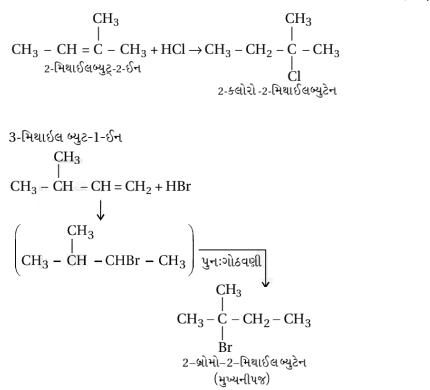
0 likes
View Solution781
Medium
Write the main product of the given reactions:
$1$. $CH_3-CH=CH-CH_3 \xrightarrow[cold, Na_2CO_3]{KMnO_4}$
$2$. $2,3-$Dimethylbut$-2-$ene $\xrightarrow{Baeyer\ test}$
$1$. $CH_3-CH=CH-CH_3 \xrightarrow[cold, Na_2CO_3]{KMnO_4}$
$2$. $2,3-$Dimethylbut$-2-$ene $\xrightarrow{Baeyer\ test}$
Solution
(N/A) The reaction of alkenes with cold,dilute alkaline $KMnO_4$ solution (Baeyer's reagent) is known as the Baeyer's test. This reaction results in the syn-hydroxylation of the double bond to form vicinal diols.
$1$. For $CH_3-CH=CH-CH_3$ (But$-2-$ene):
$CH_3-CH=CH-CH_3 + [O] + H_2O \xrightarrow{cold, alkaline\ KMnO_4} CH_3-CH(OH)-CH(OH)-CH_3$ (Butane$-2,3-$diol).
$2$. For $2,3-$Dimethylbut$-2-$ene:
$(CH_3)_2C=C(CH_3)_2 + [O] + H_2O \xrightarrow{Baeyer\ test} (CH_3)_2C(OH)-C(OH)(CH_3)_2$ ($2,3-$Dimethylbutane$-2,3-$diol).
$1$. For $CH_3-CH=CH-CH_3$ (But$-2-$ene):
$CH_3-CH=CH-CH_3 + [O] + H_2O \xrightarrow{cold, alkaline\ KMnO_4} CH_3-CH(OH)-CH(OH)-CH_3$ (Butane$-2,3-$diol).
$2$. For $2,3-$Dimethylbut$-2-$ene:
$(CH_3)_2C=C(CH_3)_2 + [O] + H_2O \xrightarrow{Baeyer\ test} (CH_3)_2C(OH)-C(OH)(CH_3)_2$ ($2,3-$Dimethylbutane$-2,3-$diol).
0 likes
View Solution782
Medium
Give the chemical reactions for the following conversions:
$(1)$ Glyoxal from acetylene
$(2)$ Glycol from bromoethane
$(1)$ Glyoxal from acetylene
$(2)$ Glycol from bromoethane
Solution
(N/A) $(1)$ Conversion of acetylene to glyoxal:
$3CH \equiv CH \xrightarrow{\text{Red hot Fe tube, } 873 \ K} C_6H_6 \text{ (Benzene)}$
$C_6H_6 \xrightarrow[(ii) Zn, H_2O]{(i) O_3} 3CHO-CHO \text{ (Glyoxal)}$
$(2)$ Conversion of bromoethane to glycol:
$CH_3CH_2Br \xrightarrow{\text{alc. KOH, } \Delta} CH_2=CH_2 \text{ (Ethene)}$
$CH_2=CH_2 \xrightarrow{\text{dil. } KMnO_4, 273 \ K} CH_2(OH)-CH_2(OH) \text{ (Ethane-1,2-diol or Glycol)}$
$3CH \equiv CH \xrightarrow{\text{Red hot Fe tube, } 873 \ K} C_6H_6 \text{ (Benzene)}$
$C_6H_6 \xrightarrow[(ii) Zn, H_2O]{(i) O_3} 3CHO-CHO \text{ (Glyoxal)}$
$(2)$ Conversion of bromoethane to glycol:
$CH_3CH_2Br \xrightarrow{\text{alc. KOH, } \Delta} CH_2=CH_2 \text{ (Ethene)}$
$CH_2=CH_2 \xrightarrow{\text{dil. } KMnO_4, 273 \ K} CH_2(OH)-CH_2(OH) \text{ (Ethane-1,2-diol or Glycol)}$
0 likes
View Solution783
MediumMCQ
What is hydrogenation reaction?
A
Addition of water to an alkene
B
Addition of hydrogen to an unsaturated hydrocarbon
C
Removal of hydrogen from an alkane
D
Addition of oxygen to a hydrocarbon
Solution
(B) $Dihydrogen$ gas adds to alkenes and alkynes in the presence of finely divided catalysts like $Pt$,$Pd$,or $Ni$ to form alkanes. This process is called hydrogenation.
0 likes
View Solution784
Easy
How many single and double bonds are present in ethene $(C_2H_4)$? Where are they located?
Solution
(N/A) In $C_2H_4$,there is one double bond and four single bonds.
There is one $C=C$ double bond and four $C-H$ single bonds.
There is one $C=C$ double bond and four $C-H$ single bonds.
0 likes
View Solution785
EasyMCQ
Which type of bond exists between the two carbon atoms of an alkene?
A
One $\sigma$-bond and one $\pi$-bond
B
Two $\sigma$-bonds
C
Two $\pi$-bonds
D
One $\sigma$-bond and two $\pi$-bonds
Solution
(A) In an alkene,the two carbon atoms are connected by a double bond.
This double bond consists of one $\sigma$-bond (formed by the head-on overlap of $sp^2$ hybrid orbitals) and one $\pi$-bond (formed by the lateral overlap of unhybridized $p$-orbitals).
This double bond consists of one $\sigma$-bond (formed by the head-on overlap of $sp^2$ hybrid orbitals) and one $\pi$-bond (formed by the lateral overlap of unhybridized $p$-orbitals).
0 likes
View Solution786
EasyMCQ
What are the enthalpies of $\sigma$-bond and $\pi$-bonds in an alkene?
A
$397 \ kJ \ mol^{-1}$ and $284 \ kJ \ mol^{-1}$
B
$284 \ kJ \ mol^{-1}$ and $397 \ kJ \ mol^{-1}$
C
$450 \ kJ \ mol^{-1}$ and $300 \ kJ \ mol^{-1}$
D
$300 \ kJ \ mol^{-1}$ and $450 \ kJ \ mol^{-1}$
Solution
(A) The bond enthalpy of a $C-C$ $\sigma$-bond in an alkene is approximately $397 \ kJ \ mol^{-1}$.
The bond enthalpy of a $C-C$ $\pi$-bond in an alkene is approximately $284 \ kJ \ mol^{-1}$.
Therefore,the enthalpies are $397 \ kJ \ mol^{-1}$ and $284 \ kJ \ mol^{-1}$ respectively.
The bond enthalpy of a $C-C$ $\pi$-bond in an alkene is approximately $284 \ kJ \ mol^{-1}$.
Therefore,the enthalpies are $397 \ kJ \ mol^{-1}$ and $284 \ kJ \ mol^{-1}$ respectively.
0 likes
View Solution787
Easy
Which one is more reactive between alkane and alkene? Why?
Solution
(B) Alkene is more reactive than alkane.
This is because alkenes contain a carbon-carbon double bond $(C=C)$,which consists of one strong $\sigma$-bond and one weak $\pi$-bond.
The $\pi$-bond is electron-rich and easily accessible to electrophilic reagents,making alkenes susceptible to electrophilic addition reactions.
In contrast,alkanes contain only strong $\sigma$-bonds ($C-C$ and $C-H$),which are relatively inert and require high energy to break,making them less reactive.
This is because alkenes contain a carbon-carbon double bond $(C=C)$,which consists of one strong $\sigma$-bond and one weak $\pi$-bond.
The $\pi$-bond is electron-rich and easily accessible to electrophilic reagents,making alkenes susceptible to electrophilic addition reactions.
In contrast,alkanes contain only strong $\sigma$-bonds ($C-C$ and $C-H$),which are relatively inert and require high energy to break,making them less reactive.
0 likes
View Solution788
MediumMCQ
What is the difference in reaction of alkene with $HBr$ in the presence of peroxide and in the absence of peroxide?
A
Presence of peroxide follows Markovnikov rule; absence follows Anti-Markovnikov rule.
B
Presence of peroxide follows Anti-Markovnikov rule; absence follows Markovnikov rule.
C
Both follow Markovnikov rule.
D
Both follow Anti-Markovnikov rule.
Solution
(B) In the presence of peroxide,the addition of $HBr$ to an alkene follows the Anti-Markovnikov rule (Kharasch effect or peroxide effect) via a free radical mechanism.
In the absence of peroxide,the addition of $HBr$ to an alkene follows the Markovnikov rule via an electrophilic addition mechanism.
In the absence of peroxide,the addition of $HBr$ to an alkene follows the Markovnikov rule via an electrophilic addition mechanism.
0 likes
View Solution789
MediumMCQ
Arrange $HI$,$HCl$,$HBr$,and $HF$ in increasing order of rate of reaction with alkene.
A
$HF < HCl < HBr < HI$
B
$HI < HBr < HCl < HF$
C
$HF < HBr < HCl < HI$
D
$HI < HCl < HBr < HF$
Solution
(A) The reaction of hydrogen halides $(HX)$ with alkenes is an electrophilic addition reaction.
The rate of reaction depends on the ease of breaking the $H-X$ bond.
The bond dissociation energy decreases as the size of the halogen atom increases $(HF > HCl > HBr > HI)$.
Therefore,the reactivity order is $HF < HCl < HBr < HI$.
The rate of reaction depends on the ease of breaking the $H-X$ bond.
The bond dissociation energy decreases as the size of the halogen atom increases $(HF > HCl > HBr > HI)$.
Therefore,the reactivity order is $HF < HCl < HBr < HI$.
0 likes
View Solution790
MediumMCQ
Name the reaction,heating of $1,2-$dibromoethane with zinc powder?
A
Dehydrohalogenation
B
Dehalogenation
C
Hydrogenation
D
Substitution
Solution
(B) The reaction of $1,2-$dibromoethane with zinc powder involves the removal of two bromine atoms from adjacent carbon atoms,resulting in the formation of ethene $(CH_2=CH_2)$ and zinc bromide $(ZnBr_2)$.
This process is known as $Dehalogenation$.
This process is known as $Dehalogenation$.
0 likes
View Solution791
Medium
What is the common name for the reaction involving dehydrohalogenation of alkyl halides and dehydration of alcohols in the presence of an acid?
Solution
(N/A) Both dehydrohalogenation of alkyl halides and dehydration of alcohols involve the removal of two atoms or groups from adjacent carbon atoms,resulting in the formation of a double bond. This type of reaction is known as $\beta$-elimination.
0 likes
View Solution792
MediumMCQ
Why is $CCl_{4}$ added in the bromination of an alkene?
A
To act as a catalyst for the reaction.
B
To provide a non-polar solvent for bromine.
C
To increase the rate of the reaction.
D
To prevent the formation of by-products.
Solution
(B) The bromination of an alkene involves the addition of $Br_{2}$ across the double bond.
$CCl_{4}$ (carbon tetrachloride) is a non-polar solvent.
Since bromine $(Br_{2})$ is a non-polar molecule,it is highly soluble in non-polar solvents like $CCl_{4}$.
Using $CCl_{4}$ ensures a homogeneous reaction medium,allowing the bromine to react efficiently with the non-polar alkene.
$CCl_{4}$ (carbon tetrachloride) is a non-polar solvent.
Since bromine $(Br_{2})$ is a non-polar molecule,it is highly soluble in non-polar solvents like $CCl_{4}$.
Using $CCl_{4}$ ensures a homogeneous reaction medium,allowing the bromine to react efficiently with the non-polar alkene.
0 likes
View Solution793
Medium
What is known as an asymmetrical alkene? Give examples.
Solution
(N/A) An alkene is known as an asymmetrical alkene if the groups attached to the two carbon atoms of the double bond are different.
For example,in $CH_3-CH=CH-CH_2-CH_3$ (pent-$2$-ene),the groups attached to the first carbon of the double bond are $-H$ and $-CH_3$,while the groups attached to the second carbon are $-H$ and $-CH_2-CH_3$. Since these groups are different,it is an asymmetrical alkene.
For example,in $CH_3-CH=CH-CH_2-CH_3$ (pent-$2$-ene),the groups attached to the first carbon of the double bond are $-H$ and $-CH_3$,while the groups attached to the second carbon are $-H$ and $-CH_2-CH_3$. Since these groups are different,it is an asymmetrical alkene.
0 likes
View Solution794
MediumMCQ
Which reaction is known as Kharash reaction?
A
Addition of $HBr$ to alkene in presence of peroxide
B
Addition of $HCl$ to alkene in presence of peroxide
C
Addition of $HI$ to alkene in presence of peroxide
D
Addition of $Br_2$ to alkene in presence of peroxide
Solution
(A) The addition of $HBr$ to an asymmetrical alkene in the presence of an organic peroxide is known as the Kharash effect or peroxide effect. This reaction follows an anti-Markovnikov addition mechanism.
0 likes
View Solution795
MediumMCQ
Among $HCl$,$HBr$,and $HI$,which reactant gives the Kharasch effect (peroxide effect) with an alkene?
A
$HCl$
B
$HBr$
C
$HI$
D
All of the above
Solution
(B) The Kharasch effect or peroxide effect is observed only in the case of $HBr$ addition to unsymmetrical alkenes in the presence of organic peroxides.
In the case of $HCl$,the $H-Cl$ bond is too strong to be broken by free radicals.
In the case of $HI$,the $I$ free radicals combine to form $I_2$ molecules instead of adding to the double bond.
Therefore,only $HBr$ exhibits the anti-Markovnikov addition via the free radical mechanism.
In the case of $HCl$,the $H-Cl$ bond is too strong to be broken by free radicals.
In the case of $HI$,the $I$ free radicals combine to form $I_2$ molecules instead of adding to the double bond.
Therefore,only $HBr$ exhibits the anti-Markovnikov addition via the free radical mechanism.
0 likes
View Solution796
MediumMCQ
Explain the product of the reaction $CH_3CH=CH_2 + HCl \xrightarrow{\text{peroxide}}$
A
$1$-Chloropropane
B
$2$-Chloropropane
C
$1,2$-Dichloropropane
D
No reaction
Solution
(B) The reaction of $CH_3CH=CH_2$ with $HCl$ in the presence of peroxide follows Markovnikov's rule to form $2$-chloropropane $(CH_3CHClCH_3)$.
Anti-Markovnikov addition (peroxide effect) is only observed with $HBr$ and not with $HCl$ or $HI$.
This is because the $H-Cl$ bond is very strong $(403.5 \ kJ \ mol^{-1})$,and the peroxide free radicals are unable to abstract a hydrogen atom from $HCl$ to initiate the chain reaction.
Anti-Markovnikov addition (peroxide effect) is only observed with $HBr$ and not with $HCl$ or $HI$.
This is because the $H-Cl$ bond is very strong $(403.5 \ kJ \ mol^{-1})$,and the peroxide free radicals are unable to abstract a hydrogen atom from $HCl$ to initiate the chain reaction.
0 likes
View Solution797
MediumMCQ
What is the product obtained from the reaction of $HCl$,$HBr$,and $HI$ with alkenes in the presence of peroxide?
A
Anti-Markovnikov addition for all
B
Markovnikov addition for all
C
Anti-Markovnikov addition for $HBr$ only
D
No reaction for any
Solution
(C) The peroxide effect (Kharasch effect) is only observed with $HBr$ due to the favorable energetics of the free radical mechanism.
$HCl$ has a strong $H-Cl$ bond,making the initiation step endothermic.
$HI$ forms $I$ radicals that readily combine to form $I_2$ rather than adding to the double bond.
Therefore,only $HBr$ shows Anti-Markovnikov addition in the presence of peroxide.
$HCl$ has a strong $H-Cl$ bond,making the initiation step endothermic.
$HI$ forms $I$ radicals that readily combine to form $I_2$ rather than adding to the double bond.
Therefore,only $HBr$ shows Anti-Markovnikov addition in the presence of peroxide.
0 likes
View Solution798
MediumMCQ
What is the product obtained from the reaction of propene with $HCl$,$HBr$,and $HI$ in the presence of peroxide?
A
Anti-Markovnikov addition for all three
B
Markovnikov addition for $HCl$,$HBr$,and $HI$
C
Anti-Markovnikov addition only for $HBr$
D
No reaction with peroxide
Solution
(C) The peroxide effect (Kharasch effect) is observed only with $HBr$ due to the favorable energetics of the free radical mechanism.
For $HCl$,the $H-Cl$ bond is too strong to be broken by the free radical.
For $HI$,the iodine radical $(I^{\bullet})$ is formed,but the $I-I$ bond is too weak,and the iodine radicals prefer to recombine to form $I_2$ rather than adding to the double bond.
Therefore,only $HBr$ shows Anti-Markovnikov addition in the presence of peroxide.
For $HCl$,the $H-Cl$ bond is too strong to be broken by the free radical.
For $HI$,the iodine radical $(I^{\bullet})$ is formed,but the $I-I$ bond is too weak,and the iodine radicals prefer to recombine to form $I_2$ rather than adding to the double bond.
Therefore,only $HBr$ shows Anti-Markovnikov addition in the presence of peroxide.
0 likes
View Solution799
EasyMCQ
What will be the change in boiling point of an alkene compound on the addition of each $-CH_2-$ group?
A
Increases by $20-30 \ K$
B
Decreases by $20-30 \ K$
C
Increases by $50-60 \ K$
D
No change
Solution
(A) The boiling point of homologous series of hydrocarbons increases with an increase in molecular mass.
For each additional $-CH_2-$ group added to the chain,the boiling point increases by approximately $20-30 \ K$ due to the increase in van der Waals forces of attraction.
For each additional $-CH_2-$ group added to the chain,the boiling point increases by approximately $20-30 \ K$ due to the increase in van der Waals forces of attraction.
0 likes
View Solution800
Easy
Give the order of stability for different alkenes.
Solution
(N/A) The stability of alkenes is primarily determined by the number of alkyl groups attached to the double-bonded carbons (hyperconjugation) and steric hindrance. The general order of stability is: $R_2C=CR_2 > R_2C=CHR > RCH=CHR \text{ (trans)} > R_2C=CH_2 > RCH=CHR \text{ (cis)} > RCH=CH_2 > CH_2=CH_2$.
0 likes
View SolutionHydrocarbons — Alkene · Frequently Asked Questions
1Are these Hydrocarbons questions useful for JEE and NEET?
Yes. All questions in this section are mapped to JEE Main and NEET exam patterns. Previous year questions from JEE Main, NEET, GUJCET and state-level exams are included with full solutions.
2Can I switch to Hindi or Gujarati for these questions?
Yes. Use the language tabs in the hero section or the sidebar to view the same questions and solutions in English, Hindi or Gujarati.
3How do I generate a question paper from this subtopic?
Use the Vedclass Exam Paper Generator — select the chapter and subtopic, set difficulty, and generate Sets A, B, C, D automatically. First 3 chapters of every subject are free.
Vedclass Products
For Students
Vedclass Test Series
Mock tests in real JEE/NEET style with performance analysis. 5-day free trial.
Start Free TrialFor Teachers
Exam Paper Generator
Generate Set A/B/C/D papers from this chapter in 2 minutes. 3 chapters free.
Try FreeFor Institutes
Online Exam Module
Live online exams with unlimited students, 360° analytics & white-label branding.
See DemoFor Teachers & Institutes
Generate a Hydrocarbons Exam Paper in 2 Minutes
Select subtopic & difficulty — Sets A, B, C, D auto-generated with No Repeat logic.
First 3 chapters of every subject are free — no payment required.