
A English
Alkene Questions in English
Class 11 Chemistry · Hydrocarbons · Alkene
1080+
Questions
English
Language
100%
With Solutions
Showing 50 of 1080 questions in English
801
MediumMCQ
Give the increasing order of stability for the following alkenes based on their heat of hydrogenation $(\Delta H^o)$:
$(I) (CH_3)_2C = C(CH_3)_2$
$(II) CH_3CH_2CH_2CH = CH_2$
$(III) (CH_3)_2C = CHCH_3$
$(IV) CH_3CH_2C(CH_3) = CH_2$
$(I) (CH_3)_2C = C(CH_3)_2$
$(II) CH_3CH_2CH_2CH = CH_2$
$(III) (CH_3)_2C = CHCH_3$
$(IV) CH_3CH_2C(CH_3) = CH_2$
A
$(II) < (IV) < (III) < (I)$
B
$(I) < (III) < (IV) < (II)$
C
$(II) < (III) < (IV) < (I)$
D
$(IV) < (II) < (III) < (I)$
Solution
(A) The stability of an alkene is directly proportional to the number of hyperconjugative structures (number of $\alpha$-hydrogens).
$1$. $(II) CH_3CH_2CH_2CH = CH_2$: $2 \ \alpha$-hydrogens (monosubstituted).
$2$. $(IV) CH_3CH_2C(CH_3) = CH_2$: $5 \ \alpha$-hydrogens (disubstituted).
$3$. $(III) (CH_3)_2C = CHCH_3$: $7 \ \alpha$-hydrogens (trisubstituted).
$4$. $(I) (CH_3)_2C = C(CH_3)_2$: $12 \ \alpha$-hydrogens (tetrasubstituted).
Since stability increases with the number of $\alpha$-hydrogens,the order is $(II) < (IV) < (III) < (I)$.
$1$. $(II) CH_3CH_2CH_2CH = CH_2$: $2 \ \alpha$-hydrogens (monosubstituted).
$2$. $(IV) CH_3CH_2C(CH_3) = CH_2$: $5 \ \alpha$-hydrogens (disubstituted).
$3$. $(III) (CH_3)_2C = CHCH_3$: $7 \ \alpha$-hydrogens (trisubstituted).
$4$. $(I) (CH_3)_2C = C(CH_3)_2$: $12 \ \alpha$-hydrogens (tetrasubstituted).
Since stability increases with the number of $\alpha$-hydrogens,the order is $(II) < (IV) < (III) < (I)$.
0 likes
View Solution802
MediumMCQ
Which products are obtained on reaction of but$-1-$ene with $HBr$ in the presence of peroxide?
A
$1-$bromobutane (major) and $2-$bromobutane (minor)
B
$2-$bromobutane (major) and $1-$bromobutane (minor)
C
Only $1-$bromobutane
D
Only $2-$bromobutane
Solution
(A) The reaction of but$-1-$ene with $HBr$ in the presence of peroxide follows the anti-Markovnikov addition mechanism (Kharasch effect or peroxide effect).
In this mechanism,the bromine atom attaches to the carbon atom with more hydrogen atoms (the terminal carbon).
Thus,$1-$bromobutane $(CH_3CH_2CH_2CH_2Br)$ is formed as the major product,and $2-$bromobutane $(CH_3CH_2CH(Br)CH_3)$ is formed as the minor product.
In this mechanism,the bromine atom attaches to the carbon atom with more hydrogen atoms (the terminal carbon).
Thus,$1-$bromobutane $(CH_3CH_2CH_2CH_2Br)$ is formed as the major product,and $2-$bromobutane $(CH_3CH_2CH(Br)CH_3)$ is formed as the minor product.
0 likes
View Solution803
Difficult
An alkene $A$ (molecular formula $C_{5}H_{10}$) on ozonolysis gives a mixture of two compounds $B$ and $C$. Compound $B$ gives a positive Fehling's test and also forms iodoform on treatment with $I_{2}$ and $NaOH$. Compound $C$ does not give Fehling's test but forms iodoform. Identify the compounds $A, B$ and $C$. Write the reaction for ozonolysis and the formation of iodoform from $B$ and $C$.
Solution
(A) The molecular formula $C_{5}H_{10}$ corresponds to an alkene. Ozonolysis of an alkene $R_{1}R_{2}C=CR_{3}R_{4}$ yields carbonyl compounds.
$B$ gives a positive Fehling's test,so it must be an aldehyde. Since it also gives the iodoform test,it must be acetaldehyde $(CH_{3}CHO)$.
$C$ does not give Fehling's test,so it is a ketone. Since it gives the iodoform test,it must be a methyl ketone $(CH_{3}COR)$. Given the total carbon count is $5$,$C$ is propanone $(CH_{3}COCH_{3})$.
Thus,the alkene $A$ is $2$-methylbut-$2$-ene $(CH_{3}-C(CH_{3})=CH-CH_{3})$.
Ozonolysis reaction:
$CH_{3}-C(CH_{3})=CH-CH_{3} \xrightarrow{O_{3}, Zn/H_{2}O} CH_{3}COCH_{3} (C) + CH_{3}CHO (B)$
Iodoform test:
$CH_{3}CHO + 3I_{2} + 4NaOH \rightarrow CHI_{3} + HCOONa + 3NaI + 3H_{2}O$
$CH_{3}COCH_{3} + 3I_{2} + 4NaOH \rightarrow CHI_{3} + CH_{3}COONa + 3NaI + 3H_{2}O$
$B$ gives a positive Fehling's test,so it must be an aldehyde. Since it also gives the iodoform test,it must be acetaldehyde $(CH_{3}CHO)$.
$C$ does not give Fehling's test,so it is a ketone. Since it gives the iodoform test,it must be a methyl ketone $(CH_{3}COR)$. Given the total carbon count is $5$,$C$ is propanone $(CH_{3}COCH_{3})$.
Thus,the alkene $A$ is $2$-methylbut-$2$-ene $(CH_{3}-C(CH_{3})=CH-CH_{3})$.
Ozonolysis reaction:
$CH_{3}-C(CH_{3})=CH-CH_{3} \xrightarrow{O_{3}, Zn/H_{2}O} CH_{3}COCH_{3} (C) + CH_{3}CHO (B)$
Iodoform test:
$CH_{3}CHO + 3I_{2} + 4NaOH \rightarrow CHI_{3} + HCOONa + 3NaI + 3H_{2}O$
$CH_{3}COCH_{3} + 3I_{2} + 4NaOH \rightarrow CHI_{3} + CH_{3}COONa + 3NaI + 3H_{2}O$
0 likes
View Solution804
MediumMCQ
The major product in the following reaction is
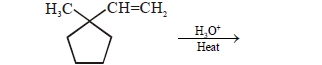
A
$1-$methyl$-1-$vinylcyclopentane
B
$1-$methylcyclopentanol derivative
C
$1,2-$dimethylcyclohexene
D
$1-$isopropylcyclopentene
Solution
(C) The reaction involves the acid-catalyzed hydration of $1-$methyl$-1-$vinylcyclopentane.
$1$. Protonation of the double bond leads to the formation of a secondary carbocation.
$2$. The five-membered ring undergoes ring expansion to form a more stable six-membered ring carbocation.
$3$. This carbocation then undergoes rearrangement and elimination of a proton $(-H^+)$ to form the most stable alkene,which is $1,2$-dimethylcyclohexene.
Thus,the major product is $1,2$-dimethylcyclohexene.
$1$. Protonation of the double bond leads to the formation of a secondary carbocation.
$2$. The five-membered ring undergoes ring expansion to form a more stable six-membered ring carbocation.
$3$. This carbocation then undergoes rearrangement and elimination of a proton $(-H^+)$ to form the most stable alkene,which is $1,2$-dimethylcyclohexene.
Thus,the major product is $1,2$-dimethylcyclohexene.
0 likes
View Solution805
MediumMCQ
When neopentyl alcohol is heated with an acid,it slowly converts into an $85:15$ mixture of alkenes $A$ and $B$,respectively. What are these alkenes $?$ (Note: $A$ is the major product and $B$ is the minor product.)
A
$2-$methyl$-2-$butene and $2-$methyl$-1-$butene
B
$2-$methyl$-1-$butene and $2-$methyl$-2-$butene
C
$3-$methyl$-1-$butene and $2-$methyl$-1-$butene
D
$2-$methyl$-2-$butene and $2-$methyl$-1-$butene (with different structures)
Solution
(A) The dehydration of neopentyl alcohol $(CH_3-C(CH_3)_2-CH_2OH)$ in the presence of an acid proceeds via the formation of a primary carbocation,which undergoes a $1,2$-methyl shift to form a more stable tertiary carbocation $(CH_3-C^+(CH_3)-CH_2-CH_3)$.
From this tertiary carbocation,two alkenes can be formed by the loss of a proton $(H^+)$:
$1$. Loss of a proton from the $CH_2$ group leads to $2$-methyl-$2$-butene $(CH_3-C(CH_3)=CH-CH_3)$,which is the more substituted and thus more stable alkene (major product,$85\%$).
$2$. Loss of a proton from the $CH_3$ group leads to $2$-methyl-$1$-butene $(CH_3-C(CH_3)-CH=CH_2)$,which is less substituted (minor product,$15\%$).
Therefore,the mixture consists of $2$-methyl-$2$-butene and $2$-methyl-$1$-butene.
From this tertiary carbocation,two alkenes can be formed by the loss of a proton $(H^+)$:
$1$. Loss of a proton from the $CH_2$ group leads to $2$-methyl-$2$-butene $(CH_3-C(CH_3)=CH-CH_3)$,which is the more substituted and thus more stable alkene (major product,$85\%$).
$2$. Loss of a proton from the $CH_3$ group leads to $2$-methyl-$1$-butene $(CH_3-C(CH_3)-CH=CH_2)$,which is less substituted (minor product,$15\%$).
Therefore,the mixture consists of $2$-methyl-$2$-butene and $2$-methyl-$1$-butene.
0 likes
View Solution806
MediumMCQ
The major product formed in the following reaction is :
$CH_3CH=CHCH(CH_3)_2 \xrightarrow{HBr}$
$CH_3CH=CHCH(CH_3)_2 \xrightarrow{HBr}$
A
$CH_3CH_2CH_2C(Br)(CH_3)_2$
B
$Br(CH_2)_3CH(CH_3)_2$
C
$CH_3CH_2CH(Br)CH(CH_3)_2$
D
$CH_3CH(Br)CH_2CH(CH_3)_2$
Solution
(A) The reaction of an alkene with $HBr$ proceeds via an electrophilic addition mechanism involving a carbocation intermediate.
Step $1$: Protonation of the double bond can form two possible secondary carbocations:
$(I)$ $CH_3-CH_2-CH^{+}-CH(CH_3)_2$
$(II)$ $CH_3-CH^{+}-CH_2-CH(CH_3)_2$
Step $2$: Carbocation $(I)$ undergoes a $1,2-$hydride shift from the adjacent tertiary carbon to form a much more stable tertiary carbocation:
$CH_3-CH_2-CH^{+}-CH(CH_3)_2 \xrightarrow{1,2-H \text{ shift}} CH_3-CH_2-CH_2-C^{+}(CH_3)_2$
Step $3$: The bromide ion $(Br^{-})$ attacks this highly stable tertiary carbocation to form the major product:
$CH_3-CH_2-CH_2-C^{+}(CH_3)_2 + Br^{-} \longrightarrow CH_3-CH_2-CH_2-C(Br)(CH_3)_2$
Thus,the major product is $2-$bromo$-2-$methylpentane.
Step $1$: Protonation of the double bond can form two possible secondary carbocations:
$(I)$ $CH_3-CH_2-CH^{+}-CH(CH_3)_2$
$(II)$ $CH_3-CH^{+}-CH_2-CH(CH_3)_2$
Step $2$: Carbocation $(I)$ undergoes a $1,2-$hydride shift from the adjacent tertiary carbon to form a much more stable tertiary carbocation:
$CH_3-CH_2-CH^{+}-CH(CH_3)_2 \xrightarrow{1,2-H \text{ shift}} CH_3-CH_2-CH_2-C^{+}(CH_3)_2$
Step $3$: The bromide ion $(Br^{-})$ attacks this highly stable tertiary carbocation to form the major product:
$CH_3-CH_2-CH_2-C^{+}(CH_3)_2 + Br^{-} \longrightarrow CH_3-CH_2-CH_2-C(Br)(CH_3)_2$
Thus,the major product is $2-$bromo$-2-$methylpentane.
0 likes
View Solution807
MediumMCQ
The major products of the following reaction are :
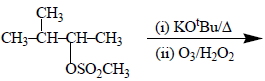
A
$CH_3-CH(CH_3)-COOH + HCOOH$
B
$CH_3-CH(CH_3)-CHO + HCHO$
C
$(CH_3)_2C=O + CH_3CHO$
D
$(CH_3)_2C=O + CH_3COOH$
Solution
(D) The reaction proceeds in two steps:
$1$. Dehydrohalogenation (or elimination of the leaving group) using $KO^tBu$ (a bulky base) and $\Delta$ (heat) follows the $E2$ mechanism to form the most stable alkene (Hofmann product is not favored here as the substrate allows for the formation of the more substituted alkene).
Starting material: $CH_3-CH(CH_3)-CH(OSO_2CH_3)-CH_3$.
Elimination of $OSO_2CH_3$ and a proton from the adjacent carbon leads to the formation of $CH_3-CH(CH_3)-CH=CH_2$ ($3$-methylbut$-1-$ene) or $CH_3-CH(CH_3)-CH=CH-CH_3$ ($2$-methylbut$-2-$ene). The more substituted alkene,$CH_3-C(CH_3)=CH-CH_3$ ($2$-methylbut$-2-$ene),is the major product.
$2$. Ozonolysis $(O_3/H_2O_2)$ of $CH_3-C(CH_3)=CH-CH_3$ leads to oxidative cleavage.
$CH_3-C(CH_3)=CH-CH_3 \xrightarrow{O_3/H_2O_2} (CH_3)_2C=O + CH_3COOH$.
Thus,the major products are acetone and acetic acid.
$1$. Dehydrohalogenation (or elimination of the leaving group) using $KO^tBu$ (a bulky base) and $\Delta$ (heat) follows the $E2$ mechanism to form the most stable alkene (Hofmann product is not favored here as the substrate allows for the formation of the more substituted alkene).
Starting material: $CH_3-CH(CH_3)-CH(OSO_2CH_3)-CH_3$.
Elimination of $OSO_2CH_3$ and a proton from the adjacent carbon leads to the formation of $CH_3-CH(CH_3)-CH=CH_2$ ($3$-methylbut$-1-$ene) or $CH_3-CH(CH_3)-CH=CH-CH_3$ ($2$-methylbut$-2-$ene). The more substituted alkene,$CH_3-C(CH_3)=CH-CH_3$ ($2$-methylbut$-2-$ene),is the major product.
$2$. Ozonolysis $(O_3/H_2O_2)$ of $CH_3-C(CH_3)=CH-CH_3$ leads to oxidative cleavage.
$CH_3-C(CH_3)=CH-CH_3 \xrightarrow{O_3/H_2O_2} (CH_3)_2C=O + CH_3COOH$.
Thus,the major products are acetone and acetic acid.
0 likes
View Solution808
DifficultMCQ
Consider the following reactions. What is $A$?
| Reaction | Observation |
| :--- | :--- |
| $A \ (C_7H_{14}) \xrightarrow{\text{ozonolysis}} B + C$ | |
| $B \xrightarrow{I_2 + NaOH, \Delta} \text{yellow ppt}$ | |
| $B \xrightarrow{Ag_2O, \Delta} \text{silver mirror}$ | |
| $C \xrightarrow{I_2 + NaOH, \Delta} \text{no yellow ppt}$ | |
| $C$ $\xrightarrow{LiAlH_4} D$ $\xrightarrow{\text{anhydrous } ZnCl_2, \text{conc. } HCl} \text{white turbidity within 5 minutes}$ | |
| Reaction | Observation |
| :--- | :--- |
| $A \ (C_7H_{14}) \xrightarrow{\text{ozonolysis}} B + C$ | |
| $B \xrightarrow{I_2 + NaOH, \Delta} \text{yellow ppt}$ | |
| $B \xrightarrow{Ag_2O, \Delta} \text{silver mirror}$ | |
| $C \xrightarrow{I_2 + NaOH, \Delta} \text{no yellow ppt}$ | |
| $C$ $\xrightarrow{LiAlH_4} D$ $\xrightarrow{\text{anhydrous } ZnCl_2, \text{conc. } HCl} \text{white turbidity within 5 minutes}$ | |
A
$3-$methylhex$-2-$ene
B
$3-$ethylpent$-2-$ene
C
hept$-2-$ene
D
$2-$methylhept$-2-$ene
Solution
(B) $1$. $B$ gives a yellow precipitate with $I_2 + NaOH$ (iodoform test) and a silver mirror with $Ag_2O$ (Tollens' test). This indicates that $B$ is an aldehyde containing a $CH_3CO-$ group. The simplest such aldehyde is acetaldehyde $(CH_3CHO)$.
$2$. $C$ does not give a yellow precipitate with $I_2 + NaOH$,but upon reduction with $LiAlH_4$,it gives $D$,which forms white turbidity with Lucas reagent $(ZnCl_2 + conc. HCl)$ within $5$ minutes. This indicates $D$ is a secondary alcohol. Thus,$C$ must be a ketone,specifically diethyl ketone $(CH_3CH_2COCH_2CH_3)$.
$3$. The ozonolysis of $A$ $(C_7H_{14})$ yields $B$ $(CH_3CHO)$ and $C$ $(CH_3CH_2COCH_2CH_3)$.
$4$. Reconstructing $A$ from the products: $CH_3CH=O + O=C(CH_2CH_3)_2 \rightarrow CH_3CH=C(CH_2CH_3)_2$.
$5$. The structure $CH_3CH=C(CH_2CH_3)_2$ is $3$-ethylpent-$2$-ene.
$2$. $C$ does not give a yellow precipitate with $I_2 + NaOH$,but upon reduction with $LiAlH_4$,it gives $D$,which forms white turbidity with Lucas reagent $(ZnCl_2 + conc. HCl)$ within $5$ minutes. This indicates $D$ is a secondary alcohol. Thus,$C$ must be a ketone,specifically diethyl ketone $(CH_3CH_2COCH_2CH_3)$.
$3$. The ozonolysis of $A$ $(C_7H_{14})$ yields $B$ $(CH_3CHO)$ and $C$ $(CH_3CH_2COCH_2CH_3)$.
$4$. Reconstructing $A$ from the products: $CH_3CH=O + O=C(CH_2CH_3)_2 \rightarrow CH_3CH=C(CH_2CH_3)_2$.
$5$. The structure $CH_3CH=C(CH_2CH_3)_2$ is $3$-ethylpent-$2$-ene.
0 likes
View Solution809
MediumMCQ
The major product of the following reaction is:
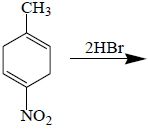
A
$1-$bromo$-1-$methyl$-4-$nitrocyclohexane derivative
B
$1,3-$dibromo$-1-$methyl$-4-$nitrocyclohexane derivative
C
$3,4-$dibromo$-1-$methyl$-4-$nitrocyclohexane derivative
D
$1,4-$dibromo$-1-$methyl$-4-$nitrocyclohexane derivative
Solution
(C) The reaction involves the electrophilic addition of $2HBr$ to a conjugated diene system.
In the given molecule,the $NO_2$ group is a strong electron-withdrawing group,which deactivates the double bond adjacent to it.
The other double bond is more electron-rich and undergoes protonation first to form the most stable carbocation.
Following the addition of the first $Br^-$ and then the second $HBr$ molecule,the major product is formed by following Markovnikov's rule and considering the stability of the intermediate carbocation.
The final product is $3,4-dibromo-1-methyl-4-nitrocyclohexane$.
In the given molecule,the $NO_2$ group is a strong electron-withdrawing group,which deactivates the double bond adjacent to it.
The other double bond is more electron-rich and undergoes protonation first to form the most stable carbocation.
Following the addition of the first $Br^-$ and then the second $HBr$ molecule,the major product is formed by following Markovnikov's rule and considering the stability of the intermediate carbocation.
The final product is $3,4-dibromo-1-methyl-4-nitrocyclohexane$.
0 likes
View Solution810
MediumMCQ
An alkene on ozonolysis gives methanal as one of the products. Its structure is
A
B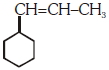
C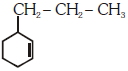
D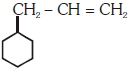
Solution
(D) The formation of methanal $(HCHO)$ during ozonolysis indicates the presence of a terminal double bond $(=CH_2)$ in the alkene.
Among the given options,the structure in option $D$ (allylcyclohexane,which is $cyclohexyl-CH_2-CH=CH_2$) contains a terminal double bond.
Upon ozonolysis,it undergoes cleavage at the double bond to produce methanal $(HCHO)$ and cyclohexylacetaldehyde $(C_6H_{11}-CH_2-CHO)$.
Among the given options,the structure in option $D$ (allylcyclohexane,which is $cyclohexyl-CH_2-CH=CH_2$) contains a terminal double bond.
Upon ozonolysis,it undergoes cleavage at the double bond to produce methanal $(HCHO)$ and cyclohexylacetaldehyde $(C_6H_{11}-CH_2-CHO)$.
0 likes
View Solution811
MediumMCQ
$CH_3CH_2CH=CH_2 \xrightarrow{B_2H_6 / H_2O_2, OH^{-}} Z$. What is $Z?$
A
$CH_3CH_2CH_2CH_3$
B
$CH_3CH_2CH_2CH_2OH$
C
$CH_3CH_2CH_2CHO$
D
$CH_3CH_2CH(OH)CH_3$
Solution
(B) The reaction of $CH_3CH_2CH=CH_2$ with $B_2H_6$ followed by oxidation with $H_2O_2$ in the presence of $OH^-$ is known as hydroboration-oxidation.
This reaction follows anti-Markovnikov's rule,where the $OH$ group is added to the less substituted carbon atom of the double bond.
Thus,the product $Z$ formed is $CH_3CH_2CH_2CH_2OH$ (butan$-1-$ol).
This reaction follows anti-Markovnikov's rule,where the $OH$ group is added to the less substituted carbon atom of the double bond.
Thus,the product $Z$ formed is $CH_3CH_2CH_2CH_2OH$ (butan$-1-$ol).
0 likes
View Solution812
MediumMCQ
The chemical reaction is shown below:
$C_6H_5-CH_2-CH=CH_2 + HCl \rightarrow X$,$X$ is:
$C_6H_5-CH_2-CH=CH_2 + HCl \rightarrow X$,$X$ is:
A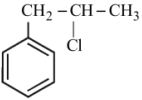
B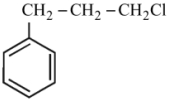
C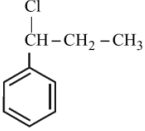
D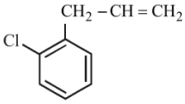
Solution
(C) The reaction follows Markovnikov's addition of $HCl$ to the alkene.
$1$. The $H^+$ ion attacks the terminal carbon of the double bond to form the most stable carbocation.
$2$. The intermediate formed is a $3^{\circ}$ benzylic carbocation $(C_6H_5-CH^+-CH_2-CH_3)$,which is highly stabilized by resonance with the phenyl ring.
$3$. The $Cl^-$ ion then attacks this carbocation to form the final product: $1$-chloro-$1$-phenylpropane $(C_6H_5-CH(Cl)-CH_2-CH_3)$.
$1$. The $H^+$ ion attacks the terminal carbon of the double bond to form the most stable carbocation.
$2$. The intermediate formed is a $3^{\circ}$ benzylic carbocation $(C_6H_5-CH^+-CH_2-CH_3)$,which is highly stabilized by resonance with the phenyl ring.
$3$. The $Cl^-$ ion then attacks this carbocation to form the final product: $1$-chloro-$1$-phenylpropane $(C_6H_5-CH(Cl)-CH_2-CH_3)$.
0 likes
View Solution813
MediumMCQ
Predict the major product $A$ for the following reaction:
$2\text{-methylbuta-1,3-diene} + HBr (1 \text{ eq.}) \xrightarrow{-80^{\circ}C (1,2\text{-addition})} A$
$2\text{-methylbuta-1,3-diene} + HBr (1 \text{ eq.}) \xrightarrow{-80^{\circ}C (1,2\text{-addition})} A$
A
$3-$bromo$-2-$methylbut$-1-$ene
B
$1-$bromo$-3-$methylbut$-2-$ene
C
$4-$bromo$-2-$methylbut$-1-$ene
D
$2-$bromo$-2-$methylbutane
Solution
(D) The reaction is an electrophilic addition of $HBr$ to a conjugated diene $(2\text{-methylbuta-1,3-diene})$ at low temperature $(-80^{\circ}C)$,which favors the kinetic product $(1,2\text{-addition})$.
$1$. The proton $(H^+)$ from $HBr$ attacks the terminal double bond to form the most stable carbocation.
$2$. Protonation at the $C_1$ position leads to a tertiary allylic carbocation,which is more stable than the secondary allylic carbocation formed by protonation at the $C_4$ position.
$3$. The bromide ion $(Br^-)$ then attacks the tertiary carbocation at the $C_2$ position to form the $1,2\text{-addition}$ product.
$4$. The final product $A$ is $2\text{-bromo-2-methylbut-3-ene}$.
$1$. The proton $(H^+)$ from $HBr$ attacks the terminal double bond to form the most stable carbocation.
$2$. Protonation at the $C_1$ position leads to a tertiary allylic carbocation,which is more stable than the secondary allylic carbocation formed by protonation at the $C_4$ position.
$3$. The bromide ion $(Br^-)$ then attacks the tertiary carbocation at the $C_2$ position to form the $1,2\text{-addition}$ product.
$4$. The final product $A$ is $2\text{-bromo-2-methylbut-3-ene}$.
0 likes
View Solution814
DifficultMCQ
Appropriate reducing agent for the following conversion is:
$CH_2=CH-CH_2-CHO \to CH_3-CH_2-CH_2-CH_2OH$
$CH_2=CH-CH_2-CHO \to CH_3-CH_2-CH_2-CH_2OH$
A
$LiAlH_4 / H_2O$
B
$NaBH_4 / H_2O$
C
$Na + C_2H_5OH$
D
$H_2 / Ni$ or $B_2H_6 / H_2O_2, OH^-$
Solution
(D) The conversion $CH_2=CH-CH_2-CHO \to CH_3-CH_2-CH_2-CH_2OH$ involves the reduction of both the carbon-carbon double bond $(C=C)$ and the aldehyde group $(-CHO)$.
$LiAlH_4$,$NaBH_4$,and $Na + C_2H_5OH$ are selective reducing agents that reduce the aldehyde group to a primary alcohol but do not reduce isolated $C=C$ double bonds.
Catalytic hydrogenation using $H_2 / Ni$ (or $Pt/Pd$) is the appropriate method to reduce both the alkene and the aldehyde functional groups to an alkane and a primary alcohol,respectively.
$LiAlH_4$,$NaBH_4$,and $Na + C_2H_5OH$ are selective reducing agents that reduce the aldehyde group to a primary alcohol but do not reduce isolated $C=C$ double bonds.
Catalytic hydrogenation using $H_2 / Ni$ (or $Pt/Pd$) is the appropriate method to reduce both the alkene and the aldehyde functional groups to an alkane and a primary alcohol,respectively.
0 likes
View Solution815
DifficultMCQ
Predict the major product $A$ for the following reaction:
$1\text{-methyl-1-vinylcyclohexane} + HBr \xrightarrow{CCl_4} A$
$1\text{-methyl-1-vinylcyclohexane} + HBr \xrightarrow{CCl_4} A$
A
$1-$($1$-bromoethyl)$-1-$methylcyclohexane
B
$1-$bromo$-1-$isopropylcyclohexane
C
$1-$bromo$-1-$methyl$-2-$methylcyclohexane
D
$1-$bromo$-2-$methyl$-1-$ethylcyclohexane
Solution
(B) The reaction of $1\text{-methyl-1-vinylcyclohexane}$ with $HBr$ proceeds via an electrophilic addition mechanism.
$1$. Protonation of the double bond occurs to form the most stable carbocation. Initially,a secondary carbocation is formed at the terminal carbon of the vinyl group.
$2$. This secondary carbocation undergoes a $1,2\text{-methyl shift}$ from the cyclohexane ring to the adjacent carbon to form a more stable tertiary carbocation at the ring position.
$3$. Finally,the bromide ion $(Br^-)$ attacks this tertiary carbocation to form the major product,which is $1\text{-bromo-1-isopropylcyclohexane}$.
$1$. Protonation of the double bond occurs to form the most stable carbocation. Initially,a secondary carbocation is formed at the terminal carbon of the vinyl group.
$2$. This secondary carbocation undergoes a $1,2\text{-methyl shift}$ from the cyclohexane ring to the adjacent carbon to form a more stable tertiary carbocation at the ring position.
$3$. Finally,the bromide ion $(Br^-)$ attacks this tertiary carbocation to form the major product,which is $1\text{-bromo-1-isopropylcyclohexane}$.
0 likes
View Solution816
EasyMCQ
Identify the reagent$(s)$ $A$ and condition$(s)$ for the reaction shown in the image:
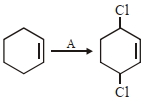
A
$A = HCl$; Anhydrous $AlCl_3$
B
$A = HCl, ZnCl_2$
C
$A = Cl_2$; $UV$ light
D
$A = Cl_2$; dark,Anhydrous $AlCl_3$
Solution
(C) The reaction shows the chlorination of cyclohexene to form a dichlorocyclohexene derivative.
Specifically,the reaction involves the substitution of hydrogen atoms at the allylic positions.
Free radical halogenation using $Cl_2$ in the presence of $UV$ light is the standard method for allylic substitution in alkenes.
Therefore,the correct reagent and condition is $A = Cl_2$ with $UV$ light.
Specifically,the reaction involves the substitution of hydrogen atoms at the allylic positions.
Free radical halogenation using $Cl_2$ in the presence of $UV$ light is the standard method for allylic substitution in alkenes.
Therefore,the correct reagent and condition is $A = Cl_2$ with $UV$ light.
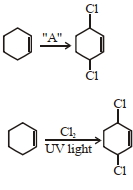
0 likes
View Solution817
DifficultMCQ
What is the major product formed by the reaction of $HI$ with $CH_3-C(CH_3)_2-CH=CH_2$?
A
$CH_3-C(CH_3)_2-CH_2-CH_2I$
B
$CH_3-C(CH_3)_2-CHI-CH_3$
C
$CH_3-CI(CH_3)-CH(CH_3)-CH_3$
D
$CH_3-CH(CH_3)-CHI-CH_2-CH_3$
Solution
(C) The reaction of $HI$ with $3,3$-dimethyl-$1$-butene $(CH_3-C(CH_3)_2-CH=CH_2)$ proceeds via a carbocation intermediate.
First,protonation of the alkene forms a secondary carbocation: $CH_3-C(CH_3)_2-C^+H-CH_3$.
To increase stability,a $1,2$-methyl shift occurs from the adjacent quaternary carbon,resulting in a more stable tertiary carbocation: $CH_3-C^+(CH_3)-CH(CH_3)-CH_3$.
Finally,the nucleophilic attack of the iodide ion $(I^-)$ on this tertiary carbocation yields the major product,$2$-iodo-$2,3$-dimethylbutane $(CH_3-CI(CH_3)-CH(CH_3)-CH_3)$.
First,protonation of the alkene forms a secondary carbocation: $CH_3-C(CH_3)_2-C^+H-CH_3$.
To increase stability,a $1,2$-methyl shift occurs from the adjacent quaternary carbon,resulting in a more stable tertiary carbocation: $CH_3-C^+(CH_3)-CH(CH_3)-CH_3$.
Finally,the nucleophilic attack of the iodide ion $(I^-)$ on this tertiary carbocation yields the major product,$2$-iodo-$2,3$-dimethylbutane $(CH_3-CI(CH_3)-CH(CH_3)-CH_3)$.
0 likes
View Solution818
MediumMCQ
Identify products $A$ and $B$ in the following reaction sequence:
$1$-methylcyclopentene $\xrightarrow{\text{dil. } KMnO_4, 273 \ K} A$ $\xrightarrow{CrO_3} B$
$1$-methylcyclopentene $\xrightarrow{\text{dil. } KMnO_4, 273 \ K} A$ $\xrightarrow{CrO_3} B$
A
$A: \text{1-methylcyclopentane-1,2-diol}, B: \text{2-hydroxy-2-methylcyclopentanone}$
B
$A: \text{1-methylcyclopentane-1,2-diol}, B: \text{2-methylcyclopentanone}$
C
$A: \text{2-methylcyclopentanol}, B: \text{2-methylcyclopentanone}$
D
$A: \text{1-methylcyclopentene oxide}, B: \text{2-methylcyclopentanone}$
Solution
(A) $1$. The reaction of $1-$methylcyclopentene with dilute alkaline $KMnO_4$ at $273 \ K$ (Baeyer's reagent) is a syn-hydroxylation reaction,which adds two hydroxyl groups across the double bond to form $1-$methylcyclopentane$-1,2-$diol $(A)$.
$2$. The product $A$ is a vicinal diol. The secondary alcohol group is more easily oxidized than the tertiary alcohol group. Treatment with $CrO_3$ (Jones reagent or similar chromium-based oxidant) selectively oxidizes the secondary alcohol to a ketone,resulting in $2-$hydroxy$-2-$methylcyclopentanone $(B)$.
$2$. The product $A$ is a vicinal diol. The secondary alcohol group is more easily oxidized than the tertiary alcohol group. Treatment with $CrO_3$ (Jones reagent or similar chromium-based oxidant) selectively oxidizes the secondary alcohol to a ketone,resulting in $2-$hydroxy$-2-$methylcyclopentanone $(B)$.
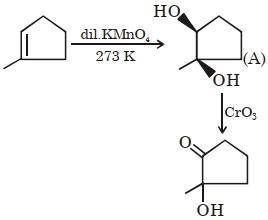
0 likes
View Solution819
MediumMCQ
What is $X$ in the given reaction?
$HOCH_2-CH_2OH + (COOH)_2 \xrightarrow{210^{\circ}C} X$
(major product)
$HOCH_2-CH_2OH + (COOH)_2 \xrightarrow{210^{\circ}C} X$
(major product)
A
$CH_2=CH_2$
B
$CH(OH)=CH_2$
C
$CHO-CHO$
D
$CH_2OH-CHO$
Solution
(A) The reaction of ethylene glycol $(HOCH_2-CH_2OH)$ with oxalic acid $((COOH)_2)$ at $110^{\circ}C$ forms a cyclic ester (ethylene oxalate).
Upon further heating to $210^{\circ}C$,this cyclic ester undergoes decarboxylation to produce ethene $(CH_2=CH_2)$ and carbon dioxide $(CO_2)$.
Therefore,the major product $X$ formed at $210^{\circ}C$ is ethene $(CH_2=CH_2)$.
Upon further heating to $210^{\circ}C$,this cyclic ester undergoes decarboxylation to produce ethene $(CH_2=CH_2)$ and carbon dioxide $(CO_2)$.
Therefore,the major product $X$ formed at $210^{\circ}C$ is ethene $(CH_2=CH_2)$.
0 likes
View Solution820
DifficultMCQ
The major product formed in the following reaction is:
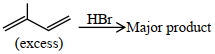
A
The structure of $1-$bromo$-3-$methylbut$-2-$ene.
B
The structure of $2,3-$dibromo$-2-$methylbutane.
C
The structure of $2-$bromo$-2-$methylbut$-3-$ene.
D
The structure of $1,4-$dibromo$-2-$methylbutane.
Solution
(A) The reaction involves the electrophilic addition of $HBr$ to a conjugated diene,$2$-methylbuta-$1,3$-diene (isoprene).
When $HBr$ is added to a conjugated diene,both $1,2$-addition and $1,4$-addition products can be formed.
In the presence of excess $HBr$,the reaction proceeds further. However,the question asks for the major product of the initial addition step or the primary outcome of the reaction.
The $1,4$-addition product is generally more stable due to the formation of a more substituted alkene.
The reaction of $2$-methylbuta-$1,3$-diene with $HBr$ yields $1$-bromo-$3$-methylbut-$2$-ene as the major $1,4$-addition product.
When $HBr$ is added to a conjugated diene,both $1,2$-addition and $1,4$-addition products can be formed.
In the presence of excess $HBr$,the reaction proceeds further. However,the question asks for the major product of the initial addition step or the primary outcome of the reaction.
The $1,4$-addition product is generally more stable due to the formation of a more substituted alkene.
The reaction of $2$-methylbuta-$1,3$-diene with $HBr$ yields $1$-bromo-$3$-methylbut-$2$-ene as the major $1,4$-addition product.
0 likes
View Solution821
EasyMCQ
The major product formed in the following reaction is :
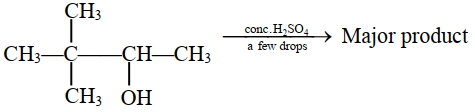
A
$CH_3-C(CH_3)=CH-CH_2CH_3$
B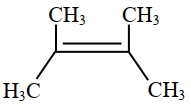
$CH_3-C(CH_3)=C(CH_3)_2$
C
$CH_3-C(CH_3)=CH-CH_3$
D
$CH_3-C(CH_3)_2-CH=CH_2$
Solution
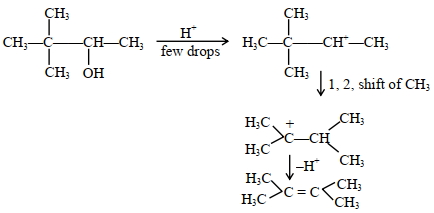
(B) The reaction involves the acid-catalyzed dehydration of $3,3-dimethylbutan-2-ol$.
$1$. Protonation of the $-OH$ group leads to the formation of a secondary carbocation: $(CH_3)_3C-CH^+(CH_3)$.
$2$. This secondary carbocation undergoes a $1,2-methyl$ shift to form a more stable tertiary carbocation: $(CH_3)_2C^+-CH(CH_3)_2$.
$3$. Loss of a proton from the adjacent carbon atom results in the formation of the most stable alkene,which is $2,3-dimethylbut-2-ene$ $(CH_3-C(CH_3)=C(CH_3)_2)$.
Thus,the major product is $2,3-dimethylbut-2-ene$.
$1$. Protonation of the $-OH$ group leads to the formation of a secondary carbocation: $(CH_3)_3C-CH^+(CH_3)$.
$2$. This secondary carbocation undergoes a $1,2-methyl$ shift to form a more stable tertiary carbocation: $(CH_3)_2C^+-CH(CH_3)_2$.
$3$. Loss of a proton from the adjacent carbon atom results in the formation of the most stable alkene,which is $2,3-dimethylbut-2-ene$ $(CH_3-C(CH_3)=C(CH_3)_2)$.
Thus,the major product is $2,3-dimethylbut-2-ene$.
0 likes
View Solution822
EasyMCQ
Given below are two statements: one is labelled as Assertion $A$ and the other is labelled as Reason $R.$
Assertion $A :$ Treatment of bromine water with propene yields $1-$bromopropan$-2-$ol.
Reason $R:$ Attack of water on bromonium ion follows Markovnikov rule and results in $1-$bromopropan$-2-$ol.
In the light of the above statements,choose the most appropriate answer from the options given below:
Assertion $A :$ Treatment of bromine water with propene yields $1-$bromopropan$-2-$ol.
Reason $R:$ Attack of water on bromonium ion follows Markovnikov rule and results in $1-$bromopropan$-2-$ol.
In the light of the above statements,choose the most appropriate answer from the options given below:
A
Both $A$ and $R$ are true but $R$ is $NOT$ the correct explanation of $A$.
B
$A$ is false but $R$ is true.
C
Both $A$ and $R$ are true and $R$ is the correct explanation of $A$.
D
$A$ is true but $R$ is false.
Solution
(C) The reaction of propene $(CH_3-CH=CH_2)$ with bromine water $(Br_2/H_2O)$ proceeds via the formation of a cyclic bromonium ion intermediate.
The water molecule then attacks the more substituted carbon atom of the bromonium ion,which is consistent with the regioselectivity predicted by the Markovnikov rule (as the more substituted carbon can better stabilize the partial positive charge during the transition state).
This leads to the formation of $1-$bromopropan$-2-$ol $(CH_3-CH(OH)-CH_2Br)$.
Therefore,both Assertion $A$ and Reason $R$ are true,and $R$ is the correct explanation of $A$.
The water molecule then attacks the more substituted carbon atom of the bromonium ion,which is consistent with the regioselectivity predicted by the Markovnikov rule (as the more substituted carbon can better stabilize the partial positive charge during the transition state).
This leads to the formation of $1-$bromopropan$-2-$ol $(CH_3-CH(OH)-CH_2Br)$.
Therefore,both Assertion $A$ and Reason $R$ are true,and $R$ is the correct explanation of $A$.
0 likes
View Solution823
EasyMCQ
Which of the following reagents cannot be used for the experimental reduction of a functional group?
A
$Pt/C, H_{2}$
B
$Na/H_{2}$
C
$Pd/C, H_{2}$
D
$Zn/H_{2}O$
Solution
(B) The reagent $Na/H_{2}$ is not a standard reducing agent used in organic synthesis.
$Pt/C, H_{2}$ and $Pd/C, H_{2}$ are common catalysts for catalytic hydrogenation.
$Zn/H_{2}O$ is used for specific reductions like the reduction of ozonides.
Therefore,$Na/H_{2}$ is the correct choice.
$Pt/C, H_{2}$ and $Pd/C, H_{2}$ are common catalysts for catalytic hydrogenation.
$Zn/H_{2}O$ is used for specific reductions like the reduction of ozonides.
Therefore,$Na/H_{2}$ is the correct choice.
0 likes
View Solution824
MediumMCQ
The major product of the following chemical reaction is: $CH_3-CH(CH_3)-CH=CH_2 + HBr \xrightarrow{(C_6H_5CO)_2O_2} ?$
A
$CH_3-CH(CH_3)-CH_2-CH_2-Br$
B
$CH_3-CH(CH_3)-CH_2-CH_2-O-COC_6H_5$
C
$CH_3-CH(CH_3)-CH_2-CH(Br)_2$
D
$CH_3-CH(CH_3)-CH_2-CH(Br)-CH_3$
Solution
(A) In the presence of peroxides like benzoyl peroxide $((C_6H_5CO)_2O_2)$,the addition of $HBr$ to unsymmetrical alkenes follows the Anti-Markovnikov rule (also known as the peroxide effect or Kharasch effect).
In this mechanism,the bromine radical attacks the less substituted carbon atom of the double bond to form a more stable radical intermediate.
Reaction: $CH_3-CH(CH_3)-CH=CH_2 + HBr \xrightarrow{\text{Peroxide}} CH_3-CH(CH_3)-CH_2-CH_2-Br$ ($1$-bromo$-3-$methylbutane).
In this mechanism,the bromine radical attacks the less substituted carbon atom of the double bond to form a more stable radical intermediate.
Reaction: $CH_3-CH(CH_3)-CH=CH_2 + HBr \xrightarrow{\text{Peroxide}} CH_3-CH(CH_3)-CH_2-CH_2-Br$ ($1$-bromo$-3-$methylbutane).
0 likes
View Solution825
DifficultMCQ
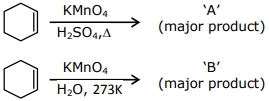
For the chemical reactions shown below,identify the correct statement from the following:
A
Compound '$A$' is a dicarboxylic acid and compound '$B$' is a diol.
B
Compound '$A$' is a diol and compound '$B$' is a dicarboxylic acid.
C
Both compound '$A$' and compound '$B$' are diols.
D
Both compound '$A$' and compound '$B$' are dicarboxylic acids.
Solution
(A) The reaction of cyclohexene with $KMnO_4 / H_2SO_4 / \Delta$ (hot acidic $KMnO_4$) causes oxidative cleavage of the double bond,resulting in the formation of a dicarboxylic acid (adipic acid) as compound '$A$'.
The reaction of cyclohexene with $KMnO_4 / H_2O / 273 \ K$ (cold alkaline $KMnO_4$,also known as Baeyer's reagent) results in syn-hydroxylation,forming a diol (cyclohexane$-1,2-$diol) as compound '$B$'.
Therefore,compound '$A$' is a dicarboxylic acid and compound '$B$' is a diol.
The reaction of cyclohexene with $KMnO_4 / H_2O / 273 \ K$ (cold alkaline $KMnO_4$,also known as Baeyer's reagent) results in syn-hydroxylation,forming a diol (cyclohexane$-1,2-$diol) as compound '$B$'.
Therefore,compound '$A$' is a dicarboxylic acid and compound '$B$' is a diol.
0 likes
View Solution826
MediumMCQ
The number of acyclic structural isomers (including geometrical isomers) for pentene $(C_5H_{10})$ are $......$
A
$9$
B
$7$
C
$8$
D
$6$
Solution
(D) The molecular formula for pentene is $C_5H_{10}$. The acyclic structural isomers are:
$1$. $Pent-1-ene$ $(CH_2=CH-CH_2-CH_2-CH_3)$
$2$. $Pent-2-ene$ $(CH_3-CH=CH-CH_2-CH_3)$
$3$. $2-Methylbut-1-ene$ $(CH_2=C(CH_3)-CH_2-CH_3)$
$4$. $3-Methylbut-1-ene$ $(CH_2=CH-CH(CH_3)_2)$
$5$. $2-Methylbut-2-ene$ $(CH_3-C(CH_3)=CH-CH_3)$
Now,considering geometrical isomers:
$Pent-2-ene$ exists as $cis$ and $trans$ isomers.
Therefore,the total number of acyclic isomers is $5$ (structural) $+ 1$ (additional geometrical isomer for $pent-2-ene$) $= 6$ isomers.
These are:
$1$. $Pent-1-ene$
$2$. $cis-Pent-2-ene$
$3$. $trans-Pent-2-ene$
$4$. $2-Methylbut-1-ene$
$5$. $3-Methylbut-1-ene$
$6$. $2-Methylbut-2-ene$
Thus,the total count is $6$.
$1$. $Pent-1-ene$ $(CH_2=CH-CH_2-CH_2-CH_3)$
$2$. $Pent-2-ene$ $(CH_3-CH=CH-CH_2-CH_3)$
$3$. $2-Methylbut-1-ene$ $(CH_2=C(CH_3)-CH_2-CH_3)$
$4$. $3-Methylbut-1-ene$ $(CH_2=CH-CH(CH_3)_2)$
$5$. $2-Methylbut-2-ene$ $(CH_3-C(CH_3)=CH-CH_3)$
Now,considering geometrical isomers:
$Pent-2-ene$ exists as $cis$ and $trans$ isomers.
Therefore,the total number of acyclic isomers is $5$ (structural) $+ 1$ (additional geometrical isomer for $pent-2-ene$) $= 6$ isomers.
These are:
$1$. $Pent-1-ene$
$2$. $cis-Pent-2-ene$
$3$. $trans-Pent-2-ene$
$4$. $2-Methylbut-1-ene$
$5$. $3-Methylbut-1-ene$
$6$. $2-Methylbut-2-ene$
Thus,the total count is $6$.
0 likes
View Solution827
MediumMCQ
An organic compound $'A'$ $(C_4H_8)$ on treatment with $KMnO_4 / H^{+}$ yields compound $'B'$ $(C_3H_6O)$. Compound $'A'$ also yields compound $'B'$ on ozonolysis. Compound $'A'$ is:
A
but$-2-$ene
B
$2-$Methylpropene
C
Cyclobutane
D
$1-$Methylcyclopropane
Solution
(B) The reaction of an alkene with $KMnO_4 / H^{+}$ (oxidative cleavage) or ozonolysis ($O_3$ followed by $Zn/H_2O$) breaks the double bond.
Compound $'A'$ $(C_4H_8)$ yields $C_3H_6O$ (acetone) as one of the products.
$2-$Methylpropene $(CH_3-C(CH_3)=CH_2)$ undergoes oxidative cleavage with $KMnO_4 / H^{+}$ to form acetone $(CH_3COCH_3)$ and $CO_2$.
Similarly,ozonolysis of $2-$Methylpropene gives acetone $(CH_3COCH_3)$ and formaldehyde $(HCHO)$.
Since the question specifies that $'A'$ yields $'B'$ $(C_3H_6O)$,$2-$Methylpropene is the correct structure for $'A'$.
Compound $'A'$ $(C_4H_8)$ yields $C_3H_6O$ (acetone) as one of the products.
$2-$Methylpropene $(CH_3-C(CH_3)=CH_2)$ undergoes oxidative cleavage with $KMnO_4 / H^{+}$ to form acetone $(CH_3COCH_3)$ and $CO_2$.
Similarly,ozonolysis of $2-$Methylpropene gives acetone $(CH_3COCH_3)$ and formaldehyde $(HCHO)$.
Since the question specifies that $'A'$ yields $'B'$ $(C_3H_6O)$,$2-$Methylpropene is the correct structure for $'A'$.
0 likes
View Solution828
MediumMCQ
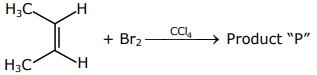
Consider the above chemical reaction. The total number of stereoisomers possible for product $'P'$ is $.....$
A
$4$
B
$3$
C
$1$
D
$2$
Solution
(D) The reaction of $cis-but-2-ene$ with $Br_2$ in $CCl_4$ proceeds via an anti-addition mechanism.
This results in the formation of a racemic mixture of $(2R, 3R)-2,3-dibromobutane$ and $(2S, 3S)-2,3-dibromobutane$.
Since these two enantiomers are stereoisomers,the total number of stereoisomers formed as product $'P'$ is $2$.
This results in the formation of a racemic mixture of $(2R, 3R)-2,3-dibromobutane$ and $(2S, 3S)-2,3-dibromobutane$.
Since these two enantiomers are stereoisomers,the total number of stereoisomers formed as product $'P'$ is $2$.
0 likes
View Solution829
EasyMCQ
Compound $X$ on reaction with $O_{3}$ followed by $Zn/H_{2}O$ gives formaldehyde and $2-$methylpropanal as products. The compound $X$ is :
A
$2-$Methylbut$-1-$ene
B
$2-$Methylbut$-2-$ene
C
Pent$-2-$ene
D
$3-$Methylbut$-1-$ene
Solution
(D) Ozonolysis of an alkene involves the cleavage of the $C=C$ double bond and the addition of oxygen atoms to each carbon atom of the double bond.
Formaldehyde is $HCHO$ and $2-$methylpropanal is $(CH_{3})_{2}CHCHO$.
By joining the carbonyl carbons of these products by a double bond,we get the structure of the original alkene $X$:
$CH_{3}-CH(CH_{3})-CH=O + O=CH_{2} \xrightarrow{Zn/H_{2}O} CH_{3}-CH(CH_{3})-CH=CH_{2} + H_{2}O$
The structure $CH_{3}-CH(CH_{3})-CH=CH_{2}$ corresponds to $3-$methylbut$-1-$ene.
Therefore,the correct option is $D$.
Formaldehyde is $HCHO$ and $2-$methylpropanal is $(CH_{3})_{2}CHCHO$.
By joining the carbonyl carbons of these products by a double bond,we get the structure of the original alkene $X$:
$CH_{3}-CH(CH_{3})-CH=O + O=CH_{2} \xrightarrow{Zn/H_{2}O} CH_{3}-CH(CH_{3})-CH=CH_{2} + H_{2}O$
The structure $CH_{3}-CH(CH_{3})-CH=CH_{2}$ corresponds to $3-$methylbut$-1-$ene.
Therefore,the correct option is $D$.
0 likes
View Solution830
MediumMCQ
Given below are two statements.
Statement $I :$ The presence of weaker $\pi$-bonds makes alkenes less stable than alkanes.
Statement $II :$ The strength of the double bond is greater than that of carbon-carbon single bond.
In the light of the above statements,choose the correct answer from the options given below.
Statement $I :$ The presence of weaker $\pi$-bonds makes alkenes less stable than alkanes.
Statement $II :$ The strength of the double bond is greater than that of carbon-carbon single bond.
In the light of the above statements,choose the correct answer from the options given below.
A
Both Statement $I$ and Statement $II$ are correct.
B
Both Statement $I$ and Statement $II$ are incorrect.
C
Statement $I$ is correct but Statement $II$ is incorrect.
D
Statement $I$ is incorrect but Statement $II$ is correct.
Solution
(D) Statement $I$ is incorrect. Alkenes are generally considered more reactive than alkanes due to the presence of the $\pi$-bond,but the stability of a molecule depends on its total bond energy. Alkenes are not inherently 'less stable' than alkanes in a way that makes them unstable compounds; they are simply more reactive towards electrophilic addition.
Statement $II$ is correct. $A$ carbon-carbon double bond $(C=C)$ consists of one $\sigma$-bond and one $\pi$-bond. The total bond energy of a $C=C$ bond (approx. $610 \ kJ/mol$) is significantly higher than that of a $C-C$ single bond (approx. $348 \ kJ/mol$). Therefore,the strength of the double bond is greater than that of the single bond.
Statement $II$ is correct. $A$ carbon-carbon double bond $(C=C)$ consists of one $\sigma$-bond and one $\pi$-bond. The total bond energy of a $C=C$ bond (approx. $610 \ kJ/mol$) is significantly higher than that of a $C-C$ single bond (approx. $348 \ kJ/mol$). Therefore,the strength of the double bond is greater than that of the single bond.
0 likes
View Solution831
MediumMCQ
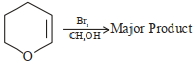
Amongst the following,the major product of the given chemical reaction is $.....$ .
A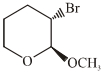
B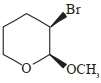
C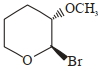
D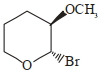
Solution
(A) The reaction of $3,4-dihydro-2H-pyran$ with $Br_2$ in the presence of $CH_3OH$ proceeds via the formation of a cyclic bromonium ion intermediate.
$1.$ $Br_2$ adds to the double bond to form a cyclic bromonium ion.
$2.$ The nucleophile $CH_3OH$ attacks the more substituted carbon atom of the bromonium ion due to electronic effects and the stability of the transition state.
$3.$ This results in an anti-addition product where the $-OCH_3$ group and the $-Br$ atom are in a trans-configuration relative to each other.
Thus,the major product is the one where $-Br$ and $-OCH_3$ are trans to each other.
$1.$ $Br_2$ adds to the double bond to form a cyclic bromonium ion.
$2.$ The nucleophile $CH_3OH$ attacks the more substituted carbon atom of the bromonium ion due to electronic effects and the stability of the transition state.
$3.$ This results in an anti-addition product where the $-OCH_3$ group and the $-Br$ atom are in a trans-configuration relative to each other.
Thus,the major product is the one where $-Br$ and $-OCH_3$ are trans to each other.
0 likes
View Solution832
DifficultMCQ
The number of grams of bromine that will completely react with $5.0 \ g$ of pent$-1-$ene is $...... \times 10^{-2} \ g$. (Atomic mass of $Br = 80 \ g/mol$) [Nearest Integer]
A
$1143$
B
$1500$
C
$951$
D
$442$
Solution
(A) The chemical reaction is: $C_{5}H_{10} + Br_{2} \rightarrow C_{5}H_{10}Br_{2}$
From the stoichiometry,$1 \ mol$ of pent$-1-$ene reacts with $1 \ mol$ of $Br_{2}$.
Molar mass of pent$-1-$ene $(C_{5}H_{10})$ $= 5 \times 12 + 10 \times 1 = 70 \ g/mol$.
Molar mass of $Br_{2} = 2 \times 80 = 160 \ g/mol$.
Moles of pent$-1-$ene $= \frac{5.0 \ g}{70 \ g/mol} = \frac{1}{14} \ mol$.
Since the molar ratio is $1:1$,moles of $Br_{2}$ required $= \frac{1}{14} \ mol$.
Mass of $Br_{2}$ required $= \text{moles} \times \text{molar mass} = \frac{1}{14} \times 160 \ g = 11.4285 \ g$.
Expressing in terms of $10^{-2} \ g$: $11.4285 \times 100 \times 10^{-2} \ g = 1142.85 \times 10^{-2} \ g$.
Rounding to the nearest integer,we get $1143 \times 10^{-2} \ g$.
From the stoichiometry,$1 \ mol$ of pent$-1-$ene reacts with $1 \ mol$ of $Br_{2}$.
Molar mass of pent$-1-$ene $(C_{5}H_{10})$ $= 5 \times 12 + 10 \times 1 = 70 \ g/mol$.
Molar mass of $Br_{2} = 2 \times 80 = 160 \ g/mol$.
Moles of pent$-1-$ene $= \frac{5.0 \ g}{70 \ g/mol} = \frac{1}{14} \ mol$.
Since the molar ratio is $1:1$,moles of $Br_{2}$ required $= \frac{1}{14} \ mol$.
Mass of $Br_{2}$ required $= \text{moles} \times \text{molar mass} = \frac{1}{14} \times 160 \ g = 11.4285 \ g$.
Expressing in terms of $10^{-2} \ g$: $11.4285 \times 100 \times 10^{-2} \ g = 1142.85 \times 10^{-2} \ g$.
Rounding to the nearest integer,we get $1143 \times 10^{-2} \ g$.
0 likes
View Solution833
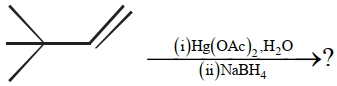
MediumMCQ
The major product in the following reaction is:
A
$3,3-$dimethylbutan$-2-$ol
B
$3,3-$dimethylbutanal
C
$2,3-$dimethylbutan$-2-$ol
D
$3,3-$dimethylbutan$-1-$ol
Solution
(A) The reaction is Oxymercuration-Demercuration of $3,3-$dimethylbut$-1-$ene.
This reaction involves the addition of $H_2O$ across the double bond following Markovnikov's rule.
An important feature of this reaction is that it proceeds without carbocation rearrangement.
Therefore,the $OH$ group attaches to the more substituted carbon ($C$-$2$) and the $H$ atom attaches to the less substituted carbon ($C$-$1$),resulting in $3,3-$dimethylbutan$-2-$ol as the major product.
This reaction involves the addition of $H_2O$ across the double bond following Markovnikov's rule.
An important feature of this reaction is that it proceeds without carbocation rearrangement.
Therefore,the $OH$ group attaches to the more substituted carbon ($C$-$2$) and the $H$ atom attaches to the less substituted carbon ($C$-$1$),resulting in $3,3-$dimethylbutan$-2-$ol as the major product.
0 likes
View Solution834
DifficultMCQ
What will be the major product of the following sequence of reactions?
$n-Bu-C \equiv CH \xrightarrow[(ii) \text{Lindlar cat.}, H_2]{(i) n-BuLi, n-C_5H_{11}Cl}$
$n-Bu-C \equiv CH \xrightarrow[(ii) \text{Lindlar cat.}, H_2]{(i) n-BuLi, n-C_5H_{11}Cl}$
A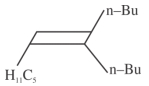
B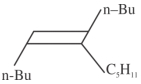
C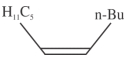
D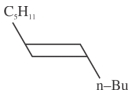
Solution
(C) Step $1$: The terminal alkyne $n-Bu-C \equiv CH$ reacts with $n-BuLi$ to form the acetylide anion $n-Bu-C \equiv C^- Li^+$.
Step $2$: The acetylide anion undergoes an $S_N2$ reaction with $n-C_5H_{11}Cl$ to form the internal alkyne $n-Bu-C \equiv C-C_5H_{11}$.
Step $3$: The hydrogenation of the internal alkyne using $Lindlar$ catalyst and $H_2$ results in the formation of a $cis$-alkene.
Therefore,the major product is the $cis$-isomer where the $n-Bu$ and $C_5H_{11}$ groups are on the same side of the double bond,which corresponds to option $C$.
Step $2$: The acetylide anion undergoes an $S_N2$ reaction with $n-C_5H_{11}Cl$ to form the internal alkyne $n-Bu-C \equiv C-C_5H_{11}$.
Step $3$: The hydrogenation of the internal alkyne using $Lindlar$ catalyst and $H_2$ results in the formation of a $cis$-alkene.
Therefore,the major product is the $cis$-isomer where the $n-Bu$ and $C_5H_{11}$ groups are on the same side of the double bond,which corresponds to option $C$.
0 likes
View Solution835
DifficultMCQ
$A$ and $B$ respectively are:
$A \xrightarrow[(2) Zn-H_2O]{(1) O_3} \text{Ethane-}1,2\text{-dicarbaldehyde} + \text{Glyoxal}$
$B \xrightarrow[(2) Zn-H_2O]{(1) O_3} 5\text{-oxohexanal}$
$A \xrightarrow[(2) Zn-H_2O]{(1) O_3} \text{Ethane-}1,2\text{-dicarbaldehyde} + \text{Glyoxal}$
$B \xrightarrow[(2) Zn-H_2O]{(1) O_3} 5\text{-oxohexanal}$
A
$1\text{-methylcyclohex-}1,3\text{-diene and cyclopentene}$
B
$\text{Cyclohex-}1,3\text{-diene and cyclopentene}$
C
$1\text{-methylcyclohex-}1,4\text{-diene and } 1\text{-methylcyclopent-}1\text{-ene}$
D
$\text{Cyclohex-}1,3\text{-diene and } 1\text{-methylcyclopent-}1\text{-ene}$
Solution
(D) Ozonolysis of $A$ gives $\text{ethane-}1,2\text{-dicarbaldehyde}$ (succinaldehyde) and $\text{glyoxal}$ (ethanedial). This indicates $A$ is $\text{cyclohex-}1,3\text{-diene}$.
Ozonolysis of $B$ gives $5\text{-oxohexanal}$. This indicates $B$ is $1\text{-methylcyclopent-}1\text{-ene}$.
Thus,$A$ is $\text{cyclohex-}1,3\text{-diene}$ and $B$ is $1\text{-methylcyclopent-}1\text{-ene}$.
Ozonolysis of $B$ gives $5\text{-oxohexanal}$. This indicates $B$ is $1\text{-methylcyclopent-}1\text{-ene}$.
Thus,$A$ is $\text{cyclohex-}1,3\text{-diene}$ and $B$ is $1\text{-methylcyclopent-}1\text{-ene}$.
0 likes
View Solution836
DifficultMCQ
The major product $(P)$ in the reaction
$Ph-CH=CH-CH_2Br \xrightarrow{HBr} ?(P)$
$[$where $Ph$ is $-C_6H_5]$ is ....
$Ph-CH=CH-CH_2Br \xrightarrow{HBr} ?(P)$
$[$where $Ph$ is $-C_6H_5]$ is ....
A
$Ph-CH(Br)-CH(Br)-CH_3$
B
$Ph-CH_2-CH(Br)-CH_2Br$
C
$Ph-CH(Br)-CH_2-CH_2Br$
D
$Ph-CH(Br)-CH=CH_2$
Solution
(C) The reaction is an electrophilic addition of $HBr$ to the alkene $Ph-CH=CH-CH_2Br$.
$1$. The proton $(H^+)$ from $HBr$ attacks the double bond to form the most stable carbocation.
$2$. The carbocation formed at the benzylic position $(Ph-CH^+-CH_2-CH_2Br)$ is resonance-stabilized by the phenyl group.
$3$. The bromide ion $(Br^-)$ then attacks this stable carbocation to form the major product.
$4$. Thus,the major product is $Ph-CH(Br)-CH_2-CH_2Br$.
$1$. The proton $(H^+)$ from $HBr$ attacks the double bond to form the most stable carbocation.
$2$. The carbocation formed at the benzylic position $(Ph-CH^+-CH_2-CH_2Br)$ is resonance-stabilized by the phenyl group.
$3$. The bromide ion $(Br^-)$ then attacks this stable carbocation to form the major product.
$4$. Thus,the major product is $Ph-CH(Br)-CH_2-CH_2Br$.
0 likes
View Solution837
MediumMCQ
Two isomers $A$ and $B$ with molecular formula $C_4H_8$ give different products on oxidation with $KMnO_4$ in acidic medium. Isomer $A$ on reaction with $KMnO_4 / H^{+}$ results in effervescence of a gas and gives a ketone. The compound $A$ is ...... .
A
but$-1-$ene
B
cis-but$-2-$ene
C
trans-but$-2-$ene
D
$2-$methylpropene
Solution
(D) The molecular formula $C_4H_8$ corresponds to alkenes.
Oxidation of alkenes with acidic $KMnO_4$ leads to cleavage of the double bond.
$2-$methylpropene $(CH_3)_2C=CH_2$ on oxidation with acidic $KMnO_4$ gives acetone $(CH_3)_2C=O$ and $CO_2$ gas,which causes effervescence.
The reaction is: $(CH_3)_2C=CH_2 + [O] \xrightarrow{KMnO_4/H^+} (CH_3)_2C=O + CO_2 + H_2O$.
Thus,compound $A$ is $2-$methylpropene.
Oxidation of alkenes with acidic $KMnO_4$ leads to cleavage of the double bond.
$2-$methylpropene $(CH_3)_2C=CH_2$ on oxidation with acidic $KMnO_4$ gives acetone $(CH_3)_2C=O$ and $CO_2$ gas,which causes effervescence.
The reaction is: $(CH_3)_2C=CH_2 + [O] \xrightarrow{KMnO_4/H^+} (CH_3)_2C=O + CO_2 + H_2O$.
Thus,compound $A$ is $2-$methylpropene.
0 likes
View Solution838
DifficultMCQ
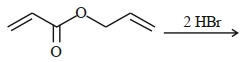
The major product of the following reaction is:
A
$3-$bromopropyl $2-$bromopropanoate
B
$1-$bromopropan$-2-$yl $2-$bromopropanoate
C
$3-$bromopropyl $3-$bromopropanoate
D
$1-$bromopropan$-2-$yl $3-$bromopropanoate
Solution
(D) The reaction involves the electrophilic addition of $HBr$ to the two double bonds present in the molecule,which is allyl acrylate $(CH_2=CH-COO-CH_2-CH=CH_2)$.
$1$. The first $HBr$ molecule adds to the more reactive double bond. The double bond in the allyl group (alkene part) is more electron-rich than the double bond conjugated with the carbonyl group (acrylate part). Thus,$HBr$ adds to the allyl double bond following Markovnikov's rule to form $CH_2=CH-COO-CH_2-CH(Br)-CH_3$.
$2$. The second $HBr$ molecule adds to the remaining double bond in the acrylate part. This addition follows anti-Markovnikov's rule (if peroxide is present,though usually,in the absence of peroxide,it follows Markovnikov's rule,but here the electron-withdrawing carbonyl group directs the addition to the terminal carbon to form the more stable carbocation or via conjugate addition). The addition to the $CH_2=CH-$ group results in the formation of $Br-CH_2-CH_2-COO-CH_2-CH(Br)-CH_3$.
Therefore,the final product is $1-$bromopropan$-2-$yl $3-$bromopropanoate.
$1$. The first $HBr$ molecule adds to the more reactive double bond. The double bond in the allyl group (alkene part) is more electron-rich than the double bond conjugated with the carbonyl group (acrylate part). Thus,$HBr$ adds to the allyl double bond following Markovnikov's rule to form $CH_2=CH-COO-CH_2-CH(Br)-CH_3$.
$2$. The second $HBr$ molecule adds to the remaining double bond in the acrylate part. This addition follows anti-Markovnikov's rule (if peroxide is present,though usually,in the absence of peroxide,it follows Markovnikov's rule,but here the electron-withdrawing carbonyl group directs the addition to the terminal carbon to form the more stable carbocation or via conjugate addition). The addition to the $CH_2=CH-$ group results in the formation of $Br-CH_2-CH_2-COO-CH_2-CH(Br)-CH_3$.
Therefore,the final product is $1-$bromopropan$-2-$yl $3-$bromopropanoate.
0 likes
View Solution839
MediumMCQ
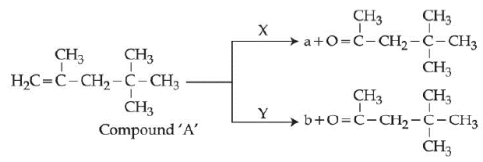
$A$ compound $A$ on reaction with $X$ and $Y$ produces the same major product but different by-products $a$ and $b$. Oxidation of $a$ gives a substance produced by ants.
$X$ and $Y$ respectively are :
$X$ and $Y$ respectively are :
A
$KMnO_4 / H^{+}$ and dil. $KMnO_4, 273 \ K$
B
$KMnO_4$ (dilute),$273 \ K$ and $KMnO_4 / H^{+}$
C
$KMnO_4 / H^{+}$ and $O_3, H_2O / Zn$
D
$O_3, H_2O / Zn$ and $KMnO_4 / H^{+}$
Solution
(D) The compound $A$ is $2,4,4-trimethylpent-1-ene$.
Reaction with $O_3, H_2O / Zn$ (reductive ozonolysis) gives formaldehyde $(HCHO)$ as by-product $a$ and a ketone.
Reaction with $KMnO_4 / H^{+}$ (oxidative cleavage) gives formic acid $(HCOOH)$ as by-product $b$ and a ketone.
Formaldehyde $(a)$ on oxidation gives formic acid,which is found in ants.
Thus,$X$ is $O_3, H_2O / Zn$ and $Y$ is $KMnO_4 / H^{+}$.
Reaction with $O_3, H_2O / Zn$ (reductive ozonolysis) gives formaldehyde $(HCHO)$ as by-product $a$ and a ketone.
Reaction with $KMnO_4 / H^{+}$ (oxidative cleavage) gives formic acid $(HCOOH)$ as by-product $b$ and a ketone.
Formaldehyde $(a)$ on oxidation gives formic acid,which is found in ants.
Thus,$X$ is $O_3, H_2O / Zn$ and $Y$ is $KMnO_4 / H^{+}$.
0 likes
View Solution840
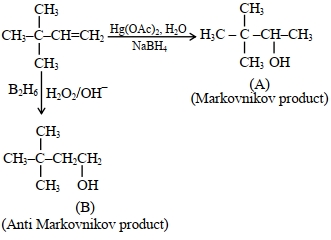
MediumMCQ
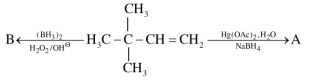
Choose the correct option for the following reactions.
A
$A$ and $B$ are both Markovnikov addition products.
B
$A$ is Markovnikov product and $B$ is anti-Markovnikov product.
C
$A$ and $B$ are both anti-Markovnikov products.
D
$B$ is Markovnikov and $A$ is anti-Markovnikov product.
Solution
(B) The reaction with $Hg(OAc)_2, H_2O$ followed by $NaBH_4$ is Oxymercuration-Demercuration,which follows Markovnikov's rule to give product $A$ ($3$,$3$-dimethylbutan$-2-$ol).
The reaction with $(BH_3)_2$ followed by $H_2O_2/OH^-$ is Hydroboration-Oxidation,which follows anti-Markovnikov's rule to give product $B$ ($3$,$3$-dimethylbutan$-1-$ol).
Therefore,$A$ is the Markovnikov product and $B$ is the anti-Markovnikov product.
The reaction with $(BH_3)_2$ followed by $H_2O_2/OH^-$ is Hydroboration-Oxidation,which follows anti-Markovnikov's rule to give product $B$ ($3$,$3$-dimethylbutan$-1-$ol).
Therefore,$A$ is the Markovnikov product and $B$ is the anti-Markovnikov product.
0 likes
View Solution841
MediumMCQ
Find the major product for the reaction shown below.
A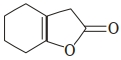
B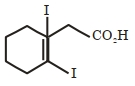
C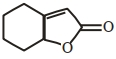
D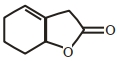
Solution
(A) The reaction is an iodolactonization followed by dehydroiodination.
$1$. Treatment of the unsaturated carboxylic acid with $I_2/NaHCO_3$ leads to the formation of an iodolactone intermediate. The carboxylate oxygen attacks the iodonium ion formed across the double bond,resulting in a bicyclic lactone with an iodine atom at the bridgehead position.
$2$. Subsequent treatment with pyridine and heat $(\Delta)$ promotes an $E2$ elimination reaction,removing the iodine atom and a hydrogen atom from the adjacent carbon to form a double bond.
$3$. The final product is a bicyclic lactone containing a double bond in the six-membered ring,which corresponds to option $A$.
$1$. Treatment of the unsaturated carboxylic acid with $I_2/NaHCO_3$ leads to the formation of an iodolactone intermediate. The carboxylate oxygen attacks the iodonium ion formed across the double bond,resulting in a bicyclic lactone with an iodine atom at the bridgehead position.
$2$. Subsequent treatment with pyridine and heat $(\Delta)$ promotes an $E2$ elimination reaction,removing the iodine atom and a hydrogen atom from the adjacent carbon to form a double bond.
$3$. The final product is a bicyclic lactone containing a double bond in the six-membered ring,which corresponds to option $A$.
0 likes
View Solution842
MediumMCQ
When ethanol is heated with conc. $H_{2}SO_{4}$,a gas is produced. The compound formed,when this gas is treated with cold dilute aqueous solution of Baeyer's reagent,is:
A
Formaldehyde
B
Formic acid
C
Glycol
D
Ethanoic acid
Solution
(C) $1$. Ethanol $(CH_{3}CH_{2}OH)$ on heating with concentrated $H_{2}SO_{4}$ undergoes dehydration to produce ethene gas $(CH_{2}=CH_{2})$.
$2$. Ethene reacts with cold dilute aqueous solution of alkaline $KMnO_{4}$ (Baeyer's reagent) to undergo hydroxylation,resulting in the formation of ethane$-1,2-$diol,commonly known as glycol $(HOCH_{2}-CH_{2}OH)$.
$2$. Ethene reacts with cold dilute aqueous solution of alkaline $KMnO_{4}$ (Baeyer's reagent) to undergo hydroxylation,resulting in the formation of ethane$-1,2-$diol,commonly known as glycol $(HOCH_{2}-CH_{2}OH)$.
0 likes
View Solution843
DifficultMCQ
An organic compound $X$ with molecular formula $C_{11}H_{14}$ gives an optically active compound on hydrogenation. Upon ozonolysis,$X$ produces a mixture of compounds $P$ and $Q$. Compound $P$ gives a yellow precipitate when treated with $I_{2}$ and $NaOH$ but does not reduce Tollen's reagent. Compound $Q$ does not give any yellow precipitate with $I_{2}$ and $NaOH$ but gives Fehling's test. The compound $X$ is:
A
$Ph-C(CH_3)=CH-CH_2-CH_3$
B
$Ph-CH=C(CH_3)-CH_2-CH_3$
C
$Ph-CH=CH-CH_2-CH_2-CH_3$
D
$Ph-C(CH_3)=C(CH_3)_2$
Solution
(A) $1$. The molecular formula of $X$ is $C_{11}H_{14}$.
$2$. Ozonolysis of $X$ gives $P$ and $Q$. $P$ gives a positive iodoform test $(I_2/NaOH)$ and does not reduce Tollen's reagent,identifying $P$ as a methyl ketone (specifically acetophenone,$Ph-CO-CH_3$).
$3$. $Q$ gives a positive Fehling's test but no iodoform test,identifying $Q$ as an aliphatic aldehyde (specifically propanal,$CH_3CH_2CHO$).
$4$. Combining these fragments ($Ph-CO-CH_3$ and $CH_3CH_2CHO$) via ozonolysis reversal,the structure of $X$ is $Ph-C(CH_3)=CH-CH_2-CH_3$.
$5$. Hydrogenation of $X$ $(Ph-C(CH_3)=CH-CH_2-CH_3 + H_2 \rightarrow Ph-CH(CH_3)-CH_2-CH_2-CH_3)$ produces a chiral center at the carbon attached to the phenyl group,making the product optically active.
$2$. Ozonolysis of $X$ gives $P$ and $Q$. $P$ gives a positive iodoform test $(I_2/NaOH)$ and does not reduce Tollen's reagent,identifying $P$ as a methyl ketone (specifically acetophenone,$Ph-CO-CH_3$).
$3$. $Q$ gives a positive Fehling's test but no iodoform test,identifying $Q$ as an aliphatic aldehyde (specifically propanal,$CH_3CH_2CHO$).
$4$. Combining these fragments ($Ph-CO-CH_3$ and $CH_3CH_2CHO$) via ozonolysis reversal,the structure of $X$ is $Ph-C(CH_3)=CH-CH_2-CH_3$.
$5$. Hydrogenation of $X$ $(Ph-C(CH_3)=CH-CH_2-CH_3 + H_2 \rightarrow Ph-CH(CH_3)-CH_2-CH_2-CH_3)$ produces a chiral center at the carbon attached to the phenyl group,making the product optically active.
0 likes
View Solution844
AdvancedMCQ
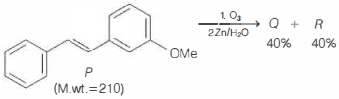
In the following reaction,$P$ gives two products $Q$ and $R$ each in $40 \,\%$ yield. If the reaction is carried out with $420 \,mg$ of $P$,the reaction yields $108.8 \,mg$ of $Q$. The amount of $R$ produced in the reaction is closest to $....\, mg$.
A
$97.6$
B
$108.8$
C
$84.8$
D
$121.6$
Solution
(C) The reaction is an ozonolysis of an alkene $P$ $(M.wt. = 210)$.
Number of moles of $P = \frac{420 \times 10^{-3} \,g}{210 \,g/mol} = 2 \times 10^{-3} \,mol$.
Since the yield of both $Q$ and $R$ is $40 \,\%$,the number of moles of $Q$ and $R$ produced is $40 \,\%$ of $2 \times 10^{-3} \,mol = 8 \times 10^{-4} \,mol$.
Product $Q$ is benzaldehyde ($C_6H_5CHO$,$M = 106$) and $R$ is $3$-methoxybenzaldehyde ($CH_3OC_6H_4CHO$,$M = 136$).
Mass of $R = \text{moles} \times \text{molar mass} = 8 \times 10^{-4} \,mol \times 136 \,g/mol = 1088 \times 10^{-4} \,g = 108.8 \,mg$.
Mass of $Q = 8 \times 10^{-4} \,mol \times 106 \,g/mol = 848 \times 10^{-4} \,g = 84.8 \,mg$.
Given that $108.8 \,mg$ of $Q$ is produced,$R$ must be the product with mass $84.8 \,mg$.
Number of moles of $P = \frac{420 \times 10^{-3} \,g}{210 \,g/mol} = 2 \times 10^{-3} \,mol$.
Since the yield of both $Q$ and $R$ is $40 \,\%$,the number of moles of $Q$ and $R$ produced is $40 \,\%$ of $2 \times 10^{-3} \,mol = 8 \times 10^{-4} \,mol$.
Product $Q$ is benzaldehyde ($C_6H_5CHO$,$M = 106$) and $R$ is $3$-methoxybenzaldehyde ($CH_3OC_6H_4CHO$,$M = 136$).
Mass of $R = \text{moles} \times \text{molar mass} = 8 \times 10^{-4} \,mol \times 136 \,g/mol = 1088 \times 10^{-4} \,g = 108.8 \,mg$.
Mass of $Q = 8 \times 10^{-4} \,mol \times 106 \,g/mol = 848 \times 10^{-4} \,g = 84.8 \,mg$.
Given that $108.8 \,mg$ of $Q$ is produced,$R$ must be the product with mass $84.8 \,mg$.
0 likes
View Solution845
MediumMCQ
The major product of the following reaction sequence is:
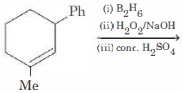
A
$1-$methyl$-3-$phenylcyclohex$-1-$ene
B
$3-$methyl$-1-$phenylcyclohex$-1-$ene
C
$5-$methyl$-1-$phenylcyclohex$-1-$ene
D
$1-$methyl$-5-$phenylcyclohex$-1-$ene
Solution
(A) Step $(i)$ and $(ii)$ represent the hydroboration-oxidation of the alkene,which follows anti-Markownikoff's addition of water across the double bond. This results in the formation of an alcohol where the $-OH$ group attaches to the less substituted carbon.
Step $(iii)$ involves the acid-catalyzed dehydration of the alcohol using $conc. \ H_2SO_4$. This proceeds via an $E1$ mechanism involving a carbocation intermediate,followed by the elimination of a proton to form the most stable alkene according to Zaitsev's rule.
The major product formed is $1-methyl-3-phenylcyclohex-1-ene$ (or a related isomer depending on the specific structure,but based on the provided reaction sequence,the product is the more substituted alkene).
Step $(iii)$ involves the acid-catalyzed dehydration of the alcohol using $conc. \ H_2SO_4$. This proceeds via an $E1$ mechanism involving a carbocation intermediate,followed by the elimination of a proton to form the most stable alkene according to Zaitsev's rule.
The major product formed is $1-methyl-3-phenylcyclohex-1-ene$ (or a related isomer depending on the specific structure,but based on the provided reaction sequence,the product is the more substituted alkene).
0 likes
View Solution846
MediumMCQ
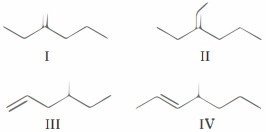
Which of the following alkenes can generate optically active compounds upon hydrogenation?
A
$I, III$ and $IV$
B
$II$ and $III$
C
$I$ and $III$
D
$II$ and $IV$
Solution
(C) An optically active compound must contain at least one chiral center (a carbon atom bonded to four different groups).
$I$: $2$-ethyl-pent-$1$-ene on hydrogenation gives $3$-methylhexane,which has a chiral center at $C3$.
$II$: $3$-ethyl-hex-$3$-ene on hydrogenation gives $3$-ethylhexane,which is achiral.
$III$: $5$-methyl-hept-$1$-ene on hydrogenation gives $3$-methylheptane,which has a chiral center at $C3$.
$IV$: $4$-methyl-hept-$2$-ene on hydrogenation gives $3$-methylheptane,which has a chiral center at $C3$.
Wait,let us re-evaluate the structures:
$I$: $2$-ethyl-pent-$1$-ene $\xrightarrow{H_2/Ni}$ $3$-methylhexane (Chiral).
$II$: $3$-ethyl-hex-$3$-ene $\xrightarrow{H_2/Ni}$ $3$-ethylhexane (Achiral).
$III$: $5$-methyl-hept-$1$-ene $\xrightarrow{H_2/Ni}$ $3$-methylheptane (Chiral).
$IV$: $4$-methyl-hept-$2$-ene $\xrightarrow{H_2/Ni}$ $3$-methylheptane (Chiral).
Based on the provided image and standard analysis,$I$ and $III$ are the intended answers as they form chiral centers upon hydrogenation of the double bond.
$I$: $2$-ethyl-pent-$1$-ene on hydrogenation gives $3$-methylhexane,which has a chiral center at $C3$.
$II$: $3$-ethyl-hex-$3$-ene on hydrogenation gives $3$-ethylhexane,which is achiral.
$III$: $5$-methyl-hept-$1$-ene on hydrogenation gives $3$-methylheptane,which has a chiral center at $C3$.
$IV$: $4$-methyl-hept-$2$-ene on hydrogenation gives $3$-methylheptane,which has a chiral center at $C3$.
Wait,let us re-evaluate the structures:
$I$: $2$-ethyl-pent-$1$-ene $\xrightarrow{H_2/Ni}$ $3$-methylhexane (Chiral).
$II$: $3$-ethyl-hex-$3$-ene $\xrightarrow{H_2/Ni}$ $3$-ethylhexane (Achiral).
$III$: $5$-methyl-hept-$1$-ene $\xrightarrow{H_2/Ni}$ $3$-methylheptane (Chiral).
$IV$: $4$-methyl-hept-$2$-ene $\xrightarrow{H_2/Ni}$ $3$-methylheptane (Chiral).
Based on the provided image and standard analysis,$I$ and $III$ are the intended answers as they form chiral centers upon hydrogenation of the double bond.
0 likes
View Solution847
MediumMCQ
Upon heating with acidic $KMnO_4$,an organic compound produces hexan$-1,6-$dioic acid as the major product. The starting compound is
A
benzene
B
cyclohexene
C
$1-$methylcyclohexene
D
$2-$methylcyclohexene
Solution
(B) The reaction of cyclic alkenes with strong oxidizing agents like acidic $KMnO_4$ leads to the oxidative cleavage of the double bond.
For cyclohexene,the oxidative cleavage of the $C=C$ double bond results in the formation of a dicarboxylic acid.
The reaction proceeds as follows:
Cyclohexene $\xrightarrow{Acidic \ KMnO_4, \Delta}$ Hexan$-1,6-$dioic acid (Adipic acid).
Thus,the starting compound is cyclohexene.
For cyclohexene,the oxidative cleavage of the $C=C$ double bond results in the formation of a dicarboxylic acid.
The reaction proceeds as follows:
Cyclohexene $\xrightarrow{Acidic \ KMnO_4, \Delta}$ Hexan$-1,6-$dioic acid (Adipic acid).
Thus,the starting compound is cyclohexene.
0 likes
View Solution848
MediumMCQ
What is the major product of the following reaction?
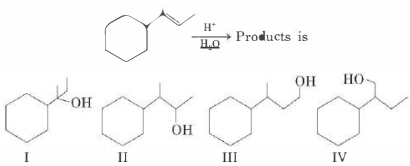
A
$I$
B
$II$
C
$III$
D
$IV$
Solution
(A) The reaction is an acid-catalyzed hydration of an alkene.
$1$. The proton $(H^+)$ attacks the double bond to form the most stable carbocation intermediate.
$2$. The protonation of the alkene leads to a tertiary carbocation at the carbon attached to the cyclohexyl group.
$3$. Water $(H_2O)$ then acts as a nucleophile and attacks this tertiary carbocation.
$4$. Subsequent deprotonation yields the tertiary alcohol as the major product,which corresponds to structure $I$.
$1$. The proton $(H^+)$ attacks the double bond to form the most stable carbocation intermediate.
$2$. The protonation of the alkene leads to a tertiary carbocation at the carbon attached to the cyclohexyl group.
$3$. Water $(H_2O)$ then acts as a nucleophile and attacks this tertiary carbocation.
$4$. Subsequent deprotonation yields the tertiary alcohol as the major product,which corresponds to structure $I$.
0 likes
View Solution849
MediumMCQ
The major product of the following reaction is

A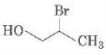
B
C
D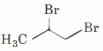
Solution
(C) The reaction of allyl alcohol $(CH_2=CH-CH_2OH)$ with concentrated $HBr$ is a nucleophilic substitution reaction.
First,the hydroxyl group is protonated to form a good leaving group $(-OH_2^+)$.
Then,water is eliminated to form the resonance-stabilized allylic carbocation ($CH_2=CH-CH_2^+$ $\leftrightarrow$ $^+CH_2-CH=CH_2$).
Finally,the bromide ion $(Br^-)$ attacks the carbocation to form allyl bromide $(CH_2=CH-CH_2Br)$.
Thus,the major product is allyl bromide.
First,the hydroxyl group is protonated to form a good leaving group $(-OH_2^+)$.
Then,water is eliminated to form the resonance-stabilized allylic carbocation ($CH_2=CH-CH_2^+$ $\leftrightarrow$ $^+CH_2-CH=CH_2$).
Finally,the bromide ion $(Br^-)$ attacks the carbocation to form allyl bromide $(CH_2=CH-CH_2Br)$.
Thus,the major product is allyl bromide.
0 likes
View Solution850
MediumMCQ
Cyclohexene is reacted with bromine in $CCl_4$ in the dark. The product of the reaction is,
A
trans$-1,2-$dibromocyclohexane
B
cis$-1,2-$dibromocyclohexane
C
bromocyclohexane
D
$3-$bromocyclohexene
Solution
(A) The reaction of cyclohexene with bromine in $CCl_4$ in the dark is an electrophilic addition reaction.
Bromine adds across the double bond in an anti-addition manner,resulting in the formation of $trans-1,2-dibromocyclohexane$.
The reaction proceeds through a cyclic bromonium ion intermediate,which is then attacked by the bromide ion from the opposite side,leading to the trans-product.
Bromine adds across the double bond in an anti-addition manner,resulting in the formation of $trans-1,2-dibromocyclohexane$.
The reaction proceeds through a cyclic bromonium ion intermediate,which is then attacked by the bromide ion from the opposite side,leading to the trans-product.
0 likes
View SolutionHydrocarbons — Alkene · Frequently Asked Questions
1Are these Hydrocarbons questions useful for JEE and NEET?
Yes. All questions in this section are mapped to JEE Main and NEET exam patterns. Previous year questions from JEE Main, NEET, GUJCET and state-level exams are included with full solutions.
2Can I switch to Hindi or Gujarati for these questions?
Yes. Use the language tabs in the hero section or the sidebar to view the same questions and solutions in English, Hindi or Gujarati.
3How do I generate a question paper from this subtopic?
Use the Vedclass Exam Paper Generator — select the chapter and subtopic, set difficulty, and generate Sets A, B, C, D automatically. First 3 chapters of every subject are free.
Vedclass Products
For Students
Vedclass Test Series
Mock tests in real JEE/NEET style with performance analysis. 5-day free trial.
Start Free TrialFor Teachers
Exam Paper Generator
Generate Set A/B/C/D papers from this chapter in 2 minutes. 3 chapters free.
Try FreeFor Institutes
Online Exam Module
Live online exams with unlimited students, 360° analytics & white-label branding.
See DemoFor Teachers & Institutes
Generate a Hydrocarbons Exam Paper in 2 Minutes
Select subtopic & difficulty — Sets A, B, C, D auto-generated with No Repeat logic.
First 3 chapters of every subject are free — no payment required.