
A English
Reactive Intermediates Questions in English
Class 11 Chemistry · 8-4.Organic Chemistry : Reaction mechanism · Reactive Intermediates
280+
Questions
English
Language
100%
With Solutions
Showing 50 of 280 questions in English
101
DifficultMCQ
Consider the following statements. Of these statements:
$(I) \ CH_3O-CH_2^+$ is more stable than $CH_3-CH_2^+$
$(II) \ Me_2CH^+$ is more stable than $CH_3-CH_2-CH_2^+$
$(III) \ CH_2=CH-CH_2^+$ is more stable than $CH_3-CH_2-CH_2^+$
$(IV) \ CH_2=CH^+$ is more stable than $CH_3-CH_2^+$
$(I) \ CH_3O-CH_2^+$ is more stable than $CH_3-CH_2^+$
$(II) \ Me_2CH^+$ is more stable than $CH_3-CH_2-CH_2^+$
$(III) \ CH_2=CH-CH_2^+$ is more stable than $CH_3-CH_2-CH_2^+$
$(IV) \ CH_2=CH^+$ is more stable than $CH_3-CH_2^+$
A
$I$ and $II$ are correct
B
$III$ and $IV$ are correct
C
$I, II$ and $III$ are correct
D
$II, III$ and $IV$ are correct
Solution
(C) $(I)$ $CH_3O-CH_2^+$ is stabilized by resonance due to the lone pair on oxygen,making it more stable than the primary carbocation $CH_3-CH_2^+$. Statement $(I)$ is correct.
$(II)$ $Me_2CH^+$ is a secondary carbocation,which is more stable than the primary carbocation $CH_3-CH_2-CH_2^+$ due to hyperconjugation and inductive effects. Statement $(II)$ is correct.
$(III)$ $CH_2=CH-CH_2^+$ is an allyl carbocation,which is stabilized by resonance,making it more stable than the primary carbocation $CH_3-CH_2-CH_2^+$. Statement $(III)$ is correct.
$(IV)$ $CH_2=CH^+$ is a vinylic carbocation where the positive charge is on an $sp$-hybridized carbon. This is highly unstable compared to the $sp^3$-hybridized primary carbocation $CH_3-CH_2^+$. Statement $(IV)$ is incorrect.
Therefore,statements $(I), (II),$ and $(III)$ are correct.
$(II)$ $Me_2CH^+$ is a secondary carbocation,which is more stable than the primary carbocation $CH_3-CH_2-CH_2^+$ due to hyperconjugation and inductive effects. Statement $(II)$ is correct.
$(III)$ $CH_2=CH-CH_2^+$ is an allyl carbocation,which is stabilized by resonance,making it more stable than the primary carbocation $CH_3-CH_2-CH_2^+$. Statement $(III)$ is correct.
$(IV)$ $CH_2=CH^+$ is a vinylic carbocation where the positive charge is on an $sp$-hybridized carbon. This is highly unstable compared to the $sp^3$-hybridized primary carbocation $CH_3-CH_2^+$. Statement $(IV)$ is incorrect.
Therefore,statements $(I), (II),$ and $(III)$ are correct.
0 likes
View Solution102
MediumMCQ
The correct stability order for the following carbocations is:
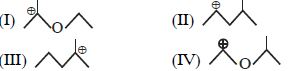
A
$I > IV > III > II$
B
$IV > I > III > II$
C
$IV > III > I > II$
D
$I > III > IV > II$
Solution
(A) To determine the stability of the given carbocations,we analyze the electronic effects:
$I$: The carbocation is adjacent to an oxygen atom with lone pairs,which provides strong resonance stabilization ($+M$ effect). This is the most stable.
$IV$: Similar to $I$,this carbocation is adjacent to an oxygen atom,providing resonance stabilization. However,the alkyl group attached to the oxygen is larger (isopropyl),which might slightly alter the electronic environment,but it remains highly stable due to resonance.
$III$: This is a secondary $(2^{\circ})$ carbocation,which is stabilized by hyperconjugation and inductive effects $(+I)$.
$II$: This is a primary $(1^{\circ})$ carbocation,which is the least stable among the given options.
Comparing $I$ and $IV$: Both are resonance-stabilized by the oxygen lone pair. $I$ is a secondary carbocation stabilized by resonance,while $IV$ is also a secondary carbocation stabilized by resonance. However,$I$ is generally considered more stable due to the smaller alkyl group attached to the oxygen,leading to less steric hindrance and better orbital overlap.
Thus,the order is $I > IV > III > II$.
$I$: The carbocation is adjacent to an oxygen atom with lone pairs,which provides strong resonance stabilization ($+M$ effect). This is the most stable.
$IV$: Similar to $I$,this carbocation is adjacent to an oxygen atom,providing resonance stabilization. However,the alkyl group attached to the oxygen is larger (isopropyl),which might slightly alter the electronic environment,but it remains highly stable due to resonance.
$III$: This is a secondary $(2^{\circ})$ carbocation,which is stabilized by hyperconjugation and inductive effects $(+I)$.
$II$: This is a primary $(1^{\circ})$ carbocation,which is the least stable among the given options.
Comparing $I$ and $IV$: Both are resonance-stabilized by the oxygen lone pair. $I$ is a secondary carbocation stabilized by resonance,while $IV$ is also a secondary carbocation stabilized by resonance. However,$I$ is generally considered more stable due to the smaller alkyl group attached to the oxygen,leading to less steric hindrance and better orbital overlap.
Thus,the order is $I > IV > III > II$.
0 likes
View Solution103
DifficultMCQ
Intermediates formed in the reactions $P$ and $Q$ are:
$P: CH_3-CH=CH_2 \xrightarrow{HCl}$
$Q: CH_3-CH=CH_2 \xrightarrow[\text{Peroxide}]{HCl}$
$P: CH_3-CH=CH_2 \xrightarrow{HCl}$
$Q: CH_3-CH=CH_2 \xrightarrow[\text{Peroxide}]{HCl}$
A
$P \to CH_3-CH^{+}CH_3$,$Q \to CH_3-CH(\bullet)-CH_2Br$
B
$P \to CH_3-CH^{+}CH_3$,$Q \to CH_3-CH^{+}CH_3$
C
$P \to CH_3-CH(\bullet)-CH_3$,$Q \to CH_3-CH^{+}CH_2Cl$
D
$P \to CH_3-CH^{+}CH_3$,$Q \to CH_3-CH(\bullet)-CH_2Cl$
Solution
(B) The peroxide effect (Kharasch effect) is only observed with $HBr$ and not with $HCl$ or $HI$.
In reaction $P$,the electrophilic addition of $HCl$ to propene follows Markovnikov's rule,forming the stable secondary carbocation intermediate $CH_3-CH^{+}CH_3$.
In reaction $Q$,despite the presence of peroxide,$HCl$ does not undergo free-radical addition because the bond dissociation energy of $H-Cl$ is too high for the peroxide to initiate the radical chain mechanism.
Therefore,reaction $Q$ also proceeds via the electrophilic addition mechanism,forming the same secondary carbocation intermediate $CH_3-CH^{+}CH_3$.
In reaction $P$,the electrophilic addition of $HCl$ to propene follows Markovnikov's rule,forming the stable secondary carbocation intermediate $CH_3-CH^{+}CH_3$.
In reaction $Q$,despite the presence of peroxide,$HCl$ does not undergo free-radical addition because the bond dissociation energy of $H-Cl$ is too high for the peroxide to initiate the radical chain mechanism.
Therefore,reaction $Q$ also proceeds via the electrophilic addition mechanism,forming the same secondary carbocation intermediate $CH_3-CH^{+}CH_3$.
0 likes
View Solution104
MediumMCQ
Arrange the following carbocations in decreasing order of stability:
$I: CH_3-CH_2^+$
$II: (CH_3)_2CH^+$
$III: Ph-CH_2^+$
$I: CH_3-CH_2^+$
$II: (CH_3)_2CH^+$
$III: Ph-CH_2^+$
A
$I > II > III$
B
$I > III > II$
C
$II > III > I$
D
$III > II > I$
Solution
(D) The stability of carbocations is determined by factors like resonance and inductive effect.
$I$ is an ethyl carbocation $(CH_3-CH_2^+)$,which is a primary $(1^{\circ})$ carbocation stabilized only by the inductive effect of one methyl group.
$II$ is an isopropyl carbocation $((CH_3)_2CH^+)$,which is a secondary $(2^{\circ})$ carbocation stabilized by the inductive effect and hyperconjugation of two methyl groups.
$III$ is a benzyl carbocation $(Ph-CH_2^+)$,which is highly stabilized by resonance with the phenyl ring.
Comparing their stabilities: Resonance stabilization in $III$ makes it the most stable. Between $I$ and $II$,the secondary carbocation $II$ is more stable than the primary carbocation $I$ due to more hyperconjugation and inductive effect.
Therefore,the decreasing order of stability is $III > II > I$.
$I$ is an ethyl carbocation $(CH_3-CH_2^+)$,which is a primary $(1^{\circ})$ carbocation stabilized only by the inductive effect of one methyl group.
$II$ is an isopropyl carbocation $((CH_3)_2CH^+)$,which is a secondary $(2^{\circ})$ carbocation stabilized by the inductive effect and hyperconjugation of two methyl groups.
$III$ is a benzyl carbocation $(Ph-CH_2^+)$,which is highly stabilized by resonance with the phenyl ring.
Comparing their stabilities: Resonance stabilization in $III$ makes it the most stable. Between $I$ and $II$,the secondary carbocation $II$ is more stable than the primary carbocation $I$ due to more hyperconjugation and inductive effect.
Therefore,the decreasing order of stability is $III > II > I$.
0 likes
View Solution105
MediumMCQ
The correct stability order for the following species is:
$(I)$ $o-CN-C_6H_4-CH_2^-$
$(II)$ $m-CN-C_6H_4-CH_2^-$
$(III)$ $p-CN-C_6H_4-CH_2^-$
$(IV)$ $C_6H_5-CH_2^-$
(Note: The image shows the structures of these carbanions.)
$(I)$ $o-CN-C_6H_4-CH_2^-$
$(II)$ $m-CN-C_6H_4-CH_2^-$
$(III)$ $p-CN-C_6H_4-CH_2^-$
$(IV)$ $C_6H_5-CH_2^-$
(Note: The image shows the structures of these carbanions.)
A
$I > II > III > IV$
B
$II > III > IV > I$
C
$I > III > II > IV$
D
$III > IV > I > II$
Solution
(C) The stability of carbanions is increased by electron-withdrawing groups $(EWG)$ through $-I$ and $-M$ effects.
$1$. In $(IV)$,there is no substituent,only the phenyl ring providing resonance stabilization.
$2$. In $(I)$,$(II)$,and $(III)$,the $-CN$ group is present,which is a strong electron-withdrawing group ($-I$ and $-M$ effects).
$3$. In $(III)$ $(p-CN)$,the $-CN$ group exerts both $-I$ and $-M$ effects,providing maximum stabilization via resonance.
$4$. In $(I)$ $(o-CN)$,the $-CN$ group exerts both $-I$ and $-M$ effects,but it is closer to the negative charge,making it highly stable due to the strong $-I$ effect.
$5$. In $(II)$ $(m-CN)$,the $-CN$ group exerts only the $-I$ effect because the resonance effect $(-M)$ does not operate at the meta position.
Comparing the effects:
- $(III)$ $(p-CN)$ and $(I)$ $(o-CN)$ are more stable than $(II)$ $(m-CN)$ due to the additional $-M$ effect.
- Between $(I)$ and $(III)$,the ortho-effect and proximity of the $-CN$ group make $(I)$ the most stable.
- Thus,the order is $(I) > (III) > (II) > (IV)$.
$1$. In $(IV)$,there is no substituent,only the phenyl ring providing resonance stabilization.
$2$. In $(I)$,$(II)$,and $(III)$,the $-CN$ group is present,which is a strong electron-withdrawing group ($-I$ and $-M$ effects).
$3$. In $(III)$ $(p-CN)$,the $-CN$ group exerts both $-I$ and $-M$ effects,providing maximum stabilization via resonance.
$4$. In $(I)$ $(o-CN)$,the $-CN$ group exerts both $-I$ and $-M$ effects,but it is closer to the negative charge,making it highly stable due to the strong $-I$ effect.
$5$. In $(II)$ $(m-CN)$,the $-CN$ group exerts only the $-I$ effect because the resonance effect $(-M)$ does not operate at the meta position.
Comparing the effects:
- $(III)$ $(p-CN)$ and $(I)$ $(o-CN)$ are more stable than $(II)$ $(m-CN)$ due to the additional $-M$ effect.
- Between $(I)$ and $(III)$,the ortho-effect and proximity of the $-CN$ group make $(I)$ the most stable.
- Thus,the order is $(I) > (III) > (II) > (IV)$.
0 likes
View Solution106
MediumMCQ
Arrange the following free radicals in order of decreasing stability:
$(A)$ Cyclohexyl-CH2-CH2•
$(B)$ Cyclohexyl-$CH$•-CH3
$(C)$ Cyclohexyl=$CH$-CH2•
(Note: The dot represents the radical center.)
$(A)$ Cyclohexyl-CH2-CH2•
$(B)$ Cyclohexyl-$CH$•-CH3
$(C)$ Cyclohexyl=$CH$-CH2•
(Note: The dot represents the radical center.)
A
$B > A > C$
B
$A > B > C$
C
$C > B > A$
D
$C > A > B$
Solution
(C) The stability of free radicals depends on the degree of substitution and resonance stabilization.
$(A)$ is a primary $(1^{\circ})$ alkyl radical: $R-CH_2•$.
$(B)$ is a secondary $(2^{\circ})$ alkyl radical: $R-CH(CH_3)•$. Secondary radicals are more stable than primary radicals due to increased hyperconjugation and inductive effects.
$(C)$ is an allylic radical: $Cyclohexylidene-CH-CH_2•$. This radical is resonance-stabilized by the adjacent double bond,making it the most stable among the three.
Therefore,the order of decreasing stability is $C > B > A$.
$(A)$ is a primary $(1^{\circ})$ alkyl radical: $R-CH_2•$.
$(B)$ is a secondary $(2^{\circ})$ alkyl radical: $R-CH(CH_3)•$. Secondary radicals are more stable than primary radicals due to increased hyperconjugation and inductive effects.
$(C)$ is an allylic radical: $Cyclohexylidene-CH-CH_2•$. This radical is resonance-stabilized by the adjacent double bond,making it the most stable among the three.
Therefore,the order of decreasing stability is $C > B > A$.
0 likes
View Solution107
MediumMCQ
Which of the following represents the incorrect stability order?
A
$Ph_3C^{+} > Ph_2CH^{+} > PhCH_2^{+}$
B
$Ph_3C^{-} < Ph_2CH^{-} < PhCH_2^{-}$
C
$Ph_3C^{\bullet} < Ph_2CH^{\bullet} < PhCH_2^{\bullet}$
D
$Ph_3C^{+} < Ph_2CH^{+} < PhCH_2^{+}$
Solution
(D) $1$. For carbocations $(Ph_3C^{+} > Ph_2CH^{+} > PhCH_2^{+})$,stability increases with the number of phenyl groups due to resonance stabilization.
$2$. For carbanions $(Ph_3C^{-} < Ph_2CH^{-} < PhCH_2^{-})$,stability decreases as the number of phenyl groups increases because the negative charge is delocalized over more rings,but the inductive effect of phenyl groups destabilizes the carbanion.
$3$. For free radicals $(Ph_3C^{\bullet} > Ph_2CH^{\bullet} > PhCH_2^{\bullet})$,stability increases with the number of phenyl groups due to resonance.
$4$. Option $D$ is incorrect because the stability order of carbocations is $Ph_3C^{+} > Ph_2CH^{+} > PhCH_2^{+}$.
$2$. For carbanions $(Ph_3C^{-} < Ph_2CH^{-} < PhCH_2^{-})$,stability decreases as the number of phenyl groups increases because the negative charge is delocalized over more rings,but the inductive effect of phenyl groups destabilizes the carbanion.
$3$. For free radicals $(Ph_3C^{\bullet} > Ph_2CH^{\bullet} > PhCH_2^{\bullet})$,stability increases with the number of phenyl groups due to resonance.
$4$. Option $D$ is incorrect because the stability order of carbocations is $Ph_3C^{+} > Ph_2CH^{+} > PhCH_2^{+}$.
0 likes
View Solution108
DifficultMCQ
What is the correct order of stability for the following carbocations?
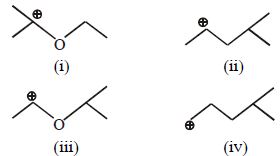
A
$(i) > (ii) > (iii) > (iv)$
B
$(ii) > (i) > (iv) > (iii)$
C
$(i) > (iii) > (ii) > (iv)$
D
$(ii) > (iv) > (i) > (iii)$
Solution
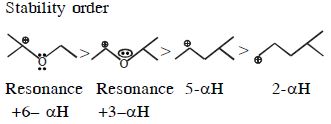
(C) The stability of carbocations is determined by resonance,hyperconjugation,and inductive effects.
$(i)$ and $(iii)$ are stabilized by resonance due to the lone pair on the oxygen atom adjacent to the carbocation center. Between $(i)$ and $(iii)$,$(i)$ has more hyperconjugative hydrogens $(6 \ \alpha-H)$ compared to $(iii)$ $(3 \ \alpha-H)$,making $(i)$ more stable than $(iii)$.
$(ii)$ and $(iv)$ are alkyl carbocations stabilized by hyperconjugation. $(ii)$ is a secondary carbocation with $5 \ \alpha-H$,while $(iv)$ is a primary carbocation with $2 \ \alpha-H$. Thus,$(ii)$ is more stable than $(iv)$.
Combining these,the overall stability order is $(i) > (iii) > (ii) > (iv)$.
$(i)$ and $(iii)$ are stabilized by resonance due to the lone pair on the oxygen atom adjacent to the carbocation center. Between $(i)$ and $(iii)$,$(i)$ has more hyperconjugative hydrogens $(6 \ \alpha-H)$ compared to $(iii)$ $(3 \ \alpha-H)$,making $(i)$ more stable than $(iii)$.
$(ii)$ and $(iv)$ are alkyl carbocations stabilized by hyperconjugation. $(ii)$ is a secondary carbocation with $5 \ \alpha-H$,while $(iv)$ is a primary carbocation with $2 \ \alpha-H$. Thus,$(ii)$ is more stable than $(iv)$.
Combining these,the overall stability order is $(i) > (iii) > (ii) > (iv)$.
0 likes
View Solution109
MediumMCQ
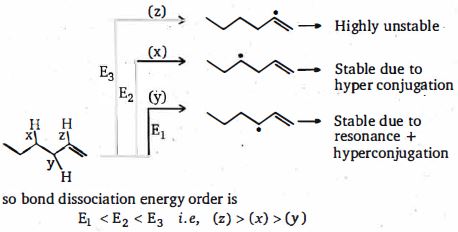
Arrange the $(C-H)$ bonds $x, y$ and $z$ in decreasing order of their bond dissociation energies in homolysis.
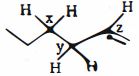
A
$y > x > z$
B
$z > x > y$
C
$z > y > x$
D
$y > z > x$
Solution
(B) The bond dissociation energy is inversely proportional to the stability of the free radical formed after homolysis.
$1$. Homolysis of bond $z$ produces a vinylic radical,which is highly unstable.
$2$. Homolysis of bond $x$ produces an allylic radical,which is stabilized by hyperconjugation.
$3$. Homolysis of bond $y$ produces a radical that is stabilized by both resonance and hyperconjugation.
Since the stability of the radicals follows the order: $y > x > z$,the bond dissociation energies follow the reverse order: $z > x > y$.
$1$. Homolysis of bond $z$ produces a vinylic radical,which is highly unstable.
$2$. Homolysis of bond $x$ produces an allylic radical,which is stabilized by hyperconjugation.
$3$. Homolysis of bond $y$ produces a radical that is stabilized by both resonance and hyperconjugation.
Since the stability of the radicals follows the order: $y > x > z$,the bond dissociation energies follow the reverse order: $z > x > y$.
0 likes
View Solution110
DifficultMCQ
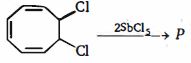
$p$ will be
A
B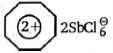
C
D
Mixture of $(a)$ and $(b)$
Solution
(B) The reaction involves the abstraction of two chloride ions from the non-aromatic $7,8-dichlorocycloocta-1,3,5-triene$ (or similar derivative) by the Lewis acid $SbCl_5$.
$SbCl_5$ acts as a strong chloride ion acceptor,forming the stable $SbCl_6^-$ anion.
By removing two $Cl^-$ ions,the ring system forms a $cyclooctatetraenyl$ dication $(C_8H_8^{2+})$.
This dication has $6$ $\pi$ electrons ($4n+2$ where $n=1$),making it aromatic according to $Huckel's$ rule.
Therefore,the product $p$ is the aromatic $cyclooctatetraenyl$ dication associated with two $SbCl_6^-$ counterions.
$SbCl_5$ acts as a strong chloride ion acceptor,forming the stable $SbCl_6^-$ anion.
By removing two $Cl^-$ ions,the ring system forms a $cyclooctatetraenyl$ dication $(C_8H_8^{2+})$.
This dication has $6$ $\pi$ electrons ($4n+2$ where $n=1$),making it aromatic according to $Huckel's$ rule.
Therefore,the product $p$ is the aromatic $cyclooctatetraenyl$ dication associated with two $SbCl_6^-$ counterions.
0 likes
View Solution111
DifficultMCQ
Some pairs of ions are given below. In which pair is the first ion more stable than the second?
A
$CH_3-CH^+-CH_3$ and $CH_3-CH^+-OCH_3$
B
$CH_3-CH_2-CH^+-CH_3$ and $CH_2=CH-CH_2-CH_2^+$
C
Cyclohexylmethyl carbocation and Cyclohex$-1-$enylmethyl carbocation
D
$CH_3-CH(CH_3)-CH_2-C^+(CH_3)_2$ and $CH_3-N(CH_3)-C^+(CH_3)_2$
Solution
(B) To determine the stability of carbocations,we consider inductive effects,resonance,and hyperconjugation.
$(A)$ $CH_3-CH^+-OCH_3$ is more stable than $CH_3-CH^+-CH_3$ due to the strong $+M$ effect of the $-OCH_3$ group.
$(B)$ $CH_3-CH_2-CH^+-CH_3$ is a secondary $(2^\circ)$ carbocation with $5$ $\alpha$-hydrogens. $CH_2=CH-CH_2-CH_2^+$ is a primary $(1^\circ)$ carbocation with $2$ $\alpha$-hydrogens. The first is more stable.
$(C)$ The cyclohex$-1-$enylmethyl carbocation is more stable than the cyclohexylmethyl carbocation because the double bond is conjugated with the carbocation center,allowing for resonance stabilization.
$(D)$ $CH_3-N(CH_3)-C^+(CH_3)_2$ is significantly more stable than the alkyl carbocation due to the strong $+M$ effect of the nitrogen lone pair.
Thus,in pair $(B)$,the first ion is more stable than the second.
$(A)$ $CH_3-CH^+-OCH_3$ is more stable than $CH_3-CH^+-CH_3$ due to the strong $+M$ effect of the $-OCH_3$ group.
$(B)$ $CH_3-CH_2-CH^+-CH_3$ is a secondary $(2^\circ)$ carbocation with $5$ $\alpha$-hydrogens. $CH_2=CH-CH_2-CH_2^+$ is a primary $(1^\circ)$ carbocation with $2$ $\alpha$-hydrogens. The first is more stable.
$(C)$ The cyclohex$-1-$enylmethyl carbocation is more stable than the cyclohexylmethyl carbocation because the double bond is conjugated with the carbocation center,allowing for resonance stabilization.
$(D)$ $CH_3-N(CH_3)-C^+(CH_3)_2$ is significantly more stable than the alkyl carbocation due to the strong $+M$ effect of the nitrogen lone pair.
Thus,in pair $(B)$,the first ion is more stable than the second.
0 likes
View Solution112
MediumMCQ
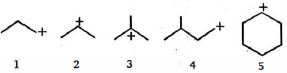
What is the decreasing order of stability (most stable $\to$ least stable) of the following carbocations?
A
$3 > 2 > 1 > 4 > 5$
B
$3 > 2 > 5 > 4 > 1$
C
$1 \approx 4 > 2 \approx 5 > 3$
D
$3 > 1 \approx 4 > 2 \approx 5$
Solution
(B) The stability of carbocations is determined by the number of $\alpha$-hydrogens (hyperconjugation) and inductive effects.
$1$. Carbocation $3$ is a tertiary carbocation with $9 \alpha$-hydrogens,making it the most stable.
$2$. Carbocation $2$ is a secondary carbocation with $6 \alpha$-hydrogens.
$3$. Carbocation $5$ is a secondary carbocation with $4 \alpha$-hydrogens.
$4$. Carbocation $4$ is a primary carbocation with $2 \alpha$-hydrogens and an additional $+I$ effect from the methyl group.
$5$. Carbocation $1$ is a primary carbocation with $2 \alpha$-hydrogens.
Comparing these,the order is $3 > 2 > 5 > 4 > 1$.
$1$. Carbocation $3$ is a tertiary carbocation with $9 \alpha$-hydrogens,making it the most stable.
$2$. Carbocation $2$ is a secondary carbocation with $6 \alpha$-hydrogens.
$3$. Carbocation $5$ is a secondary carbocation with $4 \alpha$-hydrogens.
$4$. Carbocation $4$ is a primary carbocation with $2 \alpha$-hydrogens and an additional $+I$ effect from the methyl group.
$5$. Carbocation $1$ is a primary carbocation with $2 \alpha$-hydrogens.
Comparing these,the order is $3 > 2 > 5 > 4 > 1$.

0 likes
View Solution113
DifficultMCQ
Rank the bond dissociation energies of the bonds indicated with the arrows (from smallest to largest).
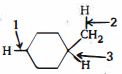
A
$1 < 2 < 3$
B
$3 < 2 < 1$
C
$2 < 3 < 1$
D
$3 < 1 < 2$
Solution
(D) The bond dissociation energy is inversely proportional to the stability of the free radical formed after homolytic cleavage of the $C-H$ bond.
$1$. Bond $3$ leads to a tertiary $(3^{\circ})$ radical on the cyclohexane ring,which is the most stable due to hyperconjugation and inductive effects.
$2$. Bond $1$ leads to a secondary $(2^{\circ})$ radical on the cyclohexane ring,which is less stable than the $3^{\circ}$ radical.
$3$. Bond $2$ leads to a primary $(1^{\circ})$ radical on the methyl group,which is the least stable.
Since the stability of radicals is $3^{\circ} > 2^{\circ} > 1^{\circ}$,the bond dissociation energy order is $3 < 1 < 2$.
$1$. Bond $3$ leads to a tertiary $(3^{\circ})$ radical on the cyclohexane ring,which is the most stable due to hyperconjugation and inductive effects.
$2$. Bond $1$ leads to a secondary $(2^{\circ})$ radical on the cyclohexane ring,which is less stable than the $3^{\circ}$ radical.
$3$. Bond $2$ leads to a primary $(1^{\circ})$ radical on the methyl group,which is the least stable.
Since the stability of radicals is $3^{\circ} > 2^{\circ} > 1^{\circ}$,the bond dissociation energy order is $3 < 1 < 2$.
0 likes
View Solution114
DifficultMCQ
Among the given compounds,choose the two that yield the same carbocation on ionization.
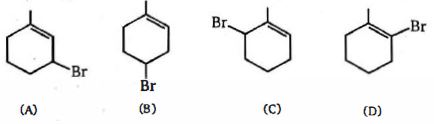
A
$A, C$
B
$B, D$
C
$A, B$
D
$B, C$
Solution
(C) Upon ionization,compound $A$ ($3$-bromo$-1-$methylcyclohex$-1-$ene) loses a bromide ion to form the $1-$methylcyclohex$-2-$en$-1-$yl cation.
Compound $B$ ($4$-bromo$-1-$methylcyclohex$-1-$ene) loses a bromide ion to form a secondary carbocation at the $C4$ position.
This secondary carbocation undergoes a hydride shift to form the more stable allylic $1-$methylcyclohex$-2-$en$-1-$yl cation,which is the same intermediate as formed from compound $A$.
Therefore,compounds $A$ and $B$ yield the same carbocation.
Compound $B$ ($4$-bromo$-1-$methylcyclohex$-1-$ene) loses a bromide ion to form a secondary carbocation at the $C4$ position.
This secondary carbocation undergoes a hydride shift to form the more stable allylic $1-$methylcyclohex$-2-$en$-1-$yl cation,which is the same intermediate as formed from compound $A$.
Therefore,compounds $A$ and $B$ yield the same carbocation.
0 likes
View Solution115
MediumMCQ
List the following carbocations in order of decreasing stability.

A
$II, III, I, IV$
B
$III, IV, II, I$
C
$III, IV, I, II$
D
$I, II, IV, III$
Solution
(B) The stability of carbocations is primarily determined by hyperconjugation (number of $\alpha$-hydrogens) and resonance effects.
$I$: This is a vinyl carbocation,which is highly unstable due to the $sp$ hybridization of the positively charged carbon,making it the least stable.
$II$: This is a secondary $(2^{\circ})$ carbocation with $4 \ \alpha$-hydrogens (from the adjacent $CH_2$ groups).
$III$: This is a tertiary $(3^{\circ})$ carbocation with a methyl group,having $7 \ \alpha$-hydrogens ($3$ from the methyl group and $4$ from the ring).
$IV$: This is a secondary $(2^{\circ})$ carbocation with $1 \ \alpha$-hydrogen.
Comparing the number of $\alpha$-hydrogens:
$III$ $(7 \ \alpha-H)$ > $II$ $(4 \ \alpha-H)$ > $IV$ $(1 \ \alpha-H)$ > $I$ (Vinyl cation).
Thus,the order of decreasing stability is $III > II > IV > I$.
$I$: This is a vinyl carbocation,which is highly unstable due to the $sp$ hybridization of the positively charged carbon,making it the least stable.
$II$: This is a secondary $(2^{\circ})$ carbocation with $4 \ \alpha$-hydrogens (from the adjacent $CH_2$ groups).
$III$: This is a tertiary $(3^{\circ})$ carbocation with a methyl group,having $7 \ \alpha$-hydrogens ($3$ from the methyl group and $4$ from the ring).
$IV$: This is a secondary $(2^{\circ})$ carbocation with $1 \ \alpha$-hydrogen.
Comparing the number of $\alpha$-hydrogens:
$III$ $(7 \ \alpha-H)$ > $II$ $(4 \ \alpha-H)$ > $IV$ $(1 \ \alpha-H)$ > $I$ (Vinyl cation).
Thus,the order of decreasing stability is $III > II > IV > I$.
0 likes
View Solution116
EasyMCQ
In the potential energy diagram shown,the point $X$ represents:
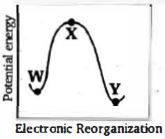
A
a transition state
B
a reaction intermediate
C
a resonance hybrid
D
a reactant
Solution
(A) In a potential energy diagram,the peak of the curve represents the state of maximum potential energy,which corresponds to the transition state $(T.S.)$.
Therefore,point $X$ represents a transition state.
Therefore,point $X$ represents a transition state.
0 likes
View Solution117
MediumMCQ
The stability order of the following carbocations is:
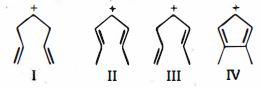
A
$II > III > I > IV$
B
$IV > II > III > I$
C
$II > III > IV > I$
D
$I > III > II > IV$
Solution
(A) $II$ is the most stable because it has more resonating structures due to extended conjugation.
$III$ is stable due to resonance.
$I$ has no resonance stabilization.
$IV$ is anti-aromatic (contains $4n$ $\pi$ electrons,i.e.,$4$ $\pi$ electrons in the ring),making it the least stable.
Therefore,the stability order is $II > III > I > IV$.
$III$ is stable due to resonance.
$I$ has no resonance stabilization.
$IV$ is anti-aromatic (contains $4n$ $\pi$ electrons,i.e.,$4$ $\pi$ electrons in the ring),making it the least stable.
Therefore,the stability order is $II > III > I > IV$.
0 likes
View Solution118
MediumMCQ
In which pair is the second ion more stable than the first?

A
$(i)$ and $(ii)$
B
$(ii)$ and $(iii)$
C
$(ii)$ and $(iv)$
D
$(iii)$ and $(iv)$
Solution
(B) Stability is determined by aromaticity,resonance,and inductive effects.
$(i)$ Cyclopropenyl cation is aromatic ($2\pi$ electrons),while cyclopropenyl anion is anti-aromatic ($4\pi$ electrons). Thus,the first is more stable.
$(ii)$ Cyclopentadienyl cation is anti-aromatic ($4\pi$ electrons),while cyclopentadienyl anion is aromatic ($6\pi$ electrons). Thus,the second is more stable.
$(iii)$ Cycloheptatrienyl cation is aromatic ($6\pi$ electrons),while cycloheptatrienyl anion is anti-aromatic ($8\pi$ electrons). Thus,the first is more stable.
$(iv)$ The carbocation with the $-OH$ group is stabilized by resonance (lone pair donation),whereas the carbocation with the $-CH_3$ group is stabilized only by hyperconjugation and inductive effect. Thus,the first is more stable.
Therefore,only in pair $(ii)$ is the second ion more stable than the first.
$(i)$ Cyclopropenyl cation is aromatic ($2\pi$ electrons),while cyclopropenyl anion is anti-aromatic ($4\pi$ electrons). Thus,the first is more stable.
$(ii)$ Cyclopentadienyl cation is anti-aromatic ($4\pi$ electrons),while cyclopentadienyl anion is aromatic ($6\pi$ electrons). Thus,the second is more stable.
$(iii)$ Cycloheptatrienyl cation is aromatic ($6\pi$ electrons),while cycloheptatrienyl anion is anti-aromatic ($8\pi$ electrons). Thus,the first is more stable.
$(iv)$ The carbocation with the $-OH$ group is stabilized by resonance (lone pair donation),whereas the carbocation with the $-CH_3$ group is stabilized only by hyperconjugation and inductive effect. Thus,the first is more stable.
Therefore,only in pair $(ii)$ is the second ion more stable than the first.
0 likes
View Solution119
MediumMCQ
Based upon an understanding of product stability,predict the product formed when the following dianion reacts with one equivalent of acid $(H^+)$.
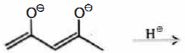
A
The oxygen atom on the left is protonated.
B
The oxygen atom on the right is protonated.
C
The carbon atom in the middle is protonated.
D
Both oxygen atoms are protonated.
Solution
(B) The dianion is an enolate derivative of a $\beta$-dicarbonyl compound. The two oxygen atoms have different electronic environments. The oxygen on the left is part of an enolate system that is more conjugated and thus more stable as an anion. The oxygen on the right is part of a system that is less stable as an anion,making it a stronger base. According to the principle that the stronger base reacts preferentially with an acid,the oxygen on the right will be protonated first to form the more stable product.
0 likes
View Solution120
MediumMCQ
Rank the following radicals in order of increasing stability (least $ < < < $ most).
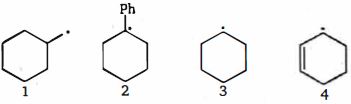
A
$4 < 2 < 1 < 3$
B
$3 < 1 < 4 < 2$
C
$1 < 3 < 4 < 2$
D
$2 < 4 < 3 < 1$
Solution
(C) The stability of free radicals is determined by resonance,hyperconjugation,and inductive effects.
$1$. Radical $2$ is benzylic,which is highly stabilized by resonance with the phenyl $(Ph)$ group.
$2$. Radical $4$ is allylic,which is stabilized by resonance with the adjacent double bond.
$3$. Radical $3$ is a secondary $(2^{\circ})$ alkyl radical with $4$ $\alpha$-hydrogens,providing hyperconjugative stabilization.
$4$. Radical $1$ is a primary $(1^{\circ})$ alkyl radical with only $1$ $\alpha$-hydrogen,making it the least stable.
Thus,the order of increasing stability is $1 < 3 < 4 < 2$.
$1$. Radical $2$ is benzylic,which is highly stabilized by resonance with the phenyl $(Ph)$ group.
$2$. Radical $4$ is allylic,which is stabilized by resonance with the adjacent double bond.
$3$. Radical $3$ is a secondary $(2^{\circ})$ alkyl radical with $4$ $\alpha$-hydrogens,providing hyperconjugative stabilization.
$4$. Radical $1$ is a primary $(1^{\circ})$ alkyl radical with only $1$ $\alpha$-hydrogen,making it the least stable.
Thus,the order of increasing stability is $1 < 3 < 4 < 2$.
0 likes
View Solution121
DifficultMCQ
Which of the following has an unstable enol form?
A
Cyclobutane$-1,2-$dione
B
Cyclopentane$-1,2-$dione
C
Cyclobutenone
D
Cyclohexa$-2,5-$dien$-1-$one
Solution
(C) The stability of an enol form is often determined by factors such as aromaticity,conjugation,and ring strain.
In the case of cyclobutenone,the enol form would be cyclobuta$-1,3-$dien$-1-$ol.
This enol form contains a $4\pi$ electron system in a planar cyclic ring,which makes it anti-aromatic.
Anti-aromatic compounds are highly unstable compared to their keto forms.
Therefore,cyclobutenone has an unstable enol form.
In the case of cyclobutenone,the enol form would be cyclobuta$-1,3-$dien$-1-$ol.
This enol form contains a $4\pi$ electron system in a planar cyclic ring,which makes it anti-aromatic.
Anti-aromatic compounds are highly unstable compared to their keto forms.
Therefore,cyclobutenone has an unstable enol form.
0 likes
View Solution122
MediumMCQ
Among the given pairs,in which pair does the second compound have less enol content than the first compound?
A
Cyclopropanone and its cation derivative
B
Cyclopent$-2-$en$-1-$one cation and cyclopent$-2-$en$-1-$one
C
Cyclopent$-2-$en$-1-$one anion and cyclopent$-2-$en$-1-$one
D
none of these
Solution
(C) The enol content is determined by the stability of the resulting enol form. Aromaticity is a major factor in stabilizing the enol form.
In option $(C)$,the first compound is the cyclopentadienyl anion derivative (cyclopent$-2-$en$-1-$one anion). Its enol form is the cyclopentadienyl anion,which is aromatic ($6 \pi$ electrons) and thus highly stable.
The second compound is cyclopent$-2-$en$-1-$one,whose enol form is phenol (if it were a cyclohexadienone derivative) or a simple enol,which is significantly less stable than the aromatic anion formed from the first compound.
Therefore,the second compound has less enol content than the first compound.
In option $(C)$,the first compound is the cyclopentadienyl anion derivative (cyclopent$-2-$en$-1-$one anion). Its enol form is the cyclopentadienyl anion,which is aromatic ($6 \pi$ electrons) and thus highly stable.
The second compound is cyclopent$-2-$en$-1-$one,whose enol form is phenol (if it were a cyclohexadienone derivative) or a simple enol,which is significantly less stable than the aromatic anion formed from the first compound.
Therefore,the second compound has less enol content than the first compound.
0 likes
View Solution123
MediumMCQ
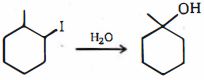
Which of the following is not expected to be an intermediate of the following reaction?
A
B
C
D
Solution
(D) The reaction is a solvolysis of $1$-iodo-$1$-methylcyclohexane in water.
Step $1$: The leaving group $I^-$ departs to form a secondary carbocation at the $C_2$ position.
Step $2$: $A$ $1,2$-hydride shift occurs to transform the secondary carbocation into a more stable tertiary carbocation at the $C_1$ position (where the methyl group is attached).
Step $3$: Water acts as a nucleophile and attacks the tertiary carbocation to form a protonated alcohol (oxonium ion).
Step $4$: Deprotonation yields the final product,$1$-methylcyclohexanol.
Comparing this with the options,the primary carbocation with a positive charge on the carbon bearing the methyl group is not formed,as the initial carbocation is secondary and the final one is tertiary.
Step $1$: The leaving group $I^-$ departs to form a secondary carbocation at the $C_2$ position.
Step $2$: $A$ $1,2$-hydride shift occurs to transform the secondary carbocation into a more stable tertiary carbocation at the $C_1$ position (where the methyl group is attached).
Step $3$: Water acts as a nucleophile and attacks the tertiary carbocation to form a protonated alcohol (oxonium ion).
Step $4$: Deprotonation yields the final product,$1$-methylcyclohexanol.
Comparing this with the options,the primary carbocation with a positive charge on the carbon bearing the methyl group is not formed,as the initial carbocation is secondary and the final one is tertiary.
0 likes
View Solution124
MediumMCQ
Which of the following carbocations will undergo rearrangement?
A
B
C
$CH_3-CH(CH_3)-{}^{\oplus}C=O$
D
$CH_3-NH-{}^{\oplus}CH-CH(CH_3)_2$
Solution
(A) Carbocation rearrangement occurs to form a more stable carbocation (e.g.,from primary to secondary or secondary to tertiary,or via ring expansion).
In option $A$ (image $350-$a530),the carbocation is a secondary carbocation on a cyclohexane ring. It can undergo a $1,2$-hydride shift to form a more stable tertiary carbocation.
In option $B$ (image $350-$b530),the carbocation is a tertiary carbocation already,so it is relatively stable and less likely to undergo rearrangement compared to the secondary one in $A$.
Therefore,the secondary carbocation in $A$ is the most prone to rearrangement to achieve greater stability.
In option $A$ (image $350-$a530),the carbocation is a secondary carbocation on a cyclohexane ring. It can undergo a $1,2$-hydride shift to form a more stable tertiary carbocation.
In option $B$ (image $350-$b530),the carbocation is a tertiary carbocation already,so it is relatively stable and less likely to undergo rearrangement compared to the secondary one in $A$.
Therefore,the secondary carbocation in $A$ is the most prone to rearrangement to achieve greater stability.
0 likes
View Solution125
DifficultMCQ
In which of the following reactions does a rearrangement take place with a change in the carbon skeleton?
A
$CH_3-C(CH_3)_2-CH_2^{\oplus}$
B
$CH_3-CH_2-CH_2^{\oplus}$
C
$CH_3-CH(CH_3)-CH_2-CH_2^{\oplus}$
D
$CH_3-CH^{\oplus}-CH_3$
Solution
(C) Rearrangement involving a change in the carbon skeleton occurs when an alkyl group or aryl group shifts to a carbocation center.
In option $(b)$,$CH_3-CH_2-CH_2^{\oplus}$ (a $1^{\circ}$ carbocation) undergoes a $1,2-H^{\ominus}$ shift to form $CH_3-CH^{\oplus}-CH_3$ (a $2^{\circ}$ carbocation),but the carbon skeleton remains the same.
In option $(c)$,$CH_3-CH(CH_3)-CH_2-CH_2^{\oplus}$ (a $1^{\circ}$ carbocation) undergoes a $1,2-CH_3^{\ominus}$ shift to form $CH_3-C^{\oplus}(CH_3)-CH_2-CH_3$ (a $3^{\circ}$ carbocation). This shift changes the carbon skeleton from a branched chain to a different branched structure,which is the correct type of rearrangement.
In option $(b)$,$CH_3-CH_2-CH_2^{\oplus}$ (a $1^{\circ}$ carbocation) undergoes a $1,2-H^{\ominus}$ shift to form $CH_3-CH^{\oplus}-CH_3$ (a $2^{\circ}$ carbocation),but the carbon skeleton remains the same.
In option $(c)$,$CH_3-CH(CH_3)-CH_2-CH_2^{\oplus}$ (a $1^{\circ}$ carbocation) undergoes a $1,2-CH_3^{\ominus}$ shift to form $CH_3-C^{\oplus}(CH_3)-CH_2-CH_3$ (a $3^{\circ}$ carbocation). This shift changes the carbon skeleton from a branched chain to a different branched structure,which is the correct type of rearrangement.
0 likes
View Solution126
MediumMCQ
Rank the transition states that occur during the following reaction steps in order of increasing stability (least $\to$ most stable):
$1.$ $CH_3-O^+H_2 \to CH_3^+ + H_2O$
$2.$ $(CH_3)_3C-O^+H_2 \to (CH_3)_3C^+ + H_2O$
$3.$ $(CH_3)_2CH-O^+H_2 \to (CH_3)_2CH^+ + H_2O$
$1.$ $CH_3-O^+H_2 \to CH_3^+ + H_2O$
$2.$ $(CH_3)_3C-O^+H_2 \to (CH_3)_3C^+ + H_2O$
$3.$ $(CH_3)_2CH-O^+H_2 \to (CH_3)_2CH^+ + H_2O$
A
$1 < 2 < 3$
B
$2 < 3 < 1$
C
$1 < 3 < 2$
D
$2 < 1 < 3$
Solution
(C) The stability of the transition state in these $S_N1$ type dissociation steps is directly related to the stability of the resulting carbocation intermediate.
Step $1$ produces a methyl carbocation $(CH_3^+)$,which is the least stable.
Step $3$ produces an isopropyl carbocation $((CH_3)_2CH^+)$,which is a secondary $(2^o)$ carbocation.
Step $2$ produces a tert-butyl carbocation $((CH_3)_3C^+)$,which is a tertiary $(3^o)$ carbocation.
Since the stability order of carbocations is $3^o > 2^o > 1^o$ (methyl),the stability of the transition states follows the same order: $1 < 3 < 2$.
Step $1$ produces a methyl carbocation $(CH_3^+)$,which is the least stable.
Step $3$ produces an isopropyl carbocation $((CH_3)_2CH^+)$,which is a secondary $(2^o)$ carbocation.
Step $2$ produces a tert-butyl carbocation $((CH_3)_3C^+)$,which is a tertiary $(3^o)$ carbocation.
Since the stability order of carbocations is $3^o > 2^o > 1^o$ (methyl),the stability of the transition states follows the same order: $1 < 3 < 2$.
0 likes
View Solution127
MediumMCQ
Taking into account the stability of various carbocations and the rules governing mechanisms of carbocation rearrangements,which reaction is most likely to occur during the given reaction?

A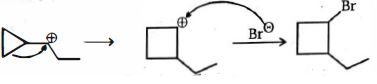
B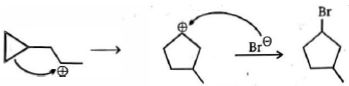
C
D
None of the above.
Solution
(A) The reaction of cyclopropyl-ethene with $HBr$ initiates with the protonation of the double bond to form a cyclopropylmethyl carbocation. This carbocation is stabilized by $\sigma$-resonance (bent bonds of the cyclopropane ring). However,it can undergo ring expansion to relieve ring strain and form a more stable carbocation. The cyclopropylmethyl carbocation can rearrange to a cyclobutyl carbocation. The cyclobutyl carbocation is then attacked by the nucleophile $Br^-$ to form cyclobutyl bromide. Therefore,the pathway involving ring expansion to a cyclobutyl system is the most likely outcome.
0 likes
View Solution128
MediumMCQ
Select the incorrect statement.
A
Bromine is more selective and less reactive.
B
Chlorine is less selective and more reactive.
C
Benzyl free radical is more stable than $2^o$ free radical.
D
Vinyl free radical is more stable than allyl free radical.
Solution
(D) The stability order of free radicals is determined by resonance and hyperconjugation. The allyl free radical $(H_2C=CH-\dot{C}H_2)$ is resonance stabilized,whereas the vinyl free radical $(H_2C=\dot{C}H)$ is highly unstable due to the radical being on an $sp^2$ hybridized carbon. Therefore,the statement that the vinyl free radical is more stable than the allyl free radical is incorrect. The correct order is: $H_2C=CH-\dot{C}H_2 > H_2C=\dot{C}H$.
0 likes
View Solution129
MediumMCQ
How many carbon-hydrogen bond orbitals are available for overlap with the vacant $p$-orbital in ethyl carbocation?
A
$0$
B
$3$
C
$5$
D
$6$
Solution
(B) The ethyl carbocation is represented as $CH_3-CH_2^+ $.
In this structure,the positively charged carbon atom is $sp^2$ hybridized and possesses a vacant $p$-orbital.
The adjacent carbon atom (the $\alpha$-carbon) is bonded to three hydrogen atoms.
Hyperconjugation occurs through the overlap of the $\sigma$-orbitals of the $C-H$ bonds with the vacant $p$-orbital of the adjacent carbocation.
Since there are $3$ $C-H$ bonds on the $\alpha$-carbon,there are $3$ such $C-H$ bond orbitals available for this overlap.
Therefore,the correct option is $B$.
In this structure,the positively charged carbon atom is $sp^2$ hybridized and possesses a vacant $p$-orbital.
The adjacent carbon atom (the $\alpha$-carbon) is bonded to three hydrogen atoms.
Hyperconjugation occurs through the overlap of the $\sigma$-orbitals of the $C-H$ bonds with the vacant $p$-orbital of the adjacent carbocation.
Since there are $3$ $C-H$ bonds on the $\alpha$-carbon,there are $3$ such $C-H$ bond orbitals available for this overlap.
Therefore,the correct option is $B$.
0 likes
View Solution130
MediumMCQ
Which of the following compounds gives the same carbocation on ionization?

A
$1$ and $3$
B
$2$ and $4$
C
$1$ and $2$
D
$1$ and $4$
Solution
(C) Upon ionization,the $Br^-$ ion leaves,generating a carbocation at the carbon atom previously bonded to the bromine.
Compound $1$ is $3$-bromo$-2-$ethylbut$-1-$ene. Ionization gives a secondary allylic carbocation: $CH_3-CH^+-C(=CH_2)-CH_2-CH_3$.
Compound $2$ is $1$-bromo$-2-$ethylbut$-2-$ene. Ionization gives a primary allylic carbocation: $CH_3-CH=C(CH_2CH_3)-CH_2^+$.
These two carbocations are resonance structures of each other,meaning they represent the same delocalized allylic system.
Therefore,compounds $1$ and $2$ yield the same resonance-stabilized carbocation.
Compound $1$ is $3$-bromo$-2-$ethylbut$-1-$ene. Ionization gives a secondary allylic carbocation: $CH_3-CH^+-C(=CH_2)-CH_2-CH_3$.
Compound $2$ is $1$-bromo$-2-$ethylbut$-2-$ene. Ionization gives a primary allylic carbocation: $CH_3-CH=C(CH_2CH_3)-CH_2^+$.
These two carbocations are resonance structures of each other,meaning they represent the same delocalized allylic system.
Therefore,compounds $1$ and $2$ yield the same resonance-stabilized carbocation.
0 likes
View Solution131
MediumMCQ
Which of the following carbocations will undergo rearrangement?

A
$1$
B
$1$ and $3$
C
All
D
$1, 2, 4$
Solution
(C) Carbocations undergo rearrangement to form more stable carbocations (e.g.,from primary to secondary or tertiary,or to a more substituted position).
$(1)$ This is a primary carbocation adjacent to a quaternary carbon. It will undergo a methyl shift to form a more stable tertiary carbocation.
$(2)$ This is a secondary carbocation. It can undergo a hydride shift to form a more stable tertiary carbocation.
$(3)$ This is a secondary carbocation. It can undergo a hydride shift to form a more stable tertiary carbocation.
$(4)$ This is a secondary carbocation. It can undergo a hydride shift to form a more stable tertiary carbocation.
Since all the given carbocations can rearrange to form more stable structures,the correct option is $C$.
$(1)$ This is a primary carbocation adjacent to a quaternary carbon. It will undergo a methyl shift to form a more stable tertiary carbocation.
$(2)$ This is a secondary carbocation. It can undergo a hydride shift to form a more stable tertiary carbocation.
$(3)$ This is a secondary carbocation. It can undergo a hydride shift to form a more stable tertiary carbocation.
$(4)$ This is a secondary carbocation. It can undergo a hydride shift to form a more stable tertiary carbocation.
Since all the given carbocations can rearrange to form more stable structures,the correct option is $C$.
0 likes
View Solution132
MediumMCQ
Which of the following is most likely to undergo a favorable hydride shift?
A
B
C
D
Solution
(A) hydride shift is favorable when it leads to a more stable carbocation (e.g.,from primary to secondary,or secondary to tertiary).
In the given options,the structure in $A$ represents a $1^{\circ}$ carbocation adjacent to a $3^{\circ}$ carbon atom.
$A$ $1,2$-hydride shift from the $3^{\circ}$ carbon to the $1^{\circ}$ carbocation will result in a more stable $3^{\circ}$ carbocation.
This is a highly favorable rearrangement because it increases the stability of the intermediate significantly.
In the given options,the structure in $A$ represents a $1^{\circ}$ carbocation adjacent to a $3^{\circ}$ carbon atom.
$A$ $1,2$-hydride shift from the $3^{\circ}$ carbon to the $1^{\circ}$ carbocation will result in a more stable $3^{\circ}$ carbocation.
This is a highly favorable rearrangement because it increases the stability of the intermediate significantly.
0 likes
View Solution133
MediumMCQ
Rank the transition states that occur during the following reaction steps in order of increasing stability (least $\to$ most stable):
$1. CH_3-OH_2^+ \to CH_3^+ + H_2O$
$2. (CH_3)_3C-OH_2^+ \to (CH_3)_3C^+ + H_2O$
$3. (CH_3)_2CH-OH_2^+ \to (CH_3)_2CH^+ + H_2O$
$1. CH_3-OH_2^+ \to CH_3^+ + H_2O$
$2. (CH_3)_3C-OH_2^+ \to (CH_3)_3C^+ + H_2O$
$3. (CH_3)_2CH-OH_2^+ \to (CH_3)_2CH^+ + H_2O$
A
$1 < 2 < 3$
B
$2 < 3 < 1$
C
$1 < 3 < 2$
D
$2 < 1 < 3$
Solution
(C) The stability of the transition state in these dissociation reactions is directly proportional to the stability of the carbocation formed as the product.
According to the Hammond Postulate,the transition state resembles the product in endothermic reactions.
The stability order of the carbocations is:
$CH_3^+ < (CH_3)_2CH^+ < (CH_3)_3C^+$
(Methyl < Secondary < Tertiary).
Therefore,the stability order of the transition states is $1 < 3 < 2$.
According to the Hammond Postulate,the transition state resembles the product in endothermic reactions.
The stability order of the carbocations is:
$CH_3^+ < (CH_3)_2CH^+ < (CH_3)_3C^+$
(Methyl < Secondary < Tertiary).
Therefore,the stability order of the transition states is $1 < 3 < 2$.
0 likes
View Solution134
DifficultMCQ
The compound shown below undergoes racemization on reaction with aqueous acid. Which of the following structures best represents the intermediate responsible for this process?

A
B
C
D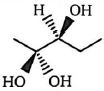
Solution
(C) The compound is a chiral ketone. In the presence of an aqueous acid,the ketone undergoes keto-enol tautomerism.
The acid protonates the carbonyl oxygen,followed by the removal of an $\alpha$-hydrogen to form an enol intermediate.
The enol intermediate is planar at the $\alpha$-carbon,which removes the chirality at that center.
When the enol tautomerizes back to the ketone,the proton can add from either side of the planar double bond,leading to the formation of both enantiomers,thus causing racemization.
The structure representing the enol intermediate is $CH_3-C(OH)=C(OH)-CH_2CH_3$.
The acid protonates the carbonyl oxygen,followed by the removal of an $\alpha$-hydrogen to form an enol intermediate.
The enol intermediate is planar at the $\alpha$-carbon,which removes the chirality at that center.
When the enol tautomerizes back to the ketone,the proton can add from either side of the planar double bond,leading to the formation of both enantiomers,thus causing racemization.
The structure representing the enol intermediate is $CH_3-C(OH)=C(OH)-CH_2CH_3$.
0 likes
View Solution135
DifficultMCQ
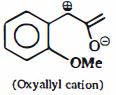
The product of the rearrangement of the given oxyallyl cation is:
A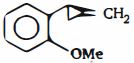
B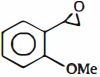
C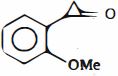
D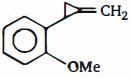
Solution
(D) The given species is an oxyallyl cation. The rearrangement involves the nucleophilic attack of the negatively charged oxygen atom on the positively charged carbon atom,leading to the formation of a three-membered ring containing a carbonyl group (cyclopropanone derivative). The mechanism proceeds via the internal cyclization of the oxyallyl intermediate to form a cyclopropanone ring attached to the benzene ring substituted with an $OMe$ group.
0 likes
View Solution136
MediumMCQ
Choose the most reasonable reaction intermediate for the following reaction.
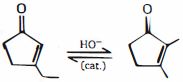
A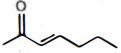
B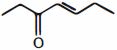
C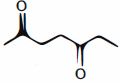
D
None of these
Solution
(C) The reaction shown is a base-catalyzed isomerization of an $\alpha,\beta$-unsaturated ketone. The first step in the presence of a base $(HO^-)$ is the nucleophilic attack of the hydroxide ion on the carbonyl carbon to form a hydrate intermediate. This is followed by an intramolecular acid-base reaction,leading to the formation of the more stable isomer. Therefore,the hydrate is the most reasonable intermediate in this specific mechanism.
0 likes
View Solution137
DifficultMCQ
The orbital picture of a singlet carbene $(:CH_2)$ can be drawn as:
A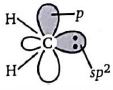
B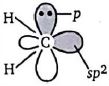
C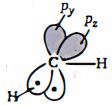
D
none of these
Solution
(A) In a singlet carbene $(:CH_2)$,the central carbon atom is $sp^2$ hybridized.
Two of the $sp^2$ hybrid orbitals form $\sigma$-bonds with two hydrogen atoms.
The third $sp^2$ hybrid orbital contains the lone pair of electrons (two electrons with opposite spins).
The remaining $p$-orbital is empty.
This configuration corresponds to the structure shown in option $(A)$.
Two of the $sp^2$ hybrid orbitals form $\sigma$-bonds with two hydrogen atoms.
The third $sp^2$ hybrid orbital contains the lone pair of electrons (two electrons with opposite spins).
The remaining $p$-orbital is empty.
This configuration corresponds to the structure shown in option $(A)$.
0 likes
View Solution138
DifficultMCQ
The orbital picture of a triplet carbene can be drawn as
A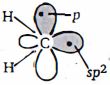
B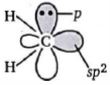
C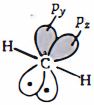
D
none of these
Solution
(A) triplet carbene has two unpaired electrons with parallel spins. In its structure,the carbon atom is $sp^2$ hybridized. Two of the $sp^2$ hybrid orbitals form bonds with hydrogen atoms,while the third $sp^2$ orbital and one unhybridized $p$-orbital each contain one unpaired electron. This corresponds to the orbital picture shown in option $A$.
0 likes
View Solution139
DifficultMCQ
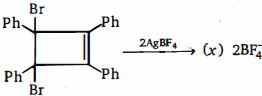
The compound $(X)$ will be:
A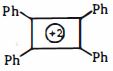
B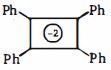
C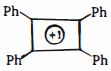
D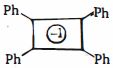
Solution
(A) The reaction involves the removal of two bromine atoms from the starting material using $2AgBF_4$.
$Ag^+$ ions react with $Br^-$ to form $AgBr$ precipitate,leaving behind a carbocation intermediate.
Since two $Br$ atoms are removed,a dication is formed.
The resulting species is a cyclobutadiene dication,which is aromatic ($2\pi$ electrons,$H$ückel's rule $4n+2$ where $n=0$).
Thus,the compound $(X)$ is the cyclobutadiene dication with four phenyl groups attached,represented by a $+2$ charge in the center of the ring.
$Ag^+$ ions react with $Br^-$ to form $AgBr$ precipitate,leaving behind a carbocation intermediate.
Since two $Br$ atoms are removed,a dication is formed.
The resulting species is a cyclobutadiene dication,which is aromatic ($2\pi$ electrons,$H$ückel's rule $4n+2$ where $n=0$).
Thus,the compound $(X)$ is the cyclobutadiene dication with four phenyl groups attached,represented by a $+2$ charge in the center of the ring.
0 likes
View Solution140
AdvancedMCQ
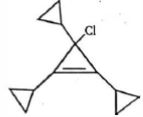
In the given compound,$Cl$ will be liberated easily in the form of:
A
$Cl^{\oplus}$
B
$Cl^{-}$
C
$Cl^{\bullet}$
D
$Cl^{2+}$
Solution
(B) The given compound is a derivative of cyclopropene. Upon the loss of the chloride ion $(Cl^{-})$,the molecule forms a cyclopropenyl cation.
This resulting cation is highly stable because it follows $H$ückel's rule for aromaticity ($4n+2$ $\pi$ electrons,where $n=0$,giving $2$ $\pi$ electrons) and is planar with a fully conjugated system.
Due to the formation of this stable aromatic cation,the $Cl$ atom is easily liberated as a chloride ion $(Cl^{-})$.
This resulting cation is highly stable because it follows $H$ückel's rule for aromaticity ($4n+2$ $\pi$ electrons,where $n=0$,giving $2$ $\pi$ electrons) and is planar with a fully conjugated system.
Due to the formation of this stable aromatic cation,the $Cl$ atom is easily liberated as a chloride ion $(Cl^{-})$.
0 likes
View Solution141
MediumMCQ
Which one among the following carbocations is the most stable?
A
$C_6H_5-\overset{\oplus}{C}H-C_6H_5$
B
Tropylium cation
C
$CH_3-C(CH_3)_2^{\oplus}$
D
Tricyclopropylmethyl cation
Solution
(D) The stability of carbocations is determined by resonance,hyperconjugation,and inductive effects.
$(a)$ Diphenylmethyl carbocation is stabilized by resonance with two phenyl rings.
$(b)$ Tropylium cation is an aromatic system ($6\pi$ electrons,Huckel's rule),making it exceptionally stable.
$(c)$ tert-Butyl carbocation is stabilized by hyperconjugation with $9$ $\alpha$-hydrogens.
$(d)$ Tricyclopropylmethyl cation is highly stabilized due to the extensive delocalization of the positive charge into the cyclopropyl rings (bent bonds/sigma-conjugation).
Among these,the tricyclopropylmethyl cation is exceptionally stable due to the unique electronic structure of the cyclopropyl groups,which provide significant stabilization to the carbocation center.
$(a)$ Diphenylmethyl carbocation is stabilized by resonance with two phenyl rings.
$(b)$ Tropylium cation is an aromatic system ($6\pi$ electrons,Huckel's rule),making it exceptionally stable.
$(c)$ tert-Butyl carbocation is stabilized by hyperconjugation with $9$ $\alpha$-hydrogens.
$(d)$ Tricyclopropylmethyl cation is highly stabilized due to the extensive delocalization of the positive charge into the cyclopropyl rings (bent bonds/sigma-conjugation).
Among these,the tricyclopropylmethyl cation is exceptionally stable due to the unique electronic structure of the cyclopropyl groups,which provide significant stabilization to the carbocation center.
0 likes
View Solution142
DifficultMCQ
In which of the following pairs is $A$ more stable than $B$?
$A$ $B$
$A$ $B$
A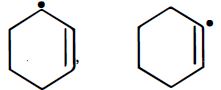
B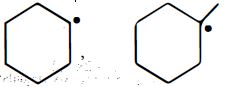
C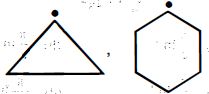
D
$Ph_{3}\dot{C}, (CH_{3})_{3}\dot{C}$
Solution
(D) To determine the stability of free radicals,we compare the factors affecting their stability such as resonance,hyperconjugation,and inductive effects.
In option $B$,the radical on the right is a tertiary alkyl radical,which is stabilized by hyperconjugation from $9$ $\alpha$-hydrogens,whereas the radical on the left is a secondary alkyl radical,which is stabilized by hyperconjugation from $4$ $\alpha$-hydrogens. Thus,the tertiary radical $(B)$ is more stable than the secondary radical $(A)$.
In option $C$,the radical on the right is a primary alkyl radical,while the radical on the left is a cyclopropyl radical. The cyclopropyl radical is less stable due to high angle strain.
In option $D$,$Ph_{3}\dot{C}$ is more stable than $(CH_{3})_{3}\dot{C}$ because resonance stabilisation in $Ph_{3}\dot{C}$ is much more effective than the hyperconjugation in $(CH_{3})_{3}\dot{C}$.
Therefore,in pair $D$,$A$ is more stable than $B$.
In option $B$,the radical on the right is a tertiary alkyl radical,which is stabilized by hyperconjugation from $9$ $\alpha$-hydrogens,whereas the radical on the left is a secondary alkyl radical,which is stabilized by hyperconjugation from $4$ $\alpha$-hydrogens. Thus,the tertiary radical $(B)$ is more stable than the secondary radical $(A)$.
In option $C$,the radical on the right is a primary alkyl radical,while the radical on the left is a cyclopropyl radical. The cyclopropyl radical is less stable due to high angle strain.
In option $D$,$Ph_{3}\dot{C}$ is more stable than $(CH_{3})_{3}\dot{C}$ because resonance stabilisation in $Ph_{3}\dot{C}$ is much more effective than the hyperconjugation in $(CH_{3})_{3}\dot{C}$.
Therefore,in pair $D$,$A$ is more stable than $B$.
0 likes
View Solution143
DifficultMCQ
Which one of the following is most stable?
A
B
C
D
Solution
(A) The stability of carbocations is determined by factors such as resonance,hyperconjugation,and inductive effects.
Option $A$ represents a carbocation where the positive charge is in conjugation with a double bond and is further stabilized by a phenyl group $(Ph)$ attached to the double bond,allowing for extended resonance.
Option $B$ is a simple cyclohexyl carbocation.
Option $C$ is a cyclohexenyl carbocation where the positive charge is in conjugation with the double bond.
Option $D$ is not a carbocation.
Comparing the structures,the carbocation in option $A$ has the most extensive delocalization of the positive charge due to resonance with both the double bond and the phenyl ring,making it the most stable.
Option $A$ represents a carbocation where the positive charge is in conjugation with a double bond and is further stabilized by a phenyl group $(Ph)$ attached to the double bond,allowing for extended resonance.
Option $B$ is a simple cyclohexyl carbocation.
Option $C$ is a cyclohexenyl carbocation where the positive charge is in conjugation with the double bond.
Option $D$ is not a carbocation.
Comparing the structures,the carbocation in option $A$ has the most extensive delocalization of the positive charge due to resonance with both the double bond and the phenyl ring,making it the most stable.
0 likes
View Solution144
DifficultMCQ
Which one of the following is the most stable carbocation?
A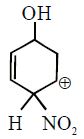
B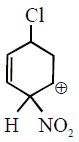
C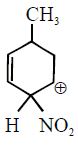
D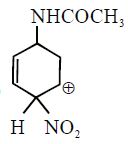
Solution
(A) The stability of a carbocation is increased by electron-donating groups $(EDG)$ through resonance or inductive effects.
In the given structures,all carbocations are allylic and have a $-NO_2$ group (a strong electron-withdrawing group) attached to the same carbon as the positive charge.
The stability depends on the substituent at the para-position relative to the double bond.
Option $A$ has an $-OH$ group,which is a strong electron-donating group by resonance ($+M$ effect).
Option $B$ has a $-Cl$ group,which is electron-withdrawing by induction $(-I)$ but donating by resonance $(+M)$. However,the $-I$ effect dominates.
Option $C$ has a $-CH_3$ group,which is electron-donating by hyperconjugation and inductive effect $(+I)$.
Option $D$ has an $-NHCOCH_3$ group,which is electron-donating by resonance $(+M)$.
Comparing the $+M$ effects,the $-OH$ group is a stronger electron donor than $-NHCOCH_3$ due to the delocalization of the lone pair on nitrogen into the carbonyl group in $-NHCOCH_3$,which reduces its donating ability to the ring.
Therefore,the carbocation with the $-OH$ group is the most stable.
In the given structures,all carbocations are allylic and have a $-NO_2$ group (a strong electron-withdrawing group) attached to the same carbon as the positive charge.
The stability depends on the substituent at the para-position relative to the double bond.
Option $A$ has an $-OH$ group,which is a strong electron-donating group by resonance ($+M$ effect).
Option $B$ has a $-Cl$ group,which is electron-withdrawing by induction $(-I)$ but donating by resonance $(+M)$. However,the $-I$ effect dominates.
Option $C$ has a $-CH_3$ group,which is electron-donating by hyperconjugation and inductive effect $(+I)$.
Option $D$ has an $-NHCOCH_3$ group,which is electron-donating by resonance $(+M)$.
Comparing the $+M$ effects,the $-OH$ group is a stronger electron donor than $-NHCOCH_3$ due to the delocalization of the lone pair on nitrogen into the carbonyl group in $-NHCOCH_3$,which reduces its donating ability to the ring.
Therefore,the carbocation with the $-OH$ group is the most stable.
0 likes
View Solution145
DifficultMCQ
Arrange the following carbocations in the correct order of stability:
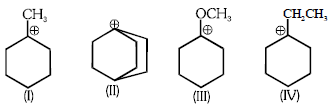
A
$II < I < IV < III$
B
$II < IV < I < III$
C
$II < III < I < IV$
D
$III < IV < I < II$
Solution
(A) The stability order is $II < I < IV < III$.
$1$. Structure $III$ (methoxycyclohexyl cation) is the most stable due to the $+M$ effect of the oxygen atom,which donates electron density to the positively charged carbon.
$2$. Structure $IV$ (ethylcyclohexyl cation) is more stable than $I$ (methylcyclohexyl cation) because the ethyl group provides more hyperconjugation and inductive stabilization than the methyl group.
$3$. Structure $II$ is a bridgehead carbocation. According to Bredt's rule,bridgehead carbocations in small bicyclic systems are highly unstable because they cannot achieve the required $sp^2$ planar geometry due to severe ring strain.
$1$. Structure $III$ (methoxycyclohexyl cation) is the most stable due to the $+M$ effect of the oxygen atom,which donates electron density to the positively charged carbon.
$2$. Structure $IV$ (ethylcyclohexyl cation) is more stable than $I$ (methylcyclohexyl cation) because the ethyl group provides more hyperconjugation and inductive stabilization than the methyl group.
$3$. Structure $II$ is a bridgehead carbocation. According to Bredt's rule,bridgehead carbocations in small bicyclic systems are highly unstable because they cannot achieve the required $sp^2$ planar geometry due to severe ring strain.
0 likes
View Solution146
MediumMCQ
In the following reaction,which type of reaction intermediate is likely to be involved?
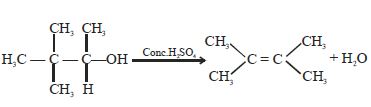
A
Carbocation
B
Carbanion
C
Carbon free radical
D
Carbene
Solution
(A) The reaction shown is the acid-catalyzed dehydration of an alcohol.
In the first step,the hydroxyl group of the alcohol is protonated by the acid $(Conc. H_2SO_4)$ to form an alkyloxonium ion.
This is followed by the loss of a water molecule to generate a carbocation intermediate.
Therefore,the reaction intermediate involved is a carbocation.
In the first step,the hydroxyl group of the alcohol is protonated by the acid $(Conc. H_2SO_4)$ to form an alkyloxonium ion.
This is followed by the loss of a water molecule to generate a carbocation intermediate.
Therefore,the reaction intermediate involved is a carbocation.
0 likes
View Solution147
DifficultMCQ
Which of the following is the most stable carbocation?
A
$CH_3 - \mathop C\limits^\oplus H_2$
B
$Ph - \mathop C\limits^\oplus H_2$
C
$\mathop C\limits^\oplus H_2CH_2Cl$
D
$\mathop C\limits^\oplus H_2 - OCH_3$
Solution
(D) The stability of carbocations is determined by resonance and inductive effects.
Option $A$ $(CH_3 - \mathop C\limits^\oplus H_2)$ is a primary carbocation with only inductive stabilization.
Option $C$ $(\mathop C\limits^\oplus H_2CH_2Cl)$ is destabilized by the electron-withdrawing $-I$ effect of the chlorine atom.
Option $B$ $(Ph - \mathop C\limits^\oplus H_2)$ is resonance stabilized by the phenyl ring.
Option $D$ $(\mathop C\limits^\oplus H_2 - OCH_3)$ is resonance stabilized by the lone pair on the oxygen atom.
In option $D$,the oxygen atom donates its lone pair to form a double bond,resulting in a structure where all atoms (including the carbon) have a complete octet $(CH_2 = \mathop O\limits^\oplus - CH_3)$.
Since the octet is complete for all atoms in the resonance structure of $D$,it is significantly more stable than the resonance-stabilized benzyl carbocation $(B)$,where the positive charge is delocalized into the ring but the octet of the benzylic carbon is not completed in the same way.
Option $A$ $(CH_3 - \mathop C\limits^\oplus H_2)$ is a primary carbocation with only inductive stabilization.
Option $C$ $(\mathop C\limits^\oplus H_2CH_2Cl)$ is destabilized by the electron-withdrawing $-I$ effect of the chlorine atom.
Option $B$ $(Ph - \mathop C\limits^\oplus H_2)$ is resonance stabilized by the phenyl ring.
Option $D$ $(\mathop C\limits^\oplus H_2 - OCH_3)$ is resonance stabilized by the lone pair on the oxygen atom.
In option $D$,the oxygen atom donates its lone pair to form a double bond,resulting in a structure where all atoms (including the carbon) have a complete octet $(CH_2 = \mathop O\limits^\oplus - CH_3)$.
Since the octet is complete for all atoms in the resonance structure of $D$,it is significantly more stable than the resonance-stabilized benzyl carbocation $(B)$,where the positive charge is delocalized into the ring but the octet of the benzylic carbon is not completed in the same way.
0 likes
View Solution148
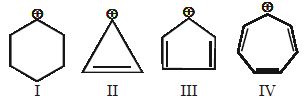
DifficultMCQ
The stability of the following carbocations decreases in the order:
A
$IV > II > I > III$
B
$IV > II > III > I$
C
$IV > I > II > III$
D
$IV > III > II > I$
Solution
(A) To determine the stability of carbocations,we analyze their aromaticity:
$1$. $IV$ is the tropylium cation $(C_7H_7^+)$,which is aromatic ($6 \pi$ electrons,planar,cyclic,fully conjugated). It is highly stable.
$2$. $II$ is the cyclopropenyl cation $(C_3H_3^+)$,which is aromatic ($2 \pi$ electrons,planar,cyclic,fully conjugated). It is also stable but less than $IV$ due to ring strain.
$3$. $I$ is the cyclohexyl cation,which is non-aromatic. It is more stable than anti-aromatic systems.
$4$. $III$ is the cyclopentadienyl cation,which is anti-aromatic ($4 \pi$ electrons,planar,cyclic,fully conjugated). It is the least stable.
Thus,the order of stability is $IV > II > I > III$.
$1$. $IV$ is the tropylium cation $(C_7H_7^+)$,which is aromatic ($6 \pi$ electrons,planar,cyclic,fully conjugated). It is highly stable.
$2$. $II$ is the cyclopropenyl cation $(C_3H_3^+)$,which is aromatic ($2 \pi$ electrons,planar,cyclic,fully conjugated). It is also stable but less than $IV$ due to ring strain.
$3$. $I$ is the cyclohexyl cation,which is non-aromatic. It is more stable than anti-aromatic systems.
$4$. $III$ is the cyclopentadienyl cation,which is anti-aromatic ($4 \pi$ electrons,planar,cyclic,fully conjugated). It is the least stable.
Thus,the order of stability is $IV > II > I > III$.
0 likes
View Solution149
MediumMCQ
The correct order of stability is:
A
$CH_3-\ddot{C}H_2^{\ominus} < CH_2=\ddot{C}H^{\ominus} < CH\equiv \ddot{C}^{\ominus}$
B
$CH_3-\dot{C}H_2 < CH_2=\dot{C}H < CH\equiv C^{\cdot}$
C
$CH_3-COO^{\ominus} > C_6H_5-O^{\ominus}$
D
$CH_3-\overset{\oplus}{C}H-CH_3 < CH_3-O-\overset{\oplus}{C}H_2$
Solution
(B) Let us analyze each option based on the stability of reactive intermediates:
$A$. Carbanion stability increases with the $s$-character of the carbon atom. The $s$-character increases in the order $sp^3 < sp^2 < sp$. Thus,the stability order is $CH_3-\ddot{C}H_2^{\ominus} < CH_2=\ddot{C}H^{\ominus} < CH\equiv \ddot{C}^{\ominus}$. The given option shows the reverse order,so it is incorrect.
$B$. Free radical stability increases with the $s$-character of the carbon atom. The stability order is $CH_3-\dot{C}H_2 < CH_2=\dot{C}H < CH\equiv C^{\cdot}$. The given option is correct.
$C$. The stability of anions is determined by the resonance effect. In $CH_3-COO^{\ominus}$,the negative charge is delocalized over two electronegative oxygen atoms. In $C_6H_5-O^{\ominus}$ (phenoxide ion),the negative charge is delocalized over the benzene ring. The acetate ion is more stable than the phenoxide ion due to the higher electronegativity of the oxygen atoms sharing the charge. The given order is correct.
$D$. Carbocation stability is increased by the $+M$ effect of the oxygen atom. In $CH_3-O-\overset{\oplus}{C}H_2$,the oxygen atom donates electron density through resonance,making it more stable than the secondary carbocation $CH_3-\overset{\oplus}{C}H-CH_3$. The given order is correct.
Note: Multiple options $(B, C, D)$ represent correct stability orders. However,in standard chemistry contexts,$B$ is a fundamental comparison of hybridization effects on radicals.
$A$. Carbanion stability increases with the $s$-character of the carbon atom. The $s$-character increases in the order $sp^3 < sp^2 < sp$. Thus,the stability order is $CH_3-\ddot{C}H_2^{\ominus} < CH_2=\ddot{C}H^{\ominus} < CH\equiv \ddot{C}^{\ominus}$. The given option shows the reverse order,so it is incorrect.
$B$. Free radical stability increases with the $s$-character of the carbon atom. The stability order is $CH_3-\dot{C}H_2 < CH_2=\dot{C}H < CH\equiv C^{\cdot}$. The given option is correct.
$C$. The stability of anions is determined by the resonance effect. In $CH_3-COO^{\ominus}$,the negative charge is delocalized over two electronegative oxygen atoms. In $C_6H_5-O^{\ominus}$ (phenoxide ion),the negative charge is delocalized over the benzene ring. The acetate ion is more stable than the phenoxide ion due to the higher electronegativity of the oxygen atoms sharing the charge. The given order is correct.
$D$. Carbocation stability is increased by the $+M$ effect of the oxygen atom. In $CH_3-O-\overset{\oplus}{C}H_2$,the oxygen atom donates electron density through resonance,making it more stable than the secondary carbocation $CH_3-\overset{\oplus}{C}H-CH_3$. The given order is correct.
Note: Multiple options $(B, C, D)$ represent correct stability orders. However,in standard chemistry contexts,$B$ is a fundamental comparison of hybridization effects on radicals.
0 likes
View Solution150
MediumMCQ
Which of the following is the most stable carbocation?
A
Phenyl carbocation $(C_6H_5^+)$
B
$(CH_3)_3C^+$
C
$CH_3-O-CH_2^+$
D
$CH_2=CH-CH_2^+$
Solution
(C) To determine the stability of carbocations,we consider the electronic effects (resonance,hyperconjugation,and inductive effect).
$1$. $CH_3-O-CH_2^+$: The oxygen atom has lone pairs of electrons that can participate in resonance with the empty $p$-orbital of the carbocation $(CH_3-O^+=CH_2)$. This $+M$ (mesomeric) effect provides significant stability.
$2$. $(CH_3)_3C^+$: This is a tertiary carbocation stabilized by hyperconjugation from $9$ $\alpha$-hydrogens.
$3$. $CH_2=CH-CH_2^+$: This is an allyl carbocation,stabilized by resonance.
$4$. Phenyl carbocation $(C_6H_5^+)$: The positive charge is on an $sp$-hybridized carbon atom in the ring,which is highly unstable due to the high $s$-character and lack of resonance stabilization for the positive charge.
Comparing these,the resonance stabilization provided by the lone pair on the oxygen atom in $CH_3-O-CH_2^+$ is the most effective in stabilizing the positive charge. Therefore,$CH_3-O-CH_2^+$ is the most stable.
$1$. $CH_3-O-CH_2^+$: The oxygen atom has lone pairs of electrons that can participate in resonance with the empty $p$-orbital of the carbocation $(CH_3-O^+=CH_2)$. This $+M$ (mesomeric) effect provides significant stability.
$2$. $(CH_3)_3C^+$: This is a tertiary carbocation stabilized by hyperconjugation from $9$ $\alpha$-hydrogens.
$3$. $CH_2=CH-CH_2^+$: This is an allyl carbocation,stabilized by resonance.
$4$. Phenyl carbocation $(C_6H_5^+)$: The positive charge is on an $sp$-hybridized carbon atom in the ring,which is highly unstable due to the high $s$-character and lack of resonance stabilization for the positive charge.
Comparing these,the resonance stabilization provided by the lone pair on the oxygen atom in $CH_3-O-CH_2^+$ is the most effective in stabilizing the positive charge. Therefore,$CH_3-O-CH_2^+$ is the most stable.
0 likes
View Solution8-4.Organic Chemistry : Reaction mechanism — Reactive Intermediates · Frequently Asked Questions
1Are these 8-4.Organic Chemistry : Reaction mechanism questions useful for JEE and NEET?
Yes. All questions in this section are mapped to JEE Main and NEET exam patterns. Previous year questions from JEE Main, NEET, GUJCET and state-level exams are included with full solutions.
2Can I switch to Hindi or Gujarati for these questions?
Yes. Use the language tabs in the hero section or the sidebar to view the same questions and solutions in English, Hindi or Gujarati.
3How do I generate a question paper from this subtopic?
Use the Vedclass Exam Paper Generator — select the chapter and subtopic, set difficulty, and generate Sets A, B, C, D automatically. First 3 chapters of every subject are free.
Vedclass Products
For Students
Vedclass Test Series
Mock tests in real JEE/NEET style with performance analysis. 5-day free trial.
Start Free TrialFor Teachers
Exam Paper Generator
Generate Set A/B/C/D papers from this chapter in 2 minutes. 3 chapters free.
Try FreeFor Institutes
Online Exam Module
Live online exams with unlimited students, 360° analytics & white-label branding.
See DemoFor Teachers & Institutes
Generate a 8-4.Organic Chemistry : Reaction mechanism Exam Paper in 2 Minutes
Select subtopic & difficulty — Sets A, B, C, D auto-generated with No Repeat logic.
First 3 chapters of every subject are free — no payment required.