
A English
Dipole moment and resonance Questions in English
Class 11 Chemistry · 8-4.Organic Chemistry : Reaction mechanism · Dipole moment and resonance
33+
Questions
English
Language
100%
With Solutions
Showing 33 of 33 questions in English
1
MediumMCQ
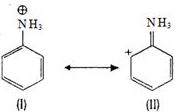
Select the correct statement for the given structures of anilinium ion:
A
$II$ is not an acceptable canonical structure because the carbonium ion is less stable than the ammonium ion.
B
$II$ is not an acceptable canonical structure because it is aromatic.
C
$II$ is not an acceptable canonical structure because nitrogen has $10$ valence electrons.
D
$II$ is an acceptable canonical structure.
Solution
(C) In structure $II$,the nitrogen atom is bonded to the ring with a double bond and also has three hydrogen atoms attached to it ($NH_3$ group).
This means the nitrogen atom is forming $5$ bonds in total ($2$ with the ring carbon and $3$ with hydrogen atoms).
Since each bond consists of $2$ electrons,this would imply that the nitrogen atom has $10$ valence electrons $(5 \times 2 = 10)$.
According to the octet rule,nitrogen can have a maximum of $8$ valence electrons.
Therefore,structure $II$ is not an acceptable canonical structure because it violates the octet rule for nitrogen.
This means the nitrogen atom is forming $5$ bonds in total ($2$ with the ring carbon and $3$ with hydrogen atoms).
Since each bond consists of $2$ electrons,this would imply that the nitrogen atom has $10$ valence electrons $(5 \times 2 = 10)$.
According to the octet rule,nitrogen can have a maximum of $8$ valence electrons.
Therefore,structure $II$ is not an acceptable canonical structure because it violates the octet rule for nitrogen.
0 likes
View Solution2
DifficultMCQ
Which of the following is the most unstable resonance structure of the $p$-nitrophenoxide ion?
A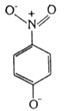
B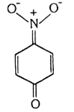
C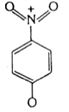
D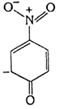
Solution
(C) The stability of resonance structures is determined by several factors:
$1$. Structures with more covalent bonds are more stable.
$2$. Structures with complete octets for all atoms are more stable.
$3$. Structures with negative charges on more electronegative atoms and positive charges on less electronegative atoms are more stable.
$4$. Structures with like charges on adjacent atoms are highly unstable due to electrostatic repulsion.
In the $p$-nitrophenoxide ion,the resonance involves the delocalization of the negative charge from the phenoxide oxygen into the nitro group.
Structure $C$ shows a positive charge on the nitrogen atom and a negative charge on the oxygen atom,which is a standard resonance contributor.
Structure $D$ shows a negative charge on a carbon atom adjacent to the ring,which is less stable than having it on oxygen.
Structure $B$ is a valid resonance structure.
Structure $A$ shows a negative charge on the phenoxide oxygen and a positive charge on the nitrogen,but it also implies a charge distribution that is less favorable compared to others.
However,looking at the structures provided,structure $C$ is the most unstable because it places a positive charge on the nitrogen atom while having a negative charge on the oxygen atom in a way that disrupts the aromaticity and creates significant charge separation without the benefit of full octets or favorable electronegativity distribution compared to the others. Actually,structure $C$ is the most unstable because it has a positive charge on the nitrogen and a negative charge on the oxygen,but it lacks the necessary double bond character to stabilize the system effectively compared to the other resonance forms.
$1$. Structures with more covalent bonds are more stable.
$2$. Structures with complete octets for all atoms are more stable.
$3$. Structures with negative charges on more electronegative atoms and positive charges on less electronegative atoms are more stable.
$4$. Structures with like charges on adjacent atoms are highly unstable due to electrostatic repulsion.
In the $p$-nitrophenoxide ion,the resonance involves the delocalization of the negative charge from the phenoxide oxygen into the nitro group.
Structure $C$ shows a positive charge on the nitrogen atom and a negative charge on the oxygen atom,which is a standard resonance contributor.
Structure $D$ shows a negative charge on a carbon atom adjacent to the ring,which is less stable than having it on oxygen.
Structure $B$ is a valid resonance structure.
Structure $A$ shows a negative charge on the phenoxide oxygen and a positive charge on the nitrogen,but it also implies a charge distribution that is less favorable compared to others.
However,looking at the structures provided,structure $C$ is the most unstable because it places a positive charge on the nitrogen atom while having a negative charge on the oxygen atom in a way that disrupts the aromaticity and creates significant charge separation without the benefit of full octets or favorable electronegativity distribution compared to the others. Actually,structure $C$ is the most unstable because it has a positive charge on the nitrogen and a negative charge on the oxygen,but it lacks the necessary double bond character to stabilize the system effectively compared to the other resonance forms.
0 likes
View Solution3
DifficultMCQ
Which of the following is the least stable?
A
$CH_3 - \overset{\oplus}{O} = CH - \overset{\ominus}{C}H - CH = CH_2$
B
$CH_3 - \overset{\oplus}{O} = CH - CH = CH - \overset{\ominus}{C}H_2$
C
$CH_3 - O - \overset{\oplus}{C}H - \overset{\ominus}{C}H - CH = CH_2$
D
$CH_3 - O - CH = CH - \overset{\oplus}{C}H - \overset{\ominus}{C}H_2$
Solution
(C) The stability of resonance structures is determined by several factors:
$1$. Structures with more covalent bonds are more stable.
$2$. Structures with complete octets for all atoms are more stable.
$3$. Structures with negative charge on the more electronegative atom and positive charge on the less electronegative atom are more stable.
$4$. Structures with like charges on adjacent atoms are highly unstable due to electrostatic repulsion.
In option $C$,we have a structure with adjacent positive and negative charges $(-\overset{\oplus}{C}H - \overset{\ominus}{C}H-)$,which makes it highly unstable compared to the others where charges are separated by double bonds or are on atoms that can accommodate them better.
$1$. Structures with more covalent bonds are more stable.
$2$. Structures with complete octets for all atoms are more stable.
$3$. Structures with negative charge on the more electronegative atom and positive charge on the less electronegative atom are more stable.
$4$. Structures with like charges on adjacent atoms are highly unstable due to electrostatic repulsion.
In option $C$,we have a structure with adjacent positive and negative charges $(-\overset{\oplus}{C}H - \overset{\ominus}{C}H-)$,which makes it highly unstable compared to the others where charges are separated by double bonds or are on atoms that can accommodate them better.
0 likes
View Solution4
AdvancedMCQ
Identify the correct stability order of the resonating structures.
A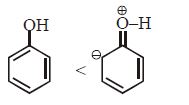
B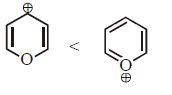
C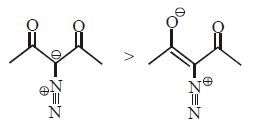
D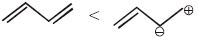
0 likes
View Solution5
DifficultMCQ
Identify the compound in which steric inhibition of resonance is present.
A
o-Cresol ($2$-methylphenol)
B
p-Toluic acid ($4$-methylbenzoic acid)
C
$1-$Bromo$-2,4,6-$trinitrobenzene
D
m-Nitrophenol
Solution
(C) Steric inhibition of resonance $(SIR)$ occurs when bulky groups at the ortho positions of a substituent force the substituent out of the plane of the benzene ring,thereby disrupting conjugation.
In $1$-bromo-$2,4,6$-trinitrobenzene,the bulky nitro groups at the ortho positions ($2$ and $6$) with respect to the bromine atom force the nitro groups out of the plane of the benzene ring,inhibiting resonance between the nitro groups and the ring. This is a classic example of steric inhibition of resonance.
In $1$-bromo-$2,4,6$-trinitrobenzene,the bulky nitro groups at the ortho positions ($2$ and $6$) with respect to the bromine atom force the nitro groups out of the plane of the benzene ring,inhibiting resonance between the nitro groups and the ring. This is a classic example of steric inhibition of resonance.
0 likes
View Solution6
DifficultMCQ
Which of the following is not a resonating structure of others?
A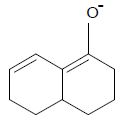
B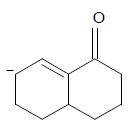
C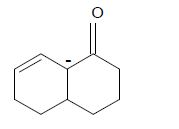
D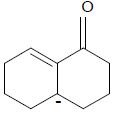
Solution
(C) Resonating structures must have the same arrangement of atoms and the same total number of electrons.
In the given options,$A$ represents the enolate form where the negative charge is delocalized on the oxygen atom.
Options $B$ and $D$ represent valid resonance contributors where the negative charge is on the alpha or beta carbons respectively,delocalized through the pi system.
Option $C$ shows a negative charge on the bridgehead carbon. According to Bredt's rule and the geometry of the system,placing a negative charge (or a double bond) at the bridgehead position in a small bicyclic system is highly unstable and does not contribute significantly to the resonance hybrid of the enolate. Therefore,it is not considered a valid resonating structure in this context.
In the given options,$A$ represents the enolate form where the negative charge is delocalized on the oxygen atom.
Options $B$ and $D$ represent valid resonance contributors where the negative charge is on the alpha or beta carbons respectively,delocalized through the pi system.
Option $C$ shows a negative charge on the bridgehead carbon. According to Bredt's rule and the geometry of the system,placing a negative charge (or a double bond) at the bridgehead position in a small bicyclic system is highly unstable and does not contribute significantly to the resonance hybrid of the enolate. Therefore,it is not considered a valid resonating structure in this context.
0 likes
View Solution7
DifficultMCQ
Which of the following stability order comparisons for resonating structures is incorrect?
A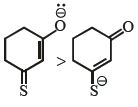
B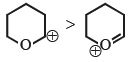
C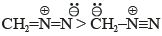
D
None of the above
Solution
(D) Let us analyze each option:
$A$: In the first structure,the negative charge is on the oxygen atom $(O)$,which is more electronegative than sulfur $(S)$. In the second structure,the negative charge is on the sulfur atom. Since $O$ is more electronegative,it can accommodate a negative charge better than $S$. Thus,the first structure is more stable. The given order is correct.
$B$: The first structure has all atoms with complete octets (the oxygen atom has a double bond and two lone pairs). The second structure has a carbocation with an incomplete octet. Therefore,the first structure is more stable. The given order is correct.
$C$: In the first structure $(CH_2=N=N)$,there are more covalent bonds compared to the second structure $(CH_2-N=N)$. Structures with more covalent bonds are generally more stable. The given order is correct.
Since all the given stability order comparisons are correct,the correct answer is $D$.
$A$: In the first structure,the negative charge is on the oxygen atom $(O)$,which is more electronegative than sulfur $(S)$. In the second structure,the negative charge is on the sulfur atom. Since $O$ is more electronegative,it can accommodate a negative charge better than $S$. Thus,the first structure is more stable. The given order is correct.
$B$: The first structure has all atoms with complete octets (the oxygen atom has a double bond and two lone pairs). The second structure has a carbocation with an incomplete octet. Therefore,the first structure is more stable. The given order is correct.
$C$: In the first structure $(CH_2=N=N)$,there are more covalent bonds compared to the second structure $(CH_2-N=N)$. Structures with more covalent bonds are generally more stable. The given order is correct.
Since all the given stability order comparisons are correct,the correct answer is $D$.
0 likes
View Solution8
AdvancedMCQ
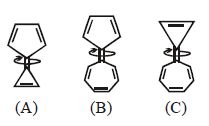
Compare the carbon-carbon double bond rotation energy for the following compounds $A$,$B$,and $C$:
A
$A > B > C$
B
$A > C > B$
C
$B > A > C$
D
$B > C > A$
Solution
(B) The rotation around the carbon-carbon double bond requires the breaking of the $\pi$-bond. The energy required for this rotation depends on the stability of the resulting zwitterionic species formed upon breaking the $\pi$-bond.
In these molecules,the $\pi$-bond breaks to form two rings,one carrying a positive charge and the other a negative charge. The stability of these rings is governed by $H$ückel's rule (aromaticity).
For $(A)$: Breaking the bond forms a $5$-membered cation (aromatic,$6\pi$ electrons) and a $3$-membered anion (antiaromatic,$4\pi$ electrons).
For $(B)$: Breaking the bond forms a $5$-membered cation (aromatic,$6\pi$ electrons) and a $7$-membered anion (aromatic,$8\pi$ electrons,but actually $7$-membered ring with $8\pi$ electrons is antiaromatic). Wait,let's re-evaluate: $5$-membered ring with $6\pi$ electrons is aromatic. $7$-membered ring with $6\pi$ electrons is aromatic. In $(B)$,we get a $5$-membered aromatic cation and a $7$-membered aromatic anion.
For $(C)$: Breaking the bond forms a $3$-membered cation (antiaromatic) and a $7$-membered anion (aromatic).
Since $(B)$ forms two aromatic rings,the $\pi$-bond breaks most easily,requiring the least energy. $(C)$ forms an antiaromatic ring,making it the most difficult to break. Thus,the order of rotation energy is $C > A > B$.
In these molecules,the $\pi$-bond breaks to form two rings,one carrying a positive charge and the other a negative charge. The stability of these rings is governed by $H$ückel's rule (aromaticity).
For $(A)$: Breaking the bond forms a $5$-membered cation (aromatic,$6\pi$ electrons) and a $3$-membered anion (antiaromatic,$4\pi$ electrons).
For $(B)$: Breaking the bond forms a $5$-membered cation (aromatic,$6\pi$ electrons) and a $7$-membered anion (aromatic,$8\pi$ electrons,but actually $7$-membered ring with $8\pi$ electrons is antiaromatic). Wait,let's re-evaluate: $5$-membered ring with $6\pi$ electrons is aromatic. $7$-membered ring with $6\pi$ electrons is aromatic. In $(B)$,we get a $5$-membered aromatic cation and a $7$-membered aromatic anion.
For $(C)$: Breaking the bond forms a $3$-membered cation (antiaromatic) and a $7$-membered anion (aromatic).
Since $(B)$ forms two aromatic rings,the $\pi$-bond breaks most easily,requiring the least energy. $(C)$ forms an antiaromatic ring,making it the most difficult to break. Thus,the order of rotation energy is $C > A > B$.
0 likes
View Solution9
DifficultMCQ
Which of the following species has a positive charge that is not involved in resonance?
A
Benzyl carbocation $(C_6H_5CH_2^{\oplus})$
B
$CH_2 = CH - CH = CH - CH_2^{\oplus}$
C
Anilinium ion $(C_6H_5NH_3^{\oplus})$
D
Tropylium cation $(C_7H_7^{\oplus})$
Solution
(C) In resonance,a positive charge must be in conjugation with a $\pi$-bond or a lone pair of electrons.
$(A)$ Benzyl carbocation: The positive charge on the carbon is in conjugation with the benzene ring,so it participates in resonance.
$(B)$ $CH_2 = CH - CH = CH - CH_2^{\oplus}$: The positive charge is in conjugation with the $\pi$-bonds,so it participates in resonance.
$(C)$ Anilinium ion $(C_6H_5NH_3^{\oplus})$: The positive charge is on the nitrogen atom,which has no vacant $p$-orbital or lone pair to participate in resonance with the benzene ring. The nitrogen is $sp^3$ hybridized and cannot extend conjugation. Thus,the positive charge is not involved in resonance.
$(D)$ Tropylium cation: The positive charge is part of a cyclic conjugated system,so it participates in resonance.
Therefore,the correct option is $C$.
$(A)$ Benzyl carbocation: The positive charge on the carbon is in conjugation with the benzene ring,so it participates in resonance.
$(B)$ $CH_2 = CH - CH = CH - CH_2^{\oplus}$: The positive charge is in conjugation with the $\pi$-bonds,so it participates in resonance.
$(C)$ Anilinium ion $(C_6H_5NH_3^{\oplus})$: The positive charge is on the nitrogen atom,which has no vacant $p$-orbital or lone pair to participate in resonance with the benzene ring. The nitrogen is $sp^3$ hybridized and cannot extend conjugation. Thus,the positive charge is not involved in resonance.
$(D)$ Tropylium cation: The positive charge is part of a cyclic conjugated system,so it participates in resonance.
Therefore,the correct option is $C$.
0 likes
View Solution10
DifficultMCQ
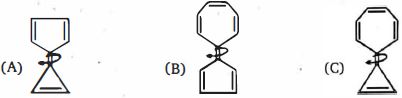
Compare the ease of carbon-carbon bond rotation across $A, B,$ and $C$.
A
$A > B > C$
B
$A > C > B$
C
$B > A > C$
D
$B > C > A$
Solution
(C) The ease of rotation about the carbon-carbon bond depends on the extent of double bond character. The double bond character is determined by the stability of the zwitterionic resonance structure formed by charge separation.
$1$. In structure $B$,charge separation leads to two aromatic rings (cyclopropenyl cation and cyclopentadienyl anion),which is highly stable.
$2$. In structure $A$,charge separation leads to one aromatic ring (cyclopropenyl cation) and one non-aromatic ring.
$3$. In structure $C$,charge separation leads to one aromatic ring and one anti-aromatic ring (cyclopropenyl anion),which is highly unstable.
Since the stability of the zwitterionic form is $B > A > C$,the extent of double bond character (and thus the energy barrier for rotation) follows the order $C > A > B$. Therefore,the ease of rotation is $B > A > C$.
$1$. In structure $B$,charge separation leads to two aromatic rings (cyclopropenyl cation and cyclopentadienyl anion),which is highly stable.
$2$. In structure $A$,charge separation leads to one aromatic ring (cyclopropenyl cation) and one non-aromatic ring.
$3$. In structure $C$,charge separation leads to one aromatic ring and one anti-aromatic ring (cyclopropenyl anion),which is highly unstable.
Since the stability of the zwitterionic form is $B > A > C$,the extent of double bond character (and thus the energy barrier for rotation) follows the order $C > A > B$. Therefore,the ease of rotation is $B > A > C$.
0 likes
View Solution11
MediumMCQ
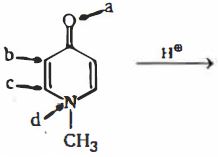
Identify the site,where attack of $H^{+}$ is most favourable.
A
$a$
B
$b$
C
$c$
D
$d$
Solution
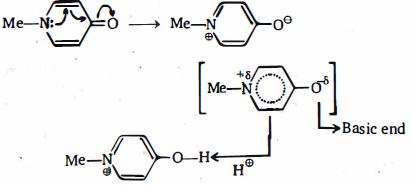
(A) The molecule is $N$-methyl$-4-$pyridone. The nitrogen atom donates its lone pair into the ring,which causes the delocalization of electrons towards the oxygen atom. This results in a resonance structure where the oxygen atom carries a partial negative charge $(\delta^-)$ and the nitrogen atom carries a partial positive charge $(\delta^+)$. Due to the high electron density on the oxygen atom,it acts as the most basic site in the molecule. Therefore,the electrophilic $H^{+}$ ion will most favourably attack the oxygen atom at site $a$.
0 likes
View Solution12
MediumMCQ
The correct order of stability for the given canonical structures is:
$(I)$ $H-C(=O)-CH_2^-$
$(II)$ $H-C(O^-)(^+)-CH_2^-$
$(III)$ $H-C(O^-)=CH_2$
$(I)$ $H-C(=O)-CH_2^-$
$(II)$ $H-C(O^-)(^+)-CH_2^-$
$(III)$ $H-C(O^-)=CH_2$
A
$I > III > II$
B
$III > I > II$
C
$II > III > I$
D
$II > I > III$
Solution
(B) To determine the stability of canonical structures,we follow these rules:
$1$. Structures with more covalent bonds are more stable.
$2$. Structures with complete octets for all atoms are more stable.
$3$. Negative charge on a more electronegative atom (like $O$) is more stable than on a less electronegative atom (like $C$).
Analyzing the structures:
- Structure $(III)$ has the maximum number of covalent bonds and all atoms (except $H$) have complete octets. Thus,it is the most stable.
- Structure $(I)$ has a negative charge on the carbon atom.
- Structure $(II)$ has a negative charge on the oxygen atom but also has adjacent opposite charges (a dipole),which makes it less stable than $(I)$ due to charge separation.
- Therefore,the stability order is $(III) > (I) > (II)$.
$1$. Structures with more covalent bonds are more stable.
$2$. Structures with complete octets for all atoms are more stable.
$3$. Negative charge on a more electronegative atom (like $O$) is more stable than on a less electronegative atom (like $C$).
Analyzing the structures:
- Structure $(III)$ has the maximum number of covalent bonds and all atoms (except $H$) have complete octets. Thus,it is the most stable.
- Structure $(I)$ has a negative charge on the carbon atom.
- Structure $(II)$ has a negative charge on the oxygen atom but also has adjacent opposite charges (a dipole),which makes it less stable than $(I)$ due to charge separation.
- Therefore,the stability order is $(III) > (I) > (II)$.
0 likes
View Solution13
MediumMCQ
For the given compounds,the correct order of resonance energy is:
$(I)$ $CH_2=CH-CH=CH-OCH_3$
$(II)$ $CH_2=CH-C(OCH_3)=CH_2$
$(III)$ $CH_2=CH-OCH_3$
$(I)$ $CH_2=CH-CH=CH-OCH_3$
$(II)$ $CH_2=CH-C(OCH_3)=CH_2$
$(III)$ $CH_2=CH-OCH_3$
A
$III > I > II$
B
$II > I > III$
C
$I > II > III$
D
$III > II > I$
Solution
(C) Resonance energy is directly proportional to the extent of conjugation in the molecule.
$(I)$ $CH_2=CH-CH=CH-OCH_3$ has a system of $4$ conjugated $\pi$-bonds (including the lone pair on oxygen),which provides extended conjugation.
$(II)$ $CH_2=CH-C(OCH_3)=CH_2$ has a cross-conjugated system.
$(III)$ $CH_2=CH-OCH_3$ has only $2$ conjugated $\pi$-bonds.
Therefore,the extent of conjugation is $I > II > III$,which implies the order of resonance energy is $I > II > III$.
$(I)$ $CH_2=CH-CH=CH-OCH_3$ has a system of $4$ conjugated $\pi$-bonds (including the lone pair on oxygen),which provides extended conjugation.
$(II)$ $CH_2=CH-C(OCH_3)=CH_2$ has a cross-conjugated system.
$(III)$ $CH_2=CH-OCH_3$ has only $2$ conjugated $\pi$-bonds.
Therefore,the extent of conjugation is $I > II > III$,which implies the order of resonance energy is $I > II > III$.
0 likes
View Solution14
DifficultMCQ
The correct stability order of the given canonical structures is:

A
$I > II > III$
B
$III > I > II$
C
$I > III > II$
D
$II > III > I$
Solution
(B) The stability of resonance structures is determined by the following rules:
$1$. Structures with complete octets for all atoms are more stable.
$2$. Structures with fewer formal charges are more stable.
$3$. Negative charge on a more electronegative atom and positive charge on a less electronegative atom is more stable.
In structure $I$,all atoms have a complete octet,but there is a positive charge on the oxygen atom $(O^{\oplus})$.
In structure $II$,the carbon atom has an incomplete octet (carbocation),making it the least stable.
In structure $III$,all atoms have a complete octet,and the positive charge is on the nitrogen atom $(N^{\oplus})$.
Since nitrogen is less electronegative than oxygen,it can better accommodate the positive charge. Therefore,$III$ is more stable than $I$.
The overall stability order is $III > I > II$.
$1$. Structures with complete octets for all atoms are more stable.
$2$. Structures with fewer formal charges are more stable.
$3$. Negative charge on a more electronegative atom and positive charge on a less electronegative atom is more stable.
In structure $I$,all atoms have a complete octet,but there is a positive charge on the oxygen atom $(O^{\oplus})$.
In structure $II$,the carbon atom has an incomplete octet (carbocation),making it the least stable.
In structure $III$,all atoms have a complete octet,and the positive charge is on the nitrogen atom $(N^{\oplus})$.
Since nitrogen is less electronegative than oxygen,it can better accommodate the positive charge. Therefore,$III$ is more stable than $I$.
The overall stability order is $III > I > II$.
0 likes
View Solution15
DifficultMCQ
In which of the following is the first resonating structure less stable compared to the second one?
A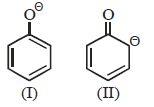
B
$CH_3-CH=\mathop{O}\limits^{\oplus}CH_3$ $(I)$ and $CH_3-\mathop{CH}^{-}-\mathop{O}^{+}-CH_3$ $(II)$
C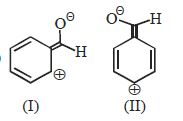
D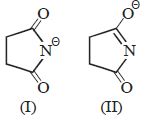
Solution
(D) To determine the stability of resonating structures,we follow these rules:
$1$. Structures with more covalent bonds are more stable.
$2$. Structures with complete octets for all atoms are more stable.
$3$. Structures with negative charge on more electronegative atoms and positive charge on less electronegative atoms are more stable.
In option $A$,structure $(I)$ is a phenoxide ion (aromatic,stable),while structure $(II)$ is a non-aromatic cyclohexadienone derivative with separated charges. Thus,$(I)$ is more stable than $(II)$.
In option $B$,$(I)$ has complete octets for all atoms,whereas $(II)$ has an incomplete octet on carbon. Thus,$(I)$ is more stable than $(II)$.
In option $C$,structure $(I)$ has a positive charge on a carbon atom adjacent to a double bond,while $(II)$ has a positive charge on a carbon atom that is not adjacent to the double bond in a way that allows for resonance stabilization. However,comparing the two,$(I)$ is generally considered more stable due to better conjugation.
In option $D$,structure $(I)$ has the negative charge on the nitrogen atom,which is less electronegative than oxygen. Structure $(II)$ has the negative charge on the oxygen atom. Since oxygen is more electronegative than nitrogen,the structure with the negative charge on oxygen $(II)$ is more stable than the one with the negative charge on nitrogen $(I)$. Therefore,$(I)$ is less stable than $(II)$.
$1$. Structures with more covalent bonds are more stable.
$2$. Structures with complete octets for all atoms are more stable.
$3$. Structures with negative charge on more electronegative atoms and positive charge on less electronegative atoms are more stable.
In option $A$,structure $(I)$ is a phenoxide ion (aromatic,stable),while structure $(II)$ is a non-aromatic cyclohexadienone derivative with separated charges. Thus,$(I)$ is more stable than $(II)$.
In option $B$,$(I)$ has complete octets for all atoms,whereas $(II)$ has an incomplete octet on carbon. Thus,$(I)$ is more stable than $(II)$.
In option $C$,structure $(I)$ has a positive charge on a carbon atom adjacent to a double bond,while $(II)$ has a positive charge on a carbon atom that is not adjacent to the double bond in a way that allows for resonance stabilization. However,comparing the two,$(I)$ is generally considered more stable due to better conjugation.
In option $D$,structure $(I)$ has the negative charge on the nitrogen atom,which is less electronegative than oxygen. Structure $(II)$ has the negative charge on the oxygen atom. Since oxygen is more electronegative than nitrogen,the structure with the negative charge on oxygen $(II)$ is more stable than the one with the negative charge on nitrogen $(I)$. Therefore,$(I)$ is less stable than $(II)$.
0 likes
View Solution16
MediumMCQ
Which of the following is the most unstable resonating structure?
A
B
C
D
All of these
Solution
(C) To determine the stability of resonating structures,we consider the following rules:
$1$. Structures with more covalent bonds are more stable.
$2$. Structures with complete octets for all atoms are more stable.
$3$. Structures with negative charge on more electronegative atoms and positive charge on less electronegative atoms are more stable.
$4$. Structures with less charge separation are more stable.
In the given structures,all are carbocations. We compare the stability of the carbocation based on the position of the positive charge relative to the double bonds and the alkyl group.
Structure $A$ has the positive charge at the allylic position relative to the methyl group and the double bond.
Structure $B$ and $C$ have the positive charge at different positions.
By analyzing the resonance,structure $C$ has the positive charge at a position where it is less stabilized by the inductive effect of the methyl group compared to the others,or it represents a structure where the charge is further from the electron-donating group.
However,in this specific set of resonance structures for a methyl-substituted cyclohexadienyl cation,structure $C$ is the least stable because the positive charge is furthest from the stabilizing effect of the methyl group.
$1$. Structures with more covalent bonds are more stable.
$2$. Structures with complete octets for all atoms are more stable.
$3$. Structures with negative charge on more electronegative atoms and positive charge on less electronegative atoms are more stable.
$4$. Structures with less charge separation are more stable.
In the given structures,all are carbocations. We compare the stability of the carbocation based on the position of the positive charge relative to the double bonds and the alkyl group.
Structure $A$ has the positive charge at the allylic position relative to the methyl group and the double bond.
Structure $B$ and $C$ have the positive charge at different positions.
By analyzing the resonance,structure $C$ has the positive charge at a position where it is less stabilized by the inductive effect of the methyl group compared to the others,or it represents a structure where the charge is further from the electron-donating group.
However,in this specific set of resonance structures for a methyl-substituted cyclohexadienyl cation,structure $C$ is the least stable because the positive charge is furthest from the stabilizing effect of the methyl group.
0 likes
View Solution17
MediumMCQ
The most stable resonating structure is
A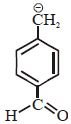
B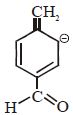
C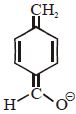
D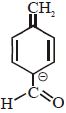
Solution
(C) To determine the most stable resonating structure,we follow these rules:
$1$. Structures with more covalent bonds are more stable.
$2$. Structures with complete octets for all atoms are more stable.
$3$. Negative charge should reside on the more electronegative atom (like $O$) and positive charge on the less electronegative atom.
In the given system,the negative charge can delocalize from the $CH_2^-$ group into the benzene ring and finally onto the oxygen atom of the carbonyl group $(C=O)$.
Structure $C$ places the negative charge on the oxygen atom,which is more electronegative than carbon. Additionally,this structure maintains a complete octet for the oxygen atom. Therefore,the structure where the negative charge is on the oxygen atom is the most stable.
$1$. Structures with more covalent bonds are more stable.
$2$. Structures with complete octets for all atoms are more stable.
$3$. Negative charge should reside on the more electronegative atom (like $O$) and positive charge on the less electronegative atom.
In the given system,the negative charge can delocalize from the $CH_2^-$ group into the benzene ring and finally onto the oxygen atom of the carbonyl group $(C=O)$.
Structure $C$ places the negative charge on the oxygen atom,which is more electronegative than carbon. Additionally,this structure maintains a complete octet for the oxygen atom. Therefore,the structure where the negative charge is on the oxygen atom is the most stable.
0 likes
View Solution18
DifficultMCQ
Consider the following statements. Which of the following statement$(s)$ is/are correct?
$(a)$ $CH_2=CH-CH_2^+$ is more stable than $CH_3-CH^+-CH_3$.
$(b)$ Naphthalene has two types of $C-C$ bonds.
$(c)$ The structures shown are both permissible resonating structures.
$(d)$ The phenyl anion is less stable than the cyclohexadienyl anion shown.
$(a)$ $CH_2=CH-CH_2^+$ is more stable than $CH_3-CH^+-CH_3$.
$(b)$ Naphthalene has two types of $C-C$ bonds.
$(c)$ The structures shown are both permissible resonating structures.
$(d)$ The phenyl anion is less stable than the cyclohexadienyl anion shown.
A
$a$ and $b$
B
$a, b$ and $c$
C
$a, b$ and $d$
D
$a, b, c$ and $d$
Solution
(D) Statement $(a)$: The allyl carbocation $(CH_2=CH-CH_2^+)$ is resonance stabilized,whereas the isopropyl carbocation $(CH_3-CH^+-CH_3)$ is stabilized only by hyperconjugation and inductive effects. Resonance stabilization is generally more effective,making the allyl carbocation more stable.
Statement $(b)$: Naphthalene has two distinct types of $C-C$ bonds due to its fused ring structure,leading to different bond lengths.
Statement $(c)$: The structures represent a valid resonance transition involving the movement of $\pi$ electrons and the lone pair on nitrogen,maintaining the octet rule and charge conservation.
Statement $(d)$: The phenyl anion (with the negative charge on an $sp^2$ hybridized carbon in the ring) is less stable than the cyclohexadienyl anion where the negative charge can be delocalized over the conjugated system.
All statements $(a), (b), (c),$ and $(d)$ are correct.
Statement $(b)$: Naphthalene has two distinct types of $C-C$ bonds due to its fused ring structure,leading to different bond lengths.
Statement $(c)$: The structures represent a valid resonance transition involving the movement of $\pi$ electrons and the lone pair on nitrogen,maintaining the octet rule and charge conservation.
Statement $(d)$: The phenyl anion (with the negative charge on an $sp^2$ hybridized carbon in the ring) is less stable than the cyclohexadienyl anion where the negative charge can be delocalized over the conjugated system.
All statements $(a), (b), (c),$ and $(d)$ are correct.
0 likes
View Solution19
Difficult
Draw other resonance structures related to the following structure and find out whether the functional group present in the molecule is ortho,para directing or meta directing.

Solution
(A) The given structure represents a halobenzene $(C_6H_5X)$,where $X$ is a halogen atom $(F, Cl, Br, I)$ having three lone pairs of electrons.
Due to the $+R$ effect (resonance effect) of the halogen atom,the electron density increases at the ortho and para positions of the benzene ring.
The resonance structures are as follows:
$1$. The lone pair on the halogen atom shifts to form a double bond with the benzene ring,and the $\pi$-bond electrons shift to the ortho position.
$2$. The negative charge at the ortho position shifts to the para position.
$3$. The negative charge at the para position shifts to the other ortho position.
$4$. Finally,the electrons shift back to the halogen atom.
Since the electron density is higher at the ortho and para positions,the halogen group is ortho,para directing.
Due to the $+R$ effect (resonance effect) of the halogen atom,the electron density increases at the ortho and para positions of the benzene ring.
The resonance structures are as follows:
$1$. The lone pair on the halogen atom shifts to form a double bond with the benzene ring,and the $\pi$-bond electrons shift to the ortho position.
$2$. The negative charge at the ortho position shifts to the para position.
$3$. The negative charge at the para position shifts to the other ortho position.
$4$. Finally,the electrons shift back to the halogen atom.
Since the electron density is higher at the ortho and para positions,the halogen group is ortho,para directing.
0 likes
View Solution20
EasyMCQ
Arrange the following in the decreasing order of stability:
$I. CH_2=CH-CHO$
$II. ^+CH_2-CH=CH-O^-$
$III. ^-CH_2-CH=CH-O^+$
$I. CH_2=CH-CHO$
$II. ^+CH_2-CH=CH-O^-$
$III. ^-CH_2-CH=CH-O^+$
A
$I > II > III$
B
$III > II > I$
C
$II > I > III$
D
$I > III > II$
Solution
(A) The stability of resonance structures is determined by the following rules:
$1$. Structures with more covalent bonds are more stable.
$2$. Structures with complete octets for all atoms are more stable.
$3$. Structures with negative charge on more electronegative atoms and positive charge on less electronegative atoms are more stable.
Structure $I$ $(CH_2=CH-CH=O)$ has all atoms with complete octets and no formal charges,making it the most stable.
Structure $II$ $(^+CH_2-CH=CH-O^-)$ has a positive charge on carbon and a negative charge on oxygen,which is relatively stable due to electronegativity,but it has fewer covalent bonds than $I$.
Structure $III$ $(-CH_2-CH=CH-O^+)$ has a negative charge on carbon and a positive charge on oxygen,which is highly unstable due to the positive charge on the highly electronegative oxygen atom.
Therefore,the decreasing order of stability is $I > II > III$.
$1$. Structures with more covalent bonds are more stable.
$2$. Structures with complete octets for all atoms are more stable.
$3$. Structures with negative charge on more electronegative atoms and positive charge on less electronegative atoms are more stable.
Structure $I$ $(CH_2=CH-CH=O)$ has all atoms with complete octets and no formal charges,making it the most stable.
Structure $II$ $(^+CH_2-CH=CH-O^-)$ has a positive charge on carbon and a negative charge on oxygen,which is relatively stable due to electronegativity,but it has fewer covalent bonds than $I$.
Structure $III$ $(-CH_2-CH=CH-O^+)$ has a negative charge on carbon and a positive charge on oxygen,which is highly unstable due to the positive charge on the highly electronegative oxygen atom.
Therefore,the decreasing order of stability is $I > II > III$.
0 likes
View Solution21
DifficultMCQ
Which one of the following compounds does not exhibit resonance?
A
$CH_3-CH_2-CH_2-CONH_2$
B
$C_6H_5CH_2OH$
C
$CH_3-CH_2-OCH=CH_2$
D
$CH_3-CH_2-CH=CH-CH_2-NH_2$
Solution
(D) Resonance requires a conjugated system,which involves alternating single and multiple bonds or the presence of lone pairs adjacent to a double bond.
$A$: $CH_3-CH_2-CH_2-CONH_2$ exhibits resonance due to the conjugation between the lone pair on the nitrogen atom and the carbonyl group $(C=O)$.
$B$: $C_6H_5CH_2OH$ (Benzyl alcohol) does not exhibit resonance involving the $-CH_2OH$ group because the $-CH_2-$ group acts as an insulator,preventing the lone pair on the oxygen from conjugating with the benzene ring.
$C$: $CH_3-CH_2-OCH=CH_2$ exhibits resonance due to the conjugation between the lone pair on the oxygen atom and the $C=C$ double bond.
$D$: $CH_3-CH_2-CH=CH-CH_2-NH_2$ is a non-conjugated system where the double bond and the lone pair on the nitrogen are separated by $sp^3$ hybridized carbon atoms,thus it does not exhibit resonance.
$A$: $CH_3-CH_2-CH_2-CONH_2$ exhibits resonance due to the conjugation between the lone pair on the nitrogen atom and the carbonyl group $(C=O)$.
$B$: $C_6H_5CH_2OH$ (Benzyl alcohol) does not exhibit resonance involving the $-CH_2OH$ group because the $-CH_2-$ group acts as an insulator,preventing the lone pair on the oxygen from conjugating with the benzene ring.
$C$: $CH_3-CH_2-OCH=CH_2$ exhibits resonance due to the conjugation between the lone pair on the oxygen atom and the $C=C$ double bond.
$D$: $CH_3-CH_2-CH=CH-CH_2-NH_2$ is a non-conjugated system where the double bond and the lone pair on the nitrogen are separated by $sp^3$ hybridized carbon atoms,thus it does not exhibit resonance.
0 likes
View Solution22
MediumMCQ
Which one among the following resonating structures is not correct?
A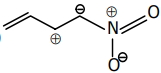
B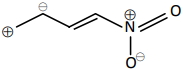
C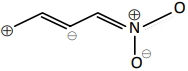
D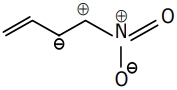
Solution
(D) Resonating structures must maintain the same number of paired and unpaired electrons and the same atomic positions.
In the given structures,we are looking for the one that violates the rules of resonance,such as exceeding the octet rule for nitrogen or having an invalid charge distribution.
Option $D$ shows a structure where the nitrogen atom is bonded to two oxygen atoms and a carbon atom,and it carries a positive charge. In this structure,the central carbon atom also carries a positive charge. This arrangement is unstable and does not represent a valid resonance contributor for the nitroalkene system because it creates an adjacent positive-positive charge repulsion and violates the stability criteria for resonance structures.
In the given structures,we are looking for the one that violates the rules of resonance,such as exceeding the octet rule for nitrogen or having an invalid charge distribution.
Option $D$ shows a structure where the nitrogen atom is bonded to two oxygen atoms and a carbon atom,and it carries a positive charge. In this structure,the central carbon atom also carries a positive charge. This arrangement is unstable and does not represent a valid resonance contributor for the nitroalkene system because it creates an adjacent positive-positive charge repulsion and violates the stability criteria for resonance structures.
0 likes
View Solution23
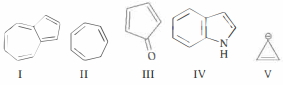
DifficultMCQ
Among the following,the antiaromatic compounds are:
A
$I$ and $IV$
B
$III$ and $V$
C
$II$ and $V$
D
$I$ and $III$
Solution
(B) The criteria for a compound to be anti-aromatic are that it must be cyclic,planar,fully conjugated,and possess $4n$ $\pi$-electrons (where $n = 1, 2, 3, ...$).
$(I)$ Azulene: It has $10$ $\pi$-electrons,which follows the $(4n+2)$ rule $(n=2)$. Thus,it is aromatic.
$(II)$ Cycloheptatriene: It contains an $sp^{3}$ hybridized carbon atom,which breaks the continuous conjugation. Thus,it is non-aromatic.
$(III)$ Cyclopentadienone: It has $4$ $\pi$-electrons in the ring (the lone pair on oxygen is not part of the cyclic conjugation in the same way as a carbanion,and the carbonyl carbon is $sp^{2}$ hybridized). It is anti-aromatic.
$(IV)$ Indole: It has $10$ $\pi$-electrons ($8$ from carbons + $2$ from the nitrogen lone pair),following the $(4n+2)$ rule. Thus,it is aromatic.
$(V)$ Cyclopropenyl anion: It has $4$ $\pi$-electrons ($2$ from the double bond + $2$ from the negative charge) and is fully conjugated with all atoms $sp^{2}$ hybridized. Thus,it is anti-aromatic.
Therefore,compounds $III$ and $V$ are anti-aromatic.
$(I)$ Azulene: It has $10$ $\pi$-electrons,which follows the $(4n+2)$ rule $(n=2)$. Thus,it is aromatic.
$(II)$ Cycloheptatriene: It contains an $sp^{3}$ hybridized carbon atom,which breaks the continuous conjugation. Thus,it is non-aromatic.
$(III)$ Cyclopentadienone: It has $4$ $\pi$-electrons in the ring (the lone pair on oxygen is not part of the cyclic conjugation in the same way as a carbanion,and the carbonyl carbon is $sp^{2}$ hybridized). It is anti-aromatic.
$(IV)$ Indole: It has $10$ $\pi$-electrons ($8$ from carbons + $2$ from the nitrogen lone pair),following the $(4n+2)$ rule. Thus,it is aromatic.
$(V)$ Cyclopropenyl anion: It has $4$ $\pi$-electrons ($2$ from the double bond + $2$ from the negative charge) and is fully conjugated with all atoms $sp^{2}$ hybridized. Thus,it is anti-aromatic.
Therefore,compounds $III$ and $V$ are anti-aromatic.
0 likes
View Solution24
DifficultMCQ
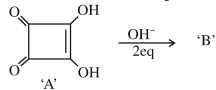
Correct statements for the given reaction are :
$A$. Compound '$B$' is aromatic
$B$. The completion of above reaction is very slow
$C$. '$A$' shows tautomerism
$D$. The bond lengths $C-C$ in compound $B$ are found to be same
Choose the correct answer from the options given below :
$A$. Compound '$B$' is aromatic
$B$. The completion of above reaction is very slow
$C$. '$A$' shows tautomerism
$D$. The bond lengths $C-C$ in compound $B$ are found to be same
Choose the correct answer from the options given below :
A
$A, B$ and $D$ only
B
$A, B$ and $C$ only
C
$B, C$ and $D$ only
D
$A, C$ and $D$ only
Solution
(D) The reaction involves the deprotonation of squaric acid $(A)$ by $2$ equivalents of $OH^-$ to form the squarate dianion $(B)$.
$1$. Compound '$B$' (squarate dianion) is aromatic because it is cyclic,planar,fully conjugated,and contains $6 \pi$ electrons ($4n+2$ rule,where $n=1$). Thus,statement $A$ is correct.
$2$. The reaction is an acid-base reaction involving the removal of acidic protons from squaric acid. Acid-base reactions are typically very fast,not slow. Thus,statement $B$ is incorrect.
$3$. Compound '$A$' (squaric acid) contains an enol group adjacent to a carbonyl group,which allows it to exhibit keto-enol tautomerism. Thus,statement $C$ is correct.
$4$. Due to resonance in the squarate dianion $(B)$,the negative charge is delocalized over the entire ring,making all $C-C$ bond lengths equal. Thus,statement $D$ is correct.
Therefore,statements $A, C,$ and $D$ are correct.
$1$. Compound '$B$' (squarate dianion) is aromatic because it is cyclic,planar,fully conjugated,and contains $6 \pi$ electrons ($4n+2$ rule,where $n=1$). Thus,statement $A$ is correct.
$2$. The reaction is an acid-base reaction involving the removal of acidic protons from squaric acid. Acid-base reactions are typically very fast,not slow. Thus,statement $B$ is incorrect.
$3$. Compound '$A$' (squaric acid) contains an enol group adjacent to a carbonyl group,which allows it to exhibit keto-enol tautomerism. Thus,statement $C$ is correct.
$4$. Due to resonance in the squarate dianion $(B)$,the negative charge is delocalized over the entire ring,making all $C-C$ bond lengths equal. Thus,statement $D$ is correct.
Therefore,statements $A, C,$ and $D$ are correct.
0 likes
View Solution25
DifficultMCQ
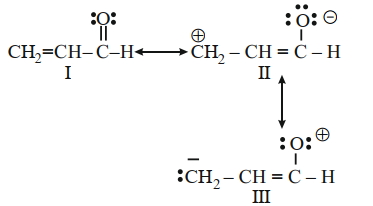
The order of relative stability of the contributing structures is:
$I: CH_2=CH-CHO$
$II: ^+CH_2-CH=CH-O^-$
$III: ^-CH_2-CH=CH-O^+$
Choose the correct answer from the options given below:
$I: CH_2=CH-CHO$
$II: ^+CH_2-CH=CH-O^-$
$III: ^-CH_2-CH=CH-O^+$
Choose the correct answer from the options given below:
A
$I > II > III$
B
$II > I > III$
C
$I = II = III$
D
$III > II > I$
Solution
(A) The stability of resonating structures is determined by the following rules:
$1$. Neutral structures are more stable than charged structures. Structure $I$ is neutral,while $II$ and $III$ are charged. Thus,$I$ is the most stable.
$2$. Between charged structures,the structure with the negative charge on the more electronegative atom (Oxygen) and the positive charge on the less electronegative atom (Carbon) is more stable. In structure $II$,the negative charge is on the oxygen atom,whereas in structure $III$,the positive charge is on the oxygen atom.
$3$. Therefore,the stability order is $I > II > III$.
$1$. Neutral structures are more stable than charged structures. Structure $I$ is neutral,while $II$ and $III$ are charged. Thus,$I$ is the most stable.
$2$. Between charged structures,the structure with the negative charge on the more electronegative atom (Oxygen) and the positive charge on the less electronegative atom (Carbon) is more stable. In structure $II$,the negative charge is on the oxygen atom,whereas in structure $III$,the positive charge is on the oxygen atom.
$3$. Therefore,the stability order is $I > II > III$.
0 likes
View Solution26
DifficultMCQ
Given below are two statements.
Statement $I :$ The dipole moment of $CH_3-CH=C(CH_3)-CH=O$ is greater than $CH_3-CH_2-CH_2-CH=O$.
Statement $II :$ $C_1-C_2$ bond length of $CH_3-CH=CH-CH=O$ is greater than $C_1-C_2$ bond length of $CH_3-CH_2-CH_2-CH=O$.
In the light of the above statements,choose the correct answer from the options given below $:$
Statement $I :$ The dipole moment of $CH_3-CH=C(CH_3)-CH=O$ is greater than $CH_3-CH_2-CH_2-CH=O$.
Statement $II :$ $C_1-C_2$ bond length of $CH_3-CH=CH-CH=O$ is greater than $C_1-C_2$ bond length of $CH_3-CH_2-CH_2-CH=O$.
In the light of the above statements,choose the correct answer from the options given below $:$
A
Statement $I$ is false but Statement $II$ is true
B
Both Statement $I$ and Statement $II$ are false
C
Statement $I$ is true but Statement $II$ is false
D
Both Statement $I$ and Statement $II$ are true
Solution
(C) Statement $-I :$ The compound $CH_3-CH=C(CH_3)-CH=O$ exhibits resonance,which leads to charge separation and a larger dipole moment compared to the saturated aldehyde $CH_3-CH_2-CH_2-CH=O$. Thus,Statement $-I$ is true.
Statement $-II :$ In $CH_3-CH=CH-CH=O$,the $C_1-C_2$ bond possesses partial double bond character due to conjugation. This results in a shorter bond length compared to the pure single $C_1-C_2$ bond in $CH_3-CH_2-CH_2-CH=O$. Thus,Statement $-II$ is false.
Statement $-II :$ In $CH_3-CH=CH-CH=O$,the $C_1-C_2$ bond possesses partial double bond character due to conjugation. This results in a shorter bond length compared to the pure single $C_1-C_2$ bond in $CH_3-CH_2-CH_2-CH=O$. Thus,Statement $-II$ is false.
0 likes
View Solution27
MediumMCQ
In which of the following is the first resonating structure less stable compared to the second one?
A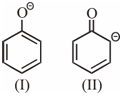
B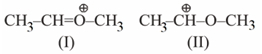
C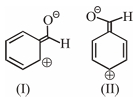
D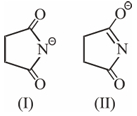
Solution
(C) To determine the stability of resonating structures,we follow these rules:
$1$. Structures with more covalent bonds are more stable.
$2$. Structures with complete octets for all atoms are more stable.
$3$. $A$ negative charge on a more electronegative atom is more stable.
In option $(C)$,structure $(I)$ has a negative charge on the nitrogen atom,while structure $(II)$ has a negative charge on the oxygen atom.
Since oxygen is more electronegative than nitrogen,the negative charge is more stable on the oxygen atom.
Therefore,structure $(I)$ is less stable than structure $(II)$.
$1$. Structures with more covalent bonds are more stable.
$2$. Structures with complete octets for all atoms are more stable.
$3$. $A$ negative charge on a more electronegative atom is more stable.
In option $(C)$,structure $(I)$ has a negative charge on the nitrogen atom,while structure $(II)$ has a negative charge on the oxygen atom.
Since oxygen is more electronegative than nitrogen,the negative charge is more stable on the oxygen atom.
Therefore,structure $(I)$ is less stable than structure $(II)$.
0 likes
View Solution28
EasyMCQ
Resonance effect is not observed in
A
$CH_2=CH-Cl$
B
$CH_2=CH-CH_2-NH_2$
C
$CH_2=CH-CH=CH_2$
D
$CH_2=CH-C\equiv N$
Solution
(B)
In $CH_2=CH-CH_2-NH_2$,the lone pair on the nitrogen atom is separated from the $\pi$ bond by an $sp^3$ hybridized carbon atom ($-CH_2-$ group).
Since there is no continuous conjugation,the resonance effect is not observed in this molecule.
In $CH_2=CH-CH_2-NH_2$,the lone pair on the nitrogen atom is separated from the $\pi$ bond by an $sp^3$ hybridized carbon atom ($-CH_2-$ group).
Since there is no continuous conjugation,the resonance effect is not observed in this molecule.
0 likes
View Solution29
EasyMCQ
Which of the following species does not exert a resonance effect?
A
$C_{6}H_{5}NH_{2}$
B
$C_{6}H_{5}NH_{3}^{+}$
C
$C_{6}H_{5}OH$
D
$C_{6}H_{5}Cl$
Solution
(B) In $C_{6}H_{5}NH_{2}$,$C_{6}H_{5}OH$,and $C_{6}H_{5}Cl$,the substituent attached to the benzene ring has at least one lone pair of electrons,which can participate in resonance with the $\pi$-system of the ring.
In $C_{6}H_{5}NH_{3}^{+}$,the nitrogen atom has four bonds and no lone pair of electrons available for resonance.
As shown in the figure,structure $(II)$ is not a valid resonance contributor because the nitrogen atom would have $10$ valence electrons,which violates the octet rule.
Therefore,$C_{6}H_{5}NH_{3}^{+}$ does not exert a resonance effect.
In $C_{6}H_{5}NH_{3}^{+}$,the nitrogen atom has four bonds and no lone pair of electrons available for resonance.
As shown in the figure,structure $(II)$ is not a valid resonance contributor because the nitrogen atom would have $10$ valence electrons,which violates the octet rule.
Therefore,$C_{6}H_{5}NH_{3}^{+}$ does not exert a resonance effect.
0 likes
View Solution30
MediumMCQ
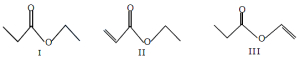
The correct order of $C=O$ bond length in ethyl propanoate $(I)$,ethyl propenoate $(II)$ and ethenyl propanoate $(III)$ is
A
$I > II > III$
B
$III > II > I$
C
$I > III > II$
D
$II > I > III$
Solution
(B) The bond length of the $C=O$ bond depends on the extent of resonance. Greater resonance character increases the single bond character of the $C=O$ bond,thereby increasing its bond length.
$I$: Ethyl propanoate has no conjugation with the $C=O$ group.
$II$: Ethyl propenoate has conjugation between the $C=C$ double bond and the $C=O$ group,which increases the single bond character of $C=O$.
$III$: Ethenyl propanoate has conjugation between the lone pair of the oxygen atom and the $C=O$ group (back-bonding),which significantly increases the single bond character of $C=O$.
Comparing the resonance effects:
In $III$,the lone pair on the oxygen atom is directly conjugated with the $C=O$ group,leading to a strong resonance effect that makes the $C=O$ bond more like a single bond.
In $II$,the $C=C$ double bond is conjugated with the $C=O$ group.
In $I$,there is no such conjugation.
Thus,the extent of single bond character is $III > II > I$.
Therefore,the order of $C=O$ bond length is $III > II > I$.
$I$: Ethyl propanoate has no conjugation with the $C=O$ group.
$II$: Ethyl propenoate has conjugation between the $C=C$ double bond and the $C=O$ group,which increases the single bond character of $C=O$.
$III$: Ethenyl propanoate has conjugation between the lone pair of the oxygen atom and the $C=O$ group (back-bonding),which significantly increases the single bond character of $C=O$.
Comparing the resonance effects:
In $III$,the lone pair on the oxygen atom is directly conjugated with the $C=O$ group,leading to a strong resonance effect that makes the $C=O$ bond more like a single bond.
In $II$,the $C=C$ double bond is conjugated with the $C=O$ group.
In $I$,there is no such conjugation.
Thus,the extent of single bond character is $III > II > I$.
Therefore,the order of $C=O$ bond length is $III > II > I$.
0 likes
View Solution31
EasyMCQ
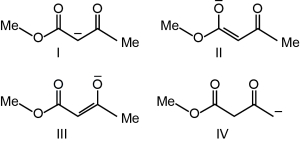
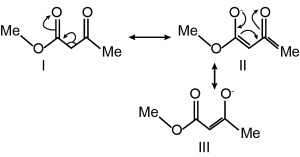
Among the following structures,the one which is not a resonating structure of others is:
A
$I$
B
$II$
C
$III$
D
$IV$
Solution
(D) Resonating structures involve the delocalization of $\pi$-electrons or lone pairs,but they do not involve the movement of atoms or groups of atoms.
In structures $I$,$II$,and $III$,the connectivity of atoms remains the same,and only the positions of electrons change.
In structure $IV$,the negative charge is on the terminal carbon atom,which implies a different connectivity compared to the enolate structures $I$,$II$,and $III$.
Thus,structure $IV$ is not a resonating structure of the others.
In structures $I$,$II$,and $III$,the connectivity of atoms remains the same,and only the positions of electrons change.
In structure $IV$,the negative charge is on the terminal carbon atom,which implies a different connectivity compared to the enolate structures $I$,$II$,and $III$.
Thus,structure $IV$ is not a resonating structure of the others.
0 likes
View Solution32
MediumMCQ
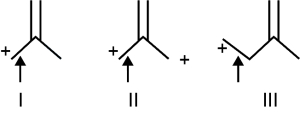
The correct order of decreasing length of the bond as indicated by the arrow in the following structures is:
A
$I > II > III$
B
$II > I > III$
C
$III > II > I$
D
$I > III > II$
Solution
(C) The bond length is inversely proportional to the double bond character. Resonance increases the double bond character,thereby decreasing the bond length.
In structure $I$,the positive charge is in direct conjugation with the double bond,leading to significant double bond character.
In structure $II$,the positive charge is also in conjugation,but the presence of two positive charges creates a different electronic environment compared to $I$.
In structure $III$,the positive charge is separated from the double bond by a $CH_2$ group,so there is no resonance-induced double bond character.
Therefore,the bond length follows the order: $III > II > I$.
In structure $I$,the positive charge is in direct conjugation with the double bond,leading to significant double bond character.
In structure $II$,the positive charge is also in conjugation,but the presence of two positive charges creates a different electronic environment compared to $I$.
In structure $III$,the positive charge is separated from the double bond by a $CH_2$ group,so there is no resonance-induced double bond character.
Therefore,the bond length follows the order: $III > II > I$.
0 likes
View Solution33
MediumMCQ
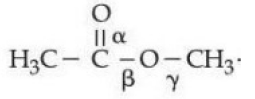
Shown below is the structure of methyl acetate with three different $\alpha, \beta$ and $\gamma$ carbon-oxygen bonds.
The correct order of bond lengths of these bonds is:
The correct order of bond lengths of these bonds is:
A
$\alpha > \beta > \gamma$
B
$\alpha < \beta < \gamma$
C
$\alpha = \beta = \gamma$
D
$\alpha < \beta = \gamma$
Solution
(B) In methyl acetate $(CH_3COOCH_3)$,the $\alpha$ bond is a $C=O$ double bond,which is the shortest.
The $\beta$ bond is the $C-O$ single bond (ester linkage) and $\gamma$ is the $C-O$ bond of the methoxy group.
Due to resonance,the ester $C-O$ bond $(\beta)$ acquires some double bond character,while the $\gamma$ bond remains a pure single bond.
Thus,the bond length order is $C=O < C-O_{\text{ester}} < C-O_{\text{alkyl}}$,i.e.,$\alpha < \beta < \gamma$.
The $\beta$ bond is the $C-O$ single bond (ester linkage) and $\gamma$ is the $C-O$ bond of the methoxy group.
Due to resonance,the ester $C-O$ bond $(\beta)$ acquires some double bond character,while the $\gamma$ bond remains a pure single bond.
Thus,the bond length order is $C=O < C-O_{\text{ester}} < C-O_{\text{alkyl}}$,i.e.,$\alpha < \beta < \gamma$.
0 likes
View Solution8-4.Organic Chemistry : Reaction mechanism — Dipole moment and resonance · Frequently Asked Questions
1Are these 8-4.Organic Chemistry : Reaction mechanism questions useful for JEE and NEET?
Yes. All questions in this section are mapped to JEE Main and NEET exam patterns. Previous year questions from JEE Main, NEET, GUJCET and state-level exams are included with full solutions.
2Can I switch to Hindi or Gujarati for these questions?
Yes. Use the language tabs in the hero section or the sidebar to view the same questions and solutions in English, Hindi or Gujarati.
3How do I generate a question paper from this subtopic?
Use the Vedclass Exam Paper Generator — select the chapter and subtopic, set difficulty, and generate Sets A, B, C, D automatically. First 3 chapters of every subject are free.
Vedclass Products
For Students
Vedclass Test Series
Mock tests in real JEE/NEET style with performance analysis. 5-day free trial.
Start Free TrialFor Teachers
Exam Paper Generator
Generate Set A/B/C/D papers from this chapter in 2 minutes. 3 chapters free.
Try FreeFor Institutes
Online Exam Module
Live online exams with unlimited students, 360° analytics & white-label branding.
See DemoFor Teachers & Institutes
Generate a 8-4.Organic Chemistry : Reaction mechanism Exam Paper in 2 Minutes
Select subtopic & difficulty — Sets A, B, C, D auto-generated with No Repeat logic.
First 3 chapters of every subject are free — no payment required.