
A English
Reactive Intermediates Questions in English
Class 11 Chemistry · 8-4.Organic Chemistry : Reaction mechanism · Reactive Intermediates
280+
Questions
English
Language
100%
With Solutions
Showing 50 of 280 questions in English
51
DifficultMCQ
Which of the following is the correct decreasing order of stability of carbanions?
$(1) (CH_3)_3C^-$
$(2) (CH_3)_2CH^-$
$(3) CH_3CH_2^-$
$(4) C_6H_5CH_2^-$
$(1) (CH_3)_3C^-$
$(2) (CH_3)_2CH^-$
$(3) CH_3CH_2^-$
$(4) C_6H_5CH_2^-$
A
$1 > 2 > 3 > 4$
B
$4 > 3 > 2 > 1$
C
$4 > 1 > 2 > 3$
D
$1 > 2 > 4 > 3$
Solution
(B) The stability of carbanions is determined by the inductive effect ($+I$ effect) and resonance.
$(1) (CH_3)_3C^-$ is a tertiary carbanion,$(2) (CH_3)_2CH^-$ is a secondary carbanion,and $(3) CH_3CH_2^-$ is a primary carbanion. The $+I$ effect of alkyl groups destabilizes the carbanion,so stability follows the order: $1^circ > 2^circ > 3^circ$.
$(4) C_6H_5CH_2^-$ is a benzyl carbanion,which is stabilized by resonance with the phenyl ring,making it more stable than the alkyl carbanions.
Thus,the decreasing order of stability is: $C_6H_5CH_2^- (4) > CH_3CH_2^- (3) > (CH_3)_2CH^- (2) > (CH_3)_3C^- (1)$.
$(1) (CH_3)_3C^-$ is a tertiary carbanion,$(2) (CH_3)_2CH^-$ is a secondary carbanion,and $(3) CH_3CH_2^-$ is a primary carbanion. The $+I$ effect of alkyl groups destabilizes the carbanion,so stability follows the order: $1^circ > 2^circ > 3^circ$.
$(4) C_6H_5CH_2^-$ is a benzyl carbanion,which is stabilized by resonance with the phenyl ring,making it more stable than the alkyl carbanions.
Thus,the decreasing order of stability is: $C_6H_5CH_2^- (4) > CH_3CH_2^- (3) > (CH_3)_2CH^- (2) > (CH_3)_3C^- (1)$.
0 likes
View Solution52
EasyMCQ
What is the shape of the methyl carbocation,$\overset{\oplus}{C}H_3$?
A
Trigonal planar
B
Tetrahedral
C
Square planar
D
Linear
Solution
(A) In the methyl carbocation,$\overset{\oplus}{C}H_3$,the central carbon atom is $sp^2$ hybridized.
It has three bonding pairs of electrons and no lone pair.
According to the Valence Shell Electron Pair Repulsion $(VSEPR)$ theory,an $sp^2$ hybridized carbon with three bonding pairs adopts a trigonal planar geometry with a bond angle of $120^{\circ}$.
It has three bonding pairs of electrons and no lone pair.
According to the Valence Shell Electron Pair Repulsion $(VSEPR)$ theory,an $sp^2$ hybridized carbon with three bonding pairs adopts a trigonal planar geometry with a bond angle of $120^{\circ}$.
0 likes
View Solution53
MediumMCQ
Which of the following is an incorrect stability order?
A
$CH_2=CH-CH_2^+ > CH_3-CH^+-CH_3$
B
$CH_2=CH^+ < CH_3-CH_2^+$
C
$CH_3-CH_2-CH_2^- > CH_3-CH^--CH_3$
D
$CH_3-CH_2^+ > CH_3O-CH_2^+$
0 likes
View Solution54
MediumMCQ
Singlet methylene is....
A
Lewis base
B
Diamagnetic
C
Nucleophile
D
Paramagnetic
Solution
(B) In singlet methylene $(:CH_2)$,the carbon atom is $sp^2$ hybridized.
Two $sp^2$ orbitals are used to form bonds with hydrogen atoms,while the third $sp^2$ orbital contains a lone pair of electrons with opposite spins.
Since all electrons are paired,singlet methylene is diamagnetic in nature.
Two $sp^2$ orbitals are used to form bonds with hydrogen atoms,while the third $sp^2$ orbital contains a lone pair of electrons with opposite spins.
Since all electrons are paired,singlet methylene is diamagnetic in nature.
0 likes
View Solution55
EasyMCQ
What is the hybridization state of a carbocation?
A
$sp^3d$
B
$sp^3$
C
$sp^2$
D
$sp$
Solution
(C) carbocation is a species containing a carbon atom bearing a positive charge and having only $6$ electrons in its valence shell.
In a simple alkyl carbocation (e.g.,$CH_3^+$),the central carbon atom is bonded to three other atoms via single bonds.
Since there are $3$ sigma bonds and no lone pairs on the central carbon,the steric number is $3$.
Therefore,the hybridization of the central carbon atom in a carbocation is $sp^2$,and its geometry is trigonal planar.
In a simple alkyl carbocation (e.g.,$CH_3^+$),the central carbon atom is bonded to three other atoms via single bonds.
Since there are $3$ sigma bonds and no lone pairs on the central carbon,the steric number is $3$.
Therefore,the hybridization of the central carbon atom in a carbocation is $sp^2$,and its geometry is trigonal planar.
0 likes
View Solution56
MediumMCQ
Which of the following are secondary radicals?
$(1) \ CH_3 - \dot{C}H - C_2H_5$
$(2) \ CH_2 = \dot{C} - CH_3$
$(3) \ CH_2 = CH - \dot{C}H_2$
$(4) \ (CH_3)_2 \dot{C}H$
$(1) \ CH_3 - \dot{C}H - C_2H_5$
$(2) \ CH_2 = \dot{C} - CH_3$
$(3) \ CH_2 = CH - \dot{C}H_2$
$(4) \ (CH_3)_2 \dot{C}H$
A
$1, 2, 3$
B
$1, 4, 3$
C
$2, 3, 4$
D
$1, 2, 4$
Solution
(D) secondary radical is a carbon radical where the carbon atom bearing the unpaired electron is bonded to two other carbon atoms.
$(1) \ CH_3 - \dot{C}H - C_2H_5$: The radical carbon is bonded to two carbons ($CH_3$ and $C_2H_5$). This is a secondary radical.
$(2) \ CH_2 = \dot{C} - CH_3$: The radical carbon is bonded to two carbons ($CH_2$ and $CH_3$). This is a secondary radical.
$(3) \ CH_2 = CH - \dot{C}H_2$: The radical carbon is bonded to only one carbon $(CH=CH_2)$. This is a primary radical.
$(4) \ (CH_3)_2 \dot{C}H$: The radical carbon is bonded to two carbons ($CH_3$ and $CH_3$). This is a secondary radical.
Therefore,$(1)$,$(2)$,and $(4)$ are secondary radicals.
$(1) \ CH_3 - \dot{C}H - C_2H_5$: The radical carbon is bonded to two carbons ($CH_3$ and $C_2H_5$). This is a secondary radical.
$(2) \ CH_2 = \dot{C} - CH_3$: The radical carbon is bonded to two carbons ($CH_2$ and $CH_3$). This is a secondary radical.
$(3) \ CH_2 = CH - \dot{C}H_2$: The radical carbon is bonded to only one carbon $(CH=CH_2)$. This is a primary radical.
$(4) \ (CH_3)_2 \dot{C}H$: The radical carbon is bonded to two carbons ($CH_3$ and $CH_3$). This is a secondary radical.
Therefore,$(1)$,$(2)$,and $(4)$ are secondary radicals.
0 likes
View Solution57
DifficultMCQ
Which of the following is the electrophile involved in the given reaction?
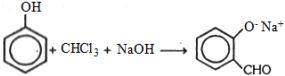
A
Dichlorocarbene $(:CCl_2)$
B
Trichloromethyl anion $(\overset{\ominus}{C}Cl_3)$
C
Formyl cation $(\overset{\oplus}{C}HO)$
D
Dichloromethyl cation $(\overset{\oplus}{C}HCl_2)$
Solution
(A) The given reaction is the Reimer-Tiemann reaction,where phenol reacts with chloroform $(CHCl_3)$ in the presence of an aqueous base $(NaOH)$ to form salicylaldehyde.
In the first step of this reaction,chloroform reacts with the hydroxide ion to form the trichloromethyl anion,which then loses a chloride ion to generate dichlorocarbene $(:CCl_2)$.
Dichlorocarbene is an electron-deficient species with a sextet of electrons,making it a strong electrophile that attacks the phenoxide ion.
In the first step of this reaction,chloroform reacts with the hydroxide ion to form the trichloromethyl anion,which then loses a chloride ion to generate dichlorocarbene $(:CCl_2)$.
Dichlorocarbene is an electron-deficient species with a sextet of electrons,making it a strong electrophile that attacks the phenoxide ion.
0 likes
View Solution58
MediumMCQ
Which of the following species $(A)$,$(B)$,$(C)$,and $(D)$ contain an $sp^2$ hybridized carbon atom? $(A) CH_3^+$,$(B) CH_3^-$,$(C) dot{C}H_3$,$(D) :CH_2$
A
Only $A$
B
Only $A$ and $B$
C
Only $A$ and $C$
D
$A, C$ and $D$
Solution
(D) To determine the hybridization of the carbon atom in each species:
$1$. $CH_3^+$ (Carbocation): The carbon atom has $3$ bond pairs and $0$ lone pairs. Steric number $= 3 + 0 = 3$,which corresponds to $sp^2$ hybridization.
$2$. $CH_3^-$ (Carbanion): The carbon atom has $3$ bond pairs and $1$ lone pair. Steric number $= 3 + 1 = 4$,which corresponds to $sp^3$ hybridization.
$3$. $dot{C}H_3$ (Free radical): The carbon atom has $3$ bond pairs and $1$ unpaired electron. The geometry is planar,and the carbon is $sp^2$ hybridized.
$4$. $:CH_2$ (Carbene): In singlet carbene,the carbon atom has $2$ bond pairs and $1$ lone pair. Steric number $= 2 + 1 = 3$,which corresponds to $sp^2$ hybridization.
Therefore,species $(A)$,$(C)$,and $(D)$ contain $sp^2$ hybridized carbon atoms.
$1$. $CH_3^+$ (Carbocation): The carbon atom has $3$ bond pairs and $0$ lone pairs. Steric number $= 3 + 0 = 3$,which corresponds to $sp^2$ hybridization.
$2$. $CH_3^-$ (Carbanion): The carbon atom has $3$ bond pairs and $1$ lone pair. Steric number $= 3 + 1 = 4$,which corresponds to $sp^3$ hybridization.
$3$. $dot{C}H_3$ (Free radical): The carbon atom has $3$ bond pairs and $1$ unpaired electron. The geometry is planar,and the carbon is $sp^2$ hybridized.
$4$. $:CH_2$ (Carbene): In singlet carbene,the carbon atom has $2$ bond pairs and $1$ lone pair. Steric number $= 2 + 1 = 3$,which corresponds to $sp^2$ hybridization.
Therefore,species $(A)$,$(C)$,and $(D)$ contain $sp^2$ hybridized carbon atoms.
0 likes
View Solution59
MediumMCQ
Consider the following carbocations. What is the relative stability order of these carbocations?
$(1)$ $CH_3O-C_6H_4-CH_2^+$
$(2)$ $C_6H_5-CH_2^+$
$(3)$ $CH_3-C_6H_4-CH_2^+$
$(1)$ $CH_3O-C_6H_4-CH_2^+$
$(2)$ $C_6H_5-CH_2^+$
$(3)$ $CH_3-C_6H_4-CH_2^+$
A
$2 < 3 < 1$
B
$3 < 2 < 1$
C
$2 < 1 < 3$
D
$1 < 2 < 3$
Solution
(A) The stability of carbocations is determined by the electronic effects of the substituents attached to the benzene ring.
$(1)$ $CH_3O-$ group is a strong electron-donating group by resonance ($+M$ effect),which significantly stabilizes the carbocation.
$(2)$ The unsubstituted benzyl carbocation $(C_6H_5-CH_2^+)$ has only resonance stabilization from the phenyl ring.
$(3)$ $CH_3-$ group is an electron-donating group by hyperconjugation and inductive effect ($+I$ effect),which provides moderate stabilization.
Therefore,the stability order is $(1) > (3) > (2)$,which is equivalent to $2 < 3 < 1$.
$(1)$ $CH_3O-$ group is a strong electron-donating group by resonance ($+M$ effect),which significantly stabilizes the carbocation.
$(2)$ The unsubstituted benzyl carbocation $(C_6H_5-CH_2^+)$ has only resonance stabilization from the phenyl ring.
$(3)$ $CH_3-$ group is an electron-donating group by hyperconjugation and inductive effect ($+I$ effect),which provides moderate stabilization.
Therefore,the stability order is $(1) > (3) > (2)$,which is equivalent to $2 < 3 < 1$.
0 likes
View Solution60
EasyMCQ
Due to the presence of an unpaired electron,free radicals are .........
A
chemically inert
B
chemically reactive
C
cations
D
anions
Solution
(B) Free radicals are species that contain at least one unpaired electron.
Because of this unpaired electron,they are highly unstable and chemically reactive,as they tend to pair up the electron to achieve a stable electronic configuration.
Because of this unpaired electron,they are highly unstable and chemically reactive,as they tend to pair up the electron to achieve a stable electronic configuration.
0 likes
View Solution61
EasyMCQ
In a carbonium ion,the carbon atom bearing the positive charge is in the:
A
$sp^2$-hybridized state
B
$sp^3d$-hybridized state
C
$sp$-hybridized state
D
$sp^3$-hybridized state
Solution
(A) The central carbon atom in a carbonium ion (carbocation) is bonded to three other atoms and has no lone pairs.
According to the valence shell electron pair repulsion theory,the steric number is $3$,which corresponds to $sp^2$ hybridization.
Therefore,the carbon atom bearing the positive charge is in the $sp^2$-hybridized state.
According to the valence shell electron pair repulsion theory,the steric number is $3$,which corresponds to $sp^2$ hybridization.
Therefore,the carbon atom bearing the positive charge is in the $sp^2$-hybridized state.
0 likes
View Solution62
EasyMCQ
The shape of a carbonium ion (carbocation) is:
A
Planar
B
Pyramidal
C
Linear
D
None of these
Solution
(A) In a carbonium ion (carbocation),the positively charged carbon atom is $sp^2$ hybridized.
This $sp^2$ hybridization results in a trigonal planar geometry,where the three bonds lie in the same plane with a bond angle of $120^{\circ}$.
Therefore,the correct shape is planar.
This $sp^2$ hybridization results in a trigonal planar geometry,where the three bonds lie in the same plane with a bond angle of $120^{\circ}$.
Therefore,the correct shape is planar.
0 likes
View Solution63
EasyMCQ
Due to the presence of an unpaired electron,free radicals are
A
Chemically reactive
B
Chemically inactive
C
Anions
D
Cations
Solution
(A) Free radicals are highly reactive species because they possess an unpaired electron,which makes them seek to complete their octet by reacting with other molecules.
0 likes
View Solution64
MediumMCQ
Consider the following compounds:
$(I)$ $(CH_3)_3C-CH^{\bullet}-C_6H_5$
$(II)$ $(C_6H_5)_3C^{\bullet}$
$(III)$ $2$-methylbicyclo$[2.2.1]$hept$-2-$yl radical (as shown in the image)
Hyperconjugation occurs in:
$(I)$ $(CH_3)_3C-CH^{\bullet}-C_6H_5$
$(II)$ $(C_6H_5)_3C^{\bullet}$
$(III)$ $2$-methylbicyclo$[2.2.1]$hept$-2-$yl radical (as shown in the image)
Hyperconjugation occurs in:
A
$III$ only
B
$I$ and $III$
C
$I$ only
D
$II$ only
Solution
(A) Hyperconjugation in free radicals occurs through the $\alpha$-hydrogen atoms present on the carbon atom adjacent to the radical carbon atom.
In structure $(I)$,the radical carbon is attached to a tert-butyl group and a phenyl group. There are no $\alpha$-hydrogens on the carbon adjacent to the radical center.
In structure $(II)$,the radical carbon is attached to three phenyl groups. There are no $\alpha$-hydrogens.
In structure $(III)$,the radical carbon is part of a bicyclic system and is attached to a $-CH_3$ group. The carbon atom adjacent to the radical carbon has an $\alpha$-hydrogen atom,which allows for hyperconjugation.
Therefore,hyperconjugation occurs in structure $(III)$ only.
In structure $(I)$,the radical carbon is attached to a tert-butyl group and a phenyl group. There are no $\alpha$-hydrogens on the carbon adjacent to the radical center.
In structure $(II)$,the radical carbon is attached to three phenyl groups. There are no $\alpha$-hydrogens.
In structure $(III)$,the radical carbon is part of a bicyclic system and is attached to a $-CH_3$ group. The carbon atom adjacent to the radical carbon has an $\alpha$-hydrogen atom,which allows for hyperconjugation.
Therefore,hyperconjugation occurs in structure $(III)$ only.
0 likes
View Solution65
DifficultMCQ
In which of the following compounds,the $C-Cl$ bond ionisation shall give the most stable carbonium ion?
A
$C_6H_5CH_2Cl$
B
$O_2NCH_2CH_2Cl$
C
$(CH_3)_2CH-Cl$
D
$(CH_3)_3C-Cl$
Solution
(A) The stability of a carbocation is determined by factors like resonance,hyperconjugation,and the inductive effect.
$1$. $C_6H_5CH_2Cl$ ionizes to form the benzyl carbocation $(C_6H_5CH_2^+)$,which is highly stabilized by resonance with the benzene ring.
$2$. $(CH_3)_3C-Cl$ forms a tertiary carbocation,which is stabilized by hyperconjugation and the inductive effect of three methyl groups.
$3$. $(CH_3)_2CH-Cl$ forms a secondary carbocation,which is less stable than the tertiary one.
$4$. $O_2NCH_2CH_2Cl$ forms a primary carbocation,which is further destabilized by the electron-withdrawing nitro group.
Comparing the benzyl carbocation and the tertiary carbocation,the resonance stabilization provided by the phenyl ring in the benzyl carbocation makes it significantly more stable than the simple alkyl-substituted tertiary carbocation. Therefore,$C_6H_5CH_2Cl$ gives the most stable carbonium ion.
$1$. $C_6H_5CH_2Cl$ ionizes to form the benzyl carbocation $(C_6H_5CH_2^+)$,which is highly stabilized by resonance with the benzene ring.
$2$. $(CH_3)_3C-Cl$ forms a tertiary carbocation,which is stabilized by hyperconjugation and the inductive effect of three methyl groups.
$3$. $(CH_3)_2CH-Cl$ forms a secondary carbocation,which is less stable than the tertiary one.
$4$. $O_2NCH_2CH_2Cl$ forms a primary carbocation,which is further destabilized by the electron-withdrawing nitro group.
Comparing the benzyl carbocation and the tertiary carbocation,the resonance stabilization provided by the phenyl ring in the benzyl carbocation makes it significantly more stable than the simple alkyl-substituted tertiary carbocation. Therefore,$C_6H_5CH_2Cl$ gives the most stable carbonium ion.
0 likes
View Solution66
MediumMCQ
Arrange the following carbocations in increasing order of stability:
$1. \, (CH_3)_2 - \overset{+}{C} - CH_2 - CH_3$
$2. \, (CH_3)_3 - \overset{+}{C}$
$3. \, (CH_3)_2 - \overset{+}{C} H$
$4. \, CH_3 - \overset{+}{C} H_2$
$5. \, \overset{+}{C} H_3$
$1. \, (CH_3)_2 - \overset{+}{C} - CH_2 - CH_3$
$2. \, (CH_3)_3 - \overset{+}{C}$
$3. \, (CH_3)_2 - \overset{+}{C} H$
$4. \, CH_3 - \overset{+}{C} H_2$
$5. \, \overset{+}{C} H_3$
A
$5 < 4 < 3 < 1 < 2$
B
$4 < 5 < 3 < 1 < 2$
C
$1 < 5 < 4 < 3 < 2$
D
$5 < 4 < 3 < 2 < 1$
Solution
(A) The stability of carbocations is determined by the inductive effect and hyperconjugation,following the order: $methyl < 1^{\circ} < 2^{\circ} < 3^{\circ}$.
Analyzing the given carbocations:
$5. \, \overset{+}{C} H_3$ (Methyl carbocation)
$4. \, CH_3 - \overset{+}{C} H_2$ ($1^{\circ}$ carbocation)
$3. \, (CH_3)_2 - \overset{+}{C} H$ ($2^{\circ}$ carbocation)
$1. \, (CH_3)_2 - \overset{+}{C} - CH_2 - CH_3$ ($3^{\circ}$ carbocation)
$2. \, (CH_3)_3 - \overset{+}{C}$ ($3^{\circ}$ carbocation)
Note that $1$ and $2$ are both $3^{\circ}$ carbocations. However,$(CH_3)_3 - \overset{+}{C}$ (tert-butyl) is slightly more stable than $(CH_3)_2 - \overset{+}{C} - CH_2 - CH_3$ due to more hyperconjugative structures.
Thus,the increasing order of stability is: $5 < 4 < 3 < 1 < 2$.
Analyzing the given carbocations:
$5. \, \overset{+}{C} H_3$ (Methyl carbocation)
$4. \, CH_3 - \overset{+}{C} H_2$ ($1^{\circ}$ carbocation)
$3. \, (CH_3)_2 - \overset{+}{C} H$ ($2^{\circ}$ carbocation)
$1. \, (CH_3)_2 - \overset{+}{C} - CH_2 - CH_3$ ($3^{\circ}$ carbocation)
$2. \, (CH_3)_3 - \overset{+}{C}$ ($3^{\circ}$ carbocation)
Note that $1$ and $2$ are both $3^{\circ}$ carbocations. However,$(CH_3)_3 - \overset{+}{C}$ (tert-butyl) is slightly more stable than $(CH_3)_2 - \overset{+}{C} - CH_2 - CH_3$ due to more hyperconjugative structures.
Thus,the increasing order of stability is: $5 < 4 < 3 < 1 < 2$.
0 likes
View Solution67
MediumMCQ
What is the hybridisation state of the benzyl carbocation shown in the image?

A
$sp^2$
B
$spd^2$
C
$sp^2d$
D
$sp^3$
Solution
(A) The benzyl carbocation is represented as $C_6H_5CH_2^+$.
In the $CH_2^+$ group,the central carbon atom is bonded to two hydrogen atoms and one phenyl ring carbon atom.
It has three sigma bonds and no lone pairs of electrons.
Therefore,the steric number is $3$,which corresponds to $sp^2$ hybridisation.
All carbocations are $sp^2$ hybridised and possess a planar triangular geometry.
In the $CH_2^+$ group,the central carbon atom is bonded to two hydrogen atoms and one phenyl ring carbon atom.
It has three sigma bonds and no lone pairs of electrons.
Therefore,the steric number is $3$,which corresponds to $sp^2$ hybridisation.
All carbocations are $sp^2$ hybridised and possess a planar triangular geometry.
0 likes
View Solution68
DifficultMCQ
Homolytic fission of the following alkanes forms free radicals: $CH_3-CH_3$,$CH_3-CH_2-CH_3$,$(CH_3)_2CH-CH_3$,and $CH_3-CH_2-CH(CH_3)_2$. The increasing order of stability of the resulting free radicals is:
A
$CH_3-\dot{C}H_2 < (CH_3)_2\dot{C}H < (CH_3)_2\dot{C}-CH_2CH_3 < (CH_3)_3\dot{C}$
B
$CH_3-\dot{C}H_2 < CH_3-\dot{C}H-CH_3 < (CH_3)_2\dot{C}-CH_2-CH_3 < (CH_3)_3\dot{C}$
C
$CH_3-\dot{C}H_2 < CH_3-\dot{C}H-CH_3 < (CH_3)_3\dot{C} < (CH_3)_2\dot{C}-CH_2CH_3$
D
$(CH_3)_3\dot{C} < (CH_3)_2\dot{C}-CH_2CH_3 < CH_3-\dot{C}H-CH_3 < CH_3-\dot{C}H_2$
Solution
(B) The stability of free radicals is determined by the number of hyperconjugative structures and inductive effects.
Primary $(1^\circ)$ radicals are less stable than secondary $(2^\circ)$ radicals,which are less stable than tertiary $(3^\circ)$ radicals.
$1$. $CH_3-\dot{C}H_2$ (Primary)
$2$. $CH_3-\dot{C}H-CH_3$ (Secondary)
$3$. $(CH_3)_2\dot{C}-CH_2CH_3$ (Secondary,but more substituted)
$4$. $(CH_3)_3\dot{C}$ (Tertiary)
Stability order: $1^\circ < 2^\circ < 3^\circ$.
Thus,the increasing order is $CH_3-\dot{C}H_2 < CH_3-\dot{C}H-CH_3 < (CH_3)_2\dot{C}-CH_2CH_3 < (CH_3)_3\dot{C}$.
Primary $(1^\circ)$ radicals are less stable than secondary $(2^\circ)$ radicals,which are less stable than tertiary $(3^\circ)$ radicals.
$1$. $CH_3-\dot{C}H_2$ (Primary)
$2$. $CH_3-\dot{C}H-CH_3$ (Secondary)
$3$. $(CH_3)_2\dot{C}-CH_2CH_3$ (Secondary,but more substituted)
$4$. $(CH_3)_3\dot{C}$ (Tertiary)
Stability order: $1^\circ < 2^\circ < 3^\circ$.
Thus,the increasing order is $CH_3-\dot{C}H_2 < CH_3-\dot{C}H-CH_3 < (CH_3)_2\dot{C}-CH_2CH_3 < (CH_3)_3\dot{C}$.
0 likes
View Solution69
DifficultMCQ
Arrange the following carbanions in the order of their stability:
$i$. $RC \equiv C^{\ominus}$
$ii$. $C_6H_5^{\ominus}$
$iii$. $R_2C = CH^{\ominus}$
$iv$. $R_3C - CH_2^{\ominus}$
$i$. $RC \equiv C^{\ominus}$
$ii$. $C_6H_5^{\ominus}$
$iii$. $R_2C = CH^{\ominus}$
$iv$. $R_3C - CH_2^{\ominus}$
A
$iv > ii > iii > i$
B
$i > iii > ii > iv$
C
$i > ii > iii > iv$
D
$ii > iii > iv > i$
Solution
(C) The stability of a carbanion is directly proportional to the $s$-character of the carbon atom bearing the negative charge.
$i$. $RC \equiv C^{\ominus}$: The carbon is $sp$ hybridized ($50\% \ s$-character).
$ii$. $C_6H_5^{\ominus}$: The carbon is $sp^2$ hybridized ($33.3\% \ s$-character).
$iii$. $R_2C = CH^{\ominus}$: The carbon is $sp^2$ hybridized ($33.3\% \ s$-character). However,the alkyl groups $(R)$ are electron-donating,which destabilizes the carbanion compared to $C_6H_5^{\ominus}$.
$iv$. $R_3C - CH_2^{\ominus}$: The carbon is $sp^3$ hybridized ($25\% \ s$-character),which is the least stable.
Therefore,the correct order of stability is $i > ii > iii > iv$.
$i$. $RC \equiv C^{\ominus}$: The carbon is $sp$ hybridized ($50\% \ s$-character).
$ii$. $C_6H_5^{\ominus}$: The carbon is $sp^2$ hybridized ($33.3\% \ s$-character).
$iii$. $R_2C = CH^{\ominus}$: The carbon is $sp^2$ hybridized ($33.3\% \ s$-character). However,the alkyl groups $(R)$ are electron-donating,which destabilizes the carbanion compared to $C_6H_5^{\ominus}$.
$iv$. $R_3C - CH_2^{\ominus}$: The carbon is $sp^3$ hybridized ($25\% \ s$-character),which is the least stable.
Therefore,the correct order of stability is $i > ii > iii > iv$.
0 likes
View Solution70
DifficultMCQ
Arrange the carbanions,$(CH_3)_3\overline{C}$,$\overline{C}Cl_3$,$(CH_3)_2\overline{C}H$,$C_6H_5\overline{C}H_2$ in order of their decreasing stability:
A
$(CH_3)_2\overline{C}H > \overline{C}Cl_3 > C_6H_5\overline{C}H_2 > (CH_3)_3\overline{C}$
B
$\overline{C}Cl_3 > C_6H_5\overline{C}H_2 > (CH_3)_2\overline{C}H > (CH_3)_3\overline{C}$
C
$(CH_3)_3\overline{C} > (CH_3)_2\overline{C}H > C_6H_5\overline{C}H_2 > \overline{C}Cl_3$
D
$C_6H_5\overline{C}H_2 > \overline{C}Cl_3 > (CH_3)_3\overline{C} > (CH_3)_2\overline{C}H$
Solution
(B) The stability of carbanions is determined by the electronic effects of the attached groups.
Electron-withdrawing groups ($-I$ effect) stabilize the negative charge,while electron-donating groups ($+I$ effect) destabilize it.
$1$. $\overline{C}Cl_3$: The three $Cl$ atoms exert a strong $-I$ effect,significantly stabilizing the negative charge.
$2$. $C_6H_5\overline{C}H_2$: The phenyl group provides stability through $-I$ effect and resonance (delocalization of electrons).
$3$. $(CH_3)_2\overline{C}H$: This is a secondary carbanion with two electron-donating $CH_3$ groups ($+I$ effect),which destabilize the negative charge.
$4$. $(CH_3)_3\overline{C}$: This is a tertiary carbanion with three electron-donating $CH_3$ groups ($+I$ effect),making it the least stable.
Thus,the order of decreasing stability is: $\overline{C}Cl_3 > C_6H_5\overline{C}H_2 > (CH_3)_2\overline{C}H > (CH_3)_3\overline{C}$.
Electron-withdrawing groups ($-I$ effect) stabilize the negative charge,while electron-donating groups ($+I$ effect) destabilize it.
$1$. $\overline{C}Cl_3$: The three $Cl$ atoms exert a strong $-I$ effect,significantly stabilizing the negative charge.
$2$. $C_6H_5\overline{C}H_2$: The phenyl group provides stability through $-I$ effect and resonance (delocalization of electrons).
$3$. $(CH_3)_2\overline{C}H$: This is a secondary carbanion with two electron-donating $CH_3$ groups ($+I$ effect),which destabilize the negative charge.
$4$. $(CH_3)_3\overline{C}$: This is a tertiary carbanion with three electron-donating $CH_3$ groups ($+I$ effect),making it the least stable.
Thus,the order of decreasing stability is: $\overline{C}Cl_3 > C_6H_5\overline{C}H_2 > (CH_3)_2\overline{C}H > (CH_3)_3\overline{C}$.
0 likes
View Solution71
MediumMCQ
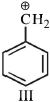
The order of stability of the following carbocations is:
$I$. $CH_2 = CH - CH_2^+$
$II$. $CH_3 - CH_2 - CH_2^+$
$III$. $C_6H_5CH_2^+$
$I$. $CH_2 = CH - CH_2^+$
$II$. $CH_3 - CH_2 - CH_2^+$
$III$. $C_6H_5CH_2^+$
A
$III > I > II$
B
$I > II > III$
C
$II > III > I$
D
$III > II > I$
Solution
(A) The stability of carbocations is determined by resonance and inductive effects.
$III$ $(C_6H_5CH_2^+)$ is a benzyl carbocation,which is highly stabilized by resonance with the benzene ring.
$I$ $(CH_2 = CH - CH_2^+)$ is an allyl carbocation,which is stabilized by resonance with the double bond.
$II$ $(CH_3 - CH_2 - CH_2^+)$ is a primary $(1^\circ)$ alkyl carbocation,which is the least stable among the three as it lacks resonance stabilization.
Therefore,the order of stability is $III > I > II$.
$III$ $(C_6H_5CH_2^+)$ is a benzyl carbocation,which is highly stabilized by resonance with the benzene ring.
$I$ $(CH_2 = CH - CH_2^+)$ is an allyl carbocation,which is stabilized by resonance with the double bond.
$II$ $(CH_3 - CH_2 - CH_2^+)$ is a primary $(1^\circ)$ alkyl carbocation,which is the least stable among the three as it lacks resonance stabilization.
Therefore,the order of stability is $III > I > II$.
0 likes
View Solution72
DifficultMCQ
Which of the following is the most stable free radical?
A
$CH_2=CH-\dot{C}H_2$
B
$CH_2=\dot{C}H$
C
D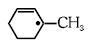
Solution
(D) The stability of free radicals is determined by resonance,hyperconjugation,and inductive effects.
$1$. $CH_2=CH-\dot{C}H_2$ is an allyl radical,which is resonance stabilized.
$2$. $CH_2=\dot{C}H$ is a vinyl radical,which is highly unstable due to the $sp^2$ hybridized carbon atom.
$3$. The radical in option $C$ is a cyclic allylic radical,which is resonance stabilized.
$4$. The radical in option $D$ is a tertiary allylic radical,which is stabilized by both resonance and hyperconjugation (due to the methyl group and the ring structure).
Comparing these,the tertiary allylic radical in option $D$ is the most stable due to the combined effects of resonance and increased hyperconjugation.
$1$. $CH_2=CH-\dot{C}H_2$ is an allyl radical,which is resonance stabilized.
$2$. $CH_2=\dot{C}H$ is a vinyl radical,which is highly unstable due to the $sp^2$ hybridized carbon atom.
$3$. The radical in option $C$ is a cyclic allylic radical,which is resonance stabilized.
$4$. The radical in option $D$ is a tertiary allylic radical,which is stabilized by both resonance and hyperconjugation (due to the methyl group and the ring structure).
Comparing these,the tertiary allylic radical in option $D$ is the most stable due to the combined effects of resonance and increased hyperconjugation.
0 likes
View Solution73
DifficultMCQ
Arrange the following carbocations in the decreasing order of their stability:
$a$. $CH_3-CH^{+}-CH_3$
$b$. $CH_3-CH^{+}-OCH_3$
$c$. $CH_3-CH^{+}-COCH_3$
$a$. $CH_3-CH^{+}-CH_3$
$b$. $CH_3-CH^{+}-OCH_3$
$c$. $CH_3-CH^{+}-COCH_3$
A
$a > b > c$
B
$b > a > c$
C
$c > a > b$
D
$b > c > a$
Solution
(B) . $CH_3-CH^{+}-OCH_3$ is the most stable due to the $+M$ effect of the oxygen atom,which donates electron density to the carbocation.
$a$. $CH_3-CH^{+}-CH_3$ is a secondary carbocation stabilized by the $+I$ effect and hyperconjugation of two methyl groups.
$c$. $CH_3-CH^{+}-COCH_3$ is the least stable because the carbonyl group $(-COCH_3)$ exerts a strong $-I$ and $-M$ effect,which destabilizes the positive charge.
Therefore,the decreasing order of stability is $b > a > c$.
$a$. $CH_3-CH^{+}-CH_3$ is a secondary carbocation stabilized by the $+I$ effect and hyperconjugation of two methyl groups.
$c$. $CH_3-CH^{+}-COCH_3$ is the least stable because the carbonyl group $(-COCH_3)$ exerts a strong $-I$ and $-M$ effect,which destabilizes the positive charge.
Therefore,the decreasing order of stability is $b > a > c$.
0 likes
View Solution74
AdvancedMCQ
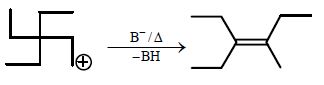
Find out the number of $1-2-$shifts during the conversion of the given carbocation to the final alkene product.
A
$2$
B
$3$
C
$4$
D
$5$
Solution
(A) The starting material is $3,3-dimethylbutan-2-yl$ cation (a secondary carbocation).
To reach the final product,which is $2,3-dimethylbut-2-ene$,the carbocation must undergo rearrangements to reach a more stable tertiary form.
$1$. First,a $1,2-methyl$ shift occurs to convert the secondary carbocation into a more stable tertiary carbocation ($2,3-dimethylbutan-2-yl$ cation).
$2$. Then,a $1,2-hydride$ shift occurs to further stabilize or rearrange the system if necessary,or simply to facilitate the elimination.
However,looking at the skeletal structure provided,the conversion from the initial $3,3-dimethylbutan-2-yl$ cation to the $2,3-dimethylbut-2-ene$ involves a total of $2$ shifts ($1,2-methyl$ shift followed by $1,2-hydride$ shift) to reach the most stable intermediate before elimination.
Thus,the total number of $1-2-$shifts is $2$.
To reach the final product,which is $2,3-dimethylbut-2-ene$,the carbocation must undergo rearrangements to reach a more stable tertiary form.
$1$. First,a $1,2-methyl$ shift occurs to convert the secondary carbocation into a more stable tertiary carbocation ($2,3-dimethylbutan-2-yl$ cation).
$2$. Then,a $1,2-hydride$ shift occurs to further stabilize or rearrange the system if necessary,or simply to facilitate the elimination.
However,looking at the skeletal structure provided,the conversion from the initial $3,3-dimethylbutan-2-yl$ cation to the $2,3-dimethylbut-2-ene$ involves a total of $2$ shifts ($1,2-methyl$ shift followed by $1,2-hydride$ shift) to reach the most stable intermediate before elimination.
Thus,the total number of $1-2-$shifts is $2$.
0 likes
View Solution75
DifficultMCQ
Find the correct stability order for the following carbocations:
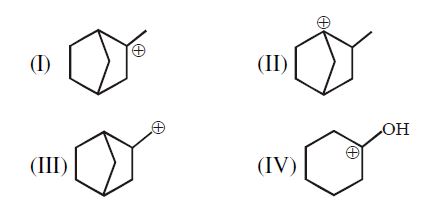
A
$IV > I > III > II$
B
$IV > III > I > II$
C
$I > IV > III > II$
D
$I > III > IV > II$
Solution
(A) The stability of carbocations is determined by factors like resonance,hyperconjugation,and inductive effects.
$IV$: The carbocation is stabilized by the $+M$ (mesomeric) effect of the $-OH$ group due to back-bonding,making it the most stable.
$I$: This is a secondary carbocation in a bicyclic system,stabilized by hyperconjugation and the $+I$ effect.
$III$: This is a secondary carbocation in a bicyclic system,also stabilized by hyperconjugation and the $+I$ effect,but it is slightly less stable than $I$ due to the specific geometry.
$II$: The carbocation is at the bridgehead position. According to Bredt's rule,a double bond or a carbocation at the bridgehead of a small bicyclic system is highly unstable due to the inability to achieve planar geometry.
Therefore,the correct stability order is $IV > I > III > II$.
$IV$: The carbocation is stabilized by the $+M$ (mesomeric) effect of the $-OH$ group due to back-bonding,making it the most stable.
$I$: This is a secondary carbocation in a bicyclic system,stabilized by hyperconjugation and the $+I$ effect.
$III$: This is a secondary carbocation in a bicyclic system,also stabilized by hyperconjugation and the $+I$ effect,but it is slightly less stable than $I$ due to the specific geometry.
$II$: The carbocation is at the bridgehead position. According to Bredt's rule,a double bond or a carbocation at the bridgehead of a small bicyclic system is highly unstable due to the inability to achieve planar geometry.
Therefore,the correct stability order is $IV > I > III > II$.
0 likes
View Solution76
DifficultMCQ
Identify the correct order of stability of the following carbocations:
A
Cyclopropylmethyl carbocation
B
$1-$methylcyclohex$-2-$en$-1-$yl cation
C
$1-$methylcyclopenta$-2,4-$dien$-1-$yl cation
D
$1-$methylcyclohexyl cation
Solution
(C) To determine the stability of carbocations,we consider factors like resonance,aromaticity,and hyperconjugation.
$1$. The $1$-methylcyclopenta-$2,4$-dien-$1$-yl cation $(c)$ is aromatic because it has a planar cyclic structure with $6 \pi$ electrons ($4n+2$ rule,where $n=1$),making it exceptionally stable.
$2$. The cyclopropylmethyl carbocation $(a)$ is stabilized by the phenomenon of 'bent bonds' or $\sigma$-conjugation,where the electrons of the cyclopropane ring overlap with the empty $p$-orbital of the carbocation.
$3$. The $1$-methylcyclohex-$2$-en-$1$-yl cation $(b)$ is stabilized by resonance with the adjacent double bond.
$4$. The $1$-methylcyclohexyl cation $(d)$ is a tertiary carbocation stabilized only by hyperconjugation and inductive effects.
Comparing these,the aromatic cation $(c)$ is the most stable. The cyclopropylmethyl cation $(a)$ is highly stable due to $\sigma$-conjugation. The allylic cation $(b)$ is more stable than the simple tertiary alkyl cation $(d)$.
Therefore,the correct order of stability is $c > a > b > d$.
$1$. The $1$-methylcyclopenta-$2,4$-dien-$1$-yl cation $(c)$ is aromatic because it has a planar cyclic structure with $6 \pi$ electrons ($4n+2$ rule,where $n=1$),making it exceptionally stable.
$2$. The cyclopropylmethyl carbocation $(a)$ is stabilized by the phenomenon of 'bent bonds' or $\sigma$-conjugation,where the electrons of the cyclopropane ring overlap with the empty $p$-orbital of the carbocation.
$3$. The $1$-methylcyclohex-$2$-en-$1$-yl cation $(b)$ is stabilized by resonance with the adjacent double bond.
$4$. The $1$-methylcyclohexyl cation $(d)$ is a tertiary carbocation stabilized only by hyperconjugation and inductive effects.
Comparing these,the aromatic cation $(c)$ is the most stable. The cyclopropylmethyl cation $(a)$ is highly stable due to $\sigma$-conjugation. The allylic cation $(b)$ is more stable than the simple tertiary alkyl cation $(d)$.
Therefore,the correct order of stability is $c > a > b > d$.
0 likes
View Solution77
MediumMCQ
$2-$chloropentane on halogenation with chlorine gives $2,3-$dichloropentane. What will be the structure of the free radical species formed in the reaction?
A
Planar
B
Trigonal planar
C
Square planar
D
Pyramidal
Solution
(B) The chlorination of $2-$chloropentane involves the abstraction of a hydrogen atom to form a free radical intermediate.
In the formation of $2,3-$dichloropentane,the hydrogen is abstracted from the $C-3$ position.
The resulting free radical at the $C-3$ carbon is $sp^2$ hybridized.
An $sp^2$ hybridized carbon atom possesses a Trigonal planar geometry.
Therefore,the correct option is $B$.
In the formation of $2,3-$dichloropentane,the hydrogen is abstracted from the $C-3$ position.
The resulting free radical at the $C-3$ carbon is $sp^2$ hybridized.
An $sp^2$ hybridized carbon atom possesses a Trigonal planar geometry.
Therefore,the correct option is $B$.
0 likes
View Solution78
MediumMCQ
Which of the following carbocations is the most stable?
A
$CH_3-C^+(CH_3)-CH_2-CH_3$
B
$CH_3-C^+(CH_3)-CH(OH)-CH_3$
C
$CH_3-C^+(CH_3)-CH_2-OH$
D
$CH_3-C^+(CH_3)-CH_2-CH_2-OH$
Solution
(B) The stability of a carbocation is increased by the presence of electron-donating groups or atoms that can stabilize the positive charge through resonance or inductive effects.
In option $B$,the $-OH$ group is attached to the carbon adjacent to the carbocation center. The oxygen atom of the $-OH$ group has lone pairs of electrons that can participate in resonance,donating electron density to the carbocation and significantly stabilizing it.
In options $A$,$C$,and $D$,the $-OH$ group is either absent or too far away to provide significant resonance stabilization. In $C$,the $-OH$ group is attached to a carbon that is directly bonded to the carbocation,but the inductive effect of the electronegative oxygen atom actually destabilizes the carbocation. In $B$,the resonance effect of the lone pair on oxygen outweighs the inductive effect,making it the most stable.
In option $B$,the $-OH$ group is attached to the carbon adjacent to the carbocation center. The oxygen atom of the $-OH$ group has lone pairs of electrons that can participate in resonance,donating electron density to the carbocation and significantly stabilizing it.
In options $A$,$C$,and $D$,the $-OH$ group is either absent or too far away to provide significant resonance stabilization. In $C$,the $-OH$ group is attached to a carbon that is directly bonded to the carbocation,but the inductive effect of the electronegative oxygen atom actually destabilizes the carbocation. In $B$,the resonance effect of the lone pair on oxygen outweighs the inductive effect,making it the most stable.
0 likes
View Solution79
MediumMCQ
Which of the following carbocations is expected to be most stable?
A
B
C
D
Solution
(B) The stability of a carbocation is determined by resonance and inductive effects.
In the given structures,the carbocation in option $B$ is a tertiary allylic carbocation where the positive charge is stabilized by resonance with two double bonds and the electron-donating inductive effect of the $CH_3$ group.
Specifically,the positive charge is located at the carbon atom directly attached to the $CH_3$ group,which provides maximum stabilization through hyperconjugation and resonance.
Therefore,the carbocation in option $B$ is the most stable.
In the given structures,the carbocation in option $B$ is a tertiary allylic carbocation where the positive charge is stabilized by resonance with two double bonds and the electron-donating inductive effect of the $CH_3$ group.
Specifically,the positive charge is located at the carbon atom directly attached to the $CH_3$ group,which provides maximum stabilization through hyperconjugation and resonance.
Therefore,the carbocation in option $B$ is the most stable.
0 likes
View Solution80
MediumMCQ
Which of the following carbocations is expected to be most stable?
A
$CH_3-CH_2^+$
B
$CH_2=CH-CH_2^+$
C
$(CH_3)_2CH^+$
D
$C_6H_5-CH_2^+$
Solution
(D) The stability of carbocations is determined by factors such as resonance,hyperconjugation,and the inductive effect.
$1$. $CH_3-CH_2^+$ is a primary carbocation,which is the least stable.
$2$. $CH_2=CH-CH_2^+$ is an allyl carbocation,which is stabilized by resonance.
$3$. $(CH_3)_2CH^+$ is a secondary carbocation,which is stabilized by hyperconjugation and the inductive effect of two methyl groups.
$4$. $C_6H_5-CH_2^+$ is a benzyl carbocation,which is highly stabilized by resonance with the phenyl ring. The positive charge is delocalized over the entire aromatic ring,making it significantly more stable than the other options provided.
$1$. $CH_3-CH_2^+$ is a primary carbocation,which is the least stable.
$2$. $CH_2=CH-CH_2^+$ is an allyl carbocation,which is stabilized by resonance.
$3$. $(CH_3)_2CH^+$ is a secondary carbocation,which is stabilized by hyperconjugation and the inductive effect of two methyl groups.
$4$. $C_6H_5-CH_2^+$ is a benzyl carbocation,which is highly stabilized by resonance with the phenyl ring. The positive charge is delocalized over the entire aromatic ring,making it significantly more stable than the other options provided.
0 likes
View Solution81
DifficultMCQ
Which of the following options given below is incorrect?
A
Stability order of carbocation: $(CH_3)_3C^{+} > (CH_3)_2CH^{+} > CH_3CH_2^+ > CH_3^+$
B
Stability order of carbanion: $CH_3-CH_2-C \equiv C^{-} > CH_3-CH_2-CH=CH^{-} > CH_3-CH_2-CH_2-CH_2^-$
C
Order of heat of hydrogenation: $2\text{-methylbut-2-ene} > 2\text{-methylbut-1-ene} > 3\text{-methylbut-1-ene}$
D
Order of heat of combustion: $n\text{-butane} > \text{isobutane}$
Solution
(C) Let us analyze each option:
$A$: The stability of carbocations follows the order: $3^{\circ} > 2^{\circ} > 1^{\circ} > \text{methyl}$. Thus,$(CH_3)_3C^{+} > (CH_3)_2CH^{+} > CH_3CH_2^+ > CH_3^+$ is correct.
$B$: The stability of carbanions is inversely proportional to the $s$-character of the carbon atom. $sp$ hybridized carbon $(C \equiv C^-)$ has $50\%$ $s$-character,$sp^2$ $(C=C^-)$ has $33.3\%$,and $sp^3$ $(C-C^-)$ has $25\%$. Higher $s$-character makes the carbon more electronegative,stabilizing the negative charge. Thus,the order is correct.
$C$: Heat of hydrogenation is inversely proportional to the stability of the alkene. More substituted alkenes are more stable and have lower heat of hydrogenation. The stability order is $2\text{-methylbut-2-ene} > 2\text{-methylbut-1-ene} > 3\text{-methylbut-1-ene}$. Therefore,the heat of hydrogenation order should be $3\text{-methylbut-1-ene} > 2\text{-methylbut-1-ene} > 2\text{-methylbut-2-ene}$. This option is incorrect.
$D$: Heat of combustion is proportional to the number of carbon atoms and inversely proportional to the stability of the isomer. For isomers,the more branched isomer is more stable and has a lower heat of combustion. $n\text{-butane}$ is less stable than isobutane,so it has a higher heat of combustion. This is correct.
$A$: The stability of carbocations follows the order: $3^{\circ} > 2^{\circ} > 1^{\circ} > \text{methyl}$. Thus,$(CH_3)_3C^{+} > (CH_3)_2CH^{+} > CH_3CH_2^+ > CH_3^+$ is correct.
$B$: The stability of carbanions is inversely proportional to the $s$-character of the carbon atom. $sp$ hybridized carbon $(C \equiv C^-)$ has $50\%$ $s$-character,$sp^2$ $(C=C^-)$ has $33.3\%$,and $sp^3$ $(C-C^-)$ has $25\%$. Higher $s$-character makes the carbon more electronegative,stabilizing the negative charge. Thus,the order is correct.
$C$: Heat of hydrogenation is inversely proportional to the stability of the alkene. More substituted alkenes are more stable and have lower heat of hydrogenation. The stability order is $2\text{-methylbut-2-ene} > 2\text{-methylbut-1-ene} > 3\text{-methylbut-1-ene}$. Therefore,the heat of hydrogenation order should be $3\text{-methylbut-1-ene} > 2\text{-methylbut-1-ene} > 2\text{-methylbut-2-ene}$. This option is incorrect.
$D$: Heat of combustion is proportional to the number of carbon atoms and inversely proportional to the stability of the isomer. For isomers,the more branched isomer is more stable and has a lower heat of combustion. $n\text{-butane}$ is less stable than isobutane,so it has a higher heat of combustion. This is correct.
0 likes
View Solution82
MediumMCQ
Which among the following carbocations has the maximum stability?
A
Tris(cyclopropyl)methyl carbocation
B
$Ph_3C^{+}$
C
$(CH_3)_3C^{+}$
D
$(CH_3)_2CH^{+}$
Solution
(A) The stability of carbocations is determined by resonance,hyperconjugation,and inductive effects.
Tris(cyclopropyl)methyl carbocation is exceptionally stable due to the phenomenon of $\sigma$-resonance (also known as bent bond resonance),where the electrons of the cyclopropyl rings delocalize into the vacant $p$-orbital of the carbocation.
This effect is significantly stronger than the resonance stabilization provided by the phenyl rings in $Ph_3C^{+}$.
Tris(cyclopropyl)methyl carbocation is exceptionally stable due to the phenomenon of $\sigma$-resonance (also known as bent bond resonance),where the electrons of the cyclopropyl rings delocalize into the vacant $p$-orbital of the carbocation.
This effect is significantly stronger than the resonance stabilization provided by the phenyl rings in $Ph_3C^{+}$.
0 likes
View Solution83
DifficultMCQ
Arrange the following cations in decreasing order of their stability:
$(a)$ $CH_3^+$
$(b)$ $F-CH_2-CH_2^+$
$(c)$ $Br-CH_2-CH_2^+$
$(d)$ $CH_3-CH_2-CH_2^+$
$(a)$ $CH_3^+$
$(b)$ $F-CH_2-CH_2^+$
$(c)$ $Br-CH_2-CH_2^+$
$(d)$ $CH_3-CH_2-CH_2^+$
A
$a > b > c > d$
B
$d > a > c > b$
C
$d > c > b > a$
D
$a > c > b > d$
Solution
(C) The stability of carbocations is increased by the $+I$ effect and hyperconjugation,and decreased by the $-I$ effect.
In $CH_3-CH_2-CH_2^+$ $(d)$,the ethyl group provides a $+I$ effect,which stabilizes the positive charge.
In $F-CH_2-CH_2^+$ $(b)$ and $Br-CH_2-CH_2^+$ $(c)$,the halogens exert a $-I$ effect,which destabilizes the carbocation.
Since $F$ is more electronegative than $Br$,its $-I$ effect is stronger,making $(b)$ less stable than $(c)$.
$CH_3^+$ $(a)$ is a methyl carbocation,which is less stable than primary carbocations like $(d)$ and $(c)$.
Therefore,the decreasing order of stability is $d > c > b > a$.
In $CH_3-CH_2-CH_2^+$ $(d)$,the ethyl group provides a $+I$ effect,which stabilizes the positive charge.
In $F-CH_2-CH_2^+$ $(b)$ and $Br-CH_2-CH_2^+$ $(c)$,the halogens exert a $-I$ effect,which destabilizes the carbocation.
Since $F$ is more electronegative than $Br$,its $-I$ effect is stronger,making $(b)$ less stable than $(c)$.
$CH_3^+$ $(a)$ is a methyl carbocation,which is less stable than primary carbocations like $(d)$ and $(c)$.
Therefore,the decreasing order of stability is $d > c > b > a$.
0 likes
View Solution84
DifficultMCQ
Arrange the following anions in decreasing order of their stability:
$CH_3^{\Theta}, NH_2^{\Theta}, OH^{\Theta}, Cl^{\Theta}$
$CH_3^{\Theta}, NH_2^{\Theta}, OH^{\Theta}, Cl^{\Theta}$
A
$Cl^{\Theta} > OH^{\Theta} > NH_2^{\Theta} > CH_3^{\Theta}$
B
$OH^{\Theta} > NH_2^{\Theta} > CH_3^{\Theta} > Cl^{\Theta}$
C
$NH_2^{\Theta} > OH^{\Theta} > Cl^{\Theta} > CH_3^{\Theta}$
D
$Cl^{\Theta} > NH_2^{\Theta} > OH^{\Theta} > CH_3^{\Theta}$
Solution
(A) The stability of an anion is determined by the electronegativity of the atom carrying the negative charge.
For elements in the same period $(C, N, O)$,stability increases as electronegativity increases: $CH_3^{\Theta} < NH_2^{\Theta} < OH^{\Theta}$.
When comparing elements in the same group,the size of the atom is the dominant factor. $Cl^{\Theta}$ is much larger than $O^{\Theta}$,$N^{\Theta}$,or $C^{\Theta}$,which allows the negative charge to be dispersed over a larger volume,making $Cl^{\Theta}$ the most stable anion among the given species.
Therefore,the decreasing order of stability is $Cl^{\Theta} > OH^{\Theta} > NH_2^{\Theta} > CH_3^{\Theta}$.
For elements in the same period $(C, N, O)$,stability increases as electronegativity increases: $CH_3^{\Theta} < NH_2^{\Theta} < OH^{\Theta}$.
When comparing elements in the same group,the size of the atom is the dominant factor. $Cl^{\Theta}$ is much larger than $O^{\Theta}$,$N^{\Theta}$,or $C^{\Theta}$,which allows the negative charge to be dispersed over a larger volume,making $Cl^{\Theta}$ the most stable anion among the given species.
Therefore,the decreasing order of stability is $Cl^{\Theta} > OH^{\Theta} > NH_2^{\Theta} > CH_3^{\Theta}$.
0 likes
View Solution85
MediumMCQ
Which of the following cannot exist at room temperature?
A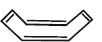
Cyclobutadiene
B
$CH_2=CH-CH=CH_2$
C
Cyclobutene
D
Cyclopentadienyl cation
Solution
(A) The molecule in option $A$ is cyclobutadiene. It is a $4n \pi$ electron system ($n=1$,total $4 \pi$ electrons),which makes it anti-aromatic according to $H$ückel's rule. Anti-aromatic compounds are highly unstable and reactive,and thus cannot exist as stable molecules at room temperature. The other options represent stable or relatively stable species.
0 likes
View Solution86
MediumMCQ
Which of the following is the most stable among the given ions?
A
$CH_3-CH_2^+$
B
$Ph-CH_2^+$
C
$Ph-CH^+-CH=CH_2$
D
$CH_3-C(CH_3)_2-CH_2^+$
Solution
(C) The correct answer is $(c)$.
$Ph-CH^+-CH=CH_2$ is the most stable carbocation because it is stabilized by resonance with both the phenyl ring and the vinyl group $(-CH=CH_2)$.
This extended conjugation leads to greater delocalization of the positive charge compared to the other options,which only have inductive effects or limited resonance.
$Ph-CH^+-CH=CH_2$ is the most stable carbocation because it is stabilized by resonance with both the phenyl ring and the vinyl group $(-CH=CH_2)$.
This extended conjugation leads to greater delocalization of the positive charge compared to the other options,which only have inductive effects or limited resonance.
0 likes
View Solution87
DifficultMCQ
Which of the following represents the incorrect order of stability?
A
$Ph_3C^+ > Ph_2CH^+ > PhCH_2^+$
B
$Ph_3C^• > Ph_2CH^• > PhCH_2^•$
C
$PhCH_2^- < Ph_2CH^- < Ph_3C^-$
D
$PhCH_2^- > Ph_2CH^- > Ph_3C^-$
Solution
(C) $1$. For carbocations $(Ph_3C^+ > Ph_2CH^+ > PhCH_2^+)$,stability increases with the number of phenyl groups due to resonance stabilization. This order is correct.
$2$. For carbon free radicals $(Ph_3C^• > Ph_2CH^• > PhCH_2^•)$,stability increases with the number of phenyl groups due to resonance. This order is correct.
$3$. For carbanions $(PhCH_2^- > Ph_2CH^- > Ph_3C^-)$,stability decreases as the number of phenyl groups increases. This is because the negative charge is delocalized over more phenyl rings,but the steric hindrance and the nature of the carbanion stability (which is destabilized by electron-donating groups or resonance that doesn't effectively disperse the charge compared to the inductive effect) make the primary carbanion more stable than the tertiary one in this specific series. Thus,$PhCH_2^- > Ph_2CH^- > Ph_3C^-$ is the correct order of stability.
$4$. Therefore,option $C$ $(PhCH_2^- < Ph_2CH^- < Ph_3C^-)$ is the incorrect order.
$2$. For carbon free radicals $(Ph_3C^• > Ph_2CH^• > PhCH_2^•)$,stability increases with the number of phenyl groups due to resonance. This order is correct.
$3$. For carbanions $(PhCH_2^- > Ph_2CH^- > Ph_3C^-)$,stability decreases as the number of phenyl groups increases. This is because the negative charge is delocalized over more phenyl rings,but the steric hindrance and the nature of the carbanion stability (which is destabilized by electron-donating groups or resonance that doesn't effectively disperse the charge compared to the inductive effect) make the primary carbanion more stable than the tertiary one in this specific series. Thus,$PhCH_2^- > Ph_2CH^- > Ph_3C^-$ is the correct order of stability.
$4$. Therefore,option $C$ $(PhCH_2^- < Ph_2CH^- < Ph_3C^-)$ is the incorrect order.
0 likes
View Solution88
MediumMCQ
$CH_3-C(CH_3)_2-CH_2-CH_2^+ \to CH_3-C^+(CH_3)-CH(CH_3)-CH_3$
How many $H^-$ shifts are involved in the above rearrangement?
How many $H^-$ shifts are involved in the above rearrangement?
A
$4$
B
$3$
C
$2$
D
$1$
Solution
(D) The rearrangement of $3,3$-dimethylbutyl cation to $2,3$-dimethyl-$2$-butyl cation occurs in two steps:
$1.$ $1,2-H^-$ shift: $CH_3-C(CH_3)_2-CH_2-CH_2^+ \to CH_3-C(CH_3)_2-CH^+-CH_3$ (Primary to Secondary carbocation).
$2.$ $1,2-CH_3^-$ shift: $CH_3-C(CH_3)_2-CH^+-CH_3 \to CH_3-C^+(CH_3)-CH(CH_3)-CH_3$ (Secondary to Tertiary carbocation).
Therefore,only $1$ hydride $(H^-)$ shift is involved.
$1.$ $1,2-H^-$ shift: $CH_3-C(CH_3)_2-CH_2-CH_2^+ \to CH_3-C(CH_3)_2-CH^+-CH_3$ (Primary to Secondary carbocation).
$2.$ $1,2-CH_3^-$ shift: $CH_3-C(CH_3)_2-CH^+-CH_3 \to CH_3-C^+(CH_3)-CH(CH_3)-CH_3$ (Secondary to Tertiary carbocation).
Therefore,only $1$ hydride $(H^-)$ shift is involved.
0 likes
View Solution89
DifficultMCQ
How many $1,2-$ shifts take place in the following carbocation to reach the most stable form?
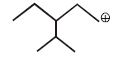
A
$2$
B
$1$
C
$3$
D
$4$
Solution
(A) The given carbocation is a $1^{\circ}$ carbocation: $CH_3-CH(CH_3)-CH(CH_3)-CH_2^+$.
Step $1$: $A$ $1,2-$ hydride shift occurs from the adjacent $2^{\circ}$ carbon to the $1^{\circ}$ carbocation,resulting in a more stable $2^{\circ}$ carbocation: $CH_3-CH(CH_3)-C^+(CH_3)-CH_3$.
Step $2$: $A$ $1,2-$ methyl shift occurs from the adjacent $3^{\circ}$ carbon to the $2^{\circ}$ carbocation,resulting in the most stable $3^{\circ}$ carbocation: $CH_3-C^+(CH_3)-CH(CH_3)-CH_3$.
Thus,a total of $2$ shifts ($1$ hydride shift and $1$ methyl shift) take place to reach the most stable carbocation.
Step $1$: $A$ $1,2-$ hydride shift occurs from the adjacent $2^{\circ}$ carbon to the $1^{\circ}$ carbocation,resulting in a more stable $2^{\circ}$ carbocation: $CH_3-CH(CH_3)-C^+(CH_3)-CH_3$.
Step $2$: $A$ $1,2-$ methyl shift occurs from the adjacent $3^{\circ}$ carbon to the $2^{\circ}$ carbocation,resulting in the most stable $3^{\circ}$ carbocation: $CH_3-C^+(CH_3)-CH(CH_3)-CH_3$.
Thus,a total of $2$ shifts ($1$ hydride shift and $1$ methyl shift) take place to reach the most stable carbocation.
0 likes
View Solution90
DifficultMCQ
What is the minimum energy required for the homolytic bond fission of the $C-H$ bond in the following molecule?
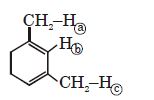
A
$H_a$
B
$H_b$
C
$H_c$
D
All are equal
Solution
(A) The energy required for homolytic bond fission (bond dissociation energy) is inversely proportional to the stability of the resulting free radical.
$1$. Homolysis of $H_a$ gives an allylic free radical,which is stabilized by resonance.
$2$. Homolysis of $H_b$ gives a vinylic free radical,which is highly unstable due to the $sp^2$ hybridized carbon.
$3$. Homolysis of $H_c$ gives an allylic free radical,which is also stabilized by resonance.
Comparing $H_a$ and $H_c$,$H_a$ is attached to a carbon that is allylic to the double bond,and the resulting radical is resonance-stabilized. $H_c$ is also allylic. However,looking at the structure,the radical formed at $H_a$ is more stable due to extended conjugation with the ring system. Thus,the $C-H_a$ bond requires the minimum energy to break.
$1$. Homolysis of $H_a$ gives an allylic free radical,which is stabilized by resonance.
$2$. Homolysis of $H_b$ gives a vinylic free radical,which is highly unstable due to the $sp^2$ hybridized carbon.
$3$. Homolysis of $H_c$ gives an allylic free radical,which is also stabilized by resonance.
Comparing $H_a$ and $H_c$,$H_a$ is attached to a carbon that is allylic to the double bond,and the resulting radical is resonance-stabilized. $H_c$ is also allylic. However,looking at the structure,the radical formed at $H_a$ is more stable due to extended conjugation with the ring system. Thus,the $C-H_a$ bond requires the minimum energy to break.
0 likes
View Solution91
AdvancedMCQ
Which of the following carbocations will not undergo rearrangement?
A
Isobutyl carbocation
B
$1-$Phenyl$-1-$propyl carbocation
C
$2-$Ethylcyclohexyl carbocation
D
$2-$($1$,$2$,$3$,$4$-tetrahydronaphthalen$-2-$yl)ethyl carbocation
Solution
(B) Rearrangement of carbocations occurs to form a more stable carbocation (e.g.,primary to secondary,or secondary to tertiary,or resonance-stabilized).
$A$. The isobutyl carbocation $(CH_3)_2CH-CH_2^+$ is a primary carbocation that undergoes a $1,2$-hydride shift to form a more stable tertiary carbocation $(CH_3)_2C^+-CH_3$.
$B$. The $1$-phenyl-$1$-propyl carbocation $(Ph-CH^+-CH_2-CH_3)$ is already resonance-stabilized by the phenyl ring and is a secondary carbocation. It does not undergo further rearrangement because it is already highly stable.
$C$. The $2$-ethylcyclohexyl carbocation is a secondary carbocation that can undergo ring expansion or hydride shifts to form more stable carbocations.
$D$. The $2-(1,2,3,4-tetrahydronaphthalen-2-yl)ethyl$ carbocation is a primary carbocation that can undergo rearrangement to form a more stable secondary or tertiary carbocation.
Therefore,the $1$-phenyl-$1$-propyl carbocation is the most stable among the options and does not undergo rearrangement.
$A$. The isobutyl carbocation $(CH_3)_2CH-CH_2^+$ is a primary carbocation that undergoes a $1,2$-hydride shift to form a more stable tertiary carbocation $(CH_3)_2C^+-CH_3$.
$B$. The $1$-phenyl-$1$-propyl carbocation $(Ph-CH^+-CH_2-CH_3)$ is already resonance-stabilized by the phenyl ring and is a secondary carbocation. It does not undergo further rearrangement because it is already highly stable.
$C$. The $2$-ethylcyclohexyl carbocation is a secondary carbocation that can undergo ring expansion or hydride shifts to form more stable carbocations.
$D$. The $2-(1,2,3,4-tetrahydronaphthalen-2-yl)ethyl$ carbocation is a primary carbocation that can undergo rearrangement to form a more stable secondary or tertiary carbocation.
Therefore,the $1$-phenyl-$1$-propyl carbocation is the most stable among the options and does not undergo rearrangement.
0 likes
View Solution92
MediumMCQ
Which of the following is the least stable carbon free radical?
A
B
C
D
Solution
(C) The stability of carbon free radicals is determined by resonance and hyperconjugation.
$A$ is an allylic radical,which is stabilized by resonance.
$B$ is also an allylic radical,stabilized by resonance.
$C$ is a secondary alkyl radical,which is stabilized by hyperconjugation.
$D$ is a tertiary alkyl radical,which is the most stable among the alkyl radicals due to maximum hyperconjugation.
Comparing these,the cyclohexyl radical $(C)$ is less stable than the allylic radicals ($A$ and $B$) and the tertiary radical $(D)$. However,between the given options,the cyclohexyl radical $(C)$ is the least stable because it lacks resonance stabilization and has fewer hyperconjugative interactions compared to the tertiary radical $(D)$.
$A$ is an allylic radical,which is stabilized by resonance.
$B$ is also an allylic radical,stabilized by resonance.
$C$ is a secondary alkyl radical,which is stabilized by hyperconjugation.
$D$ is a tertiary alkyl radical,which is the most stable among the alkyl radicals due to maximum hyperconjugation.
Comparing these,the cyclohexyl radical $(C)$ is less stable than the allylic radicals ($A$ and $B$) and the tertiary radical $(D)$. However,between the given options,the cyclohexyl radical $(C)$ is the least stable because it lacks resonance stabilization and has fewer hyperconjugative interactions compared to the tertiary radical $(D)$.
0 likes
View Solution93
MediumMCQ
Which of the following carbocations is the most stable?
A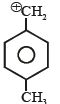
B
C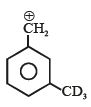
D
Solution
(B) The stability of carbocations is determined by factors like resonance,hyperconjugation,and aromaticity.
$1$. The cycloheptatrienyl carbocation (tropylium ion) is a cyclic,planar,fully conjugated system with $6 \pi$ electrons ($4n+2$ rule where $n=1$),making it aromatic.
$2$. Aromatic compounds are exceptionally stable due to the delocalization of $\pi$ electrons.
$3$. The other options are benzylic carbocations,which are stabilized by resonance with the benzene ring,but they are not aromatic themselves.
$4$. Therefore,the tropylium ion is the most stable among the given choices.
$1$. The cycloheptatrienyl carbocation (tropylium ion) is a cyclic,planar,fully conjugated system with $6 \pi$ electrons ($4n+2$ rule where $n=1$),making it aromatic.
$2$. Aromatic compounds are exceptionally stable due to the delocalization of $\pi$ electrons.
$3$. The other options are benzylic carbocations,which are stabilized by resonance with the benzene ring,but they are not aromatic themselves.
$4$. Therefore,the tropylium ion is the most stable among the given choices.
0 likes
View Solution94
MediumMCQ
Which of the following carbocations is least stable?
A
p-Fluorobenzyl carbocation
B
p-Methylbenzyl carbocation
C
p-Cyanobenzyl carbocation
D
p-Nitrobenzyl carbocation
Solution
(D) The stability of a benzyl carbocation is influenced by the substituent present on the benzene ring.
Electron-donating groups $(EDG)$ increase the stability of the carbocation by donating electron density,while electron-withdrawing groups $(EWG)$ decrease the stability by withdrawing electron density.
In the given options:
$1$. $p$-Methylbenzyl carbocation has a $-CH_3$ group,which is an electron-donating group ($+I$ and hyperconjugation),making it the most stable.
$2$. $p$-Fluorobenzyl carbocation has a $-F$ group,which is weakly electron-withdrawing by induction $(-I)$ but can donate electrons by resonance $(+M)$.
$3$. $p$-Cyanobenzyl carbocation has a $-CN$ group,which is a strong electron-withdrawing group ($-I$ and $-M$).
$4$. $p$-Nitrobenzyl carbocation has a $-NO_2$ group,which is a very strong electron-withdrawing group ($-I$ and $-M$).
Since the $-NO_2$ group is a stronger electron-withdrawing group than the $-CN$ group,the $p$-nitrobenzyl carbocation is the least stable among the given options.
Electron-donating groups $(EDG)$ increase the stability of the carbocation by donating electron density,while electron-withdrawing groups $(EWG)$ decrease the stability by withdrawing electron density.
In the given options:
$1$. $p$-Methylbenzyl carbocation has a $-CH_3$ group,which is an electron-donating group ($+I$ and hyperconjugation),making it the most stable.
$2$. $p$-Fluorobenzyl carbocation has a $-F$ group,which is weakly electron-withdrawing by induction $(-I)$ but can donate electrons by resonance $(+M)$.
$3$. $p$-Cyanobenzyl carbocation has a $-CN$ group,which is a strong electron-withdrawing group ($-I$ and $-M$).
$4$. $p$-Nitrobenzyl carbocation has a $-NO_2$ group,which is a very strong electron-withdrawing group ($-I$ and $-M$).
Since the $-NO_2$ group is a stronger electron-withdrawing group than the $-CN$ group,the $p$-nitrobenzyl carbocation is the least stable among the given options.
0 likes
View Solution95
MediumMCQ
Most stable carbocation is
A
Cyclohexyl carbocation
B
Cyclohex$-2-$en$-1-$yl carbocation
C
Cyclohexa$-2,4-$dien$-1-$yl carbocation
D
Phenyl carbocation
Solution
(C) The stability of carbocations is determined by factors such as resonance,hyperconjugation,and inductive effects.
$A$: Cyclohexyl carbocation is a secondary $(2^{\circ})$ alkyl carbocation with no resonance stabilization.
$B$: Cyclohex$-2-$en$-1-$yl carbocation is an allylic carbocation,which is stabilized by resonance with the adjacent double bond.
$C$: Cyclohexa$-2,4-$dien$-1-$yl carbocation is a conjugated dienyl carbocation. It has more resonance structures compared to the allylic carbocation in $B$,making it more stable due to extended delocalization of the positive charge.
$D$: Phenyl carbocation is an $sp$-hybridized carbocation where the positive charge is on the ring,which is highly unstable due to the high electronegativity of the $sp$-hybridized carbon.
Comparing these,the resonance stabilization in the conjugated system of $C$ makes it the most stable among the given options.
$A$: Cyclohexyl carbocation is a secondary $(2^{\circ})$ alkyl carbocation with no resonance stabilization.
$B$: Cyclohex$-2-$en$-1-$yl carbocation is an allylic carbocation,which is stabilized by resonance with the adjacent double bond.
$C$: Cyclohexa$-2,4-$dien$-1-$yl carbocation is a conjugated dienyl carbocation. It has more resonance structures compared to the allylic carbocation in $B$,making it more stable due to extended delocalization of the positive charge.
$D$: Phenyl carbocation is an $sp$-hybridized carbocation where the positive charge is on the ring,which is highly unstable due to the high electronegativity of the $sp$-hybridized carbon.
Comparing these,the resonance stabilization in the conjugated system of $C$ makes it the most stable among the given options.
0 likes
View Solution96
AdvancedMCQ
The most stable carbocation is
A
$p-Methoxybenzyl$ carbocation
B
$p-Nitrobenzyl$ carbocation
C
$Benzyl$ carbocation
D
$p-Methylbenzyl$ carbocation
Solution
(A) The stability of a carbocation is determined by the electron-donating or electron-withdrawing nature of the substituents attached to the benzene ring.
$1$. The $-OCH_3$ group in $p-methoxybenzyl$ carbocation exerts a strong $+M$ (mesomeric) effect,which significantly stabilizes the positive charge through resonance.
$2$. The $-CH_3$ group in $p-methylbenzyl$ carbocation provides stability through $+I$ (inductive) effect and hyperconjugation.
$3$. The $-NO_2$ group in $p-nitrobenzyl$ carbocation is a strong electron-withdrawing group ($-M$ and $-I$ effects),which destabilizes the carbocation.
$4$. The unsubstituted $benzyl$ carbocation has only resonance stabilization from the benzene ring.
Comparing these,the $+M$ effect of the $-OCH_3$ group provides the greatest stabilization to the carbocation. Therefore,$p-methoxybenzyl$ carbocation is the most stable.
$1$. The $-OCH_3$ group in $p-methoxybenzyl$ carbocation exerts a strong $+M$ (mesomeric) effect,which significantly stabilizes the positive charge through resonance.
$2$. The $-CH_3$ group in $p-methylbenzyl$ carbocation provides stability through $+I$ (inductive) effect and hyperconjugation.
$3$. The $-NO_2$ group in $p-nitrobenzyl$ carbocation is a strong electron-withdrawing group ($-M$ and $-I$ effects),which destabilizes the carbocation.
$4$. The unsubstituted $benzyl$ carbocation has only resonance stabilization from the benzene ring.
Comparing these,the $+M$ effect of the $-OCH_3$ group provides the greatest stabilization to the carbocation. Therefore,$p-methoxybenzyl$ carbocation is the most stable.
0 likes
View Solution97
MediumMCQ
Stability order of the following carbocations:
$(i) CH_3 - C^{+}(OCH_3) - CH_3$
$(ii) CH_3 - C^{+}(CH_3) - CH_3$
$(iii) CH_3 - NH - C^{+}H_2$
$(iv) CH_3 - C^{+}H_2$
$(i) CH_3 - C^{+}(OCH_3) - CH_3$
$(ii) CH_3 - C^{+}(CH_3) - CH_3$
$(iii) CH_3 - NH - C^{+}H_2$
$(iv) CH_3 - C^{+}H_2$
A
$iii > i > ii > iv$
B
$i > iii > ii > iv$
C
$iii > ii > i > iv$
D
$ii > iv > iii > i$
Solution
(A) The stability of carbocations is determined by electronic effects:
$1$. Mesomeric effect $(+M)$: Groups like $-NH-$ and $-OCH_3$ stabilize the carbocation by donating a lone pair through resonance. The $+M$ effect of Nitrogen is stronger than that of Oxygen because Nitrogen is less electronegative,making $(iii)$ more stable than $(i)$.
$2$. Hyperconjugation and Inductive effect $(+I)$: Alkyl groups stabilize carbocations. $A$ tertiary carbocation $(ii)$ is more stable than a primary carbocation $(iv)$.
Comparing these,the overall stability order is $(iii) > (i) > (ii) > (iv)$.
$1$. Mesomeric effect $(+M)$: Groups like $-NH-$ and $-OCH_3$ stabilize the carbocation by donating a lone pair through resonance. The $+M$ effect of Nitrogen is stronger than that of Oxygen because Nitrogen is less electronegative,making $(iii)$ more stable than $(i)$.
$2$. Hyperconjugation and Inductive effect $(+I)$: Alkyl groups stabilize carbocations. $A$ tertiary carbocation $(ii)$ is more stable than a primary carbocation $(iv)$.
Comparing these,the overall stability order is $(iii) > (i) > (ii) > (iv)$.
0 likes
View Solution98
MediumMCQ
$:CCl_2$ is
A
Dichlorocarbene
B
Obtained as an intermediate in Reimer-Tiemann reaction
C
Electrophile
D
All of these
Solution
(D) The species $:CCl_2$ is known as dichlorocarbene.
It is a neutral species with a sextet of electrons around the carbon atom,making it an electrophile.
It is generated as a reactive intermediate during the Reimer-Tiemann reaction when phenol reacts with chloroform in the presence of an aqueous base.
Therefore,all the given statements are correct.
It is a neutral species with a sextet of electrons around the carbon atom,making it an electrophile.
It is generated as a reactive intermediate during the Reimer-Tiemann reaction when phenol reacts with chloroform in the presence of an aqueous base.
Therefore,all the given statements are correct.
0 likes
View Solution99
MediumMCQ
The correct order of stability of the carbocations given below is:
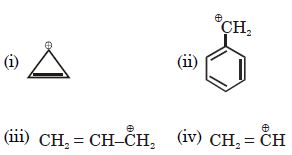
A
$(i) > (ii) > (iii) > (iv)$
B
$(ii) > (iii) > (i) > (iv)$
C
$(ii) > (i) > (iii) > (iv)$
D
$(i) > (iii) > (ii) > (iv)$
Solution
(A) The stability of the given carbocations is determined by resonance,aromaticity,and hybridization:
$(i)$ Cyclopropenyl cation is aromatic ($2\pi$ electrons,Huckel's rule),making it highly stable.
(ii) Benzyl carbocation $(C_6H_5CH_2^+)$ is stabilized by resonance with the benzene ring.
(iii) Allyl carbocation $(CH_2=CH-CH_2^+)$ is stabilized by resonance with the double bond.
(iv) Vinyl carbocation $(CH_2=CH^+)$ is highly unstable because the positive charge is on an $sp$-hybridized carbon atom,which is more electronegative.
Comparing their stabilities:
- $(i)$ is aromatic,so it is the most stable.
- $(ii)$ is resonance-stabilized by a benzene ring,which is more stable than the simple allyl cation $(iii)$.
- $(iii)$ is resonance-stabilized.
- $(iv)$ is the least stable due to the $sp$-hybridized carbon.
Thus,the correct order is $(i) > (ii) > (iii) > (iv)$.
$(i)$ Cyclopropenyl cation is aromatic ($2\pi$ electrons,Huckel's rule),making it highly stable.
(ii) Benzyl carbocation $(C_6H_5CH_2^+)$ is stabilized by resonance with the benzene ring.
(iii) Allyl carbocation $(CH_2=CH-CH_2^+)$ is stabilized by resonance with the double bond.
(iv) Vinyl carbocation $(CH_2=CH^+)$ is highly unstable because the positive charge is on an $sp$-hybridized carbon atom,which is more electronegative.
Comparing their stabilities:
- $(i)$ is aromatic,so it is the most stable.
- $(ii)$ is resonance-stabilized by a benzene ring,which is more stable than the simple allyl cation $(iii)$.
- $(iii)$ is resonance-stabilized.
- $(iv)$ is the least stable due to the $sp$-hybridized carbon.
Thus,the correct order is $(i) > (ii) > (iii) > (iv)$.
0 likes
View Solution100
MediumMCQ
The stability of the following carbanions is in the order of:
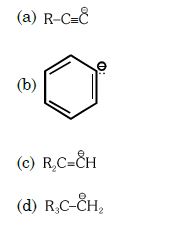
A
$(a) > (b) > (c) > (d)$
B
$(a) > (c) > (b) > (d)$
C
$(b) > (a) > (c) > (d)$
D
$(d) > (c) > (b) > (a)$
Solution
(A) The stability of carbanions depends on the hybridization of the carbon atom bearing the negative charge. The order of electronegativity is $sp > sp^2 > sp^3$. Higher electronegativity increases the stability of the negative charge.
$(a)$ $R-C \equiv C^-$: The negative charge is on an $sp$ hybridized carbon atom.
$(b)$ Phenyl carbanion $(C_6H_5^-)$: The negative charge is on an $sp^2$ hybridized carbon atom and is delocalized over the aromatic ring.
$(c)$ $R_2C=CH^-$: The negative charge is on an $sp^2$ hybridized carbon atom.
$(d)$ $R_3C-CH_2^-$: The negative charge is on an $sp^3$ hybridized carbon atom.
Comparing these:
- $(a)$ is most stable due to $sp$ hybridization.
- $(b)$ is more stable than $(c)$ because the negative charge in $(b)$ is delocalized via resonance in the aromatic ring,whereas in $(c)$ it is only stabilized by the double bond.
- $(d)$ is the least stable due to $sp^3$ hybridization and the electron-donating effect of the $R$ groups.
Therefore,the correct order of stability is $(a) > (b) > (c) > (d)$.
$(a)$ $R-C \equiv C^-$: The negative charge is on an $sp$ hybridized carbon atom.
$(b)$ Phenyl carbanion $(C_6H_5^-)$: The negative charge is on an $sp^2$ hybridized carbon atom and is delocalized over the aromatic ring.
$(c)$ $R_2C=CH^-$: The negative charge is on an $sp^2$ hybridized carbon atom.
$(d)$ $R_3C-CH_2^-$: The negative charge is on an $sp^3$ hybridized carbon atom.
Comparing these:
- $(a)$ is most stable due to $sp$ hybridization.
- $(b)$ is more stable than $(c)$ because the negative charge in $(b)$ is delocalized via resonance in the aromatic ring,whereas in $(c)$ it is only stabilized by the double bond.
- $(d)$ is the least stable due to $sp^3$ hybridization and the electron-donating effect of the $R$ groups.
Therefore,the correct order of stability is $(a) > (b) > (c) > (d)$.
0 likes
View Solution8-4.Organic Chemistry : Reaction mechanism — Reactive Intermediates · Frequently Asked Questions
1Are these 8-4.Organic Chemistry : Reaction mechanism questions useful for JEE and NEET?
Yes. All questions in this section are mapped to JEE Main and NEET exam patterns. Previous year questions from JEE Main, NEET, GUJCET and state-level exams are included with full solutions.
2Can I switch to Hindi or Gujarati for these questions?
Yes. Use the language tabs in the hero section or the sidebar to view the same questions and solutions in English, Hindi or Gujarati.
3How do I generate a question paper from this subtopic?
Use the Vedclass Exam Paper Generator — select the chapter and subtopic, set difficulty, and generate Sets A, B, C, D automatically. First 3 chapters of every subject are free.
Vedclass Products
For Students
Vedclass Test Series
Mock tests in real JEE/NEET style with performance analysis. 5-day free trial.
Start Free TrialFor Teachers
Exam Paper Generator
Generate Set A/B/C/D papers from this chapter in 2 minutes. 3 chapters free.
Try FreeFor Institutes
Online Exam Module
Live online exams with unlimited students, 360° analytics & white-label branding.
See DemoFor Teachers & Institutes
Generate a 8-4.Organic Chemistry : Reaction mechanism Exam Paper in 2 Minutes
Select subtopic & difficulty — Sets A, B, C, D auto-generated with No Repeat logic.
First 3 chapters of every subject are free — no payment required.