
A English
Reactive Intermediates Questions in English
Class 11 Chemistry · 8-4.Organic Chemistry : Reaction mechanism · Reactive Intermediates
280+
Questions
English
Language
100%
With Solutions
Showing 48 of 280 questions in English
151
MediumMCQ
The incorrect statement about carbene $(CH_2)$ is:
A
In singlet carbene,carbon is $sp^2$ hybridized whereas in triplet carbene,carbon is $sp$ hybridized.
B
Triplet carbene is less stable than singlet carbene.
C
Stability order of singlet halocarbenes is: $CHF > CHCl > CHBr$.
D
None of the above.
Solution
(B) In singlet carbene,the carbon atom is $sp^2$ hybridized,while in triplet carbene,it is $sp$ hybridized.
Triplet carbene is more stable than singlet carbene due to Hund's rule and reduced electron-electron repulsion.
The stability order of singlet halocarbenes is $CHF > CHCl > CHBr$ due to back-bonding from the halogen lone pair to the vacant $p$-orbital of carbon.
Therefore,the statement in option $(b)$ is incorrect.
Triplet carbene is more stable than singlet carbene due to Hund's rule and reduced electron-electron repulsion.
The stability order of singlet halocarbenes is $CHF > CHCl > CHBr$ due to back-bonding from the halogen lone pair to the vacant $p$-orbital of carbon.
Therefore,the statement in option $(b)$ is incorrect.
0 likes
View Solution152
MediumMCQ
Which of the following carbocations is most stable?
A
B
C
D
Solution
(A) The stability of bridgehead carbocations is governed by Bredt's rule and the ability to accommodate the planar $sp^2$ hybridized geometry at the bridgehead position.
Among the given options,the $1$-bicyclo$[2.2.2]$octyl cation is the most stable because the bridgehead carbon can more easily achieve a near-planar geometry due to the larger size of the rings compared to the other bicyclic systems.
Smaller bicyclic systems like $[2.2.1]$ (norbornyl) or $[2.1.1]$ systems impose significant strain on the bridgehead carbon,making the formation of a planar $sp^2$ carbocation highly unfavorable.
Among the given options,the $1$-bicyclo$[2.2.2]$octyl cation is the most stable because the bridgehead carbon can more easily achieve a near-planar geometry due to the larger size of the rings compared to the other bicyclic systems.
Smaller bicyclic systems like $[2.2.1]$ (norbornyl) or $[2.1.1]$ systems impose significant strain on the bridgehead carbon,making the formation of a planar $sp^2$ carbocation highly unfavorable.
0 likes
View Solution153
MediumMCQ
In which case does the heterolysis of the carbon-chlorine bond lead to the most stable carbocation?
A
$3-$chlorocyclohexene
B
$2-$chlorotetrahydropyran
C
$1-$chloro$-1-$methylcyclohexane
D
Benzyl chloride $(Ph-CH_2-Cl)$
Solution
(B) The stability of a carbocation is determined by factors like resonance,inductive effect,and hyperconjugation.
In the case of $2$-chlorotetrahydropyran,the heterolysis of the $C-Cl$ bond generates a carbocation adjacent to an oxygen atom.
The lone pair of electrons on the oxygen atom can delocalize into the vacant $p$-orbital of the carbocation,forming an oxocarbenium ion.
This structure is highly stable because every atom,including the carbon,achieves a complete octet configuration.
Therefore,$2$-chlorotetrahydropyran forms the most stable carbocation among the given options.
In the case of $2$-chlorotetrahydropyran,the heterolysis of the $C-Cl$ bond generates a carbocation adjacent to an oxygen atom.
The lone pair of electrons on the oxygen atom can delocalize into the vacant $p$-orbital of the carbocation,forming an oxocarbenium ion.
This structure is highly stable because every atom,including the carbon,achieves a complete octet configuration.
Therefore,$2$-chlorotetrahydropyran forms the most stable carbocation among the given options.
0 likes
View Solution154
MediumMCQ
Arrange the following carbocations in increasing order of stability:
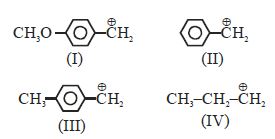
A
$IV < II < III < I$
B
$IV < III < II < I$
C
$I < II < III < IV$
D
$I < II < IV < III$
Solution
(A) The stability of carbocations is determined by the electronic effects of the substituents attached to the positively charged carbon atom.
$(I)$ $CH_3O-C_6H_4-CH_2^+$: The $-OCH_3$ group exerts a strong $+M$ (mesomeric) effect,which significantly stabilizes the carbocation.
$(II)$ $C_6H_5-CH_2^+$: This is a benzyl carbocation,stabilized by resonance with the benzene ring.
$(III)$ $CH_3-C_6H_4-CH_2^+$: The $-CH_3$ group exerts a $+I$ (inductive) effect and hyperconjugation,providing moderate stabilization.
$(IV)$ $CH_3-CH_2-CH_2^+$: This is a primary alkyl carbocation,which is the least stable among the given options.
Comparing these,the order of stability is: $IV < II < III < I$.
$(I)$ $CH_3O-C_6H_4-CH_2^+$: The $-OCH_3$ group exerts a strong $+M$ (mesomeric) effect,which significantly stabilizes the carbocation.
$(II)$ $C_6H_5-CH_2^+$: This is a benzyl carbocation,stabilized by resonance with the benzene ring.
$(III)$ $CH_3-C_6H_4-CH_2^+$: The $-CH_3$ group exerts a $+I$ (inductive) effect and hyperconjugation,providing moderate stabilization.
$(IV)$ $CH_3-CH_2-CH_2^+$: This is a primary alkyl carbocation,which is the least stable among the given options.
Comparing these,the order of stability is: $IV < II < III < I$.
0 likes
View Solution155
MediumMCQ
Which of the following carbocations is least stable?
A
Benzyl carbocation $(C_6H_5CH_2^+)$
B
o-Nitrobenzyl carbocation $(o-NO_2-C_6H_4CH_2^+)$
C
m-Nitrobenzyl carbocation $(m-NO_2-C_6H_4CH_2^+)$
D
p-Methoxybenzyl carbocation $(p-CH_3O-C_6H_4CH_2^+)$
Solution
(B) The stability of a carbocation is determined by the electronic effects of the substituents attached to the benzene ring.
$1$. The $-NO_2$ group is a strong electron-withdrawing group ($-I$ and $-M$ effects).
$2$. In the ortho-nitrobenzyl carbocation,the $-NO_2$ group is at the ortho position,which exerts a strong destabilizing effect due to both $-I$ and $-M$ effects,making it the least stable among the given options.
$3$. The meta-nitrobenzyl carbocation is more stable than the ortho-isomer because the $-M$ effect is not directly operative at the meta position.
$4$. The $p-methoxy$ group is electron-donating ($+M$ effect),which significantly stabilizes the carbocation.
$5$. Therefore,the ortho-nitrobenzyl carbocation is the least stable.
$1$. The $-NO_2$ group is a strong electron-withdrawing group ($-I$ and $-M$ effects).
$2$. In the ortho-nitrobenzyl carbocation,the $-NO_2$ group is at the ortho position,which exerts a strong destabilizing effect due to both $-I$ and $-M$ effects,making it the least stable among the given options.
$3$. The meta-nitrobenzyl carbocation is more stable than the ortho-isomer because the $-M$ effect is not directly operative at the meta position.
$4$. The $p-methoxy$ group is electron-donating ($+M$ effect),which significantly stabilizes the carbocation.
$5$. Therefore,the ortho-nitrobenzyl carbocation is the least stable.
0 likes
View Solution156
MediumMCQ
Which of the following is more stable than the remaining three?
A
$t-$Butyl anion
B
Isobutyl anion
C
Methyl anion
D
Ethyl anion
Solution
(C) The stability of carbanions is primarily determined by the inductive effect. Alkyl groups are electron-donating ($+I$ effect).
Since carbanions already possess a negative charge,the presence of electron-donating groups increases the electron density on the carbon atom,which destabilizes the carbanion.
Therefore,the stability order is: $\text{Methyl anion} > \text{Ethyl anion} > \text{Isobutyl anion} > t-\text{Butyl anion}$.
Among the given options,the methyl anion $(CH_3^-)$ is the most stable because it has no electron-donating alkyl groups attached to the negatively charged carbon.
Since carbanions already possess a negative charge,the presence of electron-donating groups increases the electron density on the carbon atom,which destabilizes the carbanion.
Therefore,the stability order is: $\text{Methyl anion} > \text{Ethyl anion} > \text{Isobutyl anion} > t-\text{Butyl anion}$.
Among the given options,the methyl anion $(CH_3^-)$ is the most stable because it has no electron-donating alkyl groups attached to the negatively charged carbon.
0 likes
View Solution157
MediumMCQ
The decreasing order of stability of the following carbocations is:
$A$. $m-CH_3O-C_6H_4-CH_2^+$
$B$. $p-CH_3O-C_6H_4-CH_2^+$
$C$. $C_6H_5-CH_2^+$
$D$. $p-NO_2-C_6H_4-CH_2^+$
$A$. $m-CH_3O-C_6H_4-CH_2^+$
$B$. $p-CH_3O-C_6H_4-CH_2^+$
$C$. $C_6H_5-CH_2^+$
$D$. $p-NO_2-C_6H_4-CH_2^+$
A
$A > B > C > D$
B
$B > C > D > A$
C
$C > B > A > D$
D
$B > C > A > D$
Solution
(D) The stability of carbocations is determined by the electronic effects of substituents attached to the benzene ring.
$1$. $p-CH_3O-C_6H_4-CH_2^+$ $(B)$: The $-OCH_3$ group at the para position exerts a strong $+M$ (mesomeric) effect,which significantly stabilizes the positive charge.
$2$. $C_6H_5-CH_2^+$ $(C)$: This is the unsubstituted benzyl carbocation,stabilized only by resonance with the phenyl ring.
$3$. $m-CH_3O-C_6H_4-CH_2^+$ $(A)$: The $-OCH_3$ group at the meta position does not exert a $+M$ effect. Instead,it exerts a $-I$ (inductive) effect,which destabilizes the carbocation compared to the unsubstituted benzyl carbocation.
$4$. $p-NO_2-C_6H_4-CH_2^+$ $(D)$: The $-NO_2$ group at the para position exerts both a strong $-M$ and $-I$ effect,which strongly destabilizes the carbocation.
Therefore,the order of stability is $B > C > A > D$.
$1$. $p-CH_3O-C_6H_4-CH_2^+$ $(B)$: The $-OCH_3$ group at the para position exerts a strong $+M$ (mesomeric) effect,which significantly stabilizes the positive charge.
$2$. $C_6H_5-CH_2^+$ $(C)$: This is the unsubstituted benzyl carbocation,stabilized only by resonance with the phenyl ring.
$3$. $m-CH_3O-C_6H_4-CH_2^+$ $(A)$: The $-OCH_3$ group at the meta position does not exert a $+M$ effect. Instead,it exerts a $-I$ (inductive) effect,which destabilizes the carbocation compared to the unsubstituted benzyl carbocation.
$4$. $p-NO_2-C_6H_4-CH_2^+$ $(D)$: The $-NO_2$ group at the para position exerts both a strong $-M$ and $-I$ effect,which strongly destabilizes the carbocation.
Therefore,the order of stability is $B > C > A > D$.
0 likes
View Solution158
MediumMCQ
Most stable carbocation among the following is:
A
B
C
D
Solution
(A) The stability of a carbocation is significantly increased by the presence of an adjacent heteroatom with lone pairs,such as oxygen,due to resonance stabilization (back-bonding).
In option $A$,the positive charge is on the carbon atom directly attached to the oxygen atom. The lone pair on the oxygen can delocalize into the empty $p$-orbital of the carbocation,forming a stable oxonium ion structure $(C=O^+)$.
In other options,the positive charge is further away from the oxygen atom,meaning the resonance stabilization effect is either absent or significantly weaker.
Therefore,the carbocation in option $A$ is the most stable.
In option $A$,the positive charge is on the carbon atom directly attached to the oxygen atom. The lone pair on the oxygen can delocalize into the empty $p$-orbital of the carbocation,forming a stable oxonium ion structure $(C=O^+)$.
In other options,the positive charge is further away from the oxygen atom,meaning the resonance stabilization effect is either absent or significantly weaker.
Therefore,the carbocation in option $A$ is the most stable.
0 likes
View Solution159
MediumMCQ
Which is the most stable cation?
A
$C_6H_5-CH_2^+$
B
$CH_2=CH-CH_2^+$
C
$CH_3-CH^+-CH_3$
D
$HO-CH_2^+$
Solution
(A) To determine the stability of carbocations,we consider resonance,hyperconjugation,and inductive effects.
$1$. $C_6H_5-CH_2^+$ is a benzyl carbocation,which is stabilized by resonance with the benzene ring.
$2$. $CH_2=CH-CH_2^+$ is an allyl carbocation,which is stabilized by resonance.
$3$. $CH_3-CH^+-CH_3$ is a secondary $(2^\circ)$ carbocation,stabilized by hyperconjugation ($6$ $\alpha$-hydrogens).
$4$. $HO-CH_2^+$ is stabilized by the $+M$ effect of the oxygen lone pair.
Comparing these,the benzyl carbocation $(C_6H_5-CH_2^+)$ is significantly more stable due to extensive delocalization of the positive charge over the entire benzene ring compared to the allyl or secondary carbocation.
$1$. $C_6H_5-CH_2^+$ is a benzyl carbocation,which is stabilized by resonance with the benzene ring.
$2$. $CH_2=CH-CH_2^+$ is an allyl carbocation,which is stabilized by resonance.
$3$. $CH_3-CH^+-CH_3$ is a secondary $(2^\circ)$ carbocation,stabilized by hyperconjugation ($6$ $\alpha$-hydrogens).
$4$. $HO-CH_2^+$ is stabilized by the $+M$ effect of the oxygen lone pair.
Comparing these,the benzyl carbocation $(C_6H_5-CH_2^+)$ is significantly more stable due to extensive delocalization of the positive charge over the entire benzene ring compared to the allyl or secondary carbocation.
0 likes
View Solution160
MediumMCQ
Correct order of stability is
A
$CH_3 - \mathop {\ddot C}\limits^\Theta H_2 < CH_2 = \mathop {\ddot C}\limits^\Theta H < CH \equiv \mathop {\ddot C}\limits^\Theta$
B
$CH_3 - \dot CH_2 < CH_2 = \dot CH < CH \equiv \dot C$
C
$CH_3COO^- > C_6H_5O^-$
D
$CH_3 - \mathop C\limits^\oplus H - CH_3 < CH_3 - O - \mathop C\limits^\oplus H_2$
Solution
(C) The stability of carbanions depends on the hybridization of the carbon atom bearing the negative charge. The order of electronegativity is $sp > sp^2 > sp^3$. As the $s$-character increases,the electronegativity of the carbon atom increases,making it better at holding the negative charge. Thus,the stability order for carbanions is $CH \equiv \mathop {\ddot C}\limits^\Theta (sp) > CH_2 = \mathop {\ddot C}\limits^\Theta H (sp^2) > CH_3 - \mathop {\ddot C}\limits^\Theta H_2 (sp^3)$.
Option $A$ shows the reverse of this order.
Option $B$ refers to radicals,where stability increases with hyperconjugation and resonance,not just hybridization.
Option $C$ compares the stability of acetate ion $(CH_3COO^-)$ and phenoxide ion $(C_6H_5O^-)$. In acetate,the negative charge is delocalized over two equivalent oxygen atoms,whereas in phenoxide,it is delocalized over one oxygen and the aromatic ring. The acetate ion is more stable due to equivalent resonance structures.
Option $D$ compares a secondary carbocation with an oxygen-stabilized primary carbocation. The oxygen-stabilized carbocation is more stable due to the $+M$ effect of the oxygen atom.
Option $A$ shows the reverse of this order.
Option $B$ refers to radicals,where stability increases with hyperconjugation and resonance,not just hybridization.
Option $C$ compares the stability of acetate ion $(CH_3COO^-)$ and phenoxide ion $(C_6H_5O^-)$. In acetate,the negative charge is delocalized over two equivalent oxygen atoms,whereas in phenoxide,it is delocalized over one oxygen and the aromatic ring. The acetate ion is more stable due to equivalent resonance structures.
Option $D$ compares a secondary carbocation with an oxygen-stabilized primary carbocation. The oxygen-stabilized carbocation is more stable due to the $+M$ effect of the oxygen atom.
0 likes
View Solution161
DifficultMCQ
Most stable carbocation is
A
Fluorenyl cation
B
Indenyl cation
C
Indanyl cation
D
Bicyclo[$4.3$.$0$]nonyl cation
Solution
(A) The stability of a carbocation is primarily determined by resonance,hyperconjugation,and inductive effects.
$1$. The fluorenyl cation (Option $A$) is highly stable because the positive charge is delocalized over two benzene rings,making it an aromatic system ($14 \pi$ electrons in the conjugated system).
$2$. The indenyl cation (Option $B$) is also aromatic ($6 \pi$ electrons),but it is less stable than the fluorenyl cation due to less extensive delocalization.
$3$. The indanyl cation (Option $C$) and bicyclo[$4.3$.$0$]nonyl cation (Option $D$) are non-aromatic and significantly less stable.
Therefore,the fluorenyl cation is the most stable among the given options.
$1$. The fluorenyl cation (Option $A$) is highly stable because the positive charge is delocalized over two benzene rings,making it an aromatic system ($14 \pi$ electrons in the conjugated system).
$2$. The indenyl cation (Option $B$) is also aromatic ($6 \pi$ electrons),but it is less stable than the fluorenyl cation due to less extensive delocalization.
$3$. The indanyl cation (Option $C$) and bicyclo[$4.3$.$0$]nonyl cation (Option $D$) are non-aromatic and significantly less stable.
Therefore,the fluorenyl cation is the most stable among the given options.
0 likes
View Solution162
DifficultMCQ
Which of the following intermediates is more stable?
A
B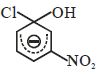
C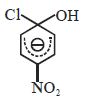
D
All are equally stable
Solution
(C) The given intermediates are carbanions stabilized by resonance within the benzene ring.
An electron-withdrawing group $(EWG)$ like $-NO_2$ increases the stability of a carbanion by dispersing the negative charge through the inductive and resonance effects.
This stabilization is most effective when the $-NO_2$ group is at the ortho or para position relative to the negative charge,as the negative charge can be delocalized directly onto the oxygen atoms of the nitro group.
In option $C$,the $-NO_2$ group is at the para position,providing maximum stabilization compared to the meta position (option $B$) or no substituent (option $A$).
Therefore,the intermediate in option $C$ is the most stable.
An electron-withdrawing group $(EWG)$ like $-NO_2$ increases the stability of a carbanion by dispersing the negative charge through the inductive and resonance effects.
This stabilization is most effective when the $-NO_2$ group is at the ortho or para position relative to the negative charge,as the negative charge can be delocalized directly onto the oxygen atoms of the nitro group.
In option $C$,the $-NO_2$ group is at the para position,providing maximum stabilization compared to the meta position (option $B$) or no substituent (option $A$).
Therefore,the intermediate in option $C$ is the most stable.
0 likes
View Solution163
DifficultMCQ
The most stable carbanion among the following is
A
$C_6H_5-CH_2-CH_2^-$
B
$C_6H_5-CH_2^-$
C
$p-CH_3O-C_6H_4-CH_2^-$
D
$p-NO_2-C_6H_4-CH_2^-$
Solution
(D) The stability of a carbanion is increased by electron-withdrawing groups $(EWG)$ and decreased by electron-donating groups $(EDG)$ attached to the carbon bearing the negative charge.
$1.$ Option $A$ is an alkyl carbanion with a phenyl group further away,providing minimal stabilization.
$2.$ Option $B$ is a benzyl carbanion,stabilized by resonance with the phenyl ring.
$3.$ Option $C$ has a $-OCH_3$ group,which is an electron-donating group (via $+M$ effect),thus destabilizing the carbanion.
$4.$ Option $D$ has a $-NO_2$ group,which is a strong electron-withdrawing group (via $-M$ and $-I$ effects). It effectively disperses the negative charge through resonance,making it the most stable carbanion among the given options.
$1.$ Option $A$ is an alkyl carbanion with a phenyl group further away,providing minimal stabilization.
$2.$ Option $B$ is a benzyl carbanion,stabilized by resonance with the phenyl ring.
$3.$ Option $C$ has a $-OCH_3$ group,which is an electron-donating group (via $+M$ effect),thus destabilizing the carbanion.
$4.$ Option $D$ has a $-NO_2$ group,which is a strong electron-withdrawing group (via $-M$ and $-I$ effects). It effectively disperses the negative charge through resonance,making it the most stable carbanion among the given options.
0 likes
View Solution164
DifficultMCQ
Which is the correct order of stability of the following three carbonium ions?
$(I)$ $CH_2 = CH - CH^+ - CH_3$
$(II)$ $CH_2 = C(CH_3) - CH_2^+$
$(III)$ $CH_3 - CH = CH - CH_2^+$
$(I)$ $CH_2 = CH - CH^+ - CH_3$
$(II)$ $CH_2 = C(CH_3) - CH_2^+$
$(III)$ $CH_3 - CH = CH - CH_2^+$
A
$I > II > III$
B
$II > I > III$
C
$I \approx III > II$
D
All are equally stable
Solution
(C) In $(I)$ and $(III)$,the positive charge is delocalized through resonance,and the carbocation character is stabilized by the presence of an adjacent alkyl group.
Specifically,$(I)$ is a secondary $(2^\circ)$ allylic carbocation,and $(III)$ is a primary $(1^\circ)$ allylic carbocation.
However,in $(I)$,the positive charge is on a secondary carbon,while in $(III)$,it is on a primary carbon.
In $(II)$,the positive charge is on a primary carbon and is allylic.
Comparing the resonance structures and the inductive effects,$(I)$ and $(III)$ show greater stability due to the nature of the allylic system and the electron-donating effects of the methyl group.
Thus,the correct order is $(I) \approx (III) > (II)$.
Specifically,$(I)$ is a secondary $(2^\circ)$ allylic carbocation,and $(III)$ is a primary $(1^\circ)$ allylic carbocation.
However,in $(I)$,the positive charge is on a secondary carbon,while in $(III)$,it is on a primary carbon.
In $(II)$,the positive charge is on a primary carbon and is allylic.
Comparing the resonance structures and the inductive effects,$(I)$ and $(III)$ show greater stability due to the nature of the allylic system and the electron-donating effects of the methyl group.
Thus,the correct order is $(I) \approx (III) > (II)$.
0 likes
View Solution165
DifficultMCQ
The increasing order of stability of the following free radicals is:
A
$(C_6H_5)_2\dot{C}H < (C_6H_5)_3\dot{C} < (CH_3)_3\dot{C} < (CH_3)_2\dot{C}H$
B
$(CH_3)_2\dot{C}H < (CH_3)_3\dot{C} < (C_6H_5)_2\dot{C}H < (C_6H_5)_3\dot{C}$
C
$(CH_3)_3\dot{C} < (CH_3)_2\dot{C}H < (C_6H_5)_2\dot{C}H < (C_6H_5)_3\dot{C}$
D
$(C_6H_5)_3\dot{C} < (C_6H_5)_2\dot{C}H < (CH_3)_3\dot{C} < (CH_3)_2\dot{C}H$
Solution
(B) The stability of free radicals is governed by resonance and inductive effects.
$1$. Resonance stabilization: The triphenylmethyl radical $(C_6H_5)_3\dot{C}$ is more stable than the diphenylmethyl radical $(C_6H_5)_2\dot{C}H$ because it has more phenyl groups to delocalize the unpaired electron.
$2$. Inductive effect: Alkyl radicals are stabilized by the $+I$ effect of alkyl groups. The tertiary butyl radical $(CH_3)_3\dot{C}$ is more stable than the isopropyl radical $(CH_3)_2\dot{C}H$.
$3$. Overall order: Resonance-stabilized radicals are significantly more stable than alkyl radicals.
Therefore,the increasing order of stability is: $(CH_3)_2\dot{C}H < (CH_3)_3\dot{C} < (C_6H_5)_2\dot{C}H < (C_6H_5)_3\dot{C}$.
$1$. Resonance stabilization: The triphenylmethyl radical $(C_6H_5)_3\dot{C}$ is more stable than the diphenylmethyl radical $(C_6H_5)_2\dot{C}H$ because it has more phenyl groups to delocalize the unpaired electron.
$2$. Inductive effect: Alkyl radicals are stabilized by the $+I$ effect of alkyl groups. The tertiary butyl radical $(CH_3)_3\dot{C}$ is more stable than the isopropyl radical $(CH_3)_2\dot{C}H$.
$3$. Overall order: Resonance-stabilized radicals are significantly more stable than alkyl radicals.
Therefore,the increasing order of stability is: $(CH_3)_2\dot{C}H < (CH_3)_3\dot{C} < (C_6H_5)_2\dot{C}H < (C_6H_5)_3\dot{C}$.
0 likes
View Solution166
DifficultMCQ
Assertion : Carbanions like ammonia have pyramidal shape.
Reason : The carbon atom carrying negative charge has an octet of electrons.
Reason : The carbon atom carrying negative charge has an octet of electrons.
A
If both Assertion and Reason are correct and the Reason is a correct explanation of the Assertion.
B
If both Assertion and Reason are correct but Reason is not a correct explanation of the Assertion.
C
If the Assertion is correct but Reason is incorrect.
D
If both the Assertion and Reason are incorrect.
Solution
(B) carbanion is a species containing a carbon atom with a negative charge and an unshared pair of electrons.
In a carbanion,the central carbon atom is $sp^3$ hybridized.
Due to the presence of three bond pairs and one lone pair,the geometry of the carbanion is pyramidal,similar to ammonia $(NH_3)$.
Thus,the Assertion is correct.
The carbon atom in a carbanion has $8$ electrons in its valence shell (six from three bonds and two from the lone pair),which completes its octet.
Thus,the Reason is also correct.
However,the pyramidal shape is due to the $sp^3$ hybridization and the presence of a lone pair,not simply because the carbon has an octet of electrons.
Therefore,the Reason is not the correct explanation of the Assertion.
In a carbanion,the central carbon atom is $sp^3$ hybridized.
Due to the presence of three bond pairs and one lone pair,the geometry of the carbanion is pyramidal,similar to ammonia $(NH_3)$.
Thus,the Assertion is correct.
The carbon atom in a carbanion has $8$ electrons in its valence shell (six from three bonds and two from the lone pair),which completes its octet.
Thus,the Reason is also correct.
However,the pyramidal shape is due to the $sp^3$ hybridization and the presence of a lone pair,not simply because the carbon has an octet of electrons.
Therefore,the Reason is not the correct explanation of the Assertion.
0 likes
View Solution167
DifficultMCQ
The most stable carbocation among the following is:
A
$(CH_{3})_{3}C^{+}$
B
$CH_{3}CH_{2}CH^{+}CH_{2}CH_{3}$
C
$CH_{3}CH^{+}CH_{2}CH_{2}CH_{3}$
D
$CH_{3}CH_{2}CH_{2}^{+}$
Solution
(A) The stability of carbocations is determined by the inductive effect $(+I)$ and hyperconjugation (number of $\alpha-H$ atoms).
$1$. $(CH_{3})_{3}C^{+}$ is a tertiary $(3^{\circ})$ carbocation with $9$ $\alpha-H$ atoms.
$2$. $CH_{3}CH_{2}CH^{+}CH_{2}CH_{3}$ is a secondary $(2^{\circ})$ carbocation with $4$ $\alpha-H$ atoms.
$3$. $CH_{3}CH^{+}CH_{2}CH_{2}CH_{3}$ is a secondary $(2^{\circ})$ carbocation with $3$ $\alpha-H$ atoms.
$4$. $CH_{3}CH_{2}CH_{2}^{+}$ is a primary $(1^{\circ})$ carbocation with $2$ $\alpha-H$ atoms.
Since the stability order is $3^{\circ} > 2^{\circ} > 1^{\circ}$, the tertiary carbocation $(CH_{3})_{3}C^{+}$ is the most stable.
$1$. $(CH_{3})_{3}C^{+}$ is a tertiary $(3^{\circ})$ carbocation with $9$ $\alpha-H$ atoms.
$2$. $CH_{3}CH_{2}CH^{+}CH_{2}CH_{3}$ is a secondary $(2^{\circ})$ carbocation with $4$ $\alpha-H$ atoms.
$3$. $CH_{3}CH^{+}CH_{2}CH_{2}CH_{3}$ is a secondary $(2^{\circ})$ carbocation with $3$ $\alpha-H$ atoms.
$4$. $CH_{3}CH_{2}CH_{2}^{+}$ is a primary $(1^{\circ})$ carbocation with $2$ $\alpha-H$ atoms.
Since the stability order is $3^{\circ} > 2^{\circ} > 1^{\circ}$, the tertiary carbocation $(CH_{3})_{3}C^{+}$ is the most stable.
0 likes
View Solution168
DifficultMCQ
Which of the following carbocations is expected to be most stable?
A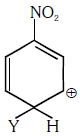
B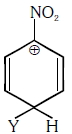
C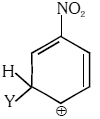
D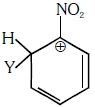
Solution
(C) The $-NO_2$ group is a strong electron-withdrawing group ($-I$ and $-M$ effects).
In electrophilic aromatic substitution,the stability of the intermediate carbocation (arenium ion) determines the orientation.
When the positive charge is at the ortho or para positions,it comes into direct conjugation with the $-NO_2$ group,leading to significant destabilization due to the electron-withdrawing effect.
When the positive charge is at the meta position,it is not in direct conjugation with the $-NO_2$ group,making it relatively more stable than the ortho and para intermediates.
Therefore,the meta-substituted carbocation is the most stable among the options.
In electrophilic aromatic substitution,the stability of the intermediate carbocation (arenium ion) determines the orientation.
When the positive charge is at the ortho or para positions,it comes into direct conjugation with the $-NO_2$ group,leading to significant destabilization due to the electron-withdrawing effect.
When the positive charge is at the meta position,it is not in direct conjugation with the $-NO_2$ group,making it relatively more stable than the ortho and para intermediates.
Therefore,the meta-substituted carbocation is the most stable among the options.
0 likes
View Solution169
DifficultMCQ
The major products $A$ and $B$ in the following reactions are:
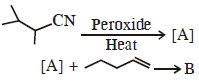
A
$A$ = $(CH_3)_2CH-\dot{C}(CN)CH_3$ and $B$ = $CH_3CH_2CH_2CH_2-C(CH_3)_2-CN$
B
$A$ = $(CH_3)_2\dot{C}-CH(CN)CH_3$ and $B$ = $CH_3CH_2CH_2CH_2-CH(CH_3)-CH(CN)CH_3$
C
$A$ = $(CH_3)_2CH-\dot{C}(CN)CH_3$ and $B$ = $CH_3CH_2CH_2-C(CH_3)_2-CN$
D
$A$ = $(CH_3)_2\dot{C}-CH(CN)CH_3$ and $B$ = $CH_3CH_2CH_2-CH(CH_3)-CH(CN)CH_3$
Solution
(A) The reaction involves the formation of a free radical intermediate $[A]$ followed by its addition to an alkene to form product $B$.
$1$. In the first step,the reaction of $2$-methylbutanenitrile with peroxide and heat leads to the abstraction of the hydrogen atom from the tertiary carbon,resulting in the most stable tertiary free radical: $(CH_3)_2C(\dot{C}HCN)CH_3$ or more simply $(CH_3)_2C(\dot{C}HCN)CH_3$ is not correct,the radical forms at the alpha position to the $CN$ group,which is $(CH_3)_2CH-\dot{C}(CN)CH_3$.
$2$. In the second step,the radical $[A]$ adds to the terminal alkene $CH_3CH_2CH_2CH=CH_2$ (pent$-1-$ene). The radical adds to the terminal carbon to form a more stable secondary radical,which then abstracts a hydrogen atom or terminates to form the final product $B$.
$3$. The structure of $B$ is $CH_3CH_2CH_2CH_2-C(CH_3)_2-CN$.
$1$. In the first step,the reaction of $2$-methylbutanenitrile with peroxide and heat leads to the abstraction of the hydrogen atom from the tertiary carbon,resulting in the most stable tertiary free radical: $(CH_3)_2C(\dot{C}HCN)CH_3$ or more simply $(CH_3)_2C(\dot{C}HCN)CH_3$ is not correct,the radical forms at the alpha position to the $CN$ group,which is $(CH_3)_2CH-\dot{C}(CN)CH_3$.
$2$. In the second step,the radical $[A]$ adds to the terminal alkene $CH_3CH_2CH_2CH=CH_2$ (pent$-1-$ene). The radical adds to the terminal carbon to form a more stable secondary radical,which then abstracts a hydrogen atom or terminates to form the final product $B$.
$3$. The structure of $B$ is $CH_3CH_2CH_2CH_2-C(CH_3)_2-CN$.
0 likes
View Solution170
DifficultMCQ
The increasing order of basicity for the following intermediates is (from weak to strong):
$(i)$ $(CH_3)_3C^{-}$
$(ii)$ $H_2C=CH-CH_2^{-}$
$(iii)$ $HC \equiv C^{-}$
$(iv)$ $CH_3^{-}$
$(v)$ $CN^{-}$
$(i)$ $(CH_3)_3C^{-}$
$(ii)$ $H_2C=CH-CH_2^{-}$
$(iii)$ $HC \equiv C^{-}$
$(iv)$ $CH_3^{-}$
$(v)$ $CN^{-}$
A
$(v) < (i) < (iv) < (ii) < (iii)$
B
$(iii) < (i) < (ii) < (iv) < (v)$
C
$(v) < (iii) < (ii) < (iv) < (i)$
D
$(iii) < (iv) < (ii) < (i) < (v)$
Solution
(C) Basicity $\propto \frac{1}{\text{Stability of conjugate base}}$.
Stability order of the given carbanions:
$(v)$ $CN^{-}$: The negative charge is on the nitrogen atom (more electronegative) and it is also stabilized by the $-I$ effect of the triple bond. It is the most stable.
$(iii)$ $HC \equiv C^{-}$: The negative charge is on an $sp$ hybridized carbon atom. It is more stable than $sp^2$ or $sp^3$ hybridized carbons.
$(ii)$ $H_2C=CH-CH_2^{-}$: The negative charge is stabilized by resonance (delocalization).
$(iv)$ $CH_3^{-}$: The negative charge is on an $sp^3$ hybridized carbon atom.
$(i)$ $(CH_3)_3C^{-}$: The negative charge is on an $sp^3$ hybridized carbon atom,which is further destabilized by the $+I$ effect of three methyl groups. It is the least stable.
Stability order: $(v) > (iii) > (ii) > (iv) > (i)$.
Since Basicity $\propto \frac{1}{\text{Stability}}$,the increasing order of basicity is: $(v) < (iii) < (ii) < (iv) < (i)$.
Stability order of the given carbanions:
$(v)$ $CN^{-}$: The negative charge is on the nitrogen atom (more electronegative) and it is also stabilized by the $-I$ effect of the triple bond. It is the most stable.
$(iii)$ $HC \equiv C^{-}$: The negative charge is on an $sp$ hybridized carbon atom. It is more stable than $sp^2$ or $sp^3$ hybridized carbons.
$(ii)$ $H_2C=CH-CH_2^{-}$: The negative charge is stabilized by resonance (delocalization).
$(iv)$ $CH_3^{-}$: The negative charge is on an $sp^3$ hybridized carbon atom.
$(i)$ $(CH_3)_3C^{-}$: The negative charge is on an $sp^3$ hybridized carbon atom,which is further destabilized by the $+I$ effect of three methyl groups. It is the least stable.
Stability order: $(v) > (iii) > (ii) > (iv) > (i)$.
Since Basicity $\propto \frac{1}{\text{Stability}}$,the increasing order of basicity is: $(v) < (iii) < (ii) < (iv) < (i)$.
0 likes
View Solution171
Medium
Using curved-arrow notation,show the formation of reactive intermediates when the following covalent bonds undergo heterolytic cleavage:
$(a)$ $CH_{3}-SCH_{3}$
$(b)$ $CH_{3}-CN$
$(c)$ $CH_{3}-Cu$
$(a)$ $CH_{3}-SCH_{3}$
$(b)$ $CH_{3}-CN$
$(c)$ $CH_{3}-Cu$
Solution
(N/A) Heterolytic cleavage involves the breaking of a covalent bond such that both electrons of the shared pair remain with one of the fragments.
$(a)$ $CH_{3}-SCH_{3} \rightarrow CH_{3}^{+} + ^{-}SCH_{3}$
(The sulfur atom is more electronegative than the carbon atom,so the electron pair moves towards sulfur.)
$(b)$ $CH_{3}-CN \rightarrow CH_{3}^{+} + ^{-}CN$
(The nitrogen-containing group is more electronegative than the carbon atom,so the electron pair moves towards the cyanide group.)
$(c)$ $CH_{3}-Cu \rightarrow ^{-}CH_{3} + Cu^{+}$
(Carbon is more electronegative than copper,so the electron pair moves towards the carbon atom.)
$(a)$ $CH_{3}-SCH_{3} \rightarrow CH_{3}^{+} + ^{-}SCH_{3}$
(The sulfur atom is more electronegative than the carbon atom,so the electron pair moves towards sulfur.)
$(b)$ $CH_{3}-CN \rightarrow CH_{3}^{+} + ^{-}CN$
(The nitrogen-containing group is more electronegative than the carbon atom,so the electron pair moves towards the cyanide group.)
$(c)$ $CH_{3}-Cu \rightarrow ^{-}CH_{3} + Cu^{+}$
(Carbon is more electronegative than copper,so the electron pair moves towards the carbon atom.)
0 likes
View Solution172
Medium
Explain why $((CH_3)_3C)^+$ is more stable than $(CH_3CH_2)^+$ and $(CH_3)^+$ is the least stable carbocation.
Solution
(N/A) The stability of carbocations is primarily determined by the inductive effect and hyperconjugation.
In $((CH_3)_3C)^+$,there are $9$ $\alpha$-$C-H$ bonds available for hyperconjugation,which provides significant stabilization.
In $(CH_3CH_2)^+$,there are only $3$ $\alpha$-$C-H$ bonds available for hyperconjugation,making it less stable than the tertiary carbocation.
In $(CH_3)^+$,there are no $\alpha$-$C-H$ bonds available for hyperconjugation. Furthermore,the vacant $p$-orbital is perpendicular to the plane of the $C-H$ bonds,preventing any overlap. Thus,$(CH_3)^+$ lacks hyperconjugative stability and is the least stable.
In $((CH_3)_3C)^+$,there are $9$ $\alpha$-$C-H$ bonds available for hyperconjugation,which provides significant stabilization.
In $(CH_3CH_2)^+$,there are only $3$ $\alpha$-$C-H$ bonds available for hyperconjugation,making it less stable than the tertiary carbocation.
In $(CH_3)^+$,there are no $\alpha$-$C-H$ bonds available for hyperconjugation. Furthermore,the vacant $p$-orbital is perpendicular to the plane of the $C-H$ bonds,preventing any overlap. Thus,$(CH_3)^+$ lacks hyperconjugative stability and is the least stable.
0 likes
View Solution173
Medium
For the following bond cleavages,use curved-arrows to show the electron flow and classify each as homolysis or heterolysis. Identify the reactive intermediate produced as free radical,carbocation,or carbanion.
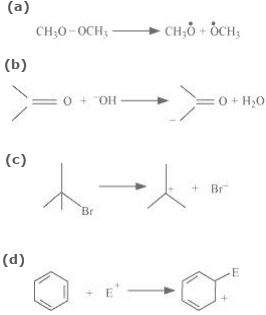
Solution
(N/A) The bond cleavage using curved-arrows to show the electron flow of the given reaction is:
$CH_3O-OCH_3 \rightarrow CH_3O^{\bullet} + ^{\bullet}OCH_3$
It is an example of homolytic cleavage as each atom takes one electron from the shared pair. The reaction intermediate formed is a free radical.
$(b)$ The bond cleavage using curved-arrows to show the electron flow of the given reaction is:
$CH_3-CO-CH_3 + OH^- \rightarrow CH_3-CO-CH_2^- + H_2O$
It is an example of heterolytic cleavage as the shared pair of electrons remains with the carbon atom. The reaction intermediate formed is a carbanion.
$(c)$ The bond cleavage using curved-arrows to show the electron flow of the given reaction is:
$(CH_3)_3C-Br \rightarrow (CH_3)_3C^+ + Br^-$
It is an example of heterolytic cleavage as the shared pair of electrons remains with the bromine atom. The reaction intermediate formed is a carbocation.
$(d)$ The bond cleavage using curved-arrows to show the electron flow of the given reaction is:
$C_6H_6 + E^+ \rightarrow [C_6H_6E]^+$
It is a heterolytic cleavage as the shared pair of electrons from the benzene ring is used to form a bond with the electrophile $E^+$. The intermediate formed is a carbocation (arenium ion).
$CH_3O-OCH_3 \rightarrow CH_3O^{\bullet} + ^{\bullet}OCH_3$
It is an example of homolytic cleavage as each atom takes one electron from the shared pair. The reaction intermediate formed is a free radical.
$(b)$ The bond cleavage using curved-arrows to show the electron flow of the given reaction is:
$CH_3-CO-CH_3 + OH^- \rightarrow CH_3-CO-CH_2^- + H_2O$
It is an example of heterolytic cleavage as the shared pair of electrons remains with the carbon atom. The reaction intermediate formed is a carbanion.
$(c)$ The bond cleavage using curved-arrows to show the electron flow of the given reaction is:
$(CH_3)_3C-Br \rightarrow (CH_3)_3C^+ + Br^-$
It is an example of heterolytic cleavage as the shared pair of electrons remains with the bromine atom. The reaction intermediate formed is a carbocation.
$(d)$ The bond cleavage using curved-arrows to show the electron flow of the given reaction is:
$C_6H_6 + E^+ \rightarrow [C_6H_6E]^+$
It is a heterolytic cleavage as the shared pair of electrons from the benzene ring is used to form a bond with the electrophile $E^+$. The intermediate formed is a carbocation (arenium ion).
0 likes
View Solution174
EasyMCQ
Which of the following carbocations is the most stable?
A
$(CH_3)_3C^+$
B
$(CH_3)_3CCH_2^+$
C
$CH_3CH_2CH_2^+$
D
$CH_3CH^+CH_2CH_3$
Solution
(A) The stability of carbocations follows the order: $3^\circ > 2^\circ > 1^\circ$.
$(CH_3)_3C^+$ is a tertiary $(3^\circ)$ carbocation.
$(CH_3)_3CCH_2^+$ is a primary $(1^\circ)$ carbocation.
$CH_3CH_2CH_2^+$ is a primary $(1^\circ)$ carbocation.
$CH_3CH^+CH_2CH_3$ is a secondary $(2^\circ)$ carbocation.
Among the given options,$(CH_3)_3C^+$ is the most stable due to the $+I$ effect and hyperconjugation provided by the three methyl groups attached to the positively charged carbon atom.
$(CH_3)_3C^+$ is a tertiary $(3^\circ)$ carbocation.
$(CH_3)_3CCH_2^+$ is a primary $(1^\circ)$ carbocation.
$CH_3CH_2CH_2^+$ is a primary $(1^\circ)$ carbocation.
$CH_3CH^+CH_2CH_3$ is a secondary $(2^\circ)$ carbocation.
Among the given options,$(CH_3)_3C^+$ is the most stable due to the $+I$ effect and hyperconjugation provided by the three methyl groups attached to the positively charged carbon atom.
0 likes
View Solution175
Difficult
Explain the heterolytic cleavage of organic compounds to form $(a)$ Carbocations and $(b)$ Carbanions with examples.
Solution
(N/A) Definition: When a covalent bond breaks in such a way that both electrons of the covalent bond (i.e.,shared pair) are taken away by one of the bonded atoms,the mode of bond cleavage is called heterolytic fission. After heterolysis,one atom has a sextet electronic structure and a positive charge,while the other has a valence octet with at least one lone pair and a negative charge.
$(a)$ Heterolytic fission producing carbocation: e.g.,Heterolytic cleavage of $CH_3Br$ gives $CH_3^+$ (methyl cation) and $Br^-$ (bromide ion).
$H_3C-Br \xrightarrow{\text{Heterolytic}} H_3C^+ + :Br^-$
$\rightarrow$ Both electrons of the $C-Br$ bond are transferred to $Br$. Thus,$Br$ gains the non-bonding electron pair,an octet,and a negative charge.
$\rightarrow$ $A$ species having a carbon atom with a sextet of electrons and a $+1$ positive charge is called a carbocation. The $CH_3^+$ ion is known as a methyl cation.
$\rightarrow$ The positively charged carbon of $CH_3^+$ possesses $sp^2$ hybridization and has a trigonal planar shape.
$(b)$ Heterolytic fission producing carbanion: The heterolytic cleavage can also produce species in which carbon retains the shared pair of electrons,obtaining a negative charge. e.g.,When a group $Z$ attached to a carbon leaves without the electron pair,a carbanion is formed.
$H_3C-Z \xrightarrow{\text{Heterolytic}} H_3C:^- + Z^+$
In this case,the carbon atom retains the shared pair of electrons,resulting in a carbanion $(H_3C:^-)$.
$(a)$ Heterolytic fission producing carbocation: e.g.,Heterolytic cleavage of $CH_3Br$ gives $CH_3^+$ (methyl cation) and $Br^-$ (bromide ion).
$H_3C-Br \xrightarrow{\text{Heterolytic}} H_3C^+ + :Br^-$
$\rightarrow$ Both electrons of the $C-Br$ bond are transferred to $Br$. Thus,$Br$ gains the non-bonding electron pair,an octet,and a negative charge.
$\rightarrow$ $A$ species having a carbon atom with a sextet of electrons and a $+1$ positive charge is called a carbocation. The $CH_3^+$ ion is known as a methyl cation.
$\rightarrow$ The positively charged carbon of $CH_3^+$ possesses $sp^2$ hybridization and has a trigonal planar shape.
$(b)$ Heterolytic fission producing carbanion: The heterolytic cleavage can also produce species in which carbon retains the shared pair of electrons,obtaining a negative charge. e.g.,When a group $Z$ attached to a carbon leaves without the electron pair,a carbanion is formed.
$H_3C-Z \xrightarrow{\text{Heterolytic}} H_3C:^- + Z^+$
In this case,the carbon atom retains the shared pair of electrons,resulting in a carbanion $(H_3C:^-)$.
0 likes
View Solution176
Medium
What is homolytic cleavage of a covalent bond? Explain with an example. Or,write about bond cleavage and the intermediate free radical.
Solution
(N/A) In homolytic cleavage,one of the electrons of the shared pair in a covalent bond goes with each of the bonded atoms.
In homolytic cleavage,the movement of a single electron takes place instead of an electron pair. The single electron movement is shown by a 'half-headed' (fish hook) curved arrow.
- Such cleavage results in the formation of neutral species (atom or group) which contains an unpaired electron. These species are called free radicals.
- Like carbocations and carbanions,free radicals are also very reactive.
- $A$ homolytic cleavage can be shown as:
$R-Z \xrightarrow{\text{Heat or Light}} \dot{R} + \dot{Z}$
Organic reactions,which proceed by homolytic fission,are called free radical,homopolar,or nonpolar reactions.
In homolytic cleavage,the movement of a single electron takes place instead of an electron pair. The single electron movement is shown by a 'half-headed' (fish hook) curved arrow.
- Such cleavage results in the formation of neutral species (atom or group) which contains an unpaired electron. These species are called free radicals.
- Like carbocations and carbanions,free radicals are also very reactive.
- $A$ homolytic cleavage can be shown as:
$R-Z \xrightarrow{\text{Heat or Light}} \dot{R} + \dot{Z}$
Organic reactions,which proceed by homolytic fission,are called free radical,homopolar,or nonpolar reactions.
0 likes
View Solution177
Difficult
In the organic reaction by fission of bond,which intermediate species are formed? Name these species and explain their stability.
Solution
(N/A) In organic compounds,covalent bonds are present between atoms. During organic reactions,the fission of a covalent bond takes place. Depending on the mode of electron displacement,three main types of reactive intermediates are formed:
$(a)$ In heterolytic fission,a carbocation or carbanion is formed.
$(b)$ In homolytic fission,a free radical is formed.
$(a)$ $(i)$ Carbocation: $A$ species in which a positive charge is present on the carbon atom. Examples: $H_3C^{+}$,$CH_3CH_2^+$,$(CH_3)_2CH^{+}$,$(CH_3)_3C^{+}$. The stability order is: $CH_3^+ < CH_3CH_2^+ < (CH_3)_2CH^{+} < (CH_3)_3C^{+}$ (i.e.,$\text{Methyl} < 1^{\circ} < 2^{\circ} < 3^{\circ}$).
(ii) Carbanion: $A$ species bearing a negative charge on the carbon atom. Examples: $H_3C^{-}$,$H_3CCH_2^-$,$(H_3C)_2CH^{-}$,$(CH_3)_3C^{-}$. The stability order is: $\text{Methyl} > 1^{\circ} > 2^{\circ} > 3^{\circ}$.
$(b)$ Free radical: These are produced by homolytic cleavage of covalent bonds. $A$ free radical contains one unpaired electron on the carbon atom. Examples: $\dot{C}H_3$,$CH_3\dot{C}H_2$,$(CH_3)_2\dot{C}H$,$(CH_3)_3\dot{C}$. The stability order is: $\dot{C}H_3 < CH_3\dot{C}H_2 < (CH_3)_2\dot{C}H < (CH_3)_3\dot{C}$ (i.e.,$1^{\circ} < 2^{\circ} < 3^{\circ}$).
$(a)$ In heterolytic fission,a carbocation or carbanion is formed.
$(b)$ In homolytic fission,a free radical is formed.
$(a)$ $(i)$ Carbocation: $A$ species in which a positive charge is present on the carbon atom. Examples: $H_3C^{+}$,$CH_3CH_2^+$,$(CH_3)_2CH^{+}$,$(CH_3)_3C^{+}$. The stability order is: $CH_3^+ < CH_3CH_2^+ < (CH_3)_2CH^{+} < (CH_3)_3C^{+}$ (i.e.,$\text{Methyl} < 1^{\circ} < 2^{\circ} < 3^{\circ}$).
(ii) Carbanion: $A$ species bearing a negative charge on the carbon atom. Examples: $H_3C^{-}$,$H_3CCH_2^-$,$(H_3C)_2CH^{-}$,$(CH_3)_3C^{-}$. The stability order is: $\text{Methyl} > 1^{\circ} > 2^{\circ} > 3^{\circ}$.
$(b)$ Free radical: These are produced by homolytic cleavage of covalent bonds. $A$ free radical contains one unpaired electron on the carbon atom. Examples: $\dot{C}H_3$,$CH_3\dot{C}H_2$,$(CH_3)_2\dot{C}H$,$(CH_3)_3\dot{C}$. The stability order is: $\dot{C}H_3 < CH_3\dot{C}H_2 < (CH_3)_2\dot{C}H < (CH_3)_3\dot{C}$ (i.e.,$1^{\circ} < 2^{\circ} < 3^{\circ}$).
0 likes
View Solution178
Medium
List the reactive intermediates produced by the fission of a covalent bond and describe their main characteristics.
Solution
(N/A) The reactive intermediates produced by the fission of a covalent bond are Carbocations,Carbanions,and Free radicals.
Characteristics:
$1$. These intermediates are highly unstable and reactive species formed during the course of a chemical reaction.
$2$. The stability of these intermediates is influenced by the inductive effect and hyperconjugation of the attached alkyl groups.
$3$. In these species,the central carbon atom is typically bonded to three other atoms or groups.
| Intermediate | $1^{\circ}$ (Primary) | $2^{\circ}$ (Secondary) | $3^{\circ}$ (Tertiary) |
|---|---|---|---|
| Carbocation | $CH_3^+, CH_3CH_2^+$ | $(CH_3)_2CH^+$ | $(CH_3)_3C^+$ |
| Carbanion | $:CH_3^-, CH_3CH_2^-$ | $(CH_3)_2CH^-$ | $(CH_3)_3C^-$ |
| Free radical | $CH_3\bullet, CH_3CH_2\bullet$ | $(CH_3)_2CH\bullet$ | $(CH_3)_3C\bullet$ |
Characteristics:
$1$. These intermediates are highly unstable and reactive species formed during the course of a chemical reaction.
$2$. The stability of these intermediates is influenced by the inductive effect and hyperconjugation of the attached alkyl groups.
$3$. In these species,the central carbon atom is typically bonded to three other atoms or groups.
0 likes
View Solution179
MediumMCQ
Which of the following carbocations is most stable?
$A) (CH_3)_2CH-CH^+-CH_3$
$B) (CH_3)_2C^+-CH_2CH_3$
$A) (CH_3)_2CH-CH^+-CH_3$
$B) (CH_3)_2C^+-CH_2CH_3$
A
$(CH_3)_2CH-CH^+-CH_3$
B
$(CH_3)_2C^+-CH_2CH_3$
Solution
(B) To determine the stability of carbocations,we look at the number of alkyl groups attached to the positively charged carbon atom (inductive effect and hyperconjugation).
$1.$ In option $A$,the carbocation is $(CH_3)_2CH-CH^+-CH_3$. This is a secondary $(2^{\circ})$ carbocation.
$2.$ In option $B$,the carbocation is $(CH_3)_2C^+-CH_2CH_3$. This is a tertiary $(3^{\circ})$ carbocation.
$3.$ Tertiary carbocations are more stable than secondary carbocations due to greater hyperconjugation and inductive effects from the three alkyl groups attached to the carbocation center.
Therefore,$(CH_3)_2C^+-CH_2CH_3$ is more stable.
$1.$ In option $A$,the carbocation is $(CH_3)_2CH-CH^+-CH_3$. This is a secondary $(2^{\circ})$ carbocation.
$2.$ In option $B$,the carbocation is $(CH_3)_2C^+-CH_2CH_3$. This is a tertiary $(3^{\circ})$ carbocation.
$3.$ Tertiary carbocations are more stable than secondary carbocations due to greater hyperconjugation and inductive effects from the three alkyl groups attached to the carbocation center.
Therefore,$(CH_3)_2C^+-CH_2CH_3$ is more stable.
0 likes
View Solution180
Medium
Show the homolysis reaction of benzoyl peroxide,$(C_6H_5CO)_2O_2$.
Solution
The homolysis of benzoyl peroxide $(C_6H_5CO)_2O_2$ involves the cleavage of the $O-O$ bond to form two benzoyloxy radicals,which subsequently undergo decarboxylation to form phenyl radicals and carbon dioxide:
$(C_6H_5CO)_2O_2$ $\xrightarrow{\text{Homolysis}} 2 C_6H_5COO\bullet$ $\rightarrow 2 C_6H_5\bullet + 2 CO_2$
$(C_6H_5CO)_2O_2$ $\xrightarrow{\text{Homolysis}} 2 C_6H_5COO\bullet$ $\rightarrow 2 C_6H_5\bullet + 2 CO_2$
0 likes
View Solution181
Easy
Arrange the following in decreasing order of stability.
$(i)$ $CH_3^{\bullet}$,$(CH_3)_3C^{\bullet}$,$(CH_3)_2CH^{\bullet}$ and $CH_3CH_2^{\bullet}$
$(ii)$ $CH_3CH_2^{+}$,$(CH_3)_3C^{+}$,$(CH_3)_2CH^{+}$ and $CH_3^{+}$
$(i)$ $CH_3^{\bullet}$,$(CH_3)_3C^{\bullet}$,$(CH_3)_2CH^{\bullet}$ and $CH_3CH_2^{\bullet}$
$(ii)$ $CH_3CH_2^{+}$,$(CH_3)_3C^{+}$,$(CH_3)_2CH^{+}$ and $CH_3^{+}$
Solution
(N/A) $(i)$ The stability of free radicals increases with the number of alkyl groups attached to the radical carbon due to hyperconjugation and inductive effect: $(CH_3)_3C^{\bullet} > (CH_3)_2CH^{\bullet} > CH_3CH_2^{\bullet} > CH_3^{\bullet}$.
$(ii)$ The stability of carbocations increases with the number of alkyl groups attached to the positive carbon due to hyperconjugation and inductive effect: $(CH_3)_3C^{+} > (CH_3)_2CH^{+} > CH_3CH_2^{+} > CH_3^{+}$.
$(ii)$ The stability of carbocations increases with the number of alkyl groups attached to the positive carbon due to hyperconjugation and inductive effect: $(CH_3)_3C^{+} > (CH_3)_2CH^{+} > CH_3CH_2^{+} > CH_3^{+}$.
0 likes
View Solution182
Medium
Classify the following species into carbocation,free radical,and carbanion:
$CH_3^{\bullet}, CH_3^{+}, \bar{C}H_3, (CH_3)_3C^{\bullet}, (CH_3)_3C^{+}, (CH_3)_2CH^{+}, (CH_3)_3\bar{C}:, (CH_3)_3\ddot{C}H, C_6H_5CH_2^{\bullet}, CH_3\ddot{C}H_2, C_6H_5CH_2^{+}, CH_2=CHCH_2^{\bullet}, CH_2=CHCH_2^{+}$
$CH_3^{\bullet}, CH_3^{+}, \bar{C}H_3, (CH_3)_3C^{\bullet}, (CH_3)_3C^{+}, (CH_3)_2CH^{+}, (CH_3)_3\bar{C}:, (CH_3)_3\ddot{C}H, C_6H_5CH_2^{\bullet}, CH_3\ddot{C}H_2, C_6H_5CH_2^{+}, CH_2=CHCH_2^{\bullet}, CH_2=CHCH_2^{+}$
Solution
Carbocation: $CH_3^{+}, (CH_3)_3C^{+}, (CH_3)_2CH^{+}, C_6H_5CH_2^{+}, CH_2=CHCH_2^{+}$
Free radical: $CH_3^{\bullet}, (CH_3)_3C^{\bullet}, C_6H_5CH_2^{\bullet}, CH_2=CHCH_2^{\bullet}$
Carbanion: $\bar{C}H_3, (CH_3)_3\bar{C}:, CH_3\ddot{C}H_2$
Free radical: $CH_3^{\bullet}, (CH_3)_3C^{\bullet}, C_6H_5CH_2^{\bullet}, CH_2=CHCH_2^{\bullet}$
Carbanion: $\bar{C}H_3, (CH_3)_3\bar{C}:, CH_3\ddot{C}H_2$
0 likes
View Solution183
EasyMCQ
Write in ascending order of stability of $1^{\circ}$,$2^{\circ}$ and $3^{\circ}$ carbocations and free radicals.
A
$1^{\circ} < 2^{\circ} < 3^{\circ}$
B
$3^{\circ} < 2^{\circ} < 1^{\circ}$
C
$1^{\circ} = 2^{\circ} = 3^{\circ}$
D
$2^{\circ} < 1^{\circ} < 3^{\circ}$
Solution
(A) The stability of carbocations and free radicals is primarily determined by the inductive effect and hyperconjugation.
Both carbocations and free radicals are electron-deficient species.
Alkyl groups are electron-donating groups ($+I$ effect) and they also provide stability through hyperconjugation.
As the number of alkyl groups attached to the central carbon atom increases,the stability increases.
Therefore,the order of stability is $1^{\circ} < 2^{\circ} < 3^{\circ}$.
Both carbocations and free radicals are electron-deficient species.
Alkyl groups are electron-donating groups ($+I$ effect) and they also provide stability through hyperconjugation.
As the number of alkyl groups attached to the central carbon atom increases,the stability increases.
Therefore,the order of stability is $1^{\circ} < 2^{\circ} < 3^{\circ}$.
0 likes
View Solution184
Medium
What are free radicals,carbanions,and carbocations? How are they formed?
Solution
(N/A) Free radicals,carbanions,and carbocations are highly reactive and unstable reaction intermediates formed during organic chemical reactions.
$1$. Carbocations and carbanions are formed by $heterolytic \ cleavage$,where the shared electron pair of a covalent bond is transferred to only one of the bonded atoms.
$2$. Free radicals are formed by $homolytic \ cleavage$,where each of the bonded atoms takes one electron from the shared pair of the covalent bond.
$1$. Carbocations and carbanions are formed by $heterolytic \ cleavage$,where the shared electron pair of a covalent bond is transferred to only one of the bonded atoms.
$2$. Free radicals are formed by $homolytic \ cleavage$,where each of the bonded atoms takes one electron from the shared pair of the covalent bond.
0 likes
View Solution185
Easy
Define carbocation,carbanion,and free radical.
Solution
(N/A) $1$. $Carbocation$: $A$ species containing a carbon atom bearing a positive charge and having only $6$ electrons in its valence shell. It is an electron-deficient species (electrophile) with $sp^2$ hybridization and a planar geometry.
$2$. $Carbanion$: $A$ species containing a carbon atom bearing a negative charge and having $8$ electrons in its valence shell. It is an electron-rich species (nucleophile) with $sp^3$ hybridization and a pyramidal geometry.
$3$. $Free \text{ } radical$: $A$ species containing a carbon atom with an unpaired electron. It is formed by homolytic fission of a covalent bond. It is neutral,electron-deficient,and highly reactive.
$2$. $Carbanion$: $A$ species containing a carbon atom bearing a negative charge and having $8$ electrons in its valence shell. It is an electron-rich species (nucleophile) with $sp^3$ hybridization and a pyramidal geometry.
$3$. $Free \text{ } radical$: $A$ species containing a carbon atom with an unpaired electron. It is formed by homolytic fission of a covalent bond. It is neutral,electron-deficient,and highly reactive.
0 likes
View Solution186
Easy
When do positive and negative charges appear on a carbon atom? Give examples.
Solution
(N/A) If a carbon atom has three covalent bonds and one vacant orbital,it carries a $(+1)$ charge.
Example: All carbocations,such as $H_{3}C^{+}$.
If a carbon atom has three bonds and one non-bonding electron pair,it carries a $(-1)$ charge.
Example: All carbanions,such as $H_{3}C^{-}$.
Example: All carbocations,such as $H_{3}C^{+}$.
If a carbon atom has three bonds and one non-bonding electron pair,it carries a $(-1)$ charge.
Example: All carbanions,such as $H_{3}C^{-}$.
0 likes
View Solution187
Easy
Represent the structure of the free radical,carbocation,and carbanion derived from methane.
Solution
(N/A) The formation of reactive intermediates from methane $(CH_4)$ occurs via bond cleavage:
$1$. Homolytic cleavage: The covalent bond breaks equally,resulting in the formation of a methyl free radical $(CH_3^{\bullet})$ and a hydrogen radical $(H^{\bullet})$.
$2$. Heterolytic cleavage: The covalent bond breaks unequally,where the shared electron pair stays with one fragment.
- If the carbon atom retains the electron pair,a methyl carbanion $(CH_3^-)$ and a proton $(H^+)$ are formed.
- If the hydrogen atom retains the electron pair,a methyl carbocation $(CH_3^+)$ and a hydride ion $(H:^-)$ are formed.
$1$. Homolytic cleavage: The covalent bond breaks equally,resulting in the formation of a methyl free radical $(CH_3^{\bullet})$ and a hydrogen radical $(H^{\bullet})$.
$2$. Heterolytic cleavage: The covalent bond breaks unequally,where the shared electron pair stays with one fragment.
- If the carbon atom retains the electron pair,a methyl carbanion $(CH_3^-)$ and a proton $(H^+)$ are formed.
- If the hydrogen atom retains the electron pair,a methyl carbocation $(CH_3^+)$ and a hydride ion $(H:^-)$ are formed.
0 likes
View Solution188
EasyMCQ
Arrange the following carbocations in decreasing order of their stability:
$\stackrel{+}{C}H_3, (CH_3)_3\stackrel{+}{C}, CH_3\stackrel{+}{C}H_2, (CH_3)_2\stackrel{+}{C}H$
$\stackrel{+}{C}H_3, (CH_3)_3\stackrel{+}{C}, CH_3\stackrel{+}{C}H_2, (CH_3)_2\stackrel{+}{C}H$
A
$(CH_3)_3\stackrel{+}{C} > (CH_3)_2\stackrel{+}{C}H > CH_3\stackrel{+}{C}H_2 > \stackrel{+}{C}H_3$
B
$\stackrel{+}{C}H_3 > CH_3\stackrel{+}{C}H_2 > (CH_3)_2\stackrel{+}{C}H > (CH_3)_3\stackrel{+}{C}$
C
$(CH_3)_2\stackrel{+}{C}H > (CH_3)_3\stackrel{+}{C} > CH_3\stackrel{+}{C}H_2 > \stackrel{+}{C}H_3$
D
$CH_3\stackrel{+}{C}H_2 > (CH_3)_3\stackrel{+}{C} > (CH_3)_2\stackrel{+}{C}H > \stackrel{+}{C}H_3$
Solution
(A) The stability of carbocations is determined by the inductive effect and hyperconjugation.
Greater the number of alkyl groups attached to the positively charged carbon atom,greater is the stability due to the $+I$ effect and hyperconjugation.
$(CH_3)_3\stackrel{+}{C}$ is a tertiary carbocation (most stable).
$(CH_3)_2\stackrel{+}{C}H$ is a secondary carbocation.
$CH_3\stackrel{+}{C}H_2$ is a primary carbocation.
$\stackrel{+}{C}H_3$ is a methyl carbocation (least stable).
Therefore,the decreasing order of stability is: $(CH_3)_3\stackrel{+}{C} > (CH_3)_2\stackrel{+}{C}H > CH_3\stackrel{+}{C}H_2 > \stackrel{+}{C}H_3$.
Greater the number of alkyl groups attached to the positively charged carbon atom,greater is the stability due to the $+I$ effect and hyperconjugation.
$(CH_3)_3\stackrel{+}{C}$ is a tertiary carbocation (most stable).
$(CH_3)_2\stackrel{+}{C}H$ is a secondary carbocation.
$CH_3\stackrel{+}{C}H_2$ is a primary carbocation.
$\stackrel{+}{C}H_3$ is a methyl carbocation (least stable).
Therefore,the decreasing order of stability is: $(CH_3)_3\stackrel{+}{C} > (CH_3)_2\stackrel{+}{C}H > CH_3\stackrel{+}{C}H_2 > \stackrel{+}{C}H_3$.
0 likes
View Solution189
Easy
Provide four formulas of carbocations.
Solution
(N/A) The four common examples of carbocations are:
$1. \ CH_3^+$ (Methyl carbocation)
$2. \ CH_3CH_2^+$ (Ethyl carbocation)
$3. \ (CH_3)_2CH^+$ (Isopropyl carbocation)
$4. \ (CH_3)_3C^+$ (tert-Butyl carbocation)
Other examples include benzyl carbocation $(C_6H_5CH_2^+)$ and allyl carbocation $(CH_2=CH-CH_2^+)$.
$1. \ CH_3^+$ (Methyl carbocation)
$2. \ CH_3CH_2^+$ (Ethyl carbocation)
$3. \ (CH_3)_2CH^+$ (Isopropyl carbocation)
$4. \ (CH_3)_3C^+$ (tert-Butyl carbocation)
Other examples include benzyl carbocation $(C_6H_5CH_2^+)$ and allyl carbocation $(CH_2=CH-CH_2^+)$.
0 likes
View Solution190
Easy
State True or False for the following statements:
$(i)$ Carbon possesses $sp^2$ hybridization in a carbocation.
$(ii)$ Carbon possesses $sp^3$ hybridization in a carbocation.
$(iii)$ $A$ carbocation is formed by homolytic fission of a bond.
$(iv)$ Carbocations are very stable.
$(i)$ Carbon possesses $sp^2$ hybridization in a carbocation.
$(ii)$ Carbon possesses $sp^3$ hybridization in a carbocation.
$(iii)$ $A$ carbocation is formed by homolytic fission of a bond.
$(iv)$ Carbocations are very stable.
Solution
(A) $(i)$ True: In a carbocation,the positively charged carbon atom is bonded to three other atoms and has an empty $p$-orbital,resulting in $sp^2$ hybridization.
$(ii)$ False: As stated above,the carbon in a carbocation is $sp^2$ hybridized,not $sp^3$.
$(iii)$ False: Carbocations are formed by heterolytic fission of a covalent bond,where the more electronegative atom takes both electrons.
$(iv)$ False: Carbocations are highly reactive,electron-deficient intermediates and are generally unstable,although their stability can vary based on inductive and resonance effects.
$(ii)$ False: As stated above,the carbon in a carbocation is $sp^2$ hybridized,not $sp^3$.
$(iii)$ False: Carbocations are formed by heterolytic fission of a covalent bond,where the more electronegative atom takes both electrons.
$(iv)$ False: Carbocations are highly reactive,electron-deficient intermediates and are generally unstable,although their stability can vary based on inductive and resonance effects.
0 likes
View Solution191
Medium
State True or False for the following statements:
$(i)$ $\mathop{C}\limits^{+}H_3$ and $CH_3\mathop{C}\limits^{+}H_2$ both are primary carbocations.
$(ii)$ $(CH_3)_3\mathop{C}\limits^{+}$ is a tertiary carbocation and all carbons are $sp^3$ hybridized.
$(iii)$ $\mathop{C}\limits^{+}H_3$ is trigonal planar.
$(iv)$ $CH_4$ is not trigonal planar.
$(i)$ $\mathop{C}\limits^{+}H_3$ and $CH_3\mathop{C}\limits^{+}H_2$ both are primary carbocations.
$(ii)$ $(CH_3)_3\mathop{C}\limits^{+}$ is a tertiary carbocation and all carbons are $sp^3$ hybridized.
$(iii)$ $\mathop{C}\limits^{+}H_3$ is trigonal planar.
$(iv)$ $CH_4$ is not trigonal planar.
Solution
(N/A) $(i)$ False. $\mathop{C}\limits^{+}H_3$ (methyl carbocation) is not classified as primary,secondary,or tertiary because it is not attached to any alkyl group. $CH_3\mathop{C}\limits^{+}H_2$ is a primary carbocation.
$(ii)$ False. $(CH_3)_3\mathop{C}\limits^{+}$ is a tertiary carbocation,but the positively charged carbon is $sp^2$ hybridized,not $sp^3$.
$(iii)$ True. The methyl carbocation $\mathop{C}\limits^{+}H_3$ has three bonding pairs and no lone pairs on the central carbon,resulting in $sp^2$ hybridization and a trigonal planar geometry.
$(iv)$ True. $CH_4$ (methane) has four bonding pairs and no lone pairs,resulting in $sp^3$ hybridization and a tetrahedral geometry,not trigonal planar.
$(ii)$ False. $(CH_3)_3\mathop{C}\limits^{+}$ is a tertiary carbocation,but the positively charged carbon is $sp^2$ hybridized,not $sp^3$.
$(iii)$ True. The methyl carbocation $\mathop{C}\limits^{+}H_3$ has three bonding pairs and no lone pairs on the central carbon,resulting in $sp^2$ hybridization and a trigonal planar geometry.
$(iv)$ True. $CH_4$ (methane) has four bonding pairs and no lone pairs,resulting in $sp^3$ hybridization and a tetrahedral geometry,not trigonal planar.
0 likes
View Solution192
Medium
State True or False for the following statements:
$(i)$ Only carbocation is formed by homolytic cleavage of a bond.
$(ii)$ By heterolytic cleavage of a bond,a carbocation or carbanion is formed.
$(iii)$ The carbon of a carbanion is $sp^2$ and the carbon of a carbocation is $sp^3$.
$(iv)$ The carbon of a carbanion is $sp^3$ and the carbon of a carbocation is $sp^2$.
$(i)$ Only carbocation is formed by homolytic cleavage of a bond.
$(ii)$ By heterolytic cleavage of a bond,a carbocation or carbanion is formed.
$(iii)$ The carbon of a carbanion is $sp^2$ and the carbon of a carbocation is $sp^3$.
$(iv)$ The carbon of a carbanion is $sp^3$ and the carbon of a carbocation is $sp^2$.
Solution
(D) $(i)$ False: Homolytic cleavage results in the formation of free radicals,not carbocations.
$(ii)$ True: Heterolytic cleavage results in the unequal distribution of electrons,leading to the formation of a carbocation $(C^+)$ or a carbanion $(C^-)$.
$(iii)$ False: The carbon of a carbanion is $sp^3$ hybridized (pyramidal geometry),and the carbon of a carbocation is $sp^2$ hybridized (planar geometry).
$(iv)$ True: As explained in $(iii)$,the carbanion carbon is $sp^3$ and the carbocation carbon is $sp^2$.
Final Answer: $(i-F, ii-T, iii-F, iv-T)$
$(ii)$ True: Heterolytic cleavage results in the unequal distribution of electrons,leading to the formation of a carbocation $(C^+)$ or a carbanion $(C^-)$.
$(iii)$ False: The carbon of a carbanion is $sp^3$ hybridized (pyramidal geometry),and the carbon of a carbocation is $sp^2$ hybridized (planar geometry).
$(iv)$ True: As explained in $(iii)$,the carbanion carbon is $sp^3$ and the carbocation carbon is $sp^2$.
Final Answer: $(i-F, ii-T, iii-F, iv-T)$
0 likes
View Solution193
Easy
State whether the following statements are True or False:
$(i)$ $CH_3-CH_2^+$ is more stable than $CH_3^+$
$(ii)$ $CH_3-CH_2^+$ is less stable than $CH_3^+$
$(iii)$ $(CH_3)_3C^+$ is less stable than $CH_3^+$
$(iv)$ $(CH_3)_3C^+$ is more stable than $CH_3^+$
$(i)$ $CH_3-CH_2^+$ is more stable than $CH_3^+$
$(ii)$ $CH_3-CH_2^+$ is less stable than $CH_3^+$
$(iii)$ $(CH_3)_3C^+$ is less stable than $CH_3^+$
$(iv)$ $(CH_3)_3C^+$ is more stable than $CH_3^+$
Solution
(A) The stability of carbocations is determined by the inductive effect and hyperconjugation. The order of stability is: $3^\circ > 2^\circ > 1^\circ > \text{methyl carbocation}$.
$(i)$ $CH_3-CH_2^+$ $(1^\circ)$ is more stable than $CH_3^+$ (methyl) due to the $+I$ effect of the methyl group. Statement is True $(T)$.
$(ii)$ $CH_3-CH_2^+$ is more stable than $CH_3^+$,so the statement that it is less stable is False $(F)$.
$(iii)$ $(CH_3)_3C^+$ $(3^\circ)$ is significantly more stable than $CH_3^+$ due to hyperconjugation and $+I$ effect. Statement is False $(F)$.
$(iv)$ $(CH_3)_3C^+$ is more stable than $CH_3^+$. Statement is True $(T)$.
Final answer: $(i-T, ii-F, iii-F, iv-T)$.
$(i)$ $CH_3-CH_2^+$ $(1^\circ)$ is more stable than $CH_3^+$ (methyl) due to the $+I$ effect of the methyl group. Statement is True $(T)$.
$(ii)$ $CH_3-CH_2^+$ is more stable than $CH_3^+$,so the statement that it is less stable is False $(F)$.
$(iii)$ $(CH_3)_3C^+$ $(3^\circ)$ is significantly more stable than $CH_3^+$ due to hyperconjugation and $+I$ effect. Statement is False $(F)$.
$(iv)$ $(CH_3)_3C^+$ is more stable than $CH_3^+$. Statement is True $(T)$.
Final answer: $(i-T, ii-F, iii-F, iv-T)$.
0 likes
View Solution194
Medium
Write structures of various carbocations that can be obtained from $2-$methylbutane. Arrange these carbocations in order of increasing stability.
Solution
(N/A) $2-$methylbutane $(CH_3-CH(CH_3)-CH_2-CH_3)$ has four different sets of equivalent $H$ atoms.
Removal of one hydrogen from each set gives four different carbocations:
$(a) (CH_3)_2CH-CH_2-CH_2^+ \text{ (primary } 1^{\circ} \text{ carbocation)}$
$(b) (CH_3)_2C^+-CH_2-CH_3 \text{ (tertiary } 3^{\circ} \text{ carbocation)}$
$(c) CH_3-CH^+-CH(CH_3)_2 \text{ (secondary } 2^{\circ} \text{ carbocation)}$
$(d) ^+CH_2-CH(CH_3)-CH_2-CH_3 \text{ (primary } 1^{\circ} \text{ carbocation)}$
Stability order of carbocations is $3^{\circ} > 2^{\circ} > 1^{\circ}$.
Comparing the two $1^{\circ}$ carbocations $(a)$ and $(d)$,$(a)$ is more stable than $(d)$ because the alkyl group attached to the positively charged carbon in $(a)$ is $(CH_3)_2CH-CH_2-$,which provides a stronger inductive effect than the group in $(d)$.
Thus,the increasing order of stability is: $(d) < (a) < (c) < (b)$.
Removal of one hydrogen from each set gives four different carbocations:
$(a) (CH_3)_2CH-CH_2-CH_2^+ \text{ (primary } 1^{\circ} \text{ carbocation)}$
$(b) (CH_3)_2C^+-CH_2-CH_3 \text{ (tertiary } 3^{\circ} \text{ carbocation)}$
$(c) CH_3-CH^+-CH(CH_3)_2 \text{ (secondary } 2^{\circ} \text{ carbocation)}$
$(d) ^+CH_2-CH(CH_3)-CH_2-CH_3 \text{ (primary } 1^{\circ} \text{ carbocation)}$
Stability order of carbocations is $3^{\circ} > 2^{\circ} > 1^{\circ}$.
Comparing the two $1^{\circ}$ carbocations $(a)$ and $(d)$,$(a)$ is more stable than $(d)$ because the alkyl group attached to the positively charged carbon in $(a)$ is $(CH_3)_2CH-CH_2-$,which provides a stronger inductive effect than the group in $(d)$.
Thus,the increasing order of stability is: $(d) < (a) < (c) < (b)$.
0 likes
View Solution195
Easy
Match the intermediates given in Column $-I$ with their probable structure in Column $-II$.
| Column $-I$ | Column $-II$ |
|---|---|
| $A$. Free radical | $1$. Trigonal planar |
| $B$. Carbocation | $2$. Pyramidal |
| $C$. Carbanion | $3$. Linear |
Solution
(A-1, B-1, C-2) $A-1, B-1, C-2$
$A$. Free radicals are formed by homolytic cleavage and they are trigonal planar.
$B$. Carbocations are formed by heterolytic cleavage,where the central carbon is $sp^2$ hybridized,resulting in a trigonal planar geometry.
$C$. Carbanions have a lone pair of electrons on the central carbon,which is $sp^3$ hybridized,resulting in a pyramidal geometry.
$A$. Free radicals are formed by homolytic cleavage and they are trigonal planar.
$B$. Carbocations are formed by heterolytic cleavage,where the central carbon is $sp^2$ hybridized,resulting in a trigonal planar geometry.
$C$. Carbanions have a lone pair of electrons on the central carbon,which is $sp^3$ hybridized,resulting in a pyramidal geometry.
0 likes
View Solution196
Medium
Match the ions given in Column-$I$ with their nature given in Column-$II$.
| Column-$I$ | Column-$II$ |
|---|---|
| $A$. $CH_3-O^{+}=CH-CH_3$ | $1$. Stable due to resonance |
| $B$. $F_3C^{+}$ | $2$. Destabilised due to inductive effect |
| $C$. $(CH_3)_3C^{-}$ | $3$. Stabilised by hyperconjugation |
| $D$. $CH_3-CH^{+}-CH_3$ | $4$. $A$ secondary carbocation |
Solution
(A-1,2; B-2; C-2; D-3,4) $A-1, 2$; $B-2$; $C-2$; $D-3, 4$
$A$. $CH_3-O^{+}=CH-CH_3$: This is an oxonium ion. It is stable due to resonance: $CH_3-\ddot{O}^{+}-CH-CH_3 \leftrightarrow CH_3-\ddot{O}=CH^{+}-CH_3$. It is also destabilised by the $-I$ effect of the oxygen atom.
$B$. $F_3C^{+}$: Destabilised due to the strong $-I$ inductive effect of three fluorine atoms,which withdraw electron density from the positively charged carbon.
$C$. $(CH_3)_3C^{-}$: Destabilised due to the $+I$ inductive effect of three methyl groups,which increase electron density on the already negatively charged carbon.
$D$. $CH_3-CH^{+}-CH_3$: This is a secondary $(2^{\circ})$ carbocation. It is stabilised by hyperconjugation from the six $\alpha$-hydrogens.
$A$. $CH_3-O^{+}=CH-CH_3$: This is an oxonium ion. It is stable due to resonance: $CH_3-\ddot{O}^{+}-CH-CH_3 \leftrightarrow CH_3-\ddot{O}=CH^{+}-CH_3$. It is also destabilised by the $-I$ effect of the oxygen atom.
$B$. $F_3C^{+}$: Destabilised due to the strong $-I$ inductive effect of three fluorine atoms,which withdraw electron density from the positively charged carbon.
$C$. $(CH_3)_3C^{-}$: Destabilised due to the $+I$ inductive effect of three methyl groups,which increase electron density on the already negatively charged carbon.
$D$. $CH_3-CH^{+}-CH_3$: This is a secondary $(2^{\circ})$ carbocation. It is stabilised by hyperconjugation from the six $\alpha$-hydrogens.
0 likes
View Solution197
MediumMCQ
$A$ tertiary butyl carbocation is more stable than a secondary butyl carbocation because of which of the following?
A
Hyperconjugation
B
$ -I $ effect of $ -CH_3 $ groups
C
$ +R $ effect of $ -CH_3 $ groups
D
$ -R $ effect of $ -CH_3 $ groups
Solution
(A) The tertiary butyl carbocation $( (CH_3)_3C^+ )$ has $9$ $\alpha$-hydrogens,whereas the secondary butyl carbocation $( CH_3CH^+CH_2CH_3 )$ has $5$ $\alpha$-hydrogens.
Stability of carbocations is directly proportional to the number of hyperconjugative structures,which in turn is determined by the number of $\alpha$-hydrogens.
Since the tertiary butyl carbocation has more $\alpha$-hydrogens,it is more stable due to hyperconjugation.
Stability of carbocations is directly proportional to the number of hyperconjugative structures,which in turn is determined by the number of $\alpha$-hydrogens.
Since the tertiary butyl carbocation has more $\alpha$-hydrogens,it is more stable due to hyperconjugation.
0 likes
View Solution198
MediumMCQ
The correct order of decreasing stability of the following carbocations is:
$I. CH_3-CH^{+}-CH_3$
$II. CH_3-CH^{+}-OCH_3$
$III. CH_3-CH^{+}-CH_2-OCH_3$
$I. CH_3-CH^{+}-CH_3$
$II. CH_3-CH^{+}-OCH_3$
$III. CH_3-CH^{+}-CH_2-OCH_3$
A
$II > I > III$
B
$II > III > I$
C
$III > I > II$
D
$I > II > III$
Solution
(A) The stability of the given carbocations is determined by electronic effects:
$I.$ $CH_3-CH^{+}-CH_3$: The carbocation is stabilized by the $+I$ effect of two methyl groups.
$II.$ $CH_3-CH^{+}-OCH_3$: The carbocation is strongly stabilized by the $+R$ (resonance) effect of the $-OCH_3$ group,which is more effective than the $+I$ effect.
$III.$ $CH_3-CH^{+}-CH_2-OCH_3$: The $-OCH_3$ group is separated by a methylene group,so its $-I$ effect destabilizes the carbocation.
Comparing these,the resonance effect in $II$ provides maximum stability,followed by the inductive effect in $I$,while the $-I$ effect in $III$ makes it the least stable.
Therefore,the correct order of decreasing stability is $II > I > III$.
$I.$ $CH_3-CH^{+}-CH_3$: The carbocation is stabilized by the $+I$ effect of two methyl groups.
$II.$ $CH_3-CH^{+}-OCH_3$: The carbocation is strongly stabilized by the $+R$ (resonance) effect of the $-OCH_3$ group,which is more effective than the $+I$ effect.
$III.$ $CH_3-CH^{+}-CH_2-OCH_3$: The $-OCH_3$ group is separated by a methylene group,so its $-I$ effect destabilizes the carbocation.
Comparing these,the resonance effect in $II$ provides maximum stability,followed by the inductive effect in $I$,while the $-I$ effect in $III$ makes it the least stable.
Therefore,the correct order of decreasing stability is $II > I > III$.
0 likes
View Solution8-4.Organic Chemistry : Reaction mechanism — Reactive Intermediates · Frequently Asked Questions
1Are these 8-4.Organic Chemistry : Reaction mechanism questions useful for JEE and NEET?
Yes. All questions in this section are mapped to JEE Main and NEET exam patterns. Previous year questions from JEE Main, NEET, GUJCET and state-level exams are included with full solutions.
2Can I switch to Hindi or Gujarati for these questions?
Yes. Use the language tabs in the hero section or the sidebar to view the same questions and solutions in English, Hindi or Gujarati.
3How do I generate a question paper from this subtopic?
Use the Vedclass Exam Paper Generator — select the chapter and subtopic, set difficulty, and generate Sets A, B, C, D automatically. First 3 chapters of every subject are free.
Vedclass Products
For Students
Vedclass Test Series
Mock tests in real JEE/NEET style with performance analysis. 5-day free trial.
Start Free TrialFor Teachers
Exam Paper Generator
Generate Set A/B/C/D papers from this chapter in 2 minutes. 3 chapters free.
Try FreeFor Institutes
Online Exam Module
Live online exams with unlimited students, 360° analytics & white-label branding.
See DemoFor Teachers & Institutes
Generate a 8-4.Organic Chemistry : Reaction mechanism Exam Paper in 2 Minutes
Select subtopic & difficulty — Sets A, B, C, D auto-generated with No Repeat logic.
First 3 chapters of every subject are free — no payment required.