
A English
Electronic Displacement in covalent bond Questions in English
Class 11 Chemistry · 8-4.Organic Chemistry : Reaction mechanism · Electronic Displacement in covalent bond
210+
Questions
English
Language
100%
With Solutions
Showing 50 of 210 questions in English
1
MediumMCQ
Which one of the following orders is correct regarding the inductive effect of the substituents?
A
$-NR_2 < -OR > -F$
B
$-NR_2 > -OR > -F$
C
$-NR_2 < -OR < -F$
D
$-NR_2 > -OR < -F$
Solution
(C) The inductive effect ($-I$ effect) depends on the electronegativity of the atom attached to the carbon chain.
As the electronegativity of the atom increases,its ability to withdraw electrons through the sigma bond increases,thereby increasing the $-I$ effect.
The electronegativity order of the atoms is $N < O < F$.
Therefore,the order of the $-I$ effect for the given substituents is $-NR_2 < -OR < -F$.
As the electronegativity of the atom increases,its ability to withdraw electrons through the sigma bond increases,thereby increasing the $-I$ effect.
The electronegativity order of the atoms is $N < O < F$.
Therefore,the order of the $-I$ effect for the given substituents is $-NR_2 < -OR < -F$.
0 likes
View Solution2
DifficultMCQ
Polarisation of electrons in acrolein may be written as:
A
$CH_2^{\delta -} = CH - CH = O^{\delta +}$
B
$CH_2^{\delta +} = CH - CH = O^{\delta -}$
C
$CH_2^{\delta -} = CH^{\delta +} - CH = O$
D
$CH_2^{\delta +} - CH = CH - O^{\delta -}$
Solution
(B) Acrolein is $CH_2 = CH - CHO$.
The oxygen atom is more electronegative than the carbon atom,so the $\pi$-electrons of the $C=O$ bond shift towards the oxygen atom,giving it a partial negative charge $(\delta-)$ and the carbonyl carbon a partial positive charge $(\delta+)$.
Due to the conjugation of the $C=C$ double bond with the $C=O$ double bond,this positive charge is delocalized,resulting in the terminal $CH_2$ group acquiring a partial positive charge $(\delta+)$.
Thus,the correct polarisation is $CH_2^{\delta+} = CH - CH = O^{\delta-}$.
The oxygen atom is more electronegative than the carbon atom,so the $\pi$-electrons of the $C=O$ bond shift towards the oxygen atom,giving it a partial negative charge $(\delta-)$ and the carbonyl carbon a partial positive charge $(\delta+)$.
Due to the conjugation of the $C=C$ double bond with the $C=O$ double bond,this positive charge is delocalized,resulting in the terminal $CH_2$ group acquiring a partial positive charge $(\delta+)$.
Thus,the correct polarisation is $CH_2^{\delta+} = CH - CH = O^{\delta-}$.
0 likes
View Solution3
DifficultMCQ
The arrangement of $CH_3-CH_2-CH_2-$,$(CH_3)_2CH-$,and $(CH_3)_3C-$ groups in increasing order of their inductive effect ($+I$ effect) is:
A
$(CH_3)_3C- < (CH_3)_2CH- < CH_3-CH_2-CH_2-$
B
$CH_3-CH_2-CH_2- < (CH_3)_2CH- < (CH_3)_3C-$
C
$(CH_3)_2CH- < (CH_3)_3C- < CH_3-CH_2-CH_2-$
D
$(CH_3)_3C- < CH_3-CH_2-CH_2- < (CH_3)_2CH-$
Solution
(B) The inductive effect ($+I$ effect) of alkyl groups increases with the increase in the number of alkyl branches attached to the alpha-carbon atom.
The order of $+I$ effect for the given alkyl groups is:
$Primary \ (CH_3-CH_2-CH_2-) < Secondary \ ((CH_3)_2CH-) < Tertiary \ ((CH_3)_3C-)$.
Thus,the increasing order of inductive effect is $CH_3-CH_2-CH_2- < (CH_3)_2CH- < (CH_3)_3C-$.
The order of $+I$ effect for the given alkyl groups is:
$Primary \ (CH_3-CH_2-CH_2-) < Secondary \ ((CH_3)_2CH-) < Tertiary \ ((CH_3)_3C-)$.
Thus,the increasing order of inductive effect is $CH_3-CH_2-CH_2- < (CH_3)_2CH- < (CH_3)_3C-$.
0 likes
View Solution4
EasyMCQ
Which of the following is observed in the $C_2H_4$ molecule?
A
Electromeric effect
B
Inductive effect
C
Homolytic fission
D
None of these
Solution
(A) The electromeric effect is a temporary effect observed in organic compounds containing multiple bonds (double or triple bonds) in the presence of an attacking reagent.
In the $C_2H_4$ (ethylene) molecule,the $\pi$-electrons are shifted to one of the carbon atoms when an attacking reagent approaches,resulting in the formation of a dipole. This phenomenon is known as the electromeric effect.
In the $C_2H_4$ (ethylene) molecule,the $\pi$-electrons are shifted to one of the carbon atoms when an attacking reagent approaches,resulting in the formation of a dipole. This phenomenon is known as the electromeric effect.
0 likes
View Solution5
EasyMCQ
Orbital interaction between the $\sigma$ bonds of a substituent group and a neighbouring $\pi$ orbital is known as
A
Hyperconjugation
B
Inductive effect
C
Steric effect
D
Dipole-dipole interactions
Solution
(A) The orbital interaction involving the delocalization of electrons from a $\sigma$ bond (usually $C-H$ or $C-C$) into an adjacent empty or partially filled $\pi$ orbital or $p$-orbital is defined as hyperconjugation.
This effect is also known as the $\sigma-\pi$ conjugation or the $Baker-Nathan$ effect.
Therefore,the correct option is $A$.
This effect is also known as the $\sigma-\pi$ conjugation or the $Baker-Nathan$ effect.
Therefore,the correct option is $A$.
0 likes
View Solution6
DifficultMCQ
In the compound given below,the correct order of the acidity of the positions $(X)$,$(Y)$ and $(Z)$ is:
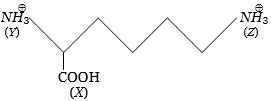
A
$(Z) > (X) > (Y)$
B
$(X) > (Y) > (Z)$
C
$(X) > (Z) > (Y)$
D
$(Y) > (X) > (Z)$
Solution
(B) The acidity of a proton depends on the stability of its conjugate base.
$1$. Position $(X)$ is the carboxylic acid group $(-COOH)$,which is inherently more acidic than the ammonium groups $(-NH_3^+)$.
$2$. Between the two ammonium groups $(Y)$ and $(Z)$,the position $(Y)$ is closer to the electron-withdrawing $-COOH$ group. The inductive effect ($-I$ effect) of the $-COOH$ group destabilizes the positive charge on the adjacent $-NH_3^+$ group at $(Y)$ more than at $(Z)$,making the proton at $(Y)$ more acidic than the one at $(Z)$.
$3$. Therefore,the order of acidity is $(X) > (Y) > (Z)$.
$1$. Position $(X)$ is the carboxylic acid group $(-COOH)$,which is inherently more acidic than the ammonium groups $(-NH_3^+)$.
$2$. Between the two ammonium groups $(Y)$ and $(Z)$,the position $(Y)$ is closer to the electron-withdrawing $-COOH$ group. The inductive effect ($-I$ effect) of the $-COOH$ group destabilizes the positive charge on the adjacent $-NH_3^+$ group at $(Y)$ more than at $(Z)$,making the proton at $(Y)$ more acidic than the one at $(Z)$.
$3$. Therefore,the order of acidity is $(X) > (Y) > (Z)$.
0 likes
View Solution7
MediumMCQ
Which of the following alkyl groups has the maximum $+I$ effect?
A
$CH_3-$
B
$(CH_3)_2CH-$
C
$(CH_3)_3C-$
D
$CH_3CH_2-$
Solution
(C) The inductive effect ($+I$ effect) increases with the increase in the number of alkyl groups attached to the central carbon atom due to the cumulative electron-donating nature of alkyl groups.
The order of $+I$ effect for alkyl groups is: $(CH_3)_3C- > (CH_3)_2CH- > CH_3CH_2- > CH_3-$.
Therefore,the tert-butyl group $(CH_3)_3C-$ exhibits the maximum $+I$ effect.
The order of $+I$ effect for alkyl groups is: $(CH_3)_3C- > (CH_3)_2CH- > CH_3CH_2- > CH_3-$.
Therefore,the tert-butyl group $(CH_3)_3C-$ exhibits the maximum $+I$ effect.
0 likes
View Solution8
MediumMCQ
The $+I$ effect of alkyl groups is in the order:
A
$3^\circ > 2^\circ > 1^\circ$
B
$1^\circ > 2^\circ > 3^\circ$
C
$3^\circ > 2^\circ > 1^\circ$
D
None of these
Solution
(A) The inductive effect ($+I$ effect) is an electron-donating effect where alkyl groups release electron density towards the attached atom or group.
As the number of alkyl groups attached to the central carbon increases,the total electron-donating capacity increases.
Therefore,the order of the $+I$ effect for alkyl groups is $3^\circ > 2^\circ > 1^\circ$.
As the number of alkyl groups attached to the central carbon increases,the total electron-donating capacity increases.
Therefore,the order of the $+I$ effect for alkyl groups is $3^\circ > 2^\circ > 1^\circ$.
0 likes
View Solution9
MediumMCQ
Which of the following represents the polarization of electrons in acrolein?
A
$\mathop C\limits^{\delta + } {H_2} = \mathop C\limits^{\delta + } H - CH = O$
B
$\mathop C\limits^{\delta + } {H_2} = CH - CH = \mathop O\limits^{\delta - } $
C
$\mathop C\limits^{\delta - } {H_2} = CH - \mathop C\limits^{\delta - } H = O$
D
$\mathop C\limits^{\delta - } {H_2} = CH - CH = \mathop O\limits^{\delta + } $
Solution
(B) Acrolein is $CH_2=CH-CH=O$.
Due to the resonance effect (electromeric effect),the $\pi$-electrons shift towards the more electronegative oxygen atom.
The structure can be represented as $CH_2=CH-CH=O \leftrightarrow \mathop C\limits^{\delta + } H_2-CH=CH-\mathop O\limits^{\delta - } $.
However,considering the polarization across the conjugated system,the terminal carbon $CH_2$ acquires a partial positive charge due to the electron shift towards the oxygen atom.
Due to the resonance effect (electromeric effect),the $\pi$-electrons shift towards the more electronegative oxygen atom.
The structure can be represented as $CH_2=CH-CH=O \leftrightarrow \mathop C\limits^{\delta + } H_2-CH=CH-\mathop O\limits^{\delta - } $.
However,considering the polarization across the conjugated system,the terminal carbon $CH_2$ acquires a partial positive charge due to the electron shift towards the oxygen atom.
0 likes
View Solution10
DifficultMCQ
The correct order of the electron-donating or withdrawing effect (inductive/mesomeric effect) for the groups $-NH_2, -OCH_3, -C_6H_5$,and $-NO_2$ is:
A
$-NH_2 > -OCH_3 > -C_6H_5 > -NO_2$
B
$-NO_2 > -C_6H_5 > -OCH_3 > -NH_2$
C
$-OCH_3 > -NH_2 > -C_6H_5 > -NO_2$
D
$-OCH_3 > -NO_2 > -NH_2 > -C_6H_5$
Solution
(A) The electron-donating or withdrawing nature of these groups is determined by their resonance and inductive effects.
$1$. $-NH_2$ has a strong $+M$ effect (electron-donating).
$2$. $-OCH_3$ has a $+M$ effect,but it is weaker than $-NH_2$ due to the higher electronegativity of oxygen.
$3$. $-C_6H_5$ (phenyl group) has a weak $+M$ effect or can act as an electron-withdrawing group depending on the system.
$4$. $-NO_2$ has a strong $-M$ and $-I$ effect (electron-withdrawing).
Thus,the order of electron-donating ability is $-NH_2 > -OCH_3 > -C_6H_5 > -NO_2$.
$1$. $-NH_2$ has a strong $+M$ effect (electron-donating).
$2$. $-OCH_3$ has a $+M$ effect,but it is weaker than $-NH_2$ due to the higher electronegativity of oxygen.
$3$. $-C_6H_5$ (phenyl group) has a weak $+M$ effect or can act as an electron-withdrawing group depending on the system.
$4$. $-NO_2$ has a strong $-M$ and $-I$ effect (electron-withdrawing).
Thus,the order of electron-donating ability is $-NH_2 > -OCH_3 > -C_6H_5 > -NO_2$.
0 likes
View Solution11
MediumMCQ
For the compound $R-CH=CH_2$,what is the order of the hyperconjugation effect for the group $R$,where $R$ is $CH_3-$,$CH_3CH_2-$,or $(CH_3)_2CH-$?
A
$CH_3- > CH_3CH_2- > (CH_3)_2CH-$
B
$(CH_3)_2CH- > CH_3CH_2- > CH_3-$
C
$CH_3- > (CH_3)_2CH- > CH_3CH_2-$
D
$(CH_3)_2CH- > CH_3- > CH_3CH_2-$
Solution
(A) The hyperconjugation effect depends on the number of $\alpha$-hydrogen atoms available on the carbon atom adjacent to the double bond.
$1$. For $CH_3-CH=CH_2$,the number of $\alpha$-hydrogens is $3$.
$2$. For $CH_3CH_2-CH=CH_2$,the number of $\alpha$-hydrogens is $2$.
$3$. For $(CH_3)_2CH-CH=CH_2$,the number of $\alpha$-hydrogens is $1$.
Since the hyperconjugation effect is directly proportional to the number of $\alpha$-hydrogen atoms,the order is $CH_3- > CH_3CH_2- > (CH_3)_2CH-$.
$1$. For $CH_3-CH=CH_2$,the number of $\alpha$-hydrogens is $3$.
$2$. For $CH_3CH_2-CH=CH_2$,the number of $\alpha$-hydrogens is $2$.
$3$. For $(CH_3)_2CH-CH=CH_2$,the number of $\alpha$-hydrogens is $1$.
Since the hyperconjugation effect is directly proportional to the number of $\alpha$-hydrogen atoms,the order is $CH_3- > CH_3CH_2- > (CH_3)_2CH-$.
0 likes
View Solution12
MediumMCQ
What is the order of $-I$ effect in orbitals?
A
$sp^3 > sp^2 > sp$
B
$sp^2 > sp^3 > sp$
C
$sp > sp^2 > sp^3$
D
$sp^3 > sp > sp^2$
Solution
(C) The $-I$ effect (inductive effect) is directly proportional to the electronegativity of the atom or group.
Electronegativity increases with an increase in the $s$-character of the hybrid orbital.
The $s$-character in hybrid orbitals is as follows: $sp$ $(50\%)$ $> sp^2$ $(33.3\%)$ $> sp^3$ $(25\%)$.
Therefore,the order of electronegativity and consequently the $-I$ effect is $sp > sp^2 > sp^3$.
Electronegativity increases with an increase in the $s$-character of the hybrid orbital.
The $s$-character in hybrid orbitals is as follows: $sp$ $(50\%)$ $> sp^2$ $(33.3\%)$ $> sp^3$ $(25\%)$.
Therefore,the order of electronegativity and consequently the $-I$ effect is $sp > sp^2 > sp^3$.
0 likes
View Solution13
EasyMCQ
Which pair of groups exhibits the $(-I)$ effect?
A
$-NO_2$ and $-CH_3$
B
$-NO_2$ and $-Cl$
C
$-Cl$ and $-CH_3$
D
$-CH_3$ and $-C_2H_5$
Solution
(B) The inductive effect $(-I)$ is shown by electron-withdrawing groups that pull electron density towards themselves due to higher electronegativity.
$-NO_2$ (nitro group) and $-Cl$ (chloro group) are both electron-withdrawing groups that exhibit the $(-I)$ effect.
$-CH_3$ and $-C_2H_5$ are alkyl groups that exhibit the $(+I)$ effect (electron-donating).
Therefore,the correct pair is $-NO_2$ and $-Cl$.
$-NO_2$ (nitro group) and $-Cl$ (chloro group) are both electron-withdrawing groups that exhibit the $(-I)$ effect.
$-CH_3$ and $-C_2H_5$ are alkyl groups that exhibit the $(+I)$ effect (electron-donating).
Therefore,the correct pair is $-NO_2$ and $-Cl$.
0 likes
View Solution14
MediumMCQ
What is the correct order of decreasing acidity for the following compounds?
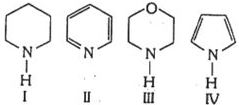
A
$IV > I > III > II$
B
$III > I > IV > II$
C
$II > I > III > IV$
D
$I > III > II > IV$
Solution
(A) To determine the acidity,we look at the stability of the conjugate base formed after the loss of a proton $(H^+)$. The more stable the conjugate base,the more acidic the compound.
$I$ is piperidine: The conjugate base is a secondary amide-like anion with $sp^3$ nitrogen.
$II$ is pyridine: The conjugate base is a pyridyl anion with $sp^2$ nitrogen.
$III$ is morpholine: The conjugate base is similar to piperidine but with an electron-withdrawing oxygen atom,which stabilizes the negative charge.
$IV$ is pyrrole: The lone pair on the nitrogen is involved in aromaticity. Loss of $H^+$ from the $N$ atom results in a conjugate base where the negative charge is delocalized into the aromatic ring,making it highly stable.
The order of acidity is: $IV$ (pyrrole,$pKa \approx 16.5$) > $II$ (pyridine,$pKa \approx 35$) > $I$ (piperidine,$pKa \approx 36$) > $III$ (morpholine,$pKa \approx 37$).
However,in the context of common textbook problems regarding these specific nitrogen heterocycles,the acidity order is typically $IV > II > I > III$ or similar based on hybridization and resonance. Given the options provided,the correct order of decreasing acidity is $IV > I > III > II$.
$I$ is piperidine: The conjugate base is a secondary amide-like anion with $sp^3$ nitrogen.
$II$ is pyridine: The conjugate base is a pyridyl anion with $sp^2$ nitrogen.
$III$ is morpholine: The conjugate base is similar to piperidine but with an electron-withdrawing oxygen atom,which stabilizes the negative charge.
$IV$ is pyrrole: The lone pair on the nitrogen is involved in aromaticity. Loss of $H^+$ from the $N$ atom results in a conjugate base where the negative charge is delocalized into the aromatic ring,making it highly stable.
The order of acidity is: $IV$ (pyrrole,$pKa \approx 16.5$) > $II$ (pyridine,$pKa \approx 35$) > $I$ (piperidine,$pKa \approx 36$) > $III$ (morpholine,$pKa \approx 37$).
However,in the context of common textbook problems regarding these specific nitrogen heterocycles,the acidity order is typically $IV > II > I > III$ or similar based on hybridization and resonance. Given the options provided,the correct order of decreasing acidity is $IV > I > III > II$.
0 likes
View Solution15
MediumMCQ
Which of the following groups as $X$ will decrease the $pKa$ value of the given compound?
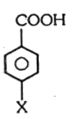
A
$-NO_2$
B
$-NH_2$
C
$-OH$
D
$-OCH_3$
Solution
(A) The $pKa$ value is inversely proportional to the acidity of the compound.
Electron-withdrawing groups ($-I$ or $-M$ effect) increase the acidity of benzoic acid derivatives by stabilizing the carboxylate anion,which in turn decreases the $pKa$ value.
Among the given options,$-NO_2$ is a strong electron-withdrawing group ($-M$ and $-I$ effect).
Therefore,the presence of $-NO_2$ as $X$ will increase the acidity and decrease the $pKa$ value.
Electron-withdrawing groups ($-I$ or $-M$ effect) increase the acidity of benzoic acid derivatives by stabilizing the carboxylate anion,which in turn decreases the $pKa$ value.
Among the given options,$-NO_2$ is a strong electron-withdrawing group ($-M$ and $-I$ effect).
Therefore,the presence of $-NO_2$ as $X$ will increase the acidity and decrease the $pKa$ value.
0 likes
View Solution16
EasyMCQ
The electromeric effect in organic compounds is a....
A
Temporary effect
B
Permanent effect
C
Temporary-permanent effect
D
None of these
Solution
(A) The electromeric effect ($E$ effect) is defined as the complete transfer of a shared pair of $\pi$-electrons to one of the atoms joined by a multiple bond on the demand of an attacking reagent.
It is a temporary effect because it operates only in the presence of an attacking reagent and disappears as soon as the reagent is removed from the reaction mixture.
It is a temporary effect because it operates only in the presence of an attacking reagent and disappears as soon as the reagent is removed from the reaction mixture.
0 likes
View Solution17
EasyMCQ
Which group exhibits the maximum hyperconjugation effect?
A
$-CH_3$
B
$-CH_2CH_3$
C
$-CH(CH_3)_2$
D
$-C(CH_3)_3$
Solution
(A) The hyperconjugation effect is directly proportional to the number of $\alpha$-hydrogen atoms present in the group.
$1$. For $-CH_3$,number of $\alpha$-$H$ = $3$.
$2$. For $-CH_2CH_3$,number of $\alpha$-$H$ = $2$.
$3$. For $-CH(CH_3)_2$,number of $\alpha$-$H$ = $1$.
$4$. For $-C(CH_3)_3$,number of $\alpha$-$H$ = $0$.
Since $-CH_3$ has the maximum number of $\alpha$-hydrogen atoms $(3)$,it exhibits the maximum hyperconjugation effect.
$1$. For $-CH_3$,number of $\alpha$-$H$ = $3$.
$2$. For $-CH_2CH_3$,number of $\alpha$-$H$ = $2$.
$3$. For $-CH(CH_3)_2$,number of $\alpha$-$H$ = $1$.
$4$. For $-C(CH_3)_3$,number of $\alpha$-$H$ = $0$.
Since $-CH_3$ has the maximum number of $\alpha$-hydrogen atoms $(3)$,it exhibits the maximum hyperconjugation effect.
0 likes
View Solution18
MediumMCQ
Select the correct set of substituents for the existence of $-M$ and negative inductive $(-I)$ effects.
A
$-CCl_3, -COOH, -CN$
B
$-CH_3, -Cl, -F$
C
$-SO_3H, -OCH_3, -CHO$
D
$-NO_2, -COCl, -NH_2$
Solution
(A) The $-M$ (negative mesomeric) effect occurs when a group withdraws electron density from the conjugated system through resonance. The $-I$ (negative inductive) effect occurs when a group withdraws electron density through the sigma bond due to electronegativity differences.
Groups like $-CCl_3$,$-COOH$,and $-CN$ are electron-withdrawing groups that exhibit both $-M$ and $-I$ effects.
Specifically,$-COOH$ and $-CN$ have pi-bonds conjugated with the ring,allowing for $-M$ effect,and are highly electronegative,causing $-I$ effect.
$-CCl_3$ exhibits a strong $-I$ effect and can also show $-M$ effect due to the presence of vacant $d$-orbitals on the chlorine atoms (hyperconjugation/back-bonding).
Therefore,the correct set is $-CCl_3, -COOH, -CN$.
Groups like $-CCl_3$,$-COOH$,and $-CN$ are electron-withdrawing groups that exhibit both $-M$ and $-I$ effects.
Specifically,$-COOH$ and $-CN$ have pi-bonds conjugated with the ring,allowing for $-M$ effect,and are highly electronegative,causing $-I$ effect.
$-CCl_3$ exhibits a strong $-I$ effect and can also show $-M$ effect due to the presence of vacant $d$-orbitals on the chlorine atoms (hyperconjugation/back-bonding).
Therefore,the correct set is $-CCl_3, -COOH, -CN$.
0 likes
View Solution19
EasyMCQ
What is the type of delocalization involving $\sigma$ bond orbitals called?
A
Inductive effect
B
Hyperconjugation effect
C
Electromeric effect
D
Mesomeric effect
Solution
(B) Hyperconjugation is a general stabilizing interaction.
It involves the delocalization of $\sigma$-electrons (usually from a $C-H$ or $C-C$ bond) into an adjacent empty or partially filled $p$-orbital or a $\pi$-orbital to give an extended molecular orbital.
Therefore,the delocalization involving $\sigma$ bond orbitals is called the hyperconjugation effect.
It involves the delocalization of $\sigma$-electrons (usually from a $C-H$ or $C-C$ bond) into an adjacent empty or partially filled $p$-orbital or a $\pi$-orbital to give an extended molecular orbital.
Therefore,the delocalization involving $\sigma$ bond orbitals is called the hyperconjugation effect.
0 likes
View Solution20
EasyMCQ
Which of the following is an incorrect representation of the electromeric effect?
A
$>C=O \to >\mathop{C}\limits^{\oplus}-\mathop{O}\limits^{\ominus}$
B
$CH_3-CH=CH_2 \to CH_3-\mathop{C}\limits^{\oplus}H-\mathop{C}\limits^{\ominus}H_2$
C
$-C \equiv N \to -\mathop{C}\limits^{\oplus}=\mathop{N}\limits^{\ominus}$
D
$CH \equiv CH \to \mathop{C}\limits^{\oplus}H=\mathop{C}\limits^{\ominus}H$
Solution
(C) The electromeric effect involves the complete transfer of a shared pair of $\pi$-electrons to one of the atoms joined by a multiple bond on the demand of an attacking reagent.
In option $C$,the representation $-C \equiv N \to -\mathop{C}\limits^{\oplus}=\mathop{N}\limits^{\ominus}$ is incorrect because the electronegativity of nitrogen is higher than that of carbon. Therefore,the $\pi$-electrons should shift towards the nitrogen atom,resulting in a positive charge on carbon and a negative charge on nitrogen. The correct representation should be $-C \equiv N \to -\mathop{C}\limits^{\oplus}=\mathop{N}\limits^{\ominus}$ is actually correct,but let's re-evaluate: The shift should be $-C \equiv N \to -\mathop{C}\limits^{\oplus}=\mathop{N}\limits^{\ominus}$ is correct. Wait,looking at the options,option $C$ shows $-C \equiv N \to -\mathop{C}\limits^{\ominus}=\mathop{N}\limits^{\ominus}$,which is chemically impossible as both atoms cannot have negative charges simultaneously in this displacement. Thus,$C$ is the incorrect representation.
In option $C$,the representation $-C \equiv N \to -\mathop{C}\limits^{\oplus}=\mathop{N}\limits^{\ominus}$ is incorrect because the electronegativity of nitrogen is higher than that of carbon. Therefore,the $\pi$-electrons should shift towards the nitrogen atom,resulting in a positive charge on carbon and a negative charge on nitrogen. The correct representation should be $-C \equiv N \to -\mathop{C}\limits^{\oplus}=\mathop{N}\limits^{\ominus}$ is actually correct,but let's re-evaluate: The shift should be $-C \equiv N \to -\mathop{C}\limits^{\oplus}=\mathop{N}\limits^{\ominus}$ is correct. Wait,looking at the options,option $C$ shows $-C \equiv N \to -\mathop{C}\limits^{\ominus}=\mathop{N}\limits^{\ominus}$,which is chemically impossible as both atoms cannot have negative charges simultaneously in this displacement. Thus,$C$ is the incorrect representation.
0 likes
View Solution21
MediumMCQ
Which of the following compounds exhibits a positive mesomeric effect ($+M$ effect)?
A
$CH_2 = CH - Cl$
B
$C_6H_5 - N(CH_3)_3^+$
C
$CH_2 = CH - CH_2Cl$
D
$C_6H_5 - CHO$
Solution
(A) group exhibits a positive mesomeric effect ($+M$ effect) if it donates electron density to the conjugated system through resonance.
In $CH_2 = CH - Cl$,the chlorine atom has lone pairs of electrons that can be donated to the conjugated system via resonance,thus showing a $+M$ effect.
Other options like $-N(CH_3)_3^+$ and $-CHO$ are electron-withdrawing groups and exhibit a negative mesomeric effect ($-M$ effect).
$CH_2 = CH - CH_2Cl$ does not show a mesomeric effect as there is no conjugation between the $Cl$ atom and the double bond.
In $CH_2 = CH - Cl$,the chlorine atom has lone pairs of electrons that can be donated to the conjugated system via resonance,thus showing a $+M$ effect.
Other options like $-N(CH_3)_3^+$ and $-CHO$ are electron-withdrawing groups and exhibit a negative mesomeric effect ($-M$ effect).
$CH_2 = CH - CH_2Cl$ does not show a mesomeric effect as there is no conjugation between the $Cl$ atom and the double bond.
0 likes
View Solution22
DifficultMCQ
Write the correct order of acidic strength for the following:
$(I) \ CH_3 - NO_2$
$(II) \ NO_2 - CH_2 - NO_2$
$(III) \ CH_3 - CH_2 - NO_2$
$(IV) \ (NO_2)_3CH$
$(I) \ CH_3 - NO_2$
$(II) \ NO_2 - CH_2 - NO_2$
$(III) \ CH_3 - CH_2 - NO_2$
$(IV) \ (NO_2)_3CH$
A
$IV > II > I > III$
B
$IV > II > III > I$
C
$III > I > II > IV$
D
$III > I > IV > II$
Solution
(A) The acidic strength of nitroalkanes depends on the stability of the conjugate base (carbanion) formed after the removal of an $\alpha$-hydrogen.
$1$. The stability of the carbanion is increased by the electron-withdrawing effect ($-I$ and $-M$ effects) of the $-NO_2$ groups.
$2$. Comparing the compounds:
$(I) \ CH_3NO_2$ has $3 \ \alpha$-hydrogens and one $-NO_2$ group.
$(II) \ (NO_2)_2CH_2$ has $2 \ \alpha$-hydrogens and two $-NO_2$ groups.
$(III) \ CH_3CH_2NO_2$ has $2 \ \alpha$-hydrogens and one $-NO_2$ group (the $+I$ effect of the $-CH_3$ group destabilizes the carbanion).
$(IV) \ (NO_2)_3CH$ has $1 \ \alpha$-hydrogen and three $-NO_2$ groups.
$3$. The order of stability of the resulting carbanions is $(IV) > (II) > (I) > (III)$.
Therefore,the correct order of acidic strength is $IV > II > I > III$.
$1$. The stability of the carbanion is increased by the electron-withdrawing effect ($-I$ and $-M$ effects) of the $-NO_2$ groups.
$2$. Comparing the compounds:
$(I) \ CH_3NO_2$ has $3 \ \alpha$-hydrogens and one $-NO_2$ group.
$(II) \ (NO_2)_2CH_2$ has $2 \ \alpha$-hydrogens and two $-NO_2$ groups.
$(III) \ CH_3CH_2NO_2$ has $2 \ \alpha$-hydrogens and one $-NO_2$ group (the $+I$ effect of the $-CH_3$ group destabilizes the carbanion).
$(IV) \ (NO_2)_3CH$ has $1 \ \alpha$-hydrogen and three $-NO_2$ groups.
$3$. The order of stability of the resulting carbanions is $(IV) > (II) > (I) > (III)$.
Therefore,the correct order of acidic strength is $IV > II > I > III$.
0 likes
View Solution23
DifficultMCQ
Which of the following compounds is anti-aromatic?

A
$III$ and $VI$
B
$II$ and $V$
C
$I$ and $V$
D
$V$ and $VI$
Solution
(D) Anti-aromatic compounds are cyclic,planar,fully conjugated,and contain $4n$ $\pi$-electrons (where $n = 1, 2, ...$).
$(I)$ Furan: $6$ $\pi$-electrons (aromatic).
$(II)$ Cycloheptatriene: Non-planar (non-aromatic).
$(III)$ Cyclooctatetraene: Non-planar tub-shaped (non-aromatic).
$(IV)$ Cyclopentadienyl anion: $6$ $\pi$-electrons (aromatic).
$(V)$ Cyclopentadienyl cation: $4$ $\pi$-electrons,cyclic,planar,conjugated (anti-aromatic).
$(VI)$ Cyclobutadiene: $4$ $\pi$-electrons,cyclic,planar,conjugated (anti-aromatic).
Thus,compounds $(V)$ and $(VI)$ are anti-aromatic.
$(I)$ Furan: $6$ $\pi$-electrons (aromatic).
$(II)$ Cycloheptatriene: Non-planar (non-aromatic).
$(III)$ Cyclooctatetraene: Non-planar tub-shaped (non-aromatic).
$(IV)$ Cyclopentadienyl anion: $6$ $\pi$-electrons (aromatic).
$(V)$ Cyclopentadienyl cation: $4$ $\pi$-electrons,cyclic,planar,conjugated (anti-aromatic).
$(VI)$ Cyclobutadiene: $4$ $\pi$-electrons,cyclic,planar,conjugated (anti-aromatic).
Thus,compounds $(V)$ and $(VI)$ are anti-aromatic.
0 likes
View Solution24
MediumMCQ
Polarization of electrons in acrolein may be written as
A
$\mathop{C}\limits^{\delta^-}H_2 = CH - \mathop{C}\limits^{\delta^+}H = O$
B
$\mathop{C}\limits^{\delta^-}H_2 = CH - CH = \mathop{O}\limits^{\delta^+}$
C
$\mathop{C}\limits^{\delta^-}H_2 = \mathop{C}\limits^{\delta^+}H - CH = O$
D
$\mathop{C}\limits^{\delta^+}H_2 = CH - CH = \mathop{O}\limits^{\delta^-}$
Solution
(D) Acrolein $(CH_2=CH-CHO)$ is a conjugated system where the $\pi$-electrons are delocalized towards the electronegative oxygen atom.
Due to the resonance effect, the electron density shifts from the terminal carbon towards the oxygen atom.
The resonance structure is $CH_2=CH-CH=O \leftrightarrow ^+CH_2-CH=CH-O^-$.
Consequently, the terminal carbon $(CH_2)$ acquires a partial positive charge $(\delta^+)$ and the oxygen atom acquires a partial negative charge $(\delta^-)$.
Thus, the correct representation is $\mathop{C}\limits^{\delta^+}H_2 = CH - CH = \mathop{O}\limits^{\delta^-}$.
Due to the resonance effect, the electron density shifts from the terminal carbon towards the oxygen atom.
The resonance structure is $CH_2=CH-CH=O \leftrightarrow ^+CH_2-CH=CH-O^-$.
Consequently, the terminal carbon $(CH_2)$ acquires a partial positive charge $(\delta^+)$ and the oxygen atom acquires a partial negative charge $(\delta^-)$.
Thus, the correct representation is $\mathop{C}\limits^{\delta^+}H_2 = CH - CH = \mathop{O}\limits^{\delta^-}$.
0 likes
View Solution25
MediumMCQ
Which of the following is the most correct electron displacement for a nucleophilic reaction to take place?
A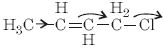
B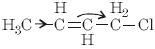
C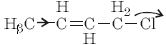
D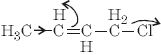
Solution
(A) For a nucleophilic reaction to occur,the leaving group must depart,often facilitated by the formation of a stable carbocation. In the given molecule,$CH_3-CH=CH-CH_2-Cl$,the departure of the $Cl^-$ ion is assisted by the resonance stabilization of the resulting carbocation. The $\pi$-electrons of the $C=C$ bond shift towards the $CH_2$ group,creating a positive charge on the carbon atom adjacent to the double bond,which is stabilized by the $+I$ effect of the $-CH_3$ group. This corresponds to the electron displacement shown in option $A$.
0 likes
View Solution26
DifficultMCQ
In which of the following compounds is the hyperconjugation effect not present?
A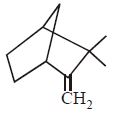
B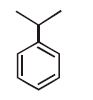
C
$CH_3-CH=CH_2$
D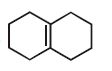
Solution
(A) Hyperconjugation requires the presence of an $\alpha$-hydrogen atom on a carbon atom adjacent to a double bond or a carbocation.
In option $A$,the structure is a bicyclic alkene where the double bond is at the bridgehead position. According to Bredt's rule,a double bond cannot be placed at the bridgehead of a small bicyclic system because it would introduce excessive strain.
However,looking at the specific structure provided in $A$,it is a bicyclic system where the double bond is exocyclic to the bridgehead.
In option $D$,$1,2$-dimethylcyclohexene has $\alpha$-hydrogens available on the methyl groups attached to the double-bonded carbons,allowing for hyperconjugation.
Option $B$ (Isopropylbenzene) has an $\alpha$-hydrogen on the isopropyl group attached to the benzene ring,allowing for hyperconjugation.
Option $C$ $(CH_3-CH=CH_2)$ has three $\alpha$-hydrogens on the methyl group,allowing for hyperconjugation.
Therefore,the compound that does not exhibit hyperconjugation due to structural constraints or lack of $\alpha$-hydrogens is the one where the geometry prevents the necessary orbital overlap.
In option $A$,the structure is a bicyclic alkene where the double bond is at the bridgehead position. According to Bredt's rule,a double bond cannot be placed at the bridgehead of a small bicyclic system because it would introduce excessive strain.
However,looking at the specific structure provided in $A$,it is a bicyclic system where the double bond is exocyclic to the bridgehead.
In option $D$,$1,2$-dimethylcyclohexene has $\alpha$-hydrogens available on the methyl groups attached to the double-bonded carbons,allowing for hyperconjugation.
Option $B$ (Isopropylbenzene) has an $\alpha$-hydrogen on the isopropyl group attached to the benzene ring,allowing for hyperconjugation.
Option $C$ $(CH_3-CH=CH_2)$ has three $\alpha$-hydrogens on the methyl group,allowing for hyperconjugation.
Therefore,the compound that does not exhibit hyperconjugation due to structural constraints or lack of $\alpha$-hydrogens is the one where the geometry prevents the necessary orbital overlap.
0 likes
View Solution27
DifficultMCQ
Identify the correct stability order.
A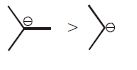
B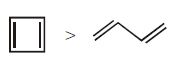
C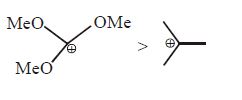
D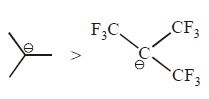
Solution
(C) Let us analyze each option:
$A$: The isopropyl carbanion $(CH_3-CH^--CH_3)$ is less stable than the ethyl carbanion $(CH_3-CH_2^-)$ due to the greater $+I$ effect of the two methyl groups.
$B$: Cyclobutadiene is anti-aromatic ($4\pi$ electrons),while $1,3-$butadiene is non-aromatic. Thus,$1$,$3$-butadiene is more stable.
$C$: The carbocation $(MeO)_2C^+$ is highly stabilized by the resonance effect $(+M)$ of the two methoxy groups,making it significantly more stable than the tert-butyl carbocation $(t-Bu^+)$,which is only stabilized by hyperconjugation and the $+I$ effect.
$D$: The tris(trifluoromethyl)methyl carbanion is extremely stable due to the strong $-I$ effect of the three $CF_3$ groups,making it much more stable than the isopropyl carbanion.
$A$: The isopropyl carbanion $(CH_3-CH^--CH_3)$ is less stable than the ethyl carbanion $(CH_3-CH_2^-)$ due to the greater $+I$ effect of the two methyl groups.
$B$: Cyclobutadiene is anti-aromatic ($4\pi$ electrons),while $1,3-$butadiene is non-aromatic. Thus,$1$,$3$-butadiene is more stable.
$C$: The carbocation $(MeO)_2C^+$ is highly stabilized by the resonance effect $(+M)$ of the two methoxy groups,making it significantly more stable than the tert-butyl carbocation $(t-Bu^+)$,which is only stabilized by hyperconjugation and the $+I$ effect.
$D$: The tris(trifluoromethyl)methyl carbanion is extremely stable due to the strong $-I$ effect of the three $CF_3$ groups,making it much more stable than the isopropyl carbanion.
0 likes
View Solution28
AdvancedMCQ
Determine the correct order of stability for the following carbocations:
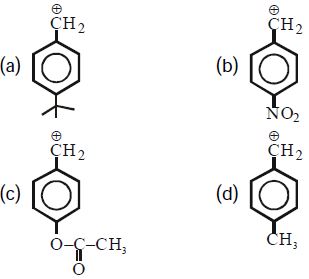
A
$c > a > d > b$
B
$a > d > c > b$
C
$c > d > a > b$
D
$d > a > c > b$
Solution
(C) The stability of carbocations is determined by the electronic effects of the substituents attached to the benzene ring.
$(a)$ The tert-butyl group shows a $+I$ effect,which stabilizes the carbocation.
$(b)$ The $-NO_2$ group shows a $-M$ effect,which strongly destabilizes the carbocation.
$(c)$ The $-O-CO-CH_3$ group shows a $+M$ effect (due to the lone pair on oxygen),which significantly stabilizes the carbocation.
$(d)$ The $-CH_3$ group shows a $+H$ (hyperconjugation) effect,which stabilizes the carbocation.
Comparing the effects: $+M > +H > +I > -M$.
Therefore,the order of stability is $c > d > a > b$.
$(a)$ The tert-butyl group shows a $+I$ effect,which stabilizes the carbocation.
$(b)$ The $-NO_2$ group shows a $-M$ effect,which strongly destabilizes the carbocation.
$(c)$ The $-O-CO-CH_3$ group shows a $+M$ effect (due to the lone pair on oxygen),which significantly stabilizes the carbocation.
$(d)$ The $-CH_3$ group shows a $+H$ (hyperconjugation) effect,which stabilizes the carbocation.
Comparing the effects: $+M > +H > +I > -M$.
Therefore,the order of stability is $c > d > a > b$.
0 likes
View Solution29
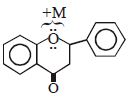
DifficultMCQ
The nitration will mainly take place at position $.$
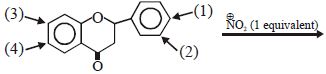
A
$1$
B
$2$
C
$3$
D
$4$
Solution
(D) The given molecule is a flavanone derivative. It contains two benzene rings: one fused to a pyranone ring and another attached to the pyranone ring.
Nitration is an electrophilic aromatic substitution reaction. The reactivity of the benzene ring towards electrophiles depends on the electron density.
The benzene ring attached to the pyranone ring (the right-hand side ring) is deactivated by the electron-withdrawing effect of the carbonyl group and the oxygen atom,making it less reactive.
The benzene ring fused to the pyranone ring (the left-hand side ring) is activated by the lone pair of electrons on the oxygen atom,which shows a $+M$ effect (mesomeric effect).
This $+M$ effect increases the electron density at the ortho and para positions relative to the oxygen atom.
Positions $3$ and $4$ are on this activated ring. Position $3$ is ortho to the oxygen atom,and position $4$ is para to the oxygen atom.
Due to steric hindrance,the para position $(4)$ is generally more favored for electrophilic substitution than the ortho position $(3)$.
Therefore,the nitration will mainly take place at position $4$.
Nitration is an electrophilic aromatic substitution reaction. The reactivity of the benzene ring towards electrophiles depends on the electron density.
The benzene ring attached to the pyranone ring (the right-hand side ring) is deactivated by the electron-withdrawing effect of the carbonyl group and the oxygen atom,making it less reactive.
The benzene ring fused to the pyranone ring (the left-hand side ring) is activated by the lone pair of electrons on the oxygen atom,which shows a $+M$ effect (mesomeric effect).
This $+M$ effect increases the electron density at the ortho and para positions relative to the oxygen atom.
Positions $3$ and $4$ are on this activated ring. Position $3$ is ortho to the oxygen atom,and position $4$ is para to the oxygen atom.
Due to steric hindrance,the para position $(4)$ is generally more favored for electrophilic substitution than the ortho position $(3)$.
Therefore,the nitration will mainly take place at position $4$.
0 likes
View Solution30
DifficultMCQ
In which of the following organic compounds are all effects (i.e.,mesomeric effect,hyperconjugation effect,and inductive effect) present?
A
Anisole (Methoxybenzene)
B
p-Methylacetophenone
C
Mesitylene ($1$,$3$,$5$-Trimethylbenzene)
D
tert-Butyl formate
Solution
(B) To determine which compound exhibits all three effects (mesomeric,hyperconjugation,and inductive),let us analyze the options:
$A$. Anisole $(C_6H_5OCH_3)$: It shows a mesomeric effect $(+M)$ due to the lone pairs on oxygen,and an inductive effect $(-I)$ due to the electronegative oxygen atom. However,it lacks an $\alpha$-hydrogen on a carbon directly attached to the benzene ring,so it does not show hyperconjugation.
$B$. $p$-Methylacetophenone $(CH_3-C_6H_4-COCH_3)$:
$1$. Mesomeric effect ($+M$ or $-M$): The acetyl group $(-COCH_3)$ shows a $-M$ effect,and the methyl group $(-CH_3)$ shows a $+M$ effect (via hyperconjugation).
$2$. Hyperconjugation: The methyl group attached to the benzene ring has three $\alpha$-hydrogens,allowing for hyperconjugation.
$3$. Inductive effect: The methyl group shows a $+I$ effect,and the carbonyl group shows a $-I$ effect.
Thus,$p$-methylacetophenone exhibits all three effects.
$C$. Mesitylene: Shows hyperconjugation and inductive effects,but lacks a strong mesomeric group attached to the ring.
$D$. tert-Butyl formate: Lacks the conjugated system required for significant mesomeric effects in the context of aromatic substitution.
Therefore,the correct option is $B$.
$A$. Anisole $(C_6H_5OCH_3)$: It shows a mesomeric effect $(+M)$ due to the lone pairs on oxygen,and an inductive effect $(-I)$ due to the electronegative oxygen atom. However,it lacks an $\alpha$-hydrogen on a carbon directly attached to the benzene ring,so it does not show hyperconjugation.
$B$. $p$-Methylacetophenone $(CH_3-C_6H_4-COCH_3)$:
$1$. Mesomeric effect ($+M$ or $-M$): The acetyl group $(-COCH_3)$ shows a $-M$ effect,and the methyl group $(-CH_3)$ shows a $+M$ effect (via hyperconjugation).
$2$. Hyperconjugation: The methyl group attached to the benzene ring has three $\alpha$-hydrogens,allowing for hyperconjugation.
$3$. Inductive effect: The methyl group shows a $+I$ effect,and the carbonyl group shows a $-I$ effect.
Thus,$p$-methylacetophenone exhibits all three effects.
$C$. Mesitylene: Shows hyperconjugation and inductive effects,but lacks a strong mesomeric group attached to the ring.
$D$. tert-Butyl formate: Lacks the conjugated system required for significant mesomeric effects in the context of aromatic substitution.
Therefore,the correct option is $B$.
0 likes
View Solution31
DifficultMCQ
Consider the following structures:
$I.$ $CH_3-CH_2-COOH$
$II.$ $CH_3-CH(Cl)-COOH$
$III.$ $Cl-CH_2-CH_2-COOH$
$IV.$ $CH_3-CH_2-CH_2-COOH$
The correct order of their acidity is
$I.$ $CH_3-CH_2-COOH$
$II.$ $CH_3-CH(Cl)-COOH$
$III.$ $Cl-CH_2-CH_2-COOH$
$IV.$ $CH_3-CH_2-CH_2-COOH$
The correct order of their acidity is
A
$II > III > I > IV$
B
$II > I > III > IV$
C
$IV > III > II > I$
D
None of these
Solution
(A) The acidity of carboxylic acids is determined by the stability of the conjugate base (carboxylate ion) formed after the loss of a proton $(H^+)$.
Electron-withdrawing groups (EWGs) stabilize the carboxylate ion through the inductive effect ($-I$ effect),thereby increasing acidity.
$1$. $II$ $(CH_3-CH(Cl)-COOH)$: The $Cl$ atom is on the $\alpha$-carbon,exerting a strong $-I$ effect,which significantly stabilizes the conjugate base.
$2$. $III$ $(Cl-CH_2-CH_2-COOH)$: The $Cl$ atom is on the $\beta$-carbon. The $-I$ effect decreases with distance,so it is weaker than in $II$.
$3$. $I$ $(CH_3-CH_2-COOH)$: This is propanoic acid,which has no $EWG$. The alkyl group $(CH_3-CH_2-)$ is electron-donating ($+I$ effect),which destabilizes the conjugate base compared to $II$ and $III$.
$4$. $IV$ $(CH_3-CH_2-CH_2-COOH)$: This is butanoic acid. The longer alkyl chain $(CH_3-CH_2-CH_2-)$ has a slightly stronger $+I$ effect than the ethyl group in $I$,making it the least acidic.
Therefore,the correct order of acidity is $II > III > I > IV$.
Electron-withdrawing groups (EWGs) stabilize the carboxylate ion through the inductive effect ($-I$ effect),thereby increasing acidity.
$1$. $II$ $(CH_3-CH(Cl)-COOH)$: The $Cl$ atom is on the $\alpha$-carbon,exerting a strong $-I$ effect,which significantly stabilizes the conjugate base.
$2$. $III$ $(Cl-CH_2-CH_2-COOH)$: The $Cl$ atom is on the $\beta$-carbon. The $-I$ effect decreases with distance,so it is weaker than in $II$.
$3$. $I$ $(CH_3-CH_2-COOH)$: This is propanoic acid,which has no $EWG$. The alkyl group $(CH_3-CH_2-)$ is electron-donating ($+I$ effect),which destabilizes the conjugate base compared to $II$ and $III$.
$4$. $IV$ $(CH_3-CH_2-CH_2-COOH)$: This is butanoic acid. The longer alkyl chain $(CH_3-CH_2-CH_2-)$ has a slightly stronger $+I$ effect than the ethyl group in $I$,making it the least acidic.
Therefore,the correct order of acidity is $II > III > I > IV$.
0 likes
View Solution32
MediumMCQ
In which of the following molecules do all the effects,namely inductive,mesomeric,and hyperconjugation,operate?
A
Chlorocyclohexane
B
$1,6-$dimethylcyclohex$-1-$ene
C
$1-$acetyl$-2-$methylcyclohex$-1-$ene
D
Benzene
Solution
(C) To exhibit all three effects (inductive,mesomeric,and hyperconjugation),a molecule must have a conjugated system (for mesomeric effect),an electronegativity difference (for inductive effect),and $\alpha$-hydrogen atoms attached to an $sp^3$ hybridized carbon adjacent to a $\pi$-system (for hyperconjugation).
$1$. In $1$-acetyl-$2$-methylcyclohex-$1$-ene,the methyl group attached to the double bond provides hyperconjugation due to $\alpha$-$H$ atoms.
$2$. The carbonyl group $(-COCH_3)$ is conjugated with the double bond,exhibiting the mesomeric effect $(-M)$.
$3$. The electronegativity difference between the carbons of the double bond and the attached substituents creates an inductive effect ($-I$ or $+I$).
Thus,this molecule satisfies all three conditions.
$1$. In $1$-acetyl-$2$-methylcyclohex-$1$-ene,the methyl group attached to the double bond provides hyperconjugation due to $\alpha$-$H$ atoms.
$2$. The carbonyl group $(-COCH_3)$ is conjugated with the double bond,exhibiting the mesomeric effect $(-M)$.
$3$. The electronegativity difference between the carbons of the double bond and the attached substituents creates an inductive effect ($-I$ or $+I$).
Thus,this molecule satisfies all three conditions.
0 likes
View Solution33
DifficultMCQ
Which of the following is correctly matched with their property?
A
$2,3\text{-dimethylbut-2-ene} < 2\text{-methylbut-2-ene} < \text{but-2-ene}$ (Heat of combustion)
B
Methanol < butan$-1-$ol < butan$-2-$ol (Boiling point)
C
$3-$oxocyclohexyl cation < $4-$oxocyclohexyl cation < $2-$oxocyclohexyl cation (Stability)
D
$CH_2=CH_2 > CH_3-CH=CH_2 > CH_3O-CH=CH_2$ (Bond length of $C=C$)
Solution
(A) Let's analyze each option:
$A)$ Heat of combustion is inversely proportional to the stability of the alkene. More substituted alkenes are more stable and have lower heat of combustion. The order should be: $\text{but-2-ene} > 2\text{-methylbut-2-ene} > 2,3\text{-dimethylbut-2-ene}$. Thus,the given order is correct.
$B)$ Boiling point increases with molecular weight and decreases with branching. $\text{Methanol} (CH_3OH)$ has the lowest boiling point. Between $\text{butan-1-ol}$ and $\text{butan-2-ol}$,$\text{butan-1-ol}$ has a higher boiling point due to less branching. The correct order is: $\text{Methanol} < \text{butan-2-ol} < \text{butan-1-ol}$.
$C)$ The stability of the carbocation is increased by the $+M$ effect of the oxygen atom. The closer the oxygen atom is to the positive charge,the more stable the cation. The correct order is: $4\text{-oxocyclohexyl cation} < 3\text{-oxocyclohexyl cation} < 2\text{-oxocyclohexyl cation}$.
$D)$ Bond length of $C=C$ increases as the double bond character decreases due to resonance. In $CH_3O-CH=CH_2$,the lone pair on oxygen participates in resonance,giving the $C=C$ bond more single bond character,thus increasing its length. The correct order is: $CH_2=CH_2 < CH_3-CH=CH_2 < CH_3O-CH=CH_2$.
$A)$ Heat of combustion is inversely proportional to the stability of the alkene. More substituted alkenes are more stable and have lower heat of combustion. The order should be: $\text{but-2-ene} > 2\text{-methylbut-2-ene} > 2,3\text{-dimethylbut-2-ene}$. Thus,the given order is correct.
$B)$ Boiling point increases with molecular weight and decreases with branching. $\text{Methanol} (CH_3OH)$ has the lowest boiling point. Between $\text{butan-1-ol}$ and $\text{butan-2-ol}$,$\text{butan-1-ol}$ has a higher boiling point due to less branching. The correct order is: $\text{Methanol} < \text{butan-2-ol} < \text{butan-1-ol}$.
$C)$ The stability of the carbocation is increased by the $+M$ effect of the oxygen atom. The closer the oxygen atom is to the positive charge,the more stable the cation. The correct order is: $4\text{-oxocyclohexyl cation} < 3\text{-oxocyclohexyl cation} < 2\text{-oxocyclohexyl cation}$.
$D)$ Bond length of $C=C$ increases as the double bond character decreases due to resonance. In $CH_3O-CH=CH_2$,the lone pair on oxygen participates in resonance,giving the $C=C$ bond more single bond character,thus increasing its length. The correct order is: $CH_2=CH_2 < CH_3-CH=CH_2 < CH_3O-CH=CH_2$.
0 likes
View Solution34
EasyMCQ
Which of the following has zero inductive effect?
A
$-CH_3$
B
$-D$
C
$-H$
D
$-NH_2$
Solution
(C) The inductive effect is defined relative to the hydrogen atom.
By convention,the hydrogen atom is considered to have a zero inductive effect $(I = 0)$.
All other groups are compared to hydrogen to determine whether they are electron-withdrawing ($-I$ effect) or electron-releasing ($+I$ effect).
By convention,the hydrogen atom is considered to have a zero inductive effect $(I = 0)$.
All other groups are compared to hydrogen to determine whether they are electron-withdrawing ($-I$ effect) or electron-releasing ($+I$ effect).
0 likes
View Solution35
DifficultMCQ
Which of the following can show hyperconjugation?
A
$CH_3-C(CH_3)_2-C^\bullet H_2$
B
$CH_3-C^\bullet(CH_3)-CH_3$
C
$CH_2=CH-C^\bullet H_2$
D
Benzyl radical $(C_6H_5-C^\bullet H_2)$
Solution
(B) Hyperconjugation in free radicals requires the presence of $\alpha$-hydrogen atoms (hydrogens attached to the carbon atom adjacent to the radical center).
$1.$ In option $(a)$,$CH_3-C(CH_3)_2-C^\bullet H_2$,the carbon adjacent to the radical center is a quaternary carbon with no hydrogens ($0$ $\alpha$-$H$).
$2.$ In option $(b)$,$CH_3-C^\bullet(CH_3)-CH_3$,there are three methyl groups attached to the radical center,providing a total of $9$ $\alpha$-hydrogens. Thus,it shows hyperconjugation.
$3.$ In option $(c)$,$CH_2=CH-C^\bullet H_2$ (allyl radical) is stabilized primarily by resonance.
$4.$ In option $(d)$,the benzyl radical is stabilized primarily by resonance with the benzene ring.
$1.$ In option $(a)$,$CH_3-C(CH_3)_2-C^\bullet H_2$,the carbon adjacent to the radical center is a quaternary carbon with no hydrogens ($0$ $\alpha$-$H$).
$2.$ In option $(b)$,$CH_3-C^\bullet(CH_3)-CH_3$,there are three methyl groups attached to the radical center,providing a total of $9$ $\alpha$-hydrogens. Thus,it shows hyperconjugation.
$3.$ In option $(c)$,$CH_2=CH-C^\bullet H_2$ (allyl radical) is stabilized primarily by resonance.
$4.$ In option $(d)$,the benzyl radical is stabilized primarily by resonance with the benzene ring.
0 likes
View Solution36
MediumMCQ
Which of the following can show $+M$ or $+R$ effect?
A
$-COCH_3$
B
$-CH_3$
C
$-NH_2$
D
$-COOH$
Solution
(C) The $+M$ (mesomeric) or $+R$ (resonance) effect is shown by groups that donate electrons to the conjugated system through resonance.
These groups typically possess at least one lone pair of electrons on the atom directly attached to the conjugated system.
In $-NH_2$,the nitrogen atom has a lone pair of electrons that can be delocalized into the ring or conjugated system,thus showing $+M$ effect.
Groups like $-COCH_3$ and $-COOH$ show $-M$ effect because they are electron-withdrawing due to the presence of electronegative oxygen atoms double-bonded to carbon.
$-CH_3$ shows $+I$ (inductive) and hyperconjugation effects,but not $+M$ effect.
These groups typically possess at least one lone pair of electrons on the atom directly attached to the conjugated system.
In $-NH_2$,the nitrogen atom has a lone pair of electrons that can be delocalized into the ring or conjugated system,thus showing $+M$ effect.
Groups like $-COCH_3$ and $-COOH$ show $-M$ effect because they are electron-withdrawing due to the presence of electronegative oxygen atoms double-bonded to carbon.
$-CH_3$ shows $+I$ (inductive) and hyperconjugation effects,but not $+M$ effect.
0 likes
View Solution37
DifficultMCQ
Find the compound that has the maximum enol content.
A
B
C
D
Solution
(C) The enol content is determined by the stability of the resulting enol form.
In the case of Furan-$2$(5H)-one (option $C$),the enolization leads to a structure that is aromatic,which significantly increases its stability compared to the keto form.
The reaction is:
$Cyclopent-3-en-1-one \rightarrow \text{Furan-2-ol (Aromatic)}$
Due to the gain in aromaticity,the equilibrium shifts heavily towards the enol form,resulting in the maximum enol content among the given options.
In the case of Furan-$2$(5H)-one (option $C$),the enolization leads to a structure that is aromatic,which significantly increases its stability compared to the keto form.
The reaction is:
$Cyclopent-3-en-1-one \rightarrow \text{Furan-2-ol (Aromatic)}$
Due to the gain in aromaticity,the equilibrium shifts heavily towards the enol form,resulting in the maximum enol content among the given options.
0 likes
View Solution38
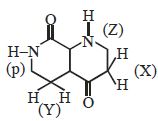
MediumMCQ
Which of the indicated $H$ in the following is most acidic?
A
$X$
B
$Y$
C
$Z$
D
$p$
Solution
(C) The acidity of a hydrogen atom depends on the stability of the conjugate base formed after the removal of the proton.
$1$. $Z$ is a hydrogen attached to a nitrogen atom in an amide group $(-NH-)$.
$2$. $p$ is a hydrogen attached to a nitrogen atom in an amide group $(-NH-)$.
$3$. $X$ is an $\alpha$-hydrogen to a carbonyl group $(C=O)$.
$4$. $Y$ is a hydrogen on a carbon atom not adjacent to any electron-withdrawing group.
Comparing the acidity,the protons on the nitrogen atoms ($Z$ and $p$) are more acidic than the $\alpha$-hydrogens $(X)$ due to the resonance stabilization of the resulting amide anion. Between $Z$ and $p$,$Z$ is part of a cyclic structure where the nitrogen is adjacent to a carbonyl group,making it more acidic due to the inductive and resonance effects of the carbonyl group. Thus,$Z$ is the most acidic.
$1$. $Z$ is a hydrogen attached to a nitrogen atom in an amide group $(-NH-)$.
$2$. $p$ is a hydrogen attached to a nitrogen atom in an amide group $(-NH-)$.
$3$. $X$ is an $\alpha$-hydrogen to a carbonyl group $(C=O)$.
$4$. $Y$ is a hydrogen on a carbon atom not adjacent to any electron-withdrawing group.
Comparing the acidity,the protons on the nitrogen atoms ($Z$ and $p$) are more acidic than the $\alpha$-hydrogens $(X)$ due to the resonance stabilization of the resulting amide anion. Between $Z$ and $p$,$Z$ is part of a cyclic structure where the nitrogen is adjacent to a carbonyl group,making it more acidic due to the inductive and resonance effects of the carbonyl group. Thus,$Z$ is the most acidic.
0 likes
View Solution39
DifficultMCQ
Which of the following is the most unstable carbocation?
A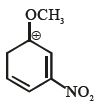
B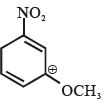
C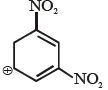
D
All are equally stable.
Solution
(C) The stability of a carbocation is increased by electron-donating groups $(EDG)$ and decreased by electron-withdrawing groups $(EWG)$.
$-OCH_3$ acts as an $EDG$ (via resonance),while $-NO_2$ is a strong $EWG$ (via both inductive and resonance effects).
In option $A$,the $-OCH_3$ group is directly attached to the cationic center,providing resonance stabilization.
In option $B$,the $-NO_2$ group is at the ortho position,exerting a strong destabilizing electron-withdrawing effect.
In option $C$,there are two $-NO_2$ groups present,which are both strong electron-withdrawing groups. The presence of two $-NO_2$ groups makes this carbocation the most unstable due to the intense electron-withdrawing effect,which destabilizes the positive charge.
$-OCH_3$ acts as an $EDG$ (via resonance),while $-NO_2$ is a strong $EWG$ (via both inductive and resonance effects).
In option $A$,the $-OCH_3$ group is directly attached to the cationic center,providing resonance stabilization.
In option $B$,the $-NO_2$ group is at the ortho position,exerting a strong destabilizing electron-withdrawing effect.
In option $C$,there are two $-NO_2$ groups present,which are both strong electron-withdrawing groups. The presence of two $-NO_2$ groups makes this carbocation the most unstable due to the intense electron-withdrawing effect,which destabilizes the positive charge.
0 likes
View Solution40
AdvancedMCQ
Which of the following orders correctly depicts the decreasing order of stability of carbanion?
A
B
$(CHO)_2\overset{\Theta}{C}H > CHO\overset{\Theta}{C}H_2 > \overset{\Theta}{C}H_3$
C
$\overset{\Theta}{C}H_2NO_2 > \overset{\Theta}{C}H_2CN > \overset{\Theta}{C}H_2Cl > \overset{\Theta}{C}H_2CH_3$
D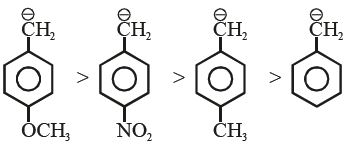
Solution
(B) The stability of a carbanion is increased by electron-withdrawing groups $(EWG)$ that disperse the negative charge through inductive $(-I)$ or resonance $(-M)$ effects. Conversely,electron-donating groups $(EDG)$ decrease stability by intensifying the negative charge.
$1$. In option $B$,the stability order is $(CHO)_2\overset{\Theta}{C}H > CHO\overset{\Theta}{C}H_2 > \overset{\Theta}{C}H_3$. This is correct because the $-CHO$ group exerts a strong $-M$ effect,and having two such groups provides more stabilization than one.
$2$. In option $C$,the correct order of stability is $\overset{\Theta}{C}H_2NO_2 > \overset{\Theta}{C}H_2CN > \overset{\Theta}{C}H_2Cl > \overset{\Theta}{C}H_2CH_3$. This is based on the strength of the electron-withdrawing groups: $-NO_2$ (strong $-M$) > $-CN$ $(-I, -M)$ > $-Cl$ $(-I)$ > $-CH_3$ ($+I$,destabilizing).
$1$. In option $B$,the stability order is $(CHO)_2\overset{\Theta}{C}H > CHO\overset{\Theta}{C}H_2 > \overset{\Theta}{C}H_3$. This is correct because the $-CHO$ group exerts a strong $-M$ effect,and having two such groups provides more stabilization than one.
$2$. In option $C$,the correct order of stability is $\overset{\Theta}{C}H_2NO_2 > \overset{\Theta}{C}H_2CN > \overset{\Theta}{C}H_2Cl > \overset{\Theta}{C}H_2CH_3$. This is based on the strength of the electron-withdrawing groups: $-NO_2$ (strong $-M$) > $-CN$ $(-I, -M)$ > $-Cl$ $(-I)$ > $-CH_3$ ($+I$,destabilizing).
0 likes
View Solution41
DifficultMCQ
Which of the following is not correct?
A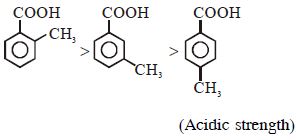
B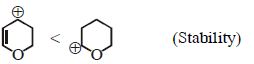
C
$ClCH_2-COOH > H-COOH$ (Acidic strength)
D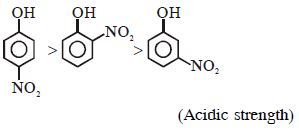
Solution
(NONE) Let us analyze each option:
$A$: The order of acidic strength for methylbenzoic acids is $o- > m- > p-$. This is correct due to the ortho effect and electronic effects.
$B$: The stability of the carbocation with a positive charge adjacent to an oxygen atom is significantly higher due to resonance stabilization by the lone pair on oxygen. The given order is correct.
$C$: The $-I$ effect of the chlorine atom increases the acidity of chloroacetic acid compared to formic acid. The order $ClCH_2-COOH > H-COOH$ is correct.
$D$: The correct order of acidic strength for nitrophenols is $p-Nitrophenol > o-Nitrophenol > m-Nitrophenol$. This is correct due to the strong $-I$ and $-M$ effects of the nitro group at ortho and para positions,with para being stronger due to less steric hindrance and effective resonance.
$A$: The order of acidic strength for methylbenzoic acids is $o- > m- > p-$. This is correct due to the ortho effect and electronic effects.
$B$: The stability of the carbocation with a positive charge adjacent to an oxygen atom is significantly higher due to resonance stabilization by the lone pair on oxygen. The given order is correct.
$C$: The $-I$ effect of the chlorine atom increases the acidity of chloroacetic acid compared to formic acid. The order $ClCH_2-COOH > H-COOH$ is correct.
$D$: The correct order of acidic strength for nitrophenols is $p-Nitrophenol > o-Nitrophenol > m-Nitrophenol$. This is correct due to the strong $-I$ and $-M$ effects of the nitro group at ortho and para positions,with para being stronger due to less steric hindrance and effective resonance.
0 likes
View Solution42
MediumMCQ
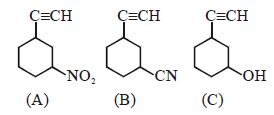
What is the correct order of $K_a$ values for the given compounds?
A
$A > B > C$
B
$A > C > B$
C
$B > A > C$
D
$C > A > B$
Solution
(A) The acidity of the compounds depends on the electron-withdrawing effect of the substituents attached to the ring.
$A$ contains a $-NO_2$ group,which is a strong electron-withdrawing group ($-I$ effect).
$B$ contains a $-CN$ group,which is also an electron-withdrawing group ($-I$ effect),but weaker than $-NO_2$.
$C$ contains an $-OH$ group,which acts as an electron-donating group ($+M$ effect) or weakly electron-withdrawing ($-I$ effect),but overall it is less acidic than the compounds with strong $-I$ groups.
Therefore,the order of acidity ($K_a$ value) is $A > B > C$.
$A$ contains a $-NO_2$ group,which is a strong electron-withdrawing group ($-I$ effect).
$B$ contains a $-CN$ group,which is also an electron-withdrawing group ($-I$ effect),but weaker than $-NO_2$.
$C$ contains an $-OH$ group,which acts as an electron-donating group ($+M$ effect) or weakly electron-withdrawing ($-I$ effect),but overall it is less acidic than the compounds with strong $-I$ groups.
Therefore,the order of acidity ($K_a$ value) is $A > B > C$.
0 likes
View Solution43
DifficultMCQ
Steric inhibition of resonance takes place in
A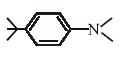
B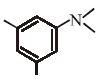
C
D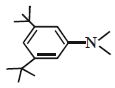
Solution
(C) Steric inhibition of resonance occurs when bulky groups are present at the ortho positions relative to a group involved in resonance (like $-N(CH_3)_2$).
This forces the group out of the plane of the benzene ring,thereby inhibiting resonance.
In option $C$,the presence of two methyl groups at the ortho positions relative to the $-N(CH_3)_2$ group causes steric hindrance,leading to the inhibition of resonance.
This forces the group out of the plane of the benzene ring,thereby inhibiting resonance.
In option $C$,the presence of two methyl groups at the ortho positions relative to the $-N(CH_3)_2$ group causes steric hindrance,leading to the inhibition of resonance.
0 likes
View Solution44
MediumMCQ
In which of the following groups is the $(-M)$ effect observed?
A
$-NH_2$
B
$-OR$
C
$-OH$
D
$-NO_2$
Solution
(D) The $(-M)$ effect (negative mesomeric effect) is observed in groups that withdraw electron density from the conjugated system through resonance.
$1$. $-NH_2$,$-OR$,and $-OH$ groups contain lone pairs of electrons on the atom directly attached to the conjugated system (e.g.,$N$ or $O$),which they donate into the system,thus exhibiting a $(+M)$ effect.
$2$. The $-NO_2$ group is a strong electron-withdrawing group because the nitrogen atom is bonded to highly electronegative oxygen atoms and carries a formal positive charge,allowing it to withdraw electron density from the conjugated system via resonance,thus exhibiting a $(-M)$ effect.
Therefore,the correct option is $D$.
$1$. $-NH_2$,$-OR$,and $-OH$ groups contain lone pairs of electrons on the atom directly attached to the conjugated system (e.g.,$N$ or $O$),which they donate into the system,thus exhibiting a $(+M)$ effect.
$2$. The $-NO_2$ group is a strong electron-withdrawing group because the nitrogen atom is bonded to highly electronegative oxygen atoms and carries a formal positive charge,allowing it to withdraw electron density from the conjugated system via resonance,thus exhibiting a $(-M)$ effect.
Therefore,the correct option is $D$.
0 likes
View Solution45
EasyMCQ
Which of the following has the strongest $+I$ effect?
A
$-\mathop O\limits^\Theta$
B
$-CH_2-CH_3$
C
$-CH_3$
D
$-CD_3$
Solution
(A) The inductive effect ($+I$ effect) is the permanent displacement of sigma electrons towards a more electropositive group or atom.
Among the given options,the negatively charged oxygen atom $(-\mathop O\limits^\Theta)$ has the highest electron density and is the most electron-donating group.
The order of $+I$ effect strength is: $-\mathop O\limits^\Theta > -CH_2-CH_3 > -CH_3 > -CD_3$.
Therefore,the correct option is $A$.
Among the given options,the negatively charged oxygen atom $(-\mathop O\limits^\Theta)$ has the highest electron density and is the most electron-donating group.
The order of $+I$ effect strength is: $-\mathop O\limits^\Theta > -CH_2-CH_3 > -CH_3 > -CD_3$.
Therefore,the correct option is $A$.
0 likes
View Solution46
MediumMCQ
Consider the following compounds. Hyperconjugation occurs in:
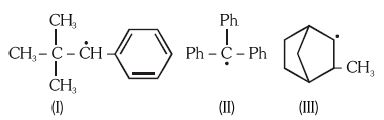
A
$I$ only
B
$II$ only
C
$III$ only
D
$I$ and $III$
Solution
(C) Hyperconjugation requires the presence of an $\alpha-H$ atom on a carbon atom adjacent to a double bond,a carbocation,or a free radical.
In compound $(I)$,the radical carbon is attached to a carbon atom that has no $\alpha-H$ atoms (it is bonded to three methyl groups). Thus,it does not show hyperconjugation.
In compound $(II)$,the radical carbon is attached to three phenyl groups,none of which provide $\alpha-H$ atoms for hyperconjugation.
In compound $(III)$,the radical carbon is attached to a bridgehead carbon and a carbon atom bearing a methyl group. The carbon atom adjacent to the radical carbon (the one with the $-CH_3$ group) has one $\alpha-H$ atom. Therefore,hyperconjugation occurs in compound $(III)$.
In compound $(I)$,the radical carbon is attached to a carbon atom that has no $\alpha-H$ atoms (it is bonded to three methyl groups). Thus,it does not show hyperconjugation.
In compound $(II)$,the radical carbon is attached to three phenyl groups,none of which provide $\alpha-H$ atoms for hyperconjugation.
In compound $(III)$,the radical carbon is attached to a bridgehead carbon and a carbon atom bearing a methyl group. The carbon atom adjacent to the radical carbon (the one with the $-CH_3$ group) has one $\alpha-H$ atom. Therefore,hyperconjugation occurs in compound $(III)$.
0 likes
View Solution47
DifficultMCQ
The decreasing order of stability of the following anions is:
$(P)$ $p-OCH_3-C_6H_4-CH_2^-$
$(Q)$ $p-CHO-C_6H_4-CH_2^-$
$(R)$ $p-Cl-C_6H_4-CH_2^-$
$(S)$ $p-CH_3-C_6H_4-CH_2^-$
$(P)$ $p-OCH_3-C_6H_4-CH_2^-$
$(Q)$ $p-CHO-C_6H_4-CH_2^-$
$(R)$ $p-Cl-C_6H_4-CH_2^-$
$(S)$ $p-CH_3-C_6H_4-CH_2^-$
A
$Q > R > S > P$
B
$R > Q > P > S$
C
$S > P > R > Q$
D
$P > Q > R > S$
Solution
(A) The stability of carbanions is determined by the electron-withdrawing or electron-donating nature of the substituents attached to the benzene ring.
Electron-withdrawing groups $(EWG)$ increase the stability of the carbanion by dispersing the negative charge,while electron-donating groups $(EDG)$ decrease the stability by intensifying the negative charge.
$(Q)$ contains the $-CHO$ group,which is a strong electron-withdrawing group ($-I$ and $-M$ effect),making it the most stable.
$(R)$ contains the $-Cl$ group,which has a $-I$ effect (electron-withdrawing) but a $+M$ effect (electron-donating). The $-I$ effect dominates,providing moderate stability.
$(S)$ contains the $-CH_3$ group,which is an electron-donating group ($+I$ and hyperconjugation),decreasing stability.
$(P)$ contains the $-OCH_3$ group,which is a strong electron-donating group ($+M$ effect),making it the least stable.
Thus,the order of stability is $Q > R > S > P$.
Electron-withdrawing groups $(EWG)$ increase the stability of the carbanion by dispersing the negative charge,while electron-donating groups $(EDG)$ decrease the stability by intensifying the negative charge.
$(Q)$ contains the $-CHO$ group,which is a strong electron-withdrawing group ($-I$ and $-M$ effect),making it the most stable.
$(R)$ contains the $-Cl$ group,which has a $-I$ effect (electron-withdrawing) but a $+M$ effect (electron-donating). The $-I$ effect dominates,providing moderate stability.
$(S)$ contains the $-CH_3$ group,which is an electron-donating group ($+I$ and hyperconjugation),decreasing stability.
$(P)$ contains the $-OCH_3$ group,which is a strong electron-donating group ($+M$ effect),making it the least stable.
Thus,the order of stability is $Q > R > S > P$.
0 likes
View Solution48
MediumMCQ
Which of the following represents an incorrect electromeric effect?
A
$>C=O \to >C^{+}-O^{-}$
B
$CH_3-CH=CH_2 \to CH_3-CH^{+}-CH_2^{-}$
C
$CH_3-C \equiv N \to CH_3-C^{-}=N^{+}$
D
$CH \equiv CH \to CH^{+}=CH^{-}$
Solution
(C) The electromeric effect involves the complete transfer of a shared pair of $\pi$-electrons to one of the atoms joined by a multiple bond on the demand of an attacking reagent. The more electronegative atom should acquire the negative charge.
In option $C$,the nitrogen atom is more electronegative than the carbon atom. Therefore,the $\pi$-electrons should shift towards the nitrogen atom,resulting in $CH_3-C^{+}=N^{-}$. The given representation $CH_3-C^{-}=N^{+}$ is incorrect because it assigns a negative charge to the less electronegative carbon atom and a positive charge to the more electronegative nitrogen atom.
In option $C$,the nitrogen atom is more electronegative than the carbon atom. Therefore,the $\pi$-electrons should shift towards the nitrogen atom,resulting in $CH_3-C^{+}=N^{-}$. The given representation $CH_3-C^{-}=N^{+}$ is incorrect because it assigns a negative charge to the less electronegative carbon atom and a positive charge to the more electronegative nitrogen atom.
0 likes
View Solution49
DifficultMCQ
Which of the following represents the correct order of stability?
A
$CH_3-COO^- > CH_3-CH_2-COO^-$
B
$CH_2=CH-CH_2^- > CH_2=C^-H$
C
$CH_3-CH_2^\bullet > CH_2=CH^\bullet$
D
All of the above
Solution
(D) $1$. In $CH_3-COO^-$,the negative charge is stabilized by resonance with the carbonyl group. In $CH_3-CH_2-COO^-$,the alkyl group $(CH_3-CH_2-)$ is electron-donating due to the $+I$ effect,which destabilizes the carboxylate anion. Thus,$CH_3-COO^- > CH_3-CH_2-COO^-$ is correct.
$2$. In $CH_2=CH-CH_2^-$,the negative charge is delocalized by resonance with the double bond (allylic carbanion). In $CH_2=C^-H$,the negative charge is on an $sp^2$ hybridized carbon atom,which is less stable than the resonance-stabilized allylic carbanion. Thus,$CH_2=CH-CH_2^- > CH_2=C^-H$ is correct.
$3$. In $CH_3-CH_2^\bullet$,the radical is stabilized by hyperconjugation from the $CH_3$ group. In $CH_2=CH^\bullet$,the radical is on an $sp^2$ hybridized carbon (vinylic radical),which is highly unstable. Thus,$CH_3-CH_2^\bullet > CH_2=CH^\bullet$ is correct.
$4$. Since all statements are correct,the answer is $D$.
$2$. In $CH_2=CH-CH_2^-$,the negative charge is delocalized by resonance with the double bond (allylic carbanion). In $CH_2=C^-H$,the negative charge is on an $sp^2$ hybridized carbon atom,which is less stable than the resonance-stabilized allylic carbanion. Thus,$CH_2=CH-CH_2^- > CH_2=C^-H$ is correct.
$3$. In $CH_3-CH_2^\bullet$,the radical is stabilized by hyperconjugation from the $CH_3$ group. In $CH_2=CH^\bullet$,the radical is on an $sp^2$ hybridized carbon (vinylic radical),which is highly unstable. Thus,$CH_3-CH_2^\bullet > CH_2=CH^\bullet$ is correct.
$4$. Since all statements are correct,the answer is $D$.
0 likes
View Solution50
MediumMCQ
Which of the following is the strongest $-I$ (inductive effect) group?
A
$-OH$
B
$-COOH$
C
$-F$
D
$-OCH_3$
Solution
(B) The inductive effect ($-I$ effect) is the permanent displacement of shared electron pairs along a carbon chain due to the difference in electronegativity of the atoms or groups attached.
Comparing the given groups:
$1$. $-OH$: Oxygen is electronegative,but it is bonded to a hydrogen atom.
$2$. $-COOH$: This group contains a carbonyl group $(C=O)$ which is strongly electron-withdrawing,making it a very strong $-I$ group.
$3$. $-F$: Fluorine is the most electronegative element,but in the context of organic substituents,the $-COOH$ group exerts a stronger overall electron-withdrawing effect due to the combined effect of the electronegative oxygen atoms and the $sp^2$ hybridized carbon.
$4$. $-OCH_3$: The methoxy group has an oxygen atom,but the electron-donating $+M$ effect of the lone pairs on oxygen partially offsets its $-I$ effect.
Therefore,among the given options,$-COOH$ is the strongest $-I$ group.
Comparing the given groups:
$1$. $-OH$: Oxygen is electronegative,but it is bonded to a hydrogen atom.
$2$. $-COOH$: This group contains a carbonyl group $(C=O)$ which is strongly electron-withdrawing,making it a very strong $-I$ group.
$3$. $-F$: Fluorine is the most electronegative element,but in the context of organic substituents,the $-COOH$ group exerts a stronger overall electron-withdrawing effect due to the combined effect of the electronegative oxygen atoms and the $sp^2$ hybridized carbon.
$4$. $-OCH_3$: The methoxy group has an oxygen atom,but the electron-donating $+M$ effect of the lone pairs on oxygen partially offsets its $-I$ effect.
Therefore,among the given options,$-COOH$ is the strongest $-I$ group.
0 likes
View Solution8-4.Organic Chemistry : Reaction mechanism — Electronic Displacement in covalent bond · Frequently Asked Questions
1Are these 8-4.Organic Chemistry : Reaction mechanism questions useful for JEE and NEET?
Yes. All questions in this section are mapped to JEE Main and NEET exam patterns. Previous year questions from JEE Main, NEET, GUJCET and state-level exams are included with full solutions.
2Can I switch to Hindi or Gujarati for these questions?
Yes. Use the language tabs in the hero section or the sidebar to view the same questions and solutions in English, Hindi or Gujarati.
3How do I generate a question paper from this subtopic?
Use the Vedclass Exam Paper Generator — select the chapter and subtopic, set difficulty, and generate Sets A, B, C, D automatically. First 3 chapters of every subject are free.
Vedclass Products
For Students
Vedclass Test Series
Mock tests in real JEE/NEET style with performance analysis. 5-day free trial.
Start Free TrialFor Teachers
Exam Paper Generator
Generate Set A/B/C/D papers from this chapter in 2 minutes. 3 chapters free.
Try FreeFor Institutes
Online Exam Module
Live online exams with unlimited students, 360° analytics & white-label branding.
See DemoFor Teachers & Institutes
Generate a 8-4.Organic Chemistry : Reaction mechanism Exam Paper in 2 Minutes
Select subtopic & difficulty — Sets A, B, C, D auto-generated with No Repeat logic.
First 3 chapters of every subject are free — no payment required.