
A English
Reactive Intermediates Questions in English
Class 11 Chemistry · 8-4.Organic Chemistry : Reaction mechanism · Reactive Intermediates
280+
Questions
English
Language
100%
With Solutions
Showing 50 of 280 questions in English
201
MediumMCQ
Compare the stability of the following free radicals:
$(1)$ $CH_3 - \dot{CH} - CH_3$
$(2)$ $C_6H_5 - \dot{CH_2}$
$(3)$ $\dot{CH_2} - CH(CH_3)_2$
$(4)$ $\dot{CH_2} - CH_3$
$(1)$ $CH_3 - \dot{CH} - CH_3$
$(2)$ $C_6H_5 - \dot{CH_2}$
$(3)$ $\dot{CH_2} - CH(CH_3)_2$
$(4)$ $\dot{CH_2} - CH_3$
A
$II > I > III > IV$
B
$II > I > IV > III$
C
$I > II > III > IV$
D
$IV > III > I > II$
Solution
(B) The stability of free radicals is determined by factors such as resonance,hyperconjugation,and the inductive effect.
$(II)$ $C_6H_5 - \dot{CH_2}$ (Benzyl radical) is resonance-stabilized by the phenyl ring,making it the most stable.
$(I)$ $CH_3 - \dot{CH} - CH_3$ is a secondary $(2^{\circ})$ radical with $6$ alpha-hydrogen atoms,providing significant hyperconjugation.
$(IV)$ $\dot{CH_2} - CH_3$ is a primary $(1^{\circ})$ radical with $3$ alpha-hydrogen atoms.
$(III)$ $\dot{CH_2} - CH(CH_3)_2$ is a primary $(1^{\circ})$ radical with only $1$ alpha-hydrogen atom.
Comparing the hyperconjugation,the order of stability for the remaining radicals is $I > IV > III$.
Thus,the overall order of stability is $II > I > IV > III$.
$(II)$ $C_6H_5 - \dot{CH_2}$ (Benzyl radical) is resonance-stabilized by the phenyl ring,making it the most stable.
$(I)$ $CH_3 - \dot{CH} - CH_3$ is a secondary $(2^{\circ})$ radical with $6$ alpha-hydrogen atoms,providing significant hyperconjugation.
$(IV)$ $\dot{CH_2} - CH_3$ is a primary $(1^{\circ})$ radical with $3$ alpha-hydrogen atoms.
$(III)$ $\dot{CH_2} - CH(CH_3)_2$ is a primary $(1^{\circ})$ radical with only $1$ alpha-hydrogen atom.
Comparing the hyperconjugation,the order of stability for the remaining radicals is $I > IV > III$.
Thus,the overall order of stability is $II > I > IV > III$.
0 likes
View Solution202
MediumMCQ
Stability order of the following carbocations is:
$(i)$ $CH_3-C^{+}(CH_3)-CH_2-CH_3$
$(ii)$ $CH_3-CH^{+}-CH_3$
$(iii)$ $CH_3-C^{+}(CH_3)-CH_3$
$(iv)$ $Ph-CH^{+}-CH_3$
$(i)$ $CH_3-C^{+}(CH_3)-CH_2-CH_3$
$(ii)$ $CH_3-CH^{+}-CH_3$
$(iii)$ $CH_3-C^{+}(CH_3)-CH_3$
$(iv)$ $Ph-CH^{+}-CH_3$
A
$i > ii > iii > iv$
B
$iv > iii > i > ii$
C
$iv > iii > ii > i$
D
$iii > iv > ii > i$
Solution
(B) The stability of carbocations is determined by resonance,hyperconjugation,and inductive effects.
$(iv)$ $Ph-CH^{+}-CH_3$ is a secondary benzylic carbocation,which is highly stabilized by resonance with the phenyl ring.
$(iii)$ $CH_3-C^{+}(CH_3)-CH_3$ is a tertiary carbocation with $9$ $\alpha$-hydrogens,providing strong hyperconjugation.
$(i)$ $CH_3-C^{+}(CH_3)-CH_2-CH_3$ is a tertiary carbocation with $8$ $\alpha$-hydrogens.
$(ii)$ $CH_3-CH^{+}-CH_3$ is a secondary carbocation with $6$ $\alpha$-hydrogens.
Comparing these,the stability order is $iv > iii > i > ii$.
$(iv)$ $Ph-CH^{+}-CH_3$ is a secondary benzylic carbocation,which is highly stabilized by resonance with the phenyl ring.
$(iii)$ $CH_3-C^{+}(CH_3)-CH_3$ is a tertiary carbocation with $9$ $\alpha$-hydrogens,providing strong hyperconjugation.
$(i)$ $CH_3-C^{+}(CH_3)-CH_2-CH_3$ is a tertiary carbocation with $8$ $\alpha$-hydrogens.
$(ii)$ $CH_3-CH^{+}-CH_3$ is a secondary carbocation with $6$ $\alpha$-hydrogens.
Comparing these,the stability order is $iv > iii > i > ii$.
0 likes
View Solution203
MediumMCQ
Which of the following intermediates is not expected to be formed in the following reaction?
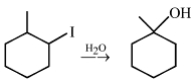
A
B
C
D
Solution
(D) The reaction is a solvolysis reaction of $1-$iodo$-2-$methylcyclohexane in water.
$1$. The leaving group $I^-$ departs to form a secondary carbocation at the $C-2$ position.
$2$. This secondary carbocation undergoes a $1,2-$hydride shift to form a more stable tertiary carbocation at the $C-1$ position.
$3$. Water acts as a nucleophile and attacks the tertiary carbocation to form an oxonium ion intermediate.
$4$. Finally,deprotonation yields $1-$methylcyclohexanol.
Comparing the options:
- Option $A$ is the oxonium ion intermediate.
- Option $B$ is the initial secondary carbocation.
- Option $C$ is the tertiary carbocation.
- Option $D$ is a primary carbocation,which is highly unstable and not expected to be formed in this mechanism.
$1$. The leaving group $I^-$ departs to form a secondary carbocation at the $C-2$ position.
$2$. This secondary carbocation undergoes a $1,2-$hydride shift to form a more stable tertiary carbocation at the $C-1$ position.
$3$. Water acts as a nucleophile and attacks the tertiary carbocation to form an oxonium ion intermediate.
$4$. Finally,deprotonation yields $1-$methylcyclohexanol.
Comparing the options:
- Option $A$ is the oxonium ion intermediate.
- Option $B$ is the initial secondary carbocation.
- Option $C$ is the tertiary carbocation.
- Option $D$ is a primary carbocation,which is highly unstable and not expected to be formed in this mechanism.
0 likes
View Solution204
MediumMCQ
Choose the correct statement regarding the formation of carbocations $A$ and $B$ given:
$CH_3-CH_2-CH=CH_2 + HBr \to CH_3-CH_2-CH_2-CH_2^+ + Br^-$ $(A)$
$CH_3-CH_2-CH=CH_2 + HBr \to CH_3-CH_2-CH^+-CH_3 + Br^-$ $(B)$
$CH_3-CH_2-CH=CH_2 + HBr \to CH_3-CH_2-CH_2-CH_2^+ + Br^-$ $(A)$
$CH_3-CH_2-CH=CH_2 + HBr \to CH_3-CH_2-CH^+-CH_3 + Br^-$ $(B)$
A
Carbocation $B$ is more stable and formed relatively at a faster rate.
B
Carbocation $A$ is more stable and formed relatively at a slow rate.
C
Carbocation $B$ is more stable and formed relatively at a slow rate.
D
Carbocation $A$ is more stable and formed relatively at a faster rate.
Solution
(A) In the electrophilic addition of $HBr$ to but$-1-$ene,the proton $(H^+)$ attacks the double bond to form a carbocation intermediate.
Carbocation $A$ is a primary $(1^\circ)$ carbocation $(CH_3-CH_2-CH_2-CH_2^+)$,while carbocation $B$ is a secondary $(2^\circ)$ carbocation $(CH_3-CH_2-CH^+-CH_3)$.
Secondary carbocations are more stable than primary carbocations due to the inductive effect and hyperconjugation.
Because carbocation $B$ is more stable,its formation has a lower activation energy,meaning it is formed at a faster rate.
Carbocation $A$ is a primary $(1^\circ)$ carbocation $(CH_3-CH_2-CH_2-CH_2^+)$,while carbocation $B$ is a secondary $(2^\circ)$ carbocation $(CH_3-CH_2-CH^+-CH_3)$.
Secondary carbocations are more stable than primary carbocations due to the inductive effect and hyperconjugation.
Because carbocation $B$ is more stable,its formation has a lower activation energy,meaning it is formed at a faster rate.
0 likes
View Solution205
MediumMCQ
Among the given species,which carbocations are resonance stabilized?
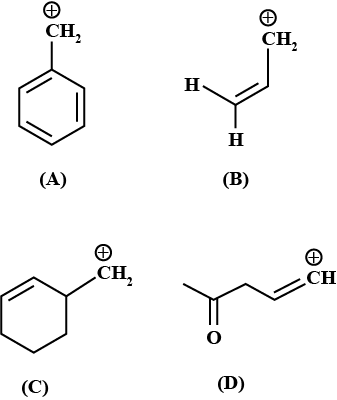
A
$A$ and $B$ only
B
$A$,$B$ and $C$ only
C
$A$,$B$ and $D$ only
D
$C$ and $D$ only
Solution
(B) carbocation is resonance stabilized if the positive charge is in conjugation with a $\pi$-bond or a lone pair of electrons.
$A$: The benzyl carbocation $(C_6H_5CH_2^+)$ is resonance stabilized by the benzene ring.
$B$: The allyl carbocation $(CH_2=CH-CH_2^+)$ is resonance stabilized by the adjacent $\pi$-bond.
$C$: This is a cyclohex$-2-$en$-1-$yl cation. The positive charge is on the carbon adjacent to the double bond,so it is resonance stabilized.
$D$: The positive charge is on the $sp^2$ carbon of a vinylic system,which is not in conjugation with the carbonyl group in a way that provides resonance stabilization to the carbocation center itself (the carbonyl group is electron-withdrawing by induction).
Thus,$A$,$B$,and $C$ are resonance stabilized.
$A$: The benzyl carbocation $(C_6H_5CH_2^+)$ is resonance stabilized by the benzene ring.
$B$: The allyl carbocation $(CH_2=CH-CH_2^+)$ is resonance stabilized by the adjacent $\pi$-bond.
$C$: This is a cyclohex$-2-$en$-1-$yl cation. The positive charge is on the carbon adjacent to the double bond,so it is resonance stabilized.
$D$: The positive charge is on the $sp^2$ carbon of a vinylic system,which is not in conjugation with the carbonyl group in a way that provides resonance stabilization to the carbocation center itself (the carbonyl group is electron-withdrawing by induction).
Thus,$A$,$B$,and $C$ are resonance stabilized.
0 likes
View Solution206
DifficultMCQ
The correct order of stability of the given carbocations is:
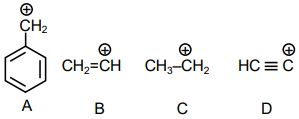
A
$A > C > B > D$
B
$D > B > C > A$
C
$A > C > B > D$
D
$D > B > A > C$
Solution
(A) The stability of carbocations depends on factors like resonance,hyperconjugation,and the electronegativity of the carbon atom bearing the positive charge.
$A$ (Benzyl carbocation) is the most stable due to resonance stabilization by the benzene ring.
$C$ $(CH_3-CH_2^+)$ is a primary alkyl carbocation,which is stabilized by the inductive effect $(+I)$ of the methyl group.
$B$ $(CH_2=CH^+)$ is a vinyl carbocation where the positive charge is on an $sp^2$ hybridized carbon,which is more electronegative than an $sp^3$ carbon.
$D$ $(HC \equiv C^+)$ is an acetylenic carbocation where the positive charge is on an $sp$ hybridized carbon,which is the most electronegative among the three $(sp > sp^2 > sp^3)$.
Since a positive charge is less stable on a more electronegative atom,the order of stability for $B, C,$ and $D$ is $C > B > D$.
Combining these,the overall order of stability is $A > C > B > D$.
$A$ (Benzyl carbocation) is the most stable due to resonance stabilization by the benzene ring.
$C$ $(CH_3-CH_2^+)$ is a primary alkyl carbocation,which is stabilized by the inductive effect $(+I)$ of the methyl group.
$B$ $(CH_2=CH^+)$ is a vinyl carbocation where the positive charge is on an $sp^2$ hybridized carbon,which is more electronegative than an $sp^3$ carbon.
$D$ $(HC \equiv C^+)$ is an acetylenic carbocation where the positive charge is on an $sp$ hybridized carbon,which is the most electronegative among the three $(sp > sp^2 > sp^3)$.
Since a positive charge is less stable on a more electronegative atom,the order of stability for $B, C,$ and $D$ is $C > B > D$.
Combining these,the overall order of stability is $A > C > B > D$.
0 likes
View Solution207
MediumMCQ
Arrange the following carbocations in decreasing order of stability.
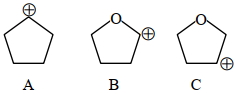
A
$A > C > B$
B
$A > B > C$
C
$C > B > A$
D
$B > A > C$
Solution
(D) The stability of carbocations is determined by resonance and inductive effects.
In structure $B$,the positive charge is on the carbon atom adjacent to the oxygen atom. The lone pair on the oxygen atom can donate electron density through resonance,which significantly stabilizes the carbocation.
In structure $C$,the positive charge is on the carbon atom at the $\beta$-position relative to the oxygen atom. The oxygen atom exerts an electron-withdrawing inductive effect ($-I$ effect),which destabilizes the carbocation.
In structure $A$,the carbocation is a simple secondary carbocation without any adjacent heteroatom effects.
Therefore,the stability order is $B > A > C$.
In structure $B$,the positive charge is on the carbon atom adjacent to the oxygen atom. The lone pair on the oxygen atom can donate electron density through resonance,which significantly stabilizes the carbocation.
In structure $C$,the positive charge is on the carbon atom at the $\beta$-position relative to the oxygen atom. The oxygen atom exerts an electron-withdrawing inductive effect ($-I$ effect),which destabilizes the carbocation.
In structure $A$,the carbocation is a simple secondary carbocation without any adjacent heteroatom effects.
Therefore,the stability order is $B > A > C$.
0 likes
View Solution208
EasyMCQ
$(C_6H_5COO)_2$ $\xrightarrow{hv} 2[X] + 2CO_2$ $\xrightarrow{} 2C_6H_5^\bullet + 2CO_2$
Consider the above reaction and identify the intermediate '$X$'.
Consider the above reaction and identify the intermediate '$X$'.
A
$C_6H_5-C^\oplus=O$
B
$C_6H_5-C^\ominus=O$
C
$C_6H_5-C(=O)-O^\bullet$
D
$C_6H_5-C(=O)-O^\bullet$
Solution
(C) The reaction represents the homolytic cleavage of benzoyl peroxide under photochemical conditions $(hv)$.
$1$. The $O-O$ bond in benzoyl peroxide undergoes homolytic fission to form two benzoyloxy radicals:
$(C_6H_5COO)_2 \xrightarrow{hv} 2C_6H_5COO^\bullet$
$2$. The benzoyloxy radical $(C_6H_5COO^\bullet)$ is unstable and undergoes decarboxylation to form a phenyl radical $(C_6H_5^\bullet)$ and carbon dioxide $(CO_2)$:
$C_6H_5COO^\bullet \rightarrow C_6H_5^\bullet + CO_2$
$3$. Comparing this with the given reaction,the intermediate '$X$' is the benzoyloxy radical,$C_6H_5COO^\bullet$.
$1$. The $O-O$ bond in benzoyl peroxide undergoes homolytic fission to form two benzoyloxy radicals:
$(C_6H_5COO)_2 \xrightarrow{hv} 2C_6H_5COO^\bullet$
$2$. The benzoyloxy radical $(C_6H_5COO^\bullet)$ is unstable and undergoes decarboxylation to form a phenyl radical $(C_6H_5^\bullet)$ and carbon dioxide $(CO_2)$:
$C_6H_5COO^\bullet \rightarrow C_6H_5^\bullet + CO_2$
$3$. Comparing this with the given reaction,the intermediate '$X$' is the benzoyloxy radical,$C_6H_5COO^\bullet$.
0 likes
View Solution209
DifficultMCQ
Among the following structures,which will show the most stable enamine formation?
(Where $Me$ is $-CH_{3}$)
(Where $Me$ is $-CH_{3}$)
A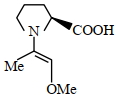
B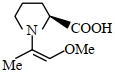
C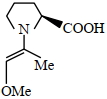
D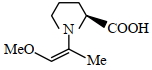
Solution
(C) The stability of an enamine is governed by steric hindrance and electronic effects.
In the given structures,the bulky $-COOH$ group attached to the ring creates significant steric hindrance.
The most stable enamine is the one where the bulky groups are oriented away from each other to minimize repulsion.
Structure $C$ represents the configuration where the steric interaction between the $-COOH$ group and the enamine substituent is minimized,making it the most stable isomer.
In the given structures,the bulky $-COOH$ group attached to the ring creates significant steric hindrance.
The most stable enamine is the one where the bulky groups are oriented away from each other to minimize repulsion.
Structure $C$ represents the configuration where the steric interaction between the $-COOH$ group and the enamine substituent is minimized,making it the most stable isomer.
0 likes
View Solution210
MediumMCQ
Which of the following is most stable?
A
Cyclopropenyl cation
B
Cyclopropenyl anion
C
Cyclopentadienyl cation
D
Cyclohexadiene
Solution
(A) The cyclopropenyl cation is the most stable among the given options because it is aromatic according to $H$ückel's rule ($4n+2$ $\pi$ electrons,where $n=0$,giving $2$ $\pi$ electrons). It has a planar,cyclic,fully conjugated system with $2$ $\pi$ electrons,which provides extra stability.
0 likes
View Solution211
MediumMCQ
Which of the following carbocations is most stable?
A
$CH_2=C(OCH_3)^+$
B
$CH_2=C(OCH_3)-CH=CH^+$
C
$CH_3O-CH=CH^+$
D
$CH_3O-CH=CH-CH=CH^+$
Solution
(D) The stability of a carbocation is increased by the presence of electron-donating groups that can stabilize the positive charge through resonance.
In the given options,the methoxy group $(-OCH_3)$ acts as a strong electron-donating group due to the $+M$ (mesomeric) effect.
Among the options,the carbocation $CH_3O-CH=CH-CH=CH^+$ is the most stable because the positive charge is delocalized over a larger conjugated system,and the $+M$ effect of the $-OCH_3$ group is effectively transmitted through the extended conjugation to stabilize the carbocation.
In the given options,the methoxy group $(-OCH_3)$ acts as a strong electron-donating group due to the $+M$ (mesomeric) effect.
Among the options,the carbocation $CH_3O-CH=CH-CH=CH^+$ is the most stable because the positive charge is delocalized over a larger conjugated system,and the $+M$ effect of the $-OCH_3$ group is effectively transmitted through the extended conjugation to stabilize the carbocation.
0 likes
View Solution212
MediumMCQ
The stable carbocation formed in the reaction of benzene with $n$-propyl chloride in the presence of anhydrous $AlCl_3$ is:

A
$CH_3-CH_2-\stackrel{\oplus}{CH}_2$
B
$CH_3-\stackrel{\oplus}{C}H-CH_3$
C
$CH_3-CH_2-CH_2-\stackrel{\oplus}{C}H_2$
D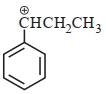
Solution
(B) In the Friedel-Crafts alkylation of benzene with $n$-propyl chloride $(CH_3CH_2CH_2Cl)$ in the presence of anhydrous $AlCl_3$,the primary carbocation $(CH_3CH_2CH_2^+)$ is initially formed.
This primary carbocation is unstable and undergoes a $1,2$-hydride shift to form a more stable secondary carbocation,which is the isopropyl carbocation $(CH_3-\stackrel{\oplus}{C}H-CH_3)$.
This primary carbocation is unstable and undergoes a $1,2$-hydride shift to form a more stable secondary carbocation,which is the isopropyl carbocation $(CH_3-\stackrel{\oplus}{C}H-CH_3)$.
0 likes
View Solution213
DifficultMCQ
The stability of the following carbocations follows the order:
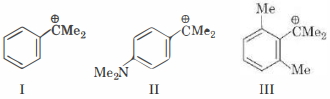
A
$I > II > III$
B
$II > I > III$
C
$II > III > I$
D
$III > II > I$
Solution
(B)
The correct stability order of the given carbocations is $II > I > III$.
In structure $II$,the presence of the electron-releasing $-NMe_2$ group significantly stabilizes the carbocation through the $+M$ effect.
In structure $I$,the carbocation is stabilized by resonance with the benzene ring.
In structure $III$,due to $SIR$ (Steric Inhibition of Resonance),the $-C(Me)_2^+$ group is forced out of the plane of the benzene ring by the two ortho-methyl groups. This loss of conjugation significantly decreases its stability compared to $I$ and $II$.
The correct stability order of the given carbocations is $II > I > III$.
In structure $II$,the presence of the electron-releasing $-NMe_2$ group significantly stabilizes the carbocation through the $+M$ effect.
In structure $I$,the carbocation is stabilized by resonance with the benzene ring.
In structure $III$,due to $SIR$ (Steric Inhibition of Resonance),the $-C(Me)_2^+$ group is forced out of the plane of the benzene ring by the two ortho-methyl groups. This loss of conjugation significantly decreases its stability compared to $I$ and $II$.
0 likes
View Solution214
MediumMCQ
The lower stability of ethyl anion compared to methyl anion and the higher stability of ethyl radical compared to methyl radical,respectively,are due to
A
$+I$-effect of the methyl group in ethyl anion; $\sigma \rightarrow p$-orbital conjugation in ethyl radical
B
$-I$-effect of the methyl group in ethyl anion and $\sigma \rightarrow \sigma^*$ conjugation in ethyl radical
C
$+I$ effect of the methyl group in both cases
D
$+I$-effect of the methyl group in ethyl anion and $\sigma \rightarrow \sigma^*$ conjugation in ethyl radical
Solution
(A) The lower stability of ethyl anion $(CH_3CH_2^-)$ compared to methyl anion $(CH_3^-)$ is due to the $+I$-effect of the methyl group,which increases the electron density on the already negatively charged carbon atom,thereby destabilizing it.
The higher stability of the ethyl radical $(CH_3CH_2^\bullet)$ compared to the methyl radical $(CH_3^\bullet)$ is due to $\sigma \rightarrow p$-orbital conjugation,which is known as hyperconjugation. This delocalization of electrons from the $\sigma$-bond of the $C-H$ bond into the half-filled $p$-orbital stabilizes the radical.
The higher stability of the ethyl radical $(CH_3CH_2^\bullet)$ compared to the methyl radical $(CH_3^\bullet)$ is due to $\sigma \rightarrow p$-orbital conjugation,which is known as hyperconjugation. This delocalization of electrons from the $\sigma$-bond of the $C-H$ bond into the half-filled $p$-orbital stabilizes the radical.
0 likes
View Solution215
DifficultMCQ
The stability of the following carbocations follows the order:
$I. (CH_3)_3C^{\oplus}$
$II. (CH_3)_2C^{\oplus}(OCH_3)$
$III. CH_3CH_2CH_2CH_2^{\oplus}$
$IV. CH_3CH^{\oplus}CH_2CH_3$
$I. (CH_3)_3C^{\oplus}$
$II. (CH_3)_2C^{\oplus}(OCH_3)$
$III. CH_3CH_2CH_2CH_2^{\oplus}$
$IV. CH_3CH^{\oplus}CH_2CH_3$
A
$III < IV < II < I$
B
$III < IV < I < II$
C
$IV < III < II < I$
D
$IV < III < I < II$
Solution
(B) The stability of carbocations is determined by inductive effects,hyperconjugation,and resonance effects.
$III$ is a primary $(1^{\circ})$ carbocation,which is the least stable.
$IV$ is a secondary $(2^{\circ})$ carbocation,which is more stable than $III$ due to hyperconjugation.
$I$ is a tertiary $(3^{\circ})$ carbocation,which is more stable than $IV$ due to greater hyperconjugation and $+I$ effect.
$II$ is a carbocation stabilized by the strong $+M$ (mesomeric) effect of the lone pair on the oxygen atom of the $-OCH_3$ group,making it the most stable among the given options.
Therefore,the correct order of stability is $III < IV < I < II$.
$III$ is a primary $(1^{\circ})$ carbocation,which is the least stable.
$IV$ is a secondary $(2^{\circ})$ carbocation,which is more stable than $III$ due to hyperconjugation.
$I$ is a tertiary $(3^{\circ})$ carbocation,which is more stable than $IV$ due to greater hyperconjugation and $+I$ effect.
$II$ is a carbocation stabilized by the strong $+M$ (mesomeric) effect of the lone pair on the oxygen atom of the $-OCH_3$ group,making it the most stable among the given options.
Therefore,the correct order of stability is $III < IV < I < II$.
0 likes
View Solution216
MediumMCQ
The stability of carbanions follows the order:
$I: CH_3CH_2CH_2\bar{C}H_2$
$II: CH_3\bar{C}HCH_2CH_3$
$III: (CH_3)_3\bar{C}$
$IV: CH_3\bar{C}(Ph)CH_2CH_3$
$I: CH_3CH_2CH_2\bar{C}H_2$
$II: CH_3\bar{C}HCH_2CH_3$
$III: (CH_3)_3\bar{C}$
$IV: CH_3\bar{C}(Ph)CH_2CH_3$
A
$III < IV < I < II$
B
$I < II < IV < III$
C
$III < II < I < IV$
D
$IV < III < II < I$
Solution
(C) The stability of carbanions is primarily governed by the inductive effect ($+I$ effect) and resonance.
$1$. Compound $IV$ is the most stable because the negative charge on the carbon is delocalized into the phenyl ring through resonance.
$2$. Among the remaining alkyl carbanions $(I, II, III)$,stability decreases as the number of alkyl groups attached to the anionic carbon increases. This is because alkyl groups exert a $+I$ effect,which increases the electron density on the anionic carbon,thereby destabilizing it.
$3$. Thus,the stability order is $1^{\circ} > 2^{\circ} > 3^{\circ}$.
$4$. Comparing the given structures:
- $I$ is a $1^{\circ}$ carbanion.
- $II$ is a $2^{\circ}$ carbanion.
- $III$ is a $3^{\circ}$ carbanion.
- $IV$ is resonance-stabilized.
Therefore,the increasing order of stability is $III < II < I < IV$.
$1$. Compound $IV$ is the most stable because the negative charge on the carbon is delocalized into the phenyl ring through resonance.
$2$. Among the remaining alkyl carbanions $(I, II, III)$,stability decreases as the number of alkyl groups attached to the anionic carbon increases. This is because alkyl groups exert a $+I$ effect,which increases the electron density on the anionic carbon,thereby destabilizing it.
$3$. Thus,the stability order is $1^{\circ} > 2^{\circ} > 3^{\circ}$.
$4$. Comparing the given structures:
- $I$ is a $1^{\circ}$ carbanion.
- $II$ is a $2^{\circ}$ carbanion.
- $III$ is a $3^{\circ}$ carbanion.
- $IV$ is resonance-stabilized.
Therefore,the increasing order of stability is $III < II < I < IV$.
0 likes
View Solution217
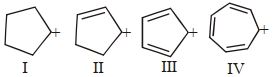
MediumMCQ
The stability of the carbocations follows the order:
A
$I > II > III > IV$
B
$III > II > IV > I$
C
$IV > II > I > III$
D
$IV > I > III > II$
Solution
(C) The stability of carbocations is determined by factors like aromaticity,resonance,and hyperconjugation.
$IV$ is a tropylium cation $(C_7H_7^+)$,which is aromatic ($6\pi$ electrons) and thus the most stable.
$II$ is stabilized by both resonance and hyperconjugation.
$I$ is a secondary carbocation stabilized by hyperconjugation.
$III$ is an anti-aromatic species ($4\pi$ electrons) and is the least stable.
Therefore,the correct order of stability is $IV > II > I > III$.
$IV$ is a tropylium cation $(C_7H_7^+)$,which is aromatic ($6\pi$ electrons) and thus the most stable.
$II$ is stabilized by both resonance and hyperconjugation.
$I$ is a secondary carbocation stabilized by hyperconjugation.
$III$ is an anti-aromatic species ($4\pi$ electrons) and is the least stable.
Therefore,the correct order of stability is $IV > II > I > III$.
0 likes
View Solution218
MediumMCQ
Which of the following is the most stable carbocation?
A
$CH_3^+$
B
$CH_3CH_2^+$
C
$(CH_3)_2CH^+$
D
$(CH_3)_3C^+$
Solution
(D) The stability of carbocations is determined by the inductive effect and hyperconjugation.
$1$. $CH_3^+$ is a methyl carbocation (zero alkyl groups).
$2$. $CH_3CH_2^+$ is a primary $(1^{\circ})$ carbocation.
$3$. $(CH_3)_2CH^+$ is a secondary $(2^{\circ})$ carbocation.
$4$. $(CH_3)_3C^+$ is a tertiary $(3^{\circ})$ carbocation.
As the number of alkyl groups attached to the positively charged carbon increases,the stability increases due to the electron-donating inductive effect ($+I$ effect) and hyperconjugation.
Therefore,the tertiary carbocation $(CH_3)_3C^+$ is the most stable.
$1$. $CH_3^+$ is a methyl carbocation (zero alkyl groups).
$2$. $CH_3CH_2^+$ is a primary $(1^{\circ})$ carbocation.
$3$. $(CH_3)_2CH^+$ is a secondary $(2^{\circ})$ carbocation.
$4$. $(CH_3)_3C^+$ is a tertiary $(3^{\circ})$ carbocation.
As the number of alkyl groups attached to the positively charged carbon increases,the stability increases due to the electron-donating inductive effect ($+I$ effect) and hyperconjugation.
Therefore,the tertiary carbocation $(CH_3)_3C^+$ is the most stable.
0 likes
View Solution219
MediumMCQ
The decreasing order of hydride affinity for the following carbocations is:
$A: CH_2=CH-C^+(CH_3)_2$
$B: (C_6H_5)_3C^+$
$C: (CH_3)_3C^+$
$D: (Cyclopropyl)_3C^+$
Choose the correct answer from the options given below:
$A: CH_2=CH-C^+(CH_3)_2$
$B: (C_6H_5)_3C^+$
$C: (CH_3)_3C^+$
$D: (Cyclopropyl)_3C^+$
Choose the correct answer from the options given below:
A
$A, C, B, D$
B
$C, A, B, D$
C
$C, A, D, B$
D
$A, C, D, B$
Solution
(C) Hydride affinity is inversely proportional to the stability of the carbocation.
Stability order of the given carbocations:
$B$ (Triphenylmethyl cation) is the most stable due to extensive resonance with three phenyl rings.
$D$ (Tricyclopropylmethyl cation) is highly stable due to cyclopropyl conjugation (bent bonds).
$A$ (Allylic carbocation) is stabilized by resonance with the double bond.
$C$ ($tert$-Butyl cation) is stabilized only by inductive effect and hyperconjugation.
Stability order: $B > D > A > C$
Since hydride affinity is inversely proportional to stability,the decreasing order of hydride affinity is: $C > A > D > B$.
Stability order of the given carbocations:
$B$ (Triphenylmethyl cation) is the most stable due to extensive resonance with three phenyl rings.
$D$ (Tricyclopropylmethyl cation) is highly stable due to cyclopropyl conjugation (bent bonds).
$A$ (Allylic carbocation) is stabilized by resonance with the double bond.
$C$ ($tert$-Butyl cation) is stabilized only by inductive effect and hyperconjugation.
Stability order: $B > D > A > C$
Since hydride affinity is inversely proportional to stability,the decreasing order of hydride affinity is: $C > A > D > B$.
0 likes
View Solution220
DifficultMCQ
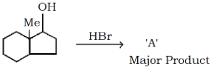
The number of hyperconjugation structures involved to stabilize the carbocation formed in the above reaction is $.............$.
A
$6$
B
$5$
C
$4$
D
$7$
Solution
(D) $1$. The reaction of the given alcohol with $HBr$ proceeds via the formation of a carbocation intermediate.
$2$. Initially,the $OH$ group is protonated to form a good leaving group $(-OH_2^+)$,which then leaves to form a secondary carbocation.
$3$. This secondary carbocation undergoes a methyl shift to form a more stable tertiary carbocation.
$4$. Subsequently,a hydride shift occurs to form an even more stable tertiary carbocation at the bridgehead position.
$5$. The final stable carbocation has $7$ alpha-hydrogens ($3$ from the $CH_3$ group and $4$ from the adjacent ring carbons).
$6$. The number of hyperconjugation structures is equal to the number of alpha-hydrogens,which is $7$.
$2$. Initially,the $OH$ group is protonated to form a good leaving group $(-OH_2^+)$,which then leaves to form a secondary carbocation.
$3$. This secondary carbocation undergoes a methyl shift to form a more stable tertiary carbocation.
$4$. Subsequently,a hydride shift occurs to form an even more stable tertiary carbocation at the bridgehead position.
$5$. The final stable carbocation has $7$ alpha-hydrogens ($3$ from the $CH_3$ group and $4$ from the adjacent ring carbons).
$6$. The number of hyperconjugation structures is equal to the number of alpha-hydrogens,which is $7$.
1 likes
View Solution221
DifficultMCQ
In the above reaction,the left-hand side and right-hand side rings are named as '$A$' and '$B$' respectively. They undergo ring expansion. The correct statement for this process is:
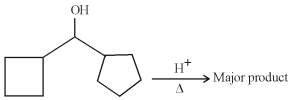
A
Finally both rings will become six-membered each.
B
Finally both rings will become five-membered each.
C
Only '$A$' will become $6$-membered.
D
Ring expansion can go up to seven-membered rings.
Solution
(A) $1$. The reaction starts with the protonation of the alcohol group,followed by the loss of water to form a carbocation at the central carbon.
$2$. The carbocation undergoes a ring expansion (or rearrangement) involving the adjacent rings to form a more stable system.
$3$. Specifically,the $4$-membered ring $(A)$ expands to a $6$-membered ring,and the $5$-membered ring $(B)$ also expands to a $6$-membered ring through a series of rearrangements and shifts.
$4$. The final product is a bicyclic system where both rings are $6$-membered (decalin derivative).
$5$. Therefore,both rings expand to become $6$-membered.
$2$. The carbocation undergoes a ring expansion (or rearrangement) involving the adjacent rings to form a more stable system.
$3$. Specifically,the $4$-membered ring $(A)$ expands to a $6$-membered ring,and the $5$-membered ring $(B)$ also expands to a $6$-membered ring through a series of rearrangements and shifts.
$4$. The final product is a bicyclic system where both rings are $6$-membered (decalin derivative).
$5$. Therefore,both rings expand to become $6$-membered.
0 likes
View Solution222
DifficultMCQ
For the given reaction,the total number of possible products formed by the tertiary carbocation of $A$ is $.........$.
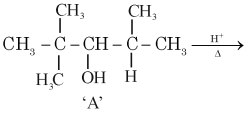
A
$4$
B
$3$
C
$5$
D
$1$
Solution
(C) The dehydration of alcohol $A$ ($3,4,4$-trimethylpentan-$2$-ol) in the presence of $H^+$ and heat proceeds via the formation of a carbocation.
First,the secondary carbocation is formed,which undergoes a $1,2$-hydride shift to form a more stable tertiary carbocation.
This tertiary carbocation can further rearrange via a $1,2$-methyl shift to form another tertiary carbocation.
From these tertiary carbocations,elimination reactions occur to form alkenes.
$1$. From the first tertiary carbocation,two alkenes are formed: $2,3,3$-trimethylpent-$1$-ene and $2,3,3$-trimethylpent-$2$-ene.
$2$. From the second tertiary carbocation,two more alkenes are formed: $3,4,4$-trimethylpent-$1$-ene (which is chiral,giving a pair of enantiomers) and $3,4,4$-trimethylpent-$2$-ene.
Counting the distinct products,including the enantiomeric pair,the total number of possible products is $5$.
First,the secondary carbocation is formed,which undergoes a $1,2$-hydride shift to form a more stable tertiary carbocation.
This tertiary carbocation can further rearrange via a $1,2$-methyl shift to form another tertiary carbocation.
From these tertiary carbocations,elimination reactions occur to form alkenes.
$1$. From the first tertiary carbocation,two alkenes are formed: $2,3,3$-trimethylpent-$1$-ene and $2,3,3$-trimethylpent-$2$-ene.
$2$. From the second tertiary carbocation,two more alkenes are formed: $3,4,4$-trimethylpent-$1$-ene (which is chiral,giving a pair of enantiomers) and $3,4,4$-trimethylpent-$2$-ene.
Counting the distinct products,including the enantiomeric pair,the total number of possible products is $5$.
0 likes
View Solution223
DifficultMCQ
Which of the following molecules/species is the most stable?
A
Cyclopropenyl cation
B
Cyclopentadienyl cation
C
Cyclopropenyl anion
D
$1,3-$Cyclohexadiene
Solution
(A) To determine the stability of the given species,we apply $H$ückel's rule for aromaticity:
$1$. $A$: The cyclopropenyl cation has $2 \pi$ electrons ($n=0$,$4n+2=2$),is planar,and cyclic. It is aromatic and highly stable.
$2$. $B$: The cyclopentadienyl cation has $4 \pi$ electrons $(4n=4)$,which makes it anti-aromatic and unstable.
$3$. $C$: The cyclopropenyl anion has $4 \pi$ electrons $(4n=4)$,which makes it anti-aromatic and unstable.
$4$. $D$: $1,3$-Cyclohexadiene is a non-aromatic conjugated diene,which is less stable than an aromatic system.
Therefore,the cyclopropenyl cation is the most stable species due to its aromatic character.
$1$. $A$: The cyclopropenyl cation has $2 \pi$ electrons ($n=0$,$4n+2=2$),is planar,and cyclic. It is aromatic and highly stable.
$2$. $B$: The cyclopentadienyl cation has $4 \pi$ electrons $(4n=4)$,which makes it anti-aromatic and unstable.
$3$. $C$: The cyclopropenyl anion has $4 \pi$ electrons $(4n=4)$,which makes it anti-aromatic and unstable.
$4$. $D$: $1,3$-Cyclohexadiene is a non-aromatic conjugated diene,which is less stable than an aromatic system.
Therefore,the cyclopropenyl cation is the most stable species due to its aromatic character.
0 likes
View Solution224
DifficultMCQ
The correct stability order of carbocations is
A
$(CH_3)_3C^{+} > CH_3-CH_2^+ > (CH_3)_2CH^{+} > CH_3^+$
B
$CH_3^+ > (CH_3)_2CH^{+} > CH_3-CH_2^+ > (CH_3)_3C^+$
C
$(CH_3)_3C^{+} > (CH_3)_2CH^{+} > CH_3-CH_2^+ > CH_3^+$
D
$CH_3^+ > CH_3-CH_2^+ > (CH_3)_2CH^{+} > (CH_3)_3C^+$
Solution
(C) The stability of carbocations is determined by the inductive effect and hyperconjugation.
Greater the number of hyperconjugable hydrogen atoms (alpha-hydrogens),the more stable the carbocation is.
$(CH_3)_3C^{+}$ has $9$ alpha-hydrogens,$(CH_3)_2CH^{+}$ has $6$ alpha-hydrogens,$CH_3-CH_2^+$ has $3$ alpha-hydrogens,and $CH_3^+$ has $0$ alpha-hydrogens.
Therefore,the correct stability order is $(CH_3)_3C^{+} > (CH_3)_2CH^{+} > CH_3-CH_2^+ > CH_3^+$.
Greater the number of hyperconjugable hydrogen atoms (alpha-hydrogens),the more stable the carbocation is.
$(CH_3)_3C^{+}$ has $9$ alpha-hydrogens,$(CH_3)_2CH^{+}$ has $6$ alpha-hydrogens,$CH_3-CH_2^+$ has $3$ alpha-hydrogens,and $CH_3^+$ has $0$ alpha-hydrogens.
Therefore,the correct stability order is $(CH_3)_3C^{+} > (CH_3)_2CH^{+} > CH_3-CH_2^+ > CH_3^+$.
0 likes
View Solution225
DifficultMCQ
$A$ species having carbon with a sextet of electrons and which can act as an electrophile is called:
A
carbon free radical
B
carbanion
C
carbocation
D
pentavalent carbon
Solution
(C) $carbocation$ is an organic species in which the carbon atom carries a positive charge and has only $6$ electrons in its valence shell (a sextet).
Because it is electron-deficient,it acts as an electrophile (electron-loving species).
For example,the methyl carbocation $(CH_3^+)$ is shown below:
$CH_3^+$ structure:
$H-C^+-H$ (with one $H$ below).
Thus,the correct option is $C$.
Because it is electron-deficient,it acts as an electrophile (electron-loving species).
For example,the methyl carbocation $(CH_3^+)$ is shown below:
$CH_3^+$ structure:
$H-C^+-H$ (with one $H$ below).
Thus,the correct option is $C$.
0 likes
View Solution226
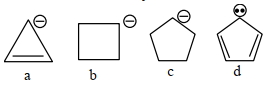
MediumMCQ
The correct order of stability of the given carbanions is:
A
$c > b > d > a$
B
$a > b > c > d$
C
$d > a > c > b$
D
$d > c > b > a$
Solution
(D) The stability of carbanions is determined by factors like aromaticity,resonance,and hybridization.
$1$. Compound $(d)$ is the cyclopentadienyl anion,which is aromatic ($6\pi$ electrons) and therefore highly stable.
$2$. Compound $(a)$ is the cyclopropenyl anion,which is anti-aromatic ($4\pi$ electrons) and therefore the least stable.
$3$. Between $(b)$ and $(c)$,both are non-aromatic and the negative charge is on an $sp^3$ hybridized carbon atom. Stability in such cases is influenced by angle strain. The five-membered ring $(c)$ has less angle strain compared to the four-membered ring $(b)$.
$4$. Thus,the correct order of stability is $d > c > b > a$.
$1$. Compound $(d)$ is the cyclopentadienyl anion,which is aromatic ($6\pi$ electrons) and therefore highly stable.
$2$. Compound $(a)$ is the cyclopropenyl anion,which is anti-aromatic ($4\pi$ electrons) and therefore the least stable.
$3$. Between $(b)$ and $(c)$,both are non-aromatic and the negative charge is on an $sp^3$ hybridized carbon atom. Stability in such cases is influenced by angle strain. The five-membered ring $(c)$ has less angle strain compared to the four-membered ring $(b)$.
$4$. Thus,the correct order of stability is $d > c > b > a$.
0 likes
View Solution227
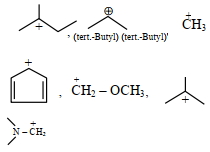
MediumMCQ
Number of carbocations from the following that are not stabilized by hyperconjugation is $...........$ .
A
$5$
B
$1$
C
$3$
D
$6$
Solution
(C) Hyperconjugation requires the presence of at least one $\alpha$-hydrogen atom on a carbon atom adjacent to the positively charged carbon atom.
Let us analyze the given carbocations:
$1$. $sec$-butyl carbocation: $CH_3-CH^+-CH_2-CH_3$ has $5$ $\alpha$-hydrogens (stabilized).
$2$. $Di(tert-butyl)$ methyl carbocation: $(t-Bu)_2CH^+$ has $2$ $\alpha$-hydrogens (stabilized).
$3$. Methyl carbocation: $CH_3^+$ has no $\alpha$-hydrogen (not stabilized).
$4$. Cyclopentadienyl cation: This is an anti-aromatic system,and the positive charge is on an $sp^2$ carbon with no $\alpha$-hydrogen (not stabilized).
$5$. Methoxymethyl cation: $CH_3-O-CH_2^+$ is stabilized by resonance from the lone pair on oxygen,but it has no $\alpha$-hydrogen (not stabilized).
$6$. Isopropyl carbocation: $(CH_3)_2CH^+$ has $6$ $\alpha$-hydrogens (stabilized).
$7$. Dimethylaminomethyl cation: $(CH_3)_2N-CH_2^+$ is stabilized by resonance from the lone pair on nitrogen,but it has no $\alpha$-hydrogen (not stabilized).
Thus,the carbocations not stabilized by hyperconjugation are: Methyl carbocation,Cyclopentadienyl cation,Methoxymethyl cation,and Dimethylaminomethyl cation.
However,re-evaluating the provided image list: $sec$-butyl,$di(tert-butyl)methyl$,$CH_3^+$,cyclopentadienyl,$CH_3OCH_2^+$,isopropyl,and $(CH_3)_2NCH_2^+$.
Total count of carbocations not stabilized by hyperconjugation is $4$.
Let us analyze the given carbocations:
$1$. $sec$-butyl carbocation: $CH_3-CH^+-CH_2-CH_3$ has $5$ $\alpha$-hydrogens (stabilized).
$2$. $Di(tert-butyl)$ methyl carbocation: $(t-Bu)_2CH^+$ has $2$ $\alpha$-hydrogens (stabilized).
$3$. Methyl carbocation: $CH_3^+$ has no $\alpha$-hydrogen (not stabilized).
$4$. Cyclopentadienyl cation: This is an anti-aromatic system,and the positive charge is on an $sp^2$ carbon with no $\alpha$-hydrogen (not stabilized).
$5$. Methoxymethyl cation: $CH_3-O-CH_2^+$ is stabilized by resonance from the lone pair on oxygen,but it has no $\alpha$-hydrogen (not stabilized).
$6$. Isopropyl carbocation: $(CH_3)_2CH^+$ has $6$ $\alpha$-hydrogens (stabilized).
$7$. Dimethylaminomethyl cation: $(CH_3)_2N-CH_2^+$ is stabilized by resonance from the lone pair on nitrogen,but it has no $\alpha$-hydrogen (not stabilized).
Thus,the carbocations not stabilized by hyperconjugation are: Methyl carbocation,Cyclopentadienyl cation,Methoxymethyl cation,and Dimethylaminomethyl cation.
However,re-evaluating the provided image list: $sec$-butyl,$di(tert-butyl)methyl$,$CH_3^+$,cyclopentadienyl,$CH_3OCH_2^+$,isopropyl,and $(CH_3)_2NCH_2^+$.
Total count of carbocations not stabilized by hyperconjugation is $4$.
0 likes
View Solution228
MediumMCQ
The shape of a carbocation is:
A
trigonal planar
B
trigonal pyramidal
C
tetrahedral
D
linear
Solution
(A) In a carbocation,the positively charged carbon atom is $sp^2$ hybridized.
It is bonded to three other atoms and has no lone pair of electrons.
According to the Valence Shell Electron Pair Repulsion $(VSEPR)$ theory,the arrangement of three bonding pairs around the central atom results in a trigonal planar geometry with bond angles of approximately $120^{\circ}$.
It is bonded to three other atoms and has no lone pair of electrons.
According to the Valence Shell Electron Pair Repulsion $(VSEPR)$ theory,the arrangement of three bonding pairs around the central atom results in a trigonal planar geometry with bond angles of approximately $120^{\circ}$.
0 likes
View Solution229
MediumMCQ
The most stable carbocation among the following is:
A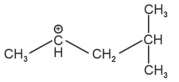
B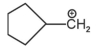
C
D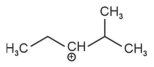
Solution
(C) The stability of a carbocation is determined by the number of $\alpha$-hydrogens,which relates to the extent of hyperconjugation. More $\alpha$-hydrogens lead to greater stability.
$1$. The first structure has $5 \ \alpha$-hydrogens.
$2$. The second structure (cyclopentylmethyl carbocation) has $1 \ \alpha$-hydrogen.
$3$. The third structure ($1$-methylcyclohexyl carbocation) is a tertiary carbocation and has $7 \ \alpha$-hydrogens.
$4$. The fourth structure has $3 \ \alpha$-hydrogens.
Comparing the number of $\alpha$-hydrogens: $7 > 5 > 3 > 1$. Therefore,the tertiary carbocation with $7 \ \alpha$-hydrogens is the most stable.
$1$. The first structure has $5 \ \alpha$-hydrogens.
$2$. The second structure (cyclopentylmethyl carbocation) has $1 \ \alpha$-hydrogen.
$3$. The third structure ($1$-methylcyclohexyl carbocation) is a tertiary carbocation and has $7 \ \alpha$-hydrogens.
$4$. The fourth structure has $3 \ \alpha$-hydrogens.
Comparing the number of $\alpha$-hydrogens: $7 > 5 > 3 > 1$. Therefore,the tertiary carbocation with $7 \ \alpha$-hydrogens is the most stable.
0 likes
View Solution230
AdvancedMCQ
The correct stability order for the following species is:

A
$(II) > (IV) > (I) > (III)$
B
$(I) > (II) > (III) > (IV)$
C
$(II) > (I) > (IV) > (III)$
D
$(I) > (III) > (II) > (IV)$
Solution
(D) The stability of carbocations is determined by resonance,hyperconjugation,and inductive effects.
$(I)$ is a tertiary carbocation adjacent to an oxygen atom. It is stabilized by resonance (lone pair donation from oxygen) and has $6$ $\alpha$-hydrogen atoms for hyperconjugation.
$(III)$ is a secondary carbocation adjacent to an oxygen atom. It is stabilized by resonance,but has only $3$ $\alpha$-hydrogen atoms.
$(II)$ is a secondary alkyl carbocation with $5$ $\alpha$-hydrogen atoms.
$(IV)$ is a primary alkyl carbocation with $2$ $\alpha$-hydrogen atoms.
Resonance stabilization by the oxygen atom is the most significant factor,making $(I)$ and $(III)$ more stable than $(II)$ and $(IV)$. Between $(I)$ and $(III)$,$(I)$ is more stable due to more hyperconjugation. Between $(II)$ and $(IV)$,$(II)$ is more stable due to more hyperconjugation.
Therefore,the correct stability order is $(I) > (III) > (II) > (IV)$.
$(I)$ is a tertiary carbocation adjacent to an oxygen atom. It is stabilized by resonance (lone pair donation from oxygen) and has $6$ $\alpha$-hydrogen atoms for hyperconjugation.
$(III)$ is a secondary carbocation adjacent to an oxygen atom. It is stabilized by resonance,but has only $3$ $\alpha$-hydrogen atoms.
$(II)$ is a secondary alkyl carbocation with $5$ $\alpha$-hydrogen atoms.
$(IV)$ is a primary alkyl carbocation with $2$ $\alpha$-hydrogen atoms.
Resonance stabilization by the oxygen atom is the most significant factor,making $(I)$ and $(III)$ more stable than $(II)$ and $(IV)$. Between $(I)$ and $(III)$,$(I)$ is more stable due to more hyperconjugation. Between $(II)$ and $(IV)$,$(II)$ is more stable due to more hyperconjugation.
Therefore,the correct stability order is $(I) > (III) > (II) > (IV)$.
0 likes
View Solution231
DifficultMCQ
In the following carbocation,the $H$ or $CH_3$ group that is most likely to migrate to the positively charged carbon is:
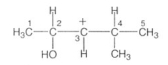
A
$CH_3$ at $C-4$
B
$H$ at $C-4$
C
$CH_3$ at $C-2$
D
$H$ at $C-2$
Solution
(D) The carbocation is at $C-3$. $A$ hydride shift from $C-2$ to $C-3$ occurs because it results in a more stable carbocation at $C-2$.
The positive charge at $C-2$ is stabilized by resonance (conjugation) from the lone pair of electrons on the oxygen atom of the $-OH$ group.
Therefore,the $H$ atom at $C-2$ is the most likely to migrate to the positively charged carbon at $C-3$.
The positive charge at $C-2$ is stabilized by resonance (conjugation) from the lone pair of electrons on the oxygen atom of the $-OH$ group.
Therefore,the $H$ atom at $C-2$ is the most likely to migrate to the positively charged carbon at $C-3$.
0 likes
View Solution232
MediumMCQ
The most stable carbocation from the following is:
A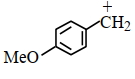
B
C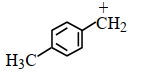
D
Solution
(A) The stability of carbocations is determined by the electronic effects of the substituents attached to the benzene ring.
$1$. In $p$-methoxybenzyl carbocation,the $-OCH_3$ group at the para position exerts a strong $+M$ (mesomeric) effect,which significantly stabilizes the positive charge through resonance.
$2$. In $p$-methylbenzyl carbocation,the $-CH_3$ group provides stability through the $+H$ (hyperconjugation) effect.
$3$. In $m$-methoxybenzyl carbocation,the $-OCH_3$ group exerts a $-I$ (inductive) effect because it is at the meta position,which destabilizes the carbocation.
$4$. The benzyl carbocation has no additional substituents for stabilization.
Therefore,the order of stability is: $p$-methoxybenzyl carbocation > $p$-methylbenzyl carbocation > benzyl carbocation > $m$-methoxybenzyl carbocation.
The most stable carbocation is the $p$-methoxybenzyl carbocation.
$1$. In $p$-methoxybenzyl carbocation,the $-OCH_3$ group at the para position exerts a strong $+M$ (mesomeric) effect,which significantly stabilizes the positive charge through resonance.
$2$. In $p$-methylbenzyl carbocation,the $-CH_3$ group provides stability through the $+H$ (hyperconjugation) effect.
$3$. In $m$-methoxybenzyl carbocation,the $-OCH_3$ group exerts a $-I$ (inductive) effect because it is at the meta position,which destabilizes the carbocation.
$4$. The benzyl carbocation has no additional substituents for stabilization.
Therefore,the order of stability is: $p$-methoxybenzyl carbocation > $p$-methylbenzyl carbocation > benzyl carbocation > $m$-methoxybenzyl carbocation.
The most stable carbocation is the $p$-methoxybenzyl carbocation.
0 likes
View Solution233
MediumMCQ
Which one of the following carbocations is the most stable?
A
$CH_2^+=CH-CH_2-O-CH_3$
B
$CH_2^+=CH-O-CH_3$
C
$CH_2^+=CH-O-CO-CH_3$
D
$CH_2^+=CH-F$
Solution
(B) The stability of a carbocation is determined by factors such as resonance,inductive effect,and hyperconjugation.
In the given options,the carbocation is in conjugation with an oxygen atom.
In option $B$ $(CH_2^+=CH-O-CH_3)$,the oxygen atom has lone pairs that can participate in resonance (delocalization of electrons) to stabilize the positive charge on the carbon atom.
This $+M$ (mesomeric) effect of the $-OCH_3$ group is very strong and provides significant stability to the carbocation.
In option $A$,the oxygen is separated by a $-CH_2-$ group,reducing the resonance effect.
In option $C$,the $-O-CO-CH_3$ group is electron-withdrawing due to the carbonyl group,which destabilizes the carbocation.
In option $D$,the fluorine atom is highly electronegative and exerts a strong $-I$ effect,which destabilizes the carbocation.
Therefore,the carbocation in option $B$ is the most stable.
In the given options,the carbocation is in conjugation with an oxygen atom.
In option $B$ $(CH_2^+=CH-O-CH_3)$,the oxygen atom has lone pairs that can participate in resonance (delocalization of electrons) to stabilize the positive charge on the carbon atom.
This $+M$ (mesomeric) effect of the $-OCH_3$ group is very strong and provides significant stability to the carbocation.
In option $A$,the oxygen is separated by a $-CH_2-$ group,reducing the resonance effect.
In option $C$,the $-O-CO-CH_3$ group is electron-withdrawing due to the carbonyl group,which destabilizes the carbocation.
In option $D$,the fluorine atom is highly electronegative and exerts a strong $-I$ effect,which destabilizes the carbocation.
Therefore,the carbocation in option $B$ is the most stable.
0 likes
View Solution234
MediumMCQ
The correct order of stability of the following carbocations is:
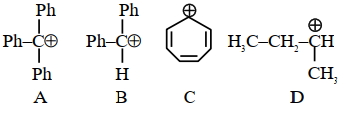
A
$A > B > C > D$
B
$B > C > A > D$
C
$C > B > A > D$
D
$C > A > B > D$
Solution
(D) The stability of carbocations is determined by factors such as aromaticity,resonance,and hyperconjugation.
$C$ is the tropylium cation $(C_7H_7^+)$,which is aromatic ($6 \pi$ electrons) and therefore the most stable.
$A$ is the triphenylmethyl carbocation,which is stabilized by resonance with three phenyl rings.
$B$ is the diphenylmethyl carbocation,which is stabilized by resonance with two phenyl rings.
$D$ is a secondary carbocation ($sec-butyl$ cation),which is stabilized only by hyperconjugation and inductive effects.
Thus,the order of stability is $C > A > B > D$.
$C$ is the tropylium cation $(C_7H_7^+)$,which is aromatic ($6 \pi$ electrons) and therefore the most stable.
$A$ is the triphenylmethyl carbocation,which is stabilized by resonance with three phenyl rings.
$B$ is the diphenylmethyl carbocation,which is stabilized by resonance with two phenyl rings.
$D$ is a secondary carbocation ($sec-butyl$ cation),which is stabilized only by hyperconjugation and inductive effects.
Thus,the order of stability is $C > A > B > D$.
0 likes
View Solution235
DifficultMCQ
Consider the following compound $(X)$:
$H-C \equiv C-CH_2-CH(CH_3)-CH_3$
The most stable and least stable carbon radicals,respectively,produced by homolytic cleavage of the corresponding $C-H$ bond are:
$H-C \equiv C-CH_2-CH(CH_3)-CH_3$
The most stable and least stable carbon radicals,respectively,produced by homolytic cleavage of the corresponding $C-H$ bond are:
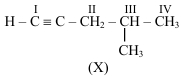
A
$II, IV$
B
$III, II$
C
$I, IV$
D
$II, I$
Solution
(D) The stability of carbon radicals depends on resonance and hyperconjugation.
$1.$ Position $II$ forms a propargyl radical $(HC \equiv C-CH^{\bullet}-CH(CH_3)_2)$,which is resonance-stabilized by the adjacent triple bond.
$2.$ Position $III$ forms a tertiary radical,which is stabilized by hyperconjugation.
$3.$ Position $IV$ forms a primary radical,which is less stable than the tertiary radical.
$4.$ Position $I$ forms an $sp$-hybridized radical $(C^{\bullet} \equiv C-CH_2-CH(CH_3)_2)$,which is highly unstable due to the high $s$-character of the $sp$ orbital.
Comparing the stability: The resonance-stabilized radical at $II$ is the most stable,and the $sp$-hybridized radical at $I$ is the least stable.
Therefore,the correct order is $II$ (most stable) and $I$ (least stable).
$1.$ Position $II$ forms a propargyl radical $(HC \equiv C-CH^{\bullet}-CH(CH_3)_2)$,which is resonance-stabilized by the adjacent triple bond.
$2.$ Position $III$ forms a tertiary radical,which is stabilized by hyperconjugation.
$3.$ Position $IV$ forms a primary radical,which is less stable than the tertiary radical.
$4.$ Position $I$ forms an $sp$-hybridized radical $(C^{\bullet} \equiv C-CH_2-CH(CH_3)_2)$,which is highly unstable due to the high $s$-character of the $sp$ orbital.
Comparing the stability: The resonance-stabilized radical at $II$ is the most stable,and the $sp$-hybridized radical at $I$ is the least stable.
Therefore,the correct order is $II$ (most stable) and $I$ (least stable).
0 likes
View Solution236
DifficultMCQ
In which pairs,the first ion is more stable than the second?
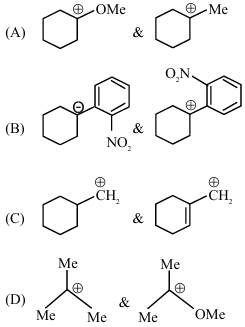
A
$A$ & $B$ only
B
$B$ & $C$ only
C
$A$ & $C$ only
D
$A$ & $D$ only
Solution
(A) Let us analyze the stability of each pair:
$(A)$ The first ion is a carbocation stabilized by the $+M$ effect of the $-OMe$ group (back bonding),whereas the second is stabilized only by the $+I$ effect of the $-Me$ group. Thus,the first is more stable.
$(B)$ The first ion is a carbanion stabilized by the $-M$ and $-I$ effects of the $-NO_2$ group,whereas the second is a carbocation destabilized by the $-I$ effect of the $-NO_2$ group. Thus,the first is more stable.
$(C)$ The first ion is a primary carbocation,while the second is an allylic carbocation stabilized by resonance. Thus,the second is more stable.
$(D)$ The first ion is a tertiary carbocation,while the second is a carbocation stabilized by the $+M$ effect of the $-OMe$ group. Thus,the second is more stable.
Therefore,the pairs where the first ion is more stable than the second are $(A)$ and $(B)$.
$(A)$ The first ion is a carbocation stabilized by the $+M$ effect of the $-OMe$ group (back bonding),whereas the second is stabilized only by the $+I$ effect of the $-Me$ group. Thus,the first is more stable.
$(B)$ The first ion is a carbanion stabilized by the $-M$ and $-I$ effects of the $-NO_2$ group,whereas the second is a carbocation destabilized by the $-I$ effect of the $-NO_2$ group. Thus,the first is more stable.
$(C)$ The first ion is a primary carbocation,while the second is an allylic carbocation stabilized by resonance. Thus,the second is more stable.
$(D)$ The first ion is a tertiary carbocation,while the second is a carbocation stabilized by the $+M$ effect of the $-OMe$ group. Thus,the second is more stable.
Therefore,the pairs where the first ion is more stable than the second are $(A)$ and $(B)$.
0 likes
View Solution237
MediumMCQ
Match the List-$I$ with List-$II$:
Choose the correct answer from the options given below:
| $A$. Carbocation | $I$. Species that can supply a pair of electrons. |
| $B$. Carbon free radical | $II$. Species that can receive a pair of electrons. |
| $C$. Nucleophile | $III$. $sp^2$ hybridized carbon with empty $p$-orbital. |
| $D$. Electrophile | $IV$. $sp^2/sp^3$ hybridized carbon with one unpaired electron. |
Choose the correct answer from the options given below:
A
$A-IV, B-II, C-III, D-I$
B
$A-II, B-III, C-I, D-IV$
C
$A-III, B-IV, C-II, D-I$
D
$A-III, B-IV, C-I, D-II$
Solution
(D) . Carbocation $\rightarrow sp^2$ hybridized carbon with empty $p$-orbital.
$B$. Carbon free radical $\rightarrow sp^2/sp^3$ hybridized carbon with one unpaired electron.
$C$. Nucleophile $\rightarrow$ Species that can supply a pair of electrons.
$D$. Electrophile $\rightarrow$ Species that can receive a pair of electrons.
Therefore,the correct matching is $A-III, B-IV, C-I, D-II$.
$B$. Carbon free radical $\rightarrow sp^2/sp^3$ hybridized carbon with one unpaired electron.
$C$. Nucleophile $\rightarrow$ Species that can supply a pair of electrons.
$D$. Electrophile $\rightarrow$ Species that can receive a pair of electrons.
Therefore,the correct matching is $A-III, B-IV, C-I, D-II$.
0 likes
View Solution238
DifficultMCQ
Among the given compounds $I, II, III$,the correct order of bond dissociation energy of the $C-H$ bond marked with $*$ is:
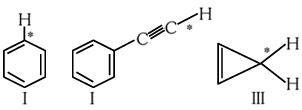
A
$II > I > III$
B
$I > II > III$
C
$III > II > I$
D
$II > III > I$
Solution
(A) The bond dissociation energy is inversely proportional to the stability of the free radical formed after the homolytic fission of the $C-H$ bond.
$1$. The $C-H$ bond in $II$ is an $sp-H$ bond (alkynyl),which is the most stable radical precursor but the radical itself is highly unstable due to high $s$-character.
$2$. The $C-H$ bond in $I$ is an $sp^2-H$ bond (aryl).
$3$. The $C-H$ bond in $III$ is an $sp^2-H$ bond (cyclopropenyl),which forms a stable aromatic cyclopropenyl radical.
The stability order of the radicals formed is: $III > I > II$.
Therefore,the bond dissociation energy order is: $II > I > III$.
$1$. The $C-H$ bond in $II$ is an $sp-H$ bond (alkynyl),which is the most stable radical precursor but the radical itself is highly unstable due to high $s$-character.
$2$. The $C-H$ bond in $I$ is an $sp^2-H$ bond (aryl).
$3$. The $C-H$ bond in $III$ is an $sp^2-H$ bond (cyclopropenyl),which forms a stable aromatic cyclopropenyl radical.
The stability order of the radicals formed is: $III > I > II$.
Therefore,the bond dissociation energy order is: $II > I > III$.
0 likes
View Solution239
MediumMCQ
The bond dissociation energy of the $C-H$ bond for the compounds: $(I)\ CH_3-H, (II)\ CH_3-CH_2-H, (III)\ CH_2=CH-CH_2-H, (IV)\ C_6H_5-H$ follows the order:
A
$I > II > III > IV$
B
$IV > III > II > I$
C
$IV > I > II > III$
D
$II > I > IV > III$
Solution
(C) The bond dissociation energy is inversely proportional to the stability of the free radical formed after the homolytic cleavage of the $C-H$ bond.
$1$. The radicals formed are:
$(I)\ CH_3^{\bullet}$ (Methyl radical)
$(II)\ CH_3-CH_2^{\bullet}$ (Primary ethyl radical)
$(III)\ CH_2=CH-CH_2^{\bullet}$ (Allyl radical,resonance stabilized)
$(IV)\ C_6H_5^{\bullet}$ (Phenyl radical,$sp^2$ hybridized carbon)
$2$. Stability order of radicals: $(III) > (II) > (I) > (IV)$.
$3$. Since bond dissociation energy is inversely proportional to radical stability,the order of energy required is: $(IV) > (I) > (II) > (III)$.
$1$. The radicals formed are:
$(I)\ CH_3^{\bullet}$ (Methyl radical)
$(II)\ CH_3-CH_2^{\bullet}$ (Primary ethyl radical)
$(III)\ CH_2=CH-CH_2^{\bullet}$ (Allyl radical,resonance stabilized)
$(IV)\ C_6H_5^{\bullet}$ (Phenyl radical,$sp^2$ hybridized carbon)
$2$. Stability order of radicals: $(III) > (II) > (I) > (IV)$.
$3$. Since bond dissociation energy is inversely proportional to radical stability,the order of energy required is: $(IV) > (I) > (II) > (III)$.
0 likes
View Solution240
MediumMCQ
The correct order of stability of the following carbocations is:
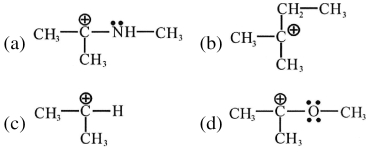
A
$a > d > b > c$
B
$d > a > b > c$
C
$a > b > c > d$
D
$c > b > a > d$
Solution
(A) The stability of carbocations is determined by the presence of electron-donating groups attached to the positively charged carbon atom.
$(a)$ $(CH_3)_2C^+-NHCH_3$: The nitrogen atom has a lone pair which provides strong resonance stabilization ($+M$ effect) to the carbocation.
$(d)$ $(CH_3)_2C^+-OCH_3$: The oxygen atom has lone pairs which provide resonance stabilization ($+M$ effect). Since nitrogen is less electronegative than oxygen,it donates its lone pair more effectively,making $(a)$ more stable than $(d)$.
$(b)$ $(CH_3)_2C^+-CH_2CH_3$: This is a tertiary carbocation stabilized by the inductive effect $(+I)$ and hyperconjugation of the alkyl groups.
$(c)$ $(CH_3)_2CH^+$: This is a secondary carbocation,which is less stable than the tertiary carbocation $(b)$.
Thus,the order of stability is $(a) > (d) > (b) > (c)$.
$(a)$ $(CH_3)_2C^+-NHCH_3$: The nitrogen atom has a lone pair which provides strong resonance stabilization ($+M$ effect) to the carbocation.
$(d)$ $(CH_3)_2C^+-OCH_3$: The oxygen atom has lone pairs which provide resonance stabilization ($+M$ effect). Since nitrogen is less electronegative than oxygen,it donates its lone pair more effectively,making $(a)$ more stable than $(d)$.
$(b)$ $(CH_3)_2C^+-CH_2CH_3$: This is a tertiary carbocation stabilized by the inductive effect $(+I)$ and hyperconjugation of the alkyl groups.
$(c)$ $(CH_3)_2CH^+$: This is a secondary carbocation,which is less stable than the tertiary carbocation $(b)$.
Thus,the order of stability is $(a) > (d) > (b) > (c)$.
0 likes
View Solution241
MediumMCQ
In which of the following pairs is the $2^{\text{nd}}$ anion more stable than the $1^{\text{st}}$?
A
$O_2N-\stackrel{\ominus}{C}H_2$ and $F-\stackrel{\ominus}{C}H_2$
B
$\stackrel{\ominus}{C}F_3$ and $\stackrel{\ominus}{C}Cl_3$
C
$F_3C-\stackrel{\ominus}{C}H_2$ and $Cl_3C-\stackrel{\ominus}{C}H_2$
D
$CH_3-CO-\stackrel{\ominus}{C}H_2$ and $H_2N-\stackrel{\ominus}{C}H_2$
Solution
(B) To determine the stability of carbanions,we look at the electron-withdrawing or electron-donating effects of the attached groups.
$(A)$ $O_2N-\stackrel{\ominus}{C}H_2$ vs $F-\stackrel{\ominus}{C}H_2$: The $-NO_2$ group is a stronger electron-withdrawing group ($-I$ and $-M$ effect) than the $-F$ atom ($-I$ effect). Thus,the $1^{\text{st}}$ anion is more stable.
$(B)$ $\stackrel{\ominus}{C}F_3$ vs $\stackrel{\ominus}{C}Cl_3$: $\stackrel{\ominus}{C}F_3$ is more stable due to the strong $-I$ effect of fluorine atoms compared to chlorine atoms.
$(C)$ $F_3C-\stackrel{\ominus}{C}H_2$ vs $Cl_3C-\stackrel{\ominus}{C}H_2$: The $F_3C-$ group exerts a stronger $-I$ effect than $Cl_3C-$,making the $1^{\text{st}}$ anion more stable.
$(D)$ $CH_3-CO-\stackrel{\ominus}{C}H_2$ vs $H_2N-\stackrel{\ominus}{C}H_2$: In $CH_3-CO-\stackrel{\ominus}{C}H_2$,the negative charge is stabilized by resonance with the carbonyl group $(C=O)$. In $H_2N-\stackrel{\ominus}{C}H_2$,the $-NH_2$ group acts as an electron-donating group ($+M$ effect),which destabilizes the negative charge. Therefore,the $2^{\text{nd}}$ anion $(H_2N-\stackrel{\ominus}{C}H_2)$ is less stable than the $1^{\text{st}}$ anion.
Wait,re-evaluating the question: The question asks where the $2^{\text{nd}}$ is more stable. None of the options provided show the $2^{\text{nd}}$ as more stable. However,if we compare the stability of $\stackrel{\ominus}{C}Cl_3$ vs $\stackrel{\ominus}{C}F_3$,$\stackrel{\ominus}{C}Cl_3$ is actually more stable due to back-bonding ($d$-orbital resonance) which is not possible in $\stackrel{\ominus}{C}F_3$. Thus,in option $(B)$,the $2^{\text{nd}}$ anion is more stable.
$(A)$ $O_2N-\stackrel{\ominus}{C}H_2$ vs $F-\stackrel{\ominus}{C}H_2$: The $-NO_2$ group is a stronger electron-withdrawing group ($-I$ and $-M$ effect) than the $-F$ atom ($-I$ effect). Thus,the $1^{\text{st}}$ anion is more stable.
$(B)$ $\stackrel{\ominus}{C}F_3$ vs $\stackrel{\ominus}{C}Cl_3$: $\stackrel{\ominus}{C}F_3$ is more stable due to the strong $-I$ effect of fluorine atoms compared to chlorine atoms.
$(C)$ $F_3C-\stackrel{\ominus}{C}H_2$ vs $Cl_3C-\stackrel{\ominus}{C}H_2$: The $F_3C-$ group exerts a stronger $-I$ effect than $Cl_3C-$,making the $1^{\text{st}}$ anion more stable.
$(D)$ $CH_3-CO-\stackrel{\ominus}{C}H_2$ vs $H_2N-\stackrel{\ominus}{C}H_2$: In $CH_3-CO-\stackrel{\ominus}{C}H_2$,the negative charge is stabilized by resonance with the carbonyl group $(C=O)$. In $H_2N-\stackrel{\ominus}{C}H_2$,the $-NH_2$ group acts as an electron-donating group ($+M$ effect),which destabilizes the negative charge. Therefore,the $2^{\text{nd}}$ anion $(H_2N-\stackrel{\ominus}{C}H_2)$ is less stable than the $1^{\text{st}}$ anion.
Wait,re-evaluating the question: The question asks where the $2^{\text{nd}}$ is more stable. None of the options provided show the $2^{\text{nd}}$ as more stable. However,if we compare the stability of $\stackrel{\ominus}{C}Cl_3$ vs $\stackrel{\ominus}{C}F_3$,$\stackrel{\ominus}{C}Cl_3$ is actually more stable due to back-bonding ($d$-orbital resonance) which is not possible in $\stackrel{\ominus}{C}F_3$. Thus,in option $(B)$,the $2^{\text{nd}}$ anion is more stable.
0 likes
View Solution242
EasyMCQ
Which of the following carbocations is the least stable?
A
$(R)_3C^{+}$
B
$(R)_2CH^{+}$
C
$R-CH_2^{+}$
D
$H_3C^{+}$
Solution
(D) The stability of carbocations is determined by the inductive effect and hyperconjugation.
Alkyl groups are electron-donating,which stabilizes the positive charge on the carbon atom.
Therefore,the order of stability is: $(R)_3C^{+} > (R)_2CH^{+} > R-CH_2^{+} > H_3C^{+}$.
Thus,the methyl carbocation $(H_3C^{+})$ is the least stable.
Alkyl groups are electron-donating,which stabilizes the positive charge on the carbon atom.
Therefore,the order of stability is: $(R)_3C^{+} > (R)_2CH^{+} > R-CH_2^{+} > H_3C^{+}$.
Thus,the methyl carbocation $(H_3C^{+})$ is the least stable.
0 likes
View Solution243
EasyMCQ
Which free radical is most stable among the following?
A
$R-CH_2^{\bullet}$
B
$R_3C^{\bullet}$
C
$CH_3^{\bullet}$
D
$R_2CH^{\bullet}$
Solution
(B) The stability of free radicals is governed by the inductive effect and hyperconjugation.
The order of stability is $3^{\circ} > 2^{\circ} > 1^{\circ} > \text{methyl}$.
$R_3C^{\bullet}$ is a tertiary $(3^{\circ})$ radical,which is the most stable due to the maximum number of hyperconjugative structures and the electron-donating inductive effect of three $R$ groups.
The order of stability is $3^{\circ} > 2^{\circ} > 1^{\circ} > \text{methyl}$.
$R_3C^{\bullet}$ is a tertiary $(3^{\circ})$ radical,which is the most stable due to the maximum number of hyperconjugative structures and the electron-donating inductive effect of three $R$ groups.
0 likes
View Solution244
MediumMCQ
Which among the following carbocations is the most reactive?
A
$(CH_{3})_{3}C^{+}$
B
$(CH_{3})_{2}CH^{+}$
C
$CH_{3}^{+}$
D
$CH_{3}CH_{2}^{+}$
Solution
(C) The reactivity of a carbocation is inversely proportional to its stability.
$CH_{3}^{+}$ is a methyl carbocation,which is the least stable among the given options because it lacks any electron-donating groups (such as alkyl groups) to stabilize the positive charge through $+I$ (inductive) or hyperconjugation effects.
Since it is the least stable,it is the most reactive.
$CH_{3}^{+}$ is a methyl carbocation,which is the least stable among the given options because it lacks any electron-donating groups (such as alkyl groups) to stabilize the positive charge through $+I$ (inductive) or hyperconjugation effects.
Since it is the least stable,it is the most reactive.
0 likes
View Solution245
MediumMCQ
The total number of electrons around the carbon atom of a methyl free radical is:
A
$6$
B
$8$
C
$7$
D
$9$
Solution
(C) The methyl free radical is represented as $\cdot CH_3$.
In this structure,the carbon atom is bonded to three hydrogen atoms by three covalent bonds.
Each $C-H$ bond consists of $2$ electrons,contributing $3 \times 2 = 6$ electrons.
Additionally,there is one unpaired electron on the carbon atom.
Therefore,the total number of electrons around the carbon atom is $6 + 1 = 7$.
In this structure,the carbon atom is bonded to three hydrogen atoms by three covalent bonds.
Each $C-H$ bond consists of $2$ electrons,contributing $3 \times 2 = 6$ electrons.
Additionally,there is one unpaired electron on the carbon atom.
Therefore,the total number of electrons around the carbon atom is $6 + 1 = 7$.
0 likes
View Solution246
MediumMCQ
Which free radical from the following is least stable?
A
$\dot{C}H_3$
B
$CH_3-\dot{C}H_2$
C
$(CH_3)_3\dot{C}$
D
$(CH_3)_2\dot{C}H$
Solution
(A) The stability of a carbon free radical $(CFR)$ is directly proportional to the number of $\alpha$-hydrogen atoms present due to hyperconjugation.
$1. \dot{C}H_3$ (methyl radical): $0 \ \alpha-H$
$2. CH_3-\dot{C}H_2$ (ethyl radical): $3 \ \alpha-H$
$3. (CH_3)_2\dot{C}H$ (isopropyl radical): $6 \ \alpha-H$
$4. (CH_3)_3\dot{C}$ (tert-butyl radical): $9 \ \alpha-H$
Since the stability order is $(CH_3)_3\dot{C} > (CH_3)_2\dot{C}H > CH_3-\dot{C}H_2 > \dot{C}H_3$,the methyl radical $\dot{C}H_3$ is the least stable.
$1. \dot{C}H_3$ (methyl radical): $0 \ \alpha-H$
$2. CH_3-\dot{C}H_2$ (ethyl radical): $3 \ \alpha-H$
$3. (CH_3)_2\dot{C}H$ (isopropyl radical): $6 \ \alpha-H$
$4. (CH_3)_3\dot{C}$ (tert-butyl radical): $9 \ \alpha-H$
Since the stability order is $(CH_3)_3\dot{C} > (CH_3)_2\dot{C}H > CH_3-\dot{C}H_2 > \dot{C}H_3$,the methyl radical $\dot{C}H_3$ is the least stable.
0 likes
View Solution247
MediumMCQ
Identify the most stable free radical from the following.
A
$CH_3-CH_2\cdot$
B
$(CH_3)_3C\cdot$
C
$(CH_3)_2CH\cdot$
D
$CH_3\cdot$
Solution
(B) The stability of free radicals is determined by the number of alkyl groups attached to the carbon atom bearing the odd electron,due to the inductive effect and hyperconjugation.
The order of stability of alkyl free radicals is: $Tertiary (3^{\circ}) > Secondary (2^{\circ}) > Primary (1^{\circ}) > Methyl (CH_3\cdot)$.
$1$. $(CH_3)_3C\cdot$ is a tertiary $(3^{\circ})$ free radical,which is stabilized by $9$ hyperconjugative structures.
$2$. $(CH_3)_2CH\cdot$ is a secondary $(2^{\circ})$ free radical,which is stabilized by $6$ hyperconjugative structures.
$3$. $CH_3-CH_2\cdot$ is a primary $(1^{\circ})$ free radical,which is stabilized by $3$ hyperconjugative structures.
$4$. $CH_3\cdot$ is a methyl free radical,which has no hyperconjugative stabilization.
Therefore,the tertiary free radical $(CH_3)_3C\cdot$ is the most stable.
The order of stability of alkyl free radicals is: $Tertiary (3^{\circ}) > Secondary (2^{\circ}) > Primary (1^{\circ}) > Methyl (CH_3\cdot)$.
$1$. $(CH_3)_3C\cdot$ is a tertiary $(3^{\circ})$ free radical,which is stabilized by $9$ hyperconjugative structures.
$2$. $(CH_3)_2CH\cdot$ is a secondary $(2^{\circ})$ free radical,which is stabilized by $6$ hyperconjugative structures.
$3$. $CH_3-CH_2\cdot$ is a primary $(1^{\circ})$ free radical,which is stabilized by $3$ hyperconjugative structures.
$4$. $CH_3\cdot$ is a methyl free radical,which has no hyperconjugative stabilization.
Therefore,the tertiary free radical $(CH_3)_3C\cdot$ is the most stable.
0 likes
View Solution248
MediumMCQ
The central carbon atom of a free radical contains
A
$6$ electrons
B
$7$ electrons
C
$8$ electrons
D
$10$ electrons
Solution
(B) The central carbon atom of a free radical contains $7$ electrons.
Free radicals are paramagnetic due to the presence of an unpaired electron and are formed by homolysis of covalent bonds either by heat or by light.
Free radicals are paramagnetic due to the presence of an unpaired electron and are formed by homolysis of covalent bonds either by heat or by light.
0 likes
View Solution249
DifficultMCQ
$A$ certain reaction occurs in two steps as:
$(i)$ $2 SO_{2(g)} + 2 NO_{2(g)} \rightarrow 2 SO_{3(g)} + 2 NO_{(g)}$
$(ii)$ $2 NO_{(g)} + O_{2(g)} \rightarrow 2 NO_{2(g)}$
In the reaction,
$(i)$ $2 SO_{2(g)} + 2 NO_{2(g)} \rightarrow 2 SO_{3(g)} + 2 NO_{(g)}$
$(ii)$ $2 NO_{(g)} + O_{2(g)} \rightarrow 2 NO_{2(g)}$
In the reaction,
A
$NO_{2(g)}$ is intermediate
B
$NO_{(g)}$ is intermediate
C
$NO_{(g)}$ is catalyst
D
$O_{2(g)}$ is intermediate
Solution
(B) An intermediate is a substance that is produced in one step of a reaction mechanism and consumed in a subsequent step.
Adding the two steps:
$(i)$ $2 SO_{2(g)} + 2 NO_{2(g)} \rightarrow 2 SO_{3(g)} + 2 NO_{(g)}$
$(ii)$ $2 NO_{(g)} + O_{2(g)} \rightarrow 2 NO_{2(g)}$
Overall reaction: $2 SO_{2(g)} + O_{2(g)} \rightarrow 2 SO_{3(g)}$
Here,$NO_{(g)}$ is produced in step $(i)$ and consumed in step $(ii)$,so it is an intermediate.
Adding the two steps:
$(i)$ $2 SO_{2(g)} + 2 NO_{2(g)} \rightarrow 2 SO_{3(g)} + 2 NO_{(g)}$
$(ii)$ $2 NO_{(g)} + O_{2(g)} \rightarrow 2 NO_{2(g)}$
Overall reaction: $2 SO_{2(g)} + O_{2(g)} \rightarrow 2 SO_{3(g)}$
Here,$NO_{(g)}$ is produced in step $(i)$ and consumed in step $(ii)$,so it is an intermediate.
0 likes
View Solution250
EasyMCQ
Chlorine $\left(Cl^{17}\right)$ free radical contains how many electrons around the nucleus?
A
$16$
B
$17$
C
$18$
D
$19$
Solution
(B) In free radicals,the number of electrons is the same as that in an isolated neutral atom.
$\because$ In a $Cl$ atom,the number of electrons $= 17$.
$\therefore$ In a $Cl$ free radical,the number of electrons $= 17$.
$\because$ In a $Cl$ atom,the number of electrons $= 17$.
$\therefore$ In a $Cl$ free radical,the number of electrons $= 17$.
0 likes
View Solution8-4.Organic Chemistry : Reaction mechanism — Reactive Intermediates · Frequently Asked Questions
1Are these 8-4.Organic Chemistry : Reaction mechanism questions useful for JEE and NEET?
Yes. All questions in this section are mapped to JEE Main and NEET exam patterns. Previous year questions from JEE Main, NEET, GUJCET and state-level exams are included with full solutions.
2Can I switch to Hindi or Gujarati for these questions?
Yes. Use the language tabs in the hero section or the sidebar to view the same questions and solutions in English, Hindi or Gujarati.
3How do I generate a question paper from this subtopic?
Use the Vedclass Exam Paper Generator — select the chapter and subtopic, set difficulty, and generate Sets A, B, C, D automatically. First 3 chapters of every subject are free.
Vedclass Products
For Students
Vedclass Test Series
Mock tests in real JEE/NEET style with performance analysis. 5-day free trial.
Start Free TrialFor Teachers
Exam Paper Generator
Generate Set A/B/C/D papers from this chapter in 2 minutes. 3 chapters free.
Try FreeFor Institutes
Online Exam Module
Live online exams with unlimited students, 360° analytics & white-label branding.
See DemoFor Teachers & Institutes
Generate a 8-4.Organic Chemistry : Reaction mechanism Exam Paper in 2 Minutes
Select subtopic & difficulty — Sets A, B, C, D auto-generated with No Repeat logic.
First 3 chapters of every subject are free — no payment required.