
A English
Types of organic reactions Questions in English
Class 11 Chemistry · 8-4.Organic Chemistry : Reaction mechanism · Types of organic reactions
72+
Questions
English
Language
100%
With Solutions
Showing 49 of 72 questions in English
1
MediumMCQ
Which kind of fission is favoured by sunlight?
A
Heterolytic fission
B
Homolytic fission
C
Both $(a)$ and $(b)$
D
None of these
Solution
(B) Homolytic fission is favoured by sunlight.
In this process,each bonded atom takes away its shared electron,resulting in the formation of free radicals.
In this process,each bonded atom takes away its shared electron,resulting in the formation of free radicals.
0 likes
View Solution2
MediumMCQ
Heterolysis of $C-Cl$ bond produces:
A
Two free radicals
B
Two carbonium ions
C
Two carbanions
D
One cation and one anion
Solution
(D) In heterolytic bond fission,the shared pair of electrons is taken away by one of the bonded atoms. For the $C-Cl$ bond,since chlorine is more electronegative than carbon,it takes both electrons,resulting in the formation of a carbocation $(C^+)$ and a chloride ion $(Cl^-)$. Thus,it produces one cation and one anion. The reaction is: $C-Cl \xrightarrow{\text{Heterolysis}} C^+ + Cl^-$.
0 likes
View Solution3
MediumMCQ
To which of the following four types does this reaction belong: $B^{-} + R - A \to B - R + A^{-}$?
A
Unimolecular electrophilic substitution
B
Bimolecular electrophilic substitution
C
Unimolecular nucleophilic substitution
D
Bimolecular nucleophilic substitution
Solution
(D) The given reaction is $B^{-} + R - A \to B - R + A^{-}$.
Here,$B^{-}$ acts as a nucleophile that attacks the substrate $R-A$ while the leaving group $A^{-}$ departs simultaneously.
This concerted mechanism,where the rate depends on the concentration of both the nucleophile and the substrate,is characteristic of a $S_N2$ (bimolecular nucleophilic substitution) reaction.
Here,$B^{-}$ acts as a nucleophile that attacks the substrate $R-A$ while the leaving group $A^{-}$ departs simultaneously.
This concerted mechanism,where the rate depends on the concentration of both the nucleophile and the substrate,is characteristic of a $S_N2$ (bimolecular nucleophilic substitution) reaction.
0 likes
View Solution4
MediumMCQ
Which of the following statements is not characteristic of free radical chain reaction?
A
It gives major product derived from most stable free radical
B
It is usually sensitive to change in solvent polarity
C
It proceeds in three main steps like initiation,propagation and termination
D
It may be initiated by $U.V.$ light
Solution
(B) The correct answer is $(B)$.
Free radical reactions involve neutral species (free radicals) and are generally not sensitive to changes in solvent polarity,unlike ionic reactions which are highly dependent on the dielectric constant of the solvent.
Other options $(A)$,$(C)$,and $(D)$ are standard characteristics of free radical chain mechanisms.
Free radical reactions involve neutral species (free radicals) and are generally not sensitive to changes in solvent polarity,unlike ionic reactions which are highly dependent on the dielectric constant of the solvent.
Other options $(A)$,$(C)$,and $(D)$ are standard characteristics of free radical chain mechanisms.
0 likes
View Solution5
MediumMCQ
In a reaction,if half of the double bond is broken and two new bonds are formed,this is a case of
A
Elimination
B
Addition
C
Displacement
D
Rearrangement
Solution
(B) In an addition reaction,the $\pi$ bond of a double bond is broken,and two new $\sigma$ bonds are formed with the incoming atoms or groups.
Example: $CH_2=CH_2 + XY \rightarrow X-CH_2-CH_2-Y$.
Example: $CH_2=CH_2 + XY \rightarrow X-CH_2-CH_2-Y$.
0 likes
View Solution6
MediumMCQ
The heterolytic decomposition of the carbon-chlorine bond forms:
A
Two free ions
B
Two carbanium ions
C
Two carbanions
D
$A$ cation and an anion
Solution
(D) The heterolytic cleavage of the $C-Cl$ bond occurs because $Cl$ is more electronegative than $C$.
$R-CH_2-Cl \xrightarrow{\text{Heterolytic bond fission}} R-CH_2^{\oplus} + Cl^-$
In this process,the shared pair of electrons is taken by the more electronegative chlorine atom,resulting in the formation of a carbocation $(R-CH_2^{\oplus})$ and a chloride anion $(Cl^-)$.
$R-CH_2-Cl \xrightarrow{\text{Heterolytic bond fission}} R-CH_2^{\oplus} + Cl^-$
In this process,the shared pair of electrons is taken by the more electronegative chlorine atom,resulting in the formation of a carbocation $(R-CH_2^{\oplus})$ and a chloride anion $(Cl^-)$.
0 likes
View Solution7
MediumMCQ
The heterolytic cleavage of a carbon-chlorine bond gives:
A
Two free radicals
B
Two carbocations
C
Two carbanions
D
$A$ carbocation and a chloride ion
Solution
(D) Heterolytic cleavage of a $C-Cl$ bond involves the unequal distribution of the shared electron pair,where the more electronegative atom $(Cl)$ takes both electrons.
The reaction is represented as: $R-CH_2-Cl \rightarrow R-CH_2^{\oplus} + Cl^{\ominus}$.
This results in the formation of a carbocation $(R-CH_2^{\oplus})$ and a chloride ion $(Cl^{\ominus})$.
The reaction is represented as: $R-CH_2-Cl \rightarrow R-CH_2^{\oplus} + Cl^{\ominus}$.
This results in the formation of a carbocation $(R-CH_2^{\oplus})$ and a chloride ion $(Cl^{\ominus})$.
0 likes
View Solution8
DifficultMCQ
An electrophile $E^{\oplus}$ attacks the benzene ring to form an intermediate $\sigma$-complex. Which of the following $\sigma$-complexes has the lowest energy?
A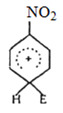
B
C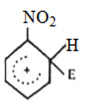
D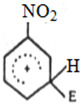
Solution
(D) The $-NO_2$ group is a strong electron-withdrawing group ($-I$ and $-M$ effect).
In electrophilic aromatic substitution of nitrobenzene,the intermediate $\sigma$-complex is destabilized by the $-NO_2$ group.
The destabilization is maximum when the positive charge of the $\sigma$-complex is adjacent to the carbon bearing the $-NO_2$ group (ortho and para positions).
Therefore,the meta-attack is the least destabilized (or relatively most stable) among the three possible positions (ortho,meta,para) because the positive charge never resides directly on the carbon attached to the $-NO_2$ group in the resonance structures of the meta-intermediate.
Thus,the meta-substituted $\sigma$-complex has the lowest energy.
In electrophilic aromatic substitution of nitrobenzene,the intermediate $\sigma$-complex is destabilized by the $-NO_2$ group.
The destabilization is maximum when the positive charge of the $\sigma$-complex is adjacent to the carbon bearing the $-NO_2$ group (ortho and para positions).
Therefore,the meta-attack is the least destabilized (or relatively most stable) among the three possible positions (ortho,meta,para) because the positive charge never resides directly on the carbon attached to the $-NO_2$ group in the resonance structures of the meta-intermediate.
Thus,the meta-substituted $\sigma$-complex has the lowest energy.
0 likes
View Solution9
EasyMCQ
What type of fission is possible by sunlight?
A
Heterolytic fission
B
Homolytic fission
C
Both $(a)$ and $(b)$
D
None of these
Solution
(B) Sunlight (or $UV$ light) provides energy to initiate homolytic fission. In this process,the shared pair of electrons in a covalent bond is split equally between the two atoms,resulting in the formation of free radicals.
0 likes
View Solution10
MediumMCQ
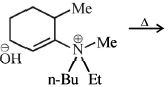
The alkene formed as a major product in the below elimination reaction is
A
$1-$methylcyclohexene
B
$3-$methylcyclohexene
C
$1-$butene
D
$CH_2=CH_2$
Solution
(D) The given reaction is a Hofmann elimination,which occurs when a quaternary ammonium salt is heated with a base like $OH^-$.
In Hofmann elimination,the base abstracts a proton from the $\beta$-carbon that is least sterically hindered,leading to the formation of the least substituted alkene as the major product.
In the provided substrate,the quaternary nitrogen is attached to a methyl group,an ethyl group,a $n$-butyl group,and a cyclohexenyl ring.
Comparing the $\beta$-hydrogens available:
$1$. $\beta_1$ on the ethyl group leads to $CH_2=CH_2$ (ethene).
$2$. $\beta_2$ on the $n$-butyl group leads to $CH_2=CHCH_2CH_3$ ($1$-butene).
$3$. $\beta_3$ and $\beta_4$ on the ring lead to cyclic alkenes.
According to the Hofmann rule,the least substituted alkene,which is $CH_2=CH_2$ (ethene),is formed as the major product because the ethyl group is the least sterically hindered group attached to the nitrogen.
In Hofmann elimination,the base abstracts a proton from the $\beta$-carbon that is least sterically hindered,leading to the formation of the least substituted alkene as the major product.
In the provided substrate,the quaternary nitrogen is attached to a methyl group,an ethyl group,a $n$-butyl group,and a cyclohexenyl ring.
Comparing the $\beta$-hydrogens available:
$1$. $\beta_1$ on the ethyl group leads to $CH_2=CH_2$ (ethene).
$2$. $\beta_2$ on the $n$-butyl group leads to $CH_2=CHCH_2CH_3$ ($1$-butene).
$3$. $\beta_3$ and $\beta_4$ on the ring lead to cyclic alkenes.
According to the Hofmann rule,the least substituted alkene,which is $CH_2=CH_2$ (ethene),is formed as the major product because the ethyl group is the least sterically hindered group attached to the nitrogen.
0 likes
View Solution11
DifficultMCQ
The given reaction is a pinacol-pinacolone rearrangement. Which of the following is not correct about the product formed?
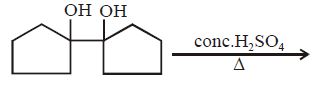
A
It is a spiro compound
B
It is a Ketone
C
It can show tautomerism
D
Its double bond equivalent is $4$
Solution
(A) The reaction is a pinacol-pinacolone rearrangement of $1,1'-bi(cyclopentane)-1,1'-diol$.
Upon treatment with $conc. H_2SO_4$ and heat,one of the hydroxyl groups is protonated and leaves as water,forming a carbocation.
Then,a ring contraction or rearrangement occurs to form a ketone.
The product formed is $cyclopentyl-cyclopentanone$ (specifically,$2-cyclopentylcyclopentanone$).
$A$. It is not a spiro compound; it is a bicyclic ketone where one cyclopentyl ring is attached to the other.
$B$. It is a ketone.
$C$. It can show tautomerism because it has $\alpha$-hydrogens.
$D$. The double bond equivalent $(DBE)$ for $C_{10}H_{16}O$ is $10 - (16/2) + 1 = 3$. Thus,the statement that $DBE = 4$ is incorrect.
Upon treatment with $conc. H_2SO_4$ and heat,one of the hydroxyl groups is protonated and leaves as water,forming a carbocation.
Then,a ring contraction or rearrangement occurs to form a ketone.
The product formed is $cyclopentyl-cyclopentanone$ (specifically,$2-cyclopentylcyclopentanone$).
$A$. It is not a spiro compound; it is a bicyclic ketone where one cyclopentyl ring is attached to the other.
$B$. It is a ketone.
$C$. It can show tautomerism because it has $\alpha$-hydrogens.
$D$. The double bond equivalent $(DBE)$ for $C_{10}H_{16}O$ is $10 - (16/2) + 1 = 3$. Thus,the statement that $DBE = 4$ is incorrect.
0 likes
View Solution12
DifficultMCQ
The major product in the given reaction is :
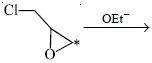
A
$Cl-CH_2-CH(OH)-CH(*)-OEt$
B
$Cl-CH_2-CH(OEt)-CH(*)-OH$
C
$EtO-CH_2-CH-CH(*)-O$ (epoxide ring)
D
$CH_2-CH-CH(*)-OEt$ (epoxide ring)
0 likes
View Solution13
DifficultMCQ
Compare the rates $(R_1, R_2, R_3)$ of the following solvolysis reactions in ethanol $(EtOH)$:
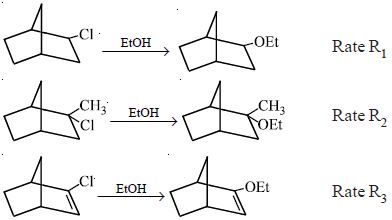
A
$R_1 > R_2 > R_3$
B
$R_3 > R_2 > R_1$
C
$R_2 > R_1 > R_3$
D
$R_2 > R_3 > R_1$
Solution
(C) The reactions involve the formation of carbocation intermediates in a solvolysis process ($S_N1$ mechanism).
$1$. In the first reaction,a secondary carbocation is formed at the bridgehead position,which is relatively stable.
$2$. In the second reaction,a tertiary carbocation is formed at the bridgehead position. Tertiary carbocations are more stable than secondary ones,so $R_2 > R_1$.
$3$. In the third reaction,the carbocation is formed on a double bond (vinylic position). Vinylic carbocations are extremely unstable due to the $sp$ hybridization of the carbon atom,making the formation of this carbocation very difficult. Thus,$R_3$ is the slowest.
Therefore,the order of rates is $R_2 > R_1 > R_3$.
$1$. In the first reaction,a secondary carbocation is formed at the bridgehead position,which is relatively stable.
$2$. In the second reaction,a tertiary carbocation is formed at the bridgehead position. Tertiary carbocations are more stable than secondary ones,so $R_2 > R_1$.
$3$. In the third reaction,the carbocation is formed on a double bond (vinylic position). Vinylic carbocations are extremely unstable due to the $sp$ hybridization of the carbon atom,making the formation of this carbocation very difficult. Thus,$R_3$ is the slowest.
Therefore,the order of rates is $R_2 > R_1 > R_3$.
0 likes
View Solution14
AdvancedMCQ
The major product $(C)$ is

A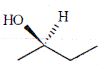
B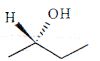
C
D
$(\pm)-2-\text{Butanol}$
Solution
(C) $1$. The starting material is $(S)-2-\text{butanol}$.
$2$. Reaction with $P-TsCl$ (p-toluenesulfonyl chloride) in pyridine converts the $-OH$ group into a good leaving group,$-OTs$,with retention of configuration. Thus,$A$ is $(S)-2-\text{butyl tosylate}$.
$3$. Reaction of $A$ with $AcOK$ (potassium acetate) proceeds via an $S_N2$ mechanism,resulting in inversion of configuration. Thus,$B$ is $(R)-2-\text{butyl acetate}$.
$4$. Hydrolysis of $B$ with $KOH$ in $H_2O$ and heat proceeds via an $S_N2$ mechanism (or $S_N1$ depending on conditions,but here it leads to inversion),resulting in another inversion of configuration. Thus,$C$ is $(S)-2-\text{butanol}$.
$2$. Reaction with $P-TsCl$ (p-toluenesulfonyl chloride) in pyridine converts the $-OH$ group into a good leaving group,$-OTs$,with retention of configuration. Thus,$A$ is $(S)-2-\text{butyl tosylate}$.
$3$. Reaction of $A$ with $AcOK$ (potassium acetate) proceeds via an $S_N2$ mechanism,resulting in inversion of configuration. Thus,$B$ is $(R)-2-\text{butyl acetate}$.
$4$. Hydrolysis of $B$ with $KOH$ in $H_2O$ and heat proceeds via an $S_N2$ mechanism (or $S_N1$ depending on conditions,but here it leads to inversion),resulting in another inversion of configuration. Thus,$C$ is $(S)-2-\text{butanol}$.
0 likes
View Solution15
DifficultMCQ
In which of the following reactions is a carbanion $NOT$ formed as an intermediate?
A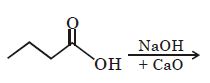
B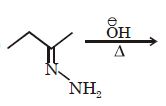
C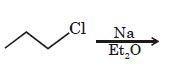
D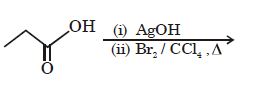
Solution
(D) Let's analyze each reaction:
$A$. Decarboxylation: The reaction of a carboxylic acid with soda lime $(NaOH + CaO)$ proceeds via the formation of a carbanion intermediate $(R^-)$ after the loss of $CO_2$.
$B$. Wolff-Kishner reduction: This reaction involves the formation of a hydrazone followed by the removal of $N_2$ gas. The mechanism involves the formation of a carbanion intermediate $(R-CH_2^-)$ upon treatment with a strong base $(OH^-)$.
$C$. Wurtz reaction: This reaction proceeds via a free radical mechanism (or sometimes organometallic intermediates),but it does not involve a carbanion intermediate.
$D$. Hunsdiecker reaction: This reaction proceeds via a free radical mechanism involving the formation of a silver salt followed by a radical decarboxylation. No carbanion is formed.
Wait,re-evaluating the options: The question asks where a carbanion is $NOT$ formed. Both $C$ and $D$ do not involve carbanions. However,in standard competitive chemistry contexts,the Wurtz reaction is often cited as a radical mechanism. Let's re-examine the Hunsdiecker reaction: it is a well-known radical mechanism. The Wurtz reaction is also radical. Looking at the options provided,the Hunsdiecker reaction is the most classic example of a non-carbanion pathway in this set. Actually,in the Wurtz reaction,the formation of an organosodium compound $(R-Na)$ can be considered to have carbanionic character. Therefore,the Hunsdiecker reaction is the most definitive answer where no carbanion character is involved.
$A$. Decarboxylation: The reaction of a carboxylic acid with soda lime $(NaOH + CaO)$ proceeds via the formation of a carbanion intermediate $(R^-)$ after the loss of $CO_2$.
$B$. Wolff-Kishner reduction: This reaction involves the formation of a hydrazone followed by the removal of $N_2$ gas. The mechanism involves the formation of a carbanion intermediate $(R-CH_2^-)$ upon treatment with a strong base $(OH^-)$.
$C$. Wurtz reaction: This reaction proceeds via a free radical mechanism (or sometimes organometallic intermediates),but it does not involve a carbanion intermediate.
$D$. Hunsdiecker reaction: This reaction proceeds via a free radical mechanism involving the formation of a silver salt followed by a radical decarboxylation. No carbanion is formed.
Wait,re-evaluating the options: The question asks where a carbanion is $NOT$ formed. Both $C$ and $D$ do not involve carbanions. However,in standard competitive chemistry contexts,the Wurtz reaction is often cited as a radical mechanism. Let's re-examine the Hunsdiecker reaction: it is a well-known radical mechanism. The Wurtz reaction is also radical. Looking at the options provided,the Hunsdiecker reaction is the most classic example of a non-carbanion pathway in this set. Actually,in the Wurtz reaction,the formation of an organosodium compound $(R-Na)$ can be considered to have carbanionic character. Therefore,the Hunsdiecker reaction is the most definitive answer where no carbanion character is involved.
0 likes
View Solution16
AdvancedMCQ
In the reaction,the major product formed is:
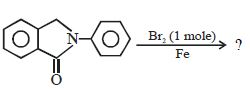
A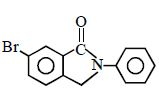
B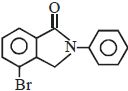
C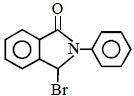
D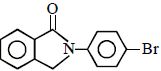
Solution
(A) The reactant is $N$-phenyl-isoindolin$-1-$one. In this molecule,the nitrogen atom is attached to a carbonyl group $(C=O)$,which is an electron-withdrawing group. This makes the nitrogen atom less activating towards electrophilic aromatic substitution on the $N$-phenyl ring.
However,the benzene ring fused to the isoindolinone structure is more electron-rich compared to the $N$-phenyl ring because the nitrogen's lone pair is delocalized into the carbonyl group,reducing its ability to activate the $N$-phenyl ring.
Electrophilic aromatic substitution $(Br_2/Fe)$ will occur at the most activated position. The benzene ring of the isoindolinone system is more activated than the $N$-phenyl ring. Between the positions on the fused benzene ring,the position para to the alkyl group (the $CH_2$ group) is favored due to the ortho/para directing effect of the alkyl group. Thus,the bromine atom substitutes at the position shown in option $A$.
However,the benzene ring fused to the isoindolinone structure is more electron-rich compared to the $N$-phenyl ring because the nitrogen's lone pair is delocalized into the carbonyl group,reducing its ability to activate the $N$-phenyl ring.
Electrophilic aromatic substitution $(Br_2/Fe)$ will occur at the most activated position. The benzene ring of the isoindolinone system is more activated than the $N$-phenyl ring. Between the positions on the fused benzene ring,the position para to the alkyl group (the $CH_2$ group) is favored due to the ortho/para directing effect of the alkyl group. Thus,the bromine atom substitutes at the position shown in option $A$.
0 likes
View Solution17
DifficultMCQ
The enol percentage of the following compound is maximum for:
A
$CH_3-CO-CH_2-CO-CH_3$
B
Cyclohexane$-1,2-$dione
C
Cyclohexa$-2,4-$dien$-1-$one
D
$CH_3-CO-CH_2-CO-OC_2H_5$
Solution
(C) The enol content is determined by the stability of the resulting enol form.
In the case of cyclohexa$-2,4-$dien$-1-$one,the enol form is phenol.
Phenol is aromatic and highly stable due to resonance stabilization.
Since the formation of an aromatic ring provides significant thermodynamic stability,the equilibrium strongly favors the enol form in this case.
Therefore,the enol percentage is maximum for cyclohexa$-2,4-$dien$-1-$one.
In the case of cyclohexa$-2,4-$dien$-1-$one,the enol form is phenol.
Phenol is aromatic and highly stable due to resonance stabilization.
Since the formation of an aromatic ring provides significant thermodynamic stability,the equilibrium strongly favors the enol form in this case.
Therefore,the enol percentage is maximum for cyclohexa$-2,4-$dien$-1-$one.
0 likes
View Solution18
DifficultMCQ
Which of the following is the correct order of reactivity for:
A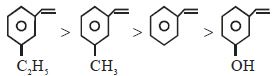
(Electrophilic addition reaction)
B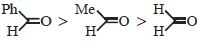
(Grignard's reagent)
C
$R-F > R-Cl > R-Br > R-I$ (Wurtz reaction)
D
$I_2 > F_2 > Br_2 > Cl_2$ (Halogenation of alkanes)
Solution
(A) $1$. For electrophilic addition to alkenes,the reactivity depends on the stability of the carbocation intermediate formed. Electron-donating groups $(EDG)$ increase the electron density on the double bond,making it more reactive towards electrophiles. The order of $EDG$ strength is $-C_2H_5 > -CH_3 > -H > -OH$ (due to the strong $-I$ effect of $-OH$ outweighing its $+M$ effect in this specific context of electrophilic addition to styrene derivatives). Thus,the order shown in option $A$ is correct.
$2$. For Grignard's reagent addition to carbonyls,the reactivity depends on the electrophilicity of the carbonyl carbon. Steric hindrance and electronic effects matter. The order $PhCHO > CH_3CHO > HCHO$ is incorrect as $HCHO$ is the most reactive due to minimal steric hindrance and lack of electron-donating groups.
$3$. For Wurtz reaction,the reactivity order is $R-I > R-Br > R-Cl > R-F$ because the $C-X$ bond strength decreases down the group.
$4$. For halogenation of alkanes,the reactivity order is $F_2 > Cl_2 > Br_2 > I_2$.
$2$. For Grignard's reagent addition to carbonyls,the reactivity depends on the electrophilicity of the carbonyl carbon. Steric hindrance and electronic effects matter. The order $PhCHO > CH_3CHO > HCHO$ is incorrect as $HCHO$ is the most reactive due to minimal steric hindrance and lack of electron-donating groups.
$3$. For Wurtz reaction,the reactivity order is $R-I > R-Br > R-Cl > R-F$ because the $C-X$ bond strength decreases down the group.
$4$. For halogenation of alkanes,the reactivity order is $F_2 > Cl_2 > Br_2 > I_2$.
0 likes
View Solution19
DifficultMCQ
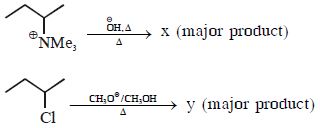
Which statement is correct for the given reactions?
A
Both $x$ and $y$ are $2-$Butene
B
Both $x$ and $y$ are $1-$Butene
C
$x$ is $1-$Butene and $y$ is $2-$Butene
D
$x$ is $2-$Butene and $y$ is $1-$Butene
Solution
(C) In the first reaction,the substrate is a quaternary ammonium salt ($sec-butyltrimethylammonium$ cation). Elimination reactions of quaternary ammonium salts follow the $Hofmann$ rule,which favors the formation of the less substituted alkene. Therefore,the major product $x$ is $1-$Butene.
In the second reaction,the substrate is $2-$chlorobutane,which is an alkyl halide. Elimination reactions of alkyl halides with strong bases like $CH_3O^-$ follow the $Saytzeff$ rule,which favors the formation of the more substituted (more stable) alkene. Therefore,the major product $y$ is $2-$Butene.
Thus,$x$ is $1-$Butene and $y$ is $2-$Butene.
In the second reaction,the substrate is $2-$chlorobutane,which is an alkyl halide. Elimination reactions of alkyl halides with strong bases like $CH_3O^-$ follow the $Saytzeff$ rule,which favors the formation of the more substituted (more stable) alkene. Therefore,the major product $y$ is $2-$Butene.
Thus,$x$ is $1-$Butene and $y$ is $2-$Butene.
0 likes
View Solution20
DifficultMCQ
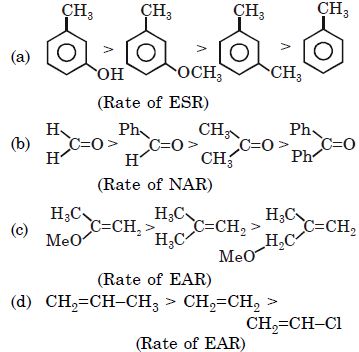
Which of the following orders is correct?
A
$a, b, c$
B
$b, c$
C
$b, c, d$
D
$a, b, c, d$
Solution
(D) Let's analyze each reaction order:
$(a)$ Rate of Electrophilic Substitution Reaction $(ESR)$: The rate depends on the electron density of the ring. $-OH$ is a stronger activating group than $-OCH_3$,which is stronger than $-CH_3$. Thus,the order is correct.
$(b)$ Rate of Nucleophilic Addition Reaction $(NAR)$: The rate depends on the electrophilicity of the carbonyl carbon. Steric hindrance and electron-donating groups decrease the rate. $HCHO > PhCHO > CH_3COCH_3 > PhCOPh$. This order is correct.
$(c)$ Rate of Electrophilic Addition Reaction $(EAR)$: The rate depends on the stability of the carbocation intermediate. The $MeO-$ group attached directly to the double bond provides strong resonance stabilization ($+M$ effect),making it the fastest. The order is correct.
$(d)$ Rate of Electrophilic Addition Reaction $(EAR)$: The rate depends on the stability of the carbocation. $CH_3-CH=CH_2$ (carbocation stabilized by $+I$ effect) $> CH_2=CH_2 > CH_2=CH-Cl$ (carbocation destabilized by $-I$ effect of $Cl$). This order is correct.
Since all orders $(a, b, c, d)$ are correct,the correct option is $D$.
$(a)$ Rate of Electrophilic Substitution Reaction $(ESR)$: The rate depends on the electron density of the ring. $-OH$ is a stronger activating group than $-OCH_3$,which is stronger than $-CH_3$. Thus,the order is correct.
$(b)$ Rate of Nucleophilic Addition Reaction $(NAR)$: The rate depends on the electrophilicity of the carbonyl carbon. Steric hindrance and electron-donating groups decrease the rate. $HCHO > PhCHO > CH_3COCH_3 > PhCOPh$. This order is correct.
$(c)$ Rate of Electrophilic Addition Reaction $(EAR)$: The rate depends on the stability of the carbocation intermediate. The $MeO-$ group attached directly to the double bond provides strong resonance stabilization ($+M$ effect),making it the fastest. The order is correct.
$(d)$ Rate of Electrophilic Addition Reaction $(EAR)$: The rate depends on the stability of the carbocation. $CH_3-CH=CH_2$ (carbocation stabilized by $+I$ effect) $> CH_2=CH_2 > CH_2=CH-Cl$ (carbocation destabilized by $-I$ effect of $Cl$). This order is correct.
Since all orders $(a, b, c, d)$ are correct,the correct option is $D$.
0 likes
View Solution21
MediumMCQ
In the given compound,how many sites are available for the attack of $CH_3O^{-}$?

A
$1$
B
$2$
C
$3$
D
$4$
Solution
(C) The compound is $2,5$-cyclohexadienone. The nucleophile $CH_3O^{-}$ can attack at the carbonyl carbon (direct addition) or at the $\beta$-carbon atoms of the conjugated system (conjugate addition). There are two equivalent $\beta$-carbon positions and one carbonyl carbon position,making a total of $3$ potential sites for nucleophilic attack.

0 likes
View Solution22
DifficultMCQ
Curved arrows are used in Organic Chemistry to show the movement of electrons in the mechanism of a reaction. The correct product of the following reaction is

A
The structure of $2-$methylpent-$4-$en-$2-$one
B
The structure of $3-$methylpent-$3-$en-$2-$one
C
The structure of pent-$4-$enal
D
The structure of $3-$methylpentan-$2-$one
Solution
(B) The reaction shown is a $[3,3]-$sigmatropic rearrangement,specifically the Claisen rearrangement of an allyl vinyl ether.
In this mechanism,the electrons move in a cyclic transition state.
The bond between the oxygen and the allylic carbon breaks,and a new carbon-carbon bond forms between the terminal carbon of the allyl group and the alpha-carbon of the vinyl group.
This results in the formation of an unsaturated carbonyl compound.
For the given reactant (allyl vinyl ether),the product is $3-$methylpent-$4-$enal (or a related isomer depending on the specific substitution pattern shown in the diagram).
Based on the provided options,the structure corresponding to the rearrangement of the allyl vinyl ether is $3-$methylpent-$4-$enal or its isomer $3-$methylpent-$3-$en-$2-$one depending on the specific starting material structure. Given the options,$B$ represents the correct unsaturated carbonyl product.
In this mechanism,the electrons move in a cyclic transition state.
The bond between the oxygen and the allylic carbon breaks,and a new carbon-carbon bond forms between the terminal carbon of the allyl group and the alpha-carbon of the vinyl group.
This results in the formation of an unsaturated carbonyl compound.
For the given reactant (allyl vinyl ether),the product is $3-$methylpent-$4-$enal (or a related isomer depending on the specific substitution pattern shown in the diagram).
Based on the provided options,the structure corresponding to the rearrangement of the allyl vinyl ether is $3-$methylpent-$4-$enal or its isomer $3-$methylpent-$3-$en-$2-$one depending on the specific starting material structure. Given the options,$B$ represents the correct unsaturated carbonyl product.
0 likes
View Solution23
MediumMCQ
Among the given compounds,the correct order of enol content is:
$(I)$ Cyclopentanone
$(II)$ $4$-hydroxycyclopent-$2$-en-$1$-one derivative
$(III)$ $\gamma$-butyrolactone derivative
$(I)$ Cyclopentanone
$(II)$ $4$-hydroxycyclopent-$2$-en-$1$-one derivative
$(III)$ $\gamma$-butyrolactone derivative
A
$I > II > III$
B
$III > II > I$
C
$II > I > III$
D
$II > III > I$
Solution
(C) The enol content depends on the stability of the enol form relative to the keto form.
$(I)$ Cyclopentanone has a standard enolization equilibrium.
$(II)$ Contains a double bond conjugated with the carbonyl group,which significantly stabilizes the enol form through resonance and conjugation.
$(III)$ Is a cyclic ester ($\gamma$-butyrolactone derivative),which has very low enol content due to the resonance stabilization of the ester group itself,making the keto form much more stable than the enol form.
Therefore,the correct order of enol content is $II > I > III$.
$(I)$ Cyclopentanone has a standard enolization equilibrium.
$(II)$ Contains a double bond conjugated with the carbonyl group,which significantly stabilizes the enol form through resonance and conjugation.
$(III)$ Is a cyclic ester ($\gamma$-butyrolactone derivative),which has very low enol content due to the resonance stabilization of the ester group itself,making the keto form much more stable than the enol form.
Therefore,the correct order of enol content is $II > I > III$.
0 likes
View Solution24
MediumMCQ
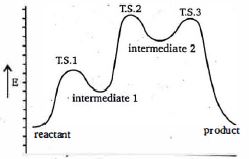
Based on the provided energy profile diagram,transition state $2$ $(T.S. 2)$ is structurally most likely similar to which of the following?
A
intermediate $1$
B
transition state $3$
C
intermediate $2$
D
product
Solution
(C) According to the Hammond Postulate,the transition state of a reaction step is structurally most similar to the species (reactant or product/intermediate) that is closest to it in energy.
In the given energy profile diagram,$T.S. 2$ is the transition state between $intermediate 1$ and $intermediate 2$.
Comparing the energy levels,$T.S. 2$ is closer in energy to $intermediate 2$ than it is to $intermediate 1$.
Therefore,$T.S. 2$ is structurally most likely similar to $intermediate 2$.
In the given energy profile diagram,$T.S. 2$ is the transition state between $intermediate 1$ and $intermediate 2$.
Comparing the energy levels,$T.S. 2$ is closer in energy to $intermediate 2$ than it is to $intermediate 1$.
Therefore,$T.S. 2$ is structurally most likely similar to $intermediate 2$.
0 likes
View Solution25
DifficultMCQ
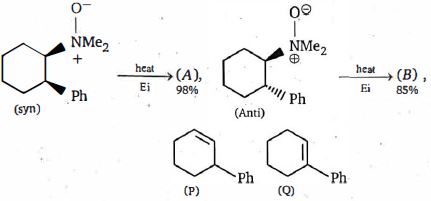
The products $(A)$ and $(B)$ of the above reaction are:
A
$A = P, B = P$
B
$A = Q, B = Q$
C
$A = P, B = Q$
D
$A = Q, B = P$
Solution
(C) The reaction shown is a Cope elimination,which is a concerted $syn$-elimination reaction.
In the $syn$-elimination,the $\beta$-hydrogen and the amine oxide group must be on the same side (cis) to form a cyclic transition state.
For the first substrate (syn-isomer),the $\beta$-hydrogen and the $-NMe_2O^-$ group are on the same side,allowing the formation of product $(P)$ ($3$-phenylcyclohexene).
For the second substrate (anti-isomer),the $\beta$-hydrogen and the $-NMe_2O^-$ group are on the same side after rotation,allowing the formation of product $(Q)$ ($1$-phenylcyclohexene),which is more stable due to conjugation with the phenyl ring.
Therefore,$(A) = P$ and $(B) = Q$.
In the $syn$-elimination,the $\beta$-hydrogen and the amine oxide group must be on the same side (cis) to form a cyclic transition state.
For the first substrate (syn-isomer),the $\beta$-hydrogen and the $-NMe_2O^-$ group are on the same side,allowing the formation of product $(P)$ ($3$-phenylcyclohexene).
For the second substrate (anti-isomer),the $\beta$-hydrogen and the $-NMe_2O^-$ group are on the same side after rotation,allowing the formation of product $(Q)$ ($1$-phenylcyclohexene),which is more stable due to conjugation with the phenyl ring.
Therefore,$(A) = P$ and $(B) = Q$.
0 likes
View Solution26
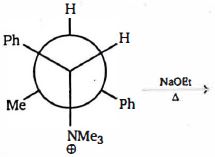
DifficultMCQ
The major product of the above reaction is:
A
$1,1-$diphenylethylene
B
$1,1-$diphenylpropene
C
$1,2-$diphenylpropene
D
$1-$ethoxy$-1-$phenyl$-2-$methylpropene
Solution
(C) The reaction is a Hofmann elimination of a quaternary ammonium salt.
In the given Newman projection,the leaving group is $-NMe_3^+$.
For the elimination to occur,the base $(EtO^-)$ must abstract a $\beta$-hydrogen that is anti-periplanar to the leaving group.
Looking at the Newman projection,the $-NMe_3^+$ group is on the front carbon. The back carbon has a $Ph$ group,a $H$ atom,and a $Ph$ group.
Wait,re-examining the structure: The front carbon has $-NMe_3^+$,$-Me$,and $-Ph$. The back carbon has $-H$,$-H$,and $-Ph$.
Actually,the structure shows the front carbon with $-NMe_3^+$,$-Me$,and $-Ph$. The back carbon has $-H$,$-H$,and $-Ph$.
For $E2$ elimination,we need an anti-periplanar $H$. The $H$ on the back carbon is anti to the $-NMe_3^+$ group.
Removing the $H$ and the $-NMe_3^+$ group results in the formation of a double bond between the two carbons.
The resulting product is $Ph(Me)C=C(H)Ph$,which is $1,2$-diphenylpropene.
In the given Newman projection,the leaving group is $-NMe_3^+$.
For the elimination to occur,the base $(EtO^-)$ must abstract a $\beta$-hydrogen that is anti-periplanar to the leaving group.
Looking at the Newman projection,the $-NMe_3^+$ group is on the front carbon. The back carbon has a $Ph$ group,a $H$ atom,and a $Ph$ group.
Wait,re-examining the structure: The front carbon has $-NMe_3^+$,$-Me$,and $-Ph$. The back carbon has $-H$,$-H$,and $-Ph$.
Actually,the structure shows the front carbon with $-NMe_3^+$,$-Me$,and $-Ph$. The back carbon has $-H$,$-H$,and $-Ph$.
For $E2$ elimination,we need an anti-periplanar $H$. The $H$ on the back carbon is anti to the $-NMe_3^+$ group.
Removing the $H$ and the $-NMe_3^+$ group results in the formation of a double bond between the two carbons.
The resulting product is $Ph(Me)C=C(H)Ph$,which is $1,2$-diphenylpropene.
0 likes
View Solution27
MediumMCQ
How many transition states and intermediates will be formed during the course of the following reaction?
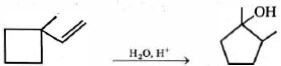
A
$3$ transition states and $3$ intermediates
B
$4$ transition states and $3$ intermediates
C
$3$ transition states and $2$ intermediates
D
$5$ transition states and $4$ intermediates
Solution
(B) The reaction is an acid-catalyzed hydration of $1$-methyl$-1-$vinylcyclobutane,which involves a carbocation rearrangement.
Step $1$: Protonation of the alkene to form a cyclobutyl carbocation (Intermediate $1$).
Step $2$: Ring expansion of the cyclobutyl carbocation to a cyclopentyl carbocation (Intermediate $2$).
Step $3$: Nucleophilic attack by $H_2O$ on the cyclopentyl carbocation to form an oxonium ion (Intermediate $3$).
Step $4$: Deprotonation to form the final product,$1$-methylcyclopentanol.
Since there are $3$ intermediates,there must be $3 + 1 = 4$ transition states.
Thus,the reaction involves $4$ transition states and $3$ intermediates.
Step $1$: Protonation of the alkene to form a cyclobutyl carbocation (Intermediate $1$).
Step $2$: Ring expansion of the cyclobutyl carbocation to a cyclopentyl carbocation (Intermediate $2$).
Step $3$: Nucleophilic attack by $H_2O$ on the cyclopentyl carbocation to form an oxonium ion (Intermediate $3$).
Step $4$: Deprotonation to form the final product,$1$-methylcyclopentanol.
Since there are $3$ intermediates,there must be $3 + 1 = 4$ transition states.
Thus,the reaction involves $4$ transition states and $3$ intermediates.
0 likes
View Solution28
DifficultMCQ
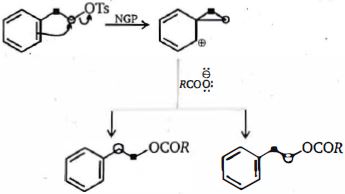
Identify the mechanism of the following reaction:

A
$S_{N^1}$
B
$S_{N^2}$
C
$SN-NGP$
D
$SN-Ar$
Solution
(C) The reaction involves the participation of the neighboring phenyl group to form a phenonium ion intermediate. This process is known as $NGP$ (Neighbouring Group Participation). The nucleophile $(RCOO^-)$ then attacks the phenonium ion at two different positions,leading to the formation of two isomeric products as shown in the image.
0 likes
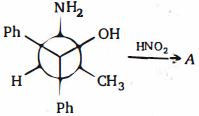
View Solution29
DifficultMCQ
The major product $A$ obtained in the above reaction is:
A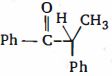
B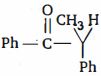
C
Racemic mixture
D
Diastereomers
Solution
(A) The reaction of a $1,2$-amino alcohol with $HNO_2$ (Tiffeneau-Demjanov rearrangement or similar pinacol-type rearrangement) involves the formation of a diazonium ion followed by the migration of an anti-periplanar group to the carbocation center formed after the loss of $N_2$.
In the given Newman projection,the $Ph$ group is anti to the $-N_2^+$ group.
Upon loss of $N_2$,the $Ph$ group migrates to the adjacent carbon,resulting in the formation of a ketone.
Based on the stereochemistry of the migration,the $Ph$ group migrates to the carbonyl carbon,leading to the product shown in image $355-$a404.
In the given Newman projection,the $Ph$ group is anti to the $-N_2^+$ group.
Upon loss of $N_2$,the $Ph$ group migrates to the adjacent carbon,resulting in the formation of a ketone.
Based on the stereochemistry of the migration,the $Ph$ group migrates to the carbonyl carbon,leading to the product shown in image $355-$a404.
0 likes
View Solution30
AdvancedMCQ
Predict the major product of the following reaction:
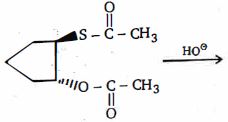
A
trans$-2-$mercaptocyclopentanol
B
cis$-2-$mercaptocyclopentanol
C
episulfide (thiirane derivative)
D
epoxide (oxirane derivative)
Solution
(C) The reaction involves the base-catalyzed hydrolysis of the thioacetate group.
$1$. The $HO^-$ ion attacks the carbonyl carbon of the thioacetate group,leading to the formation of a thiolate anion $(-S^-)$ at the adjacent carbon.
$2$. This thiolate anion is a strong nucleophile and is positioned trans to the acetate group.
$3$. Through Neighboring Group Participation $(NGP)$,the thiolate sulfur attacks the carbon bearing the acetate group,displacing the acetate ion $(CH_3COO^-)$ to form a cyclic episulfide (thiirane) ring.
Therefore,the major product is the episulfide.
$1$. The $HO^-$ ion attacks the carbonyl carbon of the thioacetate group,leading to the formation of a thiolate anion $(-S^-)$ at the adjacent carbon.
$2$. This thiolate anion is a strong nucleophile and is positioned trans to the acetate group.
$3$. Through Neighboring Group Participation $(NGP)$,the thiolate sulfur attacks the carbon bearing the acetate group,displacing the acetate ion $(CH_3COO^-)$ to form a cyclic episulfide (thiirane) ring.
Therefore,the major product is the episulfide.
0 likes
View Solution31
DifficultMCQ
The final product $(B)$ will be:
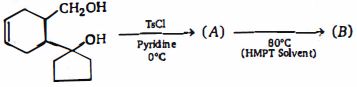
A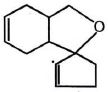
B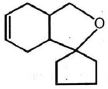
C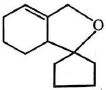
D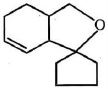
Solution
(B) $1$. The reaction starts with a diol containing a primary alcohol $(-CH_2OH)$ and a tertiary alcohol group attached to a cyclohexane ring.
$2$. Treatment with $TsCl$ (tosyl chloride) in pyridine at $0^{\circ}C$ selectively converts the less hindered primary alcohol into a tosylate group $(-OTs)$,forming intermediate $(A)$.
$3$. In the presence of $HMPT$ solvent at $80^{\circ}C$,the remaining tertiary hydroxyl group acts as an internal nucleophile.
$4$. The lone pair on the oxygen of the tertiary alcohol attacks the carbon bearing the tosylate group,leading to an intramolecular $S_N2$ reaction (Williamson ether synthesis).
$5$. This results in the formation of a cyclic ether (tetrahydrofuran derivative) as the final product $(B)$.
$2$. Treatment with $TsCl$ (tosyl chloride) in pyridine at $0^{\circ}C$ selectively converts the less hindered primary alcohol into a tosylate group $(-OTs)$,forming intermediate $(A)$.
$3$. In the presence of $HMPT$ solvent at $80^{\circ}C$,the remaining tertiary hydroxyl group acts as an internal nucleophile.
$4$. The lone pair on the oxygen of the tertiary alcohol attacks the carbon bearing the tosylate group,leading to an intramolecular $S_N2$ reaction (Williamson ether synthesis).
$5$. This results in the formation of a cyclic ether (tetrahydrofuran derivative) as the final product $(B)$.
0 likes
View Solution32
DifficultMCQ
The product $(A)$ is:

A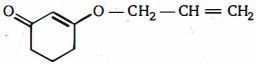
B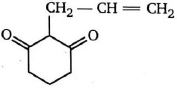
C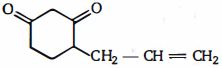
D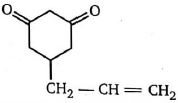
Solution
(B) The starting material is cyclohexane$-1,3-$dione,which contains highly acidic $\alpha$-hydrogens at the $C-2$ position (between the two carbonyl groups).
When treated with a base like $KOH$,the $C-2$ hydrogen is abstracted to form a stable enolate ion.
This enolate ion then acts as a nucleophile and attacks the electrophilic carbon of allyl bromide $(CH_2=CH-CH_2-Br)$ via an $S_N2$ mechanism.
This results in the alkylation of the $C-2$ position,yielding $2-$allylcyclohexane$-1,3-$dione as the product $(A)$.
When treated with a base like $KOH$,the $C-2$ hydrogen is abstracted to form a stable enolate ion.
This enolate ion then acts as a nucleophile and attacks the electrophilic carbon of allyl bromide $(CH_2=CH-CH_2-Br)$ via an $S_N2$ mechanism.
This results in the alkylation of the $C-2$ position,yielding $2-$allylcyclohexane$-1,3-$dione as the product $(A)$.
0 likes
View Solution33
MediumMCQ
Identify the product and the name of the reaction for the following transformation:
$
\begin{array}{c}
\text{Decalin-1-one oxime} \rightarrow{H_2SO_4} \text{Product}
\end{array} $
(The starting material is a ketoxime derived from decalin$-1-$one with a methyl group at the alpha position).
$
\begin{array}{c}
\text{Decalin-1-one oxime} \rightarrow{H_2SO_4} \text{Product}
\end{array} $
(The starting material is a ketoxime derived from decalin$-1-$one with a methyl group at the alpha position).
A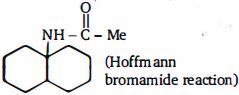
B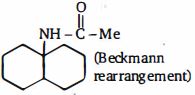
C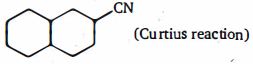
D
None of these
Solution
(B) The reaction of a ketoxime with an acid catalyst like $H_2SO_4$ is known as the $\text{Beckmann rearrangement}$.
In this reaction,the group anti to the hydroxyl $(-OH)$ group on the nitrogen atom migrates to the nitrogen,followed by the addition of water and tautomerization to form an amide.
The starting material is a ketoxime. Upon treatment with $H_2SO_4$,the $-OH$ group is protonated and leaves as water,creating a nitrenium ion intermediate. The alkyl group (decalin ring) migrates to the nitrogen,and subsequent attack by water followed by tautomerization yields the corresponding amide,$N$-(decalin$-1-$yl)acetamide.
Therefore,the correct product and reaction name are $N$-(decalin$-1-$yl)acetamide and $\text{Beckmann rearrangement}$ respectively.
In this reaction,the group anti to the hydroxyl $(-OH)$ group on the nitrogen atom migrates to the nitrogen,followed by the addition of water and tautomerization to form an amide.
The starting material is a ketoxime. Upon treatment with $H_2SO_4$,the $-OH$ group is protonated and leaves as water,creating a nitrenium ion intermediate. The alkyl group (decalin ring) migrates to the nitrogen,and subsequent attack by water followed by tautomerization yields the corresponding amide,$N$-(decalin$-1-$yl)acetamide.
Therefore,the correct product and reaction name are $N$-(decalin$-1-$yl)acetamide and $\text{Beckmann rearrangement}$ respectively.
0 likes
View Solution34
MediumMCQ
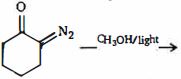
$A$ rather interesting example of the Wolff rearrangement with $2$-diazocyclohexanone in methanol is given below. Identify the major product.
A
Cyclopentanecarboxylic acid methyl ester
B
$2$-methoxycyclohexanone
C
Cyclohexane-$1,2$-dione
D
Cyclopentanecarboxylic acid
Solution
(A) The reaction is an intramolecular Wolff rearrangement.
When $2$-diazocyclohexanone is irradiated with light,it loses nitrogen gas $(N_2)$ to form a carbene intermediate.
This carbene undergoes a ring contraction via a $1,2$-alkyl shift to form a ketene intermediate (cyclopentylketene).
Subsequently,the nucleophilic attack of methanol $(CH_3OH)$ on the ketene carbonyl carbon leads to the formation of the final product,which is methyl cyclopentanecarboxylate (cyclopentanecarboxylic acid methyl ester).
When $2$-diazocyclohexanone is irradiated with light,it loses nitrogen gas $(N_2)$ to form a carbene intermediate.
This carbene undergoes a ring contraction via a $1,2$-alkyl shift to form a ketene intermediate (cyclopentylketene).
Subsequently,the nucleophilic attack of methanol $(CH_3OH)$ on the ketene carbonyl carbon leads to the formation of the final product,which is methyl cyclopentanecarboxylate (cyclopentanecarboxylic acid methyl ester).
0 likes
View Solution35
DifficultMCQ
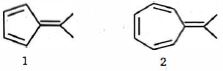
Which one of the following statements is $True$?
A
$PhLi$ adds to both compounds with equal ease
B
$PhLi$ does not add to either of the compounds
C
$PhLi$ reacts readily with $1$ but does not add to $2$
D
$PhLi$ reacts readily with $2$ but does not add to $1$
Solution
(C) The addition of $PhLi$ (a nucleophile) to the double bond involves the formation of a carbanion intermediate.
For compound $1$ (fulvene derivative),the addition of $PhLi$ leads to a cyclopentadienyl anion,which is aromatic ($6 \pi$ electrons) and thus highly stable.
For compound $2$ (heptafulvene derivative),the addition of $PhLi$ leads to a cycloheptatrienyl anion,which is anti-aromatic ($8 \pi$ electrons) and thus highly unstable.
Therefore,$PhLi$ reacts readily with $1$ to form a stable aromatic species but does not add to $2$ because it would form a highly unstable anti-aromatic species.
For compound $1$ (fulvene derivative),the addition of $PhLi$ leads to a cyclopentadienyl anion,which is aromatic ($6 \pi$ electrons) and thus highly stable.
For compound $2$ (heptafulvene derivative),the addition of $PhLi$ leads to a cycloheptatrienyl anion,which is anti-aromatic ($8 \pi$ electrons) and thus highly unstable.
Therefore,$PhLi$ reacts readily with $1$ to form a stable aromatic species but does not add to $2$ because it would form a highly unstable anti-aromatic species.
0 likes
View Solution36
DifficultMCQ
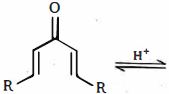
Identify the product of the above rearrangement reaction.
A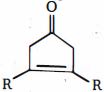
B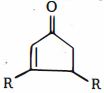
C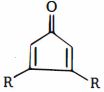
D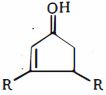
Solution
(C) The reaction is an acid-catalyzed Nazarov cyclization.
$1$. Protonation of the carbonyl oxygen increases the electrophilicity of the carbonyl carbon.
$2$. The $\pi$-electrons of one of the double bonds attack the carbonyl carbon,forming a new carbon-carbon bond and a carbocation intermediate.
$3$. The carbocation is stabilized by resonance with the enol oxygen.
$4$. Loss of a proton $(-H^+)$ restores the double bond,resulting in an enol.
$5$. Finally,tautomerization of the enol leads to the formation of the more stable cyclic $\alpha,\beta$-unsaturated ketone.
$1$. Protonation of the carbonyl oxygen increases the electrophilicity of the carbonyl carbon.
$2$. The $\pi$-electrons of one of the double bonds attack the carbonyl carbon,forming a new carbon-carbon bond and a carbocation intermediate.
$3$. The carbocation is stabilized by resonance with the enol oxygen.
$4$. Loss of a proton $(-H^+)$ restores the double bond,resulting in an enol.
$5$. Finally,tautomerization of the enol leads to the formation of the more stable cyclic $\alpha,\beta$-unsaturated ketone.
0 likes
View Solution37
DifficultMCQ
An organic compound $A$,$C_5 H_8 O$,reacts with $H_2 O$,$NH_3$,and $CH_3 COOH$ as shown in the reaction scheme. Identify $A$.
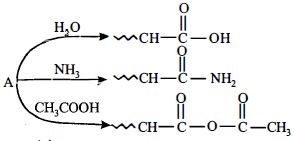
A
$CH_3 CH=C(CH_3)-CHO$
B
$CH_2=CHCH(CH_3)-CHO$
C
$CH_3-CH_2-C(CH_3)=C=O$
D
$CH_3-CH_2-C(=CH_2)-CH=O$
Solution
(C) The compound $A$ reacts with nucleophiles like $H_2 O$,$NH_3$,and $CH_3 COOH$ to form a carboxylic acid,an amide,and an acid anhydride respectively. This reactivity is characteristic of a ketene.
Given the molecular formula $C_5 H_8 O$,the structure $CH_3-CH_2-C(CH_3)=C=O$ (ethylmethylketene) fits the description.
$1$. Reaction with $H_2 O$: $CH_3-CH_2-C(CH_3)=C=O + H_2 O \rightarrow CH_3-CH_2-CH(CH_3)-COOH$
$2$. Reaction with $NH_3$: $CH_3-CH_2-C(CH_3)=C=O + NH_3 \rightarrow CH_3-CH_2-CH(CH_3)-CONH_2$
$3$. Reaction with $CH_3 COOH$: $CH_3-CH_2-C(CH_3)=C=O + CH_3 COOH \rightarrow CH_3-CH_2-CH(CH_3)-COOCOCH_3$
Given the molecular formula $C_5 H_8 O$,the structure $CH_3-CH_2-C(CH_3)=C=O$ (ethylmethylketene) fits the description.
$1$. Reaction with $H_2 O$: $CH_3-CH_2-C(CH_3)=C=O + H_2 O \rightarrow CH_3-CH_2-CH(CH_3)-COOH$
$2$. Reaction with $NH_3$: $CH_3-CH_2-C(CH_3)=C=O + NH_3 \rightarrow CH_3-CH_2-CH(CH_3)-CONH_2$
$3$. Reaction with $CH_3 COOH$: $CH_3-CH_2-C(CH_3)=C=O + CH_3 COOH \rightarrow CH_3-CH_2-CH(CH_3)-COOCOCH_3$
0 likes
View Solution38
DifficultMCQ
The major product in the following reaction is
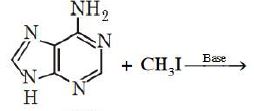
A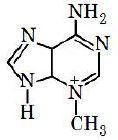
B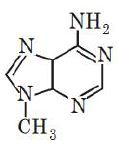
C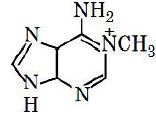
D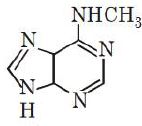
Solution
(C) The reaction involves the alkylation of adenine with $CH_3I$ in the presence of a base.
The base deprotonates the nitrogen atom at the $N-9$ position (marked with $*$ in the mechanism),which is the most acidic site in the adenine molecule.
This deprotonated nitrogen then acts as a nucleophile and attacks the methyl group of $CH_3I$ via an $S_N2$ mechanism,resulting in the formation of $9-methyladenine$ as the major product.
The base deprotonates the nitrogen atom at the $N-9$ position (marked with $*$ in the mechanism),which is the most acidic site in the adenine molecule.
This deprotonated nitrogen then acts as a nucleophile and attacks the methyl group of $CH_3I$ via an $S_N2$ mechanism,resulting in the formation of $9-methyladenine$ as the major product.
0 likes
View Solution39
DifficultMCQ
Which of the following represent free radical substitution reaction $(FSR)$,electrophilic addition reaction $(EAR)$ and nucleophilic addition reaction $(NAR)$?
$I. CH_3-CH=CH_2 \xrightarrow{Cl_2/CCl_4} CH_3-CHCl-CH_2Cl$
$II. CH_3-CO-CH_3 \xrightarrow{HCN/OH^-} CH_3-C(OH)(CN)-CH_3$
$III. CH_3-CH_2-CH_3 \xrightarrow{Cl_2/h\nu} CH_3-CHCl-CH_3$
$I. CH_3-CH=CH_2 \xrightarrow{Cl_2/CCl_4} CH_3-CHCl-CH_2Cl$
$II. CH_3-CO-CH_3 \xrightarrow{HCN/OH^-} CH_3-C(OH)(CN)-CH_3$
$III. CH_3-CH_2-CH_3 \xrightarrow{Cl_2/h\nu} CH_3-CHCl-CH_3$
A
$I-EAR, II-NAR, III-NAR$
B
$I-EAR, II-NAR, III-FSR$
C
$I-FSR, II-EAR, III-EAR$
D
$I-NAR, II-FSR, III-EAR$
Solution
(B) $I.$ The addition of $Cl_2$ to an alkene $(CH_3-CH=CH_2)$ in the presence of $CCl_4$ is an Electrophilic Addition Reaction $(EAR)$.
$II.$ The addition of $HCN$ to a carbonyl compound $(CH_3-CO-CH_3)$ in a basic medium is a Nucleophilic Addition Reaction $(NAR)$.
$III.$ The halogenation of an alkane $(CH_3-CH_2-CH_3)$ in the presence of sunlight $(h\nu)$ is a Free Radical Substitution Reaction $(FSR)$.
$II.$ The addition of $HCN$ to a carbonyl compound $(CH_3-CO-CH_3)$ in a basic medium is a Nucleophilic Addition Reaction $(NAR)$.
$III.$ The halogenation of an alkane $(CH_3-CH_2-CH_3)$ in the presence of sunlight $(h\nu)$ is a Free Radical Substitution Reaction $(FSR)$.
0 likes
View Solution40
AdvancedMCQ
The order of decreasing reactivity in electrophilic addition of the following compounds is
$(I) \, Ph-CH=CH-COOH$
$(II) \, p-NO_2-C_6H_4-CH=CH-COOH$
$(III) \, p-MeO-C_6H_4-CH=CH-COOH$
$(IV) \, p-Cl-C_6H_4-CH=CH-COOH$
$(I) \, Ph-CH=CH-COOH$
$(II) \, p-NO_2-C_6H_4-CH=CH-COOH$
$(III) \, p-MeO-C_6H_4-CH=CH-COOH$
$(IV) \, p-Cl-C_6H_4-CH=CH-COOH$
A
$II > I > IV > III$
B
$III > IV > I > II$
C
$III > I > IV > II$
D
$II > IV > I > III$
Solution
(C) The reactivity of compounds towards electrophilic addition reaction $(EAR)$ is directly proportional to the stability of the intermediate carbocation formed.
Electron-donating groups $(EDG)$ increase the stability of the carbocation,while electron-withdrawing groups $(EWG)$ decrease it.
The substituents at the para position are:
$(I) \, -H$ (no effect)
$(II) \, -NO_2$ (strong $EWG$,$-M$ and $-I$ effect)
$(III) \, -MeO$ (strong $EDG$,$+M$ effect)
$(IV) \, -Cl$ (weak $EWG$,$-I$ effect,$+M$ effect; overall $-I$ dominates)
The order of electron-donating/withdrawing strength is: $-MeO > -H > -Cl > -NO_2$.
Therefore,the stability of the resulting carbocations follows the same order: $(III) > (I) > (IV) > (II)$.
Thus,the order of decreasing reactivity is $(III) > (I) > (IV) > (II)$.
Electron-donating groups $(EDG)$ increase the stability of the carbocation,while electron-withdrawing groups $(EWG)$ decrease it.
The substituents at the para position are:
$(I) \, -H$ (no effect)
$(II) \, -NO_2$ (strong $EWG$,$-M$ and $-I$ effect)
$(III) \, -MeO$ (strong $EDG$,$+M$ effect)
$(IV) \, -Cl$ (weak $EWG$,$-I$ effect,$+M$ effect; overall $-I$ dominates)
The order of electron-donating/withdrawing strength is: $-MeO > -H > -Cl > -NO_2$.
Therefore,the stability of the resulting carbocations follows the same order: $(III) > (I) > (IV) > (II)$.
Thus,the order of decreasing reactivity is $(III) > (I) > (IV) > (II)$.
0 likes
View Solution41
Difficult
In an organic reaction,explain the reactant,substrate,and products obtained. What is the mechanism of the reaction?
Solution
(N/A) In an organic reaction,the organic molecule (also referred to as a substrate) reacts with an appropriate attacking reagent,leading to the formation of one or more intermediates $(I)$ and finally products $(P)$.
Organic molecule (Substrate) $\xrightarrow[\text{Reagent}]{\text{Attacking}}$ Intermediate $(I) \rightarrow$ Product $(P)$.
Substrate: The reactant that supplies carbon to the new bond is called the substrate.
Reagent: The other reactant is called the reagent. If both reactants supply carbon to the new bond,the choice is arbitrary,and the molecule on which attention is focused is called the substrate.
Mechanism of reaction: In such a reaction,a covalent bond between $2$ carbon atoms or a carbon and some other atom is broken,and a new bond is formed. $A$ sequential account of each step,describing details of electron movement,energetics during bond cleavage and bond formation,and the rates of transformation of reactants into products (kinetics) is referred to as the reaction mechanism.
Importance of reaction mechanism: The knowledge of reaction mechanism helps in $(i)$ understanding the reactivity of organic compounds and $(ii)$ in planning strategies for their synthesis.
Organic molecule (Substrate) $\xrightarrow[\text{Reagent}]{\text{Attacking}}$ Intermediate $(I) \rightarrow$ Product $(P)$.
Substrate: The reactant that supplies carbon to the new bond is called the substrate.
Reagent: The other reactant is called the reagent. If both reactants supply carbon to the new bond,the choice is arbitrary,and the molecule on which attention is focused is called the substrate.
Mechanism of reaction: In such a reaction,a covalent bond between $2$ carbon atoms or a carbon and some other atom is broken,and a new bond is formed. $A$ sequential account of each step,describing details of electron movement,energetics during bond cleavage and bond formation,and the rates of transformation of reactants into products (kinetics) is referred to as the reaction mechanism.
Importance of reaction mechanism: The knowledge of reaction mechanism helps in $(i)$ understanding the reactivity of organic compounds and $(ii)$ in planning strategies for their synthesis.
0 likes
View Solution42
Difficult
What is the fission of a covalent bond? Explain its types with examples and the main differences.
Solution
(N/A) The fission of a covalent bond refers to the process of breaking a covalent bond. $A$ covalent bond can be cleaved in two ways:
$(i)$ Heterolytic cleavage
$(ii)$ Homolytic cleavage
| Feature | Heterolytic Cleavage | Homolytic Cleavage |
| :--- | :--- | :--- |
| $(i)$ Example | $H_3C-Br \rightarrow H_3C^+ + Br^-$ (forms positive and negative ions) | $H_3C-Br \rightarrow H_3C\cdot + \cdot Br$ (forms free radicals) |
| $(ii)$ Reaction Type | Ionic or polar reactions (nucleophilic or electrophilic) | Free radical or nonpolar reactions |
| $(iii)$ Mechanism | The shared pair of electrons remains with one of the fragments | One electron of the shared pair goes to each of the bonded atoms |
| $(iv)$ Intermediate | Forms carbocations or carbanions | Forms free radicals |
$(i)$ Heterolytic cleavage
$(ii)$ Homolytic cleavage
| Feature | Heterolytic Cleavage | Homolytic Cleavage |
| :--- | :--- | :--- |
| $(i)$ Example | $H_3C-Br \rightarrow H_3C^+ + Br^-$ (forms positive and negative ions) | $H_3C-Br \rightarrow H_3C\cdot + \cdot Br$ (forms free radicals) |
| $(ii)$ Reaction Type | Ionic or polar reactions (nucleophilic or electrophilic) | Free radical or nonpolar reactions |
| $(iii)$ Mechanism | The shared pair of electrons remains with one of the fragments | One electron of the shared pair goes to each of the bonded atoms |
| $(iv)$ Intermediate | Forms carbocations or carbanions | Forms free radicals |
0 likes
View Solution43
Easy
What are the main types of organic reactions and their mechanisms?
Solution
(A) The main types of organic reactions are:
$i$. Substitution reactions: In these reactions,an atom or group of atoms in a molecule is replaced by another atom or group.
$ii$. Addition reactions: These involve the addition of two molecules to form a single product,typically occurring in unsaturated compounds.
$iii$. Elimination reactions: These involve the removal of two atoms or groups from a molecule,often resulting in the formation of a double or triple bond.
$iv$. Rearrangement reactions: These involve the migration of an atom or group within the same molecule to form a structural isomer.
$i$. Substitution reactions: In these reactions,an atom or group of atoms in a molecule is replaced by another atom or group.
$ii$. Addition reactions: These involve the addition of two molecules to form a single product,typically occurring in unsaturated compounds.
$iii$. Elimination reactions: These involve the removal of two atoms or groups from a molecule,often resulting in the formation of a double or triple bond.
$iv$. Rearrangement reactions: These involve the migration of an atom or group within the same molecule to form a structural isomer.
0 likes
View Solution44
Medium
Which different types of reaction mechanisms are observed in addition reactions?
Solution
(N/A) $(i)$ Free radical addition mechanism.
$(ii)$ Electrophilic addition reaction.
$(iii)$ Nucleophilic addition reaction.
$(ii)$ Electrophilic addition reaction.
$(iii)$ Nucleophilic addition reaction.
0 likes
View Solution45
EasyMCQ
What is heterolytic cleavage of a chemical bond?
A
The breaking of a bond where each atom takes one electron.
B
The breaking of a bond where the shared pair of electrons remains with one of the fragments.
C
The formation of a bond by sharing electrons.
D
The process of bond dissociation into free radicals.
Solution
(B) In heterolytic cleavage,the covalent bond breaks in such a fashion that the shared pair of electrons remains with one of the fragments. This process results in the formation of ions (a carbocation and an anion or vice versa).
0 likes
View Solution46
EasyMCQ
What happens when a chemical reaction occurs?
A
Bond fission and bond formation
B
Displacement of electrons
C
Energy change
D
All of the above
Solution
(D) When a chemical reaction occurs,the following processes take place:
$(i)$ Bond fission and bond formation: Old bonds in the reactants break,and new bonds are formed to create products.
$(ii)$ Displacement of electrons: Redistribution of electron density occurs within the molecules.
$(iii)$ Energy change: The reaction involves the absorption or release of energy.
$(iv)$ Substrate converts into product: The starting material (substrate) undergoes chemical transformation to form the final product.
Therefore,all the given statements are correct.
$(i)$ Bond fission and bond formation: Old bonds in the reactants break,and new bonds are formed to create products.
$(ii)$ Displacement of electrons: Redistribution of electron density occurs within the molecules.
$(iii)$ Energy change: The reaction involves the absorption or release of energy.
$(iv)$ Substrate converts into product: The starting material (substrate) undergoes chemical transformation to form the final product.
Therefore,all the given statements are correct.
0 likes
View Solution47
EasyMCQ
What is the fission of covalent bonds?
A
The formation of a covalent bond.
B
The breaking of a covalent bond.
C
The rearrangement of atoms in a molecule.
D
The transfer of electrons between two atoms.
Solution
(B) The fission of a covalent bond refers to the process of breaking a chemical bond between two atoms.
This process can occur in two ways:
$1$. Homolytic fission,where each atom takes one electron from the shared pair,resulting in the formation of free radicals.
$2$. Heterolytic fission,where one atom takes both electrons from the shared pair,resulting in the formation of ions (a cation and an anion).
This process can occur in two ways:
$1$. Homolytic fission,where each atom takes one electron from the shared pair,resulting in the formation of free radicals.
$2$. Heterolytic fission,where one atom takes both electrons from the shared pair,resulting in the formation of ions (a cation and an anion).
0 likes
View Solution48
Easy
Show the heterolytic and homolytic cleavage of $H_3C-Br$.
Solution
(N/A) Heterolytic cleavage:
$H_3C-Br \rightarrow H_3C^+ + :Br^-$
In this process,the shared pair of electrons remains with the more electronegative atom $(Br)$,resulting in the formation of a carbocation $(H_3C^+)$ and a bromide ion $(:Br^-)$.
Homolytic cleavage:
$H_3C-Br \rightarrow H_3C^\bullet + ^\bullet Br$
In this process,each atom takes one electron from the shared pair,resulting in the formation of free radicals ($H_3C^\bullet$ and $^\bullet Br$).
$H_3C-Br \rightarrow H_3C^+ + :Br^-$
In this process,the shared pair of electrons remains with the more electronegative atom $(Br)$,resulting in the formation of a carbocation $(H_3C^+)$ and a bromide ion $(:Br^-)$.
Homolytic cleavage:
$H_3C-Br \rightarrow H_3C^\bullet + ^\bullet Br$
In this process,each atom takes one electron from the shared pair,resulting in the formation of free radicals ($H_3C^\bullet$ and $^\bullet Br$).
0 likes
View Solution49
MediumMCQ
If heterolytic and homolytic cleavage of a bond occurs,then which types of reactions occur?
A
Ionic and Free radical reactions
B
Substitution and Addition reactions
C
Elimination and Rearrangement reactions
D
Oxidation and Reduction reactions
Solution
(A) The organic reaction which proceeds through heterolytic bond cleavage is called an ionic,polar,or heteropolar reaction (e.g.,electrophilic,nucleophilic,and elimination reactions).
The organic reaction which proceeds by homolytic fission is called a free radical,homopolar,or nonpolar reaction.
The organic reaction which proceeds by homolytic fission is called a free radical,homopolar,or nonpolar reaction.
0 likes
View Solution8-4.Organic Chemistry : Reaction mechanism — Types of organic reactions · Frequently Asked Questions
1Are these 8-4.Organic Chemistry : Reaction mechanism questions useful for JEE and NEET?
Yes. All questions in this section are mapped to JEE Main and NEET exam patterns. Previous year questions from JEE Main, NEET, GUJCET and state-level exams are included with full solutions.
2Can I switch to Hindi or Gujarati for these questions?
Yes. Use the language tabs in the hero section or the sidebar to view the same questions and solutions in English, Hindi or Gujarati.
3How do I generate a question paper from this subtopic?
Use the Vedclass Exam Paper Generator — select the chapter and subtopic, set difficulty, and generate Sets A, B, C, D automatically. First 3 chapters of every subject are free.
Vedclass Products
For Students
Vedclass Test Series
Mock tests in real JEE/NEET style with performance analysis. 5-day free trial.
Start Free TrialFor Teachers
Exam Paper Generator
Generate Set A/B/C/D papers from this chapter in 2 minutes. 3 chapters free.
Try FreeFor Institutes
Online Exam Module
Live online exams with unlimited students, 360° analytics & white-label branding.
See DemoFor Teachers & Institutes
Generate a 8-4.Organic Chemistry : Reaction mechanism Exam Paper in 2 Minutes
Select subtopic & difficulty — Sets A, B, C, D auto-generated with No Repeat logic.
First 3 chapters of every subject are free — no payment required.