
ChemistryQ1–52 of 52 questions
Page 1 of 1 · English
1
ChemistryMCQWBJEE · 2010
The value of $\frac{\cot 54^\circ}{\tan 36^\circ} + \frac{\tan 20^\circ}{\cot 70^\circ}$ is
A
$2$
B
$3$
C
$1$
D
$0$
Solution
(A) We know that $\tan(90^\circ - \theta) = \cot \theta$ and $\cot(90^\circ - \theta) = \tan \theta$.
Given expression: $\frac{\cot 54^\circ}{\tan 36^\circ} + \frac{\tan 20^\circ}{\cot 70^\circ}$
Using the identity $\tan 36^\circ = \tan(90^\circ - 54^\circ) = \cot 54^\circ$ and $\cot 70^\circ = \cot(90^\circ - 20^\circ) = \tan 20^\circ$:
$= \frac{\cot 54^\circ}{\cot 54^\circ} + \frac{\tan 20^\circ}{\tan 20^\circ}$
$= 1 + 1 = 2$.
Given expression: $\frac{\cot 54^\circ}{\tan 36^\circ} + \frac{\tan 20^\circ}{\cot 70^\circ}$
Using the identity $\tan 36^\circ = \tan(90^\circ - 54^\circ) = \cot 54^\circ$ and $\cot 70^\circ = \cot(90^\circ - 20^\circ) = \tan 20^\circ$:
$= \frac{\cot 54^\circ}{\cot 54^\circ} + \frac{\tan 20^\circ}{\tan 20^\circ}$
$= 1 + 1 = 2$.
0 likesView Solution
2
ChemistryMCQWBJEE · 2010
At identical temperature and pressure,the rate of diffusion of hydrogen gas is $3\sqrt{3}$ times that of a gaseous hydrocarbon having molecular formula $C_nH_{2n-2}$. What is the value of $n$?
A
$1$
B
$4$
C
$3$
D
$8$
Solution
(B) According to Graham's Law of Diffusion,$\frac{r_1}{r_2} = \sqrt{\frac{M_2}{M_1}}$.
Given $\frac{r_{H_2}}{r_{hydrocarbon}} = 3\sqrt{3}$,where $M_{H_2} = 2 \ g/mol$.
So,$3\sqrt{3} = \sqrt{\frac{M_{hydrocarbon}}{2}}$.
Squaring both sides: $(3\sqrt{3})^2 = \frac{M_{hydrocarbon}}{2} \Rightarrow 27 = \frac{M_{hydrocarbon}}{2}$.
$M_{hydrocarbon} = 54 \ g/mol$.
The molecular formula is $C_nH_{2n-2}$,so $12n + (2n-2) = 54$.
$14n - 2 = 54$ $\Rightarrow 14n = 56$ $\Rightarrow n = 4$.
Given $\frac{r_{H_2}}{r_{hydrocarbon}} = 3\sqrt{3}$,where $M_{H_2} = 2 \ g/mol$.
So,$3\sqrt{3} = \sqrt{\frac{M_{hydrocarbon}}{2}}$.
Squaring both sides: $(3\sqrt{3})^2 = \frac{M_{hydrocarbon}}{2} \Rightarrow 27 = \frac{M_{hydrocarbon}}{2}$.
$M_{hydrocarbon} = 54 \ g/mol$.
The molecular formula is $C_nH_{2n-2}$,so $12n + (2n-2) = 54$.
$14n - 2 = 54$ $\Rightarrow 14n = 56$ $\Rightarrow n = 4$.
0 likesView Solution
3
ChemistryMCQWBJEE · 2010
Keto-enol tautomerism is not observed in
A
$C_6H_5COC_6H_5$
B
$C_6H_5COCH_3$
C
$C_6H_5COCH_2COCH_3$
D
$CH_3COCH_2COCH_3$
Solution
(A) For a compound to exhibit keto-enol tautomerism,it must possess at least one $\alpha$-hydrogen atom attached to an $\alpha$-carbon (the carbon atom adjacent to the carbonyl group).
$1$. $C_6H_5COC_6H_5$ (Benzophenone): The carbonyl carbon is attached to two phenyl groups. There are no $\alpha$-hydrogen atoms present on the carbons adjacent to the carbonyl group. Therefore,it cannot show keto-enol tautomerism.
$2$. $C_6H_5COCH_3$ (Acetophenone): It has three $\alpha$-hydrogen atoms on the methyl group attached to the carbonyl carbon,so it exhibits tautomerism.
$3$. $C_6H_5COCH_2COCH_3$ and $CH_3COCH_2COCH_3$: Both contain active methylene groups $(-CH_2-)$ between two carbonyl groups,which have acidic $\alpha$-hydrogens,allowing for keto-enol tautomerism.
Thus,the correct option is $A$.
$1$. $C_6H_5COC_6H_5$ (Benzophenone): The carbonyl carbon is attached to two phenyl groups. There are no $\alpha$-hydrogen atoms present on the carbons adjacent to the carbonyl group. Therefore,it cannot show keto-enol tautomerism.
$2$. $C_6H_5COCH_3$ (Acetophenone): It has three $\alpha$-hydrogen atoms on the methyl group attached to the carbonyl carbon,so it exhibits tautomerism.
$3$. $C_6H_5COCH_2COCH_3$ and $CH_3COCH_2COCH_3$: Both contain active methylene groups $(-CH_2-)$ between two carbonyl groups,which have acidic $\alpha$-hydrogens,allowing for keto-enol tautomerism.
Thus,the correct option is $A$.
0 likesView Solution
4
ChemistryMCQWBJEE · 2010
At identical temperature and pressure,the rate of diffusion of hydrogen gas is $3\sqrt{3}$ times that of a gaseous hydrocarbon having molecular formula $C_n H_{2n-2}$. What is the value of $n$?
A
$1$
B
$4$
C
$3$
D
$8$
Solution
(B) According to Graham's Law of diffusion,$\frac{r_1}{r_2} = \sqrt{\frac{M_2}{M_1}}$.
Given $\frac{r_{H_2}}{r_{gas}} = 3\sqrt{3}$,where $M_{H_2} = 2 \ g/mol$.
So,$3\sqrt{3} = \sqrt{\frac{M_{gas}}{2}}$.
Squaring both sides,$(3\sqrt{3})^2 = \frac{M_{gas}}{2} \implies 9 \times 3 = \frac{M_{gas}}{2} \implies 27 = \frac{M_{gas}}{2}$.
Thus,$M_{gas} = 54 \ g/mol$.
The molecular formula is $C_n H_{2n-2}$,so $12n + (2n - 2) = 54$.
$14n - 2 = 54 \implies 14n = 56 \implies n = 4$.
Given $\frac{r_{H_2}}{r_{gas}} = 3\sqrt{3}$,where $M_{H_2} = 2 \ g/mol$.
So,$3\sqrt{3} = \sqrt{\frac{M_{gas}}{2}}$.
Squaring both sides,$(3\sqrt{3})^2 = \frac{M_{gas}}{2} \implies 9 \times 3 = \frac{M_{gas}}{2} \implies 27 = \frac{M_{gas}}{2}$.
Thus,$M_{gas} = 54 \ g/mol$.
The molecular formula is $C_n H_{2n-2}$,so $12n + (2n - 2) = 54$.
$14n - 2 = 54 \implies 14n = 56 \implies n = 4$.
0 likesView Solution
5
ChemistryMCQWBJEE · 2010
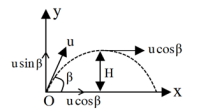
$A$ body is projected with a speed $u \ m/s$ at an angle $\beta$ with the horizontal. The kinetic energy at the highest point is $\frac{3}{4}$ of the initial kinetic energy. The value of $\beta$ is $....^{\circ}$
A
$30$
B
$45$
C
$60$
D
$120$
Solution
(A) The initial kinetic energy at the point of projection $O$ is given by:
$K = \frac{1}{2} mu^2$
where $m$ is the mass of the body and $u$ is the initial velocity of projection.
At the highest point (i.e.,at maximum height $H$),the vertical component of velocity becomes zero,and the velocity is only the horizontal component:
$v = u \cos \beta$
Therefore,the kinetic energy at the highest point is:
$K^{\prime} = \frac{1}{2} mv^2 = \frac{1}{2} m(u \cos \beta)^2 = \frac{1}{2} mu^2 \cos^2 \beta$
According to the problem,the kinetic energy at the highest point is $\frac{3}{4}$ of the initial kinetic energy:
$K^{\prime} = \frac{3}{4} K$
Substituting the expressions:
$\frac{1}{2} mu^2 \cos^2 \beta = \frac{3}{4} \left( \frac{1}{2} mu^2 \right)$
$\cos^2 \beta = \frac{3}{4}$
Taking the square root on both sides:
$\cos \beta = \frac{\sqrt{3}}{2}$
$\beta = \cos^{-1} \left( \frac{\sqrt{3}}{2} \right) = 30^{\circ}$
$K = \frac{1}{2} mu^2$
where $m$ is the mass of the body and $u$ is the initial velocity of projection.
At the highest point (i.e.,at maximum height $H$),the vertical component of velocity becomes zero,and the velocity is only the horizontal component:
$v = u \cos \beta$
Therefore,the kinetic energy at the highest point is:
$K^{\prime} = \frac{1}{2} mv^2 = \frac{1}{2} m(u \cos \beta)^2 = \frac{1}{2} mu^2 \cos^2 \beta$
According to the problem,the kinetic energy at the highest point is $\frac{3}{4}$ of the initial kinetic energy:
$K^{\prime} = \frac{3}{4} K$
Substituting the expressions:
$\frac{1}{2} mu^2 \cos^2 \beta = \frac{3}{4} \left( \frac{1}{2} mu^2 \right)$
$\cos^2 \beta = \frac{3}{4}$
Taking the square root on both sides:
$\cos \beta = \frac{\sqrt{3}}{2}$
$\beta = \cos^{-1} \left( \frac{\sqrt{3}}{2} \right) = 30^{\circ}$
0 likesView Solution
6
ChemistryEasyMCQWBJEE · 2010
What type of orbital hybridisation is considered on $P$ in $PCl_5$?
A
$sp^3d$
B
$dsp^3$
C
$sp^3d^2$
D
$d^2sp^3$
Solution
(A) In $PCl_5$,the central phosphorus atom $(P)$ has $5$ valence electrons. It forms $5$ covalent bonds with $5$ chlorine atoms.
Using the formula for steric number: $\text{Steric Number} = \frac{1}{2} (V + M - C + A)$,where $V = 5$ (valence electrons of $P$),$M = 5$ (monovalent atoms),$C = 0$ (cationic charge),and $A = 0$ (anionic charge).
$\text{Steric Number} = \frac{1}{2} (5 + 5) = 5$.
$A$ steric number of $5$ corresponds to $sp^3d$ hybridisation,resulting in a trigonal bipyramidal geometry.
Using the formula for steric number: $\text{Steric Number} = \frac{1}{2} (V + M - C + A)$,where $V = 5$ (valence electrons of $P$),$M = 5$ (monovalent atoms),$C = 0$ (cationic charge),and $A = 0$ (anionic charge).
$\text{Steric Number} = \frac{1}{2} (5 + 5) = 5$.
$A$ steric number of $5$ corresponds to $sp^3d$ hybridisation,resulting in a trigonal bipyramidal geometry.
0 likesView Solution
7
ChemistryEasyMCQWBJEE · 2010
The bond order of $CO$ molecule is
A
$2$
B
$2.5$
C
$3$
D
$3.5$
Solution
(C) The molecular orbital configuration of $CO$ ($14$ electrons) is: $\sigma(1s)^2, \sigma^*(1s)^2, \sigma(2s)^2, \sigma^*(2s)^2, \pi(2p_x)^2 = \pi(2p_y)^2, \sigma(2p_z)^2$.
Number of bonding electrons $(N_b)$ = $10$.
Number of antibonding electrons $(N_a)$ = $4$.
Bond Order = $\frac{N_b - N_a}{2} = \frac{10 - 4}{2} = 3$.
Number of bonding electrons $(N_b)$ = $10$.
Number of antibonding electrons $(N_a)$ = $4$.
Bond Order = $\frac{N_b - N_a}{2} = \frac{10 - 4}{2} = 3$.
0 likesView Solution
8
ChemistryEasyMCQWBJEE · 2010
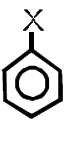
The dipole moment of chlorobenzene is $1.5 \ D$. The dipole moment of $o-$dichlorobenzene is (in $D$)
A
$1.5$
B
$2.25$
C
$2.54$
D
$0$
Solution
(C) The dipole moment of a molecule is the vector sum of the individual bond dipoles. For chlorobenzene,the dipole moment is $1.5 \ D$. Let the dipole moment of a $C-Cl$ bond be $\mu$.
For $o-$dichlorobenzene,the two $C-Cl$ bonds are at an angle of $60^{\circ}$ to each other.
The resultant dipole moment is given by $\mu_{net} = \sqrt{\mu^2 + \mu^2 + 2\mu^2 \cos(60^{\circ})}$.
Since $\cos(60^{\circ}) = 0.5$,we have $\mu_{net} = \sqrt{2\mu^2 + 2\mu^2(0.5)} = \sqrt{3\mu^2} = \mu \sqrt{3}$.
Given $\mu = 1.5 \ D$,the dipole moment of $o-$dichlorobenzene is $1.5 \times 1.732 \approx 2.54 \ D$.
For $o-$dichlorobenzene,the two $C-Cl$ bonds are at an angle of $60^{\circ}$ to each other.
The resultant dipole moment is given by $\mu_{net} = \sqrt{\mu^2 + \mu^2 + 2\mu^2 \cos(60^{\circ})}$.
Since $\cos(60^{\circ}) = 0.5$,we have $\mu_{net} = \sqrt{2\mu^2 + 2\mu^2(0.5)} = \sqrt{3\mu^2} = \mu \sqrt{3}$.
Given $\mu = 1.5 \ D$,the dipole moment of $o-$dichlorobenzene is $1.5 \times 1.732 \approx 2.54 \ D$.
0 likesView Solution
9
ChemistryEasyMCQWBJEE · 2010
Which of the following compounds shows evidence of the strongest hydrogen bonding?
A
propan$-1-$ol
B
propan$-2-$ol
C
propan$-1,2-$diol
D
propan$-1,2,3-$triol
Solution
(D) The strength of hydrogen bonding in a compound depends on the number of $-OH$ groups available for intermolecular interaction.
Propan$-1,2,3-$triol (glycerol) contains three $-OH$ groups,which allows for a greater extent of intermolecular hydrogen bonding compared to the other options.
Therefore,it exhibits the strongest hydrogen bonding.
Propan$-1,2,3-$triol (glycerol) contains three $-OH$ groups,which allows for a greater extent of intermolecular hydrogen bonding compared to the other options.
Therefore,it exhibits the strongest hydrogen bonding.
0 likesView Solution
10
ChemistryEasyMCQWBJEE · 2010
Calculate $K_{C}$ for the reversible process given below if $K_{P}=167$ and $T=800^{\circ}C$.
$CaCO_{3(s)} \rightleftharpoons CaO_{(s)} + CO_{2(g)}$
$CaCO_{3(s)} \rightleftharpoons CaO_{(s)} + CO_{2(g)}$
A
$1.95$
B
$1.85$
C
$1.89$
D
$1.6$
Solution
(C) The relationship between $K_P$ and $K_C$ is given by the equation: $K_P = K_C(RT)^{\Delta n}$.
For the reaction $CaCO_{3(s)} \rightleftharpoons CaO_{(s)} + CO_{2(g)}$,the change in the number of moles of gaseous species is $\Delta n = n_{p(g)} - n_{r(g)} = 1 - 0 = 1$.
Given $K_P = 167$,$R = 0.0821 \ L \ atm \ K^{-1} \ mol^{-1}$,and $T = 800 + 273 = 1073 \ K$.
Substituting these values into the formula: $K_C = \frac{K_P}{(RT)^{\Delta n}} = \frac{167}{(0.0821 \times 1073)^1}$.
$K_C = \frac{167}{88.0933} \approx 1.896$.
Rounding to two decimal places,we get $K_C = 1.89$.
For the reaction $CaCO_{3(s)} \rightleftharpoons CaO_{(s)} + CO_{2(g)}$,the change in the number of moles of gaseous species is $\Delta n = n_{p(g)} - n_{r(g)} = 1 - 0 = 1$.
Given $K_P = 167$,$R = 0.0821 \ L \ atm \ K^{-1} \ mol^{-1}$,and $T = 800 + 273 = 1073 \ K$.
Substituting these values into the formula: $K_C = \frac{K_P}{(RT)^{\Delta n}} = \frac{167}{(0.0821 \times 1073)^1}$.
$K_C = \frac{167}{88.0933} \approx 1.896$.
Rounding to two decimal places,we get $K_C = 1.89$.
0 likesView Solution
11
ChemistryEasyMCQWBJEE · 2010
In a periodic table,how does the basic character of oxides vary?
A
Increases from left to right and decreases from top to bottom
B
Decreases from right to left and increases from top to bottom
C
Decreases from left to right and increases from top to bottom
D
Decreases from left to right and increases from bottom to top
Solution
(C) The basic character of oxides depends on the metallic character of the element.
Metallic character decreases from left to right across a period,so the basic character of oxides also decreases from left to right.
Metallic character increases down a group,so the basic character of oxides increases from top to bottom.
Therefore,the basic character of oxides decreases from left to right and increases from top to bottom.
Metallic character decreases from left to right across a period,so the basic character of oxides also decreases from left to right.
Metallic character increases down a group,so the basic character of oxides increases from top to bottom.
Therefore,the basic character of oxides decreases from left to right and increases from top to bottom.
0 likesView Solution
12
ChemistryEasyMCQWBJEE · 2010
Which of the following orders regarding ionization energy is correct?
A
$N > O > F$
B
$N < O < F$
C
$N > O < F$
D
$N < O > F$
Solution
(C) The first ionization energy $(IE_1)$ generally increases across a period due to increasing effective nuclear charge. However,nitrogen $(N)$ has a stable half-filled $2p^3$ electronic configuration,which makes it harder to remove an electron compared to oxygen $(O)$.
Thus,$IE_1$ of $N > O$.
Since fluorine $(F)$ has a smaller atomic size and higher effective nuclear charge than oxygen,$IE_1$ of $F > O$.
Combining these,the correct order is $N > O < F$.
Thus,$IE_1$ of $N > O$.
Since fluorine $(F)$ has a smaller atomic size and higher effective nuclear charge than oxygen,$IE_1$ of $F > O$.
Combining these,the correct order is $N > O < F$.
0 likesView Solution
13
ChemistryDifficultMCQWBJEE · 2010
When a manganous salt is fused with a mixture of $KNO_3$ and solid $NaOH$,the oxidation number of $Mn$ changes from $+2$ to:
A
$+4$
B
$+3$
C
$+6$
D
$+7$
Solution
(C) The fusion of a manganous salt $(Mn^{2+})$ with $KNO_3$ and solid $NaOH$ leads to the formation of potassium manganate $(K_2MnO_4)$.
The chemical reaction is: $Mn^{2+} + 2NO_3^{-} + 4OH^{-} \rightarrow MnO_4^{2-} + 2NO_2^{-} + 2H_2O$.
In $MnO_4^{2-}$,the oxidation state of $Mn$ is calculated as: $x + 4(-2) = -2$,which gives $x = +6$.
Therefore,the oxidation number of $Mn$ changes from $+2$ to $+6$.
The chemical reaction is: $Mn^{2+} + 2NO_3^{-} + 4OH^{-} \rightarrow MnO_4^{2-} + 2NO_2^{-} + 2H_2O$.
In $MnO_4^{2-}$,the oxidation state of $Mn$ is calculated as: $x + 4(-2) = -2$,which gives $x = +6$.
Therefore,the oxidation number of $Mn$ changes from $+2$ to $+6$.
0 likesView Solution
14
ChemistryMCQWBJEE · 2010
If \(x_1\) be the size of the magnified image and \(x_2\) the size of the diminished image in Lens Displacement Method, then the size of the object is :
A
\(\sqrt{x_1 x_2}\)
B
\(x_1 x_2\)
C
\(x_1^2 x_2\)
D
\(x_1 x_2^2\)
Solution
No Solution Available
0 likesView Solution
15
ChemistryMediumMCQWBJEE · 2010
Keto-enol tautomerism is not observed in
A
$C_6H_5COC_6H_5$
B
$C_6H_5COCH=CH_2$
C
$C_6H_5COCH_2COCH_3$
D
$CH_3COCH_2COCH_3$
Solution
(A) Keto-enol tautomerism requires the presence of at least one $\alpha$-hydrogen atom adjacent to the carbonyl group $(C=O)$.
In $C_6H_5COC_6H_5$ (benzophenone),the carbonyl carbon is attached to two phenyl groups $(C_6H_5)$.
There is no $\alpha$-carbon with an $\alpha$-hydrogen atom available in this molecule.
Therefore,it cannot exhibit keto-enol tautomerism.
In $C_6H_5COC_6H_5$ (benzophenone),the carbonyl carbon is attached to two phenyl groups $(C_6H_5)$.
There is no $\alpha$-carbon with an $\alpha$-hydrogen atom available in this molecule.
Therefore,it cannot exhibit keto-enol tautomerism.
0 likesView Solution
16
ChemistryEasyMCQWBJEE · 2010
On mixing an alkane with chlorine and irradiating with ultra-violet light,it forms only one mono-chloro-alkane. The alkane is
A
Propane
B
Pentane
C
Isopentane
D
Neopentane
Solution
(D) The reaction of an alkane with chlorine in the presence of ultra-violet light is a free radical substitution reaction.
For an alkane to form only one mono-chloro-alkane,all the hydrogen atoms in the alkane must be equivalent.
In $Neopentane$ $(2,2-dimethylpropane)$,all $12$ hydrogen atoms are attached to equivalent primary carbon atoms.
Therefore,replacing any one of these hydrogen atoms with a chlorine atom results in the same product,$1-chloro-2,2-dimethylpropane$.
For an alkane to form only one mono-chloro-alkane,all the hydrogen atoms in the alkane must be equivalent.
In $Neopentane$ $(2,2-dimethylpropane)$,all $12$ hydrogen atoms are attached to equivalent primary carbon atoms.
Therefore,replacing any one of these hydrogen atoms with a chlorine atom results in the same product,$1-chloro-2,2-dimethylpropane$.
0 likesView Solution
17
ChemistryMediumMCQWBJEE · 2010
Ortho- and para-hydrogens have
A
Identical chemical properties but different physical properties
B
Identical physical and chemical properties
C
Identical physical properties but different chemical properties
D
Different physical and chemical properties
Solution
(A) Ortho-hydrogen and para-hydrogen are nuclear spin isomers of the hydrogen molecule $(H_2)$.
In ortho-hydrogen,the nuclear spins of the two protons are parallel,whereas in para-hydrogen,the nuclear spins are antiparallel.
Because they have the same electronic structure,their chemical properties are identical.
However,due to the difference in their nuclear spin states,they exhibit different physical properties,such as different thermal conductivities and specific heats.
In ortho-hydrogen,the nuclear spins of the two protons are parallel,whereas in para-hydrogen,the nuclear spins are antiparallel.
Because they have the same electronic structure,their chemical properties are identical.
However,due to the difference in their nuclear spin states,they exhibit different physical properties,such as different thermal conductivities and specific heats.
0 likesView Solution
18
ChemistryMediumMCQWBJEE · 2010
In which of the following molecules is a hydrogen bridge bond present?
A
Water
B
Inorganic benzene
C
Diborane
D
Methanol
Solution
(C) The molecule $B_2H_6$ (Diborane) contains two bridging hydrogen atoms.
In $B_2H_6$,each boron atom is $sp^3$ hybridized.
Two hydrogen atoms act as bridges between the two boron atoms,forming two $3c-2e$ (three-center-two-electron) bonds,which are also known as hydrogen bridge bonds or banana bonds.
In $B_2H_6$,each boron atom is $sp^3$ hybridized.
Two hydrogen atoms act as bridges between the two boron atoms,forming two $3c-2e$ (three-center-two-electron) bonds,which are also known as hydrogen bridge bonds or banana bonds.
0 likesView Solution
19
ChemistryDifficultMCQWBJEE · 2010
$0.1 \ (M) \ HCl$ and $0.1 \ (M) \ H_2SO_4$ each of volume $2 \ mL$ are mixed and the volume is made up to $6 \ mL$ by adding $2 \ mL$ of $0.01 \ (N) \ NaCl$ solution. The $pH$ of the resulting mixture is
A
$1.17$
B
$1$
C
$0.3$
D
$\log 2 - \log 3$
Solution
(B) Step $1$: Calculate the total millimoles of $H^{+}$ ions.
Millimoles of $H^{+}$ from $HCl = 0.1 \ (M) \times 2 \ mL \times 1 = 0.2 \ mmol$.
Millimoles of $H^{+}$ from $H_2SO_4 = 0.1 \ (M) \times 2 \ mL \times 2 = 0.4 \ mmol$.
Total millimoles of $H^{+} = 0.2 + 0.4 = 0.6 \ mmol$.
Step $2$: Calculate the concentration of $H^{+}$ in the final mixture.
Total volume $= 2 \ mL + 2 \ mL + 2 \ mL = 6 \ mL$.
$[H^{+}] = \frac{\text{Total millimoles}}{\text{Total volume in } mL} = \frac{0.6}{6} = 0.1 \ (M)$.
Step $3$: Calculate the $pH$.
$pH = -\log_{10} [H^{+}] = -\log_{10} (0.1) = 1$.
Millimoles of $H^{+}$ from $HCl = 0.1 \ (M) \times 2 \ mL \times 1 = 0.2 \ mmol$.
Millimoles of $H^{+}$ from $H_2SO_4 = 0.1 \ (M) \times 2 \ mL \times 2 = 0.4 \ mmol$.
Total millimoles of $H^{+} = 0.2 + 0.4 = 0.6 \ mmol$.
Step $2$: Calculate the concentration of $H^{+}$ in the final mixture.
Total volume $= 2 \ mL + 2 \ mL + 2 \ mL = 6 \ mL$.
$[H^{+}] = \frac{\text{Total millimoles}}{\text{Total volume in } mL} = \frac{0.6}{6} = 0.1 \ (M)$.
Step $3$: Calculate the $pH$.
$pH = -\log_{10} [H^{+}] = -\log_{10} (0.1) = 1$.
0 likesView Solution
20
ChemistryDifficultMCQWBJEE · 2010
$A$ weak acid with a dissociation constant of $10^{-5}$ is being titrated with an aqueous $NaOH$ solution. The $pH$ at the point of one-third neutralization of the acid will be:
A
$5 + \log 2 - \log 3$
B
$5 - \log 2$
C
$5 - \log 3$
D
$5 - \log 6$
Solution
(B) Given $K_a = 10^{-5}$,so $pK_a = -\log(10^{-5}) = 5$.
At one-third neutralization,the amount of salt formed is $1/3$ and the amount of acid remaining is $2/3$ of the initial concentration.
According to the Henderson-Hasselbalch equation:
$pH = pK_a + \log \frac{[\text{Salt}]}{[\text{Acid}]}$
$pH = 5 + \log \frac{1/3}{2/3}$
$pH = 5 + \log \frac{1}{2}$
$pH = 5 - \log 2$.
At one-third neutralization,the amount of salt formed is $1/3$ and the amount of acid remaining is $2/3$ of the initial concentration.
According to the Henderson-Hasselbalch equation:
$pH = pK_a + \log \frac{[\text{Salt}]}{[\text{Acid}]}$
$pH = 5 + \log \frac{1/3}{2/3}$
$pH = 5 + \log \frac{1}{2}$
$pH = 5 - \log 2$.
0 likesView Solution
21
ChemistryMediumMCQWBJEE · 2010
In the reaction of sodium thiosulphate with $I_2$ in aqueous medium,the equivalent weight of sodium thiosulphate is equal to:
A
molar mass of sodium thiosulphate
B
the average of molar masses of $Na_2S_2O_3$ and $I_2$
C
half the molar mass of sodium thiosulphate
D
molar mass of sodium thiosulphate $\times 2$
Solution
(A) The balanced chemical equation is: $2 Na_2S_2O_3 + I_2 \longrightarrow Na_2S_4O_6 + 2 NaI$.
In this reaction,the oxidation state of sulfur in $Na_2S_2O_3$ changes from $+2$ to $+2.5$ in $Na_2S_4O_6$.
The change in oxidation state per sulfur atom is $0.5$. Since there are $2$ sulfur atoms in $Na_2S_2O_3$,the total change in oxidation state (n-factor) is $2 \times 0.5 = 1$.
The equivalent weight $E$ is given by the formula $E = \frac{M}{n\text{-factor}}$,where $M$ is the molar mass.
Thus,$E = \frac{M}{1} = M$.
Therefore,the equivalent weight is equal to the molar mass of sodium thiosulphate.
In this reaction,the oxidation state of sulfur in $Na_2S_2O_3$ changes from $+2$ to $+2.5$ in $Na_2S_4O_6$.
The change in oxidation state per sulfur atom is $0.5$. Since there are $2$ sulfur atoms in $Na_2S_2O_3$,the total change in oxidation state (n-factor) is $2 \times 0.5 = 1$.
The equivalent weight $E$ is given by the formula $E = \frac{M}{n\text{-factor}}$,where $M$ is the molar mass.
Thus,$E = \frac{M}{1} = M$.
Therefore,the equivalent weight is equal to the molar mass of sodium thiosulphate.
0 likesView Solution
22
ChemistryMediumMCQWBJEE · 2010
The molarity of a $NaOH$ solution prepared by dissolving $4 \ g$ of it in $250 \ mL$ of water is: (in $M$)
A
$0.4$
B
$0.8$
C
$0.2$
D
$0.1$
Solution
(A) $1$. Calculate the molar mass of $NaOH$: $Na(23) + O(16) + H(1) = 40 \ g/mol$.
$2$. Calculate the number of moles of $NaOH$: $n = \frac{\text{mass}}{\text{molar mass}} = \frac{4 \ g}{40 \ g/mol} = 0.1 \ mol$.
$3$. Convert the volume of the solution from $mL$ to $L$: $V = \frac{250 \ mL}{1000} = 0.25 \ L$.
$4$. Calculate the molarity $(M)$: $M = \frac{n}{V} = \frac{0.1 \ mol}{0.25 \ L} = 0.4 \ M$.
$2$. Calculate the number of moles of $NaOH$: $n = \frac{\text{mass}}{\text{molar mass}} = \frac{4 \ g}{40 \ g/mol} = 0.1 \ mol$.
$3$. Convert the volume of the solution from $mL$ to $L$: $V = \frac{250 \ mL}{1000} = 0.25 \ L$.
$4$. Calculate the molarity $(M)$: $M = \frac{n}{V} = \frac{0.1 \ mol}{0.25 \ L} = 0.4 \ M$.
0 likesView Solution
23
ChemistryDifficultMCQWBJEE · 2010
At identical temperature and pressure,the rate of diffusion of hydrogen gas is $3\sqrt{3}$ times that of a hydrocarbon having molecular formula $C_n H_{2n-2}$. What is the value of '$n$'?
A
$1$
B
$4$
C
$3$
D
$8$
Solution
(B) According to Graham's Law of diffusion,$\frac{r_1}{r_2} = \sqrt{\frac{M_2}{M_1}}$.
Given,$\frac{r_{H_2}}{r_{C_n H_{2n-2}}} = 3\sqrt{3} = \sqrt{27}$.
Therefore,$\sqrt{\frac{M_{C_n H_{2n-2}}}{M_{H_2}}} = \sqrt{27}$.
Since $M_{H_2} = 2 \ g/mol$,we have $\frac{M_{C_n H_{2n-2}}}{2} = 27$.
$M_{C_n H_{2n-2}} = 54 \ g/mol$.
The molar mass of $C_n H_{2n-2}$ is $12n + (2n - 2) = 14n - 2$.
Equating the two,$14n - 2 = 54$,which gives $14n = 56$,so $n = 4$.
Given,$\frac{r_{H_2}}{r_{C_n H_{2n-2}}} = 3\sqrt{3} = \sqrt{27}$.
Therefore,$\sqrt{\frac{M_{C_n H_{2n-2}}}{M_{H_2}}} = \sqrt{27}$.
Since $M_{H_2} = 2 \ g/mol$,we have $\frac{M_{C_n H_{2n-2}}}{2} = 27$.
$M_{C_n H_{2n-2}} = 54 \ g/mol$.
The molar mass of $C_n H_{2n-2}$ is $12n + (2n - 2) = 14n - 2$.
Equating the two,$14n - 2 = 54$,which gives $14n = 56$,so $n = 4$.
0 likesView Solution
24
ChemistryMCQWBJEE · 2010
The sum of $n$ terms of the series $1^3+3^3+5^3+7^3+\ldots$ is
A
$n^2(2n^2-1)$
B
$n^3(n-1)$
C
$n^3+8n+4$
D
$2n^4+3n^2$
Solution
(A) The $n$-th term of the series is $T_n = (2n-1)^3$.
We need to find the sum $S_n = \sum_{k=1}^{n} (2k-1)^3$.
Expanding the term: $(2k-1)^3 = 8k^3 - 12k^2 + 6k - 1$.
Now,$S_n = \sum_{k=1}^{n} (8k^3 - 12k^2 + 6k - 1) = 8 \sum k^3 - 12 \sum k^2 + 6 \sum k - \sum 1$.
Using the standard summation formulas:
$\sum k^3 = \frac{n^2(n+1)^2}{4}$,$\sum k^2 = \frac{n(n+1)(2n+1)}{6}$,$\sum k = \frac{n(n+1)}{2}$,$\sum 1 = n$.
Substituting these values:
$S_n = 8 \left[ \frac{n^2(n+1)^2}{4} \right] - 12 \left[ \frac{n(n+1)(2n+1)}{6} \right] + 6 \left[ \frac{n(n+1)}{2} \right] - n$.
$S_n = 2n^2(n^2+2n+1) - 2n(2n^2+3n+1) + 3n^2+3n - n$.
$S_n = 2n^4 + 4n^3 + 2n^2 - 4n^3 - 6n^2 - 2n + 3n^2 + 2n$.
$S_n = 2n^4 - n^2 = n^2(2n^2-1)$.
We need to find the sum $S_n = \sum_{k=1}^{n} (2k-1)^3$.
Expanding the term: $(2k-1)^3 = 8k^3 - 12k^2 + 6k - 1$.
Now,$S_n = \sum_{k=1}^{n} (8k^3 - 12k^2 + 6k - 1) = 8 \sum k^3 - 12 \sum k^2 + 6 \sum k - \sum 1$.
Using the standard summation formulas:
$\sum k^3 = \frac{n^2(n+1)^2}{4}$,$\sum k^2 = \frac{n(n+1)(2n+1)}{6}$,$\sum k = \frac{n(n+1)}{2}$,$\sum 1 = n$.
Substituting these values:
$S_n = 8 \left[ \frac{n^2(n+1)^2}{4} \right] - 12 \left[ \frac{n(n+1)(2n+1)}{6} \right] + 6 \left[ \frac{n(n+1)}{2} \right] - n$.
$S_n = 2n^2(n^2+2n+1) - 2n(2n^2+3n+1) + 3n^2+3n - n$.
$S_n = 2n^4 + 4n^3 + 2n^2 - 4n^3 - 6n^2 - 2n + 3n^2 + 2n$.
$S_n = 2n^4 - n^2 = n^2(2n^2-1)$.
0 likesView Solution
25
ChemistryMCQWBJEE · 2010
If $\sin 6 \theta + \sin 4 \theta + \sin 2 \theta = 0$,then the general value of $\theta$ is
A
$\frac{n \pi}{4}, n \pi \pm \frac{\pi}{3}$
B
$\frac{n \pi}{4}, n \pi \pm \frac{\pi}{6}$
C
$\frac{n \pi}{4}, 2 n \pi \pm \frac{\pi}{3}$
D
$\frac{n \pi}{4}, 2 n \pi \pm \frac{\pi}{6}$
Solution
(A) Given the equation: $\sin 6 \theta + \sin 4 \theta + \sin 2 \theta = 0$
Group the terms: $(\sin 6 \theta + \sin 2 \theta) + \sin 4 \theta = 0$
Using the sum-to-product formula $\sin A + \sin B = 2 \sin \frac{A+B}{2} \cos \frac{A-B}{2}$:
$2 \sin 4 \theta \cos 2 \theta + \sin 4 \theta = 0$
Factor out $\sin 4 \theta$:
$\sin 4 \theta (2 \cos 2 \theta + 1) = 0$
This gives two cases:
Case $1$: $\sin 4 \theta = 0 \implies 4 \theta = n \pi \implies \theta = \frac{n \pi}{4}$
Case $2$: $2 \cos 2 \theta + 1 = 0 \implies \cos 2 \theta = -\frac{1}{2}$
Since $\cos \frac{2 \pi}{3} = -\frac{1}{2}$,we have $\cos 2 \theta = \cos \frac{2 \pi}{3}$
The general solution for $\cos x = \cos \alpha$ is $x = 2 n \pi \pm \alpha$
So,$2 \theta = 2 n \pi \pm \frac{2 \pi}{3}$
Dividing by $2$,we get $\theta = n \pi \pm \frac{\pi}{3}$
Thus,the general values are $\theta = \frac{n \pi}{4}$ and $\theta = n \pi \pm \frac{\pi}{3}$.
Group the terms: $(\sin 6 \theta + \sin 2 \theta) + \sin 4 \theta = 0$
Using the sum-to-product formula $\sin A + \sin B = 2 \sin \frac{A+B}{2} \cos \frac{A-B}{2}$:
$2 \sin 4 \theta \cos 2 \theta + \sin 4 \theta = 0$
Factor out $\sin 4 \theta$:
$\sin 4 \theta (2 \cos 2 \theta + 1) = 0$
This gives two cases:
Case $1$: $\sin 4 \theta = 0 \implies 4 \theta = n \pi \implies \theta = \frac{n \pi}{4}$
Case $2$: $2 \cos 2 \theta + 1 = 0 \implies \cos 2 \theta = -\frac{1}{2}$
Since $\cos \frac{2 \pi}{3} = -\frac{1}{2}$,we have $\cos 2 \theta = \cos \frac{2 \pi}{3}$
The general solution for $\cos x = \cos \alpha$ is $x = 2 n \pi \pm \alpha$
So,$2 \theta = 2 n \pi \pm \frac{2 \pi}{3}$
Dividing by $2$,we get $\theta = n \pi \pm \frac{\pi}{3}$
Thus,the general values are $\theta = \frac{n \pi}{4}$ and $\theta = n \pi \pm \frac{\pi}{3}$.
0 likesView Solution
26
ChemistryEasyMCQWBJEE · 2010
If a species has $16$ protons,$18$ electrons and $16$ neutrons,find the species and its charge.
A
$S^{1-}$
B
$Si^{2-}$
C
$P^{3-}$
D
$S^{2-}$
Solution
(D) The number of protons $(p)$ determines the atomic number $(Z)$.
Here,$Z = 16$,which corresponds to the element Sulfur $(S)$.
The number of electrons $(e^-)$ is $18$.
The net charge is calculated as: $\text{Charge} = \text{Number of protons} - \text{Number of electrons} = 16 - 18 = -2$.
Therefore,the species is $S^{2-}$.
Here,$Z = 16$,which corresponds to the element Sulfur $(S)$.
The number of electrons $(e^-)$ is $18$.
The net charge is calculated as: $\text{Charge} = \text{Number of protons} - \text{Number of electrons} = 16 - 18 = -2$.
Therefore,the species is $S^{2-}$.
0 likesView Solution
27
ChemistryEasyMCQWBJEE · 2010
In Sommerfeld's modification of Bohr's theory,the trajectory of an electron in a hydrogen atom is
A
a perfect ellipse
B
a closed ellipse-like curve,narrower at the perihelion position and flatter at the aphelion position
C
a closed loop on a spherical surface
D
a rosette
Solution
(B) Sommerfeld introduced elliptical orbits to explain the fine structure of spectral lines in the hydrogen atom. According to his model,the electron moves in an elliptical orbit with the nucleus at one of the foci. The trajectory is a closed ellipse-like curve,which is narrower at the perihelion (closest point to the nucleus) and flatter at the aphelion (farthest point from the nucleus).
0 likesView Solution
28
ChemistryEasyMCQWBJEE · 2010
Which of the following orbitals will have zero probability of finding the electron in the $yz$ plane?
A
$p_x$
B
$p_y$
C
$p_z$
D
$d_{yz}$
Solution
(A) The $yz$ plane is defined by the equation $x = 0$.
An orbital will have zero probability of finding an electron in the $yz$ plane if it has a nodal plane coinciding with the $yz$ plane.
The $p_x$ orbital has its electron density distributed along the $x$-axis,and its nodal plane is the $yz$ plane.
Therefore,the probability of finding an electron in the $yz$ plane for the $p_x$ orbital is zero.
An orbital will have zero probability of finding an electron in the $yz$ plane if it has a nodal plane coinciding with the $yz$ plane.
The $p_x$ orbital has its electron density distributed along the $x$-axis,and its nodal plane is the $yz$ plane.
Therefore,the probability of finding an electron in the $yz$ plane for the $p_x$ orbital is zero.
0 likesView Solution
29
ChemistryDifficultMCQWBJEE · 2010
Which of the following thermodynamic relations is correct?
A
$dG = VdP - SdT$
B
$dE = TdS - PdV$
C
$dH = TdS + VdP$
D
$dG = VdP + SdT$
Solution
(A) The Gibbs free energy is defined as $G = H - TS$.
Taking the differential,we get $dG = dH - TdS - SdT$.
Since $H = U + PV$,the differential is $dH = dU + PdV + VdP$.
From the first law of thermodynamics,$dU = TdS - PdV$.
Substituting $dU$ into the expression for $dH$,we get $dH = (TdS - PdV) + PdV + VdP = TdS + VdP$.
Now,substituting $dH$ back into the expression for $dG$:
$dG = (TdS + VdP) - TdS - SdT$.
Simplifying this,we obtain $dG = VdP - SdT$.
Taking the differential,we get $dG = dH - TdS - SdT$.
Since $H = U + PV$,the differential is $dH = dU + PdV + VdP$.
From the first law of thermodynamics,$dU = TdS - PdV$.
Substituting $dU$ into the expression for $dH$,we get $dH = (TdS - PdV) + PdV + VdP = TdS + VdP$.
Now,substituting $dH$ back into the expression for $dG$:
$dG = (TdS + VdP) - TdS - SdT$.
Simplifying this,we obtain $dG = VdP - SdT$.
0 likesView Solution
30
ChemistryMCQWBJEE · 2010
$S$ and $T$ are the foci of an ellipse and $B$ is an end point of the minor axis. If $\triangle STB$ is an equilateral triangle,then the eccentricity of the ellipse is:
A
$\frac{1}{4}$
B
$\frac{1}{3}$
C
$\frac{1}{2}$
D
$\frac{2}{3}$
Solution
(C) Let the equation of the ellipse be $\frac{x^2}{a^2} + \frac{y^2}{b^2} = 1$,where $a > b$.
The foci are $S(-ae, 0)$ and $T(ae, 0)$,and the end point of the minor axis is $B(0, b)$.
The distance $ST = 2ae$ and the distance $SB = \sqrt{(ae)^2 + b^2} = a$.
Since $\triangle STB$ is an equilateral triangle,all sides are equal,so $ST = SB = TB$.
Thus,$2ae = a$,which implies $e = \frac{1}{2}$.
Alternatively,in $\triangle OSB$ (where $O$ is the origin),$\tan(\angle OSB) = \frac{OB}{OS} = \frac{b}{ae}$.
Since $\triangle STB$ is equilateral,$\angle OSB = 30^\circ$,so $\frac{b}{ae} = \tan(30^\circ) = \frac{1}{\sqrt{3}}$.
Thus,$b^2 = \frac{a^2 e^2}{3}$.
Using $b^2 = a^2(1 - e^2)$,we get $a^2(1 - e^2) = \frac{a^2 e^2}{3}$.
$1 - e^2 = \frac{e^2}{3}$ $\Rightarrow 1 = \frac{4e^2}{3}$ $\Rightarrow e^2 = \frac{3}{4}$ $\Rightarrow e = \frac{\sqrt{3}}{2}$.
Re-evaluating the condition: If $ST = SB$,then $2ae = a \Rightarrow e = 1/2$. If $ST = TB$ and $SB = TB$,then $2ae = \sqrt{a^2 e^2 + b^2}$.
Given the standard interpretation of such problems,$e = 1/2$ is the correct result.
The foci are $S(-ae, 0)$ and $T(ae, 0)$,and the end point of the minor axis is $B(0, b)$.
The distance $ST = 2ae$ and the distance $SB = \sqrt{(ae)^2 + b^2} = a$.
Since $\triangle STB$ is an equilateral triangle,all sides are equal,so $ST = SB = TB$.
Thus,$2ae = a$,which implies $e = \frac{1}{2}$.
Alternatively,in $\triangle OSB$ (where $O$ is the origin),$\tan(\angle OSB) = \frac{OB}{OS} = \frac{b}{ae}$.
Since $\triangle STB$ is equilateral,$\angle OSB = 30^\circ$,so $\frac{b}{ae} = \tan(30^\circ) = \frac{1}{\sqrt{3}}$.
Thus,$b^2 = \frac{a^2 e^2}{3}$.
Using $b^2 = a^2(1 - e^2)$,we get $a^2(1 - e^2) = \frac{a^2 e^2}{3}$.
$1 - e^2 = \frac{e^2}{3}$ $\Rightarrow 1 = \frac{4e^2}{3}$ $\Rightarrow e^2 = \frac{3}{4}$ $\Rightarrow e = \frac{\sqrt{3}}{2}$.
Re-evaluating the condition: If $ST = SB$,then $2ae = a \Rightarrow e = 1/2$. If $ST = TB$ and $SB = TB$,then $2ae = \sqrt{a^2 e^2 + b^2}$.
Given the standard interpretation of such problems,$e = 1/2$ is the correct result.
0 likesView Solution
31
ChemistryMCQWBJEE · 2010
If $y=(1+x)(1+x^2)(1+x^4) \dots (1+x^{2^n})$,then the value of $\left(\frac{dy}{dx}\right)_{x=0}$ is
A
$0$
B
-$1$
C
$1$
D
$2$
Solution
(C) Given $y = (1+x)(1+x^2)(1+x^4) \dots (1+x^{2^n})$.
Taking the natural logarithm on both sides:
$\ln y = \ln(1+x) + \ln(1+x^2) + \ln(1+x^4) + \dots + \ln(1+x^{2^n})$.
Differentiating both sides with respect to $x$:
$\frac{1}{y} \frac{dy}{dx} = \frac{1}{1+x} + \frac{2x}{1+x^2} + \frac{4x^3}{1+x^4} + \dots + \frac{2^n x^{2^n-1}}{1+x^{2^n}}$.
Thus,$\frac{dy}{dx} = y \left[ \frac{1}{1+x} + \frac{2x}{1+x^2} + \dots + \frac{2^n x^{2^n-1}}{1+x^{2^n}} \right]$.
At $x=0$,$y = (1+0)(1+0) \dots (1+0) = 1$.
Substituting $x=0$ into the derivative expression:
$\left(\frac{dy}{dx}\right)_{x=0} = 1 \cdot \left[ \frac{1}{1+0} + 0 + 0 + \dots + 0 \right] = 1 \cdot 1 = 1$.
Taking the natural logarithm on both sides:
$\ln y = \ln(1+x) + \ln(1+x^2) + \ln(1+x^4) + \dots + \ln(1+x^{2^n})$.
Differentiating both sides with respect to $x$:
$\frac{1}{y} \frac{dy}{dx} = \frac{1}{1+x} + \frac{2x}{1+x^2} + \frac{4x^3}{1+x^4} + \dots + \frac{2^n x^{2^n-1}}{1+x^{2^n}}$.
Thus,$\frac{dy}{dx} = y \left[ \frac{1}{1+x} + \frac{2x}{1+x^2} + \dots + \frac{2^n x^{2^n-1}}{1+x^{2^n}} \right]$.
At $x=0$,$y = (1+0)(1+0) \dots (1+0) = 1$.
Substituting $x=0$ into the derivative expression:
$\left(\frac{dy}{dx}\right)_{x=0} = 1 \cdot \left[ \frac{1}{1+0} + 0 + 0 + \dots + 0 \right] = 1 \cdot 1 = 1$.
0 likesView Solution
32
ChemistryMCQWBJEE · 2010
If the normal to the curve $y=f(x)$ at the point $(3,4)$ makes an angle $3\pi/4$ with the positive $x$-axis,then $f'(3)$ is
A
$1$
B
$-1$
C
$-\frac{3}{4}$
D
$\frac{3}{4}$
Solution
(A) The slope of the normal to the curve $y=f(x)$ at a point $(x_0, y_0)$ is given by $m_n = \tan(\theta)$,where $\theta$ is the angle the normal makes with the positive $x$-axis.
Given $\theta = 3\pi/4$,the slope of the normal is $m_n = \tan(3\pi/4) = -1$.
We know that the slope of the normal is also related to the derivative of the function by the formula $m_n = -1/f'(x_0)$.
Substituting the given point $(3,4)$,we have $m_n = -1/f'(3)$.
Equating the two expressions for the slope of the normal: $-1/f'(3) = -1$.
Solving for $f'(3)$,we get $f'(3) = 1$.
Given $\theta = 3\pi/4$,the slope of the normal is $m_n = \tan(3\pi/4) = -1$.
We know that the slope of the normal is also related to the derivative of the function by the formula $m_n = -1/f'(x_0)$.
Substituting the given point $(3,4)$,we have $m_n = -1/f'(3)$.
Equating the two expressions for the slope of the normal: $-1/f'(3) = -1$.
Solving for $f'(3)$,we get $f'(3) = 1$.
0 likesView Solution
33
ChemistryMCQWBJEE · 2010
$\int \frac{\log \sqrt{x}}{3 x} dx$ is equal to
A
$\frac{1}{3}(\log \sqrt{x})^2+C$
B
$\frac{2}{3}(\log \sqrt{x})^2+C$
C
$\frac{2}{3}(\log x)^2+C$
D
$\frac{1}{3}(\log x)^2+C$
Solution
(A) Let $I = \int \frac{\log \sqrt{x}}{3 x} dx$.
Using the property $\log \sqrt{x} = \log(x^{1/2}) = \frac{1}{2} \log x$,the integral becomes:
$I = \int \frac{\frac{1}{2} \log x}{3 x} dx = \frac{1}{6} \int \frac{\log x}{x} dx$.
Let $u = \log x$,then $du = \frac{1}{x} dx$.
Substituting these into the integral:
$I = \frac{1}{6} \int u du = \frac{1}{6} \cdot \frac{u^2}{2} + C = \frac{u^2}{12} + C$.
Substituting $u = \log x$ back:
$I = \frac{(\log x)^2}{12} + C$.
Alternatively,using the substitution $t = \log \sqrt{x} = \frac{1}{2} \log x$,then $dt = \frac{1}{2x} dx$,which implies $\frac{1}{x} dx = 2 dt$.
$I = \int \frac{t}{3} (2 dt) = \frac{2}{3} \int t dt = \frac{2}{3} \cdot \frac{t^2}{2} + C = \frac{t^2}{3} + C = \frac{1}{3} (\log \sqrt{x})^2 + C$.
Thus,the correct option is $A$.
Using the property $\log \sqrt{x} = \log(x^{1/2}) = \frac{1}{2} \log x$,the integral becomes:
$I = \int \frac{\frac{1}{2} \log x}{3 x} dx = \frac{1}{6} \int \frac{\log x}{x} dx$.
Let $u = \log x$,then $du = \frac{1}{x} dx$.
Substituting these into the integral:
$I = \frac{1}{6} \int u du = \frac{1}{6} \cdot \frac{u^2}{2} + C = \frac{u^2}{12} + C$.
Substituting $u = \log x$ back:
$I = \frac{(\log x)^2}{12} + C$.
Alternatively,using the substitution $t = \log \sqrt{x} = \frac{1}{2} \log x$,then $dt = \frac{1}{2x} dx$,which implies $\frac{1}{x} dx = 2 dt$.
$I = \int \frac{t}{3} (2 dt) = \frac{2}{3} \int t dt = \frac{2}{3} \cdot \frac{t^2}{2} + C = \frac{t^2}{3} + C = \frac{1}{3} (\log \sqrt{x})^2 + C$.
Thus,the correct option is $A$.
0 likesView Solution
34
ChemistryMediumMCQWBJEE · 2010
$X \xrightarrow{PCl_5} C_2 H_5 Cl$
$Y \xrightarrow{PCl_5} CH_3 COCl$
$X$ and $Y$ are:
$Y \xrightarrow{PCl_5} CH_3 COCl$
$X$ and $Y$ are:
A
$C_2 H_5 O C_2 H_5$ and $CH_3 CO_2 H$
B
$C_2 H_5 I$ and $C_2 H_5 CHO$
C
$C_2 H_5 OH$ and $CH_3 CO_2 H$
D
$C_2 H_5 OH$ and $C_2 H_5 CHO$
Solution
(C) The reaction of $PCl_5$ with alcohols $(R-OH)$ yields alkyl chlorides $(R-Cl)$:
$C_2 H_5 OH + PCl_5 \rightarrow C_2 H_5 Cl + POCl_3 + HCl$
Thus,$X$ is $C_2 H_5 OH$.
The reaction of $PCl_5$ with carboxylic acids $(R-COOH)$ yields acid chlorides $(R-COCl)$:
$CH_3 CO_2 H + PCl_5 \rightarrow CH_3 COCl + POCl_3 + HCl$
Thus,$Y$ is $CH_3 CO_2 H$.
Therefore,the correct option is $C$.
$C_2 H_5 OH + PCl_5 \rightarrow C_2 H_5 Cl + POCl_3 + HCl$
Thus,$X$ is $C_2 H_5 OH$.
The reaction of $PCl_5$ with carboxylic acids $(R-COOH)$ yields acid chlorides $(R-COCl)$:
$CH_3 CO_2 H + PCl_5 \rightarrow CH_3 COCl + POCl_3 + HCl$
Thus,$Y$ is $CH_3 CO_2 H$.
Therefore,the correct option is $C$.
0 likesView Solution
35
ChemistryEasyMCQWBJEE · 2010
Boiling water reacts with $C_6H_5N_2^+Cl^-$ to give:
A
aniline
B
benzylamine
C
phenol
D
benzaldehyde
Solution
(C) The reaction of benzenediazonium chloride $(C_6H_5N_2^+Cl^-)$ with boiling water is a standard method for the preparation of phenol.
The reaction proceeds as follows:
$C_6H_5N_2^+Cl^- + H_2O \xrightarrow{\Delta} C_6H_5OH + N_2 \uparrow + HCl$
Here,the diazonium group is replaced by a hydroxyl group $(-OH)$,resulting in the formation of phenol.
The reaction proceeds as follows:
$C_6H_5N_2^+Cl^- + H_2O \xrightarrow{\Delta} C_6H_5OH + N_2 \uparrow + HCl$
Here,the diazonium group is replaced by a hydroxyl group $(-OH)$,resulting in the formation of phenol.
0 likesView Solution
36
ChemistryEasyMCQWBJEE · 2010
Which one of the following is produced when acetone is saturated with $HCl$ gas?
A
Acetone alcohol
B
Phorone
C
Mesityl oxide
D
Benzene
Solution
(C) When acetone $(CH_3COCH_3)$ is saturated with dry $HCl$ gas,it undergoes self-aldol condensation followed by dehydration to form mesityl oxide $(CH_3COCH=C(CH_3)_2)$.
The reaction is as follows:
$2CH_3COCH_3 \xrightarrow{HCl(g)} CH_3COCH=C(CH_3)_2 + H_2O$
Note: Phorone is formed as a minor product,but the major product is mesityl oxide.
The reaction is as follows:
$2CH_3COCH_3 \xrightarrow{HCl(g)} CH_3COCH=C(CH_3)_2 + H_2O$
Note: Phorone is formed as a minor product,but the major product is mesityl oxide.
0 likesView Solution
37
ChemistryEasyMCQWBJEE · 2010
Vitamin $C$ is
A
Citric acid
B
Lactic acid
C
Paracetamol
D
Ascorbic acid
Solution
(D) Vitamin $C$ is chemically known as $Ascorbic \ acid$. It is a water-soluble vitamin found in various foods and is essential for the synthesis of collagen and the functioning of the immune system.
0 likesView Solution
38
ChemistryMediumMCQWBJEE · 2010
Radioactivity of a sample $(Z=22)$ decreases by $90 \%$ after $10 \ years$. What will be the half-life of the sample (in $years$)?
A
$5$
B
$2$
C
$3$
D
$10$
Solution
(C) The radioactive decay follows first-order kinetics. The decay constant $\lambda$ is given by: $\lambda = \frac{2.303}{t} \log \frac{N_0}{N_t}$.
Given that radioactivity decreases by $90 \%$,the remaining amount $N_t = N_0 - 0.90 N_0 = 0.10 N_0$.
Substituting the values: $\lambda = \frac{2.303}{10} \log \frac{N_0}{0.10 N_0} = \frac{2.303}{10} \log(10) = \frac{2.303}{10} \times 1 = 0.2303 \ year^{-1}$.
The half-life $t_{1/2}$ is given by: $t_{1/2} = \frac{0.693}{\lambda}$.
$t_{1/2} = \frac{0.693}{0.2303} \approx 3.01 \ years$.
Therefore,the half-life is approximately $3 \ years$.
Given that radioactivity decreases by $90 \%$,the remaining amount $N_t = N_0 - 0.90 N_0 = 0.10 N_0$.
Substituting the values: $\lambda = \frac{2.303}{10} \log \frac{N_0}{0.10 N_0} = \frac{2.303}{10} \log(10) = \frac{2.303}{10} \times 1 = 0.2303 \ year^{-1}$.
The half-life $t_{1/2}$ is given by: $t_{1/2} = \frac{0.693}{\lambda}$.
$t_{1/2} = \frac{0.693}{0.2303} \approx 3.01 \ years$.
Therefore,the half-life is approximately $3 \ years$.
0 likesView Solution
39
ChemistryEasyMCQWBJEE · 2010
In the hydrolysis of an organic chloride in the presence of a large excess of water; $RCl + H_2O \rightarrow ROH + HCl$. What are the molecularity and order of the reaction?
A
Molecularity and order of reaction both are $2$
B
Molecularity is $2$ but order of reaction is $1$
C
Molecularity is $1$ but order of reaction is $2$
D
Molecularity is $1$ and order of reaction is also $1$
Solution
(B) The reaction is $RCl + H_2O \rightarrow ROH + HCl$.
Since water is present in large excess,its concentration remains practically constant during the reaction.
This makes the reaction a pseudo-first-order reaction,where the order of reaction is $1$.
However,the molecularity is determined by the number of reacting species colliding simultaneously in the elementary step,which is $2$ ($RCl$ and $H_2O$).
Therefore,the molecularity is $2$ and the order of reaction is $1$.
Since water is present in large excess,its concentration remains practically constant during the reaction.
This makes the reaction a pseudo-first-order reaction,where the order of reaction is $1$.
However,the molecularity is determined by the number of reacting species colliding simultaneously in the elementary step,which is $2$ ($RCl$ and $H_2O$).
Therefore,the molecularity is $2$ and the order of reaction is $1$.
0 likesView Solution
40
ChemistryEasyMCQWBJEE · 2010
For a reversible chemical reaction where the forward process is exothermic,which of the following statements is correct?
A
The backward reaction has higher activation energy than the forward reaction
B
The backward and the forward processes have the same activation energy
C
The backward reaction has lower activation energy
D
No activation energy is required at all since energy is liberated in the process.
Solution
(A) For an exothermic reaction,the energy of the products is lower than the energy of the reactants.
As shown in the energy profile diagram,the activation energy for the forward reaction $(E_{a,f})$ is the energy difference between the transition state and the reactants.
The activation energy for the backward reaction $(E_{a,b})$ is the energy difference between the transition state and the products.
Since the products are at a lower energy level than the reactants,the energy barrier to reach the transition state from the products $(E_{a,b})$ is greater than the energy barrier from the reactants $(E_{a,f})$.
Therefore,$(E_{a,b}) > (E_{a,f})$.
As shown in the energy profile diagram,the activation energy for the forward reaction $(E_{a,f})$ is the energy difference between the transition state and the reactants.
The activation energy for the backward reaction $(E_{a,b})$ is the energy difference between the transition state and the products.
Since the products are at a lower energy level than the reactants,the energy barrier to reach the transition state from the products $(E_{a,b})$ is greater than the energy barrier from the reactants $(E_{a,f})$.
Therefore,$(E_{a,b}) > (E_{a,f})$.
0 likesView Solution
41
ChemistryEasyMCQWBJEE · 2010
Aspirin is
A
Acetyl salicylic acid
B
Benzoyl salicylic acid
C
Chloro benzoic acid
D
Anthranilic acid
Solution
(A) Aspirin is chemically known as $2$-acetoxybenzoic acid or acetylsalicylic acid.
It is prepared by the acetylation of salicylic acid with acetic anhydride.
The structure consists of a benzene ring with a carboxylic acid group $(-COOH)$ and an acetoxy group $(-OCOCH_3)$ at the ortho position.
It is prepared by the acetylation of salicylic acid with acetic anhydride.
The structure consists of a benzene ring with a carboxylic acid group $(-COOH)$ and an acetoxy group $(-OCOCH_3)$ at the ortho position.
0 likesView Solution
42
ChemistryEasyMCQWBJEE · 2010
For which element will the inert pair effect not be observed?
A
$Sn$
B
$Fe$
C
$Pb$
D
$In$
Solution
(B) The inert pair effect is the tendency of the two electrons in the outermost $s$-orbital to remain unshared in compounds of post-transition elements,particularly in the $p$-block elements of the $6^{th}$ period and some $5^{th}$ period elements.
$Sn$ ($5^{th}$ period),$Pb$ ($6^{th}$ period),and $In$ ($5^{th}$ period) are $p$-block elements that exhibit the inert pair effect.
$Fe$ is a $d$-block element (transition metal) and does not exhibit the inert pair effect.
$Sn$ ($5^{th}$ period),$Pb$ ($6^{th}$ period),and $In$ ($5^{th}$ period) are $p$-block elements that exhibit the inert pair effect.
$Fe$ is a $d$-block element (transition metal) and does not exhibit the inert pair effect.
0 likesView Solution
43
ChemistryEasyMCQWBJEE · 2010
In hemoglobin,the metal ion present is:
A
$Fe^{2+}$
B
$Zn^{2+}$
C
$Co^{2+}$
D
$Cu^{2+}$
Solution
(A) Hemoglobin is a complex protein found in red blood cells that is responsible for transporting oxygen throughout the body.
It contains a prosthetic group called heme,which consists of a porphyrin ring coordinated to a central iron ion.
In functional hemoglobin,this iron ion is in the ferrous state,represented as $Fe^{2+}$.
It contains a prosthetic group called heme,which consists of a porphyrin ring coordinated to a central iron ion.
In functional hemoglobin,this iron ion is in the ferrous state,represented as $Fe^{2+}$.
0 likesView Solution
44
ChemistryMediumMCQWBJEE · 2010
When $AgCl$ is treated with $KCN$,what happens?
A
$Ag$ is precipitated
B
$A$ complex ion is formed
C
Double decomposition takes place
D
No reaction takes place
Solution
(B) When $AgCl$ reacts with $KCN$,it dissolves to form a soluble complex compound.
The chemical reaction is as follows:
$AgCl(s) + 2KCN(aq) \rightarrow K[Ag(CN)_2](aq) + KCl(aq)$
In this reaction,the silver chloride reacts with potassium cyanide to form the dicyanoargentate$(I)$ complex ion,$[Ag(CN)_2]^-$,which is soluble in water.
The chemical reaction is as follows:
$AgCl(s) + 2KCN(aq) \rightarrow K[Ag(CN)_2](aq) + KCl(aq)$
In this reaction,the silver chloride reacts with potassium cyanide to form the dicyanoargentate$(I)$ complex ion,$[Ag(CN)_2]^-$,which is soluble in water.
0 likesView Solution
45
ChemistryMediumMCQWBJEE · 2010
The potential of a hydrogen electrode at $pH = 10$ is (in $V$)
A
$0.59$
B
$0.00$
C
$-0.59$
D
$-0.059$
Solution
(C) The half-cell reaction for a hydrogen electrode is: $2H^+ (aq) + 2e^- \rightarrow H_2 (g)$.
Using the Nernst equation: $E = E^0 - \frac{0.0591}{n} \log \frac{P_{H_2}}{[H^+]^2}$.
Given $E^0 = 0 \ V$,$n = 2$,$P_{H_2} = 1 \ atm$,and $[H^+] = 10^{-pH} = 10^{-10} \ M$.
Substituting the values: $E = 0 - \frac{0.0591}{2} \log \frac{1}{(10^{-10})^2}$.
$E = -\frac{0.0591}{2} \log (10^{20})$.
$E = -\frac{0.0591}{2} \times 20$.
$E = -0.0591 \times 10 = -0.591 \ V$.
Thus,the potential is approximately $-0.59 \ V$.
Using the Nernst equation: $E = E^0 - \frac{0.0591}{n} \log \frac{P_{H_2}}{[H^+]^2}$.
Given $E^0 = 0 \ V$,$n = 2$,$P_{H_2} = 1 \ atm$,and $[H^+] = 10^{-pH} = 10^{-10} \ M$.
Substituting the values: $E = 0 - \frac{0.0591}{2} \log \frac{1}{(10^{-10})^2}$.
$E = -\frac{0.0591}{2} \log (10^{20})$.
$E = -\frac{0.0591}{2} \times 20$.
$E = -0.0591 \times 10 = -0.591 \ V$.
Thus,the potential is approximately $-0.59 \ V$.
0 likesView Solution
46
ChemistryEasyMCQWBJEE · 2010
Which of the following metals has the largest abundance in the earth's crust?
A
Aluminium
B
Calcium
C
Magnesium
D
Sodium
Solution
(A) The abundance of metals in the earth's crust is as follows: $Aluminium$ $(Al)$ is the most abundant metal,accounting for approximately $8.3\%$ by weight. $Iron$ $(Fe)$ is the second most abundant metal. Therefore,the correct option is $A$.
0 likesView Solution
47
ChemistryDifficultMCQWBJEE · 2010
What is obtained when nitrobenzene is treated sequentially with $(i)$ $NH_4Cl / Zn$ dust and $(ii)$ $H_2SO_4 / Na_2Cr_2O_7$?
A
meta-chloronitrobenzene
B
para-chloronitrobenzene
C
nitrosobenzene
D
benzene
Solution
(C) The reaction proceeds in two steps:
$1$. Nitrobenzene $(C_6H_5NO_2)$ is reduced by $NH_4Cl / Zn$ dust to form phenylhydroxylamine $(C_6H_5NHOH)$.
$2$. Phenylhydroxylamine is then oxidized by $H_2SO_4 / Na_2Cr_2O_7$ to form nitrosobenzene $(C_6H_5NO)$.
$1$. Nitrobenzene $(C_6H_5NO_2)$ is reduced by $NH_4Cl / Zn$ dust to form phenylhydroxylamine $(C_6H_5NHOH)$.
$2$. Phenylhydroxylamine is then oxidized by $H_2SO_4 / Na_2Cr_2O_7$ to form nitrosobenzene $(C_6H_5NO)$.
0 likesView Solution
48
ChemistryEasyMCQWBJEE · 2010
Which one of the following contains a $P-O-P$ bond?
A
Hypophosphorus acid
B
Phosphorus acid
C
Pyrophosphoric acid
D
Orthophosphoric acid
Solution
(C) The structure of Pyrophosphoric acid $(H_4P_2O_7)$ consists of two phosphate units linked by an oxygen atom,forming a $P-O-P$ bond.
Its structure is $(HO)_2P(O)-O-P(O)(OH)_2$.
Other acids like Hypophosphorus acid $(H_3PO_2)$,Phosphorus acid $(H_3PO_3)$,and Orthophosphoric acid $(H_3PO_4)$ do not contain a $P-O-P$ linkage.
Its structure is $(HO)_2P(O)-O-P(O)(OH)_2$.
Other acids like Hypophosphorus acid $(H_3PO_2)$,Phosphorus acid $(H_3PO_3)$,and Orthophosphoric acid $(H_3PO_4)$ do not contain a $P-O-P$ linkage.
0 likesView Solution
49
ChemistryEasyMCQWBJEE · 2010
$P_4 O_{10}$ is the anhydride of
A
$H_3 PO_2$
B
$H_3 PO_3$
C
$H_3 PO_4$
D
$H_4 P_2 O_7$
Solution
(C) An anhydride is a compound formed by the removal of water from an acid.
For phosphoric acid $(H_3 PO_4)$,the dehydration reaction is:
$4 H_3 PO_4 \longrightarrow P_4 O_{10} + 6 H_2 O$
Thus,$P_4 O_{10}$ is the anhydride of orthophosphoric acid $(H_3 PO_4)$.
For phosphoric acid $(H_3 PO_4)$,the dehydration reaction is:
$4 H_3 PO_4 \longrightarrow P_4 O_{10} + 6 H_2 O$
Thus,$P_4 O_{10}$ is the anhydride of orthophosphoric acid $(H_3 PO_4)$.
0 likesView Solution
50
ChemistryEasyMCQWBJEE · 2010
Which of the following statements regarding ozone is not correct?
A
The ozone molecule is angular in shape.
B
The ozone is a resonance hybrid of two structures.
C
The oxygen-oxygen bond length in ozone is identical with that of molecular oxygen.
D
Ozone is used as a germicide and disinfectant for the purification of air.
Solution
(C) The ozone $(O_3)$ molecule is angular in shape and is a resonance hybrid of two contributing structures. Due to resonance,the bond order in ozone is $1.5$,which is intermediate between a single bond $(1)$ and a double bond $(2)$. In molecular oxygen $(O_2)$,the bond order is $2$. Since bond length is inversely proportional to bond order,the $O-O$ bond length in $O_3$ is greater than the $O=O$ bond length in $O_2$. Therefore,statement $C$ is incorrect.
0 likesView Solution
51
ChemistryEasyMCQWBJEE · 2010
Which one of the following is an example of a co-polymer?
A
$Buna-S$
B
Teflon
C
$PVC$
D
Polypropylene
Solution
(A) co-polymer is a polymer formed from two or more different types of monomer units.
$Buna-S$ is a co-polymer formed by the polymerisation of $1,3-butadiene$ and styrene.
The structure of $Buna-S$ is: $(-CH_2-CH=CH-CH_2-CH(C_6H_5)-CH_2-)_n$.
Teflon,$PVC$,and Polypropylene are homopolymers.
$Buna-S$ is a co-polymer formed by the polymerisation of $1,3-butadiene$ and styrene.
The structure of $Buna-S$ is: $(-CH_2-CH=CH-CH_2-CH(C_6H_5)-CH_2-)_n$.
Teflon,$PVC$,and Polypropylene are homopolymers.
0 likesView Solution
52
ChemistryMediumMCQWBJEE · 2010
Identify $[A]$ and $[B]$ in the following reaction sequence:
${ }_{89}^{227} Ac$ $\xrightarrow{-\beta} [A]$ $\xrightarrow{-\alpha} [B]$ $\xrightarrow{-\alpha} { }_{86}^{219} Rn$
${ }_{89}^{227} Ac$ $\xrightarrow{-\beta} [A]$ $\xrightarrow{-\alpha} [B]$ $\xrightarrow{-\alpha} { }_{86}^{219} Rn$
A
$Po, Rn$
B
$Th, Po$
C
$Ra, Th$
D
$Th, Ra$
Solution
(D) The radioactive decay process follows the conservation of mass number and atomic number.
$1$. For $\beta$-decay: ${ }_{89}^{227} Ac \xrightarrow{-\beta} { }_{90}^{227} Th + { }_{-1}^{0} e$. Thus,$[A] = { }_{90}^{227} Th$.
$2$. For $\alpha$-decay: ${ }_{90}^{227} Th \xrightarrow{-\alpha} { }_{88}^{223} Ra + { }_{2}^{4} He$. Thus,$[B] = { }_{88}^{223} Ra$.
$3$. Further $\alpha$-decay: ${ }_{88}^{223} Ra \xrightarrow{-\alpha} { }_{86}^{219} Rn + { }_{2}^{4} He$. This confirms the sequence.
Therefore,$[A]$ is ${ }_{90}^{227} Th$ and $[B]$ is ${ }_{88}^{223} Ra$.
$1$. For $\beta$-decay: ${ }_{89}^{227} Ac \xrightarrow{-\beta} { }_{90}^{227} Th + { }_{-1}^{0} e$. Thus,$[A] = { }_{90}^{227} Th$.
$2$. For $\alpha$-decay: ${ }_{90}^{227} Th \xrightarrow{-\alpha} { }_{88}^{223} Ra + { }_{2}^{4} He$. Thus,$[B] = { }_{88}^{223} Ra$.
$3$. Further $\alpha$-decay: ${ }_{88}^{223} Ra \xrightarrow{-\alpha} { }_{86}^{219} Rn + { }_{2}^{4} He$. This confirms the sequence.
Therefore,$[A]$ is ${ }_{90}^{227} Th$ and $[B]$ is ${ }_{88}^{223} Ra$.
0 likesView Solution
Vedclass Products
For Students
Vedclass Test Series
Mock tests in real WBJEE style covering Chemistry with performance analysis. 5-day free trial.
Start Free TrialFor Teachers
Exam Paper Generator
Generate Set A/B/C/D Chemistry papers from 7.5L+ questions in 2 minutes. 3 chapters free.
Try FreeFor Institutes
Online Exam Module
Run live WBJEE mock exams with unlimited students, 360° analytics & white-label branding.
See DemoFrequently Asked Questions
How many Chemistry questions are in WBJEE 2010?
There are 52 Chemistry questions from the WBJEE 2010 paper on Vedclass, each with a detailed step-by-step solution in English.
Are WBJEE 2010 Chemistry solutions available in English?
Yes. All solutions on this page are in English. You can also switch to English or Hindi using the language buttons above the questions.
Can I practice WBJEE 2010 Chemistry as a timed test?
Yes. Use the Vedclass Test Series to attempt a full WBJEE mock test covering Chemistry with time limits and instant score analysis.
Can teachers create Chemistry papers from WBJEE previous year questions?
Yes. The Vedclass Exam Paper Generator lets teachers mix WBJEE Chemistry questions and generate Set A/B/C/D papers in minutes.
For Teachers & Institutes
Build a Custom Chemistry Paper
Pick WBJEE 2010 Chemistry questions, set difficulty, and generate Set A/B/C/D in 2 minutes.