
PhysicsQ1–35 of 35 questions
Page 1 of 1 · English
1
PhysicsMediumMCQWBJEE · 2010
The height vertically above the earth's surface at which the acceleration due to gravity becomes $1 \%$ of its value at the surface is ($R$ is the radius of the Earth). (in $R$)
A
$8$
B
$9$
C
$10$
D
$20$
Solution
(B) The acceleration due to gravity at a height $h$ above the Earth's surface is given by the formula: $g' = g \left(1 + \frac{h}{R}\right)^{-2}$.
Given that the acceleration due to gravity at height $h$ is $1 \%$ of its value at the surface,we have $g' = \frac{1}{100} g$.
Substituting this into the formula:
$\frac{g}{100} = g \left(1 + \frac{h}{R}\right)^{-2}$
$\frac{1}{100} = \left(1 + \frac{h}{R}\right)^{-2}$
Taking the square root on both sides:
$\frac{1}{10} = \left(1 + \frac{h}{R}\right)^{-1}$
$1 + \frac{h}{R} = 10$
$\frac{h}{R} = 9$
$h = 9 R$.
Therefore,the height is $9 R$.
Given that the acceleration due to gravity at height $h$ is $1 \%$ of its value at the surface,we have $g' = \frac{1}{100} g$.
Substituting this into the formula:
$\frac{g}{100} = g \left(1 + \frac{h}{R}\right)^{-2}$
$\frac{1}{100} = \left(1 + \frac{h}{R}\right)^{-2}$
Taking the square root on both sides:
$\frac{1}{10} = \left(1 + \frac{h}{R}\right)^{-1}$
$1 + \frac{h}{R} = 10$
$\frac{h}{R} = 9$
$h = 9 R$.
Therefore,the height is $9 R$.
0 likesView Solution
2
PhysicsEasyMCQWBJEE · 2010
The change in the gravitational potential energy when a body of mass $m$ is raised to a height $h = nR$ above the surface of the Earth is (where $R$ is the radius of the Earth).
A
$\left(\frac{n}{n+1}\right) mgR$
B
$\left(\frac{n}{n-1}\right) mgR$
C
$nmgR$
D
$\frac{mgR}{n}$
Solution
(A) The gravitational potential energy $U$ at a distance $r$ from the center of the Earth is given by $U = -\frac{GMm}{r}$.
At the surface of the Earth,$r = R$,so $U_i = -\frac{GMm}{R}$.
At a height $h = nR$ above the surface,the distance from the center is $r = R + nR = R(1+n)$.
So,$U_f = -\frac{GMm}{R(1+n)}$.
The change in gravitational potential energy is $\Delta U = U_f - U_i = -\frac{GMm}{R(1+n)} - (-\frac{GMm}{R})$.
$\Delta U = \frac{GMm}{R} \left(1 - \frac{1}{1+n}\right) = \frac{GMm}{R} \left(\frac{1+n-1}{1+n}\right) = \frac{GMm}{R} \left(\frac{n}{1+n}\right)$.
Since $g = \frac{GM}{R^2}$,we have $GM = gR^2$.
Substituting this,$\Delta U = \frac{gR^2 m}{R} \left(\frac{n}{n+1}\right) = \left(\frac{n}{n+1}\right) mgR$.
At the surface of the Earth,$r = R$,so $U_i = -\frac{GMm}{R}$.
At a height $h = nR$ above the surface,the distance from the center is $r = R + nR = R(1+n)$.
So,$U_f = -\frac{GMm}{R(1+n)}$.
The change in gravitational potential energy is $\Delta U = U_f - U_i = -\frac{GMm}{R(1+n)} - (-\frac{GMm}{R})$.
$\Delta U = \frac{GMm}{R} \left(1 - \frac{1}{1+n}\right) = \frac{GMm}{R} \left(\frac{1+n-1}{1+n}\right) = \frac{GMm}{R} \left(\frac{n}{1+n}\right)$.
Since $g = \frac{GM}{R^2}$,we have $GM = gR^2$.
Substituting this,$\Delta U = \frac{gR^2 m}{R} \left(\frac{n}{n+1}\right) = \left(\frac{n}{n+1}\right) mgR$.
0 likesView Solution
3
PhysicsEasyMCQWBJEE · 2010
The temperature of an ideal gas is increased from $120 \,K$ to $480 \,K$. If at $120 \,K$,the root mean square speed of gas molecules is $v$,then at $480 \,K$ it will be
A
$4 v$
B
$2 v$
C
$\frac{v}{2}$
D
$\frac{v}{4}$
Solution
(B) The root mean square speed $(v_{rms})$ of an ideal gas is given by the formula: $v_{rms} = \sqrt{\frac{3RT}{M}}$.
From this relation,we can see that $v_{rms} \propto \sqrt{T}$.
Let $v_1$ be the speed at temperature $T_1 = 120 \,K$ and $v_2$ be the speed at temperature $T_2 = 480 \,K$.
Given $v_1 = v$.
Using the proportionality,we have: $\frac{v_2}{v_1} = \sqrt{\frac{T_2}{T_1}}$.
Substituting the values: $\frac{v_2}{v} = \sqrt{\frac{480}{120}}$.
$\frac{v_2}{v} = \sqrt{4} = 2$.
Therefore,$v_2 = 2v$.
From this relation,we can see that $v_{rms} \propto \sqrt{T}$.
Let $v_1$ be the speed at temperature $T_1 = 120 \,K$ and $v_2$ be the speed at temperature $T_2 = 480 \,K$.
Given $v_1 = v$.
Using the proportionality,we have: $\frac{v_2}{v_1} = \sqrt{\frac{T_2}{T_1}}$.
Substituting the values: $\frac{v_2}{v} = \sqrt{\frac{480}{120}}$.
$\frac{v_2}{v} = \sqrt{4} = 2$.
Therefore,$v_2 = 2v$.
0 likesView Solution
4
PhysicsEasyMCQWBJEE · 2010
$A$ boy of mass $40 \,kg$ is climbing a vertical pole at a constant speed. If the coefficient of friction between his palms and the pole is $0.8$ and $g = 10 \,m/s^2$, the horizontal force that he is applying on the pole is: (in $\,N$)
A
$300$
B
$400$
C
$500$
D
$600$
Solution
(C) The boy is climbing the pole at a constant speed, which means his acceleration is $0$. Therefore, the net force acting on him in the vertical direction is $0$.
The forces acting on the boy in the vertical direction are his weight $(mg)$ acting downwards and the frictional force $(f)$ acting upwards.
For equilibrium, $f = mg$.
Given that the frictional force $f = \mu N$, where $\mu$ is the coefficient of friction and $N$ is the normal force (the horizontal force applied by the boy on the pole).
So, $\mu N = mg$.
Substituting the given values: $0.8 \times N = 40 \,kg \times 10 \,m/s^2$.
$0.8 \times N = 400 \,N$.
$N = \frac{400}{0.8} = 500 \,N$.
Thus, the horizontal force applied by the boy is $500 \,N$.
The forces acting on the boy in the vertical direction are his weight $(mg)$ acting downwards and the frictional force $(f)$ acting upwards.
For equilibrium, $f = mg$.
Given that the frictional force $f = \mu N$, where $\mu$ is the coefficient of friction and $N$ is the normal force (the horizontal force applied by the boy on the pole).
So, $\mu N = mg$.
Substituting the given values: $0.8 \times N = 40 \,kg \times 10 \,m/s^2$.
$0.8 \times N = 400 \,N$.
$N = \frac{400}{0.8} = 500 \,N$.
Thus, the horizontal force applied by the boy is $500 \,N$.
0 likesView Solution
5
PhysicsMediumMCQWBJEE · 2010
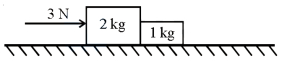
Two blocks of $2 \,kg$ and $1 \,kg$ are in contact on a frictionless table. If a force of $3 \,N$ is applied on the $2 \,kg$ block, then the force of contact between the two blocks will be: (in $\,N$)
A
$0$
B
$1$
C
$2$
D
$3$
Solution
(B) Step $1$: Calculate the common acceleration of the system.
The total mass of the system is $M = 2 \,kg + 1 \,kg = 3 \,kg$.
The applied force is $F = 3 \,N$.
Using Newton's second law, $F = Ma$, we get:
$a = \frac{F}{M} = \frac{3 \,N}{3 \,kg} = 1 \,m/s^2$.
Step $2$: Calculate the contact force between the blocks.
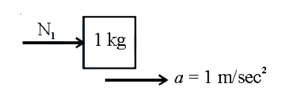
Consider the $1 \,kg$ block. The only horizontal force acting on it is the contact force $N_1$ exerted by the $2 \,kg$ block.
Applying Newton's second law to the $1 \,kg$ block:
$N_1 = m_2 \times a = 1 \,kg \times 1 \,m/s^2 = 1 \,N$.
Therefore, the contact force between the two blocks is $1 \,N$.
The total mass of the system is $M = 2 \,kg + 1 \,kg = 3 \,kg$.
The applied force is $F = 3 \,N$.
Using Newton's second law, $F = Ma$, we get:
$a = \frac{F}{M} = \frac{3 \,N}{3 \,kg} = 1 \,m/s^2$.
Step $2$: Calculate the contact force between the blocks.
Consider the $1 \,kg$ block. The only horizontal force acting on it is the contact force $N_1$ exerted by the $2 \,kg$ block.
Applying Newton's second law to the $1 \,kg$ block:
$N_1 = m_2 \times a = 1 \,kg \times 1 \,m/s^2 = 1 \,N$.
Therefore, the contact force between the two blocks is $1 \,N$.
0 likesView Solution
6
PhysicsMediumMCQWBJEE · 2010
$A$ spring of force constant $k$ is cut into three equal parts. The force constant of each part would be
A
$\frac{k}{3}$
B
$3 k$
C
$k$
D
$2 k$
Solution
(B) The force constant $k$ of a spring is inversely proportional to its natural length $l$,i.e.,$k \propto \frac{1}{l}$.
When a spring of length $L$ and force constant $k$ is cut into $n$ equal parts,the length of each part becomes $l' = \frac{L}{n}$.
Since $k' l' = k L$,we have $k' = k \frac{L}{l'} = k \frac{L}{L/n} = n k$.
In this problem,the spring is cut into $n = 3$ equal parts.
Therefore,the force constant of each part is $k' = 3 k$.
When a spring of length $L$ and force constant $k$ is cut into $n$ equal parts,the length of each part becomes $l' = \frac{L}{n}$.
Since $k' l' = k L$,we have $k' = k \frac{L}{l'} = k \frac{L}{L/n} = n k$.
In this problem,the spring is cut into $n = 3$ equal parts.
Therefore,the force constant of each part is $k' = 3 k$.
0 likesView Solution
7
PhysicsEasyMCQWBJEE · 2010
$A$ body floats in water with $40 \%$ of its volume outside water. When the same body floats in oil, $60 \%$ of its volume remains outside oil. The relative density of the oil is
A
$0.9$
B
$1.2$
C
$1.5$
D
$1.8$
Solution
(C) For a body floating in a liquid, the weight of the body equals the weight of the displaced liquid. Let $V$ be the total volume of the body and $d$ be its density.
Case $1$: Floating in water (density $\rho_w = 1 \text{ g/cm}^3$)
Volume immersed $V_{in} = V - 0.4V = 0.6V$.
Weight of body = Weight of displaced water
$V \cdot d \cdot g = (0.6V) \cdot \rho_w \cdot g$
$d = 0.6 \cdot 1 = 0.6 \text{ g/cm}^3$.
Case $2$: Floating in oil (density $\rho_{oil}$)
Volume immersed $V_{in} = V - 0.6V = 0.4V$.
Weight of body = Weight of displaced oil
$V \cdot d \cdot g = (0.4V) \cdot \rho_{oil} \cdot g$
$0.6 = 0.4 \cdot \rho_{oil}$
$\rho_{oil} = \frac{0.6}{0.4} = 1.5$.
Thus, the relative density of the oil is $1.5$.
Case $1$: Floating in water (density $\rho_w = 1 \text{ g/cm}^3$)
Volume immersed $V_{in} = V - 0.4V = 0.6V$.
Weight of body = Weight of displaced water
$V \cdot d \cdot g = (0.6V) \cdot \rho_w \cdot g$
$d = 0.6 \cdot 1 = 0.6 \text{ g/cm}^3$.
Case $2$: Floating in oil (density $\rho_{oil}$)
Volume immersed $V_{in} = V - 0.6V = 0.4V$.
Weight of body = Weight of displaced oil
$V \cdot d \cdot g = (0.4V) \cdot \rho_{oil} \cdot g$
$0.6 = 0.4 \cdot \rho_{oil}$
$\rho_{oil} = \frac{0.6}{0.4} = 1.5$.
Thus, the relative density of the oil is $1.5$.
0 likesView Solution
8
PhysicsDifficultMCQWBJEE · 2010
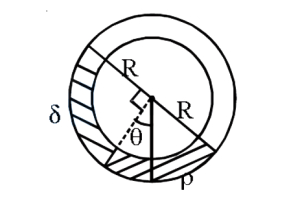
$A$ uniform long tube is bent into a circle of radius $R$ and it lies in a vertical plane. Two liquids of the same volume but densities $\rho$ and $\delta$ fill half the tube. The angle $\theta$ is
A
$\tan ^{-1}\left(\frac{\rho-\delta}{\rho+\delta}\right)$
B
$\tan ^{-1} \frac{\rho}{\delta}$
C
$\tan ^{-1} \frac{\delta}{\rho}$
D
$\tan ^{-1}\left(\frac{\rho+\delta}{\rho-\delta}\right)$
Solution
(A) Let the vertical line passing through the center be the reference. The interface between the two liquids is at an angle $\theta$ from the vertical.
Since the tube is in a vertical plane,the pressure at the lowest point must be the same from both sides.
Let the density of the liquid on the left be $\delta$ and on the right be $\rho$.
The vertical height of the center of mass of the liquid column of density $\delta$ from the lowest point is $h_1 = R(1 - \cos \theta)$.
The vertical height of the center of mass of the liquid column of density $\rho$ from the lowest point is $h_2 = R(1 - \cos \theta)$.
For equilibrium,the pressure at the lowest point of the tube must be equal from both sides.
The pressure exerted by a liquid column in a circular tube is proportional to the vertical depth of its center of mass.
The condition for equilibrium is given by:
$\delta g R(\cos \theta + \sin \theta) = \rho g R(\cos \theta - \sin \theta)$
Dividing both sides by $gR$:
$\delta(\cos \theta + \sin \theta) = \rho(\cos \theta - \sin \theta)$
$\delta \cos \theta + \delta \sin \theta = \rho \cos \theta - \rho \sin \theta$
$\sin \theta(\rho + \delta) = \cos \theta(\rho - \delta)$
$\tan \theta = \frac{\rho - \delta}{\rho + \delta}$
$\theta = \tan ^{-1}\left(\frac{\rho - \delta}{\rho + \delta}\right)$
Since the tube is in a vertical plane,the pressure at the lowest point must be the same from both sides.
Let the density of the liquid on the left be $\delta$ and on the right be $\rho$.
The vertical height of the center of mass of the liquid column of density $\delta$ from the lowest point is $h_1 = R(1 - \cos \theta)$.
The vertical height of the center of mass of the liquid column of density $\rho$ from the lowest point is $h_2 = R(1 - \cos \theta)$.
For equilibrium,the pressure at the lowest point of the tube must be equal from both sides.
The pressure exerted by a liquid column in a circular tube is proportional to the vertical depth of its center of mass.
The condition for equilibrium is given by:
$\delta g R(\cos \theta + \sin \theta) = \rho g R(\cos \theta - \sin \theta)$
Dividing both sides by $gR$:
$\delta(\cos \theta + \sin \theta) = \rho(\cos \theta - \sin \theta)$
$\delta \cos \theta + \delta \sin \theta = \rho \cos \theta - \rho \sin \theta$
$\sin \theta(\rho + \delta) = \cos \theta(\rho - \delta)$
$\tan \theta = \frac{\rho - \delta}{\rho + \delta}$
$\theta = \tan ^{-1}\left(\frac{\rho - \delta}{\rho + \delta}\right)$
0 likesView Solution
9
PhysicsMediumMCQWBJEE · 2010
Two solid spheres of the same metal but of mass $M$ and $8M$ fall simultaneously in a viscous liquid. If their terminal velocities are $v$ and $nv$,then the value of $n$ is:
A
$16$
B
$8$
C
$4$
D
$2$
Solution
(C) The terminal velocity $v_t$ of a sphere of radius $r$ falling in a viscous liquid is given by $v_t = \frac{2r^2g(\rho - \sigma)}{9\eta}$,where $\rho$ is the density of the sphere and $\sigma$ is the density of the liquid.
Since the spheres are of the same metal,$\rho$ is constant,so $v_t \propto r^2$.
The mass $M$ of a sphere is given by $M = \frac{4}{3}\pi r^3 \rho$,which implies $M \propto r^3$,or $r \propto M^{1/3}$.
Substituting this into the proportionality for terminal velocity,we get $v_t \propto (M^{1/3})^2 = M^{2/3}$.
Given the masses $M_1 = M$ and $M_2 = 8M$,the ratio of their terminal velocities is $\frac{v_1}{v_2} = \left(\frac{M_1}{M_2}\right)^{2/3}$.
Substituting the values,$\frac{v}{nv} = \left(\frac{M}{8M}\right)^{2/3} = \left(\frac{1}{8}\right)^{2/3} = \left(\left(\frac{1}{2}\right)^3\right)^{2/3} = \left(\frac{1}{2}\right)^2 = \frac{1}{4}$.
Thus,$\frac{1}{n} = \frac{1}{4}$,which gives $n = 4$.
Since the spheres are of the same metal,$\rho$ is constant,so $v_t \propto r^2$.
The mass $M$ of a sphere is given by $M = \frac{4}{3}\pi r^3 \rho$,which implies $M \propto r^3$,or $r \propto M^{1/3}$.
Substituting this into the proportionality for terminal velocity,we get $v_t \propto (M^{1/3})^2 = M^{2/3}$.
Given the masses $M_1 = M$ and $M_2 = 8M$,the ratio of their terminal velocities is $\frac{v_1}{v_2} = \left(\frac{M_1}{M_2}\right)^{2/3}$.
Substituting the values,$\frac{v}{nv} = \left(\frac{M}{8M}\right)^{2/3} = \left(\frac{1}{8}\right)^{2/3} = \left(\left(\frac{1}{2}\right)^3\right)^{2/3} = \left(\frac{1}{2}\right)^2 = \frac{1}{4}$.
Thus,$\frac{1}{n} = \frac{1}{4}$,which gives $n = 4$.
0 likesView Solution
10
PhysicsEasyMCQWBJEE · 2010
$A$ body is projected with a speed $u \ m/s$ at an angle $\beta$ with the horizontal. The kinetic energy at the highest point is $3/4$ of the initial kinetic energy. The value of $\beta$ is: (in $^{\circ}$)
A
$30$
B
$45$
C
$60$
D
$120$
Solution
(A) The initial kinetic energy of the body is $K = \frac{1}{2} m u^2$.
At the highest point of the trajectory,the vertical component of velocity is zero,and the horizontal component remains $u \cos \beta$.
Thus,the kinetic energy at the highest point is $K' = \frac{1}{2} m (u \cos \beta)^2 = K \cos^2 \beta$.
Given that $K' = \frac{3}{4} K$,we have $K \cos^2 \beta = \frac{3}{4} K$.
This simplifies to $\cos^2 \beta = \frac{3}{4}$,which means $\cos \beta = \frac{\sqrt{3}}{2}$.
Therefore,$\beta = 30^{\circ}$.
At the highest point of the trajectory,the vertical component of velocity is zero,and the horizontal component remains $u \cos \beta$.
Thus,the kinetic energy at the highest point is $K' = \frac{1}{2} m (u \cos \beta)^2 = K \cos^2 \beta$.
Given that $K' = \frac{3}{4} K$,we have $K \cos^2 \beta = \frac{3}{4} K$.
This simplifies to $\cos^2 \beta = \frac{3}{4}$,which means $\cos \beta = \frac{\sqrt{3}}{2}$.
Therefore,$\beta = 30^{\circ}$.
0 likesView Solution
11
PhysicsEasyMCQWBJEE · 2010
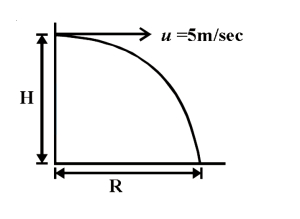
$A$ ball is projected horizontally with a velocity of $5 \text{ m/s}$ from the top of a building $19.6 \text{ m}$ high. How long will the ball take to hit the ground?
A
$\sqrt{2} \text{ s}$
B
$2 \text{ s}$
C
$\sqrt{3} \text{ s}$
D
$3 \text{ s}$
Solution
(B) The motion of the ball is a horizontal projectile motion.
For vertical motion, the initial vertical velocity $u_y = 0 \text{ m/s}$.
The vertical displacement is $H = 19.6 \text{ m}$.
The acceleration due to gravity is $g = 9.8 \text{ m/s}^2$.
Using the equation of motion $H = u_y t + \frac{1}{2} g t^2$, we get:
$19.6 = 0 \times t + \frac{1}{2} \times 9.8 \times t^2$
$19.6 = 4.9 \times t^2$
$t^2 = \frac{19.6}{4.9} = 4$
$t = \sqrt{4} = 2 \text{ s}$.
Thus, the ball will take $2 \text{ s}$ to hit the ground.
For vertical motion, the initial vertical velocity $u_y = 0 \text{ m/s}$.
The vertical displacement is $H = 19.6 \text{ m}$.
The acceleration due to gravity is $g = 9.8 \text{ m/s}^2$.
Using the equation of motion $H = u_y t + \frac{1}{2} g t^2$, we get:
$19.6 = 0 \times t + \frac{1}{2} \times 9.8 \times t^2$
$19.6 = 4.9 \times t^2$
$t^2 = \frac{19.6}{4.9} = 4$
$t = \sqrt{4} = 2 \text{ s}$.
Thus, the ball will take $2 \text{ s}$ to hit the ground.
0 likesView Solution
12
PhysicsEasyMCQWBJEE · 2010
$A$ particle is executing linear simple harmonic motion of amplitude $A$. At what displacement is the energy of the particle half potential and half kinetic?
A
$\frac{A}{4}$
B
$\frac{A}{2}$
C
$\frac{A}{\sqrt{2}}$
D
$\frac{A}{\sqrt{3}}$
Solution
(C) The total energy $E$ of a particle in simple harmonic motion is given by $E = \frac{1}{2} m \omega^2 A^2$.
Potential energy $U$ at displacement $x$ is given by $U = \frac{1}{2} m \omega^2 x^2$.
According to the problem,the potential energy is half of the total energy,so $U = \frac{E}{2}$.
Substituting the expressions,we get $\frac{1}{2} m \omega^2 x^2 = \frac{1}{2} \left( \frac{1}{2} m \omega^2 A^2 \right)$.
Simplifying the equation,we get $x^2 = \frac{A^2}{2}$.
Taking the square root on both sides,we find $x = \pm \frac{A}{\sqrt{2}}$.
Potential energy $U$ at displacement $x$ is given by $U = \frac{1}{2} m \omega^2 x^2$.
According to the problem,the potential energy is half of the total energy,so $U = \frac{E}{2}$.
Substituting the expressions,we get $\frac{1}{2} m \omega^2 x^2 = \frac{1}{2} \left( \frac{1}{2} m \omega^2 A^2 \right)$.
Simplifying the equation,we get $x^2 = \frac{A^2}{2}$.
Taking the square root on both sides,we find $x = \pm \frac{A}{\sqrt{2}}$.
0 likesView Solution
13
PhysicsMediumMCQWBJEE · 2010
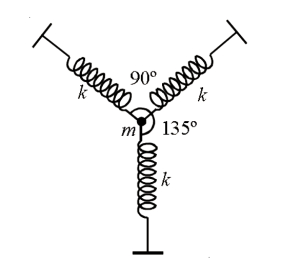
$A$ particle of mass $m$ is attached to three identical massless springs of spring constant $k$ as shown in the figure. The time period of vertical oscillation of the particle is
A
$2 \pi \sqrt{\frac{m}{k}}$
B
$2 \pi \sqrt{\frac{m}{2 k}}$
C
$2 \pi \sqrt{\frac{m}{3 k}}$
D
$\pi \sqrt{\frac{m}{k}}$
Solution
(B) Let the particle be displaced vertically downwards by a small distance $x$.
The vertical spring stretches by $x$,providing a restoring force $F_1 = kx$ upwards.
The two inclined springs are at an angle of $135^\circ$ with the vertical. When the particle moves down by $x$,the change in length of each inclined spring is $\Delta l = x \cos(135^\circ - 90^\circ) = x \cos(45^\circ) = \frac{x}{\sqrt{2}}$.
The restoring force component along the vertical for each inclined spring is $F_2 = k \Delta l \cos(45^\circ) = k (\frac{x}{\sqrt{2}}) (\frac{1}{\sqrt{2}}) = \frac{kx}{2}$.
Total restoring force $F_{net} = F_1 + 2 F_2 = kx + 2(\frac{kx}{2}) = kx + kx = 2kx$.
Thus,the equivalent spring constant is $K_{eq} = 2k$.
The time period of oscillation is $T = 2\pi \sqrt{\frac{m}{K_{eq}}} = 2\pi \sqrt{\frac{m}{2k}}$.
The vertical spring stretches by $x$,providing a restoring force $F_1 = kx$ upwards.
The two inclined springs are at an angle of $135^\circ$ with the vertical. When the particle moves down by $x$,the change in length of each inclined spring is $\Delta l = x \cos(135^\circ - 90^\circ) = x \cos(45^\circ) = \frac{x}{\sqrt{2}}$.
The restoring force component along the vertical for each inclined spring is $F_2 = k \Delta l \cos(45^\circ) = k (\frac{x}{\sqrt{2}}) (\frac{1}{\sqrt{2}}) = \frac{kx}{2}$.
Total restoring force $F_{net} = F_1 + 2 F_2 = kx + 2(\frac{kx}{2}) = kx + kx = 2kx$.
Thus,the equivalent spring constant is $K_{eq} = 2k$.
The time period of oscillation is $T = 2\pi \sqrt{\frac{m}{K_{eq}}} = 2\pi \sqrt{\frac{m}{2k}}$.
0 likesView Solution
14
PhysicsEasyMCQWBJEE · 2010
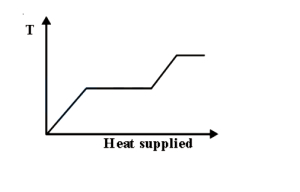
$A$ block of ice at temperature $-20^{\circ} C$ is slowly heated and converted to steam at $100^{\circ} C$. Which of the following diagrams is most appropriate?
A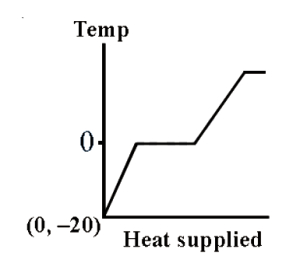
B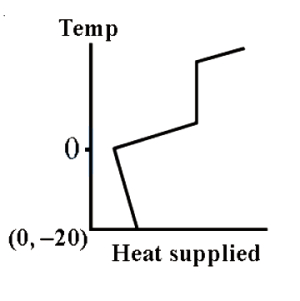
C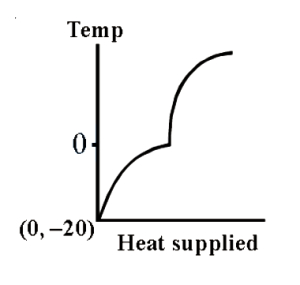
D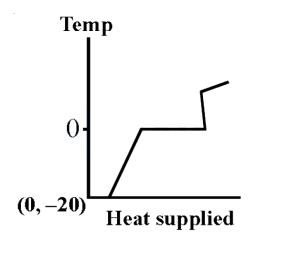
Solution
(A) The process of heating ice from $-20^{\circ} C$ to steam at $100^{\circ} C$ involves several stages:
$1$. Heating ice from $-20^{\circ} C$ to $0^{\circ} C$: The temperature increases linearly with heat supplied.
$2$. Melting ice at $0^{\circ} C$ to water at $0^{\circ} C$: The temperature remains constant (phase change).
$3$. Heating water from $0^{\circ} C$ to $100^{\circ} C$: The temperature increases linearly with heat supplied.
$4$. Boiling water at $100^{\circ} C$ to steam at $100^{\circ} C$: The temperature remains constant (phase change).
Therefore,the temperature-heat graph should show two linear increases and two horizontal constant-temperature segments. Option $A$ correctly represents this behavior.
$1$. Heating ice from $-20^{\circ} C$ to $0^{\circ} C$: The temperature increases linearly with heat supplied.
$2$. Melting ice at $0^{\circ} C$ to water at $0^{\circ} C$: The temperature remains constant (phase change).
$3$. Heating water from $0^{\circ} C$ to $100^{\circ} C$: The temperature increases linearly with heat supplied.
$4$. Boiling water at $100^{\circ} C$ to steam at $100^{\circ} C$: The temperature remains constant (phase change).
Therefore,the temperature-heat graph should show two linear increases and two horizontal constant-temperature segments. Option $A$ correctly represents this behavior.
0 likesView Solution
15
PhysicsEasyMCQWBJEE · 2010
Experimental investigations show that the intensity of solar radiation is maximum for a wavelength $480 \, nm$ in the visible region. Estimate the surface temperature of the sun. Given Wien's constant $b = 2.88 \times 10^{-3} \, mK$.
A
$4000 \, K$
B
$6000 \, K$
C
$8000 \, K$
D
$10^6 \, K$
Solution
(B) According to Wien's displacement law, the product of the wavelength corresponding to maximum intensity $(\lambda_m)$ and the absolute temperature $(T)$ of the black body is a constant $(b).$
Formula: $\lambda_m T = b$
Given values:
$\lambda_m = 480 \, nm = 480 \times 10^{-9} \, m$
$b = 2.88 \times 10^{-3} \, mK$
Calculation:
$T = \frac{b}{\lambda_m}$
$T = \frac{2.88 \times 10^{-3}}{480 \times 10^{-9}}$
$T = \frac{2.88}{480} \times 10^6$
$T = 0.006 \times 10^6 = 6000 \, K$
Therefore, the surface temperature of the sun is $6000 \, K$.
Formula: $\lambda_m T = b$
Given values:
$\lambda_m = 480 \, nm = 480 \times 10^{-9} \, m$
$b = 2.88 \times 10^{-3} \, mK$
Calculation:
$T = \frac{b}{\lambda_m}$
$T = \frac{2.88 \times 10^{-3}}{480 \times 10^{-9}}$
$T = \frac{2.88}{480} \times 10^6$
$T = 0.006 \times 10^6 = 6000 \, K$
Therefore, the surface temperature of the sun is $6000 \, K$.
0 likesView Solution
16
PhysicsMediumMCQWBJEE · 2010
Two black bodies at temperatures $327^{\circ} C$ and $427^{\circ} C$ are kept in an evacuated chamber at $27^{\circ} C$. The ratio of their rates of loss of heat are :
A
$\frac{6}{7}$
B
$\left(\frac{6}{7}\right)^2$
C
$\left(\frac{6}{7}\right)^3$
D
$\frac{243}{464}$
Solution
(D) According to Stefan-Boltzmann Law,the rate of loss of heat $E$ from a black body at temperature $T$ in an environment at temperature $T_0$ is given by $E \propto (T^4 - T_0^4)$.
Given temperatures are $T_1 = 327^{\circ} C = 600 \ K$,$T_2 = 427^{\circ} C = 700 \ K$,and $T_0 = 27^{\circ} C = 300 \ K$.
The ratio of the rates of loss of heat is $\frac{E_1}{E_2} = \frac{T_1^4 - T_0^4}{T_2^4 - T_0^4}$.
Substituting the values: $\frac{E_1}{E_2} = \frac{(600)^4 - (300)^4}{(700)^4 - (300)^4}$.
Factoring out $(100)^4$: $\frac{E_1}{E_2} = \frac{6^4 - 3^4}{7^4 - 3^4} = \frac{1296 - 81}{2401 - 81}$.
$\frac{E_1}{E_2} = \frac{1215}{2320}$.
Dividing both numerator and denominator by $5$,we get $\frac{243}{464}$.
Given temperatures are $T_1 = 327^{\circ} C = 600 \ K$,$T_2 = 427^{\circ} C = 700 \ K$,and $T_0 = 27^{\circ} C = 300 \ K$.
The ratio of the rates of loss of heat is $\frac{E_1}{E_2} = \frac{T_1^4 - T_0^4}{T_2^4 - T_0^4}$.
Substituting the values: $\frac{E_1}{E_2} = \frac{(600)^4 - (300)^4}{(700)^4 - (300)^4}$.
Factoring out $(100)^4$: $\frac{E_1}{E_2} = \frac{6^4 - 3^4}{7^4 - 3^4} = \frac{1296 - 81}{2401 - 81}$.
$\frac{E_1}{E_2} = \frac{1215}{2320}$.
Dividing both numerator and denominator by $5$,we get $\frac{243}{464}$.
0 likesView Solution
17
PhysicsEasyMCQWBJEE · 2010
The equation of a progressive wave is $y = 4 \sin(4 \pi t - 0.04 x + \pi / 3)$,where $x$ is in meters and $t$ is in seconds. The velocity of the wave is:
A
$100 \pi \ m/s$
B
$50 \pi \ m/s$
C
$25 \pi \ m/s$
D
$\pi \ m/s$
Solution
(A) The standard equation of a progressive wave is given by $y = A \sin(\omega t - kx + \phi)$.
Comparing this with the given equation $y = 4 \sin(4 \pi t - 0.04 x + \pi / 3)$,we identify the angular frequency $\omega = 4 \pi \ rad/s$ and the wave number $k = 0.04 \ rad/m$.
The velocity of the wave $(v)$ is given by the ratio of angular frequency to the wave number: $v = \frac{\omega}{k}$.
Substituting the values: $v = \frac{4 \pi}{0.04} = \frac{400 \pi}{4} = 100 \pi \ m/s$.
Comparing this with the given equation $y = 4 \sin(4 \pi t - 0.04 x + \pi / 3)$,we identify the angular frequency $\omega = 4 \pi \ rad/s$ and the wave number $k = 0.04 \ rad/m$.
The velocity of the wave $(v)$ is given by the ratio of angular frequency to the wave number: $v = \frac{\omega}{k}$.
Substituting the values: $v = \frac{4 \pi}{0.04} = \frac{400 \pi}{4} = 100 \pi \ m/s$.
0 likesView Solution
18
PhysicsMediumMCQWBJEE · 2010
$A$ longitudinal wave is represented by $x=x_0 \sin 2 \pi(n t-x / \lambda)$. The maximum particle velocity will be four times the wave velocity if:
A
$\lambda=\frac{\pi x_0}{4}$
B
$\lambda=2 \pi x_0$
C
$\lambda=\frac{\pi x_0}{2}$
D
$\lambda=4 \pi x_0$
Solution
(C) The given wave equation is $x = x_0 \sin 2 \pi (nt - x/\lambda)$.
Comparing this with the standard form $x = A \sin (\omega t - kx)$,we have amplitude $A = x_0$,angular frequency $\omega = 2 \pi n$,and wave number $k = 2 \pi / \lambda$.
The maximum particle velocity $V_p$ is given by $V_p = A \omega = x_0 (2 \pi n) = 2 \pi n x_0$.
The wave velocity $V_w$ is given by $V_w = \frac{\omega}{k} = \frac{2 \pi n}{2 \pi / \lambda} = n \lambda$.
According to the problem,$V_p = 4 V_w$.
Substituting the expressions,we get $2 \pi n x_0 = 4 (n \lambda)$.
Dividing both sides by $n$,we get $2 \pi x_0 = 4 \lambda$.
Therefore,$\lambda = \frac{2 \pi x_0}{4} = \frac{\pi x_0}{2}$.
Comparing this with the standard form $x = A \sin (\omega t - kx)$,we have amplitude $A = x_0$,angular frequency $\omega = 2 \pi n$,and wave number $k = 2 \pi / \lambda$.
The maximum particle velocity $V_p$ is given by $V_p = A \omega = x_0 (2 \pi n) = 2 \pi n x_0$.
The wave velocity $V_w$ is given by $V_w = \frac{\omega}{k} = \frac{2 \pi n}{2 \pi / \lambda} = n \lambda$.
According to the problem,$V_p = 4 V_w$.
Substituting the expressions,we get $2 \pi n x_0 = 4 (n \lambda)$.
Dividing both sides by $n$,we get $2 \pi x_0 = 4 \lambda$.
Therefore,$\lambda = \frac{2 \pi x_0}{4} = \frac{\pi x_0}{2}$.
0 likesView Solution
19
PhysicsEasyMCQWBJEE · 2010
If momentum is increased by $20 \%$,then kinetic energy increases by (in $\%$)
A
$48$
B
$44$
C
$40$
D
$36$
Solution
(B) The relationship between kinetic energy $K$ and momentum $P$ is given by $K = \frac{P^2}{2m}$.
Let the initial momentum be $P$ and the initial kinetic energy be $K = \frac{P^2}{2m}$.
If the momentum is increased by $20 \%$,the new momentum $P'$ becomes $P' = P + 0.20P = 1.2P$.
The new kinetic energy $K'$ is given by $K' = \frac{(P')^2}{2m} = \frac{(1.2P)^2}{2m} = \frac{1.44P^2}{2m}$.
Substituting $K = \frac{P^2}{2m}$,we get $K' = 1.44K$.
The percentage increase in kinetic energy is given by $\frac{K' - K}{K} \times 100 \% = \frac{1.44K - K}{K} \times 100 \% = 0.44 \times 100 \% = 44 \%$.
Let the initial momentum be $P$ and the initial kinetic energy be $K = \frac{P^2}{2m}$.
If the momentum is increased by $20 \%$,the new momentum $P'$ becomes $P' = P + 0.20P = 1.2P$.
The new kinetic energy $K'$ is given by $K' = \frac{(P')^2}{2m} = \frac{(1.2P)^2}{2m} = \frac{1.44P^2}{2m}$.
Substituting $K = \frac{P^2}{2m}$,we get $K' = 1.44K$.
The percentage increase in kinetic energy is given by $\frac{K' - K}{K} \times 100 \% = \frac{1.44K - K}{K} \times 100 \% = 0.44 \times 100 \% = 44 \%$.
0 likesView Solution
20
PhysicsMediumMCQWBJEE · 2010
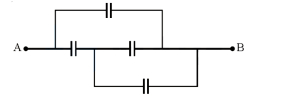
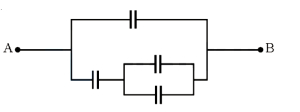
In the figure below,the capacitance of each capacitor is $3 \mu F$. The effective capacitance between $A$ and $B$ is:
A
$\frac{3}{4} \mu F$
B
$3 \mu F$
C
$6 \mu F$
D
$5 \mu F$
Solution
(D) Let the capacitance of each capacitor be $C = 3 \mu F$.
Looking at the circuit,we can identify the arrangement of capacitors.
There are two capacitors in parallel in the middle branch. Their equivalent capacitance is $C_p = C + C = 2C = 2 \times 3 = 6 \mu F$.
This combination is in series with another capacitor $C$ in that same branch. The equivalent capacitance of this branch is $C_s = \frac{C \times C_p}{C + C_p} = \frac{C \times 2C}{C + 2C} = \frac{2C^2}{3C} = \frac{2}{3}C = \frac{2}{3} \times 3 = 2 \mu F$.
Finally,this branch is in parallel with the top capacitor $C$. The total effective capacitance between $A$ and $B$ is $C_{eq} = C + C_s = 3 + 2 = 5 \mu F$.
Looking at the circuit,we can identify the arrangement of capacitors.
There are two capacitors in parallel in the middle branch. Their equivalent capacitance is $C_p = C + C = 2C = 2 \times 3 = 6 \mu F$.
This combination is in series with another capacitor $C$ in that same branch. The equivalent capacitance of this branch is $C_s = \frac{C \times C_p}{C + C_p} = \frac{C \times 2C}{C + 2C} = \frac{2C^2}{3C} = \frac{2}{3}C = \frac{2}{3} \times 3 = 2 \mu F$.
Finally,this branch is in parallel with the top capacitor $C$. The total effective capacitance between $A$ and $B$ is $C_{eq} = C + C_s = 3 + 2 = 5 \mu F$.
0 likesView Solution
21
PhysicsDifficultMCQWBJEE · 2010
$n$ identical droplets are charged to $V$ volt each. If they coalesce to form a single drop,then its potential will be
A
$n^{2/3} V$
B
$n^{1/3} V$
C
$n V$
D
$V/n$
Solution
(A) Let $r$ be the radius of each small droplet and $R$ be the radius of the large drop formed by coalescing $n$ droplets.
Since the volume remains conserved:
$n \times \frac{4}{3} \pi r^3 = \frac{4}{3} \pi R^3$
$R^3 = n r^3 \implies R = r n^{1/3}$
Each small droplet has a charge $q = C_0 V = (4 \pi \varepsilon_0 r) V$.
The total charge on the large drop is $Q = n q = n (4 \pi \varepsilon_0 r) V$.
The potential of the large drop is $V' = \frac{Q}{4 \pi \varepsilon_0 R}$.
Substituting the values of $Q$ and $R$:
$V' = \frac{n (4 \pi \varepsilon_0 r) V}{4 \pi \varepsilon_0 (r n^{1/3})}$
$V' = n \times \frac{1}{n^{1/3}} V = n^{2/3} V$.
Since the volume remains conserved:
$n \times \frac{4}{3} \pi r^3 = \frac{4}{3} \pi R^3$
$R^3 = n r^3 \implies R = r n^{1/3}$
Each small droplet has a charge $q = C_0 V = (4 \pi \varepsilon_0 r) V$.
The total charge on the large drop is $Q = n q = n (4 \pi \varepsilon_0 r) V$.
The potential of the large drop is $V' = \frac{Q}{4 \pi \varepsilon_0 R}$.
Substituting the values of $Q$ and $R$:
$V' = \frac{n (4 \pi \varepsilon_0 r) V}{4 \pi \varepsilon_0 (r n^{1/3})}$
$V' = n \times \frac{1}{n^{1/3}} V = n^{2/3} V$.
0 likesView Solution
22
PhysicsEasyMCQWBJEE · 2010
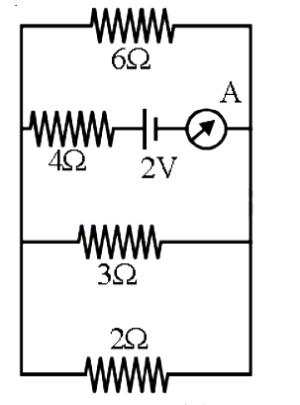
The reading of the ammeter in the following figure will be: (in $\text{A}$)
A
$0.8$
B
$0.6$
C
$0.4$
D
$0.2$
Solution
(C) From the circuit diagram, the resistors $2 \Omega$, $3 \Omega$, and $6 \Omega$ are connected in parallel.
Let their equivalent resistance be $R_p$. Then, $\frac{1}{R_p} = \frac{1}{2} + \frac{1}{3} + \frac{1}{6} = \frac{3+2+1}{6} = 1 \Omega^{-1}$.
Thus, $R_p = 1 \Omega$.
This parallel combination is in series with the $4 \Omega$ resistor and the $2 \text{ V}$ battery.
Therefore, the total equivalent resistance of the circuit is $R_{\text{eq}} = R_p + 4 \Omega = 1 \Omega + 4 \Omega = 5 \Omega$.
The current $I$ measured by the ammeter is given by Ohm's law: $I = \frac{V}{R_{\text{eq}}} = \frac{2 \text{ V}}{5 \Omega} = 0.4 \text{ A}$.
Let their equivalent resistance be $R_p$. Then, $\frac{1}{R_p} = \frac{1}{2} + \frac{1}{3} + \frac{1}{6} = \frac{3+2+1}{6} = 1 \Omega^{-1}$.
Thus, $R_p = 1 \Omega$.
This parallel combination is in series with the $4 \Omega$ resistor and the $2 \text{ V}$ battery.
Therefore, the total equivalent resistance of the circuit is $R_{\text{eq}} = R_p + 4 \Omega = 1 \Omega + 4 \Omega = 5 \Omega$.
The current $I$ measured by the ammeter is given by Ohm's law: $I = \frac{V}{R_{\text{eq}}} = \frac{2 \text{ V}}{5 \Omega} = 0.4 \text{ A}$.
0 likesView Solution
23
PhysicsMediumMCQWBJEE · 2010
$A$ wire of resistance $R$ is elongated $n$-fold to make a new uniform wire. What is the resistance of the new wire?
A
$n R$
B
$n^2 R$
C
$2 n R$
D
$2 n^2 R$
Solution
(B) The resistance of a wire is given by $R = \rho \frac{L}{A}$,where $\rho$ is the resistivity,$L$ is the length,and $A$ is the cross-sectional area.
When the wire is elongated $n$-fold,the new length $L' = nL$.
Since the volume of the wire remains constant,$V = A \times L = A' \times L'$.
Therefore,$A' = \frac{A \times L}{L'} = \frac{A \times L}{nL} = \frac{A}{n}$.
The new resistance $R'$ is given by $R' = \rho \frac{L'}{A'} = \rho \frac{nL}{A/n} = n^2 \left( \rho \frac{L}{A} \right) = n^2 R$.
When the wire is elongated $n$-fold,the new length $L' = nL$.
Since the volume of the wire remains constant,$V = A \times L = A' \times L'$.
Therefore,$A' = \frac{A \times L}{L'} = \frac{A \times L}{nL} = \frac{A}{n}$.
The new resistance $R'$ is given by $R' = \rho \frac{L'}{A'} = \rho \frac{nL}{A/n} = n^2 \left( \rho \frac{L}{A} \right) = n^2 R$.
0 likesView Solution
24
PhysicsEasyMCQWBJEE · 2010
The current through a coil of self-inductance $L = 2 \ mH$ is given by $I = t^2 e^{-t}$ at time $t$. How long will it take for the induced electromotive force $(emf)$ to become zero (in $s$)?
A
$1$
B
$2$
C
$3$
D
$4$
Solution
(B) The induced $emf$ $(e)$ in a coil is given by the formula $e = -L \frac{dI}{dt}$.
For the $emf$ to be zero,the rate of change of current $\frac{dI}{dt}$ must be zero.
Given $I = t^2 e^{-t}$.
Using the product rule for differentiation: $\frac{dI}{dt} = \frac{d}{dt}(t^2) \cdot e^{-t} + t^2 \cdot \frac{d}{dt}(e^{-t})$.
$\frac{dI}{dt} = 2t e^{-t} + t^2 (-e^{-t}) = e^{-t} (2t - t^2) = e^{-t} t(2 - t)$.
Setting $\frac{dI}{dt} = 0$,we get $e^{-t} t(2 - t) = 0$.
Since $e^{-t} \neq 0$ for finite $t$,the solutions are $t = 0$ or $t = 2 \ s$.
At $t = 0$,the current is zero,but the $emf$ becomes zero at $t = 2 \ s$ as the current reaches its maximum value.
For the $emf$ to be zero,the rate of change of current $\frac{dI}{dt}$ must be zero.
Given $I = t^2 e^{-t}$.
Using the product rule for differentiation: $\frac{dI}{dt} = \frac{d}{dt}(t^2) \cdot e^{-t} + t^2 \cdot \frac{d}{dt}(e^{-t})$.
$\frac{dI}{dt} = 2t e^{-t} + t^2 (-e^{-t}) = e^{-t} (2t - t^2) = e^{-t} t(2 - t)$.
Setting $\frac{dI}{dt} = 0$,we get $e^{-t} t(2 - t) = 0$.
Since $e^{-t} \neq 0$ for finite $t$,the solutions are $t = 0$ or $t = 2 \ s$.
At $t = 0$,the current is zero,but the $emf$ becomes zero at $t = 2 \ s$ as the current reaches its maximum value.
0 likesView Solution
25
PhysicsEasyMCQWBJEE · 2010
The magnetic flux through a loop of resistance $10 \Omega$ is given by $\phi = 5t^2 - 4t + 1 \text{ Wb}$. How much current is induced in the loop after $0.2 \text{ s}$ (in $\text{ A}$)?
A
$0.4$
B
$0.2$
C
$0.04$
D
$0.02$
Solution
(B) Given: Magnetic flux $\phi = 5t^2 - 4t + 1 \text{ Wb}$ and resistance $R = 10 \Omega$.
According to Faraday's law of induction, the induced electromotive force $(EMF)$ is $e = -\frac{d\phi}{dt}$.
Differentiating $\phi$ with respect to $t$: $\frac{d\phi}{dt} = \frac{d}{dt}(5t^2 - 4t + 1) = 10t - 4$.
The induced current $I$ is given by $I = \frac{|e|}{R} = \frac{|-d\phi/dt|}{R} = \frac{|-(10t - 4)|}{10} = \frac{|4 - 10t|}{10}$.
At $t = 0.2 \text{ s}$, the current is $I = \frac{|4 - 10(0.2)|}{10} = \frac{|4 - 2|}{10} = \frac{2}{10} = 0.2 \text{ A}$.
According to Faraday's law of induction, the induced electromotive force $(EMF)$ is $e = -\frac{d\phi}{dt}$.
Differentiating $\phi$ with respect to $t$: $\frac{d\phi}{dt} = \frac{d}{dt}(5t^2 - 4t + 1) = 10t - 4$.
The induced current $I$ is given by $I = \frac{|e|}{R} = \frac{|-d\phi/dt|}{R} = \frac{|-(10t - 4)|}{10} = \frac{|4 - 10t|}{10}$.
At $t = 0.2 \text{ s}$, the current is $I = \frac{|4 - 10(0.2)|}{10} = \frac{|4 - 2|}{10} = \frac{2}{10} = 0.2 \text{ A}$.
0 likesView Solution
26
PhysicsEasyMCQWBJEE · 2010
$A$ point charge $+q$ is placed at the centre of a cube of side $L$. The electric flux emerging from the cube is
A
$\frac{q}{\varepsilon_0}$
B
Zero
C
$\frac{6 q L^2}{\varepsilon_0}$
D
$\frac{q}{6 L^2 \varepsilon_0}$
Solution
(A) According to Gauss's Law,the total electric flux $\phi$ through any closed surface is equal to the net charge enclosed by the surface divided by the permittivity of free space $\varepsilon_0$.
Mathematically,$\phi = \frac{q_{\text{enclosed}}}{\varepsilon_0}$.
In this problem,the point charge $+q$ is placed at the centre of the cube,which is a closed surface.
Therefore,the total electric flux emerging from the cube is $\phi = \frac{q}{\varepsilon_0}$.
Mathematically,$\phi = \frac{q_{\text{enclosed}}}{\varepsilon_0}$.
In this problem,the point charge $+q$ is placed at the centre of the cube,which is a closed surface.
Therefore,the total electric flux emerging from the cube is $\phi = \frac{q}{\varepsilon_0}$.
0 likesView Solution
27
PhysicsMediumMCQWBJEE · 2010
The ratio of the magnetic field and the magnetic moment at the centre of a current-carrying circular loop is $x$. When both the current and the radius are doubled,the ratio will be:
A
$x / 8$
B
$x / 4$
C
$x / 2$
D
$2 x$
Solution
(A) The magnetic field $B$ at the centre of a circular loop of radius $a$ carrying current $I$ is given by $B = \frac{\mu_0 I}{2a}$.
The magnetic moment $M$ of the loop is given by $M = I A = I(\pi a^2)$.
The ratio $x$ is given by:
$x = \frac{B}{M} = \frac{\mu_0 I}{2a} \times \frac{1}{I \pi a^2} = \frac{\mu_0}{2 \pi a^3}$.
When the current $I$ is doubled $(I' = 2I)$ and the radius $a$ is doubled $(a' = 2a)$,the new ratio $x'$ is:
$x' = \frac{\mu_0}{2 \pi (a')^3} = \frac{\mu_0}{2 \pi (2a)^3} = \frac{\mu_0}{2 \pi (8a^3)} = \frac{1}{8} \left( \frac{\mu_0}{2 \pi a^3} \right) = \frac{x}{8}$.
The magnetic moment $M$ of the loop is given by $M = I A = I(\pi a^2)$.
The ratio $x$ is given by:
$x = \frac{B}{M} = \frac{\mu_0 I}{2a} \times \frac{1}{I \pi a^2} = \frac{\mu_0}{2 \pi a^3}$.
When the current $I$ is doubled $(I' = 2I)$ and the radius $a$ is doubled $(a' = 2a)$,the new ratio $x'$ is:
$x' = \frac{\mu_0}{2 \pi (a')^3} = \frac{\mu_0}{2 \pi (2a)^3} = \frac{\mu_0}{2 \pi (8a^3)} = \frac{1}{8} \left( \frac{\mu_0}{2 \pi a^3} \right) = \frac{x}{8}$.
0 likesView Solution
28
PhysicsEasyMCQWBJEE · 2010
The energy released by the fission of one uranium atom is $200 MeV$. The number of fissions per second required to produce $3.2 W$ of power is (Take $1 eV = 1.6 \times 10^{-19} J$).
A
$10^7$
B
$10^{10}$
C
$10^{15}$
D
$10^{11}$
Solution
(D) The energy released per fission is $E_{fission} = 200 MeV$.
Converting this energy into Joules: $E_{fission} = 200 \times 10^6 \times 1.6 \times 10^{-19} J = 3.2 \times 10^{-11} J$.
The power required is $P = 3.2 W$,which means $3.2 J$ of energy is required per second.
The number of fissions per second $(n)$ is given by the ratio of total power to energy per fission:
$n = \frac{P}{E_{fission}} = \frac{3.2 J/s}{3.2 \times 10^{-11} J} = 10^{11} \text{ fissions/second}$.
Converting this energy into Joules: $E_{fission} = 200 \times 10^6 \times 1.6 \times 10^{-19} J = 3.2 \times 10^{-11} J$.
The power required is $P = 3.2 W$,which means $3.2 J$ of energy is required per second.
The number of fissions per second $(n)$ is given by the ratio of total power to energy per fission:
$n = \frac{P}{E_{fission}} = \frac{3.2 J/s}{3.2 \times 10^{-11} J} = 10^{11} \text{ fissions/second}$.
0 likesView Solution
29
PhysicsMediumMCQWBJEE · 2010
Half-life of a radioactive substance is $20 \text{ min}$. The time between $20 \%$ and $80 \%$ decay will be: (in $\text{ min}$)
A
$20$
B
$30$
C
$40$
D
$25$
Solution
(C) The radioactive decay law is given by $N(t) = N_0 e^{-\lambda t}$, where $N(t)$ is the amount remaining at time $t$.
For $20 \%$ decay, the amount remaining is $N_1 = 80 \% \text{ of } N_0 = 0.8 N_0$. Thus, $0.8 N_0 = N_0 e^{-\lambda t_1} \Rightarrow e^{-\lambda t_1} = 0.8$.
For $80 \%$ decay, the amount remaining is $N_2 = 20 \% \text{ of } N_0 = 0.2 N_0$. Thus, $0.2 N_0 = N_0 e^{-\lambda t_2} \Rightarrow e^{-\lambda t_2} = 0.2$.
Dividing the two equations: $\frac{e^{-\lambda t_1}}{e^{-\lambda t_2}} = \frac{0.8}{0.2} = 4$.
This simplifies to $e^{\lambda(t_2 - t_1)} = 4$.
Taking the natural logarithm on both sides: $\lambda(t_2 - t_1) = \ln(4) = 2 \ln(2)$.
Since $\lambda = \frac{\ln 2}{T_{1/2}}$, we have $\frac{\ln 2}{T_{1/2}}(t_2 - t_1) = 2 \ln 2$.
Therefore, $t_2 - t_1 = 2 \times T_{1/2} = 2 \times 20 \text{ min} = 40 \text{ min}$.
For $20 \%$ decay, the amount remaining is $N_1 = 80 \% \text{ of } N_0 = 0.8 N_0$. Thus, $0.8 N_0 = N_0 e^{-\lambda t_1} \Rightarrow e^{-\lambda t_1} = 0.8$.
For $80 \%$ decay, the amount remaining is $N_2 = 20 \% \text{ of } N_0 = 0.2 N_0$. Thus, $0.2 N_0 = N_0 e^{-\lambda t_2} \Rightarrow e^{-\lambda t_2} = 0.2$.
Dividing the two equations: $\frac{e^{-\lambda t_1}}{e^{-\lambda t_2}} = \frac{0.8}{0.2} = 4$.
This simplifies to $e^{\lambda(t_2 - t_1)} = 4$.
Taking the natural logarithm on both sides: $\lambda(t_2 - t_1) = \ln(4) = 2 \ln(2)$.
Since $\lambda = \frac{\ln 2}{T_{1/2}}$, we have $\frac{\ln 2}{T_{1/2}}(t_2 - t_1) = 2 \ln 2$.
Therefore, $t_2 - t_1 = 2 \times T_{1/2} = 2 \times 20 \text{ min} = 40 \text{ min}$.
0 likesView Solution
30
PhysicsMediumMCQWBJEE · 2010
The radius of the light circle observed by a fish at a depth of $12 \ m$ is (refractive index of water $\mu = 4/3$):
A
$36 \sqrt{7}$
B
$\frac{36}{\sqrt{7}}$
C
$36 \sqrt{5}$
D
$4 \sqrt{5}$
Solution
(B) When a fish is at a depth $h$ below the surface of water,it sees the outside world through a circular window due to total internal reflection.
The radius $r$ of this circle is given by the formula $r = \frac{h}{\sqrt{\mu^2 - 1}}$.
Given: depth $h = 12 \ m$ and refractive index $\mu = 4/3$.
Substituting the values into the formula:
$r = \frac{12}{\sqrt{(4/3)^2 - 1}}$
$r = \frac{12}{\sqrt{16/9 - 1}}$
$r = \frac{12}{\sqrt{7/9}}$
$r = \frac{12 \times 3}{\sqrt{7}}$
$r = \frac{36}{\sqrt{7}} \ m$.
The radius $r$ of this circle is given by the formula $r = \frac{h}{\sqrt{\mu^2 - 1}}$.
Given: depth $h = 12 \ m$ and refractive index $\mu = 4/3$.
Substituting the values into the formula:
$r = \frac{12}{\sqrt{(4/3)^2 - 1}}$
$r = \frac{12}{\sqrt{16/9 - 1}}$
$r = \frac{12}{\sqrt{7/9}}$
$r = \frac{12 \times 3}{\sqrt{7}}$
$r = \frac{36}{\sqrt{7}} \ m$.
0 likesView Solution
31
PhysicsEasyMCQWBJEE · 2010
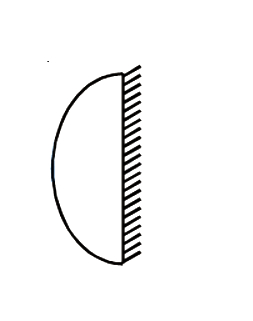
$A$ plano-convex lens $(f=20 \,cm)$ is silvered at its plane surface. What will be its new focal length (in $\,cm$)?
A
$20$
B
$40$
C
$30$
D
$10$
Solution
(D) When a lens is silvered, it acts as a mirror. The equivalent power $P_{eq}$ of the system is given by $P_{eq} = 2P_L + P_M$, where $P_L$ is the power of the lens and $P_M$ is the power of the mirror.
Given, focal length of the lens $f = 20 \,cm$. Power of the lens $P_L = \frac{1}{f} = \frac{1}{20} \,cm^{-1}$.
The plane surface is silvered, so it acts as a plane mirror. The power of a plane mirror $P_M = 0$.
Thus, $P_{eq} = 2 \times P_L + 0 = 2 \times \frac{1}{20} = \frac{1}{10} \,cm^{-1}$.
The equivalent focal length $F$ of the system is given by $P_{eq} = -\frac{1}{F}$ (negative sign because it acts as a concave mirror).
So, $-\frac{1}{F} = \frac{1}{10}$, which gives $F = -10 \,cm$.
The magnitude of the focal length is $10 \,cm$.
Given, focal length of the lens $f = 20 \,cm$. Power of the lens $P_L = \frac{1}{f} = \frac{1}{20} \,cm^{-1}$.
The plane surface is silvered, so it acts as a plane mirror. The power of a plane mirror $P_M = 0$.
Thus, $P_{eq} = 2 \times P_L + 0 = 2 \times \frac{1}{20} = \frac{1}{10} \,cm^{-1}$.
The equivalent focal length $F$ of the system is given by $P_{eq} = -\frac{1}{F}$ (negative sign because it acts as a concave mirror).
So, $-\frac{1}{F} = \frac{1}{10}$, which gives $F = -10 \,cm$.
The magnitude of the focal length is $10 \,cm$.
0 likesView Solution
32
PhysicsMediumMCQWBJEE · 2010
Two mirrors at an angle $\theta^{\circ}$ produce $5$ images of a point. The number of images produced when $\theta$ is decreased to $\theta^{\circ}-30^{\circ}$ is
A
$9$
B
$10$
C
$11$
D
$12$
Solution
(C) The number of images $n$ formed by two plane mirrors inclined at an angle $\theta$ is given by $n = \frac{360^{\circ}}{\theta} - 1$ if $\frac{360^{\circ}}{\theta}$ is an even integer,or if it is an odd integer and the object is placed symmetrically.
Given $n = 5$,we have $5 = \frac{360^{\circ}}{\theta} - 1$,which implies $\frac{360^{\circ}}{\theta} = 6$.
Thus,$\theta = \frac{360^{\circ}}{6} = 60^{\circ}$.
When the angle is decreased by $30^{\circ}$,the new angle $\theta' = 60^{\circ} - 30^{\circ} = 30^{\circ}$.
The new number of images $n'$ is given by $n' = \frac{360^{\circ}}{30^{\circ}} - 1 = 12 - 1 = 11$.
Given $n = 5$,we have $5 = \frac{360^{\circ}}{\theta} - 1$,which implies $\frac{360^{\circ}}{\theta} = 6$.
Thus,$\theta = \frac{360^{\circ}}{6} = 60^{\circ}$.
When the angle is decreased by $30^{\circ}$,the new angle $\theta' = 60^{\circ} - 30^{\circ} = 30^{\circ}$.
The new number of images $n'$ is given by $n' = \frac{360^{\circ}}{30^{\circ}} - 1 = 12 - 1 = 11$.
0 likesView Solution
33
PhysicsEasyMCQWBJEE · 2010
In a common emitter configuration,a transistor has $\beta=50$ and input resistance $1 \text{ k}\Omega$. If the peak value of a.c. input is $0.01 \text{ V}$,then the peak value of collector current is: (in $\mu\text{A}$)
A
$0.01$
B
$0.25$
C
$100$
D
$500$
Solution
(D) Given:
$\beta = 50$
Input resistance $R_i = 1 \text{ k}\Omega = 10^3 \Omega$
Peak input voltage $V_i = 0.01 \text{ V}$
Step $1$: Calculate the peak value of base current $(\Delta I_B)$:
$\Delta I_B = \frac{V_i}{R_i} = \frac{0.01 \text{ V}}{10^3 \Omega} = 10^{-5} \text{ A}$
Step $2$: Calculate the peak value of collector current $(\Delta I_C)$:
Using the relation $\beta = \frac{\Delta I_C}{\Delta I_B}$,we get:
$\Delta I_C = \beta \times \Delta I_B$
$\Delta I_C = 50 \times 10^{-5} \text{ A}$
$\Delta I_C = 5 \times 10^{-4} \text{ A} = 500 \times 10^{-6} \text{ A} = 500 \mu\text{A}$
$\beta = 50$
Input resistance $R_i = 1 \text{ k}\Omega = 10^3 \Omega$
Peak input voltage $V_i = 0.01 \text{ V}$
Step $1$: Calculate the peak value of base current $(\Delta I_B)$:
$\Delta I_B = \frac{V_i}{R_i} = \frac{0.01 \text{ V}}{10^3 \Omega} = 10^{-5} \text{ A}$
Step $2$: Calculate the peak value of collector current $(\Delta I_C)$:
Using the relation $\beta = \frac{\Delta I_C}{\Delta I_B}$,we get:
$\Delta I_C = \beta \times \Delta I_B$
$\Delta I_C = 50 \times 10^{-5} \text{ A}$
$\Delta I_C = 5 \times 10^{-4} \text{ A} = 500 \times 10^{-6} \text{ A} = 500 \mu\text{A}$
0 likesView Solution
34
PhysicsEasyMCQWBJEE · 2010
In Young's double slit experiment, the fringe width is $\beta$. If the entire arrangement is placed in a liquid of refractive index $n$, the fringe width becomes :
A
$n \beta$
B
$\frac{\beta}{n+1}$
C
$\frac{\beta}{n-1}$
D
$\frac{\beta}{n}$
Solution
(D) The fringe width $\beta$ in Young's double slit experiment is given by the formula $\beta = \frac{\lambda D}{d}$, where $\lambda$ is the wavelength of light, $D$ is the distance between the slits and the screen, and $d$ is the distance between the two slits.
When the entire arrangement is placed in a liquid of refractive index $n$, the wavelength of light changes to $\lambda' = \frac{\lambda}{n}$.
Since $D$ and $d$ remain unchanged, the new fringe width $\beta'$ becomes $\beta' = \frac{\lambda' D}{d} = \frac{(\lambda / n) D}{d} = \frac{1}{n} \left( \frac{\lambda D}{d} \right) = \frac{\beta}{n}$.
Therefore, the new fringe width is $\frac{\beta}{n}$.
When the entire arrangement is placed in a liquid of refractive index $n$, the wavelength of light changes to $\lambda' = \frac{\lambda}{n}$.
Since $D$ and $d$ remain unchanged, the new fringe width $\beta'$ becomes $\beta' = \frac{\lambda' D}{d} = \frac{(\lambda / n) D}{d} = \frac{1}{n} \left( \frac{\lambda D}{d} \right) = \frac{\beta}{n}$.
Therefore, the new fringe width is $\frac{\beta}{n}$.
0 likesView Solution
35
PhysicsEasyMCQWBJEE · 2010
The light beams of intensities in the ratio of $9: 1$ are allowed to interfere. What will be the ratio of the intensities of maxima and minima?
A
$3: 1$
B
$4: 1$
C
$25: 9$
D
$81: 1$
Solution
(B) Given the ratio of intensities $I_1 / I_2 = 9 / 1$.
Since intensity $I \propto A^2$,the ratio of amplitudes is $A_1 / A_2 = \sqrt{I_1 / I_2} = \sqrt{9 / 1} = 3 / 1$.
Let $A_1 = 3k$ and $A_2 = k$.
The intensity of maxima is given by $I_{\max} = (A_1 + A_2)^2 = (3k + k)^2 = (4k)^2 = 16k^2$.
The intensity of minima is given by $I_{\min} = (A_1 - A_2)^2 = (3k - k)^2 = (2k)^2 = 4k^2$.
Therefore,the ratio of intensities of maxima and minima is $I_{\max} / I_{\min} = 16k^2 / 4k^2 = 4 / 1$.
Since intensity $I \propto A^2$,the ratio of amplitudes is $A_1 / A_2 = \sqrt{I_1 / I_2} = \sqrt{9 / 1} = 3 / 1$.
Let $A_1 = 3k$ and $A_2 = k$.
The intensity of maxima is given by $I_{\max} = (A_1 + A_2)^2 = (3k + k)^2 = (4k)^2 = 16k^2$.
The intensity of minima is given by $I_{\min} = (A_1 - A_2)^2 = (3k - k)^2 = (2k)^2 = 4k^2$.
Therefore,the ratio of intensities of maxima and minima is $I_{\max} / I_{\min} = 16k^2 / 4k^2 = 4 / 1$.
0 likesView Solution
Vedclass Products
For Students
Vedclass Test Series
Mock tests in real WBJEE style covering Physics with performance analysis. 5-day free trial.
Start Free TrialFor Teachers
Exam Paper Generator
Generate Set A/B/C/D Physics papers from 7.5L+ questions in 2 minutes. 3 chapters free.
Try FreeFor Institutes
Online Exam Module
Run live WBJEE mock exams with unlimited students, 360° analytics & white-label branding.
See DemoFrequently Asked Questions
How many Physics questions are in WBJEE 2010?
There are 35 Physics questions from the WBJEE 2010 paper on Vedclass, each with a detailed step-by-step solution in English.
Are WBJEE 2010 Physics solutions available in English?
Yes. All solutions on this page are in English. You can also switch to English or Hindi using the language buttons above the questions.
Can I practice WBJEE 2010 Physics as a timed test?
Yes. Use the Vedclass Test Series to attempt a full WBJEE mock test covering Physics with time limits and instant score analysis.
Can teachers create Physics papers from WBJEE previous year questions?
Yes. The Vedclass Exam Paper Generator lets teachers mix WBJEE Physics questions and generate Set A/B/C/D papers in minutes.
For Teachers & Institutes
Build a Custom Physics Paper
Pick WBJEE 2010 Physics questions, set difficulty, and generate Set A/B/C/D in 2 minutes.