
ChemistryQ101–168 of 268 questions
Page 3 of 3 · English
101
ChemistryEasyMCQTS EAMCET · 2023
Match the following substances in List-$I$ with their uses in List-$II$:
| List-$I$ (Substance) | List-$II$ (Use) |
| :--- | :--- |
| $(A)$ $Na_2O_2$ | $(I)$ Photoelectric cells |
| $(B)$ $D_2O$ | $(II)$ Antacid |
| $(C)$ $Cs$ | $(III)$ Oxidising agent |
| $(D)$ $Mg(OH)_2$ | $(IV)$ Moderator |
| List-$I$ (Substance) | List-$II$ (Use) |
| :--- | :--- |
| $(A)$ $Na_2O_2$ | $(I)$ Photoelectric cells |
| $(B)$ $D_2O$ | $(II)$ Antacid |
| $(C)$ $Cs$ | $(III)$ Oxidising agent |
| $(D)$ $Mg(OH)_2$ | $(IV)$ Moderator |
A
$A-III, B-IV, C-I, D-II$
B
$A-IV, B-III, C-II, D-I$
C
$A-III, B-IV, C-II, D-I$
D
$A-II, B-IV, C-I, D-III$
Solution
(A) The correct matches are as follows:
$(A)$ $Na_2O_2$ is used as an oxidising agent $(III)$.
$(B)$ $D_2O$ (heavy water) is used as a moderator in nuclear reactors $(IV)$.
$(C)$ $Cs$ (Cesium) is used in photoelectric cells due to its low ionisation energy $(I)$.
$(D)$ $Mg(OH)_2$ (milk of magnesia) is used as an antacid $(II)$.
Therefore,the correct matching is $A-III, B-IV, C-I, D-II$.
$(A)$ $Na_2O_2$ is used as an oxidising agent $(III)$.
$(B)$ $D_2O$ (heavy water) is used as a moderator in nuclear reactors $(IV)$.
$(C)$ $Cs$ (Cesium) is used in photoelectric cells due to its low ionisation energy $(I)$.
$(D)$ $Mg(OH)_2$ (milk of magnesia) is used as an antacid $(II)$.
Therefore,the correct matching is $A-III, B-IV, C-I, D-II$.
0 likesView Solution
102
ChemistryMediumMCQTS EAMCET · 2023
Identify the correct statements with respect to compounds of Beryllium:
$I$. Beryllium oxide is amphoteric in nature.
$II$. Beryllium hydride is formed by the reaction of beryllium with hydrogen.
$III$. Beryllium hydride is formed by the reaction of beryllium chloride with lithium aluminium hydride.
$IV$. Beryllium sulphate is the least soluble sulphate among the sulphates of alkaline earth metals.
$I$. Beryllium oxide is amphoteric in nature.
$II$. Beryllium hydride is formed by the reaction of beryllium with hydrogen.
$III$. Beryllium hydride is formed by the reaction of beryllium chloride with lithium aluminium hydride.
$IV$. Beryllium sulphate is the least soluble sulphate among the sulphates of alkaline earth metals.
A
$I$ & $II$ only
B
$I$ & $III$ only
C
$II$ & $IV$ only
D
$II$ & $III$ only
Solution
(B) $I$. Beryllium oxide $(BeO)$ is amphoteric in nature,reacting with both acids and bases. This is a correct statement.
$II$. Beryllium does not react directly with hydrogen to form $BeH_2$. This is an incorrect statement.
$III$. $BeH_2$ is prepared by the reaction of $BeCl_2$ with $LiAlH_4$: $2BeCl_2 + LiAlH_4 \rightarrow 2BeH_2 + LiCl + AlCl_3$. This is a correct statement.
$IV$. Beryllium sulphate $(BeSO_4)$ is highly soluble in water due to the high hydration enthalpy of the small $Be^{2+}$ ion. It is not the least soluble. This is an incorrect statement.
Therefore,statements $I$ and $III$ are correct.
$II$. Beryllium does not react directly with hydrogen to form $BeH_2$. This is an incorrect statement.
$III$. $BeH_2$ is prepared by the reaction of $BeCl_2$ with $LiAlH_4$: $2BeCl_2 + LiAlH_4 \rightarrow 2BeH_2 + LiCl + AlCl_3$. This is a correct statement.
$IV$. Beryllium sulphate $(BeSO_4)$ is highly soluble in water due to the high hydration enthalpy of the small $Be^{2+}$ ion. It is not the least soluble. This is an incorrect statement.
Therefore,statements $I$ and $III$ are correct.
0 likesView Solution
103
ChemistryMediumMCQTS EAMCET · 2023
When compared with alkaline earth metals,the alkali metals have
A
Greater hardness
B
Higher boiling points
C
Smaller ionic radii
D
Lower ionization enthalpy
Solution
(D) Alkali metals $(Group \ 1)$ have only one valence electron per atom,which leads to weaker metallic bonding compared to alkaline earth metals $(Group \ 2)$,which have two valence electrons.
As a result,alkali metals are softer,have lower boiling points,and larger atomic/ionic radii than their corresponding alkaline earth metal counterparts.
Furthermore,due to their larger atomic size and lower effective nuclear charge,alkali metals have lower ionization enthalpy values compared to alkaline earth metals.
As a result,alkali metals are softer,have lower boiling points,and larger atomic/ionic radii than their corresponding alkaline earth metal counterparts.
Furthermore,due to their larger atomic size and lower effective nuclear charge,alkali metals have lower ionization enthalpy values compared to alkaline earth metals.
0 likesView Solution
104
ChemistryMediumMCQTS EAMCET · 2023
Which one of the following statements is not correct?
A
Molecular formula of calgon is $Na_2[Na_4(PO_3)_6]$
B
Beryllium halides are soluble in organic solvents
C
Among alkali metals,the reducing property of sodium is least in aqueous solution
D
White metal is an alloy of Lithium
Solution
(C) The correct statement analysis is as follows:
$1$. The molecular formula of calgon is $Na_2[Na_4(PO_3)_6]$,which is correct.
$2$. Beryllium halides are covalent in nature due to the small size and high polarizing power of $Be^{2+}$ ions,making them soluble in organic solvents,which is correct.
$3$. Among alkali metals,Lithium $(Li)$ has the highest reducing property in aqueous solution due to its high hydration energy. Sodium $(Na)$ does not have the least reducing property; the trend is $Li > K > Rb > Cs > Na$. Thus,the statement is incorrect.
$4$. White metal (also known as Babbitt metal) is an alloy typically composed of tin,copper,and antimony,not Lithium. This statement is also incorrect.
However,in the context of standard competitive chemistry questions,the most widely recognized incorrect statement regarding the specific properties of alkali metals is that sodium has the least reducing property,as it contradicts the standard electrochemical series behavior in aqueous media.
$1$. The molecular formula of calgon is $Na_2[Na_4(PO_3)_6]$,which is correct.
$2$. Beryllium halides are covalent in nature due to the small size and high polarizing power of $Be^{2+}$ ions,making them soluble in organic solvents,which is correct.
$3$. Among alkali metals,Lithium $(Li)$ has the highest reducing property in aqueous solution due to its high hydration energy. Sodium $(Na)$ does not have the least reducing property; the trend is $Li > K > Rb > Cs > Na$. Thus,the statement is incorrect.
$4$. White metal (also known as Babbitt metal) is an alloy typically composed of tin,copper,and antimony,not Lithium. This statement is also incorrect.
However,in the context of standard competitive chemistry questions,the most widely recognized incorrect statement regarding the specific properties of alkali metals is that sodium has the least reducing property,as it contradicts the standard electrochemical series behavior in aqueous media.
0 likesView Solution
105
ChemistryMediumMCQTS EAMCET · 2023
At $298 \ K$ the molar solubility of $Cd(OH)_2$ in $0.1 \ M \ KOH$ solution is $x \times 10^{-y}$. The values of $x$ and $y$ are respectively (at $298 \ K, \ K_{sp}$ of $Cd(OH)_2 = 2.5 \times 10^{-14}$)
A
$2.5, 14$
B
$25, 13$
C
$25, 14$
D
$2.5, 16$
Solution
(B) $KOH \rightarrow K^{+} + OH^{-}$
$Cd(OH)_2 \rightleftharpoons Cd^{2+} + 2OH^{-}$
Solubility product $K_{sp} = [Cd^{2+}][OH^{-}]^2$
Given $[OH^{-}] = 0.1 \ M$ due to common ion effect.
$K_{sp} = [S] \times [0.1]^2$
$2.5 \times 10^{-14} = [S] \times 0.01$
$[S] = \frac{2.5 \times 10^{-14}}{10^{-2}} = 2.5 \times 10^{-12}$
$[S] = 25 \times 10^{-13} = x \times 10^{-y}$
Thus,$x = 25$ and $y = 13$.
$Cd(OH)_2 \rightleftharpoons Cd^{2+} + 2OH^{-}$
Solubility product $K_{sp} = [Cd^{2+}][OH^{-}]^2$
Given $[OH^{-}] = 0.1 \ M$ due to common ion effect.
$K_{sp} = [S] \times [0.1]^2$
$2.5 \times 10^{-14} = [S] \times 0.01$
$[S] = \frac{2.5 \times 10^{-14}}{10^{-2}} = 2.5 \times 10^{-12}$
$[S] = 25 \times 10^{-13} = x \times 10^{-y}$
Thus,$x = 25$ and $y = 13$.
0 likesView Solution
106
ChemistryMediumMCQTS EAMCET · 2023
The masses of carbon dioxide and water (in $g$) respectively formed during complete combustion of $10 \ g$ of glucose at $STP$ are
A
$14.66, 18.0$
B
$14.66, 6.0$
C
$12.0, 6.0$
D
$24.0, 12.0$
Solution
(B) The balanced chemical equation for the combustion of glucose is:
$C_6H_{12}O_6 + 6O_2 \longrightarrow 6CO_2 + 6H_2O$
The molar mass of glucose $(C_6H_{12}O_6)$ is $180 \ g/mol$.
From the stoichiometry,$1 \ mol$ of glucose $(180 \ g)$ produces $6 \ mol$ of $CO_2$ $(6 \times 44 = 264 \ g)$ and $6 \ mol$ of $H_2O$ $(6 \times 18 = 108 \ g)$.
For $10 \ g$ of glucose:
Mass of $CO_2 = \frac{264 \ g}{180 \ g} \times 10 \ g = 14.66 \ g$.
Mass of $H_2O = \frac{108 \ g}{180 \ g} \times 10 \ g = 6.0 \ g$.
$C_6H_{12}O_6 + 6O_2 \longrightarrow 6CO_2 + 6H_2O$
The molar mass of glucose $(C_6H_{12}O_6)$ is $180 \ g/mol$.
From the stoichiometry,$1 \ mol$ of glucose $(180 \ g)$ produces $6 \ mol$ of $CO_2$ $(6 \times 44 = 264 \ g)$ and $6 \ mol$ of $H_2O$ $(6 \times 18 = 108 \ g)$.
For $10 \ g$ of glucose:
Mass of $CO_2 = \frac{264 \ g}{180 \ g} \times 10 \ g = 14.66 \ g$.
Mass of $H_2O = \frac{108 \ g}{180 \ g} \times 10 \ g = 6.0 \ g$.
0 likesView Solution
107
ChemistryMediumMCQTS EAMCET · 2023
Which one of the following has the same number of atoms as are in $6 \,g$ of $H_2O$?
A
$0.4 \,g$ $He$
B
$22 \,g$ $CO_2$
C
$1 \,g$ $H_2$
D
$12 \,g$ $CO$
Solution
(C) $1$. Calculate the number of atoms in $6 \,g$ of $H_2O$:
$n(H_2O) = \frac{6 \,g}{18 \,g/mol} = \frac{1}{3} \,mol$.
Since each $H_2O$ molecule has $3$ atoms ($2$ $H$ and $1$ $O$),total atoms $= 3 \times \frac{1}{3} \,N_A = N_A$.
$2$. Evaluate options:
$A$: $n(He) = \frac{0.4}{4} = 0.1 \,mol$. Atoms $= 0.1 \,N_A$.
$B$: $n(CO_2) = \frac{22}{44} = 0.5 \,mol$. Atoms $= 3 \times 0.5 \,N_A = 1.5 \,N_A$.
$C$: $n(H_2) = \frac{1}{2} = 0.5 \,mol$. Atoms $= 2 \times 0.5 \,N_A = N_A$.
$D$: $n(CO) = \frac{12}{28} \approx 0.43 \,mol$. Atoms $= 2 \times 0.43 \,N_A = 0.86 \,N_A$.
Thus,$1 \,g$ of $H_2$ has the same number of atoms.
$n(H_2O) = \frac{6 \,g}{18 \,g/mol} = \frac{1}{3} \,mol$.
Since each $H_2O$ molecule has $3$ atoms ($2$ $H$ and $1$ $O$),total atoms $= 3 \times \frac{1}{3} \,N_A = N_A$.
$2$. Evaluate options:
$A$: $n(He) = \frac{0.4}{4} = 0.1 \,mol$. Atoms $= 0.1 \,N_A$.
$B$: $n(CO_2) = \frac{22}{44} = 0.5 \,mol$. Atoms $= 3 \times 0.5 \,N_A = 1.5 \,N_A$.
$C$: $n(H_2) = \frac{1}{2} = 0.5 \,mol$. Atoms $= 2 \times 0.5 \,N_A = N_A$.
$D$: $n(CO) = \frac{12}{28} \approx 0.43 \,mol$. Atoms $= 2 \times 0.43 \,N_A = 0.86 \,N_A$.
Thus,$1 \,g$ of $H_2$ has the same number of atoms.
0 likesView Solution
108
ChemistryEasyMCQTS EAMCET · 2023
The sum of three values $12.0$,$19.034$ and $2.0143$ is equal to $X$. The number of significant figures in $X$ is
A
$2$
B
$5$
C
$4$
D
$3$
Solution
(D) The sum is $12.0 + 19.034 + 2.0143 = 33.0483$.
According to the rules for addition in significant figures,the result should be reported to the same number of decimal places as the measurement with the fewest decimal places.
Here,$12.0$ has $1$ decimal place,$19.034$ has $3$ decimal places,and $2.0143$ has $4$ decimal places.
The least number of decimal places is $1$.
Rounding $33.0483$ to $1$ decimal place gives $33.0$.
The number $33.0$ has $3$ significant figures.
According to the rules for addition in significant figures,the result should be reported to the same number of decimal places as the measurement with the fewest decimal places.
Here,$12.0$ has $1$ decimal place,$19.034$ has $3$ decimal places,and $2.0143$ has $4$ decimal places.
The least number of decimal places is $1$.
Rounding $33.0483$ to $1$ decimal place gives $33.0$.
The number $33.0$ has $3$ significant figures.
0 likesView Solution
109
ChemistryMediumMCQTS EAMCET · 2023
At $300 \ K$ and $760 \ torr$ pressure,the density of a mixture of $He$ and $O_2$ gases is $0.543 \ g \ L^{-1}$. The mass percent of oxygen is approximately $(R = 0.0821 \ L \ atm \ K^{-1} \ mol^{-1})$
A
$33$
B
$80$
C
$20$
D
$67$
Solution
(B) Using the ideal gas equation,$PV = nRT$,for $1 \ mol$ of the mixture,the volume $V$ is given by $V = \frac{RT}{P}$.
Given $P = 760 \ torr = 1 \ atm$,$T = 300 \ K$,and $R = 0.0821 \ L \ atm \ K^{-1} \ mol^{-1}$,we have $V = \frac{0.0821 \times 300}{1} = 24.63 \ L$.
The total mass of $24.63 \ L$ of the mixture is $M = V \times d = 24.63 \ L \times 0.543 \ g \ L^{-1} = 13.37 \ g$.
Let $x$ be the mole fraction of $O_2$. Then the mole fraction of $He$ is $(1 - x)$.
The average molar mass of the mixture is $M_{avg} = x(32) + (1 - x)(4) = 13.37$.
Solving for $x$: $32x + 4 - 4x = 13.37$ $\Rightarrow 28x = 9.37$ $\Rightarrow x \approx 0.3346$.
The mass of $O_2$ in $1 \ mol$ of the mixture is $0.3346 \times 32 \approx 10.707 \ g$.
The mass percent of $O_2$ is $\frac{\text{mass of } O_2}{\text{total mass}} \times 100 = \frac{10.707}{13.37} \times 100 \approx 80.08 \% \approx 80 \%$.
Given $P = 760 \ torr = 1 \ atm$,$T = 300 \ K$,and $R = 0.0821 \ L \ atm \ K^{-1} \ mol^{-1}$,we have $V = \frac{0.0821 \times 300}{1} = 24.63 \ L$.
The total mass of $24.63 \ L$ of the mixture is $M = V \times d = 24.63 \ L \times 0.543 \ g \ L^{-1} = 13.37 \ g$.
Let $x$ be the mole fraction of $O_2$. Then the mole fraction of $He$ is $(1 - x)$.
The average molar mass of the mixture is $M_{avg} = x(32) + (1 - x)(4) = 13.37$.
Solving for $x$: $32x + 4 - 4x = 13.37$ $\Rightarrow 28x = 9.37$ $\Rightarrow x \approx 0.3346$.
The mass of $O_2$ in $1 \ mol$ of the mixture is $0.3346 \times 32 \approx 10.707 \ g$.
The mass percent of $O_2$ is $\frac{\text{mass of } O_2}{\text{total mass}} \times 100 = \frac{10.707}{13.37} \times 100 \approx 80.08 \% \approx 80 \%$.
0 likesView Solution
110
ChemistryMediumMCQTS EAMCET · 2023
$4 \ g$ of an ideal gas $A$ (molar mass $= M_A$) present in a vessel of a volume $V \ L$ exerted a pressure of $5 \ atm$ at $300 \ K$. When $16 \ g$ of another ideal gas $B$ (molar mass $= M_B$) was introduced into this vessel at the same temperature,the pressure increased to $10 \ atm$. What is the correct relationship between $M_A$ and $M_B$?
A
$M_A = 4 M_B$
B
$M_A = M_B$
C
$M_A = 2 M_B$
D
$4 M_A = M_B$
Solution
(D) Using the ideal gas equation $PV = nRT = \frac{wRT}{M}$,we have $n = \frac{PV}{RT}$.
For gas $A$: $n_A = \frac{5V}{RT} = \frac{4}{M_A} \implies M_A = \frac{4RT}{5V}$.
When gas $B$ is added,the total pressure becomes $10 \ atm$. The partial pressure of gas $B$ is $P_B = P_{total} - P_A = 10 \ atm - 5 \ atm = 5 \ atm$.
For gas $B$: $n_B = \frac{5V}{RT} = \frac{16}{M_B} \implies M_B = \frac{16RT}{5V}$.
Taking the ratio: $\frac{M_A}{M_B} = \frac{4RT/5V}{16RT/5V} = \frac{4}{16} = \frac{1}{4}$.
Therefore,$4 M_A = M_B$.
For gas $A$: $n_A = \frac{5V}{RT} = \frac{4}{M_A} \implies M_A = \frac{4RT}{5V}$.
When gas $B$ is added,the total pressure becomes $10 \ atm$. The partial pressure of gas $B$ is $P_B = P_{total} - P_A = 10 \ atm - 5 \ atm = 5 \ atm$.
For gas $B$: $n_B = \frac{5V}{RT} = \frac{16}{M_B} \implies M_B = \frac{16RT}{5V}$.
Taking the ratio: $\frac{M_A}{M_B} = \frac{4RT/5V}{16RT/5V} = \frac{4}{16} = \frac{1}{4}$.
Therefore,$4 M_A = M_B$.
0 likesView Solution
111
ChemistryMediumMCQTS EAMCET · 2023
Two containers $A$ and $B$ contain $CO_2$ gas. Pressure,volume,and absolute temperature of the gas in $A$ are $4$ times more compared to that in $B$. If the mass of the gas in $B$ is $x \ g$,then the mass of the gas in $A$ will be:
A
$\frac{x}{2} \ g$
B
$4x \ g$
C
$2x \ g$
D
$16x \ g$
Solution
(B) Using the ideal gas equation: $PV = nRT = \frac{m}{M} RT$
$\therefore m = \frac{PVM}{RT}$
Since both containers contain the same gas $(CO_2)$,the molar mass $(M)$ is constant.
Therefore,$\frac{m_A}{m_B} = \frac{P_A V_A}{P_B V_B} \times \frac{T_B}{T_A}$
Given: $P_A = 4P_B$,$V_A = 4V_B$,$T_A = 4T_B$,and $m_B = x \ g$.
Substituting these values: $\frac{m_A}{x} = \frac{(4P_B)(4V_B)}{P_B V_B} \times \frac{T_B}{4T_B}$
$\frac{m_A}{x} = 16 \times \frac{1}{4} = 4$
$m_A = 4x \ g$
$\therefore m = \frac{PVM}{RT}$
Since both containers contain the same gas $(CO_2)$,the molar mass $(M)$ is constant.
Therefore,$\frac{m_A}{m_B} = \frac{P_A V_A}{P_B V_B} \times \frac{T_B}{T_A}$
Given: $P_A = 4P_B$,$V_A = 4V_B$,$T_A = 4T_B$,and $m_B = x \ g$.
Substituting these values: $\frac{m_A}{x} = \frac{(4P_B)(4V_B)}{P_B V_B} \times \frac{T_B}{4T_B}$
$\frac{m_A}{x} = 16 \times \frac{1}{4} = 4$
$m_A = 4x \ g$
0 likesView Solution
112
ChemistryMediumMCQTS EAMCET · 2023
$A$ certain volume of oxygen gas diffuses through a porous pot in $20 \ s$. If the same volume of another gas $(X)$ diffuses in $Y \ s$,then $(X)$ and $Y$ respectively are:
A
$H_2, 5$
B
$He, 10$
C
$CO, 30$
D
$CO_2, 40$
Solution
(A) According to Graham's Law of Diffusion,the rate of diffusion $(r)$ is inversely proportional to the square root of its molar mass $(M)$ and inversely proportional to the time taken $(t)$ for the same volume to diffuse:
$r \propto \frac{1}{\sqrt{M}}$ and $r \propto \frac{1}{t}$.
Therefore,$\frac{r_X}{r_{O_2}} = \sqrt{\frac{M_{O_2}}{M_X}} = \frac{t_{O_2}}{t_X}$.
Squaring both sides: $\frac{M_{O_2}}{M_X} = \frac{t_{O_2}^2}{t_X^2} \Rightarrow \frac{M_X}{t_X^2} = \frac{M_{O_2}}{t_{O_2}^2}$.
Given $M_{O_2} = 32 \ g/mol$ and $t_{O_2} = 20 \ s$:
$\frac{M_X}{t_X^2} = \frac{32}{20^2} = \frac{32}{400} = 0.08$.
Checking option $A$: For $H_2$,$M_X = 2$ and $t_X = 5 \ s$.
$\frac{2}{5^2} = \frac{2}{25} = 0.08$.
Since the ratio matches,the correct pair is $H_2$ and $5 \ s$.
$r \propto \frac{1}{\sqrt{M}}$ and $r \propto \frac{1}{t}$.
Therefore,$\frac{r_X}{r_{O_2}} = \sqrt{\frac{M_{O_2}}{M_X}} = \frac{t_{O_2}}{t_X}$.
Squaring both sides: $\frac{M_{O_2}}{M_X} = \frac{t_{O_2}^2}{t_X^2} \Rightarrow \frac{M_X}{t_X^2} = \frac{M_{O_2}}{t_{O_2}^2}$.
Given $M_{O_2} = 32 \ g/mol$ and $t_{O_2} = 20 \ s$:
$\frac{M_X}{t_X^2} = \frac{32}{20^2} = \frac{32}{400} = 0.08$.
Checking option $A$: For $H_2$,$M_X = 2$ and $t_X = 5 \ s$.
$\frac{2}{5^2} = \frac{2}{25} = 0.08$.
Since the ratio matches,the correct pair is $H_2$ and $5 \ s$.
0 likesView Solution
113
ChemistryMediumMCQTS EAMCET · 2023
The ratio of rates of diffusion of gases $X$ and $Y$ of molecular weights $36$ and $64$ is
A
$9: 16$
B
$3: 4$
C
$4: 3$
D
$16: 9$
Solution
(C) According to Graham's Law of diffusion,the rate of diffusion $r$ is inversely proportional to the square root of the molecular weight $M$ of the gas: $r \propto \frac{1}{\sqrt{M}}$.
Therefore,the ratio of rates of diffusion of gases $X$ and $Y$ is given by: $\frac{r_x}{r_y} = \sqrt{\frac{M_y}{M_x}}$.
Given $M_x = 36$ and $M_y = 64$,we have: $\frac{r_x}{r_y} = \sqrt{\frac{64}{36}}$.
Simplifying the expression: $\frac{r_x}{r_y} = \frac{8}{6} = \frac{4}{3}$.
Therefore,the ratio of rates of diffusion of gases $X$ and $Y$ is given by: $\frac{r_x}{r_y} = \sqrt{\frac{M_y}{M_x}}$.
Given $M_x = 36$ and $M_y = 64$,we have: $\frac{r_x}{r_y} = \sqrt{\frac{64}{36}}$.
Simplifying the expression: $\frac{r_x}{r_y} = \frac{8}{6} = \frac{4}{3}$.
0 likesView Solution
114
ChemistryMediumMCQTS EAMCET · 2023
The rate of diffusion of a gas $A$ is $\sqrt{5}$ times more than that of gas $B$. If the molar mass of $A$ is $x \ g \ mol^{-1}$,the molar mass of $B \ (\text{in } g \ mol^{-1})$ is (in $x$)
A
$4$
B
$5$
C
$16$
D
$25$
Solution
(B) According to Graham's Law of diffusion,the rate of diffusion $r$ is inversely proportional to the square root of the molar mass $M$: $\frac{r_A}{r_B} = \sqrt{\frac{M_B}{M_A}}$.
Given that $r_A = \sqrt{5} \ r_B$,we have $\frac{r_A}{r_B} = \sqrt{5}$.
Substituting the values: $\sqrt{5} = \sqrt{\frac{M_B}{x}}$.
Squaring both sides: $5 = \frac{M_B}{x}$.
Therefore,$M_B = 5 \ x \ g \ mol^{-1}$.
Given that $r_A = \sqrt{5} \ r_B$,we have $\frac{r_A}{r_B} = \sqrt{5}$.
Substituting the values: $\sqrt{5} = \sqrt{\frac{M_B}{x}}$.
Squaring both sides: $5 = \frac{M_B}{x}$.
Therefore,$M_B = 5 \ x \ g \ mol^{-1}$.
0 likesView Solution
115
ChemistryMediumMCQTS EAMCET · 2023
The radius of $3^{rd}$ orbit of hydrogen atom is $R \text{ pm}$. The radius of $2^{nd}$ orbit of $He^{+}$ ion (in $\text{pm}$) is
A
$\frac{4}{3} R$
B
$\frac{3}{4} R$
C
$\frac{9}{2} R$
D
$\frac{2}{9} R$
Solution
(D) The radius of an orbit in a hydrogen-like species is given by the formula: $r_n = a_0 \times \frac{n^2}{Z}$, where $a_0$ is the Bohr radius, $n$ is the principal quantum number, and $Z$ is the atomic number.
For the $3^{rd}$ orbit of $H$ atom $(n=3, Z=1)$: $R = a_0 \times \frac{3^2}{1} = 9 a_0$.
For the $2^{nd}$ orbit of $He^{+}$ ion $(n=2, Z=2)$: $r_2 = a_0 \times \frac{2^2}{2} = 2 a_0$.
From the first equation, $a_0 = \frac{R}{9}$.
Substituting this into the second equation: $r_2 = 2 \times (\frac{R}{9}) = \frac{2}{9} R$.
For the $3^{rd}$ orbit of $H$ atom $(n=3, Z=1)$: $R = a_0 \times \frac{3^2}{1} = 9 a_0$.
For the $2^{nd}$ orbit of $He^{+}$ ion $(n=2, Z=2)$: $r_2 = a_0 \times \frac{2^2}{2} = 2 a_0$.
From the first equation, $a_0 = \frac{R}{9}$.
Substituting this into the second equation: $r_2 = 2 \times (\frac{R}{9}) = \frac{2}{9} R$.
0 likesView Solution
116
ChemistryMediumMCQTS EAMCET · 2023
The radius of the first Bohr orbit of the hydrogen atom is the same as that of the orbit $(n)$ of a hydrogen-like species $X$. The values of $(n)$ and $X$ respectively are:
A
$(2)$,$Li^{2+}$
B
$(3)$,$Li^{2+}$
C
$(2)$,$Be^{3+}$
D
$(2)$,$He^{+}$
Solution
(C) The radius of the $n^{\text{th}}$ orbit of a hydrogen-like species is given by the formula: $r_n = 0.529 \times \frac{n^2}{Z} \mathring{A}$.
For the first orbit of the hydrogen atom $(n=1, Z=1)$,the radius is $r_1 = 0.529 \mathring{A}$.
For the radius of the $n^{\text{th}}$ orbit of species $X$ to be equal to the first Bohr orbit of hydrogen,we set $r_n = r_1$,which implies $\frac{n^2}{Z} = 1$,or $n^2 = Z$.
Testing the options:
For $Be^{3+}$,the atomic number $Z = 4$. Substituting $Z=4$ into $n^2 = Z$,we get $n^2 = 4$,which gives $n = 2$.
Thus,for $n = 2$ and $X = Be^{3+}$,the condition is satisfied.
For the first orbit of the hydrogen atom $(n=1, Z=1)$,the radius is $r_1 = 0.529 \mathring{A}$.
For the radius of the $n^{\text{th}}$ orbit of species $X$ to be equal to the first Bohr orbit of hydrogen,we set $r_n = r_1$,which implies $\frac{n^2}{Z} = 1$,or $n^2 = Z$.
Testing the options:
For $Be^{3+}$,the atomic number $Z = 4$. Substituting $Z=4$ into $n^2 = Z$,we get $n^2 = 4$,which gives $n = 2$.
Thus,for $n = 2$ and $X = Be^{3+}$,the condition is satisfied.
0 likesView Solution
117
ChemistryMediumMCQTS EAMCET · 2023
The energy of an electron in a hydrogen atom when present in $n=1$,$n=2$,and $n=3$ will be in the ratio of:
A
$1/1^2 : 1/2^2 : 1/3^2$ or $36 : 9 : 4$
B
$16 : 9 : 4$
C
$36 : 9 : 4$
D
$3 : 2 : 1$
Solution
(C) The energy of an electron in a hydrogen atom is given by the formula: $E_n = \frac{-13.6 \ eV}{n^2}$.
For $n=1$,$E_1 = \frac{-13.6}{1^2} = -13.6 \ eV$.
For $n=2$,$E_2 = \frac{-13.6}{2^2} = -3.4 \ eV$.
For $n=3$,$E_3 = \frac{-13.6}{3^2} = -1.51 \ eV$.
The ratio $E_1 : E_2 : E_3$ is $\frac{-13.6}{1} : \frac{-13.6}{4} : \frac{-13.6}{9}$.
Dividing by $-13.6$,we get $1 : \frac{1}{4} : \frac{1}{9}$.
Multiplying by $36$ to clear the denominators,we get $36 : 9 : 4$.
For $n=1$,$E_1 = \frac{-13.6}{1^2} = -13.6 \ eV$.
For $n=2$,$E_2 = \frac{-13.6}{2^2} = -3.4 \ eV$.
For $n=3$,$E_3 = \frac{-13.6}{3^2} = -1.51 \ eV$.
The ratio $E_1 : E_2 : E_3$ is $\frac{-13.6}{1} : \frac{-13.6}{4} : \frac{-13.6}{9}$.
Dividing by $-13.6$,we get $1 : \frac{1}{4} : \frac{1}{9}$.
Multiplying by $36$ to clear the denominators,we get $36 : 9 : 4$.
0 likesView Solution
118
ChemistryMediumMCQTS EAMCET · 2023
The energy of the second orbit of a hydrogen atom is $-5.45 \times 10^{-19} \ J$. What is the energy of the first orbit of $Li^{2+}$ ion (in $J$)?
A
$-1.962 \times 10^{-18}$
B
$-1.962 \times 10^{-17}$
C
$-3.924 \times 10^{-17}$
D
$-3.924 \times 10^{-18}$
Solution
(B) The energy of an orbit in a hydrogen-like species is given by the formula $E_n = -E_0 \times \frac{Z^2}{n^2}$,where $E_0$ is the ground state energy of hydrogen $(2.18 \times 10^{-18} \ J)$.
For the second orbit of hydrogen $(n=2, Z=1)$: $E_2 = -2.18 \times 10^{-18} \times \frac{1^2}{2^2} = -5.45 \times 10^{-19} \ J$.
For the first orbit of $Li^{2+}$ ion $(n=1, Z=3)$:
$E_1 = -2.18 \times 10^{-18} \times \frac{3^2}{1^2} \ J$
$E_1 = -2.18 \times 10^{-18} \times 9 \ J$
$E_1 = -1.962 \times 10^{-17} \ J$.
For the second orbit of hydrogen $(n=2, Z=1)$: $E_2 = -2.18 \times 10^{-18} \times \frac{1^2}{2^2} = -5.45 \times 10^{-19} \ J$.
For the first orbit of $Li^{2+}$ ion $(n=1, Z=3)$:
$E_1 = -2.18 \times 10^{-18} \times \frac{3^2}{1^2} \ J$
$E_1 = -2.18 \times 10^{-18} \times 9 \ J$
$E_1 = -1.962 \times 10^{-17} \ J$.
0 likesView Solution
119
ChemistryMediumMCQTS EAMCET · 2023
The ratio of the difference in energy between the first and second Bohr orbits to that between the second and third orbits is
A
$5/27$
B
$27/5$
C
$4/9$
D
$9/4$
Solution
(B) The energy of the $n^{th}$ Bohr orbit is given by $E_n = -13.6 \times \frac{Z^2}{n^2} \text{ eV}$.
For the hydrogen atom $(Z=1)$,the energy difference between orbits $n_1$ and $n_2$ is $\Delta E = 13.6 \times (\frac{1}{n_1^2} - \frac{1}{n_2^2}) \text{ eV}$.
Difference in energy between the first $(n=1)$ and second $(n=2)$ orbits:
$\Delta E_{1-2} = 13.6 \times (\frac{1}{1^2} - \frac{1}{2^2}) = 13.6 \times (1 - \frac{1}{4}) = 13.6 \times \frac{3}{4} \text{ eV}$.
Difference in energy between the second $(n=2)$ and third $(n=3)$ orbits:
$\Delta E_{2-3} = 13.6 \times (\frac{1}{2^2} - \frac{1}{3^2}) = 13.6 \times (\frac{1}{4} - \frac{1}{9}) = 13.6 \times \frac{5}{36} \text{ eV}$.
The required ratio is $\frac{\Delta E_{1-2}}{\Delta E_{2-3}} = \frac{13.6 \times (3/4)}{13.6 \times (5/36)} = \frac{3}{4} \times \frac{36}{5} = \frac{27}{5}$.
For the hydrogen atom $(Z=1)$,the energy difference between orbits $n_1$ and $n_2$ is $\Delta E = 13.6 \times (\frac{1}{n_1^2} - \frac{1}{n_2^2}) \text{ eV}$.
Difference in energy between the first $(n=1)$ and second $(n=2)$ orbits:
$\Delta E_{1-2} = 13.6 \times (\frac{1}{1^2} - \frac{1}{2^2}) = 13.6 \times (1 - \frac{1}{4}) = 13.6 \times \frac{3}{4} \text{ eV}$.
Difference in energy between the second $(n=2)$ and third $(n=3)$ orbits:
$\Delta E_{2-3} = 13.6 \times (\frac{1}{2^2} - \frac{1}{3^2}) = 13.6 \times (\frac{1}{4} - \frac{1}{9}) = 13.6 \times \frac{5}{36} \text{ eV}$.
The required ratio is $\frac{\Delta E_{1-2}}{\Delta E_{2-3}} = \frac{13.6 \times (3/4)}{13.6 \times (5/36)} = \frac{3}{4} \times \frac{36}{5} = \frac{27}{5}$.
0 likesView Solution
120
ChemistryMediumMCQTS EAMCET · 2023
The wavelength of the second line of the Balmer series of a hydrogen atom is $\lambda \ nm$. What is the wavelength of the first line of the Lyman series of the $He^{+}$ ion (in $nm$)?
A
$\frac{\lambda}{16}$
B
$\frac{16}{\lambda}$
C
$\frac{16}{3 \lambda}$
D
$\frac{3 \lambda}{16}$
Solution
(A) The Rydberg formula is given by $\frac{1}{\lambda} = R Z^2 \left[ \frac{1}{n_1^2} - \frac{1}{n_2^2} \right]$.
For the second line of the Balmer series of the $H$-atom $(Z=1, n_1=2, n_2=4)$:
$\frac{1}{\lambda} = R(1)^2 \left[ \frac{1}{2^2} - \frac{1}{4^2} \right] = R \left[ \frac{1}{4} - \frac{1}{16} \right] = \frac{3R}{16}$ $\Rightarrow R = \frac{16}{3\lambda}$.
For the first line of the Lyman series of the $He^{+}$ ion $(Z=2, n_1=1, n_2=2)$:
$\frac{1}{\lambda_2} = R(2)^2 \left[ \frac{1}{1^2} - \frac{1}{2^2} \right] = 4R \left[ 1 - \frac{1}{4} \right] = 4R \left( \frac{3}{4} \right) = 3R$.
Substituting $R = \frac{16}{3\lambda}$ into the expression for $\lambda_2$:
$\frac{1}{\lambda_2} = 3 \left( \frac{16}{3\lambda} \right) = \frac{16}{\lambda}$ $\Rightarrow \lambda_2 = \frac{\lambda}{16}$.
For the second line of the Balmer series of the $H$-atom $(Z=1, n_1=2, n_2=4)$:
$\frac{1}{\lambda} = R(1)^2 \left[ \frac{1}{2^2} - \frac{1}{4^2} \right] = R \left[ \frac{1}{4} - \frac{1}{16} \right] = \frac{3R}{16}$ $\Rightarrow R = \frac{16}{3\lambda}$.
For the first line of the Lyman series of the $He^{+}$ ion $(Z=2, n_1=1, n_2=2)$:
$\frac{1}{\lambda_2} = R(2)^2 \left[ \frac{1}{1^2} - \frac{1}{2^2} \right] = 4R \left[ 1 - \frac{1}{4} \right] = 4R \left( \frac{3}{4} \right) = 3R$.
Substituting $R = \frac{16}{3\lambda}$ into the expression for $\lambda_2$:
$\frac{1}{\lambda_2} = 3 \left( \frac{16}{3\lambda} \right) = \frac{16}{\lambda}$ $\Rightarrow \lambda_2 = \frac{\lambda}{16}$.
0 likesView Solution
121
ChemistryMediumMCQTS EAMCET · 2023
The threshold frequency of a metal is $10^{15} \ s^{-1}$. The ratio of maximum kinetic energies of the photoelectrons,when the metal is irradiated with radiations of frequencies $1.5 \times 10^{15} \ s^{-1}$ and $2.0 \times 10^{15} \ s^{-1}$ respectively,is
A
$2:1$
B
$1:2$
C
$4:3$
D
$3:4$
Solution
(B) Given threshold frequency,$\nu_0 = 1.0 \times 10^{15} \ s^{-1}$.
According to Einstein's photoelectric equation,the maximum kinetic energy $(K.E._{max})$ is given by $K.E._{max} = h(\nu - \nu_0)$,where $\nu$ is the frequency of incident radiation.
For $\nu_1 = 1.5 \times 10^{15} \ s^{-1}$:
$K.E._1 = h(1.5 \times 10^{15} - 1.0 \times 10^{15}) = h(0.5 \times 10^{15})$.
For $\nu_2 = 2.0 \times 10^{15} \ s^{-1}$:
$K.E._2 = h(2.0 \times 10^{15} - 1.0 \times 10^{15}) = h(1.0 \times 10^{15})$.
The ratio of maximum kinetic energies is:
$\frac{K.E._1}{K.E._2} = \frac{h(0.5 \times 10^{15})}{h(1.0 \times 10^{15})} = \frac{0.5}{1.0} = 1:2$.
According to Einstein's photoelectric equation,the maximum kinetic energy $(K.E._{max})$ is given by $K.E._{max} = h(\nu - \nu_0)$,where $\nu$ is the frequency of incident radiation.
For $\nu_1 = 1.5 \times 10^{15} \ s^{-1}$:
$K.E._1 = h(1.5 \times 10^{15} - 1.0 \times 10^{15}) = h(0.5 \times 10^{15})$.
For $\nu_2 = 2.0 \times 10^{15} \ s^{-1}$:
$K.E._2 = h(2.0 \times 10^{15} - 1.0 \times 10^{15}) = h(1.0 \times 10^{15})$.
The ratio of maximum kinetic energies is:
$\frac{K.E._1}{K.E._2} = \frac{h(0.5 \times 10^{15})}{h(1.0 \times 10^{15})} = \frac{0.5}{1.0} = 1:2$.
0 likesView Solution
122
ChemistryMediumMCQTS EAMCET · 2023
What is the approximate angular momentum (in $J \ s$) of an electron in a hydrogen atom in its ground state? $(h = 6.625 \times 10^{-34} \ J \ s)$
A
$2110 \times 10^{-37}$
B
$2110 \times 10^{-36}$
C
$1055 \times 10^{-37}$
D
$1055 \times 10^{-36}$
Solution
(C) The angular momentum $(L)$ of an electron in a hydrogen atom is given by Bohr's postulate:
$L = \frac{nh}{2\pi}$
For the ground state,the principal quantum number $n = 1$.
Substituting the values:
$L = \frac{1 \times 6.625 \times 10^{-34}}{2 \times 3.14159} \ J \ s$
$L \approx \frac{6.625 \times 10^{-34}}{6.283} \ J \ s$
$L \approx 1.0545 \times 10^{-34} \ J \ s$
To match the options,we express this as:
$1.0545 \times 10^{-34} = 1055 \times 10^{-37} \ J \ s$
Therefore,the correct option is $C$.
$L = \frac{nh}{2\pi}$
For the ground state,the principal quantum number $n = 1$.
Substituting the values:
$L = \frac{1 \times 6.625 \times 10^{-34}}{2 \times 3.14159} \ J \ s$
$L \approx \frac{6.625 \times 10^{-34}}{6.283} \ J \ s$
$L \approx 1.0545 \times 10^{-34} \ J \ s$
To match the options,we express this as:
$1.0545 \times 10^{-34} = 1055 \times 10^{-37} \ J \ s$
Therefore,the correct option is $C$.
0 likesView Solution
123
ChemistryEasyMCQTS EAMCET · 2023
$A$ $100 \ W$ bulb emits light of wavelength '$x$' $\mathring{A}$. What is the value of $x$,if the number of photons emitted is $2.0 \times 10^{20} \ s^{-1}$? $(h = 6.63 \times 10^{-34} \ J \cdot s, c = 3 \times 10^8 \ m \cdot s^{-1})$
A
$3578$
B
$4978$
C
$3978$
D
$4578$
Solution
(C) Power $(P) = 100 \ W = 100 \ J \cdot s^{-1}$.
Number of photons emitted per second $(n) = 2.0 \times 10^{20} \ s^{-1}$.
Energy of one photon $(E) = \frac{hc}{\lambda}$.
Total power emitted is given by $P = n \times E = n \times \frac{hc}{\lambda}$.
Substituting the values: $100 = \frac{2.0 \times 10^{20} \times 6.63 \times 10^{-34} \times 3 \times 10^8}{\lambda}$.
$\lambda = \frac{2.0 \times 6.63 \times 3 \times 10^{20-34+8}}{100} \ m$.
$\lambda = \frac{39.78 \times 10^{-6}}{100} \ m = 39.78 \times 10^{-8} \ m$.
Converting to $\mathring{A}$: $\lambda = 39.78 \times 10^{-8} \times 10^{10} \ \mathring{A} = 3978 \ \mathring{A}$.
Thus,$x = 3978$.
Number of photons emitted per second $(n) = 2.0 \times 10^{20} \ s^{-1}$.
Energy of one photon $(E) = \frac{hc}{\lambda}$.
Total power emitted is given by $P = n \times E = n \times \frac{hc}{\lambda}$.
Substituting the values: $100 = \frac{2.0 \times 10^{20} \times 6.63 \times 10^{-34} \times 3 \times 10^8}{\lambda}$.
$\lambda = \frac{2.0 \times 6.63 \times 3 \times 10^{20-34+8}}{100} \ m$.
$\lambda = \frac{39.78 \times 10^{-6}}{100} \ m = 39.78 \times 10^{-8} \ m$.
Converting to $\mathring{A}$: $\lambda = 39.78 \times 10^{-8} \times 10^{10} \ \mathring{A} = 3978 \ \mathring{A}$.
Thus,$x = 3978$.
0 likesView Solution
124
ChemistryMediumMCQTS EAMCET · 2023
Consider the following:
$I$. The electron spin quantum number describes the orientation of the spin of the nucleus with respect to the magnetic field.
$II$. The orbitals represented by the quantum numbers $n=3, l=2, m=+2$ and $n=3, l=2, m=-2$ have the same energy.
$III$. The energy of a photon is directly proportional to wavelength but inversely proportional to wave number.
$IV$. Lyman series of lines appear in ultra-violet region.
The correct statements are:
$I$. The electron spin quantum number describes the orientation of the spin of the nucleus with respect to the magnetic field.
$II$. The orbitals represented by the quantum numbers $n=3, l=2, m=+2$ and $n=3, l=2, m=-2$ have the same energy.
$III$. The energy of a photon is directly proportional to wavelength but inversely proportional to wave number.
$IV$. Lyman series of lines appear in ultra-violet region.
The correct statements are:
A
$II$ $\&$ $IV$ only
B
$I$ $\&$ $II$ only
C
$II, III$ $\&$ $IV$ only
D
$I, III$ $\&$ $IV$ only
Solution
(A) Statement $I$ is incorrect because the electron spin quantum number describes the orientation of the spin of the electron,not the nucleus.
Statement $II$ is correct because orbitals with the same $n$ and $l$ values (degenerate orbitals) have the same energy in the absence of an external magnetic field.
Statement $III$ is incorrect because the energy of a photon $(E = h\nu = \frac{hc}{\lambda})$ is inversely proportional to the wavelength $(\lambda)$ and directly proportional to the wave number $(\bar{\nu} = \frac{1}{\lambda})$.
Statement $IV$ is correct because the Lyman series corresponds to electronic transitions to the $n=1$ energy level,which emits radiation in the ultra-violet region.
Therefore,statements $II$ and $IV$ are correct.
Statement $II$ is correct because orbitals with the same $n$ and $l$ values (degenerate orbitals) have the same energy in the absence of an external magnetic field.
Statement $III$ is incorrect because the energy of a photon $(E = h\nu = \frac{hc}{\lambda})$ is inversely proportional to the wavelength $(\lambda)$ and directly proportional to the wave number $(\bar{\nu} = \frac{1}{\lambda})$.
Statement $IV$ is correct because the Lyman series corresponds to electronic transitions to the $n=1$ energy level,which emits radiation in the ultra-violet region.
Therefore,statements $II$ and $IV$ are correct.
0 likesView Solution
125
ChemistryMediumMCQTS EAMCET · 2023
Identify the impossible quantum number set for an electron from the following:
A
$n=2, l=0, m=0, s=-\frac{1}{2}$
B
$n=2, l=1, m=0, s=\frac{1}{2}$
C
$n=3, l=3, m=1, s=\frac{1}{2}$
D
$n=4, l=2, m=1, s=\frac{1}{2}$
Solution
(C) The rules for quantum numbers are:
$1$. The principal quantum number '$n$' can be any positive integer $(1, 2, 3, \dots)$.
$2$. The azimuthal quantum number '$l$' can have values from $0$ to $(n-1)$.
$3$. The magnetic quantum number '$m$' can have values from $-l$ to $+l$ including $0$.
$4$. The spin quantum number '$s$' can be $\pm\frac{1}{2}$.
In option $C$,$n=3$,so the maximum value of '$l$' is $(n-1) = 2$.
Since the given value is $l=3$,which is not possible for $n=3$,this set is impossible.
$1$. The principal quantum number '$n$' can be any positive integer $(1, 2, 3, \dots)$.
$2$. The azimuthal quantum number '$l$' can have values from $0$ to $(n-1)$.
$3$. The magnetic quantum number '$m$' can have values from $-l$ to $+l$ including $0$.
$4$. The spin quantum number '$s$' can be $\pm\frac{1}{2}$.
In option $C$,$n=3$,so the maximum value of '$l$' is $(n-1) = 2$.
Since the given value is $l=3$,which is not possible for $n=3$,this set is impossible.
0 likesView Solution
126
ChemistryMediumMCQTS EAMCET · 2023
The number of electrons with $(n+\ell)$ values equal to $3, 4$ and $5$ in an element with atomic number $(Z) = 24$ are respectively $(n =$ principal quantum number and $\ell =$ azimuthal quantum number).
A
$7, 8, 5$
B
$6, 8, 6$
C
$8, 7, 5$
D
$8, 8, 5$
Solution
(C) The atomic number $Z = 24$ corresponds to Chromium $(Cr)$.
The electronic configuration of $Cr$ is $1s^2 2s^2 2p^6 3s^2 3p^6 3d^5 4s^1$.
For $(n+\ell) = 3$: The orbitals are $2p$ $(n=2, \ell=1)$ and $3s$ $(n=3, \ell=0)$. Total electrons $= 6 + 2 = 8$.
For $(n+\ell) = 4$: The orbitals are $3p$ $(n=3, \ell=1)$ and $4s$ $(n=4, \ell=0)$. Total electrons $= 6 + 1 = 7$.
For $(n+\ell) = 5$: The orbital is $3d$ $(n=3, \ell=2)$. Total electrons $= 5$.
The electronic configuration of $Cr$ is $1s^2 2s^2 2p^6 3s^2 3p^6 3d^5 4s^1$.
For $(n+\ell) = 3$: The orbitals are $2p$ $(n=2, \ell=1)$ and $3s$ $(n=3, \ell=0)$. Total electrons $= 6 + 2 = 8$.
For $(n+\ell) = 4$: The orbitals are $3p$ $(n=3, \ell=1)$ and $4s$ $(n=4, \ell=0)$. Total electrons $= 6 + 1 = 7$.
For $(n+\ell) = 5$: The orbital is $3d$ $(n=3, \ell=2)$. Total electrons $= 5$.
0 likesView Solution
127
ChemistryMediumMCQTS EAMCET · 2023
Assertion $(A)$: First ionisation enthalpy of oxygen is less than that of nitrogen.
Reason $(R)$: Atoms with half-filled or completely filled orbitals are less stable.
The correct option among the following is:
Reason $(R)$: Atoms with half-filled or completely filled orbitals are less stable.
The correct option among the following is:
A
$(A)$ and $(R)$ are true. $(R)$ is the correct explanation of $(A)$
B
$(A)$ and $(R)$ are true,but $(R)$ is not the correct explanation of $(A)$
C
$(A)$ is true but $(R)$ is false
D
$(A)$ is false but $(R)$ is true
Solution
(C) The first ionisation enthalpy of oxygen is less than that of nitrogen.
This is due to the extra stability of half-filled electronic configurations.
Nitrogen $(1s^2 2s^2 2p^3)$ has a half-filled $p$-orbital,which is more stable,and hence its ionisation energy is greater than that of oxygen $(1s^2 2s^2 2p^4)$.
Therefore,the assertion $(A)$ is true,but the reason $(R)$ is false because half-filled or completely filled orbitals are more stable,not less stable.
This is due to the extra stability of half-filled electronic configurations.
Nitrogen $(1s^2 2s^2 2p^3)$ has a half-filled $p$-orbital,which is more stable,and hence its ionisation energy is greater than that of oxygen $(1s^2 2s^2 2p^4)$.
Therefore,the assertion $(A)$ is true,but the reason $(R)$ is false because half-filled or completely filled orbitals are more stable,not less stable.
0 likesView Solution
128
ChemistryEasyMCQTS EAMCET · 2023
Observe the following properties:
$I$. Molar volume
$II$. Mass
$III$. Internal energy
$IV$. Volume
$V$. Enthalpy
$VI$. Temperature
$VII$. Density
The intensive properties in the above list are:
$I$. Molar volume
$II$. Mass
$III$. Internal energy
$IV$. Volume
$V$. Enthalpy
$VI$. Temperature
$VII$. Density
The intensive properties in the above list are:
A
$I, VI, VII$ only
B
$I, IV, VI, VII$ only
C
$I, III, IV, V$ only
D
$II, III, V$ only
Solution
(A) Intensive properties are those properties of a system that do not depend on the quantity or size of matter present in the system.
Analyzing the given list:
$I$. Molar volume: Intensive (volume per mole).
$II$. Mass: Extensive.
$III$. Internal energy: Extensive.
$IV$. Volume: Extensive.
$V$. Enthalpy: Extensive.
$VI$. Temperature: Intensive.
$VII$. Density: Intensive (mass per unit volume).
Therefore,the intensive properties are $I, VI,$ and $VII$.
Analyzing the given list:
$I$. Molar volume: Intensive (volume per mole).
$II$. Mass: Extensive.
$III$. Internal energy: Extensive.
$IV$. Volume: Extensive.
$V$. Enthalpy: Extensive.
$VI$. Temperature: Intensive.
$VII$. Density: Intensive (mass per unit volume).
Therefore,the intensive properties are $I, VI,$ and $VII$.
0 likesView Solution
129
ChemistryMediumMCQTS EAMCET · 2023
If $2.5$ moles of an ideal gas at a certain temperature are allowed to expand isothermally and reversibly from an initial volume of $2$ $dm^3$ to $20$ $dm^3$,the work done by the gas is $-16.5$ $kJ$. The temperature (in $K$) of the gas is (Round off to the nearest value). $(R = 8.314 \ J \ K^{-1} \ mol^{-1})$
A
$445$
B
$245$
C
$345$
D
$745$
Solution
(C) The formula for reversible isothermal work is: $W = -2.303 nRT \log \left(\frac{V_2}{V_1}\right)$
Given: $n = 2.5 \ mol$,$V_1 = 2 \ dm^3$,$V_2 = 20 \ dm^3$,$W = -16.5 \ kJ = -16500 \ J$,$R = 8.314 \ J \ K^{-1} \ mol^{-1}$
Substituting the values: $-16500 = -2.303 \times 2.5 \times 8.314 \times T \times \log \left(\frac{20}{2}\right)$
$-16500 = -2.303 \times 2.5 \times 8.314 \times T \times \log(10)$
Since $\log(10) = 1$,we have: $-16500 = -2.303 \times 2.5 \times 8.314 \times T$
$-16500 = -47.87 \times T$
$T = \frac{16500}{47.87} \approx 344.68 \ K$
Rounding to the nearest value,$T \approx 345 \ K$.
Given: $n = 2.5 \ mol$,$V_1 = 2 \ dm^3$,$V_2 = 20 \ dm^3$,$W = -16.5 \ kJ = -16500 \ J$,$R = 8.314 \ J \ K^{-1} \ mol^{-1}$
Substituting the values: $-16500 = -2.303 \times 2.5 \times 8.314 \times T \times \log \left(\frac{20}{2}\right)$
$-16500 = -2.303 \times 2.5 \times 8.314 \times T \times \log(10)$
Since $\log(10) = 1$,we have: $-16500 = -2.303 \times 2.5 \times 8.314 \times T$
$-16500 = -47.87 \times T$
$T = \frac{16500}{47.87} \approx 344.68 \ K$
Rounding to the nearest value,$T \approx 345 \ K$.
0 likesView Solution
130
ChemistryMediumMCQTS EAMCET · 2023
At $T(K)$,$2 \ mol$ of an ideal gas is allowed to expand reversibly and isothermally from a pressure of $10 \ atm$ to $1 \ atm$. The work done (in $kJ$) is $(R=8.3 \ J \ K^{-1} \ mol^{-1})$.
A
$-3.82 \times 10^{-1} \times T$
B
$-4.82 \times 10^{-1} \times T$
C
$-2.82 \times 10^{-2} \times T$
D
$-3.82 \times 10^{-2} \times T$
Solution
(D) For a reversible isothermal expansion,the work done is given by the formula: $W = -nRT \ln \frac{P_1}{P_2} = -2.303 nRT \log \frac{P_1}{P_2}$.
Given: $n = 2 \ mol$,$P_1 = 10 \ atm$,$P_2 = 1 \ atm$,$R = 8.3 \ J \ K^{-1} \ mol^{-1}$.
Substituting the values: $W = -2.303 \times 2 \times 8.3 \times T \times \log \frac{10}{1}$.
Since $\log 10 = 1$,we get $W = -2.303 \times 2 \times 8.3 \times T \times 1 = -38.2298 \times T \ J$.
To convert to $kJ$,divide by $1000$: $W = -38.2298 \times 10^{-3} \times T \ kJ \approx -3.82 \times 10^{-2} \times T \ kJ$.
Given: $n = 2 \ mol$,$P_1 = 10 \ atm$,$P_2 = 1 \ atm$,$R = 8.3 \ J \ K^{-1} \ mol^{-1}$.
Substituting the values: $W = -2.303 \times 2 \times 8.3 \times T \times \log \frac{10}{1}$.
Since $\log 10 = 1$,we get $W = -2.303 \times 2 \times 8.3 \times T \times 1 = -38.2298 \times T \ J$.
To convert to $kJ$,divide by $1000$: $W = -38.2298 \times 10^{-3} \times T \ kJ \approx -3.82 \times 10^{-2} \times T \ kJ$.
0 likesView Solution
131
ChemistryMediumMCQTS EAMCET · 2023
The enthalpies of formation of gaseous $N_2O$ and $NO$ at $298 \ K$ are $82.0$ and $90.0 \ kJ \ mol^{-1}$ respectively. The enthalpy change of the reaction $N_2O_{(g)} + \frac{1}{2} O_{2(g)} \rightarrow 2 NO_{(g)}$ is
A
$-74 \ kJ$
B
$+98 \ kJ$
C
$+89 \ kJ$
D
$-47 \ kJ$
Solution
(B) The enthalpy change of the reaction is calculated using the formula: $\Delta H_{r}^{\circ} = \sum \Delta H_{f}^{\circ}(\text{products}) - \sum \Delta H_{f}^{\circ}(\text{reactants})$.
For the reaction $N_2O_{(g)} + \frac{1}{2} O_{2(g)} \rightarrow 2 NO_{(g)}$,the expression is: $\Delta H_{r}^{\circ} = [2 \times \Delta H_{f}^{\circ}(NO)] - [\Delta H_{f}^{\circ}(N_2O) + \frac{1}{2} \times \Delta H_{f}^{\circ}(O_2)]$.
Given that $\Delta H_{f}^{\circ}(O_2) = 0 \ kJ \ mol^{-1}$ (standard state of an element),$\Delta H_{f}^{\circ}(N_2O) = 82.0 \ kJ \ mol^{-1}$,and $\Delta H_{f}^{\circ}(NO) = 90.0 \ kJ \ mol^{-1}$.
Substituting the values: $\Delta H_{r}^{\circ} = [2 \times 90.0] - [82.0 + 0] = 180.0 - 82.0 = +98.0 \ kJ$.
For the reaction $N_2O_{(g)} + \frac{1}{2} O_{2(g)} \rightarrow 2 NO_{(g)}$,the expression is: $\Delta H_{r}^{\circ} = [2 \times \Delta H_{f}^{\circ}(NO)] - [\Delta H_{f}^{\circ}(N_2O) + \frac{1}{2} \times \Delta H_{f}^{\circ}(O_2)]$.
Given that $\Delta H_{f}^{\circ}(O_2) = 0 \ kJ \ mol^{-1}$ (standard state of an element),$\Delta H_{f}^{\circ}(N_2O) = 82.0 \ kJ \ mol^{-1}$,and $\Delta H_{f}^{\circ}(NO) = 90.0 \ kJ \ mol^{-1}$.
Substituting the values: $\Delta H_{r}^{\circ} = [2 \times 90.0] - [82.0 + 0] = 180.0 - 82.0 = +98.0 \ kJ$.
0 likesView Solution
132
ChemistryMediumMCQTS EAMCET · 2023
Enthalpy of formation of $CO_{(g)}$ and $CO_{2(g)}$ are $-110 \ kJ \ mol^{-1}$ and $-393 \ kJ \ mol^{-1}$ respectively. The enthalpy of combustion of $CO$ (in $kJ \ mol^{-1}$) is:
A
$-283.0$
B
$-110.5$
C
$504$
D
$-221.2$
Solution
(A) The combustion reaction of $CO_{(g)}$ is given by:
$CO_{(g)} + \frac{1}{2} O_{2(g)} \rightarrow CO_{2(g)}$
For the standard enthalpy of combustion,we use the formula:
$\Delta H_{comb}^{\circ} = \sum \Delta H_{f, products}^{\circ} - \sum \Delta H_{f, reactants}^{\circ}$
Given that $\Delta H_{f}^{\circ}$ for $O_{2(g)} = 0 \ kJ \ mol^{-1}$,$\Delta H_{f}^{\circ}$ for $CO_{(g)} = -110 \ kJ \ mol^{-1}$,and $\Delta H_{f}^{\circ}$ for $CO_{2(g)} = -393 \ kJ \ mol^{-1}$.
Substituting these values:
$\Delta H_{comb}^{\circ} = \Delta H_{f}^{\circ}(CO_{2}) - [\Delta H_{f}^{\circ}(CO) + \frac{1}{2} \Delta H_{f}^{\circ}(O_{2})]$
$\Delta H_{comb}^{\circ} = -393 - [-110 + 0]$
$\Delta H_{comb}^{\circ} = -393 + 110 = -283 \ kJ \ mol^{-1}$.
$CO_{(g)} + \frac{1}{2} O_{2(g)} \rightarrow CO_{2(g)}$
For the standard enthalpy of combustion,we use the formula:
$\Delta H_{comb}^{\circ} = \sum \Delta H_{f, products}^{\circ} - \sum \Delta H_{f, reactants}^{\circ}$
Given that $\Delta H_{f}^{\circ}$ for $O_{2(g)} = 0 \ kJ \ mol^{-1}$,$\Delta H_{f}^{\circ}$ for $CO_{(g)} = -110 \ kJ \ mol^{-1}$,and $\Delta H_{f}^{\circ}$ for $CO_{2(g)} = -393 \ kJ \ mol^{-1}$.
Substituting these values:
$\Delta H_{comb}^{\circ} = \Delta H_{f}^{\circ}(CO_{2}) - [\Delta H_{f}^{\circ}(CO) + \frac{1}{2} \Delta H_{f}^{\circ}(O_{2})]$
$\Delta H_{comb}^{\circ} = -393 - [-110 + 0]$
$\Delta H_{comb}^{\circ} = -393 + 110 = -283 \ kJ \ mol^{-1}$.
0 likesView Solution
133
ChemistryMediumMCQTS EAMCET · 2023
For the reaction at $25^{\circ} C$,$X_2O_{4(l)} \longrightarrow 2 XO_{2(g)}$,$\Delta U$ and $\Delta S$ are $2.1 \ kCal$ and $20 \ cal \ K^{-1}$ respectively. What is $\Delta G$ for the reaction at the same temperature? $(R = 2 \ cal \ K^{-1} \ mol^{-1})$
A
$-2.67 \ kCal$
B
$+2.67 \ kCal$
C
$-1.67 \ kCal$
D
$+3.67 \ kCal$
Solution
(A) Given: $\Delta U = 2.1 \ kCal = 2100 \ cal$,$\Delta S = 20 \ cal \ K^{-1}$,$T = 25 + 273 = 298 \ K$,$R = 2 \ cal \ K^{-1} \ mol^{-1}$,$\Delta n_g = 2 - 0 = 2$.
$\Delta H = \Delta U + \Delta n_g RT = 2100 + (2 \times 2 \times 298) = 2100 + 1192 = 3292 \ cal$.
$\Delta G = \Delta H - T \Delta S = 3292 - (298 \times 20) = 3292 - 5960 = -2668 \ cal$.
$\Delta G = -2.668 \ kCal \approx -2.67 \ kCal$.
$\Delta H = \Delta U + \Delta n_g RT = 2100 + (2 \times 2 \times 298) = 2100 + 1192 = 3292 \ cal$.
$\Delta G = \Delta H - T \Delta S = 3292 - (298 \times 20) = 3292 - 5960 = -2668 \ cal$.
$\Delta G = -2.668 \ kCal \approx -2.67 \ kCal$.
0 likesView Solution
134
ChemistryMediumMCQTS EAMCET · 2023
Identify the correct statements from the following:
A
$(I) Au$ is soluble in aqua regia but not $Pt$
B
$(II)$ Among the oxoacids of chlorine,the highest oxidation state possible for chlorine is $+7$
C
$(III)$ Among the hydrogen halides,the lowest boiling point is for $HCl$
D
$(IV)$ The order of stability of oxides of halogens is $Cl > Br > I$
Solution
(B, C) Statement $(I)$ is incorrect because both $Au$ and $Pt$ dissolve in aqua regia to form soluble compounds $HAuCl_4$ and $H_2PtCl_6$.
Statement $(II)$ is correct because in perchloric acid $(HClO_4)$,chlorine exhibits an oxidation state of $+7$.
Statement $(III)$ is correct because $HCl$ has the lowest boiling point among hydrogen halides due to the absence of hydrogen bonding and lower molecular mass compared to $HBr$ and $HI$.
Statement $(IV)$ is incorrect because the stability of halogen oxides decreases in the order $I > Cl > Br$.
Statement $(II)$ is correct because in perchloric acid $(HClO_4)$,chlorine exhibits an oxidation state of $+7$.
Statement $(III)$ is correct because $HCl$ has the lowest boiling point among hydrogen halides due to the absence of hydrogen bonding and lower molecular mass compared to $HBr$ and $HI$.
Statement $(IV)$ is incorrect because the stability of halogen oxides decreases in the order $I > Cl > Br$.
0 likesView Solution
135
ChemistryEasyMCQTS EAMCET · 2023
Which of the following reactions represents Deacon's method?
A
$2 H_2 O + 2 Cl_2 \xrightarrow{\text{Sunlight}} 4 HCl + O_2$
B
$4 HCl + O_2 \xrightarrow[723 \ K]{CuCl_2} 2 H_2 O + 2 Cl_2$
C
$2 NaCl + 2 H_2 O \xrightarrow{\text{Electrolysis}} 2 NaOH + H_2 + Cl_2$
D
$Ca(OH)_2 + Cl_2 \rightarrow CaOCl_2 \cdot H_2 O$
Solution
(B) Deacon's method involves the preparation of $Cl_2$ from $HCl$ gas by oxidation at about $723 \ K$ in the presence of a catalyst like $CuCl_2$.
The chemical reaction is:
$4 HCl + O_2 \xrightarrow[723 \ K]{CuCl_2} 2 H_2 O + 2 Cl_2$
The chemical reaction is:
$4 HCl + O_2 \xrightarrow[723 \ K]{CuCl_2} 2 H_2 O + 2 Cl_2$
0 likesView Solution
136
ChemistryEasyMCQTS EAMCET · 2023
Identify the correct pairs in which the chemical substance given is correctly matched with its use.
| Chemical substance | Use |
|---|---|
| $A. Cl_2$ | Preparation of phosgene |
| $B. I_2O_5$ | Estimation of $CO$ |
| $C. O_3$ | Disinfectant |
A
$A, B, C$
B
$A, B$ only
C
$B, C$ only
D
$A, C$ only
Solution
(A) $Cl_2$ reacts with $CO$ to form phosgene $(COCl_2)$: $CO + Cl_2 \rightarrow COCl_2$.
$I_2O_5$ is a strong oxidizing agent used for the quantitative estimation of carbon monoxide $(CO)$: $I_2O_5 + 5CO \rightarrow I_2 + 5CO_2$.
$O_3$ (Ozone) acts as a powerful disinfectant and bleaching agent due to its ability to release nascent oxygen.
Therefore,all three pairs are correctly matched.
$I_2O_5$ is a strong oxidizing agent used for the quantitative estimation of carbon monoxide $(CO)$: $I_2O_5 + 5CO \rightarrow I_2 + 5CO_2$.
$O_3$ (Ozone) acts as a powerful disinfectant and bleaching agent due to its ability to release nascent oxygen.
Therefore,all three pairs are correctly matched.
0 likesView Solution
137
ChemistryMediumMCQTS EAMCET · 2023
Consider the following statements about the oxides of halogens:
$A$. At room temperature,$OF_2$ is thermally stable.
$B$. Order of stability of oxides of halogens is $I > Br > Cl$.
$C$. $I_2O_5$ is used in the estimation of $CO$.
$D$. $ClO_2$ is used as a bleaching agent.
The correct statements are:
$A$. At room temperature,$OF_2$ is thermally stable.
$B$. Order of stability of oxides of halogens is $I > Br > Cl$.
$C$. $I_2O_5$ is used in the estimation of $CO$.
$D$. $ClO_2$ is used as a bleaching agent.
The correct statements are:
A
$A$ & $B$ only
B
$A$,$B$ & $C$ only
C
$B$ & $C$ only
D
$A$,$C$ & $D$ only
Solution
(D) The thermal stability of $OF_2$ at room temperature is due to the small difference between the electronegativities of $O$ and $F$.
The order of stability of the oxides of halogens is $I > Cl > Br$.
$I_2O_5$ is a very good oxidizing agent and is used for the estimation of $CO$.
$ClO_2$ is a well-known bleaching agent.
Thus,statements $A$,$C$,and $D$ are correct.
The order of stability of the oxides of halogens is $I > Cl > Br$.
$I_2O_5$ is a very good oxidizing agent and is used for the estimation of $CO$.
$ClO_2$ is a well-known bleaching agent.
Thus,statements $A$,$C$,and $D$ are correct.
0 likesView Solution
138
ChemistryEasyMCQTS EAMCET · 2023
Identify the incorrect statement about the interhalogen compounds.
A
$ICl$ is more reactive than $I_2$.
B
They are diamagnetic in nature.
C
The products of $ICl$ and water are $HI + HOCl$.
D
They act as fluorinating agents.
Solution
(C) Interhalogen compounds are generally more reactive than halogens (except $F_2$) because the $X-X'$ bond is weaker than the $X-X$ bond.
They are diamagnetic in nature as all electrons are paired.
During the hydrolysis of interhalogen compounds,the less electronegative halogen forms an oxyacid,and the more electronegative halogen forms a hydrohalic acid.
For $ICl$,the reaction is: $ICl + H_2O \rightarrow HCl + HOI$.
Therefore,the statement that the products are $HI + HOCl$ is incorrect.
They are diamagnetic in nature as all electrons are paired.
During the hydrolysis of interhalogen compounds,the less electronegative halogen forms an oxyacid,and the more electronegative halogen forms a hydrohalic acid.
For $ICl$,the reaction is: $ICl + H_2O \rightarrow HCl + HOI$.
Therefore,the statement that the products are $HI + HOCl$ is incorrect.
0 likesView Solution
139
ChemistryEasyMCQTS EAMCET · 2023
Amongst the following,how many of them come under the category of elastomers?
Natural rubber,polyethene,vulcanized rubber,bakelite,polyvinylchloride,Buna-$N$,Nylon $6$,Neoprene
Natural rubber,polyethene,vulcanized rubber,bakelite,polyvinylchloride,Buna-$N$,Nylon $6$,Neoprene
A
$4$
B
$5$
C
$3$
D
$6$
Solution
(A) Elastomers are polymers that have weak intermolecular forces of attraction,allowing them to be stretched.
These include: Natural rubber,vulcanized rubber,Buna-$N$,and Neoprene.
Therefore,there are $4$ elastomers in the given list.
These include: Natural rubber,vulcanized rubber,Buna-$N$,and Neoprene.
Therefore,there are $4$ elastomers in the given list.
0 likesView Solution
140
ChemistryMediumMCQTS EAMCET · 2023
From the following,the correct statements about polysaccharides are:
$(I)$ Starch is a polymer of $\alpha-D(+)$-glucose.
$(II)$ Amylose component of starch is not soluble in water.
$(III)$ Amylose is a branched chain polymer of $\alpha-D(+)$-glucose.
$(IV)$ Cellulose is a straight chain polymer of $\beta-D(+)$-glucose units.
$(I)$ Starch is a polymer of $\alpha-D(+)$-glucose.
$(II)$ Amylose component of starch is not soluble in water.
$(III)$ Amylose is a branched chain polymer of $\alpha-D(+)$-glucose.
$(IV)$ Cellulose is a straight chain polymer of $\beta-D(+)$-glucose units.
A
$I$ & $IV$ only
B
$II$ & $III$ only
C
$II$ & $IV$ only
D
$I$ & $III$ only
Solution
(A) Statement $(I)$ is correct: Starch is a polymer of $\alpha-D(+)$-glucose.
Statement $(II)$ is incorrect: Amylose is the water-soluble component of starch.
Statement $(III)$ is incorrect: Amylose is a long unbranched chain polymer of $\alpha-D(+)$-glucose.
Statement $(IV)$ is correct: Cellulose is a straight chain polymer of $\beta-D(+)$-glucose units.
Therefore,the correct statements are $(I)$ and $(IV)$.
Statement $(II)$ is incorrect: Amylose is the water-soluble component of starch.
Statement $(III)$ is incorrect: Amylose is a long unbranched chain polymer of $\alpha-D(+)$-glucose.
Statement $(IV)$ is correct: Cellulose is a straight chain polymer of $\beta-D(+)$-glucose units.
Therefore,the correct statements are $(I)$ and $(IV)$.
0 likesView Solution
141
ChemistryEasyMCQTS EAMCET · 2023
Match the items in List-$I$ (Polymer Type) with the items in List-$II$ (Example):
| List-$I$ (Polymer Type) | List-$II$ (Example) |
|---|---|
| $(A)$ Fibre | $(I)$ Bakelite |
| $(B)$ Elastomer | $(II)$ Polystyrene |
| $(C)$ Thermosetting polymer | $(III)$ Neoprene |
| $(D)$ Thermoplastic polymer | $(IV)$ Dacron |
A
$A-III, B-IV, C-I, D-II$
B
$A-IV, B-III, C-I, D-II$
C
$A-II, B-I, C-IV, D-III$
D
$A-IV, B-I, C-II, D-III$
Solution
(B) The correct matching is as follows:
$(A)$ Fibre: $(IV)$ Dacron
$(B)$ Elastomer: $(III)$ Neoprene
$(C)$ Thermosetting polymer: $(I)$ Bakelite
$(D)$ Thermoplastic polymer: $(II)$ Polystyrene
Therefore,the correct sequence is $A-IV, B-III, C-I, D-II$.
$(A)$ Fibre: $(IV)$ Dacron
$(B)$ Elastomer: $(III)$ Neoprene
$(C)$ Thermosetting polymer: $(I)$ Bakelite
$(D)$ Thermoplastic polymer: $(II)$ Polystyrene
Therefore,the correct sequence is $A-IV, B-III, C-I, D-II$.
0 likesView Solution
142
ChemistryEasyMCQTS EAMCET · 2023
Match List-$I$ (polymer) with List-$II$ (monomer/s) and select the correct option:
| List-$I$ (polymer) | List-$II$ (monomer/s) |
| :--- | :--- |
| $(A)$ Bakelite | $(I)$ $2$-Methyl-$1,3$-butadiene |
| $(B)$ Natural rubber | $(II)$ Glycine + Aminocaproic acid |
| $(C)$ Glyptal | $(III)$ Phenol + formaldehyde |
| $(D)$ Nylon $2$-Nylon $6$ | $(IV)$ Phthalic acid + ethylene glycol |
| List-$I$ (polymer) | List-$II$ (monomer/s) |
| :--- | :--- |
| $(A)$ Bakelite | $(I)$ $2$-Methyl-$1,3$-butadiene |
| $(B)$ Natural rubber | $(II)$ Glycine + Aminocaproic acid |
| $(C)$ Glyptal | $(III)$ Phenol + formaldehyde |
| $(D)$ Nylon $2$-Nylon $6$ | $(IV)$ Phthalic acid + ethylene glycol |
A
$A-IV, B-I, C-II, D-III$
B
$A-III, B-I, C-IV, D-II$
C
$A-III, B-II, C-IV, D-I$
D
$A-II, B-III, C-I, D-IV$
Solution
(B) Bakelite is a condensation polymer of phenol and formaldehyde. Thus,$A \rightarrow III$.
Natural rubber is an addition polymer of $2$-methyl-$1,3$-butadiene (isoprene). Thus,$B \rightarrow I$.
Glyptal is a condensation polymer of phthalic acid and ethylene glycol. Thus,$C \rightarrow IV$.
Nylon $2$-Nylon $6$ is a condensation polymer of glycine and aminocaproic acid. Thus,$D \rightarrow II$.
Therefore,the correct matching is $A-III, B-I, C-IV, D-II$.
Natural rubber is an addition polymer of $2$-methyl-$1,3$-butadiene (isoprene). Thus,$B \rightarrow I$.
Glyptal is a condensation polymer of phthalic acid and ethylene glycol. Thus,$C \rightarrow IV$.
Nylon $2$-Nylon $6$ is a condensation polymer of glycine and aminocaproic acid. Thus,$D \rightarrow II$.
Therefore,the correct matching is $A-III, B-I, C-IV, D-II$.
0 likesView Solution
143
ChemistryEasyMCQTS EAMCET · 2023
Identify the correct statement from the following:
$(A)$ Glyptal is made from the monomers ethylene glycol and phthalic acid
$(B)$ Bakelite is used in making electrical switches
$(C)$ Nylon-$2$-nylon-$6$ is a biodegradable polymer
$(A)$ Glyptal is made from the monomers ethylene glycol and phthalic acid
$(B)$ Bakelite is used in making electrical switches
$(C)$ Nylon-$2$-nylon-$6$ is a biodegradable polymer
A
$A, B, C$
B
$A$ & $C$ only
C
$A$ & $B$ only
D
$B$ & $C$ only
Solution
(A) Glyptal is a condensation polymer of ethylene glycol and phthalic acid.
Bakelite is a thermosetting polymer that is used in making electrical switches and other electrical appliances.
Nylon-$2$-nylon-$6$ is a biodegradable polymer.
Thus,all the statements are correct.
Bakelite is a thermosetting polymer that is used in making electrical switches and other electrical appliances.
Nylon-$2$-nylon-$6$ is a biodegradable polymer.
Thus,all the statements are correct.
0 likesView Solution
144
ChemistryDifficultMCQTS EAMCET · 2023
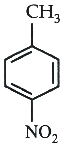
$R$ is one of the monomers for the formation of a polymer called
A
Dacron
B
Nylon $6, 6$
C
Nylon $6$
D
Bakelite
Solution
(A) The reaction sequence shows the conversion of $p$-nitrotoluene to terephthalic acid $(R)$.
$R$ is terephthalic acid $(C_6H_4(COOH)_2)$.
Terephthalic acid and ethylene glycol $(HOCH_2CH_2OH)$ are the monomers used for the synthesis of the polymer Dacron (also known as Terylene or Polyethylene terephthalate).
$R$ is terephthalic acid $(C_6H_4(COOH)_2)$.
Terephthalic acid and ethylene glycol $(HOCH_2CH_2OH)$ are the monomers used for the synthesis of the polymer Dacron (also known as Terylene or Polyethylene terephthalate).
0 likesView Solution
145
ChemistryEasyMCQTS EAMCET · 2023
Ziegler-Natta catalyst is used in the manufacture of
A
Polyacrylonitrile
B
Terylene
C
High density polythene
D
Low density polythene
Solution
(C) Ziegler-Natta catalyst is a mixture of $TiCl_4$ and $Al(C_2H_5)_3$.
It is specifically used for the polymerization of ethene to produce $HDPE$ (High Density Polythene) under low pressure conditions.
It is specifically used for the polymerization of ethene to produce $HDPE$ (High Density Polythene) under low pressure conditions.
0 likesView Solution
146
ChemistryEasyMCQTS EAMCET · 2023
Which of the following is the strongest reducing agent?
A
$TeO_3$
B
$SO_3$
C
$TeO_2$
D
$SO_2$
Solution
(D) The reducing power of oxides of group $16$ elements decreases down the group.
This is because the stability of the $+4$ oxidation state increases down the group due to the inert pair effect.
$SO_2$ acts as a reducing agent because $S$ can easily be oxidized from $+4$ to $+6$ oxidation state.
In contrast,$TeO_2$ is more stable in the $+4$ state and does not easily oxidize to $+6$.
Therefore,$SO_2$ is the strongest reducing agent among the given options.
This is because the stability of the $+4$ oxidation state increases down the group due to the inert pair effect.
$SO_2$ acts as a reducing agent because $S$ can easily be oxidized from $+4$ to $+6$ oxidation state.
In contrast,$TeO_2$ is more stable in the $+4$ state and does not easily oxidize to $+6$.
Therefore,$SO_2$ is the strongest reducing agent among the given options.
0 likesView Solution
147
ChemistryEasyMCQTS EAMCET · 2023
Identify the crystal system in which a primitive unit cell has edge lengths $a = b = 200 \text{ pm}$ and $c = 300 \text{ pm}$ and all axial angles are $90^{\circ}$.
A
Tetragonal
B
Rhombohedral
C
Monoclinic
D
Cubic
Solution
$(A)$ For a crystal system, the parameters $a = b \neq c$ and $\alpha = \beta = \gamma = 90^{\circ}$ correspond to the tetragonal crystal system.
In this case, $a = b = 200 \text{ pm}$ and $c = 300 \text{ pm}$, which satisfies the condition $a = b \neq c$.
Therefore, the correct crystal system is tetragonal.
In this case, $a = b = 200 \text{ pm}$ and $c = 300 \text{ pm}$, which satisfies the condition $a = b \neq c$.
Therefore, the correct crystal system is tetragonal.
0 likesView Solution
148
ChemistryMediumMCQTS EAMCET · 2023
At $T \ K$,copper (atomic mass $= 63.5 \ u$) has $fcc$ structure with an edge length of $x \ \mathring{A}$. The density of copper (in $g \ cm^{-3}$) at that temperature is approximately $(N_A = 6.0 \times 10^{23} \ mol^{-1})$
A
$\frac{423}{x}$
B
$\frac{4.23}{x^3}$
C
$\frac{423}{x^3}$
D
$\frac{212.5}{x^3}$
Solution
(C) The density $(d)$ of a unit cell is given by the formula: $d = \frac{Z \times M}{N_A \times a^3}$
For $fcc$ structure,the number of atoms per unit cell $(Z)$ is $4$.
The edge length $(a)$ is $x \ \mathring{A} = x \times 10^{-8} \ cm$.
Given $M = 63.5 \ g \ mol^{-1}$ and $N_A = 6.0 \times 10^{23} \ mol^{-1}$.
Substituting these values:
$d = \frac{4 \times 63.5}{(6.0 \times 10^{23}) \times (x \times 10^{-8})^3} \ g \ cm^{-3}$
$d = \frac{254}{6.0 \times 10^{23} \times x^3 \times 10^{-24}} \ g \ cm^{-3}$
$d = \frac{254}{0.6 \times x^3} \ g \ cm^{-3} = \frac{423.33}{x^3} \ g \ cm^{-3}$
Thus,the approximate density is $\frac{423}{x^3} \ g \ cm^{-3}$.
For $fcc$ structure,the number of atoms per unit cell $(Z)$ is $4$.
The edge length $(a)$ is $x \ \mathring{A} = x \times 10^{-8} \ cm$.
Given $M = 63.5 \ g \ mol^{-1}$ and $N_A = 6.0 \times 10^{23} \ mol^{-1}$.
Substituting these values:
$d = \frac{4 \times 63.5}{(6.0 \times 10^{23}) \times (x \times 10^{-8})^3} \ g \ cm^{-3}$
$d = \frac{254}{6.0 \times 10^{23} \times x^3 \times 10^{-24}} \ g \ cm^{-3}$
$d = \frac{254}{0.6 \times x^3} \ g \ cm^{-3} = \frac{423.33}{x^3} \ g \ cm^{-3}$
Thus,the approximate density is $\frac{423}{x^3} \ g \ cm^{-3}$.
0 likesView Solution
149
ChemistryMediumMCQTS EAMCET · 2023
$A$ body-centred cubic $(BCC)$ lattice is made up of two different types of atoms $X$ and $Y$. Atom $X$ occupies the body centre and atoms $Y$ occupy the corner positions. One of the corners is left unoccupied per unit cell. The empirical formula of it is
A
$X_2 Y_3$
B
$X_8 Y_7$
C
$X_7 Y_8$
D
$X_5 Y_7$
Solution
(B) Number of $X$ atoms per unit cell $= 1 \times 1 = 1$.
Number of $Y$ atoms per unit cell $= (8 - 1) \times \frac{1}{8} = \frac{7}{8}$.
Ratio of $X : Y = 1 : \frac{7}{8} = 8 : 7$.
Therefore,the empirical formula is $X_8 Y_7$.
Number of $Y$ atoms per unit cell $= (8 - 1) \times \frac{1}{8} = \frac{7}{8}$.
Ratio of $X : Y = 1 : \frac{7}{8} = 8 : 7$.
Therefore,the empirical formula is $X_8 Y_7$.
0 likesView Solution
150
ChemistryMediumMCQTS EAMCET · 2023
$A$ compound is formed by elements $A$,$B$ and $O$. Atoms of oxygen form $ccp$ lattice. Atoms of $A$ (cation) occupy $\frac{1}{8}^{\text{th}}$ of tetrahedral voids and atoms of $B$ (cation) occupy half of octahedral voids. What is the molecular formula of the compound?
A
$A_2BO_4$
B
$ABO_2$
C
$AB_2O_4$
D
$ABO_3$
Solution
(C) Let the number of oxygen atoms in the $ccp$ lattice be $1$.
Since the number of octahedral voids is equal to the number of atoms,the number of octahedral voids is $1$.
The number of tetrahedral voids is twice the number of atoms,so the number of tetrahedral voids is $2$.
Atoms of $A$ occupy $\frac{1}{8}$ of the tetrahedral voids,so the number of $A$ atoms $= \frac{1}{8} \times 2 = \frac{1}{4}$.
Atoms of $B$ occupy half of the octahedral voids,so the number of $B$ atoms $= \frac{1}{2} \times 1 = \frac{1}{2}$.
The ratio of $A:B:O$ is $\frac{1}{4} : \frac{1}{2} : 1$.
Multiplying the ratio by $4$,we get $1 : 2 : 4$.
Thus,the molecular formula of the compound is $AB_2O_4$.
Since the number of octahedral voids is equal to the number of atoms,the number of octahedral voids is $1$.
The number of tetrahedral voids is twice the number of atoms,so the number of tetrahedral voids is $2$.
Atoms of $A$ occupy $\frac{1}{8}$ of the tetrahedral voids,so the number of $A$ atoms $= \frac{1}{8} \times 2 = \frac{1}{4}$.
Atoms of $B$ occupy half of the octahedral voids,so the number of $B$ atoms $= \frac{1}{2} \times 1 = \frac{1}{2}$.
The ratio of $A:B:O$ is $\frac{1}{4} : \frac{1}{2} : 1$.
Multiplying the ratio by $4$,we get $1 : 2 : 4$.
Thus,the molecular formula of the compound is $AB_2O_4$.
0 likesView Solution
151
ChemistryEasyMCQTS EAMCET · 2023
In the structure of a solid,$W$ atoms are located at the cube corners of the unit cell,$O$ atoms are located at the cube edges,and $Na$ atoms are at the cube centers. The formula of the compound is:
A
$NaWO_3$
B
$NaWO$
C
$Na_2W_2O_2$
D
$Na_2WO_3$
Solution
(A) Contribution of $W$ atoms at the corners $= 8 \times \frac{1}{8} = 1$.
Contribution of $O$ atoms at the edges $= 12 \times \frac{1}{4} = 3$.
Contribution of $Na$ atoms at the body center $= 1 \times 1 = 1$.
Thus,the ratio of atoms $Na : W : O$ is $1 : 1 : 3$.
Therefore,the formula of the compound is $NaWO_3$.
Contribution of $O$ atoms at the edges $= 12 \times \frac{1}{4} = 3$.
Contribution of $Na$ atoms at the body center $= 1 \times 1 = 1$.
Thus,the ratio of atoms $Na : W : O$ is $1 : 1 : 3$.
Therefore,the formula of the compound is $NaWO_3$.
0 likesView Solution
152
ChemistryMediumMCQTS EAMCET · 2023
The vapour pressure of a pure liquid $A$ is $70 \ torr$ at $300 \ K$. It forms an ideal solution with another liquid $B$. The mole fraction of $B$ is $0.2$ and the total vapour pressure of the solution is $84 \ torr$ at the same temperature. The vapour pressure of pure liquid $B$ (in $torr$) is:
A
$140$
B
$90$
C
$120$
D
$80$
Solution
(A) According to Raoult's Law for an ideal solution:
$P_{total} = x_A P_A^{\circ} + x_B P_B^{\circ}$
Given:
$P_A^{\circ} = 70 \ torr$
$x_B = 0.2$
$x_A = 1 - 0.2 = 0.8$
$P_{total} = 84 \ torr$
Substituting the values into the equation:
$84 = (0.8 \times 70) + (0.2 \times P_B^{\circ})$
$84 = 56 + 0.2 P_B^{\circ}$
$0.2 P_B^{\circ} = 84 - 56$
$0.2 P_B^{\circ} = 28$
$P_B^{\circ} = \frac{28}{0.2} = 140 \ torr$
$P_{total} = x_A P_A^{\circ} + x_B P_B^{\circ}$
Given:
$P_A^{\circ} = 70 \ torr$
$x_B = 0.2$
$x_A = 1 - 0.2 = 0.8$
$P_{total} = 84 \ torr$
Substituting the values into the equation:
$84 = (0.8 \times 70) + (0.2 \times P_B^{\circ})$
$84 = 56 + 0.2 P_B^{\circ}$
$0.2 P_B^{\circ} = 84 - 56$
$0.2 P_B^{\circ} = 28$
$P_B^{\circ} = \frac{28}{0.2} = 140 \ torr$
0 likesView Solution
153
ChemistryMediumMCQTS EAMCET · 2023
Liquids $A$ and $B$ form an ideal solution. The vapour pressure of pure $A$ and $B$ are $50 \ mm \ Hg$ and $32 \ mm \ Hg$ respectively at $300 \ K$. One mole of liquid $A$ is mixed with $1$ mole of liquid $B$. What is the approximate mole fraction of $A$ in the vapour phase?
A
$0.39$
B
$0.5$
C
$0.25$
D
$0.61$
Solution
(D) Given: $P_A^0 = 50 \ mm \ Hg$,$P_B^0 = 32 \ mm \ Hg$.
Mole fraction in liquid phase: $X_A = \frac{1}{1+1} = 0.5$ and $X_B = \frac{1}{1+1} = 0.5$.
Partial pressures: $P_A = P_A^0 \times X_A = 50 \times 0.5 = 25 \ mm \ Hg$ and $P_B = P_B^0 \times X_B = 32 \times 0.5 = 16 \ mm \ Hg$.
Total pressure: $P_{total} = P_A + P_B = 25 + 16 = 41 \ mm \ Hg$.
Mole fraction of $A$ in vapour phase $(Y_A)$: $Y_A = \frac{P_A}{P_{total}} = \frac{25}{41} \approx 0.6097 \approx 0.61$.
Mole fraction in liquid phase: $X_A = \frac{1}{1+1} = 0.5$ and $X_B = \frac{1}{1+1} = 0.5$.
Partial pressures: $P_A = P_A^0 \times X_A = 50 \times 0.5 = 25 \ mm \ Hg$ and $P_B = P_B^0 \times X_B = 32 \times 0.5 = 16 \ mm \ Hg$.
Total pressure: $P_{total} = P_A + P_B = 25 + 16 = 41 \ mm \ Hg$.
Mole fraction of $A$ in vapour phase $(Y_A)$: $Y_A = \frac{P_A}{P_{total}} = \frac{25}{41} \approx 0.6097 \approx 0.61$.
0 likesView Solution
154
ChemistryMediumMCQTS EAMCET · 2023
At $300 \ K$,the osmotic pressure of a decinormal solution of sodium chloride is $4.82 \ atm$. The degree of dissociation of sodium chloride is $x \times 10^{-2}$. The value of $x$ is $\left(R=0.082 \ L \ atm \ K^{-1} \ mol^{-1}\right)$
A
$90$
B
$96$
C
$93$
D
$88$
Solution
(B) The osmotic pressure formula is given by $\pi = iCRT$.
Given: $\pi = 4.82 \ atm$,$C = 0.1 \ M$ (for $NaCl$,$N = M$),$R = 0.082 \ L \ atm \ K^{-1} \ mol^{-1}$,and $T = 300 \ K$.
Calculating the van't Hoff factor $(i)$:
$i = \frac{\pi}{CRT} = \frac{4.82}{0.1 \times 0.082 \times 300} = \frac{4.82}{2.46} \approx 1.959 \approx 1.96$.
For $NaCl$,the dissociation is $NaCl \rightarrow Na^+ + Cl^-$,so $n = 2$.
The degree of dissociation $(\alpha)$ is related to $i$ by $i = 1 + \alpha(n - 1)$.
$1.96 = 1 + \alpha(2 - 1) \Rightarrow \alpha = 0.96$.
Since $\alpha = x \times 10^{-2}$,we have $0.96 = x \times 10^{-2}$,which gives $x = 96$.
Given: $\pi = 4.82 \ atm$,$C = 0.1 \ M$ (for $NaCl$,$N = M$),$R = 0.082 \ L \ atm \ K^{-1} \ mol^{-1}$,and $T = 300 \ K$.
Calculating the van't Hoff factor $(i)$:
$i = \frac{\pi}{CRT} = \frac{4.82}{0.1 \times 0.082 \times 300} = \frac{4.82}{2.46} \approx 1.959 \approx 1.96$.
For $NaCl$,the dissociation is $NaCl \rightarrow Na^+ + Cl^-$,so $n = 2$.
The degree of dissociation $(\alpha)$ is related to $i$ by $i = 1 + \alpha(n - 1)$.
$1.96 = 1 + \alpha(2 - 1) \Rightarrow \alpha = 0.96$.
Since $\alpha = x \times 10^{-2}$,we have $0.96 = x \times 10^{-2}$,which gives $x = 96$.
0 likesView Solution
155
ChemistryMediumMCQTS EAMCET · 2023
$x \ g$ of urea (molar mass $60 \ g \ mol^{-1}$) is completely dissolved in $y \ g$ of pure water and the solution boiled at $373.202 \ K$. If the boiling point of pure water at $1.013 \ bar$ is $373.15 \ K$,then $x:y$ is $(K_b(H_2O) = 0.52 \ K \ kg \ mol^{-1})$
A
$6.0 \times 10^{-3}$
B
$3.0 \times 10^{-3}$
C
$9.0 \times 10^{-3}$
D
$4.5 \times 10^{-3}$
Solution
(A) The elevation in boiling point is given by $\Delta T_b = T_b - T_b^{\circ} = K_b \times m$,where $m$ is the molality of the solution.
$\Delta T_b = 373.202 \ K - 373.15 \ K = 0.052 \ K$.
Using the formula $\Delta T_b = K_b \times \frac{x \times 1000}{y \times M_{\text{urea}}}$,where $M_{\text{urea}} = 60 \ g \ mol^{-1}$.
$0.052 = 0.52 \times \frac{x \times 1000}{y \times 60}$.
$0.052 = \frac{x}{y} \times \frac{520}{60}$.
$\frac{x}{y} = \frac{0.052 \times 60}{520} = \frac{3.12}{520} = 0.006 = 6.0 \times 10^{-3}$.
$\Delta T_b = 373.202 \ K - 373.15 \ K = 0.052 \ K$.
Using the formula $\Delta T_b = K_b \times \frac{x \times 1000}{y \times M_{\text{urea}}}$,where $M_{\text{urea}} = 60 \ g \ mol^{-1}$.
$0.052 = 0.52 \times \frac{x \times 1000}{y \times 60}$.
$0.052 = \frac{x}{y} \times \frac{520}{60}$.
$\frac{x}{y} = \frac{0.052 \times 60}{520} = \frac{3.12}{520} = 0.006 = 6.0 \times 10^{-3}$.
0 likesView Solution
156
ChemistryMediumMCQTS EAMCET · 2023
At $50^{\circ} C$,the vapour pressure of pure benzene is $268 \ torr$. The number of moles of non-volatile solute per mole of benzene required to prepare a solution having a vapour pressure of $167 \ torr$ at the same temperature is (molar mass of benzene $= 78 \ g \ mol^{-1}$)
A
$0.505$
B
$0.705$
C
$0.605$
D
$0.405$
Solution
(C) According to Raoult's law for a solution containing a non-volatile solute,the vapour pressure of the solution is given by $P = P^{\circ} \cdot x_{\text{solvent}}$.
Here,$P = 167 \ torr$ and $P^{\circ} = 268 \ torr$.
So,the mole fraction of benzene is $x_{\text{benzene}} = \frac{P}{P^{\circ}} = \frac{167}{268} \approx 0.6231$.
Since $x_{\text{benzene}} = \frac{n_{\text{benzene}}}{n_{\text{benzene}} + n_{\text{solute}}}$,we set $n_{\text{benzene}} = 1 \ mol$.
Then,$0.6231 = \frac{1}{1 + n_{\text{solute}}}$.
$1 + n_{\text{solute}} = \frac{1}{0.6231} \approx 1.6048$.
$n_{\text{solute}} = 1.6048 - 1 = 0.6048 \ mol \approx 0.605 \ mol$.
Here,$P = 167 \ torr$ and $P^{\circ} = 268 \ torr$.
So,the mole fraction of benzene is $x_{\text{benzene}} = \frac{P}{P^{\circ}} = \frac{167}{268} \approx 0.6231$.
Since $x_{\text{benzene}} = \frac{n_{\text{benzene}}}{n_{\text{benzene}} + n_{\text{solute}}}$,we set $n_{\text{benzene}} = 1 \ mol$.
Then,$0.6231 = \frac{1}{1 + n_{\text{solute}}}$.
$1 + n_{\text{solute}} = \frac{1}{0.6231} \approx 1.6048$.
$n_{\text{solute}} = 1.6048 - 1 = 0.6048 \ mol \approx 0.605 \ mol$.
0 likesView Solution
157
ChemistryMediumMCQTS EAMCET · 2023
An aqueous solution of a non-volatile solute boils at $100.17^{\circ} C$. The temperature at which this solution will freeze (in $^{\circ} C$) is
$K_{b}(H_2 O) = 0.512^{\circ} C \ kg \ mol^{-1}$,
$K_{f}(H_2 O) = 1.86^{\circ} C \ kg \ mol^{-1}$
$K_{b}(H_2 O) = 0.512^{\circ} C \ kg \ mol^{-1}$,
$K_{f}(H_2 O) = 1.86^{\circ} C \ kg \ mol^{-1}$
A
$-0.62$
B
$-0.512$
C
$-1.24$
D
$-1.86$
Solution
(A) The elevation in boiling point is given by $\Delta T_{b} = T_{b} - T_{b}^{\circ} = 100.17^{\circ} C - 100^{\circ} C = 0.17^{\circ} C$.
Using the formula $\Delta T_{b} = K_{b} \times m$,where $m$ is the molality:
$0.17 = 0.512 \times m \implies m = \frac{0.17}{0.512} \ mol \ kg^{-1}$.
The depression in freezing point is given by $\Delta T_{f} = K_{f} \times m$.
$\Delta T_{f} = 1.86 \times \frac{0.17}{0.512} \approx 0.6176^{\circ} C \approx 0.62^{\circ} C$.
The freezing point of the solution is $T_{f} = T_{f}^{\circ} - \Delta T_{f} = 0^{\circ} C - 0.62^{\circ} C = -0.62^{\circ} C$.
Using the formula $\Delta T_{b} = K_{b} \times m$,where $m$ is the molality:
$0.17 = 0.512 \times m \implies m = \frac{0.17}{0.512} \ mol \ kg^{-1}$.
The depression in freezing point is given by $\Delta T_{f} = K_{f} \times m$.
$\Delta T_{f} = 1.86 \times \frac{0.17}{0.512} \approx 0.6176^{\circ} C \approx 0.62^{\circ} C$.
The freezing point of the solution is $T_{f} = T_{f}^{\circ} - \Delta T_{f} = 0^{\circ} C - 0.62^{\circ} C = -0.62^{\circ} C$.
0 likesView Solution
158
ChemistryMediumMCQTS EAMCET · 2023
$A$ polymer sample contains $3$ molecules of molar mass $10^3$,$3$ molecules of molar mass $500$,and $4$ molecules of molar mass $200$. What is its weight average molecular mass?
A
$530$
B
$737.7$
C
$834.4$
D
$821.6$
Solution
(B) The weight average molecular mass is calculated using the formula: $\bar{M}_w = \frac{\sum n_i M_i^2}{\sum n_i M_i}$
Given:
$n_1 = 3, M_1 = 1000$
$n_2 = 3, M_2 = 500$
$n_3 = 4, M_3 = 200$
Numerator: $(3 \times 1000^2) + (3 \times 500^2) + (4 \times 200^2) = 3,000,000 + 750,000 + 160,000 = 3,910,000$
Denominator: $(3 \times 1000) + (3 \times 500) + (4 \times 200) = 3000 + 1500 + 800 = 5300$
$\bar{M}_w = \frac{3,910,000}{5300} \approx 737.7$
Given:
$n_1 = 3, M_1 = 1000$
$n_2 = 3, M_2 = 500$
$n_3 = 4, M_3 = 200$
Numerator: $(3 \times 1000^2) + (3 \times 500^2) + (4 \times 200^2) = 3,000,000 + 750,000 + 160,000 = 3,910,000$
Denominator: $(3 \times 1000) + (3 \times 500) + (4 \times 200) = 3000 + 1500 + 800 = 5300$
$\bar{M}_w = \frac{3,910,000}{5300} \approx 737.7$
0 likesView Solution
159
ChemistryMediumMCQTS EAMCET · 2023
The formula of a metal oxide is $M_{0.96} O_1$. The fractions of metal that exist as $M^{3+}$ and $M^{2+}$ ions in that oxide are respectively
A
$0.083, 0.916$
B
$0.916, 0.083$
C
$0.88, 0.12$
D
$0.12, 0.88$
Solution
(A) Let $x$ be the number of $M^{3+}$ ions and $y$ be the number of $M^{2+}$ ions.
Total number of metal ions is $x + y = 0.96$.
Therefore,$y = 0.96 - x$.
Since the oxide is electrically neutral,the total positive charge must equal the total negative charge ($-2$ for $O^{2-}$).
$3x + 2y = 2$.
Substituting $y = 0.96 - x$ into the equation:
$3x + 2(0.96 - x) = 2$.
$3x + 1.92 - 2x = 2$.
$x = 0.08$.
Thus,$y = 0.96 - 0.08 = 0.88$.
The fraction of $M^{3+} = \frac{0.08}{0.96} = 0.083$.
The fraction of $M^{2+} = \frac{0.88}{0.96} = 0.917$.
Total number of metal ions is $x + y = 0.96$.
Therefore,$y = 0.96 - x$.
Since the oxide is electrically neutral,the total positive charge must equal the total negative charge ($-2$ for $O^{2-}$).
$3x + 2y = 2$.
Substituting $y = 0.96 - x$ into the equation:
$3x + 2(0.96 - x) = 2$.
$3x + 1.92 - 2x = 2$.
$x = 0.08$.
Thus,$y = 0.96 - 0.08 = 0.88$.
The fraction of $M^{3+} = \frac{0.08}{0.96} = 0.083$.
The fraction of $M^{2+} = \frac{0.88}{0.96} = 0.917$.
0 likesView Solution
160
ChemistryMediumMCQTS EAMCET · 2023
Observe the following ions: $V^{2+}, Zn^{2+}, Cu^{2+}, Fe^{2+}, Fe^{3+}, Ti^{3+}, Sc^{3+}, Ti^{4+}, Ni^{3+}, Co^{3+}, Cu^+$. How many ions in the above list have zero magnetic moment?
A
$4$
B
$3$
C
$5$
D
$2$
Solution
(A) An ion has zero magnetic moment if it has no unpaired electrons (diamagnetic).
$V^{2+} = [Ar] 3d^3$ ($3$ unpaired electrons)
$Zn^{2+} = [Ar] 3d^{10}$ ($0$ unpaired electrons)
$Cu^{2+} = [Ar] 3d^9$ ($1$ unpaired electron)
$Fe^{2+} = [Ar] 3d^6$ ($4$ unpaired electrons)
$Fe^{3+} = [Ar] 3d^5$ ($5$ unpaired electrons)
$Ti^{3+} = [Ar] 3d^1$ ($1$ unpaired electron)
$Sc^{3+} = [Ar] 3d^0$ ($0$ unpaired electrons)
$Ti^{4+} = [Ar] 3d^0$ ($0$ unpaired electrons)
$Ni^{3+} = [Ar] 3d^7$ ($3$ unpaired electrons)
$Co^{3+} = [Ar] 3d^6$ ($4$ unpaired electrons)
$Cu^{+} = [Ar] 3d^{10}$ ($0$ unpaired electrons)
The ions with zero magnetic moment are $Zn^{2+}$,$Sc^{3+}$,$Ti^{4+}$,and $Cu^+$.
There are $4$ such ions.
$V^{2+} = [Ar] 3d^3$ ($3$ unpaired electrons)
$Zn^{2+} = [Ar] 3d^{10}$ ($0$ unpaired electrons)
$Cu^{2+} = [Ar] 3d^9$ ($1$ unpaired electron)
$Fe^{2+} = [Ar] 3d^6$ ($4$ unpaired electrons)
$Fe^{3+} = [Ar] 3d^5$ ($5$ unpaired electrons)
$Ti^{3+} = [Ar] 3d^1$ ($1$ unpaired electron)
$Sc^{3+} = [Ar] 3d^0$ ($0$ unpaired electrons)
$Ti^{4+} = [Ar] 3d^0$ ($0$ unpaired electrons)
$Ni^{3+} = [Ar] 3d^7$ ($3$ unpaired electrons)
$Co^{3+} = [Ar] 3d^6$ ($4$ unpaired electrons)
$Cu^{+} = [Ar] 3d^{10}$ ($0$ unpaired electrons)
The ions with zero magnetic moment are $Zn^{2+}$,$Sc^{3+}$,$Ti^{4+}$,and $Cu^+$.
There are $4$ such ions.
0 likesView Solution
161
ChemistryMediumMCQTS EAMCET · 2023
Match the following:
| List-$I$ (Complex) | List-$II$ (Spin only Magnetic moment) |
| $A$. $[CoF_6]^{3-}$ | $I$. $0$ |
| $B$. $[Co(C_2O_4)_3]^{3-}$ | $II$. $\sqrt{24}$ |
| $C$. $[FeF_6]^{3-}$ | $III$. $\sqrt{8}$ |
| $D$. $[Mn(CN)_6]^{3-}$ | $IV$. $\sqrt{35}$ |
| $V$. $\sqrt{15}$ |
A
$A-II, B-I, C-IV, D-III$
B
$A-II, B-I, C-IV, D-III$
C
$A-II, B-I, C-V, D-III$
D
$A-III, B-II, C-I, D-V$
Solution
(A) $[CoF_6]^{3-}: Co$ is in $+3$ oxidation state $(3d^6)$. $F^-$ is a weak-field ligand,so electrons remain unpaired $(n=4)$. $\mu = \sqrt{4(4+2)} = \sqrt{24} \ B.M.$
$[Co(C_2O_4)_3]^{3-}: Co$ is in $+3$ oxidation state $(3d^6)$. $C_2O_4^{2-}$ is a strong-field ligand,so electrons pair up $(n=0)$. $\mu = 0 \ B.M.$
$[FeF_6]^{3-}: Fe$ is in $+3$ oxidation state $(3d^5)$. $F^-$ is a weak-field ligand,so electrons remain unpaired $(n=5)$. $\mu = \sqrt{5(5+2)} = \sqrt{35} \ B.M.$
$[Mn(CN)_6]^{3-}: Mn$ is in $+3$ oxidation state $(3d^4)$. $CN^-$ is a strong-field ligand,causing pairing $(n=2)$. $\mu = \sqrt{2(2+2)} = \sqrt{8} \ B.M.$
Thus,the correct match is $A-II, B-I, C-IV, D-III$.
$[Co(C_2O_4)_3]^{3-}: Co$ is in $+3$ oxidation state $(3d^6)$. $C_2O_4^{2-}$ is a strong-field ligand,so electrons pair up $(n=0)$. $\mu = 0 \ B.M.$
$[FeF_6]^{3-}: Fe$ is in $+3$ oxidation state $(3d^5)$. $F^-$ is a weak-field ligand,so electrons remain unpaired $(n=5)$. $\mu = \sqrt{5(5+2)} = \sqrt{35} \ B.M.$
$[Mn(CN)_6]^{3-}: Mn$ is in $+3$ oxidation state $(3d^4)$. $CN^-$ is a strong-field ligand,causing pairing $(n=2)$. $\mu = \sqrt{2(2+2)} = \sqrt{8} \ B.M.$
Thus,the correct match is $A-II, B-I, C-IV, D-III$.
0 likesView Solution
162
ChemistryEasyMCQTS EAMCET · 2023
Identify the factors which favour the physical adsorption from the following.
$(I)$ High surface area
$(II)$ Low temperatures
$(III)$ High temperatures
$(IV)$ Low pressures
$(V)$ High pressures
$(I)$ High surface area
$(II)$ Low temperatures
$(III)$ High temperatures
$(IV)$ Low pressures
$(V)$ High pressures
A
$I, III$ & $IV$ only
B
$I, II$ & $V$ only
C
$III$ & $V$ only
D
$I, II$ & $IV$ only
Solution
(B) Physical adsorption (physisorption) is an exothermic process,so it is favoured at low temperatures according to Le Chatelier's principle.
High surface area of the adsorbent provides more active sites for the accumulation of adsorbate molecules.
High pressure increases the concentration of gas molecules on the surface of the adsorbent,thereby increasing the extent of adsorption.
Therefore,factors $(I)$,$(II)$,and $(V)$ favour physical adsorption.
High surface area of the adsorbent provides more active sites for the accumulation of adsorbate molecules.
High pressure increases the concentration of gas molecules on the surface of the adsorbent,thereby increasing the extent of adsorption.
Therefore,factors $(I)$,$(II)$,and $(V)$ favour physical adsorption.
0 likesView Solution
163
ChemistryMediumMCQTS EAMCET · 2023
The graph given below shows the relationship between the extent of adsorption $(x / m)$ and pressure at different temperatures. The correct order of temperatures for curves $i$,$ii$,and $iii$ is:
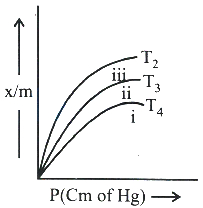
A
$T_4 > T_2 > T_3$
B
$T_4 > T_3 > T_2$
C
$T_2 > T_3 > T_4$
D
$T_2 > T_4 > T_3$
Solution
(B) Adsorption is an exothermic process. According to Le Chatelier's principle,for physical adsorption,the extent of adsorption $(x / m)$ decreases with an increase in temperature at a constant pressure.
From the given graph,at a constant pressure,the extent of adsorption follows the order: $T_2 > T_3 > T_4$.
Since the extent of adsorption is inversely proportional to temperature for physisorption,the correct order of temperatures is $T_4 > T_3 > T_2$.
From the given graph,at a constant pressure,the extent of adsorption follows the order: $T_2 > T_3 > T_4$.
Since the extent of adsorption is inversely proportional to temperature for physisorption,the correct order of temperatures is $T_4 > T_3 > T_2$.
0 likesView Solution
164
ChemistryEasyMCQTS EAMCET · 2023
Which of the following can form ionic micelles in water?
A
Starch molecules
B
Sodium lauryl sulphate
C
Iodine molecules
D
$S_8$ molecules
Solution
(B) Sodium lauryl sulphate $(CH_3(CH_2)_{11}SO_4^-Na^+)$ is an anionic surfactant.
It consists of a long hydrophobic hydrocarbon chain and a hydrophilic ionic head.
In water,these molecules aggregate to form ionic micelles above the Critical Micelle Concentration $(CMC)$.
It consists of a long hydrophobic hydrocarbon chain and a hydrophilic ionic head.
In water,these molecules aggregate to form ionic micelles above the Critical Micelle Concentration $(CMC)$.
0 likesView Solution
165
ChemistryEasyMCQTS EAMCET · 2023
The sol prepared by Bredig's Arc method is $X$ and the charge of sol particles of it is $q$. $X$ and $q$ are respectively.
A
Metal sol,$-ve$
B
Metal sol,$+ve$
C
Metal sulphide sol,$-ve$
D
$TiO_2$ sol,$+ve$
Solution
(A) Bredig's Arc (Electrical disintegration) method is used to prepare colloidal sols of metals such as gold,silver,platinum,etc.
In this method,an electric arc is struck between electrodes of the metal immersed in the dispersion medium.
The intense heat produced vaporizes the metal,which then condenses to form particles of the colloidal size.
Metal sols typically acquire a negative charge due to the preferential adsorption of anions from the dispersion medium.
In this method,an electric arc is struck between electrodes of the metal immersed in the dispersion medium.
The intense heat produced vaporizes the metal,which then condenses to form particles of the colloidal size.
Metal sols typically acquire a negative charge due to the preferential adsorption of anions from the dispersion medium.
0 likesView Solution
166
ChemistryMediumMCQTS EAMCET · 2023
Consider the following statements about the Tyndall effect:
$(I)$ It is used to distinguish between a true solution and a colloidal solution.
$(II)$ It is possible only when the refractive indices of the dispersed phase and the dispersion medium differ significantly.
$(III)$ It is observed only when the size of the colloidal particles is much smaller than the wavelength of the light used.
Which of the following statements are correct?
$(I)$ It is used to distinguish between a true solution and a colloidal solution.
$(II)$ It is possible only when the refractive indices of the dispersed phase and the dispersion medium differ significantly.
$(III)$ It is observed only when the size of the colloidal particles is much smaller than the wavelength of the light used.
Which of the following statements are correct?
A
$I$ and $III$ only
B
$II$ and $III$ only
C
$I$,$II$,and $III$
D
$I$ and $II$ only
Solution
(D) The Tyndall effect is the scattering of light by colloidal particles.
Statement $(I)$ is correct: It is a standard method to distinguish between a true solution (which does not show the effect) and a colloidal solution (which does).
Statement $(II)$ is correct: The scattering of light depends on the difference in refractive indices between the dispersed phase and the dispersion medium.
Statement $(III)$ is incorrect: The Tyndall effect is observed when the diameter of the dispersed particles is not much smaller than the wavelength of the light used; if particles are too small,they do not scatter light effectively.
Therefore,statements $(I)$ and $(II)$ are correct.
Statement $(I)$ is correct: It is a standard method to distinguish between a true solution (which does not show the effect) and a colloidal solution (which does).
Statement $(II)$ is correct: The scattering of light depends on the difference in refractive indices between the dispersed phase and the dispersion medium.
Statement $(III)$ is incorrect: The Tyndall effect is observed when the diameter of the dispersed particles is not much smaller than the wavelength of the light used; if particles are too small,they do not scatter light effectively.
Therefore,statements $(I)$ and $(II)$ are correct.
0 likesView Solution
167
ChemistryEasyMCQTS EAMCET · 2023
Match the items in List-$I$ with the items in List-$II$.
| List-$I$ | List-$II$ |
|---|---|
| $A$. Negatively charged sol | $I$. Emulsion |
| $B$. Milk | $II$. Kala-azar |
| $C$. Gold number | $III$. $FeCl_3$ solution is added to excess $NaOH$ solution |
| $D$. Colloidal antimony | $IV$. Protection of colloids |
A
$A-III, B-I, C-II, D-IV$
B
$A-III, B-I, C-IV, D-II$
C
$A-I, B-III, C-IV, D-II$
D
$A-II, B-I, C-III, D-IV$
Solution
(B) . Negatively charged sol: When $FeCl_3$ is added to excess $NaOH$ solution,it forms a negatively charged $Fe(OH)_3$ sol due to the adsorption of $OH^-$ ions. Thus,$A-III$.
$B$. Milk: Milk is a well-known example of an emulsion (liquid in liquid). Thus,$B-I$.
$C$. Gold number: It is a measure of the protective power of a lyophilic colloid. Thus,$C-IV$.
$D$. Colloidal antimony: It is used in the treatment of the disease kala-azar. Thus,$D-II$.
Therefore,the correct matching is $A-III, B-I, C-IV, D-II$.
$B$. Milk: Milk is a well-known example of an emulsion (liquid in liquid). Thus,$B-I$.
$C$. Gold number: It is a measure of the protective power of a lyophilic colloid. Thus,$C-IV$.
$D$. Colloidal antimony: It is used in the treatment of the disease kala-azar. Thus,$D-II$.
Therefore,the correct matching is $A-III, B-I, C-IV, D-II$.
0 likesView Solution
168
ChemistryEasyMCQTS EAMCET · 2023
Ellingham diagram is the plot of $X$ vs $Y$. What are $X$ and $Y$?
A
$\Delta G^{\circ}, T$
B
$\Delta G^{\circ}, 1 / T$
C
$\Delta S^{\circ}, T$
D
$\Delta H^{\circ}, 1 / T$
Solution
(A) The Ellingham diagram is a graphical representation of the variation of the change in standard Gibbs free energy $(\Delta G^{\circ})$ with temperature $(T)$.
Thus,$X = \Delta G^{\circ}$ and $Y = T$.
Thus,$X = \Delta G^{\circ}$ and $Y = T$.
0 likesView Solution
Vedclass Products
For Students
Vedclass Test Series
Mock tests in real TS EAMCET style covering Chemistry with performance analysis. 5-day free trial.
Start Free TrialFor Teachers
Exam Paper Generator
Generate Set A/B/C/D Chemistry papers from 7.5L+ questions in 2 minutes. 3 chapters free.
Try FreeFor Institutes
Online Exam Module
Run live TS EAMCET mock exams with unlimited students, 360° analytics & white-label branding.
See DemoFrequently Asked Questions
How many Chemistry questions are in TS EAMCET 2023?
There are 268 Chemistry questions from the TS EAMCET 2023 paper on Vedclass, each with a detailed step-by-step solution in English.
Are TS EAMCET 2023 Chemistry solutions available in English?
Yes. All solutions on this page are in English. You can also switch to English or Hindi using the language buttons above the questions.
Can I practice TS EAMCET 2023 Chemistry as a timed test?
Yes. Use the Vedclass Test Series to attempt a full TS EAMCET mock test covering Chemistry with time limits and instant score analysis.
Can teachers create Chemistry papers from TS EAMCET previous year questions?
Yes. The Vedclass Exam Paper Generator lets teachers mix TS EAMCET Chemistry questions and generate Set A/B/C/D papers in minutes.
For Teachers & Institutes
Build a Custom Chemistry Paper
Pick TS EAMCET 2023 Chemistry questions, set difficulty, and generate Set A/B/C/D in 2 minutes.