
MathematicsQ1–100 of 489 questions
Page 1 of 6 · English
1
MathematicsMediumMCQTS EAMCET · 2023
The number of integral terms in the expansion of $(\sqrt{3} + \sqrt[8]{5})^{256}$ is
A
$32$
B
$33$
C
$34$
D
$35$
Solution
(B) The general term in the expansion of $(\sqrt{3} + \sqrt[8]{5})^{256}$ is given by $T_{r+1} = {}^{256}C_r (\sqrt{3})^{256-r} (\sqrt[8]{5})^r$.
This simplifies to $T_{r+1} = {}^{256}C_r (3)^{\frac{256-r}{2}} (5)^{\frac{r}{8}}$.
For the term to be an integer,both exponents $\frac{256-r}{2}$ and $\frac{r}{8}$ must be non-negative integers.
Since $0 \leq r \leq 256$,for $\frac{r}{8}$ to be an integer,$r$ must be a multiple of $8$,i.e.,$r \in \{0, 8, 16, \dots, 256\}$.
For these values of $r$,$\frac{256-r}{2} = 128 - \frac{r}{2}$ is also an integer because $r$ is a multiple of $8$ (and thus a multiple of $2$).
The number of such values of $r$ is given by the arithmetic progression $0, 8, 16, \dots, 256$.
Using the formula $a_n = a + (n-1)d$,we have $256 = 0 + (n-1)8$,which gives $n-1 = 32$,so $n = 33$.
Thus,there are $33$ integral terms.
This simplifies to $T_{r+1} = {}^{256}C_r (3)^{\frac{256-r}{2}} (5)^{\frac{r}{8}}$.
For the term to be an integer,both exponents $\frac{256-r}{2}$ and $\frac{r}{8}$ must be non-negative integers.
Since $0 \leq r \leq 256$,for $\frac{r}{8}$ to be an integer,$r$ must be a multiple of $8$,i.e.,$r \in \{0, 8, 16, \dots, 256\}$.
For these values of $r$,$\frac{256-r}{2} = 128 - \frac{r}{2}$ is also an integer because $r$ is a multiple of $8$ (and thus a multiple of $2$).
The number of such values of $r$ is given by the arithmetic progression $0, 8, 16, \dots, 256$.
Using the formula $a_n = a + (n-1)d$,we have $256 = 0 + (n-1)8$,which gives $n-1 = 32$,so $n = 33$.
Thus,there are $33$ integral terms.
0 likesView Solution
2
MathematicsDifficultMCQTS EAMCET · 2023
If $\theta = \frac{\pi}{6}$,then the $10^{th}$ term of the series $1 + (\cos \theta + i \sin \theta) + (\cos \theta + i \sin \theta)^2 + (\cos \theta + i \sin \theta)^3 + \ldots$ is equal to:
A
$i$
B
$-1$
C
$1$
D
$-i$
Solution
(D) The given series is a geometric progression with the first term $a = 1$ and common ratio $r = (\cos \theta + i \sin \theta)$.
The $n^{th}$ term of a geometric progression is given by $T_n = a \cdot r^{n-1}$.
For the $10^{th}$ term $(n = 10)$,we have $T_{10} = 1 \cdot (\cos \theta + i \sin \theta)^{10-1} = (\cos \theta + i \sin \theta)^9$.
Using De Moivre's theorem,$(\cos \theta + i \sin \theta)^n = \cos(n\theta) + i \sin(n\theta) = e^{i n \theta}$.
Substituting $\theta = \frac{\pi}{6}$ and $n = 9$:
$T_{10} = e^{i 9 (\frac{\pi}{6})} = e^{i \frac{3\pi}{2}}$.
Using Euler's formula $e^{i \phi} = \cos \phi + i \sin \phi$:
$T_{10} = \cos(\frac{3\pi}{2}) + i \sin(\frac{3\pi}{2}) = 0 + i(-1) = -i$.
The $n^{th}$ term of a geometric progression is given by $T_n = a \cdot r^{n-1}$.
For the $10^{th}$ term $(n = 10)$,we have $T_{10} = 1 \cdot (\cos \theta + i \sin \theta)^{10-1} = (\cos \theta + i \sin \theta)^9$.
Using De Moivre's theorem,$(\cos \theta + i \sin \theta)^n = \cos(n\theta) + i \sin(n\theta) = e^{i n \theta}$.
Substituting $\theta = \frac{\pi}{6}$ and $n = 9$:
$T_{10} = e^{i 9 (\frac{\pi}{6})} = e^{i \frac{3\pi}{2}}$.
Using Euler's formula $e^{i \phi} = \cos \phi + i \sin \phi$:
$T_{10} = \cos(\frac{3\pi}{2}) + i \sin(\frac{3\pi}{2}) = 0 + i(-1) = -i$.
0 likesView Solution
3
MathematicsDifficultMCQTS EAMCET · 2023
The equation of the locus of $z$ such that $\left|\frac{z-i}{z+i}\right|=2$,where $z=x+iy$ is a complex number,is
A
$3x^2+3y^2+10y-3=0$
B
$3x^2+3y^2+10y+3=0$
C
$3x^2-3y^2-10y-3=0$
D
$x^2+y^2-5y+3=0$
Solution
(B) Given $\left|\frac{z-i}{z i}\right|=2$.
Since $z=x iy$,we have $\left|\frac{x i(y-1)}{x i(y 1)}\right|=2$.
Squaring both sides,we get $\frac{x^2 (y-1)^2}{x^2 (y 1)^2}=4$.
$x^2 y^2-2y 1=4(x^2 y^2 2y 1)$.
$x^2 y^2-2y 1=4x^2 4y^2 8y 4$.
Rearranging the terms,we get $3x^2 3y^2 10y 3=0$.
Since $z=x iy$,we have $\left|\frac{x i(y-1)}{x i(y 1)}\right|=2$.
Squaring both sides,we get $\frac{x^2 (y-1)^2}{x^2 (y 1)^2}=4$.
$x^2 y^2-2y 1=4(x^2 y^2 2y 1)$.
$x^2 y^2-2y 1=4x^2 4y^2 8y 4$.
Rearranging the terms,we get $3x^2 3y^2 10y 3=0$.
0 likesView Solution
4
MathematicsMediumMCQTS EAMCET · 2023
There are three sections in a question paper,each containing $4$ questions. If a candidate has to answer only $5$ questions from this paper without leaving any section,then the number of ways the candidate can make the choice of questions is:
A
$624$
B
$704$
C
$384$
D
$432$
Solution
(A) The total number of questions is $12$ ($3$ sections $\times$ $4$ questions each). The candidate must select $5$ questions such that at least one question is chosen from each section.
Possible distributions of $5$ questions across $3$ sections $(A, B, C)$ are:
Case $1$: $(2, 2, 1)$ in any order. The number of ways is $3 \times (^4C_2 \times ^4C_2 \times ^4C_1) = 3 \times (6 \times 6 \times 4) = 3 \times 144 = 432$.
Case $2$: $(3, 1, 1)$ in any order. The number of ways is $3 \times (^4C_3 \times ^4C_1 \times ^4C_1) = 3 \times (4 \times 4 \times 4) = 3 \times 64 = 192$.
Total number of ways = $432 + 192 = 624$.
Possible distributions of $5$ questions across $3$ sections $(A, B, C)$ are:
Case $1$: $(2, 2, 1)$ in any order. The number of ways is $3 \times (^4C_2 \times ^4C_2 \times ^4C_1) = 3 \times (6 \times 6 \times 4) = 3 \times 144 = 432$.
Case $2$: $(3, 1, 1)$ in any order. The number of ways is $3 \times (^4C_3 \times ^4C_1 \times ^4C_1) = 3 \times (4 \times 4 \times 4) = 3 \times 64 = 192$.
Total number of ways = $432 + 192 = 624$.
0 likesView Solution
5
MathematicsMediumMCQTS EAMCET · 2023
$A$ line $L$ has intercepts $a$ and $b$ on the coordinate axes. When the axes are rotated through a given angle $\theta$ keeping the origin fixed,this line $L$ has the intercepts $p$ and $q$. Then
A
$a^2+b^2=p^2+q^2$
B
$a^2+p^2=b^2+q^2$
C
$\frac{1}{a^2}+\frac{1}{p^2}=\frac{1}{b^2}+\frac{1}{q^2}$
D
$\frac{1}{a^2}+\frac{1}{b^2}=\frac{1}{p^2}+\frac{1}{q^2}$
Solution
(D) The equation of the line $L$ with intercepts $a$ and $b$ is given by $\frac{x}{a} + \frac{y}{b} = 1$.
When the axes are rotated by an angle $\theta$,the new coordinates $(x', y')$ are related to the old coordinates $(x, y)$ by $x = x' \cos \theta - y' \sin \theta$ and $y = x' \sin \theta + y' \cos \theta$.
Substituting these into the equation of the line:
$\frac{x' \cos \theta - y' \sin \theta}{a} + \frac{x' \sin \theta + y' \cos \theta}{b} = 1$
$x' \left( \frac{\cos \theta}{a} + \frac{\sin \theta}{b} \right) + y' \left( \frac{\cos \theta}{b} - \frac{\sin \theta}{a} \right) = 1$.
Comparing this with the intercept form of the line in the new axes,$\frac{x'}{p} + \frac{y'}{q} = 1$,we get:
$\frac{1}{p} = \frac{\cos \theta}{a} + \frac{\sin \theta}{b}$ and $\frac{1}{q} = \frac{\cos \theta}{b} - \frac{\sin \theta}{a}$.
Squaring and adding these equations:
$\frac{1}{p^2} + \frac{1}{q^2} = \left( \frac{\cos \theta}{a} + \frac{\sin \theta}{b} \right)^2 + \left( \frac{\cos \theta}{b} - \frac{\sin \theta}{a} \right)^2$
$= \frac{\cos^2 \theta}{a^2} + \frac{\sin^2 \theta}{b^2} + \frac{2 \sin \theta \cos \theta}{ab} + \frac{\cos^2 \theta}{b^2} + \frac{\sin^2 \theta}{a^2} - \frac{2 \sin \theta \cos \theta}{ab}$
$= \frac{\cos^2 \theta + \sin^2 \theta}{a^2} + \frac{\cos^2 \theta + \sin^2 \theta}{b^2}$
$= \frac{1}{a^2} + \frac{1}{b^2}$.
Thus,$\frac{1}{a^2} + \frac{1}{b^2} = \frac{1}{p^2} + \frac{1}{q^2}$.
When the axes are rotated by an angle $\theta$,the new coordinates $(x', y')$ are related to the old coordinates $(x, y)$ by $x = x' \cos \theta - y' \sin \theta$ and $y = x' \sin \theta + y' \cos \theta$.
Substituting these into the equation of the line:
$\frac{x' \cos \theta - y' \sin \theta}{a} + \frac{x' \sin \theta + y' \cos \theta}{b} = 1$
$x' \left( \frac{\cos \theta}{a} + \frac{\sin \theta}{b} \right) + y' \left( \frac{\cos \theta}{b} - \frac{\sin \theta}{a} \right) = 1$.
Comparing this with the intercept form of the line in the new axes,$\frac{x'}{p} + \frac{y'}{q} = 1$,we get:
$\frac{1}{p} = \frac{\cos \theta}{a} + \frac{\sin \theta}{b}$ and $\frac{1}{q} = \frac{\cos \theta}{b} - \frac{\sin \theta}{a}$.
Squaring and adding these equations:
$\frac{1}{p^2} + \frac{1}{q^2} = \left( \frac{\cos \theta}{a} + \frac{\sin \theta}{b} \right)^2 + \left( \frac{\cos \theta}{b} - \frac{\sin \theta}{a} \right)^2$
$= \frac{\cos^2 \theta}{a^2} + \frac{\sin^2 \theta}{b^2} + \frac{2 \sin \theta \cos \theta}{ab} + \frac{\cos^2 \theta}{b^2} + \frac{\sin^2 \theta}{a^2} - \frac{2 \sin \theta \cos \theta}{ab}$
$= \frac{\cos^2 \theta + \sin^2 \theta}{a^2} + \frac{\cos^2 \theta + \sin^2 \theta}{b^2}$
$= \frac{1}{a^2} + \frac{1}{b^2}$.
Thus,$\frac{1}{a^2} + \frac{1}{b^2} = \frac{1}{p^2} + \frac{1}{q^2}$.
0 likesView Solution
6
MathematicsDifficultMCQTS EAMCET · 2023
If $y = \frac{3}{4} + \frac{3 \cdot 5}{4 \cdot 8} + \frac{3 \cdot 5 \cdot 7}{4 \cdot 8 \cdot 12} + \dots \infty$,then
A
$y^2 - 2y + 5 = 0$
B
$y^2 + 2y - 7 = 0$
C
$y^2 - 3y + 4 = 0$
D
$y^2 + 4y - 6 = 0$
Solution
(B) The given series is $y = \frac{3}{4} + \frac{3 \cdot 5}{4 \cdot 8} + \frac{3 \cdot 5 \cdot 7}{4 \cdot 8 \cdot 12} + \dots \infty$.
Adding $1$ to both sides,we get $1 + y = 1 + \frac{3}{4} + \frac{3 \cdot 5}{4 \cdot 8} + \frac{3 \cdot 5 \cdot 7}{4 \cdot 8 \cdot 12} + \dots \infty$.
This is of the form $(1 - x)^{-n} = 1 + nx + \frac{n(n+1)}{2!}x^2 + \dots$.
Comparing terms,we have $nx = \frac{3}{4}$ and $\frac{n(n+1)}{2}x^2 = \frac{3 \cdot 5}{4 \cdot 8} = \frac{15}{32}$.
From $nx = \frac{3}{4}$,we get $x = \frac{3}{4n}$.
Substituting into the second term: $\frac{n(n+1)}{2} \cdot \frac{9}{16n^2} = \frac{15}{32} \implies \frac{n+1}{n} \cdot \frac{9}{32} = \frac{15}{32} \implies \frac{n+1}{n} = \frac{15}{9} = \frac{5}{3}$.
Solving for $n$: $3n + 3 = 5n \implies 2n = 3 \implies n = \frac{3}{2}$.
Then $x = \frac{3}{4 \cdot (3/2)} = \frac{3}{6} = \frac{1}{2}$.
Thus,$1 + y = (1 - 1/2)^{-3/2} = (1/2)^{-3/2} = 2^{3/2} = 2\sqrt{2}$.
Squaring both sides: $(1 + y)^2 = (2\sqrt{2})^2 = 8$.
$1 + 2y + y^2 = 8 \implies y^2 + 2y - 7 = 0$.
Adding $1$ to both sides,we get $1 + y = 1 + \frac{3}{4} + \frac{3 \cdot 5}{4 \cdot 8} + \frac{3 \cdot 5 \cdot 7}{4 \cdot 8 \cdot 12} + \dots \infty$.
This is of the form $(1 - x)^{-n} = 1 + nx + \frac{n(n+1)}{2!}x^2 + \dots$.
Comparing terms,we have $nx = \frac{3}{4}$ and $\frac{n(n+1)}{2}x^2 = \frac{3 \cdot 5}{4 \cdot 8} = \frac{15}{32}$.
From $nx = \frac{3}{4}$,we get $x = \frac{3}{4n}$.
Substituting into the second term: $\frac{n(n+1)}{2} \cdot \frac{9}{16n^2} = \frac{15}{32} \implies \frac{n+1}{n} \cdot \frac{9}{32} = \frac{15}{32} \implies \frac{n+1}{n} = \frac{15}{9} = \frac{5}{3}$.
Solving for $n$: $3n + 3 = 5n \implies 2n = 3 \implies n = \frac{3}{2}$.
Then $x = \frac{3}{4 \cdot (3/2)} = \frac{3}{6} = \frac{1}{2}$.
Thus,$1 + y = (1 - 1/2)^{-3/2} = (1/2)^{-3/2} = 2^{3/2} = 2\sqrt{2}$.
Squaring both sides: $(1 + y)^2 = (2\sqrt{2})^2 = 8$.
$1 + 2y + y^2 = 8 \implies y^2 + 2y - 7 = 0$.
0 likesView Solution
7
MathematicsDifficultMCQTS EAMCET · 2023
If tangents are drawn to the ellipse $x^2+2y^2=2$,then the locus of the midpoints of the intercepts made by the tangents between the coordinate axes is
A
$\frac{1}{2x^2} + \frac{1}{x^2} = 1$
B
$\frac{1}{2x^2} + \frac{1}{y^2} = 2$
C
$\frac{1}{2x^2} + \frac{1}{y^2} = 1$
D
$\frac{1}{x^2} + \frac{1}{2y^2} = 1$
Solution
(D) The equation of the ellipse is $x^2 + 2y^2 = 2$,which can be written as $\frac{x^2}{2} + \frac{y^2}{1} = 1$.
Let the point of tangency be $(x_0, y_0)$. The equation of the tangent at $(x_0, y_0)$ is $\frac{xx_0}{2} + yy_0 = 1$.
The intercepts on the axes are $A = (\frac{2}{x_0}, 0)$ and $B = (0, \frac{1}{y_0})$.
Let $(h, k)$ be the midpoint of the intercept $AB$. Then $h = \frac{1}{x_0}$ and $k = \frac{1}{2y_0}$,which implies $x_0 = \frac{1}{h}$ and $y_0 = \frac{1}{2k}$.
Since $(x_0, y_0)$ lies on the ellipse,we have $(\frac{1}{h})^2 + 2(\frac{1}{2k})^2 = 2$.
This simplifies to $\frac{1}{h^2} + \frac{2}{4k^2} = 2$,or $\frac{1}{h^2} + \frac{1}{2k^2} = 2$.
Replacing $(h, k)$ with $(x, y)$,we get $\frac{1}{x^2} + \frac{1}{2y^2} = 2$.
Let the point of tangency be $(x_0, y_0)$. The equation of the tangent at $(x_0, y_0)$ is $\frac{xx_0}{2} + yy_0 = 1$.
The intercepts on the axes are $A = (\frac{2}{x_0}, 0)$ and $B = (0, \frac{1}{y_0})$.
Let $(h, k)$ be the midpoint of the intercept $AB$. Then $h = \frac{1}{x_0}$ and $k = \frac{1}{2y_0}$,which implies $x_0 = \frac{1}{h}$ and $y_0 = \frac{1}{2k}$.
Since $(x_0, y_0)$ lies on the ellipse,we have $(\frac{1}{h})^2 + 2(\frac{1}{2k})^2 = 2$.
This simplifies to $\frac{1}{h^2} + \frac{2}{4k^2} = 2$,or $\frac{1}{h^2} + \frac{1}{2k^2} = 2$.
Replacing $(h, k)$ with $(x, y)$,we get $\frac{1}{x^2} + \frac{1}{2y^2} = 2$.
0 likesView Solution
8
MathematicsEasyMCQTS EAMCET · 2023
If one root of the equation $4x^2 - 2x + k - 4 = 0$ is the reciprocal of the other,then the value of $k$ is
A
$-8$
B
$8$
C
$-4$
D
$4$
Solution
(B) Given the quadratic equation $4x^2 - 2x + k - 4 = 0$.
Let the roots be $\alpha$ and $\frac{1}{\alpha}$.
According to the property of quadratic equations $ax^2 + bx + c = 0$,the product of the roots is given by $\frac{c}{a}$.
Here,$a = 4$,$b = -2$,and $c = k - 4$.
Therefore,$\alpha \cdot \frac{1}{\alpha} = \frac{k - 4}{4}$.
$1 = \frac{k - 4}{4}$.
$4 = k - 4$.
$k = 8$.
Let the roots be $\alpha$ and $\frac{1}{\alpha}$.
According to the property of quadratic equations $ax^2 + bx + c = 0$,the product of the roots is given by $\frac{c}{a}$.
Here,$a = 4$,$b = -2$,and $c = k - 4$.
Therefore,$\alpha \cdot \frac{1}{\alpha} = \frac{k - 4}{4}$.
$1 = \frac{k - 4}{4}$.
$4 = k - 4$.
$k = 8$.
0 likesView Solution
9
MathematicsMediumMCQTS EAMCET · 2023
If $\alpha$ and $\beta$ are the roots of the equation $x^2+2x+2=0$,then $\alpha^{15}+\beta^{15}=$
A
$-512$
B
$-256$
C
$256$
D
$512$
Solution
(B) Given the equation $x^2+2x+2=0$.
Using the quadratic formula,$x = \frac{-2 \pm \sqrt{4-8}}{2} = -1 \pm i$.
Let $\alpha = -1+i$ and $\beta = -1-i$.
In polar form,$\alpha = \sqrt{2}(\cos \frac{3\pi}{4} + i \sin \frac{3\pi}{4})$ and $\beta = \sqrt{2}(\cos \frac{5\pi}{4} + i \sin \frac{5\pi}{4})$.
Then $\alpha^{15} = (\sqrt{2})^{15} (\cos \frac{45\pi}{4} + i \sin \frac{45\pi}{4}) = 2^{7.5} (\cos \frac{5\pi}{4} + i \sin \frac{5\pi}{4}) = 2^{7.5} (-\frac{1}{\sqrt{2}} - i \frac{1}{\sqrt{2}})$.
Similarly,$\beta^{15} = (\sqrt{2})^{15} (\cos \frac{75\pi}{4} + i \sin \frac{75\pi}{4}) = 2^{7.5} (\cos \frac{3\pi}{4} + i \sin \frac{3\pi}{4}) = 2^{7.5} (-\frac{1}{\sqrt{2}} + i \frac{1}{\sqrt{2}})$.
Adding these,$\alpha^{15} + \beta^{15} = 2^{7.5} (-\frac{2}{\sqrt{2}}) = 2^{7.5} (-\sqrt{2}) = -2^8 = -256$.
Using the quadratic formula,$x = \frac{-2 \pm \sqrt{4-8}}{2} = -1 \pm i$.
Let $\alpha = -1+i$ and $\beta = -1-i$.
In polar form,$\alpha = \sqrt{2}(\cos \frac{3\pi}{4} + i \sin \frac{3\pi}{4})$ and $\beta = \sqrt{2}(\cos \frac{5\pi}{4} + i \sin \frac{5\pi}{4})$.
Then $\alpha^{15} = (\sqrt{2})^{15} (\cos \frac{45\pi}{4} + i \sin \frac{45\pi}{4}) = 2^{7.5} (\cos \frac{5\pi}{4} + i \sin \frac{5\pi}{4}) = 2^{7.5} (-\frac{1}{\sqrt{2}} - i \frac{1}{\sqrt{2}})$.
Similarly,$\beta^{15} = (\sqrt{2})^{15} (\cos \frac{75\pi}{4} + i \sin \frac{75\pi}{4}) = 2^{7.5} (\cos \frac{3\pi}{4} + i \sin \frac{3\pi}{4}) = 2^{7.5} (-\frac{1}{\sqrt{2}} + i \frac{1}{\sqrt{2}})$.
Adding these,$\alpha^{15} + \beta^{15} = 2^{7.5} (-\frac{2}{\sqrt{2}}) = 2^{7.5} (-\sqrt{2}) = -2^8 = -256$.
0 likesView Solution
10
MathematicsDifficultMCQTS EAMCET · 2023
If $\alpha, \beta, \gamma, \delta$ are the roots of the equation $x^4+x^2+1=0$ such that $\alpha+\beta=-1, \gamma+\delta=1, \alpha^2=\beta$ and $\gamma^2=-\delta$,then $\alpha^{2023}+\beta^{2023}+\gamma^{2022}+\delta^{2022}=$
A
$1$
B
$0$
C
$1+3\omega$
D
$\omega-2\omega^2$
Solution
(A) The given equation is $x^4+x^2+1=0$.
This can be factored as $(x^2+x+1)(x^2-x+1)=0$.
The roots of $x^2+x+1=0$ are $\omega$ and $\omega^2$,where $\omega$ is a complex cube root of unity.
The roots of $x^2-x+1=0$ are $-\omega$ and $-\omega^2$.
Given $\alpha+\beta=-1$ and $\alpha^2=\beta$,we identify $\alpha=\omega$ and $\beta=\omega^2$ (since $\omega+\omega^2=-1$ and $\omega^2=\omega^2$).
Given $\gamma+\delta=1$ and $\gamma^2=-\delta$,we identify $\gamma=-\omega$ and $\delta=-\omega^2$ (since $-\omega-\omega^2=1$ and $(-\omega)^2 = \omega^2 = -(-\omega^2)$).
Now,calculate $\alpha^{2023}+\beta^{2023}+\gamma^{2022}+\delta^{2022}$:
$= \omega^{2023} + (\omega^2)^{2023} + (-\omega)^{2022} + (-\omega^2)^{2022}$
$= \omega^{2023} + \omega^{4046} + \omega^{2022} + \omega^{4044}$
Using $\omega^3=1$:
$= \omega^1 + \omega^1 + 1 + 1 = 2\omega + 2$.
Wait,re-evaluating the sum: $\omega^{2023} = \omega$,$\omega^{4046} = \omega^2$,$\omega^{2022} = 1$,$\omega^{4044} = 1$.
Sum $= \omega + \omega^2 + 1 + 1 = (-1) + 2 = 1$.
This can be factored as $(x^2+x+1)(x^2-x+1)=0$.
The roots of $x^2+x+1=0$ are $\omega$ and $\omega^2$,where $\omega$ is a complex cube root of unity.
The roots of $x^2-x+1=0$ are $-\omega$ and $-\omega^2$.
Given $\alpha+\beta=-1$ and $\alpha^2=\beta$,we identify $\alpha=\omega$ and $\beta=\omega^2$ (since $\omega+\omega^2=-1$ and $\omega^2=\omega^2$).
Given $\gamma+\delta=1$ and $\gamma^2=-\delta$,we identify $\gamma=-\omega$ and $\delta=-\omega^2$ (since $-\omega-\omega^2=1$ and $(-\omega)^2 = \omega^2 = -(-\omega^2)$).
Now,calculate $\alpha^{2023}+\beta^{2023}+\gamma^{2022}+\delta^{2022}$:
$= \omega^{2023} + (\omega^2)^{2023} + (-\omega)^{2022} + (-\omega^2)^{2022}$
$= \omega^{2023} + \omega^{4046} + \omega^{2022} + \omega^{4044}$
Using $\omega^3=1$:
$= \omega^1 + \omega^1 + 1 + 1 = 2\omega + 2$.
Wait,re-evaluating the sum: $\omega^{2023} = \omega$,$\omega^{4046} = \omega^2$,$\omega^{2022} = 1$,$\omega^{4044} = 1$.
Sum $= \omega + \omega^2 + 1 + 1 = (-1) + 2 = 1$.
0 likesView Solution
11
MathematicsEasyMCQTS EAMCET · 2023
The quadratic equation whose roots are $\sin ^2 18^{\circ}$ and $\cos ^2 36^{\circ}$ is
A
$16 x^2-12 x-1=0$
B
$16 x^2-12 x+4=0$
C
$16 x^2-12 x+1=0$
D
$16 x^2+12 x+1=0$
Solution
(C) We know that $\sin 18^{\circ} = \frac{\sqrt{5}-1}{4}$ and $\cos 36^{\circ} = \frac{\sqrt{5}+1}{4}$.
$\sin ^2 18^{\circ} = \left(\frac{\sqrt{5}-1}{4}\right)^2 = \frac{5+1-2\sqrt{5}}{16} = \frac{6-2\sqrt{5}}{16} = \frac{3-\sqrt{5}}{8}$.
$\cos ^2 36^{\circ} = \left(\frac{\sqrt{5}+1}{4}\right)^2 = \frac{5+1+2\sqrt{5}}{16} = \frac{6+2\sqrt{5}}{16} = \frac{3+\sqrt{5}}{8}$.
The sum of the roots is $\frac{3-\sqrt{5}}{8} + \frac{3+\sqrt{5}}{8} = \frac{6}{8} = \frac{3}{4}$.
The product of the roots is $\left(\frac{3-\sqrt{5}}{8}\right) \left(\frac{3+\sqrt{5}}{8}\right) = \frac{9-5}{64} = \frac{4}{64} = \frac{1}{16}$.
The quadratic equation is given by $x^2 - (\text{sum of roots})x + (\text{product of roots}) = 0$.
$x^2 - \frac{3}{4}x + \frac{1}{16} = 0$.
Multiplying by $16$,we get $16x^2 - 12x + 1 = 0$.
$\sin ^2 18^{\circ} = \left(\frac{\sqrt{5}-1}{4}\right)^2 = \frac{5+1-2\sqrt{5}}{16} = \frac{6-2\sqrt{5}}{16} = \frac{3-\sqrt{5}}{8}$.
$\cos ^2 36^{\circ} = \left(\frac{\sqrt{5}+1}{4}\right)^2 = \frac{5+1+2\sqrt{5}}{16} = \frac{6+2\sqrt{5}}{16} = \frac{3+\sqrt{5}}{8}$.
The sum of the roots is $\frac{3-\sqrt{5}}{8} + \frac{3+\sqrt{5}}{8} = \frac{6}{8} = \frac{3}{4}$.
The product of the roots is $\left(\frac{3-\sqrt{5}}{8}\right) \left(\frac{3+\sqrt{5}}{8}\right) = \frac{9-5}{64} = \frac{4}{64} = \frac{1}{16}$.
The quadratic equation is given by $x^2 - (\text{sum of roots})x + (\text{product of roots}) = 0$.
$x^2 - \frac{3}{4}x + \frac{1}{16} = 0$.
Multiplying by $16$,we get $16x^2 - 12x + 1 = 0$.
0 likesView Solution
12
MathematicsEasyMCQTS EAMCET · 2023
The sum of all the real values of $x$ satisfying the equation $(x^2-7x+11)^{x^2-6x-7}=1$ is
A
$14$
B
$20$
C
$13$
D
$16$
Solution
(D) The equation $f(x)^{g(x)}=1$ is satisfied in the following cases:
Case $1$: $f(x)=1$
$x^2-7x+11=1 \implies x^2-7x+10=0 \implies (x-2)(x-5)=0 \implies x=2, 5$.
Case $2$: $g(x)=0$ and $f(x) \neq 0$
$x^2-6x-7=0 \implies (x-7)(x+1)=0 \implies x=7, -1$.
Case $3$: $f(x)=-1$ and $g(x)$ is an even integer
$x^2-7x+11=-1 \implies x^2-7x+12=0 \implies (x-3)(x-4)=0 \implies x=3, 4$.
Check $g(x)$ for $x=3, 4$:
For $x=3$,$g(3)=3^2-6(3)-7=9-18-7=-16$ (even,so $x=3$ is a solution).
For $x=4$,$g(4)=4^2-6(4)-7=16-24-7=-15$ (odd,so $x=4$ is not a solution).
The set of real values of $x$ is $\{2, 5, 7, -1, 3\}$.
The sum of these values is $2+5+7-1+3=16$.
Case $1$: $f(x)=1$
$x^2-7x+11=1 \implies x^2-7x+10=0 \implies (x-2)(x-5)=0 \implies x=2, 5$.
Case $2$: $g(x)=0$ and $f(x) \neq 0$
$x^2-6x-7=0 \implies (x-7)(x+1)=0 \implies x=7, -1$.
Case $3$: $f(x)=-1$ and $g(x)$ is an even integer
$x^2-7x+11=-1 \implies x^2-7x+12=0 \implies (x-3)(x-4)=0 \implies x=3, 4$.
Check $g(x)$ for $x=3, 4$:
For $x=3$,$g(3)=3^2-6(3)-7=9-18-7=-16$ (even,so $x=3$ is a solution).
For $x=4$,$g(4)=4^2-6(4)-7=16-24-7=-15$ (odd,so $x=4$ is not a solution).
The set of real values of $x$ is $\{2, 5, 7, -1, 3\}$.
The sum of these values is $2+5+7-1+3=16$.
0 likesView Solution
13
MathematicsMediumMCQTS EAMCET · 2023
If $\alpha, \beta$ are the roots of $x^2+ax+2=0$ and $\frac{1}{\alpha}, \frac{1}{\beta}$ are the roots of $x^2-bx+c=0$,then $\left(\alpha+\frac{1}{\beta}\right)\left(\beta+\frac{1}{\alpha}\right)\left(\alpha-\frac{1}{\alpha}\right)\left(\beta-\frac{1}{\beta}\right) = $
A
$\frac{9}{4}(9-a^2)$
B
$\frac{9}{4}(9+a^2)$
C
$\frac{9}{4}(9-b^2)$
D
$\frac{9}{4}(9+b^2)$
Solution
(A) Given $x^2+ax+2=0$,we have $\alpha+\beta = -a$ and $\alpha\beta = 2$.
For $x^2-bx+c=0$,the roots are $\frac{1}{\alpha}$ and $\frac{1}{\beta}$,so $\frac{1}{\alpha}+\frac{1}{\beta} = b$ and $\frac{1}{\alpha\beta} = c = \frac{1}{2}$.
Now,consider the expression:
$E = \left(\alpha+\frac{1}{\beta}\right)\left(\beta+\frac{1}{\alpha}\right)\left(\alpha-\frac{1}{\alpha}\right)\left(\beta-\frac{1}{\beta}\right)$
$E = \left(\alpha\beta + 1 + 1 + \frac{1}{\alpha\beta}\right) \left(\alpha\beta - 1 - 1 + \frac{1}{\alpha\beta}\right)$
$E = \left(\alpha\beta + \frac{1}{\alpha\beta} + 2\right) \left(\alpha\beta + \frac{1}{\alpha\beta} - 2\right)$
$E = \left(\alpha\beta + \frac{1}{\alpha\beta}\right)^2 - 4$
Substituting $\alpha\beta = 2$:
$E = \left(2 + \frac{1}{2}\right)^2 - 4 = \left(\frac{5}{2}\right)^2 - 4 = \frac{25}{4} - 4 = \frac{9}{4}$.
Wait,let us re-evaluate the expression expansion:
$E = \left(\alpha\beta + 1 + 1 + \frac{1}{\alpha\beta}\right) \left(\alpha\beta - \frac{\alpha}{\beta} - \frac{\beta}{\alpha} + \frac{1}{\alpha\beta}\right)$
$E = \left(2 + 2 + \frac{1}{2}\right) \left(2 + \frac{1}{2} - \frac{\alpha^2+\beta^2}{\alpha\beta}\right) = \frac{9}{2} \left(\frac{5}{2} - \frac{(\alpha+\beta)^2-2\alpha\beta}{\alpha\beta}\right)$
$E = \frac{9}{2} \left(\frac{5}{2} - \frac{a^2-4}{2}\right) = \frac{9}{2} \left(\frac{5-a^2+4}{2}\right) = \frac{9}{4}(9-a^2)$.
For $x^2-bx+c=0$,the roots are $\frac{1}{\alpha}$ and $\frac{1}{\beta}$,so $\frac{1}{\alpha}+\frac{1}{\beta} = b$ and $\frac{1}{\alpha\beta} = c = \frac{1}{2}$.
Now,consider the expression:
$E = \left(\alpha+\frac{1}{\beta}\right)\left(\beta+\frac{1}{\alpha}\right)\left(\alpha-\frac{1}{\alpha}\right)\left(\beta-\frac{1}{\beta}\right)$
$E = \left(\alpha\beta + 1 + 1 + \frac{1}{\alpha\beta}\right) \left(\alpha\beta - 1 - 1 + \frac{1}{\alpha\beta}\right)$
$E = \left(\alpha\beta + \frac{1}{\alpha\beta} + 2\right) \left(\alpha\beta + \frac{1}{\alpha\beta} - 2\right)$
$E = \left(\alpha\beta + \frac{1}{\alpha\beta}\right)^2 - 4$
Substituting $\alpha\beta = 2$:
$E = \left(2 + \frac{1}{2}\right)^2 - 4 = \left(\frac{5}{2}\right)^2 - 4 = \frac{25}{4} - 4 = \frac{9}{4}$.
Wait,let us re-evaluate the expression expansion:
$E = \left(\alpha\beta + 1 + 1 + \frac{1}{\alpha\beta}\right) \left(\alpha\beta - \frac{\alpha}{\beta} - \frac{\beta}{\alpha} + \frac{1}{\alpha\beta}\right)$
$E = \left(2 + 2 + \frac{1}{2}\right) \left(2 + \frac{1}{2} - \frac{\alpha^2+\beta^2}{\alpha\beta}\right) = \frac{9}{2} \left(\frac{5}{2} - \frac{(\alpha+\beta)^2-2\alpha\beta}{\alpha\beta}\right)$
$E = \frac{9}{2} \left(\frac{5}{2} - \frac{a^2-4}{2}\right) = \frac{9}{2} \left(\frac{5-a^2+4}{2}\right) = \frac{9}{4}(9-a^2)$.
0 likesView Solution
14
MathematicsMediumMCQTS EAMCET · 2023
If $(x-2)$ is a common factor of the expressions $x^2+ax+b$ and $x^2+cx+d$,then $\frac{b-d}{c-a}=$
A
$1$
B
$2$
C
$3$
D
$4$
Solution
(B) Since $(x-2)$ is a factor of $x^2+ax+b$,we have $x=2$ as a root,so $(2)^2+2a+b=0$,which gives $2a+b=-4$ ... $(i)$.
Similarly,since $(x-2)$ is a factor of $x^2+cx+d$,we have $(2)^2+2c+d=0$,which gives $2c+d=-4$ ... $(ii)$.
Subtracting equation $(ii)$ from equation $(i)$:
$(2a+b) - (2c+d) = -4 - (-4)$
$2(a-c) + (b-d) = 0$
$b-d = -2(a-c)$
$b-d = 2(c-a)$
Therefore,$\frac{b-d}{c-a} = 2$.
Similarly,since $(x-2)$ is a factor of $x^2+cx+d$,we have $(2)^2+2c+d=0$,which gives $2c+d=-4$ ... $(ii)$.
Subtracting equation $(ii)$ from equation $(i)$:
$(2a+b) - (2c+d) = -4 - (-4)$
$2(a-c) + (b-d) = 0$
$b-d = -2(a-c)$
$b-d = 2(c-a)$
Therefore,$\frac{b-d}{c-a} = 2$.
0 likesView Solution
15
MathematicsDifficultMCQTS EAMCET · 2023
The quadratic equations $x^2-6x+a=0$ and $x^2-cx+6=0$ have one root in common. If the other roots of the first and second equations are integers and are in the ratio $4:3$,then their common root is
A
$4$
B
$3$
C
$2$
D
$1$
Solution
(C) Let the common root be $\alpha$. The equations are $x^2-6x+a=0$ and $x^2-cx+6=0$.
Let the other roots be $\beta_1$ and $\beta_2$ respectively. Given $\beta_1 : \beta_2 = 4:3$,so $\beta_1 = 4k$ and $\beta_2 = 3k$ for some constant $k$.
From the properties of roots:
For the first equation: $\alpha + 4k = 6$ and $\alpha \cdot 4k = a$.
For the second equation: $\alpha + 3k = c$ and $\alpha \cdot 3k = 6$.
From $\alpha \cdot 3k = 6$,we have $k = \frac{2}{\alpha}$.
Substitute $k$ into the first equation: $\alpha + 4(\frac{2}{\alpha}) = 6 \Rightarrow \alpha + \frac{8}{\alpha} = 6$.
Multiplying by $\alpha$: $\alpha^2 - 6\alpha + 8 = 0$.
Factoring: $(\alpha - 4)(\alpha - 2) = 0$,so $\alpha = 4$ or $\alpha = 2$.
If $\alpha = 4$,then $4k = 6 - 4 = 2 \Rightarrow k = 0.5$. Then $\beta_1 = 4(0.5) = 2$ and $\beta_2 = 3(0.5) = 1.5$. Since $\beta_2$ must be an integer,this is rejected.
If $\alpha = 2$,then $4k = 6 - 2 = 4 \Rightarrow k = 1$. Then $\beta_1 = 4(1) = 4$ and $\beta_2 = 3(1) = 3$. Both are integers.
Thus,the common root is $2$.
Let the other roots be $\beta_1$ and $\beta_2$ respectively. Given $\beta_1 : \beta_2 = 4:3$,so $\beta_1 = 4k$ and $\beta_2 = 3k$ for some constant $k$.
From the properties of roots:
For the first equation: $\alpha + 4k = 6$ and $\alpha \cdot 4k = a$.
For the second equation: $\alpha + 3k = c$ and $\alpha \cdot 3k = 6$.
From $\alpha \cdot 3k = 6$,we have $k = \frac{2}{\alpha}$.
Substitute $k$ into the first equation: $\alpha + 4(\frac{2}{\alpha}) = 6 \Rightarrow \alpha + \frac{8}{\alpha} = 6$.
Multiplying by $\alpha$: $\alpha^2 - 6\alpha + 8 = 0$.
Factoring: $(\alpha - 4)(\alpha - 2) = 0$,so $\alpha = 4$ or $\alpha = 2$.
If $\alpha = 4$,then $4k = 6 - 4 = 2 \Rightarrow k = 0.5$. Then $\beta_1 = 4(0.5) = 2$ and $\beta_2 = 3(0.5) = 1.5$. Since $\beta_2$ must be an integer,this is rejected.
If $\alpha = 2$,then $4k = 6 - 2 = 4 \Rightarrow k = 1$. Then $\beta_1 = 4(1) = 4$ and $\beta_2 = 3(1) = 3$. Both are integers.
Thus,the common root is $2$.
0 likesView Solution
16
MathematicsEasyMCQTS EAMCET · 2023
If $x^2+3x-2k=0$ and $x^2-2x-7k=0$ have a non-zero common root,then the positive root of the equation $kx^2+(k+2)x-(k+1)=0$ is
A
$2$
B
$\frac{2}{5}$
C
$3$
D
$\frac{3}{5}$
Solution
(D) Let $\alpha$ be the non-zero common root of the equations $x^2+3x-2k=0$ and $x^2-2x-7k=0$.
Subtracting the two equations: $(x^2+3x-2k) - (x^2-2x-7k) = 0$ $\Rightarrow 5x+5k=0$ $\Rightarrow x=-k$.
Since $x=-k$ is a root,substitute it into the first equation: $(-k)^2+3(-k)-2k=0$ $\Rightarrow k^2-5k=0$ $\Rightarrow k(k-5)=0$.
Since the root is non-zero,$k \neq 0$,so $k=5$.
Substituting $k=5$ into the third equation: $5x^2+(5+2)x-(5+1)=0 \Rightarrow 5x^2+7x-6=0$.
Factoring the quadratic: $5x^2+10x-3x-6=0$ $\Rightarrow 5x(x+2)-3(x+2)=0$ $\Rightarrow (5x-3)(x+2)=0$.
The roots are $x=\frac{3}{5}$ and $x=-2$.
The positive root is $x=\frac{3}{5}$.
Subtracting the two equations: $(x^2+3x-2k) - (x^2-2x-7k) = 0$ $\Rightarrow 5x+5k=0$ $\Rightarrow x=-k$.
Since $x=-k$ is a root,substitute it into the first equation: $(-k)^2+3(-k)-2k=0$ $\Rightarrow k^2-5k=0$ $\Rightarrow k(k-5)=0$.
Since the root is non-zero,$k \neq 0$,so $k=5$.
Substituting $k=5$ into the third equation: $5x^2+(5+2)x-(5+1)=0 \Rightarrow 5x^2+7x-6=0$.
Factoring the quadratic: $5x^2+10x-3x-6=0$ $\Rightarrow 5x(x+2)-3(x+2)=0$ $\Rightarrow (5x-3)(x+2)=0$.
The roots are $x=\frac{3}{5}$ and $x=-2$.
The positive root is $x=\frac{3}{5}$.
0 likesView Solution
17
MathematicsMediumMCQTS EAMCET · 2023
Let the equations $ax^2-7x+c=0$ and $ax^2+5x-c=0$ have a common root and $ac \neq 0$. If $3$ is a root of $ax^2-7x+c=0$ other than the common root,then the common root of the given equations is
A
$3$
B
$\frac{1}{2}$
C
$2$
D
$\frac{1}{3}$
Solution
(B) Let the common root be $\alpha$.
Given equations are $ax^2-7x+c=0$ and $ax^2+5x-c=0$.
Since $\alpha$ is a common root,we have:
$a\alpha^2-7\alpha+c=0$ and $a\alpha^2+5\alpha-c=0$.
Subtracting the two equations:
$(ax^2-7x+c) - (ax^2+5x-c) = 0$ $\Rightarrow -12x + 2c = 0$ $\Rightarrow x = \frac{c}{6}$.
Thus,the common root $\alpha = \frac{c}{6}$.
Substituting $\alpha = \frac{c}{6}$ into $ax^2-7x+c=0$:
$a(\frac{c}{6})^2 - 7(\frac{c}{6}) + c = 0 \Rightarrow \frac{ac^2}{36} - \frac{7c}{6} + c = 0$.
Since $c \neq 0$,divide by $c$:
$\frac{ac}{36} - \frac{7}{6} + 1 = 0$ $\Rightarrow \frac{ac}{36} = \frac{1}{6}$ $\Rightarrow ac = 6$.
Given that $3$ is a root of $ax^2-7x+c=0$ other than the common root:
$a(3)^2 - 7(3) + c = 0$ $\Rightarrow 9a - 21 + c = 0$ $\Rightarrow c = 21 - 9a$.
Substitute $c = 21 - 9a$ into $ac = 6$:
$a(21 - 9a) = 6$ $\Rightarrow 21a - 9a^2 = 6$ $\Rightarrow 3a^2 - 7a + 2 = 0$.
Solving for $a$: $(3a-1)(a-2) = 0$,so $a = 2$ or $a = \frac{1}{3}$.
If $a = 2$,then $c = 21 - 9(2) = 3$. The equation $ax^2-7x+c=0$ becomes $2x^2-7x+3=0$.
Factoring: $(2x-1)(x-3) = 0$,so roots are $3$ and $\frac{1}{2}$.
The common root is $\frac{1}{2}$.
Given equations are $ax^2-7x+c=0$ and $ax^2+5x-c=0$.
Since $\alpha$ is a common root,we have:
$a\alpha^2-7\alpha+c=0$ and $a\alpha^2+5\alpha-c=0$.
Subtracting the two equations:
$(ax^2-7x+c) - (ax^2+5x-c) = 0$ $\Rightarrow -12x + 2c = 0$ $\Rightarrow x = \frac{c}{6}$.
Thus,the common root $\alpha = \frac{c}{6}$.
Substituting $\alpha = \frac{c}{6}$ into $ax^2-7x+c=0$:
$a(\frac{c}{6})^2 - 7(\frac{c}{6}) + c = 0 \Rightarrow \frac{ac^2}{36} - \frac{7c}{6} + c = 0$.
Since $c \neq 0$,divide by $c$:
$\frac{ac}{36} - \frac{7}{6} + 1 = 0$ $\Rightarrow \frac{ac}{36} = \frac{1}{6}$ $\Rightarrow ac = 6$.
Given that $3$ is a root of $ax^2-7x+c=0$ other than the common root:
$a(3)^2 - 7(3) + c = 0$ $\Rightarrow 9a - 21 + c = 0$ $\Rightarrow c = 21 - 9a$.
Substitute $c = 21 - 9a$ into $ac = 6$:
$a(21 - 9a) = 6$ $\Rightarrow 21a - 9a^2 = 6$ $\Rightarrow 3a^2 - 7a + 2 = 0$.
Solving for $a$: $(3a-1)(a-2) = 0$,so $a = 2$ or $a = \frac{1}{3}$.
If $a = 2$,then $c = 21 - 9(2) = 3$. The equation $ax^2-7x+c=0$ becomes $2x^2-7x+3=0$.
Factoring: $(2x-1)(x-3) = 0$,so roots are $3$ and $\frac{1}{2}$.
The common root is $\frac{1}{2}$.
0 likesView Solution
18
MathematicsMediumMCQTS EAMCET · 2023
The set of all values of $x$ for which the inequalities $x^2-7x+10 \geq 0$ and $2x+3-x^2 > 0$ hold simultaneously is
A
$(-\infty, 2]$
B
$(3, \infty)$
C
$(-1, 2]$
D
$[2, 3)$
Solution
(C) For the first inequality: $x^2-7x+10 \geq 0$
$(x-2)(x-5) \geq 0$
Thus,$x \in (-\infty, 2] \cup [5, \infty)$.
For the second inequality: $2x+3-x^2 > 0$
$x^2-2x-3 < 0$
$(x-3)(x+1) < 0$
Thus,$x \in (-1, 3)$.
Taking the intersection of both intervals:
$(-\infty, 2] \cup [5, \infty) \cap (-1, 3) = (-1, 2]$.
Therefore,the set of all values of $x$ is $(-1, 2]$.
$(x-2)(x-5) \geq 0$
Thus,$x \in (-\infty, 2] \cup [5, \infty)$.
For the second inequality: $2x+3-x^2 > 0$
$x^2-2x-3 < 0$
$(x-3)(x+1) < 0$
Thus,$x \in (-1, 3)$.
Taking the intersection of both intervals:
$(-\infty, 2] \cup [5, \infty) \cap (-1, 3) = (-1, 2]$.
Therefore,the set of all values of $x$ is $(-1, 2]$.
0 likesView Solution
19
MathematicsDifficultMCQTS EAMCET · 2023
If $x^2+2px-2p+8>0$ for all real values of $x$,then the set of all possible values of $p$ is
A
$(2,4)$
B
$(-\infty,-4)$
C
$(2, \infty)$
D
$(-4,2)$
Solution
(D) Given the quadratic expression $f(x) = x^2+2px-2p+8 > 0$ for all real values of $x$.
For a quadratic $ax^2+bx+c > 0$ to be true for all $x \in R$,the conditions are $a > 0$ and the discriminant $D < 0$.
Here,$a = 1 > 0$,which is satisfied.
Now,calculate the discriminant $D = b^2 - 4ac < 0$:
$D = (2p)^2 - 4(1)(-2p+8) < 0$
$4p^2 + 8p - 32 < 0$
Divide by $4$:
$p^2 + 2p - 8 < 0$
Factorize the quadratic:
$(p+4)(p-2) < 0$
Using the sign scheme method,the expression is negative between the roots $p = -4$ and $p = 2$.
Therefore,the set of all possible values of $p$ is $p \in (-4, 2)$.
For a quadratic $ax^2+bx+c > 0$ to be true for all $x \in R$,the conditions are $a > 0$ and the discriminant $D < 0$.
Here,$a = 1 > 0$,which is satisfied.
Now,calculate the discriminant $D = b^2 - 4ac < 0$:
$D = (2p)^2 - 4(1)(-2p+8) < 0$
$4p^2 + 8p - 32 < 0$
Divide by $4$:
$p^2 + 2p - 8 < 0$
Factorize the quadratic:
$(p+4)(p-2) < 0$
Using the sign scheme method,the expression is negative between the roots $p = -4$ and $p = 2$.
Therefore,the set of all possible values of $p$ is $p \in (-4, 2)$.
0 likesView Solution
20
MathematicsMediumMCQTS EAMCET · 2023
For all real values of $x$,the minimum value of $\frac{1-x+x^2}{1+x+x^2}$ is
A
$0$
B
$\frac{1}{3}$
C
$1$
D
$3$
Solution
(B) Let $f(x) = \frac{x^2-x+1}{x^2+x+1}$.
We can rewrite the expression as:
$f(x) = \frac{(x^2+x+1) - 2x}{x^2+x+1} = 1 - \frac{2x}{x^2+x+1}$.
To minimize $f(x)$,we need to maximize the term $\frac{2x}{x^2+x+1}$.
For $x \neq 0$,we have $\frac{2x}{x^2+x+1} = \frac{2}{x + \frac{1}{x} + 1}$.
Since $x + \frac{1}{x} \geq 2$ for $x > 0$ and $x + \frac{1}{x} \leq -2$ for $x < 0$,the maximum value of $x + \frac{1}{x} + 1$ is not applicable here directly,but we analyze the range of $\frac{x}{x^2+x+1}$.
Let $y = \frac{x^2-x+1}{x^2+x+1} \implies y(x^2+x+1) = x^2-x+1 \implies (y-1)x^2 + (y+1)x + (y-1) = 0$.
For $x$ to be real,the discriminant $D \geq 0$:
$(y+1)^2 - 4(y-1)^2 \geq 0 \implies (y+1-2y+2)(y+1+2y-2) \geq 0 \implies (3-y)(3y-1) \geq 0$.
This implies $\frac{1}{3} \leq y \leq 3$.
Thus,the minimum value is $\frac{1}{3}$.
We can rewrite the expression as:
$f(x) = \frac{(x^2+x+1) - 2x}{x^2+x+1} = 1 - \frac{2x}{x^2+x+1}$.
To minimize $f(x)$,we need to maximize the term $\frac{2x}{x^2+x+1}$.
For $x \neq 0$,we have $\frac{2x}{x^2+x+1} = \frac{2}{x + \frac{1}{x} + 1}$.
Since $x + \frac{1}{x} \geq 2$ for $x > 0$ and $x + \frac{1}{x} \leq -2$ for $x < 0$,the maximum value of $x + \frac{1}{x} + 1$ is not applicable here directly,but we analyze the range of $\frac{x}{x^2+x+1}$.
Let $y = \frac{x^2-x+1}{x^2+x+1} \implies y(x^2+x+1) = x^2-x+1 \implies (y-1)x^2 + (y+1)x + (y-1) = 0$.
For $x$ to be real,the discriminant $D \geq 0$:
$(y+1)^2 - 4(y-1)^2 \geq 0 \implies (y+1-2y+2)(y+1+2y-2) \geq 0 \implies (3-y)(3y-1) \geq 0$.
This implies $\frac{1}{3} \leq y \leq 3$.
Thus,the minimum value is $\frac{1}{3}$.
0 likesView Solution
21
MathematicsDifficultMCQTS EAMCET · 2023
The sum of the roots of the equation $e^{4t} - 10e^{3t} + 29e^{2t} - 20e^t + 4 = 0$ is
A
$\log_e 10$
B
$2\log_e 2$
C
$\log_e 2$
D
$2\log_e 10$
Solution
(B) Given the equation: $e^{4t} - 10e^{3t} + 29e^{2t} - 20e^t + 4 = 0$.
Let $x = e^t$. Then the equation becomes $x^4 - 10x^3 + 29x^2 - 20x + 4 = 0$.
Let the roots of the equation in $t$ be $t_1, t_2, t_3, t_4$.
Then the roots of the equation in $x$ are $x_1 = e^{t_1}, x_2 = e^{t_2}, x_3 = e^{t_3}, x_4 = e^{t_4}$.
By Vieta's formulas,the product of the roots of the polynomial $x^4 - 10x^3 + 29x^2 - 20x + 4 = 0$ is given by the constant term:
$x_1 \cdot x_2 \cdot x_3 \cdot x_4 = 4$.
Substituting back $e^t$:
$e^{t_1} \cdot e^{t_2} \cdot e^{t_3} \cdot e^{t_4} = 4$.
$e^{(t_1 + t_2 + t_3 + t_4)} = 4$.
Taking the natural logarithm on both sides:
$t_1 + t_2 + t_3 + t_4 = \log_e 4$.
Since $4 = 2^2$,we have:
$t_1 + t_2 + t_3 + t_4 = \log_e 2^2 = 2\log_e 2$.
Let $x = e^t$. Then the equation becomes $x^4 - 10x^3 + 29x^2 - 20x + 4 = 0$.
Let the roots of the equation in $t$ be $t_1, t_2, t_3, t_4$.
Then the roots of the equation in $x$ are $x_1 = e^{t_1}, x_2 = e^{t_2}, x_3 = e^{t_3}, x_4 = e^{t_4}$.
By Vieta's formulas,the product of the roots of the polynomial $x^4 - 10x^3 + 29x^2 - 20x + 4 = 0$ is given by the constant term:
$x_1 \cdot x_2 \cdot x_3 \cdot x_4 = 4$.
Substituting back $e^t$:
$e^{t_1} \cdot e^{t_2} \cdot e^{t_3} \cdot e^{t_4} = 4$.
$e^{(t_1 + t_2 + t_3 + t_4)} = 4$.
Taking the natural logarithm on both sides:
$t_1 + t_2 + t_3 + t_4 = \log_e 4$.
Since $4 = 2^2$,we have:
$t_1 + t_2 + t_3 + t_4 = \log_e 2^2 = 2\log_e 2$.
0 likesView Solution
22
MathematicsMediumMCQTS EAMCET · 2023
The roots of the equation $x^3-14x^2+56x-64=0$ are in
A
arithmetic-geometric progression
B
harmonic progression
C
arithmetic progression
D
geometric progression
Solution
(D) Given the cubic equation: $x^3-14x^2+56x-64=0$.
By Vieta's formulas,for roots $\alpha, \beta, \gamma$:
$\alpha+\beta+\gamma=14$
$\alpha\beta+\beta\gamma+\gamma\alpha=56$
$\alpha\beta\gamma=64$
By testing small integer values,we find that $x=2$ is a root:
$2^3-14(2^2)+56(2)-64 = 8-56+112-64 = 0$.
Dividing the polynomial by $(x-2)$,we get:
$(x-2)(x^2-12x+32)=0$
$(x-2)(x-4)(x-8)=0$
The roots are $\alpha=2, \beta=4, \gamma=8$.
Since $\frac{4}{2} = \frac{8}{4} = 2$,the roots are in Geometric Progression $(GP)$.
By Vieta's formulas,for roots $\alpha, \beta, \gamma$:
$\alpha+\beta+\gamma=14$
$\alpha\beta+\beta\gamma+\gamma\alpha=56$
$\alpha\beta\gamma=64$
By testing small integer values,we find that $x=2$ is a root:
$2^3-14(2^2)+56(2)-64 = 8-56+112-64 = 0$.
Dividing the polynomial by $(x-2)$,we get:
$(x-2)(x^2-12x+32)=0$
$(x-2)(x-4)(x-8)=0$
The roots are $\alpha=2, \beta=4, \gamma=8$.
Since $\frac{4}{2} = \frac{8}{4} = 2$,the roots are in Geometric Progression $(GP)$.
0 likesView Solution
23
MathematicsMediumMCQTS EAMCET · 2023
If the expression $x^3+3x^2-9x+\lambda$ is of the form $(x-\alpha)^2(x-\beta)$,then the values of $\lambda$ are
A
$27, -5$
B
$-27, -5$
C
$27, 5$
D
$-27, 5$
Solution
(D) Given $x^3+3x^2-9x+\lambda = (x-\alpha)^2(x-\beta) = (x^2-2\alpha x+\alpha^2)(x-\beta) = x^3 - (2\alpha+\beta)x^2 + (2\alpha\beta+\alpha^2)x - \alpha^2\beta$.
Comparing coefficients:
$2\alpha+\beta = -3$ $(i)$
$2\alpha\beta+\alpha^2 = -9$ (ii)
$-\alpha^2\beta = \lambda$ (iii)
From $(i)$,$\beta = -3-2\alpha$.
Substitute into (ii): $2\alpha(-3-2\alpha) + \alpha^2 = -9$ $\Rightarrow -6\alpha - 4\alpha^2 + \alpha^2 = -9$ $\Rightarrow 3\alpha^2 + 6\alpha - 9 = 0$ $\Rightarrow \alpha^2 + 2\alpha - 3 = 0$.
Solving for $\alpha$: $(\alpha+3)(\alpha-1) = 0$,so $\alpha = 1$ or $\alpha = -3$.
If $\alpha = 1$,then $\beta = -3-2(1) = -5$. From (iii),$\lambda = -\alpha^2\beta = -(1)^2(-5) = 5$.
If $\alpha = -3$,then $\beta = -3-2(-3) = 3$. From (iii),$\lambda = -\alpha^2\beta = -(-3)^2(3) = -27$.
Thus,the values of $\lambda$ are $-27$ and $5$.
Comparing coefficients:
$2\alpha+\beta = -3$ $(i)$
$2\alpha\beta+\alpha^2 = -9$ (ii)
$-\alpha^2\beta = \lambda$ (iii)
From $(i)$,$\beta = -3-2\alpha$.
Substitute into (ii): $2\alpha(-3-2\alpha) + \alpha^2 = -9$ $\Rightarrow -6\alpha - 4\alpha^2 + \alpha^2 = -9$ $\Rightarrow 3\alpha^2 + 6\alpha - 9 = 0$ $\Rightarrow \alpha^2 + 2\alpha - 3 = 0$.
Solving for $\alpha$: $(\alpha+3)(\alpha-1) = 0$,so $\alpha = 1$ or $\alpha = -3$.
If $\alpha = 1$,then $\beta = -3-2(1) = -5$. From (iii),$\lambda = -\alpha^2\beta = -(1)^2(-5) = 5$.
If $\alpha = -3$,then $\beta = -3-2(-3) = 3$. From (iii),$\lambda = -\alpha^2\beta = -(-3)^2(3) = -27$.
Thus,the values of $\lambda$ are $-27$ and $5$.
0 likesView Solution
24
MathematicsDifficultMCQTS EAMCET · 2023
If the equation whose roots are $p$ times the roots of the equation $x^4-2ax^3+4bx^2+8ax+16=0$ is a reciprocal equation,then $|p|=$ :
A
$\frac{1}{3}$
B
$\frac{1}{2}$
C
$2$
D
$3$
Solution
(B) Let the roots of the given equation $f(x) = x^4-2ax^3+4bx^2+8ax+16=0$ be $\alpha_1, \alpha_2, \alpha_3, \alpha_4$.
The roots of the new equation are $p\alpha_1, p\alpha_2, p\alpha_3, p\alpha_4$.
Thus,the new equation is $f(\frac{x}{p}) = 0$.
Substituting $\frac{x}{p}$ into the equation:
$(\frac{x}{p})^4 - 2a(\frac{x}{p})^3 + 4b(\frac{x}{p})^2 + 8a(\frac{x}{p}) + 16 = 0$
Multiplying by $p^4$:
$x^4 - 2apx^3 + 4bp^2x^2 + 8ap^3x + 16p^4 = 0$
Since this is a reciprocal equation,the coefficient of $x^4$ must equal the constant term:
$1 = 16p^4$
$p^4 = \frac{1}{16}$
$p^2 = \frac{1}{4} \implies |p| = \frac{1}{2}$
The roots of the new equation are $p\alpha_1, p\alpha_2, p\alpha_3, p\alpha_4$.
Thus,the new equation is $f(\frac{x}{p}) = 0$.
Substituting $\frac{x}{p}$ into the equation:
$(\frac{x}{p})^4 - 2a(\frac{x}{p})^3 + 4b(\frac{x}{p})^2 + 8a(\frac{x}{p}) + 16 = 0$
Multiplying by $p^4$:
$x^4 - 2apx^3 + 4bp^2x^2 + 8ap^3x + 16p^4 = 0$
Since this is a reciprocal equation,the coefficient of $x^4$ must equal the constant term:
$1 = 16p^4$
$p^4 = \frac{1}{16}$
$p^2 = \frac{1}{4} \implies |p| = \frac{1}{2}$
0 likesView Solution
25
MathematicsMediumMCQTS EAMCET · 2023
If the sum of two particular roots of the equation $x^4-4x^3-7x^2+22x+24=0$ is equal to the sum of the remaining two roots,then the sum of the cubes of all the roots of this equation is
A
$100$
B
$196$
C
$0$
D
$82$
Solution
(D) Given the equation $x^4-4x^3-7x^2+22x+24=0$.
By testing roots,we find the factors:
$(x+1)(x+2)(x-3)(x-4)=0$.
The roots are $x_1 = -1, x_2 = -2, x_3 = 3, x_4 = 4$.
We check the condition: the sum of two roots equals the sum of the other two.
$3 + (-1) = 2$ and $4 + (-2) = 2$.
The condition is satisfied.
The sum of the cubes of the roots is:
$(-1)^3 + (-2)^3 + (3)^3 + (4)^3 = -1 - 8 + 27 + 64 = 82$.
By testing roots,we find the factors:
$(x+1)(x+2)(x-3)(x-4)=0$.
The roots are $x_1 = -1, x_2 = -2, x_3 = 3, x_4 = 4$.
We check the condition: the sum of two roots equals the sum of the other two.
$3 + (-1) = 2$ and $4 + (-2) = 2$.
The condition is satisfied.
The sum of the cubes of the roots is:
$(-1)^3 + (-2)^3 + (3)^3 + (4)^3 = -1 - 8 + 27 + 64 = 82$.
0 likesView Solution
26
MathematicsEasyMCQTS EAMCET · 2023
If $\alpha, \beta, \gamma$ are the roots of the equation $x^3+4x^2-9x-36=0$ and $\alpha < \beta < \gamma$,then find the value of $\alpha+2\beta+3\gamma$.
A
$1$
B
$0$
C
$-1$
D
$-2$
Solution
(C) Given the cubic equation: $x^3+4x^2-9x-36=0$
Factorizing the equation:
$x^2(x+4)-9(x+4)=0$
$(x^2-9)(x+4)=0$
$(x-3)(x+3)(x+4)=0$
The roots are $x = -4, -3, 3$.
Given the condition $\alpha < \beta < \gamma$,we have $\alpha = -4$,$\beta = -3$,and $\gamma = 3$.
Now,calculate $\alpha+2\beta+3\gamma$:
$\alpha+2\beta+3\gamma = -4 + 2(-3) + 3(3)$
$= -4 - 6 + 9$
$= -10 + 9 = -1$.
Factorizing the equation:
$x^2(x+4)-9(x+4)=0$
$(x^2-9)(x+4)=0$
$(x-3)(x+3)(x+4)=0$
The roots are $x = -4, -3, 3$.
Given the condition $\alpha < \beta < \gamma$,we have $\alpha = -4$,$\beta = -3$,and $\gamma = 3$.
Now,calculate $\alpha+2\beta+3\gamma$:
$\alpha+2\beta+3\gamma = -4 + 2(-3) + 3(3)$
$= -4 - 6 + 9$
$= -10 + 9 = -1$.
0 likesView Solution
27
MathematicsMediumMCQTS EAMCET · 2023
If $\alpha, \beta, \gamma$ are the roots of the equation $x^3-3x^2+3x+1=0$,then $\alpha^2\beta^2+\beta^2\gamma^2+\gamma^2\alpha^2=$
A
$9$
B
$15$
C
$8$
D
$20$
Solution
(B) Given the cubic equation $x^3-3x^2+3x+1=0$.
By Vieta's formulas,we have:
$\alpha+\beta+\gamma = 3$
$\alpha\beta+\beta\gamma+\gamma\alpha = 3$
$\alpha\beta\gamma = -1$
We need to find $\alpha^2\beta^2+\beta^2\gamma^2+\gamma^2\alpha^2$.
Using the identity $(a+b+c)^2 = a^2+b^2+c^2+2(ab+bc+ca)$,let $a=\alpha\beta, b=\beta\gamma, c=\gamma\alpha$.
Then $(\alpha\beta+\beta\gamma+\gamma\alpha)^2 = \alpha^2\beta^2+\beta^2\gamma^2+\gamma^2\alpha^2 + 2(\alpha\beta^2\gamma + \beta\gamma^2\alpha + \gamma\alpha^2\beta)$.
Factor out $\alpha\beta\gamma$ from the second term:
$\alpha^2\beta^2+\beta^2\gamma^2+\gamma^2\alpha^2 = (\alpha\beta+\beta\gamma+\gamma\alpha)^2 - 2\alpha\beta\gamma(\beta+\alpha+\gamma)$.
Substitute the known values:
$\alpha^2\beta^2+\beta^2\gamma^2+\gamma^2\alpha^2 = (3)^2 - 2(-1)(3) = 9 + 6 = 15$.
By Vieta's formulas,we have:
$\alpha+\beta+\gamma = 3$
$\alpha\beta+\beta\gamma+\gamma\alpha = 3$
$\alpha\beta\gamma = -1$
We need to find $\alpha^2\beta^2+\beta^2\gamma^2+\gamma^2\alpha^2$.
Using the identity $(a+b+c)^2 = a^2+b^2+c^2+2(ab+bc+ca)$,let $a=\alpha\beta, b=\beta\gamma, c=\gamma\alpha$.
Then $(\alpha\beta+\beta\gamma+\gamma\alpha)^2 = \alpha^2\beta^2+\beta^2\gamma^2+\gamma^2\alpha^2 + 2(\alpha\beta^2\gamma + \beta\gamma^2\alpha + \gamma\alpha^2\beta)$.
Factor out $\alpha\beta\gamma$ from the second term:
$\alpha^2\beta^2+\beta^2\gamma^2+\gamma^2\alpha^2 = (\alpha\beta+\beta\gamma+\gamma\alpha)^2 - 2\alpha\beta\gamma(\beta+\alpha+\gamma)$.
Substitute the known values:
$\alpha^2\beta^2+\beta^2\gamma^2+\gamma^2\alpha^2 = (3)^2 - 2(-1)(3) = 9 + 6 = 15$.
0 likesView Solution
28
MathematicsMediumMCQTS EAMCET · 2023
If $\alpha$ is a multiple root of the equation $x^5-6x^4+11x^3-2x^2-12x+8=0$,then $3\alpha^2-2\alpha+1=$
A
-$2$
B
$1$
C
$0$
D
$9$
Solution
(D) Let $f(x) = x^5-6x^4+11x^3-2x^2-12x+8$.
By testing small integer roots,we find that $x=2$ is a root.
Using synthetic division or polynomial division,we factor the expression:
$f(x) = (x-2)^3(x^2-1) = (x-2)^3(x-1)(x+1)$.
The roots are $x=2$ (with multiplicity $3$),$x=1$,and $x=-1$.
Since $\alpha$ is a multiple root,$\alpha=2$.
Substituting $\alpha=2$ into the expression $3\alpha^2-2\alpha+1$:
$3(2)^2-2(2)+1 = 3(4)-4+1 = 12-4+1 = 9$.
By testing small integer roots,we find that $x=2$ is a root.
Using synthetic division or polynomial division,we factor the expression:
$f(x) = (x-2)^3(x^2-1) = (x-2)^3(x-1)(x+1)$.
The roots are $x=2$ (with multiplicity $3$),$x=1$,and $x=-1$.
Since $\alpha$ is a multiple root,$\alpha=2$.
Substituting $\alpha=2$ into the expression $3\alpha^2-2\alpha+1$:
$3(2)^2-2(2)+1 = 3(4)-4+1 = 12-4+1 = 9$.
0 likesView Solution
29
MathematicsEasyMCQTS EAMCET · 2023
If $\alpha, \beta, \gamma$ are the real roots of the equation $18x^3-15x^2-4x+4=0$ such that $\alpha=\beta$ and $\alpha>\gamma$,then $\alpha+\beta^2+\gamma^3=$
A
$\frac{71}{72}$
B
$\frac{53}{54}$
C
$\frac{89}{90}$
D
$\frac{59}{60}$
Solution
(A) Given the equation $18x^3-15x^2-4x+4=0$.
Let the roots be $\alpha, \alpha, \gamma$ where $\alpha > \gamma$.
From Vieta's formulas:
$2\alpha + \gamma = \frac{15}{18} = \frac{5}{6}$ $(i)$
$\alpha^2 + 2\alpha\gamma = \frac{-4}{18} = -\frac{2}{9}$ (ii)
$\alpha^2\gamma = -\frac{4}{18} = -\frac{2}{9}$ (iii)
From (ii) and (iii),$\alpha^2 + 2\alpha\gamma = \alpha^2\gamma$.
Since $\alpha \neq 0$,we have $\alpha + 2\gamma = \alpha\gamma$.
From $(i)$,$\gamma = \frac{5}{6} - 2\alpha$.
Substituting into $\alpha + 2\gamma = \alpha\gamma$:
$\alpha + 2(\frac{5}{6} - 2\alpha) = \alpha(\frac{5}{6} - 2\alpha)$
$\alpha + \frac{5}{3} - 4\alpha = \frac{5\alpha}{6} - 2\alpha^2$
$2\alpha^2 - 3\alpha + \frac{5}{3} = \frac{5\alpha}{6}$
$12\alpha^2 - 18\alpha + 10 = 5\alpha$
$12\alpha^2 - 23\alpha + 10 = 0$
$(3\alpha - 2)(4\alpha - 5) = 0$.
So,$\alpha = \frac{2}{3}$ or $\alpha = \frac{5}{4}$.
If $\alpha = \frac{2}{3}$,then $\gamma = \frac{5}{6} - 2(\frac{2}{3}) = \frac{5}{6} - \frac{4}{3} = -\frac{1}{2}$.
Since $\alpha > \gamma$ $(\frac{2}{3} > -\frac{1}{2})$,this is a valid solution.
Then $\alpha + \beta^2 + \gamma^3 = \frac{2}{3} + (\frac{2}{3})^2 + (-\frac{1}{2})^3 = \frac{2}{3} + \frac{4}{9} - \frac{1}{8} = \frac{48 + 32 - 9}{72} = \frac{71}{72}$.
Let the roots be $\alpha, \alpha, \gamma$ where $\alpha > \gamma$.
From Vieta's formulas:
$2\alpha + \gamma = \frac{15}{18} = \frac{5}{6}$ $(i)$
$\alpha^2 + 2\alpha\gamma = \frac{-4}{18} = -\frac{2}{9}$ (ii)
$\alpha^2\gamma = -\frac{4}{18} = -\frac{2}{9}$ (iii)
From (ii) and (iii),$\alpha^2 + 2\alpha\gamma = \alpha^2\gamma$.
Since $\alpha \neq 0$,we have $\alpha + 2\gamma = \alpha\gamma$.
From $(i)$,$\gamma = \frac{5}{6} - 2\alpha$.
Substituting into $\alpha + 2\gamma = \alpha\gamma$:
$\alpha + 2(\frac{5}{6} - 2\alpha) = \alpha(\frac{5}{6} - 2\alpha)$
$\alpha + \frac{5}{3} - 4\alpha = \frac{5\alpha}{6} - 2\alpha^2$
$2\alpha^2 - 3\alpha + \frac{5}{3} = \frac{5\alpha}{6}$
$12\alpha^2 - 18\alpha + 10 = 5\alpha$
$12\alpha^2 - 23\alpha + 10 = 0$
$(3\alpha - 2)(4\alpha - 5) = 0$.
So,$\alpha = \frac{2}{3}$ or $\alpha = \frac{5}{4}$.
If $\alpha = \frac{2}{3}$,then $\gamma = \frac{5}{6} - 2(\frac{2}{3}) = \frac{5}{6} - \frac{4}{3} = -\frac{1}{2}$.
Since $\alpha > \gamma$ $(\frac{2}{3} > -\frac{1}{2})$,this is a valid solution.
Then $\alpha + \beta^2 + \gamma^3 = \frac{2}{3} + (\frac{2}{3})^2 + (-\frac{1}{2})^3 = \frac{2}{3} + \frac{4}{9} - \frac{1}{8} = \frac{48 + 32 - 9}{72} = \frac{71}{72}$.
0 likesView Solution
30
MathematicsEasyMCQTS EAMCET · 2023
If $\alpha, \beta, \gamma$ are the roots of the equation $2x^3+x^2-13x+6=0$,then $\alpha^3+\beta^3+\gamma^3=$
A
$-\frac{161}{8}$
B
$36$
C
$99$
D
$-\frac{151}{8}$
Solution
(D) Given the cubic equation $2x^3+x^2-13x+6=0$.
By Vieta's formulas,for roots $\alpha, \beta, \gamma$:
$\alpha+\beta+\gamma = -\frac{1}{2}$
$\alpha\beta+\beta\gamma+\gamma\alpha = -\frac{13}{2}$
$\alpha\beta\gamma = -\frac{6}{2} = -3$
We use the identity: $\alpha^3+\beta^3+\gamma^3 - 3\alpha\beta\gamma = (\alpha+\beta+\gamma)(\alpha^2+\beta^2+\gamma^2 - (\alpha\beta+\beta\gamma+\gamma\alpha))$
Note that $\alpha^2+\beta^2+\gamma^2 = (\alpha+\beta+\gamma)^2 - 2(\alpha\beta+\beta\gamma+\gamma\alpha) = (-\frac{1}{2})^2 - 2(-\frac{13}{2}) = \frac{1}{4} + 13 = \frac{53}{4}$.
Substituting these values:
$\alpha^3+\beta^3+\gamma^3 = (\alpha+\beta+\gamma)(\frac{53}{4} - (-\frac{13}{2})) + 3(-3)$
$= (-\frac{1}{2})(\frac{53}{4} + \frac{26}{4}) - 9$
$= (-\frac{1}{2})(\frac{79}{4}) - 9$
$= -\frac{79}{8} - \frac{72}{8} = -\frac{151}{8}$.
By Vieta's formulas,for roots $\alpha, \beta, \gamma$:
$\alpha+\beta+\gamma = -\frac{1}{2}$
$\alpha\beta+\beta\gamma+\gamma\alpha = -\frac{13}{2}$
$\alpha\beta\gamma = -\frac{6}{2} = -3$
We use the identity: $\alpha^3+\beta^3+\gamma^3 - 3\alpha\beta\gamma = (\alpha+\beta+\gamma)(\alpha^2+\beta^2+\gamma^2 - (\alpha\beta+\beta\gamma+\gamma\alpha))$
Note that $\alpha^2+\beta^2+\gamma^2 = (\alpha+\beta+\gamma)^2 - 2(\alpha\beta+\beta\gamma+\gamma\alpha) = (-\frac{1}{2})^2 - 2(-\frac{13}{2}) = \frac{1}{4} + 13 = \frac{53}{4}$.
Substituting these values:
$\alpha^3+\beta^3+\gamma^3 = (\alpha+\beta+\gamma)(\frac{53}{4} - (-\frac{13}{2})) + 3(-3)$
$= (-\frac{1}{2})(\frac{53}{4} + \frac{26}{4}) - 9$
$= (-\frac{1}{2})(\frac{79}{4}) - 9$
$= -\frac{79}{8} - \frac{72}{8} = -\frac{151}{8}$.
0 likesView Solution
31
MathematicsMediumMCQTS EAMCET · 2023
If $\alpha, \beta, \gamma$ are the roots of the equation $x^3+2x^2-x-2=0$,then $\alpha^6+\beta^6+\gamma^6=$
A
$3$
B
$129$
C
$66$
D
$192$
Solution
(C) Given the cubic equation $x^3+2x^2-x-2=0$.
Factorizing the equation:
$x^2(x+2)-1(x+2)=0$
$(x^2-1)(x+2)=0$
$(x-1)(x+1)(x+2)=0$
Thus,the roots are $\alpha=1, \beta=-1, \gamma=-2$.
We need to calculate $\alpha^6+\beta^6+\gamma^6$:
$\alpha^6+\beta^6+\gamma^6 = (1)^6 + (-1)^6 + (-2)^6$
$= 1 + 1 + 64$
$= 66$
Factorizing the equation:
$x^2(x+2)-1(x+2)=0$
$(x^2-1)(x+2)=0$
$(x-1)(x+1)(x+2)=0$
Thus,the roots are $\alpha=1, \beta=-1, \gamma=-2$.
We need to calculate $\alpha^6+\beta^6+\gamma^6$:
$\alpha^6+\beta^6+\gamma^6 = (1)^6 + (-1)^6 + (-2)^6$
$= 1 + 1 + 64$
$= 66$
0 likesView Solution
32
MathematicsMediumMCQTS EAMCET · 2023
The roots of the equation $x^4+x^3-4x^2+x+1=0$ are diminished by $h$ so that the transformed equation does not contain the $x^2$ term. If the values of such $h$ are $\alpha$ and $\beta$,then $12(\alpha-\beta)^2=$
A
$35$
B
$25$
C
$105$
D
$115$
Solution
(A) The given equation is $x^4+x^3-4x^2+x+1=0$.
Dividing by $x^2$,we get $(x^2 + \frac{1}{x^2}) + (x + \frac{1}{x}) - 4 = 0$.
Let $y = x + \frac{1}{x}$,then $y^2 - 2 + y - 4 = 0 \Rightarrow y^2 + y - 6 = 0$.
$(y+3)(y-2) = 0$,so $y = 2$ or $y = -3$.
If $x + \frac{1}{x} = 2$,then $x=1, 1$.
If $x + \frac{1}{x} = -3$,then $x^2 + 3x + 1 = 0$,so $x = \frac{-3 \pm \sqrt{5}}{2}$.
Let the roots be $r_1, r_2, r_3, r_4$. The sum of roots taken two at a time is $\sum r_i r_j = -4$.
When roots are diminished by $h$,the new roots are $r_i - h$.
The new coefficient of $x^2$ is $\sum (r_i - h)(r_j - h) = 0$.
This expands to $\sum r_i r_j - 3h \sum r_i + 6h^2 = 0$.
From the original equation,$\sum r_i = -1$ and $\sum r_i r_j = -4$.
Substituting these,$-4 - 3h(-1) + 6h^2 = 0 \Rightarrow 6h^2 + 3h - 4 = 0$.
The roots of this quadratic in $h$ are $\alpha$ and $\beta$.
Thus,$\alpha + \beta = -\frac{3}{6} = -\frac{1}{2}$ and $\alpha \beta = -\frac{4}{6} = -\frac{2}{3}$.
Then $(\alpha - \beta)^2 = (\alpha + \beta)^2 - 4\alpha \beta = (-\frac{1}{2})^2 - 4(-\frac{2}{3}) = \frac{1}{4} + \frac{8}{3} = \frac{3+32}{12} = \frac{35}{12}$.
Therefore,$12(\alpha - \beta)^2 = 12 \times \frac{35}{12} = 35$.
Dividing by $x^2$,we get $(x^2 + \frac{1}{x^2}) + (x + \frac{1}{x}) - 4 = 0$.
Let $y = x + \frac{1}{x}$,then $y^2 - 2 + y - 4 = 0 \Rightarrow y^2 + y - 6 = 0$.
$(y+3)(y-2) = 0$,so $y = 2$ or $y = -3$.
If $x + \frac{1}{x} = 2$,then $x=1, 1$.
If $x + \frac{1}{x} = -3$,then $x^2 + 3x + 1 = 0$,so $x = \frac{-3 \pm \sqrt{5}}{2}$.
Let the roots be $r_1, r_2, r_3, r_4$. The sum of roots taken two at a time is $\sum r_i r_j = -4$.
When roots are diminished by $h$,the new roots are $r_i - h$.
The new coefficient of $x^2$ is $\sum (r_i - h)(r_j - h) = 0$.
This expands to $\sum r_i r_j - 3h \sum r_i + 6h^2 = 0$.
From the original equation,$\sum r_i = -1$ and $\sum r_i r_j = -4$.
Substituting these,$-4 - 3h(-1) + 6h^2 = 0 \Rightarrow 6h^2 + 3h - 4 = 0$.
The roots of this quadratic in $h$ are $\alpha$ and $\beta$.
Thus,$\alpha + \beta = -\frac{3}{6} = -\frac{1}{2}$ and $\alpha \beta = -\frac{4}{6} = -\frac{2}{3}$.
Then $(\alpha - \beta)^2 = (\alpha + \beta)^2 - 4\alpha \beta = (-\frac{1}{2})^2 - 4(-\frac{2}{3}) = \frac{1}{4} + \frac{8}{3} = \frac{3+32}{12} = \frac{35}{12}$.
Therefore,$12(\alpha - \beta)^2 = 12 \times \frac{35}{12} = 35$.
0 likesView Solution
33
MathematicsMediumMCQTS EAMCET · 2023
If $\alpha, \beta, \gamma$ are the roots of the equation $x^3 + x^2 + x + 1 = 0$,then match the items of List-$I$ with those of List-$II$:
List-$I$:
$(i)$ $\frac{1}{\alpha} + \frac{1}{\beta} + \frac{1}{\gamma}$
(ii) $\alpha^3 + \beta^3 + \gamma^3$
(iii) $\alpha^4 + \beta^4 + \gamma^4$
(iv) $(\alpha - \beta)^2 + (\beta - \gamma)^2 + (\gamma - \alpha)^2$
List-$II$:
$(A)$ $-1$
$(B)$ $-4$
$(C)$ $1$
$(D)$ $3$
$(E)$ $0$
List-$I$:
$(i)$ $\frac{1}{\alpha} + \frac{1}{\beta} + \frac{1}{\gamma}$
(ii) $\alpha^3 + \beta^3 + \gamma^3$
(iii) $\alpha^4 + \beta^4 + \gamma^4$
(iv) $(\alpha - \beta)^2 + (\beta - \gamma)^2 + (\gamma - \alpha)^2$
List-$II$:
$(A)$ $-1$
$(B)$ $-4$
$(C)$ $1$
$(D)$ $3$
$(E)$ $0$
A
$(i)$ $\rightarrow$ $A$,(ii) $\rightarrow$ $A$,(iii) $\rightarrow$ $D$,(iv) $\rightarrow$ $B$
B
$(i)$ $\rightarrow$ $C$,(ii) $\rightarrow$ $A$,(iii) $\rightarrow$ $E$,(iv) $\rightarrow$ $B$
C
$(i)$ $\rightarrow$ $A$,(ii) $\rightarrow$ $C$,(iii) $\rightarrow$ $D$,(iv) $\rightarrow$ $B$
D
$(i)$ $\rightarrow$ $C$,(ii) $\rightarrow$ $A$,(iii) $\rightarrow$ $B$,(iv) $\rightarrow$ $E$
Solution
(A) Given the equation $x^3 + x^2 + x + 1 = 0$,the roots are $\alpha, \beta, \gamma$.
By Vieta's formulas:
$\alpha + \beta + \gamma = -1$
$\alpha \beta + \beta \gamma + \gamma \alpha = 1$
$\alpha \beta \gamma = -1$
$(i)$ $\frac{1}{\alpha} + \frac{1}{\beta} + \frac{1}{\gamma} = \frac{\alpha \beta + \beta \gamma + \gamma \alpha}{\alpha \beta \gamma} = \frac{1}{-1} = -1$. Thus,$(i)$ $\rightarrow$ $A$.
(ii) $\alpha^3 + \beta^3 + \gamma^3$: Since $\alpha, \beta, \gamma$ are roots,$\alpha^3 = -\alpha^2 - \alpha - 1$,$\beta^3 = -\beta^2 - \beta - 1$,$\gamma^3 = -\gamma^2 - \gamma - 1$.
Summing these: $\alpha^3 + \beta^3 + \gamma^3 = -(\alpha^2 + \beta^2 + \gamma^2) - (\alpha + \beta + \gamma) - 3$.
We know $\alpha^2 + \beta^2 + \gamma^2 = (\alpha + \beta + \gamma)^2 - 2(\alpha \beta + \beta \gamma + \gamma \alpha) = (-1)^2 - 2(1) = 1 - 2 = -1$.
So,$\alpha^3 + \beta^3 + \gamma^3 = -(-1) - (-1) - 3 = 1 + 1 - 3 = -1$. Thus,(ii) $\rightarrow$ $A$.
(iii) $\alpha^4 + \beta^4 + \gamma^4$: Multiply the original equation by $x$: $x^4 + x^3 + x^2 + x = 0$.
Summing for roots: $(\alpha^4 + \beta^4 + \gamma^4) + (\alpha^3 + \beta^3 + \gamma^3) + (\alpha^2 + \beta^2 + \gamma^2) + (\alpha + \beta + \gamma) = 0$.
$(\alpha^4 + \beta^4 + \gamma^4) + (-1) + (-1) + (-1) = 0 \Rightarrow \alpha^4 + \beta^4 + \gamma^4 = 3$. Thus,(iii) $\rightarrow$ $D$.
(iv) $(\alpha - \beta)^2 + (\beta - \gamma)^2 + (\gamma - \alpha)^2 = 2(\alpha^2 + \beta^2 + \gamma^2) - 2(\alpha \beta + \beta \gamma + \gamma \alpha) = 2(-1) - 2(1) = -2 - 2 = -4$. Thus,(iv) $\rightarrow$ $B$.
The correct match is $(i)$ $\rightarrow$ $A$,(ii) $\rightarrow$ $A$,(iii) $\rightarrow$ $D$,(iv) $\rightarrow$ $B$.
By Vieta's formulas:
$\alpha + \beta + \gamma = -1$
$\alpha \beta + \beta \gamma + \gamma \alpha = 1$
$\alpha \beta \gamma = -1$
$(i)$ $\frac{1}{\alpha} + \frac{1}{\beta} + \frac{1}{\gamma} = \frac{\alpha \beta + \beta \gamma + \gamma \alpha}{\alpha \beta \gamma} = \frac{1}{-1} = -1$. Thus,$(i)$ $\rightarrow$ $A$.
(ii) $\alpha^3 + \beta^3 + \gamma^3$: Since $\alpha, \beta, \gamma$ are roots,$\alpha^3 = -\alpha^2 - \alpha - 1$,$\beta^3 = -\beta^2 - \beta - 1$,$\gamma^3 = -\gamma^2 - \gamma - 1$.
Summing these: $\alpha^3 + \beta^3 + \gamma^3 = -(\alpha^2 + \beta^2 + \gamma^2) - (\alpha + \beta + \gamma) - 3$.
We know $\alpha^2 + \beta^2 + \gamma^2 = (\alpha + \beta + \gamma)^2 - 2(\alpha \beta + \beta \gamma + \gamma \alpha) = (-1)^2 - 2(1) = 1 - 2 = -1$.
So,$\alpha^3 + \beta^3 + \gamma^3 = -(-1) - (-1) - 3 = 1 + 1 - 3 = -1$. Thus,(ii) $\rightarrow$ $A$.
(iii) $\alpha^4 + \beta^4 + \gamma^4$: Multiply the original equation by $x$: $x^4 + x^3 + x^2 + x = 0$.
Summing for roots: $(\alpha^4 + \beta^4 + \gamma^4) + (\alpha^3 + \beta^3 + \gamma^3) + (\alpha^2 + \beta^2 + \gamma^2) + (\alpha + \beta + \gamma) = 0$.
$(\alpha^4 + \beta^4 + \gamma^4) + (-1) + (-1) + (-1) = 0 \Rightarrow \alpha^4 + \beta^4 + \gamma^4 = 3$. Thus,(iii) $\rightarrow$ $D$.
(iv) $(\alpha - \beta)^2 + (\beta - \gamma)^2 + (\gamma - \alpha)^2 = 2(\alpha^2 + \beta^2 + \gamma^2) - 2(\alpha \beta + \beta \gamma + \gamma \alpha) = 2(-1) - 2(1) = -2 - 2 = -4$. Thus,(iv) $\rightarrow$ $B$.
The correct match is $(i)$ $\rightarrow$ $A$,(ii) $\rightarrow$ $A$,(iii) $\rightarrow$ $D$,(iv) $\rightarrow$ $B$.
0 likesView Solution
34
MathematicsMediumMCQTS EAMCET · 2023
If the roots of the equation $k x^3 - 18 x^2 - 36 x + 8 = 0$ are in harmonic progression,then $k =$
A
$64$
B
$45$
C
$81$
D
$27$
Solution
(C) Given the equation $k x^3 - 18 x^2 - 36 x + 8 = 0$.
Let the roots be $\alpha, \beta, \gamma$ which are in harmonic progression $(HP)$.
This implies that $\frac{1}{\alpha}, \frac{1}{\beta}, \frac{1}{\gamma}$ are in arithmetic progression $(AP)$.
Replacing $x$ with $\frac{1}{x}$ in the original equation,we get $k(\frac{1}{x})^3 - 18(\frac{1}{x})^2 - 36(\frac{1}{x}) + 8 = 0$,which simplifies to $8 x^3 - 36 x^2 - 18 x + k = 0$.
Let the roots of this new equation be $a-d, a, a+d$.
From the sum of roots,$(a-d) + a + (a+d) = -(\frac{-36}{8}) = \frac{9}{2}$ $\Rightarrow 3a = \frac{9}{2}$ $\Rightarrow a = \frac{3}{2}$.
Since $a = \frac{3}{2}$ is a root of $8 x^3 - 36 x^2 - 18 x + k = 0$,we substitute it:
$8(\frac{3}{2})^3 - 36(\frac{3}{2})^2 - 18(\frac{3}{2}) + k = 0$.
$8(\frac{27}{8}) - 36(\frac{9}{4}) - 27 + k = 0$.
$27 - 81 - 27 + k = 0$.
$k - 81 = 0 \Rightarrow k = 81$.
Let the roots be $\alpha, \beta, \gamma$ which are in harmonic progression $(HP)$.
This implies that $\frac{1}{\alpha}, \frac{1}{\beta}, \frac{1}{\gamma}$ are in arithmetic progression $(AP)$.
Replacing $x$ with $\frac{1}{x}$ in the original equation,we get $k(\frac{1}{x})^3 - 18(\frac{1}{x})^2 - 36(\frac{1}{x}) + 8 = 0$,which simplifies to $8 x^3 - 36 x^2 - 18 x + k = 0$.
Let the roots of this new equation be $a-d, a, a+d$.
From the sum of roots,$(a-d) + a + (a+d) = -(\frac{-36}{8}) = \frac{9}{2}$ $\Rightarrow 3a = \frac{9}{2}$ $\Rightarrow a = \frac{3}{2}$.
Since $a = \frac{3}{2}$ is a root of $8 x^3 - 36 x^2 - 18 x + k = 0$,we substitute it:
$8(\frac{3}{2})^3 - 36(\frac{3}{2})^2 - 18(\frac{3}{2}) + k = 0$.
$8(\frac{27}{8}) - 36(\frac{9}{4}) - 27 + k = 0$.
$27 - 81 - 27 + k = 0$.
$k - 81 = 0 \Rightarrow k = 81$.
0 likesView Solution
35
MathematicsMediumMCQTS EAMCET · 2023
If a polynomial $P(x)$ of degree $4$ is given by $P(x) = 2x^4 + ax^3 + bx^2 + cx + d$ such that $P(1) = 4, P(2) = 7, P(3) = 12$,and $P(4) = 19$,then find the value of $P(5)$.
A
$28$
B
$76$
C
$26$
D
$72$
Solution
(B) Given $P(x) = 2x^4 + ax^3 + bx^2 + cx + d$ is a polynomial of degree $4$ with leading coefficient $2$.
We observe that for $x = 1, 2, 3, 4$,the values are $P(x) = x^2 + 3$.
Let $Q(x) = P(x) - (x^2 + 3)$.
Since $P(x)$ is a polynomial of degree $4$ with leading coefficient $2$,$Q(x)$ is also a polynomial of degree $4$ with leading coefficient $2$.
Since $P(1)=4, P(2)=7, P(3)=12, P(4)=19$,we have $Q(1)=0, Q(2)=0, Q(3)=0, Q(4)=0$.
Thus,$Q(x) = 2(x-1)(x-2)(x-3)(x-4)$.
Therefore,$P(x) = 2(x-1)(x-2)(x-3)(x-4) + x^2 + 3$.
To find $P(5)$,substitute $x = 5$:
$P(5) = 2(5-1)(5-2)(5-3)(5-4) + (5^2 + 3)$
$P(5) = 2(4)(3)(2)(1) + (25 + 3)$
$P(5) = 2(24) + 28 = 48 + 28 = 76$.
We observe that for $x = 1, 2, 3, 4$,the values are $P(x) = x^2 + 3$.
Let $Q(x) = P(x) - (x^2 + 3)$.
Since $P(x)$ is a polynomial of degree $4$ with leading coefficient $2$,$Q(x)$ is also a polynomial of degree $4$ with leading coefficient $2$.
Since $P(1)=4, P(2)=7, P(3)=12, P(4)=19$,we have $Q(1)=0, Q(2)=0, Q(3)=0, Q(4)=0$.
Thus,$Q(x) = 2(x-1)(x-2)(x-3)(x-4)$.
Therefore,$P(x) = 2(x-1)(x-2)(x-3)(x-4) + x^2 + 3$.
To find $P(5)$,substitute $x = 5$:
$P(5) = 2(5-1)(5-2)(5-3)(5-4) + (5^2 + 3)$
$P(5) = 2(4)(3)(2)(1) + (25 + 3)$
$P(5) = 2(24) + 28 = 48 + 28 = 76$.
0 likesView Solution
36
MathematicsMediumMCQTS EAMCET · 2023
The set of all values of $x$ which satisfy both the inequations $x^2-1 \leq 0$ and $x^2-x-2 \geq 0$ simultaneously is
A
$(-1, 2)$
B
$(-1, 1)$
C
$(-2, -1)$
D
$\{-1\}$
Solution
(D) Given inequations are $x^2-1 \leq 0$ and $x^2-x-2 \geq 0$.
For $x^2-1 \leq 0$:
$(x-1)(x+1) \leq 0$
This implies $x \in [-1, 1]$.
For $x^2-x-2 \geq 0$:
$(x-2)(x+1) \geq 0$
This implies $x \in (-\infty, -1] \cup [2, \infty)$.
The intersection of the two sets $x \in [-1, 1]$ and $x \in (-\infty, -1] \cup [2, \infty)$ is the single point $\{-1\}$.
Thus,the set of all values of $x$ is $\{-1\}$.
For $x^2-1 \leq 0$:
$(x-1)(x+1) \leq 0$
This implies $x \in [-1, 1]$.
For $x^2-x-2 \geq 0$:
$(x-2)(x+1) \geq 0$
This implies $x \in (-\infty, -1] \cup [2, \infty)$.
The intersection of the two sets $x \in [-1, 1]$ and $x \in (-\infty, -1] \cup [2, \infty)$ is the single point $\{-1\}$.
Thus,the set of all values of $x$ is $\{-1\}$.
0 likesView Solution
37
MathematicsEasyMCQTS EAMCET · 2023
If $i=\sqrt{-1}$,then $1+i^2+i^4+i^6+\ldots+i^{2024} = $
A
$i$
B
$-i$
C
$1$
D
$-1$
Solution
(C) The given series is $S = 1+i^2+i^4+i^6+\ldots+i^{2024}$.
We know that $i^2 = -1$,$i^4 = 1$,$i^6 = -1$,and so on.
This is a geometric progression with first term $a=1$,common ratio $r=i^2=-1$,and the number of terms $n = \frac{2024-0}{2} + 1 = 1013$.
The sum of a geometric series is $S_n = \frac{a(r^n - 1)}{r - 1}$.
Substituting the values: $S = \frac{1((-1)^{1013} - 1)}{-1 - 1} = \frac{-1 - 1}{-2} = \frac{-2}{-2} = 1$.
We know that $i^2 = -1$,$i^4 = 1$,$i^6 = -1$,and so on.
This is a geometric progression with first term $a=1$,common ratio $r=i^2=-1$,and the number of terms $n = \frac{2024-0}{2} + 1 = 1013$.
The sum of a geometric series is $S_n = \frac{a(r^n - 1)}{r - 1}$.
Substituting the values: $S = \frac{1((-1)^{1013} - 1)}{-1 - 1} = \frac{-1 - 1}{-2} = \frac{-2}{-2} = 1$.
0 likesView Solution
38
MathematicsEasyMCQTS EAMCET · 2023
If $i$ is the root of the equation $x^2+1=0$,then $(1+\sqrt{3}i)^{2023}+(1-\sqrt{3}i)^{2023}=$
A
$2^{2022}$
B
$2^{2023}$
C
$2^{2022}(\sqrt{3})$
D
$2^{2023}(\sqrt{3})$
Solution
(B) Let $z_1 = 1+\sqrt{3}i = 2(\frac{1}{2} + i\frac{\sqrt{3}}{2}) = 2(\cos \frac{\pi}{3} + i\sin \frac{\pi}{3}) = 2e^{i\pi/3}$.
Similarly,$z_2 = 1-\sqrt{3}i = 2(\cos \frac{\pi}{3} - i\sin \frac{\pi}{3}) = 2e^{-i\pi/3}$.
Then,$(1+\sqrt{3}i)^{2023} + (1-\sqrt{3}i)^{2023} = (2e^{i\pi/3})^{2023} + (2e^{-i\pi/3})^{2023}$.
$= 2^{2023} (e^{i2023\pi/3} + e^{-i2023\pi/3})$.
Since $2023 = 3 \times 674 + 1$,we have $\frac{2023\pi}{3} = 674\pi + \frac{\pi}{3}$.
Thus,$e^{i2023\pi/3} = e^{i(674\pi + \pi/3)} = e^{i\pi/3} = \cos \frac{\pi}{3} + i\sin \frac{\pi}{3} = \frac{1}{2} + i\frac{\sqrt{3}}{2}$.
Similarly,$e^{-i2023\pi/3} = \frac{1}{2} - i\frac{\sqrt{3}}{2}$.
Sum $= 2^{2023} (\frac{1}{2} + i\frac{\sqrt{3}}{2} + \frac{1}{2} - i\frac{\sqrt{3}}{2}) = 2^{2023}(1) = 2^{2023}$.
Similarly,$z_2 = 1-\sqrt{3}i = 2(\cos \frac{\pi}{3} - i\sin \frac{\pi}{3}) = 2e^{-i\pi/3}$.
Then,$(1+\sqrt{3}i)^{2023} + (1-\sqrt{3}i)^{2023} = (2e^{i\pi/3})^{2023} + (2e^{-i\pi/3})^{2023}$.
$= 2^{2023} (e^{i2023\pi/3} + e^{-i2023\pi/3})$.
Since $2023 = 3 \times 674 + 1$,we have $\frac{2023\pi}{3} = 674\pi + \frac{\pi}{3}$.
Thus,$e^{i2023\pi/3} = e^{i(674\pi + \pi/3)} = e^{i\pi/3} = \cos \frac{\pi}{3} + i\sin \frac{\pi}{3} = \frac{1}{2} + i\frac{\sqrt{3}}{2}$.
Similarly,$e^{-i2023\pi/3} = \frac{1}{2} - i\frac{\sqrt{3}}{2}$.
Sum $= 2^{2023} (\frac{1}{2} + i\frac{\sqrt{3}}{2} + \frac{1}{2} - i\frac{\sqrt{3}}{2}) = 2^{2023}(1) = 2^{2023}$.
0 likesView Solution
39
MathematicsEasyMCQTS EAMCET · 2023
If $i=\sqrt{-1}$,then $\sum_{n=0}^{\infty}\left(\frac{i}{3}\right)^n=$
A
$\frac{9-3i}{10}$
B
$9-3i$
C
$9+3i$
D
$\frac{9+3i}{10}$
Solution
(D) The given expression is an infinite geometric series: $\sum_{n=0}^{\infty}\left(\frac{i}{3}\right)^n = 1 + \frac{i}{3} + \left(\frac{i}{3}\right)^2 + \dots \infty$.
The sum of an infinite geometric series is given by $S = \frac{a}{1-r}$,where $a=1$ and $r=\frac{i}{3}$.
$S = \frac{1}{1-\frac{i}{3}} = \frac{1}{\frac{3-i}{3}} = \frac{3}{3-i}$.
To simplify,multiply the numerator and denominator by the conjugate $(3+i)$:
$S = \frac{3}{3-i} \times \frac{3+i}{3+i} = \frac{3(3+i)}{3^2 - i^2} = \frac{9+3i}{9 - (-1)} = \frac{9+3i}{10}$.
The sum of an infinite geometric series is given by $S = \frac{a}{1-r}$,where $a=1$ and $r=\frac{i}{3}$.
$S = \frac{1}{1-\frac{i}{3}} = \frac{1}{\frac{3-i}{3}} = \frac{3}{3-i}$.
To simplify,multiply the numerator and denominator by the conjugate $(3+i)$:
$S = \frac{3}{3-i} \times \frac{3+i}{3+i} = \frac{3(3+i)}{3^2 - i^2} = \frac{9+3i}{9 - (-1)} = \frac{9+3i}{10}$.
0 likesView Solution
40
MathematicsMediumMCQTS EAMCET · 2023
If $\alpha, \beta$ are the roots of the equation $x^2+x+1=0$,then $(\alpha+\beta)^2+(\alpha^2+\beta^2)^2+(\alpha^3+\beta^3)^2+\ldots+(\alpha^{12}+\beta^{12})^2=$
A
$48$
B
$12$
C
$24$
D
$36$
Solution
(C) The roots of the equation $x^2+x+1=0$ are $\omega$ and $\omega^2$,where $\omega$ is a complex cube root of unity.
Given $\alpha = \omega$ and $\beta = \omega^2$,we have $\alpha+\beta = -1$ and $\alpha\beta = 1$.
For any $n$,$\alpha^n+\beta^n = \omega^n+\omega^{2n}$.
If $n$ is a multiple of $3$,then $\omega^n = 1$ and $\omega^{2n} = 1$,so $\alpha^n+\beta^n = 1+1 = 2$.
If $n$ is not a multiple of $3$,then $\alpha^n+\beta^n = \omega^n+\omega^{2n} = -1$.
We need to evaluate $S = \sum_{n=1}^{12} (\alpha^n+\beta^n)^2$.
For $n=1, 2, 4, 5, 7, 8, 10, 11$ ($8$ terms),the value is $(-1)^2 = 1$.
For $n=3, 6, 9, 12$ ($4$ terms),the value is $(2)^2 = 4$.
Thus,$S = 8 \times (1) + 4 \times (4) = 8 + 16 = 24$.
Given $\alpha = \omega$ and $\beta = \omega^2$,we have $\alpha+\beta = -1$ and $\alpha\beta = 1$.
For any $n$,$\alpha^n+\beta^n = \omega^n+\omega^{2n}$.
If $n$ is a multiple of $3$,then $\omega^n = 1$ and $\omega^{2n} = 1$,so $\alpha^n+\beta^n = 1+1 = 2$.
If $n$ is not a multiple of $3$,then $\alpha^n+\beta^n = \omega^n+\omega^{2n} = -1$.
We need to evaluate $S = \sum_{n=1}^{12} (\alpha^n+\beta^n)^2$.
For $n=1, 2, 4, 5, 7, 8, 10, 11$ ($8$ terms),the value is $(-1)^2 = 1$.
For $n=3, 6, 9, 12$ ($4$ terms),the value is $(2)^2 = 4$.
Thus,$S = 8 \times (1) + 4 \times (4) = 8 + 16 = 24$.
0 likesView Solution
41
MathematicsMediumMCQTS EAMCET · 2023
If $\alpha, \beta$ are non-zero integers and $z=(\alpha+i \beta)(2+7 i)$ is a purely imaginary number,then the minimum value of $|z|^2$ is
A
$0$
B
$2809$
C
$2808$
D
$1$
Solution
(B) Given $z = (\alpha + i\beta)(2 + 7i) = (2\alpha - 7\beta) + i(7\alpha + 2\beta)$.
Since $z$ is purely imaginary,the real part must be zero:
$2\alpha - 7\beta = 0 \Rightarrow 2\alpha = 7\beta$.
Since $\alpha, \beta$ are integers,let $\alpha = 7k$ and $\beta = 2k$ for some non-zero integer $k$.
Then $|z|^2 = (\text{Re}(z))^2 + (\text{Im}(z))^2 = 0^2 + (7\alpha + 2\beta)^2$.
Substituting $\alpha = 7k$ and $\beta = 2k$:
$|z|^2 = (7(7k) + 2(2k))^2 = (49k + 4k)^2 = (53k)^2 = 2809k^2$.
For the minimum non-zero value,we take $k = 1$ (or $k = -1$):
$|z|^2 = 2809(1)^2 = 2809$.
Since $z$ is purely imaginary,the real part must be zero:
$2\alpha - 7\beta = 0 \Rightarrow 2\alpha = 7\beta$.
Since $\alpha, \beta$ are integers,let $\alpha = 7k$ and $\beta = 2k$ for some non-zero integer $k$.
Then $|z|^2 = (\text{Re}(z))^2 + (\text{Im}(z))^2 = 0^2 + (7\alpha + 2\beta)^2$.
Substituting $\alpha = 7k$ and $\beta = 2k$:
$|z|^2 = (7(7k) + 2(2k))^2 = (49k + 4k)^2 = (53k)^2 = 2809k^2$.
For the minimum non-zero value,we take $k = 1$ (or $k = -1$):
$|z|^2 = 2809(1)^2 = 2809$.
0 likesView Solution
42
MathematicsEasyMCQTS EAMCET · 2023
If $\frac{1+i \cos \theta}{1-2 i \cos \theta}$ is purely real,then $\cos ^3 \theta+\sin ^2 \theta+\cos \theta+1=$
A
$0$
B
$1$
C
$2$
D
$\frac{3}{4}(2+\sqrt{2})$
Solution
(C) Let $Z = \frac{1+i \cos \theta}{1-2 i \cos \theta}$.
To make $Z$ purely real,we multiply the numerator and denominator by the conjugate of the denominator,$(1+2i \cos \theta)$:
$Z = \frac{(1+i \cos \theta)(1+2i \cos \theta)}{(1-2i \cos \theta)(1+2i \cos \theta)}$
$Z = \frac{1 + 2i \cos \theta + i \cos \theta + 2i^2 \cos^2 \theta}{1 + 4 \cos^2 \theta}$
Since $i^2 = -1$,we have:
$Z = \frac{(1 - 2 \cos^2 \theta) + i(3 \cos \theta)}{1 + 4 \cos^2 \theta}$
For $Z$ to be purely real,the imaginary part must be zero:
$\operatorname{Im}(Z) = \frac{3 \cos \theta}{1 + 4 \cos^2 \theta} = 0$
This implies $\cos \theta = 0$.
If $\cos \theta = 0$,then $\sin^2 \theta = 1 - \cos^2 \theta = 1$.
Substituting these values into the expression:
$\cos^3 \theta + \sin^2 \theta + \cos \theta + 1 = (0)^3 + 1 + 0 + 1 = 2$.
To make $Z$ purely real,we multiply the numerator and denominator by the conjugate of the denominator,$(1+2i \cos \theta)$:
$Z = \frac{(1+i \cos \theta)(1+2i \cos \theta)}{(1-2i \cos \theta)(1+2i \cos \theta)}$
$Z = \frac{1 + 2i \cos \theta + i \cos \theta + 2i^2 \cos^2 \theta}{1 + 4 \cos^2 \theta}$
Since $i^2 = -1$,we have:
$Z = \frac{(1 - 2 \cos^2 \theta) + i(3 \cos \theta)}{1 + 4 \cos^2 \theta}$
For $Z$ to be purely real,the imaginary part must be zero:
$\operatorname{Im}(Z) = \frac{3 \cos \theta}{1 + 4 \cos^2 \theta} = 0$
This implies $\cos \theta = 0$.
If $\cos \theta = 0$,then $\sin^2 \theta = 1 - \cos^2 \theta = 1$.
Substituting these values into the expression:
$\cos^3 \theta + \sin^2 \theta + \cos \theta + 1 = (0)^3 + 1 + 0 + 1 = 2$.
0 likesView Solution
43
MathematicsEasyMCQTS EAMCET · 2023
If $x+iy=\sqrt{\frac{3+i}{1+3i}}$,then $\left(x^2+y^2\right)^2=$
A
$0$
B
$1$
C
$2$
D
$3$
Solution
(B) Given $x+iy=\sqrt{\frac{3+i}{1+3i}}$.
Taking the modulus on both sides,we have $|x+iy| = \left|\sqrt{\frac{3+i}{1+3i}}\right|$.
$|x+iy| = \sqrt{\left|\frac{3+i}{1+3i}\right|}$.
Since $|z_1/z_2| = |z_1|/|z_2|$,we get $|x+iy| = \sqrt{\frac{|3+i|}{|1+3i|}} = \sqrt{\frac{\sqrt{3^2+1^2}}{\sqrt{1^2+3^2}}} = \sqrt{\frac{\sqrt{10}}{\sqrt{10}}} = \sqrt{1} = 1$.
We know that $|x+iy| = \sqrt{x^2+y^2}$,so $\sqrt{x^2+y^2} = 1$.
Squaring both sides,$x^2+y^2 = 1$.
Therefore,$\left(x^2+y^2\right)^2 = 1^2 = 1$.
Taking the modulus on both sides,we have $|x+iy| = \left|\sqrt{\frac{3+i}{1+3i}}\right|$.
$|x+iy| = \sqrt{\left|\frac{3+i}{1+3i}\right|}$.
Since $|z_1/z_2| = |z_1|/|z_2|$,we get $|x+iy| = \sqrt{\frac{|3+i|}{|1+3i|}} = \sqrt{\frac{\sqrt{3^2+1^2}}{\sqrt{1^2+3^2}}} = \sqrt{\frac{\sqrt{10}}{\sqrt{10}}} = \sqrt{1} = 1$.
We know that $|x+iy| = \sqrt{x^2+y^2}$,so $\sqrt{x^2+y^2} = 1$.
Squaring both sides,$x^2+y^2 = 1$.
Therefore,$\left(x^2+y^2\right)^2 = 1^2 = 1$.
0 likesView Solution
44
MathematicsMediumMCQTS EAMCET · 2023
If the value of $\sqrt{-5-12 i}+\sqrt{7+24 i}$ is a negative real number $k$,then $k=$
A
$-5$
B
$-7$
C
$-6$
D
$-4$
Solution
(C) Let $Z = \sqrt{-5-12 i} + \sqrt{7+24 i}$.
We use the formula $\sqrt{a+ib} = \pm \left( \sqrt{\frac{|Z|+a}{2}} + i \frac{b}{|b|} \sqrt{\frac{|Z|-a}{2}} \right)$.
For $\sqrt{-5-12 i}$,$|Z| = \sqrt{(-5)^2 + (-12)^2} = 13$. Thus,$\sqrt{-5-12 i} = \pm \left( \sqrt{\frac{13-5}{2}} - i \sqrt{\frac{13+5}{2}} \right) = \pm(2-3i)$.
For $\sqrt{7+24 i}$,$|Z| = \sqrt{7^2 + 24^2} = 25$. Thus,$\sqrt{7+24 i} = \pm \left( \sqrt{\frac{25+7}{2}} + i \sqrt{\frac{25-7}{2}} \right) = \pm(4+3i)$.
Given $Z = \pm(2-3i) \pm(4+3i)$.
Possible values for $Z$ are $(2-3i) + (4+3i) = 6$,$(2-3i) - (4+3i) = -2-6i$,$-(2-3i) + (4+3i) = 2+6i$,and $-(2-3i) - (4+3i) = -6$.
Since $k$ is a negative real number,$k = -6$.
We use the formula $\sqrt{a+ib} = \pm \left( \sqrt{\frac{|Z|+a}{2}} + i \frac{b}{|b|} \sqrt{\frac{|Z|-a}{2}} \right)$.
For $\sqrt{-5-12 i}$,$|Z| = \sqrt{(-5)^2 + (-12)^2} = 13$. Thus,$\sqrt{-5-12 i} = \pm \left( \sqrt{\frac{13-5}{2}} - i \sqrt{\frac{13+5}{2}} \right) = \pm(2-3i)$.
For $\sqrt{7+24 i}$,$|Z| = \sqrt{7^2 + 24^2} = 25$. Thus,$\sqrt{7+24 i} = \pm \left( \sqrt{\frac{25+7}{2}} + i \sqrt{\frac{25-7}{2}} \right) = \pm(4+3i)$.
Given $Z = \pm(2-3i) \pm(4+3i)$.
Possible values for $Z$ are $(2-3i) + (4+3i) = 6$,$(2-3i) - (4+3i) = -2-6i$,$-(2-3i) + (4+3i) = 2+6i$,and $-(2-3i) - (4+3i) = -6$.
Since $k$ is a negative real number,$k = -6$.
0 likesView Solution
45
MathematicsMediumMCQTS EAMCET · 2023
The expression $\frac{3+2 i \sin \theta}{1-2 i \sin \theta}$ will be purely imaginary,if $\theta$ is equal to
A
$2 n \pi \pm \frac{\pi}{3}$
B
$n \pi + \frac{\pi}{3}$
C
$n \pi \pm \frac{\pi}{3}$
D
None of these
Solution
(C) Let $z = \frac{3+2 i \sin \theta}{1-2 i \sin \theta}$.
To make $z$ purely imaginary,its real part must be zero.
Multiply the numerator and denominator by the conjugate of the denominator $(1+2 i \sin \theta)$:
$z = \frac{(3+2 i \sin \theta)(1+2 i \sin \theta)}{(1-2 i \sin \theta)(1+2 i \sin \theta)}$
$z = \frac{3 + 6 i \sin \theta + 2 i \sin \theta + 4 i^2 \sin^2 \theta}{1 + 4 \sin^2 \theta}$
Since $i^2 = -1$,we have:
$z = \frac{(3 - 4 \sin^2 \theta) + i(8 \sin \theta)}{1 + 4 \sin^2 \theta}$
For $z$ to be purely imaginary,$\text{Re}(z) = 0$:
$\frac{3 - 4 \sin^2 \theta}{1 + 4 \sin^2 \theta} = 0$
$3 - 4 \sin^2 \theta = 0$
$\sin^2 \theta = \frac{3}{4}$
$\sin \theta = \pm \frac{\sqrt{3}}{2}$
This implies $\theta = n \pi \pm \frac{\pi}{3}$.
To make $z$ purely imaginary,its real part must be zero.
Multiply the numerator and denominator by the conjugate of the denominator $(1+2 i \sin \theta)$:
$z = \frac{(3+2 i \sin \theta)(1+2 i \sin \theta)}{(1-2 i \sin \theta)(1+2 i \sin \theta)}$
$z = \frac{3 + 6 i \sin \theta + 2 i \sin \theta + 4 i^2 \sin^2 \theta}{1 + 4 \sin^2 \theta}$
Since $i^2 = -1$,we have:
$z = \frac{(3 - 4 \sin^2 \theta) + i(8 \sin \theta)}{1 + 4 \sin^2 \theta}$
For $z$ to be purely imaginary,$\text{Re}(z) = 0$:
$\frac{3 - 4 \sin^2 \theta}{1 + 4 \sin^2 \theta} = 0$
$3 - 4 \sin^2 \theta = 0$
$\sin^2 \theta = \frac{3}{4}$
$\sin \theta = \pm \frac{\sqrt{3}}{2}$
This implies $\theta = n \pi \pm \frac{\pi}{3}$.
0 likesView Solution
46
MathematicsEasyMCQTS EAMCET · 2023
If $Z_1$ and $Z_2$ are complex numbers such that $|Z_1+Z_2|=|Z_1|+|Z_2|$,then the difference in the amplitudes of $Z_1$ and $Z_2$ is
A
$\frac{\pi}{4}$
B
$\frac{\pi}{3}$
C
$\frac{\pi}{2}$
D
$0$
Solution
(D) The condition $|Z_1+Z_2|=|Z_1|+|Z_2|$ represents the triangle inequality becoming an equality.
This occurs if and only if the vectors representing $Z_1$ and $Z_2$ in the complex plane are in the same direction.
Therefore,the arguments (amplitudes) of $Z_1$ and $Z_2$ must be equal,i.e.,$\text{arg}(Z_1) = \text{arg}(Z_2)$.
Thus,the difference in their amplitudes is $\text{arg}(Z_1) - \text{arg}(Z_2) = 0$.
This occurs if and only if the vectors representing $Z_1$ and $Z_2$ in the complex plane are in the same direction.
Therefore,the arguments (amplitudes) of $Z_1$ and $Z_2$ must be equal,i.e.,$\text{arg}(Z_1) = \text{arg}(Z_2)$.
Thus,the difference in their amplitudes is $\text{arg}(Z_1) - \text{arg}(Z_2) = 0$.
0 likesView Solution
47
MathematicsMediumMCQTS EAMCET · 2023
$\operatorname{Arg}\left(\sin \frac{6 \pi}{5}+i\left(1+\cos \frac{6 \pi}{5}\right)\right)=$
A
$\frac{5 \pi}{6}$
B
$\frac{6 \pi}{5}$
C
$\frac{2 \pi}{5}$
D
$\frac{9 \pi}{10}$
Solution
(D) Let $Z = \sin \frac{6 \pi}{5} + i(1 + \cos \frac{6 \pi}{5})$.
Using trigonometric identities $\sin 2\theta = 2\sin\theta\cos\theta$ and $1 + \cos 2\theta = 2\cos^2\theta$ with $\theta = \frac{3\pi}{5}$:
$Z = 2\sin \frac{3\pi}{5}\cos \frac{3\pi}{5} + i(2\cos^2 \frac{3\pi}{5})$
$Z = 2\cos \frac{3\pi}{5} (\sin \frac{3\pi}{5} + i\cos \frac{3\pi}{5})$
Since $\frac{3\pi}{5} = \frac{\pi}{2} + \frac{\pi}{10}$,we have $\sin \frac{3\pi}{5} = \cos \frac{\pi}{10}$ and $\cos \frac{3\pi}{5} = -\sin \frac{\pi}{10}$.
$Z = 2\cos \frac{3\pi}{5} (\cos \frac{\pi}{10} - i\sin \frac{\pi}{10})$
$Z = 2\cos \frac{3\pi}{5} (\cos(-\frac{\pi}{10}) + i\sin(-\frac{\pi}{10}))$
Since $\cos \frac{3\pi}{5} < 0$,the argument is $\pi - \frac{\pi}{10} = \frac{9\pi}{10}$.
Using trigonometric identities $\sin 2\theta = 2\sin\theta\cos\theta$ and $1 + \cos 2\theta = 2\cos^2\theta$ with $\theta = \frac{3\pi}{5}$:
$Z = 2\sin \frac{3\pi}{5}\cos \frac{3\pi}{5} + i(2\cos^2 \frac{3\pi}{5})$
$Z = 2\cos \frac{3\pi}{5} (\sin \frac{3\pi}{5} + i\cos \frac{3\pi}{5})$
Since $\frac{3\pi}{5} = \frac{\pi}{2} + \frac{\pi}{10}$,we have $\sin \frac{3\pi}{5} = \cos \frac{\pi}{10}$ and $\cos \frac{3\pi}{5} = -\sin \frac{\pi}{10}$.
$Z = 2\cos \frac{3\pi}{5} (\cos \frac{\pi}{10} - i\sin \frac{\pi}{10})$
$Z = 2\cos \frac{3\pi}{5} (\cos(-\frac{\pi}{10}) + i\sin(-\frac{\pi}{10}))$
Since $\cos \frac{3\pi}{5} < 0$,the argument is $\pi - \frac{\pi}{10} = \frac{9\pi}{10}$.
0 likesView Solution
48
MathematicsMediumMCQTS EAMCET · 2023
If a point $P$ denotes the complex number $z=x+iy$ in the Argand plane and if $\frac{z-(2+i)}{z+(1-2i)}$ is purely real,then the locus of $P$ is
A
the line $x+3y-5=0$ excluding the point $(-1,2)$
B
the circle $x^2+y^2-x-3y=0$ excluding the point $(-1,2)$
C
the line $x+3y-5=0$ and the circle $x^2+y^2-x-3y=0$ excluding the point $(-1,2)$
D
the circle $x^2+y^2-2x-6y+5=0$ excluding the point $(-1,2)$
Solution
(A) Let $z = x+iy$. The given expression is $\frac{(x-2)+i(y-1)}{(x+1)+i(y-2)}$.
To make this purely real,the imaginary part of the product of the numerator and the conjugate of the denominator must be zero.
Multiplying by the conjugate of the denominator: $\frac{[(x-2)+i(y-1)][(x+1)-i(y-2)]}{(x+1)^2+(y-2)^2}$.
The imaginary part is $(x+1)(y-1) - (x-2)(y-2) = 0$.
Expanding this: $(xy - x + y - 1) - (xy - 2x - 2y + 4) = 0$.
$xy - x + y - 1 - xy + 2x + 2y - 4 = 0$.
$x + 3y - 5 = 0$.
Since the denominator cannot be zero,$z \neq -(1-2i)$,which means $x \neq -1$ and $y \neq 2$.
Thus,the locus is the line $x+3y-5=0$ excluding the point $(-1,2)$.
To make this purely real,the imaginary part of the product of the numerator and the conjugate of the denominator must be zero.
Multiplying by the conjugate of the denominator: $\frac{[(x-2)+i(y-1)][(x+1)-i(y-2)]}{(x+1)^2+(y-2)^2}$.
The imaginary part is $(x+1)(y-1) - (x-2)(y-2) = 0$.
Expanding this: $(xy - x + y - 1) - (xy - 2x - 2y + 4) = 0$.
$xy - x + y - 1 - xy + 2x + 2y - 4 = 0$.
$x + 3y - 5 = 0$.
Since the denominator cannot be zero,$z \neq -(1-2i)$,which means $x \neq -1$ and $y \neq 2$.
Thus,the locus is the line $x+3y-5=0$ excluding the point $(-1,2)$.
0 likesView Solution
49
MathematicsEasyMCQTS EAMCET · 2023
If the roots of the equation $z^2-i=0$ are $\alpha$ and $\beta$,then $|\operatorname{Arg} \beta-\operatorname{Arg} \alpha|=$
A
$2 \pi$
B
$\frac{\pi}{2}$
C
$\pi$
D
$\frac{\pi}{4}$
Solution
(C) Given the equation $z^2-i=0$,we have $z^2=i$.
Expressing $i$ in polar form,$i = \cos(\frac{\pi}{2}) + i \sin(\frac{\pi}{2}) = e^{i\frac{\pi}{2}}$.
The roots are $z = \pm e^{i\frac{\pi}{4}}$.
Thus,the roots are $z_1 = e^{i\frac{\pi}{4}}$ and $z_2 = e^{i(\frac{\pi}{4} + \pi)} = e^{i\frac{5\pi}{4}}$.
Let $\alpha = e^{i\frac{\pi}{4}}$ and $\beta = e^{i\frac{5\pi}{4}}$.
Then $\operatorname{Arg} \alpha = \frac{\pi}{4}$ and $\operatorname{Arg} \beta = \frac{5\pi}{4}$.
Therefore,$|\operatorname{Arg} \beta - \operatorname{Arg} \alpha| = |\frac{5\pi}{4} - \frac{\pi}{4}| = |\pi| = \pi$.
Expressing $i$ in polar form,$i = \cos(\frac{\pi}{2}) + i \sin(\frac{\pi}{2}) = e^{i\frac{\pi}{2}}$.
The roots are $z = \pm e^{i\frac{\pi}{4}}$.
Thus,the roots are $z_1 = e^{i\frac{\pi}{4}}$ and $z_2 = e^{i(\frac{\pi}{4} + \pi)} = e^{i\frac{5\pi}{4}}$.
Let $\alpha = e^{i\frac{\pi}{4}}$ and $\beta = e^{i\frac{5\pi}{4}}$.
Then $\operatorname{Arg} \alpha = \frac{\pi}{4}$ and $\operatorname{Arg} \beta = \frac{5\pi}{4}$.
Therefore,$|\operatorname{Arg} \beta - \operatorname{Arg} \alpha| = |\frac{5\pi}{4} - \frac{\pi}{4}| = |\pi| = \pi$.
0 likesView Solution
50
MathematicsMediumMCQTS EAMCET · 2023
If $i=\sqrt{-1}$,then $\operatorname{Arg}\left[\frac{(1+i)^{2025}}{(1-i)^{2022}}\right]=$
A
$\frac{-\pi}{4}$
B
$\frac{\pi}{4}$
C
$\frac{3 \pi}{4}$
D
$\frac{-3 \pi}{4}$
Solution
(A) Let $Z = \frac{(1+i)^{2025}}{(1-i)^{2022}}$.
We know that $1+i = \sqrt{2} e^{i\pi/4}$ and $1-i = \sqrt{2} e^{-i\pi/4}$.
Substituting these values:
$Z = \frac{(\sqrt{2} e^{i\pi/4})^{2025}}{(\sqrt{2} e^{-i\pi/4})^{2022}}$
$Z = \frac{(\sqrt{2})^{2025} e^{i(2025\pi/4)}}{(\sqrt{2})^{2022} e^{-i(2022\pi/4)}}$
$Z = (\sqrt{2})^3 e^{i(2025\pi/4 + 2022\pi/4)}$
$Z = 2\sqrt{2} e^{i(4047\pi/4)}$
Since $4047\pi/4 = 1011\pi + 3\pi/4$,the principal argument is $\operatorname{Arg}(Z) = \frac{3\pi}{4} - \pi = -\frac{\pi}{4}$.
We know that $1+i = \sqrt{2} e^{i\pi/4}$ and $1-i = \sqrt{2} e^{-i\pi/4}$.
Substituting these values:
$Z = \frac{(\sqrt{2} e^{i\pi/4})^{2025}}{(\sqrt{2} e^{-i\pi/4})^{2022}}$
$Z = \frac{(\sqrt{2})^{2025} e^{i(2025\pi/4)}}{(\sqrt{2})^{2022} e^{-i(2022\pi/4)}}$
$Z = (\sqrt{2})^3 e^{i(2025\pi/4 + 2022\pi/4)}$
$Z = 2\sqrt{2} e^{i(4047\pi/4)}$
Since $4047\pi/4 = 1011\pi + 3\pi/4$,the principal argument is $\operatorname{Arg}(Z) = \frac{3\pi}{4} - \pi = -\frac{\pi}{4}$.
0 likesView Solution
51
MathematicsDifficultMCQTS EAMCET · 2023
If $m$ and $n$ are respectively the order and degree of the differential equation of the family of parabolas with focus at the origin and $X$-axis as its axis,then $m n-m+n=$
A
$1$
B
$4$
C
$3$
D
$2$
Solution
(C) The equation of the family of parabolas with focus at the origin and $X$-axis as its axis is given by $y^2 = 4a(x+a) = 4ax + 4a^2$.
Differentiating with respect to $x$,we get $2y \frac{dy}{dx} = 4a$,which implies $a = \frac{1}{2} y \frac{dy}{dx}$.
Substituting the value of $a$ into the original equation:
$y^2 = 4 \left( \frac{1}{2} y \frac{dy}{dx} \right) x + 4 \left( \frac{1}{2} y \frac{dy}{dx} \right)^2$
$y^2 = 2xy \frac{dy}{dx} + y^2 \left( \frac{dy}{dx} \right)^2$.
The highest order derivative is $\frac{dy}{dx}$,so the order $m = 1$.
The power of the highest order derivative is $2$,so the degree $n = 2$.
Therefore,$mn - m + n = (1 \times 2) - 1 + 2 = 2 - 1 + 2 = 3$.
Differentiating with respect to $x$,we get $2y \frac{dy}{dx} = 4a$,which implies $a = \frac{1}{2} y \frac{dy}{dx}$.
Substituting the value of $a$ into the original equation:
$y^2 = 4 \left( \frac{1}{2} y \frac{dy}{dx} \right) x + 4 \left( \frac{1}{2} y \frac{dy}{dx} \right)^2$
$y^2 = 2xy \frac{dy}{dx} + y^2 \left( \frac{dy}{dx} \right)^2$.
The highest order derivative is $\frac{dy}{dx}$,so the order $m = 1$.
The power of the highest order derivative is $2$,so the degree $n = 2$.
Therefore,$mn - m + n = (1 \times 2) - 1 + 2 = 2 - 1 + 2 = 3$.
0 likesView Solution
52
MathematicsDifficultMCQTS EAMCET · 2023
If $(2, -1, 3)$ is the foot of the perpendicular drawn from the origin $(0, 0, 0)$ to a plane,then the equation of that plane is:
A
$2x - y + 3z - 14 = 0$
B
$2x + y - 3z + 6 = 0$
C
$2x - y + 3z - 13 = 0$
D
$2x + y + 3z - 10 = 0$
Solution
(A) Let the plane be $ax + by + cz + d = 0$.
Since the foot of the perpendicular from the origin $(0, 0, 0)$ to the plane is $(2, -1, 3)$,the normal vector $\vec{n}$ to the plane is the vector from the origin to the foot of the perpendicular,which is $\vec{n} = (2 - 0)\hat{i} + (-1 - 0)\hat{j} + (3 - 0)\hat{k} = 2\hat{i} - \hat{j} + 3\hat{k}$.
Thus,the equation of the plane is $2x - y + 3z = D$.
Since the point $(2, -1, 3)$ lies on the plane,we substitute these coordinates into the equation:
$2(2) - (-1) + 3(3) = D$
$4 + 1 + 9 = D$
$D = 14$.
Therefore,the equation of the plane is $2x - y + 3z - 14 = 0$.
Since the foot of the perpendicular from the origin $(0, 0, 0)$ to the plane is $(2, -1, 3)$,the normal vector $\vec{n}$ to the plane is the vector from the origin to the foot of the perpendicular,which is $\vec{n} = (2 - 0)\hat{i} + (-1 - 0)\hat{j} + (3 - 0)\hat{k} = 2\hat{i} - \hat{j} + 3\hat{k}$.
Thus,the equation of the plane is $2x - y + 3z = D$.
Since the point $(2, -1, 3)$ lies on the plane,we substitute these coordinates into the equation:
$2(2) - (-1) + 3(3) = D$
$4 + 1 + 9 = D$
$D = 14$.
Therefore,the equation of the plane is $2x - y + 3z - 14 = 0$.
0 likesView Solution
53
MathematicsMediumMCQTS EAMCET · 2023
If $R-(\alpha, \beta)$ is the range of $\frac{x+3}{(x-1)(x+2)}$,then the sum of the intercepts of the line $\alpha x+\beta y+1=0$ on the coordinate axes is
A
$-8$
B
$10$
C
$8$
D
$9$
Solution
(B) Let $y = \frac{x+3}{(x-1)(x+2)}$.
$(x-1)(x+2)y = x+3$
$y(x^2+x-2) = x+3$
$yx^2 + (y-1)x - (2y+3) = 0$.
Since $x \in R$,the discriminant $D \geq 0$:
$(y-1)^2 + 4y(2y+3) \geq 0$
$y^2 - 2y + 1 + 8y^2 + 12y \geq 0$
$9y^2 + 10y + 1 \geq 0$
$(9y+1)(y+1) \geq 0$.
The solution is $y \in (-\infty, -1] \cup [-\frac{1}{9}, \infty)$.
Thus,the range is $R - (-1, -\frac{1}{9})$.
Comparing with $R - (\alpha, \beta)$,we get $\alpha = -1$ and $\beta = -\frac{1}{9}$.
The line equation is $-x - \frac{1}{9}y + 1 = 0$,or $x + \frac{1}{9}y = 1$.
This can be written as $\frac{x}{1} + \frac{y}{9} = 1$.
The intercepts are $1$ and $9$.
The sum of the intercepts is $1 + 9 = 10$.
$(x-1)(x+2)y = x+3$
$y(x^2+x-2) = x+3$
$yx^2 + (y-1)x - (2y+3) = 0$.
Since $x \in R$,the discriminant $D \geq 0$:
$(y-1)^2 + 4y(2y+3) \geq 0$
$y^2 - 2y + 1 + 8y^2 + 12y \geq 0$
$9y^2 + 10y + 1 \geq 0$
$(9y+1)(y+1) \geq 0$.
The solution is $y \in (-\infty, -1] \cup [-\frac{1}{9}, \infty)$.
Thus,the range is $R - (-1, -\frac{1}{9})$.
Comparing with $R - (\alpha, \beta)$,we get $\alpha = -1$ and $\beta = -\frac{1}{9}$.
The line equation is $-x - \frac{1}{9}y + 1 = 0$,or $x + \frac{1}{9}y = 1$.
This can be written as $\frac{x}{1} + \frac{y}{9} = 1$.
The intercepts are $1$ and $9$.
The sum of the intercepts is $1 + 9 = 10$.
0 likesView Solution
54
MathematicsMediumMCQTS EAMCET · 2023
$\lim _{n}$ ${\rightarrow \infty}\left[\left(1+\frac{1^2}{n^2}\right)\left(1+\frac{2^2}{n^2}\right) \ldots \left(1+\frac{n^2}{n^2}\right)\right]^{\frac{1}{n}}=$
A
$2 e^{\pi-4}$
B
$e^{\frac{\pi-4}{2}}$
C
$2 e^{\frac{\pi-4}{2}}$
D
$\frac{1}{2} e^{\frac{\pi-4}{2}}$
Solution
(C) Let $L = \lim _{n \rightarrow \infty}\left[\prod_{r=1}^n \left(1+\frac{r^2}{n^2}\right)\right]^{1 / n}$.
Taking the natural logarithm on both sides:
$\log L = \lim _{n \rightarrow \infty} \frac{1}{n} \sum_{r=1}^n \log \left(1+\frac{r^2}{n^2}\right)$.
This is a Riemann sum,which can be expressed as a definite integral:
$\log L = \int_0^1 \log(1+x^2) dx$.
Using integration by parts,let $u = \log(1+x^2)$ and $dv = dx$:
$\int \log(1+x^2) dx = x \log(1+x^2) - \int x \cdot \frac{2x}{1+x^2} dx$.
$= x \log(1+x^2) - 2 \int \frac{x^2+1-1}{1+x^2} dx = x \log(1+x^2) - 2 \int \left(1 - \frac{1}{1+x^2}\right) dx$.
$= x \log(1+x^2) - 2x + 2 \tan^{-1} x$.
Evaluating from $0$ to $1$:
$\log L = [1 \cdot \log(2) - 2(1) + 2 \tan^{-1}(1)] - [0 - 0 + 0] = \log 2 - 2 + 2(\frac{\pi}{4}) = \log 2 - 2 + \frac{\pi}{2}$.
$\log L = \log 2 + \frac{\pi-4}{2} = \log 2 + \log e^{\frac{\pi-4}{2}} = \log \left(2 e^{\frac{\pi-4}{2}}\right)$.
Therefore,$L = 2 e^{\frac{\pi-4}{2}}$.
Taking the natural logarithm on both sides:
$\log L = \lim _{n \rightarrow \infty} \frac{1}{n} \sum_{r=1}^n \log \left(1+\frac{r^2}{n^2}\right)$.
This is a Riemann sum,which can be expressed as a definite integral:
$\log L = \int_0^1 \log(1+x^2) dx$.
Using integration by parts,let $u = \log(1+x^2)$ and $dv = dx$:
$\int \log(1+x^2) dx = x \log(1+x^2) - \int x \cdot \frac{2x}{1+x^2} dx$.
$= x \log(1+x^2) - 2 \int \frac{x^2+1-1}{1+x^2} dx = x \log(1+x^2) - 2 \int \left(1 - \frac{1}{1+x^2}\right) dx$.
$= x \log(1+x^2) - 2x + 2 \tan^{-1} x$.
Evaluating from $0$ to $1$:
$\log L = [1 \cdot \log(2) - 2(1) + 2 \tan^{-1}(1)] - [0 - 0 + 0] = \log 2 - 2 + 2(\frac{\pi}{4}) = \log 2 - 2 + \frac{\pi}{2}$.
$\log L = \log 2 + \frac{\pi-4}{2} = \log 2 + \log e^{\frac{\pi-4}{2}} = \log \left(2 e^{\frac{\pi-4}{2}}\right)$.
Therefore,$L = 2 e^{\frac{\pi-4}{2}}$.
0 likesView Solution
55
MathematicsDifficultMCQTS EAMCET · 2023
The area of the region bounded by the curve $y = 2 - x - 3x^2$,the $X$-axis,the $Y$-axis,and the line $x = -2$ is
A
$2$
B
$\frac{44}{27}$
C
$\frac{9}{2}$
D
$5$
Solution
(D) The given curve is $y = 2 - x - 3x^2$. The region is bounded by the $X$-axis $(y = 0)$,the $Y$-axis $(x = 0)$,and the line $x = -2$.
First,find the roots of the curve by setting $y = 0$:
$2 - x - 3x^2 = 0 \implies 3x^2 + x - 2 = 0 \implies (3x - 2)(x + 1) = 0$.
The roots are $x = -1$ and $x = 2/3$.
For $x \in [-2, -1]$,$y = 2 - x - 3x^2$ is negative (e.g.,at $x = -1.5$,$y = 2 + 1.5 - 3(2.25) = 3.5 - 6.75 = -3.25 < 0$).
For $x \in [-1, 0]$,$y = 2 - x - 3x^2$ is positive (e.g.,at $x = -0.5$,$y = 2 + 0.5 - 3(0.25) = 2.5 - 0.75 = 1.75 > 0$).
The total area is given by:
Area $= \int_{-2}^{-1} -(2 - x - 3x^2) dx + \int_{-1}^{0} (2 - x - 3x^2) dx$
$= \int_{-2}^{-1} (3x^2 + x - 2) dx + \int_{-1}^{0} (2 - x - 3x^2) dx$
$= [x^3 + \frac{x^2}{2} - 2x]_{-2}^{-1} + [2x - \frac{x^2}{2} - x^3]_{-1}^{0}$
$= [(-1 + 0.5 + 2) - (-8 + 2 + 4)] + [(0) - (-2 - 0.5 + 1)]$
$= [1.5 - (-2)] + [0 - (-1.5)]$
$= 3.5 + 1.5 = 5$.
Thus,the correct option is $D$.
First,find the roots of the curve by setting $y = 0$:
$2 - x - 3x^2 = 0 \implies 3x^2 + x - 2 = 0 \implies (3x - 2)(x + 1) = 0$.
The roots are $x = -1$ and $x = 2/3$.
For $x \in [-2, -1]$,$y = 2 - x - 3x^2$ is negative (e.g.,at $x = -1.5$,$y = 2 + 1.5 - 3(2.25) = 3.5 - 6.75 = -3.25 < 0$).
For $x \in [-1, 0]$,$y = 2 - x - 3x^2$ is positive (e.g.,at $x = -0.5$,$y = 2 + 0.5 - 3(0.25) = 2.5 - 0.75 = 1.75 > 0$).
The total area is given by:
Area $= \int_{-2}^{-1} -(2 - x - 3x^2) dx + \int_{-1}^{0} (2 - x - 3x^2) dx$
$= \int_{-2}^{-1} (3x^2 + x - 2) dx + \int_{-1}^{0} (2 - x - 3x^2) dx$
$= [x^3 + \frac{x^2}{2} - 2x]_{-2}^{-1} + [2x - \frac{x^2}{2} - x^3]_{-1}^{0}$
$= [(-1 + 0.5 + 2) - (-8 + 2 + 4)] + [(0) - (-2 - 0.5 + 1)]$
$= [1.5 - (-2)] + [0 - (-1.5)]$
$= 3.5 + 1.5 = 5$.
Thus,the correct option is $D$.
0 likesView Solution
56
MathematicsDifficultMCQTS EAMCET · 2023
The area (in square units) of the region bounded by the curve $y = |\sin 2x|$ and the $X$-axis in the interval $[0, 2\pi]$ is:
A
$0$
B
$1$
C
$3$
D
$4$
Solution
(D) The required area $A$ is given by the integral $A = \int_0^{2\pi} |\sin 2x| \, dx$.
Since the function $f(x) = |\sin 2x|$ is periodic with period $\frac{\pi}{2}$,the area over $[0, 2\pi]$ consists of $4$ identical humps,each over an interval of length $\frac{\pi}{2}$.
Thus,$A = 4 \int_0^{\pi/2} \sin 2x \, dx$.
Evaluating the integral: $A = 4 \left[ -\frac{\cos 2x}{2} \right]_0^{\pi/2}$.
$A = 4 \left( -\frac{1}{2} (\cos \pi - \cos 0) \right) = 4 \left( -\frac{1}{2} (-1 - 1) \right) = 4 \left( -\frac{1}{2} (-2) \right) = 4(1) = 4$.
Therefore,the area is $4$ square units.
Hence,option $D$ is correct.
Since the function $f(x) = |\sin 2x|$ is periodic with period $\frac{\pi}{2}$,the area over $[0, 2\pi]$ consists of $4$ identical humps,each over an interval of length $\frac{\pi}{2}$.
Thus,$A = 4 \int_0^{\pi/2} \sin 2x \, dx$.
Evaluating the integral: $A = 4 \left[ -\frac{\cos 2x}{2} \right]_0^{\pi/2}$.
$A = 4 \left( -\frac{1}{2} (\cos \pi - \cos 0) \right) = 4 \left( -\frac{1}{2} (-1 - 1) \right) = 4 \left( -\frac{1}{2} (-2) \right) = 4(1) = 4$.
Therefore,the area is $4$ square units.
Hence,option $D$ is correct.
0 likesView Solution
57
MathematicsEasyMCQTS EAMCET · 2023
The area (in sq. units) bounded by the curve $y=2x-x^2$ and the line $y=-x$ is
A
$\frac{9}{2}$
B
$\frac{11}{2}$
C
$\frac{16}{3}$
D
$\frac{22}{5}$
Solution
(A) To find the area bounded by the curve $y=2x-x^2$ and the line $y=-x$,we first find their points of intersection by setting $2x-x^2 = -x$.
$2x-x^2+x = 0$
$3x-x^2 = 0$
$x(3-x) = 0$
So,the points of intersection are $x=0$ and $x=3$.
In the interval $[0, 3]$,the curve $y=2x-x^2$ lies above the line $y=-x$.
The area is given by the integral:
$\text{Area} = \int_0^3 ((2x-x^2) - (-x)) dx$
$= \int_0^3 (3x-x^2) dx$
$= \left[ \frac{3x^2}{2} - \frac{x^3}{3} \right]_0^3$
$= \left( \frac{3(3)^2}{2} - \frac{(3)^3}{3} \right) - (0 - 0)$
$= \frac{27}{2} - \frac{27}{3}$
$= \frac{27}{2} - 9$
$= \frac{27-18}{2} = \frac{9}{2} \text{ sq. units.}$
$2x-x^2+x = 0$
$3x-x^2 = 0$
$x(3-x) = 0$
So,the points of intersection are $x=0$ and $x=3$.
In the interval $[0, 3]$,the curve $y=2x-x^2$ lies above the line $y=-x$.
The area is given by the integral:
$\text{Area} = \int_0^3 ((2x-x^2) - (-x)) dx$
$= \int_0^3 (3x-x^2) dx$
$= \left[ \frac{3x^2}{2} - \frac{x^3}{3} \right]_0^3$
$= \left( \frac{3(3)^2}{2} - \frac{(3)^3}{3} \right) - (0 - 0)$
$= \frac{27}{2} - \frac{27}{3}$
$= \frac{27}{2} - 9$
$= \frac{27-18}{2} = \frac{9}{2} \text{ sq. units.}$
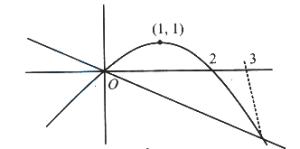
0 likesView Solution
58
MathematicsEasyMCQTS EAMCET · 2023
If $A = \begin{bmatrix} 1 & 2 & -1 \\ -1 & 0 & 2 \\ 1 & 2 & 0 \end{bmatrix}$ and $B = \begin{bmatrix} -3 & -2 & 4 \\ 2 & 2 & -1 \\ -2 & 0 & 3 \end{bmatrix}$,then $A^2 = $
A
$A-B$
B
$B-A$
C
$A+B$
D
$B^2$
Solution
(C) Given $A = \begin{bmatrix} 1 & 2 & -1 \\ -1 & 0 & 2 \\ 1 & 2 & 0 \end{bmatrix}$ and $B = \begin{bmatrix} -3 & -2 & 4 \\ 2 & 2 & -1 \\ -2 & 0 & 3 \end{bmatrix}$.
First,calculate $A^2 = A \times A$:
$A^2 = \begin{bmatrix} 1 & 2 & -1 \\ -1 & 0 & 2 \\ 1 & 2 & 0 \end{bmatrix} \begin{bmatrix} 1 & 2 & -1 \\ -1 & 0 & 2 \\ 1 & 2 & 0 \end{bmatrix} = \begin{bmatrix} (1-2-1) & (2+0-2) & (-1+4+0) \\ (-1+0+2) & (-2+0+4) & (1+0+0) \\ (1-2+0) & (2+0+0) & (-1+4+0) \end{bmatrix} = \begin{bmatrix} -2 & 0 & 3 \\ 1 & 2 & 1 \\ -1 & 2 & 3 \end{bmatrix}$.
Next,calculate $A+B$:
$A+B = \begin{bmatrix} 1-3 & 2-2 & -1+4 \\ -1+2 & 0+2 & 2-1 \\ 1-2 & 2+0 & 0+3 \end{bmatrix} = \begin{bmatrix} -2 & 0 & 3 \\ 1 & 2 & 1 \\ -1 & 2 & 3 \end{bmatrix}$.
Comparing both results,we see that $A^2 = A+B$.
First,calculate $A^2 = A \times A$:
$A^2 = \begin{bmatrix} 1 & 2 & -1 \\ -1 & 0 & 2 \\ 1 & 2 & 0 \end{bmatrix} \begin{bmatrix} 1 & 2 & -1 \\ -1 & 0 & 2 \\ 1 & 2 & 0 \end{bmatrix} = \begin{bmatrix} (1-2-1) & (2+0-2) & (-1+4+0) \\ (-1+0+2) & (-2+0+4) & (1+0+0) \\ (1-2+0) & (2+0+0) & (-1+4+0) \end{bmatrix} = \begin{bmatrix} -2 & 0 & 3 \\ 1 & 2 & 1 \\ -1 & 2 & 3 \end{bmatrix}$.
Next,calculate $A+B$:
$A+B = \begin{bmatrix} 1-3 & 2-2 & -1+4 \\ -1+2 & 0+2 & 2-1 \\ 1-2 & 2+0 & 0+3 \end{bmatrix} = \begin{bmatrix} -2 & 0 & 3 \\ 1 & 2 & 1 \\ -1 & 2 & 3 \end{bmatrix}$.
Comparing both results,we see that $A^2 = A+B$.
0 likesView Solution
59
MathematicsDifficultMCQTS EAMCET · 2023
If $P$ is a non-singular matrix such that $I+P+P^2+\ldots+P^{n}=0$ ($0$ denotes the null matrix),then $P^{-1}=$
A
$P^{n}$
B
$-P^{n}$
C
$-(I+P+\ldots+P^{n-1})$
D
$-I$
Solution
(A) Given the equation: $I+P+P^2+\ldots+P^{n}=0$ ... $(i)$
We can rewrite this as: $I+P+P^2+\ldots+P^{n-1} = -P^n$ ... $(ii)$
Now,multiply equation $(i)$ by $P^{-1}$ on the left side:
$P^{-1}(I+P+P^2+\ldots+P^{n}) = P^{-1}(0)$
$P^{-1}I + P^{-1}P + P^{-1}P^2 + \ldots + P^{-1}P^n = 0$
$P^{-1} + I + P + \ldots + P^{n-1} = 0$
From equation $(ii)$,we know that $I+P+\ldots+P^{n-1} = -P^n$.
Substituting this into the equation:
$P^{-1} + (-P^n) = 0$
Therefore,$P^{-1} = P^n$.
We can rewrite this as: $I+P+P^2+\ldots+P^{n-1} = -P^n$ ... $(ii)$
Now,multiply equation $(i)$ by $P^{-1}$ on the left side:
$P^{-1}(I+P+P^2+\ldots+P^{n}) = P^{-1}(0)$
$P^{-1}I + P^{-1}P + P^{-1}P^2 + \ldots + P^{-1}P^n = 0$
$P^{-1} + I + P + \ldots + P^{n-1} = 0$
From equation $(ii)$,we know that $I+P+\ldots+P^{n-1} = -P^n$.
Substituting this into the equation:
$P^{-1} + (-P^n) = 0$
Therefore,$P^{-1} = P^n$.
0 likesView Solution
60
MathematicsMediumMCQTS EAMCET · 2023
Let $A$ be a matrix such that $AB$ is a scalar matrix where $B = \begin{bmatrix} 1 & 2 \\ 0 & 3 \end{bmatrix}$ and $\det(3A) = 27$. Then $3A^{-1} + A^2 =$
A
$\begin{bmatrix} 4 & -6 \\ 0 & 2 \end{bmatrix}$
B
$\begin{bmatrix} 9 & -4 \\ 0 & 3 \end{bmatrix}$
C
$\begin{bmatrix} 10 & -6 \\ 0 & 2 \end{bmatrix}$
D
$\begin{bmatrix} 10 & -6 \\ 0 & 4 \end{bmatrix}$
Solution
(D) Let $A = \begin{bmatrix} a & b \\ c & d \end{bmatrix}$.
Given $AB = \begin{bmatrix} a & b \\ c & d \end{bmatrix} \begin{bmatrix} 1 & 2 \\ 0 & 3 \end{bmatrix} = \begin{bmatrix} a & 2a+3b \\ c & 2c+3d \end{bmatrix}$.
Since $AB$ is a scalar matrix,$c = 0$ and $2a+3b = 0$,and $a = 2c+3d = 3d$.
Thus,$a = 3d$ and $b = -\frac{2}{3}a = -2d$.
So,$A = \begin{bmatrix} 3d & -2d \\ 0 & d \end{bmatrix}$.
Given $\det(3A) = 27$,we have $3^2 \det(A) = 27$,so $\det(A) = 3$.
$\det(A) = (3d)(d) - 0 = 3d^2 = 3$,which implies $d^2 = 1$. Assuming $d=1$,we get $A = \begin{bmatrix} 3 & -2 \\ 0 & 1 \end{bmatrix}$.
Then $A^2 = \begin{bmatrix} 3 & -2 \\ 0 & 1 \end{bmatrix} \begin{bmatrix} 3 & -2 \\ 0 & 1 \end{bmatrix} = \begin{bmatrix} 9 & -8 \\ 0 & 1 \end{bmatrix}$.
$A^{-1} = \frac{1}{\det(A)} \text{adj}(A) = \frac{1}{3} \begin{bmatrix} 1 & 2 \\ 0 & 3 \end{bmatrix} = \begin{bmatrix} 1/3 & 2/3 \\ 0 & 1 \end{bmatrix}$.
Therefore,$3A^{-1} + A^2 = 3 \begin{bmatrix} 1/3 & 2/3 \\ 0 & 1 \end{bmatrix} + \begin{bmatrix} 9 & -8 \\ 0 & 1 \end{bmatrix} = \begin{bmatrix} 1 & 2 \\ 0 & 3 \end{bmatrix} + \begin{bmatrix} 9 & -8 \\ 0 & 1 \end{bmatrix} = \begin{bmatrix} 10 & -6 \\ 0 & 4 \end{bmatrix}$.
Given $AB = \begin{bmatrix} a & b \\ c & d \end{bmatrix} \begin{bmatrix} 1 & 2 \\ 0 & 3 \end{bmatrix} = \begin{bmatrix} a & 2a+3b \\ c & 2c+3d \end{bmatrix}$.
Since $AB$ is a scalar matrix,$c = 0$ and $2a+3b = 0$,and $a = 2c+3d = 3d$.
Thus,$a = 3d$ and $b = -\frac{2}{3}a = -2d$.
So,$A = \begin{bmatrix} 3d & -2d \\ 0 & d \end{bmatrix}$.
Given $\det(3A) = 27$,we have $3^2 \det(A) = 27$,so $\det(A) = 3$.
$\det(A) = (3d)(d) - 0 = 3d^2 = 3$,which implies $d^2 = 1$. Assuming $d=1$,we get $A = \begin{bmatrix} 3 & -2 \\ 0 & 1 \end{bmatrix}$.
Then $A^2 = \begin{bmatrix} 3 & -2 \\ 0 & 1 \end{bmatrix} \begin{bmatrix} 3 & -2 \\ 0 & 1 \end{bmatrix} = \begin{bmatrix} 9 & -8 \\ 0 & 1 \end{bmatrix}$.
$A^{-1} = \frac{1}{\det(A)} \text{adj}(A) = \frac{1}{3} \begin{bmatrix} 1 & 2 \\ 0 & 3 \end{bmatrix} = \begin{bmatrix} 1/3 & 2/3 \\ 0 & 1 \end{bmatrix}$.
Therefore,$3A^{-1} + A^2 = 3 \begin{bmatrix} 1/3 & 2/3 \\ 0 & 1 \end{bmatrix} + \begin{bmatrix} 9 & -8 \\ 0 & 1 \end{bmatrix} = \begin{bmatrix} 1 & 2 \\ 0 & 3 \end{bmatrix} + \begin{bmatrix} 9 & -8 \\ 0 & 1 \end{bmatrix} = \begin{bmatrix} 10 & -6 \\ 0 & 4 \end{bmatrix}$.
0 likesView Solution
61
MathematicsEasyMCQTS EAMCET · 2023
If $A=\begin{bmatrix} b & a & 0 \\ c & 0 & b \\ a & a & b \end{bmatrix}$ and $B=\begin{bmatrix} 0 & a & b \\ b & 0 & c \\ b & a & a \end{bmatrix}$ are two matrices such that $AB=\begin{bmatrix} 2 & 2 & 7 \\ 1 & 8 & 5 \\ 3 & 6 & 10 \end{bmatrix}$,then $a^2+b^2+c^2=$
A
$14$
B
$17$
C
$22$
D
$29$
Solution
(A) Given $A = \begin{bmatrix} b & a & 0 \\ c & 0 & b \\ a & a & b \end{bmatrix}$ and $B = \begin{bmatrix} 0 & a & b \\ b & 0 & c \\ b & a & a \end{bmatrix}$.
Performing matrix multiplication $AB$:
$AB = \begin{bmatrix} b(0)+a(b)+0(b) & b(a)+a(0)+0(a) & b(b)+a(c)+0(a) \\ c(0)+0(b)+b(b) & c(a)+0(0)+b(a) & c(b)+0(c)+b(a) \\ a(0)+a(b)+b(b) & a(a)+a(0)+b(a) & a(b)+a(c)+b(a) \end{bmatrix} = \begin{bmatrix} ab & ab & b^2+ac \\ b^2 & ac+ab & bc+ab \\ ab+b^2 & a^2+ab & 2ab+ac \end{bmatrix}$.
Equating this to the given matrix $\begin{bmatrix} 2 & 2 & 7 \\ 1 & 8 & 5 \\ 3 & 6 & 10 \end{bmatrix}$:
From the element at $(2,1)$,$b^2 = 1$.
From the element at $(1,1)$,$ab = 2$.
From the element at $(1,3)$,$b^2+ac = 7 \implies 1+ac = 7 \implies ac = 6$.
Since $ab=2$ and $b^2=1$,we have $a = 2/b$. If $b=1$,$a=2$. If $b=-1$,$a=-2$.
Case $1$: $b=1, a=2$. Then $ac=6 \implies 2c=6 \implies c=3$.
Case $2$: $b=-1, a=-2$. Then $ac=6 \implies -2c=6 \implies c=-3$.
In both cases,$a^2+b^2+c^2 = (\pm 2)^2 + (\pm 1)^2 + (\pm 3)^2 = 4+1+9 = 14$.
Performing matrix multiplication $AB$:
$AB = \begin{bmatrix} b(0)+a(b)+0(b) & b(a)+a(0)+0(a) & b(b)+a(c)+0(a) \\ c(0)+0(b)+b(b) & c(a)+0(0)+b(a) & c(b)+0(c)+b(a) \\ a(0)+a(b)+b(b) & a(a)+a(0)+b(a) & a(b)+a(c)+b(a) \end{bmatrix} = \begin{bmatrix} ab & ab & b^2+ac \\ b^2 & ac+ab & bc+ab \\ ab+b^2 & a^2+ab & 2ab+ac \end{bmatrix}$.
Equating this to the given matrix $\begin{bmatrix} 2 & 2 & 7 \\ 1 & 8 & 5 \\ 3 & 6 & 10 \end{bmatrix}$:
From the element at $(2,1)$,$b^2 = 1$.
From the element at $(1,1)$,$ab = 2$.
From the element at $(1,3)$,$b^2+ac = 7 \implies 1+ac = 7 \implies ac = 6$.
Since $ab=2$ and $b^2=1$,we have $a = 2/b$. If $b=1$,$a=2$. If $b=-1$,$a=-2$.
Case $1$: $b=1, a=2$. Then $ac=6 \implies 2c=6 \implies c=3$.
Case $2$: $b=-1, a=-2$. Then $ac=6 \implies -2c=6 \implies c=-3$.
In both cases,$a^2+b^2+c^2 = (\pm 2)^2 + (\pm 1)^2 + (\pm 3)^2 = 4+1+9 = 14$.
0 likesView Solution
62
MathematicsMediumMCQTS EAMCET · 2023
If $A = \begin{bmatrix} 1 & a & 3 \\ b & 2 & c \\ 3 & d & 4 \end{bmatrix}$ is a symmetric matrix and $B = \begin{bmatrix} 0 & 5 & b \\ -5 & 0 & -7 \\ 6 & c & 0 \end{bmatrix}$ is a skew-symmetric matrix,then $AB = $
A
$\begin{bmatrix} 48 & 27 & 48 \\ 52 & 19 & 22 \\ -59 & 43 & -67 \end{bmatrix}$
B
$\begin{bmatrix} 48 & 26 & 36 \\ 32 & 19 & 22 \\ -11 & 43 & -67 \end{bmatrix}$
C
$\begin{bmatrix} 12 & 26 & 36 \\ 32 & 79 & 50 \\ -11 & 43 & -67 \end{bmatrix}$
D
$\begin{bmatrix} 12 & 32 & 41 \\ 32 & 19 & 22 \\ -11 & 43 & -67 \end{bmatrix}$
Solution
(B) For matrix $A$ to be symmetric,$A = A^T$,which implies $a=b$,$c=d$,and $3=3$. Thus,$A = \begin{bmatrix} 1 & a & 3 \\ a & 2 & c \\ 3 & c & 4 \end{bmatrix}$.
For matrix $B$ to be skew-symmetric,$B = -B^T$,which implies diagonal elements are $0$. From $B_{13} = -B_{31}$,we get $b = -6$. From $B_{23} = -B_{32}$,we get $-7 = -c$,so $c = 7$.
Substituting these values,we get $a = b = -6$ and $d = c = 7$.
So,$A = \begin{bmatrix} 1 & -6 & 3 \\ -6 & 2 & 7 \\ 3 & 7 & 4 \end{bmatrix}$ and $B = \begin{bmatrix} 0 & 5 & -6 \\ -5 & 0 & -7 \\ 6 & 7 & 0 \end{bmatrix}$.
Now,calculating the product $AB$:
$AB = \begin{bmatrix} 1 & -6 & 3 \\ -6 & 2 & 7 \\ 3 & 7 & 4 \end{bmatrix} \begin{bmatrix} 0 & 5 & -6 \\ -5 & 0 & -7 \\ 6 & 7 & 0 \end{bmatrix} = \begin{bmatrix} 0+30+18 & 5+0+21 & -6+42+0 \\ 0-10+42 & -30+0+49 & 36-14+0 \\ 0-35+24 & 15+0+28 & -18-49+0 \end{bmatrix} = \begin{bmatrix} 48 & 26 & 36 \\ 32 & 19 & 22 \\ -11 & 43 & -67 \end{bmatrix}$.
For matrix $B$ to be skew-symmetric,$B = -B^T$,which implies diagonal elements are $0$. From $B_{13} = -B_{31}$,we get $b = -6$. From $B_{23} = -B_{32}$,we get $-7 = -c$,so $c = 7$.
Substituting these values,we get $a = b = -6$ and $d = c = 7$.
So,$A = \begin{bmatrix} 1 & -6 & 3 \\ -6 & 2 & 7 \\ 3 & 7 & 4 \end{bmatrix}$ and $B = \begin{bmatrix} 0 & 5 & -6 \\ -5 & 0 & -7 \\ 6 & 7 & 0 \end{bmatrix}$.
Now,calculating the product $AB$:
$AB = \begin{bmatrix} 1 & -6 & 3 \\ -6 & 2 & 7 \\ 3 & 7 & 4 \end{bmatrix} \begin{bmatrix} 0 & 5 & -6 \\ -5 & 0 & -7 \\ 6 & 7 & 0 \end{bmatrix} = \begin{bmatrix} 0+30+18 & 5+0+21 & -6+42+0 \\ 0-10+42 & -30+0+49 & 36-14+0 \\ 0-35+24 & 15+0+28 & -18-49+0 \end{bmatrix} = \begin{bmatrix} 48 & 26 & 36 \\ 32 & 19 & 22 \\ -11 & 43 & -67 \end{bmatrix}$.
0 likesView Solution
63
MathematicsEasyMCQTS EAMCET · 2023
If $A = \begin{bmatrix} 0 & 3 \\ 0 & 0 \end{bmatrix}$ and $f(x) = x + x^2 + x^3 + \ldots + x^{2023}$,then $f(A) + I = $
A
$\begin{bmatrix} 0 & 0 \\ 0 & 0 \end{bmatrix}$
B
$\begin{bmatrix} 1 & 3 \\ 0 & 0 \end{bmatrix}$
C
$\begin{bmatrix} 1 & 3 \\ 0 & 1 \end{bmatrix}$
D
$\begin{bmatrix} 1 & 3 \\ 1 & 1 \end{bmatrix}$
Solution
(C) Given $A = \begin{bmatrix} 0 & 3 \\ 0 & 0 \end{bmatrix}$.
First,calculate $A^2$:
$A^2 = \begin{bmatrix} 0 & 3 \\ 0 & 0 \end{bmatrix} \begin{bmatrix} 0 & 3 \\ 0 & 0 \end{bmatrix} = \begin{bmatrix} 0 & 0 \\ 0 & 0 \end{bmatrix}$.
Since $A^2 = 0$,all higher powers $A^n = 0$ for $n \geq 2$.
Given $f(x) = x + x^2 + x^3 + \ldots + x^{2023}$,we have $f(A) = A + A^2 + A^3 + \ldots + A^{2023}$.
Substituting $A^n = 0$ for $n \geq 2$,we get $f(A) = A + 0 + 0 + \ldots + 0 = A$.
Therefore,$f(A) + I = A + I$.
$f(A) + I = \begin{bmatrix} 0 & 3 \\ 0 & 0 \end{bmatrix} + \begin{bmatrix} 1 & 0 \\ 0 & 1 \end{bmatrix} = \begin{bmatrix} 1 & 3 \\ 0 & 1 \end{bmatrix}$.
First,calculate $A^2$:
$A^2 = \begin{bmatrix} 0 & 3 \\ 0 & 0 \end{bmatrix} \begin{bmatrix} 0 & 3 \\ 0 & 0 \end{bmatrix} = \begin{bmatrix} 0 & 0 \\ 0 & 0 \end{bmatrix}$.
Since $A^2 = 0$,all higher powers $A^n = 0$ for $n \geq 2$.
Given $f(x) = x + x^2 + x^3 + \ldots + x^{2023}$,we have $f(A) = A + A^2 + A^3 + \ldots + A^{2023}$.
Substituting $A^n = 0$ for $n \geq 2$,we get $f(A) = A + 0 + 0 + \ldots + 0 = A$.
Therefore,$f(A) + I = A + I$.
$f(A) + I = \begin{bmatrix} 0 & 3 \\ 0 & 0 \end{bmatrix} + \begin{bmatrix} 1 & 0 \\ 0 & 1 \end{bmatrix} = \begin{bmatrix} 1 & 3 \\ 0 & 1 \end{bmatrix}$.
0 likesView Solution
64
MathematicsEasyMCQTS EAMCET · 2023
If $A = \begin{bmatrix} 1 & 2 \\ 3 & 5 \end{bmatrix}$ and $\alpha, \beta \in \mathbb{R}$ are such that $\alpha A^2 - \beta A = 2I$,then $\alpha^2 + \beta =$
A
$-8$
B
$16$
C
$12$
D
$20$
Solution
(B) Given $A = \begin{bmatrix} 1 & 2 \\ 3 & 5 \end{bmatrix}$.
First,calculate $A^2 = A \times A = \begin{bmatrix} 1 & 2 \\ 3 & 5 \end{bmatrix} \begin{bmatrix} 1 & 2 \\ 3 & 5 \end{bmatrix} = \begin{bmatrix} 1(1)+2(3) & 1(2)+2(5) \\ 3(1)+5(3) & 3(2)+5(5) \end{bmatrix} = \begin{bmatrix} 7 & 12 \\ 18 & 31 \end{bmatrix}$.
Substitute $A^2$ and $A$ into the equation $\alpha A^2 - \beta A = 2I$:
$\alpha \begin{bmatrix} 7 & 12 \\ 18 & 31 \end{bmatrix} - \beta \begin{bmatrix} 1 & 2 \\ 3 & 5 \end{bmatrix} = 2 \begin{bmatrix} 1 & 0 \\ 0 & 1 \end{bmatrix}$.
This gives the matrix equation:
$\begin{bmatrix} 7\alpha - \beta & 12\alpha - 2\beta \\ 18\alpha - 3\beta & 31\alpha - 5\beta \end{bmatrix} = \begin{bmatrix} 2 & 0 \\ 0 & 2 \end{bmatrix}$.
Comparing the elements,we get:
$7\alpha - \beta = 2$ $(i)$
$12\alpha - 2\beta = 0 \Rightarrow 6\alpha - \beta = 0$ $(ii)$
Subtracting $(ii)$ from $(i)$ gives $\alpha = 2$.
Substituting $\alpha = 2$ into $(ii)$,we get $6(2) - \beta = 0 \Rightarrow \beta = 12$.
Finally,$\alpha^2 + \beta = (2)^2 + 12 = 4 + 12 = 16$.
First,calculate $A^2 = A \times A = \begin{bmatrix} 1 & 2 \\ 3 & 5 \end{bmatrix} \begin{bmatrix} 1 & 2 \\ 3 & 5 \end{bmatrix} = \begin{bmatrix} 1(1)+2(3) & 1(2)+2(5) \\ 3(1)+5(3) & 3(2)+5(5) \end{bmatrix} = \begin{bmatrix} 7 & 12 \\ 18 & 31 \end{bmatrix}$.
Substitute $A^2$ and $A$ into the equation $\alpha A^2 - \beta A = 2I$:
$\alpha \begin{bmatrix} 7 & 12 \\ 18 & 31 \end{bmatrix} - \beta \begin{bmatrix} 1 & 2 \\ 3 & 5 \end{bmatrix} = 2 \begin{bmatrix} 1 & 0 \\ 0 & 1 \end{bmatrix}$.
This gives the matrix equation:
$\begin{bmatrix} 7\alpha - \beta & 12\alpha - 2\beta \\ 18\alpha - 3\beta & 31\alpha - 5\beta \end{bmatrix} = \begin{bmatrix} 2 & 0 \\ 0 & 2 \end{bmatrix}$.
Comparing the elements,we get:
$7\alpha - \beta = 2$ $(i)$
$12\alpha - 2\beta = 0 \Rightarrow 6\alpha - \beta = 0$ $(ii)$
Subtracting $(ii)$ from $(i)$ gives $\alpha = 2$.
Substituting $\alpha = 2$ into $(ii)$,we get $6(2) - \beta = 0 \Rightarrow \beta = 12$.
Finally,$\alpha^2 + \beta = (2)^2 + 12 = 4 + 12 = 16$.
0 likesView Solution
65
MathematicsMediumMCQTS EAMCET · 2023
$P$ is a $3 \times 3$ square matrix and $\operatorname{Tr}(P) \neq 0$. If $\operatorname{Tr}(P-P^{T})+\operatorname{Tr}(P+P^{T})+\frac{\operatorname{Tr}(P)}{\operatorname{Tr}(P^T)}+\operatorname{Tr}(P) \times \operatorname{Tr}(P^{T})=0$,then $\operatorname{Tr}(P)=$
A
$0$
B
$-1$
C
$4$
D
$3$
Solution
(B) We know that for any square matrix $P$,the trace of its transpose is equal to the trace of the matrix itself,i.e.,$\operatorname{Tr}(P) = \operatorname{Tr}(P^T)$.
Also,$\operatorname{Tr}(P - P^T) = \operatorname{Tr}(P) - \operatorname{Tr}(P^T) = 0$ and $\operatorname{Tr}(P + P^T) = \operatorname{Tr}(P) + \operatorname{Tr}(P^T) = 2\operatorname{Tr}(P)$.
Substituting these into the given equation:
$0 + 2\operatorname{Tr}(P) + \frac{\operatorname{Tr}(P)}{\operatorname{Tr}(P)} + \operatorname{Tr}(P) \times \operatorname{Tr}(P) = 0$
Since $\operatorname{Tr}(P) \neq 0$,we have $\frac{\operatorname{Tr}(P)}{\operatorname{Tr}(P)} = 1$.
Thus,the equation becomes: $2\operatorname{Tr}(P) + 1 + (\operatorname{Tr}(P))^2 = 0$.
This is a quadratic equation in terms of $\operatorname{Tr}(P)$:
$(\operatorname{Tr}(P))^2 + 2\operatorname{Tr}(P) + 1 = 0$
$(\operatorname{Tr}(P) + 1)^2 = 0$
$\operatorname{Tr}(P) = -1$.
Also,$\operatorname{Tr}(P - P^T) = \operatorname{Tr}(P) - \operatorname{Tr}(P^T) = 0$ and $\operatorname{Tr}(P + P^T) = \operatorname{Tr}(P) + \operatorname{Tr}(P^T) = 2\operatorname{Tr}(P)$.
Substituting these into the given equation:
$0 + 2\operatorname{Tr}(P) + \frac{\operatorname{Tr}(P)}{\operatorname{Tr}(P)} + \operatorname{Tr}(P) \times \operatorname{Tr}(P) = 0$
Since $\operatorname{Tr}(P) \neq 0$,we have $\frac{\operatorname{Tr}(P)}{\operatorname{Tr}(P)} = 1$.
Thus,the equation becomes: $2\operatorname{Tr}(P) + 1 + (\operatorname{Tr}(P))^2 = 0$.
This is a quadratic equation in terms of $\operatorname{Tr}(P)$:
$(\operatorname{Tr}(P))^2 + 2\operatorname{Tr}(P) + 1 = 0$
$(\operatorname{Tr}(P) + 1)^2 = 0$
$\operatorname{Tr}(P) = -1$.
0 likesView Solution
66
MathematicsMediumMCQTS EAMCET · 2023
If $A$ and $B$ are two square matrices of the same order and $(AB+BA)^{T}+(AB-BA)^{T}=2BA$,then:
A
$A$ and $B$ are both symmetric matrices but not skew-symmetric matrices
B
$A$ and $B$ are both skew-symmetric matrices but not symmetric matrices
C
$A$ and $B$ are neither symmetric nor skew-symmetric matrices
D
$A$ and $B$ are any two non-zero matrices
Solution
(A) Given the equation: $(AB+BA)^{T}+(AB-BA)^{T}=2BA$
Using the property $(X+Y)^T = X^T + Y^T$,we get:
$(AB)^T + (BA)^T + (AB)^T - (BA)^T = 2BA$
$2(AB)^T = 2BA$
$(AB)^T = BA$
$B^T A^T = BA$
If $A$ and $B$ are symmetric,then $A^T = A$ and $B^T = B$. Substituting these,we get $BA = BA$,which is true.
If $A$ and $B$ are skew-symmetric,then $A^T = -A$ and $B^T = -B$. Substituting these,we get $(-B)(-A) = BA$,which is $BA = BA$,which is also true.
Thus,the condition holds if $A$ and $B$ are both symmetric or both skew-symmetric. Since the options provided are limited,the most appropriate conclusion based on the derivation is that the property holds for both cases.
Using the property $(X+Y)^T = X^T + Y^T$,we get:
$(AB)^T + (BA)^T + (AB)^T - (BA)^T = 2BA$
$2(AB)^T = 2BA$
$(AB)^T = BA$
$B^T A^T = BA$
If $A$ and $B$ are symmetric,then $A^T = A$ and $B^T = B$. Substituting these,we get $BA = BA$,which is true.
If $A$ and $B$ are skew-symmetric,then $A^T = -A$ and $B^T = -B$. Substituting these,we get $(-B)(-A) = BA$,which is $BA = BA$,which is also true.
Thus,the condition holds if $A$ and $B$ are both symmetric or both skew-symmetric. Since the options provided are limited,the most appropriate conclusion based on the derivation is that the property holds for both cases.
0 likesView Solution
67
MathematicsMediumMCQTS EAMCET · 2023
If $X_{4 \times 3}$,$Y_{4 \times 3}$ and $P_{2 \times 3}$ are matrices,then the order of the matrix $\left[P(X^T Y)^{-1} P^T\right]^T$ is
A
$4 \times 3$
B
$3 \times 4$
C
$3 \times 3$
D
$2 \times 2$
Solution
(D) Given matrices: $P_{2 \times 3}$,$X_{4 \times 3}$,$Y_{4 \times 3}$.
$X^T$ has order $3 \times 4$.
$P^T$ has order $3 \times 2$.
$X^T Y$ has order $(3 \times 4) \times (4 \times 3) = 3 \times 3$.
$(X^T Y)^{-1}$ has order $3 \times 3$.
$P(X^T Y)^{-1}$ has order $(2 \times 3) \times (3 \times 3) = 2 \times 3$.
$P(X^T Y)^{-1} P^T$ has order $(2 \times 3) \times (3 \times 2) = 2 \times 2$.
Finally,the transpose of a $2 \times 2$ matrix remains $2 \times 2$.
$X^T$ has order $3 \times 4$.
$P^T$ has order $3 \times 2$.
$X^T Y$ has order $(3 \times 4) \times (4 \times 3) = 3 \times 3$.
$(X^T Y)^{-1}$ has order $3 \times 3$.
$P(X^T Y)^{-1}$ has order $(2 \times 3) \times (3 \times 3) = 2 \times 3$.
$P(X^T Y)^{-1} P^T$ has order $(2 \times 3) \times (3 \times 2) = 2 \times 2$.
Finally,the transpose of a $2 \times 2$ matrix remains $2 \times 2$.
0 likesView Solution
68
MathematicsMediumMCQTS EAMCET · 2023
If $A$ is a symmetric matrix with real entries,then
A
$A^{-1}$ is symmetric,if it exists
B
$A^{-1}$ always exists and is symmetric
C
$A^{-1}$ is skew-symmetric,if it exists
D
$A^{-1}$ always exists and is skew-symmetric
Solution
(A) Given that $A$ is a symmetric matrix,we have $A^T = A$.
If the inverse $A^{-1}$ exists,we use the property $(A^{-1})^T = (A^T)^{-1}$.
Substituting $A^T = A$ into the equation,we get $(A^{-1})^T = (A)^{-1} = A^{-1}$.
Since the transpose of $A^{-1}$ is equal to $A^{-1}$,it follows that $A^{-1}$ is a symmetric matrix,provided it exists.
If the inverse $A^{-1}$ exists,we use the property $(A^{-1})^T = (A^T)^{-1}$.
Substituting $A^T = A$ into the equation,we get $(A^{-1})^T = (A)^{-1} = A^{-1}$.
Since the transpose of $A^{-1}$ is equal to $A^{-1}$,it follows that $A^{-1}$ is a symmetric matrix,provided it exists.
0 likesView Solution
69
MathematicsEasyMCQTS EAMCET · 2023
If a matrix is chosen at random from the set of all $3 \times 3$ non-zero matrices whose entries are the elements of the set $\{-1, 0, 1\}$,then the probability that the matrix is skew-symmetric is
A
$\frac{1}{729}$
B
$\frac{1}{757}$
C
$\frac{1}{703}$
D
$\frac{1}{742}$
Solution
(B) The total number of $3 \times 3$ matrices with entries from $\{-1, 0, 1\}$ is $3^9 = 19683$. Since we are considering only non-zero matrices,the total number of possible matrices is $3^9 - 1 = 19682$.
$A$ skew-symmetric matrix $A$ satisfies $A^T = -A$. For a $3 \times 3$ matrix,this implies the diagonal elements must be $0$. The matrix takes the form:
$\begin{bmatrix} 0 & a & b \\ -a & 0 & c \\ -b & -c & 0 \end{bmatrix}$
The entries $a, b, c$ can each be chosen from $\{-1, 0, 1\}$. Thus,there are $3^3 = 27$ such matrices.
Excluding the zero matrix (where $a=b=c=0$),the number of non-zero skew-symmetric matrices is $27 - 1 = 26$.
The probability is $\frac{26}{19682} = \frac{1}{757}$.
$A$ skew-symmetric matrix $A$ satisfies $A^T = -A$. For a $3 \times 3$ matrix,this implies the diagonal elements must be $0$. The matrix takes the form:
$\begin{bmatrix} 0 & a & b \\ -a & 0 & c \\ -b & -c & 0 \end{bmatrix}$
The entries $a, b, c$ can each be chosen from $\{-1, 0, 1\}$. Thus,there are $3^3 = 27$ such matrices.
Excluding the zero matrix (where $a=b=c=0$),the number of non-zero skew-symmetric matrices is $27 - 1 = 26$.
The probability is $\frac{26}{19682} = \frac{1}{757}$.
0 likesView Solution
70
MathematicsMediumMCQTS EAMCET · 2023
If $A = \begin{bmatrix} k & 5 & 2 \\ 2 & -k & 5 \\ 5 & 2 & -k \end{bmatrix}$ and $\det A = 190$,then $\operatorname{Adj} A = $
A
$\begin{bmatrix} -1 & 19 & 31 \\ 31 & -19 & -11 \\ 19 & 19 & -19 \end{bmatrix}$
B
$\begin{bmatrix} -1 & 31 & 19 \\ 19 & -19 & 19 \\ 31 & -11 & -19 \end{bmatrix}$
C
$\begin{bmatrix} -1 & 19 & 31 \\ -31 & -19 & -11 \\ 19 & 19 & -19 \end{bmatrix}$
D
$\begin{bmatrix} -1 & -31 & 19 \\ 19 & -19 & 19 \\ 31 & -11 & -19 \end{bmatrix}$
Solution
(A) Given $A = \begin{bmatrix} k & 5 & 2 \\ 2 & -k & 5 \\ 5 & 2 & -k \end{bmatrix}$ and $\det A = 190$.
Expanding the determinant along the first row:
$\det A = k(k^2 - 10) - 5(-2k - 25) + 2(4 + 5k) = 190$
$k^3 - 10k + 10k + 125 + 8 + 10k = 190$
$k^3 + 10k - 57 = 0$
By testing values,for $k=3$: $27 + 30 - 57 = 0$. Thus,$k=3$.
Substituting $k=3$,$A = \begin{bmatrix} 3 & 5 & 2 \\ 2 & -3 & 5 \\ 5 & 2 & -3 \end{bmatrix}$.
The cofactor matrix $C$ is calculated as:
$C_{11} = ((-3)(-3) - (5)(2)) = 9 - 10 = -1$
$C_{12} = -((2)(-3) - (5)(5)) = -(-6 - 25) = 31$
$C_{13} = ((2)(2) - (-3)(5)) = 4 + 15 = 19$
$C_{21} = -((5)(-3) - (2)(2)) = -(-15 - 4) = 19$
$C_{22} = ((3)(-3) - (2)(5)) = -9 - 10 = -19$
$C_{23} = -((3)(2) - (5)(5)) = -(6 - 25) = 19$
$C_{31} = ((5)(5) - (-3)(2)) = 25 + 6 = 31$
$C_{32} = -((3)(5) - (2)(2)) = -(15 - 4) = -11$
$C_{33} = ((3)(-3) - (5)(2)) = -9 - 10 = -19$
The adjoint matrix is the transpose of the cofactor matrix:
$\operatorname{Adj} A = C^T = \begin{bmatrix} -1 & 19 & 31 \\ 31 & -19 & -11 \\ 19 & 19 & -19 \end{bmatrix}$.
Expanding the determinant along the first row:
$\det A = k(k^2 - 10) - 5(-2k - 25) + 2(4 + 5k) = 190$
$k^3 - 10k + 10k + 125 + 8 + 10k = 190$
$k^3 + 10k - 57 = 0$
By testing values,for $k=3$: $27 + 30 - 57 = 0$. Thus,$k=3$.
Substituting $k=3$,$A = \begin{bmatrix} 3 & 5 & 2 \\ 2 & -3 & 5 \\ 5 & 2 & -3 \end{bmatrix}$.
The cofactor matrix $C$ is calculated as:
$C_{11} = ((-3)(-3) - (5)(2)) = 9 - 10 = -1$
$C_{12} = -((2)(-3) - (5)(5)) = -(-6 - 25) = 31$
$C_{13} = ((2)(2) - (-3)(5)) = 4 + 15 = 19$
$C_{21} = -((5)(-3) - (2)(2)) = -(-15 - 4) = 19$
$C_{22} = ((3)(-3) - (2)(5)) = -9 - 10 = -19$
$C_{23} = -((3)(2) - (5)(5)) = -(6 - 25) = 19$
$C_{31} = ((5)(5) - (-3)(2)) = 25 + 6 = 31$
$C_{32} = -((3)(5) - (2)(2)) = -(15 - 4) = -11$
$C_{33} = ((3)(-3) - (5)(2)) = -9 - 10 = -19$
The adjoint matrix is the transpose of the cofactor matrix:
$\operatorname{Adj} A = C^T = \begin{bmatrix} -1 & 19 & 31 \\ 31 & -19 & -11 \\ 19 & 19 & -19 \end{bmatrix}$.
0 likesView Solution
71
MathematicsMediumMCQTS EAMCET · 2023
If $A$ is a square matrix of order $3$,then $|\operatorname{Adj}(\operatorname{Adj} A^2)|=$
A
$|A|^2$
B
$|A|^4$
C
$|A|^8$
D
$|A|^{16}$
Solution
(C) We know that for a square matrix $M$ of order $n$,$|\operatorname{adj} M| = |M|^{n-1}$.
Given $A$ is a square matrix of order $n=3$.
First,consider the matrix $M = A^2$. The order of $M$ is $3$.
Then,$|\operatorname{adj} M| = |M|^{3-1} = |M|^2 = (|A|^2)^2 = |A|^4$.
Now,we need to find $|\operatorname{adj}(\operatorname{adj} A^2)|$.
Let $K = \operatorname{adj} A^2$. Then $|K| = |A|^4$.
Using the property $|\operatorname{adj} K| = |K|^{n-1}$,where $n=3$:
$|\operatorname{adj} K| = |K|^{3-1} = |K|^2$.
Substituting $|K| = |A|^4$:
$|\operatorname{adj}(\operatorname{adj} A^2)| = (|A|^4)^2 = |A|^8$.
Given $A$ is a square matrix of order $n=3$.
First,consider the matrix $M = A^2$. The order of $M$ is $3$.
Then,$|\operatorname{adj} M| = |M|^{3-1} = |M|^2 = (|A|^2)^2 = |A|^4$.
Now,we need to find $|\operatorname{adj}(\operatorname{adj} A^2)|$.
Let $K = \operatorname{adj} A^2$. Then $|K| = |A|^4$.
Using the property $|\operatorname{adj} K| = |K|^{n-1}$,where $n=3$:
$|\operatorname{adj} K| = |K|^{3-1} = |K|^2$.
Substituting $|K| = |A|^4$:
$|\operatorname{adj}(\operatorname{adj} A^2)| = (|A|^4)^2 = |A|^8$.
0 likesView Solution
72
MathematicsMediumMCQTS EAMCET · 2023
If $\text{adj} \begin{bmatrix} 1 & 0 & 2 \\ -1 & 1 & -2 \\ 0 & 2 & 1 \end{bmatrix} = \begin{bmatrix} 5 & m & -2 \\ 1 & 1 & 0 \\ -2 & -2 & n \end{bmatrix}$,then $m+n=$
A
$2$
B
$-3$
C
$5$
D
$-5$
Solution
(C) Let $A = \begin{bmatrix} 1 & 0 & 2 \\ -1 & 1 & -2 \\ 0 & 2 & 1 \end{bmatrix}$. The adjoint of a matrix is the transpose of its cofactor matrix,$\text{adj}(A) = [C_{ij}]^T$.
The cofactors are calculated as follows:
$C_{11} = +\begin{vmatrix} 1 & -2 \\ 2 & 1 \end{vmatrix} = 1 - (-4) = 5$
$C_{12} = -\begin{vmatrix} -1 & -2 \\ 0 & 1 \end{vmatrix} = -(-1 - 0) = 1$
$C_{13} = +\begin{vmatrix} -1 & 1 \\ 0 & 2 \end{vmatrix} = -2 - 0 = -2$
$C_{21} = -\begin{vmatrix} 0 & 2 \\ 2 & 1 \end{vmatrix} = -(0 - 4) = 4$
$C_{22} = +\begin{vmatrix} 1 & 2 \\ 0 & 1 \end{vmatrix} = 1 - 0 = 1$
$C_{23} = -\begin{vmatrix} 1 & 0 \\ 0 & 2 \end{vmatrix} = -(2 - 0) = -2$
$C_{31} = +\begin{vmatrix} 0 & 2 \\ 1 & -2 \end{vmatrix} = 0 - 2 = -2$
$C_{32} = -\begin{vmatrix} 1 & 2 \\ -1 & -2 \end{vmatrix} = -(-2 - (-2)) = 0$
$C_{33} = +\begin{vmatrix} 1 & 0 \\ -1 & 1 \end{vmatrix} = 1 - 0 = 1$
Thus,$\text{adj}(A) = \begin{bmatrix} C_{11} & C_{21} & C_{31} \\ C_{12} & C_{22} & C_{32} \\ C_{13} & C_{23} & C_{33} \end{bmatrix} = \begin{bmatrix} 5 & 4 & -2 \\ 1 & 1 & 0 \\ -2 & -2 & 1 \end{bmatrix}$.
Comparing this with the given matrix,we get $m = 4$ and $n = 1$.
Therefore,$m+n = 4+1 = 5$.
The cofactors are calculated as follows:
$C_{11} = +\begin{vmatrix} 1 & -2 \\ 2 & 1 \end{vmatrix} = 1 - (-4) = 5$
$C_{12} = -\begin{vmatrix} -1 & -2 \\ 0 & 1 \end{vmatrix} = -(-1 - 0) = 1$
$C_{13} = +\begin{vmatrix} -1 & 1 \\ 0 & 2 \end{vmatrix} = -2 - 0 = -2$
$C_{21} = -\begin{vmatrix} 0 & 2 \\ 2 & 1 \end{vmatrix} = -(0 - 4) = 4$
$C_{22} = +\begin{vmatrix} 1 & 2 \\ 0 & 1 \end{vmatrix} = 1 - 0 = 1$
$C_{23} = -\begin{vmatrix} 1 & 0 \\ 0 & 2 \end{vmatrix} = -(2 - 0) = -2$
$C_{31} = +\begin{vmatrix} 0 & 2 \\ 1 & -2 \end{vmatrix} = 0 - 2 = -2$
$C_{32} = -\begin{vmatrix} 1 & 2 \\ -1 & -2 \end{vmatrix} = -(-2 - (-2)) = 0$
$C_{33} = +\begin{vmatrix} 1 & 0 \\ -1 & 1 \end{vmatrix} = 1 - 0 = 1$
Thus,$\text{adj}(A) = \begin{bmatrix} C_{11} & C_{21} & C_{31} \\ C_{12} & C_{22} & C_{32} \\ C_{13} & C_{23} & C_{33} \end{bmatrix} = \begin{bmatrix} 5 & 4 & -2 \\ 1 & 1 & 0 \\ -2 & -2 & 1 \end{bmatrix}$.
Comparing this with the given matrix,we get $m = 4$ and $n = 1$.
Therefore,$m+n = 4+1 = 5$.
0 likesView Solution
73
MathematicsDifficultMCQTS EAMCET · 2023
If $A$ is a non-singular matrix such that $(A-2I)(A-3I)=O$,then $\frac{1}{5}A + \frac{6}{5}A^{-1} = $
A
$O$
B
$I$
C
$2I$
D
$3I$
Solution
(B) Given $(A-2I)(A-3I) = O$.
Expanding the expression,we get $A^2 - 3A - 2A + 6I^2 = O$.
This simplifies to $A^2 - 5A + 6I = O$.
Rearranging to isolate $I$,we have $6I = 5A - A^2$.
Factoring out $A$,we get $6I = A(5I - A)$.
Multiplying by $A^{-1}$ on both sides,we get $6A^{-1} = 5I - A$,which implies $A^{-1} = \frac{5I - A}{6}$.
Now,substitute this into the expression $\frac{1}{5}A + \frac{6}{5}A^{-1}$:
$\frac{1}{5}A + \frac{6}{5} \left( \frac{5I - A}{6} \right) = \frac{1}{5}A + \frac{5I - A}{5} = \frac{1}{5}A + I - \frac{1}{5}A = I$.
Expanding the expression,we get $A^2 - 3A - 2A + 6I^2 = O$.
This simplifies to $A^2 - 5A + 6I = O$.
Rearranging to isolate $I$,we have $6I = 5A - A^2$.
Factoring out $A$,we get $6I = A(5I - A)$.
Multiplying by $A^{-1}$ on both sides,we get $6A^{-1} = 5I - A$,which implies $A^{-1} = \frac{5I - A}{6}$.
Now,substitute this into the expression $\frac{1}{5}A + \frac{6}{5}A^{-1}$:
$\frac{1}{5}A + \frac{6}{5} \left( \frac{5I - A}{6} \right) = \frac{1}{5}A + \frac{5I - A}{5} = \frac{1}{5}A + I - \frac{1}{5}A = I$.
0 likesView Solution
74
MathematicsMediumMCQTS EAMCET · 2023
If the inverse of the matrix $A = \begin{bmatrix} -1 & -3 & -2 \\ 0 & 1 & 2 \\ 3 & 4 & 5 \end{bmatrix}$ is $A^{-1} = \begin{bmatrix} a_1 & a_2 & a_3 \\ b_1 & b_2 & b_3 \\ c_1 & c_2 & c_3 \end{bmatrix}$,then find the value of $a_1 + c_2 + b_3$.
A
$-6$
B
$-\frac{2}{3}$
C
$\frac{2}{3}$
D
$6$
Solution
(C) First,we find the determinant of $A$:
$|A| = -1(5 - 8) - (-3)(0 - 6) + (-2)(0 - 3) = -1(-3) + 3(-6) - 2(-3) = 3 - 18 + 6 = -9$.
Next,we find the matrix of cofactors $C_{ij}$:
$C_{11} = +(5 - 8) = -3$,$C_{12} = -(0 - 6) = 6$,$C_{13} = +(0 - 3) = -3$.
$C_{21} = -(-15 - (-8)) = -(-7) = 7$,$C_{22} = +(-5 - (-6)) = 1$,$C_{23} = -(-4 - (-9)) = -5$.
$C_{31} = +(-6 - (-2)) = -4$,$C_{32} = -(-2 - 0) = 2$,$C_{33} = +(-1 - 0) = -1$.
The adjoint matrix is the transpose of the cofactor matrix:
$\text{adj } A = \begin{bmatrix} -3 & 7 & -4 \\ 6 & 1 & 2 \\ -3 & -5 & -1 \end{bmatrix}$.
Thus,$A^{-1} = \frac{1}{|A|} \text{adj } A = -\frac{1}{9} \begin{bmatrix} -3 & 7 & -4 \\ 6 & 1 & 2 \\ -3 & -5 & -1 \end{bmatrix} = \begin{bmatrix} 1/3 & -7/9 & 4/9 \\ -6/9 & -1/9 & -2/9 \\ 3/9 & 5/9 & 1/9 \end{bmatrix}$.
Comparing this to the given form,we have $a_1 = 1/3$,$c_2 = 5/9$,and $b_3 = -2/9$.
Therefore,$a_1 + c_2 + b_3 = \frac{3}{9} + \frac{5}{9} - \frac{2}{9} = \frac{6}{9} = \frac{2}{3}$.
$|A| = -1(5 - 8) - (-3)(0 - 6) + (-2)(0 - 3) = -1(-3) + 3(-6) - 2(-3) = 3 - 18 + 6 = -9$.
Next,we find the matrix of cofactors $C_{ij}$:
$C_{11} = +(5 - 8) = -3$,$C_{12} = -(0 - 6) = 6$,$C_{13} = +(0 - 3) = -3$.
$C_{21} = -(-15 - (-8)) = -(-7) = 7$,$C_{22} = +(-5 - (-6)) = 1$,$C_{23} = -(-4 - (-9)) = -5$.
$C_{31} = +(-6 - (-2)) = -4$,$C_{32} = -(-2 - 0) = 2$,$C_{33} = +(-1 - 0) = -1$.
The adjoint matrix is the transpose of the cofactor matrix:
$\text{adj } A = \begin{bmatrix} -3 & 7 & -4 \\ 6 & 1 & 2 \\ -3 & -5 & -1 \end{bmatrix}$.
Thus,$A^{-1} = \frac{1}{|A|} \text{adj } A = -\frac{1}{9} \begin{bmatrix} -3 & 7 & -4 \\ 6 & 1 & 2 \\ -3 & -5 & -1 \end{bmatrix} = \begin{bmatrix} 1/3 & -7/9 & 4/9 \\ -6/9 & -1/9 & -2/9 \\ 3/9 & 5/9 & 1/9 \end{bmatrix}$.
Comparing this to the given form,we have $a_1 = 1/3$,$c_2 = 5/9$,and $b_3 = -2/9$.
Therefore,$a_1 + c_2 + b_3 = \frac{3}{9} + \frac{5}{9} - \frac{2}{9} = \frac{6}{9} = \frac{2}{3}$.
0 likesView Solution
75
MathematicsMediumMCQTS EAMCET · 2023
If $A = \begin{bmatrix} 5 & 5\alpha & \alpha \\ 0 & \alpha & 5\alpha \\ 0 & 0 & 5 \end{bmatrix}$ and $\operatorname{det}(A^2) = 25$,then $|\alpha| = $
A
$5$
B
$5^2$
C
$1$
D
$\frac{1}{5}$
Solution
(D) Given $\operatorname{det}(A^2) = 25$.
Using the property $\operatorname{det}(A^n) = (\operatorname{det}(A))^n$,we have $(\operatorname{det}(A))^2 = 25$.
Now,calculate the determinant of matrix $A$:
$|A| = \begin{vmatrix} 5 & 5\alpha & \alpha \\ 0 & \alpha & 5\alpha \\ 0 & 0 & 5 \end{vmatrix}$.
Since this is an upper triangular matrix,the determinant is the product of the diagonal elements:
$|A| = 5 \times \alpha \times 5 = 25\alpha$.
Substituting this into the equation:
$(25\alpha)^2 = 25$.
$625\alpha^2 = 25$.
$\alpha^2 = \frac{25}{625} = \frac{1}{25}$.
Taking the square root on both sides:
$|\alpha| = \sqrt{\frac{1}{25}} = \frac{1}{5}$.
Using the property $\operatorname{det}(A^n) = (\operatorname{det}(A))^n$,we have $(\operatorname{det}(A))^2 = 25$.
Now,calculate the determinant of matrix $A$:
$|A| = \begin{vmatrix} 5 & 5\alpha & \alpha \\ 0 & \alpha & 5\alpha \\ 0 & 0 & 5 \end{vmatrix}$.
Since this is an upper triangular matrix,the determinant is the product of the diagonal elements:
$|A| = 5 \times \alpha \times 5 = 25\alpha$.
Substituting this into the equation:
$(25\alpha)^2 = 25$.
$625\alpha^2 = 25$.
$\alpha^2 = \frac{25}{625} = \frac{1}{25}$.
Taking the square root on both sides:
$|\alpha| = \sqrt{\frac{1}{25}} = \frac{1}{5}$.
0 likesView Solution
76
MathematicsEasyMCQTS EAMCET · 2023
$\left|\begin{array}{ccc}\sqrt{3} & 2 \sqrt{5} & \sqrt{5} \\ \sqrt{15} & 5 & \sqrt{10} \\ 3 & \sqrt{15} & 5\end{array}\right|=$
A
$5 \sqrt{2}-3 \sqrt{3}$
B
$5 \sqrt{3}-3 \sqrt{5}$
C
$10 \sqrt{3}-15 \sqrt{2}$
D
$15 \sqrt{2}-25 \sqrt{3}$
Solution
(D) To evaluate the determinant $\left|\begin{array}{ccc}\sqrt{3} & 2 \sqrt{5} & \sqrt{5} \\ \sqrt{15} & 5 & \sqrt{10} \\ 3 & \sqrt{15} & 5\end{array}\right|$,we expand along the first row:
$\Delta = \sqrt{3}(5 \times 5 - \sqrt{15} \times \sqrt{10}) - 2\sqrt{5}(\sqrt{15} \times 5 - 3 \times \sqrt{10}) + \sqrt{5}(\sqrt{15} \times \sqrt{15} - 3 \times 5)$
$\Delta = \sqrt{3}(25 - \sqrt{150}) - 2\sqrt{5}(5\sqrt{15} - 3\sqrt{10}) + \sqrt{5}(15 - 15)$
Since $\sqrt{150} = \sqrt{25 \times 6} = 5\sqrt{6}$,we have:
$\Delta = \sqrt{3}(25 - 5\sqrt{6}) - 2\sqrt{5}(5\sqrt{15} - 3\sqrt{10}) + 0$
$\Delta = 25\sqrt{3} - 5\sqrt{18} - 10\sqrt{75} + 6\sqrt{50}$
$\Delta = 25\sqrt{3} - 5(3\sqrt{2}) - 10(5\sqrt{3}) + 6(5\sqrt{2})$
$\Delta = 25\sqrt{3} - 15\sqrt{2} - 50\sqrt{3} + 30\sqrt{2}$
$\Delta = 15\sqrt{2} - 25\sqrt{3}$
$\Delta = \sqrt{3}(5 \times 5 - \sqrt{15} \times \sqrt{10}) - 2\sqrt{5}(\sqrt{15} \times 5 - 3 \times \sqrt{10}) + \sqrt{5}(\sqrt{15} \times \sqrt{15} - 3 \times 5)$
$\Delta = \sqrt{3}(25 - \sqrt{150}) - 2\sqrt{5}(5\sqrt{15} - 3\sqrt{10}) + \sqrt{5}(15 - 15)$
Since $\sqrt{150} = \sqrt{25 \times 6} = 5\sqrt{6}$,we have:
$\Delta = \sqrt{3}(25 - 5\sqrt{6}) - 2\sqrt{5}(5\sqrt{15} - 3\sqrt{10}) + 0$
$\Delta = 25\sqrt{3} - 5\sqrt{18} - 10\sqrt{75} + 6\sqrt{50}$
$\Delta = 25\sqrt{3} - 5(3\sqrt{2}) - 10(5\sqrt{3}) + 6(5\sqrt{2})$
$\Delta = 25\sqrt{3} - 15\sqrt{2} - 50\sqrt{3} + 30\sqrt{2}$
$\Delta = 15\sqrt{2} - 25\sqrt{3}$
0 likesView Solution
77
MathematicsMediumMCQTS EAMCET · 2023
If $\omega \neq 1$ is a cube root of unity,then the value of the determinant $\left|\begin{array}{ccc}\omega+\omega^2 & \omega^2+\omega^9 & \omega^9+\omega \\ \omega^{27}+\omega^{31} & \omega^{31}+\omega^{17} & \omega^{17}+\omega^{27} \\ \omega^{30}+\omega^{41} & \omega^{41}+\omega^{19} & \omega^{19}+\omega^{30}\end{array}\right|$ is:
A
$3$
B
$2$
C
$1$
D
$0$
Solution
(D) Given that $\omega$ is a cube root of unity,we know that $\omega^3 = 1$ and $1 + \omega + \omega^2 = 0$.
Simplifying the powers of $\omega$ in the determinant:
$\omega^9 = (\omega^3)^3 = 1^3 = 1$
$\omega^{27} = (\omega^3)^9 = 1^9 = 1$
$\omega^{31} = \omega^{30} \cdot \omega = (\omega^3)^{10} \cdot \omega = 1^{10} \cdot \omega = \omega$
$\omega^{17} = \omega^{15} \cdot \omega^2 = (\omega^3)^5 \cdot \omega^2 = 1^5 \cdot \omega^2 = \omega^2$
$\omega^{30} = (\omega^3)^{10} = 1^{10} = 1$
$\omega^{41} = \omega^{39} \cdot \omega^2 = (\omega^3)^{13} \cdot \omega^2 = 1^{13} \cdot \omega^2 = \omega^2$
$\omega^{19} = \omega^{18} \cdot \omega = (\omega^3)^6 \cdot \omega = 1^6 \cdot \omega = \omega$
Substituting these values into the determinant:
$\Delta = \left|\begin{array}{ccc}\omega+\omega^2 & \omega^2+1 & 1+\omega \\ 1+\omega & \omega+\omega^2 & \omega^2+1 \\ 1+\omega^2 & \omega^2+\omega & \omega+1\end{array}\right|$
Since $1+\omega+\omega^2 = 0$,we have $\omega+\omega^2 = -1$,$\omega^2+1 = -\omega$,and $1+\omega = -\omega^2$.
$\Delta = \left|\begin{array}{ccc}-1 & -\omega & -\omega^2 \\ -\omega^2 & -1 & -\omega \\ -\omega & -\omega^2 & -1\end{array}\right|$
Taking $-1$ common from each row:
$\Delta = (-1)^3 \left|\begin{array}{ccc}1 & \omega & \omega^2 \\ \omega^2 & 1 & \omega \\ \omega & \omega^2 & 1\end{array}\right|$
Using the property of cyclic determinants,this determinant is equal to $1(1-\omega^3) - \omega(\omega^2-\omega^2) + \omega^2(\omega^4-\omega) = 1(1-1) - 0 + \omega^2(\omega-\omega) = 0$.
Thus,the value is $0$.
Simplifying the powers of $\omega$ in the determinant:
$\omega^9 = (\omega^3)^3 = 1^3 = 1$
$\omega^{27} = (\omega^3)^9 = 1^9 = 1$
$\omega^{31} = \omega^{30} \cdot \omega = (\omega^3)^{10} \cdot \omega = 1^{10} \cdot \omega = \omega$
$\omega^{17} = \omega^{15} \cdot \omega^2 = (\omega^3)^5 \cdot \omega^2 = 1^5 \cdot \omega^2 = \omega^2$
$\omega^{30} = (\omega^3)^{10} = 1^{10} = 1$
$\omega^{41} = \omega^{39} \cdot \omega^2 = (\omega^3)^{13} \cdot \omega^2 = 1^{13} \cdot \omega^2 = \omega^2$
$\omega^{19} = \omega^{18} \cdot \omega = (\omega^3)^6 \cdot \omega = 1^6 \cdot \omega = \omega$
Substituting these values into the determinant:
$\Delta = \left|\begin{array}{ccc}\omega+\omega^2 & \omega^2+1 & 1+\omega \\ 1+\omega & \omega+\omega^2 & \omega^2+1 \\ 1+\omega^2 & \omega^2+\omega & \omega+1\end{array}\right|$
Since $1+\omega+\omega^2 = 0$,we have $\omega+\omega^2 = -1$,$\omega^2+1 = -\omega$,and $1+\omega = -\omega^2$.
$\Delta = \left|\begin{array}{ccc}-1 & -\omega & -\omega^2 \\ -\omega^2 & -1 & -\omega \\ -\omega & -\omega^2 & -1\end{array}\right|$
Taking $-1$ common from each row:
$\Delta = (-1)^3 \left|\begin{array}{ccc}1 & \omega & \omega^2 \\ \omega^2 & 1 & \omega \\ \omega & \omega^2 & 1\end{array}\right|$
Using the property of cyclic determinants,this determinant is equal to $1(1-\omega^3) - \omega(\omega^2-\omega^2) + \omega^2(\omega^4-\omega) = 1(1-1) - 0 + \omega^2(\omega-\omega) = 0$.
Thus,the value is $0$.
0 likesView Solution
78
MathematicsEasyMCQTS EAMCET · 2023
$f(x) = \left| \begin{array}{ccc} 1 & x & x+1 \\ 2x & x(x-1) & (x+1)x \\ 3x(x-1) & x(x-1)(x-2) & (x+1)x(x-1) \end{array} \right|$,then $f(100)$ is equal to:
A
$0$
B
$1$
C
$100$
D
-$100$
Solution
(A) Given $f(x) = \left| \begin{array}{ccc} 1 & x & x+1 \\ 2x & x(x-1) & (x+1)x \\ 3x(x-1) & x(x-1)(x-2) & (x+1)x(x-1) \end{array} \right|$.
Applying the column operation $C_3 \rightarrow C_3 - C_2$:
$f(x) = \left| \begin{array}{ccc} 1 & x & (x+1) - x \\ 2x & x(x-1) & (x+1)x - x(x-1) \\ 3x(x-1) & x(x-1)(x-2) & (x+1)x(x-1) - x(x-1)(x-2) \end{array} \right|$.
Simplifying the third column:
$(x+1) - x = 1$.
$(x+1)x - x(x-1) = x^2 + x - x^2 + x = 2x$.
$(x+1)x(x-1) - x(x-1)(x-2) = x(x-1) [ (x+1) - (x-2) ] = x(x-1) [ 3 ] = 3x(x-1)$.
Thus,$f(x) = \left| \begin{array}{ccc} 1 & x & 1 \\ 2x & x(x-1) & 2x \\ 3x(x-1) & x(x-1)(x-2) & 3x(x-1) \end{array} \right|$.
Since column $C_1$ and column $C_3$ are identical,the value of the determinant is $0$.
Therefore,$f(x) = 0$ for all $x$,which implies $f(100) = 0$.
Applying the column operation $C_3 \rightarrow C_3 - C_2$:
$f(x) = \left| \begin{array}{ccc} 1 & x & (x+1) - x \\ 2x & x(x-1) & (x+1)x - x(x-1) \\ 3x(x-1) & x(x-1)(x-2) & (x+1)x(x-1) - x(x-1)(x-2) \end{array} \right|$.
Simplifying the third column:
$(x+1) - x = 1$.
$(x+1)x - x(x-1) = x^2 + x - x^2 + x = 2x$.
$(x+1)x(x-1) - x(x-1)(x-2) = x(x-1) [ (x+1) - (x-2) ] = x(x-1) [ 3 ] = 3x(x-1)$.
Thus,$f(x) = \left| \begin{array}{ccc} 1 & x & 1 \\ 2x & x(x-1) & 2x \\ 3x(x-1) & x(x-1)(x-2) & 3x(x-1) \end{array} \right|$.
Since column $C_1$ and column $C_3$ are identical,the value of the determinant is $0$.
Therefore,$f(x) = 0$ for all $x$,which implies $f(100) = 0$.
0 likesView Solution
79
MathematicsEasyMCQTS EAMCET · 2023
$\left|\begin{array}{lll}2 & 3 & 5 \\ 3 & 5 & 2 \\ 5 & 2 & 3\end{array}\right|+\left|\begin{array}{ccc}1 & 1 & 1 \\ 7 & 11 & 13 \\ 49 & 121 & 169\end{array}\right|=$
A
$32$
B
$-67$
C
$93$
D
$-22$
Solution
(D) We evaluate the two determinants separately.
First,consider the determinant $D_1 = \left|\begin{array}{lll}2 & 3 & 5 \\ 3 & 5 & 2 \\ 5 & 2 & 3\end{array}\right|$.
Using the property $\left|\begin{array}{lll}a & b & c \\ b & c & a \\ c & a & b\end{array}\right| = 3abc - a^3 - b^3 - c^3$,we get:
$D_1 = 3(2)(3)(5) - 2^3 - 3^3 - 5^3$
$D_1 = 90 - 8 - 27 - 125 = -70$.
Next,consider the determinant $D_2 = \left|\begin{array}{ccc}1 & 1 & 1 \\ 7 & 11 & 13 \\ 49 & 121 & 169\end{array}\right|$.
This is a Vandermonde determinant of the form $\left|\begin{array}{ccc}1 & 1 & 1 \\ a & b & c \\ a^2 & b^2 & c^2\end{array}\right| = (a-b)(b-c)(c-a)$,where $a=7, b=11, c=13$.
$D_2 = (7-11)(11-13)(13-7)$
$D_2 = (-4)(-2)(6) = 48$.
The required sum is $D_1 + D_2 = -70 + 48 = -22$.
First,consider the determinant $D_1 = \left|\begin{array}{lll}2 & 3 & 5 \\ 3 & 5 & 2 \\ 5 & 2 & 3\end{array}\right|$.
Using the property $\left|\begin{array}{lll}a & b & c \\ b & c & a \\ c & a & b\end{array}\right| = 3abc - a^3 - b^3 - c^3$,we get:
$D_1 = 3(2)(3)(5) - 2^3 - 3^3 - 5^3$
$D_1 = 90 - 8 - 27 - 125 = -70$.
Next,consider the determinant $D_2 = \left|\begin{array}{ccc}1 & 1 & 1 \\ 7 & 11 & 13 \\ 49 & 121 & 169\end{array}\right|$.
This is a Vandermonde determinant of the form $\left|\begin{array}{ccc}1 & 1 & 1 \\ a & b & c \\ a^2 & b^2 & c^2\end{array}\right| = (a-b)(b-c)(c-a)$,where $a=7, b=11, c=13$.
$D_2 = (7-11)(11-13)(13-7)$
$D_2 = (-4)(-2)(6) = 48$.
The required sum is $D_1 + D_2 = -70 + 48 = -22$.
0 likesView Solution
80
MathematicsMediumMCQTS EAMCET · 2023
If the system of equations $x+ky+3z=-2$,$4x+3y+kz=14$,and $2x+y+2z=3$ can be solved by the matrix inversion method,then:
A
$k \neq 0$ and $\frac{9}{2}$
B
$k = 0$ or $\frac{9}{2}$
C
$k \neq \frac{1}{2}$ and $2$
D
$k = \frac{1}{2}$ or $2$
Solution
(A) The given system of equations is:
$x + ky + 3z = -2$
$4x + 3y + kz = 14$
$2x + y + 2z = 3$
For the system to be solved by the matrix inversion method,the coefficient matrix $A$ must be invertible,which means the determinant $|A|$ must be non-zero $(|A| \neq 0)$.
$|A| = \begin{vmatrix} 1 & k & 3 \\ 4 & 3 & k \\ 2 & 1 & 2 \end{vmatrix}$
Expanding along the first row:
$|A| = 1(3 \times 2 - k \times 1) - k(4 \times 2 - k \times 2) + 3(4 \times 1 - 3 \times 2)$
$|A| = 1(6 - k) - k(8 - 2k) + 3(4 - 6)$
$|A| = 6 - k - 8k + 2k^2 - 6$
$|A| = 2k^2 - 9k$
Since $|A| \neq 0$:
$2k^2 - 9k \neq 0$
$k(2k - 9) \neq 0$
Therefore,$k \neq 0$ and $k \neq \frac{9}{2}$.
$x + ky + 3z = -2$
$4x + 3y + kz = 14$
$2x + y + 2z = 3$
For the system to be solved by the matrix inversion method,the coefficient matrix $A$ must be invertible,which means the determinant $|A|$ must be non-zero $(|A| \neq 0)$.
$|A| = \begin{vmatrix} 1 & k & 3 \\ 4 & 3 & k \\ 2 & 1 & 2 \end{vmatrix}$
Expanding along the first row:
$|A| = 1(3 \times 2 - k \times 1) - k(4 \times 2 - k \times 2) + 3(4 \times 1 - 3 \times 2)$
$|A| = 1(6 - k) - k(8 - 2k) + 3(4 - 6)$
$|A| = 6 - k - 8k + 2k^2 - 6$
$|A| = 2k^2 - 9k$
Since $|A| \neq 0$:
$2k^2 - 9k \neq 0$
$k(2k - 9) \neq 0$
Therefore,$k \neq 0$ and $k \neq \frac{9}{2}$.
0 likesView Solution
81
MathematicsEasyMCQTS EAMCET · 2023
If the unique solution of the simultaneous linear equations $3x - 2y + z = 5k$,$2x + 3y - 2z = -5k$,and $x + 4y + 3z = k$ is $x = \alpha, y = \beta, z = 3$,then $k =$
A
$1$
B
$2$
C
$-1$
D
$-2$
Solution
(B) Given the system of equations:
$3x - 2y + z = 5k$
$2x + 3y - 2z = -5k$
$x + 4y + 3z = k$
First,calculate the determinant $D$ of the coefficient matrix:
$D = \begin{vmatrix} 3 & -2 & 1 \\ 2 & 3 & -2 \\ 1 & 4 & 3 \end{vmatrix} = 3(9 + 8) + 2(6 + 2) + 1(8 - 3) = 3(17) + 2(8) + 1(5) = 51 + 16 + 5 = 72$.
Next,calculate $D_3$ using Cramer's rule:
$D_3 = \begin{vmatrix} 3 & -2 & 5k \\ 2 & 3 & -5k \\ 1 & 4 & k \end{vmatrix} = k \begin{vmatrix} 3 & -2 & 5 \\ 2 & 3 & -5 \\ 1 & 4 & 1 \end{vmatrix} = k [3(3 + 20) + 2(2 + 5) + 5(8 - 3)] = k [3(23) + 2(7) + 5(5)] = k [69 + 14 + 25] = 108k$.
Since $z = \frac{D_3}{D} = 3$,we have:
$\frac{108k}{72} = 3$
$\frac{3k}{2} = 3$
$3k = 6$
$k = 2$.
$3x - 2y + z = 5k$
$2x + 3y - 2z = -5k$
$x + 4y + 3z = k$
First,calculate the determinant $D$ of the coefficient matrix:
$D = \begin{vmatrix} 3 & -2 & 1 \\ 2 & 3 & -2 \\ 1 & 4 & 3 \end{vmatrix} = 3(9 + 8) + 2(6 + 2) + 1(8 - 3) = 3(17) + 2(8) + 1(5) = 51 + 16 + 5 = 72$.
Next,calculate $D_3$ using Cramer's rule:
$D_3 = \begin{vmatrix} 3 & -2 & 5k \\ 2 & 3 & -5k \\ 1 & 4 & k \end{vmatrix} = k \begin{vmatrix} 3 & -2 & 5 \\ 2 & 3 & -5 \\ 1 & 4 & 1 \end{vmatrix} = k [3(3 + 20) + 2(2 + 5) + 5(8 - 3)] = k [3(23) + 2(7) + 5(5)] = k [69 + 14 + 25] = 108k$.
Since $z = \frac{D_3}{D} = 3$,we have:
$\frac{108k}{72} = 3$
$\frac{3k}{2} = 3$
$3k = 6$
$k = 2$.
0 likesView Solution
82
MathematicsEasyMCQTS EAMCET · 2023
If $x=\alpha, y=\beta, z=\gamma$ is the unique solution of the system of linear equations $2x-3y+5z=12$,$5x+2y+3z=11$,and $x+2y-3z=-3$,then $2\alpha+5\beta+3\gamma=$
A
$10$
B
$11$
C
$3$
D
$2$
Solution
(D) Given the system of linear equations:
$2x-3y+5z=12$ $(1)$
$5x+2y+3z=11$ $(2)$
$x+2y-3z=-3$ $(3)$
First,calculate the determinant $D$ of the coefficient matrix:
$D = \begin{vmatrix} 2 & -3 & 5 \\ 5 & 2 & 3 \\ 1 & 2 & -3 \end{vmatrix} = 2(-6-6) + 3(-15-3) + 5(10-2) = 2(-12) + 3(-18) + 5(8) = -24 - 54 + 40 = -38$.
Now,calculate $D_1, D_2, D_3$ using Cramer's Rule:
$D_1 = \begin{vmatrix} 12 & -3 & 5 \\ 11 & 2 & 3 \\ -3 & 2 & -3 \end{vmatrix} = 12(-6-6) + 3(-33+9) + 5(22+6) = 12(-12) + 3(-24) + 5(28) = -144 - 72 + 140 = -76$.
$D_2 = \begin{vmatrix} 2 & 12 & 5 \\ 5 & 11 & 3 \\ 1 & -3 & -3 \end{vmatrix} = 2(-33+9) - 12(-15-3) + 5(-15-11) = 2(-24) - 12(-18) + 5(-26) = -48 + 216 - 130 = 38$.
$D_3 = \begin{vmatrix} 2 & -3 & 12 \\ 5 & 2 & 11 \\ 1 & 2 & -3 \end{vmatrix} = 2(-6-22) + 3(-15-11) + 12(10-2) = 2(-28) + 3(-26) + 12(8) = -56 - 78 + 96 = -38$.
Solving for $\alpha, \beta, \gamma$:
$\alpha = \frac{D_1}{D} = \frac{-76}{-38} = 2$.
$\beta = \frac{D_2}{D} = \frac{38}{-38} = -1$.
$\gamma = \frac{D_3}{D} = \frac{-38}{-38} = 1$.
Finally,calculate $2\alpha + 5\beta + 3\gamma$:
$2(2) + 5(-1) + 3(1) = 4 - 5 + 3 = 2$.
$2x-3y+5z=12$ $(1)$
$5x+2y+3z=11$ $(2)$
$x+2y-3z=-3$ $(3)$
First,calculate the determinant $D$ of the coefficient matrix:
$D = \begin{vmatrix} 2 & -3 & 5 \\ 5 & 2 & 3 \\ 1 & 2 & -3 \end{vmatrix} = 2(-6-6) + 3(-15-3) + 5(10-2) = 2(-12) + 3(-18) + 5(8) = -24 - 54 + 40 = -38$.
Now,calculate $D_1, D_2, D_3$ using Cramer's Rule:
$D_1 = \begin{vmatrix} 12 & -3 & 5 \\ 11 & 2 & 3 \\ -3 & 2 & -3 \end{vmatrix} = 12(-6-6) + 3(-33+9) + 5(22+6) = 12(-12) + 3(-24) + 5(28) = -144 - 72 + 140 = -76$.
$D_2 = \begin{vmatrix} 2 & 12 & 5 \\ 5 & 11 & 3 \\ 1 & -3 & -3 \end{vmatrix} = 2(-33+9) - 12(-15-3) + 5(-15-11) = 2(-24) - 12(-18) + 5(-26) = -48 + 216 - 130 = 38$.
$D_3 = \begin{vmatrix} 2 & -3 & 12 \\ 5 & 2 & 11 \\ 1 & 2 & -3 \end{vmatrix} = 2(-6-22) + 3(-15-11) + 12(10-2) = 2(-28) + 3(-26) + 12(8) = -56 - 78 + 96 = -38$.
Solving for $\alpha, \beta, \gamma$:
$\alpha = \frac{D_1}{D} = \frac{-76}{-38} = 2$.
$\beta = \frac{D_2}{D} = \frac{38}{-38} = -1$.
$\gamma = \frac{D_3}{D} = \frac{-38}{-38} = 1$.
Finally,calculate $2\alpha + 5\beta + 3\gamma$:
$2(2) + 5(-1) + 3(1) = 4 - 5 + 3 = 2$.
0 likesView Solution
83
MathematicsEasyMCQTS EAMCET · 2023
If the system of equations $x+y+z=5$,$x+2y+2z=6$,and $x+3y+\lambda z=\mu$ (where $\lambda, \mu \in R$) is solvable by the Matrix Inversion Method,then:
A
$\lambda \neq 3, \mu \in R$
B
$\lambda=3, \mu=0$
C
$\lambda \neq 3, \mu \neq 5$
D
$\lambda=3, \mu \in R$
Solution
(A) The given system of linear equations is:
$x+y+z=5$
$x+2y+2z=6$
$x+3y+\lambda z=\mu$
The system is solvable by the Matrix Inversion Method if and only if the determinant of the coefficient matrix $A$ is non-zero $(|A| \neq 0)$.
The coefficient matrix $A$ is given by:
$A = \begin{bmatrix} 1 & 1 & 1 \\ 1 & 2 & 2 \\ 1 & 3 & \lambda \end{bmatrix}$
Calculating the determinant $|A|$:
$|A| = 1(2\lambda - 6) - 1(\lambda - 2) + 1(3 - 2)$
$|A| = 2\lambda - 6 - \lambda + 2 + 1$
$|A| = \lambda - 3$
For the system to be solvable by the Matrix Inversion Method,we require $|A| \neq 0$,which implies $\lambda - 3 \neq 0$,or $\lambda \neq 3$.
Since the matrix is invertible for any $\lambda \neq 3$,the system has a unique solution for any value of $\mu \in R$.
Therefore,the condition is $\lambda \neq 3, \mu \in R$.
$x+y+z=5$
$x+2y+2z=6$
$x+3y+\lambda z=\mu$
The system is solvable by the Matrix Inversion Method if and only if the determinant of the coefficient matrix $A$ is non-zero $(|A| \neq 0)$.
The coefficient matrix $A$ is given by:
$A = \begin{bmatrix} 1 & 1 & 1 \\ 1 & 2 & 2 \\ 1 & 3 & \lambda \end{bmatrix}$
Calculating the determinant $|A|$:
$|A| = 1(2\lambda - 6) - 1(\lambda - 2) + 1(3 - 2)$
$|A| = 2\lambda - 6 - \lambda + 2 + 1$
$|A| = \lambda - 3$
For the system to be solvable by the Matrix Inversion Method,we require $|A| \neq 0$,which implies $\lambda - 3 \neq 0$,or $\lambda \neq 3$.
Since the matrix is invertible for any $\lambda \neq 3$,the system has a unique solution for any value of $\mu \in R$.
Therefore,the condition is $\lambda \neq 3, \mu \in R$.
0 likesView Solution
84
MathematicsEasyMCQTS EAMCET · 2023
The domain of the function $f(x) = \sin^{-1}\left(\log_2\left(\frac{x^2}{2}\right)\right)$ is
A
$[-2, 0) \cup (0, 1)$
B
$[1, \infty) \cap [-2, 2]$
C
$[-2, -1] \cup [1, 2]$
D
$(-\infty, 1] \cap [-2, 2]$
Solution
(C) The domain of $\sin^{-1}(u)$ is $u \in [-1, 1]$.
For the given function,we must have $-1 \leq \log_2\left(\frac{x^2}{2}\right) \leq 1$.
Applying the base $2$ exponentiation to all parts,we get $2^{-1} \leq \frac{x^2}{2} \leq 2^1$.
This simplifies to $\frac{1}{2} \leq \frac{x^2}{2} \leq 2$.
Multiplying by $2$,we get $1 \leq x^2 \leq 4$.
Taking the square root,we find $x \in [-2, -1] \cup [1, 2]$.
For the given function,we must have $-1 \leq \log_2\left(\frac{x^2}{2}\right) \leq 1$.
Applying the base $2$ exponentiation to all parts,we get $2^{-1} \leq \frac{x^2}{2} \leq 2^1$.
This simplifies to $\frac{1}{2} \leq \frac{x^2}{2} \leq 2$.
Multiplying by $2$,we get $1 \leq x^2 \leq 4$.
Taking the square root,we find $x \in [-2, -1] \cup [1, 2]$.
0 likesView Solution
85
MathematicsMediumMCQTS EAMCET · 2023
The domain of the real-valued function $f(x) = \frac{\sqrt{\log_{10}\left(\frac{x}{x-2}\right)}}{\sqrt{[x]^2-5[x]+6}}$ is (where $[x]$ denotes the greatest integer function):
A
$(-\infty, 0) \cup (2, \infty)$
B
$(2, \infty)$
C
$(-\infty, 2) \cup (4, \infty)$
D
$[4, \infty)$
Solution
(D) For the function $f(x)$ to be defined,the following conditions must be satisfied:
$1$. The expression inside the square root in the numerator must be non-negative: $\log_{10}\left(\frac{x}{x-2}\right) \geq 0$.
This implies $\frac{x}{x-2} \geq 10^0$,so $\frac{x}{x-2} \geq 1$.
$\frac{x}{x-2} - 1 \geq 0$ $\Rightarrow \frac{x - (x-2)}{x-2} \geq 0$ $\Rightarrow \frac{2}{x-2} > 0$.
This holds when $x-2 > 0$,i.e.,$x > 2$.
$2$. The expression inside the square root in the denominator must be strictly positive: $[x]^2 - 5[x] + 6 > 0$.
$([x]-2)([x]-3) > 0$.
This implies $[x] < 2$ or $[x] > 3$.
If $[x] < 2$,then $x < 2$. If $[x] > 3$,then $x \geq 4$.
$3$. Combining the conditions $x > 2$ and ($x < 2$ or $x \geq 4$),we get $x \in [4, \infty)$.
$1$. The expression inside the square root in the numerator must be non-negative: $\log_{10}\left(\frac{x}{x-2}\right) \geq 0$.
This implies $\frac{x}{x-2} \geq 10^0$,so $\frac{x}{x-2} \geq 1$.
$\frac{x}{x-2} - 1 \geq 0$ $\Rightarrow \frac{x - (x-2)}{x-2} \geq 0$ $\Rightarrow \frac{2}{x-2} > 0$.
This holds when $x-2 > 0$,i.e.,$x > 2$.
$2$. The expression inside the square root in the denominator must be strictly positive: $[x]^2 - 5[x] + 6 > 0$.
$([x]-2)([x]-3) > 0$.
This implies $[x] < 2$ or $[x] > 3$.
If $[x] < 2$,then $x < 2$. If $[x] > 3$,then $x \geq 4$.
$3$. Combining the conditions $x > 2$ and ($x < 2$ or $x \geq 4$),we get $x \in [4, \infty)$.
0 likesView Solution
86
MathematicsEasyMCQTS EAMCET · 2023
The domain of the real-valued function $f(x) = \frac{\sqrt{|x|-x}}{\sqrt{x-[x]}}$ is
A
$Z$
B
$\phi$
C
$R-Z$
D
$R$
Solution
(C) The function is defined as $f(x) = \sqrt{\frac{|x|-x}{x-[x]}}$.
For the numerator $\sqrt{|x|-x}$ to be defined,we need $|x|-x \geq 0$,which implies $|x| \geq x$. This is true for all $x \in R$.
For the denominator $\sqrt{x-[x]}$ to be defined and non-zero,we need $x-[x] > 0$.
We know that $x-[x] = \{x\}$,where $\{x\}$ is the fractional part of $x$.
The condition $\{x\} > 0$ holds for all $x \notin Z$ (all real numbers except integers).
If $x \in Z$,then $\{x\} = 0$,which makes the denominator zero and the function undefined.
Therefore,the domain of the function is $R-Z$.
For the numerator $\sqrt{|x|-x}$ to be defined,we need $|x|-x \geq 0$,which implies $|x| \geq x$. This is true for all $x \in R$.
For the denominator $\sqrt{x-[x]}$ to be defined and non-zero,we need $x-[x] > 0$.
We know that $x-[x] = \{x\}$,where $\{x\}$ is the fractional part of $x$.
The condition $\{x\} > 0$ holds for all $x \notin Z$ (all real numbers except integers).
If $x \in Z$,then $\{x\} = 0$,which makes the denominator zero and the function undefined.
Therefore,the domain of the function is $R-Z$.
0 likesView Solution
87
MathematicsEasyMCQTS EAMCET · 2023
If ${ }^{n} C_{r}$ denotes the number of combinations of $n$ distinct things taken $r$ at a time,then the domain of the function $g(x)={ }^{(16-x)} C_{(2 x-1)}$ is
A
$\{1, 2, 3, 4, 5\}$
B
$\{0, 1, 2, 3, 4\}$
C
$\phi$
D
$\{0\}$
Solution
(A) For the combination ${ }^{n} C_{r}$ to be defined,we must have $n \geq r \geq 0$ and $n, r \in \mathbb{Z}_{\geq 0}$.
Here,$n = 16-x$ and $r = 2x-1$.
$1$) $r \geq 0 \implies 2x-1 \geq 0 \implies x \geq \frac{1}{2}$.
$2$) $n \geq r \implies 16-x \geq 2x-1 \implies 17 \geq 3x \implies x \leq \frac{17}{3} \approx 5.66$.
$3$) $n \geq 0 \implies 16-x \geq 0 \implies x \leq 16$.
Combining these,we get $\frac{1}{2} \leq x \leq 5.66$.
Since $n$ and $r$ must be non-negative integers,$x$ must be an integer such that $2x-1$ is a non-negative integer and $16-x$ is an integer $\geq 2x-1$.
The possible integer values for $x$ in the interval $[0.5, 5.66]$ are $x \in \{1, 2, 3, 4, 5\}$.
Here,$n = 16-x$ and $r = 2x-1$.
$1$) $r \geq 0 \implies 2x-1 \geq 0 \implies x \geq \frac{1}{2}$.
$2$) $n \geq r \implies 16-x \geq 2x-1 \implies 17 \geq 3x \implies x \leq \frac{17}{3} \approx 5.66$.
$3$) $n \geq 0 \implies 16-x \geq 0 \implies x \leq 16$.
Combining these,we get $\frac{1}{2} \leq x \leq 5.66$.
Since $n$ and $r$ must be non-negative integers,$x$ must be an integer such that $2x-1$ is a non-negative integer and $16-x$ is an integer $\geq 2x-1$.
The possible integer values for $x$ in the interval $[0.5, 5.66]$ are $x \in \{1, 2, 3, 4, 5\}$.
0 likesView Solution
88
MathematicsEasyMCQTS EAMCET · 2023
Let $f: R \rightarrow R$ be a function defined by $f(x) = \begin{cases} x^2 - 4x + 3, & \text{if } x < 2 \\ x - 3, & \text{if } x \geq 2 \end{cases}$. Then the number of real numbers $x$ for which $f(x) = 8$ is:
A
$1$
B
$2$
C
$3$
D
$4$
Solution
(B) We are given $f(x) = 8$.
Case $1$: For $x < 2$,$f(x) = x^2 - 4x + 3$.
Setting $x^2 - 4x + 3 = 8$,we get $x^2 - 4x - 5 = 0$.
Factoring gives $(x - 5)(x + 1) = 0$,so $x = 5$ or $x = -1$.
Since the condition is $x < 2$,only $x = -1$ is a valid solution.
Case $2$: For $x \geq 2$,$f(x) = x - 3$.
Setting $x - 3 = 8$,we get $x = 11$.
Since $11 \geq 2$,this is a valid solution.
Thus,the solutions are $x = -1$ and $x = 11$.
The total number of real numbers $x$ for which $f(x) = 8$ is $2$.
Case $1$: For $x < 2$,$f(x) = x^2 - 4x + 3$.
Setting $x^2 - 4x + 3 = 8$,we get $x^2 - 4x - 5 = 0$.
Factoring gives $(x - 5)(x + 1) = 0$,so $x = 5$ or $x = -1$.
Since the condition is $x < 2$,only $x = -1$ is a valid solution.
Case $2$: For $x \geq 2$,$f(x) = x - 3$.
Setting $x - 3 = 8$,we get $x = 11$.
Since $11 \geq 2$,this is a valid solution.
Thus,the solutions are $x = -1$ and $x = 11$.
The total number of real numbers $x$ for which $f(x) = 8$ is $2$.
0 likesView Solution
89
MathematicsEasyMCQTS EAMCET · 2023
If $f:[2, \infty) \rightarrow R$ is defined by $f(x)=x^2-4x+5$,then the range of $f$ is
A
$R$
B
$[1, \infty)$
C
$[4, \infty)$
D
$[5, \infty)$
Solution
(B) Given the function $f(x) = x^2 - 4x + 5$ defined on the domain $[2, \infty)$.
We can rewrite the function by completing the square:
$f(x) = (x^2 - 4x + 4) + 1 = (x - 2)^2 + 1$.
Since the domain is $x \in [2, \infty)$,the minimum value of $(x - 2)^2$ is $0$ (at $x = 2$).
As $x \rightarrow \infty$,$(x - 2)^2 \rightarrow \infty$.
Therefore,the range of $f(x)$ is $[0 + 1, \infty) = [1, \infty)$.
We can rewrite the function by completing the square:
$f(x) = (x^2 - 4x + 4) + 1 = (x - 2)^2 + 1$.
Since the domain is $x \in [2, \infty)$,the minimum value of $(x - 2)^2$ is $0$ (at $x = 2$).
As $x \rightarrow \infty$,$(x - 2)^2 \rightarrow \infty$.
Therefore,the range of $f(x)$ is $[0 + 1, \infty) = [1, \infty)$.
0 likesView Solution
90
MathematicsMediumMCQTS EAMCET · 2023
The range of the function $f(x) = \log_{0.5}(x^4 - 2x^2 + 3)$ is
A
$(-\infty, \infty)$
B
$(-\infty, -1]$
C
$[-1, \infty)$
D
$[-1, 1]$
Solution
(B) Let $g(x) = x^4 - 2x^2 + 3 = (x^2 - 1)^2 + 2$.
Since $(x^2 - 1)^2 \geq 0$,the minimum value of $g(x)$ is $2$ (at $x^2 = 1$) and the maximum value is $\infty$.
Thus,the range of $g(x)$ is $[2, \infty)$.
Now,$f(x) = \log_{0.5}(g(x)) = \log_{1/2}(g(x)) = -\log_2(g(x))$.
Since $g(x) \in [2, \infty)$,we have $\log_2(g(x)) \in [\log_2 2, \log_2 \infty) = [1, \infty)$.
Multiplying by $-1$,we get $-\log_2(g(x)) \in (-\infty, -1]$.
Therefore,the range of $f(x)$ is $(-\infty, -1]$.
Since $(x^2 - 1)^2 \geq 0$,the minimum value of $g(x)$ is $2$ (at $x^2 = 1$) and the maximum value is $\infty$.
Thus,the range of $g(x)$ is $[2, \infty)$.
Now,$f(x) = \log_{0.5}(g(x)) = \log_{1/2}(g(x)) = -\log_2(g(x))$.
Since $g(x) \in [2, \infty)$,we have $\log_2(g(x)) \in [\log_2 2, \log_2 \infty) = [1, \infty)$.
Multiplying by $-1$,we get $-\log_2(g(x)) \in (-\infty, -1]$.
Therefore,the range of $f(x)$ is $(-\infty, -1]$.
0 likesView Solution
91
MathematicsMediumMCQTS EAMCET · 2023
The range of the function $f(x) = -\sqrt{-x^2-6x-5}$ is
A
$[0, 2]$
B
$[-2, 0]$
C
$[-2, 2]$
D
$(-\infty, 2]$
Solution
(B) Let $g(x) = -x^2-6x-5$. This is a downward-opening parabola.
The maximum value of $g(x)$ is given by $-\frac{D}{4a}$,where $D = b^2-4ac = (-6)^2 - 4(-1)(-5) = 36 - 20 = 16$.
The maximum value is $-\frac{16}{4(-1)} = 4$.
Thus,the range of $g(x)$ is $(-\infty, 4]$.
Since the function is $f(x) = -\sqrt{g(x)}$,the expression inside the square root must be non-negative,so $g(x) \in [0, 4]$.
Taking the square root,$\sqrt{g(x)} \in [0, 2]$.
Multiplying by $-1$,we get $f(x) \in [-2, 0]$.
The maximum value of $g(x)$ is given by $-\frac{D}{4a}$,where $D = b^2-4ac = (-6)^2 - 4(-1)(-5) = 36 - 20 = 16$.
The maximum value is $-\frac{16}{4(-1)} = 4$.
Thus,the range of $g(x)$ is $(-\infty, 4]$.
Since the function is $f(x) = -\sqrt{g(x)}$,the expression inside the square root must be non-negative,so $g(x) \in [0, 4]$.
Taking the square root,$\sqrt{g(x)} \in [0, 2]$.
Multiplying by $-1$,we get $f(x) \in [-2, 0]$.
0 likesView Solution
92
MathematicsEasyMCQTS EAMCET · 2023
The range of the real valued function $f(x) = \frac{1}{x - |x|}$ is
A
$(0, \infty)$
B
$(-\infty, 0)$
C
$(-\infty, 0) \cup (0, \infty)$
D
$(-\infty, \infty)$
Solution
(B) Given the function $f(x) = \frac{1}{x - |x|}$.
For $x \geq 0$,we have $|x| = x$,so the denominator $x - |x| = 0$. Thus,the function is undefined for $x \geq 0$.
For $x < 0$,we have $|x| = -x$,so the denominator becomes $x - (-x) = 2x$.
Therefore,$f(x) = \frac{1}{2x}$ for $x < 0$.
As $x$ ranges from $(-\infty, 0)$,the value of $2x$ ranges from $(-\infty, 0)$.
Consequently,the value of $\frac{1}{2x}$ ranges from $(-\infty, 0)$.
Thus,the range of the function is $(-\infty, 0)$.
For $x \geq 0$,we have $|x| = x$,so the denominator $x - |x| = 0$. Thus,the function is undefined for $x \geq 0$.
For $x < 0$,we have $|x| = -x$,so the denominator becomes $x - (-x) = 2x$.
Therefore,$f(x) = \frac{1}{2x}$ for $x < 0$.
As $x$ ranges from $(-\infty, 0)$,the value of $2x$ ranges from $(-\infty, 0)$.
Consequently,the value of $\frac{1}{2x}$ ranges from $(-\infty, 0)$.
Thus,the range of the function is $(-\infty, 0)$.
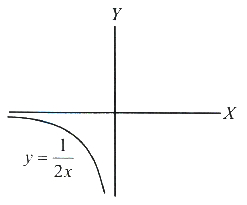
0 likesView Solution
93
MathematicsEasyMCQTS EAMCET · 2023
Find the range of the function $f(x)$ defined by:
$f(x) = \begin{cases} 2x-3, & x < -1 \\ 1-x^2, & -1 \leq x \leq 1 \\ 3x^2+2, & x > 1 \end{cases}$
$f(x) = \begin{cases} 2x-3, & x < -1 \\ 1-x^2, & -1 \leq x \leq 1 \\ 3x^2+2, & x > 1 \end{cases}$
A
$R$
B
$(-\infty, -5) \cup [0, 1] \cup (5, \infty)$
C
$(-\infty, -1) \cup (1, \infty)$
D
$(-\infty, -3) \cup (0, 1) \cup (3, \infty)$
Solution
(B) To find the range,we analyze the function in three intervals:
$1$. For $x < -1$,$f(x) = 2x - 3$. As $x \to -1^-$,$f(x) \to 2(-1) - 3 = -5$. Since $x < -1$,$f(x) < -5$. So,the range for this part is $(-\infty, -5)$.
$2$. For $-1 \leq x \leq 1$,$f(x) = 1 - x^2$. The minimum value is at $x = -1$ or $x = 1$,which is $1 - (1)^2 = 0$. The maximum value is at $x = 0$,which is $1 - 0 = 1$. So,the range for this part is $[0, 1]$.
$3$. For $x > 1$,$f(x) = 3x^2 + 2$. As $x \to 1^+$,$f(x) \to 3(1)^2 + 2 = 5$. Since $x > 1$,$f(x) > 5$. So,the range for this part is $(5, \infty)$.
Combining these,the total range is $(-\infty, -5) \cup [0, 1] \cup (5, \infty)$.
$1$. For $x < -1$,$f(x) = 2x - 3$. As $x \to -1^-$,$f(x) \to 2(-1) - 3 = -5$. Since $x < -1$,$f(x) < -5$. So,the range for this part is $(-\infty, -5)$.
$2$. For $-1 \leq x \leq 1$,$f(x) = 1 - x^2$. The minimum value is at $x = -1$ or $x = 1$,which is $1 - (1)^2 = 0$. The maximum value is at $x = 0$,which is $1 - 0 = 1$. So,the range for this part is $[0, 1]$.
$3$. For $x > 1$,$f(x) = 3x^2 + 2$. As $x \to 1^+$,$f(x) \to 3(1)^2 + 2 = 5$. Since $x > 1$,$f(x) > 5$. So,the range for this part is $(5, \infty)$.
Combining these,the total range is $(-\infty, -5) \cup [0, 1] \cup (5, \infty)$.
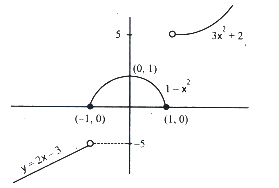
0 likesView Solution
94
MathematicsMediumMCQTS EAMCET · 2023
Which one of the following functions is a bijection?
A
$f: R \setminus Z \rightarrow [0,1]$ defined by $f(x) = \sqrt{x-[x]}$. (Here $[x]$ represents the greatest integer function)
B
$f: R \rightarrow (-\infty, 1]$ defined by $f(x) = 4x-x^2-3$
C
$f: (5, \infty) \rightarrow R \setminus \{0\}$ defined by $f(x) = \frac{1}{\sqrt{x-5}}$
D
$f: [0,4] \rightarrow [0,4]$ defined by $f(x) = \sqrt{16-x^2}$
Solution
(D) function is a bijection if it is both one-to-one (injective) and onto (surjective).
$(a)$ $f(x) = \sqrt{\{x\}}$. Since $\{x\}$ is periodic with period $1$,$f(0.1) = f(1.1)$,so it is many-to-one.
$(b)$ $f(x) = -(x^2-4x+4)+1 = 1-(x-2)^2$. This is a parabola opening downwards,which is many-to-one.
$(c)$ $f(x) = \frac{1}{\sqrt{x-5}}$. The range is $(0, \infty)$,which is not equal to the codomain $R \setminus \{0\}$,so it is into.
$(d)$ $f(x) = \sqrt{16-x^2}$. For $x \in [0,4]$,$f(x)$ is strictly decreasing from $4$ to $0$. Thus,it is one-to-one and onto. Hence,it is a bijection.
$(a)$ $f(x) = \sqrt{\{x\}}$. Since $\{x\}$ is periodic with period $1$,$f(0.1) = f(1.1)$,so it is many-to-one.
$(b)$ $f(x) = -(x^2-4x+4)+1 = 1-(x-2)^2$. This is a parabola opening downwards,which is many-to-one.
$(c)$ $f(x) = \frac{1}{\sqrt{x-5}}$. The range is $(0, \infty)$,which is not equal to the codomain $R \setminus \{0\}$,so it is into.
$(d)$ $f(x) = \sqrt{16-x^2}$. For $x \in [0,4]$,$f(x)$ is strictly decreasing from $4$ to $0$. Thus,it is one-to-one and onto. Hence,it is a bijection.
0 likesView Solution
95
MathematicsMediumMCQTS EAMCET · 2023
If $f(x)=-|x|$,then $(f \circ f \circ f)(x) + (f \circ f \circ f)(-x) =$
A
$-2 f(x)$
B
$|f(x)|$
C
$2 f(x)$
D
$-|f(x)|$
Solution
(C) Given $f(x) = -|x|$.
First,we evaluate $(f \circ f \circ f)(x)$:
$f(f(f(x))) = f(f(-|x|)) = f(-|-|x||) = f(-|x|) = -|-|x|| = -|x| = f(x)$.
Wait,let us re-evaluate carefully:
$f(x) = -|x|$.
$f(f(x)) = f(-|x|) = -|-|x|| = -|x| = f(x)$.
Since $f(f(x)) = f(x)$,it follows that $(f \circ f \circ f)(x) = f(f(f(x))) = f(f(x)) = f(x)$.
Similarly,$(f \circ f \circ f)(-x) = f(f(f(-x))) = f(f(-x)) = f(-x)$.
Therefore,$(f \circ f \circ f)(x) + (f \circ f \circ f)(-x) = f(x) + f(-x)$.
Since $f(x) = -|x|$,we have $f(-x) = -|-x| = -|x| = f(x)$.
Thus,$f(x) + f(-x) = f(x) + f(x) = 2f(x)$.
First,we evaluate $(f \circ f \circ f)(x)$:
$f(f(f(x))) = f(f(-|x|)) = f(-|-|x||) = f(-|x|) = -|-|x|| = -|x| = f(x)$.
Wait,let us re-evaluate carefully:
$f(x) = -|x|$.
$f(f(x)) = f(-|x|) = -|-|x|| = -|x| = f(x)$.
Since $f(f(x)) = f(x)$,it follows that $(f \circ f \circ f)(x) = f(f(f(x))) = f(f(x)) = f(x)$.
Similarly,$(f \circ f \circ f)(-x) = f(f(f(-x))) = f(f(-x)) = f(-x)$.
Therefore,$(f \circ f \circ f)(x) + (f \circ f \circ f)(-x) = f(x) + f(-x)$.
Since $f(x) = -|x|$,we have $f(-x) = -|-x| = -|x| = f(x)$.
Thus,$f(x) + f(-x) = f(x) + f(x) = 2f(x)$.
0 likesView Solution
96
MathematicsEasyMCQTS EAMCET · 2023
If $f(x)$ and $g(x)$ are two real valued functions such that $f(x)=3x-2$ and $g(x)=x^2+2$,then $[(g \circ f)+(f \circ g)](x) = $
A
$2g(x)+2f(x)$
B
$12g(x)-4f(x)-22$
C
$3g(x)+f(x)-2$
D
$2f(x)+4g(x)-32$
Solution
(B) Given $f(x) = 3x-2$ and $g(x) = x^2+2$.
We need to find $(g \circ f)(x) + (f \circ g)(x)$.
First,$(g \circ f)(x) = g(f(x)) = (f(x))^2 + 2 = (3x-2)^2 + 2 = 9x^2 - 12x + 4 + 2 = 9x^2 - 12x + 6$.
Next,$(f \circ g)(x) = f(g(x)) = 3(g(x)) - 2 = 3(x^2+2) - 2 = 3x^2 + 6 - 2 = 3x^2 + 4$.
Adding these,$(g \circ f + f \circ g)(x) = (9x^2 - 12x + 6) + (3x^2 + 4) = 12x^2 - 12x + 10$.
Now,check the options by substituting $f(x)$ and $g(x)$:
$12g(x) - 4f(x) - 22 = 12(x^2+2) - 4(3x-2) - 22 = 12x^2 + 24 - 12x + 8 - 22 = 12x^2 - 12x + 10$.
Thus,the correct option is $B$.
We need to find $(g \circ f)(x) + (f \circ g)(x)$.
First,$(g \circ f)(x) = g(f(x)) = (f(x))^2 + 2 = (3x-2)^2 + 2 = 9x^2 - 12x + 4 + 2 = 9x^2 - 12x + 6$.
Next,$(f \circ g)(x) = f(g(x)) = 3(g(x)) - 2 = 3(x^2+2) - 2 = 3x^2 + 6 - 2 = 3x^2 + 4$.
Adding these,$(g \circ f + f \circ g)(x) = (9x^2 - 12x + 6) + (3x^2 + 4) = 12x^2 - 12x + 10$.
Now,check the options by substituting $f(x)$ and $g(x)$:
$12g(x) - 4f(x) - 22 = 12(x^2+2) - 4(3x-2) - 22 = 12x^2 + 24 - 12x + 8 - 22 = 12x^2 - 12x + 10$.
Thus,the correct option is $B$.
0 likesView Solution
97
MathematicsMediumMCQTS EAMCET · 2023
If $f: R \rightarrow R$ is defined by $f(x)=2x+\sin x, x \in R$,then $f$ is
A
one-one and onto
B
one-one but not onto
C
onto but not one-one
D
neither one-one nor onto
Solution
(A) Given the function $f(x) = 2x + \sin x$.
To check for one-one,we find the derivative: $f'(x) = 2 + \cos x$.
Since $-1 \leq \cos x \leq 1$,it follows that $f'(x) = 2 + \cos x \geq 2 - 1 = 1 > 0$.
Since $f'(x) > 0$ for all $x \in R$,the function $f(x)$ is strictly increasing,which implies $f(x)$ is one-one.
To check for onto,we observe the range of $f(x)$. As $x \to \infty$,$f(x) \to \infty$,and as $x \to -\infty$,$f(x) \to -\infty$.
Since $f(x)$ is a continuous function,by the Intermediate Value Theorem,its range is $(-\infty, \infty) = R$.
Therefore,$f(x)$ is onto.
Thus,$f$ is one-one and onto.
To check for one-one,we find the derivative: $f'(x) = 2 + \cos x$.
Since $-1 \leq \cos x \leq 1$,it follows that $f'(x) = 2 + \cos x \geq 2 - 1 = 1 > 0$.
Since $f'(x) > 0$ for all $x \in R$,the function $f(x)$ is strictly increasing,which implies $f(x)$ is one-one.
To check for onto,we observe the range of $f(x)$. As $x \to \infty$,$f(x) \to \infty$,and as $x \to -\infty$,$f(x) \to -\infty$.
Since $f(x)$ is a continuous function,by the Intermediate Value Theorem,its range is $(-\infty, \infty) = R$.
Therefore,$f(x)$ is onto.
Thus,$f$ is one-one and onto.
0 likesView Solution
98
MathematicsEasyMCQTS EAMCET · 2023
If the function $f: R \rightarrow R$ is defined by $f(x) = \begin{cases} 2x-3, & \text{if } x < -2 \\ x^2-1, & \text{if } -2 \leq x \leq 2 \\ 3x+2, & \text{if } x > 2 \end{cases}$ then $f$ is
A
an injection but not a surjection
B
a surjection but not an injection
C
a bijection
D
neither injection nor surjection
Solution
(D) The function is defined as $f(x) = \begin{cases} 2x-3, & x < -2 \\ x^2-1, & -2 \leq x \leq 2 \\ 3x+2, & x > 2 \end{cases}$.
$1$. Checking for Injectivity (One-to-One):
$A$ function is injective if $f(x_1) = f(x_2) \implies x_1 = x_2$.
Consider the interval $[-2, 2]$,where $f(x) = x^2 - 1$.
We observe that $f(-1) = (-1)^2 - 1 = 0$ and $f(1) = (1)^2 - 1 = 0$.
Since $f(-1) = f(1)$ but $-1 \neq 1$,the function is not injective.
$2$. Checking for Surjectivity (Onto):
$A$ function is surjective if its range equals its codomain $(R)$.
- For $x < -2$,$f(x) < 2(-2) - 3 = -7$. So,$f(x) \in (-\infty, -7)$.
- For $-2 \leq x \leq 2$,$f(x) = x^2 - 1$. The minimum value is $-1$ (at $x=0$) and the maximum is $f(-2) = f(2) = 3$. So,$f(x) \in [-1, 3]$.
- For $x > 2$,$f(x) > 3(2) + 2 = 8$. So,$f(x) \in (8, \infty)$.
The range of $f$ is $(-\infty, -7) \cup [-1, 3] \cup (8, \infty)$.
Since the range is not equal to the codomain $R$,the function is not surjective.
Conclusion: The function is neither injective nor surjective.
$1$. Checking for Injectivity (One-to-One):
$A$ function is injective if $f(x_1) = f(x_2) \implies x_1 = x_2$.
Consider the interval $[-2, 2]$,where $f(x) = x^2 - 1$.
We observe that $f(-1) = (-1)^2 - 1 = 0$ and $f(1) = (1)^2 - 1 = 0$.
Since $f(-1) = f(1)$ but $-1 \neq 1$,the function is not injective.
$2$. Checking for Surjectivity (Onto):
$A$ function is surjective if its range equals its codomain $(R)$.
- For $x < -2$,$f(x) < 2(-2) - 3 = -7$. So,$f(x) \in (-\infty, -7)$.
- For $-2 \leq x \leq 2$,$f(x) = x^2 - 1$. The minimum value is $-1$ (at $x=0$) and the maximum is $f(-2) = f(2) = 3$. So,$f(x) \in [-1, 3]$.
- For $x > 2$,$f(x) > 3(2) + 2 = 8$. So,$f(x) \in (8, \infty)$.
The range of $f$ is $(-\infty, -7) \cup [-1, 3] \cup (8, \infty)$.
Since the range is not equal to the codomain $R$,the function is not surjective.
Conclusion: The function is neither injective nor surjective.
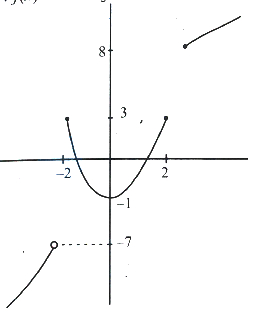
0 likesView Solution
99
MathematicsMediumMCQTS EAMCET · 2023
Let $X = \left\{ \begin{bmatrix} a & b \\ c & d \end{bmatrix} : a, b, c, d \in \mathbb{R} \right\}$. If $f: X \rightarrow \mathbb{R}$ is defined by $f(A) = \det(A)$ for all $A \in X$,then $f$ is
A
one-one but not onto
B
onto but not one-one
C
one-one and onto
D
neither one-one nor onto
Solution
(B) The set $X$ consists of all $2 \times 2$ matrices with real entries. The function $f: X \rightarrow \mathbb{R}$ is defined as $f(A) = \det(A) = ad - bc$.
To check if $f$ is one-one,consider two different matrices $A_1 = \begin{bmatrix} 1 & 0 \\ 0 & 1 \end{bmatrix}$ and $A_2 = \begin{bmatrix} 2 & 0 \\ 0 & 0.5 \end{bmatrix}$.
Here,$f(A_1) = (1)(1) - (0)(0) = 1$ and $f(A_2) = (2)(0.5) - (0)(0) = 1$.
Since $f(A_1) = f(A_2)$ but $A_1 \neq A_2$,the function $f$ is not one-one.
To check if $f$ is onto,for any real number $k \in \mathbb{R}$,we can find a matrix $A = \begin{bmatrix} k & 0 \\ 0 & 1 \end{bmatrix} \in X$ such that $f(A) = (k)(1) - (0)(0) = k$.
Since every element in the codomain $\mathbb{R}$ has a pre-image in $X$,the function $f$ is onto.
Therefore,$f$ is onto but not one-one.
To check if $f$ is one-one,consider two different matrices $A_1 = \begin{bmatrix} 1 & 0 \\ 0 & 1 \end{bmatrix}$ and $A_2 = \begin{bmatrix} 2 & 0 \\ 0 & 0.5 \end{bmatrix}$.
Here,$f(A_1) = (1)(1) - (0)(0) = 1$ and $f(A_2) = (2)(0.5) - (0)(0) = 1$.
Since $f(A_1) = f(A_2)$ but $A_1 \neq A_2$,the function $f$ is not one-one.
To check if $f$ is onto,for any real number $k \in \mathbb{R}$,we can find a matrix $A = \begin{bmatrix} k & 0 \\ 0 & 1 \end{bmatrix} \in X$ such that $f(A) = (k)(1) - (0)(0) = k$.
Since every element in the codomain $\mathbb{R}$ has a pre-image in $X$,the function $f$ is onto.
Therefore,$f$ is onto but not one-one.
0 likesView Solution
100
MathematicsEasyMCQTS EAMCET · 2023
If $f(x)=|x-1|+|x-2|$,then $f^{\prime}(-2023)+f^{\prime}\left(\frac{2024}{2023}\right)+f^{\prime}(2023)=$
A
$1$
B
$-1$
C
$0$
D
$3$
Solution
(C) The function is defined as $f(x) = |x-1| + |x-2|$.
We analyze the derivative $f^{\prime}(x)$ in different intervals:
$1$. For $x < 1$,$f(x) = -(x-1) - (x-2) = -2x + 3$,so $f^{\prime}(x) = -2$.
Since $-2023 < 1$,$f^{\prime}(-2023) = -2$.
$2$. For $1 < x < 2$,$f(x) = (x-1) - (x-2) = 1$,so $f^{\prime}(x) = 0$.
Since $1 < \frac{2024}{2023} < 2$,$f^{\prime}\left(\frac{2024}{2023}\right) = 0$.
$3$. For $x > 2$,$f(x) = (x-1) + (x-2) = 2x - 3$,so $f^{\prime}(x) = 2$.
Since $2023 > 2$,$f^{\prime}(2023) = 2$.
Summing these values: $f^{\prime}(-2023) + f^{\prime}\left(\frac{2024}{2023}\right) + f^{\prime}(2023) = -2 + 0 + 2 = 0$.
We analyze the derivative $f^{\prime}(x)$ in different intervals:
$1$. For $x < 1$,$f(x) = -(x-1) - (x-2) = -2x + 3$,so $f^{\prime}(x) = -2$.
Since $-2023 < 1$,$f^{\prime}(-2023) = -2$.
$2$. For $1 < x < 2$,$f(x) = (x-1) - (x-2) = 1$,so $f^{\prime}(x) = 0$.
Since $1 < \frac{2024}{2023} < 2$,$f^{\prime}\left(\frac{2024}{2023}\right) = 0$.
$3$. For $x > 2$,$f(x) = (x-1) + (x-2) = 2x - 3$,so $f^{\prime}(x) = 2$.
Since $2023 > 2$,$f^{\prime}(2023) = 2$.
Summing these values: $f^{\prime}(-2023) + f^{\prime}\left(\frac{2024}{2023}\right) + f^{\prime}(2023) = -2 + 0 + 2 = 0$.
0 likesView Solution
Vedclass Products
For Students
Vedclass Test Series
Mock tests in real TS EAMCET style covering Mathematics with performance analysis. 5-day free trial.
Start Free TrialFor Teachers
Exam Paper Generator
Generate Set A/B/C/D Mathematics papers from 7.5L+ questions in 2 minutes. 3 chapters free.
Try FreeFor Institutes
Online Exam Module
Run live TS EAMCET mock exams with unlimited students, 360° analytics & white-label branding.
See DemoFrequently Asked Questions
How many Mathematics questions are in TS EAMCET 2023?
There are 489 Mathematics questions from the TS EAMCET 2023 paper on Vedclass, each with a detailed step-by-step solution in English.
Are TS EAMCET 2023 Mathematics solutions available in English?
Yes. All solutions on this page are in English. You can also switch to English or Hindi using the language buttons above the questions.
Can I practice TS EAMCET 2023 Mathematics as a timed test?
Yes. Use the Vedclass Test Series to attempt a full TS EAMCET mock test covering Mathematics with time limits and instant score analysis.
Can teachers create Mathematics papers from TS EAMCET previous year questions?
Yes. The Vedclass Exam Paper Generator lets teachers mix TS EAMCET Mathematics questions and generate Set A/B/C/D papers in minutes.
For Teachers & Institutes
Build a Custom Mathematics Paper
Pick TS EAMCET 2023 Mathematics questions, set difficulty, and generate Set A/B/C/D in 2 minutes.