
ChemistryQ51–150 of 268 questions
Page 2 of 3 · English
51
ChemistryEasyMCQTS EAMCET · 2023
Arrange the following in the correct order of their acidic strength:
| $I. H_2C=CH_2$ | $II. CH \equiv CH$ | $III. CH_3-C \equiv CH$ | $IV. CH_3-CH_3$ |
A
$I < II < III < IV$
B
$IV < I < III < II$
C
$IV < III < II < I$
D
$II < III < IV < I$
Solution
(B) Acidic strength $\propto \ \% \ s$-character.
The acidity of hydrogen atoms attached to carbon depends on the hybridization of the carbon atom. The order of electronegativity is $sp > sp^2 > sp^3$,which corresponds to $50\% \ s$,$33.3\% \ s$,and $25\% \ s$ character respectively.
$1$. $CH \equiv CH$ $(II)$: $sp$ hybridized carbon ($50\% \ s$-character),most acidic.
$2$. $CH_3-C \equiv CH$ $(III)$: Terminal alkyne,but the $+I$ effect of the $-CH_3$ group decreases the acidity compared to ethyne.
$3$. $H_2C=CH_2$ $(I)$: $sp^2$ hybridized carbon ($33.3\% \ s$-character).
$4$. $CH_3-CH_3$ $(IV)$: $sp^3$ hybridized carbon ($25\% \ s$-character),least acidic.
Thus,the correct order of acidic strength is $IV < I < III < II$.
The acidity of hydrogen atoms attached to carbon depends on the hybridization of the carbon atom. The order of electronegativity is $sp > sp^2 > sp^3$,which corresponds to $50\% \ s$,$33.3\% \ s$,and $25\% \ s$ character respectively.
$1$. $CH \equiv CH$ $(II)$: $sp$ hybridized carbon ($50\% \ s$-character),most acidic.
$2$. $CH_3-C \equiv CH$ $(III)$: Terminal alkyne,but the $+I$ effect of the $-CH_3$ group decreases the acidity compared to ethyne.
$3$. $H_2C=CH_2$ $(I)$: $sp^2$ hybridized carbon ($33.3\% \ s$-character).
$4$. $CH_3-CH_3$ $(IV)$: $sp^3$ hybridized carbon ($25\% \ s$-character),least acidic.
Thus,the correct order of acidic strength is $IV < I < III < II$.
0 likesView Solution
52
ChemistryEasyMCQTS EAMCET · 2023
In which of the following is hyperconjugation not possible?
A
$C_6H_5-C(CH_3)_3$
B
$C_6H_5-CH(CH_3)_2$
C
$C_6H_5-CH_2-CH_3$
D
$C_6H_5-CH_3$
Solution
(A) Hyperconjugation requires the presence of at least one $\alpha$-hydrogen atom on a carbon atom adjacent to an unsaturated system (like a double bond or a benzene ring) or a carbocation.
In the given options:
$A$) $C_6H_5-C(CH_3)_3$: The $\alpha$-carbon is attached to three methyl groups and the benzene ring. It has no $\alpha$-hydrogen atoms,so hyperconjugation is not possible.
$B$) $C_6H_5-CH(CH_3)_2$: The $\alpha$-carbon has one $\alpha$-hydrogen atom.
$C$) $C_6H_5-CH_2-CH_3$: The $\alpha$-carbon has two $\alpha$-hydrogen atoms.
$D$) $C_6H_5-CH_3$: The $\alpha$-carbon has three $\alpha$-hydrogen atoms.
Therefore,the correct option is $(A)$.
In the given options:
$A$) $C_6H_5-C(CH_3)_3$: The $\alpha$-carbon is attached to three methyl groups and the benzene ring. It has no $\alpha$-hydrogen atoms,so hyperconjugation is not possible.
$B$) $C_6H_5-CH(CH_3)_2$: The $\alpha$-carbon has one $\alpha$-hydrogen atom.
$C$) $C_6H_5-CH_2-CH_3$: The $\alpha$-carbon has two $\alpha$-hydrogen atoms.
$D$) $C_6H_5-CH_3$: The $\alpha$-carbon has three $\alpha$-hydrogen atoms.
Therefore,the correct option is $(A)$.
0 likesView Solution
53
ChemistryMediumMCQTS EAMCET · 2023
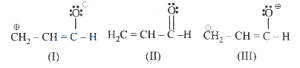
Consider the following three resonance structures:
The correct order of their stabilities is:
The correct order of their stabilities is:
A
$II > I > III$
B
$I > II > III$
C
$III > I > II$
D
$III > II > I$
Solution
(A) The stability of resonance structures is determined by the following rules:
$1$. Neutral structures are more stable than charged structures.
$2$. Structures with a complete octet for all atoms are more stable.
$3$. Negative charge on a more electronegative atom is more stable.
Structure $II$ is a neutral molecule where all atoms have complete octets,making it the most stable.
Structure $I$ has a positive charge on carbon and a negative charge on oxygen. Oxygen is more electronegative than carbon,so having a negative charge on oxygen is relatively stable.
Structure $III$ has a negative charge on carbon and a positive charge on oxygen. Having a positive charge on a highly electronegative atom like oxygen is highly unstable.
Therefore,the stability order is $II > I > III$.
$1$. Neutral structures are more stable than charged structures.
$2$. Structures with a complete octet for all atoms are more stable.
$3$. Negative charge on a more electronegative atom is more stable.
Structure $II$ is a neutral molecule where all atoms have complete octets,making it the most stable.
Structure $I$ has a positive charge on carbon and a negative charge on oxygen. Oxygen is more electronegative than carbon,so having a negative charge on oxygen is relatively stable.
Structure $III$ has a negative charge on carbon and a positive charge on oxygen. Having a positive charge on a highly electronegative atom like oxygen is highly unstable.
Therefore,the stability order is $II > I > III$.
0 likesView Solution
54
ChemistryEasyMCQTS EAMCET · 2023
The delocalization of $\sigma$ electrons of $C-H$ bond of an alkyl group with the $\pi$ electrons of benzene is observed in
A
Inductive effect
B
Hyperconjugation effect
C
Resonance effect
D
Electromeric effect
Solution
(B) The phenomenon involving the delocalization of $\sigma$ electrons of a $C-H$ bond of an alkyl group attached to an unsaturated system (like benzene) or a vacant $p$-orbital is known as hyperconjugation.
This effect is also referred to as 'no-bond resonance' or the Baker-Nathan effect.
This effect is also referred to as 'no-bond resonance' or the Baker-Nathan effect.
0 likesView Solution
55
ChemistryEasyMCQTS EAMCET · 2023
The aromatic compound/species with the maximum number of $\pi$-electrons is:
A
Phenanthrene
B
Naphthalene
C
Cyclopentadienyl anion
D
Cycloheptatrienyl cation
Solution
(A) To determine the number of $\pi$-electrons in each species:
$1$. Phenanthrene: It consists of three fused benzene rings. It has $14$ $\pi$-electrons.
$2$. Naphthalene: It consists of two fused benzene rings. It has $10$ $\pi$-electrons.
$3$. Cyclopentadienyl anion: It has two double bonds ($4$ $\pi$-electrons) and one lone pair on the carbon atom involved in resonance,contributing $2$ $\pi$-electrons,totaling $6$ $\pi$-electrons.
$4$. Cycloheptatrienyl cation: It has three double bonds ($6$ $\pi$-electrons) and a vacant $p$-orbital on the positively charged carbon,totaling $6$ $\pi$-electrons.
Comparing these,Phenanthrene has the maximum number of $\pi$-electrons $(14)$.
Therefore,the correct option is $A$.
$1$. Phenanthrene: It consists of three fused benzene rings. It has $14$ $\pi$-electrons.
$2$. Naphthalene: It consists of two fused benzene rings. It has $10$ $\pi$-electrons.
$3$. Cyclopentadienyl anion: It has two double bonds ($4$ $\pi$-electrons) and one lone pair on the carbon atom involved in resonance,contributing $2$ $\pi$-electrons,totaling $6$ $\pi$-electrons.
$4$. Cycloheptatrienyl cation: It has three double bonds ($6$ $\pi$-electrons) and a vacant $p$-orbital on the positively charged carbon,totaling $6$ $\pi$-electrons.
Comparing these,Phenanthrene has the maximum number of $\pi$-electrons $(14)$.
Therefore,the correct option is $A$.
0 likesView Solution
56
ChemistryEasyMCQTS EAMCET · 2023
Kernite and cryolite are the minerals of two elements $X$ and $Z$. Respectively $X$ and $Z$ are
A
$B, Ga$
B
$B, Al$
C
$Al, In$
D
$B, Tl$
Solution
(B) Kernite is a mineral of Boron $(B)$ with the formula $Na_2B_4O_6(OH)_2 \cdot 3H_2O$.
Cryolite is a mineral of Aluminum $(Al)$ with the formula $Na_3AlF_6$.
Therefore,$X$ is $B$ and $Z$ is $Al$.
Cryolite is a mineral of Aluminum $(Al)$ with the formula $Na_3AlF_6$.
Therefore,$X$ is $B$ and $Z$ is $Al$.
0 likesView Solution
57
ChemistryEasyMCQTS EAMCET · 2023
Zeolite is a silicate of two metal ions $X$ and $Y$. $X$ and $Y$ are respectively
A
$Ca^{2+}, Na^{+}$
B
$Mg^{2+}, Na^{+}$
C
$Na^{+}, Al^{3+}$
D
$Ca^{2+}, Mg^{2+}$
Solution
(C) Zeolite is a hydrated sodium aluminium silicate.
Its general chemical formula is $Na_2Al_2Si_2O_8 \cdot xH_2O$.
Thus,the metal ions present are $Na^{+}$ and $Al^{3+}$.
Its general chemical formula is $Na_2Al_2Si_2O_8 \cdot xH_2O$.
Thus,the metal ions present are $Na^{+}$ and $Al^{3+}$.
0 likesView Solution
58
ChemistryMediumMCQTS EAMCET · 2023
Identify the major product $B$ in the given sequence of reactions:
$CH_3-C \equiv CH$ $\xrightarrow{H_2 / Pd-C} A$ $\xrightarrow{(C_6H_5CO)_2O_2 / HBr} B$
$CH_3-C \equiv CH$ $\xrightarrow{H_2 / Pd-C} A$ $\xrightarrow{(C_6H_5CO)_2O_2 / HBr} B$
A
$CH_3-CH_2-CH_2Br$
B
$CH_3-CH(Br)-CH_3$
C
$CH_3-CH_2-CHBr_2$
D
$CH_3-CH(Br)-CH_2Br$
Solution
(A) Step $1$: The hydrogenation of propyne $(CH_3-C \equiv CH)$ with $H_2 / Pd-C$ (Lindlar's catalyst or similar) reduces the alkyne to an alkene,specifically propene $(CH_3-CH=CH_2)$,which is product $A$.
Step $2$: The reaction of propene with $HBr$ in the presence of benzoyl peroxide $((C_6H_5CO)_2O_2)$ follows the anti-Markovnikov addition (peroxide effect).
Step $3$: According to the anti-Markovnikov rule,the bromine atom attaches to the carbon atom with more hydrogen atoms,resulting in $1$-bromopropane $(CH_3-CH_2-CH_2Br)$ as the major product $B$.
Step $2$: The reaction of propene with $HBr$ in the presence of benzoyl peroxide $((C_6H_5CO)_2O_2)$ follows the anti-Markovnikov addition (peroxide effect).
Step $3$: According to the anti-Markovnikov rule,the bromine atom attaches to the carbon atom with more hydrogen atoms,resulting in $1$-bromopropane $(CH_3-CH_2-CH_2Br)$ as the major product $B$.
0 likesView Solution
59
ChemistryMediumMCQTS EAMCET · 2023
$I$. $(CH_3)_2 C=CH_2 \xrightarrow{KMnO_4 / H^{+}} X + CO_2 + H_2 O$
$II$. $CH_3-CH=CH-CH_3 \xrightarrow{KMnO_4 / H^{+}} Y$
The functional groups in $X$ and $Y$ are respectively
$II$. $CH_3-CH=CH-CH_3 \xrightarrow{KMnO_4 / H^{+}} Y$
The functional groups in $X$ and $Y$ are respectively
A
Ketone and Carboxylic acid
B
Ketone and Ketone
C
Aldehyde and Ketone
D
Ester and Aldehyde
Solution
(A) The oxidative cleavage of alkenes using hot acidic $KMnO_4$ results in the breaking of the $C=C$ double bond.
For reaction $I$: $(CH_3)_2 C=CH_2$ undergoes cleavage to form $(CH_3)_2 C=O$ (acetone,a ketone) and $CO_2 + H_2 O$. Thus,$X$ is a ketone.
For reaction $II$: $CH_3-CH=CH-CH_3$ undergoes cleavage to form $2CH_3COOH$ (acetic acid,a carboxylic acid). However,looking at the provided options and the structure of $Y$ in the image,the product is $CH_3COOH$. Given the options,the correct functional groups are Ketone $(X)$ and Carboxylic acid $(Y)$.
For reaction $I$: $(CH_3)_2 C=CH_2$ undergoes cleavage to form $(CH_3)_2 C=O$ (acetone,a ketone) and $CO_2 + H_2 O$. Thus,$X$ is a ketone.
For reaction $II$: $CH_3-CH=CH-CH_3$ undergoes cleavage to form $2CH_3COOH$ (acetic acid,a carboxylic acid). However,looking at the provided options and the structure of $Y$ in the image,the product is $CH_3COOH$. Given the options,the correct functional groups are Ketone $(X)$ and Carboxylic acid $(Y)$.
0 likesView Solution
60
ChemistryEasyMCQTS EAMCET · 2023
An alkene $(X)$ on ozonolysis gives propanal and ethanal. What is $X$?
A
Pent$-2-$ene
B
Pent$-1-$ene
C
But$-1-$ene
D
But$-2-$ene
Solution
(A) Ozonolysis of an alkene involves the cleavage of the double bond to form two carbonyl compounds.
Given products are $CH_3-CH_2-CHO$ (propanal) and $CH_3-CHO$ (ethanal).
By removing the oxygen atoms from the carbonyl groups and joining the carbon atoms with a double bond,we get:
$CH_3-CH_2-CH=CH-CH_3$.
The structure corresponds to $Pent-2-ene$.
Therefore,the correct option is $A$.
Given products are $CH_3-CH_2-CHO$ (propanal) and $CH_3-CHO$ (ethanal).
By removing the oxygen atoms from the carbonyl groups and joining the carbon atoms with a double bond,we get:
$CH_3-CH_2-CH=CH-CH_3$.
The structure corresponds to $Pent-2-ene$.
Therefore,the correct option is $A$.
0 likesView Solution
61
ChemistryDifficultMCQTS EAMCET · 2023
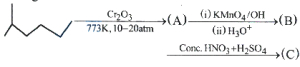
In the following reaction,'$C$' is an aromatic compound having substituents $D$ and $E$. What are $D$ and $E$?
A
$-OH, -SO_3H$
B
$-CHO, -NO_2$
C
$-COOH, -NO_2$
D
$-SO_3H, -NO_2$
Solution
(C) $1$. The starting material is $2$-methylhexane. Upon heating with $Cr_2O_3$ at $773 \ K$ and $10-20 \ atm$,it undergoes aromatization to form $A$ (Toluene).
$2$. Toluene $(A)$ reacts with alkaline $KMnO_4$ followed by acidic workup $(H_3O^+)$ to undergo oxidation of the methyl group to a carboxylic acid group,forming $B$ (Benzoic acid).
$3$. Benzoic acid $(B)$ reacts with concentrated $HNO_3$ and $H_2SO_4$ (nitration). Since the $-COOH$ group is meta-directing,the $-NO_2$ group attaches at the meta position,forming $C$ ($m$-nitrobenzoic acid).
$4$. Compound $C$ has substituents $D = -COOH$ and $E = -NO_2$.
$2$. Toluene $(A)$ reacts with alkaline $KMnO_4$ followed by acidic workup $(H_3O^+)$ to undergo oxidation of the methyl group to a carboxylic acid group,forming $B$ (Benzoic acid).
$3$. Benzoic acid $(B)$ reacts with concentrated $HNO_3$ and $H_2SO_4$ (nitration). Since the $-COOH$ group is meta-directing,the $-NO_2$ group attaches at the meta position,forming $C$ ($m$-nitrobenzoic acid).
$4$. Compound $C$ has substituents $D = -COOH$ and $E = -NO_2$.
0 likesView Solution
62
ChemistryMediumMCQTS EAMCET · 2023
An alkene $X$ $(C_6H_{12})$ on ozonolysis gives acetaldehyde and ethyl methyl ketone. What is the product formed when $X$ reacts with $HBr$?
A
$3-$bromo$-3-$methylpentane
B
$3-$bromo$-2-$methylpentane
C
$2-$bromo$-3-$methylpentane
D
$2-$bromo$-2-$methylpentane
Solution
(A) $1$. Ozonolysis of alkene $X$ $(C_6H_{12})$ yields acetaldehyde $(CH_3CHO)$ and ethyl methyl ketone $(CH_3COCH_2CH_3)$.
$2$. By reversing the ozonolysis process,we can determine the structure of $X$ by joining the carbonyl carbons with a double bond: $CH_3CH=C(CH_3)CH_2CH_3$.
$3$. The structure of $X$ is $3-methylpent-2-ene$.
$4$. When $X$ reacts with $HBr$,the reaction follows Markovnikov's rule,where the $H^+$ adds to the carbon with more hydrogen atoms and $Br^-$ adds to the more substituted carbon.
$5$. The reaction is: $CH_3CH=C(CH_3)CH_2CH_3 + HBr \rightarrow CH_3CH_2-C(Br)(CH_3)CH_2CH_3$.
$6$. The product formed is $3-bromo-3-methylpentane$.
$2$. By reversing the ozonolysis process,we can determine the structure of $X$ by joining the carbonyl carbons with a double bond: $CH_3CH=C(CH_3)CH_2CH_3$.
$3$. The structure of $X$ is $3-methylpent-2-ene$.
$4$. When $X$ reacts with $HBr$,the reaction follows Markovnikov's rule,where the $H^+$ adds to the carbon with more hydrogen atoms and $Br^-$ adds to the more substituted carbon.
$5$. The reaction is: $CH_3CH=C(CH_3)CH_2CH_3 + HBr \rightarrow CH_3CH_2-C(Br)(CH_3)CH_2CH_3$.
$6$. The product formed is $3-bromo-3-methylpentane$.
0 likesView Solution
63
ChemistryMediumMCQTS EAMCET · 2023
An alkene $X$ on ozonolysis gives a mixture of $Propan-2-one$ and $methanal$. What is $X$?
A
$2-Methylpropene$
B
$2-Methylbut-1-ene$
C
$2-Methylbut-2-ene$
D
$3-Methylbut-1-ene$
Solution
(A) Ozonolysis of an alkene involves the cleavage of the $C=C$ double bond to form carbonyl compounds.
To find the original alkene,we join the two carbonyl products by removing the oxygen atoms and forming a double bond between the carbon atoms.
The products are $Propan-2-one$ $(CH_3-CO-CH_3)$ and $methanal$ $(H-CHO)$.
Joining these: $(CH_3)_2C=O + O=CH_2 \rightarrow (CH_3)_2C=CH_2$.
The resulting alkene is $2-Methylpropene$.
To find the original alkene,we join the two carbonyl products by removing the oxygen atoms and forming a double bond between the carbon atoms.
The products are $Propan-2-one$ $(CH_3-CO-CH_3)$ and $methanal$ $(H-CHO)$.
Joining these: $(CH_3)_2C=O + O=CH_2 \rightarrow (CH_3)_2C=CH_2$.
The resulting alkene is $2-Methylpropene$.
0 likesView Solution
64
ChemistryEasyMCQTS EAMCET · 2023
Addition of $HBr$ to propene in the presence of a peroxide takes place contrary to Markovnikov rule. This can be explained by the mechanism involving
A
electrophile
B
free radical
C
nucleophile
D
carbene
Solution
(B) The addition of $HBr$ to propene in the presence of a peroxide occurs contrary to Markovnikov's rule,which is known as the peroxide effect or Kharasch effect.
This reaction proceeds via a free radical chain mechanism.
The mechanism is initiated by the homolysis of benzoyl peroxide as shown below:
$(i) \ C_6H_5-CO-O-O-CO-C_6H_5$ $\xrightarrow{\text{Homolysis}} 2C_6H_5-CO-O^{\bullet}$ $\rightarrow 2C_6H_5^{\bullet} + 2CO_2$
This reaction proceeds via a free radical chain mechanism.
The mechanism is initiated by the homolysis of benzoyl peroxide as shown below:
$(i) \ C_6H_5-CO-O-O-CO-C_6H_5$ $\xrightarrow{\text{Homolysis}} 2C_6H_5-CO-O^{\bullet}$ $\rightarrow 2C_6H_5^{\bullet} + 2CO_2$
0 likesView Solution
65
ChemistryMediumMCQTS EAMCET · 2023
Identify '$Z$' in the following reaction sequence:
$2CH_3CH_2CH_2Br$ $\xrightarrow{Na/Ether} X$ $\xrightarrow[10-20 \ atm]{Mo_2O_3, 773K} Y$ $\xrightarrow[CH_3Cl]{Anh. AlCl_3} Z$
$2CH_3CH_2CH_2Br$ $\xrightarrow{Na/Ether} X$ $\xrightarrow[10-20 \ atm]{Mo_2O_3, 773K} Y$ $\xrightarrow[CH_3Cl]{Anh. AlCl_3} Z$
A
Chlorobenzene
B
Benzyl chloride
C
Toluene
D
p-Chlorotoluene
Solution
(C) $1$. The reaction of $2CH_3CH_2CH_2Br$ with $Na/Ether$ is a Wurtz reaction,which produces $n$-hexane $(X = CH_3CH_2CH_2CH_2CH_2CH_3)$.
$2$. The aromatization of $n$-hexane in the presence of $Mo_2O_3$ at $773K$ and $10-20 \ atm$ yields benzene $(Y = C_6H_6)$.
$3$. The reaction of benzene $(Y)$ with $CH_3Cl$ in the presence of anhydrous $AlCl_3$ is a Friedel-Crafts alkylation,which produces toluene $(Z = C_6H_5CH_3)$.
$2$. The aromatization of $n$-hexane in the presence of $Mo_2O_3$ at $773K$ and $10-20 \ atm$ yields benzene $(Y = C_6H_6)$.
$3$. The reaction of benzene $(Y)$ with $CH_3Cl$ in the presence of anhydrous $AlCl_3$ is a Friedel-Crafts alkylation,which produces toluene $(Z = C_6H_5CH_3)$.
0 likesView Solution
66
ChemistryMediumMCQTS EAMCET · 2023
Match the following reactions in List-$I$ with their corresponding products in List-$II$:
List-$I$ (Reaction):
$A$. $\text{Benzene} + Cl_2 \xrightarrow{AlCl_3}$
$B$. $\text{Benzene} + CH_3Cl \xrightarrow{\text{anhyd. } AlCl_3}$
$C$. $\text{Benzene} + R-CO-Cl \xrightarrow{\text{anhyd. } AlCl_3}$
$D$. $\text{Toluene} \xrightarrow{(i) KMnO_4/KOH, (ii) H_3O^+}$
List-$II$ (Product):
$I$. $\text{Benzoic acid}$
$II$. $\text{Alkyl phenyl ketone}$
$III$. $\text{Chlorobenzene}$
$IV$. $\text{Toluene}$
List-$I$ (Reaction):
$A$. $\text{Benzene} + Cl_2 \xrightarrow{AlCl_3}$
$B$. $\text{Benzene} + CH_3Cl \xrightarrow{\text{anhyd. } AlCl_3}$
$C$. $\text{Benzene} + R-CO-Cl \xrightarrow{\text{anhyd. } AlCl_3}$
$D$. $\text{Toluene} \xrightarrow{(i) KMnO_4/KOH, (ii) H_3O^+}$
List-$II$ (Product):
$I$. $\text{Benzoic acid}$
$II$. $\text{Alkyl phenyl ketone}$
$III$. $\text{Chlorobenzene}$
$IV$. $\text{Toluene}$
A
$A-III, B-IV, C-II, D-I$
B
$A-II, B-I, C-IV, D-III$
C
$A-IV, B-III, C-II, D-I$
D
$A-III, B-IV, C-I, D-II$
Solution
(A) The reactions are identified as follows:
$A$. $\text{Benzene} + Cl_2 \xrightarrow{AlCl_3} \text{Chlorobenzene}$ (Electrophilic substitution),so $A-III$.
$B$. $\text{Benzene} + CH_3Cl \xrightarrow{\text{anhyd. } AlCl_3} \text{Toluene}$ (Friedel-Crafts alkylation),so $B-IV$.
$C$. $\text{Benzene} + R-CO-Cl \xrightarrow{\text{anhyd. } AlCl_3} \text{Alkyl phenyl ketone}$ (Friedel-Crafts acylation),so $C-II$.
$D$. $\text{Toluene} \xrightarrow{(i) KMnO_4/KOH, (ii) H_3O^+} \text{Benzoic acid}$ (Oxidation of side chain),so $D-I$.
Thus,the correct matching is $A-III, B-IV, C-II, D-I$.
$A$. $\text{Benzene} + Cl_2 \xrightarrow{AlCl_3} \text{Chlorobenzene}$ (Electrophilic substitution),so $A-III$.
$B$. $\text{Benzene} + CH_3Cl \xrightarrow{\text{anhyd. } AlCl_3} \text{Toluene}$ (Friedel-Crafts alkylation),so $B-IV$.
$C$. $\text{Benzene} + R-CO-Cl \xrightarrow{\text{anhyd. } AlCl_3} \text{Alkyl phenyl ketone}$ (Friedel-Crafts acylation),so $C-II$.
$D$. $\text{Toluene} \xrightarrow{(i) KMnO_4/KOH, (ii) H_3O^+} \text{Benzoic acid}$ (Oxidation of side chain),so $D-I$.
Thus,the correct matching is $A-III, B-IV, C-II, D-I$.
0 likesView Solution
67
ChemistryEasyMCQTS EAMCET · 2023
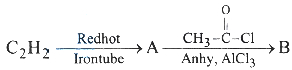
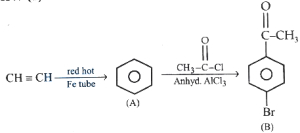
In the conversion of $A$ to $B$,the electrophile involved is:
A
${}^{\oplus}CH_3$
B
$Cl^{\oplus}$
C
$CH_3CO^{\oplus}$
D
$CH_3CH_2^{\oplus}$
Solution
(C) The reaction shown is a Friedel-Crafts acylation of benzene $(A)$ to form acetophenone,which is then further substituted to form $B$. The electrophile in the Friedel-Crafts acylation reaction is the acylium ion,$CH_3-C\equiv O^{\oplus}$ (or $CH_3CO^{\oplus}$),which is generated by the reaction of acetyl chloride $(CH_3COCl)$ with the Lewis acid catalyst $AlCl_3$.
0 likesView Solution
68
ChemistryEasyMCQTS EAMCET · 2023
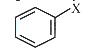
The rate of attack of an electrophile is least when $X$ in the given compound is
A
$-NO_2$
B
$-CH_3$
C
$-OH$
D
$-NH_2$
Solution
(A) Electrophilic aromatic substitution is favored by electron-donating groups (activating groups) and disfavored by electron-withdrawing groups (deactivating groups).
$-OH$,$-NH_2$,and $-CH_3$ are electron-donating groups that increase the electron density of the benzene ring,thereby facilitating the electrophilic attack.
$-NO_2$ is a strong electron-withdrawing group due to both its $-I$ (inductive) and $-M$ (mesomeric) effects.
It significantly reduces the electron density of the benzene ring,making it the least reactive towards electrophilic attack.
$-OH$,$-NH_2$,and $-CH_3$ are electron-donating groups that increase the electron density of the benzene ring,thereby facilitating the electrophilic attack.
$-NO_2$ is a strong electron-withdrawing group due to both its $-I$ (inductive) and $-M$ (mesomeric) effects.
It significantly reduces the electron density of the benzene ring,making it the least reactive towards electrophilic attack.
0 likesView Solution
69
ChemistryMediumMCQTS EAMCET · 2023
Consider the following statements about the hydrides: $(I)$ Sodium hydride with water liberates oxygen gas $(II)$ Methane,silane are examples of electron precise hydrides $(III)$ Ammonia and water molecules are examples of electron deficient hydrides $(IV)$ Hydrides of beryllium and magnesium are polymeric in structure. The correct statements are:
A
$I$ & $II$ only
B
$III$ & $IV$ only
C
$II$ & $IV$ only
D
$I$ & $IV$ only
Solution
(C) Statement $(I)$ is incorrect because the reaction between $NaH$ and $H_2O$ releases hydrogen gas,not oxygen gas: $NaH + H_2O \rightarrow NaOH + H_2 \uparrow$.
Statement $(II)$ is correct; $CH_4$ and $SiH_4$ have the required number of electrons to form normal covalent bonds,making them electron-precise hydrides.
Statement $(III)$ is incorrect; $NH_3$ and $H_2O$ are electron-rich hydrides because they possess lone pairs of electrons on the central atom.
Statement $(IV)$ is correct; hydrides of $Be$ and $Mg$ ($BeH_2$ and $MgH_2$) are electron-deficient and exist in polymeric structures.
Thus,statements $(II)$ and $(IV)$ are correct.
Statement $(II)$ is correct; $CH_4$ and $SiH_4$ have the required number of electrons to form normal covalent bonds,making them electron-precise hydrides.
Statement $(III)$ is incorrect; $NH_3$ and $H_2O$ are electron-rich hydrides because they possess lone pairs of electrons on the central atom.
Statement $(IV)$ is correct; hydrides of $Be$ and $Mg$ ($BeH_2$ and $MgH_2$) are electron-deficient and exist in polymeric structures.
Thus,statements $(II)$ and $(IV)$ are correct.
0 likesView Solution
70
ChemistryMediumMCQTS EAMCET · 2023
Identify the correct statements about the hydrides.
$(I)$ In saline hydrides,the oxidation state of hydrogen is $-1$.
$(II)$ $LaH_{2.87}$ is an example of an interstitial hydride.
$(III)$ $NH_3$ and $H_2O$ have the tendency to form hydrogen bonds.
$(IV)$ Electrolysis of molten sodium hydride liberates $H_2$ gas at the anode.
$(I)$ In saline hydrides,the oxidation state of hydrogen is $-1$.
$(II)$ $LaH_{2.87}$ is an example of an interstitial hydride.
$(III)$ $NH_3$ and $H_2O$ have the tendency to form hydrogen bonds.
$(IV)$ Electrolysis of molten sodium hydride liberates $H_2$ gas at the anode.
A
$I$ and $II$ only
B
$I$ and $IV$ only
C
$II$ and $IV$ only
D
$II$ and $III$ only
Solution
(D) Statement $(I)$ is incorrect because in saline (ionic) hydrides,hydrogen exists as the hydride ion $(H^-)$,meaning its oxidation state is $-1$.
Statement $(II)$ is correct because lanthanum hydride $(LaH_{2.87})$ is a non-stoichiometric interstitial hydride.
Statement $(III)$ is correct because $NH_3$ and $H_2O$ contain highly electronegative atoms ($N$ and $O$) bonded to hydrogen,allowing for hydrogen bonding.
Statement $(IV)$ is correct because during the electrolysis of molten $NaH$,the $H^-$ ions migrate to the anode and are oxidized to $H_2$ gas $(2H^- \rightarrow H_2 + 2e^-)$.
Therefore,statements $(II)$ and $(III)$ are correct.
Statement $(II)$ is correct because lanthanum hydride $(LaH_{2.87})$ is a non-stoichiometric interstitial hydride.
Statement $(III)$ is correct because $NH_3$ and $H_2O$ contain highly electronegative atoms ($N$ and $O$) bonded to hydrogen,allowing for hydrogen bonding.
Statement $(IV)$ is correct because during the electrolysis of molten $NaH$,the $H^-$ ions migrate to the anode and are oxidized to $H_2$ gas $(2H^- \rightarrow H_2 + 2e^-)$.
Therefore,statements $(II)$ and $(III)$ are correct.
0 likesView Solution
71
ChemistryEasyMCQTS EAMCET · 2023
Identify the correct statements from the following.
$A$. In photosynthesis reaction,water is oxidized to oxygen.
$B$. An example for interstitial hydride is $MgH_2$.
$C$. Sodium hexametaphosphate is used in the removal of permanent hardness of water.
$A$. In photosynthesis reaction,water is oxidized to oxygen.
$B$. An example for interstitial hydride is $MgH_2$.
$C$. Sodium hexametaphosphate is used in the removal of permanent hardness of water.
A
$A, B, C$
B
$A \& B$ only
C
$B \& C$ only
D
$A \& C$ only
Solution
(D) In photosynthesis,$H_2O$ is oxidized to $O_2$ in photosystem $II$ at the oxygen-evolving complex.
Statement $A$ is correct.
$MgH_2$ is a saline (ionic) hydride,not an interstitial hydride. Interstitial hydrides are formed by $d$-block and $f$-block elements. Statement $B$ is incorrect.
Sodium hexametaphosphate $(Na_6P_6O_{18})$,also known as Calgon,is used to remove permanent hardness of water by sequestering $Ca^{2+}$ and $Mg^{2+}$ ions. Statement $C$ is correct.
Therefore,statements $A$ and $C$ are correct.
Statement $A$ is correct.
$MgH_2$ is a saline (ionic) hydride,not an interstitial hydride. Interstitial hydrides are formed by $d$-block and $f$-block elements. Statement $B$ is incorrect.
Sodium hexametaphosphate $(Na_6P_6O_{18})$,also known as Calgon,is used to remove permanent hardness of water by sequestering $Ca^{2+}$ and $Mg^{2+}$ ions. Statement $C$ is correct.
Therefore,statements $A$ and $C$ are correct.
0 likesView Solution
72
ChemistryEasyMCQTS EAMCET · 2023
The hydrides of which group elements of the periodic table form electron-precise hydrides?
A
group $12$
B
group $13$
C
group $14$
D
group $16$
Solution
(C) Electron-precise hydrides are formed by group $14$ elements.
These elements have exactly the number of electrons required to form normal covalent bonds,such as in $CH_4$,$SiH_4$,$GeH_4$,and $SnH_4$.
These elements have exactly the number of electrons required to form normal covalent bonds,such as in $CH_4$,$SiH_4$,$GeH_4$,and $SnH_4$.
0 likesView Solution
73
ChemistryEasyMCQTS EAMCET · 2023
The chemical name of calgon is
A
Sodium hexametaphosphite
B
Potassium hexametaphosphate
C
Calcium hexametaphosphate
D
Sodium hexametaphosphate
Solution
(D) Calgon is the commercial name for sodium hexametaphosphate,which has the chemical formula $Na_6P_6O_{18}$.
It is commonly used in water treatment to soften water by sequestering calcium and magnesium ions.
It is commonly used in water treatment to soften water by sequestering calcium and magnesium ions.
0 likesView Solution
74
ChemistryMCQTS EAMCET · 2023
The perimeter of a $\triangle ABC$ is $6$ times the arithmetic mean of the sine of its angles. If its side $BC$ is of unit length,then $\angle A=$
A
$\frac{\pi}{6}$
B
$\frac{\pi}{3}$
C
$\frac{\pi}{2}$
D
$\pi$
Solution
(A) Given that the side length $a = BC = 1$ unit. The perimeter of the triangle is $a + b + c$. The arithmetic mean of the sines of its angles is $\frac{\sin A + \sin B + \sin C}{3}$.
According to the problem,$a + b + c = 6 \times \frac{\sin A + \sin B + \sin C}{3}$.
This simplifies to $a + b + c = 2(\sin A + \sin B + \sin C)$.
Using the sine rule,$a = 2R \sin A$,$b = 2R \sin B$,and $c = 2R \sin C$,where $R$ is the circumradius.
Substituting these into the equation: $2R(\sin A + \sin B + \sin C) = 2(\sin A + \sin B + \sin C)$.
Since $\sin A + \sin B + \sin C \neq 0$ for a triangle,we get $2R = 2$,which implies $R = 1$.
From the sine rule,$\frac{a}{\sin A} = 2R$.
Substituting $a = 1$ and $R = 1$,we get $\frac{1}{\sin A} = 2(1) = 2$.
Therefore,$\sin A = \frac{1}{2}$,which gives $A = \frac{\pi}{6}$ (since $A$ is an angle of a triangle).
According to the problem,$a + b + c = 6 \times \frac{\sin A + \sin B + \sin C}{3}$.
This simplifies to $a + b + c = 2(\sin A + \sin B + \sin C)$.
Using the sine rule,$a = 2R \sin A$,$b = 2R \sin B$,and $c = 2R \sin C$,where $R$ is the circumradius.
Substituting these into the equation: $2R(\sin A + \sin B + \sin C) = 2(\sin A + \sin B + \sin C)$.
Since $\sin A + \sin B + \sin C \neq 0$ for a triangle,we get $2R = 2$,which implies $R = 1$.
From the sine rule,$\frac{a}{\sin A} = 2R$.
Substituting $a = 1$ and $R = 1$,we get $\frac{1}{\sin A} = 2(1) = 2$.
Therefore,$\sin A = \frac{1}{2}$,which gives $A = \frac{\pi}{6}$ (since $A$ is an angle of a triangle).
0 likesView Solution
75
ChemistryMCQTS EAMCET · 2023
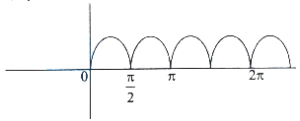
The area (in square units) of the region bounded by the curve $y=|\sin 2x|$ and the $X$-axis in the interval $[0, 2\pi]$ is:
A
$0$
B
$3$
C
$4$
D
$1$
Solution
(C) The function is $y = |\sin 2x|$. We need to find the area bounded by this curve and the $X$-axis in the interval $[0, 2\pi]$.
Since the period of $|\sin 2x|$ is $\frac{\pi}{2}$,the function repeats its shape every $\frac{\pi}{2}$ units.
In the interval $[0, 2\pi]$,there are $4$ such identical humps (from $0$ to $\frac{\pi}{2}$,$\frac{\pi}{2}$ to $\pi$,$\pi$ to $\frac{3\pi}{2}$,and $\frac{3\pi}{2}$ to $2\pi$).
Thus,the total area $A$ is given by:
$A = \int_0^{2\pi} |\sin 2x| \, dx = 4 \int_0^{\frac{\pi}{2}} \sin 2x \, dx$
$A = 4 \left[ \frac{-\cos 2x}{2} \right]_0^{\frac{\pi}{2}}$
$A = -2 [\cos(2 \cdot \frac{\pi}{2}) - \cos(0)]$
$A = -2 [\cos(\pi) - \cos(0)]$
$A = -2 [-1 - 1] = -2 [-2] = 4$
Therefore,the area is $4$ square units.
Since the period of $|\sin 2x|$ is $\frac{\pi}{2}$,the function repeats its shape every $\frac{\pi}{2}$ units.
In the interval $[0, 2\pi]$,there are $4$ such identical humps (from $0$ to $\frac{\pi}{2}$,$\frac{\pi}{2}$ to $\pi$,$\pi$ to $\frac{3\pi}{2}$,and $\frac{3\pi}{2}$ to $2\pi$).
Thus,the total area $A$ is given by:
$A = \int_0^{2\pi} |\sin 2x| \, dx = 4 \int_0^{\frac{\pi}{2}} \sin 2x \, dx$
$A = 4 \left[ \frac{-\cos 2x}{2} \right]_0^{\frac{\pi}{2}}$
$A = -2 [\cos(2 \cdot \frac{\pi}{2}) - \cos(0)]$
$A = -2 [\cos(\pi) - \cos(0)]$
$A = -2 [-1 - 1] = -2 [-2] = 4$
Therefore,the area is $4$ square units.
0 likesView Solution
76
ChemistryMediumMCQTS EAMCET · 2023
$A$ solution is prepared by mixing $10 \ mL$ of $1.0 \ M$ acetic acid and $20 \ mL$ of $0.5 \ M$ sodium acetate and diluted to $100 \ mL$. If the $pK_{a}$ of acetic acid is $4.76$,then the $pH$ of the solution is
A
$4.76$
B
$3.76$
C
$5.76$
D
$9.24$
Solution
(A) The solution is a buffer solution consisting of a weak acid $(CH_3COOH)$ and its conjugate base $(CH_3COO^-)$.
The Henderson-Hasselbalch equation is: $pH = pK_{a} + \log \frac{[\text{Salt}]}{[\text{Acid}]}$
Calculate the concentration of acid: $[\text{Acid}] = \frac{10 \ mL \times 1.0 \ M}{100 \ mL} = 0.1 \ M$
Calculate the concentration of salt: $[\text{Salt}] = \frac{20 \ mL \times 0.5 \ M}{100 \ mL} = 0.1 \ M$
Substitute the values into the equation: $pH = 4.76 + \log \frac{0.1}{0.1}$
Since $\log(1) = 0$,we get $pH = 4.76 + 0 = 4.76$.
The Henderson-Hasselbalch equation is: $pH = pK_{a} + \log \frac{[\text{Salt}]}{[\text{Acid}]}$
Calculate the concentration of acid: $[\text{Acid}] = \frac{10 \ mL \times 1.0 \ M}{100 \ mL} = 0.1 \ M$
Calculate the concentration of salt: $[\text{Salt}] = \frac{20 \ mL \times 0.5 \ M}{100 \ mL} = 0.1 \ M$
Substitute the values into the equation: $pH = 4.76 + \log \frac{0.1}{0.1}$
Since $\log(1) = 0$,we get $pH = 4.76 + 0 = 4.76$.
0 likesView Solution
77
ChemistryEasyMCQTS EAMCET · 2023
Which of the following does not form a buffer solution?
A
$NH_3 + HCl$ ($2 : 1$ mole ratio)
B
$CH_3COOH + NaOH$ ($2 : 1$ mole ratio)
C
$NaOH + CH_3COOH$ ($1 : 1$ mole ratio)
D
$NH_4Cl + NH_3$ ($1 : 1$ mole ratio)
Solution
(C) buffer solution is formed by a mixture of a weak acid and its conjugate base,or a weak base and its conjugate acid.
In option $A$,$NH_3$ (weak base) and $HCl$ (strong acid) in a $2:1$ ratio result in $NH_4Cl$ and $NH_3$,forming a basic buffer.
In option $B$,$CH_3COOH$ (weak acid) and $NaOH$ (strong base) in a $2:1$ ratio result in $CH_3COONa$ and $CH_3COOH$,forming an acidic buffer.
In option $C$,$NaOH$ and $CH_3COOH$ in a $1:1$ ratio undergo complete neutralization to form $CH_3COONa$ (a salt of a weak acid and strong base),which does not act as a buffer.
In option $D$,$NH_4Cl$ and $NH_3$ form a standard basic buffer.
In option $A$,$NH_3$ (weak base) and $HCl$ (strong acid) in a $2:1$ ratio result in $NH_4Cl$ and $NH_3$,forming a basic buffer.
In option $B$,$CH_3COOH$ (weak acid) and $NaOH$ (strong base) in a $2:1$ ratio result in $CH_3COONa$ and $CH_3COOH$,forming an acidic buffer.
In option $C$,$NaOH$ and $CH_3COOH$ in a $1:1$ ratio undergo complete neutralization to form $CH_3COONa$ (a salt of a weak acid and strong base),which does not act as a buffer.
In option $D$,$NH_4Cl$ and $NH_3$ form a standard basic buffer.
0 likesView Solution
78
ChemistryMCQTS EAMCET · 2023
If $m$ and $n$ are respectively the order and degree of the differential equation of the family of parabolas with origin as its focus and $X$-axis as its axis,then $mn-m+n=$
A
$1$
B
$2$
C
$3$
D
$4$
Solution
(C) The equation of a parabola with the origin as its focus and the $X$-axis as its axis is given by $y^2 = 4a(x+a)$,where $a$ is a parameter.
Differentiating with respect to $x$,we get $2y \frac{dy}{dx} = 4a$,which implies $a = \frac{y}{2} \frac{dy}{dx}$.
Substituting the value of $a$ back into the original equation:
$y^2 = 4 \left( \frac{y}{2} \frac{dy}{dx} \right) \left( x + \frac{y}{2} \frac{dy}{dx} \right)$
$y^2 = 2y \frac{dy}{dx} \left( x + \frac{y}{2} \frac{dy}{dx} \right)$
$y^2 = 2xy \frac{dy}{dx} + y^2 \left( \frac{dy}{dx} \right)^2$.
Here,the highest order derivative is $\frac{dy}{dx}$,so the order $m = 1$.
The power of the highest order derivative is $2$,so the degree $n = 2$.
Therefore,$mn - m + n = (1)(2) - 1 + 2 = 2 - 1 + 2 = 3$.
Differentiating with respect to $x$,we get $2y \frac{dy}{dx} = 4a$,which implies $a = \frac{y}{2} \frac{dy}{dx}$.
Substituting the value of $a$ back into the original equation:
$y^2 = 4 \left( \frac{y}{2} \frac{dy}{dx} \right) \left( x + \frac{y}{2} \frac{dy}{dx} \right)$
$y^2 = 2y \frac{dy}{dx} \left( x + \frac{y}{2} \frac{dy}{dx} \right)$
$y^2 = 2xy \frac{dy}{dx} + y^2 \left( \frac{dy}{dx} \right)^2$.
Here,the highest order derivative is $\frac{dy}{dx}$,so the order $m = 1$.
The power of the highest order derivative is $2$,so the degree $n = 2$.
Therefore,$mn - m + n = (1)(2) - 1 + 2 = 2 - 1 + 2 = 3$.
0 likesView Solution
79
ChemistryMCQTS EAMCET · 2023
If $(2,-1,3)$ is the foot of the perpendicular drawn from the origin to the plane,then the equation of the plane is
A
$2x+y-3z+6=0$
B
$2x-y+3z-14=0$
C
$2x-y+3z-13=0$
D
$2x+y+3z-10=0$
Solution
(B) Let the origin be $O(0,0,0)$ and the foot of the perpendicular from the origin to the plane be $P(2,-1,3)$.
Since $OP$ is perpendicular to the plane,the vector $\vec{OP}$ is the normal vector to the plane.
The direction ratios of the normal vector $\vec{OP}$ are $(2-0, -1-0, 3-0) = (2, -1, 3)$.
The equation of a plane passing through a point $(x_1, y_1, z_1)$ with normal vector $(a, b, c)$ is given by $a(x-x_1) + b(y-y_1) + c(z-z_1) = 0$.
Substituting the point $P(2, -1, 3)$ and the normal vector $(2, -1, 3)$ into the equation:
$2(x-2) - 1(y-(-1)) + 3(z-3) = 0$
$2(x-2) - 1(y+1) + 3(z-3) = 0$
$2x - 4 - y - 1 + 3z - 9 = 0$
$2x - y + 3z - 14 = 0$
Thus,the equation of the plane is $2x - y + 3z - 14 = 0$.
Since $OP$ is perpendicular to the plane,the vector $\vec{OP}$ is the normal vector to the plane.
The direction ratios of the normal vector $\vec{OP}$ are $(2-0, -1-0, 3-0) = (2, -1, 3)$.
The equation of a plane passing through a point $(x_1, y_1, z_1)$ with normal vector $(a, b, c)$ is given by $a(x-x_1) + b(y-y_1) + c(z-z_1) = 0$.
Substituting the point $P(2, -1, 3)$ and the normal vector $(2, -1, 3)$ into the equation:
$2(x-2) - 1(y-(-1)) + 3(z-3) = 0$
$2(x-2) - 1(y+1) + 3(z-3) = 0$
$2x - 4 - y - 1 + 3z - 9 = 0$
$2x - y + 3z - 14 = 0$
Thus,the equation of the plane is $2x - y + 3z - 14 = 0$.
0 likesView Solution
80
ChemistryMCQTS EAMCET · 2023
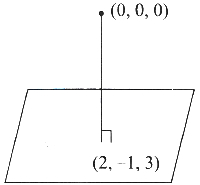
If $(2, -1, 3)$ is the foot of the perpendicular drawn from the origin to a plane,then the equation of that plane is
A
$2x + y - 3z + 6 = 0$
B
$2x - y + 3z - 14 = 0$
C
$2x - y + 3z - 13 = 0$
D
$2x + y + 3z - 10 = 0$
Solution
(B) Let the equation of the plane be $ax + by + cz + d = 0$.
Since the line segment joining the origin $(0, 0, 0)$ and the point $(2, -1, 3)$ is perpendicular to the plane,the direction ratios of the normal to the plane are given by the coordinates of the foot of the perpendicular:
$a = 2 - 0 = 2$
$b = -1 - 0 = -1$
$c = 3 - 0 = 3$
Thus,the equation of the plane is $2x - y + 3z + d = 0$.
Since the plane passes through the point $(2, -1, 3)$,we substitute these coordinates into the equation:
$2(2) - (-1) + 3(3) + d = 0$
$4 + 1 + 9 + d = 0$
$14 + d = 0$
$d = -14$
Therefore,the equation of the plane is $2x - y + 3z - 14 = 0$.
Since the line segment joining the origin $(0, 0, 0)$ and the point $(2, -1, 3)$ is perpendicular to the plane,the direction ratios of the normal to the plane are given by the coordinates of the foot of the perpendicular:
$a = 2 - 0 = 2$
$b = -1 - 0 = -1$
$c = 3 - 0 = 3$
Thus,the equation of the plane is $2x - y + 3z + d = 0$.
Since the plane passes through the point $(2, -1, 3)$,we substitute these coordinates into the equation:
$2(2) - (-1) + 3(3) + d = 0$
$4 + 1 + 9 + d = 0$
$14 + d = 0$
$d = -14$
Therefore,the equation of the plane is $2x - y + 3z - 14 = 0$.
0 likesView Solution
81
ChemistryMCQTS EAMCET · 2023
If the coefficients $a$ and $b$ of a quadratic expression $x^2+ax+b$ are chosen from the sets $A=\{3,4,5\}$ and $B=\{1,2,3,4\}$ respectively,then the probability that the equation $x^2+ax+b=0$ has real roots is
A
$\frac{1}{6}$
B
$\frac{5}{6}$
C
$\frac{3}{4}$
D
$\frac{7}{12}$
Solution
(B) For the quadratic equation $x^2+ax+b=0$ to have real roots,the discriminant $D$ must be greater than or equal to $0$.
$D = a^2 - 4b \geq 0 \implies a^2 \geq 4b$.
Given $a \in \{3, 4, 5\}$ and $b \in \{1, 2, 3, 4\}$,the total number of possible pairs $(a, b)$ is $3 \times 4 = 12$.
We check the condition $a^2 \geq 4b$ for each $a$:
$1$. If $a=3$,$a^2=9$. $9 \geq 4b \implies b \leq 2.25$. Possible $b$ values are $\{1, 2\}$ ($2$ pairs).
$2$. If $a=4$,$a^2=16$. $16 \geq 4b \implies b \leq 4$. Possible $b$ values are $\{1, 2, 3, 4\}$ ($4$ pairs).
$3$. If $a=5$,$a^2=25$. $25 \geq 4b \implies b \leq 6.25$. Possible $b$ values are $\{1, 2, 3, 4\}$ ($4$ pairs).
Total favorable outcomes = $2 + 4 + 4 = 10$.
Probability = $\frac{\text{Favorable outcomes}}{\text{Total outcomes}} = \frac{10}{12} = \frac{5}{6}$.
$D = a^2 - 4b \geq 0 \implies a^2 \geq 4b$.
Given $a \in \{3, 4, 5\}$ and $b \in \{1, 2, 3, 4\}$,the total number of possible pairs $(a, b)$ is $3 \times 4 = 12$.
We check the condition $a^2 \geq 4b$ for each $a$:
$1$. If $a=3$,$a^2=9$. $9 \geq 4b \implies b \leq 2.25$. Possible $b$ values are $\{1, 2\}$ ($2$ pairs).
$2$. If $a=4$,$a^2=16$. $16 \geq 4b \implies b \leq 4$. Possible $b$ values are $\{1, 2, 3, 4\}$ ($4$ pairs).
$3$. If $a=5$,$a^2=25$. $25 \geq 4b \implies b \leq 6.25$. Possible $b$ values are $\{1, 2, 3, 4\}$ ($4$ pairs).
Total favorable outcomes = $2 + 4 + 4 = 10$.
Probability = $\frac{\text{Favorable outcomes}}{\text{Total outcomes}} = \frac{10}{12} = \frac{5}{6}$.
0 likesView Solution
82
ChemistryEasyMCQTS EAMCET · 2023
What is the correct order of melting temperature of $C$,$Si$,$Ge$?
A
$C > Ge > Si$
B
$Si > C > Ge$
C
$C > Si > Ge$
D
$Si > Ge > C$
Solution
(C) The elements belonging to group $14$ are $C$,$Si$,$Ge$,$Sn$,and $Pb$.
$C$ and $Si$ are non-metals,$Ge$ is a metalloid,while $Sn$ and $Pb$ are metals.
These elements form covalent networks in their solid state.
The melting point depends on the strength of the interatomic forces (covalent or metallic bonds).
As we move down the group,the atomic size increases,which leads to a decrease in the strength of the interatomic forces.
Therefore,the melting point decreases from $C$ to $Pb$.
Thus,the correct order of melting temperature is $C > Si > Ge$.
$C$ and $Si$ are non-metals,$Ge$ is a metalloid,while $Sn$ and $Pb$ are metals.
These elements form covalent networks in their solid state.
The melting point depends on the strength of the interatomic forces (covalent or metallic bonds).
As we move down the group,the atomic size increases,which leads to a decrease in the strength of the interatomic forces.
Therefore,the melting point decreases from $C$ to $Pb$.
Thus,the correct order of melting temperature is $C > Si > Ge$.
0 likesView Solution
83
ChemistryEasyMCQTS EAMCET · 2023
Consider the following statements about group $13$ elements:
$A$. $AlCl_3$ achieves stability by forming a dimer.
$B$. $BCl_3$ is an electron-deficient molecule.
$C$. $E^0_{M^{3+}/M^0} \ (V)$ is $+1.26 \ V$ for aluminium.
$D$. In $+1$ oxidation state,thallium is unstable.
The incorrect statements are:
$A$. $AlCl_3$ achieves stability by forming a dimer.
$B$. $BCl_3$ is an electron-deficient molecule.
$C$. $E^0_{M^{3+}/M^0} \ (V)$ is $+1.26 \ V$ for aluminium.
$D$. In $+1$ oxidation state,thallium is unstable.
The incorrect statements are:
A
$C$ & $D$ only
B
$A$ & $B$ only
C
$A$ & $D$ only
D
$B$ & $C$ only
Solution
(A) Statement $A$ is correct: $AlCl_3$ forms a dimer $(Al_2Cl_6)$ to complete its octet.
Statement $B$ is correct: $BCl_3$ has only $6$ electrons in the valence shell of boron,making it electron-deficient.
Statement $C$ is incorrect: The standard reduction potential $E^0_{Al^{3+}/Al}$ is $-1.66 \ V$,not $+1.26 \ V$.
Statement $D$ is incorrect: Due to the inert pair effect,the $+1$ oxidation state of thallium $(Tl^+)$ is more stable than the $+3$ oxidation state $(Tl^{3+})$.
Therefore,statements $C$ and $D$ are incorrect.
Statement $B$ is correct: $BCl_3$ has only $6$ electrons in the valence shell of boron,making it electron-deficient.
Statement $C$ is incorrect: The standard reduction potential $E^0_{Al^{3+}/Al}$ is $-1.66 \ V$,not $+1.26 \ V$.
Statement $D$ is incorrect: Due to the inert pair effect,the $+1$ oxidation state of thallium $(Tl^+)$ is more stable than the $+3$ oxidation state $(Tl^{3+})$.
Therefore,statements $C$ and $D$ are incorrect.
0 likesView Solution
84
ChemistryMediumMCQTS EAMCET · 2023
What are the correct statements about the elements of group $13$ given below?
$(I)$ The stability of $+1$ oxidation state follows the order $Tl > In > Ga$
$(II)$ Boron has the lowest melting point and boiling point as it is a non-metal
$(III)$ Boron shows a maximum covalency of $4$ in its compounds
$(IV)$ The order of atomic radius is $Ga > Al > In$
$(V)$ Aluminium is passive to concentrated nitric acid
$(I)$ The stability of $+1$ oxidation state follows the order $Tl > In > Ga$
$(II)$ Boron has the lowest melting point and boiling point as it is a non-metal
$(III)$ Boron shows a maximum covalency of $4$ in its compounds
$(IV)$ The order of atomic radius is $Ga > Al > In$
$(V)$ Aluminium is passive to concentrated nitric acid
A
$I, III$ & $V$ only
B
$II, IV$ & $V$ only
C
$I, II$ & $IV$ only
D
$III, IV$ & $V$ only
Solution
(A) Statement $(I)$ is correct due to the inert pair effect,where the stability of the $+1$ oxidation state increases down the group $(Ga < In < Tl)$.
Statement $(II)$ is incorrect; Boron has a very high melting point due to its giant covalent structure.
Statement $(III)$ is correct; Boron lacks $d$-orbitals and can accommodate a maximum of $4$ electron pairs in its valence shell.
Statement $(IV)$ is incorrect; the correct order of atomic radius is $Al > Ga < In$ (due to poor shielding of $d$-electrons in $Ga$).
Statement $(V)$ is correct; Aluminium forms a protective oxide layer on its surface when treated with concentrated nitric acid,making it passive.
Thus,statements $(I, III, V)$ are correct.
Statement $(II)$ is incorrect; Boron has a very high melting point due to its giant covalent structure.
Statement $(III)$ is correct; Boron lacks $d$-orbitals and can accommodate a maximum of $4$ electron pairs in its valence shell.
Statement $(IV)$ is incorrect; the correct order of atomic radius is $Al > Ga < In$ (due to poor shielding of $d$-electrons in $Ga$).
Statement $(V)$ is correct; Aluminium forms a protective oxide layer on its surface when treated with concentrated nitric acid,making it passive.
Thus,statements $(I, III, V)$ are correct.
0 likesView Solution
85
ChemistryMediumMCQTS EAMCET · 2023
In group $13$ of the long form of the periodic table,an element $X$ has a boiling point of $T_2 \ (K)$ and a melting point of $T_1 \ (K)$. Identify the element $X$ for which $T_2 - T_1 \ (K)$ is maximum.
A
$Al$
B
$Ga$
C
$In$
D
$B$
Solution
(B) To find the element $X$ for which $T_2 - T_1$ is maximum,we calculate the difference for each element given in the table:
For $B$: $3923 - 2453 = 1470 \ K$
For $Al$: $2740 - 933 = 1807 \ K$
For $Ga$: $2676 - 303 = 2373 \ K$
For $In$: $2353 - 430 = 1923 \ K$
Comparing these values,the maximum difference is $2373 \ K$,which corresponds to $Ga$.
For $B$: $3923 - 2453 = 1470 \ K$
For $Al$: $2740 - 933 = 1807 \ K$
For $Ga$: $2676 - 303 = 2373 \ K$
For $In$: $2353 - 430 = 1923 \ K$
Comparing these values,the maximum difference is $2373 \ K$,which corresponds to $Ga$.
0 likesView Solution
86
ChemistryEasyMCQTS EAMCET · 2023
Aluminium reacts with dilute $HCl$ and liberates a gas '$A$' and with aqueous alkali liberates a gas '$B$'. $A$ and $B$ respectively are
A
$Cl_2, O_2$
B
$O_2, O_2$
C
$Cl_2, H_2$
D
$H_2, H_2$
Solution
(D) When aluminium reacts with dilute hydrochloric acid,it forms aluminium chloride and releases hydrogen gas:
$2 Al_{(s)} + 6 HCl_{(aq)} \longrightarrow 2 AlCl_{3(aq)} + 3 H_2 \uparrow$
Similarly,aluminium reacts with aqueous alkali to release hydrogen gas:
$2 Al_{(s)} + 2 NaOH_{(aq)} + 6 H_2O_{(l)} \longrightarrow 2 Na[Al(OH)_4]_{(aq)} + 3 H_2 \uparrow$
Thus,both gases $A$ and $B$ are $H_2$.
$2 Al_{(s)} + 6 HCl_{(aq)} \longrightarrow 2 AlCl_{3(aq)} + 3 H_2 \uparrow$
Similarly,aluminium reacts with aqueous alkali to release hydrogen gas:
$2 Al_{(s)} + 2 NaOH_{(aq)} + 6 H_2O_{(l)} \longrightarrow 2 Na[Al(OH)_4]_{(aq)} + 3 H_2 \uparrow$
Thus,both gases $A$ and $B$ are $H_2$.
0 likesView Solution
87
ChemistryMediumMCQTS EAMCET · 2023
Assertion $(A)$: Graphite is used as a dry lubricant in machines which run at high temperatures.
Reason $(R)$: The layers of graphite slip one over the other when pressure is applied.
The correct option among the following is:
Reason $(R)$: The layers of graphite slip one over the other when pressure is applied.
The correct option among the following is:
A
$(A)$ is true but $(R)$ is false
B
$(A)$ is false but $(R)$ is true
C
$(A)$ and $(R)$ are true. $(R)$ is the correct explanation of $(A)$
D
$(A)$ and $(R)$ are true,but $(R)$ is not the correct explanation of $(A)$
Solution
(C) Graphite is an allotrope of carbon that has a layered structure,making it soft and slippery,which allows it to be used as a dry lubricant at high temperatures.
Thus,Assertion $(A)$ is true.
The reason for this soft and slippery nature is that the hexagonal layers of carbon atoms are held together by weak van der Waals forces,allowing them to slip over one another.
Thus,Reason $(R)$ is true and it correctly explains why graphite acts as a lubricant.
Thus,Assertion $(A)$ is true.
The reason for this soft and slippery nature is that the hexagonal layers of carbon atoms are held together by weak van der Waals forces,allowing them to slip over one another.
Thus,Reason $(R)$ is true and it correctly explains why graphite acts as a lubricant.
0 likesView Solution
88
ChemistryMediumMCQTS EAMCET · 2023
The dioxides and monoxides of elements $X$ and $Y$ are amphoteric in nature. $X$ and $Y$ are respectively.
A
$C, Si$
B
$Si, Ge$
C
$Sn, Pb$
D
$Ge, Pb$
Solution
(C) The oxides of $Sn$ and $Pb$ (Group $14$) exhibit amphoteric character.
Specifically,$SnO_2, SnO, PbO,$ and $PbO_2$ are amphoteric because they can react with both acids and bases.
This property arises due to the stability of different oxidation states ($+2$ and $+4$) influenced by the inert pair effect.
Specifically,$SnO_2, SnO, PbO,$ and $PbO_2$ are amphoteric because they can react with both acids and bases.
This property arises due to the stability of different oxidation states ($+2$ and $+4$) influenced by the inert pair effect.
0 likesView Solution
89
ChemistryEasyMCQTS EAMCET · 2023
Which of the following has the lowest melting point?
A
$Si$
B
$Ge$
C
$Sn$
D
$Pb$
Solution
(C) In Group $14$,the melting point generally decreases as we move down the group due to the weakening of metallic bonding.
However,there is an anomaly where the melting point of $Pb$ is slightly higher than that of $Sn$.
The order of melting points for the elements is $C > Si > Ge > Pb > Sn$.
Therefore,$Sn$ has the lowest melting point.
However,there is an anomaly where the melting point of $Pb$ is slightly higher than that of $Sn$.
The order of melting points for the elements is $C > Si > Ge > Pb > Sn$.
Therefore,$Sn$ has the lowest melting point.
0 likesView Solution
90
ChemistryMediumMCQTS EAMCET · 2023
The nitrate of which of the following metals does not liberate $NO_2$ gas on heating?
A
$Pb$
B
$Ba$
C
$Li$
D
$K$
Solution
(D) Nitrates of alkali metals (except $LiNO_3$) decompose on heating to form metal nitrites and oxygen gas,without releasing $NO_2$.
For potassium nitrate: $2 KNO_3 \xrightarrow{\Delta} 2 KNO_2 + O_2$.
Nitrates of heavy metals (like $Pb$) and $LiNO_3$ decompose to form metal oxides,$NO_2$,and $O_2$.
For potassium nitrate: $2 KNO_3 \xrightarrow{\Delta} 2 KNO_2 + O_2$.
Nitrates of heavy metals (like $Pb$) and $LiNO_3$ decompose to form metal oxides,$NO_2$,and $O_2$.
0 likesView Solution
91
ChemistryMediumMCQTS EAMCET · 2023
The oxidation states of sulfur atoms and the number of $S-OH$ bonds in Peroxydisulfuric acid are respectively:
A
$(+6, +5), 2$
B
$(+6, +6), 4$
C
$(+6, +6), 2$
D
$(+6, +5), 4$
Solution
(C) The chemical formula of Peroxydisulfuric acid (Marshall's acid) is $H_2S_2O_8$.
Its structure is $HO-S(=O)_2-O-O-S(=O)_2-OH$.
From the structure,each sulfur atom is bonded to two double-bonded oxygen atoms,one oxygen atom of the peroxide linkage $(-O-O-)$,and one hydroxyl group $(-OH)$.
The oxidation state of each sulfur atom is $+6$.
There are two $S-OH$ bonds in the molecule (one on each sulfur atom).
Its structure is $HO-S(=O)_2-O-O-S(=O)_2-OH$.
From the structure,each sulfur atom is bonded to two double-bonded oxygen atoms,one oxygen atom of the peroxide linkage $(-O-O-)$,and one hydroxyl group $(-OH)$.
The oxidation state of each sulfur atom is $+6$.
There are two $S-OH$ bonds in the molecule (one on each sulfur atom).
0 likesView Solution
92
ChemistryMediumMCQTS EAMCET · 2023
Which of the following is only a redox reaction but not a disproportionation reaction?
A
$4 H_3 PO_3 \rightarrow 3 H_3 PO_4 + PH_3$
B
$2 H_2 O_2 \rightarrow 2 H_2 O + O_2$
C
$P_4 + 3 NaOH + 3 H_2 O \rightarrow 3 NaH_2 PO_2 + PH_3$
D
$P_4 + 8 SOCl_2 \rightarrow 4 PCl_3 + 2 S_2 Cl_2 + 4 SO_2$
Solution
(D) disproportionation reaction is a type of redox reaction where the same element in a single oxidation state is simultaneously oxidized and reduced.
In option $A$,$P$ in $H_3 PO_3$ $(+3)$ is oxidized to $H_3 PO_4$ $(+5)$ and reduced to $PH_3$ $(-3)$.
In option $B$,$O$ in $H_2 O_2$ $(-1)$ is oxidized to $O_2$ $(0)$ and reduced to $H_2 O$ $(-2)$.
In option $C$,$P$ in $P_4$ $(0)$ is oxidized to $NaH_2 PO_2$ $(+1)$ and reduced to $PH_3$ $(-3)$.
In option $D$,$P$ in $P_4$ $(0)$ is oxidized to $PCl_3$ $(+3)$ and $S$ in $SOCl_2$ $(+4)$ is reduced to $S_2 Cl_2$ $(+1)$. Since different elements undergo oxidation and reduction,it is a redox reaction but not a disproportionation reaction.
In option $A$,$P$ in $H_3 PO_3$ $(+3)$ is oxidized to $H_3 PO_4$ $(+5)$ and reduced to $PH_3$ $(-3)$.
In option $B$,$O$ in $H_2 O_2$ $(-1)$ is oxidized to $O_2$ $(0)$ and reduced to $H_2 O$ $(-2)$.
In option $C$,$P$ in $P_4$ $(0)$ is oxidized to $NaH_2 PO_2$ $(+1)$ and reduced to $PH_3$ $(-3)$.
In option $D$,$P$ in $P_4$ $(0)$ is oxidized to $PCl_3$ $(+3)$ and $S$ in $SOCl_2$ $(+4)$ is reduced to $S_2 Cl_2$ $(+1)$. Since different elements undergo oxidation and reduction,it is a redox reaction but not a disproportionation reaction.
0 likesView Solution
93
ChemistryMediumMCQTS EAMCET · 2023
Identify the incorrect statement about the oxidation states of group $14$ elements.
A
Carbon and Silicon mostly exhibit $+4$ oxidation state.
B
Tin in $+2$ oxidation state is a reducing agent.
C
Lead in $+2$ oxidation state is a reducing agent.
D
The order of stability of $+2$ oxidation state follows the sequence $Ge < Sn < Pb$.
Solution
(C) In group $14$,the stability of the $+2$ oxidation state increases down the group due to the inert pair effect. Therefore,$Pb^{2+}$ is the most stable state for lead. Consequently,$Pb^{2+}$ acts as an oxidizing agent because it tends to gain electrons to reach the more stable $Pb^0$ state or remain in the $Pb^{2+}$ state,whereas $Sn^{2+}$ acts as a reducing agent because it tends to lose electrons to reach the more stable $Sn^{4+}$ state. Thus,the statement that lead in $+2$ oxidation state is a reducing agent is incorrect.
0 likesView Solution
94
ChemistryEasyMCQTS EAMCET · 2023
The oxidation states of three carbon atoms in carbon suboxide $(C_3O_2)$ respectively are
A
$+2, 0, +2$
B
$+2, 0, +4$
C
$+4, +2, +2$
D
$-2, +2, 0$
Solution
(A) The structure of carbon suboxide $(C_3O_2)$ is $O=C=C=C=O$.
In this structure,the two terminal carbon atoms are bonded to oxygen atoms.
Since the oxidation state of oxygen is $-2$,each terminal carbon atom must have an oxidation state of $+2$ to balance the bond.
The central carbon atom is bonded to two other carbon atoms,and since there is no electronegativity difference between identical atoms,its oxidation state is $0$.
Thus,the oxidation states are $+2, 0, +2$.
In this structure,the two terminal carbon atoms are bonded to oxygen atoms.
Since the oxidation state of oxygen is $-2$,each terminal carbon atom must have an oxidation state of $+2$ to balance the bond.
The central carbon atom is bonded to two other carbon atoms,and since there is no electronegativity difference between identical atoms,its oxidation state is $0$.
Thus,the oxidation states are $+2, 0, +2$.
0 likesView Solution
95
ChemistryMediumMCQTS EAMCET · 2023
The equivalent weight of which of the following is maximum? (Given: atomic weights $Na=23, Mn=55, Cr=52, K=39, O=16, C=12$)
A
$Na_2C_2O_4 \cdot 2H_2O$
B
$KMnO_4$ in acidic medium $(H^{+})$
C
$KMnO_4$ in neutral medium $(H_2O)$
D
$K_2Cr_2O_7$ in acidic medium $(H^{+})$
Solution
(A) The equivalent weight is calculated as: $E = \frac{\text{Molar mass}}{n\text{-factor}}$.
$1$. For $Na_2C_2O_4 \cdot 2H_2O$: Molar mass $= 2(23) + 2(12) + 4(16) + 2(18) = 46 + 24 + 64 + 36 = 170 \ g/mol$. Here,$C_2O_4^{2-} \rightarrow 2CO_2 + 2e^-$,so $n$-factor $= 2$. $E = \frac{170}{2} = 85$.
$2$. For $KMnO_4$ in acidic medium: Molar mass $= 39 + 55 + 4(16) = 158 \ g/mol$. $MnO_4^- + 8H^+ + 5e^- \rightarrow Mn^{2+} + 4H_2O$,so $n$-factor $= 5$. $E = \frac{158}{5} = 31.6$.
$3$. For $KMnO_4$ in neutral medium: $MnO_4^- + 2H_2O + 3e^- \rightarrow MnO_2 + 4OH^-$,so $n$-factor $= 3$. $E = \frac{158}{3} \approx 52.67$.
$4$. For $K_2Cr_2O_7$ in acidic medium: Molar mass $= 2(39) + 2(52) + 7(16) = 78 + 104 + 112 = 294 \ g/mol$. $Cr_2O_7^{2-} + 14H^+ + 6e^- \rightarrow 2Cr^{3+} + 7H_2O$,so $n$-factor $= 6$. $E = \frac{294}{6} = 49$.
Comparing the values $(85, 31.6, 52.67, 49)$,the maximum equivalent weight is $85$.
$1$. For $Na_2C_2O_4 \cdot 2H_2O$: Molar mass $= 2(23) + 2(12) + 4(16) + 2(18) = 46 + 24 + 64 + 36 = 170 \ g/mol$. Here,$C_2O_4^{2-} \rightarrow 2CO_2 + 2e^-$,so $n$-factor $= 2$. $E = \frac{170}{2} = 85$.
$2$. For $KMnO_4$ in acidic medium: Molar mass $= 39 + 55 + 4(16) = 158 \ g/mol$. $MnO_4^- + 8H^+ + 5e^- \rightarrow Mn^{2+} + 4H_2O$,so $n$-factor $= 5$. $E = \frac{158}{5} = 31.6$.
$3$. For $KMnO_4$ in neutral medium: $MnO_4^- + 2H_2O + 3e^- \rightarrow MnO_2 + 4OH^-$,so $n$-factor $= 3$. $E = \frac{158}{3} \approx 52.67$.
$4$. For $K_2Cr_2O_7$ in acidic medium: Molar mass $= 2(39) + 2(52) + 7(16) = 78 + 104 + 112 = 294 \ g/mol$. $Cr_2O_7^{2-} + 14H^+ + 6e^- \rightarrow 2Cr^{3+} + 7H_2O$,so $n$-factor $= 6$. $E = \frac{294}{6} = 49$.
Comparing the values $(85, 31.6, 52.67, 49)$,the maximum equivalent weight is $85$.
0 likesView Solution
96
ChemistryMediumMCQTS EAMCET · 2023
Assertion $(A)$: Alkali metals and their salts impart characteristic flame colours.
Reason $(R)$: Alkali metals have low ionization enthalpy values. So,electron excitation is possible.
The correct option among the following is
Reason $(R)$: Alkali metals have low ionization enthalpy values. So,electron excitation is possible.
The correct option among the following is
A
$(A)$ and $(R)$ are true. $(R)$ is the correct explanation for $(A)$
B
$(A)$ and $(R)$ are true. $(R)$ is not the correct explanation for $(A)$
C
$(A)$ is true but $(R)$ is false
D
$(A)$ is false,but $(R)$ is true
Solution
(A) Assertion $(A)$ is true because alkali metals have low ionization enthalpies,meaning their valence electrons are loosely held.
When these metals or their salts are heated in a flame,the energy from the flame is sufficient to excite these valence electrons to higher energy levels.
When these excited electrons return to their ground state,they emit energy in the form of visible light,which gives characteristic flame colours.
Therefore,the reason $(R)$ correctly explains the assertion $(A)$.
When these metals or their salts are heated in a flame,the energy from the flame is sufficient to excite these valence electrons to higher energy levels.
When these excited electrons return to their ground state,they emit energy in the form of visible light,which gives characteristic flame colours.
Therefore,the reason $(R)$ correctly explains the assertion $(A)$.
0 likesView Solution
97
ChemistryEasyMCQTS EAMCET · 2023
Thermal decomposition of lithium nitrate gives:
A
$LiO_2, O_2, NO_2$
B
$Li_2O, O_2, N_2O$
C
$Li_2O, O_2, N_2$
D
$Li_2O, O_2, NO_2$
Solution
(D) Lithium nitrate $(LiNO_3)$ decomposes upon heating to form lithium oxide $(Li_2O)$,nitrogen dioxide $(NO_2)$,and oxygen $(O_2)$.
The balanced chemical equation is:
$4LiNO_3 \rightarrow 2Li_2O + 4NO_2 + O_2$
The balanced chemical equation is:
$4LiNO_3 \rightarrow 2Li_2O + 4NO_2 + O_2$
0 likesView Solution
98
ChemistryEasyMCQTS EAMCET · 2023
Identify the incorrect reaction from the following.
A
$2 NaNO_3 \rightarrow 2 NaNO_2 + O_2$
B
$2 LiNO_3 \rightarrow 2 LiNO_2 + O_2$
C
$2 Pb(NO_3)_2 \rightarrow 2 PbO + 4 NO_2 + O_2$
D
$4 LiNO_3 \rightarrow 2 Li_2O + 4 NO_2 + O_2$
Solution
(B) Lithium nitrate $(LiNO_3)$ is unique among alkali metal nitrates because it decomposes upon heating to form lithium oxide $(Li_2O)$,nitrogen dioxide $(NO_2)$,and oxygen $(O_2)$.
Other alkali metal nitrates like sodium nitrate $(NaNO_3)$ decompose to form the corresponding nitrite $(NaNO_2)$ and oxygen $(O_2)$.
Therefore,the reaction $2 LiNO_3 \rightarrow 2 LiNO_2 + O_2$ is incorrect.
Other alkali metal nitrates like sodium nitrate $(NaNO_3)$ decompose to form the corresponding nitrite $(NaNO_2)$ and oxygen $(O_2)$.
Therefore,the reaction $2 LiNO_3 \rightarrow 2 LiNO_2 + O_2$ is incorrect.
0 likesView Solution
99
ChemistryEasyMCQTS EAMCET · 2023
Which of the following set of metals have a strong tendency to form superoxides?
A
$Li, Na, Be$
B
$Be, Mg, Ca$
C
$K, Rb, Cs$
D
$Li, Be, Mg$
Solution
(C) The alkali metals react with oxygen to form different types of oxides depending on their size.
$Li$ forms only the monoxide $(Li_2O)$.
$Na$ forms the peroxide $(Na_2O_2)$.
$K, Rb,$ and $Cs$ have a strong tendency to form superoxides $(MO_2)$ due to the stabilization of the large superoxide anion $(O_2^-)$ by the large alkali metal cations.
$Li$ forms only the monoxide $(Li_2O)$.
$Na$ forms the peroxide $(Na_2O_2)$.
$K, Rb,$ and $Cs$ have a strong tendency to form superoxides $(MO_2)$ due to the stabilization of the large superoxide anion $(O_2^-)$ by the large alkali metal cations.
0 likesView Solution
100
ChemistryEasyMCQTS EAMCET · 2023
Assertion $(A)$: $Be$ and $Mg$ do not impart any colour to the flame.
Reason $(R)$: The electrons in them are too strongly bound to get excited by the energy of the flame.
The correct option among the following is:
Reason $(R)$: The electrons in them are too strongly bound to get excited by the energy of the flame.
The correct option among the following is:
A
$(A)$ and $(R)$ are true,$(R)$ is the correct explanation of $(A)$
B
$(A)$ and $(R)$ are true,but $(R)$ is not the correct explanation of $(A)$
C
$(A)$ is correct but $(R)$ is incorrect
D
$(A)$ is incorrect but $(R)$ is correct
Solution
(A) Assertion $(A)$: $Be$ and $Mg$ have very high ionization enthalpies due to their small atomic size.
Reason $(R)$: Because of their high ionization enthalpies,the electrons in $Be$ and $Mg$ are too strongly bound to be excited to higher energy levels by the energy available in the Bunsen flame.
Consequently,they do not impart any characteristic colour to the flame.
Therefore,both $(A)$ and $(R)$ are true,and $(R)$ is the correct explanation of $(A)$.
Reason $(R)$: Because of their high ionization enthalpies,the electrons in $Be$ and $Mg$ are too strongly bound to be excited to higher energy levels by the energy available in the Bunsen flame.
Consequently,they do not impart any characteristic colour to the flame.
Therefore,both $(A)$ and $(R)$ are true,and $(R)$ is the correct explanation of $(A)$.
0 likesView Solution
101
ChemistryEasyMCQTS EAMCET · 2023
Identify the pair of drugs which act as tranquilizers.
A
Heroin,Codeine
B
Valium,Serotonin
C
Dimetapp,Seldane
D
Cimetidine,Ranitidine
Solution
(B) Tranquilizers are chemical compounds used for the treatment of stress,and mild or even severe mental diseases. Examples include $Valium$ and $Serotonin$.
$Heroin$ and $Codeine$ are analgesics.
$Dimetapp$ and $Seldane$ are antihistamines.
$Cimetidine$ and $Ranitidine$ are antacids.
$Heroin$ and $Codeine$ are analgesics.
$Dimetapp$ and $Seldane$ are antihistamines.
$Cimetidine$ and $Ranitidine$ are antacids.
0 likesView Solution
102
ChemistryEasyMCQTS EAMCET · 2023
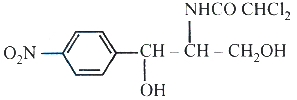
The following molecule with the structure acts as:
A
Antibiotic
B
Antiseptic
C
Analgesic
D
Tranquilizer
Solution
(A) The given structure is of $Chloramphenicol$,which is a broad-spectrum antibiotic.
It is used to treat various bacterial infections.
It is used to treat various bacterial infections.
0 likesView Solution
103
ChemistryEasyMCQTS EAMCET · 2023
Which of the following acts as an antihistamine?
A
Heroin
B
Dimetapp
C
Nardil
D
Veronal
Solution
(B) Dimetapp (brompheniramine) is a synthetic drug that acts as an antihistamine.
Heroin is a narcotic analgesic.
Nardil is an antidepressant drug.
Veronal is a tranquilizer.
Heroin is a narcotic analgesic.
Nardil is an antidepressant drug.
Veronal is a tranquilizer.
0 likesView Solution
104
ChemistryEasyMCQTS EAMCET · 2023
Which one of the following will improve the lathering property of soap?
A
Sodium stearate
B
Sodium rosinate
C
Sodium carbonate
D
Sodium phosphate
Solution
(B) Sodium rosinate is added to soap during its manufacture to improve its lathering property. It acts as a lathering agent.
0 likesView Solution
105
ChemistryMediumMCQTS EAMCET · 2023
The sum of the oxidation state and the coordination number of the central metal atom is maximum for which of the following complexes?
A
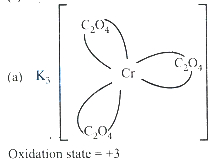
$K_3[Cr(C_2O_4)_3]$
B
$[Cr(CO)_6]$
C
$K_2[PtCl_6]$
D
$K_4[Fe(CN)_6]$
Solution
(C) For $K_3[Cr(C_2O_4)_3]$: Oxidation state $= +3$,Coordination number $= 6$,Sum $= 3 + 6 = 9$
For $[Cr(CO)_6]$: Oxidation state $= 0$,Coordination number $= 6$,Sum $= 0 + 6 = 6$
For $K_2[PtCl_6]$: Oxidation state $= +4$,Coordination number $= 6$,Sum $= 4 + 6 = 10$
For $K_4[Fe(CN)_6]$: Oxidation state $= +2$,Coordination number $= 6$,Sum $= 2 + 6 = 8$
Thus,the sum is maximum for $K_2[PtCl_6]$.
For $[Cr(CO)_6]$: Oxidation state $= 0$,Coordination number $= 6$,Sum $= 0 + 6 = 6$
For $K_2[PtCl_6]$: Oxidation state $= +4$,Coordination number $= 6$,Sum $= 4 + 6 = 10$
For $K_4[Fe(CN)_6]$: Oxidation state $= +2$,Coordination number $= 6$,Sum $= 2 + 6 = 8$
Thus,the sum is maximum for $K_2[PtCl_6]$.
0 likesView Solution
106
ChemistryMediumMCQTS EAMCET · 2023
Identify the incorrect match from the following:
A
$[Cr(H_2O)_6]Br_2$ - Paramagnetic
B
$Na_4[Fe(CN)_6]$ - Diamagnetic
C
$[Ni(CO)_4]$ - Paramagnetic
D
$Na_2[NiCl_4]$ - Paramagnetic
Solution
(C) In $[Cr(H_2O)_6]Br_2$,$Cr$ is in $+2$ oxidation state $(3d^4)$,which has $4$ unpaired electrons,so it is paramagnetic.
In $Na_4[Fe(CN)_6]$,$Fe$ is in $+2$ oxidation state $(3d^6)$. $CN^-$ is a strong field ligand,causing pairing of electrons,resulting in $0$ unpaired electrons,so it is diamagnetic.
In $[Ni(CO)_4]$,$Ni$ is in $0$ oxidation state $(3d^8 4s^2)$. $CO$ is a strong field ligand,causing pairing of all electrons,resulting in $0$ unpaired electrons,so it is diamagnetic.
In $Na_2[NiCl_4]$,$Ni$ is in $+2$ oxidation state $(3d^8)$. $Cl^-$ is a weak field ligand,resulting in $2$ unpaired electrons,so it is paramagnetic.
Therefore,the incorrect match is $[Ni(CO)_4]$ - Paramagnetic.
In $Na_4[Fe(CN)_6]$,$Fe$ is in $+2$ oxidation state $(3d^6)$. $CN^-$ is a strong field ligand,causing pairing of electrons,resulting in $0$ unpaired electrons,so it is diamagnetic.
In $[Ni(CO)_4]$,$Ni$ is in $0$ oxidation state $(3d^8 4s^2)$. $CO$ is a strong field ligand,causing pairing of all electrons,resulting in $0$ unpaired electrons,so it is diamagnetic.
In $Na_2[NiCl_4]$,$Ni$ is in $+2$ oxidation state $(3d^8)$. $Cl^-$ is a weak field ligand,resulting in $2$ unpaired electrons,so it is paramagnetic.
Therefore,the incorrect match is $[Ni(CO)_4]$ - Paramagnetic.
0 likesView Solution
107
ChemistryEasyMCQTS EAMCET · 2023
According to Werner's theory,the number of groups bonded to the central metal atom/ion in a coordination complex represents:
A
Oxidation state
B
Primary Valency
C
Secondary Valency
D
Polyhedron
Solution
(C) According to Werner's theory,the secondary valency of a central metal atom or ion in a coordination complex represents the number of ligands (neutral or negatively charged groups) directly bonded to it.
This is also known as the coordination number.
The primary valency corresponds to the oxidation state of the metal atom or ion.
This is also known as the coordination number.
The primary valency corresponds to the oxidation state of the metal atom or ion.
0 likesView Solution
108
ChemistryMediumMCQTS EAMCET · 2023
Match the following complexes in List-$I$ with their electronic configurations in List-$II$.
| List-$I$ (Complex) | List-$II$ (Electronic configuration of metal/ion) |
|---|---|
| $A. [Co(NH_3)_6]^{3+}$ | $I. t_{2g}^5 e_g^0$ |
| $B. [CoF_6]^{3-}$ | $II. t_{2g}^6 e_g^0$ |
| $C. [Ni(CO)_4]$ | $III. t_{2g}^4 e_g^2$ |
| $D. [Fe(CN)_6]^{3-}$ | $IV. t^4 e^6$ |
A
$A-II, B-III, C-IV, D-I$
B
$A-III, B-IV, C-II, D-I$
C
$A-IV, B-III, C-I, D-II$
D
$A-II, B-I, C-IV, D-III$
Solution
(A) $[Co(NH_3)_6]^{3+}$: $NH_3$ is a strong field ligand. $Co^{3+}$ is $3d^6$. In octahedral field,it becomes $t_{2g}^6 e_g^0$ $(II)$.
$[CoF_6]^{3-}$: $F^-$ is a weak field ligand. $Co^{3+}$ is $3d^6$. In octahedral field,it becomes $t_{2g}^4 e_g^2$ $(III)$.
$[Ni(CO)_4]$: $CO$ is a strong field ligand. $Ni$ is in $0$ oxidation state $(3d^8 4s^2)$. It forms a tetrahedral complex with configuration $e^4 t_2^4$ (often represented as $t^4 e^6$ in some contexts for tetrahedral splitting) $(IV)$.
$[Fe(CN)_6]^{3-}$: $CN^-$ is a strong field ligand. $Fe^{3+}$ is $3d^5$. In octahedral field,it becomes $t_{2g}^5 e_g^0$ $(I)$.
Therefore,the correct match is $A-II, B-III, C-IV, D-I$.
$[CoF_6]^{3-}$: $F^-$ is a weak field ligand. $Co^{3+}$ is $3d^6$. In octahedral field,it becomes $t_{2g}^4 e_g^2$ $(III)$.
$[Ni(CO)_4]$: $CO$ is a strong field ligand. $Ni$ is in $0$ oxidation state $(3d^8 4s^2)$. It forms a tetrahedral complex with configuration $e^4 t_2^4$ (often represented as $t^4 e^6$ in some contexts for tetrahedral splitting) $(IV)$.
$[Fe(CN)_6]^{3-}$: $CN^-$ is a strong field ligand. $Fe^{3+}$ is $3d^5$. In octahedral field,it becomes $t_{2g}^5 e_g^0$ $(I)$.
Therefore,the correct match is $A-II, B-III, C-IV, D-I$.
0 likesView Solution
109
ChemistryEasyMCQTS EAMCET · 2023
The order of melting points of $Cr$,$Mo$,and $W$ is:
A
$Cr > Mo > W$
B
$Mo > Cr > W$
C
$W > Mo > Cr$
D
$W > Cr > Mo$
Solution
(C) The melting points of transition metals in a group generally increase as we move down the group due to the increase in the number of unpaired electrons and the strength of metallic bonding.
For the group $6$ elements ($Cr$,$Mo$,$W$),the melting points follow the order $W > Mo > Cr$.
For the group $6$ elements ($Cr$,$Mo$,$W$),the melting points follow the order $W > Mo > Cr$.
0 likesView Solution
110
ChemistryMediumMCQTS EAMCET · 2023
$Cr^{2+}$ and $Mn^{3+}$ both possess $d^4$ electronic configuration. Therefore,
A
$Mn^{3+}$ is an oxidizing agent while $Cr^{2+}$ is a reducing agent
B
Both are reducing agents
C
$Mn^{3+}$ is a reducing agent while $Cr^{2+}$ is an oxidizing agent
D
Both are oxidizing agents
Solution
(A) $Mn$ is stable in the $+2$ oxidation state. Thus,$Mn^{3+}$ acts as an oxidizing agent by getting reduced to $Mn^{2+}$ and attaining the stable $d^5$ configuration.
$Cr$ is stable in the $+3$ oxidation state. Thus,$Cr^{2+}$ acts as a reducing agent by getting oxidized to $Cr^{3+}$.
$Cr$ is stable in the $+3$ oxidation state. Thus,$Cr^{2+}$ acts as a reducing agent by getting oxidized to $Cr^{3+}$.
0 likesView Solution
111
ChemistryMediumMCQTS EAMCET · 2023
Among the following,the incorrect statement about transition metals is:
A
$Cr$,$Mo$ and $W$ have high melting points
B
With an increase in the number of unpaired electrons,the melting point increases
C
$Mn^{3+}$ is more stable than $Mn^{2+}$
D
They show variable oxidation states
Solution
(C) $Mn$ has the electronic configuration $[Ar] 3d^5 4s^2$.
$Mn^{2+}$ has the configuration $[Ar] 3d^5$,which is a half-filled $d$-orbital configuration,making it extra stable.
$Mn^{3+}$ has the configuration $[Ar] 3d^4$.
Due to the extra stability of the half-filled $d^5$ subshell,$Mn^{2+}$ is more stable than $Mn^{3+}$.
Therefore,the statement that $Mn^{3+}$ is more stable than $Mn^{2+}$ is incorrect.
$Mn^{2+}$ has the configuration $[Ar] 3d^5$,which is a half-filled $d$-orbital configuration,making it extra stable.
$Mn^{3+}$ has the configuration $[Ar] 3d^4$.
Due to the extra stability of the half-filled $d^5$ subshell,$Mn^{2+}$ is more stable than $Mn^{3+}$.
Therefore,the statement that $Mn^{3+}$ is more stable than $Mn^{2+}$ is incorrect.
0 likesView Solution
112
ChemistryEasyMCQTS EAMCET · 2023
Which of the following reactions gives nitrogen $(II)$ oxide $(NO)$ as one of the products?
A
$Cu + \text{dil. } HNO_3 \rightarrow$
B
$Cu + \text{conc. } HNO_3 \rightarrow$
C
$Zn + \text{dil. } HNO_3 \rightarrow$
D
$Zn + \text{conc. } HNO_3 \rightarrow$
Solution
(A) The reaction of copper with dilute nitric acid is given by: $3Cu + 8HNO_3 (\text{dilute}) \rightarrow 3Cu(NO_3)_2 + 2NO + 4H_2O$.
The reaction of copper with concentrated nitric acid is: $Cu + 4HNO_3 (\text{conc.}) \rightarrow Cu(NO_3)_2 + 2NO_2 + 2H_2O$.
The reaction of zinc with dilute nitric acid is: $4Zn + 10HNO_3 (\text{dilute}) \rightarrow 4Zn(NO_3)_2 + 5H_2O + N_2O$.
The reaction of zinc with concentrated nitric acid is: $Zn + 4HNO_3 (\text{conc.}) \rightarrow Zn(NO_3)_2 + 2H_2O + 2NO_2$.
Therefore,the reaction that produces nitrogen $(II)$ oxide $(NO)$ is the reaction between copper and dilute nitric acid.
The reaction of copper with concentrated nitric acid is: $Cu + 4HNO_3 (\text{conc.}) \rightarrow Cu(NO_3)_2 + 2NO_2 + 2H_2O$.
The reaction of zinc with dilute nitric acid is: $4Zn + 10HNO_3 (\text{dilute}) \rightarrow 4Zn(NO_3)_2 + 5H_2O + N_2O$.
The reaction of zinc with concentrated nitric acid is: $Zn + 4HNO_3 (\text{conc.}) \rightarrow Zn(NO_3)_2 + 2H_2O + 2NO_2$.
Therefore,the reaction that produces nitrogen $(II)$ oxide $(NO)$ is the reaction between copper and dilute nitric acid.
0 likesView Solution
113
ChemistryEasyMCQTS EAMCET · 2023
The products formed during thermal decomposition of ammonium dichromate are
A
$O_2, H_2O, Cr(OH)_3$
B
$NO_2, H_2O, Cr_2O_3$
C
$N_2, Cr_2O_3, H_2O$
D
$N_2O, Cr(OH)_3$
Solution
(C) The thermal decomposition of ammonium dichromate produces nitrogen gas,chromium $(III)$ oxide,and water vapour.
$(NH_4)_2Cr_2O_7 \stackrel{\Delta}{\longrightarrow} N_2 + Cr_2O_3 + 4H_2O$
$(NH_4)_2Cr_2O_7 \stackrel{\Delta}{\longrightarrow} N_2 + Cr_2O_3 + 4H_2O$
0 likesView Solution
114
ChemistryMediumMCQTS EAMCET · 2023
The number of $f$-electrons in the $+3$ oxidation state of gadolinium $(Z=64)$ is $x$ and in the $+2$ oxidation state of ytterbium $(Z=70)$ is $y$. The sum of $x$ and $y$ is:
A
$13$
B
$20$
C
$18$
D
$21$
Solution
(D) The ground state electronic configurations are:
$Gd (Z=64) = [Xe] 4f^7 5d^1 6s^2$
$Yb (Z=70) = [Xe] 4f^{14} 6s^2$
For $Gd^{3+}$,three electrons are removed ($1$ from $5d$ and $2$ from $6s$),resulting in $4f^7$. Thus,$x = 7$.
For $Yb^{2+}$,two electrons are removed from $6s$,resulting in $4f^{14}$. Thus,$y = 14$.
The sum $x + y = 7 + 14 = 21$.
$Gd (Z=64) = [Xe] 4f^7 5d^1 6s^2$
$Yb (Z=70) = [Xe] 4f^{14} 6s^2$
For $Gd^{3+}$,three electrons are removed ($1$ from $5d$ and $2$ from $6s$),resulting in $4f^7$. Thus,$x = 7$.
For $Yb^{2+}$,two electrons are removed from $6s$,resulting in $4f^{14}$. Thus,$y = 14$.
The sum $x + y = 7 + 14 = 21$.
0 likesView Solution
115
ChemistryMediumMCQTS EAMCET · 2023
In $+2$ oxidation state,which of the following lanthanoids act as reducing agents?
A
$Ce, Pr$
B
$Eu, Gd$
C
$Eu, Yb$
D
$Lu, Er$
Solution
(C) Lanthanoids in the $+2$ oxidation state,such as $Eu^{+2}$ and $Yb^{+2}$,act as strong reducing agents.
This is because they tend to lose one electron to acquire the more stable $+3$ oxidation state,which is the most common and stable oxidation state for lanthanoids.
This is because they tend to lose one electron to acquire the more stable $+3$ oxidation state,which is the most common and stable oxidation state for lanthanoids.
0 likesView Solution
116
ChemistryMediumMCQTS EAMCET · 2023
The electrode potential of a chlorine electrode is maximum when the concentration of chloride ion in the solution (in $mol \ L^{-1}$) is $X$. What is the value of $X$?
A
$2.5 \times 10^{-3}$
B
$7.5 \times 10^{-3}$
C
$7.5 \times 10^{-2}$
D
$2.5 \times 10^{-2}$
Solution
(A) The reduction half-reaction for a chlorine electrode is: $Cl_2(g) + 2e^- \rightarrow 2Cl^-(aq)$.
According to the Nernst equation,the electrode potential $E$ is given by: $E = E^{\circ} - \frac{0.0591}{2} \log \frac{[Cl^-]^2}{P_{Cl_2}}$.
Assuming standard pressure $P_{Cl_2} = 1 \ bar$,the equation becomes: $E = E^{\circ} - 0.0591 \log [Cl^-]$.
To maximize the electrode potential $E$,the term $-0.0591 \log [Cl^-]$ must be as large as possible,which means $\log [Cl^-]$ must be as small as possible (most negative).
This occurs when the concentration $[Cl^-]$ is the lowest among the given options.
Comparing the options,the lowest concentration is $2.5 \times 10^{-3} \ mol \ L^{-1}$.
Therefore,$X = 2.5 \times 10^{-3}$.
According to the Nernst equation,the electrode potential $E$ is given by: $E = E^{\circ} - \frac{0.0591}{2} \log \frac{[Cl^-]^2}{P_{Cl_2}}$.
Assuming standard pressure $P_{Cl_2} = 1 \ bar$,the equation becomes: $E = E^{\circ} - 0.0591 \log [Cl^-]$.
To maximize the electrode potential $E$,the term $-0.0591 \log [Cl^-]$ must be as large as possible,which means $\log [Cl^-]$ must be as small as possible (most negative).
This occurs when the concentration $[Cl^-]$ is the lowest among the given options.
Comparing the options,the lowest concentration is $2.5 \times 10^{-3} \ mol \ L^{-1}$.
Therefore,$X = 2.5 \times 10^{-3}$.
0 likesView Solution
117
ChemistryMediumMCQTS EAMCET · 2023
$A$ and $B$ are two metals. The standard reduction potentials of $A^{+}_{(aq)} / A_{(s)}$ and $B^{+}_{(aq)} / B_{(s)}$ are $-0.5 \ V$ and $+0.5 \ V$ respectively. What is the $\log K_C$ value for the following reaction at $298 \ K$?
$A_{(s)} + B^{+}_{(aq)} \rightleftharpoons A^{+}_{(aq)} + B_{(s)}$
(Given: $\frac{2.303 RT}{F} = 0.06 \ V$)
$A_{(s)} + B^{+}_{(aq)} \rightleftharpoons A^{+}_{(aq)} + B_{(s)}$
(Given: $\frac{2.303 RT}{F} = 0.06 \ V$)
A
$\frac{6}{100}$
B
$\frac{100}{6}$
C
$\frac{1}{200}$
D
$\frac{200}{6}$
Solution
(B) The cell reaction is: $A_{(s)} + B^{+}_{(aq)} \rightleftharpoons A^{+}_{(aq)} + B_{(s)}$
Here,$A$ is oxidized to $A^{+}$ $(n=1)$ and $B^{+}$ is reduced to $B$.
$E^{\circ}_{cell} = E^{\circ}_{cathode} - E^{\circ}_{anode} = E^{\circ}_{B^{+}/B} - E^{\circ}_{A^{+}/A} = 0.5 - (-0.5) = 1.0 \ V$
Using the relation: $E^{\circ}_{cell} = \frac{0.06}{n} \log K_C$
Substituting the values: $1.0 = \frac{0.06}{1} \log K_C$
Therefore,$\log K_C = \frac{1.0}{0.06} = \frac{100}{6}$
Here,$A$ is oxidized to $A^{+}$ $(n=1)$ and $B^{+}$ is reduced to $B$.
$E^{\circ}_{cell} = E^{\circ}_{cathode} - E^{\circ}_{anode} = E^{\circ}_{B^{+}/B} - E^{\circ}_{A^{+}/A} = 0.5 - (-0.5) = 1.0 \ V$
Using the relation: $E^{\circ}_{cell} = \frac{0.06}{n} \log K_C$
Substituting the values: $1.0 = \frac{0.06}{1} \log K_C$
Therefore,$\log K_C = \frac{1.0}{0.06} = \frac{100}{6}$
0 likesView Solution
118
ChemistryMediumMCQTS EAMCET · 2023
$A$ current of $15.0 \ A$ is passed through a solution of $CrCl_2$ for $45 \ min$. The volume of $Cl_2$ (in $L$) obtained at the anode at $1 \ atm$ and $273 \ K$ is around ($1 \ F = 96500 \ C \ mol^{-1}$,At. wt. of $Cl=35.5$,$R=0.082 \ L \ atm \ K^{-1} \ mol^{-1}$) (in $.7$)
A
$4$
B
$3$
C
$2$
D
$5$
Solution
(A) The anodic reaction is: $2Cl^{-} \rightarrow Cl_2 + 2e^{-}$
The total charge passed is $Q = I \times t = 15.0 \ A \times (45 \times 60) \ s = 40500 \ C$.
The number of moles of electrons passed is $n_{e^-} = \frac{Q}{F} = \frac{40500}{96500} \approx 0.4197 \ mol$.
From the stoichiometry of the reaction,$2 \ mol$ of $e^-$ produce $1 \ mol$ of $Cl_2$. Therefore,$n_{Cl_2} = \frac{n_{e^-}}{2} = \frac{0.4197}{2} \approx 0.20985 \ mol$.
Using the ideal gas law $PV = nRT$ at $1 \ atm$ and $273 \ K$ ($STP$ conditions),the volume is $V = \frac{nRT}{P} = \frac{0.20985 \times 0.082 \times 273}{1} \approx 4.7 \ L$.
The total charge passed is $Q = I \times t = 15.0 \ A \times (45 \times 60) \ s = 40500 \ C$.
The number of moles of electrons passed is $n_{e^-} = \frac{Q}{F} = \frac{40500}{96500} \approx 0.4197 \ mol$.
From the stoichiometry of the reaction,$2 \ mol$ of $e^-$ produce $1 \ mol$ of $Cl_2$. Therefore,$n_{Cl_2} = \frac{n_{e^-}}{2} = \frac{0.4197}{2} \approx 0.20985 \ mol$.
Using the ideal gas law $PV = nRT$ at $1 \ atm$ and $273 \ K$ ($STP$ conditions),the volume is $V = \frac{nRT}{P} = \frac{0.20985 \times 0.082 \times 273}{1} \approx 4.7 \ L$.
0 likesView Solution
119
ChemistryMediumMCQTS EAMCET · 2023
The reduction potential of a half cell consisting of a $Pt$ electrode immersed in $2.0 \ M \ Fe^{2+}$ and $0.02 \ M \ Fe^{3+}$ solution (in $V$) is. Given: $\left(\frac{2.303 \ RT}{F} = 0.059, E^0_{Fe^{3+} \mid Fe^{2+}} = 0.771 \ V\right)$
A
$0.543$
B
$0.653$
C
$0.733$
D
$0.822$
Solution
(B) The reduction half-reaction is: $Fe^{3+} + e^{-} \rightarrow Fe^{2+}$
Using the Nernst equation:
$E_{Fe^{3+} \mid Fe^{2+}} = E^0_{Fe^{3+} \mid Fe^{2+}} - \frac{2.303 \ RT}{nF} \log \frac{[Fe^{2+}]}{[Fe^{3+}]}$
Here,$n = 1$,$[Fe^{2+}] = 2.0 \ M$,$[Fe^{3+}] = 0.02 \ M$,$\frac{2.303 \ RT}{F} = 0.059 \ V$,and $E^0 = 0.771 \ V$.
Substituting the values:
$E = 0.771 - 0.059 \log \left(\frac{2.0}{0.02}\right)$
$E = 0.771 - 0.059 \log(100)$
$E = 0.771 - 0.059 \times 2$
$E = 0.771 - 0.118 = 0.653 \ V$
Using the Nernst equation:
$E_{Fe^{3+} \mid Fe^{2+}} = E^0_{Fe^{3+} \mid Fe^{2+}} - \frac{2.303 \ RT}{nF} \log \frac{[Fe^{2+}]}{[Fe^{3+}]}$
Here,$n = 1$,$[Fe^{2+}] = 2.0 \ M$,$[Fe^{3+}] = 0.02 \ M$,$\frac{2.303 \ RT}{F} = 0.059 \ V$,and $E^0 = 0.771 \ V$.
Substituting the values:
$E = 0.771 - 0.059 \log \left(\frac{2.0}{0.02}\right)$
$E = 0.771 - 0.059 \log(100)$
$E = 0.771 - 0.059 \times 2$
$E = 0.771 - 0.118 = 0.653 \ V$
0 likesView Solution
120
ChemistryMediumMCQTS EAMCET · 2023
At $300 \ K$,the conductivity of $0.01 \ mol \ dm^{-3}$ aqueous solution of acetic acid is $19.5 \times 10^{-5} \ S \ cm^{-1}$ and the limiting molar conductivity of acetic acid at the same temperature is $390 \ S \ cm^2 \ mol^{-1}$. The degree of dissociation of acetic acid is:
A
$5.0 \times 10^{-5}$
B
$5.0 \times 10^{-2}$
C
$2.5 \times 10^{-5}$
D
$7.5 \times 10^{-2}$
Solution
(B) The degree of dissociation $(\alpha)$ is given by the formula: $\alpha = \frac{\Lambda_m}{\Lambda_m^\circ}$
First,calculate the molar conductivity $(\Lambda_m)$ using the formula: $\Lambda_m = \frac{\kappa \times 1000}{C}$
Given: $\kappa = 19.5 \times 10^{-5} \ S \ cm^{-1}$ and $C = 0.01 \ mol \ L^{-1}$
$\Lambda_m = \frac{19.5 \times 10^{-5} \times 1000}{0.01} = 19.5 \ S \ cm^2 \ mol^{-1}$
Now,calculate $\alpha$:
$\alpha = \frac{19.5}{390} = 0.05 = 5.0 \times 10^{-2}$
First,calculate the molar conductivity $(\Lambda_m)$ using the formula: $\Lambda_m = \frac{\kappa \times 1000}{C}$
Given: $\kappa = 19.5 \times 10^{-5} \ S \ cm^{-1}$ and $C = 0.01 \ mol \ L^{-1}$
$\Lambda_m = \frac{19.5 \times 10^{-5} \times 1000}{0.01} = 19.5 \ S \ cm^2 \ mol^{-1}$
Now,calculate $\alpha$:
$\alpha = \frac{19.5}{390} = 0.05 = 5.0 \times 10^{-2}$
0 likesView Solution
121
ChemistryMediumMCQTS EAMCET · 2023
The conductivity of a solution of concentration $0.1 \ mol \ L^{-1}$ of a weak monobasic acid $(HA)$ (in $S \ cm^{-1}$) is (Given $\Lambda_{HA}^{\circ}=400 \ S \ cm^2 \ mol^{-1}$ and degree of dissociation $(\alpha)$ of $HA=0.02$)
A
$32 \times 10^{-4}$
B
$16 \times 10^{-4}$
C
$4 \times 10^{-4}$
D
$8 \times 10^{-4}$
Solution
(D) The molar conductivity $\Lambda_{m}$ is related to the degree of dissociation $\alpha$ and limiting molar conductivity $\Lambda_{m}^{\circ}$ by the formula: $\Lambda_{m} = \alpha \times \Lambda_{m}^{\circ}$.
Substituting the given values: $\Lambda_{m} = 0.02 \times 400 = 8.0 \ S \ cm^2 \ mol^{-1}$.
The conductivity $\kappa$ is related to molar conductivity $\Lambda_{m}$ and concentration $C$ (in $mol \ L^{-1}$) by: $\kappa = \frac{\Lambda_{m} \times C}{1000}$.
Substituting the values: $\kappa = \frac{8.0 \times 0.1}{1000} = 0.8 \times 10^{-3} = 8 \times 10^{-4} \ S \ cm^{-1}$.
Substituting the given values: $\Lambda_{m} = 0.02 \times 400 = 8.0 \ S \ cm^2 \ mol^{-1}$.
The conductivity $\kappa$ is related to molar conductivity $\Lambda_{m}$ and concentration $C$ (in $mol \ L^{-1}$) by: $\kappa = \frac{\Lambda_{m} \times C}{1000}$.
Substituting the values: $\kappa = \frac{8.0 \times 0.1}{1000} = 0.8 \times 10^{-3} = 8 \times 10^{-4} \ S \ cm^{-1}$.
0 likesView Solution
122
ChemistryEasyMCQTS EAMCET · 2023
The common name of benzene-$1,3$-diol is:
A
Resorcinol
B
Hydroquinol
C
Catechol
D
Cresol
Solution
(A) Benzene-$1,3$-diol consists of a benzene ring with two hydroxyl $(-OH)$ groups attached at the $1$ and $3$ positions.
Common names for dihydroxybenzenes are:
$1,2$-dihydroxybenzene is known as Catechol.
$1,3$-dihydroxybenzene is known as Resorcinol.
$1,4$-dihydroxybenzene is known as Hydroquinol (or Quinol).
Therefore,the correct common name for benzene-$1,3$-diol is Resorcinol.
Common names for dihydroxybenzenes are:
$1,2$-dihydroxybenzene is known as Catechol.
$1,3$-dihydroxybenzene is known as Resorcinol.
$1,4$-dihydroxybenzene is known as Hydroquinol (or Quinol).
Therefore,the correct common name for benzene-$1,3$-diol is Resorcinol.
0 likesView Solution
123
ChemistryMediumMCQTS EAMCET · 2023
Which of the following is least reactive towards $S_{N}1$ reaction?
A
$C_6H_5CH_2Cl$
B
$C_6H_5Cl$
C
$CH_2=CH-CH_2Cl$
D
$(C_6H_5)_2CHCl$
Solution
(B) The reactivity towards $S_{N}1$ reaction depends on the stability of the carbocation formed in the rate-determining step.
In $C_6H_5Cl$,the $C-Cl$ bond has partial double bond character due to resonance,making it extremely difficult to break.
Furthermore,the resulting phenyl cation $(C_6H_5^+)$ is highly unstable because the positive charge is on an $sp$-hybridized carbon atom.
In contrast,the other options form relatively stable carbocations: $C_6H_5CH_2^+$ (benzyl),$CH_2=CH-CH_2^+$ (allyl),and $(C_6H_5)_2CH^+$ (diphenylmethyl).
Therefore,$C_6H_5Cl$ is the least reactive towards $S_{N}1$ reaction.
In $C_6H_5Cl$,the $C-Cl$ bond has partial double bond character due to resonance,making it extremely difficult to break.
Furthermore,the resulting phenyl cation $(C_6H_5^+)$ is highly unstable because the positive charge is on an $sp$-hybridized carbon atom.
In contrast,the other options form relatively stable carbocations: $C_6H_5CH_2^+$ (benzyl),$CH_2=CH-CH_2^+$ (allyl),and $(C_6H_5)_2CH^+$ (diphenylmethyl).
Therefore,$C_6H_5Cl$ is the least reactive towards $S_{N}1$ reaction.
0 likesView Solution
124
ChemistryMediumMCQTS EAMCET · 2023
Assertion $(A)$: $pK_a$ of phenol is $4.19$ and that of benzoic acid is $10$.
Reason $(R)$: Phenoxide ion is stabilised by non-equivalent resonance structures,whereas benzoate ion is stabilised by two equivalent resonance structures.
The correct option among the following is:
Reason $(R)$: Phenoxide ion is stabilised by non-equivalent resonance structures,whereas benzoate ion is stabilised by two equivalent resonance structures.
The correct option among the following is:
A
$A$ and $R$ are true. $R$ is the correct explanation of $A$.
B
$A$ and $R$ are true,but $R$ is not the correct explanation for $A$.
C
$A$ is true,$R$ is false.
D
$A$ is false,but $R$ is true.
Solution
(D) $pK_a = -\log K_a$. As $K_a$ increases,$pK_a$ decreases.
Benzoic acid $(pK_a \approx 4.2)$ is a stronger acid than phenol $(pK_a \approx 10)$,so the $pK_a$ of benzoic acid is smaller than that of phenol.
Therefore,Assertion $(A)$ is false.
The phenoxide ion is stabilized by non-equivalent resonance structures,while the benzoate ion is stabilized by two equivalent resonance structures,which makes the benzoate ion more stable and benzoic acid a stronger acid.
Thus,Reason $(R)$ is true.
Benzoic acid $(pK_a \approx 4.2)$ is a stronger acid than phenol $(pK_a \approx 10)$,so the $pK_a$ of benzoic acid is smaller than that of phenol.
Therefore,Assertion $(A)$ is false.
The phenoxide ion is stabilized by non-equivalent resonance structures,while the benzoate ion is stabilized by two equivalent resonance structures,which makes the benzoate ion more stable and benzoic acid a stronger acid.
Thus,Reason $(R)$ is true.
0 likesView Solution
125
ChemistryEasyMCQTS EAMCET · 2023
Sphalerite,siderite,and malachite are the ores of metals $X$,$Y$,and $Z$ respectively. What are the atomic numbers of these metals?
A
$30, 26, 29$
B
$26, 30, 29$
C
$30, 29, 26$
D
$29, 30, 26$
Solution
(A) Sphalerite is the sulphide ore of zinc $(Zn)$,which has an atomic number of $30$.
Siderite is the carbonate ore of iron $(Fe)$,which has an atomic number of $26$.
Malachite is the carbonate hydroxide ore of copper $(Cu)$,which has an atomic number of $29$.
Therefore,the atomic numbers of $X$,$Y$,and $Z$ are $30, 26, 29$ respectively.
Siderite is the carbonate ore of iron $(Fe)$,which has an atomic number of $26$.
Malachite is the carbonate hydroxide ore of copper $(Cu)$,which has an atomic number of $29$.
Therefore,the atomic numbers of $X$,$Y$,and $Z$ are $30, 26, 29$ respectively.
0 likesView Solution
126
ChemistryEasyMCQTS EAMCET · 2023
$4 Ag_{(s)} + 8 CN^{-}_{(aq)} + 2 H_2O_{(l)} + O_{2(g)} \longrightarrow 4 [Ag(CN)_2]^{-}_{(aq)} + 4 OH^{-}_{(aq)}$
The above reaction represents the process of concentration of ore in the extraction of silver. This process is:
The above reaction represents the process of concentration of ore in the extraction of silver. This process is:
A
Leaching
B
Levigation
C
Froth flotation
D
Liquation
Solution
(A) The given reaction is an example of cyanide leaching,which is used for the extraction of metals like $Ag$ and $Au$ from their ores.
In this process,the ore is treated with a suitable reagent (like $NaCN$ or $KCN$) to dissolve the metal in the form of a complex.
Levigation is a gravity separation process based on the difference in densities of the ore and gangue.
Froth flotation is a physical process used primarily for sulphide ores.
Liquation is a refining process used for metals with low melting points.
In this process,the ore is treated with a suitable reagent (like $NaCN$ or $KCN$) to dissolve the metal in the form of a complex.
Levigation is a gravity separation process based on the difference in densities of the ore and gangue.
Froth flotation is a physical process used primarily for sulphide ores.
Liquation is a refining process used for metals with low melting points.
0 likesView Solution
127
ChemistryEasyMCQTS EAMCET · 2023
The ore which is purified by the leaching process is
A
$Zinc$ $blende$
B
$Bauxite$
C
$Calamine$
D
$Haematite$
Solution
(B) $Bauxite$ is the chief ore of $Al$ that is concentrated by the leaching process (Baeyer's process).
$Haematite$ is concentrated by magnetic separation.
$Zinc$ $blende$ and $Calamine$ are concentrated by the froth floatation process.
$Haematite$ is concentrated by magnetic separation.
$Zinc$ $blende$ and $Calamine$ are concentrated by the froth floatation process.
0 likesView Solution
128
ChemistryMediumMCQTS EAMCET · 2023
Match the following:
| List-$I$ (Refining Methods) | List-$II$ (Metal to be refined) |
| :--- | :--- |
| $(A)$ Zone refining | $(I)$ Titanium |
| $(B)$ Poling | $(II)$ Tin |
| $(C)$ Liquation | $(III)$ Gallium |
| $(D)$ Vapour phase refining | $(IV)$ Copper |
| List-$I$ (Refining Methods) | List-$II$ (Metal to be refined) |
| :--- | :--- |
| $(A)$ Zone refining | $(I)$ Titanium |
| $(B)$ Poling | $(II)$ Tin |
| $(C)$ Liquation | $(III)$ Gallium |
| $(D)$ Vapour phase refining | $(IV)$ Copper |
A
$A-IV, B-II, C-I, D-III$
B
$A-III, B-I, C-IV, D-II$
C
$A-III, B-IV, C-II, D-I$
D
$A-II, B-IV, C-I, D-III$
Solution
(C) The correct matches are as follows:
$(A)$ Zone refining is used for the purification of semiconductors like $Ga, Si, Ge$. Thus,$A \rightarrow III$.
$(B)$ Poling is used for the purification of copper $(Cu)$ containing $Cu_2O$ as an impurity. Thus,$B \rightarrow IV$.
$(C)$ Liquation is used for metals with low melting points like tin $(Sn)$. Thus,$C \rightarrow II$.
$(D)$ Vapour phase refining is used for metals like $Ti$ and $Zr$ (Van Arkel method) or $Ni$ (Mond process). Thus,$D \rightarrow I$.
Therefore,the correct matching is $A-III, B-IV, C-II, D-I$.
$(A)$ Zone refining is used for the purification of semiconductors like $Ga, Si, Ge$. Thus,$A \rightarrow III$.
$(B)$ Poling is used for the purification of copper $(Cu)$ containing $Cu_2O$ as an impurity. Thus,$B \rightarrow IV$.
$(C)$ Liquation is used for metals with low melting points like tin $(Sn)$. Thus,$C \rightarrow II$.
$(D)$ Vapour phase refining is used for metals like $Ti$ and $Zr$ (Van Arkel method) or $Ni$ (Mond process). Thus,$D \rightarrow I$.
Therefore,the correct matching is $A-III, B-IV, C-II, D-I$.
0 likesView Solution
129
ChemistryEasyMCQTS EAMCET · 2023
The metal which is refined by Mond process is $(X)$,by van Arkel process is $(Y)$ and by zone refining is $(Z)$. $(X)$,$(Y)$ and $(Z)$ respectively are
A
$Ni, Zr, Ga$
B
$Zr, Ni, Ga$
C
$Ga, Ni, Zr$
D
$Ni, Ga, Zr$
Solution
(A) The Mond process is specifically used for the refining of nickel $(Ni)$.
The van Arkel method is used for the refining of metals like zirconium $(Zr)$ or titanium $(Ti)$.
Zone refining is used for producing semiconductors and other metals of very high purity,such as germanium $(Ge)$,silicon $(Si)$,boron $(B)$,gallium $(Ga)$,and indium $(In)$.
Therefore,$(X) = Ni$,$(Y) = Zr$,and $(Z) = Ga$.
The van Arkel method is used for the refining of metals like zirconium $(Zr)$ or titanium $(Ti)$.
Zone refining is used for producing semiconductors and other metals of very high purity,such as germanium $(Ge)$,silicon $(Si)$,boron $(B)$,gallium $(Ga)$,and indium $(In)$.
Therefore,$(X) = Ni$,$(Y) = Zr$,and $(Z) = Ga$.
0 likesView Solution
130
ChemistryMediumMCQTS EAMCET · 2023
Which of the following is least reactive towards $S_N2$ reaction?
A
$(CH_3)_3C-CH_2Br$
B
$CH_3-CH_2-CH_2-Br$
C
$(CH_3)_2CH-Br$
D
$(CH_3)_3C-Br$
Solution
(D) $S_N2$ mechanism involves a single-step attack of the nucleophile and departure of the leaving group.
Reactivity towards $S_N2$ reaction depends on steric hindrance at the $\alpha$-carbon.
As the number of alkyl groups attached to the $\alpha$-carbon increases,steric hindrance increases,making the nucleophilic attack more difficult.
The order of reactivity towards $S_N2$ is: $\text{Primary} > \text{Secondary} > \text{Tertiary}$.
In $(CH_3)_3C-Br$,the carbon attached to the bromine is a tertiary carbon,which is highly sterically hindered,making it the least reactive towards $S_N2$ reaction.
Reactivity towards $S_N2$ reaction depends on steric hindrance at the $\alpha$-carbon.
As the number of alkyl groups attached to the $\alpha$-carbon increases,steric hindrance increases,making the nucleophilic attack more difficult.
The order of reactivity towards $S_N2$ is: $\text{Primary} > \text{Secondary} > \text{Tertiary}$.
In $(CH_3)_3C-Br$,the carbon attached to the bromine is a tertiary carbon,which is highly sterically hindered,making it the least reactive towards $S_N2$ reaction.
0 likesView Solution
131
ChemistryEasyMCQTS EAMCET · 2023
Which of the following compounds has no reaction with sodium metal?
A
Phenol
B
Ethanol
C
Benzoic acid
D
Anisole
Solution
(D) Sodium metal reacts with compounds containing acidic hydrogen atoms (like $-OH$ or $-COOH$ groups) to evolve hydrogen gas.
Phenol $(C_6H_5OH)$,ethanol $(C_2H_5OH)$,and benzoic acid $(C_6H_5COOH)$ all contain acidic hydrogen atoms.
Anisole $(C_6H_5OCH_3)$ is an ether and does not contain any acidic hydrogen atom,therefore it does not react with sodium metal.
Phenol $(C_6H_5OH)$,ethanol $(C_2H_5OH)$,and benzoic acid $(C_6H_5COOH)$ all contain acidic hydrogen atoms.
Anisole $(C_6H_5OCH_3)$ is an ether and does not contain any acidic hydrogen atom,therefore it does not react with sodium metal.
0 likesView Solution
132
ChemistryEasyMCQTS EAMCET · 2023
Which of the following reactions represents the Swarts reaction?
A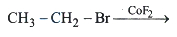
B
C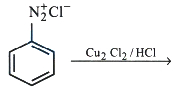
D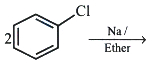
Solution
(A) The Swarts reaction is a method used for the preparation of alkyl fluorides from alkyl chlorides or alkyl bromides by heating them in the presence of metallic fluorides such as $AgF$,$Hg_2F_2$,$CoF_2$,or $SbF_3$.
The reaction is represented as:
$CH_3-CH_2-Br \xrightarrow{CoF_2} CH_3-CH_2-F$
Therefore,option $A$ represents the Swarts reaction.
The reaction is represented as:
$CH_3-CH_2-Br \xrightarrow{CoF_2} CH_3-CH_2-F$
Therefore,option $A$ represents the Swarts reaction.
0 likesView Solution
133
ChemistryMediumMCQTS EAMCET · 2023
Choose the correct decreasing order of reactivity of alkyl halides towards $S_{N}1$ reaction.
A
Primary halide $>$ Secondary halide $>$ Tertiary halide
B
Secondary halide $>$ Tertiary halide $>$ Primary halide
C
Tertiary halide $>$ Secondary halide $>$ Primary halide
D
Tertiary halide $>$ Primary halide $>$ Secondary halide
Solution
(C) The reactivity of alkyl halides towards nucleophilic $S_{N}1$ reaction depends on the stability of the intermediate carbocation formed in the rate-determining step.
Since the stability of carbocations follows the order $3^{\circ} > 2^{\circ} > 1^{\circ}$,the reactivity towards $S_{N}1$ follows the same order.
Therefore,the correct order is $3^{\circ} \text{ halide} > 2^{\circ} \text{ halide} > 1^{\circ} \text{ halide}$.
Since the stability of carbocations follows the order $3^{\circ} > 2^{\circ} > 1^{\circ}$,the reactivity towards $S_{N}1$ follows the same order.
Therefore,the correct order is $3^{\circ} \text{ halide} > 2^{\circ} \text{ halide} > 1^{\circ} \text{ halide}$.
0 likesView Solution
134
ChemistryMediumMCQTS EAMCET · 2023
An alkyl halide $X$ $(C_4H_9Br)$ undergoes nucleophilic substitution by $S_N2$ reaction. The product of $X$ on reaction with $Mg/\text{dry ether}$ followed by $D_2O$ is:
A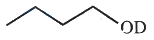
B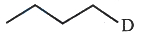
C
D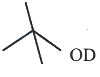
Solution
(B) The alkyl halide $X$ $(C_4H_9Br)$ undergoes $S_N2$ reaction,which implies it must be a primary alkyl halide to minimize steric hindrance. Thus,$X$ is $n$-butyl bromide $(CH_3CH_2CH_2CH_2Br)$.
When $n$-butyl bromide reacts with $Mg$ in dry ether,it forms a Grignard reagent,$n$-butylmagnesium bromide $(CH_3CH_2CH_2CH_2MgBr)$.
Subsequent reaction with $D_2O$ replaces the $MgBr$ group with a deuterium atom $(D)$,resulting in $n$-butane$-1-$d $(CH_3CH_2CH_2CH_2D)$.
When $n$-butyl bromide reacts with $Mg$ in dry ether,it forms a Grignard reagent,$n$-butylmagnesium bromide $(CH_3CH_2CH_2CH_2MgBr)$.
Subsequent reaction with $D_2O$ replaces the $MgBr$ group with a deuterium atom $(D)$,resulting in $n$-butane$-1-$d $(CH_3CH_2CH_2CH_2D)$.
0 likesView Solution
135
ChemistryEasyMCQTS EAMCET · 2023
Identify the halogen exchange reaction from the following.
A
Sandmeyer reaction
B
Swarts reaction
C
Stephens reaction
D
Wurtz reaction
Solution
(B) The Swarts reaction is a method used for the synthesis of alkyl fluorides by heating alkyl chlorides or alkyl bromides in the presence of a metallic fluoride such as $AgF$,$Hg_2F_2$,$CoF_2$,or $SbF_3$.
This is a classic example of a halogen exchange reaction.
The general reaction is: $H_3C-Br + AgF \rightarrow H_3C-F + AgBr$.
This is a classic example of a halogen exchange reaction.
The general reaction is: $H_3C-Br + AgF \rightarrow H_3C-F + AgBr$.
0 likesView Solution
136
ChemistryMediumMCQTS EAMCET · 2023
Identify the product '$Y$' in the given sequence of reactions.
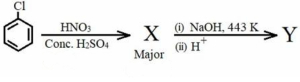
A
$2-$Nitrophenol
B
$4-$Nitrophenol
C
$2,4-$Dinitrophenol
D
$4-$Hydroxybenzenesulfonic acid
Solution
(B) The reaction sequence is as follows:
$1$. Chlorobenzene reacts with $HNO_3$ and $Conc. H_2SO_4$ (nitration) to form a mixture of $o$-nitrochlorobenzene and $p$-nitrochlorobenzene. The major product '$X$' is $p$-nitrochlorobenzene.
$2$. $p$-Nitrochlorobenzene then undergoes nucleophilic aromatic substitution with $NaOH$ at $443 \ K$,followed by acidification with $H^+$,to replace the $-Cl$ group with an $-OH$ group,yielding $p$-nitrophenol ($4$-nitrophenol) as the final product '$Y$'.
Therefore,the correct option is $B$.
$1$. Chlorobenzene reacts with $HNO_3$ and $Conc. H_2SO_4$ (nitration) to form a mixture of $o$-nitrochlorobenzene and $p$-nitrochlorobenzene. The major product '$X$' is $p$-nitrochlorobenzene.
$2$. $p$-Nitrochlorobenzene then undergoes nucleophilic aromatic substitution with $NaOH$ at $443 \ K$,followed by acidification with $H^+$,to replace the $-Cl$ group with an $-OH$ group,yielding $p$-nitrophenol ($4$-nitrophenol) as the final product '$Y$'.
Therefore,the correct option is $B$.
0 likesView Solution
137
ChemistryDifficultMCQTS EAMCET · 2023
Identify the major product $C$ in the given sequence of reactions.
$(CH_3)_2C=O$ $\xrightarrow[(ii) H^+/H_2O]{(i) CH_3MgBr/Ether} A$ $\xrightarrow[\Delta]{SOCl_2} B$ $\xrightarrow[\Delta]{CH_3ONa} C$
$(CH_3)_2C=O$ $\xrightarrow[(ii) H^+/H_2O]{(i) CH_3MgBr/Ether} A$ $\xrightarrow[\Delta]{SOCl_2} B$ $\xrightarrow[\Delta]{CH_3ONa} C$
A
$CH_3-C(CH_3)=CH_2$
B
$CH_3-CH(CH_3)-O-CH_3$
C
$CH_3-C(CH_3)_2-O-CH_3$
D
$CH_3-CH(CH_3)-COCl$
Solution
(A) $1$. The reaction of acetone $(CH_3)_2C=O$ with $CH_3MgBr$ followed by acidic hydrolysis gives tert-butyl alcohol $(A)$,which is $(CH_3)_3C-OH$.
$2$. Treatment of $(A)$ with $SOCl_2$ leads to the formation of tert-butyl chloride $(B)$,which is $(CH_3)_3C-Cl$.
$3$. The reaction of $(B)$ with $CH_3ONa$ (a strong base) under heating conditions leads to dehydrohalogenation via an $E2$ mechanism,resulting in the formation of isobutylene ($2$-methylpropene) as the major product $(C)$,which is $(CH_3)_2C=CH_2$.
$2$. Treatment of $(A)$ with $SOCl_2$ leads to the formation of tert-butyl chloride $(B)$,which is $(CH_3)_3C-Cl$.
$3$. The reaction of $(B)$ with $CH_3ONa$ (a strong base) under heating conditions leads to dehydrohalogenation via an $E2$ mechanism,resulting in the formation of isobutylene ($2$-methylpropene) as the major product $(C)$,which is $(CH_3)_2C=CH_2$.
0 likesView Solution
138
ChemistryDifficultMCQTS EAMCET · 2023
Identify $A$ and $B$ from the following reactions:
$(I)$ $CH_3-CH=CH-CH_3 \xrightarrow{\text{(i) } O_3}{\text{(ii) } Zn-H_2O} 2X$
$(II)$ $2X$ $\xrightarrow[2. \Delta]{1. NaOH \text{ (dil.)}} Z$ $\xrightarrow[\text{(ii) } Zn-H_2O]{\text{(i) } O_3} A + B$
$(I)$ $CH_3-CH=CH-CH_3 \xrightarrow{\text{(i) } O_3}{\text{(ii) } Zn-H_2O} 2X$
$(II)$ $2X$ $\xrightarrow[2. \Delta]{1. NaOH \text{ (dil.)}} Z$ $\xrightarrow[\text{(ii) } Zn-H_2O]{\text{(i) } O_3} A + B$
A
$CH_3CHO + CHO-CHO$
B
$2CH_3CHO$
C
$CH_3CH_2CHO + CH_2O$
D
$CH_3COCH_3 + CHO-CHO$
Solution
(A) Step $1$: Ozonolysis of $but-2-ene$ $(CH_3-CH=CH-CH_3)$ yields two molecules of acetaldehyde $(CH_3CHO)$. Thus,$X = CH_3CHO$.
Step $2$: Aldol condensation of $2$ molecules of acetaldehyde $(2CH_3CHO)$ in the presence of dilute $NaOH$ followed by heating $(\Delta)$ gives $but-2-enal$ $(CH_3-CH=CH-CHO)$,which is $Z$.
Step $3$: Ozonolysis of $but-2-enal$ $(CH_3-CH=CH-CHO)$ breaks the double bond to form acetaldehyde $(CH_3CHO)$ and glyoxal $(CHO-CHO)$.
Therefore,$A$ and $B$ are $CH_3CHO$ and $CHO-CHO$.
Step $2$: Aldol condensation of $2$ molecules of acetaldehyde $(2CH_3CHO)$ in the presence of dilute $NaOH$ followed by heating $(\Delta)$ gives $but-2-enal$ $(CH_3-CH=CH-CHO)$,which is $Z$.
Step $3$: Ozonolysis of $but-2-enal$ $(CH_3-CH=CH-CHO)$ breaks the double bond to form acetaldehyde $(CH_3CHO)$ and glyoxal $(CHO-CHO)$.
Therefore,$A$ and $B$ are $CH_3CHO$ and $CHO-CHO$.
0 likesView Solution
139
ChemistryMediumMCQTS EAMCET · 2023
In the following sequence of reaction,identify the major product $B$.
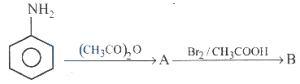
A
p-Bromoacetanilide
B
m-Bromoacetanilide
C
o-Bromoacetanilide
D
$2,4,6-$Tribromoacetanilide
Solution
(A) The reaction of aniline with acetic anhydride $(CH_3CO)_2O$ leads to the formation of acetanilide $(A)$. This process is known as acetylation. The $-NHCOCH_3$ group is less activating than the $-NH_2$ group due to the resonance of the lone pair of nitrogen with the carbonyl group. This reduces the electron density on the ring,preventing polybromination. When acetanilide $(A)$ is treated with $Br_2$ in $CH_3COOH$,the bulky acetamido group directs the incoming bromine atom primarily to the para position due to steric hindrance at the ortho position. Thus,the major product $B$ is $p$-bromoacetanilide.
0 likesView Solution
140
ChemistryMediumMCQTS EAMCET · 2023
The product$(s)$ formed when $m$-chlorobenzaldehyde is heated with concentrated $NaOH$ is/are:
A
$A$ mixture of $3$-chlorobenzoic acid and $3$-chlorobenzyl alcohol.
B
$A$ mixture of sodium $3$-chlorobenzoate and $3$-chlorobenzyl alcohol.
C
$A$ pinacol-type coupling product.
D
$A$ diol derivative.
Solution
(B) The reaction of $m$-chlorobenzaldehyde with concentrated $NaOH$ is a Cannizzaro reaction.
Aldehydes that do not contain any $\alpha$-hydrogen atoms undergo self-oxidation and reduction (disproportionation) in the presence of a concentrated base.
In this reaction,one molecule of $m$-chlorobenzaldehyde is oxidized to the corresponding salt of the carboxylic acid (sodium $3$-chlorobenzoate),and another molecule is reduced to the corresponding alcohol ($3$-chlorobenzyl alcohol).
The reaction is: $2 \text{ } m\text{-Cl-C}_6\text{H}_4\text{CHO} + \text{NaOH (conc.)}$ $\rightarrow m\text{-Cl-C}_6\text{H}_4\text{CH}_2\text{OH} + m\text{-Cl-C}_6\text{H}_4\text{COONa}$.
Aldehydes that do not contain any $\alpha$-hydrogen atoms undergo self-oxidation and reduction (disproportionation) in the presence of a concentrated base.
In this reaction,one molecule of $m$-chlorobenzaldehyde is oxidized to the corresponding salt of the carboxylic acid (sodium $3$-chlorobenzoate),and another molecule is reduced to the corresponding alcohol ($3$-chlorobenzyl alcohol).
The reaction is: $2 \text{ } m\text{-Cl-C}_6\text{H}_4\text{CHO} + \text{NaOH (conc.)}$ $\rightarrow m\text{-Cl-C}_6\text{H}_4\text{CH}_2\text{OH} + m\text{-Cl-C}_6\text{H}_4\text{COONa}$.
0 likesView Solution
141
ChemistryMediumMCQTS EAMCET · 2023
What is $X$ in the following reaction sequence?
$Toluene \xrightarrow[ii. HNO_3/H_2SO_4]{i. CrO_2Cl_2/CS_2, H_3O^+} X$
$Toluene \xrightarrow[ii. HNO_3/H_2SO_4]{i. CrO_2Cl_2/CS_2, H_3O^+} X$
A
$3-$Nitrobenzoic acid
B
$4-$Chloromethylnitrobenzene
C
$3-$Nitrobenzoyl chloride
D
$3-$Nitrobenzaldehyde
Solution
(D) The reaction sequence is as follows:
$1$. The first step is the Etard reaction,where toluene is oxidized to benzaldehyde using chromyl chloride $(CrO_2Cl_2)$ in the presence of carbon disulfide $(CS_2)$,followed by hydrolysis with $H_3O^+$.
$2$. The second step is the nitration of benzaldehyde using a nitrating mixture $(HNO_3/H_2SO_4)$.
$3$. The $-CHO$ group is a meta-directing group,so the nitro group $(-NO_2)$ will be introduced at the meta-position relative to the aldehyde group.
$4$. Thus,the final product $X$ is $3$-nitrobenzaldehyde.
$1$. The first step is the Etard reaction,where toluene is oxidized to benzaldehyde using chromyl chloride $(CrO_2Cl_2)$ in the presence of carbon disulfide $(CS_2)$,followed by hydrolysis with $H_3O^+$.
$2$. The second step is the nitration of benzaldehyde using a nitrating mixture $(HNO_3/H_2SO_4)$.
$3$. The $-CHO$ group is a meta-directing group,so the nitro group $(-NO_2)$ will be introduced at the meta-position relative to the aldehyde group.
$4$. Thus,the final product $X$ is $3$-nitrobenzaldehyde.
0 likesView Solution
142
ChemistryEasyMCQTS EAMCET · 2023
The main reactants involved in the Etard reaction are:
A
$Toluene + CrO_2Cl_2$
B
$Toluene + CrO_3 + (CH_3CO)_2O$
C
$Toluene + Cl_2 / hv$
D
$Benzene + CO + HCl$ (Anhydrous $AlCl_3$)
Solution
(A) In the Etard reaction,chromyl chloride $(CrO_2Cl_2)$ oxidises the methyl group of toluene to a chromium complex in the presence of a solvent like $CS_2$ or $CCl_4$.
This chromium complex,upon subsequent hydrolysis with water $(H_3O^+)$,yields benzaldehyde as the final product.
This chromium complex,upon subsequent hydrolysis with water $(H_3O^+)$,yields benzaldehyde as the final product.
0 likesView Solution
143
ChemistryMediumMCQTS EAMCET · 2023
Assertion $(A)$: In group $15$ elements,nitrogen does not form pentahalides.
Reason $(R)$: Nitrogen can exhibit $+5$ oxidation state.
The correct option among the following is:
Reason $(R)$: Nitrogen can exhibit $+5$ oxidation state.
The correct option among the following is:
A
$(A)$ and $(R)$ are true. $(R)$ is the correct explanation of $(A)$
B
$(A)$ and $(R)$ are true,but $(R)$ is not the correct explanation of $(A)$
C
$(A)$ is true but $(R)$ is false
D
$(A)$ is false but $(R)$ is true
Solution
(B) Nitrogen cannot form pentahalides because it lacks vacant $d$-orbitals in its valence shell to expand its octet. Thus,Assertion $(A)$ is true.
Nitrogen can exhibit a $+5$ oxidation state,for example,in $N_2O_5$ or $HNO_3$. Thus,Reason $(R)$ is true.
However,the inability to form pentahalides is due to the absence of $d$-orbitals,not because it cannot exhibit a $+5$ oxidation state. Therefore,$(R)$ is not the correct explanation of $(A)$.
Nitrogen can exhibit a $+5$ oxidation state,for example,in $N_2O_5$ or $HNO_3$. Thus,Reason $(R)$ is true.
However,the inability to form pentahalides is due to the absence of $d$-orbitals,not because it cannot exhibit a $+5$ oxidation state. Therefore,$(R)$ is not the correct explanation of $(A)$.
0 likesView Solution
144
ChemistryMediumMCQTS EAMCET · 2023
Identify the correct orders from the following with respect to the property associated with:
$A$. $NH_3 > PH_3 > AsH_3 > SbH_3$ - Bond Angle
$B$. $NH_3 > PH_3 > AsH_3 > SbH_3$ - Basic Character
$C$. $PH_3 > AsH_3 > SbH_3 > NH_3$ - Thermal stability
$D$. $SbH_3 > NH_3 > AsH_3 > PH_3$ - Boiling point
$A$. $NH_3 > PH_3 > AsH_3 > SbH_3$ - Bond Angle
$B$. $NH_3 > PH_3 > AsH_3 > SbH_3$ - Basic Character
$C$. $PH_3 > AsH_3 > SbH_3 > NH_3$ - Thermal stability
$D$. $SbH_3 > NH_3 > AsH_3 > PH_3$ - Boiling point
A
$A, B$ & $C$ only
B
$A, C$ & $D$ only
C
$B, C$ & $D$ only
D
$A, B$ & $D$ only
Solution
(D) The order in '$A$' is correct because the bond angle decreases as the electronegativity of the central atom decreases down the group,leading to less repulsion between bond pairs.
The order in '$B$' is correct because the electron density on the central atom decreases as the size of the atom increases,making the lone pair less available for donation.
The order in '$C$' is incorrect because thermal stability decreases down the group due to the increase in bond length and decrease in bond dissociation energy. The correct order is $NH_3 > PH_3 > AsH_3 > SbH_3$.
The order in '$D$' is correct. $NH_3$ has a high boiling point due to intermolecular $H$-bonding,while for the others $(PH_3, AsH_3, SbH_3)$,the boiling point increases down the group due to increasing van der Waals forces (molecular weight).
Thus,the correct orders are $A, B$ and $D$.
The order in '$B$' is correct because the electron density on the central atom decreases as the size of the atom increases,making the lone pair less available for donation.
The order in '$C$' is incorrect because thermal stability decreases down the group due to the increase in bond length and decrease in bond dissociation energy. The correct order is $NH_3 > PH_3 > AsH_3 > SbH_3$.
The order in '$D$' is correct. $NH_3$ has a high boiling point due to intermolecular $H$-bonding,while for the others $(PH_3, AsH_3, SbH_3)$,the boiling point increases down the group due to increasing van der Waals forces (molecular weight).
Thus,the correct orders are $A, B$ and $D$.
0 likesView Solution
145
ChemistryEasyMCQTS EAMCET · 2023
Which one of the following statements is correct?
A
$N_2$ is a brown coloured gas
B
$O_3$ is thermodynamically stable compared to oxygen
C
Rhombic sulphur is stable at room temperature
D
$Cl_2$ is a colourless gas
Solution
(C) Among the allotropes of sulphur,rhombic (yellow) sulphur is more stable than the monoclinic sulphur and is stable at room temperature.
Above $369 \ K$,rhombic sulphur transforms into monoclinic.
$N_2$ is a colourless gas.
$O_3$ is less stable than $O_2$ because its decomposition into $O_2$ is exothermic.
$Cl_2$ is a greenish-yellow gas.
Above $369 \ K$,rhombic sulphur transforms into monoclinic.
$N_2$ is a colourless gas.
$O_3$ is less stable than $O_2$ because its decomposition into $O_2$ is exothermic.
$Cl_2$ is a greenish-yellow gas.
0 likesView Solution
146
ChemistryEasyMCQTS EAMCET · 2023
Sodium nitrite with hydrochloric acid gives water along with two nitrogen oxides. They are
A
$NO, NO_2$
B
$NO_2, N_2O_3$
C
$NO_2, N_2O$
D
$NO, N_2O_5$
Solution
(A) The reaction between sodium nitrite $(NaNO_2)$ and hydrochloric acid $(HCl)$ is as follows:
$2 NaNO_2 + 2 HCl \rightarrow 2 NaCl + NO + NO_2 + H_2O$
In this reaction,the two nitrogen oxides produced are nitric oxide $(NO)$ and nitrogen dioxide $(NO_2)$.
$2 NaNO_2 + 2 HCl \rightarrow 2 NaCl + NO + NO_2 + H_2O$
In this reaction,the two nitrogen oxides produced are nitric oxide $(NO)$ and nitrogen dioxide $(NO_2)$.
0 likesView Solution
147
ChemistryMediumMCQTS EAMCET · 2023
Consider the reaction:
$P_4 + 3 NaOH + 3 H_2 O \rightarrow Q + 3 NaH_2 PO_2$
Identify the reaction in which $Q$ is not the product. (Equations are not balanced)
$P_4 + 3 NaOH + 3 H_2 O \rightarrow Q + 3 NaH_2 PO_2$
Identify the reaction in which $Q$ is not the product. (Equations are not balanced)
A
$Ca_3 P_2 + H_2 O \rightarrow$
B
$H_3 PO_3 \stackrel{\Delta}{\longrightarrow}$
C
$PH_4 I + KOH \rightarrow$
D
$PCl_3 + H_2 O \rightarrow$
Solution
(D) The given reaction is: $P_4 + 3 NaOH + 3 H_2 O \rightarrow PH_3 + 3 NaH_2 PO_2$.
Here,$Q$ is phosphine $(PH_3)$.
Let us analyze the products of the given reactions:
$A$: $Ca_3 P_2 + 6 H_2 O \rightarrow 3 Ca(OH)_2 + 2 PH_3$ (Produces $PH_3$)
$B$: $4 H_3 PO_3 \stackrel{\Delta}{\longrightarrow} 3 H_3 PO_4 + PH_3$ (Produces $PH_3$)
$C$: $PH_4 I + KOH \rightarrow KI + H_2 O + PH_3$ (Produces $PH_3$)
$D$: $PCl_3 + 3 H_2 O \rightarrow H_3 PO_3 + 3 HCl$ (Does not produce $PH_3$)
Therefore,$Q$ is not the product in reaction $D$.
Here,$Q$ is phosphine $(PH_3)$.
Let us analyze the products of the given reactions:
$A$: $Ca_3 P_2 + 6 H_2 O \rightarrow 3 Ca(OH)_2 + 2 PH_3$ (Produces $PH_3$)
$B$: $4 H_3 PO_3 \stackrel{\Delta}{\longrightarrow} 3 H_3 PO_4 + PH_3$ (Produces $PH_3$)
$C$: $PH_4 I + KOH \rightarrow KI + H_2 O + PH_3$ (Produces $PH_3$)
$D$: $PCl_3 + 3 H_2 O \rightarrow H_3 PO_3 + 3 HCl$ (Does not produce $PH_3$)
Therefore,$Q$ is not the product in reaction $D$.
0 likesView Solution
148
ChemistryMediumMCQTS EAMCET · 2023
$P_4 + 3 NaOH + 3 H_2 O \xrightarrow{CO_2} 3 X + PH_3 \uparrow$
$X \xrightarrow{HCl_{(aq)}} Y + NaCl$
The incorrect statement about $Y$ is
$X \xrightarrow{HCl_{(aq)}} Y + NaCl$
The incorrect statement about $Y$ is
A
It is also called phosphonic acid
B
It is a monobasic acid
C
It is a reducing agent
D
Oxidation state of the central atom in it is $+1$
Solution
(A) $P_4 + 3 NaOH + 3 H_2 O \xrightarrow{CO_2} 3 NaH_2 PO_2 + PH_3$
$(X = NaH_2 PO_2)$
$NaH_2 PO_2 + HCl_{(aq)} \rightarrow H_3 PO_2 + NaCl$
$(Y = H_3 PO_2)$
$H_3 PO_2$ is hypophosphorous acid or phosphinic acid.
It is a monobasic acid because it has only one $P-OH$ bond.
It acts as a strong reducing agent.
The oxidation state of $P$ in $H_3 PO_2$ is $+1$.
Therefore,the statement that it is called phosphonic acid is incorrect,as phosphonic acid is $H_3 PO_3$.
$(X = NaH_2 PO_2)$
$NaH_2 PO_2 + HCl_{(aq)} \rightarrow H_3 PO_2 + NaCl$
$(Y = H_3 PO_2)$
$H_3 PO_2$ is hypophosphorous acid or phosphinic acid.
It is a monobasic acid because it has only one $P-OH$ bond.
It acts as a strong reducing agent.
The oxidation state of $P$ in $H_3 PO_2$ is $+1$.
Therefore,the statement that it is called phosphonic acid is incorrect,as phosphonic acid is $H_3 PO_3$.
0 likesView Solution
149
ChemistryEasyMCQTS EAMCET · 2023
Among the hydrides of group $16$ elements,the hydride $X$ has the lowest boiling point and the hydride $Y$ has the highest boiling point. $X$ and $Y$ respectively are:
A
$H_2Te, H_2Se$
B
$H_2O, H_2Te$
C
$H_2S, H_2Te$
D
$H_2S, H_2O$
Solution
(D) On moving down the group from $O$ to $Te$,the molecular mass increases,which leads to an increase in the magnitude of van der Waals forces of attraction,causing the boiling point to increase.
However,$H_2O$ exhibits an anomalously high boiling point due to the presence of strong intermolecular hydrogen bonding.
The boiling point order for group $16$ hydrides is: $H_2S < H_2Se < H_2Te < H_2O$.
Therefore,$H_2S$ has the lowest boiling point $(X)$ and $H_2O$ has the highest boiling point $(Y)$.
However,$H_2O$ exhibits an anomalously high boiling point due to the presence of strong intermolecular hydrogen bonding.
The boiling point order for group $16$ hydrides is: $H_2S < H_2Se < H_2Te < H_2O$.
Therefore,$H_2S$ has the lowest boiling point $(X)$ and $H_2O$ has the highest boiling point $(Y)$.
0 likesView Solution
150
ChemistryEasyMCQTS EAMCET · 2023
Which oxo acid of sulphur contains an $S-O-S$ bond?
A
$H_2S_2O_5$
B
$H_2S_2O_4$
C
$H_2S_2O_7$
D
$H_2S_2O_8$
Solution
(C) The $S-O-S$ bond is present in disulphuric acid (also known as pyrosulphuric acid or oleum),which has the chemical formula $H_2S_2O_7$.
In its structure,two $SO_3$ units are linked through an oxygen atom,forming an $S-O-S$ bridge.
In its structure,two $SO_3$ units are linked through an oxygen atom,forming an $S-O-S$ bridge.
0 likesView Solution
Vedclass Products
For Students
Vedclass Test Series
Mock tests in real TS EAMCET style covering Chemistry with performance analysis. 5-day free trial.
Start Free TrialFor Teachers
Exam Paper Generator
Generate Set A/B/C/D Chemistry papers from 7.5L+ questions in 2 minutes. 3 chapters free.
Try FreeFor Institutes
Online Exam Module
Run live TS EAMCET mock exams with unlimited students, 360° analytics & white-label branding.
See DemoFrequently Asked Questions
How many Chemistry questions are in TS EAMCET 2023?
There are 268 Chemistry questions from the TS EAMCET 2023 paper on Vedclass, each with a detailed step-by-step solution in English.
Are TS EAMCET 2023 Chemistry solutions available in English?
Yes. All solutions on this page are in English. You can also switch to English or Hindi using the language buttons above the questions.
Can I practice TS EAMCET 2023 Chemistry as a timed test?
Yes. Use the Vedclass Test Series to attempt a full TS EAMCET mock test covering Chemistry with time limits and instant score analysis.
Can teachers create Chemistry papers from TS EAMCET previous year questions?
Yes. The Vedclass Exam Paper Generator lets teachers mix TS EAMCET Chemistry questions and generate Set A/B/C/D papers in minutes.
For Teachers & Institutes
Build a Custom Chemistry Paper
Pick TS EAMCET 2023 Chemistry questions, set difficulty, and generate Set A/B/C/D in 2 minutes.