
PhysicsQ1–100 of 240 questions
Page 1 of 3 · English
1
PhysicsMediumMCQTS EAMCET · 2025
$A$ solid cylinder of mass $2 \ kg$,length $40 \ cm$ and radius $10 \ cm$ is placed in contact with a solid sphere of mass $0.5 \ kg$ and radius $10 \ cm$ such that the centres of the two bodies lie along the geometrical axis of the cylinder. The distance of the centre of mass of the system of two bodies from the centre of the sphere is (in $cm$)
A
$27$
B
$15$
C
$24$
D
$18$
Solution
(C) Let the centre of the sphere be the origin $(0, 0)$.
The radius of the sphere is $R_s = 10 \ cm$.
The sphere is in contact with the cylinder,so the centre of the cylinder is at a distance of $R_s + L/2$ from the centre of the sphere,where $L = 40 \ cm$ is the length of the cylinder.
Distance of the centre of the cylinder from the centre of the sphere,$x_c = 10 \ cm + 20 \ cm = 30 \ cm$.
Mass of the sphere,$m_s = 0.5 \ kg$.
Mass of the cylinder,$m_c = 2 \ kg$.
The centre of mass $X_{cm}$ of the system from the centre of the sphere is given by:
$X_{cm} = \frac{m_s \cdot x_s + m_c \cdot x_c}{m_s + m_c}$
$X_{cm} = \frac{0.5 \cdot 0 + 2 \cdot 30}{0.5 + 2}$
$X_{cm} = \frac{60}{2.5} = 24 \ cm$.
The radius of the sphere is $R_s = 10 \ cm$.
The sphere is in contact with the cylinder,so the centre of the cylinder is at a distance of $R_s + L/2$ from the centre of the sphere,where $L = 40 \ cm$ is the length of the cylinder.
Distance of the centre of the cylinder from the centre of the sphere,$x_c = 10 \ cm + 20 \ cm = 30 \ cm$.
Mass of the sphere,$m_s = 0.5 \ kg$.
Mass of the cylinder,$m_c = 2 \ kg$.
The centre of mass $X_{cm}$ of the system from the centre of the sphere is given by:
$X_{cm} = \frac{m_s \cdot x_s + m_c \cdot x_c}{m_s + m_c}$
$X_{cm} = \frac{0.5 \cdot 0 + 2 \cdot 30}{0.5 + 2}$
$X_{cm} = \frac{60}{2.5} = 24 \ cm$.
0 likesView Solution
2
PhysicsMediumMCQTS EAMCET · 2025
$A$ body of mass $m$ moving with a velocity $v$ collides head-on with another body of mass $2m$ at rest. If the coefficient of restitution between the two bodies is $e$,then the ratio of the velocities of the two bodies after collision is:
A
$\frac{1+e}{1-2e}$
B
$\frac{1+2e}{1-e}$
C
$\frac{1-e}{1+2e}$
D
$\frac{1-2e}{1+e}$
Solution
(D) Let $v_1$ and $v_2$ be the velocities of the bodies of mass $m$ and $2m$ respectively after the collision.
By the law of conservation of linear momentum: $mv + (2m)(0) = mv_1 + 2mv_2$,which simplifies to $v = v_1 + 2v_2$ (Equation $1$).
The coefficient of restitution $e$ is defined as $e = \frac{v_2 - v_1}{u_1 - u_2}$.
Given $u_1 = v$ and $u_2 = 0$,we have $e = \frac{v_2 - v_1}{v}$,which implies $v_1 = v_2 - ev$ (Equation $2$).
Substitute Equation $2$ into Equation $1$: $v = (v_2 - ev) + 2v_2$.
$v(1+e) = 3v_2$,so $v_2 = \frac{v(1+e)}{3}$.
Now,substitute $v_2$ back into Equation $2$: $v_1 = \frac{v(1+e)}{3} - ev = \frac{v + ev - 3ev}{3} = \frac{v(1-2e)}{3}$.
The ratio of the velocities $v_1/v_2$ is $\frac{v(1-2e)/3}{v(1+e)/3} = \frac{1-2e}{1+e}$.
By the law of conservation of linear momentum: $mv + (2m)(0) = mv_1 + 2mv_2$,which simplifies to $v = v_1 + 2v_2$ (Equation $1$).
The coefficient of restitution $e$ is defined as $e = \frac{v_2 - v_1}{u_1 - u_2}$.
Given $u_1 = v$ and $u_2 = 0$,we have $e = \frac{v_2 - v_1}{v}$,which implies $v_1 = v_2 - ev$ (Equation $2$).
Substitute Equation $2$ into Equation $1$: $v = (v_2 - ev) + 2v_2$.
$v(1+e) = 3v_2$,so $v_2 = \frac{v(1+e)}{3}$.
Now,substitute $v_2$ back into Equation $2$: $v_1 = \frac{v(1+e)}{3} - ev = \frac{v + ev - 3ev}{3} = \frac{v(1-2e)}{3}$.
The ratio of the velocities $v_1/v_2$ is $\frac{v(1-2e)/3}{v(1+e)/3} = \frac{1-2e}{1+e}$.
0 likesView Solution
3
PhysicsMediumMCQTS EAMCET · 2025
$A$ ball is allowed to fall freely from a height of $42 \ m$ from the ground. If the coefficient of restitution between the ball and the ground is $0.4$,then the total distance travelled by the ball before it comes to rest is (in $m$)
A
$84$
B
$87$
C
$72$
D
$58$
Solution
(D) When a ball is dropped from a height $H$ and the coefficient of restitution is $e$,the height reached after the first bounce is $h_1 = e^2 H$,after the second bounce is $h_2 = e^4 H$,and so on.
The total distance $D$ travelled by the ball is given by the sum of the initial fall and the infinite series of bounces (up and down):
$D = H + 2h_1 + 2h_2 + 2h_3 + ...$
$D = H + 2(e^2 H + e^4 H + e^6 H + ...)$
$D = H + 2e^2 H (1 + e^2 + e^4 + ...)$
Using the sum of an infinite geometric progression $S = \frac{a}{1-r}$,where $a = 1$ and $r = e^2$:
$D = H + 2e^2 H \left( \frac{1}{1 - e^2} \right)$
$D = H \left( 1 + \frac{2e^2}{1 - e^2} \right) = H \left( \frac{1 - e^2 + 2e^2}{1 - e^2} \right) = H \left( \frac{1 + e^2}{1 - e^2} \right)$
Given $H = 42 \ m$ and $e = 0.4$:
$e^2 = (0.4)^2 = 0.16$
$D = 42 \times \left( \frac{1 + 0.16}{1 - 0.16} \right) = 42 \times \left( \frac{1.16}{0.84} \right)$
$D = 42 \times \frac{116}{84} = 42 \times \frac{116}{2 \times 42} = \frac{116}{2} = 58 \ m$.
The total distance $D$ travelled by the ball is given by the sum of the initial fall and the infinite series of bounces (up and down):
$D = H + 2h_1 + 2h_2 + 2h_3 + ...$
$D = H + 2(e^2 H + e^4 H + e^6 H + ...)$
$D = H + 2e^2 H (1 + e^2 + e^4 + ...)$
Using the sum of an infinite geometric progression $S = \frac{a}{1-r}$,where $a = 1$ and $r = e^2$:
$D = H + 2e^2 H \left( \frac{1}{1 - e^2} \right)$
$D = H \left( 1 + \frac{2e^2}{1 - e^2} \right) = H \left( \frac{1 - e^2 + 2e^2}{1 - e^2} \right) = H \left( \frac{1 + e^2}{1 - e^2} \right)$
Given $H = 42 \ m$ and $e = 0.4$:
$e^2 = (0.4)^2 = 0.16$
$D = 42 \times \left( \frac{1 + 0.16}{1 - 0.16} \right) = 42 \times \left( \frac{1.16}{0.84} \right)$
$D = 42 \times \frac{116}{84} = 42 \times \frac{116}{2 \times 42} = \frac{116}{2} = 58 \ m$.
0 likesView Solution
4
PhysicsMediumMCQTS EAMCET · 2025
Match the "Technology" given in List-$1$ with the "Principle of Physics" given in List-$2$.
| $A$. Steam engine | $I$. Magnetic confinement of plasma |
| $B$. Electron microscope | $II$. Laws of thermodynamics |
| $C$. Non-reflecting coatings | $III$. Wave nature of electrons |
| $D$. Tokamak | $IV$. Interference of light |
A
$A-I, B-II, C-III, D-IV$
B
$A-II, B-III, C-IV, D-I$
C
$A-II, B-IV, C-III, D-I$
D
$A-II, B-I, C-III, D-IV$
Solution
(B) The correct matches are as follows:
$A$. Steam engine operates on the $\text{Laws}$ $\text{of}$ $\text{thermodynamics}$ $(II)$.
$B$. Electron microscope utilizes the $\text{Wave}$ $\text{nature}$ $\text{of}$ $\text{electrons}$ $(III)$.
$C$. Non-reflecting coatings are based on the $\text{Interference}$ $\text{of}$ $\text{light}$ $(IV)$.
$D$. Tokamak uses $\text{Magnetic}$ $\text{confinement}$ $\text{of}$ $\text{plasma}$ $(I)$.
Therefore, the correct sequence is $A-II, B-III, C-IV, D-I$.
$A$. Steam engine operates on the $\text{Laws}$ $\text{of}$ $\text{thermodynamics}$ $(II)$.
$B$. Electron microscope utilizes the $\text{Wave}$ $\text{nature}$ $\text{of}$ $\text{electrons}$ $(III)$.
$C$. Non-reflecting coatings are based on the $\text{Interference}$ $\text{of}$ $\text{light}$ $(IV)$.
$D$. Tokamak uses $\text{Magnetic}$ $\text{confinement}$ $\text{of}$ $\text{plasma}$ $(I)$.
Therefore, the correct sequence is $A-II, B-III, C-IV, D-I$.
0 likesView Solution
5
PhysicsMediumMCQTS EAMCET · 2025
The ratio of the time periods of a simple pendulum at heights $2 R_E$ and $3 R_E$ from the surface of the earth is ($R_E$ is the radius of the earth).
A
$1: 2$
B
$1: 3$
C
$3: 4$
D
$2: 3$
Solution
(C) The time period of a simple pendulum is given by $T = 2\pi \sqrt{\frac{L}{g'}}$.
Here,$g'$ is the acceleration due to gravity at a height $h$ from the surface of the earth,given by $g' = g (\frac{R_E}{R_E + h} )^2$.
Therefore,$T \propto \frac{1}{\sqrt{g'}} \propto \frac{R_E + h}{R_E}$.
At height $h_1 = 2 R_E$,the time period is $T_1 \propto \frac{R_E + 2 R_E}{R_E} = \frac{3 R_E}{R_E} = 3$.
At height $h_2 = 3 R_E$,the time period is $T_2 \propto \frac{R_E + 3 R_E}{R_E} = \frac{4 R_E}{R_E} = 4$.
The ratio of the time periods is $\frac{T_1}{T_2} = \frac{3}{4}$ or $3: 4$.
Here,$g'$ is the acceleration due to gravity at a height $h$ from the surface of the earth,given by $g' = g (\frac{R_E}{R_E + h} )^2$.
Therefore,$T \propto \frac{1}{\sqrt{g'}} \propto \frac{R_E + h}{R_E}$.
At height $h_1 = 2 R_E$,the time period is $T_1 \propto \frac{R_E + 2 R_E}{R_E} = \frac{3 R_E}{R_E} = 3$.
At height $h_2 = 3 R_E$,the time period is $T_2 \propto \frac{R_E + 3 R_E}{R_E} = \frac{4 R_E}{R_E} = 4$.
The ratio of the time periods is $\frac{T_1}{T_2} = \frac{3}{4}$ or $3: 4$.
0 likesView Solution
6
PhysicsMediumMCQTS EAMCET · 2025
If a body is projected vertically from the surface of the earth with a speed of $8000 \,ms^{-1}$, then the maximum height reached by the body is (Radius of the earth $= 6400 \,km$ and acceleration due to gravity $= 10 \,ms^{-2}$) (in $km$)
A
$1600$
B
$9600$
C
$6400$
D
$3200$
Solution
(C) Using the law of conservation of energy, the total energy at the surface equals the total energy at the maximum height $h$.
At the surface: $E_i = K_i + U_i = \frac{1}{2}mv^2 - \frac{GMm}{R}$
At maximum height: $E_f = K_f + U_f = 0 - \frac{GMm}{R+h}$
Equating $E_i = E_f$: $\frac{1}{2}mv^2 - \frac{GMm}{R} = - \frac{GMm}{R+h}$
Dividing by $m$ and using $GM = gR^2$: $\frac{v^2}{2} - gR = - \frac{gR^2}{R+h}$
Rearranging: $\frac{gR^2}{R+h} = gR - \frac{v^2}{2} = gR(1 - \frac{v^2}{2gR})$
$\frac{R}{R+h} = 1 - \frac{v^2}{2gR} = 1 - \frac{(8000)^2}{2 \times 10 \times 6400 \times 10^3} = 1 - \frac{64 \times 10^6}{128 \times 10^6} = 1 - 0.5 = 0.5$
$\frac{R}{R+h} = 0.5 \implies R+h = 2R \implies h = R$
Since $R = 6400 \,km$, the maximum height $h = 6400 \,km$.
At the surface: $E_i = K_i + U_i = \frac{1}{2}mv^2 - \frac{GMm}{R}$
At maximum height: $E_f = K_f + U_f = 0 - \frac{GMm}{R+h}$
Equating $E_i = E_f$: $\frac{1}{2}mv^2 - \frac{GMm}{R} = - \frac{GMm}{R+h}$
Dividing by $m$ and using $GM = gR^2$: $\frac{v^2}{2} - gR = - \frac{gR^2}{R+h}$
Rearranging: $\frac{gR^2}{R+h} = gR - \frac{v^2}{2} = gR(1 - \frac{v^2}{2gR})$
$\frac{R}{R+h} = 1 - \frac{v^2}{2gR} = 1 - \frac{(8000)^2}{2 \times 10 \times 6400 \times 10^3} = 1 - \frac{64 \times 10^6}{128 \times 10^6} = 1 - 0.5 = 0.5$
$\frac{R}{R+h} = 0.5 \implies R+h = 2R \implies h = R$
Since $R = 6400 \,km$, the maximum height $h = 6400 \,km$.
0 likesView Solution
7
PhysicsMediumMCQTS EAMCET · 2025
$A$ body is projected from the earth's surface with a speed $\sqrt{5}$ times the escape speed $(V_{e})$. The speed of the body when it escapes from the gravitational influence of the earth is
A
$2 \,V_{e}$
B
$V_{e}$
C
$3 \,V_{e}$
D
$5 \,V_{e}$
Solution
(A) According to the law of conservation of energy, the total energy at the surface of the earth must equal the total energy at infinity.
Let $m$ be the mass of the body and $M$ be the mass of the earth.
The initial speed is $v = \sqrt{5} V_{e}$, where $V_{e} = \sqrt{\frac{2GM}{R}}$.
The total initial energy $E_{i} = \frac{1}{2}mv^2 - \frac{GMm}{R}$.
Substituting $v = \sqrt{5} V_{e}$, we get $E_{i} = \frac{1}{2}m(5 V_{e}^2) - \frac{GMm}{R} = \frac{5}{2}m(\frac{2GM}{R}) - \frac{GMm}{R} = \frac{5GMm}{R} - \frac{GMm}{R} = \frac{4GMm}{R}$.
At infinity, the potential energy is $0$. Let the final speed be $v_{f}$.
The total final energy $E_{f} = \frac{1}{2}mv_{f}^2 + 0$.
Equating $E_{i} = E_{f}$, we get $\frac{4GMm}{R} = \frac{1}{2}mv_{f}^2$.
$v_{f}^2 = \frac{8GM}{R} = 4 \times (\frac{2GM}{R}) = 4 V_{e}^2$.
Therefore, $v_{f} = 2 V_{e}$.
Let $m$ be the mass of the body and $M$ be the mass of the earth.
The initial speed is $v = \sqrt{5} V_{e}$, where $V_{e} = \sqrt{\frac{2GM}{R}}$.
The total initial energy $E_{i} = \frac{1}{2}mv^2 - \frac{GMm}{R}$.
Substituting $v = \sqrt{5} V_{e}$, we get $E_{i} = \frac{1}{2}m(5 V_{e}^2) - \frac{GMm}{R} = \frac{5}{2}m(\frac{2GM}{R}) - \frac{GMm}{R} = \frac{5GMm}{R} - \frac{GMm}{R} = \frac{4GMm}{R}$.
At infinity, the potential energy is $0$. Let the final speed be $v_{f}$.
The total final energy $E_{f} = \frac{1}{2}mv_{f}^2 + 0$.
Equating $E_{i} = E_{f}$, we get $\frac{4GMm}{R} = \frac{1}{2}mv_{f}^2$.
$v_{f}^2 = \frac{8GM}{R} = 4 \times (\frac{2GM}{R}) = 4 V_{e}^2$.
Therefore, $v_{f} = 2 V_{e}$.
0 likesView Solution
8
PhysicsMediumMCQTS EAMCET · 2025
$A$ meteor of mass $m$ having a speed $v$ at infinity reaches the surface of the earth with a speed of (where $v_e$ is the escape speed from the earth's surface).
A
$\sqrt{v^2 + v_e^2}$
B
$\sqrt{v^2 - v_e^2}$
C
$\sqrt{v_e^2 - v^2}$
D
$v + v_e$
Solution
(A) According to the law of conservation of energy,the total energy of the meteor at infinity is equal to the total energy at the earth's surface.
At infinity,the potential energy is $0$ and the kinetic energy is $\frac{1}{2}mv^2$.
At the earth's surface,the potential energy is $-\frac{GMm}{R}$ and the kinetic energy is $\frac{1}{2}mv_f^2$,where $v_f$ is the final speed.
So,$\frac{1}{2}mv^2 + 0 = \frac{1}{2}mv_f^2 - \frac{GMm}{R}$.
We know that the escape speed $v_e = \sqrt{\frac{2GM}{R}}$,which implies $v_e^2 = \frac{2GM}{R}$,or $\frac{GM}{R} = \frac{v_e^2}{2}$.
Substituting this into the energy equation: $\frac{1}{2}mv^2 = \frac{1}{2}mv_f^2 - m(\frac{v_e^2}{2})$.
Dividing by $\frac{m}{2}$ gives $v^2 = v_f^2 - v_e^2$.
Therefore,$v_f^2 = v^2 + v_e^2$,which means $v_f = \sqrt{v^2 + v_e^2}$.
At infinity,the potential energy is $0$ and the kinetic energy is $\frac{1}{2}mv^2$.
At the earth's surface,the potential energy is $-\frac{GMm}{R}$ and the kinetic energy is $\frac{1}{2}mv_f^2$,where $v_f$ is the final speed.
So,$\frac{1}{2}mv^2 + 0 = \frac{1}{2}mv_f^2 - \frac{GMm}{R}$.
We know that the escape speed $v_e = \sqrt{\frac{2GM}{R}}$,which implies $v_e^2 = \frac{2GM}{R}$,or $\frac{GM}{R} = \frac{v_e^2}{2}$.
Substituting this into the energy equation: $\frac{1}{2}mv^2 = \frac{1}{2}mv_f^2 - m(\frac{v_e^2}{2})$.
Dividing by $\frac{m}{2}$ gives $v^2 = v_f^2 - v_e^2$.
Therefore,$v_f^2 = v^2 + v_e^2$,which means $v_f = \sqrt{v^2 + v_e^2}$.
0 likesView Solution
9
PhysicsMediumMCQTS EAMCET · 2025
If the orbital speed of a body revolving in a circular path near the surface of the earth is $8 \ km s^{-1}$,then the orbital speed of a body revolving around the earth in a circular orbit at a height of $19,200 \ km$ from the surface of the earth is (Radius of the earth $R = 6400 \ km$). (in $km s^{-1}$)
A
$4$
B
$6$
C
$7.5$
D
$9$
Solution
(A) The orbital speed $v_0$ of a satellite at a distance $r$ from the center of the earth is given by $v_0 = \sqrt{\frac{GM}{r}}$.
For a body near the earth's surface,$r_1 = R = 6400 \ km$,so $v_1 = \sqrt{\frac{GM}{R}} = 8 \ km s^{-1}$.
For a body at a height $h = 19,200 \ km$,the distance from the center is $r_2 = R + h = 6400 + 19,200 = 25,600 \ km$.
The orbital speed at this height is $v_2 = \sqrt{\frac{GM}{r_2}}$.
Taking the ratio: $\frac{v_2}{v_1} = \sqrt{\frac{R}{r_2}} = \sqrt{\frac{6400}{25600}} = \sqrt{\frac{1}{4}} = \frac{1}{2}$.
Therefore,$v_2 = \frac{v_1}{2} = \frac{8 \ km s^{-1}}{2} = 4 \ km s^{-1}$.
For a body near the earth's surface,$r_1 = R = 6400 \ km$,so $v_1 = \sqrt{\frac{GM}{R}} = 8 \ km s^{-1}$.
For a body at a height $h = 19,200 \ km$,the distance from the center is $r_2 = R + h = 6400 + 19,200 = 25,600 \ km$.
The orbital speed at this height is $v_2 = \sqrt{\frac{GM}{r_2}}$.
Taking the ratio: $\frac{v_2}{v_1} = \sqrt{\frac{R}{r_2}} = \sqrt{\frac{6400}{25600}} = \sqrt{\frac{1}{4}} = \frac{1}{2}$.
Therefore,$v_2 = \frac{v_1}{2} = \frac{8 \ km s^{-1}}{2} = 4 \ km s^{-1}$.
0 likesView Solution
10
PhysicsEasyMCQTS EAMCET · 2025
The force of mutual attraction between any two objects by virtue of their masses is
A
Gravitational force
B
Electromagnetic force
C
Strong nuclear force
D
Weak nuclear force
Solution
(A) According to Newton's Law of Universal Gravitation,every particle of matter in the universe attracts every other particle with a force that is directly proportional to the product of their masses and inversely proportional to the square of the distance between their centers.
This force of mutual attraction that exists between any two objects due to their masses is known as the Gravitational force.
This force of mutual attraction that exists between any two objects due to their masses is known as the Gravitational force.
0 likesView Solution
11
PhysicsEasyMCQTS EAMCET · 2025
Which of the following is incorrect about the gravitational force between two bodies?
A
Conservative force
B
Attractive force
C
Not a central force
D
Not a contact force
Solution
(C) The gravitational force between two point masses is given by Newton's Law of Gravitation,$F = G \frac{m_1 m_2}{r^2}$.
$1$. It is a conservative force,meaning the work done by it is independent of the path.
$2$. It is always an attractive force between two masses.
$3$. It is a central force,as it acts along the line joining the centers of the two bodies.
$4$. It is a non-contact force (or action-at-a-distance force),meaning it does not require physical contact between the bodies.
Therefore,the statement that it is 'Not a central force' is incorrect.
$1$. It is a conservative force,meaning the work done by it is independent of the path.
$2$. It is always an attractive force between two masses.
$3$. It is a central force,as it acts along the line joining the centers of the two bodies.
$4$. It is a non-contact force (or action-at-a-distance force),meaning it does not require physical contact between the bodies.
Therefore,the statement that it is 'Not a central force' is incorrect.
0 likesView Solution
12
PhysicsEasyMCQTS EAMCET · 2025
The molar specific heat of a monoatomic gas at constant pressure is (Universal gas constant $R = 8.3 \,J \,mol^{-1} \,K^{-1}$)
A
$24.9 \,J \,mol^{-1} \,K^{-1}$
B
$20.75 \,J \,mol^{-1} \,K^{-1}$
C
$41.5 \,J \,mol^{-1} \,K^{-1}$
D
$16.6 \,J \,mol^{-1} \,K^{-1}$
Solution
(B) For a monoatomic gas,the degrees of freedom $f = 3$.
The molar specific heat at constant volume is given by $C_V = \frac{f}{2}R = \frac{3}{2}R$.
The molar specific heat at constant pressure is given by $C_P = C_V + R = \frac{3}{2}R + R = \frac{5}{2}R$.
Given $R = 8.3 \,J \,mol^{-1} \,K^{-1}$.
Substituting the value of $R$,we get $C_P = \frac{5}{2} \times 8.3 = 2.5 \times 8.3 = 20.75 \,J \,mol^{-1} \,K^{-1}$.
The molar specific heat at constant volume is given by $C_V = \frac{f}{2}R = \frac{3}{2}R$.
The molar specific heat at constant pressure is given by $C_P = C_V + R = \frac{3}{2}R + R = \frac{5}{2}R$.
Given $R = 8.3 \,J \,mol^{-1} \,K^{-1}$.
Substituting the value of $R$,we get $C_P = \frac{5}{2} \times 8.3 = 2.5 \times 8.3 = 20.75 \,J \,mol^{-1} \,K^{-1}$.
0 likesView Solution
13
PhysicsMediumMCQTS EAMCET · 2025
The pressure of a mixture of $64 \ g$ of oxygen,$28 \ g$ of nitrogen,and $132 \ g$ of carbon dioxide gases in a closed vessel is $P$. Under isothermal conditions,if the entire oxygen is removed from the vessel,the pressure of the mixture of the remaining two gases is:
A
$P$
B
$\frac{3 P}{2}$
C
$\frac{P}{3}$
D
$\frac{2 P}{3}$
Solution
(D) $1$. Calculate the number of moles $(n)$ for each gas:
$n_{O_2} = \frac{64 \ g}{32 \ g/mol} = 2 \ mol$
$n_{N_2} = \frac{28 \ g}{28 \ g/mol} = 1 \ mol$
$n_{CO_2} = \frac{132 \ g}{44 \ g/mol} = 3 \ mol$
$2$. The total number of moles initially is $n_{total} = 2 + 1 + 3 = 6 \ mol$.
$3$. According to the ideal gas law,$PV = nRT$. Since $V, R, T$ are constant,$P \propto n$.
$4$. Therefore,$P = k \times 6$,where $k$ is a constant.
$5$. After removing oxygen,the remaining moles are $n_{remaining} = 1 (N_2) + 3 (CO_2) = 4 \ mol$.
$6$. The new pressure $P'$ is $P' = k \times 4$.
$7$. Taking the ratio: $\frac{P'}{P} = \frac{4}{6} = \frac{2}{3}$.
$8$. Thus,$P' = \frac{2 P}{3}$.
$n_{O_2} = \frac{64 \ g}{32 \ g/mol} = 2 \ mol$
$n_{N_2} = \frac{28 \ g}{28 \ g/mol} = 1 \ mol$
$n_{CO_2} = \frac{132 \ g}{44 \ g/mol} = 3 \ mol$
$2$. The total number of moles initially is $n_{total} = 2 + 1 + 3 = 6 \ mol$.
$3$. According to the ideal gas law,$PV = nRT$. Since $V, R, T$ are constant,$P \propto n$.
$4$. Therefore,$P = k \times 6$,where $k$ is a constant.
$5$. After removing oxygen,the remaining moles are $n_{remaining} = 1 (N_2) + 3 (CO_2) = 4 \ mol$.
$6$. The new pressure $P'$ is $P' = k \times 4$.
$7$. Taking the ratio: $\frac{P'}{P} = \frac{4}{6} = \frac{2}{3}$.
$8$. Thus,$P' = \frac{2 P}{3}$.
0 likesView Solution
14
PhysicsEasyMCQTS EAMCET · 2025
The ratio of the average translational kinetic energies of hydrogen and oxygen at the same temperature is
A
$1: 8$
B
$1: 4$
C
$1: 1$
D
$1: 16$
Solution
(C) The average translational kinetic energy $(K_{avg})$ of a gas molecule is given by the formula: $K_{avg} = \frac{3}{2} k_B T$,where $k_B$ is the Boltzmann constant and $T$ is the absolute temperature.
Since the temperature $T$ is the same for both hydrogen and oxygen,the average translational kinetic energy depends only on the temperature.
Therefore,the ratio of the average translational kinetic energies of hydrogen and oxygen is $1: 1$.
Since the temperature $T$ is the same for both hydrogen and oxygen,the average translational kinetic energy depends only on the temperature.
Therefore,the ratio of the average translational kinetic energies of hydrogen and oxygen is $1: 1$.
0 likesView Solution
15
PhysicsMediumMCQTS EAMCET · 2025
If the heat required to increase the rms speed of $4$ moles of a diatomic gas from $v$ to $\sqrt{3} v$ is $83.1 \ kJ$,then the initial temperature of the gas is (Universal gas constant $R = 8.31 \ J \ mol^{-1} \ K^{-1}$) (in $^{\circ} C$)
A
$377$
B
$327$
C
$227$
D
$277$
Solution
(C) The rms speed of a gas is given by $v_{rms} = \sqrt{\frac{3RT}{M}}$.
Since $v_{rms} \propto \sqrt{T}$,if the speed increases from $v$ to $\sqrt{3}v$,the temperature increases from $T_1$ to $T_2$ such that $\frac{v_{rms2}}{v_{rms1}} = \sqrt{\frac{T_2}{T_1}} = \sqrt{3}$.
Thus,$\frac{T_2}{T_1} = 3$,which implies $T_2 = 3T_1$.
The heat required for a diatomic gas at constant volume is given by $Q = n C_v \Delta T$.
For a diatomic gas,the degrees of freedom $f = 5$,so $C_v = \frac{5}{2}R$.
Given $n = 4 \ mol$,$Q = 83.1 \ kJ = 83100 \ J$,and $R = 8.31 \ J \ mol^{-1} \ K^{-1}$.
Substituting the values: $83100 = 4 \times \frac{5}{2} \times 8.31 \times (3T_1 - T_1)$.
$83100 = 10 \times 8.31 \times 2T_1$.
$83100 = 166.2 \times T_1$.
$T_1 = \frac{83100}{166.2} = 500 \ K$.
Converting to Celsius: $T_1(^{\circ}C) = 500 - 273 = 227^{\circ}C$.
Since $v_{rms} \propto \sqrt{T}$,if the speed increases from $v$ to $\sqrt{3}v$,the temperature increases from $T_1$ to $T_2$ such that $\frac{v_{rms2}}{v_{rms1}} = \sqrt{\frac{T_2}{T_1}} = \sqrt{3}$.
Thus,$\frac{T_2}{T_1} = 3$,which implies $T_2 = 3T_1$.
The heat required for a diatomic gas at constant volume is given by $Q = n C_v \Delta T$.
For a diatomic gas,the degrees of freedom $f = 5$,so $C_v = \frac{5}{2}R$.
Given $n = 4 \ mol$,$Q = 83.1 \ kJ = 83100 \ J$,and $R = 8.31 \ J \ mol^{-1} \ K^{-1}$.
Substituting the values: $83100 = 4 \times \frac{5}{2} \times 8.31 \times (3T_1 - T_1)$.
$83100 = 10 \times 8.31 \times 2T_1$.
$83100 = 166.2 \times T_1$.
$T_1 = \frac{83100}{166.2} = 500 \ K$.
Converting to Celsius: $T_1(^{\circ}C) = 500 - 273 = 227^{\circ}C$.
0 likesView Solution
16
PhysicsMediumMCQTS EAMCET · 2025
If the rms speed of the molecules of a gas at a temperature of $77^{\circ} C$ is $50 \,ms^{-1}$, then the rms speed of the same gas molecules at a temperature of $150.5^{\circ} C$ is (in $\,ms^{-1}$)
A
$65$
B
$35$
C
$55$
D
$45$
Solution
(C) The root mean square (rms) speed of gas molecules is given by the formula $v_{rms} = \sqrt{\frac{3RT}{M}}$.
This implies that $v_{rms} \propto \sqrt{T}$, where $T$ is the absolute temperature in Kelvin.
Given $T_1 = 77^{\circ} C = 77 + 273 = 350 \,K$ and $v_1 = 50 \,ms^{-1}$.
Given $T_2 = 150.5^{\circ} C = 150.5 + 273 = 423.5 \,K$.
Using the ratio $\frac{v_2}{v_1} = \sqrt{\frac{T_2}{T_1}}$, we get:
$v_2 = v_1 \times \sqrt{\frac{T_2}{T_1}} = 50 \times \sqrt{\frac{423.5}{350}}$.
$v_2 = 50 \times \sqrt{1.21} = 50 \times 1.1 = 55 \,ms^{-1}$.
Thus, the correct option is $C$.
This implies that $v_{rms} \propto \sqrt{T}$, where $T$ is the absolute temperature in Kelvin.
Given $T_1 = 77^{\circ} C = 77 + 273 = 350 \,K$ and $v_1 = 50 \,ms^{-1}$.
Given $T_2 = 150.5^{\circ} C = 150.5 + 273 = 423.5 \,K$.
Using the ratio $\frac{v_2}{v_1} = \sqrt{\frac{T_2}{T_1}}$, we get:
$v_2 = v_1 \times \sqrt{\frac{T_2}{T_1}} = 50 \times \sqrt{\frac{423.5}{350}}$.
$v_2 = 50 \times \sqrt{1.21} = 50 \times 1.1 = 55 \,ms^{-1}$.
Thus, the correct option is $C$.
0 likesView Solution
17
PhysicsMediumMCQTS EAMCET · 2025
If the temperature of a gas is increased from $127^{\circ} C$ to $527^{\circ} C$,then the rms speed of the gas molecules
A
increases by $4$ times
B
becomes $\sqrt{2}$ times
C
becomes half
D
decreases by $\sqrt{2}$ times
Solution
(B) The root mean square (rms) speed of gas molecules is given by the formula $v_{rms} = \sqrt{\frac{3RT}{M}}$,where $T$ is the absolute temperature in Kelvin.
Since $v_{rms} \propto \sqrt{T}$,the ratio of the final rms speed $(v_2)$ to the initial rms speed $(v_1)$ is $\frac{v_2}{v_1} = \sqrt{\frac{T_2}{T_1}}$.
Initial temperature $T_1 = 127^{\circ} C = 127 + 273 = 400 \ K$.
Final temperature $T_2 = 527^{\circ} C = 527 + 273 = 800 \ K$.
Substituting these values into the ratio formula: $\frac{v_2}{v_1} = \sqrt{\frac{800}{400}} = \sqrt{2}$.
Therefore,the rms speed becomes $\sqrt{2}$ times the initial speed.
Since $v_{rms} \propto \sqrt{T}$,the ratio of the final rms speed $(v_2)$ to the initial rms speed $(v_1)$ is $\frac{v_2}{v_1} = \sqrt{\frac{T_2}{T_1}}$.
Initial temperature $T_1 = 127^{\circ} C = 127 + 273 = 400 \ K$.
Final temperature $T_2 = 527^{\circ} C = 527 + 273 = 800 \ K$.
Substituting these values into the ratio formula: $\frac{v_2}{v_1} = \sqrt{\frac{800}{400}} = \sqrt{2}$.
Therefore,the rms speed becomes $\sqrt{2}$ times the initial speed.
0 likesView Solution
18
PhysicsMediumMCQTS EAMCET · 2025
$A$ man of mass $60 \ kg$ is standing in a lift moving up with a retardation of $2.8 \ ms^{-2}$. The apparent weight of the man is (in $N$)
A
$756$
B
$168$
C
$588$
D
$420$
Solution
(D) The apparent weight $W'$ of a person in a lift is given by the formula $W' = m(g + a)$,where $a$ is the acceleration of the lift.
When the lift is moving up with a retardation,the acceleration $a$ is negative.
Given: mass $m = 60 \ kg$,acceleration due to gravity $g = 9.8 \ ms^{-2}$,and retardation $a = -2.8 \ ms^{-2}$.
Substituting these values into the formula:
$W' = 60 \times (9.8 - 2.8)$
$W' = 60 \times 7.0$
$W' = 420 \ N$.
Therefore,the apparent weight of the man is $420 \ N$.
When the lift is moving up with a retardation,the acceleration $a$ is negative.
Given: mass $m = 60 \ kg$,acceleration due to gravity $g = 9.8 \ ms^{-2}$,and retardation $a = -2.8 \ ms^{-2}$.
Substituting these values into the formula:
$W' = 60 \times (9.8 - 2.8)$
$W' = 60 \times 7.0$
$W' = 420 \ N$.
Therefore,the apparent weight of the man is $420 \ N$.
0 likesView Solution
19
PhysicsMediumMCQTS EAMCET · 2025
$A$ truck of mass $8 \text{ ton}$ is carrying a block of mass $2 \text{ ton}$. If a breaking force of $25 \text{ kN}$ is applied on the truck, then the frictional force acting on the block is (Coefficient of static friction between the block and the truck is $0.3$) (in $\text{ N}$)
A
$6250$
B
$6000$
C
$5000$
D
$1000$
Solution
(C) Total mass of the system $M = 8 \text{ ton} + 2 \text{ ton} = 10 \text{ ton} = 10000 \text{ kg}$.
Breaking force $F = 25000 \text{ N}$.
Deceleration of the truck $a = F / M = 25000 / 10000 = 2.5 \text{ m/s}^2$.
The block of mass $m = 2000 \text{ kg}$ experiences a pseudo force $F_p = m \times a = 2000 \times 2.5 = 5000 \text{ N}$ in the forward direction.
The maximum static frictional force available is $f_{max} = \mu \times m \times g = 0.3 \times 2000 \times 10 = 6000 \text{ N}$.
Since the required force to keep the block stationary $(5000 \text{ N})$ is less than the maximum static friction $(6000 \text{ N})$, the block will not slide.
Therefore, the frictional force acting on the block is equal to the pseudo force, which is $5000 \text{ N}$.
Breaking force $F = 25000 \text{ N}$.
Deceleration of the truck $a = F / M = 25000 / 10000 = 2.5 \text{ m/s}^2$.
The block of mass $m = 2000 \text{ kg}$ experiences a pseudo force $F_p = m \times a = 2000 \times 2.5 = 5000 \text{ N}$ in the forward direction.
The maximum static frictional force available is $f_{max} = \mu \times m \times g = 0.3 \times 2000 \times 10 = 6000 \text{ N}$.
Since the required force to keep the block stationary $(5000 \text{ N})$ is less than the maximum static friction $(6000 \text{ N})$, the block will not slide.
Therefore, the frictional force acting on the block is equal to the pseudo force, which is $5000 \text{ N}$.
0 likesView Solution
20
PhysicsMediumMCQTS EAMCET · 2025
$A$ block of mass $\sqrt{2} \,kg$ is placed on a rough horizontal surface. $A$ force $F$ acting upwards at an angle of $45^{\circ}$ with the horizontal causes the block to start motion. If the coefficient of static friction between the surface and the block is $0.25$, the magnitude of the force $F$ is (Acceleration due to gravity $= 10 \,ms^{-2}$) (in $\,N$)
A
$0.5$
B
$2$
C
$4$
D
$8$
Solution
(C) The block is on a horizontal surface. The forces acting on the block are:
$1$. Weight $mg$ acting downwards.
$2$. Normal reaction $N$ acting upwards.
$3$. Applied force $F$ at $45^{\circ}$ to the horizontal.
Resolving $F$ into components: $F_x = F \cos 45^{\circ}$ and $F_y = F \sin 45^{\circ}$.
For vertical equilibrium: $N + F \sin 45^{\circ} = mg$.
So, $N = mg - F \sin 45^{\circ} = \sqrt{2} \times 10 - F \times \frac{1}{\sqrt{2}} = 10\sqrt{2} - \frac{F}{\sqrt{2}}$.
The block starts to move when the horizontal component of the force equals the limiting friction: $F \cos 45^{\circ} = \mu N$.
Substituting the values: $F \times \frac{1}{\sqrt{2}} = 0.25 \times (10\sqrt{2} - \frac{F}{\sqrt{2}})$.
Multiply by $\sqrt{2}$: $F = 0.25 \times (10 \times 2 - F) = 0.25 \times (20 - F)$.
$F = 5 - 0.25F$.
$1.25F = 5$.
$F = \frac{5}{1.25} = 4 \,N$.
$1$. Weight $mg$ acting downwards.
$2$. Normal reaction $N$ acting upwards.
$3$. Applied force $F$ at $45^{\circ}$ to the horizontal.
Resolving $F$ into components: $F_x = F \cos 45^{\circ}$ and $F_y = F \sin 45^{\circ}$.
For vertical equilibrium: $N + F \sin 45^{\circ} = mg$.
So, $N = mg - F \sin 45^{\circ} = \sqrt{2} \times 10 - F \times \frac{1}{\sqrt{2}} = 10\sqrt{2} - \frac{F}{\sqrt{2}}$.
The block starts to move when the horizontal component of the force equals the limiting friction: $F \cos 45^{\circ} = \mu N$.
Substituting the values: $F \times \frac{1}{\sqrt{2}} = 0.25 \times (10\sqrt{2} - \frac{F}{\sqrt{2}})$.
Multiply by $\sqrt{2}$: $F = 0.25 \times (10 \times 2 - F) = 0.25 \times (20 - F)$.
$F = 5 - 0.25F$.
$1.25F = 5$.
$F = \frac{5}{1.25} = 4 \,N$.
0 likesView Solution
21
PhysicsMediumMCQTS EAMCET · 2025
$A$ particle is acted upon by a force of constant magnitude such that its velocity and acceleration are always perpendicular to each other,then its
A
linear momentum is constant
B
kinetic energy is constant
C
velocity is constant
D
acceleration is constant
Solution
(B) The power delivered by a force is given by $P = \vec{F} \cdot \vec{v}$.
Since the force $\vec{F}$ is proportional to acceleration $\vec{a}$ (by Newton's second law,$\vec{F} = m\vec{a}$),the condition that velocity $\vec{v}$ and acceleration $\vec{a}$ are perpendicular implies that $\vec{F} \cdot \vec{v} = 0$.
Therefore,the power delivered to the particle is zero $(P = 0)$.
Since power is the rate of change of kinetic energy $(P = \frac{dK}{dt})$,$P = 0$ implies that the kinetic energy $K$ is constant.
Thus,the kinetic energy of the particle remains constant throughout the motion.
Since the force $\vec{F}$ is proportional to acceleration $\vec{a}$ (by Newton's second law,$\vec{F} = m\vec{a}$),the condition that velocity $\vec{v}$ and acceleration $\vec{a}$ are perpendicular implies that $\vec{F} \cdot \vec{v} = 0$.
Therefore,the power delivered to the particle is zero $(P = 0)$.
Since power is the rate of change of kinetic energy $(P = \frac{dK}{dt})$,$P = 0$ implies that the kinetic energy $K$ is constant.
Thus,the kinetic energy of the particle remains constant throughout the motion.
0 likesView Solution
22
PhysicsMediumMCQTS EAMCET · 2025
Two blocks of masses in the ratio $m:n$ are connected by a light inextensible string passing over a frictionless fixed pulley. If the system of the blocks is released from rest,then the acceleration of the centre of mass of the system of the blocks is ($g$ = acceleration due to gravity).
A
$\left(\frac{m+n}{m-n}\right)^2 g$
B
$\left(\frac{m-n}{m+n}\right)^2 g$
C
$\left(\frac{m+n}{m-n}\right) g$
D
$\left(\frac{m-n}{m+n}\right) g$
Solution
(B) Let the masses of the two blocks be $M_1 = m$ and $M_2 = n$. Assume $m > n$.
The acceleration $a$ of the blocks in an Atwood machine is given by $a = \frac{|M_1 - M_2|}{M_1 + M_2} g = \frac{m-n}{m+n} g$.
The acceleration of block $1$ is $a_1 = a$ (downwards) and the acceleration of block $2$ is $a_2 = a$ (upwards).
Taking the downward direction as positive,the acceleration of the centre of mass $a_{cm}$ is given by:
$a_{cm} = \frac{M_1 a_1 + M_2 a_2}{M_1 + M_2} = \frac{m(a) + n(-a)}{m+n} = \frac{(m-n)a}{m+n}$.
Substituting the value of $a$:
$a_{cm} = \frac{(m-n)}{m+n} \cdot \left( \frac{m-n}{m+n} g \right) = \left( \frac{m-n}{m+n} \right)^2 g$.
The acceleration $a$ of the blocks in an Atwood machine is given by $a = \frac{|M_1 - M_2|}{M_1 + M_2} g = \frac{m-n}{m+n} g$.
The acceleration of block $1$ is $a_1 = a$ (downwards) and the acceleration of block $2$ is $a_2 = a$ (upwards).
Taking the downward direction as positive,the acceleration of the centre of mass $a_{cm}$ is given by:
$a_{cm} = \frac{M_1 a_1 + M_2 a_2}{M_1 + M_2} = \frac{m(a) + n(-a)}{m+n} = \frac{(m-n)a}{m+n}$.
Substituting the value of $a$:
$a_{cm} = \frac{(m-n)}{m+n} \cdot \left( \frac{m-n}{m+n} g \right) = \left( \frac{m-n}{m+n} \right)^2 g$.
0 likesView Solution
23
PhysicsMediumMCQTS EAMCET · 2025
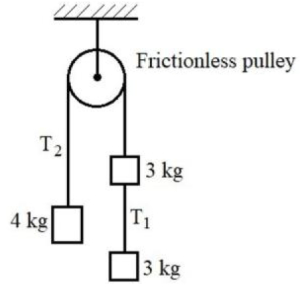
If the system of blocks shown in the figure is released from rest,the ratio of the tensions $T_1$ and $T_2$ is (Neglect the mass of the string shown in the figure).
A
$1: 1$
B
$1: 2$
C
$1: 3$
D
$3: 4$
Solution
(D) Let the masses be $m_1 = 4 \ kg$ (left side),$m_2 = 3 \ kg$ (upper right),and $m_3 = 3 \ kg$ (lower right).
The total mass on the right side is $M_R = m_2 + m_3 = 3 \ kg + 3 \ kg = 6 \ kg$.
The mass on the left side is $M_L = 4 \ kg$.
Since $M_R > M_L$,the system accelerates towards the right with acceleration $a$.
The acceleration $a$ is given by $a = \frac{(M_R - M_L)g}{M_R + M_L} = \frac{(6 - 4)g}{6 + 4} = \frac{2g}{10} = 0.2g$.
For the lower $3 \ kg$ block,the equation of motion is $T_1 - m_3g = m_3a$.
$T_1 = m_3(g + a) = 3(g + 0.2g) = 3(1.2g) = 3.6g$.
For the entire system,the tension $T_2$ in the string passing over the pulley is $T_2 = \frac{2 M_L M_R g}{M_L + M_R} = \frac{2(4)(6)g}{4 + 6} = \frac{48g}{10} = 4.8g$.
The ratio of tensions is $\frac{T_1}{T_2} = \frac{3.6g}{4.8g} = \frac{36}{48} = \frac{3}{4}$.
The total mass on the right side is $M_R = m_2 + m_3 = 3 \ kg + 3 \ kg = 6 \ kg$.
The mass on the left side is $M_L = 4 \ kg$.
Since $M_R > M_L$,the system accelerates towards the right with acceleration $a$.
The acceleration $a$ is given by $a = \frac{(M_R - M_L)g}{M_R + M_L} = \frac{(6 - 4)g}{6 + 4} = \frac{2g}{10} = 0.2g$.
For the lower $3 \ kg$ block,the equation of motion is $T_1 - m_3g = m_3a$.
$T_1 = m_3(g + a) = 3(g + 0.2g) = 3(1.2g) = 3.6g$.
For the entire system,the tension $T_2$ in the string passing over the pulley is $T_2 = \frac{2 M_L M_R g}{M_L + M_R} = \frac{2(4)(6)g}{4 + 6} = \frac{48g}{10} = 4.8g$.
The ratio of tensions is $\frac{T_1}{T_2} = \frac{3.6g}{4.8g} = \frac{36}{48} = \frac{3}{4}$.
0 likesView Solution
24
PhysicsMediumMCQTS EAMCET · 2025
$A$ force separately produces accelerations of $18 \ m/s^2$,$9 \ m/s^2$,and $6 \ m/s^2$ in three bodies of masses $P$,$Q$,and $R$ respectively. If the same force is applied on a body of mass $P+Q+R$,then the acceleration of that body is: (in $m/s^2$)
A
$3$
B
$6$
C
$2$
D
$33$
Solution
(A) Let the force be $F$. According to Newton's second law,$F = ma$,so $m = F/a$.
For mass $P$,$P = F/18$.
For mass $Q$,$Q = F/9$.
For mass $R$,$R = F/6$.
When the same force $F$ is applied to the combined mass $(P+Q+R)$,the acceleration $a'$ is given by $a' = F / (P+Q+R)$.
Substituting the values of $P, Q,$ and $R$:
$a' = F / (F/18 + F/9 + F/6) = F / [F(1/18 + 2/18 + 3/18)]$.
$a' = 1 / (6/18) = 1 / (1/3) = 3 \ m/s^2$.
Thus,the acceleration is $3 \ m/s^2$.
For mass $P$,$P = F/18$.
For mass $Q$,$Q = F/9$.
For mass $R$,$R = F/6$.
When the same force $F$ is applied to the combined mass $(P+Q+R)$,the acceleration $a'$ is given by $a' = F / (P+Q+R)$.
Substituting the values of $P, Q,$ and $R$:
$a' = F / (F/18 + F/9 + F/6) = F / [F(1/18 + 2/18 + 3/18)]$.
$a' = 1 / (6/18) = 1 / (1/3) = 3 \ m/s^2$.
Thus,the acceleration is $3 \ m/s^2$.
0 likesView Solution
25
PhysicsMediumMCQTS EAMCET · 2025
Due to the presence of air resistance,if a body dropped from a height of $20 \ m$ reaches the ground with a speed of $18 \ m/s$,then the time taken by the body to reach the ground is nearly (in $s$)
A
$1.8$
B
$2.2$
C
$2$
D
$2.5$
Solution
(B) For a body falling under gravity with air resistance,the acceleration is not constant. However,we can use the average velocity concept for motion with constant acceleration or approximate the motion.
Given: Initial velocity $u = 0 \ m/s$,final velocity $v = 18 \ m/s$,and displacement $s = 20 \ m$.
The average velocity $v_{avg}$ is given by $v_{avg} = \frac{u + v}{2} = \frac{0 + 18}{2} = 9 \ m/s$.
The time taken $t$ is given by $t = \frac{s}{v_{avg}} = \frac{20 \ m}{9 \ m/s} \approx 2.22 \ s$.
Rounding to the nearest value,the time taken is approximately $2.2 \ s$.
Given: Initial velocity $u = 0 \ m/s$,final velocity $v = 18 \ m/s$,and displacement $s = 20 \ m$.
The average velocity $v_{avg}$ is given by $v_{avg} = \frac{u + v}{2} = \frac{0 + 18}{2} = 9 \ m/s$.
The time taken $t$ is given by $t = \frac{s}{v_{avg}} = \frac{20 \ m}{9 \ m/s} \approx 2.22 \ s$.
Rounding to the nearest value,the time taken is approximately $2.2 \ s$.
0 likesView Solution
26
PhysicsMediumMCQTS EAMCET · 2025
$A$ circular path of radius $75 \ m$ is banked at an angle of $\tan^{-1}(0.2)$. If the coefficient of static friction between the tyres of the car and the circular path is $0.1$,then the maximum permissible speed of the car to avoid slipping is (in $m/s$)
A
$10$
B
$20$
C
$15$
D
$30$
Solution
(C) The maximum speed $v_{max}$ on a banked road with friction is given by the formula: $v_{max} = \sqrt{rg \left( \frac{\tan \theta + \mu}{1 - \mu \tan \theta} \right)}$.
Given: Radius $r = 75 \ m$,angle $\tan \theta = 0.2$,coefficient of friction $\mu = 0.1$,and acceleration due to gravity $g = 10 \ m/s^2$.
Substituting the values:
$v_{max} = \sqrt{75 \times 10 \times \left( \frac{0.2 + 0.1}{1 - (0.1 \times 0.2)} \right)}$
$v_{max} = \sqrt{750 \times \left( \frac{0.3}{1 - 0.02} \right)}$
$v_{max} = \sqrt{750 \times \left( \frac{0.3}{0.98} \right)}$
$v_{max} = \sqrt{750 \times 0.3061} \approx \sqrt{229.57} \approx 15.15 \ m/s$.
Rounding to the nearest option,the maximum permissible speed is $15 \ m/s$.
Given: Radius $r = 75 \ m$,angle $\tan \theta = 0.2$,coefficient of friction $\mu = 0.1$,and acceleration due to gravity $g = 10 \ m/s^2$.
Substituting the values:
$v_{max} = \sqrt{75 \times 10 \times \left( \frac{0.2 + 0.1}{1 - (0.1 \times 0.2)} \right)}$
$v_{max} = \sqrt{750 \times \left( \frac{0.3}{1 - 0.02} \right)}$
$v_{max} = \sqrt{750 \times \left( \frac{0.3}{0.98} \right)}$
$v_{max} = \sqrt{750 \times 0.3061} \approx \sqrt{229.57} \approx 15.15 \ m/s$.
Rounding to the nearest option,the maximum permissible speed is $15 \ m/s$.
0 likesView Solution
27
PhysicsMediumMCQTS EAMCET · 2025
If the component of the vector $\vec{A}$ along the vector $\vec{B}$ is twice the component of $\vec{B}$ along $\vec{A}$,then the ratio of magnitudes of vectors $\vec{A}$ and $\vec{B}$ is
A
$1: 2$
B
$3: 2$
C
$2: 1$
D
$3: 1$
Solution
(C) The component of vector $\vec{A}$ along $\vec{B}$ is given by $\frac{\vec{A} \cdot \vec{B}}{|\vec{B}|}$.
The component of vector $\vec{B}$ along $\vec{A}$ is given by $\frac{\vec{A} \cdot \vec{B}}{|\vec{A}|}$.
According to the problem,the component of $\vec{A}$ along $\vec{B}$ is twice the component of $\vec{B}$ along $\vec{A}$:
$\frac{\vec{A} \cdot \vec{B}}{|\vec{B}|} = 2 \left( \frac{\vec{A} \cdot \vec{B}}{|\vec{A}|} \right)$.
Assuming $\vec{A} \cdot \vec{B} \neq 0$,we can divide both sides by $(\vec{A} \cdot \vec{B})$:
$\frac{1}{|\vec{B}|} = \frac{2}{|\vec{A}|}$.
Rearranging the terms to find the ratio of magnitudes $\frac{|\vec{A}|}{|\vec{B}|}$:
$\frac{|\vec{A}|}{|\vec{B}|} = 2$.
Thus,the ratio is $2: 1$.
The component of vector $\vec{B}$ along $\vec{A}$ is given by $\frac{\vec{A} \cdot \vec{B}}{|\vec{A}|}$.
According to the problem,the component of $\vec{A}$ along $\vec{B}$ is twice the component of $\vec{B}$ along $\vec{A}$:
$\frac{\vec{A} \cdot \vec{B}}{|\vec{B}|} = 2 \left( \frac{\vec{A} \cdot \vec{B}}{|\vec{A}|} \right)$.
Assuming $\vec{A} \cdot \vec{B} \neq 0$,we can divide both sides by $(\vec{A} \cdot \vec{B})$:
$\frac{1}{|\vec{B}|} = \frac{2}{|\vec{A}|}$.
Rearranging the terms to find the ratio of magnitudes $\frac{|\vec{A}|}{|\vec{B}|}$:
$\frac{|\vec{A}|}{|\vec{B}|} = 2$.
Thus,the ratio is $2: 1$.
0 likesView Solution
28
PhysicsMediumMCQTS EAMCET · 2025
$A$ wooden block of outer volume $1 \text{ litre}$ and specific gravity $\frac{3}{4}$ having a cavity floats with half of its volume immersed in water. Then the volume of the cavity is (in $\text{ ml}$)
A
$250$
B
$500$
C
$333.3$
D
$666.6$
Solution
(C) Let the outer volume of the block be $V = 1000 \text{ ml} = 10^{-3} \text{ m}^3$.
The specific gravity of the wood is $\rho_w / \rho_{water} = 0.75$.
Thus,the density of the wood material is $\rho_w = 0.75 \times 1000 \text{ kg/m}^3 = 750 \text{ kg/m}^3$.
Let $V_c$ be the volume of the cavity. The volume of the actual wooden material is $V_m = V - V_c$.
The mass of the block is $M = \rho_w \times V_m = 750 \times (10^{-3} - V_c)$.
According to the law of floatation,the weight of the block equals the weight of the water displaced.
The block floats with half its volume immersed,so $V_{displaced} = \frac{V}{2} = 500 \text{ ml} = 5 \times 10^{-4} \text{ m}^3$.
Weight of displaced water = $\rho_{water} \times V_{displaced} \times g = 1000 \times 5 \times 10^{-4} \times g = 0.5g$.
Weight of the block = $M \times g = 750 \times (10^{-3} - V_c) \times g$.
Equating the two: $0.5g = 750 \times (10^{-3} - V_c) \times g$.
$0.5 = 0.75 - 750 \times V_c$.
$750 \times V_c = 0.25$.
$V_c = \frac{0.25}{750} = \frac{1}{3000} \text{ m}^3$.
$V_c = \frac{1}{3000} \times 10^6 \text{ ml} = 333.33 \text{ ml}$.
The specific gravity of the wood is $\rho_w / \rho_{water} = 0.75$.
Thus,the density of the wood material is $\rho_w = 0.75 \times 1000 \text{ kg/m}^3 = 750 \text{ kg/m}^3$.
Let $V_c$ be the volume of the cavity. The volume of the actual wooden material is $V_m = V - V_c$.
The mass of the block is $M = \rho_w \times V_m = 750 \times (10^{-3} - V_c)$.
According to the law of floatation,the weight of the block equals the weight of the water displaced.
The block floats with half its volume immersed,so $V_{displaced} = \frac{V}{2} = 500 \text{ ml} = 5 \times 10^{-4} \text{ m}^3$.
Weight of displaced water = $\rho_{water} \times V_{displaced} \times g = 1000 \times 5 \times 10^{-4} \times g = 0.5g$.
Weight of the block = $M \times g = 750 \times (10^{-3} - V_c) \times g$.
Equating the two: $0.5g = 750 \times (10^{-3} - V_c) \times g$.
$0.5 = 0.75 - 750 \times V_c$.
$750 \times V_c = 0.25$.
$V_c = \frac{0.25}{750} = \frac{1}{3000} \text{ m}^3$.
$V_c = \frac{1}{3000} \times 10^6 \text{ ml} = 333.33 \text{ ml}$.
0 likesView Solution
29
PhysicsMediumMCQTS EAMCET · 2025
$A$ cube of side $40 \ cm$ is floating with $\frac{1}{4}$th of its volume immersed in water. When a circular disc is placed on the cube,it floats with $\frac{2}{5}$th of its volume immersed in water. The mass of the disc is (in $kg$)
A
$6.4$
B
$3.2$
C
$9.6$
D
$1.6$
Solution
(C) Let the side of the cube be $a = 40 \ cm = 0.4 \ m$. The volume of the cube is $V = a^3 = (0.4)^3 = 0.064 \ m^3$.
Density of water $\rho_w = 1000 \ kg/m^3$.
Initially,the cube floats with $\frac{1}{4}$ of its volume immersed. By the law of floatation,the weight of the cube equals the weight of the displaced water:
$m_{cube} \cdot g = \rho_w \cdot V_{immersed} \cdot g$
$m_{cube} = 1000 \cdot (\frac{1}{4} \cdot 0.064) = 1000 \cdot 0.016 = 16 \ kg$.
When the disc of mass $M$ is placed on the cube,the total weight is $(m_{cube} + M)g$. The new volume immersed is $\frac{2}{5}$ of $V$:
$(m_{cube} + M)g = \rho_w \cdot (\frac{2}{5} \cdot V) \cdot g$
$16 + M = 1000 \cdot (\frac{2}{5} \cdot 0.064)$
$16 + M = 1000 \cdot 0.0256 = 25.6$
$M = 25.6 - 16 = 9.6 \ kg$.
Density of water $\rho_w = 1000 \ kg/m^3$.
Initially,the cube floats with $\frac{1}{4}$ of its volume immersed. By the law of floatation,the weight of the cube equals the weight of the displaced water:
$m_{cube} \cdot g = \rho_w \cdot V_{immersed} \cdot g$
$m_{cube} = 1000 \cdot (\frac{1}{4} \cdot 0.064) = 1000 \cdot 0.016 = 16 \ kg$.
When the disc of mass $M$ is placed on the cube,the total weight is $(m_{cube} + M)g$. The new volume immersed is $\frac{2}{5}$ of $V$:
$(m_{cube} + M)g = \rho_w \cdot (\frac{2}{5} \cdot V) \cdot g$
$16 + M = 1000 \cdot (\frac{2}{5} \cdot 0.064)$
$16 + M = 1000 \cdot 0.0256 = 25.6$
$M = 25.6 - 16 = 9.6 \ kg$.
0 likesView Solution
30
PhysicsMediumMCQTS EAMCET · 2025
Water is filled in a tank up to a height of $20 \ cm$ from the bottom of the tank. Water flows through a hole of area $1 \ mm^2$ at its bottom. The mass of the water coming out from the hole in a time of $0.6 \ s$ is (Density of water $= 1000 \ kg \ m^{-3}$ and acceleration due to gravity $= 10 \ m \ s^{-2}$) (in $g$)
A
$1.8$
B
$1.2$
C
$0.6$
D
$2.4$
Solution
(B) The velocity of efflux $v$ is given by Torricelli's law: $v = \sqrt{2gh}$.
Given: $h = 20 \ cm = 0.2 \ m$,$g = 10 \ m \ s^{-2}$.
$v = \sqrt{2 \times 10 \times 0.2} = \sqrt{4} = 2 \ m \ s^{-1}$.
The volume of water flowing out per second is $Q = A \times v$,where $A = 1 \ mm^2 = 1 \times 10^{-6} \ m^2$.
$Q = 1 \times 10^{-6} \ m^2 \times 2 \ m \ s^{-1} = 2 \times 10^{-6} \ m^3 \ s^{-1}$.
The mass of water flowing out in time $t = 0.6 \ s$ is $m = \rho \times Q \times t$.
$m = 1000 \ kg \ m^{-3} \times 2 \times 10^{-6} \ m^3 \ s^{-1} \times 0.6 \ s$.
$m = 1000 \times 1.2 \times 10^{-6} \ kg = 1.2 \times 10^{-3} \ kg = 1.2 \ g$.
Given: $h = 20 \ cm = 0.2 \ m$,$g = 10 \ m \ s^{-2}$.
$v = \sqrt{2 \times 10 \times 0.2} = \sqrt{4} = 2 \ m \ s^{-1}$.
The volume of water flowing out per second is $Q = A \times v$,where $A = 1 \ mm^2 = 1 \times 10^{-6} \ m^2$.
$Q = 1 \times 10^{-6} \ m^2 \times 2 \ m \ s^{-1} = 2 \times 10^{-6} \ m^3 \ s^{-1}$.
The mass of water flowing out in time $t = 0.6 \ s$ is $m = \rho \times Q \times t$.
$m = 1000 \ kg \ m^{-3} \times 2 \times 10^{-6} \ m^3 \ s^{-1} \times 0.6 \ s$.
$m = 1000 \times 1.2 \times 10^{-6} \ kg = 1.2 \times 10^{-3} \ kg = 1.2 \ g$.
0 likesView Solution
31
PhysicsMediumMCQTS EAMCET · 2025
An air bubble rises from the bottom to the top of a water tank in which the temperature of the water is uniform. The surface area of the bubble at the top of the tank is $125 \%$ more than its surface area at the bottom of the tank. If the atmospheric pressure is equal to the pressure of $10 \ m$ water column,then the depth of water in the tank is (in $m$)
A
$16.25$
B
$27$
C
$19$
D
$23.75$
Solution
(D) Let the surface area of the bubble at the bottom be $A_1$ and at the top be $A_2$. Given $A_2 = A_1 + 1.25 A_1 = 2.25 A_1$.
Since the bubble is spherical,$A = 4 \pi r^2$,which implies $r \propto \sqrt{A}$. Thus,$r_2 = \sqrt{2.25} r_1 = 1.5 r_1$.
The volume $V = \frac{4}{3} \pi r^3$,so $V_2 = (1.5)^3 V_1 = 3.375 V_1$.
Since the temperature is uniform,Boyle's Law applies: $P_1 V_1 = P_2 V_2$.
Here,$P_2 = P_{atm} = 10 \ m$ of water column.
$P_1 = P_{atm} + h = 10 + h$,where $h$ is the depth of the tank.
Substituting the values: $(10 + h) V_1 = 10 \times (3.375 V_1)$.
$10 + h = 33.75$.
$h = 33.75 - 10 = 23.75 \ m$.
Since the bubble is spherical,$A = 4 \pi r^2$,which implies $r \propto \sqrt{A}$. Thus,$r_2 = \sqrt{2.25} r_1 = 1.5 r_1$.
The volume $V = \frac{4}{3} \pi r^3$,so $V_2 = (1.5)^3 V_1 = 3.375 V_1$.
Since the temperature is uniform,Boyle's Law applies: $P_1 V_1 = P_2 V_2$.
Here,$P_2 = P_{atm} = 10 \ m$ of water column.
$P_1 = P_{atm} + h = 10 + h$,where $h$ is the depth of the tank.
Substituting the values: $(10 + h) V_1 = 10 \times (3.375 V_1)$.
$10 + h = 33.75$.
$h = 33.75 - 10 = 23.75 \ m$.
0 likesView Solution
32
PhysicsMediumMCQTS EAMCET · 2025
The work done in blowing a soap bubble of diameter $3 \ cm$ is (Surface tension of soap solution $= 0.035 \ N/m$). (in $\mu J$)
A
$792$
B
$99$
C
$396$
D
$198$
Solution
(D) The work done $W$ in blowing a soap bubble of radius $r$ is given by the formula $W = T \times \Delta A$,where $T$ is the surface tension and $\Delta A$ is the change in surface area.
Since a soap bubble has two surfaces (inner and outer),the change in surface area is $\Delta A = 2 \times (4 \pi r^2) = 8 \pi r^2$.
Given: Diameter $d = 3 \ cm$,so radius $r = 1.5 \ cm = 1.5 \times 10^{-2} \ m$.
Surface tension $T = 0.035 \ N/m$.
Substituting the values:
$W = 0.035 \times 8 \times \pi \times (1.5 \times 10^{-2})^2$
$W = 0.035 \times 8 \times 3.14159 \times 2.25 \times 10^{-4}$
$W = 0.28 \times 3.14159 \times 2.25 \times 10^{-4}$
$W \approx 1.979 \times 10^{-4} \ J$
$W \approx 198 \times 10^{-6} \ J = 198 \ \mu J$.
Thus,the correct option is $D$.
Since a soap bubble has two surfaces (inner and outer),the change in surface area is $\Delta A = 2 \times (4 \pi r^2) = 8 \pi r^2$.
Given: Diameter $d = 3 \ cm$,so radius $r = 1.5 \ cm = 1.5 \times 10^{-2} \ m$.
Surface tension $T = 0.035 \ N/m$.
Substituting the values:
$W = 0.035 \times 8 \times \pi \times (1.5 \times 10^{-2})^2$
$W = 0.035 \times 8 \times 3.14159 \times 2.25 \times 10^{-4}$
$W = 0.28 \times 3.14159 \times 2.25 \times 10^{-4}$
$W \approx 1.979 \times 10^{-4} \ J$
$W \approx 198 \times 10^{-6} \ J = 198 \ \mu J$.
Thus,the correct option is $D$.
0 likesView Solution
33
PhysicsMediumMCQTS EAMCET · 2025
If $W_1$ is the work done in increasing the radius of a soap bubble from $r$ to $2r$ and $W_2$ is the work done in increasing the radius of the soap bubble from $2r$ to $3r$,then $W_1: W_2=$
A
$3: 5$
B
$1: 1$
C
$2: 3$
D
$3: 4$
Solution
(A) The work done in increasing the radius of a soap bubble from $r_1$ to $r_2$ is given by the formula $W = T \times \Delta A$,where $T$ is the surface tension and $\Delta A$ is the change in surface area. Since a soap bubble has two surfaces,the change in area is $\Delta A = 2 \times (4\pi r_2^2 - 4\pi r_1^2) = 8\pi(r_2^2 - r_1^2)$.
For $W_1$ (from $r$ to $2r$): $W_1 = 8\pi T ((2r)^2 - r^2) = 8\pi T (4r^2 - r^2) = 8\pi T (3r^2) = 24\pi T r^2$.
For $W_2$ (from $2r$ to $3r$): $W_2 = 8\pi T ((3r)^2 - (2r)^2) = 8\pi T (9r^2 - 4r^2) = 8\pi T (5r^2) = 40\pi T r^2$.
Therefore,the ratio $W_1: W_2 = (24\pi T r^2) : (40\pi T r^2) = 24:40 = 3:5$.
For $W_1$ (from $r$ to $2r$): $W_1 = 8\pi T ((2r)^2 - r^2) = 8\pi T (4r^2 - r^2) = 8\pi T (3r^2) = 24\pi T r^2$.
For $W_2$ (from $2r$ to $3r$): $W_2 = 8\pi T ((3r)^2 - (2r)^2) = 8\pi T (9r^2 - 4r^2) = 8\pi T (5r^2) = 40\pi T r^2$.
Therefore,the ratio $W_1: W_2 = (24\pi T r^2) : (40\pi T r^2) = 24:40 = 3:5$.
0 likesView Solution
34
PhysicsMediumMCQTS EAMCET · 2025
$A$ thin film of water is formed between two straight parallel wires each of length $8 \ cm$ separated by a distance of $0.6 \ cm$. The work done to increase the distance between the wires to $0.8 \ cm$ is (Surface tension of water $= 0.07 \ N/m$) (in $\mu J$)
A
$33.6$
B
$22.4$
C
$11.2$
D
$44.8$
Solution
(B) The work done in increasing the area of a film is given by $W = T \times \Delta A$,where $T$ is the surface tension and $\Delta A$ is the change in surface area.
Since a thin film has two surfaces,the total change in area is $\Delta A = 2 \times l \times (d_2 - d_1)$.
Given: $l = 8 \ cm = 0.08 \ m$,$d_1 = 0.6 \ cm = 0.006 \ m$,$d_2 = 0.8 \ cm = 0.008 \ m$,and $T = 0.07 \ N/m$.
Change in distance $\Delta d = d_2 - d_1 = 0.8 \ cm - 0.6 \ cm = 0.2 \ cm = 0.002 \ m$.
$\Delta A = 2 \times 0.08 \ m \times 0.002 \ m = 0.00032 \ m^2$.
Work done $W = 0.07 \ N/m \times 0.00032 \ m^2 = 0.0000224 \ J$.
$W = 22.4 \times 10^{-6} \ J = 22.4 \ \mu J$.
Since a thin film has two surfaces,the total change in area is $\Delta A = 2 \times l \times (d_2 - d_1)$.
Given: $l = 8 \ cm = 0.08 \ m$,$d_1 = 0.6 \ cm = 0.006 \ m$,$d_2 = 0.8 \ cm = 0.008 \ m$,and $T = 0.07 \ N/m$.
Change in distance $\Delta d = d_2 - d_1 = 0.8 \ cm - 0.6 \ cm = 0.2 \ cm = 0.002 \ m$.
$\Delta A = 2 \times 0.08 \ m \times 0.002 \ m = 0.00032 \ m^2$.
Work done $W = 0.07 \ N/m \times 0.00032 \ m^2 = 0.0000224 \ J$.
$W = 22.4 \times 10^{-6} \ J = 22.4 \ \mu J$.
0 likesView Solution
35
PhysicsMediumMCQTS EAMCET · 2025
When $n$ identical mercury drops combine to form a single big drop,
A
Surface area increases and heat is released
B
Surface area decreases and heat is released
C
Surface area increases and heat is absorbed
D
Surface area decreases and heat is absorbed
Solution
(B) Let the radius of each small drop be $r$ and the radius of the big drop be $R$. Since the total volume remains constant,we have $n \times (4/3) \pi r^3 = (4/3) \pi R^3$,which gives $R = n^{1/3} r$.
The initial surface area of $n$ drops is $A_i = n \times 4 \pi r^2$.
The final surface area of the big drop is $A_f = 4 \pi R^2 = 4 \pi (n^{1/3} r)^2 = 4 \pi n^{2/3} r^2$.
Since $n^{2/3} < n$ for $n > 1$,the final surface area $A_f$ is less than the initial surface area $A_i$. Thus,the surface area decreases.
Surface energy is given by $U = T \times A$,where $T$ is the surface tension. Since the surface area decreases,the surface energy of the system decreases.
According to the law of conservation of energy,the decrease in surface energy is released as heat. Therefore,surface area decreases and heat is released.
The initial surface area of $n$ drops is $A_i = n \times 4 \pi r^2$.
The final surface area of the big drop is $A_f = 4 \pi R^2 = 4 \pi (n^{1/3} r)^2 = 4 \pi n^{2/3} r^2$.
Since $n^{2/3} < n$ for $n > 1$,the final surface area $A_f$ is less than the initial surface area $A_i$. Thus,the surface area decreases.
Surface energy is given by $U = T \times A$,where $T$ is the surface tension. Since the surface area decreases,the surface energy of the system decreases.
According to the law of conservation of energy,the decrease in surface energy is released as heat. Therefore,surface area decreases and heat is released.
0 likesView Solution
36
PhysicsMediumMCQTS EAMCET · 2025
The maximum length of a water column that can stay without falling in a vertically held capillary tube of diameter $1 \ mm$ and open at both ends is (Acceleration due to gravity $= 10 \ ms^{-2}$ and surface tension of water $= 0.07 \ Nm^{-1}$) (in $cm$)
A
$2.8$
B
$5.6$
C
$1.4$
D
$0$
Solution
(D) For a capillary tube open at both ends,the water column is supported by surface tension forces at the meniscus.
When a water column of length $h$ is held in a capillary tube,the pressure difference due to surface tension must balance the hydrostatic pressure of the water column.
For a tube open at both ends,the water will not be able to be supported if the tube is vertical because the pressure at the top and bottom meniscus would be atmospheric,and gravity would pull the water down.
However,if we consider the capillary rise formula $h = \frac{2T \cos \theta}{r \rho g}$,this applies to a tube dipping in a reservoir.
In a tube open at both ends,the water column cannot be supported against gravity unless there is a pressure difference.
Since the tube is open at both ends,the pressure at both ends is atmospheric pressure $(P_0)$.
Thus,the water column will fall out due to gravity.
Therefore,the maximum length of the water column that can stay without falling is $0 \ cm$.
When a water column of length $h$ is held in a capillary tube,the pressure difference due to surface tension must balance the hydrostatic pressure of the water column.
For a tube open at both ends,the water will not be able to be supported if the tube is vertical because the pressure at the top and bottom meniscus would be atmospheric,and gravity would pull the water down.
However,if we consider the capillary rise formula $h = \frac{2T \cos \theta}{r \rho g}$,this applies to a tube dipping in a reservoir.
In a tube open at both ends,the water column cannot be supported against gravity unless there is a pressure difference.
Since the tube is open at both ends,the pressure at both ends is atmospheric pressure $(P_0)$.
Thus,the water column will fall out due to gravity.
Therefore,the maximum length of the water column that can stay without falling is $0 \ cm$.
0 likesView Solution
37
PhysicsMediumMCQTS EAMCET · 2025
If the terminal velocity of a metal sphere of mass $8 \ g$ falling through a liquid is $3 \ cm s^{-1}$,then the terminal velocity of another sphere of mass $64 \ g$ made of the same metal falling through the same liquid is (in $cm s^{-1}$)
A
$6$
B
$3$
C
$12$
D
$18$
Solution
(C) The terminal velocity $v_t$ of a sphere of radius $r$ and density $\rho$ falling through a liquid of density $\sigma$ and viscosity $\eta$ is given by the formula: $v_t = \frac{2}{9} \frac{r^2 g (\rho - \sigma)}{\eta}$.
Since both spheres are made of the same metal and fall through the same liquid,$\rho, \sigma, g,$ and $\eta$ are constant. Thus,$v_t \propto r^2$.
Given the mass $m = \frac{4}{3} \pi r^3 \rho$,we have $r^3 \propto m$,which implies $r \propto m^{1/3}$.
Substituting this into the proportionality for $v_t$,we get $v_t \propto (m^{1/3})^2 = m^{2/3}$.
Let $v_1 = 3 \ cm s^{-1}$ for $m_1 = 8 \ g$ and $v_2$ be the terminal velocity for $m_2 = 64 \ g$.
Then,$\frac{v_2}{v_1} = \left( \frac{m_2}{m_1} \right)^{2/3} = \left( \frac{64}{8} \right)^{2/3} = (8)^{2/3} = (2^3)^{2/3} = 2^2 = 4$.
Therefore,$v_2 = 4 \times v_1 = 4 \times 3 \ cm s^{-1} = 12 \ cm s^{-1}$.
Since both spheres are made of the same metal and fall through the same liquid,$\rho, \sigma, g,$ and $\eta$ are constant. Thus,$v_t \propto r^2$.
Given the mass $m = \frac{4}{3} \pi r^3 \rho$,we have $r^3 \propto m$,which implies $r \propto m^{1/3}$.
Substituting this into the proportionality for $v_t$,we get $v_t \propto (m^{1/3})^2 = m^{2/3}$.
Let $v_1 = 3 \ cm s^{-1}$ for $m_1 = 8 \ g$ and $v_2$ be the terminal velocity for $m_2 = 64 \ g$.
Then,$\frac{v_2}{v_1} = \left( \frac{m_2}{m_1} \right)^{2/3} = \left( \frac{64}{8} \right)^{2/3} = (8)^{2/3} = (2^3)^{2/3} = 2^2 = 4$.
Therefore,$v_2 = 4 \times v_1 = 4 \times 3 \ cm s^{-1} = 12 \ cm s^{-1}$.
0 likesView Solution
38
PhysicsEasyMCQTS EAMCET · 2025
For which of the following Reynolds numbers is a flow considered streamlined (laminar)?
A
$900$
B
$2100$
C
$2900$
D
$4000$
Solution
$(A)$ The Reynolds number $(Re)$ is a dimensionless quantity used to predict the flow regime of a fluid.
For flow in a pipe, the criteria are generally defined as follows:
$1$. If $Re < 2000$, the flow is streamlined or laminar.
$2$. If $2000 < Re < 3000$, the flow is in a transition state.
$3$. If $Re > 3000$, the flow is turbulent.
Comparing the given options with the criteria for streamlined flow $(Re < 2000)$:
- Option $A$: $900 < 2000$ (Streamlined)
- Option $B$: $2100$ (Transition)
- Option $C$: $2900$ (Transition)
- Option $D$: $4000$ (Turbulent)
Therefore, the correct option is $A$.
For flow in a pipe, the criteria are generally defined as follows:
$1$. If $Re < 2000$, the flow is streamlined or laminar.
$2$. If $2000 < Re < 3000$, the flow is in a transition state.
$3$. If $Re > 3000$, the flow is turbulent.
Comparing the given options with the criteria for streamlined flow $(Re < 2000)$:
- Option $A$: $900 < 2000$ (Streamlined)
- Option $B$: $2100$ (Transition)
- Option $C$: $2900$ (Transition)
- Option $D$: $4000$ (Turbulent)
Therefore, the correct option is $A$.
0 likesView Solution
39
PhysicsMediumMCQTS EAMCET · 2025
$A$ rain drop of diameter $1 \ mm$ falls with a terminal velocity of $0.7 \ ms^{-1}$ in air. If the coefficient of viscosity of air is $2 \times 10^{-5} \ Pa \cdot s$,the viscous force on the rain drop is
A
$13.2 \times 10^{-8} \ N$
B
$6.6 \times 10^{-8} \ N$
C
$26.4 \times 10^{-8} \ N$
D
$10.4 \times 10^{-8} \ N$
Solution
(B) According to Stokes' Law,the viscous force $F$ acting on a spherical object of radius $r$ moving with a terminal velocity $v$ in a fluid of viscosity $\eta$ is given by $F = 6 \pi \eta r v$.
Given:
Diameter $d = 1 \ mm = 10^{-3} \ m$,so radius $r = 0.5 \times 10^{-3} \ m$.
Terminal velocity $v = 0.7 \ ms^{-1}$.
Coefficient of viscosity $\eta = 2 \times 10^{-5} \ Pa \cdot s$.
Substituting these values into the formula:
$F = 6 \times 3.14 \times (2 \times 10^{-5}) \times (0.5 \times 10^{-3}) \times 0.7$
$F = 6 \times 3.14 \times 10^{-5} \times 0.5 \times 10^{-3} \times 0.7$
$F = 6 \times 0.5 \times 0.7 \times 3.14 \times 10^{-8}$
$F = 2.1 \times 3.14 \times 10^{-8}$
$F = 6.594 \times 10^{-8} \ N \approx 6.6 \times 10^{-8} \ N$.
Thus,the correct option is $B$.
Given:
Diameter $d = 1 \ mm = 10^{-3} \ m$,so radius $r = 0.5 \times 10^{-3} \ m$.
Terminal velocity $v = 0.7 \ ms^{-1}$.
Coefficient of viscosity $\eta = 2 \times 10^{-5} \ Pa \cdot s$.
Substituting these values into the formula:
$F = 6 \times 3.14 \times (2 \times 10^{-5}) \times (0.5 \times 10^{-3}) \times 0.7$
$F = 6 \times 3.14 \times 10^{-5} \times 0.5 \times 10^{-3} \times 0.7$
$F = 6 \times 0.5 \times 0.7 \times 3.14 \times 10^{-8}$
$F = 2.1 \times 3.14 \times 10^{-8}$
$F = 6.594 \times 10^{-8} \ N \approx 6.6 \times 10^{-8} \ N$.
Thus,the correct option is $B$.
0 likesView Solution
40
PhysicsMediumMCQTS EAMCET · 2025
If a brass sphere of radius $36 \ cm$ is submerged in a lake at a depth where the pressure is $10^7 \ Pa$,then the change in the radius of the sphere is $($Bulk modulus of brass $= 60 \ GPa)$.
A
$4 \times 10^{-2} \ cm$
B
$2 \times 10^{-3} \ cm$
C
$4 \times 10^{-3} \ cm$
D
$2 \times 10^{-2} \ cm$
Solution
(B) The Bulk modulus $B$ is defined as $B = -\frac{\Delta P}{\Delta V/V}$.
Given: $B = 60 \ GPa = 60 \times 10^9 \ Pa$,$\Delta P = 10^7 \ Pa$,$r = 36 \ cm = 0.36 \ m$.
The volume of a sphere is $V = \frac{4}{3}\pi r^3$,so the fractional change in volume is $\frac{\Delta V}{V} = 3 \frac{\Delta r}{r}$.
Substituting this into the Bulk modulus formula: $B = -\frac{\Delta P}{3 \Delta r / r}$.
Rearranging for $\Delta r$: $\Delta r = -\frac{\Delta P \cdot r}{3B}$.
Taking the magnitude: $|\Delta r| = \frac{10^7 \times 0.36}{3 \times 60 \times 10^9}$.
$|\Delta r| = \frac{3.6 \times 10^6}{180 \times 10^9} = \frac{3.6}{180} \times 10^{-3} = 0.02 \times 10^{-3} \ m = 2 \times 10^{-5} \ m$.
Converting to cm: $2 \times 10^{-5} \times 10^2 \ cm = 2 \times 10^{-3} \ cm$.
Given: $B = 60 \ GPa = 60 \times 10^9 \ Pa$,$\Delta P = 10^7 \ Pa$,$r = 36 \ cm = 0.36 \ m$.
The volume of a sphere is $V = \frac{4}{3}\pi r^3$,so the fractional change in volume is $\frac{\Delta V}{V} = 3 \frac{\Delta r}{r}$.
Substituting this into the Bulk modulus formula: $B = -\frac{\Delta P}{3 \Delta r / r}$.
Rearranging for $\Delta r$: $\Delta r = -\frac{\Delta P \cdot r}{3B}$.
Taking the magnitude: $|\Delta r| = \frac{10^7 \times 0.36}{3 \times 60 \times 10^9}$.
$|\Delta r| = \frac{3.6 \times 10^6}{180 \times 10^9} = \frac{3.6}{180} \times 10^{-3} = 0.02 \times 10^{-3} \ m = 2 \times 10^{-5} \ m$.
Converting to cm: $2 \times 10^{-5} \times 10^2 \ cm = 2 \times 10^{-3} \ cm$.
0 likesView Solution
41
PhysicsMediumMCQTS EAMCET · 2025
The Young's modulus and Poisson's ratio of a material are respectively $Y$ and $\sigma$. The force required to decrease the area of cross-section of a wire made of this material by $\Delta A$ is
A
$\frac{Y \Delta A}{4 \sigma}$
B
$\frac{2 Y \Delta A}{\sigma}$
C
$\frac{Y \Delta A}{2 \sigma}$
D
$\frac{Y \Delta A}{\sigma}$
Solution
(C) Let the original radius of the wire be $r$ and its length be $L$. The area of cross-section is $A = \pi r^2$.
Taking the derivative,$\Delta A = 2 \pi r \Delta r$.
Poisson's ratio $\sigma$ is defined as $\sigma = -\frac{\Delta r / r}{\Delta L / L}$,so $\frac{\Delta r}{r} = -\sigma \frac{\Delta L}{L}$.
Substituting this into the area change equation: $\Delta A = 2 \pi r^2 (-\sigma \frac{\Delta L}{L}) = -2 A \sigma \frac{\Delta L}{L}$.
Taking the magnitude,$|\Delta A| = 2 A \sigma \frac{\Delta L}{L}$,which gives $\frac{\Delta L}{L} = \frac{\Delta A}{2 A \sigma}$.
Young's modulus $Y$ is defined as $Y = \frac{F/A}{\Delta L/L}$,so $F = Y A \frac{\Delta L}{L}$.
Substituting $\frac{\Delta L}{L}$: $F = Y A (\frac{\Delta A}{2 A \sigma}) = \frac{Y \Delta A}{2 \sigma}$.
Taking the derivative,$\Delta A = 2 \pi r \Delta r$.
Poisson's ratio $\sigma$ is defined as $\sigma = -\frac{\Delta r / r}{\Delta L / L}$,so $\frac{\Delta r}{r} = -\sigma \frac{\Delta L}{L}$.
Substituting this into the area change equation: $\Delta A = 2 \pi r^2 (-\sigma \frac{\Delta L}{L}) = -2 A \sigma \frac{\Delta L}{L}$.
Taking the magnitude,$|\Delta A| = 2 A \sigma \frac{\Delta L}{L}$,which gives $\frac{\Delta L}{L} = \frac{\Delta A}{2 A \sigma}$.
Young's modulus $Y$ is defined as $Y = \frac{F/A}{\Delta L/L}$,so $F = Y A \frac{\Delta L}{L}$.
Substituting $\frac{\Delta L}{L}$: $F = Y A (\frac{\Delta A}{2 A \sigma}) = \frac{Y \Delta A}{2 \sigma}$.
0 likesView Solution
42
PhysicsMediumMCQTS EAMCET · 2025
$A$ metal rod of area of cross-section $3 \,cm^2$ is stretched along its length by applying a force of $9 \times 10^4 \,N$. If the Young's modulus of the material of the rod is $2 \times 10^{11} \,Nm^{-2}$, the energy stored per unit volume in the stretched rod is:
A
$13.5 \times 10^5 \,Jm^{-3}$
B
$9 \times 10^5 \,Jm^{-3}$
C
$2.25 \times 10^5 \,Jm^{-3}$
D
$4.5 \times 10^5 \,Jm^{-3}$
Solution
(C) The energy stored per unit volume $(u)$ in a stretched rod is given by the formula: $u = \frac{1}{2} \times \text{stress} \times \text{strain}$.
We know that $\text{stress} = \frac{F}{A}$ and $\text{strain} = \frac{\text{stress}}{Y} = \frac{F}{AY}$.
Substituting these into the formula, we get $u = \frac{1}{2} \times \frac{F}{A} \times \frac{F}{AY} = \frac{F^2}{2A^2Y}$.
Given: $F = 9 \times 10^4 \,N$, $A = 3 \,cm^2 = 3 \times 10^{-4} \,m^2$, and $Y = 2 \times 10^{11} \,Nm^{-2}$.
Calculating stress: $\sigma = \frac{9 \times 10^4}{3 \times 10^{-4}} = 3 \times 10^8 \,Nm^{-2}$.
Now, $u = \frac{1}{2} \times \sigma \times \frac{\sigma}{Y} = \frac{\sigma^2}{2Y}$.
$u = \frac{(3 \times 10^8)^2}{2 \times 2 \times 10^{11}} = \frac{9 \times 10^{16}}{4 \times 10^{11}} = 2.25 \times 10^5 \,Jm^{-3}$.
We know that $\text{stress} = \frac{F}{A}$ and $\text{strain} = \frac{\text{stress}}{Y} = \frac{F}{AY}$.
Substituting these into the formula, we get $u = \frac{1}{2} \times \frac{F}{A} \times \frac{F}{AY} = \frac{F^2}{2A^2Y}$.
Given: $F = 9 \times 10^4 \,N$, $A = 3 \,cm^2 = 3 \times 10^{-4} \,m^2$, and $Y = 2 \times 10^{11} \,Nm^{-2}$.
Calculating stress: $\sigma = \frac{9 \times 10^4}{3 \times 10^{-4}} = 3 \times 10^8 \,Nm^{-2}$.
Now, $u = \frac{1}{2} \times \sigma \times \frac{\sigma}{Y} = \frac{\sigma^2}{2Y}$.
$u = \frac{(3 \times 10^8)^2}{2 \times 2 \times 10^{11}} = \frac{9 \times 10^{16}}{4 \times 10^{11}} = 2.25 \times 10^5 \,Jm^{-3}$.
0 likesView Solution
43
PhysicsMediumMCQTS EAMCET · 2025
The work to be done to produce a strain of $10^{-3}$ in a steel wire of mass $2.96 \ kg$ and density $7.4 \ g \ cm^{-3}$ is (Young's modulus of steel $= 2 \times 10^{11} \ Nm^{-2}$)
A
$0.04$ kJ
B
$0.04$ $J$
C
$100$ kJ
D
$400$ $J$
Solution
(A) The work done in stretching a wire is given by the formula: $W = \frac{1}{2} \times \text{Stress} \times \text{Strain} \times \text{Volume}$.
Given: Strain $(\epsilon) = 10^{-3}$,Young's modulus $(Y) = 2 \times 10^{11} \ Nm^{-2}$,Mass $(m) = 2.96 \ kg$,Density $(\rho) = 7.4 \ g \ cm^{-3} = 7400 \ kg \ m^{-3}$.
First,calculate the volume $(V)$ of the wire: $V = \frac{m}{\rho} = \frac{2.96}{7400} = 4 \times 10^{-4} \ m^3$.
Next,calculate the stress: $\text{Stress} = Y \times \epsilon = (2 \times 10^{11}) \times (10^{-3}) = 2 \times 10^8 \ Nm^{-2}$.
Now,calculate the work done: $W = \frac{1}{2} \times (2 \times 10^8) \times (10^{-3}) \times (4 \times 10^{-4})$.
$W = 10^8 \times 10^{-3} \times 4 \times 10^{-4} = 4 \times 10^1 = 40 \ J = 0.04 \ kJ$.
Given: Strain $(\epsilon) = 10^{-3}$,Young's modulus $(Y) = 2 \times 10^{11} \ Nm^{-2}$,Mass $(m) = 2.96 \ kg$,Density $(\rho) = 7.4 \ g \ cm^{-3} = 7400 \ kg \ m^{-3}$.
First,calculate the volume $(V)$ of the wire: $V = \frac{m}{\rho} = \frac{2.96}{7400} = 4 \times 10^{-4} \ m^3$.
Next,calculate the stress: $\text{Stress} = Y \times \epsilon = (2 \times 10^{11}) \times (10^{-3}) = 2 \times 10^8 \ Nm^{-2}$.
Now,calculate the work done: $W = \frac{1}{2} \times (2 \times 10^8) \times (10^{-3}) \times (4 \times 10^{-4})$.
$W = 10^8 \times 10^{-3} \times 4 \times 10^{-4} = 4 \times 10^1 = 40 \ J = 0.04 \ kJ$.
0 likesView Solution
44
PhysicsMediumMCQTS EAMCET · 2025
Two wires $A$ and $B$ made of the same material and areas of cross-section in the ratio $1: 2$ are stretched by the same force. If the masses of the wires $A$ and $B$ are in the ratio $2: 3$,then the ratio of the elongations of the wires $A$ and $B$ is
A
$1: 2$
B
$8: 3$
C
$1: 3$
D
$4: 3$
Solution
(B) The elongation $\Delta L$ of a wire is given by $\Delta L = \frac{FL}{AY}$,where $F$ is the force,$L$ is the length,$A$ is the area of cross-section,and $Y$ is Young's modulus.
Since the wires are made of the same material,$Y_A = Y_B = Y$. The force $F$ is also the same.
We know that mass $m = \rho A L$,where $\rho$ is the density. Since the material is the same,$\rho_A = \rho_B = \rho$.
Thus,$L = \frac{m}{\rho A}$.
Substituting this into the elongation formula: $\Delta L = \frac{F}{\rho A^2 Y} \cdot m$.
For the ratio of elongations: $\frac{\Delta L_A}{\Delta L_B} = \frac{m_A}{m_B} \cdot \left( \frac{A_B}{A_A} \right)^2$.
Given $\frac{m_A}{m_B} = \frac{2}{3}$ and $\frac{A_A}{A_B} = \frac{1}{2}$,we have $\frac{A_B}{A_A} = 2$.
Therefore,$\frac{\Delta L_A}{\Delta L_B} = \frac{2}{3} \cdot (2)^2 = \frac{2}{3} \cdot 4 = \frac{8}{3}$.
Since the wires are made of the same material,$Y_A = Y_B = Y$. The force $F$ is also the same.
We know that mass $m = \rho A L$,where $\rho$ is the density. Since the material is the same,$\rho_A = \rho_B = \rho$.
Thus,$L = \frac{m}{\rho A}$.
Substituting this into the elongation formula: $\Delta L = \frac{F}{\rho A^2 Y} \cdot m$.
For the ratio of elongations: $\frac{\Delta L_A}{\Delta L_B} = \frac{m_A}{m_B} \cdot \left( \frac{A_B}{A_A} \right)^2$.
Given $\frac{m_A}{m_B} = \frac{2}{3}$ and $\frac{A_A}{A_B} = \frac{1}{2}$,we have $\frac{A_B}{A_A} = 2$.
Therefore,$\frac{\Delta L_A}{\Delta L_B} = \frac{2}{3} \cdot (2)^2 = \frac{2}{3} \cdot 4 = \frac{8}{3}$.
0 likesView Solution
45
PhysicsMediumMCQTS EAMCET · 2025
$A$ steel rod with a circular cross-section of diameter $1 \ cm$ and another steel rod with a square cross-section of side $1 \ cm$ have equal mass. If the two rods are subjected to the same tension,the ratio of the elongations of the two rods is
A
$\frac{1}{\pi^2}$
B
$\frac{2}{\pi^2}$
C
$\frac{4}{\pi^2}$
D
$\frac{\pi^2}{4}$
Solution
(D) Let the length of both rods be $L$,density be $\rho$,and Young's modulus be $Y$.
Since the masses are equal,$m_1 = m_2 \implies \rho A_1 L = \rho A_2 L \implies A_1 = A_2$.
For the circular rod,$A_1 = \pi r^2 = \pi (d/2)^2 = \pi (0.5)^2 = \frac{\pi}{4} \ cm^2$.
For the square rod,$A_2 = s^2 = 1^2 = 1 \ cm^2$.
Wait,the problem states they have equal mass and equal length (implied by rods),so $A_1 = A_2$. However,the dimensions given ($d=1 \ cm$ and $s=1 \ cm$) lead to $A_1 = \frac{\pi}{4}$ and $A_2 = 1$. This implies the lengths must be different to keep mass equal.
Let $L_1$ and $L_2$ be the lengths. $m = \rho A_1 L_1 = \rho A_2 L_2 \implies L_1 A_1 = L_2 A_2$.
Elongation $\Delta L = \frac{FL}{AY}$.
Ratio $\frac{\Delta L_1}{\Delta L_2} = \frac{L_1}{A_1} \times \frac{A_2}{L_2} = \frac{L_1}{L_2} \times \frac{A_2}{A_1}$.
Since $\frac{L_1}{L_2} = \frac{A_2}{A_1}$,the ratio is $(\frac{A_2}{A_1})^2$.
$A_1 = \frac{\pi}{4}$,$A_2 = 1$.
Ratio $= (\frac{1}{\pi/4})^2 = (\frac{4}{\pi})^2 = \frac{16}{\pi^2}$.
Since the masses are equal,$m_1 = m_2 \implies \rho A_1 L = \rho A_2 L \implies A_1 = A_2$.
For the circular rod,$A_1 = \pi r^2 = \pi (d/2)^2 = \pi (0.5)^2 = \frac{\pi}{4} \ cm^2$.
For the square rod,$A_2 = s^2 = 1^2 = 1 \ cm^2$.
Wait,the problem states they have equal mass and equal length (implied by rods),so $A_1 = A_2$. However,the dimensions given ($d=1 \ cm$ and $s=1 \ cm$) lead to $A_1 = \frac{\pi}{4}$ and $A_2 = 1$. This implies the lengths must be different to keep mass equal.
Let $L_1$ and $L_2$ be the lengths. $m = \rho A_1 L_1 = \rho A_2 L_2 \implies L_1 A_1 = L_2 A_2$.
Elongation $\Delta L = \frac{FL}{AY}$.
Ratio $\frac{\Delta L_1}{\Delta L_2} = \frac{L_1}{A_1} \times \frac{A_2}{L_2} = \frac{L_1}{L_2} \times \frac{A_2}{A_1}$.
Since $\frac{L_1}{L_2} = \frac{A_2}{A_1}$,the ratio is $(\frac{A_2}{A_1})^2$.
$A_1 = \frac{\pi}{4}$,$A_2 = 1$.
Ratio $= (\frac{1}{\pi/4})^2 = (\frac{4}{\pi})^2 = \frac{16}{\pi^2}$.
0 likesView Solution
46
PhysicsEasyMCQTS EAMCET · 2025
The initial and final velocities of a body projected vertically from the ground are $20 \,ms^{-1}$ and $18 \,ms^{-1}$ respectively. The maximum height reached by the body is (Acceleration due to gravity $= 10 \,ms^{-2}$) (in $\,m$)
A
$20$
B
$16.2$
C
$19$
D
$18.1$
Solution
(A) Given: Initial velocity $u = 20 \,ms^{-1}$, final velocity $v = 0 \,ms^{-1}$ at maximum height, and acceleration $a = -g = -10 \,ms^{-2}$.
Using the third equation of motion: $v^2 = u^2 + 2as$.
Substituting the values: $0^2 = (20)^2 + 2(-10)h$.
$0 = 400 - 20h$.
$20h = 400$.
$h = 20 \,m$.
Note: The value $18 \,ms^{-1}$ provided in the question is irrelevant to finding the maximum height, as the final velocity at the peak of a vertical projection is always $0 \,ms^{-1}$.
Using the third equation of motion: $v^2 = u^2 + 2as$.
Substituting the values: $0^2 = (20)^2 + 2(-10)h$.
$0 = 400 - 20h$.
$20h = 400$.
$h = 20 \,m$.
Note: The value $18 \,ms^{-1}$ provided in the question is irrelevant to finding the maximum height, as the final velocity at the peak of a vertical projection is always $0 \,ms^{-1}$.
0 likesView Solution
47
PhysicsMediumMCQTS EAMCET · 2025
The ratio of times taken by a freely falling body to travel the first $5 \ m$,second $5 \ m$,and third $5 \ m$ distances is:
A
$1: \sqrt{2}: \sqrt{3}$
B
$1: \sqrt{2}-1: \sqrt{3}-\sqrt{2}$
C
$1: \sqrt{3}: \sqrt{5}$
D
$1: 2: 3$
Solution
(B) For a body falling freely from rest,the distance $s$ covered in time $t$ is given by $s = \frac{1}{2}gt^2$.
Thus,the time taken to cover a distance $s$ is $t = \sqrt{\frac{2s}{g}}$.
Let $t_1$ be the time to travel the first $5 \ m$ $(s_1 = 5 \ m)$. Then $t_1 = \sqrt{\frac{2(5)}{g}} = \sqrt{\frac{10}{g}}$.
Let $t_2$ be the time to travel the first $10 \ m$ $(s_2 = 10 \ m)$. Then $t_2 = \sqrt{\frac{2(10)}{g}} = \sqrt{\frac{20}{g}}$.
Let $t_3$ be the time to travel the first $15 \ m$ $(s_3 = 15 \ m)$. Then $t_3 = \sqrt{\frac{2(15)}{g}} = \sqrt{\frac{30}{g}}$.
The time taken to travel the first $5 \ m$ is $T_1 = t_1 = \sqrt{\frac{10}{g}}$.
The time taken to travel the second $5 \ m$ is $T_2 = t_2 - t_1 = \sqrt{\frac{20}{g}} - \sqrt{\frac{10}{g}} = \sqrt{\frac{10}{g}}(\sqrt{2} - 1)$.
The time taken to travel the third $5 \ m$ is $T_3 = t_3 - t_2 = \sqrt{\frac{30}{g}} - \sqrt{\frac{20}{g}} = \sqrt{\frac{10}{g}}(\sqrt{3} - \sqrt{2})$.
The ratio $T_1 : T_2 : T_3$ is $\sqrt{\frac{10}{g}} : \sqrt{\frac{10}{g}}(\sqrt{2} - 1) : \sqrt{\frac{10}{g}}(\sqrt{3} - \sqrt{2})$.
Simplifying,we get $1 : (\sqrt{2} - 1) : (\sqrt{3} - \sqrt{2})$.
Thus,the time taken to cover a distance $s$ is $t = \sqrt{\frac{2s}{g}}$.
Let $t_1$ be the time to travel the first $5 \ m$ $(s_1 = 5 \ m)$. Then $t_1 = \sqrt{\frac{2(5)}{g}} = \sqrt{\frac{10}{g}}$.
Let $t_2$ be the time to travel the first $10 \ m$ $(s_2 = 10 \ m)$. Then $t_2 = \sqrt{\frac{2(10)}{g}} = \sqrt{\frac{20}{g}}$.
Let $t_3$ be the time to travel the first $15 \ m$ $(s_3 = 15 \ m)$. Then $t_3 = \sqrt{\frac{2(15)}{g}} = \sqrt{\frac{30}{g}}$.
The time taken to travel the first $5 \ m$ is $T_1 = t_1 = \sqrt{\frac{10}{g}}$.
The time taken to travel the second $5 \ m$ is $T_2 = t_2 - t_1 = \sqrt{\frac{20}{g}} - \sqrt{\frac{10}{g}} = \sqrt{\frac{10}{g}}(\sqrt{2} - 1)$.
The time taken to travel the third $5 \ m$ is $T_3 = t_3 - t_2 = \sqrt{\frac{30}{g}} - \sqrt{\frac{20}{g}} = \sqrt{\frac{10}{g}}(\sqrt{3} - \sqrt{2})$.
The ratio $T_1 : T_2 : T_3$ is $\sqrt{\frac{10}{g}} : \sqrt{\frac{10}{g}}(\sqrt{2} - 1) : \sqrt{\frac{10}{g}}(\sqrt{3} - \sqrt{2})$.
Simplifying,we get $1 : (\sqrt{2} - 1) : (\sqrt{3} - \sqrt{2})$.
0 likesView Solution
48
PhysicsMediumMCQTS EAMCET · 2025
$A$ person wearing a parachute jumps off a plane from a height of $2 \ km$ from the ground and falls freely for $20 \ m$ before his parachute opens. After his parachute opens,if he continues to move uniformly with the velocity attained due to his freefall,the total time taken by the person to reach the ground is (Acceleration due to gravity $= 10 \ m/s^2$) (in $s$)
A
$99$
B
$100$
C
$101$
D
$102$
Solution
(C) Step $1$: Calculate the time taken for free fall $(t_1)$ and velocity attained $(v)$.
For free fall,initial velocity $u = 0$,distance $s_1 = 20 \ m$,and $g = 10 \ m/s^2$.
Using $v^2 = u^2 + 2gs_1$,we get $v^2 = 0 + 2 \times 10 \times 20 = 400$,so $v = 20 \ m/s$.
Using $v = u + gt_1$,we get $20 = 0 + 10t_1$,so $t_1 = 2 \ s$.
Step $2$: Calculate the time taken for uniform motion $(t_2)$.
The remaining distance is $s_2 = 2000 \ m - 20 \ m = 1980 \ m$.
The velocity is constant at $v = 20 \ m/s$.
Time $t_2 = s_2 / v = 1980 / 20 = 99 \ s$.
Step $3$: Calculate total time.
Total time $T = t_1 + t_2 = 2 \ s + 99 \ s = 101 \ s$.
For free fall,initial velocity $u = 0$,distance $s_1 = 20 \ m$,and $g = 10 \ m/s^2$.
Using $v^2 = u^2 + 2gs_1$,we get $v^2 = 0 + 2 \times 10 \times 20 = 400$,so $v = 20 \ m/s$.
Using $v = u + gt_1$,we get $20 = 0 + 10t_1$,so $t_1 = 2 \ s$.
Step $2$: Calculate the time taken for uniform motion $(t_2)$.
The remaining distance is $s_2 = 2000 \ m - 20 \ m = 1980 \ m$.
The velocity is constant at $v = 20 \ m/s$.
Time $t_2 = s_2 / v = 1980 / 20 = 99 \ s$.
Step $3$: Calculate total time.
Total time $T = t_1 + t_2 = 2 \ s + 99 \ s = 101 \ s$.
0 likesView Solution
49
PhysicsMediumMCQTS EAMCET · 2025
The relation between the displacement $x$ (in metre) and the time $t$ (in second) of a particle is $t = 2x^2 + 3x$. If the displacement of the particle is $25 \ cm$ from the origin $(x = 0)$,then the acceleration of the particle is:
A
$+\frac{1}{16} \ ms^{-2}$
B
$-\frac{1}{16} \ ms^{-2}$
C
$+\frac{1}{8} \ ms^{-2}$
D
$-\frac{1}{8} \ ms^{-2}$
Solution
(B) Given the relation: $t = 2x^2 + 3x$.
To find velocity $v$,differentiate $t$ with respect to $x$: $\frac{dt}{dx} = 4x + 3$.
Since $v = \frac{dx}{dt}$,we have $v = \frac{1}{4x + 3} = (4x + 3)^{-1}$.
To find acceleration $a$,differentiate $v$ with respect to $t$: $a = \frac{dv}{dt} = \frac{dv}{dx} \cdot \frac{dx}{dt} = \frac{dv}{dx} \cdot v$.
$\frac{dv}{dx} = -1(4x + 3)^{-2} \cdot 4 = -\frac{4}{(4x + 3)^2}$.
Thus,$a = -\frac{4}{(4x + 3)^2} \cdot \frac{1}{4x + 3} = -\frac{4}{(4x + 3)^3}$.
Given displacement $x = 25 \ cm = 0.25 \ m = \frac{1}{4} \ m$.
Substitute $x = \frac{1}{4}$ into the acceleration formula: $a = -\frac{4}{(4(1/4) + 3)^3} = -\frac{4}{(1 + 3)^3} = -\frac{4}{4^3} = -\frac{4}{64} = -\frac{1}{16} \ ms^{-2}$.
To find velocity $v$,differentiate $t$ with respect to $x$: $\frac{dt}{dx} = 4x + 3$.
Since $v = \frac{dx}{dt}$,we have $v = \frac{1}{4x + 3} = (4x + 3)^{-1}$.
To find acceleration $a$,differentiate $v$ with respect to $t$: $a = \frac{dv}{dt} = \frac{dv}{dx} \cdot \frac{dx}{dt} = \frac{dv}{dx} \cdot v$.
$\frac{dv}{dx} = -1(4x + 3)^{-2} \cdot 4 = -\frac{4}{(4x + 3)^2}$.
Thus,$a = -\frac{4}{(4x + 3)^2} \cdot \frac{1}{4x + 3} = -\frac{4}{(4x + 3)^3}$.
Given displacement $x = 25 \ cm = 0.25 \ m = \frac{1}{4} \ m$.
Substitute $x = \frac{1}{4}$ into the acceleration formula: $a = -\frac{4}{(4(1/4) + 3)^3} = -\frac{4}{(1 + 3)^3} = -\frac{4}{4^3} = -\frac{4}{64} = -\frac{1}{16} \ ms^{-2}$.
0 likesView Solution
50
PhysicsMediumMCQTS EAMCET · 2025
For a particle moving along a straight line path,the displacements in the third and fifth seconds of its motion are $10 \ m$ and $18 \ m$ respectively. The speed of the particle at time $t=4 \ s$ is (in $ms^{-1}$)
A
$32$
B
$8$
C
$12$
D
$16$
Solution
(D) The displacement of a particle in the $n^{th}$ second is given by the formula: $S_n = u + \frac{a}{2}(2n - 1)$,where $u$ is the initial velocity and $a$ is the constant acceleration.
For the $3^{rd}$ second $(n=3)$: $10 = u + \frac{a}{2}(2(3) - 1) \implies 10 = u + 2.5a$ --- (Equation $1$)
For the $5^{th}$ second $(n=5)$: $18 = u + \frac{a}{2}(2(5) - 1) \implies 18 = u + 4.5a$ --- (Equation $2$)
Subtracting Equation $1$ from Equation $2$: $(18 - 10) = (u + 4.5a) - (u + 2.5a) \implies 8 = 2a \implies a = 4 \ ms^{-2}$.
Substituting $a = 4$ into Equation $1$: $10 = u + 2.5(4) \implies 10 = u + 10 \implies u = 0 \ ms^{-1}$.
The velocity at time $t$ is given by $v = u + at$.
At $t = 4 \ s$: $v = 0 + (4)(4) = 16 \ ms^{-1}$.
For the $3^{rd}$ second $(n=3)$: $10 = u + \frac{a}{2}(2(3) - 1) \implies 10 = u + 2.5a$ --- (Equation $1$)
For the $5^{th}$ second $(n=5)$: $18 = u + \frac{a}{2}(2(5) - 1) \implies 18 = u + 4.5a$ --- (Equation $2$)
Subtracting Equation $1$ from Equation $2$: $(18 - 10) = (u + 4.5a) - (u + 2.5a) \implies 8 = 2a \implies a = 4 \ ms^{-2}$.
Substituting $a = 4$ into Equation $1$: $10 = u + 2.5(4) \implies 10 = u + 10 \implies u = 0 \ ms^{-1}$.
The velocity at time $t$ is given by $v = u + at$.
At $t = 4 \ s$: $v = 0 + (4)(4) = 16 \ ms^{-1}$.
0 likesView Solution
51
PhysicsMediumMCQTS EAMCET · 2025
An electric bulb,an open coil inductor,an $AC$ source,and a key are all connected in series to form a closed circuit. The key is closed and after some time,an iron rod is inserted into the interior of the inductor. Then:
A
The glow of the bulb increases
B
The glow of the bulb remains unchanged
C
The glow of the bulb decreases
D
The bulb does not glow
Solution
(C) When an iron rod is inserted into the inductor,the self-inductance $L$ of the coil increases because the permeability of the core increases.
The inductive reactance of the circuit is given by $X_L = \omega L$.
As $L$ increases,$X_L$ increases.
The total impedance of the series circuit is $Z = \sqrt{R^2 + X_L^2}$,where $R$ is the resistance of the bulb.
Since $X_L$ increases,the total impedance $Z$ of the circuit increases.
The current in the circuit is given by $I = V/Z$.
As $Z$ increases,the current $I$ flowing through the bulb decreases.
Since the power dissipated in the bulb is $P = I^2 R$,a decrease in current leads to a decrease in the power,and thus the glow of the bulb decreases.
The inductive reactance of the circuit is given by $X_L = \omega L$.
As $L$ increases,$X_L$ increases.
The total impedance of the series circuit is $Z = \sqrt{R^2 + X_L^2}$,where $R$ is the resistance of the bulb.
Since $X_L$ increases,the total impedance $Z$ of the circuit increases.
The current in the circuit is given by $I = V/Z$.
As $Z$ increases,the current $I$ flowing through the bulb decreases.
Since the power dissipated in the bulb is $P = I^2 R$,a decrease in current leads to a decrease in the power,and thus the glow of the bulb decreases.
0 likesView Solution
52
PhysicsMediumMCQTS EAMCET · 2025
$A$ capacitor and a resistor of resistance $100 \sqrt{3} \Omega$ are connected in series to an $AC$ source of voltage $V = 100 \sin(200t) \text{ V}$,where $t$ is time in seconds. If the phase difference between the voltage and the current in the circuit is $30^{\circ}$,then the capacitance of the capacitor is: (in $\mu \text{F}$)
A
$30$
B
$50$
C
$100$
D
$150$
Solution
(B) Given: Resistance $R = 100 \sqrt{3} \Omega$,Voltage $V = 100 \sin(200t) \text{ V}$,Phase difference $\phi = 30^{\circ}$.
Comparing the voltage equation with $V = V_m \sin(\omega t)$,we get angular frequency $\omega = 200 \text{ rad/s}$.
In an $RC$ series circuit,the phase difference $\phi$ is given by $\tan \phi = \frac{X_C}{R}$,where $X_C = \frac{1}{\omega C}$.
Substituting the values: $\tan 30^{\circ} = \frac{1}{\omega C R}$.
Since $\tan 30^{\circ} = \frac{1}{\sqrt{3}}$,we have $\frac{1}{\sqrt{3}} = \frac{1}{200 \times C \times 100 \sqrt{3}}$.
Canceling $\sqrt{3}$ from both sides: $1 = \frac{1}{200 \times 100 \times C}$.
$C = \frac{1}{20000} \text{ F} = 0.5 \times 10^{-4} \text{ F} = 50 \times 10^{-6} \text{ F} = 50 \mu \text{F}$.
Thus,the capacitance is $50 \mu \text{F}$.
Comparing the voltage equation with $V = V_m \sin(\omega t)$,we get angular frequency $\omega = 200 \text{ rad/s}$.
In an $RC$ series circuit,the phase difference $\phi$ is given by $\tan \phi = \frac{X_C}{R}$,where $X_C = \frac{1}{\omega C}$.
Substituting the values: $\tan 30^{\circ} = \frac{1}{\omega C R}$.
Since $\tan 30^{\circ} = \frac{1}{\sqrt{3}}$,we have $\frac{1}{\sqrt{3}} = \frac{1}{200 \times C \times 100 \sqrt{3}}$.
Canceling $\sqrt{3}$ from both sides: $1 = \frac{1}{200 \times 100 \times C}$.
$C = \frac{1}{20000} \text{ F} = 0.5 \times 10^{-4} \text{ F} = 50 \times 10^{-6} \text{ F} = 50 \mu \text{F}$.
Thus,the capacitance is $50 \mu \text{F}$.
0 likesView Solution
53
PhysicsEasyMCQTS EAMCET · 2025
The inductance $L$,capacitance $C$,and resistance $R$ are the values of the components connected in series to an $AC$ source of angular frequency $\omega$. The inductive and capacitive reactances are $X_L$ and $X_C$ respectively. If the circuit is purely resistive,then
A
$L=C$
B
$X_L=X_C$
C
$\omega L=\omega C$
D
$R=L=C$
Solution
(B) In an $LCR$ series circuit,the total impedance $Z$ is given by $Z = \sqrt{R^2 + (X_L - X_C)^2}$.
For the circuit to be purely resistive,the net reactance must be zero,which means the inductive reactance must equal the capacitive reactance.
Therefore,$X_L - X_C = 0$,which implies $X_L = X_C$.
At this condition,the circuit is said to be in resonance,and the impedance $Z$ becomes equal to $R$.
For the circuit to be purely resistive,the net reactance must be zero,which means the inductive reactance must equal the capacitive reactance.
Therefore,$X_L - X_C = 0$,which implies $X_L = X_C$.
At this condition,the circuit is said to be in resonance,and the impedance $Z$ becomes equal to $R$.
0 likesView Solution
54
PhysicsMediumMCQTS EAMCET · 2025
The frequency of an alternating voltage is $50 \ Hz$. The time taken for the instantaneous voltage to increase from zero to half of its peak voltage is:
A
$\frac{1}{800} \ s$
B
$\frac{1}{600} \ s$
C
$\frac{1}{300} \ s$
D
$\frac{1}{200} \ s$
Solution
(B) The instantaneous voltage $V$ is given by $V = V_0 \sin(\omega t)$,where $V_0$ is the peak voltage and $\omega = 2\pi f$.
Given $f = 50 \ Hz$,so $\omega = 2 \times \pi \times 50 = 100\pi \ rad/s$.
We want to find the time $t$ when $V = \frac{V_0}{2}$.
Substituting this into the equation: $\frac{V_0}{2} = V_0 \sin(100\pi t)$.
$\sin(100\pi t) = \frac{1}{2}$.
Since $\sin(30^\circ) = \frac{1}{2}$,we have $100\pi t = \frac{\pi}{6}$.
$t = \frac{\pi}{6 \times 100\pi} = \frac{1}{600} \ s$.
Given $f = 50 \ Hz$,so $\omega = 2 \times \pi \times 50 = 100\pi \ rad/s$.
We want to find the time $t$ when $V = \frac{V_0}{2}$.
Substituting this into the equation: $\frac{V_0}{2} = V_0 \sin(100\pi t)$.
$\sin(100\pi t) = \frac{1}{2}$.
Since $\sin(30^\circ) = \frac{1}{2}$,we have $100\pi t = \frac{\pi}{6}$.
$t = \frac{\pi}{6 \times 100\pi} = \frac{1}{600} \ s$.
0 likesView Solution
55
PhysicsEasyMCQTS EAMCET · 2025
An inductor and a resistor are connected in series to an ac supply. If the potential differences across the inductor and the resistor are $180 \ V$ and $240 \ V$ respectively,then the voltage of the ac supply is (in $V$)
A
$300$
B
$420$
C
$60$
D
$210$
Solution
(A) In an $LR$ series circuit,the voltage across the inductor $(V_L)$ and the voltage across the resistor $(V_R)$ are out of phase by $90^{\circ}$.
The total voltage $(V)$ of the ac supply is given by the phasor sum of the individual voltages:
$V = \sqrt{V_L^2 + V_R^2}$
Given:
$V_L = 180 \ V$
$V_R = 240 \ V$
Substituting the values:
$V = \sqrt{(180)^2 + (240)^2}$
$V = \sqrt{32400 + 57600}$
$V = \sqrt{90000}$
$V = 300 \ V$
Therefore,the voltage of the ac supply is $300 \ V$.
The total voltage $(V)$ of the ac supply is given by the phasor sum of the individual voltages:
$V = \sqrt{V_L^2 + V_R^2}$
Given:
$V_L = 180 \ V$
$V_R = 240 \ V$
Substituting the values:
$V = \sqrt{(180)^2 + (240)^2}$
$V = \sqrt{32400 + 57600}$
$V = \sqrt{90000}$
$V = 300 \ V$
Therefore,the voltage of the ac supply is $300 \ V$.
0 likesView Solution
56
PhysicsEasyMCQTS EAMCET · 2025
The small energy losses in transformers due to eddy currents can be reduced by
A
winding the primary and secondary coils one over the other
B
using thick wire
C
using a laminated core
D
using magnetic material with low hysteresis loss
Solution
(C) Eddy currents are induced currents that circulate within the core of a transformer when it is subjected to a changing magnetic field,leading to energy loss in the form of heat.
To minimize these losses,the core is constructed using thin,insulated sheets of metal stacked together,known as a laminated core.
This lamination increases the electrical resistance of the path for eddy currents,thereby significantly reducing their magnitude and the associated energy dissipation.
To minimize these losses,the core is constructed using thin,insulated sheets of metal stacked together,known as a laminated core.
This lamination increases the electrical resistance of the path for eddy currents,thereby significantly reducing their magnitude and the associated energy dissipation.
0 likesView Solution
57
PhysicsMediumMCQTS EAMCET · 2025
If the difference in the frequencies of the first and second lines of Lyman series of hydrogen atom is $f$,then the difference in frequencies of the first and second lines of Balmer series of hydrogen atom is
A
$\frac{3 f}{4}$
B
$f$
C
$\frac{7 f}{20}$
D
$\frac{5 f}{27}$
Solution
(C) The frequency of a spectral line in the hydrogen atom is given by $f = R c \left( \frac{1}{n_1^2} - \frac{1}{n_2^2} \right)$,where $R$ is the Rydberg constant and $c$ is the speed of light.
For the Lyman series,$n_1 = 1$. The first line is $n_2 = 2$ and the second line is $n_2 = 3$.
$f_1 = R c \left( \frac{1}{1^2} - \frac{1}{2^2} \right) = R c \left( 1 - \frac{1}{4} \right) = \frac{3}{4} R c$
$f_2 = R c \left( \frac{1}{1^2} - \frac{1}{3^2} \right) = R c \left( 1 - \frac{1}{9} \right) = \frac{8}{9} R c$
The difference is $f = f_2 - f_1 = R c \left( \frac{8}{9} - \frac{3}{4} \right) = R c \left( \frac{32 - 27}{36} \right) = \frac{5}{36} R c$. Thus,$R c = \frac{36 f}{5}$.
For the Balmer series,$n_1 = 2$. The first line is $n_2 = 3$ and the second line is $n_2 = 4$.
$f'_1 = R c \left( \frac{1}{2^2} - \frac{1}{3^2} \right) = R c \left( \frac{1}{4} - \frac{1}{9} \right) = \frac{5}{36} R c$
$f'_2 = R c \left( \frac{1}{2^2} - \frac{1}{4^2} \right) = R c \left( \frac{1}{4} - \frac{1}{16} \right) = \frac{3}{16} R c$
The difference is $f' = f'_2 - f'_1 = R c \left( \frac{3}{16} - \frac{5}{36} \right) = R c \left( \frac{27 - 20}{144} \right) = \frac{7}{144} R c$.
Substituting $R c = \frac{36 f}{5}$,we get $f' = \frac{7}{144} \times \frac{36 f}{5} = \frac{7 f}{4 \times 5} = \frac{7 f}{20}$.
For the Lyman series,$n_1 = 1$. The first line is $n_2 = 2$ and the second line is $n_2 = 3$.
$f_1 = R c \left( \frac{1}{1^2} - \frac{1}{2^2} \right) = R c \left( 1 - \frac{1}{4} \right) = \frac{3}{4} R c$
$f_2 = R c \left( \frac{1}{1^2} - \frac{1}{3^2} \right) = R c \left( 1 - \frac{1}{9} \right) = \frac{8}{9} R c$
The difference is $f = f_2 - f_1 = R c \left( \frac{8}{9} - \frac{3}{4} \right) = R c \left( \frac{32 - 27}{36} \right) = \frac{5}{36} R c$. Thus,$R c = \frac{36 f}{5}$.
For the Balmer series,$n_1 = 2$. The first line is $n_2 = 3$ and the second line is $n_2 = 4$.
$f'_1 = R c \left( \frac{1}{2^2} - \frac{1}{3^2} \right) = R c \left( \frac{1}{4} - \frac{1}{9} \right) = \frac{5}{36} R c$
$f'_2 = R c \left( \frac{1}{2^2} - \frac{1}{4^2} \right) = R c \left( \frac{1}{4} - \frac{1}{16} \right) = \frac{3}{16} R c$
The difference is $f' = f'_2 - f'_1 = R c \left( \frac{3}{16} - \frac{5}{36} \right) = R c \left( \frac{27 - 20}{144} \right) = \frac{7}{144} R c$.
Substituting $R c = \frac{36 f}{5}$,we get $f' = \frac{7}{144} \times \frac{36 f}{5} = \frac{7 f}{4 \times 5} = \frac{7 f}{20}$.
0 likesView Solution
58
PhysicsMediumMCQTS EAMCET · 2025
The ratio of wavelengths of the second line in the Balmer series and the first line in the Lyman series of a hydrogen atom is:
A
$2: 1$
B
$9: 4$
C
$4: 1$
D
$3: 2$
Solution
(C) The wavelength $\lambda$ for a transition in a hydrogen atom is given by the Rydberg formula: $\frac{1}{\lambda} = R \left( \frac{1}{n_1^2} - \frac{1}{n_2^2} \right)$,where $R$ is the Rydberg constant.
For the second line of the Balmer series,$n_1 = 2$ and $n_2 = 4$. Thus,$\frac{1}{\lambda_B} = R \left( \frac{1}{2^2} - \frac{1}{4^2} \right) = R \left( \frac{1}{4} - \frac{1}{16} \right) = R \left( \frac{3}{16} \right)$. So,$\lambda_B = \frac{16}{3R}$.
For the first line of the Lyman series,$n_1 = 1$ and $n_2 = 2$. Thus,$\frac{1}{\lambda_L} = R \left( \frac{1}{1^2} - \frac{1}{2^2} \right) = R \left( 1 - \frac{1}{4} \right) = R \left( \frac{3}{4} \right)$. So,$\lambda_L = \frac{4}{3R}$.
The ratio of the wavelengths is $\frac{\lambda_B}{\lambda_L} = \frac{16/3R}{4/3R} = \frac{16}{4} = 4:1$.
For the second line of the Balmer series,$n_1 = 2$ and $n_2 = 4$. Thus,$\frac{1}{\lambda_B} = R \left( \frac{1}{2^2} - \frac{1}{4^2} \right) = R \left( \frac{1}{4} - \frac{1}{16} \right) = R \left( \frac{3}{16} \right)$. So,$\lambda_B = \frac{16}{3R}$.
For the first line of the Lyman series,$n_1 = 1$ and $n_2 = 2$. Thus,$\frac{1}{\lambda_L} = R \left( \frac{1}{1^2} - \frac{1}{2^2} \right) = R \left( 1 - \frac{1}{4} \right) = R \left( \frac{3}{4} \right)$. So,$\lambda_L = \frac{4}{3R}$.
The ratio of the wavelengths is $\frac{\lambda_B}{\lambda_L} = \frac{16/3R}{4/3R} = \frac{16}{4} = 4:1$.
0 likesView Solution
59
PhysicsMediumMCQTS EAMCET · 2025
The ratio of the kinetic energies of the electrons in the third and fourth excited states of the hydrogen atom is
A
$4: 3$
B
$16: 9$
C
$25: 16$
D
$5: 4$
Solution
(C) The kinetic energy $(K)$ of an electron in the $n^{th}$ orbit of a hydrogen atom is given by $K_n = \frac{13.6 \text{ eV}}{n^2}$.
For the third excited state,the principal quantum number is $n_1 = 3 + 1 = 4$.
For the fourth excited state,the principal quantum number is $n_2 = 4 + 1 = 5$.
The kinetic energy in the third excited state is $K_4 = \frac{13.6}{4^2} = \frac{13.6}{16}$.
The kinetic energy in the fourth excited state is $K_5 = \frac{13.6}{5^2} = \frac{13.6}{25}$.
The ratio of the kinetic energies is $\frac{K_4}{K_5} = \frac{13.6/16}{13.6/25} = \frac{25}{16}$.
Thus,the ratio is $25: 16$.
For the third excited state,the principal quantum number is $n_1 = 3 + 1 = 4$.
For the fourth excited state,the principal quantum number is $n_2 = 4 + 1 = 5$.
The kinetic energy in the third excited state is $K_4 = \frac{13.6}{4^2} = \frac{13.6}{16}$.
The kinetic energy in the fourth excited state is $K_5 = \frac{13.6}{5^2} = \frac{13.6}{25}$.
The ratio of the kinetic energies is $\frac{K_4}{K_5} = \frac{13.6/16}{13.6/25} = \frac{25}{16}$.
Thus,the ratio is $25: 16$.
0 likesView Solution
60
PhysicsEasyMCQTS EAMCET · 2025
If the total energy of an electron in an orbit is positive,then
A
electron will revolve in a circular orbit
B
electron will revolve in an elliptical orbit
C
electron will not follow a closed orbit
D
electron will fall into the nucleus
Solution
(C) The total energy $E$ of an electron in an orbit is given by the sum of its kinetic energy $K$ and potential energy $U$. For a bound system,such as an electron in an atom,the total energy is negative $(E < 0)$.
If the total energy $E$ is positive $(E > 0)$,it implies that the kinetic energy is greater than the magnitude of the potential energy. In such a case,the electron is not bound to the nucleus and will escape the influence of the electrostatic force.
Therefore,the electron will not follow a closed orbit and will move away to infinity.
If the total energy $E$ is positive $(E > 0)$,it implies that the kinetic energy is greater than the magnitude of the potential energy. In such a case,the electron is not bound to the nucleus and will escape the influence of the electrostatic force.
Therefore,the electron will not follow a closed orbit and will move away to infinity.
0 likesView Solution
61
PhysicsMediumMCQTS EAMCET · 2025
The maximum wavelength of incident radiation required to ionize a hydrogen atom in its ground state is nearly
A
$912$ nm
B
$1215 \, Å$
C
$912 \, Å$
D
$1215$ nm
Solution
(C) The energy required to ionize a hydrogen atom from its ground state $(n=1)$ is equal to the ionization energy, which is $E = 13.6 \, eV$.
To find the maximum wavelength $(\lambda_{max})$ of the incident radiation, we use the relation $E = \frac{hc}{\lambda}$.
Substituting the values: $13.6 \, eV = \frac{1240 \, eV \cdot nm}{\lambda}$.
$\lambda = \frac{1240}{13.6} \, nm \approx 91.17 \, nm$.
Converting this to $\mathring{A}$ $(Å)$: $91.17 \, nm = 911.7 \, Å \approx 912 \, Å$.
Thus, the maximum wavelength required is nearly $912 \, Å$.
To find the maximum wavelength $(\lambda_{max})$ of the incident radiation, we use the relation $E = \frac{hc}{\lambda}$.
Substituting the values: $13.6 \, eV = \frac{1240 \, eV \cdot nm}{\lambda}$.
$\lambda = \frac{1240}{13.6} \, nm \approx 91.17 \, nm$.
Converting this to $\mathring{A}$ $(Å)$: $91.17 \, nm = 911.7 \, Å \approx 912 \, Å$.
Thus, the maximum wavelength required is nearly $912 \, Å$.
0 likesView Solution
62
PhysicsMediumMCQTS EAMCET · 2025
As shown in the figure,a dielectric slab of thickness $d/2$ and dielectric constant $K$ is placed between the plates of a parallel plate capacitor of plate separation $d$. The capacitor is charged to a potential $V$ using a battery. If the dielectric slab is pulled out after disconnecting the battery from the capacitor,the final potential difference across the plates of the capacitor is
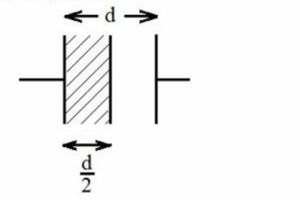
A
$V \left( \frac{K+1}{2K} \right)$
B
$V \left( \frac{2K}{K+1} \right)$
C
$V \left( \frac{K+1}{2} \right)$
D
$V \left( \frac{2}{K+1} \right)$
Solution
(B) $1$. Initial state: The capacitor has a dielectric of thickness $d/2$ and constant $K$. The capacitance $C_i$ is given by the series combination of two capacitors: one with dielectric $(C_1 = \frac{2K\epsilon_0 A}{d})$ and one with air $(C_2 = \frac{2\epsilon_0 A}{d})$.
$C_i = \frac{C_1 C_2}{C_1 + C_2} = \frac{\frac{2K\epsilon_0 A}{d} \cdot \frac{2\epsilon_0 A}{d}}{\frac{2\epsilon_0 A}{d}(K+1)} = \frac{2K\epsilon_0 A}{d(K+1)}$.
$2$. Charge on the capacitor: $Q = C_i V = \frac{2K\epsilon_0 A V}{d(K+1)}$.
$3$. After disconnecting the battery,the charge $Q$ remains constant.
$4$. Final state: The dielectric is removed,so the capacitor becomes an air-filled parallel plate capacitor with capacitance $C_f = \frac{\epsilon_0 A}{d}$.
$5$. Final potential difference $V_f = \frac{Q}{C_f} = \frac{2K\epsilon_0 A V}{d(K+1)} \cdot \frac{d}{\epsilon_0 A} = V \left( \frac{2K}{K+1} \right)$.
$C_i = \frac{C_1 C_2}{C_1 + C_2} = \frac{\frac{2K\epsilon_0 A}{d} \cdot \frac{2\epsilon_0 A}{d}}{\frac{2\epsilon_0 A}{d}(K+1)} = \frac{2K\epsilon_0 A}{d(K+1)}$.
$2$. Charge on the capacitor: $Q = C_i V = \frac{2K\epsilon_0 A V}{d(K+1)}$.
$3$. After disconnecting the battery,the charge $Q$ remains constant.
$4$. Final state: The dielectric is removed,so the capacitor becomes an air-filled parallel plate capacitor with capacitance $C_f = \frac{\epsilon_0 A}{d}$.
$5$. Final potential difference $V_f = \frac{Q}{C_f} = \frac{2K\epsilon_0 A V}{d(K+1)} \cdot \frac{d}{\epsilon_0 A} = V \left( \frac{2K}{K+1} \right)$.
0 likesView Solution
63
PhysicsMediumMCQTS EAMCET · 2025
$A$ parallel plate capacitor with air as dielectric has a capacitance of $4 \mu F$. The space between the plates of the capacitor is completely filled with a material of dielectric constant $K = 5$ and charged to a potential of $100 \ V$. The work done to completely remove the dielectric material after the capacitor is disconnected from the battery is (in $J$)
A
$0.1$
B
$0.5$
C
$0.6$
D
$0.4$
Solution
(D) Initial capacitance with air $C_0 = 4 \mu F$.
After filling with dielectric $(K = 5)$,the new capacitance is $C = K C_0 = 5 \times 4 \mu F = 20 \mu F$.
The charge on the capacitor is $Q = C V = 20 \mu F \times 100 \ V = 2000 \mu C = 2 \times 10^{-3} \ C$.
Since the capacitor is disconnected from the battery,the charge $Q$ remains constant.
Initial energy stored with dielectric: $U_i = \frac{Q^2}{2C} = \frac{(2 \times 10^{-3})^2}{2 \times 20 \times 10^{-6}} = \frac{4 \times 10^{-6}}{40 \times 10^{-6}} = 0.1 \ J$.
Final capacitance after removing the dielectric: $C_f = C_0 = 4 \mu F$.
Final energy stored: $U_f = \frac{Q^2}{2C_f} = \frac{(2 \times 10^{-3})^2}{2 \times 4 \times 10^{-6}} = \frac{4 \times 10^{-6}}{8 \times 10^{-6}} = 0.5 \ J$.
Work done by external agent $W = U_f - U_i = 0.5 \ J - 0.1 \ J = 0.4 \ J$.
After filling with dielectric $(K = 5)$,the new capacitance is $C = K C_0 = 5 \times 4 \mu F = 20 \mu F$.
The charge on the capacitor is $Q = C V = 20 \mu F \times 100 \ V = 2000 \mu C = 2 \times 10^{-3} \ C$.
Since the capacitor is disconnected from the battery,the charge $Q$ remains constant.
Initial energy stored with dielectric: $U_i = \frac{Q^2}{2C} = \frac{(2 \times 10^{-3})^2}{2 \times 20 \times 10^{-6}} = \frac{4 \times 10^{-6}}{40 \times 10^{-6}} = 0.1 \ J$.
Final capacitance after removing the dielectric: $C_f = C_0 = 4 \mu F$.
Final energy stored: $U_f = \frac{Q^2}{2C_f} = \frac{(2 \times 10^{-3})^2}{2 \times 4 \times 10^{-6}} = \frac{4 \times 10^{-6}}{8 \times 10^{-6}} = 0.5 \ J$.
Work done by external agent $W = U_f - U_i = 0.5 \ J - 0.1 \ J = 0.4 \ J$.
0 likesView Solution
64
PhysicsMediumMCQTS EAMCET · 2025
$A$ parallel plate capacitor of capacitance $10 \mu F$ is charged by a $220 \text{ V}$ supply. The capacitor is then disconnected from the supply and is connected to another uncharged parallel plate capacitor of capacitance $12 \mu F$. The loss of electrostatic energy in this process is (in $\text{ mJ}$)
A
$132$
B
$220$
C
$66$
D
$110$
Solution
(A) Initial energy stored in the first capacitor: $U_i = \frac{1}{2} C_1 V^2 = \frac{1}{2} \times 10 \times 10^{-6} \times (220)^2 = 5 \times 10^{-6} \times 48400 = 0.242 \text{ J} = 242 \text{ mJ}$.
When connected to the second capacitor,the charge $Q = C_1 V = 10 \times 10^{-6} \times 220 = 2.2 \times 10^{-3} \text{ C}$ is redistributed.
The common potential $V'$ is given by $V' = \frac{Q}{C_1 + C_2} = \frac{2.2 \times 10^{-3}}{10 \times 10^{-6} + 12 \times 10^{-6}} = \frac{2.2 \times 10^{-3}}{22 \times 10^{-6}} = 100 \text{ V}$.
Final energy stored in the system: $U_f = \frac{1}{2} (C_1 + C_2) (V')^2 = \frac{1}{2} \times 22 \times 10^{-6} \times (100)^2 = 11 \times 10^{-6} \times 10000 = 0.11 \text{ J} = 110 \text{ mJ}$.
Loss of energy: $\Delta U = U_i - U_f = 242 \text{ mJ} - 110 \text{ mJ} = 132 \text{ mJ}$.
When connected to the second capacitor,the charge $Q = C_1 V = 10 \times 10^{-6} \times 220 = 2.2 \times 10^{-3} \text{ C}$ is redistributed.
The common potential $V'$ is given by $V' = \frac{Q}{C_1 + C_2} = \frac{2.2 \times 10^{-3}}{10 \times 10^{-6} + 12 \times 10^{-6}} = \frac{2.2 \times 10^{-3}}{22 \times 10^{-6}} = 100 \text{ V}$.
Final energy stored in the system: $U_f = \frac{1}{2} (C_1 + C_2) (V')^2 = \frac{1}{2} \times 22 \times 10^{-6} \times (100)^2 = 11 \times 10^{-6} \times 10000 = 0.11 \text{ J} = 110 \text{ mJ}$.
Loss of energy: $\Delta U = U_i - U_f = 242 \text{ mJ} - 110 \text{ mJ} = 132 \text{ mJ}$.
0 likesView Solution
65
PhysicsEasyMCQTS EAMCET · 2025
For commercial telephonic communication,the frequency range adequate for speech signals is
A
$20 \ Hz - 20 \ kHz$
B
$300 \ Hz - 3100 \ Hz$
C
$200 \ MHz - 600 \ MHz$
D
$300 \ kHz - 8000 \ kHz$
Solution
(B) Speech signals are human voice signals which typically have a frequency range from $20 \ Hz$ to $20 \ kHz$. However,for commercial telephonic communication,it is not necessary to transmit the entire audible range. To ensure clarity and efficiency in transmission,the frequency range is restricted. The standard frequency range adequate for speech signals in commercial telephony is $300 \ Hz$ to $3100 \ Hz$.
0 likesView Solution
66
PhysicsEasyMCQTS EAMCET · 2025
Coaxial cable,a widely used wire medium,offers an approximate frequency bandwidth of:
A
$750 \text{ GHz}$
B
$750 \text{ Hz}$
C
$750 \text{ MHz}$
D
$750 \text{ kHz}$
Solution
(C) coaxial cable is a type of transmission line that consists of an inner conductor surrounded by a tubular insulating layer,surrounded by a tubular conducting shield.
It is widely used for cable television,broadband internet,and other high-frequency signal transmissions.
The frequency bandwidth of a coaxial cable is typically in the range of up to $750 \text{ MHz}$.
Therefore,the correct option is $C$.
It is widely used for cable television,broadband internet,and other high-frequency signal transmissions.
The frequency bandwidth of a coaxial cable is typically in the range of up to $750 \text{ MHz}$.
Therefore,the correct option is $C$.
0 likesView Solution
67
PhysicsEasyMCQTS EAMCET · 2025
If the frequencies of the carrier wave and message signal are $1 \text{ MHz}$ and $28 \text{ kHz}$ respectively,then the frequencies of the side bands are
A
$1028 \text{ kHz}, 972 \text{ kHz}$
B
$1014 \text{ kHz}, 986 \text{ kHz}$
C
$29 \text{ kHz}, 27 \text{ kHz}$
D
$514 \text{ kHz}, 486 \text{ kHz}$
Solution
(A) The frequency of the carrier wave is $f_c = 1 \text{ MHz} = 1000 \text{ kHz}$.
The frequency of the message signal is $f_m = 28 \text{ kHz}$.
The frequencies of the side bands are given by the upper side band $(USB)$ and lower side band $(LSB)$ formulas:
$USB = f_c + f_m = 1000 \text{ kHz} + 28 \text{ kHz} = 1028 \text{ kHz}$.
$LSB = f_c - f_m = 1000 \text{ kHz} - 28 \text{ kHz} = 972 \text{ kHz}$.
Therefore,the side band frequencies are $1028 \text{ kHz}$ and $972 \text{ kHz}$.
The frequency of the message signal is $f_m = 28 \text{ kHz}$.
The frequencies of the side bands are given by the upper side band $(USB)$ and lower side band $(LSB)$ formulas:
$USB = f_c + f_m = 1000 \text{ kHz} + 28 \text{ kHz} = 1028 \text{ kHz}$.
$LSB = f_c - f_m = 1000 \text{ kHz} - 28 \text{ kHz} = 972 \text{ kHz}$.
Therefore,the side band frequencies are $1028 \text{ kHz}$ and $972 \text{ kHz}$.
0 likesView Solution
68
PhysicsMediumMCQTS EAMCET · 2025
When the receiving antenna is on the ground,the range of a transmitting antenna of height $980 \ m$ is (Radius of the earth $= 6400 \ km$) (in $km$)
A
$56$
B
$112$
C
$72.4$
D
$224$
Solution
(B) The range $d$ of a transmitting antenna of height $h$ is given by the formula $d = \sqrt{2Rh}$,where $R$ is the radius of the Earth.
Given: $h = 980 \ m = 0.98 \ km$ and $R = 6400 \ km$.
Substituting the values into the formula:
$d = \sqrt{2 \times 6400 \times 0.98}$
$d = \sqrt{12800 \times 0.98}$
$d = \sqrt{12544}$
$d = 112 \ km$.
Therefore,the range of the transmitting antenna is $112 \ km$.
Given: $h = 980 \ m = 0.98 \ km$ and $R = 6400 \ km$.
Substituting the values into the formula:
$d = \sqrt{2 \times 6400 \times 0.98}$
$d = \sqrt{12800 \times 0.98}$
$d = \sqrt{12544}$
$d = 112 \ km$.
Therefore,the range of the transmitting antenna is $112 \ km$.
0 likesView Solution
69
PhysicsEasyMCQTS EAMCET · 2025
The layer of the atmosphere which efficiently reflects high frequency waves particularly at night is
A
Troposphere
B
Stratosphere
C
Mesosphere
D
Thermosphere
Solution
(D) The layer of the atmosphere that reflects radio waves,including high-frequency waves,is the ionosphere,which is a part of the thermosphere.
During the night,the ionosphere becomes more stable and effective at reflecting these waves,allowing for long-distance communication.
Therefore,the correct layer is the thermosphere.
During the night,the ionosphere becomes more stable and effective at reflecting these waves,allowing for long-distance communication.
Therefore,the correct layer is the thermosphere.
0 likesView Solution
70
PhysicsMediumMCQTS EAMCET · 2025
The radio horizon of a transmitting antenna of height $39.2 \ m$ is (Radius of the earth $= 6400 \ km$) (in $km$)
A
$44.8$
B
$19.6$
C
$22.4$
D
$78.4$
Solution
(C) The radio horizon distance $d$ for a transmitting antenna of height $h$ is given by the formula $d = \sqrt{2Rh}$,where $R$ is the radius of the Earth.
Given: $h = 39.2 \ m = 39.2 \times 10^{-3} \ km$ and $R = 6400 \ km$.
Substituting the values into the formula:
$d = \sqrt{2 \times 6400 \times 39.2 \times 10^{-3}}$
$d = \sqrt{12800 \times 0.0392}$
$d = \sqrt{501.76}$
$d = 22.4 \ km$.
Therefore,the correct option is $C$.
Given: $h = 39.2 \ m = 39.2 \times 10^{-3} \ km$ and $R = 6400 \ km$.
Substituting the values into the formula:
$d = \sqrt{2 \times 6400 \times 39.2 \times 10^{-3}}$
$d = \sqrt{12800 \times 0.0392}$
$d = \sqrt{501.76}$
$d = 22.4 \ km$.
Therefore,the correct option is $C$.
0 likesView Solution
71
PhysicsMediumMCQTS EAMCET · 2025
$A$ straight uniform wire of resistance $36 \Omega$ is bent in the form of a semi-circular loop. The effective resistance between the ends of the diameter of the semi-circular loop is
A
$9 \Omega$
B
$\frac{36}{7} \Omega$
C
$\frac{99}{7} \Omega$
D
$\frac{77}{9} \Omega$
Solution
(A) The total resistance of the wire is $R = 36 \Omega$.
When the wire is bent into a semi-circular loop,the wire is divided into two equal halves along the diameter.
Each half has a resistance of $R' = \frac{R}{2} = \frac{36}{2} = 18 \Omega$.
These two halves are connected in parallel between the ends of the diameter.
The equivalent resistance $R_{eq}$ is given by the formula for parallel resistors: $\frac{1}{R_{eq}} = \frac{1}{R'} + \frac{1}{R'}$.
$\frac{1}{R_{eq}} = \frac{1}{18} + \frac{1}{18} = \frac{2}{18} = \frac{1}{9}$.
Therefore,$R_{eq} = 9 \Omega$.
When the wire is bent into a semi-circular loop,the wire is divided into two equal halves along the diameter.
Each half has a resistance of $R' = \frac{R}{2} = \frac{36}{2} = 18 \Omega$.
These two halves are connected in parallel between the ends of the diameter.
The equivalent resistance $R_{eq}$ is given by the formula for parallel resistors: $\frac{1}{R_{eq}} = \frac{1}{R'} + \frac{1}{R'}$.
$\frac{1}{R_{eq}} = \frac{1}{18} + \frac{1}{18} = \frac{2}{18} = \frac{1}{9}$.
Therefore,$R_{eq} = 9 \Omega$.
0 likesView Solution
72
PhysicsMediumMCQTS EAMCET · 2025
The potential difference between the terminals of a cell is $20 \ V$ when a current of $2 \ A$ flows through the circuit. When the direction of current in the circuit is reversed,the potential difference between the terminals of the cell is $30 \ V$. The internal resistance of the cell is (in $Omega$)
A
$1$
B
$1.5$
C
$2$
D
$2.5$
Solution
(D) Let the electromotive force of the cell be $E$ and its internal resistance be $r$. The current flowing through the circuit is $I = 2 \ A$.
When the current flows in the normal direction,the terminal potential difference is given by $V_1 = E - Ir$.
Substituting the given values: $20 = E - 2r$ --- (Equation $1$).
When the direction of the current is reversed,the cell is being charged,so the terminal potential difference is given by $V_2 = E + Ir$.
Substituting the given values: $30 = E + 2r$ --- (Equation $2$).
Subtracting Equation $1$ from Equation $2$: $(E + 2r) - (E - 2r) = 30 - 20$.
$4r = 10$.
$r = 2.5 \ \Omega$.
Thus,the internal resistance of the cell is $2.5 \ \Omega$.
When the current flows in the normal direction,the terminal potential difference is given by $V_1 = E - Ir$.
Substituting the given values: $20 = E - 2r$ --- (Equation $1$).
When the direction of the current is reversed,the cell is being charged,so the terminal potential difference is given by $V_2 = E + Ir$.
Substituting the given values: $30 = E + 2r$ --- (Equation $2$).
Subtracting Equation $1$ from Equation $2$: $(E + 2r) - (E - 2r) = 30 - 20$.
$4r = 10$.
$r = 2.5 \ \Omega$.
Thus,the internal resistance of the cell is $2.5 \ \Omega$.
0 likesView Solution
73
PhysicsEasyMCQTS EAMCET · 2025
The drift speed of electrons in a material is found to be $0.3 \ m s^{-1}$ when an electric field of $2 \ V m^{-1}$ is applied across it. The electron mobility (in $m^2 \ V^{-1} \ s^{-1}$) in the material is
A
$0.15$
B
$0.6$
C
$0.135$
D
$0.54$
Solution
(A) The mobility $\mu$ of charge carriers is defined as the ratio of drift velocity $v_d$ to the applied electric field $E$.
Formula: $\mu = \frac{v_d}{E}$
Given:
Drift velocity $v_d = 0.3 \ m s^{-1}$
Electric field $E = 2 \ V m^{-1}$
Calculation:
$\mu = \frac{0.3}{2} = 0.15 \ m^2 V^{-1} s^{-1}$
Therefore,the correct option is $A$.
Formula: $\mu = \frac{v_d}{E}$
Given:
Drift velocity $v_d = 0.3 \ m s^{-1}$
Electric field $E = 2 \ V m^{-1}$
Calculation:
$\mu = \frac{0.3}{2} = 0.15 \ m^2 V^{-1} s^{-1}$
Therefore,the correct option is $A$.
0 likesView Solution
74
PhysicsMediumMCQTS EAMCET · 2025
The lengths of two wires made of the same material are in the ratio $2:3$ and their radii are in the ratio $1:2$. If the two wires are connected in parallel to a battery,then the ratio of the drift velocities of free electrons in the two wires is
A
$2:1$
B
$3:1$
C
$3:2$
D
$3:4$
Solution
(C) The drift velocity $v_d$ is given by the formula $v_d = \frac{I}{neA}$,where $I$ is the current,$n$ is the electron density,$e$ is the charge of an electron,and $A$ is the cross-sectional area.
Since the wires are connected in parallel to the same battery,the potential difference $V$ across both wires is the same.
Using Ohm's law,$I = \frac{V}{R}$,where $R = \rho \frac{L}{A}$. Thus,$I = \frac{VA}{\rho L}$.
Substituting this into the drift velocity formula: $v_d = \frac{VA}{neA\rho L} = \frac{V}{ne\rho L}$.
Since both wires are made of the same material,$n$,$e$,and $\rho$ are constant. Also,$V$ is constant.
Therefore,$v_d \propto \frac{1}{L}$.
The ratio of lengths is $L_1 : L_2 = 2 : 3$.
Thus,the ratio of drift velocities is $\frac{v_{d1}}{v_{d2}} = \frac{L_2}{L_1} = \frac{3}{2}$.
Since the wires are connected in parallel to the same battery,the potential difference $V$ across both wires is the same.
Using Ohm's law,$I = \frac{V}{R}$,where $R = \rho \frac{L}{A}$. Thus,$I = \frac{VA}{\rho L}$.
Substituting this into the drift velocity formula: $v_d = \frac{VA}{neA\rho L} = \frac{V}{ne\rho L}$.
Since both wires are made of the same material,$n$,$e$,and $\rho$ are constant. Also,$V$ is constant.
Therefore,$v_d \propto \frac{1}{L}$.
The ratio of lengths is $L_1 : L_2 = 2 : 3$.
Thus,the ratio of drift velocities is $\frac{v_{d1}}{v_{d2}} = \frac{L_2}{L_1} = \frac{3}{2}$.
0 likesView Solution
75
PhysicsMediumMCQTS EAMCET · 2025
In a potentiometer experiment,a wire of length $10 \ m$ and resistance $5 \ \Omega$ is connected to a cell of emf $2.2 \ V$. If the potential difference between two points separated by a distance of $660 \ cm$ on the potentiometer wire is $1.1 \ V$,then the internal resistance of the cell is: (in $Omega$)
A
$1.6$
B
$1.4$
C
$1.2$
D
$1$
Solution
(A) The resistance per unit length of the potentiometer wire is $\lambda = \frac{R}{L} = \frac{5 \ \Omega}{10 \ m} = 0.5 \ \Omega/m$.
The resistance of the wire segment of length $6.6 \ m$ $(660 \ cm)$ is $R' = 0.5 \ \Omega/m \times 6.6 \ m = 3.3 \ \Omega$.
The potential difference across this segment is $V' = I \times R'$,where $I$ is the current in the potentiometer wire.
Given $V' = 1.1 \ V$,we have $1.1 = I \times 3.3$,which gives $I = \frac{1.1}{3.3} = \frac{1}{3} \ A$.
The current in the circuit is given by $I = \frac{E}{R + r}$,where $E = 2.2 \ V$,$R = 5 \ \Omega$,and $r$ is the internal resistance.
Substituting the values: $\frac{1}{3} = \frac{2.2}{5 + r}$.
$5 + r = 3 \times 2.2 = 6.6$.
$r = 6.6 - 5 = 1.6 \ \Omega$.
The resistance of the wire segment of length $6.6 \ m$ $(660 \ cm)$ is $R' = 0.5 \ \Omega/m \times 6.6 \ m = 3.3 \ \Omega$.
The potential difference across this segment is $V' = I \times R'$,where $I$ is the current in the potentiometer wire.
Given $V' = 1.1 \ V$,we have $1.1 = I \times 3.3$,which gives $I = \frac{1.1}{3.3} = \frac{1}{3} \ A$.
The current in the circuit is given by $I = \frac{E}{R + r}$,where $E = 2.2 \ V$,$R = 5 \ \Omega$,and $r$ is the internal resistance.
Substituting the values: $\frac{1}{3} = \frac{2.2}{5 + r}$.
$5 + r = 3 \times 2.2 = 6.6$.
$r = 6.6 - 5 = 1.6 \ \Omega$.
0 likesView Solution
76
PhysicsMediumMCQTS EAMCET · 2025
The length of a potentiometer wire is $2.5 \ m$ and its resistance is $8 \ \Omega$. $A$ cell of negligible internal resistance and emf of $2.5 \ V$ is connected in series with a resistance of $242 \ \Omega$ in the primary circuit. The potential difference between two points separated by a distance of $20 \ cm$ on the potentiometer wire is (in $mV$)
A
$1.6$
B
$4.8$
C
$6.4$
D
$3.2$
Solution
(C) The total resistance in the primary circuit is $R_{total} = R_{wire} + R_{series} = 8 \ \Omega + 242 \ \Omega = 250 \ \Omega$.
The current flowing through the potentiometer wire is $I = \frac{V}{R_{total}} = \frac{2.5 \ V}{250 \ \Omega} = 0.01 \ A$.
The potential drop across the entire wire is $V_{wire} = I \times R_{wire} = 0.01 \ A \times 8 \ \Omega = 0.08 \ V$.
The potential gradient $k$ is the potential drop per unit length: $k = \frac{V_{wire}}{L} = \frac{0.08 \ V}{2.5 \ m} = 0.032 \ V/m$.
The potential difference across a length $l = 20 \ cm = 0.2 \ m$ is $V' = k \times l = 0.032 \ V/m \times 0.2 \ m = 0.0064 \ V = 6.4 \ mV$.
The current flowing through the potentiometer wire is $I = \frac{V}{R_{total}} = \frac{2.5 \ V}{250 \ \Omega} = 0.01 \ A$.
The potential drop across the entire wire is $V_{wire} = I \times R_{wire} = 0.01 \ A \times 8 \ \Omega = 0.08 \ V$.
The potential gradient $k$ is the potential drop per unit length: $k = \frac{V_{wire}}{L} = \frac{0.08 \ V}{2.5 \ m} = 0.032 \ V/m$.
The potential difference across a length $l = 20 \ cm = 0.2 \ m$ is $V' = k \times l = 0.032 \ V/m \times 0.2 \ m = 0.0064 \ V = 6.4 \ mV$.
0 likesView Solution
77
PhysicsMediumMCQTS EAMCET · 2025
The ratios of the voltage sensitivities,resistances and areas of the coils of two moving coil galvanometers $A$ and $B$ are $4:3$,$3:4$ and $1:2$ respectively. If the number of turns of the coil of galvanometer $A$ is $200$,then the number of turns of the coil of galvanometer $B$ is (All other quantities remain same in both the cases)
A
$100$
B
$150$
C
$200$
D
$400$
Solution
(A) The voltage sensitivity $(V_s)$ of a moving coil galvanometer is given by $V_s = \frac{NBA}{kR}$,where $N$ is the number of turns,$B$ is the magnetic field,$A$ is the area,$k$ is the torsional constant,and $R$ is the resistance.
Given the ratio of voltage sensitivities: $\frac{V_{sA}}{V_{sB}} = \frac{4}{3}$.
Given the ratio of resistances: $\frac{R_A}{R_B} = \frac{3}{4}$.
Given the ratio of areas: $\frac{A_A}{A_B} = \frac{1}{2}$.
Since $B$ and $k$ are constant,we have $\frac{V_{sA}}{V_{sB}} = \frac{N_A A_A R_B}{N_B A_B R_A}$.
Substituting the given values: $\frac{4}{3} = \frac{N_A}{N_B} \times (\frac{1}{2}) \times (\frac{4}{3})$.
$\frac{4}{3} = \frac{N_A}{N_B} \times \frac{2}{3}$.
$\frac{N_A}{N_B} = \frac{4}{3} \times \frac{3}{2} = 2$.
Given $N_A = 200$,then $N_B = \frac{N_A}{2} = \frac{200}{2} = 100$.
Given the ratio of voltage sensitivities: $\frac{V_{sA}}{V_{sB}} = \frac{4}{3}$.
Given the ratio of resistances: $\frac{R_A}{R_B} = \frac{3}{4}$.
Given the ratio of areas: $\frac{A_A}{A_B} = \frac{1}{2}$.
Since $B$ and $k$ are constant,we have $\frac{V_{sA}}{V_{sB}} = \frac{N_A A_A R_B}{N_B A_B R_A}$.
Substituting the given values: $\frac{4}{3} = \frac{N_A}{N_B} \times (\frac{1}{2}) \times (\frac{4}{3})$.
$\frac{4}{3} = \frac{N_A}{N_B} \times \frac{2}{3}$.
$\frac{N_A}{N_B} = \frac{4}{3} \times \frac{3}{2} = 2$.
Given $N_A = 200$,then $N_B = \frac{N_A}{2} = \frac{200}{2} = 100$.
0 likesView Solution
78
PhysicsMediumMCQTS EAMCET · 2025
In a potentiometer experiment for the determination of the internal resistance of a cell,when an external resistance of $R$ is connected in parallel to the cell,the balancing length decreases by $10 \%$. The internal resistance of the cell is
A
$\frac{R}{9}$
B
$\frac{R}{7}$
C
$\frac{R}{5}$
D
$\frac{R}{11}$
Solution
(A) In a potentiometer,the balancing length $l$ is directly proportional to the terminal potential difference $V$ across the cell.
Initially,when the cell is in an open circuit,the balancing length is $l_1 = kE$,where $E$ is the $EMF$ of the cell and $k$ is the potential gradient.
When an external resistance $R$ is connected in parallel,the terminal potential difference becomes $V = E \left( \frac{R}{R + r} \right)$,where $r$ is the internal resistance.
The new balancing length is $l_2 = kV = kE \left( \frac{R}{R + r} \right)$.
Given that the balancing length decreases by $10 \%$,we have $l_2 = l_1 - 0.1l_1 = 0.9l_1$.
Substituting the expressions for $l_1$ and $l_2$: $kE \left( \frac{R}{R + r} \right) = 0.9 kE$.
Dividing both sides by $kE$: $\frac{R}{R + r} = 0.9 = \frac{9}{10}$.
Cross-multiplying gives $10R = 9(R + r) = 9R + 9r$.
Therefore,$R = 9r$,which implies $r = \frac{R}{9}$.
Initially,when the cell is in an open circuit,the balancing length is $l_1 = kE$,where $E$ is the $EMF$ of the cell and $k$ is the potential gradient.
When an external resistance $R$ is connected in parallel,the terminal potential difference becomes $V = E \left( \frac{R}{R + r} \right)$,where $r$ is the internal resistance.
The new balancing length is $l_2 = kV = kE \left( \frac{R}{R + r} \right)$.
Given that the balancing length decreases by $10 \%$,we have $l_2 = l_1 - 0.1l_1 = 0.9l_1$.
Substituting the expressions for $l_1$ and $l_2$: $kE \left( \frac{R}{R + r} \right) = 0.9 kE$.
Dividing both sides by $kE$: $\frac{R}{R + r} = 0.9 = \frac{9}{10}$.
Cross-multiplying gives $10R = 9(R + r) = 9R + 9r$.
Therefore,$R = 9r$,which implies $r = \frac{R}{9}$.
0 likesView Solution
79
PhysicsMediumMCQTS EAMCET · 2025
The power of an electric motor is $242 \ W$ when connected to a $220 \ V$ supply. When the motor is operated at $200 \ V$,the current drawn by it is (in $A$)
A
$1.21$
B
$1.1$
C
$1.5$
D
$1$
Solution
(D) The power $P$ of an electric motor is given by $P = \frac{V^2}{R}$,where $V$ is the voltage and $R$ is the resistance of the motor.
First,we calculate the resistance $R$ using the initial conditions: $P_1 = 242 \ W$ and $V_1 = 220 \ V$.
$R = \frac{V_1^2}{P_1} = \frac{220 \times 220}{242} = \frac{48400}{242} = 200 \ \Omega$.
Now,when the motor is operated at $V_2 = 200 \ V$,the current $I$ drawn by the motor is given by Ohm's law: $I = \frac{V_2}{R}$.
$I = \frac{200 \ V}{200 \ \Omega} = 1 \ A$.
Thus,the current drawn is $1 \ A$.
First,we calculate the resistance $R$ using the initial conditions: $P_1 = 242 \ W$ and $V_1 = 220 \ V$.
$R = \frac{V_1^2}{P_1} = \frac{220 \times 220}{242} = \frac{48400}{242} = 200 \ \Omega$.
Now,when the motor is operated at $V_2 = 200 \ V$,the current $I$ drawn by the motor is given by Ohm's law: $I = \frac{V_2}{R}$.
$I = \frac{200 \ V}{200 \ \Omega} = 1 \ A$.
Thus,the current drawn is $1 \ A$.
0 likesView Solution
80
PhysicsMediumMCQTS EAMCET · 2025
The potential difference between points $C$ and $D$ of the electrical circuit shown in the figure is (in $V$)
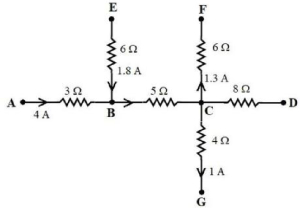
A
$28$
B
$32$
C
$24$
D
$20$
Solution
(A) To find the potential difference between points $C$ and $D$,we first need to determine the current flowing through the resistor between $C$ and $D$.
Applying Kirchhoff's Current Law $(KCL)$ at junction $C$:
The sum of currents entering the junction must equal the sum of currents leaving the junction.
Let $I_{BC}$ be the current flowing from $B$ to $C$,$I_{CF}$ be the current flowing from $C$ to $F$,$I_{CG}$ be the current flowing from $C$ to $G$,and $I_{CD}$ be the current flowing from $C$ to $D$.
First,find $I_{BC}$ using $KCL$ at junction $B$:
$I_{AB} + I_{EB} = I_{BC}$
$4 \ A + 1.8 \ A = I_{BC}$
$I_{BC} = 5.8 \ A$
Now,apply $KCL$ at junction $C$:
$I_{BC} = I_{CF} + I_{CG} + I_{CD}$
$5.8 \ A = 1.3 \ A + 1 \ A + I_{CD}$
$5.8 \ A = 2.3 \ A + I_{CD}$
$I_{CD} = 5.8 \ A - 2.3 \ A = 3.5 \ A$
The potential difference between $C$ and $D$ is given by Ohm's Law:
$V_{CD} = I_{CD} \times R_{CD}$
$V_{CD} = 3.5 \ A \times 8 \ \Omega = 28 \ V$.
Applying Kirchhoff's Current Law $(KCL)$ at junction $C$:
The sum of currents entering the junction must equal the sum of currents leaving the junction.
Let $I_{BC}$ be the current flowing from $B$ to $C$,$I_{CF}$ be the current flowing from $C$ to $F$,$I_{CG}$ be the current flowing from $C$ to $G$,and $I_{CD}$ be the current flowing from $C$ to $D$.
First,find $I_{BC}$ using $KCL$ at junction $B$:
$I_{AB} + I_{EB} = I_{BC}$
$4 \ A + 1.8 \ A = I_{BC}$
$I_{BC} = 5.8 \ A$
Now,apply $KCL$ at junction $C$:
$I_{BC} = I_{CF} + I_{CG} + I_{CD}$
$5.8 \ A = 1.3 \ A + 1 \ A + I_{CD}$
$5.8 \ A = 2.3 \ A + I_{CD}$
$I_{CD} = 5.8 \ A - 2.3 \ A = 3.5 \ A$
The potential difference between $C$ and $D$ is given by Ohm's Law:
$V_{CD} = I_{CD} \times R_{CD}$
$V_{CD} = 3.5 \ A \times 8 \ \Omega = 28 \ V$.
0 likesView Solution
81
PhysicsMediumMCQTS EAMCET · 2025
For the circuit shown in the figure,the current through the $6 \Omega$ resistor connected between the junctions $A$ and $B$ is (in $A$)
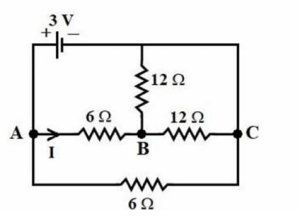
A
$0.25$
B
$0.5$
C
$0.75$
D
$0.4$
Solution
(A) Let the potential at junction $A$ be $V_A = 3 \text{ V}$ and at junction $C$ be $V_C = 0 \text{ V}$.
Let the potential at junction $B$ be $V_B$.
Applying Kirchhoff's Current Law $(KCL)$ at junction $B$:
$\frac{V_B - V_A}{6} + \frac{V_B - V_C}{12} + \frac{V_B - V_C}{12} = 0$
$\frac{V_B - 3}{6} + \frac{V_B}{12} + \frac{V_B}{12} = 0$
Multiplying by $12$:
$2(V_B - 3) + V_B + V_B = 0$
$2V_B - 6 + 2V_B = 0$
$4V_B = 6 \implies V_B = 1.5 \text{ V}$.
The current through the $6 \Omega$ resistor between $A$ and $B$ is $I = \frac{V_A - V_B}{6} = \frac{3 - 1.5}{6} = \frac{1.5}{6} = 0.25 \text{ A}$.
Let the potential at junction $B$ be $V_B$.
Applying Kirchhoff's Current Law $(KCL)$ at junction $B$:
$\frac{V_B - V_A}{6} + \frac{V_B - V_C}{12} + \frac{V_B - V_C}{12} = 0$
$\frac{V_B - 3}{6} + \frac{V_B}{12} + \frac{V_B}{12} = 0$
Multiplying by $12$:
$2(V_B - 3) + V_B + V_B = 0$
$2V_B - 6 + 2V_B = 0$
$4V_B = 6 \implies V_B = 1.5 \text{ V}$.
The current through the $6 \Omega$ resistor between $A$ and $B$ is $I = \frac{V_A - V_B}{6} = \frac{3 - 1.5}{6} = \frac{1.5}{6} = 0.25 \text{ A}$.
0 likesView Solution
82
PhysicsMediumMCQTS EAMCET · 2025
The area of cross-section of a potentiometer wire is $6 \times 10^{-7} \ m^2$. The potential difference per unit length of the potentiometer wire when it is connected to a cell of negligible internal resistance and a resistor in series is $0.15 \ Vm^{-1}$. If the current through the potentiometer wire is $0.3 \ A$,then the resistivity of the material of the potentiometer wire is:
A
$4 \times 10^{-6} \ \Omega \ m$
B
$3 \times 10^{-7} \ \Omega \ m$
C
$3 \times 10^{-6} \ \Omega \ m$
D
$4 \times 10^{-7} \ \Omega \ m$
Solution
(B) Given:
Area of cross-section,$A = 6 \times 10^{-7} \ m^2$
Potential gradient,$x = \frac{V}{L} = 0.15 \ Vm^{-1}$
Current,$I = 0.3 \ A$
From Ohm's law,the potential difference across a length $L$ is $V = I \times R$,where $R = \rho \frac{L}{A}$.
Substituting $R$ in the equation for $V$,we get $V = I \times \rho \frac{L}{A}$.
Rearranging for potential gradient: $\frac{V}{L} = \frac{I \times \rho}{A}$.
Substituting the given values: $0.15 = \frac{0.3 \times \rho}{6 \times 10^{-7}}$.
Solving for $\rho$: $\rho = \frac{0.15 \times 6 \times 10^{-7}}{0.3}$.
$\rho = 0.5 \times 6 \times 10^{-7} = 3 \times 10^{-7} \ \Omega \ m$.
Area of cross-section,$A = 6 \times 10^{-7} \ m^2$
Potential gradient,$x = \frac{V}{L} = 0.15 \ Vm^{-1}$
Current,$I = 0.3 \ A$
From Ohm's law,the potential difference across a length $L$ is $V = I \times R$,where $R = \rho \frac{L}{A}$.
Substituting $R$ in the equation for $V$,we get $V = I \times \rho \frac{L}{A}$.
Rearranging for potential gradient: $\frac{V}{L} = \frac{I \times \rho}{A}$.
Substituting the given values: $0.15 = \frac{0.3 \times \rho}{6 \times 10^{-7}}$.
Solving for $\rho$: $\rho = \frac{0.15 \times 6 \times 10^{-7}}{0.3}$.
$\rho = 0.5 \times 6 \times 10^{-7} = 3 \times 10^{-7} \ \Omega \ m$.
0 likesView Solution
83
PhysicsMediumMCQTS EAMCET · 2025
When the right gap of a meter bridge consists of two equal resistors in series,the balancing point is at $50 \ cm$. When one of the resistors in the right gap is removed and is connected in parallel to the resistor in the left gap,the balancing point is at: (in $cm$)
A
$60$
B
$33.3$
C
$25$
D
$40$
Solution
(D) Let the resistance in the left gap be $R_L$ and the resistance in the right gap be $R_R$.
In the first case,the right gap has two equal resistors $r$ in series,so $R_R = r + r = 2r$.
The balancing point is at $l_1 = 50 \ cm$.
Using the meter bridge formula: $\frac{R_L}{R_R} = \frac{l_1}{100 - l_1} \implies \frac{R_L}{2r} = \frac{50}{50} = 1 \implies R_L = 2r$.
In the second case,one resistor $r$ is removed from the right gap,so the new right resistance is $R_R' = r$.
This removed resistor $r$ is connected in parallel to $R_L$.
The new left resistance is $R_L' = \frac{R_L \cdot r}{R_L + r} = \frac{2r \cdot r}{2r + r} = \frac{2r^2}{3r} = \frac{2}{3}r$.
Let the new balancing point be $l_2$.
Then $\frac{R_L'}{R_R'} = \frac{l_2}{100 - l_2} \implies \frac{(2/3)r}{r} = \frac{l_2}{100 - l_2} \implies \frac{2}{3} = \frac{l_2}{100 - l_2}$.
$2(100 - l_2) = 3l_2 \implies 200 - 2l_2 = 3l_2 \implies 5l_2 = 200 \implies l_2 = 40 \ cm$.
In the first case,the right gap has two equal resistors $r$ in series,so $R_R = r + r = 2r$.
The balancing point is at $l_1 = 50 \ cm$.
Using the meter bridge formula: $\frac{R_L}{R_R} = \frac{l_1}{100 - l_1} \implies \frac{R_L}{2r} = \frac{50}{50} = 1 \implies R_L = 2r$.
In the second case,one resistor $r$ is removed from the right gap,so the new right resistance is $R_R' = r$.
This removed resistor $r$ is connected in parallel to $R_L$.
The new left resistance is $R_L' = \frac{R_L \cdot r}{R_L + r} = \frac{2r \cdot r}{2r + r} = \frac{2r^2}{3r} = \frac{2}{3}r$.
Let the new balancing point be $l_2$.
Then $\frac{R_L'}{R_R'} = \frac{l_2}{100 - l_2} \implies \frac{(2/3)r}{r} = \frac{l_2}{100 - l_2} \implies \frac{2}{3} = \frac{l_2}{100 - l_2}$.
$2(100 - l_2) = 3l_2 \implies 200 - 2l_2 = 3l_2 \implies 5l_2 = 200 \implies l_2 = 40 \ cm$.
0 likesView Solution
84
PhysicsMediumMCQTS EAMCET · 2025
Photons of energy $4.5 \ eV$ are incident on a photosensitive material of work function $3 \ eV$. The de Broglie wavelength associated with the photoelectrons emitted with maximum kinetic energy is nearly (in $Å$)
A
$10$
B
$5$
C
$20$
D
$15$
Solution
(A) According to Einstein's photoelectric equation,the maximum kinetic energy $K_{max}$ of the emitted photoelectrons is given by $K_{max} = E - \Phi$,where $E$ is the energy of the incident photon and $\Phi$ is the work function of the material.
Given $E = 4.5 \ eV$ and $\Phi = 3 \ eV$,we have $K_{max} = 4.5 \ eV - 3 \ eV = 1.5 \ eV$.
Converting this energy to Joules: $K_{max} = 1.5 \times 1.6 \times 10^{-19} \ J = 2.4 \times 10^{-19} \ J$.
The de Broglie wavelength $\lambda$ is given by $\lambda = \frac{h}{\sqrt{2mK_{max}}}$,where $h = 6.63 \times 10^{-34} \ J \cdot s$ and $m = 9.1 \times 10^{-31} \ kg$.
Substituting the values: $\lambda = \frac{6.63 \times 10^{-34}}{\sqrt{2 \times 9.1 \times 10^{-31} \times 2.4 \times 10^{-19}}} = \frac{6.63 \times 10^{-34}}{\sqrt{43.68 \times 10^{-50}}} = \frac{6.63 \times 10^{-34}}{6.61 \times 10^{-25}} \approx 1.0 \times 10^{-9} \ m$.
Since $1 \ Å = 10^{-10} \ m$,we have $\lambda \approx 10 \ Å$.
Given $E = 4.5 \ eV$ and $\Phi = 3 \ eV$,we have $K_{max} = 4.5 \ eV - 3 \ eV = 1.5 \ eV$.
Converting this energy to Joules: $K_{max} = 1.5 \times 1.6 \times 10^{-19} \ J = 2.4 \times 10^{-19} \ J$.
The de Broglie wavelength $\lambda$ is given by $\lambda = \frac{h}{\sqrt{2mK_{max}}}$,where $h = 6.63 \times 10^{-34} \ J \cdot s$ and $m = 9.1 \times 10^{-31} \ kg$.
Substituting the values: $\lambda = \frac{6.63 \times 10^{-34}}{\sqrt{2 \times 9.1 \times 10^{-31} \times 2.4 \times 10^{-19}}} = \frac{6.63 \times 10^{-34}}{\sqrt{43.68 \times 10^{-50}}} = \frac{6.63 \times 10^{-34}}{6.61 \times 10^{-25}} \approx 1.0 \times 10^{-9} \ m$.
Since $1 \ Å = 10^{-10} \ m$,we have $\lambda \approx 10 \ Å$.
0 likesView Solution
85
PhysicsMediumMCQTS EAMCET · 2025
The potential energy of an electron in an orbit of a hydrogen atom is $-6.8 \text{ eV}$. The de Broglie wavelength of the electron in this orbit is (where $r_0$ is the Bohr radius).
A
$2 \pi r_0$
B
$4 \pi r_0$
C
$\pi r_0$
D
$3 \pi r_0$
Solution
(B) The potential energy $U$ of an electron in the $n^{th}$ orbit of a hydrogen atom is given by $U = -27.2 / n^2 \text{ eV}$.
Given $U = -6.8 \text{ eV}$,we have $-27.2 / n^2 = -6.8$,which implies $n^2 = 27.2 / 6.8 = 4$,so $n = 2$.
The radius of the $n^{th}$ orbit is given by $r_n = n^2 r_0$. For $n = 2$,$r_2 = 2^2 r_0 = 4 r_0$.
According to Bohr's quantization condition,the circumference of the orbit is an integer multiple of the de Broglie wavelength: $2 \pi r_n = n \lambda$.
Substituting the values,$2 \pi (4 r_0) = 2 \lambda$.
Solving for $\lambda$,we get $\lambda = (8 \pi r_0) / 2 = 4 \pi r_0$.
Given $U = -6.8 \text{ eV}$,we have $-27.2 / n^2 = -6.8$,which implies $n^2 = 27.2 / 6.8 = 4$,so $n = 2$.
The radius of the $n^{th}$ orbit is given by $r_n = n^2 r_0$. For $n = 2$,$r_2 = 2^2 r_0 = 4 r_0$.
According to Bohr's quantization condition,the circumference of the orbit is an integer multiple of the de Broglie wavelength: $2 \pi r_n = n \lambda$.
Substituting the values,$2 \pi (4 r_0) = 2 \lambda$.
Solving for $\lambda$,we get $\lambda = (8 \pi r_0) / 2 = 4 \pi r_0$.
0 likesView Solution
86
PhysicsMediumMCQTS EAMCET · 2025
The work done to accelerate an electron from rest so that it can have a de Broglie wavelength of $6600 \text{ Å}$ is nearly (Planck's constant $= 6.6 \times 10^{-34} \text{ J s}$ and mass of electron $= 9 \times 10^{-31} \text{ kg}$)
A
$5.56 \times 10^{-25} \text{ eV}$
B
$1.88 \text{ eV}$
C
$5.56 \times 10^{-25} \text{ J}$
D
$1.88 \text{ J}$
Solution
(C) The de Broglie wavelength $\lambda$ is given by $\lambda = \frac{h}{p}$,where $p = \sqrt{2mK}$ and $K$ is the kinetic energy.
Thus,$\lambda = \frac{h}{\sqrt{2mK}}$,which implies $K = \frac{h^2}{2m\lambda^2}$.
Given: $h = 6.6 \times 10^{-34} \text{ J s}$,$m = 9 \times 10^{-31} \text{ kg}$,and $\lambda = 6600 \times 10^{-10} \text{ m} = 6.6 \times 10^{-7} \text{ m}$.
Substituting the values:
$K = \frac{(6.6 \times 10^{-34})^2}{2 \times 9 \times 10^{-31} \times (6.6 \times 10^{-7})^2}$
$K = \frac{6.6^2 \times 10^{-68}}{18 \times 10^{-31} \times 6.6^2 \times 10^{-14}}$
$K = \frac{10^{-68}}{18 \times 10^{-45}} = \frac{1}{18} \times 10^{-23} \approx 0.0556 \times 10^{-23} \text{ J} = 5.56 \times 10^{-25} \text{ J}$.
Since the work done equals the kinetic energy gained,the work done is $5.56 \times 10^{-25} \text{ J}$.
Thus,$\lambda = \frac{h}{\sqrt{2mK}}$,which implies $K = \frac{h^2}{2m\lambda^2}$.
Given: $h = 6.6 \times 10^{-34} \text{ J s}$,$m = 9 \times 10^{-31} \text{ kg}$,and $\lambda = 6600 \times 10^{-10} \text{ m} = 6.6 \times 10^{-7} \text{ m}$.
Substituting the values:
$K = \frac{(6.6 \times 10^{-34})^2}{2 \times 9 \times 10^{-31} \times (6.6 \times 10^{-7})^2}$
$K = \frac{6.6^2 \times 10^{-68}}{18 \times 10^{-31} \times 6.6^2 \times 10^{-14}}$
$K = \frac{10^{-68}}{18 \times 10^{-45}} = \frac{1}{18} \times 10^{-23} \approx 0.0556 \times 10^{-23} \text{ J} = 5.56 \times 10^{-25} \text{ J}$.
Since the work done equals the kinetic energy gained,the work done is $5.56 \times 10^{-25} \text{ J}$.
0 likesView Solution
87
PhysicsMediumMCQTS EAMCET · 2025
When a photosensitive material is illuminated by photons of energy $3.1 \ eV$,the stopping potential of the photoelectrons is $1.7 \ V$. When the same photosensitive material is illuminated by photons of energy $2.5 \ eV$,the stopping potential of the photoelectrons is: (in $V$)
A
$1.8$
B
$1.4$
C
$1.1$
D
$1.3$
Solution
(C) According to Einstein's photoelectric equation,the maximum kinetic energy of photoelectrons is given by $K_{max} = E - \phi$,where $E$ is the energy of the incident photon and $\phi$ is the work function of the material.
Since $K_{max} = e V_s$,where $V_s$ is the stopping potential,we have $e V_s = E - \phi$.
For the first case: $e(1.7 \ V) = 3.1 \ eV - \phi$,which implies $\phi = 3.1 \ eV - 1.7 \ eV = 1.4 \ eV$.
For the second case: $e V_s' = 2.5 \ eV - \phi$.
Substituting the value of $\phi$: $e V_s' = 2.5 \ eV - 1.4 \ eV = 1.1 \ eV$.
Therefore,the stopping potential $V_s' = 1.1 \ V$.
Since $K_{max} = e V_s$,where $V_s$ is the stopping potential,we have $e V_s = E - \phi$.
For the first case: $e(1.7 \ V) = 3.1 \ eV - \phi$,which implies $\phi = 3.1 \ eV - 1.7 \ eV = 1.4 \ eV$.
For the second case: $e V_s' = 2.5 \ eV - \phi$.
Substituting the value of $\phi$: $e V_s' = 2.5 \ eV - 1.4 \ eV = 1.1 \ eV$.
Therefore,the stopping potential $V_s' = 1.1 \ V$.
0 likesView Solution
88
PhysicsMediumMCQTS EAMCET · 2025
When photons are incident on a photosensitive material of work function $1.5 \text{ eV}$,the maximum velocity of the emitted photoelectrons is $8 \times 10^5 \text{ m/s}$. The stopping potential of the photoelectrons is (Mass of the electron $= 9 \times 10^{-31} \text{ kg}$ and charge of the electron $= 1.6 \times 10^{-19} \text{ C}$) (in $V$)
A
$1.8$
B
$1.5$
C
$2.1$
D
$2.4$
Solution
(A) The maximum kinetic energy $(K_{max})$ of the emitted photoelectrons is given by the formula: $K_{max} = \frac{1}{2} m v_{max}^2$.
Given $m = 9 \times 10^{-31} \text{ kg}$ and $v_{max} = 8 \times 10^5 \text{ m/s}$.
$K_{max} = \frac{1}{2} \times (9 \times 10^{-31}) \times (8 \times 10^5)^2$.
$K_{max} = 0.5 \times 9 \times 10^{-31} \times 64 \times 10^{10} = 288 \times 10^{-21} \text{ J}$.
To convert this energy into electron-volts (eV),divide by the charge of an electron $(e = 1.6 \times 10^{-19} \text{ C})$:
$K_{max} \text{ (in eV)} = \frac{288 \times 10^{-21}}{1.6 \times 10^{-19}} = 180 \times 10^{-2} = 1.8 \text{ eV}$.
The stopping potential $(V_s)$ is related to the maximum kinetic energy by the equation: $K_{max} = e V_s$.
Therefore,$V_s = \frac{K_{max}}{e} = 1.8 \text{ V}$.
Given $m = 9 \times 10^{-31} \text{ kg}$ and $v_{max} = 8 \times 10^5 \text{ m/s}$.
$K_{max} = \frac{1}{2} \times (9 \times 10^{-31}) \times (8 \times 10^5)^2$.
$K_{max} = 0.5 \times 9 \times 10^{-31} \times 64 \times 10^{10} = 288 \times 10^{-21} \text{ J}$.
To convert this energy into electron-volts (eV),divide by the charge of an electron $(e = 1.6 \times 10^{-19} \text{ C})$:
$K_{max} \text{ (in eV)} = \frac{288 \times 10^{-21}}{1.6 \times 10^{-19}} = 180 \times 10^{-2} = 1.8 \text{ eV}$.
The stopping potential $(V_s)$ is related to the maximum kinetic energy by the equation: $K_{max} = e V_s$.
Therefore,$V_s = \frac{K_{max}}{e} = 1.8 \text{ V}$.
0 likesView Solution
89
PhysicsMediumMCQTS EAMCET · 2025
In a photoelectric experiment, the slope of the graph drawn between stopping potential $(V_s)$ along the $y$-axis and the frequency $(\nu)$ of incident radiation along the $x$-axis is (Planck's constant $h = 6.6 \times 10^{-34} \text{ Js}$)
A
$2.42 \times 10^{15} \text{ JsC}^{-1}$
B
$10.56 \times 10^{-15} \text{ JsC}^{-1}$
C
$4.125 \times 10^{-15} \text{ JsC}^{-1}$
D
$6.25 \times 10^{-20} \text{ JsC}^{-1}$
Solution
(C) According to Einstein's photoelectric equation, the maximum kinetic energy of emitted photoelectrons is given by $K_{max} = h\nu - \phi_0$, where $h$ is Planck's constant, $\nu$ is the frequency of incident radiation, and $\phi_0$ is the work function.
Since $K_{max} = eV_s$, where $e$ is the charge of an electron and $V_s$ is the stopping potential, we can write:
$eV_s = h\nu - \phi_0$
$V_s = (\frac{h}{e})\nu - \frac{\phi_0}{e}$
This equation is in the form of a straight line $y = mx + c$, where $y = V_s$, $x = \nu$, and the slope $m = \frac{h}{e}$.
Given $h = 6.6 \times 10^{-34} \text{ Js}$ and $e = 1.6 \times 10^{-19} \text{ C}$.
Slope $m = \frac{6.6 \times 10^{-34}}{1.6 \times 10^{-19}} = 4.125 \times 10^{-15} \text{ JsC}^{-1}$.
Thus, the correct option is $C$.
Since $K_{max} = eV_s$, where $e$ is the charge of an electron and $V_s$ is the stopping potential, we can write:
$eV_s = h\nu - \phi_0$
$V_s = (\frac{h}{e})\nu - \frac{\phi_0}{e}$
This equation is in the form of a straight line $y = mx + c$, where $y = V_s$, $x = \nu$, and the slope $m = \frac{h}{e}$.
Given $h = 6.6 \times 10^{-34} \text{ Js}$ and $e = 1.6 \times 10^{-19} \text{ C}$.
Slope $m = \frac{6.6 \times 10^{-34}}{1.6 \times 10^{-19}} = 4.125 \times 10^{-15} \text{ JsC}^{-1}$.
Thus, the correct option is $C$.
0 likesView Solution
90
PhysicsMediumMCQTS EAMCET · 2025
The plane of a circular coil of resistance $7.5 \ \Omega$ is placed perpendicular to a uniform magnetic field. The flux $\phi$ (in weber) through the coil varies with time $t$ (in second) as $\phi = 2t^2 + 3t - 2$. The induced power in the coil at time $t = 3 \ s$ is (in $W$)
A
$7.5$
B
$15$
C
$30$
D
$20$
Solution
(C) The magnetic flux through the coil is given by $\phi = 2t^2 + 3t - 2$.
According to Faraday's law of electromagnetic induction,the induced electromotive force $(e)$ is given by $e = -\frac{d\phi}{dt}$.
$e = -\frac{d}{dt}(2t^2 + 3t - 2) = -(4t + 3)$.
The magnitude of the induced $EMF$ is $|e| = 4t + 3$.
At time $t = 3 \ s$,the induced $EMF$ is $|e| = 4(3) + 3 = 12 + 3 = 15 \ V$.
The induced current in the coil is $I = \frac{|e|}{R} = \frac{15 \ V}{7.5 \ \Omega} = 2 \ A$.
The induced power $(P)$ in the coil is given by $P = I^2 R = (2)^2 \times 7.5 = 4 \times 7.5 = 30 \ W$.
According to Faraday's law of electromagnetic induction,the induced electromotive force $(e)$ is given by $e = -\frac{d\phi}{dt}$.
$e = -\frac{d}{dt}(2t^2 + 3t - 2) = -(4t + 3)$.
The magnitude of the induced $EMF$ is $|e| = 4t + 3$.
At time $t = 3 \ s$,the induced $EMF$ is $|e| = 4(3) + 3 = 12 + 3 = 15 \ V$.
The induced current in the coil is $I = \frac{|e|}{R} = \frac{15 \ V}{7.5 \ \Omega} = 2 \ A$.
The induced power $(P)$ in the coil is given by $P = I^2 R = (2)^2 \times 7.5 = 4 \times 7.5 = 30 \ W$.
0 likesView Solution
91
PhysicsMediumMCQTS EAMCET · 2025
$A$ coil of resistance $8 \Omega$,number of turns $250$,and area $120 \ cm^2$ is placed in a uniform magnetic field of $2 \ T$ such that the plane of the coil makes an angle of $\frac{\pi}{6}$ with the direction of the magnetic field. In a time of $100 \ ms$,the coil is rotated until its plane becomes parallel to the direction of the magnetic field. The current induced in the coil is (in $A$)
A
$5.25$
B
$3.75$
C
$2.75$
D
$1.25$
Solution
(B) The magnetic flux $\phi$ through a coil is given by $\phi = NBA \cos \theta$,where $\theta$ is the angle between the area vector and the magnetic field.
Given that the plane of the coil makes an angle of $\frac{\pi}{6}$ with the magnetic field,the angle $\theta_1$ between the area vector and the magnetic field is $\theta_1 = \frac{\pi}{2} - \frac{\pi}{6} = \frac{\pi}{3} = 60^\circ$.
Initial flux $\phi_1 = NBA \cos(60^\circ) = 250 \times 2 \times (120 \times 10^{-4}) \times 0.5 = 3 \ Wb$.
When the plane of the coil is parallel to the magnetic field,the area vector is perpendicular to the magnetic field,so $\theta_2 = 90^\circ$.
Final flux $\phi_2 = NBA \cos(90^\circ) = 0 \ Wb$.
The change in flux is $\Delta \phi = |\phi_2 - \phi_1| = 3 \ Wb$.
The induced $EMF$ is $\varepsilon = \frac{\Delta \phi}{\Delta t} = \frac{3}{100 \times 10^{-3}} = 30 \ V$.
The induced current is $I = \frac{\varepsilon}{R} = \frac{30}{8} = 3.75 \ A$.
Given that the plane of the coil makes an angle of $\frac{\pi}{6}$ with the magnetic field,the angle $\theta_1$ between the area vector and the magnetic field is $\theta_1 = \frac{\pi}{2} - \frac{\pi}{6} = \frac{\pi}{3} = 60^\circ$.
Initial flux $\phi_1 = NBA \cos(60^\circ) = 250 \times 2 \times (120 \times 10^{-4}) \times 0.5 = 3 \ Wb$.
When the plane of the coil is parallel to the magnetic field,the area vector is perpendicular to the magnetic field,so $\theta_2 = 90^\circ$.
Final flux $\phi_2 = NBA \cos(90^\circ) = 0 \ Wb$.
The change in flux is $\Delta \phi = |\phi_2 - \phi_1| = 3 \ Wb$.
The induced $EMF$ is $\varepsilon = \frac{\Delta \phi}{\Delta t} = \frac{3}{100 \times 10^{-3}} = 30 \ V$.
The induced current is $I = \frac{\varepsilon}{R} = \frac{30}{8} = 3.75 \ A$.
0 likesView Solution
92
PhysicsMediumMCQTS EAMCET · 2025
$A$ circular coil of area $3 \times 10^{-2} \, m^2$, $900$ turns, and a resistance of $1.8 \, \Omega$ is placed with its plane perpendicular to a uniform magnetic field of $3.5 \times 10^{-5} \, T$. The current induced in the coil when it is rotated through $180^{\circ}$ in half a second is (in $ \, mA$)
A
$2.1$
B
$1.8$
C
$1.5$
D
$2.7$
Solution
(A) Given: Area $A = 3 \times 10^{-2} \, m^2$, Number of turns $N = 900$, Resistance $R = 1.8 \, \Omega$, Magnetic field $B = 3.5 \times 10^{-5} \, T$, Time $t = 0.5 \, s$.
Initial magnetic flux $\phi_i = N B A \cos(0^{\circ}) = N B A$.
Final magnetic flux $\phi_f = N B A \cos(180^{\circ}) = -N B A$.
Change in flux $\Delta \phi = \phi_f - \phi_i = -2 N B A$.
Induced $EMF$ $\varepsilon = -\frac{\Delta \phi}{\Delta t} = \frac{2 N B A}{t}$.
Induced current $I = \frac{\varepsilon}{R} = \frac{2 N B A}{R t}$.
Substituting the values: $I = \frac{2 \times 900 \times 3.5 \times 10^{-5} \times 3 \times 10^{-2}}{1.8 \times 0.5}$.
$I = \frac{1800 \times 10.5 \times 10^{-7}}{0.9} = 2000 \times 10.5 \times 10^{-7} = 21000 \times 10^{-7} = 2.1 \times 10^{-3} \, A = 2.1 \, mA$.
Initial magnetic flux $\phi_i = N B A \cos(0^{\circ}) = N B A$.
Final magnetic flux $\phi_f = N B A \cos(180^{\circ}) = -N B A$.
Change in flux $\Delta \phi = \phi_f - \phi_i = -2 N B A$.
Induced $EMF$ $\varepsilon = -\frac{\Delta \phi}{\Delta t} = \frac{2 N B A}{t}$.
Induced current $I = \frac{\varepsilon}{R} = \frac{2 N B A}{R t}$.
Substituting the values: $I = \frac{2 \times 900 \times 3.5 \times 10^{-5} \times 3 \times 10^{-2}}{1.8 \times 0.5}$.
$I = \frac{1800 \times 10.5 \times 10^{-7}}{0.9} = 2000 \times 10.5 \times 10^{-7} = 21000 \times 10^{-7} = 2.1 \times 10^{-3} \, A = 2.1 \, mA$.
0 likesView Solution
93
PhysicsEasyMCQTS EAMCET · 2025
The radius of a coil of $N$ turns is $R$. If the plane of the coil is placed parallel to a uniform magnetic field $B$,then the flux linked with the coil is:
A
$\pi BNR^2$
B
$2 \pi BNR^2$
C
$\frac{\pi BNR^2}{2}$
D
Zero
Solution
(D) The magnetic flux $\phi$ linked with a coil is given by the formula $\phi = N \vec{B} \cdot \vec{A} = N B A \cos \theta$,where $\theta$ is the angle between the magnetic field vector $\vec{B}$ and the area vector $\vec{A}$.
The area vector $\vec{A}$ is always perpendicular to the plane of the coil.
Given that the plane of the coil is parallel to the magnetic field $\vec{B}$,the angle between the area vector $\vec{A}$ and the magnetic field $\vec{B}$ is $90^\circ$.
Therefore,$\theta = 90^\circ$.
Substituting this into the formula: $\phi = N B A \cos(90^\circ) = N B A (0) = 0$.
Thus,the magnetic flux linked with the coil is zero.
The area vector $\vec{A}$ is always perpendicular to the plane of the coil.
Given that the plane of the coil is parallel to the magnetic field $\vec{B}$,the angle between the area vector $\vec{A}$ and the magnetic field $\vec{B}$ is $90^\circ$.
Therefore,$\theta = 90^\circ$.
Substituting this into the formula: $\phi = N B A \cos(90^\circ) = N B A (0) = 0$.
Thus,the magnetic flux linked with the coil is zero.
0 likesView Solution
94
PhysicsMediumMCQTS EAMCET · 2025
$A$ coil of resistance $16 \Omega$ is placed with its plane perpendicular to a uniform magnetic field whose flux ($\phi$ in $10^{-3} \text{ Wb}$) changes with time ($t$ in seconds) as $\phi = 5t^2 + 4t + 2$. The induced current at time $t = 6 \text{ s}$ is: (in $\text{ mA}$)
A
$4$
B
$2.12$
C
$34$
D
$74$
Solution
(A) According to Faraday's law of electromagnetic induction, the induced electromotive force $(EMF)$ is given by $\varepsilon = -\frac{d\phi}{dt}$.
Given $\phi = (5t^2 + 4t + 2) \times 10^{-3} \text{ Wb}$.
Differentiating with respect to $t$:
$\frac{d\phi}{dt} = (10t + 4) \times 10^{-3} \text{ Wb/s}$.
At $t = 6 \text{ s}$, the magnitude of induced $EMF$ is:
$|\varepsilon| = |10(6) + 4| \times 10^{-3} = 64 \times 10^{-3} \text{ V}$.
The induced current $I$ is given by $I = \frac{|\varepsilon|}{R}$.
Given $R = 16 \Omega$, we have:
$I = \frac{64 \times 10^{-3}}{16} = 4 \times 10^{-3} \text{ A} = 4 \text{ mA}$.
Thus, the correct option is $A$.
Given $\phi = (5t^2 + 4t + 2) \times 10^{-3} \text{ Wb}$.
Differentiating with respect to $t$:
$\frac{d\phi}{dt} = (10t + 4) \times 10^{-3} \text{ Wb/s}$.
At $t = 6 \text{ s}$, the magnitude of induced $EMF$ is:
$|\varepsilon| = |10(6) + 4| \times 10^{-3} = 64 \times 10^{-3} \text{ V}$.
The induced current $I$ is given by $I = \frac{|\varepsilon|}{R}$.
Given $R = 16 \Omega$, we have:
$I = \frac{64 \times 10^{-3}}{16} = 4 \times 10^{-3} \text{ A} = 4 \text{ mA}$.
Thus, the correct option is $A$.
0 likesView Solution
95
PhysicsMediumMCQTS EAMCET · 2025
An emf of $2.8 \ mV$ is induced in a rectangular loop of area $150 \ cm^2$ when the current in the loop changes from $3 \ A$ to $8 \ A$ in a time of $0.2 \ s$. Then the self-inductance of the loop is (in $\mu H$)
A
$112$
B
$56$
C
$28$
D
$84$
Solution
(A) The induced emf $(e)$ in a coil due to self-inductance $(L)$ is given by the formula: $e = -L \frac{di}{dt}$.
Given values are:
Induced emf,$e = 2.8 \ mV = 2.8 \times 10^{-3} \ V$.
Change in current,$di = 8 \ A - 3 \ A = 5 \ A$.
Time interval,$dt = 0.2 \ s$.
Substituting these values into the formula (ignoring the negative sign as we are calculating the magnitude of inductance):
$2.8 \times 10^{-3} = L \times \frac{5}{0.2}$.
$2.8 \times 10^{-3} = L \times 25$.
$L = \frac{2.8 \times 10^{-3}}{25}$.
$L = 0.112 \times 10^{-3} \ H$.
$L = 112 \times 10^{-6} \ H = 112 \ \mu H$.
Therefore,the self-inductance of the loop is $112 \ \mu H$.
Given values are:
Induced emf,$e = 2.8 \ mV = 2.8 \times 10^{-3} \ V$.
Change in current,$di = 8 \ A - 3 \ A = 5 \ A$.
Time interval,$dt = 0.2 \ s$.
Substituting these values into the formula (ignoring the negative sign as we are calculating the magnitude of inductance):
$2.8 \times 10^{-3} = L \times \frac{5}{0.2}$.
$2.8 \times 10^{-3} = L \times 25$.
$L = \frac{2.8 \times 10^{-3}}{25}$.
$L = 0.112 \times 10^{-3} \ H$.
$L = 112 \times 10^{-6} \ H = 112 \ \mu H$.
Therefore,the self-inductance of the loop is $112 \ \mu H$.
0 likesView Solution
96
PhysicsMediumMCQTS EAMCET · 2025
The dielectric constant of a medium is $8$ and its relative permeability is $200$. If an electromagnetic wave of frequency $100 \text{ MHz}$ travels in this medium,then its wavelength is
A
$5 \text{ m}$
B
$5 \text{ cm}$
C
$7.5 \text{ m}$
D
$7.5 \text{ cm}$
Solution
(D) The speed of an electromagnetic wave in a medium is given by $v = \frac{1}{\sqrt{\mu \epsilon}} = \frac{1}{\sqrt{\mu_0 \mu_r \epsilon_0 \epsilon_r}}$.
Since $c = \frac{1}{\sqrt{\mu_0 \epsilon_0}} = 3 \times 10^8 \text{ m/s}$,we can write $v = \frac{c}{\sqrt{\mu_r \epsilon_r}}$.
Given $\epsilon_r = 8$ and $\mu_r = 200$,the refractive index $n = \sqrt{\mu_r \epsilon_r} = \sqrt{200 \times 8} = \sqrt{1600} = 40$.
Thus,the speed $v = \frac{3 \times 10^8}{40} = 0.075 \times 10^8 = 7.5 \times 10^6 \text{ m/s}$.
The wavelength $\lambda$ is given by $\lambda = \frac{v}{f}$.
Given $f = 100 \text{ MHz} = 10^8 \text{ Hz}$.
Therefore,$\lambda = \frac{7.5 \times 10^6}{10^8} = 7.5 \times 10^{-2} \text{ m} = 7.5 \text{ cm}$.
Since $c = \frac{1}{\sqrt{\mu_0 \epsilon_0}} = 3 \times 10^8 \text{ m/s}$,we can write $v = \frac{c}{\sqrt{\mu_r \epsilon_r}}$.
Given $\epsilon_r = 8$ and $\mu_r = 200$,the refractive index $n = \sqrt{\mu_r \epsilon_r} = \sqrt{200 \times 8} = \sqrt{1600} = 40$.
Thus,the speed $v = \frac{3 \times 10^8}{40} = 0.075 \times 10^8 = 7.5 \times 10^6 \text{ m/s}$.
The wavelength $\lambda$ is given by $\lambda = \frac{v}{f}$.
Given $f = 100 \text{ MHz} = 10^8 \text{ Hz}$.
Therefore,$\lambda = \frac{7.5 \times 10^6}{10^8} = 7.5 \times 10^{-2} \text{ m} = 7.5 \text{ cm}$.
0 likesView Solution
97
PhysicsMediumMCQTS EAMCET · 2025
If electromagnetic waves of power $600 \ W$ are incident on a non-reflecting surface,then the total force acting on the surface is
A
$12 \times 10^{-6} \ N$
B
$9 \times 10^{-9} \ N$
C
$6 \times 10^{-6} \ N$
D
$2 \times 10^{-6} \ N$
Solution
(D) The force $F$ exerted by electromagnetic waves on a non-reflecting (perfectly absorbing) surface is given by the formula $F = \frac{P}{c}$,where $P$ is the power of the waves and $c$ is the speed of light in vacuum.
Given,power $P = 600 \ W$.
The speed of light $c = 3 \times 10^8 \ m/s$.
Substituting the values,we get $F = \frac{600}{3 \times 10^8} \ N$.
$F = 200 \times 10^{-8} \ N$.
$F = 2 \times 10^{-6} \ N$.
Therefore,the correct option is $D$.
Given,power $P = 600 \ W$.
The speed of light $c = 3 \times 10^8 \ m/s$.
Substituting the values,we get $F = \frac{600}{3 \times 10^8} \ N$.
$F = 200 \times 10^{-8} \ N$.
$F = 2 \times 10^{-6} \ N$.
Therefore,the correct option is $D$.
0 likesView Solution
98
PhysicsEasyMCQTS EAMCET · 2025
If the rate of change in electric flux between the plates of a capacitor is $9 \pi \times 10^3 \text{ Vm s}^{-1}$,then the displacement current inside the capacitor is (in $\mu \text{A}$)
A
$0.25$
B
$0.36$
C
$3.14$
D
$4$
Solution
(A) The displacement current $I_d$ is given by the formula $I_d = \epsilon_0 \frac{d\Phi_E}{dt}$,where $\epsilon_0$ is the permittivity of free space and $\frac{d\Phi_E}{dt}$ is the rate of change of electric flux.
Given $\epsilon_0 = 8.854 \times 10^{-12} \text{ F/m}$ and $\frac{d\Phi_E}{dt} = 9 \pi \times 10^3 \text{ Vm s}^{-1}$.
Substituting the values: $I_d = (8.854 \times 10^{-12}) \times (9 \times 3.14159 \times 10^3)$.
$I_d \approx 8.854 \times 10^{-12} \times 28.27 \times 10^3 \approx 250.3 \times 10^{-9} \text{ A} = 0.25 \mu \text{A}$.
Given $\epsilon_0 = 8.854 \times 10^{-12} \text{ F/m}$ and $\frac{d\Phi_E}{dt} = 9 \pi \times 10^3 \text{ Vm s}^{-1}$.
Substituting the values: $I_d = (8.854 \times 10^{-12}) \times (9 \times 3.14159 \times 10^3)$.
$I_d \approx 8.854 \times 10^{-12} \times 28.27 \times 10^3 \approx 250.3 \times 10^{-9} \text{ A} = 0.25 \mu \text{A}$.
0 likesView Solution
99
PhysicsMediumMCQTS EAMCET · 2025
The amplitude of the electric field associated with a light beam of intensity $\frac{15}{\pi} \text{ W m}^{-2}$ is (in $\text{ N C}^{-1}$)
A
$120$
B
$15$
C
$60$
D
$30$
Solution
(C) The intensity $I$ of an electromagnetic wave is related to the amplitude of the electric field $E_0$ by the formula: $I = \frac{1}{2} c \epsilon_0 E_0^2$.
Given: $I = \frac{15}{\pi} \text{ W m}^{-2}$, $c = 3 \times 10^8 \text{ m s}^{-1}$, and $\epsilon_0 = \frac{1}{36\pi} \times 10^{-9} \text{ F m}^{-1}$.
Substituting the values: $\frac{15}{\pi} = \frac{1}{2} \times (3 \times 10^8) \times (\frac{1}{36\pi} \times 10^{-9}) \times E_0^2$.
$\frac{15}{\pi} = \frac{3 \times 10^{-1}}{72\pi} \times E_0^2$.
$\frac{15}{\pi} = \frac{1}{240\pi} \times E_0^2$.
$E_0^2 = 15 \times 240 = 3600$.
$E_0 = \sqrt{3600} = 60 \text{ N C}^{-1}$.
Given: $I = \frac{15}{\pi} \text{ W m}^{-2}$, $c = 3 \times 10^8 \text{ m s}^{-1}$, and $\epsilon_0 = \frac{1}{36\pi} \times 10^{-9} \text{ F m}^{-1}$.
Substituting the values: $\frac{15}{\pi} = \frac{1}{2} \times (3 \times 10^8) \times (\frac{1}{36\pi} \times 10^{-9}) \times E_0^2$.
$\frac{15}{\pi} = \frac{3 \times 10^{-1}}{72\pi} \times E_0^2$.
$\frac{15}{\pi} = \frac{1}{240\pi} \times E_0^2$.
$E_0^2 = 15 \times 240 = 3600$.
$E_0 = \sqrt{3600} = 60 \text{ N C}^{-1}$.
0 likesView Solution
100
PhysicsMediumMCQTS EAMCET · 2025
If the rate of change of electric field across the plates of a parallel plate capacitor is $E$ and the displacement current is $I$,then the area of one plate of the capacitor is ($\varepsilon_{0}$ is permittivity of free space).
A
$\frac{I}{2 \varepsilon_{0} E}$
B
$\frac{2 I}{\varepsilon_0 E}$
C
$I \varepsilon_0 E$
D
$\frac{I}{\varepsilon_0 E}$
Solution
(D) The displacement current $I$ in a parallel plate capacitor is given by the formula $I = \varepsilon_0 \frac{d\phi_E}{dt}$,where $\phi_E$ is the electric flux.
Since the electric flux $\phi_E$ through the area $A$ of the plates is given by $\phi_E = E_{field} \cdot A$,where $E_{field}$ is the electric field between the plates.
Substituting this into the displacement current formula,we get $I = \varepsilon_0 \frac{d}{dt}(E_{field} \cdot A)$.
Since the area $A$ is constant,we have $I = \varepsilon_0 A \frac{dE_{field}}{dt}$.
Given that the rate of change of the electric field is $E$,we substitute $\frac{dE_{field}}{dt} = E$.
Thus,$I = \varepsilon_0 A E$.
Solving for the area $A$,we get $A = \frac{I}{\varepsilon_0 E}$.
Since the electric flux $\phi_E$ through the area $A$ of the plates is given by $\phi_E = E_{field} \cdot A$,where $E_{field}$ is the electric field between the plates.
Substituting this into the displacement current formula,we get $I = \varepsilon_0 \frac{d}{dt}(E_{field} \cdot A)$.
Since the area $A$ is constant,we have $I = \varepsilon_0 A \frac{dE_{field}}{dt}$.
Given that the rate of change of the electric field is $E$,we substitute $\frac{dE_{field}}{dt} = E$.
Thus,$I = \varepsilon_0 A E$.
Solving for the area $A$,we get $A = \frac{I}{\varepsilon_0 E}$.
0 likesView Solution
Vedclass Products
For Students
Vedclass Test Series
Mock tests in real TS EAMCET style covering Physics with performance analysis. 5-day free trial.
Start Free TrialFor Teachers
Exam Paper Generator
Generate Set A/B/C/D Physics papers from 7.5L+ questions in 2 minutes. 3 chapters free.
Try FreeFor Institutes
Online Exam Module
Run live TS EAMCET mock exams with unlimited students, 360° analytics & white-label branding.
See DemoFrequently Asked Questions
How many Physics questions are in TS EAMCET 2025?
There are 240 Physics questions from the TS EAMCET 2025 paper on Vedclass, each with a detailed step-by-step solution in English.
Are TS EAMCET 2025 Physics solutions available in English?
Yes. All solutions on this page are in English. You can also switch to English or Hindi using the language buttons above the questions.
Can I practice TS EAMCET 2025 Physics as a timed test?
Yes. Use the Vedclass Test Series to attempt a full TS EAMCET mock test covering Physics with time limits and instant score analysis.
Can teachers create Physics papers from TS EAMCET previous year questions?
Yes. The Vedclass Exam Paper Generator lets teachers mix TS EAMCET Physics questions and generate Set A/B/C/D papers in minutes.
For Teachers & Institutes
Build a Custom Physics Paper
Pick TS EAMCET 2025 Physics questions, set difficulty, and generate Set A/B/C/D in 2 minutes.