
PhysicsQ101–140 of 240 questions
Page 3 of 3 · English
101
PhysicsEasyMCQTS EAMCET · 2022
Assertion $(A)$: The zeroth law of thermodynamics leads to the concept of temperature.
Reason $(R)$: The zeroth law states that two systems in thermal equilibrium with a third system are in thermal equilibrium with each other.
The correct option among the following is:
Reason $(R)$: The zeroth law states that two systems in thermal equilibrium with a third system are in thermal equilibrium with each other.
The correct option among the following is:
A
$(A)$ is true,$(R)$ is true and $(R)$ is the correct explanation for $(A)$
B
$(A)$ is true,$(R)$ is true but $(R)$ is not the correct explanation for $(A)$
C
$(A)$ is true but $(R)$ is false
D
$(A)$ is false but $(R)$ is true
Solution
(A) The zeroth law of thermodynamics states that if two systems are each in thermal equilibrium with a third system,then they are in thermal equilibrium with each other.
This law forms the basis for the measurement of temperature,as it allows us to define a property (temperature) that is the same for all systems in thermal equilibrium.
Therefore,the zeroth law provides the fundamental concept of temperature.
Since the reason correctly explains why the zeroth law leads to the concept of temperature,$(A)$ is true,$(R)$ is true,and $(R)$ is the correct explanation for $(A)$.
This law forms the basis for the measurement of temperature,as it allows us to define a property (temperature) that is the same for all systems in thermal equilibrium.
Therefore,the zeroth law provides the fundamental concept of temperature.
Since the reason correctly explains why the zeroth law leads to the concept of temperature,$(A)$ is true,$(R)$ is true,and $(R)$ is the correct explanation for $(A)$.
0 likesView Solution
102
PhysicsEasyMCQTS EAMCET · 2022
If $E$ and $E_0$ denote energies at time $t$ and $t_0$ respectively,and $L$ and $L_0$ denote distances from some point at $t$ and $t_0$ respectively,then which of the following equations can be declared to be incorrect on dimensional grounds?
$(A) E = \frac{2 E_0 L}{L_0}$
$(B) E = E_0 e^{-\frac{2 L}{L_0}}$
$(C) E = 2 L e^{-\frac{L}{E_0}}$
$(D) E = 2 \left( \frac{E_0}{L_0} \right) e^{-\frac{L}{L_0}}$
$(A) E = \frac{2 E_0 L}{L_0}$
$(B) E = E_0 e^{-\frac{2 L}{L_0}}$
$(C) E = 2 L e^{-\frac{L}{E_0}}$
$(D) E = 2 \left( \frac{E_0}{L_0} \right) e^{-\frac{L}{L_0}}$
A
$A, B$ only
B
$A, C$ only
C
$A, C, D$ only
D
$C, D$ only
Solution
(D) Dimensional analysis requires that both sides of an equation have the same dimensions and that the argument of any exponential function must be dimensionless.
$(A) E = 2 E_0 \frac{L}{L_0}$
$LHS$: $[M L^2 T^{-2}]$
$RHS$: $[M L^2 T^{-2}] \times \frac{[L]}{[L]} = [M L^2 T^{-2}]$
Status: Dimensionally correct.
$(B) E = E_0 e^{-\frac{2 L}{L_0}}$
Exponent: $\frac{[L]}{[L]} = [1]$ (Dimensionless). Correct.
$LHS$: $[M L^2 T^{-2}]$
$RHS$: $[M L^2 T^{-2}] \times [1] = [M L^2 T^{-2}]$
Status: Dimensionally correct.
$(C) E = 2 L e^{-\frac{L}{E_0}}$
Exponent: $\frac{[L]}{[M L^2 T^{-2}]} = [M^{-1} L^{-1} T^2]$. Since the exponent is not dimensionless,the expression is invalid.
$LHS$: $[M L^2 T^{-2}]$
Pre-factor: $[L]$
Status: Dimensionally incorrect.
$(D) E = 2 \left( \frac{E_0}{L_0} \right) e^{-\frac{L}{L_0}}$
Exponent: $\frac{[L]}{[L]} = [1]$. Correct.
$LHS$: $[M L^2 T^{-2}]$
$RHS$: $\frac{[M L^2 T^{-2}]}{[L]} = [M L T^{-2}]$
Status: Dimensionally incorrect.
Therefore,equations $(C)$ and $(D)$ are incorrect.
$(A) E = 2 E_0 \frac{L}{L_0}$
$LHS$: $[M L^2 T^{-2}]$
$RHS$: $[M L^2 T^{-2}] \times \frac{[L]}{[L]} = [M L^2 T^{-2}]$
Status: Dimensionally correct.
$(B) E = E_0 e^{-\frac{2 L}{L_0}}$
Exponent: $\frac{[L]}{[L]} = [1]$ (Dimensionless). Correct.
$LHS$: $[M L^2 T^{-2}]$
$RHS$: $[M L^2 T^{-2}] \times [1] = [M L^2 T^{-2}]$
Status: Dimensionally correct.
$(C) E = 2 L e^{-\frac{L}{E_0}}$
Exponent: $\frac{[L]}{[M L^2 T^{-2}]} = [M^{-1} L^{-1} T^2]$. Since the exponent is not dimensionless,the expression is invalid.
$LHS$: $[M L^2 T^{-2}]$
Pre-factor: $[L]$
Status: Dimensionally incorrect.
$(D) E = 2 \left( \frac{E_0}{L_0} \right) e^{-\frac{L}{L_0}}$
Exponent: $\frac{[L]}{[L]} = [1]$. Correct.
$LHS$: $[M L^2 T^{-2}]$
$RHS$: $\frac{[M L^2 T^{-2}]}{[L]} = [M L T^{-2}]$
Status: Dimensionally incorrect.
Therefore,equations $(C)$ and $(D)$ are incorrect.
0 likesView Solution
103
PhysicsDifficultMCQTS EAMCET · 2022
Choose the correct statement from the following.
A
Not all basic laws of physics are universal.
B
Conservation laws have a deep connection with symmetries of nature.
C
There are four to six fundamental forces in nature that govern the diverse phenomena of the world.
D
Physics can generate new technology but new physics cannot come out from technology.
Solution
(B) According to Noether's theorem,conservation laws are deeply connected to the symmetries of nature.
There are exactly four fundamental forces in nature: the gravitational force,the electromagnetic force,the strong nuclear force,and the weak nuclear force.
Therefore,statement $B$ is correct.
There are exactly four fundamental forces in nature: the gravitational force,the electromagnetic force,the strong nuclear force,and the weak nuclear force.
Therefore,statement $B$ is correct.
0 likesView Solution
104
PhysicsEasyMCQTS EAMCET · 2022
Match the physical quantities in Column-$I$ with those in Column-$II$ having the same dimensions. The correct matching is:
| $A$. Entropy | $I$. Angular velocity |
| $B$. Young's modulus of elasticity | $II$. Boltzmann constant |
| $C$. Angular momentum | $III$. Energy density |
| $D$. Decay constant | $IV$. Planck's constant |
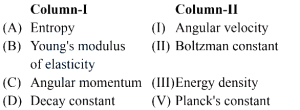
A
$A-II, B-III, C-IV, D-I$
B
$A-IV, B-I, C-III, D-II$
C
$A-II, B-III, C-IV, D-I$
D
$A-II, B-IV, C-III, D-I$
Solution
$(A)$ The dimensions are matched as follows:
$(A)$ Entropy $(S)$: $S = \frac{\Delta Q}{T}$. The unit is $J/K$, which is the same as the unit of the Boltzmann constant $(k_B)$. Thus, $(A) \rightarrow (II)$.
$(B)$ Young's modulus $(Y)$: $Y = \frac{\text{Stress}}{\text{Strain}} = \frac{\text{Force}}{\text{Area}}$. The unit is $N/m^2$ or $J/m^3$, which is the same as the unit of energy density $(U/V)$. Thus, $(B) \rightarrow (III)$.
$(C)$ Angular momentum $(L)$: $L = mvr$. The unit is $kg \cdot m^2/s$, which is the same as the unit of Planck's constant $(h)$. Thus, $(C) \rightarrow (IV)$.
$(D)$ Decay constant $(\lambda)$: $\lambda = \frac{1}{\text{time}}$. The unit is $s^{-1}$, which is the same as the unit of angular velocity $(\omega)$. Thus, $(D) \rightarrow (I)$.
Therefore, the correct matching is $(A-II, B-III, C-IV, D-I)$.
$(A)$ Entropy $(S)$: $S = \frac{\Delta Q}{T}$. The unit is $J/K$, which is the same as the unit of the Boltzmann constant $(k_B)$. Thus, $(A) \rightarrow (II)$.
$(B)$ Young's modulus $(Y)$: $Y = \frac{\text{Stress}}{\text{Strain}} = \frac{\text{Force}}{\text{Area}}$. The unit is $N/m^2$ or $J/m^3$, which is the same as the unit of energy density $(U/V)$. Thus, $(B) \rightarrow (III)$.
$(C)$ Angular momentum $(L)$: $L = mvr$. The unit is $kg \cdot m^2/s$, which is the same as the unit of Planck's constant $(h)$. Thus, $(C) \rightarrow (IV)$.
$(D)$ Decay constant $(\lambda)$: $\lambda = \frac{1}{\text{time}}$. The unit is $s^{-1}$, which is the same as the unit of angular velocity $(\omega)$. Thus, $(D) \rightarrow (I)$.
Therefore, the correct matching is $(A-II, B-III, C-IV, D-I)$.
0 likesView Solution
105
PhysicsDifficultMCQTS EAMCET · 2022
If the velocity of light $C$,the gravitational constant $G$,and Planck's constant $h$ are chosen as the fundamental units,the dimension of density in the new system is
A
$C^3 G^{-2} h^1$
B
$C^5 G^{-2} h^{-1}$
C
$C^{-3/2} G^{-1/2} h^{1/2}$
D
$C^{9/2} G^{-1/2} h^{-1/2}$
Solution
(B) Let the density $\rho$ be expressed as $\rho = k C^a G^b h^c$.
Dimensional formulas are:
$[\rho] = M L^{-3}$
$[C] = L T^{-1}$
$[G] = M^{-1} L^3 T^{-2}$
$[h] = M L^2 T^{-1}$
Substituting these into the equation:
$M^1 L^{-3} T^0 = (L T^{-1})^a (M^{-1} L^3 T^{-2})^b (M L^2 T^{-1})^c$
$M^1 L^{-3} T^0 = M^{-b+c} L^{a+3b+2c} T^{-a-2b-c}$
Comparing the exponents of $M, L,$ and $T$:
$1$) $-b + c = 1 \implies c = 1 + b$
$2$) $a + 3b + 2c = -3$
$3$) $-a - 2b - c = 0 \implies a = -2b - c$
Substitute $c = 1 + b$ into $(3)$: $a = -2b - (1 + b) = -3b - 1$
Substitute $a$ and $c$ into $(2)$: $(-3b - 1) + 3b + 2(1 + b) = -3$
$-3b - 1 + 3b + 2 + 2b = -3$
$2b + 1 = -3 \implies 2b = -4 \implies b = -2$
Now find $c$: $c = 1 + (-2) = -1$
Now find $a$: $a = -3(-2) - 1 = 6 - 1 = 5$
Thus,the dimension of density is $[\rho] = C^5 G^{-2} h^{-1}$.
Dimensional formulas are:
$[\rho] = M L^{-3}$
$[C] = L T^{-1}$
$[G] = M^{-1} L^3 T^{-2}$
$[h] = M L^2 T^{-1}$
Substituting these into the equation:
$M^1 L^{-3} T^0 = (L T^{-1})^a (M^{-1} L^3 T^{-2})^b (M L^2 T^{-1})^c$
$M^1 L^{-3} T^0 = M^{-b+c} L^{a+3b+2c} T^{-a-2b-c}$
Comparing the exponents of $M, L,$ and $T$:
$1$) $-b + c = 1 \implies c = 1 + b$
$2$) $a + 3b + 2c = -3$
$3$) $-a - 2b - c = 0 \implies a = -2b - c$
Substitute $c = 1 + b$ into $(3)$: $a = -2b - (1 + b) = -3b - 1$
Substitute $a$ and $c$ into $(2)$: $(-3b - 1) + 3b + 2(1 + b) = -3$
$-3b - 1 + 3b + 2 + 2b = -3$
$2b + 1 = -3 \implies 2b = -4 \implies b = -2$
Now find $c$: $c = 1 + (-2) = -1$
Now find $a$: $a = -3(-2) - 1 = 6 - 1 = 5$
Thus,the dimension of density is $[\rho] = C^5 G^{-2} h^{-1}$.
0 likesView Solution
106
PhysicsEasyMCQTS EAMCET · 2022
The distance between two successive minima of a transverse wave is $2.7 \ m$. Five crests of the wave pass a given point along the direction of travel every $15.0 \ s$. The speed of the wave is (in $m \ s^{-1}$)
A
$0.9$
B
$1.2$
C
$0.5$
D
$2.4$
Solution
(A) The distance between two successive minima is equal to the wavelength $\lambda$. Therefore,$\lambda = 2.7 \ m$.
Frequency $f$ is defined as the number of waves passing a point per unit time.
Given that $5$ crests pass in $15.0 \ s$,the frequency is $f = \frac{5}{15} = \frac{1}{3} \ s^{-1}$.
The speed of the wave $v$ is given by the relation $v = f \lambda$.
Substituting the values,$v = \frac{1}{3} \times 2.7 = 0.9 \ m \ s^{-1}$.
Frequency $f$ is defined as the number of waves passing a point per unit time.
Given that $5$ crests pass in $15.0 \ s$,the frequency is $f = \frac{5}{15} = \frac{1}{3} \ s^{-1}$.
The speed of the wave $v$ is given by the relation $v = f \lambda$.
Substituting the values,$v = \frac{1}{3} \times 2.7 = 0.9 \ m \ s^{-1}$.
0 likesView Solution
107
PhysicsEasyMCQTS EAMCET · 2022
Two strings $A$ and $B$ produce beats of frequency $\Delta f_1 > 0$. The tension in string $A$ is slightly increased and the beat frequency is found to be $\Delta f_2 > 0$. If the original frequency of $A$ is $f_0$ and $\Delta f_2 < \Delta f_1$,then the frequency of $B$ is
A
$f_0 + \Delta f_1$
B
$f_0 + \Delta f_1 - \Delta f_2$
C
$f_0 - \Delta f_1$
D
$f_0 + \frac{(\Delta f_1 + \Delta f_2)}{2}$
Solution
(A) Let the frequency of string $A$ be $f_A = f_0$ and the frequency of string $B$ be $f_B$.
Initially,the beat frequency is $\Delta f_1 = |f_0 - f_B| > 0$.
When the tension in string $A$ is increased,its frequency $f_A$ increases to $f_A'$.
The new beat frequency is $\Delta f_2 = |f_A' - f_B| < \Delta f_1$.
Since the beat frequency decreased after increasing the frequency of $A$,it implies that $f_A$ was approaching $f_B$.
Therefore,$f_B$ must be greater than $f_A$.
Thus,$\Delta f_1 = f_B - f_0$,which gives $f_B = f_0 + \Delta f_1$.
Initially,the beat frequency is $\Delta f_1 = |f_0 - f_B| > 0$.
When the tension in string $A$ is increased,its frequency $f_A$ increases to $f_A'$.
The new beat frequency is $\Delta f_2 = |f_A' - f_B| < \Delta f_1$.
Since the beat frequency decreased after increasing the frequency of $A$,it implies that $f_A$ was approaching $f_B$.
Therefore,$f_B$ must be greater than $f_A$.
Thus,$\Delta f_1 = f_B - f_0$,which gives $f_B = f_0 + \Delta f_1$.
0 likesView Solution
108
PhysicsEasyMCQTS EAMCET · 2022
Two waves of amplitudes $A_1$ and $A_2$ respectively are superimposed. The ratio between the maximum and minimum intensities of the resultant waves is $9 : 4$. The value of $A_2 / A_1$ is [Assume $A_1 > A_2$]
A
$0.66$
B
$0.20$
C
$0.75$
D
$0.44$
Solution
(B) The intensity $I$ of a wave is proportional to the square of its amplitude $A$,i.e.,$I \propto A^2$.
For two waves with amplitudes $A_1$ and $A_2$,the maximum intensity $I_{max}$ occurs at constructive interference,where $I_{max} \propto (A_1 + A_2)^2$.
The minimum intensity $I_{min}$ occurs at destructive interference,where $I_{min} \propto (A_1 - A_2)^2$.
Given the ratio of intensities $\frac{I_{max}}{I_{min}} = \frac{9}{4}$,we have:
$\frac{(A_1 + A_2)^2}{(A_1 - A_2)^2} = \frac{9}{4}$
Taking the square root on both sides:
$\frac{A_1 + A_2}{A_1 - A_2} = \frac{3}{2}$
Cross-multiplying gives:
$2(A_1 + A_2) = 3(A_1 - A_2)$
$2A_1 + 2A_2 = 3A_1 - 3A_2$
$5A_2 = A_1$
Therefore,the ratio $\frac{A_2}{A_1} = \frac{1}{5} = 0.2$.
For two waves with amplitudes $A_1$ and $A_2$,the maximum intensity $I_{max}$ occurs at constructive interference,where $I_{max} \propto (A_1 + A_2)^2$.
The minimum intensity $I_{min}$ occurs at destructive interference,where $I_{min} \propto (A_1 - A_2)^2$.
Given the ratio of intensities $\frac{I_{max}}{I_{min}} = \frac{9}{4}$,we have:
$\frac{(A_1 + A_2)^2}{(A_1 - A_2)^2} = \frac{9}{4}$
Taking the square root on both sides:
$\frac{A_1 + A_2}{A_1 - A_2} = \frac{3}{2}$
Cross-multiplying gives:
$2(A_1 + A_2) = 3(A_1 - A_2)$
$2A_1 + 2A_2 = 3A_1 - 3A_2$
$5A_2 = A_1$
Therefore,the ratio $\frac{A_2}{A_1} = \frac{1}{5} = 0.2$.
0 likesView Solution
109
PhysicsEasyMCQTS EAMCET · 2022
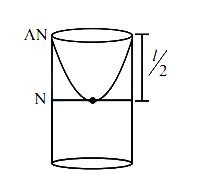
$A$ cylindrical tube open at both ends has a fundamental frequency '$f$' in air. The tube is dipped vertically in water so that half of its length is in water. The new fundamental frequency is
A
$f$
B
$\frac{f}{2}$
C
$2f$
D
$4f$
Solution
(A) Initially,for an open pipe of length '$L$',the fundamental frequency is given by:
$f = \frac{V}{2L}$
When the tube is dipped vertically in water such that half of its length is submerged,the remaining length of the air column above the water surface is '$L/2$'.
The water surface acts as a closed end. Thus,the tube now behaves as a pipe closed at one end with an effective length '$L' = L/2$'.
The fundamental frequency of a pipe closed at one end is given by:
$f' = \frac{V}{4L'}$
Substituting '$L' = L/2$':
$f' = \frac{V}{4(L/2)} = \frac{V}{2L} = f$
Therefore,the new fundamental frequency remains '$f$'.
$f = \frac{V}{2L}$
When the tube is dipped vertically in water such that half of its length is submerged,the remaining length of the air column above the water surface is '$L/2$'.
The water surface acts as a closed end. Thus,the tube now behaves as a pipe closed at one end with an effective length '$L' = L/2$'.
The fundamental frequency of a pipe closed at one end is given by:
$f' = \frac{V}{4L'}$
Substituting '$L' = L/2$':
$f' = \frac{V}{4(L/2)} = \frac{V}{2L} = f$
Therefore,the new fundamental frequency remains '$f$'.
0 likesView Solution
110
PhysicsEasyMCQTS EAMCET · 2022
Which of the following waves has the largest wave speed?
A
$y(x, t)=2 \sin (2 x-2 t)$
B
$y(x, t)=3 \sin (2 x-3 t)$
C
$y(x, t)=2 \sin (3 x-2 t)$
D
$y(x, t)=3 \sin (5 x-2 t)$
Solution
(B) The general equation of a progressive wave is $y(x, t) = A \sin(kx - \omega t)$.
The wave speed $v$ is given by the ratio of the angular frequency $\omega$ to the wave number $k$:
$v = \frac{\omega}{k} = \frac{\text{coefficient of } t}{\text{coefficient of } x}$.
Calculating the speed for each option:
$(a)$ $v = \frac{2}{2} = 1.0 \text{ m/s}$
$(b)$ $v = \frac{3}{2} = 1.5 \text{ m/s}$
$(c)$ $v = \frac{2}{3} \approx 0.67 \text{ m/s}$
$(d)$ $v = \frac{2}{5} = 0.4 \text{ m/s}$
Comparing these values,the wave speed is largest for the equation in option $(b)$.
The wave speed $v$ is given by the ratio of the angular frequency $\omega$ to the wave number $k$:
$v = \frac{\omega}{k} = \frac{\text{coefficient of } t}{\text{coefficient of } x}$.
Calculating the speed for each option:
$(a)$ $v = \frac{2}{2} = 1.0 \text{ m/s}$
$(b)$ $v = \frac{3}{2} = 1.5 \text{ m/s}$
$(c)$ $v = \frac{2}{3} \approx 0.67 \text{ m/s}$
$(d)$ $v = \frac{2}{5} = 0.4 \text{ m/s}$
Comparing these values,the wave speed is largest for the equation in option $(b)$.
0 likesView Solution
111
PhysicsMediumMCQTS EAMCET · 2022
$A$ wire of length $0.4 \,m$ stretched at both ends vibrates $250$ times per second. If the length of the wire is increased by $0.1 \,m$ and the stretching force is reduced to $1/4$ of its original value, then the new frequency is (in $\,Hz$)
A
$50$
B
$75$
C
$100$
D
$150$
Solution
(C) The fundamental frequency of a stretched wire is given by $f = \frac{1}{2L} \sqrt{\frac{T}{\mu}}$, where $L$ is the length, $T$ is the tension, and $\mu$ is the linear mass density.
Initially, $L_1 = 0.4 \,m$, $f_1 = 250 \,Hz$, and tension is $T_1 = T$.
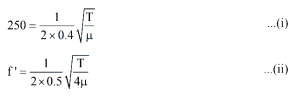
So, $250 = \frac{1}{2 \times 0.4} \sqrt{\frac{T}{\mu}} \quad ...(i)$
Finally, $L_2 = 0.4 + 0.1 = 0.5 \,m$, and the new tension is $T_2 = T/4$.
So, $f_2 = \frac{1}{2 \times 0.5} \sqrt{\frac{T/4}{\mu}} \quad ...(ii)$
Dividing equation $(ii)$ by $(i)$:
$\frac{f_2}{250} = \frac{\frac{1}{2 \times 0.5} \sqrt{\frac{T}{4\mu}}}{\frac{1}{2 \times 0.4} \sqrt{\frac{T}{\mu}}} = \frac{0.4}{0.5} \times \sqrt{\frac{1}{4}} = \frac{4}{5} \times \frac{1}{2} = \frac{2}{5} = 0.4$
$f_2 = 250 \times 0.4 = 100 \,Hz$.
Initially, $L_1 = 0.4 \,m$, $f_1 = 250 \,Hz$, and tension is $T_1 = T$.
So, $250 = \frac{1}{2 \times 0.4} \sqrt{\frac{T}{\mu}} \quad ...(i)$
Finally, $L_2 = 0.4 + 0.1 = 0.5 \,m$, and the new tension is $T_2 = T/4$.
So, $f_2 = \frac{1}{2 \times 0.5} \sqrt{\frac{T/4}{\mu}} \quad ...(ii)$
Dividing equation $(ii)$ by $(i)$:
$\frac{f_2}{250} = \frac{\frac{1}{2 \times 0.5} \sqrt{\frac{T}{4\mu}}}{\frac{1}{2 \times 0.4} \sqrt{\frac{T}{\mu}}} = \frac{0.4}{0.5} \times \sqrt{\frac{1}{4}} = \frac{4}{5} \times \frac{1}{2} = \frac{2}{5} = 0.4$
$f_2 = 250 \times 0.4 = 100 \,Hz$.
0 likesView Solution
112
PhysicsDifficultMCQTS EAMCET · 2022
$A$ cyclist is riding with a speed of $36 \,km/h$. As he approaches a circular turn on the road of radius $50 \,m$, he applies brakes and reduces his speed at the constant rate of $0.5 \,m/s^2$. The magnitude and direction of the net acceleration of the cyclist on the circular turn are respectively:
A
$\frac{\sqrt{3}}{2} \,m/s^2, \tan^{-1}(4)$
B
$\frac{\sqrt{3}}{2} \,m/s^2, \tan^{-1}\left(\frac{1}{4}\right)$
C
$\sqrt{17} \,m/s^2, \tan^{-1}\left(\frac{1}{4}\right)$
D
$\frac{\sqrt{17}}{2} \,m/s^2, \tan^{-1}(4)$
Solution
(D) Initial speed $V = 36 \,km/h = 36 \times \frac{5}{18} = 10 \,m/s$.
Radial acceleration $a_r = \frac{V^2}{R} = \frac{10^2}{50} = \frac{100}{50} = 2 \,m/s^2$.
Tangential acceleration $a_t = 0.5 \,m/s^2$.
Net acceleration $a_{net} = \sqrt{a_r^2 + a_t^2} = \sqrt{2^2 + 0.5^2} = \sqrt{4 + 0.25} = \sqrt{4.25} = \sqrt{\frac{17}{4}} = \frac{\sqrt{17}}{2} \,m/s^2$.
Direction $\theta$ with respect to the radial vector is given by $\tan \theta = \frac{a_t}{a_r} = \frac{0.5}{2} = \frac{1}{4}$.
However, the angle with respect to the tangential vector is $\tan \phi = \frac{a_r}{a_t} = \frac{2}{0.5} = 4$, so $\phi = \tan^{-1}(4)$.
Radial acceleration $a_r = \frac{V^2}{R} = \frac{10^2}{50} = \frac{100}{50} = 2 \,m/s^2$.
Tangential acceleration $a_t = 0.5 \,m/s^2$.
Net acceleration $a_{net} = \sqrt{a_r^2 + a_t^2} = \sqrt{2^2 + 0.5^2} = \sqrt{4 + 0.25} = \sqrt{4.25} = \sqrt{\frac{17}{4}} = \frac{\sqrt{17}}{2} \,m/s^2$.
Direction $\theta$ with respect to the radial vector is given by $\tan \theta = \frac{a_t}{a_r} = \frac{0.5}{2} = \frac{1}{4}$.
However, the angle with respect to the tangential vector is $\tan \phi = \frac{a_r}{a_t} = \frac{2}{0.5} = 4$, so $\phi = \tan^{-1}(4)$.
0 likesView Solution
113
PhysicsEasyMCQTS EAMCET · 2022
$A$ pump on the ground floor of a building can pump up water to fill a tank of volume $36 \,m^3$ in $30 \,min$. If the tank is $50 \,m$ above the ground, and the electric power consumed by the pump is $40 \,kW$, the efficiency of the pump is (Use $g=10 \,m / s^2$ and density of water $=1000 \,kg / m^3$ ) (in $\%$)
A
$30$
B
$25$
C
$33$
D
$40$
Solution
(B) Given:
Volume of water $V = 36 \,m^3$
Time $t = 30 \,min = 30 \times 60 \,s = 1800 \,s$
Height $h = 50 \,m$
Input Power $P_{\text{in}} = 40 \,kW = 40,000 \,W$
Density of water $\rho = 1000 \,kg/m^3$
Acceleration due to gravity $g = 10 \,m/s^2$
Mass of water $m = V \times \rho = 36 \times 1000 = 36,000 \,kg$
Work done to lift the water $W = mgh = 36,000 \times 10 \times 50 = 18,000,000 \,J$
Output Power $P_{\text{out}} = \frac{W}{t} = \frac{18,000,000}{1800} = 10,000 \,W = 10 \,kW$
Efficiency $\eta = \frac{P_{\text{out}}}{P_{\text{in}}} \times 100\% = \frac{10,000}{40,000} \times 100\% = 25\%$
Volume of water $V = 36 \,m^3$
Time $t = 30 \,min = 30 \times 60 \,s = 1800 \,s$
Height $h = 50 \,m$
Input Power $P_{\text{in}} = 40 \,kW = 40,000 \,W$
Density of water $\rho = 1000 \,kg/m^3$
Acceleration due to gravity $g = 10 \,m/s^2$
Mass of water $m = V \times \rho = 36 \times 1000 = 36,000 \,kg$
Work done to lift the water $W = mgh = 36,000 \times 10 \times 50 = 18,000,000 \,J$
Output Power $P_{\text{out}} = \frac{W}{t} = \frac{18,000,000}{1800} = 10,000 \,W = 10 \,kW$
Efficiency $\eta = \frac{P_{\text{out}}}{P_{\text{in}}} \times 100\% = \frac{10,000}{40,000} \times 100\% = 25\%$
0 likesView Solution
114
PhysicsEasyMCQTS EAMCET · 2022
The potential energy of an object is $U(x) = (5x^2 - 4x^3) \ J$,where $x$ is the position in meters. The position at which the force becomes zero is
A
$1/2 \ m$
B
$5/6 \ m$
C
$1/3 \ m$
D
$2/3 \ m$
Solution
(B) For a conservative force,the relationship between force $F$ and potential energy $U$ is given by $F = -\frac{dU}{dx}$.
Given $U(x) = 5x^2 - 4x^3$.
To find the position where the force is zero,we set $F = 0$:
$0 = -\frac{d}{dx}(5x^2 - 4x^3)$
$0 = -(10x - 12x^2)$
$12x^2 - 10x = 0$
$2x(6x - 5) = 0$
This gives two solutions: $x = 0 \ m$ or $x = 5/6 \ m$.
Comparing this with the given options,the correct position is $5/6 \ m$.
Given $U(x) = 5x^2 - 4x^3$.
To find the position where the force is zero,we set $F = 0$:
$0 = -\frac{d}{dx}(5x^2 - 4x^3)$
$0 = -(10x - 12x^2)$
$12x^2 - 10x = 0$
$2x(6x - 5) = 0$
This gives two solutions: $x = 0 \ m$ or $x = 5/6 \ m$.
Comparing this with the given options,the correct position is $5/6 \ m$.
0 likesView Solution
115
PhysicsMediumMCQTS EAMCET · 2022
$A$ ball of mass $1 \ kg$ moves in a straight line with velocity $v = c x^\alpha$,where $c = 1$ ($SI$ unit) and $\alpha$ is a constant. If the work done by the net force during its displacement from $x = 0$ to $x = 4 \ m$ is $128 \ J$,then the value of $\alpha$ is
A
$1$
B
$\frac{3}{2}$
C
$2$
D
$\frac{1}{2}$
Solution
(C) According to the Work-Energy Theorem,the work done by the net force is equal to the change in kinetic energy:
$W = \Delta K = K_f - K_i$
Given $m = 1 \ kg$,$c = 1$,$v = x^\alpha$,$x_i = 0 \ m$,$x_f = 4 \ m$,and $W = 128 \ J$.
At $x = 0$,$v_i = 1 \times (0)^\alpha = 0$.
At $x = 4$,$v_f = 1 \times (4)^\alpha = 4^\alpha$.
Substituting these into the Work-Energy equation:
$128 = \frac{1}{2} m v_f^2 - \frac{1}{2} m v_i^2$
$128 = \frac{1}{2} (1) (4^\alpha)^2 - 0$
$128 = \frac{1}{2} (4^{2\alpha})$
$256 = 4^{2\alpha}$
Since $256 = 2^8 = (2^2)^4 = 4^4$,we have:
$4^4 = 4^{2\alpha}$
$2\alpha = 4$
$\alpha = 2$.
$W = \Delta K = K_f - K_i$
Given $m = 1 \ kg$,$c = 1$,$v = x^\alpha$,$x_i = 0 \ m$,$x_f = 4 \ m$,and $W = 128 \ J$.
At $x = 0$,$v_i = 1 \times (0)^\alpha = 0$.
At $x = 4$,$v_f = 1 \times (4)^\alpha = 4^\alpha$.
Substituting these into the Work-Energy equation:
$128 = \frac{1}{2} m v_f^2 - \frac{1}{2} m v_i^2$
$128 = \frac{1}{2} (1) (4^\alpha)^2 - 0$
$128 = \frac{1}{2} (4^{2\alpha})$
$256 = 4^{2\alpha}$
Since $256 = 2^8 = (2^2)^4 = 4^4$,we have:
$4^4 = 4^{2\alpha}$
$2\alpha = 4$
$\alpha = 2$.
0 likesView Solution
116
PhysicsMediumMCQTS EAMCET · 2022
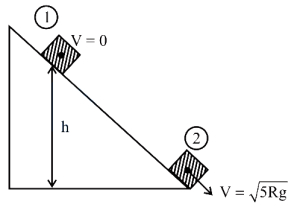
$A$ body of mass $m$ slides down along a frictionless inclined plane from height $h$ and just completes motion in a vertical circle of radius $R = 2 \ m$ after reaching the bottom. What is the value of $h$? [Use $g = 10 \ m/s^2$]
A
$2 \ m$
B
$\frac{5}{2} \ m$
C
$5 \ m$
D
$10 \ m$
Solution
(C) To complete a vertical circle,the minimum velocity at the bottom must be $v = \sqrt{5Rg}$,where $R$ is the radius of the circle.
Applying the law of conservation of mechanical energy between the top of the incline and the bottom:
$P_1 + K_1 = P_2 + K_2$
$mgh + 0 = 0 + \frac{1}{2} m v^2$
$mgh = \frac{1}{2} m (\sqrt{5Rg})^2$
$mgh = \frac{1}{2} m (5Rg)$
$h = \frac{5R}{2}$
Given $R = 2 \ m$,we have:
$h = \frac{5 \times 2}{2} = 5 \ m$
Applying the law of conservation of mechanical energy between the top of the incline and the bottom:
$P_1 + K_1 = P_2 + K_2$
$mgh + 0 = 0 + \frac{1}{2} m v^2$
$mgh = \frac{1}{2} m (\sqrt{5Rg})^2$
$mgh = \frac{1}{2} m (5Rg)$
$h = \frac{5R}{2}$
Given $R = 2 \ m$,we have:
$h = \frac{5 \times 2}{2} = 5 \ m$
0 likesView Solution
117
PhysicsEasyMCQTS EAMCET · 2022
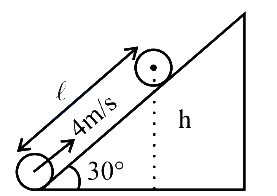
$A$ solid spherical ball is rolled up an inclined plane of angle of inclination $30^{\circ}$ with an initial speed of $4 \ m/s$ at the bottom of the inclination. How far will the ball go up the plane (in $cm$)? (Use $g=10 \ m/s^2$)
A
$56$
B
$112$
C
$224$
D
$120$
Solution
(C) By the law of conservation of energy,the total initial mechanical energy equals the total final mechanical energy at the highest point.
Initial energy: $E_i = K.E_{trans} + K.E_{rot} = \frac{1}{2}mv^2 + \frac{1}{2}I\omega^2$
For a solid sphere,$I = \frac{2}{5}mR^2$ and for pure rolling,$\omega = \frac{v}{R}$.
$E_i = \frac{1}{2}mv^2 + \frac{1}{2}(\frac{2}{5}mR^2)(\frac{v}{R})^2 = \frac{1}{2}mv^2 + \frac{1}{5}mv^2 = \frac{7}{10}mv^2$
At the highest point,the final kinetic energy is zero,and the potential energy is $mgh$.
So,$\frac{7}{10}mv^2 = mgh \Rightarrow h = \frac{7v^2}{10g}$
Given $v = 4 \ m/s$ and $g = 10 \ m/s^2$,$h = \frac{7 \times 4^2}{10 \times 10} = \frac{7 \times 16}{100} = 1.12 \ m$.
The distance $\ell$ along the plane is given by $\ell = \frac{h}{\sin 30^{\circ}} = \frac{1.12}{0.5} = 2.24 \ m = 224 \ cm$.
Initial energy: $E_i = K.E_{trans} + K.E_{rot} = \frac{1}{2}mv^2 + \frac{1}{2}I\omega^2$
For a solid sphere,$I = \frac{2}{5}mR^2$ and for pure rolling,$\omega = \frac{v}{R}$.
$E_i = \frac{1}{2}mv^2 + \frac{1}{2}(\frac{2}{5}mR^2)(\frac{v}{R})^2 = \frac{1}{2}mv^2 + \frac{1}{5}mv^2 = \frac{7}{10}mv^2$
At the highest point,the final kinetic energy is zero,and the potential energy is $mgh$.
So,$\frac{7}{10}mv^2 = mgh \Rightarrow h = \frac{7v^2}{10g}$
Given $v = 4 \ m/s$ and $g = 10 \ m/s^2$,$h = \frac{7 \times 4^2}{10 \times 10} = \frac{7 \times 16}{100} = 1.12 \ m$.
The distance $\ell$ along the plane is given by $\ell = \frac{h}{\sin 30^{\circ}} = \frac{1.12}{0.5} = 2.24 \ m = 224 \ cm$.
0 likesView Solution
118
PhysicsMediumMCQTS EAMCET · 2022
Statement $(I)$: The slope of the kinetic energy-displacement curve of a body in motion is directly proportional to its acceleration.
Statement $(II)$: From a height of $15 \ m$,a ball is projected vertically upwards with a velocity of $30 \ m/s$. If the ball rises to the same height after hitting the ground,the loss of its energy on hitting the ground is $30 \%$.
Statement $(III)$: The velocity acquired by a body of mass '$m$' after travelling a fixed distance from rest under the action of a constant force is directly proportional to mass '$m$'.
Which of the following is correct?
Statement $(II)$: From a height of $15 \ m$,a ball is projected vertically upwards with a velocity of $30 \ m/s$. If the ball rises to the same height after hitting the ground,the loss of its energy on hitting the ground is $30 \%$.
Statement $(III)$: The velocity acquired by a body of mass '$m$' after travelling a fixed distance from rest under the action of a constant force is directly proportional to mass '$m$'.
Which of the following is correct?
A
Statements $I, II, III$ are true
B
Statements $I, III$ are true,but statement $II$ is false
C
Statement $I$ is true,but statements $II$ and $III$ are false
D
Statements $I, II$ are true,but statement $III$ is false
Solution
(C) Analysis of Statement $(I)$: The kinetic energy $K = \frac{1}{2}mv^2$. The slope of the $K-x$ curve is $\frac{dK}{dx} = \frac{d}{dx}(\frac{1}{2}mv^2) = mv \frac{dv}{dx} = m \cdot a$. Since $m$ is constant,the slope is directly proportional to acceleration $a$. Thus,Statement $(I)$ is true.
Analysis of Statement $(II)$: Initial velocity $u = 30 \ m/s$,height $h = 15 \ m$,$g = 10 \ m/s^2$. Velocity just before hitting the ground $v^2 = u^2 + 2gh = 30^2 + 2(10)(15) = 900 + 300 = 1200 \ (m/s)^2$. Kinetic energy before impact $E_i = \frac{1}{2}m(1200)$. After impact,it rises to $15 \ m$,so velocity after impact $v' = \sqrt{2gh} = \sqrt{2(10)(15)} = \sqrt{300} \ m/s$. Kinetic energy after impact $E_f = \frac{1}{2}m(300)$. Loss in energy $\Delta E = E_i - E_f = \frac{1}{2}m(1200 - 300) = \frac{1}{2}m(900)$. Percentage loss $= (\frac{\Delta E}{E_i}) \times 100 = (\frac{900}{1200}) \times 100 = 75 \%$. Thus,Statement $(II)$ is false.
Analysis of Statement $(III)$: From $v^2 = u^2 + 2as$,where $u=0$ and $a = F/m$,we get $v^2 = 2(F/m)s$. Thus $v = \sqrt{2Fs/m}$. Velocity is inversely proportional to $\sqrt{m}$,not directly proportional to $m$. Thus,Statement $(III)$ is false.
Analysis of Statement $(II)$: Initial velocity $u = 30 \ m/s$,height $h = 15 \ m$,$g = 10 \ m/s^2$. Velocity just before hitting the ground $v^2 = u^2 + 2gh = 30^2 + 2(10)(15) = 900 + 300 = 1200 \ (m/s)^2$. Kinetic energy before impact $E_i = \frac{1}{2}m(1200)$. After impact,it rises to $15 \ m$,so velocity after impact $v' = \sqrt{2gh} = \sqrt{2(10)(15)} = \sqrt{300} \ m/s$. Kinetic energy after impact $E_f = \frac{1}{2}m(300)$. Loss in energy $\Delta E = E_i - E_f = \frac{1}{2}m(1200 - 300) = \frac{1}{2}m(900)$. Percentage loss $= (\frac{\Delta E}{E_i}) \times 100 = (\frac{900}{1200}) \times 100 = 75 \%$. Thus,Statement $(II)$ is false.
Analysis of Statement $(III)$: From $v^2 = u^2 + 2as$,where $u=0$ and $a = F/m$,we get $v^2 = 2(F/m)s$. Thus $v = \sqrt{2Fs/m}$. Velocity is inversely proportional to $\sqrt{m}$,not directly proportional to $m$. Thus,Statement $(III)$ is false.
0 likesView Solution
119
PhysicsMediumMCQTS EAMCET · 2022
$A$ boat of mass $1000 \,kg$ goes from rest to a speed of $20.0 \,m/s$ in $5.0 \,s$. The water exerts a constant drag force and the acceleration of the boat is constant. If the average power required by the boat is $45000 \,W$, then the magnitude of the drag force is: (in $\,N$)
A
$500$
B
$750$
C
$250$
D
$1000$
Solution
(A) First, calculate the acceleration of the boat: $a = \frac{v-u}{t} = \frac{20-0}{5} = 4 \,m/s^2$.
Next, calculate the distance traveled by the boat: $S = ut + \frac{1}{2}at^2 = 0 + \frac{1}{2} \times 4 \times 5^2 = 50 \,m$.
The average power is given by $P_{av} = \frac{W}{t} = \frac{F_{boat} \times S}{t}$.
Substituting the values: $45000 = \frac{F_{boat} \times 50}{5} = F_{boat} \times 10$.
Thus, the force exerted by the boat engine is $F_{boat} = 4500 \,N$.
According to Newton's second law, the net force is $F_{net} = F_{boat} - F_{drag} = ma$.
Substituting the values: $4500 - F_{drag} = 1000 \times 4 = 4000 \,N$.
Therefore, the drag force is $F_{drag} = 4500 - 4000 = 500 \,N$.
Next, calculate the distance traveled by the boat: $S = ut + \frac{1}{2}at^2 = 0 + \frac{1}{2} \times 4 \times 5^2 = 50 \,m$.
The average power is given by $P_{av} = \frac{W}{t} = \frac{F_{boat} \times S}{t}$.
Substituting the values: $45000 = \frac{F_{boat} \times 50}{5} = F_{boat} \times 10$.
Thus, the force exerted by the boat engine is $F_{boat} = 4500 \,N$.
According to Newton's second law, the net force is $F_{net} = F_{boat} - F_{drag} = ma$.
Substituting the values: $4500 - F_{drag} = 1000 \times 4 = 4000 \,N$.
Therefore, the drag force is $F_{drag} = 4500 - 4000 = 500 \,N$.
0 likesView Solution
120
PhysicsEasyMCQTS EAMCET · 2022
An object is moving in a straight line under the influence of a source of constant power. If $v$ and $t$ are velocity and time respectively,then
A
$v \propto t^2$
B
$v \propto t^{\frac{1}{2}}$
C
$v \propto t$
D
$v \propto t^{\frac{3}{2}}$
Solution
(B) Power $P$ is defined as the rate of doing work,given by $P = F \cdot v$.
Since $F = m \cdot a = m \frac{dv}{dt}$,we have $P = m \frac{dv}{dt} \cdot v$.
Rearranging the terms,we get $P \cdot dt = m \cdot v \cdot dv$.
Integrating both sides,$\int_{0}^{t} P \cdot dt = \int_{0}^{v} m \cdot v \cdot dv$.
Since $P$ and $m$ are constant,$P \cdot t = m \cdot \frac{v^2}{2}$.
Solving for $v$,we get $v^2 = \frac{2Pt}{m}$,which implies $v = \sqrt{\frac{2P}{m}} \cdot t^{\frac{1}{2}}$.
Therefore,$v \propto t^{\frac{1}{2}}$.
Since $F = m \cdot a = m \frac{dv}{dt}$,we have $P = m \frac{dv}{dt} \cdot v$.
Rearranging the terms,we get $P \cdot dt = m \cdot v \cdot dv$.
Integrating both sides,$\int_{0}^{t} P \cdot dt = \int_{0}^{v} m \cdot v \cdot dv$.
Since $P$ and $m$ are constant,$P \cdot t = m \cdot \frac{v^2}{2}$.
Solving for $v$,we get $v^2 = \frac{2Pt}{m}$,which implies $v = \sqrt{\frac{2P}{m}} \cdot t^{\frac{1}{2}}$.
Therefore,$v \propto t^{\frac{1}{2}}$.
0 likesView Solution
121
PhysicsMediumMCQTS EAMCET · 2022
$A$ spherical bob of mass $250 \ g$ is attached to the end of a string having length $50 \ cm$. The bob is rotated on a horizontal circular path about a vertical axis. The maximum tension that the string can bear is $72 \ N$. The maximum possible value of angular velocity of the bob (in $rad/s$) is
A
$18$
B
$24$
C
$28$
D
$32$
Solution
(B) Given mass $m = 250 \ g = 0.25 \ kg$,length of string $l = 50 \ cm = 0.5 \ m$,and maximum tension $T_{\max} = 72 \ N$.
For a horizontal circular motion,the tension in the string provides the necessary centripetal force.
$T = m \omega^2 R$.
Here,the radius $R$ of the circular path is equal to the length of the string $l$ (assuming the string remains horizontal).
$T_{\max} = m \omega_{\max}^2 l$.
Substituting the values:
$72 = 0.25 \times \omega_{\max}^2 \times 0.5$.
$72 = 0.125 \times \omega_{\max}^2$.
$\omega_{\max}^2 = \frac{72}{0.125} = 576$.
$\omega_{\max} = \sqrt{576} = 24 \ rad/s$.
For a horizontal circular motion,the tension in the string provides the necessary centripetal force.
$T = m \omega^2 R$.
Here,the radius $R$ of the circular path is equal to the length of the string $l$ (assuming the string remains horizontal).
$T_{\max} = m \omega_{\max}^2 l$.
Substituting the values:
$72 = 0.25 \times \omega_{\max}^2 \times 0.5$.
$72 = 0.125 \times \omega_{\max}^2$.
$\omega_{\max}^2 = \frac{72}{0.125} = 576$.
$\omega_{\max} = \sqrt{576} = 24 \ rad/s$.
0 likesView Solution
122
PhysicsEasyMCQTS EAMCET · 2022
$A$ $p-n$ junction is fabricated from a semiconductor with a band gap of $2.8 \ eV$. What approximate wavelength can it $NOT$ detect (in $nm$)?
[Use $h = 6 \times 10^{-34} \ J \cdot s$ and $c = 3 \times 10^8 \ m/s$]
[Use $h = 6 \times 10^{-34} \ J \cdot s$ and $c = 3 \times 10^8 \ m/s$]
A
$100$
B
$200$
C
$400$
D
$600$
Solution
(D) The energy of a photon is given by $E = \frac{hc}{\lambda}$.
For a $p-n$ junction to detect a signal,the energy of the incident photon must be greater than or equal to the band gap energy $(E_g = 2.8 \ eV)$.
If $E < E_g$,the photon cannot excite an electron from the valence band to the conduction band,and thus cannot be detected.
Using $h = 6 \times 10^{-34} \ J \cdot s$ and $c = 3 \times 10^8 \ m/s$,we have $hc = 18 \times 10^{-26} \ J \cdot m$.
Converting $E_g$ to Joules: $2.8 \ eV = 2.8 \times 1.6 \times 10^{-19} \ J = 4.48 \times 10^{-19} \ J$.
The threshold wavelength $\lambda_0$ is given by $\lambda_0 = \frac{hc}{E_g} = \frac{18 \times 10^{-26}}{4.48 \times 10^{-19}} \approx 4.017 \times 10^{-7} \ m = 401.7 \ \text{nm}$.
Any wavelength $\lambda > \lambda_0$ will have energy $E < E_g$ and will not be detected.
Among the given options,$600 \ nm$ is the only wavelength greater than $401.7 \ nm$.
For a $p-n$ junction to detect a signal,the energy of the incident photon must be greater than or equal to the band gap energy $(E_g = 2.8 \ eV)$.
If $E < E_g$,the photon cannot excite an electron from the valence band to the conduction band,and thus cannot be detected.
Using $h = 6 \times 10^{-34} \ J \cdot s$ and $c = 3 \times 10^8 \ m/s$,we have $hc = 18 \times 10^{-26} \ J \cdot m$.
Converting $E_g$ to Joules: $2.8 \ eV = 2.8 \times 1.6 \times 10^{-19} \ J = 4.48 \times 10^{-19} \ J$.
The threshold wavelength $\lambda_0$ is given by $\lambda_0 = \frac{hc}{E_g} = \frac{18 \times 10^{-26}}{4.48 \times 10^{-19}} \approx 4.017 \times 10^{-7} \ m = 401.7 \ \text{nm}$.
Any wavelength $\lambda > \lambda_0$ will have energy $E < E_g$ and will not be detected.
Among the given options,$600 \ nm$ is the only wavelength greater than $401.7 \ nm$.
0 likesView Solution
123
PhysicsEasyMCQTS EAMCET · 2022
The band gap in a semiconductor is $0.6 eV$. The maximum wavelength of electromagnetic radiation which can create a hole-electron pair in this semiconductor is equal to [Use $hc = 1242 eV-nm$]. (in $nm$)
A
$2450$
B
$1150$
C
$2070$
D
$1050$
Solution
(C) The energy of a photon required to create an electron-hole pair in a semiconductor must be at least equal to the band gap energy $(E_g)$.
$E_g = 0.6 eV$
We know that the energy of a photon is given by $E = \frac{hc}{\lambda}$.
To find the maximum wavelength $(\lambda_{max})$,we set the photon energy equal to the band gap energy:
$E_g = \frac{hc}{\lambda_{max}}$
$\lambda_{max} = \frac{hc}{E_g}$
Given $hc = 1242 eV-nm$ and $E_g = 0.6 eV$:
$\lambda_{max} = \frac{1242}{0.6} nm = 2070 nm$
If the wavelength is greater than $2070 nm$,the photon energy will be less than $0.6 eV$,which is insufficient to excite an electron from the valence band to the conduction band. Therefore,$2070 nm$ is the maximum wavelength.
$E_g = 0.6 eV$
We know that the energy of a photon is given by $E = \frac{hc}{\lambda}$.
To find the maximum wavelength $(\lambda_{max})$,we set the photon energy equal to the band gap energy:
$E_g = \frac{hc}{\lambda_{max}}$
$\lambda_{max} = \frac{hc}{E_g}$
Given $hc = 1242 eV-nm$ and $E_g = 0.6 eV$:
$\lambda_{max} = \frac{1242}{0.6} nm = 2070 nm$
If the wavelength is greater than $2070 nm$,the photon energy will be less than $0.6 eV$,which is insufficient to excite an electron from the valence band to the conduction band. Therefore,$2070 nm$ is the maximum wavelength.
0 likesView Solution
124
PhysicsEasyMCQTS EAMCET · 2022
For an $n-p-n$ transistor structure,which of the following statements is $NOT$ true?
A
Emitter is heavily doped and moderate in size
B
Base is lightly doped and thin in size
C
Collector is lightly doped and large in size
D
Collector is moderately doped and large in size
Solution
(C) In an $n-p-n$ transistor,the emitter is heavily doped to provide a large number of charge carriers. The base is very thin and lightly doped to allow most of the charge carriers from the emitter to pass through to the collector. The collector is moderately doped and is the largest in size to dissipate the heat generated during operation. Therefore,the statement that the collector is lightly doped is incorrect.
0 likesView Solution
125
PhysicsMediumMCQTS EAMCET · 2022
In a $\text{NAND}$ gate,$A$ and $B$ are inputs and $Y$ is the output,then the correct option is
A
$A=0, B=0; Y=0$
B
$A=0, B=1; Y=0$
C
$A=1, B=0; Y=0$
D
$A=1, B=1; Y=0$
Solution
(D) The output of an $\text{AND}$ gate is $Y = A \cdot B$.
$A$ $\text{NAND}$ gate is an $\text{AND}$ gate followed by a $\text{NOT}$ gate. Therefore,the output of a $\text{NAND}$ gate is $Y = \overline{A \cdot B}$.
According to De Morgan's theorem,$Y = \overline{A} + \overline{B}$.
The truth table for the $\text{NAND}$ gate is as follows:
Comparing this with the given options,when $A=1$ and $B=1$,the output $Y=0$.
$A$ $\text{NAND}$ gate is an $\text{AND}$ gate followed by a $\text{NOT}$ gate. Therefore,the output of a $\text{NAND}$ gate is $Y = \overline{A \cdot B}$.
According to De Morgan's theorem,$Y = \overline{A} + \overline{B}$.
The truth table for the $\text{NAND}$ gate is as follows:
| $A$ | $B$ | $Y$ |
| $0$ | $0$ | $1$ |
| $0$ | $1$ | $1$ |
| $1$ | $0$ | $1$ |
| $1$ | $1$ | $0$ |
Comparing this with the given options,when $A=1$ and $B=1$,the output $Y=0$.
0 likesView Solution
126
PhysicsMediumMCQTS EAMCET · 2022
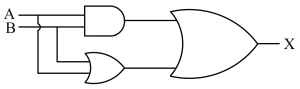
The behavior of the circuit is like which gate?
A
$OR$
B
$NOR$
C
$NAND$
D
$AND$
Solution
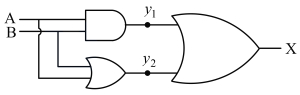
(A) Let the inputs be $A$ and $B$. The circuit consists of an $AND$ gate and an $OR$ gate whose outputs are fed into a final $OR$ gate.
Let the output of the $AND$ gate be $Y_1 = A \cdot B$.
Let the output of the first $OR$ gate be $Y_2 = A + B$.
The final output $X$ is the $OR$ operation of $Y_1$ and $Y_2$:
$X = Y_1 + Y_2 = (A \cdot B) + (A + B)$.
Using the Boolean identity $(A \cdot B) + A + B = A + B$,we get $X = A + B$.
Truth Table:
Since the output $X$ follows the truth table of an $OR$ gate,the circuit behaves like an $OR$ gate.
Let the output of the $AND$ gate be $Y_1 = A \cdot B$.
Let the output of the first $OR$ gate be $Y_2 = A + B$.
The final output $X$ is the $OR$ operation of $Y_1$ and $Y_2$:
$X = Y_1 + Y_2 = (A \cdot B) + (A + B)$.
Using the Boolean identity $(A \cdot B) + A + B = A + B$,we get $X = A + B$.
Truth Table:
| $A, B$ | $Y_1 = A \cdot B$ | $Y_2 = A + B$ | $X = Y_1 + Y_2$ |
| $0, 0$ | $0$ | $0$ | $0$ |
| $0, 1$ | $0$ | $1$ | $1$ |
| $1, 0$ | $0$ | $1$ | $1$ |
| $1, 1$ | $1$ | $1$ | $1$ |
Since the output $X$ follows the truth table of an $OR$ gate,the circuit behaves like an $OR$ gate.
0 likesView Solution
127
PhysicsEasyMCQTS EAMCET · 2022
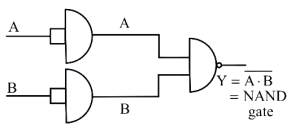
The output of the following circuit is equivalent to which gate?

A
$OR$
B
$AND$
C
$NOT$
D
$NAND$
Solution
(D) The given circuit consists of two buffers (or $NOT$ gates connected in series to act as buffers) followed by a $NAND$ gate.
$1$. The input $A$ passes through a buffer,so the output is $A$.
$2$. The input $B$ passes through a buffer,so the output is $B$.
$3$. These two outputs $A$ and $B$ are fed into a $NAND$ gate.
$4$. The output of a $NAND$ gate with inputs $A$ and $B$ is $Y = \overline{A \cdot B}$.
$5$. This is the definition of a $NAND$ gate.
Therefore,the circuit is equivalent to a $NAND$ gate.
$1$. The input $A$ passes through a buffer,so the output is $A$.
$2$. The input $B$ passes through a buffer,so the output is $B$.
$3$. These two outputs $A$ and $B$ are fed into a $NAND$ gate.
$4$. The output of a $NAND$ gate with inputs $A$ and $B$ is $Y = \overline{A \cdot B}$.
$5$. This is the definition of a $NAND$ gate.
Therefore,the circuit is equivalent to a $NAND$ gate.
0 likesView Solution
128
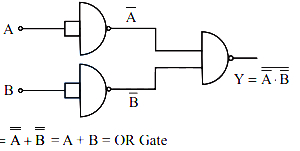
PhysicsEasyMCQTS EAMCET · 2022
Identify the logic gate from the following with the same truth table characteristics as the logic circuit shown below.
A
$NAND$
B
$NOR$
C
$AND$
D
$OR$
Solution
(D) The given circuit consists of two $NAND$ gates acting as $NOT$ gates (since their inputs are shorted) followed by a $NAND$ gate.
Let the inputs be $A$ and $B$.
The first two $NAND$ gates invert the inputs to produce $\bar{A}$ and $\bar{B}$.
The final $NAND$ gate takes these as inputs,so the output $Y$ is given by $Y = \overline{\bar{A} \cdot \bar{B}}$.
Using De Morgan's theorem,$\overline{\bar{A} \cdot \bar{B}} = \overline{\bar{A}} + \overline{\bar{B}} = A + B$.
This is the Boolean expression for an $OR$ gate.
Therefore,the circuit behaves as an $OR$ gate.
Let the inputs be $A$ and $B$.
The first two $NAND$ gates invert the inputs to produce $\bar{A}$ and $\bar{B}$.
The final $NAND$ gate takes these as inputs,so the output $Y$ is given by $Y = \overline{\bar{A} \cdot \bar{B}}$.
Using De Morgan's theorem,$\overline{\bar{A} \cdot \bar{B}} = \overline{\bar{A}} + \overline{\bar{B}} = A + B$.
This is the Boolean expression for an $OR$ gate.
Therefore,the circuit behaves as an $OR$ gate.
0 likesView Solution
129
PhysicsMediumMCQTS EAMCET · 2022
In a $p-$type semiconductor,which of the following statements is true?
A
Holes are majority carriers and trivalent atoms are the dopants
B
Electrons are minority carriers and pentavalent atoms are the dopants
C
Electrons are majority carriers and trivalent atoms are the dopants
D
Holes are minority carriers and pentavalent atoms are the dopants
Solution
(A) In a $p-$type semiconductor,trivalent impurities (such as Boron,Aluminum,etc.) are added to an intrinsic semiconductor.
These trivalent atoms create an excess of holes in the valence band.
Therefore,holes act as the majority charge carriers,while electrons act as the minority charge carriers.
These trivalent atoms create an excess of holes in the valence band.
Therefore,holes act as the majority charge carriers,while electrons act as the minority charge carriers.
0 likesView Solution
130
PhysicsEasyMCQTS EAMCET · 2022
The resistivity of a material is found to be $10^8 \Omega \cdot m$. Then the material would be
A
Only insulator
B
Only metal
C
Only semiconductor
D
Only superconductor
Solution
(A) The resistivity of materials is categorized as follows:
$1$. Conductors (Metals): $10^{-8} \Omega \cdot m$ to $10^{-6} \Omega \cdot m$.
$2$. Semiconductors: $10^{-5} \Omega \cdot m$ to $10^6 \Omega \cdot m$.
$3$. Insulators: $10^6 \Omega \cdot m$ to $10^{18} \Omega \cdot m$.
Given the resistivity of the material is $10^8 \Omega \cdot m$,which falls within the range of insulators.
Therefore,the material is an insulator.
$1$. Conductors (Metals): $10^{-8} \Omega \cdot m$ to $10^{-6} \Omega \cdot m$.
$2$. Semiconductors: $10^{-5} \Omega \cdot m$ to $10^6 \Omega \cdot m$.
$3$. Insulators: $10^6 \Omega \cdot m$ to $10^{18} \Omega \cdot m$.
Given the resistivity of the material is $10^8 \Omega \cdot m$,which falls within the range of insulators.
Therefore,the material is an insulator.
0 likesView Solution
131
PhysicsDifficultMCQTS EAMCET · 2022
The number of silicon atoms per $m^3$ is $5 \times 10^{28}$. This is doped with $4.5 \times 10^{21}$ atoms $/ m^3$ of Arsenic. The ratio of the number of electrons to the number of holes after doping is (Take $n_i = 1.5 \times 10^{16} / m^3$)
A
$4.5 \times 10^{12}$
B
$8 \times 10^{14}$
C
$9 \times 10^{10}$
D
$9 \times 10^{11}$
Solution
(C) Given that the concentration of donor atoms (Arsenic) is $N_D = 4.5 \times 10^{21} \ m^{-3}$.
Since Arsenic is a pentavalent impurity,the number of electrons $n_e \approx N_D = 4.5 \times 10^{21} \ m^{-3}$.
The intrinsic carrier concentration is $n_i = 1.5 \times 10^{16} \ m^{-3}$.
Using the law of mass action,$n_e \cdot n_h = n_i^2$,the number of holes $n_h$ is given by:
$n_h = \frac{n_i^2}{n_e} = \frac{(1.5 \times 10^{16})^2}{4.5 \times 10^{21}} = \frac{2.25 \times 10^{32}}{4.5 \times 10^{21}} = 0.5 \times 10^{11} = 5 \times 10^{10} \ m^{-3}$.
The ratio of the number of electrons to the number of holes is:
$\frac{n_e}{n_h} = \frac{4.5 \times 10^{21}}{5 \times 10^{10}} = 0.9 \times 10^{11} = 9 \times 10^{10}$.
Since Arsenic is a pentavalent impurity,the number of electrons $n_e \approx N_D = 4.5 \times 10^{21} \ m^{-3}$.
The intrinsic carrier concentration is $n_i = 1.5 \times 10^{16} \ m^{-3}$.
Using the law of mass action,$n_e \cdot n_h = n_i^2$,the number of holes $n_h$ is given by:
$n_h = \frac{n_i^2}{n_e} = \frac{(1.5 \times 10^{16})^2}{4.5 \times 10^{21}} = \frac{2.25 \times 10^{32}}{4.5 \times 10^{21}} = 0.5 \times 10^{11} = 5 \times 10^{10} \ m^{-3}$.
The ratio of the number of electrons to the number of holes is:
$\frac{n_e}{n_h} = \frac{4.5 \times 10^{21}}{5 \times 10^{10}} = 0.9 \times 10^{11} = 9 \times 10^{10}$.
0 likesView Solution
132
PhysicsEasyMCQTS EAMCET · 2022
In a $RC$ circuit,where $R$ is resistance and $C$ is capacitance,which of the following has the dimension of time?
A
$R/C$
B
$C/R$
C
$\sqrt{RC}$
D
$RC$
Solution
(D) In an $RC$ circuit,the charge $q$ on the capacitor at time $t$ is given by $q(t) = q_0(1 - e^{-t/RC})$.
Since the exponent of the exponential function must be dimensionless,the term $t/RC$ must be dimensionless.
Therefore,the dimensions of $RC$ must be equal to the dimensions of time $t$.
Thus,the time constant of an $RC$ circuit is $\tau = RC$,which has the dimension of time.
Since the exponent of the exponential function must be dimensionless,the term $t/RC$ must be dimensionless.
Therefore,the dimensions of $RC$ must be equal to the dimensions of time $t$.
Thus,the time constant of an $RC$ circuit is $\tau = RC$,which has the dimension of time.
0 likesView Solution
133
PhysicsEasyMCQTS EAMCET · 2022
Which of the following is the unit of mobility of an electron in a conductor?
A
$kg^{-1} \,s^2 \,A^{-1}$
B
$kg^{-1} \,s^2 \,A$
C
$kg^{-1} \,m \,s^2 \,A^{-1}$
D
$kg \,m \,s^{-1} \,A^{-1}$
Solution
(B) Mobility $\mu$ is defined as the ratio of drift velocity $v_d$ to the applied electric field $E$, given by the formula $\mu = \frac{e \tau}{m}$.
Here, $e$ is the charge (unit: $A \cdot s$), $\tau$ is the relaxation time (unit: $s$), and $m$ is the mass (unit: $kg$).
Substituting these units into the formula: $\text{Unit of } \mu = \frac{(A \cdot s) \cdot s}{kg} = \frac{A \cdot s^2}{kg}$.
This can be written as $kg^{-1} \,s^2 \,A$.
Here, $e$ is the charge (unit: $A \cdot s$), $\tau$ is the relaxation time (unit: $s$), and $m$ is the mass (unit: $kg$).
Substituting these units into the formula: $\text{Unit of } \mu = \frac{(A \cdot s) \cdot s}{kg} = \frac{A \cdot s^2}{kg}$.
This can be written as $kg^{-1} \,s^2 \,A$.
0 likesView Solution
134
PhysicsEasyMCQTS EAMCET · 2022
Which of the following interactions is responsible for beta decay?
A
Gravitational
B
Weak
C
Electromagnetic
D
Strong
Solution
(B) In nuclear physics,$\beta$-decay is a type of radioactive decay in which a beta particle (fast energetic electron or positron) is emitted from an atomic nucleus,transforming the original nuclide into an isobar of that nuclide.
Beta decay is a fundamental process governed by the weak nuclear force,which allows for the transmutation of quarks (e.g.,a down quark changing into an up quark) within nucleons.
Beta decay is a fundamental process governed by the weak nuclear force,which allows for the transmutation of quarks (e.g.,a down quark changing into an up quark) within nucleons.
0 likesView Solution
135
PhysicsDifficultMCQTS EAMCET · 2022
$A$ Young's double slit experiment apparatus has slits separated by $0.2 \ mm$ and a screen $60 \ cm$ away from the slits. The whole apparatus is immersed in a liquid medium of refractive index $\mu = \frac{11}{9}$ and the slits are illuminated with green light $(\lambda = 550 \ nm$ in vacuum$)$. Find the fringe width of the pattern formed on the screen. (in $mm$)
A
$0.95$
B
$1.25$
C
$1.35$
D
$1.45$
Solution
(C) When a light wave enters a medium of refractive index $\mu$,its wavelength becomes $\lambda^{\prime} = \frac{\lambda}{\mu}$.
Fringe width in $\text{YDSE}$ is given by $\beta = \frac{\lambda^{\prime} D}{d}$.
Given: $\lambda = 550 \times 10^{-9} \ m$,$D = 0.6 \ m$,$d = 0.2 \times 10^{-3} \ m$,and $\mu = \frac{11}{9}$.
Substituting the values:
$\beta = \frac{(\lambda / \mu) D}{d} = \frac{\lambda D}{\mu d} = \frac{550 \times 10^{-9} \times 0.6}{(11/9) \times 0.2 \times 10^{-3}}$.
$\beta = \frac{550 \times 10^{-9} \times 0.6 \times 9}{11 \times 0.2 \times 10^{-3}} = \frac{330 \times 10^{-9} \times 9}{2.2 \times 10^{-3}} = \frac{2970 \times 10^{-9}}{2.2 \times 10^{-3}} = 1350 \times 10^{-6} \ m = 1.35 \ mm$.
Fringe width in $\text{YDSE}$ is given by $\beta = \frac{\lambda^{\prime} D}{d}$.
Given: $\lambda = 550 \times 10^{-9} \ m$,$D = 0.6 \ m$,$d = 0.2 \times 10^{-3} \ m$,and $\mu = \frac{11}{9}$.
Substituting the values:
$\beta = \frac{(\lambda / \mu) D}{d} = \frac{\lambda D}{\mu d} = \frac{550 \times 10^{-9} \times 0.6}{(11/9) \times 0.2 \times 10^{-3}}$.
$\beta = \frac{550 \times 10^{-9} \times 0.6 \times 9}{11 \times 0.2 \times 10^{-3}} = \frac{330 \times 10^{-9} \times 9}{2.2 \times 10^{-3}} = \frac{2970 \times 10^{-9}}{2.2 \times 10^{-3}} = 1350 \times 10^{-6} \ m = 1.35 \ mm$.
0 likesView Solution
136
PhysicsMediumMCQTS EAMCET · 2022
The angular width of a fringe in a double slit experiment is found to be $0.2^{\circ}$ on a screen $1 \ m$ away. The wavelength of light used is $600 \ nm$. What is the change in the angular width of the fringe if the entire measurement system is immersed in water (in $^{\circ}$)? (Use refractive index of water as $\mu = \frac{4}{3}$)
A
$0.05$
B
$0.10$
C
$0.15$
D
$0.20$
Solution
(A) The angular fringe width $\beta_{\theta}$ is given by the formula $\beta_{\theta} = \frac{\lambda}{d}$,where $\lambda$ is the wavelength of light and $d$ is the slit separation.
Since $\beta_{\theta} \propto \lambda$,when the system is immersed in water,the wavelength changes to $\lambda' = \frac{\lambda}{\mu}$.
Therefore,the new angular width $\beta_{\theta}'$ is $\beta_{\theta}' = \frac{\beta_{\theta}}{\mu}$.
Given $\beta_{\theta} = 0.2^{\circ}$ and $\mu = \frac{4}{3}$,the new angular width is $\beta_{\theta}' = 0.2^{\circ} \times \frac{3}{4} = 0.15^{\circ}$.
The change in angular width is $\Delta \beta_{\theta} = \beta_{\theta} - \beta_{\theta}' = 0.2^{\circ} - 0.15^{\circ} = 0.05^{\circ}$.
Since $\beta_{\theta} \propto \lambda$,when the system is immersed in water,the wavelength changes to $\lambda' = \frac{\lambda}{\mu}$.
Therefore,the new angular width $\beta_{\theta}'$ is $\beta_{\theta}' = \frac{\beta_{\theta}}{\mu}$.
Given $\beta_{\theta} = 0.2^{\circ}$ and $\mu = \frac{4}{3}$,the new angular width is $\beta_{\theta}' = 0.2^{\circ} \times \frac{3}{4} = 0.15^{\circ}$.
The change in angular width is $\Delta \beta_{\theta} = \beta_{\theta} - \beta_{\theta}' = 0.2^{\circ} - 0.15^{\circ} = 0.05^{\circ}$.
0 likesView Solution
137
PhysicsEasyMCQTS EAMCET · 2022
In Young's double slit experiment,for what order $m$ does the $m^{\text{th}}$ order maximum of red light $(\lambda_1 = 780 \ nm)$ coincide with the $(m+1)^{\text{th}}$ order maximum of blue light $(\lambda_2 = 520 \ nm)$?
A
$1$
B
$2$
C
$3$
D
$4$
Solution
(B) The condition for the position of the $m^{\text{th}}$ order maximum in Young's double slit experiment is given by $y = \frac{m \lambda D}{d}$.
For the $m^{\text{th}}$ order of red light and $(m+1)^{\text{th}}$ order of blue light to coincide,their positions must be equal:
$y_{\text{red}} = y_{\text{blue}}$
$\frac{m \lambda_1 D}{d} = \frac{(m+1) \lambda_2 D}{d}$
$m \lambda_1 = (m+1) \lambda_2$
Substituting the given values:
$m(780 \ nm) = (m+1)(520 \ nm)$
$780m = 520m + 520$
$780m - 520m = 520$
$260m = 520$
$m = \frac{520}{260} = 2$
Thus,the $2^{\text{nd}}$ order of red light coincides with the $3^{\text{rd}}$ order of blue light.
For the $m^{\text{th}}$ order of red light and $(m+1)^{\text{th}}$ order of blue light to coincide,their positions must be equal:
$y_{\text{red}} = y_{\text{blue}}$
$\frac{m \lambda_1 D}{d} = \frac{(m+1) \lambda_2 D}{d}$
$m \lambda_1 = (m+1) \lambda_2$
Substituting the given values:
$m(780 \ nm) = (m+1)(520 \ nm)$
$780m = 520m + 520$
$780m - 520m = 520$
$260m = 520$
$m = \frac{520}{260} = 2$
Thus,the $2^{\text{nd}}$ order of red light coincides with the $3^{\text{rd}}$ order of blue light.
0 likesView Solution
138
PhysicsMediumMCQTS EAMCET · 2022
In a double-slit experiment performed in air,the angular width of a fringe is found to be $0.15^{\circ}$ on a screen placed $80 \ cm$ away. The wavelength of light used is $490 \ nm$. What is the angular width of the fringe if the entire apparatus is immersed in a medium of refractive index $\frac{5}{3}$ (in $^{\circ}$)?
A
$0.09$
B
$0.7$
C
$0.9$
D
$0.11$
Solution
(A) The angular width of a fringe in a double-slit experiment is given by $\theta = \frac{\lambda}{d}$,where $\lambda$ is the wavelength of light and $d$ is the slit separation.
Since $d$ remains constant,the angular width is directly proportional to the wavelength: $\theta \propto \lambda$.
When the apparatus is immersed in a medium of refractive index $\mu$,the wavelength of light changes to $\lambda' = \frac{\lambda}{\mu}$.
Therefore,the new angular width $\theta'$ is given by $\theta' = \frac{\theta}{\mu}$.
Given $\theta = 0.15^{\circ}$ and $\mu = \frac{5}{3}$,we have:
$\theta' = \frac{0.15^{\circ}}{5/3} = 0.15^{\circ} \times \frac{3}{5} = 0.03^{\circ} \times 3 = 0.09^{\circ}$.
Since $d$ remains constant,the angular width is directly proportional to the wavelength: $\theta \propto \lambda$.
When the apparatus is immersed in a medium of refractive index $\mu$,the wavelength of light changes to $\lambda' = \frac{\lambda}{\mu}$.
Therefore,the new angular width $\theta'$ is given by $\theta' = \frac{\theta}{\mu}$.
Given $\theta = 0.15^{\circ}$ and $\mu = \frac{5}{3}$,we have:
$\theta' = \frac{0.15^{\circ}}{5/3} = 0.15^{\circ} \times \frac{3}{5} = 0.03^{\circ} \times 3 = 0.09^{\circ}$.
0 likesView Solution
139
PhysicsMediumMCQTS EAMCET · 2022
In an interference pattern of Young's double slit experiment,at a point we observe the $12^{\text{th}}$ order maximum for a monochromatic light source with wavelength $6000 \ Å$. What order will be visible here if the source is replaced by a light of wavelength $4800 \ Å$?
A
$15$
B
$10$
C
$8$
D
$18$
Solution
(A) The position of the $n^{\text{th}}$ order maximum in Young's double slit experiment is given by the formula: $Y_n = \frac{n \lambda D}{d}$.
Since the position $Y_n$ remains the same for both light sources,we can equate the expressions:
$Y_n = \frac{n_1 \lambda_1 D}{d} = \frac{n_2 \lambda_2 D}{d}$.
This simplifies to: $n_1 \lambda_1 = n_2 \lambda_2$.
Given $n_1 = 12$,$\lambda_1 = 6000 \ Å$,and $\lambda_2 = 4800 \ Å$,we substitute these values:
$12 \times 6000 = n_2 \times 4800$.
$n_2 = \frac{12 \times 6000}{4800} = \frac{72000}{4800} = 15$.
Therefore,the $15^{\text{th}}$ order maximum will be visible at the same point.
Since the position $Y_n$ remains the same for both light sources,we can equate the expressions:
$Y_n = \frac{n_1 \lambda_1 D}{d} = \frac{n_2 \lambda_2 D}{d}$.
This simplifies to: $n_1 \lambda_1 = n_2 \lambda_2$.
Given $n_1 = 12$,$\lambda_1 = 6000 \ Å$,and $\lambda_2 = 4800 \ Å$,we substitute these values:
$12 \times 6000 = n_2 \times 4800$.
$n_2 = \frac{12 \times 6000}{4800} = \frac{72000}{4800} = 15$.
Therefore,the $15^{\text{th}}$ order maximum will be visible at the same point.
0 likesView Solution
140
PhysicsEasyMCQTS EAMCET · 2022
In a Young's double-slit experiment,if the distance between two slits is reduced by a factor of $2$ and the wavelength of light is increased $4$ times,then the distance between two consecutive maxima (fringe width) will become . . . . . . times the original value.
A
$2$
B
$4$
C
$8$
D
$16$
Solution
(C) The fringe width $\beta$ in a Young's double-slit experiment is given by the formula: $\beta = \frac{\lambda D}{d}$,where $\lambda$ is the wavelength,$D$ is the distance between the slits and the screen,and $d$ is the distance between the two slits.
From the formula,we can see that $\beta \propto \frac{\lambda}{d}$.
Let the initial fringe width be $\beta_1 = \frac{\lambda_1 D}{d_1}$.
According to the problem,the new wavelength $\lambda_2 = 4\lambda_1$ and the new slit distance $d_2 = \frac{d_1}{2}$.
The new fringe width $\beta_2$ is given by: $\beta_2 = \frac{\lambda_2 D}{d_2} = \frac{(4\lambda_1) D}{(d_1/2)} = 8 \times \frac{\lambda_1 D}{d_1} = 8\beta_1$.
Therefore,the distance between two maxima will become $8$ times the original value.
From the formula,we can see that $\beta \propto \frac{\lambda}{d}$.
Let the initial fringe width be $\beta_1 = \frac{\lambda_1 D}{d_1}$.
According to the problem,the new wavelength $\lambda_2 = 4\lambda_1$ and the new slit distance $d_2 = \frac{d_1}{2}$.
The new fringe width $\beta_2$ is given by: $\beta_2 = \frac{\lambda_2 D}{d_2} = \frac{(4\lambda_1) D}{(d_1/2)} = 8 \times \frac{\lambda_1 D}{d_1} = 8\beta_1$.
Therefore,the distance between two maxima will become $8$ times the original value.
0 likesView Solution
Vedclass Products
For Students
Vedclass Test Series
Mock tests in real TS EAMCET style covering Physics with performance analysis. 5-day free trial.
Start Free TrialFor Teachers
Exam Paper Generator
Generate Set A/B/C/D Physics papers from 7.5L+ questions in 2 minutes. 3 chapters free.
Try FreeFor Institutes
Online Exam Module
Run live TS EAMCET mock exams with unlimited students, 360° analytics & white-label branding.
See DemoFrequently Asked Questions
How many Physics questions are in TS EAMCET 2022?
There are 240 Physics questions from the TS EAMCET 2022 paper on Vedclass, each with a detailed step-by-step solution in English.
Are TS EAMCET 2022 Physics solutions available in English?
Yes. All solutions on this page are in English. You can also switch to English or Hindi using the language buttons above the questions.
Can I practice TS EAMCET 2022 Physics as a timed test?
Yes. Use the Vedclass Test Series to attempt a full TS EAMCET mock test covering Physics with time limits and instant score analysis.
Can teachers create Physics papers from TS EAMCET previous year questions?
Yes. The Vedclass Exam Paper Generator lets teachers mix TS EAMCET Physics questions and generate Set A/B/C/D papers in minutes.
For Teachers & Institutes
Build a Custom Physics Paper
Pick TS EAMCET 2022 Physics questions, set difficulty, and generate Set A/B/C/D in 2 minutes.