
ChemistryQ51–150 of 358 questions
Page 2 of 4 · English
51
ChemistryDifficultMCQTS EAMCET · 2020
$KMnO_4$ oxidises $C_2H_2O_4$ to form $CO_2$. In which of the following,the reaction will be faster?
A
Aq. $HCl$ solution
B
Aq. $NaOH$ solution
C
Aq. $NaCl$ solution
D
Aq. $NaHCO_3$ solution
Solution
(A) The reaction between $KMnO_4$ and oxalic acid $(C_2H_2O_4)$ is an autocatalytic reaction where $Mn^{2+}$ ions act as a catalyst.
This reaction proceeds faster in an acidic medium.
Among the given options,$HCl$ provides an acidic medium ($H^+$ ions),which facilitates the reduction of $KMnO_4$ and the subsequent formation of $Mn^{2+}$ ions,thereby accelerating the reaction.
In contrast,$NaOH$ and $NaHCO_3$ create basic conditions,which inhibit the reaction,and $NaCl$ is neutral.
This reaction proceeds faster in an acidic medium.
Among the given options,$HCl$ provides an acidic medium ($H^+$ ions),which facilitates the reduction of $KMnO_4$ and the subsequent formation of $Mn^{2+}$ ions,thereby accelerating the reaction.
In contrast,$NaOH$ and $NaHCO_3$ create basic conditions,which inhibit the reaction,and $NaCl$ is neutral.
0 likesView Solution
52
ChemistryDifficultMCQTS EAMCET · 2020
In the following reactions,identify $P, Q$ and $R$,respectively:
$I. 3Fe_2O_3 + CO \longrightarrow 2P + CO_2 \uparrow$
$II. Fe_3O_4 + 4CO \longrightarrow 3Q + 4CO_2 \uparrow$
$III. Fe_2O_3 + CO \longrightarrow 2R + CO_2 \uparrow$
$I. 3Fe_2O_3 + CO \longrightarrow 2P + CO_2 \uparrow$
$II. Fe_3O_4 + 4CO \longrightarrow 3Q + 4CO_2 \uparrow$
$III. Fe_2O_3 + CO \longrightarrow 2R + CO_2 \uparrow$
A
$P = Fe, Q = Fe_3O_4, R = FeO$
B
$P = Fe_3O_4, Q = FeO, R = Fe$
C
$P = Fe_3O_4, Q = Fe, R = FeO$
D
$P = FeO, Q = Fe_3O_4, R = Fe$
Solution
(C) By balancing the chemical equations:
$I. 3Fe_2O_3 + CO \longrightarrow 2Fe_3O_4 + CO_2 \uparrow$ (So,$P = Fe_3O_4$)
$II. Fe_3O_4 + 4CO \longrightarrow 3Fe + 4CO_2 \uparrow$ (So,$Q = Fe$)
$III. Fe_2O_3 + CO \longrightarrow 2FeO + CO_2 \uparrow$ (So,$R = FeO$)
Therefore,the correct option is $(c)$.
$I. 3Fe_2O_3 + CO \longrightarrow 2Fe_3O_4 + CO_2 \uparrow$ (So,$P = Fe_3O_4$)
$II. Fe_3O_4 + 4CO \longrightarrow 3Fe + 4CO_2 \uparrow$ (So,$Q = Fe$)
$III. Fe_2O_3 + CO \longrightarrow 2FeO + CO_2 \uparrow$ (So,$R = FeO$)
Therefore,the correct option is $(c)$.
0 likesView Solution
53
ChemistryEasyMCQTS EAMCET · 2020
The consequence of global warming may be the following:
A
Decrease in average temperature of the earth
B
Melting of Himalayan glaciers
C
Eutrophication
D
Increased biochemical oxygen demand
Solution
(B) Global warming refers to the steady temperature rise on our planet. It is the unusually rapid increase in Earth's average surface temperature over the past century,primarily due to greenhouse gases released by burning fossil fuels.
One of the major consequences of global warming is the melting of Himalayan glaciers,as glacier ice loss is directly linked to rising global temperatures.
One of the major consequences of global warming is the melting of Himalayan glaciers,as glacier ice loss is directly linked to rising global temperatures.
0 likesView Solution
54
ChemistryEasyMCQTS EAMCET · 2020
Which among the following is not a component of photochemical smog?
A
$NO_2$
B
Formaldehyde
C
$SO_2$
D
$O_3$
Solution
(C) Photochemical smog is formed by the action of sunlight on nitrogen oxides $(NO_x)$ and volatile organic compounds $(VOCs)$.
It typically contains $NO_2$,$O_3$,formaldehyde,acrolein,and peroxyacetyl nitrate $(PAN)$.
$SO_2$ is a primary component of classical (sulfurous) smog,not photochemical smog.
Therefore,$SO_2$ is not a component of photochemical smog.
It typically contains $NO_2$,$O_3$,formaldehyde,acrolein,and peroxyacetyl nitrate $(PAN)$.
$SO_2$ is a primary component of classical (sulfurous) smog,not photochemical smog.
Therefore,$SO_2$ is not a component of photochemical smog.
0 likesView Solution
55
ChemistryEasyMCQTS EAMCET · 2020
Which of the following is an air pollutant?
A
Pesticides
B
Phosphates
C
Biphenyls
D
Oxides of sulphur
Solution
(D) Oxides of sulphur are major air pollutants. For example,$H_2S$ is readily oxidised to $SO_2$ in the atmosphere.
$2H_2S + 3O_2 \rightarrow 2SO_2 + 2H_2O$
$H_2S + O_3 \rightarrow SO_2 + H_2O$
Thus,oxides of sulphur like $SO_2$ are significant contributors to air pollution.
$2H_2S + 3O_2 \rightarrow 2SO_2 + 2H_2O$
$H_2S + O_3 \rightarrow SO_2 + H_2O$
Thus,oxides of sulphur like $SO_2$ are significant contributors to air pollution.
0 likesView Solution
56
ChemistryEasyMCQTS EAMCET · 2020
Which of the following molecules is present in photochemical smog?
A
$SO_2$
B
$NO_2$
C
$CO_2$
D
$CO$
Solution
(B) Photochemical smog is a type of smog produced when ultraviolet light from the sun reacts with nitrogen oxides in the atmosphere.
It is visible as a brown haze and is most prominent during the morning and afternoon,especially in densely populated,warm cities.
Photochemical smog is a mixture of ozone,nitric acid,aldehydes,peroxyacyl nitrates $(PAN)$,and other secondary pollutants.
Among the given options,$NO_2$ is a primary precursor and a key component involved in the formation of photochemical smog.
Hence,the correct option is $B$.
It is visible as a brown haze and is most prominent during the morning and afternoon,especially in densely populated,warm cities.
Photochemical smog is a mixture of ozone,nitric acid,aldehydes,peroxyacyl nitrates $(PAN)$,and other secondary pollutants.
Among the given options,$NO_2$ is a primary precursor and a key component involved in the formation of photochemical smog.
Hence,the correct option is $B$.
0 likesView Solution
57
ChemistryEasyMCQTS EAMCET · 2020
The average atmospheric residence time is lowest for which of the given greenhouse gases?
A
Carbon dioxide
B
Methane
C
Nitrous oxide
D
Freon
Solution
(B) Atmospheric residence time is the average time a molecule spends in the atmosphere between its emission from a source and its removal by a sink.
Among the common greenhouse gases,$CH_4$ (Methane) has the shortest atmospheric residence time,typically estimated at approximately $12$ years.
In comparison,$CO_2$ (Carbon dioxide) has a residence time ranging from $50$ to $200$ years,$N_2O$ (Nitrous oxide) is about $114$ years,and $CFCs$ (Freons) can persist for decades to centuries.
Among the common greenhouse gases,$CH_4$ (Methane) has the shortest atmospheric residence time,typically estimated at approximately $12$ years.
In comparison,$CO_2$ (Carbon dioxide) has a residence time ranging from $50$ to $200$ years,$N_2O$ (Nitrous oxide) is about $114$ years,and $CFCs$ (Freons) can persist for decades to centuries.
0 likesView Solution
58
ChemistryEasyMCQTS EAMCET · 2020
Acid rain is mainly caused by the emissions of which of the following gases?
$I.$ Sulphur dioxide
$II.$ Carbon dioxide
$III.$ Nitrogen dioxide
$IV.$ Methane
$I.$ Sulphur dioxide
$II.$ Carbon dioxide
$III.$ Nitrogen dioxide
$IV.$ Methane
A
$I$ and $II$
B
$I, II$ and $III$
C
$I$ and $III$
D
$I, II, III$ and $IV$
Solution
(C) Acid rain is primarily caused by the presence of oxides of sulphur and nitrogen in the atmosphere.
These gases,specifically $SO_2$ and $NO_2$,react with water vapor in the atmosphere to form sulphuric acid $(H_2SO_4)$ and nitric acid $(HNO_3)$.
These acids then fall to the Earth's surface as acid rain.
Therefore,the correct combination is $I$ and $III$.
These gases,specifically $SO_2$ and $NO_2$,react with water vapor in the atmosphere to form sulphuric acid $(H_2SO_4)$ and nitric acid $(HNO_3)$.
These acids then fall to the Earth's surface as acid rain.
Therefore,the correct combination is $I$ and $III$.
0 likesView Solution
59
ChemistryEasyMCQTS EAMCET · 2020
Biochemical oxygen demand $(BOD)$ is a measure of organic materials present in water. $A$ $BOD$ value less than $5 \ ppm$ indicates a water sample to be:
A
rich in dissolved oxygen
B
poor in dissolved oxygen
C
highly polluted
D
not suitable for aquatic life
Solution
(A) The amount of oxygen required by bacteria to break down the organic matter present in a certain volume of a sample of water is called biochemical oxygen demand $(BOD)$.
$BOD$ is a measure of the amount of organic material in water in terms of the oxygen required to break it down biologically.
Clean water typically has a $BOD$ value of less than $5 \ ppm$,whereas highly polluted water can have a $BOD$ value of $17 \ ppm$ or more.
Therefore,a $BOD$ value less than $5 \ ppm$ indicates that the water sample is clean and rich in dissolved oxygen.
$BOD$ is a measure of the amount of organic material in water in terms of the oxygen required to break it down biologically.
Clean water typically has a $BOD$ value of less than $5 \ ppm$,whereas highly polluted water can have a $BOD$ value of $17 \ ppm$ or more.
Therefore,a $BOD$ value less than $5 \ ppm$ indicates that the water sample is clean and rich in dissolved oxygen.
0 likesView Solution
60
ChemistryMCQTS EAMCET · 2020
If $y = \frac{3}{4} + \frac{3 \cdot 5}{4 \cdot 8} + \frac{3 \cdot 5 \cdot 7}{4 \cdot 8 \cdot 12} + \ldots \infty$,then:
A
$y^2 - 2y + 5 = 0$
B
$y^2 + 2y - 7 = 0$
C
$y^2 - 3y + 4 = 0$
D
$y^2 + 4y - 6 = 0$
Solution
(B) Given the series: $y = \frac{3}{4} + \frac{3 \cdot 5}{4 \cdot 8} + \frac{3 \cdot 5 \cdot 7}{4 \cdot 8 \cdot 12} + \ldots \infty$.
Adding $1$ to both sides: $1 + y = 1 + \frac{3}{4} + \frac{3 \cdot 5}{4 \cdot 8} + \frac{3 \cdot 5 \cdot 7}{4 \cdot 8 \cdot 12} + \ldots \infty$.
Using the binomial expansion $(1 - x)^{-n} = 1 + nx + \frac{n(n+1)}{2!}x^2 + \ldots$,where $n = \frac{3}{2}$ and $x = \frac{1}{2}$,we have:
$1 + y = (1 - \frac{1}{2})^{-\frac{3}{2}} = (\frac{1}{2})^{-\frac{3}{2}} = 2^{\frac{3}{2}} = \sqrt{8} = 2\sqrt{2}$.
Squaring both sides: $(1 + y)^2 = (2\sqrt{2})^2$.
$1 + y^2 + 2y = 8$.
$y^2 + 2y - 7 = 0$.
Adding $1$ to both sides: $1 + y = 1 + \frac{3}{4} + \frac{3 \cdot 5}{4 \cdot 8} + \frac{3 \cdot 5 \cdot 7}{4 \cdot 8 \cdot 12} + \ldots \infty$.
Using the binomial expansion $(1 - x)^{-n} = 1 + nx + \frac{n(n+1)}{2!}x^2 + \ldots$,where $n = \frac{3}{2}$ and $x = \frac{1}{2}$,we have:
$1 + y = (1 - \frac{1}{2})^{-\frac{3}{2}} = (\frac{1}{2})^{-\frac{3}{2}} = 2^{\frac{3}{2}} = \sqrt{8} = 2\sqrt{2}$.
Squaring both sides: $(1 + y)^2 = (2\sqrt{2})^2$.
$1 + y^2 + 2y = 8$.
$y^2 + 2y - 7 = 0$.
0 likesView Solution
61
ChemistryMCQTS EAMCET · 2020
$A$ vector $\vec{a}$ has components $2p$ and $1$ with respect to a two-dimensional rectangular Cartesian system. This system is rotated through a certain angle $\theta$ about the origin in the counter-clockwise direction. If $\vec{a}$ has components $p+1$ and $1$ with respect to the new system,then:
A
$p=1$ or $p=\frac{-1}{3}$
B
$p=-1$ or $p=\frac{1}{3}$
C
$p=1$ or $p=-1$
D
$p=0$ or $p=\frac{1}{2}$
Solution
(A) The magnitude of a vector remains invariant under the rotation of the coordinate system about the origin.
Given the initial components are $(2p, 1)$,the squared magnitude is $(2p)^2 + 1^2 = 4p^2 + 1$.
Given the new components are $(p+1, 1)$,the squared magnitude is $(p+1)^2 + 1^2 = p^2 + 2p + 1 + 1 = p^2 + 2p + 2$.
Equating the squared magnitudes:
$4p^2 + 1 = p^2 + 2p + 2$
$3p^2 - 2p - 1 = 0$
$(3p + 1)(p - 1) = 0$
Thus,$p = 1$ or $p = \frac{-1}{3}$.
Given the initial components are $(2p, 1)$,the squared magnitude is $(2p)^2 + 1^2 = 4p^2 + 1$.
Given the new components are $(p+1, 1)$,the squared magnitude is $(p+1)^2 + 1^2 = p^2 + 2p + 1 + 1 = p^2 + 2p + 2$.
Equating the squared magnitudes:
$4p^2 + 1 = p^2 + 2p + 2$
$3p^2 - 2p - 1 = 0$
$(3p + 1)(p - 1) = 0$
Thus,$p = 1$ or $p = \frac{-1}{3}$.
0 likesView Solution
62
ChemistryMCQTS EAMCET · 2020
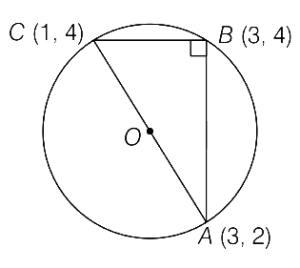
If the parametric equations of the circle passing through the points $(3,4), (3,2)$ and $(1,4)$ are $x=a+r \cos \theta$ and $y=b+r \sin \theta$,then find the value of $b^a r^a$.
A
$27$
B
$18$
C
$9$
D
$54$
Solution
(B) Let the points be $A(3,2)$,$B(3,4)$,and $C(1,4)$.
Since the line segment $AB$ is vertical $(x=3)$ and $BC$ is horizontal $(y=4)$,the angle $\angle ABC = 90^\circ$.
Thus,$AC$ is the diameter of the circle.
The center of the circle $O(a,b)$ is the midpoint of $AC$:
$a = \frac{3+1}{2} = 2$,$b = \frac{2+4}{2} = 3$.
The radius $r$ is the distance from the center $(2,3)$ to any point,e.g.,$A(3,2)$:
$r = \sqrt{(3-2)^2 + (2-3)^2} = \sqrt{1^2 + (-1)^2} = \sqrt{2}$.
We need to find $b^a r^a$:
$b^a r^a = 3^2 \cdot (\sqrt{2})^2 = 9 \cdot 2 = 18$.
Since the line segment $AB$ is vertical $(x=3)$ and $BC$ is horizontal $(y=4)$,the angle $\angle ABC = 90^\circ$.
Thus,$AC$ is the diameter of the circle.
The center of the circle $O(a,b)$ is the midpoint of $AC$:
$a = \frac{3+1}{2} = 2$,$b = \frac{2+4}{2} = 3$.
The radius $r$ is the distance from the center $(2,3)$ to any point,e.g.,$A(3,2)$:
$r = \sqrt{(3-2)^2 + (2-3)^2} = \sqrt{1^2 + (-1)^2} = \sqrt{2}$.
We need to find $b^a r^a$:
$b^a r^a = 3^2 \cdot (\sqrt{2})^2 = 9 \cdot 2 = 18$.
0 likesView Solution
63
ChemistryMediumMCQTS EAMCET · 2020
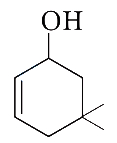
The $IUPAC$ name of the following compound is
A
$5, 5-$dimethylcyclohex$-2-$en$-1-$ol
B
$4, 4-$dimethylcyclohex$-1-$en$-2-$ol
C
$3, 3-$dimethylcyclohex$-5-$en$-1-$ol
D
$3, 3-$dimethylcyclohex$-1-$en$-5-$ol
Solution
(A) $1$. Identify the principal functional group: The $-OH$ group is the principal functional group,so the carbon attached to it is assigned position $1$.
$2$. Number the ring: Number the ring to give the lowest possible locants to the double bond and substituents. Starting from the carbon with $-OH$ as $1$,we move towards the double bond to give it the lowest number. Thus,the double bond starts at position $2$.
$3$. Locate substituents: The two methyl groups are at position $5$.
$4$. Combine the parts: The parent chain is a cyclohexene ring. With the $-OH$ at $1$,the double bond at $2$,and two methyl groups at $5$,the $IUPAC$ name is $5, 5-$dimethylcyclohex$-2-$en$-1-$ol.
$2$. Number the ring: Number the ring to give the lowest possible locants to the double bond and substituents. Starting from the carbon with $-OH$ as $1$,we move towards the double bond to give it the lowest number. Thus,the double bond starts at position $2$.
$3$. Locate substituents: The two methyl groups are at position $5$.
$4$. Combine the parts: The parent chain is a cyclohexene ring. With the $-OH$ at $1$,the double bond at $2$,and two methyl groups at $5$,the $IUPAC$ name is $5, 5-$dimethylcyclohex$-2-$en$-1-$ol.
0 likesView Solution
64
ChemistryMCQTS EAMCET · 2020
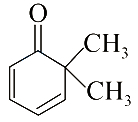
Which of the following carbonyl compounds will exhibit enolization?
$(i)$
$(ii)$
$(iii)$
$(iv)$
$(v)$
$(i)$
$(ii)$
$(iii)$
$(iv)$
$(v)$
A
$(i)$, $(ii)$ and $(iii)$
B
$(ii)$, $(iii)$ and $(iv)$
C
$(iii)$, $(iv)$ and $(v)$
D
$(i)$, $(iii)$ and $(v)$
Solution
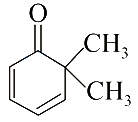
For the enolization carbonyl compound, the carbonyl compound must contain at least one $\alpha-H$.
Compounds $(i)$, $(v)$ have no $\alpha-hydrogen$ so these compounds will not show enolization.
Compounds $(ii)$, $(iii)$, $(iv)$ have $\alpha-hydrogen$ so these compounds will show enolization.
$(i)$
$(ii)$
$(iii)$
$(iv)$
$(v)$
$(i)$ compound $= 0 (\alpha-H)$
$(ii)$ compound $= 2 (\alpha-H)$
$(iii)$ compound $= 5 (\alpha-H)$
$(iv)$ compound $= 2 (\alpha-H)$
$(v)$ compound $= 0 (\alpha-H)$
Compounds $(i)$, $(v)$ have no $\alpha-hydrogen$ so these compounds will not show enolization.
Compounds $(ii)$, $(iii)$, $(iv)$ have $\alpha-hydrogen$ so these compounds will show enolization.
$(i)$
$(ii)$
$(iii)$
$(iv)$
$(v)$
$(i)$ compound $= 0 (\alpha-H)$
$(ii)$ compound $= 2 (\alpha-H)$
$(iii)$ compound $= 5 (\alpha-H)$
$(iv)$ compound $= 2 (\alpha-H)$
$(v)$ compound $= 0 (\alpha-H)$
0 likesView Solution
65
ChemistryMediumMCQTS EAMCET · 2020
The correct order of the relative stability of the following carbanions is:
$I$. $HC \equiv C^{-}$
$II$. $CH_2=CH-CH_2^{-}$
$III$. $H_2C=CH^{-}$
$IV$. $(C_6H_5)_2CH^{-}$
$I$. $HC \equiv C^{-}$
$II$. $CH_2=CH-CH_2^{-}$
$III$. $H_2C=CH^{-}$
$IV$. $(C_6H_5)_2CH^{-}$
A
$I > IV > II > III$
B
$III > IV > I > II$
C
$IV > II > I > III$
D
$IV > I > II > III$
Solution
(C) The stability of carbanions is determined by factors such as resonance,hybridization,and inductive effects.
$IV$. $(C_6H_5)_2CH^{-}$: This carbanion is highly stable due to extensive resonance with two phenyl rings and the delocalization of the negative charge.
$II$. $CH_2=CH-CH_2^{-}$: This is an allylic carbanion,which is stabilized by resonance (conjugation of the negative charge with the double bond).
$I$. $HC \equiv C^{-}$: This is an $sp$-hybridized carbanion. The higher $s$-character $(50\%)$ makes the carbon more electronegative,thus stabilizing the negative charge.
$III$. $H_2C=CH^{-}$: This is an $sp^2$-hybridized carbanion. It has less $s$-character $(33.3\%)$ compared to the $sp$-hybridized carbanion,making it less stable than $I$.
Comparing these,the order of stability is $IV > II > I > III$.
$IV$. $(C_6H_5)_2CH^{-}$: This carbanion is highly stable due to extensive resonance with two phenyl rings and the delocalization of the negative charge.
$II$. $CH_2=CH-CH_2^{-}$: This is an allylic carbanion,which is stabilized by resonance (conjugation of the negative charge with the double bond).
$I$. $HC \equiv C^{-}$: This is an $sp$-hybridized carbanion. The higher $s$-character $(50\%)$ makes the carbon more electronegative,thus stabilizing the negative charge.
$III$. $H_2C=CH^{-}$: This is an $sp^2$-hybridized carbanion. It has less $s$-character $(33.3\%)$ compared to the $sp$-hybridized carbanion,making it less stable than $I$.
Comparing these,the order of stability is $IV > II > I > III$.
0 likesView Solution
66
ChemistryDifficultMCQTS EAMCET · 2020
The order of circled $C-H$ bond dissociation energy in the following compounds is:
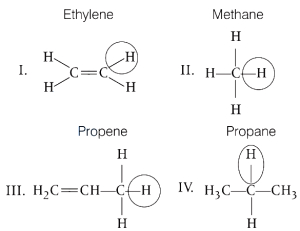
A
$II > I > IV > III$
B
$IV > III > I > II$
C
$I > II > IV > III$
D
$I > IV > II > III$
Solution
(C) The bond dissociation energy $(BDE)$ of a $C-H$ bond is inversely proportional to the stability of the free radical formed after homolytic cleavage of that bond.
$1.$ Ethylene $(I)$: The radical formed is a vinyl radical $(CH_2=CH^{\bullet})$,where the unpaired electron is in an $sp^2$ orbital. This is highly unstable.
$2.$ Methane $(II)$: The radical formed is a methyl radical $(CH_3^{\bullet})$.
$3.$ Propene $(III)$: The radical formed is an allyl radical $(CH_2=CH-CH_2^{\bullet})$,which is resonance stabilized and thus the most stable.
$4.$ Propane $(IV)$: The radical formed is an isopropyl radical $((CH_3)_2CH^{\bullet})$,which is stabilized by hyperconjugation.
Stability order of radicals: Allyl $(III)$ > Isopropyl $(IV)$ > Methyl $(II)$ > Vinyl $(I)$.
Since $BDE \propto \frac{1}{\text{Stability of radical}}$,the order of $BDE$ is: $I > II > IV > III$.
$1.$ Ethylene $(I)$: The radical formed is a vinyl radical $(CH_2=CH^{\bullet})$,where the unpaired electron is in an $sp^2$ orbital. This is highly unstable.
$2.$ Methane $(II)$: The radical formed is a methyl radical $(CH_3^{\bullet})$.
$3.$ Propene $(III)$: The radical formed is an allyl radical $(CH_2=CH-CH_2^{\bullet})$,which is resonance stabilized and thus the most stable.
$4.$ Propane $(IV)$: The radical formed is an isopropyl radical $((CH_3)_2CH^{\bullet})$,which is stabilized by hyperconjugation.
Stability order of radicals: Allyl $(III)$ > Isopropyl $(IV)$ > Methyl $(II)$ > Vinyl $(I)$.
Since $BDE \propto \frac{1}{\text{Stability of radical}}$,the order of $BDE$ is: $I > II > IV > III$.
0 likesView Solution
67
ChemistryDifficultMCQTS EAMCET · 2020
How many geometrical isomers are possible for the compound with molecular formula $C_2FClBrI$?
A
Four
B
Five
C
Six
D
Eight
Solution
(C) The compound $C_2FClBrI$ corresponds to a substituted ethene where each carbon atom is bonded to two different halogen atoms.
For an alkene of the type $abcC=Cde$,the number of geometrical isomers is determined by the arrangement of groups around the double bond.
Since all four substituents $(F, Cl, Br, I)$ are different,we can fix the position of one atom (e.g.,$F$) on the first carbon and permute the others.
Specifically,for $C_2FClBrI$,the number of geometrical isomers is $3! = 6$.
The six possible isomers are shown in the provided image.
Thus,there are $6$ geometrical isomers possible.
Therefore,option $(c)$ is the correct answer.
For an alkene of the type $abcC=Cde$,the number of geometrical isomers is determined by the arrangement of groups around the double bond.
Since all four substituents $(F, Cl, Br, I)$ are different,we can fix the position of one atom (e.g.,$F$) on the first carbon and permute the others.
Specifically,for $C_2FClBrI$,the number of geometrical isomers is $3! = 6$.
The six possible isomers are shown in the provided image.
Thus,there are $6$ geometrical isomers possible.
Therefore,option $(c)$ is the correct answer.
0 likesView Solution
68
ChemistryEasyMCQTS EAMCET · 2020
Which one of the following methods is suitable to separate a mixture of $n$-pentane and toluene?
A
Steam distillation
B
Simple distillation
C
Sublimation
D
Vacuum distillation
Solution
(B) $n$-Pentane (boiling point $\approx 36 \ ^\circ C$) and toluene (boiling point $\approx 111 \ ^\circ C$) are miscible liquids with a significant difference in their boiling points.
Simple distillation is used to separate liquids that have a difference in boiling points of more than $20-25 \ K$ and are stable at their boiling temperatures.
Since the boiling point difference between $n$-pentane and toluene is large,simple distillation is the suitable method for their separation.
Simple distillation is used to separate liquids that have a difference in boiling points of more than $20-25 \ K$ and are stable at their boiling temperatures.
Since the boiling point difference between $n$-pentane and toluene is large,simple distillation is the suitable method for their separation.
0 likesView Solution
69
ChemistryMediumMCQTS EAMCET · 2020
Sodium fusion extract of aniline,when heated with ferrous sulphate solution and then acidified with concentrated $H_2SO_4$,forms which of the following complexes?
A
$\left[Fe(CN)_6\right]^{4-}$
B
$Fe_4\left[Fe(CN)_6\right]_3 \cdot x H_2O$
C
$[Fe(SCN)]^{2+}$
D
$\left[Fe(CN)_5NOS\right]^{4-}$
Solution
(B) The carbon and nitrogen present in the organic compound,upon fusion with sodium metal,form sodium cyanide $(NaCN)$,which is soluble in water.
This is converted into sodium ferrocyanide by the addition of a sufficient quantity of ferrous sulphate.
Ferric ions generated during the process react with ferrocyanide to form the Prussian blue precipitate of ferric ferrocyanide.
The Prussian blue colour is due to the formation of ferric ferrocyanide,$Fe_4\left[Fe(CN)_6\right]_3 \cdot xH_2O$.
Reaction:
$(i) Fe^{2+} + 6CN^{-} \longrightarrow \left[Fe(CN)_6\right]^{4-}$ (Hexacyanoferrate$(II)$)
$(ii) Fe^{2+} \xrightarrow[Conc. H_2SO_4]{} Fe^{3+} + e^{-}$
$(iii) 3\left[Fe(CN)_6\right]^{4-} + 4Fe^{3+} \longrightarrow Fe_4\left[Fe(CN)_6\right]_3 \cdot xH_2O$
This is converted into sodium ferrocyanide by the addition of a sufficient quantity of ferrous sulphate.
Ferric ions generated during the process react with ferrocyanide to form the Prussian blue precipitate of ferric ferrocyanide.
The Prussian blue colour is due to the formation of ferric ferrocyanide,$Fe_4\left[Fe(CN)_6\right]_3 \cdot xH_2O$.
Reaction:
$(i) Fe^{2+} + 6CN^{-} \longrightarrow \left[Fe(CN)_6\right]^{4-}$ (Hexacyanoferrate$(II)$)
$(ii) Fe^{2+} \xrightarrow[Conc. H_2SO_4]{} Fe^{3+} + e^{-}$
$(iii) 3\left[Fe(CN)_6\right]^{4-} + 4Fe^{3+} \longrightarrow Fe_4\left[Fe(CN)_6\right]_3 \cdot xH_2O$
0 likesView Solution
70
ChemistryMediumMCQTS EAMCET · 2020
During the course of estimating nitrogen using Kjeldahl's method,the organic compound is heated with
A
conc. $HCl$
B
dil. $H_2SO_4$
C
conc. $H_2SO_4$
D
conc. $HI$
Solution
(C) In the Kjeldahl's method for the estimation of nitrogen,the organic compound is heated with concentrated $H_2SO_4$ in the presence of a catalyst like $CuSO_4$ and $K_2SO_4$.
This process converts the nitrogen present in the organic compound into ammonium sulphate,$(NH_4)_2SO_4$.
This process converts the nitrogen present in the organic compound into ammonium sulphate,$(NH_4)_2SO_4$.
0 likesView Solution
71
ChemistryDifficultMCQTS EAMCET · 2020
The maximum number of bromine atoms present in the final product $P$ upon complete bromination is
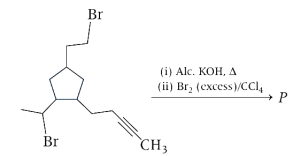
A
$4$
B
$6$
C
$10$
D
$8$
Solution
(D) Step $1$: Dehydrohalogenation using $Alc. KOH/\Delta$ (E2 elimination). The starting material has two $-Br$ groups. Elimination of two moles of $HBr$ results in the formation of two double bonds: one terminal vinyl group $(-CH=CH_2)$ and one exocyclic double bond ($-C(CH_3)=CH_2$ is not formed,rather the double bond forms between the ring and the side chain). Wait,looking at the structure,the elimination creates a vinyl group and an exocyclic double bond. The alkyne remains unaffected.
Step $2$: Electrophilic addition of excess $Br_2/CCl_4$. The molecule now contains one terminal alkene,one exocyclic alkene,and one internal alkyne.
- The terminal alkene adds $1$ mole of $Br_2$ ($2$ $Br$ atoms).
- The exocyclic alkene adds $1$ mole of $Br_2$ ($2$ $Br$ atoms).
- The internal alkyne adds $2$ moles of $Br_2$ ($4$ $Br$ atoms).
Total $Br$ atoms added = $2 + 2 + 4 = 8$ atoms.
Including the $2$ $Br$ atoms already present in the starting material is incorrect as the question asks for the number of bromine atoms in the final product $P$. Counting the structure of $P$ in the solution image: there are $2$ $Br$ on the terminal side chain,$2$ $Br$ on the ring,$4$ $Br$ on the alkyne side chain. Total = $8$ atoms.
Step $2$: Electrophilic addition of excess $Br_2/CCl_4$. The molecule now contains one terminal alkene,one exocyclic alkene,and one internal alkyne.
- The terminal alkene adds $1$ mole of $Br_2$ ($2$ $Br$ atoms).
- The exocyclic alkene adds $1$ mole of $Br_2$ ($2$ $Br$ atoms).
- The internal alkyne adds $2$ moles of $Br_2$ ($4$ $Br$ atoms).
Total $Br$ atoms added = $2 + 2 + 4 = 8$ atoms.
Including the $2$ $Br$ atoms already present in the starting material is incorrect as the question asks for the number of bromine atoms in the final product $P$. Counting the structure of $P$ in the solution image: there are $2$ $Br$ on the terminal side chain,$2$ $Br$ on the ring,$4$ $Br$ on the alkyne side chain. Total = $8$ atoms.
0 likesView Solution
72
ChemistryMediumMCQTS EAMCET · 2020
When $CH_3Br$ and $C_2H_5Br$ are subjected to Wurtz reaction,the maximum number of possible alkane product$(s)$ formed is/are
A
$1$
B
$2$
C
$3$
D
$4$
Solution
(C) The Wurtz reaction involves the coupling of alkyl halides in the presence of sodium metal and dry ether to form higher alkanes.
When a mixture of $CH_3Br$ and $C_2H_5Br$ is used,the following free radicals are generated: $CH_3^{\bullet}$ and $C_2H_5^{\bullet}$.
These radicals combine in all possible ways:
$1$. $CH_3^{\bullet} + CH_3^{\bullet} \rightarrow CH_3-CH_3$ (Ethane)
$2$. $C_2H_5^{\bullet} + C_2H_5^{\bullet} \rightarrow C_2H_5-C_2H_5$ ($n$-Butane)
$3$. $CH_3^{\bullet} + C_2H_5^{\bullet} \rightarrow CH_3-C_2H_5$ (Propane)
Thus,a total of $3$ different alkane products are formed.
When a mixture of $CH_3Br$ and $C_2H_5Br$ is used,the following free radicals are generated: $CH_3^{\bullet}$ and $C_2H_5^{\bullet}$.
These radicals combine in all possible ways:
$1$. $CH_3^{\bullet} + CH_3^{\bullet} \rightarrow CH_3-CH_3$ (Ethane)
$2$. $C_2H_5^{\bullet} + C_2H_5^{\bullet} \rightarrow C_2H_5-C_2H_5$ ($n$-Butane)
$3$. $CH_3^{\bullet} + C_2H_5^{\bullet} \rightarrow CH_3-C_2H_5$ (Propane)
Thus,a total of $3$ different alkane products are formed.
0 likesView Solution
73
ChemistryMediumMCQTS EAMCET · 2020
Which one of the following reactions gives the product with a lesser number of carbon atoms than the starting material?
A
$R - X \xrightarrow{Na, \text{ Ether}}$
B
$RCO_2Na \xrightarrow[\Delta]{NaOH, CaO}$
C
$RCO_2K \xrightarrow{\text{Electrolysis}}$
D
$R - X \xrightarrow{Zn, HCl}$
Solution
(B) The reaction of the sodium salt of a carboxylic acid $(RCOONa)$ with soda lime $(NaOH + CaO)$ is known as decarboxylation.
In this process,a molecule of $CO_2$ is removed as $Na_2CO_3$,resulting in an alkane with one carbon atom less than the starting carboxylic acid.
The reaction is: $RCOONa + NaOH \xrightarrow{CaO, \Delta} R-H + Na_2CO_3$.
Other options like Wurtz reaction $(R-X + Na)$ or Kolbe electrolysis increase the carbon chain length.
In this process,a molecule of $CO_2$ is removed as $Na_2CO_3$,resulting in an alkane with one carbon atom less than the starting carboxylic acid.
The reaction is: $RCOONa + NaOH \xrightarrow{CaO, \Delta} R-H + Na_2CO_3$.
Other options like Wurtz reaction $(R-X + Na)$ or Kolbe electrolysis increase the carbon chain length.
0 likesView Solution
74
ChemistryEasyMCQTS EAMCET · 2020
Which one of the following methods is suitable to generate aromatic compound$(s)$ from linear aliphatic saturated hydrocarbons with at least six carbon atoms?
A
Heating at $773 \ K$
B
$Mo_2O_3, 773 \ K, 10-20 \ atm$
C
Anhyd. $AlCl_3$,conc. $HCl, \Delta$
D
$Cu, 523 \ K, 100 \ atm$
Solution
(B) Linear alkanes containing $6$ or more carbon atoms undergo cyclization and aromatization when heated at $773 \ K$ under $10-20 \ atm$ pressure in the presence of catalysts like $Cr_2O_3$,$V_2O_5$,or $Mo_2O_3$ supported over alumina. This process is known as aromatization or reforming. For example,$n$-hexane gives benzene under these conditions.
0 likesView Solution
75
ChemistryMediumMCQTS EAMCET · 2020
Ethyl phenyl acetylene ($1$-phenyl-but-$1$-yne) on reduction with partially deactivated palladised charcoal (Lindlar's catalyst) gives:
A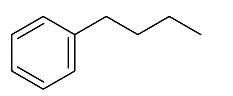
B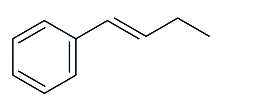
C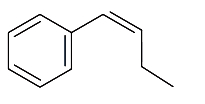
D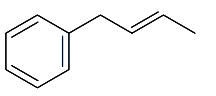
Solution
(C) Lindlar catalyst is a partially deactivated catalyst composed of $BaSO_4$ coated with $Pd$ poisoned with quinoline.
It reduces $(C \equiv C)$ to $(C=C)$ bond,occurs via syn-addition,and gives a $cis$-alkene.
For $1$-phenyl-but-$1$-yne $(C_2H_5-C \equiv C-C_6H_5)$,the reduction yields $cis$-$1$-phenyl-but-$1$-ene,which corresponds to option $C$.
It reduces $(C \equiv C)$ to $(C=C)$ bond,occurs via syn-addition,and gives a $cis$-alkene.
For $1$-phenyl-but-$1$-yne $(C_2H_5-C \equiv C-C_6H_5)$,the reduction yields $cis$-$1$-phenyl-but-$1$-ene,which corresponds to option $C$.
0 likesView Solution
76
ChemistryMediumMCQTS EAMCET · 2020
The reaction of $2-$methylbuta$-1,3-$diene with $O_3$ followed by $Zn-H_2O$ gives:
A
$CH_3COCH_3 + 2CO_2$
B
$CH_3COCHO + HCHO$
C
$CH_3COCHO + 2HCOOH$
D
$CH_3COOH + 3HCOOH$
Solution
(B) Ozonolysis of $2-$methylbuta$-1,3-$diene $(CH_2=C(CH_3)-CH=CH_2)$ involves the cleavage of both double bonds.
Reductive ozonolysis using $O_3$ followed by $Zn-H_2O$ converts the alkene carbons into carbonyl groups (aldehydes or ketones).
The reaction proceeds as follows:
$CH_2=C(CH_3)-CH=CH_2 \xrightarrow[Zn-H_2O]{O_3} HCHO + CH_3COCHO + HCHO$
Thus,the products are $HCHO$ (formaldehyde) and $CH_3COCHO$ (methylglyoxal).
Therefore,option $(b)$ is correct.
Reductive ozonolysis using $O_3$ followed by $Zn-H_2O$ converts the alkene carbons into carbonyl groups (aldehydes or ketones).
The reaction proceeds as follows:
$CH_2=C(CH_3)-CH=CH_2 \xrightarrow[Zn-H_2O]{O_3} HCHO + CH_3COCHO + HCHO$
Thus,the products are $HCHO$ (formaldehyde) and $CH_3COCHO$ (methylglyoxal).
Therefore,option $(b)$ is correct.
0 likesView Solution
77
ChemistryEasyMCQTS EAMCET · 2020
Which of the following can be used as the test for unsaturation with regard to colour change of reaction?
A
Addition of hydrogen
B
Addition of hydrogen bromide
C
Addition of hypobromous acid
D
Addition of bromine
Solution
(D) Addition of bromine can be used as the test for unsaturation with regard to colour change of reaction.
For example,when an unsaturated compound reacts with $Br_2$,the reddish-brown colour of $Br_2$ rapidly disappears.
This process is known as the decolourisation of bromine water.
For example,when an unsaturated compound reacts with $Br_2$,the reddish-brown colour of $Br_2$ rapidly disappears.
This process is known as the decolourisation of bromine water.
0 likesView Solution
78
ChemistryDifficultMCQTS EAMCET · 2020
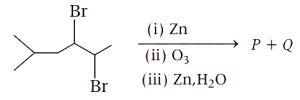
The major products $P$ and $Q$ in the following reaction sequence are:
A
| $P$ | $Q$ |
|---|---|
| $3$-methylpentanol | Ethanol |
B
| $P$ | $Q$ |
|---|---|
| $3$-methylpentanal | Ethanal |
C
| $P$ | $Q$ |
|---|---|
| $3$-methylbutanol | Ethanol |
D
| $P$ | $Q$ |
|---|---|
| $3$-methylbutanal | Ethanal |
Solution
(D) Step $1$: Debromination of $2,3$-dibromo-$5$-methylhexane with $Zn$ dust leads to the formation of $5$-methylhex-$2$-ene.
Step $2$: Ozonolysis $(O_3)$ of $5$-methylhex-$2$-ene forms an ozonide intermediate.
Step $3$: Reductive hydrolysis of the ozonide with $Zn/H_2O$ cleaves the double bond to yield two carbonyl compounds.
The reaction is: $(CH_3)_2CH-CH_2-CH=CH-CH_3 + O_3 \rightarrow (CH_3)_2CH-CH_2-CHO + CH_3-CHO$.
Thus,the products are $3$-methylbutanal $(P)$ and ethanal $(Q)$.
Step $2$: Ozonolysis $(O_3)$ of $5$-methylhex-$2$-ene forms an ozonide intermediate.
Step $3$: Reductive hydrolysis of the ozonide with $Zn/H_2O$ cleaves the double bond to yield two carbonyl compounds.
The reaction is: $(CH_3)_2CH-CH_2-CH=CH-CH_3 + O_3 \rightarrow (CH_3)_2CH-CH_2-CHO + CH_3-CHO$.
Thus,the products are $3$-methylbutanal $(P)$ and ethanal $(Q)$.
0 likesView Solution
79
ChemistryMediumMCQTS EAMCET · 2020
The correct order of reactivity of hydrogen halides with propene is
A
$HCl > HBr > HI$
B
$HBr > HI > HCl$
C
$HI > HBr > HCl$
D
$HCl > HI > HBr$
Solution
(C) The reaction of propene with hydrogen halides $(HX)$ is an electrophilic addition reaction.
In this reaction,the rate-determining step involves the protonation of the alkene by the hydrogen halide.
The reactivity of hydrogen halides depends on the strength of the $H-X$ bond.
The bond dissociation energy decreases in the order $HCl > HBr > HI$.
Therefore,$HI$ is the most reactive because it has the weakest $H-X$ bond,making it the easiest to break to provide a proton $(H^+)$.
The correct order of reactivity is $HI > HBr > HCl$.
In this reaction,the rate-determining step involves the protonation of the alkene by the hydrogen halide.
The reactivity of hydrogen halides depends on the strength of the $H-X$ bond.
The bond dissociation energy decreases in the order $HCl > HBr > HI$.
Therefore,$HI$ is the most reactive because it has the weakest $H-X$ bond,making it the easiest to break to provide a proton $(H^+)$.
The correct order of reactivity is $HI > HBr > HCl$.
0 likesView Solution
80
ChemistryMediumMCQTS EAMCET · 2020
The major products $P$ and $Q$ from the below reactions are :
$CH_3CH=CH_2 \xrightarrow{HBr} P$
$CH_3CH=CH_2 \xrightarrow[(BH_3)_2]{H_2O, H_2O_2 / OH^-} Q$
$CH_3CH=CH_2 \xrightarrow{HBr} P$
$CH_3CH=CH_2 \xrightarrow[(BH_3)_2]{H_2O, H_2O_2 / OH^-} Q$
A
| $P$ | $Q$ |
|---|---|
| $CH_3CH(Br)CH_3$ | $CH_3CH(OH)CH_3$ |
B
| $P$ | $Q$ |
|---|---|
| $CH_3CH(Br)CH_3$ | $CH_3CH_2CH_2OH$ |
C
| $P$ | $Q$ |
|---|---|
| $CH_3CH_2CH_2Br$ | $CH_3CH_2CH_2OH$ |
D
| $P$ | $Q$ |
|---|---|
| $CH_3CH_2CH_2Br$ | $CH_3CH_2COOH$ |
Solution
(B) In the given reactions:
$1$. $CH_3CH=CH_2 \xrightarrow{HBr} CH_3CH(Br)CH_3$ $(P)$
This is an electrophilic addition reaction following Markovnikov's rule,where the nucleophile $(Br^-)$ attaches to the more substituted carbon.
$2$. $CH_3CH=CH_2 \xrightarrow[(BH_3)_2]{H_2O, H_2O_2 / OH^-} CH_3CH_2CH_2OH$ $(Q)$
This is a hydroboration-oxidation reaction,which follows anti-Markovnikov's rule,resulting in the anti-Markovnikov addition of water ($H$ and $OH$) across the double bond.
Therefore,the correct products are $P = CH_3CH(Br)CH_3$ and $Q = CH_3CH_2CH_2OH$.
$1$. $CH_3CH=CH_2 \xrightarrow{HBr} CH_3CH(Br)CH_3$ $(P)$
This is an electrophilic addition reaction following Markovnikov's rule,where the nucleophile $(Br^-)$ attaches to the more substituted carbon.
$2$. $CH_3CH=CH_2 \xrightarrow[(BH_3)_2]{H_2O, H_2O_2 / OH^-} CH_3CH_2CH_2OH$ $(Q)$
This is a hydroboration-oxidation reaction,which follows anti-Markovnikov's rule,resulting in the anti-Markovnikov addition of water ($H$ and $OH$) across the double bond.
Therefore,the correct products are $P = CH_3CH(Br)CH_3$ and $Q = CH_3CH_2CH_2OH$.
0 likesView Solution
81
ChemistryMediumMCQTS EAMCET · 2020
The reaction of one mole of $3-$ethyl$-3-$methylpenta$-1, 4-$diene with $O_3$ and then with $Zn / H_2O$,gives
A
$2$ moles of $HCHO$ and $1$ mole of $H_3C-C(C_2H_5)(CH_3)-CHO$
B
$1$ mole of $CH_3CHO$,$1$ mole of $HCHO$ and $1$ mole of $H-C(CH_3)(C_2H_5)-CHO$
C
$2$ moles of $CH_3CHO$ and $1$ mole of $OHC-C(C_2H_5)(CH_3)-CHO$
D
$2$ moles of $HCHO$ and $1$ mole of $OHC-C(CH_3)(C_2H_5)-CHO$
Solution
(D) The given compound is $3-$ethyl$-3-$methylpenta$-1, 4-$diene. Its structure is $CH_2=CH-C(CH_3)(C_2H_5)-CH=CH_2$.
Ozonolysis followed by reductive workup $(Zn/H_2O)$ cleaves the double bonds and replaces them with carbonyl groups.
Cleaving the two terminal double bonds $(CH_2=)$ results in the formation of $2$ moles of formaldehyde $(HCHO)$.
The remaining central part of the molecule becomes a dicarbonyl compound: $OHC-C(CH_3)(C_2H_5)-CHO$.
Thus,the products are $2$ moles of $HCHO$ and $1$ mole of $2-$ethyl$-2-$methylpropanedial.
Ozonolysis followed by reductive workup $(Zn/H_2O)$ cleaves the double bonds and replaces them with carbonyl groups.
Cleaving the two terminal double bonds $(CH_2=)$ results in the formation of $2$ moles of formaldehyde $(HCHO)$.
The remaining central part of the molecule becomes a dicarbonyl compound: $OHC-C(CH_3)(C_2H_5)-CHO$.
Thus,the products are $2$ moles of $HCHO$ and $1$ mole of $2-$ethyl$-2-$methylpropanedial.
0 likesView Solution
82
ChemistryEasyMCQTS EAMCET · 2020
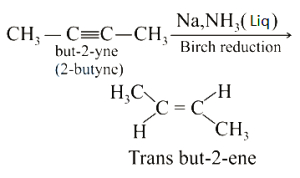
The major product formed in the following reaction is $CH_3-C \equiv C-CH_3 + Na \xrightarrow{liquid \ NH_3}$
A
$trans-but-2-ene$
B
$cis-but-2-ene$
C
$but-1-ene$
D
$2-methylpropene$
Solution
(A) The reaction of an internal alkyne with an alkali metal (like $Na$ or $Li$) in liquid $NH_3$ is known as a dissolving metal reduction or Birch-type reduction of alkynes.
This reaction proceeds via a radical anion intermediate and stereoselectively yields the $trans$-alkene as the major product due to the greater stability of the $trans$-vinyl radical intermediate.
Therefore,the reduction of $but-2-yne$ $(CH_3-C \equiv C-CH_3)$ with $Na/liquid \ NH_3$ produces $trans-but-2-ene$.
This reaction proceeds via a radical anion intermediate and stereoselectively yields the $trans$-alkene as the major product due to the greater stability of the $trans$-vinyl radical intermediate.
Therefore,the reduction of $but-2-yne$ $(CH_3-C \equiv C-CH_3)$ with $Na/liquid \ NH_3$ produces $trans-but-2-ene$.
0 likesView Solution
83
ChemistryDifficultMCQTS EAMCET · 2020
The major product formed in the following reaction sequence is:
$C_6H_5-CHBr-CH_2Br$ $\xrightarrow[(ii) NaNH_2]{(i) alc. KOH}$ $\xrightarrow[(iii) \text{Red hot iron tube}, 873 K]{}$
$C_6H_5-CHBr-CH_2Br$ $\xrightarrow[(ii) NaNH_2]{(i) alc. KOH}$ $\xrightarrow[(iii) \text{Red hot iron tube}, 873 K]{}$
A
$1,2-$diphenylbenzene
B
$1,2,4-$triphenylbenzene
C
$1,3,5-$triphenylbenzene
D
$1,2,3-$triphenylbenzene
Solution
(C) Step $1$: Dehydrohalogenation of $C_6H_5-CHBr-CH_2Br$ with $alc. KOH$ followed by $NaNH_2$ leads to the formation of phenylacetylene $(C_6H_5-C \equiv CH)$.
Step $2$: The cyclic trimerization of phenylacetylene occurs when passed through a red hot iron tube at $873 \ K$.
Step $3$: The trimerization of $C_6H_5-C \equiv CH$ yields $1,3,5-triphenylbenzene$ as the major product due to steric hindrance,which favors the meta-substituted product.
Step $2$: The cyclic trimerization of phenylacetylene occurs when passed through a red hot iron tube at $873 \ K$.
Step $3$: The trimerization of $C_6H_5-C \equiv CH$ yields $1,3,5-triphenylbenzene$ as the major product due to steric hindrance,which favors the meta-substituted product.
0 likesView Solution
84
ChemistryDifficultMCQTS EAMCET · 2020
The major product $P$ formed in the following reaction is:
A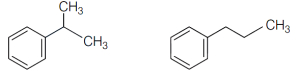
B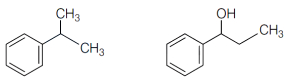
C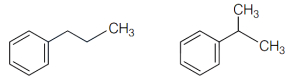
D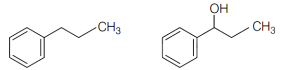
Solution
(A) The reaction of benzene with $n$-propyl chloride $(CH_3CH_2CH_2Cl)$ in the presence of anhydrous $AlCl_3$ is a Friedel-Crafts alkylation reaction.
In this reaction,the primary carbocation $(CH_3CH_2CH_2^+)$ formed initially is unstable and undergoes a $1,2-$hydride shift to form a more stable secondary carbocation $(CH_3CH^+CH_3)$.
This secondary carbocation then attacks the benzene ring to form isopropylbenzene (cumene) as the major product $P$.
In this reaction,the primary carbocation $(CH_3CH_2CH_2^+)$ formed initially is unstable and undergoes a $1,2-$hydride shift to form a more stable secondary carbocation $(CH_3CH^+CH_3)$.
This secondary carbocation then attacks the benzene ring to form isopropylbenzene (cumene) as the major product $P$.
0 likesView Solution
85
ChemistryDifficultMCQTS EAMCET · 2020
$A$ benzene derivative did not produce a white precipitate with ammoniacal silver nitrate solution (Tollens' reagent) but decolorized cold dilute alkaline $KMnO_4$ solution (Baeyer's reagent). The compound is:
A
$C_8H_6$
B
$C_8H_{10}$
C
$C_8H_8$
D
$C_7H_8$
Solution
(C) The compound is $C_8H_8$ (Styrene).
$1$. Ammoniacal silver nitrate (Tollens' reagent) reacts with terminal alkynes to form a white precipitate. Since the compound does not produce this precipitate,it does not contain a terminal $-C \equiv CH$ group.
$2$. Cold dilute alkaline $KMnO_4$ (Baeyer's reagent) is a test for unsaturation (alkenes or alkynes). Decolorization indicates the presence of a double or triple bond.
$3$. Styrene $(C_6H_5-CH=CH_2)$ has the molecular formula $C_8H_8$. It contains a double bond,which reacts with $KMnO_4$ to decolorize it,but it lacks a terminal alkyne group,so it does not react with Tollens' reagent.
$1$. Ammoniacal silver nitrate (Tollens' reagent) reacts with terminal alkynes to form a white precipitate. Since the compound does not produce this precipitate,it does not contain a terminal $-C \equiv CH$ group.
$2$. Cold dilute alkaline $KMnO_4$ (Baeyer's reagent) is a test for unsaturation (alkenes or alkynes). Decolorization indicates the presence of a double or triple bond.
$3$. Styrene $(C_6H_5-CH=CH_2)$ has the molecular formula $C_8H_8$. It contains a double bond,which reacts with $KMnO_4$ to decolorize it,but it lacks a terminal alkyne group,so it does not react with Tollens' reagent.
0 likesView Solution
86
ChemistryMediumMCQTS EAMCET · 2020
Dihydrogen can be prepared by which of the following reactions?
$(I)$ Reaction of granulated $Zn$ with dil. $HCl$
$(II)$ Reaction of $Zn$ with aq. $NaOH$
$(III)$ By heating calcium hydrogen carbonate
$(I)$ Reaction of granulated $Zn$ with dil. $HCl$
$(II)$ Reaction of $Zn$ with aq. $NaOH$
$(III)$ By heating calcium hydrogen carbonate
A
$(I)$ and $(III)$
B
$(I)$,$(II)$ and $(III)$
C
$(I)$ and $(II)$
D
$(II)$ and $(III)$
Solution
(C) $I$. $Zn + 2HCl \ (dil.) \longrightarrow ZnCl_2 + H_2 \uparrow$
$II$. $Zn + 2NaOH \ (aq.) \longrightarrow Na_2ZnO_2 + H_2 \uparrow$
$III$. Heating calcium hydrogen carbonate $\left[Ca(HCO_3)_2\right]$ results in:
$Ca(HCO_3)_2 \stackrel{\Delta}{\longrightarrow} CaCO_3 + CO_2 + H_2O$
Since reaction $(III)$ does not produce $H_2$,only reactions $(I)$ and $(II)$ produce dihydrogen.
$II$. $Zn + 2NaOH \ (aq.) \longrightarrow Na_2ZnO_2 + H_2 \uparrow$
$III$. Heating calcium hydrogen carbonate $\left[Ca(HCO_3)_2\right]$ results in:
$Ca(HCO_3)_2 \stackrel{\Delta}{\longrightarrow} CaCO_3 + CO_2 + H_2O$
Since reaction $(III)$ does not produce $H_2$,only reactions $(I)$ and $(II)$ produce dihydrogen.
0 likesView Solution
87
ChemistryMediumMCQTS EAMCET · 2020
Hydrogen peroxide is stored away from light because it can get decomposed when exposed to light as:
A
$H_2O$ and $O_2$
B
$H_2$ and $O_2$
C
$H_2O$ and $H_2$
D
$H_2O$ and $O_3$
Solution
(A) Hydrogen peroxide $(H_2O_2)$ is an unstable compound.
When exposed to light,it undergoes decomposition to form water $(H_2O)$ and oxygen gas $(O_2)$.
The balanced chemical equation for this decomposition is: $2 H_2O_2(aq) \rightarrow 2 H_2O(l) + O_2(g)$.
Therefore,it is stored in dark-colored bottles away from light to prevent this decomposition.
When exposed to light,it undergoes decomposition to form water $(H_2O)$ and oxygen gas $(O_2)$.
The balanced chemical equation for this decomposition is: $2 H_2O_2(aq) \rightarrow 2 H_2O(l) + O_2(g)$.
Therefore,it is stored in dark-colored bottles away from light to prevent this decomposition.
0 likesView Solution
88
ChemistryMediumMCQTS EAMCET · 2020
What is the $\%$ strength of $22.4$ volume of $H_2O_2$ solution (in $\%$)?
A
$3.4$
B
$2.5$
C
$5$
D
$6.8$
Solution
(D) $22.4$ volume $H_2O_2$ means $1 \ mL$ of $H_2O_2$ solution gives $22.4 \ mL$ of $O_2$ at $NTP$.
$\therefore 22400 \ mL$ of $O_2$ is obtained by $68 \ g$ of $H_2O_2$.
$\therefore 22.4 \ mL$ of $O_2$ is obtained by $\frac{68 \times 22.4}{22400} = 0.068 \ g$ of $H_2O_2$.
Since $1 \ mL$ of $H_2O_2$ solution contains $0.068 \ g$ of $H_2O_2$,
$\therefore 100 \ mL$ of $H_2O_2$ solution contains $0.068 \times 100 = 6.8 \ g$ of $H_2O_2$.
Thus,the strength is $6.8 \%$.
| $2H_2O_2 \longrightarrow 2H_2O + O_2$ | $2 \ mol \longrightarrow 1 \ mol$ |
| $68 \ g$ | $22400 \ mL$ at $NTP$ |
$\therefore 22400 \ mL$ of $O_2$ is obtained by $68 \ g$ of $H_2O_2$.
$\therefore 22.4 \ mL$ of $O_2$ is obtained by $\frac{68 \times 22.4}{22400} = 0.068 \ g$ of $H_2O_2$.
Since $1 \ mL$ of $H_2O_2$ solution contains $0.068 \ g$ of $H_2O_2$,
$\therefore 100 \ mL$ of $H_2O_2$ solution contains $0.068 \times 100 = 6.8 \ g$ of $H_2O_2$.
Thus,the strength is $6.8 \%$.
0 likesView Solution
89
ChemistryMediumMCQTS EAMCET · 2020
With reference to the redox properties of hydrogen peroxide $(H_2O_2)$,which of these reactions are feasible?
$(I)$ $2Fe^{2+} + 2H^{+} + H_2O_2 \longrightarrow 2Fe^{3+} + 2H_2O$
$(II)$ $2MnO_4^{-} + 6H^{+} + 5H_2O_2 \longrightarrow 2Mn^{2+} + 8H_2O + 5O_2$
$(III)$ $2Fe^{2+} + H_2O_2 \longrightarrow 2Fe^{3+} + 2OH^{-}$
$(IV)$ $2MnO_4^{-} + 3H_2O_2 \longrightarrow 2MnO_2 + 2H_2O + 3O_2 + 2OH^{-}$
$(I)$ $2Fe^{2+} + 2H^{+} + H_2O_2 \longrightarrow 2Fe^{3+} + 2H_2O$
$(II)$ $2MnO_4^{-} + 6H^{+} + 5H_2O_2 \longrightarrow 2Mn^{2+} + 8H_2O + 5O_2$
$(III)$ $2Fe^{2+} + H_2O_2 \longrightarrow 2Fe^{3+} + 2OH^{-}$
$(IV)$ $2MnO_4^{-} + 3H_2O_2 \longrightarrow 2MnO_2 + 2H_2O + 3O_2 + 2OH^{-}$
A
$(I)$ and $(II)$
B
$(II)$ and $(IV)$
C
$(I)$,$(II)$,$(III)$ and $(IV)$
D
$(II)$,$(III)$ and $(IV)$
Solution
(C) $H_2O_2$ acts as both an oxidizing and a reducing agent.
$1.$ Oxidizing action:
In acidic medium: $H_2O_2 + 2H^{+} + 2e^{-} \longrightarrow 2H_2O$. Reaction $(I)$ is a standard oxidation of $Fe^{2+}$ to $Fe^{3+}$ by $H_2O_2$ in acidic medium.
$2.$ Reducing action:
In acidic medium: $H_2O_2 \longrightarrow 2H^{+} + O_2 + 2e^{-}$. Reaction $(II)$ is a standard reduction of $MnO_4^{-}$ to $Mn^{2+}$ by $H_2O_2$ in acidic medium.
$3.$ In alkaline medium:
$H_2O_2$ can act as an oxidizing agent: $H_2O_2 + 2e^{-} \longrightarrow 2OH^{-}$. Reaction $(III)$ represents the oxidation of $Fe^{2+}$ to $Fe^{3+}$ in basic conditions.
$H_2O_2$ can act as a reducing agent: $H_2O_2 + 2OH^{-} \longrightarrow 2H_2O + O_2 + 2e^{-}$. Reaction $(IV)$ represents the reduction of $MnO_4^{-}$ to $MnO_2$ in basic conditions.
Since all four reactions represent valid redox processes involving $H_2O_2$ in their respective media,all are feasible.
$1.$ Oxidizing action:
In acidic medium: $H_2O_2 + 2H^{+} + 2e^{-} \longrightarrow 2H_2O$. Reaction $(I)$ is a standard oxidation of $Fe^{2+}$ to $Fe^{3+}$ by $H_2O_2$ in acidic medium.
$2.$ Reducing action:
In acidic medium: $H_2O_2 \longrightarrow 2H^{+} + O_2 + 2e^{-}$. Reaction $(II)$ is a standard reduction of $MnO_4^{-}$ to $Mn^{2+}$ by $H_2O_2$ in acidic medium.
$3.$ In alkaline medium:
$H_2O_2$ can act as an oxidizing agent: $H_2O_2 + 2e^{-} \longrightarrow 2OH^{-}$. Reaction $(III)$ represents the oxidation of $Fe^{2+}$ to $Fe^{3+}$ in basic conditions.
$H_2O_2$ can act as a reducing agent: $H_2O_2 + 2OH^{-} \longrightarrow 2H_2O + O_2 + 2e^{-}$. Reaction $(IV)$ represents the reduction of $MnO_4^{-}$ to $MnO_2$ in basic conditions.
Since all four reactions represent valid redox processes involving $H_2O_2$ in their respective media,all are feasible.
0 likesView Solution
90
ChemistryEasyMCQTS EAMCET · 2020
Match the following methods for treating hardness of water with their corresponding reagents used.
The correct match is:
| List-$I$ | List-$II$ |
|---|---|
| $A$. Treatment with washing soda | $I$. $Ca(OH)_2$ |
| $B$. Calgon's method | $II$. $Na_2CO_3$ |
| $C$. Clark's method | $III$. $NaAlSiO_4$ |
| $D$. Zeolite/permutit process | $IV$. $Na_6P_6O_{18}$ |
The correct match is:
A
$A-II, B-I, C-III, D-IV$
B
$A-II, B-IV, C-I, D-III$
C
$A-III, B-II, C-IV, D-I$
D
$A-II, B-III, C-IV, D-I$
Solution
(B) The correct matches are as follows:
$(A)$ Treatment with washing soda uses $Na_2CO_3$ to precipitate calcium and magnesium ions as carbonates. Thus,$A-II$.
$(B)$ Calgon's method uses sodium hexametaphosphate,$Na_6P_6O_{18}$,which is known as Calgon. Thus,$B-IV$.
$(C)$ Clark's method involves the addition of calculated amounts of lime,$Ca(OH)_2$,to remove temporary hardness. Thus,$C-I$.
$(D)$ Zeolite/permutit process uses hydrated sodium aluminium silicate,$NaAlSiO_4$ (often represented as $Na_2Ze$),for ion exchange. Thus,$D-III$.
Therefore,the correct sequence is $A-II, B-IV, C-I, D-III$.
$(A)$ Treatment with washing soda uses $Na_2CO_3$ to precipitate calcium and magnesium ions as carbonates. Thus,$A-II$.
$(B)$ Calgon's method uses sodium hexametaphosphate,$Na_6P_6O_{18}$,which is known as Calgon. Thus,$B-IV$.
$(C)$ Clark's method involves the addition of calculated amounts of lime,$Ca(OH)_2$,to remove temporary hardness. Thus,$C-I$.
$(D)$ Zeolite/permutit process uses hydrated sodium aluminium silicate,$NaAlSiO_4$ (often represented as $Na_2Ze$),for ion exchange. Thus,$D-III$.
Therefore,the correct sequence is $A-II, B-IV, C-I, D-III$.
0 likesView Solution
91
ChemistryEasyMCQTS EAMCET · 2020
Hard water contains ions of
A
zinc
B
magnesium and calcium
C
iron
D
iron and manganese
Solution
(B) Hard water is defined as water that does not produce lather with soap.
Hardness is primarily due to the presence of dissolved bicarbonates,chlorides,and sulphates of $Ca^{2+}$ and $Mg^{2+}$ ions.
The reaction with soap (sodium stearate) is:
$M^{2+} + 2C_{17}H_{35}COONa \longrightarrow (C_{17}H_{35}COO)_2M + 2Na^+$
(where $M = Ca^{2+}, Mg^{2+}$).
These ions react with soap to form insoluble precipitates of calcium and magnesium salts of fatty acids,preventing the formation of lather.
Hardness is primarily due to the presence of dissolved bicarbonates,chlorides,and sulphates of $Ca^{2+}$ and $Mg^{2+}$ ions.
The reaction with soap (sodium stearate) is:
$M^{2+} + 2C_{17}H_{35}COONa \longrightarrow (C_{17}H_{35}COO)_2M + 2Na^+$
(where $M = Ca^{2+}, Mg^{2+}$).
These ions react with soap to form insoluble precipitates of calcium and magnesium salts of fatty acids,preventing the formation of lather.
0 likesView Solution
92
ChemistryEasyMCQTS EAMCET · 2020
At atmospheric pressure and very low temperature,water crystallises to
A
hexagonal form
B
cubic form
C
tetragonal form
D
tetrahedral form
Solution
(B) At atmospheric pressure,ice crystallises in the hexagonal form.
However,at very low temperatures (below $200 \ K$),water condenses into the cubic form.
However,at very low temperatures (below $200 \ K$),water condenses into the cubic form.
0 likesView Solution
93
ChemistryEasyMCQTS EAMCET · 2020
What will be the organic compound formed when aluminium carbide reacts with deuterated water?
A
$CD_3OD$
B
$DCOOD$
C
$CD_4$
D
$D_3C^{-}O^{-}CD_3$
Solution
(C) Aluminium carbide $(Al_4C_3)$ reacts with deuterated water $(D_2O)$ to produce aluminium deuteroxide $(Al(OD)_3)$ and deutero-methane $(CD_4)$.
The balanced chemical equation for the reaction is:
$Al_4C_3 + 12 D_2O \longrightarrow 4 Al(OD)_3 + 3 CD_4$
Thus,the organic compound formed is $CD_4$.
The balanced chemical equation for the reaction is:
$Al_4C_3 + 12 D_2O \longrightarrow 4 Al(OD)_3 + 3 CD_4$
Thus,the organic compound formed is $CD_4$.
0 likesView Solution
94
ChemistryMediumMCQTS EAMCET · 2020
When calcium carbide is reacted with heavy water,which of the following product$(s)$ will be formed?
$I$. $CD_4$
$II$. $C_2D_2$
$III$. $Ca(OD)_2$
$IV$. $Ca_2 \cdot D_2O$
$I$. $CD_4$
$II$. $C_2D_2$
$III$. $Ca(OD)_2$
$IV$. $Ca_2 \cdot D_2O$
A
$I$ and $IV$
B
$II$ and $III$
C
$I$,$II$ and $III$
D
$I$,$II$,$III$ and $IV$
Solution
(B) Calcium carbide $(CaC_2)$ is an ionic carbide containing the acetylide ion $[C \equiv C]^{2-}$.
When it reacts with heavy water $(D_2O)$,it undergoes hydrolysis to form deuterated acetylene and calcium deuteroxide.
The chemical reaction is:
$CaC_2 + 2D_2O \rightarrow C_2D_2 + Ca(OD)_2$
From the reaction,the products formed are $C_2D_2$ (labeled as $II$) and $Ca(OD)_2$ (labeled as $III$).
When it reacts with heavy water $(D_2O)$,it undergoes hydrolysis to form deuterated acetylene and calcium deuteroxide.
The chemical reaction is:
$CaC_2 + 2D_2O \rightarrow C_2D_2 + Ca(OD)_2$
From the reaction,the products formed are $C_2D_2$ (labeled as $II$) and $Ca(OD)_2$ (labeled as $III$).
0 likesView Solution
95
ChemistryMCQTS EAMCET · 2020
The perimeter of a $\triangle ABC$ is $6$ times the arithmetic mean of the sine of its angles. If its side $BC$ is of unit length,then $\angle A=$
A
$\frac{\pi}{6}$
B
$\frac{\pi}{3}$
C
$\frac{\pi}{2}$
D
$\pi$
Solution
(A) Given that the side length $a = BC = 1$ unit. The perimeter of the triangle is $a + b + c$. The arithmetic mean of the sines of its angles is $\frac{\sin A + \sin B + \sin C}{3}$.
According to the problem,$a + b + c = 6 \times \frac{\sin A + \sin B + \sin C}{3}$.
This simplifies to $a + b + c = 2(\sin A + \sin B + \sin C)$.
Using the sine rule,$a = 2R \sin A$,$b = 2R \sin B$,and $c = 2R \sin C$,where $R$ is the circumradius.
Substituting these into the equation: $2R(\sin A + \sin B + \sin C) = 2(\sin A + \sin B + \sin C)$.
Since $\sin A + \sin B + \sin C \neq 0$ for a triangle,we get $2R = 2$,which implies $R = 1$.
From the sine rule,$\frac{a}{\sin A} = 2R$.
Substituting $a = 1$ and $R = 1$,we get $\frac{1}{\sin A} = 2(1) = 2$.
Therefore,$\sin A = \frac{1}{2}$,which gives $A = \frac{\pi}{6}$ (since $A$ is an angle of a triangle).
According to the problem,$a + b + c = 6 \times \frac{\sin A + \sin B + \sin C}{3}$.
This simplifies to $a + b + c = 2(\sin A + \sin B + \sin C)$.
Using the sine rule,$a = 2R \sin A$,$b = 2R \sin B$,and $c = 2R \sin C$,where $R$ is the circumradius.
Substituting these into the equation: $2R(\sin A + \sin B + \sin C) = 2(\sin A + \sin B + \sin C)$.
Since $\sin A + \sin B + \sin C \neq 0$ for a triangle,we get $2R = 2$,which implies $R = 1$.
From the sine rule,$\frac{a}{\sin A} = 2R$.
Substituting $a = 1$ and $R = 1$,we get $\frac{1}{\sin A} = 2(1) = 2$.
Therefore,$\sin A = \frac{1}{2}$,which gives $A = \frac{\pi}{6}$ (since $A$ is an angle of a triangle).
0 likesView Solution
96
ChemistryMediumMCQTS EAMCET · 2020
At $25^{\circ} C$,the ionization constant for anilinium hydroxide is $5.00 \times 10^{-10}$. The hydrolysis constant of anilinium chloride is
A
$2.00 \times 10^{-5}$
B
$4.00 \times 10^{-3}$
C
$1.50 \times 10^{-6}$
D
$2.50 \times 10^{-4}$
Solution
(A) The hydrolysis constant $(K_h)$ for the salt of a weak base and a strong acid is given by the formula:
$K_h = \frac{K_w}{K_b}$
Given that the ionization constant of the weak base $(K_b)$ is $5.00 \times 10^{-10}$ and the ionic product of water $(K_w)$ at $25^{\circ} C$ is $1.00 \times 10^{-14}$.
Substituting the values:
$K_h = \frac{1.00 \times 10^{-14}}{5.00 \times 10^{-10}} = 0.20 \times 10^{-4} = 2.00 \times 10^{-5}$
Thus,the hydrolysis constant of anilinium chloride is $2.00 \times 10^{-5}$.
$K_h = \frac{K_w}{K_b}$
Given that the ionization constant of the weak base $(K_b)$ is $5.00 \times 10^{-10}$ and the ionic product of water $(K_w)$ at $25^{\circ} C$ is $1.00 \times 10^{-14}$.
Substituting the values:
$K_h = \frac{1.00 \times 10^{-14}}{5.00 \times 10^{-10}} = 0.20 \times 10^{-4} = 2.00 \times 10^{-5}$
Thus,the hydrolysis constant of anilinium chloride is $2.00 \times 10^{-5}$.
0 likesView Solution
97
ChemistryMediumMCQTS EAMCET · 2020
What is the $pH$ of a $10^{-8} \ M$ solution of $HCl$?
A
$7.1$
B
$8.0$
C
$5.8$
D
$6.9$
Solution
(D) Since $HCl$ is a strong acid,it dissociates completely in water.
However,for very dilute solutions $(10^{-8} \ M)$,the contribution of $H^+$ ions from the auto-ionization of water cannot be neglected.
Let the concentration of $H^+$ ions from water be $x$.
The total concentration of $H^+$ ions is $[H^+] = 10^{-8} + x$.
The concentration of $OH^-$ ions from water is $[OH^-] = x$.
Using the ionic product of water,$K_w = [H^+][OH^-] = 10^{-14}$.
$(10^{-8} + x)(x) = 10^{-14} \implies x^2 + 10^{-8}x - 10^{-14} = 0$.
Solving this quadratic equation for $x$ using the quadratic formula $x = \frac{-b + \sqrt{b^2 - 4ac}}{2a}$:
$x = \frac{-10^{-8} + \sqrt{(10^{-8})^2 - 4(1)(-10^{-14})}}{2} = \frac{-10^{-8} + \sqrt{10^{-16} + 4 \times 10^{-14}}}{2} \approx 0.95 \times 10^{-8} \ M$.
Total $[H^+] = 10^{-8} + 0.95 \times 10^{-8} = 1.05 \times 10^{-8} \ M$ (Correction: $1.05 \times 10^{-7} \ M$ is the correct total concentration).
$pH = -\log[H^+] = -\log(1.05 \times 10^{-7}) \approx 6.98 \approx 6.9$.
Thus,option $(D)$ is the correct answer.
However,for very dilute solutions $(10^{-8} \ M)$,the contribution of $H^+$ ions from the auto-ionization of water cannot be neglected.
Let the concentration of $H^+$ ions from water be $x$.
The total concentration of $H^+$ ions is $[H^+] = 10^{-8} + x$.
The concentration of $OH^-$ ions from water is $[OH^-] = x$.
Using the ionic product of water,$K_w = [H^+][OH^-] = 10^{-14}$.
$(10^{-8} + x)(x) = 10^{-14} \implies x^2 + 10^{-8}x - 10^{-14} = 0$.
Solving this quadratic equation for $x$ using the quadratic formula $x = \frac{-b + \sqrt{b^2 - 4ac}}{2a}$:
$x = \frac{-10^{-8} + \sqrt{(10^{-8})^2 - 4(1)(-10^{-14})}}{2} = \frac{-10^{-8} + \sqrt{10^{-16} + 4 \times 10^{-14}}}{2} \approx 0.95 \times 10^{-8} \ M$.
Total $[H^+] = 10^{-8} + 0.95 \times 10^{-8} = 1.05 \times 10^{-8} \ M$ (Correction: $1.05 \times 10^{-7} \ M$ is the correct total concentration).
$pH = -\log[H^+] = -\log(1.05 \times 10^{-7}) \approx 6.98 \approx 6.9$.
Thus,option $(D)$ is the correct answer.
0 likesView Solution
98
ChemistryMediumMCQTS EAMCET · 2020
Match the given ionisation constant values with the corresponding acids.
The correct match is:
| $A$. $HI$ | $(i)$ $3.2 \times 10^9$ |
| $B$. $HF$ | $(ii)$ $3.5 \times 10^{-4}$ |
| $C$. $HCl$ | $(iii)$ $1.3 \times 10^6$ |
| $D$. $HBr$ | $(iv)$ $1.0 \times 10^9$ |
The correct match is:
A
$A-(i), B-(ii), C-(iii), D-(iv)$
B
$A-(ii), B-(iii), C-(iv), D-(i)$
C
$A-(iv), B-(iii), C-(ii), D-(i)$
D
$A-(ii), B-(i), C-(iii), D-(iv)$
Solution
(A) The acid strength is directly proportional to the acid dissociation constant $(K_a)$. The order of acid strength for hydrohalic acids is $HI > HBr > HCl > HF$.
Comparing the given $K_a$ values:
$HI: 3.2 \times 10^9$ $(i)$
$HBr: 1.0 \times 10^9$ $(iv)$
$HCl: 1.3 \times 10^6$ $(iii)$
$HF: 3.5 \times 10^{-4}$ $(ii)$
Therefore,the correct matching is $A-(i), B-(ii), C-(iii), D-(iv)$.
Comparing the given $K_a$ values:
$HI: 3.2 \times 10^9$ $(i)$
$HBr: 1.0 \times 10^9$ $(iv)$
$HCl: 1.3 \times 10^6$ $(iii)$
$HF: 3.5 \times 10^{-4}$ $(ii)$
Therefore,the correct matching is $A-(i), B-(ii), C-(iii), D-(iv)$.
0 likesView Solution
99
ChemistryEasyMCQTS EAMCET · 2020
The $pH$ of the solution,when
$(i)$ sodium acetate is dissolved in water.
$(ii)$ ammonium chloride is dissolved in water.
$(i)$ sodium acetate is dissolved in water.
$(ii)$ ammonium chloride is dissolved in water.
A
$(i)$ $pH > 7$
$(ii)$ $pH < 7$
$(ii)$ $pH < 7$
B
$(i)$ $pH = 7$
$(ii)$ $pH = 0$
$(ii)$ $pH = 0$
C
$(i)$ $pH > 7$
$(ii)$ $pH > 7$
$(ii)$ $pH > 7$
D
$(i)$ $pH < 7$
$(ii)$ $pH > 7$
$(ii)$ $pH > 7$
Solution
(A) $(i)$ Sodium acetate $(CH_3COONa)$ is a salt of a weak acid $(CH_3COOH)$ and a strong base $(NaOH)$. When dissolved in water,it undergoes hydrolysis to form a basic solution:
$CH_3COO^- + H_2O \rightleftharpoons CH_3COOH + OH^-$
Since the solution is basic,the $pH > 7$.
$(ii)$ Ammonium chloride $(NH_4Cl)$ is a salt of a strong acid $(HCl)$ and a weak base $(NH_4OH)$. When dissolved in water,it undergoes hydrolysis to form an acidic solution:
$NH_4^+ + H_2O \rightleftharpoons NH_3 + H_3O^+$
Since the solution is acidic,the $pH < 7$.
Therefore,the correct option is $(i)$ $pH > 7$ and $(ii)$ $pH < 7$.
$CH_3COO^- + H_2O \rightleftharpoons CH_3COOH + OH^-$
Since the solution is basic,the $pH > 7$.
$(ii)$ Ammonium chloride $(NH_4Cl)$ is a salt of a strong acid $(HCl)$ and a weak base $(NH_4OH)$. When dissolved in water,it undergoes hydrolysis to form an acidic solution:
$NH_4^+ + H_2O \rightleftharpoons NH_3 + H_3O^+$
Since the solution is acidic,the $pH < 7$.
Therefore,the correct option is $(i)$ $pH > 7$ and $(ii)$ $pH < 7$.
0 likesView Solution
100
ChemistryDifficultMCQTS EAMCET · 2020
What is the $pH$ of $10 \ L$ of a buffer solution containing $0.01 \ M \ NH_4Cl$ and $0.1 \ M \ NH_4OH$ having $pK_b$ of $5$?
A
$8$
B
$7$
C
$10$
D
$5$
Solution
(C) Given: Concentration of salt $[NH_4Cl] = 0.01 \ M$.
Concentration of base $[NH_4OH] = 0.1 \ M$.
$pK_b = 5$.
$A$ mixture of $NH_4OH$ and $NH_4Cl$ forms a basic buffer solution.
The Henderson-Hasselbalch equation for a basic buffer solution is:
$pOH = pK_b + \log \frac{[Salt]}{[Base]}$.
Substituting the values into the equation:
$pOH = 5 + \log \frac{0.01}{0.1} = 5 + \log(0.1) = 5 - 1 = 4$.
Since $pH + pOH = 14$ at $25^{\circ}C$:
$pH = 14 - pOH = 14 - 4 = 10$.
Concentration of base $[NH_4OH] = 0.1 \ M$.
$pK_b = 5$.
$A$ mixture of $NH_4OH$ and $NH_4Cl$ forms a basic buffer solution.
The Henderson-Hasselbalch equation for a basic buffer solution is:
$pOH = pK_b + \log \frac{[Salt]}{[Base]}$.
Substituting the values into the equation:
$pOH = 5 + \log \frac{0.01}{0.1} = 5 + \log(0.1) = 5 - 1 = 4$.
Since $pH + pOH = 14$ at $25^{\circ}C$:
$pH = 14 - pOH = 14 - 4 = 10$.
0 likesView Solution
101
ChemistryDifficultMCQTS EAMCET · 2020
The specific rate constant of decomposition of a compound is given by $\ln k = 5.0 - \frac{12000}{T}$. The activation energy of decomposition for this compound at $300 \ K$ is
A
$24 \ kcal \ mol^{-1}$
B
$12 \ kcal \ mol^{-1}$
C
$24 \ cal \ mol^{-1}$
D
$12 \ cal \ mol^{-1}$
Solution
(A) The given Arrhenius equation is $\ln k = 5.0 - \frac{12000}{T}$.
Comparing this with the standard Arrhenius equation $\ln k = \ln A - \frac{E_a}{RT}$,we get $\frac{E_a}{R} = 12000 \ K$.
Given the gas constant $R = 2 \ cal \ K^{-1} \ mol^{-1} = 2 \times 10^{-3} \ kcal \ K^{-1} \ mol^{-1}$.
Therefore,$E_a = 12000 \times R = 12000 \times 2 \times 10^{-3} \ kcal \ mol^{-1}$.
$E_a = 24 \ kcal \ mol^{-1}$.
Comparing this with the standard Arrhenius equation $\ln k = \ln A - \frac{E_a}{RT}$,we get $\frac{E_a}{R} = 12000 \ K$.
Given the gas constant $R = 2 \ cal \ K^{-1} \ mol^{-1} = 2 \times 10^{-3} \ kcal \ K^{-1} \ mol^{-1}$.
Therefore,$E_a = 12000 \times R = 12000 \times 2 \times 10^{-3} \ kcal \ mol^{-1}$.
$E_a = 24 \ kcal \ mol^{-1}$.
0 likesView Solution
102
ChemistryDifficultMCQTS EAMCET · 2020
For a first order reaction $(A \rightarrow B)$,the temperature $(T)$ dependent rate constant $(k)$ in $s^{-1}$ was found to follow the equation: $\log k = \left(-\frac{20}{T}\right)+4$. The activation energy $(E_a)$ and pre-exponential factor $(A)$ respectively,are
A
$46.06 \ cal \ mol^{-1}$ and $10^{-4} \ s^{-1}$
B
$92.12 \ cal \ mol^{-1}$ and $10^4 \ s^{-1}$
C
$46.06 \ cal \ mol^{-1}$ and $10^4 \ s^{-1}$
D
$9.212 \ cal \ mol^{-1}$ and $10^{-4} \ s^{-1}$
Solution
(B) The Arrhenius equation is given by $\log k = \log A - \frac{E_a}{2.303 \ RT}$.
Comparing this with the given equation $\log k = -\frac{20}{T} + 4$:
We get $\log A = 4$,which implies $A = 10^4 \ s^{-1}$.
Also,$\frac{E_a}{2.303 \ R} = 20$.
Using $R = 2 \ cal \ K^{-1} \ mol^{-1}$,we get $E_a = 20 \times 2.303 \times 2 = 92.12 \ cal \ mol^{-1}$.
Thus,the activation energy is $92.12 \ cal \ mol^{-1}$ and the pre-exponential factor is $10^4 \ s^{-1}$.
Comparing this with the given equation $\log k = -\frac{20}{T} + 4$:
We get $\log A = 4$,which implies $A = 10^4 \ s^{-1}$.
Also,$\frac{E_a}{2.303 \ R} = 20$.
Using $R = 2 \ cal \ K^{-1} \ mol^{-1}$,we get $E_a = 20 \times 2.303 \times 2 = 92.12 \ cal \ mol^{-1}$.
Thus,the activation energy is $92.12 \ cal \ mol^{-1}$ and the pre-exponential factor is $10^4 \ s^{-1}$.
0 likesView Solution
103
ChemistryEasyMCQTS EAMCET · 2020
Which among the following is an arsenic based antibiotic drug,for which Paul Ehrlich was awarded Nobel prize in $1908$?
A
Salvarsan
B
Penicillin
C
Prontosil
D
Sulphapyridine
Solution
(A) Paul Ehrlich,a German bacteriologist,was awarded the Nobel Prize in $1908$ for medicine.
He discovered an arsenic-based compound,$Salvarsan$ (arsphenamine),for the treatment of syphilis.
Although $Salvarsan$ is toxic to human beings,its effect on the bacteria,$Treponema pallidum$ (the spirochete causing syphilis),is much greater than its effect on human beings.
He discovered an arsenic-based compound,$Salvarsan$ (arsphenamine),for the treatment of syphilis.
Although $Salvarsan$ is toxic to human beings,its effect on the bacteria,$Treponema pallidum$ (the spirochete causing syphilis),is much greater than its effect on human beings.
0 likesView Solution
104
ChemistryEasyMCQTS EAMCET · 2020
Paracetamol is:
A
an antiseptic drug
B
an antipyretic drug
C
an antihistamine drug
D
an antibiotic drug
Solution
(B) Paracetamol is an antipyretic drug. It is used to lower the body temperature in case of fever. Its chemical structure is $4$-acetamidophenol,which is represented as follows:
$HO-C_6H_4-NHCOCH_3$
$HO-C_6H_4-NHCOCH_3$
0 likesView Solution
105
ChemistryMediumMCQTS EAMCET · 2020
The number of six-membered and five-membered rings present in norethindrone (a synthetic progesterone) are respectively:
A
$2$ and $2$
B
$3$ and $1$
C
$3$ and $3$
D
$3$ and $2$
Solution
(B) Norethindrone is a steroid derivative.
By examining its structure,we can identify the rings present in the steroid nucleus (gonane skeleton).
It consists of three six-membered rings (labeled $A$,$B$,and $C$) and one five-membered ring (labeled $D$).
Therefore,the number of six-membered rings is $3$ and the number of five-membered rings is $1$.
By examining its structure,we can identify the rings present in the steroid nucleus (gonane skeleton).
It consists of three six-membered rings (labeled $A$,$B$,and $C$) and one five-membered ring (labeled $D$).
Therefore,the number of six-membered rings is $3$ and the number of five-membered rings is $1$.
0 likesView Solution
106
ChemistryEasyMCQTS EAMCET · 2020
Match the following items given in List-$I$ with their appropriate categories in List-$II$:
| List-$I$ | List-$II$ |
| $A$. Codeine | $I$. Antiseptic |
| $B$. Dettol | $II$. Antibiotic |
| $C$. Tetracycline | $III$. Narcotic analgesics |
A
$A-I, B-II, C-III$
B
$A-II, B-III, C-I$
C
$A-III, B-I, C-II$
D
$A-III, B-II, C-I$
Solution
(C) The correct matching is as follows:
$A$. Codeine is a narcotic analgesic $(III)$.
$B$. Dettol is an antiseptic $(I)$.
$C$. Tetracycline is an antibiotic $(II)$.
Therefore,the correct sequence is $A-III, B-I, C-II$,which corresponds to option $(c)$.
$A$. Codeine is a narcotic analgesic $(III)$.
$B$. Dettol is an antiseptic $(I)$.
$C$. Tetracycline is an antibiotic $(II)$.
Therefore,the correct sequence is $A-III, B-I, C-II$,which corresponds to option $(c)$.
0 likesView Solution
107
ChemistryEasyMCQTS EAMCET · 2020
The structure of paracetamol is
A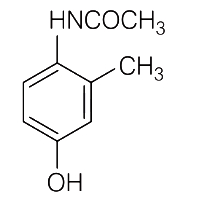
B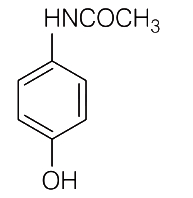
C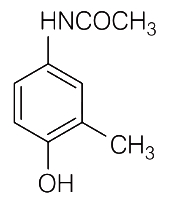
D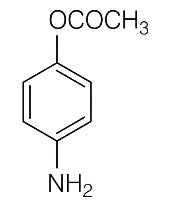
Solution
(B) Paracetamol is also known as $N$-($4$-hydroxyphenyl)acetamide or $N$-($4$-hydroxyphenyl)ethanamide. Its structure consists of a benzene ring substituted with a hydroxyl group $(-OH)$ at the para position and an acetamido group $(-NHCOCH_3)$ at the other para position. Comparing this with the given options,the structure in option $B$ represents paracetamol.
0 likesView Solution
108
ChemistryMediumMCQTS EAMCET · 2020
Which one of the following statements is "not correct" about cationic detergents?
A
Cationic detergents are quaternary ammonium salts.
B
The cationic part contains a long hydrocarbon chain.
C
Cationic detergents exhibit germicidal properties.
D
Cationic detergents are cheap and are widely used.
Solution
(D) Cationic detergents are quaternary ammonium salts of amines with acetates,chlorides,or bromides as anions.
They consist of a long hydrocarbon chain attached to a nitrogen atom,which carries a positive charge.
Because of this structure,the cationic part is the active site,which gives them germicidal properties.
They are relatively expensive compared to anionic detergents and are not used as common household detergents.
An example is $CH_3(CH_2)_{15}N^+(CH_3)_3Br^-$,known as cetyltrimethylammonium bromide.
They consist of a long hydrocarbon chain attached to a nitrogen atom,which carries a positive charge.
Because of this structure,the cationic part is the active site,which gives them germicidal properties.
They are relatively expensive compared to anionic detergents and are not used as common household detergents.
An example is $CH_3(CH_2)_{15}N^+(CH_3)_3Br^-$,known as cetyltrimethylammonium bromide.
0 likesView Solution
109
ChemistryEasyMCQTS EAMCET · 2020
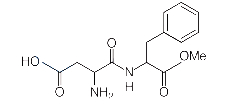
The dipeptide given below is used as:
A
Detergent
B
Preservative
C
Sweetening agent
D
Antioxidant (Drug)
Solution
(C) The given dipeptide is an artificial sweetening agent known as $Aspartame$.
It is the methyl ester of a dipeptide derivative,formed from $L-aspartic$ acid and $L-phenylalanine$.
It is approximately $150-200$ times sweeter than sucrose,but it is unstable at cooking temperatures.
Therefore,it is used as a sweetening agent in cold foods and soft drinks.
Hence,the correct answer is option $(C)$.
It is the methyl ester of a dipeptide derivative,formed from $L-aspartic$ acid and $L-phenylalanine$.
It is approximately $150-200$ times sweeter than sucrose,but it is unstable at cooking temperatures.
Therefore,it is used as a sweetening agent in cold foods and soft drinks.
Hence,the correct answer is option $(C)$.
0 likesView Solution
110
ChemistryEasyMCQTS EAMCET · 2020
Which of the following is an artificial sweetening agent?
A
salvarsan
B
sucrose
C
chloroxylenol
D
aspartame
Solution
(D) An artificial sweetening agent is a food additive that provides a sweet taste with little or no energy (calories).
$Aspartame$ is a well-known artificial sweetener.
It is approximately $200$ times sweeter than sucrose and is commonly used in beverages and cold drinks.
It is the methyl ester of a dipeptide formed from aspartic acid and phenylalanine,with the molecular formula $C_{14}H_{18}N_2O_5$.
$Aspartame$ is a well-known artificial sweetener.
It is approximately $200$ times sweeter than sucrose and is commonly used in beverages and cold drinks.
It is the methyl ester of a dipeptide formed from aspartic acid and phenylalanine,with the molecular formula $C_{14}H_{18}N_2O_5$.
0 likesView Solution
111
ChemistryEasyMCQTS EAMCET · 2020
The coordination number and oxidation state of $Cr$ in $K_3[Cr(C_2O_4)_3]$ are respectively
A
$3$ and $3$
B
$3$ and $0$
C
$6$ and $3$
D
$4$ and $2$
Solution
(C) The coordination number is the total number of coordinate bonds formed by the ligands with the central metal atom.
In the complex $K_3[Cr(C_2O_4)_3]$,the ligand is oxalate ion $(C_2O_4^{2-})$,which is a bidentate ligand.
Since there are $3$ oxalate ligands,the coordination number $= 3 \times 2 = 6$.
To find the oxidation state of $Cr$,let it be $x$.
The oxidation state of $K$ is $+1$ and the oxidation state of $C_2O_4^{2-}$ is $-2$.
For the neutral complex $K_3[Cr(C_2O_4)_3]$:
$3(+1) + x + 3(-2) = 0$
$3 + x - 6 = 0$
$x - 3 = 0$
$x = +3$.
Therefore,the coordination number is $6$ and the oxidation state is $+3$. The correct option is $(C)$.
In the complex $K_3[Cr(C_2O_4)_3]$,the ligand is oxalate ion $(C_2O_4^{2-})$,which is a bidentate ligand.
Since there are $3$ oxalate ligands,the coordination number $= 3 \times 2 = 6$.
To find the oxidation state of $Cr$,let it be $x$.
The oxidation state of $K$ is $+1$ and the oxidation state of $C_2O_4^{2-}$ is $-2$.
For the neutral complex $K_3[Cr(C_2O_4)_3]$:
$3(+1) + x + 3(-2) = 0$
$3 + x - 6 = 0$
$x - 3 = 0$
$x = +3$.
Therefore,the coordination number is $6$ and the oxidation state is $+3$. The correct option is $(C)$.
0 likesView Solution
112
ChemistryDifficultMCQTS EAMCET · 2020
$A^{2+}$,$B^{2+}$ and $C^{-}$ form an ionic complex like $A_{x-2}[B(C)_x]_2$. If the complex is $75 \%$ dissociated in a solvent with $i=4$,the coordination number of $B$ is:
A
$3$
B
$4$
C
$5$
D
$6$
Solution
(C) The dissociation of the complex $A_{x-2}[B(C)_x]_2$ is given by:
$A_{x-2}[B(C)_x]_2 \longrightarrow (x-2) A^{2+} + 2[B(C)_x]^{-(x-2)}$
Total number of ions produced per formula unit,$n = (x-2) + 2 = x$.
The van't Hoff factor $i$ is given by the formula: $i = 1 + (n-1)\alpha$.
Given $i = 4$ and $\alpha = 0.75$:
$4 = 1 + (x-1)(0.75)$
$3 = (x-1)(0.75)$
$x-1 = \frac{3}{0.75} = 4$
$x = 5$.
The coordination number of the central metal ion $B$ is equal to the number of ligands $C$ attached to it,which is $x = 5$.
$A_{x-2}[B(C)_x]_2 \longrightarrow (x-2) A^{2+} + 2[B(C)_x]^{-(x-2)}$
Total number of ions produced per formula unit,$n = (x-2) + 2 = x$.
The van't Hoff factor $i$ is given by the formula: $i = 1 + (n-1)\alpha$.
Given $i = 4$ and $\alpha = 0.75$:
$4 = 1 + (x-1)(0.75)$
$3 = (x-1)(0.75)$
$x-1 = \frac{3}{0.75} = 4$
$x = 5$.
The coordination number of the central metal ion $B$ is equal to the number of ligands $C$ attached to it,which is $x = 5$.
0 likesView Solution
113
ChemistryMediumMCQTS EAMCET · 2020
The coordination number of $Fe$ in the complexes $[Fe(CN)_6]^{4-}$,$[Fe(CN)_6]^{3-}$ and $[FeCl_4]^-$ would be respectively:
A
$2, 3, 3$
B
$6, 6, 4$
C
$6, 3, 3$
D
$6, 4, 6$
Solution
(B) The coordination number of a central metal ion is defined as the number of ligand donor atoms directly bonded to it.
$1$. In $[Fe(CN)_6]^{4-}$,there are $6$ $CN^-$ ligands,each being monodentate. Thus,the coordination number is $6$.
$2$. In $[Fe(CN)_6]^{3-}$,there are $6$ $CN^-$ ligands,each being monodentate. Thus,the coordination number is $6$.
$3$. In $[FeCl_4]^-$,there are $4$ $Cl^-$ ligands,each being monodentate. Thus,the coordination number is $4$.
Therefore,the coordination numbers are $6, 6, 4$.
$1$. In $[Fe(CN)_6]^{4-}$,there are $6$ $CN^-$ ligands,each being monodentate. Thus,the coordination number is $6$.
$2$. In $[Fe(CN)_6]^{3-}$,there are $6$ $CN^-$ ligands,each being monodentate. Thus,the coordination number is $6$.
$3$. In $[FeCl_4]^-$,there are $4$ $Cl^-$ ligands,each being monodentate. Thus,the coordination number is $4$.
Therefore,the coordination numbers are $6, 6, 4$.
0 likesView Solution
114
ChemistryEasyMCQTS EAMCET · 2020
Which compound is a zero-valent metal complex?
A
$[Cu(NH_3)_4]SO_4$
B
$[Pt(NH_3)_2Cl_2]$
C
$[Ni(CO)_4]$
D
$K_3[Fe(CN)_6]$
Solution
(C) In the complex $[Ni(CO)_4]$,$CO$ is a neutral ligand.
Let the oxidation state of $Ni$ be $x$.
$x + 4(0) = 0$
$x = 0$
Thus,in metal carbonyls,the metal is present in its zero-valent state.
Let the oxidation state of $Ni$ be $x$.
$x + 4(0) = 0$
$x = 0$
Thus,in metal carbonyls,the metal is present in its zero-valent state.
0 likesView Solution
115
ChemistryEasyMCQTS EAMCET · 2020
Which of the following correctly represents the order of ligands in the spectrochemical series?
A
$Br^{-} < Cl^{-} < NH_3 < H_2O$
B
$I^{-} < Br^{-} < H_2O < OH^{-}$
C
$F^{-} < Cl^{-} < H_2O < NH_3$
D
$I^{-} < Cl^{-} < H_2O < en$
Solution
(D) The spectrochemical series is an arrangement of ligands in order of their increasing crystal field splitting energy $(\Delta_o)$.
Based on the experimental data,the order is: $I^{-} < Br^{-} < S^{2-} < SCN^{-} < Cl^{-} < NO_3^{-} < F^{-} < OH^{-} < C_2O_4^{2-} < H_2O < NCS^{-} < NH_3 < en < NO_2^{-} < CN^{-} < CO$.
Comparing this with the given options:
Option $D$ $(I^{-} < Cl^{-} < H_2O < en)$ correctly follows the increasing order of field strength.
Based on the experimental data,the order is: $I^{-} < Br^{-} < S^{2-} < SCN^{-} < Cl^{-} < NO_3^{-} < F^{-} < OH^{-} < C_2O_4^{2-} < H_2O < NCS^{-} < NH_3 < en < NO_2^{-} < CN^{-} < CO$.
Comparing this with the given options:
Option $D$ $(I^{-} < Cl^{-} < H_2O < en)$ correctly follows the increasing order of field strength.
0 likesView Solution
116
ChemistryDifficultMCQTS EAMCET · 2020
The coordination complex $[Co(OH_2)_6]^{2+}$ has one unpaired electron. Which of the following statements are true?
$(i)$ The complex is octahedral.
$(ii)$ The complex is an outer orbital complex.
$(iii)$ The complex is diamagnetic.
$(i)$ The complex is octahedral.
$(ii)$ The complex is an outer orbital complex.
$(iii)$ The complex is diamagnetic.
A
$(i)$ and $(iii)$ only
B
$(i)$,$(ii)$ and $(iii)$
C
$(i)$ and $(ii)$ only
D
$(ii)$ and $(iii)$ only
Solution
(C) The central metal ion is $Co^{2+}$,which has a $d^7$ electronic configuration.
$(i)$ Since there are $6$ ligands $(H_2O)$,the coordination number is $6$,making the geometry octahedral.
$(ii)$ $H_2O$ is a weak field ligand,so it forms a high-spin (outer orbital) complex using $sp^3d^2$ hybridization.
$(iii)$ The complex has one unpaired electron (as stated in the question),so it is paramagnetic,not diamagnetic.
Therefore,statements $(i)$ and $(ii)$ are true.
$(i)$ Since there are $6$ ligands $(H_2O)$,the coordination number is $6$,making the geometry octahedral.
$(ii)$ $H_2O$ is a weak field ligand,so it forms a high-spin (outer orbital) complex using $sp^3d^2$ hybridization.
$(iii)$ The complex has one unpaired electron (as stated in the question),so it is paramagnetic,not diamagnetic.
Therefore,statements $(i)$ and $(ii)$ are true.
0 likesView Solution
117
ChemistryMediumMCQTS EAMCET · 2020
In the octahedral crystal field,the correct order of splitting for $I^{-}, H_2O, NH_3$ and $CN^{-}$ ligands is:
A
$CN^{-} < NH_3 < H_2O < I^{-}$
B
$NH_3 < H_2O < I^{-} < CN^{-}$
C
$CN^{-} < I^{-} < H_2O < NH_3$
D
$I^{-} < H_2O < NH_3 < CN^{-}$
Solution
(D) The crystal field splitting energy $(\Delta_o)$ depends on the strength of the ligand,which is determined by the spectrochemical series.
According to the spectrochemical series,the order of field strength for the given ligands is $I^{-} < H_2O < NH_3 < CN^{-}$.
Therefore,the correct order of splitting is $I^{-} < H_2O < NH_3 < CN^{-}$,which corresponds to option $(D)$.
According to the spectrochemical series,the order of field strength for the given ligands is $I^{-} < H_2O < NH_3 < CN^{-}$.
Therefore,the correct order of splitting is $I^{-} < H_2O < NH_3 < CN^{-}$,which corresponds to option $(D)$.
0 likesView Solution
118
ChemistryEasyMCQTS EAMCET · 2020
Which sets of the $d$-orbitals are directly oriented towards the ligands in octahedral coordination compounds?
A
$d_{x^2-y^2}$ and $d_{xy}$
B
$d_{z^2}$ and $d_{yz}$
C
$d_{xz}$ and $d_{xy}$
D
$d_{x^2-y^2}$ and $d_{z^2}$
Solution
(D) The $d$-subshell consists of five orbitals: $d_{x^2-y^2}, d_{z^2}, d_{xy}, d_{xz},$ and $d_{yz}$.
In an octahedral coordination complex,the ligands approach along the $x, y,$ and $z$ axes.
The orbitals $d_{x^2-y^2}$ and $d_{z^2}$ (collectively known as the $e_g$ set) have their electron density lobes directed along these axes,directly facing the incoming ligands.
Conversely,the $d_{xy}, d_{xz},$ and $d_{yz}$ orbitals (the $t_{2g}$ set) have lobes oriented between the axes.
Therefore,$d_{x^2-y^2}$ and $d_{z^2}$ are directly oriented towards the ligands.
Hence,$(D)$ is the correct answer.
In an octahedral coordination complex,the ligands approach along the $x, y,$ and $z$ axes.
The orbitals $d_{x^2-y^2}$ and $d_{z^2}$ (collectively known as the $e_g$ set) have their electron density lobes directed along these axes,directly facing the incoming ligands.
Conversely,the $d_{xy}, d_{xz},$ and $d_{yz}$ orbitals (the $t_{2g}$ set) have lobes oriented between the axes.
Therefore,$d_{x^2-y^2}$ and $d_{z^2}$ are directly oriented towards the ligands.
Hence,$(D)$ is the correct answer.
0 likesView Solution
119
ChemistryMediumMCQTS EAMCET · 2020
Among the following $Cr(III)$ complexes,which one will have the highest octahedral crystal field splitting?
A
$[CrF_6]^{3-}$
B
$[Cr(H_2O)_6]^{3+}$
C
$[Cr(NH_3)_6]^{3+}$
D
$[Cr(CN)_6]^{3-}$
Solution
(D) strong field ligand will cause higher crystal field splitting. This can be predicted from the relative position of a ligand in the spectrochemical series.
In the given octahedral complexes of $Cr(III)$ ion,the ligands are $F^{-}$,$H_2O$,$NH_3$,and $CN^{-}$.
The increasing order of their field strength in the spectrochemical series is $F^{-} < H_2O < NH_3 < CN^{-}$.
Since $CN^{-}$ is the strongest field ligand among the given choices,$[Cr(CN)_6]^{3-}$ will have the highest octahedral crystal field splitting.
In the given octahedral complexes of $Cr(III)$ ion,the ligands are $F^{-}$,$H_2O$,$NH_3$,and $CN^{-}$.
The increasing order of their field strength in the spectrochemical series is $F^{-} < H_2O < NH_3 < CN^{-}$.
Since $CN^{-}$ is the strongest field ligand among the given choices,$[Cr(CN)_6]^{3-}$ will have the highest octahedral crystal field splitting.
0 likesView Solution
120
ChemistryMediumMCQTS EAMCET · 2020
When $[Ti(H_2O)_6]Cl_3$ is heated at $250^{\circ} C$,the change in colour is from
A
violet to red
B
violet to blue
C
blue to green
D
violet to colourless
Solution
(D) The complex $[Ti(H_2O)_6]Cl_3$ contains $Ti^{3+}$ ion which has a $3d^1$ electronic configuration.
Due to the presence of one unpaired electron,it undergoes $d-d$ transition and exhibits a violet colour.
Upon heating at $250^{\circ} C$ in the presence of oxygen,it decomposes to form $TiO_2$ where titanium is in the $+4$ oxidation state $(Ti^{4+} : 3d^0)$.
Since $Ti^{4+}$ has no unpaired electrons,it does not undergo $d-d$ transition and is colourless.
Therefore,the colour change is from violet to colourless.
Due to the presence of one unpaired electron,it undergoes $d-d$ transition and exhibits a violet colour.
Upon heating at $250^{\circ} C$ in the presence of oxygen,it decomposes to form $TiO_2$ where titanium is in the $+4$ oxidation state $(Ti^{4+} : 3d^0)$.
Since $Ti^{4+}$ has no unpaired electrons,it does not undergo $d-d$ transition and is colourless.
Therefore,the colour change is from violet to colourless.
0 likesView Solution
121
ChemistryMediumMCQTS EAMCET · 2020
Which of the following sets correctly represents the increase in the paramagnetic property of the ions?
A
$Cu^{2+} < V^{2+} < Cr^{2+} < Mn^{2+}$
B
$Cu^{2+} < Cr^{2+} < V^{2+} < Mn^{2+}$
C
$Mn^{2+} < V^{2+} < Cr^{2+} < Cu^{2+}$
D
$Mn^{2+} < Cu^{2+} < Cr^{2+} < V^{2+}$
Solution
(A) The paramagnetic property of an ion is directly proportional to the number of unpaired electrons present in its $d$-orbitals.
$Cu^{2+} (3d^9)$: $1$ unpaired electron.
$V^{2+} (3d^3)$: $3$ unpaired electrons.
$Cr^{2+} (3d^4)$: $4$ unpaired electrons.
$Mn^{2+} (3d^5)$: $5$ unpaired electrons.
Therefore,the increasing order of paramagnetic property is $Cu^{2+} < V^{2+} < Cr^{2+} < Mn^{2+}$.
$Cu^{2+} (3d^9)$: $1$ unpaired electron.
$V^{2+} (3d^3)$: $3$ unpaired electrons.
$Cr^{2+} (3d^4)$: $4$ unpaired electrons.
$Mn^{2+} (3d^5)$: $5$ unpaired electrons.
Therefore,the increasing order of paramagnetic property is $Cu^{2+} < V^{2+} < Cr^{2+} < Mn^{2+}$.
0 likesView Solution
122
ChemistryMediumMCQTS EAMCET · 2020
Which of the following statements is incorrect?
A
The enthalpy of atomization decreases down a group in $s$-block elements
B
The enthalpy of atomization decreases down a group in $p$-block elements
C
The enthalpy of atomization decreases down a group in $d$-block elements
D
The enthalpy of atomization increases down a group in $d$-block elements
Solution
(C) The enthalpy of atomization depends on the strength of metallic bonding.
In $s$-block and $p$-block elements,the metallic bond strength generally decreases down a group due to an increase in atomic size,leading to a decrease in the enthalpy of atomization.
However,for $d$-block elements (transition metals),the enthalpy of atomization generally increases down a group because the $d$-orbitals become more involved in metallic bonding as the principal quantum number increases,leading to stronger metallic bonds.
Therefore,the statement that the enthalpy of atomization decreases down a group in $d$-block elements is incorrect.
In $s$-block and $p$-block elements,the metallic bond strength generally decreases down a group due to an increase in atomic size,leading to a decrease in the enthalpy of atomization.
However,for $d$-block elements (transition metals),the enthalpy of atomization generally increases down a group because the $d$-orbitals become more involved in metallic bonding as the principal quantum number increases,leading to stronger metallic bonds.
Therefore,the statement that the enthalpy of atomization decreases down a group in $d$-block elements is incorrect.
0 likesView Solution
123
ChemistryMediumMCQTS EAMCET · 2020
The correct match for the complex with its magnetic behavior is:
A
$[Zn(OH_2)_6]^{2+}$; paramagnetic
B
$[Co(NH_3)_6]^{3+}$; diamagnetic
C
$[CoF_6]^{3-}$; diamagnetic
D
$[V(OH_2)_6]^{2+}$; diamagnetic
Solution
(B) $1$. For $[Zn(OH_2)_6]^{2+}$: $Zn^{2+}$ is $3d^{10}$,which has no unpaired electrons,so it is diamagnetic.
$2$. For $[Co(NH_3)_6]^{3+}$: $Co^{3+}$ is $3d^6$. $NH_3$ is a strong field ligand,causing pairing of electrons. It forms $d^2sp^3$ hybridization with no unpaired electrons,making it diamagnetic.
$3$. For $[CoF_6]^{3-}$: $Co^{3+}$ is $3d^6$. $F^-$ is a weak field ligand,so no pairing occurs. It has $4$ unpaired electrons,making it paramagnetic.
$4$. For $[V(OH_2)_6]^{2+}$: $V^{2+}$ is $3d^3$,which has $3$ unpaired electrons,making it paramagnetic.
Therefore,the correct match is $[Co(NH_3)_6]^{3+}$; diamagnetic.
$2$. For $[Co(NH_3)_6]^{3+}$: $Co^{3+}$ is $3d^6$. $NH_3$ is a strong field ligand,causing pairing of electrons. It forms $d^2sp^3$ hybridization with no unpaired electrons,making it diamagnetic.
$3$. For $[CoF_6]^{3-}$: $Co^{3+}$ is $3d^6$. $F^-$ is a weak field ligand,so no pairing occurs. It has $4$ unpaired electrons,making it paramagnetic.
$4$. For $[V(OH_2)_6]^{2+}$: $V^{2+}$ is $3d^3$,which has $3$ unpaired electrons,making it paramagnetic.
Therefore,the correct match is $[Co(NH_3)_6]^{3+}$; diamagnetic.
0 likesView Solution
124
ChemistryMediumMCQTS EAMCET · 2020
Among the following series of transition metal ions,the one in which all the metal ions have $3d^2$ electronic configuration (excluding the $3p^6$ core) is (Atomic number: $Ti=22, V=23, Cr=24, Mn=25$)
A
$Ti^{3+}, V^{2+}, Cr^{3+}, Mn^{4+}$
B
$Ti^{+}, V^{4+}, Cr^{6+}, Mn^{7+}$
C
$Ti^{4+}, V^{3+}, Cr^{2+}, Mn^{3+}$
D
$Ti^{2+}, V^{3+}, Cr^{4+}, Mn^{5+}$
Solution
(D) The electronic configuration of the neutral atoms is:
$Ti (Z=22): [Ar] 3d^2 4s^2$
$V (Z=23): [Ar] 3d^3 4s^2$
$Cr (Z=24): [Ar] 3d^5 4s^1$
$Mn (Z=25): [Ar] 3d^5 4s^2$
For the ions in option $(d)$:
$Ti^{2+}: [Ar] 3d^2$
$V^{3+}: [Ar] 3d^2$
$Cr^{4+}: [Ar] 3d^2$
$Mn^{5+}: [Ar] 3d^2$
Since $[Ar]$ corresponds to $1s^2 2s^2 2p^6 3s^2 3p^6$,all these ions possess the $3d^2$ configuration outside the $3p^6$ shell.
$Ti (Z=22): [Ar] 3d^2 4s^2$
$V (Z=23): [Ar] 3d^3 4s^2$
$Cr (Z=24): [Ar] 3d^5 4s^1$
$Mn (Z=25): [Ar] 3d^5 4s^2$
For the ions in option $(d)$:
$Ti^{2+}: [Ar] 3d^2$
$V^{3+}: [Ar] 3d^2$
$Cr^{4+}: [Ar] 3d^2$
$Mn^{5+}: [Ar] 3d^2$
Since $[Ar]$ corresponds to $1s^2 2s^2 2p^6 3s^2 3p^6$,all these ions possess the $3d^2$ configuration outside the $3p^6$ shell.
0 likesView Solution
125
ChemistryMediumMCQTS EAMCET · 2020
Which of the following is a diamagnetic ion?
A
$Co^{2+}$
B
$Cu^{2+}$
C
$Mn^{2+}$
D
$Sc^{3+}$
Solution
(D) $Sc^{3+}$ has the electronic configuration $[Ar] 3d^0 4s^0$.
Since there are no unpaired electrons,it is diamagnetic.
Since there are no unpaired electrons,it is diamagnetic.
0 likesView Solution
126
ChemistryMediumMCQTS EAMCET · 2020
Which of the following molecules is colourless?
A
$CuSO_4 \cdot 5 H_2 O$ (crystal)
B
$CuSO_4$ (anhydrous)
C
$\left[Cu(NH_3)_4\right]^{2+}_{(aq)}$
D
$\left[CuCl_4\right]^{2-}_{(aq)}$
Solution
(B) Hydrated copper sulphate $CuSO_4 \cdot 5 H_2 O$ is blue in colour due to the presence of water ligands which cause splitting of $d$-orbitals,facilitating $d-d$ transitions.
Anhydrous copper sulphate $CuSO_4$ is colourless because,in the absence of ligands,the $d$-orbitals do not split,making $d-d$ transitions impossible.
Therefore,option $(B)$ is correct.
Anhydrous copper sulphate $CuSO_4$ is colourless because,in the absence of ligands,the $d$-orbitals do not split,making $d-d$ transitions impossible.
Therefore,option $(B)$ is correct.
0 likesView Solution
127
ChemistryEasyMCQTS EAMCET · 2020
What is the effect of lanthanoid contraction in the lanthanoid series of elements with increasing atomic number?
A
Decrease in atomic radii
B
Increase in atomic radii
C
Decrease in melting point
D
Increase in melting point
Solution
(A) Lanthanoid contraction is the steady decrease in the size of atoms and ions of rare earth elements with an increasing atomic number from lanthanum $(Z = 57)$.
It is caused by the poor shielding effect of $4f$-electrons.
In the $4f$ series,the $4f$-electrons do not shield the outer electrons effectively from the nuclear charge.
This results in a greater effective nuclear charge,which exerts a stronger pull on the electrons towards the nucleus.
Thus,the decrease in atomic and ionic radii is the primary effect of lanthanoid contraction.
Therefore,option $(A)$ is correct.
It is caused by the poor shielding effect of $4f$-electrons.
In the $4f$ series,the $4f$-electrons do not shield the outer electrons effectively from the nuclear charge.
This results in a greater effective nuclear charge,which exerts a stronger pull on the electrons towards the nucleus.
Thus,the decrease in atomic and ionic radii is the primary effect of lanthanoid contraction.
Therefore,option $(A)$ is correct.
0 likesView Solution
128
ChemistryMediumMCQTS EAMCET · 2020
Which of the following ions will exhibit colour in aqueous solution?
A
$La^{3+} (Z=57)$
B
$Ti^{3+} (Z=22)$
C
$Lu^{3+} (Z=71)$
D
$Sc^{3+} (Z=21)$
Solution
(B) Ions exhibit colour in aqueous solution due to the presence of unpaired electrons in their $d$-orbitals,which allow for $d-d$ transitions.
Electronic configurations:
$La^{3+} (Z=57): [Xe] 4f^0 5d^0$ (No unpaired electrons).
$Ti^{3+} (Z=22): [Ar] 3d^1$ (One unpaired electron).
$Lu^{3+} (Z=71): [Xe] 4f^{14}$ (No unpaired electrons).
$Sc^{3+} (Z=21): [Ar] 3d^0$ (No unpaired electrons).
Since $Ti^{3+}$ has one unpaired electron,it will exhibit colour in aqueous solution.
Electronic configurations:
$La^{3+} (Z=57): [Xe] 4f^0 5d^0$ (No unpaired electrons).
$Ti^{3+} (Z=22): [Ar] 3d^1$ (One unpaired electron).
$Lu^{3+} (Z=71): [Xe] 4f^{14}$ (No unpaired electrons).
$Sc^{3+} (Z=21): [Ar] 3d^0$ (No unpaired electrons).
Since $Ti^{3+}$ has one unpaired electron,it will exhibit colour in aqueous solution.
0 likesView Solution
129
ChemistryEasyMCQTS EAMCET · 2020
Transuranium elements are
A
elements before uranium
B
inner transition elements
C
elements after uranium
D
actinoid elements
Solution
(C) Transuranium elements are the chemical elements with atomic numbers greater than $92$ (the atomic number of uranium). These elements are synthetic and are produced artificially in nuclear reactors or particle accelerators.
0 likesView Solution
130
ChemistryMediumMCQTS EAMCET · 2020
The value of $E_1^{\circ}$ is (in $V$)
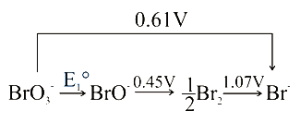
A
$0.76$
B
$0.535$
C
$0.428$
D
$1.12$
Solution
(B) Given the Latimer diagram:
$BrO_3^{-}$ $\xrightarrow{E_1^{\circ}} BrO^{-}$ $\xrightarrow{0.45 \ V} \frac{1}{2} Br_2$ $\xrightarrow{1.07 \ V} Br^{-}$
And the overall potential $BrO_3^{-} \rightarrow Br^{-}$ is $0.61 \ V$.
We use the relation $\Delta G^{\circ} = -nFE^{\circ}$.
For the overall reaction $BrO_3^{-} \rightarrow Br^{-}$:
$n = 6$,so $\Delta G_{total}^{\circ} = -6F(0.61 \ V) = -3.66F$.
For the individual steps:
$1$. $BrO_3^{-} \rightarrow BrO^{-}$: $n = 4$,$\Delta G_1^{\circ} = -4FE_1^{\circ}$.
$2$. $BrO^{-} \rightarrow \frac{1}{2} Br_2$: $n = 1$,$\Delta G_2^{\circ} = -1F(0.45 \ V) = -0.45F$.
$3$. $\frac{1}{2} Br_2 \rightarrow Br^{-}$: $n = 1$,$\Delta G_3^{\circ} = -1F(1.07 \ V) = -1.07F$.
Summing the $\Delta G^{\circ}$ values:
$-3.66F = -4FE_1^{\circ} - 0.45F - 1.07F$
$-3.66 = -4E_1^{\circ} - 1.52$
$4E_1^{\circ} = 3.66 - 1.52$
$4E_1^{\circ} = 2.14$
$E_1^{\circ} = \frac{2.14}{4} = 0.535 \ V$.
$BrO_3^{-}$ $\xrightarrow{E_1^{\circ}} BrO^{-}$ $\xrightarrow{0.45 \ V} \frac{1}{2} Br_2$ $\xrightarrow{1.07 \ V} Br^{-}$
And the overall potential $BrO_3^{-} \rightarrow Br^{-}$ is $0.61 \ V$.
We use the relation $\Delta G^{\circ} = -nFE^{\circ}$.
For the overall reaction $BrO_3^{-} \rightarrow Br^{-}$:
$n = 6$,so $\Delta G_{total}^{\circ} = -6F(0.61 \ V) = -3.66F$.
For the individual steps:
$1$. $BrO_3^{-} \rightarrow BrO^{-}$: $n = 4$,$\Delta G_1^{\circ} = -4FE_1^{\circ}$.
$2$. $BrO^{-} \rightarrow \frac{1}{2} Br_2$: $n = 1$,$\Delta G_2^{\circ} = -1F(0.45 \ V) = -0.45F$.
$3$. $\frac{1}{2} Br_2 \rightarrow Br^{-}$: $n = 1$,$\Delta G_3^{\circ} = -1F(1.07 \ V) = -1.07F$.
Summing the $\Delta G^{\circ}$ values:
$-3.66F = -4FE_1^{\circ} - 0.45F - 1.07F$
$-3.66 = -4E_1^{\circ} - 1.52$
$4E_1^{\circ} = 3.66 - 1.52$
$4E_1^{\circ} = 2.14$
$E_1^{\circ} = \frac{2.14}{4} = 0.535 \ V$.
0 likesView Solution
131
ChemistryEasyMCQTS EAMCET · 2020
For a cell constructed with $Cu$ and $Ag$ electrodes,which of the following statements is correct regarding the cathode and the standard cell potential $(E_{cell}^{\circ})$?
A
Copper electrode acts as anode and $E_{cell}^{\circ}$ is $+0.46 \ V$
B
Copper electrode acts as anode and $E_{cell}^{\circ}$ is $-0.46 \ V$
C
Silver electrode acts as a cathode and $E_{cell}^{\circ}$ is $-0.34 \ V$
D
Copper electrode acts as cathode and $E_{cell}^{\circ}$ is $+0.46 \ V$
Solution
(A) The electrode with the higher standard reduction potential acts as the cathode.
Given standard reduction potentials: $E_{Ag^+/Ag}^{\circ} = +0.80 \ V$ and $E_{Cu^{2+}/Cu}^{\circ} = +0.34 \ V$.
Since $E_{Ag^+/Ag}^{\circ} > E_{Cu^{2+}/Cu}^{\circ}$,the silver electrode acts as the cathode and the copper electrode acts as the anode.
The standard cell potential is calculated as:
$E_{cell}^{\circ} = E_{cathode}^{\circ} - E_{anode}^{\circ}$
$E_{cell}^{\circ} = +0.80 \ V - (+0.34 \ V) = +0.46 \ V$.
Given standard reduction potentials: $E_{Ag^+/Ag}^{\circ} = +0.80 \ V$ and $E_{Cu^{2+}/Cu}^{\circ} = +0.34 \ V$.
Since $E_{Ag^+/Ag}^{\circ} > E_{Cu^{2+}/Cu}^{\circ}$,the silver electrode acts as the cathode and the copper electrode acts as the anode.
The standard cell potential is calculated as:
$E_{cell}^{\circ} = E_{cathode}^{\circ} - E_{anode}^{\circ}$
$E_{cell}^{\circ} = +0.80 \ V - (+0.34 \ V) = +0.46 \ V$.
0 likesView Solution
132
ChemistryEasyMCQTS EAMCET · 2020
The maximum work that can be obtained from the following cell is
$X|X^{2+}_{(aq)} || Y^{+}_{(aq)}| Y$
Given,$E^{\circ}_{X^{2+}/X} = -1.7 \ V, E^{\circ}_{Y^{+}/Y} = 0.8 \ V$
$X|X^{2+}_{(aq)} || Y^{+}_{(aq)}| Y$
Given,$E^{\circ}_{X^{2+}/X} = -1.7 \ V, E^{\circ}_{Y^{+}/Y} = 0.8 \ V$
A
$579 \ kJ/mol$
B
$482.5 \ kJ/mol$
C
$289.5 \ kJ/mol$
D
$301.8 \ kJ/mol$
Solution
(B) The cell reaction is:
Anode: $X \rightarrow X^{2+} + 2e^-$
Cathode: $2Y^+ + 2e^- \rightarrow 2Y$
Overall reaction: $X + 2Y^+ \rightarrow X^{2+} + 2Y$
Here,the number of electrons involved,$n = 2$.
$E^{\circ}_{cell} = E^{\circ}_{cathode} - E^{\circ}_{anode} = 0.8 \ V - (-1.7 \ V) = 2.5 \ V$.
The maximum work done is given by $W_{max} = -\Delta G^{\circ} = nFE^{\circ}_{cell}$.
$W_{max} = 2 \times 96500 \ C/mol \times 2.5 \ V = 482500 \ J/mol$.
Converting to $kJ/mol$: $W_{max} = \frac{482500}{1000} = 482.5 \ kJ/mol$.
Anode: $X \rightarrow X^{2+} + 2e^-$
Cathode: $2Y^+ + 2e^- \rightarrow 2Y$
Overall reaction: $X + 2Y^+ \rightarrow X^{2+} + 2Y$
Here,the number of electrons involved,$n = 2$.
$E^{\circ}_{cell} = E^{\circ}_{cathode} - E^{\circ}_{anode} = 0.8 \ V - (-1.7 \ V) = 2.5 \ V$.
The maximum work done is given by $W_{max} = -\Delta G^{\circ} = nFE^{\circ}_{cell}$.
$W_{max} = 2 \times 96500 \ C/mol \times 2.5 \ V = 482500 \ J/mol$.
Converting to $kJ/mol$: $W_{max} = \frac{482500}{1000} = 482.5 \ kJ/mol$.
0 likesView Solution
133
ChemistryEasyMCQTS EAMCET · 2020
What is the standard cell potential for the reaction with $K=1$ (equilibrium constant)?
A
One
B
Zero
C
$2.303$
D
Infinity
Solution
(B) The relationship between standard cell potential $(E^{\circ})$ and the equilibrium constant $(K)$ is given by the Nernst equation at equilibrium:
$\Delta G^{\circ} = -RT \ln K = -nFE^{\circ}$
Since $\Delta G^{\circ} = -nFE^{\circ}$,we have $E^{\circ} = \frac{RT}{nF} \ln K$.
Given $K = 1$,we know that $\ln(1) = 0$.
Therefore,$E^{\circ} = \frac{RT}{nF} \times 0 = 0 \ V$.
Thus,for a reaction with an equilibrium constant of $1$,the standard cell potential is $0$.
$\Delta G^{\circ} = -RT \ln K = -nFE^{\circ}$
Since $\Delta G^{\circ} = -nFE^{\circ}$,we have $E^{\circ} = \frac{RT}{nF} \ln K$.
Given $K = 1$,we know that $\ln(1) = 0$.
Therefore,$E^{\circ} = \frac{RT}{nF} \times 0 = 0 \ V$.
Thus,for a reaction with an equilibrium constant of $1$,the standard cell potential is $0$.
0 likesView Solution
134
ChemistryMediumMCQTS EAMCET · 2020
$A$ solution of $Fe^{2+}$ is titrated potentiometrically using $Ce^{4+}$ solution. When $80 \%$ of $Fe^{2+}$ is titrated,the $EMF$ of the system in $V$ is (Given,$E^{\circ}_{Fe^{3+}/Fe^{2+}} = 0.77 \ V$ and $Fe^{2+} + Ce^{4+} \longrightarrow Fe^{3+} + Ce^{3+}$)
$(\log 2 = 0.3, \log 3 = 0.5, \log 4 = 0.6)$
$(\log 2 = 0.3, \log 3 = 0.5, \log 4 = 0.6)$
A
$0.806$
B
$0.532$
C
$0.734$
D
$0.756$
Solution
(A) The reaction is $Fe^{2+} + Ce^{4+} \longrightarrow Fe^{3+} + Ce^{3+}$.
Using the Nernst equation for the $Fe^{3+}/Fe^{2+}$ half-cell: $E = E^{\circ}_{Fe^{3+}/Fe^{2+}} - 0.059 \log \frac{[Fe^{2+}]}{[Fe^{3+}]}$.
Since $80 \%$ of $Fe^{2+}$ is converted to $Fe^{3+}$,the concentration ratio is $[Fe^{3+}] = 80$ and $[Fe^{2+}] = 20$.
Thus,$E = 0.77 - 0.059 \log \frac{20}{80} = 0.77 - 0.059 \log \frac{1}{4} = 0.77 + 0.059 \log 4$.
Given $\log 4 = 0.6$,we get $E = 0.77 + 0.059 \times 0.6 = 0.77 + 0.0354 = 0.8054 \ V \approx 0.806 \ V$.
Using the Nernst equation for the $Fe^{3+}/Fe^{2+}$ half-cell: $E = E^{\circ}_{Fe^{3+}/Fe^{2+}} - 0.059 \log \frac{[Fe^{2+}]}{[Fe^{3+}]}$.
Since $80 \%$ of $Fe^{2+}$ is converted to $Fe^{3+}$,the concentration ratio is $[Fe^{3+}] = 80$ and $[Fe^{2+}] = 20$.
Thus,$E = 0.77 - 0.059 \log \frac{20}{80} = 0.77 - 0.059 \log \frac{1}{4} = 0.77 + 0.059 \log 4$.
Given $\log 4 = 0.6$,we get $E = 0.77 + 0.059 \times 0.6 = 0.77 + 0.0354 = 0.8054 \ V \approx 0.806 \ V$.
0 likesView Solution
135
ChemistryMediumMCQTS EAMCET · 2020
Copper is to be electrodeposited on a nickel block of $(20 \times 5) \ cm^2$ area by using $CuSO_4$ as electrolyte. How much quantity of electricity is needed to deposit a $3.6 \ \mu m$ layer of copper (in $C$)? [Atomic weight of $Cu = 63.5 \ g \ mol^{-1}$,Density of $Cu = 8.9 \ g/cm^3$]
A
$974$
B
$580$
C
$1080$
D
$365$
Solution
(A) The volume of $Cu$ deposited is $V = \text{Area} \times \text{thickness} = (20 \times 5) \ cm^2 \times (3.6 \times 10^{-4} \ cm) = 0.036 \ cm^3$.
The mass of $Cu$ deposited is $W = V \times d = 0.036 \ cm^3 \times 8.9 \ g/cm^3 = 0.3204 \ g$.
Using Faraday's law,$W = \frac{M \times Q}{n \times F}$,where $M = 63.5 \ g/mol$,$n = 2$,and $F = 96500 \ C/mol$.
$Q = \frac{W \times n \times F}{M} = \frac{0.3204 \times 2 \times 96500}{63.5} \approx 973.81 \ C \approx 974 \ C$.
The mass of $Cu$ deposited is $W = V \times d = 0.036 \ cm^3 \times 8.9 \ g/cm^3 = 0.3204 \ g$.
Using Faraday's law,$W = \frac{M \times Q}{n \times F}$,where $M = 63.5 \ g/mol$,$n = 2$,and $F = 96500 \ C/mol$.
$Q = \frac{W \times n \times F}{M} = \frac{0.3204 \times 2 \times 96500}{63.5} \approx 973.81 \ C \approx 974 \ C$.
0 likesView Solution
136
ChemistryEasyMCQTS EAMCET · 2020
$Mg^{2+}$ displaces hydrogen from acids but copper does not. $A$ galvanic cell prepared by combining $Cu/Cu^{2+}$ and $Mg/Mg^{2+}$ has an $EMF$ of $2.71 \ V$ at $298 \ K$. If the potential of copper electrode is $0.34 \ V$,what is the reduction potential of $Mg$ electrode?
A
$+3.05 \ V$
B
$-2.37 \ V$
C
$+2.37 \ V$
D
$2 \ V$
Solution
(B) The galvanic cell can be represented as: $Mg | Mg^{2+} || Cu^{2+} | Cu$.
The standard cell potential is given by the formula: $E^{\circ}_{cell} = E^{\circ}_{cathode} - E^{\circ}_{anode}$.
Here,$E^{\circ}_{cathode} = E^{\circ}_{Cu^{2+}/Cu} = 0.34 \ V$ and $E^{\circ}_{cell} = 2.71 \ V$.
Substituting these values: $2.71 \ V = 0.34 \ V - E^{\circ}_{Mg^{2+}/Mg}$.
Therefore,$E^{\circ}_{Mg^{2+}/Mg} = 0.34 \ V - 2.71 \ V = -2.37 \ V$.
The standard cell potential is given by the formula: $E^{\circ}_{cell} = E^{\circ}_{cathode} - E^{\circ}_{anode}$.
Here,$E^{\circ}_{cathode} = E^{\circ}_{Cu^{2+}/Cu} = 0.34 \ V$ and $E^{\circ}_{cell} = 2.71 \ V$.
Substituting these values: $2.71 \ V = 0.34 \ V - E^{\circ}_{Mg^{2+}/Mg}$.
Therefore,$E^{\circ}_{Mg^{2+}/Mg} = 0.34 \ V - 2.71 \ V = -2.37 \ V$.
0 likesView Solution
137
ChemistryEasyMCQTS EAMCET · 2020
Which one of the following has the highest molar conductivity?
A
Penta-carbonyl iron$(0)$
B
Hexaqua-chromium$(III)$ bromide
C
Tetraamine-dichloro-cobalt$(III)$ chloride
D
Potassium hexacyanoferrate$(II)$
Solution
(D) The molar conductivity of an electrolyte solution is directly proportional to the number of ions produced per formula unit in the solution.
$(a)$ $[Fe(CO)_5]$ is a neutral complex,it does not dissociate into ions.
$(b)$ $[Cr(H_2O)_5Br]Br_2$ dissociates as $[Cr(H_2O)_5Br]^{2+} + 2Br^-$,providing $3$ ions.
$(c)$ $[Co(NH_3)_4Cl_2]Cl$ dissociates as $[Co(NH_3)_4Cl_2]^+ + Cl^-$,providing $2$ ions.
$(d)$ $K_4[Fe(CN)_6]$ dissociates as $4K^+ + [Fe(CN)_6]^{4-}$,providing $5$ ions.
Since $K_4[Fe(CN)_6]$ produces the maximum number of ions $(5)$,it exhibits the highest molar conductivity.
Thus,$(d)$ is the correct answer.
$(a)$ $[Fe(CO)_5]$ is a neutral complex,it does not dissociate into ions.
$(b)$ $[Cr(H_2O)_5Br]Br_2$ dissociates as $[Cr(H_2O)_5Br]^{2+} + 2Br^-$,providing $3$ ions.
$(c)$ $[Co(NH_3)_4Cl_2]Cl$ dissociates as $[Co(NH_3)_4Cl_2]^+ + Cl^-$,providing $2$ ions.
$(d)$ $K_4[Fe(CN)_6]$ dissociates as $4K^+ + [Fe(CN)_6]^{4-}$,providing $5$ ions.
Since $K_4[Fe(CN)_6]$ produces the maximum number of ions $(5)$,it exhibits the highest molar conductivity.
Thus,$(d)$ is the correct answer.
0 likesView Solution
138
ChemistryMediumMCQTS EAMCET · 2020
Identify the correct decreasing order of acidic strength for the following compounds:
$I$: $p$-Nitrobenzoic acid
$II$: Benzoic acid
$III$: $p$-Methoxybenzoic acid
$I$: $p$-Nitrobenzoic acid
$II$: Benzoic acid
$III$: $p$-Methoxybenzoic acid
A
$III > II > I$
B
$I > II > III$
C
$II > III > I$
D
$I > III > II$
Solution
(B) The acidic strength of substituted benzoic acids depends on the electronic effects of the substituents attached to the benzene ring.
$1$. The $-NO_2$ group is a strong electron-withdrawing group ($-I$ and $-M$ effects),which stabilizes the carboxylate anion,thereby increasing the acidic strength.
$2$. The $-OCH_3$ group is an electron-donating group ($+M$ effect),which destabilizes the carboxylate anion,thereby decreasing the acidic strength.
$3$. Benzoic acid $(II)$ acts as the reference compound.
Therefore,the order of acidic strength is $p$-Nitrobenzoic acid $(I)$ > Benzoic acid $(II)$ > $p$-Methoxybenzoic acid $(III)$.
The correct decreasing order is $I > II > III$.
$1$. The $-NO_2$ group is a strong electron-withdrawing group ($-I$ and $-M$ effects),which stabilizes the carboxylate anion,thereby increasing the acidic strength.
$2$. The $-OCH_3$ group is an electron-donating group ($+M$ effect),which destabilizes the carboxylate anion,thereby decreasing the acidic strength.
$3$. Benzoic acid $(II)$ acts as the reference compound.
Therefore,the order of acidic strength is $p$-Nitrobenzoic acid $(I)$ > Benzoic acid $(II)$ > $p$-Methoxybenzoic acid $(III)$.
The correct decreasing order is $I > II > III$.
0 likesView Solution
139
ChemistryMediumMCQTS EAMCET · 2020
Which of the following sets of functional groups contains only meta-directing groups?
A
$-NO_2, -NH_2, -COOH, -COOR$
B
$-NO_2, -CHO, -SO_3H, -COR$
C
$-CN, -CHO, -NHCOCH_3, -COOR$
D
$-CN, -NH_2, -NHR, -OCH_3$
Solution
(B) Meta-directing groups are electron-withdrawing groups that decrease the electron density of the benzene ring,particularly at the ortho and para positions,thereby directing the incoming electrophile to the meta position.
In the given options,the set $-NO_2, -CHO, -SO_3H, -COR$ consists entirely of electron-withdrawing groups that are meta-directing.
$-NH_2, -NHR, -OCH_3$ and $-NHCOCH_3$ are ortho/para-directing groups due to their electron-donating resonance effect.
In the given options,the set $-NO_2, -CHO, -SO_3H, -COR$ consists entirely of electron-withdrawing groups that are meta-directing.
$-NH_2, -NHR, -OCH_3$ and $-NHCOCH_3$ are ortho/para-directing groups due to their electron-donating resonance effect.
0 likesView Solution
140
ChemistryEasyMCQTS EAMCET · 2020
The method,which is based on the principle that "different components of a mixture are differently adsorbed on an adsorbent" is called
A
zone refining method
B
vapour phase refining method
C
liquation method
D
chromatographic method
Solution
(D) The principle of $Zone \ refining$ is that impurities are more soluble in the melt than in the solid state.
The $Vapour \ phase \ refining$ method is based on converting an impure metal into a volatile compound,which is then decomposed to obtain the pure metal.
The $Liquation$ method is based on the difference in melting points of the metal and the impurities,where the metal flows on a sloping surface.
The $Chromatographic$ method is based on the principle that different components of a mixture are adsorbed to different extents on an adsorbent. As the mobile phase moves through the stationary phase,these components separate based on their differential adsorption. Therefore,the correct option is $D$.
The $Vapour \ phase \ refining$ method is based on converting an impure metal into a volatile compound,which is then decomposed to obtain the pure metal.
The $Liquation$ method is based on the difference in melting points of the metal and the impurities,where the metal flows on a sloping surface.
The $Chromatographic$ method is based on the principle that different components of a mixture are adsorbed to different extents on an adsorbent. As the mobile phase moves through the stationary phase,these components separate based on their differential adsorption. Therefore,the correct option is $D$.
0 likesView Solution
141
ChemistryEasyMCQTS EAMCET · 2020
Why is iron pyrite not the ideal choice of ore for the extraction of iron?
A
It produces polluting gases
B
Thermodynamically not feasible
C
Highly stable
D
Difficult in roasting process
Solution
(A) Iron pyrite,i.e.,$FeS_2$,is also known as Fool's Gold.
It is not an ideal choice of ore for the extraction of iron because it produces polluting sulfur-containing gases,such as $SO_2$ and $SO_3$,during the roasting process.
Although it is thermodynamically feasible and stable,the environmental impact of these gases makes it undesirable.
Hence,option $(A)$ is the correct answer.
It is not an ideal choice of ore for the extraction of iron because it produces polluting sulfur-containing gases,such as $SO_2$ and $SO_3$,during the roasting process.
Although it is thermodynamically feasible and stable,the environmental impact of these gases makes it undesirable.
Hence,option $(A)$ is the correct answer.
0 likesView Solution
142
ChemistryEasyMCQTS EAMCET · 2020
Which one of the following ores does not contain iron?
A
Hematite
B
Magnetite
C
Calamine
D
Siderite
Solution
(C) Calamine $(ZnCO_3)$ is an ore of zinc $(Zn)$,while the others are ores of iron.
Hematite is $(Fe_2O_3)$.
Magnetite is $(Fe_3O_4)$.
Siderite is $(FeCO_3)$.
Hematite is $(Fe_2O_3)$.
Magnetite is $(Fe_3O_4)$.
Siderite is $(FeCO_3)$.
0 likesView Solution
143
ChemistryEasyMCQTS EAMCET · 2020
Match the following ores with their compositions:
| $A$. Calamine | $i$. $CuFeS_2$ |
| $B$. Chalcopyrite | $ii$. $ZnCO_3$ |
| $C$. Bauxite | $iii$. $Fe_2O_3$ |
| $D$. Haematite | $iv$. $Al_2O_3 \cdot 2H_2O$ |
A
$A-ii, B-i, C-iv, D-iii$
B
$A-i, B-ii, C-iii, D-iv$
C
$A-iv, B-iii, C-ii, D-i$
D
$A-iii, B-iv, C-i, D-ii$
Solution
(A) The chemical compositions of the given ores are as follows:
$A$. Calamine: $ZnCO_3$ (matches with $ii$)
$B$. Chalcopyrite: $CuFeS_2$ (matches with $i$)
$C$. Bauxite: $Al_2O_3 \cdot 2H_2O$ (matches with $iv$)
$D$. Haematite: $Fe_2O_3$ (matches with $iii$)
Therefore,the correct matching is $A-ii, B-i, C-iv, D-iii$.
$A$. Calamine: $ZnCO_3$ (matches with $ii$)
$B$. Chalcopyrite: $CuFeS_2$ (matches with $i$)
$C$. Bauxite: $Al_2O_3 \cdot 2H_2O$ (matches with $iv$)
$D$. Haematite: $Fe_2O_3$ (matches with $iii$)
Therefore,the correct matching is $A-ii, B-i, C-iv, D-iii$.
0 likesView Solution
144
ChemistryEasyMCQTS EAMCET · 2020
Which element does not exist in elemental state in the earth's crust?
A
$C$
B
$S$
C
$Fe$
D
$Au$
Solution
(C) Out of the given four elements $C$,$S$,$Fe$,and $Au$,the non-metals $C$ and $S$ exist in their elemental form as allotropes.
$Au$ is a noble metal with low reactivity,so it exists in nature in its elemental form,often called a nugget.
$Fe$ is an electropositive metal. Therefore,it is highly reactive and exists in the earth's crust only in a combined state (as compounds),such as $Fe_2O_3$,$Fe_3O_4$,and $FeS_2$.
$Au$ is a noble metal with low reactivity,so it exists in nature in its elemental form,often called a nugget.
$Fe$ is an electropositive metal. Therefore,it is highly reactive and exists in the earth's crust only in a combined state (as compounds),such as $Fe_2O_3$,$Fe_3O_4$,and $FeS_2$.
0 likesView Solution
145
ChemistryEasyMCQTS EAMCET · 2020
The Ellingham diagram is a plot between:
A
Change in potential and $pH$
B
Change in free energy and oxidation state
C
Change in free energy and temperature
D
Change in free energy and polarizability
Solution
(C) The Ellingham diagram is a graphical representation showing the temperature dependence of the stability of compounds,typically metal oxides and sulfides.
It plots the change in standard Gibbs free energy of formation $(\Delta G^{\circ})$ against temperature $(T)$.
This diagram is used to predict the feasibility of the reduction of metal oxides by various reducing agents.
It plots the change in standard Gibbs free energy of formation $(\Delta G^{\circ})$ against temperature $(T)$.
This diagram is used to predict the feasibility of the reduction of metal oxides by various reducing agents.
0 likesView Solution
146
ChemistryEasyMCQTS EAMCET · 2020
Which one of the following statements is true about the froth flotation method?
A
Ores possessing magnetic properties can be concentrated in this process
B
The mineral particles become wet by water
C
The mineral particles become wet by oil
D
It is not possible to separate a mixture of two sulphide ores by adjusting proportion of oil to water
Solution
(C) . This principle is valid for magnetic separation.
$B$. This principle is valid for gravity separation.
$D$. It is possible to separate two sulphide ores by adjusting the proportion of oil to water or by using depressants.
$C$. In the froth flotation process,the mineral particles are preferentially wetted by oil,while the gangue particles are wetted by water. Thus,option $C$ is the correct statement.
$B$. This principle is valid for gravity separation.
$D$. It is possible to separate two sulphide ores by adjusting the proportion of oil to water or by using depressants.
$C$. In the froth flotation process,the mineral particles are preferentially wetted by oil,while the gangue particles are wetted by water. Thus,option $C$ is the correct statement.
0 likesView Solution
147
ChemistryEasyMCQTS EAMCET · 2020
The solubilities of the impurities in the melt and solid states are not the same. This principle is applied during the extraction of boron. This method is known as:
A
Poling
B
Zone refining
C
Liquation
D
van Arkel's method
Solution
(B) The principle of $Zone \ refining$ is that the impurities are more soluble in the melt state than in the solid state of the metal.
As the heater moves,the pure metal crystallizes out of the melt,while the impurities pass into the adjacent molten zone.
This method is particularly useful for producing semiconductors like $Ge$,$Si$,$Ga$,and for the purification of elements like $Boron$ $(B)$.
Therefore,the correct option is $B$.
As the heater moves,the pure metal crystallizes out of the melt,while the impurities pass into the adjacent molten zone.
This method is particularly useful for producing semiconductors like $Ge$,$Si$,$Ga$,and for the purification of elements like $Boron$ $(B)$.
Therefore,the correct option is $B$.
0 likesView Solution
148
ChemistryDifficultMCQTS EAMCET · 2020
The major product in the following reaction is:
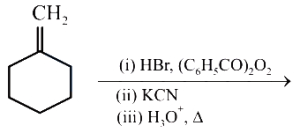
A
Cyclohexanecarboxylic acid with a methyl group at the alpha position.
B
$1-$methylcyclohexanecarboxylic acid.
C
Cyclohexylacetic acid.
D
$3-$cyclohexylpropanoic acid.
Solution
(C) The reaction proceeds as follows:
$1$. The first step is the anti-Markovnikov addition of $HBr$ to methylenecyclohexane in the presence of a peroxide,$(C_6H_5CO)_2O_2$. This yields (cyclohexylmethyl) bromide,$C_6H_{11}CH_2Br$.
$2$. The second step is a nucleophilic substitution reaction with $KCN$,where the bromide ion is replaced by a cyanide group,yielding cyclohexylacetonitrile,$C_6H_{11}CH_2CN$.
$3$. The third step is the acid-catalyzed hydrolysis of the nitrile group followed by heating,which converts the $-CN$ group into a carboxylic acid group,$-COOH$. The final product is cyclohexylacetic acid,$C_6H_{11}CH_2COOH$.
$1$. The first step is the anti-Markovnikov addition of $HBr$ to methylenecyclohexane in the presence of a peroxide,$(C_6H_5CO)_2O_2$. This yields (cyclohexylmethyl) bromide,$C_6H_{11}CH_2Br$.
$2$. The second step is a nucleophilic substitution reaction with $KCN$,where the bromide ion is replaced by a cyanide group,yielding cyclohexylacetonitrile,$C_6H_{11}CH_2CN$.
$3$. The third step is the acid-catalyzed hydrolysis of the nitrile group followed by heating,which converts the $-CN$ group into a carboxylic acid group,$-COOH$. The final product is cyclohexylacetic acid,$C_6H_{11}CH_2COOH$.
0 likesView Solution
149
ChemistryEasyMCQTS EAMCET · 2020
Which one of the following will be most reactive for $SN^1$ reaction?
A
Chlorocyclohexane
B
$3-$Chlorocyclohexene
C
$1-$Methyl$-1-$chlorocyclohexane
D
$1-$Methyl$-3-$chlorocyclohexene
Solution
(D) The rate of $SN^1$ reaction depends upon the stability of the carbocation intermediate formed in the rate-determining step.
$1$. $A$ forms a secondary carbocation.
$2$. $B$ forms an allylic secondary carbocation,which is stabilized by resonance.
$3$. $C$ forms a tertiary carbocation.
$4$. $D$ forms an allylic tertiary carbocation,which is the most stable due to both the tertiary nature and resonance stabilization.
Therefore,$D$ is the most reactive for the $SN^1$ reaction.
$1$. $A$ forms a secondary carbocation.
$2$. $B$ forms an allylic secondary carbocation,which is stabilized by resonance.
$3$. $C$ forms a tertiary carbocation.
$4$. $D$ forms an allylic tertiary carbocation,which is the most stable due to both the tertiary nature and resonance stabilization.
Therefore,$D$ is the most reactive for the $SN^1$ reaction.
0 likesView Solution
150
ChemistryMediumMCQTS EAMCET · 2020
Which one among the following will undergo a faster $S_{N}1$ reaction?
A
Benzyl bromide $(C_6H_5CH_2Br)$
B
$1-$Phenylethyl bromide $(C_6H_5CH(CH_3)Br)$
C
$2-$Phenylpropan$-2-$yl bromide $(C_6H_5C(CH_3)_2Br)$
D
$1,1-$Diphenylethyl bromide $(C_6H_5C(CH_3)(C_6H_5)Br)$
Solution
(D) The rate of an $S_{N}1$ reaction depends on the stability of the carbocation intermediate formed in the rate-determining step. The more stable the carbocation,the faster the $S_{N}1$ reaction.
Comparing the carbocations formed from the given substrates:
$A$: Benzyl cation $(C_6H_5CH_2^+)$ - Stabilized by resonance with one phenyl ring.
$B$: $1-$Phenylethyl cation $(C_6H_5CH^+CH_3)$ - Stabilized by resonance and the inductive effect of the methyl group.
$C$: $2-$Phenylpropan$-2-$yl cation $(C_6H_5C^+(CH_3)_2)$ - Stabilized by resonance and two methyl groups.
$D$: $1,1-$Diphenylethyl cation $(C_6H_5C^+(CH_3)C_6H_5)$ - Stabilized by resonance with two phenyl rings and the inductive effect of one methyl group.
Since the carbocation in option $D$ is stabilized by resonance with two phenyl rings,it is the most stable among the given options. Therefore,it will undergo the fastest $S_{N}1$ reaction.
Comparing the carbocations formed from the given substrates:
$A$: Benzyl cation $(C_6H_5CH_2^+)$ - Stabilized by resonance with one phenyl ring.
$B$: $1-$Phenylethyl cation $(C_6H_5CH^+CH_3)$ - Stabilized by resonance and the inductive effect of the methyl group.
$C$: $2-$Phenylpropan$-2-$yl cation $(C_6H_5C^+(CH_3)_2)$ - Stabilized by resonance and two methyl groups.
$D$: $1,1-$Diphenylethyl cation $(C_6H_5C^+(CH_3)C_6H_5)$ - Stabilized by resonance with two phenyl rings and the inductive effect of one methyl group.
Since the carbocation in option $D$ is stabilized by resonance with two phenyl rings,it is the most stable among the given options. Therefore,it will undergo the fastest $S_{N}1$ reaction.
0 likesView Solution
Vedclass Products
For Students
Vedclass Test Series
Mock tests in real TS EAMCET style covering Chemistry with performance analysis. 5-day free trial.
Start Free TrialFor Teachers
Exam Paper Generator
Generate Set A/B/C/D Chemistry papers from 7.5L+ questions in 2 minutes. 3 chapters free.
Try FreeFor Institutes
Online Exam Module
Run live TS EAMCET mock exams with unlimited students, 360° analytics & white-label branding.
See DemoFrequently Asked Questions
How many Chemistry questions are in TS EAMCET 2020?
There are 358 Chemistry questions from the TS EAMCET 2020 paper on Vedclass, each with a detailed step-by-step solution in English.
Are TS EAMCET 2020 Chemistry solutions available in English?
Yes. All solutions on this page are in English. You can also switch to English or Hindi using the language buttons above the questions.
Can I practice TS EAMCET 2020 Chemistry as a timed test?
Yes. Use the Vedclass Test Series to attempt a full TS EAMCET mock test covering Chemistry with time limits and instant score analysis.
Can teachers create Chemistry papers from TS EAMCET previous year questions?
Yes. The Vedclass Exam Paper Generator lets teachers mix TS EAMCET Chemistry questions and generate Set A/B/C/D papers in minutes.
For Teachers & Institutes
Build a Custom Chemistry Paper
Pick TS EAMCET 2020 Chemistry questions, set difficulty, and generate Set A/B/C/D in 2 minutes.