
ChemistryQ51–150 of 240 questions
Page 2 of 3 · English
51
ChemistryDifficultTS EAMCET · 2018
Match the following reactions in List-$I$ with their products in List-$II$:
| List-$I$ | List-$II$ |
|---|---|
| $A$. The reaction of $1,6$-dibromohexane with $Zn$. | $i$. $H_3C-C \equiv CH$ |
| $B$. Reaction of ethanol with concentrated $H_2SO_4$ at $443 \ K$. | $ii$. $H_2C=CH_2$ |
| $C$. Major product in the reaction of propene with $HBr$ in the presence of benzoyl peroxide. | $iii$. $CH_3-CH_2-CH_2-Br$ |
| $D$. The reaction of $1,1$-dibromopropane with $NaNH_2$ at $433 \ K$. | $iv$. Cyclohexane |
Solution
(A-IV, B-II, C-III, D-I) . $1,6$-dibromohexane reacts with $Zn$ to undergo intramolecular cyclization to form cyclohexane. Thus,$A-iv$.
$B$. Ethanol $(C_2H_5OH)$ reacts with concentrated $H_2SO_4$ at $443 \ K$ to undergo dehydration to form ethene $(H_2C=CH_2)$. Thus,$B-ii$.
$C$. Propene reacts with $HBr$ in the presence of peroxide (anti-Markovnikov addition) to form $1$-bromopropane $(CH_3-CH_2-CH_2-Br)$. Thus,$C-iii$.
$D$. $1,1$-dibromopropane reacts with $NaNH_2$ (a strong base) to undergo dehydrohalogenation to form propyne $(H_3C-C \equiv CH)$. Thus,$D-i$.
Therefore,the correct matching is $A-iv, B-ii, C-iii, D-i$.
$B$. Ethanol $(C_2H_5OH)$ reacts with concentrated $H_2SO_4$ at $443 \ K$ to undergo dehydration to form ethene $(H_2C=CH_2)$. Thus,$B-ii$.
$C$. Propene reacts with $HBr$ in the presence of peroxide (anti-Markovnikov addition) to form $1$-bromopropane $(CH_3-CH_2-CH_2-Br)$. Thus,$C-iii$.
$D$. $1,1$-dibromopropane reacts with $NaNH_2$ (a strong base) to undergo dehydrohalogenation to form propyne $(H_3C-C \equiv CH)$. Thus,$D-i$.
Therefore,the correct matching is $A-iv, B-ii, C-iii, D-i$.
0 likesView Solution
52
ChemistryMediumMCQTS EAMCET · 2018
The major product $(P)$ formed in the below reaction is:
$CH_2$ attached to a cyclohexane ring $\xrightarrow[(ii) NaBH_4, OH^-]{(i) Hg(OAc)_2, H_2O-THF} P?$
$CH_2$ attached to a cyclohexane ring $\xrightarrow[(ii) NaBH_4, OH^-]{(i) Hg(OAc)_2, H_2O-THF} P?$
A
Methylcyclohexane
B
Cyclohexylmethanol
C
$1-$Methylcyclohexanol
D
Cyclohexylmethyl acetate
Solution
(C) The reaction is an oxymercuration-demercuration of an alkene.
$1$. In the first step,$Hg(OAc)_2$ in aqueous $THF$ reacts with the alkene to form an organomercurial intermediate via an electrophilic addition of $Hg(OAc)^+$ followed by the attack of water.
$2$. In the second step,$NaBH_4$ reduces the $C-Hg$ bond to a $C-H$ bond,resulting in the Markovnikov addition of water across the double bond.
$3$. For methylenecyclohexane,the addition of water follows Markovnikov's rule,where the $OH$ group attaches to the more substituted carbon (the tertiary carbon of the ring).
$4$. Thus,the product formed is $1$-methylcyclohexanol.
Hence,option $(C)$ is the correct answer.
$1$. In the first step,$Hg(OAc)_2$ in aqueous $THF$ reacts with the alkene to form an organomercurial intermediate via an electrophilic addition of $Hg(OAc)^+$ followed by the attack of water.
$2$. In the second step,$NaBH_4$ reduces the $C-Hg$ bond to a $C-H$ bond,resulting in the Markovnikov addition of water across the double bond.
$3$. For methylenecyclohexane,the addition of water follows Markovnikov's rule,where the $OH$ group attaches to the more substituted carbon (the tertiary carbon of the ring).
$4$. Thus,the product formed is $1$-methylcyclohexanol.
Hence,option $(C)$ is the correct answer.
0 likesView Solution
53
ChemistryEasyMCQTS EAMCET · 2018
The major product $(P)$ formed in the reaction below is: $HC \equiv C-CH_2-CH=CH_2 \xrightarrow[CCl_4, 253 \ K]{Br_2(1 \ mol)} P$
A
$HC \equiv C-CH_2-CH(Br)-CH_2Br$
B
$CHBr_2-CBr_2-CH_2-CH=CH_2$
C
$HC \equiv C-CH_2-CH(Br)-CH_2Br$
D
$CH_2=CH(Br)-CH(Br)-CH=CH_2$
Solution
(A) The reaction involves the electrophilic addition of $Br_2$ to an alkene in the presence of $CCl_4$ at low temperature $(253 \ K)$.
Alkenes are more reactive towards electrophilic addition than alkynes.
Therefore,$Br_2$ selectively adds across the double bond to form a vicinal dibromide.
The reaction is: $HC \equiv C-CH_2-CH=CH_2 + Br_2 \xrightarrow{CCl_4} HC \equiv C-CH_2-CH(Br)-CH_2Br$.
Thus,the major product is $HC \equiv C-CH_2-CH(Br)-CH_2Br$.
Alkenes are more reactive towards electrophilic addition than alkynes.
Therefore,$Br_2$ selectively adds across the double bond to form a vicinal dibromide.
The reaction is: $HC \equiv C-CH_2-CH=CH_2 + Br_2 \xrightarrow{CCl_4} HC \equiv C-CH_2-CH(Br)-CH_2Br$.
Thus,the major product is $HC \equiv C-CH_2-CH(Br)-CH_2Br$.
0 likesView Solution
54
ChemistryEasyMCQTS EAMCET · 2018
$2-$pentyne on reaction with sodium in liquid ammonia produces compound $A$. What is $A$?
A
$n-$pentane
B
$1-$pentyne
C
cis$-2-$pentene
D
trans$-2-$pentene
Solution
(D) The reaction of an internal alkyne like $2-$pentyne with sodium in liquid ammonia $(Na/Liq. NH_3)$ is a Birch reduction,which stereoselectively produces a $trans-$alkene.
$CH_3-C \equiv C-CH_2-CH_3 \xrightarrow{Na/Liq. NH_3} CH_3-CH=CH-CH_2-CH_3$ (trans$-2-$pentene).
Therefore,compound $A$ is trans$-2-$pentene.
$CH_3-C \equiv C-CH_2-CH_3 \xrightarrow{Na/Liq. NH_3} CH_3-CH=CH-CH_2-CH_3$ (trans$-2-$pentene).
Therefore,compound $A$ is trans$-2-$pentene.
0 likesView Solution
55
ChemistryMediumMCQTS EAMCET · 2018
In the process of formation of nitronium ion,nitric acid acts as
A
$a$ base
B
$an$ acid
C
$a$ catalyst
D
$a$ solvent
Solution
(A) In the process of nitration,the nitronium ion $(NO_2^+)$ is generated by the reaction between sulfuric acid $(H_2SO_4)$ and nitric acid $(HNO_3)$.
$H_2SO_4 + HNO_3 \rightleftharpoons HSO_4^- + H_2NO_3^+$
$H_2NO_3^+ \rightleftharpoons H_2O + NO_2^+$
According to the Brønsted-Lowry acid-base theory,$H_2SO_4$ acts as a proton donor (acid),while $HNO_3$ acts as a proton acceptor (base) because it accepts a proton from $H_2SO_4$ to form $H_2NO_3^+$,which subsequently dehydrates to form the nitronium ion.
$H_2SO_4 + HNO_3 \rightleftharpoons HSO_4^- + H_2NO_3^+$
$H_2NO_3^+ \rightleftharpoons H_2O + NO_2^+$
According to the Brønsted-Lowry acid-base theory,$H_2SO_4$ acts as a proton donor (acid),while $HNO_3$ acts as a proton acceptor (base) because it accepts a proton from $H_2SO_4$ to form $H_2NO_3^+$,which subsequently dehydrates to form the nitronium ion.
0 likesView Solution
56
ChemistryEasyMCQTS EAMCET · 2018
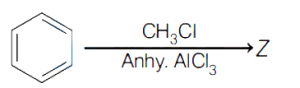
The product $(Z)$ of the following reaction is
A
Chlorobenzene
B
Toluene
C
$2-$Chlorotoluene
D
$1,2-$Dichlorobenzene
Solution
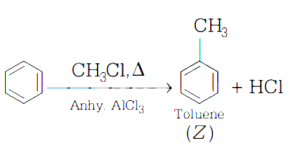
(B) The given reaction is a Friedel-Crafts alkylation reaction. In this reaction,benzene reacts with methyl chloride $(CH_3Cl)$ in the presence of anhydrous aluminum chloride $(Anhy. AlCl_3)$ as a Lewis acid catalyst to form toluene $(C_6H_5CH_3)$ as the product $(Z)$.
The reaction is:
$C_6H_6 + CH_3Cl \xrightarrow{Anhy. AlCl_3} C_6H_5CH_3 + HCl$
Thus,the product $(Z)$ is toluene.
The reaction is:
$C_6H_6 + CH_3Cl \xrightarrow{Anhy. AlCl_3} C_6H_5CH_3 + HCl$
Thus,the product $(Z)$ is toluene.
0 likesView Solution
57
ChemistryEasyMCQTS EAMCET · 2018
The natural relative abundance of isotopes of hydrogen is:
A
$^1_1H = 99.985 \%; ^2_1D = 0.015 \%$
B
$^1_1H = 99.985 \%; ^2_1D = 0.015 \%; ^3_1T = 10^{-16} \%$
C
$^1_1H = 99.100 \%; ^2_1D = 0.900 \%$
D
$^1_1H = 99.900 \%; ^2_1D = 0.10 \%; ^3_1T = 10^{-15} \%$
Solution
(B) Hydrogen has three naturally occurring isotopes: Protium $(^1_1H)$,Deuterium $(^2_1D)$,and Tritium $(^3_1T)$.
Protium is the most abundant isotope with a natural abundance of $99.985 \%$.
Deuterium has a natural abundance of $0.015 \%$.
Tritium is radioactive and exists in trace amounts with a natural abundance of approximately $10^{-16} \%$.
Protium is the most abundant isotope with a natural abundance of $99.985 \%$.
Deuterium has a natural abundance of $0.015 \%$.
Tritium is radioactive and exists in trace amounts with a natural abundance of approximately $10^{-16} \%$.
0 likesView Solution
58
ChemistryMediumMCQTS EAMCET · 2018
Identify the reactions in which $H_2$ is liberated? $(i)$ $Zn + NaOH_{(aq)} \longrightarrow$ $(ii)$ $HCOOH \xrightarrow[\text{Conc. } H_2SO_4]{373 \ K}$ $(iii)$ $CH_{4(g)} + H_2O_{(g)} \xrightarrow[Ni]{1270 \ K}$ $(iv)$ $Zn + H^+_{(aq)} \longrightarrow$ $(v)$ $C_{(s)} + H_2O_{(g)} \xrightarrow{1270 \ K}$
A
$i, iii, iv, v$
B
$i, ii, iii, iv$
C
$ii, iii, iv, v$
D
$i, ii, iii, v$
Solution
(A) $(i)$ $Zn + 2NaOH_{(aq)} \longrightarrow Na_2ZnO_2 + H_{2(g)}$ (Liberates $H_2$)
$(ii)$ $HCOOH \xrightarrow[\text{Conc. } H_2SO_4]{373 \ K} H_2O + CO$ (Does not liberate $H_2$)
$(iii)$ $CH_{4(g)} + H_2O_{(g)} \xrightarrow[Ni]{1270 \ K} CO_{(g)} + 3H_{2(g)}$ (Liberates $H_2$)
$(iv)$ $Zn + 2H^+_{(aq)} \longrightarrow Zn^{2+} + H_{2(g)}$ (Liberates $H_2$)
$(v)$ $C_{(s)} + H_2O_{(g)} \xrightarrow{1270 \ K} CO_{(g)} + H_{2(g)}$ (Liberates $H_2$)
Therefore,reactions $(i)$,$(iii)$,$(iv)$,and $(v)$ liberate $H_2$ gas.
$(ii)$ $HCOOH \xrightarrow[\text{Conc. } H_2SO_4]{373 \ K} H_2O + CO$ (Does not liberate $H_2$)
$(iii)$ $CH_{4(g)} + H_2O_{(g)} \xrightarrow[Ni]{1270 \ K} CO_{(g)} + 3H_{2(g)}$ (Liberates $H_2$)
$(iv)$ $Zn + 2H^+_{(aq)} \longrightarrow Zn^{2+} + H_{2(g)}$ (Liberates $H_2$)
$(v)$ $C_{(s)} + H_2O_{(g)} \xrightarrow{1270 \ K} CO_{(g)} + H_{2(g)}$ (Liberates $H_2$)
Therefore,reactions $(i)$,$(iii)$,$(iv)$,and $(v)$ liberate $H_2$ gas.
0 likesView Solution
59
ChemistryEasyMCQTS EAMCET · 2018
$BeH_2$ can be prepared by the reaction of
A
$BeCl_2$ with $LiAlH_4$
B
$Be$ with $H_2$
C
$Be$ with water
D
$Be$ with liquid ammonia
Solution
(A) Beryllium hydride $(BeH_2)$ is prepared by the reaction of beryllium chloride $(BeCl_2)$ with lithium aluminium hydride $(LiAlH_4)$ in an ethereal solution.
The chemical reaction is: $2BeCl_2 + LiAlH_4 \rightarrow 2BeH_2 + LiCl + AlCl_3$.
The chemical reaction is: $2BeCl_2 + LiAlH_4 \rightarrow 2BeH_2 + LiCl + AlCl_3$.
0 likesView Solution
60
ChemistryDifficultMCQTS EAMCET · 2018
Assertion $(A)$: Ferricyanide ion oxidises $H_2O_2$ to $H_2O$ in basic medium.
Reason $(R)$: Oxidation product of $H_2O_2$ is $O_2$. Which of the following is true?
Reason $(R)$: Oxidation product of $H_2O_2$ is $O_2$. Which of the following is true?
A
Both $(A)$ and $(R)$ are true and $(R)$ is the correct explanation of $(A)$
B
Both $(A)$ and $(R)$ are true,but $(R)$ is not correct explanation of $(A)$
C
$(A)$ is true,but $(R)$ is false
D
$(A)$ is false,but $(R)$ is true
Solution
(D) In basic medium,$H_2O_2$ acts as a reducing agent and gets oxidized to $O_2$. The reaction is:
$2[Fe(CN)_6]^{3-} + H_2O_2 + 2OH^- \rightarrow 2[Fe(CN)_6]^{4-} + 2H_2O + O_2$
Here,the ferricyanide ion $([Fe(CN)_6]^{3-})$ oxidizes $H_2O_2$ to $O_2$,not $H_2O$.
Therefore,Assertion $(A)$ is false because it states that $H_2O_2$ is oxidized to $H_2O$.
Reason $(R)$ is true because the oxidation product of $H_2O_2$ in this reaction is $O_2$.
$2[Fe(CN)_6]^{3-} + H_2O_2 + 2OH^- \rightarrow 2[Fe(CN)_6]^{4-} + 2H_2O + O_2$
Here,the ferricyanide ion $([Fe(CN)_6]^{3-})$ oxidizes $H_2O_2$ to $O_2$,not $H_2O$.
Therefore,Assertion $(A)$ is false because it states that $H_2O_2$ is oxidized to $H_2O$.
Reason $(R)$ is true because the oxidation product of $H_2O_2$ in this reaction is $O_2$.
0 likesView Solution
61
ChemistryMediumMCQTS EAMCET · 2018
Hardness of water is $200 \ ppm$. Calculate the molarity and normality of $CaCO_3$ in the water.
A
$2 \times 10^{-3} \ M ; 4 \times 10^{-3} \ N$
B
$4 \times 10^{-3} \ M ; 2 \times 10^{-3} \ N$
C
$2 \times 10^{-3} \ M ; 2 \times 10^{-3} \ N$
D
$1 \times 10^{-3} \ M ; 4 \times 10^{-3} \ N$
Solution
(A) $200 \ ppm$ means $200 \ g$ of $CaCO_3$ in $10^6 \ g$ (or approximately $10^6 \ mL$) of water.
$\text{Molar mass of } CaCO_3 = 40 + 12 + (3 \times 16) = 100 \ g/mol$.
$\text{Molarity} = \frac{\text{mass in } g}{\text{Molar mass}} \times \frac{1000}{V_{mL}} = \frac{200}{100} \times \frac{1000}{10^6} = 2 \times 10^{-3} \ M$.
$\text{Equivalent mass of } CaCO_3 = \frac{\text{Molar mass}}{n\text{-factor}} = \frac{100}{2} = 50 \ g/eq$.
$\text{Normality} = \frac{\text{mass in } g}{\text{Equivalent mass}} \times \frac{1000}{V_{mL}} = \frac{200}{50} \times \frac{1000}{10^6} = 4 \times 10^{-3} \ N$.
$\text{Molar mass of } CaCO_3 = 40 + 12 + (3 \times 16) = 100 \ g/mol$.
$\text{Molarity} = \frac{\text{mass in } g}{\text{Molar mass}} \times \frac{1000}{V_{mL}} = \frac{200}{100} \times \frac{1000}{10^6} = 2 \times 10^{-3} \ M$.
$\text{Equivalent mass of } CaCO_3 = \frac{\text{Molar mass}}{n\text{-factor}} = \frac{100}{2} = 50 \ g/eq$.
$\text{Normality} = \frac{\text{mass in } g}{\text{Equivalent mass}} \times \frac{1000}{V_{mL}} = \frac{200}{50} \times \frac{1000}{10^6} = 4 \times 10^{-3} \ N$.
0 likesView Solution
62
ChemistryMCQTS EAMCET · 2018
The variance of $50$ observations is $7$. If each observation is multiplied by $6$ and then $5$ is subtracted from it,then the variance of the new data is
A
$37$
B
$42$
C
$247$
D
$252$
0 likesView Solution
63
ChemistryMediumMCQTS EAMCET · 2018
The degree of dissociation of $0.1 \ N$ $CH_3COOH$ is (given $K_a = 1 \times 10^{-5}$) approximately $......$
A
$1 \times 10^{-6}$
B
$1 \times 10^{-7}$
C
$1 \times 10^{-3}$
D
$1 \times 10^{-2}$
Solution
(D) For a weak acid like $CH_3COOH$,the concentration $C = 0.1 \ N$ and dissociation constant $K_a = 1 \times 10^{-5}$.
Using the Ostwald dilution law,the degree of dissociation $\alpha$ is given by the formula $\alpha = \sqrt{\frac{K_a}{C}}$.
Substituting the values: $\alpha = \sqrt{\frac{1 \times 10^{-5}}{0.1}} = \sqrt{1 \times 10^{-4}} = 1 \times 10^{-2}$.
Thus,the degree of dissociation is $1 \times 10^{-2}$.
Using the Ostwald dilution law,the degree of dissociation $\alpha$ is given by the formula $\alpha = \sqrt{\frac{K_a}{C}}$.
Substituting the values: $\alpha = \sqrt{\frac{1 \times 10^{-5}}{0.1}} = \sqrt{1 \times 10^{-4}} = 1 \times 10^{-2}$.
Thus,the degree of dissociation is $1 \times 10^{-2}$.
0 likesView Solution
64
ChemistryMediumMCQTS EAMCET · 2018
What is the $pH$ of acetic acid at equilibrium,given that acetic acid concentration is $0.1 \ M$ and it is $30 \%$ dissociated at equilibrium? $(\log 3=0.47)$
A
$2$
B
$1.53$
C
$3.53$
D
$3$
Solution
(B) The dissociation of acetic acid is represented as: $CH_3COOH \rightleftharpoons CH_3COO^- + H^+$
Given that the degree of dissociation is $30 \%$,the concentration of $H^+$ ions produced is calculated as:
$[H^+] = C \times \alpha = 0.1 \times 0.30 = 0.03 \ M$
Now,calculate the $pH$ using the formula $pH = -\log[H^+]$:
$pH = -\log(0.03)$
$pH = -\log(3 \times 10^{-2})$
$pH = -(\log 3 + \log 10^{-2})$
$pH = -(0.47 - 2)$
$pH = 1.53$
Given that the degree of dissociation is $30 \%$,the concentration of $H^+$ ions produced is calculated as:
$[H^+] = C \times \alpha = 0.1 \times 0.30 = 0.03 \ M$
Now,calculate the $pH$ using the formula $pH = -\log[H^+]$:
$pH = -\log(0.03)$
$pH = -\log(3 \times 10^{-2})$
$pH = -(\log 3 + \log 10^{-2})$
$pH = -(0.47 - 2)$
$pH = 1.53$
0 likesView Solution
65
ChemistryMediumMCQTS EAMCET · 2018
Match the reactants in List-$I$ with the products in List-$II$.
| List-$I$ | List-$II$ |
| $(a). H_2O + H_2S$ | $(i). (H_3O^{+}, HS^{-})$ |
| $(b). H_2O + N^{3-}$ | $(ii). (NH_3, OH^{-})$ |
| $(c). H_2O + SiCl_4$ | $(iii). (OH^{-}, H_3S^{+})$ |
| $(d). H_2O + F_2$ | $(iv). (SiO_2, HCl)$ |
| $(v). (SiO_4^{4-}, Cl_2)$ | |
| $(vi). (O_2, F^{-})$ | |
| $(vii). (HF, OH^{-})$ | |
| $(viii). (OH^{-}, NH_3)$ |
A
$(a)-(i), (b)-(viii), (c)-(v), (d)-(vi)$
B
$(a)-(iii), (b)-(ii), (c)-(v), (d)-(vii)$
C
$(a)-(iii), (b)-(viii), (c)-(iv), (d)-(vii)$
D
$(a)-(i), (b)-(ii), (c)-(iv), (d)-(vi)$
Solution
(D) $(a). H_2O + H_2S \rightarrow H_3O^{+} + HS^{-}$
$(b). 3H_2O + N^{3-} \rightarrow NH_3 + 3OH^{-}$
$(c). 2H_2O + SiCl_4 \rightarrow SiO_2 + 4HCl$
$(d). 2F_2 + 2H_2O \rightarrow O_2 + 4HF$ (or $O_2 + 4F^{-} + 4H^{+}$)
Matching the products: $(a)-(i), (b)-(ii), (c)-(iv), (d)-(vi)$.
$(b). 3H_2O + N^{3-} \rightarrow NH_3 + 3OH^{-}$
$(c). 2H_2O + SiCl_4 \rightarrow SiO_2 + 4HCl$
$(d). 2F_2 + 2H_2O \rightarrow O_2 + 4HF$ (or $O_2 + 4F^{-} + 4H^{+}$)
Matching the products: $(a)-(i), (b)-(ii), (c)-(iv), (d)-(vi)$.
0 likesView Solution
66
ChemistryMediumMCQTS EAMCET · 2018
If the solubility product of $Ni(OH)_2$ is $4.0 \times 10^{-15}$,the solubility (in $mol \ L^{-1}$) is
A
$5.0 \times 10^{-5}$
B
$4.0 \times 10^{-5}$
C
$2.0 \times 10^{-5}$
D
$1.0 \times 10^{-5}$
Solution
(D) The dissociation of $Ni(OH)_2$ is given by:
$Ni(OH)_2(s) \rightleftharpoons Ni^{2+}(aq) + 2OH^{-}(aq)$
Let the solubility be $s \ mol \ L^{-1}$.
Then,$[Ni^{2+}] = s$ and $[OH^{-}] = 2s$.
The solubility product expression is:
$K_{sp} = [Ni^{2+}][OH^{-}]^2$
$K_{sp} = (s)(2s)^2 = 4s^3$
Given $K_{sp} = 4.0 \times 10^{-15}$.
$4s^3 = 4.0 \times 10^{-15}$
$s^3 = 1.0 \times 10^{-15}$
$s = \sqrt[3]{1.0 \times 10^{-15}} = 1.0 \times 10^{-5} \ mol \ L^{-1}$
$Ni(OH)_2(s) \rightleftharpoons Ni^{2+}(aq) + 2OH^{-}(aq)$
Let the solubility be $s \ mol \ L^{-1}$.
Then,$[Ni^{2+}] = s$ and $[OH^{-}] = 2s$.
The solubility product expression is:
$K_{sp} = [Ni^{2+}][OH^{-}]^2$
$K_{sp} = (s)(2s)^2 = 4s^3$
Given $K_{sp} = 4.0 \times 10^{-15}$.
$4s^3 = 4.0 \times 10^{-15}$
$s^3 = 1.0 \times 10^{-15}$
$s = \sqrt[3]{1.0 \times 10^{-15}} = 1.0 \times 10^{-5} \ mol \ L^{-1}$
0 likesView Solution
67
ChemistryMCQTS EAMCET · 2018
$\int \frac{x^8-9 x^2+18}{x^4-3 x^2+3} d x=$
A
$\frac{x^4}{4}+x^3+6 x^2+c$
B
$\frac{x^5}{5}+\frac{x^4}{4}+6 x+c$
C
$\frac{x^5}{5}+x^3+6 x+c$
D
$\frac{x^5}{5}-\frac{x^3}{2}+6 x^2+c$
Solution
(C) To solve the integral $\int \frac{x^8-9 x^2+18}{x^4-3 x^2+3} d x$,we first perform polynomial long division.
Dividing $x^8-9 x^2+18$ by $x^4-3 x^2+3$:
$x^8-9 x^2+18 = (x^4-3 x^2+3)(x^4+3 x^2+6) + 0$.
Thus,the integrand simplifies to $x^4+3 x^2+6$.
Now,we integrate the resulting polynomial:
$\int (x^4+3 x^2+6) d x = \frac{x^5}{5} + 3 \cdot \frac{x^3}{3} + 6x + c$.
Simplifying the expression,we get:
$\frac{x^5}{5} + x^3 + 6x + c$.
Dividing $x^8-9 x^2+18$ by $x^4-3 x^2+3$:
$x^8-9 x^2+18 = (x^4-3 x^2+3)(x^4+3 x^2+6) + 0$.
Thus,the integrand simplifies to $x^4+3 x^2+6$.
Now,we integrate the resulting polynomial:
$\int (x^4+3 x^2+6) d x = \frac{x^5}{5} + 3 \cdot \frac{x^3}{3} + 6x + c$.
Simplifying the expression,we get:
$\frac{x^5}{5} + x^3 + 6x + c$.
0 likesView Solution
68
ChemistryMCQTS EAMCET · 2018
If $|a|=4, |b|=5, |a-b|=3$ and $\theta$ is the angle between the vectors $a$ and $b$,then $\tan^2 \theta=$
A
$\frac{4}{3}$
B
$\frac{3}{4}$
C
$\frac{16}{9}$
D
$\frac{9}{16}$
Solution
(D) Given that,$|a|=4, |b|=5, |a-b|=3$.
We know that $|a-b|^2 = |a|^2 + |b|^2 - 2(a \cdot b)$.
Substituting the given values:
$(3)^2 = (4)^2 + (5)^2 - 2(a \cdot b)$
$9 = 16 + 25 - 2(a \cdot b)$
$9 = 41 - 2(a \cdot b)$
$2(a \cdot b) = 41 - 9 = 32$
$a \cdot b = 16$.
Now,the cosine of the angle $\theta$ between vectors $a$ and $b$ is given by:
$\cos \theta = \frac{a \cdot b}{|a||b|} = \frac{16}{4 \times 5} = \frac{16}{20} = \frac{4}{5}$.
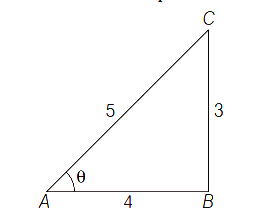
Since $\cos \theta = \frac{4}{5}$,we can form a right-angled triangle with adjacent side $4$ and hypotenuse $5$. The opposite side is $\sqrt{5^2 - 4^2} = \sqrt{25 - 16} = \sqrt{9} = 3$.
Therefore,$\tan \theta = \frac{\text{opposite}}{\text{adjacent}} = \frac{3}{4}$.
Finally,$\tan^2 \theta = \left(\frac{3}{4}\right)^2 = \frac{9}{16}$.
We know that $|a-b|^2 = |a|^2 + |b|^2 - 2(a \cdot b)$.
Substituting the given values:
$(3)^2 = (4)^2 + (5)^2 - 2(a \cdot b)$
$9 = 16 + 25 - 2(a \cdot b)$
$9 = 41 - 2(a \cdot b)$
$2(a \cdot b) = 41 - 9 = 32$
$a \cdot b = 16$.
Now,the cosine of the angle $\theta$ between vectors $a$ and $b$ is given by:
$\cos \theta = \frac{a \cdot b}{|a||b|} = \frac{16}{4 \times 5} = \frac{16}{20} = \frac{4}{5}$.
Since $\cos \theta = \frac{4}{5}$,we can form a right-angled triangle with adjacent side $4$ and hypotenuse $5$. The opposite side is $\sqrt{5^2 - 4^2} = \sqrt{25 - 16} = \sqrt{9} = 3$.
Therefore,$\tan \theta = \frac{\text{opposite}}{\text{adjacent}} = \frac{3}{4}$.
Finally,$\tan^2 \theta = \left(\frac{3}{4}\right)^2 = \frac{9}{16}$.
0 likesView Solution
69
ChemistryMCQTS EAMCET · 2018
If the direction cosines of two lines satisfy the equations $l+m+n=0$ and $2lm+2ln-mn=0$,then the acute angle between those two lines is
A
$\frac{\pi}{4}$
B
$\frac{\pi}{3}$
C
$\frac{\pi}{6}$
D
$\frac{2\pi}{5}$
Solution
(B) Given equations are $l+m+n=0$ and $2lm+2ln-mn=0$.
From the first equation,$l = -(m+n)$.
Substituting this into the second equation:
$2(-m-n)m + 2(-m-n)n - mn = 0$
$-2m^2 - 2mn - 2mn - 2n^2 - mn = 0$
$-2m^2 - 5mn - 2n^2 = 0$
$2m^2 + 5mn + 2n^2 = 0$
$(2m+n)(m+2n) = 0$
Case $1$: $2m+n=0 \Rightarrow m = -n/2$. Then $l = -(-n/2 + n) = -n/2$. The direction ratios are $\langle -n/2, -n/2, n \rangle$,which is proportional to $\langle -1, -1, 2 \rangle$.
Case $2$: $m+2n=0 \Rightarrow m = -2n$. Then $l = -(-2n + n) = n$. The direction ratios are $\langle n, -2n, n \rangle$,which is proportional to $\langle 1, -2, 1 \rangle$.
Let the direction ratios be $\vec{a} = \langle -1, -1, 2 \rangle$ and $\vec{b} = \langle 1, -2, 1 \rangle$.
The angle $\theta$ between the lines is given by $\cos \theta = \frac{|\vec{a} \cdot \vec{b}|}{|\vec{a}| |\vec{b}|}$.
$\vec{a} \cdot \vec{b} = (-1)(1) + (-1)(-2) + (2)(1) = -1 + 2 + 2 = 3$.
$|\vec{a}| = \sqrt{(-1)^2 + (-1)^2 + 2^2} = \sqrt{6}$.
$|\vec{b}| = \sqrt{1^2 + (-2)^2 + 1^2} = \sqrt{6}$.
$\cos \theta = \frac{3}{\sqrt{6} \cdot \sqrt{6}} = \frac{3}{6} = \frac{1}{2}$.
Therefore,$\theta = \cos^{-1}(1/2) = \frac{\pi}{3}$.
From the first equation,$l = -(m+n)$.
Substituting this into the second equation:
$2(-m-n)m + 2(-m-n)n - mn = 0$
$-2m^2 - 2mn - 2mn - 2n^2 - mn = 0$
$-2m^2 - 5mn - 2n^2 = 0$
$2m^2 + 5mn + 2n^2 = 0$
$(2m+n)(m+2n) = 0$
Case $1$: $2m+n=0 \Rightarrow m = -n/2$. Then $l = -(-n/2 + n) = -n/2$. The direction ratios are $\langle -n/2, -n/2, n \rangle$,which is proportional to $\langle -1, -1, 2 \rangle$.
Case $2$: $m+2n=0 \Rightarrow m = -2n$. Then $l = -(-2n + n) = n$. The direction ratios are $\langle n, -2n, n \rangle$,which is proportional to $\langle 1, -2, 1 \rangle$.
Let the direction ratios be $\vec{a} = \langle -1, -1, 2 \rangle$ and $\vec{b} = \langle 1, -2, 1 \rangle$.
The angle $\theta$ between the lines is given by $\cos \theta = \frac{|\vec{a} \cdot \vec{b}|}{|\vec{a}| |\vec{b}|}$.
$\vec{a} \cdot \vec{b} = (-1)(1) + (-1)(-2) + (2)(1) = -1 + 2 + 2 = 3$.
$|\vec{a}| = \sqrt{(-1)^2 + (-1)^2 + 2^2} = \sqrt{6}$.
$|\vec{b}| = \sqrt{1^2 + (-2)^2 + 1^2} = \sqrt{6}$.
$\cos \theta = \frac{3}{\sqrt{6} \cdot \sqrt{6}} = \frac{3}{6} = \frac{1}{2}$.
Therefore,$\theta = \cos^{-1}(1/2) = \frac{\pi}{3}$.
0 likesView Solution
70
ChemistryMediumMCQTS EAMCET · 2018
Identify the correct statements from the following:
$(a)$ In orthoboric acid,boron is in planar geometry.
$(b)$ In $BCl_3 \cdot NH_3$,boron has tetrahedral geometry.
$(c)$ Aqueous solution of borax is acidic.
$(a)$ In orthoboric acid,boron is in planar geometry.
$(b)$ In $BCl_3 \cdot NH_3$,boron has tetrahedral geometry.
$(c)$ Aqueous solution of borax is acidic.
A
$a, b$
B
$b, c$
C
$a, c$
D
$a, b, c$
Solution
(A) $1.$ In orthoboric acid $H_3BO_3$,boron is $sp^2$ hybridized and thus has a planar geometry.
$2.$ In $BCl_3 \cdot NH_3$,boron is $sp^3$ hybridized due to the formation of a coordinate bond with $NH_3$,resulting in a tetrahedral geometry.
$3.$ Borax is a salt of a strong base $(NaOH)$ and a weak acid $(H_3BO_3)$. Therefore,its aqueous solution is basic in nature,not acidic.
Thus,statements $(a)$ and $(b)$ are correct.
$2.$ In $BCl_3 \cdot NH_3$,boron is $sp^3$ hybridized due to the formation of a coordinate bond with $NH_3$,resulting in a tetrahedral geometry.
$3.$ Borax is a salt of a strong base $(NaOH)$ and a weak acid $(H_3BO_3)$. Therefore,its aqueous solution is basic in nature,not acidic.
Thus,statements $(a)$ and $(b)$ are correct.
0 likesView Solution
71
ChemistryEasyMCQTS EAMCET · 2018
The formula of borax is
A
$Na_2 B_4 O_7 \cdot 5 H_2 O$
B
$Na_2 B_4 O_7 \cdot 7 H_2 O$
C
$Na_2 B_4 O_7 \cdot 10 H_2 O$
D
$Na_2 B_4 O_7 \cdot 2 H_2 O$
Solution
(C) The chemical formula of borax is $Na_2 B_4 O_7 \cdot 10 H_2 O$,which is more accurately represented as $Na_2 [B_4 O_5 (OH)_4] \cdot 8 H_2 O$.
$Na_2 B_4 O_7 \cdot 5 H_2 O$ is known as tincalconite (borax pentahydrate).
$Na_2 B_4 O_7 \cdot 7 H_2 O$ and $Na_2 B_4 O_7 \cdot 2 H_2 O$ are not standard common forms of borax.
$Na_2 B_4 O_7 \cdot 5 H_2 O$ is known as tincalconite (borax pentahydrate).
$Na_2 B_4 O_7 \cdot 7 H_2 O$ and $Na_2 B_4 O_7 \cdot 2 H_2 O$ are not standard common forms of borax.
0 likesView Solution
72
ChemistryEasyMCQTS EAMCET · 2018
Which of the following statements about $BF_4^{-}$ and $AlF_6^{3-}$ are correct?
$(i)$ $B$ and $Al$ differ in their oxidation states.
$(ii)$ $B$ and $Al$ differ in their covalency.
$(iii)$ $B$ obeys the octet rule.
$(iv)$ $B$ and $Al$ are in diagonal relationship.
$(i)$ $B$ and $Al$ differ in their oxidation states.
$(ii)$ $B$ and $Al$ differ in their covalency.
$(iii)$ $B$ obeys the octet rule.
$(iv)$ $B$ and $Al$ are in diagonal relationship.
A
$(i)$,$(ii)$
B
$(ii)$,$(iii)$,$(iv)$
C
$(i)$,$(ii)$,$(iii)$
D
$(ii)$,$(iii)$
Solution
(D) In $BF_4^{-}$,the oxidation state of $B$ is $+3$. In $AlF_6^{3-}$,the oxidation state of $Al$ is $+3$. Thus,statement $(i)$ is incorrect.
In $BF_4^{-}$,the covalency of $B$ is $4$. In $AlF_6^{3-}$,the covalency of $Al$ is $6$. Thus,statement $(ii)$ is correct.
In $BF_4^{-}$,$B$ is surrounded by $4$ bonds,meaning $8$ electrons in its valence shell,so it obeys the octet rule. Thus,statement $(iii)$ is correct.
$B$ and $Al$ do not have a diagonal relationship; $B$ has a diagonal relationship with $Si$. Thus,statement $(iv)$ is incorrect.
Therefore,statements $(ii)$ and $(iii)$ are correct.
In $BF_4^{-}$,the covalency of $B$ is $4$. In $AlF_6^{3-}$,the covalency of $Al$ is $6$. Thus,statement $(ii)$ is correct.
In $BF_4^{-}$,$B$ is surrounded by $4$ bonds,meaning $8$ electrons in its valence shell,so it obeys the octet rule. Thus,statement $(iii)$ is correct.
$B$ and $Al$ do not have a diagonal relationship; $B$ has a diagonal relationship with $Si$. Thus,statement $(iv)$ is incorrect.
Therefore,statements $(ii)$ and $(iii)$ are correct.
0 likesView Solution
73
ChemistryEasyMCQTS EAMCET · 2018
When borax is dissolved in water,the product formed is
A
$H_3BO_3$
B
$H_2BO_3$
C
$B_2H_6$
D
$B_2O_3$
Solution
(A) Borax is $Na_2B_4O_7 \cdot 10H_2O$.
When dissolved in water,it undergoes hydrolysis:
$Na_2B_4O_7 + 7H_2O \longrightarrow 2NaOH + 4H_3BO_3$.
Thus,the products formed are sodium hydroxide $(NaOH)$ and orthoboric acid $(H_3BO_3)$.
When dissolved in water,it undergoes hydrolysis:
$Na_2B_4O_7 + 7H_2O \longrightarrow 2NaOH + 4H_3BO_3$.
Thus,the products formed are sodium hydroxide $(NaOH)$ and orthoboric acid $(H_3BO_3)$.
0 likesView Solution
74
ChemistryMediumMCQTS EAMCET · 2018
Diborane reacts with ammonia to form $X$,which on heating gives $H_2$ and borazine. $X$ is
A
$[BH_2(NH_3)_2]^+[BH_4]^-$
B
$B_3N_3H_6$
C
$BH_3 \cdot NH_3$
D
$[BH(NH_3)_3]^+[BH_4]^-$
Solution
(A) The reaction of diborane $(B_2H_6)$ with ammonia $(NH_3)$ at low temperature results in the formation of an ionic adduct $X$,which is diammoniate of diborane,$[BH_2(NH_3)_2]^+[BH_4]^-$.
The chemical equation is: $B_2H_6 + 2NH_3 \longrightarrow [BH_2(NH_3)_2]^+[BH_4]^-$.
Upon heating,this compound $X$ undergoes decomposition to form borazine $(B_3N_3H_6)$ and hydrogen gas $(H_2)$: $3[BH_2(NH_3)_2]^+[BH_4]^- \xrightarrow{\Delta} 2B_3N_3H_6 + 12H_2$.
The chemical equation is: $B_2H_6 + 2NH_3 \longrightarrow [BH_2(NH_3)_2]^+[BH_4]^-$.
Upon heating,this compound $X$ undergoes decomposition to form borazine $(B_3N_3H_6)$ and hydrogen gas $(H_2)$: $3[BH_2(NH_3)_2]^+[BH_4]^- \xrightarrow{\Delta} 2B_3N_3H_6 + 12H_2$.
0 likesView Solution
75
ChemistryMediumMCQTS EAMCET · 2018
$AlCl_3$ in water at $pH < 7$ forms
A
tetrahedral $Al(OH)_4^{-}$ ions
B
octahedral $Al(OH)_6^{3-}$ ions
C
square planar $Al(OH)_4^{-}$ ions
D
octahedral $[Al(H_2O)_6]^{3+}$ ions
Solution
(D) In an acidic medium $(pH < 7)$,$AlCl_3$ undergoes hydrolysis to form the hexaaquaaluminum$(III)$ complex ion.
The reaction is: $AlCl_3 + 6H_2O \longrightarrow [Al(H_2O)_6]^{3+} + 3Cl^{-}$
This complex ion has an octahedral geometry.
The reaction is: $AlCl_3 + 6H_2O \longrightarrow [Al(H_2O)_6]^{3+} + 3Cl^{-}$
This complex ion has an octahedral geometry.
0 likesView Solution
76
ChemistryMediumMCQTS EAMCET · 2018
In which allotrope of carbon does each carbon atom form four bonds with other carbon atoms?
A
Graphite
B
Graphite and $C_{60}$
C
Diamond
D
Diamond and $C_{60}$
Solution
(C) Carbon has an electronic configuration of $2, 4$.
In diamond,each carbon atom is $sp^3$ hybridized and forms four strong covalent bonds with four other carbon atoms in a tetrahedral arrangement.
In graphite,each carbon atom is $sp^2$ hybridized and forms three covalent bonds with other carbon atoms,leaving one electron delocalized.
In $C_{60}$ (fullerene),each carbon atom is also $sp^2$ hybridized and forms three bonds.
In diamond,each carbon atom is $sp^3$ hybridized and forms four strong covalent bonds with four other carbon atoms in a tetrahedral arrangement.
In graphite,each carbon atom is $sp^2$ hybridized and forms three covalent bonds with other carbon atoms,leaving one electron delocalized.
In $C_{60}$ (fullerene),each carbon atom is also $sp^2$ hybridized and forms three bonds.
0 likesView Solution
77
ChemistryMediumMCQTS EAMCET · 2018
$Si$ reacts with $CH_3Cl$ at $573 \ K$ in the presence of $Cu$ powder to form methyl substituted chlorosilanes. Among the given methyl substituted chlorosilanes,whose yield is minimum?
A
$CH_3SiCl_3$
B
$(CH_3)_2SiCl_2$
C
$(CH_3)_3SiCl$
D
$(CH_3)_4Si$
Solution
(D) When heating silicon with methyl chloride at $573 \ K$ in the presence of $Cu$ powder (Direct Process),a mixture of methyl chlorosilanes is formed: $CH_3SiCl_3$,$(CH_3)_2SiCl_2$,$(CH_3)_3SiCl$,and $(CH_3)_4Si$.
Among these,the yield of $(CH_3)_4Si$ (tetramethylsilane) is the minimum.
This is because the substitution of all four chlorine atoms by bulky methyl groups is sterically hindered and thermodynamically less favorable compared to the formation of chlorosilanes.
Among these,the yield of $(CH_3)_4Si$ (tetramethylsilane) is the minimum.
This is because the substitution of all four chlorine atoms by bulky methyl groups is sterically hindered and thermodynamically less favorable compared to the formation of chlorosilanes.
0 likesView Solution
78
ChemistryEasyMCQTS EAMCET · 2018
Which of the following is known as silicone?
A
Polymer of $R_2SiCl_2$
B
Polymer of $R_2SiO$
C
Polymer of $SiO_2$
D
Polymer of $[SiO_4]^{4-}$
Solution
(B) Silicones are a group of organosilicon polymers which have the general empirical formula $(R_2SiO)_n$.
They are synthesized by the hydrolysis of dialkyldichlorosilanes $(R_2SiCl_2)$,followed by condensation polymerization.
The structure consists of a repeating unit of $-(Si(R)_2-O)-$.
Thus,they are considered as polymers of $R_2SiO$.
They are synthesized by the hydrolysis of dialkyldichlorosilanes $(R_2SiCl_2)$,followed by condensation polymerization.
The structure consists of a repeating unit of $-(Si(R)_2-O)-$.
Thus,they are considered as polymers of $R_2SiO$.
0 likesView Solution
79
ChemistryMediumMCQTS EAMCET · 2018
$SiO_2$ reacts with
A
$H_2SO_4, HF$
B
$HF, NaOH$
C
$Na_2CO_3, NaOH$
D
$Na_2CO_3, H_2SO_4$
Solution
(B) $SiO_2$ is an acidic oxide. It reacts with hydrofluoric acid $(HF)$ to form hexafluorosilicic acid and with strong bases like sodium hydroxide $(NaOH)$ to form sodium silicate.
$SiO_2 + 6HF \longrightarrow H_2[SiF_6] + 2H_2O$
$SiO_2 + 2NaOH \longrightarrow Na_2SiO_3 + H_2O$
$SiO_2 + 6HF \longrightarrow H_2[SiF_6] + 2H_2O$
$SiO_2 + 2NaOH \longrightarrow Na_2SiO_3 + H_2O$
0 likesView Solution
80
ChemistryMediumMCQTS EAMCET · 2018
The correct order of the bond angles of the given compounds is
A
$NH_3 < PH_3 < AsH_3 < SbH_3$
B
$SbH_3 < AsH_3 < PH_3 < NH_3$
C
$NH_3 < AsH_3 < SbH_3 < PH_3$
D
$PH_3 < SbH_3 < AsH_3 < NH_3$
Solution
(B) In the group $15$ hydrides $(NH_3, PH_3, AsH_3, SbH_3)$,the central atom size increases down the group $(N < P < As < Sb)$.
As the size of the central atom increases,the bond pair-bond pair repulsion decreases,and the electronegativity of the central atom decreases.
This leads to a decrease in the bond angle as we move down the group.
Therefore,the correct order of bond angles is $SbH_3 < AsH_3 < PH_3 < NH_3$.
As the size of the central atom increases,the bond pair-bond pair repulsion decreases,and the electronegativity of the central atom decreases.
This leads to a decrease in the bond angle as we move down the group.
Therefore,the correct order of bond angles is $SbH_3 < AsH_3 < PH_3 < NH_3$.
0 likesView Solution
81
ChemistryEasyMCQTS EAMCET · 2018
Which one of the following is a disproportionation reaction?
A
$2 AgNO_{3(aq)} + Cu_{(s)} \longrightarrow Cu(NO_3)_{2(aq)} + 2 Ag_{(s)}$
B
$3 AgNO_{3(aq)} + K_3PO_{4(aq)} \longrightarrow Ag_3PO_{4(s)} + 3 KNO_{3(aq)}$
C
$4 KClO_{3(s)} \stackrel{\Delta}{\longrightarrow} KCl_{(s)} + 3 KClO_{4(s)}$
D
$4 Fe_{(s)} + 3 O_{2(g)} \longrightarrow 2 Fe_2O_3$
Solution
(C) disproportionation reaction is a type of redox reaction in which the same element is simultaneously oxidized and reduced.
In the reaction $4 KClO_{3(s)} \stackrel{\Delta}{\longrightarrow} KCl_{(s)} + 3 KClO_{4(s)}$:
The oxidation state of chlorine in $KClO_3$ is $+5$.
In $KCl$,the oxidation state of chlorine is $-1$ (reduction).
In $KClO_4$,the oxidation state of chlorine is $+7$ (oxidation).
Since the same element (chlorine) is both oxidized and reduced,this is a disproportionation reaction.
In the reaction $4 KClO_{3(s)} \stackrel{\Delta}{\longrightarrow} KCl_{(s)} + 3 KClO_{4(s)}$:
The oxidation state of chlorine in $KClO_3$ is $+5$.
In $KCl$,the oxidation state of chlorine is $-1$ (reduction).
In $KClO_4$,the oxidation state of chlorine is $+7$ (oxidation).
Since the same element (chlorine) is both oxidized and reduced,this is a disproportionation reaction.
0 likesView Solution
82
ChemistryEasyMCQTS EAMCET · 2018
The oxidation states of $S$ in $H_2S_2O_7$ are:
A
$VI, VI$
B
$IV, VI$
C
$IV, IV$
D
$I, VII$
Solution
(A) $H_2S_2O_7$ is known as oleum or pyrosulphuric acid.
In the structure of $H_2S_2O_7$,each sulphur atom is bonded to three oxygen atoms via double bonds (contributing $+2$ each) and one oxygen atom via a single bond (contributing $+1$),and one hydroxyl group (contributing $+1$).
Therefore,the oxidation state for each sulphur atom is $+2 + 2 + 1 + 1 = +6$.
Thus,the oxidation states of both sulphur atoms are $VI$ and $VI$.
In the structure of $H_2S_2O_7$,each sulphur atom is bonded to three oxygen atoms via double bonds (contributing $+2$ each) and one oxygen atom via a single bond (contributing $+1$),and one hydroxyl group (contributing $+1$).
Therefore,the oxidation state for each sulphur atom is $+2 + 2 + 1 + 1 = +6$.
Thus,the oxidation states of both sulphur atoms are $VI$ and $VI$.
0 likesView Solution
83
ChemistryEasyMCQTS EAMCET · 2018
Which pair of elements on combustion in air give superoxides?
A
$Li, Cs$
B
$K, Rb$
C
$Li, Rb$
D
$K, Li$
Solution
(B) Alkali metals react with oxygen to form different types of oxides depending on their size and ionization energy.
$Li$ forms only the monoxide $(Li_2O)$.
$Na$ forms the peroxide $(Na_2O_2)$.
$K$,$Rb$,and $Cs$ form superoxides $(MO_2)$ when burnt in excess of air.
Therefore,the pair of elements that form superoxides is $K$ and $Rb$.
$Li$ forms only the monoxide $(Li_2O)$.
$Na$ forms the peroxide $(Na_2O_2)$.
$K$,$Rb$,and $Cs$ form superoxides $(MO_2)$ when burnt in excess of air.
Therefore,the pair of elements that form superoxides is $K$ and $Rb$.
0 likesView Solution
84
ChemistryEasyMCQTS EAMCET · 2018
Highest melting point among the following is displayed by
A
$Be$
B
$Ca$
C
$Sr$
D
$Ba$
Solution
(A) The melting points of alkaline earth metals $(Be, Mg, Ca, Sr, Ba)$ do not show a regular trend due to differences in their crystal structures. However,$Be$ has a significantly higher melting point $(1560 \ K)$ compared to the other alkaline earth metals $(Ca = 1124 \ K, Sr = 1045 \ K, Ba = 1002 \ K)$ due to its small size and strong metallic bonding. Therefore,$Be$ has the highest melting point among the given options.
0 likesView Solution
85
ChemistryEasyMCQTS EAMCET · 2018
When sodium $(Na)$ metal is dissolved in liquid ammonia $(NH_3)$,it imparts a blue colour to the solution. This blue coloration is due to:
A
Liquid $NH_3$
B
$[Na(NH_3)_x]^+$
C
$NaNH_2$
D
$[e(NH_3)_x]^-$
Solution
(D) When sodium $(Na)$ metal is dissolved in liquid ammonia $(NH_3)$,it undergoes ionization to form ammoniated cations and ammoniated electrons:
$Na + (x+y)NH_3 \rightarrow [Na(NH_3)_x]^+ + [e(NH_3)_y]^-$
The blue colour of the solution is due to the excitation of the ammoniated electrons $[e(NH_3)_y]^-$ to higher energy levels,which absorb light in the visible region.
$Na + (x+y)NH_3 \rightarrow [Na(NH_3)_x]^+ + [e(NH_3)_y]^-$
The blue colour of the solution is due to the excitation of the ammoniated electrons $[e(NH_3)_y]^-$ to higher energy levels,which absorb light in the visible region.
0 likesView Solution
86
ChemistryMediumMCQTS EAMCET · 2018
Which of the following compounds give a basic solution on hydrolysis?
$(1)$ $NH_4Cl$
$(2)$ $K_2CO_3$
$(3)$ $Na_2B_4O_7 \cdot 10 H_2O$
$(4)$ $NaCl$
$(1)$ $NH_4Cl$
$(2)$ $K_2CO_3$
$(3)$ $Na_2B_4O_7 \cdot 10 H_2O$
$(4)$ $NaCl$
A
$1, 2, 3$
B
$2, 3$
C
$2, 3, 4$
D
$3, 4$
Solution
(B) Hydrolysis of salts determines the nature of the resulting solution:
$(1)$ $NH_4Cl$ is a salt of a weak base $(NH_4OH)$ and a strong acid $(HCl)$,resulting in an acidic solution.
$(2)$ $K_2CO_3$ is a salt of a strong base $(KOH)$ and a weak acid $(H_2CO_3)$,resulting in a basic solution.
$(3)$ $Na_2B_4O_7 \cdot 10 H_2O$ (Borax) on hydrolysis gives $NaOH$ (strong base) and $H_3BO_3$ (weak acid),resulting in a basic solution.
$(4)$ $NaCl$ is a salt of a strong base $(NaOH)$ and a strong acid $(HCl)$,resulting in a neutral solution.
Therefore,compounds $(2)$ and $(3)$ yield a basic solution.
$(1)$ $NH_4Cl$ is a salt of a weak base $(NH_4OH)$ and a strong acid $(HCl)$,resulting in an acidic solution.
$(2)$ $K_2CO_3$ is a salt of a strong base $(KOH)$ and a weak acid $(H_2CO_3)$,resulting in a basic solution.
$(3)$ $Na_2B_4O_7 \cdot 10 H_2O$ (Borax) on hydrolysis gives $NaOH$ (strong base) and $H_3BO_3$ (weak acid),resulting in a basic solution.
$(4)$ $NaCl$ is a salt of a strong base $(NaOH)$ and a strong acid $(HCl)$,resulting in a neutral solution.
Therefore,compounds $(2)$ and $(3)$ yield a basic solution.
0 likesView Solution
87
ChemistryMediumMCQTS EAMCET · 2018
Calcium on heating in $N_2$ yields an ionic compound $A$,which reacts with water to give $Ca(OH)_2$ and a gas $B$. Identify $A$ and $B$.
A
$CaN_2, NO$
B
$Ca_3N_2, NH_3$
C
$CaN_2, NH_3$
D
$Ca_3N_2, NO$
Solution
(B) When calcium is heated in an atmosphere of $N_2$,it forms calcium nitride,$Ca_3N_2$,which is the ionic compound $A$.
$3Ca + N_2 \xrightarrow{\Delta} Ca_3N_2 (A)$
Calcium nitride reacts with water to produce calcium hydroxide and ammonia gas,$B$.
$Ca_3N_2 + 6H_2O \rightarrow 3Ca(OH)_2 + 2NH_3 (B)$
Therefore,$A$ is $Ca_3N_2$ and $B$ is $NH_3$.
$3Ca + N_2 \xrightarrow{\Delta} Ca_3N_2 (A)$
Calcium nitride reacts with water to produce calcium hydroxide and ammonia gas,$B$.
$Ca_3N_2 + 6H_2O \rightarrow 3Ca(OH)_2 + 2NH_3 (B)$
Therefore,$A$ is $Ca_3N_2$ and $B$ is $NH_3$.
0 likesView Solution
88
ChemistryMediumMCQTS EAMCET · 2018
When $10 \ g$ of $90 \%$ pure limestone is heated,the approximate volume $($in $L$ $)$ of $CO_2$ liberated at $\text{STP}$ is:
A
$4.4$
B
$2.0$
C
$4.0$
D
$22.4$
Solution
(B) The decomposition reaction of $CaCO_3$ is:
$CaCO_{3(s)} \xrightarrow{\Delta} CaO_{(s)} + CO_{2(g)}$
At $\text{STP}$,heating $1 \ mol$ of $CaCO_3$ (i.e.,$100 \ g$) liberates $1 \ mol$ or $22.4 \ L$ of $CO_2$.
Mass of pure $CaCO_3$ in $10 \ g$ of $90 \%$ pure limestone $= \frac{10 \times 90}{100} = 9 \ g$.
Since $100 \ g$ of $CaCO_3$ produces $22.4 \ L$ of $CO_2$,
$9 \ g$ of $CaCO_3$ will liberate $= \frac{9 \times 22.4}{100} \ L = 2.016 \ L \approx 2.0 \ L$ of $CO_2$.
$CaCO_{3(s)} \xrightarrow{\Delta} CaO_{(s)} + CO_{2(g)}$
At $\text{STP}$,heating $1 \ mol$ of $CaCO_3$ (i.e.,$100 \ g$) liberates $1 \ mol$ or $22.4 \ L$ of $CO_2$.
Mass of pure $CaCO_3$ in $10 \ g$ of $90 \%$ pure limestone $= \frac{10 \times 90}{100} = 9 \ g$.
Since $100 \ g$ of $CaCO_3$ produces $22.4 \ L$ of $CO_2$,
$9 \ g$ of $CaCO_3$ will liberate $= \frac{9 \times 22.4}{100} \ L = 2.016 \ L \approx 2.0 \ L$ of $CO_2$.
0 likesView Solution
89
ChemistryMediumMCQTS EAMCET · 2018
The amount of iron $(Fe)$ in $g$ which can be produced from $600 \ g$ of magnetite ore is [Atomic mass of $Fe$ : $55.8$]
A
$450$
B
$379$
C
$434$
D
$210$
Solution
(C) The chemical formula of magnetite is $Fe_3O_4$.
The molar mass of $Fe_3O_4 = (3 \times 55.8) + (4 \times 16) = 167.4 + 64 = 231.4 \ g/mol$.
The number of moles in $600 \ g$ of $Fe_3O_4 = \frac{600}{231.4} \approx 2.593 \ mol$.
According to the stoichiometry of the reaction $Fe_3O_4 + 4CO \longrightarrow 3Fe + 4CO_2$,$1 \ mol$ of $Fe_3O_4$ produces $3 \ mol$ of $Fe$.
Therefore,$2.593 \ mol$ of $Fe_3O_4$ produces $2.593 \times 3 = 7.779 \ mol$ of $Fe$.
Mass of $Fe = 7.779 \ mol \times 55.8 \ g/mol \approx 434 \ g$.
The molar mass of $Fe_3O_4 = (3 \times 55.8) + (4 \times 16) = 167.4 + 64 = 231.4 \ g/mol$.
The number of moles in $600 \ g$ of $Fe_3O_4 = \frac{600}{231.4} \approx 2.593 \ mol$.
According to the stoichiometry of the reaction $Fe_3O_4 + 4CO \longrightarrow 3Fe + 4CO_2$,$1 \ mol$ of $Fe_3O_4$ produces $3 \ mol$ of $Fe$.
Therefore,$2.593 \ mol$ of $Fe_3O_4$ produces $2.593 \times 3 = 7.779 \ mol$ of $Fe$.
Mass of $Fe = 7.779 \ mol \times 55.8 \ g/mol \approx 434 \ g$.
0 likesView Solution
90
ChemistryDifficultMCQTS EAMCET · 2018
Calculate the approximate mass (in $g$) of $H_2S$ required for the following reaction when $15 \ L$ of oxygen at $STP$ reacts completely.
$2 H_2S_{(g)} + 3 O_{2(g)} \longrightarrow 2 SO_{2(g)} + 2 H_2O_{(g)}$
(molar mass of $H_2S = 34 \ g \ mol^{-1}$)
$2 H_2S_{(g)} + 3 O_{2(g)} \longrightarrow 2 SO_{2(g)} + 2 H_2O_{(g)}$
(molar mass of $H_2S = 34 \ g \ mol^{-1}$)
A
$12.11$
B
$15.16$
C
$34.12$
D
$68.24$
Solution
(B) The balanced chemical equation is:
$2 H_2S_{(g)} + 3 O_{2(g)} \longrightarrow 2 SO_{2(g)} + 2 H_2O_{(g)}$
From the stoichiometry,$3 \ mol$ of $O_2$ reacts with $2 \ mol$ of $H_2S$.
At $STP$,$1 \ mol$ of gas occupies $22.4 \ L$.
Therefore,$15 \ L$ of $O_2 = \frac{15}{22.4} \ mol \approx 0.6696 \ mol$.
Using the mole ratio,the moles of $H_2S$ required = $\frac{2}{3} \times \left(\frac{15}{22.4}\right) \ mol$.
Mass of $H_2S = \text{moles} \times \text{molar mass} = \left(\frac{2}{3} \times \frac{15}{22.4}\right) \times 34 \ g \ mol^{-1}$.
Mass of $H_2S = \frac{10}{22.4} \times 34 \approx 15.178 \ g$.
The approximate mass is $15.16 \ g$.
$2 H_2S_{(g)} + 3 O_{2(g)} \longrightarrow 2 SO_{2(g)} + 2 H_2O_{(g)}$
From the stoichiometry,$3 \ mol$ of $O_2$ reacts with $2 \ mol$ of $H_2S$.
At $STP$,$1 \ mol$ of gas occupies $22.4 \ L$.
Therefore,$15 \ L$ of $O_2 = \frac{15}{22.4} \ mol \approx 0.6696 \ mol$.
Using the mole ratio,the moles of $H_2S$ required = $\frac{2}{3} \times \left(\frac{15}{22.4}\right) \ mol$.
Mass of $H_2S = \text{moles} \times \text{molar mass} = \left(\frac{2}{3} \times \frac{15}{22.4}\right) \times 34 \ g \ mol^{-1}$.
Mass of $H_2S = \frac{10}{22.4} \times 34 \approx 15.178 \ g$.
The approximate mass is $15.16 \ g$.
0 likesView Solution
91
ChemistryDifficultMCQTS EAMCET · 2018
$CaCO_3$ reacts with $HCl$ to produce $CaCl_2, CO_2$ and $H_2O$. The approximate mass (in $g$) of $CaCO_3$ required to react completely with $25 \ mL$ of $0.75 \ M \ HCl$ is (atomic mass of $Ca=40, C=12, O=16, Cl=35.5$ and $H=1$).
A
$94$
B
$9.4$
C
$0.94$
D
$0.094$
Solution
(C) The balanced chemical equation is: $CaCO_3 + 2HCl \longrightarrow CaCl_2 + CO_2 + H_2O$
Moles of $HCl = \text{Molarity} \times \text{Volume (in L)} = 0.75 \ M \times 0.025 \ L = 0.01875 \ mol$.
According to the stoichiometry of the reaction,$1 \ mol$ of $CaCO_3$ reacts with $2 \ mol$ of $HCl$.
Therefore,moles of $CaCO_3$ required $= \frac{0.01875}{2} = 0.009375 \ mol$.
Molar mass of $CaCO_3 = 40 + 12 + (3 \times 16) = 100 \ g/mol$.
Mass of $CaCO_3 = 0.009375 \ mol \times 100 \ g/mol = 0.9375 \ g \approx 0.94 \ g$.
Moles of $HCl = \text{Molarity} \times \text{Volume (in L)} = 0.75 \ M \times 0.025 \ L = 0.01875 \ mol$.
According to the stoichiometry of the reaction,$1 \ mol$ of $CaCO_3$ reacts with $2 \ mol$ of $HCl$.
Therefore,moles of $CaCO_3$ required $= \frac{0.01875}{2} = 0.009375 \ mol$.
Molar mass of $CaCO_3 = 40 + 12 + (3 \times 16) = 100 \ g/mol$.
Mass of $CaCO_3 = 0.009375 \ mol \times 100 \ g/mol = 0.9375 \ g \approx 0.94 \ g$.
0 likesView Solution
92
ChemistryEasyMCQTS EAMCET · 2018
$28 \ g$ $KOH$ is required to completely neutralize $CO_2$ produced on heating $60 \ g$ of impure $CaCO_3$. The percentage purity of $CaCO_3$ is approximately (molar masses of $KOH$ and $CaCO_3$ are $56$ and $100 \ g \ mol^{-1}$,respectively).
A
$41.6$
B
$40$
C
$20.8$
D
$83.3$
Solution
(A) The reaction for heating $CaCO_3$ is: $CaCO_3 \xrightarrow{\Delta} CaO + CO_2$.
Neutralization of $CO_2$ by $KOH$ is: $2KOH + CO_2 \rightarrow K_2CO_3 + H_2O$.
From the stoichiometry,$2 \ mol$ of $KOH$ reacts with $1 \ mol$ of $CO_2$,which is produced from $1 \ mol$ of $CaCO_3$.
Thus,$2 \ mol$ of $KOH$ reacts with $1 \ mol$ of $CaCO_3$.
$2 \times 56 \ g$ of $KOH$ reacts with $100 \ g$ of $CaCO_3$.
$112 \ g$ of $KOH$ reacts with $100 \ g$ of $CaCO_3$.
Therefore,$28 \ g$ of $KOH$ reacts with $\frac{100 \times 28}{112} = 25 \ g$ of pure $CaCO_3$.
Percentage purity $= \frac{\text{mass of pure } CaCO_3}{\text{mass of impure } CaCO_3} \times 100 = \frac{25}{60} \times 100 = 41.66\% \approx 41.6\%$.
Neutralization of $CO_2$ by $KOH$ is: $2KOH + CO_2 \rightarrow K_2CO_3 + H_2O$.
From the stoichiometry,$2 \ mol$ of $KOH$ reacts with $1 \ mol$ of $CO_2$,which is produced from $1 \ mol$ of $CaCO_3$.
Thus,$2 \ mol$ of $KOH$ reacts with $1 \ mol$ of $CaCO_3$.
$2 \times 56 \ g$ of $KOH$ reacts with $100 \ g$ of $CaCO_3$.
$112 \ g$ of $KOH$ reacts with $100 \ g$ of $CaCO_3$.
Therefore,$28 \ g$ of $KOH$ reacts with $\frac{100 \times 28}{112} = 25 \ g$ of pure $CaCO_3$.
Percentage purity $= \frac{\text{mass of pure } CaCO_3}{\text{mass of impure } CaCO_3} \times 100 = \frac{25}{60} \times 100 = 41.66\% \approx 41.6\%$.
0 likesView Solution
93
ChemistryEasyMCQTS EAMCET · 2018
Molarity of a $50 \ mL$ $H_2SO_4$ solution is $10.0 \ M$. If the density of the solution is $1.4 \ g/cc$,calculate its molality.
A
$7.14$
B
$23.8$
C
$10$
D
$0.5$
Solution
(B) Given,molarity of $H_2SO_4$ solution $= 10.0 \ M$.
Volume $(V) = 50 \ mL$.
Density of solution $(d) = 1.4 \ g/cc$.
Molarity $10 \ M$ means $10 \ moles$ of $H_2SO_4$ are present in $1000 \ mL$ of solution.
Molar mass of $H_2SO_4$ $(M_B) = 98 \ g/mol$.
Mass of $H_2SO_4$ in $1000 \ mL = 10 \ mol \times 98 \ g/mol = 980 \ g$.
Mass of $H_2SO_4$ in $50 \ mL = (980 \ g / 1000 \ mL) \times 50 \ mL = 49 \ g$.
Mass of solution $= d \times V = 1.4 \ g/cc \times 50 \ mL = 70 \ g$.
Mass of solvent $(w_A) = \text{Mass of solution} - \text{Mass of solute} = 70 \ g - 49 \ g = 21 \ g$.
Molality $(m) = \frac{\text{moles of solute}}{\text{mass of solvent in kg}} = \frac{49 \ g / 98 \ g/mol}{21 \ g / 1000 \ g/kg} = 0.5 \ mol \times (1000 / 21) \ kg^{-1} \approx 23.8 \ m$.
Volume $(V) = 50 \ mL$.
Density of solution $(d) = 1.4 \ g/cc$.
Molarity $10 \ M$ means $10 \ moles$ of $H_2SO_4$ are present in $1000 \ mL$ of solution.
Molar mass of $H_2SO_4$ $(M_B) = 98 \ g/mol$.
Mass of $H_2SO_4$ in $1000 \ mL = 10 \ mol \times 98 \ g/mol = 980 \ g$.
Mass of $H_2SO_4$ in $50 \ mL = (980 \ g / 1000 \ mL) \times 50 \ mL = 49 \ g$.
Mass of solution $= d \times V = 1.4 \ g/cc \times 50 \ mL = 70 \ g$.
Mass of solvent $(w_A) = \text{Mass of solution} - \text{Mass of solute} = 70 \ g - 49 \ g = 21 \ g$.
Molality $(m) = \frac{\text{moles of solute}}{\text{mass of solvent in kg}} = \frac{49 \ g / 98 \ g/mol}{21 \ g / 1000 \ g/kg} = 0.5 \ mol \times (1000 / 21) \ kg^{-1} \approx 23.8 \ m$.
0 likesView Solution
94
ChemistryMediumMCQTS EAMCET · 2018
For a fixed mass of an ideal gas,which of the following is a correct representation?
A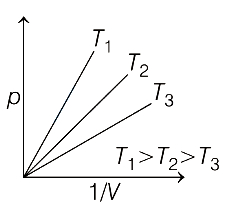
B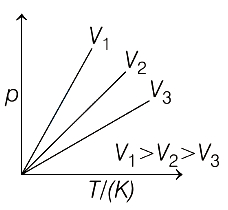
C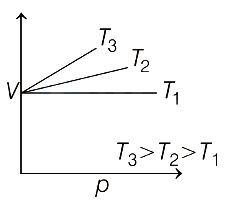
D
None of these
Solution
(A) For a fixed mass $(m)$ of an ideal gas,the ideal gas equation is $pV = nRT$,where $n$ is constant.
$(A)$ For $p$ vs $1/V$ (Boyle's Law): $p = (nRT) \times (1/V)$. The slope is $nRT$. Since $T_1 > T_2 > T_3$,the slope $T_1 > T_2 > T_3$. This graph is correct.
$(B)$ For $p$ vs $T$ (Gay-Lussac's Law): $p = (nR/V) \times T$. The slope is $nR/V$. Since $V_1 > V_2 > V_3$,the slope $1/V_1 < 1/V_2 < 1/V_3$. Thus,the order of slopes should be $V_3 > V_2 > V_1$. The provided graph shows $V_1 > V_2 > V_3$,which is incorrect.
$(C)$ For $V$ vs $p$ (Boyle's Law): $V = (nRT) \times (1/p)$. This is a rectangular hyperbola,not a straight line passing through the origin. The provided graph is incorrect.
Therefore,the correct representation is $(A)$.
$(A)$ For $p$ vs $1/V$ (Boyle's Law): $p = (nRT) \times (1/V)$. The slope is $nRT$. Since $T_1 > T_2 > T_3$,the slope $T_1 > T_2 > T_3$. This graph is correct.
$(B)$ For $p$ vs $T$ (Gay-Lussac's Law): $p = (nR/V) \times T$. The slope is $nR/V$. Since $V_1 > V_2 > V_3$,the slope $1/V_1 < 1/V_2 < 1/V_3$. Thus,the order of slopes should be $V_3 > V_2 > V_1$. The provided graph shows $V_1 > V_2 > V_3$,which is incorrect.
$(C)$ For $V$ vs $p$ (Boyle's Law): $V = (nRT) \times (1/p)$. This is a rectangular hyperbola,not a straight line passing through the origin. The provided graph is incorrect.
Therefore,the correct representation is $(A)$.
0 likesView Solution
95
ChemistryDifficultMCQTS EAMCET · 2018
$12 \ cm^3$ of $SO_{2(g)}$ diffused through a porous membrane in $1 \ minute$. Under similar conditions $120 \ cm^3$ of another gas diffused in $5 \ minutes$. The molar mass of the gas in $g \ mol^{-1}$ is
A
$32$
B
$18$
C
$44$
D
$16$
Solution
(D) According to Graham's law of diffusion,the rate of diffusion $(r)$ is inversely proportional to the square root of the molar mass $(M)$,i.e.,$r \propto \frac{1}{\sqrt{M}}$.
Also,the rate $(r)$ is directly proportional to the volume $(V)$ diffused per unit time $(t)$,i.e.,$r = \frac{V}{t}$.
Therefore,$\frac{r_1}{r_2} = \frac{V_1/t_1}{V_2/t_2} = \sqrt{\frac{M_2}{M_1}}$.
Given:
$V_{SO_2} = 12 \ cm^3$,$t_{SO_2} = 1 \ min$,$M_{SO_2} = 64 \ g \ mol^{-1}$.
$V_{gas} = 120 \ cm^3$,$t_{gas} = 5 \ min$,$M_{gas} = ?$.
Substituting the values:
$\frac{12/1}{120/5} = \sqrt{\frac{M_{gas}}{64}}$.
$\frac{12}{24} = \sqrt{\frac{M_{gas}}{64}}$.
$0.5 = \sqrt{\frac{M_{gas}}{64}}$.
Squaring both sides:
$0.25 = \frac{M_{gas}}{64}$.
$M_{gas} = 0.25 \times 64 = 16 \ g \ mol^{-1}$.
Also,the rate $(r)$ is directly proportional to the volume $(V)$ diffused per unit time $(t)$,i.e.,$r = \frac{V}{t}$.
Therefore,$\frac{r_1}{r_2} = \frac{V_1/t_1}{V_2/t_2} = \sqrt{\frac{M_2}{M_1}}$.
Given:
$V_{SO_2} = 12 \ cm^3$,$t_{SO_2} = 1 \ min$,$M_{SO_2} = 64 \ g \ mol^{-1}$.
$V_{gas} = 120 \ cm^3$,$t_{gas} = 5 \ min$,$M_{gas} = ?$.
Substituting the values:
$\frac{12/1}{120/5} = \sqrt{\frac{M_{gas}}{64}}$.
$\frac{12}{24} = \sqrt{\frac{M_{gas}}{64}}$.
$0.5 = \sqrt{\frac{M_{gas}}{64}}$.
Squaring both sides:
$0.25 = \frac{M_{gas}}{64}$.
$M_{gas} = 0.25 \times 64 = 16 \ g \ mol^{-1}$.
0 likesView Solution
96
ChemistryEasyMCQTS EAMCET · 2018
The kinetic energy in $J$ of $1$ mole of $N_2$ at $27^{\circ} C$ is: $\left( R = 8.314 \ J \ mol^{-1} \ K^{-1} \right)$
A
$2494$
B
$18706$
C
$7482$
D
$3741$
Solution
(D) The kinetic energy of $n$ moles of an ideal gas is given by the formula: $KE = \frac{3}{2} nRT$
Given values are:
$n = 1 \ mol$
$T = 27 + 273 = 300 \ K$
$R = 8.314 \ J \ mol^{-1} \ K^{-1}$
Substituting these values into the formula:
$KE = \frac{3}{2} \times 1 \times 8.314 \times 300$
$KE = 1.5 \times 8.314 \times 300$
$KE = 3741.3 \ J$
Rounding to the nearest integer,we get $3741 \ J$.
Given values are:
$n = 1 \ mol$
$T = 27 + 273 = 300 \ K$
$R = 8.314 \ J \ mol^{-1} \ K^{-1}$
Substituting these values into the formula:
$KE = \frac{3}{2} \times 1 \times 8.314 \times 300$
$KE = 1.5 \times 8.314 \times 300$
$KE = 3741.3 \ J$
Rounding to the nearest integer,we get $3741 \ J$.
0 likesView Solution
97
ChemistryEasyMCQTS EAMCET · 2018
The ratio between the most probable speed of $N_2$ at $400 \ K$ and $CO$ at $800 \ K$ is (molar mass of $N_2 = 28 \ g \ mol^{-1}$,molar mass of $CO = 28 \ g \ mol^{-1}$)
A
$0.75$
B
$0.25$
C
$0.707$
D
$1.414$
Solution
(C) The formula for the most probable speed $(v_{mp})$ is $v_{mp} = \sqrt{\frac{2RT}{M}}$.
Given:
Molar mass of $N_2$ $(M_1)$ = $28 \ g \ mol^{-1}$,Temperature $(T_1)$ = $400 \ K$.
Molar mass of $CO$ $(M_2)$ = $28 \ g \ mol^{-1}$,Temperature $(T_2)$ = $800 \ K$.
The ratio of the most probable speed of $N_2$ to $CO$ is:
$\frac{v_{mp(N_2)}}{v_{mp(CO)}} = \frac{\sqrt{\frac{2RT_1}{M_1}}}{\sqrt{\frac{2RT_2}{M_2}}} = \sqrt{\frac{T_1}{T_2} \times \frac{M_2}{M_1}}$
Substituting the values:
$\frac{v_{mp(N_2)}}{v_{mp(CO)}} = \sqrt{\frac{400}{800} \times \frac{28}{28}} = \sqrt{\frac{1}{2}} = \sqrt{0.5} \approx 0.707$.
Given:
Molar mass of $N_2$ $(M_1)$ = $28 \ g \ mol^{-1}$,Temperature $(T_1)$ = $400 \ K$.
Molar mass of $CO$ $(M_2)$ = $28 \ g \ mol^{-1}$,Temperature $(T_2)$ = $800 \ K$.
The ratio of the most probable speed of $N_2$ to $CO$ is:
$\frac{v_{mp(N_2)}}{v_{mp(CO)}} = \frac{\sqrt{\frac{2RT_1}{M_1}}}{\sqrt{\frac{2RT_2}{M_2}}} = \sqrt{\frac{T_1}{T_2} \times \frac{M_2}{M_1}}$
Substituting the values:
$\frac{v_{mp(N_2)}}{v_{mp(CO)}} = \sqrt{\frac{400}{800} \times \frac{28}{28}} = \sqrt{\frac{1}{2}} = \sqrt{0.5} \approx 0.707$.
0 likesView Solution
98
ChemistryMediumMCQTS EAMCET · 2018
$A$ helium molecule is two times heavier than a hydrogen molecule at $298 \ K$. According to the kinetic theory,the average kinetic energy of helium at $298 \ K$ is
A
two times higher than a hydrogen molecule
B
four times higher than a hydrogen molecule
C
same as that of a hydrogen molecule
D
half of a hydrogen molecule
Solution
(C) The average kinetic energy of gas molecules depends only on the absolute temperature $(T)$ and is independent of the nature of the gas.
The formula for average kinetic energy is given by $\text{Average Kinetic Energy} = \frac{3}{2} KT$,where $K$ is the Boltzmann constant.
Since both hydrogen and helium are at the same temperature $(298 \ K)$,their average kinetic energies will be equal.
The formula for average kinetic energy is given by $\text{Average Kinetic Energy} = \frac{3}{2} KT$,where $K$ is the Boltzmann constant.
Since both hydrogen and helium are at the same temperature $(298 \ K)$,their average kinetic energies will be equal.
0 likesView Solution
99
ChemistryMediumMCQTS EAMCET · 2018
$1 \text{ mole}$ of gas $A$ and $1 \text{ mole}$ of gas $B$ at $27^{\circ} C$ were pumped into a $24.6 \ L$ volume pre-evacuated isolated flask. The catalyst coated inside the flask catalyses the following reaction $A_{(g)} + B_{(g)} \longrightarrow 2 D_{(g)}$. The kinetic energy of $D$ is $98.03 \ L \ atm$. Calculate the pressure realized at the end of the reaction. (in $atm$)
A
$1.66$
B
$2.66$
C
$5.33$
D
$4.33$
Solution
(B) The kinetic energy for $n$ moles of an ideal gas is given by $K.E. = \frac{3}{2} pV$.
Given: $K.E. = 98.03 \ L \ atm$ and $V = 24.6 \ L$.
Substituting the values: $98.03 = \frac{3}{2} \times p \times 24.6$.
$p = \frac{98.03 \times 2}{3 \times 24.6} = \frac{196.06}{73.8} \approx 2.66 \ atm$.
Since the reaction $A_{(g)} + B_{(g)} \longrightarrow 2 D_{(g)}$ involves $2 \text{ moles}$ of reactants producing $2 \text{ moles}$ of products,the total number of moles remains constant ($2 \text{ moles}$ total).
Thus,the pressure exerted by the gas $D$ at the end of the reaction is $2.66 \ atm$.
Given: $K.E. = 98.03 \ L \ atm$ and $V = 24.6 \ L$.
Substituting the values: $98.03 = \frac{3}{2} \times p \times 24.6$.
$p = \frac{98.03 \times 2}{3 \times 24.6} = \frac{196.06}{73.8} \approx 2.66 \ atm$.
Since the reaction $A_{(g)} + B_{(g)} \longrightarrow 2 D_{(g)}$ involves $2 \text{ moles}$ of reactants producing $2 \text{ moles}$ of products,the total number of moles remains constant ($2 \text{ moles}$ total).
Thus,the pressure exerted by the gas $D$ at the end of the reaction is $2.66 \ atm$.
0 likesView Solution
100
ChemistryEasyMCQTS EAMCET · 2018
The ratio between the $RMS$ velocity of $N_2$ at $200 \ K$ and that of $CO$ at $800 \ K$ is (molecular mass of $N_2 = 28 \ g \ mol^{-1}$,molecular mass of $CO = 28 \ g \ mol^{-1}$)
A
$1$
B
$0.75$
C
$0.25$
D
$0.5$
Solution
(D) The formula for $RMS$ velocity is $v_{rms} = \sqrt{\frac{3RT}{M}}$.
Here,$R$ is the molar gas constant,$T$ is the temperature in Kelvin,and $M$ is the molar mass.
Given $M_{(N_2)} = 28 \ g \ mol^{-1}$ and $M_{(CO)} = 28 \ g \ mol^{-1}$.
Since the molar masses are equal,the ratio of $RMS$ velocities depends only on the square root of the temperatures:
$\frac{v_{rms}(N_2)}{v_{rms}(CO)} = \sqrt{\frac{T_{(N_2)}}{T_{(CO)}}} = \sqrt{\frac{200}{800}}$.
$\frac{v_{rms}(N_2)}{v_{rms}(CO)} = \sqrt{\frac{1}{4}} = \frac{1}{2} = 0.5$.
Here,$R$ is the molar gas constant,$T$ is the temperature in Kelvin,and $M$ is the molar mass.
Given $M_{(N_2)} = 28 \ g \ mol^{-1}$ and $M_{(CO)} = 28 \ g \ mol^{-1}$.
Since the molar masses are equal,the ratio of $RMS$ velocities depends only on the square root of the temperatures:
$\frac{v_{rms}(N_2)}{v_{rms}(CO)} = \sqrt{\frac{T_{(N_2)}}{T_{(CO)}}} = \sqrt{\frac{200}{800}}$.
$\frac{v_{rms}(N_2)}{v_{rms}(CO)} = \sqrt{\frac{1}{4}} = \frac{1}{2} = 0.5$.
0 likesView Solution
101
ChemistryMediumMCQTS EAMCET · 2018
Aqueous ammonia readily dissolves $AgCl$ because
A
$NH_3$ molecules readily solvate $Ag^{+}$ and $Cl^{-}$ ions
B
$NH_3$ molecules abstract chloride from $AgCl$ to form $NH_4Cl$
C
a soluble complex $[Ag(NH_3)_6]^{+}$ is formed
D
a soluble complex $[Ag(NH_3)_2]^{+}$ is formed
Solution
(D) $AgCl$ is sparingly soluble in water but dissolves readily in aqueous ammonia due to the formation of a stable,soluble complex ion,$[Ag(NH_3)_2]^{+}$.
The chemical reaction is as follows:
$AgCl(s) + 2NH_3(aq) \longrightarrow [Ag(NH_3)_2]^{+}(aq) + Cl^{-}(aq)$
The chemical reaction is as follows:
$AgCl(s) + 2NH_3(aq) \longrightarrow [Ag(NH_3)_2]^{+}(aq) + Cl^{-}(aq)$
0 likesView Solution
102
ChemistryEasyMCQTS EAMCET · 2018
Ethylenediamine $(en)$ is a:
A
monodentate ligand and can occupy one position in the coordination polyhedron
B
bidentate ligand and can occupy two positions in the coordination polyhedron
C
polydentate ligand
D
tridentate ligand and can occupy three positions in the coordination polyhedron
Solution
(B) Ethylenediamine is an organic compound with the formula $NH_2-CH_2-CH_2-NH_2$.
It acts as a bidentate ligand because it has two nitrogen atoms,each possessing a lone pair of electrons that can coordinate with a central metal ion.
Therefore,it can occupy two coordination positions in the coordination polyhedron.
It acts as a bidentate ligand because it has two nitrogen atoms,each possessing a lone pair of electrons that can coordinate with a central metal ion.
Therefore,it can occupy two coordination positions in the coordination polyhedron.
0 likesView Solution
103
ChemistryDifficultMCQTS EAMCET · 2018
Consider the complexes:
$I$. $[Pd(NH_3)_2 ClBr]$
$II$. $[Pd(NH_3)_2 Cl_2]$
$III$. $[Pd(en) Cl_2]$
$IV$. $[Pd(en) ClBr]$
$V$. $[Pd(en)_2 Cl_2]$
(en = ethylenediamine)
The total number of geometrical isomers of $(I)$ is the same as the total number of geometrical isomers of:
$I$. $[Pd(NH_3)_2 ClBr]$
$II$. $[Pd(NH_3)_2 Cl_2]$
$III$. $[Pd(en) Cl_2]$
$IV$. $[Pd(en) ClBr]$
$V$. $[Pd(en)_2 Cl_2]$
(en = ethylenediamine)
The total number of geometrical isomers of $(I)$ is the same as the total number of geometrical isomers of:
A
$II$
B
$III$
C
$IV$
D
$V$
Solution
(A) $Pd(II)$ complexes are square planar.
$I$. $[Pd(NH_3)_2 ClBr]$ is of the type $[M(a)_2bc]$,which shows $2$ geometrical isomers (cis and trans).
$II$. $[Pd(NH_3)_2 Cl_2]$ is of the type $[M(a)_2b_2]$,which shows $2$ geometrical isomers (cis and trans).
$III$. $[Pd(en) Cl_2]$ is of the type $[M(AA)b_2]$,which shows $0$ geometrical isomers.
$IV$. $[Pd(en) ClBr]$ is of the type $[M(AA)bc]$,which shows $0$ geometrical isomers.
$V$. $[Pd(en)_2 Cl_2]$ is of the type $[M(AA)_2b_2]$,which shows $0$ geometrical isomers.
Thus,the number of geometrical isomers of $(I)$ is the same as that of $(II)$.
$I$. $[Pd(NH_3)_2 ClBr]$ is of the type $[M(a)_2bc]$,which shows $2$ geometrical isomers (cis and trans).
$II$. $[Pd(NH_3)_2 Cl_2]$ is of the type $[M(a)_2b_2]$,which shows $2$ geometrical isomers (cis and trans).
$III$. $[Pd(en) Cl_2]$ is of the type $[M(AA)b_2]$,which shows $0$ geometrical isomers.
$IV$. $[Pd(en) ClBr]$ is of the type $[M(AA)bc]$,which shows $0$ geometrical isomers.
$V$. $[Pd(en)_2 Cl_2]$ is of the type $[M(AA)_2b_2]$,which shows $0$ geometrical isomers.
Thus,the number of geometrical isomers of $(I)$ is the same as that of $(II)$.
0 likesView Solution
104
ChemistryDifficultMCQTS EAMCET · 2018
Identify the number of complexes that are optically active:
$[Co(en)_3]^{3+}$; $[Co(NH_3)_4Cl_2]^{+}$; $[CoCl_2(en)_2]^{+}$; $[Co(NH_3)_3(NO_2)_3]$
$[Co(en)_3]^{3+}$; $[Co(NH_3)_4Cl_2]^{+}$; $[CoCl_2(en)_2]^{+}$; $[Co(NH_3)_3(NO_2)_3]$
A
$0$
B
$1$
C
$2$
D
$3$
Solution
(C) The complexes are evaluated for optical activity:
$1$. $[Co(en)_3]^{3+}$: Optically active (contains $en$ ligand,no plane of symmetry).
$2$. $[Co(NH_3)_4Cl_2]^{+}$: Optically inactive ($cis$-form has a plane of symmetry; $trans$-form has a plane of symmetry).
$3$. $[CoCl_2(en)_2]^{+}$: Optically active ($cis$-form is chiral; $trans$-form is achiral).
$4$. $[Co(NH_3)_3(NO_2)_3]$: Optically inactive ($fac$ and $mer$ isomers are achiral).
Thus,there are $2$ optically active complexes.
$1$. $[Co(en)_3]^{3+}$: Optically active (contains $en$ ligand,no plane of symmetry).
$2$. $[Co(NH_3)_4Cl_2]^{+}$: Optically inactive ($cis$-form has a plane of symmetry; $trans$-form has a plane of symmetry).
$3$. $[CoCl_2(en)_2]^{+}$: Optically active ($cis$-form is chiral; $trans$-form is achiral).
$4$. $[Co(NH_3)_3(NO_2)_3]$: Optically inactive ($fac$ and $mer$ isomers are achiral).
Thus,there are $2$ optically active complexes.
0 likesView Solution
105
ChemistryDifficultMCQTS EAMCET · 2018
Which of the following molecules/ions can exhibit isomerism:
Here,$en = 1,2-\text{diaminoethane}$.
| $A$. Tetrahedral $NiCl_2Br_2^{2-}$ | $B$. Square planar $Pt(NH_3)_2Cl_2$ |
| $C$. Octahedral $Co(NH_3)_3Cl_3$ | $D$. Square planar $Pd(NH_3)_3Br^{+}$ |
| $E$. Octahedral $Co(en)_3^{3+}$ |
Here,$en = 1,2-\text{diaminoethane}$.
A
$A, B, C, D$
B
$B, C, E$
C
$B, C, D$
D
$A, B, C, E$
Solution
(B) . Tetrahedral $NiCl_2Br_2^{2-}$: Tetrahedral complexes do not exhibit geometric isomerism because all positions are equivalent.
$B$. Square planar $Pt(NH_3)_2Cl_2$: This is of the type $Ma_2b_2$,which exhibits cis-trans geometric isomerism.
$C$. Octahedral $Co(NH_3)_3Cl_3$: This is of the type $Ma_3b_3$,which exhibits facial (fac) and meridional (mer) geometric isomerism.
$D$. Square planar $Pd(NH_3)_3Br^{+}$: This is of the type $Ma_3b$,which does not exhibit geometric isomerism.
$E$. Octahedral $Co(en)_3^{3+}$: This is of the type $M(AA)_3$,which exhibits optical isomerism (enantiomers).
Therefore,$B, C,$ and $E$ exhibit isomerism.
$B$. Square planar $Pt(NH_3)_2Cl_2$: This is of the type $Ma_2b_2$,which exhibits cis-trans geometric isomerism.
$C$. Octahedral $Co(NH_3)_3Cl_3$: This is of the type $Ma_3b_3$,which exhibits facial (fac) and meridional (mer) geometric isomerism.
$D$. Square planar $Pd(NH_3)_3Br^{+}$: This is of the type $Ma_3b$,which does not exhibit geometric isomerism.
$E$. Octahedral $Co(en)_3^{3+}$: This is of the type $M(AA)_3$,which exhibits optical isomerism (enantiomers).
Therefore,$B, C,$ and $E$ exhibit isomerism.
0 likesView Solution
106
ChemistryMediumMCQTS EAMCET · 2018
The electronic configuration of $Cr$ in $Cr(CO)_6$ as calculated using crystal field theory is
A
$t_{2g}^4 e_g^0$
B
$t_{2g}^3 e_g^1$
C
$t_{2g}^6 e_g^0$
D
$t_{2g}^4 e_g^2$
Solution
(C) $Cr(CO)_6$ has an octahedral geometry and $CO$ is a strong field ligand. Therefore,a low spin complex is formed.
$Cr$ (atomic number $Z = 24$) has the ground state electronic configuration $[Ar] 3d^5 4s^1$.
In $Cr(CO)_6$,the oxidation state of $Cr$ is $0$ because $CO$ is a neutral ligand. Thus,the $Cr$ atom retains its $6$ valence electrons ($3d^5 4s^1$ becomes $3d^6$ in the complex).
Due to the strong field nature of $CO$,the $6$ electrons pair up in the lower energy $t_{2g}$ orbitals.
Therefore,the electronic configuration of $Cr$ in $Cr(CO)_6$ is $t_{2g}^6 e_g^0$.
$Cr$ (atomic number $Z = 24$) has the ground state electronic configuration $[Ar] 3d^5 4s^1$.
In $Cr(CO)_6$,the oxidation state of $Cr$ is $0$ because $CO$ is a neutral ligand. Thus,the $Cr$ atom retains its $6$ valence electrons ($3d^5 4s^1$ becomes $3d^6$ in the complex).
Due to the strong field nature of $CO$,the $6$ electrons pair up in the lower energy $t_{2g}$ orbitals.
Therefore,the electronic configuration of $Cr$ in $Cr(CO)_6$ is $t_{2g}^6 e_g^0$.
0 likesView Solution
107
ChemistryMediumMCQTS EAMCET · 2018
Which of the following sets correctly represents the increase in the paramagnetic property of the ions?
A
$Cu^{2+} < V^{2+} < Cr^{2+} < Mn^{2+}$
B
$Cu^{2+} < Cr^{2+} < V^{2+} < Mn^{2+}$
C
$Mn^{2+} < V^{2+} < Cr^{2+} < Cu^{2+}$
D
$Mn^{2+} < Cu^{2+} < Cr^{2+} < V^{2+}$
Solution
(A) The paramagnetic property of an ion is directly proportional to the number of unpaired electrons present in its $d$-orbitals.
$Cu^{2+} (3d^9)$: $1$ unpaired electron.
$V^{2+} (3d^3)$: $3$ unpaired electrons.
$Cr^{2+} (3d^4)$: $4$ unpaired electrons.
$Mn^{2+} (3d^5)$: $5$ unpaired electrons.
Therefore,the increasing order of paramagnetic property is $Cu^{2+} < V^{2+} < Cr^{2+} < Mn^{2+}$.
$Cu^{2+} (3d^9)$: $1$ unpaired electron.
$V^{2+} (3d^3)$: $3$ unpaired electrons.
$Cr^{2+} (3d^4)$: $4$ unpaired electrons.
$Mn^{2+} (3d^5)$: $5$ unpaired electrons.
Therefore,the increasing order of paramagnetic property is $Cu^{2+} < V^{2+} < Cr^{2+} < Mn^{2+}$.
0 likesView Solution
108
ChemistryEasyMCQTS EAMCET · 2018
Match the following:
The correct answer is
| List-$I$ | List-$II$ |
|---|---|
| $A$. $Co^{2+}$ | $I$. Yellow colour |
| $B$. $Fe^{2+}$ | $II$. Dark green colour |
| $C$. $Ni^{2+}$ | $III$. Blue colour |
| $D$. $Cu^{2+}$ | $IV$. Pale green colour |
| $V$. Pink colour |
The correct answer is
A
$A-V, B-IV, C-II, D-III$
B
$A-IV, B-V, C-II, D-III$
C
$A-V, B-IV, C-III, D-II$
D
$A-IV, B-V, C-III, D-II$
Solution
(A) . $Co^{2+} \longrightarrow (V)$ Pink colour
$B$. $Fe^{2+} \longrightarrow (IV)$ Pale green colour
$C$. $Ni^{2+} \longrightarrow (II)$ Dark green colour
$D$. $Cu^{2+} \longrightarrow (III)$ Blue colour
Hence,the correct matching is $A-V, B-IV, C-II, D-III$.
Therefore,option $(A)$ is the correct answer.
$B$. $Fe^{2+} \longrightarrow (IV)$ Pale green colour
$C$. $Ni^{2+} \longrightarrow (II)$ Dark green colour
$D$. $Cu^{2+} \longrightarrow (III)$ Blue colour
Hence,the correct matching is $A-V, B-IV, C-II, D-III$.
Therefore,option $(A)$ is the correct answer.
0 likesView Solution
109
ChemistryMediumMCQTS EAMCET · 2018
What is the final chemical form of Gold $(Au)$ when it is dissolved in aqua-regia?
A
$Au$
B
$AuCl$
C
$AuCl_2$
D
$\left[AuCl_4\right]^{-}$
Solution
(D) When gold $(Au)$ is dissolved in aqua-regia,it reacts to form chloroauric acid $(HAuCl_4)$.
The chemical reaction is as follows:
$Au + 3HCl + HNO_3 \rightarrow HAuCl_4 + NO + 2H_2O$
In an aqueous solution,chloroauric acid dissociates to form the tetrachloroaurate$(III)$ ion:
$HAuCl_4 \rightarrow H^{+} + \left[AuCl_4\right]^{-}$
Therefore,the final chemical form of gold in the solution is the $\left[AuCl_4\right]^{-}$ ion.
The chemical reaction is as follows:
$Au + 3HCl + HNO_3 \rightarrow HAuCl_4 + NO + 2H_2O$
In an aqueous solution,chloroauric acid dissociates to form the tetrachloroaurate$(III)$ ion:
$HAuCl_4 \rightarrow H^{+} + \left[AuCl_4\right]^{-}$
Therefore,the final chemical form of gold in the solution is the $\left[AuCl_4\right]^{-}$ ion.
0 likesView Solution
110
ChemistryEasyMCQTS EAMCET · 2018
Identify the correct actinide series from the following.
A
$Nd, Np, No$
B
$Pr, Pa, Pu$
C
$Pa, Lr, Pu$
D
$Lu, Lr, Th$
Solution
(C) The actinide series consists of elements with atomic numbers from $89$ to $103$.
$Pa$ (Protactinium,$Z=91$),$Lr$ (Lawrencium,$Z=103$),and $Pu$ (Plutonium,$Z=94$) are all members of the actinide series.
$Nd$ $(Z=60)$ and $Pr$ $(Z=59)$ are lanthanides.
$Lu$ $(Z=71)$ is a lanthanide.
Therefore,the correct set containing only actinides is $Pa, Lr, Pu$.
$Pa$ (Protactinium,$Z=91$),$Lr$ (Lawrencium,$Z=103$),and $Pu$ (Plutonium,$Z=94$) are all members of the actinide series.
$Nd$ $(Z=60)$ and $Pr$ $(Z=59)$ are lanthanides.
$Lu$ $(Z=71)$ is a lanthanide.
Therefore,the correct set containing only actinides is $Pa, Lr, Pu$.
0 likesView Solution
111
ChemistryDifficultMCQTS EAMCET · 2018
Which of the elements possess only one electron in the $5d$-orbital?
A
$^{69}Tm, ^{61}Pm$
B
$^{59}Pr, ^{71}Lu$
C
$^{57}La, ^{61}Pm$
D
$^{57}La, ^{71}Lu$
Solution
(D) $^{57}La$ and $^{71}Lu$ have a $d^1$ electronic configuration.
Electronic configuration of $^{57}La = [^{54}Xe] 5d^1 6s^2$.
Electronic configuration of $^{71}Lu = [^{54}Xe] 4f^{14} 5d^1 6s^2$.
Electronic configuration of $^{57}La = [^{54}Xe] 5d^1 6s^2$.
Electronic configuration of $^{71}Lu = [^{54}Xe] 4f^{14} 5d^1 6s^2$.
0 likesView Solution
112
ChemistryMediumMCQTS EAMCET · 2018
Statement $(I)$ $Co^{2+}$ has a higher magnetic moment than $Cr^{3+}$.
Statement $(II)$ Ionisation enthalpies of $Ce$,$Pr$ and $Nd$ are higher than $Th$,$Pa$ and $U$.
Which of the following is correct?
Statement $(II)$ Ionisation enthalpies of $Ce$,$Pr$ and $Nd$ are higher than $Th$,$Pa$ and $U$.
Which of the following is correct?
A
Both $(I)$ and $(II)$ are not correct
B
Both $(I)$ and $(II)$ are correct
C
$(I)$ is correct but $(II)$ is not correct
D
$(I)$ is not correct but $(II)$ is correct
Solution
(D) For Statement $(I)$:
The electronic configuration of $Co^{2+}$ is $[Ar] 3d^7$. It has $n = 3$ unpaired electrons.
The magnetic moment $\mu = \sqrt{n(n+2)} = \sqrt{3(3+2)} = \sqrt{15} \approx 3.87 \ B.M$.
The electronic configuration of $Cr^{3+}$ is $[Ar] 3d^3$. It has $n = 3$ unpaired electrons.
Wait,$Cr^{3+}$ is $3d^3$ $(n=3)$,so $\mu = \sqrt{3(5)} = 3.87 \ B.M$. Actually,$Cr^{3+}$ has $3$ unpaired electrons and $Co^{2+}$ has $3$ unpaired electrons. Thus,their magnetic moments are similar. The statement claiming $Co^{2+}$ has a higher magnetic moment is incorrect.
For Statement $(II)$:
The ionisation enthalpies of lanthanoids $(Ce, Pr, Nd)$ are generally higher than those of actinoids $(Th, Pa, U)$ because $4f$ electrons are more effectively shielded than $5f$ electrons,making the valence electrons in actinoids more loosely held.
Therefore,Statement $(I)$ is incorrect and Statement $(II)$ is correct. The correct option is $(D)$.
The electronic configuration of $Co^{2+}$ is $[Ar] 3d^7$. It has $n = 3$ unpaired electrons.
The magnetic moment $\mu = \sqrt{n(n+2)} = \sqrt{3(3+2)} = \sqrt{15} \approx 3.87 \ B.M$.
The electronic configuration of $Cr^{3+}$ is $[Ar] 3d^3$. It has $n = 3$ unpaired electrons.
Wait,$Cr^{3+}$ is $3d^3$ $(n=3)$,so $\mu = \sqrt{3(5)} = 3.87 \ B.M$. Actually,$Cr^{3+}$ has $3$ unpaired electrons and $Co^{2+}$ has $3$ unpaired electrons. Thus,their magnetic moments are similar. The statement claiming $Co^{2+}$ has a higher magnetic moment is incorrect.
For Statement $(II)$:
The ionisation enthalpies of lanthanoids $(Ce, Pr, Nd)$ are generally higher than those of actinoids $(Th, Pa, U)$ because $4f$ electrons are more effectively shielded than $5f$ electrons,making the valence electrons in actinoids more loosely held.
Therefore,Statement $(I)$ is incorrect and Statement $(II)$ is correct. The correct option is $(D)$.
0 likesView Solution
113
ChemistryMediumMCQTS EAMCET · 2018
The $\text{EMF}$ of a galvanic cell consisting of two hydrogen electrodes is $0.17 \ V$. If the solution of one of the electrodes has $[H^+] = 10^{-3} \ M$,the $\text{pH}$ at the other electrode is:
A
$5.88$
B
$4.88$
C
$2.08$
D
$3.08$
Solution
(A) For a concentration cell consisting of two hydrogen electrodes,the $\text{EMF}$ is given by the Nernst equation:
$E_{\text{cell}} = -0.059 \log \frac{[H^+]_1}{[H^+]_2}$
Given $E_{\text{cell}} = 0.17 \ V$ and $[H^+]_2 = 10^{-3} \ M$:
$0.17 = -0.059 \log \frac{[H^+]_1}{10^{-3}}$
$-2.88 = \log [H^+]_1 - \log(10^{-3})$
$-2.88 = \log [H^+]_1 - (-3)$
$-2.88 = \log [H^+]_1 + 3$
$-\log [H^+]_1 = 3 + 2.88 = 5.88$
Since $\text{pH} = -\log [H^+]$,the $\text{pH}$ at the other electrode is $5.88$.
$E_{\text{cell}} = -0.059 \log \frac{[H^+]_1}{[H^+]_2}$
Given $E_{\text{cell}} = 0.17 \ V$ and $[H^+]_2 = 10^{-3} \ M$:
$0.17 = -0.059 \log \frac{[H^+]_1}{10^{-3}}$
$-2.88 = \log [H^+]_1 - \log(10^{-3})$
$-2.88 = \log [H^+]_1 - (-3)$
$-2.88 = \log [H^+]_1 + 3$
$-\log [H^+]_1 = 3 + 2.88 = 5.88$
Since $\text{pH} = -\log [H^+]$,the $\text{pH}$ at the other electrode is $5.88$.
0 likesView Solution
114
ChemistryEasyMCQTS EAMCET · 2018
The potential of a hydrogen electrode with $pH = 10$ with respect to a standard hydrogen electrode is:
A
$-0.0591 \ V$
B
$-0.591 \ V$
C
$0.2 \ V$
D
$0$
Solution
(B) For a hydrogen electrode,the reaction is $H^{+} + e^{-} \rightarrow \frac{1}{2} H_2$.
Given $pH = 10$,the concentration of hydrogen ions is $[H^{+}] = 10^{-10} \ M$.
Using the Nernst equation at $298 \ K$:
$E_{cell} = E^{\circ}_{H^{+}/H_2} - \frac{0.0591}{n} \log \frac{1}{[H^{+}]}$
Since $E^{\circ}_{H^{+}/H_2} = 0 \ V$ and $n = 1$:
$E_{cell} = 0 - 0.0591 \log \frac{1}{10^{-10}}$
$E_{cell} = -0.0591 \times \log(10^{10})$
$E_{cell} = -0.0591 \times 10 = -0.591 \ V$.
Given $pH = 10$,the concentration of hydrogen ions is $[H^{+}] = 10^{-10} \ M$.
Using the Nernst equation at $298 \ K$:
$E_{cell} = E^{\circ}_{H^{+}/H_2} - \frac{0.0591}{n} \log \frac{1}{[H^{+}]}$
Since $E^{\circ}_{H^{+}/H_2} = 0 \ V$ and $n = 1$:
$E_{cell} = 0 - 0.0591 \log \frac{1}{10^{-10}}$
$E_{cell} = -0.0591 \times \log(10^{10})$
$E_{cell} = -0.0591 \times 10 = -0.591 \ V$.
0 likesView Solution
115
ChemistryMediumMCQTS EAMCET · 2018
What is the approximate standard free energy change per mole of $Zn$ (in $kJ \ mol^{-1}$) for a Daniell cell at $298 \ K$?
A
$-212.3$
B
$230$
C
$0$
D
$-1.1$
Solution
(A) For a Daniell cell,the cell reaction is: $Zn_{(s)} + Cu^{2+}_{(aq)} \longrightarrow Zn^{2+}_{(aq)} + Cu_{(s)}$
The standard Gibbs free energy change is given by the formula: $\Delta G^{\circ} = -nFE^{\circ}_{cell}$
Here,$n = 2$ (number of electrons transferred),
$F = 96500 \ C \ mol^{-1}$ (Faraday's constant),
$E^{\circ}_{cell} = 1.1 \ V$ (standard emf of the Daniell cell).
Substituting these values:
$\Delta G^{\circ} = -2 \times 96500 \ C \ mol^{-1} \times 1.1 \ V$
$\Delta G^{\circ} = -212300 \ J \ mol^{-1}$
Converting to $kJ \ mol^{-1}$:
$\Delta G^{\circ} = -212.3 \ kJ \ mol^{-1}$
The standard Gibbs free energy change is given by the formula: $\Delta G^{\circ} = -nFE^{\circ}_{cell}$
Here,$n = 2$ (number of electrons transferred),
$F = 96500 \ C \ mol^{-1}$ (Faraday's constant),
$E^{\circ}_{cell} = 1.1 \ V$ (standard emf of the Daniell cell).
Substituting these values:
$\Delta G^{\circ} = -2 \times 96500 \ C \ mol^{-1} \times 1.1 \ V$
$\Delta G^{\circ} = -212300 \ J \ mol^{-1}$
Converting to $kJ \ mol^{-1}$:
$\Delta G^{\circ} = -212.3 \ kJ \ mol^{-1}$
0 likesView Solution
116
ChemistryEasyMCQTS EAMCET · 2018
Limiting molar conductivity of $Mg^{2+}$ and $Cl^{-}$ ions in water is $106.0 \ S \ cm^2 \ mol^{-1}$ and $76.3 \ S \ cm^2 \ mol^{-1}$ respectively. The limiting molar conductivity of magnesium chloride (in $S \ cm^2 \ mol^{-1}$) in water is
A
$182.3$
B
$258.6$
C
$288.3$
D
$364.6$
Solution
(B) According to Kohlrausch's law of independent migration of ions,the limiting molar conductivity of an electrolyte is the sum of the limiting molar conductivities of its constituent ions.
For $MgCl_2$,the dissociation is $MgCl_2 \rightarrow Mg^{2+} + 2Cl^{-}$.
Therefore,$\Lambda^{\circ}_{m(MgCl_2)} = \Lambda^{\circ}_{m(Mg^{2+})} + 2 \times \Lambda^{\circ}_{m(Cl^{-})}$.
Given: $\Lambda^{\circ}_{m(Mg^{2+})} = 106.0 \ S \ cm^2 \ mol^{-1}$ and $\Lambda^{\circ}_{m(Cl^{-})} = 76.3 \ S \ cm^2 \ mol^{-1}$.
$\Lambda^{\circ}_{m(MgCl_2)} = 106.0 + 2 \times 76.3 = 106.0 + 152.6 = 258.6 \ S \ cm^2 \ mol^{-1}$.
For $MgCl_2$,the dissociation is $MgCl_2 \rightarrow Mg^{2+} + 2Cl^{-}$.
Therefore,$\Lambda^{\circ}_{m(MgCl_2)} = \Lambda^{\circ}_{m(Mg^{2+})} + 2 \times \Lambda^{\circ}_{m(Cl^{-})}$.
Given: $\Lambda^{\circ}_{m(Mg^{2+})} = 106.0 \ S \ cm^2 \ mol^{-1}$ and $\Lambda^{\circ}_{m(Cl^{-})} = 76.3 \ S \ cm^2 \ mol^{-1}$.
$\Lambda^{\circ}_{m(MgCl_2)} = 106.0 + 2 \times 76.3 = 106.0 + 152.6 = 258.6 \ S \ cm^2 \ mol^{-1}$.
0 likesView Solution
117
ChemistryEasyMCQTS EAMCET · 2018
Which of the following elements is extracted using $I_2$ as the reactant?
A
$Ni$
B
$Zr$
C
$Al$
D
$Cu$
Solution
(B) Iodine is heated with zirconium to form a volatile compound which on further heating decomposes to give pure zirconium. This process is known as the Van Arkel method for refining metals.
Formation: $Zr + 2 I_2 \longrightarrow ZrI_4$ $(300-500^{\circ} C)$
Decomposition: $ZrI_4 \longrightarrow Zr + 2 I_2$ $(1100^{\circ} C)$
Formation: $Zr + 2 I_2 \longrightarrow ZrI_4$ $(300-500^{\circ} C)$
Decomposition: $ZrI_4 \longrightarrow Zr + 2 I_2$ $(1100^{\circ} C)$
0 likesView Solution
118
ChemistryMediumMCQTS EAMCET · 2018
Identify the correct set of sulphide ores from the following.
A
Fool's gold,Calamine,Kaolinite
B
Sphalerite,Fool's gold,Chalcopyrites
C
Copper glance,Siderite,Malachite
D
Bauxite,Magnetite,Zincite
Solution
(B) The correct set of sulphide ores is Sphalerite,Fool's gold,and Chalcopyrites.
$1$. Sphalerite is a zinc sulphide mineral with the chemical formula $ZnS$.
$2$. Fool's gold (Pyrite) is an iron sulphide with the chemical formula $FeS_2$.
$3$. Chalcopyrite is a copper iron sulphide mineral with the chemical formula $CuFeS_2$.
$1$. Sphalerite is a zinc sulphide mineral with the chemical formula $ZnS$.
$2$. Fool's gold (Pyrite) is an iron sulphide with the chemical formula $FeS_2$.
$3$. Chalcopyrite is a copper iron sulphide mineral with the chemical formula $CuFeS_2$.
0 likesView Solution
119
ChemistryMediumMCQTS EAMCET · 2018
The oxidising and reducing agents respectively for the cyanide extraction of silver from argentite ore are
A
$O_2, CO$
B
$HNO_3, CO$
C
$O_2, Zn$ dust
D
$HNO_3, Zn$ dust
Solution
(C) The extraction of silver from argentite $(Ag_2S)$ involves the following steps:
$1$. Leaching: $4Ag + 8CN^- + 2H_2O + O_2 \longrightarrow 4[Ag(CN)_2]^- + 4OH^-$. Here,$O_2$ acts as an oxidising agent.
$2$. Precipitation: $2[Ag(CN)_2]^- + Zn \longrightarrow 2Ag + [Zn(CN)_4]^{2-}$. Here,$Zn$ dust acts as a reducing agent.
Thus,$O_2$ is the oxidising agent and $Zn$ dust is the reducing agent.
$1$. Leaching: $4Ag + 8CN^- + 2H_2O + O_2 \longrightarrow 4[Ag(CN)_2]^- + 4OH^-$. Here,$O_2$ acts as an oxidising agent.
$2$. Precipitation: $2[Ag(CN)_2]^- + Zn \longrightarrow 2Ag + [Zn(CN)_4]^{2-}$. Here,$Zn$ dust acts as a reducing agent.
Thus,$O_2$ is the oxidising agent and $Zn$ dust is the reducing agent.
0 likesView Solution
120
ChemistryEasyMCQTS EAMCET · 2018
Which of the following reactions is used for Mond's process of metal refining?
A
$Ni + 4CO \xrightarrow{330-350 \ K} Ni(CO)_4$
B
$2[Au(CN)_2]^-(aq) + Zn(s) \longrightarrow 2Au(s) + [Zn(CN)_4]^{2-}(aq)$
C
$ZnO + C \xrightarrow{1673 \ K} Zn + CO$
D
$Fe_2O_3 + 3CO \longrightarrow 2Fe + 3CO_2$
Solution
(A) Mond's process is a method used for the refining of nickel $(Ni)$.
In this process,impure nickel is heated in a stream of carbon monoxide $(CO)$ at a temperature of $330-350 \ K$ to form a volatile nickel tetracarbonyl complex: $Ni + 4CO \xrightarrow{330-350 \ K} Ni(CO)_4$.
This complex is then decomposed at a higher temperature $(450-470 \ K)$ to obtain pure nickel.
In this process,impure nickel is heated in a stream of carbon monoxide $(CO)$ at a temperature of $330-350 \ K$ to form a volatile nickel tetracarbonyl complex: $Ni + 4CO \xrightarrow{330-350 \ K} Ni(CO)_4$.
This complex is then decomposed at a higher temperature $(450-470 \ K)$ to obtain pure nickel.
0 likesView Solution
121
ChemistryMediumMCQTS EAMCET · 2018
What is the slag formed during the extraction of iron?
A
$MgO$
B
$FeSiO_3$
C
$CaSiO_3$
D
$MgSiO_3$
Solution
(C) Iron is extracted from its ore,haematite $(Fe_2O_3)$,in a blast furnace. The ore is fed into the top of the furnace along with coke and limestone.
Carbon monoxide acts as a reducing agent during the reaction in the blast furnace,and limestone $(CaCO_3)$ decomposes in the hot furnace to form calcium oxide $(CaO)$.
Calcium oxide reacts with the silica $(SiO_2)$ impurity present in the ore to form a molten slag.
The chemical reaction is:
$CaO + SiO_2 \longrightarrow CaSiO_3$
Thus,the slag formed is calcium silicate $(CaSiO_3)$.
Carbon monoxide acts as a reducing agent during the reaction in the blast furnace,and limestone $(CaCO_3)$ decomposes in the hot furnace to form calcium oxide $(CaO)$.
Calcium oxide reacts with the silica $(SiO_2)$ impurity present in the ore to form a molten slag.
The chemical reaction is:
$CaO + SiO_2 \longrightarrow CaSiO_3$
Thus,the slag formed is calcium silicate $(CaSiO_3)$.
0 likesView Solution
122
ChemistryDifficultMCQTS EAMCET · 2018
The major product in the following reaction is:
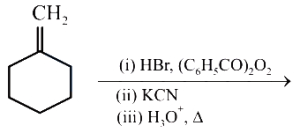
A
Cyclohexanecarboxylic acid with a methyl group at the alpha position.
B
$1-$methylcyclohexanecarboxylic acid.
C
Cyclohexylacetic acid.
D
$3-$cyclohexylpropanoic acid.
Solution
(C) The reaction proceeds as follows:
$1$. The first step is the anti-Markovnikov addition of $HBr$ to methylenecyclohexane in the presence of a peroxide,$(C_6H_5CO)_2O_2$. This yields (cyclohexylmethyl) bromide,$C_6H_{11}CH_2Br$.
$2$. The second step is a nucleophilic substitution reaction with $KCN$,where the bromide ion is replaced by a cyanide group,yielding cyclohexylacetonitrile,$C_6H_{11}CH_2CN$.
$3$. The third step is the acid-catalyzed hydrolysis of the nitrile group followed by heating,which converts the $-CN$ group into a carboxylic acid group,$-COOH$. The final product is cyclohexylacetic acid,$C_6H_{11}CH_2COOH$.
$1$. The first step is the anti-Markovnikov addition of $HBr$ to methylenecyclohexane in the presence of a peroxide,$(C_6H_5CO)_2O_2$. This yields (cyclohexylmethyl) bromide,$C_6H_{11}CH_2Br$.
$2$. The second step is a nucleophilic substitution reaction with $KCN$,where the bromide ion is replaced by a cyanide group,yielding cyclohexylacetonitrile,$C_6H_{11}CH_2CN$.
$3$. The third step is the acid-catalyzed hydrolysis of the nitrile group followed by heating,which converts the $-CN$ group into a carboxylic acid group,$-COOH$. The final product is cyclohexylacetic acid,$C_6H_{11}CH_2COOH$.
0 likesView Solution
123
ChemistryDifficultMCQTS EAMCET · 2018
The major product formed in the following reaction is:
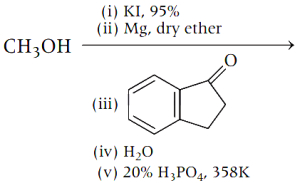
A
$1-$methyl-1H-indene
B
$1-$methylene$-2,3-$dihydro-1H-indene
C
$3-$methyl-1H-indene
D
$1-$methyl$-2,3-$dihydro-1H-inden$-1-$ol
Solution
(A) The reaction proceeds as follows:
$(i)$ $CH_3OH$ reacts with $KI$ to form $CH_3I$.
(ii) $CH_3I$ reacts with $Mg$ in dry ether to form the Grignard reagent $CH_3MgI$.
(iii) $CH_3MgI$ undergoes nucleophilic addition to the carbonyl group of $1-$indanone ($2$,$3$-dihydro-1H-inden$-1-$one).
(iv) Subsequent hydrolysis with $H_2O$ yields $1-$methyl$-2,3-$dihydro-1H-inden$-1-$ol.
$(v)$ Dehydration of the alcohol using $20\% H_3PO_4$ at $358 \ K$ results in the formation of the more stable conjugated alkene,$1$-methyl-1H-indene,as the major product.
$(i)$ $CH_3OH$ reacts with $KI$ to form $CH_3I$.
(ii) $CH_3I$ reacts with $Mg$ in dry ether to form the Grignard reagent $CH_3MgI$.
(iii) $CH_3MgI$ undergoes nucleophilic addition to the carbonyl group of $1-$indanone ($2$,$3$-dihydro-1H-inden$-1-$one).
(iv) Subsequent hydrolysis with $H_2O$ yields $1-$methyl$-2,3-$dihydro-1H-inden$-1-$ol.
$(v)$ Dehydration of the alcohol using $20\% H_3PO_4$ at $358 \ K$ results in the formation of the more stable conjugated alkene,$1$-methyl-1H-indene,as the major product.
0 likesView Solution
124
ChemistryEasyMCQTS EAMCET · 2018
Arrange the following bromides in the order of reactivity in undergoing $S_{N}1$ reaction:
$(i)$ $(CH_3)_3CBr$
(ii) $CH_3CH_2CH_2Br$
(iii) $(CH_3)_2CHCH_2Br$
(iv) $CH_3Br$
$(i)$ $(CH_3)_3CBr$
(ii) $CH_3CH_2CH_2Br$
(iii) $(CH_3)_2CHCH_2Br$
(iv) $CH_3Br$
A
$i > iii > ii > iv$
B
$iv > ii > iii > i$
C
$i > ii > iii > iv$
D
$ii > iv > iii > i$
Solution
(A) The reactivity of alkyl halides towards $S_{N}1$ reaction depends on the stability of the carbocation intermediate formed in the rate-determining step.
The order of stability of carbocations is $3^{\circ} > 2^{\circ} > 1^{\circ} > \text{methyl}$.
$(i)$ $(CH_3)_3CBr$ forms a $3^{\circ}$ carbocation (most stable).
(ii) $CH_3CH_2CH_2Br$ forms a $1^{\circ}$ carbocation.
(iii) $(CH_3)_2CHCH_2Br$ forms a $1^{\circ}$ carbocation,but it is slightly more stable than (ii) due to the inductive effect of the alkyl group,though both are $1^{\circ}$. However,in standard textbook problems,(ii) and (iii) are both $1^{\circ}$ and (iv) is methyl.
Comparing the structures: $(i)$ is $3^{\circ}$,(ii) is $1^{\circ}$ (n-propyl),(iii) is $1^{\circ}$ (isobutyl),(iv) is methyl.
The order of reactivity is $i > iii > ii > iv$.
The order of stability of carbocations is $3^{\circ} > 2^{\circ} > 1^{\circ} > \text{methyl}$.
$(i)$ $(CH_3)_3CBr$ forms a $3^{\circ}$ carbocation (most stable).
(ii) $CH_3CH_2CH_2Br$ forms a $1^{\circ}$ carbocation.
(iii) $(CH_3)_2CHCH_2Br$ forms a $1^{\circ}$ carbocation,but it is slightly more stable than (ii) due to the inductive effect of the alkyl group,though both are $1^{\circ}$. However,in standard textbook problems,(ii) and (iii) are both $1^{\circ}$ and (iv) is methyl.
Comparing the structures: $(i)$ is $3^{\circ}$,(ii) is $1^{\circ}$ (n-propyl),(iii) is $1^{\circ}$ (isobutyl),(iv) is methyl.
The order of reactivity is $i > iii > ii > iv$.
0 likesView Solution
125
ChemistryDifficultTS EAMCET · 2018
Which of the following statements is correct for optically active alkyl halides,upon reaction with nucleophiles?
| $S_{N}1$ | $S_{N}2$ | |
|---|---|---|
| $(a)$ | Retention of configuration | Inversion of configuration |
| $(b)$ | Racemisation | Inversion of configuration |
| $(c)$ | Inversion of configuration | Retention of configuration |
| $(d)$ | Racemisation | Retention of configuration |
Solution
(B) In an $S_{N}1$ reaction,the carbocation intermediate formed is planar,allowing the nucleophile to attack from either side,which leads to the formation of a racemic mixture (racemisation).
In an $S_{N}2$ reaction,the nucleophile attacks the carbon atom from the side opposite to the leaving group,resulting in the inversion of configuration (Walden inversion).
Therefore,the correct statement is that $S_{N}1$ leads to racemisation and $S_{N}2$ leads to inversion of configuration,which corresponds to option $(b)$.
In an $S_{N}2$ reaction,the nucleophile attacks the carbon atom from the side opposite to the leaving group,resulting in the inversion of configuration (Walden inversion).
Therefore,the correct statement is that $S_{N}1$ leads to racemisation and $S_{N}2$ leads to inversion of configuration,which corresponds to option $(b)$.
0 likesView Solution
126
ChemistryDifficultMCQTS EAMCET · 2018
The major product in the following reaction sequence is:
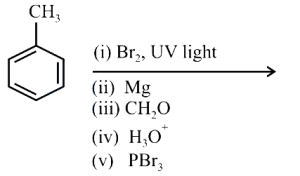
A
$1-$bromo$-1-$phenylethane
B
o-bromomethyltoluene
C
($2$-bromoethyl)benzene
D
p-bromomethyltoluene
Solution
(C) The reaction sequence is as follows:
$1$. Toluene reacts with $Br_2$ in the presence of $UV$ light to undergo free-radical substitution at the benzylic position,forming benzyl bromide $(C_6H_5CH_2Br)$.
$2$. Benzyl bromide reacts with $Mg$ in dry ether to form the Grignard reagent,benzylmagnesium bromide $(C_6H_5CH_2MgBr)$.
$3$. The Grignard reagent reacts with formaldehyde $(CH_2O)$ followed by acidic hydrolysis $(H_3O^+)$ to form $2-$phenylethanol $(C_6H_5CH_2CH_2OH)$.
$4$. Finally,$2$-phenylethanol reacts with $PBr_3$ to replace the hydroxyl group with a bromine atom,yielding ($2$-bromoethyl)benzene $(C_6H_5CH_2CH_2Br)$.
$1$. Toluene reacts with $Br_2$ in the presence of $UV$ light to undergo free-radical substitution at the benzylic position,forming benzyl bromide $(C_6H_5CH_2Br)$.
$2$. Benzyl bromide reacts with $Mg$ in dry ether to form the Grignard reagent,benzylmagnesium bromide $(C_6H_5CH_2MgBr)$.
$3$. The Grignard reagent reacts with formaldehyde $(CH_2O)$ followed by acidic hydrolysis $(H_3O^+)$ to form $2-$phenylethanol $(C_6H_5CH_2CH_2OH)$.
$4$. Finally,$2$-phenylethanol reacts with $PBr_3$ to replace the hydroxyl group with a bromine atom,yielding ($2$-bromoethyl)benzene $(C_6H_5CH_2CH_2Br)$.
0 likesView Solution
127
ChemistryDifficultMCQTS EAMCET · 2018
The major product in the following reaction is
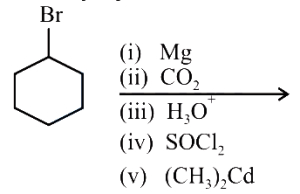
A
Cyclohexyl ethanol
B
Cyclohexyl methyl ketone
C
$1-$Cyclohexyl ethanol
D
$2-$Cyclohexyl propan$-2-$ol
Solution
(B) The reaction proceeds as follows:
$1$. Bromocyclohexane reacts with $Mg$ in dry ether to form cyclohexylmagnesium bromide (a Grignard reagent).
$2$. The Grignard reagent reacts with $CO_2$ followed by acidic workup $(H_3O^+)$ to form cyclohexanecarboxylic acid.
$3$. Cyclohexanecarboxylic acid reacts with $SOCl_2$ to form cyclohexanecarbonyl chloride.
$4$. Finally,the reaction of cyclohexanecarbonyl chloride with dimethylcadmium,$(CH_3)_2Cd$,yields cyclohexyl methyl ketone as the major product. This is a standard method for the preparation of ketones from acid chlorides.
$1$. Bromocyclohexane reacts with $Mg$ in dry ether to form cyclohexylmagnesium bromide (a Grignard reagent).
$2$. The Grignard reagent reacts with $CO_2$ followed by acidic workup $(H_3O^+)$ to form cyclohexanecarboxylic acid.
$3$. Cyclohexanecarboxylic acid reacts with $SOCl_2$ to form cyclohexanecarbonyl chloride.
$4$. Finally,the reaction of cyclohexanecarbonyl chloride with dimethylcadmium,$(CH_3)_2Cd$,yields cyclohexyl methyl ketone as the major product. This is a standard method for the preparation of ketones from acid chlorides.
0 likesView Solution
128
ChemistryMediumMCQTS EAMCET · 2018
The major product $P$ formed in the following reaction is
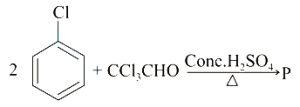
A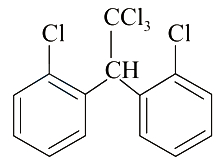
B
C
D
Solution
(D) The reaction between $2$ moles of chlorobenzene and $1$ mole of chloral $(CCl_3CHO)$ in the presence of concentrated $H_2SO_4$ is a condensation reaction.
In this reaction,the oxygen atom of the aldehyde group of chloral reacts with the hydrogen atoms at the para-positions of the two chlorobenzene rings to eliminate a water molecule.
The resulting product is $1,1,1-\text{trichloro}-2,2-\text{bis}(p-\text{chlorophenyl})\text{ethane}$,commonly known as $DDT$.
In this reaction,the oxygen atom of the aldehyde group of chloral reacts with the hydrogen atoms at the para-positions of the two chlorobenzene rings to eliminate a water molecule.
The resulting product is $1,1,1-\text{trichloro}-2,2-\text{bis}(p-\text{chlorophenyl})\text{ethane}$,commonly known as $DDT$.
0 likesView Solution
129
ChemistryDifficultMCQTS EAMCET · 2018
The major product of the following reaction is:
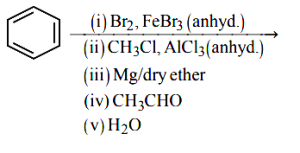
A
$1-$($4$-methylphenyl)propan$-2-$ol
B
$1-$($4$-methylphenyl)ethanol
C
$2-$($2$-methylphenyl)propan$-2-$ol
D
$1-$($2$-methylphenyl)ethanol
Solution
(B) Step $(i)$: Benzene reacts with $Br_2$ in the presence of anhydrous $FeBr_3$ to form bromobenzene via electrophilic aromatic substitution.
Step (ii): Bromobenzene undergoes Friedel-Crafts alkylation with $CH_3Cl$ and anhydrous $AlCl_3$. Since the $-Br$ group is ortho/para directing,the major product is $p$-bromotoluene.
Step (iii): $p$-Bromotoluene reacts with $Mg$ in dry ether to form the Grignard reagent,$p$-tolylmagnesium bromide $(CH_3-C_6H_4-MgBr)$.
Step (iv) and $(v)$: The Grignard reagent reacts with acetaldehyde $(CH_3CHO)$ followed by hydrolysis $(H_2O)$ to form a secondary alcohol. The nucleophilic carbon of the Grignard reagent attacks the carbonyl carbon of acetaldehyde,resulting in $1-(4-methylphenyl)ethanol$.
Step (ii): Bromobenzene undergoes Friedel-Crafts alkylation with $CH_3Cl$ and anhydrous $AlCl_3$. Since the $-Br$ group is ortho/para directing,the major product is $p$-bromotoluene.
Step (iii): $p$-Bromotoluene reacts with $Mg$ in dry ether to form the Grignard reagent,$p$-tolylmagnesium bromide $(CH_3-C_6H_4-MgBr)$.
Step (iv) and $(v)$: The Grignard reagent reacts with acetaldehyde $(CH_3CHO)$ followed by hydrolysis $(H_2O)$ to form a secondary alcohol. The nucleophilic carbon of the Grignard reagent attacks the carbonyl carbon of acetaldehyde,resulting in $1-(4-methylphenyl)ethanol$.
0 likesView Solution
130
ChemistryMediumMCQTS EAMCET · 2018
The major product of the following reaction is:
A
$4-$chlorophenol
B
$2-$chlorophenol
C
$2,4-$dichlorophenol
D
chlorobenzene
Solution
(D) Step $1$: Phenol reacts with zinc dust $(Zn)$ under heating $(\Delta)$ to undergo reduction,resulting in the formation of benzene.
$C_6H_5OH Zn \xrightarrow{\Delta} C_6H_6 ZnO$
Step $2$: Benzene then undergoes electrophilic aromatic substitution (chlorination) in the presence of anhydrous ferric chloride $(FeCl_3)$ and chlorine $(Cl_2)$ to form chlorobenzene.
$C_6H_6 Cl_2 \xrightarrow{\text{anhyd. } FeCl_3} C_6H_5Cl HCl$
Therefore,the major product is chlorobenzene.
$C_6H_5OH Zn \xrightarrow{\Delta} C_6H_6 ZnO$
Step $2$: Benzene then undergoes electrophilic aromatic substitution (chlorination) in the presence of anhydrous ferric chloride $(FeCl_3)$ and chlorine $(Cl_2)$ to form chlorobenzene.
$C_6H_6 Cl_2 \xrightarrow{\text{anhyd. } FeCl_3} C_6H_5Cl HCl$
Therefore,the major product is chlorobenzene.
0 likesView Solution
131
ChemistryDifficultMCQTS EAMCET · 2018
The major product formed in the following reaction is:
A
$1-$methyl$-3,5-$dibromobenzene
B
$1-$methyl$-2,6-$dibromobenzene
C
$1-$methyl$-3,4-$dibromobenzene
D
$1-$methyl$-2,4-$dibromobenzene
Solution
(C) The reaction proceeds as follows:
$(i)$ $Sn/HCl$ reduces the $-NO_2$ group to an $-NH_2$ group,forming $p$-toluidine.
(ii) $Br_2$ $(1 \ eq.)$ in the presence of the strongly activating $-NH_2$ group leads to ortho-bromination,yielding $2$-bromo-$4$-methylaniline.
(iii) $NaNO_2/HCl$ at $273-278 \ K$ converts the $-NH_2$ group into a diazonium salt,$-N_2^+Cl^-$.
(iv) $Cu_2Br_2/HBr$ (Sandmeyer reaction) replaces the diazonium group with a $-Br$ atom,resulting in $1,2$-dibromo-$4$-methylbenzene (also known as $3,4$-dibromotoluene).
$(i)$ $Sn/HCl$ reduces the $-NO_2$ group to an $-NH_2$ group,forming $p$-toluidine.
(ii) $Br_2$ $(1 \ eq.)$ in the presence of the strongly activating $-NH_2$ group leads to ortho-bromination,yielding $2$-bromo-$4$-methylaniline.
(iii) $NaNO_2/HCl$ at $273-278 \ K$ converts the $-NH_2$ group into a diazonium salt,$-N_2^+Cl^-$.
(iv) $Cu_2Br_2/HBr$ (Sandmeyer reaction) replaces the diazonium group with a $-Br$ atom,resulting in $1,2$-dibromo-$4$-methylbenzene (also known as $3,4$-dibromotoluene).
0 likesView Solution
132
ChemistryDifficultMCQTS EAMCET · 2018
What are the structures of $X$,$Y$,and $Z$ in the above given reaction sequence?
A
B
C
D
Solution
(C) The reaction sequence is as follows:
$1$. Aniline reacts with acetic anhydride $(CH_3CO)_2O$ in the presence of pyridine to form acetanilide,which is $X$ $(C_6H_5NHCOCH_3)$.
$2$. Acetanilide $(X)$ undergoes electrophilic aromatic substitution with $Br_2$ in acetic acid $(CH_3CO_2H)$ to form $p$-bromoacetanilide,which is $Y$ $(Br-C_6H_4-NHCOCH_3)$.
$3$. $p$-Bromoacetanilide $(Y)$ undergoes alkaline hydrolysis with $OH^-$ to form $p$-bromoaniline,which is $Z$ $(Br-C_6H_4-NH_2)$.
$1$. Aniline reacts with acetic anhydride $(CH_3CO)_2O$ in the presence of pyridine to form acetanilide,which is $X$ $(C_6H_5NHCOCH_3)$.
$2$. Acetanilide $(X)$ undergoes electrophilic aromatic substitution with $Br_2$ in acetic acid $(CH_3CO_2H)$ to form $p$-bromoacetanilide,which is $Y$ $(Br-C_6H_4-NHCOCH_3)$.
$3$. $p$-Bromoacetanilide $(Y)$ undergoes alkaline hydrolysis with $OH^-$ to form $p$-bromoaniline,which is $Z$ $(Br-C_6H_4-NH_2)$.
0 likesView Solution
133
ChemistryEasyMCQTS EAMCET · 2018
The strongest acid among the following is
A
acetic acid
B
acrylic acid
C
benzoic acid
D
propionic acid
Solution
(C) The acidity of carboxylic acids depends on the stability of the conjugate base (carboxylate ion) and the inductive effect of the substituent group attached to the $-COOH$ group.
In $CH_3COOH$ (acetic acid) and $CH_3CH_2COOH$ (propionic acid),the alkyl groups exert a $+I$ effect,which destabilizes the conjugate base.
In $CH_2=CH-COOH$ (acrylic acid),the $sp^2$ hybridized carbon exerts a $-I$ effect,making it stronger than aliphatic saturated acids.
In $C_6H_5COOH$ (benzoic acid),the phenyl group is $sp^2$ hybridized and exerts a strong electron-withdrawing effect ($-I$ effect) and resonance stabilization of the carboxylate ion,making it the strongest acid among the given options.
In $CH_3COOH$ (acetic acid) and $CH_3CH_2COOH$ (propionic acid),the alkyl groups exert a $+I$ effect,which destabilizes the conjugate base.
In $CH_2=CH-COOH$ (acrylic acid),the $sp^2$ hybridized carbon exerts a $-I$ effect,making it stronger than aliphatic saturated acids.
In $C_6H_5COOH$ (benzoic acid),the phenyl group is $sp^2$ hybridized and exerts a strong electron-withdrawing effect ($-I$ effect) and resonance stabilization of the carboxylate ion,making it the strongest acid among the given options.
0 likesView Solution
134
ChemistryEasyMCQTS EAMCET · 2018
Relative abundance (in percentage) of ${}^{14}C$ isotope is
A
$1.1$
B
$2 \times 10^{-10}$
C
$2 \times 10^{-4}$
D
$2 \times 10^{-5}$
Solution
(B) The relative abundance of ${}^{14}C$ isotope in nature is extremely low,approximately $10^{-10} \%$.
Among the given options,$2 \times 10^{-10}$ is the correct value.
Among the given options,$2 \times 10^{-10}$ is the correct value.
0 likesView Solution
135
ChemistryDifficultMCQTS EAMCET · 2018
What are $X$ and $Y$,respectively in the following reactions?
$Au + \text{aqua regia} \longrightarrow AuCl_4^{-} + H_2O + X$
$Pt + \text{aqua regia} \longrightarrow PtCl_6^{2-} + H_2O + Y$
$Au + \text{aqua regia} \longrightarrow AuCl_4^{-} + H_2O + X$
$Pt + \text{aqua regia} \longrightarrow PtCl_6^{2-} + H_2O + Y$
A
$N_2O, NO$
B
$N_2O, N_2O$
C
$NO, NO$
D
$NO, NO_2$
Solution
(C) Aqua regia is a mixture of concentrated $HNO_3$ and concentrated $HCl$ in a $1:3$ molar ratio.
It dissolves noble metals like gold and platinum by oxidizing them.
The chemical reactions are:
$Au + 4H^+ + NO_3^- + 4Cl^- \longrightarrow AuCl_4^- + NO + 2H_2O$
$3Pt + 16H^+ + 4NO_3^- + 18Cl^- \longrightarrow 3PtCl_6^{2-} + 4NO + 8H_2O$
In both reactions,$NO$ (Nitric oxide) is produced as the byproduct.
Therefore,$X = NO$ and $Y = NO$.
It dissolves noble metals like gold and platinum by oxidizing them.
The chemical reactions are:
$Au + 4H^+ + NO_3^- + 4Cl^- \longrightarrow AuCl_4^- + NO + 2H_2O$
$3Pt + 16H^+ + 4NO_3^- + 18Cl^- \longrightarrow 3PtCl_6^{2-} + 4NO + 8H_2O$
In both reactions,$NO$ (Nitric oxide) is produced as the byproduct.
Therefore,$X = NO$ and $Y = NO$.
0 likesView Solution
136
ChemistryDifficultMCQTS EAMCET · 2018
Identify the reactions in which $N_2$ is liberated.
$a. \ (NH_4)_2SO_4 + NaOH \longrightarrow$
$b. \ NH_3 + Cl_2 \longrightarrow$ (excess $Cl_2$ is not specified,but $N_2$ is formed when $NH_3$ is in excess)
$c. \ (NH_4)_2Cr_2O_7 \xrightarrow{\Delta}$
$d. \ NH_4NO_3 \xrightarrow{\Delta}$
$e. \ NH_4Cl_{(aq)} + NaNO_{2_{(aq)}} \longrightarrow$
$a. \ (NH_4)_2SO_4 + NaOH \longrightarrow$
$b. \ NH_3 + Cl_2 \longrightarrow$ (excess $Cl_2$ is not specified,but $N_2$ is formed when $NH_3$ is in excess)
$c. \ (NH_4)_2Cr_2O_7 \xrightarrow{\Delta}$
$d. \ NH_4NO_3 \xrightarrow{\Delta}$
$e. \ NH_4Cl_{(aq)} + NaNO_{2_{(aq)}} \longrightarrow$
A
$a, b, c$
B
$c, d, e$
C
$b, c, e$
D
$a, c, d$
Solution
(C) $(a) \ (NH_4)_2SO_4 + 2NaOH \rightarrow Na_2SO_4 + 2NH_3 + 2H_2O$ (No $N_2$ gas)
$(b) \ 8NH_3 + 3Cl_2 \rightarrow N_2 + 6NH_4Cl$ ($N_2$ is liberated when $NH_3$ is in excess)
$(c) \ (NH_4)_2Cr_2O_7 \xrightarrow{\Delta} N_2 + 4H_2O + Cr_2O_3$ ($N_2$ is liberated)
$(d) \ NH_4NO_3 \xrightarrow{\Delta} N_2O + 2H_2O$ (No $N_2$ gas)
$(e) \ NH_4Cl_{(aq)} + NaNO_{2_{(aq)}} \xrightarrow{\Delta} NaCl + N_2 + 2H_2O$ ($N_2$ is liberated)
Thus,the reactions that liberate $N_2$ are $b, c, e$.
$(b) \ 8NH_3 + 3Cl_2 \rightarrow N_2 + 6NH_4Cl$ ($N_2$ is liberated when $NH_3$ is in excess)
$(c) \ (NH_4)_2Cr_2O_7 \xrightarrow{\Delta} N_2 + 4H_2O + Cr_2O_3$ ($N_2$ is liberated)
$(d) \ NH_4NO_3 \xrightarrow{\Delta} N_2O + 2H_2O$ (No $N_2$ gas)
$(e) \ NH_4Cl_{(aq)} + NaNO_{2_{(aq)}} \xrightarrow{\Delta} NaCl + N_2 + 2H_2O$ ($N_2$ is liberated)
Thus,the reactions that liberate $N_2$ are $b, c, e$.
0 likesView Solution
137
ChemistryEasyMCQTS EAMCET · 2018
The most acidic among the following compounds is
A
$NO_2$
B
$N_2O_4$
C
$N_2O_5$
D
$N_2O_3$
Solution
(C) The acidity of non-metal oxides increases with an increase in the oxidation state of the central atom.
Calculating the oxidation states of nitrogen in the given oxides:
$NO_2$: $x + 2(-2) = 0 \implies x = +4$
$N_2O_4$: $2x + 4(-2) = 0 \implies x = +4$
$N_2O_5$: $2x + 5(-2) = 0 \implies x = +5$
$N_2O_3$: $2x + 3(-2) = 0 \implies x = +3$
Since $N_2O_5$ has the highest oxidation state of $+5$,it is the most acidic oxide among the given compounds.
Calculating the oxidation states of nitrogen in the given oxides:
$NO_2$: $x + 2(-2) = 0 \implies x = +4$
$N_2O_4$: $2x + 4(-2) = 0 \implies x = +4$
$N_2O_5$: $2x + 5(-2) = 0 \implies x = +5$
$N_2O_3$: $2x + 3(-2) = 0 \implies x = +3$
Since $N_2O_5$ has the highest oxidation state of $+5$,it is the most acidic oxide among the given compounds.
0 likesView Solution
138
ChemistryMediumMCQTS EAMCET · 2018
Match the following List-$I$ (Acid) with List-$II$ (Reagents used for preparation):
| List-$I$ (Acid) | List-$II$ (Reagents used for preparation) |
| :--- | :--- |
| $A. H_3PO_2$ | $I. \text{Red } P_4 \text{alkali}$ |
| $B. H_4P_2O_5$ | $II. \text{White } P_4 \text{alkali}$ |
| $C. H_3PO_4$ | $III. PCl_3; H_3PO_3$ |
| $D. H_4P_2O_7$ | $IV. P_2O_5; H_2O$ |
| | $V. H_3PO_4; \Delta$ |
| List-$I$ (Acid) | List-$II$ (Reagents used for preparation) |
| :--- | :--- |
| $A. H_3PO_2$ | $I. \text{Red } P_4 \text{alkali}$ |
| $B. H_4P_2O_5$ | $II. \text{White } P_4 \text{alkali}$ |
| $C. H_3PO_4$ | $III. PCl_3; H_3PO_3$ |
| $D. H_4P_2O_7$ | $IV. P_2O_5; H_2O$ |
| | $V. H_3PO_4; \Delta$ |
A
$A-II, B-III, C-IV, D-V$
B
$A-I, B-III, C-IV, D-V$
C
$A-II, B-III, C-V, D-IV$
D
$A-I, B-II, C-III, D-IV$
Solution
(A) The correct matches are:
$A. H_3PO_2$: Prepared by the reaction of white $P_4$ with alkali. $(A-II)$
$B. H_4P_2O_5$: Prepared by the reaction of $PCl_3$ with $H_3PO_3$. $(B-III)$
$C. H_3PO_4$: Prepared by the reaction of $P_2O_5$ with $H_2O$. $(C-IV)$
$D. H_4P_2O_7$: Prepared by the thermal dehydration $(\Delta)$ of $H_3PO_4$. $(D-V)$
Thus,the correct matching is $A-II, B-III, C-IV, D-V$.
$A. H_3PO_2$: Prepared by the reaction of white $P_4$ with alkali. $(A-II)$
$B. H_4P_2O_5$: Prepared by the reaction of $PCl_3$ with $H_3PO_3$. $(B-III)$
$C. H_3PO_4$: Prepared by the reaction of $P_2O_5$ with $H_2O$. $(C-IV)$
$D. H_4P_2O_7$: Prepared by the thermal dehydration $(\Delta)$ of $H_3PO_4$. $(D-V)$
Thus,the correct matching is $A-II, B-III, C-IV, D-V$.
0 likesView Solution
139
ChemistryMediumMCQTS EAMCET · 2018
What is the chemical formula of hypophosphorus acid?
A
$H_3PO_3$
B
$H_3PO_2$
C
$H_3PO_4$
D
$H_4P_2O_6$
Solution
(B) The chemical formula of hypophosphorus acid (also known as phosphinic acid) is $H_3PO_2$.
It has a tetrahedral geometry with $sp^3$ hybridization of the phosphorus atom.
It has a tetrahedral geometry with $sp^3$ hybridization of the phosphorus atom.
0 likesView Solution
140
ChemistryMediumMCQTS EAMCET · 2018
In reaction $(1)$,$XeF_6$ undergoes complete hydrolysis to form $HF$ and $X$. In reaction $(2)$,$XeF_6$ undergoes partial hydrolysis to form $HF$,$Y$,and $Z$. The products $X, Y, Z$ respectively,are
A
$XeO_3, XeOF_4, XeO_2 F_2$
B
$XeO_3, XeO_2 F_2, XeOF_4$
C
$Xe, XeOF_4, XeO_2 F_2$
D
$XeO_3, O_2, XeO_2 F_2$
Solution
(A) Complete hydrolysis of $XeF_6$ is given by the reaction:
$XeF_6 + 3 H_2O \longrightarrow XeO_3 + 6 HF$
Thus,$X = XeO_3$.
Partial hydrolysis of $XeF_6$ occurs in two steps:
$XeF_6 + H_2O \longrightarrow XeOF_4 + 2 HF$
$XeF_6 + 2 H_2O \longrightarrow XeO_2 F_2 + 4 HF$
Thus,$Y$ and $Z$ are $XeOF_4$ and $XeO_2 F_2$ respectively.
Therefore,the products $X, Y, Z$ are $XeO_3, XeOF_4, XeO_2 F_2$.
$XeF_6 + 3 H_2O \longrightarrow XeO_3 + 6 HF$
Thus,$X = XeO_3$.
Partial hydrolysis of $XeF_6$ occurs in two steps:
$XeF_6 + H_2O \longrightarrow XeOF_4 + 2 HF$
$XeF_6 + 2 H_2O \longrightarrow XeO_2 F_2 + 4 HF$
Thus,$Y$ and $Z$ are $XeOF_4$ and $XeO_2 F_2$ respectively.
Therefore,the products $X, Y, Z$ are $XeO_3, XeOF_4, XeO_2 F_2$.
0 likesView Solution
141
ChemistryMediumMCQTS EAMCET · 2018
Match the following:
| List-$I$ | List-$II$ |
|---|---|
| $A$. $(CH_2-C(Cl)=CH-CH_2)_n$ | $I$. Cross-linked network |
| $B$. Nylon-$6,6$ | $II$. Elastomer |
| $C$. $HDP$ | $III$. Fibre |
| $D$. Melamine-formaldehyde | $IV$. Ziegler-Natta catalyst |
A
$A-II, B-III, C-IV, D-I$
B
$A-I, B-II, C-III, D-IV$
C
$A-II, B-III, C-I, D-IV$
D
$A-IV, B-III, C-II, D-I$
Solution
(A) . The polymer $(CH_2-C(Cl)=CH-CH_2)_n$ is Neoprene,which is an elastomer.
$B$. Nylon-$6,6$ is a synthetic polymer classified as a fibre.
$C$. High-density polyethylene $(HDP)$ is synthesized using a Ziegler-Natta catalyst.
$D$. Melamine-formaldehyde is a thermosetting polymer with a cross-linked network structure.
Therefore,the correct matching is $A-II, B-III, C-IV, D-I$.
$B$. Nylon-$6,6$ is a synthetic polymer classified as a fibre.
$C$. High-density polyethylene $(HDP)$ is synthesized using a Ziegler-Natta catalyst.
$D$. Melamine-formaldehyde is a thermosetting polymer with a cross-linked network structure.
Therefore,the correct matching is $A-II, B-III, C-IV, D-I$.
0 likesView Solution
142
ChemistryMediumMCQTS EAMCET · 2018
The formation of terylene (or Dacron) from ethylene glycol and terephthalic acid is . . . . . . .
A
$a$ condensation polymerization reaction
B
$an$ anionic polymerization reaction
C
$an$ addition polymerization reaction
D
$a$ cationic polymerization reaction
Solution
(A) Condensation polymerization occurs between two bifunctional monomers,which results in the formation of a high molecular mass condensation polymer.
$Dacron$ (or $Terylene$) is obtained by the condensation polymerization of ethylene glycol $(HO-CH_2-CH_2-OH)$ and terephthalic acid $(HOOC-C_6H_4-COOH)$.
During this process,small molecules like water $(H_2O)$ are eliminated.
It is an example of a polyester.
$Dacron$ (or $Terylene$) is obtained by the condensation polymerization of ethylene glycol $(HO-CH_2-CH_2-OH)$ and terephthalic acid $(HOOC-C_6H_4-COOH)$.
During this process,small molecules like water $(H_2O)$ are eliminated.
It is an example of a polyester.
0 likesView Solution
143
ChemistryMediumMCQTS EAMCET · 2018
The schematic illustrations of macromolecules given below represent:
A
$A$: $HDPE$,$B$: $LDPE$,$C$: Bakelite
B
$A$: Bakelite,$B$: $HDPE$,$C$: $LDPE$
C
$A$: $HDPE$,$B$: Bakelite,$C$: $LDPE$
D
$A$: $LDPE$,$B$: Bakelite,$C$: $HDPE$
Solution
(B) The schematic illustrations represent the structures of different types of polymers:
$(A)$ shows a cross-linked polymer structure,which is characteristic of thermosetting polymers like Bakelite.
$(B)$ shows linear polymer chains,which is characteristic of high-density polyethylene $(HDPE)$.
$(C)$ shows branched polymer chains,which is characteristic of low-density polyethylene $(LDPE)$.
$(A)$ shows a cross-linked polymer structure,which is characteristic of thermosetting polymers like Bakelite.
$(B)$ shows linear polymer chains,which is characteristic of high-density polyethylene $(HDPE)$.
$(C)$ shows branched polymer chains,which is characteristic of low-density polyethylene $(LDPE)$.
0 likesView Solution
144
ChemistryEasyMCQTS EAMCET · 2018
Examples for natural polymers are
A
cotton,silk,bakelite and wool
B
cellulose,polystyrene and neoprene
C
nylon,terylene and $PVC$
D
silk,cotton and proteins
Solution
(D) Natural polymers are those that occur naturally in plants and animals.
Silk,cotton,and proteins are all examples of natural polymers.
Bakelite,polystyrene,neoprene,nylon,terylene,and $PVC$ are synthetic polymers.
Silk,cotton,and proteins are all examples of natural polymers.
Bakelite,polystyrene,neoprene,nylon,terylene,and $PVC$ are synthetic polymers.
0 likesView Solution
145
ChemistryMediumMCQTS EAMCET · 2018
Identify the monomers used in the manufacture of glyptal $(X)$,dacron $(Y)$ and nylon $2$-nylon $6$ $(Z)$.
A
B
C
D
Solution
(C) $Glyptal (X):$ Ethylene glycol and phthalic acid.
$Dacron (Y):$ Ethylene glycol and terephthalic acid.
$Nylon 2-nylon 6 (Z):$ Glycine and aminocaproic acid.
$Dacron (Y):$ Ethylene glycol and terephthalic acid.
$Nylon 2-nylon 6 (Z):$ Glycine and aminocaproic acid.
0 likesView Solution
146
ChemistryMediumTS EAMCET · 2018
Match the following items in List-$I$ with their corresponding monomer units in List-$II$.
| List-$I$ | List-$II$ |
|---|---|
| $A$. Natural rubber | $i$. $\beta$-glucose |
| $B$. Cellulose | $ii$. Isoprene |
| $C$. Nylon-$6$ | $iii$. Tetrafluoroethylene |
| $D$. Teflon | $iv$. Caprolactam |
Solution
(A-II, B-I, C-IV, D-III) The correct matches are as follows:
$A$. Natural rubber is a polymer of isoprene ($2$-methyl-$1,3$-butadiene). Thus,$A \rightarrow ii$.
$B$. Cellulose is a polysaccharide consisting of a linear chain of $\beta(1-4)$ linked $\beta$-$D$-glucose units. Thus,$B \rightarrow i$.
$C$. The monomer unit of Nylon-$6$ is caprolactam. Thus,$C \rightarrow iv$.
$D$. Teflon is formed by the polymerization of tetrafluoroethylene monomer units: $n(CF_2=CF_2) \rightarrow -(CF_2-CF_2)_n-$. Thus,$D \rightarrow iii$.
The correct matching is $A-ii, B-i, C-iv, D-iii$.
$A$. Natural rubber is a polymer of isoprene ($2$-methyl-$1,3$-butadiene). Thus,$A \rightarrow ii$.
$B$. Cellulose is a polysaccharide consisting of a linear chain of $\beta(1-4)$ linked $\beta$-$D$-glucose units. Thus,$B \rightarrow i$.
$C$. The monomer unit of Nylon-$6$ is caprolactam. Thus,$C \rightarrow iv$.
$D$. Teflon is formed by the polymerization of tetrafluoroethylene monomer units: $n(CF_2=CF_2) \rightarrow -(CF_2-CF_2)_n-$. Thus,$D \rightarrow iii$.
The correct matching is $A-ii, B-i, C-iv, D-iii$.
0 likesView Solution
147
ChemistryMediumMCQTS EAMCET · 2018
In the titration of $I_{2(aq)}$ by $S_2O_3^{2-}{_{\text{(aq)}}}$ using the starch indicator,the end point is indicated by:
A
Colourless to blue
B
Blue to colourless
C
Pink to colourless
D
Blue to pink
Solution
(B) The titration of iodine $(I_2)$ with sodium thiosulphate $(S_2O_3^{2-})$ follows the reaction:
$I_2 + 2S_2O_3^{2-} \rightarrow 2I^- + S_4O_6^{2-}$
In the presence of starch,free iodine forms a deep blue complex.
As the titration proceeds,the thiosulphate ions reduce the iodine to iodide ions $(I^-)$.
At the end point,all free iodine is consumed,causing the blue starch-iodine complex to disappear.
Therefore,the solution changes from blue to colourless.
$I_2 + 2S_2O_3^{2-} \rightarrow 2I^- + S_4O_6^{2-}$
In the presence of starch,free iodine forms a deep blue complex.
As the titration proceeds,the thiosulphate ions reduce the iodine to iodide ions $(I^-)$.
At the end point,all free iodine is consumed,causing the blue starch-iodine complex to disappear.
Therefore,the solution changes from blue to colourless.
0 likesView Solution
148
ChemistryMediumMCQTS EAMCET · 2018
$A$ compound is formed by elements $X$,$Y$,and $Z$. Atoms of $Z$ (anions) make $FCC$ lattice. Atoms of $X$ (cations) occupy all the octahedral voids. Atoms of $Y$ (cations) occupy $\frac{1}{3}$ rd of the tetrahedral voids. The formula of the compound is:
A
$X_3Y_2Z_3$
B
$X_2YZ$
C
$XY_2Z$
D
$X_2Y_2Z$
Solution
(A) In an $FCC$ lattice,the number of atoms per unit cell is $4$.
Since $Z$ forms the $FCC$ lattice,the number of $Z$ atoms $= 4$.
The number of octahedral voids is equal to the number of atoms in the lattice,so the number of $X$ atoms $= 4$.
The number of tetrahedral voids is twice the number of atoms in the lattice,so the number of tetrahedral voids $= 2 \times 4 = 8$.
Given that $Y$ occupies $\frac{1}{3}$ of the tetrahedral voids,the number of $Y$ atoms $= \frac{1}{3} \times 8 = \frac{8}{3}$.
The ratio of atoms $X:Y:Z = 4 : \frac{8}{3} : 4$.
Multiplying by $3$ to get the simplest whole number ratio: $12 : 8 : 12$,which simplifies to $3 : 2 : 3$.
Therefore,the formula of the compound is $X_3Y_2Z_3$.
Since $Z$ forms the $FCC$ lattice,the number of $Z$ atoms $= 4$.
The number of octahedral voids is equal to the number of atoms in the lattice,so the number of $X$ atoms $= 4$.
The number of tetrahedral voids is twice the number of atoms in the lattice,so the number of tetrahedral voids $= 2 \times 4 = 8$.
Given that $Y$ occupies $\frac{1}{3}$ of the tetrahedral voids,the number of $Y$ atoms $= \frac{1}{3} \times 8 = \frac{8}{3}$.
The ratio of atoms $X:Y:Z = 4 : \frac{8}{3} : 4$.
Multiplying by $3$ to get the simplest whole number ratio: $12 : 8 : 12$,which simplifies to $3 : 2 : 3$.
Therefore,the formula of the compound is $X_3Y_2Z_3$.
0 likesView Solution
149
ChemistryMediumMCQTS EAMCET · 2018
$A$ solid has an $hcp$ lattice. Atoms of $Z$ (anions) form the $hcp$ lattice. Atoms of $X$ (cations) occupy all the octahedral voids in the lattice. Atoms of $Y$ (cations) occupy half of the tetrahedral voids. What is the molecular formula of the solid?
A
$X_{2/3} Y_{1/3} Z$
B
$XYZ$
C
$X_{1/3} Y_{2/3} Z$
D
$XYZ_2$
Solution
(B) In an $hcp$ lattice,the number of atoms per unit cell is $6$.
Let the number of atoms of $Z$ be $N = 6$.
The number of octahedral voids is equal to the number of atoms,so the number of $X$ atoms $= N = 6$.
The number of tetrahedral voids is $2N = 12$.
Atoms of $Y$ occupy half of the tetrahedral voids,so the number of $Y$ atoms $= \frac{1}{2} \times 12 = 6$.
The ratio of atoms $X : Y : Z$ is $6 : 6 : 6$,which simplifies to $1 : 1 : 1$.
Therefore,the molecular formula of the solid is $XYZ$.
Let the number of atoms of $Z$ be $N = 6$.
The number of octahedral voids is equal to the number of atoms,so the number of $X$ atoms $= N = 6$.
The number of tetrahedral voids is $2N = 12$.
Atoms of $Y$ occupy half of the tetrahedral voids,so the number of $Y$ atoms $= \frac{1}{2} \times 12 = 6$.
The ratio of atoms $X : Y : Z$ is $6 : 6 : 6$,which simplifies to $1 : 1 : 1$.
Therefore,the molecular formula of the solid is $XYZ$.
0 likesView Solution
150
ChemistryEasyMCQTS EAMCET · 2018
$A$ compound having elements $X$ and $Y$ crystallises in a cubic structure,where $X$ is at the corner position and $Y$ is at the center of the cube. The correct formula of the compound is
A
$XY$
B
$X_3Y$
C
$XY_2$
D
$XY_3$
Solution
(A) In a cubic structure:
Number of $X$-atoms per unit cell (at corners) $= 8 \times \frac{1}{8} = 1$.
Number of $Y$-atoms per unit cell (at the body center) $= 1$.
Thus,the ratio of $X:Y$ is $1:1$.
The formula of the compound is $XY$.
Number of $X$-atoms per unit cell (at corners) $= 8 \times \frac{1}{8} = 1$.
Number of $Y$-atoms per unit cell (at the body center) $= 1$.
Thus,the ratio of $X:Y$ is $1:1$.
The formula of the compound is $XY$.
0 likesView Solution
Vedclass Products
For Students
Vedclass Test Series
Mock tests in real TS EAMCET style covering Chemistry with performance analysis. 5-day free trial.
Start Free TrialFor Teachers
Exam Paper Generator
Generate Set A/B/C/D Chemistry papers from 7.5L+ questions in 2 minutes. 3 chapters free.
Try FreeFor Institutes
Online Exam Module
Run live TS EAMCET mock exams with unlimited students, 360° analytics & white-label branding.
See DemoFrequently Asked Questions
How many Chemistry questions are in TS EAMCET 2018?
There are 240 Chemistry questions from the TS EAMCET 2018 paper on Vedclass, each with a detailed step-by-step solution in English.
Are TS EAMCET 2018 Chemistry solutions available in English?
Yes. All solutions on this page are in English. You can also switch to English or Hindi using the language buttons above the questions.
Can I practice TS EAMCET 2018 Chemistry as a timed test?
Yes. Use the Vedclass Test Series to attempt a full TS EAMCET mock test covering Chemistry with time limits and instant score analysis.
Can teachers create Chemistry papers from TS EAMCET previous year questions?
Yes. The Vedclass Exam Paper Generator lets teachers mix TS EAMCET Chemistry questions and generate Set A/B/C/D papers in minutes.
For Teachers & Institutes
Build a Custom Chemistry Paper
Pick TS EAMCET 2018 Chemistry questions, set difficulty, and generate Set A/B/C/D in 2 minutes.