
ChemistryQ1–43 of 43 questions
Page 1 of 1 · English
1
ChemistryDifficultMCQTS EAMCET · 2016
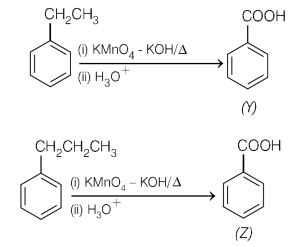
Consider the following reactions:
$Ethylbenzene \xrightarrow[(ii) H_3O^{+}]{(i) KMnO_4-KOH/\Delta} Y$
$Propylbenzene \xrightarrow[(ii) H_3O^{+}]{(i) KMnO_4-KOH/\Delta} Z$
What are the structures of $Y$ and $Z$?
$Ethylbenzene \xrightarrow[(ii) H_3O^{+}]{(i) KMnO_4-KOH/\Delta} Y$
$Propylbenzene \xrightarrow[(ii) H_3O^{+}]{(i) KMnO_4-KOH/\Delta} Z$
What are the structures of $Y$ and $Z$?
A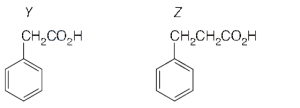
B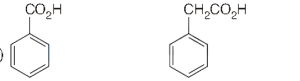
C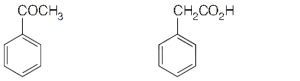
D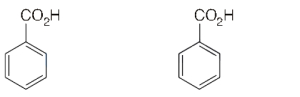
Solution
(D) Alkaline $KMnO_4$ oxidizes any alkyl group directly attached to a benzene ring to a carboxylic acid group $(-COOH)$,provided the alkyl group has at least one $\alpha$-hydrogen atom.
In both ethylbenzene and propylbenzene,the $\alpha$-carbon has hydrogen atoms,so both are oxidized to benzoic acid.
Therefore,both $Y$ and $Z$ are benzoic acid.
In both ethylbenzene and propylbenzene,the $\alpha$-carbon has hydrogen atoms,so both are oxidized to benzoic acid.
Therefore,both $Y$ and $Z$ are benzoic acid.
0 likesView Solution
2
ChemistryEasyMCQTS EAMCET · 2016
The hybridisation of each carbon in the following compound respectively is:
$CH_3-C(=O)-CH_2-CN$
$CH_3-C(=O)-CH_2-CN$
A
$sp^3, sp^2, sp^3, sp$
B
$sp^3, sp^3, sp^2, sp$
C
$sp^3, sp, sp^3, sp^2$
D
$sp^3, sp^2, sp, sp^3$
Solution
(A) The structure of the compound is $CH_3-C(=O)-CH_2-C \equiv N$.
Let us label the carbons as follows:
$(i) CH_3-$,$(ii) -C(=O)-$,$(iii) -CH_2-$,$(iv) -CN$.
$1$. The carbon in the methyl group $(CH_3)$ is bonded to four atoms (three $H$ and one $C$),so it is $sp^3$ hybridised.
$2$. The carbonyl carbon $(C=O)$ is bonded to three atoms (one $C$ of $CH_3$,one $O$,and one $C$ of $CH_2$),so it is $sp^2$ hybridised.
$3$. The methylene carbon $(CH_2)$ is bonded to four atoms (two $H$,one $C$ of $C=O$,and one $C$ of $CN$),so it is $sp^3$ hybridised.
$4$. The cyano carbon $(CN)$ is bonded to two atoms (one $C$ of $CH_2$ and one $N$),so it is $sp$ hybridised.
Thus,the hybridisation of carbons $(i), (ii), (iii),$ and $(iv)$ is $sp^3, sp^2, sp^3, sp$ respectively.
Let us label the carbons as follows:
$(i) CH_3-$,$(ii) -C(=O)-$,$(iii) -CH_2-$,$(iv) -CN$.
$1$. The carbon in the methyl group $(CH_3)$ is bonded to four atoms (three $H$ and one $C$),so it is $sp^3$ hybridised.
$2$. The carbonyl carbon $(C=O)$ is bonded to three atoms (one $C$ of $CH_3$,one $O$,and one $C$ of $CH_2$),so it is $sp^2$ hybridised.
$3$. The methylene carbon $(CH_2)$ is bonded to four atoms (two $H$,one $C$ of $C=O$,and one $C$ of $CN$),so it is $sp^3$ hybridised.
$4$. The cyano carbon $(CN)$ is bonded to two atoms (one $C$ of $CH_2$ and one $N$),so it is $sp$ hybridised.
Thus,the hybridisation of carbons $(i), (ii), (iii),$ and $(iv)$ is $sp^3, sp^2, sp^3, sp$ respectively.
0 likesView Solution
3
ChemistryEasyMCQTS EAMCET · 2016
Match the molecules in List-$I$ with their correct geometries in List-$II$ according to $VSEPR$ theory:
| List-$I$ | List-$II$ |
|---|---|
| $(A)$ $PCl_3$ | $(I)$ Square planar |
| $(B)$ $BF_3$ | $(II)$ $T$-shape |
| $(C)$ $ClF_3$ | $(III)$ Trigonal pyramidal |
| $(D)$ $XeF_4$ | $(IV)$ See-saw |
| $(V)$ Trigonal planar |
A
$A-III, B-V, C-II, D-I$
B
$A-II, B-V, C-III, D-I$
C
$A-III, B-V, C-II, D-IV$
D
$A-I, B-III, C-V, D-II$
Solution
(A) According to $VSEPR$ theory:
$1$. $PCl_3$: Central atom $P$ has $5$ valence electrons. It forms $3$ bonds with $Cl$ and has $1$ lone pair. Total electron pairs = $4$ ($3$ bond pairs + $1$ lone pair),resulting in a Trigonal pyramidal geometry $(A-III)$.
$2$. $BF_3$: Central atom $B$ has $3$ valence electrons. It forms $3$ bonds with $F$ and has $0$ lone pairs. Total electron pairs = $3$,resulting in a Trigonal planar geometry $(B-V)$.
$3$. $ClF_3$: Central atom $Cl$ has $7$ valence electrons. It forms $3$ bonds with $F$ and has $2$ lone pairs. Total electron pairs = $5$,resulting in a $T$-shape geometry $(C-II)$.
$4$. $XeF_4$: Central atom $Xe$ has $8$ valence electrons. It forms $4$ bonds with $F$ and has $2$ lone pairs. Total electron pairs = $6$,resulting in a Square planar geometry $(D-I)$.
Therefore,the correct match is $A-III, B-V, C-II, D-I$.
$1$. $PCl_3$: Central atom $P$ has $5$ valence electrons. It forms $3$ bonds with $Cl$ and has $1$ lone pair. Total electron pairs = $4$ ($3$ bond pairs + $1$ lone pair),resulting in a Trigonal pyramidal geometry $(A-III)$.
$2$. $BF_3$: Central atom $B$ has $3$ valence electrons. It forms $3$ bonds with $F$ and has $0$ lone pairs. Total electron pairs = $3$,resulting in a Trigonal planar geometry $(B-V)$.
$3$. $ClF_3$: Central atom $Cl$ has $7$ valence electrons. It forms $3$ bonds with $F$ and has $2$ lone pairs. Total electron pairs = $5$,resulting in a $T$-shape geometry $(C-II)$.
$4$. $XeF_4$: Central atom $Xe$ has $8$ valence electrons. It forms $4$ bonds with $F$ and has $2$ lone pairs. Total electron pairs = $6$,resulting in a Square planar geometry $(D-I)$.
Therefore,the correct match is $A-III, B-V, C-II, D-I$.
0 likesView Solution
4
ChemistryMediumMCQTS EAMCET · 2016
The order of covalent character of $KF, KCl, KI$ is
A
$KCl < KF < KI$
B
$KI < KCl < KF$
C
$KF < KI < KCl$
D
$KF < KCl < KI$
Solution
(D) According to Fajan's rule,the covalent character of an ionic bond increases with the increase in the size of the anion.
Since the cation $K^{+}$ is common in all the given compounds,the covalent character depends on the size of the halide ions $(F^{-}, Cl^{-}, I^{-})$.
The size order of the anions is $F^{-} < Cl^{-} < I^{-}$.
Therefore,the order of covalent character is $KF < KCl < KI$.
Since the cation $K^{+}$ is common in all the given compounds,the covalent character depends on the size of the halide ions $(F^{-}, Cl^{-}, I^{-})$.
The size order of the anions is $F^{-} < Cl^{-} < I^{-}$.
Therefore,the order of covalent character is $KF < KCl < KI$.
0 likesView Solution
5
ChemistryMediumMCQTS EAMCET · 2016
Which one of the following statements is correct?
A
The equilibrium constant $(K_c)$ is independent of temperature.
B
The value of $K_c$ is independent of initial concentrations of reactants and products.
C
At equilibrium,the rate of the forward reaction is twice the rate of the backward reaction.
D
The equilibrium constant $(K_c)$ for the reaction $Ni_{(s)} + 4CO_{(g)} \rightleftharpoons Ni(CO)_{4(g)}$ is $\frac{[Ni(CO)_4]}{[CO]^4}$.
Solution
(B) The correct option is $B$.
$(A)$ The equilibrium constant $(K_c)$ is temperature-dependent.
$(B)$ The value of $K_c$ is a constant at a given temperature and is independent of the initial concentrations of reactants and products.
$(C)$ At equilibrium,the rate of the forward reaction is equal to the rate of the backward reaction.
$(D)$ For the reaction $Ni_{(s)} + 4CO_{(g)} \rightleftharpoons Ni(CO)_{4(g)}$,the equilibrium constant expression is $K_c = \frac{[Ni(CO)_4]}{[CO]^4}$. Since the expression in the option omitted the $K_c$ definition or was potentially ambiguous,$B$ is the most fundamentally correct statement regarding the nature of $K_c$.
$(A)$ The equilibrium constant $(K_c)$ is temperature-dependent.
$(B)$ The value of $K_c$ is a constant at a given temperature and is independent of the initial concentrations of reactants and products.
$(C)$ At equilibrium,the rate of the forward reaction is equal to the rate of the backward reaction.
$(D)$ For the reaction $Ni_{(s)} + 4CO_{(g)} \rightleftharpoons Ni(CO)_{4(g)}$,the equilibrium constant expression is $K_c = \frac{[Ni(CO)_4]}{[CO]^4}$. Since the expression in the option omitted the $K_c$ definition or was potentially ambiguous,$B$ is the most fundamentally correct statement regarding the nature of $K_c$.
0 likesView Solution
6
ChemistryEasyMCQTS EAMCET · 2016
What is the atomic number of the element with symbol $Uus$?
A
$117$
B
$116$
C
$115$
D
$114$
Solution
(A) The atomic number of the element $Uus$ is $117$.
Ununseptium $(Uus)$ is the second heaviest known element and penultimate element of the $7^{th}$ period of the periodic table.
Electronic configuration of $Uus = [Rn] 5f^{14} 6d^{10} 7s^2 7p^5$.
Ununseptium $(Uus)$ is the second heaviest known element and penultimate element of the $7^{th}$ period of the periodic table.
Electronic configuration of $Uus = [Rn] 5f^{14} 6d^{10} 7s^2 7p^5$.
0 likesView Solution
7
ChemistryEasyMCQTS EAMCET · 2016
Which one of the following forms a basic oxide?
A
$B$
B
$Tl$
C
$Al$
D
$Ga$
Solution
(B) The basic character of an oxide increases with an increase in the metallic character of the element.
As we move down the group,the metallic character increases.
Among the given elements ($B$,$Al$,$Ga$,$Tl$),$Tl$ $(Thallium)$ is at the bottom of the group and thus possesses the highest metallic character.
Therefore,$Tl$ forms a basic oxide.
$B$ $(Boron)$ forms an acidic oxide,while $Al$ $(Aluminium)$ and $Ga$ $(Gallium)$ form amphoteric oxides.
As we move down the group,the metallic character increases.
Among the given elements ($B$,$Al$,$Ga$,$Tl$),$Tl$ $(Thallium)$ is at the bottom of the group and thus possesses the highest metallic character.
Therefore,$Tl$ forms a basic oxide.
$B$ $(Boron)$ forms an acidic oxide,while $Al$ $(Aluminium)$ and $Ga$ $(Gallium)$ form amphoteric oxides.
0 likesView Solution
8
ChemistryMediumMCQTS EAMCET · 2016
What is the change in the oxidation state of $Mn$ in the reaction of $MnO_4^{-}$ with $H_2O_2$ in acidic medium?
A
$7 \rightarrow 4$
B
$6 \rightarrow 4$
C
$7 \rightarrow 2$
D
$6 \rightarrow 2$
Solution
(C) In an acidic medium,the permanganate ion $(MnO_4^{-})$ acts as a strong oxidizing agent and reacts with hydrogen peroxide $(H_2O_2)$.
The balanced chemical equation for this reaction is: $2MnO_4^{-} + 5H_2O_2 + 6H^{+} \rightarrow 2Mn^{2+} + 5O_2 + 8H_2O$.
In $MnO_4^{-}$,the oxidation state of $Mn$ is calculated as: $x + 4(-2) = -1$,which gives $x = +7$.
In the product $Mn^{2+}$,the oxidation state of $Mn$ is $+2$.
Therefore,the oxidation state of $Mn$ changes from $+7$ to $+2$.
The balanced chemical equation for this reaction is: $2MnO_4^{-} + 5H_2O_2 + 6H^{+} \rightarrow 2Mn^{2+} + 5O_2 + 8H_2O$.
In $MnO_4^{-}$,the oxidation state of $Mn$ is calculated as: $x + 4(-2) = -1$,which gives $x = +7$.
In the product $Mn^{2+}$,the oxidation state of $Mn$ is $+2$.
Therefore,the oxidation state of $Mn$ changes from $+7$ to $+2$.
0 likesView Solution
9
ChemistryMCQTS EAMCET · 2016
The minimum value of $|z-1|+|z-5|$ is
A
$5$
B
$4$
C
$3$
D
$2$
Solution
(B) By the triangle inequality,for any complex numbers $z_1$ and $z_2$,we have $|z_1| + |z_2| \geq |z_1 + z_2|$.
More specifically,for the expression $|z-1| + |z-5|$,we can use the property $|a| + |b| \geq |a - b|$.
Let $a = z-1$ and $b = z-5$.
Then $|z-1| + |z-5| \geq |(z-1) - (z-5)|$.
$|z-1| + |z-5| \geq |z - 1 - z + 5|$.
$|z-1| + |z-5| \geq |4|$.
$|z-1| + |z-5| \geq 4$.
Thus,the minimum value is $4$.
More specifically,for the expression $|z-1| + |z-5|$,we can use the property $|a| + |b| \geq |a - b|$.
Let $a = z-1$ and $b = z-5$.
Then $|z-1| + |z-5| \geq |(z-1) - (z-5)|$.
$|z-1| + |z-5| \geq |z - 1 - z + 5|$.
$|z-1| + |z-5| \geq |4|$.
$|z-1| + |z-5| \geq 4$.
Thus,the minimum value is $4$.
0 likesView Solution
10
ChemistryMCQTS EAMCET · 2016
The number of divisors of $7!$ is
A
$24$
B
$72$
C
$64$
D
$60$
Solution
(D) First,find the prime factorization of $7!$:
$7! = 7 \times 6 \times 5 \times 4 \times 3 \times 2 \times 1 = 2^4 \times 3^2 \times 5^1 \times 7^1$.
The number of divisors of a number $N = p_1^{a} p_2^{b} p_3^{c} p_4^{d}$ is given by $(a+1)(b+1)(c+1)(d+1)$.
Here,$a=4, b=2, c=1, d=1$.
Therefore,the number of divisors is $(4+1)(2+1)(1+1)(1+1) = 5 \times 3 \times 2 \times 2 = 60$.
$7! = 7 \times 6 \times 5 \times 4 \times 3 \times 2 \times 1 = 2^4 \times 3^2 \times 5^1 \times 7^1$.
The number of divisors of a number $N = p_1^{a} p_2^{b} p_3^{c} p_4^{d}$ is given by $(a+1)(b+1)(c+1)(d+1)$.
Here,$a=4, b=2, c=1, d=1$.
Therefore,the number of divisors is $(4+1)(2+1)(1+1)(1+1) = 5 \times 3 \times 2 \times 2 = 60$.
0 likesView Solution
11
ChemistryEasyMCQTS EAMCET · 2016
In environmental chemistry,the medium which is affected by a pollutant is called the
A
sink
B
slag
C
solvent
D
receptor
Solution
(D) In environmental chemistry,the medium or component that is adversely affected by a pollutant is known as a $receptor$ or $target$. $Receptors$ can be biotic (living organisms) or abiotic (non-living components) that suffer negative impacts due to the presence of pollutants.
0 likesView Solution
12
ChemistryMCQTS EAMCET · 2016
If the circles $x^2+y^2-2 \lambda x-2 y-7=0$ and $3(x^2+y^2)-8 x+29 y=0$ are orthogonal,then $\lambda$ is equal to
A
$4$
B
$3$
C
$2$
D
$1$
Solution
(D) The equations of the circles are:
$x^2+y^2-2 \lambda x-2 y-7=0$ $(i)$
$3(x^2+y^2)-8 x+29 y=0 \Rightarrow x^2+y^2-\frac{8}{3} x+\frac{29}{3} y=0$ $(ii)$
Comparing these with the general form $x^2+y^2+2gx+2fy+c=0$:
For circle $(i)$: $g_1 = -\lambda, f_1 = -1, c_1 = -7$
For circle $(ii)$: $g_2 = -\frac{4}{3}, f_2 = \frac{29}{6}, c_2 = 0$
Since the circles are orthogonal,the condition is $2g_1g_2 + 2f_1f_2 = c_1 + c_2$.
Substituting the values:
$2(-\lambda)(-\frac{4}{3}) + 2(-1)(\frac{29}{6}) = -7 + 0$
$\frac{8}{3}\lambda - \frac{29}{3} = -7$
$\frac{8}{3}\lambda = -7 + \frac{29}{3} = \frac{-21+29}{3} = \frac{8}{3}$
$\lambda = 1$
$x^2+y^2-2 \lambda x-2 y-7=0$ $(i)$
$3(x^2+y^2)-8 x+29 y=0 \Rightarrow x^2+y^2-\frac{8}{3} x+\frac{29}{3} y=0$ $(ii)$
Comparing these with the general form $x^2+y^2+2gx+2fy+c=0$:
For circle $(i)$: $g_1 = -\lambda, f_1 = -1, c_1 = -7$
For circle $(ii)$: $g_2 = -\frac{4}{3}, f_2 = \frac{29}{6}, c_2 = 0$
Since the circles are orthogonal,the condition is $2g_1g_2 + 2f_1f_2 = c_1 + c_2$.
Substituting the values:
$2(-\lambda)(-\frac{4}{3}) + 2(-1)(\frac{29}{6}) = -7 + 0$
$\frac{8}{3}\lambda - \frac{29}{3} = -7$
$\frac{8}{3}\lambda = -7 + \frac{29}{3} = \frac{-21+29}{3} = \frac{8}{3}$
$\lambda = 1$
0 likesView Solution
13
ChemistryDifficultMCQTS EAMCET · 2016
Identify $X$ and $Y$ in the following reaction sequence: $X$ $\xrightarrow{Zn} Y$ $\xrightarrow[Zn, H_2O]{O_3} (CH_3)_2CO + CH_2O$
A
$X = (CH_3)_2CBrCH_2Br, Y = (CH_3)_2C=CH_2$
B
$X = (CH_3)_2CHCH_2Br, Y = (CH_3)_2C=CH_2$
C
$X = (CH_3)_2CBrCH_2Br, Y = CH_3CH=CHCH_3$
D
$X = (CH_3)_2CHCHBrCH_2Br, Y = (CH_3)_2C=CH_2$
Solution
(A) The reaction sequence is as follows:
$1$. The reaction of a vicinal dibromide with $Zn$ dust (dehalogenation) leads to the formation of an alkene.
$2$. $X = (CH_3)_2CBrCH_2Br$ reacts with $Zn$ to form $Y = (CH_3)_2C=CH_2$ (isobutylene).
$3$. Ozonolysis of isobutylene $(CH_3)_2C=CH_2$ in the presence of $Zn/H_2O$ yields acetone $(CH_3)_2CO$ and formaldehyde $(CH_2O)$.
$1$. The reaction of a vicinal dibromide with $Zn$ dust (dehalogenation) leads to the formation of an alkene.
$2$. $X = (CH_3)_2CBrCH_2Br$ reacts with $Zn$ to form $Y = (CH_3)_2C=CH_2$ (isobutylene).
$3$. Ozonolysis of isobutylene $(CH_3)_2C=CH_2$ in the presence of $Zn/H_2O$ yields acetone $(CH_3)_2CO$ and formaldehyde $(CH_2O)$.
0 likesView Solution
14
ChemistryMediumMCQTS EAMCET · 2016
The product $Z$ of the following reaction is
$CH_3-C \equiv CH \xrightarrow{2 HBr} Z$
$CH_3-C \equiv CH \xrightarrow{2 HBr} Z$
A
$CH_3-CH_2-CHBr_2$
B
$CH_3-CHBr-CH_2Br$
C
$CH_3-CBr_2-CH_3$
D
$Br-CH_2-CH_2-CH_2Br$
Solution
(C) The reaction of propyne $(CH_3-C \equiv CH)$ with $2$ equivalents of $HBr$ proceeds via Markovnikov's addition.
In the first step,$HBr$ adds to the triple bond to form $CH_3-CBr=CH_2$ ($2$-bromopropene).
In the second step,another molecule of $HBr$ adds to the double bond following Markovnikov's rule,where the hydrogen atom attaches to the carbon with more hydrogens,resulting in the geminal dihalide $CH_3-CBr_2-CH_3$ ($2$,$2$-dibromopropane).
In the first step,$HBr$ adds to the triple bond to form $CH_3-CBr=CH_2$ ($2$-bromopropene).
In the second step,another molecule of $HBr$ adds to the double bond following Markovnikov's rule,where the hydrogen atom attaches to the carbon with more hydrogens,resulting in the geminal dihalide $CH_3-CBr_2-CH_3$ ($2$,$2$-dibromopropane).
0 likesView Solution
15
ChemistryMediumMCQTS EAMCET · 2016
$pH$ of an aqueous solution of $NH_4Cl$ is
A
$7$
B
$ > 7$
C
$ < 7$
D
$1$
Solution
(C) $NH_4Cl$ is a salt formed from a weak base $(NH_4OH)$ and a strong acid $(HCl)$.
In water,it undergoes hydrolysis: $NH_4^+ + H_2O \rightleftharpoons NH_4OH + H^+$.
Due to the production of $H^+$ ions,the solution becomes acidic.
Therefore,the $pH$ of an aqueous solution of $NH_4Cl$ is $< 7$.
In water,it undergoes hydrolysis: $NH_4^+ + H_2O \rightleftharpoons NH_4OH + H^+$.
Due to the production of $H^+$ ions,the solution becomes acidic.
Therefore,the $pH$ of an aqueous solution of $NH_4Cl$ is $< 7$.
0 likesView Solution
16
ChemistryMediumMCQTS EAMCET · 2016
The gas produced by the passage of air over hot coke is
A
carbon monoxide
B
carbon dioxide
C
producer gas
D
water gas
Solution
(C) The gas produced by the passage of air over hot coke is called producer gas.
The reaction proceeds as:
$2 C (s) + (O_2 + 3.76 N_2) (g) \xrightarrow{\Delta} 2 CO (g) + 3.76 N_2 (g)$
This mixture of $CO$ and $N_2$ is known as producer gas.
The reaction proceeds as:
$2 C (s) + (O_2 + 3.76 N_2) (g) \xrightarrow{\Delta} 2 CO (g) + 3.76 N_2 (g)$
This mixture of $CO$ and $N_2$ is known as producer gas.
0 likesView Solution
17
ChemistryEasyMCQTS EAMCET · 2016
Which one of the following will not give a flame test?
A
$Ca$
B
$Ba$
C
$Sr$
D
$Be$
Solution
(D) Beryllium $(Be)$ has the smallest atomic size in group $2$. Due to its high ionization enthalpy,its outermost electrons are tightly held and do not get excited to higher energy levels by the energy provided in a flame test. Therefore,$Be$ does not impart any characteristic color to the flame.
0 likesView Solution
18
ChemistryMediumMCQTS EAMCET · 2016
The following reaction occurs in acidic medium: $KMnO_4 + 8 H^{+} + 5 e^{-} \longrightarrow K^{+} + Mn^{2+} + 4 H_2O$. What is the equivalent weight of $KMnO_4$? (Molecular weight of $KMnO_4 = 158$)
A
$79$
B
$31.6$
C
$158$
D
$39.5$
Solution
(B) In the given reaction in acidic medium,$KMnO_4$ acts as an oxidizing agent.
$KMnO_4$ gains $5$ electrons per molecule to reduce $Mn^{7+}$ to $Mn^{2+}$.
Therefore,the $n$-factor for $KMnO_4$ in acidic medium is $5$.
Equivalent weight = $\frac{\text{Molecular weight}}{n\text{-factor}}$
Equivalent weight = $\frac{158}{5} = 31.6 \ g/\text{equivalent}$.
$KMnO_4$ gains $5$ electrons per molecule to reduce $Mn^{7+}$ to $Mn^{2+}$.
Therefore,the $n$-factor for $KMnO_4$ in acidic medium is $5$.
Equivalent weight = $\frac{\text{Molecular weight}}{n\text{-factor}}$
Equivalent weight = $\frac{158}{5} = 31.6 \ g/\text{equivalent}$.
0 likesView Solution
19
ChemistryEasyMCQTS EAMCET · 2016
In Haber's process,$50.0 \ g$ of $N_{2(g)}$ and $10.0 \ g$ of $H_{2(g)}$ are mixed to produce $NH_{3(g)}$. What is the number of moles of $NH_{3(g)}$ formed?
A
$3.33$
B
$2.36$
C
$2.01$
D
$5.36$
Solution
(A) The balanced chemical equation is: $N_{2(g)} + 3H_{2(g)} \rightleftharpoons 2NH_{3(g)}$.
First,calculate the moles of reactants:
$n_{N_2} = \frac{50.0 \ g}{28.0 \ g/mol} \approx 1.786 \ mol$.
$n_{H_2} = \frac{10.0 \ g}{2.016 \ g/mol} \approx 4.96 \ mol$.
According to the stoichiometry,$1 \ mol$ of $N_2$ requires $3 \ mol$ of $H_2$.
For $1.786 \ mol$ of $N_2$,we need $1.786 \times 3 = 5.358 \ mol$ of $H_2$.
Since we only have $4.96 \ mol$ of $H_2$,$H_2$ is the limiting reagent.
The moles of $NH_3$ produced depend on the limiting reagent $(H_2)$:
$n_{NH_3} = n_{H_2} \times \frac{2 \ mol \ NH_3}{3 \ mol \ H_2} = 4.96 \times \frac{2}{3} \approx 3.31 \ mol$.
Using the exact mass calculation: $n_{NH_3} = \frac{10 \ g}{6 \ g} \times 2 = \frac{20}{6} = 3.33 \ mol$.
First,calculate the moles of reactants:
$n_{N_2} = \frac{50.0 \ g}{28.0 \ g/mol} \approx 1.786 \ mol$.
$n_{H_2} = \frac{10.0 \ g}{2.016 \ g/mol} \approx 4.96 \ mol$.
According to the stoichiometry,$1 \ mol$ of $N_2$ requires $3 \ mol$ of $H_2$.
For $1.786 \ mol$ of $N_2$,we need $1.786 \times 3 = 5.358 \ mol$ of $H_2$.
Since we only have $4.96 \ mol$ of $H_2$,$H_2$ is the limiting reagent.
The moles of $NH_3$ produced depend on the limiting reagent $(H_2)$:
$n_{NH_3} = n_{H_2} \times \frac{2 \ mol \ NH_3}{3 \ mol \ H_2} = 4.96 \times \frac{2}{3} \approx 3.31 \ mol$.
Using the exact mass calculation: $n_{NH_3} = \frac{10 \ g}{6 \ g} \times 2 = \frac{20}{6} = 3.33 \ mol$.
0 likesView Solution
20
ChemistryMediumMCQTS EAMCET · 2016
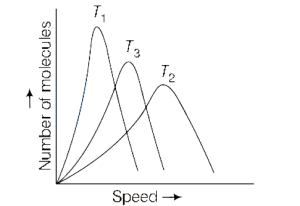
The given figure shows the Maxwell distribution of molecular speeds of a gas at three different temperatures $T_1$,$T_2$ and $T_3$. The correct order of temperature is
A
$T_1 > T_2 > T_3$
B
$T_1 > T_3 > T_2$
C
$T_3 > T_2 > T_1$
D
$T_2 > T_3 > T_1$
Solution
(D) According to the Maxwell-Boltzmann distribution,as the temperature of a gas increases,the most probable speed $(u_{mp})$ increases,and the peak of the distribution curve shifts to the right and flattens.
In the given figure,the peak for $T_2$ is at the highest speed,followed by $T_3$,and then $T_1$.
Therefore,the most probable speed follows the order $u_{mp}(T_2) > u_{mp}(T_3) > u_{mp}(T_1)$.
Since $u_{mp} = \sqrt{\frac{2RT}{M}}$,it implies that $u_{mp} \propto \sqrt{T}$.
Thus,the correct order of temperature is $T_2 > T_3 > T_1$.
In the given figure,the peak for $T_2$ is at the highest speed,followed by $T_3$,and then $T_1$.
Therefore,the most probable speed follows the order $u_{mp}(T_2) > u_{mp}(T_3) > u_{mp}(T_1)$.
Since $u_{mp} = \sqrt{\frac{2RT}{M}}$,it implies that $u_{mp} \propto \sqrt{T}$.
Thus,the correct order of temperature is $T_2 > T_3 > T_1$.
0 likesView Solution
21
ChemistryEasyMCQTS EAMCET · 2016
If the kinetic energy in $J$,of $CH_4$ (molar mass $= 16 \ g \ mol^{-1}$) at $T(K)$ is $X$,the kinetic energy in $J$,of $O_2$ (molar mass $= 32 \ g \ mol^{-1}$) at the same temperature is
A
$X$
B
$2 X$
C
$X^2$
D
$\frac{X}{2}$
Solution
(A) The average kinetic energy of an ideal gas is given by the formula $KE = \frac{3}{2} RT$.
Since the kinetic energy depends only on the temperature $T$ and the gas constant $R$,it is independent of the nature or molar mass of the gas.
Therefore,at the same temperature $T$,the kinetic energy of $CH_4$ and $O_2$ will be equal.
Thus,$KE_{(CH_4)} = KE_{(O_2)} = X$.
Since the kinetic energy depends only on the temperature $T$ and the gas constant $R$,it is independent of the nature or molar mass of the gas.
Therefore,at the same temperature $T$,the kinetic energy of $CH_4$ and $O_2$ will be equal.
Thus,$KE_{(CH_4)} = KE_{(O_2)} = X$.
0 likesView Solution
22
ChemistryEasyMCQTS EAMCET · 2016
Among the following,the isoelectronic species is/are:
$(I)$ $O^{2-}, F^{-}, Na^{+}, Mg^{2+}$
$(II)$ $Na^{+}, Mg^{+}, Al^{3+}, F^{-}$
$(III)$ $N^{3-}, O^{2-}, F^{-}, Ne$
$(I)$ $O^{2-}, F^{-}, Na^{+}, Mg^{2+}$
$(II)$ $Na^{+}, Mg^{+}, Al^{3+}, F^{-}$
$(III)$ $N^{3-}, O^{2-}, F^{-}, Ne$
A
$(I)$ and $(II)$
B
$(I)$,$(II)$ and $(III)$
C
$(II)$ and $(III)$
D
$(I)$ and $(III)$
Solution
(D) Isoelectronic species are atoms or ions that have the same number of electrons.
For $(I)$: $O^{2-} (8+2=10)$,$F^{-} (9+1=10)$,$Na^{+} (11-1=10)$,$Mg^{2+} (12-2=10)$. All have $10$ electrons,so $(I)$ is isoelectronic.
For $(II)$: $Na^{+} (10)$,$Mg^{+} (11)$,$Al^{3+} (10)$,$F^{-} (10)$. Since $Mg^{+}$ has $11$ electrons,$(II)$ is not isoelectronic.
For $(III)$: $N^{3-} (7+3=10)$,$O^{2-} (8+2=10)$,$F^{-} (9+1=10)$,$Ne (10)$. All have $10$ electrons,so $(III)$ is isoelectronic.
Therefore,$(I)$ and $(III)$ are isoelectronic species.
For $(I)$: $O^{2-} (8+2=10)$,$F^{-} (9+1=10)$,$Na^{+} (11-1=10)$,$Mg^{2+} (12-2=10)$. All have $10$ electrons,so $(I)$ is isoelectronic.
For $(II)$: $Na^{+} (10)$,$Mg^{+} (11)$,$Al^{3+} (10)$,$F^{-} (10)$. Since $Mg^{+}$ has $11$ electrons,$(II)$ is not isoelectronic.
For $(III)$: $N^{3-} (7+3=10)$,$O^{2-} (8+2=10)$,$F^{-} (9+1=10)$,$Ne (10)$. All have $10$ electrons,so $(III)$ is isoelectronic.
Therefore,$(I)$ and $(III)$ are isoelectronic species.
0 likesView Solution
23
ChemistryEasyMCQTS EAMCET · 2016
The element with the electronic configuration $1s^2 2s^2 2p^6 3s^2 3p^6 3d^{10} 4s^1$ is
A
$Cu$
B
$Ca$
C
$Cr$
D
$CO$
Solution
(A) The given electronic configuration is $1s^2 2s^2 2p^6 3s^2 3p^6 3d^{10} 4s^1$.
Summing the electrons: $2+2+6+2+6+10+1 = 29$.
The element with atomic number $29$ is Copper $(Cu)$.
This configuration represents the stable ground state of $Cu$ where the $3d$ subshell is completely filled.
Summing the electrons: $2+2+6+2+6+10+1 = 29$.
The element with atomic number $29$ is Copper $(Cu)$.
This configuration represents the stable ground state of $Cu$ where the $3d$ subshell is completely filled.
0 likesView Solution
24
ChemistryMediumMCQTS EAMCET · 2016
Assertion $(A)$: Atoms with completely filled and half-filled subshells are stable.
Reason $(R)$: Completely filled and half-filled subshells have symmetrical distribution of electrons and have maximum exchange energy.
The correct answer is:
Reason $(R)$: Completely filled and half-filled subshells have symmetrical distribution of electrons and have maximum exchange energy.
The correct answer is:
A
$(A)$ and $(R)$ are correct,$(R)$ is the correct explanation of $(A)$
B
$(A)$ and $(R)$ are correct,$(R)$ is not the correct explanation of $(A)$
C
$(A)$ is correct,but $(R)$ is not correct
D
$(A)$ is not correct,but $(R)$ is correct
Solution
(A) The extra stability of half-filled and fully filled electronic configurations can be explained in terms of symmetry and exchange energy.
All the orbitals of the same subshell that are either completely filled or half-filled have a more symmetrical distribution of electrons.
Consequently,the shielding of electrons is relatively small,and the electrons are more strongly attracted by the nucleus.
Furthermore,the number of possible exchanges is maximum in these configurations,which leads to higher exchange energy and,therefore,greater stability of the atom.
Thus,both $(A)$ and $(R)$ are correct,and $(R)$ is the correct explanation of $(A)$.
All the orbitals of the same subshell that are either completely filled or half-filled have a more symmetrical distribution of electrons.
Consequently,the shielding of electrons is relatively small,and the electrons are more strongly attracted by the nucleus.
Furthermore,the number of possible exchanges is maximum in these configurations,which leads to higher exchange energy and,therefore,greater stability of the atom.
Thus,both $(A)$ and $(R)$ are correct,and $(R)$ is the correct explanation of $(A)$.
0 likesView Solution
25
ChemistryEasyMCQTS EAMCET · 2016
Given that $N_{2(g)} + 3 H_{2(g)} \longrightarrow 2 NH_{3(g)}$; $\Delta_r H^{\circ} = -92 \ kJ$,the standard molar enthalpy of formation in $kJ \ mol^{-1}$ of $NH_{3(g)}$ is
A
$-92$
B
$46$
C
$92$
D
$-46$
Solution
(D) The standard molar enthalpy of formation $(\Delta_f H^{\circ})$ is defined as the enthalpy change when $1 \ mol$ of a substance is formed from its constituent elements in their standard states.
For the reaction: $N_{2(g)} + 3 H_{2(g)} \longrightarrow 2 NH_{3(g)}$,the enthalpy change is $\Delta_r H^{\circ} = -92 \ kJ$ for the formation of $2 \ mol$ of $NH_{3(g)}$.
To find the enthalpy of formation for $1 \ mol$ of $NH_{3(g)}$,we divide the reaction by $2$:
$\frac{1}{2} N_{2(g)} + \frac{3}{2} H_{2(g)} \longrightarrow NH_{3(g)}$
$\Delta_f H^{\circ} = \frac{\Delta_r H^{\circ}}{2} = \frac{-92 \ kJ}{2} = -46 \ kJ \ mol^{-1}$.
For the reaction: $N_{2(g)} + 3 H_{2(g)} \longrightarrow 2 NH_{3(g)}$,the enthalpy change is $\Delta_r H^{\circ} = -92 \ kJ$ for the formation of $2 \ mol$ of $NH_{3(g)}$.
To find the enthalpy of formation for $1 \ mol$ of $NH_{3(g)}$,we divide the reaction by $2$:
$\frac{1}{2} N_{2(g)} + \frac{3}{2} H_{2(g)} \longrightarrow NH_{3(g)}$
$\Delta_f H^{\circ} = \frac{\Delta_r H^{\circ}}{2} = \frac{-92 \ kJ}{2} = -46 \ kJ \ mol^{-1}$.
0 likesView Solution
26
ChemistryDifficultMCQTS EAMCET · 2016
$X + Y \xrightarrow{H^{+}} \text{Aspirin} + CH_3COOH$. Identify $X$ and $Y$ from the following:
A
$X = \text{Benzoic acid}, Y = CH_3COCl$
B
$X = \text{Salicylic acid}, Y = (CH_3CO)_2O$
C
$X = \text{m-Hydroxybenzoic acid}, Y = CH_3COOH$
D
$X = \text{p-Hydroxybenzoic acid}, Y = CH_3COCH_3$
Solution
(B) The synthesis of Aspirin (acetylsalicylic acid) involves the acetylation of salicylic acid.
Salicylic acid $(X)$ reacts with acetic anhydride $(Y)$ in the presence of an acid catalyst $(H^+)$ to form acetylsalicylic acid (Aspirin) and acetic acid $(CH_3COOH)$.
The reaction is:
$\text{Salicylic acid} + (CH_3CO)_2O \xrightarrow{H^+} \text{Aspirin} + CH_3COOH$.
Thus,$X$ is salicylic acid and $Y$ is acetic anhydride $(CH_3CO)_2O$.
Salicylic acid $(X)$ reacts with acetic anhydride $(Y)$ in the presence of an acid catalyst $(H^+)$ to form acetylsalicylic acid (Aspirin) and acetic acid $(CH_3COOH)$.
The reaction is:
$\text{Salicylic acid} + (CH_3CO)_2O \xrightarrow{H^+} \text{Aspirin} + CH_3COOH$.
Thus,$X$ is salicylic acid and $Y$ is acetic anhydride $(CH_3CO)_2O$.
0 likesView Solution
27
ChemistryEasyMCQTS EAMCET · 2016
$R-CN \xrightarrow[(ii) H_3O^{+}]{(i) SnCl_2 + HCl} R-CHO$
What is the name of the above reaction?
What is the name of the above reaction?
A
Rosenmund
B
Williamson
C
Stephen
D
Kolbe
Solution
(C) The reaction of nitriles $(R-CN)$ with stannous chloride $(SnCl_2)$ in the presence of hydrochloric acid $(HCl)$,followed by hydrolysis $(H_3O^+)$,yields an aldehyde $(R-CHO)$. This specific reduction method is known as the Stephen's reaction.
The mechanism involves the formation of an imine hydrochloride intermediate,which is subsequently hydrolyzed to the corresponding aldehyde:
$R-C \equiv N + SnCl_2 + 2HCl \rightarrow R-CH=NH \cdot HCl$
$R-CH=NH \cdot HCl + H_2O \rightarrow R-CHO + NH_4Cl$
The mechanism involves the formation of an imine hydrochloride intermediate,which is subsequently hydrolyzed to the corresponding aldehyde:
$R-C \equiv N + SnCl_2 + 2HCl \rightarrow R-CH=NH \cdot HCl$
$R-CH=NH \cdot HCl + H_2O \rightarrow R-CHO + NH_4Cl$
0 likesView Solution
28
ChemistryDifficultMCQTS EAMCET · 2016
Which of the following is the strongest base?
A
$C_6H_5NH_2$
B
$C_6H_5NHCH_3$
C
$C_6H_5N(CH_3)_2$
D
$CH_3NH_2$
Solution
(D) The basicity of amines depends on the availability of the lone pair of electrons on the nitrogen atom for protonation.
In aromatic amines like $C_6H_5NH_2$,$C_6H_5NHCH_3$,and $C_6H_5N(CH_3)_2$,the lone pair of electrons on the nitrogen atom is involved in resonance with the benzene ring,which decreases its availability for protonation.
In aliphatic amines like $CH_3NH_2$,there is no such resonance,and the electron-donating inductive effect of the alkyl group increases the electron density on the nitrogen atom,making it more available for protonation.
Therefore,$CH_3NH_2$ is a much stronger base than the given aromatic amines.
In aromatic amines like $C_6H_5NH_2$,$C_6H_5NHCH_3$,and $C_6H_5N(CH_3)_2$,the lone pair of electrons on the nitrogen atom is involved in resonance with the benzene ring,which decreases its availability for protonation.
In aliphatic amines like $CH_3NH_2$,there is no such resonance,and the electron-donating inductive effect of the alkyl group increases the electron density on the nitrogen atom,making it more available for protonation.
Therefore,$CH_3NH_2$ is a much stronger base than the given aromatic amines.
0 likesView Solution
29
ChemistryEasyMCQTS EAMCET · 2016
The hormone that maintains the blood glucose level within the limit is
A
thyroxine
B
insulin
C
testosterone
D
epinephrine
Solution
(B) Insulin is a peptide hormone secreted by the pancreas.
It regulates blood glucose metabolism by signaling the liver,muscles,and fat cells to take up excess glucose from the blood,thereby maintaining the level within the normal limit.
It regulates blood glucose metabolism by signaling the liver,muscles,and fat cells to take up excess glucose from the blood,thereby maintaining the level within the normal limit.
0 likesView Solution
30
ChemistryMediumMCQTS EAMCET · 2016
For the reaction $5Br^-{_{\text{(aq)}}} + 6H^+{_{\text{(aq)}}} + BrO_3^-{_{\text{(aq)}}} \rightarrow 3Br_{2\text{(aq)}} + 3H_2O_{\text{(l)}}$. If $-\frac{\Delta[BrO_3^{-}]}{\Delta t} = 0.01 \ mol \ L^{-1} \ min^{-1}$,calculate $\frac{\Delta[Br_2]}{\Delta t}$ in $mol \ L^{-1} \ min^{-1}$.
A
$0.01$
B
$0.3$
C
$0.03$
D
$0.005$
Solution
(C) For the given reaction: $5Br^-{_{\text{(aq)}}} + 6H^+{_{\text{(aq)}}} + BrO_3^-{_{\text{(aq)}}} \rightarrow 3Br_{2\text{(aq)}} + 3H_2O_{\text{(l)}}$
The rate of reaction expression is:
$Rate = -\frac{1}{5} \frac{\Delta[Br^{-}]}{\Delta t} = -\frac{\Delta[BrO_3^{-}]}{\Delta t} = +\frac{1}{3} \frac{\Delta[Br_2]}{\Delta t}$
Given that $-\frac{\Delta[BrO_3^{-}]}{\Delta t} = 0.01 \ mol \ L^{-1} \ min^{-1}$,we equate the terms:
$-\frac{\Delta[BrO_3^{-}]}{\Delta t} = \frac{1}{3} \frac{\Delta[Br_2]}{\Delta t}$
Substituting the given value:
$0.01 = \frac{1}{3} \frac{\Delta[Br_2]}{\Delta t}$
Therefore,$\frac{\Delta[Br_2]}{\Delta t} = 3 \times 0.01 = 0.03 \ mol \ L^{-1} \ min^{-1}$.
The rate of reaction expression is:
$Rate = -\frac{1}{5} \frac{\Delta[Br^{-}]}{\Delta t} = -\frac{\Delta[BrO_3^{-}]}{\Delta t} = +\frac{1}{3} \frac{\Delta[Br_2]}{\Delta t}$
Given that $-\frac{\Delta[BrO_3^{-}]}{\Delta t} = 0.01 \ mol \ L^{-1} \ min^{-1}$,we equate the terms:
$-\frac{\Delta[BrO_3^{-}]}{\Delta t} = \frac{1}{3} \frac{\Delta[Br_2]}{\Delta t}$
Substituting the given value:
$0.01 = \frac{1}{3} \frac{\Delta[Br_2]}{\Delta t}$
Therefore,$\frac{\Delta[Br_2]}{\Delta t} = 3 \times 0.01 = 0.03 \ mol \ L^{-1} \ min^{-1}$.
0 likesView Solution
31
ChemistryEasyMCQTS EAMCET · 2016
Chloroxylenol is an example of
A
antiseptic
B
antipyretic
C
analgesic
D
tranquiliser
Solution
(A) Chloroxylenol is an example of an antiseptic.
Dettol is a mixture of chloroxylenol and $\alpha$-terpineol.
Chloroxylenol is responsible for the antiseptic and disinfectant properties of Dettol.
Dettol is a mixture of chloroxylenol and $\alpha$-terpineol.
Chloroxylenol is responsible for the antiseptic and disinfectant properties of Dettol.
0 likesView Solution
32
ChemistryDifficultMCQTS EAMCET · 2016
Which one of the following does not exhibit geometrical isomerism?
A
Octahedral complex with formula $[MX_2L_4]$
B
Square planar complex with formula $[MX_2L_2]$
C
Tetrahedral complex with formula $[MABXL]$
D
Octahedral complex with formula $[MX_2(L^{-}L)_2]$
Solution
(C) Geometrical isomerism is observed in complexes where the relative positions of ligands around the central metal atom can change.
$1$. Octahedral complexes of the type $[MX_2L_4]$ exhibit geometrical isomerism (cis and trans forms).
$2$. Square planar complexes of the type $[MX_2L_2]$ exhibit geometrical isomerism (cis and trans forms).
$3$. Tetrahedral complexes of the type $[MABXL]$ do not exhibit geometrical isomerism because all four positions in a tetrahedron are adjacent to each other,making the relative positions of ligands identical.
$4$. Octahedral complexes of the type $[MX_2(L^{-}L)_2]$ exhibit geometrical isomerism due to the arrangement of $X$ ligands.
Therefore,the correct answer is the tetrahedral complex.
$1$. Octahedral complexes of the type $[MX_2L_4]$ exhibit geometrical isomerism (cis and trans forms).
$2$. Square planar complexes of the type $[MX_2L_2]$ exhibit geometrical isomerism (cis and trans forms).
$3$. Tetrahedral complexes of the type $[MABXL]$ do not exhibit geometrical isomerism because all four positions in a tetrahedron are adjacent to each other,making the relative positions of ligands identical.
$4$. Octahedral complexes of the type $[MX_2(L^{-}L)_2]$ exhibit geometrical isomerism due to the arrangement of $X$ ligands.
Therefore,the correct answer is the tetrahedral complex.
0 likesView Solution
33
ChemistryMediumMCQTS EAMCET · 2016
Copper matte contains
A
$Cu_2O, Cu_2S$
B
$Cu_2O, FeO$
C
$Cu_2S, FeS$
D
$Cu_2S, FeO$
Solution
(C) Copper matte is a mixture of $Cu_2S$ and $FeS$.
During the smelting of roasted copper ore (copper pyrites,$CuFeS_2$),the ore is heated with silica $(SiO_2)$ in a blast furnace.
The iron oxide $(FeO)$ formed reacts with silica to form slag $(FeSiO_3)$,while the remaining $Cu_2S$ and $FeS$ form the molten copper matte.
$2CuFeS_2 + O_2 \longrightarrow Cu_2S + 2FeS + SO_2$
During the smelting of roasted copper ore (copper pyrites,$CuFeS_2$),the ore is heated with silica $(SiO_2)$ in a blast furnace.
The iron oxide $(FeO)$ formed reacts with silica to form slag $(FeSiO_3)$,while the remaining $Cu_2S$ and $FeS$ form the molten copper matte.
$2CuFeS_2 + O_2 \longrightarrow Cu_2S + 2FeS + SO_2$
0 likesView Solution
34
ChemistryMediumMCQTS EAMCET · 2016
Which one of the following is the correct plot of $\Lambda_m$ (in $S \ cm^2 \ mol^{-1}$) and $\sqrt{C}$ (in $mol^{1/2} \ L^{-1/2}$) for a $KCl$ solution? ($y=\Lambda_m$; $x=\sqrt{C}$)
A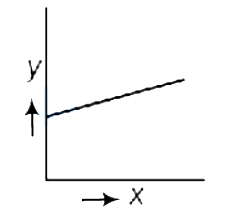
B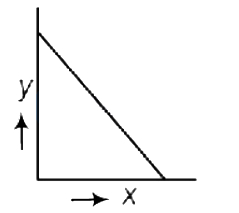
C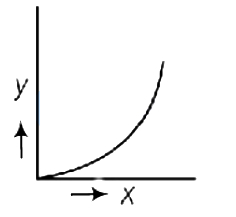
D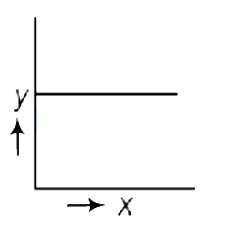
Solution
(B) The variation of molar conductivity $(\Lambda_m)$ with concentration $(C)$ for strong electrolytes like $KCl$ is given by the Kohlrausch equation: $\Lambda_m = \Lambda_m^{\circ} - A \sqrt{C}$.
Here,$\Lambda_m^{\circ}$ is the molar conductivity at infinite dilution and $A$ is a constant.
This equation follows the linear form $y = mx + c$,where $y = \Lambda_m$,$x = \sqrt{C}$,$m = -A$ (slope),and $c = \Lambda_m^{\circ}$ (intercept).
Since the slope is negative $(-A)$,the plot of $\Lambda_m$ versus $\sqrt{C}$ is a straight line with a negative slope,indicating that $\Lambda_m$ decreases as $\sqrt{C}$ increases.
Here,$\Lambda_m^{\circ}$ is the molar conductivity at infinite dilution and $A$ is a constant.
This equation follows the linear form $y = mx + c$,where $y = \Lambda_m$,$x = \sqrt{C}$,$m = -A$ (slope),and $c = \Lambda_m^{\circ}$ (intercept).
Since the slope is negative $(-A)$,the plot of $\Lambda_m$ versus $\sqrt{C}$ is a straight line with a negative slope,indicating that $\Lambda_m$ decreases as $\sqrt{C}$ increases.
0 likesView Solution
35
ChemistryMediumMCQTS EAMCET · 2016
Which one of the following has the highest boiling point?
A
$H_3CCH_2CH_2CH_2Cl$
B
$(H_3C)_2CHCH_2Cl$
C
$(H_3C)_3CCl$
D
$H_3CCH_2CHClCH_3$
Solution
(A) The correct answer is $H_3CCH_2CH_2CH_2Cl$ (n-butyl chloride).
For isomeric alkyl halides,the boiling point decreases with an increase in branching.
Branching of the carbon chain makes the molecule more compact,which reduces the surface area.
As the surface area decreases,the magnitude of intermolecular van der Waals forces of attraction also decreases.
Therefore,straight-chain isomers have higher boiling points compared to their branched-chain counterparts with the same molecular formula.
Among the given options,$H_3CCH_2CH_2CH_2Cl$ is a straight-chain isomer,while the others are branched,making it the one with the highest boiling point.
For isomeric alkyl halides,the boiling point decreases with an increase in branching.
Branching of the carbon chain makes the molecule more compact,which reduces the surface area.
As the surface area decreases,the magnitude of intermolecular van der Waals forces of attraction also decreases.
Therefore,straight-chain isomers have higher boiling points compared to their branched-chain counterparts with the same molecular formula.
Among the given options,$H_3CCH_2CH_2CH_2Cl$ is a straight-chain isomer,while the others are branched,making it the one with the highest boiling point.
0 likesView Solution
36
ChemistryEasyMCQTS EAMCET · 2016
$X$ reacts with dilute nitric acid to form 'laughing gas'. What is $X$?
A
$Cu$
B
$P_4$
C
$Sb$
D
$Zn$
Solution
(D) $Zn$ reacts with very dilute nitric acid to form 'laughing gas' $(N_2O)$.
$4 Zn + 10 HNO_3 (\text{very dilute}) \longrightarrow 4 Zn(NO_3)_2 + N_2O + 5 H_2O$
$4 Zn + 10 HNO_3 (\text{very dilute}) \longrightarrow 4 Zn(NO_3)_2 + N_2O + 5 H_2O$
0 likesView Solution
37
ChemistryMediumMCQTS EAMCET · 2016
Xenon reacts with fluorine at $873 \ K$ and $7 \ bar$ to form $XeF_4$. In this reaction,the ratio of xenon and fluorine required is
A
$1: 5$
B
$10: 1$
C
$1: 3$
D
$5: 1$
Solution
(A) $XeF_4$ is obtained by heating a mixture of xenon and fluorine in the molar ratio of $1: 5$ at $873 \ K$ and $7 \ bar$ pressure in an enclosed nickel vessel for a few hours.
The reaction proceeds as:
$Xe_{(g)} + 2 \ F_{2(g)} \xrightarrow{873 \ K, 7 \ bar} XeF_4$
The extra fluorine is added to ensure the complete conversion of xenon to $XeF_4$.
The reaction proceeds as:
$Xe_{(g)} + 2 \ F_{2(g)} \xrightarrow{873 \ K, 7 \ bar} XeF_4$
The extra fluorine is added to ensure the complete conversion of xenon to $XeF_4$.
0 likesView Solution
38
ChemistryDifficultMCQTS EAMCET · 2016
The polydispersity index $(PDI)$ of a polymer is ($\bar{M}_w = \text{weight average molecular mass}$ and $\bar{M}_n = \text{number average molecular mass}$)
A
the product of $\bar{M}_n$ and $\bar{M}_w$
B
the sum of $\bar{M}_n$ and $\bar{M}_w$
C
the difference between $\bar{M}_w$ and $\bar{M}_n$
D
the ratio between $\bar{M}_w$ and $\bar{M}_n$
Solution
(D) The polydispersity index $(PDI)$ of a polymer is defined as the ratio of the weight average molecular mass $(\bar{M}_w)$ to the number average molecular mass $(\bar{M}_n)$.
$PDI = \frac{\bar{M}_w}{\bar{M}_n}$
It serves as a measure of the breadth or distribution of molecular weights in a polymer sample.
$PDI = \frac{\bar{M}_w}{\bar{M}_n}$
It serves as a measure of the breadth or distribution of molecular weights in a polymer sample.
0 likesView Solution
39
ChemistryMediumMCQTS EAMCET · 2016
The packing efficiency of simple cubic $(sc)$,body-centred cubic $(bcc)$ and cubic close packing $(ccp)$ lattices follow the order:
A
$sc < bcc < ccp$
B
$ccp < bcc < sc$
C
$sc < ccp < bcc$
D
$bcc < sc < ccp$
Solution
(A) The packing efficiency is the percentage of total space occupied by the constituent particles in a crystal lattice.
For simple cubic $(sc)$ lattice,the packing efficiency is $52.4 \%$.
For body-centred cubic $(bcc)$ lattice,the packing efficiency is $68 \%$.
For cubic close packing $(ccp)$ or face-centred cubic $(fcc)$ lattice,the packing efficiency is $74 \%$.
Therefore,the order of packing efficiency is $sc < bcc < ccp$.
For simple cubic $(sc)$ lattice,the packing efficiency is $52.4 \%$.
For body-centred cubic $(bcc)$ lattice,the packing efficiency is $68 \%$.
For cubic close packing $(ccp)$ or face-centred cubic $(fcc)$ lattice,the packing efficiency is $74 \%$.
Therefore,the order of packing efficiency is $sc < bcc < ccp$.
0 likesView Solution
40
ChemistryEasyMCQTS EAMCET · 2016
The molality of an aqueous dilute solution containing a non-volatile solute is $0.1 \ m$. What is the boiling temperature (in $^{\circ}C$) of the solution? (Boiling point elevation constant,$K_b = 0.52 \ K \ kg \ mol^{-1}$; boiling temperature of water $= 100^{\circ}C$).
A
$100.0052$
B
$100.052$
C
$100$
D
$100.52$
Solution
(B) The formula for boiling point elevation is $\Delta T_b = K_b \times m$.
Given,$K_b = 0.52 \ K \ kg \ mol^{-1}$ and molality $m = 0.1 \ m$.
Calculating the elevation in boiling point: $\Delta T_b = 0.52 \times 0.1 = 0.052 \ K$ (or $^{\circ}C$).
The boiling point of the solution is $T_b = T_b^{\circ} + \Delta T_b$.
Since the boiling point of pure water $T_b^{\circ} = 100^{\circ}C$,we have $T_b = 100 + 0.052 = 100.052^{\circ}C$.
Given,$K_b = 0.52 \ K \ kg \ mol^{-1}$ and molality $m = 0.1 \ m$.
Calculating the elevation in boiling point: $\Delta T_b = 0.52 \times 0.1 = 0.052 \ K$ (or $^{\circ}C$).
The boiling point of the solution is $T_b = T_b^{\circ} + \Delta T_b$.
Since the boiling point of pure water $T_b^{\circ} = 100^{\circ}C$,we have $T_b = 100 + 0.052 = 100.052^{\circ}C$.
0 likesView Solution
41
ChemistryMediumMCQTS EAMCET · 2016
The experimental depression in freezing point of a dilute solution is $0.025 \ K$. If the van't Hoff factor $(i)$ is $2.0$,the calculated depression in freezing point (in $K$) is
A
$0.00125$
B
$0.025$
C
$0.0125$
D
$0.05$
Solution
(C) The van't Hoff factor $(i)$ is defined as the ratio of the observed colligative property to the calculated (theoretical) colligative property.
$i = \frac{\Delta T_f \text{ (observed)}}{\Delta T_f \text{ (calculated)}}$
Given:
$\Delta T_f \text{ (observed)} = 0.025 \ K$
$i = 2.0$
Substituting the values:
$2.0 = \frac{0.025}{\Delta T_f \text{ (calculated)}}$
$\Delta T_f \text{ (calculated)} = \frac{0.025}{2.0} = 0.0125 \ K$
$i = \frac{\Delta T_f \text{ (observed)}}{\Delta T_f \text{ (calculated)}}$
Given:
$\Delta T_f \text{ (observed)} = 0.025 \ K$
$i = 2.0$
Substituting the values:
$2.0 = \frac{0.025}{\Delta T_f \text{ (calculated)}}$
$\Delta T_f \text{ (calculated)} = \frac{0.025}{2.0} = 0.0125 \ K$
0 likesView Solution
42
ChemistryEasyMCQTS EAMCET · 2016
Which of the following metal ions has a calculated magnetic moment value of $\sqrt{24} \ BM$?
A
$Mn^{2+}$
B
$Fe^{2+}$
C
$Fe^{3+}$
D
$Co^{2+}$
Solution
(B) The magnetic moment $(\mu)$ is related to the number of unpaired electrons '$n$' by the formula: $\mu_{eff} = \sqrt{n(n+2)} \ BM$.
Given $\mu_{eff} = \sqrt{24} \ BM$,we equate $\sqrt{n(n+2)} = \sqrt{24}$,which gives $n(n+2) = 24$.
Solving for $n$,we get $n^2 + 2n - 24 = 0$,which factors to $(n+6)(n-4) = 0$. Since $n$ must be positive,$n = 4$.
Now,let us check the number of unpaired electrons for each ion:
$Mn^{2+}$ $(Z=25)$: $[Ar] 3d^5$,$n = 5$.
$Fe^{2+}$ $(Z=26)$: $[Ar] 3d^6$,$n = 4$.
$Fe^{3+}$ $(Z=26)$: $[Ar] 3d^5$,$n = 5$.
$Co^{2+}$ $(Z=27)$: $[Ar] 3d^7$,$n = 3$.
Thus,$Fe^{2+}$ has $4$ unpaired electrons and corresponds to a magnetic moment of $\sqrt{24} \ BM$.
Given $\mu_{eff} = \sqrt{24} \ BM$,we equate $\sqrt{n(n+2)} = \sqrt{24}$,which gives $n(n+2) = 24$.
Solving for $n$,we get $n^2 + 2n - 24 = 0$,which factors to $(n+6)(n-4) = 0$. Since $n$ must be positive,$n = 4$.
Now,let us check the number of unpaired electrons for each ion:
$Mn^{2+}$ $(Z=25)$: $[Ar] 3d^5$,$n = 5$.
$Fe^{2+}$ $(Z=26)$: $[Ar] 3d^6$,$n = 4$.
$Fe^{3+}$ $(Z=26)$: $[Ar] 3d^5$,$n = 5$.
$Co^{2+}$ $(Z=27)$: $[Ar] 3d^7$,$n = 3$.
Thus,$Fe^{2+}$ has $4$ unpaired electrons and corresponds to a magnetic moment of $\sqrt{24} \ BM$.
0 likesView Solution
43
ChemistryEasyMCQTS EAMCET · 2016
Which one of the following is an emulsion?
A
Milk
B
Soap lather
C
Butter
D
Vanishing cream
Solution
(A) An emulsion is a colloidal system in which both the dispersed phase and the dispersion medium are liquids.
Milk is a classic example of an emulsion where fat droplets are dispersed in water.
While butter and vanishing cream are also emulsions,milk is the most standard example cited in textbooks for a liquid-in-liquid colloidal system.
Milk is a classic example of an emulsion where fat droplets are dispersed in water.
While butter and vanishing cream are also emulsions,milk is the most standard example cited in textbooks for a liquid-in-liquid colloidal system.
0 likesView Solution
Vedclass Products
For Students
Vedclass Test Series
Mock tests in real TS EAMCET style covering Chemistry with performance analysis. 5-day free trial.
Start Free TrialFor Teachers
Exam Paper Generator
Generate Set A/B/C/D Chemistry papers from 7.5L+ questions in 2 minutes. 3 chapters free.
Try FreeFor Institutes
Online Exam Module
Run live TS EAMCET mock exams with unlimited students, 360° analytics & white-label branding.
See DemoFrequently Asked Questions
How many Chemistry questions are in TS EAMCET 2016?
There are 43 Chemistry questions from the TS EAMCET 2016 paper on Vedclass, each with a detailed step-by-step solution in English.
Are TS EAMCET 2016 Chemistry solutions available in English?
Yes. All solutions on this page are in English. You can also switch to English or Hindi using the language buttons above the questions.
Can I practice TS EAMCET 2016 Chemistry as a timed test?
Yes. Use the Vedclass Test Series to attempt a full TS EAMCET mock test covering Chemistry with time limits and instant score analysis.
Can teachers create Chemistry papers from TS EAMCET previous year questions?
Yes. The Vedclass Exam Paper Generator lets teachers mix TS EAMCET Chemistry questions and generate Set A/B/C/D papers in minutes.
For Teachers & Institutes
Build a Custom Chemistry Paper
Pick TS EAMCET 2016 Chemistry questions, set difficulty, and generate Set A/B/C/D in 2 minutes.