
PhysicsQ1–40 of 40 questions
Page 1 of 1 · English
1
PhysicsEasyMCQTS EAMCET · 2016
$A$ system of two particles has masses $m_1$ and $m_2$. If the particle of mass $m_1$ is pushed towards the centre of mass of the particles through a distance $d$,by what distance should the particle of mass $m_2$ be moved to keep the centre of mass of the particles at the original position?
A
$\left(\frac{m_1}{m_1+m_2}\right) d$
B
$\left(\frac{m_2}{m_1+m_2}\right) d$
C
$\left(\frac{m_1}{m_2}\right) d$
D
$\left(\frac{m_2}{m_1}\right) d$
Solution
(C) The position of the centre of mass $R_{cm}$ is given by $R_{cm} = \frac{m_1 r_1 + m_2 r_2}{m_1 + m_2}$.
For the centre of mass to remain at the same position,the change in the position of the centre of mass must be zero,i.e.,$\Delta R_{cm} = 0$.
Therefore,$m_1 \Delta r_1 + m_2 \Delta r_2 = 0$.
Here,the particle of mass $m_1$ is moved by a distance $d$ towards the centre of mass,so $\Delta r_1 = -d$ (assuming the direction towards the centre of mass is negative).
Substituting this into the equation: $m_1 (-d) + m_2 \Delta r_2 = 0$.
$m_2 \Delta r_2 = m_1 d$.
$\Delta r_2 = \left(\frac{m_1}{m_2}\right) d$.
Thus,the particle of mass $m_2$ must be moved by a distance of $\left(\frac{m_1}{m_2}\right) d$ to keep the centre of mass at the original position.
For the centre of mass to remain at the same position,the change in the position of the centre of mass must be zero,i.e.,$\Delta R_{cm} = 0$.
Therefore,$m_1 \Delta r_1 + m_2 \Delta r_2 = 0$.
Here,the particle of mass $m_1$ is moved by a distance $d$ towards the centre of mass,so $\Delta r_1 = -d$ (assuming the direction towards the centre of mass is negative).
Substituting this into the equation: $m_1 (-d) + m_2 \Delta r_2 = 0$.
$m_2 \Delta r_2 = m_1 d$.
$\Delta r_2 = \left(\frac{m_1}{m_2}\right) d$.
Thus,the particle of mass $m_2$ must be moved by a distance of $\left(\frac{m_1}{m_2}\right) d$ to keep the centre of mass at the original position.
0 likesView Solution
2
PhysicsMediumMCQTS EAMCET · 2016
$A$ body of mass $3 \ kg$ moving with a velocity $(2 \hat{i}+3 \hat{j}+3 \hat{k}) \ m/s$ collides with another body of mass $4 \ kg$ moving with a velocity $(3 \hat{i}+2 \hat{j}-3 \hat{k}) \ m/s$. The two bodies stick together after collision. The velocity of the composite body is
A
$\frac{1}{7}(4 \hat{i}+6 \hat{j}-3 \hat{k}) \ m/s$
B
$\frac{1}{7}(18 \hat{i}+17 \hat{j}-3 \hat{k}) \ m/s$
C
$\frac{1}{7}(6 \hat{i}+4 \hat{j}-6 \hat{k}) \ m/s$
D
$\frac{1}{7}(9 \hat{i}+8 \hat{j}-6 \hat{k}) \ m/s$
Solution
(B) Given,mass of the first body $m_1 = 3 \ kg$ and its velocity $v_1 = (2 \hat{i}+3 \hat{j}+3 \hat{k}) \ m/s$.
Mass of the second body $m_2 = 4 \ kg$ and its velocity $v_2 = (3 \hat{i}+2 \hat{j}-3 \hat{k}) \ m/s$.
According to the law of conservation of linear momentum,the total momentum before collision is equal to the total momentum after collision.
$m_1 v_1 + m_2 v_2 = (m_1 + m_2) v$
Substituting the values:
$3(2 \hat{i}+3 \hat{j}+3 \hat{k}) + 4(3 \hat{i}+2 \hat{j}-3 \hat{k}) = (3 + 4) v$
$(6 \hat{i}+9 \hat{j}+9 \hat{k}) + (12 \hat{i}+8 \hat{j}-12 \hat{k}) = 7 v$
$(6+12) \hat{i} + (9+8) \hat{j} + (9-12) \hat{k} = 7 v$
$18 \hat{i} + 17 \hat{j} - 3 \hat{k} = 7 v$
$v = \frac{1}{7}(18 \hat{i}+17 \hat{j}-3 \hat{k}) \ m/s$.
Mass of the second body $m_2 = 4 \ kg$ and its velocity $v_2 = (3 \hat{i}+2 \hat{j}-3 \hat{k}) \ m/s$.
According to the law of conservation of linear momentum,the total momentum before collision is equal to the total momentum after collision.
$m_1 v_1 + m_2 v_2 = (m_1 + m_2) v$
Substituting the values:
$3(2 \hat{i}+3 \hat{j}+3 \hat{k}) + 4(3 \hat{i}+2 \hat{j}-3 \hat{k}) = (3 + 4) v$
$(6 \hat{i}+9 \hat{j}+9 \hat{k}) + (12 \hat{i}+8 \hat{j}-12 \hat{k}) = 7 v$
$(6+12) \hat{i} + (9+8) \hat{j} + (9-12) \hat{k} = 7 v$
$18 \hat{i} + 17 \hat{j} - 3 \hat{k} = 7 v$
$v = \frac{1}{7}(18 \hat{i}+17 \hat{j}-3 \hat{k}) \ m/s$.
0 likesView Solution
3
PhysicsEasyMCQTS EAMCET · 2016
The bodies of masses $100 \,kg$ and $8100 \,kg$ are held at a distance of $1 \,m$. The gravitational field at a point on the line joining them is zero. The gravitational potential at that point in $J/kg$ is $\left(G = 6.67 \times 10^{-11} \,Nm^2/kg^2\right)$
A
$-6.67 \times 10^{-7}$
B
$-6.67 \times 10^{-10}$
C
$-13.34 \times 10^{-7}$
D
$-6.67 \times 10^{-9}$
Solution
(A) Let $m_1 = 100 \,kg$ and $m_2 = 8100 \,kg$ be the masses separated by distance $d = 1 \,m$.
Let $x$ be the distance of the null point (where gravitational field is zero) from $m_1$.
The condition for zero gravitational field is $\frac{G m_1}{x^2} = \frac{G m_2}{(d-x)^2}$.
Taking the square root on both sides: $\frac{\sqrt{m_1}}{x} = \frac{\sqrt{m_2}}{d-x}$.
Substituting values: $\frac{10}{x} = \frac{90}{1-x} \implies 10 - 10x = 90x \implies 100x = 10 \implies x = 0.1 \,m$.
The distance from $m_2$ is $d-x = 0.9 \,m$.
The gravitational potential $V$ at this point is $V = -\frac{G m_1}{x} - \frac{G m_2}{d-x}$.
$V = -G \left( \frac{100}{0.1} + \frac{8100}{0.9} \right) = -G (1000 + 9000) = -10000 G$.
$V = -10000 \times 6.67 \times 10^{-11} = -6.67 \times 10^{-7} \,J/kg$.
Let $x$ be the distance of the null point (where gravitational field is zero) from $m_1$.
The condition for zero gravitational field is $\frac{G m_1}{x^2} = \frac{G m_2}{(d-x)^2}$.
Taking the square root on both sides: $\frac{\sqrt{m_1}}{x} = \frac{\sqrt{m_2}}{d-x}$.
Substituting values: $\frac{10}{x} = \frac{90}{1-x} \implies 10 - 10x = 90x \implies 100x = 10 \implies x = 0.1 \,m$.
The distance from $m_2$ is $d-x = 0.9 \,m$.
The gravitational potential $V$ at this point is $V = -\frac{G m_1}{x} - \frac{G m_2}{d-x}$.
$V = -G \left( \frac{100}{0.1} + \frac{8100}{0.9} \right) = -G (1000 + 9000) = -10000 G$.
$V = -10000 \times 6.67 \times 10^{-11} = -6.67 \times 10^{-7} \,J/kg$.
0 likesView Solution
4
PhysicsEasyMCQTS EAMCET · 2016
Uranium has two isotopes of masses $235$ and $238$ units. If both of them are present in uranium hexafluoride gas,find the percentage ratio of the difference in rms velocities of the two isotopes to the rms velocity of the heavier isotope.
A
$1.64$
B
$0.064$
C
$0.64$
D
$6.4$
Solution
(C) Given:
Mass of heavier uranium isotope $(M_1)$ $= 238$ units
Mass of lighter uranium isotope $(M_2)$ $= 235$ units
We know that the root mean square velocity $(v_{\text{rms}})$ is given by:
$v_{\text{rms}} = \sqrt{\frac{3RT}{M}}$
Thus,$v_{\text{rms}} \propto \frac{1}{\sqrt{M}}$.
The percentage ratio of the difference in rms velocities to the rms velocity of the heavier isotope is:
$\text{Ratio} = \left( \frac{v_{\text{rms, lighter}} - v_{\text{rms, heavier}}}{v_{\text{rms, heavier}}} \right) \times 100$
Substituting the proportionality $v_{\text{rms}} \propto \frac{1}{\sqrt{M}}$:
$\text{Ratio} = \left( \frac{\frac{1}{\sqrt{235}} - \frac{1}{\sqrt{238}}}{\frac{1}{\sqrt{238}}} \right) \times 100 = \left( \frac{\sqrt{238}}{\sqrt{235}} - 1 \right) \times 100$
$\text{Ratio} = \left( \sqrt{\frac{238}{235}} - 1 \right) \times 100 \approx (\sqrt{1.01276} - 1) \times 100$
$\text{Ratio} \approx (1.00636 - 1) \times 100 = 0.00636 \times 100 = 0.636 \% \approx 0.64 \%$
Mass of heavier uranium isotope $(M_1)$ $= 238$ units
Mass of lighter uranium isotope $(M_2)$ $= 235$ units
We know that the root mean square velocity $(v_{\text{rms}})$ is given by:
$v_{\text{rms}} = \sqrt{\frac{3RT}{M}}$
Thus,$v_{\text{rms}} \propto \frac{1}{\sqrt{M}}$.
The percentage ratio of the difference in rms velocities to the rms velocity of the heavier isotope is:
$\text{Ratio} = \left( \frac{v_{\text{rms, lighter}} - v_{\text{rms, heavier}}}{v_{\text{rms, heavier}}} \right) \times 100$
Substituting the proportionality $v_{\text{rms}} \propto \frac{1}{\sqrt{M}}$:
$\text{Ratio} = \left( \frac{\frac{1}{\sqrt{235}} - \frac{1}{\sqrt{238}}}{\frac{1}{\sqrt{238}}} \right) \times 100 = \left( \frac{\sqrt{238}}{\sqrt{235}} - 1 \right) \times 100$
$\text{Ratio} = \left( \sqrt{\frac{238}{235}} - 1 \right) \times 100 \approx (\sqrt{1.01276} - 1) \times 100$
$\text{Ratio} \approx (1.00636 - 1) \times 100 = 0.00636 \times 100 = 0.636 \% \approx 0.64 \%$
0 likesView Solution
5
PhysicsEasyMCQTS EAMCET · 2016
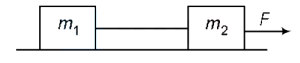
Two masses $m_1$ and $m_2$ are placed on a smooth horizontal surface and are connected by a string of negligible mass. $A$ horizontal force $F$ is applied on the mass $m_2$ as shown in the figure. The tension in the string is
A
$\left(\frac{m_1}{m_1+m_2}\right) F$
B
$\frac{m_2 F}{m_1+m_2}$
C
$\left(\frac{m_1}{m_2}\right) F$
D
$\frac{m_2 F}{m_1}$
Solution
(A) First,consider the system as a whole. The total mass of the system is $(m_1 + m_2)$.
Since the surface is smooth,the acceleration $(a)$ of the system is given by Newton's second law: $a = \frac{F}{m_1 + m_2}$.
Now,consider the free body diagram of mass $m_1$. The only horizontal force acting on $m_1$ is the tension $(T)$ in the string.
Applying Newton's second law to mass $m_1$: $T = m_1 \times a$.
Substituting the value of acceleration $(a)$: $T = m_1 \times \left(\frac{F}{m_1 + m_2}\right)$.
Therefore,the tension in the string is $T = \left(\frac{m_1}{m_1 + m_2}\right) F$.
Since the surface is smooth,the acceleration $(a)$ of the system is given by Newton's second law: $a = \frac{F}{m_1 + m_2}$.
Now,consider the free body diagram of mass $m_1$. The only horizontal force acting on $m_1$ is the tension $(T)$ in the string.
Applying Newton's second law to mass $m_1$: $T = m_1 \times a$.
Substituting the value of acceleration $(a)$: $T = m_1 \times \left(\frac{F}{m_1 + m_2}\right)$.
Therefore,the tension in the string is $T = \left(\frac{m_1}{m_1 + m_2}\right) F$.
0 likesView Solution
6
PhysicsDifficultMCQTS EAMCET · 2016
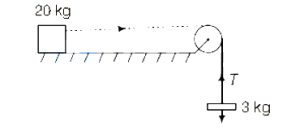
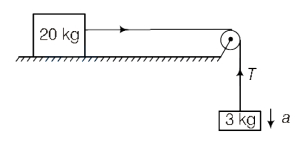
$A$ body of mass $20 \,kg$ is moving on a rough horizontal plane. $A$ block of mass $3 \,kg$ is connected to the $20 \,kg$ mass by a string of negligible mass through a smooth pulley as shown in the figure. The tension in the string is $27 \,N$. The coefficient of kinetic friction between the heavier mass and the surface is $\left(g=10 \,m/s^2\right)$.
A
$0.025$
B
$0.035$
C
$0.35$
D
$0.25$
Solution
(B) Given,tension in the string $(T) = 27 \,N$.
Mass of the hanging block $(m) = 3 \,kg$.
Let the acceleration of the system be $a$.
For the hanging block of mass $3 \,kg$,the equation of motion is:
$m g - T = m a$
$3 \times 10 - 27 = 3 a$
$30 - 27 = 3 a$
$3 = 3 a$
$a = 1 \,m/s^2$.
For the body of mass $M = 20 \,kg$ moving on the horizontal surface,the equation of motion is:
$T - f_k = M a$
where $f_k = \mu M g$ is the kinetic friction force.
$27 - \mu \times 20 \times 10 = 20 \times 1$
$27 - 200 \mu = 20$
$200 \mu = 27 - 20$
$200 \mu = 7$
$\mu = \frac{7}{200} = 0.035$.
Therefore,the coefficient of kinetic friction is $0.035$.
Mass of the hanging block $(m) = 3 \,kg$.
Let the acceleration of the system be $a$.
For the hanging block of mass $3 \,kg$,the equation of motion is:
$m g - T = m a$
$3 \times 10 - 27 = 3 a$
$30 - 27 = 3 a$
$3 = 3 a$
$a = 1 \,m/s^2$.
For the body of mass $M = 20 \,kg$ moving on the horizontal surface,the equation of motion is:
$T - f_k = M a$
where $f_k = \mu M g$ is the kinetic friction force.
$27 - \mu \times 20 \times 10 = 20 \times 1$
$27 - 200 \mu = 20$
$200 \mu = 27 - 20$
$200 \mu = 7$
$\mu = \frac{7}{200} = 0.035$.
Therefore,the coefficient of kinetic friction is $0.035$.
0 likesView Solution
7
PhysicsMediumMCQTS EAMCET · 2016
$A$ soap bubble of radius $1.0 \text{ cm}$ is formed inside another soap bubble of radius $2.0 \text{ cm}$. The radius of another soap bubble which has the same pressure difference as that between the inside of the smaller and outside of the large soap bubble, in metres is:
A
$6.67 \times 10^{-3}$
B
$3.34 \times 10^{-3}$
C
$2.23 \times 10^{-3}$
D
$4.5 \times 10^{-3}$
Solution
(A) The excess pressure inside a soap bubble of radius $R$ is given by $\Delta P = \frac{4T}{R}$, where $T$ is the surface tension.
Let $R_1 = 2.0 \text{ cm}$ and $R_2 = 1.0 \text{ cm}$.
The pressure inside the smaller bubble is $P_{in} = P_0 + \frac{4T}{R_2}$.
The pressure between the two bubbles is $P_{mid} = P_0 + \frac{4T}{R_1}$.
The pressure difference between the inside of the smaller bubble and the outside of the larger bubble is $\Delta P_{total} = (P_0 + \frac{4T}{R_2}) - P_0 = \frac{4T}{R_2}$.
Wait, the question asks for the pressure difference between the inside of the smaller bubble and the outside of the larger bubble. This is $\Delta P = \frac{4T}{R_2} + \frac{4T}{R_1} = 4T(\frac{1}{R_1} + \frac{1}{R_2})$.
Let the radius of the equivalent bubble be $R$. Then $\frac{4T}{R} = 4T(\frac{1}{R_1} + \frac{1}{R_2})$.
$\frac{1}{R} = \frac{1}{R_1} + \frac{1}{R_2} = \frac{R_1 + R_2}{R_1 R_2}$.
$R = \frac{R_1 R_2}{R_1 + R_2} = \frac{2.0 \times 1.0}{2.0 + 1.0} \text{ cm} = \frac{2}{3} \text{ cm} = 0.667 \text{ cm}$.
Converting to metres: $R = 0.667 \times 10^{-2} \text{ m} = 6.67 \times 10^{-3} \text{ m}$.
Let $R_1 = 2.0 \text{ cm}$ and $R_2 = 1.0 \text{ cm}$.
The pressure inside the smaller bubble is $P_{in} = P_0 + \frac{4T}{R_2}$.
The pressure between the two bubbles is $P_{mid} = P_0 + \frac{4T}{R_1}$.
The pressure difference between the inside of the smaller bubble and the outside of the larger bubble is $\Delta P_{total} = (P_0 + \frac{4T}{R_2}) - P_0 = \frac{4T}{R_2}$.
Wait, the question asks for the pressure difference between the inside of the smaller bubble and the outside of the larger bubble. This is $\Delta P = \frac{4T}{R_2} + \frac{4T}{R_1} = 4T(\frac{1}{R_1} + \frac{1}{R_2})$.
Let the radius of the equivalent bubble be $R$. Then $\frac{4T}{R} = 4T(\frac{1}{R_1} + \frac{1}{R_2})$.
$\frac{1}{R} = \frac{1}{R_1} + \frac{1}{R_2} = \frac{R_1 + R_2}{R_1 R_2}$.
$R = \frac{R_1 R_2}{R_1 + R_2} = \frac{2.0 \times 1.0}{2.0 + 1.0} \text{ cm} = \frac{2}{3} \text{ cm} = 0.667 \text{ cm}$.
Converting to metres: $R = 0.667 \times 10^{-2} \text{ m} = 6.67 \times 10^{-3} \text{ m}$.
0 likesView Solution
8
PhysicsMediumMCQTS EAMCET · 2016
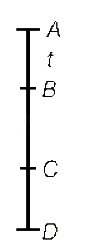
$A$ body is falling freely from a point $A$ at a certain height from the ground and passes through points $B, C$,and $D$ (vertically as shown below) such that $BC = CD$. The time taken by the particle to move from $B$ to $C$ is $2 \ s$ and from $C$ to $D$ is $1 \ s$. The time taken to move from $A$ to $B$ in seconds is
A
$0.6$
B
$0.5$
C
$0.2$
D
$0.4$
Solution
(B) Let the velocity of the particle at point $B$ be $v$.
Since the body is falling freely,the acceleration is $g$.
For the interval $BC$,the time taken is $t_1 = 2 \ s$. Using the equation of motion $s = ut + \frac{1}{2}at^2$:
$BC = v(2) + \frac{1}{2}g(2)^2 = 2v + 2g$ --- $(i)$
For the interval $BD$,the total time is $t_2 = 2 + 1 = 3 \ s$.
$BD = BC + CD = 2BC$ (since $BC = CD$).
$BD = v(3) + \frac{1}{2}g(3)^2 = 3v + 4.5g$
Since $BD = 2BC$,we have:
$2(2v + 2g) = 3v + 4.5g$
$4v + 4g = 3v + 4.5g$
$v = 0.5g$
Now,for the interval $AB$,let the time taken be $t$. Since the body falls freely from $A$,its initial velocity $u = 0$.
$v = u + at \Rightarrow 0.5g = 0 + gt$
$t = 0.5 \ s$.
Since the body is falling freely,the acceleration is $g$.
For the interval $BC$,the time taken is $t_1 = 2 \ s$. Using the equation of motion $s = ut + \frac{1}{2}at^2$:
$BC = v(2) + \frac{1}{2}g(2)^2 = 2v + 2g$ --- $(i)$
For the interval $BD$,the total time is $t_2 = 2 + 1 = 3 \ s$.
$BD = BC + CD = 2BC$ (since $BC = CD$).
$BD = v(3) + \frac{1}{2}g(3)^2 = 3v + 4.5g$
Since $BD = 2BC$,we have:
$2(2v + 2g) = 3v + 4.5g$
$4v + 4g = 3v + 4.5g$
$v = 0.5g$
Now,for the interval $AB$,let the time taken be $t$. Since the body falls freely from $A$,its initial velocity $u = 0$.
$v = u + at \Rightarrow 0.5g = 0 + gt$
$t = 0.5 \ s$.
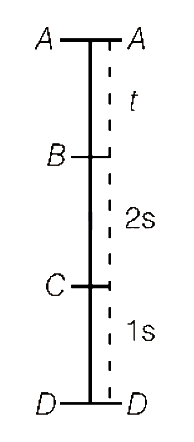
0 likesView Solution
9
PhysicsMediumMCQTS EAMCET · 2016
$A$ car accelerates from rest with $2 \,m/s^2$ on a straight line path and then comes to rest after applying brakes. Total distance travelled by the car is $100 \,m$ in $20 \,s$. Then,the maximum velocity attained by the car is (in $\,m/s$)
A
$10$
B
$20$
C
$15$
D
$5$
Solution
$(A)$ Let the acceleration be $\alpha = 2 \,m/s^2$ and the retardation be $\beta$. Let $t_1$ be the time taken to accelerate and $t_2$ be the time taken to decelerate. Total time $t = t_1 + t_2 = 20 \,s$.
Maximum velocity $v_{max} = \alpha t_1 = \beta t_2$.
Thus,$t_1 = v_{max}/\alpha$ and $t_2 = v_{max}/\beta$.
Total time $t = v_{max}(1/\alpha + 1/\beta) = v_{max}(\frac{\alpha + \beta}{\alpha \beta}) = 20$.
Total distance $s = \frac{1}{2} v_{max} t = 100 \,m$.
Substituting $t = 20 \,s$ into the distance formula: $100 = \frac{1}{2} \times v_{max} \times 20$.
$100 = 10 \times v_{max} \Rightarrow v_{max} = 10 \,m/s$.
Maximum velocity $v_{max} = \alpha t_1 = \beta t_2$.
Thus,$t_1 = v_{max}/\alpha$ and $t_2 = v_{max}/\beta$.
Total time $t = v_{max}(1/\alpha + 1/\beta) = v_{max}(\frac{\alpha + \beta}{\alpha \beta}) = 20$.
Total distance $s = \frac{1}{2} v_{max} t = 100 \,m$.
Substituting $t = 20 \,s$ into the distance formula: $100 = \frac{1}{2} \times v_{max} \times 20$.
$100 = 10 \times v_{max} \Rightarrow v_{max} = 10 \,m/s$.
0 likesView Solution
10
PhysicsMediumMCQTS EAMCET · 2016
$A$ particle is projected with velocity $2 \sqrt{gh}$ at an angle $60^{\circ}$ to the horizontal so that it just clears two walls of equal height $h$ which are at a distance $2h$ from each other. The time taken by the particle to travel between these two walls is
A
$2 \sqrt{\frac{2h}{g}}$
B
$\sqrt{\frac{h}{2g}}$
C
$2 \sqrt{\frac{h}{g}}$
D
$\sqrt{\frac{h}{g}}$
Solution
(C) The horizontal component of the velocity is $v_x = v \cos \theta = 2 \sqrt{gh} \cos 60^{\circ}$.
Since $\cos 60^{\circ} = \frac{1}{2}$,we have $v_x = 2 \sqrt{gh} \times \frac{1}{2} = \sqrt{gh}$.
The particle travels a horizontal distance $d = 2h$ between the two walls.
Since the horizontal component of velocity remains constant in projectile motion,the time $t$ taken to travel between the walls is given by $t = \frac{d}{v_x}$.
Substituting the values,$t = \frac{2h}{\sqrt{gh}} = 2 \sqrt{\frac{h}{g}}$.
Since $\cos 60^{\circ} = \frac{1}{2}$,we have $v_x = 2 \sqrt{gh} \times \frac{1}{2} = \sqrt{gh}$.
The particle travels a horizontal distance $d = 2h$ between the two walls.
Since the horizontal component of velocity remains constant in projectile motion,the time $t$ taken to travel between the walls is given by $t = \frac{d}{v_x}$.
Substituting the values,$t = \frac{2h}{\sqrt{gh}} = 2 \sqrt{\frac{h}{g}}$.
0 likesView Solution
11
PhysicsDifficultMCQTS EAMCET · 2016
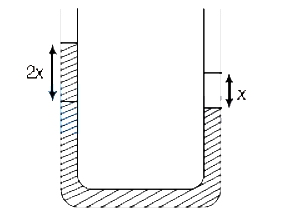
$9 \text{ kg}$ of solution is poured into a glass $U$-tube as shown in the figure. The tube's inner diameter is $2 \sqrt{\frac{\pi}{5}} \text{ m}$ and the solution oscillates freely up and down about its position of equilibrium $(x=0)$. The period of oscillation in seconds is (Given: $1 \text{ m}^3$ of solution has a mass $\rho=900 \text{ kg/m}^3$,$g=10 \text{ m/s}^2$,ignore frictional and surface tension effects).
A
$0.1$
B
$10$
C
$\sqrt{\pi}$
D
$1$
Solution
(A) The mass of the liquid column is $M = 9 \text{ kg}$.
The density of the liquid is $\rho = 900 \text{ kg/m}^3$.
The inner diameter of the tube is $D = 2 \sqrt{\frac{\pi}{5}} \text{ m}$,so the radius is $r = \sqrt{\frac{\pi}{5}} \text{ m}$.
The cross-sectional area of the tube is $A = \pi r^2 = \pi \left(\sqrt{\frac{\pi}{5}}\right)^2 = \frac{\pi^2}{5} \text{ m}^2$.
The total length $L$ of the liquid column is given by $M = \rho A L$.
Substituting the values: $9 = 900 \times \frac{\pi^2}{5} \times L$.
$9 = 180 \pi^2 L \implies L = \frac{9}{180 \pi^2} = \frac{1}{20 \pi^2} \text{ m}$.
For a $U$-tube,the time period of oscillation is $T = 2 \pi \sqrt{\frac{L}{2g}}$.
Substituting $L = \frac{1}{20 \pi^2}$ and $g = 10 \text{ m/s}^2$:
$T = 2 \pi \sqrt{\frac{1 / (20 \pi^2)}{2 \times 10}} = 2 \pi \sqrt{\frac{1}{400 \pi^2}} = 2 \pi \times \frac{1}{20 \pi} = \frac{2}{20} = 0.1 \text{ s}$.
The density of the liquid is $\rho = 900 \text{ kg/m}^3$.
The inner diameter of the tube is $D = 2 \sqrt{\frac{\pi}{5}} \text{ m}$,so the radius is $r = \sqrt{\frac{\pi}{5}} \text{ m}$.
The cross-sectional area of the tube is $A = \pi r^2 = \pi \left(\sqrt{\frac{\pi}{5}}\right)^2 = \frac{\pi^2}{5} \text{ m}^2$.
The total length $L$ of the liquid column is given by $M = \rho A L$.
Substituting the values: $9 = 900 \times \frac{\pi^2}{5} \times L$.
$9 = 180 \pi^2 L \implies L = \frac{9}{180 \pi^2} = \frac{1}{20 \pi^2} \text{ m}$.
For a $U$-tube,the time period of oscillation is $T = 2 \pi \sqrt{\frac{L}{2g}}$.
Substituting $L = \frac{1}{20 \pi^2}$ and $g = 10 \text{ m/s}^2$:
$T = 2 \pi \sqrt{\frac{1 / (20 \pi^2)}{2 \times 10}} = 2 \pi \sqrt{\frac{1}{400 \pi^2}} = 2 \pi \times \frac{1}{20 \pi} = \frac{2}{20} = 0.1 \text{ s}$.
0 likesView Solution
12
PhysicsDifficultMCQTS EAMCET · 2016
$A$ thin uniform circular disc of mass $M$ and radius $R$ is rotating in a horizontal plane about an axis passing through its centre and perpendicular to its plane with an angular velocity $\omega$. Another disc of the same thickness and radius but of mass $\frac{1}{8} M$ is placed gently on the first disc coaxially. The angular velocity of the system is now
A
$\frac{8}{9} \omega$
B
$\frac{5}{9} \omega$
C
$\frac{1}{3} \omega$
D
$\frac{2}{9} \omega$
Solution
(A) Given: Mass of the first disc $m_1 = M$,radius $r_1 = R$,and initial angular velocity $\omega_1 = \omega$.
The moment of inertia of the first disc is $I_1 = \frac{1}{2} M R^2$.
The second disc has mass $m_2 = \frac{1}{8} M$ and radius $r_2 = R$.
The moment of inertia of the second disc is $I_2 = \frac{1}{2} (\frac{1}{8} M) R^2 = \frac{1}{16} M R^2$.
When the second disc is placed on the first,the total moment of inertia of the system becomes $I_{total} = I_1 + I_2 = \frac{1}{2} M R^2 + \frac{1}{16} M R^2 = \frac{8+1}{16} M R^2 = \frac{9}{16} M R^2$.
By the principle of conservation of angular momentum,$L_{initial} = L_{final}$.
$I_1 \omega = I_{total} \omega_{final}$
$\frac{1}{2} M R^2 \omega = \frac{9}{16} M R^2 \omega_{final}$
$\frac{1}{2} \omega = \frac{9}{16} \omega_{final}$
$\omega_{final} = \frac{16}{18} \omega = \frac{8}{9} \omega$.
The moment of inertia of the first disc is $I_1 = \frac{1}{2} M R^2$.
The second disc has mass $m_2 = \frac{1}{8} M$ and radius $r_2 = R$.
The moment of inertia of the second disc is $I_2 = \frac{1}{2} (\frac{1}{8} M) R^2 = \frac{1}{16} M R^2$.
When the second disc is placed on the first,the total moment of inertia of the system becomes $I_{total} = I_1 + I_2 = \frac{1}{2} M R^2 + \frac{1}{16} M R^2 = \frac{8+1}{16} M R^2 = \frac{9}{16} M R^2$.
By the principle of conservation of angular momentum,$L_{initial} = L_{final}$.
$I_1 \omega = I_{total} \omega_{final}$
$\frac{1}{2} M R^2 \omega = \frac{9}{16} M R^2 \omega_{final}$
$\frac{1}{2} \omega = \frac{9}{16} \omega_{final}$
$\omega_{final} = \frac{16}{18} \omega = \frac{8}{9} \omega$.
0 likesView Solution
13
PhysicsMediumMCQTS EAMCET · 2016
$A$ slab of stone of area $3600 \, cm^2$ and thickness $10 \, cm$ is exposed on the lower surface to steam at $100^{\circ} C$. $A$ block of ice at $0^{\circ} C$ rests on the upper surface of the slab. In one hour, $4.8 \, kg$ of ice is melted. The thermal conductivity of the stone in $J \, s^{-1} \, m^{-1} \, K^{-1}$ is (Latent heat of ice $= 3.36 \times 10^5 \, J/kg$)
A
$12$
B
$10.5$
C
$1.02$
D
$1.24$
Solution
(D) Given: Area of slab $(A) = 3600 \, cm^2 = 0.36 \, m^2$.
Thickness $(d) = 10 \, cm = 0.1 \, m$.
Temperature difference $(\Delta \theta) = 100^{\circ} C - 0^{\circ} C = 100 \, K$.
Time $(t) = 1 \, hour = 3600 \, s$.
Mass of ice melted $(m) = 4.8 \, kg$.
Latent heat of fusion $(L) = 3.36 \times 10^5 \, J/kg$.
The heat required to melt the ice is $Q = m \times L = 4.8 \times 3.36 \times 10^5 \, J$.
The rate of heat flow is given by $\frac{Q}{t} = \frac{K A \Delta \theta}{d}$.
Substituting the values:
$\frac{4.8 \times 3.36 \times 10^5}{3600} = \frac{K \times 0.36 \times 100}{0.1}$.
$\frac{1612800}{3600} = K \times 360$.
$448 = K \times 360$.
$K = \frac{448}{360} \approx 1.24 \, J \, s^{-1} \, m^{-1} \, K^{-1}$.
Thickness $(d) = 10 \, cm = 0.1 \, m$.
Temperature difference $(\Delta \theta) = 100^{\circ} C - 0^{\circ} C = 100 \, K$.
Time $(t) = 1 \, hour = 3600 \, s$.
Mass of ice melted $(m) = 4.8 \, kg$.
Latent heat of fusion $(L) = 3.36 \times 10^5 \, J/kg$.
The heat required to melt the ice is $Q = m \times L = 4.8 \times 3.36 \times 10^5 \, J$.
The rate of heat flow is given by $\frac{Q}{t} = \frac{K A \Delta \theta}{d}$.
Substituting the values:
$\frac{4.8 \times 3.36 \times 10^5}{3600} = \frac{K \times 0.36 \times 100}{0.1}$.
$\frac{1612800}{3600} = K \times 360$.
$448 = K \times 360$.
$K = \frac{448}{360} \approx 1.24 \, J \, s^{-1} \, m^{-1} \, K^{-1}$.
0 likesView Solution
14
PhysicsEasyMCQTS EAMCET · 2016
The surface of a black body is at a temperature $727^{\circ} C$ and its cross-section is $1 \,m^2$. Heat radiated from this surface in one minute in joules is (Stefan's constant $=5.7 \times 10^{-8} \,W / m^2 / K^4$ )
A
$34.2 \times 10^5$
B
$2.5 \times 10^5$
C
$3.42 \times 10^5$
D
$2.5 \times 10^6$
Solution
(A) Given: Temperature of black body $T = 727^{\circ} C = 727 + 273 = 1000 \,K$.
Cross-sectional area $A = 1 \,m^2$.
Stefan's constant $\sigma = 5.7 \times 10^{-8} \,W / m^2 / K^4$.
Time $t = 1 \,minute = 60 \,seconds$.
According to Stefan-Boltzmann law,the power radiated is $P = \sigma A T^4$.
$P = 5.7 \times 10^{-8} \times 1 \times (1000)^4 = 5.7 \times 10^{-8} \times 10^{12} = 5.7 \times 10^4 \,W$.
Total heat radiated $Q = P \times t$.
$Q = 5.7 \times 10^4 \times 60 = 342 \times 10^4 = 34.2 \times 10^5 \,J$.
Cross-sectional area $A = 1 \,m^2$.
Stefan's constant $\sigma = 5.7 \times 10^{-8} \,W / m^2 / K^4$.
Time $t = 1 \,minute = 60 \,seconds$.
According to Stefan-Boltzmann law,the power radiated is $P = \sigma A T^4$.
$P = 5.7 \times 10^{-8} \times 1 \times (1000)^4 = 5.7 \times 10^{-8} \times 10^{12} = 5.7 \times 10^4 \,W$.
Total heat radiated $Q = P \times t$.
$Q = 5.7 \times 10^4 \times 60 = 342 \times 10^4 = 34.2 \times 10^5 \,J$.
0 likesView Solution
15
PhysicsEasyMCQTS EAMCET · 2016
Two moles of a gas are expanded to double their volume by two different processes. One is isobaric and the other is isothermal. If $W_1$ and $W_2$ are the works done,respectively,then:
A
$W_2 = \frac{W_1}{\log_e 2}$
B
$W_2 = W_1$
C
$W_2 = W_1 \log_e 2^2$
D
$W_2 = W_1 \log_e 2$
Solution
(D) Given: $n = 2$ moles. The volume is doubled from $V$ to $2V$.
For the isobaric process,the work done is $W_1 = P \Delta V = P(2V - V) = PV$.
For the isothermal process,the work done is $W_2 = nRT \ln(\frac{V_2}{V_1})$.
Since $PV = nRT$,we can substitute $nRT$ with $PV$.
Thus,$W_2 = PV \ln(\frac{2V}{V}) = PV \ln(2)$.
Comparing the two expressions,since $W_1 = PV$,we get $W_2 = W_1 \ln(2)$.
For the isobaric process,the work done is $W_1 = P \Delta V = P(2V - V) = PV$.
For the isothermal process,the work done is $W_2 = nRT \ln(\frac{V_2}{V_1})$.
Since $PV = nRT$,we can substitute $nRT$ with $PV$.
Thus,$W_2 = PV \ln(\frac{2V}{V}) = PV \ln(2)$.
Comparing the two expressions,since $W_1 = PV$,we get $W_2 = W_1 \ln(2)$.
0 likesView Solution
16
PhysicsEasyMCQTS EAMCET · 2016
Force is given by the expression,$F = A \cos(Bx) + C \cos(Dt)$,where $x$ is displacement and $t$ is time. The dimension of $\left(\frac{D}{B}\right)$ is the same as that of
A
velocity
B
velocity gradient
C
angular velocity
D
angular momentum
Solution
(A) In the expression $F = A \cos(Bx) + C \cos(Dt)$,the argument of the trigonometric function must be dimensionless.
Therefore,the dimensions of $Bx$ and $Dt$ must be equal to the dimension of a constant (dimensionless).
$[Bx] = [M^0 L^0 T^0] \implies [B] = [x^{-1}] = [L^{-1}]$.
$[Dt] = [M^0 L^0 T^0] \implies [D] = [t^{-1}] = [T^{-1}]$.
Now,we find the dimension of $\left(\frac{D}{B}\right)$:
$\left[\frac{D}{B}\right] = \frac{[T^{-1}]}{[L^{-1}]} = [L T^{-1}]$.
Since $[L T^{-1}]$ represents the dimension of velocity,the correct option is $A$.
Therefore,the dimensions of $Bx$ and $Dt$ must be equal to the dimension of a constant (dimensionless).
$[Bx] = [M^0 L^0 T^0] \implies [B] = [x^{-1}] = [L^{-1}]$.
$[Dt] = [M^0 L^0 T^0] \implies [D] = [t^{-1}] = [T^{-1}]$.
Now,we find the dimension of $\left(\frac{D}{B}\right)$:
$\left[\frac{D}{B}\right] = \frac{[T^{-1}]}{[L^{-1}]} = [L T^{-1}]$.
Since $[L T^{-1}]$ represents the dimension of velocity,the correct option is $A$.
0 likesView Solution
17
PhysicsMediumMCQTS EAMCET · 2016
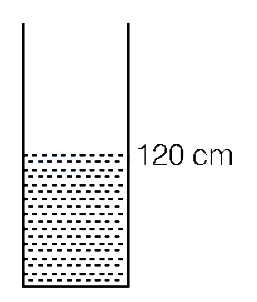
$A$ source of frequency $340 \,Hz$ is kept above a vertical cylindrical tube closed at the lower end. The length of the tube is $120 \,cm$. Water is slowly poured in just enough to produce resonance. Then, the minimum height (velocity of sound $= 340 \,m/s$) of the water level in the tube for that resonance is (in $\,m$)
A
$0.75$
B
$0.25$
C
$0.95$
D
$0.45$
Solution
(D) The frequency of the source is $f = 340 \,Hz$ and the velocity of sound is $v = 340 \,m/s$.
The wavelength of the sound wave is $\lambda = \frac{v}{f} = \frac{340}{340} = 1 \,m = 100 \,cm$.
For a tube closed at one end, resonance occurs when the length of the air column $l$ satisfies $l = (2n-1) \frac{\lambda}{4}$, where $n = 1, 2, 3, \dots$.
For $n=1$, $l_1 = \frac{\lambda}{4} = \frac{100}{4} = 25 \,cm$.
For $n=2$, $l_2 = \frac{3\lambda}{4} = \frac{3 \times 100}{4} = 75 \,cm$.
For $n=3$, $l_3 = \frac{5\lambda}{4} = \frac{5 \times 100}{4} = 125 \,cm$.
Since the total length of the tube is $120 \,cm$, the possible air column lengths are $25 \,cm$ and $75 \,cm$.
The height of the water level $h$ from the bottom is given by $h = L - l$, where $L = 120 \,cm$ is the total length of the tube.
For $l_1 = 25 \,cm$, $h_1 = 120 - 25 = 95 \,cm = 0.95 \,m$.
For $l_2 = 75 \,cm$, $h_2 = 120 - 75 = 45 \,cm = 0.45 \,m$.
The minimum height of the water level is $0.45 \,m$.
The wavelength of the sound wave is $\lambda = \frac{v}{f} = \frac{340}{340} = 1 \,m = 100 \,cm$.
For a tube closed at one end, resonance occurs when the length of the air column $l$ satisfies $l = (2n-1) \frac{\lambda}{4}$, where $n = 1, 2, 3, \dots$.
For $n=1$, $l_1 = \frac{\lambda}{4} = \frac{100}{4} = 25 \,cm$.
For $n=2$, $l_2 = \frac{3\lambda}{4} = \frac{3 \times 100}{4} = 75 \,cm$.
For $n=3$, $l_3 = \frac{5\lambda}{4} = \frac{5 \times 100}{4} = 125 \,cm$.
Since the total length of the tube is $120 \,cm$, the possible air column lengths are $25 \,cm$ and $75 \,cm$.
The height of the water level $h$ from the bottom is given by $h = L - l$, where $L = 120 \,cm$ is the total length of the tube.
For $l_1 = 25 \,cm$, $h_1 = 120 - 25 = 95 \,cm = 0.95 \,m$.
For $l_2 = 75 \,cm$, $h_2 = 120 - 75 = 45 \,cm = 0.45 \,m$.
The minimum height of the water level is $0.45 \,m$.
0 likesView Solution
18
PhysicsMediumMCQTS EAMCET · 2016
An elastic spring of unstretched length $L$ and force constant $k$ is stretched by a small length $x$. It is further stretched by another small length $y$. Work done during the second stretching is
A
$\frac{k y}{2}(x+2 y)$
B
$\frac{k}{2}(2 x+y)$
C
$k y(x+2 y)$
D
$\frac{k y}{2}(2 x+y)$
Solution
(D) The work done in stretching a spring by an extension $x$ is given by $W = \frac{1}{2} k x^2$.
Initially,the spring is stretched by $x$. The potential energy stored is $U_1 = \frac{1}{2} k x^2$.
Then,it is further stretched by $y$,so the total extension becomes $(x + y)$. The potential energy stored is $U_2 = \frac{1}{2} k (x + y)^2$.
The work done during the second stretching is the change in potential energy:
$W = U_2 - U_1 = \frac{1}{2} k (x + y)^2 - \frac{1}{2} k x^2$.
Expanding the term $(x + y)^2$:
$W = \frac{1}{2} k (x^2 + y^2 + 2xy - x^2) = \frac{1}{2} k (y^2 + 2xy)$.
Factoring out $y$:
$W = \frac{ky}{2} (2x + y)$.
Initially,the spring is stretched by $x$. The potential energy stored is $U_1 = \frac{1}{2} k x^2$.
Then,it is further stretched by $y$,so the total extension becomes $(x + y)$. The potential energy stored is $U_2 = \frac{1}{2} k (x + y)^2$.
The work done during the second stretching is the change in potential energy:
$W = U_2 - U_1 = \frac{1}{2} k (x + y)^2 - \frac{1}{2} k x^2$.
Expanding the term $(x + y)^2$:
$W = \frac{1}{2} k (x^2 + y^2 + 2xy - x^2) = \frac{1}{2} k (y^2 + 2xy)$.
Factoring out $y$:
$W = \frac{ky}{2} (2x + y)$.
0 likesView Solution
19
PhysicsDifficultMCQTS EAMCET · 2016
$A$ simple pendulum of length $L$ carries a bob of mass $m$. When the bob is at its lowest position,it is given the minimum horizontal speed necessary for it to move in a vertical circle about the point of suspension. When the string is horizontal,the net force on the bob is
A
$\sqrt{10} mg$
B
$\sqrt{5} mg$
C
$4 mg$
D
$1 mg$
Solution
(A) For a bob to complete a vertical circle,the minimum velocity at the lowest point is $v_0 = \sqrt{5gL}$.
Applying the law of conservation of energy between the lowest point and the point where the string is horizontal (at height $L$):
$\frac{1}{2}mv_0^2 = \frac{1}{2}mv^2 + mgL$
$\frac{1}{2}m(5gL) = \frac{1}{2}mv^2 + mgL$
$\frac{5}{2}gL = \frac{1}{2}v^2 + gL \implies \frac{3}{2}gL = \frac{1}{2}v^2 \implies v^2 = 3gL$.
At the horizontal position,the forces acting on the bob are:
$1$. Centripetal force (horizontal): $F_x = \frac{mv^2}{L} = \frac{m(3gL)}{L} = 3mg$.
$2$. Gravitational force (vertical): $F_y = mg$.
The net force is $F_{\text{net}} = \sqrt{F_x^2 + F_y^2} = \sqrt{(3mg)^2 + (mg)^2} = \sqrt{9m^2g^2 + m^2g^2} = \sqrt{10}mg$.
Applying the law of conservation of energy between the lowest point and the point where the string is horizontal (at height $L$):
$\frac{1}{2}mv_0^2 = \frac{1}{2}mv^2 + mgL$
$\frac{1}{2}m(5gL) = \frac{1}{2}mv^2 + mgL$
$\frac{5}{2}gL = \frac{1}{2}v^2 + gL \implies \frac{3}{2}gL = \frac{1}{2}v^2 \implies v^2 = 3gL$.
At the horizontal position,the forces acting on the bob are:
$1$. Centripetal force (horizontal): $F_x = \frac{mv^2}{L} = \frac{m(3gL)}{L} = 3mg$.
$2$. Gravitational force (vertical): $F_y = mg$.
The net force is $F_{\text{net}} = \sqrt{F_x^2 + F_y^2} = \sqrt{(3mg)^2 + (mg)^2} = \sqrt{9m^2g^2 + m^2g^2} = \sqrt{10}mg$.
0 likesView Solution
20
PhysicsEasyMCQTS EAMCET · 2016
$A$ particle moves from $(1, 0, 3)$ to the point $(-3, 4, 5)$,when a force $F = \hat{i} + 5 \hat{k}$ acts on it. The amount of work done in joules is:
A
$14$
B
$10$
C
$6$
D
$15$
Solution
(C) The initial position vector of the particle is $\vec{r}_1 = \hat{i} + 3 \hat{k}$.
The final position vector of the particle is $\vec{r}_2 = -3 \hat{i} + 4 \hat{j} + 5 \hat{k}$.
The force acting on the particle is $\vec{F} = \hat{i} + 5 \hat{k}$.
The displacement vector $\vec{s}$ is given by $\vec{r}_2 - \vec{r}_1$:
$\vec{s} = (-3 \hat{i} + 4 \hat{j} + 5 \hat{k}) - (\hat{i} + 3 \hat{k})$
$\vec{s} = -4 \hat{i} + 4 \hat{j} + 2 \hat{k}$.
Work done $W$ is the dot product of force and displacement:
$W = \vec{F} \cdot \vec{s} = (\hat{i} + 5 \hat{k}) \cdot (-4 \hat{i} + 4 \hat{j} + 2 \hat{k})$.
Calculating the dot product:
$W = (1)(-4) + (0)(4) + (5)(2)$
$W = -4 + 0 + 10 = 6 \ J$.
The final position vector of the particle is $\vec{r}_2 = -3 \hat{i} + 4 \hat{j} + 5 \hat{k}$.
The force acting on the particle is $\vec{F} = \hat{i} + 5 \hat{k}$.
The displacement vector $\vec{s}$ is given by $\vec{r}_2 - \vec{r}_1$:
$\vec{s} = (-3 \hat{i} + 4 \hat{j} + 5 \hat{k}) - (\hat{i} + 3 \hat{k})$
$\vec{s} = -4 \hat{i} + 4 \hat{j} + 2 \hat{k}$.
Work done $W$ is the dot product of force and displacement:
$W = \vec{F} \cdot \vec{s} = (\hat{i} + 5 \hat{k}) \cdot (-4 \hat{i} + 4 \hat{j} + 2 \hat{k})$.
Calculating the dot product:
$W = (1)(-4) + (0)(4) + (5)(2)$
$W = -4 + 0 + 10 = 6 \ J$.
0 likesView Solution
21
PhysicsMediumMCQTS EAMCET · 2016
$A$ capacitance of $\left(\frac{10^{-3}}{2 \pi}\right) F$,an inductance of $\left(\frac{100}{\pi}\right) mH$,and a resistance of $10 \Omega$ are connected in series with an $AC$ voltage source of $220 V, 50 Hz$. The phase angle of the circuit is (in $^{\circ}$)
A
$60$
B
$30$
C
$45$
D
$90$
Solution
(C) Given: Capacitance $C = \frac{10^{-3}}{2 \pi} F$,Inductance $L = \frac{100}{\pi} mH = \frac{100}{\pi} \times 10^{-3} H$,Resistance $R = 10 \Omega$,and Frequency $f = 50 Hz$.
First,calculate the inductive reactance $X_L = \omega L = 2 \pi f L = 2 \pi \times 50 \times \frac{100}{\pi} \times 10^{-3} = 10 \Omega$.
Next,calculate the capacitive reactance $X_C = \frac{1}{\omega C} = \frac{1}{2 \pi f C} = \frac{1}{2 \pi \times 50 \times \frac{10^{-3}}{2 \pi}} = \frac{1}{50 \times 10^{-3}} = \frac{1000}{50} = 20 \Omega$.
The phase angle $\phi$ is given by $\tan \phi = \frac{X_C - X_L}{R}$.
Substituting the values: $\tan \phi = \frac{20 - 10}{10} = \frac{10}{10} = 1$.
Therefore,$\phi = \tan^{-1}(1) = 45^{\circ}$.
First,calculate the inductive reactance $X_L = \omega L = 2 \pi f L = 2 \pi \times 50 \times \frac{100}{\pi} \times 10^{-3} = 10 \Omega$.
Next,calculate the capacitive reactance $X_C = \frac{1}{\omega C} = \frac{1}{2 \pi f C} = \frac{1}{2 \pi \times 50 \times \frac{10^{-3}}{2 \pi}} = \frac{1}{50 \times 10^{-3}} = \frac{1000}{50} = 20 \Omega$.
The phase angle $\phi$ is given by $\tan \phi = \frac{X_C - X_L}{R}$.
Substituting the values: $\tan \phi = \frac{20 - 10}{10} = \frac{10}{10} = 1$.
Therefore,$\phi = \tan^{-1}(1) = 45^{\circ}$.
0 likesView Solution
22
PhysicsMediumMCQTS EAMCET · 2016
If the first line of Lyman series has a wavelength $1215.4 \text{ Å}$, the first line of Balmer series is approximately (in $\text{ Å}$)
A
$4864$
B
$1025.5$
C
$6563$
D
$6400$
Solution
(C) From the hydrogen spectrum, when an electron transitions from $n_2$ orbit to $n_1$ orbit, the emitted wavelength $\lambda$ is given by the Rydberg formula: $\frac{1}{\lambda} = R Z^2 \left( \frac{1}{n_1^2} - \frac{1}{n_2^2} \right)$.
For the Lyman series, $n_1 = 1$. The first line corresponds to $n_2 = 2$. Thus, $\frac{1}{\lambda_L} = R Z^2 \left( \frac{1}{1^2} - \frac{1}{2^2} \right) = R Z^2 \left( 1 - \frac{1}{4} \right) = \frac{3}{4} R Z^2$.
For the Balmer series, $n_1 = 2$. The first line corresponds to $n_2 = 3$. Thus, $\frac{1}{\lambda_B} = R Z^2 \left( \frac{1}{2^2} - \frac{1}{3^2} \right) = R Z^2 \left( \frac{1}{4} - \frac{1}{9} \right) = R Z^2 \left( \frac{5}{36} \right)$.
Dividing the expression for $\frac{1}{\lambda_L}$ by $\frac{1}{\lambda_B}$, we get: $\frac{\lambda_B}{\lambda_L} = \frac{3/4}{5/36} = \frac{3}{4} \times \frac{36}{5} = \frac{27}{5} = 5.4$.
Given $\lambda_L = 1215.4 \text{ Å}$, we have $\lambda_B = 5.4 \times 1215.4 \text{ Å} = 6563.16 \text{ Å} \approx 6563 \text{ Å}$.
For the Lyman series, $n_1 = 1$. The first line corresponds to $n_2 = 2$. Thus, $\frac{1}{\lambda_L} = R Z^2 \left( \frac{1}{1^2} - \frac{1}{2^2} \right) = R Z^2 \left( 1 - \frac{1}{4} \right) = \frac{3}{4} R Z^2$.
For the Balmer series, $n_1 = 2$. The first line corresponds to $n_2 = 3$. Thus, $\frac{1}{\lambda_B} = R Z^2 \left( \frac{1}{2^2} - \frac{1}{3^2} \right) = R Z^2 \left( \frac{1}{4} - \frac{1}{9} \right) = R Z^2 \left( \frac{5}{36} \right)$.
Dividing the expression for $\frac{1}{\lambda_L}$ by $\frac{1}{\lambda_B}$, we get: $\frac{\lambda_B}{\lambda_L} = \frac{3/4}{5/36} = \frac{3}{4} \times \frac{36}{5} = \frac{27}{5} = 5.4$.
Given $\lambda_L = 1215.4 \text{ Å}$, we have $\lambda_B = 5.4 \times 1215.4 \text{ Å} = 6563.16 \text{ Å} \approx 6563 \text{ Å}$.
0 likesView Solution
23
PhysicsEasyMCQTS EAMCET · 2016
$A$ message signal of $12 kHz$ and peak voltage $20 V$ is used to modulate a carrier wave of frequency $12 MHz$ and peak voltage $30 V$. Then,the modulation index is
A
$0.32$
B
$6.7$
C
$0.67$
D
$67$
Solution
(C) The modulation index $m_a$ is defined as the ratio of the peak voltage of the message signal $(E_m)$ to the peak voltage of the carrier wave $(E_c)$.
Given:
Peak voltage of message signal,$E_m = 20 V$
Peak voltage of carrier wave,$E_c = 30 V$
Using the formula:
$m_a = \frac{E_m}{E_c}$
$m_a = \frac{20}{30} = \frac{2}{3} \approx 0.67$
Therefore,the modulation index is $0.67$.
Given:
Peak voltage of message signal,$E_m = 20 V$
Peak voltage of carrier wave,$E_c = 30 V$
Using the formula:
$m_a = \frac{E_m}{E_c}$
$m_a = \frac{20}{30} = \frac{2}{3} \approx 0.67$
Therefore,the modulation index is $0.67$.
0 likesView Solution
24
PhysicsDifficultMCQTS EAMCET · 2016
Three unequal resistances are connected in parallel. Two of these resistances are in the ratio $1:2$. The equivalent resistance of these three resistors connected in parallel is $1 \Omega$. What is the highest resistance value among these three resistances if no resistance is fractional (in $Omega$)?
A
$10$
B
$8$
C
$15$
D
$6$
Solution
(D) Let the three resistances be $R_1, R_2$,and $R_3$. The equivalent resistance $R_{\text{eq}}$ for parallel connection is given by $\frac{1}{R_{\text{eq}}} = \frac{1}{R_1} + \frac{1}{R_2} + \frac{1}{R_3}$.
Given $R_{\text{eq}} = 1 \Omega$,so $\frac{1}{R_1} + \frac{1}{R_2} + \frac{1}{R_3} = 1$.
Let the ratio of two resistances be $R_1 : R_2 = 1 : 2$,which implies $R_2 = 2R_1$.
Substituting this into the equation: $\frac{1}{R_1} + \frac{1}{2R_1} + \frac{1}{R_3} = 1 \Rightarrow \frac{3}{2R_1} + \frac{1}{R_3} = 1$.
We need to find integer values for $R_1, R_2, R_3$ such that they are unequal and satisfy the equation.
If $R_1 = 2$,then $R_2 = 4$. Substituting: $\frac{3}{4} + \frac{1}{R_3} = 1 \Rightarrow \frac{1}{R_3} = \frac{1}{4} \Rightarrow R_3 = 4$. This makes $R_2 = R_3$,which contradicts the condition that resistances are unequal.
If $R_1 = 3$,then $R_2 = 6$. Substituting: $\frac{3}{6} + \frac{1}{R_3} = 1 \Rightarrow \frac{1}{2} + \frac{1}{R_3} = 1 \Rightarrow \frac{1}{R_3} = \frac{1}{2} \Rightarrow R_3 = 2$. The resistances are $3 \Omega, 6 \Omega, 2 \Omega$. These are unequal and satisfy the condition.
The values are $2 \Omega, 3 \Omega, 6 \Omega$. The highest resistance is $6 \Omega$.
Given $R_{\text{eq}} = 1 \Omega$,so $\frac{1}{R_1} + \frac{1}{R_2} + \frac{1}{R_3} = 1$.
Let the ratio of two resistances be $R_1 : R_2 = 1 : 2$,which implies $R_2 = 2R_1$.
Substituting this into the equation: $\frac{1}{R_1} + \frac{1}{2R_1} + \frac{1}{R_3} = 1 \Rightarrow \frac{3}{2R_1} + \frac{1}{R_3} = 1$.
We need to find integer values for $R_1, R_2, R_3$ such that they are unequal and satisfy the equation.
If $R_1 = 2$,then $R_2 = 4$. Substituting: $\frac{3}{4} + \frac{1}{R_3} = 1 \Rightarrow \frac{1}{R_3} = \frac{1}{4} \Rightarrow R_3 = 4$. This makes $R_2 = R_3$,which contradicts the condition that resistances are unequal.
If $R_1 = 3$,then $R_2 = 6$. Substituting: $\frac{3}{6} + \frac{1}{R_3} = 1 \Rightarrow \frac{1}{2} + \frac{1}{R_3} = 1 \Rightarrow \frac{1}{R_3} = \frac{1}{2} \Rightarrow R_3 = 2$. The resistances are $3 \Omega, 6 \Omega, 2 \Omega$. These are unequal and satisfy the condition.
The values are $2 \Omega, 3 \Omega, 6 \Omega$. The highest resistance is $6 \Omega$.
0 likesView Solution
25
PhysicsEasyMCQTS EAMCET · 2016
Two electric resistors have equal values of resistance $R$. Each can be operated with a power of $320 \ W$ at $220 \ V$. If the two resistors are connected in series to a $110 \ V$ electric supply,then the power generated in each resistor is (in $W$)
A
$90$
B
$80$
C
$60$
D
$20$
Solution
(D) The resistance $R$ of each resistor is calculated using the formula $P = \frac{V^2}{R}$,which gives $R = \frac{V^2}{P}$.
Given $P = 320 \ W$ and $V = 220 \ V$,we have $R = \frac{220^2}{320} \ \Omega$.
When two identical resistors are connected in series to a supply voltage $V_{total} = 110 \ V$,the voltage across each resistor is $V' = \frac{V_{total}}{2} = \frac{110}{2} = 55 \ V$.
The power generated in each resistor is $P' = \frac{(V')^2}{R}$.
Substituting the values: $P' = \frac{55^2}{R} = \frac{55^2}{220^2 / 320} = \frac{55^2 \times 320}{220^2}$.
Since $\frac{55}{220} = \frac{1}{4}$,we get $P' = (\frac{1}{4})^2 \times 320 = \frac{1}{16} \times 320 = 20 \ W$.
Given $P = 320 \ W$ and $V = 220 \ V$,we have $R = \frac{220^2}{320} \ \Omega$.
When two identical resistors are connected in series to a supply voltage $V_{total} = 110 \ V$,the voltage across each resistor is $V' = \frac{V_{total}}{2} = \frac{110}{2} = 55 \ V$.
The power generated in each resistor is $P' = \frac{(V')^2}{R}$.
Substituting the values: $P' = \frac{55^2}{R} = \frac{55^2}{220^2 / 320} = \frac{55^2 \times 320}{220^2}$.
Since $\frac{55}{220} = \frac{1}{4}$,we get $P' = (\frac{1}{4})^2 \times 320 = \frac{1}{16} \times 320 = 20 \ W$.
0 likesView Solution
26
PhysicsEasyMCQTS EAMCET · 2016
The electron microscope is based on the principle of
A
photoelectric effect
B
wave nature of electron
C
superconductivity
D
laws of electromagnetic induction
Solution
(B) The electron microscope operates on the principle of the wave nature of electrons,as proposed by de Broglie. According to de Broglie's hypothesis,moving electrons are associated with a wave of wavelength $\lambda = \frac{h}{p}$,where $h$ is Planck's constant and $p$ is the momentum of the electron. Because the wavelength of an electron is much smaller than that of visible light,electron microscopes can achieve much higher resolution than optical microscopes.
0 likesView Solution
27
PhysicsEasyMCQTS EAMCET · 2016
$A$ charged particle is accelerated from rest through a certain potential difference. The de-Broglie wavelength is $\lambda_1$ when it is accelerated through $V_1$ and is $\lambda_2$ when accelerated through $V_2$. The ratio $\lambda_1 / \lambda_2$ is
A
$V_1^{3/2} : V_2^{3/2}$
B
$V_2^{1/2} : V_1^{1/2}$
C
$V_1^{1/2} : V_2^{1/2}$
D
$V_1^2 : V_2^2$
Solution
(B) The de-Broglie wavelength $\lambda$ of a charged particle of mass $m$ and charge $q$ accelerated through a potential difference $V$ is given by the formula:
$\lambda = \frac{h}{\sqrt{2mqV}}$
Since $h$,$m$,and $q$ are constants for the same particle,we have:
$\lambda \propto \frac{1}{\sqrt{V}}$
Therefore,the ratio of the wavelengths is:
$\frac{\lambda_1}{\lambda_2} = \sqrt{\frac{V_2}{V_1}} = \frac{V_2^{1/2}}{V_1^{1/2}}$
This can be written as $V_2^{1/2} : V_1^{1/2}$.
$\lambda = \frac{h}{\sqrt{2mqV}}$
Since $h$,$m$,and $q$ are constants for the same particle,we have:
$\lambda \propto \frac{1}{\sqrt{V}}$
Therefore,the ratio of the wavelengths is:
$\frac{\lambda_1}{\lambda_2} = \sqrt{\frac{V_2}{V_1}} = \frac{V_2^{1/2}}{V_1^{1/2}}$
This can be written as $V_2^{1/2} : V_1^{1/2}$.
0 likesView Solution
28
PhysicsMediumMCQTS EAMCET · 2016
Two coils have a mutual inductance of $0.005 \ H$. The current changes in the first coil according to the equation $I = I_0 \sin \omega t$,where $I_0 = 10 \ A$ and $\omega = 100 \pi \ rad/s$. The maximum value of the induced emf in the second coil is:
A
$5 \ V$
B
$5 \pi \ V$
C
$0.5 \pi \ V$
D
$\pi \ V$
Solution
(B) Given: Mutual inductance $M = 0.005 \ H$,current $I = I_0 \sin \omega t$,$I_0 = 10 \ A$,and $\omega = 100 \pi \ rad/s$.
The induced emf $(e)$ in the second coil is given by the formula:
$e = M \frac{dI}{dt}$
Substituting the expression for current:
$e = M \frac{d}{dt} (I_0 \sin \omega t) = M I_0 \omega \cos \omega t$
The maximum value of the induced emf $(e_{\max})$ occurs when $\cos \omega t = 1$:
$e_{\max} = M I_0 \omega$
Substituting the given values:
$e_{\max} = 0.005 \times 10 \times 100 \pi$
$e_{\max} = 0.05 \times 100 \pi = 5 \pi \ V$
Therefore,the maximum induced emf is $5 \pi \ V$.
The induced emf $(e)$ in the second coil is given by the formula:
$e = M \frac{dI}{dt}$
Substituting the expression for current:
$e = M \frac{d}{dt} (I_0 \sin \omega t) = M I_0 \omega \cos \omega t$
The maximum value of the induced emf $(e_{\max})$ occurs when $\cos \omega t = 1$:
$e_{\max} = M I_0 \omega$
Substituting the given values:
$e_{\max} = 0.005 \times 10 \times 100 \pi$
$e_{\max} = 0.05 \times 100 \pi = 5 \pi \ V$
Therefore,the maximum induced emf is $5 \pi \ V$.
0 likesView Solution
29
PhysicsMediumMCQTS EAMCET · 2016
Two charged identical metal spheres $A$ and $B$ repel each other with a force of $3 \times 10^{-5} \,N$. Another identical uncharged sphere $C$ is touched with sphere $A$ and then it is placed mid-way between $A$ and $B$. Then, the magnitude of net force on $C$ is
A
$1 \times 10^{-5} \,N$
B
$3 \times 10^{-5} \,N$
C
$2 \times 10^{-5} \,N$
D
$5 \times 10^{-5} \,N$
Solution
(B) Let the initial charges on spheres $A$ and $B$ be $q$. The distance between them is $r$.
The initial repulsive force is $F = \frac{k q^2}{r^2} = 3 \times 10^{-5} \,N$.
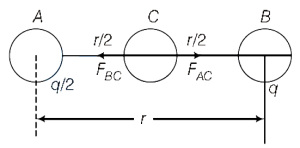
When uncharged sphere $C$ touches sphere $A$, the charge $q$ is shared equally between $A$ and $C$. Thus, the charge on $A$ becomes $q/2$ and the charge on $C$ becomes $q/2$.
Sphere $C$ is then placed at the midpoint between $A$ and $B$. The distance of $C$ from both $A$ and $B$ is $r/2$.
The force exerted by $A$ on $C$ is $F_{AC} = \frac{k (q/2)(q/2)}{(r/2)^2} = \frac{k q^2}{r^2} = F = 3 \times 10^{-5} \,N$ (repulsive, directed towards $B$).
The force exerted by $B$ on $C$ is $F_{BC} = \frac{k (q)(q/2)}{(r/2)^2} = 2 \frac{k q^2}{r^2} = 2F = 6 \times 10^{-5} \,N$ (repulsive, directed towards $A$).
The net force on $C$ is $F' = |F_{BC} - F_{AC}| = |2F - F| = F = 3 \times 10^{-5} \,N$.
The initial repulsive force is $F = \frac{k q^2}{r^2} = 3 \times 10^{-5} \,N$.
When uncharged sphere $C$ touches sphere $A$, the charge $q$ is shared equally between $A$ and $C$. Thus, the charge on $A$ becomes $q/2$ and the charge on $C$ becomes $q/2$.
Sphere $C$ is then placed at the midpoint between $A$ and $B$. The distance of $C$ from both $A$ and $B$ is $r/2$.
The force exerted by $A$ on $C$ is $F_{AC} = \frac{k (q/2)(q/2)}{(r/2)^2} = \frac{k q^2}{r^2} = F = 3 \times 10^{-5} \,N$ (repulsive, directed towards $B$).
The force exerted by $B$ on $C$ is $F_{BC} = \frac{k (q)(q/2)}{(r/2)^2} = 2 \frac{k q^2}{r^2} = 2F = 6 \times 10^{-5} \,N$ (repulsive, directed towards $A$).
The net force on $C$ is $F' = |F_{BC} - F_{AC}| = |2F - F| = F = 3 \times 10^{-5} \,N$.
0 likesView Solution
30
PhysicsDifficultMCQTS EAMCET · 2016
The electrostatic potential inside a charged sphere is given as $V = A r^2 + B$,where $r$ is the distance from the centre of the sphere,$A$ and $B$ are constants. Then,the charge density in the sphere is
A
$16 A \varepsilon_0$
B
$-6 A \varepsilon_0$
C
$20 A \varepsilon_0$
D
$-15 A \varepsilon_0$
Solution
(B) The electrostatic potential $V$ inside a charged sphere is given by $V = A r^2 + B$.
The electric field $E$ is related to the potential $V$ by the relation $E = -\frac{dV}{dr}$.
Substituting the given expression for $V$:
$E = -\frac{d}{dr}(A r^2 + B) = -2 A r$.
According to Gauss's Law in differential form,the volume charge density $\rho$ is related to the electric field $E$ by the equation $\nabla \cdot E = \frac{\rho}{\varepsilon_0}$.
For a spherically symmetric distribution,this becomes $\frac{1}{r^2} \frac{d}{dr}(r^2 E) = \frac{\rho}{\varepsilon_0}$.
Substituting $E = -2 A r$:
$\frac{\rho}{\varepsilon_0} = \frac{1}{r^2} \frac{d}{dr}(r^2 \cdot (-2 A r)) = \frac{1}{r^2} \frac{d}{dr}(-2 A r^3) = \frac{1}{r^2} (-6 A r^2) = -6 A$.
Therefore,the charge density is $\rho = -6 A \varepsilon_0$.
The electric field $E$ is related to the potential $V$ by the relation $E = -\frac{dV}{dr}$.
Substituting the given expression for $V$:
$E = -\frac{d}{dr}(A r^2 + B) = -2 A r$.
According to Gauss's Law in differential form,the volume charge density $\rho$ is related to the electric field $E$ by the equation $\nabla \cdot E = \frac{\rho}{\varepsilon_0}$.
For a spherically symmetric distribution,this becomes $\frac{1}{r^2} \frac{d}{dr}(r^2 E) = \frac{\rho}{\varepsilon_0}$.
Substituting $E = -2 A r$:
$\frac{\rho}{\varepsilon_0} = \frac{1}{r^2} \frac{d}{dr}(r^2 \cdot (-2 A r)) = \frac{1}{r^2} \frac{d}{dr}(-2 A r^3) = \frac{1}{r^2} (-6 A r^2) = -6 A$.
Therefore,the charge density is $\rho = -6 A \varepsilon_0$.
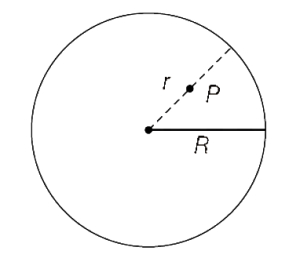
0 likesView Solution
31
PhysicsEasyMCQTS EAMCET · 2016
Two equations are given below:
$A. \oint E \cdot dA = \frac{Q}{\varepsilon_0}$
$B. \oint B \cdot dA = 0$
They are:
$A. \oint E \cdot dA = \frac{Q}{\varepsilon_0}$
$B. \oint B \cdot dA = 0$
They are:
A
$A$. Ampere's law,$B$. Gauss law for electricity
B
$A$. Gauss law for electric fields,$B$. Gauss law for magnetic fields
C
$A$. Faraday's law,$B$. Gauss law for electric fields
D
Both $A$ and $B$ represent Faraday's law
Solution
(B) Equation $A$ is $\oint E \cdot dA = \frac{Q}{\varepsilon_0}$,which is the Gauss law for electrostatics. It states that the total electric flux through a closed surface is equal to the enclosed charge divided by the permittivity of free space.
Equation $B$ is $\oint B \cdot dA = 0$,which is the Gauss law for magnetism. It implies that magnetic monopoles do not exist,meaning the net magnetic flux through any closed surface is always zero.
Equation $B$ is $\oint B \cdot dA = 0$,which is the Gauss law for magnetism. It implies that magnetic monopoles do not exist,meaning the net magnetic flux through any closed surface is always zero.
0 likesView Solution
32
PhysicsMediumMCQTS EAMCET · 2016
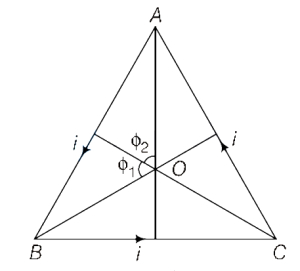
$A$ current of $1 \,A$ is flowing along the sides of an equilateral triangle of side $a = 4.5 \times 10^{-2} \,m$. The magnetic field at the centroid of the triangle is $(\mu_0 = 4 \pi \times 10^{-7} \,T \cdot m/A)$.
A
$4 \times 10^{-5} \,T$
B
$2 \times 10^{-5} \,T$
C
$4 \times 10^{-4} \,T$
D
$2 \times 10^{-4} \,T$
Solution
(A) For a straight wire of length $a$ carrying current $i$, the magnetic field at a perpendicular distance $r$ is given by $B = \frac{\mu_0 i}{4 \pi r} (\sin \phi_1 + \sin \phi_2)$.
For an equilateral triangle of side $a$, the distance $r$ from the centroid to any side is $r = \frac{a}{2 \sqrt{3}}$.
The angles subtended by the corners at the centroid are $\phi_1 = \phi_2 = 60^{\circ}$.
The magnetic field due to one side is $B_1 = \frac{\mu_0 i}{4 \pi (a / 2 \sqrt{3})} (\sin 60^{\circ} + \sin 60^{\circ}) = \frac{\mu_0 i}{4 \pi (a / 2 \sqrt{3})} (\sqrt{3}) = \frac{\mu_0 i \sqrt{3}}{4 \pi (a / 2 \sqrt{3})} = \frac{3 \mu_0 i}{2 \pi a}$.
The total magnetic field at the centroid due to all three sides is $B = 3 B_1 = \frac{9 \mu_0 i}{2 \pi a}$.
Given $i = 1 \,A$, $a = 4.5 \times 10^{-2} \,m$, and $\frac{\mu_0}{4 \pi} = 10^{-7} \,T \cdot m/A$, we have:
$B = 3 \times \frac{10^{-7} \times 1 \times (\sqrt{3} + \sqrt{3})}{a / 2 \sqrt{3}} = 3 \times \frac{10^{-7} \times 2 \sqrt{3}}{4.5 \times 10^{-2} / 2 \sqrt{3}} = 3 \times \frac{10^{-7} \times 2 \sqrt{3} \times 2 \sqrt{3}}{4.5 \times 10^{-2}} = 3 \times \frac{10^{-7} \times 12}{4.5 \times 10^{-2}} = \frac{36 \times 10^{-5}}{4.5} = 8 \times 10^{-5} \,T$.
Wait, re-calculating: $B = 3 \times \frac{\mu_0 i}{4 \pi r} (2 \sin 60^{\circ}) = 3 \times \frac{10^{-7} \times 1}{4.5 \times 10^{-2} / 2 \sqrt{3}} \times \sqrt{3} = 3 \times \frac{10^{-7} \times 2 \sqrt{3} \times \sqrt{3}}{4.5 \times 10^{-2}} = 3 \times \frac{10^{-7} \times 6}{4.5 \times 10^{-2}} = \frac{18 \times 10^{-5}}{4.5} = 4 \times 10^{-5} \,T$.
For an equilateral triangle of side $a$, the distance $r$ from the centroid to any side is $r = \frac{a}{2 \sqrt{3}}$.
The angles subtended by the corners at the centroid are $\phi_1 = \phi_2 = 60^{\circ}$.
The magnetic field due to one side is $B_1 = \frac{\mu_0 i}{4 \pi (a / 2 \sqrt{3})} (\sin 60^{\circ} + \sin 60^{\circ}) = \frac{\mu_0 i}{4 \pi (a / 2 \sqrt{3})} (\sqrt{3}) = \frac{\mu_0 i \sqrt{3}}{4 \pi (a / 2 \sqrt{3})} = \frac{3 \mu_0 i}{2 \pi a}$.
The total magnetic field at the centroid due to all three sides is $B = 3 B_1 = \frac{9 \mu_0 i}{2 \pi a}$.
Given $i = 1 \,A$, $a = 4.5 \times 10^{-2} \,m$, and $\frac{\mu_0}{4 \pi} = 10^{-7} \,T \cdot m/A$, we have:
$B = 3 \times \frac{10^{-7} \times 1 \times (\sqrt{3} + \sqrt{3})}{a / 2 \sqrt{3}} = 3 \times \frac{10^{-7} \times 2 \sqrt{3}}{4.5 \times 10^{-2} / 2 \sqrt{3}} = 3 \times \frac{10^{-7} \times 2 \sqrt{3} \times 2 \sqrt{3}}{4.5 \times 10^{-2}} = 3 \times \frac{10^{-7} \times 12}{4.5 \times 10^{-2}} = \frac{36 \times 10^{-5}}{4.5} = 8 \times 10^{-5} \,T$.
Wait, re-calculating: $B = 3 \times \frac{\mu_0 i}{4 \pi r} (2 \sin 60^{\circ}) = 3 \times \frac{10^{-7} \times 1}{4.5 \times 10^{-2} / 2 \sqrt{3}} \times \sqrt{3} = 3 \times \frac{10^{-7} \times 2 \sqrt{3} \times \sqrt{3}}{4.5 \times 10^{-2}} = 3 \times \frac{10^{-7} \times 6}{4.5 \times 10^{-2}} = \frac{18 \times 10^{-5}}{4.5} = 4 \times 10^{-5} \,T$.
0 likesView Solution
33
PhysicsEasyMCQTS EAMCET · 2016
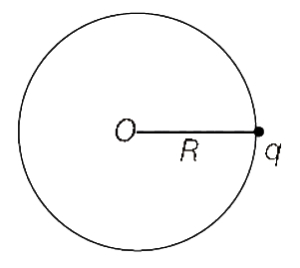
$A$ charged particle (charge $= q$; mass $= m$) is rotating in a circle of radius $R$ with uniform speed $V$. The ratio of its magnetic moment $(\mu)$ to the angular momentum $(L)$ is:
A
$\frac{q}{2m}$
B
$\frac{q}{m}$
C
$\frac{q}{4m}$
D
$\frac{2q}{m}$
Solution
(A) The magnetic moment $(\mu)$ of a current loop is given by $\mu = iA$,where $i$ is the current and $A$ is the area of the loop.
For a particle of charge $q$ moving with speed $V$ in a circle of radius $R$,the time period $T$ is $T = \frac{2\pi R}{V}$.
The equivalent current is $i = \frac{q}{T} = \frac{qV}{2\pi R}$.
The area of the circle is $A = \pi R^2$.
Thus,$\mu = iA = \left(\frac{qV}{2\pi R}\right) \times (\pi R^2) = \frac{qVR}{2}$.
The angular momentum $(L)$ of the particle about the center of the circle is $L = mVR$.
Taking the ratio of magnetic moment to angular momentum:
$\frac{\mu}{L} = \frac{qVR / 2}{mVR} = \frac{q}{2m}$.
For a particle of charge $q$ moving with speed $V$ in a circle of radius $R$,the time period $T$ is $T = \frac{2\pi R}{V}$.
The equivalent current is $i = \frac{q}{T} = \frac{qV}{2\pi R}$.
The area of the circle is $A = \pi R^2$.
Thus,$\mu = iA = \left(\frac{qV}{2\pi R}\right) \times (\pi R^2) = \frac{qVR}{2}$.
The angular momentum $(L)$ of the particle about the center of the circle is $L = mVR$.
Taking the ratio of magnetic moment to angular momentum:
$\frac{\mu}{L} = \frac{qVR / 2}{mVR} = \frac{q}{2m}$.
0 likesView Solution
34
PhysicsEasyMCQTS EAMCET · 2016
Two small magnets have their masses and lengths in the ratio $1:2$. The maximum torques experienced by them in a uniform magnetic field are the same. For small oscillations,the ratio of their time periods is
A
$\frac{1}{2 \sqrt{2}}$
B
$\frac{1}{\sqrt{2}}$
C
$\frac{1}{2}$
D
$2 \sqrt{2}$
Solution
(A) Let the mass of the first magnet be $m_1 = m$ and the second be $m_2 = 2m$. Let the lengths be $l_1 = l$ and $l_2 = 2l$.
The moment of inertia of a bar magnet about its center is $I = \frac{m l^2}{12}$.
Thus,$I_1 = \frac{m l^2}{12}$ and $I_2 = \frac{(2m)(2l)^2}{12} = \frac{8 m l^2}{12} = 8 I_1$.
The maximum torque is given by $\tau_{max} = M B$. Since $\tau_{max,1} = \tau_{max,2}$,we have $M_1 B = M_2 B$,so $M_1 = M_2 = M$.
The time period of oscillation is $T = 2 \pi \sqrt{\frac{I}{M B}}$.
The ratio of time periods is $\frac{T_1}{T_2} = \sqrt{\frac{I_1}{I_2} \cdot \frac{M_2}{M_1}}$.
Substituting the values,$\frac{T_1}{T_2} = \sqrt{\frac{I_1}{8 I_1} \cdot \frac{M}{M}} = \sqrt{\frac{1}{8}} = \frac{1}{2 \sqrt{2}}$.
The moment of inertia of a bar magnet about its center is $I = \frac{m l^2}{12}$.
Thus,$I_1 = \frac{m l^2}{12}$ and $I_2 = \frac{(2m)(2l)^2}{12} = \frac{8 m l^2}{12} = 8 I_1$.
The maximum torque is given by $\tau_{max} = M B$. Since $\tau_{max,1} = \tau_{max,2}$,we have $M_1 B = M_2 B$,so $M_1 = M_2 = M$.
The time period of oscillation is $T = 2 \pi \sqrt{\frac{I}{M B}}$.
The ratio of time periods is $\frac{T_1}{T_2} = \sqrt{\frac{I_1}{I_2} \cdot \frac{M_2}{M_1}}$.
Substituting the values,$\frac{T_1}{T_2} = \sqrt{\frac{I_1}{8 I_1} \cdot \frac{M}{M}} = \sqrt{\frac{1}{8}} = \frac{1}{2 \sqrt{2}}$.
0 likesView Solution
35
PhysicsEasyMCQTS EAMCET · 2016
$A$ certain radioactive element disintegrates with a decay constant of $7.9 \times 10^{-10} / s$. At a given instant of time,if the activity of the sample is equal to $55.3 \times 10^{11}$ disintegration/second,then the number of nuclei at that instant of time is:
A
$7.0 \times 10^{21}$
B
$4.27 \times 10^{13}$
C
$4.27 \times 10^3$
D
$6 \times 10^{23}$
Solution
(A) Given decay constant,$\lambda = 7.9 \times 10^{-10} / s$.
Activity of the sample,$A = 55.3 \times 10^{11} \text{ disintegration/second}$.
We know that the relationship between activity $A$ and the number of nuclei $N$ is given by the formula:
$A = \lambda N$
To find the number of nuclei $N$,we rearrange the formula:
$N = \frac{A}{\lambda}$
Substituting the given values:
$N = \frac{55.3 \times 10^{11}}{7.9 \times 10^{-10}}$
$N = 7.0 \times 10^{21}$
Therefore,the number of nuclei at that instant is $7.0 \times 10^{21}$.
Activity of the sample,$A = 55.3 \times 10^{11} \text{ disintegration/second}$.
We know that the relationship between activity $A$ and the number of nuclei $N$ is given by the formula:
$A = \lambda N$
To find the number of nuclei $N$,we rearrange the formula:
$N = \frac{A}{\lambda}$
Substituting the given values:
$N = \frac{55.3 \times 10^{11}}{7.9 \times 10^{-10}}$
$N = 7.0 \times 10^{21}$
Therefore,the number of nuclei at that instant is $7.0 \times 10^{21}$.
0 likesView Solution
36
PhysicsDifficultMCQTS EAMCET · 2016
Two convex lenses of focal lengths $f_1$ and $f_2$ form images with magnification $m_1$ and $m_2$,when used individually for an object kept at the same distance from the lenses. Then,$f_1 / f_2$ is
A
$\frac{m_1(1-m_1)}{m_2(1-m_2)}$
B
$\frac{m_1(1-m_2)}{m_2(1-m_1)}$
C
$\frac{m_2(1-m_1)}{m_1(1-m_2)}$
D
$\frac{m_2(1-m_2)}{m_1(1-m_1)}$
Solution
(B) The linear magnification $m$ of a lens in terms of focal length $f$ and object distance $u$ is given by $m = \frac{f}{f+u}$.
For the first lens,$m_1 = \frac{f_1}{f_1+u}$,which implies $f_1 + u = \frac{f_1}{m_1}$,so $u = f_1(\frac{1}{m_1} - 1) = f_1(\frac{1-m_1}{m_1})$.
For the second lens,$m_2 = \frac{f_2}{f_2+u}$,which implies $u = f_2(\frac{1-m_2}{m_2})$.
Since the object distance $u$ is the same for both lenses,we have $f_1(\frac{1-m_1}{m_1}) = f_2(\frac{1-m_2}{m_2})$.
Rearranging the terms to find the ratio $f_1/f_2$,we get $\frac{f_1}{f_2} = \frac{m_1(1-m_2)}{m_2(1-m_1)}$.
For the first lens,$m_1 = \frac{f_1}{f_1+u}$,which implies $f_1 + u = \frac{f_1}{m_1}$,so $u = f_1(\frac{1}{m_1} - 1) = f_1(\frac{1-m_1}{m_1})$.
For the second lens,$m_2 = \frac{f_2}{f_2+u}$,which implies $u = f_2(\frac{1-m_2}{m_2})$.
Since the object distance $u$ is the same for both lenses,we have $f_1(\frac{1-m_1}{m_1}) = f_2(\frac{1-m_2}{m_2})$.
Rearranging the terms to find the ratio $f_1/f_2$,we get $\frac{f_1}{f_2} = \frac{m_1(1-m_2)}{m_2(1-m_1)}$.
0 likesView Solution
37
PhysicsMediumMCQTS EAMCET · 2016
$A$ thin convex lens of focal length $f$ made of crown glass is immersed in a liquid of refractive index $\mu_l$ $(\mu_l > \mu_c)$,where $\mu_c$ is the refractive index of the crown glass. The convex lens now acts as:
A
a convex lens of longer focal length
B
a convex lens of shorter focal length
C
a divergent lens
D
a convex lens of focal length $(\mu_c - \mu_l) f$
Solution
(C) According to the lens maker's formula,the focal length $f'$ of a lens in a medium is given by $\frac{1}{f'} = \left( \frac{\mu_c}{\mu_l} - 1 \right) \left( \frac{1}{R_1} - \frac{1}{R_2} \right)$.
For a convex lens in air,$\frac{1}{f} = (\mu_c - 1) \left( \frac{1}{R_1} - \frac{1}{R_2} \right)$.
When immersed in a liquid with refractive index $\mu_l > \mu_c$,the term $\left( \frac{\mu_c}{\mu_l} - 1 \right)$ becomes negative because $\frac{\mu_c}{\mu_l} < 1$.
Since the term $\left( \frac{1}{R_1} - \frac{1}{R_2} \right)$ is positive for a convex lens,the new focal length $f'$ becomes negative.
$A$ lens with a negative focal length behaves as a concave or divergent lens.
For a convex lens in air,$\frac{1}{f} = (\mu_c - 1) \left( \frac{1}{R_1} - \frac{1}{R_2} \right)$.
When immersed in a liquid with refractive index $\mu_l > \mu_c$,the term $\left( \frac{\mu_c}{\mu_l} - 1 \right)$ becomes negative because $\frac{\mu_c}{\mu_l} < 1$.
Since the term $\left( \frac{1}{R_1} - \frac{1}{R_2} \right)$ is positive for a convex lens,the new focal length $f'$ becomes negative.
$A$ lens with a negative focal length behaves as a concave or divergent lens.
0 likesView Solution
38
PhysicsEasyMCQTS EAMCET · 2016
With the help of a telescope that has an objective of diameter $200 \,cm$, it is proved that light of wavelengths of the order of $6400 \text{ Å}$ coming from a star can be easily resolved. Then, the limit of resolution is
A
$3.9 \times 10^{-7} \,rad$
B
$3.9 \times 10^{-8} \,rad$
C
$1.95 \times 10^{-7} \,rad$
D
$1.95 \times 10^{-8} \,rad$
Solution
(A) The limit of resolution of a telescope is given by the formula:
$\theta = \frac{1.22 \lambda}{d}$
where $\lambda$ is the wavelength of light and $d$ is the diameter of the objective lens.
Given:
$\lambda = 6400 \text{ Å} = 6400 \times 10^{-10} \,m = 6.4 \times 10^{-7} \,m$
$d = 200 \,cm = 2 \,m$
Substituting these values into the formula:
$\theta = \frac{1.22 \times 6.4 \times 10^{-7}}{2}$
$\theta = 1.22 \times 3.2 \times 10^{-7}$
$\theta = 3.904 \times 10^{-7} \,rad$
Rounding to the nearest significant value, we get $\theta \approx 3.9 \times 10^{-7} \,rad$.
$\theta = \frac{1.22 \lambda}{d}$
where $\lambda$ is the wavelength of light and $d$ is the diameter of the objective lens.
Given:
$\lambda = 6400 \text{ Å} = 6400 \times 10^{-10} \,m = 6.4 \times 10^{-7} \,m$
$d = 200 \,cm = 2 \,m$
Substituting these values into the formula:
$\theta = \frac{1.22 \times 6.4 \times 10^{-7}}{2}$
$\theta = 1.22 \times 3.2 \times 10^{-7}$
$\theta = 3.904 \times 10^{-7} \,rad$
Rounding to the nearest significant value, we get $\theta \approx 3.9 \times 10^{-7} \,rad$.
0 likesView Solution
39
PhysicsEasyMCQTS EAMCET · 2016
The change in current through a junction diode is $12 \, mA$ when the forward bias voltage is changed by $0.6 \, V$. The dynamic resistance is
A
$500 \, \Omega$
B
$300 \, \Omega$
C
$150 \, \Omega$
D
$250 \, \Omega$
Solution
(A) The dynamic resistance $(R_{\text{dyn}})$ of a junction diode is defined as the ratio of the change in voltage $(\Delta V)$ to the change in current $(\Delta I)$.
Given:
Change in current, $\Delta I = 12 \, mA = 12 \times 10^{-3} \, A$
Change in voltage, $\Delta V = 0.6 \, V$
Using the formula:
$R_{\text{dyn}} = \frac{\Delta V}{\Delta I}$
$R_{\text{dyn}} = \frac{0.6}{12 \times 10^{-3}}$
$R_{\text{dyn}} = \frac{0.6}{0.012} = 50 \, \Omega$
Wait, recalculating: $\frac{0.6}{12 \times 10^{-3}} = \frac{600}{12} = 50 \, \Omega$.
Correction: The provided options suggest $50 \, \Omega$ is not listed, but if the current was $1.2 \, mA$, it would be $500 \, \Omega$. Given the input $12 \, mA$, the result is $50 \, \Omega$. Assuming a typo in the question's current value ($1.2 \, mA$ instead of $12 \, mA$), the intended answer is $500 \, \Omega$.
Given:
Change in current, $\Delta I = 12 \, mA = 12 \times 10^{-3} \, A$
Change in voltage, $\Delta V = 0.6 \, V$
Using the formula:
$R_{\text{dyn}} = \frac{\Delta V}{\Delta I}$
$R_{\text{dyn}} = \frac{0.6}{12 \times 10^{-3}}$
$R_{\text{dyn}} = \frac{0.6}{0.012} = 50 \, \Omega$
Wait, recalculating: $\frac{0.6}{12 \times 10^{-3}} = \frac{600}{12} = 50 \, \Omega$.
Correction: The provided options suggest $50 \, \Omega$ is not listed, but if the current was $1.2 \, mA$, it would be $500 \, \Omega$. Given the input $12 \, mA$, the result is $50 \, \Omega$. Assuming a typo in the question's current value ($1.2 \, mA$ instead of $12 \, mA$), the intended answer is $500 \, \Omega$.
0 likesView Solution
40
PhysicsEasyMCQTS EAMCET · 2016
$A$ semiconductor has equal electron and hole concentration of $2 \times 10^8 \ m^{-3}$. On doping with a certain impurity,the electron concentration increases to $4 \times 10^{10} \ m^{-3}$. What is the new hole concentration of the semiconductor?
A
$10^6 \ m^{-3}$
B
$10^8 \ m^{-3}$
C
$10^{10} \ m^{-3}$
D
$10^{12} \ m^{-3}$
Solution
(A) For an intrinsic semiconductor,the electron concentration $n_e$ and hole concentration $n_h$ are equal to the intrinsic carrier concentration $n_i$.
Given: $n_e = n_h = 2 \times 10^8 \ m^{-3}$.
The law of mass action states that $n_e \times n_h = n_i^2$.
Therefore,$n_i^2 = (2 \times 10^8) \times (2 \times 10^8) = 4 \times 10^{16} \ m^{-6}$.
After doping,the new electron concentration is $n_e' = 4 \times 10^{10} \ m^{-3}$.
Since the product of carrier concentrations remains constant at a given temperature,$n_e' \times n_h' = n_i^2$.
Substituting the values: $(4 \times 10^{10}) \times n_h' = 4 \times 10^{16}$.
Solving for $n_h'$: $n_h' = \frac{4 \times 10^{16}}{4 \times 10^{10}} = 10^6 \ m^{-3}$.
Given: $n_e = n_h = 2 \times 10^8 \ m^{-3}$.
The law of mass action states that $n_e \times n_h = n_i^2$.
Therefore,$n_i^2 = (2 \times 10^8) \times (2 \times 10^8) = 4 \times 10^{16} \ m^{-6}$.
After doping,the new electron concentration is $n_e' = 4 \times 10^{10} \ m^{-3}$.
Since the product of carrier concentrations remains constant at a given temperature,$n_e' \times n_h' = n_i^2$.
Substituting the values: $(4 \times 10^{10}) \times n_h' = 4 \times 10^{16}$.
Solving for $n_h'$: $n_h' = \frac{4 \times 10^{16}}{4 \times 10^{10}} = 10^6 \ m^{-3}$.
0 likesView Solution
Vedclass Products
For Students
Vedclass Test Series
Mock tests in real TS EAMCET style covering Physics with performance analysis. 5-day free trial.
Start Free TrialFor Teachers
Exam Paper Generator
Generate Set A/B/C/D Physics papers from 7.5L+ questions in 2 minutes. 3 chapters free.
Try FreeFor Institutes
Online Exam Module
Run live TS EAMCET mock exams with unlimited students, 360° analytics & white-label branding.
See DemoFrequently Asked Questions
How many Physics questions are in TS EAMCET 2016?
There are 40 Physics questions from the TS EAMCET 2016 paper on Vedclass, each with a detailed step-by-step solution in English.
Are TS EAMCET 2016 Physics solutions available in English?
Yes. All solutions on this page are in English. You can also switch to English or Hindi using the language buttons above the questions.
Can I practice TS EAMCET 2016 Physics as a timed test?
Yes. Use the Vedclass Test Series to attempt a full TS EAMCET mock test covering Physics with time limits and instant score analysis.
Can teachers create Physics papers from TS EAMCET previous year questions?
Yes. The Vedclass Exam Paper Generator lets teachers mix TS EAMCET Physics questions and generate Set A/B/C/D papers in minutes.
For Teachers & Institutes
Build a Custom Physics Paper
Pick TS EAMCET 2016 Physics questions, set difficulty, and generate Set A/B/C/D in 2 minutes.