
ChemistryQ1–73 of 185 questions
Page 1 of 4 · English
1
ChemistryMCQTS EAMCET · 2010
The conversion of $O$-acylated phenol to $C$-acylated phenol in the presence of $AlCl_3$ is an example of which type of organic reaction?
A
addition reaction
B
substitution reaction
C
molecular rearrangement
D
elimination reaction
Solution
(C) The conversion of $O$-acylated phenol to $C$-acylated phenol in the presence of a Lewis acid like $AlCl_3$ is known as the Fries rearrangement.
In this reaction,the acyl group $(RCO-)$ migrates from the oxygen atom of the phenolic ester to the ortho or para position of the benzene ring.
Since the atoms or groups within the molecule rearrange to form a new isomer,this process is classified as a molecular rearrangement reaction.
In this reaction,the acyl group $(RCO-)$ migrates from the oxygen atom of the phenolic ester to the ortho or para position of the benzene ring.
Since the atoms or groups within the molecule rearrange to form a new isomer,this process is classified as a molecular rearrangement reaction.
0 likesView Solution
2
ChemistryMCQTS EAMCET · 2010
Identify the product $(A)$ of the following reaction: $C_2H_5-O-C_2H_5 + CO \xrightarrow[500 \ atm]{BF_3 / 150^{\circ}C} A$
A
ethyl alcohol
B
ethyl propionate
C
ethanoic acid
D
ethyl acetate
Solution
(B) The reaction of diethyl ether with carbon monoxide in the presence of a Lewis acid catalyst like $BF_3$ at high pressure and temperature is a carbonylation reaction.
The reaction proceeds as follows:
$C_2H_5-O-C_2H_5 + CO \xrightarrow[500 \ atm]{BF_3 / 150^{\circ}C} C_2H_5COOC_2H_5$
The product $(A)$ formed is ethyl propionate.
The reaction proceeds as follows:
$C_2H_5-O-C_2H_5 + CO \xrightarrow[500 \ atm]{BF_3 / 150^{\circ}C} C_2H_5COOC_2H_5$
The product $(A)$ formed is ethyl propionate.
0 likesView Solution
3
ChemistryMCQTS EAMCET · 2010
Which one of the following gives a yellow precipitate with iodine and $NaOH$ solution?
A
$CH_3-CHO$
B
$C_6H_5COC_6H_5$
C
$HCHO$
D
$CH_3OH$
Solution
(A) Alcohols containing the $CH_3CH(OH)-$ group and carbonyl compounds containing the $CH_3CO-$ group give a yellow precipitate with iodine and $NaOH$ solution. This reaction is known as the iodoform test.
Thus,$CH_3CHO$,due to the presence of the $CH_3CO-$ group,gives a yellow precipitate with $I_2$ and $NaOH$.
The reaction is: $CH_3CHO + 3I_2 + 4NaOH \longrightarrow CHI_3 + HCOONa + 3NaI + 3H_2O$.
Thus,$CH_3CHO$,due to the presence of the $CH_3CO-$ group,gives a yellow precipitate with $I_2$ and $NaOH$.
The reaction is: $CH_3CHO + 3I_2 + 4NaOH \longrightarrow CHI_3 + HCOONa + 3NaI + 3H_2O$.
0 likesView Solution
4
ChemistryMCQTS EAMCET · 2010
Reduction of nitrobenzene with $Zn$ and alcoholic $KOH$ solution results in the formation of the following compound:
A
hydrazobenzene
B
azobenzene
C
aniline
D
phenyl hydroxyl amine
Solution
(A) The reduction of nitrobenzene $(C_6H_5NO_2)$ with $Zn$ dust and alcoholic $KOH$ is a classic reaction in organic chemistry.
This reaction proceeds through several intermediates (nitrosobenzene,azoxybenzene,azobenzene) and finally yields hydrazobenzene $(C_6H_5NH-NHC_6H_5)$ as the major product.
This reaction proceeds through several intermediates (nitrosobenzene,azoxybenzene,azobenzene) and finally yields hydrazobenzene $(C_6H_5NH-NHC_6H_5)$ as the major product.
0 likesView Solution
5
ChemistryMCQTS EAMCET · 2010
The $AT/GC$ ratio in human beings is (where $A=$ adenine,$T=$ thymine,$G=$ guanine,$C=$ cytosine).
A
$1$
B
$1.52$
C
$9.3$
D
$2$
Solution
(B) According to Chargaff's rules,the base composition of $DNA$ varies between species.
In human beings,the ratio of $(A+T)/(G+C)$ is approximately $1.52$.
In human beings,the ratio of $(A+T)/(G+C)$ is approximately $1.52$.
0 likesView Solution
6
ChemistryMCQTS EAMCET · 2010
$A$ capacitor of capacity $0.1 \mu F$ connected in series to a resistor of $10 M \Omega$ is charged to a certain potential and then made to discharge through the resistor. The time in which the potential will take to fall to half its original value is (Given,$\log _{10} 2=0.3010$ ) (in $~s$)
A
$2$
B
$0.693$
C
$0.5$
D
$1.0$
Solution
(B) The potential across a discharging capacitor is given by $V = V_0 e^{-t/RC}$.
According to the problem,the potential falls to half its original value,so $V = V_0/2$.
Substituting this into the equation: $V_0/2 = V_0 e^{-t/RC}$.
This simplifies to $1/2 = e^{-t/RC}$,or $e^{t/RC} = 2$.
Taking the natural logarithm on both sides: $t/RC = \ln(2)$.
We know that $\ln(2) = 2.3026 \times \log_{10}(2)$.
Given $\log_{10}(2) = 0.3010$,so $\ln(2) = 2.3026 \times 0.3010 \approx 0.693$.
Now,calculate the time constant $RC$:
$R = 10 M\Omega = 10 \times 10^6 \Omega = 10^7 \Omega$.
$C = 0.1 \mu F = 0.1 \times 10^{-6} F = 10^{-7} F$.
$RC = 10^7 \times 10^{-7} = 1 ~s$.
Therefore,$t = RC \times 0.693 = 1 \times 0.693 = 0.693 ~s$.
According to the problem,the potential falls to half its original value,so $V = V_0/2$.
Substituting this into the equation: $V_0/2 = V_0 e^{-t/RC}$.
This simplifies to $1/2 = e^{-t/RC}$,or $e^{t/RC} = 2$.
Taking the natural logarithm on both sides: $t/RC = \ln(2)$.
We know that $\ln(2) = 2.3026 \times \log_{10}(2)$.
Given $\log_{10}(2) = 0.3010$,so $\ln(2) = 2.3026 \times 0.3010 \approx 0.693$.
Now,calculate the time constant $RC$:
$R = 10 M\Omega = 10 \times 10^6 \Omega = 10^7 \Omega$.
$C = 0.1 \mu F = 0.1 \times 10^{-6} F = 10^{-7} F$.
$RC = 10^7 \times 10^{-7} = 1 ~s$.
Therefore,$t = RC \times 0.693 = 1 \times 0.693 = 0.693 ~s$.
0 likesView Solution
7
ChemistryMCQTS EAMCET · 2010
Two capacitors of capacities $1 \mu F$ and $C \mu F$ are connected in series and the combination is charged to a potential difference of $120 \ V$. If the charge on the combination is $80 \mu C$,the energy stored in the capacitor of capacity $C$ in $\mu J$ is
A
$1800$
B
$1600$
C
$14400$
D
$7200$
Solution
(B) When capacitors are connected in series,the charge on each capacitor is the same as the total charge on the combination.
Given,$q = 80 \mu C$ for both capacitors.
The energy stored in a capacitor is given by $U = \frac{q^2}{2C}$.
First,we find the value of $C$ using the equivalent capacitance formula: $C_{\text{eq}} = \frac{q}{V} = \frac{80 \mu C}{120 \ V} = \frac{2}{3} \mu F$.
For series connection,$\frac{1}{C_{\text{eq}}} = \frac{1}{1} + \frac{1}{C}$.
$\frac{3}{2} = 1 + \frac{1}{C} \implies \frac{1}{C} = \frac{1}{2} \implies C = 2 \mu F$.
Now,the energy stored in the capacitor $C$ is $U = \frac{q^2}{2C} = \frac{(80 \mu C)^2}{2 \times 2 \mu F} = \frac{6400 \times 10^{-12}}{4 \times 10^{-6}} \ J = 1600 \times 10^{-6} \ J = 1600 \ \mu J$.
Given,$q = 80 \mu C$ for both capacitors.
The energy stored in a capacitor is given by $U = \frac{q^2}{2C}$.
First,we find the value of $C$ using the equivalent capacitance formula: $C_{\text{eq}} = \frac{q}{V} = \frac{80 \mu C}{120 \ V} = \frac{2}{3} \mu F$.
For series connection,$\frac{1}{C_{\text{eq}}} = \frac{1}{1} + \frac{1}{C}$.
$\frac{3}{2} = 1 + \frac{1}{C} \implies \frac{1}{C} = \frac{1}{2} \implies C = 2 \mu F$.
Now,the energy stored in the capacitor $C$ is $U = \frac{q^2}{2C} = \frac{(80 \mu C)^2}{2 \times 2 \mu F} = \frac{6400 \times 10^{-12}}{4 \times 10^{-6}} \ J = 1600 \times 10^{-6} \ J = 1600 \ \mu J$.
0 likesView Solution
8
ChemistryMCQTS EAMCET · 2010
The potential difference between two parallel plates is $10^4 ~V$. If the plates are separated by $0.5 ~cm$,the force on an electron between the plates is
A
$32 \times 10^{-13} ~N$
B
$0.32 \times 10^{-13} ~N$
C
$0.032 \times 10^{-13} ~N$
D
$3.2 \times 10^{-13} ~N$
Solution
(D) The electric field $E$ between two parallel plates is given by $E = \frac{V}{d}$.
Given,potential difference $V = 10^4 ~V$ and separation $d = 0.5 ~cm = 0.5 \times 10^{-2} ~m$.
The force $F$ on an electron of charge $e = 1.6 \times 10^{-19} ~C$ is $F = eE = \frac{eV}{d}$.
Substituting the values:
$F = \frac{1.6 \times 10^{-19} \times 10^4}{0.5 \times 10^{-2}}$
$F = \frac{1.6 \times 10^{-15}}{0.5 \times 10^{-2}}$
$F = 3.2 \times 10^{-13} ~N$.
Given,potential difference $V = 10^4 ~V$ and separation $d = 0.5 ~cm = 0.5 \times 10^{-2} ~m$.
The force $F$ on an electron of charge $e = 1.6 \times 10^{-19} ~C$ is $F = eE = \frac{eV}{d}$.
Substituting the values:
$F = \frac{1.6 \times 10^{-19} \times 10^4}{0.5 \times 10^{-2}}$
$F = \frac{1.6 \times 10^{-15}}{0.5 \times 10^{-2}}$
$F = 3.2 \times 10^{-13} ~N$.
0 likesView Solution
9
ChemistryMCQTS EAMCET · 2010
$A$ body of mass $m_1 = 4 \ kg$ moves at $5 \hat{i} \ m/s$ and another body of mass $m_2 = 2 \ kg$ moves at $10 \hat{i} \ m/s$. The kinetic energy of the centre of mass is
A
$\frac{200}{3} \ J$
B
$\frac{500}{3} \ J$
C
$\frac{400}{3} \ J$
D
$\frac{800}{3} \ J$
Solution
(C) The velocity of the centre of mass $(v_{CM})$ is given by the formula: $v_{CM} = \frac{m_1 v_1 + m_2 v_2}{m_1 + m_2}$.
Substituting the given values: $v_{CM} = \frac{4 \times 5 \hat{i} + 2 \times 10 \hat{i}}{4 + 2}$.
$v_{CM} = \frac{20 \hat{i} + 20 \hat{i}}{6} = \frac{40 \hat{i}}{6} = \frac{20}{3} \hat{i} \ m/s$.
The kinetic energy of the centre of mass is given by $K = \frac{1}{2} M v_{CM}^2$,where $M = m_1 + m_2 = 6 \ kg$.
$K = \frac{1}{2} \times 6 \times (\frac{20}{3})^2$.
$K = 3 \times \frac{400}{9} = \frac{400}{3} \ J$.
Substituting the given values: $v_{CM} = \frac{4 \times 5 \hat{i} + 2 \times 10 \hat{i}}{4 + 2}$.
$v_{CM} = \frac{20 \hat{i} + 20 \hat{i}}{6} = \frac{40 \hat{i}}{6} = \frac{20}{3} \hat{i} \ m/s$.
The kinetic energy of the centre of mass is given by $K = \frac{1}{2} M v_{CM}^2$,where $M = m_1 + m_2 = 6 \ kg$.
$K = \frac{1}{2} \times 6 \times (\frac{20}{3})^2$.
$K = 3 \times \frac{400}{9} = \frac{400}{3} \ J$.
0 likesView Solution
10
ChemistryMCQTS EAMCET · 2010
Match the following molecules in Column-$I$ with the number of lone pairs on their central atom in Column-$II$.
| Column-$I$ (Molecules) | Column-$II$ (Number of lone pairs on central atom) |
|---|---|
| $A$. $NH_3$ | $1$. Two |
| $B$. $H_2O$ | $2$. Three |
| $C$. $XeF_2$ | $3$. Zero |
| $D$. $CH_4$ | $4$. Four |
| $5$. One |
A
$A-5, B-1, C-2, D-3$
B
$A-3, B-1, C-2, D-5$
C
$A-5, B-1, C-2, D-3$
D
$A-1, B-5, C-3, D-4$
Solution
(C) To determine the number of lone pairs on the central atom,we use the formula: $\text{Lone pairs} = \frac{V - M}{2}$,where $V$ is the number of valence electrons of the central atom and $M$ is the number of monovalent atoms bonded to it.
For $A$. $NH_3$: Central atom $N$ has $5$ valence electrons and $3$ $H$ atoms attached. $\text{Lone pairs} = \frac{5-3}{2} = 1$. Thus,$A-5$.
For $B$. $H_2O$: Central atom $O$ has $6$ valence electrons and $2$ $H$ atoms attached. $\text{Lone pairs} = \frac{6-2}{2} = 2$. Thus,$B-1$.
For $C$. $XeF_2$: Central atom $Xe$ has $8$ valence electrons and $2$ $F$ atoms attached. $\text{Lone pairs} = \frac{8-2}{2} = 3$. Thus,$C-2$.
For $D$. $CH_4$: Central atom $C$ has $4$ valence electrons and $4$ $H$ atoms attached. $\text{Lone pairs} = \frac{4-4}{2} = 0$. Thus,$D-3$.
Therefore,the correct match is $A-5, B-1, C-2, D-3$.
For $A$. $NH_3$: Central atom $N$ has $5$ valence electrons and $3$ $H$ atoms attached. $\text{Lone pairs} = \frac{5-3}{2} = 1$. Thus,$A-5$.
For $B$. $H_2O$: Central atom $O$ has $6$ valence electrons and $2$ $H$ atoms attached. $\text{Lone pairs} = \frac{6-2}{2} = 2$. Thus,$B-1$.
For $C$. $XeF_2$: Central atom $Xe$ has $8$ valence electrons and $2$ $F$ atoms attached. $\text{Lone pairs} = \frac{8-2}{2} = 3$. Thus,$C-2$.
For $D$. $CH_4$: Central atom $C$ has $4$ valence electrons and $4$ $H$ atoms attached. $\text{Lone pairs} = \frac{4-4}{2} = 0$. Thus,$D-3$.
Therefore,the correct match is $A-5, B-1, C-2, D-3$.
0 likesView Solution
11
ChemistryMCQTS EAMCET · 2010
If the equilibrium constant for the reaction,$H_{2(g)} + I_{2(g)} \rightleftharpoons 2 HI_{(g)}$ is $K$,what is the equilibrium constant of $HI_{(g)} \rightleftharpoons \frac{1}{2} H_{2(g)} + \frac{1}{2} I_{2(g)}$?
A
$\frac{1}{K}$
B
$\sqrt{K}$
C
$K$
D
$\frac{1}{\sqrt{K}}$
Solution
(D) For the reaction $H_{2(g)} + I_{2(g)} \rightleftharpoons 2 HI_{(g)}$,the equilibrium constant is $K = \frac{[HI]^2}{[H_2][I_2]}$ ...$(i)$
For the reaction $HI_{(g)} \rightleftharpoons \frac{1}{2} H_{2(g)} + \frac{1}{2} I_{2(g)}$,the equilibrium constant is $K' = \frac{[H_2]^{1/2} [I_2]^{1/2}}{[HI]}$
Comparing this with equation $(i)$,we see that $K' = \sqrt{\frac{1}{K}} = \frac{1}{\sqrt{K}}$.
For the reaction $HI_{(g)} \rightleftharpoons \frac{1}{2} H_{2(g)} + \frac{1}{2} I_{2(g)}$,the equilibrium constant is $K' = \frac{[H_2]^{1/2} [I_2]^{1/2}}{[HI]}$
Comparing this with equation $(i)$,we see that $K' = \sqrt{\frac{1}{K}} = \frac{1}{\sqrt{K}}$.
0 likesView Solution
12
ChemistryMCQTS EAMCET · 2010
What is the slope of the straight line for the graph drawn between $\ln k$ and $\frac{1}{T}$,where $k$ is the rate constant of a reaction at temperature $T$?
A
$\frac{-E_a}{2.303 R}$
B
$\frac{-E_a}{R}$
C
$\frac{E_a}{R}$
D
$\frac{R}{E_a}$
Solution
(B) The Arrhenius equation is given by:
$k = A e^{-E_a / RT}$
Taking the natural logarithm $(\ln)$ on both sides:
$\ln k = \ln A - \frac{E_a}{RT}$
Rearranging this into the linear equation form $y = mx + c$:
$\ln k = (-\frac{E_a}{R}) (\frac{1}{T}) + \ln A$
Comparing this with the equation of a straight line $y = mx + c$,where $y = \ln k$,$x = \frac{1}{T}$,and $c = \ln A$,the slope $(m)$ is equal to $-\frac{E_a}{R}$.
$k = A e^{-E_a / RT}$
Taking the natural logarithm $(\ln)$ on both sides:
$\ln k = \ln A - \frac{E_a}{RT}$
Rearranging this into the linear equation form $y = mx + c$:
$\ln k = (-\frac{E_a}{R}) (\frac{1}{T}) + \ln A$
Comparing this with the equation of a straight line $y = mx + c$,where $y = \ln k$,$x = \frac{1}{T}$,and $c = \ln A$,the slope $(m)$ is equal to $-\frac{E_a}{R}$.
0 likesView Solution
13
ChemistryMCQTS EAMCET · 2010
Identify the non-narcotic analgesic from the following.
A
diazepam
B
ibuprofen
C
formalin
D
terpineol
Solution
(B) Among the given drugs,$ibuprofen$ is a non-narcotic (i.e.,not habit-forming) analgesic.
$Note$: $Diazepam$ is a hypnotic and sedative drug. $Formalin$ and $terpineol$ have antiseptic properties.
$Note$: $Diazepam$ is a hypnotic and sedative drug. $Formalin$ and $terpineol$ have antiseptic properties.
0 likesView Solution
14
ChemistryMCQTS EAMCET · 2010
The electron affinity values of elements $A, B, C$ and $D$ are respectively $-135, -60, -200$ and $-348 \ kJ \ mol^{-1}$. The outer electronic configuration of element $B$ is
A
$3s^2 3p^5$
B
$3s^2 3p^4$
C
$3s^2 3p^3$
D
$3s^2 3p^2$
Solution
(C) Elements with half-filled or completely-filled orbitals possess stable electronic configurations and exhibit very low negative values of electron affinity.
Given the electron affinity values,element $B$ has the lowest magnitude $(-60 \ kJ \ mol^{-1})$,which indicates it possesses a stable half-filled $p$-orbital configuration.
Therefore,the outer electronic configuration of element $B$ is $3s^2 3p^3$.
Given the electron affinity values,element $B$ has the lowest magnitude $(-60 \ kJ \ mol^{-1})$,which indicates it possesses a stable half-filled $p$-orbital configuration.
Therefore,the outer electronic configuration of element $B$ is $3s^2 3p^3$.
0 likesView Solution
15
ChemistryMCQTS EAMCET · 2010
Charge passing through a conductor of cross-section area $A=0.3 ~m^2$ is given by $q=3 t^2+5 t+2$ in coulomb,where $t$ is in second. What is the value of drift velocity at $t=2 ~s$ ? (Given,$n=2 \times 10^{25} / m^3$ )
A
$0.77 \times 10^{-5} ~m/s$
B
$1.77 \times 10^{-5} ~m/s$
C
$2.08 \times 10^{-5} ~m/s$
D
$0.57 \times 10^{-5} ~m/s$
Solution
(B) Given: Area $A = 0.3 ~m^2$,charge density $n = 2 \times 10^{25} / m^3$,and charge $q = 3t^2 + 5t + 2$.
First,find the current $i$ by differentiating $q$ with respect to time $t$:
$i = \frac{dq}{dt} = \frac{d}{dt}(3t^2 + 5t + 2) = 6t + 5$.
At $t = 2 ~s$,the current is $i = 6(2) + 5 = 17 ~A$.
The relationship between current and drift velocity $v_d$ is given by $i = neAv_d$.
Rearranging for $v_d$:
$v_d = \frac{i}{neA}$.
Substituting the values $(e = 1.6 \times 10^{-19} ~C)$:
$v_d = \frac{17}{2 \times 10^{25} \times 1.6 \times 10^{-19} \times 0.3}$.
$v_d = \frac{17}{0.96 \times 10^6} = 17.708 \times 10^{-6} ~m/s = 1.77 \times 10^{-5} ~m/s$.
First,find the current $i$ by differentiating $q$ with respect to time $t$:
$i = \frac{dq}{dt} = \frac{d}{dt}(3t^2 + 5t + 2) = 6t + 5$.
At $t = 2 ~s$,the current is $i = 6(2) + 5 = 17 ~A$.
The relationship between current and drift velocity $v_d$ is given by $i = neAv_d$.
Rearranging for $v_d$:
$v_d = \frac{i}{neA}$.
Substituting the values $(e = 1.6 \times 10^{-19} ~C)$:
$v_d = \frac{17}{2 \times 10^{25} \times 1.6 \times 10^{-19} \times 0.3}$.
$v_d = \frac{17}{0.96 \times 10^6} = 17.708 \times 10^{-6} ~m/s = 1.77 \times 10^{-5} ~m/s$.
0 likesView Solution
16
ChemistryMCQTS EAMCET · 2010
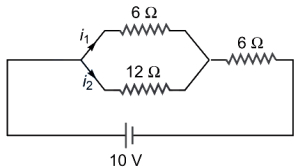
$6 \Omega$ and $12 \Omega$ resistors are connected in parallel. This combination is connected in series with a $10 \text{ V}$ battery and a $6 \Omega$ resistor. What is the potential difference between the terminals of the $12 \Omega$ resistor (in $text{ V}$)?
A
$4$
B
$16$
C
$2$
D
$8$
Solution
(A) First,calculate the equivalent resistance of the parallel combination of $6 \Omega$ and $12 \Omega$ resistors:
$R_p = \frac{6 \times 12}{6 + 12} = \frac{72}{18} = 4 \Omega$
Next,calculate the total resistance of the circuit,as the parallel combination is in series with the $6 \Omega$ resistor:
$R_{eq} = R_p + 6 \Omega = 4 \Omega + 6 \Omega = 10 \Omega$
Now,calculate the total current flowing through the circuit using Ohm's law $(I = V / R)$:
$I = \frac{10 \text{ V}}{10 \Omega} = 1 \text{ A}$
The potential difference across the parallel combination $(V_p)$ is the current multiplied by the equivalent parallel resistance:
$V_p = I \times R_p = 1 \text{ A} \times 4 \Omega = 4 \text{ V}$
Since resistors in parallel have the same potential difference across them,the potential difference across the $12 \Omega$ resistor is $4 \text{ V}$.
$R_p = \frac{6 \times 12}{6 + 12} = \frac{72}{18} = 4 \Omega$
Next,calculate the total resistance of the circuit,as the parallel combination is in series with the $6 \Omega$ resistor:
$R_{eq} = R_p + 6 \Omega = 4 \Omega + 6 \Omega = 10 \Omega$
Now,calculate the total current flowing through the circuit using Ohm's law $(I = V / R)$:
$I = \frac{10 \text{ V}}{10 \Omega} = 1 \text{ A}$
The potential difference across the parallel combination $(V_p)$ is the current multiplied by the equivalent parallel resistance:
$V_p = I \times R_p = 1 \text{ A} \times 4 \Omega = 4 \text{ V}$
Since resistors in parallel have the same potential difference across them,the potential difference across the $12 \Omega$ resistor is $4 \text{ V}$.
0 likesView Solution
17
ChemistryMCQTS EAMCET · 2010
Which of the following is a correct statement?
A
Aqueous solutions of $Cu^{+}$ and $Zn^{2+}$ are colourless
B
Aqueous solutions of $Cu^{2+}$ and $Zn^{2+}$ are colourless
C
Aqueous solution of $Fe^{3+}$ is green in colour
D
Aqueous solution of $MnO_4^{-}$ is colourless
Solution
(A) . $Cu^{+} = [Ar] 3d^{10}$ (No unpaired electrons,so it is colourless). $Zn^{2+} = [Ar] 3d^{10}$ (No unpaired electrons,so it is colourless).
$B$. $Cu^{2+} = [Ar] 3d^9$ (One unpaired electron is present,so it is coloured). $Zn^{2+}$ is colourless.
$C$. The colour of $Fe^{2+}$ is green while that of $Fe^{3+}$ is yellow/brown.
$D$. $MnO_4^{-}$ contains no unpaired electrons,however,it is coloured due to charge transfer.
Thus,only the statement given in option $A$ is correct.
$B$. $Cu^{2+} = [Ar] 3d^9$ (One unpaired electron is present,so it is coloured). $Zn^{2+}$ is colourless.
$C$. The colour of $Fe^{2+}$ is green while that of $Fe^{3+}$ is yellow/brown.
$D$. $MnO_4^{-}$ contains no unpaired electrons,however,it is coloured due to charge transfer.
Thus,only the statement given in option $A$ is correct.
0 likesView Solution
18
ChemistryMCQTS EAMCET · 2010
Photoelectric emission is observed from a metallic surface for frequencies $v_1$ and $v_2$ of the incident light $(v_1 > v_2)$. If the maximum values of kinetic energy of the photoelectrons emitted in the two cases are in the ratio $1: n$,then the threshold frequency of the metallic surface is
A
$\frac{(v_1 - v_2)}{(n - 1)}$
B
$\frac{(n v_1 - v_2)}{(n - 1)}$
C
$\frac{(n v_2 - v_1)}{(n - 1)}$
D
$\frac{(v_1 - v_2)}{n}$
Solution
(B) According to Einstein's photoelectric equation,the maximum kinetic energy $K_{\max}$ is given by $K_{\max} = h v - h v_0$,where $v$ is the frequency of incident light and $v_0$ is the threshold frequency.
For frequency $v_1$,$K_1 = h(v_1 - v_0)$.
For frequency $v_2$,$K_2 = h(v_2 - v_0)$.
Given the ratio of kinetic energies is $\frac{K_1}{K_2} = \frac{1}{n}$.
Substituting the expressions,we get $\frac{h(v_1 - v_0)}{h(v_2 - v_0)} = \frac{1}{n}$.
$\frac{v_1 - v_0}{v_2 - v_0} = \frac{1}{n}$.
Cross-multiplying gives $n(v_1 - v_0) = v_2 - v_0$.
$n v_1 - n v_0 = v_2 - v_0$.
$n v_1 - v_2 = n v_0 - v_0$.
$n v_1 - v_2 = v_0(n - 1)$.
Therefore,$v_0 = \frac{n v_1 - v_2}{n - 1}$.
For frequency $v_1$,$K_1 = h(v_1 - v_0)$.
For frequency $v_2$,$K_2 = h(v_2 - v_0)$.
Given the ratio of kinetic energies is $\frac{K_1}{K_2} = \frac{1}{n}$.
Substituting the expressions,we get $\frac{h(v_1 - v_0)}{h(v_2 - v_0)} = \frac{1}{n}$.
$\frac{v_1 - v_0}{v_2 - v_0} = \frac{1}{n}$.
Cross-multiplying gives $n(v_1 - v_0) = v_2 - v_0$.
$n v_1 - n v_0 = v_2 - v_0$.
$n v_1 - v_2 = n v_0 - v_0$.
$n v_1 - v_2 = v_0(n - 1)$.
Therefore,$v_0 = \frac{n v_1 - v_2}{n - 1}$.
0 likesView Solution
19
ChemistryMCQTS EAMCET · 2010
At a certain temperature and at infinite dilution,the equivalent conductances of sodium benzoate,hydrochloric acid,and sodium chloride are $240$,$349$,and $229 \ \Omega^{-1} \ cm^2 \ \text{equiv}^{-1}$ respectively. The equivalent conductance of benzoic acid in $\Omega^{-1} \ cm^2 \ \text{equiv}^{-1}$ at the same conditions is:
A
$80$
B
$328$
C
$360$
D
$408$
Solution
(C) According to Kohlrausch's law of independent migration of ions,the equivalent conductance at infinite dilution for benzoic acid $(C_6H_5COOH)$ can be calculated as follows:
$\Lambda^{\infty}_{C_6H_5COOH} = \Lambda^{\infty}_{C_6H_5COONa} + \Lambda^{\infty}_{HCl} - \Lambda^{\infty}_{NaCl}$
Given values:
$\Lambda^{\infty}_{C_6H_5COONa} = 240 \ \Omega^{-1} \ cm^2 \ \text{equiv}^{-1}$
$\Lambda^{\infty}_{HCl} = 349 \ \Omega^{-1} \ cm^2 \ \text{equiv}^{-1}$
$\Lambda^{\infty}_{NaCl} = 229 \ \Omega^{-1} \ cm^2 \ \text{equiv}^{-1}$
Substituting the values:
$\Lambda^{\infty}_{C_6H_5COOH} = 240 + 349 - 229 = 360 \ \Omega^{-1} \ cm^2 \ \text{equiv}^{-1}$
$\Lambda^{\infty}_{C_6H_5COOH} = \Lambda^{\infty}_{C_6H_5COONa} + \Lambda^{\infty}_{HCl} - \Lambda^{\infty}_{NaCl}$
Given values:
$\Lambda^{\infty}_{C_6H_5COONa} = 240 \ \Omega^{-1} \ cm^2 \ \text{equiv}^{-1}$
$\Lambda^{\infty}_{HCl} = 349 \ \Omega^{-1} \ cm^2 \ \text{equiv}^{-1}$
$\Lambda^{\infty}_{NaCl} = 229 \ \Omega^{-1} \ cm^2 \ \text{equiv}^{-1}$
Substituting the values:
$\Lambda^{\infty}_{C_6H_5COOH} = 240 + 349 - 229 = 360 \ \Omega^{-1} \ cm^2 \ \text{equiv}^{-1}$
0 likesView Solution
20
ChemistryMCQTS EAMCET · 2010
$A$ solution of concentration $C \ g \ \text{equiv}/L$ has a specific resistance $R$. The equivalent conductance of the solution is
A
$\frac{R}{C}$
B
$\frac{C}{R}$
C
$\frac{1000}{R C}$
D
$\frac{1000 R}{C}$
Solution
(C) Equivalent conductivity,$\wedge_{eq} = \frac{\kappa \times 1000}{C}$,where $\kappa$ is the specific conductance and $C$ is the concentration in $g \ \text{equiv}/L$.
Since specific conductance $\kappa = \frac{1}{R}$,where $R$ is the specific resistance.
Substituting the value of $\kappa$ in the formula:
$\wedge_{eq} = \frac{1}{R} \times \frac{1000}{C} = \frac{1000}{R C}$.
Since specific conductance $\kappa = \frac{1}{R}$,where $R$ is the specific resistance.
Substituting the value of $\kappa$ in the formula:
$\wedge_{eq} = \frac{1}{R} \times \frac{1000}{C} = \frac{1000}{R C}$.
0 likesView Solution
21
ChemistryMCQTS EAMCET · 2010
The time constant of an inductance coil is $3 \text{ ms}$. When a $90 \Omega$ resistance is joined in series,the time constant becomes $0.5 \text{ ms}$. The inductance and the resistance of the coil are:
A
$54 \text{ mH}, 18 \Omega$
B
$14 \text{ mH}, 42 \Omega$
C
$42 \text{ mH}, 14 \Omega$
D
$14 \text{ mH}, 60 \Omega$
Solution
(A) The time constant of an $LR$ circuit is given by $\tau = \frac{L}{R}$.
Initially,$\tau_1 = \frac{L}{R} = 3 \times 10^{-3} \text{ s}$ ...$(i)$
When a $90 \Omega$ resistor is added in series,the new resistance is $(R + 90) \Omega$.
The new time constant is $\tau_2 = \frac{L}{R + 90} = 0.5 \times 10^{-3} \text{ s}$ ...(ii)
Dividing equation $(i)$ by (ii):
$\frac{3 \times 10^{-3}}{0.5 \times 10^{-3}} = \frac{L/R}{L/(R + 90)}$
$6 = \frac{R + 90}{R}$
$6R = R + 90$
$5R = 90 \implies R = 18 \Omega$
Substituting $R = 18 \Omega$ into equation $(i)$:
$L = 3 \times 10^{-3} \times 18 = 54 \times 10^{-3} \text{ H} = 54 \text{ mH}$.
Thus,the inductance is $54 \text{ mH}$ and the resistance is $18 \Omega$.
Initially,$\tau_1 = \frac{L}{R} = 3 \times 10^{-3} \text{ s}$ ...$(i)$
When a $90 \Omega$ resistor is added in series,the new resistance is $(R + 90) \Omega$.
The new time constant is $\tau_2 = \frac{L}{R + 90} = 0.5 \times 10^{-3} \text{ s}$ ...(ii)
Dividing equation $(i)$ by (ii):
$\frac{3 \times 10^{-3}}{0.5 \times 10^{-3}} = \frac{L/R}{L/(R + 90)}$
$6 = \frac{R + 90}{R}$
$6R = R + 90$
$5R = 90 \implies R = 18 \Omega$
Substituting $R = 18 \Omega$ into equation $(i)$:
$L = 3 \times 10^{-3} \times 18 = 54 \times 10^{-3} \text{ H} = 54 \text{ mH}$.
Thus,the inductance is $54 \text{ mH}$ and the resistance is $18 \Omega$.
0 likesView Solution
22
ChemistryMCQTS EAMCET · 2010
The thermo emf of a thermocouple is given by $E = aT + bT^2$,where $\frac{a}{b} = -200^{\circ}C$. If the cold junction is kept at $30^{\circ}C$,then the inversion temperature is ($\varepsilon$ in volt,$T$ in centigrade). (in $K$)
A
$103$
B
$143$
C
$333$
D
$443$
Solution
(D) The thermo emf is given by $E = aT + bT^2$.
At the neutral temperature $(T_n)$,the emf is maximum,and at the inversion temperature $(T_i)$,the emf becomes zero.
Setting $E = 0$ for the inversion temperature:
$0 = aT_i + bT_i^2$
$T_i(a + bT_i) = 0$
Since $T_i \neq 0$,we have $a + bT_i = 0$,which gives $T_i = -\frac{a}{b}$.
Given $\frac{a}{b} = -200^{\circ}C$,so $T_i = -(-200^{\circ}C) = 200^{\circ}C$.
This $T_i$ is the temperature relative to the cold junction being at $0^{\circ}C$.
Since the cold junction is kept at $T_c = 30^{\circ}C$,the actual inversion temperature is $T_{inv} = T_i + T_c = 200^{\circ}C + 30^{\circ}C = 230^{\circ}C$.
Converting to Kelvin: $T(K) = 273 + 230 = 503 \ K$.
Wait,re-evaluating the standard relation: The inversion temperature $T_i$ is defined such that $T_i - T_c = T_c - T_n$,where $T_n$ is the neutral temperature. The equation $E = aT + bT^2$ implies $T_n = -a/2b = 100^{\circ}C$. If $T_c = 30^{\circ}C$,then $T_i = 2T_n - T_c = 2(100) - 30 = 170^{\circ}C$.
Converting to Kelvin: $T = 273 + 170 = 443 \ K$.
At the neutral temperature $(T_n)$,the emf is maximum,and at the inversion temperature $(T_i)$,the emf becomes zero.
Setting $E = 0$ for the inversion temperature:
$0 = aT_i + bT_i^2$
$T_i(a + bT_i) = 0$
Since $T_i \neq 0$,we have $a + bT_i = 0$,which gives $T_i = -\frac{a}{b}$.
Given $\frac{a}{b} = -200^{\circ}C$,so $T_i = -(-200^{\circ}C) = 200^{\circ}C$.
This $T_i$ is the temperature relative to the cold junction being at $0^{\circ}C$.
Since the cold junction is kept at $T_c = 30^{\circ}C$,the actual inversion temperature is $T_{inv} = T_i + T_c = 200^{\circ}C + 30^{\circ}C = 230^{\circ}C$.
Converting to Kelvin: $T(K) = 273 + 230 = 503 \ K$.
Wait,re-evaluating the standard relation: The inversion temperature $T_i$ is defined such that $T_i - T_c = T_c - T_n$,where $T_n$ is the neutral temperature. The equation $E = aT + bT^2$ implies $T_n = -a/2b = 100^{\circ}C$. If $T_c = 30^{\circ}C$,then $T_i = 2T_n - T_c = 2(100) - 30 = 170^{\circ}C$.
Converting to Kelvin: $T = 273 + 170 = 443 \ K$.
0 likesView Solution
23
ChemistryMCQTS EAMCET · 2010
$A$ proton, a deuteron, and an $\alpha$-particle having the same momentum enter a region of uniform electric field between the parallel plates of a capacitor. The electric field is perpendicular to the initial path of the particles. The ratio of deflections suffered by them is
A
$1: 2: 8$
B
$1: 2: 4$
C
$1: 1: 2$
D
None of these
Solution
(A) The deflection $y$ of a charged particle moving with velocity $u$ in a uniform electric field $E$ over a distance $L$ is given by $y = \frac{1}{2} a t^2 = \frac{1}{2} (\frac{qE}{m}) (\frac{L}{u})^2 = \frac{qEL^2}{2mu^2}$.
Since momentum $p = mu$, we have $u = p/m$. Substituting this, $y = \frac{qEL^2}{2m(p/m)^2} = \frac{qEL^2m}{2p^2}$.
Given that $E, L,$ and $p$ are constant for all particles, we have $y \propto qm$.
For a proton $(p)$, deuteron $(d)$, and $\alpha$-particle $(\alpha)$:
Charge ratio: $q_p : q_d : q_\alpha = 1 : 1 : 2$.
Mass ratio: $m_p : m_d : m_\alpha = 1 : 2 : 4$.
Therefore, the ratio of deflections is $y_p : y_d : y_\alpha = (q_p m_p) : (q_d m_d) : (q_\alpha m_\alpha) = (1 \times 1) : (1 \times 2) : (2 \times 4) = 1 : 2 : 8$.
Since momentum $p = mu$, we have $u = p/m$. Substituting this, $y = \frac{qEL^2}{2m(p/m)^2} = \frac{qEL^2m}{2p^2}$.
Given that $E, L,$ and $p$ are constant for all particles, we have $y \propto qm$.
For a proton $(p)$, deuteron $(d)$, and $\alpha$-particle $(\alpha)$:
Charge ratio: $q_p : q_d : q_\alpha = 1 : 1 : 2$.
Mass ratio: $m_p : m_d : m_\alpha = 1 : 2 : 4$.
Therefore, the ratio of deflections is $y_p : y_d : y_\alpha = (q_p m_p) : (q_d m_d) : (q_\alpha m_\alpha) = (1 \times 1) : (1 \times 2) : (2 \times 4) = 1 : 2 : 8$.
0 likesView Solution
24
ChemistryMCQTS EAMCET · 2010
The acceptable level of carbon monoxide gas $(CO)$ in the atmosphere in $ppm$ level is
A
$9$
B
$250$
C
$49$
D
$850$
Solution
(A) The acceptable level of carbon monoxide gas $(CO)$ in the atmosphere is approximately $9 \ ppm$.
0 likesView Solution
25
ChemistryMCQTS EAMCET · 2010
In which of the following,ortho/para substitution by an electrophile is very facile?
A
Nitrobenzene
B
Phenol
C
Benzoic acid
D
Acetophenone
Solution
(B) The $-OH$ group is ortho/para directing and increases the electron density of the benzene ring,making it highly reactive towards electrophilic substitution.
Thus,ortho/para substitution in phenol by an electrophile is very facile.
Thus,ortho/para substitution in phenol by an electrophile is very facile.
0 likesView Solution
26
ChemistryMCQTS EAMCET · 2010
The two enantiomers of secondary butyl chloride differ from each other in which one of the following properties?
A
Boiling point
B
Specific rotation
C
Density
D
$C-Cl$ bond length
Solution
(B) Enantiomers are stereoisomers that are non-superimposable mirror images of each other.
They possess identical physical properties such as boiling point,density,and bond lengths in an achiral environment.
However,they differ in their interaction with plane-polarized light,which is measured as specific rotation.
Therefore,the two enantiomers of secondary butyl chloride differ in specific rotation.
They possess identical physical properties such as boiling point,density,and bond lengths in an achiral environment.
However,they differ in their interaction with plane-polarized light,which is measured as specific rotation.
Therefore,the two enantiomers of secondary butyl chloride differ in specific rotation.
0 likesView Solution
27
ChemistryMCQTS EAMCET · 2010
Which of the following pairs of $2,3$-butanediol are enantiomeric?
A
$2R, 3R$ and $2S, 3S$
B
$2S, 3S$ and $2S, 3R$
C
$2R, 3R$ and $2R, 3S$
D
$2S, 3S$ and $2R, 3S$
Solution
(A) Enantiomers are non-superimposable mirror images of each other.
For a molecule with multiple chiral centers,the enantiomer is formed by inverting the configuration at every chiral center.
Thus,the enantiomer of $(2R, 3R)$-butanediol is $(2S, 3S)$-butanediol.
Therefore,the pair $(2R, 3R)$ and $(2S, 3S)$ represents enantiomers.
For a molecule with multiple chiral centers,the enantiomer is formed by inverting the configuration at every chiral center.
Thus,the enantiomer of $(2R, 3R)$-butanediol is $(2S, 3S)$-butanediol.
Therefore,the pair $(2R, 3R)$ and $(2S, 3S)$ represents enantiomers.
0 likesView Solution
28
ChemistryMCQTS EAMCET · 2010
Which one of the following is the mineral for tin?
A
Galena
B
Cerussite
C
Cassiterite
D
Anglesite
Solution
(C) The minerals and their chemical formulas are as follows:
From the table,it is clear that $SnO_2$ (Cassiterite) is the mineral for tin $(Sn)$.
| Mineral | Formula |
|---|---|
| Galena | $PbS$ |
| Cerussite | $PbCO_3$ |
| Cassiterite | $SnO_2$ |
| Anglesite | $PbSO_4$ |
From the table,it is clear that $SnO_2$ (Cassiterite) is the mineral for tin $(Sn)$.
0 likesView Solution
29
ChemistryMCQTS EAMCET · 2010
The chemical reaction that involves the roasting process is
A
$Fe_2O_3 + 3CO \longrightarrow 2Fe + 3CO_2$
B
$2Al + Fe_2O_3 \longrightarrow 2Fe + Al_2O_3$
C
$2ZnS + 3O_2 \longrightarrow 2ZnO + 2SO_2$
D
$FeO + SiO_2 \longrightarrow FeSiO_3$
Solution
(C) Roasting is a metallurgical process in which sulphide ores are heated in the presence of excess air to convert them into their corresponding metal oxides.
In the given options,the reaction $2ZnS + 3O_2 \longrightarrow 2ZnO + 2SO_2$ represents the roasting of zinc blende $(ZnS)$.
In the given options,the reaction $2ZnS + 3O_2 \longrightarrow 2ZnO + 2SO_2$ represents the roasting of zinc blende $(ZnS)$.
0 likesView Solution
30
ChemistryMCQTS EAMCET · 2010
$A$ launching vehicle carrying an artificial satellite of mass $m$ is set for launch on the surface of the earth of mass $M$ and radius $R$. If the satellite is intended to move in a circular orbit of radius $7R$,the minimum energy required to be spent by the launching vehicle on the satellite is (Gravitational constant $= G$)
A
$\frac{GMm}{R}$
B
$\frac{13GMm}{14R}$
C
$\frac{GMm}{7R}$
D
$\frac{GMm}{14R}$
Solution
(B) The initial energy of the satellite on the surface of the earth is $E_1 = -\frac{GMm}{R}$.
When the satellite is in a circular orbit of radius $r = 7R$,its total energy is $E_2 = -\frac{GMm}{2r} = -\frac{GMm}{2(7R)} = -\frac{GMm}{14R}$.
The minimum energy required to be spent by the launching vehicle is the difference between the final energy and the initial energy:
$\Delta E = E_2 - E_1$
$\Delta E = -\frac{GMm}{14R} - \left(-\frac{GMm}{R}\right)$
$\Delta E = -\frac{GMm}{14R} + \frac{14GMm}{14R}$
$\Delta E = \frac{13GMm}{14R}$.
When the satellite is in a circular orbit of radius $r = 7R$,its total energy is $E_2 = -\frac{GMm}{2r} = -\frac{GMm}{2(7R)} = -\frac{GMm}{14R}$.
The minimum energy required to be spent by the launching vehicle is the difference between the final energy and the initial energy:
$\Delta E = E_2 - E_1$
$\Delta E = -\frac{GMm}{14R} - \left(-\frac{GMm}{R}\right)$
$\Delta E = -\frac{GMm}{14R} + \frac{14GMm}{14R}$
$\Delta E = \frac{13GMm}{14R}$.
0 likesView Solution
31
ChemistryMCQTS EAMCET · 2010
Identify $A, B$ and $C$ in the following reactions:
$CH_3 Cl$ $\xrightarrow{KCN} A$ $\xrightarrow{H_3 O^{\oplus}} B$ $\xrightarrow{C_2 H_5 OH / H^{+}, \Delta} C$
$CH_3 Cl$ $\xrightarrow{KCN} A$ $\xrightarrow{H_3 O^{\oplus}} B$ $\xrightarrow{C_2 H_5 OH / H^{+}, \Delta} C$
A
$A = CH_3 NC, B = CH_3 NHCH_3, C = CH_3 N(CH_3)C_2 H_5$
B
$A = CH_3 CN, B = CH_3 CONH_2, C = CH_3 CO_2 H$
C
$A = CH_3 CN, B = CH_3 CO_2 H, C = CH_3 CO_2 C_2 H_5$
D
$A = CH_3 CN, B = CH_3 CO_2 H, C = (CH_3 CO)_2 O$
Solution
(C) $1$. $CH_3 Cl + KCN \longrightarrow CH_3 CN (A) + KCl$
(Nucleophilic substitution of $Cl^{-}$ by $CN^{-}$ gives methyl cyanide or acetonitrile).
$2$. $CH_3 CN + 2H_2 O \xrightarrow{H_3 O^{\oplus}} CH_3 COOH (B) + NH_3$
(Acidic hydrolysis of nitrile gives ethanoic acid).
$3$. $CH_3 COOH + C_2 H_5 OH \xrightarrow{H^{+}, \Delta} CH_3 COOC_2 H_5 (C) + H_2 O$
(Esterification of ethanoic acid with ethanol gives ethyl ethanoate).
Thus,$A = CH_3 CN, B = CH_3 CO_2 H, C = CH_3 CO_2 C_2 H_5$.
(Nucleophilic substitution of $Cl^{-}$ by $CN^{-}$ gives methyl cyanide or acetonitrile).
$2$. $CH_3 CN + 2H_2 O \xrightarrow{H_3 O^{\oplus}} CH_3 COOH (B) + NH_3$
(Acidic hydrolysis of nitrile gives ethanoic acid).
$3$. $CH_3 COOH + C_2 H_5 OH \xrightarrow{H^{+}, \Delta} CH_3 COOC_2 H_5 (C) + H_2 O$
(Esterification of ethanoic acid with ethanol gives ethyl ethanoate).
Thus,$A = CH_3 CN, B = CH_3 CO_2 H, C = CH_3 CO_2 C_2 H_5$.
0 likesView Solution
32
ChemistryDifficultMCQTS EAMCET · 2010
The Diels-Alder reaction will not take place with which of the following reactants?
A
$1,4-$pentadiene and ethene
B
$1,3-$pentadiene and ethene
C
$1,3-$butadiene and propene
D
$1,3-$butadiene and ethene
Solution
(A) The Diels-Alder reaction requires a conjugated diene and a dienophile (an alkene or alkyne).
In option $A$,$1,4$-pentadiene is an isolated diene,not a conjugated diene.
Conjugated dienes have alternating single and double bonds (e.g.,$CH_2=CH-CH=CH_2$).
Since $1,4$-pentadiene lacks the necessary conjugated system,it cannot participate in the Diels-Alder reaction.
In option $A$,$1,4$-pentadiene is an isolated diene,not a conjugated diene.
Conjugated dienes have alternating single and double bonds (e.g.,$CH_2=CH-CH=CH_2$).
Since $1,4$-pentadiene lacks the necessary conjugated system,it cannot participate in the Diels-Alder reaction.
0 likesView Solution
33
ChemistryMCQTS EAMCET · 2010
Which one of the following is most acidic?
A
$H_2O$
B
$H_2S$
C
$H_2Te$
D
$H_2Se$
Solution
(C) As the size of the central atom (order of size $O < S < Se < Te$) increases,the $H-A$ (where $A$ is the central atom) bond length increases.
This leads to a decrease in the $H-A$ bond dissociation energy.
Consequently,$H_2Te$ releases a proton $(H^+)$ more readily than the others.
Therefore,$H_2Te$ is the most acidic among the given compounds.
$H_2Te + H_2O \longrightarrow H_3O^+ + HTe^-$
This leads to a decrease in the $H-A$ bond dissociation energy.
Consequently,$H_2Te$ releases a proton $(H^+)$ more readily than the others.
Therefore,$H_2Te$ is the most acidic among the given compounds.
$H_2Te + H_2O \longrightarrow H_3O^+ + HTe^-$
0 likesView Solution
34
ChemistryMCQTS EAMCET · 2010
The orange coloured compound formed when $H_2O_2$ is added to $TiO_2$ solution acidified with conc $H_2SO_4$ is
A
$Ti_2O_3$
B
$H_2Ti_2O_8$
C
$H_2TiO_3$
D
$H_2TiO_4$
Solution
(D) When an acidified solution of $TiO_2$ is treated with $H_2O_2$,an intense yellow-orange colour is obtained due to the formation of pertitanic acid,$H_2TiO_4$.
$TiO_2 + H_2O_2 \xrightarrow{H_2SO_4} H_2TiO_4$
This reaction is used for the detection of both $Ti(IV)$ and $H_2O_2$.
$TiO_2 + H_2O_2 \xrightarrow{H_2SO_4} H_2TiO_4$
This reaction is used for the detection of both $Ti(IV)$ and $H_2O_2$.
0 likesView Solution
35
ChemistryMCQTS EAMCET · 2010
The $pH$ of $0.01 \ M$ solution of acetic acid is $5.0$. What are the values of $[H^{+}]$ and $K_a$ respectively?
A
$1 \times 10^{-5} \ M, 1 \times 10^{-8}$
B
$1 \times 10^{-5} \ M, 1 \times 10^{-9}$
C
$1 \times 10^{-4} \ M, 1 \times 10^{-8}$
D
$1 \times 10^{-3} \ M, 1 \times 10^{-8}$
Solution
(A) Given,$pH$ of $0.01 \ M \ CH_3COOH$ solution $= 5.0$.
Concentration,$C = 0.01 \ M = 10^{-2} \ M$.
We know that $[H^{+}] = 10^{-pH} = 10^{-5} \ M$.
For a weak acid,the dissociation constant $K_a$ is given by the formula:
$[H^{+}] = \sqrt{K_a \cdot C} \implies [H^{+}]^2 = K_a \cdot C$.
Therefore,$K_a = \frac{[H^{+}]^2}{C} = \frac{(10^{-5})^2}{10^{-2}} = \frac{10^{-10}}{10^{-2}} = 10^{-8}$.
Thus,the values are $[H^{+}] = 1 \times 10^{-5} \ M$ and $K_a = 1 \times 10^{-8}$.
Concentration,$C = 0.01 \ M = 10^{-2} \ M$.
We know that $[H^{+}] = 10^{-pH} = 10^{-5} \ M$.
For a weak acid,the dissociation constant $K_a$ is given by the formula:
$[H^{+}] = \sqrt{K_a \cdot C} \implies [H^{+}]^2 = K_a \cdot C$.
Therefore,$K_a = \frac{[H^{+}]^2}{C} = \frac{(10^{-5})^2}{10^{-2}} = \frac{10^{-10}}{10^{-2}} = 10^{-8}$.
Thus,the values are $[H^{+}] = 1 \times 10^{-5} \ M$ and $K_a = 1 \times 10^{-8}$.
0 likesView Solution
36
ChemistryMCQTS EAMCET · 2010
An object takes $n$ times as much time to slide down a $45^{\circ}$ rough inclined plane as it takes to slide down a perfectly smooth inclined plane of the same inclination. The coefficient of kinetic friction between the object and the rough incline is given by:
A
$\left(1-\frac{1}{n^2}\right)$
B
$\left(\frac{1}{1-n^2}\right)$
C
$\sqrt{1-\frac{1}{n^2}}$
D
$\sqrt{1+\frac{1}{n^2}}$
Solution
(A) For a smooth inclined plane,the acceleration is $a_s = g \sin \theta$. The time taken to cover distance $s$ is $t_s = \sqrt{\frac{2s}{g \sin \theta}}$.
For a rough inclined plane,the acceleration is $a_r = g(\sin \theta - \mu \cos \theta)$. The time taken is $t_r = \sqrt{\frac{2s}{g(\sin \theta - \mu \cos \theta)}}$.
Given $t_r = n t_s$,we have $\frac{t_r}{t_s} = n$.
Squaring both sides: $\frac{t_r^2}{t_s^2} = n^2 \implies \frac{\sin \theta}{\sin \theta - \mu \cos \theta} = n^2$.
Rearranging: $\sin \theta = n^2 \sin \theta - n^2 \mu \cos \theta$.
$n^2 \mu \cos \theta = (n^2 - 1) \sin \theta$.
$\mu = \frac{n^2 - 1}{n^2} \tan \theta$.
Since $\theta = 45^{\circ}$,$\tan 45^{\circ} = 1$.
Therefore,$\mu = 1 - \frac{1}{n^2}$.
For a rough inclined plane,the acceleration is $a_r = g(\sin \theta - \mu \cos \theta)$. The time taken is $t_r = \sqrt{\frac{2s}{g(\sin \theta - \mu \cos \theta)}}$.
Given $t_r = n t_s$,we have $\frac{t_r}{t_s} = n$.
Squaring both sides: $\frac{t_r^2}{t_s^2} = n^2 \implies \frac{\sin \theta}{\sin \theta - \mu \cos \theta} = n^2$.
Rearranging: $\sin \theta = n^2 \sin \theta - n^2 \mu \cos \theta$.
$n^2 \mu \cos \theta = (n^2 - 1) \sin \theta$.
$\mu = \frac{n^2 - 1}{n^2} \tan \theta$.
Since $\theta = 45^{\circ}$,$\tan 45^{\circ} = 1$.
Therefore,$\mu = 1 - \frac{1}{n^2}$.
0 likesView Solution
37
ChemistryMCQTS EAMCET · 2010
In Thomson's experiment to determine $\frac{e}{m}$ of an electron,it is found that an electron beam having a kinetic energy of $45.5 \text{ eV}$ remains undeflected,when subjected to crossed electric and magnetic fields. If $E = 1 \times 10^3 \text{ V m}^{-1}$,the value of $B$ is (mass of the electron is $9.1 \times 10^{-31} \text{ kg}$)
A
$2.5 \times 10^{-3} \text{ Wb m}^{-2}$
B
$5.0 \times 10^{-4} \text{ Wb m}^{-2}$
C
$2.5 \times 10^{-4} \text{ Wb m}^{-2}$
D
$1.0 \text{ Wb m}^{-2}$
Solution
(C) The kinetic energy $K$ is given by $K = \frac{1}{2} m v^2$.
Given $K = 45.5 \text{ eV} = 45.5 \times 1.6 \times 10^{-19} \text{ J}$.
$v^2 = \frac{2K}{m} = \frac{2 \times 45.5 \times 1.6 \times 10^{-19}}{9.1 \times 10^{-31}}$.
$v^2 = \frac{145.6 \times 10^{-19}}{9.1 \times 10^{-31}} = 16 \times 10^{12} \text{ m}^2 \text{s}^{-2}$.
$v = 4 \times 10^6 \text{ m s}^{-1}$.
For an undeflected beam in crossed fields,the electric force equals the magnetic force: $qE = qvB$,which implies $v = \frac{E}{B}$.
$B = \frac{E}{v} = \frac{1 \times 10^3}{4 \times 10^6} = 0.25 \times 10^{-3} = 2.5 \times 10^{-4} \text{ Wb m}^{-2}$.
Given $K = 45.5 \text{ eV} = 45.5 \times 1.6 \times 10^{-19} \text{ J}$.
$v^2 = \frac{2K}{m} = \frac{2 \times 45.5 \times 1.6 \times 10^{-19}}{9.1 \times 10^{-31}}$.
$v^2 = \frac{145.6 \times 10^{-19}}{9.1 \times 10^{-31}} = 16 \times 10^{12} \text{ m}^2 \text{s}^{-2}$.
$v = 4 \times 10^6 \text{ m s}^{-1}$.
For an undeflected beam in crossed fields,the electric force equals the magnetic force: $qE = qvB$,which implies $v = \frac{E}{B}$.
$B = \frac{E}{v} = \frac{1 \times 10^3}{4 \times 10^6} = 0.25 \times 10^{-3} = 2.5 \times 10^{-4} \text{ Wb m}^{-2}$.
0 likesView Solution
38
ChemistryMCQTS EAMCET · 2010
The frequency of vibration in a vibration magnetometer of the combination of two bar magnets of magnetic moments $M_1$ and $M_2$ is $6 ~Hz$ when like poles are tied together and it is $2 ~Hz$ when the unlike poles are tied together,then the ratio $M_1: M_2$ is
A
$4: 5$
B
$5: 4$
C
$1: 3$
D
$3: 1$
Solution
(B) The frequency of vibration in a vibration magnetometer is given by $n = \frac{1}{2\pi} \sqrt{\frac{MB}{I}}$.
For the combination of two magnets,the effective magnetic moment $M_{eff}$ and moment of inertia $I_{eff} = I_1 + I_2$ are used.
When like poles are tied together,$M_{eff} = M_1 + M_2$,so $n_1 = \frac{1}{2\pi} \sqrt{\frac{(M_1+M_2)B}{I_1+I_2}} = 6 ~Hz$.
When unlike poles are tied together,$M_{eff} = M_1 - M_2$,so $n_2 = \frac{1}{2\pi} \sqrt{\frac{(M_1-M_2)B}{I_1+I_2}} = 2 ~Hz$.
Taking the ratio of the two frequencies:
$\frac{n_1}{n_2} = \sqrt{\frac{M_1+M_2}{M_1-M_2}} = \frac{6}{2} = 3$.
Squaring both sides:
$\frac{M_1+M_2}{M_1-M_2} = 9$.
$M_1 + M_2 = 9M_1 - 9M_2$.
$10M_2 = 8M_1$.
$\frac{M_1}{M_2} = \frac{10}{8} = \frac{5}{4}$.
Thus,the ratio $M_1: M_2$ is $5: 4$.
For the combination of two magnets,the effective magnetic moment $M_{eff}$ and moment of inertia $I_{eff} = I_1 + I_2$ are used.
When like poles are tied together,$M_{eff} = M_1 + M_2$,so $n_1 = \frac{1}{2\pi} \sqrt{\frac{(M_1+M_2)B}{I_1+I_2}} = 6 ~Hz$.
When unlike poles are tied together,$M_{eff} = M_1 - M_2$,so $n_2 = \frac{1}{2\pi} \sqrt{\frac{(M_1-M_2)B}{I_1+I_2}} = 2 ~Hz$.
Taking the ratio of the two frequencies:
$\frac{n_1}{n_2} = \sqrt{\frac{M_1+M_2}{M_1-M_2}} = \frac{6}{2} = 3$.
Squaring both sides:
$\frac{M_1+M_2}{M_1-M_2} = 9$.
$M_1 + M_2 = 9M_1 - 9M_2$.
$10M_2 = 8M_1$.
$\frac{M_1}{M_2} = \frac{10}{8} = \frac{5}{4}$.
Thus,the ratio $M_1: M_2$ is $5: 4$.
0 likesView Solution
39
ChemistryMCQTS EAMCET · 2010
The intensity of the magnetic induction field at the centre of a single turn circular coil of radius $5 ~cm$ carrying a current of $0.9 ~A$ is:
A
$36 \pi \times 10^{-7} ~T$
B
$9 \pi \times 10^{-7} ~T$
C
$36 \pi \times 10^{-6} ~T$
D
$9 \pi \times 10^{-6} ~T$
Solution
(A) The formula for the magnetic field at the center of a circular coil is given by $B = \frac{\mu_0 I}{2R}$.
Given values are:
Permeability of free space $\mu_0 = 4 \pi \times 10^{-7} ~T \cdot m/A$
Current $I = 0.9 ~A$
Radius $R = 5 ~cm = 5 \times 10^{-2} ~m$
Substituting these values into the formula:
$B = \frac{4 \pi \times 10^{-7} \times 0.9}{2 \times 5 \times 10^{-2}}$
$B = \frac{3.6 \pi \times 10^{-7}}{10 \times 10^{-2}}$
$B = \frac{3.6 \pi \times 10^{-7}}{10^{-1}}$
$B = 3.6 \pi \times 10^{-6} ~T = 36 \pi \times 10^{-7} ~T$.
Given values are:
Permeability of free space $\mu_0 = 4 \pi \times 10^{-7} ~T \cdot m/A$
Current $I = 0.9 ~A$
Radius $R = 5 ~cm = 5 \times 10^{-2} ~m$
Substituting these values into the formula:
$B = \frac{4 \pi \times 10^{-7} \times 0.9}{2 \times 5 \times 10^{-2}}$
$B = \frac{3.6 \pi \times 10^{-7}}{10 \times 10^{-2}}$
$B = \frac{3.6 \pi \times 10^{-7}}{10^{-1}}$
$B = 3.6 \pi \times 10^{-6} ~T = 36 \pi \times 10^{-7} ~T$.
0 likesView Solution
40
ChemistryMCQTS EAMCET · 2010
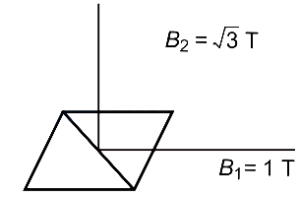
$A$ short magnetic needle is pivoted in a uniform magnetic field of induction $1 ~T$. Now,simultaneously another magnetic field of induction $\sqrt{3} ~T$ is applied at right angles to the first field; the needle deflects through an angle $\theta$ whose value is (in $^{\circ}$)
A
$30$
B
$45$
C
$90$
D
$60$
Solution
(D) When a magnetic needle is placed in two mutually perpendicular magnetic fields $B_1$ and $B_2$,it aligns itself along the resultant magnetic field direction.
Let $B_1 = 1 ~T$ and $B_2 = \sqrt{3} ~T$.
The deflection angle $\theta$ of the needle from the direction of $B_1$ is given by the tangent law:
$\tan \theta = \frac{B_2}{B_1}$
Substituting the given values:
$\tan \theta = \frac{\sqrt{3}}{1} = \sqrt{3}$
Since $\tan 60^{\circ} = \sqrt{3}$,we have:
$\theta = 60^{\circ}$
Let $B_1 = 1 ~T$ and $B_2 = \sqrt{3} ~T$.
The deflection angle $\theta$ of the needle from the direction of $B_1$ is given by the tangent law:
$\tan \theta = \frac{B_2}{B_1}$
Substituting the given values:
$\tan \theta = \frac{\sqrt{3}}{1} = \sqrt{3}$
Since $\tan 60^{\circ} = \sqrt{3}$,we have:
$\theta = 60^{\circ}$
0 likesView Solution
41
ChemistryMCQTS EAMCET · 2010
$\overrightarrow{A}$ and $\overrightarrow{B}$ are two vectors of equal magnitudes and $\theta$ is the angle between them. The angle between $\overrightarrow{A}$ or $\overrightarrow{B}$ with their resultant is
A
$\frac{\theta}{4}$
B
$\frac{\theta}{2}$
C
$2 \theta$
D
zero
Solution
(B) Let the magnitudes of the two vectors be $|\overrightarrow{A}| = |\overrightarrow{B}| = a$.
The resultant vector $\overrightarrow{R} = \overrightarrow{A} + \overrightarrow{B}$ has a magnitude $R = \sqrt{a^2 + a^2 + 2a^2 \cos \theta} = \sqrt{2a^2(1 + \cos \theta)} = \sqrt{2a^2(2 \cos^2 \frac{\theta}{2})} = 2a \cos \frac{\theta}{2}$.
The angle $\alpha$ that the resultant $\overrightarrow{R}$ makes with vector $\overrightarrow{A}$ is given by $\tan \alpha = \frac{B \sin \theta}{A + B \cos \theta}$.
Substituting $A = B = a$,we get $\tan \alpha = \frac{a \sin \theta}{a + a \cos \theta} = \frac{\sin \theta}{1 + \cos \theta} = \frac{2 \sin \frac{\theta}{2} \cos \frac{\theta}{2}}{2 \cos^2 \frac{\theta}{2}} = \tan \frac{\theta}{2}$.
Therefore,$\alpha = \frac{\theta}{2}$.
Since the magnitudes are equal,the resultant bisects the angle between the two vectors.
The resultant vector $\overrightarrow{R} = \overrightarrow{A} + \overrightarrow{B}$ has a magnitude $R = \sqrt{a^2 + a^2 + 2a^2 \cos \theta} = \sqrt{2a^2(1 + \cos \theta)} = \sqrt{2a^2(2 \cos^2 \frac{\theta}{2})} = 2a \cos \frac{\theta}{2}$.
The angle $\alpha$ that the resultant $\overrightarrow{R}$ makes with vector $\overrightarrow{A}$ is given by $\tan \alpha = \frac{B \sin \theta}{A + B \cos \theta}$.
Substituting $A = B = a$,we get $\tan \alpha = \frac{a \sin \theta}{a + a \cos \theta} = \frac{\sin \theta}{1 + \cos \theta} = \frac{2 \sin \frac{\theta}{2} \cos \frac{\theta}{2}}{2 \cos^2 \frac{\theta}{2}} = \tan \frac{\theta}{2}$.
Therefore,$\alpha = \frac{\theta}{2}$.
Since the magnitudes are equal,the resultant bisects the angle between the two vectors.
0 likesView Solution
42
ChemistryMCQTS EAMCET · 2010
If $m_1$ and $m_2$ are the roots of the equation $x^2+(\sqrt{3}+2) x+(\sqrt{3}-1)=0$,then the area of the triangle formed by the lines $y=m_1 x, y=m_2 x$ and $y=c$ is:
A
$\left(\frac{\sqrt{33}-\sqrt{11}}{4}\right) \cdot c^2$
B
$\left(\frac{\sqrt{33}+\sqrt{11}}{4}\right) \cdot c^2$
C
$\left(\frac{\sqrt{11}-\sqrt{33}}{2}\right) \cdot c^2$
D
$\frac{\sqrt{33}}{2} \cdot c^2$
Solution
(B) Given the quadratic equation $x^2+(\sqrt{3}+2) x+(\sqrt{3}-1)=0$.
By Vieta's formulas,the sum of roots $m_1+m_2 = -(\sqrt{3}+2)$ and the product of roots $m_1 m_2 = \sqrt{3}-1$.
The difference of the roots is $|m_1-m_2| = \sqrt{(m_1+m_2)^2 - 4m_1 m_2} = \sqrt{(\sqrt{3}+2)^2 - 4(\sqrt{3}-1)} = \sqrt{3+4+4\sqrt{3}-4\sqrt{3}+4} = \sqrt{11}$.
The vertices of the triangle formed by $y=m_1 x, y=m_2 x$ and $y=c$ are $(0,0), (c/m_1, c)$ and $(c/m_2, c)$.
The area of the triangle is $\frac{1}{2} |x_1(y_2-y_3) + x_2(y_3-y_1) + x_3(y_1-y_2)| = \frac{1}{2} |0(c-c) + \frac{c}{m_1}(c-0) + \frac{c}{m_2}(0-c)| = \frac{1}{2} c^2 |\frac{1}{m_1} - \frac{1}{m_2}| = \frac{1}{2} c^2 \frac{|m_2-m_1|}{|m_1 m_2|}$.
Substituting the values,Area $= \frac{1}{2} c^2 \frac{\sqrt{11}}{\sqrt{3}-1} = \frac{1}{2} c^2 \frac{\sqrt{11}(\sqrt{3}+1)}{3-1} = \frac{\sqrt{33}+\sqrt{11}}{4} c^2$.
By Vieta's formulas,the sum of roots $m_1+m_2 = -(\sqrt{3}+2)$ and the product of roots $m_1 m_2 = \sqrt{3}-1$.
The difference of the roots is $|m_1-m_2| = \sqrt{(m_1+m_2)^2 - 4m_1 m_2} = \sqrt{(\sqrt{3}+2)^2 - 4(\sqrt{3}-1)} = \sqrt{3+4+4\sqrt{3}-4\sqrt{3}+4} = \sqrt{11}$.
The vertices of the triangle formed by $y=m_1 x, y=m_2 x$ and $y=c$ are $(0,0), (c/m_1, c)$ and $(c/m_2, c)$.
The area of the triangle is $\frac{1}{2} |x_1(y_2-y_3) + x_2(y_3-y_1) + x_3(y_1-y_2)| = \frac{1}{2} |0(c-c) + \frac{c}{m_1}(c-0) + \frac{c}{m_2}(0-c)| = \frac{1}{2} c^2 |\frac{1}{m_1} - \frac{1}{m_2}| = \frac{1}{2} c^2 \frac{|m_2-m_1|}{|m_1 m_2|}$.
Substituting the values,Area $= \frac{1}{2} c^2 \frac{\sqrt{11}}{\sqrt{3}-1} = \frac{1}{2} c^2 \frac{\sqrt{11}(\sqrt{3}+1)}{3-1} = \frac{\sqrt{33}+\sqrt{11}}{4} c^2$.
0 likesView Solution
43
ChemistryMCQTS EAMCET · 2010
$(\sqrt{3}+i)^7+(\sqrt{3}-i)^7$ is equal to (in $sqrt{3}$)
A
$128$
B
$256$
C
$-128$
D
$-256$
Solution
(C) Let $z = \sqrt{3}+i$.
Converting to polar form: $r = \sqrt{(\sqrt{3})^2 + 1^2} = \sqrt{4} = 2$.
$\theta = \tan^{-1}(\frac{1}{\sqrt{3}}) = \frac{\pi}{6}$.
So,$z = 2(\cos \frac{\pi}{6} + i \sin \frac{\pi}{6})$.
Then $\bar{z} = 2(\cos \frac{\pi}{6} - i \sin \frac{\pi}{6})$.
Using De Moivre's theorem:
$z^7 + \bar{z}^7 = 2^7(\cos \frac{7\pi}{6} + i \sin \frac{7\pi}{6}) + 2^7(\cos \frac{7\pi}{6} - i \sin \frac{7\pi}{6})$.
$= 2^7 \times 2 \cos \frac{7\pi}{6} = 2^8 \cos(\pi + \frac{\pi}{6})$.
$= -2^8 \cos \frac{\pi}{6} = -256 \times \frac{\sqrt{3}}{2} = -128 \sqrt{3}$.
Converting to polar form: $r = \sqrt{(\sqrt{3})^2 + 1^2} = \sqrt{4} = 2$.
$\theta = \tan^{-1}(\frac{1}{\sqrt{3}}) = \frac{\pi}{6}$.
So,$z = 2(\cos \frac{\pi}{6} + i \sin \frac{\pi}{6})$.
Then $\bar{z} = 2(\cos \frac{\pi}{6} - i \sin \frac{\pi}{6})$.
Using De Moivre's theorem:
$z^7 + \bar{z}^7 = 2^7(\cos \frac{7\pi}{6} + i \sin \frac{7\pi}{6}) + 2^7(\cos \frac{7\pi}{6} - i \sin \frac{7\pi}{6})$.
$= 2^7 \times 2 \cos \frac{7\pi}{6} = 2^8 \cos(\pi + \frac{\pi}{6})$.
$= -2^8 \cos \frac{\pi}{6} = -256 \times \frac{\sqrt{3}}{2} = -128 \sqrt{3}$.
0 likesView Solution
44
ChemistryMCQTS EAMCET · 2010
If $\omega$ is a complex cube root of unity,then $(x+1)(x+\omega)(x-\omega-1)$ is equal to
A
$x^3-1$
B
$x^3+1$
C
$x^3+2$
D
$x^3-2$
Solution
(B) Given that $\omega$ is a complex cube root of unity,we have $\omega^3 = 1$ and $1 + \omega + \omega^2 = 0$.
We need to evaluate the expression: $(x+1)(x+\omega)(x-\omega-1)$.
First,rewrite the third term: $(x - (\omega + 1))$.
Since $1 + \omega + \omega^2 = 0$,we have $\omega + 1 = -\omega^2$.
So the expression becomes $(x+1)(x+\omega)(x - (-\omega^2)) = (x+1)(x+\omega)(x+\omega^2)$.
Now,multiply $(x+\omega)(x+\omega^2) = x^2 + \omega^2 x + \omega x + \omega^3 = x^2 + x(\omega + \omega^2) + 1$.
Since $\omega + \omega^2 = -1$ and $\omega^3 = 1$,this simplifies to $x^2 - x + 1$.
Finally,multiply by $(x+1)$: $(x+1)(x^2 - x + 1) = x^3 + 1$.
We need to evaluate the expression: $(x+1)(x+\omega)(x-\omega-1)$.
First,rewrite the third term: $(x - (\omega + 1))$.
Since $1 + \omega + \omega^2 = 0$,we have $\omega + 1 = -\omega^2$.
So the expression becomes $(x+1)(x+\omega)(x - (-\omega^2)) = (x+1)(x+\omega)(x+\omega^2)$.
Now,multiply $(x+\omega)(x+\omega^2) = x^2 + \omega^2 x + \omega x + \omega^3 = x^2 + x(\omega + \omega^2) + 1$.
Since $\omega + \omega^2 = -1$ and $\omega^3 = 1$,this simplifies to $x^2 - x + 1$.
Finally,multiply by $(x+1)$: $(x+1)(x^2 - x + 1) = x^3 + 1$.
0 likesView Solution
45
ChemistryMCQTS EAMCET · 2010
Match the following:
| Column $I$ | Column $II$ |
| :--- | :--- |
| $A$. Hooke's law | $1$. Tangential strain |
| $B$. Shearing strain | $2$. Temporary loss of elastic property |
| $C$. Bulk strain | $3$. Elastic limit |
| $D$. Elastic fatigue | $4$. $3$ times the linear strain |
| Column $I$ | Column $II$ |
| :--- | :--- |
| $A$. Hooke's law | $1$. Tangential strain |
| $B$. Shearing strain | $2$. Temporary loss of elastic property |
| $C$. Bulk strain | $3$. Elastic limit |
| $D$. Elastic fatigue | $4$. $3$ times the linear strain |
A
$A-2, B-1, C-4, D-3$
B
$A-3, B-4, C-1, D-2$
C
$A-3, B-1, C-4, D-2$
D
$A-1, B-2, C-3, D-4$
Solution
(C) The correct matches are as follows:
$A$. Hooke's law: Within the elastic limit,stress is directly proportional to strain. Thus,$A-3$.
$B$. Shearing strain: It is defined as the angle in radians through which a plane perpendicular to the fixed surface of a cubical body gets turned under the effect of a tangential force. It is also known as tangential strain. Thus,$B-1$.
$C$. Bulk strain: For a solid,the volumetric strain (bulk strain) is equal to $3$ times the linear strain. Thus,$C-4$.
$D$. Elastic fatigue: The temporary loss of elastic properties due to the action of repeated alternating deforming forces is called elastic fatigue. Thus,$D-2$.
Therefore,the correct matching is $A-3, B-1, C-4, D-2$,which corresponds to option $C$.
$A$. Hooke's law: Within the elastic limit,stress is directly proportional to strain. Thus,$A-3$.
$B$. Shearing strain: It is defined as the angle in radians through which a plane perpendicular to the fixed surface of a cubical body gets turned under the effect of a tangential force. It is also known as tangential strain. Thus,$B-1$.
$C$. Bulk strain: For a solid,the volumetric strain (bulk strain) is equal to $3$ times the linear strain. Thus,$C-4$.
$D$. Elastic fatigue: The temporary loss of elastic properties due to the action of repeated alternating deforming forces is called elastic fatigue. Thus,$D-2$.
Therefore,the correct matching is $A-3, B-1, C-4, D-2$,which corresponds to option $C$.
0 likesView Solution
46
ChemistryMCQTS EAMCET · 2010
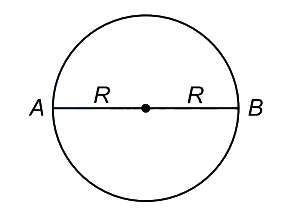
An athlete completes one round of a circular track of radius $R$ in $40 \ s$. What will be his displacement at the end of $2 \ min \ 20 \ s$?
A
$7 R$
B
$2 R$
C
$2 \pi R$
D
$7 \pi R$
Solution
(B) The total time is $2 \ min \ 20 \ s = 2 \times 60 \ s + 20 \ s = 140 \ s$.
In $40 \ s$,the athlete completes $1$ round.
In $140 \ s$,the number of rounds completed is $\frac{140}{40} = 3.5$ rounds.
After $3$ complete rounds,the athlete returns to the starting point,so the displacement is $0$.
After the remaining $0.5$ round,the athlete reaches the diametrically opposite point of the starting position.
The displacement is equal to the diameter of the circular track,which is $2 R$.
In $40 \ s$,the athlete completes $1$ round.
In $140 \ s$,the number of rounds completed is $\frac{140}{40} = 3.5$ rounds.
After $3$ complete rounds,the athlete returns to the starting point,so the displacement is $0$.
After the remaining $0.5$ round,the athlete reaches the diametrically opposite point of the starting position.
The displacement is equal to the diameter of the circular track,which is $2 R$.
0 likesView Solution
47
ChemistryMCQTS EAMCET · 2010
The displacements of two particles of same mass executing $SHM$ are represented by the equations $x_1 = 4 \sin \left(10 t + \frac{\pi}{6}\right)$ and $x_2 = 5 \cos (\omega t)$. The value of $\omega$ for which the energies of both the particles remain same is (in $text{ unit}$)
A
$16$
B
$6$
C
$4$
D
$8$
Solution
(D) The total energy of a particle executing $SHM$ is given by $E = \frac{1}{2} m \omega^2 A^2$,where $m$ is the mass,$\omega$ is the angular frequency,and $A$ is the amplitude.
For the first particle,$x_1 = 4 \sin \left(10 t + \frac{\pi}{6}\right)$,the angular frequency $\omega_1 = 10 \text{ rad/s}$ and amplitude $A_1 = 4 \text{ units}$.
Thus,$E_1 = \frac{1}{2} m (10)^2 (4)^2 = \frac{1}{2} m (100)(16) = 800m$.
For the second particle,$x_2 = 5 \cos (\omega t)$,the angular frequency is $\omega$ and amplitude $A_2 = 5 \text{ units}$.
Thus,$E_2 = \frac{1}{2} m \omega^2 (5)^2 = \frac{25}{2} m \omega^2$.
Given that the energies are equal,$E_1 = E_2$.
$800m = \frac{25}{2} m \omega^2$.
$1600 = 25 \omega^2$.
$\omega^2 = \frac{1600}{25} = 64$.
$\omega = 8 \text{ units}$.
For the first particle,$x_1 = 4 \sin \left(10 t + \frac{\pi}{6}\right)$,the angular frequency $\omega_1 = 10 \text{ rad/s}$ and amplitude $A_1 = 4 \text{ units}$.
Thus,$E_1 = \frac{1}{2} m (10)^2 (4)^2 = \frac{1}{2} m (100)(16) = 800m$.
For the second particle,$x_2 = 5 \cos (\omega t)$,the angular frequency is $\omega$ and amplitude $A_2 = 5 \text{ units}$.
Thus,$E_2 = \frac{1}{2} m \omega^2 (5)^2 = \frac{25}{2} m \omega^2$.
Given that the energies are equal,$E_1 = E_2$.
$800m = \frac{25}{2} m \omega^2$.
$1600 = 25 \omega^2$.
$\omega^2 = \frac{1600}{25} = 64$.
$\omega = 8 \text{ units}$.
0 likesView Solution
48
ChemistryMCQTS EAMCET · 2010
Diborane reacts with ammonia under different conditions to give a variety of products. Which one among the following is not formed in these reactions?
A
$B_2H_6 \cdot 2NH_3$
B
$B_{12}H_{12}$
C
$B_3N_3H_6$
D
$(BN)_n$
Solution
(B) Diborane reacts with ammonia to give different products under different reaction conditions:
$1$. At low temperature: $B_2H_6 + 2NH_3 \rightarrow B_2H_6 \cdot 2NH_3$ (ionic salt $[BH_2(NH_3)_2]^+[BH_4]^-$).
$2$. At high temperature: $3B_2H_6 + 6NH_3 \rightarrow 2B_3N_3H_6$ (Borazine,also known as inorganic benzene).
$3$. At very high temperature: $B_2H_6 + 2NH_3 \rightarrow 2(BN)_n + 6H_2$ (Boron nitride,which resembles graphite).
Therefore,$B_{12}H_{12}$ is not formed in the reaction between diborane and ammonia.
$1$. At low temperature: $B_2H_6 + 2NH_3 \rightarrow B_2H_6 \cdot 2NH_3$ (ionic salt $[BH_2(NH_3)_2]^+[BH_4]^-$).
$2$. At high temperature: $3B_2H_6 + 6NH_3 \rightarrow 2B_3N_3H_6$ (Borazine,also known as inorganic benzene).
$3$. At very high temperature: $B_2H_6 + 2NH_3 \rightarrow 2(BN)_n + 6H_2$ (Boron nitride,which resembles graphite).
Therefore,$B_{12}H_{12}$ is not formed in the reaction between diborane and ammonia.
0 likesView Solution
49
ChemistryMCQTS EAMCET · 2010
The oxide of nitrogen formed by thermal decomposition of $NH_4NO_3$ is
A
$NO$
B
$N_2O$
C
$N_2O_5$
D
$NO_2$
Solution
(B) The thermal decomposition of ammonium nitrate $(NH_4NO_3)$ at $250^{\circ}C$ yields nitrous oxide $(N_2O)$,also known as laughing gas,and water vapor.
The balanced chemical equation is:
$NH_4NO_3 \xrightarrow{\Delta, 250^{\circ}C} N_2O + 2H_2O$
The balanced chemical equation is:
$NH_4NO_3 \xrightarrow{\Delta, 250^{\circ}C} N_2O + 2H_2O$
0 likesView Solution
50
ChemistryMCQTS EAMCET · 2010
Helium mixed with oxygen is used in the treatment of
A
beri beri
B
burning feet
C
joints burning
D
asthma
Solution
(D) mixture of helium and oxygen is used in the treatment of asthma.
Because helium has a low density,this mixture flows easily through restricted respiratory passages,making it easier for patients to breathe.
Because helium has a low density,this mixture flows easily through restricted respiratory passages,making it easier for patients to breathe.
0 likesView Solution
51
ChemistryMediumMCQTS EAMCET · 2010
The conversion of $O$-acylated phenol in the presence of $AlCl_3$ to $C$-acylated phenol is an example of which type of organic reaction?
A
addition reaction
B
substitution reaction
C
molecular rearrangement
D
elimination reaction
Solution
(C) The conversion of $O$-acylated phenol to $C$-acylated phenol in the presence of a Lewis acid like $AlCl_3$ is known as the Fries rearrangement.
In this reaction,the acyl group $(RCO-)$ migrates from the oxygen atom of the phenolic ester to the ortho or para position of the benzene ring.
Since the atoms or groups within the same molecule rearrange to form a new isomer,this process is classified as a molecular rearrangement reaction.
In this reaction,the acyl group $(RCO-)$ migrates from the oxygen atom of the phenolic ester to the ortho or para position of the benzene ring.
Since the atoms or groups within the same molecule rearrange to form a new isomer,this process is classified as a molecular rearrangement reaction.
0 likesView Solution
52
ChemistryDifficultMCQTS EAMCET · 2010
Identify the product $(A)$ of the following reaction:
$C_2H_5-O-C_2H_5 + CO \xrightarrow[500 \text{ atm}]{BF_3 / 150^{\circ}C} A$
$C_2H_5-O-C_2H_5 + CO \xrightarrow[500 \text{ atm}]{BF_3 / 150^{\circ}C} A$
A
ethyl alcohol
B
ethyl propionate
C
ethanoic acid
D
ethyl acetate
Solution
(B) The reaction of diethyl ether with carbon monoxide in the presence of a Lewis acid catalyst like $BF_3$ at high pressure and temperature is a carbonylation reaction.
$C_2H_5-O-C_2H_5 + CO \xrightarrow[500 \text{ atm}]{BF_3 / 150^{\circ}C} C_2H_5COOC_2H_5$
The product $(A)$ formed is ethyl propionate.
$C_2H_5-O-C_2H_5 + CO \xrightarrow[500 \text{ atm}]{BF_3 / 150^{\circ}C} C_2H_5COOC_2H_5$
The product $(A)$ formed is ethyl propionate.
0 likesView Solution
53
ChemistryEasyMCQTS EAMCET · 2010
Which one of the following gives a yellow precipitate with iodine and $NaOH$ solution?
A
$CH_3CHO$
B
$C_6H_5COC_6H_5$
C
$HCHO$
D
$CH_3OH$
Solution
(A) Alcohols containing the $CH_3CH(OH)-$ group and carbonyl compounds containing the $CH_3CO-$ group give a yellow precipitate with iodine and $NaOH$ solution. This reaction is known as the iodoform test.
Thus,$CH_3CHO$ gives a yellow precipitate with $I_2$ and $NaOH$ due to the presence of the $CH_3CO-$ group.
The reaction is: $CH_3CHO + 3I_2 + 4NaOH \longrightarrow CHI_3 + HCOONa + 3NaI + 3H_2O$.
Thus,$CH_3CHO$ gives a yellow precipitate with $I_2$ and $NaOH$ due to the presence of the $CH_3CO-$ group.
The reaction is: $CH_3CHO + 3I_2 + 4NaOH \longrightarrow CHI_3 + HCOONa + 3NaI + 3H_2O$.
0 likesView Solution
54
ChemistryDifficultMCQTS EAMCET · 2010
Reduction of nitrobenzene with $Zn$ and alcoholic $KOH$ solution results in the formation of the following compound:
A
hydrazobenzene
B
azobenzene
C
aniline
D
phenyl hydroxyl amine
Solution
(A) The reduction of nitrobenzene $(C_6H_5NO_2)$ with $Zn$ dust and alcoholic $KOH$ is a specific chemical reaction that proceeds through several intermediates to finally yield hydrazobenzene $(C_6H_5NH-NHC_6H_5)$.
This reaction is a classic example of the reduction of nitro compounds in a basic medium.
This reaction is a classic example of the reduction of nitro compounds in a basic medium.
0 likesView Solution
55
ChemistryEasyMCQTS EAMCET · 2010
The $AT/GC$ ratio in human beings is (where $A = \text{adenine}$,$T = \text{thymine}$,$G = \text{guanine}$,$C = \text{cytosine}$)
A
$1$
B
$1.52$
C
$9.3$
D
$2$
Solution
(B) The base composition of human $DNA$ varies,but the average ratio of $(A+T)/(G+C)$ in human beings is approximately $1.52$.
0 likesView Solution
56
ChemistryMediumMCQTS EAMCET · 2010
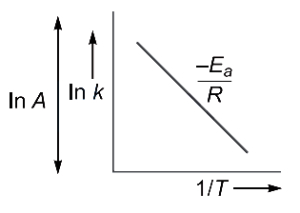
What is the slope of the straight line for the graph drawn between $\ln k$ and $\frac{1}{T}$,where $k$ is the rate constant of a reaction at temperature $T$?
A
$\frac{-E_a}{2.303 R}$
B
$\frac{-E_a}{R}$
C
$\frac{E_a}{R}$
D
$\frac{R}{E_a}$
Solution
(B) The Arrhenius equation is given by:
$k = A e^{-E_a / RT}$
Taking the natural logarithm on both sides:
$\ln k = \ln A - \frac{E_a}{RT}$
Rearranging this into the linear equation form $y = mx + c$:
$\ln k = -\frac{E_a}{R} \left( \frac{1}{T} \right) + \ln A$
Comparing this with $y = mx + c$,where $y = \ln k$,$x = \frac{1}{T}$,and $c = \ln A$,the slope $m$ is equal to $-\frac{E_a}{R}$.
$k = A e^{-E_a / RT}$
Taking the natural logarithm on both sides:
$\ln k = \ln A - \frac{E_a}{RT}$
Rearranging this into the linear equation form $y = mx + c$:
$\ln k = -\frac{E_a}{R} \left( \frac{1}{T} \right) + \ln A$
Comparing this with $y = mx + c$,where $y = \ln k$,$x = \frac{1}{T}$,and $c = \ln A$,the slope $m$ is equal to $-\frac{E_a}{R}$.
0 likesView Solution
57
ChemistryEasyMCQTS EAMCET · 2010
Identify the non-narcotic analgesic from the following:
A
diazepam
B
ibuprofen
C
formalin
D
terpineol
Solution
(B) Among the given drugs,$ibuprofen$ is a non-narcotic (i.e.,not habit-forming) analgesic.
Note: $Diazepam$ is a hypnotic and sedative drug.
$Formalin$ and $terpineol$ possess antiseptic properties.
Note: $Diazepam$ is a hypnotic and sedative drug.
$Formalin$ and $terpineol$ possess antiseptic properties.
0 likesView Solution
58
ChemistryMediumMCQTS EAMCET · 2010
Which of the following is a correct statement?
A
Aqueous solutions of $Cu^{+}$ and $Zn^{2+}$ are colourless
B
Aqueous solutions of $Cu^{2+}$ and $Zn^{2+}$ are colourless
C
Aqueous solution of $Fe^{3+}$ is green in colour
D
Aqueous solution of $MnO_4^{-}$ is colourless
Solution
(A) $Cu^{+} = [Ar] 3d^{10}$ (No unpaired electrons,so it is colourless).
$Zn^{2+} = [Ar] 3d^{10}$ (No unpaired electrons,so it is colourless).
Therefore,aqueous solutions of $Cu^{+}$ and $Zn^{2+}$ are colourless.
$Cu^{2+} = [Ar] 3d^9$ (One unpaired electron is present,so it is coloured).
$Fe^{3+}$ is yellow/brown in aqueous solution.
$MnO_4^{-}$ is purple due to charge transfer,despite having no unpaired electrons.
Thus,the statement in option $(A)$ is correct.
$Zn^{2+} = [Ar] 3d^{10}$ (No unpaired electrons,so it is colourless).
Therefore,aqueous solutions of $Cu^{+}$ and $Zn^{2+}$ are colourless.
$Cu^{2+} = [Ar] 3d^9$ (One unpaired electron is present,so it is coloured).
$Fe^{3+}$ is yellow/brown in aqueous solution.
$MnO_4^{-}$ is purple due to charge transfer,despite having no unpaired electrons.
Thus,the statement in option $(A)$ is correct.
0 likesView Solution
59
ChemistryEasyMCQTS EAMCET · 2010
At a certain temperature and at infinite dilution,the equivalent conductances of sodium benzoate,hydrochloric acid,and sodium chloride are $240$,$349$,and $229 \ \Omega^{-1} \ cm^2 \ equiv^{-1}$ respectively. The equivalent conductance of benzoic acid in $\Omega^{-1} \ cm^2 \ equiv^{-1}$ at the same conditions is
A
$80$
B
$328$
C
$360$
D
$408$
Solution
(C) According to Kohlrausch's law of independent migration of ions,the equivalent conductance at infinite dilution for benzoic acid $(C_6H_5COOH)$ can be calculated as follows:
$\wedge_{C_6H_5COOH}^{\infty} = \wedge_{C_6H_5COONa}^{\infty} + \wedge_{HCl}^{\infty} - \wedge_{NaCl}^{\infty}$
Given values:
$\wedge_{C_6H_5COONa}^{\infty} = 240 \ \Omega^{-1} \ cm^2 \ equiv^{-1}$
$\wedge_{HCl}^{\infty} = 349 \ \Omega^{-1} \ cm^2 \ equiv^{-1}$
$\wedge_{NaCl}^{\infty} = 229 \ \Omega^{-1} \ cm^2 \ equiv^{-1}$
Substituting the values:
$\wedge_{C_6H_5COOH}^{\infty} = 240 + 349 - 229$
$= 589 - 229$
$= 360 \ \Omega^{-1} \ cm^2 \ equiv^{-1}$
$\wedge_{C_6H_5COOH}^{\infty} = \wedge_{C_6H_5COONa}^{\infty} + \wedge_{HCl}^{\infty} - \wedge_{NaCl}^{\infty}$
Given values:
$\wedge_{C_6H_5COONa}^{\infty} = 240 \ \Omega^{-1} \ cm^2 \ equiv^{-1}$
$\wedge_{HCl}^{\infty} = 349 \ \Omega^{-1} \ cm^2 \ equiv^{-1}$
$\wedge_{NaCl}^{\infty} = 229 \ \Omega^{-1} \ cm^2 \ equiv^{-1}$
Substituting the values:
$\wedge_{C_6H_5COOH}^{\infty} = 240 + 349 - 229$
$= 589 - 229$
$= 360 \ \Omega^{-1} \ cm^2 \ equiv^{-1}$
0 likesView Solution
60
ChemistryEasyMCQTS EAMCET · 2010
$A$ solution of concentration $C \ g \ equiv/L$ has a specific resistance $R$. The equivalent conductance of the solution is
A
$\frac{R}{C}$
B
$\frac{C}{R}$
C
$\frac{1000}{R C}$
D
$\frac{1000 R}{C}$
Solution
(C) Equivalent conductivity,$\wedge_{eq} = \frac{\kappa \times 1000}{C}$,where $\kappa$ is specific conductance.
Since specific conductance $\kappa = \frac{1}{R}$ (where $R$ is specific resistance,often denoted as resistivity $\rho$ in some contexts,but here $R$ represents the specific resistance value).
Substituting the value of $\kappa$ into the formula:
$\wedge_{eq} = \frac{1}{R} \times \frac{1000}{C} = \frac{1000}{R C}$.
Since specific conductance $\kappa = \frac{1}{R}$ (where $R$ is specific resistance,often denoted as resistivity $\rho$ in some contexts,but here $R$ represents the specific resistance value).
Substituting the value of $\kappa$ into the formula:
$\wedge_{eq} = \frac{1}{R} \times \frac{1000}{C} = \frac{1000}{R C}$.
0 likesView Solution
61
ChemistryMediumMCQTS EAMCET · 2010
In which of the following,ortho/para substitution by an electrophile is very facile?
A
Nitrobenzene
B
Phenol
C
Benzoic acid
D
Acetophenone
Solution
(B) The $-OH$ group is an electron-donating group by resonance effect,which makes the benzene ring highly activated towards electrophilic substitution.
It is ortho/para directing in nature.
Therefore,ortho/para substitution in phenol by an electrophile is very facile compared to the other options,which contain electron-withdrawing groups.
It is ortho/para directing in nature.
Therefore,ortho/para substitution in phenol by an electrophile is very facile compared to the other options,which contain electron-withdrawing groups.
0 likesView Solution
62
ChemistryEasyMCQTS EAMCET · 2010
Which one of the following is the mineral for tin?
A
Galena
B
Cerussite
C
Cassiterite
D
Anglesite
Solution
(C) The minerals and their formulas are as follows:
From the table,it is clear that $SnO_2$ (Cassiterite) is the mineral for tin $(Sn)$.
Therefore,the correct option is $C$.
| Mineral | Formula |
|---|---|
| Galena | $PbS$ |
| Cerussite | $PbCO_3$ |
| Cassiterite | $SnO_2$ |
| Anglesite | $PbSO_4$ |
From the table,it is clear that $SnO_2$ (Cassiterite) is the mineral for tin $(Sn)$.
Therefore,the correct option is $C$.
0 likesView Solution
63
ChemistryMediumMCQTS EAMCET · 2010
The chemical reaction that involves the roasting process is:
A
$Fe_2O_3 + 3CO \longrightarrow 2Fe + 3CO_2$
B
$2Al + Fe_2O_3 \longrightarrow 2Fe + Al_2O_3$
C
$2ZnS + 3O_2 \longrightarrow 2ZnO + 2SO_2$
D
$FeO + SiO_2 \longrightarrow FeSiO_3$
Solution
(C) Roasting is a metallurgical process in which sulphide ores are heated in the presence of excess air to convert them into their corresponding metal oxides.
In the given options,the reaction $2ZnS + 3O_2 \longrightarrow 2ZnO + 2SO_2$ represents the roasting of zinc sulphide $(ZnS)$ ore to form zinc oxide $(ZnO)$.
In the given options,the reaction $2ZnS + 3O_2 \longrightarrow 2ZnO + 2SO_2$ represents the roasting of zinc sulphide $(ZnS)$ ore to form zinc oxide $(ZnO)$.
0 likesView Solution
64
ChemistryMediumMCQTS EAMCET · 2010
Identify $A, B$ and $C$ in the following reactions:
$CH_3 Cl$ $\xrightarrow{KCN} A$ $\xrightarrow{H_3 O^{\oplus}} B$ $\xrightarrow{C_2 H_5 OH / H^{+}, \Delta} C$
$CH_3 Cl$ $\xrightarrow{KCN} A$ $\xrightarrow{H_3 O^{\oplus}} B$ $\xrightarrow{C_2 H_5 OH / H^{+}, \Delta} C$
A
$A = CH_3 NC, B = CH_3 NHCH_3, C = CH_3 N(CH_3)C_2 H_5$
B
$A = CH_3 CN, B = CH_3 CONH_2, C = CH_3 CO_2 H$
C
$A = CH_3 CN, B = CH_3 CO_2 H, C = CH_3 CO_2 C_2 H_5$
D
$A = CH_3 CN, B = CH_3 CO_2 H, C = (CH_3 CO)_2 O$
Solution
(C) The reaction sequence is as follows:
$1$. $CH_3 Cl + KCN \rightarrow CH_3 CN (A) + KCl$. Here,$A$ is methyl cyanide (acetonitrile).
$2$. $CH_3 CN + 2H_2 O \xrightarrow{H_3 O^{\oplus}} CH_3 COOH (B) + NH_3$. Here,$B$ is ethanoic acid (acetic acid).
$3$. $CH_3 COOH + C_2 H_5 OH \xrightarrow{H^{+}} CH_3 COOC_2 H_5 (C) + H_2 O$. This is an esterification reaction,where $C$ is ethyl ethanoate (ethyl acetate).
Thus,the correct sequence is $A = CH_3 CN, B = CH_3 CO_2 H, C = CH_3 CO_2 C_2 H_5$.
$1$. $CH_3 Cl + KCN \rightarrow CH_3 CN (A) + KCl$. Here,$A$ is methyl cyanide (acetonitrile).
$2$. $CH_3 CN + 2H_2 O \xrightarrow{H_3 O^{\oplus}} CH_3 COOH (B) + NH_3$. Here,$B$ is ethanoic acid (acetic acid).
$3$. $CH_3 COOH + C_2 H_5 OH \xrightarrow{H^{+}} CH_3 COOC_2 H_5 (C) + H_2 O$. This is an esterification reaction,where $C$ is ethyl ethanoate (ethyl acetate).
Thus,the correct sequence is $A = CH_3 CN, B = CH_3 CO_2 H, C = CH_3 CO_2 C_2 H_5$.
0 likesView Solution
65
ChemistryMediumMCQTS EAMCET · 2010
Which one of the following is most acidic?
A
$H_2O$
B
$H_2S$
C
$H_2Te$
D
$H_2Se$
Solution
(C) As the size of the central atom increases (order of size $O < S < Se < Te$),the $H-A$ (where $A$ is the central atom) bond length increases.
Consequently,the $H-A$ bond dissociation energy decreases.
Therefore,$H_2Te$ releases a proton $(H^+)$ most readily,making it the most acidic among the given compounds.
The acidic strength order is $H_2O < H_2S < H_2Se < H_2Te$.
Consequently,the $H-A$ bond dissociation energy decreases.
Therefore,$H_2Te$ releases a proton $(H^+)$ most readily,making it the most acidic among the given compounds.
The acidic strength order is $H_2O < H_2S < H_2Se < H_2Te$.
0 likesView Solution
66
ChemistryEasyMCQTS EAMCET · 2010
The oxide of nitrogen formed by thermal decomposition of $NH_4NO_3$ is
A
$NO$
B
$N_2O$
C
$N_2O_5$
D
$NO_2$
Solution
(B) The thermal decomposition of ammonium nitrate $(NH_4NO_3)$ at $250^{\circ}C$ yields nitrous oxide $(N_2O)$ and water vapor.
$NH_4NO_3 \xrightarrow{\Delta, 250^{\circ}C} N_2O + 2H_2O$
Thus,the correct oxide formed is $N_2O$.
$NH_4NO_3 \xrightarrow{\Delta, 250^{\circ}C} N_2O + 2H_2O$
Thus,the correct oxide formed is $N_2O$.
0 likesView Solution
67
ChemistryMediumMCQTS EAMCET · 2010
If the number average molecular weight and weight average molecular weight of a polymer are $40000$ and $60000$ respectively,the polydispersity index of the polymer will be
A
$>1$
B
$ < 1$
C
$1$
D
zero
Solution
(A) The polydispersity index $(PDI)$ is defined as the ratio of weight average molecular weight to number average molecular weight.
$PDI = \frac{\bar{M}_w}{\bar{M}_n}$
Given:
$\bar{M}_w = 60000$
$\bar{M}_n = 40000$
$PDI = \frac{60000}{40000} = 1.5$
Since $1.5 > 1$,the polydispersity index of the polymer is $>1$.
$PDI = \frac{\bar{M}_w}{\bar{M}_n}$
Given:
$\bar{M}_w = 60000$
$\bar{M}_n = 40000$
$PDI = \frac{60000}{40000} = 1.5$
Since $1.5 > 1$,the polydispersity index of the polymer is $>1$.
0 likesView Solution
68
ChemistryEasyMCQTS EAMCET · 2010
Which one of the following is formed apart from sodium chloride when chlorine reacts with hot concentrated sodium hydroxide?
A
$NaOCl$
B
$NaClO_3$
C
$NaClO_2$
D
$NaClO_4$
Solution
(B) When chlorine gas reacts with hot and concentrated sodium hydroxide $(NaOH)$,it undergoes a disproportionation reaction to form sodium chloride $(NaCl)$ and sodium chlorate $(NaClO_3)$.
The balanced chemical equation is:
$3Cl_2 + 6NaOH \rightarrow 5NaCl + NaClO_3 + 3H_2O$
Therefore,apart from sodium chloride,sodium chlorate $(NaClO_3)$ is formed.
The balanced chemical equation is:
$3Cl_2 + 6NaOH \rightarrow 5NaCl + NaClO_3 + 3H_2O$
Therefore,apart from sodium chloride,sodium chlorate $(NaClO_3)$ is formed.
0 likesView Solution
69
ChemistryMediumMCQTS EAMCET · 2010
$Assertion (A)$: White tin is an example of a tetragonal system. $Reasoning (R)$: For a tetragonal system,$a=b=c$ and $\alpha=\beta=\gamma \neq 90^{\circ}$. The correct answer is
A
$A$ and $R$ are true and $R$ is the correct explanation of $A$.
B
Both $A$ and $R$ are true and $R$ is not the correct explanation of $A$.
C
$A$ is true but $R$ is not true.
D
$A$ is not true but $R$ is true.
Solution
(C) White tin,an allotropic form of tin,is an example of a tetragonal system.
For a tetragonal system,the unit cell parameters are defined as $a=b \neq c$ and $\alpha=\beta=\gamma=90^{\circ}$.
The given reasoning states $a=b=c$ and $\alpha=\beta=\gamma \neq 90^{\circ}$,which describes a rhombohedral system,not a tetragonal one.
Therefore,$Assertion (A)$ is true but $Reasoning (R)$ is false.
For a tetragonal system,the unit cell parameters are defined as $a=b \neq c$ and $\alpha=\beta=\gamma=90^{\circ}$.
The given reasoning states $a=b=c$ and $\alpha=\beta=\gamma \neq 90^{\circ}$,which describes a rhombohedral system,not a tetragonal one.
Therefore,$Assertion (A)$ is true but $Reasoning (R)$ is false.
0 likesView Solution
70
ChemistryMediumMCQTS EAMCET · 2010
The ratio of anion radius to cation radius of a crystal is $10 : 9.3$. Then,the coordination number of the cation in the crystal is
A
$2$
B
$4$
C
$6$
D
$8$
Solution
(D) Given,the radius ratio of anion to cation $= 10 : 9.3$.
$\therefore$ The radius ratio of cation to anion $= \frac{9.3}{10} = 0.93$.
When the radius ratio of cation to anion lies between $0.732$ and $1.00$,the coordination number is $8$.
Thus,the coordination number of the cation in the crystal is $8$.
$\therefore$ The radius ratio of cation to anion $= \frac{9.3}{10} = 0.93$.
When the radius ratio of cation to anion lies between $0.732$ and $1.00$,the coordination number is $8$.
Thus,the coordination number of the cation in the crystal is $8$.
0 likesView Solution
71
ChemistryMediumMCQTS EAMCET · 2010
$X$ is a non-volatile solute and $Y$ is a volatile solvent. The following vapour pressures are observed by dissolving $X$ in $Y$ at different concentrations:
| $X / \text{mol L}^{-1}$ | $Y / \text{mm of Hg}$ |
| :--- | :--- |
| $0.10$ | $p_1$ |
| $0.25$ | $p_2$ |
| $0.01$ | $p_3$ |
The correct order of vapour pressures is:
| $X / \text{mol L}^{-1}$ | $Y / \text{mm of Hg}$ |
| :--- | :--- |
| $0.10$ | $p_1$ |
| $0.25$ | $p_2$ |
| $0.01$ | $p_3$ |
The correct order of vapour pressures is:
A
$p_1 < p_2 < p_3$
B
$p_3 < p_2 < p_1$
C
$p_3 < p_1 < p_2$
D
$p_2 < p_1 < p_3$
Solution
(D) When a non-volatile solute is added to a volatile solvent,the solute particles occupy some of the surface area of the solvent.
This reduces the number of solvent molecules available at the surface for vaporization,leading to a decrease in vapour pressure.
As the concentration of the non-volatile solute increases,the vapour pressure of the solution decreases.
Given the concentrations of $X$ as $0.01 < 0.10 < 0.25$,the corresponding vapour pressures follow the order $p_3 > p_1 > p_2$.
Thus,the correct order is $p_2 < p_1 < p_3$.
This reduces the number of solvent molecules available at the surface for vaporization,leading to a decrease in vapour pressure.
As the concentration of the non-volatile solute increases,the vapour pressure of the solution decreases.
Given the concentrations of $X$ as $0.01 < 0.10 < 0.25$,the corresponding vapour pressures follow the order $p_3 > p_1 > p_2$.
Thus,the correct order is $p_2 < p_1 < p_3$.
0 likesView Solution
72
ChemistryEasyMCQTS EAMCET · 2010
If $BaCl_2$ ionizes to an extent of $80 \%$ in aqueous solution,the value of van't Hoff factor is
A
$2.6$
B
$0.4$
C
$0.8$
D
$2.4$
Solution
(A) The dissociation reaction for $BaCl_2$ is: $BaCl_{2(aq)} \rightarrow Ba^{2+}_{(aq)} + 2Cl^-_{(aq)}$
Initially,we have $1$ mole of $BaCl_2$.
Given the degree of dissociation $\alpha = 80\% = 0.8$.
At equilibrium,the moles are:
$BaCl_2 = 1 - \alpha = 1 - 0.8 = 0.2$
$Ba^{2+} = \alpha = 0.8$
$Cl^- = 2\alpha = 2 \times 0.8 = 1.6$
Total moles at equilibrium = $0.2 + 0.8 + 1.6 = 2.6$
The van't Hoff factor $i$ is defined as the ratio of total moles after dissociation to the initial moles:
$i = \frac{2.6}{1} = 2.6$
Initially,we have $1$ mole of $BaCl_2$.
Given the degree of dissociation $\alpha = 80\% = 0.8$.
At equilibrium,the moles are:
$BaCl_2 = 1 - \alpha = 1 - 0.8 = 0.2$
$Ba^{2+} = \alpha = 0.8$
$Cl^- = 2\alpha = 2 \times 0.8 = 1.6$
Total moles at equilibrium = $0.2 + 0.8 + 1.6 = 2.6$
The van't Hoff factor $i$ is defined as the ratio of total moles after dissociation to the initial moles:
$i = \frac{2.6}{1} = 2.6$
0 likesView Solution
73
ChemistryEasyMCQTS EAMCET · 2010
$A$ micelle formed during the cleansing action by soap is
A
$a$ discrete particle of soap
B
aggregated particles of soap and dirt
C
$a$ discrete particle of dust
D
an aggregated particle of dust and water
Solution
(B) Soap molecules contain a hydrophobic (water-repelling) tail and a hydrophilic (water-attracting) head.
When soap is added to water,the hydrophobic tails dissolve in the grease or dirt particles,while the hydrophilic heads remain in the water.
This arrangement results in the formation of spherical clusters known as micelles.
Thus,a micelle is an aggregate of soap molecules surrounding a dirt or grease particle.
When soap is added to water,the hydrophobic tails dissolve in the grease or dirt particles,while the hydrophilic heads remain in the water.
This arrangement results in the formation of spherical clusters known as micelles.
Thus,a micelle is an aggregate of soap molecules surrounding a dirt or grease particle.
0 likesView Solution
Vedclass Products
For Students
Vedclass Test Series
Mock tests in real TS EAMCET style covering Chemistry with performance analysis. 5-day free trial.
Start Free TrialFor Teachers
Exam Paper Generator
Generate Set A/B/C/D Chemistry papers from 7.5L+ questions in 2 minutes. 3 chapters free.
Try FreeFor Institutes
Online Exam Module
Run live TS EAMCET mock exams with unlimited students, 360° analytics & white-label branding.
See DemoFrequently Asked Questions
How many Chemistry questions are in TS EAMCET 2010?
There are 185 Chemistry questions from the TS EAMCET 2010 paper on Vedclass, each with a detailed step-by-step solution in English.
Are TS EAMCET 2010 Chemistry solutions available in English?
Yes. All solutions on this page are in English. You can also switch to English or Hindi using the language buttons above the questions.
Can I practice TS EAMCET 2010 Chemistry as a timed test?
Yes. Use the Vedclass Test Series to attempt a full TS EAMCET mock test covering Chemistry with time limits and instant score analysis.
Can teachers create Chemistry papers from TS EAMCET previous year questions?
Yes. The Vedclass Exam Paper Generator lets teachers mix TS EAMCET Chemistry questions and generate Set A/B/C/D papers in minutes.
For Teachers & Institutes
Build a Custom Chemistry Paper
Pick TS EAMCET 2010 Chemistry questions, set difficulty, and generate Set A/B/C/D in 2 minutes.