
ChemistryQ51–100 of 185 questions
Page 2 of 4 · English
51
ChemistryMCQTS EAMCET · 2010
$A$ polygon has $54$ diagonals. Then,the number of its sides is
A
$7$
B
$9$
C
$10$
D
$12$
Solution
(D) The number of diagonals in a polygon with $n$ sides is given by the formula $\frac{n(n-3)}{2}$.
Given that the number of diagonals is $54$,we have:
$\frac{n(n-3)}{2} = 54$
$n(n-3) = 108$
$n^2 - 3n - 108 = 0$
Factoring the quadratic equation:
$n^2 - 12n + 9n - 108 = 0$
$n(n - 12) + 9(n - 12) = 0$
$(n + 9)(n - 12) = 0$
Since the number of sides $n$ must be positive,we have $n = 12$.
Therefore,the number of sides in the polygon is $12$.
Given that the number of diagonals is $54$,we have:
$\frac{n(n-3)}{2} = 54$
$n(n-3) = 108$
$n^2 - 3n - 108 = 0$
Factoring the quadratic equation:
$n^2 - 12n + 9n - 108 = 0$
$n(n - 12) + 9(n - 12) = 0$
$(n + 9)(n - 12) = 0$
Since the number of sides $n$ must be positive,we have $n = 12$.
Therefore,the number of sides in the polygon is $12$.
0 likesView Solution
52
ChemistryMCQTS EAMCET · 2010
The period of $\left(\tan \theta - \frac{1}{3} \tan^3 \theta\right) \left(\frac{1}{3} - \tan^2 \theta\right)^{-1}$,where $\tan^2 \theta \neq \frac{1}{3}$,is
A
$\frac{\pi}{3}$
B
$\frac{2 \pi}{3}$
C
$\pi$
D
$2 \pi$
Solution
(A) Let $f(\theta) = \left(\tan \theta - \frac{1}{3} \tan^3 \theta\right) \left(\frac{1}{3} - \tan^2 \theta\right)^{-1}$.
Given $\tan^2 \theta \neq \frac{1}{3}$,we can rewrite the expression as:
$f(\theta) = \frac{\tan \theta - \frac{1}{3} \tan^3 \theta}{\frac{1}{3} - \tan^2 \theta} = \frac{\frac{3 \tan \theta - \tan^3 \theta}{3}}{\frac{1 - 3 \tan^2 \theta}{3}} = \frac{3 \tan \theta - \tan^3 \theta}{1 - 3 \tan^2 \theta}$.
Using the identity $\tan(3\theta) = \frac{3 \tan \theta - \tan^3 \theta}{1 - 3 \tan^2 \theta}$,we get $f(\theta) = \tan(3\theta)$.
The period of $\tan(x)$ is $\pi$. Therefore,the period of $\tan(3\theta)$ is $\frac{\pi}{3}$.
Given $\tan^2 \theta \neq \frac{1}{3}$,we can rewrite the expression as:
$f(\theta) = \frac{\tan \theta - \frac{1}{3} \tan^3 \theta}{\frac{1}{3} - \tan^2 \theta} = \frac{\frac{3 \tan \theta - \tan^3 \theta}{3}}{\frac{1 - 3 \tan^2 \theta}{3}} = \frac{3 \tan \theta - \tan^3 \theta}{1 - 3 \tan^2 \theta}$.
Using the identity $\tan(3\theta) = \frac{3 \tan \theta - \tan^3 \theta}{1 - 3 \tan^2 \theta}$,we get $f(\theta) = \tan(3\theta)$.
The period of $\tan(x)$ is $\pi$. Therefore,the period of $\tan(3\theta)$ is $\frac{\pi}{3}$.
0 likesView Solution
53
ChemistryMCQTS EAMCET · 2010
If $a \sin^2 \theta + b \cos^2 \theta = c$,then $\tan^2 \theta$ is equal to
A
$\frac{b-c}{a-c}$
B
$\frac{c-b}{a-c}$
C
$\frac{a-c}{b-c}$
D
$\frac{a-c}{c-b}$
Solution
(B) Given: $a \sin^2 \theta + b \cos^2 \theta = c$
Divide both sides by $\cos^2 \theta$:
$a \tan^2 \theta + b = c \sec^2 \theta$
Since $\sec^2 \theta = 1 + \tan^2 \theta$,we have:
$a \tan^2 \theta + b = c(1 + \tan^2 \theta)$
$a \tan^2 \theta + b = c + c \tan^2 \theta$
Rearranging the terms to isolate $\tan^2 \theta$:
$a \tan^2 \theta - c \tan^2 \theta = c - b$
$(a - c) \tan^2 \theta = c - b$
$\tan^2 \theta = \frac{c - b}{a - c}$
Divide both sides by $\cos^2 \theta$:
$a \tan^2 \theta + b = c \sec^2 \theta$
Since $\sec^2 \theta = 1 + \tan^2 \theta$,we have:
$a \tan^2 \theta + b = c(1 + \tan^2 \theta)$
$a \tan^2 \theta + b = c + c \tan^2 \theta$
Rearranging the terms to isolate $\tan^2 \theta$:
$a \tan^2 \theta - c \tan^2 \theta = c - b$
$(a - c) \tan^2 \theta = c - b$
$\tan^2 \theta = \frac{c - b}{a - c}$
0 likesView Solution
54
ChemistryMCQTS EAMCET · 2010
The set of solutions of the equation $(\sqrt{3}-1) \sin \theta+(\sqrt{3}+1) \cos \theta=2$ is
A
$\{2 n \pi \pm \frac{\pi}{4}+\frac{\pi}{12}: n \in Z\}$
B
$\{2 n \pi \pm \frac{\pi}{4}-\frac{\pi}{12}: n \in Z\}$
C
$\{n \pi+(-1)^n \frac{\pi}{4}+\frac{\pi}{12}: n \in Z\}$
D
$\{n \pi+(-1)^n \frac{\pi}{4}-\frac{\pi}{12}: n \in Z\}$
Solution
(A) Given equation: $(\sqrt{3}-1) \sin \theta+(\sqrt{3}+1) \cos \theta=2$
Divide by $2\sqrt{2}$ on both sides:
$\frac{\sqrt{3}-1}{2\sqrt{2}} \sin \theta + \frac{\sqrt{3}+1}{2\sqrt{2}} \cos \theta = \frac{2}{2\sqrt{2}} = \frac{1}{\sqrt{2}}$
We know that $\cos(15^{\circ}) = \cos(\frac{\pi}{12}) = \frac{\sqrt{3}+1}{2\sqrt{2}}$ and $\sin(15^{\circ}) = \sin(\frac{\pi}{12}) = \frac{\sqrt{3}-1}{2\sqrt{2}}$.
Substituting these values,we get:
$\sin(\frac{\pi}{12}) \sin \theta + \cos(\frac{\pi}{12}) \cos \theta = \frac{1}{\sqrt{2}}$
Using the identity $\cos(A-B) = \cos A \cos B + \sin A \sin B$:
$\cos(\theta - \frac{\pi}{12}) = \cos(\frac{\pi}{4})$
The general solution for $\cos x = \cos \alpha$ is $x = 2n\pi \pm \alpha$.
Therefore,$\theta - \frac{\pi}{12} = 2n\pi \pm \frac{\pi}{4}$
$\theta = 2n\pi \pm \frac{\pi}{4} + \frac{\pi}{12}$,where $n \in Z$.
Divide by $2\sqrt{2}$ on both sides:
$\frac{\sqrt{3}-1}{2\sqrt{2}} \sin \theta + \frac{\sqrt{3}+1}{2\sqrt{2}} \cos \theta = \frac{2}{2\sqrt{2}} = \frac{1}{\sqrt{2}}$
We know that $\cos(15^{\circ}) = \cos(\frac{\pi}{12}) = \frac{\sqrt{3}+1}{2\sqrt{2}}$ and $\sin(15^{\circ}) = \sin(\frac{\pi}{12}) = \frac{\sqrt{3}-1}{2\sqrt{2}}$.
Substituting these values,we get:
$\sin(\frac{\pi}{12}) \sin \theta + \cos(\frac{\pi}{12}) \cos \theta = \frac{1}{\sqrt{2}}$
Using the identity $\cos(A-B) = \cos A \cos B + \sin A \sin B$:
$\cos(\theta - \frac{\pi}{12}) = \cos(\frac{\pi}{4})$
The general solution for $\cos x = \cos \alpha$ is $x = 2n\pi \pm \alpha$.
Therefore,$\theta - \frac{\pi}{12} = 2n\pi \pm \frac{\pi}{4}$
$\theta = 2n\pi \pm \frac{\pi}{4} + \frac{\pi}{12}$,where $n \in Z$.
0 likesView Solution
55
ChemistryMCQTS EAMCET · 2010
The equation of the circle concentric with the circle $x^2+y^2-6x+12y+15=0$ and having double its area is
A
$x^2+y^2-6x+12y-15=0$
B
$x^2+y^2-6x+12y-30=0$
C
$x^2+y^2-6x+12y-25=0$
D
$x^2+y^2-6x+12y-20=0$
Solution
(A) The given circle is $x^2+y^2-6x+12y+15=0$.
Comparing with $x^2+y^2+2gx+2fy+c=0$,we get $g=-3$,$f=6$,and $c=15$.
The radius $r_1$ is $\sqrt{g^2+f^2-c} = \sqrt{(-3)^2+6^2-15} = \sqrt{9+36-15} = \sqrt{30}$.
The area of this circle is $A_1 = \pi r_1^2 = 30\pi$.
Let the concentric circle be $x^2+y^2-6x+12y+k=0$.
Its radius $r_2$ satisfies $r_2^2 = g^2+f^2-k = 45-k$.
The area of the new circle is $A_2 = \pi r_2^2 = \pi(45-k)$.
Given $A_2 = 2A_1$,we have $\pi(45-k) = 2(30\pi) = 60\pi$.
Thus,$45-k = 60$,which gives $k = -15$.
The equation of the circle is $x^2+y^2-6x+12y-15=0$.
Comparing with $x^2+y^2+2gx+2fy+c=0$,we get $g=-3$,$f=6$,and $c=15$.
The radius $r_1$ is $\sqrt{g^2+f^2-c} = \sqrt{(-3)^2+6^2-15} = \sqrt{9+36-15} = \sqrt{30}$.
The area of this circle is $A_1 = \pi r_1^2 = 30\pi$.
Let the concentric circle be $x^2+y^2-6x+12y+k=0$.
Its radius $r_2$ satisfies $r_2^2 = g^2+f^2-k = 45-k$.
The area of the new circle is $A_2 = \pi r_2^2 = \pi(45-k)$.
Given $A_2 = 2A_1$,we have $\pi(45-k) = 2(30\pi) = 60\pi$.
Thus,$45-k = 60$,which gives $k = -15$.
The equation of the circle is $x^2+y^2-6x+12y-15=0$.
0 likesView Solution
56
ChemistryMCQTS EAMCET · 2010
The length of the common chord of the circles of radii $15$ and $20$,whose centers are $25$ units of distance apart,is
A
$12$
B
$16$
C
$24$
D
$25$
Solution
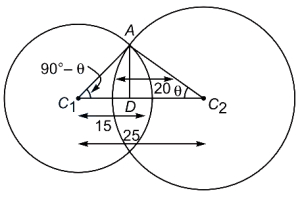
(C) Given,$r_1 = 15$ units,$r_2 = 20$ units,and the distance between centers $C_1 C_2 = 25$ units.
Note that $r_1^2 + r_2^2 = 15^2 + 20^2 = 225 + 400 = 625 = 25^2 = (C_1 C_2)^2$.
Since the sum of the squares of the radii equals the square of the distance between the centers,the triangle $\triangle A C_1 C_2$ is a right-angled triangle with $\angle C_1 A C_2 = 90^\circ$.
The common chord $AB$ is perpendicular to the line joining the centers $C_1 C_2$ at point $D$.
In $\triangle A C_1 C_2$,the altitude $AD$ to the hypotenuse $C_1 C_2$ is given by $AD = \frac{r_1 \times r_2}{C_1 C_2}$.
$AD = \frac{15 \times 20}{25} = \frac{300}{25} = 12$ units.
The length of the common chord is $2 \times AD = 2 \times 12 = 24$ units.
Note that $r_1^2 + r_2^2 = 15^2 + 20^2 = 225 + 400 = 625 = 25^2 = (C_1 C_2)^2$.
Since the sum of the squares of the radii equals the square of the distance between the centers,the triangle $\triangle A C_1 C_2$ is a right-angled triangle with $\angle C_1 A C_2 = 90^\circ$.
The common chord $AB$ is perpendicular to the line joining the centers $C_1 C_2$ at point $D$.
In $\triangle A C_1 C_2$,the altitude $AD$ to the hypotenuse $C_1 C_2$ is given by $AD = \frac{r_1 \times r_2}{C_1 C_2}$.
$AD = \frac{15 \times 20}{25} = \frac{300}{25} = 12$ units.
The length of the common chord is $2 \times AD = 2 \times 12 = 24$ units.
0 likesView Solution
57
ChemistryMCQTS EAMCET · 2010
If the circle $x^2+y^2+2x+3y+1=0$ cuts another circle $x^2+y^2+4x+3y+2=0$ at points $A$ and $B$,then the equation of the circle with $AB$ as a diameter is
A
$x^2+y^2+x+3y+3=0$
B
$2x^2+2y^2+2x+6y+1=0$
C
$x^2+y^2+x+6y+1=0$
D
$2x^2+2y^2+x+3y+1=0$
Solution
(B) The equations of the circles are $S_1 \equiv x^2+y^2+2x+3y+1=0$ and $S_2 \equiv x^2+y^2+4x+3y+2=0$.
Since the circles intersect at $A$ and $B$,the equation of the common chord $AB$ is given by $S_1 - S_2 = 0$.
$(x^2+y^2+2x+3y+1) - (x^2+y^2+4x+3y+2) = 0$
$-2x - 1 = 0 \Rightarrow x = -\frac{1}{2}$.
The family of circles passing through the intersection of $S_1$ and $S_2$ is $S_1 + \lambda(S_1 - S_2) = 0$.
However,the circle with $AB$ as diameter is given by $S_1 + k(S_1 - S_2) = 0$ where the coefficient of $x^2$ and $y^2$ is $1$.
Alternatively,using the property that the circle with diameter $AB$ is $S_1 + k(S_1 - S_2) = 0$,we find the equation.
Substituting $x = -\frac{1}{2}$ into $S_1$: $\frac{1}{4} + y^2 - 1 + 3y + 1 = 0 \Rightarrow y^2 + 3y + \frac{1}{4} = 0$.
The circle with diameter $AB$ has the equation $S_1 + k(S_1 - S_2) = 0$.
$x^2+y^2+2x+3y+1 + k(2x+1) = 0$.
Since the center of this circle must lie on the line $x = -\frac{1}{2}$,we have $x + \frac{k}{1} = -\frac{1}{2}$ $\Rightarrow -1 + k = -\frac{1}{2}$ $\Rightarrow k = \frac{1}{2}$.
Substituting $k = \frac{1}{2}$: $x^2+y^2+2x+3y+1 + \frac{1}{2}(2x+1) = 0$.
$x^2+y^2+2x+3y+1 + x + \frac{1}{2} = 0 \Rightarrow x^2+y^2+3x+3y+\frac{3}{2} = 0$.
Multiplying by $2$: $2x^2+2y^2+2x+6y+1 = 0$.
Since the circles intersect at $A$ and $B$,the equation of the common chord $AB$ is given by $S_1 - S_2 = 0$.
$(x^2+y^2+2x+3y+1) - (x^2+y^2+4x+3y+2) = 0$
$-2x - 1 = 0 \Rightarrow x = -\frac{1}{2}$.
The family of circles passing through the intersection of $S_1$ and $S_2$ is $S_1 + \lambda(S_1 - S_2) = 0$.
However,the circle with $AB$ as diameter is given by $S_1 + k(S_1 - S_2) = 0$ where the coefficient of $x^2$ and $y^2$ is $1$.
Alternatively,using the property that the circle with diameter $AB$ is $S_1 + k(S_1 - S_2) = 0$,we find the equation.
Substituting $x = -\frac{1}{2}$ into $S_1$: $\frac{1}{4} + y^2 - 1 + 3y + 1 = 0 \Rightarrow y^2 + 3y + \frac{1}{4} = 0$.
The circle with diameter $AB$ has the equation $S_1 + k(S_1 - S_2) = 0$.
$x^2+y^2+2x+3y+1 + k(2x+1) = 0$.
Since the center of this circle must lie on the line $x = -\frac{1}{2}$,we have $x + \frac{k}{1} = -\frac{1}{2}$ $\Rightarrow -1 + k = -\frac{1}{2}$ $\Rightarrow k = \frac{1}{2}$.
Substituting $k = \frac{1}{2}$: $x^2+y^2+2x+3y+1 + \frac{1}{2}(2x+1) = 0$.
$x^2+y^2+2x+3y+1 + x + \frac{1}{2} = 0 \Rightarrow x^2+y^2+3x+3y+\frac{3}{2} = 0$.
Multiplying by $2$: $2x^2+2y^2+2x+6y+1 = 0$.
0 likesView Solution
58
ChemistryMCQTS EAMCET · 2010
The equation of the radical axis of the pair of circles $7x^2+7y^2-7x+14y+18=0$ and $4x^2+4y^2-7x+8y+20=0$ is
A
$x-2y-5=0$
B
$2x-y+5=0$
C
$21x-68=0$
D
$23x-68=0$
Solution
(C) The radical axis of two circles $S_1=0$ and $S_2=0$ is given by $S_1-S_2=0$.
First,normalize the equations so the coefficients of $x^2$ and $y^2$ are $1$.
For $S_1: x^2+y^2-x+2y+\frac{18}{7}=0$
For $S_2: x^2+y^2-\frac{7}{4}x+2y+5=0$
Subtracting $S_2$ from $S_1$:
$(x^2+y^2-x+2y+\frac{18}{7}) - (x^2+y^2-\frac{7}{4}x+2y+5) = 0$
$-x + \frac{7}{4}x + \frac{18}{7} - 5 = 0$
$\frac{3}{4}x + \frac{18-35}{7} = 0$
$\frac{3}{4}x - \frac{17}{7} = 0$
Multiplying by $28$:
$21x - 68 = 0$
First,normalize the equations so the coefficients of $x^2$ and $y^2$ are $1$.
For $S_1: x^2+y^2-x+2y+\frac{18}{7}=0$
For $S_2: x^2+y^2-\frac{7}{4}x+2y+5=0$
Subtracting $S_2$ from $S_1$:
$(x^2+y^2-x+2y+\frac{18}{7}) - (x^2+y^2-\frac{7}{4}x+2y+5) = 0$
$-x + \frac{7}{4}x + \frac{18}{7} - 5 = 0$
$\frac{3}{4}x + \frac{18-35}{7} = 0$
$\frac{3}{4}x - \frac{17}{7} = 0$
Multiplying by $28$:
$21x - 68 = 0$
0 likesView Solution
59
ChemistryMCQTS EAMCET · 2010
Find the equation of the parabola whose axis is parallel to the $y$-axis and which passes through the points $(0, 4), (1, 9),$ and $(4, 5)$.
A
$y = -x^2 + x + 4$
B
$y = -x^2 + x + 1$
C
$y = -\frac{19}{12}x^2 + \frac{79}{12}x + 4$
D
$y = -\frac{19}{12}x^2 + \frac{89}{12}x + 1$
Solution
(C) The general equation of a parabola with its axis parallel to the $y$-axis is given by $y = Ax^2 + Bx + C$ ...$(i)$
Since the parabola passes through the points $(0, 4), (1, 9),$ and $(4, 5)$,these points must satisfy the equation.
Substituting $(0, 4)$ in $(i)$: $4 = A(0)^2 + B(0) + C \Rightarrow C = 4$ ...(ii)
Substituting $(1, 9)$ in $(i)$: $9 = A(1)^2 + B(1) + 4 \Rightarrow A + B = 5$ ...(iii)
Substituting $(4, 5)$ in $(i)$: $5 = A(4)^2 + B(4) + 4 \Rightarrow 16A + 4B = 1$ ...(iv)
Dividing (iv) by $4$,we get $4A + B = 0.25$ or $4A + B = \frac{1}{4}$ ...$(v)$
Subtracting (iii) from $(v)$: $(4A + B) - (A + B) = \frac{1}{4} - 5$ $\Rightarrow 3A = -\frac{19}{4}$ $\Rightarrow A = -\frac{19}{12}$
Substituting $A$ in (iii): $-\frac{19}{12} + B = 5 \Rightarrow B = 5 + \frac{19}{12} = \frac{79}{12}$
Thus,the equation is $y = -\frac{19}{12}x^2 + \frac{79}{12}x + 4$.
Since the parabola passes through the points $(0, 4), (1, 9),$ and $(4, 5)$,these points must satisfy the equation.
Substituting $(0, 4)$ in $(i)$: $4 = A(0)^2 + B(0) + C \Rightarrow C = 4$ ...(ii)
Substituting $(1, 9)$ in $(i)$: $9 = A(1)^2 + B(1) + 4 \Rightarrow A + B = 5$ ...(iii)
Substituting $(4, 5)$ in $(i)$: $5 = A(4)^2 + B(4) + 4 \Rightarrow 16A + 4B = 1$ ...(iv)
Dividing (iv) by $4$,we get $4A + B = 0.25$ or $4A + B = \frac{1}{4}$ ...$(v)$
Subtracting (iii) from $(v)$: $(4A + B) - (A + B) = \frac{1}{4} - 5$ $\Rightarrow 3A = -\frac{19}{4}$ $\Rightarrow A = -\frac{19}{12}$
Substituting $A$ in (iii): $-\frac{19}{12} + B = 5 \Rightarrow B = 5 + \frac{19}{12} = \frac{79}{12}$
Thus,the equation is $y = -\frac{19}{12}x^2 + \frac{79}{12}x + 4$.
0 likesView Solution
60
ChemistryMCQTS EAMCET · 2010
Let $M$ be the foot of the perpendicular from a point $P$ on the parabola $y^2=8(x-3)$ onto its directrix and let $S$ be the focus of the parabola. If $\triangle SPM$ is an equilateral triangle,then $P$ is equal to
A
$(4 \sqrt{3}, 8)$
B
$(8, 4 \sqrt{3})$
C
$(9, 4 \sqrt{3})$
D
$(4 \sqrt{3}, 9)$
Solution
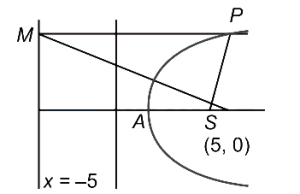
(C) The given parabola is $y^2 = 8(x-3)$. Comparing this with $(y-k)^2 = 4a(x-h)$,we get $h=3, k=0$,and $4a=8$,so $a=2$.
The focus $S$ is $(h+a, k) = (3+2, 0) = (5, 0)$.
The directrix is $x = h-a = 3-2 = 1$. Wait,the directrix is $x = h-a = 3-2 = 1$. Let's re-evaluate.
Actually,for $y^2 = 8(x-3)$,the vertex is $(3,0)$ and $a=2$. The directrix is $x = 3-2 = 1$.
Let $P$ be $(x, y)$. Since $P$ is on the parabola,$PS = PM$,where $PM$ is the distance to the directrix $x=1$.
$PS = PM = |x-1|$.
In an equilateral triangle $\triangle SPM$,all sides are equal. Thus $SP = PM = SM = |x-1|$.
Since $P$ is on the parabola,$SP = PM$ is always true by definition.
For $\triangle SPM$ to be equilateral,we must have $SP = SM$.
Let $P = (3+2t^2, 4t)$. Then $S = (5, 0)$.
$SP = \sqrt{(3+2t^2-5)^2 + (4t-0)^2} = \sqrt{(2t^2-2)^2 + 16t^2} = \sqrt{4t^4 - 8t^2 + 4 + 16t^2} = \sqrt{4t^4 + 8t^2 + 4} = \sqrt{4(t^2+1)^2} = 2(t^2+1)$.
The directrix is $x=1$. The foot of the perpendicular $M$ from $P(3+2t^2, 4t)$ to $x=1$ is $M(1, 4t)$.
$SM = \sqrt{(5-1)^2 + (0-4t)^2} = \sqrt{4^2 + 16t^2} = \sqrt{16 + 16t^2} = 4\sqrt{1+t^2}$.
Equating $SP = SM$:
$2(t^2+1) = 4\sqrt{1+t^2}$.
Squaring both sides: $4(t^2+1)^2 = 16(1+t^2)$.
$(t^2+1)^2 = 4(t^2+1)$.
Since $t^2+1 \neq 0$,we have $t^2+1 = 4$,so $t^2 = 3$,$t = \sqrt{3}$ (taking positive $y$ coordinate).
Then $P = (3+2(3), 4\sqrt{3}) = (9, 4\sqrt{3})$.
The focus $S$ is $(h+a, k) = (3+2, 0) = (5, 0)$.
The directrix is $x = h-a = 3-2 = 1$. Wait,the directrix is $x = h-a = 3-2 = 1$. Let's re-evaluate.
Actually,for $y^2 = 8(x-3)$,the vertex is $(3,0)$ and $a=2$. The directrix is $x = 3-2 = 1$.
Let $P$ be $(x, y)$. Since $P$ is on the parabola,$PS = PM$,where $PM$ is the distance to the directrix $x=1$.
$PS = PM = |x-1|$.
In an equilateral triangle $\triangle SPM$,all sides are equal. Thus $SP = PM = SM = |x-1|$.
Since $P$ is on the parabola,$SP = PM$ is always true by definition.
For $\triangle SPM$ to be equilateral,we must have $SP = SM$.
Let $P = (3+2t^2, 4t)$. Then $S = (5, 0)$.
$SP = \sqrt{(3+2t^2-5)^2 + (4t-0)^2} = \sqrt{(2t^2-2)^2 + 16t^2} = \sqrt{4t^4 - 8t^2 + 4 + 16t^2} = \sqrt{4t^4 + 8t^2 + 4} = \sqrt{4(t^2+1)^2} = 2(t^2+1)$.
The directrix is $x=1$. The foot of the perpendicular $M$ from $P(3+2t^2, 4t)$ to $x=1$ is $M(1, 4t)$.
$SM = \sqrt{(5-1)^2 + (0-4t)^2} = \sqrt{4^2 + 16t^2} = \sqrt{16 + 16t^2} = 4\sqrt{1+t^2}$.
Equating $SP = SM$:
$2(t^2+1) = 4\sqrt{1+t^2}$.
Squaring both sides: $4(t^2+1)^2 = 16(1+t^2)$.
$(t^2+1)^2 = 4(t^2+1)$.
Since $t^2+1 \neq 0$,we have $t^2+1 = 4$,so $t^2 = 3$,$t = \sqrt{3}$ (taking positive $y$ coordinate).
Then $P = (3+2(3), 4\sqrt{3}) = (9, 4\sqrt{3})$.
0 likesView Solution
61
ChemistryMCQTS EAMCET · 2010
If the lines $2x + 3y + 12 = 0$ and $x - y + k = 0$ are conjugate with respect to the parabola $y^2 = 8x$,then $k$ is equal to
A
$10$
B
$\frac{7}{2}$
C
$-12$
D
$-2$
Solution
(C) Given,the conjugate lines are $2x + 3y + 12 = 0$ $(i)$ and $x - y + k = 0$ $(ii)$.
Two lines are conjugate with respect to a parabola if the pole of one line lies on the other line.
Let the pole of the line $2x + 3y + 12 = 0$ be $(x_1, y_1)$ with respect to the parabola $y^2 = 8x$.
The equation of the polar of the point $(x_1, y_1)$ with respect to $y^2 = 8x$ is $yy_1 = 4(x + x_1)$,which simplifies to $4x - yy_1 + 4x_1 = 0$.
Comparing this with the given line $2x + 3y + 12 = 0$,we have:
$\frac{4}{2} = \frac{-y_1}{3} = \frac{4x_1}{12}$
$2 = \frac{-y_1}{3} \Rightarrow y_1 = -6$
$2 = \frac{x_1}{3} \Rightarrow x_1 = 6$
Thus,the pole is $(6, -6)$.
Since the lines are conjugate,the pole $(6, -6)$ must lie on the second line $x - y + k = 0$.
Substituting the coordinates,we get $6 - (-6) + k = 0$.
$12 + k = 0 \Rightarrow k = -12$.
Two lines are conjugate with respect to a parabola if the pole of one line lies on the other line.
Let the pole of the line $2x + 3y + 12 = 0$ be $(x_1, y_1)$ with respect to the parabola $y^2 = 8x$.
The equation of the polar of the point $(x_1, y_1)$ with respect to $y^2 = 8x$ is $yy_1 = 4(x + x_1)$,which simplifies to $4x - yy_1 + 4x_1 = 0$.
Comparing this with the given line $2x + 3y + 12 = 0$,we have:
$\frac{4}{2} = \frac{-y_1}{3} = \frac{4x_1}{12}$
$2 = \frac{-y_1}{3} \Rightarrow y_1 = -6$
$2 = \frac{x_1}{3} \Rightarrow x_1 = 6$
Thus,the pole is $(6, -6)$.
Since the lines are conjugate,the pole $(6, -6)$ must lie on the second line $x - y + k = 0$.
Substituting the coordinates,we get $6 - (-6) + k = 0$.
$12 + k = 0 \Rightarrow k = -12$.
0 likesView Solution
62
ChemistryMCQTS EAMCET · 2010
The numbers $a_n = 6^n - 5n$ for $n = 1, 2, 3, \ldots$ when divided by $25$ leave the remainder:
A
$9$
B
$7$
C
$3$
D
$1$
Solution
(D) Given,$a_n = 6^n - 5n$ for $n = 1, 2, 3, \ldots$
We can write $6^n$ as $(1 + 5)^n$.
Using the binomial expansion:
$6^n = (1 + 5)^n = {^nC_0} + {^nC_1}(5) + {^nC_2}(5^2) + {^nC_3}(5^3) + \ldots$
$6^n = 1 + 5n + 25({^nC_2} + {^nC_3}(5) + \ldots)$
Now,substitute this into the expression for $a_n$:
$a_n = (1 + 5n + 25k) - 5n$,where $k = {^nC_2} + {^nC_3}(5) + \ldots$
$a_n = 1 + 25k$
This shows that when $a_n$ is divided by $25$,the remainder is $1$.
We can write $6^n$ as $(1 + 5)^n$.
Using the binomial expansion:
$6^n = (1 + 5)^n = {^nC_0} + {^nC_1}(5) + {^nC_2}(5^2) + {^nC_3}(5^3) + \ldots$
$6^n = 1 + 5n + 25({^nC_2} + {^nC_3}(5) + \ldots)$
Now,substitute this into the expression for $a_n$:
$a_n = (1 + 5n + 25k) - 5n$,where $k = {^nC_2} + {^nC_3}(5) + \ldots$
$a_n = 1 + 25k$
This shows that when $a_n$ is divided by $25$,the remainder is $1$.
0 likesView Solution
63
ChemistryMCQTS EAMCET · 2010
Let $n = 1! + 4! + 7! + \ldots + 400!$. Then the ten's digit of $n$ is
A
$1$
B
$6$
C
$2$
D
$7$
Solution
(B) We are given $n = 1! + 4! + 7! + \ldots + 400!$.
First,calculate the values of the factorials:
$1! = 1$
$4! = 24$
$7! = 5040$
$10! = 3628800$
For any $k \ge 10$,$k!$ ends with at least two zeros,meaning the last two digits of $k!$ are $00$.
Thus,the sum $n$ modulo $100$ is determined by the sum of the first few terms:
$n \equiv 1! + 4! + 7! + 10! + \ldots + 400! \pmod{100}$
$n \equiv 1 + 24 + 40 + 0 + \ldots + 0 \pmod{100}$
$n \equiv 65 \pmod{100}$
The last two digits of $n$ are $65$.
Therefore,the ten's digit of $n$ is $6$.
First,calculate the values of the factorials:
$1! = 1$
$4! = 24$
$7! = 5040$
$10! = 3628800$
For any $k \ge 10$,$k!$ ends with at least two zeros,meaning the last two digits of $k!$ are $00$.
Thus,the sum $n$ modulo $100$ is determined by the sum of the first few terms:
$n \equiv 1! + 4! + 7! + 10! + \ldots + 400! \pmod{100}$
$n \equiv 1 + 24 + 40 + 0 + \ldots + 0 \pmod{100}$
$n \equiv 65 \pmod{100}$
The last two digits of $n$ are $65$.
Therefore,the ten's digit of $n$ is $6$.
0 likesView Solution
64
ChemistryMCQTS EAMCET · 2010
If $(1+2x+3x^2)^{10} = a_0+a_1x+a_2x^2+\ldots+a_{20}x^{20}$,then $\frac{a_2}{a_1}$ is equal to
A
$10.5$
B
$21$
C
$10$
D
$5.5$
Solution
(A) Given $(1+2x+3x^2)^{10} = a_0+a_1x+a_2x^2+\ldots+a_{20}x^{20}$.
Using the binomial expansion $(1+y)^n = \sum_{k=0}^{n} {}^{n}C_k y^k$,where $y = 2x+3x^2$:
$(1+(2x+3x^2))^{10} = {}^{10}C_0 + {}^{10}C_1(2x+3x^2) + {}^{10}C_2(2x+3x^2)^2 + \ldots$
$= 1 + 10(2x+3x^2) + 45(4x^2+12x^3+9x^4) + \ldots$
$= 1 + 20x + 30x^2 + 180x^2 + 540x^3 + 405x^4 + \ldots$
$= 1 + 20x + 210x^2 + \ldots$
Comparing coefficients:
$a_1 = 20$
$a_2 = 210$
Therefore,$\frac{a_2}{a_1} = \frac{210}{20} = 10.5$.
Using the binomial expansion $(1+y)^n = \sum_{k=0}^{n} {}^{n}C_k y^k$,where $y = 2x+3x^2$:
$(1+(2x+3x^2))^{10} = {}^{10}C_0 + {}^{10}C_1(2x+3x^2) + {}^{10}C_2(2x+3x^2)^2 + \ldots$
$= 1 + 10(2x+3x^2) + 45(4x^2+12x^3+9x^4) + \ldots$
$= 1 + 20x + 30x^2 + 180x^2 + 540x^3 + 405x^4 + \ldots$
$= 1 + 20x + 210x^2 + \ldots$
Comparing coefficients:
$a_1 = 20$
$a_2 = 210$
Therefore,$\frac{a_2}{a_1} = \frac{210}{20} = 10.5$.
0 likesView Solution
65
ChemistryMCQTS EAMCET · 2010
For $|x| < \frac{1}{5}$,the coefficient of $x^3$ in the expansion of $\frac{1}{(1-5 x)(1-4 x)}$ is
A
$369$
B
$370$
C
$371$
D
$372$
Solution
(A) Given the expression $\frac{1}{(1-5 x)(1-4 x)}$ for $|x| < \frac{1}{5}$.
Using the binomial expansion formula $(1-z)^{-1} = 1 + z + z^2 + z^3 + \dots$,we have:
$(1-5x)^{-1} = 1 + 5x + 25x^2 + 125x^3 + \dots$
$(1-4x)^{-1} = 1 + 4x + 16x^2 + 64x^3 + \dots$
Multiplying these two series:
$(1 + 5x + 25x^2 + 125x^3 + \dots)(1 + 4x + 16x^2 + 64x^3 + \dots)$
The coefficient of $x^3$ is obtained by summing the products of terms whose powers add up to $3$:
$= (1 \cdot 64) + (5x \cdot 16x^2) + (25x^2 \cdot 4x) + (125x^3 \cdot 1)$
$= 64 + 80 + 100 + 125$
$= 369$
Using the binomial expansion formula $(1-z)^{-1} = 1 + z + z^2 + z^3 + \dots$,we have:
$(1-5x)^{-1} = 1 + 5x + 25x^2 + 125x^3 + \dots$
$(1-4x)^{-1} = 1 + 4x + 16x^2 + 64x^3 + \dots$
Multiplying these two series:
$(1 + 5x + 25x^2 + 125x^3 + \dots)(1 + 4x + 16x^2 + 64x^3 + \dots)$
The coefficient of $x^3$ is obtained by summing the products of terms whose powers add up to $3$:
$= (1 \cdot 64) + (5x \cdot 16x^2) + (25x^2 \cdot 4x) + (125x^3 \cdot 1)$
$= 64 + 80 + 100 + 125$
$= 369$
0 likesView Solution
66
ChemistryMCQTS EAMCET · 2010
The longest distance of the point $(a, 0)$ from the curve $2 x^2+y^2=2 x$ is
A
$1+a$
B
$|1-a|$
C
$\sqrt{1-2 a+2 a^2}$
D
$\sqrt{1-2 a+3 a^2}$
Solution
(C) Given the curve is $2 x^2+y^2=2 x$.
Rearranging terms: $2 x^2-2 x+y^2=0$.
Completing the square: $2(x^2-x)+y^2=0 \Rightarrow 2(x-\frac{1}{2})^2+y^2=\frac{1}{2}$.
Dividing by $\frac{1}{2}$: $\frac{(x-\frac{1}{2})^2}{1/4} + \frac{y^2}{1/2} = 1$.
This is an ellipse with center $(\frac{1}{2}, 0)$,$a^2 = \frac{1}{4} \Rightarrow a = \frac{1}{2}$,and $b^2 = \frac{1}{2} \Rightarrow b = \frac{1}{\sqrt{2}}$.
Let a point $P$ on the ellipse be $(\frac{1}{2} + \frac{1}{2} \cos \theta, \frac{1}{\sqrt{2}} \sin \theta)$.
The distance $PQ$ from $Q(a, 0)$ is $PQ^2 = (\frac{1}{2} + \frac{1}{2} \cos \theta - a)^2 + (\frac{1}{\sqrt{2}} \sin \theta)^2$.
$PQ^2 = (\frac{1}{2}-a)^2 + \frac{1}{4} \cos^2 \theta + (\frac{1}{2}-a) \cos \theta + \frac{1}{2} \sin^2 \theta$.
Substituting $\sin^2 \theta = 1 - \cos^2 \theta$:
$PQ^2 = (\frac{1}{2}-a)^2 + \frac{1}{4} \cos^2 \theta + (\frac{1}{2}-a) \cos \theta + \frac{1}{2} - \frac{1}{2} \cos^2 \theta$.
$PQ^2 = -\frac{1}{4} \cos^2 \theta + (\frac{1}{2}-a) \cos \theta + (\frac{1}{2}-a)^2 + \frac{1}{2}$.
This is a quadratic in $\cos \theta$. The maximum occurs at $\cos \theta = \frac{-b}{2A} = \frac{-(1/2-a)}{2(-1/4)} = 1-2a$.
Substituting $\cos \theta = 1-2a$ into the expression for $PQ^2$:
$PQ^2 = -\frac{1}{4}(1-2a)^2 + (\frac{1}{2}-a)(1-2a) + \frac{1}{4} - a + a^2 + \frac{1}{2}$.
$PQ^2 = -\frac{1}{4}(1-4a+4a^2) + (\frac{1}{2}-a-a+2a^2) + \frac{3}{4} - a + a^2$.
$PQ^2 = -\frac{1}{4} + a - a^2 + \frac{1}{2} - 2a + 2a^2 + \frac{3}{4} - a + a^2 = 2a^2 - 2a + 1$.
Thus,the longest distance is $\sqrt{2a^2 - 2a + 1}$.
Rearranging terms: $2 x^2-2 x+y^2=0$.
Completing the square: $2(x^2-x)+y^2=0 \Rightarrow 2(x-\frac{1}{2})^2+y^2=\frac{1}{2}$.
Dividing by $\frac{1}{2}$: $\frac{(x-\frac{1}{2})^2}{1/4} + \frac{y^2}{1/2} = 1$.
This is an ellipse with center $(\frac{1}{2}, 0)$,$a^2 = \frac{1}{4} \Rightarrow a = \frac{1}{2}$,and $b^2 = \frac{1}{2} \Rightarrow b = \frac{1}{\sqrt{2}}$.
Let a point $P$ on the ellipse be $(\frac{1}{2} + \frac{1}{2} \cos \theta, \frac{1}{\sqrt{2}} \sin \theta)$.
The distance $PQ$ from $Q(a, 0)$ is $PQ^2 = (\frac{1}{2} + \frac{1}{2} \cos \theta - a)^2 + (\frac{1}{\sqrt{2}} \sin \theta)^2$.
$PQ^2 = (\frac{1}{2}-a)^2 + \frac{1}{4} \cos^2 \theta + (\frac{1}{2}-a) \cos \theta + \frac{1}{2} \sin^2 \theta$.
Substituting $\sin^2 \theta = 1 - \cos^2 \theta$:
$PQ^2 = (\frac{1}{2}-a)^2 + \frac{1}{4} \cos^2 \theta + (\frac{1}{2}-a) \cos \theta + \frac{1}{2} - \frac{1}{2} \cos^2 \theta$.
$PQ^2 = -\frac{1}{4} \cos^2 \theta + (\frac{1}{2}-a) \cos \theta + (\frac{1}{2}-a)^2 + \frac{1}{2}$.
This is a quadratic in $\cos \theta$. The maximum occurs at $\cos \theta = \frac{-b}{2A} = \frac{-(1/2-a)}{2(-1/4)} = 1-2a$.
Substituting $\cos \theta = 1-2a$ into the expression for $PQ^2$:
$PQ^2 = -\frac{1}{4}(1-2a)^2 + (\frac{1}{2}-a)(1-2a) + \frac{1}{4} - a + a^2 + \frac{1}{2}$.
$PQ^2 = -\frac{1}{4}(1-4a+4a^2) + (\frac{1}{2}-a-a+2a^2) + \frac{3}{4} - a + a^2$.
$PQ^2 = -\frac{1}{4} + a - a^2 + \frac{1}{2} - 2a + 2a^2 + \frac{3}{4} - a + a^2 = 2a^2 - 2a + 1$.
Thus,the longest distance is $\sqrt{2a^2 - 2a + 1}$.
0 likesView Solution
67
ChemistryMCQTS EAMCET · 2010
The equation of the hyperbola which passes through the point $(2,3)$ and has the asymptotes $4x+3y-7=0$ and $x-2y-1=0$ is
A
$4x^2+5xy-6y^2-11x+11y+50=0$
B
$4x^2+5xy-6y^2-11x+11y-43=0$
C
$4x^2-5xy-6y^2-11x+11y+57=0$
D
$x^2-5xy-y^2-11x+11y-43=0$
Solution
(C) The equation of a hyperbola with asymptotes $L_1=0$ and $L_2=0$ is given by $L_1 \cdot L_2 + k = 0$.
Here,the asymptotes are $(4x+3y-7)=0$ and $(x-2y-1)=0$.
So,the equation of the hyperbola is $(4x+3y-7)(x-2y-1)+k=0$ ...$(i)$
Since the hyperbola passes through the point $(2,3)$,we substitute $x=2$ and $y=3$ into Eq. $(i)$:
$(4(2)+3(3)-7)(2-2(3)-1)+k=0$
$(8+9-7)(2-6-1)+k=0$
$(10)(-5)+k=0$
$-50+k=0 \Rightarrow k=50$
Substituting $k=50$ into Eq. $(i)$:
$(4x+3y-7)(x-2y-1)+50=0$
$4x^2-8xy-4x+3xy-6y^2-3y-7x+14y+7+50=0$
$4x^2-5xy-6y^2-11x+11y+57=0$
Here,the asymptotes are $(4x+3y-7)=0$ and $(x-2y-1)=0$.
So,the equation of the hyperbola is $(4x+3y-7)(x-2y-1)+k=0$ ...$(i)$
Since the hyperbola passes through the point $(2,3)$,we substitute $x=2$ and $y=3$ into Eq. $(i)$:
$(4(2)+3(3)-7)(2-2(3)-1)+k=0$
$(8+9-7)(2-6-1)+k=0$
$(10)(-5)+k=0$
$-50+k=0 \Rightarrow k=50$
Substituting $k=50$ into Eq. $(i)$:
$(4x+3y-7)(x-2y-1)+50=0$
$4x^2-8xy-4x+3xy-6y^2-3y-7x+14y+7+50=0$
$4x^2-5xy-6y^2-11x+11y+57=0$
0 likesView Solution
68
ChemistryMCQTS EAMCET · 2010
The product of the perpendicular distances from any point on the hyperbola $\frac{x^2}{a^2}-\frac{y^2}{b^2}=1$ to its asymptotes is
A
$\frac{a^2 b^2}{a^2-b^2}$
B
$\frac{a^2 b^2}{a^2+b^2}$
C
$\frac{a^2+b^2}{a^2 b^2}$
D
$\frac{a^2-b^2}{a^2 b^2}$
Solution
(B) Let $(a \sec \theta, b \tan \theta)$ be any point on the hyperbola $\frac{x^2}{a^2}-\frac{y^2}{b^2}=1$.
The equations of the asymptotes are $\frac{x}{a} + \frac{y}{b} = 0$ and $\frac{x}{a} - \frac{y}{b} = 0$.
The perpendicular distance $P_1$ from $(a \sec \theta, b \tan \theta)$ to the line $\frac{x}{a} + \frac{y}{b} = 0$ is given by:
$P_1 = \frac{|\sec \theta + \tan \theta|}{\sqrt{\frac{1}{a^2} + \frac{1}{b^2}}}$.
The perpendicular distance $P_2$ from $(a \sec \theta, b \tan \theta)$ to the line $\frac{x}{a} - \frac{y}{b} = 0$ is given by:
$P_2 = \frac{|\sec \theta - \tan \theta|}{\sqrt{\frac{1}{a^2} + \frac{1}{b^2}}}$.
The product $P_1 P_2$ is:
$P_1 P_2 = \frac{|\sec^2 \theta - \tan^2 \theta|}{\frac{1}{a^2} + \frac{1}{b^2}} = \frac{1}{\frac{a^2 + b^2}{a^2 b^2}} = \frac{a^2 b^2}{a^2 + b^2}$.
The equations of the asymptotes are $\frac{x}{a} + \frac{y}{b} = 0$ and $\frac{x}{a} - \frac{y}{b} = 0$.
The perpendicular distance $P_1$ from $(a \sec \theta, b \tan \theta)$ to the line $\frac{x}{a} + \frac{y}{b} = 0$ is given by:
$P_1 = \frac{|\sec \theta + \tan \theta|}{\sqrt{\frac{1}{a^2} + \frac{1}{b^2}}}$.
The perpendicular distance $P_2$ from $(a \sec \theta, b \tan \theta)$ to the line $\frac{x}{a} - \frac{y}{b} = 0$ is given by:
$P_2 = \frac{|\sec \theta - \tan \theta|}{\sqrt{\frac{1}{a^2} + \frac{1}{b^2}}}$.
The product $P_1 P_2$ is:
$P_1 P_2 = \frac{|\sec^2 \theta - \tan^2 \theta|}{\frac{1}{a^2} + \frac{1}{b^2}} = \frac{1}{\frac{a^2 + b^2}{a^2 b^2}} = \frac{a^2 b^2}{a^2 + b^2}$.
0 likesView Solution
69
ChemistryMCQTS EAMCET · 2010
$\lim _{x \rightarrow 0} \frac{\tan x - \sin x}{x^3}$ is equal to
A
$0$
B
$1$
C
$\frac{1}{2}$
D
$-\frac{1}{2}$
Solution
(C) We evaluate the limit: $\lim _{x \rightarrow 0} \frac{\tan x - \sin x}{x^3}$.
Since this is a $\frac{0}{0}$ form,we use the Taylor series expansion:
$\tan x = x + \frac{x^3}{3} + O(x^5)$
$\sin x = x - \frac{x^3}{6} + O(x^5)$
Substituting these into the expression:
$\lim _{x \rightarrow 0} \frac{(x + \frac{x^3}{3}) - (x - \frac{x^3}{6})}{x^3} = \lim _{x \rightarrow 0} \frac{\frac{x^3}{3} + \frac{x^3}{6}}{x^3} = \lim _{x \rightarrow 0} \frac{\frac{x^3}{2}}{x^3} = \frac{1}{2}$.
Since this is a $\frac{0}{0}$ form,we use the Taylor series expansion:
$\tan x = x + \frac{x^3}{3} + O(x^5)$
$\sin x = x - \frac{x^3}{6} + O(x^5)$
Substituting these into the expression:
$\lim _{x \rightarrow 0} \frac{(x + \frac{x^3}{3}) - (x - \frac{x^3}{6})}{x^3} = \lim _{x \rightarrow 0} \frac{\frac{x^3}{3} + \frac{x^3}{6}}{x^3} = \lim _{x \rightarrow 0} \frac{\frac{x^3}{2}}{x^3} = \frac{1}{2}$.
0 likesView Solution
70
ChemistryMCQTS EAMCET · 2010
If the number average molecular weight and weight average molecular weight of a polymer are $40000$ and $60000$ respectively,the polydispersity index of the polymer will be
A
$>1$
B
$ < 1$
C
$1$
D
zero
Solution
(A) The Polydispersity Index $(PDI)$ is defined as the ratio of weight average molecular weight to number average molecular weight:
$PDI = \frac{\bar{M}_w}{\bar{M}_n}$
Given:
$\bar{M}_n = 40000$
$\bar{M}_w = 60000$
Substituting the values:
$PDI = \frac{60000}{40000} = 1.5$
Since $1.5 > 1$,the polydispersity index is greater than $1$.
$PDI = \frac{\bar{M}_w}{\bar{M}_n}$
Given:
$\bar{M}_n = 40000$
$\bar{M}_w = 60000$
Substituting the values:
$PDI = \frac{60000}{40000} = 1.5$
Since $1.5 > 1$,the polydispersity index is greater than $1$.
0 likesView Solution
71
ChemistryMCQTS EAMCET · 2010
In a $\triangle ABC$,if $\angle C = 90^{\circ}$,then $\frac{a^2-b^2}{a^2+b^2}$ is equal to
A
$\sin (A+B)$
B
$\sin (A-B)$
C
$\cos (A+B)$
D
$\cos (A-B)$
Solution
(B) Given $\angle C = 90^{\circ}$. In a right-angled triangle,$c^2 = a^2 + b^2$.
Using the Sine Rule,$a = c \sin A$ and $b = c \sin B$.
Substituting these into the expression:
$\frac{a^2-b^2}{a^2+b^2} = \frac{(c \sin A)^2 - (c \sin B)^2}{c^2} = \sin^2 A - \sin^2 B$.
Using the identity $\sin^2 A - \sin^2 B = \sin(A+B) \sin(A-B)$.
Since $A+B+C = 180^{\circ}$ and $C = 90^{\circ}$,we have $A+B = 90^{\circ}$.
Therefore,$\sin(A+B) = \sin 90^{\circ} = 1$.
Thus,$\sin^2 A - \sin^2 B = 1 \cdot \sin(A-B) = \sin(A-B)$.
Using the Sine Rule,$a = c \sin A$ and $b = c \sin B$.
Substituting these into the expression:
$\frac{a^2-b^2}{a^2+b^2} = \frac{(c \sin A)^2 - (c \sin B)^2}{c^2} = \sin^2 A - \sin^2 B$.
Using the identity $\sin^2 A - \sin^2 B = \sin(A+B) \sin(A-B)$.
Since $A+B+C = 180^{\circ}$ and $C = 90^{\circ}$,we have $A+B = 90^{\circ}$.
Therefore,$\sin(A+B) = \sin 90^{\circ} = 1$.
Thus,$\sin^2 A - \sin^2 B = 1 \cdot \sin(A-B) = \sin(A-B)$.
0 likesView Solution
72
ChemistryMCQTS EAMCET · 2010
If $\Delta = a^2 - (b - c)^2$ is the area of the $\triangle ABC$,then $\tan A$ is equal to
A
$\frac{1}{16}$
B
$\frac{8}{15}$
C
$\frac{3}{4}$
D
$\frac{4}{3}$
Solution
(B) Given $\Delta = a^2 - (b - c)^2$.
Using the identity $x^2 - y^2 = (x - y)(x + y)$,we have $\Delta = (a - (b - c))(a + (b - c)) = (a - b + c)(a + b - c)$.
Since $2s = a + b + c$,we have $a + b - c = 2s - 2c$ and $a - b + c = 2s - 2b$.
Thus,$\Delta = (2s - 2b)(2s - 2c) = 4(s - b)(s - c)$.
We know that $\Delta = \sqrt{s(s - a)(s - b)(s - c)}$.
Equating the two expressions: $\sqrt{s(s - a)(s - b)(s - c)} = 4(s - b)(s - c)$.
Dividing both sides by $\sqrt{(s - b)(s - c)}$,we get $\sqrt{s(s - a)} = 4\sqrt{(s - b)(s - c)}$.
Therefore,$\sqrt{\frac{(s - b)(s - c)}{s(s - a)}} = \frac{1}{4}$.
Since $\tan \frac{A}{2} = \sqrt{\frac{(s - b)(s - c)}{s(s - a)}}$,we have $\tan \frac{A}{2} = \frac{1}{4}$.
Using the formula $\tan A = \frac{2 \tan \frac{A}{2}}{1 - \tan^2 \frac{A}{2}}$,we get $\tan A = \frac{2(1/4)}{1 - (1/4)^2} = \frac{1/2}{1 - 1/16} = \frac{1/2}{15/16} = \frac{8}{15}$.
Using the identity $x^2 - y^2 = (x - y)(x + y)$,we have $\Delta = (a - (b - c))(a + (b - c)) = (a - b + c)(a + b - c)$.
Since $2s = a + b + c$,we have $a + b - c = 2s - 2c$ and $a - b + c = 2s - 2b$.
Thus,$\Delta = (2s - 2b)(2s - 2c) = 4(s - b)(s - c)$.
We know that $\Delta = \sqrt{s(s - a)(s - b)(s - c)}$.
Equating the two expressions: $\sqrt{s(s - a)(s - b)(s - c)} = 4(s - b)(s - c)$.
Dividing both sides by $\sqrt{(s - b)(s - c)}$,we get $\sqrt{s(s - a)} = 4\sqrt{(s - b)(s - c)}$.
Therefore,$\sqrt{\frac{(s - b)(s - c)}{s(s - a)}} = \frac{1}{4}$.
Since $\tan \frac{A}{2} = \sqrt{\frac{(s - b)(s - c)}{s(s - a)}}$,we have $\tan \frac{A}{2} = \frac{1}{4}$.
Using the formula $\tan A = \frac{2 \tan \frac{A}{2}}{1 - \tan^2 \frac{A}{2}}$,we get $\tan A = \frac{2(1/4)}{1 - (1/4)^2} = \frac{1/2}{1 - 1/16} = \frac{1/2}{15/16} = \frac{8}{15}$.
0 likesView Solution
73
ChemistryMCQTS EAMCET · 2010
If $A$ is a non-zero square matrix of order $n$ with $\operatorname{det}(I+A) \neq 0$ and $A^3=O$,where $I$ and $O$ are the unit and null matrices of order $n \times n$ respectively,then $(I+A)^{-1}$ is equal to
A
$I-A+A^2$
B
$I+A+A^2$
C
$I+A^{-1}$
D
$I+A$
Solution
(A) Given that $\operatorname{det}(I+A) \neq 0$,which implies that $(I+A)$ is an invertible matrix.
We are given $A^3 = O$.
We know the algebraic identity $x^3 + y^3 = (x+y)(x^2 - xy + y^2)$.
Substituting $x=A$ and $y=I$,we get:
$A^3 + I^3 = (A+I)(A^2 - AI + I^2)$.
Since $I^3 = I$ and $A^3 = O$,the equation becomes:
$O + I = (A+I)(A^2 - A + I)$.
$I = (A+I)(A^2 - A + I)$.
Since $(A+I)$ is invertible,we can multiply both sides by $(A+I)^{-1}$ from the left:
$(A+I)^{-1} I = (A+I)^{-1} (A+I)(A^2 - A + I)$.
$(A+I)^{-1} = I(A^2 - A + I)$.
$(A+I)^{-1} = I - A + A^2$.
We are given $A^3 = O$.
We know the algebraic identity $x^3 + y^3 = (x+y)(x^2 - xy + y^2)$.
Substituting $x=A$ and $y=I$,we get:
$A^3 + I^3 = (A+I)(A^2 - AI + I^2)$.
Since $I^3 = I$ and $A^3 = O$,the equation becomes:
$O + I = (A+I)(A^2 - A + I)$.
$I = (A+I)(A^2 - A + I)$.
Since $(A+I)$ is invertible,we can multiply both sides by $(A+I)^{-1}$ from the left:
$(A+I)^{-1} I = (A+I)^{-1} (A+I)(A^2 - A + I)$.
$(A+I)^{-1} = I(A^2 - A + I)$.
$(A+I)^{-1} = I - A + A^2$.
0 likesView Solution
74
ChemistryMCQTS EAMCET · 2010
If $\left|\begin{array}{ccc}x & x^2 & 1+x^3 \\ y & y^2 & 1+y^3 \\ z & z^2 & 1+z^3\end{array}\right|=0$ and $x \neq y \neq z$,then $1+x y z$ is equal to
A
$0$
B
$-1$
C
$1$
D
$2$
Solution
(B) Given the determinant equation: $\left|\begin{array}{ccc}x & x^2 & 1+x^3 \\ y & y^2 & 1+y^3 \\ z & z^2 & 1+z^3\end{array}\right|=0$.
We can split the determinant into two: $\left|\begin{array}{ccc}x & x^2 & 1 \\ y & y^2 & 1 \\ z & z^2 & 1\end{array}\right|+\left|\begin{array}{ccc}x & x^2 & x^3 \\ y & y^2 & y^3 \\ z & z^2 & z^3\end{array}\right|=0$.
Taking $xyz$ common from the second determinant: $\left|\begin{array}{ccc}x & x^2 & 1 \\ y & y^2 & 1 \\ z & z^2 & 1\end{array}\right|+xyz\left|\begin{array}{ccc}1 & x & x^2 \\ 1 & y & y^2 \\ 1 & z & z^2\end{array}\right|=0$.
By performing column swaps ($C_1 \leftrightarrow C_2$ then $C_2 \leftrightarrow C_3$),the second determinant becomes $\left|\begin{array}{ccc}x & x^2 & 1 \\ y & y^2 & 1 \\ z & z^2 & 1\end{array}\right|$.
Thus,$(1+xyz)\left|\begin{array}{ccc}x & x^2 & 1 \\ y & y^2 & 1 \\ z & z^2 & 1\end{array}\right|=0$.
Since $x \neq y \neq z$,the determinant $\left|\begin{array}{ccc}x & x^2 & 1 \\ y & y^2 & 1 \\ z & z^2 & 1\end{array}\right| \neq 0$.
Therefore,$1+xyz=0$,which implies $xyz = -1$.
We can split the determinant into two: $\left|\begin{array}{ccc}x & x^2 & 1 \\ y & y^2 & 1 \\ z & z^2 & 1\end{array}\right|+\left|\begin{array}{ccc}x & x^2 & x^3 \\ y & y^2 & y^3 \\ z & z^2 & z^3\end{array}\right|=0$.
Taking $xyz$ common from the second determinant: $\left|\begin{array}{ccc}x & x^2 & 1 \\ y & y^2 & 1 \\ z & z^2 & 1\end{array}\right|+xyz\left|\begin{array}{ccc}1 & x & x^2 \\ 1 & y & y^2 \\ 1 & z & z^2\end{array}\right|=0$.
By performing column swaps ($C_1 \leftrightarrow C_2$ then $C_2 \leftrightarrow C_3$),the second determinant becomes $\left|\begin{array}{ccc}x & x^2 & 1 \\ y & y^2 & 1 \\ z & z^2 & 1\end{array}\right|$.
Thus,$(1+xyz)\left|\begin{array}{ccc}x & x^2 & 1 \\ y & y^2 & 1 \\ z & z^2 & 1\end{array}\right|=0$.
Since $x \neq y \neq z$,the determinant $\left|\begin{array}{ccc}x & x^2 & 1 \\ y & y^2 & 1 \\ z & z^2 & 1\end{array}\right| \neq 0$.
Therefore,$1+xyz=0$,which implies $xyz = -1$.
0 likesView Solution
75
ChemistryMCQTS EAMCET · 2010
If $f(x) = \left| \begin{array}{ccc} 2 \cos x & 1 & 0 \\ x - \frac{\pi}{2} & 2 \cos x & 1 \\ 0 & 1 & 2 \cos x \end{array} \right|$,then $f^{\prime}(\pi)$ is equal to
A
$0$
B
$2$
C
$\frac{\pi}{2}$
D
$\pi - 6$
Solution
(B) Given $f(x) = \left| \begin{array}{ccc} 2 \cos x & 1 & 0 \\ x - \frac{\pi}{2} & 2 \cos x & 1 \\ 0 & 1 & 2 \cos x \end{array} \right|$.
Using the property of differentiation of a determinant,$f^{\prime}(x)$ is the sum of three determinants where each row is differentiated one at a time:
$f^{\prime}(x) = \left| \begin{array}{ccc} -2 \sin x & 1 & 0 \\ 1 & 2 \cos x & 1 \\ 0 & 1 & 2 \cos x \end{array} \right| + \left| \begin{array}{ccc} 2 \cos x & 0 & 0 \\ x - \frac{\pi}{2} & -2 \sin x & 1 \\ 0 & 0 & 2 \cos x \end{array} \right| + \left| \begin{array}{ccc} 2 \cos x & 1 & 0 \\ x - \frac{\pi}{2} & 2 \cos x & 0 \\ 0 & 1 & -2 \sin x \end{array} \right|$.
Now,substitute $x = \pi$ into the expression. Since $\sin \pi = 0$ and $\cos \pi = -1$:
$f^{\prime}(\pi) = \left| \begin{array}{ccc} 0 & 1 & 0 \\ 1 & -2 & 1 \\ 0 & 1 & -2 \end{array} \right| + \left| \begin{array}{ccc} -2 & 0 & 0 \\ \frac{\pi}{2} & 0 & 1 \\ 0 & 0 & -2 \end{array} \right| + \left| \begin{array}{ccc} -2 & 1 & 0 \\ \frac{\pi}{2} & -2 & 0 \\ 0 & 1 & 0 \end{array} \right|$.
Evaluating each determinant:
$1$. $\left| \begin{array}{ccc} 0 & 1 & 0 \\ 1 & -2 & 1 \\ 0 & 1 & -2 \end{array} \right| = 0 - 1(-2 - 0) + 0 = 2$.
$2$. $\left| \begin{array}{ccc} -2 & 0 & 0 \\ \frac{\pi}{2} & 0 & 1 \\ 0 & 0 & -2 \end{array} \right| = 0$ (since the second column is all zeros).
$3$. $\left| \begin{array}{ccc} -2 & 1 & 0 \\ \frac{\pi}{2} & -2 & 0 \\ 0 & 1 & 0 \end{array} \right| = 0$ (since the third column is all zeros).
Therefore,$f^{\prime}(\pi) = 2 + 0 + 0 = 2$.
Using the property of differentiation of a determinant,$f^{\prime}(x)$ is the sum of three determinants where each row is differentiated one at a time:
$f^{\prime}(x) = \left| \begin{array}{ccc} -2 \sin x & 1 & 0 \\ 1 & 2 \cos x & 1 \\ 0 & 1 & 2 \cos x \end{array} \right| + \left| \begin{array}{ccc} 2 \cos x & 0 & 0 \\ x - \frac{\pi}{2} & -2 \sin x & 1 \\ 0 & 0 & 2 \cos x \end{array} \right| + \left| \begin{array}{ccc} 2 \cos x & 1 & 0 \\ x - \frac{\pi}{2} & 2 \cos x & 0 \\ 0 & 1 & -2 \sin x \end{array} \right|$.
Now,substitute $x = \pi$ into the expression. Since $\sin \pi = 0$ and $\cos \pi = -1$:
$f^{\prime}(\pi) = \left| \begin{array}{ccc} 0 & 1 & 0 \\ 1 & -2 & 1 \\ 0 & 1 & -2 \end{array} \right| + \left| \begin{array}{ccc} -2 & 0 & 0 \\ \frac{\pi}{2} & 0 & 1 \\ 0 & 0 & -2 \end{array} \right| + \left| \begin{array}{ccc} -2 & 1 & 0 \\ \frac{\pi}{2} & -2 & 0 \\ 0 & 1 & 0 \end{array} \right|$.
Evaluating each determinant:
$1$. $\left| \begin{array}{ccc} 0 & 1 & 0 \\ 1 & -2 & 1 \\ 0 & 1 & -2 \end{array} \right| = 0 - 1(-2 - 0) + 0 = 2$.
$2$. $\left| \begin{array}{ccc} -2 & 0 & 0 \\ \frac{\pi}{2} & 0 & 1 \\ 0 & 0 & -2 \end{array} \right| = 0$ (since the second column is all zeros).
$3$. $\left| \begin{array}{ccc} -2 & 1 & 0 \\ \frac{\pi}{2} & -2 & 0 \\ 0 & 1 & 0 \end{array} \right| = 0$ (since the third column is all zeros).
Therefore,$f^{\prime}(\pi) = 2 + 0 + 0 = 2$.
0 likesView Solution
76
ChemistryMCQTS EAMCET · 2010
If $\tanh ^{-1} x = a \log \left(\frac{1+x}{1-x}\right)$,$|x| < 1$,then $a$ is equal to
A
$1$
B
$2$
C
$\frac{1}{2}$
D
$\frac{1}{4}$
Solution
(C) Given the equation: $\tanh ^{-1} x = a \log \left(\frac{1+x}{1-x}\right)$,where $|x| < 1$ ...$(i)$
We know the standard logarithmic form of the inverse hyperbolic tangent function is: $\tanh ^{-1} x = \frac{1}{2} \log \left(\frac{1+x}{1-x}\right)$ ...(ii)
Comparing equation $(i)$ and equation (ii),we can equate the coefficients of the logarithmic term.
Therefore,$a = \frac{1}{2}$.
We know the standard logarithmic form of the inverse hyperbolic tangent function is: $\tanh ^{-1} x = \frac{1}{2} \log \left(\frac{1+x}{1-x}\right)$ ...(ii)
Comparing equation $(i)$ and equation (ii),we can equate the coefficients of the logarithmic term.
Therefore,$a = \frac{1}{2}$.
0 likesView Solution
77
ChemistryMCQTS EAMCET · 2010
If $\tan ^{-1} x+\tan ^{-1} y+\tan ^{-1} z=\frac{\pi}{2}$,then $1-xy-yz-zx$ is equal to
A
$1$
B
$0$
C
$-1$
D
$2$
Solution
(B) Given that $\tan ^{-1} x+\tan ^{-1} y+\tan ^{-1} z=\frac{\pi}{2}$.
We know the formula $\tan ^{-1} x+\tan ^{-1} y = \tan ^{-1} \left( \frac{x+y}{1-xy} \right)$.
So,$\tan ^{-1} \left( \frac{x+y}{1-xy} \right) + \tan ^{-1} z = \frac{\pi}{2}$.
Taking $\tan$ on both sides,we use $\tan(A+B) = \frac{\tan A + \tan B}{1 - \tan A \tan B}$.
Let $A = \tan ^{-1} \left( \frac{x+y}{1-xy} \right)$ and $B = \tan ^{-1} z$.
Then $\tan(A+B) = \tan \left( \frac{\pi}{2} \right) = \infty$.
For the expression to be undefined,the denominator must be zero:
$1 - \left( \frac{x+y}{1-xy} \right) z = 0$.
$1 - \frac{z(x+y)}{1-xy} = 0$.
$1 - xy - z(x+y) = 0$.
$1 - xy - zx - zy = 0$.
Therefore,$1 - xy - yz - zx = 0$.
We know the formula $\tan ^{-1} x+\tan ^{-1} y = \tan ^{-1} \left( \frac{x+y}{1-xy} \right)$.
So,$\tan ^{-1} \left( \frac{x+y}{1-xy} \right) + \tan ^{-1} z = \frac{\pi}{2}$.
Taking $\tan$ on both sides,we use $\tan(A+B) = \frac{\tan A + \tan B}{1 - \tan A \tan B}$.
Let $A = \tan ^{-1} \left( \frac{x+y}{1-xy} \right)$ and $B = \tan ^{-1} z$.
Then $\tan(A+B) = \tan \left( \frac{\pi}{2} \right) = \infty$.
For the expression to be undefined,the denominator must be zero:
$1 - \left( \frac{x+y}{1-xy} \right) z = 0$.
$1 - \frac{z(x+y)}{1-xy} = 0$.
$1 - xy - z(x+y) = 0$.
$1 - xy - zx - zy = 0$.
Therefore,$1 - xy - yz - zx = 0$.
0 likesView Solution
78
ChemistryMCQTS EAMCET · 2010
For $x \in \mathbb{R}$,the least value of $\frac{x^2-6x+5}{x^2+2x+1}$ is
A
-$1$
B
$-\frac{1}{2}$
C
$-\frac{1}{4}$
D
$-\frac{1}{3}$
Solution
(D) Let $f(x) = \frac{x^2-6x+5}{x^2+2x+1}$ for $x \in \mathbb{R}$.
Let $y = \frac{x^2-6x+5}{x^2+2x+1}$.
$y(x^2+2x+1) = x^2-6x+5$.
$yx^2 + 2yx + y = x^2 - 6x + 5$.
$(y-1)x^2 + (2y+6)x + (y-5) = 0$.
Since $x$ is real,the discriminant $D \geq 0$.
$D = (2y+6)^2 - 4(y-1)(y-5) \geq 0$.
$4(y+3)^2 - 4(y^2 - 6y + 5) \geq 0$.
$(y^2 + 6y + 9) - (y^2 - 6y + 5) \geq 0$.
$12y + 4 \geq 0$.
$12y \geq -4$.
$y \geq -\frac{4}{12} = -\frac{1}{3}$.
Thus,the least value is $-\frac{1}{3}$.
Let $y = \frac{x^2-6x+5}{x^2+2x+1}$.
$y(x^2+2x+1) = x^2-6x+5$.
$yx^2 + 2yx + y = x^2 - 6x + 5$.
$(y-1)x^2 + (2y+6)x + (y-5) = 0$.
Since $x$ is real,the discriminant $D \geq 0$.
$D = (2y+6)^2 - 4(y-1)(y-5) \geq 0$.
$4(y+3)^2 - 4(y^2 - 6y + 5) \geq 0$.
$(y^2 + 6y + 9) - (y^2 - 6y + 5) \geq 0$.
$12y + 4 \geq 0$.
$12y \geq -4$.
$y \geq -\frac{4}{12} = -\frac{1}{3}$.
Thus,the least value is $-\frac{1}{3}$.
0 likesView Solution
79
ChemistryMCQTS EAMCET · 2010
If $f(x) = \sin x + \cos x$,then $f\left(\frac{\pi}{4}\right) f^{(iv)}\left(\frac{\pi}{4}\right)$ is equal to
A
$1$
B
$2$
C
$3$
D
$4$
Solution
(B) Given $f(x) = \sin x + \cos x$.
First derivative: $f'(x) = \cos x - \sin x$.
Second derivative: $f''(x) = -\sin x - \cos x$.
Third derivative: $f'''(x) = -\cos x + \sin x$.
Fourth derivative: $f^{(iv)}(x) = \sin x + \cos x$.
Now,evaluate at $x = \frac{\pi}{4}$:
$f\left(\frac{\pi}{4}\right) = \sin\left(\frac{\pi}{4}\right) + \cos\left(\frac{\pi}{4}\right) = \frac{1}{\sqrt{2}} + \frac{1}{\sqrt{2}} = \frac{2}{\sqrt{2}} = \sqrt{2}$.
Similarly,$f^{(iv)}\left(\frac{\pi}{4}\right) = \sin\left(\frac{\pi}{4}\right) + \cos\left(\frac{\pi}{4}\right) = \sqrt{2}$.
Therefore,$f\left(\frac{\pi}{4}\right) f^{(iv)}\left(\frac{\pi}{4}\right) = \sqrt{2} \times \sqrt{2} = 2$.
First derivative: $f'(x) = \cos x - \sin x$.
Second derivative: $f''(x) = -\sin x - \cos x$.
Third derivative: $f'''(x) = -\cos x + \sin x$.
Fourth derivative: $f^{(iv)}(x) = \sin x + \cos x$.
Now,evaluate at $x = \frac{\pi}{4}$:
$f\left(\frac{\pi}{4}\right) = \sin\left(\frac{\pi}{4}\right) + \cos\left(\frac{\pi}{4}\right) = \frac{1}{\sqrt{2}} + \frac{1}{\sqrt{2}} = \frac{2}{\sqrt{2}} = \sqrt{2}$.
Similarly,$f^{(iv)}\left(\frac{\pi}{4}\right) = \sin\left(\frac{\pi}{4}\right) + \cos\left(\frac{\pi}{4}\right) = \sqrt{2}$.
Therefore,$f\left(\frac{\pi}{4}\right) f^{(iv)}\left(\frac{\pi}{4}\right) = \sqrt{2} \times \sqrt{2} = 2$.
0 likesView Solution
80
ChemistryMCQTS EAMCET · 2010
If $y = \sin(m \sin^{-1} x)$,then $(1 - x^2) y_2 - x y_1$ is equal to (Here,$y_n$ denotes $\frac{d^n y}{dx^n}$)
A
$m^2 y$
B
$-m^2 y$
C
$2 m^2 y$
D
$-2 m^2 y$
Solution
(B) Given $y = \sin(m \sin^{-1} x)$.
Differentiating with respect to $x$:
$y_1 = \cos(m \sin^{-1} x) \cdot \frac{m}{\sqrt{1 - x^2}}$
$y_1 \sqrt{1 - x^2} = m \cos(m \sin^{-1} x)$
Squaring both sides:
$y_1^2 (1 - x^2) = m^2 \cos^2(m \sin^{-1} x) = m^2 (1 - \sin^2(m \sin^{-1} x)) = m^2 (1 - y^2)$
$y_1^2 (1 - x^2) = m^2 - m^2 y^2$
Differentiating again with respect to $x$:
$2 y_1 y_2 (1 - x^2) + y_1^2 (-2x) = -2 m^2 y y_1$
Dividing by $2 y_1$ (assuming $y_1 \neq 0$):
$y_2 (1 - x^2) - x y_1 = -m^2 y$
Differentiating with respect to $x$:
$y_1 = \cos(m \sin^{-1} x) \cdot \frac{m}{\sqrt{1 - x^2}}$
$y_1 \sqrt{1 - x^2} = m \cos(m \sin^{-1} x)$
Squaring both sides:
$y_1^2 (1 - x^2) = m^2 \cos^2(m \sin^{-1} x) = m^2 (1 - \sin^2(m \sin^{-1} x)) = m^2 (1 - y^2)$
$y_1^2 (1 - x^2) = m^2 - m^2 y^2$
Differentiating again with respect to $x$:
$2 y_1 y_2 (1 - x^2) + y_1^2 (-2x) = -2 m^2 y y_1$
Dividing by $2 y_1$ (assuming $y_1 \neq 0$):
$y_2 (1 - x^2) - x y_1 = -m^2 y$
0 likesView Solution
81
ChemistryMCQTS EAMCET · 2010
If $f(x)=(\cos x)(\cos 2 x) \ldots(\cos n x)$,then $f^{\prime}(x)+\sum_{r=1}^n(r \tan r x) f(x)$ is equal to
A
$f(x)$
B
$0$
C
$-f(x)$
D
$2 f(x)$
Solution
(B) Given $f(x) = \prod_{r=1}^n \cos(rx)$.
Taking the natural logarithm on both sides:
$\ln|f(x)| = \sum_{r=1}^n \ln|\cos(rx)|$.
Differentiating both sides with respect to $x$:
$\frac{1}{f(x)} f^{\prime}(x) = \sum_{r=1}^n \frac{1}{\cos(rx)} \cdot (-\sin(rx) \cdot r)$.
$\frac{f^{\prime}(x)}{f(x)} = -\sum_{r=1}^n r \tan(rx)$.
Multiplying both sides by $f(x)$:
$f^{\prime}(x) = -f(x) \sum_{r=1}^n r \tan(rx)$.
Rearranging the terms:
$f^{\prime}(x) + \sum_{r=1}^n (r \tan(rx)) f(x) = 0$.
Taking the natural logarithm on both sides:
$\ln|f(x)| = \sum_{r=1}^n \ln|\cos(rx)|$.
Differentiating both sides with respect to $x$:
$\frac{1}{f(x)} f^{\prime}(x) = \sum_{r=1}^n \frac{1}{\cos(rx)} \cdot (-\sin(rx) \cdot r)$.
$\frac{f^{\prime}(x)}{f(x)} = -\sum_{r=1}^n r \tan(rx)$.
Multiplying both sides by $f(x)$:
$f^{\prime}(x) = -f(x) \sum_{r=1}^n r \tan(rx)$.
Rearranging the terms:
$f^{\prime}(x) + \sum_{r=1}^n (r \tan(rx)) f(x) = 0$.
0 likesView Solution
82
ChemistryMCQTS EAMCET · 2010
The height of the cone of maximum volume inscribed in a sphere of radius $R$ is
A
$\frac{R}{3}$
B
$\frac{2 R}{3}$
C
$\frac{4 R}{3}$
D
$\frac{4 R}{\sqrt{3}}$
Solution
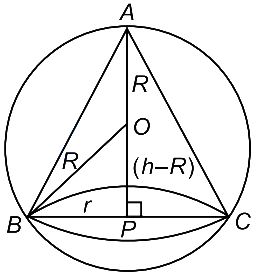
(C) Let the height of the cone be $h$ and the radius of the base of the cone be $r$.
Given,the radius of the sphere is $R$.
In the right-angled triangle $\triangle OPB$,where $O$ is the center of the sphere,$P$ is the center of the base of the cone,and $B$ is a point on the circumference of the base of the cone:
$R^2 = r^2 + (h - R)^2$
$r^2 = R^2 - (h - R)^2 = R^2 - (h^2 - 2Rh + R^2) = 2Rh - h^2$.
The volume of the cone $V$ is given by:
$V = \frac{1}{3} \pi r^2 h = \frac{1}{3} \pi (2Rh - h^2) h = \frac{\pi}{3} (2Rh^2 - h^3)$.
To find the maximum volume,differentiate $V$ with respect to $h$:
$\frac{dV}{dh} = \frac{\pi}{3} (4Rh - 3h^2)$.
Setting $\frac{dV}{dh} = 0$:
$\frac{\pi}{3} h(4R - 3h) = 0$.
Since $h \neq 0$,we have $h = \frac{4R}{3}$.
Checking the second derivative:
$\frac{d^2V}{dh^2} = \frac{\pi}{3} (4R - 6h)$.
At $h = \frac{4R}{3}$,$\frac{d^2V}{dh^2} = \frac{\pi}{3} (4R - 6(\frac{4R}{3})) = \frac{\pi}{3} (4R - 8R) = -\frac{4\pi R}{3} < 0$.
Since the second derivative is negative,the volume is maximum at $h = \frac{4R}{3}$.
Given,the radius of the sphere is $R$.
In the right-angled triangle $\triangle OPB$,where $O$ is the center of the sphere,$P$ is the center of the base of the cone,and $B$ is a point on the circumference of the base of the cone:
$R^2 = r^2 + (h - R)^2$
$r^2 = R^2 - (h - R)^2 = R^2 - (h^2 - 2Rh + R^2) = 2Rh - h^2$.
The volume of the cone $V$ is given by:
$V = \frac{1}{3} \pi r^2 h = \frac{1}{3} \pi (2Rh - h^2) h = \frac{\pi}{3} (2Rh^2 - h^3)$.
To find the maximum volume,differentiate $V$ with respect to $h$:
$\frac{dV}{dh} = \frac{\pi}{3} (4Rh - 3h^2)$.
Setting $\frac{dV}{dh} = 0$:
$\frac{\pi}{3} h(4R - 3h) = 0$.
Since $h \neq 0$,we have $h = \frac{4R}{3}$.
Checking the second derivative:
$\frac{d^2V}{dh^2} = \frac{\pi}{3} (4R - 6h)$.
At $h = \frac{4R}{3}$,$\frac{d^2V}{dh^2} = \frac{\pi}{3} (4R - 6(\frac{4R}{3})) = \frac{\pi}{3} (4R - 8R) = -\frac{4\pi R}{3} < 0$.
Since the second derivative is negative,the volume is maximum at $h = \frac{4R}{3}$.
0 likesView Solution
83
ChemistryMCQTS EAMCET · 2010
If $\int \frac{7x^8+8x^7}{(1+x+x^8)^2} dx = f(x) + c$,then $f(x)$ is equal to
A
$\frac{x^8}{1+x+x^8}$
B
$28 \log(1+x+x^8)$
C
$\frac{1}{1+x+x^8}$
D
$\frac{-1}{1+x+x^8}$
Solution
(A) To find $f(x)$,we differentiate the given options to see which one yields the integrand $\frac{7x^8+8x^7}{(1+x+x^8)^2}$.
Let $f(x) = \frac{x^8}{1+x+x^8}$.
Using the quotient rule $\frac{d}{dx} \left( \frac{u}{v} \right) = \frac{v u' - u v'}{v^2}$,where $u = x^8$ and $v = 1+x+x^8$:
$f'(x) = \frac{(1+x+x^8)(8x^7) - (x^8)(1+8x^7)}{(1+x+x^8)^2}$
$f'(x) = \frac{8x^7 + 8x^8 + 8x^{15} - x^8 - 8x^{15}}{(1+x+x^8)^2}$
$f'(x) = \frac{7x^8 + 8x^7}{(1+x+x^8)^2}$
Since the derivative of option $A$ matches the integrand,$f(x) = \frac{x^8}{1+x+x^8}$.
Let $f(x) = \frac{x^8}{1+x+x^8}$.
Using the quotient rule $\frac{d}{dx} \left( \frac{u}{v} \right) = \frac{v u' - u v'}{v^2}$,where $u = x^8$ and $v = 1+x+x^8$:
$f'(x) = \frac{(1+x+x^8)(8x^7) - (x^8)(1+8x^7)}{(1+x+x^8)^2}$
$f'(x) = \frac{8x^7 + 8x^8 + 8x^{15} - x^8 - 8x^{15}}{(1+x+x^8)^2}$
$f'(x) = \frac{7x^8 + 8x^7}{(1+x+x^8)^2}$
Since the derivative of option $A$ matches the integrand,$f(x) = \frac{x^8}{1+x+x^8}$.
0 likesView Solution
84
ChemistryMCQTS EAMCET · 2010
If $f_n(x) = \log \log \log \ldots \log x$ (where $\log$ is repeated $n$ times),then $\int (x f_1(x) f_2(x) \ldots f_n(x))^{-1} dx$ is equal to
A
$f_{n+1}(x) + c$
B
$\frac{f_{n+1}(x)}{n+1} + c$
C
$n f_n(x) + c$
D
$\frac{f_n(x)}{n} + c$
Solution
(A) Given $f_n(x) = \log(\log(\ldots \log x))$ ($n$ times).
Let $I = \int \frac{dx}{x f_1(x) f_2(x) \ldots f_n(x)}$.
Let $t = f_n(x) = \log(f_{n-1}(x))$.
Then,$\frac{dt}{dx} = \frac{1}{f_{n-1}(x)} \cdot \frac{d}{dx}(f_{n-1}(x)) = \frac{1}{f_{n-1}(x) f_{n-2}(x) \ldots f_1(x) \cdot x}$.
Thus,$dx = (x f_1(x) f_2(x) \ldots f_{n-1}(x)) dt$.
Substituting this into the integral:
$I = \int \frac{(x f_1(x) f_2(x) \ldots f_{n-1}(x)) dt}{x f_1(x) f_2(x) \ldots f_{n-1}(x) f_n(x)} = \int \frac{dt}{f_n(x)}$.
Wait,the substitution $t = f_n(x)$ implies $dt = \frac{dx}{x f_1(x) \ldots f_{n-1}(x)}$.
Therefore,$I = \int \frac{dt}{t} = \log|t| + c = \log|f_n(x)| + c$.
Since $f_{n+1}(x) = \log(f_n(x))$,we have $I = f_{n+1}(x) + c$.
Let $I = \int \frac{dx}{x f_1(x) f_2(x) \ldots f_n(x)}$.
Let $t = f_n(x) = \log(f_{n-1}(x))$.
Then,$\frac{dt}{dx} = \frac{1}{f_{n-1}(x)} \cdot \frac{d}{dx}(f_{n-1}(x)) = \frac{1}{f_{n-1}(x) f_{n-2}(x) \ldots f_1(x) \cdot x}$.
Thus,$dx = (x f_1(x) f_2(x) \ldots f_{n-1}(x)) dt$.
Substituting this into the integral:
$I = \int \frac{(x f_1(x) f_2(x) \ldots f_{n-1}(x)) dt}{x f_1(x) f_2(x) \ldots f_{n-1}(x) f_n(x)} = \int \frac{dt}{f_n(x)}$.
Wait,the substitution $t = f_n(x)$ implies $dt = \frac{dx}{x f_1(x) \ldots f_{n-1}(x)}$.
Therefore,$I = \int \frac{dt}{t} = \log|t| + c = \log|f_n(x)| + c$.
Since $f_{n+1}(x) = \log(f_n(x))$,we have $I = f_{n+1}(x) + c$.
0 likesView Solution
85
ChemistryMCQTS EAMCET · 2010
The area (in square units) of the region enclosed by the two circles $x^2+y^2=1$ and $(x-1)^2+y^2=1$ is
A
$\frac{2 \pi}{3}+\frac{\sqrt{3}}{2}$
B
$\frac{\pi}{3}+\frac{\sqrt{3}}{2}$
C
$\frac{\pi}{3}-\frac{\sqrt{3}}{2}$
D
$\frac{2 \pi}{3}-\frac{\sqrt{3}}{2}$
Solution
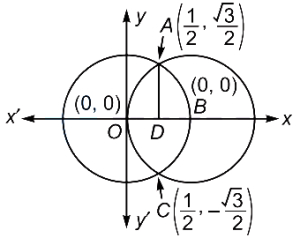
(D) The intersection points of the two circles $x^2+y^2=1$ $(i)$ and $(x-1)^2+y^2=1$ (ii) are found by substituting $y^2=1-x^2$ from $(i)$ into (ii):
$(x-1)^2+(1-x^2)=1$
$x^2-2x+1+1-x^2=1$
$2-2x=1 \Rightarrow x=\frac{1}{2}$
Substituting $x=\frac{1}{2}$ into $(i)$,we get $y^2=1-\frac{1}{4}=\frac{3}{4}$,so $y=\pm\frac{\sqrt{3}}{2}$.
The intersection points are $A\left(\frac{1}{2}, \frac{\sqrt{3}}{2}\right)$ and $C\left(\frac{1}{2}, -\frac{\sqrt{3}}{2}\right)$.
The total area is symmetric about the $x$-axis,so Area $= 2 \times \int_{0}^{1/2} \sqrt{1-(x-1)^2} dx + 2 \times \int_{1/2}^{1} \sqrt{1-x^2} dx$.
Using the formula $\int \sqrt{a^2-x^2} dx = \frac{x}{2}\sqrt{a^2-x^2} + \frac{a^2}{2}\sin^{-1}(\frac{x}{a})$,
Area $= 2 \left[ \frac{x-1}{2}\sqrt{1-(x-1)^2} + \frac{1}{2}\sin^{-1}(x-1) \right]_0^{1/2} + 2 \left[ \frac{x}{2}\sqrt{1-x^2} + \frac{1}{2}\sin^{-1}(x) \right]_{1/2}^1$
$= 2 \left[ (-\frac{1}{4}\cdot\frac{\sqrt{3}}{2} + \frac{1}{2}\sin^{-1}(-\frac{1}{2})) - (0 + \frac{1}{2}\sin^{-1}(-1)) \right] + 2 \left[ (0 + \frac{1}{2}\sin^{-1}(1)) - (\frac{1}{4}\cdot\frac{\sqrt{3}}{2} + \frac{1}{2}\sin^{-1}(\frac{1}{2})) \right]$
$= 2 \left[ -\frac{\sqrt{3}}{8} - \frac{\pi}{12} + \frac{\pi}{4} \right] + 2 \left[ \frac{\pi}{4} - \frac{\sqrt{3}}{8} - \frac{\pi}{12} \right]$
$= 2 \left[ \frac{\pi}{6} - \frac{\sqrt{3}}{8} \right] + 2 \left[ \frac{\pi}{6} - \frac{\sqrt{3}}{8} \right] = 4 \left( \frac{\pi}{6} - \frac{\sqrt{3}}{8} \right) = \frac{2\pi}{3} - \frac{\sqrt{3}}{2}$.
$(x-1)^2+(1-x^2)=1$
$x^2-2x+1+1-x^2=1$
$2-2x=1 \Rightarrow x=\frac{1}{2}$
Substituting $x=\frac{1}{2}$ into $(i)$,we get $y^2=1-\frac{1}{4}=\frac{3}{4}$,so $y=\pm\frac{\sqrt{3}}{2}$.
The intersection points are $A\left(\frac{1}{2}, \frac{\sqrt{3}}{2}\right)$ and $C\left(\frac{1}{2}, -\frac{\sqrt{3}}{2}\right)$.
The total area is symmetric about the $x$-axis,so Area $= 2 \times \int_{0}^{1/2} \sqrt{1-(x-1)^2} dx + 2 \times \int_{1/2}^{1} \sqrt{1-x^2} dx$.
Using the formula $\int \sqrt{a^2-x^2} dx = \frac{x}{2}\sqrt{a^2-x^2} + \frac{a^2}{2}\sin^{-1}(\frac{x}{a})$,
Area $= 2 \left[ \frac{x-1}{2}\sqrt{1-(x-1)^2} + \frac{1}{2}\sin^{-1}(x-1) \right]_0^{1/2} + 2 \left[ \frac{x}{2}\sqrt{1-x^2} + \frac{1}{2}\sin^{-1}(x) \right]_{1/2}^1$
$= 2 \left[ (-\frac{1}{4}\cdot\frac{\sqrt{3}}{2} + \frac{1}{2}\sin^{-1}(-\frac{1}{2})) - (0 + \frac{1}{2}\sin^{-1}(-1)) \right] + 2 \left[ (0 + \frac{1}{2}\sin^{-1}(1)) - (\frac{1}{4}\cdot\frac{\sqrt{3}}{2} + \frac{1}{2}\sin^{-1}(\frac{1}{2})) \right]$
$= 2 \left[ -\frac{\sqrt{3}}{8} - \frac{\pi}{12} + \frac{\pi}{4} \right] + 2 \left[ \frac{\pi}{4} - \frac{\sqrt{3}}{8} - \frac{\pi}{12} \right]$
$= 2 \left[ \frac{\pi}{6} - \frac{\sqrt{3}}{8} \right] + 2 \left[ \frac{\pi}{6} - \frac{\sqrt{3}}{8} \right] = 4 \left( \frac{\pi}{6} - \frac{\sqrt{3}}{8} \right) = \frac{2\pi}{3} - \frac{\sqrt{3}}{2}$.
0 likesView Solution
86
ChemistryMCQTS EAMCET · 2010
The values of a function $f(x)$ at different values of $x$ are given in the table below:
Then,the approximate area (in square units) bounded by the curve $y=f(x)$ and the $x$-axis between $x=0$ and $x=5$,using the Trapezoidal rule,is
| $x$ | $0$ | $1$ | $2$ | $3$ | $4$ | $5$ |
|---|---|---|---|---|---|---|
| $f(x)$ | $2$ | $3$ | $6$ | $11$ | $18$ | $27$ |
Then,the approximate area (in square units) bounded by the curve $y=f(x)$ and the $x$-axis between $x=0$ and $x=5$,using the Trapezoidal rule,is
A
$50$
B
$75$
C
$52.5$
D
$62.5$
Solution
(C) The Trapezoidal rule for approximating the integral $\int_{x_0}^{x_n} f(x) dx$ is given by:
$\int_{x_0}^{x_n} f(x) dx \approx \frac{h}{2} [ (y_0 + y_n) + 2(y_1 + y_2 + \dots + y_{n-1}) ]$
Here,$h = 1$ (the difference between consecutive $x$ values).
The values are $y_0=2, y_1=3, y_2=6, y_3=11, y_4=18, y_5=27$.
Substituting these values into the formula:
Area $\approx \frac{1}{2} [ (2 + 27) + 2(3 + 6 + 11 + 18) ]$
Area $\approx \frac{1}{2} [ 29 + 2(38) ]$
Area $\approx \frac{1}{2} [ 29 + 76 ]$
Area $\approx \frac{1}{2} [ 105 ] = 52.5$ square units.
$\int_{x_0}^{x_n} f(x) dx \approx \frac{h}{2} [ (y_0 + y_n) + 2(y_1 + y_2 + \dots + y_{n-1}) ]$
Here,$h = 1$ (the difference between consecutive $x$ values).
The values are $y_0=2, y_1=3, y_2=6, y_3=11, y_4=18, y_5=27$.
Substituting these values into the formula:
Area $\approx \frac{1}{2} [ (2 + 27) + 2(3 + 6 + 11 + 18) ]$
Area $\approx \frac{1}{2} [ 29 + 2(38) ]$
Area $\approx \frac{1}{2} [ 29 + 76 ]$
Area $\approx \frac{1}{2} [ 105 ] = 52.5$ square units.
0 likesView Solution
87
ChemistryMCQTS EAMCET · 2010
In an optical fibre,the core and cladding are made with materials of refractive indices $1.5$ and $1.414$ respectively. To observe total internal reflection,what will be the range of the incident angle with the axis of the optical fibre?
A
$0^{\circ}-60^{\circ}$
B
$0^{\circ}-48^{\circ}$
C
$0^{\circ}-30^{\circ}$
D
$0^{\circ}-82^{\circ}$
Solution
(C) For an optical fibre,the acceptance angle $\theta_a$ is given by the formula: $\sin \theta_a = \sqrt{\mu_1^2 - \mu_2^2}$,where $\mu_1$ is the refractive index of the core and $\mu_2$ is the refractive index of the cladding,assuming the surrounding medium is air $(\mu_0 = 1)$.
Given $\mu_1 = 1.5$ and $\mu_2 = 1.414$.
Substituting the values: $\sin \theta_a = \sqrt{(1.5)^2 - (1.414)^2}$.
Since $(1.414)^2 \approx 2$,we have $\sin \theta_a = \sqrt{2.25 - 2} = \sqrt{0.25} = 0.5$.
Therefore,$\theta_a = \sin^{-1}(0.5) = 30^{\circ}$.
This means the incident light must enter the fibre within an angle range of $0^{\circ}$ to $30^{\circ}$ with the axis to undergo total internal reflection.
Hence,option $(C)$ is correct.
Given $\mu_1 = 1.5$ and $\mu_2 = 1.414$.
Substituting the values: $\sin \theta_a = \sqrt{(1.5)^2 - (1.414)^2}$.
Since $(1.414)^2 \approx 2$,we have $\sin \theta_a = \sqrt{2.25 - 2} = \sqrt{0.25} = 0.5$.
Therefore,$\theta_a = \sin^{-1}(0.5) = 30^{\circ}$.
This means the incident light must enter the fibre within an angle range of $0^{\circ}$ to $30^{\circ}$ with the axis to undergo total internal reflection.
Hence,option $(C)$ is correct.
0 likesView Solution
88
ChemistryMCQTS EAMCET · 2010
The diameter of the objective of a telescope is $1 \ m$. Its resolving limit for light of wavelength $4538 \ \mathring{A}$ will be:
A
$5.54 \times 10^{-7} \ \text{rad}$
B
$2.54 \times 10^{-4} \ \text{rad}$
C
$6.54 \times 10^{-7} \ \text{rad}$
D
None of these
Solution
(A) The resolving limit $(d\theta)$ of a telescope is given by the formula:
$d\theta = \frac{1.22 \lambda}{a}$
Where $\lambda$ is the wavelength of light and $a$ is the diameter of the objective lens.
Given:
$\lambda = 4538 \ \mathring{A} = 4538 \times 10^{-10} \ \text{m}$
$a = 1 \ \text{m}$
Substituting the values:
$d\theta = \frac{1.22 \times 4538 \times 10^{-10}}{1}$
$d\theta = 5536.36 \times 10^{-10} \ \text{rad}$
$d\theta \approx 5.54 \times 10^{-7} \ \text{rad}$
$d\theta = \frac{1.22 \lambda}{a}$
Where $\lambda$ is the wavelength of light and $a$ is the diameter of the objective lens.
Given:
$\lambda = 4538 \ \mathring{A} = 4538 \times 10^{-10} \ \text{m}$
$a = 1 \ \text{m}$
Substituting the values:
$d\theta = \frac{1.22 \times 4538 \times 10^{-10}}{1}$
$d\theta = 5536.36 \times 10^{-10} \ \text{rad}$
$d\theta \approx 5.54 \times 10^{-7} \ \text{rad}$
0 likesView Solution
89
ChemistryMCQTS EAMCET · 2010
$A$ ray of light passes through an equilateral prism such that the angle of incidence is equal to the angle of emergence and each one is equal to $3/4$th the angle of the prism. The angle of deviation is (in $^{\circ}$)
A
$45$
B
$39$
C
$20$
D
$30$
Solution
(D) For an equilateral prism,the angle of the prism $A = 60^{\circ}$.
Given that the angle of incidence $i$ is equal to the angle of emergence $e$,and both are equal to $3/4$ of the angle of the prism:
$i = e = \frac{3}{4} \times A = \frac{3}{4} \times 60^{\circ} = 45^{\circ}$.
The relationship between the angle of incidence,angle of emergence,angle of the prism,and the angle of deviation $\delta$ is given by:
$i + e = A + \delta$
Substituting the known values into the equation:
$45^{\circ} + 45^{\circ} = 60^{\circ} + \delta$
$90^{\circ} = 60^{\circ} + \delta$
$\delta = 90^{\circ} - 60^{\circ} = 30^{\circ}$.
Thus,the angle of deviation is $30^{\circ}$.
Given that the angle of incidence $i$ is equal to the angle of emergence $e$,and both are equal to $3/4$ of the angle of the prism:
$i = e = \frac{3}{4} \times A = \frac{3}{4} \times 60^{\circ} = 45^{\circ}$.
The relationship between the angle of incidence,angle of emergence,angle of the prism,and the angle of deviation $\delta$ is given by:
$i + e = A + \delta$
Substituting the known values into the equation:
$45^{\circ} + 45^{\circ} = 60^{\circ} + \delta$
$90^{\circ} = 60^{\circ} + \delta$
$\delta = 90^{\circ} - 60^{\circ} = 30^{\circ}$.
Thus,the angle of deviation is $30^{\circ}$.
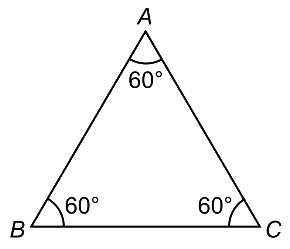
0 likesView Solution
90
ChemistryMCQTS EAMCET · 2010
Which one of the following is formed apart from sodium chloride when chlorine reacts with hot concentrated sodium hydroxide?
A
$NaOCl$
B
$NaClO_3$
C
$NaClO_2$
D
$NaClO_4$
Solution
(B) When chlorine reacts with hot and concentrated sodium hydroxide,it undergoes a disproportionation reaction to form sodium chloride,sodium chlorate,and water.
The balanced chemical equation is:
$3Cl_{2(g)} + 6NaOH_{(aq, \text{hot conc})} \longrightarrow 5NaCl_{(aq)} + NaClO_{3(aq)} + 3H_2O_{(l)}$
Thus,apart from sodium chloride,sodium chlorate $(NaClO_3)$ is formed.
The balanced chemical equation is:
$3Cl_{2(g)} + 6NaOH_{(aq, \text{hot conc})} \longrightarrow 5NaCl_{(aq)} + NaClO_{3(aq)} + 3H_2O_{(l)}$
Thus,apart from sodium chloride,sodium chlorate $(NaClO_3)$ is formed.
0 likesView Solution
91
ChemistryMCQTS EAMCET · 2010
$A$ transistor having a $\beta$ equal to $80$ has a change in base current of $250 \mu A$. The change in collector current is:
A
$20,000 \text{ mA}$
B
$200 \text{ mA}$
C
$2000 \text{ mA}$
D
$20 \text{ mA}$
Solution
(D) The current gain $\beta$ of a common-emitter transistor is defined as the ratio of the change in collector current $(\Delta i_C)$ to the change in base current $(\Delta i_B)$.
$\beta = \frac{\Delta i_C}{\Delta i_B}$
Given: $\beta = 80$ and $\Delta i_B = 250 \mu A = 250 \times 10^{-6} \text{ A}$.
Substituting the values into the formula:
$80 = \frac{\Delta i_C}{250 \times 10^{-6} \text{ A}}$
$\Delta i_C = 80 \times 250 \times 10^{-6} \text{ A}$
$\Delta i_C = 20,000 \times 10^{-6} \text{ A}$
$\Delta i_C = 20 \times 10^{-3} \text{ A} = 20 \text{ mA}$.
Therefore,the change in collector current is $20 \text{ mA}$.
$\beta = \frac{\Delta i_C}{\Delta i_B}$
Given: $\beta = 80$ and $\Delta i_B = 250 \mu A = 250 \times 10^{-6} \text{ A}$.
Substituting the values into the formula:
$80 = \frac{\Delta i_C}{250 \times 10^{-6} \text{ A}}$
$\Delta i_C = 80 \times 250 \times 10^{-6} \text{ A}$
$\Delta i_C = 20,000 \times 10^{-6} \text{ A}$
$\Delta i_C = 20 \times 10^{-3} \text{ A} = 20 \text{ mA}$.
Therefore,the change in collector current is $20 \text{ mA}$.
0 likesView Solution
92
ChemistryMCQTS EAMCET · 2010
The solution of $\tan y \frac{dy}{dx} = \sin(x+y) + \sin(x-y)$ is
A
$\sec y = 2 \cos x + c$
B
$\sec y = -2 \cos x + c$
C
$\tan y = -2 \cos x + c$
D
$\sec^2 y = -2 \cos x + c$
Solution
(B) Given: $\tan y \frac{dy}{dx} = \sin(x+y) + \sin(x-y)$
Using the trigonometric identity $\sin C + \sin D = 2 \sin(\frac{C+D}{2}) \cos(\frac{C-D}{2})$:
$\tan y \frac{dy}{dx} = 2 \sin x \cos y$
Rearranging the terms to separate variables:
$\frac{\sin y}{\cos^2 y} dy = 2 \sin x dx$
Integrating both sides:
$\int \frac{\sin y}{\cos^2 y} dy = \int 2 \sin x dx$
Let $t = \cos y$,then $dt = -\sin y dy$,so $\sin y dy = -dt$.
Substituting this into the integral:
$-\int \frac{dt}{t^2} = -2 \cos x + c$
$-(- \frac{1}{t}) = -2 \cos x + c$
$\frac{1}{\cos y} = -2 \cos x + c$
$\sec y = -2 \cos x + c$
Using the trigonometric identity $\sin C + \sin D = 2 \sin(\frac{C+D}{2}) \cos(\frac{C-D}{2})$:
$\tan y \frac{dy}{dx} = 2 \sin x \cos y$
Rearranging the terms to separate variables:
$\frac{\sin y}{\cos^2 y} dy = 2 \sin x dx$
Integrating both sides:
$\int \frac{\sin y}{\cos^2 y} dy = \int 2 \sin x dx$
Let $t = \cos y$,then $dt = -\sin y dy$,so $\sin y dy = -dt$.
Substituting this into the integral:
$-\int \frac{dt}{t^2} = -2 \cos x + c$
$-(- \frac{1}{t}) = -2 \cos x + c$
$\frac{1}{\cos y} = -2 \cos x + c$
$\sec y = -2 \cos x + c$
0 likesView Solution
93
ChemistryMCQTS EAMCET · 2010
$A$ family of curves has the differential equation $x y \frac{d y}{d x}=2 y^2-x^2$. Then,the family of curves is
A
$y^2=c x^2+x^3$
B
$y^2=c x^4+x^3$
C
$y^2=x+c x^4$
D
$y^2=x^2+c x^4$
Solution
(D) Given differential equation is $x y \frac{d y}{d x}=2 y^2-x^2$.
Dividing by $x$,we get $\frac{d y}{d x}=\frac{2 y}{x}-\frac{x}{y}$.
Rearranging the terms: $y \frac{d y}{d x}-\frac{2 y^2}{x}=-x$ $\ldots$ $(i)$.
Let $v=y^2$,then differentiating with respect to $x$,we get $\frac{d v}{d x}=2 y \frac{d y}{d x}$,which implies $y \frac{d y}{d x}=\frac{1}{2} \frac{d v}{d x}$.
Substituting this into $(i)$: $\frac{1}{2} \frac{d v}{d x}-\frac{2 v}{x}=-x$.
Multiplying by $2$: $\frac{d v}{d x}-\frac{4 v}{x}=-2 x$.
This is a linear differential equation of the form $\frac{d v}{d x}+P v=Q$,where $P=-\frac{4}{x}$ and $Q=-2 x$.
Integrating factor $IF=e^{\int P d x}=e^{\int-\frac{4}{x} d x}=e^{-4 \log x}=x^{-4}$.
The solution is $v \cdot IF = \int Q \cdot IF d x + c$.
$v \cdot x^{-4} = \int (-2 x) \cdot x^{-4} d x + c = -2 \int x^{-3} d x + c$.
$v x^{-4} = -2 \left( \frac{x^{-2}}{-2} \right) + c = x^{-2} + c$.
$v = x^2 + c x^4$.
Since $v=y^2$,the family of curves is $y^2 = x^2 + c x^4$.
Dividing by $x$,we get $\frac{d y}{d x}=\frac{2 y}{x}-\frac{x}{y}$.
Rearranging the terms: $y \frac{d y}{d x}-\frac{2 y^2}{x}=-x$ $\ldots$ $(i)$.
Let $v=y^2$,then differentiating with respect to $x$,we get $\frac{d v}{d x}=2 y \frac{d y}{d x}$,which implies $y \frac{d y}{d x}=\frac{1}{2} \frac{d v}{d x}$.
Substituting this into $(i)$: $\frac{1}{2} \frac{d v}{d x}-\frac{2 v}{x}=-x$.
Multiplying by $2$: $\frac{d v}{d x}-\frac{4 v}{x}=-2 x$.
This is a linear differential equation of the form $\frac{d v}{d x}+P v=Q$,where $P=-\frac{4}{x}$ and $Q=-2 x$.
Integrating factor $IF=e^{\int P d x}=e^{\int-\frac{4}{x} d x}=e^{-4 \log x}=x^{-4}$.
The solution is $v \cdot IF = \int Q \cdot IF d x + c$.
$v \cdot x^{-4} = \int (-2 x) \cdot x^{-4} d x + c = -2 \int x^{-3} d x + c$.
$v x^{-4} = -2 \left( \frac{x^{-2}}{-2} \right) + c = x^{-2} + c$.
$v = x^2 + c x^4$.
Since $v=y^2$,the family of curves is $y^2 = x^2 + c x^4$.
0 likesView Solution
94
ChemistryMCQTS EAMCET · 2010
Let $\overrightarrow{a}=\hat{i}-2 \hat{j}+3 \hat{k}$,$\overrightarrow{b}=2 \hat{i}+3 \hat{j}-\hat{k}$ and $\overrightarrow{c}=\lambda \hat{i}+\hat{j}+(2 \lambda-1) \hat{k}$. If $\overrightarrow{c}$ is parallel to the plane containing $\overrightarrow{a}$ and $\overrightarrow{b}$,then $\lambda$ is equal to
A
$0$
B
$1$
C
$-1$
D
$2$
Solution
(A) Given vectors are $\overrightarrow{a}=\hat{i}-2 \hat{j}+3 \hat{k}$,$\overrightarrow{b}=2 \hat{i}+3 \hat{j}-\hat{k}$ and $\overrightarrow{c}=\lambda \hat{i}+\hat{j}+(2 \lambda-1) \hat{k}$.
Since $\overrightarrow{a}$ and $\overrightarrow{b}$ lie in a plane,their cross product $\overrightarrow{n} = \overrightarrow{a} \times \overrightarrow{b}$ is a vector perpendicular to that plane.
If $\overrightarrow{c}$ is parallel to the plane containing $\overrightarrow{a}$ and $\overrightarrow{b}$,then $\overrightarrow{c}$ must be perpendicular to the normal vector $\overrightarrow{n}$.
Therefore,the scalar triple product $(\overrightarrow{a} \times \overrightarrow{b}) \cdot \overrightarrow{c} = 0$.
First,calculate $\overrightarrow{a} \times \overrightarrow{b}$:
$\overrightarrow{a} \times \overrightarrow{b} = \begin{vmatrix} \hat{i} & \hat{j} & \hat{k} \\ 1 & -2 & 3 \\ 2 & 3 & -1 \end{vmatrix} = \hat{i}(2-9) - \hat{j}(-1-6) + \hat{k}(3+4) = -7\hat{i} + 7\hat{j} + 7\hat{k}$.
Now,compute the dot product with $\overrightarrow{c}$:
$(-7\hat{i} + 7\hat{j} + 7\hat{k}) \cdot (\lambda \hat{i} + \hat{j} + (2\lambda-1)\hat{k}) = 0$.
$-7\lambda + 7(1) + 7(2\lambda-1) = 0$.
$-7\lambda + 7 + 14\lambda - 7 = 0$.
$7\lambda = 0 \Rightarrow \lambda = 0$.
Thus,the value of $\lambda$ is $0$.
Since $\overrightarrow{a}$ and $\overrightarrow{b}$ lie in a plane,their cross product $\overrightarrow{n} = \overrightarrow{a} \times \overrightarrow{b}$ is a vector perpendicular to that plane.
If $\overrightarrow{c}$ is parallel to the plane containing $\overrightarrow{a}$ and $\overrightarrow{b}$,then $\overrightarrow{c}$ must be perpendicular to the normal vector $\overrightarrow{n}$.
Therefore,the scalar triple product $(\overrightarrow{a} \times \overrightarrow{b}) \cdot \overrightarrow{c} = 0$.
First,calculate $\overrightarrow{a} \times \overrightarrow{b}$:
$\overrightarrow{a} \times \overrightarrow{b} = \begin{vmatrix} \hat{i} & \hat{j} & \hat{k} \\ 1 & -2 & 3 \\ 2 & 3 & -1 \end{vmatrix} = \hat{i}(2-9) - \hat{j}(-1-6) + \hat{k}(3+4) = -7\hat{i} + 7\hat{j} + 7\hat{k}$.
Now,compute the dot product with $\overrightarrow{c}$:
$(-7\hat{i} + 7\hat{j} + 7\hat{k}) \cdot (\lambda \hat{i} + \hat{j} + (2\lambda-1)\hat{k}) = 0$.
$-7\lambda + 7(1) + 7(2\lambda-1) = 0$.
$-7\lambda + 7 + 14\lambda - 7 = 0$.
$7\lambda = 0 \Rightarrow \lambda = 0$.
Thus,the value of $\lambda$ is $0$.
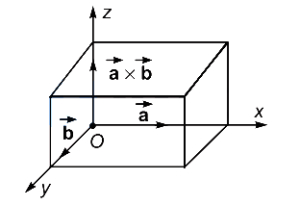
0 likesView Solution
95
ChemistryMCQTS EAMCET · 2010
Suppose $A$ and $B$ are two events such that $P(A \cap B) = \frac{3}{25}$ and $P(B - A) = \frac{8}{25}$. Then,$P(B)$ is equal to
A
$\frac{11}{25}$
B
$\frac{3}{11}$
C
$\frac{1}{11}$
D
$\frac{9}{11}$
Solution
(A) Given that $P(A \cap B) = \frac{3}{25}$ and $P(B - A) = \frac{8}{25}$.
From the properties of sets and probability,the event $B$ can be expressed as the union of two disjoint sets: $(B - A)$ and $(A \cap B)$.
Therefore,$P(B) = P(B - A) + P(A \cap B)$.
Substituting the given values:
$P(B) = \frac{8}{25} + \frac{3}{25} = \frac{11}{25}$.
From the properties of sets and probability,the event $B$ can be expressed as the union of two disjoint sets: $(B - A)$ and $(A \cap B)$.
Therefore,$P(B) = P(B - A) + P(A \cap B)$.
Substituting the given values:
$P(B) = \frac{8}{25} + \frac{3}{25} = \frac{11}{25}$.
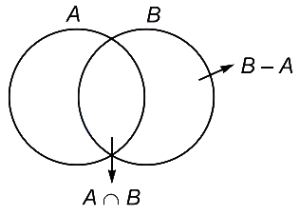
0 likesView Solution
96
ChemistryMCQTS EAMCET · 2010
An urn $A$ contains $3$ white and $5$ black balls. Another urn $B$ contains $6$ white and $8$ black balls. $A$ ball is picked from $A$ at random and then transferred to $B$. Then,a ball is picked at random from $B$. The probability that it is a white ball is
A
$\frac{14}{40}$
B
$\frac{15}{40}$
C
$\frac{16}{40}$
D
$\frac{17}{40}$
Solution
(D) Case $I$: $A$ white ball is transferred from urn $A$ to urn $B$.
The probability of selecting a white ball from urn $A$ is $P(W_A) = \frac{3}{3+5} = \frac{3}{8}$.
After transferring,urn $B$ contains $7$ white and $8$ black balls (total $15$).
The probability of selecting a white ball from urn $B$ is $P(W_B|W_A) = \frac{7}{15}$.
The probability of this case is $P(W_A) \times P(W_B|W_A) = \frac{3}{8} \times \frac{7}{15} = \frac{21}{120} = \frac{7}{40}$.
Case $II$: $A$ black ball is transferred from urn $A$ to urn $B$.
The probability of selecting a black ball from urn $A$ is $P(B_A) = \frac{5}{3+5} = \frac{5}{8}$.
After transferring,urn $B$ contains $6$ white and $9$ black balls (total $15$).
The probability of selecting a white ball from urn $B$ is $P(W_B|B_A) = \frac{6}{15}$.
The probability of this case is $P(B_A) \times P(W_B|B_A) = \frac{5}{8} \times \frac{6}{15} = \frac{30}{120} = \frac{10}{40}$.
The total probability of drawing a white ball from urn $B$ is $\frac{7}{40} + \frac{10}{40} = \frac{17}{40}$.
The probability of selecting a white ball from urn $A$ is $P(W_A) = \frac{3}{3+5} = \frac{3}{8}$.
After transferring,urn $B$ contains $7$ white and $8$ black balls (total $15$).
The probability of selecting a white ball from urn $B$ is $P(W_B|W_A) = \frac{7}{15}$.
The probability of this case is $P(W_A) \times P(W_B|W_A) = \frac{3}{8} \times \frac{7}{15} = \frac{21}{120} = \frac{7}{40}$.
Case $II$: $A$ black ball is transferred from urn $A$ to urn $B$.
The probability of selecting a black ball from urn $A$ is $P(B_A) = \frac{5}{3+5} = \frac{5}{8}$.
After transferring,urn $B$ contains $6$ white and $9$ black balls (total $15$).
The probability of selecting a white ball from urn $B$ is $P(W_B|B_A) = \frac{6}{15}$.
The probability of this case is $P(B_A) \times P(W_B|B_A) = \frac{5}{8} \times \frac{6}{15} = \frac{30}{120} = \frac{10}{40}$.
The total probability of drawing a white ball from urn $B$ is $\frac{7}{40} + \frac{10}{40} = \frac{17}{40}$.
0 likesView Solution
97
ChemistryMCQTS EAMCET · 2010
Suppose that a random variable $X$ follows a Poisson distribution. If $P(X=1) = P(X=2)$,then $P(X=5)$ is equal to:
A
$\frac{2}{3} e^{-2}$
B
$\frac{3}{4} e^{-2}$
C
$\frac{4}{15} e^{-2}$
D
$\frac{7}{8} e^{-2}$
Solution
(C) Let $\lambda$ be the parameter (mean) of the Poisson distribution for the random variable $X$.
The probability mass function is given by $P(X=r) = \frac{\lambda^r e^{-\lambda}}{r!}$ for $r = 0, 1, 2, \dots$.
Given that $P(X=1) = P(X=2)$,we have:
$\frac{\lambda^1 e^{-\lambda}}{1!} = \frac{\lambda^2 e^{-\lambda}}{2!}$
$\lambda = \frac{\lambda^2}{2}$
Since $\lambda \neq 0$,we divide by $\lambda$ to get $1 = \frac{\lambda}{2}$,which implies $\lambda = 2$.
Now,we calculate $P(X=5)$:
$P(X=5) = \frac{\lambda^5 e^{-\lambda}}{5!} = \frac{2^5 e^{-2}}{120}$
$P(X=5) = \frac{32 e^{-2}}{120} = \frac{4}{15} e^{-2}$.
The probability mass function is given by $P(X=r) = \frac{\lambda^r e^{-\lambda}}{r!}$ for $r = 0, 1, 2, \dots$.
Given that $P(X=1) = P(X=2)$,we have:
$\frac{\lambda^1 e^{-\lambda}}{1!} = \frac{\lambda^2 e^{-\lambda}}{2!}$
$\lambda = \frac{\lambda^2}{2}$
Since $\lambda \neq 0$,we divide by $\lambda$ to get $1 = \frac{\lambda}{2}$,which implies $\lambda = 2$.
Now,we calculate $P(X=5)$:
$P(X=5) = \frac{\lambda^5 e^{-\lambda}}{5!} = \frac{2^5 e^{-2}}{120}$
$P(X=5) = \frac{32 e^{-2}}{120} = \frac{4}{15} e^{-2}$.
0 likesView Solution
98
ChemistryMCQTS EAMCET · 2010
If the mean and variance of a binomial variable $X$ are $2$ and $1$ respectively,then $P(X \geq 1)$ is equal to
A
$\frac{2}{3}$
B
$\frac{15}{16}$
C
$\frac{7}{8}$
D
$\frac{4}{5}$
Solution
(B) For a binomial distribution,the mean is given by $np = 2$ and the variance is given by $npq = 1$.
Dividing the variance by the mean,we get $q = \frac{npq}{np} = \frac{1}{2}$.
Since $p = 1 - q$,we have $p = 1 - \frac{1}{2} = \frac{1}{2}$.
Substituting $p = \frac{1}{2}$ into $np = 2$,we get $n(\frac{1}{2}) = 2$,which implies $n = 4$.
The probability mass function is $P(X = k) = \binom{n}{k} p^k q^{n-k}$.
We need to find $P(X \geq 1) = 1 - P(X = 0)$.
$P(X = 0) = \binom{4}{0} (\frac{1}{2})^0 (\frac{1}{2})^4 = 1 \times 1 \times \frac{1}{16} = \frac{1}{16}$.
Therefore,$P(X \geq 1) = 1 - \frac{1}{16} = \frac{15}{16}$.
Dividing the variance by the mean,we get $q = \frac{npq}{np} = \frac{1}{2}$.
Since $p = 1 - q$,we have $p = 1 - \frac{1}{2} = \frac{1}{2}$.
Substituting $p = \frac{1}{2}$ into $np = 2$,we get $n(\frac{1}{2}) = 2$,which implies $n = 4$.
The probability mass function is $P(X = k) = \binom{n}{k} p^k q^{n-k}$.
We need to find $P(X \geq 1) = 1 - P(X = 0)$.
$P(X = 0) = \binom{4}{0} (\frac{1}{2})^0 (\frac{1}{2})^4 = 1 \times 1 \times \frac{1}{16} = \frac{1}{16}$.
Therefore,$P(X \geq 1) = 1 - \frac{1}{16} = \frac{15}{16}$.
0 likesView Solution
99
ChemistryMCQTS EAMCET · 2010
Assertion $(A)$: White tin is an example of a tetragonal system.
Reasoning $(R)$: For a tetragonal system,$a=b=c$ and $\alpha=\beta=\gamma \neq 90^{\circ}$. The correct answer is
Reasoning $(R)$: For a tetragonal system,$a=b=c$ and $\alpha=\beta=\gamma \neq 90^{\circ}$. The correct answer is
A
$(A)$ and $(R)$ are true and $(R)$ is the correct explanation of $(A)$.
B
Both $(A)$ and $(R)$ are true and $(R)$ is not the correct explanation of $(A)$.
C
$(A)$ is true but $(R)$ is not true.
D
$(A)$ is not true but $(R)$ is true.
Solution
(C) White tin,an allotropic form of tin,is an example of a tetragonal crystal system.
For a tetragonal system,the unit cell parameters are $a = b \neq c$ and $\alpha = \beta = \gamma = 90^{\circ}$.
The reasoning provided states $a=b=c$ and $\alpha=\beta=\gamma \neq 90^{\circ}$,which is incorrect.
Therefore,Assertion $(A)$ is true,but Reason $(R)$ is false.
For a tetragonal system,the unit cell parameters are $a = b \neq c$ and $\alpha = \beta = \gamma = 90^{\circ}$.
The reasoning provided states $a=b=c$ and $\alpha=\beta=\gamma \neq 90^{\circ}$,which is incorrect.
Therefore,Assertion $(A)$ is true,but Reason $(R)$ is false.
0 likesView Solution
100
ChemistryMCQTS EAMCET · 2010
The ratio of anion radius to cation radius of a crystal is $10: 9.3$. Then,the coordination number of the cation in the crystal is
A
$2$
B
$4$
C
$6$
D
$8$
Solution
(D) Given,the radius ratio of anion to cation $= 10 : 9.3$.
$\therefore$ The radius ratio of cation to anion $= 9.3 : 10 = 0.93$.
When the radius ratio of cation to anion lies between $0.732$ and $1.00$,the coordination number is $8$.
Thus,the coordination number of the cation in the crystal is $8$.
$\therefore$ The radius ratio of cation to anion $= 9.3 : 10 = 0.93$.
When the radius ratio of cation to anion lies between $0.732$ and $1.00$,the coordination number is $8$.
Thus,the coordination number of the cation in the crystal is $8$.
0 likesView Solution
Vedclass Products
For Students
Vedclass Test Series
Mock tests in real TS EAMCET style covering Chemistry with performance analysis. 5-day free trial.
Start Free TrialFor Teachers
Exam Paper Generator
Generate Set A/B/C/D Chemistry papers from 7.5L+ questions in 2 minutes. 3 chapters free.
Try FreeFor Institutes
Online Exam Module
Run live TS EAMCET mock exams with unlimited students, 360° analytics & white-label branding.
See DemoFrequently Asked Questions
How many Chemistry questions are in TS EAMCET 2010?
There are 185 Chemistry questions from the TS EAMCET 2010 paper on Vedclass, each with a detailed step-by-step solution in English.
Are TS EAMCET 2010 Chemistry solutions available in English?
Yes. All solutions on this page are in English. You can also switch to English or Hindi using the language buttons above the questions.
Can I practice TS EAMCET 2010 Chemistry as a timed test?
Yes. Use the Vedclass Test Series to attempt a full TS EAMCET mock test covering Chemistry with time limits and instant score analysis.
Can teachers create Chemistry papers from TS EAMCET previous year questions?
Yes. The Vedclass Exam Paper Generator lets teachers mix TS EAMCET Chemistry questions and generate Set A/B/C/D papers in minutes.
For Teachers & Institutes
Build a Custom Chemistry Paper
Pick TS EAMCET 2010 Chemistry questions, set difficulty, and generate Set A/B/C/D in 2 minutes.