
ChemistryQ151–162 of 185 questions
Page 4 of 4 · English
151
ChemistryMCQTS EAMCET · 2010
If $A_i$ $(i=1, 2, 3, \ldots, n)$ are $n$ independent events with $P(A_i) = \frac{1}{1+i}$ for each $i$,then the probability that none of $A_i$ occurs is
A
$\frac{n-1}{n+1}$
B
$\frac{n}{n+1}$
C
$\frac{n}{n+2}$
D
$\frac{1}{n+1}$
Solution
(D) The probability that event $A_i$ does not occur is given by $P(\bar{A}_i) = 1 - P(A_i)$.
Given $P(A_i) = \frac{1}{1+i}$,we have $P(\bar{A}_i) = 1 - \frac{1}{1+i} = \frac{1+i-1}{1+i} = \frac{i}{1+i}$.
Since $A_i$ are independent events,the probability that none of $A_i$ occurs is the product of the probabilities of their complements:
$P(\text{none occurs}) = P(\bar{A}_1) \times P(\bar{A}_2) \times \ldots \times P(\bar{A}_n)$.
Substituting the values:
$P(\text{none occurs}) = \frac{1}{2} \times \frac{2}{3} \times \frac{3}{4} \times \ldots \times \frac{n}{n+1}$.
Observing the product,the terms cancel out in a telescoping manner:
$P(\text{none occurs}) = \frac{1}{2} \times \frac{2}{3} \times \frac{3}{4} \times \ldots \times \frac{n}{n+1} = \frac{1}{n+1}$.
Given $P(A_i) = \frac{1}{1+i}$,we have $P(\bar{A}_i) = 1 - \frac{1}{1+i} = \frac{1+i-1}{1+i} = \frac{i}{1+i}$.
Since $A_i$ are independent events,the probability that none of $A_i$ occurs is the product of the probabilities of their complements:
$P(\text{none occurs}) = P(\bar{A}_1) \times P(\bar{A}_2) \times \ldots \times P(\bar{A}_n)$.
Substituting the values:
$P(\text{none occurs}) = \frac{1}{2} \times \frac{2}{3} \times \frac{3}{4} \times \ldots \times \frac{n}{n+1}$.
Observing the product,the terms cancel out in a telescoping manner:
$P(\text{none occurs}) = \frac{1}{2} \times \frac{2}{3} \times \frac{3}{4} \times \ldots \times \frac{n}{n+1} = \frac{1}{n+1}$.
0 likesView Solution
152
ChemistryMCQTS EAMCET · 2010
Water from a tap emerges vertically downwards with initial velocity $4 ~m/s$. The cross-sectional area of the tap is $A$. The flow is steady and pressure is constant throughout the stream of water. The distance $h$ vertically below the tap,where the cross-sectional area of the stream becomes $\frac{2}{3} A$,is $(g=10 ~m/s^2)$ (in $~m$)
A
$0.5$
B
$1$
C
$1.5$
D
$2.2$
Solution
(B) According to the equation of continuity,the product of cross-sectional area and velocity remains constant for an incompressible fluid: $A_1 v_1 = A_2 v_2$.
Given $A_1 = A$,$v_1 = 4 ~m/s$,and $A_2 = \frac{2}{3} A$.
Substituting these values: $A \times 4 = \frac{2}{3} A \times v_2$,which gives $v_2 = 6 ~m/s$.
Using the equation of motion $v_2^2 = v_1^2 + 2gh$ for a freely falling body under gravity:
$(6)^2 = (4)^2 + 2(10)h$.
$36 = 16 + 20h$.
$20 = 20h$.
Therefore,$h = 1 ~m$.
Given $A_1 = A$,$v_1 = 4 ~m/s$,and $A_2 = \frac{2}{3} A$.
Substituting these values: $A \times 4 = \frac{2}{3} A \times v_2$,which gives $v_2 = 6 ~m/s$.
Using the equation of motion $v_2^2 = v_1^2 + 2gh$ for a freely falling body under gravity:
$(6)^2 = (4)^2 + 2(10)h$.
$36 = 16 + 20h$.
$20 = 20h$.
Therefore,$h = 1 ~m$.
0 likesView Solution
153
ChemistryMCQTS EAMCET · 2010
The excess pressure inside a spherical soap bubble of radius $1 ~cm$ is balanced by a column of oil (specific gravity $= 0.8$),$2 ~mm$ high. The surface tension of the bubble is: (in $~N/m$)
A
$3.92$
B
$0.0392$
C
$0.392$
D
$0.00392$
Solution
(B) The excess pressure inside a soap bubble is given by $p = \frac{4T}{R}$.
This pressure is balanced by the pressure exerted by the oil column,which is $p = h \rho g$.
Equating the two,we get $h \rho g = \frac{4T}{R}$.
Rearranging for surface tension $T$,we have $T = \frac{R h \rho g}{4}$.
Given values: $R = 1 ~cm = 10^{-2} ~m$,$h = 2 ~mm = 2 \times 10^{-3} ~m$,$\rho = 0.8 \times 10^3 ~kg/m^3$,and $g = 9.8 ~m/s^2$.
Substituting these values into the formula:
$T = \frac{10^{-2} \times 2 \times 10^{-3} \times 0.8 \times 10^3 \times 9.8}{4}$
$T = \frac{2 \times 0.8 \times 9.8 \times 10^{-2}}{4}$
$T = 0.4 \times 0.8 \times 9.8 \times 10^{-2} = 0.392 \times 10^{-1} = 0.0392 ~N/m$.
This pressure is balanced by the pressure exerted by the oil column,which is $p = h \rho g$.
Equating the two,we get $h \rho g = \frac{4T}{R}$.
Rearranging for surface tension $T$,we have $T = \frac{R h \rho g}{4}$.
Given values: $R = 1 ~cm = 10^{-2} ~m$,$h = 2 ~mm = 2 \times 10^{-3} ~m$,$\rho = 0.8 \times 10^3 ~kg/m^3$,and $g = 9.8 ~m/s^2$.
Substituting these values into the formula:
$T = \frac{10^{-2} \times 2 \times 10^{-3} \times 0.8 \times 10^3 \times 9.8}{4}$
$T = \frac{2 \times 0.8 \times 9.8 \times 10^{-2}}{4}$
$T = 0.4 \times 0.8 \times 9.8 \times 10^{-2} = 0.392 \times 10^{-1} = 0.0392 ~N/m$.
0 likesView Solution
154
ChemistryEasyMCQTS EAMCET · 2010
Diborane reacts with ammonia under different conditions to give a variety of products. Which one among the following is not formed in these reactions?
A
$B_2H_6 \cdot 2NH_3$
B
$B_{12}H_{12}$
C
$B_3N_3H_6$
D
$(BN)_n$
Solution
(B) Diborane $(B_2H_6)$ reacts with ammonia $(NH_3)$ under different conditions to yield various products:
$1$. At low temperature,it forms an ionic addition product: $B_2H_6 + 2NH_3 \rightarrow [BH_2(NH_3)_2]^+ [BH_4]^-$ (often written as $B_2H_6 \cdot 2NH_3$).
$2$. At high temperatures,it forms borazine $(B_3N_3H_6)$,which is known as inorganic benzene: $3B_2H_6 + 6NH_3 \rightarrow 2B_3N_3H_6 + 12H_2$.
$3$. At very high temperatures,it forms boron nitride $((BN)_n)$,which is isoelectronic with graphite: $B_2H_6 + 2NH_3 \rightarrow 2BN + 6H_2$.
Therefore,$B_{12}H_{12}$ is not formed in the reaction between diborane and ammonia.
$1$. At low temperature,it forms an ionic addition product: $B_2H_6 + 2NH_3 \rightarrow [BH_2(NH_3)_2]^+ [BH_4]^-$ (often written as $B_2H_6 \cdot 2NH_3$).
$2$. At high temperatures,it forms borazine $(B_3N_3H_6)$,which is known as inorganic benzene: $3B_2H_6 + 6NH_3 \rightarrow 2B_3N_3H_6 + 12H_2$.
$3$. At very high temperatures,it forms boron nitride $((BN)_n)$,which is isoelectronic with graphite: $B_2H_6 + 2NH_3 \rightarrow 2BN + 6H_2$.
Therefore,$B_{12}H_{12}$ is not formed in the reaction between diborane and ammonia.
0 likesView Solution
155
ChemistryEasyMCQTS EAMCET · 2010
Helium mixed with oxygen is used in the treatment of
A
beri beri
B
burning feet
C
joints burning
D
asthma
Solution
(D) mixture of helium and oxygen is used in the treatment of asthma.
Because helium has a low density,this mixture flows easily through restricted respiratory passages,making it easier for patients with asthma to breathe.
Because helium has a low density,this mixture flows easily through restricted respiratory passages,making it easier for patients with asthma to breathe.
0 likesView Solution
156
ChemistryMCQTS EAMCET · 2010
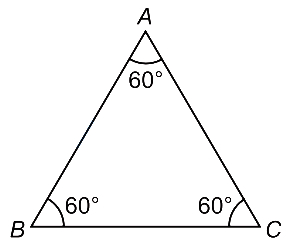
$A$ ray of light passes through an equilateral prism such that the angle of incidence is equal to the angle of emergence and each one is equal to $3/4$th the angle of the prism. The angle of deviation is (in $^{\circ}$)
A
$45$
B
$39$
C
$20$
D
$30$
Solution
(D) For an equilateral prism,the angle of the prism $A = 60^{\circ}$.
Given that the angle of incidence $i$ is equal to the angle of emergence $e$,and each is equal to $3/4$ of the angle of the prism:
$i = e = \frac{3}{4} \times A$
$i = e = \frac{3}{4} \times 60^{\circ} = 45^{\circ}$.
The relation between the angle of incidence,angle of emergence,angle of the prism,and the angle of deviation $\delta$ is given by:
$i + e = A + \delta$
Substituting the values:
$45^{\circ} + 45^{\circ} = 60^{\circ} + \delta$
$90^{\circ} = 60^{\circ} + \delta$
$\delta = 90^{\circ} - 60^{\circ} = 30^{\circ}$.
Thus,the angle of deviation is $30^{\circ}$.
Given that the angle of incidence $i$ is equal to the angle of emergence $e$,and each is equal to $3/4$ of the angle of the prism:
$i = e = \frac{3}{4} \times A$
$i = e = \frac{3}{4} \times 60^{\circ} = 45^{\circ}$.
The relation between the angle of incidence,angle of emergence,angle of the prism,and the angle of deviation $\delta$ is given by:
$i + e = A + \delta$
Substituting the values:
$45^{\circ} + 45^{\circ} = 60^{\circ} + \delta$
$90^{\circ} = 60^{\circ} + \delta$
$\delta = 90^{\circ} - 60^{\circ} = 30^{\circ}$.
Thus,the angle of deviation is $30^{\circ}$.
0 likesView Solution
157
ChemistryEasyMCQTS EAMCET · 2010
Solvay process is used in the manufacture of
A
$K_2CO_3$
B
$KHCO_3$
C
$Na_2CO_3$
D
$CaCl_2$
Solution
(C) The Solvay process is an industrial method used for the large-scale production of sodium carbonate $(Na_2CO_3)$,commonly known as soda ash.
0 likesView Solution
158
ChemistryEasyMCQTS EAMCET · 2010
The number of molecules of $CO_2$ liberated by the complete combustion of $0.1 \ mol$ of graphite in air is
A
$3.01 \times 10^{22}$
B
$6.02 \times 10^{23}$
C
$6.02 \times 10^{22}$
D
$3.01 \times 10^{23}$
Solution
(C) The balanced chemical equation for the combustion of graphite is:
$C_{(s)} + O_{2(g)} \longrightarrow CO_{2(g)}$
From the stoichiometry,$1 \ mol$ of $C$ produces $1 \ mol$ of $CO_2$.
Since $1 \ mol$ of any substance contains $6.022 \times 10^{23}$ molecules,$1 \ mol$ of $C$ produces $6.022 \times 10^{23}$ molecules of $CO_2$.
Therefore,$0.1 \ mol$ of graphite will produce:
$0.1 \times 6.022 \times 10^{23} = 6.022 \times 10^{22}$ molecules of $CO_2$.
$C_{(s)} + O_{2(g)} \longrightarrow CO_{2(g)}$
From the stoichiometry,$1 \ mol$ of $C$ produces $1 \ mol$ of $CO_2$.
Since $1 \ mol$ of any substance contains $6.022 \times 10^{23}$ molecules,$1 \ mol$ of $C$ produces $6.022 \times 10^{23}$ molecules of $CO_2$.
Therefore,$0.1 \ mol$ of graphite will produce:
$0.1 \times 6.022 \times 10^{23} = 6.022 \times 10^{22}$ molecules of $CO_2$.
0 likesView Solution
159
ChemistryDifficultMCQTS EAMCET · 2010
$CH_4$ diffuses two times faster than a gas $X$. The number of molecules present in $32 \ g$ of gas $X$ is ($N$ is Avogadro number).
A
$N$
B
$\frac{N}{2}$
C
$\frac{N}{4}$
D
$\frac{N}{16}$
Solution
(B) From Graham's law of diffusion,$\frac{r_{CH_4}}{r_X} = \sqrt{\frac{M_X}{M_{CH_4}}}$.
Given that $r_{CH_4} = 2 \cdot r_X$,we have $2 = \sqrt{\frac{M_X}{16}}$.
Squaring both sides,$4 = \frac{M_X}{16}$,so $M_X = 64 \ g/mol$.
The number of moles of gas $X$ in $32 \ g$ is $n = \frac{32}{64} = 0.5 \ mol$.
The number of molecules is $n \times N = 0.5 \times N = \frac{N}{2}$.
Given that $r_{CH_4} = 2 \cdot r_X$,we have $2 = \sqrt{\frac{M_X}{16}}$.
Squaring both sides,$4 = \frac{M_X}{16}$,so $M_X = 64 \ g/mol$.
The number of moles of gas $X$ in $32 \ g$ is $n = \frac{32}{64} = 0.5 \ mol$.
The number of molecules is $n \times N = 0.5 \times N = \frac{N}{2}$.
0 likesView Solution
160
ChemistryMediumMCQTS EAMCET · 2010
Which one of the following transitions of an electron in a hydrogen atom emits radiation of the lowest wavelength?
A
$n_2=\infty$ to $n_1=2$
B
$n_2=4$ to $n_1=3$
C
$n_2=2$ to $n_1=1$
D
$n_2=5$ to $n_1=3$
Solution
(C) The energy of a photon emitted during an electronic transition is given by $\Delta E = E_{n_2} - E_{n_1} = 13.6 \left( \frac{1}{n_1^2} - \frac{1}{n_2^2} \right) \text{ eV}$.
Since $\Delta E = \frac{hc}{\lambda}$,the wavelength $\lambda$ is inversely proportional to the energy difference $\Delta E$ $(\lambda = \frac{hc}{\Delta E})$.
To obtain the lowest wavelength,we need the transition with the highest energy difference $\Delta E$.
Comparing the transitions:
$(A)$ $n_2=\infty$ to $n_1=2$: $\Delta E \propto (1/4 - 0) = 0.25$
$(B)$ $n_2=4$ to $n_1=3$: $\Delta E \propto (1/9 - 1/16) = 0.0486$
$(C)$ $n_2=2$ to $n_1=1$: $\Delta E \propto (1/1 - 1/4) = 0.75$
$(D)$ $n_2=5$ to $n_1=3$: $\Delta E \propto (1/9 - 1/25) = 0.0711$
The transition $n_2=2$ to $n_1=1$ has the largest energy difference,therefore it emits radiation of the lowest wavelength.
Since $\Delta E = \frac{hc}{\lambda}$,the wavelength $\lambda$ is inversely proportional to the energy difference $\Delta E$ $(\lambda = \frac{hc}{\Delta E})$.
To obtain the lowest wavelength,we need the transition with the highest energy difference $\Delta E$.
Comparing the transitions:
$(A)$ $n_2=\infty$ to $n_1=2$: $\Delta E \propto (1/4 - 0) = 0.25$
$(B)$ $n_2=4$ to $n_1=3$: $\Delta E \propto (1/9 - 1/16) = 0.0486$
$(C)$ $n_2=2$ to $n_1=1$: $\Delta E \propto (1/1 - 1/4) = 0.75$
$(D)$ $n_2=5$ to $n_1=3$: $\Delta E \propto (1/9 - 1/25) = 0.0711$
The transition $n_2=2$ to $n_1=1$ has the largest energy difference,therefore it emits radiation of the lowest wavelength.
0 likesView Solution
161
ChemistryEasyMCQTS EAMCET · 2010
Which one of the following conditions is incorrect for a well-behaved wave function $(\psi)$?
A
$\psi$ must be finite
B
$\psi$ must be single-valued
C
$\psi$ must be infinite
D
$\psi$ must be continuous
Solution
(C) For a well-behaved wave function,the $BORN$ conditions are that $\psi$ must be finite,single-valued,and continuous. Therefore,the condition that $\psi$ must be infinite is incorrect.
0 likesView Solution
162
ChemistryMediumMCQTS EAMCET · 2010
$A$ system is provided with $50 \ J$ of heat and the work done on the system is $10 \ J$. What is the change in internal energy of the system in joules?
A
$60$
B
$40$
C
$50$
D
$10$
Solution
(A) From the first law of thermodynamics,$\Delta U = Q + W$.
Since heat is provided to the system,$Q = +50 \ J$.
Since work is done on the system,$W = +10 \ J$.
Therefore,the change in internal energy is $\Delta U = 50 \ J + 10 \ J = 60 \ J$.
Since heat is provided to the system,$Q = +50 \ J$.
Since work is done on the system,$W = +10 \ J$.
Therefore,the change in internal energy is $\Delta U = 50 \ J + 10 \ J = 60 \ J$.
0 likesView Solution
Vedclass Products
For Students
Vedclass Test Series
Mock tests in real TS EAMCET style covering Chemistry with performance analysis. 5-day free trial.
Start Free TrialFor Teachers
Exam Paper Generator
Generate Set A/B/C/D Chemistry papers from 7.5L+ questions in 2 minutes. 3 chapters free.
Try FreeFor Institutes
Online Exam Module
Run live TS EAMCET mock exams with unlimited students, 360° analytics & white-label branding.
See DemoFrequently Asked Questions
How many Chemistry questions are in TS EAMCET 2010?
There are 185 Chemistry questions from the TS EAMCET 2010 paper on Vedclass, each with a detailed step-by-step solution in English.
Are TS EAMCET 2010 Chemistry solutions available in English?
Yes. All solutions on this page are in English. You can also switch to English or Hindi using the language buttons above the questions.
Can I practice TS EAMCET 2010 Chemistry as a timed test?
Yes. Use the Vedclass Test Series to attempt a full TS EAMCET mock test covering Chemistry with time limits and instant score analysis.
Can teachers create Chemistry papers from TS EAMCET previous year questions?
Yes. The Vedclass Exam Paper Generator lets teachers mix TS EAMCET Chemistry questions and generate Set A/B/C/D papers in minutes.
For Teachers & Institutes
Build a Custom Chemistry Paper
Pick TS EAMCET 2010 Chemistry questions, set difficulty, and generate Set A/B/C/D in 2 minutes.