
ChemistryQ101–150 of 185 questions
Page 3 of 4 · English
101
ChemistryMCQTS EAMCET · 2010
$X$ is a non-volatile solute and $Y$ is a volatile solvent. The following vapour pressures are observed by dissolving $X$ in $Y$:
| $X / \text{mol L}^{-1}$ | $Y / \text{mm of Hg}$ |
| :--- | :--- |
| $0.10$ | $p_1$ |
| $0.25$ | $p_2$ |
| $0.01$ | $p_3$ |
The correct order of vapour pressures is:
| $X / \text{mol L}^{-1}$ | $Y / \text{mm of Hg}$ |
| :--- | :--- |
| $0.10$ | $p_1$ |
| $0.25$ | $p_2$ |
| $0.01$ | $p_3$ |
The correct order of vapour pressures is:
A
$p_1 < p_2 < p_3$
B
$p_3 < p_2 < p_1$
C
$p_3 < p_1 < p_2$
D
$p_2 < p_1 < p_3$
Solution
(D) When a non-volatile solute is added to a volatile solvent,the solute particles occupy some of the surface area of the solvent.
This reduces the number of solvent molecules available at the surface for vaporization,leading to a decrease in vapour pressure.
As the concentration of the non-volatile solute increases,the vapour pressure of the solution decreases.
Given concentrations of $X$ are:
$0.01 \text{ mol L}^{-1} < 0.10 \text{ mol L}^{-1} < 0.25 \text{ mol L}^{-1}$
Correspondingly,the vapour pressures are:
$p_3 > p_1 > p_2$
This can be rewritten as:
$p_2 < p_1 < p_3$
This reduces the number of solvent molecules available at the surface for vaporization,leading to a decrease in vapour pressure.
As the concentration of the non-volatile solute increases,the vapour pressure of the solution decreases.
Given concentrations of $X$ are:
$0.01 \text{ mol L}^{-1} < 0.10 \text{ mol L}^{-1} < 0.25 \text{ mol L}^{-1}$
Correspondingly,the vapour pressures are:
$p_3 > p_1 > p_2$
This can be rewritten as:
$p_2 < p_1 < p_3$
0 likesView Solution
102
ChemistryMCQTS EAMCET · 2010
The number of molecules of $CO_2$ liberated by the complete combustion of $0.1 \text{ mol}$ of graphite in air is:
A
$3.01 \times 10^{22}$
B
$6.02 \times 10^{23}$
C
$6.02 \times 10^{22}$
D
$3.01 \times 10^{23}$
Solution
(C) The combustion reaction of graphite is given by:
$C_{(s)} + O_{2(g)} \longrightarrow CO_{2(g)}$
From the stoichiometry of the reaction,$1 \text{ mole}$ of $C$ produces $1 \text{ mole}$ of $CO_2$.
Since $1 \text{ mole}$ of any substance contains $6.022 \times 10^{23}$ molecules:
$1 \text{ mole of } C \text{ produces } 6.022 \times 10^{23} \text{ molecules of } CO_2$.
Therefore,$0.1 \text{ mole}$ of graphite will produce:
$0.1 \times 6.022 \times 10^{23} = 6.022 \times 10^{22} \text{ molecules of } CO_2$.
$C_{(s)} + O_{2(g)} \longrightarrow CO_{2(g)}$
From the stoichiometry of the reaction,$1 \text{ mole}$ of $C$ produces $1 \text{ mole}$ of $CO_2$.
Since $1 \text{ mole}$ of any substance contains $6.022 \times 10^{23}$ molecules:
$1 \text{ mole of } C \text{ produces } 6.022 \times 10^{23} \text{ molecules of } CO_2$.
Therefore,$0.1 \text{ mole}$ of graphite will produce:
$0.1 \times 6.022 \times 10^{23} = 6.022 \times 10^{22} \text{ molecules of } CO_2$.
0 likesView Solution
103
ChemistryMCQTS EAMCET · 2010
$CH_4$ diffuses two times faster than a gas $X$. The number of molecules present in $32 \ g$ of gas $X$ is ($N$ is Avogadro number).
A
$N$
B
$\frac{N}{2}$
C
$\frac{N}{4}$
D
$\frac{N}{16}$
Solution
(B) From Graham's law of diffusion,$\frac{r_{CH_4}}{r_X} = \sqrt{\frac{M_X}{M_{CH_4}}}$.
Given that $r_{CH_4} = 2 \cdot r_X$,we have $2 = \sqrt{\frac{M_X}{16}}$.
Squaring both sides,$4 = \frac{M_X}{16}$,which gives $M_X = 64 \ g/mol$.
The number of moles of gas $X$ in $32 \ g$ is $n = \frac{32 \ g}{64 \ g/mol} = 0.5 \ mol$.
The number of molecules is $n \times N = 0.5 \times N = \frac{N}{2}$.
Given that $r_{CH_4} = 2 \cdot r_X$,we have $2 = \sqrt{\frac{M_X}{16}}$.
Squaring both sides,$4 = \frac{M_X}{16}$,which gives $M_X = 64 \ g/mol$.
The number of moles of gas $X$ in $32 \ g$ is $n = \frac{32 \ g}{64 \ g/mol} = 0.5 \ mol$.
The number of molecules is $n \times N = 0.5 \times N = \frac{N}{2}$.
0 likesView Solution
104
ChemistryMCQTS EAMCET · 2010
Which one of the following transitions of an electron in a hydrogen atom emits radiation of the lowest wavelength?
A
$n_2=\infty$ to $n_1=2$
B
$n_2=4$ to $n_1=3$
C
$n_2=2$ to $n_1=1$
D
$n_2=5$ to $n_1=3$
Solution
(C) The energy of a photon emitted during an electronic transition is given by $\Delta E = E_{n_2} - E_{n_1} = 13.6 \left( \frac{1}{n_1^2} - \frac{1}{n_2^2} \right) \text{ eV}$.
Since $\Delta E = \frac{hc}{\lambda}$,the wavelength $\lambda$ is inversely proportional to the energy difference $\Delta E$.
To obtain the lowest wavelength,we need the highest energy transition.
Comparing the transitions:
$(A)$ $n_2=\infty$ to $n_1=2$: $\Delta E \propto (1/4 - 0) = 0.25$
$(B)$ $n_2=4$ to $n_1=3$: $\Delta E \propto (1/9 - 1/16) = 0.0486$
$(C)$ $n_2=2$ to $n_1=1$: $\Delta E \propto (1/1 - 1/4) = 0.75$
$(D)$ $n_2=5$ to $n_1=3$: $\Delta E \propto (1/9 - 1/25) = 0.0711$
The transition $n_2=2$ to $n_1=1$ has the largest energy difference,therefore it emits radiation of the lowest wavelength.
Since $\Delta E = \frac{hc}{\lambda}$,the wavelength $\lambda$ is inversely proportional to the energy difference $\Delta E$.
To obtain the lowest wavelength,we need the highest energy transition.
Comparing the transitions:
$(A)$ $n_2=\infty$ to $n_1=2$: $\Delta E \propto (1/4 - 0) = 0.25$
$(B)$ $n_2=4$ to $n_1=3$: $\Delta E \propto (1/9 - 1/16) = 0.0486$
$(C)$ $n_2=2$ to $n_1=1$: $\Delta E \propto (1/1 - 1/4) = 0.75$
$(D)$ $n_2=5$ to $n_1=3$: $\Delta E \propto (1/9 - 1/25) = 0.0711$
The transition $n_2=2$ to $n_1=1$ has the largest energy difference,therefore it emits radiation of the lowest wavelength.
0 likesView Solution
105
ChemistryMCQTS EAMCET · 2010
Which one of the following conditions is incorrect for a well-behaved wave function $(\psi)$?
A
$\psi$ must be finite
B
$\psi$ must be single-valued
C
$\psi$ must be infinite
D
$\psi$ must be continuous
Solution
(C) For a wave function to be physically acceptable or well-behaved,it must satisfy the following Born's conditions:
$1$. $\psi$ must be finite everywhere.
$2$. $\psi$ must be single-valued.
$3$. $\psi$ must be continuous and its first derivative must also be continuous.
Therefore,the condition that $\psi$ must be infinite is incorrect.
$1$. $\psi$ must be finite everywhere.
$2$. $\psi$ must be single-valued.
$3$. $\psi$ must be continuous and its first derivative must also be continuous.
Therefore,the condition that $\psi$ must be infinite is incorrect.
0 likesView Solution
106
ChemistryMCQTS EAMCET · 2010
$A$ micelle formed during the cleansing action by soap is
A
a discrete particle of soap
B
aggregated particles of soap and dirt
C
a discrete particle of dust
D
an aggregated particle of dust and water
Solution
(B) Soap molecules contain a hydrophobic (water-repelling) tail and a hydrophilic (water-attracting) head.
When soap is added to water containing grease or dirt,the hydrophobic tails dissolve into the grease,while the hydrophilic heads remain in the water.
This arrangement forms a spherical structure where the grease is trapped inside the hydrophobic core,and the hydrophilic heads point outward towards the water.
This aggregate of soap and dirt particles is known as a micelle.
When the surface is rinsed with water,the micelle is washed away,effectively removing the dirt.
When soap is added to water containing grease or dirt,the hydrophobic tails dissolve into the grease,while the hydrophilic heads remain in the water.
This arrangement forms a spherical structure where the grease is trapped inside the hydrophobic core,and the hydrophilic heads point outward towards the water.
This aggregate of soap and dirt particles is known as a micelle.
When the surface is rinsed with water,the micelle is washed away,effectively removing the dirt.
0 likesView Solution
107
ChemistryMCQTS EAMCET · 2010
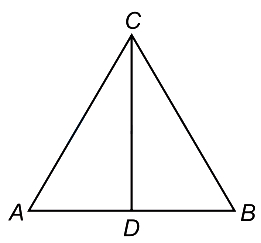
Three rods of equal lengths are joined to form an equilateral triangle $ABC$. $D$ is the mid-point of $AB$. The coefficient of linear expansion is $\alpha_1$ for the material of rod $AB$ and $\alpha_2$ for the material of rods $AC$ and $BC$. If the distance $DC$ remains constant for small changes in temperature,then
A
$\alpha_1 = 2\alpha_2$
B
$\alpha_1 = 4\alpha_2$
C
$\alpha_1 = 8\alpha_2$
D
$\alpha_1 = \alpha_2$
Solution
(B) Let the initial length of each rod be $l$. In the equilateral triangle $ABC$,$D$ is the mid-point of $AB$,so $AD = l/2$. The length of the altitude $DC$ is given by $DC^2 = AC^2 - AD^2 = l^2 - (l/2)^2 = 3l^2/4$.
After a small change in temperature $\Delta t$,the new lengths become $l' = l(1 + \alpha \Delta t)$.
The new length of $AC$ is $l_{AC}' = l(1 + \alpha_2 \Delta t)$ and the new length of $AD$ is $l_{AD}' = (l/2)(1 + \alpha_1 \Delta t)$.
Since $DC$ remains constant,$DC^2 = (l_{AC}')^2 - (l_{AD}')^2$.
$3l^2/4 = [l(1 + \alpha_2 \Delta t)]^2 - [(l/2)(1 + \alpha_1 \Delta t)]^2$.
$3l^2/4 = l^2(1 + 2\alpha_2 \Delta t + \alpha_2^2 \Delta t^2) - (l^2/4)(1 + 2\alpha_1 \Delta t + \alpha_1^2 \Delta t^2)$.
Neglecting higher-order terms $\alpha^2 \Delta t^2$,we get:
$3l^2/4 = l^2 + 2l^2 \alpha_2 \Delta t - l^2/4 - (l^2/4)(2\alpha_1 \Delta t)$.
$3l^2/4 = 3l^2/4 + 2l^2 \alpha_2 \Delta t - (l^2/2)\alpha_1 \Delta t$.
$0 = 2\alpha_2 \Delta t - (1/2)\alpha_1 \Delta t$.
$2\alpha_2 = \alpha_1/2 \implies \alpha_1 = 4\alpha_2$.
After a small change in temperature $\Delta t$,the new lengths become $l' = l(1 + \alpha \Delta t)$.
The new length of $AC$ is $l_{AC}' = l(1 + \alpha_2 \Delta t)$ and the new length of $AD$ is $l_{AD}' = (l/2)(1 + \alpha_1 \Delta t)$.
Since $DC$ remains constant,$DC^2 = (l_{AC}')^2 - (l_{AD}')^2$.
$3l^2/4 = [l(1 + \alpha_2 \Delta t)]^2 - [(l/2)(1 + \alpha_1 \Delta t)]^2$.
$3l^2/4 = l^2(1 + 2\alpha_2 \Delta t + \alpha_2^2 \Delta t^2) - (l^2/4)(1 + 2\alpha_1 \Delta t + \alpha_1^2 \Delta t^2)$.
Neglecting higher-order terms $\alpha^2 \Delta t^2$,we get:
$3l^2/4 = l^2 + 2l^2 \alpha_2 \Delta t - l^2/4 - (l^2/4)(2\alpha_1 \Delta t)$.
$3l^2/4 = 3l^2/4 + 2l^2 \alpha_2 \Delta t - (l^2/2)\alpha_1 \Delta t$.
$0 = 2\alpha_2 \Delta t - (1/2)\alpha_1 \Delta t$.
$2\alpha_2 = \alpha_1/2 \implies \alpha_1 = 4\alpha_2$.
0 likesView Solution
108
ChemistryMCQTS EAMCET · 2010
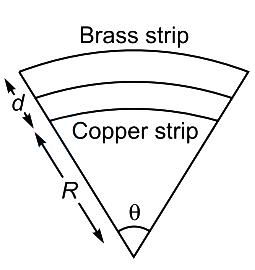
$A$ bimetallic strip is formed out of two identical strips,one of copper and the other of brass. The coefficients of linear expansion of the two metals are $\alpha_C$ and $\alpha_B$. On heating,the temperature of the strip increases by $\Delta T$ and the strip bends to form an arc of radius $R$. Then $R$ is proportional to
A
$\Delta T$
B
$\frac{1}{\Delta T}$
C
$\sqrt{\Delta T}$
D
$\frac{1}{\sqrt{\Delta T}}$
Solution
(B) Let $L_0$ be the initial length of each strip before heating. Let $d$ be the total thickness of the bimetallic strip.
After heating,the length of the brass strip is $L_B = L_0(1 + \alpha_B \Delta T) = (R + d) \theta$.
The length of the copper strip is $L_C = L_0(1 + \alpha_C \Delta T) = R \theta$.
Dividing the two equations,we get $\frac{R + d}{R} = \frac{1 + \alpha_B \Delta T}{1 + \alpha_C \Delta T}$.
This simplifies to $1 + \frac{d}{R} = \frac{1 + \alpha_B \Delta T}{1 + \alpha_C \Delta T}$.
$\frac{d}{R} = \frac{1 + \alpha_B \Delta T}{1 + \alpha_C \Delta T} - 1 = \frac{1 + \alpha_B \Delta T - 1 - \alpha_C \Delta T}{1 + \alpha_C \Delta T} = \frac{(\alpha_B - \alpha_C) \Delta T}{1 + \alpha_C \Delta T}$.
Since $\alpha \Delta T \ll 1$,we can approximate $1 + \alpha_C \Delta T \approx 1$.
Thus,$R \approx \frac{d}{(\alpha_B - \alpha_C) \Delta T}$.
Therefore,$R \propto \frac{1}{\Delta T}$.
After heating,the length of the brass strip is $L_B = L_0(1 + \alpha_B \Delta T) = (R + d) \theta$.
The length of the copper strip is $L_C = L_0(1 + \alpha_C \Delta T) = R \theta$.
Dividing the two equations,we get $\frac{R + d}{R} = \frac{1 + \alpha_B \Delta T}{1 + \alpha_C \Delta T}$.
This simplifies to $1 + \frac{d}{R} = \frac{1 + \alpha_B \Delta T}{1 + \alpha_C \Delta T}$.
$\frac{d}{R} = \frac{1 + \alpha_B \Delta T}{1 + \alpha_C \Delta T} - 1 = \frac{1 + \alpha_B \Delta T - 1 - \alpha_C \Delta T}{1 + \alpha_C \Delta T} = \frac{(\alpha_B - \alpha_C) \Delta T}{1 + \alpha_C \Delta T}$.
Since $\alpha \Delta T \ll 1$,we can approximate $1 + \alpha_C \Delta T \approx 1$.
Thus,$R \approx \frac{d}{(\alpha_B - \alpha_C) \Delta T}$.
Therefore,$R \propto \frac{1}{\Delta T}$.
0 likesView Solution
109
ChemistryMCQTS EAMCET · 2010
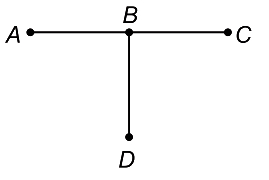
Three rods $AB$,$BC$,and $BD$ made of the same material and having the same cross-section have been joined as shown in the figure. The ends $A$,$C$,and $D$ are held at temperatures of $20^{\circ}C$,$80^{\circ}C$,and $80^{\circ}C$ respectively. If each rod is of the same length,then the temperature at the junction $B$ of the three rods is: (in $^{\circ}C$)
A
$90$
B
$60$
C
$40$
D
$30$
Solution
(B) Let the temperature of the junction $B$ be $\theta$.
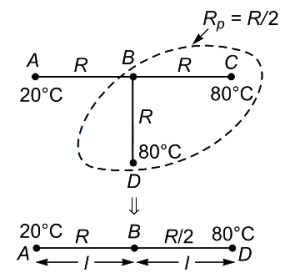
Since the rods $BC$ and $BD$ are connected to the same temperature $80^{\circ}C$ at their ends $C$ and $D$,they act as parallel thermal resistances.
Let $R$ be the thermal resistance of each rod. The equivalent resistance of the parallel combination of rods $BC$ and $BD$ is $R_{eq} = \frac{R \times R}{R + R} = \frac{R}{2}$.
According to the principle of steady-state heat flow,the heat current flowing through rod $AB$ must equal the sum of the heat currents flowing through rods $BC$ and $BD$.
Using the formula for heat current $\frac{Q}{t} = \frac{\Delta T}{R}$,we have:
$\frac{\theta - 20}{R} = \frac{80 - \theta}{R/2}$
$\theta - 20 = 2(80 - \theta)$
$\theta - 20 = 160 - 2\theta$
$3\theta = 180$
$\theta = 60^{\circ}C$.
Since the rods $BC$ and $BD$ are connected to the same temperature $80^{\circ}C$ at their ends $C$ and $D$,they act as parallel thermal resistances.
Let $R$ be the thermal resistance of each rod. The equivalent resistance of the parallel combination of rods $BC$ and $BD$ is $R_{eq} = \frac{R \times R}{R + R} = \frac{R}{2}$.
According to the principle of steady-state heat flow,the heat current flowing through rod $AB$ must equal the sum of the heat currents flowing through rods $BC$ and $BD$.
Using the formula for heat current $\frac{Q}{t} = \frac{\Delta T}{R}$,we have:
$\frac{\theta - 20}{R} = \frac{80 - \theta}{R/2}$
$\theta - 20 = 2(80 - \theta)$
$\theta - 20 = 160 - 2\theta$
$3\theta = 180$
$\theta = 60^{\circ}C$.
0 likesView Solution
110
ChemistryMCQTS EAMCET · 2010
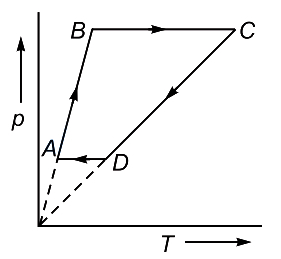
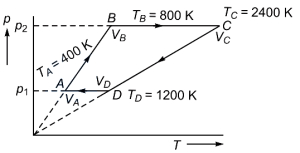
$3$ moles of an ideal monoatomic gas perform an $A B C D A$ cyclic process as shown in the figure. The gas temperatures are $T_A=400 \, K$, $T_B=800 \, K$, $T_C=2400 \, K$, and $T_D=1200 \, K$. The work done by the gas is (approximately) $(R=8.314 \, J / mol K)$. (in $ \, kJ$)
A
$10$
B
$20$
C
$40$
D
$100$
Solution
(B) The process is given on a $p-T$ diagram. For an ideal gas, $p V = \mu R T$, which implies $p = \frac{\mu R}{V} T$.
Since $p \propto T$ for a constant volume, the lines passing through the origin in a $p-T$ diagram represent isochoric (constant volume) processes.
In the given figure, $A B$ and $C D$ are straight lines passing through the origin, so these are isochoric processes.
Work done in an isochoric process is zero. Thus, $W_{A B} = 0$ and $W_{C D} = 0$.
For the isobaric processes $B C$ and $D A$, the work done is $W = p \Delta V = \mu R \Delta T$.
For process $B C$ (at constant pressure $p_2$): $W_{B C} = \mu R (T_C - T_B) = 3 \times R \times (2400 - 800) = 3 R \times 1600 = 4800 R$.
For process $D A$ (at constant pressure $p_1$): $W_{D A} = \mu R (T_A - T_D) = 3 \times R \times (400 - 1200) = 3 R \times (-800) = -2400 R$.
The total work done in the cycle is $W = W_{A B} + W_{B C} + W_{C D} + W_{D A} = 0 + 4800 R + 0 - 2400 R = 2400 R$.
Substituting $R = 8.314 \, J / mol K$: $W = 2400 \times 8.314 = 19953.6 \, J \approx 20 \, kJ$.
Since $p \propto T$ for a constant volume, the lines passing through the origin in a $p-T$ diagram represent isochoric (constant volume) processes.
In the given figure, $A B$ and $C D$ are straight lines passing through the origin, so these are isochoric processes.
Work done in an isochoric process is zero. Thus, $W_{A B} = 0$ and $W_{C D} = 0$.
For the isobaric processes $B C$ and $D A$, the work done is $W = p \Delta V = \mu R \Delta T$.
For process $B C$ (at constant pressure $p_2$): $W_{B C} = \mu R (T_C - T_B) = 3 \times R \times (2400 - 800) = 3 R \times 1600 = 4800 R$.
For process $D A$ (at constant pressure $p_1$): $W_{D A} = \mu R (T_A - T_D) = 3 \times R \times (400 - 1200) = 3 R \times (-800) = -2400 R$.
The total work done in the cycle is $W = W_{A B} + W_{B C} + W_{C D} + W_{D A} = 0 + 4800 R + 0 - 2400 R = 2400 R$.
Substituting $R = 8.314 \, J / mol K$: $W = 2400 \times 8.314 = 19953.6 \, J \approx 20 \, kJ$.
0 likesView Solution
111
ChemistryMCQTS EAMCET · 2010
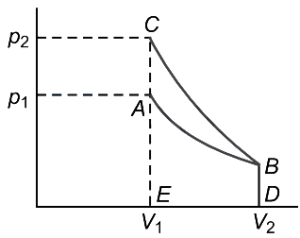
An ideal gas expands isothermally from volume $V_1$ to volume $V_2$. It is then compressed to the original volume $V_1$ adiabatically. If $p_1$ and $p_2$ represent the initial pressure and final pressure respectively,and $W$ represents the net work done by the gas during the entire process,then:
A
$p_1 > p_2, W = 0$
B
$p_1 > p_2, W > 0$
C
$p_2 > p_1, W > 0$
D
$p_2 > p_1, W < 0$
Solution
(D) $1$. In the $p-V$ diagram,the isothermal expansion from $A$ to $B$ follows the curve $AB$. The adiabatic compression from $B$ to $C$ follows the curve $BC$.
$2$. From the graph,it is clear that the final pressure $p_2$ at point $C$ is greater than the initial pressure $p_1$ at point $A$ $(p_2 > p_1)$.
$3$. The net work done $W$ by the gas in a cyclic process is equal to the area enclosed by the cycle $ABCA$. Since the process is counter-clockwise (expansion $A \to B$ followed by compression $B \to C$),the work done by the gas is negative $(W < 0)$.
$4$. Alternatively,the area under the adiabatic curve $BC$ (which is the work done on the gas during compression) is greater than the area under the isothermal curve $AB$ (which is the work done by the gas during expansion). Thus,the net work done by the gas is negative.
$5$. Therefore,$p_2 > p_1$ and $W < 0$.
$2$. From the graph,it is clear that the final pressure $p_2$ at point $C$ is greater than the initial pressure $p_1$ at point $A$ $(p_2 > p_1)$.
$3$. The net work done $W$ by the gas in a cyclic process is equal to the area enclosed by the cycle $ABCA$. Since the process is counter-clockwise (expansion $A \to B$ followed by compression $B \to C$),the work done by the gas is negative $(W < 0)$.
$4$. Alternatively,the area under the adiabatic curve $BC$ (which is the work done on the gas during compression) is greater than the area under the isothermal curve $AB$ (which is the work done by the gas during expansion). Thus,the net work done by the gas is negative.
$5$. Therefore,$p_2 > p_1$ and $W < 0$.
0 likesView Solution
112
ChemistryMCQTS EAMCET · 2010
$A$ system is provided with $50 \ J$ of heat and the work done on the system is $10 \ J$. What is the change in internal energy of the system in joules?
A
$60$
B
$40$
C
$50$
D
$10$
Solution
(A) From the first law of thermodynamics,$\Delta U = Q + W$.
Since heat is provided to the system,$Q = +50 \ J$.
Since work is done on the system,$W = +10 \ J$.
Therefore,the change in internal energy is $\Delta U = 50 \ J + 10 \ J = 60 \ J$.
Since heat is provided to the system,$Q = +50 \ J$.
Since work is done on the system,$W = +10 \ J$.
Therefore,the change in internal energy is $\Delta U = 50 \ J + 10 \ J = 60 \ J$.
0 likesView Solution
113
ChemistryMCQTS EAMCET · 2010
If the force is given by $F = at + bt^2$,where $t$ is time,the dimensions of $a$ and $b$ are:
A
$[MLT^{-4}], [MLT^{-2}]$
B
$[MLT^{-3}], [MLT^{-4}]$
C
$[ML^2 T^{-3}], [ML^2 T^{-2}]$
D
$[ML^2 T^{-3}], [ML^3 T^{-4}]$
Solution
(B) According to the principle of homogeneity of dimensions,the dimensions of each term in a physical equation must be the same.
Given the equation $F = at + bt^2$,where $F$ is force and $t$ is time.
The dimension of force $F$ is $[MLT^{-2}]$.
For the first term: $[at] = [F]$
$[a] = [F] / [t] = [MLT^{-2}] / [T] = [MLT^{-3}]$.
For the second term: $[bt^2] = [F]$
$[b] = [F] / [t^2] = [MLT^{-2}] / [T^2] = [MLT^{-4}]$.
Thus,the dimensions of $a$ and $b$ are $[MLT^{-3}]$ and $[MLT^{-4}]$ respectively.
Given the equation $F = at + bt^2$,where $F$ is force and $t$ is time.
The dimension of force $F$ is $[MLT^{-2}]$.
For the first term: $[at] = [F]$
$[a] = [F] / [t] = [MLT^{-2}] / [T] = [MLT^{-3}]$.
For the second term: $[bt^2] = [F]$
$[b] = [F] / [t^2] = [MLT^{-2}] / [T^2] = [MLT^{-4}]$.
Thus,the dimensions of $a$ and $b$ are $[MLT^{-3}]$ and $[MLT^{-4}]$ respectively.
0 likesView Solution
114
ChemistryMCQTS EAMCET · 2010
Two coherent sources whose intensity ratio is $64: 1$ produce interference fringes. The ratio of intensities of maxima and minima is
A
$9: 7$
B
$8: 1$
C
$81: 49$
D
$81: 7$
Solution
(C) The ratio of intensities of two coherent sources is given as $\frac{I_1}{I_2} = \frac{64}{1}$.
Let $I_1 = 64k$ and $I_2 = k$,where $k$ is a constant.
The ratio of maximum intensity to minimum intensity in an interference pattern is given by the formula:
$\frac{I_{\max}}{I_{\min}} = \frac{(\sqrt{I_1} + \sqrt{I_2})^2}{(\sqrt{I_1} - \sqrt{I_2})^2}$.
Substituting the values:
$\frac{I_{\max}}{I_{\min}} = \frac{(\sqrt{64k} + \sqrt{k})^2}{(\sqrt{64k} - \sqrt{k})^2} = \frac{(8\sqrt{k} + \sqrt{k})^2}{(8\sqrt{k} - \sqrt{k})^2}$.
$\frac{I_{\max}}{I_{\min}} = \frac{(9\sqrt{k})^2}{(7\sqrt{k})^2} = \frac{81k}{49k} = \frac{81}{49}$.
Let $I_1 = 64k$ and $I_2 = k$,where $k$ is a constant.
The ratio of maximum intensity to minimum intensity in an interference pattern is given by the formula:
$\frac{I_{\max}}{I_{\min}} = \frac{(\sqrt{I_1} + \sqrt{I_2})^2}{(\sqrt{I_1} - \sqrt{I_2})^2}$.
Substituting the values:
$\frac{I_{\max}}{I_{\min}} = \frac{(\sqrt{64k} + \sqrt{k})^2}{(\sqrt{64k} - \sqrt{k})^2} = \frac{(8\sqrt{k} + \sqrt{k})^2}{(8\sqrt{k} - \sqrt{k})^2}$.
$\frac{I_{\max}}{I_{\min}} = \frac{(9\sqrt{k})^2}{(7\sqrt{k})^2} = \frac{81k}{49k} = \frac{81}{49}$.
0 likesView Solution
115
ChemistryMCQTS EAMCET · 2010
An organ pipe $P_1$,closed at one end and containing a gas of density $\rho_1$ is vibrating in its first harmonic. Another organ pipe $P_2$,open at both ends and containing a gas of density $\rho_2$ is vibrating in its third harmonic. Both the pipes are in resonance with a given tuning fork. If the compressibility of gases is equal in both pipes,the ratio of the lengths of $P_1$ and $P_2$ is (assume the given gases to be monoatomic).
A
$\frac{1}{3}$
B
$3$
C
$\frac{1}{6} \sqrt{\frac{\rho_1}{\rho_2}}$
D
$\frac{1}{6} \sqrt{\frac{\rho_2}{\rho_1}}$
Solution
(D) The frequency of a closed organ pipe vibrating in its first harmonic is $n_1 = \frac{v_1}{4 l_1}$.
The frequency of an open organ pipe vibrating in its third harmonic is $n_3 = \frac{3 v_2}{2 l_2}$.
Since both pipes are in resonance with the same tuning fork,their frequencies are equal: $n_1 = n_3$.
Therefore,$\frac{v_1}{4 l_1} = \frac{3 v_2}{2 l_2}$,which simplifies to $\frac{l_1}{l_2} = \frac{1}{6} \left( \frac{v_1}{v_2} \right)$.
The speed of sound in a gas is given by $v = \sqrt{\frac{B}{\rho}}$,where $B$ is the bulk modulus (reciprocal of compressibility) and $\rho$ is the density.
Given that the compressibility is equal in both pipes,$B_1 = B_2 = B$.
Thus,$\frac{v_1}{v_2} = \sqrt{\frac{B/\rho_1}{B/\rho_2}} = \sqrt{\frac{\rho_2}{\rho_1}}$.
Substituting this into the ratio of lengths: $\frac{l_1}{l_2} = \frac{1}{6} \sqrt{\frac{\rho_2}{\rho_1}}$.
The frequency of an open organ pipe vibrating in its third harmonic is $n_3 = \frac{3 v_2}{2 l_2}$.
Since both pipes are in resonance with the same tuning fork,their frequencies are equal: $n_1 = n_3$.
Therefore,$\frac{v_1}{4 l_1} = \frac{3 v_2}{2 l_2}$,which simplifies to $\frac{l_1}{l_2} = \frac{1}{6} \left( \frac{v_1}{v_2} \right)$.
The speed of sound in a gas is given by $v = \sqrt{\frac{B}{\rho}}$,where $B$ is the bulk modulus (reciprocal of compressibility) and $\rho$ is the density.
Given that the compressibility is equal in both pipes,$B_1 = B_2 = B$.
Thus,$\frac{v_1}{v_2} = \sqrt{\frac{B/\rho_1}{B/\rho_2}} = \sqrt{\frac{\rho_2}{\rho_1}}$.
Substituting this into the ratio of lengths: $\frac{l_1}{l_2} = \frac{1}{6} \sqrt{\frac{\rho_2}{\rho_1}}$.
0 likesView Solution
116
ChemistryMCQTS EAMCET · 2010
$A$ sonometer wire has a length of $114 ~cm$ between two fixed ends. Where should two bridges be placed so as to divide the wire into three segments (in $cm$) whose fundamental frequencies are in the ratio $1:3:4$?
A
$l_1, l_2, l_3 = 18, 24, 72$
B
$l_1, l_2, l_3 = 24, 18, 72$
C
$l_1, l_2, l_3 = 72, 18, 24$
D
$l_1, l_2, l_3 = 72, 24, 18$
Solution
(D) The fundamental frequency $n$ of a sonometer wire of length $l$ is given by $n = \frac{1}{2l} \sqrt{\frac{T}{m}}$.
Since $T$ and $m$ are constant for the wire,$n \propto \frac{1}{l}$,which implies $l \propto \frac{1}{n}$.
Given the ratio of frequencies $n_1 : n_2 : n_3 = 1 : 3 : 4$,the ratio of the lengths of the segments must be $l_1 : l_2 : l_3 = \frac{1}{1} : \frac{1}{3} : \frac{1}{4}$.
To simplify this ratio,multiply by the least common multiple of $1, 3, 4$,which is $12$: $l_1 : l_2 : l_3 = 12 : 4 : 3$.
The sum of the parts is $12 + 4 + 3 = 19$.
The total length is $114 ~cm$.
Thus,$l_1 = \frac{12}{19} \times 114 = 12 \times 6 = 72 ~cm$.
$l_2 = \frac{4}{19} \times 114 = 4 \times 6 = 24 ~cm$.
$l_3 = \frac{3}{19} \times 114 = 3 \times 6 = 18 ~cm$.
Therefore,the lengths are $72 ~cm, 24 ~cm, 18 ~cm$.
Since $T$ and $m$ are constant for the wire,$n \propto \frac{1}{l}$,which implies $l \propto \frac{1}{n}$.
Given the ratio of frequencies $n_1 : n_2 : n_3 = 1 : 3 : 4$,the ratio of the lengths of the segments must be $l_1 : l_2 : l_3 = \frac{1}{1} : \frac{1}{3} : \frac{1}{4}$.
To simplify this ratio,multiply by the least common multiple of $1, 3, 4$,which is $12$: $l_1 : l_2 : l_3 = 12 : 4 : 3$.
The sum of the parts is $12 + 4 + 3 = 19$.
The total length is $114 ~cm$.
Thus,$l_1 = \frac{12}{19} \times 114 = 12 \times 6 = 72 ~cm$.
$l_2 = \frac{4}{19} \times 114 = 4 \times 6 = 24 ~cm$.
$l_3 = \frac{3}{19} \times 114 = 3 \times 6 = 18 ~cm$.
Therefore,the lengths are $72 ~cm, 24 ~cm, 18 ~cm$.
0 likesView Solution
117
ChemistryMCQTS EAMCET · 2010
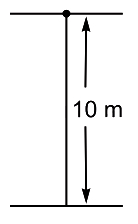
$A$ ball is falling freely from a height. When it reaches $10 ~m$ height from the ground,its velocity is $v_0$. It collides with the ground,loses $50 \%$ of its energy,and rises back to a height of $10 ~m$. Then the velocity $v_0$ is (in $~m/s$)
A
$7$
B
$10$
C
$14$
D
$16$
Solution
(C) Let the mass of the ball be $m$. When the ball is at a height $h = 10 ~m$,its velocity is $v_0$. The kinetic energy at this point is $K_1 = \frac{1}{2} m v_0^2$.
Just before hitting the ground,the ball falls an additional $10 ~m$. By the work-energy theorem,the kinetic energy just before impact is $K_{impact} = K_1 + mgh = \frac{1}{2} m v_0^2 + mg(10)$.
After the collision,the ball loses $50 \%$ of its energy,so the kinetic energy just after impact is $K_{after} = 0.5 \times K_{impact} = 0.5 \times (\frac{1}{2} m v_0^2 + 10mg)$.
The ball rises back to a height of $10 ~m$,meaning its potential energy at the peak is $mgh = 10mg$. Since the kinetic energy is zero at the peak,by conservation of energy,$K_{after} = 10mg$.
Equating the two: $0.5 \times (\frac{1}{2} m v_0^2 + 10mg) = 10mg$.
$\frac{1}{2} m v_0^2 + 10mg = 20mg$.
$\frac{1}{2} m v_0^2 = 10mg$.
$v_0^2 = 20g$.
Using $g = 10 ~m/s^2$,$v_0^2 = 200$,so $v_0 = \sqrt{200} \approx 14.14 ~m/s$. Given the options,$14 ~m/s$ is the correct choice.
Just before hitting the ground,the ball falls an additional $10 ~m$. By the work-energy theorem,the kinetic energy just before impact is $K_{impact} = K_1 + mgh = \frac{1}{2} m v_0^2 + mg(10)$.
After the collision,the ball loses $50 \%$ of its energy,so the kinetic energy just after impact is $K_{after} = 0.5 \times K_{impact} = 0.5 \times (\frac{1}{2} m v_0^2 + 10mg)$.
The ball rises back to a height of $10 ~m$,meaning its potential energy at the peak is $mgh = 10mg$. Since the kinetic energy is zero at the peak,by conservation of energy,$K_{after} = 10mg$.
Equating the two: $0.5 \times (\frac{1}{2} m v_0^2 + 10mg) = 10mg$.
$\frac{1}{2} m v_0^2 + 10mg = 20mg$.
$\frac{1}{2} m v_0^2 = 10mg$.
$v_0^2 = 20g$.
Using $g = 10 ~m/s^2$,$v_0^2 = 200$,so $v_0 = \sqrt{200} \approx 14.14 ~m/s$. Given the options,$14 ~m/s$ is the correct choice.
0 likesView Solution
118
ChemistryMCQTS EAMCET · 2010
$A$ ball falls from a height $h$ and rebounds after striking the floor. The coefficient of restitution is $e$. The total distance covered before it comes to rest is
A
$\frac{\left(1-e^2\right) h}{e^2}$
B
$\frac{\left(1+e^2\right) h}{e^2}$
C
$\left(\frac{1+e^2}{1-e^2}\right) h$
D
$\frac{e^2 h}{1-e^2}$
Solution
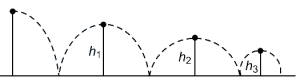
(C) When a ball falls from a height $h$,the height reached after the $n^{th}$ rebound is given by $h_n = h e^{2n}$,where $e$ is the coefficient of restitution.
The total distance $H$ covered by the ball before it comes to rest is the sum of the initial fall and the subsequent upward and downward paths for each rebound:
$H = h + 2h_1 + 2h_2 + 2h_3 + \dots$
$H = h + 2(h e^2) + 2(h e^4) + 2(h e^6) + \dots$
$H = h + 2h(e^2 + e^4 + e^6 + \dots)$
The term in the bracket is an infinite geometric progression with first term $a = e^2$ and common ratio $r = e^2$. The sum is $S = \frac{a}{1-r} = \frac{e^2}{1-e^2}$.
Substituting this back into the expression for $H$:
$H = h + 2h \left( \frac{e^2}{1-e^2} \right)$
$H = h \left( 1 + \frac{2e^2}{1-e^2} \right)$
$H = h \left( \frac{1 - e^2 + 2e^2}{1-e^2} \right)$
$H = h \left( \frac{1 + e^2}{1-e^2} \right)$
The total distance $H$ covered by the ball before it comes to rest is the sum of the initial fall and the subsequent upward and downward paths for each rebound:
$H = h + 2h_1 + 2h_2 + 2h_3 + \dots$
$H = h + 2(h e^2) + 2(h e^4) + 2(h e^6) + \dots$
$H = h + 2h(e^2 + e^4 + e^6 + \dots)$
The term in the bracket is an infinite geometric progression with first term $a = e^2$ and common ratio $r = e^2$. The sum is $S = \frac{a}{1-r} = \frac{e^2}{1-e^2}$.
Substituting this back into the expression for $H$:
$H = h + 2h \left( \frac{e^2}{1-e^2} \right)$
$H = h \left( 1 + \frac{2e^2}{1-e^2} \right)$
$H = h \left( \frac{1 - e^2 + 2e^2}{1-e^2} \right)$
$H = h \left( \frac{1 + e^2}{1-e^2} \right)$
0 likesView Solution
119
ChemistryMCQTS EAMCET · 2010
$A$ bomb moving with velocity $(40 \hat{i} + 50 \hat{j} - 25 \hat{k}) \text{ m/s}$ explodes into two pieces of mass ratio $1:4$. After the explosion,the smaller piece moves away with velocity $(200 \hat{i} + 70 \hat{j} + 15 \hat{k}) \text{ m/s}$. The velocity of the larger piece after the explosion is:
A
$45 \hat{j} - 35 \hat{k}$
B
$45 \hat{i} - 35 \hat{j}$
C
$45 \hat{k} - 35 \hat{j}$
D
$-35 \hat{i} + 45 \hat{k}$
Solution
(A) Let the mass of the smaller piece be $m$ and the mass of the larger piece be $4m$. The total mass is $5m$.
According to the law of conservation of linear momentum,the initial momentum equals the final momentum:
$P_{initial} = P_{final}$
$5m(40 \hat{i} + 50 \hat{j} - 25 \hat{k}) = m(200 \hat{i} + 70 \hat{j} + 15 \hat{k}) + 4m(\vec{v}_{large})$
Dividing by $m$:
$5(40 \hat{i} + 50 \hat{j} - 25 \hat{k}) = (200 \hat{i} + 70 \hat{j} + 15 \hat{k}) + 4\vec{v}_{large}$
$(200 \hat{i} + 250 \hat{j} - 125 \hat{k}) - (200 \hat{i} + 70 \hat{j} + 15 \hat{k}) = 4\vec{v}_{large}$
$0 \hat{i} + 180 \hat{j} - 140 \hat{k} = 4\vec{v}_{large}$
$\vec{v}_{large} = \frac{180 \hat{j} - 140 \hat{k}}{4} = 45 \hat{j} - 35 \hat{k} \text{ m/s}$.
According to the law of conservation of linear momentum,the initial momentum equals the final momentum:
$P_{initial} = P_{final}$
$5m(40 \hat{i} + 50 \hat{j} - 25 \hat{k}) = m(200 \hat{i} + 70 \hat{j} + 15 \hat{k}) + 4m(\vec{v}_{large})$
Dividing by $m$:
$5(40 \hat{i} + 50 \hat{j} - 25 \hat{k}) = (200 \hat{i} + 70 \hat{j} + 15 \hat{k}) + 4\vec{v}_{large}$
$(200 \hat{i} + 250 \hat{j} - 125 \hat{k}) - (200 \hat{i} + 70 \hat{j} + 15 \hat{k}) = 4\vec{v}_{large}$
$0 \hat{i} + 180 \hat{j} - 140 \hat{k} = 4\vec{v}_{large}$
$\vec{v}_{large} = \frac{180 \hat{j} - 140 \hat{k}}{4} = 45 \hat{j} - 35 \hat{k} \text{ m/s}$.
0 likesView Solution
120
ChemistryMediumMCQTS EAMCET · 2010
Match the following molecules in Column $I$ with the number of lone pairs on their central atom in Column $II$.
| Column $I$ (Molecules) | Column $II$ (Number of lone pairs on central atom) |
|---|---|
| $A. \ NH_3$ | $1. \ \text{Two}$ |
| $B. \ H_2O$ | $2. \ \text{Three}$ |
| $C. \ XeF_2$ | $3. \ \text{Zero}$ |
| $D. \ CH_4$ | $4. \ \text{Four}$ |
| $5. \ \text{One}$ |
A
$A-5, B-1, C-2, D-3$
B
$A-3, B-1, C-2, D-5$
C
$A-5, B-1, C-2, D-3$
D
$A-1, B-5, C-3, D-4$
Solution
(A) To determine the number of lone pairs on the central atom,we use the formula: $\text{Lone pairs} = \frac{V - M}{2}$,where $V$ is the number of valence electrons of the central atom and $M$ is the number of monovalent atoms bonded to it.
$A. \ NH_3$: Central atom $N$ has $5$ valence electrons. It is bonded to $3$ $H$ atoms. $\text{Lone pairs} = \frac{5-3}{2} = 1$ (Option $5$).
$B. \ H_2O$: Central atom $O$ has $6$ valence electrons. It is bonded to $2$ $H$ atoms. $\text{Lone pairs} = \frac{6-2}{2} = 2$ (Option $1$).
$C. \ XeF_2$: Central atom $Xe$ has $8$ valence electrons. It is bonded to $2$ $F$ atoms. $\text{Lone pairs} = \frac{8-2}{2} = 3$ (Option $2$).
$D. \ CH_4$: Central atom $C$ has $4$ valence electrons. It is bonded to $4$ $H$ atoms. $\text{Lone pairs} = \frac{4-4}{2} = 0$ (Option $3$).
Therefore,the correct matching is $A-5, B-1, C-2, D-3$.
$A. \ NH_3$: Central atom $N$ has $5$ valence electrons. It is bonded to $3$ $H$ atoms. $\text{Lone pairs} = \frac{5-3}{2} = 1$ (Option $5$).
$B. \ H_2O$: Central atom $O$ has $6$ valence electrons. It is bonded to $2$ $H$ atoms. $\text{Lone pairs} = \frac{6-2}{2} = 2$ (Option $1$).
$C. \ XeF_2$: Central atom $Xe$ has $8$ valence electrons. It is bonded to $2$ $F$ atoms. $\text{Lone pairs} = \frac{8-2}{2} = 3$ (Option $2$).
$D. \ CH_4$: Central atom $C$ has $4$ valence electrons. It is bonded to $4$ $H$ atoms. $\text{Lone pairs} = \frac{4-4}{2} = 0$ (Option $3$).
Therefore,the correct matching is $A-5, B-1, C-2, D-3$.
0 likesView Solution
121
ChemistryEasyMCQTS EAMCET · 2010
If the equilibrium constant for the reaction,$H_{2(g)} + I_{2(g)} \rightleftharpoons 2 HI_{(g)}$ is $K$,what is the equilibrium constant of $HI_{(g)} \rightleftharpoons \frac{1}{2} H_{2(g)} + \frac{1}{2} I_{2(g)}$?
A
$\frac{1}{K}$
B
$\sqrt{K}$
C
$K$
D
$\frac{1}{\sqrt{K}}$
Solution
(D) For the reaction: $H_{2(g)} + I_{2(g)} \rightleftharpoons 2 HI_{(g)}$,the equilibrium constant is $K = \frac{[HI]^2}{[H_2][I_2]}$ ...$(i)$
For the reaction: $HI_{(g)} \rightleftharpoons \frac{1}{2} H_{2(g)} + \frac{1}{2} I_{2(g)}$,the equilibrium constant is $K' = \frac{[H_2]^{1/2} [I_2]^{1/2}}{[HI]}$ ...$(ii)$
Comparing $(ii)$ with $(i)$,we can see that $K' = \sqrt{\frac{1}{K}} = \frac{1}{\sqrt{K}}$.
For the reaction: $HI_{(g)} \rightleftharpoons \frac{1}{2} H_{2(g)} + \frac{1}{2} I_{2(g)}$,the equilibrium constant is $K' = \frac{[H_2]^{1/2} [I_2]^{1/2}}{[HI]}$ ...$(ii)$
Comparing $(ii)$ with $(i)$,we can see that $K' = \sqrt{\frac{1}{K}} = \frac{1}{\sqrt{K}}$.
0 likesView Solution
122
ChemistryEasyMCQTS EAMCET · 2010
The electron affinity values of elements $A, B, C$ and $D$ are respectively $-135, -60, -200$ and $-348 \ kJ \ mol^{-1}$. The outer electronic configuration of element $B$ is
A
$3s^2 3p^5$
B
$3s^2 3p^4$
C
$3s^2 3p^3$
D
$3s^2 3p^2$
Solution
(C) Elements with half-filled or completely-filled orbitals,$i.e.$,having stable electronic configurations,have very low negative values of electron affinity.
Since the electron affinity of $B$ $(-60 \ kJ \ mol^{-1})$ is the lowest among the given values,it corresponds to the most stable electronic configuration,which is $3s^2 3p^3$ (half-filled $p$-orbital).
Since the electron affinity of $B$ $(-60 \ kJ \ mol^{-1})$ is the lowest among the given values,it corresponds to the most stable electronic configuration,which is $3s^2 3p^3$ (half-filled $p$-orbital).
0 likesView Solution
123
ChemistryMCQTS EAMCET · 2010
Let $\alpha \neq 1$ be a real root of the equation $x^3-ax^2+ax-1=0$,where $a \neq -1$ is a real number. Then,a root of this equation,among the following,is
A
$\alpha^2$
B
$-\frac{1}{\alpha}$
C
$\frac{1}{\alpha}$
D
$-\frac{1}{\alpha^2}$
Solution
(C) Given equation: $x^3-ax^2+ax-1=0$.
We can factorize the equation as: $(x^3-1) - ax(x-1) = 0$.
$(x-1)(x^2+x+1) - ax(x-1) = 0$.
$(x-1)(x^2+x+1-ax) = 0$.
Since $\alpha \neq 1$ is a root,$\alpha$ must satisfy $x^2+(1-a)x+1=0$.
Thus,$\alpha^2+(1-a)\alpha+1=0$.
If $x = \frac{1}{\alpha}$ is a root,then $(\frac{1}{\alpha})^3 - a(\frac{1}{\alpha})^2 + a(\frac{1}{\alpha}) - 1 = 0$.
Multiplying by $\alpha^3$,we get $1 - a\alpha + a\alpha^2 - \alpha^3 = 0$,which is $-(x^3-ax^2+ax-1) = 0$ evaluated at $x=\alpha$.
Since $\alpha$ is a root,$\frac{1}{\alpha}$ is also a root of the equation.
We can factorize the equation as: $(x^3-1) - ax(x-1) = 0$.
$(x-1)(x^2+x+1) - ax(x-1) = 0$.
$(x-1)(x^2+x+1-ax) = 0$.
Since $\alpha \neq 1$ is a root,$\alpha$ must satisfy $x^2+(1-a)x+1=0$.
Thus,$\alpha^2+(1-a)\alpha+1=0$.
If $x = \frac{1}{\alpha}$ is a root,then $(\frac{1}{\alpha})^3 - a(\frac{1}{\alpha})^2 + a(\frac{1}{\alpha}) - 1 = 0$.
Multiplying by $\alpha^3$,we get $1 - a\alpha + a\alpha^2 - \alpha^3 = 0$,which is $-(x^3-ax^2+ax-1) = 0$ evaluated at $x=\alpha$.
Since $\alpha$ is a root,$\frac{1}{\alpha}$ is also a root of the equation.
0 likesView Solution
124
ChemistryMCQTS EAMCET · 2010
The condition that the roots of $x^3-b x^2+c x-d=0$ are in geometric progression is
A
$c^3=b^3 d$
B
$c^2=b^2 d$
C
$c=b d^3$
D
$c=b d^2$
Solution
(A) Given the cubic equation $x^3-b x^2+c x-d=0$.
Let the roots of this equation in geometric progression be $\frac{a}{r}, a, ar$.
From the relationship between roots and coefficients:
$1$. Sum of roots: $\frac{a}{r} + a + ar = b \Rightarrow a(\frac{1}{r} + 1 + r) = b$ ... $(i)$
$2$. Sum of roots taken two at a time: $\frac{a}{r} \cdot a + a \cdot ar + ar \cdot \frac{a}{r} = c \Rightarrow a^2(\frac{1}{r} + 1 + r) = c$ ... (ii)
$3$. Product of roots: $\frac{a}{r} \cdot a \cdot ar = d \Rightarrow a^3 = d$ ... (iii)
Dividing equation (ii) by equation $(i)$:
$\frac{a^2(\frac{1}{r} + 1 + r)}{a(\frac{1}{r} + 1 + r)} = \frac{c}{b} \Rightarrow a = \frac{c}{b}$.
Substituting $a = \frac{c}{b}$ into equation (iii):
$(\frac{c}{b})^3 = d$ $\Rightarrow \frac{c^3}{b^3} = d$ $\Rightarrow c^3 = b^3 d$.
Let the roots of this equation in geometric progression be $\frac{a}{r}, a, ar$.
From the relationship between roots and coefficients:
$1$. Sum of roots: $\frac{a}{r} + a + ar = b \Rightarrow a(\frac{1}{r} + 1 + r) = b$ ... $(i)$
$2$. Sum of roots taken two at a time: $\frac{a}{r} \cdot a + a \cdot ar + ar \cdot \frac{a}{r} = c \Rightarrow a^2(\frac{1}{r} + 1 + r) = c$ ... (ii)
$3$. Product of roots: $\frac{a}{r} \cdot a \cdot ar = d \Rightarrow a^3 = d$ ... (iii)
Dividing equation (ii) by equation $(i)$:
$\frac{a^2(\frac{1}{r} + 1 + r)}{a(\frac{1}{r} + 1 + r)} = \frac{c}{b} \Rightarrow a = \frac{c}{b}$.
Substituting $a = \frac{c}{b}$ into equation (iii):
$(\frac{c}{b})^3 = d$ $\Rightarrow \frac{c^3}{b^3} = d$ $\Rightarrow c^3 = b^3 d$.
0 likesView Solution
125
ChemistryMCQTS EAMCET · 2010
If $\alpha, \beta, \gamma$ are the roots of the equation $x^3-6x^2+11x-6=0$ and if $a=\alpha^2+\beta^2+\gamma^2$,$b=\alpha\beta+\beta\gamma+\gamma\alpha$ and $c=(\alpha+\beta)(\beta+\gamma)(\gamma+\alpha)$,then the correct inequality among the following is
A
$a < b < c$
B
$b < a < c$
C
$b < c < a$
D
$c < a < b$
Solution
(B) Given equation $x^3-6x^2+11x-6=0$ has the roots $\alpha, \beta, \gamma$.
By factoring,$(x-1)(x-2)(x-3)=0$,so the roots are $1, 2, 3$.
Let $\alpha=1, \beta=2, \gamma=3$.
Then,$a = \alpha^2+\beta^2+\gamma^2 = 1^2+2^2+3^2 = 1+4+9 = 14$.
$b = \alpha\beta+\beta\gamma+\gamma\alpha = (1)(2)+(2)(3)+(3)(1) = 2+6+3 = 11$.
$c = (\alpha+\beta)(\beta+\gamma)(\gamma+\alpha) = (1+2)(2+3)(3+1) = 3 \times 5 \times 4 = 60$.
Comparing the values,$11 < 14 < 60$,which implies $b < a < c$.
By factoring,$(x-1)(x-2)(x-3)=0$,so the roots are $1, 2, 3$.
Let $\alpha=1, \beta=2, \gamma=3$.
Then,$a = \alpha^2+\beta^2+\gamma^2 = 1^2+2^2+3^2 = 1+4+9 = 14$.
$b = \alpha\beta+\beta\gamma+\gamma\alpha = (1)(2)+(2)(3)+(3)(1) = 2+6+3 = 11$.
$c = (\alpha+\beta)(\beta+\gamma)(\gamma+\alpha) = (1+2)(2+3)(3+1) = 3 \times 5 \times 4 = 60$.
Comparing the values,$11 < 14 < 60$,which implies $b < a < c$.
0 likesView Solution
126
ChemistryMCQTS EAMCET · 2010
If $z=1+i\sqrt{3}$,then $|\operatorname{Arg} z|+|\operatorname{Arg} \bar{z}|$ is equal to
A
$0$
B
$\frac{\pi}{3}$
C
$\frac{\pi}{2}$
D
$\frac{2\pi}{3}$
Solution
(D) Given $z=1+i\sqrt{3}$.
We know that for a complex number $z=x+iy$,the argument $\operatorname{Arg} z$ is $\tan^{-1}(\frac{y}{x})$.
Here,$x=1$ and $y=\sqrt{3}$.
Since $x>0$ and $y>0$,$z$ lies in the first quadrant.
$\operatorname{Arg} z = \tan^{-1}(\frac{\sqrt{3}}{1}) = \tan^{-1}(\sqrt{3}) = \frac{\pi}{3}$.
Now,the conjugate of $z$ is $\bar{z} = 1-i\sqrt{3}$.
Here,$x=1$ and $y=-\sqrt{3}$.
Since $x>0$ and $y < 0$,$\bar{z}$ lies in the fourth quadrant.
$\operatorname{Arg} \bar{z} = \tan^{-1}(\frac{-\sqrt{3}}{1}) = \tan^{-1}(-\sqrt{3}) = -\frac{\pi}{3}$.
Therefore,$|\operatorname{Arg} z|+|\operatorname{Arg} \bar{z}| = |\frac{\pi}{3}| + |-\frac{\pi}{3}| = \frac{\pi}{3} + \frac{\pi}{3} = \frac{2\pi}{3}$.
We know that for a complex number $z=x+iy$,the argument $\operatorname{Arg} z$ is $\tan^{-1}(\frac{y}{x})$.
Here,$x=1$ and $y=\sqrt{3}$.
Since $x>0$ and $y>0$,$z$ lies in the first quadrant.
$\operatorname{Arg} z = \tan^{-1}(\frac{\sqrt{3}}{1}) = \tan^{-1}(\sqrt{3}) = \frac{\pi}{3}$.
Now,the conjugate of $z$ is $\bar{z} = 1-i\sqrt{3}$.
Here,$x=1$ and $y=-\sqrt{3}$.
Since $x>0$ and $y < 0$,$\bar{z}$ lies in the fourth quadrant.
$\operatorname{Arg} \bar{z} = \tan^{-1}(\frac{-\sqrt{3}}{1}) = \tan^{-1}(-\sqrt{3}) = -\frac{\pi}{3}$.
Therefore,$|\operatorname{Arg} z|+|\operatorname{Arg} \bar{z}| = |\frac{\pi}{3}| + |-\frac{\pi}{3}| = \frac{\pi}{3} + \frac{\pi}{3} = \frac{2\pi}{3}$.
0 likesView Solution
127
ChemistryEasyMCQTS EAMCET · 2010
The acceptable level of carbon monoxide gas $(CO)$ in the atmosphere in $ppm$ level is
A
$9$
B
$250$
C
$49$
D
$850$
Solution
(A) The acceptable level of carbon monoxide gas $(CO)$ in the atmosphere is approximately $9 \ ppm$.
0 likesView Solution
128
ChemistryMCQTS EAMCET · 2010
If $\cos (x-y), \cos x, \cos (x+y)$ are three distinct numbers which are in harmonic progression and $\cos x \neq \cos y$,then $1+\cos y$ is equal to
A
$\cos ^2 x$
B
$-\cos ^2 x$
C
$\cos ^2 x-1$
D
$\cos ^2 x-2$
Solution
(A) Given that $\cos (x-y), \cos x, \cos (x+y)$ are in harmonic progression $(HP)$.
Therefore,$\cos x = \frac{2 \cos (x-y) \cos (x+y)}{\cos (x+y) + \cos (x-y)}$.
Using the identity $\cos (A-B) \cos (A+B) = \cos ^2 A - \sin ^2 B = \cos ^2 A - (1 - \cos ^2 B) = \cos ^2 A + \cos ^2 B - 1$,we have:
$\cos x = \frac{2(\cos ^2 x + \cos ^2 y - 1)}{2 \cos x \cos y}$.
$\cos ^2 x \cos y = \cos ^2 x + \cos ^2 y - 1$.
Rearranging the terms:
$\cos ^2 x \cos y - \cos ^2 x = \cos ^2 y - 1$.
$\cos ^2 x (\cos y - 1) = - (1 - \cos ^2 y)$.
$\cos ^2 x (\cos y - 1) = - \sin ^2 y$.
Since $1 - \cos ^2 y = \sin ^2 y$,we have:
$\cos ^2 x (1 - \cos y) = (1 - \cos y)(1 + \cos y)$.
Given $\cos x \neq \cos y$,we can assume $\cos y \neq 1$ (otherwise $\cos x = 1$,which contradicts the distinct numbers condition).
Dividing both sides by $(1 - \cos y)$:
$\cos ^2 x = 1 + \cos y$.
Therefore,$\cos x = \frac{2 \cos (x-y) \cos (x+y)}{\cos (x+y) + \cos (x-y)}$.
Using the identity $\cos (A-B) \cos (A+B) = \cos ^2 A - \sin ^2 B = \cos ^2 A - (1 - \cos ^2 B) = \cos ^2 A + \cos ^2 B - 1$,we have:
$\cos x = \frac{2(\cos ^2 x + \cos ^2 y - 1)}{2 \cos x \cos y}$.
$\cos ^2 x \cos y = \cos ^2 x + \cos ^2 y - 1$.
Rearranging the terms:
$\cos ^2 x \cos y - \cos ^2 x = \cos ^2 y - 1$.
$\cos ^2 x (\cos y - 1) = - (1 - \cos ^2 y)$.
$\cos ^2 x (\cos y - 1) = - \sin ^2 y$.
Since $1 - \cos ^2 y = \sin ^2 y$,we have:
$\cos ^2 x (1 - \cos y) = (1 - \cos y)(1 + \cos y)$.
Given $\cos x \neq \cos y$,we can assume $\cos y \neq 1$ (otherwise $\cos x = 1$,which contradicts the distinct numbers condition).
Dividing both sides by $(1 - \cos y)$:
$\cos ^2 x = 1 + \cos y$.
0 likesView Solution
129
ChemistryMCQTS EAMCET · 2010
$A$ straight line which makes equal intercepts on positive $X$ and $Y$ axes and which is at a distance of $1$ unit from the origin intersects the straight line $y = 2x + 3 + \sqrt{2}$ at $(x_0, y_0)$. Then $2x_0 + y_0$ is equal to
A
$3 + \sqrt{2}$
B
$\sqrt{2} - 1$
C
$1$
D
$0$
Solution
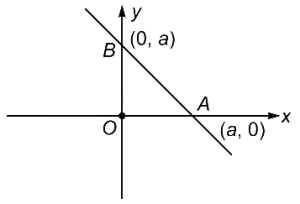
(B) The equation of a line that makes equal intercepts $a$ on the positive $x$ and $y$ axes is given by $\frac{x}{a} + \frac{y}{a} = 1$,which simplifies to $x + y = a$ (where $a > 0$).
The perpendicular distance of this line from the origin $(0, 0)$ is given as $1$ unit.
Using the distance formula $\left| \frac{Ax_1 + By_1 + C}{\sqrt{A^2 + B^2}} \right| = d$,we have:
$\left| \frac{0 + 0 - a}{\sqrt{1^2 + 1^2}} \right| = 1$
$\left| \frac{-a}{\sqrt{2}} \right| = 1$
Since $a > 0$,we get $a = \sqrt{2}$.
Thus,the equation of the line is $x + y = \sqrt{2}$ ... $(i)$.
The second line is given as $y = 2x + 3 + \sqrt{2}$,which can be rewritten as $2x - y = -3 - \sqrt{2}$ ... (ii).
To find the intersection point $(x_0, y_0)$,we solve equations $(i)$ and (ii):
Adding $(i)$ and (ii):
$(x + y) + (2x - y) = \sqrt{2} + (-3 - \sqrt{2})$
$3x = -3 \implies x_0 = -1$.
Substituting $x_0 = -1$ into $(i)$:
$-1 + y_0 = \sqrt{2} \implies y_0 = \sqrt{2} + 1$.
Finally,we calculate $2x_0 + y_0$:
$2(-1) + (\sqrt{2} + 1) = -2 + \sqrt{2} + 1 = \sqrt{2} - 1$.
The perpendicular distance of this line from the origin $(0, 0)$ is given as $1$ unit.
Using the distance formula $\left| \frac{Ax_1 + By_1 + C}{\sqrt{A^2 + B^2}} \right| = d$,we have:
$\left| \frac{0 + 0 - a}{\sqrt{1^2 + 1^2}} \right| = 1$
$\left| \frac{-a}{\sqrt{2}} \right| = 1$
Since $a > 0$,we get $a = \sqrt{2}$.
Thus,the equation of the line is $x + y = \sqrt{2}$ ... $(i)$.
The second line is given as $y = 2x + 3 + \sqrt{2}$,which can be rewritten as $2x - y = -3 - \sqrt{2}$ ... (ii).
To find the intersection point $(x_0, y_0)$,we solve equations $(i)$ and (ii):
Adding $(i)$ and (ii):
$(x + y) + (2x - y) = \sqrt{2} + (-3 - \sqrt{2})$
$3x = -3 \implies x_0 = -1$.
Substituting $x_0 = -1$ into $(i)$:
$-1 + y_0 = \sqrt{2} \implies y_0 = \sqrt{2} + 1$.
Finally,we calculate $2x_0 + y_0$:
$2(-1) + (\sqrt{2} + 1) = -2 + \sqrt{2} + 1 = \sqrt{2} - 1$.
0 likesView Solution
130
ChemistryMCQTS EAMCET · 2010
The image of the line $x+y-2=0$ in the $y$-axis is
A
$x-y+2=0$
B
$y-x+2=0$
C
$x+y+2=0$
D
$x+y-2=0$
Solution
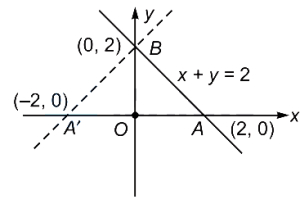
(A) To find the image of the line $x+y-2=0$ with respect to the $y$-axis,we replace $x$ with $-x$ in the equation.
Substituting $x = -x$ into the given equation $x+y-2=0$,we get:
$(-x)+y-2=0$
$-x+y-2=0$
Multiplying by $-1$,we obtain:
$x-y+2=0$
Thus,the image of the line is $x-y+2=0$.
Substituting $x = -x$ into the given equation $x+y-2=0$,we get:
$(-x)+y-2=0$
$-x+y-2=0$
Multiplying by $-1$,we obtain:
$x-y+2=0$
Thus,the image of the line is $x-y+2=0$.
0 likesView Solution
131
ChemistryMCQTS EAMCET · 2010
If a straight line $L$ is perpendicular to the line $4x - 2y = 1$ and forms a triangle of area $4 \text{ sq unit}$ with the coordinate axes,then the equation of the line $L$ is
A
$2x + 4y + 7 = 0$
B
$2x - 4y + 8 = 0$
C
$2x + 4y + 8 = 0$
D
$4x - 2y - 8 = 0$
Solution
(C) The given line is $4x - 2y = 1$,which can be written as $2y = 4x - 1$ or $y = 2x - 1/2$. The slope of this line is $m_1 = 2$.
Since line $L$ is perpendicular to this line,its slope $m_2$ must satisfy $m_1 \times m_2 = -1$.
Thus,$2 \times m_2 = -1$,which gives $m_2 = -1/2$.
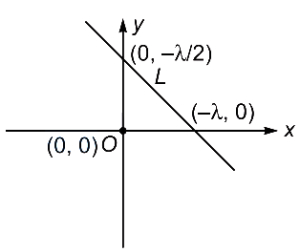
The equation of line $L$ with slope $-1/2$ can be written as $x + 2y + \lambda = 0$.
This line intersects the coordinate axes at points $(-\lambda, 0)$ and $(0, -\lambda/2)$.
The area of the triangle formed by the line with the coordinate axes is given by $\frac{1}{2} \times |\text{base}| \times |\text{height}| = 4$.
$\frac{1}{2} \times |-\lambda| \times |-\lambda/2| = 4$.
$\frac{\lambda^2}{4} = 4 \implies \lambda^2 = 16 \implies \lambda = \pm 4$.
Substituting $\lambda = 4$ into the equation $x + 2y + \lambda = 0$,we get $x + 2y + 4 = 0$,which is equivalent to $2x + 4y + 8 = 0$.
Substituting $\lambda = -4$ into the equation $x + 2y + \lambda = 0$,we get $x + 2y - 4 = 0$,which is equivalent to $2x + 4y - 8 = 0$.
Since line $L$ is perpendicular to this line,its slope $m_2$ must satisfy $m_1 \times m_2 = -1$.
Thus,$2 \times m_2 = -1$,which gives $m_2 = -1/2$.
The equation of line $L$ with slope $-1/2$ can be written as $x + 2y + \lambda = 0$.
This line intersects the coordinate axes at points $(-\lambda, 0)$ and $(0, -\lambda/2)$.
The area of the triangle formed by the line with the coordinate axes is given by $\frac{1}{2} \times |\text{base}| \times |\text{height}| = 4$.
$\frac{1}{2} \times |-\lambda| \times |-\lambda/2| = 4$.
$\frac{\lambda^2}{4} = 4 \implies \lambda^2 = 16 \implies \lambda = \pm 4$.
Substituting $\lambda = 4$ into the equation $x + 2y + \lambda = 0$,we get $x + 2y + 4 = 0$,which is equivalent to $2x + 4y + 8 = 0$.
Substituting $\lambda = -4$ into the equation $x + 2y + \lambda = 0$,we get $x + 2y - 4 = 0$,which is equivalent to $2x + 4y - 8 = 0$.
0 likesView Solution
132
ChemistryMCQTS EAMCET · 2010
The image of the point $(4, -13)$ with respect to the line $5x + y + 6 = 0$ is
A
$(-1, -14)$
B
$(3, 4)$
C
$(1, 2)$
D
$(-4, 13)$
Solution
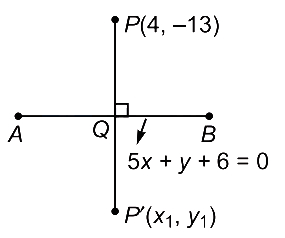
(A) Let the image of the point $P(4, -13)$ be $P'(x_1, y_1)$.
Since $Q$ is the midpoint of $PP'$,its coordinates are $Q = \left(\frac{x_1 + 4}{2}, \frac{y_1 - 13}{2}\right)$.
Since $Q$ lies on the line $5x + y + 6 = 0$,we have:
$5\left(\frac{x_1 + 4}{2}\right) + \left(\frac{y_1 - 13}{2}\right) + 6 = 0$
$5x_1 + 20 + y_1 - 13 + 12 = 0$
$5x_1 + y_1 + 19 = 0$ $\ldots$ $(i)$
Since the line $PP'$ is perpendicular to the line $5x + y + 6 = 0$ (which has slope $-5$),the slope of $PP'$ is $\frac{1}{5}$.
Thus,$\frac{y_1 - (-13)}{x_1 - 4} = \frac{1}{5}$
$5(y_1 + 13) = x_1 - 4$
$x_1 - 5y_1 - 69 = 0$ $\ldots$ (ii)
Solving equations $(i)$ and (ii):
Multiply $(i)$ by $5$: $25x_1 + 5y_1 + 95 = 0$
Add to (ii): $(25x_1 + 5y_1 + 95) + (x_1 - 5y_1 - 69) = 0$
$26x_1 + 26 = 0 \Rightarrow x_1 = -1$
Substitute $x_1 = -1$ into $(i)$: $5(-1) + y_1 + 19 = 0 \Rightarrow y_1 = -14$.
Thus,the image is $(-1, -14)$.
Since $Q$ is the midpoint of $PP'$,its coordinates are $Q = \left(\frac{x_1 + 4}{2}, \frac{y_1 - 13}{2}\right)$.
Since $Q$ lies on the line $5x + y + 6 = 0$,we have:
$5\left(\frac{x_1 + 4}{2}\right) + \left(\frac{y_1 - 13}{2}\right) + 6 = 0$
$5x_1 + 20 + y_1 - 13 + 12 = 0$
$5x_1 + y_1 + 19 = 0$ $\ldots$ $(i)$
Since the line $PP'$ is perpendicular to the line $5x + y + 6 = 0$ (which has slope $-5$),the slope of $PP'$ is $\frac{1}{5}$.
Thus,$\frac{y_1 - (-13)}{x_1 - 4} = \frac{1}{5}$
$5(y_1 + 13) = x_1 - 4$
$x_1 - 5y_1 - 69 = 0$ $\ldots$ (ii)
Solving equations $(i)$ and (ii):
Multiply $(i)$ by $5$: $25x_1 + 5y_1 + 95 = 0$
Add to (ii): $(25x_1 + 5y_1 + 95) + (x_1 - 5y_1 - 69) = 0$
$26x_1 + 26 = 0 \Rightarrow x_1 = -1$
Substitute $x_1 = -1$ into $(i)$: $5(-1) + y_1 + 19 = 0 \Rightarrow y_1 = -14$.
Thus,the image is $(-1, -14)$.
0 likesView Solution
133
ChemistryMCQTS EAMCET · 2010
If $3x^2-11xy+10y^2-7x+13y+k=0$ denotes a pair of straight lines,then the point of intersection of the lines is
A
$(1,3)$
B
$(3,1)$
C
$(-3,1)$
D
$(1,-3)$
Solution
(B) The given equation of the pair of straight lines is $3x^2-11xy+10y^2-7x+13y+k=0$.
Comparing this with the general equation $ax^2+2hxy+by^2+2gx+2fy+c=0$,we get:
$a=3, h=-\frac{11}{2}, b=10, g=-\frac{7}{2}, f=\frac{13}{2}$.
The point of intersection $(x, y)$ of the pair of lines is given by the formula:
$x = \frac{hf-bg}{ab-h^2}$ and $y = \frac{gh-af}{ab-h^2}$.
Calculating the denominator: $ab-h^2 = 3(10) - (-\frac{11}{2})^2 = 30 - \frac{121}{4} = \frac{120-121}{4} = -\frac{1}{4}$.
Calculating $x$: $x = \frac{(-\frac{11}{2})(\frac{13}{2}) - (10)(-\frac{7}{2})}{-\frac{1}{4}} = \frac{-\frac{143}{4} + 35}{-\frac{1}{4}} = \frac{\frac{-143+140}{4}}{-\frac{1}{4}} = \frac{-3/4}{-1/4} = 3$.
Calculating $y$: $y = \frac{(-\frac{7}{2})(-\frac{11}{2}) - (3)(\frac{13}{2})}{-\frac{1}{4}} = \frac{\frac{77}{4} - \frac{39}{2}}{-\frac{1}{4}} = \frac{\frac{77-78}{4}}{-\frac{1}{4}} = \frac{-1/4}{-1/4} = 1$.
Thus,the point of intersection is $(3, 1)$.
Comparing this with the general equation $ax^2+2hxy+by^2+2gx+2fy+c=0$,we get:
$a=3, h=-\frac{11}{2}, b=10, g=-\frac{7}{2}, f=\frac{13}{2}$.
The point of intersection $(x, y)$ of the pair of lines is given by the formula:
$x = \frac{hf-bg}{ab-h^2}$ and $y = \frac{gh-af}{ab-h^2}$.
Calculating the denominator: $ab-h^2 = 3(10) - (-\frac{11}{2})^2 = 30 - \frac{121}{4} = \frac{120-121}{4} = -\frac{1}{4}$.
Calculating $x$: $x = \frac{(-\frac{11}{2})(\frac{13}{2}) - (10)(-\frac{7}{2})}{-\frac{1}{4}} = \frac{-\frac{143}{4} + 35}{-\frac{1}{4}} = \frac{\frac{-143+140}{4}}{-\frac{1}{4}} = \frac{-3/4}{-1/4} = 3$.
Calculating $y$: $y = \frac{(-\frac{7}{2})(-\frac{11}{2}) - (3)(\frac{13}{2})}{-\frac{1}{4}} = \frac{\frac{77}{4} - \frac{39}{2}}{-\frac{1}{4}} = \frac{\frac{77-78}{4}}{-\frac{1}{4}} = \frac{-1/4}{-1/4} = 1$.
Thus,the point of intersection is $(3, 1)$.
0 likesView Solution
134
ChemistryMCQTS EAMCET · 2010
$A$ pair of perpendicular lines passes through the origin and also through the points of intersection of the curve $x^2+y^2=4$ with $x+y=a$,where $a>0$. Then $a$ is equal to
A
$2$
B
$3$
C
$4$
D
$5$
Solution
(A) The equation of the pair of lines passing through the origin and the intersection of $x^2+y^2=4$ and $x+y=a$ is obtained by homogenizing the circle equation using the line equation:
$x^2+y^2=4 \left(\frac{x+y}{a}\right)^2$
$a^2(x^2+y^2)=4(x^2+y^2+2xy)$
$(a^2-4)x^2 - 8xy + (a^2-4)y^2 = 0$
Since the lines are perpendicular,the sum of the coefficients of $x^2$ and $y^2$ must be zero:
$(a^2-4) + (a^2-4) = 0$
$2(a^2-4) = 0$
$a^2 = 4$
Since $a>0$,we have $a=2$.
$x^2+y^2=4 \left(\frac{x+y}{a}\right)^2$
$a^2(x^2+y^2)=4(x^2+y^2+2xy)$
$(a^2-4)x^2 - 8xy + (a^2-4)y^2 = 0$
Since the lines are perpendicular,the sum of the coefficients of $x^2$ and $y^2$ must be zero:
$(a^2-4) + (a^2-4) = 0$
$2(a^2-4) = 0$
$a^2 = 4$
Since $a>0$,we have $a=2$.
0 likesView Solution
135
ChemistryMCQTS EAMCET · 2010
The distance between the two parallel lines represented by $8x^2 - 24xy + 18y^2 - 6x + 9y - 5 = 0$ is
A
$0$
B
$\frac{3}{4\sqrt{13}}$
C
$\frac{6}{\sqrt{13}}$
D
$\frac{7}{2\sqrt{13}}$
Solution
(D) The given equation is $8x^2 - 24xy + 18y^2 - 6x + 9y - 5 = 0$.
We can rewrite this as $2(4x^2 - 12xy + 9y^2) - 3(2x - 3y) - 5 = 0$.
This simplifies to $2(2x - 3y)^2 - 3(2x - 3y) - 5 = 0$.
Let $t = 2x - 3y$. Then the equation becomes $2t^2 - 3t - 5 = 0$.
Factoring the quadratic,we get $(2t - 5)(t + 1) = 0$.
So,$2x - 3y = 5/2$ and $2x - 3y = -1$.
These are two parallel lines of the form $Ax + By + C_1 = 0$ and $Ax + By + C_2 = 0$,where $A = 2, B = -3$.
Rewriting the lines: $2x - 3y - 2.5 = 0$ and $2x - 3y + 1 = 0$.
The distance $d$ between parallel lines is given by $d = \frac{|C_1 - C_2|}{\sqrt{A^2 + B^2}}$.
$d = \frac{|-2.5 - 1|}{\sqrt{2^2 + (-3)^2}} = \frac{|-3.5|}{\sqrt{4 + 9}} = \frac{3.5}{\sqrt{13}} = \frac{7/2}{\sqrt{13}} = \frac{7}{2\sqrt{13}}$.
We can rewrite this as $2(4x^2 - 12xy + 9y^2) - 3(2x - 3y) - 5 = 0$.
This simplifies to $2(2x - 3y)^2 - 3(2x - 3y) - 5 = 0$.
Let $t = 2x - 3y$. Then the equation becomes $2t^2 - 3t - 5 = 0$.
Factoring the quadratic,we get $(2t - 5)(t + 1) = 0$.
So,$2x - 3y = 5/2$ and $2x - 3y = -1$.
These are two parallel lines of the form $Ax + By + C_1 = 0$ and $Ax + By + C_2 = 0$,where $A = 2, B = -3$.
Rewriting the lines: $2x - 3y - 2.5 = 0$ and $2x - 3y + 1 = 0$.
The distance $d$ between parallel lines is given by $d = \frac{|C_1 - C_2|}{\sqrt{A^2 + B^2}}$.
$d = \frac{|-2.5 - 1|}{\sqrt{2^2 + (-3)^2}} = \frac{|-3.5|}{\sqrt{4 + 9}} = \frac{3.5}{\sqrt{13}} = \frac{7/2}{\sqrt{13}} = \frac{7}{2\sqrt{13}}$.
0 likesView Solution
136
ChemistryEasyMCQTS EAMCET · 2010
The two enantiomers of secondary butyl chloride differ from each other in which one of the following properties?
A
Boiling point
B
Specific rotation
C
Density
D
$C-Cl$ bond length
Solution
(B) Enantiomers are stereoisomers that are non-superimposable mirror images of each other.
They possess identical physical properties such as boiling point,density,and bond lengths in an achiral environment.
However,they differ in their interaction with plane-polarized light,which is measured as specific rotation.
Therefore,the two enantiomers of secondary butyl chloride differ in specific rotation.
They possess identical physical properties such as boiling point,density,and bond lengths in an achiral environment.
However,they differ in their interaction with plane-polarized light,which is measured as specific rotation.
Therefore,the two enantiomers of secondary butyl chloride differ in specific rotation.
0 likesView Solution
137
ChemistryMediumMCQTS EAMCET · 2010
Which of the following pairs of $2,3-$butanediol are enantiomers?
A
$2R, 3R$ and $2S, 3S$
B
$2S, 3S$ and $2S, 3R$
C
$2R, 3R$ and $2R, 3S$
D
$2S, 3S$ and $2R, 3S$
Solution
(A) Enantiomers are non-superimposable mirror images of each other. For a molecule with multiple chiral centers,the enantiomer is formed by inverting the configuration at every chiral center.
For $2,3-$butanediol,the chiral centers are at positions $2$ and $3$.
The enantiomer of the $(2R, 3R)$ isomer is the $(2S, 3S)$ isomer.
Therefore,the pair $(2R, 3R)$ and $(2S, 3S)$ represents enantiomers.
For $2,3-$butanediol,the chiral centers are at positions $2$ and $3$.
The enantiomer of the $(2R, 3R)$ isomer is the $(2S, 3S)$ isomer.
Therefore,the pair $(2R, 3R)$ and $(2S, 3S)$ represents enantiomers.
0 likesView Solution
138
ChemistryMediumMCQTS EAMCET · 2010
The Diels-Alder reaction will not take place with which of the following reactants?
A
$CH_2=CH-CH_2-CH=CH_2$ and $CH_2=CH_2$
B
$CH_2=CH-CH=CH_2$ and $CH_2=CH_2$
C
$CH_2=CH-CH=CH_2$ and $CH_3-CH=CH_2$
D
$CH_2=CH-CH=CH_2$ and $CH_2=CH-CH_3$
Solution
(A) The Diels-Alder reaction requires a conjugated diene and a dienophile (an alkene or alkyne).
In option $A$,the reactant $CH_2=CH-CH_2-CH=CH_2$ is $penta-1,4-diene$.
This is an isolated diene,not a conjugated diene.
Therefore,it cannot participate in the Diels-Alder reaction.
In option $A$,the reactant $CH_2=CH-CH_2-CH=CH_2$ is $penta-1,4-diene$.
This is an isolated diene,not a conjugated diene.
Therefore,it cannot participate in the Diels-Alder reaction.
0 likesView Solution
139
ChemistryMediumMCQTS EAMCET · 2010
The orange coloured compound formed when $H_2O_2$ is added to $TiO_2$ solution acidified with conc $H_2SO_4$ is
A
$Ti_2O_3$
B
$H_2Ti_2O_8$
C
$H_2TiO_3$
D
$H_2TiO_4$
Solution
(D) When an acidified solution of $TiO_2$ is treated with $H_2O_2$,an intense yellow-orange colour is obtained due to the formation of pertitanic acid,$H_2TiO_4$.
The chemical reaction is:
$TiO_2 + H_2O_2 \xrightarrow{H_2SO_4} H_2TiO_4$
This reaction is used for the detection of both $Ti(IV)$ and $H_2O_2$.
The chemical reaction is:
$TiO_2 + H_2O_2 \xrightarrow{H_2SO_4} H_2TiO_4$
This reaction is used for the detection of both $Ti(IV)$ and $H_2O_2$.
0 likesView Solution
140
ChemistryMCQTS EAMCET · 2010
If $f(0)=0, f(1)=1, f(2)=2$ and $f(x)=f(x-2)+f(x-3)$ for $x=3, 4, 5, \ldots$,then $f(9)$ is equal to
A
$12$
B
$13$
C
$14$
D
$10$
Solution
(D) Given the recurrence relation $f(x)=f(x-2)+f(x-3)$ with initial values $f(0)=0, f(1)=1, f(2)=2$.
We calculate the values step by step:
For $x=3: f(3)=f(1)+f(0)=1+0=1$.
For $x=4: f(4)=f(2)+f(1)=2+1=3$.
For $x=5: f(5)=f(3)+f(2)=1+2=3$.
For $x=6: f(6)=f(4)+f(3)=3+1=4$.
For $x=7: f(7)=f(5)+f(4)=3+3=6$.
For $x=8: f(8)=f(6)+f(5)=4+3=7$.
For $x=9: f(9)=f(7)+f(6)=6+4=10$.
Thus,$f(9)=10$.
We calculate the values step by step:
For $x=3: f(3)=f(1)+f(0)=1+0=1$.
For $x=4: f(4)=f(2)+f(1)=2+1=3$.
For $x=5: f(5)=f(3)+f(2)=1+2=3$.
For $x=6: f(6)=f(4)+f(3)=3+1=4$.
For $x=7: f(7)=f(5)+f(4)=3+3=6$.
For $x=8: f(8)=f(6)+f(5)=4+3=7$.
For $x=9: f(9)=f(7)+f(6)=6+4=10$.
Thus,$f(9)=10$.
0 likesView Solution
141
ChemistryMCQTS EAMCET · 2010
If $u=\sin ^{-1}\left(\frac{x^4+y^4}{x+y}\right)$,then $x \frac{\partial u}{\partial x}+y \frac{\partial u}{\partial y}$ is equal to
A
$3 u$
B
$4 u$
C
$3 \sin u$
D
$3 \tan u$
Solution
(D) Given $u=\sin ^{-1}\left(\frac{x^4+y^4}{x+y}\right)$.
Let $v=\sin u=\frac{x^4+y^4}{x+y}$.
Here,$v$ is a homogeneous function of $x$ and $y$ with degree $n = 4 - 1 = 3$.
By Euler's theorem for homogeneous functions,we have $x \frac{\partial v}{\partial x} + y \frac{\partial v}{\partial y} = n v$.
Substituting $v = \sin u$ and $n = 3$,we get $x \frac{\partial}{\partial x}(\sin u) + y \frac{\partial}{\partial y}(\sin u) = 3 \sin u$.
Applying the chain rule,$x \cos u \frac{\partial u}{\partial x} + y \cos u \frac{\partial u}{\partial y} = 3 \sin u$.
Dividing both sides by $\cos u$,we get $x \frac{\partial u}{\partial x} + y \frac{\partial u}{\partial y} = 3 \frac{\sin u}{\cos u} = 3 \tan u$.
Let $v=\sin u=\frac{x^4+y^4}{x+y}$.
Here,$v$ is a homogeneous function of $x$ and $y$ with degree $n = 4 - 1 = 3$.
By Euler's theorem for homogeneous functions,we have $x \frac{\partial v}{\partial x} + y \frac{\partial v}{\partial y} = n v$.
Substituting $v = \sin u$ and $n = 3$,we get $x \frac{\partial}{\partial x}(\sin u) + y \frac{\partial}{\partial y}(\sin u) = 3 \sin u$.
Applying the chain rule,$x \cos u \frac{\partial u}{\partial x} + y \cos u \frac{\partial u}{\partial y} = 3 \sin u$.
Dividing both sides by $\cos u$,we get $x \frac{\partial u}{\partial x} + y \frac{\partial u}{\partial y} = 3 \frac{\sin u}{\cos u} = 3 \tan u$.
0 likesView Solution
142
ChemistryDifficultMCQTS EAMCET · 2010
The $pH$ of $0.01 \ M$ solution of acetic acid is $5.0$. What are the values of $[H^{+}]$ and $K_a$ respectively?
A
$1 \times 10^{-5} \ M, 1 \times 10^{-8}$
B
$1 \times 10^{-5} \ M, 1 \times 10^{-9}$
C
$1 \times 10^{-4} \ M, 1 \times 10^{-8}$
D
$1 \times 10^{-3} \ M, 1 \times 10^{-8}$
Solution
(A) Given: $pH = 5.0$ and concentration $C = 0.01 \ M = 10^{-2} \ M$.
$[H^{+}] = 10^{-pH} = 10^{-5} \ M$.
For a weak acid,the dissociation constant $K_a$ is given by the formula $[H^{+}] = \sqrt{K_a \cdot C}$.
Squaring both sides,we get $[H^{+}]^2 = K_a \cdot C$.
Therefore,$K_a = \frac{[H^{+}]^2}{C} = \frac{(10^{-5})^2}{10^{-2}} = \frac{10^{-10}}{10^{-2}} = 10^{-8}$.
Thus,$[H^{+}] = 1 \times 10^{-5} \ M$ and $K_a = 1 \times 10^{-8}$.
$[H^{+}] = 10^{-pH} = 10^{-5} \ M$.
For a weak acid,the dissociation constant $K_a$ is given by the formula $[H^{+}] = \sqrt{K_a \cdot C}$.
Squaring both sides,we get $[H^{+}]^2 = K_a \cdot C$.
Therefore,$K_a = \frac{[H^{+}]^2}{C} = \frac{(10^{-5})^2}{10^{-2}} = \frac{10^{-10}}{10^{-2}} = 10^{-8}$.
Thus,$[H^{+}] = 1 \times 10^{-5} \ M$ and $K_a = 1 \times 10^{-8}$.
0 likesView Solution
143
ChemistryMCQTS EAMCET · 2010
If $y = \cos^{-1}\left(\frac{a^2-x^2}{a^2+x^2}\right) + \sin^{-1}\left(\frac{2ax}{a^2+x^2}\right)$,then $\frac{dy}{dx}$ is equal to
A
$\frac{a}{x^2+a^2}$
B
$\frac{2a}{x^2+a^2}$
C
$\frac{4a}{x^2+a^2}$
D
$\frac{a^2}{x^2+a^2}$
Solution
(C) Given,$y = \cos^{-1}\left(\frac{a^2-x^2}{a^2+x^2}\right) + \sin^{-1}\left(\frac{2ax}{a^2+x^2}\right)$.
Substitute $x = a \tan \theta$,which implies $\theta = \tan^{-1}\left(\frac{x}{a}\right)$.
Then,$y = \cos^{-1}\left(\frac{a^2 - a^2 \tan^2 \theta}{a^2 + a^2 \tan^2 \theta}\right) + \sin^{-1}\left(\frac{2a^2 \tan \theta}{a^2 + a^2 \tan^2 \theta}\right)$.
Simplifying the terms inside the brackets:
$y = \cos^{-1}\left(\frac{1 - \tan^2 \theta}{1 + \tan^2 \theta}\right) + \sin^{-1}\left(\frac{2 \tan \theta}{1 + \tan^2 \theta}\right)$.
Using trigonometric identities $\cos 2\theta = \frac{1 - \tan^2 \theta}{1 + \tan^2 \theta}$ and $\sin 2\theta = \frac{2 \tan \theta}{1 + \tan^2 \theta}$,we get:
$y = \cos^{-1}(\cos 2\theta) + \sin^{-1}(\sin 2\theta)$.
$y = 2\theta + 2\theta = 4\theta$.
Substituting back $\theta = \tan^{-1}\left(\frac{x}{a}\right)$,we have $y = 4 \tan^{-1}\left(\frac{x}{a}\right)$.
Differentiating with respect to $x$:
$\frac{dy}{dx} = 4 \cdot \frac{1}{1 + (x/a)^2} \cdot \frac{1}{a} = 4 \cdot \frac{a^2}{a^2 + x^2} \cdot \frac{1}{a} = \frac{4a}{a^2 + x^2}$.
Substitute $x = a \tan \theta$,which implies $\theta = \tan^{-1}\left(\frac{x}{a}\right)$.
Then,$y = \cos^{-1}\left(\frac{a^2 - a^2 \tan^2 \theta}{a^2 + a^2 \tan^2 \theta}\right) + \sin^{-1}\left(\frac{2a^2 \tan \theta}{a^2 + a^2 \tan^2 \theta}\right)$.
Simplifying the terms inside the brackets:
$y = \cos^{-1}\left(\frac{1 - \tan^2 \theta}{1 + \tan^2 \theta}\right) + \sin^{-1}\left(\frac{2 \tan \theta}{1 + \tan^2 \theta}\right)$.
Using trigonometric identities $\cos 2\theta = \frac{1 - \tan^2 \theta}{1 + \tan^2 \theta}$ and $\sin 2\theta = \frac{2 \tan \theta}{1 + \tan^2 \theta}$,we get:
$y = \cos^{-1}(\cos 2\theta) + \sin^{-1}(\sin 2\theta)$.
$y = 2\theta + 2\theta = 4\theta$.
Substituting back $\theta = \tan^{-1}\left(\frac{x}{a}\right)$,we have $y = 4 \tan^{-1}\left(\frac{x}{a}\right)$.
Differentiating with respect to $x$:
$\frac{dy}{dx} = 4 \cdot \frac{1}{1 + (x/a)^2} \cdot \frac{1}{a} = 4 \cdot \frac{a^2}{a^2 + x^2} \cdot \frac{1}{a} = \frac{4a}{a^2 + x^2}$.
0 likesView Solution
144
ChemistryMCQTS EAMCET · 2010
If $\int(1-\cos x) \operatorname{cosec}^2 x \, dx = f(x) + c$,then $f(x)$ is equal to
A
$\tan \frac{x}{2}$
B
$\cot \frac{x}{2}$
C
$2 \tan \frac{x}{2}$
D
$\frac{1}{2} \tan \frac{x}{2}$
Solution
(A) We are given the integral $I = \int(1-\cos x) \operatorname{cosec}^2 x \, dx$.
Using the trigonometric identities $1-\cos x = 2 \sin^2 \frac{x}{2}$ and $\sin x = 2 \sin \frac{x}{2} \cos \frac{x}{2}$,we have:
$I = \int \left(2 \sin^2 \frac{x}{2}\right) \cdot \frac{1}{\sin^2 x} \, dx$
$I = \int \frac{2 \sin^2 \frac{x}{2}}{(2 \sin \frac{x}{2} \cos \frac{x}{2})^2} \, dx$
$I = \int \frac{2 \sin^2 \frac{x}{2}}{4 \sin^2 \frac{x}{2} \cos^2 \frac{x}{2}} \, dx$
$I = \frac{1}{2} \int \frac{1}{\cos^2 \frac{x}{2}} \, dx$
$I = \frac{1}{2} \int \sec^2 \frac{x}{2} \, dx$
Integrating $\sec^2 \frac{x}{2}$ gives $2 \tan \frac{x}{2}$:
$I = \frac{1}{2} \cdot (2 \tan \frac{x}{2}) + c = \tan \frac{x}{2} + c$.
Comparing this with $f(x) + c$,we get $f(x) = \tan \frac{x}{2}$.
Using the trigonometric identities $1-\cos x = 2 \sin^2 \frac{x}{2}$ and $\sin x = 2 \sin \frac{x}{2} \cos \frac{x}{2}$,we have:
$I = \int \left(2 \sin^2 \frac{x}{2}\right) \cdot \frac{1}{\sin^2 x} \, dx$
$I = \int \frac{2 \sin^2 \frac{x}{2}}{(2 \sin \frac{x}{2} \cos \frac{x}{2})^2} \, dx$
$I = \int \frac{2 \sin^2 \frac{x}{2}}{4 \sin^2 \frac{x}{2} \cos^2 \frac{x}{2}} \, dx$
$I = \frac{1}{2} \int \frac{1}{\cos^2 \frac{x}{2}} \, dx$
$I = \frac{1}{2} \int \sec^2 \frac{x}{2} \, dx$
Integrating $\sec^2 \frac{x}{2}$ gives $2 \tan \frac{x}{2}$:
$I = \frac{1}{2} \cdot (2 \tan \frac{x}{2}) + c = \tan \frac{x}{2} + c$.
Comparing this with $f(x) + c$,we get $f(x) = \tan \frac{x}{2}$.
0 likesView Solution
145
ChemistryMCQTS EAMCET · 2010
If $I_n = \int_0^{\pi / 4} \tan^n x \, dx$,then $I_2+I_4, I_3+I_5, I_4+I_6, \ldots$ are in
A
arithmetic progression
B
geometric progression
C
harmonic progression
D
arithmetico-geometric progression
Solution
(C) Given $I_n = \int_0^{\pi / 4} \tan^n x \, dx$.
Consider the sum $I_r + I_{r+2} = \int_0^{\pi / 4} \tan^r x \, dx + \int_0^{\pi / 4} \tan^{r+2} x \, dx$.
$I_r + I_{r+2} = \int_0^{\pi / 4} \tan^r x (1 + \tan^2 x) \, dx$.
Since $1 + \tan^2 x = \sec^2 x$,we have $I_r + I_{r+2} = \int_0^{\pi / 4} \tan^r x \sec^2 x \, dx$.
Let $t = \tan x$,then $dt = \sec^2 x \, dx$. When $x=0, t=0$ and when $x=\pi/4, t=1$.
Thus,$I_r + I_{r+2} = \int_0^1 t^r \, dt = \left[ \frac{t^{r+1}}{r+1} \right]_0^1 = \frac{1}{r+1}$.
For $r=2$,$I_2 + I_4 = \frac{1}{3}$.
For $r=3$,$I_3 + I_5 = \frac{1}{4}$.
For $r=4$,$I_4 + I_6 = \frac{1}{5}$.
The sequence is $\frac{1}{3}, \frac{1}{4}, \frac{1}{5}, \ldots$,which are in harmonic progression $(HP)$ because their reciprocals $3, 4, 5, \ldots$ are in arithmetic progression.
Consider the sum $I_r + I_{r+2} = \int_0^{\pi / 4} \tan^r x \, dx + \int_0^{\pi / 4} \tan^{r+2} x \, dx$.
$I_r + I_{r+2} = \int_0^{\pi / 4} \tan^r x (1 + \tan^2 x) \, dx$.
Since $1 + \tan^2 x = \sec^2 x$,we have $I_r + I_{r+2} = \int_0^{\pi / 4} \tan^r x \sec^2 x \, dx$.
Let $t = \tan x$,then $dt = \sec^2 x \, dx$. When $x=0, t=0$ and when $x=\pi/4, t=1$.
Thus,$I_r + I_{r+2} = \int_0^1 t^r \, dt = \left[ \frac{t^{r+1}}{r+1} \right]_0^1 = \frac{1}{r+1}$.
For $r=2$,$I_2 + I_4 = \frac{1}{3}$.
For $r=3$,$I_3 + I_5 = \frac{1}{4}$.
For $r=4$,$I_4 + I_6 = \frac{1}{5}$.
The sequence is $\frac{1}{3}, \frac{1}{4}, \frac{1}{5}, \ldots$,which are in harmonic progression $(HP)$ because their reciprocals $3, 4, 5, \ldots$ are in arithmetic progression.
0 likesView Solution
146
ChemistryMCQTS EAMCET · 2010
$\log _4 2 - \log _8 2 + \log _{16} 2 - \dots$ is equal to
A
$e^2$
B
$\log _e 2$
C
$1 + \log _e 3$
D
$1 - \log _e 2$
Solution
(D) The given series is $\log _4 2 - \log _8 2 + \log _{16} 2 - \dots$
Using the property $\log _b a = \frac{1}{\log _a b}$,we get:
$= \frac{1}{\log _2 4} - \frac{1}{\log _2 8} + \frac{1}{\log _2 16} - \dots$
$= \frac{1}{\log _2(2^2)} - \frac{1}{\log _2(2^3)} + \frac{1}{\log _2(2^4)} - \dots$
$= \frac{1}{2 \log _2 2} - \frac{1}{3 \log _2 2} + \frac{1}{4 \log _2 2} - \dots$
Since $\log _2 2 = 1$,the expression becomes:
$= \frac{1}{2} - \frac{1}{3} + \frac{1}{4} - \dots$
We know the expansion $\log _e(1 + x) = x - \frac{x^2}{2} + \frac{x^3}{3} - \frac{x^4}{4} + \dots$
For $x = 1$,$\log _e(2) = 1 - \frac{1}{2} + \frac{1}{3} - \frac{1}{4} + \dots$
Rearranging the terms,we get $\frac{1}{2} - \frac{1}{3} + \frac{1}{4} - \dots = 1 - \log _e 2$.
Using the property $\log _b a = \frac{1}{\log _a b}$,we get:
$= \frac{1}{\log _2 4} - \frac{1}{\log _2 8} + \frac{1}{\log _2 16} - \dots$
$= \frac{1}{\log _2(2^2)} - \frac{1}{\log _2(2^3)} + \frac{1}{\log _2(2^4)} - \dots$
$= \frac{1}{2 \log _2 2} - \frac{1}{3 \log _2 2} + \frac{1}{4 \log _2 2} - \dots$
Since $\log _2 2 = 1$,the expression becomes:
$= \frac{1}{2} - \frac{1}{3} + \frac{1}{4} - \dots$
We know the expansion $\log _e(1 + x) = x - \frac{x^2}{2} + \frac{x^3}{3} - \frac{x^4}{4} + \dots$
For $x = 1$,$\log _e(2) = 1 - \frac{1}{2} + \frac{1}{3} - \frac{1}{4} + \dots$
Rearranging the terms,we get $\frac{1}{2} - \frac{1}{3} + \frac{1}{4} - \dots = 1 - \log _e 2$.
0 likesView Solution
147
ChemistryMCQTS EAMCET · 2010
If three unit vectors $\overrightarrow{a}, \overrightarrow{b}, \overrightarrow{c}$ satisfy $\overrightarrow{a}+\overrightarrow{b}+\overrightarrow{c}=\overrightarrow{0}$,then the angle between $\overrightarrow{a}$ and $\overrightarrow{b}$ is
A
$\frac{2 \pi}{3}$
B
$\frac{5 \pi}{6}$
C
$\frac{\pi}{3}$
D
$\frac{\pi}{6}$
Solution
(A) Given,the condition is $\overrightarrow{a}+\overrightarrow{b}+\overrightarrow{c}=\overrightarrow{0}$ ...$(i)$
Since $\overrightarrow{a}, \overrightarrow{b}, \overrightarrow{c}$ are unit vectors,we have $|\overrightarrow{a}|=|\overrightarrow{b}|=|\overrightarrow{c}|=1$.
Let the angle between $\overrightarrow{a}$ and $\overrightarrow{b}$ be $\theta$.
From equation $(i)$,we can write:
$\overrightarrow{a}+\overrightarrow{b}=-\overrightarrow{c}$
Squaring both sides,we get:
$(\overrightarrow{a}+\overrightarrow{b})^2=(-\overrightarrow{c})^2$
$|\overrightarrow{a}|^2+|\overrightarrow{b}|^2+2(\overrightarrow{a} \cdot \overrightarrow{b})=|\overrightarrow{c}|^2$
Substituting the values $|\overrightarrow{a}|=1, |\overrightarrow{b}|=1, |\overrightarrow{c}|=1$:
$1^2+1^2+2(\overrightarrow{a} \cdot \overrightarrow{b})=1^2$
$2+2(\overrightarrow{a} \cdot \overrightarrow{b})=1$
$2(\overrightarrow{a} \cdot \overrightarrow{b})=-1$
$\overrightarrow{a} \cdot \overrightarrow{b}=-\frac{1}{2}$
Using the definition of the dot product,$\overrightarrow{a} \cdot \overrightarrow{b}=|\overrightarrow{a}||\overrightarrow{b}| \cos \theta$:
$1 \cdot 1 \cdot \cos \theta = -\frac{1}{2}$
$\cos \theta = -\frac{1}{2}$
Since $\cos \theta = -\frac{1}{2}$,the angle $\theta = \frac{2 \pi}{3}$.
Since $\overrightarrow{a}, \overrightarrow{b}, \overrightarrow{c}$ are unit vectors,we have $|\overrightarrow{a}|=|\overrightarrow{b}|=|\overrightarrow{c}|=1$.
Let the angle between $\overrightarrow{a}$ and $\overrightarrow{b}$ be $\theta$.
From equation $(i)$,we can write:
$\overrightarrow{a}+\overrightarrow{b}=-\overrightarrow{c}$
Squaring both sides,we get:
$(\overrightarrow{a}+\overrightarrow{b})^2=(-\overrightarrow{c})^2$
$|\overrightarrow{a}|^2+|\overrightarrow{b}|^2+2(\overrightarrow{a} \cdot \overrightarrow{b})=|\overrightarrow{c}|^2$
Substituting the values $|\overrightarrow{a}|=1, |\overrightarrow{b}|=1, |\overrightarrow{c}|=1$:
$1^2+1^2+2(\overrightarrow{a} \cdot \overrightarrow{b})=1^2$
$2+2(\overrightarrow{a} \cdot \overrightarrow{b})=1$
$2(\overrightarrow{a} \cdot \overrightarrow{b})=-1$
$\overrightarrow{a} \cdot \overrightarrow{b}=-\frac{1}{2}$
Using the definition of the dot product,$\overrightarrow{a} \cdot \overrightarrow{b}=|\overrightarrow{a}||\overrightarrow{b}| \cos \theta$:
$1 \cdot 1 \cdot \cos \theta = -\frac{1}{2}$
$\cos \theta = -\frac{1}{2}$
Since $\cos \theta = -\frac{1}{2}$,the angle $\theta = \frac{2 \pi}{3}$.
0 likesView Solution
148
ChemistryMCQTS EAMCET · 2010
If the angle $\theta$ between the vectors $\overrightarrow{a}=2 x^2 \hat{i}+4 x \hat{j}+\hat{k}$ and $\overrightarrow{b}=7 \hat{i}-2 \hat{j}+x \hat{k}$ is such that $90^{\circ} < \theta < 180^{\circ}$,then $x$ lies in the interval
A
$\left(0, \frac{1}{2}\right)$
B
$\left(\frac{1}{2}, 1\right)$
C
$\left(1, \frac{3}{2}\right)$
D
$\left(\frac{1}{2}, \frac{3}{2}\right)$
Solution
(A) Given,$\overrightarrow{a}=2 x^2 \hat{i}+4 x \hat{j}+\hat{k}$ and $\overrightarrow{b}=7 \hat{i}-2 \hat{j}+x \hat{k}$.
We are given that the angle $\theta$ between the vectors satisfies $90^{\circ} < \theta < 180^{\circ}$.
This implies that $\cos \theta < 0$.
We know that $\cos \theta = \frac{\overrightarrow{a} \cdot \overrightarrow{b}}{|\overrightarrow{a}| |\overrightarrow{b}|}$.
Since the magnitudes $|\overrightarrow{a}|$ and $|\overrightarrow{b}|$ are always non-negative,the condition $\cos \theta < 0$ is equivalent to $\overrightarrow{a} \cdot \overrightarrow{b} < 0$.
Calculating the dot product:
$\overrightarrow{a} \cdot \overrightarrow{b} = (2 x^2)(7) + (4 x)(-2) + (1)(x) = 14 x^2 - 8 x + x = 14 x^2 - 7 x$.
Setting the dot product to be less than zero:
$14 x^2 - 7 x < 0$
$7 x(2 x - 1) < 0$.
To solve this inequality,we find the critical points $x = 0$ and $x = \frac{1}{2}$.
Testing the intervals,we find that the expression $7 x(2 x - 1)$ is negative when $x$ lies between $0$ and $\frac{1}{2}$.
Thus,$x \in \left(0, \frac{1}{2}\right)$.
We are given that the angle $\theta$ between the vectors satisfies $90^{\circ} < \theta < 180^{\circ}$.
This implies that $\cos \theta < 0$.
We know that $\cos \theta = \frac{\overrightarrow{a} \cdot \overrightarrow{b}}{|\overrightarrow{a}| |\overrightarrow{b}|}$.
Since the magnitudes $|\overrightarrow{a}|$ and $|\overrightarrow{b}|$ are always non-negative,the condition $\cos \theta < 0$ is equivalent to $\overrightarrow{a} \cdot \overrightarrow{b} < 0$.
Calculating the dot product:
$\overrightarrow{a} \cdot \overrightarrow{b} = (2 x^2)(7) + (4 x)(-2) + (1)(x) = 14 x^2 - 8 x + x = 14 x^2 - 7 x$.
Setting the dot product to be less than zero:
$14 x^2 - 7 x < 0$
$7 x(2 x - 1) < 0$.
To solve this inequality,we find the critical points $x = 0$ and $x = \frac{1}{2}$.
Testing the intervals,we find that the expression $7 x(2 x - 1)$ is negative when $x$ lies between $0$ and $\frac{1}{2}$.
Thus,$x \in \left(0, \frac{1}{2}\right)$.
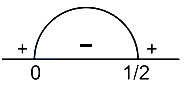
0 likesView Solution
149
ChemistryMCQTS EAMCET · 2010
If $\overrightarrow{u}=\overrightarrow{a}-\overrightarrow{b}$,$\overrightarrow{v}=\overrightarrow{a}+\overrightarrow{b}$,$|\overrightarrow{a}|=|\overrightarrow{b}|=2$,then $|\overrightarrow{u} \times \overrightarrow{v}|$ is equal to
A
$2 \sqrt{16-(\overrightarrow{a} \cdot \overrightarrow{b})^2}$
B
$\sqrt{16-(\overrightarrow{a} \cdot \overrightarrow{b})^2}$
C
$2 \sqrt{4-(\overrightarrow{a} \cdot \overrightarrow{b})^2}$
D
$\sqrt{4-(\overrightarrow{a} \cdot \overrightarrow{b})^2}$
Solution
(A) Given $\overrightarrow{u}=\overrightarrow{a}-\overrightarrow{b}$ and $\overrightarrow{v}=\overrightarrow{a}+\overrightarrow{b}$.
We calculate the cross product: $\overrightarrow{u} \times \overrightarrow{v} = (\overrightarrow{a}-\overrightarrow{b}) \times (\overrightarrow{a}+\overrightarrow{b})$.
Using the distributive property of the cross product: $\overrightarrow{u} \times \overrightarrow{v} = \overrightarrow{a} \times \overrightarrow{a} + \overrightarrow{a} \times \overrightarrow{b} - \overrightarrow{b} \times \overrightarrow{a} - \overrightarrow{b} \times \overrightarrow{b}$.
Since $\overrightarrow{a} \times \overrightarrow{a} = 0$ and $\overrightarrow{b} \times \overrightarrow{b} = 0$,and $\overrightarrow{b} \times \overrightarrow{a} = -(\overrightarrow{a} \times \overrightarrow{b})$,we get:
$\overrightarrow{u} \times \overrightarrow{v} = 0 + \overrightarrow{a} \times \overrightarrow{b} + \overrightarrow{a} \times \overrightarrow{b} - 0 = 2(\overrightarrow{a} \times \overrightarrow{b})$.
Taking the magnitude: $|\overrightarrow{u} \times \overrightarrow{v}| = 2|\overrightarrow{a} \times \overrightarrow{b}|$.
Using the identity $|\overrightarrow{a} \times \overrightarrow{b}|^2 = |\overrightarrow{a}|^2 |\overrightarrow{b}|^2 - (\overrightarrow{a} \cdot \overrightarrow{b})^2$:
$|\overrightarrow{a} \times \overrightarrow{b}| = \sqrt{|\overrightarrow{a}|^2 |\overrightarrow{b}|^2 - (\overrightarrow{a} \cdot \overrightarrow{b})^2}$.
Given $|\overrightarrow{a}| = 2$ and $|\overrightarrow{b}| = 2$,then $|\overrightarrow{a}|^2 = 4$ and $|\overrightarrow{b}|^2 = 4$.
Thus,$|\overrightarrow{a} \times \overrightarrow{b}| = \sqrt{4 \times 4 - (\overrightarrow{a} \cdot \overrightarrow{b})^2} = \sqrt{16 - (\overrightarrow{a} \cdot \overrightarrow{b})^2}$.
Therefore,$|\overrightarrow{u} \times \overrightarrow{v}| = 2 \sqrt{16 - (\overrightarrow{a} \cdot \overrightarrow{b})^2}$.
We calculate the cross product: $\overrightarrow{u} \times \overrightarrow{v} = (\overrightarrow{a}-\overrightarrow{b}) \times (\overrightarrow{a}+\overrightarrow{b})$.
Using the distributive property of the cross product: $\overrightarrow{u} \times \overrightarrow{v} = \overrightarrow{a} \times \overrightarrow{a} + \overrightarrow{a} \times \overrightarrow{b} - \overrightarrow{b} \times \overrightarrow{a} - \overrightarrow{b} \times \overrightarrow{b}$.
Since $\overrightarrow{a} \times \overrightarrow{a} = 0$ and $\overrightarrow{b} \times \overrightarrow{b} = 0$,and $\overrightarrow{b} \times \overrightarrow{a} = -(\overrightarrow{a} \times \overrightarrow{b})$,we get:
$\overrightarrow{u} \times \overrightarrow{v} = 0 + \overrightarrow{a} \times \overrightarrow{b} + \overrightarrow{a} \times \overrightarrow{b} - 0 = 2(\overrightarrow{a} \times \overrightarrow{b})$.
Taking the magnitude: $|\overrightarrow{u} \times \overrightarrow{v}| = 2|\overrightarrow{a} \times \overrightarrow{b}|$.
Using the identity $|\overrightarrow{a} \times \overrightarrow{b}|^2 = |\overrightarrow{a}|^2 |\overrightarrow{b}|^2 - (\overrightarrow{a} \cdot \overrightarrow{b})^2$:
$|\overrightarrow{a} \times \overrightarrow{b}| = \sqrt{|\overrightarrow{a}|^2 |\overrightarrow{b}|^2 - (\overrightarrow{a} \cdot \overrightarrow{b})^2}$.
Given $|\overrightarrow{a}| = 2$ and $|\overrightarrow{b}| = 2$,then $|\overrightarrow{a}|^2 = 4$ and $|\overrightarrow{b}|^2 = 4$.
Thus,$|\overrightarrow{a} \times \overrightarrow{b}| = \sqrt{4 \times 4 - (\overrightarrow{a} \cdot \overrightarrow{b})^2} = \sqrt{16 - (\overrightarrow{a} \cdot \overrightarrow{b})^2}$.
Therefore,$|\overrightarrow{u} \times \overrightarrow{v}| = 2 \sqrt{16 - (\overrightarrow{a} \cdot \overrightarrow{b})^2}$.
0 likesView Solution
150
ChemistryMCQTS EAMCET · 2010
If $(2,3,-3)$ is one end of a diameter of the sphere $x^2+y^2+z^2-6x-12y-2z+20=0$,then the other end of the diameter is
A
$(4,9,-1)$
B
$(4,9,5)$
C
$(-8,-15,1)$
D
$(8,15,5)$
Solution
(B) The equation of the sphere is $x^2+y^2+z^2-6x-12y-2z+20=0$.
Comparing this with the general equation $x^2+y^2+z^2+2ux+2vy+2wz+d=0$,we get $u=-3, v=-6, w=-1$.
The centre of the sphere is $(-u,-v,-w) = (3,6,1)$.
Let the other end of the diameter be $(\alpha, \beta, \gamma)$.
Since the centre of the sphere is the midpoint of the diameter,we have:
$(3,6,1) = \left(\frac{\alpha+2}{2}, \frac{\beta+3}{2}, \frac{\gamma-3}{2}\right)$.
Equating the coordinates:
$\frac{\alpha+2}{2} = 3 \Rightarrow \alpha+2 = 6 \Rightarrow \alpha = 4$.
$\frac{\beta+3}{2} = 6 \Rightarrow \beta+3 = 12 \Rightarrow \beta = 9$.
$\frac{\gamma-3}{2} = 1 \Rightarrow \gamma-3 = 2 \Rightarrow \gamma = 5$.
Thus,the other end of the diameter is $(4,9,5)$.
Comparing this with the general equation $x^2+y^2+z^2+2ux+2vy+2wz+d=0$,we get $u=-3, v=-6, w=-1$.
The centre of the sphere is $(-u,-v,-w) = (3,6,1)$.
Let the other end of the diameter be $(\alpha, \beta, \gamma)$.
Since the centre of the sphere is the midpoint of the diameter,we have:
$(3,6,1) = \left(\frac{\alpha+2}{2}, \frac{\beta+3}{2}, \frac{\gamma-3}{2}\right)$.
Equating the coordinates:
$\frac{\alpha+2}{2} = 3 \Rightarrow \alpha+2 = 6 \Rightarrow \alpha = 4$.
$\frac{\beta+3}{2} = 6 \Rightarrow \beta+3 = 12 \Rightarrow \beta = 9$.
$\frac{\gamma-3}{2} = 1 \Rightarrow \gamma-3 = 2 \Rightarrow \gamma = 5$.
Thus,the other end of the diameter is $(4,9,5)$.
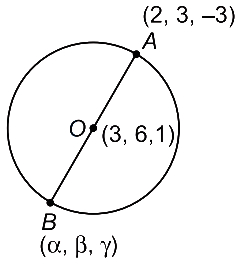
0 likesView Solution
Vedclass Products
For Students
Vedclass Test Series
Mock tests in real TS EAMCET style covering Chemistry with performance analysis. 5-day free trial.
Start Free TrialFor Teachers
Exam Paper Generator
Generate Set A/B/C/D Chemistry papers from 7.5L+ questions in 2 minutes. 3 chapters free.
Try FreeFor Institutes
Online Exam Module
Run live TS EAMCET mock exams with unlimited students, 360° analytics & white-label branding.
See DemoFrequently Asked Questions
How many Chemistry questions are in TS EAMCET 2010?
There are 185 Chemistry questions from the TS EAMCET 2010 paper on Vedclass, each with a detailed step-by-step solution in English.
Are TS EAMCET 2010 Chemistry solutions available in English?
Yes. All solutions on this page are in English. You can also switch to English or Hindi using the language buttons above the questions.
Can I practice TS EAMCET 2010 Chemistry as a timed test?
Yes. Use the Vedclass Test Series to attempt a full TS EAMCET mock test covering Chemistry with time limits and instant score analysis.
Can teachers create Chemistry papers from TS EAMCET previous year questions?
Yes. The Vedclass Exam Paper Generator lets teachers mix TS EAMCET Chemistry questions and generate Set A/B/C/D papers in minutes.
For Teachers & Institutes
Build a Custom Chemistry Paper
Pick TS EAMCET 2010 Chemistry questions, set difficulty, and generate Set A/B/C/D in 2 minutes.